Insights from recent episode analysis
Audience Interest
Podcast Focus
Publishing Consistency
Platform Reach
Insights are generated by CastFox AI using publicly available data, episode content, and proprietary models.
Most discussed topics
Brands & references
Total monthly reach
Estimated from 2 chart positions in 2 markets.
By chart position
- đŻđ”JP · History#1071K to 10K
- đ”đPH · History#813K to 10K
- Per-Episode Audience
Est. listeners per new episode within ~30 days
2K to 10Kđ ~2x weekly·105 episodes·Last published 1w ago - Monthly Reach
Unique listeners across all episodes (30 days)
4K to 20KđŻđ”50%đ”đ50% - Active Followers
Loyal subscribers who consistently listen
1.6K to 8K
Market Insights
Platform Distribution
Reach across major podcast platforms, updated hourly
Total Followers
â
Total Plays
â
Total Reviews
â
* Data sourced directly from platform APIs and aggregated hourly across all major podcast directories.
On the show
From 13 epsHost
Recent guests
Recent episodes
S8E6: After the Black Ships Departed
Jun 13, 2026
17m 59s
S8E5: Rajio TaisĆ; Or, How to Get Fit in a Time of War
May 29, 2026
15m 36s
INTERVIEW: Restoring historical markers with Project Panandito
May 23, 2026
50m 46s
S8E4: Edisonâs Cameras, Manilaâs Trenches
May 9, 2026
15m 52s
S8E3: Nobody Expects the Philippine Inquisition!
Apr 25, 2026
17m 33s
Social Links & Contact
Official channels & resources
Official Website
Login
RSS Feed
Login
| Date | Episode | Topics | Guests | Brands | Places | Keywords | Sponsor | Length | |
|---|---|---|---|---|---|---|---|---|---|
| 6/13/26 | ![]() S8E6: After the Black Ships Departed | The island of Balangingi stands halfway between Borneo and Mindanao. Surrounding Balangingi were sharp reefs and surging cross-currents that would be lethal to any boatman⊠except for the Balangingi Samal, of course. Surrounding the main landmass were little islets that would wink in and out with the tides. On the coast were thick snarls of mangrove; in the parched interior were swaying groves of coconut. During the Spanish occupation, the Balangingi Samalâalso known as the Banguingui Sama or the Sama Balangingiâvisited the Philippines twice a year, raiding coastal villages across the Philippines and capturing many of their inhabitants as slaves. And then the Spanish struck back. This is the story of the rise and fall of a fierce seafaring people.Support us on Patreon: patreon.com/thecolonialdeptFollow us on IG: @thecolonialdeptFollow us on TikTok: @thecolonialdeptEmail us: thecolonialdept@gmail.comReferences: Cojuangco, Tingting (1993). Kris of Valor: The Samal Balangingiâs Defiance and Diaspora. Manisan Research and Pub. Inc.Warren, James Francis (2020). âIn Search of Julano Taupan: His Life and His Times.â Journal of Indian Ocean World Studies, 4, pp. 2-31.Warren, James Francis (2021). The Sulu Zone, 1768-1898: The Dynamics of External Trade, Slavery, and Ethnicity in the Transformation of a Southeast Asian Maritime State (40th Anniversary Ed.). Ateneo de Manila Press.Mastura, Datu Michael Ong (2023). The Rulers of Magindanao in Modern History, 1515â1903: Continuity and Change in a Traditional Realm in the Southern Philippines. Ateneo de Manila University Press.Nimmo, H. Arlo (1968). âReflections on Bajau History.â Philippine Studies: Historical and Ethnographic Viewpoints, 16(1), pp. 32-58.Roxas-Lim, Aurora (2017). âMarine-Oriented Sama-Bajao People and Their Searchfor Human Rights.â Public Policy, 18, pp. 50-66.Cojuangco, Margarita delos Reyes (2003). âThe Samal People in the Mindanao Sea, Pre-History to 1900s: A Historical Study in Ethnic Origination, Dispersion, and Migrationâ [doctoral dissertation]. Faculty of the Graduate School, University of Santo Tomas.Moreno, Frede (2023). âStateless sea gypsies in Bangsamoro coastlines: Understanding the Sama Bajau ethnic tribe in the Philippines.â MPRA Paper No. 117900, pp. 1-17.Silvestre, Jojo G. (24 June 2023). âTingting Cojuangco â Christian Espirituâs ultimate muse.â Daily Tribune. https://tribune.net.ph/2023/06/23/tingting-cojuangco-christian-espiritus-ultimate-muse | 17m 59s | ||||||
| 5/29/26 | ![]() S8E5: Rajio TaisĆ; Or, How to Get Fit in a Time of Warâš | Wartime fitnessJapanese occupation+3 | â | Rajio TaisĆThere Were Children on the Battleground: Japanese and Filipino Youth in the Second World War+2 | PhilippinesJapan | Rajio TaisĆJapanese occupation+5 | â | 15m 36s | |
| 5/23/26 | ![]() INTERVIEW: Restoring historical markers with Project Pananditoâš | historical markersconservation+4 | â | University of the Philippines DilimanProject Panandito | â | historical markersProject Panandito+5 | â | 50m 46s | |
| 5/9/26 | ![]() S8E4: Edisonâs Cameras, Manilaâs Trenchesâš | EdisonPhilippine-American War+3 | â | Ateneo de Manila University PressGeoJournal+4 | â | EdisonPhilippine-American War+3 | â | 15m 52s | |
| 4/25/26 | ![]() S8E3: Nobody Expects the Philippine Inquisition!âš | Philippine Inquisitionreligious investigations+4 | â | National Historical Commission of the PhilippinesThe Philippine Inquisition: A Survey+1 | â | Philippine Inquisitionblasphemy+5 | â | 17m 33s | |
| 4/10/26 | ![]() S8E2: Riding a Tram in 1911 Manilaâš | colonial Manilatrams+3 | â | Ateneo de Manila University PressAsian Studies+2 | â | Manilatrams+4 | â | 17m 45s | |
| 4/4/26 | ![]() INTERVIEW: Exploring the food history of the Philippinesâš | food historyPhilippines+3 | Felice Prudente Sta. MariaKarina Bolasco+2 | Ateneo de Manila University Press | â | Filipino foodfood history+3 | â | 37m 57s | |
| 3/21/26 | ![]() S8E1: The Philippine Sour-chipelagoâš | Philippine cuisinesour flavors+3 | â | What Recipes Don't Tell: Philippine Food History in Fifty WordsCulture Ingested: Notes on the Indigenization of Philippine Food+1 | â | sournessPhilippine food+5 | â | 17m 23s | |
| 2/27/26 | ![]() An important announcement about the future of The Colonial Dept.âš | podcast announcementfuture of the podcast+2 | â | â | â | podcastannouncement+3 | â | 6m 27s | |
| 2/7/26 | ![]() INTERVIEW: Twin timelines, entangled historiesâš | cultural redemptionhistorical narratives+3 | Tom Sykes | Back to the Future | Manilabarangay | redemptionjustice+5 | â | 37m 32s | |
Want analysis for the episodes below?Free for Pro Submit a request, we'll have your selected episodes analyzed within an hour. Free, at no cost to you, for Pro users. | |||||||||
| 1/28/26 | ![]() INTERVIEW: Sungka as a wargame?âš | folk gameswarfare+3 | Micah Perez | UP Diliman Department of History | â | Sungkawargame+5 | â | 45m 49s | |
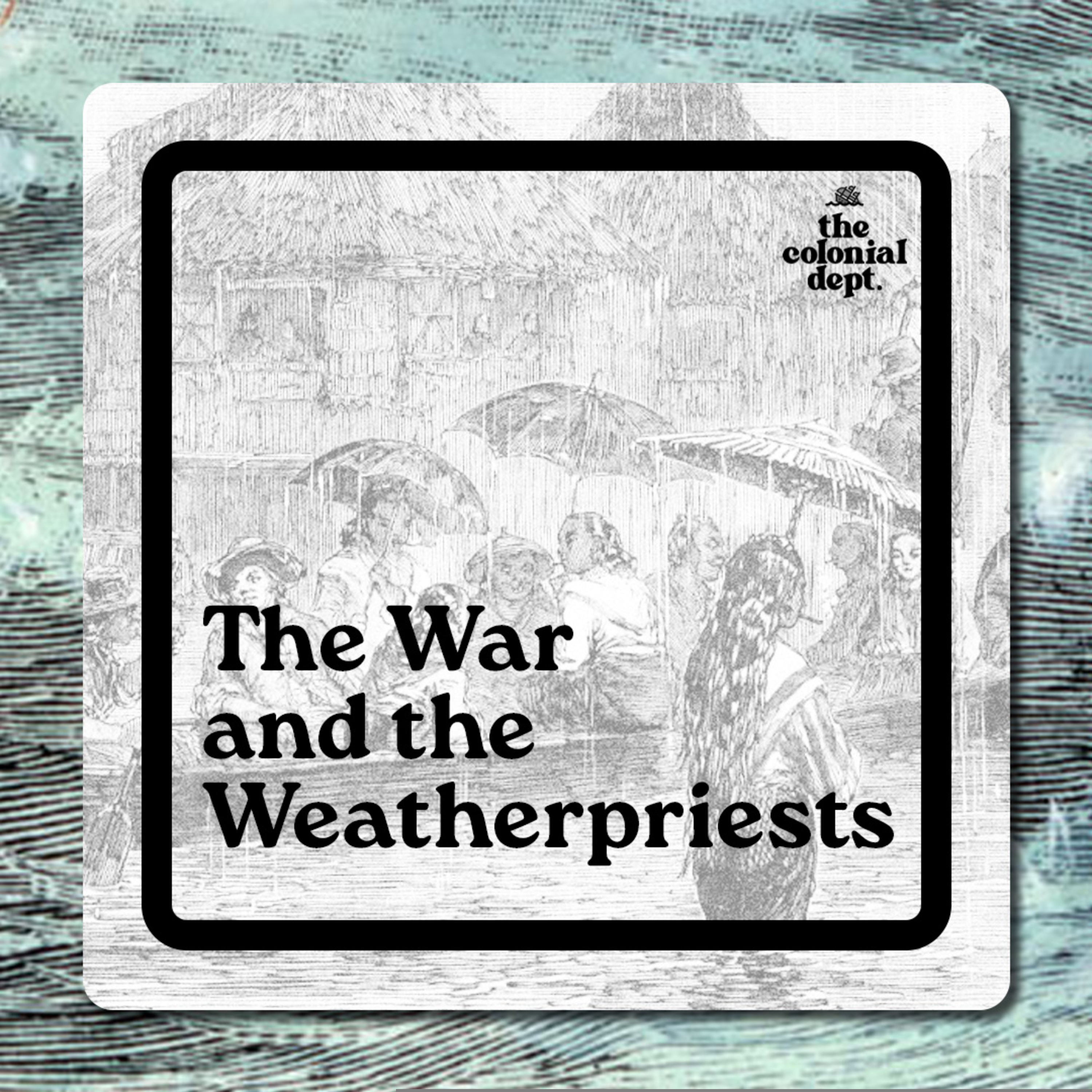
| 12/20/25 | ![]() S7E13: The War and the Weatherpriestsâš | Manila Observatorytyphoons+3 | â | Manila ObservatoryTyphoons: Climate, Society, and History in the Philippines+4 | â | Manila Observatorytyphoons+3 | â | 17m 09s | |
| 11/29/25 | ![]() S7E12: Turbulent Times at Manila Bayâš | historyManila+4 | â | University of the Philippines PressAtaque de Li-ma-hong a Manila en 1574 | ManilaBrunei | Manilahistory+5 | â | 16m 18s | |
| 11/15/25 | ![]() S7E11: Paint Me By Your Nameâš | 19th century artPhilippine society+4 | â | Ayala CorporationFrontier Constitutions: Christianity and Colonial Empire in the Nineteenth-Century Philippines+5 | â | Philippine artletras y figuras+4 | â | 17m 22s | |
| 11/1/25 | ![]() S7E10: Abaca World War | It was the Great War, the War to End All the Wars⊠and Philippine abaca merchants were raking in sky-high profits. The worldâs most powerful navies relied on this plantâwhich is native to the Philippinesâto keep their warships in battle-ready shape. But what the First World War giveth, the First World War also taketh away.Follow us on IG: @thecolonialdeptFollow us on TikTok: @thecolonialdeptEmail us: thecolonialdept@gmail.comReferences:Dacudao, Patricia Irene (2023). Abaca Frontier: The Socioeconomic and Cultural Transformation of Davao, 1898-1941. Ateneo de Manila University Press.Crapo, G.R. (February 1926). âThe Philippine Fiber Industry.â Proceedings, 52(2). https://www.usni.org/magazines/proceedings/1926/february/philippine-fiber-industryLayton, J. Kent (undated). âLusitania 100 years later: never forget.â National Museums Liverpool. https://www.liverpoolmuseums.org.uk/stories/lusitania-100-years-later-never-forgetJose, Ricardo Trota (1988). âThe Philippine National Guard in World War I.â Philippine Studies, 36(3), pp. 275-299. https://www.jstor.org/stable/42633097Nagano, Yoshiko (2012). âThe Philippine National Bank and Credit Inflation after World War I.â Global COE Hi-Stat Discussion Paper Series gd11-216, Institute of Economic Research, Hitotsubashi University.Ybiernas, Vicente Angel (2012) "Philippine Financial Standing in 1921: The First World War Boom and Bust." Philippine Studies, 55(3), pp. 345-372. | 17m 48s | ||||||
| 10/11/25 | ![]() S7E9: Running of the Bulls, Part Two | In the second part of our look at the lost sport of Philippine bullfighting, we go deep into its heyday in the 1800s, with social clubs, provincial arenas, and matadors with nicknames like âFatiguitas.âThen, we look at how and why bullfighting faded away in our archipelago.Follow us on IG: @thecolonialdeptFollow us on TikTok: @thecolonialdeptEmail us: thecolonialdept@gmail.comReferences:Vibal, Gaspar (2022). Bullfighting in the Philippines, 1602-2022. Vibal Books. Cornwell, Zach (Host). (13 December 2021). âGore: The Brutal History of Bullfightingâ [Audio podcast episode]. In Conflicted, Evergreen Podcast.Amano, N., Bankoff, G., Findley, D. M., Barretto-Tesoro, G., & Roberts, P. (2020). âArchaeological and historical insights into the ecological impacts of pre-colonial and colonial introductions into the Philippine Archipelago.â The Holocene, 31(2), pp. 313-330. https://doi.org/10.1177/0959683620941152Mudar, Karen (1997). âPatterns of Animal Utilization in the Holocene of the Philippines: A Comparison of Faunal Samples from Four Archaeological Sites.â Asian Perspectives, 36(1), pp. 67-105.Davis, Janet M. (2013) âCockfight Nationalism: Blood Sport and the Moral Politics of American Empire and Nation Building.â American Quarterly, 65(3), pp. 549-574. | 14m 40s | ||||||
| 10/3/25 | ![]() S7E8: Running of the Bulls, Part One | In fiestas in a bygone age, the corrida de torosâthe coursing of the bullsâwould always be part of the festivities and celebrations in town plazas across the Philippines. Why did this tradition disappear from our shores?In this two-part episode, we examine the history of bullfighting in the Philippines. In Part One, join Antonio Luna as he watches his first bullfight⊠and then travel back in time to the very start of the Spanish occupation, when the fiesta de toros became a fixture in our holidays!Follow us on IG: @thecolonialdeptFollow us on TikTok: @thecolonialdeptEmail us: thecolonialdept@gmail.comReferences:Vibal, Gaspar (2022). Bullfighting in the Philippines, 1602-2022. Vibal Books. Hemingway, Ernest (1927). Fiesta; or, The Sun Also Rises. Jonathan Cape Ltd.Hartwell, Rafael Ernest (2019). âBad English and Fresh Spaniards: Translation and Authority in Philippine and Cuban Travel Writing.â Unitas, 92(1), pp. 43-74.Cornwell, Zach (Host). (13 December 2021). âGore: The Brutal History of Bullfightingâ [Audio podcast episode]. In Conflicted, Evergreen Podcast. | 15m 57s | ||||||
| 9/20/25 | ![]() S7E7: Extramuros | For centuries, Spain ruled the Philippines from within the closed, claustrophobic walls of Intramurosâthe walled city of Manila. But right outside these walls, Manila, too, grew and developed, following the contours of migration, enterprise, and yes, even conflict. Letâs track the evolution of the districts and arrabales outside the walls, or extramuros.Follow us on IG: @thecolonialdeptFollow us on TikTok: @thecolonialdeptEmail us: thecolonialdept@gmail.comReferences:Camagay, Ma. Luisa (1993-1996). âUrban Development of Manila During the 19th Century.â In Victoriano, Enrique L. (ed.), Historic Manila: Commemorative Lectures, Manila Historical Commission.Wise, Edwin (2019). Manila, City of Islands. Ateneo de Manila University Press.Eng Sin Kueh, Joshua (2014). The Manila Chinese: Community, Trade, and Empire, c. 1570-1770 [doctoral dissertation]. Georgetown University.Fish, Shirley (2003). When Britain Ruled the Philippines, 1762-1764: The Story of the 18th Century British Invasion of the Philippines During the Seven Years War. FirstBooks Library.Banyard, Laurence (16 May 2025). âManila Port City â A Story of Mutual Interdependence and Competing Self-interest.â PortCityFutures. https://www.portcityfutures.nl/news/manila-port-city-a-story-of-mutual-interdependence-and-competing-self-interestCubeiro, Didac (2017). âModernizing the Colony: Ports in Colonial Philippines, 1880-1908.â World History Connected. https://worldhistoryconnected.press.uillinois.edu/14.3/forum_cubeiro.htmlEnano, Jhesset O. (25 June 2019). âMetro Manilaâs green spaces continue to shrink.â Philippine Daily Inquirer. https://newsinfo.inquirer.net/1133654/metro-manilas-green-spaces-continue-to-shrinkDe Villa, Kathleen (1 May 2025). â21 Manila Bay reclamation projects equal area of 2 cities.â Philippine Daily Inquirer. https://newsinfo.inquirer.net/2057082/21-manila-bay-reclamation-projects-equal-area-of-2-cities | 16m 43s | ||||||
| 8/29/25 | ![]() S7E6: ShisĆsenâA Japanese Propagandist Confronts the Filipino Psyche | Beyond the bullets, the tanks, the planes, the bombs, the Japanese also brought other weapons to bear against the Filipinos: Typewriters. Radio waves. Movie theaters.Here is one story from the frontlines of shisĆsen, or "the thought war."Follow us on IG: @thecolonialdeptFollow us on TikTok: @thecolonialdeptEmail us: thecolonialdept@gmail.comReferences:Campoamor II, Gonzalo (2017). âRe-Examining Japanese Wartime Intellectuals: Kiyoshi Miki during the Japanese Occupation of the Philippines.â Asian Studies: Journal of Critical Perspectives on Asia, 53(1), pp. 1-38.Terami-Wada, Motoe (1990). âThe Japanese Propaganda Corps in the Philippines.â Philippine Studies, 38(3), pp. 279-300.Lagmay, Alfred (1977). âBahala Na!â In Pe-Pua, Rogelio (ed., 2018), Handbuk ng Sikolohiyang Pilipino, Bolyum I: Perspektibo at Metodolohiya, University of the Philippines Press.Jose, Ricardo T. (1998). The Japanese Occupation. In Kasaysayan: The Story of the Filipino People. Asia Publishing Company Limited.Griggs, Alyson (2020). There Were Children on the Battleground: Japanese and Filipino Youth in the Second World War [masteral dissertation]. Utah State University. | 16m 28s | ||||||
| 8/16/25 | ![]() S7E5: Inside Tomâs Dixie Kitchen, Prewar Manilaâs Hottest Restaurant | Governors and gangsters, spies and socialitesâit seemed that all of Manila dined out at the two-floor restaurant that rose above the bustle of Plaza Goiti. Inside, waiters handed you menus with more than three hundred dishes on offer, and, for special guests, directed you to special themed dining rooms upstairs. But there was enough entertainment on the first floor. There was a jazz band playing live music. There was a boxing promoter hamming it up at the next table. There was a steady stream of VIPs coming in through the front door.This is the story of Tomâs Dixie Kitchen.Follow us on IG: @thecolonialdeptFollow us on TikTok: @thecolonialdeptEmail us: thecolonialdept@gmail.comReferences:Manila Electric Co. (1932). âCity of Manila and Suburbs [map].âMount, Guy Emerson (2018). âSoul Food, Stir Fry, and Citizenship.â In Mount, The Last Reconstruction: Slavery, Emancipation, and Empire in the Black Pacific [doctoral dissertation], The University of Chicago.Mount, Guy Emerson (2018). âAn Open Door: The Geopolitical Possibilities and Pitfalls of Black Colonization to the Pacific.â In Mount, The Last Reconstruction: Slavery, Emancipation, and Empire in the Black Pacific [doctoral dissertation], The University of Chicago.Ngozi-Brown, Scot (1997). âAfrican-American Soldiers and Filipinos: Racial Imperialism, Jim Crow and Social Relations.â The Journal of Negro History, 82(1), pp. 42-53.Lee, Ira (17 March 2020). âHow Racism Pushed This U.S. Soldier to Join Filipino Guerrillas.â Esquire Philippines. Department of Agricultural and Commerce (1934). Philippine Statistical Review. Bureau of Printing.Pritchard vs. Republic, Case Digest (G.R. No. L-1715) (1948). | 15m 43s | ||||||
| 8/2/25 | ![]() S7E4: The Plague Years | Smallpox was one of the deadliest diseases known to manâand not even the Philippines was immune to its virulent dangers! But how did the dreaded disease arrive on our shores? And what devastating effects did it have during the long centuries of our occupation?Follow us on IG: @thecolonialdeptFollow us on TikTok: @thecolonialdeptEmail us: thecolonialdept@gmail.comThe thumbnail image, which dates from the 16th century, depicts Aztec victims of smallpox.References:Newson, Linda A. (2011). Conquest and Pestilence in the Early Spanish Philippines. Ateneo de Manila University Press.Fenner, F.; Henderson, D.A.; Arita, I.; Jezek, Z.; Ladnyi, I.D. (1988). Smallpox and Its Eradication. World Health Organization.âTermination of Smallpox Vaccination.â DOH Memorandum Circular, May 08, 1980.Herzog, Richard (23 September 2020). âHow Aztecs Reacted to Colonial Epidemics.â JSTOR Daily. https://daily.jstor.org/how-aztecs-reacted-to-colonial-epidemics/Mursell, Ian. (7 April 2020) âIN THE NEWS: epidemic, self-isolation, dedication and the preservation of memory.â Mexicolore. https://www.mexicolore.co.uk/aztecs/spanish-invasion/epidemic-self-isolation-dedication-and-the-preservation-of-memoryThein, M.M.; Goh, L.G., Phua, K.H. (1988). âThe Smallpox Story: From Variolation to Victory.â Asia Pacific Journal of Public Health, 2(3), pp. 203-210.Wise, Edwin (2019). Manila, City of Islands. Ateneo de Manila University Press. | 15m 05s | ||||||
| 7/18/25 | ![]() S7E3: A Short Philippine History of Beverages | Coffee. Tea. Cocoa. The three have a surprisingly rich, complex, and layered history in the Philippines. How did they arrive here, and what effect did they have in the archipelagoâs colonial period?Follow us on IG: @thecolonialdeptFollow us on TikTok: @thecolonialdeptEmail us: thecolonialdept@gmail.comThanks to Beach Reads Book Club (based in The Beach House cafe in Kapitolyo) for hosting the live premiere of this episode last July 5. References:Acabado, Stephen (4 May 2025). â[Time Trowel] A drunk history of the Philippines.â Rappler. https://www.rappler.com/voices/thought-leaders/time-trowel-drunk-history-philippines/Edgar, Blake (2010). âThe Power of Chocolate.â Archaeology, 63(6), pp. 20-25. https://www.jstor.org/stable/41780626Doeppers, Daniel (2016). Feeding Manila in Peace and War, 1850-1945. Ateneo de Manila University Press.Topik, Steven (2003). The World Coffee Market in the Eighteenth and Nineteenth Centuries, from Colonial to National Regimes. GEHN Conference, Bankside, London.Sonnad, Nikhil (11 January 2018). âTea if by sea, cha if by land: Why the world only has two words for tea.â Vox.Chia, Lucille (2006). âThe Butcher, the Baker, and the Carpenter: Chinese Sojourners in the Spanish Philippines and Their Impact on Southern Fujian (Sixteenth-Eighteenth Centuries).â Journal of the Economic and Social History of the Orient, 49(4), pp. 509-534.Lanzona, Claudine (2019). âThe Search Party.â Grid. âCocoa (cacao).â (n.d.) Plant Village. https://plantvillage.psu.edu/topics/cocoa-cacao/infosCrawford, John (1852). âHistory of Coffee.â Journal of the Statistical Society of London, 15(1), pp. 50-58. | 16m 15s | ||||||
| 7/4/25 | ![]() S7E2: An Ottoman Emissary in Mindanao | As the United States moves to take over Mindanao, both the Americans and the Moros invoke the name of the Ottoman Empireâseat of the Caliphâto support their campaigns. But in 1914, an actual Ottoman emissary arrives in Zamboanga. How will the American occupiers react to his visit?Follow us on IG: @thecolonialdeptFollow us on TikTok: @thecolonialdeptEmail us: thecolonialdept@gmail.comReferences:Dwight, H.D. (1915). Constantinople: Old and New. Charles Scribnerâs Sons.Inanc, Yusuf Selman. âAbdulhamid II: An autocrat, reformer and the last stand of the Ottoman Empire.â Middle East Eye. https://www.middleeasteye.net/discover/abdulhamid-ii-last-stand-ottoman-empireGöksoy, Ismail Hakki (2024). âThe Ottomansâ Shaykh Al-Islam of Philippines, Mehmet Vecih Efendi: His Life, Duties and Activities.â In Göksoy, Kadi (eds.), Studies on the Relations Between the Ottoman Empire and Southeast Asia, YTB Publications.Charbonneau, Oliver (2021). Civilizational Imperatives: Americans, Moros, and the Colonial World. Ateneo de Manila University Press.Amirell, Stefan Eklöf (25 August 2022). ââAn Extremely Mild Form of Slavery ⊠of the Worst Sortâ: American Perceptions of Slavery in the Sulu Sultanate, 1899â1904,â Slavery & Abolition, 43(3), pp. 517-532.Vatin, Nicolas (19 December 2017). âThe Death of Ottoman Sultans.â Politika. https://www.politika.io/en/notice/the-death-of-ottoman-sultans | 16m 58s | ||||||
| 6/20/25 | ![]() S7E1: Foreign Piano Devils | Itâs the late 1800s, and all across the Pacific seaboard, in places like Singapore and Yokohama, Medan and Selangor, the music of town bands drifts across the esplanades. Many of these groups proudly hail from one port of call: Manila. This is their story.Follow us on IG: @thecolonialdeptFollow us on TikTok: @thecolonialdeptEmail us: thecolonialdept@gmail.comAudio of âWiener Schwalben Marschâ is from the Discography of American Historical Recordings.References: Affan, Muhammad (2023). âFrom Riverside Hub to Urban Center: Understanding The Metamorphosis of The Sultanate of Deli's Capital Landscape.â Al-Tsaqafa: Jurnal Ilmiah Peradaban Islam, 20(2), pp. 194-203.âThe history of Medanâ (26 December 2020). Stories from DeliâChinese coolies life in Deli. https://storiesfromdeli.com/2020/12/26/the-history-of-medan/Columbia matrix 87055. Wiener Schwalben Marsch / Kapelle MilitĂ€r. (2025). In Discography of American Historical Recordings. Retrieved May 15, 2025, from https://adp.library.ucsb.edu/index.php/matrix/detail/2000112570/87055-Wiener_Schwalben_Marsch.Birgit Krohn Albums, Vol. 2 (n.d.) âPorpourri Populaire, George Renaud (1835-1913).â Furman University Scholar Exchange. https://scholarexchange.furman.edu/krohn-album2/8/Yamomo, Mele (2015). âBrokering Sonic Modernities: migrant Manila musicians in the Asia Pacific, 1881-1948.â Popular Entertainment Studies, 6(2), pp. 22-37.Castro, Christi-anne (2018). âColonized by Rote: Music Education at the Outset of the US Colonial Era in the Philippines.â In Tan, Arwin Q. (ed.), Saysay Himig: A Sourcebook on Philippine Music History, University of the Philippines Press, pp. 39-44.Chua, Maria Alexandra Iñigo. (2018). âThe Appropriated Villancico Filipino in the Rituals of Philippine Christmas.â In Tan, Arwin Q. (ed.), Saysay Himig: A Sourcebook on Philippine Music History, University of the Philippines Press, pp. 91-99.Chua, Maria Alexandra Iñigo. (2018). âMusic Printing and Publishing in Urban Colonial Manila, 1858-1942.â In Tan, Arwin Q. (ed.), Saysay Himig: A Sourcebook on Philippine Music History, University of the Philippines Press, pp. 215-223.Buenconsejo, Jose S. (2018). âKeyboards in the Nineteenth-Century Philippines.â In Tan, Arwin Q. (ed.), Saysay Himig: A Sourcebook on Philippine Music History, University of the Philippines Press, pp. 234-242.Tan, Arwin Q. (2018). âSocial Networking in Musiciansâ Unions and Musical Associations.â In Tan, Arwin Q. (ed.), Saysay Himig: A Sourcebook on Philippine Music History, University of the Philippines Press, pp. 365-371.Jando, Dominique (n.d.) âGiuseppe Chiarini: Equestrian, Circus Entrepreneur.â Circopedia. https://www.circopedia.org/Giuseppe_ChiariniâThe Overseas Market for Filipino Entertainers (March 2004).â TESDA. https://www.tesda.gov.ph/About/TESDA/60Ng, Stephanie Sook-Lynn (n.d.) âOverseas Filipino Musicians and the Geographies of Migrant Creative Labor.â Dissertation Reviews. Yu Jose, Lydia N. (2007). âWhy are Most Filipino Workers in Japan Entertainers?: Perspectives from History and Law.â Kasarinlan: Philippine Journal of Third World Studies, 22(1), pp. 61-84.Piquero-Ballescas, Ma. Rosario (1993). âThe Various Contexts of Filipino Labor Migration to Japan.â Kasarinlan: Philippine Journal of Third World Studies, 8(4), pp.125-145. | 15m 41s | ||||||
| 3/21/25 | ![]() S6E13: If Not Shipwrecks, Scurvy | The route of a Spanish galleon from Manila to Acapulco was littered with the wrecks of ships that sailed beforeâhit by storms, hammered by tides, preyed on by pirates. Meanwhile, on the filthy decks, hunger and disease stalked the ranks of the sailors, slaves, and passengers. Spanning thousands of kilometers, every voyage of the Galleon Trade was grueling and lethal⊠but for the investors who bet fortunes on the trade ships, the payoff was worth every dead body. In this episode, letâs sail aboard a galleon as it makes its way from Manila to Mexico. Will we make it to the end alive?Follow us on IG: @thecolonialdeptFollow us on TikTok: @thecolonialdeptEmail us: thecolonialdept@gmail.comReferences:CasabĂĄn, JosĂ© Luis (2014). âThe Reconstruction of a Seventeenth-Century Spanish Galleon.â 2014 Underwater Archaeology Proceedings.Legarda, Benito J. (1999). After the Galleons: Foreign Trade, Economic Change and Entrepreneurship in the Nineteenth-Century Philippines. Ateneo de Manila Press.Seijas, Tatiana (2014). Asian Slaves in Colonial Mexico: From Chinos to Indians. Cambridge University Press.Isorena, Efren B. (2015). âMaritime Disasters in Spanish Philippines: The Manila-Acapulco Galleons, 1565-1815.â International Journal of Asia Pacific Studies, 11(1), pp. 53-83.Schurz, William Lyle (July 1918). âAcapulco and the Manila Galleon.â The Southwestern Historical Quarterly, 22(1), pp. 18-37.Hayes, Lieutenant John D. (December 1934). âThe Manila Galleons.â Proceedings of the US Naval Institute, 60(12).Worrall, Simon (15 January 2017). âA Nightmare Disease Haunted Ships During Age of Discovery.â National Geographic. https://www.nationalgeographic.com/science/article/scurvy-disease-discovery-jonathan-lambMorris, David Z. (17 May 2016). âCruel ships of prosperity.â Aeon. https://aeon.co/essays/the-manila-galleons-that-oceaneered-for-plague-and-profit | 15m 24s | ||||||
Showing 25 of 110
Pitch Fit is a Pro feature
See how bookable this show is for guests, which brands already advertise, the per-episode ad value, and the best-fit guest and sponsor profile. The numbers are blurred on the free plan.
How readily this show books outside guests like you.
How proven this show is for host-read sponsorships.
For Guests
ProFor Advertisers
ProUpgrade to Pro to unlock guest cadence, sponsor categories, fit scores, and per-episode ad value for this show.
Chart Positions
2 placements across 2 markets.
Chart Positions
2 placements across 2 markets.