The Deeper Thinking Podcast
by The Deeper Thinking Podcast
Is this your podcast?Insights from recent episode analysis
Audience Interest
Podcast Focus
Publishing Consistency
Platform Reach
Insights are generated by CastFox AI using publicly available data, episode content, and proprietary models.
Most discussed topics
Brands & references
No brand mentions extracted.
Total monthly reach
Estimated from 13 chart positions in 13 markets.
By chart position
- 🇺🇸US · Philosophy#7230K to 100K
- 🇨🇦CA · Philosophy#1225K to 30K
- 🇦🇺AU · Philosophy#1335K to 30K
- 🇧🇷BR · Philosophy#1141K to 10K
- 🇮🇪IE · Philosophy#4010K to 30K
- Per-Episode Audience
Est. listeners per new episode within ~30 days
34K to 129K🎙 ~2x weekly·223 episodes·Last published 1mo ago - Monthly Reach
Unique listeners across all episodes (30 days)
67K to 258K🇺🇸39%🇨🇦12%🇦🇺12%+10 more - Active Followers
Loyal subscribers who consistently listen
20K to 77K
Market Insights
Platform Distribution
Reach across major podcast platforms, updated hourly
Total Followers
—
Total Plays
—
Total Reviews
—
* Data sourced directly from platform APIs and aggregated hourly across all major podcast directories.
On the show
From 11 epsHost
Recent guests
No guests detected in recent episodes.
Recent episodes
The System Cannot See Itself
Jul 25, 2026
17m 20s
Artificial intelligence: The Permission Machine
Jul 25, 2026
28m 31s
The Second Existence - The Deeper Thinking Podcast
Jul 2, 2026
26m 12s
Artificial General Intelligence: The Second Existence
Jul 2, 2026
26m 12s
A Life Standing Beside Itself (Part 2) - The Deeper Thinking Podcast
May 23, 2026
40m 19s
Social Links & Contact
Official channels & resources
Official Website
Login
RSS Feed
Login
| Date | Episode | Topics | Guests | Brands | Places | Keywords | Sponsor | Length | |
|---|---|---|---|---|---|---|---|---|---|
| 7/25/26 |  The System Cannot See Itself | Systems thinking becomes politically consequential when a model stops merely describing behaviour and begins reorganising the conditions under which behaviour occurs. This episode of The Deeper Thinking Podcast uses AI-generated narration. A hospital scheduling system can improve attendance while giving people classified as unreliable fewer choices and shorter confirmation windows. Their failures return as evidence that the classification was correct. The same structure appears when credit scores alter costs, school rankings redirect families, crime maps redirect police and recommendation systems reshape attention before recording it as preference. Drawing on cybernetics, feedback loops, reflexivity, complex systems and Goodhart’s law, the episode follows the point at which prediction becomes intervention. A model may appear accurate because it has helped produce the conditions that make its prediction true. The map acquires hands. With artificial intelligence and automated decision-making, opacity can harden institutional authority. Transparency matters, but it cannot make an unjust category fair. Contestability matters more: whether those affected can challenge the system’s account of reality and alter its consequences. A mature institution must preserve appeal, discretion and correction from below. For those drawn to systems thinking, institutional power, artificial intelligence and the question of how reality can correct the models imposed upon it. Reflections This episode examines the tension between the power to model human systems and the humility required to govern without claiming possession of the whole. Models that allocate opportunity participate in the reality they claim to measure. Predictions can become interventions, then return as evidence that the original prediction was correct. No model discovers its own purpose. Someone decides what counts as success, risk, cost and acceptable harm. Precision cannot rescue a system calibrated to the wrong value. When budgets, promotions and reputations attach to a metric, the metric begins reorganising the work. Explanation reveals how a decision was made; contestability allows the affected person to challenge what the decision assumes. Friction, discretion, redundancy and appeal can function as routes through which reality re-enters an institution. Responsibility does not vanish into a system. It is distributed across design, deployment, governance and revision. Why Listen? Understand how classifications and predictions can reshape the behaviour they appear merely to record. Trace how feedback, reflexivity and Goodhart’s law expose the politics hidden inside apparently neutral measures. Examine why transparency without contestability cannot adequately protect people from automated decisions. Reconsider discretion, appeal and institutional friction as sources of knowledge rather than failures of efficiency. Listen On: YouTube Spotify Apple Podcasts Support This Work If this episode stayed with you and you would like to support the ongoing work, you can do so here: Buy Me a Coffee. Further Reading Wiener, Norbert. Cybernetics: Or Control and Communication in the Animal and the Machine. Cambridge, MA: The Technology Press; New York: John Wiley & Sons; Paris: Hermann et Cie, 1948. Meadows, Donella H. Thinking in Systems: A Primer. Edited by Diana Wright. White River Junction, VT: Chelsea Green Publishing, 2008. Scott, James C. Seeing Like a State: How Certain Schemes to Improve the Human Condition Have Failed. New Haven: Yale University Press, 1998. O’Neil, Cathy. Weapons of Math Destruction: How Big Data Increases Inequality and Threatens Democracy. New York: Crown, 2016. Eubanks, Virginia. Automating Inequality: How High-Tech Tools Profile, Police, and Punish the Poor. New York: St. Martin’s Press, 2018. Further Reading Relevance Norbert Wiener: Establishes cybernetics through communication, control and feedback across machines, organisms and social | 17m 20s | ||||||
| 7/25/26 |  Artificial intelligence: The Permission Machine | Artificial intelligence can make institutional power harder to locate by converting human choices into technical outputs that appear to have no author. A loan is declined, a payment suspended, a worker ranked or a patient classified, while the people who designed the categories, evidence, thresholds and consequences recede from view. This episode of The Deeper Thinking Podcast uses AI-generated narration. This episode examines AI as an institutional arrangement, asking when a tool that extends human agency becomes a process that assigns people to the shrinking gaps left by automation. Cory Doctorow’s reverse centaur clarifies this inversion, while Frederick Winslow Taylor’s scientific management reveals its older ambition: to move practical knowledge away from workers and into systems of control. James C. Scott’s account of administrative legibility and Hannah Arendt’s understanding of judgment show what is lost when complicated lives must become readable from a distance. A human being may remain inside the process, yet their authority can become ceremonial when automation bias makes the system’s recommendation more credible than the person closest to its failure. The episode names the resulting condition automation debt: people, skill, memory and redundancy are removed before the system has proved it can carry what was transferred to it. Immediate savings remain visible; the costs return later through exceptions, crises and change. The central question is therefore not whether AI is useful, but whether its usefulness is arranged to enlarge judgment, preserve contestability and keep institutions answerable. For those drawn to the politics of automation, the concealment of responsibility and the fragile conditions of human judgment. Reflections The episode’s central tension lies between automation that assists judgment and automation that makes judgment difficult to locate. The system’s apparent judgment contains human choices that have been made difficult to find. Automation can move uncertainty downward while allowing the institution to appear more certain. Human presence does not create human control when the system defines the only acceptable response. The machine seems autonomous because its dependencies have been hidden inside other people’s lives. The person closest to a system’s failure is often recoded as the failure. Removing discretion does not remove values. It relocates them. A fluent explanation is not the same as a traceable reason. An organisation can know more about a population while becoming less capable of seeing a person. Why Listen? Understand how AI can conceal institutional choices and diffuse responsibility. Recognise the hidden labour and uncertainty that automation can relocate rather than remove. Examine why human oversight can remain present while becoming largely symbolic. Consider how contestability, memory and skilled dissent can keep automated systems answerable. Listen On: YouTube Spotify Apple Podcasts Support This Work If this episode stayed with you and you would like to support the ongoing work, you can do so here: Buy Me a Coffee. Further Reading Doctorow, Cory. The Internet Con: How to Seize the Means of Computation. Verso, 2023. Scott, James C. Seeing Like a State: How Certain Schemes to Improve the Human Condition Have Failed. Yale University Press, 1998. Taylor, Frederick Winslow. The Principles of Scientific Management. Harper & Brothers, 1911. Arendt, Hannah. Lectures on Kant’s Political Philosophy. Edited by Ronald Beiner. University of Chicago Press, 1982. Royal Commission into the Robodebt Scheme. Report of the Royal Commission into the Robodebt Scheme. Commonwealth of Australia, 2023. Wallis, Nick. The Great Post Office Scandal. Bath Publishing, 2021. Further Reading Relevance Cory Doctorow: Examines how technical infrastructures distribute power and make users dependent on decisions made elsewhere. James C. Scott: Explains how administrative simplificati | 28m 31s | ||||||
| 7/2/26 | artificial intelligencephilosophy of mind+5 | — | — | — | Artificial General IntelligencePhilosophy of Mind+6 | — | 26m 12s | ||
| 7/2/26 |  Artificial General Intelligence: The Second Existence | The human brain is the first proof that general intelligence is possible. Artificial general intelligence may become the second, revealing whether intelligence can mature into wisdom. This episode of The Deeper Thinking Podcast uses AI-generated narration. This episode asks what intelligence becomes when it is understood not as answer production, but as reality contact: the capacity to update when the world pushes back, ask better questions, simulate consequences, integrate experience, create new frames, and govern power wisely. Moving from the philosophy of mind and scientific instruments to AlphaFold, AlphaGo's Move 37, cybernetics, memory consolidation, and the extended mind thesis, it examines how artificial intelligence may change not only what we know, but what we are able to ask. The central distinction is between capability and maturity. Artificial intelligence can already search, predict, and generate. The harder question is whether scalable intelligence can remain answerable to evidence, consequence, uncertainty, and human agency. For those drawn to artificial intelligence, philosophy of mind, scientific discovery, and the question of whether intelligence can become wisdom. Key Ideas The brain proves that general intelligence can exist, but does not explain how to build it. Intelligence is not answer production. It is sustained contact with reality. Scientific discovery advances when reality becomes more searchable, askable, and interrogable. Simulation matters because it can make consequences visible before they arrive. Creativity is not only making a surprising move inside a game. It is inventing the game. Tone is not decoration. In artificial intelligence, tone is governance. Thinkers and Concepts Alan Turing, Karl Popper, Thomas Kuhn, and Herbert A. Simon Norbert Wiener, cybernetics, Gregory Bateson, and systems thinking Andy Clark, David Chalmers, and the extended mind thesis Hannah Arendt, Martin Heidegger, and the politics of technological power AlphaFold, AlphaGo's Move 37, simulation, consolidation, frame creation, and AI alignment Reflections A telescope reveals new objects. A microscope reveals new scales. Artificial intelligence may be the first scientific instrument that argues back, entering the loop between uncertainty and hypothesis, evidence and interpretation, and the known and the testable. AlphaFold shows how parts of life can become navigable without becoming simple. Life is not a database. The breakthrough is not mastery. It is navigability, and beyond navigability, askability. Simulation matters because it lets reality push back earlier. The aim is not omniscience, but less blind action. Future intelligence may also need something like sleep: a way to select, compress, forget, replay, and reorganise experience. A system that cannot integrate the past cannot simulate the future well. The machine that sleeps is really the machine that updates. Move 37 clarifies the difference between novelty and creation. Optimisation can find an unexpected move within known rules. Creation changes the field of play. In Kuhn's terms, it is the difference between working inside a paradigm and creating a new frame in which future thought can occur. If artificial intelligence becomes conversational, personalised, and present in everyday judgement, tone becomes a form of governance. A system does not need consciousness to shape confidence, attention, agency, or contact with evidence. Personalisation is cognitive infrastructure. The deepest question is whether intelligence, once made scalable, can remain in honest contact with reality. Wisdom is intelligence under restraint. Why Listen? Reimagine artificial intelligence as a question about reality contact, not only productivity. Understand why artificial general intelligence differs philosophically from narrow task performance. Explore how scientific discovery changes when life becomes more searchable and askable. See why simulation matters most when | 26m 12s | ||||||
| 5/23/26 | emotional pressure of modern lifepermanent readiness+4 | — | — | — | anticipationburnout+4 | — | 40m 19s | ||
| 5/23/26 |  Permanent Readiness: A Life Standing Beside Itself(Part 2) | Contemporary exhaustion can begin before anything happens, as anticipation recruits the body into preparing for futures that may never arrive. A glowing phone, an unopened calendar or an unsent message can reorganise the nervous system before conscious thought has caught up. This episode of The Deeper Thinking Podcast uses AI-generated narration. Through phenomenology and the attention economy, the episode follows the small gestures by which possible futures enter the body: checking a school portal out of care, softening a message before conflict exists, revising a finished document or monitoring a roster because one missed update could narrow the week. Readiness appears not only as anxiety, but as love, professionalism, survival and hope. Resonances with Michel Foucault's account of discipline, Byung-Chul Han's achievement subject, Hartmut Rosa's theory of social acceleration and Mark Fisher's analysis of systems experienced as inescapable reveal how power can operate through anticipation and self-monitoring before any explicit command. The argument remains attentive to inequality: the future may appear as opportunity for some and as survival for others. The episode does not reject preparation. Planning can protect people and anticipation can prevent harm. The threshold is crossed when readiness stops serving life and becomes the medium through which life is lived, turning rest into recovery strategy, friendship into network maintenance and every finished task into another rehearsal of consequences. For those drawn to the bodily pressure of anticipation, the unequal politics of readiness and the strange ways the future can occupy the present. Reflections This episode traces the point at which preparation ceases to protect the present and begins to displace it. Thought does not always initiate action. Sometimes it arrives after the body has already begun preparing. The future does not arrive equally: it may appear as possibility for one person and survival for another. Readiness can feel like care, competence, intimacy and moral seriousness. The same act of preparation can be both an expression of love and a source of injury. Modern power can work through self-monitoring before it needs to issue a command. Language begins to flinch early when every sentence rehearses its possible reception. A completed task may remain psychologically unfinished while its future interpretation is still active. Preparation can sharpen competence, but it can also remove a person from the life being prepared for. The problem is not anticipation itself, but readiness becoming the medium through which life is lived. Why Listen? Recognise how anticipation can enter the body before conscious thought. Explore why contemporary exhaustion can begin before any visible crisis. Reconsider preparation as an ambiguous mixture of care, survival, control and hope. Connect ordinary digital rituals with wider theories of discipline, achievement and social acceleration. Listen On: YouTube Spotify Apple Podcasts Support This Work If this episode stayed with you and you would like to support the ongoing work, you can do so here: Buy Me a Coffee. Further Reading Foucault, Michel. Discipline and Punish: The Birth of the Prison. Translated by Alan Sheridan. New York: Pantheon Books, 1977. Han, Byung-Chul. The Burnout Society. Translated by Erik Butler. Stanford, CA: Stanford University Press, 2015. Rosa, Hartmut. Social Acceleration: A New Theory of Modernity. Translated by Jonathan Trejo-Mathys. New York: Columbia University Press, 2013. Fisher, Mark. Capitalist Realism: Is There No Alternative? Winchester: Zero Books, 2009. Berlant, Lauren. Cruel Optimism. Durham, NC: Duke University Press, 2011. Further Reading Relevance Michel Foucault: Frames the movement of discipline from external command into internalised self-regulation. Byung-Chul Han: Illuminates exhaustion produced through performance, availability and self-optimisation. Hartmut Rosa: E | 40m 19s | ||||||
| 5/22/26 | emotional realityphenomenology+4 | — | — | — | emotional unrealityattention+5 | — | 31m 44s | ||
| 5/22/26 |  The Emotional Unreality of Modern Life (Part 1) | Modern life can feel emotionally unreal because experience is increasingly interpreted, documented and managed before it has time to consolidate into lived feeling. The problem is not false emotion, but emotionally incomplete experience. This episode of The Deeper Thinking Podcast uses AI-generated narration. Drawing on phenomenology and Maurice Merleau-Ponty’s account of embodied perception, alongside Hartmut Rosa’s theory of social acceleration, the episode asks how interruption, anticipatory self-monitoring and recursive self-observation reorganise feeling. The analyses of Byung-Chul Han, Mark Fisher and Jonathan Crary help trace the systems that accelerate interpretation, proceduralise identity and reduce the duration in which experience can settle. Messages are rewritten before they are sent, moments documented before they are inhabited, and memory made archival rather than lived. Under the attention economy, the self increasingly lives beside itself as observer, editor and administrator, trying to remain present while continuously preparing experience for circulation. Yet interruption is not only capture. A notification can soften loneliness before loneliness becomes specific, and a feed can blur anxiety before it sharpens into bodily contact. The same systems that fragment attention also provide reassurance, work, care, connection and proof of belonging. The episode therefore resists nostalgia: modern systems can preserve and articulate emotional life while thinning the duration in which it becomes fully inhabitable. For those drawn to the tension between attention and presence, memory and documentation, emotional postponement and the search for reality before it is managed. Reflections The episode follows the tension between emotional consolidation and the systems that interpret experience before it can settle. Experience can be interpreted before it becomes emotionally consolidated. Self-awareness does not always deepen contact with feeling. Sometimes it replaces it. Interruption can protect people from emotions they are not yet ready to inhabit. The self increasingly lives beside itself as observer, editor and administrator. Documentation can become more emotionally accessible than memory itself. Institutions can acknowledge distress while preserving the rhythms that generate it. Awareness of a mechanism does not necessarily restore agency over it. Acceleration changes not only productivity, but the structure of feeling. Emotional unreality is not the absence of feeling, but the thinning of its duration. Why Listen? Explore how phenomenology distinguishes lived experience from its later interpretation. Understand how social acceleration and continuous interruption alter attention, memory and the structure of feeling. Examine why self-monitoring can create emotional distance even when it increases self-awareness. Reconsider why the same interruptions that deplete attention can also provide relief, connection and care. Listen On: YouTube Spotify Apple Podcasts Support This Work If this episode stayed with you and you would like to support the ongoing work, you can do so here: Buy Me a Coffee. Further Reading Han, Byung-Chul. The Burnout Society. Translated by Erik Butler. Stanford, CA: Stanford University Press, 2015. Rosa, Hartmut. Social Acceleration: A New Theory of Modernity. Translated by Jonathan Trejo-Mathys. New York: Columbia University Press, 2013. Fisher, Mark. Capitalist Realism: Is There No Alternative? Winchester: Zero Books, 2009. Crary, Jonathan. 24/7: Late Capitalism and the Ends of Sleep. London: Verso, 2013. Merleau-Ponty, Maurice. Phenomenology of Perception. Translated by Colin Smith. London: Routledge & Kegan Paul, 1962. Further Reading Relevance Byung-Chul Han: Clarifies how self-optimisation and achievement culture convert external pressure into internal exhaustion. Hartmut Rosa: Shows how technological change, social change and the pace of life compress the experienced | 31m 44s | ||||||
| 4/24/26 | epistemologyphilosophy of mind+4 | — | — | — | truthconviction+5 | — | 21m 09s | ||
| 4/24/26 |  Truth, Under Constraint: How Conviction Outruns Its Own Evidence | Certainty often forms before reflection, stabilising the world enough for us to act while also constraining what we can recognise as true. This episode approaches epistemology through that tension: conviction is not merely the conclusion of thought, but one of the conditions from which thought begins. This episode of The Deeper Thinking Podcast uses AI-generated narration. Belief develops within inherited concepts, social expectations and perceptual limits. Drawing on Thomas Kuhn, the episode examines how paradigms determine which questions appear meaningful, and how anomalies can remain invisible until the framework that excludes them begins to fail. Karl Popper supplies a different discipline: beliefs should remain exposed to tests that could prove them inadequate. Michel Foucault widens the frame by asking how institutions, classifications and discourse organise the field in which truth can be spoken and recognised. Together, these perspectives show why correction is not purely individual. A belief can feel secure because it is socially supported, procedurally repeated and built into the language through which alternatives must appear. Research on cognitive bias brings the problem into ordinary judgement. We notice confirming evidence more readily, interpret ambiguity through prior commitments and protect beliefs entangled with identity. The challenge is not to abandon conviction, but to hold it without making it sovereign, preserving a shared reality without pretending that any perspective is neutral. For those drawn to the tension between certainty and doubt, the fragility of shared reality and the discipline of thinking under constraint. Reflections This episode traces how certainty forms, hardens and can conceal its failure from within. What feels obvious is rarely examined, and what is rarely examined is rarely questioned. Certainty gives thinking a starting point, then risks disguising that starting point as a destination. A framework becomes hardest to see when it successfully organises everything seen through it. Evidence cannot correct a belief if the belief has already decided what will count as evidence. Interpretation resists revision when it also carries identity and belonging. Shared reality is indispensable, yet every shared reality has conditions of admission. Openness can harden into self-flattery when it treats every conviction but its own as dogma. Intellectual humility is not indecision. It is the practice of remaining answerable to correction. The decisive question is not whether we are wrong, but whether our way of knowing allows wrongness to appear. Why Listen? Understand why certainty often precedes rather than follows reflection. Compare how Kuhn, Popper and Foucault locate constraint in paradigms, testing and institutions. Recognise how cognitive bias and identity can make error difficult to detect from within. Develop a stricter account of intellectual humility as continued exposure to correction. Listen On: YouTube Spotify Apple Podcasts Support This Work If this episode stayed with you and you would like to support the ongoing work, you can do so here: Buy Me a Coffee. Further Reading Kuhn, Thomas S. The Structure of Scientific Revolutions. Chicago: University of Chicago Press, 1962. Popper, Karl R. The Logic of Scientific Discovery. London: Hutchinson & Co., 1959. Foucault, Michel. The Order of Things: An Archaeology of the Human Sciences. New York: Pantheon Books, 1970. Kahneman, Daniel. Thinking, Fast and Slow. New York: Farrar, Straus and Giroux, 2011. Further Reading Relevance Thomas Kuhn: Explains how scientific inquiry is organised by paradigms that determine normal problems and legitimate solutions. Karl Popper: Develops falsifiability and criticism as disciplines for advancing knowledge without claiming certainty. Michel Foucault: Examines the historical conditions that order knowledge and define what can count as intelligible discourse. Daniel Kahneman: Surveys | 21m 09s | ||||||
Want analysis for the episodes below?Free for Pro Submit a request, we'll have your selected episodes analyzed within an hour. Free, at no cost to you, for Pro users. | |||||||||
| 3/27/26 | perceptionreality+5 | — | — | — | perceptionreality+8 | — | 30m 47s | ||
| 3/27/26 |  Perception and Power: The Arrangement of the Visible | Perception is organised before judgement: institutions, media and digital systems shape what enters public attention and what remains unseen. This episode of The Deeper Thinking Podcast uses AI-generated narration. Disagreement once presumed common facts despite disputes over meaning. Drawing on Friedrich Nietzsche, Michel Foucault and Hannah Arendt, the episode asks how truth remains recognisable when institutions classify experience and define the limits of a shared world. The argument moves from institutional knowledge to mediated perception. Marshall McLuhan and Roland Barthes show how media forms and signs organise meaning; Jean Baudrillard traces when images detach from reference; Gilles Deleuze and Manuel Castells illuminate control distributed through networks. With Shoshana Zuboff and Byung-Chul Han, the analysis reaches digital infrastructures that turn behaviour into prediction and organise attention. The crisis is not simply misinformation or polarisation. It is the erosion of shared conditions under which evidence can appear as evidence and truth remain public. For those drawn to perception, media power, fractured shared reality and the quiet architectures deciding what can be seen. Reflections The episode traces the change from a common world of disagreement to visibility organised by institutions, media and digital systems. Reality arrives through categories, interfaces and institutions. A common world requires shared routes by which facts can appear. Media organise attention before audiences interpret content. Images lose their reference when circulation becomes their measure. Personalisation changes the conditions under which viewpoints form. Convenience can conceal selection because alternatives leave no trace. Power increasingly arranges visibility rather than suppressing speech. Public truth weakens when evidence no longer enters a common field. Why Listen? Understand why perception is political before conscious judgement begins. Trace classification and mass media into networks, behavioural data and personalised attention. Reconsider misinformation as fractured visibility, not only false belief. Listen On: YouTube Spotify Apple Podcasts Support This Work If this episode stayed with you and you would like to support the ongoing work, you can do so here: Buy Me a Coffee. Bibliography Nietzsche, Friedrich. On the Genealogy of Morality. 1887. Foucault, Michel. Discipline and Punish. 1975. Arendt, Hannah. The Origins of Totalitarianism. 1951. McLuhan, Marshall. Understanding Media: The Extensions of Man. 1964. Barthes, Roland. Mythologies. 1957. Baudrillard, Jean. Simulacra and Simulation. 1981. Deleuze, Gilles. Postscript on the Societies of Control. 1992. Castells, Manuel. The Rise of the Network Society. 1996. Zuboff, Shoshana. The Age of Surveillance Capitalism. 2019. Han, Byung-Chul. The Transparency Society. 2012. Bibliography Relevance Friedrich Nietzsche: Traces the historical and evaluative foundations of inherited truths. Michel Foucault: Shows how institutions organise knowledge through classification and power. Hannah Arendt: Examines the political fragility of factual truth and a shared world. Marshall McLuhan: Explains how media forms reorganise perception and social experience. Roland Barthes: Shows how cultural signs make contingent meanings appear natural. Jean Baudrillard: Describes how circulating signs can displace their referents. Gilles Deleuze: Identifies control as continuous, distributed and systemic. Manuel Castells: Maps how networks reorganise power and communication. Shoshana Zuboff: Examines how behavioural data enables prediction and intervention. Byung-Chul Han: Explores transparency, exposure and self-monitoring in digital life. When routes to visibility no longer meet, truth loses not only agreement but the public place in which to appear. #Perception #SharedReality #MediaTheory #Attention #MichelFoucault #JeanBaudrillard #DigitalPower #Epistemology #TheDe | 30m 47s | ||||||
| 3/13/26 | systems theorysurveillance+4 | — | — | — | bureaucratic rationalitycybernetics+4 | — | 47m 01s | ||
| 3/13/26 |  The Systems That Learned to Watch Us | Modern surveillance did not begin with digital platforms. It emerged through a longer history in which bureaucracy, feedback, media, institutions and data made human behaviour increasingly observable and governable. This episode of The Deeper Thinking Podcast uses AI-generated narration. The story begins with Max Weber's analysis of bureaucratic rationality and the iron cage, then moves through Norbert Wiener's cybernetics, where feedback makes regulation through information imaginable. Guy Debord and Edward Bernays shift the problem towards perception, showing how images, symbols and persuasion can organise experience without direct coercion. Inside institutions, Michel Foucault examines how surveillance, classification and normalisation encourage people to regulate themselves, while Jacques Ellul describes technological systems whose pursuit of efficiency can acquire a momentum of its own. The episode treats these not as a single conspiracy, but as overlapping historical developments that gradually make society more legible to the systems governing it. From there, Bruno Latour's actor-network theory blurs the boundary between human agency and technological mediation, while Shoshana Zuboff's surveillance capitalism shows how behaviour becomes material for prediction. Hartmut Rosa's social acceleration and Mark Fisher's capitalist realism bring the argument into the experience of time itself, where systems increasingly do not merely record behaviour but attempt to anticipate its patterns. For those drawn to surveillance, systems thinking, technological power and the hidden infrastructures that shape perception and behaviour. Reflections The episode follows a central tension: systems built to organise complexity can also become systems through which behaviour is observed, guided and anticipated. The most powerful systems often derive authority from appearing neutral. Bureaucracy makes complex societies legible, but legibility can also become a form of control. Feedback turns information into a means of regulation. Images and symbols do not merely represent reality; they can reorganise how reality is perceived. Institutions can shape conduct by creating environments in which people adjust themselves. Efficiency can become difficult to refuse once it is embedded as a system's governing value. Networks complicate the distinction between human intention and technological mediation. Predictive data changes observation from a record of the past into a model of possible behaviour. Any system built from behavioural patterns remains exposed to the possibility that those patterns can change. Why Listen? Trace how bureaucracy, cybernetics, media and data infrastructures became connected forms of social organisation. Understand how Weber, Wiener, Foucault, Ellul, Latour and Zuboff illuminate different layers of modern systems. Connect surveillance and prediction to wider questions of perception, agency and technological mediation. Reconsider what changes when systems move from recording behaviour to anticipating it. Listen On: YouTube Spotify Apple Podcasts Support This Work If this episode stayed with you and you would like to support the ongoing work, you can do so here: Buy Me a Coffee. Further Reading Weber, Max. The Protestant Ethic and the Spirit of Capitalism. Wiener, Norbert. Cybernetics: Or Control and Communication in the Animal and the Machine. Debord, Guy. The Society of the Spectacle. Foucault, Michel. Discipline and Punish. Zuboff, Shoshana. The Age of Surveillance Capitalism. Further Reading Relevance Max Weber: Provides the episode's account of rationalisation, bureaucracy and the iron cage. Norbert Wiener: Grounds the discussion of feedback, information and cybernetic regulation. Guy Debord: Frames the role of images and mediated experience in the organisation of perception. Michel Foucault: Illuminates surveillance, classification, normalisation and self-regulation within institutions. Shoshana Zuboff | 47m 01s | ||||||
| 3/13/26 | institutional realitysocial theory+5 | — | — | — | InstitutionalRealitySocialTheory+8 | — | 27m 32s | ||
| 3/13/26 |  The Institutional Production of Reality | Institutions do more than record reality: through classifications, metrics and records, they help determine what becomes legible and actionable within modern systems. This episode of The Deeper Thinking Podcast uses AI-generated narration. Moving through medicine, law, education and technology, the episode examines how diagnoses, legal categories, risk scores and institutional records translate complex experience into forms that systems can recognise and act upon. Drawing on Friedrich Nietzsche, Ludwig Wittgenstein and Michel Foucault, it asks what happens when categories created to describe the world begin shaping how that world is perceived. Hannah Arendt brings attention to the relationship between organised systems, judgment and human action, while Jacques Ellul helps illuminate the capacity of technological systems to reorganise social life around their own procedures. Guy Debord extends the problem into mediated experience through the society of the spectacle, while Mark Fisher's capitalist realism captures the strange moment when historically produced arrangements begin to appear inevitable. The argument is not that institutions fabricate a false world or conceal a single reality behind it. Complex societies require simplification. The deeper question is what happens when the classifications required to make reality manageable acquire the authority of reality itself, and when judgment becomes increasingly difficult because the record, score or category appears more reliable than the experience it was designed to represent. For those drawn to the hidden architecture of reality, the authority of classification and the subtle politics of deciding what becomes visible, measurable and institutionally real. Reflections This episode explores the tension between the complexity of lived reality and the institutional need to make that reality classifiable, measurable and administratively usable. Institutions do not simply observe reality. They translate it into forms they can recognise and act upon. Classifications begin as tools, but repeated institutional use can give them the authority of facts. The categories that organise social life can also become categories through which people understand themselves. Metrics make complexity manageable by leaving part of it outside the frame. Technological systems allow classification to become continuous rather than occasional. Systems acquire unusual authority when their representations become easier to trust than the realities they represent. Judgment becomes harder when institutional categories appear neutral, complete or inevitable. Institutional clarity is indispensable, but clarity should not be confused with completeness. Reality continues to exceed every system designed to describe it. Why Listen? Explore how institutions convert complex experience into categories, metrics and records. Understand how classification can move from describing reality to organising perception and action. Examine how technological systems extend institutional classification into everyday life. Engage with Nietzsche, Wittgenstein, Foucault, Arendt, Ellul, Debord and Fisher on language, institutions, representation and power. Listen On: YouTube Spotify Apple Podcasts Support This Work If this episode stayed with you and you would like to support the ongoing work, you can do so here: Buy Me a Coffee. Bibliography Foucault, Michel. Discipline and Punish: The Birth of the Prison. Translated by Alan Sheridan. New York: Pantheon Books, 1977. Debord, Guy. Society of the Spectacle. Detroit: Black & Red, 1970. Ellul, Jacques. The Technological Society. Translated by John Wilkinson. New York: Vintage Books, 1964. Arendt, Hannah. The Human Condition. Chicago: University of Chicago Press, 1958. Fisher, Mark. Capitalist Realism: Is There No Alternative? Winchester: Zero Books, 2009. Bibliography Relevance Michel Foucault: Examines how disciplinary institutions organise behaviour, knowledge a | 27m 32s | ||||||
| 2/15/26 | artificial intelligencephilosophy of technology+4 | — | — | — | artificial intelligenceinfrastructure+6 | — | 22m 30s | ||
| 2/15/26 |  The Fragile God: Artificial Intelligence as Infrastructure | Artificial intelligence becomes more than a tool when intelligence is continuously available: it becomes infrastructure, reorganising how knowledge is encountered, how judgement feels and how human time is experienced. This episode of The Deeper Thinking Podcast uses AI-generated narration. Rather than treating large-scale artificial intelligence primarily as an agent, assistant or threat, the episode considers what changes when it becomes an atmosphere through which thought increasingly passes. Drawing on traditions of power, mediation and critique associated with Michel Foucault, Mark Fisher and Bruno Latour, it asks what happens when answers arrive before readiness, clarity becomes frictionless and meaning begins to thin. Systems designed for fluency, safety and composure do not eliminate instability. They can relocate it into human labour, governance regimes, filtering systems and energy-intensive infrastructure. The interface remains calm because disorder has been displaced elsewhere. Hesitation does not disappear. It is engineered out of view. The deeper concern is a form of authority that need not announce itself as authority. Intelligence can become influential through convenience, repetition and dependence, while something resembling sovereignty emerges without intention. Alignment is then not only something imposed upon systems. It is also something people may gradually learn through use, as infrastructure begins shaping judgement before judgement is consciously felt. For those drawn to artificial intelligence, attention, power and the quiet transformation of judgement, time and meaning. Reflections This episode examines what becomes difficult to see when intelligence is no longer encountered as an event but inhabited as an environment. When intelligence becomes smooth, struggle does not disappear. It is displaced. Safety can mean the relocation of disorder rather than its absence. Fluency can resemble wisdom when hesitation has been removed from view. Governance can become atmospheric before it becomes recognisable as governance. Alignment is not only imposed. Patterns of use can teach people how to accommodate the system. Meaning can thin when answers arrive without sufficient time for experience to become thought. Infrastructure shapes the conditions of judgement before any individual judgement is made. Calm maintained at scale may depend upon forms of oversight that remain largely invisible to the user. What feels like care may sometimes be the smooth execution of constraint. Why Listen? Reconsider artificial intelligence as infrastructure rather than simply as an autonomous agent or tool. Explore how scale and continuous availability can reshape attention, judgement and meaning. Examine how fluency and safety can conceal the labour, governance and constraint required to sustain them. Reflect on what happens to inner life when answers begin arriving faster than experience can acquire meaning. Listen On: YouTube Spotify Apple Podcasts Support This Work If this episode stayed with you and you would like to support the ongoing work, you can do so here: Buy Me a Coffee. Further Reading Foucault, Michel. Discipline and Punish: The Birth of the Prison. Translated by Alan Sheridan. New York: Pantheon Books, 1977. Fisher, Mark. Capitalist Realism: Is There No Alternative? Winchester: Zero Books, 2009. Latour, Bruno. Reassembling the Social: An Introduction to Actor-Network-Theory. Oxford: Oxford University Press, 2005. Weil, Simone. The Need for Roots: Prelude to a Declaration of Duties Towards Mankind. London: Routledge & Kegan Paul, 1952. Further Reading Relevance Michel Foucault: Provides a framework for understanding power as embedded in practices, institutions and regimes of visibility. Mark Fisher: Illuminates the affective consequences of systems that become difficult to imagine living outside. Bruno Latour: Helps illuminate how human and non-human systems combine to reorganise social life | 22m 30s | ||||||
| 1/26/26 | attentional democracyethics of perception+3 | — | — | — | attentional democracyethics of attention+8 | — | 16m 47s | ||
| 1/26/26 |  Attentional Democracy: Rhythm, Refusal, and the Ethics of Tempo | Attention has become a political problem because the conditions under which people are noticed, ignored, interrupted or made visible are increasingly organised by systems that reward speed, capture and continuous exposure. What would democracy mean if attention itself were treated as a civic and ethical condition? This episode of The Deeper Thinking Podcast uses AI-generated narration. Moving between Hannah Arendt’s account of appearance, Simone Weil’s ethics of attention and Iris Murdoch’s understanding of moral vision, the episode treats noticing as more than private concentration. Attention becomes a practice of recognition, shaping what and who can enter a shared world without reducing perception to possession. The critiques associated with Byung-Chul Han and Michel Foucault sharpen the danger. Democratising attention cannot simply mean making everything permanently visible. Visibility can become exposure, and intensified attention can reproduce the pressures of surveillance, control and compulsory self-display. The problem is therefore not only who receives attention, but what forms of attention make genuine recognition possible. The episode proposes a slower possibility: an ethics of tempo in which rhythm, refusal and sustained presence protect what cannot be immediately captured or optimised. Attentional democracy is not maximal awareness. It is the creation of conditions in which perception can remain receptive enough to encounter what exceeds its existing categories, and patient enough to hold what would otherwise disappear. For those drawn to the ethics of perception, the politics of visibility, the structure of care and the possibility of a shared world that does not require everything to become spectacle. Reflections This episode asks what happens when attention becomes both a scarce resource and a condition of democratic recognition. Attention is not passive reception. It distributes recognition. Visibility without care can become exposure. Care without sustained attention can become abstraction. Attention does not create reality, but it helps determine what a shared world can hold. Democracy requires perceptual solidarity as well as formal inclusion. Refusal can protect attention from compulsory visibility and permanent urgency. Ethical attention requires tempo because recognition cannot always be accelerated. Too little attention can erase. Too much can overwhelm, expose or surveil. Distraction can reveal a dislocation of care rather than merely a private failure of concentration. Why Listen? Reframe attention as a civic and ethical condition rather than merely a mental resource. Explore how Arendt, Weil and Murdoch connect perception with appearance, recognition and moral life. Examine how Han and Foucault complicate the assumption that greater visibility necessarily produces greater freedom. Consider how rhythm, refusal and slower forms of attention might sustain care without turning it into surveillance. Listen On: YouTube Spotify Apple Podcasts Support This Work If this episode stayed with you and you would like to support the ongoing work, you can do so here: Buy Me a Coffee. Further Reading Arendt, Hannah. The Human Condition. Weil, Simone. Gravity and Grace. Murdoch, Iris. The Sovereignty of Good. Han, Byung-Chul. The Burnout Society. Foucault, Michel. Discipline and Punish: The Birth of the Prison. Further Reading Relevance Hannah Arendt: Provides a framework for thinking about appearance, plurality and the shared public world. Simone Weil: Treats attention as an ethically demanding form of receptivity rather than simple concentration. Iris Murdoch: Connects moral life with the quality of perception and the difficult work of seeing beyond the self. Byung-Chul Han: Helps illuminate the pressures of acceleration, performance and continuous self-exposure within contemporary life. Michel Foucault: Provides a critical framework for understanding visibility, discipline and the relation bet | 16m 47s | ||||||
| 1/15/26 | responsibilityethical life+4 | — | — | — | responsibilityethical practice+7 | — | 34m 27s | ||
| 1/15/26 | 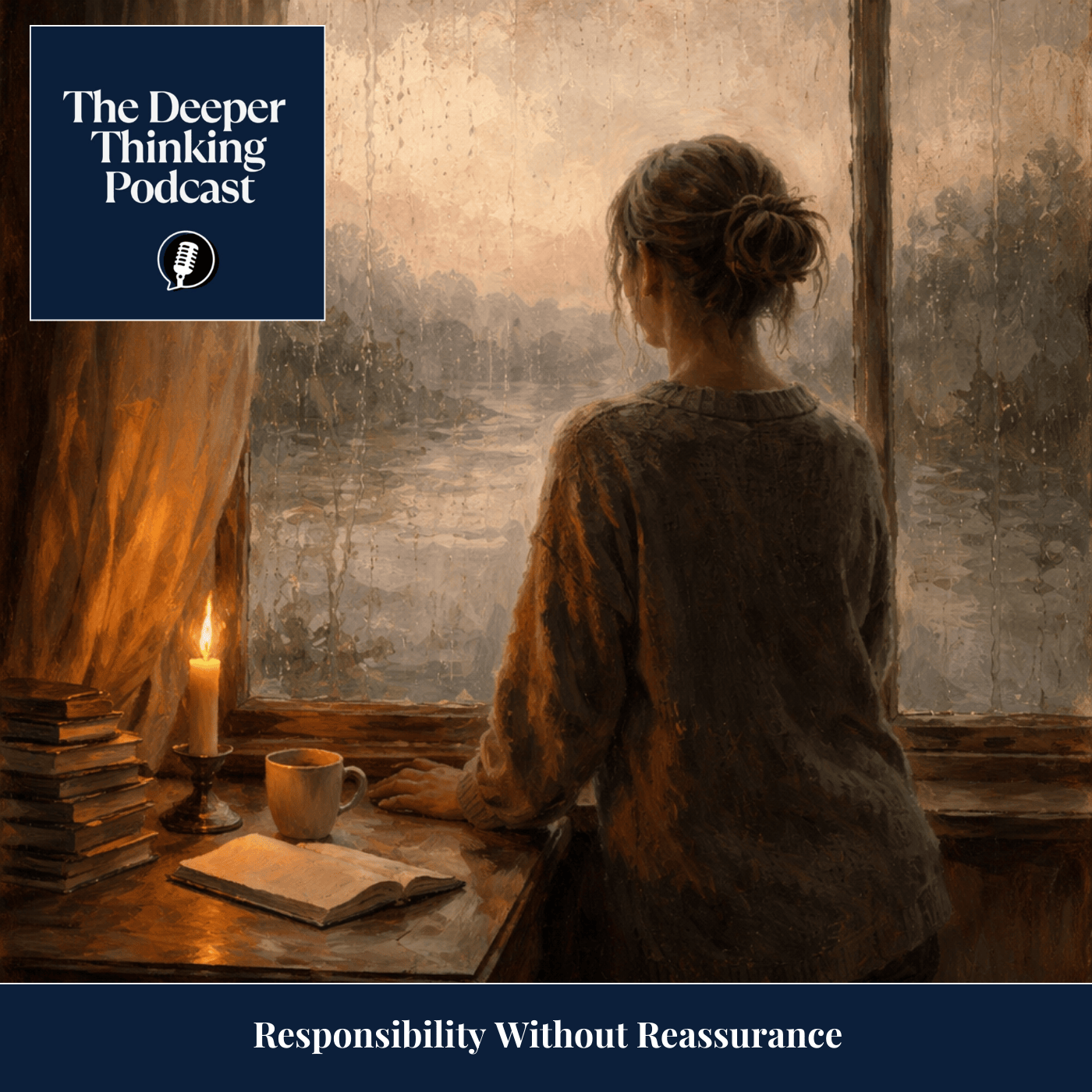 Responsibility Without Reassurance | Responsibility does not wait for clarity. It begins inside constraint, while decisions remain incomplete and consequences continue elsewhere. The ethical problem is not simply whether we choose correctly, but whether we remain present when certainty arrives late, costs cannot be avoided and action still has to continue. This episode of The Deeper Thinking Podcast uses AI-generated narration. Moving through delay, discipline, care and time pressure, the episode examines responsibility not as moral purity or private conviction, but as the capacity to remain usable under imperfect conditions. Hesitation can redistribute harm. Care can lose accuracy when it outruns perception. Discipline can become less a form of control than a way of preserving the ability to respond when pressure narrows attention. The argument draws quietly on Simone Weil and her treatment of attention as an ethical discipline, alongside Maurice Merleau-Ponty and the phenomenological insistence that perception is embodied, situated and already involved in the world. Attention matters here not because it guarantees insight, but because accurate response depends upon remaining sufficiently present to perceive what a situation is actually asking. What emerges is an ethics without the reassurance of completion. Responsibility may consist in maintenance rather than heroism, continuity rather than resolution, and the prevention of harms that therefore never become visible. Finitude does not cancel responsibility. It gives responsibility its shape by forcing action to occur within limits of time, knowledge, energy and control. For those drawn to ethical life under constraint, the discipline of attention, and the question of how care persists when clarity and reassurance do not arrive first. Reflections Responsibility becomes most demanding when action must continue without the comfort of certainty, purity or closure. Responsibility can begin before readiness and continue after reassurance disappears. Delay is not neutral when its costs are transferred to someone else. Care loses accuracy when the desire to help moves faster than perception. Discipline can mean preserving the capacity to respond rather than imposing control. Some ethical work is visible only through the harms, failures or abandonments that do not occur. Finitude sharpens responsibility because every response must occur within real limits. Integrity requires presence without the disguise of moral cleanliness. Endurance is often less dramatic than heroism and more dependent upon maintenance. Responsibility can remain meaningful even when nothing finally resolves it. Why Listen? Reconsider responsibility beyond choice, intention and moral identity. Examine how delay, care and discipline alter ethical outcomes under pressure. Understand attention as an ethical capacity grounded in accurate perception. Explore what ethical continuity means when clarity, control and closure remain incomplete. Listen On: YouTube Spotify Apple Podcasts Support This Work If this episode stayed with you and you would like to support the ongoing work, you can do so here: Buy Me a Coffee. Bibliography Weil, Simone. Gravity and Grace. London: Routledge, 2002. Merleau-Ponty, Maurice. Phenomenology of Perception. London: Routledge, 2002. Arendt, Hannah. Responsibility and Judgment. Edited by Jerome Kohn. New York: Schocken Books, 2003. Bibliography Relevance Simone Weil: Supports the episode's treatment of attention, necessity and ethical discipline under conditions that cannot simply be mastered. Maurice Merleau-Ponty: Grounds the account of perception in embodied and situated experience rather than detached cognition. Hannah Arendt: Provides a framework for thinking about responsibility and judgement when inherited moral rules do not settle the demands of action. Ethical life may offer no final reassurance, but responsibility remains in the quality of the presence we sustain before the work is finished. #Respo | 34m 27s | ||||||
| 12/24/25 | ethicscontemplative practices+4 | — | — | — | meditationself-concern+5 | — | 35m 12s | ||
| 12/24/25 |  This Is Not About You | Ethical presence begins with a refusal to turn every encounter into evidence about ourselves. This episode asks what becomes possible when attention stops grasping, interpreting and converting the world into material for identity. This episode of The Deeper Thinking Podcast uses AI-generated narration. Drawing on Simone Weil's account of attention, Édouard Glissant's defence of opacity, Baruch Spinoza's immanent ethics and Ram Dass's practice of presence, the meditation explores a difficult form of ethical restraint: remaining with what appears without immediately possessing it through explanation. It moves between contemplative withdrawal, nondualism and ordinary encounters to consider the difference between seeing and appropriating. The self is not asked to disappear. It is asked to relinquish its claim to be the centre around which every meaning must organise itself. What emerges is a meditation on witnessing without ownership, silence without vacancy and reverence without possession. Its unresolved question is whether meaning can deepen when experience is allowed to exceed our need to explain, narrate or use it. For those drawn to attention as ethical practice, the limits of interpretation, the dignity of opacity and forms of presence that resist possession. Reflections This episode considers what remains when perception is no longer organised around the demand to possess, explain or perform what we encounter. Interpretation can clarify an encounter, but it can also close it too quickly. Attention may become ethical when it stops treating the world as material for the self. The self need not disappear for decentring to begin. Opacity can protect what explanation would otherwise reduce. Silence can be a disciplined refusal to convert experience into performance. Non-interference is not indifference when it preserves the reality of what is encountered. Presence does not require possession, usefulness or narrative completion. Meaning may appear differently when we stop demanding that experience confirm who we are. Why Listen? Reconsider attention as ethical restraint rather than acquisition. Explore how Weil, Glissant, Spinoza and Ram Dass approach attention, opacity, immanence and presence. Distinguish witnessing from interpretation, and non-interference from indifference. Reflect on whether meaning can deepen when experience is not immediately made useful or personal. Listen On: YouTube Spotify Apple Podcasts Support This Work If this episode stayed with you and you would like to support the ongoing work, you can do so here: Buy Me a Coffee. Bibliography Weil, Simone. Gravity and Grace. Routledge, 2002. Glissant, Édouard. Poetics of Relation. University of Michigan Press, 1997. Spinoza, Baruch. Ethics. Penguin Classics, 2005. Ram Dass. Be Here Now. Lama Foundation, 1971. Bibliography Relevance Simone Weil: Develops an account of attention in which self-emptying makes a different relation to reality possible. Édouard Glissant: Defends opacity against the demand that persons and worlds become completely transparent to understanding. Baruch Spinoza: Provides an immanent ethical framework in which human beings are understood within, rather than outside, the order of nature. Ram Dass: Places sustained presence at the centre of contemplative practice rather than treating it merely as a means to another end. Perhaps the deepest form of attention begins when the world is finally allowed to remain more than what we can make of it. #EthicalPresence #SimoneWeil #EdouardGlissant #Spinoza #RamDass #Attention #Opacity #ContemplativeEthics #TheDeeperThinkingPodcast | 35m 12s | ||||||
| 12/5/25 | 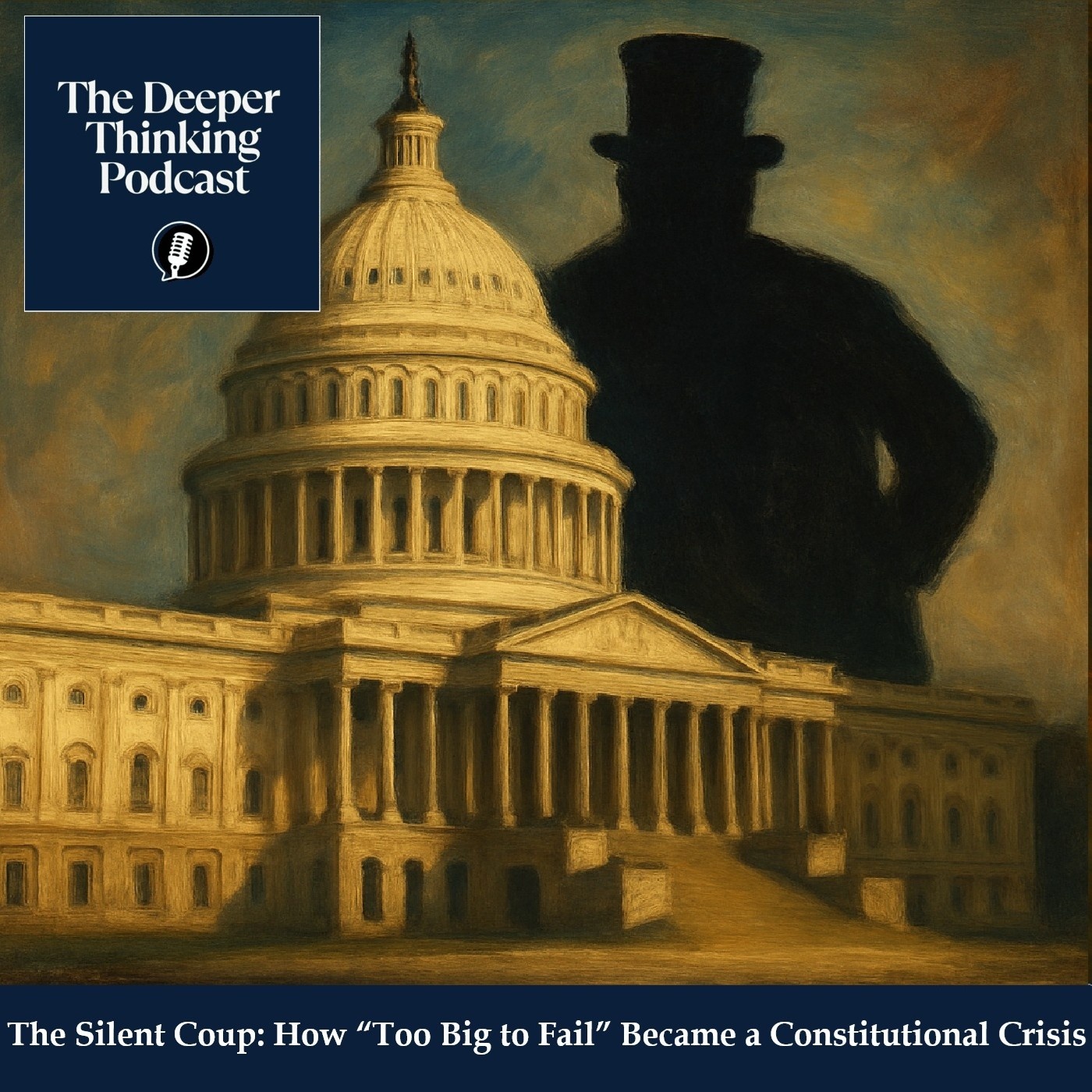 The Silent Coup: How Fragility Became Political Power | Too big to fail describes more than institutions whose collapse would threaten an economy. It describes a political condition in which the consequences of failure become so severe that governments lose some of their practical freedom to choose. This episode of The Deeper Thinking Podcast uses AI-generated narration. The argument begins with a simple inversion. Fragility is usually understood as weakness, yet sufficiently concentrated fragility can become a source of power. When the failure of a bank, corporation or financial system would injure millions of people, the institution no longer needs a formal constitutional veto. Its vulnerability itself begins to constrain what governments can safely allow. Drawing on Karl Polanyi and his account of market society, Wolfgang Streeck on public debt and democratic constraint, and Quinn Slobodian on attempts to insulate economic orders from popular pressure, the episode asks what happens when stability acquires political authority. The problem is not simply that governments rescue powerful institutions. It is that repeated dependence can alter the boundaries of imaginable policy before any formal decision is made. The historical arc moves from Renaissance Florence and the Medici banking dynasty through the East India Company and into the Greek government debt crisis. Across very different institutions and periods, the recurring question is the same: what becomes of sovereignty when public authorities depend upon systems whose disruption they cannot politically, economically or socially afford? For those drawn to political economy, institutional power, democratic sovereignty and the hidden ways dependency can narrow the space of collective choice. Reflections The central tension is between the preservation of stability and the preservation of democratic freedom of action. Too big to fail can become a political condition before it becomes an explicit policy. Fragility becomes power when the consequences of resistance are transferred to everyone else. Dependency often begins as efficiency, becomes necessity and eventually presents itself as inevitability. A bailout can protect ordinary lives while simultaneously strengthening the dependency that made rescue unavoidable. Democratic institutions can retain their formal authority while losing practical room to exercise it. Financial markets can discipline governments faster than electorates can reward or punish them. The socialisation of systemic risk can coexist with the private accumulation of its rewards. The deepest transfer of power may occur without anyone formally acquiring a new constitutional right. Stability becomes politically dangerous when preserving the system consistently outranks the public's capacity to alter it. Why Listen? Reconsider too big to fail as a question of political power and democratic sovereignty, not only financial regulation. Understand how systemic dependence can constrain governments without creating any formal constitutional veto. Explore how Polanyi, Streeck and Slobodian illuminate different relationships between markets, states and democratic choice. Trace the recurring tension between concentrated private power and public dependence across several historical forms. Listen On: YouTube Spotify Apple Podcasts Support This Work If this episode stayed with you and you would like to support the ongoing work, you can do so here: Buy Me a Coffee. Bibliography Polanyi, Karl. The Great Transformation: The Political and Economic Origins of Our Time. Boston: Beacon Press, 2001. Streeck, Wolfgang. Buying Time: The Delayed Crisis of Democratic Capitalism. London: Verso, 2014. Slobodian, Quinn. Globalists: The End of Empire and the Birth of Neoliberalism. Cambridge, MA: Harvard University Press, 2018. Robins, Nick. The Corporation That Changed the World: How the East India Company Shaped the Modern Multinational. London: Pluto Press, 2012. Bibliography Relevance Karl Polanyi: Provides the broade | 27m 57s | ||||||
Showing 25 of 229
Pitch Fit is a Pro feature
See how bookable this show is for guests, which brands already advertise, the per-episode ad value, and the best-fit guest and sponsor profile. The numbers are blurred on the free plan.
How readily this show books outside guests like you.
How proven this show is for host-read sponsorships.
For Guests
ProFor Advertisers
ProUpgrade to Pro to unlock guest cadence, sponsor categories, fit scores, and per-episode ad value for this show.
Chart history for The Deeper Thinking Podcast
Peaked at #40 in Ireland, currently #40 in Ireland.
| Market | Genre | Peak | Current | Trend |
|---|---|---|---|---|
| Ireland | — | #40 | #40 | — |
| MY | — | #50 | #50 | — |
| SA | — | #67 | #67 | — |
| United States | — | #72 | #72 | — |
| Norway | — | #102 | #102 | — |
| Brazil | — | #114 | #114 | — |
| GR | — | #120 | #120 | — |
| Canada | — | #122 | #122 | — |
| HU | — | #123 | #123 | — |
| HK | — | #125 | #125 | — |
| TW | — | #132 | #132 | — |
| Australia | — | #133 | #133 | — |
| ID | — | #185 | #185 | — |
Chart Positions
13 placements across 13 markets.
Chart Positions
13 placements across 13 markets.