
Insights from recent episode analysis
Audience Interest
Podcast Focus
Publishing Consistency
Platform Reach
Insights are generated by CastFox AI using publicly available data, episode content, and proprietary models.
Est. Listeners
Based on iTunes & Spotify (publisher stats).
- Per-Episode Audience
Est. listeners per new episode within ~30 days
10,001 - 25,000 - Monthly Reach
Unique listeners across all episodes (30 days)
25,001 - 75,000 - Active Followers
Loyal subscribers who consistently listen
5,001 - 15,000
Market Insights
Platform Distribution
Reach across major podcast platforms, updated hourly
Total Followers
—
Total Plays
—
Total Reviews
—
* Data sourced directly from platform APIs and aggregated hourly across all major podcast directories.
On the show
Recent episodes
Keep On Rolling: Electrifying, Scaling & Automating The Vehicles of Tomorrow (Curbivore 2026)
Apr 27, 2026
44m 50s
Urban Autonomy in America: What’s Real & What’s Next (Curbivore 2026)
Apr 27, 2026
50m 35s
Meet Dot: DoorDash’s Accelerated Autonomous Local Commerce Solution (Curbivore 2026)
Apr 27, 2026
21m 18s
DoorDash’s Autonomous Delivery Strategy with Ashu Rege
Apr 6, 2026
37m 43s
The Humans Powering Autonomous Vehicle Operations (Omar Zoubi, TaskUs)
Mar 30, 2026
26m 19s
Social Links & Contact
Official channels & resources
Official Website
Login
RSS Feed
Login
| Date | Episode | Description | Length | ||||||
|---|---|---|---|---|---|---|---|---|---|
| 4/27/26 |  Keep On Rolling: Electrifying, Scaling & Automating The Vehicles of Tomorrow (Curbivore 2026) Keep On Rolling: Electrifying, Scaling & Automating The Vehicles of Tomorrow (Curbivore 2026) | Listen to this episode on Apple Podcasts, YouTube, Spotify, and Substack. Transcripts are also available by clicking on the “transcripts” button in the top right corner of this post.Join panelists at the just concluded Curbivore conference as they discuss what it takes to electrify, scale, and automate the vehicles of tomorrow, and the key systems supporting autonomy as deployments expand. This panel featured Aileen Zhong (Director of Government Affairs, Starship Technologies), Will Graylin (CEO & Chairman, indiGOtech), Nick Allen (Head of AV/Mobility Solutions, TaskUs), John McLean (Head of Market Development, Voltera), and Ed Walker (Senior Vice President, Hub International), and was moderated by Lloyd Lee (Reporter, Business Insider).The conversation explores the infrastructure backbone enabling autonomy, from charging and fleet support to the human-in-the-loop systems that underpin AV safety today. It also covers key regulatory hurdles in cities, barriers to deploying sidewalk robots, and the most important metrics for early pilot programs. Panelists discuss how insurability evolves with scale, including the role of real-world versus simulated miles, how remote assistance may shift globally, and how risk and compliance frameworks change as drivers are removed. The discussion also touches on labor dynamics, the infrastructure versus scale “chicken-and-egg” challenge, public and regulatory perception, and which pieces of the ecosystem will have the biggest impact on AV growth in the coming years.Curbivore 2026 brought together leaders across autonomy, delivery, and mobility in downtown Los Angeles for a full day of panels, firesides, exhibitions, and street food, focused on the ideas shaping the future of the curb and cities. You can check out the highlights clip here to get a feel for the event, and we’ve curated recordings of the panels, firesides, and speeches here. Also check out hundreds of our event photos here.We’re bringing that same energy to our next Urban Autonomy Summit in Detroit on June 9. After that, we’ll be in Austin this fall and back in San Francisco in the winter for our next series of AV summits.Chapters(00:00) Introduction and overview(03:45) The backbone that makes autonomy work and the infrastructure layer(09:45) The human-in-the-loop layer behind AV safety(11:04) Regulatory hurdles facing autonomous vehicle deployments in cities(14:05) Barriers to deploying sidewalk robots in major cities(15:37) The most critical metrics for AV pilot deployments(19:03) Key requirements for autonomous fleets to ensure insurability at scale(22:09) How physical vs. simulated miles impact AV fleet insurability(23:23) How human-in-the-loop systems will evolve as AVs scale(25:05) Overseas remote assistance for autonomous vehicles(27:34) How risk and compliance dynamics change as drivers are removed(30:34) Balancing labor concerns with scaling autonomy(33:06) The “chicken and egg” problem of infrastructure vs. scaling(36:20) Regulator and public perception of AVs today(40:22) Which infrastructure pieces will most impact AV scaling, and how insurance may evolve- Harry This is a public episode. If you would like to discuss this with other subscribers or get access to bonus episodes, visit www.thedriverlessdigest.com | 44m 50s | ||||||
| 4/27/26 |  Urban Autonomy in America: What’s Real & What’s Next (Curbivore 2026) Urban Autonomy in America: What’s Real & What’s Next (Curbivore 2026) | Listen to this episode on Apple Podcasts, YouTube, Spotify, and Substack. Transcripts are also available by clicking on the “transcripts” button in the top right corner of this post.Join panelists at the just concluded Curbivore conference as they discuss how autonomy has progressed over the last few years, the challenges the industry still faces, and what it will take to accelerate progress as AV services begin to scale. This panel featured Pat Tsen (Deputy Executive Director, California Public Utilities Commission), Phillip Pierce (City Policy Lead, Zoox), Jon Miller (Chief Business Officer, Nexar), Ashwini Anburajan (CEO, Obi), and Aaron Park (Chief Business Development Officer, Robotis), and was moderated by Alan Ohnsman (Senior Editor, Forbes).The conversation explores how AV deployments are evolving in real-world environments, including Zoox’s current rollout and safety approach, the regulatory and operational hurdles that remain, and how agencies like the CPUC are handling approvals and data reporting. It also covers early pricing dynamics and consumer perception, how companies like Nexar support AV safety as services scale, the growing role of autonomous robotics and emerging use cases, and how industry players can better align to standardize testing, improve edge case readiness, and support safe, scalable growth.Curbivore 2026 brought together leaders across autonomy, delivery, and mobility in downtown Los Angeles for a full day of panels, firesides, exhibitions, and street food, focused on the ideas shaping the future of the curb and cities. You can check out the highlights clip here to get a feel for the event, and we’ve curated recordings of the panels, firesides, and speeches here. Also check out hundreds of our event photos here.We’re bringing that same energy to our next Urban Autonomy Summit in Detroit on June 9. After that, we’ll be in Austin this fall and back in San Francisco in the winter for our next series of AV summits.Chapters(00:00) Introduction, and overview(06:25) Zoox’s current AV deployment position and the challenges so far(08:51) Steps to a more harmonized system of approval for robotaxis (Federal and state), and the CPUC’s place in this system(12:40) How the CPUC handles data reporting for AV companies in the testing phase, and what qualifies as an autonomous vehicle deployment(14:40) Early pricing trends, and customer perception insights in current robotaxi deployments(21:30) Zoox’s approach to safety and how they handle edge cases(24:20) How Nexar supports AV companies and their safety cases as services begin to scale(30:40) How the autonomous robotics market is developing and how their use cases are evolving.(34:58) Standardizing AV testing and validation, and how to better prepare for edge cases(42:30) Consumer perception of AVs/pricing and how it has evolved(46:20) Projections for the future of autonomy- Harry This is a public episode. If you would like to discuss this with other subscribers or get access to bonus episodes, visit www.thedriverlessdigest.com | 50m 35s | ||||||
| 4/27/26 |  Meet Dot: DoorDash’s Accelerated Autonomous Local Commerce Solution (Curbivore 2026) Meet Dot: DoorDash’s Accelerated Autonomous Local Commerce Solution (Curbivore 2026) | Listen to this episode on Apple Podcasts, YouTube, Spotify, and Substack. Transcripts are also available by clicking on the “transcripts” button in the top right corner of this post.Join Harry and Harrison Shih, Senior Director at DoorDash Labs, DoorDash for a fireside chat from the recently concluded Curbivore conference. They dive into DoorDash’s push into autonomy, with a focus on their latest delivery robot, DOT, and how it fits into a broader shift toward multimodal delivery. The conversation covers everything from the timing behind automation to how cities, consumers, and logistics networks are evolving alongside it.They also unpack where DOT fits within DoorDash’s ecosystem, how the company collaborates with cities, and what real-world use cases are emerging today versus what’s coming next.Curbivore 2026 brought together leaders across autonomy, delivery, and mobility in downtown Los Angeles for a full day of panels, firesides, exhibitions, and street food, focused on the ideas shaping the future of the curb and cities. You can check out the highlights clip here to get a feel for the event, and we’ve curated recordings of the panels, firesides, and speeches here. Also check out hundreds of our event photos here.We’re bringing that same energy to our next Urban Autonomy Summit in Detroit on June 9. After that, we’ll be in Austin this fall and back in San Francisco in the winter for our next series of AV summits.Chapters(00:00) Introduction(00:40) Harrison’s background and the philosophy behind DoorDash Labs(02:29) DOT robot specs and design philosophy(04:00) Why now is the right moment for delivery automation(04:59) DOT’s role in a multimodal delivery ecosystem(07:10) How DoorDash works with cities to automate delivery(10:15) Problems autonomy solves in delivery(12:32) Key use cases for DOT(14:00) Consumer behavior trends in delivery(15:44) The “other half” of the delivery equation, alongside autonomy(19:37) How autonomous delivery evolves in cities over time- Harry This is a public episode. If you would like to discuss this with other subscribers or get access to bonus episodes, visit www.thedriverlessdigest.com | 21m 18s | ||||||
| 4/6/26 | 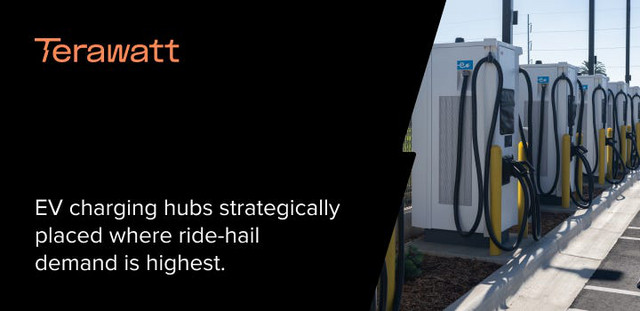 DoorDash’s Autonomous Delivery Strategy with Ashu Rege DoorDash’s Autonomous Delivery Strategy with Ashu Rege | This week’s podcast is brought to you by Terawatt – purpose-built charging for autonomous vehicle fleets.Listen to this episode on Apple Podcasts, YouTube, Spotify, and Substack. Transcripts are also available by clicking on the “transcripts” button in the top right corner of this post on the app/web version. You can also access them from the email version by clicking here.In today’s episode, I’m speaking with Ashu Rege, Vice President of DoorDash Labs at DoorDash. Ashu shares his journey through the autonomous vehicle industry, including roles at NVIDIA and Zoox, before leading autonomy efforts within one of the largest delivery platforms in the world.We dive into what drew him to DoorDash Labs and how the team is thinking about autonomy differently from robotaxi companies. Ashu explains the origins of DoorDash’s delivery robot DOT, the goals of the DoorDash Labs, and how their Autonomous Delivery Platform (ADP) is designed to support a wide range of delivery modalities. The conversation explores what makes autonomous delivery fundamentally different from human delivery, how mature DoorDash’s delivery solutions are today, and the different categories of autonomy DoorDash is pursuing.We also get into the economics of autonomous delivery and the unique problems autonomy is best suited to solve in delivery. Ashu breaks down how DOT operates in the real world, including its limitations and where it stands out the most. Finally, we look ahead to what’s next for DoorDash and DoorDash Labs’ autonomy efforts over the coming year, including how the company is balancing partnerships with in‑house development.DoorDash will also be bringing a DOT delivery vehicle to our flagship Curbivore conference on April 17 in Downtown LA, and we’ll have Harrison Shih, Senior Director of DoorDash Labs, joining me for a fireside chat.Join industry experts across autonomy, mobility, and delivery for a can’t-miss gathering shaping the future of curbside commerce. Register now and use the code Autonomy25 to save an extra 25%.Chapters* (00:00) Introduction to Ashu Rege* (02:47) Ashu’s background in the AV industry (Nvidia, Zoox, and DoorDash).* (04:30) What excited Ashu about joining DoorDash Labs, and its autonomy goals.* (05:43) The story behind the creation of DOT and its perks* (08:23) The goal of DoorDash Labs and what they do* (09:18) DoorDash Labs’ Autonomous Delivery Platform (ADP) explained.* (10:34) One key difference between an autonomous delivery solution and a human.* (11:52) How commercially mature are DoorDash’s autonomous delivery solutions?* (12:54) DoorDash’s autonomous delivery categories, and how they compare to each other.* (14:29) Why is now the right time to scale autonomy in delivery, and how autonomous delivery differs from robotaxis.* (18:30) How DoorDash approaches the balance between partnering and building autonomous delivery solutions in-house.* (23:31) How autonomous deliveries compare to human deliveries in cost, and the unique problem autonomous deliveries solve.* (25:20) How autonomous deliveries work using DOT, its limitations, and where it stands out.* (35:11) What to expect from DoorDash and DoorDash Labs over the next year in autonomy.* (36:52) Conclusions and final thoughtsDesigning Charging Hubs for Autonomous FleetsWe are excited to partner with Terawatt, one of the leading providers of charging infrastructure. To learn more about Terawatt’s network of AV charging hubs and track record of 99%+ uptime, reach out to Logan Szidik at lszidik@terawattinfrastructure.comNotes/Links:* You can find Ashu on LinkedIn.* DOT is DoorDash’s first in-house autonomous delivery robot. You can find more info about it here (link).* DoorDash Labs is DoorDash’s robotics and automation arm. You can find more info about them on their website (link).* Open roles at DoorDash Labs (link).-Harry This is a public episode. If you would like to discuss this with other subscribers or get access to bonus episodes, visit www.thedriverlessdigest.com | 37m 43s | ||||||
| 3/30/26 |  The Humans Powering Autonomous Vehicle Operations (Omar Zoubi, TaskUs) The Humans Powering Autonomous Vehicle Operations (Omar Zoubi, TaskUs) | Listen to this episode on Apple Podcasts, YouTube, Spotify, and Substack. Transcripts are also available by clicking on the “transcripts” button in the top right corner of this post on the app/web version. You can also access them from the email version by clicking here.In today’s episode, I’m speaking with Omar Zoubi, VP of Autonomous Mobility & Rideshare Network Strategy at TaskUs. Omar breaks down how TaskUs supports autonomous vehicle operators behind the scenes, from remote assistance to handling edge cases that today’s AI systems still struggle to navigate.We get into TaskUs’ role across the AV ecosystem, including who they partner with and how their human-in-the-loop model helps fleets operate safely and scale more efficiently. Omar explains the types of real-world scenarios where AVs need intervention, how those interventions feed back into improving AI systems, and what it takes to support different types of fleets with varying operational needs.The conversation also covers the current stage of the AV industry, including how companies like Waymo are approaching remote assistance and safety, and what challenges emerge as fleets grow. We discuss operational complexity, cost structures, and how companies think about cost per mile as they move toward commercialization.Finally, Omar shares his perspective on where TaskUs adds the most value today, how the human-in-the-loop model will evolve over time, and what the future of the AV industry looks like as autonomy matures.Chapters* (00:00) Introduction to Omar Zoubi and TaskUs* (03:19) TaskUs’ domain of operation* (03:30) TaskUs’ AV business model, and their partners* (04:43) What services does TaskUs provide to its AV clients?* (06:10) How does TaskUs’ assistance in edge cases help AV clients improve their AI?* (07:53) Common scenarios where AV companies might need remote assistance, and how TaskUs helps.* (09:30) Differences between supporting different AV fleets* (10:41) How Omar thinks about Waymo’s remote assistance and safety* (12:40) What stage of the AV industry are we in?* (14:19) Biggest operational challenges as AV fleets start to scale* (15:46) Common traits across operators and companies in the AV industry* (17:00) How the human-in-the-loop model will evolve as AVs mature* (19:05) How do you plan for unpredictable scenarios, like the recent SF blackout?* (21:38) How AV operational costs are distributed and cost per mile* (23:10) Where does TaskUs offer the biggest value or opportunity for AV companies?* (24:00) What does the future of the AV industry look like?* (25:43) Conclusions and final thoughtsNotes/Links:* You can find Omar Zoubi on Linkedin.* TaskUs website (link).* Learn how TaskUs supports AV operations in their case study (link).- Harry This is a public episode. If you would like to discuss this with other subscribers or get access to bonus episodes, visit www.thedriverlessdigest.com | 26m 19s | ||||||
| 3/23/26 | 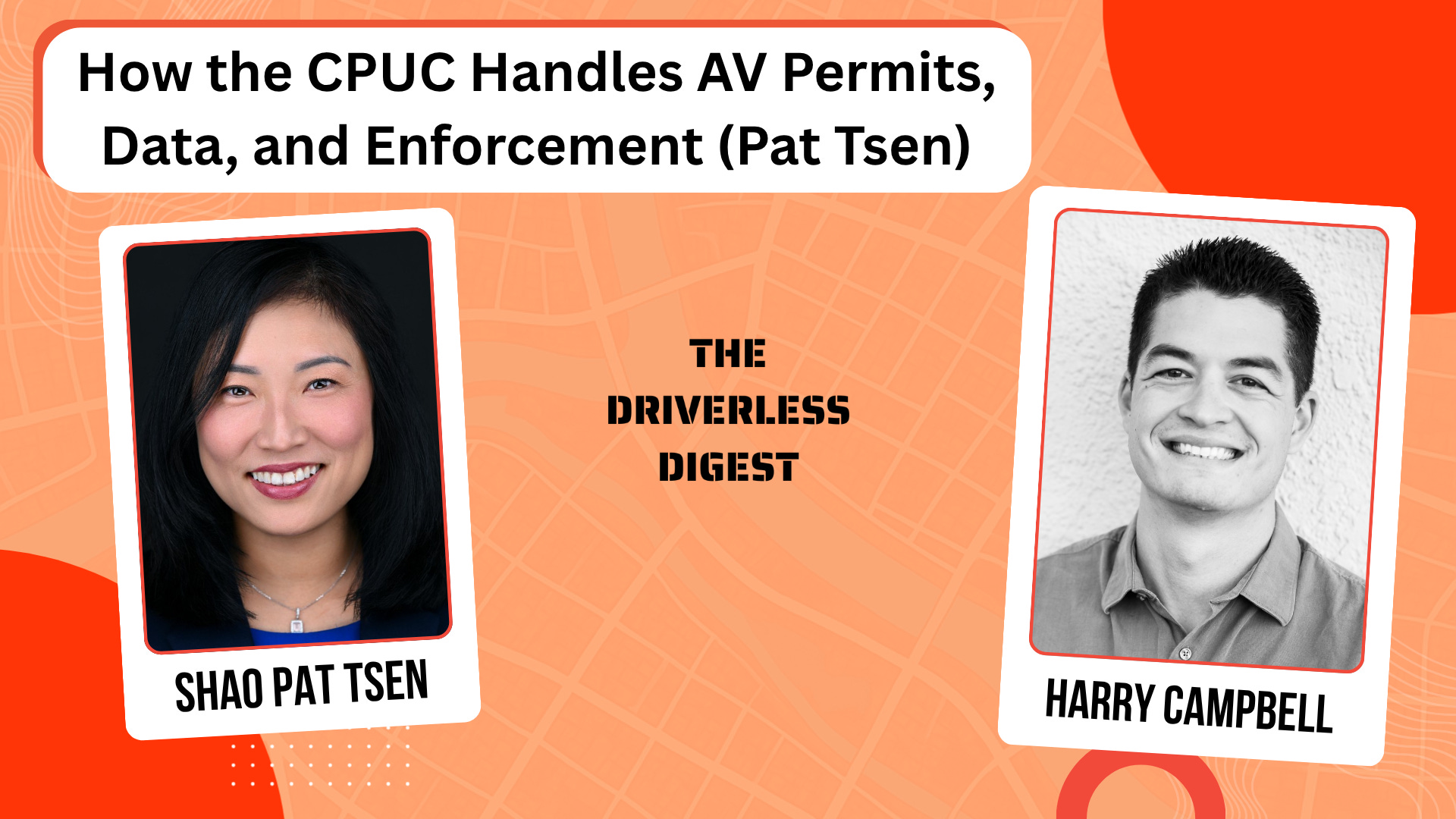 How the CPUC Handles AV Permits, Data, and Enforcement (Pat Tsen) How the CPUC Handles AV Permits, Data, and Enforcement (Pat Tsen) | This week’s podcast is brought to you by Terawatt – purpose-built charging for autonomous vehicle fleets.Listen to this episode on Apple Podcasts, YouTube, Spotify, and Substack. Transcripts are also available by clicking on the “transcripts” button in the top right corner of this post.In today’s episode, I’m speaking with Shao (Pat) Tsen, Deputy Executive Director for Consumer Policy, Transportation, and Enforcement at the California Public Utilities Commission (CPUC).We start with an overview of the CPUC and Pat’s role in it. We also break down the split between the CPUC and DMV, clarifying who regulates what, and what companies actually need to do to launch an autonomous vehicle service in California, including the different permit types required along the way.Pat explains the CPUC’s technology-agnostic approach to AV regulation, and why Tesla’s current robotaxi deployment isn’t considered an autonomous vehicle service under CPUC jurisdiction. We then dig into what it really takes to secure an AV permit, and whether the approval process is more subjective or objective in practice.The conversation also covers enforcement, reporting, and data collection requirements for AV companies, including new stoppage event reporting rules and what data is ultimately made public. We also get into how the CPUC approaches transparency, accountability, and the balance between innovation and public safety—and where its regulatory oversight starts to reach its limits.Chapters* (00:00) Introduction to Shao (Pat) Tsen* (03:34) Introduction to the CPUC and their areas of regulation* (05:03) Pat’s role at the CPUC* (08:37) CPUC vs DMV: Who Regulates What?* (10:54) Steps to launching an autonomous vehicle service in California—and the different types of permits* (14:05) The CPUC’s technology-agnostic role in AV regulation* (15:05) Why Tesla’s robotaxi isn’t considered an autonomous vehicle service in California* (18:35) What it takes to get an AV permit from the CPUC* (21:35) Is the CPUC’s AV permit approval process more subjective or objective?* (24:55) Enforcement, reporting, and data collection for AV companies under the CPUC’s jurisdiction* (30:21) What autonomous vehicle companies currently have to report to the CPUC, including new stoppage event requirements* (32:45) What AV company data is made publicly available?* (37:10) How the CPUC handles new edge cases and teleoperations* (41:44) Limits of the CPUC’s oversight* (43:00) Conclusions and final thoughtsDesigning Charging Hubs for Autonomous FleetsWe are excited to partner with Terawatt, one of the leading providers of charging infrastructure. To learn more about Terawatt’s network of AV charging hubs and track record of 99%+ uptime, reach out to Logan Szidik at lszidik@terawattinfrastructure.comNotes/Links:* You can find Pat on Linkedin.* Relevant links for the CPUC’s AV program* Decision and resolution numbers which set rules or approved new authority to operate* D.18-05-043 aka the “Pilot Decision,” created the AV Pilot program and set requirements for participants* D.20-11-046 as modified by D.21-05-017 aka the “Deployment Decision,” created AV Deployment program and set the requirements for participants* D.24-11-002 aka the AV Data Decision, expanded AV data reporting requirements including incident reporting and “stoppage event” reporting* R.-25-08-013 (OIR opened August 2025) – the new AV rulemaking to update policies/processes/rules for AV passenger transportation* General Order (GO) 157-E: TCP Regulations* Resolutions:* Resolution TL-19144 (2023) – approved Waymo for Phase I Driverless AV Passenger Service Deployment* Resolution TL-19145 (2023) – approved Cruise (Phase 1 driverless deployment authorization)* AV Program Quarterly Reporting (link).* To file a complaint, you can fill out this form Passenger complaint form and email to consumer-affairs@cpuc.ca.gov* To submit a public comment in the ongoing AV rulemaking, as mentioned at the 41:25 timestamp, you can access the public comment tab here R2508013-Harry This is a public episode. If you would like to discuss this with other subscribers or get access to bonus episodes, visit www.thedriverlessdigest.com | 43m 27s | ||||||
| 3/18/26 |  The Chips Powering Autonomous Driving with Augustin Friedel The Chips Powering Autonomous Driving with Augustin Friedel | Listen to this episode on Apple Podcasts, YouTube, Spotify, and Substack. Transcripts are also available by clicking on the “transcripts” button in the top right corner of this post.Today, we are featuring a guest podcast from Daniel Abreu Marques, host of Autonomy Insiders, the companion podcast to his newsletter The AV Market Strategist. Daniel regularly covers the global autonomous vehicle industry with a particular focus on strategy, and we’ve long enjoyed reading and supporting each other’s work.While the show keeps a close eye on the US market, this podcast places a special emphasis on the European and Chinese ecosystems.In this episode, Daniel Abreu Marques sits down with Augustin Friedel, an expert in software-defined vehicles (SDV) and AI-enabled mobility. They dive into the critical role of high-performance silicon in autonomous driving, exploring the evolution of System-on-a-Chip (SoC) technology, the key factors driving chip selection, and the intensifying competition among providers. They also discuss the growing trend of OEMs developing in-house chips and the long-term impact of semiconductor shortages.Chapters* (02:16) Introduction to SOCs and Their Importance* (04:23) Critical Role of High-Performance Chips in Autonomous Driving* (08:52) Choosing the Right Chip: Performance vs. Efficiency* (12:27) Major Players in the Chip Market for Autonomous Vehicles* (15:35) The Push for In-House Chip Development by OEMs* (18:41) Competition and Collaboration in the Chip Industry* (23:46) Market Penetration of High-Performance Chips* (25:49) Level 3 Autonomy: Challenges and Perspectives* (27:51) China’s Ambition in Semiconductor Independence* (29:19) Collaborations and Acquisitions in Chip Development* (32:22) The Wake-Up Call of the Semiconductor Shortage* (34:13) The Role of Tier 1 Suppliers in the New Ecosystem* (37:45) Understanding the Chip Supply Chain* (40:56) The Importance of Node Size in Chip Production* (44:17) Evaluating the Best Chip for Level 4 Vehicles* (46:31) Key Questions for Semiconductor StrategyNotes/Links:* You can find Daniel on Linkedin and Twitter/X.* You can find Augustin on Linkedin.* The Autonomy Insiders Podcast is available on Spotify, Apple Podcasts, YouTube and Amazon Music.* Daniel’s Newsletter: The AV Market Strategist (link). This is a public episode. If you would like to discuss this with other subscribers or get access to bonus episodes, visit www.thedriverlessdigest.com | 47m 45s | ||||||
| 3/9/26 |  AV Fleet Management with Ming Maa (Moove AV CEO) AV Fleet Management with Ming Maa (Moove AV CEO) | Listen to this episode on Apple Podcasts, YouTube, Spotify, and Substack. Transcripts are also available by clicking on the “transcripts” button in the top right corner of this post.In today’s episode, I’m speaking with Ming Maa, Co-Founder and CEO of Moove AV, a global fleet provider for autonomous vehicles, and Waymo’s current fleet partner in Phoenix, Miami and London.We discussed Ming’s time at Grab and the key rideshare lessons that ultimately inspired the creation of Moove AV. Ming explains how rideshare fleet models differ inside and outside the U.S., and what separates Moove’s traditional rideshare business (Moove.io) from Moove’s AV-focused operations.We also dive into what it actually means to be an AV fleet partner. Ming shares why Waymo chose Moove AV, the challenges behind operating autonomous fleets, and how the company works with partners across different markets. We also talk about how Moove decides where to place its fleet depots, maintenance, and charging infrastructure, along with lessons learned from managing fleets globally.Later in the episode, Ming breaks down the operational differences between managing autonomous fleets and human-driven fleets, including the capabilities Moove AV had to build specifically for AVs. We also explore which parts of depot operations could eventually be automated, whether there are redundancies in AV fleet operations that could be trimmed to reduce costs, and why fleet management itself could become one of the biggest competitive advantages in the AV industry.Chapters* (00:00) Introduction to Ming Maa* (02:25) Rideshare lessons from Ming’s time at Grab, and the inspiration behind Moove AV’s creation* (06:00) Rideshare fleet models inside/outside the U.S.* (08:25) The differences between Moove.io and Moove AV* (09:50) Why did Waymo choose Moove AV as a fleet partner?* (12:43) The challenges of being an AV fleet partner* (13:47) How does Moove AV work with partners in their various markets?* (15:01) How Moove AV picks their sites for fleet maintenance/charging infrastructure* (17:30) AV fleet management lessons from different markets* (21:50) How Moove AV’s partnership impacts Waymo’s operational metrics* (23:25) What capabilities did Moove AV develop for AV fleets that are different from human-driven fleets?* (25:01) What processes in AV depot operations could be automated?* (26:07) Are there redundancies in AV fleet operations that could be trimmed to cut costs/save time?* (30:20) Does fleet management become the next moat in the AV space?* (33:17) Conclusions and final thoughtsNotes/Links:* You can find Ming Maa on Linkedin.* Moove’s website (link).* The TDD newsletter edition featuring RoboDock, mentioned at the 24:59 timestamp (link).-Harry This is a public episode. If you would like to discuss this with other subscribers or get access to bonus episodes, visit www.thedriverlessdigest.com | 33m 51s | ||||||
| 3/3/26 |  Inside Waymo’s Remote Assistance Program with Dr. Missy Cummings Inside Waymo’s Remote Assistance Program with Dr. Missy Cummings | Listen to this episode on Apple Podcasts, YouTube, Spotify, and Substack. Transcripts are also available by clicking on the “transcripts” button in the top right corner of this post.In today’s episode, I’m speaking with Dr. Missy Cummings, professor and director of the Mason Autonomy and Robotics Center at George Mason University, and former Senior Safety Advisor at the National Highway Traffic Safety Administration (NHTSA). We go deep on one of the most misunderstood pieces of the AV stack: remote operations. Dr. Cummings breaks down the difference between remote assistance and true teleoperation, why latency matters more than most people realize, and why “median latency” can be a misleading metric when safety is on the line.We also unpack common misconceptions around Waymo’s remote assistance model, where it works well, and where it could improve. Dr. Cummings shares her perspective on whether offshore remote operators pose safety risks, and why local licensing, training, and regulatory clarity are essential as the industry scales.Our discussion then turns to the lessons from Cruise’s collapse, what remote operations revealed about the limits of current AV systems, and how regulators should think about oversight without stifling innovation. We examine Waymo’s remote operator-to-vehicle ratio, and wrap up with a broader question: will AVs ever be fully autonomous? And what should policymakers, investors, and the public actually look at when evaluating safety claims and remote operations?Chapters* (00:00) Introduction to Dr. Missy Cummings* (05:55) Remote assistance vs remote driving (teleoperation): characteristics and differences* (10:45) Effects of time latency on remote operation* (14:55) Why “median latency” is misleading and why maximum latency is the number that really matters.* (17:02) The misconceptions around Waymo’s remote assistance process, and how it could improve* (20:26) Are offshore remote operators a safety risk? The importance of local licensing and training* (26:06) Remote operation lessons from Cruise’s demise* (27:05) What should be the limits of regulatory oversight in autonomy?* (33:14) Waymo’s remote operator-to-vehicle ratio, and the rarity of fully autonomous systems.* (37:39) Will AVs ever be fully autonomous?* (39:25) What the public and regulators should look out for when evaluating Waymo’s safety record and remote operations.* (42:05) Conclusions and final thoughtsNotes/Links:* You can find Dr. Cummings on LinkedIn, where she’ll announce the publication of her upcoming article mentioned at the 06:35 timestamp.* Brad Templeton’s article I mentioned at the 12:13 timestamp: Waymo Runs A Red Light And The Difference Between Humans And Robots (link, no paywall).* Waymo’s latest blog post on their remote assistance, mentioned at the 14:52 timestamp (link).* Waymo’s earlier blog post outlining the “Phone a friend” structure of their fleet response I mentioned at the 17:04 timestamp (link).* John Deniston’s TDD guest post I mentioned at the 24:41 timestamp (link).-Harry This is a public episode. If you would like to discuss this with other subscribers or get access to bonus episodes, visit www.thedriverlessdigest.com | 42m 58s | ||||||
| 1/19/26 |  A Deep Dive into Waymo’s CPUC Data with Dr. Matthew Raifman A Deep Dive into Waymo’s CPUC Data with Dr. Matthew Raifman | This week’s podcast is brought to you by Terawatt – purpose-built charging for autonomous vehicle fleets.Listen to this episode on Apple Podcasts, YouTube, Spotify, and Substack. We now have transcripts available too (Click on the “transcripts” button in the top right corner of this post to access them).In today’s episode, I’m speaking with Dr. Matthew Raifman, Research Lead for policy and automated vehicles at UC Berkeley’s SafeTREC Center, who has researched on the safety and societal impacts of automated vehicles. We dive into Matt’s work at SafeTREC and how the group collaborates with state agencies and funding bodies on transportation safety and policy. We discuss what drew Matt to the California Public Utilities Commission (CPUC) data from Waymo that he recently analyzed in The Driverless Digest, and whether cities and autonomous vehicle companies are truly aligned in their goals.We unpack the current state of AV data reporting, including how vehicle miles traveled (VMT) are defined across different periods for rideshare and autonomous vehicles, what trends are beginning to emerge, and where there may be opportunities for better alignment between cities and AV operators. Matt explains the concept of deadheading in both AV and human-driven rideshare fleets, methods for reducing it, and why distinctions like P1 versus P2 VMT periods matter—both for cities trying to manage congestion and for AV companies optimizing their operations.We also explore the environmental implications of autonomous vehicles, what CPUC data reveals about Waymo’s time between trips and passenger wait times, and the open question of whether AVs should idle or drive around between trips. Drawing lessons from early rideshare pick-up and drop-off zones, we discuss potential approaches to reducing congestion as AV fleets scale, examine the limitations of currently available AV data, and the key questions that remain unanswered.Chapters* (00:00) Introduction to Dr. Matthew Raifman* (02:15) Matt’s work at UC Berkeley’s SafeTrec Center* (03:17) How does SafeTrec collaborate with state agencies and funding bodies?* (04:41) What got Matt interested in the Waymo California Public Utilities Commission (CPUC) data he wrote about in TDD?* (7:00) Do cities and AV companies have aligned goals?* (09:20) The current state of AV data reporting* (11:00) Definitions of Vehicle Miles Travelled (VMT) periods for rideshare and AVs* (12:30) Trends in the (VMT) periods, and synergies between AV companies and cities* (16:20) AV vs human driven rideshare deadheading, methods of reducing it* (20:45) The P1 vs P2 VMT periods theory, and benefits of P1 to AV companies* (27:35) How AVs impact the environment* (29:30) Matt’s post in TDD, and what it says about Waymo’s time between trips, and waiting time* (34:40) Should AVs stop or drive around between trips?* (38:44) Lessons from pick-up and drop-off zones in early rideshare, and potential solutions to congestion* (45:00) The limitations of the currently available AV data, and some questions that still remain unanswered.* (43:39) Conclusion and final thoughtsDesigning Charging Hubs for Autonomous FleetsWe are excited to partner with Terawatt, one of the leading providers of charging infrastructure. To learn more about Terawatt’s network of AV charging hubs and track record of 99%+ uptime, reach out to Logan Szidik at lszidik@terawattinfrastructure.comNotes/Links:* The views expressed by Dr. Matthew Raifman in this episode are his own, and do not reflect the views of the Regents of the University of California or UC Berkeley.* You can find Matt on Linkedin and Twitter/X.* Link to Matt’s article on The Driverless Digest about Waymo’s time between trips, mentioned at the 29:30 timestamp (link).* Link to Matt’s Linkedin post/chart on Waymo’s deadheading, mentioned at the 21:14 timestamp (link).* Link to my Waymo deadheading article, mentioned at the 49:45 timestamp (link).* SafeTREC at UC Berkeley, where you can find Matt’s articles and other ones from his colleagues (link).-Harry This is a public episode. If you would like to discuss this with other subscribers or get access to bonus episodes, visit www.thedriverlessdigest.com | 50m 17s | ||||||
Want analysis for the episodes below?Free for Pro Submit a request, we'll have your selected episodes analyzed within an hour. Free, at no cost to you, for Pro users. | |||||||||
| 1/12/26 |  Autonomous Delivery Robots with Coco CEO Zach Rash Autonomous Delivery Robots with Coco CEO Zach Rash | This episode was recorded live in person at Coco’s office in Venice, CA, so is a great one to watch on YouTube.Otherwise, you can listen to this episode on Apple Podcasts, Spotify, and Substack. We now have transcripts available too (Click on the “transcripts” button in the top right corner of this post to access them).In today’s episode, I’m speaking with Zach Rash, Co-founder and CEO of Coco, the autonomous delivery robotics company transforming last-mile delivery in cities around the world. Zach catches us up on Coco’s progress and explains what’s fuelling this wave of sidewalk delivery robots. He breaks down how Coco’s robots fit into the broader robotics ecosystem, how their form and capabilities have evolved over time, and what autonomy really looks like in practice, including the role teleoperation still plays today.We also cover Coco’s delivery volume, fleet size, and teleoperation model, as well as industry sentiment around human-in-the-loop systems and how Zach thinks about them. Zach also shares his perspective on autonomous delivery versus robotaxis, and how merchants interact with Coco’s robots during real-world deliveries.We explore the customer experience around pricing, no tipping, and delivery costs, along with Coco’s unit economics, operating costs, and utilization. The episode also looks at where Coco fits within the on-demand delivery ecosystem, how autonomous delivery can support local economies while lowering costs for AV companies, and the importance of partnerships with platforms like Uber and DoorDash.Zach closes by sharing what excites him most about Coco’s future and where he sees the company heading next.Chapters(00:00) Introduction to Zach Rash and Coco(02:10) Catching up on Coco, and their progress so far(03:56) The second wave of sidewalk delivery robots, and what’s fuelling it(05:40) How Coco’s robots fit into the robotics ecosystem(07:10) How has Coco’s autonomous robots have evolved over time in form and function?(09:29) How autonomous are Coco’s autonomous delivery robots? and their teleoperation(10:30) Coco’s delivery volume by numbers, and fleet size(11:30) How Coco’s teleoperation works(13:14) Industry sentiments around teleoperation, and how Zach looks at it(16:15) How Coco sources their teleoperators(17:50) What Zach thinks about autonomous delivery vs robotaxis(21:48) How restaurants/merchants interact with Coco’s robots during delivery(22:50) How Coco’s customer experience works with no tipping, and delivery costs(25:49) The unit economics of Coco’s robots, operating costs, and utilization(33:15) Where Coco fits in the on-demand and delivery ecosystem(34:40) How autonomous delivery benefits the local economies, and reduces costs for AV companies(36:25) Coco’s partnership ecosystem overview(37:31) How significant are Uber and DoorDash in the delivery ecosystem, and how independent are merchants?(38:53) What are you most excited about in the future of Coco?(41:30) Conclusion and final thoughtsNotes/Links:* You can find Zach on LinkedIn (link), and Twitter/X (link).* Coco’s website (link).* Coco’s last fundraising announcement, mentioned at the 00:55 timestamp (link, no paywall).-HarryThanks for being a subscriber to The Driverless Digest! If you enjoyed this episode, feel free to share it with someone who might like it too. And if this email was forwarded to you, why not subscribe and stick around :) This is a public episode. If you would like to discuss this with other subscribers or get access to bonus episodes, visit www.thedriverlessdigest.com | 42m 09s | ||||||
| 1/6/26 |  Lessons from the Great Waymo Outage of 2025 (Brad Templeton) Lessons from the Great Waymo Outage of 2025 (Brad Templeton) | Listen to this episode on Apple Podcasts, YouTube, Spotify, and Substack. We now have transcripts available too (Click on the “transcripts” button in the top right corner of this post to access them).In today’s episode, I’m speaking with Brad Templeton, a longtime speaker and consultant in the autonomy space, who has advised companies including Waymo, Zoox, Cruise, and Starship since their early days. He also runs Robocars.com and writes about self-driving technology for Forbes.We talk through the recent Waymo outage in San Francisco that left robotaxis stuck across the city, what actually happened, and how the situation unfolded. We break down the timeline of the incident, the root cause of the incident, and why remote operators became such a bottleneck during the outage.We also discuss how transparent AV companies should be when things go wrong, what Waymo can learn from past incidents at Cruise, and whether systems like Waymo are ready to handle ‘edge cases’ such as dead intersections. Brad explains how remote assistance works in practice, how Waymo uses it today, and where its limits start to show.The conversation then zooms out to compare Waymo’s performance to human drivers, how outages like this shape public perception, and what role regulators could play in improving robotaxi safety going forward. We finish up with Brad’s thoughts on what this incident means for Waymo, and what it says about the current state of autonomy more broadly.Chapters(00:00) Introduction to Brad Templeton(01:01) The great Waymo outage of 2025, and facts(06:05) Transparency with AV companies and lessons from Cruise(07:06) Can Waymo handle dead intersections?(09:25) Timeline of the Waymo outage(10:30) The main cause of the Waymo blackout, and teleoperation(13:30) How remote operation works with robotaxis(15:50) Remote operation at Waymo(18:50) How Waymo could improve for future occurrences, and lessons from the past/present(39:24) Waymo vs human drivers, and public perception(42:50) How regulators could help improve robotaxi safety(54:00) Conclusion and final thoughtsNotes/Links:* You can find Brad on LinkedIn (link), and Twitter/X (link).* Brad’s Forbes article on the Waymo outage, mentioned at the 03:00 timestamp (link, no paywall).* You can also find Brad’s articles on Forbes (link).* Waymo’s article explaining the outage, mentioned at the 10:04 timestamp (link).-HarryThanks for being a subscriber to The Driverless Digest! If you enjoyed this episode, feel free to share it with someone who might like it too. And if this email was forwarded to you, why not subscribe and stick around :) This is a public episode. If you would like to discuss this with other subscribers or get access to bonus episodes, visit www.thedriverlessdigest.com | 54m 35s | ||||||
| 12/29/25 |  Why Waymo Replaces Nannies and Parents, Not Uber Drivers (Sam Lessin) Why Waymo Replaces Nannies and Parents, Not Uber Drivers (Sam Lessin) | Listen to this episode on Apple Podcasts, YouTube, Spotify, and Substack. We now have transcripts available too (Click on the “transcripts” button in the top right corner of this post to access them).In today’s episode, I’m speaking with Sam Lessin, an early VP of Product at Facebook and currently co-founder and GP at Slow Ventures, a generalist early-stage VC firm with offices in San Francisco and Boston. We explore how autonomous vehicles—particularly Waymo—are already changing everyday life in San Francisco, and why Sam believes their biggest impact may be on families.Sam shares what he’s observed about Waymo’s progress over the past few years, why kids and childcare could be the real unlock for autonomy, and how AVs might reduce the financial and career tradeoffs that come with parenting. We also dig into practical questions, including what age it could make sense for a child to ride alone in a robotaxi, how autonomous vehicles could make suburban living more appealing, and what that shift could mean for housing and real estate.We compare autonomous rides to human-driven services like Uber, discuss Waymo’s pricing and cost structure, and examine how widespread AV adoption could expand the overall ridesharing market. The conversation also covers the short and long term effects of autonomy and automation, from job displacement and birth rates to investment opportunities in AVs.Chapters(00:00) Introduction to Sam Lessin(03:20) What Sam has noticed about Waymo in San Francisco over the last few years(05:10) Why Waymo’s biggest impact will be with kids and childcare(08:00) The financial and career cost of having kids, and how Waymo can help(09:50) What age does Sam think is appropriate for a kid to use a Waymo?(10:50) How Waymo makes the suburbs more appealing, and it’s impact on real estate(14:10) How AVs compare to human driven rideshare like Uber(16:30) Short and long term effects of AV proliferation: Job loss, ridesharing Total Addressible Market (TAM), birth rates(18:19) Insights on Waymo pricing and cost vs rideshare(19:58) How AVs and automation could make parenting easier(22:03) Investment opportunities in the advent of AVs and AI(25:27) Conclusion and final thoughtsNotes/Links:* You can find Sam on Linkedin (link).* You can also find him on Twitter/X (link).* Sam’s personal website (link).* Slow Ventures’ website (link).* Sam’s post about Waymo replacing nanny and parent chauffeur jobs, mentioned at the 05:12 timestamp (link).* My previous podcast episode with Brad Hargreaves explaining the effect of robotaxis on real estate, mentioned at the 22:11 timestamp (link).Designing Charging Hubs for Autonomous FleetsWe are excited to partner with Terawatt, one of the leading providers of charging infrastructure. To learn more about Terawatt’s network of AV charging hubs and track record of 99%+ uptime, reach out to Logan Szidik at lszidik@terawattinfrastructure.com-Harry This is a public episode. If you would like to discuss this with other subscribers or get access to bonus episodes, visit www.thedriverlessdigest.com | 25m 56s | ||||||
| 12/15/25 |  Robotaxi Lessons From San Francisco With Jeffrey Tumlin Robotaxi Lessons From San Francisco With Jeffrey Tumlin | Listen to this episode on Apple Podcasts, YouTube, Spotify, and Substack. We now have transcripts available too (Click on the “transcripts” button in the top right corner of this post to access them).In today’s episode, I’m speaking with Jeffrey Tumlin, a 30-year transportation leader and former executive director of the San Francisco Municipal Transportation Agency (SFMTA). Jeffrey shares how robotaxis first came onto his radar, what the SFMTA is responsible for, and why San Francisco has long been a proving ground for new transportation technologies.The conversation centers on autonomous vehicles in San Francisco, including the city’s turning point with AV deployment, how traffic incidents are tracked, and the ongoing challenges around data transparency. Jeffrey explains what AV companies could do better when working with cities, the cultural friction between public agencies and private operators, and practical ways to make early AV rollouts less chaotic.We also explore congestion, safety, and the broader impacts of autonomy — drawing lessons from rideshare, discussing how AVs could affect traffic, and reflecting on the collapse of Cruise. Jeffrey closes with his perspective on whether cities should embrace AVs, how edge cases requiring human intervention might be addressed, and the most meaningful upsides autonomous vehicles can bring if deployed thoughtfully.Editor’s Note: Jeffrey’s video unfortunately did not record (I blame Zoom) so that’s why there’s no video of him speaking in this episode. Audio is still great though!Chapters(00:00) Introduction to Jeffrey Tumlin(01:08) When did Robotaxis first come to your radar while at the SFMTA?(02:08) What is the SFMTA responsible for?(02:45) San Francisco’s history with transportation technology(03:50) San Francisco’s turning point with AV technology(05:19) How San Francisco tracks traffic incidents, and data transparency problems(08:06) What AV companies could do better on data transparency(10:07) The cultural clash between cities and AV companies(11:49) What solutions exist to make these early days of AV introduction smoother for AV companies and cities?(14:48) The main adverse effects of AV proliferation(17:36) How did rideshare affect traffic congestion, and lessons learnt(20:58) How AVs would affect congestion, and solutions that exist(22:30) Jeffrey’s take on the safety argument for AVs(27:05) Should cities embrace AVs, and how?(30:07) The demise of Cruise and lessons learnt(37:29) How do we solve AV edge cases that require human intervention(40:26) The main upsides of AV introduction(44:20) Conclusion and final thoughtsNotes/Links:* You can find Jeffrey on Linkedin (link).* You can also find Jeffrey on BlueSky (link).* Jeffrey’s interview with David Zipper on Bloomberg about robotaxis in San Francisco, mentioned at the 13:49 timestamp (link, no paywall).* RSG article on how Uber and Lyft affect congestion, mentioned at the 18:10 timestamp (link).* New York Times op-ed by Dr. Jonathan Slotkin about robotaxi safety, mentioned at the 22:31 timestamp (link, no paywall).-HarryThanks for being a subscriber to The Driverless Digest! If you enjoyed this episode, feel free to share it with someone who might like it too. And if this email was forwarded to you, why not subscribe and stick around :) This is a public episode. If you would like to discuss this with other subscribers or get access to bonus episodes, visit www.thedriverlessdigest.com | 45m 10s | ||||||
| 12/1/25 |  Inside Tesla’s Autonomy Strategy with Farzad Mesbahi Inside Tesla’s Autonomy Strategy with Farzad Mesbahi | Listen to this episode on Apple Podcasts, YouTube, Spotify, and Substack. We now have transcripts available too (Click on the “transcripts” button in the top right corner of this post to access them).In today’s episode, I’m speaking with Farzad Mesbahi, a former Tesla employee, a longtime Tesla investor and popular Tesla YouTuber. We get into why Farzad has become such a well-regarded voice in the Tesla community, how he thinks about the broader Tesla ecosystem, and how public perception has shifted over time. He also walks through a few interesting Tesla stats and facts, along with some of the more common criticisms the company faces.We then dive into the latest on Tesla’s Robotaxi efforts — what we know, what’s still unclear, and how the rider experience differs from what companies like Waymo offer today. Farzad breaks down where Tesla’s autonomy approach may have advantages, how he thinks about Tesla’s safety profile, and whether Waymo is still ahead. We also compare both companies’ deployment strategies and discuss whether pricing even matters at this stage of the robotaxi rollout.We wrap up with Farzad’s thoughts on the rest of the AV landscape beyond Tesla and Waymo, how he sees competition evolving, and his final outlook on where autonomy is headed.Chapters(00:00) Introduction to Farzad Mesbahi(04:10) Why is Farzad considered knowledgeable about Tesla?(05:25) The larger Tesla ecosystem and public perception(07:35) Interesting Tesla stats/facts(13:00) Some criticisms of Tesla(14:40) The latest on Tesla’s Robotaxi(18:00) The Tesla Robotaxi rider experience vs Waymo’s(19:13) Advantages of Tesla’s autonomy approach over Waymo’s(20:46) Quantifying Tesla’s safety profile(24:03) Is Waymo ahead of Tesla?(26:15) Thoughts on Tesla’s Robotaxi deployment approach vs Waymo’s(32:25) Is pricing important at this stage of robotaxi rollout?(35:05) Thoughts on other AV players apart from Tesla and Zoox(40:30) Conclusion and final thoughtsNotes/Links:* Farzad’s YouTube Channel (link).* Farzad’s Website (link).-HarryThanks for being a subscriber to The Driverless Digest! If you enjoyed this episode, feel free to share it with someone who might like it too. And if this email was forwarded to you, why not subscribe and stick around :) This is a public episode. If you would like to discuss this with other subscribers or get access to bonus episodes, visit www.thedriverlessdigest.com | 41m 48s | ||||||
| 11/24/25 |  Uber, Taxis, and the Shift to AVs (Hansu Kim - Flywheel CEO) Uber, Taxis, and the Shift to AVs (Hansu Kim - Flywheel CEO) | Listen to this episode on Apple Podcasts, YouTube, Spotify, and Substack. We now have transcripts available too (Click on the “transcripts” button in the top right corner of this post to access them).In today’s episode, I’m speaking with Hansu Kim, longtime San Francisco political consultant with 20+ years of experience in transportation policy and legislation, and Chairman of Flywheel Technologies, one of Uber’s taxi fleet partners, and taxi booking platform. We get into how the Flywheel–Uber partnership actually works, what the customer experience looks like, and how the taxi industry is responding to this model.Hansu breaks down how Flywheel balances traditional taxi demand with Uber-induced trips, and how their approach boosts utilization while reducing congestion and emissions. We also talk about the benefits this model brings to drivers and TNCs, plus why taxi drivers still have a few meaningful advantages over regular rideshare drivers.We then shift into the AV world, from how Uber uses similar fleet-partnership frameworks to onboard autonomous vehicle companies, to how robotaxis in San Francisco are affecting demand. Hansu shares where taxis could fill important gaps for AV operators, his take on Waymo’s challenges, how driver income might change as AVs scale, and how Flywheel is preparing for that future, including their work with Nexar on next-gen AI cameras.Chapters(00:00) Introduction to Hansu Kim(01:25) Current state of the Flywheel-Uber partnership and the taxi industry(03:20) Mechanics of the partnership, and the customer experience(05:00) Is the Flywheel-Uber partnership model being embraced by the taxi industry?(08:32) Flywheel’s demand distribution — Traditional taxi demand vs Uber induced demand(09:21) How Flywheel maximizes vehicle utilization, and reduces congestion/pollution(10:13) Benefits of the Flywheel-Uber partnership model to drivers and TNCs(13:00) Flywheel’s business structure(19:58) Advantages of taxi drivers over regular rideshare drivers(23:30) How Uber uses the same fleet partnership model for autonomous vehicle companies(25:10) How AV companies benefit from TNC/taxi partnerships(26:15) Waymo’s challenges in SF, and how Flywheel could help (Disabled customers etc)(29:39) How have robotaxis in SF impacted taxi/rideshare demand?(32:20) How would taxi driver income change with the advent of AVs(34:18) Would AVs eventually compete with Taxis?(36:07) How Flywheel is preparing for the AV future(40:15) How Flywheel is partnering with Nexar for their new generation AI cameras(42:34) Hansu’s overall assessment of Waymo(45:12) Conclusion and final notesNotes/Links:* Hansu’s previous appearance on The Rideshare Guy podcast: Order An Uber Get A Taxi?! Uber X Taxis | RSG 207 (link).* RSG contributor Jay Cradeur tried out taxi driving with Flywheel: What’s It Like To Be A Taxi Driver vs an Uber Driver? (link).-HarryThanks for being a subscriber to The Driverless Digest! If you enjoyed this episode, feel free to share it with someone who might like it too. And if this email was forwarded to you, why not subscribe and stick around :) This is a public episode. If you would like to discuss this with other subscribers or get access to bonus episodes, visit www.thedriverlessdigest.com | 45m 57s | ||||||
| 11/3/25 |  What It Would Take for Waymo to Launch in New York City (Podcast) What It Would Take for Waymo to Launch in New York City (Podcast) | Listen to this episode on Apple Podcasts, YouTube, Spotify, and Substack. We now have transcripts available too (Click on the “transcripts” button in the top right corner of this post to access them).In today’s episode, I’m speaking with Dawood Mian, a long time NYC fleet owner, and founder of AutoMarketplace, the largest content platform focused exclusively on New York city’s TLC market. We get into what makes the NYC TLC ecosystem unlike any other market in the country — from the regulatory framework and driver pay rules to the insurance realities. And why it’s such an important market for ridehail players like Uber and Waymo. Dawood breaks down how the market has evolved over the past years, the origin of lockouts, and how the economics of operating a rideshare fleet in New York differ dramatically from the rest of the U.S.Dawood also walks through the details of running a rideshare fleet in NYC: managing insurance costs, sourcing and maintaining vehicles, plate values, and the operational challenges for future AV fleets, like finding real estate for parking, staging, and maintenance.We also explore what it would take for a robotaxi operator like Waymo to launch in NYC — the regulatory steps, business barriers, and technical constraints that make New York one of the toughest markets for AV deployment. Dawood shares what he sees coming next for mobility in the city, and how both human-driven and future autonomous fleets may coexist in such a dense, tightly managed market.Chapters(00:00) Introduction to Dawood Mian(01:30) What makes the NYC TLC market unique(04:40) Why is insurance different for rideshare in NYC?(07:20) How the NYC rideshare/taxi market has evolved(09:50) NYC’s driver pay model, and the origin of lockouts(13:19) How the rideshare rental business works in NYC(16:30) Dawood’s fleet and business strategy(19:51) Insurance in NYC’s rideshare fleet business(22:57) Cost of an NYC TLC plate, and transferability(24:47) The mechanics of Waymo’s entry into the NYC ridehail market(30:00) Business and regulatory barriers to Waymo’s entry into New York city(36:35) The future of AVs in NYC(37:07) Are there technical/additional constraints to the operation of AVs in NYC?(39:50) Real estate challenges for fleet operators in NYC(43:55) Key NYC mobility issues to watch(46:26) Conclusion and final thoughtsNotes/Links:Check out Dawood’s website (AutoMarketplace), and you can follow his newsletter for the latest in NYC’s TLC market (link).- HarryThanks for being a subscriber to The Driverless Digest! If you enjoyed this episode, feel free to share it with someone who might like it too. And if this email was forwarded to you, why not subscribe and stick around :) This is a public episode. If you would like to discuss this with other subscribers or get access to bonus episodes, visit www.thedriverlessdigest.com | 47m 32s | ||||||
| 10/27/25 |  Inside Bot Auto’s Driverless Trucking Milestone with CEO Xiaodi Hou Inside Bot Auto’s Driverless Trucking Milestone with CEO Xiaodi Hou | Listen to this episode on Apple Podcasts, YouTube, Spotify, and Substack. We now have transcripts available too (Click on the “transcripts” button in the top right corner of this post to access them).In today’s episode, I’m speaking with Dr. Xiaodi Hou, founder and CEO of Bot Auto, a company making big strides in autonomous trucking. Most recently, they completed their first human-less autonomous truck validation run — a major milestone in the push toward fully driver-out operations.We talk about Xiaodi’s journey before founding Bot Auto, how the autonomous vehicle landscape has evolved over the years, his perspective on whether autonomous driving has truly been “solved,” and the key milestones Bot Auto has hit on its road to commercialization. Xiaodi also dives into the cost savings from driver-out operations, and the unique economics of running a driverless fleet. We unpack how Bot Auto is able to achieve multiple operational milestones with relatively small capital and what it’ll take to boost revenue beyond their cost per mile.We also discuss the business side of autonomy — from Bot Auto’s model and approach to optimizing costs, to balancing cutting-edge technology with the realities of operations and customer acquisition. Xiaodi explains why Bot Auto doesn’t see itself as competing against human drivers, but rather solving the industry’s biggest pain points and creating value where it’s needed most.Chapters(00:00) Introduction to Dr. Xiaodi Hou(01:40) Background on Bot Auto(02:27) Xiaodi’s background and early ventures before Bot Auto(04:03) The early days of AV development vs now(06:15) Has autonomous driving been solved?(08:05) Key milestones in the commercialization of autonomous driving at Bot Auto(10:20) Cost savings from driver-out operations in autonomous trucking(13:50) Broad insights into the trucking industry (15:25) How autonomous trucks solve human/time factor limitations in trucking(17:10) Bot Auto’s business model(19:06) Optimizing the cost of autonomous trucking(24:40) Bot Auto’s human-less validation run, and its significance(28:35) How were you able to achieve multiple operational milestones with relatively small capital?(31:32) What would it take for Bot Auto to make money, and increase revenue over cost-per -mile?(32:53) How to balance the technology and business operations(34:33) Customer acquisition in autonomous trucking(35:55) Why does Bot Auto not compete against Humans? and their value proposition(37:45) How does highway driving compare to urban driving for autonomous trucks vs robotaxis?(41:25) Conclusion and final thoughtsNotes/Links:Bot Auto’s first human-less autonomous truck validation run* Full timelapse (link).* Article: Bot Auto Completes Human-Less Hub-To-Hub Validation Run In Texas (link, no paywall).- HarryThanks for being a subscriber to The Driverless Digest! If you enjoyed this episode, feel free to share it with someone who might like it too. And if this email was forwarded to you, why not subscribe and stick around :) This is a public episode. If you would like to discuss this with other subscribers or get access to bonus episodes, visit www.thedriverlessdigest.com | 42m 13s | ||||||
| 10/21/25 |  Preparing Fleets and Streets for Responsible Operations (Urban Autonomy Summit NYC) Preparing Fleets and Streets for Responsible Operations (Urban Autonomy Summit NYC) | Listen to this episode on Apple Podcasts, YouTube, Spotify, and Substack. We now have transcripts available too (Click on the “transcripts” button in the top right corner of this post to access them).Join panelists at the just concluded Urban Autonomy Summit at Newlab in Brooklyn as they discuss how cities, fleets, and regulators can work together to ensure AVs are deployed safely and responsibly. The panel featured Zach Greenberger (CEO, Nexar), Sarah Kaufman (Commissioner, NYC TLC), Jeremy Moskowitz (EVP Rideshare, VGM), and Aparna Paladugu (VP Policy & Government Affairs, Via), moderated by Andrew Hawkins, Transportation Editor at The Verge.The conversation explores when robotaxis might realistically arrive in New York, how cities can balance safety and job security as AVs scale, and what kinds of data are most important in the AV deployment journey. The panelists also touch on policy pointers for the next NYC mayoral administration, the growing role of computer vision in rideshare and AV operations, and how partnerships between AV companies and public transit can support safer, more efficient streets.They dive into questions around liability, fleet management, and public trust, and discuss how equitable robotaxi distribution could shape the future of mobility in New York and beyond.Chapters(00:00) Introduction to panelists(00:44) When are robotaxis coming to New York?(03:08) How to bridge the gap between safety and job security in AV deployment(05:28) What kind of data is important in the AV deployment journey?(10:36) Pointers for the next NYC mayoral administration on AV deployment(13:38) Partnerships between AV companies and public transit(18:44) Importance of computer vision is AV deployment and rideshare(22:26) Questions around safety, fleet management, and liability as AVs begin to scale?(26:57) How to build public trust around robotaxi/rideshare data collection/sharing(33:25) How can robotaxis distribution be more equitable?(38:20) Conclusion and final thoughts- HarryThanks for being a subscriber to The Driverless Digest! If you enjoyed this episode, feel free to share it with someone who might like it too. And if this email was forwarded to you, why not subscribe and stick around :) This is a public episode. If you would like to discuss this with other subscribers or get access to bonus episodes, visit www.thedriverlessdigest.com | 38m 45s | ||||||
| 10/21/25 |  AVs’ Coming Impact on Existing Fleets & Driver Earnings (Urban Autonomy Summit NYC) AVs’ Coming Impact on Existing Fleets & Driver Earnings (Urban Autonomy Summit NYC) | Listen to this episode on Apple Podcasts, YouTube, Spotify, and Substack. We now have transcripts available too (Click on the “transcripts” button in the top right corner of this post to access them).Join panelists, at the just concluded Urban Autonomy Summit at Newlab in Brooklyn as they dissect the impact the impact of AVs to existing fleets and driver earnings. The panel featured Ashwini Anburajan (CEO, Obi), Ryan Green (CEO, Gridwise), Daniel Muñoz (Co-Founder & COO, Tower Mobility), and Yariel Diaz (Director of Government Affairs, Serve Robotics), moderated by Natalie Lung, Tech Reporter at Bloomberg.The conversation explores how AVs are already affecting drivers’ earnings, how drivers and fleets are adapting, and where delivery bots fit into the mix. The panelists also touch on the kinds of new jobs AV deployment could create for humans — from fleet management to remote operations etc. They dive into AV ride pricing dynamics, the importance of pricing transparency for riders and drivers alike, and what the near future could look like for the gig economy.Chapters(00:00) Introduction to panelists(01:30) How AVs are affecting driver earnings(04:19) How are drivers adapting to AVs?(06:09) How has fleet management been affected by AVs?(08:34) The role of delivery robots in AV deployment(10:18) AV pricing dynamics for riders(14:23) Importance of rideshare pricing transparency(15:24) What jobs will AVs create for humans?(21:43) How is trust from drivers in existing fleets and AV partners maintained?(29:14) Data sharing between fleets and rideshare/AV companies(30:30) How do you improve utilization with additional AV deployment?(31:40) Mitigating adverse weather conditions for delivery robots- HarryThanks for being a subscriber to The Driverless Digest! If you enjoyed this episode, feel free to share it with someone who might like it too. And if this email was forwarded to you, why not subscribe and stick around :) This is a public episode. If you would like to discuss this with other subscribers or get access to bonus episodes, visit www.thedriverlessdigest.com | 33m 16s | ||||||
| 10/13/25 |  David Zipper on AVs, Congestion, and the Future of Cities David Zipper on AVs, Congestion, and the Future of Cities | This week’s podcast is brought to you by Terawatt – purpose-built charging for autonomous vehicle fleets.Listen to this episode on Apple Podcasts, YouTube, Spotify, and Substack. We now have transcripts available too (Click on the “transcripts” button in the top right corner of this post to access them).In today’s episode, I’m speaking with David Zipper, a Senior Fellow at the MIT Mobility Initiative known for his writing on transportation policy, technology, and urban planning. He often writes about the impacts of autonomous vehicles (AVs) on cities, emphasizing concerns about increased congestion, safety risks from “car bloat”, and the potential for AVs to undermine public transit.We discuss the evolution of the ridehail industry and its broader impact on cities and mobility. David shares his perspective on the early days of autonomous vehicles, highlighting both their promise and the risks they pose — particularly around congestion and the potential to draw riders away from public transit.He breaks down why cheaper AV rides could worsen traffic, the role that policy tools like bus rapid transit, congestion pricing, and deadheading fees could play in addressing it, and whether robotaxis can meaningfully improve road safety. We also touch on the shared responsibilities of governments and AV companies, potential synergies between AVs and transit, and how cities can better design pickup and drop-off zones to serve riders, cyclists, and pedestrians alike.Chapters(00:00) Introduction to David Zipper(02:29) David’s new transportation podcast(03:39) Overall view of the ridehail industry and its impact on society(07:30) How do you feel about AVs at this early stage?(09:34) The biggest potential negative impact of AVs (Congestion)(11:45) Should ridehail be blamed for congestion in cities?(15:20) How price reduction in AVs could potentially affect congestion(17:14) What are the solutions to congestion in the advent of AVs?(24:11) Can robotaxis reduce road fatalities?(30:40) The role of Government and AV companies in road safety(31:01) AVs vs Public Transit(34:24) Possible synergies between AVs and Transit(37:13) Improving pickup and drop-off points for ridehail/AVs(39:30) Cyclists and Pedestrians in the Age of AVs(43:00) Conclusion and final thoughtsNotes/Links:* Check out David’s website (link) to join his newsletter and explore his past writing.* David’s new podcast: Look Both Ways with David & Wes (link).* David’s Vox Article: A self-driving car traffic jam is coming for US cities (link).Designing Charging Hubs for Autonomous FleetsWe are excited to partner with Terawatt, one of the leading providers of charging infrastructure. To learn more about Terawatt’s network of AV charging hubs and track record of 99%+ uptime, reach out to Logan Szidik at lszidik@terawattinfrastructure.com- Harry This is a public episode. If you would like to discuss this with other subscribers or get access to bonus episodes, visit www.thedriverlessdigest.com | 43m 47s | ||||||
| 10/6/25 |  Lessons Learned From Testing All of China's Major Robotaxis (Dimitri Strobbe) Lessons Learned From Testing All of China's Major Robotaxis (Dimitri Strobbe) | It’s less than two days until our first annual Urban Autonomy Summit, presented by Nexar, on October 8th, at Newlab in Brooklyn. We’re down to just a few spots, so this is your last chance to apply and make sure you don’t miss out on the action. Register here to secure your spot!Listen to this episode on Apple Podcasts, YouTube, Spotify, and Substack. We now have transcripts available too (Click on the “transcripts” button in the top right corner of this post to access them).In today’s episode, I’m speaking with Dimitri Strobbe, Director of Road Maintenance at the Brussels Capital Region, who recently joined a study tour in China, testing autonomous vehicles from major local players and engaging with industry leaders to see firsthand how the technology is developing abroad. We discussed the study tour and the impetus behind it, as well as his interactions with Chinese autonomous vehicle companies and executives. He also talked about his experience testing various AV products from companies like Pony.ai, Baidu, Xpeng, and Huawei, and how these experiences measured up to his expectations.Dimitri dove into some of the things that stood out in Chinese society, including urban infrastructure and technological shocks he experienced during the study tour, as well as his interactions with Chinese AVs and society. He discussed the differences in transparency between Chinese AV companies and American ones like Waymo, and wrapped up with some lessons learned from the trip.Chapters(00:00) Introduction to Dimitri Strobbe(02:02) Details of the China study tour(03:35) The impetus for the China Study Tour(06:55) How transparent were Chinese AV companies?(7:57) Which AV companies did you interact with in China?(08:42) What was the experience riding Chinese robotaxis and Robobuses?(11:25) What stood out with the robotaxis(14:19) Expectations vs reality(17:35) High-level AV executive interactions in China(20:35) What stood out with the Chinese society(23:16) Urban infrastructure shocks(24:28) Automation of AV maintenance/charging in China(25:26) DiDi’s giant AV strides(26:39) Take-home lessons from the China study tour(32:20) Conclusion and final thoughtsNotes/Links:* Apply to attend our Urban Autonomy Summit here* Itinerary for the China study tour (link).* Dimitri’s first/second post about the China Study Tour.* Jacco’s post on Neolix’s autonomous cargo delivery robots from the Study Tour (he was another participant).* Pieter’s video of Chinese AVs demonstrating autonomous maintenance and charging (he was another participant of the Study Tour)- HarryThanks for being a subscriber to The Driverless Digest! If you enjoyed this episode, feel free to share it with someone who might like it too. And if this email was forwarded to you, why not subscribe and stick around :) This is a public episode. If you would like to discuss this with other subscribers or get access to bonus episodes, visit www.thedriverlessdigest.com | 32m 07s | ||||||
| 9/29/25 |  Rideshare and Robotaxi Pricing with Ashwini Anburajan (Obi CEO) Rideshare and Robotaxi Pricing with Ashwini Anburajan (Obi CEO) | It’s less than a month until our first annual Urban Autonomy Summit, presented by Nexar, on October 8th, at Newlab in Brooklyn. Space is limited, but you can apply to attend here if you’re interested in joining the festivities!Listen to this episode on Apple Podcasts, YouTube, Spotify, and Substack. We now have transcripts available too (Click on the “transcripts” button in the top right corner of this post to access them).In today’s episode, I’m speaking with Ashwini Anburajan, CEO of Obi, an app that compares real-time prices and pickup times across ride-hailing platforms. We discuss Ashwini’s journey from Upside to Obi, and her recent rise to the role of CEO. She goes over the facts and figures on price differences among human/AV rideshare providers and the recent trends in rideshare pricing, including rideshare loyalty programs and opportunities for riders and providers. She also talks about Obi’s international operations and their somewhat complicated relationship with rideshare providers.Ashwini dove into Waymo’s recent pricing data and shared additional insights, including customer attitude toward wait times and her thoughts on Waymo’s pricing model across its jurisdictions — such as Waymo on Uber in Austin and the forthcoming Waymo on Lyft in Nashville. We also discussed how the AV landscape would evolve in the coming times, and market fragmentation from the customers’ POV.Chapters(00:00) Introduction to Ashwini, and her background(03:34) What Obi does and Ashwini’s focus as the new CEO(05:14) Insights on pricing differences among human/AV rideshare providers and the logic behind them(09:54) Recent trends in rideshare pricing(11:49) Rideshare customer pricing behaviour(14:16) Rideshare loyalty programs and the opportunities that lie within(16:18) The international landscape of rideshare(20:23) Obi’s international operations(21:29) Obi’s relationship with rideshare providers(22:59) Waymo pricing report(25:59) Customer attitude towards wait times(28:49) Ashwini’s thoughts on Waymo’s pricing(31:19) Peculiarities of Waymo on Uber, in Austin and Atlanta(32:18) Lyft–Waymo partnership and pricing insights(35:12) How will the AV landscape evolve from the customer/pricing POV?(36:46) Human/AV rideshare market fragmentation from the customers’ POV(38:50) Conclusion and final thoughtsNotes/Links:* Apply to attend our Urban Autonomy Summit here* Obi’s Waymo pricing data - The Road Ahead: Pricing Insights On Waymo, Uber and Lyft* TechCrunch article on Obi’s Waymo pricing data - Waymo rides cost more than Uber or Lyft — and people are paying anyway* Forbes article highlighting Obi’s Waymo pricing data - Waymo Is A Trillion-Dollar Opportunity. Google Just Needs To Seize It (no paywall)* Obi blog (link)- HarryThanks for being a subscriber to The Driverless Digest! If you enjoyed this episode, feel free to share it with someone who might like it too. And if this email was forwarded to you, why not subscribe and stick around :) This is a public episode. If you would like to discuss this with other subscribers or get access to bonus episodes, visit www.thedriverlessdigest.com | 39m 20s | ||||||
| 9/22/25 |  Fleet Management for an AV Future with Tower Mobility Fleet Management for an AV Future with Tower Mobility | This week’s podcast is brought to you by Terawatt – purpose-built charging for autonomous vehicle fleets.Listen to this episode on Apple Podcasts, YouTube, Spotify, and Substack. We now have transcripts available too (Click on the "transcripts" button in the top right corner of this post to access them).In today’s episode, I’m speaking with Daniel and Andres Munoz, co-founders of Tower Mobility. They are one of Uber’s largest fleet partners and operate with a unique W2 driver model, where all of their drivers are employees and they own every vehicle in the fleet. This model allows them to invest in training for their drivers, infrastructure for their vehicles, charging and more. We also go into the details of their Uber partnership, especially from the insurance and safety perspectives.We also discuss the main challenges of managing a human fleet and how this might evolve with the advent of AV fleets, touching on charging infrastructure and Tower’s future plans as AVs take more market share. If you enjoyed this episode and would like to hear more about Tower, they will be one of our featured speakers at the Urban Autonomy Summit in NYC on 10/8. Space is limited, but you can apply to attend here if you’re interested in joining the festivities!Chapters(0:00) Introduction to Daniel and Andres(02:53) Background on Tower Mobility and how it started(04:40) The difference between W2 drivers and independent contractors(06:50) What types of drivers does Tower Mobility recruit and how do they find them?(10:15) Tower Mobility driver benefits/comp(13:27) Tower Mobility’s partnership with Uber and its benefits(19:50) Insurance and Safety benefits of Towers model(23:15) The main challenges of managing a human/autonomous vehicle fleet(26:38) Tower’s fleet size and details(27:58) What benefits come with managing an EV fleet?(32:23) How Tower handles charging for their EV fleet(34:18) Tower’s future plans in the advent of AVs, and business with Waymo(39:25) Conclusion and final thoughtsDesigning Charging Hubs for Autonomous FleetsWe are excited to partner with Terawatt, one of the leading providers of charging infrastructure. To learn more about Terawatt's network of AV charging hubs and track record of 99%+ uptime, reach out to Logan Szidik at lszidik@terawattinfrastructure.com- Harry This is a public episode. If you would like to discuss this with other subscribers or get access to bonus episodes, visit www.thedriverlessdigest.com | 39m 53s | ||||||
| 9/15/25 |  The Future of Shared Robotaxi Rides, with James Cox The Future of Shared Robotaxi Rides, with James Cox | This week’s podcast is brought to you by Terawatt – purpose-built charging for autonomous vehicle fleets.Listen to this episode on Apple Podcasts, YouTube, Spotify, and Substack. We now have transcripts available too (Click on the "transcripts" button in the top right corner of this post to access them).In today’s episode, I’m speaking with James Cox, Ex Uber Pool Exec, and CEO at The Routing Company, a startup that’s transforming transit with routing and optimization software. James talks about his time at Uber Pool and how ridepooling worked, and the lessons learned there that could be applied to AVs. He also talks about The Routing Company and how their technology has been applied in real world deployments.We also discuss The Routing Company’s recent technology license agreement to Zoox, and the key to making AV ridepooling work. Finally, we dive into the potential challenges of ridepooling for AVs, the overlap of AV ridepooling against public transit, the importance of vehicle form factor in ridepooling, and the public sentiment towards shared rides. Chapters(00:00) Who is James Cox and what is his background?(02:20) James’ background at Uber Pool(05:04) Uber’s dynamic pricing with varying demand(06:23) The mechanics of ridepooling in the Uberpool product(10:42) Background on The Routing Company(11:57) The Routing Company’s technology in action(13:35) The keys to making ride pooling work(18:00) Lessons for AVs from human ridepooling(20:10) Ridepooling pick-up and drop-off challenges for AVs(21:15) How Uber pool increased traffic in certain markets, and how this applies to AVs(23:00) Making a case for AV ridepooling(24:57) The Routing Company’s technology license agreement to Zoox(26:44) What you need to be successful in the AV ridepooling space(27:37) When is the right time for AV companies to go into ridepooling?(30:25) How does ridepooling solve high ETAs(33:40) Do riders in the U.S. want to share rides?(36:08) AV ridepooling vs public transit(38:31) Does vehicle form factor matter in ridepooling?(40:57) Conclusion and final thoughtsDesigning Charging Hubs for Autonomous FleetsWe are excited to partner with Terawatt, one of the leading providers of charging infrastructure. To learn more about Terawatt's network of AV charging hubs and track record of 99%+ uptime, reach out to Logan Szidik at lszidik@terawattinfrastructure.com- Harry This is a public episode. If you would like to discuss this with other subscribers or get access to bonus episodes, visit www.thedriverlessdigest.com | 41m 15s | ||||||
Showing 25 of 39
Sponsor Intelligence
Sign in to see which brands sponsor this podcast, their ad offers, and promo codes.
Chart Positions
1 placement across 1 market.
Chart Positions
1 placement across 1 market.