
Insights from recent episode analysis
Audience Interest
Podcast Focus
Publishing Consistency
Platform Reach
Insights are generated by CastFox AI using publicly available data, episode content, and proprietary models.
Est. Listeners
Based on iTunes & Spotify (publisher stats).
- Per-Episode Audience
Est. listeners per new episode within ~30 days
10,001 - 25,000 - Monthly Reach
Unique listeners across all episodes (30 days)
25,001 - 75,000 - Active Followers
Loyal subscribers who consistently listen
5,001 - 15,000
Market Insights
Platform Distribution
Reach across major podcast platforms, updated hourly
Total Followers
—
Total Plays
—
Total Reviews
—
* Data sourced directly from platform APIs and aggregated hourly across all major podcast directories.
On the show
Recent episodes
Fossil Fails: Weird ideas about how and when Mammoths were "Snuffed Out"
Apr 7, 2026
Unknown duration
25. A dinosaur covered in porcupine spines & the earliest fossil cloaca
Mar 23, 2026
Unknown duration
24. How and when did animals first appear? Extraordinary new fossils from China
Mar 11, 2026
Unknown duration
23. Squishy fishies and horned Hungarian dinosaurs: Fossils hidden in plain sight
Feb 24, 2026
Unknown duration
22. The dawn of dangerous seas in the Triassic
Feb 10, 2026
Unknown duration
Social Links & Contact
Official channels & resources
Official Website
Login
RSS Feed
Login
| Date | Episode | Description | Length | ||||||
|---|---|---|---|---|---|---|---|---|---|
| 4/7/26 |  Fossil Fails: Weird ideas about how and when Mammoths were "Snuffed Out" Fossil Fails: Weird ideas about how and when Mammoths were "Snuffed Out" | How and when did mammoths go extinct? This week we take a look at two bizarre mammoth related "fossil fails". The first is some unexpected results from from the "adopt-a-mammoth" scheme, a fascinating citizen science project trying to find the youngest mammoth fossil to date their extinction. In the second, we take some time to consider the most bizarre hypothesis of mammoth extinction yet: did they sneeze themselves to death as a result of horrible allergies and then get "snuffed out"? Get your skepticism at the ready. The papers we discuss this week are "Adopted mammoths from Alaska turn out to be a whale's tale" by Matthew Wooller and colleagues published in the Journal of Quaternary Science in December 2025 https://doi.org/10.1002/jqs.70040 and "Sense of smell reduction as factor for mammoth's and other mammals extinction" by Gleb Zilberstein and colleagues published in Earth History and Biodiversity in September 2024 https://doi.org/10.1016/j.hisbio.2024.100008. Relevant past episodes of The Fossil Files are #10 "Fossil Fails: A Precambrian beehive and dinosaurs on the moon" and #3 "Is de-extinction a scam?". Wide screen art by James Havens. | — | ||||||
| 3/23/26 |  25. A dinosaur covered in porcupine spines & the earliest fossil cloaca 25. A dinosaur covered in porcupine spines & the earliest fossil cloaca | The idea that dinosaurs were all scaley beasts got a massive challenge in 2000s when a variety of feather-like structures were found in fossils in China and other places. An even greater diversity of weird coverings have been found since then, most recently an iguanodontian covered in spines. This week we take a look at the porcupine looking Haolong dongi and what this means for dinosaur evolution. We also take a look some amazing trace fossils from the Permian of Germany, so detailed they even show the scales of an early reptile, including its cloaca. That's right, an improbable fossil butthole. Two tales of suprising scales. This week's papers are "Cellular-level preservation of cutaneous spikes in an Early Cretaceous iguanodontian dinosaur" by Jiandong Huang and colleagues published in Nature Ecology & Evolution in February 2026 https://doi.org/10.1038/s41559-025-02960-9 and "The earliest reptile body impressions with scaly skin" by Lorenzo Marchetti and colleagues published in Current Biology in March 2026. Wide screen artwork by Fabio Manucci. | — | ||||||
| 3/11/26 |  24. How and when did animals first appear? Extraordinary new fossils from China 24. How and when did animals first appear? Extraordinary new fossils from China | What (and when) is an animal? They are thought to have first arrived about 500 million years ago and immediately underwent an explosive diversifcation at the beginning of the Cambrian. When and how this important event took place has always been hard evolutionary problem to solve: fossils with the necessary preservation of soft-tissues are rare and limited. Two finds from China blow open new windows into this episode. The first is a new site from just before the Cambrian. It yields all sorts of typical Ediacaran weirdos, but preserved in a way that we don't usually get to see them. This not only sheds new light on what was going on before the Cambrian, but also means we can begin to look at the origin of animals in a new way. The second is a new site from 27 million years after Cambrian began. The quality and diversity of the new fossil finds is massive, so much so that it could be considered a new "Burgess Shale", the archetypal and famous Cambrian deposit with exceptional preservation. In a final after-thought, we take a look at sponges and their evolutionary relationships. A new phylogeny helps us to understand why we have such a limited fossil record of early animals: they were likely completely squishy and devoid of a skeleton. Together a more complete picture of our distant animal origins is emerging and how palaeontology can help us, even through the limited windows that we have. The first paper is "The terminal Ediacaran Tongshan Lagerstätte from South China" by Jin-bo Hou and colleagues published in Nature Ecology and Evolution in November 2025. https://doi.org/10.1038/s41467-025-65176-2 The second paper is "A Cambrian soft-bodied biota after the first Phanerozoic mass extinction" by Han Zeng and colleagues published in Nature in Janaury 2026 https://doi.org/10.1038/s41586-025-10030-0 The final paper is "Independent origins of spicules reconcile paleontological and molecular evidence of sponge evolutionary history" by Maria Eleonora Rossi and colleagues published in Science Advances in January 2026 DOI: 10.1126/sciadv.adx1754 Wide screen art by Dinghua Yang. | — | ||||||
| 2/24/26 | 23. Squishy fishies and horned Hungarian dinosaurs: Fossils hidden in plain sight | Sometimes the answer to palaeontological mysteries can actually be right in front of our faces, if only we know how, or where, to look. This week we take a look a two cases by the Fossils Files' own Susie, Rob and Jane. Firstly, we reveal how the eyes and skeletons of early vertebrates were right in front of us, hidden in Silurian Scottish fish fossils, but only observable when we applied high powered X-ray analysis to them. Secondly, we look at the mystery of the missing European ceratopsian dinosaurs. Turns out these horned dinosaurs were there all along after a new discovery from the Cretaceous of Hungary shook up the family tree. So this week the Fossil Files gets a bit self-involved as we discuss about our own research. The first paper was by Jane Reeves (behind the scenes contributor to The Fossil Files), with Rob Sansom and colleauges in Manchester and California, published in Proceedings of the Royal Society B in January 2026 "Early vertebrate biomineralization and eye structure determined by synchrotron X-ray analyses of Silurian jawless fish" https://doi.org/10.1098/rspb.2025.2248 The second paper was by Susie Maidment, Richad Butler, Steve Brusatte, Luke Meade, and colleauges in Hungary, Germany and Romania published in Nature in January 2026 "A hidden diversity of ceratopsian dinosaurs in Late Cretaceous Europe" https://doi.org/10.1038/s41586-025-09897-w Another paper we mention when talking about fossil fish came out the same week of Jane's paper in Nature by Xiangton Lei and colleagues published in Nature in January 2026 "Four camera-type eyes in the earliest vertebrates from the Cambrian Period" https://doi.org/10.1038/s41586-025-09966-0 Wide screen art by Matt Dempsey. | — | ||||||
| 2/10/26 | 22. The dawn of dangerous seas in the Triassic | Life nearly died 252 million years ago in a mass extinction at the end of the Permian. It was long thought that it took 10s of millions of years into the Triassic for life to recover and get back to a 'new normal'. That was until a new and very muddy fossil site from the high Arctic revealed a staggering diversity of predators and tetrapods in the earliest Triassic seas. This week we take a look at the new findings and its implications for life's ability to recover from major extinctions. This week's paper is "Earliest oceanic tetrapod ecosystem reveals rapid complexification of Triassic marine communities" by Aubrey Roberts, published in Science in November 2025 DOI: 10.1126/science.adx739 An accessible summary can be found here. You can see lots of nice pictures and get some extra context from some slides by Jørn Hurum here Wide screen art by Robert Back. | — | ||||||
| 1/27/26 | 21. Lead Poisoned Apes and Our Human Origins | Lead is a well known pollutant affecting human health over the course of our urbanisation and industrialisation. But what about before this? Analysis of a range of fossil hominid teeth from the Pleistocene reveals that lead poisoning might have been a ubiquitious part of our deep evolutionary history. Furthermore, lab experiments looking at the effect of lead exposure on human and neanderthal brain development reveals the interplay between this pollutant and 'the language gene' (FOXP2). Together, this suggests that the development of language, socialisation and ultimate evolutionary success of humans might be related to our ability to overcome lead poisoning. This week's paper is "Impact of intermittent lead exposure on hominid brain evolution" by Renaud Joannes-Boyau and colleagues published in Science Advances, October 2025. https://doi.org/10.1126/sciadv.adr1524 Wide screen art by Mark Witton | — | ||||||
| 1/13/26 | 20. Back-breaking and baby making, the disturbing bedroom habits of hadrosaurs | Having large body sizes conferred all sorts of advantages on dinosaurs, but it potentially made breeding a bit complicated. This week we take a look at some weird pathologies in fossil hadrosaurs (duck billed dinosaurs and friends) and what they might tell us about their amourous habits - do broken backs provide evidence of rough housing in the bedroom? This week's paper is "Deciphering causes and behaviors: A recurrent pattern of tail injuries in hadrosaurid dinosaurs" by Filippo Bertozzo and colleagues, published in IScience November 2025 https://doi.org/10.1016/j.isci.2025.113739 The widescreen artwork is by Troco. | — | ||||||
| 11/21/25 | 16. Rotting crocs, the dino bus, and engineering skulls: Day 3 at the Society of Vertebrate Paleontology | In the last of our series from the massive Society of Vertebrate Paleontology meeting, Susie and Rob finally manage to catch up for a gossip. In this episode with get a disgusting taste of rotting crocodile experiments with Stephanie Drumheller of the University of Tennessee, an insight into the Dinosaur battle bus education project that has been travelling the Mongolian steppe with Bolor Minjin of the American Museum of Natural History and the Institute for the Study of Mongolian Dinosaurs, and finally how engineering approaches can help us figure out what fossil organisms were up to long after their death with Emily Rayfield, University of Bristol. | — | ||||||
| 11/15/25 | 15. Swimming robots and walking fish: Day 2 at the Society of Vertebrate Paleontology | New fossil discoveries keep coming thick and fast, but we managed to sit down with the researchers as they present them. In this episode Susie and Rob catch up (in person!) on their second day in Birmingham and talk to the researchers tackling important transitions in vertebrate evolution: the transitions of moving onto land, into the sea, into the air. This includes Emily Hillan of University of Chicago and her discovery of a new specimen of the walking fish (?) Tiktaalik, Dave Hone of Queen Mary University London on his new research on pterosaurs and spinosaurs, Dean Lomax about his new research on ichthyosaurs and his latest book, and Luke Muscutt of Imperial on his swimming plesiosaur robot. | — | ||||||
| 11/13/25 | 14. Nanotyrannus and vertebrate origins: day 1 at the society of vertebrate paleontology | The Fossils Files are on Tour! Susie and Rob are in Birmingham for the massive Society of Vertebrate Paleontology conference which has made a rare trip to Europe. We will be meeting and chatting with palaeontologists from all over the world and bringing you the latest discoveries and hot gossip. On day 1 we join the Nanotyrannus craze and chat to co-author of that study, James Napoli of Stoney Brook NY. The amazing "Duelling Dinos" specimen has been released the world by the North Carolina Museum of Natural Sciences and has sent dinosaur fans aflutter with its implications for tyrannosaurs. We also catch with Yara Haridy of the University of Chicago. She has been revealing lots of new insights into vertebrate origins and evolution with high powered synchrotron analyses. With also catch up Steve Brussatte of the University of Edinburgh as a preview of a longer episode coming up. For more information on Nanaotyrannus: https://naturalsciences.org/calendar/news/nanotyrannus-confirmed/ And for more information on vertebrate origins, check out our earlier episode "Our deep origins and the vertebrate that wasn't" | — | ||||||
Want analysis for the episodes below?Free for Pro Submit a request, we'll have your selected episodes analyzed within an hour. Free, at no cost to you, for Pro users. | |||||||||
| 11/3/25 | A new head banging dinosaur | A newly discovered fossil from the Cretaceous of Mongolia tells us an interesting story about the purported head butting behaviour of dinosaurs. Pachycephalosaurs are famous for their thick domed heads but it has been disputed how or when this evolved. The beautifully preserved Zavacephale rinpoche has a well preserved skull and dome but also loads of details of the body and tail as well. What is suprising is that this individual is much smaller, and occurs much earlier, than other pachycephalosaurs. We take a look at this new fossil and what this means for interpreting the evolution of dinosaur behaviour. This week's paper is "A domed pachycephalosaur from the early Cretaceous of Mongolia" by Tsogtbaatar Chinzorig and colleagues from Mongolia and North Carolina, published in Nature in September 2025. https://doi.org/10.1038/s41586-025-09213-6 Wide screen palaeoart by Masaya Hattori. | — | ||||||
| 10/21/25 | Cretaceous zombie ants | Cordyceps is a weird fungus that can take over the brain of ants and spiders causing them to go zombie and commit suicide in order to spread disease. Weirder still, some new fossils from the Cretaceous have directly captured this nightmarish behaviour for the first time. We take a look at these interesting fossils, their potentially shady origin story, and their implications for reconstructing evolution of this unsual parasitic behaviour. Side-note: did fungus cause the extinction of dinosaurs? The main paper discussed this week is by Yuhui Zhuang and colleagues "Cretaceous entomopathogenic fungi illuminate the early evolution of insect–fungal associations" published in Proceedings of the Royal Soceiy B in June 2025, (https://doi.org/10.1098/rspb.2025.0407), free version here. | — | ||||||
| 10/7/25 | 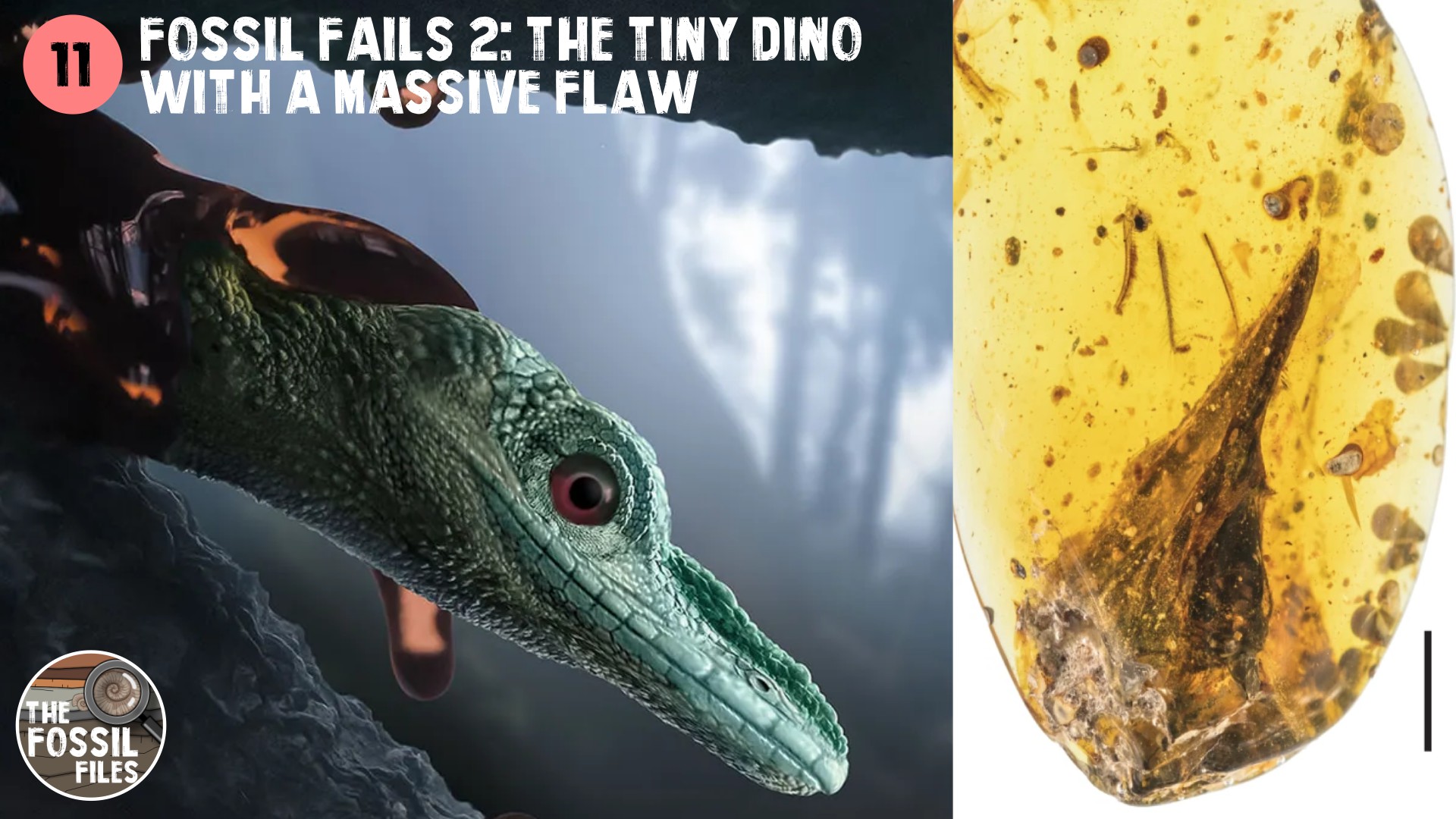 Fossil Fails: The tiny dino with a massive flaw Fossil Fails: The tiny dino with a massive flaw | Discovery of the smallest ever dinosaur acheived quite a splash when it was publised on the front cover of Nature in 2020. The new critter, Oculodentavis, was the size of a hummingbird and reconstructed as close to Archaeopteryx on the lineage to birds. In this episode, Susie and Rob take a look at how this story quickly started to unravel as it turned out Oculodentavis might been something else altogether. This how episode also shed some light on a dark underbelly of an ethical problem for palaeontologists - what if your fossils are coming from a war zone and potentially funding ethic violence? The main paper discussed this week is by Lida Xing and Jingmai O'Connor and colleagues "Hummingbird-sized dinosaur from the Cretaceous period of Myanmar" published in Nature in 2020, now retracted (https://doi.org/10.1038/s41586-020-2068-4). A brief accessible summary of what happened afterwards can be found here by Krister Smith in Current Biology "It's a bird, it's a plane, it's Oculudentavis!" (https://doi.org/10.1016/j.cub.2021.06.017). A summary of the situation with Myanmar amber fossils including discussion of the paper by Emma Dunne and colleagues can be found in Science "Violent conflict in Myanmar linked to boom in fossil amber research, study claims" by Rodrigo Pérez Ortega (doi:10.1126/science.adf0973) Wide screen palaeoart by Stephanie Abramowicz. | — | ||||||
| 9/23/25 | Fossil Fails: A Precambrian beehive and dinosaurs on the moon | In the first of two episodes on notorious fossil fails, Rob and Susie take a look at how a serious case of mistaken identify unfolded for some Ediacaran 'fossils'. Herein lies a cautionary tail for all relating to pareidolia: our very human tendency to perceive patterns in random shapes and lines, or why we might see jesus is a piece of toast or a smiley face in a cut pepper. This takes us to unexpected destination for hunting for dinosaur fossils: the moon! Image 1: A look at some 'Ediacaran fossils' from the Bhimbetka cave in India and some other structures found there. Image 2: "Fossilised embryo of a dinosaur inside the egg on the moon". Yes you read that right. The main papers discussed this week is by Greg Retallack and colleagues "Dickinsonia discovered in India and late Ediacaran biogeography" published in Gondwana Research in 2021 (https://doi.org/10.1016/j.gr.2020.11.008) with follow up articles by Joseph Meert and colleagues "Stinging News: 'Dickinsonia' discovered in the Upper Vindhyan of India not worth the buzz" published in Gondwana Research in 2023 (https://doi.org/10.1016/j.gr.2023.01.003) and SK Pandey and colleagues "Dickinsonia tenuis reported by Retallack et al. 2021 is not a fossil, instead an impression of an extant 'fallen beehive'" published in 2023 in the Journal of the Geological Society of India (https://doi.org/10.1007/s12594-023-2312-2). The final paper is by Hari Mohan Saxena and Jagmohan Saxena "Dinosaur eggs with fossilized embryos on the moon" 'published' in the New York Science Journal (http://www.dx.doi.org/10.7537/marsnys160823.030). Wide screen Ediacaran image by John Sibbeck. | — | ||||||
| 9/8/25 | The Spicomellus Special | Perhaps the weirdest dinosaur ever has just been described in Nature, by The Fossil Files' own Susie Maidment. In a worldwide EXCLUSIVE*, Susie gives as the unvarnshed truth about how this spikey Jurassic weirdo came to be found, what makes it different, and peek under the hood as to how palaeontological research like this is conducted. The story weaves in the local and scientific communities in Morroco, funding crises, a global pandemic, dodgy fossil collectors, international law, and a lot of hard work. The paper is "Extreme armour in the world's oldest ankylosaur" by Susannah Maidment and colleagues, published in Nature August 27th, 2025. https://doi.org/10.1038/s41586-025-09453-6 *Not exclusive Widescreen artwork: Matthew Dempsey | — | ||||||
| 9/2/25 | Mirasaura, Triassic Punk | This new discovery is WEIRD. Mirasaura (the 'marvellous lizard') has been described from the Triassic of France, and it has mad projections coming out of its back, far longer than its body. We take a look at what these projections were, and were not (i.e. not feathers), their implications for the evolution of integumentary structures, and our own historically bad haircuts. The paper is "Triassic diapsid shows early diversification of skin appendages in reptiles" by Stephan Spiekman and colleagues, published in Nature in July 2025. https://doi.org/10.1038/s41586-025-09167-9 Wide screen art: Gabriel Ugueto | — | ||||||
| 8/25/25 | 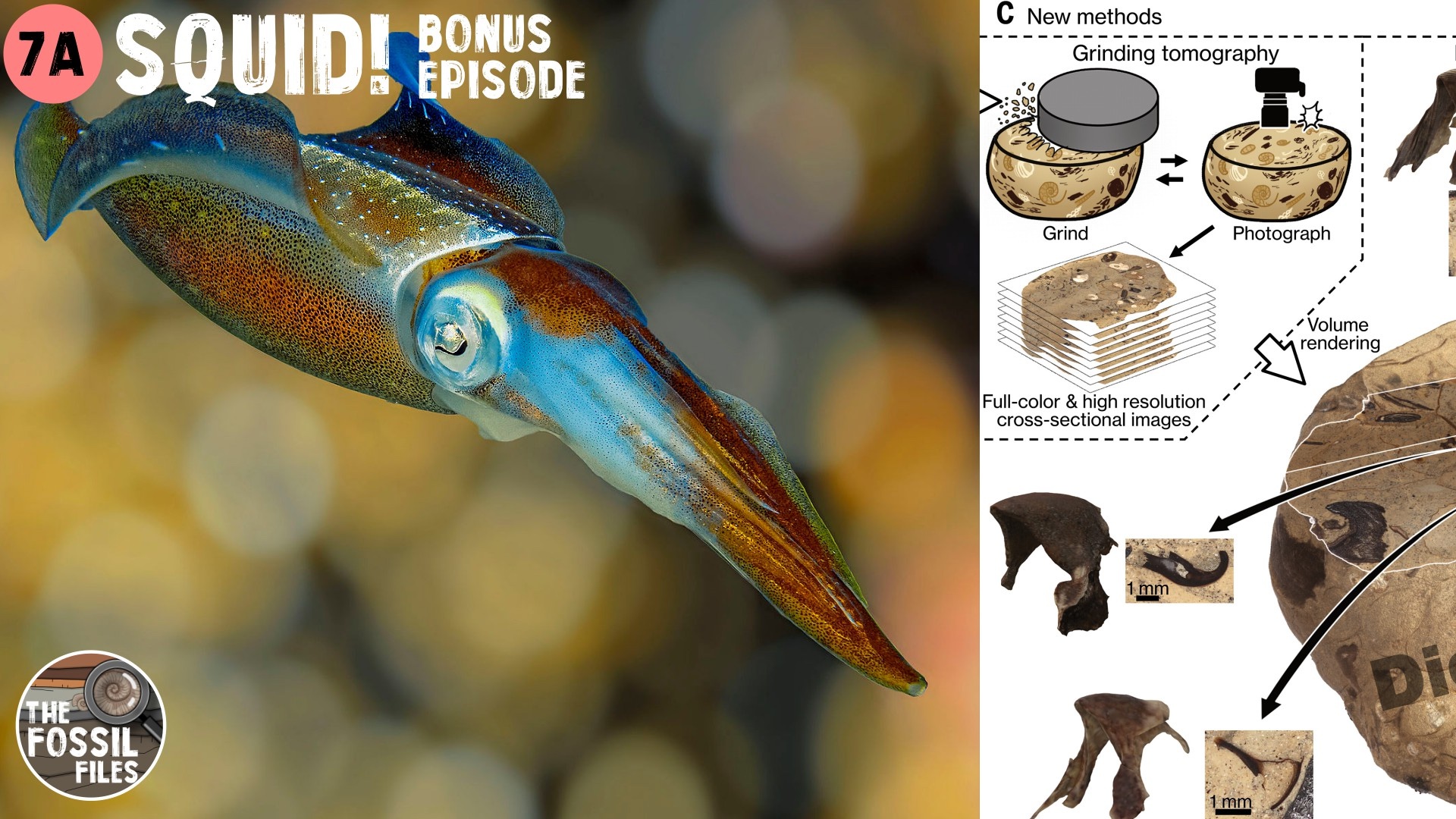 SQUID! (bonus episode) SQUID! (bonus episode) | Squid are a really important part of marine ecosystems, but their fossil record is close to non-existent - their squishy bodies are just really unlikely to be fossilised. In this short bonus episode we take a new look at the squid fossil record. 'Digital fossil mining' reveals a massive diversity of squid in Creataceous oceans. How did the scientists do it and what does this mean? The paper is "Origin and radiation of squids revealed by digital fossil-mining" by Shin Ikegami and colleagues of Hokkaido University, Japan. https://doi.org/10.1126/science.adu6248 | — | ||||||
| 8/19/25 | Our deep origins and the vertebrate that wasn't | The origin of our own group, the vertebrates, has received quite the shake up. One of the important fossil players has been found to be an invertebrate imposter, and this completely changes our understanding of this evolutionary episode. We take a look at why and when, and how this boils to down to a interesting question all about teeth. Did our entire skeleton come from teeth on the outside of our bodies, even before jaws existed? Is this why we now get tooth ache? The paper is "The origin of vertebrate teeth and evolution of sensory exoskeletons" by Yara Haridy and colleagues, published in Nature in May 2025. https://doi.org/10.1038/s41586-025-08944-w Wide screen art: Brian Engh. | — | ||||||
| 8/5/25 | Where did Pterosaurs come from? | Pterosaurs dominated Mesozoic skies but it has always been a mystery where these flying reptiles came from. This week Susie and Rob discuss Pterosaur controveries and a cool new study that attempts to solve the problem of where and how they originated. How can you do this? By looking at the climate and locations of where pterosaurs lived and their closest relatives - the weird looking lagerpetids -, we can make predictions about how pterosaurs lived, thrived, and died. And maybe even where we should be looking for them... Figure 4 from paper shows the authors predictions where in the Triassic world would have the right climate for Pterosaurs to live (left column) and Lagerpetids to live (right column). The paper is "Climate drivers and palaeobiogeography of lagerpetids and early pterosaurs" published by Davide Foffa and colleauges in Nature Ecology and Evolution, June 2025. https://doi.org/10.1038/s41559-025-02767-8 Widescreen artwork: Gabriel Ugueto | — | ||||||
| 7/22/25 | Were Neanderthals the first fossil collectors? | Why do we collect fossils and who were the first fossil collectors? Cretaceious fossils have been found in a cave in Northern Spain alongside the Neanderthals that were living there 46,000 years ago. Were Neanderthals collecting fossils and if so why? This week Susie and Rob examine those claims and discuss fossil collecting and the recent surge in private trade in dinosaur fossils. Because we are children, we also giggle at possibly one of the earliest fossils collected, the Erfoud Manuport as well as the Makapansgat pebble. The paper is "Were Neanderthals the First Collectors? First Evidence Recovered in Level 4 of the Prado Vargas Cave, Cornejo, Burgos and Spain" by Marta Navazo Ruiz and colleagues from the University of Burgos. https://doi.org/10.3390/quat7040049 We also go on to discuss the Stegosaur fossil Apex sold, purchased and loaned to the American Museum of Natural History (AMNH) and the sale of a Ceratosaurus fossil by Utah's Museum of Ancient life. | — | ||||||
| 7/9/25 | Walking with… our Carboniferous ancestors in the rain | Our evolutionary timeline just leapt back an additional 40 million years into the past. Some new fossil trackways from the early Carboniferous of Australia have been interpreted as the first bone-fide "amniotes". This is the group of egg laying vertebrates which we belong to along, with all the other mammals, birds, and reptiles. These fossils are much earlier than previously thought possible and potentially turns our understanding of this event on its head. We take a look at these fossils and the implications, in particular that there could be loads of missing things out there yet to be found, including our own ancestors and distant relatives. Figure from the study showing the fossil footprints slab, with details of fingers/toes and claws scrapping along the surface, and fossil rain drops. The paper is "Earliest amniote tracks recalibrate the timeline of tetrapod evolution" by John Long and colleagues, published in Nature in May 2025. https://doi.org/10.1038/s41586-025-08884-5 Widescreen artwork: Marcin Ambrozik.. | — | ||||||
| 7/1/25 | Is de-extinction a scam? | Can we bring extinct organisms back to life? Colossal Biosciences caused quite the stir earlier this year when claimed they could do just that, and indeed have done with Dire Wolves - an extinct species of candid from North America. What is going on here? We sense check those claims and ask what they did (and did not do) as well as the broader implications of the science (pseudoscience?) of de-extinction. The front cover of "Time" magazine - no ambiguity here about what they are saying. Here is the phylogeny (evolutionary tree) from the paper. Dire wolves have a long branch arising from a point between Jackal/Dog/Dhole/Wolf on the one side and Bush Dog/Maned wolf on the other side. There was a lot of press about this work, but the paper it comes from is a pre-print "On the ancestry and evolution of the extinct dire wolf" uploaded to BioRxiv in April 2025 by Gregory Gedman and Beth Shapiro of Colossal Biosciences, and colleagues, including George R. R. Martin (!). Update: the 3 individuals are not technically clones but genetically manipulated grey wolves https://doi.org/10.1101/2025.04.09.647074 Widescreen artwork: Colossal Biosciences | — | ||||||
| 6/24/25 | Dinosaur poos from Poland | How did dinosaurs rise to supremacy? This difficult question is given "fresh" insights from new data from a motherload of fossils from Poland. Over 500 bromalites - fossil vomit, gut contents or poo - were analysed with new technology allowing reconstruction of how diets and ecosystems changed over this crucial time. We take a look at some of these fossils and interpretations and speculate about how to experimentally test these smelly findings. Figure 2: A selection of fossils found inside the bromalites (gut contents, vomit, and poos) from the paper. a - fish scales in a lungfish bromalite, b - teeth and bones with bite marks including a dicyndont in an archosaur bromalite , c - crocodylomorph bones in a theropod bromalite, d- several whole beetles in an early dinosaur bromalite, f - plant fossils including ferns from inside bromalites, g - fish inside a phytosaur coprolite, h and i - fragmented plants. Figure 3: The authors interpretations of the foodwebs and ecosystems changing during the Triassic. The paper is "Digestive contents and food webs record the advent of dinosaur supremacy" by Martin Qvarnström from Uppala University and colleagues from Poland, published in Nature.. https://doi.org/10.1038/s41586-024-08265-4 | — | ||||||
| 6/13/25 | How does your plesiosaur swim? | For our first paper, we look at some exceptional preservation of soft tissue in Jurassic plesiosaur (large marine reptiles). Detailed preservation of soft tissues to the sub-cellular level is very rare in the fossil record. We discuss this specific example from Germany (which we name Nigel) and the types of analyses that the authors did of its skin and tissues. This new data helps us reconstruct how plesiosaurs may have lived and moved. Or does it? In this figure from the paper we can see the whole fossil of Nigel (A), a close up of the preserved skin (B and C), and a cross section of the sub-cellular detail from the fossil skin (D and E) compared with skin cells from a modern turtle (F). The paper is "Skin, scales, and cells in a Jurassic plesiosaur" published in Current Biology in 2025 by Miguel Marx of Lund Univertsity Sweden, and colleages. https://doi.org/10.1016/j.cub.2025.01.001 Widescreen artwork: Joshua Knüppe | — | ||||||
| 6/13/25 |  Introducing the Fossil Files Introducing the Fossil Files | In "The Fossil Files", a pair of palaeontologists delve into the latest discoveries from the world of palaeontology and seek to bring fossils to back to life. Each episode, Susie and Rob will discuss an interesting new research paper ranging from topics of what dinosaurs ate, how plesiosaurs swam, where we came from, and the science of de-extinction. Whilst doing so, we peek under the hood of how the science of palaeontology is done and how research gets to see the light of day. It is accessible to all those interested in palaeontology whether that is students, researchers themselves, or simply the fossil-curious - we laugh as we learn, and hope you will too. In this trailer we introduce "The Fossil Files" explaining a bit about our approach and our background. In our day jobs, Susannah Maidment (Natural History of London) conducts museum work and fieldwork to reconstruct dinosaur anatomy, evolution and ecology and Robert Sansom (University of Manchester) undertakes fossil and lab analyses to reconstruct early vertebrates, evolutionary relationships and how fossils are formed. | — | ||||||
Showing 25 of 25
Sponsor Intelligence
Sign in to see which brands sponsor this podcast, their ad offers, and promo codes.
Chart Positions
7 placements across 7 markets.
Chart Positions
7 placements across 7 markets.