
Insights from recent episode analysis
Audience Interest
Podcast Focus
Publishing Consistency
Platform Reach
Insights are generated by CastFox AI using publicly available data, episode content, and proprietary models.
Total monthly reach
Estimated from 1 chart position in 1 market.
By chart position
- 🇦🇹AT · Games#107500 to 3K
- Per-Episode Audience
Est. listeners per new episode within ~30 days
250 to 1.5K🎙 Weekly cadence·66 episodes·Last published 5mo ago - Monthly Reach
Unique listeners across all episodes (30 days)
500 to 3K🇦🇹100% - Active Followers
Loyal subscribers who consistently listen
150 to 900
Market Insights
Platform Distribution
Reach across major podcast platforms, updated hourly
Total Followers
—
Total Plays
—
Total Reviews
—
* Data sourced directly from platform APIs and aggregated hourly across all major podcast directories.
On the show
Recent episodes
Episode 36: The Reminiscences of Paulis Longvale (Part 2)
Dec 11, 2025
Unknown duration
Glorantha Initiation: Benjamin, Podcasts, Wikis, and Looking for the One Truth
Oct 27, 2025
Unknown duration
Episode 35: Secrets of Dorastor
May 23, 2025
Unknown duration
Episode 34: The Reminiscences of Paulis Longvale (Part 1)
Apr 16, 2025
Unknown duration
Episode 33: The House Rules of Sandheart
Dec 31, 2024
Unknown duration
Social Links & Contact
Official channels & resources
Official Website
Login
RSS Feed
Login
| Date | Episode | Description | Length | ||||||
|---|---|---|---|---|---|---|---|---|---|
| 12/11/25 |  Episode 36: The Reminiscences of Paulis Longvale (Part 2) | Our Guest We welcome once again Austin Conrad to the show! His website is Akhelas Get Treasures of Glorantha: Volume 2, one of the finest books on the Jonstown Compendium! (which we talked about in episode 31) Austin hopes to be “done soon” with his upcoming “Wolves of the Wild Hunt” book… that was a couple months ago and it’s not done yet The book will include slightly remastered previous materials such as The Quacken, and The Queen’s Star, plus new stuff about Gagarthi monsters! Show Notes Things that happened in this episode: Joerg reminds us what the Reminiscences of Paulis Longvale are… Listen to episode 34 if you haven’t already! Cults of Terror is “the gamemaster’s best friend” Also listen to episode 35 with Simon Phipp, specialist of Dorastor! Yes, YOU too can play a Thanatar cultist! Ludo summarizes the previous episode’s story Austin mentions the old Dorastor book, plus gives another shout out to Simon Phipp’s books Ludo goes on a short tangent about the name “Bilini” Austin lays down another argument about the Orlanthi really being Vikings We discuss the various motivations of the characters regarding Chaos, Dorastor, and the Lunar Empire Ludo has made a spreadsheet! He tries to figure out what are the chances of the Bilini king’s army against Razalkark’s army How cute are baby broos? Or baby Scorpion Men? Apparently Diana Probst has one of those in Stone and Bone, go check it out! We talk about battle tactics and “broo walls” How the hell do you recreate this story using RQ rules? Should we play using HeroQuest/QuestWorlds? (again) The phalanx rules suck? Is dual wielding better than using a shield? (We fumble around the convoluted RQG dual wielding rules) Rules terms inside the narrative text… what to make of it? Would you abstract the things we see in this story to “just a few rolls” in RuneQuest? Austin is being an asshole (his words! not mine!) How much plunder do you get from Chaos creatures? Giving a “personal touch” to plunder and gifts… or just add some jewels! Reselling gifts to buy actually useful stuff, like skills and spells! “WHERE IS MY MONEY?” and other things players say Ancient cultures versus transactional cultures Ea-Nasir name drop! Storm Bull cultists as a biker gang Austin mentions “A Short Detour” and the way we tried writing Chaos cultists as nuanced people Are Illuminates crazy assholes? Or are they people with feelings? Uleria is more powerful and bad-ass than we give her credit for Body horror with Uleria! Play Limbo! Austin has more conspiracy theories about the Celestial Court on his website! Vampires in Dorastor… do they have enough to eat? World of Darkness vampires vs Dresden Files vampires (also, Ludo mixes up Dresden Files and Laundry Files) Austin’s Harrek campaign, and the shenanigans the PCs are up to Give player characters cool or embarrassing epithets! The interesting framing of a Chaos-based narrative with a Lunar perspective Telmori vampires! Or vampires feeding on Telmori! Maybe both! The lost power of RQ2 vampires that can steal Rune magic when feeding off someone Rituals to get your magic items to trust you Fear mechanics in RuneQuest? There’s a difference between improvising and off-the-rails-improvising! RQ2 silver magic collars… they’re in every RQ2 story How do you keep prisoners? Suspicious tricksters! (aren’t they always?) Joerg tells us about Jojo The Bobo. Also, Bugs Bunny and the Puppeteer Troupe “We’re in Dorastor, but we’re getting…. human drama???!” Credits The intro music is “The Warbird” by Try-Tachion. Other music includes “Cinder and Smoke” and “Skyspeak“, along with audio from the FreeSound library. | — | ||||||
| 10/27/25 | Glorantha Initiation: Benjamin, Podcasts, Wikis, and Looking for the One Truth | We are back with a long overdue Glorantha Initiation interview featuring twice the amount of French accents! We talked to Benjamin, aka Dasfynx, who is the webmaster of the (French) RuneQuest Wiki, and co-hosts the (also French) “Runecast” podcast with Gianni Vacca. Le Wiki du JDR RuneQuest Le Runecast (you can of course find it on Apple Podcasts, Spotify, or on whatever app you use to listen to podcasts!) Show Notes Here are the things we talk about in this episode! Ben’s podcast “Runecast” This is one of the three known “talk show” podcasts about Glorantha right now, the other one being the Finnish Dayzatarin tähtien alla (“Under the stars of Dayzatar”) Ben also runs the French RQWiki which started as a translation of Chaosium’s wiki. It started as just figuring out what tech was powering Chaosium’s website Then it was a small translation for Ben’s players And then other fans joined the effort… there are now extra things compared to the Chaosium version Any extra material on the wiki that is from the published material is reproduced with the approval of Studio Deadcrows, the French publisher for RQG Watching old adventure/sci-fi movies on VHS, and being pitched the Warhammer Fantasy RPG (WFRP) as similar to those movies Ben’s first purchased RPG books were from the Call of Cthulhu and World of Darkness lines, but we was busy playing sports and listening to rap, so he read the books but didn’t play them! This may be called “lonely fun” Only years after that one WFRP game did Ben finally find another gaming group playing the WEG Star Wars RPG Ben offered to GM Call of Cthulhu after that, which lasted for a handful of years, going through the Spawn of Azathoth campaign You too can learn geography and history by GMing Call of Cthulhu! It’s hard to find English or French RPG books while living in China, so Ben loaded up on many books whenever he would come home As a Roliste TV watcher (YouTube channel here), Ben learned that one host (Mathieu) is a big fan of RuneQuest, so Ben bought the latest edition… and didn’t like it! This is because the world wasn’t described enough for Ben to picture, so he bought the Glorantha Sourcebook… and didn’t like it either! Too many names and lists of things! It was the Bestiary that made Ben “get it”: each “monster” is actually coming from somewhere and have their place After that, Ben was deep into Glorantha and started reading more and more books about it Glorantha: a steep curve followed by a rabbit hole! Books are expensive so Ben got Gianni Vacca to explain things to him for free! Gianni is Ben’s co-host on the Runecast podcast Gianni is Ben’s Joerg, an old hands of Glorantha… actually even older than Joerg, since Gianni started with RQ2! Ben’s wiki and podcast are geared towards beginners Favourite thing about Glorantha: Dorastor, to make players suffer! See Simon Phipp’s “Secrets of Dorastor” (and other related books), and his interview episode on the show Sartar, because it’s an interesting place Next on Ben’s reading list are the Red Cow campaign books (book 1 and book 2) See also Ian Cooper’s Questworlds interview on the show Things Ben doesn’t like: the gray areas, because he likes to feel like he understands everything Ben asks Joerg what is the nature of the great compromise? Joerg explains how gods can break the compromise and act in Time We talk about avatars of gods also manifesting gods enough to endanger the Compromise, and how Chaos allows gods to get involved in Time Greg’s narrative framework of writing “in world” texts that give contradictory views and accounts The annoyance of “no answers” vs “multiple answers” King of Sartar is… a dense and complicated book GMing the French campaign “Children of the Flame” (Gianni is an author on it) This campaign helped show Ben what is possible in Glorantha It’s about the Dundealos tribe, near Swenville, after they have been replaced by the Lunar Entalos tribe… until the Dragonrise gives an opportunity to retake their lands Faction play, with various tribes, the Lunars, etc. There’s a map of Swenville! A good way to start in Glorantha is a good example: a scenario, a campaign, etc. The Sourcebook isn’t a good idea for beginners The GM pack or a campaign are better! (classic RQ2 campaigns, or newer ones from the Jonstown Compendium) Basically, start small! The French edition of RQG has one scenario in the rulebook, and one in the bestiary… something the English edition is lacking! Ludo briefly talks about his similarly failed encounters with Glorantha Ben reiterates how Glorantha is consistently deep and how he loves that about it Ben started just with the books for a while, but later discovered there are so many things about Glorantha on the internet! Shout-out to 7Tigers, who translates all the news and Well of Daliath content to French Also shout-out to Olivier from “Les Fils du Chaos” for helping correct the French RQWiki And shout-out to everybody else helping in their own way Ben asks Joerg about the Sky World and Joerg obliges! Ludo adds his take about the multi-shaped Sky World Ben still wants one final answer on everything! Joerg mentions the “blind men touching the elephant” tale, and Ben wants to see the elephant, not be one of the blend men We devolve into Jungian archetypes, and other tangents… We end with some quick-fire questions… Ben loves ducks! Credits The intro music is “Dancing Tiger” by Damscray. The outro music is “Islam Dream” by Serge Quadrado. Other audio is from the FreeSound library. | — | ||||||
| 5/23/25 | Episode 35: Secrets of Dorastor | Our Guest Our guest this episode is Simon Phipp, author of Secrets of Dorastor, Secrets of Heroquesting, and author or contributor on many, many other books. Joerg sadly isn’t present this time: he was stuck on a highway somewhere in Germany waiting for auto-assistance. Show Notes Here are some various things we talk about in this episode: Getting started playing in Glorantha in 1982… which sounds like 15 years ago but apparently is a lot longer ago RuneQuest 2 (with Cults of Prax) was Simon’s first game Bud (from Bud’s RPG Review) recently said that it’s like being born with a silver spoon in your mouth Watching “World of Sports” and reading “The Iliad” as a kid… as one does Simon loves RQ2 for its scale and the visceral feeling you get from playing it Playing in Dorastor because it was nasty and unmapped in the early 80s The only source was the Paulis Longvale narrative from Cults of Terror Other GMs in Simon’s gaming circles were already playing in the “usual places” (Sartar, Prax, Pavis & The Big Rubble) We started our series on Paulis Longvale last episode! Running a Star Trek-like episodic campaign in and out of Dorastor, starting around 1985 Later, during the RuneQuest 3 era, Dorastor: Land of Doom was released Simon’s players accused him of knowing about the upcoming book’s contents! The pros & cons of playing in the vaguely defined Glorantha of the 80s vs the encyclopedic Glorantha of the 2010s The Dorastor: Land of Doom’s warning on the back cover is factually accurate… if you consider Simon, as a GM, as a big and ugly thing! Come to the Risklands! It’s great! The Chaos Nests of Genertela. They’re great too! Simon’s Dorastor has multiple Chaos Nests In his campaign, Simon’s players killed Razalkark, the king of the Broos, and occupied his fort… and then things got worse Chaotic True Dragons are apparently a bad thing? Simon tells us the story of Dorastor, including his own interpretation of the whole Nysalor/Gbaji/Arkat thing You may remember we discussed some of this with Bud in a previous episode Dorastor is filled with lots and lots of bad monsters! How do you get your players to go there? Simon’s Dorastor is a bit more nuanced than just “a place to kill monsters”: you can create alliances, do trade, and so on Simon gets bored to tears watching the Gloranthan metaplot unfold, with NPCs doing all the cool things HeroWars was very guilty of this Dorastor is so far away from Dragon Pass that we don’t care what Argrath is doing! Simon’s books contain many, many scenarios for Dorastor, plus many adventure seeds There are several layers to Dorastor: Go in, fight Chaos, come out (if you succeed enough times, become a Dorastor guide!) Interact with the big personalities of Dorastor (meet the Spider Queen, she’s great!) Storm Bull initiates must learn to prioritize Humakti broos! Dorastor ducks! Giant vampires! Relationship with the neighbours Don’t forget not all cults hate Chaos Simon likes messing with his players’ heads Chaotic people: they’re not as bad as you think? But watch out, you might quickly end up worshipping Thanatar if you don’t pay attention to Simon’s evil schemes Finding lost or secret things in Dorastor What makes heroes? Super-RuneQuest! and other high-level character stats… The most useless magic item ever… until it breaks your scenario! The problem of long running campaigns Acid! Poison! Ash elementals! Bathing in gorps! Ludo discovers that Cacodemon got Vomit Acid in RuneQuest 3 Fun with Chaos Features! Simon’s best anecdote: basilisks and mirrors! Designing encounter locations It’s not the GM’s job to know the solutions, it’s their job to setup problems Hair and fingernail elementals! Illumination in Dorastor: break the rules, become good, become evil? Come to Dorastor, it’s lovely, and you can become heroes! Credits The intro music is “The Warbird” by Try-Tachion. Other music includes “Cinder and Smoke” and “Skyspeak“, along with audio from the FreeSound library. | — | ||||||
| 4/16/25 | Episode 34: The Reminiscences of Paulis Longvale (Part 1) | After too long a hiatus, we are finally back! Well, almost, because Ludo is an idiot and got the time zones wrong while setting up the recording, so Joerg shows up a bit later. Ludo apologizes for messing that up but hey, this is an episode about Chaos, so… Our Guest We welcome once again Austin Conrad to the show! His website is Akhelas Get Treasures of Glorantha: Volume 2, one of the finest books on the Jonstown Compendium! We actually talked about that book, and magical items in general, for episode 31 Austin’s ghost was summoned during our more recent episode on RuneQuest house rules Show Notes In this episode we chat about things like: Cult of Terror (RQ2, 1981) You can get it as a POD reprint or in PDF from Chaosium Dorastor: Land of Doom (RQ3, 1993) The Cults of Runequest sourcebooks (available here from Chaosium) Shadows on the Borderlands (RQ3, 1993) The first time the Gloranthan cosmology and history is presented in one text Worshipping Mallia as a non-Chaos deity, in a propitiatory way King of Dragon Pass RuneQuest Warlords Razalkark, the King of the Broos, and a “good boy” Cults of Prax (RQ2, 1979) and the tribulations of Biturian Varosh Our episode series on Biturian Varosh started back when we were the “Wind Words” podcast, and continued with guest Drew Baker early in the God Learners podcast The four philosophies and magic forms of Glorantha… plus a few more! Add you own! The usual suspects: the Guide to Glorantha, the Glorantha Sourcebook, and the Mythology book The entire cosmology and history of Glorantha in 10 pages! Boom! Done! Ludo’s favourite RuneQuest cover, by Jennell Jaquays (see the real wrap-around version!) A Gloranthan pronunciation guide! Can YOU pronounce Gloranthan deities’ names correctly? The Prosopaedia The Curse of Thed: it really sucks! Ludo got confused by his notes (“confusing notes” is a Chaotic feature!) “Reverse Chaos” was renamed “Curse of Thed” in RQG Warhammer Fantasy Roleplay features chaos corruption rules that affect the player characters, sometimes willingly We should be playing in Bilini and Dorastor, there’s a lot of fun stuff happening there! Is it Chaos, or Just Very Bad Thing? Simon Phipp’s Secrets of Dorastor and lines of books Our episode on Arkat, with guest Bud from Bud’s RPG Review The big-ass Genertela map Austin is supposedly being “very polite” in Ludo’s game about NOT becoming an assassin. Spoiler: a month later, Austin did in fact murder a long-standing NPC and initiated into the Eurmal Murderer cult… Wesley Crusher Ragnar Lodbrok and the TV show “Vikings” The Orlanthi as Vikings vs the Orlanthi as ancient Greeks Want to make your players go on a quest? Loan them magical items! The Lightbringers Summons and forcing it on your players Chaos as organized crime Mallia and pandemics… too soon, Joerg! Shenanigans with disease spirits! Dealing with trickster player characters… Scorpion Men: the other iconic Gloranthan bad guys? Beer With Teeth’s Stone and Bone 13th Age Glorantha‘s Scorpion Men illustrations Gagyx Two-Barb, Scorpion Queen The Footprint, another place of Chaos Food and water are tainted! Roll to find safe things to consume, or pack them! Making your own funky diseases Using the table of troll drink effects from Trollpak (RQ2, 1982) Differences in Chaos curses between RQ2 and RQG Paranoia in players, and nasty Chaotic features Xenohealing, the spell nobody misses, apparently Hashtag Not All Chaos! Adapting a combat scene environment to the baddies’ abilities… For instance: Scorpion Men can climb very well! Austin’s correct answer to Scorpion Men is “don’t” Milking Scorpion Men…. uugggh The players are always the baddies! Credits The intro music is “The Warbird” by Try-Tachion. Other music includes “Cinder and Smoke” and “Skyspeak“, along with audio from the FreeSound library. | — | ||||||
| 12/31/24 | 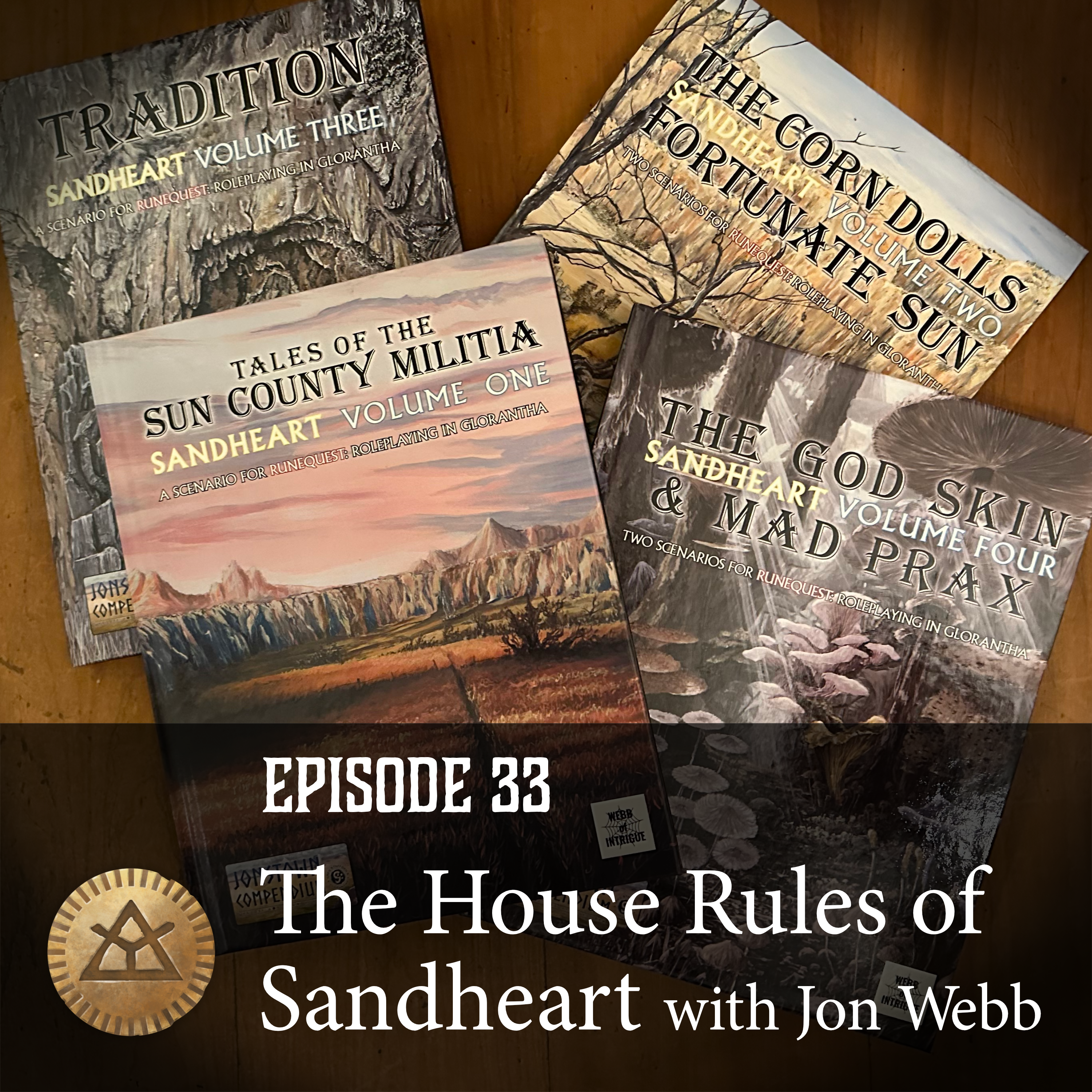 Episode 33: The House Rules of Sandheart | We said we were back from our summer break with episode 32, but we lied! Joerg’s laptop died and he was busy growing a moustache, and Ludo was ridiculously busy with work. Either way, we are back again, just in time for the end of the year! Our Guest This time we welcome Jon Webb again, who appeared on our show back in episode 6 along with Neil Gibson. Jon is of course the wonderful author of the equally wonderful “Sandheart” series of scenarios: Sandheart Volume 1: Tales of the Sun County Militia Sandheart Volume 2: The Corn Dolls & Fortunate Sun Sandheart Volume 3: Tradition Sandheart Volume 4: The God Skin & Mad Prax Disclaimer: the above links are affiliate links of course (please use them to support the show!) The Making of Sandheart Our first topic is the Sandheart series of scenarios (see links above) which, although they have been written and published a long time ago, we had not covered on the show before… better late than never! We chat with Jon about how Sandheart came to be, the strength of its campaign framework, moral choices, “street-level” adventures, designing problems for which you don’t know the solution, culture clashes between characters, custom heroquesting rules, and more. If you haven’t read or played Sandheart, there shouldn’t be any spoilers for you — only titillating previews of the sort of fun you can expect therein. Note that if you don’t plan on getting all four volumes of the series, we recommend getting volumes 1 and 3. The reason for this is that volume 3 is a scenario that spans multiple years, as the adventurers are tasked with guard duty for a recurring ritual. Getting volume 3 early will let you weave the first couple occurrences of the ritual into the first few adventures. House Rules and Custom Systems In the second and larger half of the episode, we exchange all kinds of ideas about tweaking and extending the RuneQuest rules. Among the things we talk about, in no particular order: Picking rules from different editions of RuneQuest Hit Points formulas Initiative systems and Strike Ranks Sorcery rules Experience checks and experience gain Resolving ties Failing Forward Combat effects and aiming at hit locations Custom hit location tables Shields Granularity of rules per activity Gritty tactical combat vs heroic scenes Average skill scores vs heroic skill scores Fighting styles and converting to other weapons Group rolls Adopting rules from Call of Cthulhu 7th Edition Chaotic corruption! Lingering emotions Caravan trading rules Going into a rabbit hole of research and math, and finding what a mechanic should be about Keeping custom mechanics into the “spirit” of the main system Post-coital pillow talk rules We also mention: Ludovic’s own adventure, “A Short Detour” Mythras Troika Dragonbane Warhammer Fantasy Roleplay Traveller Alien RPG Credits The intro music is “The Warbird” by Try-Tachion. Other music includes “Cinder and Smoke” and “Skyspeak“, along with audio from the FreeSound library. | — | ||||||
| 8/28/24 | Episode 32: The Lunar Way | Our Guests In this episode we welcome returning guests Evan Franke and J-M DeFoggi (who had to leave early because of Imperial Administration requirements). You would of course know Evan and J-M from our previous episodes with them: Chaos Rises! (episode 26 about 13th Age Glorantha) and Jackals and Ancient Worldbuilding (episode 19 about J-M’s Bronze Age fantasy adventure game, Jackals!) Our guests are also found in these fine places: The Exploring Glorantha Series on YouTube Lots of Iconic Production endeavours, including YouTube and Patreon. As we release this episode, Evan’s Red Moon and Warring Kingdoms is officially out! Go grab it now, it’s FREE! Show Notes Things we mention during this episode, in vague chronological order, include: TORG Shadows of Esteren The Arms of Nargash-Tor (for Palladium Fantasy) The Cults of RuneQuest books and, of course, The Lunar Way in particular You can read Ludo’s own reviews of these books here As always, we mention the usual Gloranthan sources: The Glorantha Sourcebook (or in PDF, or on DTRPG) The Guide to Glorantha (or in PDF, or on DTRPG) Our episodes on Furthest and Imther, and their corresponding books: Furthest: Crown Jewel of Tarsh Edge of Empire Are you using The Lunar Way mostly for PCs or NPCs? Themes of a Lunar scenario or campaign Citizens of the Lunar Empire Xena: Warrior Princess featuring many Greek gods The Red Goddess as a guest star in your campaign Glorantha, where everybody’s an Illuminated asshole, and nobody’s the good guy The Empire’s trading, culture, politics, etc. Star Wars Glorantha as a Manichean settings vs a nuanced setting The problem of the “simple” settings of our youth becoming more nuanced as we grow older RIFTS and the Coalition States The X-Men, Magneto, and the Brotherhood of Evil Mutants Memorable Lunar villains The morality of the Lunar Empire The Lunar Empire as a pretty great place to live in, actually There’s no fairness and civil rights in the Bronze Age The Lunar Empire as the Roman Empire The human flaws and administrative weight of the Lunar Empire The Crimson Bat was self-defence! Struggling to show the Lunar Empire as a nuanced faction Using the USA as a model for the Lunar Empire The editorial history of the Lunars in RuneQuest publications White Bear & Red Moon Harrek the Berserk is “not a great guy!” Beatpot Aelrwin Argrath is up to no good, meddling with stuff he shouldn’t Evan is available for rent as a guest Argrath Black Spear, and Nick Brooke’s take on Argrath Alexander The Great Sartar Griffin Mountain and Strangers in Prax Our favourite cults in the Lunar Way The Seven Mothers as the “Justice League cult” The awesomeness of the Crimson Bat cult The Nysalor/Gbaji chapter and its fourth-wall breaking aside Crimson Bat feeders publishing city rankings for their “visits” The demonic cult of Yara Aranis, which is pretty much as bad as the Tusk Riders Maran Gor is bad too! Sheng Seleris, the Gloranthan Ghengis Khan The Carmanian Empire roughly explained Lunar Magic, and how to use it in play Getting the Glowline to fail, so you can land your Stormtroopers and AT-ATs Ghost heist at the Lunar Temple! Harry Potter and the Lunar College of Magic Questworlds and 13th Age Glorantha as alternate game systems for certain campaigns The fine points of Lunar phases There are no physics in Glorantha Dragon Pass is a distraction for the Lunar Empire, which is mostly worried about the Pentans Dart Competitions as a Jason Bourne spy-thriller Credits The intro music is “The Warbird” by Try-Tachion. Other music includes “Cinder and Smoke” and “Skyspeak“, along with audio from the FreeSound library. | — | ||||||
| 6/3/24 | Glorantha Initiation: Amber and Christian, Wolves, Book Problems, and Actual Play | Guests Our guests for this new episode of the Glorantha Initiation series are Christian and Amber, from DMs After Dark! We chatted with them back in… (checks notes) November 2023! How time flies… you can find DMs After Dark in many places around the internet, including: YouTube and Twitch Facebook, Twitter, and Bluesky Amber has written a few things, including some short story in the Monstrous Feminine anthology, and can be found at the West Warwick Public Library where she curates the gaming collection. Christian has written and published several scenarios, including “Zennor & The Sins of St Senara” and “The Night Mother’s Moon“, for Call of Cthulhu, published by Stygian Fox. Show Notes In this episode we talk about, more or less: Luring Amber with promises of playing a werewolf (Telmori) Using Chalana Arroy for luring in the cleric-loving player, and shamans for the player who likes weird characters Animism, the Spirit World, and other gameplay elements that are fairly unique to Glorantha Starting with the Starter Set, then going to the Sourcebook Pacing actual play games, making it feel like sitting at an actual table RuneQuest grognards coming to help with the rules Christian has a “book problem”… Ludo can relate Using Six Seasons in Sartar as a way to start small and get all the PCs together Collaborative storytelling and world-building Reconciling player-created lore with “canon” lore Being mindful of players and the audience when preparing storylines, especially cult initiations leading into mythologies like the Unholy Trio, the Sex Pit, etc. Amber acting as a GM assistant, especially in the early stages of preparation Ludo mentions his short story about Chalana Arroy and Mallia Ducks! Broos! Verisimilitude and/or realism to the Bronze Age and other antiquity history Approaching sensitive topics, and doing editorial work with players to match their comfort levels Casino Town! Cwim! The Crimson Bat! What makes sense in your Glorantha, and what seems out of place Early RQ2 dungeon crawling vs later RQ2 dungeons with ecologies and mythologies Understand the vibe of the system over the rules of the system Mary Renault’s The King Must Die and The Bull From The Sea, as good sources for getting a grasp on the antiquity RuneQuest’s crunchy combat system, with its many moving parts and possible combinations A wild mention of Shadows of Esteren makes Ludo happy! Telmori lore! Of course we mention Brian Duguid’s Children of Hykim (see also our interview episode with Brian) Credits The photo of the red deer used in the title image is by Michael Brace. The intro music is “Dancing Tiger” by Damscray. The outro music is “Islam Dream” by Serge Quadrado. Other audio is from the FreeSound library. | — | ||||||
| 5/3/24 | Episode 31: Treasures of Glorantha | A new episode is out but Joerg still doesn’t have his replacement laptop so there are no detailed show notes again! Our Guest We welcome the ever prolific Austin Conrad back on the show to talk about his new book which is all about magic items. Links to Austin’s stuff: Treasures of Glorantha Volume 2: Relics of the Second Age Treasures of Glorantha Volume 1: Dragon Pass Note that the above are affiliate links — please use them, thank you! You can also get the old Plunder book for RuneQuest 2nd edition in PDF and in POD from Chaosium. Credits The intro music is “The Warbird” by Try-Tachion. Other music includes “Cinder and Smoke” and “Skyspeak“, along with audio from the FreeSound library. | — | ||||||
| 3/18/24 | Episode 30: Questworlds Glorantha | Show Notes Joerg is still without a computer, so not only are there no detailed show notes again, but he’s not here to stop me from giving a clickbaity title to this episode! Because, indeed, we have zero news about a Questworld Glorantha book… if anything, it’s the contrary. But what we do have for you is Ian Cooper as our guest! Ian comes on the podcast to talk to us about the imminently coming Questworlds. We talk about what it is, what it isn’t, how its mechanics work, and what it’s good for. You can find Questworlds’ free SRD here. You can find Ian on Mastodon here, on Bluesky here, and on Twitter here. We also chat about the game’s history as Hero Wars and then HeroQuest (1st and 2nd editions). Ian tells us about his Red Cow campaign books, The Coming Storm and The Eleven Lights, and what happens in the unreleased sequels that he’s played through. We talk about Greg Stafford’s design philosophy and involvement in the early days of the product line, the differences between the other product lines, and more! Of course, it’s not a zero-sum game, so Ian also makes a point that you can play some games with RuneQuest, and some other games with Questworlds… it’s all about the sort of experience you want for a given story. Credits The intro music is “The Warbird” by Try-Tachion. Other music includes “Cinder and Smoke” and “Skyspeak“, along with audio from the FreeSound library. | — | ||||||
| 2/15/24 | Glorantha Initiation: Joel, Theology, and Old-School Video Games Boxes | Photo by David Dunham This time we interview Gloranthan newcomer Joel Bridge, who thinks we’re intimidating but also nice! Joel is originally from New Jersey but currently lives in San Diego. You can find Joel on Discord as @sirjamesfriendofthecolonel, and also sometimes on the Glorantha-related subreddits r/Glorantha and r/RuneQuest. Show Notes Here are things we talk about in this interview! JRPGs like Final Fantasy and Parasite Eve, but also other video games like Metal Gear Solid which ingrained a love of deep lore and complicated narratives in Joel’s mind. Games where mechanics are intertwined with the setting. Finding D&D at a board game cafe in New York and starting playing roleplaying games… this was followed by Vampire: The Masquerade and Vampire: Requiem. Creating a character one way and roleplaying them another way. Playing Don’t Rest Your Head and Unknown Armies. We digress a bit about Unknown Armies’ “One Shots” scenario collection, where Jailbreak and, especially, Fly to Heaven are featured. Life-path character creation systems, especially Traveller’s. King of Dragon Pass, back when it was a game in a box with manuals. We digress again about old school video games that had actual good stuff in the box, not just a DVD, especially one Ludo’s favourite video games ever, the Ultima series (you can get them on GOG). Playing KoDP again later on mobile/tablet to finish it properly. Using the Glorantha wiki to learn more about the lore, mostly by looking at the references mentioned at the bottom of the pages. This led Joel to getting some old RuneQuest and HeroQuest products in PDF before buying the new RuneQuest: Glorantha books. The idea of time and god in theology/philosophy classes. Roughly speaking, gods need to be outside of time to not be subject to change. Joel was interested in the metaphysics of the setting, but the RuneQuest mechanics were intimidating. Joel’s ideal game: KoDP but with an “adventure mode” like in Dwarf Fortress to play members of the tribe. Joerg mentions that he did play games like this with HeroQuest: Glorantha (now Questworlds), which had some rules for handling the clan. We mention the overlap between KoDP and HeroQuest in the person of Robin Laws. Talking about Six Ages and its sequel, we answer questions about heroquesting. Joerg explains it as a “passion play”, and goes into a bit more detail. Joel draws some analogy with his own religious experiences and theological education. Answering more questions about the mythology and cultures of Glorantha (the Red Goddess, Chaos, etc) sends Joel on another philosophical discussion about Platonic ideals, “true evil” as non-existence, and other erudite things. Joerg explains his take on Chaos. Joel and Joerg discuss the different world views and creation myths on Glorantha. Ludo compares the “default” theistic Gloranthan creation myth with Greek mythology, but notes that there are other views. Joerg launches us into the draconic view, and Joel notes the parallels with Hinduism. While we’re at it, Ludo even mentions the Malkioni humanists. Joerg adds more information, and Joel sees it as an interesting mix of many real-world inspirations from all over the map, across many different eras. Of course, Plato’s Republic gets a mention. We talk some more about the Hyalorings that you play in Six Ages. Joel asks about their pedigree, so Joerg is happy to provide him with their story from the God Time to the Second Age. This leads us somehow to talk about Argrath and the Red Moon & White Bear board game. Joel says he would like to get an RPG group going but he hasn’t been able to so far. We talk about the different types of gameplay possible in Glorantha. Asking Joel about what he doesn’t like about Glorantha, he mentions how there’s a lot of material that’s hard to shuffle through. He mentions how Harnworld (another favourite of Ludo’s) also has a lot of material, but is well organized. With Glorantha, you’re “feeling around in the dark”, dealing with many competing systems and titles. Joel says that starting with the video games was good but was just the tip of the iceberg. Joerg recommends the RuneQuest Starter Set, and the usual other books. Joel mentions that he listens to podcasts to get into history and lore — for Earth he regularly follows the History of Rome podcast, the Revolution podcast, and two History of China podcasts. Ludo mentions that he got interested in Earth ancient history after getting into Glorantha. The actual interview actually ran much longer than this episode’s duration, and a lot of it was cut in the editing room. So if you think we’re digressing a lot, believe us, it was even worse. Credits The intro music is “Dancing Tiger” by Damscray. The outro music is “Islam Dream” by Serge Quadrado. Other audio is from the FreeSound library. | — | ||||||
Want analysis for the episodes below?Free for Pro Submit a request, we'll have your selected episodes analyzed within an hour. Free, at no cost to you, for Pro users. | |||||||||
| 1/23/24 | Episode 29: Furthest in Tarsh | Our Guests For this episode, we have Nick Brooke and Simon Bray as our guests to talk about Simon’s book Furthest, Crown Jewel of Lunar Tarsh, and about what goes on in Lunar Tarsh in general. Show Notes There are no fancy show notes for this episode yet: Joerg’s laptop seems to have been blown up by Orlanthi rebels who don’t want the truth to be told… we will edit this post with the final show notes when Joerg has acquired a new laptop. In the meantime, you can go buy Simon’s stuff: Furthest, Crown Jewel of Tarsh (PDF & hardcover) Simon’s Redbubble shop, including the Map of Furthest and the Map of Tarsh. Bonus stuff: Hydra! (PDF) Adventurers from the Lunar Provinces (PDF) Credits The intro music is “The Warbird” by Try-Tachion. Other music includes “Cinder and Smoke” and “Skyspeak“, along with audio from the FreeSound library. | — | ||||||
| 11/25/23 | Episode 28: Gloranthan Free Forms | This episode comes much later than anticipated, but this is Ludo’s fault! Apologies to all. Our Guests In this episode we welcome Kevin Jacklin and David Hall: Kevin has been writing freeform games for a very long time, and table-top role-playing games a little before that, becoming a huge fan of RuneQuest. Kevin names a fateful meeting with our other guest David Hall at a board-gaming convention in the West of England that had a big bearing on what happened afterwards. David Hall started producing a RuneQuest and Glorantha magazine by the name Tales of the Reaching Moon back in 1989. The magazine lasted until 2002 across 20 issues. David was also behind the Reaching Moon Megacorp which produced a number of supporting Gloranthan publications over the same period. Of course the Megacorp was not as massive as the name suggests, it was basically David working part-time out of a very small flat in Slough. Lastly, David was the organizer of the Convulsion game convention from 1992 to 2002, which continues to this day by the name Continuum. And it was at the first Convulsion in 1992 that David and Kevin ran their first freeform, Home of the Bold. Main Topic Ludo admits that he has no experience at all with freeforms but then asks Jörg when he first got into this form of roleplaying. Jörg’s first exposure to freeforms was in the same year he met David for the first time, in 1993 when David visited our annual German RuneQuest convention. While it was not a Gloranthan freeform, it was a Call of Cthulhu freeform which saw Jörg wearing his lab coat chasing after a bird mummy and other stuff. Ludo asked whether there was someone actually dressed as a mummy, but that mummy actually was a prop – a desiccated bird carcass originally wrapped into linen bandages. David sadly did not play in that freeform, as it was German language only, but we (the German RuneQuest society that had been organizing these conventions since 1990) remedied that language problem two years later at our convention near Berlin. The next year Jörg attended the second Convulsion convention in Leicester and had a role to play in How the West Was One, the second of the Reaching Moon Megacorp Gloranthan freeforms. What is a Freeform? David describes a freeform as a microcosm of fantasy roleplaying. Home of the Bold is a fifty player game where each of the fifty players gets a pre-generated character. They get objectives they are trying to meet, they get a list of characters in the game who they are supposed to know, and they get a few abilities and spells to help them get along. Effectively, the cast covers the Lunar administration, the Lunar military, tax collectors, spies, merchants, and on the Sartarite side it includes the city councillors, guilds people, merchants, the local underworld, city constables who look after the local underworld, heralds, and various members of the tribes who are in the city of Boldhome. Altogether a microcosm of the whole of Sartar and the whole of the city, and effectively what happens is that everybody talks to each other. As the directors of the freeform “all we do” is to write the characters, set up the scene, sort of coil the spring, and then just let it go. By the end of the game, the directors will know a lot less about the game than the players will know because they will be living the game and they will work out what’s happening. Kevin adds that it is very much a living thing. To be ultra-precise about it, this is not people sitting around a large table rolling dice, this is a large playing area. People will very often costume for this. It runs over several hours – Home of the Bold in particular is an eight or nine hour game, with a break in there – so it lasts pretty much for the whole of one day of the convention, and people can be caught up in it. That is something that regular table-top roleplaying usually doesn’t do, you can actually become lost in the whole thing. This direct experience is one of the huge benefits of the whole freeform game. Something like that is very taxing to write and organize, which is why you need a convention to support a freeform game. You cannot really run a massive freeform anywhere else. The very first Convulsion had a big freeform game, and David brought Kevin on board because he knew a little bit about them. Kevin’s experience with freeforms originated from a conversation with Sandy Petersen because he had written a Call of Cthulhu scenario. In the late eighties and early nineties Kevin got a chance to visit the Chaosium headquarters because the head offices of his company were situated in the Bay area, too, giving Kevin a really good excuse to go and visit Chaosium and see the folk at work there. A year or two later, Sandy had moved to Microprose on the east coast of the US, and he told Kevin about a group of folks there who had started to write freeform games. This was something that had been going on mainly on the east coast and west coast of the US, something called Interactive Literature., which is in fact live action theatrical roleplaying or freeforms. Sandy had got into a group that included e.g. Lawrence Shick who had written for D&D. The group was called Cruel Hoax, and they were putting on a big freeform in a convention on the east coast, and because Kevin had accumulated lots of air miles, Kevin decided it would be a good idea if he and Dan Steel, a friend of his, flew over to take part in this. The game was called Café Casablanca, effectively a mash-up of all the film noir of the late 1930ies and 40ies including Casablanca of course. Having taken part in this, Kevin thought this was a really cool idea (Details can be found on the Convivium convention website run by Kevin) David knew Kevin, and when Kevin told him about Cafe Casablanca it sounded amazing. David showed off his costumes and everything, and David wanted to have one of those freeforms for the Convulsion convention he was setting up in Leicester for 1992, so they sat down to write one. David says that had they known how much work it was to write a freeform, they might not have started that. Kevin remembers that it was not quite that straightforward – they had to convince the rest of the Convulsion committee that this was a cool thing to do. Because nobody had ever played a freeform, and because they needed how cool they really are, Kevin wrote one which he ran at his house for the committee. That was Adventures of Robin Hood, Kevin asks David whether there exist any pictures of him in tights, which David (quite vehemently) negates. Anyway, the committee seemed to like the concept, and the following year they introduced Home of the Bold to an unsuspecting public at Convulsion. Freeform Plots Ludo falls into his role as the newcomer to this kind of activity, and he asks about what to expect from a freeform. He has some idea about murder mystery games which have a inciting incident – the murder – and then people trying to get behind who did it, and that’s the big resolution. David replies that there are always a number of plots in the freeforms. There are about ten or twenty plots in Home of the Bold, some bigger than others. There are probably murders that need to be solved, heists the underworld is trying to pull, but the main backdrop is the occupation by the Lunar Empire, so there is a big aspect of that. The directors set this thing up, then it all depends on what the players do. There is no such thing as a right ending, but there is a likely ending. Kevin adds that one of the things the directors do put in place is scaffolding which gives players something bigger than themselves to do. So for example there is an election, and it is in the objectives of some of the players to try and get elected, so you have to go around and persuade people, or blackmail them or whatever you want to do to vote for you. There is a chariot race, and there are prizes for people who win the chariot race. You have all of these things that people hang on to that are part of something that is really big, and that’s a cool thing about freeforms. Everybody does have their own objectives, but the trick with writing a character sheet is that if you need to go and find X, there is going to be someone who has got X or who has information how to find X. Every player is the star of their own movie, things are happening to them. If you talk to the lowliest street beggar about what is going on in Home of the Bold, it is going to be the glorious rise of the street beggar, he probably doesn’t care about the Lunar occupation as long as he is getting a bowl of soup at the end of the day. The writers basically provide half a novel for each of the players and give them a bunch of objectives. The really good players are ones that make up more objectives for themselves, which is when things become self-generative. David adds that the writers have another technique. Some player characters get an envelope which is to be opened when there is a life-changing event happening to them. When a certain triggering event happens, their whole objectives may change. There are romance plots as well, you may end up sharing objectives with people who you may not accidentally fall for. There are all sorts of things that can send people off into a different direction. There is one rule though that unless it is into the last hour of the game, you never make it a player’s objective to kill another player character. That is a big no-go in freeforms. Ludo asks whether “except in the last hour” means that there is going to be a big blood-bath. Kevin explains that some people spend weeks and months to prepare their characters for the game. There usually is a good mix of genders attending such a freeform. A lot of players like to do the costuming bits, some might have a different costume for every hour of the game. It is fantastic to see what the players bring to a freeform, it can be one of the satisfactions in preparing such an event. So what you cannot do is tell a character to go and kill character Y, because if you kill that player’s character thirty minutes into the game, that player is going to be terribly annoyed as all their preparation will have been for naught from that point onward. However, a good public death scene is fantastic in a freeform, especially for a baddie, so the general rule is that yes, in the last hour of the game you can actually kill another player’s character. Jörg interjects that there is one way you can kill a player character when there is a villain or victim who needs killing if you tell that to the player of that character beforehand and you provide them with the replacement character from the start. David elaborates that yes, you can play a villain in the game, and often players will sign up for playing a villain in the game because they are fun and have a lot of agency. The thing about villains is that for 95% of the time they are a formidable foe of the heroes who are quite likely a bit incompetent, but in the last five percent of the time they need to fail. All this may entail imprisoning the hero, torturing them, telling them all of their plans, where they are going to be next week, and then the hero escapes, strangely. The game is about creating a maximum game fun environment where the players know who the villains are. The writers use very broad strokes that people know from movies or comics etc. Especially when people aren’t that familiar with the background you need to employ some well-known tropes that people can connect with. Glorantha as a background is a little specialized, and people playing Glorantha games usually know a reasonable amount about it, but the authors try not necessarily to assume that familiarity. You don’t have to be a gloranthaphile to enjoy any of the Gloranthan games Kevin and his friends have written. The character sheet will contain some necessary basic information about the background relevant to the character, and there are also booklets presenting the background of the game to the players that are handed out before the game. With conflicts up to and including killing other player characters, Ludo asks about the actual rules mechanics that are used to resolve conflicts in the game. Kevin observes the more he has written freeforms, the fewer rules he has actually put into the games. There are freeforms where the players actually carry around a little shaker with a die that will be used to resolve conflicts, but that doesn’t work all that well. Kevin’s best advice to players is to actually talk to other players to find a mutual way to resolve the conflict that is actually dramatically satisfying, even (or especially) if one of you loses. If there is no mutual solution, the players get to use stone paper scissors just to get a decision. David adds that a lot of the abilities and spells given to the players are built around that resolution mechanism, which especially in the last hour of the game should be used to get a resolution to their own objectives, too. Taking the example of the chariot race featured in Home of the Bold, there are obviously going to be some rules around that chariot race, allowing people to feel that their skill or their special ability is going to help them to win that event. So there are some specific rules as well as some general rules. Freeform Metagame Ludo asks whether that is also where as the game masters you go around the rooms and help people with that, to which David replies hopefully as little as possible. The directors are always there to help, but they really try not to get involved unless they really have to be. Jörg mentions that the directors tend to cheat a bit about that involvement, assigning some players a role that requires them to go around at certain times and announce a new event or similar. So the player how has the town herald gets the job to make the players aware of things happening. David explains that there are some events in the game that are pre-set. To some extent, all the freeforms set in Glorantha are based on a historical (or prophesied) event in the setting, that tells how the Malani tribe was created and all sorts of things. But being things actually played out by players, the events don’t usually end up like canonical history has them ending. Ludo then asks whether there is a post-game presentation of what everybody in the game was up to. Often there will be a big event at the end, in-game. Actually it is very important to have a debriefing or decompressing session after the game. Sometimes people get really caught up in their game and their character, which can be a very emotional thing, so you need that time to allow people to understand that it wasn’t personal, that it wasn’t the other player doing bad things to you as a person, that it was their character doing stuff to a character whose role you took on. Ludo observes that this can be a general problems at conventions where you play with people you don’t know, so you cannot be sure whether that other player is acting like an asshole because that’s how his character is set up or whether that person actually is an asshole in real life. Kevin stresses the importance of having the opportunity after a freeform to get things off your chest, even if it is only to boast about things you achieved in the game, and talk about some of the plots you were involved in. Often someone will stand up and talk about a plot, and other people will chime in to clarify what actually went on (from their perspective), possibly across the other side of town in their experience of the game. Learning about events that you weren’t directly involved in actually is a nice thing as it gives you the feeling that you were involved in something bigger than your character. Jörg mentions the two after-action write-up collections submitted by a large number of players in the game which were published as fund-raisers at the follow-up conventions and distributed to the contributors. Kevin remembers that to have been a quite hefty bit of work, and they stopped producing those quite quickly. A Few Famous Gloranthan Freeforms Ludo then asks about the freeforms that have been mentioned to him, like Home of the Bold or How the West Was One. David explains that Home of the Bold was set in Boldhome during the Lunar occupation. That is about as much he wants to say at this point in order not to give the plot away. How The West Was One is set in the west of Glorantha, it is about an attempt to bring all the various Malkioni sects together at an ecumenical council with attending people wearing funny hats and working at not having too many crises of faith. These crises of faith had a nice mechanism (involving sealed letters being opened) where people would go off chewing scenery (pretending to whip themselves or other expressions of religious drama) and changing the direction of their characters and their goals. Life of Moonson was set in Glamour. It was about choosing the new mask of the Red Emperor, featuring all the people you would expect in the empire like Jar-eel, Beat-pot Aelwrin, the Batman. Ludo points out that that is the freeform that is available on the Jonstown Compendium. People get all the material possibly to run it on their birthday parties (or other events where there may be fifty people willing to spend a day on a freeform). Fall of the House of Malan by Jeff Richard and Neil Robinson, produced around the way the Malani tribe was basically broken and the Lismelder tribe splitting off. Another one by the same team was Orkarl’s Bull, with an epic cattle raid at the center of things. There was People of Pavis (run at German RuneQuest Convention in 1997) during the Lunar occupation, there was Rise of Ralios (with The World’s Greatest Tournament the accompanying background booklet, run at German RuneQuest Convention in 1996) about the return of Arkat – five times, there was the Broken Council (at the San Francisco RuneQuest Con) about the birth of Nysalor, and there was Home of the Bold, the first bilingual freeform at the German RuneQuest convention 1995 outside of Berlin which was about the Lhankor Mhy temple of Jonstown having to pay a tribute to the imperial library in terms of valuable books. Jörg adds a few other offerings the conventions had later on, like e.g. Harem Nights set in Fonrit, Griffin Mountain or Bust set in Balazar, and David adds even one set in the Grey Dog Inn, The Murder at the Grey Dog Inn. (A more extensive list is found in this blog post of Jörg’s.) The very large freeforms sort of petered out about 2002-ish, becoming much much smaller since then. The reasons for that change in format were mostly practical ones as it is quite hard to find and then keep fifty people engaged for a whole day. There were smaller ones like for instance Tarsh War (which got published by the Reaching Moon Megacorp). David rightly mentions the original Gloranthan freeform which was Sartar High Council by Greg Stafford, published in Wyrm’s Footnotes #7 (and reprinted in Reaching Moon Megacorp’s Wyrm’s Footprints, a bit of a precursor to the Glorantha Sourcebook catching up all the good stuff from Wyrm’s Footnotes at a time when they were out of print). David thinks that Chris Gidlow’s smaller freeform games come a bit more out of the table-top game. They are normally played around a table but have very strong freeform elements to them. Jörg describes how the big freeforms usually prepare the gaming site indicating various in-game locations by associating features of the gaming site. These may include the temple of Boldhome, the royal palace, the thieves’ den, the market place where you can meet everybody, and some of these places have access restrictions, often enforced by some of the players. There is a bit of faction building simply by where your character can go in the game. David describes the locations in Home of the Bold and their roles: The market place, where all people may gather and where the herald makes his announcements, the Lunar headquarters, Geo’s Inn where all the Sartarites may gather. Home of the Bold 2024 Ludo mentions that David and Kevin are going to revive the tradition of having these freeforms at the Chaosium convention 2024 in Ypsilanti, Michigan, running what they call the Director’s Cut of Home of the Bold. The original game is for eighty players, but David says they could not get eighty players now, so they scaled it down to about fifty players. Play time has been shortened, too, from originally 10 hours to about 8 hours with a break. Looking back at the original game, David says that it was really basic, wonderfully carried by everybody’s enthusiasm for the whole concept. He and Kevin have accumulated experience from writing and running a lot of freeforms since then, and they hope this one will be a bit more polished. Kevin adds that Chaosium is very keen to have this freeform, they shared the layout of the convention ground to be able to set up the event. Chaosium is aware that this is a thing they can only do at a convention, something they cannot do normally. In many roleplaying conventions you hardly see anybody because they are all in rooms, hugging their gaming tables, which is okay but is not hugely different from what you can do at home. Freeforms are one of these things bigger than you are, like also the legendary auction. David and Kevin are expecting Jeff Richard to be in the game and are hoping for the other Chaosium people to be able to make at least cameo appearances. Chaosium is a business, after all, and the freeform will occupy some of the co-organizers for quite a bit of the time. Freeform Goodies Kevin mentions some of the extra goodies they have done for all of their freeforms, especially for the first one where they did not know whether it would work, and that was to produce some memorabilia that the players would be able to take home even if the freeform may have turned out to flop. One of these things was the Rough Guide to Boldhome, providing setting information and background. Greg Stafford put in his description of Boldhome, there is a list of all the major personalities (in the freeform, and major figures absent from this action), so even if the whole game crashed and burned (it obviously did not), the players would have a souvenir and something useful out of it. One of the other things the directors did was actually mint some (lead) coins to use as currency in the game, giving one to each player at the end of the game. These coins represent Lunar coins. Kevin remembers that he and David were absolutely amazed how the first run of the game turned out, with the players making the game far greater than they had expected. Basically they had been rookies at creating such an event, and they were still printing out character sheets at the morning of the game. Kevin tried to warn Ingo Tschinke and Jörg about the things they were getting into with Heroes of Wisdom, and indeed Jörg was also printing out character sheets at the convention on the morning of the game. Other Freeform Notes Looking back, Kevin takes pleasure at how the freeform community took off in the UK, and how many people’s first experience was Home of the Bold. There is for example Steve Hatherly who runs a semi-professional murder mysteries outfit – confusingly called freeform games – where you can do freeforms at home, and Kevin has actually run a few of these as events at his workplace. Kevin was re-visiting the Continuum convention earlier this year, and it has a strong freeform track as one of its signature features, and does it very well. Ludo asks about the re-playability of these freeforms. David agrees that that is the case, although the directors usually have to change a few things between different runs of the game, like e.g. the hidden identity of key villains. As a general rule, these games are very re-playable – the original Home of the Bold has been run four times. Advice for First-Time Players One thing to keep in mind as a first-time player is that somewhere in that game there is going to be someone who needs something that your character has – a well-written game will always give the characters things that other characters need as that creates hooks for interaction. The really basic trick to get started in the game is to go around and start talking to people, asking them who they are. Or you go to meet people that you are supposed to know (hoping that they know who your character is, too). Ludo asks somewhat incredulously whether these freeforms are going to ask a bunch of nerds to engage in something like a social activity, and the answer is a resounding yes. The character sheet will normally list people you are supposed to know, and if you are a little bit stuck about what to do you just go to people you know and ask them for help with one of your objectives. Or you might see something interesting happening across the room, and you might go and observe what is taking place there. The big spectacles like the chariot race will have only a small number actively engaging in these activities, but the other players are encouraged to observe the event, cheer some of the participants or even bet on the outcome. David promises that there will be a bookmaker, and they will be taking in as many bets as the players may wish. Ludo asks how he has to envision the actual thing happening in the chariot race, and David replies imagination. Kevin explains that the directors have to run with imagination as the budget does not extent to having full-on chariots on site. Jörg chimes in that it is advisable to make yourself recognizable in the game. Kevin confirms that you should stand out, and confesses that in some cases he enjoys the prep work for a freeform almost more than the actual play. Players should make it clear what clan they belong to – Kevin recalls some Lunar players turning up in full Roman military gear. Players who are less gifted in costuming should at least wear a significant hat. A good hat can say more than a million words. Jörg tells about the time he was playing Vamargic Eye-Necklace, a bad-ass troll. His costume consisted mainly of a set of pingpong balls with eyes painted on put on a string around his neck and some grey face paint to produce a terrifying troll. Likewise Beat-pot Aelwrin will be recognized by the eponymous kitchen pot for a helmet, for practical reasons (people will bang on it) insert a piece of cloth in between and arrange it like a turban. With red cloth, the Lunar affiliation will be shouted out, too. David recalls the costume of David Cheng at the Baltimore RuneQuest convention run of Home of the Bold. David was playing a wind child, and what he was wearing was basically a body suit with wings and a strategically placed cloud. You definitely don’t have to costume like that – a hat would have been fine. Jörg talks about the after-effects of these freeforms as means of world-building and creating fan canon. Not so much the actual outcome of the game, but the characters in it would become NPCs in many people’s games. Quite a lot of the characters from the original game actually are going to make it into the upcoming Sartar Book by Jeff Richard, while (having some early access to that book) several of the characters from the upcoming book are going to show up in the Directors Cut of Home of the Bold. The set-up for the upcoming run of Home of the Bold will be fairly canonical, even if the outcome may be vastly different. For the background, they will be using some of the information of the new Sartar book. And yes, that means that there will be a new background booklet for the players this time as well in case the game should crash and burn. Speaking of crashing and burning, Jörg opines that he has yet to play or run a freeform where players did not crash or burn part of the setting. In games he ran and co-wrote, he has been surprised by players running off on tangents he would never have imagined. And that’s perfectly fine, that’s an example of players bringing their own imagination to the game. As David said early on, if you want to know what happened in the freeform, don’t ask the referees, they often have no clue. David recalls playing People of Pavis, and he made up an objective – he decided it was the Lunar governor-general’s birthday, so he had several of the other players aid him in organizing all sorts of things for the party, and then they had a surprise birthday party where the player of Sor-eel thought he was going to be assassinated. Tales of the Reaching Moon We talk a little bit about the fanzine that David and his co-conspirators produced back in the days. David shows up originals of the first and the last issue, the first issue being the classic A4 photocopied and stapled booklet you might expect from a fanzine, while the last issue has a beautiful colour cover and is professionally set and layout’ed. Ludo points out that the magazine was massively influential at a key time in Glorantha’s publishing history. David explains that the fanzine came out at the time when Chaosium had licensed RuneQuest to Avalon Hill, and what the fanzine did was it started a new RuneQuest Renaissance at Avalon Hill, starting with Michael O’Brien’s classic Sun County and Ken Rolston’s River of Cradles. Jörg also points out David Hall’s role in kickstarting Greg Stafford again to produce King of Sartar from a meeting at a Gaelcon in Dublin. David confirms that Home of the Bold did owe quite a bit to the material in King of Sartar. As David recalls, Greg Stafford had retreated largely from writing for Glorantha due to the detriorating situation with Avalon Hill publishing the RuneQuest boxed sets, and was concentrating largely on his magnum opus Pendragon at the time (the role-playing game about Sit Tomas Malory’s Le Morte D’Artur). Meeting fans enthusiastic about Glorantha, Greg started interacting with the setting again. In 1990, Greg held a convention seminar on heroquesting (that bit of Gloranthan gaming that had been promised for Next Year throughout Chaosium’s second edition of RuneQuest). The things explained at that seminar inspired Tales of the Reaching Moon issue seven which focused on heroquesting. At one of the Gaelcons, it was just David, Nick Brooke, and Greg Stafford, and David thinks that Nick was in seventh heaven at the time. Kevin mentions that one of the reasons why Glorantha was very big in the UK was that in the early 1980ies Games Workshop lost the license to reprint Dungeons and Dragons – TSR took it upon themselves to have a local office, so they could do it themselves – and so Games Workshop were looking around for another roleplaying property, and they alighted upon RuneQuest, which is one reason why it was very strong in the UK. Games Workshop did a few reprints of the pink box of the RQ2 rules. Ludo claims they ruined the cover when they used a scale-mail bikini-clad skinny female fighter rather than Luise Perrin’s sensibly hoplite-armored warrioress fighting off that rock lizard climbing up her shield. Anyway, this policy of Games Workshop resulted in a strong followership for RuneQuest and Glorantha in the UK, and another reason why Tales was doing well was that by fortunate coincidence they managed to get the fanzine into UK distribution which meant that it got into all the major games stores over there. Ludo asks whether this was unusual for a fanzine, and David confirms that it was serendipity at work again. When David and Kevin met at that board-game convention, Kevin’s best mate was in charge of Esdevium Games, and they would take 600 copies out of a total print run of about 1600 copies to retail. As a result, UK gamers got to see support for RuneQuest and Glorantha, which sort of pushed the effect of Games Workshop publishing a local edition. David recalls that the original Tales 1 was around 290 copies, the second about 250, but by Tales 12 they were doing 1600. Jörg adds that Tales of the Reaching Moon went global pretty soon – Michael O’Brien (aka MOB) chimed in with issue 4, which is how Tales conquered Australia very early on. David says they got lucky very early on. Tales 1 started with David, Brian Duguid and Matt Tudor. Matt had plans to get into publishing and was using this for his professional kick-off, while David and Brian mainly wanted to do an A4 fanzine. They met through Greg Stafford, and then it was Jonathan Quaife who helped very much networking with Michael O’Brien, Oliver Dickinson, and all the other people that joined subsequently. Kevin points out that all of this happened before the internet. David remembers that they were writing letters to each other when this started. This gets Ludo wondering whether he ever sent a letter by mail other than Christmas greetings. As soon as Compuserve and e-mail came came along, they went straight to that new medium. Ludo asks whether Tales (or the UK in general) ever went through the APA style of self-publication of epistolary exchange. David says that that model never really happened in the UK. You rather created your own A5 fanzine, or a few A4 ones, some of which were pretty well known and almost commercially produced. While the APA did not play a role in the UK, Greg Stafford himself was a prolific participant in the US APA scene, with his Son of Sartar offerings (that recently have been collected and published by Chaosium as The Stafford House Campaign). Jörg claims that the APA format sort of carried over into the RuneQuest and Glorantha mailing lists. The original RuneQuest Digest started out in the late eighties even, mainly frequented by people with university access to email, but when it became the RuneQuest Daily in 1993 it exploded in volume and traffic. The archives can be found at: http://glorantha.steff.in Jörg claims that Home of the Bold (and the Rough Guide to Boldhome and the after-action reports) really opened up roleplaying in Sartar, because before of that, we had Snake Pipe Hollow and Apple Lane as scenarios in Sartar (and the Haunted Ruins as part of Troll Pak), but that was it. All the other material was for Pavis, the River of Cradles, or the Elder Wilds. David recalls learning a lot about Sartar from Jon Quaife when he joined his Greydog campaign, and then sort of introduced that campaign to his own players. Ludo asks whether that played a role in re-centering RuneQuest away from Pavis and into Sartar. David remembers that a lot of the material published in Tales was from that Lismelder campaign, but he also shouts off towards Jeff Richard’s Orlmarth campaign (just across the Starfire Ridges) in Seattle, where there was a lot of mutual bashing between the two rival clans. Jörg points toward the big metaplot for Glorantha already having been published with the board game White Bear and Red Moon, and the sequence of the scenarios in that game. Right now we are getting this translated into roleplaying books for RuneQuest. Sartarites vs Lunars always was a thing, and for some weird reason nobody really played the Lunars. David protests that they all played the Lunars – in Tales of the Reaching Moon they had to. While it may have been exposition with the name of the magazine, with Nick Brooke and Chris Gidlow they always had strong representation of the Lunar Way. “We (the Lunars) might not win the war, but we won the argument.” Ludo points to our recent episode with Nick which was an exercise in Lunar propaganda. Different Forms of Life Action Roleplaying Ludo asks about the fair number of different labels for freeform gaming. There are for instance freeforms, murder mysteries, Nordic LARP, whereas tabletop roleplaying pretty much is what it is. So is there more of a segregation of the various types of LARPing going on than in table-top roleplaying? David agrees that there used to be. They typically said they were not running around the woods whacking each other with rubber swords, that is LARPing, but he things that these rubber sword LARPs have taken on a lot of the aspects of freeforming in terms that they are plotted, that they are better created. Jörg mentions the far end of physical activity LARPing with organizations like the Society of Creative Anachronism or even HEMA (middle ages martial re-enactment). Ludo asks whether the SCA actually does roleplaying, but they do take on characters in their get-togethers. Whether they actually have plotted games is a different question. Ludo asks whether anybody ever created a Gloranthan LARP with rubber swords, and Jörg confesses to have accompanied one such as a (drafted) referee, with a group of trolls haunting the vineyards around Castle Stahleck on one German RuneQuest convention. Kevin also points towards having met Life Action Trollball, which is a different kind of LARPing. David quips that it may be similar to the SCA taking on roles, but Jörg claims that Trollball actually evolved a lot. Trollball, as played on Eternal Conventions, the inheritor of the location and date of the Tentacles conventions, now have a trollball league where the children in the teams get to play the great trolls and the adults (if you can speak of such in a pastime like this) are the normal trolls. There still is audience participation by tossing in harmless water bombs (at adult players), there still is the Xiola Umbar healer with the really messy healing by putting on flour, and the game still is played in slow motion, at least when it comes to movement across the field. The bashing of others happens in real time, at least as much as the very soft weapons allow. It still is as extremely silly as it was when Jörg brought his experience from 1994 Convulsion home to a local convention in his hometown in Kiel. There was a reporter from the local newspaper attending the convention, and he was fascinated by the impression of grown up people bashing one another over the head with blow-up toys. David remembers that MOB was very into Life Action Trollball (he was the one who brought it over from Australia, invented the slow motion rule, for the 1994 Baltimore convention and Convulsion in the same year) and will ask him about a chance to re-introduce this to Chaosium Con. Jörg gives another shout-out to the rules of the Eternal Convention league as that offers the small attendees a chance to participate in Glorantha. Eternal Convention also offers freeforms for children – taking situations like a meeting of Disney princesses and having the children and some supporting parents playing this out for two or maybe three hours. Kevin had not heard of that, but thinks it is a cool idea to run with a premise that requires little to no explanation of the setting and giving the children a chance to have a go at this kind of roleplaying. Kevin observes that freeforming is a very broad church, encompassing a lot of everything. As people got a better understanding of what is going on, the range of topics and people you can draw in has expanded a lot. Nordic LARPing can be very dark and very deep, psychologically very testing. They are aware that they are exploring something in a safe space, that you probably would not be able to do in another way. That’s a common feature in all forms of freeforming, allowing to explore things in character that you wouldn’t be able to do otherwise. Ludo talks about his limited understanding of how Nordic LARPs work, with referees approaching the players in game to confront them with a new, usually dark and disturbing new direction of their role, e.g. revealing that that other character is the person who murdered your sister, or a similarly traumatic twist. Kevin agrees that some of the Nordic Larps can be pretty dark and deep, and some of the topics can be pretty dark. You really need to know what you are getting into before you run into one of those. They definitely have mature content warning on the cover when you are signing up. Coming back to Ludo’s leading argument that table-top roleplaying pretty much is what it is, Jörg suggests that you can have tabletop roleplaying experiences going nearly as deep, like for instance Robin Laws’s Drama System, which doesn’t require any kind of typical table-top heroism. At one Kraken convention Robin and Kat Tobin from Pelgrane games presented a possible conflict in Drama system escalating from something like “you never put away the dishes”. Final Words Kevin wishes that more people would write them so that he would get to play in more of them. He has played in a few when he went to conventions, but it would be nice to see more peeping up at conventions. David is hopeful that their return to Home of the Bold might encourage a few more people to write freeforms. Jörg observes that sometimes you have to go to rather niche places to play a freeform, and traveling to many can be quite costly. So the Directors Cut of Home of the Bold will be run at Chaosium Con in April 18th to 21st in Ypsilanti, Michigan. Ludo recalls how a freeform prepared by John Wick for the first Chaosium Con had to be cancelled last minute because of Covid concerns. Kevin is looking forward to seeing people and their hats, which Ludo remembers he needs to prepare over the next few months. When Jörg suggests that the newsletter might have to be resurrected for some pictures, the argument that taking pictures of yourself doesn’t work all of a sudden becomes a lot more attractive. Kevin explains that when people sign up for the Director’s Cut of Home of the Bold, they will receive a questionnaire where they can jot down their preferences, and he and David will then use a very scientific method of allocating roles so you will know a few weeks ahead of the event which role you will be given, which means you can work on your hat. Kevin and David assure Jörg that the top AI algorithm is a little more sophisticated than die rolls. Credits The intro music is “The Warbird” by Try-Tachion. Other music includes “Cinder and Smoke” and “Skyspeak“, along with audio from the FreeSound library. | — | ||||||
| 10/29/23 | Glorantha Initiation: Aaron, SpeedRune, the Second Age, and “Glorantha Varies” Extremism | For this new initiation series episode we are happy to welcome Aaron King! Aaron is the designer of SpeedRune, an OSR-esque rules-light game of Gloranthan community adventures. Get it here, it’s free! There are even now a few supplements available for SpeedRune, including some things we discuss in this episode. Check out Aaron’s itch.io store! Aaron also co-hosts a TTRPG podcast called “RTFM” with Maxwell Lander. If you’ve ever dealt with the Linux and open-source community in your life, you definitely know what this acronym stands for… Anyway, Aaron and Maxwell read and discuss various game books, including RuneQuest in their September episode. You can also find Aaron on Twitter (while that still exists). Show Notes Things we discuss in this episode include: Minnesota being the “real birthplace of RPGs” (since that’s where Dave Arnison is from), and not Wisconsin (where Gary Gygax lived). Reading Dragon Magazine and figuring out how RPGs work from that. Playing D&D 3.5 and 4.0, and then moving on directly to full-on narrative games like Fiasco, Polaris, Firefly (and the Cortex system), Powered by the Apocalypse games, and more. Discovering Glorantha with King of Dragon Pass and loving the setting, with its faction play. Reading RQ2 Classic… but Aaron thought it was missing something, like it was referencing things the reader didn’t know. Finding a copy of HeroWars, which Aaron felt was “more accessible”. Treating the Big Rubble as Fortnite. Getting some Second Age books from the old Mongoose RuneQuest line, and also the newer RuneQuest Glorantha rulebook. A lot of players are put off by the size of Glorantha, and expectations of “homework” don’t help. See also: how the Marvel Cinematic Universe now “forces” you to watch many other movies and TV series to follow what’s going on. Trying to simplify Glorantha to just “you are part of a clan”. Introducing elements one by one from there. Aaron loves ducks in comics, and loves ducks in Glorantha. Aaron runs his campaign using SpeedRune, a free rules-lite system that he wrote. It’s inspired by Sledgehammer, a simplified version of Warhammer FRPG, and Cybermetal 2012. Player rules are on the character sheet, like in PbtA games. The appeal of seasonal games, like Pendragon and Sagas of the Icelanders, and the passage of time with PCs becoming old and having kids. This lets players make decisions on a grander scale of time. Expansions to SpeedRune are coming (some of them having been released since we recorded), including more Runes, and a non-Gloranthan expansion that lets you play in a campy ancient world setting inspired by the classic Xena/Hercules TV series. Speedrune is easily hacked, and able to bring material from other bronze age fantasy sources besides Glorantha. In SpeedRune, the GM never rolls. The D100 roll defines success, but also one dice is used for damage and the other for “fate”. Combat is pretty quick, but healing is not as easy as in RQG so there’s a slow decline over a season, inciting the player to go in downtime. Because rolls are all player-facing, there is not sitting around while the GM rolls attacks and parries and damage and location for each of the 8 orcs attacking the players. The community gets a character sheet like in Blades in the Dark or HeroQuest Glorantha, which is used during downtime actions. Building your clan and finding a campaign framework. Being a “Glorantha varies extremist”. Aaron starts very small. He lets the players build their community and participate in the world-building, at least a few days’ travel around of the adventurers’ home. The Lunar Empire probably exists but Aaron also wants to include other fun things like Tanith Lee’s “ancient horny demon kings that come at night”. Aaron likes the Second Age books from the Mongoose RuneQuest line written by Robin Laws. He especially likes the idea of the magic religious pyramid scheme that the Empire of the Wyrms Friends setup. Using Glorantha as a big sandbox of cool ideas rather than as canon… possibly because it’s still all new. Aaron has encyclopedic knowledge of other settings like the Elder Scrolls, so it’s not a universal approach. And it probably also explains why Aaron got hooked with Glorantha, since a lot of it has influenced the world of the Elder Scrolls via people like Ken Rolston. One crazy element from Aaron’s Glorantha: an Iron God had its heart pulled out by a jealous dirt god. The heart was grabbed by a goose that was flying by, and it bled over the ground, leaving veins of iron in the ground. Where the goose dropped the heart is a large crater with a big giant metal heart in it, which some people try to exploit and guard jealously. Heroquesting as a reversal of roles between GM and player. Aaron says that “Heroquesting seems difficult” (ho ho ha ha). In SpeedRune, Aaron has the GM roll, and the players not, which is a total reversal of the usual mechanics. In fact, during Heroquests, the GM has to roll above the player skills, like a mirror reality. Aaron isn’t super happy yet about it however, and might tweak it further. One PC in Aaron’s game seems to have ascended as a star. Aaron like the multiple points of view of the people of Glorantha. Having a world reference outside of the mechanics. Aaron has good hopes about the (since then released) Cults of RuneQuest Prosopaedia. However, we also recommend the Glorantha Sourcebook to him, and maybe Trollpak since he likes trolls. We briefly talk about the very old RQ2 Source Pack books with several pages of stats. We also talk about Balastor’s Barracks and its nonsensical dungeon. We even talk about old horrible comicbooks drawn by Rob Liefield. Aaron reiterates his love for the Robin Laws/ Second Age books…. and even possibly recommends the main one as a first contact with Glorantha! There’s a trope of “ancient amazing empires long gone” in fantasy settings, and sometimes you do want to play in those times. If these were indeed amazing times, maybe that should be when and where games should be set! And these old MRQ books allow for that. The main MRQ Second Age book also provides information in a contained way, in one book, whereas a lot of Glorantha information is usually spread across many other books in other product lines. This Second Age book might also show the weirdness of Glorantha better than other books. Aaron talks about being a weird obsessive kid who would read the Marvel Comics encyclopedia entries first, and then the comic books second, and sometimes be disappointed that a certain story arc wouldn’t be as cool as it looked in the encyclopedia. Aaron asks about elements for which the canon has several versions of events/truths/etc based on different people’s perspectives, but no “official, objective answer”. Ludo talks about the origin of the Tusk Riders. Joerg briefly mentions the end of the Second Age, some other things like the nature of Yelmalio, and myths in general. We end as Aaron literally orders Trollpak, and talk about the myth of trolls as political refugees. Credits The intro music is “Dancing Tiger” by Damscray. The outro music is “Islam Dream” by Serge Quadrado. Other audio is from the FreeSound library. | — | ||||||
| 10/8/23 | Episode 27: The Cults of RuneQuest | We finally worked up the courage to get Jeff Richard on our show! Jeff is the Creative Director and Chair of Chaosium, the lead writer on most of the RuneQuest books, the lead art director on RuneQuest, and the editor for Pendragon. Jeff is also generally responsible for the look and feel of the Chaosium books. Jeff’s Gaming History Jeff’s roleplaying career started in the late seventies with not being able to make much sense of the original D&D rules but getting the system from playing Gamma World and Metamorphosis Alpha. It was in Middle or High School when one of his friends brought a copy of RuneQuest and advertised it as a game where you could play anything in the setting, even a were-pig. Even better, they realized it was in the same setting as that board game White Bear and Red Moon which they had played before. Jeff had been gaming for quite some time before he and Greg Stafford started writing together in the late 1990s. In the 2000s Jeff and Rick Meints ended up pretty much taking over the leaderless Issaries Inc. with its Hero Wars/HeroQuest line, putting out the second (generic) edition of the HeroQuest rules and campaign books for Sartar and Pavis. A few years later Greg Stafford regained control over Chaosium and brought the Moon Design crew (expanded to include Michael O’Brian aka MOB and Neil Robinson) in to take over the company. Ludo mentions that Jörg told him just before the recording about the werepig. Jeff confirms that Pinky Petunia was his first character (who didn’t last very long), a kamikaze werepig which was the coolest experience to a 14 or 15 year old who had been playing just AD&D and related games with their very limited set of character classes and races. Jeff also was part of the Seattle Farmers Collective, a group of Seattle roleplayers including Jeff, David Dunham, Neil Robinson, Pam Carlson, Dana Shack (?), Dave Pearton and others which engaged in a number of ways of exploratory gaming in the nineties. David Dunham had managed to marry the Pendragon rules with RuneQuest, which on retrospect is pretty easy, and the Collective played a couple of generational games in various places in Glorantha. What was interesting was that the characters were the local community, and they were involved in these Bronze Age feuds, and the more the characters succeeded the worse the things would turn out. At the time, Jeff was reading a lot of Icelandic Sagas and researching theories of feuds, of how feud systems would end up to create an equilibrium. A lot of those experiences worked their way into David Dunham’s computer game King of Dragon Pass, and then, twenty years later, a lot of that worked its way into the current edition of RuneQuest. Ludo mentions that a lot of people who play RuneQuest might recognize its setting as that of the King of Dragon Pass or Six Ages games, much like Jeff had the experience with the White Bear and Red Moon boardgame. Jeff talks about the demography of the players of RuneQuest and the fans of Glorantha. It is very clear that a lot of old-time fans are getting back into it, but sales numbers indicate that it is largely a new audience. There are people coming in from David Dunham’s computer games, others come in from the Morrowind/Skyrim connections (mentioned in this interview with the designers). Jeff often jokes that old RuneQuest is The Velvet Underground of gaming, selling 20,000 copies but everybody who ended up owning a copy leaving a big impression. Ludo inserts the saying “You might not know RuneQuest, but RuneQuest is your favourite game designer’s favourite game.” Jeff argues that this changed in the last decade or so as RuneQuest had largely been dead as a rules system since the early nineties. Now it has a new edition, it has a very active fan-base, it is showing up at conventions, its audience is growing – Jeff will probably have to retire that Velvet Underground joke. What would have happened if that band had ever actually caught on? Ludo points out the good influence of new people coming in to the setting, and mentions our Gloranthan Initiation series of interviews where we talk to people comparatively new to the setting (which we upload in between the main episodes of this podcast). Asked for roleplaying games outside of the BRP family, after rattling off a number of games published by Chaosium (Pendragon, Call of Cthulhu, Nephilim) Jeff mentions Vampire: The Masquerade as a game he enjoyed a lot, and Ars Magica, which he did a couple of campaigns with. Both these games offered something else than going underground knocking down doors and taking people’s shit. Other games include the old West End Games Star Wars, FGU’s Bushido (which shared one of the authors with RQ3’s Land of Ninja). Ludo points out Bushido’s battle rules, while Jeff emphasizes its implementation of the samurai code of honour. Jeff names Chris Klug’s James Bond 007 as one of his favourite games of all time, too, comparing it to Pendragon for brilliantly designed games. Ludo points out Jeff’s role in the first ever Gloranthan podcast, Tales of Mythic Adventures which he co-hosted with Michael O’Brian (aka MOB). Jeff explains that setting up a regular podcast or just any kind of regular show is a gigantic time commitment (you can nearly hear Ludo and Jörg nodding sagely at that), and for some reason people thought that it was more important that Jeff and MOB write and create books for there to be podcasts about. Jörg points towards Jeff’s work on the Prince of Sartar webcomic which went into indeterminate hiatus for the same reason. Again, some people out there put more value in new books being produced rather than Jeff and Kalin Kadiev producing an experimental webcomic. Ludo recalls people crediting the webcomic for drawing them back into the Glorantha hobby. Again, Jeff blames the time commitment, but calls it a platform to play around with the look and feel of things, and you can see a lot of impact from that in the later art direction and the look and feel of the RuneQuest books. The Cults of RuneQuest Series With this, we have completed the introduction of our guest, and we can drop into the Cults of RuneQuest series. Ludo quotes Jeff having said that this was the biggest project he had worked on in his career so far, and asks whether Jeff can take a break now or whether he is already diving into his next big project. Jeff replies that there are no breaks. One of the differences between fan publications and his current position is that he does that for a living, so he can’t sit back and take a nice pause now a project gets fulfilled. At the end of the day, what Chaosium is all about is to create new books and new adventures. Jeff is in the process of looking at the first pass of the layout for the Lunar book, looking into the refining, and hoping that it will be off to the printer in the next couple of weeks. After that there will be the Guide to Dragon Pass, and after that either the Sartar campaign book or the Solar volume of Cults of RuneQuest. Jeff describes the situation of his layout people as working on a conveyor belt. Jeff enjoys that RuneQuest now is in a situation where Chaosium could realistically schedule six to eight RuneQuest books in any twelve months period. Other than RuneQuest, the Pendragon line is getting up to a similarly lively publication schedule. Ludo allows himself to be distracted from Glorantha giving his appreciation for the layout style of Pendragon with all those little medieval illuminations in the margins. Jeff compares the word count of the Cults books with that of the Guide, both being in roughly the same magnitude. Asked what was the most complicated aspect of the project, Jeff confirms it was the inter-connectedness which made the project so much harder, making sure that all of these rules systems tie into each other. Jeff describes the Guide as a fictional encyclopedia, a purely narrative description of the setting which doesn’t need to be mechanically linked. For example, when you go through the associated cults you need to make sure they all line up with each other. Ludo claims that you can’t make a big table cross-indexing all cults with one another, and while Jeff did actually create such a table with a hundred by a hundred entries when developing the books, including spreadsheets documenting which cults allow sorcery, which cults allow shamanism, which cults are associated with other cults, which cults are enemies… That was a whole other level of complexity compared to writing the Guide to Glorantha. When asked about the Mythology book, Jeff confirms that it is already printed, and going to be released in October. Go and buy, buy, buy! He goes on to show us the printed proof, which doesn’t do that much to our audience, as no-one can see this (yet), but boy it looks pretty. In an absolute ideal world where Chaosium did not have to worry about marketing and building their audience, Jeff would have liked to start the Cults of RuneQuest series with the Mythology as the leading book. In Jeff’s view the Mythology book is the most important book in the series because it explains how Greg Stafford and Jeff view mythology and how to interact with the rest of the books. It provides the framework for the rest of the Cults books. On the other hand, in itself it has no cults in it. Jeff supports Chaosium’s marketing decision to go with the Prosopaedia first, presenting a huge number of deities, and then the volumes Lightbringers and Earth Goddesses which include the most popular player character cults. Now that the books are broken up into eleven volumes, Ludo asks about who would be the customers for which books of the series. While a player mainly interested in playing earth cults will be well served with the Earth Goddesses volume, would the Mythology book be catering to the GMs instead? Jeff views all of the Cults books as player-facing. While a player may say “I never play a Darkness cult, I won’t need that book”, and that’s totally fine. With the exception of the Lords of Terror book all the Cults Books contain stuff that you might play. As a player, Jeff would probably buy the book with the cult of the character, and then the companion book about all the other cults in the party, and then the Mythology book which connects all the stories of the deities. Jeff tried to provide the most detailed presentation of the Monomyth to date. Jeff tells us how Greg had tried to write the Mythology book based entirely on individual stories. You would then be able to assemble the Monomyth by realizing that all these stories fit together. There are two problems with this approach. One is that the entire project is getting really long. The other is that at some point you start writing stories to fill in gaps, resulting in some stories just not being as good. Greg always worked better when he had this great inspiration and came up with an amazing story, and in that story he would see how it would fit into the overall framework of the Monomyth. On the other hand, when he had to write all that stuff between the lines, he ended up with a lot of stuff that lacked that brilliance and probably should have been rejected a long time ago. The approach taken by the Mythology book is to provide the overview of the Monomyth supplemented by small stories that give you examples how that would work. As a result it reads better and can actually be done in a reasonable deadline rather than try to finish the Belintar’s Book project which would collect all the stories that are known. Ludo reports his experience how the Monomyth shines through the various stories told in the two Cults Books published so far, and he has been wondering whether the Monomyth is a convenient construct for a gaming world or whether Greg just was a great fan of Joseph Campbell and wanted to implement his theory. Greg Stafford started writing his fictional mythology back in the Sixties, and there has been a framework to the mythology since 1966 or 1967 and has always been there since. It got the title of the Monomyth in recognition of Joseph Campbell, but it has a structure similar to how Tolkien’s Legendaria has structure to it. This is where Glorantha is a work of fantasy and experimental mythology. We can do things in the world that make it feel more real and that can take us a step further than we can imagine with real world mythologies. Ludo brings up interconnected stories like e.g. the Marvel Cinematic Universe but points out that mythology doesn’t need as much consistency as that. Myths may very well contradict each other. Ludo asks how the Cults series avoids creating just a Gloranthan cinematic universe where all the stories line up perfectly consistent with one another, creating a One True Monomyth. Jeff replies that there is an essay in the Mythology book addressing that. One of the things that was important to Greg (and Jeff) is that the very worst approaches to understand mythology is to grab a book and argue about the details as you largely miss the point of the stories. The best way to understand mythology is for it to show up in your games, for your GM and the player characters to participate in it and to experience it. It would even better to be that person and directly interact with spirits and gods, but given the limitations of our experiences that is difficult to arrange. The next best way to experience the mythology is to play it, and after that the next best is to listen to someone telling you the stories (in a minimally interactive way). Treating the events in a myth as cold facts from a book is the worst way to interact with the myth. Still, nerds being nerds, these details usually end up being what is discussed on internet forums. Most Glorantha fans fall into the group experiencing the myths through play or narration, appreciating that there is a structure where it all fits together, ideally leading them onward to think about other things. One of the ironies Jeff experiences is that people brand new to the setting get this point a lot better than people who have been arguing about it for years. Sensitive Topics in Glorantha Ludo lists a number of grand themes that myths deal with: why people do what they do, why society has to work this way etc., touching on death and gender roles and other sensitive topics. Ludo brings up a couple of cases where people have complained about depictions of nudity or of animal sacrifice in the art. Jeff (who had a foot in both the European and the American side of things) points out that contrary to Ludo’s expectations Chaosium never had any complaints like that from the US. The complaints came from the UK or in case of the animal sacrifices from Spain. Jeff views RuneQuest as game material for mature individuals of whatever age able to deal with topics like life, death, sex, gender, social organization. A lot of the stuff is “Where does the world come from?” or “Why do things function the way they do?” In order for that to feel real and to be artistically honest it is gonna hit a lot of stuff that we don’t like to talk about as much, especially in this social media-driven world that we find ourselves in today. Asked whether Chaosium actually had to wave away certain vocal minority problems, Jeff tells that they started out being very careful about how they presented things, there being some ground rules. Jeff tries to be as open and aware of inclusion as possible. There are some things that don’t exist in Glorantha like a race-based slavery with large scale deportation in the setting. Writing takes a combination of care and artistic integrity. When problematic topics arise, it is because they are part of the world, and not out of a sense of mischief or trying to be shocking. A fantasy setting cannot just be about things we like and aspire to, but also need things we fear and hate. People’s reaction is different when such elements enter the story with artistic integrity rather than when they are smuggled in only for shock value. Ludo describes the Monomyth as the way each cult and deity fits into the grand scheme of the cosmos. Presented in the core rules book with three seemingly redundant hunter cults (Foundchild, Odayla and Yinkin) Ludo was confused why there were three such gods, but with the Lightbringers book their respective roles and context has been clarified. Jeff reminisces that at the time of putting together the core rules book Jeff knew that it would be quite a long time before Chaosium could deliver the detailed cult write-ups, so the designers had to find a compromise between providing a set of archetypes that exist in the world but also throwing in a few existing cults that were fan favourites from earlier editions. While these may not be as mythologically important, people might whine if these were missing. If the designers had decided to have only Yinkin as the example hunter cult, that would have been pointless for people wishing to game in Prax. The one cult that almost did not make the cut was Odayla who isn’t really that important in the core area covered by the rules, but as Jason Durall pointed out, that cult allows its members to become a bear, and how awesome is that? Any time the designers create a book, they establish the setting and provide its content, and try make sure that the setting and fantasy fiction fit together, but also it has to function as a game, to keep people engaged in it is also terribly important because that is what RuneQuest is for. Asked whether it would be hard to make these cults playable, Jeff answers that e.g. that followers of the water cults might have a tough time making those cults relevant if the entire campaign takes place up in the highlands of Dragon Pass, away from the sea. Jeff tells how one of the players in his current game is an initiate of the local river god, who is great when the party is right near the river, which they almost never are in the adventures. But to Jeff it is important that not every character decision is equally good in all situations, that there are consequences. A situation without consequences might be hard ot get into, and may ultimately end up in a dead end for game play for most people. Ludo asks how Jeff presents people coming from D&D with the roleplaying opportunities when they pick a less important minority cult (without attempting to introduce some artificial game balance). In Jeff’s opinion a lot of the minor cults have tremendous roleplaying opportunities, but that initiating to the Great Storm King with all his friends and being devoted to basically the cat god have different scope in affecting the game world. While playing a follower of Yinkin may not be as cosmologically significant as playing a hero of the Storm King, it can be as much fun, and most new players get that. There is an unfortunate tendency to conflate paths to potential power with roleplaying opportunities. While it is completely valid that some players seek a character on the path to power, it is just as fine to have players who want their characters just to chew scenery and have a great time without ever achieving some great power. Ludo talks about his experiences with players designing a character they wanted to play, totally unwilling to give that character any growth in terms of proficiency as that character already hit that sweet spot. In Jeff’s experience, it is a fallacy to assume that all players playing the game want a certain thing X, and then to design the game so that all players achieve this thing, when the players demanding this thing X are just a vocal minority of the target audience. What Jeff likes about the Cults books as splatbooks is that each cult provides a different mix of possibilities. If players choose Humakt as their cult, they know that combat is a very important part of their character, and same for a Storm Bull cultist, but playing a follower of Donandar is going to be a very different perspective, with combat still going to be an important part of the experience of that character, but not something their cult is going to be a great help with. Playing RuneQuest with other humans doesn’t have to provide that computer-game-like balance. Entering the game with a scribe who has nothing in the way of combat skills is an option in an open setting, even though it may place a tough task on the GM who has to provide situations for the characters to play their characters. RuneQuest is what you make of it. The advice to play is to pick a location, the core theme of the campaign and its context. The players learn about the important gods of the place and find the one that clicks, that speaks to the player. Now if a player insists on playing an Engizi worshiper, the GM should tell the player that the setting is up in the mountains, away from the river valley, and it is fine if the player then decides to select a cult that has a little more heft in that environment, but many players will be cool with having much of that cult identity exerting less of an impact to their game. Beyond Dragon Pass Ludo observes that the Cults Books often mention places outside of the area described in the core rules, and asks what was the design decision behind opening more of the world of Glorantha through these sometimes cryptic references. Jeff explains how Greg Stafford was always dissatisfied with how the old RQ3 Gods of Glorantha book had been put away, with the assumption that you would have these cults from the whole world in one place, and that you could play any cult you want from that list, but that all the places offered to the GM to interact with the world were set in the valley of the River of Cradles, or briefly in Dorastor. For RQG they kind of flipped that, providing information mainly for central Genertela, which includes Dragon Pass, Prax, the Holy Country, and the Lunar Empire and the Elder Wilds, which is where Jeff estimates 99.5% of all the games set in Glorantha played over history have been set. While Jeff has played quite a few games outside of that area, and a couple of quite vocal people have done so as well, the other games might be little more than a rounding error. Ludo expects a flood of letters aiming to prove Jeff wrong. Jeff would go on to locate about half of all games ever played in the River of Cradles area (and Prax), and the other half in Dragon Pass. That’s where most of the audience is. On the other hand, Jeff wanted to provide the wider world and the larger picture, which is why for instance Pamalt is included. His cult gives an impression how Genertela might have turned out had Genert survived the Gods War. Presenting Pamalt’s tribal pantheon also gives a different way how you can arrange these cults and their interactions. That doesn’t mean that Jeff expects many people to play Pamalt initiates in Dragon Pass or Prax, but players being players, it is almost bound to happen. But if you want to, you now have the building blocks. Jörg points out that the description of Argrath’s companions (in the Glorantha Sourcebook) laid the little cuckoo’s egg with his companions from the Circumnavigation of the Homeward Sea (following Harrek’s Wolf Pirates). Jeff agrees that with the Hero Wars coming, we always have an excuse to include characters with exotic backgrounds, possibly characters that would have rejected when playing with the original rules of the Hero Wars rpg (that later turned into HeroQuest, now into Questworlds). But now, if a player’s heart is set on playing a Pamalt initiate? There are boats, the character could have arrived with the Wolf Pirates or on board of a merchant vessel. The History of the Cult of Orlanth Ludo asks how much the cults have evolved over the decades until they were published now. Jeff could approach this from a fan point of view, but chooses to look at it from the writer’s perspective he shared with Greg. Orlanth (or rather the Storm King) first showed up in Greg’s stories in the sixties as Humat or Humakt or Humath, the great storm god, and he started writing stories about it. The name Orlanth doesn’t even appear until the year 1977 (a year before the publication of RQ1, two years after the publication of White Bear and Red Moon). Using the setting of White Bear and Red Moon for playtesting RuneQuest, Greg’s players wanted a god, and he said ok, we have one of the gods who is a war god, Humakt. And the god turned into a deity of war and death in the course of the game, so Greg realized he needed a new name as this wasn’t even close to the Storm God that he envisioned behind the Kingdom of Sartar. That new name became Orlanth. Initially for RQ2 Greg had the Lightbringers story quickly, and then he wrote a ton of cool material about the Orlanth cult, its history, etc. The Orlanth Adventurous write-up was one of the three original cult examples in RuneQuest. Greg kept writing such material, but due to the nature of the Chaosium Greg lost a lot of that material in the early 1990ies, and it remained AWOL until about 2015. After Chaosium had licensed RuneQuest to Avalon Hill, basically it became a money loser every time Greg wrote new material for the game, as unlike earlier he would only receive the royalties from the new material, with Avalon Hill earning the lion’s share of the new product. Greg was one of the best writers in the Chaosium team, and they would not earn very much by writing for RuneQuest any more. So Greg turned towards writing a story about what he really cared about, which turned out to be one of the most interesting characters in the setting, Arkat, but at a certain point this turned into a story about Harmast, so Greg wrote about Harmast’s Lightbringer’s Quest, and then it became a story about the initiation of Harmast. Now all of this is set in the First Age of Glorantha rather than the Now of RuneQuest in the Third Age, with Greg’s focus on the early histora of the setting before the Gbaji Wars, before Arkat, before Harmast’s Lightbringer’s Quest, and even more before the God Learners, the EWF or the Lunar Empire. The subsequent publications by Greg were Glorious ReAscent of Yelm set 230 years after the Dawn, The Fortunate Succession tracking the Dara Happan dynasties from the God Time into the Modern Age, Entekosiad with stories set in God Time, etc. Throughout this period Greg wasn’t really writing anything for a game product, but then you had Hero Wars coming out and people wanted to write material, so Greg gave them what he was working on at the time and people tried to make it relevant for the now of the gaming time, pulling stuff a millennium or more into the future of the setting. By the time Jeff started working on the Guide, he and Greg wanted the Guide to be set in the gameable now, even when it was looking back on the history of the setting or a region in the setting. Around that time Greg re-gained much of his older writings. Subsequently, Greg regained control over Chaosium with the aid of Moon Design. When work on the new edition of RuneQuest started, the focus was to be on the now as it had been in the seventies and eighties. Back to Ludo’s question: The Orlanth cult actually got a heavy rewrite compared to its earliest appearances, as did the Ernalda cult which got a lot of input from Claudia Loroff (Jeff’s wife, and our guest for episode 16 of this podcast) and Skylar Mannen (credited for editing and proofreading in the Cults books). Thinking about what changed, Jeff mentions the Ernalda spell list, the context for Maran Gor and Babeester Gor who did not have any full cult write-up beyond the skeleton info in RQ3 Gods of Glorantha (although Maran Gor got a write-up in Tales of the Reaching Moon #6), or Orlanth receiving a lot of work about how the Orlanth Rex subcult works within Orlanth. A lot of world building derives from that. The Sartar Book which has all the editing and the art done is due to go into Layout as soon as it fits into Simeon Cogwell’s schedule. All this new material about Orlanth, Ernalda and their associates ties into the work that has been done on the Sartar Book. The Cults books provide a framework, and Jeff can now show how this cults works within a specific homeland through the homeland books. So the cults in both the Lightbringers and the Earth Goddesses volume required quite a bit of rewrite, although not all – Humakt did not change much, for instance. Ludo asks about cults changing not just in their descriptive text but also in their role in the cosmology and their look and feel. And in many cases there wasn’t much in the way of cult write-ups to start with at all. Jeff claims that this was the first time that the Ernalda cult really was written, claiming his take on it in the HQ2 Sartar: Kingdom of Heroes as a first draft. (Jörg’s pedantry demands that the Ernalda long cult write-up in the RQ3 DeLuxe box Glorantha booklet receives a mention, but that book did not really invite anybody to create a roleplaying character from that cult.) What is new is a shift in thinking about what is the role of the Earth Mother, the goddess of women and Fertility, letting this run wild. Anciant Symbolism and Real World Inspirations Ludo mentions some of the ancient symbolism used in the cult descriptions and depictions, like the snakes that accompany the earth goddesses. The snakes stand for healing and rebirth, connected to their shedding of the skin, leading to the Caduceus, whereas in modern thinking snakes got bedevilled and associated with venom and getting bit, the dragon aspect. Jeff says he put these things there for people to run wild with this. In the the Southwest of (the United States of) America where he lives, snakes are an important symbol. Jeff mentions a recent experience on a walk shared with Suzanne Stafford and his son Finn during a visit to the Lindenmeier archaeological site which has one of the oldest archaeological records of the proto-Indians, and it has a bison herd. A rattle-snake crossed their path, and rattle-snakes are a powerful image, as it also is in the Meso-American mythology. For some people this is great, this is not the Marvel version of Thor. Other people may ignore such symbolism, and either way is fine with Jeff. Ludo explains how his exposure to Glorantha made him get up to date with Meso-American and Vedic Indian symbology and other ancient sources, but he wonders what would be the most surprising inspiration that was used for the cults, stuff like the native American clown societies which made their way into the Cult of Eurmal. Jeff explains that with almost all Gloranthan deities it is a combination on drawing on various real-world parallels but then also just personal inspirations and experiences. One thing that came as a surprise to Jeff was how strong the Orlanth and Shiva connections turned out to be. Orlanth is a Destroyer, but his destruction makes the world possible, which makes him both a destroyer and a preserver. That gives Orlanth a nice distance from say a Viking god. Jeff recalls that there were some Meso-American stories they drew on for Ernalda, in part because Greg was really heavily influenced by Meso-American mythology. When Greg died, he was working on a (non-fiction) book on Tehuacan mythology, based on his research during his stay in Mexico. Other influences include Hindu mythology, but one rather impactful experience on Jeff was a visit to an exhibition at the ethnographical museum in Dahlem, Berlin, about the cult of Heracles. The iconography of Heracles moved around the (Old) world, spreading from Roman Britain and the Pillars of Heracles at Gibraltar all the way to being the guardian of Japanese Buddhist temples in the name Nio. One of the places which registered as most Gloranthan with Jeff was Gandahara in the second century BC to the first century AD, a place which has a mythic synthesis of Buddhism, Vedic imagery and Greek and Persian mythology. This also has the advantage of being a period which has some massive sculpture and surviving artwork giving us something we can actually look at. For Jeff, Gloranthan iconography works similarly, with names and images of deities migrating across the setting. In Glorantha we always start with the underlying proposition that the deity or the spirit is real, whereas in our real world we always assume that the deities depicted are more societal constructs than actual entities (unless one may be considered a religious nut). That perspective lets you end up with a very different feel and understanding if you come from the underlying assumption that these Gloranthan deities are real. Ludo talks about how Jeff’s posts on Facebook often describe that Gloranthan cults aren’t static within its history, how certain groups may have different cultures with different understanding of archetypal entities until they come together and realize that this deity is Orlanth, or that there is cultural and technological development like people starting to ride horses or horse-drawn chariots. This results in cultural, religious, technological and social developments happening to the various groups in Glorantha. In Jeff’s opinion, such a non-static behaviour is also necessary to make the setting believable. For instance the Lightbringers’ Quest in the Orlanth cult and its history within Time shows this tension about what is Orlanth – on one hand this heroic adventurer god who runs around, kills dragons, fights giants, or is he this atmospheric god responsible for natural phenomena. As a result the cult has now two big aspects that are both acknowledged, but they are slightly in tension with each other. To Jeff this is more believable than saying “sixteen hundred years ago, before the player characters could do anything, we have the Dawn, and it has all been set in stone since then.” Having this tension creates the sense that the setting is dynamic and that even the understandings of the deities are dynamic, making it easier to believe in the reality of the setting. Jeff points out that he is giving the perspective of a writer here. Thinking about which of the Cults books got the most new writing, the Lunar book has almost completely new material, and even the Solar book had surprisingly little material previously defined. That Elmal Business Jeff mentions the endless debates on Yelmalio, Elmal, Kargzant, etc., and Jeff has the old marked-up manuscripts from Greg where it says all Yelmalio, and then hand-written corrections “let’s call him Elmal here”, or “Yelmalio is the chief god of the nomads”, or “hey, let’s give him a nomadic name: Kargzant.” Having this access makes Jeff look at the material from a different perspective. Jeff recalls a conversation a few years back about the Mesopotamian scribes identifying hundreds and hundreds and hundreds of gods, when in reality they had about forty deities which had a cult. But if you wanted to have a big list, you would give a recognizable god say twenty different names, resulting in a list of maybe 500 names when there are about forty distinct identities. The same thing is going on in Glorantha, there are about 100 or 120 divine entities of wide relevance around, and all sorts of minor and tiny ones. Greg would write lists of names. When it comes to the solar gods (who are worshipped by different names in many distinct cultures) it becomes clear that you have to cut through the list, let’s cut through the names. We all know that in the actual real world, the Romans did not really think that Greek Zeus was a totally different deity from Jupiter. They said “this is what the Greeks call Jupiter”. When you read Herodotus, he talks about the Egyptian gods, giving them the Greek names but pointing out that the Egyptians view these deities differently and address them differently, but it still is the same god. So, looking at the solar gods, there is a sun god, because there is a sun. So we have Yelm, and most people cannot even reach Yelm. That’s why you have the Sun Disk, and then there is a god who pulls the sun disk across the sky. Jeff reminds Jörg of Christine Reich, the resident archaeologist of Jeff’s Berlin group (immortalized in the HeroQuest Glorantha rules), who gave a presentation at the German convention The Kraken about the solar gods of central Europe in the Bronze and Iron Age. The sun is one of the few things in the world that always follows a set pattern. It is a regular thing and doesn’t have a lot of stuff it can do on its own. Most cultures did not even view it as something which had a lot of agency. The sun is a great thing, it is in the sky, it brings life, but it is not going to do anything much beyond what it is doing. But it has got a horse or someone who is following that path, and that thing is a lot easier to approach. So you just have to go to Greg’s names for the sun gods, you got Yelm, and then you got Little Yelm, or Yelmalio. In the Solar book, Jeff had a lot of fun exploring that, but he is fairly sure that there will be vigorous small argument about it along the lines of “This is Awful!” or “I feel this has ruined this”. Jörg suggests that maybe Jeff might put out some of the faksimiles of Greg’s original manuscripts to document how this is not so much a recent development but how things were meant to work. Jeff recalls the first draft of the Entekosiad, before Greg came up with the naming system of Pelanda, so there were stories about Lodril, Yelmalio, Yelm, etc. Jeff thinks that it is great that people get so passionate in these debates about those names, that shows how much people love this setting and love the game, but sometimes observing these debates just makes him go “guys…” Ludo repeats that nerds will be nerds, which Jeff rephrases as “It’s passionate fandom.” Ludo blames the internet, but Jörg speaks from experience when he says that people do it face to face as well. Jeff tells about people telling him with a straight face that he got it wrong, that god X (usually it’s Elmal) has fire powers and fire spells and the cult write-up says so when there never was a published RuneQuest cult of Elmal. Jeff admits that he wrote something in a book (the HeroQuest 2nd edition book Sartar: Kingdom of Heroes), and he admits that he got it wrong at the time. The passion of some of the discussion about it can be interesting. Jeff explains how Elmal came about: Greg was trying to figure out what the Orlanthi of the First Age thought the sun was right before they had the interaction with the Dara Happans. What would their stories have been, and the result of that was Elmal. The next step was to determine how it was that this perception of the Little Sun deity became Yelmalio, and there we were with all the stories about the Yelmalio cult in the Second Age (both in Griffin Mountain background notes and in the history in Troll Pak). Jeff then claims that if you had read everything in the (publication) history up to King of Sartar, it all was easy to put together. The problem happened when David Dunham came out with the King of Dragon Pass computer game, and Elmal was a popular cult in this, and you had these Elmal myths that David (and Robin Laws) wrote, and they are great, and great fun. All of that became people’s experience of Elmal, but people forgot that the entire premise of the King of Dragon Pass computer game was an alternate history of Glorantha where there was no Sartar coming to unite the Quivini tribes, and the task falls onto your clan instead. That game is set two to three centuries before the RuneQuest setting. Untangling that came up when the question was should we have Elmal temples in Dragon Pass, and Greg said “No, they are all Yelmalio, that’s what I said in King of Sartar.” One of the great things about Glorantha is that everybody has their own head-canon, but at times that causes a headache to Jeff. When Chaosium is publishing RuneQuest (or other Glorantha material), they need to keep the story lines for the publication straight, providing one definitive version of what the cult description is going to be, while on the other hand everybody’s Glorantha is going to vary. (Often from one game to the next with the same group of people.) An Impromptu Lore Auction Jeff drops a surprise on Ludo and Jörg as we are coming to the end of the episode by offering us to do the old Glorantha lore auction, with three questions we can get answered with a canonical answer. Expanding on the identity of deities, Jörg asks “If Tolat and Annilla are twins, who are their parents, and when are they born?” Jeff leads by stating that while not all their myths claim that these two deities are twins, it is one of the most accepted genealogies for them. Both were born in the Underworld after Yelm died, so their parents are Yelm and the River Styx (listed as Edzaroun in the Prosopaedia). Yelm being so awesome that even dead he was able to produce offspring on Underworld deities. When you think of it, we got the Blue Moon goddess who is tied to the tides, but also the sky, because she goes up and down from the Underworld to the sky. When she moves up, the waters rise following her, and when she moves down they drop with her, so she has got to have some deep water connection. The planetary deity Tolat also spends half his time in the Underworld, as the planet dies, but he is also a celestial entity that has this kind of screwed-up Underworld connection. Now all good Dara Happans will tell you that Shargash is the son of Yelm and Dendara, who is also a planet. From an in-Gloranthan perspective (rather than the external perspective of a writer), Plentonius (the in-world author of the Glorious ReAscent of Yelm) did such a good job explaining things in the first or second century of History that even where he was wrong, people find reasons to make him right. Plentonius basically hammered things down. The identification of Antirius (the Dara Happan name for the Little Sun) on the Gods Wall is such an example. There are a lot of identifications by Plentonius, you can poke holes in them (the Guide appendix has a Lhankor Mhy scholar’s commentary on the ancient text, too), but by god, he was such a good writer, and generations of scribes learning the written version of Firespeech have been trained on his text. With these countless copies of his text, the Dara Happan scribes are dedicated to preserving the Plentonius version of it. Jörg likens this to the fallacious passage in Caesar’s De Bello Gallico where he repeats the information given to him that people capture sleeping moose by felling the trees they lean on since these beasts are lacking knees. Jeff counters this with Herodotus claiming that giant ant lions are the source of India’s gold. Ludo asks what was Prince Snodal’s goal when he killed the local communication god. Jeff replies that Snodal (a Talar from Loskalm) and the Syndics had to destroy the God of the Silver Feet because if they could not find a way for Fronela to dissociate, the writing that Snodal had seen in Zzabur’s book or some other such document be a semi-divine people during his stay with the Altinae (on the northern edge of the World) claimed that Loskalm (in addition to vast other tracts of Fronela that mattered less to Snodal) was going to be destroyed. By killing the God of the Silver Feet they were going to bypass that prophecy, eliminating some of the stated prerequisites of that future event. In essence, they had a horrible prophecy predicting a major catastrophe, and Prince Snodal and his buddies figured out a way to bypass it. Of course, now the Syndic’ Ban is ending, and you got the Kingdom of War appearing, so maybe this only temporarily bypassed the prophecy, or it just delayed it. Jeff had recently re-visited the story of Snodal visiting the Altinae, and this was the way Snodal figured out to prevent the doom for Loskalm. For the last question, Jörg picks up something that he saw recently discussed online, the matter of theist worship of the Malkioni, To what extent is the theist worship of deities convergent with their monotheist philosophy? Jeff starts out by talking about the words and labels that send people down the wrong path. Malkioni is a big cluster word, describing a religious group more broadly than almost any other such grouping in Glorantha, which is probably a mistake. The key thing that all Malkioni groups have in common is that the humans are at the centre of the universe, and that the world can be understood materially. The Malkioni say that they have a material view of the world that is superior to that of people sitting around offering plates of food and dead pigs to gods and spirits. From this materialist perspective results ways that people are able to influence the ways of the world through the use of what we call sorcery. But the problem with sorcery is that most people are never going to possess the time or resources or dedication to make much out of it. In an ideal world (as a sorcerer) we would set up a system where everybody, the rest of society, the non-specialists, would provide us with massive pools of mana, for us to weave it into spells where we are able to do the things that are necessary for us to have a good harvest, to be protected from our enemies, for hostile and malevolent things to be banished, and whatnot. But even the purest wizards have (almost) never been able to produce a society that works entirely on that philosophical grounding. Unfortunately for the sorcerers, there is history, there are other peoples, and gods and spirits, they have always been there in the background, and it has often been easier and more cost efficient for us to set up some cult to that deity rather than to spend a huge amount of resources and focus to give the wizards the power to deal with it in a way they find philosophically appropriate. In every Malkioni society you have the tension between the logical rationalism you have among the wizards, and all the rest of society. Ludo chimes in that the farmers say “we have this ritual that allows us to offer a pig so we have rain without you wizards having to undertake a season long ritual to produce the same rain this deity gives just in exchange for this pig.” And a lot of the people living in the Malkioni portion of the world have always worshipped the spirits and the earth goddess, and the most important Malkioni history of Time was Hrestol, and his big myth was that he went and killed the daughter of the local earth goddess, for which he got sent to the Underworld, and his father Froalar, the Talar of Seshnela, ended up having to marry the Earth goddess, and his son who was to inherit the kingdom was half serpent, so it was obvious that he was touched by the Earth goddess. All of this interaction with the deities has been there from the beginning. So of course there is going to be in a lot of the Malkioni societies a lot of people who aren’t going to rely a hundred percent on the wizards, they are going to hedge their bets and they are going to set up shrines to spirits and to acceptable deities. They might call that acceptable deity something else. The two Malkioni places that are really exceptional are both movements in the Third Age. One is Rokarism, and Rokarism is a reaction to the destruction of Seshnela and all the other horrible calamities that the God Learners had. The Rokari movement states that we should follow the law, that we should really not make compromises that are philosophically and intellectually unjustified. People should not enslave themselves to deities and spirits. Only bad stuff happens from this. Of course, again you have the problem that the vast majority of the common people weren’t part of this philosophical movement. There was an alliance between the wizards and the rulers to try and create a society that has a more rational basis. Rokarism is the faction of the realists. This is unfortunately the way the world is, but in the long run we will be able to create something that really is able to follow Malkion’s precepts or laws. Eventually, will basically have what was promised to humanity. And then you have these New Hrestoli, who may actually be way whackier than the Rokari. The New Hrestoli got to take advantage from the fact that during the Syndics’ Ban there was no outside people. Loskalm basically was Gormenghast, removed from the rest of the world, surrounded by mist and with no contact by anyone else. This gave them the opportunity to cut top through bottom, to really impose a philosophically ideal society. And they managed to pull that off (at least as long as the Ban lasted). One thing that an ideal philosophical society has is that humans don’t subjugate themselves to spirits or deities. They rely on wizards to manipulate such entities through logic. The New Hrestoli of Loskalm went further and probably were more successful than the Rokari in Seshnela, but everywhere else people had to make compromises with the real world. There were gods and there were spirits, and as Ludo said, the local farmers would sacrifice a pig to the grain goddess regardless whether it was philosophically correct or not. Based on his experience living in Berlin, you kind of can make the analogy of the soviet system in Eastern Europe if you imagine Marxism/Leninism as a philosophical system that would get rid of capitalism and all these preexisting conditions and whatnot. But if you cut deep enough into any layer existing there, the preexisting society continued to exist despite declarations that it did not. So to boil it down, we now have this cultic worship in Rokari lands. The Talars (the nobles) have an ever shorter list of what’s acceptable. The wizards would always say “there should not be a list! These are all exceptions!” This is the stuff that emerges when you do your world-building from the bottom up, when you rthink about what would be the experience of the people actually living in that setting, what they would react to, as opposed to the top-down model where the wizards at the top dictate the exact way things are going to be resolved. The nobles want to make ends meet economically too, so that’s why they want these fertility rites performed on their fields. But at the same time, they need the wizards for legitimacy and support. Another possible parallel for this is the relation between the house of Saud and the Salafi movement in Saudi Arabia. Part of the reason behind the rise of the house of Saud was their alliance with a very strict and stripped-down view of Islam, in the eighteenth century. You need to do that, but on the other hand scholars and preachers don’t have to pay the bills, they don’t have to raise the armies. But on the other hand, the rulers need the scholars and preachers because they provide the ideological support for me being the top dog. So I need to keep them happy while still making enough money out of my peasants for still being able to hire an army. Jeff always figured that that’s where the rulers of Seshnela are. They got this very organized and cohesive group of wizards who are very numerous and really, really useful. And these wizards also say that I am going to be the top dog, that I get to make all the big decisions. They will support me as long as I support whatever it is that they are doing. But on the other hand, between the nobles and the wizards there are the 98% who make up the rest of the population, and they aren’t really on board with any of this. I need to be able to hire full-time people to fight for me because, if it is wizards, maybe give them six months to cast that spell.- that’s not very useful here. It’s great when we have the time to do it, but I need something that is going to connect faster, my soldiers/warriors. And half of them, they worship war gods and martial spirits and whatnot, I am going to turn a blind eye to that because they are damn useful. And then I have the farmers and crafters, and if they don’t have a good harvest, I am screwed. One of Jeff’s models for Seshnela in the Third Age is the Mughal Empire in India. There you have that top tier of society that are devout Sunni Muslims – they need to be, all the key power holders in the empire are Muslim, and you got to keep them happy. But they rule a population that is mainly not Muslim. Somehow that needs to work. You can have various other examples. Jeff always tries to avoid the trap thinking about the Malkioni barely as something like medieval Christians. In Jeff’s opinion they don’t map all that well. To blame is an unfortunate use of titles Greg used in the eighties, and the parallels drawn to the Credo board game (about the Roman Empire Christianity that had been used as inspiration for the How the West Was One freeform). So now Ludo has this image of medieval Arab scholars for the wizards. With that we try to come to the end of this episode. Ludo mentions the eleventh book of the Cults series about the Invisible God, probably touching on this last topic, but that will be published at the (foreseeable) end of the Cults of RuneQuest series. In the mean while, Jeff expects the Dragon Pass background book to blow people’s minds. Credits The intro music is “The Warbird” by Try-Tachion. Other music includes “Cinder and Smoke” and “Skyspeak“, along with audio from the FreeSound library. | — | ||||||
| 9/27/23 | Glorantha Initiation: Matt, Old-School Rules, and the Overly Long Character Creation | RuneQuest is copyright 2023 Chaosium Inc., Old-School Essentials is copyright 2023 Necrotic Gnome This new initiation episode features Matt, a school teacher who recently moved to Virginia and does the Lord of Chaos’ good work by introducing kids to roleplaying games. Show Notes Things we mention in this episode include: Starting with D&D (of course). Getting “sucked” into Vampire: The Masquerade and the World of Darkness setting, particularly Mage: The Ascension. We don’t need to get into the weeds of the WoD metaplot. Discovering the OSR movement, and especially OSE. Going from Troika to Seth Skorkowski to Call of Cthulhu to RuneQuest 2nd edition (classic reprint) Reading RQ2 cover to cover. It has layers of complexity but somehow in a simple way. It’s less crunchy than, say, Lancer. Rurik’s saga in the RQ2 rulebook gives a fascinating glimpse of the setting. The idea of ransom is very interesting, especially to prevent PCs from always killing everyone. Cults of Prax also has a very interesting narrative, and expands nicely upon the cults glimpsed at in the RQ2 rulebook. The new RQG books are like RQ2 but with a lot (a lot!) more pages, and great art (some of the best ever found in an RPG product). Matt had a false-ish start as an RQG gamemaster, but has now found a player spot in someone else’s game. RQG character creation is way too long and complicated. Too many choices to make. Lots of information that that needs to be looked up about the setting. Somehow RQ2 did a better job teasing the setting but implying that “nobody knows more that this”. Comparatively, RQG teases the setting in a way that sends the reader to the Glorantha Sourcebook and other lore books. This might be because reading RQ2 puts the reader back at the origin of the game. Matt ran the Broken Tower but the first character took three evenings to create. He therefore used a more “we’ll figure it out as we go” approach, coupled with pre-gens, for the other characters and the lore. Not looking up all the lore you don’t need for an adventure is important. The Glorantha Sourcebook might be required reading to explain a lot of stuff from the rulebook (like the many places, events, and NPCs mentioned in the Family History). Dreaming of a simpler character creation system, like Call of Cthulhu’s faster creation options from the Investigator Handbook. There’s actually a simpler RQG character creation system available on the RQ Wiki. Matt experienced the Broken Tower a second time as a duck, and is now on to more adventures in Dragon Pass… including going to the Shaker Temple and descending into Hell! Matt wouldn’t necessarily recommend RQ2 as a first dive into Glorantha, but he recommends it as a good rules system read. Matt recommends the RuneQuest Starter Set and its world-book as a first contact with Glorantha. But Sartar is Matt’s least interesting place to game in. Matt changes his mind and recommends Khan of Khan instead to get started… but we discuss how the game is now out of print. Ducks are real cool, and the Spirit World is cool too. Matt isn’t really interested in metaplots in general, and Glorantha’s Hero Wars isn’t any different. We talk a bit about various ways of playing around a metaplot, or ignoring it. Joerg argues about taking on the role of the main heroes of a metaplot. Matt wishes there was more information outside of Sartar and the River of Cradles, and outside of the Orlanthi pantheon. Again, the Sourcebook is recommended reading, but (at the time of recording) the release of the first few cult books was imminent. Matt asks his question for Joerg, about how the Mindlink spells aren’t in RQG. Ludo talks about the dark-elf walkie-talkie hack, and Joerg mentions the Waertagi sort of did that already. As we go through the wildcard questions, we also go on a tangent about Yelmalio (who else?) that leads us through the God Time, the Dawn, and up to the Sandheart campaign. Credits The intro music is “Dancing Tiger” by Damscray. The outro music is “Islam Dream” by Serge Quadrado. Other audio is from the FreeSound library. | — | ||||||
| 9/10/23 | Episode 26: Chaos Rises! | In this episode which we finally get around to talking about 13th Age Glorantha. Ludo and Jörg are joined by Becca of “Dames & Dice” fame on the Iconic Podcast, and by Evan Franke, of “Exploring Glorantha” fame. Becca is part of the Iconic Production Podcast, a bunch of podcasts and channels dedicated to talking about 13th Age, which includes 13th Age Glorantha. Becca has Glorantha experience not just from a multi-session game of 13th Age Glorantha, but also from two RuneQuest Roleplaying in Glorantha games (one of which she talks about in episode 5 of Dames & Dice). Evan has already been on this podcast together with J-M in episode 19 of our podcast, talking about Jackals and Ancient World-Building. He may be more familiar to you as the source of deep Glorantha lore on the Exploring Glorantha YouTube series. He jokingly describes himself as a “hanger-on” of Iconic Production podcasts and actual plays. As Ludo expounds on the history of Glorantha as a setting for games, Becca drops that she has the board game: a copy of the original White Bear and Red Moon, gifted to her at Christmas last year by her dad who did a lot of roleplaying in college along a couple of AD&D 1st edition books. 13th Age Ludo admonishes people to not just buy the 13th Age Glorantha book thinking of it as a full game as you need the 13th Age rules along with this book. (Ludo claims it has to be the full rules book, but it is possible to work out the rules from the SRD which is free from Pelgrane Press) Becca outlines 13th Age: a fantasy D20 roleplaying game which feels somewhat similar to D&D 5th edition with a few exceptions (no skills, backgrounds, the idea of failing forward) and being a lot more heroic in scope than your usual start into a D20 game. Ludo quotes descriptions of 13th Age as a mix of D&D 3.5 and D&D 4th edition, usually in reflection of its authors’ involvement in those two iterations of D&D. Ludo comments on the tone of the writing in the 13th Age rules book, and on the emphasis on the player characters being the heroes (and movers and shakers) in the world rather than just another bunch of schmucks. Becca agrees that beginning characters are a lot more powerful than in D100 games or like roughly a 5th level character in D&D 5th edition. Icons One thing to put your character on the hero’s path is your Iconic Relationship, a connection to one of the 13 Icons in 13th Age. (The number 13 comes up a lot…) There are 13 Icons to the world, great beings who can influence your character and how that character is made. Jörg asks what an Icon is: a god, a demigod? Becca gives a few examples, like the Emperor (of the Dragon Empire) who has a lot of resources and followers behind him, the Great Druid who lives in the woods with an agenda to let nature take down civilization, the Diabolist, the Crusader, the Orc Lord, etc. In Gloranthan terms, these would be people like the Red Emperor (a reincarnating demigod) or Zzabur (immortal sorcerer supreme). Ludo points out that while these Icons may have agendas antagonistic to one’s own personal or cultural agendas, there are no outright good or evil individuals among these Icons. Rob Heinsoo and Jonathan Tweet went into the rulebook saying “It is your world, nothing has to work in it like it does in our world.” That means that the Emperor might really care about running the Dragon Empire down to the details, or he might just use his position as highest authority in the Empire to acquire some certain personal goal or object of power. Likewise the Orc Lord may seem like a terrible person leaving a trail raiding and pillaging behind him, or he could be a liberator for all the monsters in the Empire suppressed by human (elf, dwarf, …) supremacy. Which sounds a lot like Prince Argrath to Jörg. Ludo points out the conversational style of the rulebook, with little jokes, designers’ notes (at times contradicting one another), One Unique Thing In 13th Age, each character has one distinctive feature that sets them apart from all the rest of the people in the world. It may be something big and major from the onset, or it might start as something simple and small but possibly growing as your character acquires levels and more powers. Becca tells us about her and Evan’s characters in the Iconic Production playtest actual play game. Becca’s character was the last heir to the Ringsome Dukedom, a formerly lovely place now swallowed by a Hellhole. Evan has something that can either destroy the Lich King (one of the 13 icons) or restore the Lich King to its former glory, the wizard king. Evan describes this as his gift to the GM to shape the campaign, not as an in-game benefit to the character but as a campaign hook for the unfolding story of the characters. Jörg concludes that this concept might be translated to Glorantha as something like “I am Arkat Reborn” (although Evan points out that that claim is actually not that unique as there will be five Arkats in the foreseeable course of the Hero Wars at the same time). Ludo asks how that collection of Unique Things for each player character works out in practice for the GM who has to balance these rather different personal spotlights in the course of the campaign, but Becca points out that these reduce the number of Icons the GM has to keep track of for that campaign, with Becca’s heiress having a negative relation to the Diabolist (as source of that Hell Hole), and Evan’s character having (to build) a relation to the Lich King and his activities. Becca describes Evan’s One Unique Thing as more of an end of campaign (arc) item when the decision which way to go is made while her own theme of dealing with the Hell Hole might be more mid-campaign, Jörg asks how these rather specific directions of such a campaign align with pre-written adventures for 13th Age. Becca describes how 13th Age adventures too are written in a conversational tone, asking the prospective GM about the main Icons and giving some ideas how each of the Icons might influence this specific adventure, giving 3 or four ideas for each Icon. Becca quotes some of her own writing for Pelgrane Press for the to be released in a near future, “Behemoths: Path of the Koru”. In her contribution, Becca outlines how the impending death of the Behemoths will affect the Dragon Empire and the future of the setting, providing advice for each Icon how they are involved and what their interest in this event may be. Ludo points out a narrative mechanism where the players roll on their Icon relations and giving the GM a roll for the Icon which is going to be involved in the next leg of the game, providing another narrative clue to the GM about the direction this play-through of the scenario/campaign is going to take. Becca gives a practical example how to spend a relationship point to the Icon in a situation where the player characters are stuck, invoking a narrative reason to apply said relationship. And also how a creative GM can take this approach to insert another complication to the lives of the characters. Ludo rambles about how a gritty D20 game has such narrative mechanics, and Jörg feels reminded of how Fate Points are used in Fate. Montage Technique While Ludo is in the spirit of raiding 13th Age for other games, he points out a mechanic that might not even be in the core rules, the Montage technique, allowing you to go through “half the dungeon” in just about 15 minutes. The GM challenges the players asking one of them to come up with a problem they encounter on their way into the story, and the person next to you will solve it, going through all the players to create a shared idea about the story so fat. Unless it is a big ask, you don’t typically spend spell slots or similarly limited resources on these but just solve these narratively. Failing Forward When designing their rules, Jonathan and Rob observed that in many games there was a danger of getting stuck in a station of a scenario if nobody rolled well enough. In order to keep the narrative going, the player attempting e.g. to pick a lock still fails their roll, but the GM still allows the door to open, but introduces a complication. The door opens, and behind it there have gathered a bunch of armed and angry orcs… Ludo talks about how old-school investigative games (or scenarios) may get stuck by the players (and/or their characters) failing to find or to get the clues, where some more recent games like Robin Laws’ Gumshoe (also published by Pelgrane Press) have the philosophy that the players automatically get the relevant clues but modifying the narrative (and possibly the sense of personal achievement). Escalating Combats The Escalation Die in 13th Age is meant to reflect how the momentum in a fight builds up as it progresses. In the first round of the combat, the Escalation die is not used, but in the following round it is turned to show a 1, resulting in the player characters’ attacks gaining plus 1 on their D20 roll (where rolling high is good), giving +2 the next round, maxing out at +6. This helps speed up combat by reducing the chance of the big heroes missing all their rolls in combat. Normally this applies only to attack rolls, unless a character has a special ability allowing the use of the Escalation Die. Equally, normal monsters don’t benefit from the Escalation Die unless they are special monsters like dragons, who do. There might also be special circumstances where the GM may deny the Escalation Die to the player characters, like subjecting them to a fear power, making monsters scarier or forcing players to approach a fight more tactically than just dicing out attack rolls. The Escalation Die may also be used as a timing device for the GM to trigger an additional event, helping to build more dynamism into a scene. Porting this over into other game systems as a cumulative attack bonus could easily be done, e.g. a cumulative 10% bonus. Whether this makes a good timer when ported to say RQG is another question. Monsters Have Fixed Damage Which makes player “death” rather predictable once you have suffered a few hits, especially since you don’t get to do anything actively to block damage, as Jörg observed in a game he sat in. Evan points out that the player characters have always the option to run away from an opponent (unlike RQG which penalizes such retreats), and also that player characters have a go at a heroic return, a game mechanic familiar to players of the WBRM/Dragon Pass board game and repurposed to simulate the “backdoor from Hell” heroquesting reward that seems to have been one common heroquesting bonus in the Stafford house campaign. Other Features of 13th Age Missed rolls by player characters still deal some minimum damage. There is a whole chapter of advice on building battles and staging opposition. When Jörg asks about how non-combat specialists fare in battle, we learn that with very few exceptions all classes will have combat or at least combat-supporting abilities. There is no idea how to model a pacifist Chalana Arroy healer as a 13th Age Glorantha class yet, though. 13th Age Glorantha Next, we move on to 13th Age Glorantha specifically. The “Chaos Rises!” Campaign When translating Glorantha into a sandboxy framework for fighting monsters, the designers opted to go with Chaos as the existential threat that needs to be dealt with rather than politicking or intrigue. Chaos Rises! is the framework for 13th Age Glorantha. While the Kickstarter for 13th Age Glorantha also financed the publication of the (system-less) Glorantha Sourcebook which provides the background for the upcoming Hero Wars, the main premise of 13G is that the world is breaking as Chaos rises. You need to pull together desperate player characters to prevent the world from falling apart as a separate thread from the geopolitical conflict between the resurging Kingdom of Sartar and the Lunar Empire. While that conflict spawns some of this, there are other places where Chaos rears its ugly head, like the scorpionfolk queen Gagix Twobarb down south in Larnste’s Footprint or chaos monsters boiling out of Snake Pipe Hollow and other notorious dens of Chaos. In keeping with the general design philosophy of 13th Age this is not an absolute requirement, the basic idea is that heroes set out to patch the world together so that there is a stage for the Hero Wars to happen at all. Given Evan’s credits as a big Glorantha expert (Ludo said nerd, but…), Ludo asks whether Evan’s games feature elements and protagonists of the official Hero Wars prophecies, or whether he just lets loose fighting Chaos. Evan tells of two different paths he has taken, one GMing published introductory scenarios for newcomers to both Glorantha and 13th Age, such as The Next Valley Over where something chaotic destroyed your neighbouring community and you have to figure out what it is, or The Horn of Snake Pipe Hollow which is from the 13th Age Glorantha rulebook itself. Evan then mentions his “little side project” Red Moon and Warring Kingdoms which is set in Fronela, far away from Dragon Pass and exploring playing 13th Age Glorantha with Lunar characters (although not from the Lunar Empire). Parallel to Chaos Rising, there is the problem of the Kingdom of War in Fronela, distracting from the (Sartar and Lunar Empire focus on the) Hero Wars. For Evan, this is also a return to the spirit of adventuring in RQ2 in distant areas like Balazar where the local adventures and dangers make up your experience of Glorantha, a sandbox of dungeons as Ludo puts it. Runes as Icons Ludo points out that even the description of the setting in 13th Age Glorantha is not by region, but by rune, providing Chaos places like Snake Pipe Hollow or Larnste’s Print, Disorder places like the Big Rubble and the Rockwood Mountains, Dragonewt places, Earth strongholds etc. Not so much a cohesive whole but locations to pick and insert into your campaign regardless of geography. Ludo refers to a map pointed out to him by our listener Uzz, a map of Dragon Pass and Prax without any labels at all, leaving this up to the GM and the campaign to develop or to randomly re-interpret. Evan elaborates that in standard 13th Age the Icons are important movers and shakers in the world, and that the authors could have ported that into the world of 13th Age Glorantha framing Jar-eel, the Red Emperor, Argrath etc. as Icons. Rather than these transitory characters, you have a relationship with several runes that dominate your life and personality. We see something like that in RuneQuest: Roleplaying in Glorantha, but in 13th Age Glorantha this is limited to a set of three runes, one of which (at least) should be connected to your deity and cult. This extends to framing the scenes by rolling which rune will be influencing the upcoming scene. Ludo admits that he had to re-read the “Narrating the Runes” chapter a number of times to get an idea how to make that work. Similar to the Icon relationships in 13th Age, a character’s relationship to three of the runes can be positive, neutral or negative/conflicting. Rather than the augmenting role you get from Runic inspiration in RuneQuest Glorantha, in 13th Age Glorantha the runes allow the player to frame the scene from a story-telling or atmospheric approach. Ludo describes how RQG might force a player to spend a rune point for such atmospheric enhancement of a scene when all they wanted was to look cool when taking the narrative spotlight, something more easily achieved in HeroQuest Glorantha/Questworlds, and in 13th Age Glorantha. Character Classes 13th Age character classes start with a short blurb about what the role of members of this character class is in the world. We start with the Trickster class, which is a unique approach and definitely not for everyone. The core idea is a role for a heroic Trickster. Evan describes his experience playing such a trickster as the rest of the party playing in Beowulf or the Iliad while the Trickster was playing in Monty Python and the Holy Grail. Everything the Trickster does serves to make the other characters look and act more heroic while causing pain and danger to the Trickster. These powers include to “take possession” of a fumble rolled by another player, applying that to the next roll done by the Trickster, or to cause critical success for another player by taking on a ridiculous disadvantage for the Trickster. Evan describes a scene where his actions as a Trickster enable the party Humakti to make use of an ability that the initial miss on his attack would otherwise have wasted, resulting in the comic relief granting the Humakti their great moment. Speaking of comic relief, Jörg asks whether you can play a duck in 13th Age Glorantha. This brings us to cultural backgrounds and races, of which there are several human cultures with different advantages and disadvantages in the book, plus Dark Trolls and Ducks. Ducks get one of two powers – the grim death-wielding power or the wacky comic-relief power. Evan mentions that his upcoming opus will contain not just human followers of the Lunar Way and other Fronelan cultures, but also Mostali, Aldryami and Waertagi as ancestral backgrounds. Ludo suggests that all the class-based powers in 13th Age Glorantha are good ideas to be used as Heroquesting boons or abilities. There is also a chapter on heroquest gifts by runes in 13th Age Glorantha. Ludo describes how especially the Earth Priestess and the Hellmother have entire hosts of spirits they can summon repeatedly in different combats, unlike the very restricted rune power economy in a game of RQG. This leads to a more heroic style of Glorantha, perhaps the anime version of Glorantha (rather the Saturday morning cartoon version, to allow some adult content). While RuneQuest does offer a toolkit with which you can ultimately construct such effects, with the 13th Age Glorantha powers you simply get to use these in play without fine-tuning and developing your character in that direction. Jörg points towards the RQ2 Runemasters supplement where each of the sample rune masters had zoos of spirits enabling them to overcome some of these limitations, but Ludo feels that with new limitations like the RQG Charisma cap for spirits controlled by a character the RuneQuest resource economy remains more stingy. Glorantha Through Different Systems After all this talk about how 13th Age compares to RuneQuest, Jörg asks about how the experience compares to playing HeroQuest Glorantha/Questworlds. Evan refers to his experience of playing with Ian Cooper at Chaosium Con. 13th Age Glorantha is a lot crunchier than Questworlds, with classes, powers etc. providing rather strict definition what can be done. Where 13th Age Glorantha is about fighting monsters in Glorantha in the course of the narrative, Questworlds with its single roll resolution mechanic is a game of telling a story, having a rich narrative experience in engaging with the world followed through with a very simple resolution mechanic. Ludo chimes in that both 13th Age Glorantha and Questworlds have in common a more magical Glorantha as opposed to the more mundane Glorantha that can be modelled by RuneQuest. (Ludo actually suggested “boring” rather than mundane, and claims it would be nice to get some angry emails for a change.) Heroquesting Putting his finger again into the continued absence of official rules for Heroquesting in RuneQuest, Ludo asks about the 13th Age implementation of Heroquesting. Where an F20 game can be described as Dungeon Crawling, Jonathan Tweet and Rob Heinsoo described heroquesting as Myth Crawling, visiting various stations of the quest like stations in a dungeon. Evan describes the Lightbringers Quest where the Westfaring (to the Gates of Dusk) is a Wilderness adventure that gets you to the Dungeon, the descent into Hell, with various stations like the underworld palace of the Only Old One, getting thrown into the dungeons there, getting revived, descending even further to Yelm’s Court where there are tests to be overcome, and finally facing the Boss Monster, the Devil sent into Hell, in order to revive the world. All of this can be put together like a dungeon adventure with stations like rooms. And the experimental heroquesting introduced by Arkat and exploited by the God Learners is that in certain rooms you have secret passages, leading to other parts of the dungeon or possibly into completely different dungeons. This analogy works very well to structure a heroquest. Evan also talks about Jacquaying a dungeon, referring to Jennel Jacquays’ (of Griffin Mountain fame) seminal work in the early F20 space that there are different ways to get to different parts of the dungeon. When asked about her experiences with Heroquesting (in RuneQuest), Becca confesses that it felt terrifying in the stakes. Her second experience resulted in her character being taken over by the Chaos entity with many bodies, returning to her tribe and eating them one by one. The stakes were what terrified Becca. To her, a GM presenting the world right means that everything is important or consequential – who you get married to, who you sell your llamas to, who you make an alliance with, all those creates rather high stakes. Doing a heroquest on top of that, say you need to re-seal a box or your entire clan might be erased from the face of the world, increases those stakes to an existential level. The timelessness of Godtime means if you mess up there, it will always have been messed up. Jörg compares that to the time-traveller’s paradox problem. Returning to 13th Age Glorantha, Ludo talks about the suggested heroquest gifts to be given to the characters. Jörg asks whether these are designed to fit into the character advancement options, but they are tied to runes, and essentially replace the distribution of magical items in standard 13th Age. These gifts are tied to a rune that is part of your character, the gifts have different categories such as combat boosts or defensive or special powers, and they can be levelled up from adventurer tier through champion tier to epic tier, giving both a mechanical bonus and some special narrative ability. Ludo gives special mention to the fact that you might pick up Chaos gifts on heroquests, which come with a hilarious description. While there are some gifts that resemble rune spells in RuneQuest (making it Gloranthan to long-time fans), others are quite original. Last Words Ludo gives a shout-out to the artwork in 13th Age Glorantha. Evan’s take-away from 13th Age Glorantha is its approach to monster design. The good thing about RQG (as well as D&D fifth edition) is that everything works the same (mechanically), and the bad thing about it is that everything works the same. The monsters have the same stats as the player characters and use the same spells as the characters, making them really complicated to run for a GM who has also to provide the ongoing narrative. This approach culminates in the mook rules for less consequential opponents. While Jörg throws in that in his experience of running RuneQuest he cannot remember when he last used fully stat’ed opponents outside of material for publication, Ludo shares that that is one of the most work-intensive and least pleasurable parts of preparing a publication for RuneQuest. When asked about converting between 13th Age Glorantha and RuneQuest Roleplaying in Glorantha, Evan has ideas about converting e.g. Griffin Mountain to 13th Age when not working on his grand Fronelan opus. Ludo gives a shout-out to the lists of enemies in the rules which is almost a graded set of encounters, with e.g. a broo shaman rather than a standard broo, or a maimed ghoul if the encounter needs to be toned down. Becca talks about the ease of using elements from other 13th Age supplements for 13th Age Glorantha, and also in the other directions like e.g. scorpion men with their extra abilities that may be surprising in other F20 environments. Becca points out how 13th Age Glorantha has everything (Gloranthan) in a single book, much like the Core 13th Age rulebook has everything you need to run the game. Evan talks about the 13th Age SRD (System Reference Document) that has its own interactive website and complements the missing rules parts in the 13th Age Glorantha book, allowing you to make sense of the mechanical bits even without the full 13th Age rules set. Still, Evan advocates getting lots of 13th Age stuff as it is very beautiful and evocative. Looking at her collection, Becca suggests that she could stop buying stuff, but she just doesn’t want to. While there are multiple add-ons and campaigns which field their own monsters (or those from some of the additional bestiaries), the core book contains enough to get a game off the ground. There is a second edition of the core rules under development (currently being playtested), but backward compatibility or compatibility with 13th Age Glorantha will be good. Where to Find Our Guests Becca’s dulcet tones can be heard on Iconic Production Podcast, she is on the Iconic Production wordpress website, as well as on Youtube and Twitch, Twitter (nowadays X) and Instagram. Only genuine with the dragon icon: Evan too can be found on various Iconic Production things, the back catalogue of actual plays, including at least one run by Evan, a 13th Age Glorantha game called Rising Moon Rescue, and you will see Evan again on Exploring Glorantha, which is currently in hiatus due to health issues for J-M. Thankfully J-M is on the road to recovery, and Evan gives his and Iconic Podcast’s appreciation for the outpouring of support for J-M and his family. Exploring Glorantha will be tackling Cults of RuneQuest in the next number of shows once they return to the regular schedule. Ludo takes the opportunity to hoot his own horn about his own too publications on the Jonstown Compendium, A Short Detour and Bog Struggles, as well as a future publication on amnesiac Telmori werewolves and hopefully his “Goonies in Glorantha” campaign featuring children as player characters. Credits The intro music is “The Warbird” by Try-Tachion. Other music includes “Cinder and Smoke” and “Skyspeak“, along with audio from the FreeSound library. | — | ||||||
| 7/15/23 | Episode 25: Making Up Cults! | Our guest for this episode is Austin Conrad, who last graced our podcast in episode 2, On the Road. Austin is the author of many things on the Jonstown Compendium, generally publishing under the “Akhelas” brand, while he is known as “Crel” on BRP Central, Discord, and social media. Introductions Austin is a contender for the most productive publisher on the Jonstown Compendium with his 24 issue Myth of the Month series that ran for the first two years of the Jonstown Compendium, culminating in the sizeable scenario booklet To Hunt A God. Akhelas is the name of the setting Austin started writing in 2016 before the Jonstown Compendium even existed, and before he was even involved in Glorantha. The setting is inspired by Homeric epics and the tales of Herodotus, and especially Thucydides and the conflicts of city states. The cosmology of Akhelas derives heavily from Platon’s Timeas, and the setting is kind of on the edge between Bronze Age and Classic Age. Little wonder Austin “took to Glorantha like a duck to water”. When Austin is going to start publishing this animist city-state Bronze Age warfare stuff, he expects people to point to Glorantha as a parallel. Great minds… Austin expects to self-publish his first novel maybe later this year, more likely next year. Ludo mentions that Shawn and Peggy Carpenter have returned their publication Valley of Plenty, with new material added: extra detail, new cults, extra adventures. Like Austin, Shawn has announced a novel for next year. To Hunt A God According to Austin, To Hunt A God is a heroquest where your adventurers do the thing it says in the title. Before we conclude this episode with this definitive statement, Austin expresses his sense of accomplishment after getting this book into print on demand. He urges everybody to sit down and publish their stuff in the community content program. More stuff is great, and sitting down with your own book is a spectacular experience. Getting it print-ready took Austin about a week of work and then six weeks of waiting. To Hunt A God contains a new cult for players, Hrunda. Austin had the goal to provide a player cult that people would want to belong to. Another major section of the book is a temple site dedicated to Hrunda and a number of associate beast totem cults with their human and animal worshippers. The second half of the book contains the adventure. It sets off with a religious festival attended by the player characters. We discuss the location of the temple and the Old Woods in relation to Esrolia (west of the Skyreach range, north of Longsiland, the easternmost outreach of the Arstola forest). Austin calls out both similarities and differences with the Wild Temple in Beast Valley. The temple in the Old Woods is more modest in extent, concentrating all its important holy places in a small area. Austin explains that the adventure originated from his RuneQuest Glorantha campaign situated in the city of Sylthi in Esrolia. We talk a bit about how this piece of Arstola is different from the rest of the forest, and where to find information. Austin admits that he still needs to catch up listening to our podcast. Ludo is not sure he has his priorities straight. Making Up Cults Ludo elaborates on how cults are the defining difference between RuneQuest Glorantha and other fantasy games and settings, and how sooner or later every group or GM will leave the canonical selection of cults behind for their own special thing. Even with the upcoming publication of the Cults of RuneQuest books (“more cults than you need”) you will sooner or later find your own niche cult. Jörg points out that already the third adventure in the Colymar Adventure book gives the player characters a choice about how the deity of the backstory will turn out, showing the official endorsement of this practice. Ludo counters with the Quickstart adventure which will lead to some new cult activity if the players go for mostly non-violent solutions. Austin confesses that he is a great fan of making up cults. GMs as well as player tend to buy in to their game by adding a personal touch. In mainstream D20 games people make their own character class. In RuneQuest set in Glorantha these are the cults. Austin talks about numerous cults and deities that he wrote up for his Esrolia game. Ludo teases that people might understand this as a backlog of upcoming books, but Austin quickly denies anything within calling distance. There was a reason he needed 18 months to finish To Hunt A God after having hit a hard start into 2022, and re-entering a project with a thousand pages of notes after such a break won’t produce results quickly. Austin compares his creative process to that guy who has a disassembled car project in the garage he religiously visits, only to drink a beer or two rather than put in some effort. Austin also explains how him turning to a full time writing job means that people need to buy his books if they want the Esrolia project to proceed, as there will be fewer commissions outside of his Glorantha writing. Inspired by the Red Book of Magic The Red Book of Magic is the collection of all the Rune Spells and special Spirit Spells from the Cults Books (at least at the time of its publication back in 2020, when we naively thought that the Cults Books would be just around the corner). Because of the delay of the less typical cult write-ups, Austin states that a spell without a known cult has no obvious way to use it in your game: a collection of toys without giving you the instructions how to use them. One spell that caught Austin’s attention (and affection) was Proteus, a spell that allows the caster to change their shape into a shape that they have devoured earlier. While owners of RQ3 Gods of Glorantha would be able to find that this is a Triolina spell, people without this long out-of-print supplement have no way to associate that spell with a cult or to make use of it. Austin saw the Movement Rune, originally owned by Larnste, the god of Change. Austin complains that the river cults are “boring as hell”, which is why he gives the river cults in his area access to shape-shifting. Austin had a player whose thief character could shape-shift, and it was a disaster, and they had a great time. In Austin’s version, the river cults would give their worshippers three shapes that they could acquire with Meld Form (an Enchantment which doesn’t cost POW). These forms were bull, ram, and crocodile (actually baby crocodile). Austin suggests that use of this spell combo could make Hsunchen shape-shifting magic less overpriced, with a beast partner sensing their approaching death potentially volunteering to give their shape to a human partner. In summary, if you want to give access to an orphaned spell, how do you fit it into the setting in a way that is kind of unusual and unexpected. Ludo describes how playing the scenario that he later published as Bog Struggles the players got access to the spirit of the River Horse, It seems to be very common to encounter spirits or forgotten godlings whose magic may get accessible as a spirit cult. It is a question “What do I get in return for joining this cult”, and Austin points out that this mind-set was typical for the ancient (and earlier) periods. Cult practices were of a transactional nature – I give you this cow and you stop messing up my harvest by sending (pr withholding) rain. Deities were powerful forces, but not role models, unlike in modern monotheism. Ludo calls the deities selfish assholes who mess with people and stuff, make children with whatever and demand worship and adoration. Jörg compares the deities to service providers who need to be propitiated in order to get the necessary service. We go on talking about Orlanth as Comcast deep in Balazar… We talk about how you only get the right kind of lightning when within reach of at least one of the holy mountains. Types of Cults The RuneQuest rules recognize several layers of cults by importance as well as by the target entity. Spirit Cults Spirit cults are a place to start if you want to screw with cults. They found very naturally upon exposure of the adventurers to the cult entity. Austin wonders whether spirit cults are regularly established via adventurer types or whether they may be started by ordinary folk in the setting of Glorantha. Ludo posits that usually there will be a shaman nearby whose job it is to monitor spirits and to know how to deal with them, both to avoid arousing them and when player adventurers or unlucky NPCs have aroused them (creating scenario hooks). Jörg has a different approach, with spirits of and in the household or on a ship etc. being interacted with by ordinary people – often propitiated, but also asked for boons or magic. Austin talks about household spirits falling into Ernalda’s domain, and Ludo brings up ancestor worship as another form of personal relation to spirits. Austin expects non-adventurer people not founding spirit cults but initiating into existing ones (providing the necessary number of worshipers for shrines to work). E.g. a minor healing spirit able to provide Cure Disease who may temporarily attract a great following. Mechanically, spirit cults are a way to give player adventurers that one spell they cannot get from their main cult but can’t live without. Austin compares them to prestige classes in certain D20 games. In RuneQuest, this ties into the Power economy: how much you put into Rune spells, how much into personal enchantments, or other uses. Austin re-invents the existing Praxian spirit cult Lightning Boy (the local form of Orlanth Adventurous). Austin talks about giving a spirit cult a special rune spell and maybe one or two common rune spells. In hindsight, his treatment of Hrunda in To Hunt A God may have been over-complicated by giving some but not all common rune spells. For another example, a Naiad who grants Breath Air/Water might make that POW investment more attractive if her cult also gave Heal Wound as an alternative use for that rune point. Cult entities of spirit cults tend to be fairly minor deities or big spirits. Ludo thinks of them as not big enough to have played a role in the Gods War. With major cults, Ludo sees a lot more strings attached. Jörg proposes spirit cults as shards of greater deities unavailable in the local pantheon, e.g. in Prax (Lightning Boy) or the Lunar Heartlands. Austin and Jörg riff about farmer magics. Austin asks whether most spirit cults would be formed after accidental encounters with a spirit, or whether people went out of their way to find a spirit to worship for a certain purpose. Ludo and Jörg agree that encounters play a role, whether in a game or in stories. (There are cases of heroes bringing in spirit cults to serve their communities, like e.g. Balazar with Mralota). Ludo argues that spirit cults are just the first phase of a regular cult, with most remaining at this size (or disappearing again) while others grow and grow until they qualify for temples and regular cult structures. Ludo can see how (a local form of) Yelmalio could start out as a spirit cult before attracting more than a few dozen worshippers. Other people go on exploratory heroquests to bring back an entity filling their needs that may turn out to be just an aspect of a greater deity (or grow into one). Jörg uses the simile of people describing the elephant by touching one of its parts to describe how such explorers may not grasp the full extent and associations of a deity they have contacted. Even major cults cannot really embrace the entirety of their deity. Propitiation is a major point in spirit cults, too – giving sacrifice just to an aspect to be left in peace. People constructing cults and shaping cult entities are known, too. Most notorious were the God Learners, but they were hardly alone. Austin points out that there is no reliable systematic approach, things need to be messy. Jörg suggests another term of these partial worship, splinter cults. Austin makes a difference between contacting a tree spirit that exists within Time from contacting a God Time entity or partial entity like Aldrya. Austin also warns us not to delve too deep into the differences between God Time and Time… Hero Cults Austin starts with the observation that a hero cult is like a spirit cult, using the same mechanic. Ludo and Jörg point out that the difference lies mainly in the cult entity, as a worshipped cult hero may still be alive. Ludo even suggests that the entity can be one of the player characters. Austin observes that it can be very fun to be worshipped, because then you get special powers. Jörg sees also a ball-and-chain aspect of being worshipped, as the cult entity gets pulled into the same role again and again, will he or nil he. Ludo asks whether that is more your echo in the God Plane, but Jörg claims that your echo and ego align over time. Ludo asks to expand this, so he can throw more shenanigans at his players (possibly referring to Austin here). Ludo lays out the rules side of the deal. Your hero goes on a heroquest and obtains a heroquest ability and some hero points to activate it. Your hero then regains the hero points by being worshipped, and the worshipper in turn gain access to (a toned down variant of) the heroquest ability as a rune spell. Jörg names Hofstaring Treeleaper as his go-to character for a hero with a cult. Hofstaring is worshipped among the Culbrea tribe, with some getting the tree-leaping rune spell. If Hofstaring was still alive, he would easily be challenged to jump the next impossible tree. Austin prefers Jar-eel as his example (she has that effect on people who encounter her). If you were facing Jar-eel and you had a feat that allows your axe to do double damage against Lunes (Red Moon elementals), that feat would carry over into a vulnerability for the woman who is essentially the Red Goddess walking on (Gloranthan) Earth. She also has to fulfill commitments beyond what other initiates or rune masters have to. Jeff Richard wrote a while ago that a capital H Hero will have transgressed against their cult, too. Ludo argues that that is the way to bring progress to the cult, with ultimately the hero cult feat/Rune spell becoming a mainstream cult spell. Ludo asks how to play out this integration into the wider cult in a game without doing something like a three year break with some charisma rolls to convince 1D6 temples to adopt your method. Jörg suggests that this may happen in the face of cataclysm when the hero’s feat becomes crucial in averting a bad fate. With the Hero Wars basically consisting of a whole series of upcoming cataclysms, no shortage there (and no big deal if the GM adds another one). Or, as Ludo puts it, there are no Hero Wars, just min-maxing players with delusion of greatness. Austin feels called out by this. Subcults Subcults are a way to add a new aspect to a cult entity. One thing Ludo likes about Greek mythology is that there were many places where a special role was attached to an otherwise well known deity. There was a temple of Zeus Flyswatter (Zeus Apomyios) in a great collection of temples where all manner of animal sacrifice went on, which naturally attracted flies to the slaughter. Jörg posits a different approach: whenever you write a new myth about a deity (or otherwise cult entity), you create a new subcult. Ludo thinks that’s the business of hero cults, but Austin points out that many hero cults are basically subcults of the existing cult of their hero. There are hero cults outside of existing cult structures, with Harrek the Berserk as a case study. Austin paraphrases Jeff Richard that Harrek gets worship for the same reason Malia does: “Oh please, Harrek, don’t come this way!” Ludo makes Jar-eel the poster girl for the opposite way, a hero fully integrated into her deity’s cult. We discuss poster girls in the sense of Carry Fisher’s Princess Leia bondage image being worshipped by young boys in (or rather from) the seventies and eighties. Austin really likes these distinctions to be messy and ambiguous. While some of the introductory material could be more straightforward, the ambiguity is what makes Glorantha (or mythology in general) fun to play around with. “Maybe that elephant has wings.” Austin has the revelation that the entirety of the Gods War was just a dog toy. Ludo is sure that there was a God Learner theory supporting that, and Jörg locates that in the library of the sunk Trickster library in Slontos. Jörg offers another distinction between hero cult and subcult – when did the myth (or introduction of the feat) happen, in God Time, or as a heroic effort within History? Ludo fleshes this out – you can come back from the discovery of how to leap trees saying “look at me, I am awesome because now I can leap over trees, so worship me!”, or you can come back saying “I went to the God Time and met this kinsman of Orlanth called Bob who taught me to leap trees, so everybody worship Bob!” Hero cults are for egomaniacs, while subcults are founded by true devotees. Or the difference between Rune Lords and Rune Priests, as Jörg puts it. Syncretism rears its ugly head: You encounter a deity which shares certain angles with your own, like e.g. being the cruel god at the Hill of Gold, chaining Orlanth to Shargash (or the Fronelan form Vorthan) and ultimately Zorak Zoran, possibly bringing in shared magic. Austin gives an example of how the Death Wielder feat can do such heroic mis-identification that nonetheless can give access to powers. Ludo takes Heler as the example – this could be the personification of the rain as a bona fide deity, or it could be just the name for Orlanth’s power to make it rain without any intrinsic contradiction. Vinga can be a daughter of Orlanth or just a female aspect of Orlanth. It compares to dedicating yourself only to part of the cult, like a Star Trek fan only ever watching the original series, and not the entirety of the franchise. We conclude that you should not ever involve yourself with a fandom. And no, we aren’t fans, we are devoting ourselves to serious study of Glorantha. Ahem. Jörg reminisces about dipping his own feet in Gloranthan fan-subcreation tackling the weird henotheism of Malkioni worshipping regular deities, like that Aeolian sect in Heortland. This triggers Austin to bring up his deranged scribble journal. Austin (too) spent three days rambling about Aeolian sorcery in his notes. The Aeolians sit in southern Heortland, between Orlanthi Heortland (Hendrikiland) and God Forgot, a land of atheist sorcerers who either are Brithini or think they are, imitating their ways. Austin’s deranged ramblings for Aeolian sorcery (which may never see the light of day any more than the picture above) have new relationships between runes, or assign elements to deities which aren’t apparent anywhere else. The premise is that the Monomyth could be very wrong and the magic still works, which is made possible by having the sorcery element which doesn’t rely on the warranty of your rune magic. Sorcery gives you the tools to jailbreak your phone, it is really good at it. Sorcery also allows you to infer and use the antithesis of a rune you mastered. Regardless whether he will use it in publication or not, what Austin found out from this exercise is that if you don’t play with the cults but with the runes you are getting different results in your sub-creation. Austin feels that the Monomyth as presented over-emphasizes the role of the elements, He plays through an experiment where all the Lightbringer deities are purely made up of power runes, including Orlanth. Things get too messy to transcribe, or to count potential Nysalorean riddles. Austin rambles about Entekos the still Air Goddess being the wife of Orlanth, challenging many magical preconceptions. Jörg rambles about Orlanth possibly not being born a storm god but becoming the Storm King through his teenage hero journey through the Gods War. Austin riffs on how the sorcerous ability to infer the antithesis of a power might influence a henotheist offshoot of a religion. Jörg mentions his own first steps toying with the Aeolians. Austin talks about approaching cults as a game tool rather than a setting feature and what would be interesting to mechanically play around with. Engizi is a case study of what Austin doesn’t like very much in the core rules book, there is little to incite a player to follow this deity. As a counter-example, Austin cites Brian Duguid’s cult of Mee Vorala in his recent The Voralans offering on the Jonstown Compendium (Brian was our guest in episode 17, by the way) Austin could see himself as a troll mushroom farmer with access to cool alchemical toys and unexpected magics. “It is a really nice blend of inventive mythology and actual I could play this.” Jörg points out that his tinkering with the Aeolians was accompanying his first time GMing RuneQuest in Glorantha after years of experience GMing RQ in his own settings, making actual play with the rules system a powerful motivation at the time, too. Rune Cults Austin’s Cult of Hrundra in To Hunt A God is an example of this. For Austin, every fun idea doesn’t stand alone but blurs into a melange. One idea behind it was an illusion-focused knowledge god would be interesting. While Hrundra turned out not to be this, this was one of the starting points. Hrundra’s monkey shape was inspired by Thoth, the Egyptian baboon-headed god of knowledge (Besides the baboon head, Thoth is also often depicted with an Ibis head, in case you were wondering how you misremembered.) Austin has a blue statue of a baboon apparently dedicated to Thoth which gave him the notion of the blue monkeys. The actual imagery for Hrundra’s species came from howler monkeys from South America. Austin likes to take not one but maybe sixteen different influences to create a new one. To Hunt A God was intended as the big finale of Austin’s Monster of the Month series, where he wanted to throw this big cool monster into the path of the players to deal with. Ludo asks why Hrundra was designed as a stand-alone deity rather than like Gouger, the Ernaldan cult monster boar sent as a punisher at the start of Time. Austin basically just wanted to do it this way. Really wanting to do it is part of the fun to create things this way. Ludo asks about pitfalls, dangers etc. to look out for. Austin remembers that writing the cult was a fairly easy exercise, as he wrote the first half of the publication in about a month. The cult was following a lot of standard structures, including Campbell’s Hero’s Journey, Eliade’s shamanism, and of course the full RuneQuest cult write-up outline originating in Cults of Prax. Playing a campaign around Sylthy in Esrolia at the time, Austin also thought how the cult would be perceived outside of the forest it protected. In his game, the Temple of the Bones is the only such cult centre in the region for a lot of the gods of the wilds, including Yinkin who does receive associate worship in many Orlanth shrines but doesn’t have a full (minor) temple anywhere except maybe in Nochet. Jörg asks about Kipling’s Jungle Book as an influence on the Temple of Bones with its assortment of wild deities – bear, snake, large feline, monkeys… When thinking about Hrundra, Austin’s goal was cool fun cults, with more power than a cult of this size would really earn from a pure setting perspective. Jörg points out that this is balanced by the very hard geographical limit of the cult’s influence, but Austin just likes to make the setting more “gonzo” or “Bollywood”. Austin points to the gritty and personal style on the cover of the Starter Set while the setting also allowing over-the-top magics (like the Dragonrise image in the interior of the Starter Set). Ludo talks about a scale in the fandom of Glorantha, with some making it a very archaeological world with everyday items like looms and farming, all the way to the completely gonzo scenarios by Sandy Petersen or Nick Brooke (The Black Spear, Crimson King). Both Austin and Jörg claim both ends of the spectrum for themselves, with Austin giving an example he read about a change in Mesopotamian plowing techniques documented in cuneiform tablets led to seeds being sown deeper into the soil, leading to greater crops, leading to population growth and a period of increased warfare. Ludo asks how runic interactions influence Austin’s writing or design. Austin regards the Form and Element Runes as nouns and the Power Runes as verbs, and the antagonism of the Power Runes plays a greater role in his design. Austin talks about how the rune dice which allow you to roll a situative rune are great props for framing a scene. Austin reads and interprets the runes, possibly more for his deranged scribbles stage of collecting ideas than for his more structured writing process. Austin comes back to how Hrunda has lost any connection to the initial knowledge god concept, having turned into a trickster scape-goaty thing. Austin likes how Hrunda fails to fit neatly into any of these boxes, if he did he would be too mono-mythy for Austin’s tastes. Jörg points out that Hrunda also does this by having a significant shamanic element to his theist cult. Austin emphasizes the shamanic nature of the cult and mentions how that makes getting the support for a temple unlikely. That is why he came up with the Temple of the Bones as a joint shamanic worship site where small followings of shamans of different wild gods would help one another out as lay worshippers boosting the size of the holy place. Jörg mentions the animal worshippers of Hrunda (the non-sentient of the bluepaws monkeys) whose attendance also boosts the site beyond normal temple restrictions. One of the images inspiring Austin was swarms of monkeys attacking people in the streets of very urban cities in India like sea-gulls. So Austin thought to throw a bunch of monkeys into urban Esrolia, as a major pain in the butt, and some of them talk. This worship by animals is a trick first published for the Cult of Zola Fel with its intelligent and non-intelligent fish worshippers. Austin saw that and thought this should be more widespread than just one river god in the middle of nowhere. Austin also emphasizes that the bear (Odayla) worship at the Temple of Bones is very different from the Rathori Hsunchen ways, and has no (ancestral) relationship. Cool Toys for Players Ludo asks for a rather specific cool toy like e.g. turtle shell powers that a player might ask for. Austin talks about several ways to handle this. In the case of Hrunda the cult was there first, and then the toys came up when muddling around the different stories that resulted from that. Most of his key magic is stuff Austin made up following the pattern of Yinkin (which in turn follow the pattern of the Hsunchen entities while avoiding the shapeshifting aspect). Austin remembers thinking about writing a short cult creation guide when the Red Book of Magic first came out, but other commitments and doubts about how it would be received resulted in about ten thousand words being shelved indeterminately. Ludo suggests publishing such notes as the Conrad Library, while Jörg asks for the Akhelas manifests. If you ever see “Volume 2 – The Great Re-Ascent of Bullshit” in print, Ludo suggested it here first. Taking the RQ2 Rune Power concept backwards, Austin posits that if you see a bunch of spells with shared runes, you can create a cult from that retrospectively. For an example cult of Fire and Death, Austin talks about taking five or six spells, say True Spear, Produce Light, Earthwarm and maybe two or three others. One of the spells is exciting, three are okay and useful, and then there is your equivalent of Cloud Call which is mythically significant but dull as hell. You muddle these together, and then you ask what are the stories that led to those spells. So if you have a fire god with True Spear, how did he win his spear? Was he born with it, did he tear his own rib out to get a spear, did he climb a tall mountain and use its peak as a point of his spear, did he chop a tree down and now carries a spear but his cult is hated by elves, was he born as a spear and then became a man – weird random ideas that you can draw from. A rune spell in Austin’s mind is really an embodiment of the myth. You are throwing a story at somebody and it blows up in their face. So if you want to have Proteus for a spirit cult, you might make it slightly malignant, to have to keep the magic you need to acquire a new form regularly (Austin initially suggested once a season, but then ruddered back to once a year). It is a way to have the really cool toys, but requiring that you cast Sanctify or similar regularly is going to cost you. Reasons to adventure, reasons to do stuff. Hrunda has the story about stealing fruit, as a consequence initiates cannot let each other starve, and as a shaman or rune lord your are not even allowed to pay for food, you have to be offered it for free, steal it, or grow it yourself, As a last word on creating cults: Just do it. You will make mistakes, and you will learn from these. Austin talks about the upcoming volume on Mythology in the Cults of RuneQuest series and how he fears it might contaminate his creativity. Jorg speculates about some of the contents, with many old acquaintances appearing, and absences being more glaring than inclusions. Closing Statements Austin’s stuff can be found on the Jonstown Compendium. He also has a website, where he publishes his weekly blog, Glorantha stuff, backstory for his original world, a play report for Six Seasons in Sartar, a review of The Design Mechanism’s Mythic Babylon, trying soloquest rules and solo gaming, etc. Austin’s most recent offerings on the Jonstown Compendium are the print version of To Hunt A God and the PDF of The Queen’s Star, a site-based adventure where you go to the Cinder Pits in Colymar lands, mucking around with fallen sky gods trying to convince them to let someone go. Ludo takes the occasion to promote some of the stuff he has recently participated in on the Jonstown Compendium: Veins of Discord by Finmirage where he did most of the illustrations and the layout, a few drawings in The Voralans by Brian Duguid, the cover for To Hunt a God, and also one little illustration in The Queen’s Star. Ludo also teases Jörg about his still not upcoming work on Ludoch (and fisherfolk) in the Choralinthor Bay. The God Learners on Holiday On a more general note, the next episode of the podcast is scheduled for early September, so please hold the line (And that’s the last telecommunication simile in this transcript, too.) Any delays in releasing this episode are Jörg’s fault for being late with the transcript. | — | ||||||
| 6/18/23 | Glorantha Initiation: Bryon, Convention Games, and What’s a Babeester Gor? | In this month’s Glorantha Initiation interview, Ludo talks to Bryon Ross without any Joerg present. Bryon is a long time RuneQuest lover, but he played mostly with the Fantasy Earth setting until the release of the RuneQuest Quickstart in 2017. He is also a retired marine, SCA participant, and regular Chaosium convention gamemaster. You can find Bryon here: Bryon1187 on Twitter Bryon’s YouTube channel with his game reports, RPG-a-day entries, and, more importantly, RuneQuest Glorantha book reviews. Bryon on MeWe Show Notes Among the many things we’re ranting about in this episode, you’ll find: Running convention games for Chaosium’s Cult of Chaos when the RuneQuest Glorantha Quickstart came out (Origins and GenCon first year, Pax Unplugged a few times, etc) Discovering RuneQuest 2nd edition by looking at Apple Lane and/or Snakepipe Hollow on the game store’s shelves The wonders of the RuneQuest hit location chart Collecting a lot of books from the old Gloranthan product lines, and (gasp!) highlighting passages in them Trying to answer the question “what is a Glorantha?” Northern European vision of Bronze Age slowly transitioning to other, more Mediterranean and Mesopotamian mental pictures The Mythology and the Runes are real in Glorantha Explaining Glorantha in a very excited way to new people at conventions The integration between the setting and the mechanics, also featured in other games such as: Behind Enemy Lines Harn (system agnostic setting) and Harnmaster (a crunchy rules system developed to play in Harn) Land of the Rising Sun (Bryon actually told me later that the Lands of Adventure supplement has “a great non-magical miracles section that [he has] been dying to try out“) Bushido 40 years of catching up is daunting, but RuneQuest Glorantha nicely focuses at first on the Colymar clan to keep it simple: no need to worry about Ralios, the Eastern Isles, or whatever RuneQuest 2n edition didn’t even have many areas covered anyway Converting D&D modules (Bryon later told me it was Judges Guild’s “Caverns of Thrasia”), placed near Larnste’s Footprint because there’s some Chaos stuff there Tying Runes to personalities can be confusing, because you have to learn what Runes actually mean, and what they can augment (compare to Pendragon’s clearer and more obvious Traits) Some cults can be fairly niche and, again, you have to learn what they are… what is a Babeester Gor? So you want to play a hunter… do you want to worship Yinkin, Foundchild, or Odayla? What are these anyway, and why are there three of them? The integration of world and setting means that there is a lot of lore exposition needed to explain the mechanics, and vice versa Building spreadsheets to keep track of all the temples across Dragon Pass! Bryon’s video series on the Red Book of Magic, and what he learned meticulously reading through it The many editing issues in RuneQuest Glorantha books: POW vs POW rolls, sentence construction, Spirit Combat, etc. Opposed roll ties article on the God Learners It’s tricky to change or tweak Glorantha when you don’t feel like you’re comfortable with the lore yet Sorcery is hard: Bryon’s Lhankor Mhy player has a spreadsheet! Shamanism is hard too: lots of “realizations” about spirits and the Spirit World during play, after the first interpretations proved to be too game-breaking Using Cyberpunk’s netrunning as an analogy for the Spirit World Spirits can’t always sort through all the auras and spirits they see, so they are unreliable spies Bryon’s game is mixing homebrew adventures with published ones like The Fainting Spirit (Cult of Chaos only), the Rattling Wind, etc. Bryon’s game was railroady at first, but came to a crawl when it became more player driven Dungeon Master’s Block technique: use Magic: The Gathering cards to generate ideas for the who/what/where of the campaign’s story threads Grabbing existing adventures from many other games and systems to fill the blanks Mutant Year Zero’s procedural scenario generation card deck Roleplay Cafe‘s and DungeonCraft‘s (aka Professor Dungeon Master) YouTube channels for more game prep tips Bryon’s recommendation for newbies is to play the Quickstart, and he wished he had gotten the White Bear & Red Moom board game earlier! Credits The intro music is “Dancing Tiger” by Damscray. The outro music is “Islam Dream” by Serge Quadrado. Other audio is from the FreeSound library. | — | ||||||
| 6/5/23 | Episode 24: Villains and Heroes of the Gbaji War | Art by Dan Barker, from the Broken Council Guidebook We start this episode with a minor existential crisis on Ludo’s identity, followed by Ludo being protective of our usual guests by volunteering to take the brunt of Jörg’s incoming obscurantism and pedantry. Ludo accuses rather than praises Jörg of being a bright guy… Main Topic The Second Council and its God Project Jörg wants to go to the beginning of that God Project, which was in his opinion the discovery of the Pseudocosmic Egg in the ruins of Dorastor. He mentions the Dawn Age appendix in the Guide, p.712 if you want to take a deeper read into this. (If you own the old RQ3 Dorastor Book, it has this text, too.) Ludo asks whether the Pseudocosmic egg, that rare artifact which was instrumental in creating the perfect god, was just lying around in those ruins, and Jörg name-drops the Feldichi builders of those ruins, suggesting that the artifact would have been sitting in a Feldichi laboratory. The ruins were first discovered by the early settlers, in the 120ies. Ludo paints this time (prior to hostile contact with the Horse Warlords in Dara Happa) as a time of peace and plenty. We talk about the nature of the Pseudocosmic Egg, an artifact which Jörg describes as something that spoke to its investigators, awakening creative urges that ultimately led to the decision to breed a perfect deity. Its origin isn’t clear, although Jörg wouldn’t be Jörg if he did not have a theory about that. A rather weird theory, describing the Egg as an unborn child of Mostal, the World Machine, which would be a von Neumann probe in this theory – a self-replicating mechanism establishing a universe and then spawning daughter universes, more places like Glorantha. Only Mostal was damaged by the birth of Umath, and the hatching of the egg (in Jörg’s theory one of eight) was interrupted. This gives the entire Dorastor civilization (both the Feldichi and the Second Council) a certain science-fantasy vibe, which is fine with Jörg. Anyway, the people investigating the egg start the God Project. Ludo expounds on their possible motivations: having the gods around again. (An effect which is called “Proximate Holy Realm” by Jeff Richard, describing the vicinity of deities in Belintar’s City of Wonders, but which also seems to have been the goal of the EWF Third Council.) People of the God Project Jörg briefly introduces Lokamayadon as the new Orlanthi member of the Second Council, a Pelorian, non-Heortling Orlanthi, and his personal feud against the family of the Vanak Spear heroes in the Berennethtelli tribe (who were Heortlings), foreshadowing Harmast Barefoot who was one of their descendants. Being forced back onto the God Project, Jörg drops another name of the participants, Holy Estorex, a Dara Happan mystic who becomes one of the chief contributors to the new deity. Ludo mishears the name as Asterix, the cartoon hero by Goscinni and Uderzo whose adventures in and from Roman occupied Gaul are a great inspiration for the Sartarites despite being very non-Sartarite. Leaving that aside, we talk about what the Dara Happans want from this. For context: up to 221, since before the Dawn, the Dara Happans and other Pelorian lowlanders were ruled by horse warlords who immigrated from the Arcos Valley and established a semblance of order in the Gray Age while remaining quite barbaric themselves. These horse-warlords slaughtered any Lightbringer Missionaries entering their territory, which earned them the enmity of the Council in Dorastor, and led to its first war, culminating in the Battle of Argentium Thri’ile in 221 (a name wisely – or cowardly – not pronounced by Jörg). Jörg talks about the effect of having Holy Estorex on the God Project, which led to new advances, and a grwoing unease of the trolls, the Heortlings and the Dragonewts, all of whom ultimately break off from the project and their participation in the Second Council, which is called the Broken Council afterwards. Ludo describes the Dara Happan representative as the Yoko Ono of the Second Council. (A pop culture reference as old as the older part of our audience: this is about the break-up of the Beatles, one of the most infliential bands of the late sixties and early seventies of the last century. As if “pop” in pop culture stands for “dad” or “granddad”…) We talk about how this representation of all elements is an ongoing theme, like with Belintar’s Holy Country, and a reflection of the universe. Which gets Jörg to drop in the Young Elementals, source of the non-moon elemental magic of the Seven Mothers Cult, who were the spawn of the Pseudocosmic Egg alongside Osentalka. Enter the Antagonists Nysalor and Arkat Fast-forward to the Sunstop, with Jörg listing other culprits like the Kralori emperor meditating, Western wizards fighting shamans in Fronela, a new bloom in the Yellow Elf forests in Pamaltela. Ludo observes that these pivotal moments in Gloranthan myth or history always have multiple causes and participants. Jörg adds that he is pretty sure Zzabur had something to do with the cause of the Sunstop, too. Ludo asks whether the Sunstop was a bad thing, and Jörg forwards the Dara Happan notion that this would be the ideal state of the world, re-creating the ideal of Godtime. The trolls on the other hand might think this is the worst idea possible – at least those who were condemned to a life on the Surface World. Jörg tries to convey that while (normal) Time stopped, lives went on. Hence “the Sunstop lasted for an unknowable amount of time” doesn’t mean that everybody was frozen in their movements (as that would mean they wouldn’t even notice the Sunstop). Necessarily, Jörg mentions the birth of Arkat in the distant forests of Brithos, probably as the result of a tryst with a deity (these things happen in the Malkioni west all the time in that age), a deity who leaves his mortal offspring the Unbreakable Sword. Looking back at Dorastor, Ludo asks whether Nysalor was born with a cool magical item like his counterpart, or whether Arkat gets preferential treatment by the GM. Jörg points out that Nysalor is born with a partially restored magical city to his name, while Arkat starts out in the wilderness. Jörg clarifies that he meant the magical buildings left behind by the Feldichi and brought into a semblance of function by the Second Council. With the possibility that Osentalka’s birth awakens the ruins more than before. Ludo asks whether the two antagonists were born as infants. Jörg opines that Arkat was indeed born the biological way as a baby, whereas Nysalor probably came into the world as a fully grown adolescent, a shape he retained trhoughout the rest of his life. Coming to the end of the Sunstop, Ludo asks how this ended. Jörg first gives the observations that were passed on through the generations: dark strands forming around the sun, dragging it back onto its Sunpath procession. Some people call that the Web of Arachne Solara, and Ludo imagines a “pissed-off” Arachne Solara. Jörg suggests that the Sun Spider (Arachne Solara) and her son Time pull the sun back onto its cycle, The perfect god Osentalka (who could only exist under the perfect conditions of the Sunstop) becomes revered as Nysalor, the Bright Lord. Ludo asks whether this demand for perfection is part of an in-world sage’s agenda, or whether this is an objective observation. Jörg evades the question, re-stating that there was Osentalka who was perfect while Time had stopped, but when it re-started again, the deity now named Nysalor had imperfections. Ludo tries to play that down as excuses. Jörg argues that Nysalor doesn’t do or need excuses, since he is illuminated. We discuss who might have apologized, but other than some humans on the council (illuminated by the time they could be interviewed) we don’t find who might have apologized. Certainly not the Mostali who were involved. Ludo summarizes what we said about the Bright Empire in our last episode – a Solar-themed empire that took over vast chunks of Central and even Western Genertela. Heroes of the Bright Empire Jörg brings up the Battle of Night and Day, where the friends and foes of Nysalor met three years after the Sunstop. While the battle is described in quite a lot of detail in the Stafford Library offering History of the Heortling People (from the perspective of Lokamayadon), Jörg attempts to give an elevator pitch of those details. Ludo asks how the battle went. It started with conventional warfare (other than Lokamayadon riding his flying ram while the King of the Heortlings is riding a cloud, which Ludo agrees is fairly conventional for Gloranthan warfare). The Dara Happan forces facing the trolls are faring badly, and the Dara Happan general asks his Vanchite (hill barbarian aka Orlanthi) charioteer whether he had any hidden trump card. The charioteer replies, “Try my god, Daysenerus, the planet Lightfore.” Ludo asks whether we are talking about Yelmalio, which is of course another name for this sort of divine presence. Ludo also wonders whether the charioteer god should be Lokarnos, but Jörg insists that Lokarnos is the wagon(eer) god rather than the chariot(eer) god. What’s the difference? “You wouldn’t use a Lamborghini to move furniture, would you?” The general does, calling the deity into himself, whereupon the deity itself manifests on the battlefield with a divine presence above and beyond what was agreed on in the Great Compromise. (Note that it was the humans summoning the deity this way who broke the compromise, not the deity out of its own volition – up to that point.) Ludo sensibly asks how this is different from casting awesome amounts of Rune Magic “as the deity”. Jörg replies that there is a vast difference in scale between spending a whole lot of rune points and calling forth this much of a divine presence. In fact, this over-taxes the life force of the Dara Happan general, who dies of this experience – in RQ terms possibly because he blew all of his personal POW in the process. The deity does stick around long enough for the commander of the Nysaloran center, a certain Palangio, to synchronize with the newly arrived deity, which bears a certain resemblance to his own (Lightfore?) deity from Rinliddi. The trolls don’t take this standing still, they huddle together forming a great black thing, the Black Eater. There is a big Lightfore deity on one side and the huge Darkness monster, the Black Eater, on the other side. Jörg claims that this is well beyond conventional Gloranthan warfare, while Ludo tries to blame this on “heroquesting powers and what not”. So we get this towering figure of a bright spearman facing the trolls, who shrink back from the brightness. Jörg claims that what happens here is more apocalyptic, as hundreds of trolls dissolve into the Black Eater whose great maw proceeds to eat up the Dara Happans, hindered by Daysenerus. And that’s when Nysalor, thar androgynous youth of a god, steps onto the battlefield, and right into the maw of the Black Eater. Ludo: “And he dies, end of the story.” “All of his friends fear that is the case.” Instead, the black blob starts convulsing and shrieking, falling apart into thousands of trolls, all of whom suffered terrible wounds to their wombs (if they had them, or comparable internal damage if they did not). This wounding affects all trolls, up to Korasting, Mother of Many, the fecund daughter of Kyger Litor and second most important ancestral deities of the trolls. Ludo points to the RuneQuest Bestiary as the currently best available source on the Trollkin Curse. Ludo asks whether this is where the troll expression “don’t put all your trolls into the same Black Eater” comes from, an expression Jörg had not heard before. That’s also how the trolls gave Nysalor the name “Womb-Biter”, or D’Wargon. All trolls are injured, and instead of getting normal dark troll births, which also are diminished compared to the original Mistress Race, they get these runts. Ludo goes on a tangent fabulating about a great ball of all the trollkin in the hero wars, getting even worse offspring, and observes that the (dark) trolls keep getting worse and worse reproductive deals. So Nysalor wins the Battle of Night and Day – a resounding victory. On the Storm flank, the king of the Heortlings falls to Lokamayadon, Palangio mops up the field with his awesome Daysenerus powers, and the dragonewts were supposed to suffer from a similar curse, but a dragon intercedes and negates it. The Heortlings are conquered by the forces of Palangio in the afteermath of the battle. Ludo asks whether this is limited to the Pelorian Heortlings, but no, all the Heortlings all the way to Kethaela are subject to Palangio’s overlordship. He conquers Esrolia, too, but the region nowadays known as Heortland in the Holy Country remains unconquered – it is a forested, thinly settled land at this time, inhabited by the followers of Hendrik the Free. Ludo asks the usual question:Why do we care about all that shit that happened in a distant past? Jörg mentions that this resulted in the founding of the Sun Dome Temple at Vanntar by Palangio, as a means to control the conquered Orlanthi. Ludo complains that that is all good and fine, but why would it be relevant in the Gloranthan now of 1625. While it is cool and adds a bit of flavor, since then a lot of other things have happened which influenced history as much or more. Jörg evades by talking about Lokamayadon’s endeavors after the Battle of Night and Day. Lokamayadon’s heroquesting (what about Harmast or Arkat starting the business of Orlanthi exploratory heroquesting in the Dawn Age?) leads him to TarUmath, the High Storm, the Storm beyond the Storm. (Actually, Tarumath started out as the Harmony Storm, already present at the Battle of Night and Day, where Lokamayadon’s Orlanthi from Lakrene are interchangeably called Tarumathings. History of the Heortling People, p.18 onwards for the account of the Battle of Night and Day. This also tells how Lokamayadon calling upon his god steals the breath of all weaker Orlanthi, and how only Hendrik the Larnsti could keep a free breath in his cloak.) Lokamayadon becomes the super-Orlanthi, taking the Breath of all weaker Orlanthi – pretty much like what happened to the worshipers of Orlanth during the Windstop. Ludo asks why Lokamayadon (who is an Orlanthi) is doing that (stealing everyone’s breath, and magic). Jörg replies that Lokamayadon is becoming Orlanth, or like Orlanth. Worship of the High Storm (which Jörg assumes goes through the person of Lokamayadon) is still possible, which means that his followers are doing fine with magic. This is extremely high stakes. Jörg talks about Lokamayadon’s downfall, which is tied to his feud with the Berennethtelli clan which ultimately produced Harmast Barefoot, a youth who managed to survive the initiation rites and contact Orlanth despite Lokamayadon holding on to the High Storm. Harmast Barefoot is of course the Orlanthi who first re-enacted the Full Lightbrigners’ Quest (and even did it twice). Ludo tells how Harmast returns Arkat from Hell after the hero had been killed by Palangio (in 418, in front of Kartolin Castle, on the Dorastan border of Ralios). Harmast’s family was hiding out on the edge of Prax, outside of the Bright Empire proper. When Ludo says that there is probably no trace of this in the modern era, Jörg counters that the site of the Battle of the Verge is known as Barbarian Town in the Third Age (again a hide-out against unjust persecution). What next? After the Battle of Night and Day, Palangio goes on conquering Maniria, on behalf of the Bright Empire, he visits the lost city of Erenplose hiding in a bubble under water, gets a hint to follow a magical item up to a mountain where the a piece of the sky fell down in the Gods War (Selon Mount) and finds the Iron Vrok there, according to Jörg a huge magical beast made of iron which Palangio then can ride – pretty much like the Dykene Hawk Riders in Balazar. Ludo is slightly disappointed as he expected a smaller sidekick that would be able to land on Palangio’s shoulders. Ludo asks whether the bird is a Mostali construct, but Jörg pleads for a magical creature in its own right. Meanwhile in Ralios Bright Empire visionaries have been active in Ralios, entering across Kartolin Pass. The Dangan Confederacy in the Tanier Valley (pretty much exactly where the modern Kingdom of Seshnela is located) accepts the teachings of Holy Estorex, the Dara Happan mystic mentioned above. This worthy is converting the local Enerali Orlanthi to the cause of the Bright Empire. Ludo asks whether this is where Arkat will be fighting (of course it is). Jörg states that the Ralian Orlanthi are divided, many join the Bright Empire, but some groups resist it – in typical Orlanthi manner. Ludo asks whether this is when someone has the bright idea to spread the uncurable disease that only the priests of Nysalor can heal. Ludo is sort of disappointed about how sneaky the Bright Empire operates. Jörg quotes Nysalor: “On the Edge of Light there is always Darkness.” Bur this method of spreading the cult is successful, and a large number of people in Seshnela and even Arolanit follow the cult that brings the cure, tp the point where Nysalor’s mystical thinking is taking over the land of rationality, Arolanit. Arolanit used to be the most orthodox and pious of the Brithini colonies, and Zzabur and his Talar rulers won’t have that. Ludo observes that this is in the extreme west of the continent of Genertela, and that this is when the Brithini army is brought to the continent, including Arkat as a young Horali soldier. This is where the Brithini army is confronted with the dark minions of the god Kraljid, a demonic entity which had history already in the wars of the Serpent Kings of Seshnela. This entity is controlled by the Bright Empire, a state of affairs that is ended by Arkat when he puts that god to rest (if not for good, then at least for the rest of the Dawn Age). This happened in a little town in westernmost Tanisor (the modern province or rather heartland of the Third Age Kingdom of Seshnela)-.a town named Kaniwal. Jörg jokes that it could be pronounced like cannibal, too, which is possibly one of the cult practices of Kraljid. Jörg refers to a fragment of Arkat’s Saga that Greg Stafford read at Convulsion 1994, a rather nightmaresh stand against dark enemies strikung out of the shadows, which has been compared to a Vietnam war report. This Arkat Saga fragment is occasionally offered for quite high sums on Ebay, alongside other fragments of Greg Stafford’s early western stories. Back to the topic: The Nysalor Cult has a priest overseeing things in Seshnela by the name of Gaalth – with two “a”s, according to Ludo a sure sign that this is a bad guy.Jürg offers that he is bound to have a goatee and an evil laugh. But Gaalth is rather charismatic, and spreads Illumination among those he healed, and once illuminated, the so afflicted and healed understand that the ordeal was a learning experience. Ludo asks whether this was the first time the Bright Empire is actively teaching illumination, but to Jörg’s knowledge that happened all over the Empire. Jörg points out that the Dara Happans pursued Illumination as long as they have memories, even the horse warlords did so to some extent. They pursue the enhanced state Yelm obtained when he recognized his Other (or Shadow). We jest about what happens if you stare into the sun too long,.Jörg adds that the worshipers of Dayzatar look beyond the sun to a higher truth, and what Lokamayadon did with the High Storm was similar. We briefly return to Lokamayadon when Ludo asks whether he attempted to establish an illuminated Orlanthi culture, Ludo fabulates that we could have an illuminated Orlanthi culture, peaceful and urbanized. Jörg points out that exactly this happened in the next age, although with a different (draconic) form of enlightenment. Once again. Ludo wants to pull these things into the now, suggesting Lokamayadon as a role model for Illuminated Orlanthi. Jörg insists that mainstream Orlanthi reject what Lokamayadon did, but there is always room for dissidents. Ludo asks whether that disease might still be around, but it seems to have disappeared without the Nysalor Cult to spread it. Ludo asks for more information on this disease, and Jörg points to the Seshnelan Kings List on the Well of Daliath. When asked what cool Third Age adventuring can result from all this information, Jörg points at Lunars searching for such fragments from the Bright Empire. There may also be parts in Ralios where the local Orlanthi think that Nysalor was a good thing, and Arkat a terrible mistake. Whether Safelstran basements with secret meetings support Powerpoint presentations for indoctrination can be decided by the GM. The Bright Empire is spreading out, but it is starting to get some opposition (it could not overcome). In Seshnela, it is quite successful, but the ruling dynasty prefers to rule afflicted by the disease rather than succumb to the whisperings of Gaalth and Gbaji (although some of their cousins did). People fighting on Arkat’s side of the conflict Jörg describes how the conflict in Seshnela was really a civil war, with the Nysalor cult opposed by the rulers, and how a decisive battle between the friends of Gaalth on one side and Arkat and the king on the other is almost lost for Arkat, when a shiny young hero with a flaming sword and fresh horse troops falls into the rear of the Nysalorans. Faced with defeat, the opponents show the ugly side of illumination when they start to sprout tentacles and other such abominations, causing grievous losses even in their defeat. The old dynasty is ended on that battlefield, a new one emerges (and gets afflicted by the disease, too). Maybe not the first time – there was the fight against the Vampire King of Tanisor, too. Ludo talks about how cool the title “Vampire King of Tanisor” is, and asks whether we have information how that came about, and how vampires join the forces of light which usually are their nemesis. Jörg brings up Tanisoran history, with Sehsnegi invasions unleashing vile Vadeli magics. The Vadeli are the anti-Brithini, or as Ludo puts it, even more like Brithini. Rather than obeying the Brithini rules, the Vadeli carefully transgress these in specific wasy, leading to a society using vile magics and slavery. Jörg points to Nick Brooke’s illuminated History of Malkionism for better information on the Vadeli. Ludo complains that the Vadeli way is convoluted, going at lengths to make a mockery of the Brithini rules, only to achieve the same result – immortality. Jörg suspects that the Vampire Kings used magics that were left behind or perhaps recently imported by the Vadeli magics that poisoned the land before. Ludo cuts short Jörg-s attempts to take a closer look at the Vadeli. Apparently the vampires can tolerate the Brightness of Nysalor without getting burned . Jörg points out that the Tanisoran nobility were people afraid of dying, so they took an alternative route out, achieving escape from death. They also formed a vampire legion – a unit found in the Lunar Empire. Asked whether there is anything left of these struggles, Jorg names the Vampire King Gracmacaglan, in his royal city of Taniwal, nowadays known as the Red Ruins because the fallout from that battle still glows stronger than Cernobyl. The Brithini officer was there to collect the helmet (which doubled as the crouwn) of the Vampire King when Arkat beheaded him, performing a service only a Talar caste member could in the Brithini army. That worthy way Talar Malaskan Philippe, who is still alivc, and has been the ruling Talar of Arolanit for the last five centuries. Jörg dispels Ludo’’s notion that he might be a vampire, pointing out his Brithini nature. Ludo asks whether there are still nests of vampires in the region, and Jörg claims that vampires never go away for good. The Vampire Legion now serves in the Lunar Empire. (Jörg thinks that some might be able to boast that they were decapitated by Arkat once or twice.) Jörg also points to the Kingdom of Ramalia in Maniria where the rulers might use magics similar to those of the Vampire Kings. Ludo gets enthusiastic about ancient vampires acting as strategicians and grey eminences, not limited to the Vampire Legion. Jörg counters that he wouldn’t be surprised if some of them were teaching at the Lunar College of Magic, although only the very advanced courses. Ludo imagines a Harry Potter style campaign in the Lunar College of Magic, and asks for someone to write that up for the Jonstown Compendium (or official releases). Jörg puts a mild damper (and a spoiler for Sun County) that some ancient vampires may have lost their memories in the centuries since. We briefly digress about that unhealable wound that Arkat contracted – apparently a spear wound to the foot rather than a Rand al-Thor stab into the abdomen – during his initiation to the Cult of Hhumakt. The Ralian Campaign Early in the Ralian campaign, Holy Estorex opposes Arkat’s advance, but gets beaten up and escapes limping, barely alive. In 418, Arkat approaches Kartolin Castle and asks for a challenger for single combat. Palangio responds, slays Arkat, wipes the floor with his companions and his army. The next four years, the Bright Empire retakes what it lost in Ralios, while Arkat lingers in Hell. The Seshnegi Kings believe that they are done with the Gbaji Wars, and the Bright Empire thinks they are done with Arkat. Harmast Barefoot’s Lightbringers’ Quest changes all that. Harmast brings Arkat to Hrelar Amali, thie most holy place in Ralios, where the tree of Flamal used to stand in Godtime before Zorak Zoran hewed it down, in the Tanier Valley, nowadays only a ruin. There is a Ralian Humakti whose name is remembered – Makla Man, a cult hero of Humakt, who aided Arkat against the Vampire King and who invited him to his father’s cult after he had become an Orlanthi. He has special magics against resurrection. We discuss how escaping the Underworld in other ways than Chalana Arroy resurrection doesn’t trigger the Humakti. We discuss the Telmori gift by Nysalor (later turned into a curse by Talor). We meniton the Telmori temple city in northern Vesmonstran, destroyed by Arkat when he drove the gifted Telmori north of the Nidan range (making them another problem for Talor to solve) Even with the Telmori out of the way, Arkat was thwarted again and again at Kartolin Castle, so he left a siege force there and turned south into Slontos, rule by Palangio at the time. Jörg briefly digresses to Palangio having established the dragonewt colony at Ryzel in Maniria. Ludo asks about Palangio’s relationship with the dragonewts. Jörg assumes that the dragonewts were obliged to give Palangio some form of support, and that the Ryzel colony was their way of dealing with that oligation. We briefly mention the siege of Kaxtorplose, and a naval operation on board of Waertagi ships bringing Arkat’s army into the east. Kaxtorplose still has ruins and temples remembering the Gbaji Wars. We briefly talk about the Hendriki, the last free Heortlings against the Bright Empire. The theater of war enters Dragon Pass, with the fighting getting more and more bitter, Chaos coming into the fight more often, and troll forces becoming more important. Jörg brings up Gerlant Flamesword again, now a Seshnegi noble who married the sister of the new king Hupala, and who lost several sons fighting alnogside Arkat even though he condemned his conversions to Orlanth and Humakt, and ultimately to Kyger Litor and Zorak Zoran. Jörg muses about Arkat’s nameless companions who joined him in beciming trolls, expecting at least one Brithini and one Man-of-All, plus various Orlanthi both from Ralios and from the Dragon Pass region among them. The troll politics around Arkat’s rebirth are mentioned, and Arkat’s initial fecundity siring Mistress Race daughters. Jörg talks about how the Heortlings get to conquer a largely undefended Dara Happa while their best forcces try to stem Arkat’s dark tide towatrds Dorastor. The Heortling take great riches (which might have been plundered from their lands before) and establish a tribute after having deposed the former emperor. We talk about Arkat’s trail of destruction towatds Dorastor, still haunted and forbidding. In Dorator, Arkat faces off with Ralzakark and kills him. When asked who Ralzakark was during the Bright Empire, Jörg speculates that he was a civilized, unicord-headed guy who operated Feldichi technology amd helped manage the empire, a good conversationalist, possibly a good dancer who had the misfortune to have to fight Arkat, the most monstrous troll you can imagine. Ralzakark was killed and dismembered, and to bring him back some rite or quest of resurrection would have been required. Something nobody in their right mind would do, which is why some God Learners did it. We briefly discuss the Lunar depiction of the conflict from the Appendix in the Guide. The Fronelan Side Story A very quick run through Talor the Laughing Warrior’s achievements, re-founding Loskalm, overcoming Varganthar the Unconquerable Knight, but dying and ending up in Hell. Harmast goes onto another Lightbringers’ Quest, returns with another western warrior, Ludo speculates there may have been even more people brought back from Hell by Harmast, but there is a list of his quests somewhere.We touch upon the Hrestoli concept of Joy of the Heart (again a topic for the History of Malkionism mentined above), It is not illuminaiton, but hard to tell apart. Harmast and Talor unite the Loskalmi Malkinio and the Orlanthi of the region, fight the Telmori in Ralios and enter Dorastor in time to witness Arkat’s assault on the Tower of Dreams and him cirsomg the amcoemt technology of the Feldichi. Talor takes inspiration and casts his own curse on the (few surviving) Telmori with the gift. We discuss whether the Telmori shape-shifting could be done through the wyter with multi-casting etc, and the pitfalls of using the wyter’s permanent POW to fuel these spells. Jörg doubts thtt Telmori packs can support a regular wyter. Arkat’s Command The Shadow Tribute, expanded to the Dagori Inkart trolls by Arkat’s command, to compensate for missed booty from the Dara Happans, whose tribute initially paid for the troll portion. Jörg points out the irony that subsequently, the Heortling lands become the urbanized, (and ultimately enlightened) civilization Lokamayadon would have wanted, the Kingdom of Orlanthland and later the EWF. And now Jörg asks how any of this is relevant to your game set in the now of RuenQuest: Roleplaying in Glorantha. Ludo talks about three levels of artefacts etc. to unearth – recent history, old history, and the Godtime. There are two approaches – either you can use all this history, sprinkle in odd facts (like the connection fo the magical sword Ironbreaker with Arkat), or you can just improvise ignoring established history, expanding it with your own. Ludo argues you can just “make up some shit”. Jörg talks about players researching these layers, pulling together artefiacts etc. There is also the cyclical nature of Glroanthan history, and it would be weird not to re-use stuff that happened to Arkat which doesn’t happen to Argrath. Jörg talks about similarities between Morag, the horned brother of Biturian’s sister Norayeep, and how this character might emerge as a companion of Arkat, a horned hero, either overtowering physique or weird magic. Listen to the Bitouran Varosh series of podcasts if you want to know more about this. Ludo asks whether Argrath is expected to multiclass like Arkat did, and Jörg doesn’t think so. We talk about how player characters can become necessary elements of Argrath’s heroquesting. Basically the stuff Biturian is offered again and again, and rejects. Ludo tells a similar story about his current players refusing to meet Argrath (during the Lunar occupaiton of Pavis).. Jörg suggests offers that cannot be refused (when offered in a raspy voice). To summarize: Arkat’s foes were people, too. Arkat’s friends had some very strange stories. Ludo accuses Jörg of pulling a historian’s agenda, but Jörg counters with the developments in Ralios where Arkat is bound to return. Five Arkats (plus a few more false ones). Jörg makes a case for Arkati bringing knowledge to heroquesting where Harmast brought emoition and passion, and for the power of invoking the appropriate mythical identifications. Know your history, know your enemies, outsmart them. In conclusion, we address the parallel with the Exploring Glorantha series covering the same time-frame. Notice that this is the text version only. Return for page references and links soonish. Credits The intro music is “The Warbird” by Try-Tachion. Other music includes “Cinder and Smoke” and “Skyspeak“, along with audio from the FreeSound library. | — | ||||||
| 5/8/23 | Episode 23: Arkat the Minmaxer | Joerg and Ludo welcome Bud from Bud’s RPG Review, where we see his hands in a typical unboxing set-up, not just doing flip-throughs but also a whole series of explanation videos: Bud’s RPG Review YouTube channel RuneQuest reviews [1] Bud explains… RuneQuest (which, at this time, includes the Lightbringers, the Uz, Illumination, and the Seven Mothers) [1] It seems that since the episode was recorded, Bud fixed the duplicated RuneQuest video playlist… or maybe Ludo imagined it. Another place to find Bud is the “Bud and Griff’s Gaming Creepshow” podcast, a “podcast about spooky gaming” (in Bud’s words): Apple podcasts Spotify podcasts Last but not least, Bud is one of the authors of the Miskatonic Repository bestselling book Viral: A Modern Call of Cthulhu Scenario, with Alex Guillotte. For those of you less involved with Call of Cthulhu, the Miskatonic Repository is the sister community content program to the Jonstown Compendium. Bud states that his “Bud Explains” videos (which Ludo has faithfully linked from his newsletter) are really for beginners, since delving into the lore of Glorantha can be hard work. He promises more in the future. Finally you can find Bud on Twitter, if that thing is still going by the time you read this. Main Topic Going to our main topic, Ludo says that you will find mention of that guy Arkat in many places, with plenty of lore to dig into. So who is this guy, and why is he cool? What Does Your RuneQuest Character Knows About Arkat Bud points out that many of the things Arkat did are kind of hidden. Arkat is possibly most renowned for being the person who mastered heroquesting and for being the slayer of a god, whom he called Gbaji the Deceiver, but who was known to his worshippers as Nysalor. Bud remains neutral on whether the deity slain by Arkat was the Deceiver or not. Ludo gives the context that all of these great deeds happened about 1200 years ago (if you are playing in the normal 1625 time frame). To give a comparison from our world’s history, Ludo suggests a weird Arthurian hero, Jörg interjects that Charlemagne fits the time frame even better. Ludo jokes that Charlemagne was evil because he introduced the school system, but Jörg points out that his evil included the genocide of the Saxons, and that that may be why the peace price of the European Union is named after him. Getting back on topic, Ludo points out that the Gbaji Wars ended with the blighting and destruction of Dorastor, formerly a beautiful and fertile land. Bud calls Arkat’s action the rites of cleansing, even though they poisoned the land. (Arkat did curse the land of Dorastor, and sort of bound the Chaos that had been loosed in the final phase of the Gbaji Wars to this ruined place. The land remained dormant for quite a while until both God Learners and EWF explorers took an interest, which seems to have awakened the land.) Ludo then talks about Arkat’s star, which appeared when Arkat apotheosized early in the Second Age. Jörg claims that the star vanished since, because the God Learners hid the way. (Doing some additional research after the podcast, the Guide p.646 claims that Arkat is a prominent constellation in the area of the sky called the Celestial Fields, between the Celestial Forest and the Celestial River.) (The star map on p. 645 only shows a differently named constellation: the Doves, which is how the Dara Happans name the constellation. They were followers of Nysalor and have no love at all for the slayer of their god, whom they name Gbaji.) (The list of constellations talks about the constellation of Arkat, stating that only one star was visible there at the Dawn, but that Arkat’s apotheosis caused three bright companions and a number of less bright ones nearby that some claim for the hero as well.) So Jörg was wrong by remembering correctly that there is no constellation named Arkat on the star map. Bud then points out that Arkat also is a troll god. Ludo then sums it up: Arkat was several things to several people, he was some sort of either hero or antihero or evil war general. “He killed a whole bunch of people and did many awesome things.” The Life of Arkat Bud starts by telling us that Arkat was born in the elf forests of Brithos, interestingly during the Sunstop… or the Sunspot? Linguistic shenanigans ensue, and come to haunt us. The Sunstop occurred in the year 375 S.T. (“Solar Time”, after the Dawn) when the Second Council (cooperating with the Dara Happan Empire) created Osentalka, the (presumed) Perfect God, in their capital in Dorastor. (Several other contributors to the Sunstop include Malkioni sorcerers in Fronela casting a great ritual against the Hsunchen shamans, the Kralori Emperor meditating on a potent symbol – the Dragon’s Eye, and a hundred thousand Aldryami in Pamaltela calling on a good spirit to combat a virulent rot affecting them and their forests. See the Guide to Glorantha p.128 for the wider view. A good introductory read is the history from Cults of Terror, available on the Well of Daliath and reprinted in the Guide.) Bud goes into detail on Arkat’s birth on Brithos, an island in the western Neliomi Sea that disappeared during the Closing (some say that its disappearance caused the Closing). Arkat’s birth may have been the creation of the opposite to the newborn god in Dorastor, a balancing force brought in by the universe. The new god was born outside of the Compromise, making the birth of Arkat the opposition of the universe to this insult to Time. Bud compares this to Argrath being the nemesis of the Red Goddess. Arkat was fostered by the Aldryami of Brithos, and supposedly illuminated by them at a young age, which Bud thinks is another great irony. About 24 years later he was part of the 4th Brithos Army of Law, Eventually he became known as the son of Humakt, Arkat Humaktsson. Progressing through local wars (with the Vampire Kings of Tanisor still as Brithini soldier, then alongside the Seshnegi Men-of-All against the Nieby priests led by Gaalth, then joining the Orlanthi of the upper Tanier River in their fight against Gbaji‘s shock troops, the Telmori who had received Nysalor’s blessing to turn into magical wolves on Wilddays) Arkat became aware of the Riddlers of Nysalor. In Seshnela, the priests of Nysalor apparently spread poison, or an unhealable disease, and offered healing and protection from it, thereby getting people to worship Nysalor. Arkat saw and showed that Nysalor had a duality, that he wasn’t just a benevolent god who illuminated people and taught them a different way of thinking, he exposed the deity behind these priests as the Chaos God Gbaji. Arkat made it his life quest to slay Gbaji and free the world from the great Deceiver. (Much of Arkat’s earliest activities are mentioned in the list of the Kings of Seshnela on the Well of Daliath to greater detail than in the Guide to Glorantha, where p.410 gives details about Arkat’s deeds in Seshnela.) Skipping far ahead, eventually Arkat managed to invade Dorastor, the homeland of Nysalor, and slew the enemy god atop the Tower of Miracles in the City of Dreams. He supposedly dismembered Nysalor and had its parts scattered and buried around Glorantha. However, slaying a god doesn’t come easy, and Arkat looked into heroquesting at various points. He brought the Unbreakable Sword with him, the original Death, to enable him to slay a god. Supposedly when he was on one of his heroquests, he encountered himself as a troll and was wounded by himself, an unhealable wound that he carried with him for his entire life that caused him discomfort. Also, Arkat is known to have mapped out the Gods’ Realm to enable passage for him, which explains how he ended up so ridiculously powerful. Before he actually went to slay Nysalor, he underwent the Rite of Rebirth and became one of the Uzuz (the Mistress Troll Race). There are various pieces of art depicting Arkat as an armoured troll fighting Nysalor. Once Arkat had killed Nysalor, he created the Autarchy, a.k.a. Stygian Empire, in Ralios and modern Seshnela. Ralios lies west of Dragon Pass, south of Dorastor. The capital of the Autarchy was Arkhome (on the Nidan river in Rindland, a portion of the ancient Ralian territory of Fornoar now belonging to the modern Kingdom of Seshnela. See the political map on p.417 in the Guide to Gloranha. It was the place where Harmast emerged with Arkat on his first Lightbringer’s Quest.) Arkat eventually pulled a Thanos move and retired, his work done. The destruction of Nysalor ended the Dawn Age, making Arkat sort of responsible for starting the cycle of Ages in Glorantha’s History. Ludo picks up the Thanos comparison and also brings up Colonel Kurtz from Apocalypse Now as another powerful archetype resembling Arkat. Arkat, The Ultimate Minmaxer Ludo recapitulates how Nysalor became the god of the Bright Empire, spreading a philosophy of participation and harmony, but on its fringes Arkat figured out that missionaries from the Empire were causing the problems that they professed to solve, resulting in Arkat vowing to destroy Nysalor’s Empire. In order to do that, he initiated into a series of cults and religions. (Ludo fails to mention his origins as a Child of the Forest, a bucolic existence in the forest like the happy end for Morag from Biturian’s travelogue, and his illumination experience there.) Arkat was “initiated” into the Horali caste (his grandfather’s caste) on Brithos, the warrior caste of ancient Malkionism. Then he moved on to the (Seshnegi-style) Hrestoli Man-of-All, mastering all of the Malkioni castes, and all the power, including sorcery, Then he went on and became friendly with the Orlanthi, initiating into Orlanth, and then Humakt. Then he needed anti-Chaos powers and became a troll (through the Ritual of Rebirth, initiating him to Kyger Litor) and joined Zorak Zoran for his final assault on Dorastor. Arkat basically multiclassed like crazy, making him the ultimate mini-maxer in Ludo’s eyes. Jörg counters that Arkat’s spiritual experiences resembled serial monogamy – whatever cult Arkat joined, he joined with all his being. Ludo counter-argues that Arkat kept all the powers, and Bud claims that the reason for that was that Arkat was illuminated. Bud claims that this was due to the illuminates’ immunity to Spirits of Reprisal that would otherwise plague an apostate. Jörg argues that the benefit of Illumination is rather a compartmentalization of the illuminate’s personality. Bud continues that Arkat essentially ploughed roughshot over multiple cults, his aim being to accumulate as much power as he could to destroy Nysalor, and that Arkat was right, be cause he did it. (Which is questioned by Jorg.) Bud feels that this is where Your Glorantha May Vary falls down slightly, when unlike the fluidity of the God Time, things go into the historical record. What went on atop the Tower of Dreams? Nobody knows, nobody else was there. But everything else is part of the historical record, there are records of Arkat becoming a troll, the whole thing was written down by a troll who witnessed the event (and can be read in the Jonstown Compendium excerpt on trolls provided by the RQ3 Troll Gods box if you are lucky enough to own it). Bud acknowledges historical bias, but unlike the Gods Age where you can see things from different perspectives – how many versions of the Lightbringers’ Quest are there? – but when it is viewing things from the historical record, that’s really all you got to go off. Jörg claims that the thing about the Gbaji Wars was a clash of realities. His personal pet theory is that whenever Arkat looked in the direction of Nysalor, he saw Gbaji, Whenever Nysalor looked in the direction of Arkat, he saw Gbaji, the chaotic Deceiver God. What Nysalor did (or what actually his creators from the Second Council and Dara Happa did using the Pseudocosmic Egg) was to create a new reality where everything was bright and shiny and harmonious (at least once the dissenting voices of the Heortling Orlanthi and the trolls and dragonewts had been muted), and Arkat was born on the other side of this effect. Arkat brought his anti-Nysalor effect with him, and so realities clashed whenever the forces of Nysalor and of Arkat met. Jörg draws a comparison to the Glowline (which separates a magical reality full of Lunar glow from the drab mundane reality outside) because the Glowline is a bit of a copy of this Bright Empire thing. (Jörg fails to mention the Young Elementals from the Seven Mothers write-up as his evidence.) Bud demands to expand that a little more, since the Glowline is something everyone can see (at least on days of the Dark Moon when it makes a difference). Jörg mentions the Dan Barker illustration in the Guide p.724 which shows Arkat and Nysalor, with different skin tones and expressions but otherwise identical faces (or at least beard styles). Arkat’s Multiple Initiations and Mastery of Heroquesting Ludo explains how this series of cultic initiations let Arkat experience a lot of “safe” (re-enacted) cult heroquests and gave him a unique experience of arriving at the same God Time events from different quests (including the one where Zorak Zorani Arkat wounded Hrestoli or Horali Arkat). Arkat was the first heroquester who voluntarily went off-script in his heroquesting, exploring the hero plane seeing connected paths and creating a map. Arkat greatly innovated the art of heroquesting. Jörg compares a heroquest to a medieval road map which only shows one linear journey where you reach intermediate spots where you could go elsewhere, leading to your initial target. Arkat would have followed two (or more) separate heroquests to a Hero Plane location (a Godtime event) and he would have known where both paths leading there came from, and where he could continue from that station. Ludo compares Arkat’s method to a hex crawl across the hero plane. Bud offers a different term than off-script: Arkat got to go back-stage, also getting an insight how all of this worked. Ludo brags about his ChaosiumCon playtest glimpse of the ever-upcoming heroquesting rules for RuneQuest. Bud (jokingly) rejects the notion that such a thing exists. Ludo goes on to describe how those rules have techniques reminiscent of the sorcery techniques in RQG, techniques like Ranging. Arkat developed these techniques, and later the God Learners put names on them. Ludo talks about the relationship between Arkati heroquesting and God Learner heroquesting. Bud points out that a lot what the God Learners did was based on Arkat’s work anyway. Ludo mentions Arkat’s very specific philosophy that all heroquesting was to be “with respect and humility”. Apparently, Arkat set up a heroquesting police that was basically patrolling the hero plane and slapping the fingers of any transgressors. Jörg and Bud point out that the Arkati presence more often manifests as stationary guardians. Ludo goes on to compare the God Learner heroquesters with Mad Scientists (TM) who got whatever they wanted and destroyed many of the remaining Arkati stationary guardians, exploring the Hero Plane without any ethics. Ludo imagines playing a Dark Empire heroquesting game where you are the guardians, something Jörg compares to the Time Police. Bud adds that these police would make sure that you don’t mess with reality too much, but that’s the problem. The God Learners effectively wiped these guardians out and made the hero plane their playground. Jörg points out that when you enter the hero plane these days, you will still find the black guardians at all the major crossings, suggesting that the God Learners failed to eradicate them all. Ludo approves of their presence for games set in the 1625 era, Bud claims that the problem about the God Learners is that there isn’t all that much written about them. Bud wanted to do a video about them and was stopped by the scarcity of material. Arkat Went to Hell Probably several times, but very prominently involuntarily so when Palangio the Iron Vrok killed and dismembered him in Ralios around 418 S.T. Arkat was sent to a special Hell he could not use his heroic powers to escape from, which since has become a tradition to do to the big bad anti-illumination guy. That Hell was supposed to be inaccessible, but an Orlanthi hero by the name of Harmast Barefoot managed to get him back. Arkat had basically two lives. (The Xeotam Dialogue in the Sourcebook p.74 calls this state of being a Kaelith.) Bud points out that Arkat having been dismembered is what he went on to do with Nysalor. Ludo asks whether that was petty, but Bud calls that the ultimate revenge. Jörg brings up dismemberment as a proven method to get rid of a god – citing the dismemberment of Umath even before the discovery of Death as proof for the efficiency of the method. Ludo philosophizes that a lot of people get dismembered in Glorantha, which Bud counters with the predilection of people to lose their left legs in (RuneQuest) Glorantha. A Hero’s Retirement Ludo points out that Arkat had fifty years of fighting, and then fifty years of peaceful retirement, during which he sets up the Autarchy (called Stygian Empire by its foes). He spends those years teaching his secrets and benevolently overseeing the lands without much interference. Bud replies Ludo’s question about the fate of the Autarchy that it fell in the end, to the forces of the God Learners (during the reign of Annmak Peacemaker, in 740 S.T.) Jörg points out that the Dark Empire was the premier Malkioni (and Orlanthi, and troll) realm in Genertela. It ruled over the entire Tanisor valley (the land ironically called Kingdom of Seshnela in the Third Age) and Safelster, with the capital Arkhome situated in Rindland, the home Duchy of Bailifes the Hammer who founded the new Kingdom of Seshnela. Jörg nerdplains that Autarchy roughly translates from Greek as Self-Rule, and that that was what he allowed the local potentates to do, the Archons who were basically his disciples who kept oversight over some of those places. The term Archon still is used for the rulers of Safelster, where a city-state might also be called an Archonate. Fast-forwarding to the Now of RQG (i.e. 1625 ST), what is the legacy that Arkat left behind? Bud quips that there is one less god. Or at least Nysalor required a lot of patching together by the Red Goddess, as Ludo points out. Which Bud compares to a jigsaw puzzle with too many parts. Jörg puts forward that Gbaji was dismembered at the same time as Nysalor, who was cut into 49 parts which the Lunars collected. When the Lunars collected the parts, they ended up with more than 50, and they made sure that they weren’t using any portion of Gbaji when re-assembling Nysalor. Bud asks whether the Lunars could differentiate between the portions of Nysalor and Gbaji, and Jörg suggests that the Lunars know about Chaos, so he gueses they could. They say so. Ludo corroborates that when the Lunar propaganda says so, it is probably true. Right? There are still followers of Black Arkat active on the hero planes, doing things to heroquesters, and (on the mundane plane) to people they suspect of Godlearnerism. These Arkati can pop up and jinx your heroquests, or even your preparations for those. Jörg manages to confuse Arkat’s Last Fortress near Kartolin Pass (crossing from Ralios into Dorastor) with Arkat’s Hold in Esrolia, the city at the end of the Building Wall. Ludo points to The Smoking Ruins which has information and stats on some Black Arkati from that place. Bud points out that Arkat was in his seventies when he became a troll. Bud ponders whether Arkat underwent the Ritual of Rebirth because trolls are longer-lived than humans. Jörg counters that Arkat was born as a Brithini, a race that doesn’t age when they maintain their caste restrictions (something Arkat definitely did not do), and age slowly if they did. Bud mentions the years of war wearing down on Arkat, and his unhealable wound from that heroquest. By normal standards, Arkat would have been an old man yet unable to fulfill his life quest (writing this feels strange the day after the coronation of King Charles III), although by Brithini standards he was still a young man (according to Jörg just about initiation age, really). Another aspect of Arkat is that as an Illuminate, he should have known better than to pursue his revenge so relentlessly. When you’re illuminated, you understand that Chaos is not always bad. Jorg interjects that that is why some people claim that Arkat became a Chaos monster in the end in order to overcome Nysalor. Bud asks for citations, Jörg points out that no witnesses survived. (This could be inferred from the upcoming five-fold return of Arkat in Safelster, in the boxed text on p.385 in the Guide to Glorantha.) Bud reports that the argument has been made that Arkat never became a troll, casting doubt on the reliability of the troll witness of his Ritual of Rebirth. Bud admits that when Arkat returned from his fight atop the Tower of Dreams, he was no longer a troll. Jörg brings up another pet theory of his, that Arkat might have become a Kitori shape-shifter (in addition to joining the cults of Kyger Litor and Zorak Zoran), the adoptive species imitating the Only Old One capable of taking human, troll and dehori (darkness spirit) shape. Ludo admits that Arkat did ally with the Only Old One in the Shadowlands, and that he might have picked up a trick or two there. Which would be also more multiclassing, as Bud remarks. Jörg points out that after the Gbaji Wars, the Kitori were collectively called Arkati by the Orlanthi (at least in History of the Heortling People p.72). We digress about the Hillbilly nature of Orlanthi, and that an argument (which is what you get when you bring two or more Orlanthi together) might the best collective name for a bunch of Orlanthi (much like a Murder of Crows). The Illumination Bit Ludo steers the conversation back to illumination, pointing out that Nysalor was illuminated too. (Cart before the horse, really, as Nysalor was the source for that form of Illumination.) Ludo is getting more vibes of Anarchy vs. Law/Order than of anti-Chaos vs. Chaos. He feels that the two enemies had opposed philosophies and politics about what to do with the continent of Genertela, with one making everything yellow and bright with great cities and laws and imposed order, and Arkat demanding that everybody should rule themselves (making him the ultimate punk). Bud mentions his Illumination explanatory video and says that that is the argument against Illumination, and that the Red Goddess is taking the blame for adhering to a difference between Draconic and Nysalorean illumination (which is what the Red Goddess is spreading). Bud claims that when dragons become illuminated, they leave Glorantha, whereas when Nysaloreans achieve illumination, they stay around and use their power of illumination to build up more power, whereupon the universe creates an opposite power, and that where Nysalor was the action, Arkat was the reaction. Jörg brings up the Nysalor quote “At the Edge of Light, there is always Darkness” as his reaction to learning about the spreading of the disease in Seshnela. Bud quips that that sounds like equivalent of “thoughts and prayers”. Ludo thinks the dragons have the right idea, but Jörg cannot help to mention that the only dragon he remembers to have left the world was Obduran the Flyer, the only EWF Orlanthi who became a (full) dragon.(Details in History of the Heortling Peoples, p.44, 803 S.T,) Back on topic, Ludo asks how to put Arkat into your RQG games. Bud suggests that Chaosium should do an epic campaign, based on the idea that the Lunars put Nysalor back together, and then having Arkat return and deal with it. Jörg mentions that he contributed to a game like that, the 1995 Freeform Rise of Ralios, a follow-up to Reaching Moon Megacorp’s 1994 How the West Was One, with the core idea that the five prophesied Arkats return. Ludo asks whether that means that there were five aspects of Arkat coming back from the hero plane, like a troll Arkat etc., Ludo points out that when you are illuminated, Chaos is not necessarily bad, and a Chaos Monster Arkat could be useful. Bud brings up that Arkat defeated the Crimson Bat at one point, and Jörg elaborates that it might have been called the Purple Bat before, a death demon of Rinliddi which Arkat flayed, which is how it became Crimson. After taking a moment’s pause, Bud calls Arkat a bad-ass. Bud asks whether there is any other hero in Gloranthan history who has accomplished what Arkat has accomplished. Jörg proposes Sheng Seleris. Bud complains that Sheng was killed, but Jörg replies that so was Arkat. We quibble about stars lost and returning. Ludo points out that Arkat was liberated by the Lightbringers Quest, and then gives a metaplot spoiler that Argrath is expected to liberate Sheng Seleris with his Lightbringers’ Quest. Jörg calls Argrath Arkat the Liberator. Ludo rambles on that much like Harmast being an Orlanthi hero performing a Lightbringers’ Quest liberating Arkat from Hell, Argrath is an Orlanthi hero prophesied to liberate Sheng Seleris from Hell, claiming that history repeats itself. Whether because of cycles of cosmic significance or because the designers run out of ideas Ludo doesn’t know. Ludo points out that Arkat’s story was among the first Gloranthan pieces written by Greg, with the protagonist still called Argat, which only later morphed into Arkat, with the similarity of Argrath (both names meaning “Liberator”) intentional. Jörg points out that Greg’s Glorantha at the time did not yet know Dragon Pass, When Greg decided to publish his Glorantha stories not as books but as a series of games, he took his character Arkat and put him in that board game called White Bear and Red Moon by a slightly different name. Ludo stubbornly tries to steer us back towards how to use Arkat in your games. One possibility might be the presence of pieces of Nysalor (or Gbaji) still lying around in some hiding places, as McGuffins for scenarios, claiming that Arkat might even have taken Nysalor’s own monsters and set them up as guardians of those bits. Bud interjects that that implies that Nysalor was a thing of Chaos, and he says he wasn’t. Ludo refuses to be Deceived. Now Bud admits that some say that it was Gbaji who walked away from the Tower of Dreams that day, but Ludo wants to delay talking about the crazy conspiracy theories a little longer. Ludo points towards Safelster, where each city state may be the guardian of some pocket or snippet of Arkati knowledge, giving way to some sort of secret society/spy game shenanigans, whether in Safelster or carried into the Hero Wars in and around Dragon Pass. Bud asks whether anybody knows where Arkat was buried. Jörg suggests near Arkhome, but draws a blank whether his body was buried, whether he was cremated, or whether Arkat ascended bodily. After all, Sartar did not leave a body behind, either. Ludo suggests that he may have asked his followers do dismember his body after he left, hiding them away, and maybe that were some of the extra bits the Lunars found, so that they now have a Frankenstein Nysalor that may contain certain amounts of Arkat, making a Voltron illuminated god. Jörg suggests that alternatively Arkat may have had a troll burial, becoming a funerary feast. Bud ominously says “he exists within trolls” (and at least Jörg can hear the idea of hyena skins being sewn together transferred to Arkat and Mistress Race stomachs). Ludo rambles about the fact that while Arkat ascended as a god, the God Learners installed locks that prevent people from contacting the hero in the God Plane. Ludo correctly points out that there are still people maintaining these God Learner locks (check out the last paragraph on p.415 in the Guide, the city of Harsad near the ruins of Arkhome). This cripples all the many surviving (or resurrected) Arkati cults that claim they got Arkat’s power. Jörg points out that the greatest of the God Learners, Halwal, who had turned against his compatriots, had attempted to re-unite and return a single Arkat, and even he failed (which may be why he and his opponent Yomili ended up mutually eliminating not just themselves but many of their allies and foes, polluting the region of the Red Ruins to this day). Ludo explains that when he gets his players into heroquesting, he plans to give them some God Learner or Arkati obstacles. Bud points out that there is supposedly a God Learner alive, as a prisoner of Ralzakark receiving daily torture. Ludo states that whenever you see something phrased as a rumor, it will be true in somebody’s version of Glorantha. Jörg repeats the slander that Belintar was a God Learner. Ludo drops a spoiler for Andrew Logan Montgomery’s Company of the Dragon where your heroquesting players might come across a God Learner who got lost on the hero plane, without any idea how much Time has passed in the mundane world. Jörg points out that Nick Brooke’s Scenario Duel at Dangerford has a Humakti guardian who might be sort of an Arkati heroquesting guard. Bud proposes that the Arkati guardians at thresholds in the Hero Plane might not be guarding with death as the alternative. He brings up the Chronicles of Thomas Covenant as having a possible parallel to the Arkati hero plane guardians, as Guardians who aren’t there to necessarily stop you but to prevent you from stumbling into things you aren’t prepared for yet. And then the God Learners found ways of bypassing a lot of them, which is one of the crimes they committed. Jörg mentions that one of the guardians removed by the God Learners was a raccoon, the Raccoon Guardian of Tusunimmi Ford, causing some hilarity when telling the story and mis-attributing it (not Cults of Terror, but the Glorantha Book of the RQ3 Genertela Box and subsequently the Guide p.136). Bud’s observation that this sounds like a pipe dream might be accurate given the work environment at The Chaosium at the time this was written. Glorantha can be more than a bit gonzo, at the same time being this down-to-earth Bronze Age fantasy thing. Crazy Conspiracy Theories Bud declines to be first responder to Ludo’s demand for crazy conspiracy theories. Jörg puts forward that Argrath is Arkat the Liberator, and his Lightbringer’s Quest liberating Sheng is also a way of paying back the cosmic karma to Harmast liberating Arkat. Ludo asks whether that means that the other four of the five returning Arkats could be player characters, and Jörg agrees. (Played and tested in the 1995 run of Rise of Ralios.) Jörg suggests that there will be more than five such people claiming to be Arkat. All of them KNOW they are the real deal, but several will be proven to be false. Ludo’s theory involves the motives of the Second Council awakening Nysalor – to bring Harmony between Glorantha and the Void. Arkat ruined that chance of reconciliation. Bud asks about the runes of Nysalor. There is definitely light (fire without the dot in the center, aka a circle). Ludo brags about his brand-new copy of the Prosopaedia for Cults of RuneQuest that he brought back from ChaosiumCon and looks it up. It is Light and Mastery, and there is neither Harmony nor Chaos nor Moon. Ludo (jokingly?) comes to the conclusion that the Prosopaedia was written by biased people and suggests to ignore it. Bud finally comes clear that his theory is that Arkat was defeated on the Tower of Dreams, and that Gbaji deceived everybody by pretending he was Arkat, and walking away. That would also make Gbaji the founder of the Autarchy, the Heroquesting police, etc. One “proof” is that Arkat no longer looked like a troll when he left. When Ludo casts doubt – after all most that Arkat did afterwards was to settle down on a farm – Jörg suggests that that’s what THEY tell you. Bringing up pluripresence, Jörg states that One of Them (Them being Arkat, or Gbaji) went to Arkhome and settled down, Bud suggests that that would have been the ultimate deception for Gbaji the Deceiver, deception for deception’s sake, but when Jörg suggests that deceiving everybody possibly included deceiving himself, Bud thinks that is going too far. Ludo comes forward with another theory – Arkat did win, but only because Nysalor wanted him to win, to dismember him and spread him around all over the known world. Bud objects that the Red Goddess was not illuminated by the body parts of Nysalor but by the spirit of the god in Hell. Jörg’s suggestion that the dismemberment of Nysalor could be seen as a version of utuma is rejected by Ludo, who wants to have some clear distinction between these two ways towards enlightenment. Jörg points out that the core point of draconic enlightenment is to make True Dragons out of neotenic dragons, and that human adaptation of that has always resulted in strange things. Bud refers to Company of the Dragon which has Andrew Logan Montgomery’s essay on draconic illumination, with dragonewts having problems to wake up to draconic reality while dragons spend their time sleeping before finally ascending. This segues into what kind of illumination did Arkat have. Jörg dodges this by tracking back where Arkat supposedly received his illumination, giving the aldryami of Brithos as the source, asking what kind they would have had. Bud goes back into the Godtime, where Rashoran (an aspect or jigsaw piece of the reconstituted Red Goddess) was the source of all illumination. Jörg claims that Rashoran was effectively Nysalor pre-born, or that Nysalor was the reincarnation of Rashoran. We discuss Rashoran’s credentials (illuminated Chalana Arroy and Humakt, illuminated the Unholy Trio who then killed Rashoran and created the Devil) and his role in the birth of the Red Goddess. Bud wants to argue that if Rashoran was the earlier version of the Red Goddess, then Nysalorean illumination really is Lunar illumination, whereas Jörg insists that Lunar illumination is Nysalorean illumination. Which one was first, the hen or her egg? Jörg agrees that the Lunars say that Rashoran was an incarnation of the Red Goddess, and that we know that what the Lunars say is true. They would never deceive us. In reaction to this riddle, Bud spurts that if the Lunars know that Chaos is not necessarily a bad thing, then it doesn’t matter if their reconstituted Nysalor contained bits of Gbaji, and that their claims of being able to discern what was what was a deception. Jörg calls that out as vile slander, and probably true. In this huddle of confusion, bad puns and talking nonsens, we realize that we have reached the targeted length of this episode, and give Bud another chance to promote his presence on the interwebs. Any further shenanigans (or pre-show banter) are not subject of this transcript. Credits The intro music is “The Warbird” by Try-Tachion. Other music includes “Cinder and Smoke” and “Skyspeak“, along with audio from the FreeSound library. | — | ||||||
| 4/27/23 | Glorantha Initiation: Michael, Gloranthan Fiction, and Not Worrying About It | After a hiatus last month we are back with another Glorantha Initiation episode in which we interview a newcomer to the tribe. This time, Ludo is by himself due to some scheduling issue with Joerg (it was Ludo’s fault), interviewing Michael Bernth. Michael lives in Europe’s first… no, second (probably?) happiest country. He is a multi-skilled designer (among other things) so if you’re working on a Jonstown Compendium book, he might be able to help with some InDesign layout work! Michael is on Twitter and Mastodon Michael’s portfolio Michael’s design company Show Notes In this episode we talk about: Miniatures of the 1980s Comics like Conan the Barbarian (Barry Windsor-Smith’s run) or Prince Valiant Ivanhoe (1952) D&D Basic and Expert, followed by Advanced D&D Going bananas with RPGs: Traveller, Bushido, Golden Heroes, Rolemaster, and more Games Workshop’s RuneQuest and Broos miniatures Call of Cthulhu, Cyberpunk, GURPS, Delta Green Avalon Hill RuneQuest, Sun County, River of Cradles The Grognard Files podcast and coming out of the “deep freeze” Jonstown Compendium, and in particular the Sandheart series Playing in Prax Not throwing too much at the players How to put all the lore and metaplot events in the game Dealing with the metaplot the same way you treat real history in Call of Cthulhu adventures Not being so precious about the lore Lots of gold lying around in the Glorantha materials… pick it up and do what you want with it Playing with new fantasy tropes, different from the usual Tolkienesque stereotypes Playing with rich cultures, mythology, and cults Glorantha is not about good vs evil or even order vs chaos Chaos is great, it can add a touch of horror in your fantasy game Where to start? Are there actually too many places to start? Lack of knowledge to “hang yourself onto” Broos are problematic, Morokanths may need tweaking Handwaving rules like ENC, varying crunch based on the story Spirit combat easily gets into a dealock, possession can lead to player agency issues, shamanism and sorcery rules are complicated, and… how does heroquesting even work? The rulebook has many editing issues, and its index could be improved Wishing for spell cards, god cards, and a Gloranthan tarot deck. But overall, wishing for Gloranthan novels and short story collections Romulus TV show …and more! Credits The intro music is “Dancing Tiger” by Damscray. The outro music is “Islam Dream” by Serge Quadrado. Other audio is from the FreeSound library. | — | ||||||
| 4/2/23 | Episode 22: People of Glorantha: The Lunar Empire | Art by Dario Corallo We resume our series on the People of Glorantha with, according to our guest, the very best people that there is on Glorantha. Our guest is indeed Nick Brooke! Among his many hats, Nick is: A community content ambassador for Chaosium, where he promotes fan creations and helps fans put out Print-on-Demand books An author and collaborator on many Jonstown Compendium books (Sandheart, Life of Moonson, A Rough Guide to Glamour, Duel at Dangerford, Black Spear, Crimson King, and more) His Gloranthan Manifesto is available on the Jonstown Compendium too, although you can get the “naked” version from the BRP Central forums (volumes one and two) His old website still has plenty of Gloranthan content We talk about Nick’s history with the Lunar Empire, which starts with David Hall’s Reaching Moon Megacorp and the fanzine Tales of the Reaching Moon, which had a very pro-Lunar editorial leaning. This was perhaps in response to the Storm Bull leanings of the Pavic Tales fanzine. Nick talks about the way British people are great for playing evil imperial people. He points to the 2022 RRR movie, although Ludo points out that the practice goes way back, with for instance Ben Hur specifically hiring British actors to play evil Romans. While players are concerned with Dragon Pass adventurers, the GM often wants to understand the Lunar Empire better, at least to portray the evil NPCs. But Nick reminds us that it’s all just a game in a make believe world, and there’s no need to get upset online. Given the number of threads on the topic that routinely get locked down on BRP Central and elsewhere, I’m sure more people need to hear this. What the PCs know about the Lunars We go through the core RuneQuest homelands and Nick explains what is their knowledge and opinion of the Lunars is. For Sartarites and Praxians: They killed your grand-parent, made you pay taxes, and got eaten by a Dragon (good riddance) For older RuneQuest players, they were the Roman-like occupiers of Sartar Using Romans is a good model for the Lunars… see the many Roman-featuring movies and TV series in existence, including the classic Spartacus movie and more recent TV series For Esrolians: There was a recent civil war between the Red Earth and Old Earth alliances (pro vs anti Lunars) Nick talks about the God King Belintar of the Holy Country as the “Pharaoh”, a term used in older RuneQuest material, but that Chaosium doesn’t want to use anymore for obvious reasons (such as the fact that there aren’t any pyramids in the Holy Country). Joerg tells me that at least Nick didn’t say “Pharoah”, as it was mispelled as such in the RuneQuest Companion. Nick also quickly mentions some “Old Earth” rituals, featuring the sacrificing of a “year king”, that were “cut” from the Glorantha Sourcebook There are parallels between Belintar, who dies and comes back, and the Red Emperor, who does the same Nick likes to use Cleopatra and Anthony or Caesar as a reference for Lunars flirting with Esrolian queens. And yes this includes their depiction in Asterix comics For the Grazelanders: They generally love the Lunars because they often employ them as mercenaries and they pay well, although there is a minority of Grazelanders who doesn’t like the Lunars The Grazelanders don’t convert to the Lunar Way, they have their fundamental ways The current Feathered Horse Queen is a daughter of a Lunar King of Tarsh For the Old Tarshites: They hate the Lunars, but they’re just embittered losers of the old Orlanthi Tarsh Kingdom Palashee Longaxe was a rebel leader who, for a time, manage to retake the kingdom from the Lunars, but he was put down eventually For the Lunar Tarshites: They live under the Glowline, and their kingdom is centered on Furthest Furthest is a very Lunar city, planned and well designed, a beacon of civilization in the middle of Tarsh The benevolent temple of the Reaching the Moon extends the Glowline here A Short History of the Lunar Empire Nick takes us on a historical tour of the Lunar Empire: The birth of the Red Goddess in Torang (although we’re supposed to say “Blessed Torang”) The Seven Mothers and their ability to bypass the Great Compromise The Moon Goddess “should” have been in the Compromise… was there a patriarchal conspiracy at play from Yelm and Orlanth? At Castle Blue she proved her place in the God Time and ascended in the sky The Red Goddess can be seen from most of Glorantha, fixed in the sky as the Red Moon Glamour is founded next to the crater left behind when she took a chunk of the earth and ascended in the sky The Lunar Empire is governed by the ever reincarnating Red Emperor. Nick talks about whether they’re the same person or not after each reincarnation. Ludo makes a 1984 reference. Nick touches upon the evil Carmanian empire, and the Dara Happan patriarchs that were there before. The Lunar Empire has liberated everyone with a much more feminist, open, and egalitarian society. At some point, the Lunar Empire almost gets destroyed by Pentan Solar-worshipping noamds. They were led by the “madman” Sheng Seleris, a sort of a magical Genghis Khan. He’s now tortured in a Lunar Hell. Nick explains the “wanes” used (or not) for Lunar history. After the Pentan invasions, the great Hon Eel reconstructs the empire and invades several southern barbarian kingdoms. Later, the Empire invades even more areas like Sartar, Prax, and for a short time the Holy Country. During the RuneQuest character creation (the Family History section), you see all of this progress being undone, as the Lunar Empire gets kicked out of Dragon Pass. Nick explains what the Glowline is, and what the Lunars might have planned for Sartar if the Dragonrise didn’t happen. The Lunar Empire’s current concerns are: Financing the Red Emperor’s parties. Nick uses Nero and other Roman emperors as inspiration for this. Jar-eel is busy “talking” to the White Moon movement, a bunch of pacifist anti-imperialist hippies. The Pentans are back, and almost got into the holy city of Torang. Jar-eel thankfully stopped them, riding the mighty Crimson Bat. The Dragonrise in Sartar is only a small annoyance to the Lunars at this point. The Lunar Empire is organized between the Heartlands and the Provinces: Nick goes over the pendantic history of using “satrapy” vs “sultanate” to designate the different administrative regions of the Lunar Hearlands. Once again he diverges from Chaosium terminology. Incestuous noble families lead the Satrapies… errr, I mean Sultanates. Provinces are former barbarian kingdoms that were conquered and converted to the Lunar Way. The Lunars need to deal with the “natural state of rebellion” of the Orlanth cult Nick makes fun of the Orlanthi beliefs and hypocrisy We look at the difference between an Orlanthi from Sartar and an Orlanthi from Lunar Tarsh Nick wants it to be known that the Empire lets anybody worship anyone. Ludo is misled by rebel propaganda about how the Dara Happan became part of the Lunar Empire, so Nick explains all about it. The Seven Mothers We take a closer look at the Seven Mothers cult, which isn’t very well explained in the RuneQuest rulebook, and might be hard to grasp: Nick recommends getting Cults of Prax for the longer (albeit slightly outdated in some places) write-up for RuneQuest 2nd edition Nick explains who each mother is: Teelo Norri is the outreach cult, with free food and orphanages and such Irripi Ontor is a sage and astronomer, like Lhankor Mhy but with better libraries and no silly beards Yanafal Tarnils is like a government-backed version of Humakt Queen Deezola is for nobles, poets, and civilized people in general Jakaleel the Witch deals with mad people (including making non-mad people mad) Danfive Xaron is a cult for thieves who get captured and are “rehabilitated” She Who Waits… let’s not talk about her While explaining all this, we do a small aside about how Lunar taxes fix all the problems the Empire causes… no worries! Nick talks about the similarities between the Seven Mothers and the Lightbringers, and the parallels with the Roman vs Greek gods Nick explains how the Seven Mothers pacify and convert the people that the Empire conquers. The Seven Mothers are “closer to the people” than the old gods, and have many other advantages to the everyday person. Dart Competitions Joerg brings up the Dart Competitions, the Lunar Empire’s sanctioned way of doing spy operations and assassinations between nobles Unlike the bickering of Orlanthi clans and tribes, these can’t interfere with the general population and the collection of taxes. There is no “civil war” in Tarsh. Just people losing the ongoing Dart Competition. Playing Seven Mothers Initiates We go through a few possible backstories for a Seven Mothers initiate joining a party of Dragon Pass adventurers: A Lunar Tarshite whose patron is on the losing side of a Dart Competition in Tarsh or some other province, and needs to lay low for a few years, out of reach from his/her enemies Playing someone doing some “groundwork” in Sartar for a noble family’s Dart Competition (although this might require some work to manage that character’s agenda vs the other characters) Families initiated into the Seven Mothers cult during the Lunar occupation of Sartar, and you could play an adventurer that comes from these families Pelorian traders settled in Sartar or Prax generations ago for business reasons, since commerce between the Lunar Empire, the Holy Country, and Prax has been quite lucrative for everybody. You could therefore play someone who comes from one of those merchant families. Playing a Lunar merchant who worships Etyries, the Lunar goddess of trade. Nick even shares his own head-canon for Etyries merchants, as compared to Issaries merchants. Playing an Irripi Ontor scholar doing research in Dragon Pass. The C Word Nick brings up the topic of Chaos and then tries to run away from the podcast: Ludo compares the Lunar’s use of Chaos with the US’s militaro-industrial complex and nuclear weapons The Lunar Empire uses Chaos “for the benefit of people”, we are told We discuss more Chaos-related matters, including what to do with Chaotic races Other Lunar Cults and Lunar campaigns Nick is looking forward to the “recognition and adoration” that the Lunar cults deserve with the upcoming “Lunar Way” cults book Playing the glorious conquests of the Lunar Empire would be fun! At the moment, playing a Lunar campaign is tricky and requires a lot of work: you need the Guide and the Sourcebook, and some work to model the Lunar cults into RuneQuest mechanics… but use common sense, and re-use what’s already in the rulebook. You can use the Rough Guide to Glamour, Citizens of the Lunar Empire, Life of Moonson, Nick’s Glorantha Manifesto to build something. Harald Smith’s Edge of Empire (we had an episode on it) is a great example of building a campaign framework in the Lunar Provinces. Illumination Ludo asks about Illumination: Nick explains what Illumination is… shortly. Illuminated people can use Chaos, and know that the Compromise can be changed The Seven Mothers cult is looking for people that would be good for “Illumination training” Illuminated villains can be either mad sorcerers or “dangerously sane” people. Finally, Nick does a mic-drop by reading the Guide to Glorantha, giving the final summation of what the Lunar Empire is. Credits The intro music is “The Warbird” by Try-Tachion. Other music includes “Cinder and Smoke” and “Skyspeak“, along with audio from the FreeSound library. | — | ||||||
| 3/5/23 | Episode 21: Gamemastering A New Hero | This episode starts with Jörg pronouncing our guest’s name wrongly! We welcome James Coquillat of Chaosium to talk about RuneQuest actual play and gamemastering. James is both on the digital content team and on the editorial team for Call of Cthulhu. You can find James at the following online places: James’ personal website Twitter The Chaosium Youtube channel, and in particular: The Chaosium video interview series The RuneQuest Starter Stream (ended) A New Hero (ongoing) The Stream of Chaos Discord server (invite link here) Show Notes James tells us about his gaming and professional career. AD&D 2nd edition, Call of Cthulhu, screenwriting turning into video game production, and finally changing over into tabletop RPG production. Living in Melbourne brought him into contact with Michael O’Brien aka “MOB” (Chaosium’s vice president), Mark Morrison (Chaosium community embassador and part of the awesome Campaign Coins), and other notables from the Down Under roleplaying community. From there to Chaosium was not a big step. James’s first work for Chaosium was helping with the translation of Khan of Khans. And while that is a Gloranthan game, it took some diving into the Chaosium back catalogue to familiarize himself with RuneQuest and Glorantha. RuneQuest: Roleplaying in Glorantha was the first experience of both the game system and the world through play. Ludo asks how much Gloranthan knowledge James had accumulated when he had the courage to present both the system and the setting publicly. James explains that, to the folks at Chaosium (many of whom have been involved since before there were the Tales of the Reaching Moon in the early nineties), he fits into the demographic of young new players and GMs that they want to target with the new edition of RuneQuest. This is one reason why he was chosen to run the game between himself and his colleague David Naylor, who is a player in the RuneQuest stream along with Bridgett Jeffries, who we interviewed recently. Jörg asks about how much James profits from the interviews with Jeff Richard (Chaosium’s vice president, creative director, and Glorantha lead designer). James confesses to have led the discussion towards upcoming features in his game every now and then. Asked about his stumbling blocks with RuneQuest and Glorantha, James describes how coming from the typical Tolkienesque fantasy in most fantasy roleplaying games made the encounter with Glorantha something of a new territory. It was weird to encounter these tropes from the early days of the hobby. The beastmen were strange, not just the ducks but also creatures like scorpionmen or anthropomorphized animals. Chaos was a concept that was different from previous experiences. To understand the big opponents of the Sartarites, James used the advice to think of the Lunars like the Roman Empire, and of the Praxian beast riders like the Mongol hordes invading Europe. Ludo commiserates that long-time Gloranthaphiles tend to use historical parallels that you may never have heard about before, like e.g. Thracians. Another stumbling block for James was the multitude of gods that would pop up in the gaming material and the lore. When asked whether James got to play RuneQuest Glorantha before running it, he explains that he was the GM for his local group. As a long time Call of Cthulhu player and contributor James was familiar with the Basic Roleplaying system that was based on the original RuneQuest. Features specific to RuneQuest, like the different success levels or Strike Ranks, were alien and needed to get used to. David Naylor gets another shout-out as being a great GM’s assistant (looking up rules on the fly when needed), and also for running the technical side of the streams. Ludo asks where to get advice as a new GM if you don’t happen to be able to call Chaosium old-timers like Jeff or MOB. James suggests to start really small, isolating the initial setting enough so that the lore of the greater world is not yet required. Jörg asks what material James used when he started GMing RuneQuest (for his friends). James started with the core rule books, but things came together when he got his hand on the Starter Set material (before it was published, as James and Dave designed the solo adventure in Book 3 of the Starter Set). James describes how Dave and he had submitted a scenario for RuneQuest to Chaosium, which had gone through editorial feedback (and which was pending publication) before getting tasked with creating the Starter Set’s solo-adventure. Part of James and Dave’s approach was to make sure that the solo-adventure would work online as well. James points out that the designers being relatively new to Glorantha was considered an advantage for creating the first contact for many players with both the rules and the setting. Jörg asks about the ceremonies in the Starter Set’s SoloQuest which do require quite a bit of familiarity with the background, but those resulted from James and Dave rather than direct demands by the editors. James talks about the feedback he got from his playtesters in his gaming group, including one player whose SoloQuest run ended in the protagonist dying in the decisive combat against Vostor after a long iteration of combat rolls, leading to another mechanic inserted to bring such a gridlock to a narratively pleasing end. That player ended up playing Vostor in the Starter Set scenarios! James talks about his two previous GMing experiences. The first one was about a village facing the demands of both a Lunar tax collector and a Praxian warband, each demanding half the year’s production (which obviously could not be satisfied for both). The other one was more experimental, riffing on the Apocalypse Now upriver journey into hostile territory. Jörg remembers MOB’s scenario “Hut of Darkness” from Tales of the Reaching Moon which uses the same inspiration. Ludo shifts the topic to the evolution of the shelves behind James in his videos. James talks about his growing collection, and shares how he moved three times during his work on the Chaosium YouTube channel. One time he dismantled and re-populated the shelf at a new home between a Sunday Call of Cthulhu recording and a Tuesday RuneQuest recording. Ludo talks about his appreciation of the A New Hero stream and feels empowered by seeing James struggle with some of the crunch of the system while James still keeps the game flow. James talks about dealing with the crunch, again by keeping it focused, with deeper dives delayed while applying the principles of Maximum Game Fun and Your Glorantha Will Vary to the current game. The New Hero stream doesn’t use published scenarios but uses original adventures. James explains that each of the streams has a focus on one specific product in the game line, and that would be the core rules book after having played the Starter Set scenarios on the previous stream. The first theme would be the clan rivalry, and feedback from Jeff Richard suggested Greenstone as a suitable starting point for that kind of setting. Greenstone has one of the most important Earth temples in Sartar, which gave a logical backdrop for the characters’ backstory. The proximity of the Upland Marsh and its undead led to a follow-up on that theme, and so on. Ludo asks about the sources used to research the region. James lists his sources, which included the Guide to Glorantha, the RuneQuest Glorantha Bestiary, the RuneQuest wiki, and the fan-maintained (and often not quite correct) Glorantha wiki for a general overview and for an idea what specifics to look up, and then using his access to the previously published material on the setting. Ludo points out that the Bestiary is a lot more than just a catalogue of monsters: it also contains a significant amount of world-building, worth a read-through rather than just skimming for single monster stats. As the only grognard in the podcast, Jörg cannot help but reminisce his experience playing in a Freeform set in the Greenstone region around the time the current tribes were formed, and how the rivals of the resident Orleving clan were the first presentation of clan life in Sartar in the RuneQuest 3rd edition Genertela box, still available in the free collection called “HeroQuest Voices“. These are in-world instructions to young adults in the various cultures and regions of Glorantha. They are excellent as player-facing hand-outs to get an idea about the setting. The individual content is available for download at the bottom of this page. When asked for advice to get started, James first points to the online version of the Starter Set SoloQuest. James’ next tip is that the new GM should select the pre-generated characters in the Starter Set that they feel comfortable with, and offer that selection to the players as the group composition will be influential on the style of the game. James suggests to take the Strike Rank system not so much as a fixed turn order but just as an aid to determine who goes first after all the actions have been announced. James then suggests that, to get a feel for the style of the setting, look at the real-world inspirations for cults, like ascetic monks for Humakt or fertility goddess and rites for Ernalda. Also look at the religions and try to make sense of interactions and parallels. Just asking whether it is coincidence that there are seven Lightbringers and Seven Mothers can lead to insights, for instance, and comparing it to the Roman re-interpretations of Greek mythology in their own pantheon. Ludo asks about the Session Zero and determining the style and orientation of the campaign. James talks about setting the mood of the game (like leaving silly jokes at the door for a game of the Alien RPG), along with extra demands when running a game on a public stream. For the New Hero stream, they initially kept it small and focused, while for the Starter Set stream they would just jump in to get the general experience. Jörg asks about the players derailing the original ideas for the session, and James tells about a whole subplot that was avoided by the players involving a fight against zombies inside a horse stable with horses trapped, and then centaurs coming to the rescue. That did not happen, and neither did the players return to a village on the edge of the Marsh to get more information on the undead, leaving a whole set of small subplots unplayed. Ludo asks about personal favourite and least favourite aspects of the setting. James starts with confessing his love for the ducks of Glorantha, a concept that initially seemed alien, 1970ish, but resonating with his love for Duck Tales and an early tabletop roleplaying experience with a DIY game called Duckromancer (not the commercially available game by the same name, but a game where you play ducks and have skills like Duckplomacy and other puns galore). He also likes the Mostali, thanks to exposure to an enthusiastic fan at a convention. Stuff James enjoyed less were the big spanning political story arches as those are hard to make a connection with for new players unfamiliar with these struggles. Ludo talks about how GMs coming from Call of Cthulhu are used to deal with rather ordinary people being tossed into stuff way beyond their pay grades, and how they (might) return from their adventure still as normal folk rather than big heroes. Switching to stories where the player characters are expected to be or become recognized heroes means a change in narrative style. James mentions how his academic background as a screenwriter ingrained all the narratological story-telling tropes, which mean that the hero emerges from a community, and at the end of the hero’s journey returns to that community. We close the interview with our usual silly questions, like the favourite steed (bolo lizard), favourite culture (Orlanthi over Lunar or Praxian, with Sartar on the Praxian border possibly the ideal mixture), favourite cult (Humakt for the swords and asceticism, Urox the Storm Bull for the bad-ass boisterous guys), trollkin or ducks (ducks, of course), scorpionmen or undead (undead), favourite undead villain (Delecti over Brangbane), most interesting character homeland (Lunar Tarsh), and favourite runes (Death, Water, Truth, Fire). Credits The intro music is “The Warbird” by Try-Tachion. Other music includes “Cinder and Smoke” and “Skyspeak“, along with audio from the FreeSound library. | — | ||||||
| 2/26/23 | Glorantha Initiation: Lee, Irish Mythology, and Reverential Tones | Fionn fighting Aillen by Beatrice Elvery, Jason and the Argonauts by Columbia Pictures, Warhammer Fantasy Roleplay by Games Workshop In this episode of our Glorantha Initiation Series, we had the absolute pleasure of talking to Lee O’Connor. He came to Glorantha during the initial pandemic lockdown by way of his love for mythology and the fact that his middle-aged British gamer friends wanted to recapture the joy of their youth by playing RPGs again. We apologize for Lee’s squeaking and cracking chair, which causes some background noise during the interview. Where to Find Lee This is where you’ll find Lee online: Personal website, and blog Instagram feed Twitter and Facebook Fionn Mac Cumhaill Graphic Novel RuneQuest campaign wiki (the PCs’ village is “Stoneroot”) All of Lee’s Gloranthan art is in this Facebook photo set Lee contributed some art to the Duckpac sourcebooks for RuneQuest Glorantha. Lee also has some more upcoming stuff for RuneQuest: Upcoming black elves book by Brian Duguid Upcoming Greydog clan book by Jonathan Quaife Upcoming “in-world” historical book by Jonathan Quaife Show Notes Here is a list of stuff we talk about in the interview: The medieval town of Totnes in Devon (UK) where Totnes Castle is Image Comics Games Workshop shops (say it three times fast) Warhammer and Warhammer Fantasy Roleplay (the latest edition is published by Cubicle7) Magic The Gathering RuneQuest (spoken in reverential tones by British people) Warhammer’s Beastmen and RuneQuest’s Broos Call of Cthulhu and the Masks of Nyarlathotep campaign Cyberpunk 2020 Savage Worlds Dungeons & Dragons Fighting Fantasy books and the RPGs that spun-off from them There are no tabletops in buses RuneQuest Glorantha Quickstart Agon, for playing in mythic Greece GURPS Greece Savage Worlds’ 50 Fathoms and Pirates of the Spanish Main OpenQuest Barebones Fantasy Jason and the Argonauts Cthulhutech: H.P. Lovecraft meets Neon Genesis Evangelion plus Guyver Too Good To Be True, a Battletech PbtA system The Regiment, another PbtA game RuneQuest Glorantha, and the wonderful cover by Andrey Fetisov Fionn mac Cumhaill (pronounced Finn Macool, because of course it is), and the similarities to the later Arthurian myths The Cattle Raid of Cooley Using the King of Dragon Pass wiki for heroquesting ideas Father Ted RQG Gamemaster adventures Understanding the RQG Family History and bringing it in play The big Dragon Pass timeline, playing along the metaplot, and whether to bring back Kallyr The Duel at Dangerford JRR Tolkien and his take on celtic mythology The Seven Tailed Wolf The Black Spear Using King of Sartar for the alternative timelines River river, Hill hill hill hill, and the “quadruple redundancy of tautological placename etymologies” Gloranthan bad names (Clearwine, Ghosts Around, Nochet) RuneQuest Starter Set and Infinity Engine strike rank trackers The too many skills of RuneQuest The complicated publishing history of RuneQuest and its edition wars The modularity of RuneQuest Too much bookkeeping of weapon HP Babies, adult themes, and X-Cards The Glorantha Sourcebook vs The Guide to Glorantha D’Aulaire’s Book of Greek Myths The Percy Jackson & The Olympians book series by Rick Riordan The “Rick Riordan Presents” book imprint with, for instance, The Storm Runner, a middle grade/young adult fantasy book based on Mayan mythology Tales of the Reaching Moon | — | ||||||
| 2/13/23 | Episode 20: Imther, Edge of the Empire | Edge of Empire and map of the “known world” © 2022 Runesmith Publications & Chaosium Inc., Argan Argar Atlas map © 2022 Chaosium Inc. Our guest for this episode is Harald Smith, aka Jajagappa. BRP Central profile RPGGeek profile You can also find Harald on the Facebook RuneQuest group and Jonstown Compendium Creators Circle group. Introduction Jajagappa is the dog-headed psychopomp of Saird, known for his net. Harald grew fond of this deity when diving into Saird, the region north of Dragon Pass. Harald started in the early eighties, in time for the classic RQ2 campaigns, and followed through the RQ3 era until he sort of dropped out in the late nineties. He resumed his activity around the time the Guide to Glorantha was in preparation, and has been one of the more active posters on the forums since. When he returned, Harald played a few games by forum. Harald speaks about different pace in that kind of game, how to apply GM techniques, and the technology that a platform like rpg-geek offers. Some of Harald’s game are still on rpg-geek. RuneQuest Glorantha games: The Broken Tower Quickstart play by post game The Quest for Colymar’s Vision play by post game (part 1 of 3, see the end of the thread for links to part 2) Into the Hero Wars play by post game (this is part 1 of the sequel to the Colymar campaign, or part 4 of Harald’s overall Dragon Pass campaign) Smoke and Fire play by post game (this is part 1 of The Smoking Ruin adventure, and fits again in Harald’s overall Dragon Pass campaign) HeroQuest Glorantha games: Colymar Campaign, the Orlmarth clan play by post game (part 1 of 8) Harald notes that you may want to see a full heroquest into the Underworld to rescue the goddess Orane… this was the climax of the game in part 8. Main Topic © 2022 Runesmith Publications & Chaosium Inc. Edge of Empire is a supplement for playing RuneQuest in the Kingdom of Imther. Harald describes Imther as the smallest of the Lunar Provincial kingdoms, and its position. Imther has been part of the Lunar sphere for centuries and doesn’t have the sense of being occupied by foreign troops that was so characteristic for Lunar occupied Sartar and Pavis. The mountains of Imther are also home to a colony of dwarfs which used to trade metal with the King of Imther, but that lineage has died out, and for the trade to resume there needs to be a new king who gains tthe trust of the Mostali. Another main topic is the interaction with the Lunar Empire. When the Empire still was young, a hero from Imther by the name of Jannisor nearly conquered the empire, but got betrayed on the bridgte to the Red Moon in Glamour. This was followed by the campaigning of the Conquering Daughter who esstablished the provincial Kingdoms, and who built the branch of the magical road reaching to Hilltown in Imther. She turned the barbarian lands of Sylila into a Heartland satrapy. North of Imther is the forbidden land of Tork, a land where Jannisor bound the maddened and chaotically tainted followers of the Mad Sultan, survivors of the First Battle of Chaos, and how violating its fluctuating border may release them. South lie the provincial kingdoms of Holay and Saird with the Provincial administration, an area where Dara Happan and Orlanthi culture have merged over the centuries. Northwest lies Vanch, another sort-of Orlanthi kingdom whose people are adept at “borrowing” things and customs permanently. Harald’s version of Imther wouldn’t be complete without the local variants of known cults whose cult write-ups are part of this book. Most prominent is Khelmal, a local take on Yelmalio with a few peculiarities, and local myths. Then there is Nealda, a local name for the Earth Goddess with local myths in addition to known Ernalda myths. An important role falls to the trickster gods of Imther, the most important of whom is Orlantio, a variant of Orlanth. There are compelling reasons to keep a trickster in your clan. Then there is the Imtherian pride in their cheeses, shared by the author. Some of the first published texts on Imther (in Codex Vol.3) was about the cheese. There are many flavour pieces in the book that help get a sense for the region. There are examples of Imtherian sayings and similar commonly used phrases and references to local myths. There is also the “Lunar Survey” which offers an in-game view on Imther through the perspective of the Lunar empire. We ask Harald about the history of his work on Imther. He originally picked an area of Glorantha that was underdeveloped to do his own thing. Then he pitched the idea of an Imther sourcebook to Chaosium/Avalon Hill but the timing wasn’t right. Harald shared and developed his work through the Glorantha Digest and the gaming conventions of the time. This eventually led to two issues of the short-lived fanzine New Lolon Gospel (more here). Harald and Joerg even briefly discuss the different covers of various international printings of the fanzine. Harald also mentions working with Greg Stafford and Jeff Richard, and having some of his creations canonized. Ludo asks how the Orlanthi of Imther ended up herding goats and making goat cheese. Ludo follows with how Edge of Empire has a cool clan creation section with many possible foundational myths for your adventurers’ community. This came from the HeroQuest material, which had something similar. Harald discusses how he portrays dwarfs in his game. Edge of Empire includes several example conversations to be had with dwarfs, and this showcases Harald’s very particular choice of speech patterns for this obscure Elder Race. Edge of Empire contains many tools for procedural play. Joerg praises the book as being the closest to Griffin Mountain on the Jonstown Compendium, with Griffin Mountain being the gold standard for sandbox exploration games. Harald says that he wanted to provide the necessary tools for people to design their own campaign in Imther. More “proper” scenarios might follow in further sourcebooks. Joerg says we should talk about Harald’s cartography work. Ludo says that he is mostly interested in Harald’s amazingly complex map of Nochet. Lots of little buildings and, we learn, other maps about underground waterways (because he had an Esrolian game that required knowing about this!) You can see the map of Nochet here. Harald talks about the various maps he’s done over the years, some of which are visible on BRP Central. We go into our usual “wildcard questions”, with a few digressions on Borderlands or the evolution of Glorantha’s canon over the years. Harald teases a few different campaign books he’s considering writing to expand on his Imther sourcebook. Harald also recommends looking at Peter Hart’s Hydra book for resources on playing in the Lunar provinces. Some of the art in Edge of Imther is done by Harald’s daughter Rebecca Smith. Check out her portfolio. She takes commissions including characters (B&W or colour) and cover designs! Harald will be at Chaosium Con 2023, and will even be running a panel on Exploring Glorantha beyond Dragon Pass and Prax. Credits The intro music is “The Warbird” by Try-Tachion. Other music includes “Cinder and Smoke” and “Skyspeak“, along with audio from the FreeSound library. | — | ||||||
Showing 25 of 66
Sponsor Intelligence
Sign in to see which brands sponsor this podcast, their ad offers, and promo codes.
Chart Positions
1 placement across 1 market.
Chart Positions
1 placement across 1 market.