

Insights from recent episode analysis
Audience Interest
Podcast Focus
Publishing Consistency
Platform Reach
Insights are generated by CastFox AI using publicly available data, episode content, and proprietary models.
Total monthly reach
Estimated from 1 chart position in 1 market.
By chart position
- 🇦🇺AU · Marketing#8630K to 100K
- Per-Episode Audience
Est. listeners per new episode within ~30 days
21K to 70K🎙 Weekly cadence·110 episodes·Last published 2mo ago - Monthly Reach
Unique listeners across all episodes (30 days)
30K to 100K🇦🇺100% - Active Followers
Loyal subscribers who consistently listen
9K to 30K
Market Insights
Platform Distribution
Reach across major podcast platforms, updated hourly
Total Followers
—
Total Plays
—
Total Reviews
—
* Data sourced directly from platform APIs and aggregated hourly across all major podcast directories.
On the show
Recent episodes
111. The Disconnect Costing Growing Brands
Feb 20, 2026
11m 11s
110. Why "Great Service" Doesn't Create Customer Loyalty (Here's what Does.)
Apr 18, 2025
13m 38s
109. What 100 B2B Websites Got Wrong
Apr 11, 2025
17m 03s
108. Why Your B2B Marketing Isn’t Working
Apr 4, 2025
18m 18s
107. Why Most Mission Statements Fail — And How to Create One That Drives Profits
Mar 28, 2025
15m 46s
Social Links & Contact
Official channels & resources
Official Website
Login
RSS Feed
Login
| Date | Episode | Description | Length | ||||||
|---|---|---|---|---|---|---|---|---|---|
| 2/20/26 |  111. The Disconnect Costing Growing Brands | You know how when a business starts doing well, the first reaction is to do more? More marketing, try another channel, reach a new audience. It feels smart. It feels like that’s what you’re supposed to do. But sometimes that’s where things get messy. The message that used to feel really clear starts stretching. You’re talking to more people, trying to say more things, and before you know it, it doesn’t land the way it used to. In the meantime you’re spending on more marketing, but revenue feels less predictable. In this episode of the High Performance Marketing Podcast, Ali Garbero unpacks the subtle disconnect that shows up as companies grow — when marketing, messaging, and revenue stop moving in sync. Reference links: Business Made Simple Course | 11m 11s | ||||||
| 4/18/25 |  110. Why "Great Service" Doesn't Create Customer Loyalty (Here's what Does.) | Think customer satisfaction drives loyalty? Think again. On this episode of The High Performance Marketing Podcast, I'll unpack surprising research (including a 97,000-customer study) that reveals why "delighting customers" isn't the key to keeping them—and what actually is. You'll learn: Why customer service interactions often drive disloyalty, not loyalty The one factor that predicts whether a customer will stay—or bounce Real-world examples of high-friction vs. frictionless experiences Why self-service is more powerful than you think How to turn your site, service, or product into a friction-free experience that earns trust and retention If you're building a business around long-term customers, this episode will serve as a blueprint for making every interaction easier, faster, and loyalty-worthy. Research notes: The Effortless Experience: Conquering the New Battleground for Customer Loyalty Kajabi Free Trial Schedule an intro call Start a project | 13m 38s | ||||||
| 4/11/25 |  109. What 100 B2B Websites Got Wrong | On this episode of The High Performance Marketing Podcast, I'm talking about your company's digital front door. It's all about websites. Not just how they look, but how they work—or don’t. Here's what I've learned after reviewing 100 B2B websites - the 5 silent killers tanking conversions. Fix them, to win more customers. Bonus: The Five Marketing Assets That Turn Leads Into Customers Click HERE to download. | 17m 03s | ||||||
| 4/4/25 |  108. Why Your B2B Marketing Isn’t Working | If your B2B sales cycle drags on for weeks—or months—I bet you, it’s not your pitch. It’s the way you’re talking about your products and services. On today’s episode of The High Performance Marketing Podcast, I’ll teach you how to bridge the gap between ‘interested’ and ‘ready to buy prospects’—by using story based marketing to help people quickly understand what you do, the pain points you solve and why they have to absolutely choose to work with you - instead of your competition. | 18m 18s | ||||||
| 3/28/25 | 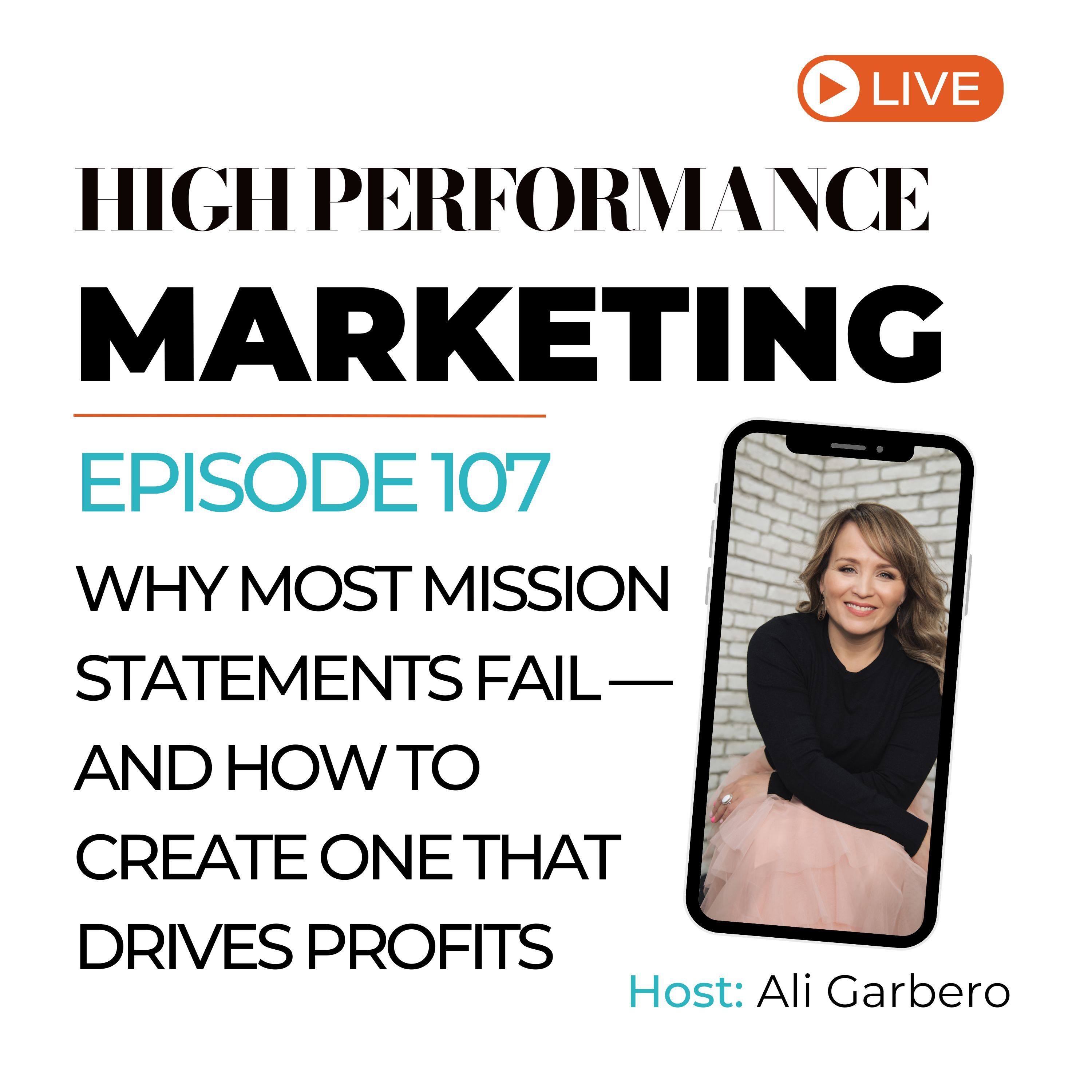 107. Why Most Mission Statements Fail — And How to Create One That Drives Profits | Are mission statements still relevant—or just corporate wallpaper no one actually looks at? You’ve seen them: vague, buzzword-packed blurbs hiding on an “About” page, doing nothing to inspire action or connection. In this episode of the High Performance Marketing Podcast, we’re breaking down whether mission statements still matter (spoiler: they do—but only if they’re done right). You’ll learn why most fall flat, what makes a mission actually meaningful, and how to write one that rallies your team, resonates with your audience, and sets your brand apart. If your mission doesn’t make people care, it’s time for a rewrite. | 15m 46s | ||||||
| 3/14/25 |  106. Stop Confusing, Start Converting: The Clear Messaging Formula | If your business was a movie trailer, would people be excited to see the whole thing? Would they lean in, eyes wide, thinking, "Wow, I need to see this!" Or… would they just keep scrolling, forgetting about you before the next scene even plays? See, great trailers don’t confuse you. They don’t waste time. In the first few seconds, you know the hero, the stakes, and exactly why you should care. Your brand message needs to do the same thing. But most businesses? They throw in too much fluff—fancy words, vague statements, and a whole lot of “What does that even mean?” That’s why today, I’m giving you the formula for ways you can write a brand message that grabs attention, keeps people hooked, and—most importantly—gets them to buy. Because if people don’t get what you do, they’re not sticking around to figure it out. ________________________________________________________________________________ Welcome to the High Performance Marketing Podcast—the show for businesses that want to master marketing and become the go-to brand customers trust and buy from. I’m your host, Ali Garbero, founder of Write Brand Marketing and your StoryBrand Certified Marketing Coach. | 12m 51s | ||||||
| 9/13/24 |  105. Making Your Business the Obvious Choice: Brand Positioning | When your marketing doesn’t make it clear why you’re the best choice, customers aren’t sure why they should choose you over your competitors. The result? Price becomes the only difference, leading to lost sales, less consumer trust, and your strengths getting overlooked. This is where brand positioning comes in. In the simplest way I can think of Brand positioning is the process of defining how your brand, your service, is different from your closest competitors and why it is the best choice for your best-fit customers. On today’s episode of the podcast I’ll walk you through key steps to creating a successful brand positioning strategy to help you stand out and differentiate yourself from your competitors. | 20m 42s | ||||||
| 8/30/24 |  104. The Founder’s Guide to Creating Content: Overcoming Fear, Imposter Syndrome, and Building Your Brand | If you’re the founder, CEO or leader of a company, you know that creating content is no longer just an option its become a non-negotiable — like a carve out time in your calendar, get it done kinda thing, or you’ll get overlooked. On today’s episode of the podcast, I'm diving in on content for founders—how and why to do it (psst…it’s going to get your customers fired up to work with you for starts.) | 22m 01s | ||||||
| 8/16/24 |  103. Why Content Marketing Still Matters | I get it—new marketing trends pop up faster than you can say 'shiny object syndrome,' and it’s tempting to chase after every single one of them. But here’s the thing: content marketing is like that one friend who’s always there for you—reliable, trustworthy, and pretty much the best wingman you could ask for. It’s still the secret sauce that builds brand awareness and keeps your customers coming back for more. On this episode of the High Performance Marketing Podcast, I'm diving into why content marketing is still the unsung hero your business needs to succeed. | 18m 34s | ||||||
| 8/2/24 |  102. Simplify Customer Buying Decisions | On this episode of the High Performance Marketing podcast I'll dive into ways you can help simplify the buying decisions for your clients. Learn ways to minimize their perceived risks and provide them with a seamless, positive purchasing experience. | 15m 02s | ||||||
Want analysis for the episodes below?Free for Pro Submit a request, we'll have your selected episodes analyzed within an hour. Free, at no cost to you, for Pro users. | |||||||||
| 7/19/24 |  101: Start with Why - The Core of Successful Marketing | A clear purpose for why you do what you do is more important than even having resources, technology or even talent. And this concept applies to your business because people don’t buy what you do, they buy why you do it. On today’s episode of the podcast I’ll dive into the incredible philosophy to start with why and how it can be a game-changer for your marketing efforts. | 14m 04s | ||||||
| 7/5/24 |  100. Unleashing Your Competitive Advantage To Win More Customers | I recently read a book and this statement stuck out to me. “The secret to attracting people to your service brand isn’t out-marketing or out-competing. It’s understanding what other people find extra ordinary in what you find ordinary.” Well my friend, if you aren’t communicating your super powers, no wonder you’re getting overlooked. So let’s fix that. On this episode of the podcast I'll lean into a marketing term called positioning and what it means for you as it relates to landing that number one spot in the minds of your best-fit customers. | 20m 11s | ||||||
| 5/31/24 |  99. The Sales and Marketing Connection | On this episode of The High-Performance Marketing Podcast, Ali breaks down the misconception that marketing is an unaffordable luxury. She'll explore the critical connection between sales and marketing, and share practical tips on how to leverage marketing investments to drive revenue. TRANSCRIPT Welcome to The High Performance Marketing Podcast, a show for business owners who want to create meaningful customer connections, using simple marketing and quality content. I’m your marketing guide, Ali Garbero. Earlier this month I was speaking to a potential client. She runs a growing medical practice and like many business owners - she does much of her own marketing. When I asked about why she was reaching out my way now, she shared that she wanted to create a consistent flow of incoming patients and was aware that she needed support to grow the business but she felt hesitant about investing in marketing. During our conversation, she said: “I've always thought that marketing is too expensive for a smaller business like mine. I really can't afford to throw money into something that might not bring immediate results." Hey and I get it, when you’re running a business, every dollar matters. And this concern is one that many business owners share – the fear of spending money on marketing without a clear understanding of how it impacts their revenue. On today’s episode of the podcast I’m breaking down the misconception that marketing is an unaffordable luxury and show you how it’s actually the secret sauce for business growth. To tie up my conversation with this medical practice owner - I invited her to think about marketing from a different perspective. I asked her to visualize marketing like yeast to dough. Without yeast, the dough won't rise, no matter how perfect the other ingredients are. I know that’s kind of a cheesy or overly simple way to see it, but it applies the same way to your business. You may have the best product or service but without effective marketing, your business won't grow. By the end of our conversation, this potential client I was on zoom with began to see the potential. We discussed budget-friendly marketing tactics that she could start zoning in on, and I emphasized the importance of tracking her results so she could begin to see a true picture of her return on investment. Ok, so the question you want answered is: How does marketing really tie back to more customers, more revenue, and more growth? How does marketing make me more money than I spend on it? To keep things simple, I’m going to share three ways it does. First, let’s talk about Brand Awareness. A fancy marketing term that means when people recognize and remember your business/brand, they trust you more and are more likely to buy from you than from you competitors. Simply put, brand awareness is about creating emotional connections with your customers so you have an influence on their buying decisions, preferences, and willingness to work with your company. Strong brand awareness helps drive future sales by making sure that customers know about your services before they even arrive at your website. However, there's no single way to build brand awareness. Your marketing needs to consider your target audience and the best channels to reach them. Where do your people hang out? For example, using Tik Tok might boost brand awareness, but if your target audience is on LinkedIn this might not be effective and could even seem inappropriate and vice versa right? Of course, It's important to mention that while increasing brand awareness can boost sales, getting people to hire your business is another challenge. Because Ultimately, it's the quality of your services and other aspects of your business that build your brand's reputation. All that to say that Your brand awareness campaigns should always support, not distract from, providing value to your customers. And can I just give you one terrible example? The other day I was watching a reel. It was for a real estate agent. She implied how tiring it was showing so many homes. She attempt to make this problem, which is a common one for real estate agents funny, that this process is so tiring and tried to course correct by saying - that well, no matter how many homes she has to show you, she will be there for you. Help me understand what value that provides for her buyers and sellers? Of course you will show me as many homes as I want to see. From the customer perspective I wouldn’t expect anything else. You’re my agent after all! So in your efforts to increase brand awareness, please start and end with making it about giving value to your customers, first and always. Instead of using insider humor that only her fellow real estate agents would find funny. Now, off my tangent, What marketing activities actually build brand awareness? Things like content marketing, social media marketing, SEO, email marketing, and paid advertising. Simply put, great brand awareness marketing makes it so more people know you, trust you, and buy from you. Cha-ching! Next let’s talk about Strengthening your Market Position. What is Market Positioning? Market positioning is about shaping how consumers see your brand or product and services compared to competitors. The goal is to create a specific image or identity for your brand in the minds of consumers. For example: A Louis Vutton handbag positions itself as a luxury status symbol. A fast-food restaurant might position itself as the provider of cheap meals. UPS and FedEx position themselves as leaders in delivery compared to the US post office. Marketing helps your clients see the value or lack thereof in your service. It does so in a few ways. By Highlighting specific features or benefits of your product. Emphasizing competitive pricing. Focusing on high quality. Showing how your service is better than your competitors'. And this one is kind of overlooked by business owners. You might think well I sell insurance - every insurance agent sells insurance the same way. But that’s not true. You would be assuming “all agents do.” And only you know the true difference between one agent or company over another but if you aren’t communicating that - it’s a missed opportunity. What marketing activities help with market positioning? Brand messaging or as I refer to it foundational messaging is your hands down winner! Foundational messaging highlights your unique value differentiator and can include slogans, taglines, and key marketing messages. Foundational messaging is so important because it helps you keep your position in the marketplace as the number one solution to solving X problem for your clients. And incase you’re thinking, Market positioning oh c’mon Ali - this is fluff. Well let’s consider one of the greatest examples of a company that has kept its market position among drinks, and that’s cola giant Coca-Cola. Since starting in 1886, Coca-Cola has used consistent marketing to remain a top brand in the beverage industry. They’re known for their memorable ads, catchy slogans, and being everywhere you look. Coca-Cola’s famous logo and constant presence have made it a strong brand that’s hard for competitors to beat. Their ongoing dedication to consistent marketing has helped them remain a leader in the market for over a century. See, here’s an interesting fact you probably already know. Most of us can’t name more than two or three cola companies. We don’t remember hundreds of auto insurance companies, chiropractors, lawyers, real estate agents, cybersecurity businesses. Like right now, name five laundry detergent brands? Ok what about roofing companies, or mental health counselors? Coca cola has created such a wide gap and dominated their position in the marketplace and made it very hard for any other brand to lead that space. That’s how great marketing helps you. You might be thinking, well I’m no coca cola. You’re right, you might not be competing for the attention of billions of people - maybe it’s just your city or state, even if you work nationwide - you’re competing for the attention of dozen, hundreds or maybe thousands of people. And marketing’s job is to help you stay number 1 in the mind of your ideal client when it comes to solving for problem X. Third, the customer journey. Way too many companies are unsure about HOW customers and clients actually happen. When you don’t understand the buying journey, or what actually gets clients through your door, or what gets them to hit the buy now button on your website - how can you create effective marketing solutions or strategies? The job of marketing is to determine or outline the customer journey and the factors that influence purchasing decisions. This way your company can target its marketing efforts and resources wisely - on the thing that gets more people to work with you. When you have a clear understanding of how to attract and keep customers, companies find it easier to measure the success of their campaigns or make data-driven decisions for future growth. When your company tracks Marketing and uses data you do more of what’s working to make you money and less of what’s not. The Role of Marketing in Sales Success I can’t tell you how many times, when times are tough, owners look to cut marketing first. Or they want to grow but are afraid to invest in marketing. Marketing and sales are companions. You can’t have one without the other. Marketing lays the groundwork for the success of your sales effort, by generating consistent Leads. Those people who are ready to work with you right now. And for those who aren’t ready to work with you just yet, marketing nurtures those people until they are. Nurturing your leads nurtures the relationship. And you’re there when your customers need you. And the best part is, once you’ve closed business with a client, Post-sale marketing continues to build relationships and encourages repeat business. But I can’t overemphasize that to fully leverage the sales and marketing connection, you have to align you marketing efforts with the goals of your business, so they both work together toward the common goal. How do you do that? Define your goals, build a marketing plan, stay consistent with your messaging and regularly monitor and adjust marketing performance against business initiatives. Marketing is more than an expense, it’s the best investment you can make for the growth and sustainability of your business. Just like yeast makes the dough rise gradually, effective marketing strategies boost your revenue over time are the rocket ship that grows revenue. Until next time, I’m cheering you on! Thanks for joining me today. If you’d like to stop throwing spaghetti at the wall and create a marketing strategy that increases sales, schedule a call with me at writebrandmarketing.com I’m Ali Garbero, copywriting is what I do, content marketing is what I create, and more customers is what you get. | 16m 53s | ||||||
| 5/17/24 |  98. Simple Tips for Growth | On this episode of The High Performance Marketing podcast, I share easy-to-implement techniques that can make a big impact on the growth of your business without requiring a huge budget. | 12m 43s | ||||||
| 4/12/24 |  97. Hiring the Right Marketing Leader | On this episode of The High Performance Marketing podcast - I’ll take you down the path of why hiring a marketing leader is an absolute must for your business, what you should expect and how marketing leadership is the driving force behind successful, scalable and repeatable sales results. Transcript Welcome to the high performance marketing podcast, a show for business owners who wanna create meaningful customer connection using simple marketing and quality content.I'm your marketing guide, Ali Garbero. Hey.Welcome back to the show.So you know, when most people think about starting a business, They aren't thinking about running a business. They're thinking about selling the thing that they love, right, making or delivering on that service that they love doing and, of course, making a profit. But no one in I literally mean No one says, yep.Yeah.Yeah.I wanna run a P and L.I wanna manage people.I wanna worry about sales and marketing.Yeah.Right. It goes more like, oh, I'm gonna sell this thing.But, oh, crap. How do I get people to buy it? If at some point, the fact that you need marketing hits you like a light bulb, well, most businesses think that they can do it themselves or they go out and hire, you know, their cousin who's some college intern or part time help to really just make this attempt at filling the gaps.On today's episode of the podcast, I'll take you down the path of why hiring a marketing leader is an absolute must for your business. What you should expect and how marketing leadership is the driving force behind successful, scalable, and repeatable sales results. First, who is a marketing leader? What am I talking about when I use this term? Naturally, people think about marketing technicians like social media managers, ad managers, maybe SEO gurus, but a marketing leader is someone who oversees and directs the marketing efforts of your company. They are responsible for developing and implementing marketing strategies to help you promote the brand to attract more customers and, of course, drive sales. A marketing leader may manage a team of in house marketing technicians like graphic designers, social media marketers, writers, pretty much they're responsible for also working with other departments, sometimes, uh, operations, almost always sales to really make sure that your marketing initiatives align with the overall goals of the business, right? Because imagine saying we wanna sell x amount of products, or revenue this year. And we're just going to do that through random acts of marketing.No one will be responsible for whether we achieve these We don't even know what goals they are exactly, what KPIs will put into place.And, you know, we're just gonna spend money on marketing as we go.Like that would never happen. You would never arrive at the results that you're trying to achieve.So a marketing leader literally takes on the role and the responsibility of shaping your company's brand identity. Really driving the product or the service positioning and, of course, identifying opportunities for growth But really just putting on that that load on their shoulders that they are going to oversee the whole shebang of it.Right? They will almost always report to the CEO or the company founder because let's be honest if you are the CEO and the founder You may not. You know, and then this is it to you, but you most likely probably, even if you love marketing, don't have time. To execute on it the way that you want.Fundamentally, a marketing leader is a key decision maker who drives the marketing strategy forward and helps the company achieve its objectives. Now if you wanna hire a marketing leader to take on these challenges for your business, you're most likely going to need a marketing director or a chief marketing officer of some kind, possibly even a fractional CMO, but I'm gonna talk you through some options. K? You you get to decide here.I'm not gonna force you into anything. But first, let's get a clear understanding around a chief marketing officer in this sense, a fractional chief marketing officer, and here's why I'm gonna say fractional is because This is a fractional CMO is a fancy marketing term for a part time or temporary marketing executive who provides that strategic leadership that I'm talking about, right? That direction for your company's marketing efforts on a fractional basis.This is more on a part time or as needed basis. And why I'm bringing this up is because most often businesses are growing.They're in growth stage. They can't always afford a big budget executive salary. CMOs get paid several 100,000 of dollars a year. So this is why I'm leading you down this path of, you know, more as needed work through fractional work.So instead of hiring a full time CMO, your business can really you know, engage the services of her fractional one to access that higher level marketing x tease and guidance, but without that commitment of a full time salary. Fractional CMOs usually work with multiple appliance as well.And they will, you know, tailor things to really meet your specific needs, which is a benefit because They're not just practicing on you. They're seeing marketing in the whole gamut across lots of different verticals, across lots of different industries, And so they're very well equipped to help build marketing plans, implement campaigns.Also, analyze the performance, you know, I talked about KPIs earlier, like, what are those key metrics that we need to measure and look at so that we can understand whether our efforts are being successful or not.Fractional CMOs are extremely beneficial for small or midsized companies, you're getting the expertise of a professional without hiring someone full time. Now the type of marketing leader you should hire depends on your business's specific needs, goals, as well as your industry. So I'm gonna give you the rundown on a few types of marketing leaders you might consider. And the first is a generalist marketing leader.Now, this person has, you know, a pretty good experience across various marketing disciplines, and they can usually oversee things like branding or digital marketing, advertising, content creation.And really work great for, you know, like, comprehensive overall marketing guidance and some job titles that would fall under this category include marketing coordinator or marketing manager. The next is a specialist marketing leader who focuses on a specific area of marketing, like, you know, social media, content marketing, SEO.These individuals have a deep expertise in that area of special utilization.And most often, what I'm seeing is businesses will lean into a social media marketing manager first.Because who doesn't wanna be on social media.Right? Like, we all love the idea of being on there.We wanna be seen.Okay.This is making me think about that time.If I don't know.Jerry Seinfeld.It's been on Netflix, and there's this episode where, I don't know, he's wearing a fur coat.And there's this long story where Kramer asks him to kinda cover up that this fur coat is his.And, you know, so that Kramer doesn't get kicked out of his building. And the super is like, whose coat is this? This fur coat? And, uh, he's like, oh, oh, it's gotta be Jerry's.You know celebrities.They need to be loved and liked.Look at me.Love me.Anyway, super long tangent, but I think that's what we do sometimes as businesses as to why we go down the path of social media marketing first.Look at me.Love me.Alright. Well, job titles in this bracket include a social media managers, I mentioned, or a marketing specialist.Next is that industry specific marketing leader that has experience and knowledge specific to your industry.They understand the unique challenges, the trends, really the opportunities within industry, especially if it's like really niche.And I get it. We all wanna think nobody understands my business.But if you have, like, a really unique industry, then this is where you'd want someone who's got that, you know, tailor Mitch, because they can then tailor your marketing strategies to meet the needs of your target audience. Next is a growth marketing leader.And this is someone who focuses on driving quick But sustainable growth for your business through data driven experimentation and often I mean, these are the people who love the numbers.They're looking at website traffic.They're looking at all of the you know, PPC analytics.I mean, they are skilled in really identifying and capitalizing on growth opportunities.Optimizing conversion funnels and maximizing ROI.So job titles that might, you know, that you might look for in this area are either growth manager or digital marketing manager. And then, of course, that fractional or interim marketing leader in, as I mentioned earlier, provides part time or temporary leadership that, you know, in a flexible way that's also super cost effective.So Job titles here are marketing executive, head of marketing, chief marketing officer, including that fractional CMO, which I explained earlier. So now the next question that you might be asking yourself is, well, alright, Ally.How do I know when I'm ready to hire a marketing leader.Well, companies typically hire a marketing director or leader at various stages of business growth depending on your specific needs, your goals, your resources.Right? But here are some common moments in business growth that might lead you to knowing that you're ready to make this hire. And the first is the early stage startup.Right? This is when you're first getting started launching the company.You're going to need someone who can handle your efforts internally You're going to really need them to help your business gain traction. And especially because this is where load starts to increase.So you might decide to hire a marketing leader to bring in some structure, some strategy, and expertise to marketing initiatives. Because when you're in that stage, you really are wearing that hat of chief everything officer.So you might not be able to see things as strategically or you might not have the ability to execute on those marketing efforts in a way that could yield the results that you want.Obviously, the next stage where you'd be looking to bringing on marketing leader would be in that expansion phase. This is where, you know, you're growing.Your operations are getting bigger.Maybe you're going into either new markets or you're trying to launch new products or services.So again, you need that strategic leadership to really show up.So, you know, at this stage, you wanna make sure that those marketing efforts really, really align with your overall business objectives so that you can support that growth.And then finally, that scaling up process where you're like, okay, I have experienced a ton of quick growth or, you know, I really wanna scale my operations, right? I need a dedicated marketing leader who can really help us do that. So this is where, you know, a marketing leader will manage your marketing team.Now you've got a little bit more money.So you've got more people.You need someone to manage this team them accountable, keep them motivated, right, really just driving that continued growth and success.And let me mention, 1 or 2 other areas as well that sometimes business owners will sort of overlook as a stage where you would really need a marketing leader.And this is transition periods. You know, during periods of change transition, like, let's say, you know, you've had a leadership leadership change or, you know, maybe you're rebranding or you've had some type merger or acquisition, this is where you need to really lean on the the guidance and the stability of a a marketing leader to just really help sort of create this seamless process. And You know, also the next one that I would have you consider would be if you're in decline or even if you're you've just hit a plateau.Your business isn't growing.The way you want it to anymore.I mean, you're not in a bad place, but you're not seeing the growth that you want anymore or worse, you're uh, the numbers aren't looking good.You're in decline. And of course, what I have seen most businesses do in this case is when the business starts to decline, they start to cut back. They're like, no, no, red alert, you know, cut out in the marketing, cut out fire everybody.And That's just the absolute worst thing that you can do because a marketing leader can absolutely know how to get you out of the rut, get you out of that plateau, and get you back into growth mode.Now finally, what questions should you ask someone when you're thinking about hiring them, right, to lead your marketing efforts? Well, I'll run through a few and, you know, They're not no brainers, but they are, you know, sort of they're simple.I mean, they they're helpful here.So let me go through these. And I would wanna know, hey, can you walk us through your experience in creating and actually executing on successful? Marketing strategies? Like, what does that look like? How do you personally stay updated on the latest marketing trends, tools, and best practices I mean, I wanna know that they're not just throwing spaghetti at the wall here, right? Like who are who are their leaders? What strategies are are they following or frameworks, are they helping me implement into my business? And can you provide examples of marketing campaigns or projects that you've led that resulted in measurable success.Now, this is the kicker, right? Because anybody can say, oh, yeah, you know, like, great.Just hire me. I'll I'll make you grow.Well, no, I wanna see.I wanna actually see the numbers.I wanna see you know, how you took someone from, you know, 10,000,000 in revenue to 20,000,000 or or even a 1,000,000 in revenue to 5,000,000.Like, what were the things that happened there? Because, again, I want tangible evidence here.I would also ask, how do you approach market research and audience analysis to really make informed marketing decisions.This is so important. Like, market research and analyzing your audience is something you may have done early on when you were just getting started, and then you just forgot about it.But this is something you should be doing on at least an annual basis, if not every few years.And a marketing leader can help you do that.I would also wanna know, like, what their experience is with branding and positioning a company, you know, in within the marketplace. And if you're not sure what positioning is, it's like, okay.What position does our brand or company hold in the heart and minds of our consumers.Do you know how to position us in a way where we're different where we gain their loyalty where we stand out. You know, an example of this is, you know, what position does co Cola hold in your mind when it comes to cola.Well, number 1, most likely unless you're like a a Pepsi fan.So I would wanna know what their experience was around, you know, positioning, branding, all that cool stuff.Um, I would also probably ask like he How do you work with other departments? Because this is gonna be a key leader who's going to have to get along with other team members.And the last thing you want is like a big jerk.You want someone that's diplomatic that can play, you know, well at the playground you know, with with all the the kids, not just some big bully.I would also ask, you know, around their experience managing a marketing budget and really optimizing ROI. I mean, if you're gonna hand over 1000 and 1000 of dollars, you're hoping you're gonna get a return on investment.Right? So I would wanna see how they'd managed previous company's marketing budgets.What that looks like? Of course, I would want to talk about KPIs.Those are those metrics that really measure performance.I need to know what the KPIs are that this individual is going to put into effect because those are the things we will use to measure success.How will we know if we're succeeding if we don't know how to measure it? I would also dig a little bit deeper, maybe get personal.Hey.Tell me about a time when you faced a challenger setback.You know, specific to marketing, what did that look like? How did you overcome it? You know, tell me about that.And of course, their leadership style. We did talk about that in regards to, you know, we wanna make sure that they get along with other people, other departments, but also can they motivate and buyer your team, you know, if you've got a marketing team to actually achieve the goals of the business.These questions are super helpful because they're going to give you a better feel for the qualifications and the problem solving abilities of this potential candidate.And I know that you might be thinking here at this point.Maybe you're not, and I'm gonna put this into your head here, but you might as you have been listening in the show thought, well, you know, maybe I should just hire a marketing agency.To handle all of these things for my business.That might just be easier. No doubt you have heard of marketing agencies.I love them.They're great.I have clients who are agencies.Here are some pros and cons on that, though, on hiring an agency versus an actual marketing leader.And that's that hiring an agency is usually more expensive, especially for small businesses and startups with limited budgets.When you hire a marketing agent agency, you're you're pretty much giving over over your marketing efforts to external professionals, which is fine.If you want it to be hands off, but with an in house team member or leader, you have a lot more control and flexibility to adjust strategies timelines, even your priorities, right, based on kinda how things are working, any changes in the market.Also, marketing agencies you know, often tend to have an expertise in, like, a specific area, like ads or HubSpot.And, I mean, that's great.It allows them to really provide specialized services, but an in house marketing team or leader can really focus on a more customized approach to your unique challenges, right, the the things that are happening within your business over time. Well, there you have it.Everything you need to know about hiring a marketing leader.Whether you're just starting out or you're in that super hyper fast growth mode that we all love or maybe hate it.But ultimately having the right marketing leader by your side is the ultimate difference maker.They'll help you stand out, grow your business, no matter what phase of the journey that you're in.And, again, the reason you need them is because they're number 1 focus is strategy, execution, is marketing, whereas for you as the leader, you you've got a lot.You've got a lot of other things.You gotta focus on people, uh, customer service, a million different things.So if you don't have a marketing leader in place, takes them out of what I shared with you today, and go out and get 1 and watch your business, grow. Thanks for joining me today. If you'd like to talk about marketing leadership, and how we can revolutionize your business, schedule a call with me at writebrandmarketing.com I'm Ali Garbero, Copywriting is what I do content marketing is what I create - and more customers is what you get | 22m 44s | ||||||
| 3/29/24 |  96. Your Clear Communication Blueprint: The Power of Foundational Messaging | Imagine you're building your dream home. Your blueprint, or plan, shows you how to put all the pieces together so it looks great. Well, businesses have a plan too, called foundational messaging. It's like their blueprint for how to talk to people and make them understand what they're all about. On this episode of the High Performance Marketing Podcast, - Ali breaks down foundational messaging for you as a blueprint you can use in your business to make sure you’re communicating with the right people the right way so they pay attention and do business with you. She outlines the StoryBrand 7part framework as a way to help you create foundational messaging. | 21m 32s | ||||||
| 3/8/24 |  Simplifying Success - Do Less To Achieve More | Most business owners find themselves really busy yet feeling completely unproductive. Every day feeling like you don’t have enough hours in the day to complete everything on your plate while simultaneously asking yourself at the end of the day - what did I get done? On today’s episode podcast I'll dive into ways that you can run your business better by focusing on the essentials or as they say the things that matter most. | 13m 27s | ||||||
| 2/23/24 |  94. Humanizing Cold Outreach For Better Leads | Most often you want to grow your list of potential leads, but the idea of cold calling or sending spammy emails on Linkedin make you cringe. And that's because in business marketing, too much of our cold outreach strategies feel icky. On this episode of the High Performance Marketing podcast, I’m diving deep into the world of lead magnets and email marketing, as ways to give you the power to provide upfront value, and build more effective cold outreach strategies -- so that you can grow a list of higher qualified leads. | 15m 45s | ||||||
| 2/16/24 |  93. Want Business Referrals? Go Get Them! | Referrals are the currency of trust in the world of running a business. They’re literally the golden goose of entrepreneurship. But here’s the problem, many business owners feel uncomfortable asking for referrals. Onthis episode of the podcast let’s talk about ways to get more referrals for your business. | 11m 05s | ||||||
| 2/2/24 |  92. The Courage to Admit Failure | As a business owner, you had a passion for the service you sell and helping others and most likely have found yourself becoming an 'accidental leader,' someone who leads not by design but by circumstance. On today’s episode of the podcast we’ll dive into accidental leadership and the power of owning up to mistakes. TRANSCRIPT Welcome to The High Performance Marketing Podcast, a show for business owners who want to create meaningful customer connections, using simple marketing and quality content. I’m your marketing guide, Ali Garbero. Welcome back to the show. You know, success in business is a blend of strategy, skill, and often, a few happy accidents. As a business owner, you had a passion for the service you sell and helping others and most likely have found yourself becoming an 'accidental leader,' someone who leads not by design but by circumstance. In this unexpected role, you face unique challenges, and amongst the hardest is admitting to and learning from mistakes. It takes courage in leadership to own up to errors, but it's this brave act that distinguishes exceptional leaders from the ordinary. On today’s episode of the podcast we’ll dive into accidental leadership and the power of owning up to mistakes. First, The term 'accidental leader' might hit home with you if your journey to entrepreneurship came as a surprise or you found yourself at the helm without formal leadership training. This happens a lot in corporate business - where most often it’s the people who work hard and are good at their jobs, that get thrown into managerial roles. Introverted engineers, quiet writers, or an introverted real estate agent who happens to be very good at being consistent, who is then asked to lead a sales team. A leadership role can feel intimidating, overwhelming, and you may question your ability to guide your team effectively. Early on in my sales career I was kind of arrogant. My team leader asked me if I was ok leading a sales team of primarily men. As the oldest sibling in my family to a single mom - I thought “how hard can it be” you just tell people what to do - you never ask them to do anything you wouldn’t and there you go. Ha - yeah right! I went through the fire in that director of sales role. Immediately learning that not everyone is motivated by the same thing in life, and that leadership is less of the football coach style methodology that I believed it to be, and more a Yoda, guide on the side instead. There will be times when you be required to lead your clients as they look to you for ways to make important decisions. They will rely on you to lead them and that again - can feel like more than you signed up for. You might have believed “Hey I just wanted to show people pretty houses the way many real estate agents initially thinking about things. Or if you’re a web developer and you’re overseeing a website redesign, clients will lean on you to lead them and that will take a lot of confidence building and courage. You should feel some comfort however that leadership isn't solely about well-crafted visions or impeccable decision-making; it's also about authenticity and vulnerability. When leaders demonstrate these qualities, they build trust and respect within their teams, with their clients and setting the foundation for an outstanding business culture. Next, let’s talk about The Importance of Owning Your Mistakes In an age where authenticity in leadership is more valued than ever, admitting mistakes has become a powerful tool for growth. It shows not just courage but integrity. I don’t want to get political, but remember when Bill Clinton lied to the entire nation - he emphatically looked at the camera and vehemently told us he hadn’t had any sort of affair with Monica Lewinsky. What garbage for us to be lied to that way. I think what’s hardest about trying to cover up your mistakes is that it involves not only dishonesty to yourself but to others - and when you lie, people can forgive you for it, you just make it so they don’t know when they can believe you again. Here's why owning up to mistakes can be transformative for both you and your business: When you admit your mistakes, you create a space where employees feel comfortable sharing their failures too. This transparency can lead to open discussions about what went wrong and how to improve. Your team and clients respect leaders who are humble enough to acknowledge their fallibility. Trust grows when they see you as human – someone who can err, reflect, and move forward. I remember years ago I worked for an individual who literally never allowed us to see their human side. They were perfect and the rest of us were the problem. That was a hard leader to work for and to connect with. And you know what else? And maybe the hardest thing you will have to do as a leader is take accountability for when your team makes a mistake. The buck stops with you. I see this happen a lot in sports - where a head coach has to face the media for the way his or her players acted, the decisions they made on the field. Similarly if your assistant or a junior manager or staff member makes a mistake - you can’t go to your clients and say “oh well it was their fault.” You are the leader - you are the one who hired them.And durings those moments, you’ll need some big boy or big girl pants - because what you will want to do is use a scape goat and say “well it wasn’t my fault.” And I get it, it might not be. It might wholeheartedly be a team member you trust - but ultimately like I said - that’s that “the buck stops with you” accidental leadership thing, right? And the great part here though is that seeing a leader take responsibility for errors encourages a "growth mindset" within the company. It becomes an environment where learning from failure is valued, which can drive innovation. When owning up to your mistakes I’d say Admit It Quickly. When you realize you've made a mistake, address it promptly. Avoid justifications and Instead, lay out the facts and be transparent about what happened. Take Responsibility and let everyone that you're taking the mistake seriously, and it's your responsibility to fix it. From there, plan how you intend to rectify the situation, and if applicable, involve your team in the problem-solving process. Wouldn’t it be great if the leaders of our nation could take some of this advice? Instead of playing the “well it was the previous administration, or it’s the other political party’s fault not ours.” What a different county we would be. If our leaders had the integrity and courage to admit their failures and mistakes, maybe our citizens would follow suit too. Use mistakes as learning opportunities. Reflect on what you can do differently to prevent similar issues in the future. Accidental leadership comes with its uncertainties, but it also offers a unique opportunity to lead with a touch of humanity. Admitting to your mistakes isn't a sign of weakness but a courageous act that can profoundly influence the success of your business. As a business owner, your willingness to embrace this can be a pivotal moment of growth for both your team and your leadership journey. By making courage in leadership a staple of your business values, particularly when handling mistakes, you're setting a stage for authenticity and continuous improvement. Remember, it’s not about being perfect; it’s about being real, adapting, and leading with conviction—even through the mishaps. To all the accidental leaders out there, you are more capable than you know, and your mistakes just might be your stepping stones to greatness. I’m cheering you on. Thanks for joining me today. I’m Ali Garbero, Copywriting is what I do, Content Marketing is what I create, more customers is what you get. | 13m 46s | ||||||
| 1/26/24 |  91. Everything is Marketing | On this episode of The High Performance Marketing podcast we'll explore a broader definition of marketing and how it extends beyond your traditional marketing efforts. Transcript Welcome to The High Performance Marketing Podcast, a show for business owners who want to create meaningful customer connections, using simple marketing and quality content. I’m your marketing guide, Ali Garbero. Many businesses find it challenging to see how their marketing efforts really help their company grow. No doubt you’ve felt this way. With so many choices to get the word out …social media, google, ads, billboards, email marketing and more. The question you have isn’t if you want to grow your company, but how do I get my website and other marketing efforts to help me accomplish that goal? The fallacy many of us often fall for is that *one thing* will be the silver bullet that catapults our marketing into a new stratosphere. And while that can happen, don’t bet on it. Why? First, Marketing works best against the backdrop of a comprehensive strategy Second, Everything in your business–not one magic thing–is marketing. On today’s episode of the podcast - I’ll help you explore the broad definition of marketing and how it extends beyond traditional advertising and what you might now know as marketing practices . And that’s because like I just said - everything is marketing. Your sales process? Marketing. Your onboarding process? Marketing. How you treat your clients? Marketing. How you handle mistakes? Marketing Every interaction a customer has with your business is a powerful expression of your brand and a fundamental aspect of marketing. These interactions collectively create a narrative that communicates your brand values, reliability, and overall identity. Every detail, from the tone of customer service to the design of your packaging, becomes a part of the marketing story you tell. Small gestures, like a personalized email or a swift resolution to a customer inquiry, contribute significantly to building trust and loyalty. Recognizing that every touchpoint is a form of marketing empowers you to become strategic and enhance each interaction, so you ensure a positive customer experience is created even long after your initial engagement. And if you’ve overlooked your employees as marketing - let me share a quick story. Years ago, I interviewed for a sales role with a local company who helps small businesses get more customer reviews. I made it past my first two interviews. When it came time to meet with the VP of sales the interview last at most five minutes. This gentleman walked into the room - told me who he was and literally said the following: “alright this is how this is going to go, I’m going to ask you questions and you’re going to answer them.” “Uh ok.” He then proceeded to ask me three or four questions, which I responded promptly. When we were finished he didn’t thank me - he just said if you have any questions you can email me at xyz email. It was crazy. Everything had moved so quickly, I’d passed all my other interviews with flying colors, and then after I met him, it went completely downhill. Slow responses to my questions about when I could expect to hear back - I mean literally nothing. Finally I got some standard email saying “thanks but no thanks.” Years later, this company now pays to sponsor ads to target me - the small business owner. And do you think I would ever do business with a company like this? Because yes - even the way you treat potential employees and current ones is Marketing. Again, everything is marketing. Next, let’s talk about the The Customer Experience as Marketing Let me give you two examples - a poor one first - and amazing one next. First - Brent Brown Toyota Second - Quick Quack The customer experience is the heartbeat of any business, it plays a pivotal role in shaping your image and leaving a lasting impression on consumers. It goes beyond merely delivering a product or service; it encompasses every touchpoint, from the first interaction to post-purchase support. A positive customer experience acts as a powerful catalyst for brand advocacy. On the contrary, a subpar experience like the one I had buying my car can tarnish a business's reputation. When your business makes the customer experience a priority you’re signaling that you value your customers, are committed to quality, and are willing to go the extra mile. In today's competitive landscape, where consumers have so many of your competitors to choose from, the way your business makes a customers feel becomes a defining factor in establishing brand identity and building enduring relationships. And finally - Building a Consistent Brand Message Consistency in brand messaging across all platforms is a cornerstone of successful marketing. I’ve often shared that marketing is an activity in memorization. So when you have a unified message - one your customers hear repeatedly it reinforces your values, your personality (it humanizes you) and creates a seamless experience for customers across any of the variety of marketing channels they choose to follow you on. It’s why franchises are so successful. Customers know exactly what they can expect if they visit a chain store in one state or another. The experience, the look and feel will be identical. So whether it’s your company website, your social media platforms, or traditional advertising, you should be saying the same thing. Years ago the mens warehouse did this well. Their message was “you’re going to like the way you look, I guarantee it.” When customers encounter a consistent narrative, they develop a clearer understanding of your business, what you do, and the problems you help them solve. Thanks for joining me today. If you’d like to create a clear marketing message that gets your customers to pay attention so they do business with you, schedule a call with me at writebrandmarketing.com I’m Ali Garbero, Copywriting is what I do, Content Marketing is what I create, more customers is what you get. | 14m 44s | ||||||
| 1/12/24 |  90. Supercharge Customer Connections - Create Buyer Profiles | The most important asset your business has is your customer. And if you want to capture their attention you need to know them inside and out. On this episode of The High Performance Marketing podcast, we'll outline the process of creating a buyer persona as an indispensable strategy for creating a genuine connection between you and your ideal client. _________ Crafting irresistible connections through buyer personas and targeted marketed. Transcript Welcome to The High Performance Marketing Podcast, a show for entrepreneurs and small business owners who want to create meaningful customer connections, using simple marketing and quality content. I’m your marketing guide, Ali Garbero. Many business owners have valuable insights other people could benefit from and they wonder if they could turn what they know into a valuable consulting or coaching business. If that sounds like you, then you’ve got to pick up a copy of Donald Miller's new book Coach Builder. It will give you an 8-step plan to turn your skills into your own coaching and consulting business — so you make a lot of money doing something you love every single day. The book is available for pre-order at coachbuilderbook.com with tons of free resources and bonuses. Additionally, I’d like to invite you to attend a free event - the Coach Builder Summit that includes a world class speaker line up with the likes of Amy Porterfield, Ryan Diess, Michael Hyatt and more. Head over to https://coachbuilder.com/summit/ now and register! If I were to ask you what the most valuable asset of your business is, your mind might instantly gravitate towards your dedicated team of talented employees, your exceptional service, or perhaps your cutting-edge patented technology. While these are vital contributors to the success of any business. Take a moment to think about this: without a customer, how substantial would the impact of these assets truly be? For me, everything starts with the customer - as a certified Story Brand Marketing guide, I teach the story brand 7 part framework to my clients, and always lead the discussion by starting with the character of the story - which in business marketing is our client. Customers are the heartbeat of any business that hopes to thrive. And on this episode of the podcast I want you to reconnect with your ideal customers by building out buyer personas. Buyer personas are a well-known term for the ideal customer you want to attract and ideally work with over and over again. A buyer persona is a semi-fictional representation of your ideal customer, based on market research and real data about your existing customers. It’s important to create and re-create or re-evaluate buyer personas because markets shift all the time, and industries change. And if you’re not crystal clear about your ideal client, then how do you know how to speak when you write emails, or shoot video content? One perfect example of this is looking at the Stanley drink wear and gear brand. Right now, Stanley cups are all the rage! But years ago the Stanley brand catered to most blue collared men. Stanley could run a campaign that said “hey Joe, we know that come lunch time, you want to sit back and enjoy a warm lunch.” Today, Stanley continues to speak to Joe, but also speaks to Jane. “Hi Jane, you don’t want a boring life. After yoga, running the kids around, or heading into a long day of meetings you want to be sure you stay hydrated with our super cute Barbie pink colored stanley cup, that holds 40 ozs and keeps your drinks cold!” Now that Stanley knows, they’re talking to Jane their marketing message becomes more targeted and on point. So, when thinking about buyer personas, start by creating an ideal customer profile. Write out a detailed description of the characteristics and traits that define your most valuable customers. And because I also understand who my ideal customer is, I know that you are entrepreneurs and busy business leaders and that you don’t have time to sit and pontificate on marketing - so I’ve created a simple Ideal Customer Profile sheet you can download at writebrandmarketing.com/ICP By developing a detailed and accurate ideal customer profile, you can tailor your emails, social media content, graphics, blogs, videos and customer interactions to better meet the needs and preferences of your most valuable audience. The goal of buyer persona profiles are to humanize your target market. Key components to understanding your customers better includes an understanding of their values and motivations. Do you know what values are important to those who hire you? What motivates their decision-making process? Is it status, attention, security? What about their pain points? This one’s my favorite because I believe that people buy solutions to their problems. During my client workshops, I take time to help you identify the problems, obstacles, or frustrations your potential clients experience in their journey as a customer. For example if you’re a real estate agent, a pain point in selling your home is having to pack up and store things, clean up and show your home. When you’re clear about that pain point, it’s easy for you to create content and communicate that you have a simple solution to ease the stress of packing and selling. A final point to consider when creating your buyer personas is to take some time to reflect on your potential customer’s communication preferences. How do they want to hear from you? Email, social media, in - person? If your ideal customer is never on email but loves spending time on tik-tok then meet them there. Finally, I’d invite you to think about buyer buying patterns: How does your typical client buy the service you sell? What’s the buying journey they go on? Meaning, the process they go through as they discover, evaluate, and purchase a service like yours? How can you research the process, and decision-making criteria of your ideal client? Ask them? Use social listening. Go onto sites like quora, answer the public, or even join facebook groups where you customers hang out. Equally important is to consider any potential objections that would keep your potential clients from engaging and paying for your services. I’m a strong advocate for creating content that not only answers those objections but serves to help them overcome it. When you know the answer to these questions, it guides your marketing message and the positioning your services hold in the mind of your potential customers. A detailed and spot-on ideal customer profile allows you to make customer interactions more on point with what your audience loves. It sets the stage for super-effective and laser-focused marketing that hits to the heart of solving the problems your customers need solutions too.Thanks for joining me today. If you’d like to schedule a messaging workshop to get clear about your ideal customer, their problems and position your services as the solution, schedule a call with me at writebrandmarketing.com I’m Ali Garbero, Copywriting is what I do, Content Marketing is what I create, more customers is what you get. | 12m 54s | ||||||
| 1/5/24 |  89. Your 2024 Three-Step Marketing Roadmap | Have you ever had a big dream but no plan to achieve it? It's like wanting to climb a mountain without a trusty Sherpa to show you the way. When it comes to your 2024 business goals you need a roadmap - and that's where your marketing plan comes in. But I'm not giving you overwhelm or a 20 page strategy you'll write and never read again. I'm keeping it super simple and breaking it down into 3 key steps. On today's episode of the High Performance Marketing podcast, you'll gain absolute clarity about connecting with your customers, generating leads, and increasing sales. | 9m 51s | ||||||
| 12/29/23 |  88. Reflecting on Your 2023 Marketing To Boost Your Success in 2024 | Well here we are, the last week of the year! 2024 is days away and before we get into the whole planning for the future, let’s take a moment to consider that marketing is always changing and to stay on top of the change you need a combination of three things: Reflection Adaptability And strategic planning So, on today’s episode of the podcast - we’ll look back at 2023, identify what worked, and look ahead at ways to improve so that ultimately you know what to improve on to reach the goals you have for yourself and your business. | 15m 31s | ||||||
| 12/22/23 |  87. Managing Unpopularity and Criticism in Business Leadership | It's hard not being liked. We're hard wired to want to be. And when it comes to running a business, leading a team, and your clients - it all comes with its fair share of challenges. The reality check is that not everyone will like you, support you, or sing your praises. When faced with unpopularity and criticism, how do you handle it and keep moving forward? On this episode of the High Performance Marketing podcast we'll dive into how you can learn to see criticism as an opportunity for growth and improvement. | 13m 41s | ||||||
Showing 25 of 95
Sponsor Intelligence
Sign in to see which brands sponsor this podcast, their ad offers, and promo codes.
Chart Positions
1 placement across 1 market.
Chart Positions
1 placement across 1 market.