
Insights from recent episode analysis
Audience Interest
Podcast Focus
Publishing Consistency
Platform Reach
Insights are generated by CastFox AI using publicly available data, episode content, and proprietary models.
Total monthly reach
Estimated from 8 chart positions in 8 markets.
By chart position
- 🇺🇸US · Non-Profit#12300K to 1M
- 🇨🇦CA · Non-Profit#5130K to 100K
- 🇬🇧GB · Non-Profit#6830K to 100K
- 🇩🇪DE · Non-Profit#1145K to 30K
- 🇦🇺AU · Non-Profit#1405K to 30K
- Per-Episode Audience
Est. listeners per new episode within ~30 days
115K to 391K🎙 Daily cadence·32 episodes·Last published today - Monthly Reach
Unique listeners across all episodes (30 days)
384K to 1.3M🇺🇸77%🇨🇦8%🇬🇧8%+5 more - Active Followers
Loyal subscribers who consistently listen
153K to 521K
Market Insights
Platform Distribution
Reach across major podcast platforms, updated hourly
Total Followers
—
Total Plays
—
Total Reviews
—
* Data sourced directly from platform APIs and aggregated hourly across all major podcast directories.
On the show
Recent episodes
Lauren Tom on Spiritual Mentorship with Homeboy’s Fr. Greg Boyle
Jun 24, 2026
Unknown duration
Dads Stepping Up: Homeboy’s George Nunez and Daniel Martinez on the Courage to Stay
Jun 17, 2026
Unknown duration
From Lockup to Living a Life of Purpose with Karla Leon and Anthony Chairez
Jun 10, 2026
Unknown duration
Keep Moving Forward: Fr. Greg Boyle, S.J. on How to Let Go of Your Ego
Jun 3, 2026
Unknown duration
Bodies Don’t Lie: Dr. Bessel van der Kolk on Trauma Recovery and the Power of Homeboy Industries
May 27, 2026
Unknown duration
Social Links & Contact
Official channels & resources
Official Website
Login
RSS Feed
Login
| Date | Episode | Description | Length | ||||||
|---|---|---|---|---|---|---|---|---|---|
| 6/24/26 | 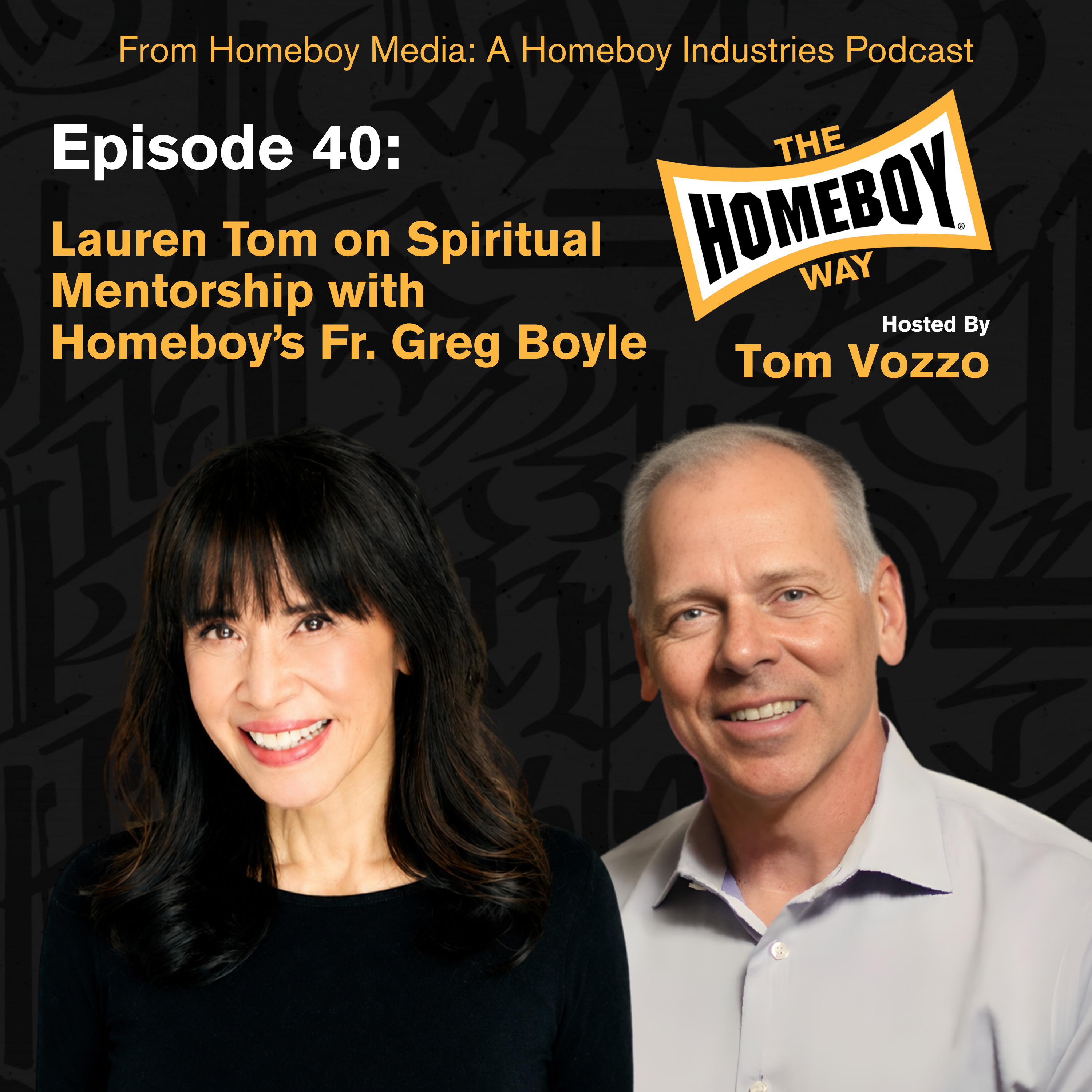 Lauren Tom on Spiritual Mentorship with Homeboy’s Fr. Greg Boyle | Actor Lauren Tom has spent decades moving audiences through roles in The Joy Luck Club, Friends, Futurama, and more. But in this episode of The Homeboy Way, she joins Tom Vozzo to talk about the story that moved her: Homeboy Industries. After reading Fr. Greg Boyle S.J.’s Tattoos on the Heart and hearing him speak, Lauren knew she had to get involved, even if she didn’t yet know what she could offer.What began with a book club and a muddy early Homeboy 5K became a 15-year relationship with the organization, its mission, and its people. Lauren shares how Fr. Greg became a spiritual mentor, how Homeboy helped her move from fear to compassion, and why being honored as a Community Hero at Lo Máximo meant more to her than any Hollywood award ever could.Together, Tom and Lauren explore second chances, first chances, belonging, fandom, representation, and the simple but radical idea that relationships change everything. This is a conversation about what happens when people are seen with love, and how one person, one introduction, one act of compassion, can help someone remember they belong.Key TakeawaysHomeboy turns fear into relationship.Lauren shares how she used to feel afraid when seeing someone with gang tattoos. Through Homeboy, that fear shifted into recognition, humanity, and a simple willingness to say hello.Second chances are often first chances.Tom and Lauren discuss how many Homeboy trainees were never given a real first chance to be loved, believed in, educated, or seen without judgment.Belonging is a healing force.Whether at the Homeboy 5K, Lo Máximo, or a fan convention, Lauren sees the same human need everywhere: people want to belong to something bigger than themselves.Hope is an everyday practice.Lauren reminds us that hope is not passive. It can be as small as making one phone call, building one relationship, or asking one person to help.In This Episode[00:00] Introduction[01:17] How Lauren first discovered Homeboy Industries[02:06] Why Fr. Greg’s stories make people laugh and cry[04:40] Why the Homeboy 5K feels bigger than a run[06:34] Fr. Greg as Lauren’s spiritual mentor[09:43] Why everything in life is about relationship[10:35] How Homeboy changed Lauren’s view of gang members[13:30] Why Lo Máximo meant more than an Oscar[14:01] The meaning of collective effervescence[14:52] The hope and joy people feel at Homeboy[16:22] The Homeboy story Lauren never forgot[17:59] Why one person believing in someone can change a life[18:35] Bringing Lauren’s fan communities into Homeboy’s mission[27:02] Why Lauren keeps coming back to Homeboy[29:15] The current state of the entertainment industry in Los Angeles[30:16] How Lauren stays hopeful[31:41] Why people need a visceral experience of Fr. Greg’s message[33:52] Closing reflectionsNotable Quotes“I feel so deeply blessed that I get to live in the same time that Fr. Boyle is alive.” — Lauren Tom [06:34]“At the end of the day, I feel like everyone just wants to belong. And that’s the beauty of Homeboy.” — Lauren Tom [20:53]“I can’t help but fundraise for Homeboy. I feel like it’s not even a choice for me. It’s something I need to do.” — Lauren Tom [27:15]“Relationships, just keep building those relationships and not being shy about asking for help with the people you know already love you.” — Lauren Tom [28:07]Resources and LinksLauren Tomhttps://laurentom.com/https://www.instagram.com/laurentom9000/Homeboy Industrieshttps://homeboyindustries.org/https://www.youtube.com/@HomeboyIndustries_LA/videosDonate: https://homeboyindustries.org/donate/donate-online/Homeboy Media https://homeboyindustries.org/social-enterprises/homeboy-media/Thomas Vozzohttps://www.linkedin.com/in/thomasvozzoThe Homeboy Way: A Radical Approach to Business and Life: https://www.amazon.com/Homeboy-Way-Radical-Approach-Business/dp/082945456XCredits:Hosted by: Tom VozzoProduced by: Podify, and Alexa Rousso and Melody Carter of Homeboy Media | — | ||||||
| 6/17/26 | 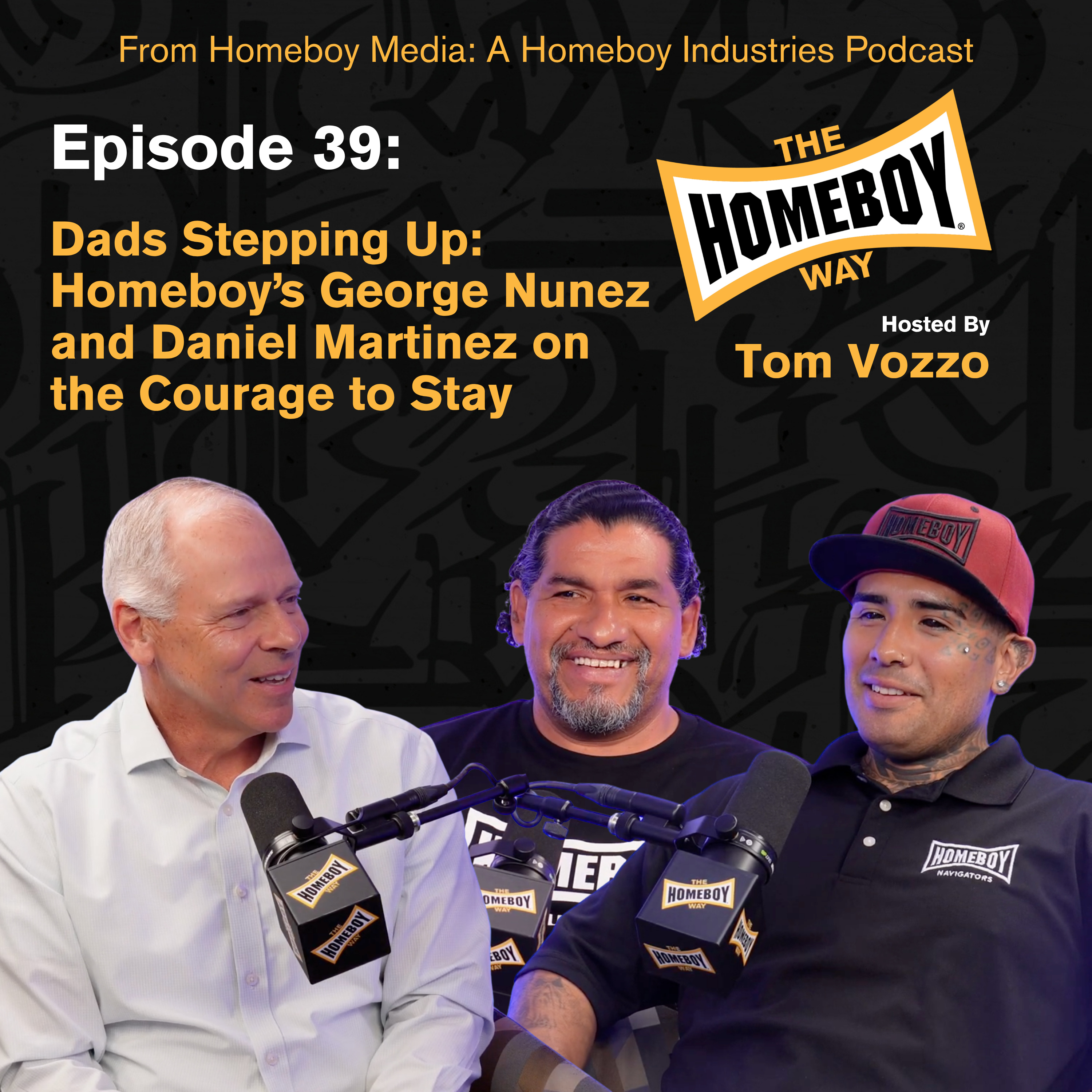 Dads Stepping Up: Homeboy’s George Nunez and Daniel Martinez on the Courage to Stay | George Nunez, Head of Security at Homeboy Industries, spent years in and out of prison. He shut out the world, including his own children, because showing weakness behind bars wasn't an option. Daniel Martinez, a Navigator at Homeboy Industries, asked his parole officer to lock him up again rather than feel like a burden to his brother. Both men walked through Homeboy's doors expecting nothing more than a resume or tattoo removal. What they found instead was a place that wouldn't give up on them and wouldn't let them give up on their kids.In this episode, host Tom Vozzo sits down with George and Daniel to talk about what real fatherhood looks like when you're learning from scratch. They discuss the terror of being vulnerable, the slow work of putting ego aside, and the unexpected mentors, including Father Greg, whom they now call "Dad." Together, they prove that the cycle of abandonment can be broken, one parenting class, one 2:00 a.m. phone call, and one soaked train ride with a baby at a time.Key TakeawaysShow up even when you're not readyGeorge doubted himself and didn't want to come to Homeboy, but he chose to show up on Monday.Healing is an inside jobGeorge learned in therapy that wanting to change isn't enough, you have to work on what's inside and let someone help you figure it out.It's not about you anymoreGeorge says you save the next person walking through the door, because someone saved you. This lifestyle requires you to care and feel things you never felt before."You're never in my way"George expected to be scolded by Father Greg, but Greg said, "You start Monday." That one invitation changed everything.Straddling the fence takes timeDaniel wanted to be a father, but the lifestyle kept pulling him back. Change didn't happen overnight; it was a battle.Prison taught me to shut the world offGeorge blocked everyone out to survive. Coming home meant learning a new way to be one where you don't have to hide.In This Episode:[00:00] Introduction[00:25] Meet Daniel Martinez and George Nunez[01:05] Daniel finds Homeboy after prison[02:35] Discovering support through classes and community[04:11] Feeling like a burden to family[05:36] George returns to Homeboy in 2013[08:09] Therapy, trauma, and looking within[10:46] Choosing fatherhood over gang life[11:42] Learning how to be a dad[16:17] The Challenge Program and accountability inside prison[17:44] Trying to be a father while incarcerated[19:05] George explains why he shut the world out[19:59] Learning fatherhood after prison[21:22] Earning back the right to be called Dad[21:55] Parenting classes and communication skills[22:59] Their children begin to see the change[23:58] Father Greg as the father figure they never had[25:42] Learning fatherhood with a new baby[27:02] Mentoring trainees with patience and compassion[28:50] Dreams and hopes for their children[31:54] Why Homeboy feels like family[33:19] Finding joy through fatherhood and healing[36:10] Closing reflections and outroNotable Quotes“I felt the embrace. I felt the love. And I hadn’t even started therapy yet.” — George [00:07:56]“It’s not easy to change. It didn’t take days or months for me. It took years.” — Daniel [00:12:49]“Being a father now is giving my kids what I never got.” — George [00:23:54]Resources and LinksHomeboy Industrieshttps://homeboyindustries.org/https://www.youtube.com/@HomeboyIndustries_LA/videosDonate: https://homeboyindustries.org/donate/donate-online/Homeboy Media https://homeboyindustries.org/social-enterprises/homeboy-media/Thomas Vozzohttps://www.linkedin.com/in/thomasvozzoThe Homeboy Way: A Radical Approach to Business and Life: https://www.amazon.com/Homeboy-Way-Radical-Approach-Business/dp/082945456XCredits:Hosted by: Tom VozzoProduced by: Podify, and Alexa Rousso and Melody Carter of Homeboy Media | — | ||||||
| 6/10/26 | 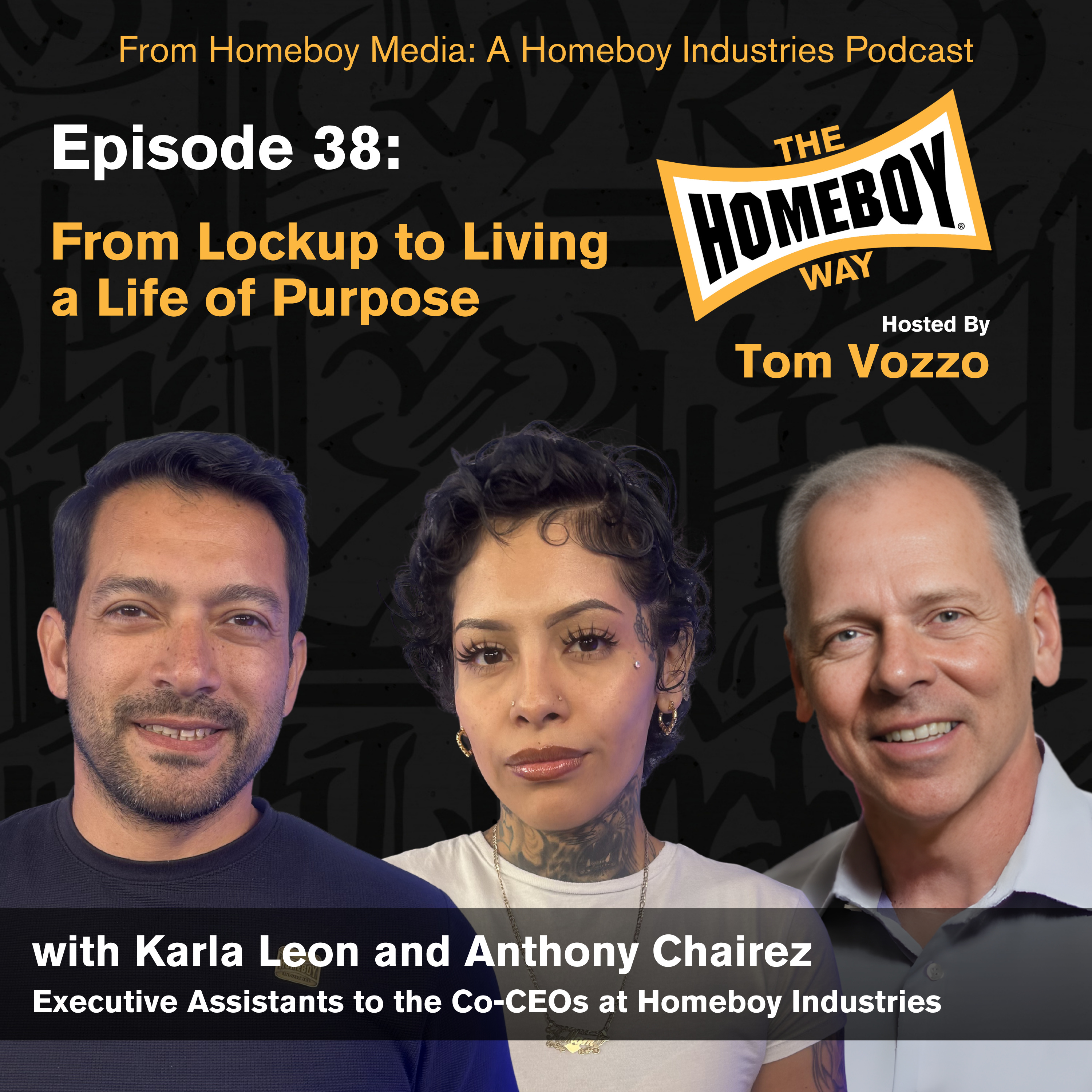 From Lockup to Living a Life of Purpose with Karla Leon and Anthony Chairez | What does it take to trust again after a lifetime of betrayal? For Karla Leon and Anthony Chairez, both formerly incarcerated and now executive assistants to the Co-CEOs of Homeboy Industries, the answer isn't a pill or a program, it's patience, kinship, and learning how to hug.Karla came home from federal prison to a three-year-old daughter who didn't know her as "Mom." Anthony served 20 years, from age 15 to 36, and had never provided for himself a single day. Both walked through Homeboy's doors with their guards up, expecting the worst from people who looked just like the ones who hurt them. What they found instead was something they didn't have words for yet: safety.In this episode, Tom Vozzo sits down with Karla and Anthony to talk about what healing actually looks like. They discuss the terror of walking into a room full of former gang members, the slow work of lowering your shield, and the surprising discovery that the people who can help you most might be ex-convicts and admitted drug addicts. Together, they prove that transformation doesn't happen fast, and that sometimes, the first step is learning to let someone teach you how to hug.Key TakeawaysWhen the state raises you, you never learn to provide for yourself.Anthony spent from 15 to 36 in prison. The state gave him everything. He came home never paying a bill or holding a job. Homeboy taught him how to be an adult.Homeboy helps people heal through trust and support.Anthony explains that Homeboy’s 18-month model is built around healing trauma, building resilience, and helping people withstand whatever life throws at them.Healing starts when people realize they are not alone.Through Homeboy’s classes, Anthony discovered that hearing others share their struggles with trauma, violence, and anxiety helped him feel connected instead of isolated.Love and patience can rebuild broken relationships.Karla shares how Homeboy taught her patience, emotional connection, and even how to hug, lessons that helped her reconnect with her daughter after prison.Growth takes patience and honesty.Karla explains that real healing began when she stopped rushing the process and finally learned to face herself honestly instead of avoiding the pain she carried inside.In This Episode:[00:00] Introduction[01:10] Karla’s journey to Homeboy Industries[03:02] Anthony reflects on 20 years in prison[05:04] Accepting the opportunity at Homeboy[06:12] The Homeboy healing model explained[07:05] Finding hope and kinship through classes[08:40] Rebuilding a relationship with family after prison[11:39] Learning not to take everything personally[13:36] Supporting Homeboy’s CEOs behind the scenes[17:58] Anthony on addiction and protecting his sanity[18:42] Karla on motherhood and joy[19:18] Ongoing trauma healing and therapy[21:03] Redirecting survival skills toward success[26:45] Anthony’s passion for rebuilding cars[27:33] Final reflections Notable Quotes“Had anyone asked me before I came home who I wanted mentoring me, I never would have imagined it would be former gang members and ex-convicts helping me rebuild my life.” — Anthony [08:12]“Until you’re comfortable with who’s staring back at you in the mirror, then you can move forward.” — Karla [16:57]“One thing I learned in therapy was if you can imagine the worst outcome, you can also imagine the best one.” — Karla [20:38]“My sanity brings me joy.” — Anthony [18:39]Resources and LinksHomeboy Industrieshttps://homeboyindustries.org/https://www.youtube.com/@HomeboyIndustries_LA/videosDonate: https://homeboyindustries.org/donate/donate-online/Homeboy Media https://homeboyindustries.org/social-enterprises/homeboy-media/Thomas Vozzohttps://www.linkedin.com/in/thomasvozzoThe Homeboy Way: A Radical Approach to Business and Life: https://www.amazon.com/Homeboy-Way-Radical-Approach-Business/dp/082945456XCredits:Hosted by: Tom VozzoProduced by: Podify, and Alexa Rousso and Melody Carter of Homeboy Media | — | ||||||
| 6/3/26 | 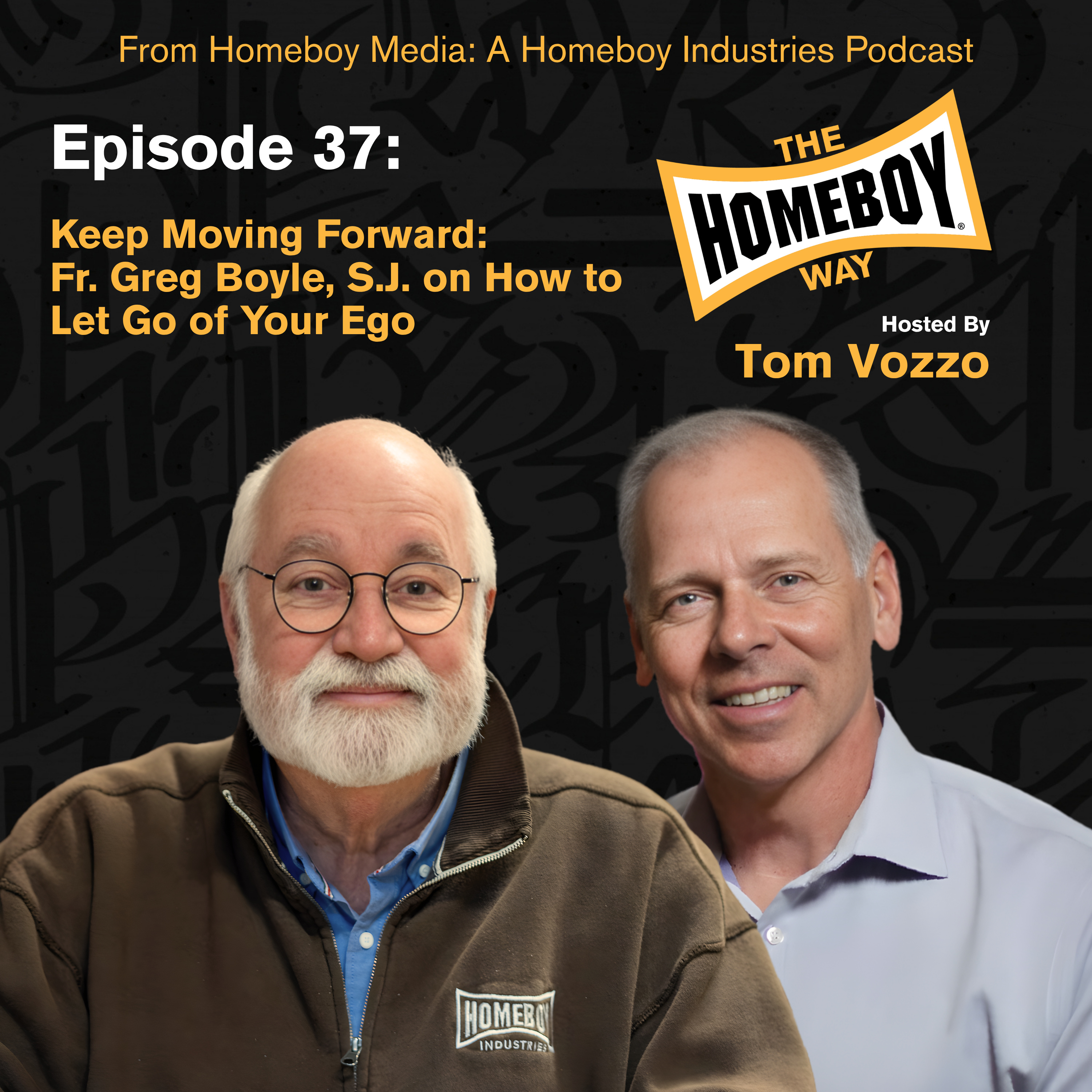 Keep Moving Forward: Fr. Greg Boyle, S.J. on How to Let Go of Your Ego | What does it mean to be loved without needing to earn it? In this episode of The Homeboy Way, host Tom Vozzo sits down with Fr. Greg Boyle, S.J., founder of Homeboy Industries, for a deeply human conversation about love, humility, recognition, trauma healing, and the kind of kinship that changes lives.Fr. Greg reflects on his birthday at Homeboy, the mariachis, the joy of being celebrated, and the lesson that love is not just something people give. It is their joy to give it. From Father Greg Boyle Day in Los Angeles to receiving the Presidential Medal of Freedom, he opens up about how he holds praise lightly, why he resists the language of “success,” and why the work has never been about ego or legacy.Tom and Fr. Greg also explore the heart of the Homeboy Industries model: moving beyond fixing, rescuing, and saving, and toward loving connection. Fr. Greg shares why trauma blocks love, why shame is one of the deepest wounds of poverty, and why walking through the doors of Homeboy requires real courage. This is a conversation about widening the circle, letting go of fear, and discovering the true self in loving.Key TakeawaysLove is not begrudging. It is joyfulFr. Greg explains how the birthday celebrations at Homeboy became a living parable for God’s love: not distant, forced, or half-hearted, but full of joy.The goal is not to make a difference.Fr. Greg challenges the usual nonprofit mindset, saying we should not go to the margins to make a difference. We should go so the people there make us different.Trauma blocks loving connectionFr. Greg explains that while loving connection heals trauma, it takes bravery for someone wounded by trauma to take the first step toward that connection.Walking into Homeboy is an act of courage.For someone whose identity is tied to gang life, shame, or survival, entering a place of love is not obvious. It is a leap.Love your neighbor means move forward.Fr. Greg contrasts “fear the world” communities with “love your neighbor” communities. One circles the wagons. The other widens the circle.In This Episode[00:00] Introduction[00:47] Why Fr. Greg’s birthday means so much at Homebo[03:06] “This is not for you. This is for the people.[08:12] Father Greg Boyle Day and the trap of legacy[09:03] Why “making a difference” gets the mission wrong[11:14] The moment Fr. Greg stopped trying to fix everyone[12:21] Why clinging is the source of suffering[14:38] True self in loving vs. false self in succeeding[15:44] Shame, disgrace, trauma, and loving connection[16:42] Why walking into Homeboy takes bravery[18:33] Being seen as a symbol, not a saint[20:16] What the Presidential Medal of Freedom meant to Homeboy[25:42] The deeper meaning of being recognized[29:12] Fear the world or love your neighbor[30:52] The Homeboy vibe outsiders immediately notice[31:37] Moving forward without taking yourself too seriouslyNotable Quotes“God’s too busy loving you to be disappointed.” — Fr. Greg Boyle [04:04]“Authentic Christian living is about moving forward. You just keep moving forward.” — Fr. Greg Boyle [08:25]“Clinging is the source of all suffering.” — Fr. Greg Boyle [12:26]“Trauma blocks the loving connection… and the loving connection heals the trauma.” — Fr. Greg Boyle [15:53]Resources and LinksHomeboy Industrieshttps://homeboyindustries.org/https://www.youtube.com/@HomeboyIndustries_LA/videosDonate: https://homeboyindustries.org/donate/donate-online/Homeboy Media https://homeboyindustries.org/social-enterprises/homeboy-media/Father Greg Boylelinkedin.com/in/greg-boyle-s-j-05458514Thomas Vozzohttps://www.linkedin.com/in/thomasvozzoThe Homeboy Way: A Radical Approach to Business and Life: https://www.amazon.com/Homeboy-Way-Radical-Approach-Business/dp/082945456XCredits:Hosted by: Tom VozzoProduced by: Podify, and Alexa Rousso and Melody Carter of Homeboy MediaHomeboy Media Production Assistant Cohort: Anthony Salazar and Sebastian Guzman | — | ||||||
| 5/27/26 | 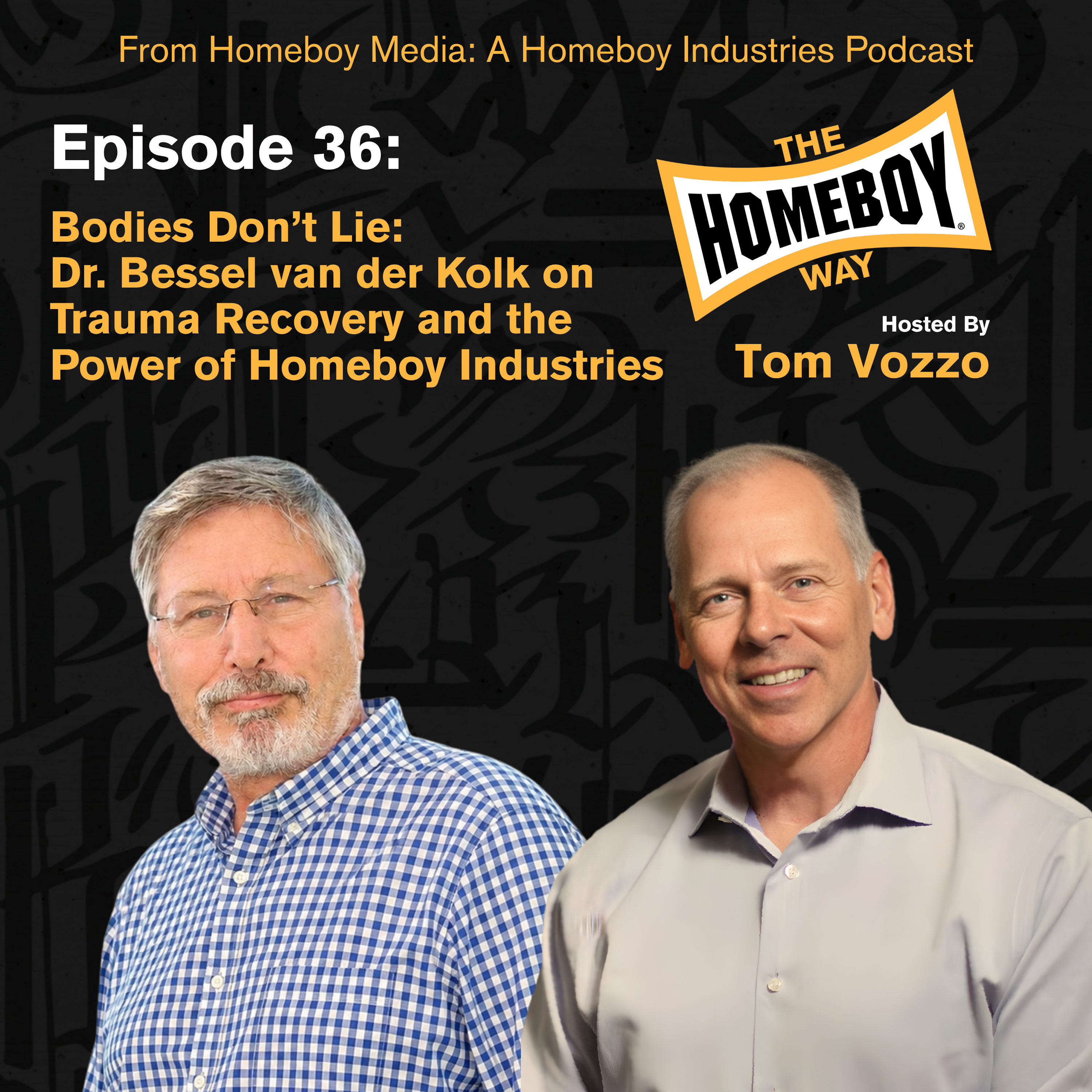 Bodies Don’t Lie: Dr. Bessel van der Kolk on Trauma Recovery and the Power of Homeboy Industries | When world-renowned trauma expert Dr. Bessel van der Kolk, author of the nine-million-copy bestseller The Body Keeps the Score, walked into Homeboy Industries, he came skeptical. What he found stopped him cold: people leaning into each other like friends. No suspicion. No dominance games. Just open-hearted safety. For a population with histories of violence and gang life, that is "quite remarkable."Dr. van der Kolk visited Homeboy and San Quentin in the same week. At San Quentin, he saw the familiar scars of trauma, isolation, and rigid hierarchy. But at Homeboy, he witnessed something radically different: people leaning into each other with trust and warmth. The contrast stunned him.In this episode, Tom Vozzo sits down with Dr. van der Kolk to delve into trauma, community, and the science behind Homeboy's transformative model. Together, they unpack why belonging is a biological imperative, why trauma lives in the body, and why action, such as chopping vegetables, dancing, or working in a kitchen, can heal what talk therapy alone cannot. They explore EMDR, why gangs and college campuses satisfy the same deep human need, and what it means to discover, perhaps for the very first time, that you might be lovable.So moved by what he saw at Homeboy, Dr. van der Kolk plans to dedicate a chapter of his next book to the program.Key TakeawaysSafety looks different at Homeboy.At San Quentin, people play dominance games. At Homeboy, men with histories of violence lean into each other, open-hearted. That contrast tells you everything about kinship.What you do becomes who you are.Psychiatry is top-down: pill, advice, sit still. Homeboy does the opposite: people work and build identity through action. For someone whose only identity was the gang, that job is the foundation of a new self.Trauma is not an event; it is helplessness.The antidote, as Darwin knew, is community: our uniquely human capacity to collaborate and look out for each other.The past can become a memory, not a life sentence.Terrible things become an alibi, a reason to stay stuck. Moving from ‘look what they did’ to ‘it’s over’ is the hardest shift. Homeboy makes it possible.In This Episode:[00:00] Introduction[00:30] Why Homeboy changes people[02:28] First impressions of Homeboy[04:14] Why belonging heals trauma[06:39] Finding community and identity[09:56] Letting go of gang identity[11:02] Trauma explained in simple terms[13:18] Understanding complex trauma[14:33] Why the body keeps the score[16:25] Understanding EMDR and healing[19:42] Why trauma keeps reliving itself[22:00] Trauma and the feeling of paralysis[23:53] Desmond Tutu and collective joy[27:00] Belonging across different cultures[28:08] The limits of traditional therapy[29:58] Can people ever fully heal?[30:50] Neurofeedback yoga and brain healing[32:39] Addiction, psychedelics, and recovery[35:19] Spirituality, compassion, and feeling loved[38:02] How trauma lives in the body[39:09] Final reflections Notable Quotes“People were open-hearted to each other as if they were accustomed to feeling safe with each other.” — Bessel [03:18] “In our field, we rarely talk about how the feeling of belonging is a critical human need.” – Bessel [04:42]Resources and LinksHomeboy Industrieshttps://homeboyindustries.org/https://www.youtube.com/@HomeboyIndustries_LA/videosDonate: https://homeboyindustries.org/donate/donate-online/Homeboy Media https://homeboyindustries.org/social-enterprises/homeboy-media/Dr. Bessel van der Kolkhttps://www.besselvanderkolk.com/BookThomas Vozzohttps://www.linkedin.com/in/thomasvozzoThe Homeboy Way: A Radical Approach to Business and Life: https://www.amazon.com/Homeboy-Way-Radical-Approach-Business/dp/082945456XCredits:Hosted by: Tom VozzoProduced by: Podify, and Alexa Rousso and Melody Carter of Homeboy Media | — | ||||||
| 5/20/26 | 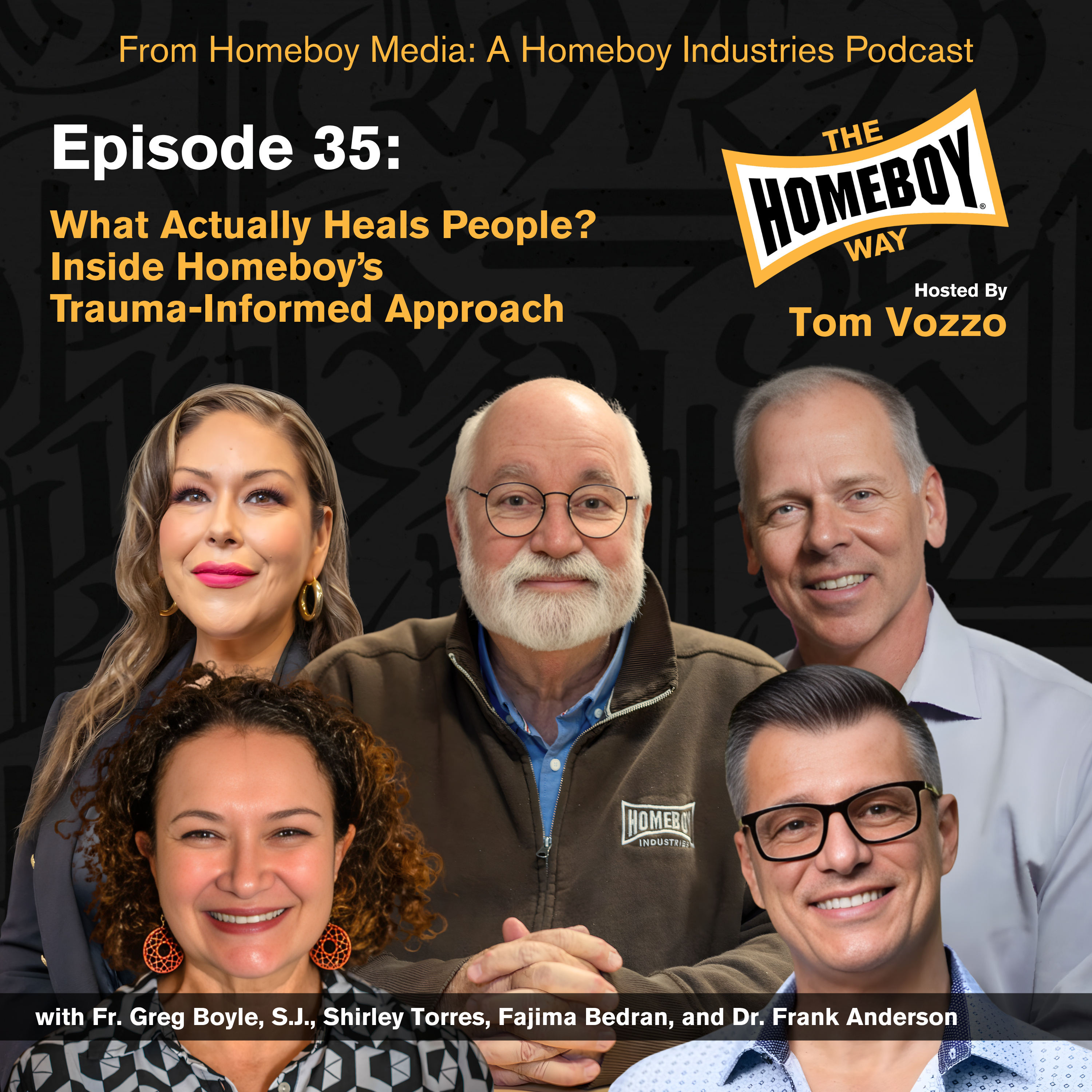 What Actually Heals People? Inside Homeboy’s Trauma-Informed Approach with Fr. Greg Boyle, S.J., Shirley Torres, Fajima Bedran, and Dr. Frank Anderson | What actually helps people heal? Is it therapy? Medication? Community? A conversation? A job? A second chance?In this special episode for Mental Health Awareness Month, host Tom Vozzo steps back from single transformation stories to look at the through line that makes Homeboy Industries actually work: mental health healing in community.Tom sits down with three sets of voices who have built, shaped, and lived Homeboy’s healing model.First, Father Greg Boyle returns to talk about why “listen, listen, love, love” isn’t just poetry but the most sophisticated trauma intervention there is.Then, Dr. Frank Anderson, a Harvard-trained trauma expert and world-renowned psychiatrist, breaks down what trauma actually is (and isn’t), why your symptoms might be protecting you, and the three components of real healing.Finally, Homeboy Industries’ Co-CEO Shirley Torres and longtime Clinical Director Fajima Bedran reveal how joy, dancing, and hot water became essential tools for whole-person healing.This episode teaches us how that transformation becomes possible and why you don’t need a therapy degree to help someone heal.Key TakeawaysHealing isn’t formulaic but it is cumulative.Father Greg calls it a “dosing effect” : one person remembers your name, another asks about your baby, a guard greets you. Alone, not therapy. Together, everything changes.Trauma isn’t who you are. It’s what happened to you.Dr. Frank Anderson says drinking, anger or withdrawal aren’t signs you’re broken, they’re adaptations. Healing starts when someone asks, “How is that helping you?”The therapy room is only one part of the container.At Homeboy, healing begins with a tap, an embrace, sitting with tears. What happens outside makes inside possible.Joy and suffering can coexist.Every Friday, Homeboy holds The Body Keeps the Score, stretching, meditation, dancing. Someone who wouldn’t give eye contact a month ago now glows. That’s not a break from work. That is the work.You don’t need to be a therapist to help someone heal.Anyone can sit, listen, offer a dose of love. That’s how a movement works.In This Episode:00:00 – Introduction00:29 – Why this episode focuses on mental health healing02:04 – Father Greg on how healing really happens03:37 – ACE scores and childhood trauma exposure05:59 – Why healing is bigger than talk therapy09:44 – Community healing and the “dosing” effect of love12:11 – Dr. Frank Anderson joins the conversation14:56 – Defining trauma and PTSD in simple terms16:50 – Understanding complex trauma and family dysfunction21:18 – Seeing people as good instead of broken22:52 – Looking beneath destructive behavior24:35 – The three steps required for healing trauma29:14 – Whole person healing at Homeboy32:11 – Why healing starts outside the therapy room41:51 – Staying hopeful while walking with people in painNotable Quotes"Listen, listen, love, love." — Fr. Greg [07:18]"Trauma blocks love and connection, and love and connection heals trauma." — Dr. Frank Anderson [28:13]"People are not what happened to them, and they are not the worst thing they've ever done." — Shirley Torres [31:00]"It was the first time I danced sober." — Homeboy trainee, as shared by Fajima Bedran [37:57]Resources and LinksHomeboy Industrieshttps://homeboyindustries.org/https://www.youtube.com/@HomeboyIndustries_LA/videosDonate: https://homeboyindustries.org/donate/donate-online/Homeboy Media https://homeboyindustries.org/social-enterprises/homeboy-media/Fr. Greg Boylelinkedin.com/in/greg-boyle-s-j-05458514Dr. Frank Andersonhttps://www.frankandersonmd.com/Shirley Torres linkedin.com/in/shirley-torres-1a9516a2Thomas Vozzohttps://www.linkedin.com/in/thomasvozzoThe Homeboy Way: A Radical Approach to Business and Life: https://www.amazon.com/Homeboy-Way-Radical-Approach-Business/dp/082945456XCredits:Hosted by: Tom VozzoProduced by: Podify, and Alexa Rousso and Melody Carter of Homeboy Media | — | ||||||
| 5/13/26 | 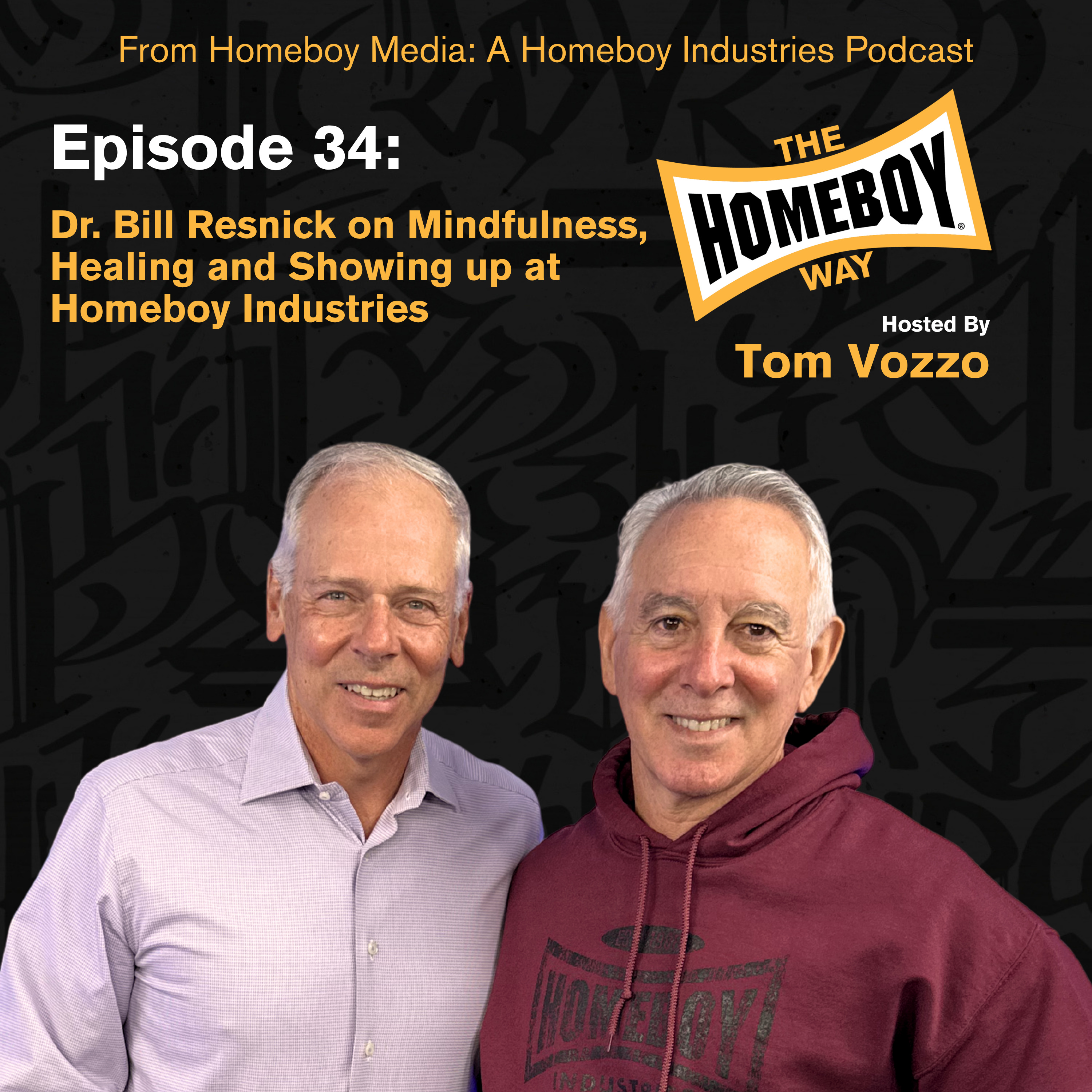 Dr. Bill Resnick on Mindfulness, Healing and Showing up at Homeboy Industries | Dr. Bill Resnick first heard about Homeboy through a friend before Homeboy even existed. Years later, after a site visit, reading Tattoos on the Heart, and witnessing Homeboy’s financial crisis, he found his way into the community.In this episode, former CEO Tom Vozzo talks with Bill about moving from donor to volunteer. A psychiatrist in long-term recovery, Bill now leads mindfulness classes at Homeboy. He shares what mindfulness really is, how to teach it in unpredictable classrooms, and why healing happens best in community, not just in a therapist’s office.Bill also opens up about his own mental health struggles and the multiple second chances he has received. His story reveals what it truly means to be part of Homeboy, not as an expert, but as someone willing to show up, get proximate, and simply be in a relationship.Key TakeawaysYou don’t need a quiet mind to practice mindfulnessMindfulness isn’t about stopping your thoughts. It’s about noticing them, “busy mind,” “planning mind,” and gently returning to the present. The shift isn’t control, it’s awareness.People are carrying more than you can seeAt Homeboy, trainees walk in with real-life pressures, court dates, family stress, trauma. That reality shows up in the classroom, and it shapes how healing has to happen.Mindfulness can be a shared experienceEven in silence, practicing alongside others creates connection. There’s something powerful about knowing you’re not alone in the work of being present.Belonging is part of the healingVolunteering becomes meaningful not because of what you give, but because you become part of something. Being recognized, welcomed, and connected matters.It’s not about fixing, it’s about relationshipHomeboy doesn’t need experts coming in to teach. It needs people willing to listen, to show up, and to be in genuine relationship with others.Healing isn’t one chance, it’s manyThe people at Homeboy often come from deep, generational trauma. Change doesn’t happen once. It happens over time, through multiple chances, and sometimes for the first time ever.In This Episode:00:00 – Introduction01:08 – How Bill first learned about Homeboy04:29 – The Miracle of Mindfulness class07:00 – Why mindfulness matters in daily life10:02 – Personal mindfulness practice13:14 – Teaching mindfulness at Homeboy16:51 – Tools for managing stress and anxiety19:23 – Why mindfulness works23:05 – What it means to be a volunteer28:53 – Philosophy of giving and philanthropy34:07 – Being part of the Homeboy community36:39 – Bill’s personal journey and second chances40:22 – Closing reflectionsNotable Quotes“Healing happens best in community, not just individually.” — Dr. Bill [02:32]“I can't meditate because my mind's too busy. I can't shut off my thoughts. If that were the requirement, nobody would be able to meditate.” — Dr. Bill [11:11]“ We give multiple chances to people” — Tom [36:29]Resources and LinksHomeboy Industrieshttps://homeboyindustries.org/https://www.youtube.com/@HomeboyIndustries_LA/videosDonate: https://homeboyindustries.org/donate/donate-online/Homeboy Media https://homeboyindustries.org/social-enterprises/homeboy-media/Dr. Bill Resnickhttps://www.linkedin.com/in/bill-resnick-03a5135/Thomas Vozzohttps://www.linkedin.com/in/thomasvozzoThe Homeboy Way: A Radical Approach to Business and Life: https://www.amazon.com/Homeboy-Way-Radical-Approach-Business/dp/082945456XCredits:Hosted by: Tom VozzoProduced by: Podify, and Alexa Rousso and Melody Carter of Homeboy Media | — | ||||||
| 5/6/26 | 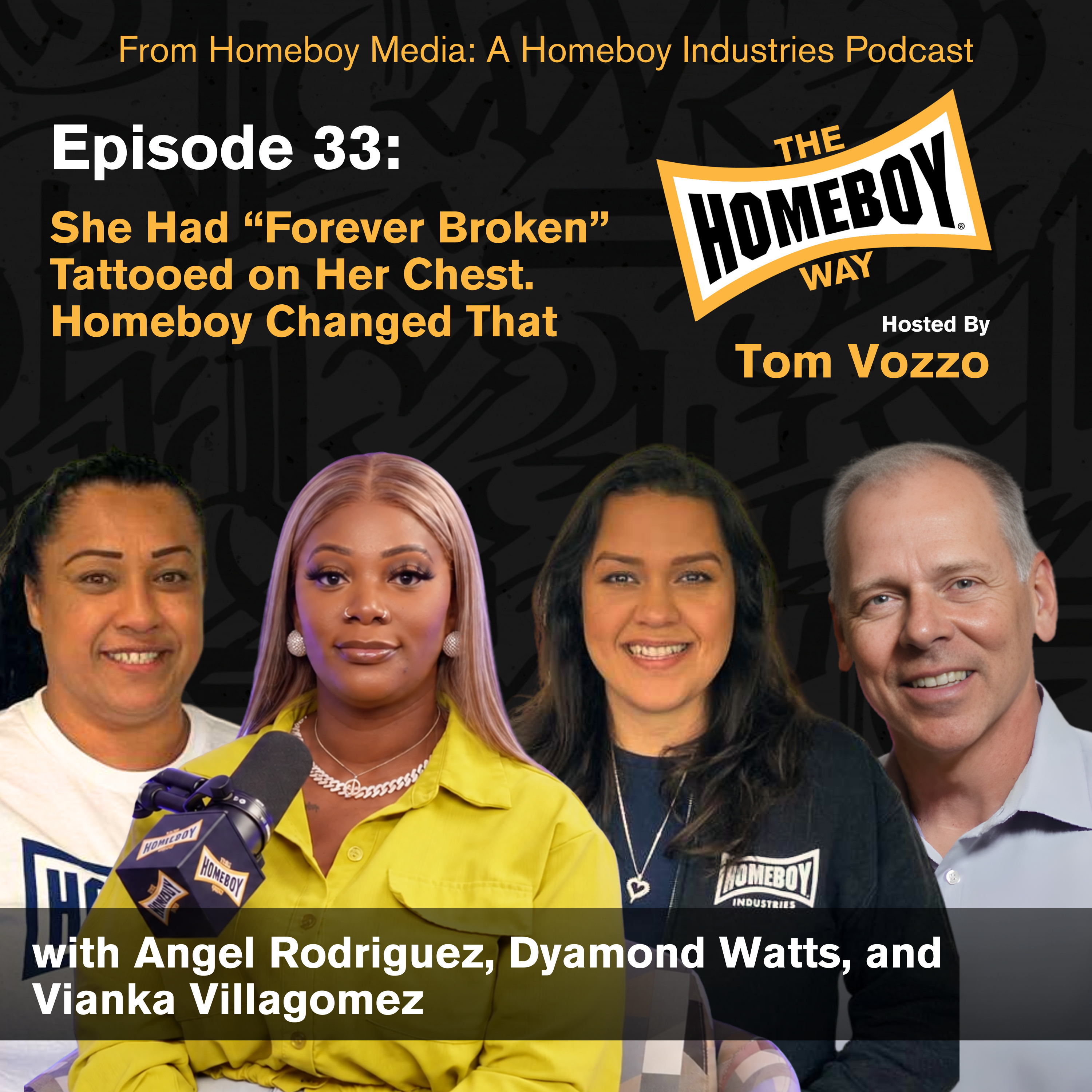 She Had "Forever Broken" Tattooed on Her Chest. Homeboy Changed That with Angel Rodriguez, Dyamond Watts, and Vianka Villagomez | In this episode, Tom Vozzo sits down with three remarkable women who have each walked through Homeboy's doors broken and walked out as leaders. Dyamond is now a brand strategist for the Homeboy Way podcast. Angel is a navigator helping new trainees find their footing. Vianka is an academic program coordinator at Homeboy's adult high school. Together, their stories paint a vivid portrait of what healing looks like when it is real, when it is slow, and when it never really ends.Dyamond came in after escaping an abusive relationship, drawn in by nothing more than the color of her cousin's purple shirt. She did not believe you could be paid to heal. Angel stood in the rain, literally torn between the familiar pain of her past and the unknown promise of Homeboy's open door. She chose the right path. Vianka arrived through Homeboy's anger management program, sent by a case manager she met while incarcerated, stepping through the doors during COVID when the building was nearly empty but the welcome was full.All three carry tattoos and scars and imposter syndrome. All three have sat in the same classes they now help facilitate. All three are raising children who see them showing up every day. And all three have one message for anyone still standing in the rain deciding which way to walk: you are not forever broken.Key TakeawaysHealing can be a job.Dyamond couldn't believe it when her cousin said all you have to do is go to classes and they pay you for it. She had to see it to believe it.We don't only hurt ourselves, we hurt the people who love us.Angel learned in incarceration classes that every relapse, every arrest cuts deep into the people who love you, and her son crying for her at night was her turning point. At Homeboy, the color lines disappear.Coming from the hood where Blacks and Hispanics don't always get along, Dyamond found something different at Homeboy: protection, support, and being seen as a boss.Motherly instinct is a superpower.Vianka feeds off the men's strength, but what connects the women is holding each other through difficult situations because they know what it means to bear kids and show up anyway. A business card can feel like an Oscar. Angel handed her mom a card with her name on it, and her mom made the biggest deal out of it. Because seeing your child finally change, that is everything.In This Episode:00:00 – Introduction01:20 – Dyamond’s journey to Homeboy02:45 – Choosing healing over familiar pain04:20 – Angel’s role as a navigator06:45 – Angel’s turning point after incarceration08:49 – Vianka’s path through trauma and healing15:06 – Lessons for their younger selves23:09 – Homeboy as a place of sanctuary24:55 – Being a woman at Homeboy29:21 – Women who inspire them40:42 – What gives them hope today44:14 – The meaning behind the gala momentNotable Quotes" I just couldn't believe that you're paying me to do something that I need to do. It was a win-win." – Dyamond [02:33]"I stood there and it was raining and I was torn because I wanted to go with the comfortable pain that I was used to." – Dyamond [03:32]"Hope has an address. It's 130 West Bruno Street." – Angel [41:30]Resources and LinksHomeboy Industrieshttps://homeboyindustries.org/https://www.youtube.com/@HomeboyIndustries_LA/videosDonate: https://homeboyindustries.org/donate/donate-online/Homeboy Media https://homeboyindustries.org/social-enterprises/homeboy-media/Vianka Villagomezhttps://www.facebook.com/vianka827/Dyamond Wattshttps://www.instagram.com/therealqueenofcompton/Thomas Vozzohttps://www.linkedin.com/in/thomasvozzoThe Homeboy Way: A Radical Approach to Business and Life: https://www.amazon.com/Homeboy-Way-Radical-Approach-Business/dp/082945456XCredits:Hosted by: Tom VozzoProduced by: Podify, and Alexa Rousso and Melody Carter of Homeboy Media | — | ||||||
| 4/29/26 | 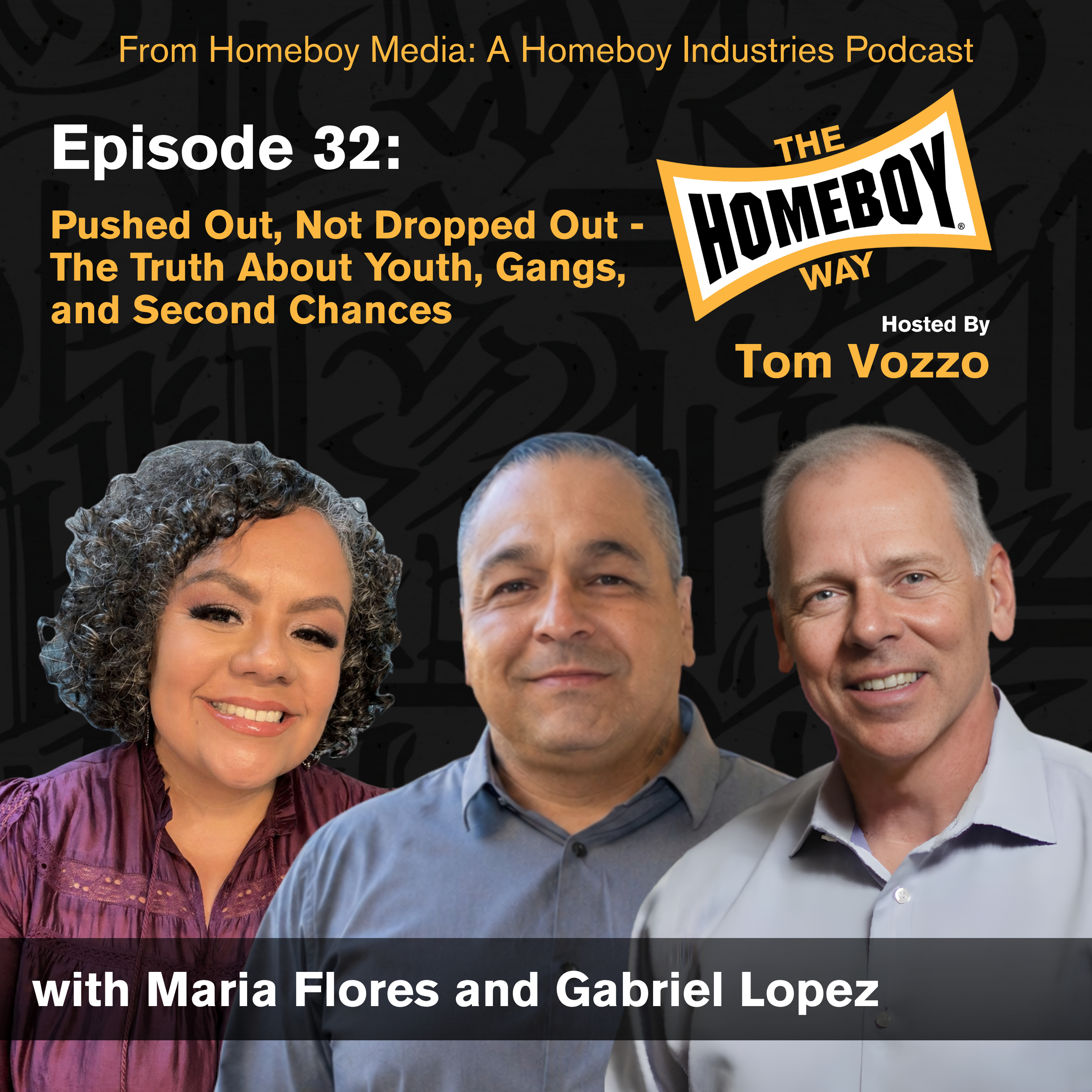 Pushed Out, Not Dropped Out: The Truth About Youth, Gangs, and Second Chances with Maria Flores and Gabriel Lopez | What does it take to reach a kid who’s already been given up on by every system around them? Maria Flores and Gabriel Lopez of Homeboy’s Youth Reentry Center answer simply: show up, stay, and never close the door.In this episode, Tom Vozzo sits down with Maria and Gabriel to explore the reality of working with youth coming out of incarceration and still living in gang violence, generational trauma, and instability. Unlike adults, these young people return to the same environments they came from. Their trauma isn’t something they leave behind, it’s where they live.Gabriel brings lived experience as a former generational gang member who spent years in prison before choosing a different path after his son was born. Maria, with 18 years at Homeboy, has seen entire cycles repeat, including parents she once supported now sending their own children through the program. Together, they describe a model rooted in radical consistency: no youth is ever expelled, no family is abandoned, and no one faces the system alone.From moments of joy like white water rafting trips where a hardened teen smiles for the first time, to a young man who kept returning simply because someone noticed him, this episode shows what happens when kids are treated not as problems to fix, but as people who want to be seen and loved.Key TakeawaysSociety failed her, Homeboy showed upA girl out of school for three years wasn’t blamed. Instead, Maria asked how the system failed her. With support, she graduated two years later. No one gets pushed out hereThe Youth Reentry Center never expels kids. Instead of punishment, they use reflection and healing circles, offering stability to youth used to rejection. Education is the turning pointThough legally allowed back in school, many youth are pushed out. Homeboy created its own school to ensure they don’t fall through the cracks. Kids are pushed out not failing aloneBehaviors that lead to expulsion in underserved communities are often handled differently elsewhere. The homeboy chooses to open the door instead. Gang identity is about survival What looks like defiance is often protection. As Gabriel puts it, beneath it all is a kid who wants to be loved. Healing the healer matters Maria calls Homeboy "my medicine." Staying present requires daily practices. Staff wellbeing is essential to sustaining this work. In This Episode:00:00 – Introduction00:30 – Why Homeboy focuses on youth02:49 – Living in trauma, not beyond it06:47 – Girls, foster care, and hidden struggles08:44 – Why no one is ever kicked out09:30 – The reason Homeboy built a school10:40 – The “chaser” model and wraparound support15:27 – Understanding a young man’s mindset16:30 – Gabriel’s story: joining a gang early19:02 – What changed the direction of his life21:12 – Fatherhood and a new sense of purpose23:26 – Building trust and creating safe spaces26:42 – Summer programs and moments of joy28:48 – Lessons in trust and letting go33:50 – Working with parents and reunification36:02 – Breaking cycles of conflict and violence41:26 – Gabriel’s journey as a fatherNotable Quotes“No one stops to look at what our kids are holding in their heart.” – Gabriel [03:58]“There is no such thing as ‘that’s it, you’re done.” – Maria [09:01]“They’re just little boys that want to be loved, bro.” – Gabriel [16:16]“ There's never a hopeful kid that joins a gang.” – Maria [17:25]Resources and LinksHomeboy Industrieshttps://homeboyindustries.org/https://www.youtube.com/@HomeboyIndustries_LA/videosDonate: https://homeboyindustries.org/donate/donate-online/Homeboy Media https://homeboyindustries.org/social-enterprises/homeboy-media/Thomas Vozzohttps://www.linkedin.com/in/thomasvozzoThe Homeboy Way: A Radical Approach to Business and Life: https://www.amazon.com/Homeboy-Way-Radical-Approach-Business/dp/082945456XCredits:Hosted by: Tom VozzoProduced by: Podify, and Alexa Rousso and Melody Carter of Homeboy Media | — | ||||||
| 4/22/26 | 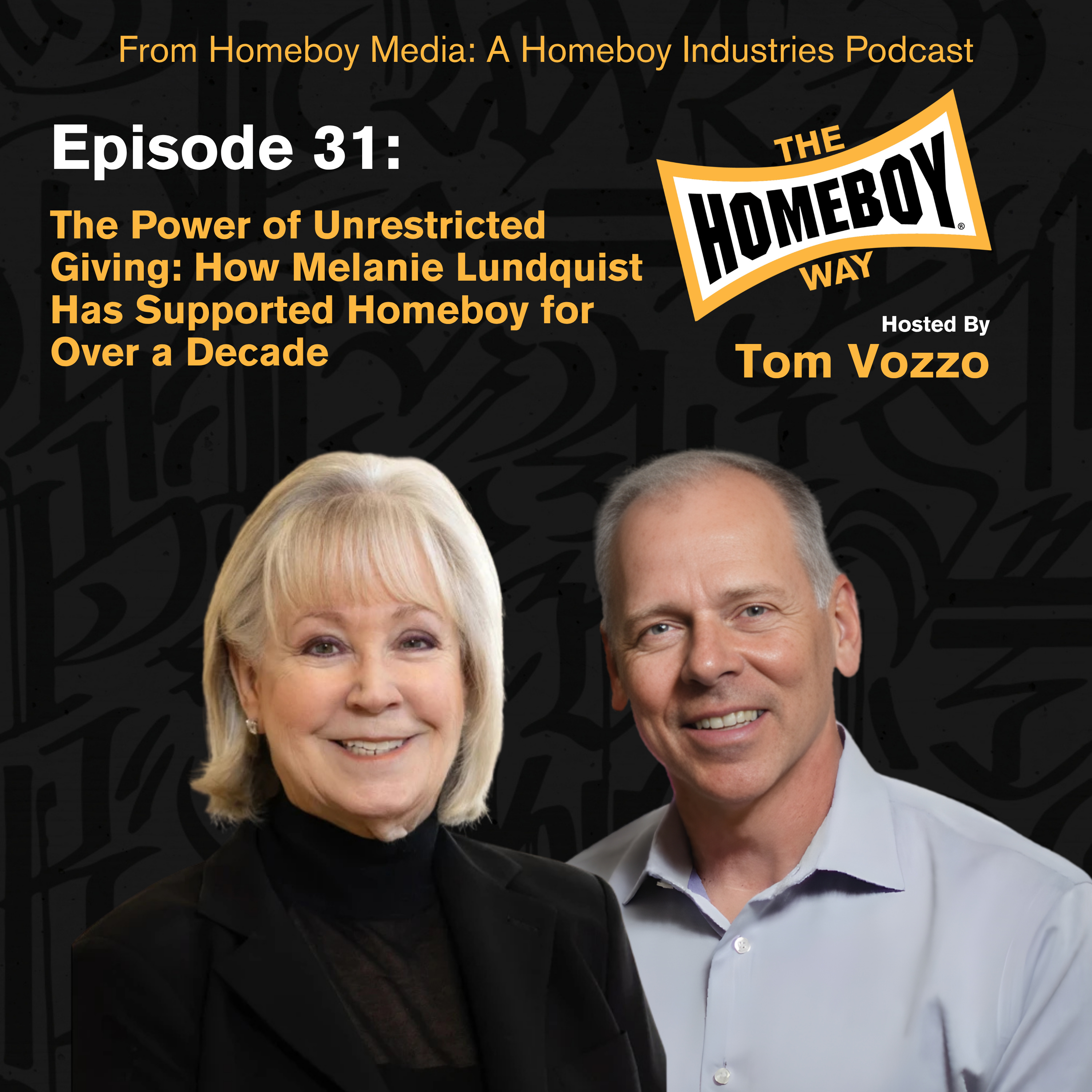 The Power of Unrestricted Giving: How Melanie Lundquist Has Supported Homeboy for Over a Decade | Years ago, Homeboy Industries was experiencing financial hardship. In order to make payroll, Melanie and her husband Richard Lundquist received a call from a Homeboy Board member that resulted in a check with no strings attached. No restrictions. Just trust.In this episode, Tom Vozzo sits down with 2026 Lo Maximo KINSHIP Honoree Melanie Lundquist, longtime Homeboy Industries supporter, to uncover the story behind that trust.Melanie's father was raised in Boyle Heights, and she remains true to her roots, retaining her lifelong love of service to others.Melanie and her husband, Richard are Giving Pledge (https://www.givingpledge.org/) signatories, and for them, impact is not about perfect numbers. It is about walking with the most vulnerable, and investing in replicable models like Homeboy Industries, that create systemic changeKey TakeawaysCherishing each other is a shared responsibility.If we had enough cherishing, there would be no need for Homeboy. Melanie subscribes to Warren Buffett's theory: money belongs to society; we're just temporary stewards.Systemic change requires replicable models.We live in a deeply broken system across education, justice, and healthcare. True success is not short term help. It is creating models that can replicate and drive change from the bottom up. Homeboy is a replicable model; dollars invested here reach far beyond LA.Homies belong at the tableWhen people ask if Melanie has had "clients" at her dining room, she corrects them: "They're homies." She's proud to have them there. Your dollars build a model that helps people in Chicago, New York, and beyond.Kindness costs nothing but changes everythingYet we struggle to give it. As a philanthropist, Melanie says, "It's the biggest, most joyful journey of my life. I wouldn't trade it for anything."In This Episode:00:00 – Introduction00:41 – Why Melanie became a supporter of Homeboy05:53 – Why philanthropy gives life meaning07:50 – Defining impact and systemic change10:12 – Why donors should engage beyond money12:10 – Gratitude and the deeper meaning of giving14:02 – Why she chose to invest in Homeboy16:20 – Balancing different causes and priorities19:21 – Five-year forecast: the future of philanthropy21:00 – Why long-term commitment matters25:07 – Politics vs. philanthropy26:45 – Elected officials prioritizing the poor and disenfranchised27:51 – The freedom and limits of philanthropy31:47 – Why Homeboy’s model works34:07 – Can philanthropy save democracy?37:00 – The power of kindness and empathy38:03 – The redwood metaphorNotable Quotes“ If we had enough cherishing, there would be no need for Homeboy - Melanie [02:19]“Philanthropy is the rent we pay for the air we breathe.” - Melanie [03:43]“Philanthropy is the meaning of life and what gives our life meaning.” - Melanie [06:00]“What does it cost people to be kind? It costs nothing.” - Melanie [37:00]Resources and LinksHomeboy Industrieshttps://homeboyindustries.org/https://www.youtube.com/@HomeboyIndustries_LA/videosDonate: https://homeboyindustries.org/donate/donate-online/Homeboy Media https://homeboyindustries.org/social-enterprises/homeboy-media/Melanie Lundquisthttps://www.givingpledge.org/Thomas Vozzohttps://www.linkedin.com/in/thomasvozzoThe Homeboy Way: A Radical Approach to Business and Life: https://www.amazon.com/Homeboy-Way-Radical-Approach-Business/dp/082945456XCredits:Hosted by: Tom VozzoProduced by: Podify, and Alexa Rousso and Melody Carter of Homeboy Media | — | ||||||
Want analysis for the episodes below?Free for Pro Submit a request, we'll have your selected episodes analyzed within an hour. Free, at no cost to you, for Pro users. | |||||||||
| 4/15/26 | 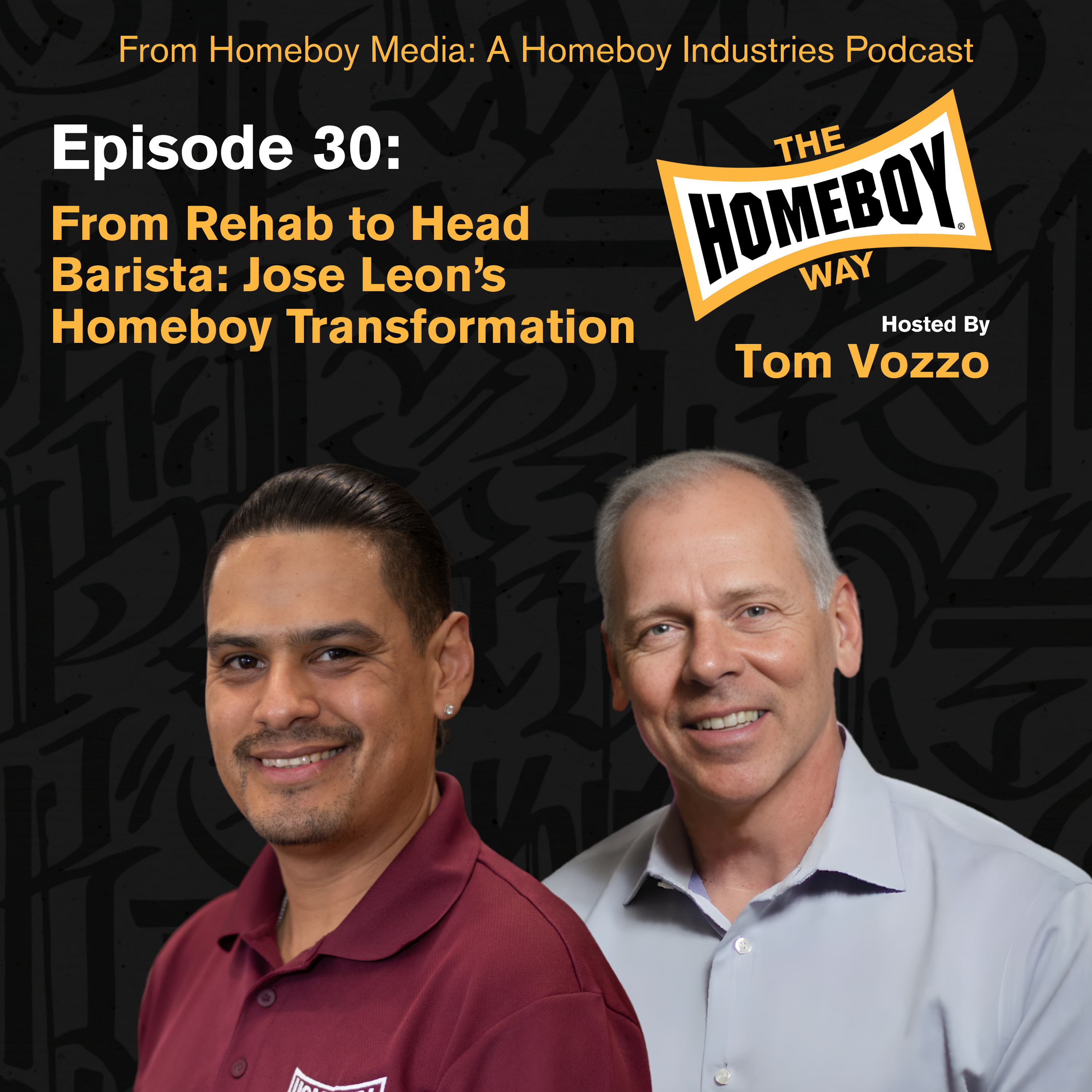 From Rehab to Head Barista: Jose Leon’s Homeboy Transformation | In this episode, Tom Vozzo sits down with Jose Leon, head barista at Homegirl Cafe. But Jose almost didn’t stay long enough to make a single cup.The first time Jose walked through the doors of Homeboy Industries, he was already planning his exit. Fresh out of rehab and carrying a charge for “fire,” considered worse than murder on the streets, he assumed a place full of gang members could never be positive. But his roommate, T, had a persistent, vibrant energy that Jose wanted for himself. More than that, he had four daughters. He needed to become someone they could count on.So he stayed. He washed dishes. He unlearned nearly everything. And then he got tricked into becoming a barista. Behind the counter at Homegirl Cafe, Jose discovered that coffee dissolves the barriers between strangers. People walk in with heavy stories, a mother grieving a son, and hand them over with their order. He listens, he serves, and he makes the best latte in Los Angeles.Now the head barista and a quiet leader, Jose still wakes at 3:30 a.m. He still focuses on the next generation, knowing he may never fully heal the wounds of his past. But he shows up differently. And that, he says, changes everything.Key TakeawaysIf you want something different, you have to do something different.Jose did not suddenly feel ready. He chose differently. He realized that everything he had done before led him to where he was, and if he wanted a different life, he had to take a completely different path.Transformation does not instantly fix relationshipsEven when someone does the work to heal, grow, and change, family members may still see the old version of them. Rebuilding trust takes time, patience, and consistency.Small, consistent actions can create a sense of purpose.When Jose started in the back of the cafe washing dishes, it wasn't a dead-end job. It was the first time he knew he could do something, finish it, and do it correctly again the next day. Support can break deeply rooted beliefsMany who come from incarceration or hardship feel like they do not deserve help. Experiencing genuine care through meals, kindness, and community begins to shift that mindset and opens the door to changeIn This Episode:00:55 – Jose’s first time at Homeboy01:28 – The arson charge and coming out of rehab02:04 – Why Jose was against Homeboy at first02:45 – What kept him coming back03:33 – The turning point: “I had to do something different”05:44 – What Father Greg means to Jose07:22 – Traveling to Fairbanks, Alaska to speak08:46 – Unlearning everything09:20 – Daily practices: waking up at 3:30 a.m.11:06 – Healing family relationships without expectations13:33 – Talking to his daughters and focusing on the next generation14:17 – What Jose tells customers at the coffee counter15:17 – Daily mindset reminders17:10 – Part 2: Inside the Homegirl Cafe17:28 – Starting as a dishwasher in the back18:35 – Becoming a barista by accident19:21 – Overcoming insecurity about facial scars20:38 – Why the coffee counter removes barriers22:20 – When a mother shared her son’s death24:06 – Helping people straight out of jail with a free mealNotable Quotes“ If I wanted something different in life, I had to do something different.” — Jose [03:35]“I wanted to be the person my daughters needed me to be” — Jose [02:47]“I had to unlearn everything.” — Jose [09:07]Resources and LinksHomeboy Industrieshttps://homeboyindustries.org/https://www.youtube.com/@HomeboyIndustries_LA/videosDonate: https://homeboyindustries.org/donate/donate-online/Homeboy Media https://homeboyindustries.org/social-enterprises/homeboy-media/Jose Leonlinkedin.com/in/jleon77Thomas Vozzohttps://www.linkedin.com/in/thomasvozzoThe Homeboy Way: A Radical Approach to Business and Life: https://www.amazon.com/Homeboy-Way-Radical-Approach-Business/dp/082945456XCredits:Hosted by: Tom VozzoProduced by: Podify, and Alexa Rousso and Melody Carter of Homeboy Media | — | ||||||
| 4/8/26 | 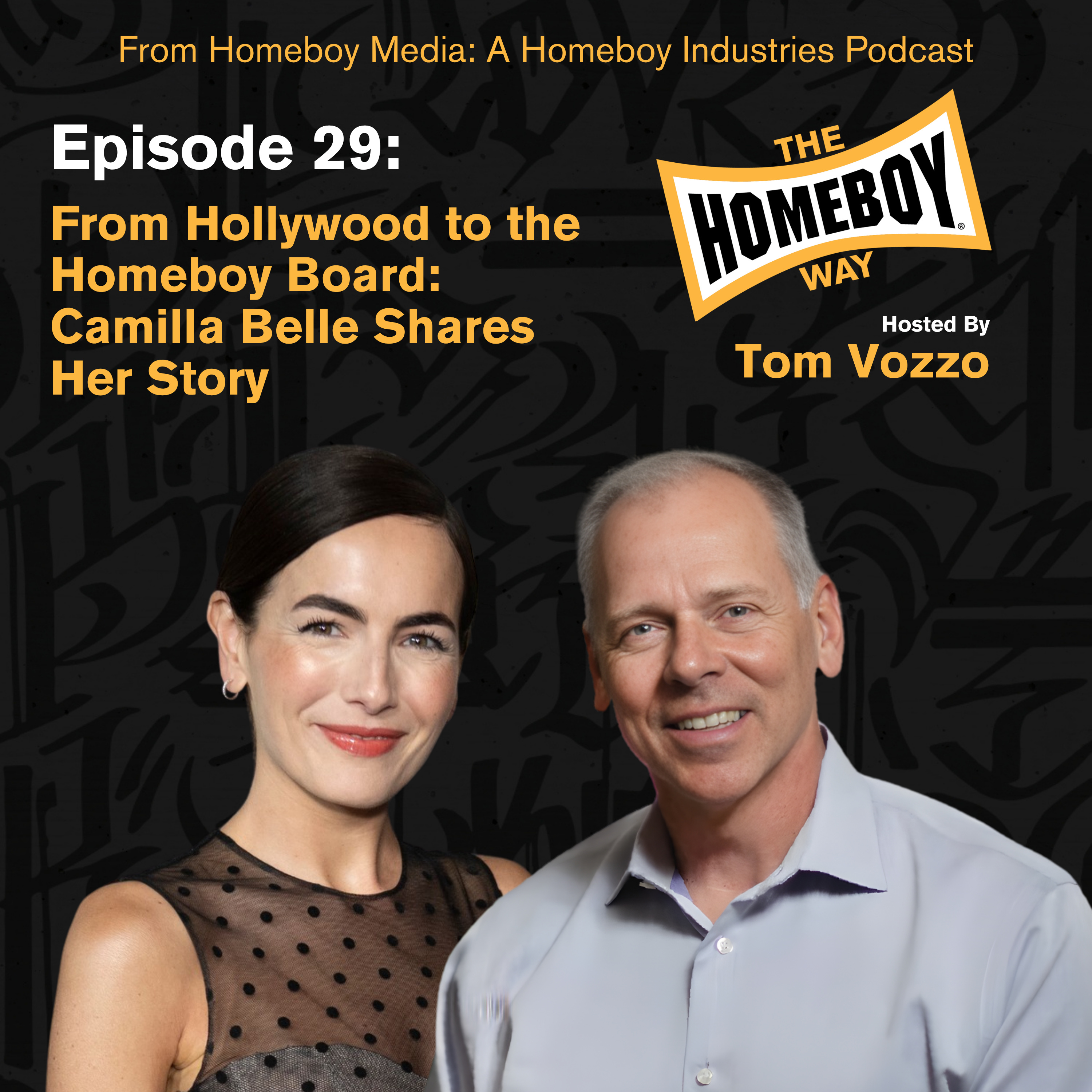 From Hollywood to the Homeboy Board: Camilla Belle Shares Her Story | A Hollywood actor spent years trying to get through the doors of Homeboy Industries. Not as a client. Not as a case manager. Just as someone who felt drawn to a place she did not fully understand. Camilla Belle had heard Father Greg speak at her church, seen the logo around Los Angeles, and had friends on the inside. But she still needed someone to take her by the hand.In this episode, Tom Vozzo sits down with Camilla to hear the full story, from Mommy & Me classes at Jane Fonda's workout studio to finally getting the tour at Homeboy. She describes her first morning meeting as indescribable: the prayer, the celebrations, the bake sales. That single visit turned into a board seat, a PA training class, and a van ride with a homie who trusted her with his entire life story.Camilla did not come from gangs or prison. She came from Hollywood. And that turned out to be enough. Because at Homeboy, kinship does not require a shared past. Just a willingness to show up, listen, and believe in second chances.Key TakeawaysMorning meeting is the heartbeat of HomeboyCamilla describes it as indescribable, a celebration of life, community, and positivity that stays with you. From prayer to bake sales, everyone should experience it.Second chances are irresistible.Camilla was drawn to Homeboy not despite the fear people feel, but because of it. Father Greg's message about giving people another chance spoke to her deeply.You don't need a shared past to belongMany look at Homeboy and think, "I have nothing in common." But inside those doors, there's no judgment. We're all human.Listening is a privilege.During a board activation day, Camilla sat in the front of a van and listened as a homie told her his whole story, incarceration, family, and kids. She felt lucky he trusted her.Homeboy doesn't give anything away.No handouts. You work hard, show up, go through the 18-month program, and dedicate yourself to change. Homeboy gives second, third, and fourth chances as many as it takes.In This Episode:00:00 – Introduction00:45 – How Camilla got involved with Homeboy03:25 – First impressions: the morning meeting05:25 – Philanthropy and motivation to join Homeboy07:02 – Finding common ground and human connection08:41 – Homeboy Media Group and workforce development09:07 – PA training class experience11:22 – Navigating the entertainment industry and social media13:06 – Lessons learned from Father Greg Boyle14:40 – Applying Homeboy lessons to everyday life15:26 – Jane Fonda’s influence and activism17:37 – Encouraging advocacy and activism19:28 – Building relationships and volunteering20:17 – Family support and memorable Homeboy stories22:04 – Hope for the future and second chances24:00 – The importance of second chances25:25 – Board member experience27:39 – Podcast closingNotable Quotes“You walk in here and you say, there's no judgment..” — Camilla [08:08]“If you believe in it, you're going to show up.” — Camilla [15:54]“Get off your phone, talk to people.” — Camilla [17:45]“Slow yourself down and just be available and listen.” — Camilla [21:53]Resources and LinksHomeboy Industrieshttps://homeboyindustries.org/https://www.youtube.com/@HomeboyIndustries_LA/videosDonate: https://homeboyindustries.org/donate/donate-online/Homeboy Media https://homeboyindustries.org/social-enterprises/homeboy-media/Camilla Bellehttps://www.instagram.com/camillabelle/Thomas Vozzohttps://www.linkedin.com/in/thomasvozzoThe Homeboy Way: A Radical Approach to Business and Life: https://www.amazon.com/Homeboy-Way-Radical-Approach-Business/dp/082945456XCredits:Hosted by: Tom VozzoProduced by: Podify, and Alexa Rousso and Melody Carter of Homeboy Media | — | ||||||
| 4/1/26 | 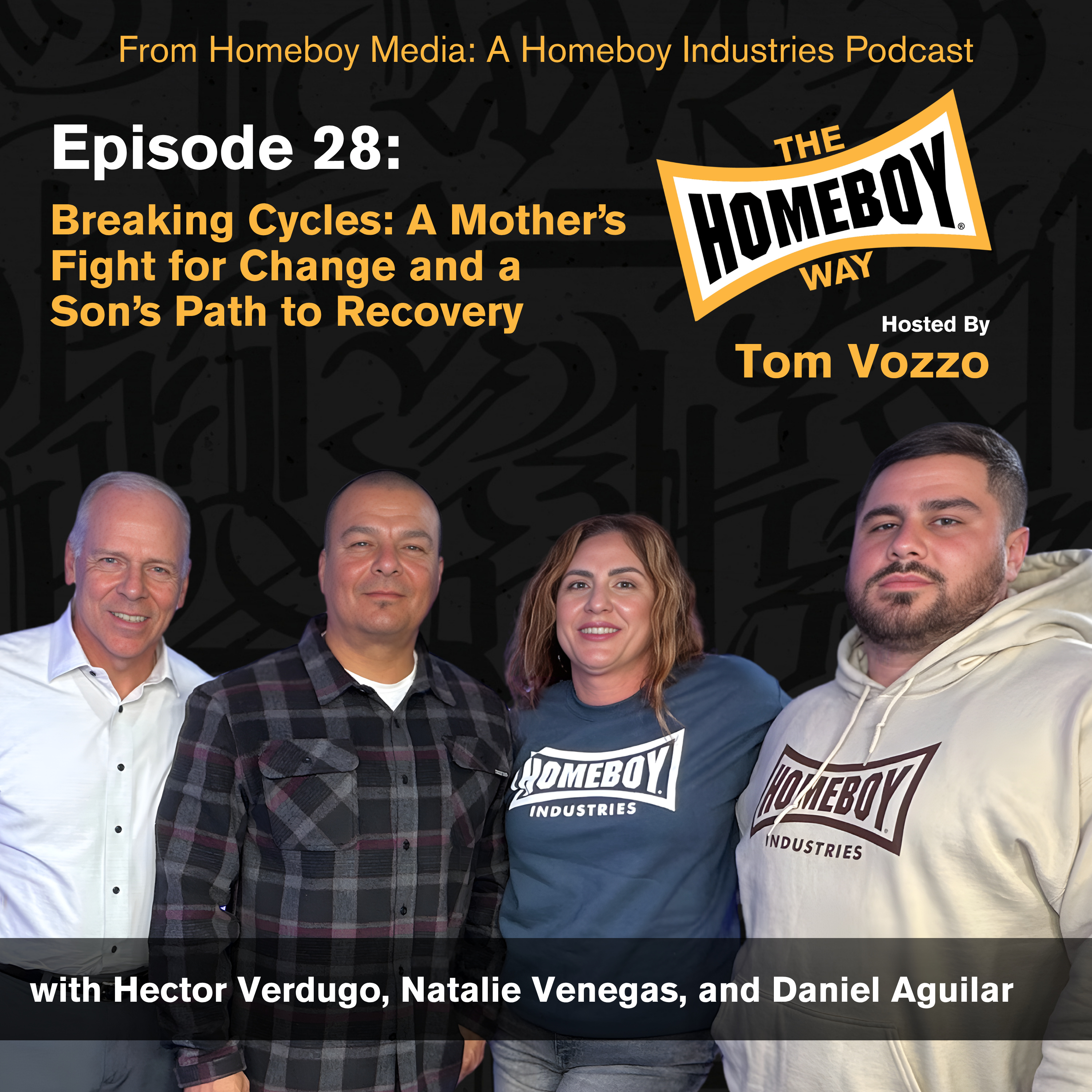 Breaking Cycles: A Mother's Fight for Change and a Son's Path to Recovery with Natalie Venegas and Daniel Aguilar | Imagine your children being taken from your home at gunpoint. That searing, shame-filled moment becomes the catalyst. Not for more destruction, but for a journey that leads you from prison yards to the director’s chair, and eventually, to finding freedom in a sun-drenched square in Barcelona. This is Natalie’s story.In this episode of The Homeboy Way, host Tom Vozzo sits down with Natalie Venegas, Director of Case Management at Homeboy Industries, her son Daniel Aguilar, and longtime Homeboy leader Hector Verdugo to explore the long arc of transformation and generational healing. Natalie reflects on her 15-year journey from leaving prison as a four-time felon, carrying the trauma of her children being taken at gunpoint, to rising into senior leadership while pursuing clinical licensure. She shares how addiction, rejection, and survival masks once shaped her life, and how therapy, education, and unconditional love helped her learn how to live, parent, and lead. Daniel offers his perspective on choosing recovery for himself, while Hector reflects on witnessing Natalie’s evolution firsthand. Together, their stories reveal how kinship and consistency reshape not just individual lives, but entire family trajectories.Key TakeawaysHealing begins when survival endsNatalie shares how emotional shutdown and stoicism kept her alive but also kept her stuck. Healing began only when she felt safe enough to be vulnerable.Consistency builds trust where words cannotHomeboy’s steady presence taught Natalie how to be consistent for herself, her children, and others, something she never experienced growing up.Unconditional love creates capacity Being loved without prerequisites allowed Natalie to believe in herself, pursue education, enter therapy, and step into leadership.Healing is generational Daniel’s recovery is connected to his mother’s healing. Homeboy’s model shows how helping one person reshapes an entire family’s future.You cannot do it alone, and you are not meant to Walking alongside others through sponsors, staff, and peers makes transformation sustainable and real.In This Episode:00:00 – Introduction00:42 – Natalie’s early years and repeated incarceration02:09 – Being taken from her children at gunpoint03:59 – Choosing not to numb out in prison06:28 – A letter from her son that changed everything08:09 – The Greyhound bus, temptation, and choosing sobriety10:36 – Entering a program and first encounters with Homeboy12:18 – “You don’t fit our profile”: misjudgment and persistence14:58 – Vulnerability breaks through stoicism17:22 – Learning how to live on the outside18:36 – Education, therapy, and discovering a calling21:10 – From survival to service23:09 – Daniel shares his recovery journey28:25 – Parenting, boundaries, and letting go31:26 – How Homeboy changes entire family trajectories33:01 – Traveling the world as formerly incarcerated leaders35:26 – Belonging without labelsNotable Quotes“I didn’t know how to live out here. I knew how to hustle, but not how to be a mom.” — Natalie Venegas [17:02]“I’m the only one who’s going to fix my life.” — Daniel Aguilar [26:35]“Homeboy loves people, gives people hugs until they learn how to love themselves.” — Natalie [23:01]Resources and LinksHomeboy Industrieshttps://homeboyindustries.org/https://www.youtube.com/@HomeboyIndustries_LA/videosDonate: https://homeboyindustries.org/donate/donate-online/Homeboy Media https://homeboyindustries.org/social-enterprises/homeboy-media/Natalie Venegashttps://www.linkedin.com/in/natalie-venegas-1327b0a3/Hector Verdugohttps://www.linkedin.com/in/hector-verdugo-7297a684Thomas Vozzohttps://www.linkedin.com/in/thomasvozzoThe Homeboy Way: A Radical Approach to Business and Life: https://www.amazon.com/Homeboy-Way-Radical-Approach-Business/dp/082945456XCredits:Hosted by: Tom VozzoProduced by: Podify, and Alexa Rousso and Melody Carter of Homeboy Media | — | ||||||
| 3/25/26 | 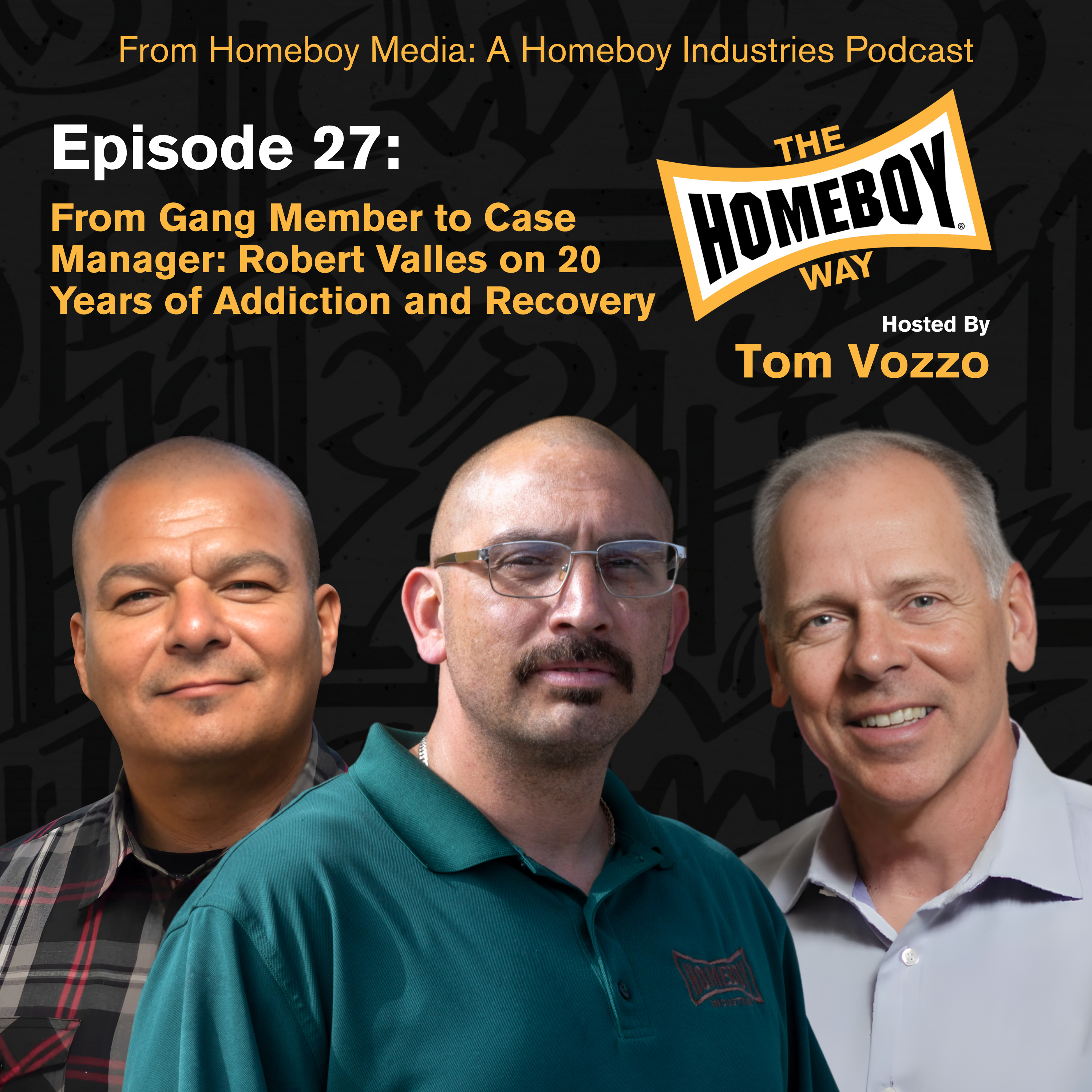 From Gang Member to Case Manager: Robert Valles on 20 Years of Addiction and Recovery | When Robert Valles first walked through the doors of Homeboy Industries, he wasn’t looking for healing. He was looking for a job. After more than fifteen interviews and repeated rejection because of his federal record, he arrived skeptical and unsure of what to expect.What he found instead was something he had never experienced before: a place where people are, in his words, “paid to heal.”In this episode, Tom Vozzo and Hector Verdugo sit down with Robert to reflect on the long road that brought him there. Once a gang member and federal prisoner, Robert spent years numbing pain through addiction. When sobriety finally forced him to face his life, he was confronted with shame, loss, and the devastating moment his children were taken away.Not knowing where his kids were for forty days became the turning point that pushed him to surrender and change.Today, Robert serves as a Case Manager, helping others rebuild their lives. His story reveals how healing begins, how love can feel unfamiliar at first, and how serving others can become a powerful form of recovery.Key TakeawaysWhen a federal record becomes a barrierRobert went on 15 job interviews before coming to Homeboy. Despite being likable and qualified, his federal record, which can never be expunged, kept doors closed until he found Homeboy.Getting paid to healRobert was initially upset about the low pay. But through self-help classes, he discovered: "You get paid in a different way here. I'm getting paid to heal." His story now helps others heal, too.Healing as a couple, with boundariesRobert was skeptical about doing the program with his wife. But it worked because they understood: "You have your program, I have my program. Once we're healed, then maybe we can heal our marriage.""If I could do it, you could do it"Robert tells trainees daily: "Gang member, incarcerated, addicted 20 years, kids taken away. If there's a box, check it." His lived experience gives others hope.A touch of love makes a differencePeople who experienced even some love in childhood recognize it at Homeboy and thrive quickly. That thread of love, however tangled, matters.When there is no love, healing takes longerThose who were tortured as kids, who experienced no love, often leave when shown love. They return, leave again, and stay longer each time. Healing just takes more time.In This Episode:00:00 – Introduction00:53 – Robert’s role and journey at Homeboy02:43 – Transformation from gang life03:26 – Ozzy the Navigator moment04:50 – Getting paid to heal 05:20 – Determination to get his children back06:09 – Skepticism about his wife joining07:15 – What Robert tells new trainees11:33 – Confronting shame12:44 – Watching his children walk away13:11 – Faith, surrender, and recovery16:36 – Restoring relationships with children18:05 – Breaking generational cycles19:25 – Robert’s future goals in 5-10 years 20:31 – Growing up with addiction and abuse in the home22:48 – The power of love and healing at Homeboy26:29 – The future of Homeboy is strongNotable Quotes“I'm getting paid to heal.” — Robert [04:55]“If I could do it, you could do it because I'm no different from you.” — Robert [07:18]“ Just that simple, are you okay? And how are you doing today? Could change your life..” — Robert [07:59]“ My fear as a parent is my kids growing up doing what I was doing.” — Robert [18:05]Resources and LinksHomeboy Industrieshttps://homeboyindustries.org/https://www.youtube.com/@HomeboyIndustries_LA/videosDonate: https://homeboyindustries.org/donate/donate-online/Homeboy Media https://homeboyindustries.org/social-enterprises/homeboy-media/Hector Verdugohttps://www.linkedin.com/in/hector-verdugoThomas Vozzohttps://www.linkedin.com/in/thomasvozzoThe Homeboy Way: A Radical Approach to Business and Life: https://www.amazon.com/Homeboy-Way-Radical-Approach-Business/dp/082945456XCredits:Hosted by: Tom VozzoProduced by: Podify, and Alexa Rousso and Melody Carter of Homeboy Media | — | ||||||
| 3/18/26 | 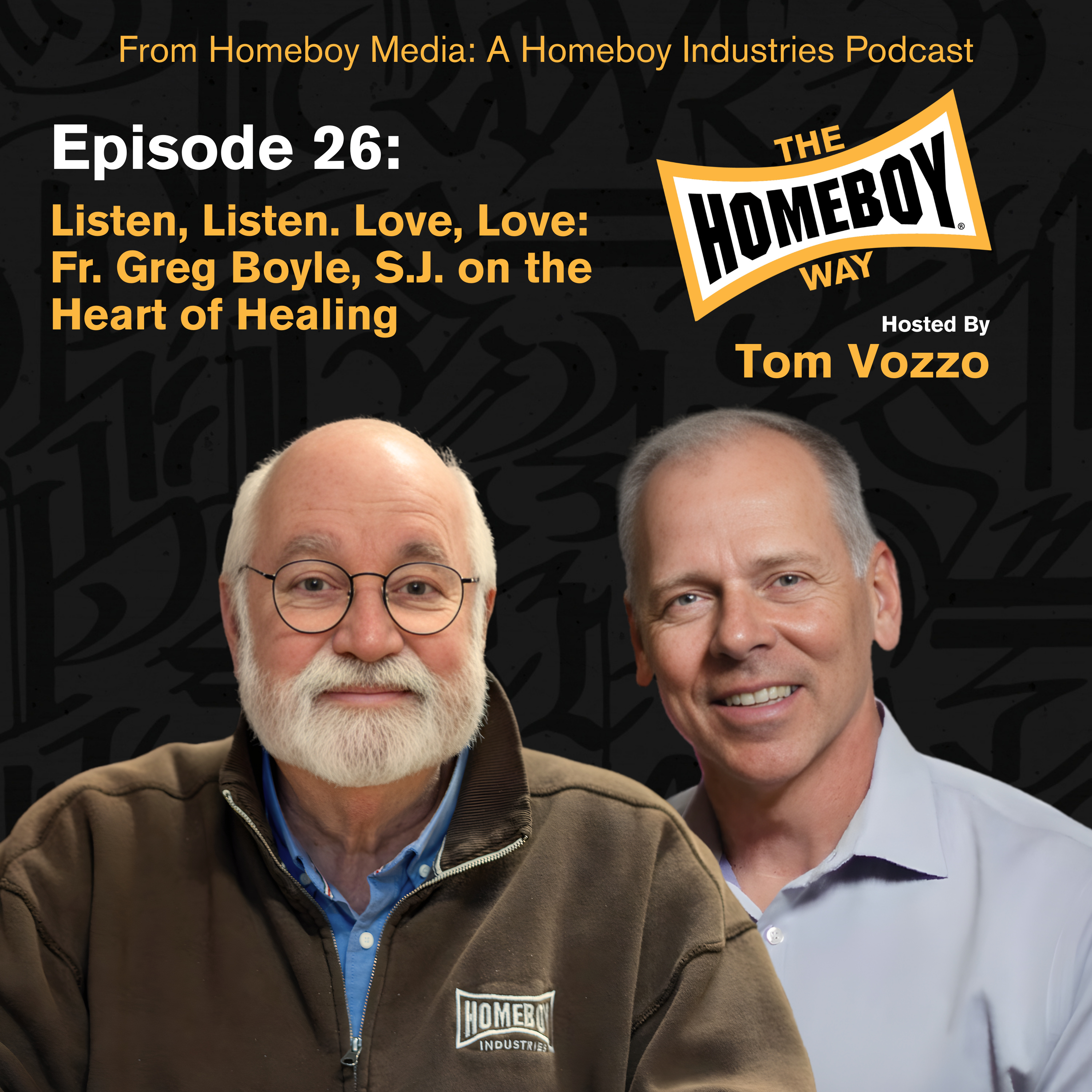 Listen, Listen. Love, Love: Fr. Greg Boyle, S.J. on the Heart of Healing | At Homeboy Industries, healing rarely happens through a single method. It unfolds through therapy, community, compassion, and the steady presence of people who care.In this episode, Tom Vozzo sits down with Fr. Greg Boyle, S.J. to explore how healing really happens for people carrying deep trauma. Fr. Greg describes it as the “cumulative dosing effect of cherishing” when someone is consistently seen, known, and valued. Yet that kind of love can feel overwhelming. Some homies even walk away at first because they do not know how to receive it.Fr. Greg reflects on the early days of Homeboy, when therapy carried heavy stigma. Today, the demand is so great that there are waiting lists. He shares stories of people wrestling with addiction, hearing voices, and confronting wounds they once tried to bury.Through decades of experience, Fr. Greg reveals a deeper truth. Healing does not happen only in therapy. It happens in a community where people discover they are no longer alone.Key TakeawaysOverwhelm from love is real.Fr. Greg shares about a homie who left Homeboy not because things were bad, but because he “didn’t know how to handle all the love.” For people used to trauma, steady care and belonging can feel unfamiliar or overwhelming, so some leave and return when they are ready.Community dosing surrounds and amplifies therapy.Beyond methods like talk therapy and EMDR, healing also happens through daily relationships. Consistent care from staff, mentors, and volunteers helps build resilience.The three profiles of gang members (and all of us).Fr. Greg breaks down that everyone falls into one of three categories: despair (can't imagine a future), trauma (high ACEs score), or mental illness.Luck and privilege shape our lives more than we admit.Fr. Greg reminds us that success is not only about hard work. Many benefit from unseen advantages, and recognizing this can foster humility and compassion.In This Episode:00:00 – Introduction 01:00 – How healing happens02:28 – Why therapy must be voluntary03:09 – The early days and the need for therapy at Homeboy (ACEs)05:50 – What surrendering to healing looks like07:44 – When love feels overwhelming09:14 – Challenges finding therapists and homies to try therapy12:29 – The rise of therapy and volunteer clinicians14:35 – Listening and loving as the foundation of healing16:05 – Alternative therapies and healing experiences20:32 – Why there is no “one-size-fits-all” healing23:37 – Compassion and forgiveness in the healing process26:38 – What it means to be a “stranger to yourself”30:43 – Three profiles of gang members33:44 – Excavating generational wounds in everyday life36:31 – The role of luck, privilege, and circumstance38:46 – Reducing stigma around mental health40:35 – Mental illness and societal misunderstanding45:39 – Why healing is reliable and ongoingNotable Quotes“I don't think healing is so formulaic. I think if you believe in how the cumulative dosing effect of cherishing is, you can observe it.” — Fr. Greg Boyle, S.J. [01:00]“Listen, listen. Love, love.” — Fr. Greg Boyle, S.J. [14:01]“If you don’t welcome your own wound, you will be tempted to despise the wounded.” — Fr. Greg Boyle, S.J. [28:01]“How do you transform your pain so you no longer transmit it?” — Fr. Greg Boyle, S.J. [31:41]Homeboy Industrieshttps://homeboyindustries.org/https://www.youtube.com/@HomeboyIndustries_LA/videosDonate: https://homeboyindustries.org/donate/donate-online/Homeboy Media https://homeboyindustries.org/social-enterprises/homeboy-media/Father Greg Boylelinkedin.com/in/greg-boyle-s-j-05458514Thomas Vozzohttps://www.linkedin.com/in/thomasvozzoThe Homeboy Way: A Radical Approach to Business and Life: https://www.amazon.com/Homeboy-Way-Radical-Approach-Business/dp/082945456XCredits:Hosted by: Tom VozzoProduced by: Podify, and Alexa Rousso and Melody Carter of Homeboy Media | — | ||||||
| 3/11/26 | 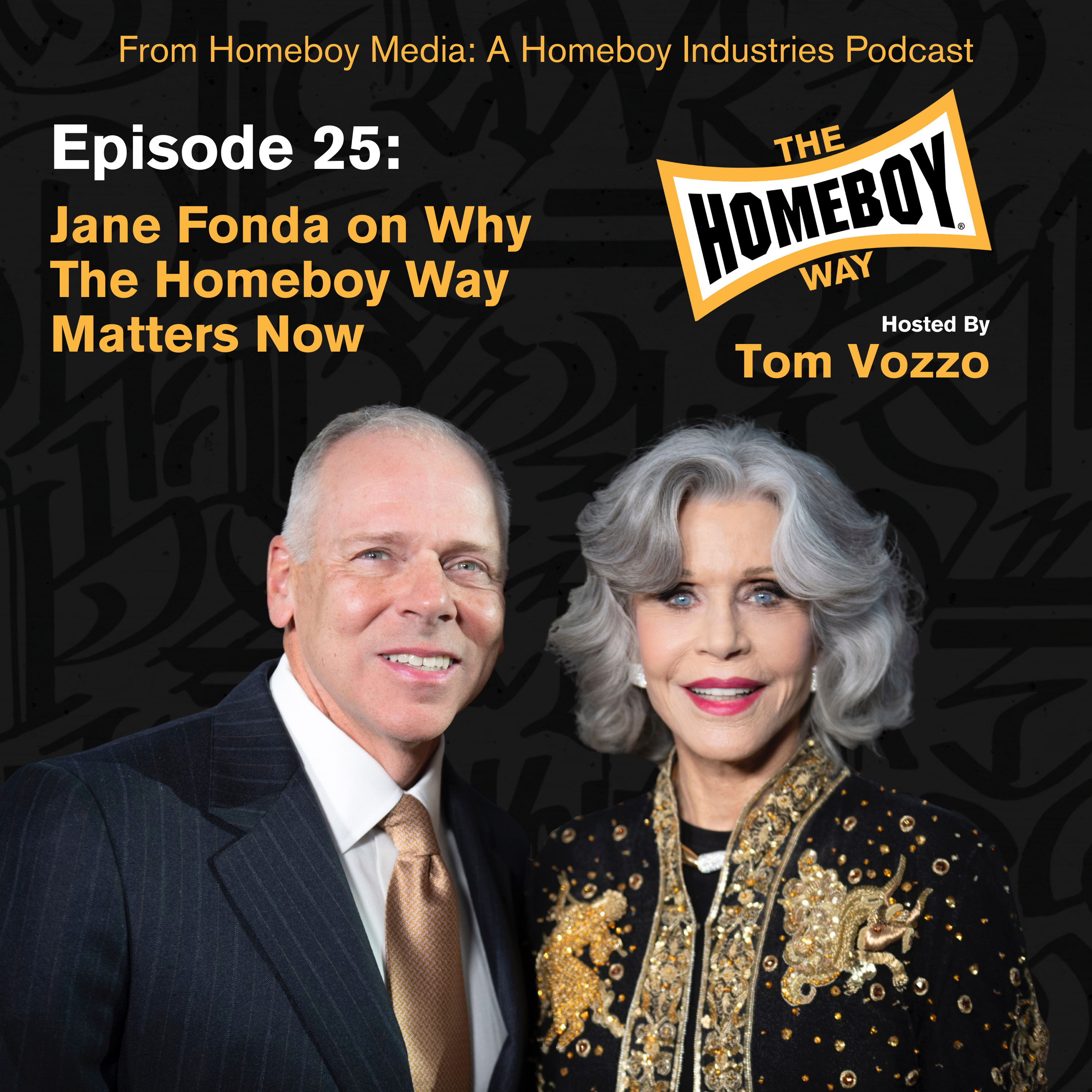 Jane Fonda on Why The Homeboy Way Matters Now | Jane Fonda, Oscar-winning actress and lifelong activist, first learned about Homeboy Industries in the 1980s through her then-husband, Tom Hayden. He came home energized by a Jesuit priest who had opened a bakery employing formerly incarcerated gang members. Years later, at a Homeboy gala, she finally heard Father Greg Boyle speak and knew she wanted to be part of something so transformative.In this episode, Tom Vozzo sits down with Jane to reflect on her seven years as a board member and what continues to draw her to a community built on healing and second chances. She shares how walking through Homeboy’s doors feels like “sinking into a warm bath,” and why, at 88, she still finds herself learning from the homegirls she calls “smarter than me in so many ways.” For Jane, leadership begins with humility, and real change starts by listening from the heart.Key TakeawaysJobs are not enough. Healing comes first. Father Greg realized quickly that employment alone would not create lasting change. Deep trauma, left unaddressed, leads people back into trouble. Homeboy evolved into a healing-centered community where recovery comes before placement.Cherish, don’t judge.To cherish someone is to fully receive them into your heart. Healing begins there.Transformation requires proximity. It's wonderful when rich people throw money out from their homes up on the hill to people who need it," Jane says. Generosity from a distance is good. But real change happens shoulder to shoulder. Being present, listening, and building relationships transforms everyone involved.Hate the behavior, not the personBad behavior is often the language of trauma. You can reject harm while still honoring human dignity.We give because we see ourselves. Homeboy’s mission resonates because we are all broken in some way. Watching others heal reminds us that transformation is possible for us too.Women are the glue. "In every class, in every rung of society, and in every ethnicity and race in the world, it's women that hold things together. They're the glue for families and for communities."Life with meaning is better. Jane has lived without meaning and with meaning. "I know that the meaning is a lot better. In This Episode:00:00 – Introduction01:46 – How Jane Fonda first found Father Greg and Homeboy Bakery03:41 – From the Homeboy Bakery to a healing-centered model04:40 – "I need whatever that secret sauce is"06:05 – Kinship and mutuality with people on the margins08:48 – What Jane learns from homegirls13:09 – The meaning of cherishing15:54 – Ignatian spirituality at Homeboy18:32 – Funding the mission19:51 – Gangsters, leaders, and the pressure of machismo21:32 – Homeboy’s culture shift: from toughness to tears22:09 – Poverty, business hiring, and “show by doing”23:30 – Jane Fonda’s activist origin story26:19 – The urgency of activism today28:19 – What Jane would tell her younger self30:06 – The Global Homeboy NetworkNotable Quotes“ Bad behavior, even evil behavior is the language of the traumatized.” — Jane [07:25]" Avoid violence. Violence is our enemy." — Jane [28:04]“ Cherished, to me is even greater than love means I've brought you fully into my full heart in every possible way.” — Jane [13:42]“I've lived without meaning, and I've lived with meaning, and I know that the meaning is a lot better.”— Jane [29:19] Resources and LinksHomeboy Industrieshttps://homeboyindustries.org/https://www.youtube.com/@HomeboyIndustries_LA/videosDonate: https://homeboyindustries.org/donate/donate-online/Homeboy Media https://homeboyindustries.org/social-enterprises/homeboy-media/Jane Fondahttps://www.linkedin.com/in/jane-fonda-2408b4302/Thomas Vozzohttps://www.linkedin.com/in/thomasvozzoThe Homeboy Way: A Radical Approach to Business and Life: https://www.amazon.com/Homeboy-Way-Radical-Approach-Business/dp/082945456XCredits:Hosted by: Tom VozzoProduced by: Podify, and Alexa Rousso and Melody Carter of Homeboy Media | — | ||||||
| 3/4/26 | 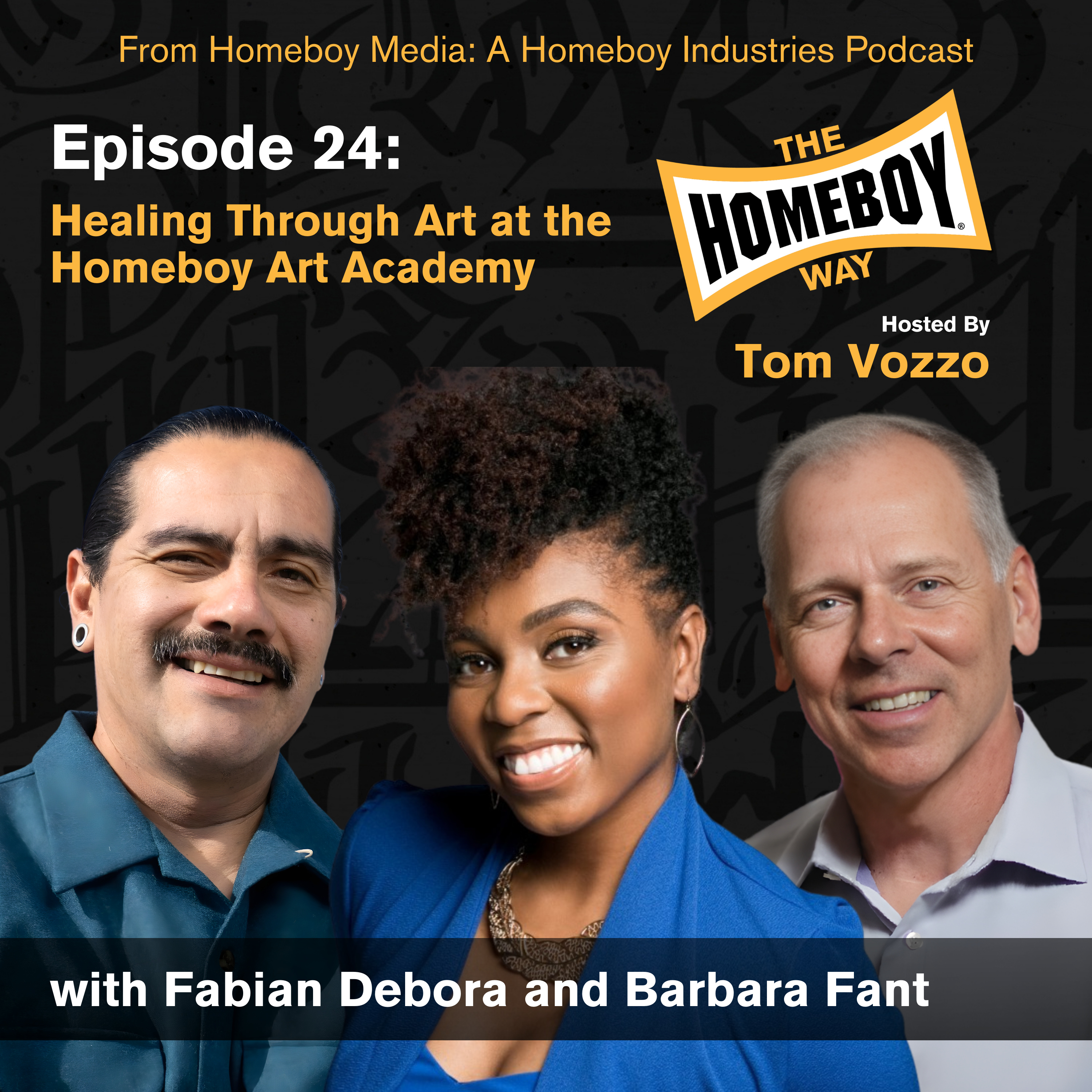 Healing Through Art at the Homeboy Art Academy with Fabian Debora and Barbara Fant | When Tom Vozzo first walked into Homeboy Industries more than 12 years ago, he was skeptical. “Shouldn’t we be doing work here at ‘Industries’?” he wondered, seeing art classes throughout the building.In this episode, Tom sits down with Fabian Debora, Executive Director of the Homeboy Art Academy, and Program Manager Barbara Fant to explore how art reaches wounds words cannot and why creativity is central to Homeboy’s model of healing and belonging.Fabian shares how, as a child hiding from domestic violence, drawing became his refuge, a sanctuary that carried him through addiction, recovery, and ultimately national recognition as a Heritage Fellow with the National Endowment for the Arts. Barbara reflects on losing her mother at fifteen and turning grief into poetry, using verse as both prayer and therapy.Through the Art Academy, rival youth create side by side, guided by Fabian’s Three R’s: Reconnect, Re-identify, and Reimagine.Key TakeawaysArt is refugeAs a child, Fabian learned art did not just express him, it held him. Hiding under a coffee table from violence, he found safety and hope. That same refuge is what the Art Academy now offers every young person who enters.Mentorship restores what shame steals. When a teacher destroyed Fabian’s artwork, Father Greg Boyle saw him for who he truly was and gave art back. That moment of being seen and reassured that his gift mattered changed everything.Poetry can be prayer.At 15, without therapy, Barbara turned sermon notes into poems, using them to grieve, pray, and make sense of losing her mother.Healing is intentional.The Art Academy practices a healing-centered approach: circles, reflection, the three R’s, creative exercises aligned with specific aspects of healing, and structured closing reflections.Identity can evolve.The young man known for his face tattoo begins with gang writing and gradually discovers artistry, leadership, and gentleness within himself.In This Episode:00:00 – Introduction01:26 – Fabian’s childhood and art as refuge03:32 – Mentorship and artistic development05:28 – Barbara’s story: poetry as prayer11:03 – The Homeboy Art Academy12:32 – Healing-centered approach and the three R’s14:25 – Community, safety, and transformation16:29 – Co-designing the Academy’s modality18:09 – Stories of transformation: Giselle and Jesus20:13 – Managing gang dynamics and building kinship21:55 – Team approach and wraparound services24:03 – Challenges of the work27:07 – Resilience and returning youth28:17 – Fabian’s artistic recognition and advocacy30:21 – Barbara’s writing and influence of Homeboy31:52 – Future vision: accredited school of art32:44 – Graffiti, tagging, and artistic expressionNotable Quotes“People really do heal through the arts.” — Tom [01:16]"Art gave me a sense of purpose, existence, and, most importantly, hope." — Fabian [02:08]“ I started writing as just this way of processing, of talking to God and of prayer.” — Barbara [07:14]“The toughest part of the job has been the heartbreak.”— Tom [26:23] Resources and LinksHomeboy Industrieshttps://homeboyindustries.org/https://www.youtube.com/@HomeboyIndustries_LA/videosDonate: https://homeboyindustries.org/donate/donate-online/Homeboy Media https://homeboyindustries.org/social-enterprises/homeboy-media/Barbara Fanthttps://www.linkedin.com/in/barbara-fant-mfa-8114b633/https://homeboyindustries.org/services/art-academy/Fabian Deborahttps://www.linkedin.com/in/fabian-debora-886279a/https://homeboyindustries.org/services/art-academy/Thomas Vozzohttps://www.linkedin.com/in/thomasvozzoThe Homeboy Way: A Radical Approach to Business and Life: https://www.amazon.com/Homeboy-Way-Radical-Approach-Business/dp/082945456XCredits:Hosted by: Tom VozzoProduced by: Podify, and Alexa Rousso and Melody Carter of Homeboy Media | — | ||||||
| 2/25/26 | 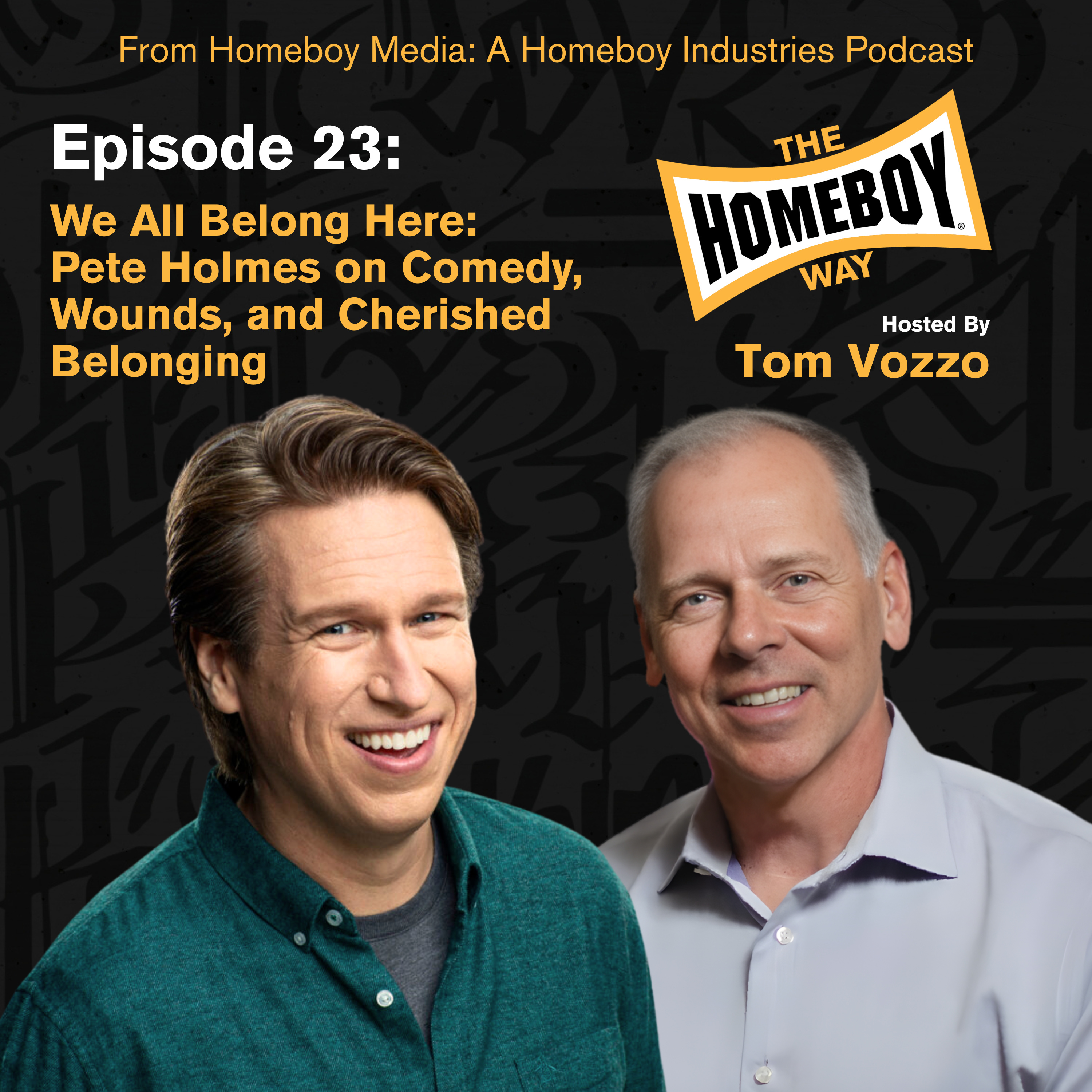 We All Belong Here: Pete Holmes on Comedy, Wounds, and Cherished Belonging | In this episode, Tom Vozzo sits down with comedian and podcaster Pete Holmes to talk about faith, belonging, and spirituality. Pete shares how discovering Fr. Greg Boyle, S.J. and Homeboy Industries reshaped not just his theology, but the way he walks on stage. Before performing, he often listens to Father Greg to remind himself that “we belong to each other,” shifting comedy from performance to kinship.Pete reflects on coming from the Christian tradition, where being the center of attention can feel almost wicked, like becoming the “special boy.” Comedy, he explains, is not that. He will play the role of the special performer, and the audience plays their role too. But underneath it all, it is just a connection. It is all just sunlight wearing different masks.Reflecting on the story of the prodigal son, Pete explains that you cannot be more of the man’s son in the kingdom and less his son with the pigs. It is about accepting that you are accepted. You are already in. They talk about staying soft when things go wrong, letting anger move through without shame, and resisting the urge to create “the other.”Key TakeawaysWe are sunlight wearing different masks.Pete looks at the audience and does not see strangers. He sees himself in different forms. Each person carries quiet burdens, love and hurt, generosity and selfishness. The gospel draws a crowd.Pete observes that Homeboy’s lobby feels like Disneyland or summer camp. That pull, he argues, is the real sign of the sacred.Pain is not a competition. Your shit is your shit.Pete almost minimizes his own story beside another’s trauma, then realizes suffering is not a scoreboard. Healing begins when we stop ranking wounds and start honoring them.Want to know you’re accepted? Start accepting others.You can't be more the man's son when you're in the kingdom and less his son when you're with the pigs. Tom watched Greg Boyle pause with wealthy donors to attend to a homie with a simple question. Acceptance is not a reward. It’s a practice we extend, especially to the least visible.Grace is getting it wrong and being loved anyway.Tom’s tree story captures the ache of good intentions missing the mark. That tender space between intent and impact is where grace lives.Hating the other is hating yourself.When we label anyone disposable, we quietly say the same about ourselves. Loving those cast aside brings the hidden parts of us back to life.In This Episode:00:00 – Introduction00:53 – Getting involved with Homeboy01:22 – Connecting with Fr. Richard Rohr and Fr. Greg Boyle03:16 – The impact of Homeboy’s teachings04:45 – Performing with compassion07:43 – Lessons from Homeboy16:11 – The power of acceptance and belonging22:39 – Balancing help and personal boundaries27:17 – Spiritual teachings and reflections29:03 – The value of vulnerability29:55 – A humbling medical experience30:44 – Embracing brokenness34:14 – Spirituality in the corporate world35:05 – Discovering true spirituality42:05 – The role of psychedelics in spiritual awakeningNotable Quotes“Every single one of you has an unseen burden.” — Pete Holmes [05:09]"We're all just sunlight wearing different masks." — Pete Holmes [05:43]“If you want to know you're accepted, start by accepting others.” — Tom [25:11]Resources and LinksHomeboy Industrieshttps://homeboyindustries.org/https://www.youtube.com/@HomeboyIndustries_LA/videosDonate: https://homeboyindustries.org/donate/donate-online/Homeboy Media https://homeboyindustries.org/social-enterprises/homeboy-media/Pete Holmeshttps://peteholmes.com/https://www.youtube.com/user/peteholmesThomas Vozzohttps://www.linkedin.com/in/thomasvozzoThe Homeboy Way: A Radical Approach to Business and Life: https://www.amazon.com/Homeboy-Way-Radical-Approach-Business/dp/082945456XCredits:Hosted by: Tom VozzoProduced by: Podify, and Alexa Rousso and Melody Carter of Homeboy Media | — | ||||||
| 2/18/26 | 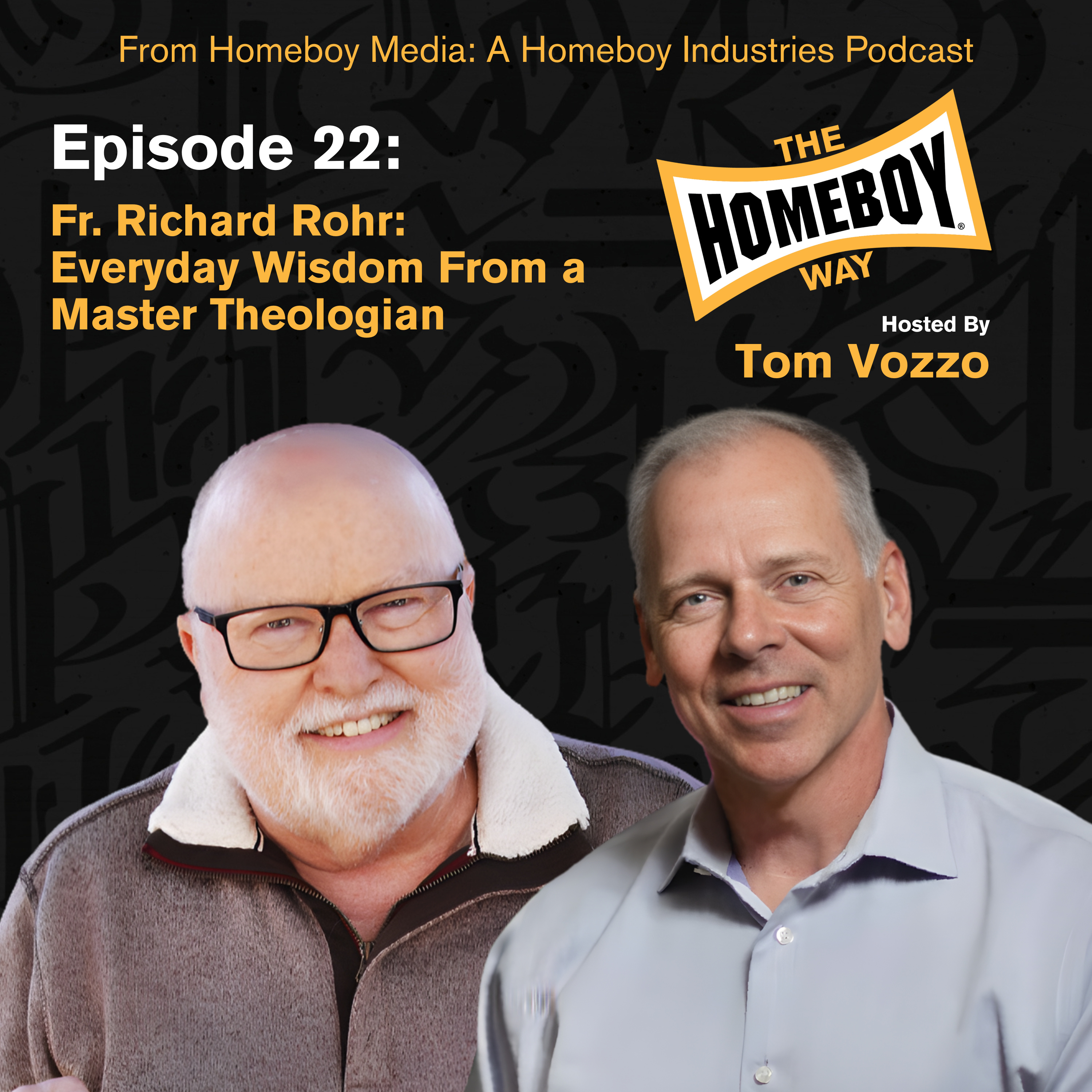 Fr. Richard Rohr: Everyday Wisdom From a Master Theologian | In this episode, Tom Vozzo sits down with renowned Franciscan priest and author Fr. Richard Rohr to explore the emotional and spiritual journey behind anger, sadness, and healing. Fr. Richard explains why so many people, especially men, get stuck in anger and how that reaction often covers a much deeper sadness.Their discussion naturally connects to the lived experiences at Homeboy Industries, where individuals arrive carrying both grief and the desire for a new beginning. Fr. Richard shares why welcoming our sorrow is not weakness but a pathway to compassion, transformation, and spiritual maturity. The result is a warm, honest, and deeply human conversation about what it truly means to grow, to heal, and to become more whole.Key TakeawaysReal transformation begins when anger gives way to sadness.Most people think prophets were angry men. Rohr explains they actually began in anger but moved into sadness and ultimately into compassion, mirroring the inner journey many at Homeboy take.Grief is not weakness; it is the soul’s entrance into maturity.Cultures throughout history had rites teaching boys how to weep. Rohr recounts the Maasai “caves of grief,” where warriors learned that tears were strength, not failure.Control is the enemy of healing.Trying to control emotions keeps people stuck in anger. Letting go allows sadness to rise, which is the pathway to compassion.Suffering is unavoidable and essential.Whether it is the death of a loved one, loss of a pet, or inherited trauma, every person experiences pain. Rohr argues that grief, felt honestly, is the starting point of a real spiritual journey.Joy comes only after walking through grief.True joy is not positive thinking. It is what emerges when we release judgment, righteousness, and the need to perfect the world and ourselves.In This Episode:00:00 – Introduction to The Homeboy Way01:04 – The spiritual lessons of Homeboy and Fr. Richard's writings01:43 – Why the soul must weep: Anger, sadness, and the prophetic journey06:19 – Why men don't weep and how to learn10:42 – Grief as initiation: The Men's Rites of Passage and PTSD14:13 – What the poor know: A critical lens on society and success18:31 – The necessity of suffering and exile for transformation24:30 – Wholeness vs. perfection and the "wounded warrior"27:48 – Occam's Razor: Why the simplest answer is Love33:13 – Certitude vs. faith in spirituality and politics36:04 – From lamentation to doxology: Where true joy is found39:47 – Conclusion and gratitudeNotable Quotes"You're much more sad than you are angry." — Fr. Richard Rohr (04:36)"The ego likes to be angry. It gives you a false sense of power and superiority" — Fr. Richard Rohr (09:02)"The simplest answer is invariably and almost always the correct one… The answer to everything is love." — Fr. Richard Rohr on Occam's Razor (28:35)"The opposite of faith is not doubt. The opposite of faith is certitude." — Fr. Richard Rohr (33:17)"We come to God more by doing it wrong than by doing it right." — Fr. Richard Rohr (38:12)Resources and LinksHomeboy Industrieshttps://homeboyindustries.org/https://www.youtube.com/@HomeboyIndustries_LA/videosDonate: https://homeboyindustries.org/donate/donate-online/Homeboy Media https://homeboyindustries.org/social-enterprises/homeboy-media/Fr. Richard Rohrhttps://cac.org/about/cac-faculty/cac-founder-richard-rohr/https://cac.org/Daily Meditations: https://cac.org/daily-meditations/Books: "The Universal Christ," "Falling Upward," "The Wisdom Pattern," and his latest discussed, "The Tears of Things.Thomas Vozzohttps://www.linkedin.com/in/thomasvozzoThe Homeboy Way: A Radical Approach to Business and Life: https://www.amazon.com/Homeboy-Way-Radical-Approach-Business/dp/082945456XCredits:Hosted by: Tom VozzoProduced by: Podify, and Alexa Rousso and Melody Carter of Homeboy Media | — | ||||||
| 2/11/26 |  A Lifetime of Perspective on Gangs, Policing, and Poverty with Hector Verdugo and Stephanie Lane | In this episode of The Homeboy Way, host Tom Vozzo sits down with Homeboy leaders Hector and Stephanie for a raw, unfiltered conversation about policing, childhood trauma, and the long road from survival to kinship.Through deeply personal stories, they explore how early encounters with law enforcement shaped fear, anger, and identity and how Homeboy Industries created a radical alternative: a place where healing requires moving beyond “us vs. them” and choosing to be fully in, even when it’s uncomfortable.This episode doesn’t simplify pain or excuse harm. Instead, it names the wounds honestly while asking a harder question: What does it take to heal without becoming what hurt you?Key Takeaways“We’re In”: Choosing Kinship Over DivisionHector explains the turning point at Homeboy Industries: realizing the work only functions when everyone commits fully. Not partially. Not conditionally. “It’s not about us and them. It’s just us.” True transformation begins when people decide they’re all in, including with former enemies and authority figures.Seeing Law Enforcement as Human Without Erasing HarmHector reflects on learning to hold two truths at once: acknowledging abuse while recognizing the humanity of those in uniform.Healing, he explains, doesn’t mean pretending harm didn’t happen, it means refusing to let it define the future.Choosing Restraint in the Face of Old RageHector shares a moment years later when he encounters a police officer who had deeply harmed his family. His body reacts instantly but he chooses to walk away. This illustrates the quiet, invisible work of healing: regulating yourself when every instinct tells you to explode.From Fear of Beatings to Fear of DeathStephanie contrasts past and present policing realities. Where earlier generations expected brutality, today’s communities fear being killed especially during mental health or domestic calls. This connects the rise in aggression, distrust, and hyper-vigilance to a deeper, collective fear that has only intensified since COVID.Wearing Homeboy in Public: From Target to SignalStephanie explains why she once avoided wearing Homeboy gear in her neighborhood and how that changed as law enforcement began to understand the mission. This moment reflects the broader shift in how Homeboy Industries is perceived: no longer a “soft place for gang members,” but a proven model of transformation.In This Episode:00:00 – Introduction00:57 – Hector’s experience with police12:15 – Stephanie’s experience with police16:58 – Interactions with law enforcement17:33 – The current state of the streets18:48 – The impact of COVID-19 on gang violence19:47 – Fear and aggression20:59 – Police brutality then and now22:32 – Advice for dealing with police23:57 – Homeboy Industries’ changing perception25:18 – Hopes for Homeboy Industries’ future28:27 – The importance of resources and experiences33:07 – Concluding thoughtsNotable Quotes“It’s not about us and them. It’s just us.” — Hector [05:20]“I grew up believing the police were going to hurt us.” — Stephanie [13:59]“Healing doesn’t mean forgetting. It means choosing differently.” — Hector [17:30]“This place is home. It’s the last stop for a lot of us.” — Stephanie [25:18]Resources and LinksHomeboy Industrieshttps://homeboyindustries.org/https://www.youtube.com/@HomeboyIndustries_LA/videosDonate: https://homeboyindustries.org/donate/donate-online/Homeboy Media https://homeboyindustries.org/social-enterprises/homeboy-media/Stephanie Lanehttps://www.linkedin.com/in/stephanie-lane-757052284/Hector Verdugohttps://www.linkedin.com/in/hector-verdugo-7297a684/Thomas Vozzohttps://www.linkedin.com/in/thomasvozzoThe Homeboy Way: A Radical Approach to Business and Life: https://www.amazon.com/Homeboy-Way-Radical-Approach-Business/dp/082945456XCredits:Hosted by: Tom VozzoProduced by: Podify, and Alexa Rousso and Melody Carter of Homeboy Media | — | ||||||
| 2/4/26 |  Smitty’s Story: From Incarceration to Purpose with Diwaine “Smitty” Smith | Smitty did not come to Homeboy Industries looking for a job or a title. He came looking for his daughter. After incarceration and a painful separation from his child, he arrived at Homeboy for parenting classes, hoping to rebuild his family. What he found was a place where people were allowed to be human, to heal, and to grow without judgment.In this episode of The Homeboy Way, Tom Vozzo sits down with Diwaine "Smitty" Smith to talk about his journey from trainee to navigator, a role that places him on the front lines supporting others through reentry and transition. Smitty reflects on how life inside jail taught him that if people can learn to coexist there, they can learn to do so anywhere. He also shares how a Civil Rights Immersion trip through the South reshaped his understanding of courage, mercy, and responsibility. Through faith, service, and kinship, Smitty’s story shows how personal healing becomes leadership.Key Takeaways Jail Taught Kinship First Incarceration showed Smitty that rivals can coexist. Homeboy proves respect and dialogue make it possible beyond jail.Safe Space for Stumbling and HealingHomeboy allows mistakes with support, wellness days, family priorities, and care without fear of punishment.From Personal Healing to Helping OthersAs a Navigator, Smitty leads with empathy, meeting people where they are and asking how he can help.The Civil Rights Trip’s Profound ImpactWalking in civil rights history reshaped Smitty’s view on nonviolence, resilience, and moving forward.Mercy as a Teachable PracticeSmitty led a class on mercy, sparking honest dialogue about compassion, even when it feels undeserved.In This Episode:00:00 – Introduction 00:26 – Meet Smitty: from trainee to navigator00:56 – The jail mentality and Homeboy’s safe haven02:45 – Smitty’s journey to Homeboy03:34 – Culinary arts and Bread and Roses04:24 – The role of a navigator06:17 – Community organizing and helping others09:50 – The Civil Rights Trail experience12:45 – Reflecting on regional differences13:37 – Impact of Southern history14:26 – Personal transformation and community16:49 – Teaching mercy at Homeboy20:24 – Spiritual journey and personal growth21:49 – Conclusion and final thoughtsNotable Quotes“If we can get along in jail, we can get along anywhere else.” — Smitty [00:01:08]“We took punches from these people so our grandkids wouldn't have to take them.” — Quote from the Civil Rights trip that shifted Smitty's view on courage [10:59]“I came back a different person... showing that love instead of just telling people what to do.” — Smitty [15:58]“I'm a Homeboy for life... even if it's washing dishes at the cafe.” — Smitty [20:12]Resources and LinksHomeboy Industrieshttps://homeboyindustries.org/https://www.youtube.com/@HomeboyIndustries_LA/videosDonate: https://homeboyindustries.org/donate/donate-online/Homeboy Media https://homeboyindustries.org/social-enterprises/homeboy-media/Thomas Vozzohttps://www.linkedin.com/in/thomasvozzoThe Homeboy Way: A Radical Approach to Business and Life: https://www.amazon.com/Homeboy-Way-Radical-Approach-Business/dp/082945456XCredits:Hosted by: Tom VozzoProduced by: Podify, and Alexa Rousso and Melody Carter of Homeboy Media | — | ||||||
| 1/28/26 |  The Door Marked Recovery: Grace, Surrender, and the Courage to Be Free with Fr. Greg Boyle, S.J. | In this episode of The Homeboy Way, host Tom Vozzo sits down with Fr. Greg Boyle, S.J., founder of Homeboy Industries, to unpack one of the most pervasive challenges for those who come through Homeboy's doors: substance abuse. Drawing from decades of experience, they explore how addiction often serves as self-medication for unhealed trauma, why people numb pain when forced to "excavate wounds," and how programs like AA and NA foster surrender, community, and spiritual awakening. Fr. Greg shares raw stories of homies who first got high only after beginning deep healing work at Homeboy, the shift from drug testing to trusting sobriety for real progress, and the parallel between gang addiction, domestic violence cycles, and substance use. The conversation turns to mercy as the ultimate liberation, beyond transactional forgiveness, and how kinship creates sturdiness against life's knocks.This episode reveals how Homeboy meets people where they are without forcing recovery while offering clear paths to healing, emphasizing that "it takes what it takes" for change, and true freedom comes from mercy upon mercy.Key TakeawaysAddiction as Self-Medication Substances numb the pain of excavating deep wounds from trauma; healing begins when people stop avoiding the "pause" to look at their lives.AA/NA Works Through Surrender Success depends on willingness to cooperate in one's own healing, sharing delusions humbly, and turning life over to a higher power (broadly defined).Harm Reduction and PatienceHomeboy respects readiness: outpatient vs. residential rehab, testing, incentives, or "come back when you're ready"—you can't want recovery more than the person does.Clear Over Tough "Tough love" is often mean; true clarity offers one open door to recovery, like showing a child the exit ramp from a violent freeway.Mercy as Liberation Move beyond back-and-forth forgiveness to pure mercy (just "forth"); it's God's essence, freeing both giver and receiver from clinging to grudges or payback.Spiritual Underpinning The 12 Steps offer a genius American contribution to spirituality: sponsors provide walking companionship, and recognizing a higher power builds resilience.In This Episode:00:00 – Introduction03:49 – The role of AA and NA06:16 – Acknowledging and addressing addiction08:31 – Therapy and alternative coping mechanisms09:09 – Harm reduction and rehabilitation12:58 – The concept of tough love18:44 – Spiritual underpinnings of AA19:56 – Exploring the spiritual basis of healing22:53 – Forgiveness and mercy: A deeper dive23:22 – The historical spread of Christianity25:51 – The concept of mercy in modern times36:41 – The importance of resilience and sturdiness38:23 – Final thoughts on mercy and transformationNotable Quotes ”Excavate the wounds so that you can air 'em out and they can heal and then close up the wound.” — Fr. Greg [01:46]“It takes what it takes.” — Fr. Greg [11:18]“I love you so much that you can't live here anymore..” — Fr. Greg [14:09]“Nothing can touch me 'cause I'm already dead... you have to die before you die.” — Fr. Greg [36:14]“Everybody’s unshakably good and we belong to each other.” — Fr. Greg [37:33]Resources and LinksHomeboy Industrieshttps://homeboyindustries.org/https://www.youtube.com/@HomeboyIndustries_LA/videosDonate: https://homeboyindustries.org/donate/donate-online/Homeboy Media https://homeboyindustries.org/social-enterprises/homeboy-media/Fr. Greg Boyle. S. Jlinkedin.com/in/greg-boyle-s-j-05458514Books: Tattoos on the Heart, Barking to the Choir, The Whole LanguageThomas Vozzohttps://www.linkedin.com/in/thomasvozzoThe Homeboy Way: A Radical Approach to Business and Life: https://www.amazon.com/Homeboy-Way-Radical-Approach-Business/dp/082945456XCredits:Hosted by: Tom VozzoProduced by: Podify, and Alexa Rousso and Melody Carter of Homeboy Media | — | ||||||
| 1/21/26 |  Turning Survival Into Leadership with Miguel Lugo | Miguel Lugo came to Homeboy Industries looking for help removing a chest tattoo that had defined his violent past and kept him trapped long after prison. After serving 18 years behind bars, starting at age 18, Miguel walked through Homeboy’s doors just days after his release. He stood outside for hours, unsure if he was ready to let go of the identity that once kept him alive but was now holding him back.In this episode of The Homeboy Way, Tom Vozzo sits down with Miguel, Community Relations and Head of Security at Homeboy Industries, to trace his journey from a life shaped by violence to one rooted in presence, accountability, and care. Miguel shares how tattoo removal became a path to reclaiming himself, how spiritual practices like sweat lodge ceremonies sustained him in prison, and how therapy helped him confront when harm became acceptable. Today, Miguel stands on the sidewalk welcoming newcomers, diffusing conflict, and walking with people before they ever enter the building. His story shows how deep personal healing becomes sacred work and how choosing love, again and again, turns survival into leadership.Key TakeawaysTattoo Removal as FreedomRemoving gang tattoos was not about jobs. It was about shedding an identity rooted in harm and reclaiming self-ownership.The Power of the SidewalkMany people hesitate before entering Homeboy. Healing often begins outside the door through presence, listening, and trust.Community Relations = Walking With, Not WatchingMiguel reframes safety as walking with people, not watching them, creating belonging instead of fear.Spiritual Practice as SurvivalSweat lodge ceremonies in prison offered grounding, humility, and a connection to identity beyond incarceration.Therapy and the Courage to Ask WhyHealing deepened when Miguel confronted the question of when harming others became acceptable.From Violence to BufferBy stepping between conflict and naming people with care, Miguel and his team prevent harm before it escalates.In This Episode:00:00 – Introduction00:25 – Miguel’s journey begins01:08 – First steps at Homeboy03:06 – Tattoo removal and transformation06:01 – Leaving the gang life behind08:09 – Helping others and building community18:52 – Navigating challenges and misconceptions21:39 – Changing lives for a better future21:59 – Interactions with politicians24:44 – Building a new home26:52 – Spiritual journey and sweat lodges30:42 – Overcoming trauma and finding freedom38:05 – Passion for classic cars42:12 – Final reflections and gratitudeNotable Quotes“Am I okay cleaning toilets? ... I give it a shot.” — Miguel [02:21]“ In tattoo removal, the main thing it got is the freedom from yourself of who you were before.” — Miguel [05:30]“ A lot of people still call it security, but we don't. We like community relations because it does something different. I'm not here to watch you, I'm here to walk with you.” — Miguel [11:53]“In the sweat lodge, I was able to humble myself and give myself up to God.” — Miguel [31:51]“My job now is to be water to fire.”— Miguel [35:33]]Resources and LinksHomeboy Industrieshttps://homeboyindustries.org/https://www.youtube.com/@HomeboyIndustries_LA/videosDonate: https://homeboyindustries.org/donate/donate-online/Homeboy Media https://homeboyindustries.org/social-enterprises/homeboy-media/Miguel Lugohttps://homeboyindustries.org/transformation_story/miguel-lugo-2/Thomas Vozzohttps://www.linkedin.com/in/thomasvozzoThe Homeboy Way: A Radical Approach to Business and Life: https://www.amazon.com/Homeboy-Way-Radical-Approach-Business/dp/082945456XCredits:Hosted by: Tom VozzoProduced by: Podify, and Alexa Rousso and Melody Carter of Homeboy Media | — | ||||||
| 1/14/26 |  Brewing Hope: Social Enterprise and Ownership the Homeboy Way with Mike de la Rocha and Jose Arellano (Owners of Tepito Coffee) | How do you build a business that puts healing, culture, and opportunity first while still making a profit? In this episode of The Homeboy Way, Tom Vozzo sits down with Tepito Coffee co-owners Jose Arellano, Vice President of Operations at Homeboy Industries, and Mike de la Rocha, co-founder of Revolve Impact, to discuss social enterprises, specifically the challenges and successes of running Tepito Coffee. They delve into the significance of providing purposeful structure for those leaving gang life and the pivotal role of social enterprises in creating job opportunities. Tom recounts the creation of the Homeboy Ventures and Jobs Fund, a crucial step in supporting these enterprises. Mike and Jose share their journey from initial struggles, receiving investment, to finding success while staying true to their mission. Through personal stories and lessons learned, they highlight the importance of intentionality, community support, and the transformative power of giving back.Key TakeawaysMission Meets Market RealityRunning a for-profit social enterprise requires tough accountability alongside unwavering support. It's the "next level" after Homeboy's safety net preparing people for the real workforce.Access to Capital Changes EverythingPredatory loans and exclusionary investors nearly ended the business. Homeboy's low-interest investment provided not just funds, but expertise and belief in modest, impactful returns.Homegrown Leadership Is PossibleFrom trainee to VP to co-owner: Jose's journey shows what's achievable when organizations invest in internal talent, inspiring others to dream of ownership.Trauma-Informed Business Takes PatienceHiring system-impacted staff means embracing setbacks, offering dignity in tough conversations, and always leaving the door open for return.Cultural Pride Drives SuccessUnapologetically Chicano and Indigenous branding, combined with specialty quality and authentic storytelling, builds loyal community and disrupts who gets to succeed in coffee.In This Episode:00:00 – Introduction 01:15 – Tom's journey with Homeboy05:28 – The birth of Tepito Coffee15:29 – The struggle for investment and support21:56 – Building a brand with purpose23:56 – The spirit of Homeboy: connecting to the earth and each other24:41 – Training with intentionality: customer service at Tepito Coffee25:18 – Marketing with pride: embracing Chicano and Indigenous roots25:45 – Investing in community: long-term returns beyond capitalism26:23 – Success stories: from barista to business owner28:48 – Balancing accountability and compassion41:13 – Future growth: expanding Tepito Coffee's impactNotable Quotes“ If you have a good product and an authentic story and be unapologetically yourself, you can create a good brand identity and community.” — Mike [06:25]“ I've always been clear studying Homeboy Industries, that the future is in social entrepreneurship.”— Mike [07:51]“ First, you gotta know how to run a business. Then you can decide how to make it a social enterprise.” — Tom [19:15]“ I felt not just rescued by Homeboy, but actually like I felt swooped up by God.” — Jose [38:03]Resources and LinksHomeboy Industrieshttps://homeboyindustries.org/https://www.youtube.com/@HomeboyIndustries_LA/videosDonate: https://homeboyindustries.org/donate/donate-online/Homeboy Media https://homeboyindustries.org/social-enterprises/homeboy-media/Tepito CoffeeVisit: 695 E Colorado Blvd, Pasadena, CAOnline: https://www.tepitocoffee.com/Instagram: https://www.instagram.com/tepitocoffee/Mike de la Rochalinkedin.com/in/mrmikedelarochahttps://www.revolveimpact.com/Jose Arellanolinkedin.com/in/jose-arellano-001966a0Thomas Vozzohttps://www.linkedin.com/in/thomasvozzoThe Homeboy Way: A Radical Approach to Business and Life: https://www.amazon.com/Homeboy-Way-Radical-Approach-Business/dp/082945456XCredits:Hosted by: Tom VozzoProduced by: Podify, and Alexa Rousso and Melody Carter of Homeboy Media | — | ||||||
| 1/7/26 |  Mission Over Margin: Rethinking Social Enterprise the Homeboy Way with Gayle Northrop and Steve Delgado | How do you run a real business when your primary mission is healing, kinship, and transformation? In this episode, Tom Vozzo is joined by Homeboy Industries Co-CEO Steve Delgado and longtime advisor Gayle Northrop to explore the social enterprises at the heart of Homeboy.Their conversation centers on people, not products. People coming home from prison. People who have never held a formal job. People carrying trauma alongside hope and a desire to belong. At Homeboy, businesses are designed around that reality, not in spite of it.They explore the tension between mission and margin, speaking honestly about the real costs of being trauma-informed and the courage it takes to invest in people before the world believes they are ready. They reflect on bakeries that employ twice the usual staff, leaders grown from within, and workplaces built on dignity, structure, and accountability.This is lived experience, not theory. A reminder that at Homeboy, businesses exist to serve healing, and when people are met with kinship and structure, they rise together with their community.Key TakeawaysThe Foundational Principle“We don’t employ people to bake bread. We bake bread to employ people.” The social enterprises exist to provide purposeful, healing-centric work.Mission Over Margin Is a Daily ChoiceHomeboy runs real businesses in real markets, but mission always leads. Profit serves people, not the other way around.Social Enterprise Is About Disrupting SystemsTrue social enterprise challenges who is seen as employable and redefines value in the workforce.Trauma-Informed Workplaces Require Structure, Not SlogansBeing trauma-informed means building roles, teams, and systems that support healing, not just good intentions.Investment in People Is the Hard WorkRaising leaders from within takes time, patience, training, and a willingness to walk alongside people through setbacks.Everyone Doesn’t Automatically Know How to Work Employment success depends on stability, resources, transportation, support, and grace, not just effort.In This Episode:00:00 – Introduction 00:30 – Understanding social enterprises03:00 – Homeboy’s unique approach to social enterprise06:59 – Balancing mission and margin18:27 – Trauma-informed workplaces23:18 – Healing-centric workforce development24:14 – The challenges of homegrown leadership25:41 – Investing in internal talent30:42 – The realities of running a social enterprise34:42 – Breaking conventional business wisdom42:00 – Supporting upward mobility through education and opportunity44:20 – Closing reflections and future conversationsNotable Quotes“We don’t employ people to bake bread. We bake bread to employ people.” — Gayle [14:34]“ 95% of our full-time staff who operate and manage our social enterprises have come up through our program.” — Steve [04:54]“ Mission, at least at Homeboy, I think predominates over margin always. And I think that's the right way. I think that's the Homeboy way." — Steve [10:06]Homeboy Industrieshttps://homeboyindustries.org/https://www.youtube.com/@HomeboyIndustries_LA/videosDonate: https://homeboyindustries.org/donate/donate-online/Homeboy Media https://homeboyindustries.org/social-enterprises/homeboy-media/Gayle Northrophttps://www.linkedin.com/in/gaylenorthrop/Steve Delgadohttps://www.linkedin.com/in/steve-delgado-9222523/Thomas Vozzohttps://www.linkedin.com/in/thomasvozzoThe Homeboy Way: A Radical Approach to Business and Life: https://www.amazon.com/Homeboy-Way-Radical-Approach-Business/dp/082945456XCredits:Hosted by: Tom VozzoProduced by: Podify, and Alexa Rousso and Melody Carter of Homeboy Media | — | ||||||
Showing 25 of 42
Sponsor Intelligence
Sign in to see which brands sponsor this podcast, their ad offers, and promo codes.
Chart Positions
8 placements across 8 markets.
Chart Positions
8 placements across 8 markets.