The Inner Circle Podcast
by Optimize Business Systems
Is this your podcast?Optimize Business Systems is an independent podcast creator specializing in delivering insights that empower business leaders and entrepreneurs. They focus on providing actionable strategies and tools that help individuals streamline their …
On the show
Recent episodes
The Leverage System Part 2: The Handoff Conversation
Oct 2, 2026
36m 30s
The Leverage System Part 1: The Leverage Audit
Sep 25, 2026
32m 47s
Guest Speaker: Chris Lewis on Leadership & Accountability
Sep 18, 2026
44m 37s
The Performance Leader Series Part 4: The Performance System
Sep 11, 2026
34m 08s
The Performance Leadership Part 3: The Hard Conversations Framework
Sep 4, 2026
40m 17s
Insights from recent episode analysis
Audience Interest
- business growth strategies
- leadership development
Podcast Focus
- proven systems for business
- real-world leadership insights
Publishing Consistency
- weekly episodes released
- active for one year
Platform Reach
- available on major podcast platforms
- growing community engagement
Insights are generated by CastFox AI using publicly available data, episode content, and proprietary models.
Total monthly reach
Estimated from 1 chart position in 1 market.
By chart position
- 🇻🇳VN · Entrepreneurship#573K to 10K
- Per-Episode Audience
Est. listeners per new episode within ~30 days
900 to 3K🎙 Daily cadence·69 episodes·Last published 2d ago - Monthly Reach
Unique listeners across all episodes (30 days)
3K to 10K🇻🇳100% - Active Followers
Loyal subscribers who consistently listen
1.2K to 4K133 real followers tracked across platforms
Market Insights
Platform Distribution
Reach across major podcast platforms, updated hourly
Total Followers
—
Total Plays
—
Total Reviews
—
* Data sourced directly from platform APIs and aggregated hourly across all major podcast directories.
Social Links & Contact
Official channels & resources
Official Website
Login
RSS Feed
Login
| Date | Episode | Description | Length | ||||||
|---|---|---|---|---|---|---|---|---|---|
| 10/2/26 |  The Leverage System Part 2: The Handoff Conversation | In week two of the Leverage System, the presenters explain why delegation often “boomerangs” back to leaders and argue it’s usually a handoff failure caused by missing clarity, not an employee skill issue. They introduce a repeatable four-part handoff framework—clear ownership (one named person), clear scope (what’s in/out and decision authority), clear deadline (including recurring cadence and check-ins), and clear accountability (how “done to standard” is confirmed). Using examples like monthly vendor reconciliation and client intake calls, they show how a slightly longer handoff conversation prevents rework, delays, and silent stalls. They warn against common mistakes (skipping a part, vague scope, answering instead of asking “What do you think we should do?”, and missing deadlines) and advise probing “I don’t know” responses by asking why to uncover what’s missing. Want in on the live Q&A? Join our OBS Inner Circle — where entrepreneurs connect, learn, and get their biggest business questions answered live. Join Today — don’t just listen, get involved! www.optimizebusinesssystems.com 00:00 Week Two Kickoff 00:47 Why Handoffs Fail 03:28 Four Part Framework 04:34 Clarity Not Micromanagement 08:02 Vendor Reconciliation Story 11:06 Ownership Scope Deadline Accountability 14:47 Prep Before Delegating 16:16 Stop Answering Questions 18:41 Live Handoff Examples 23:46 Common Delegation Mistakes 26:35 Why This Works 28:09 Homework And Next Weeks 30:00 Q&A And Trust Building 34:20 Final Takeaways | 36m 30s | ||||||
| 9/25/26 |  The Leverage System Part 1: The Leverage Audit | This episode kicks off a four-part “Leverage System” series to help business owners get out of the day-to-day without losing control by mapping what truly requires the owner versus what is kept out of habit. The hosts argue most owners don’t have a delegation problem but a trust problem caused by past handoffs that came back wrong or late, and introduce a practical tool: a leverage audit that sorts every task and recurring decision into three buckets—“Only You,” “Delegatable,” and “Should Already Be Gone”—using three specific tests. They share examples (purchase orders, financial reviews, key client negotiations, dispatching), address common resistance and mistakes, and instruct owners to list, bucket, and rank tasks by time and opportunity cost. The discussion previews next steps: the “handcuff conversation,” decision rights, and a trust ladder for staged autonomy. Want in on the live Q&A? Join our OBS Inner Circle — where entrepreneurs connect, learn, and get their biggest business questions answered live. Join Today — don’t just listen, get involved! www.optimizebusinesssystems.com 00:00 Welcome and Setup 00:11 Calendar Reality Check 01:57 Why Owners Stay Stuck 03:04 Delegation Is Trust 05:25 Leverage Audit Explained 06:54 Purchase Order Story 09:19 Resistance to the Audit 11:38 Three Bucket Framework 14:31 Three Sorting Questions 17:23 Real World Examples 20:11 Hidden Approvals and Interruptions 21:26 Rank Your Leverage Moves 23:16 Common Audit Mistakes 26:43 What Changes After Audit 27:47 This Week Challenge 30:31 Willy Joins the Discussion 35:16 Delegation Done Right 36:59 Handling Client Callbacks 39:17 Wrap Up and Next Steps | 32m 47s | ||||||
| 9/18/26 |  Guest Speaker: Chris Lewis on Leadership & Accountability | In this Inner Circle Call, Hector welcomes guest Christopher “Coach Chris” Lewis—former CFL player turned GovTech growth and operations leader and youth football coach—to discuss leadership and accountability. Chris shares his path from university football to the CFL, injuries, and a transition into business roles spanning sales, utilities, and GovTech, emphasizing how locker-room habits translate to companies. He highlights preparation and one-page planning, building teams that perform without the leader present, and developing people rather than relying on a “next man up” mindset. Chris explains how to drive change in slow-moving government organizations by understanding motivations and mitigating risk. He covers diagnosing performance issues through clear expectations, purpose, and process-focused culture, recounts a $13M project mistake as a key accountability lesson, and stresses consistent standards, support-first coaching, and firing fast when necessary. Want in on the live Q&A? Join our OBS Inner Circle — where entrepreneurs connect, learn, and get their biggest business questions answered live. Join Today — don’t just listen, get involved! www.optimizebusinesssystems.com 00:00 Welcome and Guest Intro 02:05 From CFL to Business 07:08 Preparation as Leadership 10:39 Why Coach Youth Football 13:34 Locker Room vs Office 16:50 Driving Change in Government 19:18 Leadership vs Accountability 22:04 Accountability Story Setup 22:31 G7 Summit Deal 23:31 Power Failure Fallout 25:38 Lessons From The COO 27:53 Coaching Kids To Lead Adults 31:23 Stop Making Assumptions 32:31 Remote Work Before COVID 35:39 Support Versus Standards 39:30 What’s Next For Chris 40:45 Working On The Business 42:08 Southwest Savings Story 43:04 Final Wrap And Takeaways | 44m 37s | ||||||
| 9/11/26 |  The Performance Leader Series Part 4: The Performance System | In the final week of a four-part series, the hosts introduce the “High Performance Team System” to prevent the expectations blueprint, coaching conversations, and hard conversation framework from fading after training ends. They explain that willpower fails without a calendar-based rhythm and share an example of an owner who reverted to vague expectations and avoided conversations because nothing was scheduled. The system has four parts: weekly 15–20 minute check-ins with direct reports focused on standards (not status updates), a recognition rhythm tied to specific behaviors and standards (including core value alignment), an accountability ladder that escalates from a nudge to coaching to a hard conversation, and calendarizing the entire process. They outline weekly, monthly, and quarterly layers, common rollout mistakes, and discuss how structure makes tough conversations and consistent standards easier to maintain. Want in on the live Q&A? Join our OBS Inner Circle — where entrepreneurs connect, learn, and get their biggest business questions answered live. Join Today — don’t just listen, get involved! www.optimizebusinesssystems.com 00:00 Series Finale Setup 01:26 Why Tools Fail Without Rhythm 03:04 Quick Recap Weeks One to Three 04:31 Willpower Versus Systems 06:10 System Not Bureaucracy 08:07 Part One Weekly Check Ins 09:20 Part Two Recognition Rhythm 11:00 Part Three Accountability Ladder 13:11 Part Four Calendarize Everything 14:23 Sample Weekly Calendar 16:48 Add Monthly and Quarterly Layers 18:14 Rolling It Out to Team 20:01 Four Common Implementation Mistakes 23:19 What Changes When It Runs 25:39 Final Recap and Action Steps 28:30 Willy Reflections and Examples 30:35 Closing Thoughts and Q and A | 34m 08s | ||||||
| 9/4/26 |  The Performance Leadership Part 3: The Hard Conversations Framework | In this Inner Circle call (week three of the Performance Leader series), the speaker teaches a five-part “hard conversation” framework for addressing known underperformance directly before it becomes a crisis, emphasizing that avoiding tough talks increases damage to relationships, team trust, and standards. Building on week one’s expectations blueprint and week two’s coaching conversation, this episode focuses on when coaching hasn’t closed the gap and the standard is no longer negotiable. The framework covers opening with no small talk, stating factual gaps tied to agreed standards, letting the person respond, setting clear requirements with deadlines and consequences, and confirming understanding while documenting. Examples include a warehouse lead repeatedly missing deadlines and guidance for handling tears, anger, and silence, plus common leader mistakes like judgment, negotiating standards, vague consequences, and skipping documentation. Want in on the live Q&A? Join our OBS Inner Circle — where entrepreneurs connect, learn, and get their biggest business questions answered live. Join Today — don’t just listen, get involved! www.optimizebusinesssystems.com 00:00 Hard Conversation Framework 00:56 Why Waiting Makes It Worse 02:18 Week Three Performance Leader 03:49 Fear And Resistance 07:20 Warehouse Lead Story 09:28 Coaching Versus Consequences 11:09 Prep And Setting The Stage 14:24 Five Part Conversation Framework 19:32 Real World Script Example 22:17 Handling Tears Anger Silence 26:23 Four Common Leader Mistakes 29:12 Why This Approach Works 32:04 Your Assignment Next Week 34:00 Willie Reflects On Being Direct 36:46 Toughest Talks Letting Go 38:43 Wrap Up And Open Discussion | 40m 17s | ||||||
| 8/28/26 |  The Performance Leader Series Part 2: Coaching Conversations | In week two of the Performance Leader series, the call focuses on coaching conversations that develop people rather than just managing output. The speaker contrasts managing (checking if outcomes happened) with coaching (building thinking, judgment, and capability so results repeat without the leader present), using a story of a shop foreman whose constant availability created team dependency until he shifted to “asking before answering.” The episode introduces a five-part live coaching framework: open with purpose (developmental, not disciplinary), ask before you tell, reflect on the gap using previously agreed standards from last week’s expectations blueprint, co-build a specific growth plan, and lock in a concrete follow-up date. Examples cover correcting missed client updates and stretching a high performer toward leadership, plus warnings about silence, common mistakes, and distinguishing coaching from a hard conversation/PIP. Want in on the live Q&A? Join our OBS Inner Circle — where entrepreneurs connect, learn, and get their biggest business questions answered live. Join Today — don’t just listen, get involved! www.optimizebusinesssystems.com 00:00 Week Two Kickoff 00:40 Telling Versus Developing 01:59 Shop Foreman Story 04:14 Why Coaching Gets Skipped 04:49 Coaching Versus Managing 08:38 The Five Part Framework 14:00 Prep Before The Talk 16:03 Live Coaching Example 18:43 Coaching High Performers 21:59 Ask Before You Tell 22:55 Silence And Common Mistakes 28:32 Recap And Weekly Challenge 30:46 Group Takeaways | 33m 15s | ||||||
| 8/21/26 |  The Performance Leader Series Part 1: Expectations Blueprint | In week one of a four-part performance leadership series, Hector introduces the “Expectations Blueprint” as a practical tool to improve performance by defining standards so clearly that accountability becomes natural. He argues most performance issues stem from unclear expectations—a leadership problem—illustrated by a story of an operations manager missing deadlines because the owner never defined measurable standards. The blueprint has four parts: outcome (why the role exists), standard (measurable yes/no bar), behavior (repeatable actions that drive results), and review rhythm (scheduled check-ins). Hector shares sales and operations examples, a “stranger test” to verify clarity, guidance for rolling it out collaboratively, common pushbacks and responses, four implementation mistakes to avoid, and emphasizes this is proactive clarity—not a performance improvement plan. Want in on the live Q&A? Join our OBS Inner Circle — where entrepreneurs connect, learn, and get their biggest business questions answered live. Join Today — don’t just listen, get involved! www.optimizebusinesssystems.com 00:00 Welcome and Series Setup 01:17 The Accountability Problem 03:00 Story of Undefined Standards 05:57 Four Failures Overview 06:57 Why Expectations Stay Vague 09:47 Resistance and Mindset Shifts 12:14 Four-Part Blueprint Framework 16:26 Blueprint Examples Sales Ops 21:11 Stranger Test and Rollout 25:07 Handling Pushback and Mistakes 30:05 Not a PIP Closing Recap 32:50 Wrap Up and Host Banter | 35m 26s | ||||||
| 8/14/26 |  Guest Speaker: Alfonso "The Godfather" Cuadra | In this Inner Circle call wrapping a four-part Decision Maker’s Playbook series, host Hector interviews Alfonso Cuadra, founder and CEO of WealthGenius and the Quadra Group of Companies. Cuadra shares his immigrant upbringing and first entrepreneurial venture at 12, building a paper-route business by hiring friends, then describes living on the streets as a teen and becoming a parent at 17, which led him to start a clothing company that grew to millions in sales across Canada. After financial vulnerability in the early 2000s, he pursued “Armageddon-proof” income through multifamily real estate, scaling from 7-unit buildings to nearly 1,000 doors across Canada and the US. He explains growing through community and “superfans,” outlines underwriting priorities like capital preservation and worst-case planning, discusses delegating decisions, trusting gut instincts, protecting time, and making fast decisions aligned to long-term goals. Want in on the live Q&A? Join our OBS Inner Circle — where entrepreneurs connect, learn, and get their biggest business questions answered live. Join Today — don’t just listen, get involved! www.optimizebusinesssystems.com 00:00 Welcome and Guest Intro 01:28 El Salvador Catch Up 02:12 Grassroots Hustle Story 03:45 Paper Route to Leadership 07:07 Hard Lessons and Real Estate Pivot 10:22 Building Community and Superfans 14:30 Deal Analysis and Capital Protection 17:33 Numbers Over Hype 18:10 Protect the House 19:42 Cutting Ties Fast 22:36 Delegation Without Bottlenecks 25:06 Stepping Outside Your Lane 27:08 Choosing Partners Wisely 28:19 Leadership Is We 31:16 Trust Your Gut 32:23 Protecting Mental Bandwidth 35:22 Decide Fast Win Big | 39m 10s | ||||||
| 8/7/26 |  The Decision-Maker's Playbook Part 4: The Decision Operating System | In the final episode of the OBS Inner Circle four-part series, the speakers emphasize building a repeatable decision-making system rather than relying on luck or gut feel, connecting the idea to Napoleon Hill’s “Outwitting the Devil” and the risk of becoming easily swayed without strong foundations. They recap the prior tools—decision audit, decision framework, and bias blockers—and introduce a “decision operating system” that runs on rhythm through four layers: a daily morning scan and end-of-day check, a weekly 30-minute decision review (open decisions, delegation audit, and decision quality review), a structured delegation framework with clear ownership/scope/deadlines and coaching questions, and a quarterly calibration focused on evaluating process over outcomes. A CFO case study shows reduced decision load via delegation and bias awareness, and they close by noting teams learn by watching how leaders decide. Want in on the live Q&A? Join our OBS Inner Circle — where entrepreneurs connect, learn, and get their biggest business questions answered live. Join Today — don’t just listen, get involved! www.optimizebusinesssystems.com 00:00 Series Wrap and Hill 02:17 Best Decision Reflection 03:27 Three Tools Recap 05:51 Why Systems Win 08:04 Four Layer Overview 08:30 Daily Decision Rhythm 11:47 Weekly Decision Review 16:35 Delegation Framework 22:02 Quarterly Calibration 24:59 CFO Case Study 27:35 Closing Leadership Lesson 30:16 Team Watches You Decide | 34m 53s | ||||||
| 7/31/26 |  The Decision Makers Playbook Part 3: The Bias Blockers | Week three of the Decision Makers Playbook teaches leaders that decision frameworks can’t protect them from their own brain shortcuts, as behavioral economics shows even experienced, well-intentioned leaders make predictable judgment errors due to bias. The episode introduces a “bias blocker” system and explains six common biases—confirmation, sunk cost, anchoring, overconfidence, loss aversion, and groupthink—along with practical overrides like assigning a devil’s advocate, evaluating choices without past investment, creating your own anchor first, running a pre-mortem, reframing opportunity cost, and structuring dissent. Viewers rate their dominant biases, answer three reflection questions, and estimate the real cost of bias. A case study shows sunk cost and confirmation bias driving prolonged investment in a failing product line until a clean-slate review prompts a pivot that frees overhead and boosts revenue. The session closes with a four-step checklist and participant reflections on applying the tools in personal and business decisions. Want in on the live Q&A? Join our OBS Inner Circle — where entrepreneurs connect, learn, and get their biggest business questions answered live. Join Today — don’t just listen, get involved! www.optimizebusinesssystems.com 00:00 Week Three Kickoff 00:18 Why Biases Happen 02:21 Three Bias Truths 03:59 Build a Bias System 05:32 Confirmation Bias 07:12 Sunk Cost Trap 09:02 Anchoring Effect 11:00 Overconfidence Check 12:57 Loss Aversion Fear 14:54 Groupthink Pressure 16:46 Find Your Pattern 19:07 Case Study Product Line 22:56 Four Step Bias Blocker 25:15 Series Wrap and Week Four 26:27 Alan Applies the Tools 34:20 Willy Bias in Trucking 38:05 Closing Homework Reminder | 39m 41s | ||||||
Want analysis for the episodes below?Free for Pro Submit a request, we'll have your selected episodes analyzed within an hour. Free, at no cost to you, for Pro users. | |||||||||
| 7/24/26 |  The Decision-Maker's Playbook Part 2: The Decision Framework | In Part 2 of the Decision-Maker’s Playbook, Hector and Alan explain why leaders struggle when they run every decision through the same process, either overthinking small calls or underthinking major ones. They introduce a two-axis framework—stakes (low vs. high consequence) and reversibility (reversible vs. irreversible)—that creates four decision types with distinct protocols: Type 1 (low stakes, reversible) “fast call”; Type 2 (high stakes, reversible) “consult and decide” with 1–3 targeted inputs and a firm deadline; Type 3 (low stakes, irreversible) “pilot/experiment” with defined success and review; and Type 4 (high stakes, irreversible) slow, rigorous analysis reserved for rare, critical choices. A case study shows a manufacturing firm cutting decision cycles from 18 to 4 days by classifying decisions first, improving trust and empowerment, and the episode ends with an assignment to post the framework visibly and use it before team decisions. Want in on the live Q&A? Join our OBS Inner Circle — where entrepreneurs connect, learn, and get their biggest business questions answered live. Join Today — don’t just listen, get involved! www.optimizebusinesssystems.com 00:00 Series Recap Setup 02:03 Two Axes Explained 04:00 Quadrants Overview 05:07 Type One Fast Call 06:37 Type Two Consult Decide 08:48 Type Three Pilot First 10:17 Type Four Maximum Rigor 12:50 Common Misapplications 17:31 Case Study Red Tape 21:11 Three Questions Checklist 22:08 Assignment Q A Wrap 23:03 Listener Reflection Takeaways | 27m 49s | ||||||
| 7/17/26 | 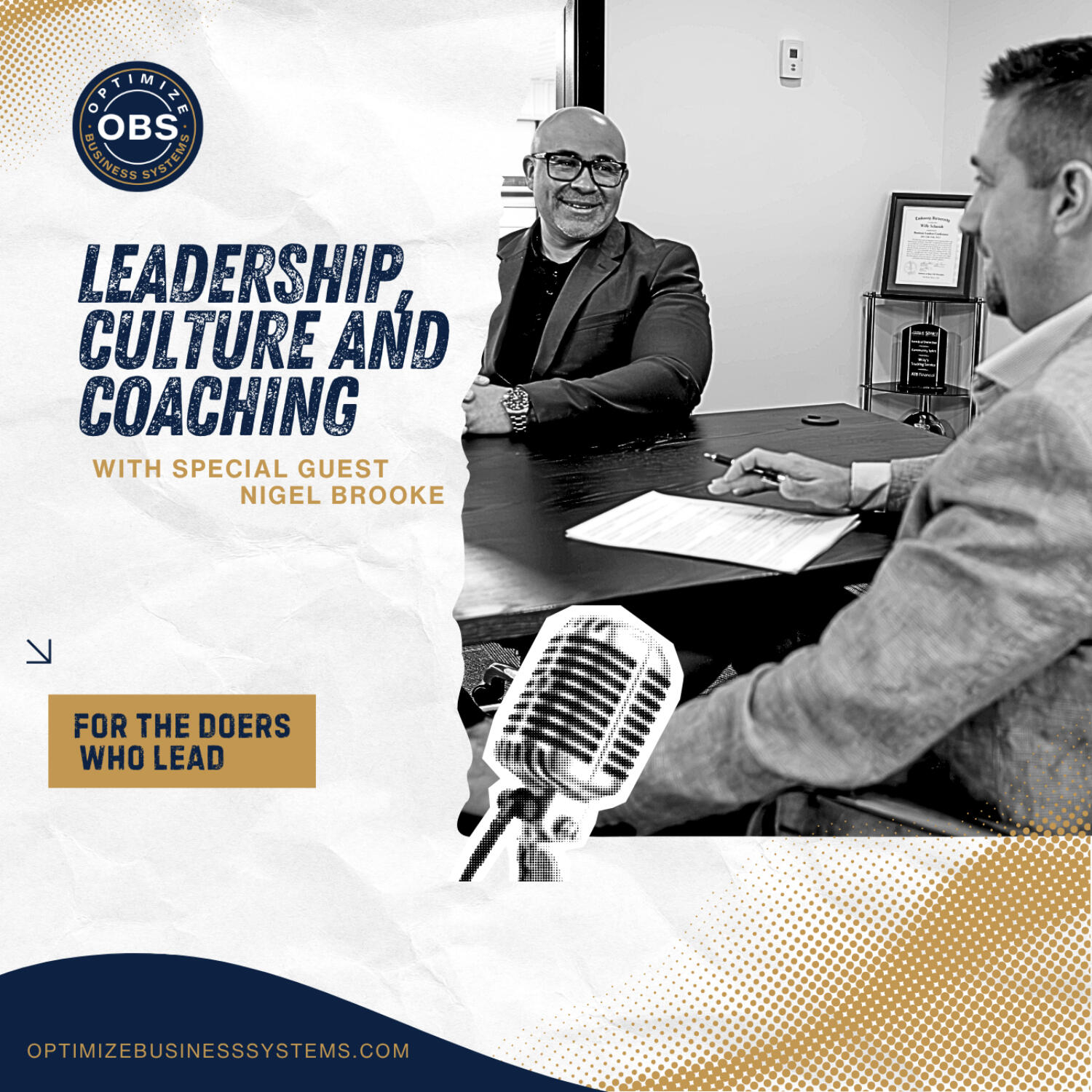 Leadership, Culture and Coaching With Special Guest Nigel Brooke | In this Inner Circle Community Call, host Hector interviews leadership coach Nigel Brooke, who shares lessons from 25 years rising from the shop floor to executive roles in warehousing, logistics, and distribution across the UK and Canada. Nigel explains that the best leaders aren’t the most technically skilled, but the most consistent in mindset and communication under pressure, focusing on people, psychological safety, and trust. He discusses how to lead through operational disruptions by communicating clearly, involving subject-matter experts, and avoiding emotional swings or panic decisions. The conversation covers leadership without titles, the importance of listening, transparency in pre-shift huddles, and the distinction between ownership and accountability. Nigel also emphasizes self-awareness as the first leadership habit, learning your team’s names, and rejecting the myth that leaders are born rather than developed. Want in on the live Q&A? Join our OBS Inner Circle — where entrepreneurs connect, learn, and get their biggest business questions answered live. Join Today — don’t just listen, get involved! www.optimizebusinesssystems.com 00:00 Welcome and Guest Intro 03:11 Nigel’s Career Journey 06:49 Real Leadership Without Titles 10:48 Consistency Under Pressure 14:35 Trust and Transparency 19:57 Ownership Versus Accountability 23:34 Leading Through Mistakes 27:08 Communication Gaps Today 29:30 Why Start Coaching 31:51 Self Awareness First 34:20 Know Your People 37:07 Leadership Myths and Next Steps | 40m 44s | ||||||
| 7/10/26 | The Decision Audit | Hector Alvarado opens a four-part Inner Circle series shifting from culture to action and decision-making, urging leaders to stop carrying unresolved decisions that drain mental bandwidth and slow teams. He outlines four decision-making failure modes—paralysis, the speed trap, bias blind spot, and wrong owner—then leads an exercise to count unresolved decisions and sort them into a four-quadrant audit: Yours to Make (High Stakes), Delegate It, Decide With Input, and Drop It. He explains the costs of unmade decisions (mental bandwidth, team velocity, opportunity cost, and trust erosion) and shares a case study of an agency owner who reduced overload by delegating, dropping non-decisions, and addressing avoided conversations. Week-one commitments: delegate three items, make one avoided decision, and drop two non-decisions; next week covers matching rigour to decision type, with a worksheet posted in the community. Want in on the live Q&A? Join our OBS Inner Circle — where entrepreneurs connect, learn, and get their biggest business questions answered live. Join Today — don’t just listen, get involved! www.optimizebusinesssystems.com 00:00 Welcome and Series Setup 01:03 Why Decisions Weigh You Down 03:55 Four Decision Failure Modes 09:31 Decision Audit Exercise 11:18 Four Quadrants Framework 16:57 Hidden Costs of Indecision 24:04 Agency Owner Case Study 27:58 Week One Commitments 31:59 Group Discussion and Insights 39:07 Next Week Guest and Wrap Up | 39m 07s | ||||||
| 7/3/26 | The Intentional Workplace Culture | In the final week of a four-part Inner Circle series on workplace cultures, the hosts recap three costly patterns—happy accident (relationship-based and common under $5M but doesn’t scale), command-and-control (orderly but destroys ownership), and chaotic culture (hard work without alignment that causes burnout)—then outline the only sustainable option: an intentional culture. They define intentional culture as deliberately created and consistently maintained through values, behaviors, and practices, independent of any one person and stronger at scale. The episode explains four pillars (defined behavioral values, leaders modeling standards, balanced recognition and accountability, and systems like huddles, onboarding, and reviews) and warns against undermining culture by excusing high performers, declaring values without living them, or waiting for the “right time.” The call-to-action is to start immediately with one value, one standard, and one recognition/accountability move. Want in on the live Q&A? Join our OBS Inner Circle — where entrepreneurs connect, learn, and get their biggest business questions answered live. Join Today — don’t just listen, get involved! www.optimizebusinesssystems.com 00:00 Welcome and Series Recap 00:53 Three Costly Culture Types 06:51 Defining Intentional Culture 08:58 Three Words That Define It 12:58 Four Pillars Overview 13:26 Pillar One Defined Values 16:04 Pillar Two Lead by Example 18:25 Pillar Three Recognition and Accountability 21:19 Pillar Four Systems That Reinforce 25:41 Three Ways Leaders Undermine Culture 30:58 Three Moves to Start Next Week 33:49 Wrap Up Challenge and Next Week 36:02 Live Reactions and Closing Chat | 39m 41s | ||||||
| 6/26/26 | The Chaotic Workplace Culture | In this Inner Circle tutorial (week three of four workplace cultures), Hector explains how “chaotic culture” forms when businesses grow faster than their structures, creating unclear roles, competing priorities, and inconsistent leadership. He outlines six warning signs—no shared top priority, overlapping roles, meetings with action items but no completion, conflicting leadership messages, burnout as the norm, and top performers leaving—and describes the “burnout pipeline” from confusion to departure. He quantifies chaos as a recurring “tax” of wasted hours and shares a case study of a 54-employee construction company where misalignment led to resignations, then improved through declaring one priority, clarifying role ownership, and enforcing meeting accountability with named owners, deadlines, and follow-up. The session previews next week’s focus on building intentional culture and includes Q&A emphasizing core values and execution. Want in on the live Q&A? Join our OBS Inner Circle — where entrepreneurs connect, learn, and get their biggest business questions answered live. Join Today — don’t just listen, get involved! www.optimizebusinesssystems.com 00:00 Welcome and Setup 00:23 When Change Creates Confusion 02:54 Defining Chaotic Culture 04:43 Roots of the Chaos 09:27 Six Warning Signs 14:52 Burnout and Talent Loss 17:19 The Hidden Chaos Tax 18:53 Case Study Construction Firm 23:26 Three Stabilization Moves 27:16 Next Week Intentional Culture 28:54 Q&A and Practical Advice | 32m 53s | ||||||
| 6/19/26 | Command & Control Workplace Culture | In week two of a four-part workplace culture series, the speakers unpack command-and-control culture, often created unintentionally by leaders pursuing high standards. They define it by centralized authority, compliance as the metric, and fear-based motivation, noting it can be necessary in high-risk environments but damages everyday growth businesses by killing ideas, hiding mistakes, and driving top performers away. Six warning signs are outlined: decisions waiting for the leader, problems not being raised, silence on ideas, hidden mistakes, quiet exits of best people, and compliant but disengaged morale. Using a manufacturing case study, they show how owner-dependence breaks operations when the owner steps away. They contrast compliance vs ownership and offer three moves: stop making one decision category, ask before answering to coach judgment, and make it safe to surface problems; the discussion ends with practical examples of setting decision authority limits and aligning vision and core values through regular check-ins. Want in on the live Q&A? Join our OBS Inner Circle — where entrepreneurs connect, learn, and get their biggest business questions answered live. Join Today — don’t just listen, get involved! www.optimizebusinesssystems.com 00:00 Week Two Kickoff 00:56 Is Your Team Waiting 02:03 What Command Control Means 03:56 Three Defining Traits 05:33 Standards vs Fear Tipping 06:26 When It Is Necessary 08:11 Six Warning Signs 13:07 Compliance vs Ownership 15:03 Why It Fails to Scale 16:34 Case Study Owner Dependency 19:30 Three Moves to Shift 19:57 Move One Delegate Decisions 20:55 Move Two Ask First 21:49 Move Three Surface Problems 24:10 Week Wrap and Worksheet 25:33 Panel Reflections on Culture 29:15 Applying It in Real Teams 32:02 New Hire Culture Check 33:57 Autonomy Limits and Examples 36:45 Laundromat Story Autonomy 39:12 Final Q&A Invitation | 30m 19s | ||||||
| 6/12/26 | The _Happy Accident_ Workplace Culture | In this Inner Circle call, Hector introduces a four-part series on four workplace cultures, starting with the “happy accident” culture—an organic, family-like environment built through small teams, shared origin, and a strong founder personality. He explains why it feels good but becomes dangerous as a business scales, especially when culture isn’t documented and depends on relationships and founder presence. Hector outlines six warning signs (inconsistent standards, relationship-based accountability, outsiders among new hires, dilution with growth, values felt but undefined, and expansion creating inconsistency), describes the ROI and time costs of unintentional culture, and shares a case study where a founder’s vacation exposed dependency. Hector gives three moves to start this week: name real current values, capture unwritten rules from tenured staff, and standardize one inconsistent behavior. Willy adds how documenting vision, implementing core values, and quarterly one-on-ones helped his company scale and reduce founder dependency, emphasizing culture work before expansion. Want in on the live Q&A? Join our OBS Inner Circle — where entrepreneurs connect, learn, and get their biggest business questions answered live. Join Today — don’t just listen, get involved! www.optimizebusinesssystems.com 00:00 Welcome and Series Pivot 01:01 Picture Your Best Team 01:50 Why Happy Accident Fails 02:35 What We Will Cover 03:45 Culture Is Behavior 05:27 How Happy Accident Forms 07:10 Three Conditions Explained 08:23 Six Warning Signs 13:13 The Real Business Cost 14:28 Founder Bottleneck Trap 16:34 Case Study Founder Vacation 19:37 Family Feel Does Not Scale 21:07 Three Moves This Week 21:37 Move One Name Values 22:40 Move Two Unwritten Rules 24:17 Move Three Standardize One 25:42 Week One Wrap and Next 27:05 Willy Insights From Vegas 29:23 Keeping Family Feel 31:45 When to Get Intentional | 34m 19s | ||||||
| 6/5/26 | The Intersection of AI, People & Business Growth with Ryan Kononoff | On an Inner Circle call, host interviews Ryan Kononoff, CEO of Clearbridge Business Solutions, about building at the intersection of people, technology, and growth. Ryan shares his early start in IT, how Clearbridge was founded to bridge the gap between tech-focused and business-focused thinking, and why he leads with family-first priorities and a people-development mindset. Ryan explains Clearbridge’s work across IT, cybersecurity, automation, and process improvement, emphasizing solving business problems with clear ROI rather than “tech for tech’s sake.” The conversation covers why owners resist strategic tech, how AI should be introduced through experimentation and trust-building, common gaps between AI theory and deployment, security guardrails and policies, and practical first steps like getting a paid AI account, identifying internal AI champions, and using an AI readiness assessment. Want in on the live Q&A? Join our OBS Inner Circle — where entrepreneurs connect, learn, and get their biggest business questions answered live. Join Today — don’t just listen, get involved! www.optimizebusinesssystems.com 00:00 Welcome and Guest Intro 01:02 Ryan Origin Story 02:19 Why Clearbridge Exists 03:26 People First Leadership 06:34 Generalist Mindset and ROI 08:19 What Clearbridge Does Today 10:29 Why Owners Resist Tech 16:24 AI From Theory to Practice 20:04 Where to Start With AI 23:23 Job Fear and Change 28:39 AI Security and Policies 33:31 Monday Morning Action Plan 36:10 AI Tools Tier List 39:16 Connect With Ryan Closing | 41m 43s | ||||||
| 5/29/26 | The AI Operating System | In the final Week 4 session of the AI Integration Playbook Inner Circle Calls, Hector explains how to move from ad hoc experimentation to a sustainable AI operating system that prevents “shadow AI” and its risks (data privacy, inefficiency, unmeasurable ROI, and budget creep). The framework covers six components: decision authority and an AI governance structure (leadership, an AI task force/champions, and all team members), standardizing a small core AI tech stack, a fast request-and-pilot process (one-week review and 30-day pilot), clear data privacy and security rules (including a “newspaper/competitor” test), ROI tracking via KPIs and dashboards (hours and dollars saved), and a quarterly/90-day audit rhythm to review tools and approve new pilots. Want in on the live Q&A? Join our OBS Inner Circle — where entrepreneurs connect, learn, and get their biggest business questions answered live. Join Today — don’t just listen, get involved! www.optimizebusinesssystems.com 00:00 Week Four Kickoff 00:39 Shadow AI Risks 01:11 AI Operating System 02:18 Six Core Components 05:12 Governance Decision Levels 07:59 Standardize Your Stack 08:55 Fast Tool Request Flow 11:13 Data Privacy Rules 13:43 ROI Dashboard KPIs 15:20 Quarterly Audit Rhythm 17:37 Action Plan Recap 19:14 Graduation And Next Guest 21:06 Q&A Key Takeaways 25:14 Shadow AI Defined | 27m 13s | ||||||
| 5/22/26 | The Pilot-to-Production System | In this Inner Circle Call (AI Integration Playbook Part 3), Hector explains “pilot purgatory,” where teams keep experimenting with AI without deploying solutions because they fail to set clear success criteria. He introduces a 30-day pilot protocol: choose one high-impact, low-complexity, low-risk use case; define measurable success criteria (time saved, accuracy/quality, user, cost including setup time, and a non-negotiable decision date); execute with week 1 setup/training and a short SOP, weeks 2–3 testing and adjustments, and week 4 measurement; then decide on day 30 to scale, optimize with one more 30-day cycle, or kill and cancel. Willy demos building branded assessment tools in Claude, showing rapid creation of interactive tools and reports, and Hector shares using Claude to revise a compensation document. The group discusses tech stacks and using AI for email responses via account integrations. Want in on the live Q&A? Join our OBS Inner Circle — where entrepreneurs connect, learn, and get their biggest business questions answered live. Join Today — don’t just listen, get involved! www.optimizebusinesssystems.com 00:00 Welcome and Agenda 01:06 What Is Pilot Purgatory 02:23 Why Most Pilots Stall 05:45 30 Day Pilot Step One 07:25 Define Success Criteria 09:50 30 Day Execution Timeline 12:48 Day 30 Scale Optimize Kill 15:37 Claude Demo Setup 17:55 Assessment Tool Walkthrough 24:05 Branding and Tech Stack Q&A 26:49 More Use Cases and Comparisons 34:58 Hector Live Document Example 38:22 Wrap Up Action Items 40:39 Email and Calendar Automation Q&A 42:32 Closing Thoughts | 44m 34s | ||||||
| 5/19/26 | AI: The Trust Framework | On this weekly Inner Circle call, Hector discusses why AI rollouts often trigger team resistance and how to build trust so tools don’t sit unused. They outline five main causes of pushback—fear of job loss, loss of autonomy, extra work during early adoption, distrust of AI accuracy, and privacy/ethical concerns—citing stats such as 45% of small business workers worrying AI could harm reputation, 35% naming data privacy as a top concern, and 8% of companies reducing roles due to AI in 2025 while 69% did not. The episode presents a “trust equation,” a four-phase approach (honest conversation, involve the team, train/empower, and show weekly wins), suggested answers to common employee questions, and the importance of internal AI champions and clear usage policies, with a preview of a live pilot demo next week. Want in on the live Q&A? Join our OBS Inner Circle — where entrepreneurs connect, learn, and get their biggest business questions answered live. Join Today — don’t just listen, get involved! www.optimizebusinesssystems.com 00:00 Welcome and Setup 00:48 Why AI Triggers Fear 01:31 Trust Gap by the Numbers 04:16 Five Reasons Teams Resist 09:26 Privacy Policies and Ethics 11:23 The Trust Equation 13:49 Four Phases to Build Trust 18:02 AI Friday and Champions 21:28 Five Tough Questions Answered 25:53 Key Takeaways and Next Week 28:53 Host Reaction and Discussion 34:32 Team Roundtable and Pushback 38:47 Open Floor Wrap Up | 40m 16s | ||||||
| 5/9/26 | The AI Opportunity Audit | In this Inner Circle call, Hector introduces an “Integration Playbook” to help businesses move beyond dabbling in AI and instead systematically integrate it for measurable ROI. He explains that most people try tools like ChatGPT but don’t use AI consistently to save time, cut costs, or generate revenue because they chase hype and tools rather than starting with business problems. Hector outlines where AI excels (pattern recognition, repetitive tasks, content generation, data processing, chatbots) and where it struggles (complex judgment, true creativity and strategy, relationship-building, accountability), emphasizing AI as a tool—not a replacement—best used in partnership with human expertise. He shares five use-case categories (marketing, customer service, operations, sales, finance), a task audit and scoring method, and a simple ROI calculation with examples, plus week-one homework to identify quick wins and what not to automate. Want in on the live Q&A? Join our OBS Inner Circle — where entrepreneurs connect, learn, and get their biggest business questions answered live. Join Today — don’t just listen, get involved! www.optimizebusinesssystems.com 00:00 AI Integration Playbook Intro 01:59 The AI Adoption Gap 03:51 Separating Hype From Help 07:13 AI Strengths And Limits 15:38 Five Business Use Cases 18:21 AI Opportunity Audit Steps 23:32 Calculating ROI And Quick Wins 28:32 Case Study Proposal Automation 30:33 Week One Action Plan 33:57 Q&A Real World Claude Demo 39:42 Wrap Up And Open Discussion | 41m 39s | ||||||
| 5/3/26 | Seth Greene Interview: Business Scars, Landing Kevin Harrington & The Marketing Playbook | Seth shares his biggest emotional business scar: after nine months courting a major multi-state personal injury law firm, the founder promised a six-figure check and perks, then abruptly backed out, leaving Seth having hired staff, paused prospecting, and nearly overcommitted financially; he later learned the prospect was notorious for saying yes and disappearing, teaching lessons like not spending until checks clear, continuing pipeline work, and vetting clients. He explains how he later connected with Shark Tank’s Kevin Harrington by offering him a ride to the airport, pitching funnel improvements for AsSeenOnTV.com, and following up with a “shock and awe” package that led to long-term work and a co-hosting relationship on the Sharkpreneurs podcast. Seth discusses his 10 books, including a summit-to-book approach, emphasizes personal development as key to business growth, advocates “co-opetition” partnerships, mission-driven ripple effects, and marketing fundamentals like ultra-specific targeting and direct response over branding. Want in on the live Q&A? Join our OBS Inner Circle — where entrepreneurs connect, learn, and get their biggest business questions answered live. Join Today — don’t just listen, get involved! www.optimizebusinesssystems.com 00:00 Failure Behind Success 00:34 The Deal That Vanished 02:42 Gut Punch and Scramble 03:55 Lessons From the Near Miss 05:49 Landing Kevin Harrington 07:27 Pitching on the Airport Ride 09:54 From Client to Co Host 11:19 Sharkpreneurs Podcast Breakdown 12:18 Ten Books and Summit Hack 13:41 Personal Growth Drives Scale 16:24 Co-opetition Marketing 17:59 Ripple Effect Mission 20:14 Stop Hustling Start Scaling 22:42 Laser Focus Target Market 24:29 Direct Response Over Branding 26:10 Pick One Channel 27:37 Premium Positioning 28:58 Choose Your Forever Niche 31:41 Where to Find Seth | 40m 10s | ||||||
| 4/25/26 | The Leadership Operating System | In the final week of the Scalable Business Blueprint, the presenters explain how entrepreneurs can break free from the “second prison” of trading time for money by shifting from operator to true CEO. They distinguish working in the business versus on the business and outline six founder responsibilities: set vision and strategy, build and lead the team and culture, ensure financial health, protect brand and reputation, drive innovation and improvement, and maintain perspective and energy. The episode provides a themed ideal weekly rhythm, a simple leadership structure with key roles (visionary, operator, operations, revenue, finance, plus optional people/admin), clear delegation and decision-rights guidance, a 90-day planning sprint methodology, and steps to build a metrics-driven culture where each role owns a number that defines success. Want in on the live Q&A? Join our OBS Inner Circle — where entrepreneurs connect, learn, and get their biggest business questions answered live. Join Today — don’t just listen, get involved! www.optimizebusinesssystems.com 00:00 Welcome and Finale Setup 00:42 Escaping the Second Prison 02:09 Operator vs CEO Shift 05:02 Six CEO Responsibilities 05:31 Vision and Strategy 06:37 Team and Culture Value 09:43 Financial Health Oversight 11:00 Brand and Reputation Guard 13:11 Innovation and Improvement 14:28 Energy and Perspective 16:26 What CEOs Don’t Do 17:35 Ideal Weekly Rhythm 18:16 Theme Your Week Breakdown 20:41 Friday Review and Recharge 22:32 Building Leadership Structure 22:43 Five Key Leadership Roles 24:32 Define Roles Before Hiring 25:51 Delegation and Decision Rights 27:42 90 Day Planning Sprints 30:03 Metrics Driven Culture 31:41 Scorecards and One Number 33:31 Action Plan and Wrap Up 35:17 Panel Reflections and Takeaways 39:21 Metrics Examples for Teams 40:30 Solopreneur Metrics Challenge | 42m 41s | ||||||
| 4/17/26 | The Profitability Model | In week three of the Scalable Business Blueprint, the speakers argue that entrepreneurs obsess over revenue while avoiding profit, emphasizing “revenue is vanity, profit is sanity, and cash is reality.” They share examples of high-revenue businesses taking home little or losing money due to eroded margins and poor unit economics, and compare a $5M business at 5% net margin versus a $2M business at 20% to show why margins and cash matter more than ego-driven top-line growth. The episode teaches five key numbers to track consistently—cash in bank, revenue, gross profit margin, net profit margin, and accounts receivable—plus unit economics to identify what truly makes money. It introduces the “Profit First” approach (revenue minus profit equals expenses) and assigns actions to improve profitability by 5% through pricing, cutting waste, or dropping unprofitable offerings. Want in on the live Q&A? Join our OBS Inner Circle — where entrepreneurs connect, learn, and get their biggest business questions answered live. Join Today — don’t just listen, get involved! www.optimizebusinesssystems.com 00:00 Revenue vs Profit Reality 00:59 Scaling Without Margins 03:04 Three Profitability Lies 05:10 Mindset Shift Business B 07:08 Five Numbers That Matter 09:04 Gross and Net Margins 14:05 Cash Flow and Receivables 15:39 Unit Economics and Offers 20:10 Profit First Method 25:37 Build Your CEO Dashboard 29:18 Weekly Action and Takeaways 32:33 Willy Story Cutting Waste 37:05 Group Reflection Closing | 39m 19s | ||||||
Showing 25 of 69
Pitch Fit is a Pro feature
See how bookable this show is for guests, which brands already advertise, the per-episode ad value, and the best-fit guest and sponsor profile. The numbers are blurred on the free plan.
How readily this show books outside guests like you.
How proven this show is for host-read sponsorships.
For Guests
ProFor Advertisers
ProUpgrade to Pro to unlock guest cadence, sponsor categories, fit scores, and per-episode ad value for this show.
Distribution & Reach
About the show, platforms, and key insights.
Distribution & Reach
About the show, platforms, and key insights.
Optimize Business Systems is an independent podcast creator specializing in delivering insights that empower business leaders and entrepreneurs. They focus on providing actionable strategies and tools that help individuals streamline their operations and enhance their leadership capabilities. The Inner Circle Podcast stands out by offering a blend of practical advice and mindset shifts tailored for business owners and leaders. Each episode explores a range of topics, from operational efficiency to innovative leadership techniques, featuring deep dives into proven systems that help listeners transform chaotic situations into structured growth opportunities. The podcast appeals primarily to business professionals seeking to refine their management skills and drive organizational success. With an estimated listener base of 5K to 30K, audiences gain valuable insights that not only sharpen their vision but also equip them with the necessary frameworks to build lasting legacies in their fields.
By the numbers
- Total followers: 133
- Total plays: 32K
Platforms
TuneIn
- Followers: 96
Castbox
- Followers: 1
- Plays: 14
YouTube
- Subscribers: 36
- Views: 32K
- Videos: 352
Audience
adults, professionals, family
Key insights
What the show covers
- proven systems for business
- real-world leadership insights
- strategies for operational efficiency
- mindset shifts for clarity
Audience interests
- business growth strategies
- leadership development
- entrepreneurial mindset
- marketing insights
Platform reach
- available on major podcast platforms
- growing community engagement
- no specific platforms detected
- unknown follower count
Publishing consistency
- weekly episodes released
- active for one year
- 48 episodes total
- reliable content schedule
Chart history for The Inner Circle Podcast
Peaked at #57 in VN, currently #57 in VN.
| Market | Genre | Peak | Current | Trend |
|---|---|---|---|---|
| VN | — | #57 | #57 | — |
Chart Positions
1 placement across 1 market.
Chart Positions
1 placement across 1 market.