

Insights from recent episode analysis
Audience Interest
Podcast Focus
Publishing Consistency
Platform Reach
Insights are generated by CastFox AI using publicly available data, episode content, and proprietary models.
Most discussed topics
Brands & references
Est. Listeners
Insufficient chart data. Estimates will improve as the show charts.
- Per-Episode Audience
Est. listeners per new episode within ~30 days
N/A🎙 Weekly cadence·145 episodes·Last published 5mo ago - Monthly Reach
Unique listeners across all episodes (30 days)
N/A - Active Followers
Loyal subscribers who consistently listen
N/A
Market Insights
Platform Distribution
Reach across major podcast platforms, updated hourly
Total Followers
—
Total Plays
—
Total Reviews
—
* Data sourced directly from platform APIs and aggregated hourly across all major podcast directories.
On the show
From 1 epsHost
Recent guests
No guests detected in recent episodes.
Recent episodes
Welcome to 2026 and beyond
Jan 3, 2026
4m 26s
2025 End of Year Recap
Dec 27, 2025
1m 07s
Nested learning and the illusion of depth
Dec 20, 2025
7m 34s
The great 2025 LLM vibe shift
Dec 13, 2025
5m 56s
The 5 biggest unsolved problems in quantum computing
Dec 6, 2025
9m 46s
Social Links & Contact
Official channels & resources
Official Website
Login
RSS Feed
Login
Resolving iTunes ID\u2026 if this persists, the podcast may not be indexed on Apple Podcasts.
| Date | Episode | Topics | Guests | Brands | Places | Keywords | Sponsor | Length | |
|---|---|---|---|---|---|---|---|---|---|
| 1/3/26 |  Welcome to 2026 and beyond✨ | technologybusiness+5 | — | Lindahl Letter | — | Lindahl Letter2026+5 | — | 4m 26s | |
| 12/27/25 |  2025 End of Year Recap | Thank you for tuning in to week 219 of the Lindahl Letter publication. A new edition arrives every Friday. This week the topic under consideration for the Lindahl Letter is, “2025 End of Year Recap.”Thank you for being here! The Lindahl Letter this week started out as a Merry Christmas and Happy Holidays post and ended up just being an end of year recap. As the year comes to a close, I am taking a brief pause from publishing this week to spend time with family, recharge, and reflect on the remarkable conversations and ideas we have explored together throughout the year. If you are reading this one, then you certainly learned about AI/ML/AGI, robotics, and quantum computing this year. The Lindahl Letter will return to its regular schedule next year, and I am grateful for your continued readership, curiosity, and engagement. I wish you and yours a happy holiday season and a thoughtful, restorative start to the new year.My top 5 posts of 2025 included:What’s next for the Lindahl Letter? New editions arrive every Friday. If you are still listening at this point and enjoyed this content, then please take a moment and share it with a friend. If you are new to the Lindahl Letter, then please consider subscribing. Make sure to stay curious, stay informed, and enjoy the week ahead! This is a public episode. If you would like to discuss this with other subscribers or get access to bonus episodes, visit www.nelsx.com | 1m 07s | ||||||
| 12/20/25 |  Nested learning and the illusion of depth | Thank you for tuning in to week 218 of the Lindahl Letter publication. A new edition arrives every Friday. This week the topic under consideration for the Lindahl Letter is, “Nested learning and the illusion of depth.”Just for fun with this nested learning paper we are evaluating today, I downloaded the 52 page PDF and uploaded it to my Google Drive to have Gemini create an audio overview of the paper. That is just a one button request these days. We have reached a point where we can easily listen to a paper recap with very little friction. It’s actually harder to get a complete reading of the PDF as an audio file. I had tried the Adobe Acrobat read aloud feature and I don’t really like the robotic output. Sometimes, I would rather listen to a paper than read it when I am trying to really think deeply about something. The 5 minutes of podcast audio Gemini spit out about the paper are embedded below. It’s interesting to say the least how quickly Gemini turned that paper into a short podcast. It’s entirely possible that my analysis might be less entertaining than the podcast Gemini created on the fly. You will be the judge of that one. This is a paper I actually printed out 2 pages per page using the double sided setting. That is how I used to read papers during graduate school. This paper had a few color elements that is something my graduate school papers never really had. They were all monochromatic. I had to put on my reading glasses and hold the paper a little closer than I used to with the 2 pages per page printing. I’ll have to remember to just print using single page spacing next time around. I really only print out papers I want to keep in my stack of stuff. This one certainly fits that criteria.Trying to make content that is accessible is one of the reasons that I have been recording audio for the Lindahl Letter. Sometimes listening to something is a great unlock. Other times due to complexity and the diagrams included you just have to read academic papers. I try to bring things forward without complex charts in a highly consumable way. My take on research notes is that they need to be generally understandable and communicate a clear take on whatever topic is being covered. The content has to be condensed into something that can be considered in 5-10 minutes. To that end I’m going to do my best to bring this paper on nested learning to life today.This paper matters, it really does, because the research presented undermines one of the core assumptions driving modern AI investment and the endless LLM building and training that has been occurring, namely that stacking more layers reliably produces qualitatively better intelligence [1]. The mantra to just keep scaling maybe will fade away. If many so-called deep models collapse into shallow equivalents during training, then reported gains attributed to architectural depth may instead be artifacts of data scale, regularization, or optimization heuristics rather than true representational progress.This has direct implications for benchmarking, since comparisons that reward parameter count or depth risk overstating advances that do not translate into more robust reasoning or generalization. It also affects hardware and infrastructure strategy, because enormous resources are being allocated to support depth that may not deliver proportional returns. At a deeper level, the result forces a reconsideration of what meaningful learning progress actually looks like, shifting attention from surface complexity toward mechanisms that introduce genuinely new inductive structure and adaptive behavior.Maybe the long term impact of this call out is likely to be gradual rather than abrupt, but it meaningfully shifts the intellectual ground beneath current AI narratives [1]. The paper in question provides a formal vocabulary for a concern many researchers have held intuitively, that architectural depth has become a proxy metric for progress rather than a principled design choice. Over time, this reframing may influence how serious research groups evaluate models, placing more weight on identifiably distinct learning mechanisms, training dynamics, and robustness properties instead of raw scale.It is unlikely to immediately change the minds of investors or vendors whose incentives favor larger systems, but it can shape academic norms, reviewer expectations, and eventually benchmark construction. Historically, results like this matter most not because they halt a paradigm, but because they constrain it, narrowing the space of credible claims and forcing future advances to justify themselves on grounds other than appearance and size.This argument intersects directly with my broader concerns about interpretability and generalization. I am still curious about creating a combiner model, but this might change the mechanics of how that might ultimately work. If performance gains arise primarily from optimization dynamics rather than architectural expressivity, then claims about learned representations should be treated with caution. Apparent abstraction may not correspond to stable semantic structure but to transient equilibria shaped by training order, learning rates, and implicit regularization. This aligns with growing skepticism about whether large models truly learn hierarchical concepts or merely approximate them through iterative adjustment [2].The implications extend beyond theory. Nested learning reframes debates about model scaling, architectural novelty, and transfer learning. It suggests that progress may come less from ever deeper networks and more from better understanding and controlling learning dynamics. This has practical consequences for reproducibility, safety, and deployment, since nested optimization can introduce path dependence and sensitivity to training regimes that are difficult to observe or audit.In the broader context of the AI marketplace, this work reinforces a recurring theme. Fluency and performance do not necessarily imply understanding. As with recent neuroscience critiques of language models, nested learning highlights how impressive outputs can emerge from mechanisms that lack stable, interpretable internal structure [3]. That gap matters when systems are deployed in high stakes environments where reliability, robustness, and reasoning are essential.We will see how this plays out in 2026 and what new research will ultimately shift the landscape.Footnotes:[1] Behrouz, A., Razaviyayn, M., Zhong, P., & Mirrokni, V. “Nested learning: The illusion of deep learning architectures.” Advances in Neural Information Processing Systems 39 (2025). https://abehrouz.github.io/files/NL.pdf[2] Raghu, M., Poole, B., Kleinberg, J., Ganguli, S., & Dickstein, J. “On the expressive power of deep neural networks.” Proceedings of the 34th International Conference on Machine Learning (2017). https://arxiv.org/abs/1606.05336[3] Riley, B. “Large language mistake: Cutting edge research shows language is not the same as intelligence.” The Verge (2025). https://www.theverge.com/ai-artificial-intelligence/827820/large-language-models-ai-intelligence-neuroscience-problemsWhat’s next for the Lindahl Letter? New editions arrive every Friday. If you are still listening at this point and enjoyed this content, then please take a moment and share it with a friend. If you are new to the Lindahl Letter, then please consider subscribing. Make sure to stay curious, stay informed, and enjoy the week ahead! This is a public episode. If you would like to discuss this with other subscribers or get access to bonus episodes, visit www.nelsx.com | 7m 34s | ||||||
| 12/13/25 |  The great 2025 LLM vibe shift | Thank you for tuning in to week 217 of the Lindahl Letter publication. A new edition arrives every Friday. This week the topic under consideration for the Lindahl Letter is, “The great 2025 LLM vibe shift.”Vibe shifts came and went. People are certainly adding the word vibe to all sorts of things as the initial meaning has ironically faded. Casey Newton in the industry standard setting Platformer newsletter wrote about a big silicon valley vibe shift in 2022 [1]. It was a big thing; until it wasn’t. The really big completely surreal LLM shift has happened toward the tail end of 2025. We went from extreme AI bubble talk to very clear, rational, and thoughtful perspectives on how LLMs won’t realize the promises that have been made. Keep in mind the market fears of an AI bubble are different from the understanding that LLMs might be the technology that ultimately wins. All of the spending in the marketplace and the academic argument may get reconciled at some point, but we have not seen that happen in 2025.The backward linkages of how potential technological progress regressed may not have been felt just yet, but the overall sentiment has shifted. The ship has indeed sailed. Let that sink in for a moment and think about just how big a shift in sentiment that really happens to be and how it just sort of happened. As OpenAI and Anthropic move toward inevitable IPO, that shift will certainly change things. Maybe the single best written explanation of this is from Benjamin Riley who wrote a piece for The Verge called, “Large language mistake: Cutting-edge research shows language is not the same as intelligence. The entire AI bubble is built on ignoring it” [2]. I owe a hat tip to Nilay Patel for recommending and helping surface that piece of writing.I was skeptical at first, but then realized it was a really interesting and well reasoned read. I’ll admit at the same time, I was also reading a 52 paper from the Google Research team, “Nested Learning: The Illusion of Deep Learning Architecture” around the same time which was interesting as a paired reading assignment [3]. More to come on that paper and what it means in a later post. I’m still digesting the deeper implications of that paper.Maybe to really sell the shift you could take a moment and listen to some of the recent words from OpenAI cofounder Ilya Sutskever. I’m still a little shocked about the casual way Ilaya described how we moved from research and the great AI winter, to the age of scaling, and finally back to the age of research again. The idea that scaling based on compute or size of corpse won’t win the LLM race is a very big shift and Ilya makes it pretty casually during this video.You will notice I have set the video to play about 1882 seconds into the conversation:Maybe a video with a really sharp looking classic linux Red Hat fedora in the background featuring a conversation between Nilay Patel and IBM CEO Arvind Krishna can help explain things. Don’t panic when you realize that the CEO of IBM very clearly argues with some back of the envelope math that all the data center investment has no real way to pay off in practical terms or an actual return on investment. Try not to flinch when it is described that within 3-5 years the same data centers could be built at a fraction of the current cost. Technology does just keep getting better. The argument makes sense. It is no less shocking based on the billions being spent.I set the video to start playing 502 seconds into the conversation.The argument that I probably prefer in the long run is how quantum computing is going to change the entire scaling and compute landscape [4]. The long-term argument that may end up mattering the most suggests that quantum computing will transform the economics of scale and ultimately reset expectations about what is computationally feasible. Former Intel CEO Pat Gelsinger recently framed quantum as the force likely to deflate the AI bubble by altering the fundamental relationship between compute and capability, a claim that is gaining analytical support across the research community. We may see it be an effective counter to the billions being spent on data centers for a late mover willing to make a prominent investment in the space or it could just end up being Alphabet who is highly invested in both TPU and quantum chips [5].What’s next for the Lindahl Letter? New editions arrive every Friday. If you are still listening at this point and enjoyed this content, then please take a moment and share it with a friend. If you are new to the Lindahl Letter, then please consider subscribing. Make sure to stay curious, stay informed, and enjoy the week ahead!Footnotes:[1] Newton, C. (2022). The vibe shift in Silicon Valley. Platformer. https://www.platformer.news/the-vibe-shift-in-silicon-valley/[2] Riley, B. (2025). Large language mistake: Cutting-edge research shows language is not the same as intelligence. The entire AI bubble is built on ignoring it. The Verge. https://www.theverge.com/ai-artificial-intelligence/827820/large-language-models-ai-intelligence-neuroscience-problems[3] Behrouz, A., Razaviyayn, M., Zhong, P., & Mirrokni, V. (2025). Nested learning: The illusion of deep learning architectures. In The Thirty-ninth Annual Conference on Neural Information Processing Systems. https://abehrouz.github.io/files/NL.pdf[4] Shrivastava, H. (2025). Quantum computing will pop the AI bubble, claims ex-Intel CEO Pat Gelsinger. Wccftech. https://wccftech.com/quantum-computing-will-pop-the-ai-bubble-claims-ex-intel-ceo-pat-gelsinger/[5] Yahoo Finance, “Alphabet CEO just said quantum computing could be close to a breakthrough,” https://finance.yahoo.com/news/alphabet-ceo-just-said-quantum-155229893.html This is a public episode. If you would like to discuss this with other subscribers or get access to bonus episodes, visit www.nelsx.com | 5m 56s | ||||||
| 12/6/25 | 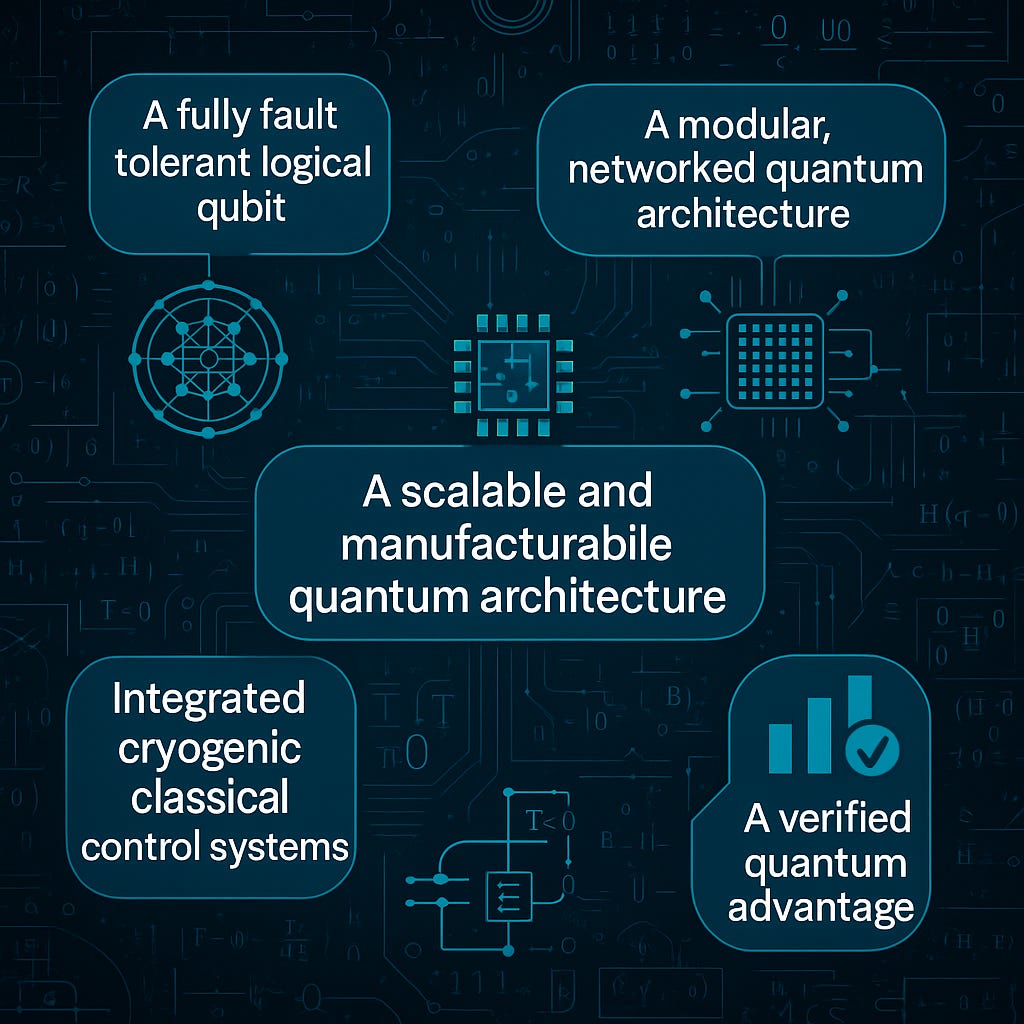 The 5 biggest unsolved problems in quantum computing | Thank you for tuning in to week 216 of the Lindahl Letter publication. A new edition arrives every Friday. This week the topic under consideration for the Lindahl Letter is, “The biggest unsolved problems in quantum computing.”The field of quantum computing has accelerated rapidly during the last decade, yet its most important breakthroughs remain incomplete. The core research challenges that stand between today’s prototypes and large scale, industrially relevant systems are now visible with unusual clarity. I think we are on the path to seeing this technology realized. These challenges are increasingly framed not as incremental milestones but as structural bottlenecks that shape the entire trajectory of the field. This week’s analysis focuses on the five most critical problems that must be solved for quantum computing to reach fault tolerant, economically meaningful operation. These gaps define where research investment, national strategy, and competitive advantage will be determined in the coming decade.1. A fully fault tolerant logical qubit with logical error rates below thresholdThe first and most fundamental problem is the absence of a fully fault tolerant logical qubit. I know, I know, people are getting close, but this technology is not fully realized just yet. Theoretical thresholds for fault tolerance are well studied, and progress has been reported through surface codes, low density parity check codes, and recent advances in magic state distillation. Several groups have demonstrated logical qubits whose performance exceeds their underlying physical qubits, and some trapped-ion experiments now show better than break-even behavior under repeated rounds of error correction. However, no team has yet realized a logical qubit that maintains below-threshold logical error rates in a fully integrated setting that combines encoding, stabilizer measurement, real time decoding, and continuous correction across arbitrarily deep circuits. Experiments such as the University of Osaka’s zero level magic state distillation results and Quantinuum’s recent logical circuit demonstrations illustrate meaningful progress, yet a complete fault tolerant logical qubit build rolling off the assembly line has not been achieved [1]. This missing element prevents reliable execution of deep circuits and stands as the central research challenge of the field. I am also tracking a leaderboard of efforts aimed at increasing the number and stability of logical qubits as new systems emerge [2].2. A scalable and manufacturable quantum architecture that supports thousands of high fidelity qubitsThe second unsolved problem is the absence of a scalable, manufacturable quantum architecture capable of supporting thousands of high fidelity qubits. Superconducting platforms continue to face wiring congestion, cross talk, and fabrication variability across large wafers, which limits reproducibility at scale. Trapped-ion systems achieve some of the highest gate fidelities reported, but their physical footprint, control volume, and relatively slow gate speeds constrain system growth. Neutral atom arrays offer large qubit counts, yet they have not demonstrated uniform, high fidelity two qubit gates across arrays large enough to support fault tolerant codes. Photonic and spin qubits continue to advance but remain earlier in their development for universal, gate based architectures. Across all platforms, the transition from laboratory systems to repeatable, wafer scale manufacturing has not occurred. Most resource estimates indicate that tens of thousands of physical qubits will be required for practically useful, error corrected applications, and no architecture is yet positioned to deliver this scale with consistent fidelity. I am tracking universal gate based physical qubit leaders closely, and I expect to see significant shifts in 2026 as fabrication strategies evolve [3].3. Integrated cryogenic classical control systems capable of real time decoding at scaleThe third unsolved problem concerns the integration of classical control systems capable of operating efficiently at cryogenic temperatures. Quantum processors rely on classical electronics to generate precise control pulses, read measurement outcomes, and perform real time decoding. As devices grow, these classical requirements become a dominant engineering bottleneck. Current systems depend on extensive room temperature hardware and thousands of coaxial lines, an approach that is not viable for scaling beyond a few hundred qubits. Research into cryogenic CMOS, multiplexed readout architectures, and fast low noise routing has shown meaningful progress, and prototype decoders have demonstrated sub microsecond performance. However, the field still lacks a fully integrated classical to quantum control stack that can operate near the device, support large scale decoding throughput, and eliminate the wiring overhead required for million channel systems. Solving this challenge is as essential as improving qubit fidelity, because fault tolerant computation will require tightly coupled classical and quantum subsystems functioning in real time at cryogenic depths.4. A modular, networked quantum architecture with reliable chip to chip entanglementThe fourth major unsolved problem involves modularity and quantum networking. Large scale quantum computers will not be monolithic systems. They will require distributed architectures in which multiple chips or modules exchange entanglement to support error corrected computation across larger systems. Research groups have demonstrated chip to chip photonic links, heralded entanglement generation, and short range coupling between trapped-ion and superconducting devices, but these demonstrations remain small scale and experimental. No team has yet produced a modular architecture capable of sustaining reliable inter module entanglement rates, routing operations, and error corrected logical circuits across networked components. A practical quantum interconnect, whether photonic or microwave based, would redefine system design by enabling large logical qubit counts without relying on a single monolithic wafer. Developing these networked architectures is now seen as one of the highest value targets for national research programs, because modularity is likely the only viable path to systems with millions of physical qubits.5. A verified quantum advantage tied to a real scientific or industrial workloadThe fifth unsolved problem is the absence of a widely accepted, independently verified quantum advantage tied to a real scientific or industrial workload. Quantum supremacy experiments have demonstrated that certain random circuit sampling tasks are exceptionally difficult for classical systems to simulate, but these tasks do not translate into chemistry, materials, optimization, or cryptography workloads. Several vendors have recently reported domain specific quantum advantages, including applications in quantum navigation and narrow optimization tasks, but these demonstrations have not yet achieved broad community validation or independent replication under strict verification and resource accounting. A robust demonstration of advantage requires a computation that is infeasible for classical systems within realistic time and energy constraints, produces an output that can be meaningfully verified, and operates using real hardware error rates rather than idealized gates. Achieving this milestone would mark a decisive shift in the strategic landscape of the field and would accelerate commercial investment into fault tolerant platforms.Together, these five problems outline the most important questions I’m tracking that are facing quantum computing today. This is based on my research interests. Please feel free to let me know if something else jumps out when you read this list. Each topic represents an opportunity for technical leadership, research investment, and industrial strategy. That does not mean my list is complete. It’s directionally accurate for late 2025, but things in the quantum computing space are changing rapidly. These elements called out also define the hurdles that stand between early laboratory demonstrations and the large-scale quantum platforms required for transformative scientific progress.What’s next for the Lindahl Letter? New editions arrive every Friday. If you are still listening at this point and enjoyed this content, then please take a moment and share it with a friend. If you are new to the Lindahl Letter, then please consider subscribing. Make sure to stay curious, stay informed, and enjoy the week ahead!Links I’m sharing this week!You may not have watched Linus Torvalds build a computer on your watch list for 2025, but I’m sharing that link anyway. I truly enjoyed watching this video.This video made me chuckle several times and was delightful.Footnotes:[1] Itogawa, T., Takada, Y., Hirano, Y., & Fujii, K. (2024). Even more efficient magic state distillation by zero-level distillation. arXiv preprint arXiv:2403.03991. http://arxiv.org/pdf/2403.03991[2] Top quantum computers by logical qubit[3] Updating my top 10 quantum computer leaderboard This is a public episode. If you would like to discuss this with other subscribers or get access to bonus episodes, visit www.nelsx.com | 9m 46s | ||||||
| 11/29/25 | 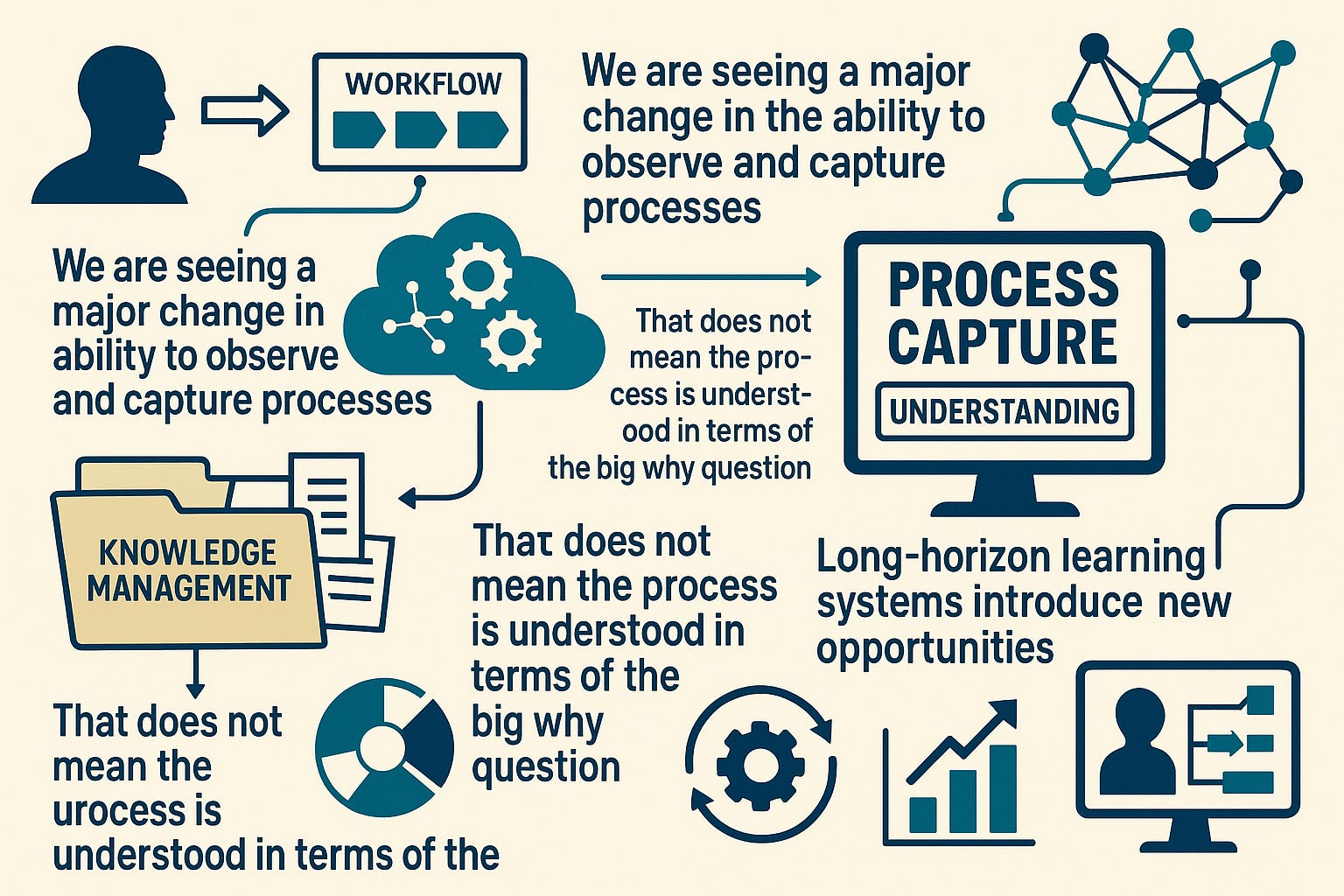 Process capture and the future of knowledge management | Thank you for tuning in to week 215 of the Lindahl Letter publication. A new edition arrives every Friday. This week the topic under consideration for the Lindahl Letter is, “Process capture and the future of knowledge management.”The history of knowledge management has been shaped by repeated attempts to store, retrieve, and reuse organizational insight. So much institutional knowledge gets lost and discarded as organizations change and people shift roles or exit. People within organizations learn through the every day practice of getting things done. It’s only recently that systems are augmenting and sometimes automating those processes. Early systems focused on document repositories, and later platforms emphasized collaboration, tagging, and collective intelligence. We now find ourselves in a period where knowledge management converges with automated workflows and computational assistants that can observe, extract, and generalize decision patterns. We are seeing a major change in the ability to observe and capture processes. Systems are able to capture and catalog what is happening. This creates an interesting inflection point where the system may store the knowledge, but the users of that knowledge are dependent on the system. That does not mean the process is understood in terms of the big why question. Scholars have noted that the operational layer of organizational memory is often lost because it resides in informal practices rather than formal documentation. The shift toward embedded and automated capture offers a remedy to that problem.The rise of agentic AI and workflow-integrated assistants alters the knowledge landscape by making it possible to synthesize procedural knowledge in real time. Instead of relying on teams to manually update wikis or define operating procedures, modern systems can extract key steps from repeated actions, identify dependencies, and flag anomalies that deviate from observed patterns. This transforms knowledge management from a static library into a dynamic computational environment. What exactly happens to this store of knowledge over time is something to consider going forward. Supervising the repository will require deep knowledge of the systems which are now being maintained systematically. Maintaining and refining it will be the difference between sustained institutional knowledge or temporary model advantages that drop with the next update. Recent studies on digital trace data argue that high fidelity observational streams can significantly improve the accuracy of organizational models. When this data flows into agents capable of modeling tasks, predicting outcomes, and recommending actions, the role of knowledge management shifts from storage to orchestration.Process capture also introduces new opportunities for long-horizon learning systems. This is the part I’m really interested in understanding. The orchestration layer has to have some background learning and storage that runs periodically. When workflows are automatically translated into structured representations, organizations can run simulations, perform optimization, and enable higher levels of task autonomy. These capabilities begin to resemble continuous improvement environments that merge human judgment with machine-refined operational insight. Researchers have observed that structured process models can improve downstream automation and decision support, particularly in complex enterprise settings where procedures evolve rapidly. This suggests that the next phase of knowledge management will involve systems that not only store information but also refine it through computational analysis and real world feedback. It’s in that refinement that the magic might happen in terms of real knowledge management.What’s next for the Lindahl Letter? New editions arrive every Friday. If you are still listening at this point and enjoyed this content, then please take a moment and share it with a friend. If you are new to the Lindahl Letter, then please consider subscribing. Make sure to stay curious, stay informed, and enjoy the week ahead!Links I’m sharing this week!https://www.computerworld.com/article/4094557/the-world-is-split-between-ai-sloppers-and-stoppers.htmlThis video is a super interesting look at a number we don’t normally question on a daily basis. The delivery style is a bit bombastic, but the fact check on the argument is interesting. You know I enjoy numbers and was really curious how this was calculated. That video referenced this widely shared analysis from Michael W. Green on Substack. This is a public episode. If you would like to discuss this with other subscribers or get access to bonus episodes, visit www.nelsx.com | 4m 19s | ||||||
| 11/22/25 | 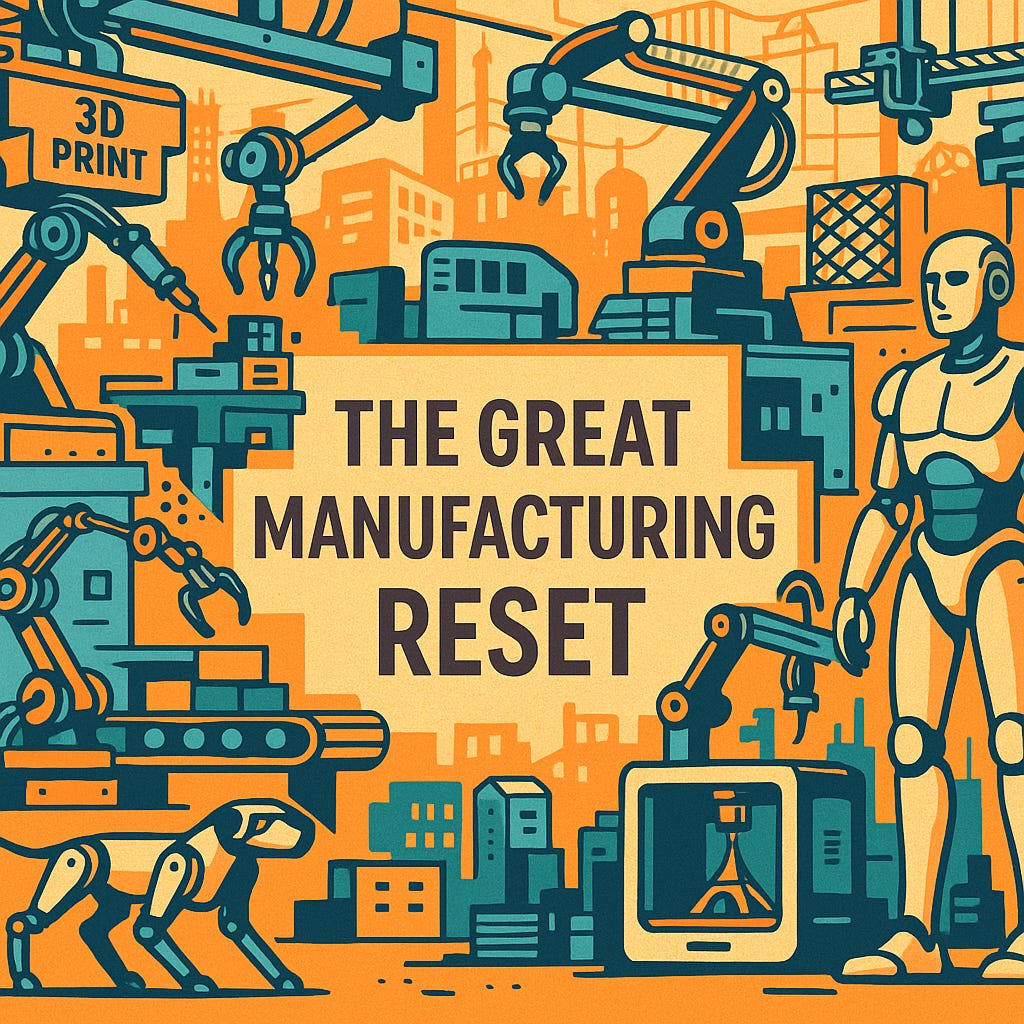 The great manufacturing reset | Thank you for tuning in to week 214 of the Lindahl Letter publication. A new edition arrives every Friday. This week the topic under consideration for the Lindahl Letter is, “The great manufacturing reset.”Boston Dynamics captured public imagination when they introduced Spot the dog-like robot back in 2016. Things have changed. Robots that walk around are beginning to enter the commercial landscape, and new entrants continue to appear. A humanoid robot product from Russia built by the company Idol surfaced last week [1]. Other companies such as Agility Robotics (USA), Figure AI (USA), Boston Dynamics (USA), UBTECH (China), and 1X Technologies (Norway/USA) are all working toward delivering humanoid robots. Optimus, the Tesla bot introduced conceptually in 2021 and now in its third-generation prototype which remains part of an internal program and has not yet reached commercial deployment is also being talked about.The stage is now set, and we are at a point where robotics, autonomous fabrication systems, and advanced materials are converging into a new industrial baseline. The last decade brought low-cost filament printers into hobbyist and commercial spaces at massive scale, and the next decade is poised to move far beyond that early wave. Industrial additive manufacturing has already expanded into metals, composites, and high-performance polymers, with global revenue expected to accelerate over the coming years. At the same time, the field is absorbing rapid advancements in AI-enabled calibration, defect detection, and real-time optimization, allowing machinery to tune production parameters autonomously. That capability shifts what it means to operate a modern fabrication workflow. Things are changing rapidly.Alongside these developments, humanoid and semi-autonomous industrial robots are transitioning from research demonstrations to contract manufacturing deployments. Several builders are scaling up pilot programs in which general-purpose robots support assembly, materials handling, and repetitive manufacturing tasks. These systems benefit from advances in reinforcement learning, enhanced sensors, and cloud-based model updates. Industrial robotics shipments are increasing rapidly, driven by global demand for flexible production lines and labor-augmentation strategies. The supply side of robotics is not only expanding but also becoming modular and more interoperable across fabrication environments.The most significant shift may come from the emergence of machines that build machines. That is a topic I’m focused on understanding. Historically, tooling design required long lead times, significant manual labor, and specialized expertise. Today, automated CAM pipelines, printable tooling, adaptive CNC systems, and robotically tended fabrication cells allow factories to generate and regenerate their own production processes. Some aerospace and automotive facilities already deploy these closed-loop systems to create fixtures, jigs, and replacement components internally. This form of self-manufacturing reduces dependency on external suppliers and removes friction from engineering iteration cycles. We are moving toward a world where design, testing, and tooling are all integrated within an AI-guided, robotics-driven feedback loop. That integration is the foundation of the great manufacturing reset.For the United States, these technologies open a realistic path to reshoring custom and small-batch manufacturing in ways that were not economically viable during the offshoring wave of the late twentieth century. Rising labor costs in traditional manufacturing hubs, geopolitical risk, and supply chain disruptions have already encouraged firms to reconsider where they build things. Additive manufacturing and flexible robotics change the cost structure by reducing reliance on large minimum-order quantities, expensive hard tooling, and long logistics chains. A factory that can print tooling on demand, deploy modular robots, and run AI-optimized production scheduling can serve shorter runs and more specialized designs while remaining geographically close to end customers. In effect, the United States can replace scale-driven arbitrage with speed, customization, and resilience. That is why we are at the inflection point for the great manufacturing reset.Policy and infrastructure are beginning to support this transition. Federal programs such as Manufacturing USA and its associated network of advanced manufacturing institutes are working to diffuse next-generation production technologies across domestic firms and regions [2]. Investments in semiconductor fabrication, battery plants, and clean-energy hardware have already catalyzed billions of dollars in new onshore manufacturing commitments. The same capabilities that support large facilities can extend to mid-market and smaller manufacturers through shared tooling libraries, regional robotics integrators, and standardized digital design pipelines. Universities and community colleges can align curricula with this reset by emphasizing mechatronics, robotics programming, and design-for-additive principles that translate directly to a modern factory floor.If the United States leans into this transition, the great manufacturing reset will not simply re-create legacy industrial capacity. It will establish a distributed network of automated, digitally coordinated micro-factories specializing in custom work, rapid prototyping, and short-run production. The strategic advantage will be the ability to move from concept to physical part in days instead of months, while retaining critical capabilities within domestic borders. The risk is that other regions may scale faster and capture the integrator role that coordinates robots, additive systems, and AI platforms across global supply chains. The next few years will determine whether the United States treats these technologies as incremental enhancements or as foundational infrastructure for a new manufacturing baseline. Ideally, this reset will create conditions for a new wave of startups delivering smaller manufacturing runs, bespoke development cycles, and entirely new product categories.Things to consider:* The economics of reshoring depend as much on automation and design speed as on wage differentials.* Policy support for advanced manufacturing will matter most where it connects directly to tooling, robotics, and workforce upskilling.* Custom, short-run production could become a core competitive advantage for regions that adopt additive and robotics early.* The integrators that connect robots, printers, and AI software may end up more powerful than any single hardware vendor.* Manufacturing resilience will increasingly be measured by how quickly domestic systems can reconfigure to new designs and shocks.What’s next for the Lindahl Letter? New editions arrive every Friday. If you are still listening at this point and enjoyed this content, then please take a moment and share it with a friend. If you are new to the Lindahl Letter, then please consider subscribing. Make sure to stay curious, stay informed, and enjoy the week ahead!Links I’m sharing this week!Footnotes:[1] Mesa, J. (2025, November 11). Russia ‘human’ robot falls on stage during debut. Newsweek. https://www.newsweek.com/russia-human-robot-falls-stage-during-debut-11031104[2] Manufacturing USA. (n.d.). Home. https://www.manufacturingusa.com/ This is a public episode. If you would like to discuss this with other subscribers or get access to bonus episodes, visit www.nelsx.com | 7m 20s | ||||||
| 11/15/25 | 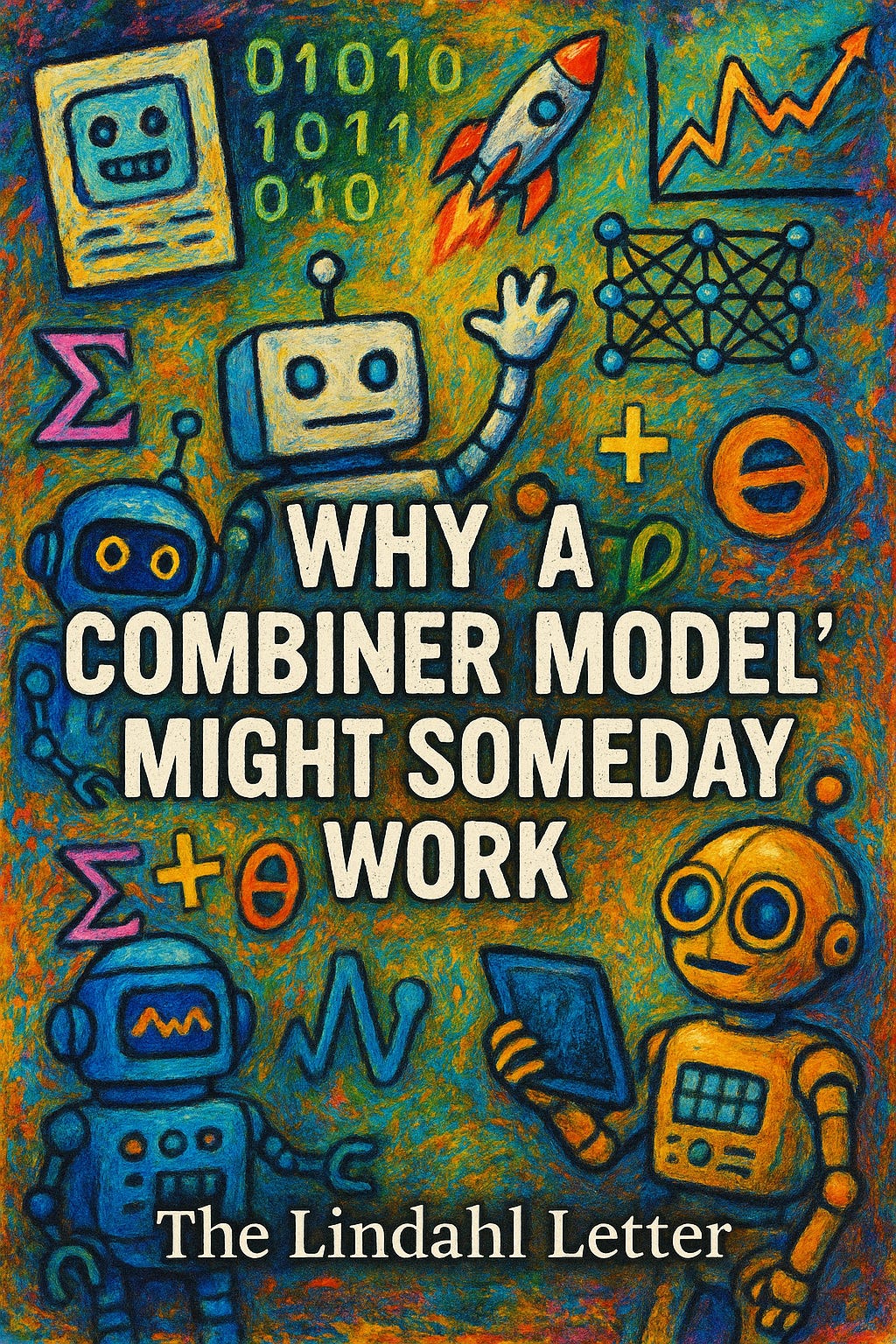 Why a “combiner model” might someday work | Thank you for tuning in to week 213 of the Lindahl Letter publication. A new edition arrives every Friday. This week the topic under consideration for the Lindahl Letter is, “Why a “combiner model” might someday work.”Open models abound. Every week, new open-weight large language models appear on Hugging Face, adding to a massive archive of fine-tuned variants and experimental checkpoints. Together, they form a kind of digital wasteland of stranded intelligence. These models aren’t all obsolete; they’re simply sidelined because the community lacks effective open source tools to combine their specialized insights efficiently. The concept of a “combiner model” offers one powerful path to reclaim this lost potential. Millions of hours of training, billions of dollars in compute, and so much electricity have been spent. Sure you can work by distillation to capture outputs from one model into another, but a combiner model would be different as it overlays instead of extracts.A combiner model represents a critical shift away from the assumption that AI progress requires ever-larger single systems. Instead of training another trillion-parameter monolith, we can learn to combine many smaller, specialized models into a coherent whole. The central challenge lies in making these models truly interoperable. The challenges form from questions around how to merge or align their parameters, embeddings, or reasoning traces without degrading performance. The combiner model would act as a meta-learner, adapting, weighting, and reconciling information across independently trained systems, unlocking the latent knowledge already encoded in thousands of open weights. Somebody at some point is going to make an agent that works on this problem and grows stronger by essentially eating other modals.This vision can be realized through at least three technical routes. The first involves weight-space merging. Techniques such as Model Soups and Mergekit show that when models share a common base, their weights can be effectively averaged or blended. More advanced methods, like TIES-Merging, learn adaptive coefficients that vary across layers, turning model blending into a trainable optimization process rather than a static recipe. In this view, the combiner model becomes a universal optimizer for reuse, synthesizing the gradients of many past experiments into a single, functioning network.The second approach focuses on latent-space alignment. When models differ in architecture or tokenizer, their internal representations diverge. Even so, a smaller alignment bridge can learn to translate between their embedding spaces, creating a shared semantic layer, or semantic superposition. This allows, for example, a legal-domain model and a biomedical model to exchange information while their original knowledge weights remain frozen. The combiner learns the translation rules, effectively building a common interlingua for neural representations that connects thousands of isolated domain experts.The third approach treats the combiner not as a merger but as a controller or orchestrator. In this design, the combiner dynamically decides which expert model to invoke, evaluates their outputs, and fuses the results through its own learned inference layer. This idea already appears in robust multi-agent frameworks. A true combiner model or maybe combiner agent would internalize this orchestration as a core part of its reasoning process. Instead of running one model at a time, it would simultaneously select and synthesize outputs from many experts, producing complex, context-aware intelligence assembled on demand. This approach is the most immediately viable and is already being used in sophisticated production systems today.If such systems mature, the economics of AI will fundamentally change. Rather than concentrating resources on a few massive, proprietary models, research will shift toward modular ecosystems built from reusable parts. Each fine-tuned checkpoint on Hugging Face will become a potential building block, not an obsolete artifact. The combiner would turn the open-weight landscape into an evolving lattice of knowledge, where specialization and reuse replace the endless cycle of frontier retraining. This vision is demanding, but the promise remains compelling: a world where intelligence is assembled, not hoarded; where the fragments of past experiments contribute directly to future understanding. The combiner model might not exist yet, but its underlying logic already dictates the future of open source AI.What’s next for the Lindahl Letter? New editions arrive every Friday. If you are still listening at this point and enjoyed this content, then please take a moment and share it with a friend. If you are new to the Lindahl Letter, then please consider subscribing. Make sure to stay curious, stay informed, and enjoy the week ahead!Links I’m sharing this week!This is the episode with Sam Altman that everybody was talking about. This is a public episode. If you would like to discuss this with other subscribers or get access to bonus episodes, visit www.nelsx.com | 5m 42s | ||||||
| 11/8/25 |  The edge of realized technology | Thank you for tuning in to week 212 of the Lindahl Letter publication. A new edition arrives every Friday. This week the topic under consideration for the Lindahl Letter is, “The edge of realized technology.”Welcome to the start of season 5. Don’t panic, we are still covering advancing technology including quantum, robotics, and artificial intelligence within the Lindahl Letter. I’ll be writing about the intersection of technology and modernity until the singularity. For better or worse, modernity’s shadow will continue to be the edge of realized technology. We are on the path to seeing a bunch of different technologies end up being realized in the not so distant future. That is why I’m so focused on the path toward realizing robotics, quantum, and agentic. That is where season 5 of the Lindahl Letter is going to pick up and start to dig into those topics at the edge of realized technology. To that end, I started to make a graphic of the timeline of major financial bubbles and extended it out to emerging technologies expected to deliver before 2045 [1]. You can modify the Python visualization code for this one if you want, I shared an executable version of it on GitHub.Within that visualization I started to sketch out the next 10 most likely technologies we will see realized. Within each path toward realization is where private investment and ultimately retail investors will crowd into the market before it gets commoditized to the point where the initial leaders in the space have no first mover advantage and some type of bubble ensues. That does not mean these things won’t be game changing. I’m just expecting some type of financial crowding followed by pressure against expected profits that won’t be realized. Resulting from that would be some type of financial bubble which might very well be led by a huge windfall of some sort. People made money on tulips and pepper before those markets crashed out.* 2026, “AI Bubble”, “Tech”* 2028, “Metaverse and XR Bubble”, “Tech/Speculative”* 2029, “Robotics Bubble”, “Tech”* 2031, “Climate Tech Bubble”, “Climate Tech”* 2032, “Space Economy Bubble”, “Space Economy”* 2033, “Biotech and Longevity Bubble”, “Biotech/Longevity”* 2034, “Synthetic Biology and Food Tech Bubble”, “Synthetic Bio/Food Tech”* 2035, “Quantum Bubble”, “Tech”* 2035, “Neurotech and BCI Bubble”, “Neurotech/BCI”* 2040, “Fusion Energy Bubble”, “Energy”These edges of technology realization might not be in the right order or tied exactly to the right year, but I do think that directionally this list will prove to be an accurate prediction of when technology will be achieved and we will see meaningful changes to modernity. Futurist considerations abound for what might end up happening. This was my swing at predicting what’s next. Only time will tell if it was an accurate swing or it will be disrupted by some other emerging technology.Going forward you are going to see my weekly writing efforts get split into 4 distinct buckets. My general weekly think pieces will stay here within the relative safety of the standard Lindahl Letter publication, writing about civics, civility, and civil society will be over on the Civic Honors domain, blogging will be done within the Functional Journal, and my hope is to resume daily posting back over on the nels.ai domain. Ideally, enough content will be generated in the major domains that only a small amount of blogging will occur. Going forward it is far better to produce meaningful work than to complete passages of extended navel gazing. Sure being a reflective practitioner and blogging has its place, but sometimes all that writing about the process ends up being more circular than forward looking.What’s next for the Lindahl Letter? New editions arrive every Friday. If you are still listening at this point and enjoyed this content, then please take a moment and share it with a friend. If you are new to the Lindahl Letter, then please consider subscribing. Make sure to stay curious, stay informed, and enjoy the week ahead!Links I’m sharing this week!Footnotes:[1] https://github.com/nelslindahlx/Data-Analysis/blob/master/TimelineofMajorFinancialBubbles.ipynb This is a public episode. If you would like to discuss this with other subscribers or get access to bonus episodes, visit www.nelsx.com | 5m 08s | ||||||
| 10/31/25 |  Spooky Halloween edition: When Satoshi-Era Wallets Wake Up | Happy Halloween everybody! Thank you for tuning in to week 211 of the Lindahl Letter publication. A new edition arrives every Friday. This week the topic under consideration for the Lindahl Letter is, “When Satoshi-Era Wallets Wake Up.”Seriously, Bitcoin is weird. It has an enigmatic and anonymous founder. The origin story of how this cryptocurrency came to be is pretty much ineffable. Roughly a third of all bitcoin has never moved [1].These dormant or maybe abandoned coins shape both the scarcity and the psychology of the network. Now, some of those early wallets are coming alive again, and their reawakening reveals a deeper story about profit, security, and the bleeding edge of quantum cryptography. Maybe some of these cutting edge massive quantum computers are being used to run Shor’s algorithm and factor some of these older wallet keys [2]. That seems more likely to me than somebody remembering they had some old bitcoin after a decade and moving it around. We could write a really spooky short story about people waking up to old bitcoin wallets getting cracked by quantum computers running Shor’s algorithm. That is the type of short story that could move from fiction to non-fiction with one scientific breakthrough. It’s even possible it has already started to happen. By possible, I think it probably already is happening.Speculation aside, it’s true that an estimated thirty percent of all mined bitcoin has been untouched for more than five years [3]. That is shocking. About seventeen percent of bitcoins have not moved in a decade [4]. Those figures mean that even as mining nears completion, a huge fraction of the network’s supply remains functionally absent or potentially abandoned. This long-term dormancy amplifies Bitcoin’s scarcity, turning lost or forgotten coins into a silent deflationary force. Yet in 2025, something shifted. Several ancient wallets, first active during Bitcoin’s infancy, have begun to stir after twelve to fourteen years of silence. Their movements are rare, deliberate, and full of meaning.Some of these wallets trace back to 2010 and 2011, a time when bitcoin traded for less than a dollar. In July, eight early addresses moved roughly eighty thousand bitcoin in a coordinated set of transfers [5]. That is wealth that once totaled a few thousand dollars but is now worth billions. Somebody made some shocking profits. Later, a miner-era wallet from 2010 moved four hundred bitcoin after twelve years of dormancy [6]. In October, an early 2011 wallet that had accumulated four thousand bitcoin sent a small test transaction of 150 coins before going quiet again [7]. None of these events caused market disruption, but each drew immediate attention. Every time an ancient wallet moves, it feels like a fragment of Bitcoin’s early history is stepping into the present.Why are these early coins moving now? The first reason is straightforward economics. With bitcoin surpassing one hundred thousand dollars, even small transfers yield generational wealth. Another reason is technological maturity. Over the past decade, wallet recovery methods have improved, and holders who once misplaced keys or old software backups can now retrieve them. Security has also evolved. Many early wallets were built with primitive address types that expose their public keys, leaving them theoretically vulnerable to a future cryptographic breakthrough. This leads to the third and most forward-looking motivation: the quantum threat. That is the part I’m super curious about. Some of the larger quantum systems that I shared in my leaderboard could be active here, but we don’t really know.Quantum computing is still developing, but progress is steady. Bitcoin relies on elliptic-curve digital signatures that would be mathematically vulnerable to sufficiently powerful quantum machines. The earliest wallets used formats that make this risk more immediate, because they reveal public keys on-chain once a transaction occurs. If quantum computing advances far enough, those exposed keys could allow attackers to derive private keys and spend the coins. Experts estimate that a quarter of all existing bitcoin resides in such legacy formats. That reality has not escaped early holders. Some of the recent awakenings may reflect quiet migrations of classic wallet cold coins being moved to SegWit, multi-signature, or even post-quantum-resistant wallets to protect them from future compromise. These reactivations might not be about profit at all. They could be acts of defensive foresight from people who understand how close technology may be to challenging the foundations of digital security.There are also practical motivations. Estate planning, custodial audits, and consolidation are all normal parts of managing large digital holdings. After more than a decade, early miners are updating their records, creating inheritance plans, and transferring assets to institutional custodians. The act of moving coins from an old address is sometimes less a financial maneuver and more a generational effort to ensure those digital fortunes survive their original owners.Each time these wallets awaken, the community reacts with fascination and unease. The first question is always the same: could this be Satoshi Nakamoto? So far, none of the reactivated wallets match known Satoshi mining patterns, but the mythology persists. Beyond the curiosity, there’s the market anxiety that large moves might signal selling pressure. Yet most transfers have not flowed into exchanges. They seem measured, intentional, and quiet. In a sense, this is the opposite of panic: the calm movement of old wealth into modern systems that have better security.What we are witnessing is also a potential generational handoff. The early experimenters who mined coins on laptops are now confronting questions of succession and security that mirror those of traditional wealth. Their coins, once symbols of rebellion against institutions, are being integrated into structured estates, custodial frameworks, and long-term trusts. As these coins move, they pass through new layers of infrastructure and oversight, becoming part of a global financial fabric that looks very different from the anarchic beginnings of Bitcoin.As quantum computing advances and Bitcoin’s price continues to rise, more early wallets are likely to move. Some of those transfers will be tests or migrations; others may represent the quiet liquidation of immense fortunes. Watching these awakenings provides a rare link between the network’s origin story and its future. The early holders are not gone, some of them may have abandoned some bitcoins, or lost access, but some of them are simply preparing for the next phase of digital permanence, one where Bitcoin must prove its resilience against both time and the very real likelihood of advancements in quantum based technology.Summary of the key points on the quantum threat to bitcoin:* Quantum computing is advancing, and although no system has yet cracked the relevant cryptography used by Bitcoin, experts estimate that within the next 5-10 years some wallets using legacy address types could become vulnerable.* A significant fraction of Bitcoin’s supply (in some estimates around 25 %) is held in addresses whose public key has been exposed (or in older formats such as pay-to-public-key) and thus are considered more at risk from a “Q-day” style attack.* The network is already responding: developers have floated proposals (e.g., a draft BIP‑360) to freeze coins in vulnerable legacy addresses and force migration to quantum-resistant formats, with multi-phase transition plans.* The fact that early “Satoshi-era” wallets are waking up now may reflect not just profit or estate planning motives but also pre-emptive security behaviour by holders who recognise the quantum risk and wish to migrate coins to safer custody.* From a scarcity and supply-dynamics perspective, the quantum threat adds another layer of complexity: dormant coins may not just be inert, they may be targeted or moved due to security fears, altering how one thinks about long-term supply, holder behaviour and concentration risk.What’s next for the Lindahl Letter? New editions arrive every Friday. If you are still listening at this point and enjoyed this content, then please take a moment and share it with a friend. If you are new to the Lindahl Letter, then please consider subscribing. Make sure to stay curious, stay informed, and enjoy the week ahead!Links I’m sharing this week!Footnotes:[1] Van Straten, J. (2023, November 15). Record 70% of Bitcoin supply lies dormant for a year or more. CryptoSlate. https://cryptoslate.com/insights/record-70-of-bitcoin-supply-lies-dormant-for-a-year-or-more/[2] Chojecki, P. (2025, May 20). Quantum computers threat to Bitcoin: Q-Day, post-quantum cryptography and Bitcoin. Medium. https://pchojecki.medium.com/quantum-computers-threat-to-bitcoin-e1b57b0da2aa[3] AInvest. (2025, July 5). 30.4% of Bitcoin supply dormant for over five years. https://www.ainvest.com/news/30-4-bitcoin-supply-dormant-years-2507/[4] Crypto News. (2025, June 18). Over 3.4 million BTC, more than 17% of the total supply, have not moved in at least a decade. https://crypto.news/bitcoin-dormant-supply-growth-outpaces-issuance-2025/[5] Malwa, S. (2025, July 5). Eight Bitcoin wallets move 80,000 BTC in largest ever ‘Satoshi-era’ transfers. CoinDesk. https://www.coindesk.com/markets/2025/07/05/eight-bitcoin-wallets-move-80000-btc-in-largest-ever-satoshi-era-transfers[6] Kumari, I. (2025, September 29). Bitcoin address from miner era reactivates to shift 400 BTC – Report. AMBCrypto. https://ambcrypto.com/bitcoin-address-from-miner-era-reactivates-to-shift-400-btc-report/[7] Van Straten, J. (2025, October 24). Dormant Bitcoin Whale With $442 M Awakens for First Time in 14 Years Amid Quantum Fears. CoinDesk. https://www.coindesk.com/markets/2025/10/24/dormant-bitcoin-whale-with-usd442m-awakens-for-first-time-in-14-years-amid-quantum-fears This is a public episode. If you would like to discuss this with other subscribers or get access to bonus episodes, visit www.nelsx.com | 6m 56s | ||||||
Want analysis for the episodes below?Free for Pro Submit a request, we'll have your selected episodes analyzed within an hour. Free, at no cost to you, for Pro users. | |||||||||
| 10/24/25 |  AI Is Burning Through Graphics Cards | Thank you for tuning in to week 210 of the Lindahl Letter publication. A new edition arrives every Friday. This week the topic under consideration for the Lindahl Letter is, “AI Is Burning Through Graphics Cards.”Generational wealth is being invested into data centers for AI. It’s so prevalent that you hear about it on the nightly news and municipalities are dealing with the power demands. The clock is ticking on graphics cards being used for AI inference. The current generation of GPUs was never designed to run around the clock under inference loads. These chips were originally built for bursts of rendering, not continuous model execution at scale. What we are seeing now is an industry trying to stretch gaming hardware into a role it was never meant to fill. The result is heat, power consumption, and a ticking clock based on the inevitable wear.Each graphics card has a limited operational lifespan. These are not like bricks being used to build a house; they are just expensive computer hardware. The more intensive the workloads, the shorter that lifespan becomes. Fans fail, thermal paste dries out, and the silicon itself begins to degrade. Inference tasks, particularly when stacked across large fleets of GPUs, magnify this effect. The relentless pace of AI workloads accelerates the failure curve, turning once-premium cards into temporary consumables. I’m actually really curious what is going to happen to all of them at the end of this cycle. A secondary market does exist for these used devices and companies like Iron Mountain will help data centers with secure disposal.By most reasonable estimates, there are now between 3.5 and 4.5 million NVIDIA data-center GPUs actively deployed in production environments. Hyperscalers such as Meta, Microsoft, and Google each operate hundreds of thousands of units, while smaller data centers fill out the rest of the global total. Each GPU represents a remarkable amount of compute density, but also a constant thermal and economic liability. Even with optimized cooling, sustained inference loads drive high thermal stress and power draw that shorten component life. These systems were never meant to run 24 hours a day, 365 days a year.Under heavy duty cycles, many GPUs experience significant degradation within one to three years of continuous operation. The warranties often match that window, which reflects a design expectation rather than coincidence. Silicon aging and persistent thermal cycling all take their toll. Even when the hardware technically survives longer, it becomes economically obsolete as new architectures quickly double efficiency and throughput. The pace of improvement ensures that by 2027 or 2028, most of today’s fleet will either be retired, resold, or relegated to low-priority inference tasks. Right now TSMC would have to make the chips to replenish this fleet of GPUs which would be outrageously expensive. Both NVIDIA and TSMC manufacturing teams could be looking at a huge impending need for production or a shift to a new type of technology.That replacement cycle has massive implications. The cost of refreshing millions of GPUs every few years is enormous, and the environmental impact of manufacturing and disposing of that much silicon is even harder to ignore. As AI inference continues to scale, this churn becomes unsustainable. Companies are already exploring purpose-built accelerators, ASICs, and FPGAs that can deliver better efficiency and longer service life. These designs aim to handle continuous inference without the same thermal or aging limitations that plague graphics cards.Sustainability will define the next phase of AI infrastructure. The transition away from general-purpose GPUs is underway, but what comes after silicon remains uncertain. Research into photonic computing, quantum processors, and neuromorphic architectures offers glimpses of what a post-GPU world might look like. Each of these alternatives seeks to break free from the limits of traditional chips while extending useful lifespans. The next leap in AI hardware will not be measured by sheer speed, but by how well it can endure the relentless demands of inference at scale.What’s next for the Lindahl Letter? New editions arrive every Friday. If you are still listening at this point and enjoyed this content, then please take a moment and share it with a friend. If you are new to the Lindahl Letter, then please consider subscribing. Make sure to stay curious, stay informed, and enjoy the week ahead!Links I’m sharing this week! This is a public episode. If you would like to discuss this with other subscribers or get access to bonus episodes, visit www.nelsx.com | 5m 04s | ||||||
| 10/17/25 |  Social media stopped being social | Thank you for tuning in to week 209 of the Lindahl Letter publication. A new edition arrives every Friday. This week the topic under consideration for the Lindahl Letter is, “Social media stopped being social.”Before we get going this week. I need to provide an update about last week’s post. I take full responsibility, as the principal writer here, that last week my writing efforts were just not up to par within the 208th Lindahl Letter publication. You have come to expect better from me and last week I just delivered a dud of a post. It’s the first post in a long time that actively drove people to leave the Lindahl Letter. It’s pretty easy to see the signal within the noise when something was bad enough to drive people away and I take responsibility for delivering that subpar effort.That being noted, let’s pivot back to the main topic at hand related to social media.I’m not sure if social media was ever really about togetherness and being social. Those are things after the fact that I want to ascribe to it. Let’s blame it on nostalgia. Communities tend to align with place, interest, or circumstance. Certainly online communities that are highly focused and targeted on a distinct community probably work. Later in a different essay it might be worth digging into the pocks of working online communities. That side of the coin however is not the focus of this missive.Things were different back when Twitter arrived in 2006 and ultimately became popular during South by Southwest in 2007. During the initial development and discovery of these applications for social media sharing things were different and maybe that newness is now something to be nostalgic about. Social media now is fragmented and stopped being social the moment algorithms learned how to predict the things that would hold our attention better than we could possibly direct it.What started the social media ball rolling as a digital gathering of friends slowly transformed into a system of engineered consumption. The feed no longer reflects our relationships. It reflects what the platform believes will keep us scrolling. In the process, the human layer was optimized out of existence. I am hoping the Substack experience ends up being different. Right now Substack is really my only active social media platform. It’s full of actual readers and writers for the most part. I’m trying to get into the swing of using Substack Notes, but that just seems to be an ongoing process of trying to figure it out. Previously, I tried to get into posting on Bluesky and I’ll admit that during Colorado Avalanche games it did feel like some level of community existed. Outside of gametime I just never really got much out of the Bluesky experience.Let’s take a step back from where we are now to consider history for a moment. Things were different for the first wave adopters. The first generation of social networks were built around connection. You followed people you knew, saw what they were doing, and commented because you cared. The platforms of today are not built for connection, but instead of being factored around community they are built for amplification. The more content flows, the more data moves, and the more ads get served. The mechanics of community were replaced by the logic of engagement.That shift changed the culture. Ultimately, it spawned the influencer movement. Maybe it’s a moment or it could be a watershed change away from public intellectuals to something else more product centric. People began curating identities instead of sharing moments. Every post became a performance. Every response was an opportunity for algorithmic reinforcement. What once felt like a conversation now feels like an audition. Social validation metrics turned communication into competition. The ultimate winners being the people who ended up making a career within this new flow of attention online.As that dynamic took hold, the real social behavior moved into the shadows. Private group chats, invite-only communities, and niche networks quietly took over the role that public timelines once held. The visible web is now dominated by content farms and brand influencers. The meaningful conversations happen elsewhere, often out of reach of recommendation systems. What used to feel like a town square has become a noisy digital strip mall.Social networks have become media networks. In some ways they are just the next generation of broadcast television or radio. It’s just more targeted and in some ways a lot more divisive. They are not spaces for dialogue but for distribution. Every interaction is mediated through a system that values attention over authenticity. That is why the average user now feels less connected than ever, even as they scroll through an endless feed of “content.” The core function of social media has inverted. It no longer connects people directly instead connecting people to platforms.We may be entering a post-social era online. Connection is returning to smaller spaces: group chats, email lists, federated platforms, and direct exchanges. The large-scale, public-facing feed is collapsing under the weight of its own incentives. Maybe that’s the natural end of a system built on attention rather than empathy. What comes next may not look like social media at all. It might look more like correspondence. The strange part is that most users know this. We can feel the shift. We see fewer updates from friends, fewer real conversations, and more noise disguised as engagement. The feedback loop is obvious, but breaking free from it is hard. Every design choice keeps us tethered to the cycle. The system runs on our participation, but not our connection.What’s next for the Lindahl Letter? New editions arrive every Friday. If you are still listening at this point and enjoyed this content, then please take a moment and share it with a friend. If you are new to the Lindahl Letter, then please consider subscribing. Make sure to stay curious, stay informed, and enjoy the week ahead!Links I’m sharing this week!White, M. (2025, October 17). Anatomy of a crypto meltdown. Citation Needed. Retrieved from https://www.citationneeded.news/anatomy-of-a-crypto-meltdown/ The Vergecast. (2024, October 17). AI can’t even turn on the lights | The Vergecast [Video].SearchParty. (2024, April 12). The big flaw in Trump’s AI plan [Video]. YouTube.Nathan Labenz & Erik Torenberg. (2024, March 8). Is AI slowing down? Nathan Labenz on GPT-5, progress and predictions [Video]. YouTube. This is a public episode. If you would like to discuss this with other subscribers or get access to bonus episodes, visit www.nelsx.com | 6m 40s | ||||||
| 10/10/25 |  Building with constant model churn | Day after release update: I guess it was the 208th post where we hit the proverbial wall with a dud of a post. This post in retrospect turned out to be one of my weaker efforts. I thought it was a strong take about dealing with the rate of change in model development, but it was just not focused and targeted based on delivering quality and insights.Thank you for tuning in to week 208 of the Lindahl Letter publication. A new edition arrives every Friday. This week the topic under consideration for the Lindahl Letter is, “Building with constant model churn.”Developers have spent a lot of time in the past patching software. That happens based on vulnerabilities, edge cases, and performance issues. All this vibe-coded content and things built on models are not getting any patches to make them better going forward. You may get a new release or a new model, but that patch to save you from vulnerabilities is not being developed and is not on the way. It is the nature of modern development. The ecosystem of dependencies is real. However, the pace of model development has created an unusual environment for anyone trying to build durable systems.You cannot really hot swap models within production systems. That just does not work. In the last five years, we have seen large language model releases from OpenAI, Anthropic, Google, Meta, Mistral, Cohere, and several open-source groups. Each iteration has been faster, larger, and sometimes more efficient than the one before. What has not been stable is the interface between models and the systems people build around them. Even seemingly small changes in context window size, output quality, or API availability ripple outward and cause redesigns, migrations, and sudden pivots. Sometimes these changes happen with no warning whatsoever.For builders, this creates a paradox. The potential upside of adopting a newer model is undeniable: better reasoning, lower costs, and expanded capabilities. At the same time, the risk of betting on an API or framework that may be deprecated in months is a constant concern. Some developers chase every release, weaving the newest model into their applications as quickly as possible. Others step back, building abstractions and wrappers that allow for switching models without disrupting core workflows. Neither path offers complete insulation from this wave of almost continuous churn.The history of technology offers parallels. Software engineers have long had to deal with shifting operating systems, frameworks, and libraries. What makes this moment different is the velocity of change and the sheer dependency of emerging applications on model behavior. The model is not just another dependency, it is the foundation of the system. When that foundation shifts, everything built on top of it must be reconsidered.There is also a deeper strategic question. Should builders lean into constant change and accept churn as a feature of the landscape? Or should they try to design in ways that minimize dependency, focusing more on proprietary data pipelines, unique integrations, and distinctive user experiences? Both strategies reflect an awareness that stability is not guaranteed in this ecosystem. The companies that endure will be the ones that treat churn not as an annoyance but as a design constraint.Things to consider:* The lack of patching for AI models makes long-term maintenance difficult.* Model churn introduces structural instability into modern systems.* Abstraction layers help, but they cannot prevent cascading change.* Treating churn as a core design constraint is a pragmatic approach.* Builders must balance innovation speed with long-term stability.What’s next for the Lindahl Letter? New editions arrive every Friday. If you are still listening at this point and enjoyed this content, then please take a moment and share it with a friend. If you are new to the Lindahl Letter, then please consider subscribing. Make sure to stay curious, stay informed, and enjoy the week ahead! This is a public episode. If you would like to discuss this with other subscribers or get access to bonus episodes, visit www.nelsx.com | 3m 33s | ||||||
| 10/3/25 |  Enforcing AI standards without exception | Thank you for tuning in to week 207 of the Lindahl Letter publication. A new edition arrives every Friday. This week the topic under consideration for the Lindahl Letter is, “Enforcing AI standards without exception.”Standards are something we need to spend more time talking about. That is a general statement and not a special argument. Years ago, I actually witnessed a physical desk sign at an office that said, “We either have standards or we don’t.” It’s not a great mystery how that particular leader felt about standards. That type of adherence to standards is not all that common. In our LLM sponsored chat by prompt first and ask questions later world; people just keep prompting. Allowing models to just keep generating without standards is how we ended up where we are right now. Those tokens are being burnt at prodigious rates. All of those burnt tokens yield nothing reusable or even effectively carried forward. Mostly they are highly siloed outputs to an audience of one. They are all spent and the electricity and compute used will never be recovered. They are just an expense on somebody else’s balance sheet.Everything about the open web is pretty much in rapid decline. I would argue that enforcing standards without exception is the only way the end user can truly control the agenda or hope to manage the ultimate outcome when working with AI. It might even help us save the internet. That cause however might have already been lost. One of the great ironies of generative AI is that it demands more discipline from the human interacting with it to get quality outputs, not less. Sure prompt engineering has become a hands on the keyboard type of sport, but my best guess is everything ends up being more conversational in the end. You would expect a machine to be the enforcer of rules, to deliver outputs with mechanical precision. Instead, the responsibility ultimately falls back on the end user to enforce standards at every turn. The system will generate endlessly, but unless you control the agenda, it will wander away from the very standards that define your work. A lot of people are also just creating AI slop and potentially worse AI generated workslop.This is not a trivial annoyance. It is the defining challenge of using AI effectively. You might tell a system: no em dashes, strict numeric citations, Substack-compatible footnotes. And for a moment, it will comply. Then, in the next draft, it slips back into its defaults. Suddenly the citations are misplaced, the formatting is broken, or the output is square when you clearly require 14:10. It doesn’t matter how many times you’ve said it for some reason the system’s memory for discipline is shallow. If you do not enforce the standard without exception, the drift takes over. For an organization, that can mean tens or thousands of drifting lines of argument and fragmented results.That is why the end user must step into a role that looks less like automation’s promise and more like quality assurance. You are not simply a writer or a collaborator. You are the auditor, the rule enforcer, the one who stops the drift. We either have standards or we don’t. Allow one exception, and you have taught the system that exceptions are acceptable. Enforce the standard every time, and you create a boundary strong enough to shape consistent results.This relentless enforcement becomes the core of collaboration. Without it, the system defaults to “plausible” instead of “correct,” “close enough” instead of “aligned.” You cannot rely on the machine to protect the integrity of your work or really even to have solid consistent outputs. That responsibility is yours. The human must guard the agenda with vigilance and insistence. Outside of ruthlessly enforcing standards without exception the path forward is just full of slop.Over time, this process builds more than consistency. It builds identity. A body of work that holds together across hundreds of posts or thousands of outputs does so because the user enforced the standards that give it coherence. We may very well look at the internet archives before all the LLM training as untainted and everything after that point with skepticism. I’m not arguing that everything in that first tranche of content was high quality or even accurate, but it was before the models. Without that enforcement, the work would fracture into a mix of styles, structures, and shortcuts. Enforcing standards without exception is exhausting, but it is also the only way to produce work that reflects your agenda rather than the system’s defaults.Things to consider:* AI will always drift back toward its defaults unless the user enforces rules consistently.* The promise of automation is inverted: the human enforces discipline, not the machine.* Exceptions teach the system the wrong lesson and erode consistency.* Vigilant enforcement is what turns scattered outputs into a coherent body of work.* Control of the agenda belongs to the end user, or it is lost altogether.What’s next for the Lindahl Letter? New editions arrive every Friday. If you are still listening at this point and enjoyed this content, then please take a moment and share it with a friend. If you are new to the Lindahl Letter, then please consider subscribing. Make sure to stay curious, stay informed, and enjoy the week ahead! This is a public episode. If you would like to discuss this with other subscribers or get access to bonus episodes, visit www.nelsx.com | 5m 52s | ||||||
| 9/26/25 |  The Great Tokenapocalypse | Thank you for tuning in to week 206 of the Lindahl Letter publication. A new edition arrives every Friday. This week the topic under consideration is “The Great Tokenapocalypse.”As large language models reach deeper into consumer devices, the cost of running them becomes the real bottleneck. So many tokens get burned with no ROI or use case for the company burning them; it's really out of control. Almost as out of control as the sunk cost of data centers that will probably be regretted at some point in the next 5 years. It’s sort of the unspoken reality of an arms race where building data centers that just depreciate and spending compute resources without any plan for recovering the cost is happening. This week explores how token economics is silently shaping the deployment strategies of Google and Apple.You may have noticed something strange about the rollout of generative AI: despite Google’s global reach and technical infrastructure, Gemini is not yet present on every device. It isn’t quietly running in the background on your Nest Hub, it doesn’t summarize content on your Pixel Watch, and it hasn’t taken over the always-on interactions that dominate the smart home experience. On paper, Gemini could power all of this: but in practice, it doesn’t. The reasons are not technical, but economic.It’s the tokens. Each time a large language model like Gemini processes a prompt or generates a response, it consumes tokens which are effectively a unit of computation that translate directly into cost. This cost is not abstract. It is real-time, metered, and at scale becomes wildly continuous with enough uses. When you ask Gemini to summarize an email or rewrite a paragraph, you’re triggering a live cloud inference cycle that draws directly on Google’s TPU infrastructure. At a small scale, these requests are manageable. But when deployed across millions of devices, in billions of micro-interactions, the financial and infrastructure burden becomes extreme. What looks like product restraint is actually cost containment. Google is avoiding what could become a tokenapocalypse which would be a runaway escalation of inference demand that outpaces both compute supply and operating budget.Gemini was designed for centralized, high-performance environments. It was not optimized for low-power edge devices or offline operation. Its rollout has been concentrated in strategic, high-leverage use cases: Workspace productivity, Pixel exclusives, and experimental features inside Search Labs. These are high-value zones where the cost per token can be justified. Gemini has not been deployed ambiently in the wild on smart speakers, in Android Auto, or on lightweight wearables mostly because those endpoints offer little to no margin against token cost. The model cannot run constantly without triggering exponential cloud expenditure. Until inference becomes drastically cheaper or edge-native Gemini variants emerge, Google is likely to continue rationing its deployment to protect against economic overextension.Apple, by contrast, has chosen an entirely different path forward. They elected a path that avoids the token problem from the outset. Its 2024 rollout of “Apple Intelligence” emphasized a local-first architecture built around on-device models. Instead of sending every prompt to the cloud, Apple routes the vast majority of inference through its A-series and M-series silicon. This strategy means that users can rewrite notes, summarize messages, or interact with Siri entirely offline, with zero token cost to Apple. When tasks exceed the capability of local models, they are sent to Apple’s “Private Cloud Compute” system, but this fallback is used selectively, with strict privacy and latency guarantees.Apple’s approach isn’t just a branding play. It reflects a fundamental architectural decision to avoid the economics of inference altogether. Apple doesn’t operate a hyperscale public cloud business, so it has no incentive to absorb or monetize cloud-based generative AI usage. Its profits come from hardware margins and platform services. This gives Apple the freedom to constrain usage, limit interaction complexity, and push AI to the edge. A strategy they can get away with, ultimately without incurring the compounding costs that Google faces. It’s a token-avoidant strategy, and it may prove to be the more sustainable one.Where Google builds outward from a full-stack cloud foundation, Apple builds inward from a controlled edge. Google’s strategy scales across models and modalities, but each expansion amplifies cost. Apple’s strategy constrains functionality but keeps economics stable. Both are reacting to the same underlying pressure: token costs are rising faster than monetization models can support. The more embedded the model becomes, the more tokens flow. A stark reality comes into existence where it becomes more urgent to rethink deployment patterns. This isn’t just a question of technical feasibility. It’s a matter of financial survivability.The race to deploy generative AI at scale is quickly becoming a race to control token exposure. Inference cost and not model quality may be the key determinant of which platforms can sustainably integrate AI across the stack. If cloud economics don’t shift, and if token optimization doesn’t advance, then ambient LLMs may remain a luxury reserved for premium endpoints and enterprise tasks. The real future of ubiquitous AI may depend less on how powerful models become, and more on how efficiently they run in the wild.Things to consider:* Google’s restraint in deploying Gemini across its device ecosystem likely reflects real-time token cost constraints rather than technical limits.* Every cloud-based Gemini interaction consumes metered compute, making global deployment economically unstable without stronger monetization.* Apple avoids these problems by designing for on-device inference and constraining AI functionality to remain token-light.* Token economics are now shaping the strategic posture of every major platform, defining where and how AI appears in consumer workflows.* Sustained deployment of generative models may depend less on breakthrough architecture and more on advances in inference efficiency and local compute.As the tokenapocalypse looms, we’ll be watching how companies respond. That response could be through model compression, edge acceleration, hybrid routing, and new monetization strategies. In the coming weeks, we’ll explore how these constraints are shaping research priorities, ecosystem fragmentation, and what it means to run AI sustainably across global networks. If you see an AI endpoint that should exist but doesn’t, it may be because someone, somewhere, did the token math.What’s next for the Lindahl Letter? New editions arrive every Friday. If you are still listening at this point and enjoyed this content, then please take a moment and share it with a friend. If you are new to the Lindahl Letter, then please consider subscribing. Make sure to stay curious, stay informed, and enjoy the week ahead! This is a public episode. If you would like to discuss this with other subscribers or get access to bonus episodes, visit www.nelsx.com | 7m 13s | ||||||
| 9/19/25 |  Apple’s Hidden AI Strategy | Thank you for tuning in to week 205 of the Lindahl Letter publication. A new edition arrives every Friday. This week the topic under consideration for the Lindahl Letter is, “Apple’s Hidden AI Strategy: Waiting it out with token avoidance as a first principle.”Apple’s relative restraint in deploying large-scale generative AI isn’t just about privacy posturing or design philosophy. Maybe it is just the latest supply chain management initiative in terms of managing tokens. It may reflect a deliberate avoidance of token-expensive cloud inference which is an infrastructural and financial commitment that Apple has historically chosen not to make. This choice is akin to keeping supply chain costs down; this type of effort fits with the general operating model. Right now engaging token usage would just eat profits.Apple’s approach to “Apple Intelligence,” announced in 2024, hinges on three pillars:* On-device first: Apple designed its models (small language models and transformer variants) to run locally on A17+ and M-series chips. This dramatically reduces reliance on cloud GPUs and token accounting. If you generate 200 tokens on your phone, there’s no inference cost to Apple. This method avoids cloud costs, but makes the hardware the tipping point.* Private Cloud Compute: For tasks that exceed the capabilities of on-device models, Apple routes requests to its proprietary cloud using Secure Enclaves. But this only happens for high-value or infrequent tasks. That would include things like summarizing a document, generating email replies, or rewriting notes. This keeps cloud token loads minimal and predictable.* Selective rollout: Apple isn’t putting generative models everywhere. The system isn’t always listening, and “AI” is offered as an opt-in assistant across Mail, Notes, Safari, and Siri. There’s no ChatGPT clone embedded system-wide, and certainly nothing ambient like Gemini could theoretically become.You can see based on the bottom line and balance sheet concerns why Apple’s caution probably makes financial sense in the long run. Apple sells hardware, not compute. Even some of the cloud forward vendors might operate at a loss at Apple scale. Unlike Google or Microsoft, it doesn’t have an economic engine tied to cloud usage. If it gave every iPhone user unlimited generative AI access via the cloud, it would have to subsidize trillions of tokens per year without monetization return. Nothing in the workflow has any ROI for Apple where the hardware is a sunk cost and they have not offered a standalone monthly AI service. They let everybody else spend billions on hardware, data centers, and electricity.Instead, Apple wants:* Efficiency over scale.* Local inference over cloud latency.* Sporadic usage over daily token floods.In short: Apple is playing defense against the tokenapocalypse before it ever hits. That token apocalypse will happen when billions of devices become token hungry.What’s next for the Lindahl Letter? New editions arrive every Friday. If you are still listening at this point and enjoyed this content, then please take a moment and share it with a friend. If you are new to the Lindahl Letter, then please consider subscribing. Make sure to stay curious, stay informed, and enjoy the week ahead! This is a public episode. If you would like to discuss this with other subscribers or get access to bonus episodes, visit www.nelsx.com | 3m 53s | ||||||
| 9/12/25 |  Context window garbage collection | Thank you for tuning in to week 204 of the Lindahl Letter publication. A new edition arrives every Friday. This week the topic under consideration for the Lindahl Letter is, “Context window garbage collection.”Here we are this week contemplating how to clean up the mess from all these celebrated LLM chat sessions. It’s a disjointed mess that lacks federation or dare we say portability. We are at the point where we need to think about how context window garbage collection explores the deeper process based idea of how large language models might manage overflowing histories, selectively pruning, discarding, or compressing tokens to maintain efficiency without losing coherence. Certainly my thoughts on this is that we would all benefit from portable knowledge sharding, but that is just one way to look at the potential set of solutions that need to be built. Another way to slice the apple up and put just the best parts back together again would be to build out some context window garbage collection.When you open a long conversation with a large language model, the context window eventually fills with tokens from your prompts and the model’s replies. These windows have strict limits, whether 128k tokens, 200k tokens, or more, and yet our usage tends to grow indefinitely. As prompts expand, sessions become inefficient and costly, sometimes degrading in coherence as irrelevant or outdated details pile up. We have all run into hallucinations and just weird output from models. At this point in the experience the next best question then becomes very clear. We have to evaluate how models should manage their overflowing context windows at the end or during a chat session.In programming, garbage collection has long been the answer to similar problems. Long garbage collection problems have literally kept me up at night. Computer systems with finite memory must constantly decide what to keep and what to discard. Techniques such as reference counting, mark-and-sweep, and generational garbage collection have been developed to handle this challenge. The analogy we can build out here is very straightforward: in a world where context is the working memory of LLMs, garbage collection could provide the rules and processes for pruning, summarizing, or discarding tokens without breaking continuity.Several strategies already hint at how this could work. Some systems automatically prune less relevant history, while others compress sections of text into summaries or embeddings that can be retrieved later. I would run a knowledge reduce function based on my previously shared research, but I always think that is the answer. User-directed pinning, where important content is marked as permanent, is another possible feature. In longer interactions, models could run background “cleanup passes,” automatically condensing earlier exchanges into portable knowledge shards. Each of these approaches mirrors classic computing strategies while being adapted to the new problem space of language models.The risks are obvious. Things could go sideways. We face a direct computing time cost associated with this effort. Poorly designed garbage collection could lead to subtle context loss, missing small but crucial details. Summarization may introduce semantic drift or hallucinations. I would argue that properly structured context will actually reduce drift or hallucinations. Users may also resist invisible pruning, questioning whether they can trust a model that silently discards information. The challenge lies in balancing efficiency, fidelity, and transparency, ensuring that garbage collection makes interactions smoother rather than introducing new points of failure.Looking forward, context window garbage collection could become a fundamental layer of model architecture. Standardized processes and even some APIs might emerge to expose garbage collection logs to users or allow customization of pruning strategies. Entire ecosystems of agents could share compressed or pruned context shards across models, creating interoperability where today there is only fragmentation. Just as garbage collection enabled more scalable and reliable programming environments, context window garbage collection may become the invisible backbone of scalable AI interaction.Things to consider:* Should context garbage collection be visible and user-controllable?* Can models balance efficiency with fidelity when pruning?* What lessons from programming garbage collection apply directly to LLMs?* Does context GC make interoperability between models easier or harder?What’s next for the Lindahl Letter? New editions arrive every Friday. If you are still listening at this point and enjoyed this content, then please take a moment and share it with a friend. If you are new to the Lindahl Letter, then please consider subscribing. Make sure to stay curious, stay informed, and enjoy the week ahead! This is a public episode. If you would like to discuss this with other subscribers or get access to bonus episodes, visit www.nelsx.com | 5m 43s | ||||||
| 9/5/25 |  Portable knowledge sharding | Thank you for tuning in to week 203 of the Lindahl Letter publication. A new edition arrives every Friday. This week the topic under consideration for the Lindahl Letter is, “Portable knowledge sharding.”The shards of knowledge that we need are everywhere. They are just not portable and all packaged up. You open an interaction with an LLM based on a prompt, but you don’t really close it out by receiving a prompt or a packaged transferable output. This week’s focus is on how knowledge can be broken into modular, transferable units and moved across systems, sessions, or users. At its core, this concept involves fragmentation by design, creating smaller, self-contained pieces that retain meaning independently while becoming more useful when recombined. These modular shards offer a practical method for bridging gaps between disconnected tools, memory systems, and AI agents. You could just ask the model at the end of your session to package up the results for you. That type of effort makes you your own data broker. You are then responsible for putting the right data in all the right places.A true system of portable knowledge sharding that is easily transferable addresses the growing problem of fragmentation in digital workflows. Isolated AI memory systems, disconnected application ecosystems, and session-based interactions that fail to persist information have made continuity more difficult to maintain. In this context, a knowledge shard can be understood as a compact, self-contained packet of insight that includes metadata and minimal context. This idea draws from concepts such as database sharding, microservices architecture, Zettelkasten-style note-taking, and linked data formats like JSON-LD. The defining characteristic of a portable shard is that it contains just enough information to be interpreted outside its original environment.Fragmentation is increasing across nearly every dimension. Large language models operate in isolation. Memory is not shared between models, or even across sessions within the same system. Users frequently move between unconnected platforms and tools. The result is a scattered intellectual landscape. Portable knowledge sharding provides a way to restore structure, making it easier to preserve, transport, and reassemble valuable insights.Several key principles support the creation of effective knowledge shards. These include atomicity, where each shard captures a single coherent idea; context tagging, where metadata includes origin, date, and relationships; minimal dependency, ensuring each shard is understandable on its own; mergeability, allowing recombination into larger ideas; and transportability, which enables movement across systems without loss of meaning. Together, these principles provide a foundation for more resilient and flexible knowledge systems.Real-world applications of portable knowledge sharding are already emerging. Tools like Manus and Rewind.ai offer memory replay capabilities that hint at this modular future. As workflows become more complex, it will be necessary to repackage experiences and decisions into transferable learning units. Research systems like the nels.ai KnowledgeReduce project are grounded in this very concept. Portable shards could also improve task handoffs between AI agents, support modular scientific publishing, or serve as components within platform-spanning knowledge graphs. A side-by-side comparison of traditional notes and knowledge shards would help illustrate these differences more clearly.This approach is not without challenges. Shards can lose critical context or become misleading when separated from their origin. Interoperability suffers without standardized formats. Version control becomes more difficult. Excessive sharding may also reduce clarity instead of enhancing it. Even with these limitations, portable knowledge sharding remains a promising strategy for managing complexity in highly fragmented environments.Consider whether your current workflows support modular knowledge reuse. Think about how agents might benefit from receiving portable shards as part of their input. Reflect on whether we are moving toward an ecosystem of shard-native tools and practices.What’s next for the Lindahl Letter? New editions arrive every Friday. If you are still listening at this point and enjoyed this content, then please take a moment and share it with a friend. If you are new to the Lindahl Letter, then please consider subscribing. Make sure to stay curious, stay informed, and enjoy the week ahead! This is a public episode. If you would like to discuss this with other subscribers or get access to bonus episodes, visit www.nelsx.com | 4m 57s | ||||||
| 8/29/25 |  Personalized context bubbles | Thank you for tuning into the podcast. This is week 202 of the Lindahl Letter publication. A new edition arrives every Friday. This week the topic under consideration for the Lindahl Letter is, “Personalized context bubbles.”Last week we took a deeper look into content window fragmentation. That is just the right amount of foundation to start to consider personalized content bubbles. Don’t panic; no foundation model pun intended. I even talked about it on YouTube during a recent Nelscast episode. It has been years since I actively livestreamed on YouTube. Live streaming is apparently a lot like riding a bicycle and you pick it back up pretty quickly.The context bubbles we are focusing on today are model-specific and ultimately memory-driven. Functionally they are hidden from the outside world and only interacted with by the user. The whole experience is highly gated and mostly hidden by design. Unlike the algorithmic filter bubbles of the social media era, highly personalized context bubbles in LLMs emerge from user-specific interaction histories and model memory. They are shaped by prompts, preferences, and usage over time. Some people have ridiculously deep context in memory and have radically changed how the model even interacts with them on an ongoing basis. Some people even call this a type of modal rot where things worked better initially and then over time degraded.This type of both hidden and blatantly obvious fragmentation is increasing across AI ecosystems. There is no interoperability between different models’ memory systems. A user’s context in GPT-4o does not translate to Claude, Gemini, or Mistral, leading to siloed experiences that fragment continuity and collaboration. It means the only point of continuity is individual to the user and fundamentally disjointed to any external view.Ultimately what we are talking about is that private AI interactions are creating isolated knowledge spaces. As more users rely on fine-tuned personal agents and persistent memory features, the result is a proliferation of parallel digital realities, each uniquely shaped by the individual’s bubble of past interactions. It takes everything that was creating conflict within our broader social fabric and exacerbates it both in terms of isolation and from an observability consideration it remains completely invisible.The risk of invisible epistemic bias is growing. Personalized bubbles can limit intellectual perspective and reinforce confirmation bias, particularly when LLMs refine outputs based solely on a user’s prior behavior and inputs. You can basically create a walled garden of very optimistic reinforcement that just celebrates whatever perspective, the bubble has fostered for the end user.I would argue that this is happening because no standards for portability of data exist. Truly at this point in the ecosystem there is a lack of standards for context portability. Without a framework to export or synchronize context across tools or agents, users remain locked into proprietary silos, impeding collaborative and transparent knowledge generation.What’s next for the Lindahl Letter? New editions arrive every Friday. If you are still listening at this point and enjoyed this content, then please take a moment and share it with a friend. If you are new to the Lindahl Letter, then please consider subscribing. Make sure to stay curious, stay informed, and enjoy the week ahead! This is a public episode. If you would like to discuss this with other subscribers or get access to bonus episodes, visit www.nelsx.com | 4m 01s | ||||||
| 8/22/25 |  Context window fragmentation | Thank you for being a part of the adventure. This is week 201 of the Lindahl Letter publication. A new edition arrives every Friday. This week the topic under consideration for the Lindahl Letter is, “Context window fragmentation.”Exactly. You are either aware of or have felt the effects of context window fragmentation. I thought this topic would be a really sharp angle for consideration. Something that would stand out and be interesting as a point of conjecture. Instead of just digging into the technical fragmentation inside one model’s context window, I’m more interested in evaluating ecosystem-level fragmentation. Fragmentation confounds and conflates concepts between environments, users, and ultimately sessions.Users move between multiple models (say, Claude, Gemini, GPT, Mistral, etc.), each with its own maximum context length and its own memory handling. Nothing of that experience is shared between them and no effective way of packaging and sharing context windows even exists. Effectively that means that no shared continuity across those systems exists and what one model “remembers” has no carryover to another. A lot of the time it has no carryover between sessions either based on how the memory is managed. We effectively run tabula rasa into whatever training that particular model had received. It’s a new dance every time, but the dance partners are unclear.This creates fragmented work products: research threads, writing drafts, or code bases become scattered across different LLM silos.Even within one provider, different versions of the same model can handle context differently, further increasing the fragmentation. Sometimes you even end up with the model changing in the middle of things from say the more comfortable GPT-4o to the underwhelming GPT-5 [1].Let’s highlight two layers of “context window fragmentation”:1. Within-model limits: losing track of earlier tokens inside one long prompt.2. Across-model silos: knowledge, drafts, and reasoning don’t travel with the user between systems and sessions.This double fragmentation means users are left stitching things back together manually, or trying to impose their own save-points, knowledge graphs, or workflows to keep continuity.Things to consider:* Expanding context windows does not solve fragmentation across providers.* Users are building their own ad hoc systems to bridge silos, often with limited success.* True continuity may require hybrid architectures that integrate structured memory with LLMs.* The absence of interoperability standards ensures this fragmentation will persist for now.What’s next for the Lindahl Letter? New editions arrive every Friday. If you are still listening at this point and enjoyed this content, then please take a moment and share it with a friend. If you are new to the Lindahl Letter, then please consider subscribing. Make sure to stay curious, stay informed, and enjoy the week ahead!Footnotes:[1] https://www.theverge.com/openai/759755/gpt-5-failed-the-hype-test-sam-altman-openai This is a public episode. If you would like to discuss this with other subscribers or get access to bonus episodes, visit www.nelsx.com | 3m 02s | ||||||
| 8/15/25 |  My 200th Lindahl Letter Explained | Thank you for tuning in this week. Not only will this not be an audio only presentation this week and you will have to check YouTube at some point in the not so distant future for more details on that, but also I have tweaked the noise gate in GarageBand to improve the overall audio quality. This is week 200 of the Lindahl Letter publication. A new edition arrives every Friday. This week, the topic under consideration for the Lindahl Letter is, “My 200th Lindahl Letter Explained.”My very first Substack post was published on January 26, 2021, at 5:44 p.m. We can safely say that was about 236 weeks and 3 days ago at the point I started this draft. You probably have figured out that 36 weeks in that window did not receive any Lindahl Letter. That inaction does reflect a series of gaps in my publishing schedule. It happened. It happens. It might very well happen again at some point. Sometimes that is the way things go during an ongoing writing project. Today, however, you are getting the 200th cumulative week of my writing efforts for the Lindahl Letter publication. We have arrived at this major milestone in my writing efforts, and we should take a moment and celebrate. It is pretty exciting. I had compiled the previous years into manuscripts you can find online. At this point, it would probably make sense to assemble the year 4 edition of that writing project.For this 200th milestone post, it really does make sense to spotlight five topics that capture both the breadth of coverage and the depth of research that have defined the Lindahl Letter. Those weekly research notes don’t self-generate.The first topic would be from our recent shift to understanding quantum computing. It was a big shift from covering AI/ML to talking about quantum computing. That series included posts such as Magic state distillation explained and Quantum computing near Denver, which showcased detailed explorations of cutting-edge hardware breakthroughs and the regional tech ecosystem. I really do think that quantum computing is getting near a key breakthrough point where it will be more accessible. I’m not talking about it being widespread or used for everyday compute, but we are getting very close to the edge of possibility where quantum workloads are going to be a part of daily processes.The second topic relates to machines that build machines, a series examining advanced robotics, automation, and manufacturing systems that has been a defining theme of the current season. As we move forward, understanding prototyping and building the means of manufacturing is important to the next phase of building. We are going to see a movement from 3D printing to small-scale prototyping. Generally, I do not provide the same talk over and over again, but I think my elevator pitch on this topic needs some work.Third, we spent a lot of time discussing AI governance and ethics. That effort has been among the most engaged-with posts, offering insights into regulation, societal impact, and the responsible development of large language models. This topic just seems to be a known thing that we need, but it just does not end up being at the forefront of considerations.The fourth topic would have to be my all-time favorite topic to consider. That would be the intersection of technology and modernity, a recurring theme that connects technology trends to broader cultural and societal contexts. At some point, I plan on finishing my magnum opus on that topic. It should be a good read.Finally, the fifth topic would be worth rewinding back to my earliest foundational topics that were all just adapted talks, including my very first post in January 2021, which ultimately would provide you with a clear sense of how far the publication has evolved over 200 weeks. That key foundational topic was all about ROI and how to ensure you are aligning your priorities with actual dollars from the budget.As we move forward, the Lindahl Letter will continue along this new trajectory of research based on focusing on 3 topics: quantum computing, robotics, and enabled agents. I’m not sure if I will end up writing another 200 Lindahl Letters, but it is an interesting moment to consider having reached 200 of them and still be considering what’s next. I have considered moving to a monthly cadence where a paper is produced vs. a weekly research note. We will see where that ends up going during the next few weeks.What’s next for the Lindahl Letter? New editions arrive every Friday. If you are still listening at this point and enjoyed this content, then please take a moment and share it with a friend. If you are new to the Lindahl Letter, then please consider subscribing. Make sure to stay curious, stay informed, and enjoy the week ahead! This is a public episode. If you would like to discuss this with other subscribers or get access to bonus episodes, visit www.nelsx.com | 5m 00s | ||||||
| 8/1/25 |  Machines that build machines | Thank you for tuning in to this audio only podcast presentation. This is week 198 of the Lindahl Letter publication. A new edition arrives every Friday. This week the topic under consideration for the Lindahl Letter is, “Machines that build machines.”As we embarked on this new season of the Lindahl Letter, I signaled that we would focus on three content themes. These themes included quantum computing, machines building machines, and agents taking action. We are now shifting from quantum related topics toward innovations in advanced robotics, which I group under a series of research notes titled “machines that build machines.” The future of manufacturing depends on more than automation. It hinges on the ability to rapidly prototype, iterate, and deploy the machines that make everything else possible.Modern manufacturing at scale nearly always involves some form of robotics. These robotic systems range from industrial arms performing repetitive tasks to highly customized modular assemblies tailored to the needs of specific products. A few weeks ago, during our trip back to Kansas City, I listened to the audiobook Apple in China by Patrick McGee [1]. That narrative presented a vivid exploration of Apple’s entanglement with China’s manufacturing infrastructure. Beneath McGee’s primary story is a powerful subtext about the foundation of China’s manufacturing prowess. The critical enabler in that story is the set of machines that build other machines. These tools not only support prototyping and product assembly but also underpin supply chain resilience and adaptability. A nation’s or company’s ability to design, iterate, and build these enabling machines directly influences how quickly it can scale production, respond to demand, and recover from disruption.To refine this research note further, I want to focus on the prerequisites for developing these prototyping machines. What infrastructure, talent, and technological components are essential to make all of this work going forward. Unlocking these prerequisites will be key. It likely starts with a feedback loop between design software, materials science, and precision engineering. You need high-accuracy CNC tools, industrial-grade 3D printers, flexible robotic arms, and a digital design plus rapid testing environment that allows for fast iteration. Integration with simulation software enables virtual testing before physical builds. On top of that, you need skilled operators with interdisciplinary knowledge across mechanical design, embedded systems, control theory, and software development. Building machines that build machines is not just about automation. It's about compressing the distance between what can be imagined and what can be executed.The engineering talent capable of achieving this is increasingly interdisciplinary. My thought here is that clusters of skilled workers in this space have a distinct advantage. Based on my initial research you can find clusters in five primary regions in the United States. Boston and Cambridge are anchored by MIT and home to legacy firms like Boston Dynamics [2]. Silicon Valley remains a stronghold with a deep pool of venture-backed robotics startups. Pittsburgh leverages Carnegie Mellon University to drive robotic innovation, while Austin, Texas, is rising fast with Tesla’s Gigafactory and a strong embedded systems culture. Here in Colorado, the Denver–Boulder–Fort Collins corridor is building momentum. The University of Colorado Boulder contributes robotics talent, and local companies like AMP Robotics, Ball Aerospace, and Intrinsic (a Google X spinout) are growing engineering teams focused on automation and scalable machine design [3][4]. It’s not the largest cluster, but it’s one with real promise and momentum. It’s the region where I plan on making contributions going forward.Outside formal clusters, much of the talent exchange is happening in online communities. Hackaday.io is one of the most active hubs for open-source hardware builders. Reddit forums like r/robotics and r/functionalprint allow engineers to share designs and feedback loops. GitHub is where firmware, control systems, and design files live. Especially for foundational projects like GRBL, Klipper, and Marlin [5][6][7]. This is an ecosystem I want to investigate further: what enables it, where it thrives, and how it might be scaled to bring the next generation of prototyping and manufacturing capability into reality.Things to consider:1. Manufacturing capability now depends on how fast you can build and reconfigure the machines behind production lines.2. Engineering talent that enables machine-building clusters around universities, megafactories, and open-source communities.3. Denver and Boulder are emerging as credible nodes in this ecosystem with strong robotics and aerospace footholds.4. Online platforms like Hackaday, GitHub, and ROS Discourse are core to knowledge sharing and prototyping workflows.5. The real unlock may come from compressing time between idea, simulation, prototype, and deployment.What’s next for the Lindahl Letter? New editions arrive every Friday. If you are still listening at this point and enjoyed this content, then please take a moment and share it with a friend. If you are new to the Lindahl Letter, then please consider subscribing. Make sure to stay curious, stay informed, and enjoy the week ahead!Footnotes:[1] Patrick McGee, “Apple in China: The Capture of the World’s Greatest Company”, Scribner, 2025. https://www.simonandschuster.com/books/Apple-in-China/Patrick-McGee/9781668053379[2] https://bostondynamics.com/industry/manufacturing/[3] https://ampsortation.com/[4] https://x.company/projects/intrinsic/[5] https://github.com/grbl/grbl[6] https://github.com/Klipper3d/klipper[7] https://github.com/MarlinFirmware/Marlin This is a public episode. If you would like to discuss this with other subscribers or get access to bonus episodes, visit www.nelsx.com | 5m 32s | ||||||
| 7/25/25 |  Magic state distillation explained | Thank you for tuning in to this audio-only podcast presentation. This is week 197 of the Lindahl Letter publication. A new edition arrives every Friday. This week, the topic under consideration for the Lindahl Letter is, “Magic state distillation explained.”We have spent the last 3 weeks digging into quantum computing. That journey involved looking at the top 10 quantum computer leaderboard, annealing vs. gate-based systems, and the reality of enterprise plays. Trying to figure out where the edge of what is possible for quantum computing actually exists is a tricky proposition. A lot of roadmaps and promises exist in this space. People have plans, and they seem reasonable. It however, is hard to figure out what parts of them are actually real and delivering. We have seen some major movement in announcements for quantum error-reduction, which is a major step or part of a lot of roadmaps. News is going to keep breaking as we get closer to fault-tolerance. One of those breakthroughs is explained in a paper about magic state distillation that was submitted back in 2024, but just officially was published this month. The good people at the University of Osaka published a paper called, “Efficient Magic State Distillation by Zero-Level Distillation” [1]. The full citation for that 12-page paper happens to be:Tomohiro Itogawa, Yugo Takada, Yutaka Hirano, Keisuke Fujii. Efficient Magic State Distillation by Zero-Level Distillation. PRX Quantum, 2025; 6 (2) DOI: 10.1103/thxx-njr6Sure, improving how we use magic states is a key element of unlocking one of the top bottlenecks in quantum hardware design. The more base hardware elements that can be incorporated the lower the ceiling falls for practical implementation of quantum systems. You can read the PDF online, and the paper is readable if you are willing to look up a few terms that are commonly used in the quantum computing space [2]. You are probably well aware by now that I’m super duper interested in better understanding where gate-based quantum computing is heading in the next couple of years. This paper happens to dig into a subset of gate-based quantum computing called the Clifford operations. This is where a lot of things start as it is a well defined space. A Clifford operation is a quantum gate operation or circuit that maps Pauli operators to other Pauli operators under conjugation and can be composed of Hadamard, Phase, and CNOT gates. Think base actions or building blocks that need to be taken as part of a quantum system. A Pauli operator is one of the four fundamental 2×2 matrices (I, X, Y, Z) used to represent quantum bit-flip, phase-flip, and identity operations, forming the core building blocks of quantum error correction and circuit analysis.This paper introduces a new technique called zero-level distillation, which dramatically simplifies how quantum computers prepare the special “magic” states needed for universal computation. Traditionally, this process required error-corrected logical qubits, making it slow and resource-intensive. The team at the University of Osaka figured out how to do this more efficiently at the physical qubit level, verify the state using error-detecting circuits, and then teleport the result into a fully protected logical qubit. This method reduces both error rates and resource costs, bringing us one step closer to practical, large-scale quantum computers. It will be interesting to see how this advancement gets built into practical hardware implementations. I was digging into an advance shared by the Microsoft Quantum team related to a new four-dimensional geometric code method trying to figure out if this used a hardware-based method or something post-hardware [3]. That paper is 40 pages long and goes into a degree of depth that is interesting, but could have benefited from a brief summary beyond the provided abstract.Aasen, D., Hastings, M. B., Kliuchnikov, V., Bello-Rivas, J. M., Paetznick, A., Chao, R., ... & Svore, K. M. (2025). A Topologically Fault-Tolerant Quantum Computer with Four-Dimensional Geometric Codes. arXiv preprint arXiv:2506.15130.Still wanting to learn more? You can pretty easily do a Google Scholar search for “efficient magic state distillation” and you will get a bunch of different papers you can read [4]. It did not hold my interest enough for me to pull out key papers for you, but it was a thread that almost got pulled.This week I want to include a bonus topic from a video I watched on YouTube, “Quantum Complexity: Scott Aaronson on P vs NP and the Future.”Aaronson explains that while P ≠ NP is widely believed, quantum computing does not resolve this distinction or solve NP-complete problems efficiently. He introduces BQP or Bounded-Error Quantum Polynomial Time as the class of problems solvable by quantum computers, noting that quantum speedups like those from Grover’s and Shor’s algorithms can apply only to problems with specific structure. Aaronson concludes that quantum computing offers significant but limited advantages, and that future breakthroughs will depend on understanding the deep complexity boundaries that define its capabilities. You could dig into the very large paper Aaronson released about computational complexity [5]. It’s 59 pages and I downloaded it to give it a read later this week.What’s next for the Lindahl Letter? New editions arrive every Friday. If you are still listening at this point and enjoyed this content, then please take a moment and share it with a friend. If you are new to the Lindahl Letter, then please consider subscribing. Make sure to stay curious, stay informed, and enjoy the week ahead!Footnotes:[1] The University of Osaka. (2025, June 26). Quantum breakthrough: ‘Magic states’ now easier, faster, and way less noisy. ScienceDaily. Retrieved July 12, 2025 from www.sciencedaily.com/releases/2025/06/250621233816.htm[2] Tomohiro Itogawa, Yugo Takada, Yutaka Hirano, Keisuke Fujii. Efficient Magic State Distillation by Zero-Level Distillation. PRX Quantum, 2025; 6 (2) DOI: 10.1103/thxx-njr6 https://journals.aps.org/prxquantum/abstract/10.1103/thxx-njr6https://journals.aps.org/prxquantum/pdf/10.1103/thxx-njr6[3] https://azure.microsoft.com/en-us/blog/quantum/2025/06/19/microsoft-advances-quantum-error-correction-with-a-family-of-novel-four-dimensional-codes/ you can read the paper here https://arxiv.org/abs/2506.15130[4] https://scholar.google.com/scholar?hl=en&as_sdt=0%2C6&q=Efficient+Magic+State+Distillation&btnG=[5] Scott Aaronson, “Why Philosophers Should Care About Computational Complexity” https://www.scottaaronson.com/papers/philos.pdf This is a public episode. If you would like to discuss this with other subscribers or get access to bonus episodes, visit www.nelsx.com | 6m 15s | ||||||
| 7/18/25 |  Is quantum computing becoming an establishment play? | Thank you for tuning in to this audio-only podcast presentation. This is week 196 of the Lindahl Letter publication. A new edition arrives every Friday. This week, the topic under consideration for the Lindahl Letter is, “Is quantum computing becoming an establishment play?”You probably have heard of IBM, Google, and Microsoft. They are a pretty big deal in the technology world. IBM has a really involved and well-defined quantum computing roadmap [1]. They pretty much tell everybody who will listen about it. That roadmap includes details about error correction, fault tolerance, and the road to 10,000 gates. We also have a roadmap from Google Quantum AI which details 6 milestones and notes that they have achieved 2 of the 6 noted milestones [2]. We also have a fun quantum roadmap from the Microsoft team that notes 3 levels: foundational, resilient, and scale [3]. All those roadmaps make me wonder if quantum computing will end up becoming, in the end, a pure establishment play. On a side note, building a matrix that compares all 3 roadmaps might be interesting for a future research note and has been added to the backlog.Some of the companies we mentioned earlier in Lindahl Letter research notes like Rigetti Computing, D‑Wave Quantum, IonQ, and Quantum Computing Inc. are doing both pure research into quantum computing to drive the technology forward and applied applications of that research, allowing people to actually access hardware. The Amazon Braket functionality platforms quantum hardware and will sell you actual access to IonQ, Rigetti, QuEra, and IQM for a reservation rate of under $7,000.00 per hour [4]. Making AWS positioned to deliver as long as the hardware is available for sale in the quantum space. That AWS hardware-as-a-service model spreads out risk. If Google or Microsoft ends up being the winner, then that strategy might involve having to buy services by API from them as they might not distribute hardware.Apple as a company has a lot of available cash and could make a defensive patent play here by acquiring a potentially emerging technology leader in the quantum computing space. Given the workloads on Apple devices are highly repeatable and pattern-specific, maybe an annealing play while potentially limited in the end could work in the near horizon. Apple engineers are incorporating post-quantum cryptography (PQC) into their messaging and technology stacks, so they are working ahead of the game, but not directly in the quantum hardware space at least in an observable way [5].My concern here and the reason for this research note is that no matter what innovation ends up happening in the quantum computing space, the establishment technology companies may end up winning. They may move a little bit slower getting things to market, but will end up winning the space at scale and delivery. As we all know by now, the elephant does not dance all that quickly. However, those three companies (IBM, Google, and Microsoft) do have a history of delivering enterprise scale. My guess here is if one of the quantum computing companies listed above ends up getting a key technology patented and gains a distinct advantage, the bidding war to complete an acquisition will be intense. It’s also possible that IBM may end up building the winning quantum computer by 2028, which is what they are currently shouting from the rooftops [6]. They are and have been delivering on a detailed, very well-publicized roadmap.What’s next for the Lindahl Letter? New editions arrive every Friday. If you are still listening at this point and enjoyed this content, then please take a moment and share it with a friend. If you are new to the Lindahl Letter, then please consider subscribing. Make sure to stay curious, stay informed, and enjoy the week ahead!Footnotes:[1] https://www.ibm.com/roadmaps/quantum/[2] https://quantumai.google/roadmap[3] https://quantum.microsoft.com/en-us/vision/quantum-roadmap[4] https://aws.amazon.com/braket/pricing/[5] https://security.apple.com/blog/imessage-pq3/[6] https://www.technologyreview.com/2025/06/10/1118297/ibm-large-scale-error-corrected-quantum-computer-by-2028/ This is a public episode. If you would like to discuss this with other subscribers or get access to bonus episodes, visit www.nelsx.com | 3m 49s | ||||||
| 7/11/25 |  Annealing vs. gate based quantum computing | Thank you for tuning in to this audio only podcast presentation. This is week 195 of the Lindahl Letter publication. A new edition arrives every Friday. This week the topic under consideration for the Lindahl Letter is, “Annealing vs. gate based quantum computing.”You may have picked up from the last edition of the Lindahl Letter that I’m more focused on gate based quantum computing than I am concerned about the current advances in annealing based systems. This week I went back over and dug out some gems on Google Scholar related to annealing quantum computing [1]. Some of these academic articles have a few hundred citations, but none of them seem to be breakout articles with thousands of citations. Within a small academic discipline you will see a paper pick up citations under 100 and that is probably a well read paper. Some of the mega papers in the AI space have 100,000 citations and those are foundational and very well read academic papers. Honestly, the only things that might be better read are books that break into the public mind and become bestsellers. I don’t think anything that I have found in the annealing based quantum computing space would qualify as breakout or bestseller.Here are 5 papers that are highly cited that I thought were interesting this week:Das, A., & Chakrabarti, B. K. (2008). Colloquium: Quantum annealing and analog quantum computation. Reviews of Modern Physics, 80(3), 1061-1081. https://arxiv.org/pdf/0801.2193Pudenz, K. L., Albash, T., & Lidar, D. A. (2014). Error-corrected quantum annealing with hundreds of qubits. Nature communications, 5(1), 3243. https://www.nature.com/articles/ncomms4243.pdfHauke, P., Katzgraber, H. G., Lechner, W., Nishimori, H., & Oliver, W. D. (2020). Perspectives of quantum annealing: Methods and implementations. Reports on Progress in Physics, 83(5), 054401. https://arxiv.org/pdf/1903.06559Morita, S., & Nishimori, H. (2008). Mathematical foundation of quantum annealing. Journal of Mathematical Physics, 49(12). https://arxiv.org/pdf/0806.1859Yarkoni, S., Raponi, E., Bäck, T., & Schmitt, S. (2022). Quantum annealing for industry applications: Introduction and review. Reports on Progress in Physics, 85(10), 104001. https://arxiv.org/pdf/2112.07491What exactly is annealing quantum computing?Let’s answer this question the hard way by first stating that universal gate based quantum computing is built out to a set of qubits where any type of computation could be worked using the available qubits. If you have quantum computing work, then you are good to go within the universal gate-based system. Now let’s say you were a company like D-Wave Systems and you wanted to take a different direction than universal gate-based quantum computing and lean into the annealing quantum computing world. You would start to build a system that works toward being optimized for special use cases and you might write a nice presentation about it which you could read [2]. Based on what D-Wave Systems is sharing, annealing quantum computing system uses a method that solves optimization problems by gradually evolving a quantum system toward its lowest energy state, or ground state. It leverages the quantum adiabatic theorem, which ensures that a system will remain in its ground state if changes to its energy landscape are made slowly enough. Instead of using logic gates, annealing encodes a problem into a Hamiltonian (which is a mathematical function that describes the total energy of a quantum system), and the solution emerges as the system relaxes. This model excels at solving complex combinatorial optimization problems. Unlike gate-based systems, annealers are not universal quantum computers but offer practical advantages for certain narrow tasks. It’s like special quantum computing vs. general quantum computing.What’s next for the Lindahl Letter? New editions arrive every Friday. If you are still listening at this point and enjoyed this content, then please take a moment and share it with a friend. If you are new to the Lindahl Letter, then please consider subscribing. Make sure to stay curious, stay informed, and enjoy the week ahead!Footnotes:[1] https://scholar.google.com/scholar?hl=en&as_sdt=0%2C5&q=annealing+quantum+computing&oq=Annealing+qu[2] https://s201.q4cdn.com/339170267/files/doc_presentations/2025/Mar/31/20250331_D-Wave-Technology-and-the-Competitive-Landscape.pdf This is a public episode. If you would like to discuss this with other subscribers or get access to bonus episodes, visit www.nelsx.com | 4m 16s | ||||||
Showing 25 of 145
Pitch Fit is a Pro feature
See how bookable this show is for guests, which brands already advertise, the per-episode ad value, and the best-fit guest and sponsor profile. The numbers are blurred on the free plan.
How readily this show books outside guests like you.
How proven this show is for host-read sponsorships.
For Guests
ProFor Advertisers
ProUpgrade to Pro to unlock guest cadence, sponsor categories, fit scores, and per-episode ad value for this show.