
Insights from recent episode analysis
Audience Interest
Podcast Focus
Publishing Consistency
Platform Reach
Insights are generated by CastFox AI using publicly available data, episode content, and proprietary models.
Total monthly reach
Estimated from 45 chart positions in 45 markets.
By chart position
- 🇦🇺AU · Astronomy#13300K to 1M
- 🇺🇸US · Astronomy#15300K to 1M
- 🇨🇦CA · Astronomy#24100K to 300K
- 🇬🇧GB · Astronomy#31100K to 300K
- 🇩🇪DE · Astronomy#8030K to 100K
- Per-Episode Audience
Est. listeners per new episode within ~30 days
897K to 2.9M🎙 ~2x weekly·74 episodes·Last published 1w ago - Monthly Reach
Unique listeners across all episodes (30 days)
1.8M to 5.8M🇦🇺17%🇺🇸17%🇨🇦5%+42 more - Active Followers
Loyal subscribers who consistently listen
717K to 2.3M
Market Insights
Platform Distribution
Reach across major podcast platforms, updated hourly
Total Followers
—
Total Plays
—
Total Reviews
—
* Data sourced directly from platform APIs and aggregated hourly across all major podcast directories.
On the show
Recent episodes
ChuckGPT - Patreon Question Edition
Jun 13, 2026
38m 08s
Our Weird, Wondrous Universe with Erika Hamden
May 30, 2026
43m 06s
Ruby Raindrops and Painted Peacocks with Munazza Alam
May 16, 2026
45m 18s
Astrophotography with Astronaut Don Pettit
May 2, 2026
47m 51s
Finding the “Bubbles” Exoplanet and Crocheting Dinosaurs with Victoria DiTomasso
Apr 11, 2026
47m 33s
Social Links & Contact
Official channels & resources
Official Website
Login
RSS Feed
Login
| Date | Episode | Description | Length | ||||||
|---|---|---|---|---|---|---|---|---|---|
| 6/13/26 |  ChuckGPT - Patreon Question Edition | It’s time for the Season 5 finale of The LIUniverse, which means another episode of ChuckGPT where we answer our audience’s most vexing questions – this time via video from our Patreon Patrons. And to help us answer those questions, Dr. Charles Liu and co-host Allen Liu welcome back fan favorite guest and expert on ancient civilizations, author and educator Hannah Liu, M.Ed. | 38m 08s | ||||||
| 5/30/26 |  Our Weird, Wondrous Universe with Erika Hamden | How do distant galaxies form? If you have two distant clouds of hydrogen, why does one turn into a star and another doesn’t? To find out, Dr. Charles Liu and co-host Allen Liu welcome Dr. Erika Hamden, Professor of Astrophysics at the University of Arizona. If Erika looks familiar, that might be because her TED Talk or “New Frontiers,” the TV show she hosts on Arizona Public Media. | 43m 06s | ||||||
| 5/16/26 |  Ruby Raindrops and Painted Peacocks with Munazza Alam | Are there really exoplanets with where it rains ruby and emerald raindrops? How do we measure the atmospheres of exoplanets light years away? To find out, Dr. Charles Liu and co-host Allen Liu welcome Dr. Munazza Alam of the Space Telescope Science Institute, which performs science operations for the Hubble Space Telescope, James Webb Space Telescope, and Nancy Grace Roman Space Telescope. | 45m 18s | ||||||
| 5/2/26 |  Astrophotography with Astronaut Don Pettit | Can the physics you learned in high school take you to the stars? Who is behind many of your favorite pictures of space? What is it actually like to live and work in space? To answer those questions and more, Dr. Charles Liu and co-host Allen Liu welcome Dr. Don Pettit –NASA astronaut, astrophotographer, and chemical engineer, who was also a science consultant for the movie “Project Hail Mary.” | 47m 51s | ||||||
| 4/11/26 |  Finding the “Bubbles” Exoplanet and Crocheting Dinosaurs with Victoria DiTomasso | How do we find exoplanets? What is the Milky Way’s “Thick Disk” and what makes it so special? To find out, Dr. Charles Liu and co-host Allen Liu welcome Havard astronomer Dr. Victoria DiTomasso, who has discovered an exoplanet system that includes exoplanet HD60079 b, which she sometimes calls “Bubbles.” | 47m 33s | ||||||
| 3/21/26 |  Supernovas and Space Gold with Dr. Ashley Villar | How do stars die? And what happens when they do? To find out, Dr. Charles Liu and co-host Allen Liu welcome Dr. Ashley Villar, who teaches astronomy at Harvard and whose team studies supernovas as they happen. | 40m 25s | ||||||
| 3/8/26 |  Building Worlds with Luke Skywatcher | How do planetary systems form? If you wanted to observe them, where would you look and what would you look for? To find out, Dr. Charles Liu and co-host Allen Liu welcome Luke Keller, professor of Astronomy and Physics at Ithaca College, who together with his team has identified 9 of these early solar systems. | 43m 43s | ||||||
| 2/8/26 |  Chuck GPT: Astrotech | How can a helicopter fly in space? How does LIGO detect gravitational waves? How do quantum electronic devices like Josephson junctions work? Could AI turn evil soon and destroy humanity? And what about those grabby aliens? In this episode of Chuck GPT, Dr. Charles Liu and co-host Allen Liu answer audience questions about the technology of astronomy, astrophysics and the future. | 55m 03s | ||||||
| 1/25/26 |  Chuck GPT: Answering Eerie Questions | Is universal expansion slowing? What is the Bubble Universe Theory? And will we control AI, or will AI control us? In this special Chuck GPT episode of The LIUniverse, we’re answering questions from the Annual Global Summit in Erie, Pennsylvania where our host Dr. Charles Liu gave a talk on “2050 - The Future of Humanity.” | 46m 27s | ||||||
| 1/10/26 |  Serving Cosmic Brunch with Thresa Kelly | How do supermassive black holes actually form in the early universe? Is the Cosmological Constant not so constant after all? And what would be on the astrophysical menu at a Cosmic Brunch? To find out, Dr. Charles Liu and co-host Allen Liu welcome astrophysicist Thresa Kelly, who is a second year grad student working on her PhD at the Rochester Institute of Technology. | 38m 43s | ||||||
Want analysis for the episodes below?Free for Pro Submit a request, we'll have your selected episodes analyzed within an hour. Free, at no cost to you, for Pro users. | |||||||||
| 12/27/25 |  2025 Year-End Special | What were our joyfully cool cosmic things of 2025? To find out, Dr. Charles Liu and co-host Allen Liu welcome three members of The LIUniverse production team: Jon Barnes, our Editor and self-proclaimed “#1 LIUniverse Fan;” Stacey Severn, our Social Media Manager/Community Director; and physics student Eleanor Adams, the show’s first intern. | 34m 39s | ||||||
| 12/14/25 |  Venus, Interstellar Visitors, and Auroras with Dr. David Grinspoon | Are Coronal Mass Ejections dangerous to life on Earth? When are we finally going to plunge through the sulfuric acid clouds to measure the atmosphere of Venus. And what’s up with ’Oumuamua and 3I/Atlas? To find out, Dr. Charles Liu and co-host Allen Liu welcome astrobiologist Dr. David Grinspoon, aka Dr. FunkySpoon. | 41m 09s | ||||||
| 11/30/25 |  Rings, Orbits and Space Storms with Dr. Phil Nicholson | How do planetary ring systems rings form, and what keeps them in line? What exactly is the Dragon Cloud of Saturn? And what’s up with quasi moon 2025 PN7? To find out, Dr. Charles Liu and co-host Allen Liu welcome Cornell University’s dynamical astronomer Dr. Phil Nicholson for a refresher course in orbital mechanics. As always, though, we start off with the day’s joyfully cool cosmic thing, which is right up Phil’s alley: the recent discovery of quasi moon 2025 PN7. Phil unpacks the orbital mechanics to explain the critical differences between quasi moons and regular moons, and also 2025 PN7’s strange relationship to Earth’s orbit. He also explains the dynamics of the sun’s tidal forces and Earth’s Hill Sphere. For our first question from the audience, Jameson asks, “Are meteorites smaller copies of planets. Are all of them the same?” Rather than discuss meteorites, which are the tiny survivors that have crashed on Earth, Phil pivots to where many of them come from in the first place: asteroids. Really big asteroids share some characteristics with planets, like being spherical in shape, whereas the smaller ones can be highly irregular, like the dumbbell-shaped asteroid 216 Kleopatra, or Arrokoth, previously known as Ultima Thule. Chuck asks Phil about the different shapes large asteroids can come in, and Phil points out 433 Eros, the second largest Near Earth Object, which is banana shaped. The ensuing brief discussion of the “is it a long, skinny asteroid or an interstellar starship?” debate, like the one sparked by Oumuamua, leads to a conversation about Arthur C. Clarke’s “Rendezvous with Rama”, which described just such a starship back in 1973. Somehow, we end up looking at the “face” on Mars and the “Death Star,” aka, Saturn’s moon Mimus as it was imaged by the Cassini spacecraft. Phil actually worked on the Cassini mission, and Chuck asks him to talk about his experience peering hundreds of miles deep into Saturn’s atmosphere with the spacecraft’s Visible and Infrared Mapping Spectrometer (VIMS). Along with other instruments run by other teams, the mission changed our perception of Saturn’s “boring” atmosphere, documenting aurora, lightning, and giant storms like the “Dragon Cloud of Saturn.” Our next student question comes from Marvin, who asks, “What exactly is a Shepherd moon?” To answer, Phil describes what Saturn’s rings are made of, how they form, and how they’re structured. He explains what happens when particles that make up the rings collide, why some rings spread over time, while others stay very narrow, and the role Shepherd satellites play in the process. We end with Chuck soliciting a few classic sci-fi recommendations from Phil, who suggests anything by Arthur C. Clarke, the Foundation Trilogy by Isaac Asimov, and almost anything by Larry Niven, including Ringworld, his most famous series. We hope you enjoy this episode of The LIUniverse, and, if you do, please support us on Patreon at https://www.patreon.com/theliuniverse. Credits for Images Used in this Episode: Orbit of quasi moon 2025 PN7 – Credit: NASA/JPL Earth’s Hill Sphere extends between the Lagrange Points L1 and L2. – Credit: Creative Commons / Xander89 433 Eros, a banana-shaped asteroid. – Credit: NASA/JPL/JHUAPL 216 Kleopatra, a dumbbell shaped asteroid – Credit: NSSDC, NASA Arrokoth, previously known as Ultima Thule – Credit: NASA/Johns Hopkins University Applied Physics Laboratory/Southwest Research Institute/Roman Tkachenko The “face” on Mars next to a higher resolution image of the same hill. – Credit: NASA / JPL / University of Arizona Mimus as imaged by the Cassini spacecraft. – Credit: NASA / JPL-Caltech / Space Science Institute Visible and Infrared Mapping Spectrometer (VIMS) image of Saturn – Credit: NASA/JPL/Space Science Institute Dragon Cloud of Saturn – Credit: NASA/JPL/Space Science Institute Shepherd moon animation showing Prometheus (right) and Pandora (left) both orbit near Saturn's F ring. – Credit: NASA/JPL/ | 46m 44s | ||||||
| 11/15/25 |  Tiny Galaxies and Massive Black Holes with Dr. Matt Taylor | Can an ultra-compact dwarf galaxy have a supermassive black hole at its center? Are there galaxies whose supermassive black holes aren’t even in their galactic centers? To find out, Dr. Charles Liu and co-host Allen Liu welcome “the other” Dr. Matt Taylor, Assistant Prof. of Astronomy at University of Calgary, who joins us from the control room of the largest astronomical telescope in Canada. | 39m 59s | ||||||
| 11/1/25 |  Black Holes Colliding with Dr. Charlotte Olsen | How do very small galaxies form? What’s going on inside them? And what happens when black holes collide? To find out, Dr. Charles Liu and co-host Allen Liu welcome astrophysicist and “Galaxy Detective” Dr. Charlotte Olsen from New York City College of Technology – and you can call her Chuck, too! | 41m 37s | ||||||
| 10/18/25 |  Measuring the Stars with Astrostatistician Sabrina Berger | How does a star form? How does the universe form? And how can we use every bit of astronomical data to answer those questions? To find out, Dr. Charles Liu and co-host Allen Liu welcome astrostatistician Sabrina Berger, all the way from Melbourne, Australia, where she’s currently pursuing her PhD. | 43m 39s | ||||||
| 9/27/25 |  Cosmic Raspberries and Life on Mars with Dr. Kelly Blumenthal | Have we discovered life on Mars? What does the center of our galaxy taste like? To find out, and to kick off Season 5 of The LIUniverse, Dr. Charles Liu and co-host Allen Liu have reached out all the way to Tokyo to chat with Dr. Kelly Blumenthal, the Director of the International Astronomical Union Office for Astronomy Outreach. | 37m 13s | ||||||
| 6/21/25 | 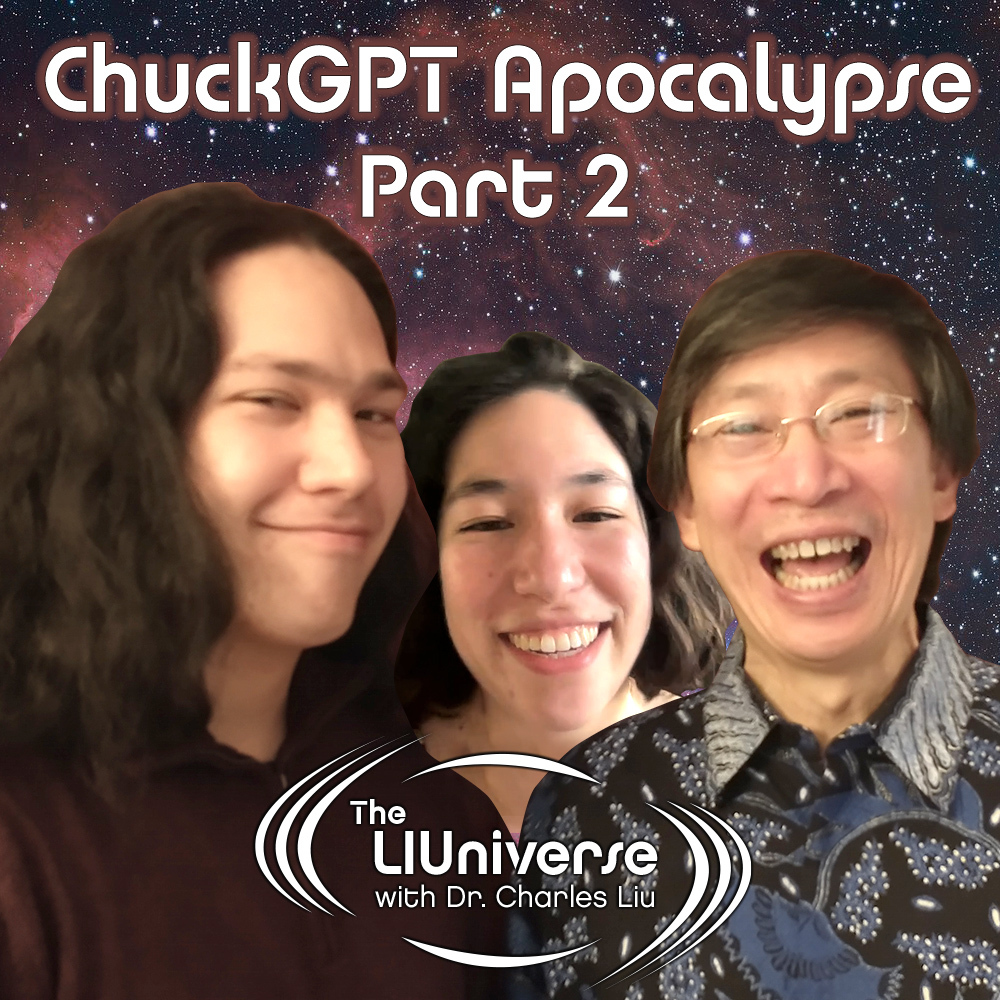 Chuck GPT Apocalypse, Part 2 | It’s the end of everything! Welcome back to Part 2 of our season finale featuring Dr. Charles Liu, co-host Allen Liu, and our guest archaeology expert and author, Hannah Liu, MEd. We pick right up where we left off, with our second question from our audience. Daniela asks, “If a black hole hits the Sun, will Earth be destroyed?” | 24m 21s | ||||||
| 6/8/25 | 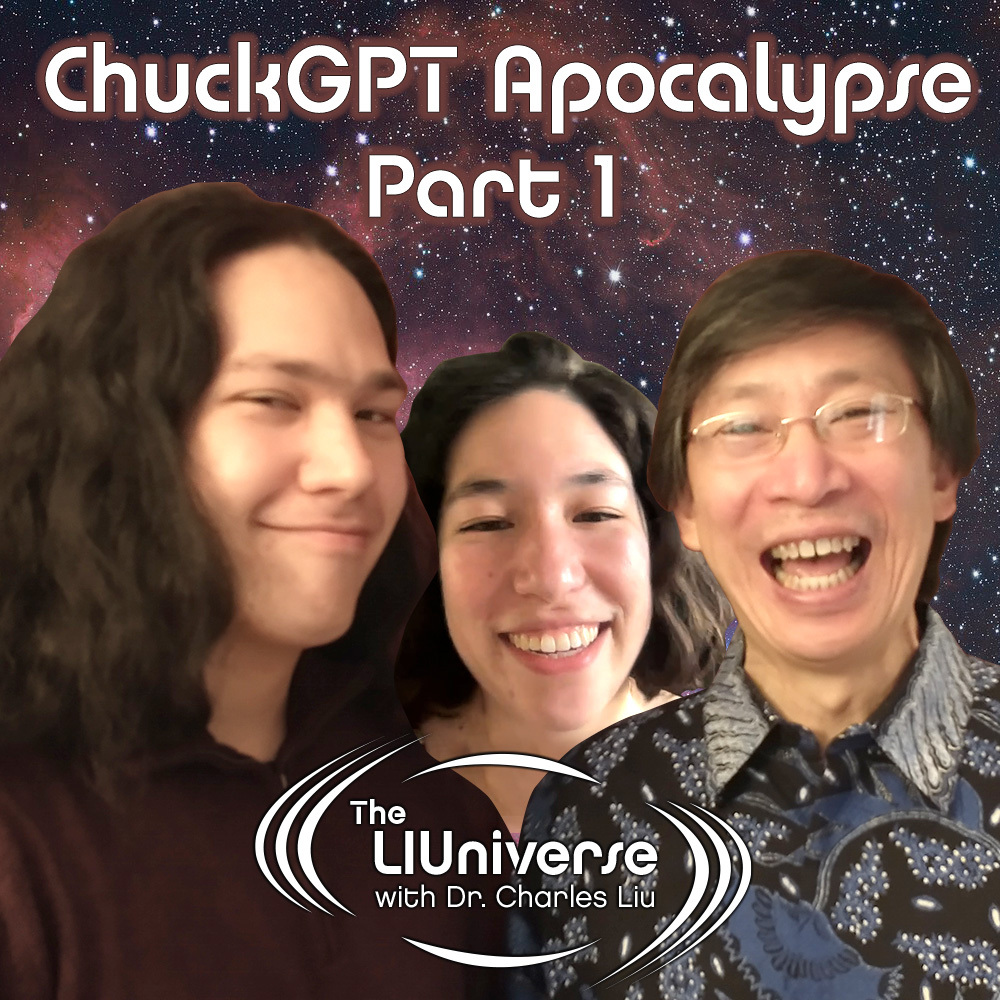 Chuck GPT Apocalypse, Part 1 | As our fourth season draws to a close, we’ve got an apocalyptic, 2-part ending lined up. That’s right, we’re talking Armageddon, and we don’t mean the 1998 Bruce Willis blockbuster. And of course, if we’re going to delve into the end of everything, Dr. Charles Liu and co-host Allen Liu are going to need the help of our ever popular archaeology expert and author, Hannah Liu, MEd. | 27m 00s | ||||||
| 5/24/25 | 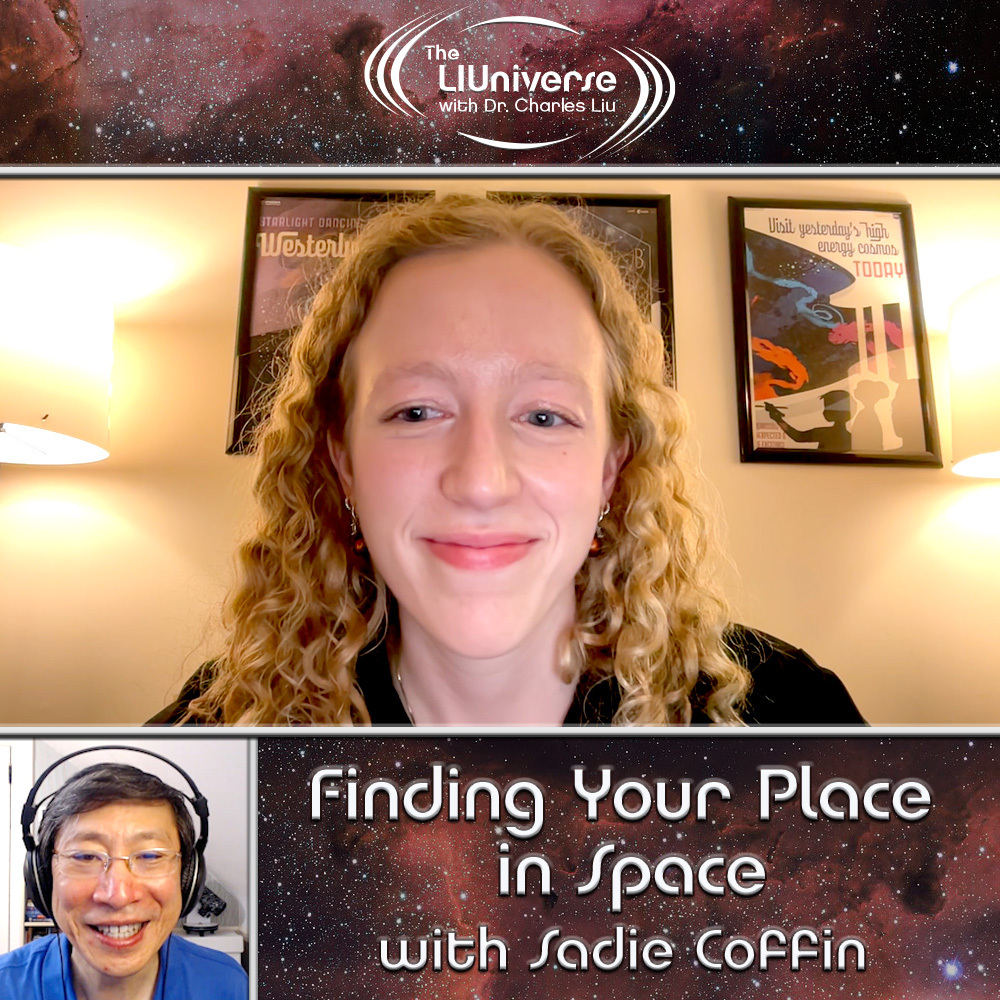 Finding Your Place in Space with Sadie Coffin | Who are the “Redshift Wranglers” and what can they tell us about the evolution of our universe? To find out, Dr. Charles Liu and co-host Allen Liu welcome back astrophysics PhD candidate Sadie Coffin from the Rochester Institute of Technology whose focus is galactic evolution, and in particular, the spectroscopy of galaxies and their lights. | 45m 58s | ||||||
| 5/10/25 | 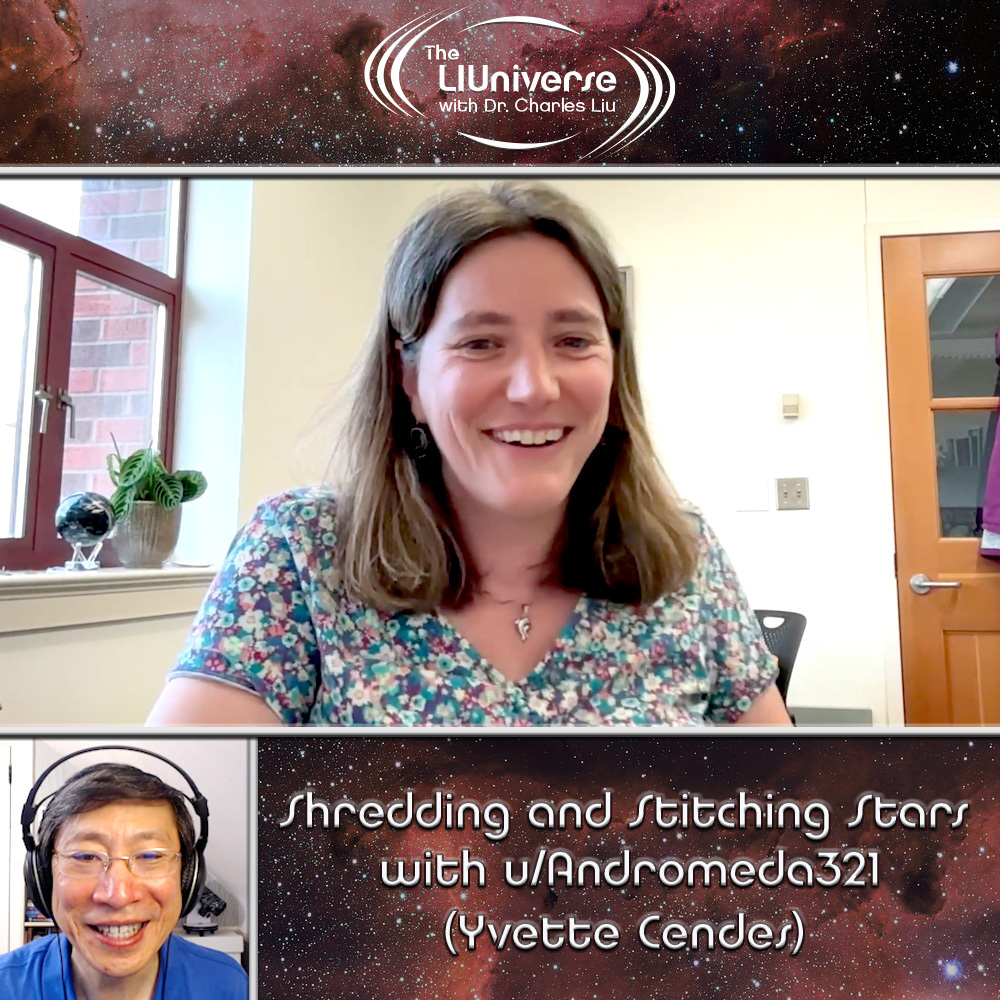 Shredding and Stitching Stars with u/Andromeda321 (Yvette Cendes) | If a black hole shreds a star and nobody is around to hear it, does it make a sound? To find out, Dr. Charles Liu and co-host Allen Liu welcome Professor Yvette Cendes, (aka u/Andromeda321 on Reddit), a Radio Astronomer studying transient radio signals from space. | 48m 24s | ||||||
| 4/26/25 |  Early Galaxies, Intelligent Plants and the Geometry of D&D Dice With Justin Cole | Why is it so difficult to study the evolution of early galaxies? Are metallic D&D dice better than plastic ones? And can you have too many Pokémon tattoos? To find out, Dr. Charles Liu and co-host Allen Liu welcome Justin Cole, who is currently a grad student at Texas A&M studying the evolution of distant galaxies in pursuit of his PhD in Astronomy and Astrophysics. | 38m 10s | ||||||
| 4/5/25 | 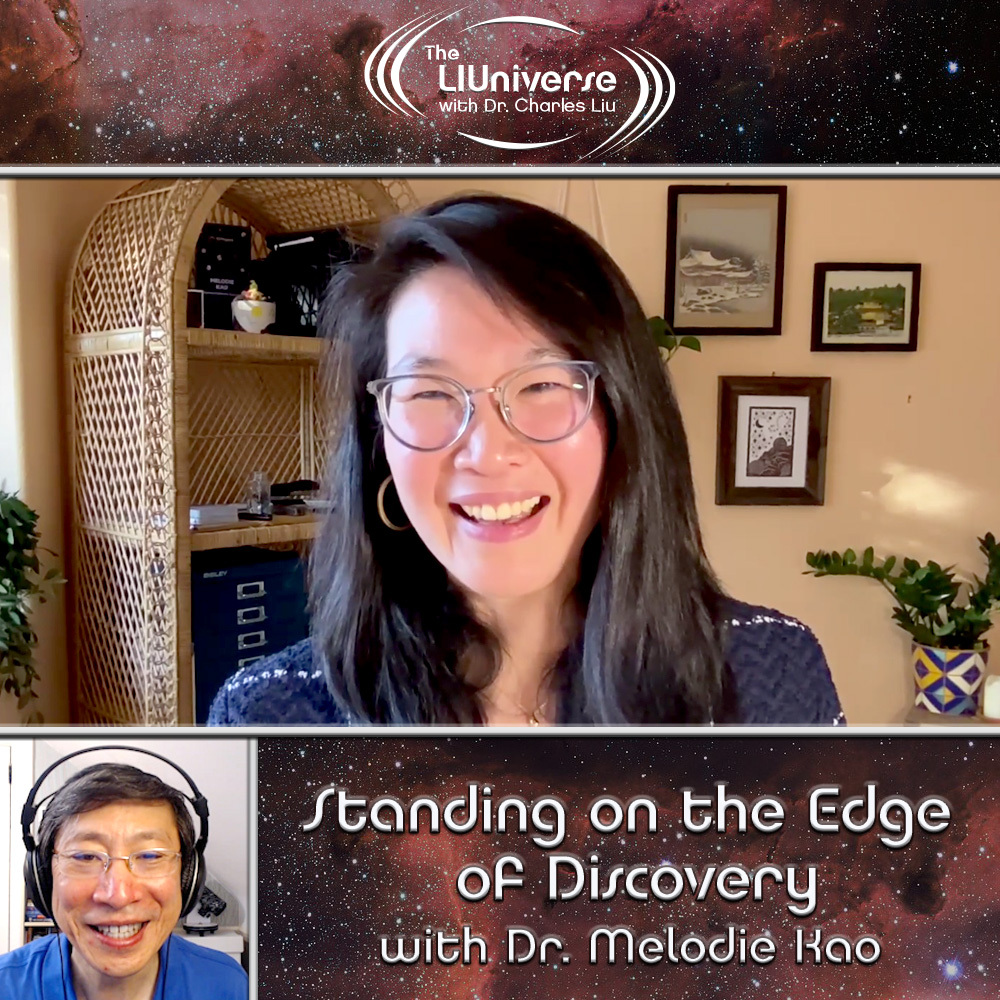 Standing on the Edge of Discovery with Dr. Melodie Kao | What’s it like to stand at the edge of human knowledge, where we don’t know what leap forward in understanding the next technological innovation will herald? To find out, Dr. Charles Liu and co-host Allen Liu welcome Dr. Melodie Kao, the resident radio astronomer at the Lowell Observatory in Flagstaff, AZ, the place where Clyde Tombaugh discovered Pluto back in 1930. | 43m 43s | ||||||
| 3/22/25 | 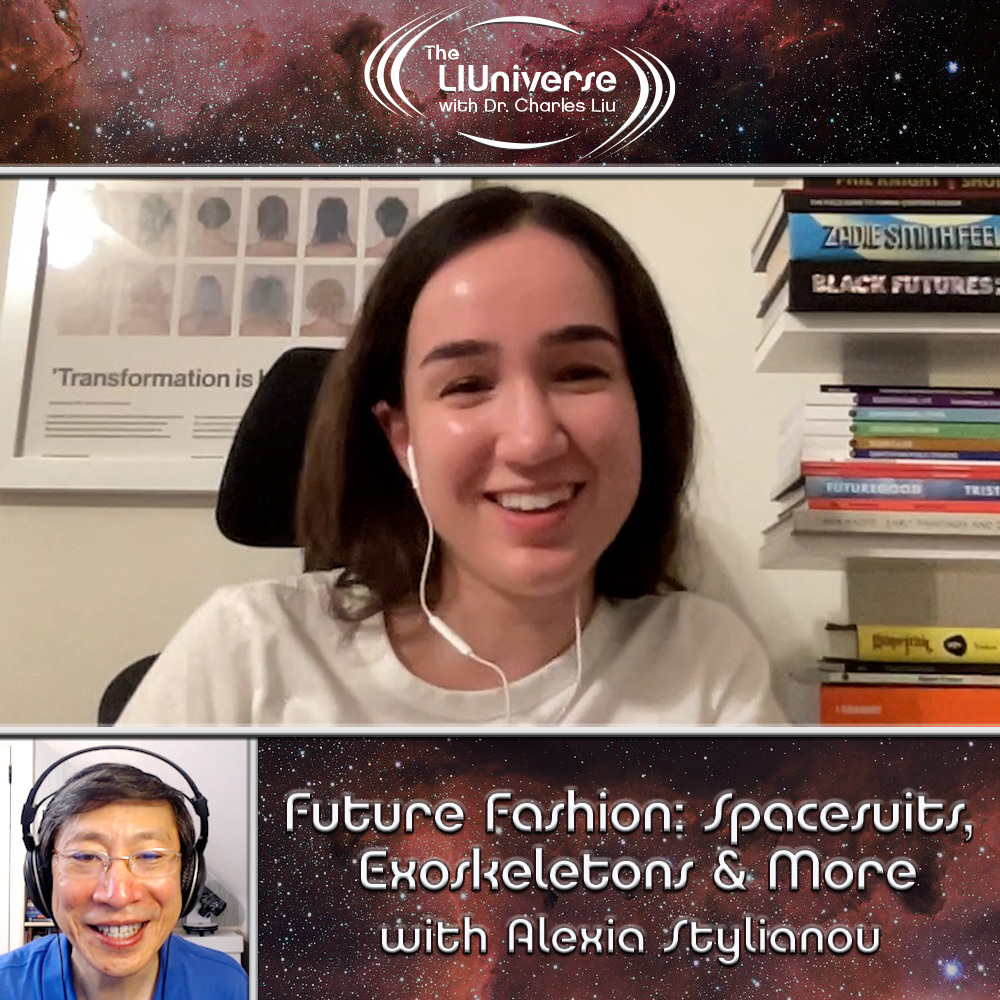 Future Fashion: Spacesuits, Exoskeletons & More with Alexia Stylianou | What will well-dressed astronauts be wearing on the Artemis III mission? Will AI destroy creativity? Can we actually make leather clothing out of mushrooms? To find out, Dr. Charles Liu and co-host Allen Liu welcome engineer and futurist Alexia Stylianou, who is designing wearable biometric platforms that measure human biomechanics to a degree far beyond what’s accessible to everyday people. | 47m 01s | ||||||
| 3/8/25 | 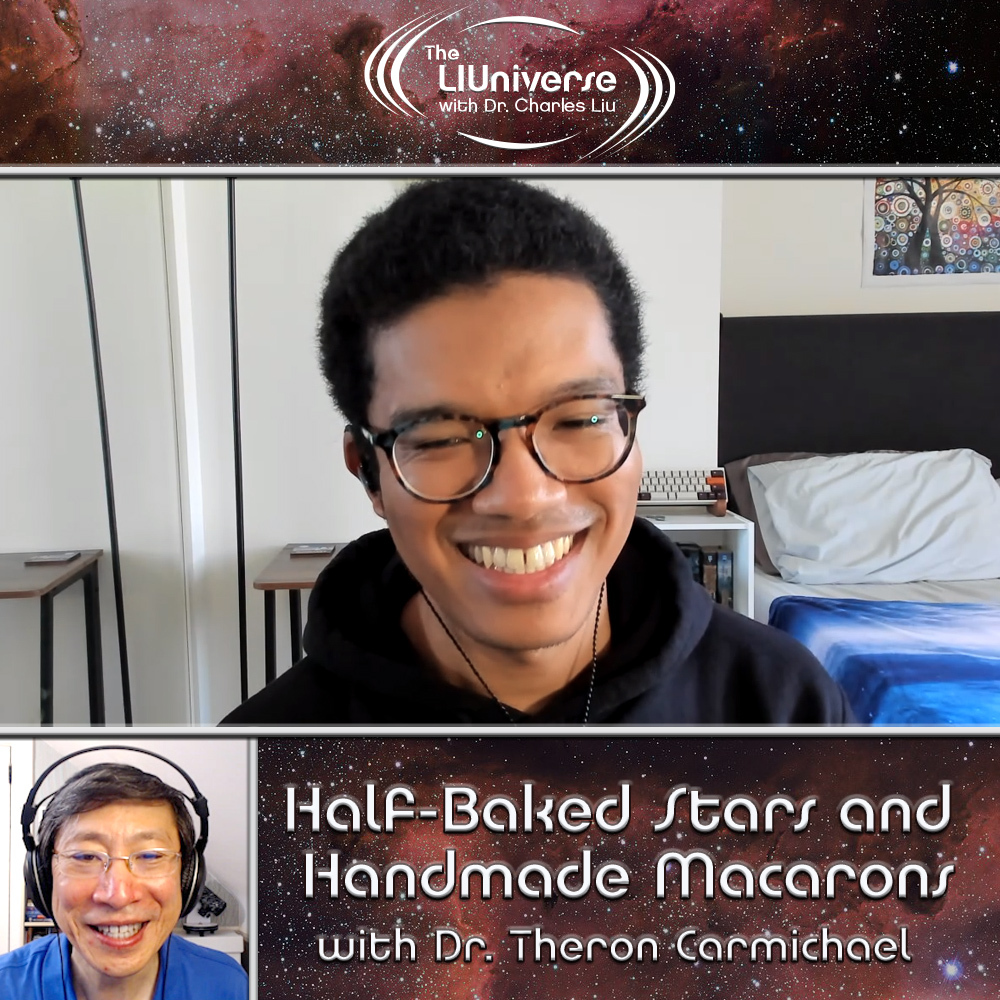 Half-Baked Stars and Handmade Macarons with Dr. Theron Carmichael | What is a transiting brown dwarf, why are they so rare, and how do you find them? Equally important, how do you make a good French macaron? To find out, Dr. Charles Liu and co-host Allen Liu welcome astronomer and astrophysicist Dr. Theron Carmichael. | 37m 22s | ||||||
Showing 25 of 78
Sponsor Intelligence
Sign in to see which brands sponsor this podcast, their ad offers, and promo codes.
Chart Positions
50 placements across 45 markets.
Chart Positions
50 placements across 45 markets.