

Insights from recent episode analysis
Audience Interest
Podcast Focus
Publishing Consistency
Platform Reach
Insights are generated by CastFox AI using publicly available data, episode content, and proprietary models.
Est. Listeners
Based on iTunes & Spotify (publisher stats).
- Per-Episode Audience
Est. listeners per new episode within ~30 days
25,001 - 50,000 - Monthly Reach
Unique listeners across all episodes (30 days)
25,001 - 75,000 - Active Followers
Loyal subscribers who consistently listen
15,001 - 40,000
Market Insights
Platform Distribution
Reach across major podcast platforms, updated hourly
Total Followers
—
Total Plays
—
Total Reviews
—
* Data sourced directly from platform APIs and aggregated hourly across all major podcast directories.
On the show
Recent episodes
Does Targeting Work on Mass Marketing Channels?
May 5, 2026
22m 53s
Nerd Alert: Why Branding Strategy Matters
Apr 30, 2026
8m 26s
No More Mild Marketing
Apr 28, 2026
24m 43s
Nerd Alert: Life After Brand Death
Apr 23, 2026
10m 23s
The Business Case for Brand Trust
Apr 21, 2026
26m 51s
Social Links & Contact
Official channels & resources
Official Website
Login
RSS Feed
Login
| Date | Episode | Description | Length | ||||||
|---|---|---|---|---|---|---|---|---|---|
| 5/5/26 | Does Targeting Work on Mass Marketing Channels? | Over half of marketers are targeting sub-segments rather than all potential buyers. And 62% aren't even targeting people over 45, a group that accounts for 50% of consumer spending.This week, Elena, Angela, and Rob tackle one of the most debated questions in marketing: how do you actually reach the right people on mass channels like TV? They dig into why narrow targeting can quietly shrink your business, how creative can do more of the targeting work than your media buy, and what it really looks like to transition from performance digital to TV. Topics covered:• [01:00] Les Binet and Will Davis research on budget vs. ROI• [03:00] Why narrow targeting creates a "death spiral"• [06:00] Why TV's business impact has increased as media fragmented• [08:00] How creative can target more effectively than media selection• [10:00] How a linear TV buy actually works• [14:00] Brand building vs. activation• [17:00] How to transition from performance digital to TVTo learn more, visit marketingarchitects.com/podcast or subscribe to our newsletter at marketingarchitects.com/newsletter.Resources:2025 IPA Article: https://ipa.co.uk/news/go-big-or-go-homeGet more research-backed marketing strategies by subscribing to The Marketing Architects on Apple Podcasts, Spotify, or wherever you listen to podcasts. | 22m 53s | ||||||
| 4/30/26 |  Nerd Alert: Why Branding Strategy Matters Nerd Alert: Why Branding Strategy Matters | Welcome to Nerd Alert, a series of special episodes bridging the gap between marketing academia and practitioners. We're breaking down highly involved, complex research into plain language and takeaways any marketer can use. In this episode, Elena and Rob dig into how branding strategy shapes consumer buying behavior and why the strategy you choose matters less than how consistently you execute it. Topics covered:[01:20] "Impact of Branding Strategy on Consumer Buying Behavior"[02:50] Why branding does the heavy lifting for fast-moving consumer goods[03:15] Four branding strategies: corporate, multi-brand, sub-brand and mono[05:20] When a house of brands beats a branded house[07:00] Commitment over perfection: why execution determines brand powerTo learn more, visit marketingarchitects.com/podcast Resources: Singh, Balgopal (2013), “Impact of Branding Strategy on Consumer Buying Behavior.”Research Journal of Arts, Management & Social Sciences, March 2013 Get more research-backed marketing strategies by subscribing to The Marketing Architects on Apple Podcasts, Spotify, or wherever you listen to podcasts. | 8m 26s | ||||||
| 4/28/26 | No More Mild Marketing | 94% of pricing power comes from how meaningfully different a brand is perceived to be. So why are so many marketers playing it safe?This week, Elena, Angela, and Rob ditch the safe answers and eat progressively spicier hot wings while doing it. Inspired by the format of Hot Ones, each round brings hotter wings and bolder takes on the marketing strategies most people are afraid to question. From the real cost of over-targeting to why your first-party data obsession may be holding you back, these are the opinions your marketing team needs to hear, even if they sting a little.Topics covered:[01:00] Research on why playing it safe is the riskiest bet in marketing[04:00] Low CPMs on TV aren't a red flag[06:00] Retargeting is overrated and doesn't grow your business[08:00] Most marketers are over-targeting and overpaying for the illusion of precision[14:00] Digital attribution set marketers back a decade[19:00] First-party data obsession is preventing real growth[22:00] Brands should stop producing TV spots like it's 2006To learn more, visit marketingarchitects.com/podcast or subscribe to our newsletter at marketingarchitects.com/newsletter. Resources:2025 Ad Age Article: https://adage.com/article/opinion/why-playing-it-safe-riskiest-bet-marketing/2603646/2025 WARC and Kantar Report: https://www.warc.com/SubscriberContent/article/warc-exclusive/playing-it-safe-is-not-safe-how-the-most-successful-brands-stand-out/en-gb/147826Get more research-backed marketing strategies by subscribing to The Marketing Architects on Apple Podcasts, Spotify, or wherever you listen to podcasts. | 24m 43s | ||||||
| 4/23/26 | Nerd Alert: Life After Brand Death | Welcome to Nerd Alert, a series of special episodes bridging the gap between marketing academia and practitioners. We're breaking down highly involved, complex research into plain language and takeaways any marketer can use. In this episode, Elena and Rob explore what happens when a brand disappears, and which competitors stand to gain the most when a brand gets permanently pulled from the market. Topics covered:[01:45] "Filling the Void: How Competing Brands Can Capitalize on a Brand Deletion"[02:20] Why brands get deleted and how often it happens[04:00] Who actually benefits when a brand disappears?[05:30] The highest-return move competitors can make[07:10] When raising prices backfires[08:20] What manufacturers should stress-test before deleting a brandTo learn more, visit marketingarchitects.com/podcast Resources: Keller, Kristopher O., and Harald J. van Heerde (2026), "Filling the Void: How Competing Brands Can Capitalize on a Brand Deletion." Working paper, University of North Carolina at Chapel Hill and University of New South Wales. Get more research-backed marketing strategies by subscribing to The Marketing Architects on Apple Podcasts, Spotify, or wherever you listen to podcasts. | 10m 23s | ||||||
| 4/21/26 |  The Business Case for Brand Trust The Business Case for Brand Trust | Trust isn't just a feel-good metric. According to an IPA Effectiveness Data Bank analysis of over 800 campaigns, 93% of campaigns that drive very large trust gains also deliver at least one major business effect. This week, Elena and Rob are joined by Catrina McAuliffe, SVP of Brand Strategy at Marketing Architects, to dig into what brand trust really means, how to measure it without turning your brand tracker into a "vibes recital," and what marketers get wrong when they try to advertise their way out of a trust deficit. Topics covered:[01:45] IPA data: trust-building campaigns and business impact[03:00] What a genuinely good brand measurement system looks like[06:00] Why brand health trackers become "vibes recitals"[09:00] How to measure trust in two layers — what people say and what they'll forgive[13:00] How newer brands vs. comeback brands should approach trust differently[18:00] TV as a trust legitimizer and amplifier[21:00] Can you advertise your way to trust?To learn more, visit marketingarchitects.com/podcast or subscribe to our newsletter at marketingarchitects.com/newsletter. Resources: 2024 MarketingWeek ArticleGet more research-backed marketing strategies by subscribing to The Marketing Architects on Apple Podcasts, Spotify, or wherever you listen to podcasts. | 26m 51s | ||||||
| 4/16/26 | Nerd Alert: Brands in Unsafe Places | Welcome to Nerd Alert, a series of special episodes bridging the gap between marketing academia and practitioners. We're breaking down highly involved, complex research into plain language and takeaways any marketer can use.In this episode, Elena and Rob explore how ads appearing next to offensive or harmful content can quietly erode consumer trust, and what marketers should do when it happens.Topics covered:[00:45] "Brands in Unsafe Places: Effects of Brand Safety Incidents on Brand Outcomes"[02:00] What counts as a brand safety incident?[04:00] How quickly does brand damage spread?[05:00] Which brands are most at risk?[06:00] Unsafe content versus negative content: there's a difference[07:00] How to respond when an incident occursTo learn more, visit marketingarchitects.com/podcastResources: Grewal, L. S., Vana, P., & Stephen, A. T. (2025). Brands in unsafe places: Effects of brand safety incidents on brand outcomes. JMR, Journal of Marketing Research, 62(6), 981–1002. https://doi.org/10.1177/00222437251349522Get more research-backed marketing strategies by subscribing to The Marketing Architects on Apple Podcasts, Spotify, or wherever you listen to podcasts. | 11m 07s | ||||||
| 4/14/26 |  The Science of Ad Personalization The Science of Ad Personalization | Personalized ads outperform generic ones. But the effect is smaller than most marketers expect, and the hidden costs can quietly undercut your brand.This episode, Elena, Angela, and Rob dig into a meta-analysis of 53 studies on ad personalization and what the research actually says about when it works. They're joined by Chief Analytics Officer Matt Hultgren and Director of AI Audio Josh Wilson to discuss the real tradeoffs of personalization and why a new tool called the Mass Customizer could change what's possible for TV advertisers.Topics covered:[01:00] What the meta-analysis reveals about personalization's modest impact[03:00] The reach trap and why narrowing audiences shrinks mental availability[06:00] Why marketers overestimate audience differences[09:00] How to test personalization cleanly using geography and control groups[14:00] Traditional roadblocks in TV production when scaling creative versions[18:00] How the Mass Customizer uses AI to swap voiceover and graphics at scale[21:00] Why CTV breaks the false choice between mass reach and customization To learn more, visit marketingarchitects.com/podcast or subscribe to our newsletter at marketingarchitects.com/newsletter. Resources: Yeo, T. E. D., Chu, T. H., & Li, Q. (2025). How Persuasive Is Personalized Advertising? A Meta-Analytic Review of Experimental Evidence of the Effects of Personalization on Ad Effectiveness. Journal of Advertising Research, 65(4), 616–631. https://doi.org/10.1080/00218499.2025.2467763Get more research-backed marketing strategies by subscribing to The Marketing Architects on Apple Podcasts, Spotify, or wherever you listen to podcasts. | 25m 53s | ||||||
| 4/9/26 | Nerd Alert: When to change your messaging | Welcome to Nerd Alert, a series of special episodes bridging the gap between marketing academia and practitioners. We're breaking down highly involved, complex research into plain language and takeaways any marketer can use.In this episode, Elena and Rob explore when brands should evolve their messaging versus refreshing their creative execution, and why the right answer depends entirely on how old your brand is.Topics covered: [01:00] "Should You Change Your Ad Messaging or Execution? It Depends On Brand Age[02:00] Message versus execution: what's the difference?[04:00] Why younger brands benefit from changing their message[05:00] Why mature brands should protect their core positioning[06:00] The formula for older brands: keep the promise, change the packagingTo learn more, visit marketingarchitects.com/podcastResources: Pauwels, K., Sud, B., Fisher, R., & Antia, K. (2022). Should you change your ad messaging or execution? It depends on brand age. Applied Marketing Analytics, 8(1), 43–54.Get more research-backed marketing strategies by subscribing to The Marketing Architects on Apple Podcasts, Spotify, or wherever you listen to podcasts. | 9m 08s | ||||||
| 4/8/26 |  TV Like Digital? Debunking the Biggest CTV Myths TV Like Digital? Debunking the Biggest CTV Myths | Many brands treat Connected TV like another form of digital advertising. That's a mistake.This week, we’re sharing a bonus episode with a special presentation from Shoptalk. Catherine Walstad, Chief Media Officer at Marketing Architects, breaks down the most common CTV myths and explains what smarter TV buying actually looks like. From frequency management to targeting accuracy to ad fraud, Catherine covers the traps brands fall into and the strategies that get results.Topics covered: [01:00] Why CTV is not just another digital channel [03:00] How frequency becomes waste faster than you think [04:00] Why premium inventory doesn’t guarantee better performance [05:00] Ad fraud, poor supply, and wasted CTV impressions [06:00] The limitations of IP-based targeting [07:00] Why CTV measurement produces conflicting answers To learn more, visit marketingarchitects.com/podcast or subscribe to our newsletter at marketingarchitects.com/newsletter. Resources: Watch: TV Like Digital and Other CTV Myths Catherine’s LinkedIn | 10m 27s | ||||||
| 4/7/26 |  When CPM is King When CPM is King | Marketers are being told to stop buying media on CPM. But is that actually good advice?This week, Elena and Angela are joined by Chief Media Officer Catherine Walstad and Chief Analytics Officer Matt Hultgren to dig into one of advertising's most debated metrics. Together, they break down why CPM still matters, where the low-CPM-equals-bad-media logic breaks down, and what actually signals media quality.Topics covered:[01:30] Research on the true cost of dull media[06:00] Why TV outperforms digital on cost per attentive second[07:00] Should marketers stop buying on CPM?[11:00] Where low CPM signals bad inventory, and where it doesn't[16:00] How to identify high-quality media[21:00] Why CPM is king at Marketing Architects[25:00] How to design a test to challenge your CPM assumptions To learn more, visit marketingarchitects.com/podcast or subscribe to our newsletter at marketingarchitects.com/newsletter.Resources: Think TV/Eat Big Fish/Amplified Report: https://thinktv.ca/research/the-eye-watering-cost-of-dull-media/Elliot Wright Article: https://mediacat.uk/whats-holding-tv-back-culture-not-effectiveness/Get more research-backed marketing strategies by subscribing to The Marketing Architects on Apple Podcasts, Spotify, or wherever you listen to podcasts. | 32m 17s | ||||||
Want analysis for the episodes below?Free for Pro Submit a request, we'll have your selected episodes analyzed within an hour. Free, at no cost to you, for Pro users. | |||||||||
| 4/2/26 | Nerd Alert: What 100 studies taught us about marketing | Nerd Alert: What 100 Studies Taught Us About Marketing Welcome to Nerd Alert, a series of special episodes bridging the gap between marketing academia and practitioners. We’re breaking down highly involved, complex research into plain language and takeaways any marketer can use. In this episode, Elena and Rob synthesize findings from 100 Nerd Alert episodes to surface the principles that consistently show up across the research and what they mean for how marketers should think about creative, reach, promotions and measurement. Topics covered: [00:55] “What 100 Studies Taught Us About Marketing”[02:00] Marketing works through memory[03:00] Why creative is a strategic multiplier, not a subjective choice[04:30] Brand growth comes from reach, not loyalty[05:30] Promotions create spikes, not growth[06:00] Why measurement often misleads strategy To learn more, visit marketingarchitects.com/podcast Get more research-backed marketing strategies by subscribing to The Marketing Architects on Apple Podcasts, Spotify, or wherever you listen to podcasts. | 9m 51s | ||||||
| 3/31/26 | From the Archive: The 95/5 Rule: Rethinking Reach and Timing | This week, we're resharing a top episode from the archive. Originally recorded a year ago, this episode on the 95/5 rule remains one of our most popular. Enjoy, and we'll be back with new content next week! This episode, Elena, Angela, and Rob explore the 95/5 rule introduced by professor John Dawes in 2021. They discuss how this principle contradicts the familiar 80/20 rule, why it applies beyond B2B categories, and how brands can shift from "hunter" to "farmer" mindsets. The team also covers creative strategies for reaching the 95% who aren't ready to buy yet and why mental availability matters more than immediate conversion. Topics covered: [01:00] Origins of the 95/5 rule and how it contradicts 80/20 thinking [04:00] Why the rule makes sense for B2B but challenges B2C assumptions [07:00] How modern marketing overemphasizes tracking immediate conversions [09:00] Calculating the 95/5 rule for your specific category [12:00] Creative strategies that build memory structures for future buyers [14:00] Shifting from hunter to farmer mentality in advertising strategy [17:00] Brand versus performance marketing balance under this rule To learn more, visit marketingarchitects.com/podcast or subscribe to our newsletter at marketingarchitects.com/newsletter. Resources: The 95:5 Rule: https://www.linkedin.com/pulse/955-rule-john-dawes/Why You Should Follow The 95-5 Rule: https://www.linkedin.com/pulse/why-you-should-follow-95-5-rule-tyrona-heath/ Calculate your in-market audience: mymarketcalculator.comGet more research-backed marketing strategies by subscribing to The Marketing Architects on Apple Podcasts, Spotify, or wherever you listen to podcasts. | 24m 34s | ||||||
| 3/26/26 | 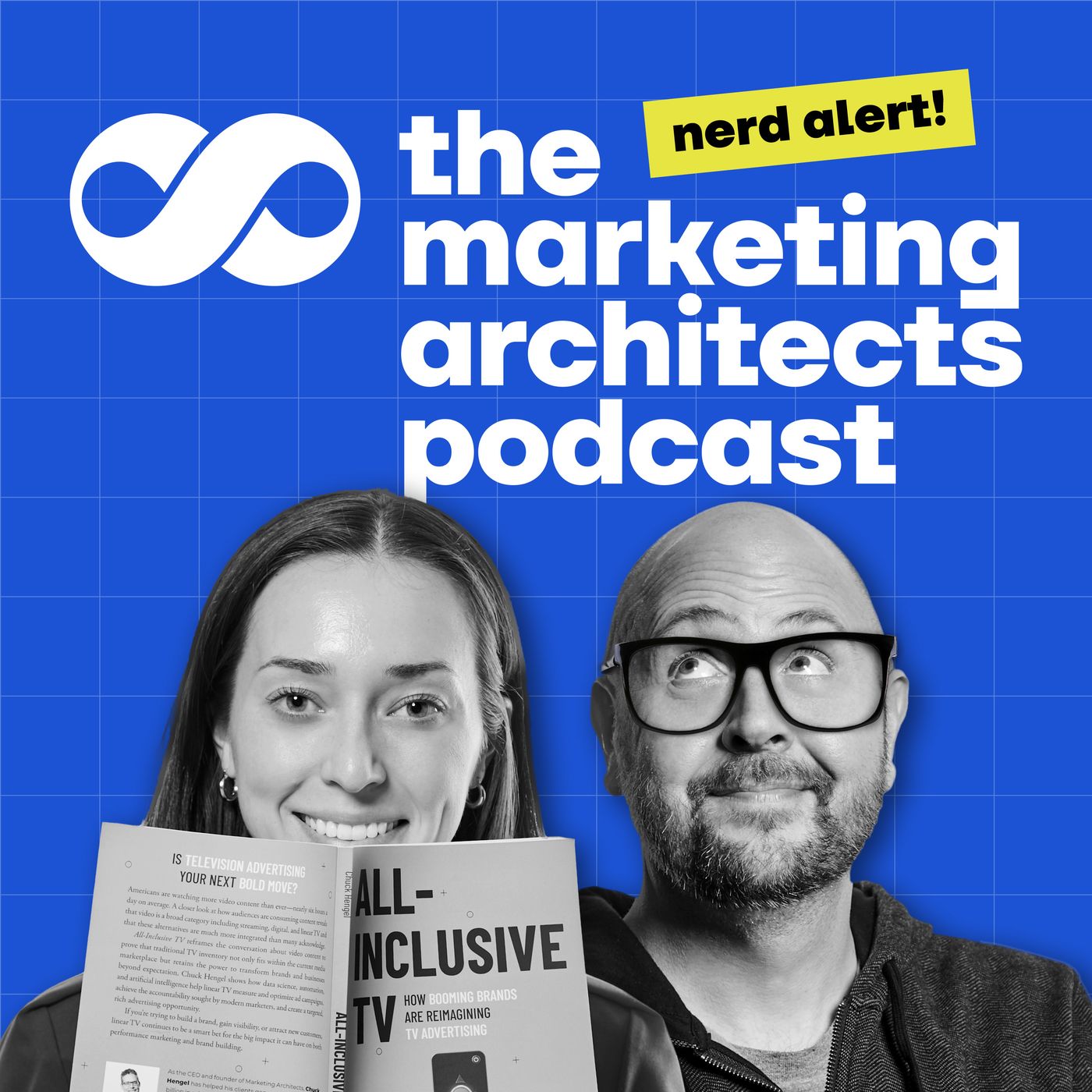 Nerd Alert: How Brands Grow: The Book That Changed Marketing Nerd Alert: How Brands Grow: The Book That Changed Marketing | Welcome to Nerd Alert, a series of special episodes bridging the gap between marketing academia and practitioners. We’re breaking down highly involved, complex research into plain language and takeaways any marketer can use. In this episode, Elena and Rob celebrate 100 episodes by flipping the script. Rob takes the lead to break down How Brands Grow by Byron Sharp, exploring why penetration beats loyalty, why light buyers matter more than most marketers think, and how distinctiveness drives brand growth. Topics covered: [01:20] "How Brands Grow" by Byron Sharp[02:45] The Law of Double Jeopardy[06:15] Why light buyers drive growth[08:00] Mental and physical availability[10:00] Differentiation vs. distinctiveness[12:15] Four takeaways marketers can apply today To learn more, visit marketingarchitects.com/podcast or subscribe to our newsletter at marketingarchitects.com/newsletter. Resources: Sharp, B. (2010). How brands grow: What marketers don’t know. Oxford University Press. Get more research-backed marketing strategies by subscribing to The Marketing Architects on Apple Podcasts, Spotify, or wherever you listen to podcasts. | 15m 47s | ||||||
| 3/24/26 |  The Hidden Cost of Media Flighting The Hidden Cost of Media Flighting | Most brands pile spend into peak weeks. But higher CPMs, more clutter and faster saturation mean you're often paying more to reach the same people. Many of whom would have bought anyway.This episode, Elena, Angela, and VP of Media Analytics Jordan Rosler dig into media flighting: why it became the default, where the strategy breaks down, and what the data says about marginal ROI. They also tackle why shoulder weeks often outperform peak ones, when always-on advertising makes more sense, and how upfronts can quietly undermine the efficiency they promise.Topics covered:• [01:00] Why media flighting became standard marketing practice.• [04:00] The difference between blended and marginal ROI explained.• [07:30] What happens to TV performance when spend spikes in a short window.• [11:00] When always-on advertising beats a flighting strategy.• [14:00] How upfronts add rigidity to media planning.• [16:00] When flighting does make sense for your brand.• [17:30] How to build a 2026 media plan that's both impactful and measurable.To learn more, visit marketingarchitects.com/podcast or subscribe to our newsletter at marketingarchitects.com/newsletter.Resources:2026 Digiday Article: https://digiday.com/sponsored/how-a-precise-timing-structure-drives-material-differences-in-marketing-efficiency/Get more research-backed marketing strategies by subscribing to The Marketing Architects on Apple Podcasts, Spotify, or wherever you listen to podcasts. | 21m 07s | ||||||
| 3/19/26 | Nerd Alert: How Tiny Brands Grow | Welcome to Nerd Alert, a series of special episodes bridging the gap between marketing academia and practitioners. We’re breaking down highly involved, complex research into plain language and takeaways any marketer can use.In this episode, Elena and Rob challenge the widely held belief that small brands survive on loyal, niche audiences. They reveal why reach, not loyalty, is the real driver of growth for tiny brands.Topics covered: [01:20] "Tiny Brands, Big Challenges: The Limits of Loyalty and the Role of Penetration in Driving Growth"[02:10] What counts as a tiny brand?[04:20] Do tiny brands actually have more loyal customers?[06:10] What growing tiny brands have in common[07:20] Why loyalty follows growth, not the other way around[08:00] Why tiny brands need to compete for the whole category To learn more, visit marketingarchitects.com/podcast or subscribe to our newsletter at marketingarchitects.com/newsletter. Resources: Barker-Trowse, A., Dunn, S., Graham, C., Sharp, B., & Corsi, A. M. (2026). Tiny brands, big challenges: The limits of loyalty and the role of penetration in driving growth. Journal of Business Research, 204, 115864. https://doi.org/10.1016/j.jbusres.2025.115864 Get more research-backed marketing strategies by subscribing to The Marketing Architects on Apple Podcasts, Spotify, or wherever you listen to podcasts. | 10m 54s | ||||||
| 3/17/26 |  What Your CFO Really Thinks About Marketing What Your CFO Really Thinks About Marketing | Only 2.6% of board directors have marketing experience. So how is marketing really being evaluated at the top? And what can marketers do about it?This episode, Elena, Angela, and Rob are joined by Marketing Architects CFO Brent Longwall to break down how finance actually evaluates marketing investments. They cover the root causes of tension between marketing and finance, what makes a marketing pitch credible to a CFO, and how to build a shared language across both functions. If you've ever struggled to justify a brand investment or earn trust with your finance team, this one's for you.Topics covered: [01:45] Marketing's shrinking influence in the boardroom[03:30] The core tension between marketing and finance time horizons[07:00] The three numbers your CFO checks every month[15:00] What makes a marketing investment credible vs. suspicious[23:00] How marketers can speak the CFO's language[25:00] What marketers should stop (and start) saying to finance To learn more, visit marketingarchitects.com/podcast or subscribe to our newsletter at marketingarchitects.com/newsletter. Resources: Whitler, Kimberly & Krause, Ryan & Lehmann, Donald. (2018). When and How Board Members with Marketing Experience Facilitate Firm Growth. 10.1509/jm.17.0195?code=amma-site. Get more research-backed marketing strategies by subscribing to The Marketing Architects on Apple Podcasts, Spotify, or wherever you listen to podcasts. | 32m 01s | ||||||
| 3/12/26 | Nerd Alert: The Ad Load Problem | Welcome to Nerd Alert, a series of special episodes bridging the gap between marketing academia and practitioners. We’re breaking down highly involved, complex research into plain language and takeaways any marketer can use.In this episode, Elena and Rob explore what happens when people feel bombarded by ads on social media and why the real threat to engagement isn't a bad ad. It's platform fatigue.Topics covered: [01:05] "The Impact of Ad Overload Perception and Social Media on Ad Avoidance Behavior"[02:10] The two theories behind why ads push people away[03:45] How researchers measured ad clutter, fatigue and avoidance[05:55] Why fatigue, not the ad itself, drives avoidance[06:45] Three key takeaways for marketers[08:00] Why TV advertising sidesteps the ad overload problem To learn more, visit marketingarchitects.com/podcast or subscribe to our newsletter at marketingarchitects.com/newsletter. Resources: Essa Tayeb, M., Chebbi, T., Badawi, A., Ali Toumi, J., & Louail, B. (2024). The impact of ad overloads perception in social media on ad avoidance behavior: The mediating effect of social media fatigue and goal impediment. Management, 28(2). https://doi.org/10.58691/man/197329 Get more research-backed marketing strategies by subscribing to The Marketing Architects on Apple Podcasts, Spotify, or wherever you listen to podcasts. | 9m 22s | ||||||
| 3/10/26 | The Marketing Order of Operations (MOO) | Tiny brands don't grow through loyalty. They grow through penetration. A study of 400+ brands found that growing brands increased penetration by 135%, compared to just 26% growth from purchase frequency. So where should marketers invest first?This episode, Elena, Angela, and Rob introduce the MOO, a seven-step Marketing Order of Operations that gives marketers a clear priority sequence for building effectiveness, from defining the competitive playing field to communicating results internally. The team also covers why even small brands can't afford to ignore marketing effectiveness principles and how to balance short-term performance with long-term brand building.Topics covered: [01:00] Research on tiny brands debunks the loyalty-first growth myth[05:00] Step 1: Define your competitive playing field and category buyers[07:30] Step 2: Build distinctive brand assets that make your brand recognizable[12:30] Step 4: Choose channels for both short- and long-term growth[15:00] Step 5: Build a measurement system that matches your objectives[19:30] Step 7: Communicate results in the language of the business To learn more, visit marketingarchitects.com/podcast or subscribe to our newsletter at marketingarchitects.com/newsletter. Resources: 2026 Money Guy Article: https://moneyguy.com/guide/foo/Alicia Barker-Trowse, Steven Dunn, Charles Graham, Byron Sharp, Armando Maria Corsi, Tiny brands, big challenges: The limits of loyalty and the role of penetration in driving growth, Journal of Business Research, Volume 204, 2026, 115864, ISSN 0148-2963, https://doi.org/10.1016/j.jbusres.2025.115864. Get more research-backed marketing strategies by subscribing to The Marketing Architects on Apple Podcasts, Spotify, or wherever you listen to podcasts. | 26m 39s | ||||||
| 3/5/26 | Nerd Alert: The Science of Sustainability Advertising | Welcome to Nerd Alert, a series of special episodes bridging the gap between marketing academia and practitioners. We’re breaking down highly involved, complex research into plain language and takeaways any marketer can use.In this episode, Elena and Rob explore why sustainability advertising is so hard to get right and what brands can do to close the gap between what consumers say they value and what they actually buy.Topics covered: [00:55] "Sustainability Advertising: A Literature Review and Framework for Future Research"[01:50] The gap between sustainable intent and action[04:00] The three levers of sustainability advertising: ad context, source characteristics, and message design[05:30] Why consumers don't trust sustainability claims and when third-party cues help[06:15] The sustainability liability: when "eco-friendly" hurts perceived performance[07:40] What brands can do to make sustainability messaging actually work To learn more, visit marketingarchitects.com/podcast or subscribe to our newsletter at marketingarchitects.com/newsletter. Resources: Rathee, S., & Milfeld, T. (2023). Sustainability advertising: Literature review and framework for future research. International Journal of Advertising. https://doi.org/10.1080/02650487.2023.2175300 Get more research-backed marketing strategies by subscribing to The Marketing Architects on Apple Podcasts, Spotify, or wherever you listen to podcasts. | 10m 35s | ||||||
| 3/3/26 | Where Brand Actually Happens | 7 in 10 people globally say they're hesitant to trust someone different from them, according to the 2026 Edelman Trust Barometer. Trust is getting more personal. So where does that leave brands? This week, Elena, Angela, and Rob explore what it really means to build a brand in a world where trust is earned through experience, not messaging. They dig into why the gap between marketing promises and reality is so damaging, how to bridge online and in-person brand moments, and what channels like TV do for brand trust that others simply can't. Plus, hear real-world examples of brands that get it right, from Snickers to Disney to Jeep. Topics covered: [01:00] 2026 Edelman Trust Barometer findings on consumer trust[03:00] How much control marketers actually have over brand perception[06:00] Where marketing promises most often break down[08:30] Why marketers over-index on comms and under-index on product experience[11:00] The moment where brand actually happens[14:00] How TV builds familiarity that carries into other channels[17:00] Real examples of brands bridging TV and in-person experience To learn more, visit marketingarchitects.com/podcast or subscribe to our newsletter at marketingarchitects.com/newsletter. Resources: 2026 Edelman Trust Barometer Report: https://www.edelman.com/trust/2026/trust-barometer Get more research-backed marketing strategies by subscribing to The Marketing Architects on Apple Podcasts, Spotify, or wherever you listen to podcasts. | 22m 19s | ||||||
| 2/26/26 | Nerd Alert: The Power of Imagery in Advertising | Welcome to Nerd Alert, a series of special episodes bridging the gap between marketing academia and practitioners. We’re breaking down highly involved, complex research into plain language and takeaways any marketer can use.In this episode, Elena and Rob explore why narrative ads work even when they say little about the product. The answer lies in image fluency. How easily a story can be pictured shapes how much people like the ad and the brand behind it.Topics covered: [01:05] "Image Fluency and Narrative Advertising Effects"[01:55] The four steps of ad processing[03:00] How matching visuals change brand attitudes[03:55] Familiar vs. unfamiliar story scenarios[04:35] How to make your ads easier to imagine[05:00] Why clarity matters more than originality To learn more, visit marketingarchitects.com/podcast or subscribe to our newsletter at marketingarchitects.com/newsletter. Resources: Chang, C. (2013). Imagery fluency and narrative advertising effects. Journal of Advertising, 42(1), 54–68. https://doi.org/10.1080/00913367.2012.749087 Get more research-backed marketing strategies by subscribing to The Marketing Architects on Apple Podcasts, Spotify, or wherever you listen to podcasts. | 7m 09s | ||||||
| 2/24/26 | When is Premium Media Worth the Price? | Marketers love the idea that premium media makes brands premium. But the research is surprisingly mixed. High involvement content can change how ads land, sometimes helping attitudes, sometimes hurting recall.This week, Elena, Angela, and Rob tackle the debate between premium media and efficient reach. They review mixed research on media context effects, break down the extreme cost differences between premium and standard TV placements, and share when high-profile media genuinely outperforms. Discover why sacrificing reach for prestige might hurt more than help.Topics covered: [02:00] Super Bowl advertising performance data[04:00] The history of premium media and costly signaling[09:00] Cost differences between premium and standard TV placements[14:00] When premium media actually performs better[18:00] Creative requirements for premium placements[26:00] Playing "Worth the Premium" game with real scenarios To learn more, visit marketingarchitects.com/podcast or subscribe to our newsletter at marketingarchitects.com/newsletter. Resources: Norris, Claire E.; Colman, Andrew M.; Aleixo, Paulo A. (2003). Selective Exposure to Television Programmes and Advertising Effectiveness. University of Leicester. Journal contribution. https://hdl.handle.net/2381/3983 Hartmann, W. R., & Klapper, D. (2016). Super Bowl Ads (Working Paper No. 2139). Stanford Graduate School of Business. https://web.stanford.edu/~wesleyr/SuperBowl.pdf Get more research-backed marketing strategies by subscribing to The Marketing Architects on Apple Podcasts, Spotify, or wherever you listen to podcasts. | 33m 41s | ||||||
| 2/19/26 | Nerd Alert: Targeting Without Tracking | Welcome to Nerd Alert, a series of special episodes bridging the gap between marketing academia and practitioners. We're breaking down highly involved, complex research into plain language and takeaways any marketer can use. In this episode, Elena and Rob explore how privacy first advertising changes digital marketing. They reveal that when individual tracking disappears, platforms must rely on user groups instead. This shifts advertising toward probabilistic targeting, like how TV has always worked. Topics covered: [01:00] "Reach, Measurement, Optimization and Frequency Capping and Targeted Online Advertising Under K Anonymity"[01:45] Privacy forces less tracking, more thinking[02:50] How K Anonymity groups users by shared traits[04:35] Simulating the trade-off between privacy and performance[06:00] Privacy pushes reach-first thinking To learn more, visit marketingarchitects.com/podcast or subscribe to our newsletter at marketingarchitects.com/newsletter. Resources: Gao, Y., & Qiao, M. (2025). Reach measurement, optimization and frequency capping in targeted online advertising under k-anonymity. arXiv preprint arXiv:2501.04882. Get more research-backed marketing strategies by subscribing to The Marketing Architects on Apple Podcasts, Spotify, or wherever you listen to podcasts. | 8m 14s | ||||||
| 2/17/26 | Distinctive or Distracting? A Super Bowl Ad Effectiveness Review | A single 30-second Super Bowl spot now costs $8 million. Factor in production, celebrities, and amplification, and total campaign costs land between $15 and $50 million. So, are the ads actually worth it?Elena, Angela, and Rob break down this year's Super Bowl commercials through a marketing effectiveness lens. They discuss which brands nailed distinctive assets versus those that let celebrity overshadow strategy, why consistency beats spectacle, and what separates memorable ads from forgettable ones. Topics covered: [02:00] Classic TV commercial effectiveness errors in Super Bowl ads[06:00] Which brands executed distinctive brand assets well[11:00] The Pepsi polar bear debate and brand linkage[20:00] Patterns across effective ads: product as hero and consistency[28:00] Quiet winners that did real work for brands[32:00] Key takeaways for brands not advertising in the Super Bowl To learn more, visit marketingarchitects.com/podcast or subscribe to our newsletter at marketingarchitects.com/newsletter. Resources: 2026 Adwave Article: https://adwave.com/resources/super-bowl-commercial-cost2026 Billboard Article: https://www.billboard.com/lists/super-bowl-2026-time-performers-commercials-everything-to-know/ Get more research-backed marketing strategies by subscribing to The Marketing Architects on Apple Podcasts, Spotify, or wherever you listen to podcasts. | 38m 07s | ||||||
| 2/12/26 | Nerd Alert: The Science of Ads that Stick | Welcome to Nerd Alert, a series of special episodes bridging the gap between marketing academia and practitioners. We’re breaking down highly involved, complex research into plain language and takeaways any marketer can use. In this episode, Elena and Rob explore what makes ads memorable over time, not just minutes after viewing. They reveal how emotion, brand relevance, and AI are reshaping how marketers should think about ad recall and creative testing. Topics covered: [01:00] "Long-Term Ad Memorability: Understanding and Generating Memorable Ads"[02:00] Why short-term recall is a poor proxy for advertising effectiveness[04:00] Emotion as the strongest driver of long-term memory[05:00] How brand relevance affects ad memorability[06:00] AI model Henry predicts and generates more memorable ads[07:00] Practical takeaways for marketers on creative testing To learn more, visit marketingarchitects.com/podcast or subscribe to our newsletter at marketingarchitects.com/newsletter. Resources: Khosla, A., Ranjan, A., Torralba, A., Oliva, A., & colleagues. (2024). Long-term ad memorability: Understanding and generating memorable ads. Adobe Research and collaborating universities. Get more research-backed marketing strategies by subscribing to The Marketing Architects on Apple Podcasts, Spotify, or wherever you listen to podcasts. | 9m 32s | ||||||
Showing 25 of 270
Sponsor Intelligence
Sign in to see which brands sponsor this podcast, their ad offers, and promo codes.
Chart Positions
11 placements across 11 markets.
Chart Positions
11 placements across 11 markets.