
The Math Club
by Pete and Noah
Is this your podcast?Insights from recent episode analysis
Audience Interest
Podcast Focus
Publishing Consistency
Platform Reach
Insights are generated by CastFox AI using publicly available data, episode content, and proprietary models.
Total monthly reach
Estimated from 24 chart positions in 24 markets.
By chart position
- 🇨🇦CA · Mathematics#8300K to 1M
- 🇬🇧GB · Mathematics#11300K to 1M
- 🇦🇺AU · Mathematics#22100K to 300K
- 🇺🇸US · Mathematics#25100K to 300K
- 🇩🇪DE · Mathematics#28100K to 300K
- Per-Episode Audience
Est. listeners per new episode within ~30 days
1.2M to 3.6M🎙 ~2x weekly·81 episodes·Last published 1mo ago - Monthly Reach
Unique listeners across all episodes (30 days)
2.3M to 7.2M🇨🇦14%🇬🇧14%🇸🇪11%+21 more - Active Followers
Loyal subscribers who consistently listen
932K to 2.9M
Market Insights
Platform Distribution
Reach across major podcast platforms, updated hourly
Total Followers
—
Total Plays
—
Total Reviews
—
* Data sourced directly from platform APIs and aggregated hourly across all major podcast directories.
On the show
Recent episodes
Black Hole Fun - Exploring Kaprekar's Constant
Aug 5, 2026
Unknown duration
Introducing A Novel Approach
Jul 25, 2026
Unknown duration
What are the Odds? - The Mathematics of Poker
May 20, 2026
Unknown duration
Life on Math: Living Your Best Mathematical Life
Apr 8, 2026
Unknown duration
Around the World in 20 Problems: World Math Day 2026
Feb 25, 2026
Unknown duration
Social Links & Contact
Official channels & resources
Official Website
Login
RSS Feed
Login
| Date | Episode | Description | Length | ||||||
|---|---|---|---|---|---|---|---|---|---|
| 8/5/26 |  Black Hole Fun - Exploring Kaprekar's Constant | A close call on the Math Club holodeck sends Pete and Noah down a wormhole investigating Kaprekar's Constant. Beam aboard as we explore strange new algorithms and boldly discover what happens when numbers are put through this interesting iterative process. Leave us a voice message Find us on Twitter Send us an email Questions Answered in the Episode What is Kaprekar's constant and how does the Kaprekar process work for four-digit numbers? What is the maximum number of steps required for any valid four-digit number to reach Kaprekar's constant? | — | ||||||
| 7/25/26 |  Introducing A Novel Approach | Hey there, Math Club. We have some exciting news to share. Noah has teamed up with yet another Pete to bring you yet another show! A Novel Approach is dedicated to creating novel length stories, produced as immersive audio productions. The first book is called "The End of Secrets", and it explores what happens when the ancient world of vampires collides with the modern world of AI. In each pair of new episodes, you'll get to hear a new chapter of the book, and then a short discussion about how that chapter was put together. We're including the first chapter here. If you like it and want more, you can find it on Apple Podcasts, or in whatever podcast app you like to use. Just search for "A Novel Approach", or use our RSS feed https://anchor.fm/s/1150a6278/podcast/rss | — | ||||||
| 5/20/26 |  What are the Odds? - The Mathematics of Poker | A friend's story leads Pete and Noah to dive into the high-stakes world of poker to settle a debate: does a flush really beat a straight? Using the tools of combinatorics and probability, our hosts break down the math behind five-card hands and explore how the hierarchy of the game is built upon the frequency of outcomes. Ante up... the next hand is about to begin! Leave us a voice message Find us on Twitter Send us an email Questions Answered in the Episode How do you calculate the total number of possible five-card poker hands from a 52-card deck? What are the mathematical odds of being dealt a flush versus a straight in poker? | — | ||||||
| 4/8/26 |  Life on Math: Living Your Best Mathematical Life | A chat with Alexa leads Pete to contemplate what it looks like to lead his best mathematical life. But what does that mean? In this episode, Pete and Noah discuss ways to view mathematics not as a rigid school subject, but as a "grand adventure" that is constantly present in your life. Leave us a voice message Find us on Twitter Send us an email Questions Answered in the Episode: • What does it mean to live a mathematical life? • How can the "I Notice, I Wonder" framework be used to find math in everyday life? | — | ||||||
| 2/25/26 |  Around the World in 20 Problems: World Math Day 2026 | In this episode, veteran educator Sheila Robitaille joins Pete and Noah to discuss World Math Day, a global competition for students ages 5 to 18 that promotes mathematical fluency through 60-second "live Mathletics" games. The conversation highlights the 2026 theme, "United by Numbers," exploring how gamification can foster a growth mindset and make math fun and engaging for kids at all levels of math proficiency. Register your child or students for World Math Day 2026 Leave us a voice message Find us on Twitter Send us an email Questions Answered in the Episode: • What is World Math Day and who is eligible to participate in the competition? • How does the gamification of mathematics help students develop a growth mindset and academic perseverance? | — | ||||||
| 1/28/26 |  One More Time: The Oddities of Benford's Law | If we asked all of our listeners to look up the current population of their hometown and email us just the first digit of that number, what do you expect we'd find? Would the digits be evenly distributed, or would some be more common than others? In this episode, we look at Benford's Law, and learn some surprising truths about the distribution of numbers in natural data sets. Leave us a voice message Find us on Twitter Send us an email Questions Answered in the Episode: • What is Benford's Law and how does it predict the frequency of leading digits in data sets? • Why do natural data sets like city populations and surface areas often follow a logarithmic distribution of first digits? | — | ||||||
| 12/24/25 |  Partial Credit: Exploring Luhn's Algorithm | Ever wonder how a website knows your credit card number is "invalid" before you even hit the submit button? In this commando-style holiday episode, Pete and Noah dive into the secrets of Luhn's Algorithm, a clever approach that uses simple arithmetic to validate sequences of digits. Leave us a voice message Find us on Twitter Send us an email Questions Answered in the Episode: • How does the Luhn algorithm work to validate credit card numbers? • Why do credit card companies use a checksum digit? | — | ||||||
| 12/17/25 | 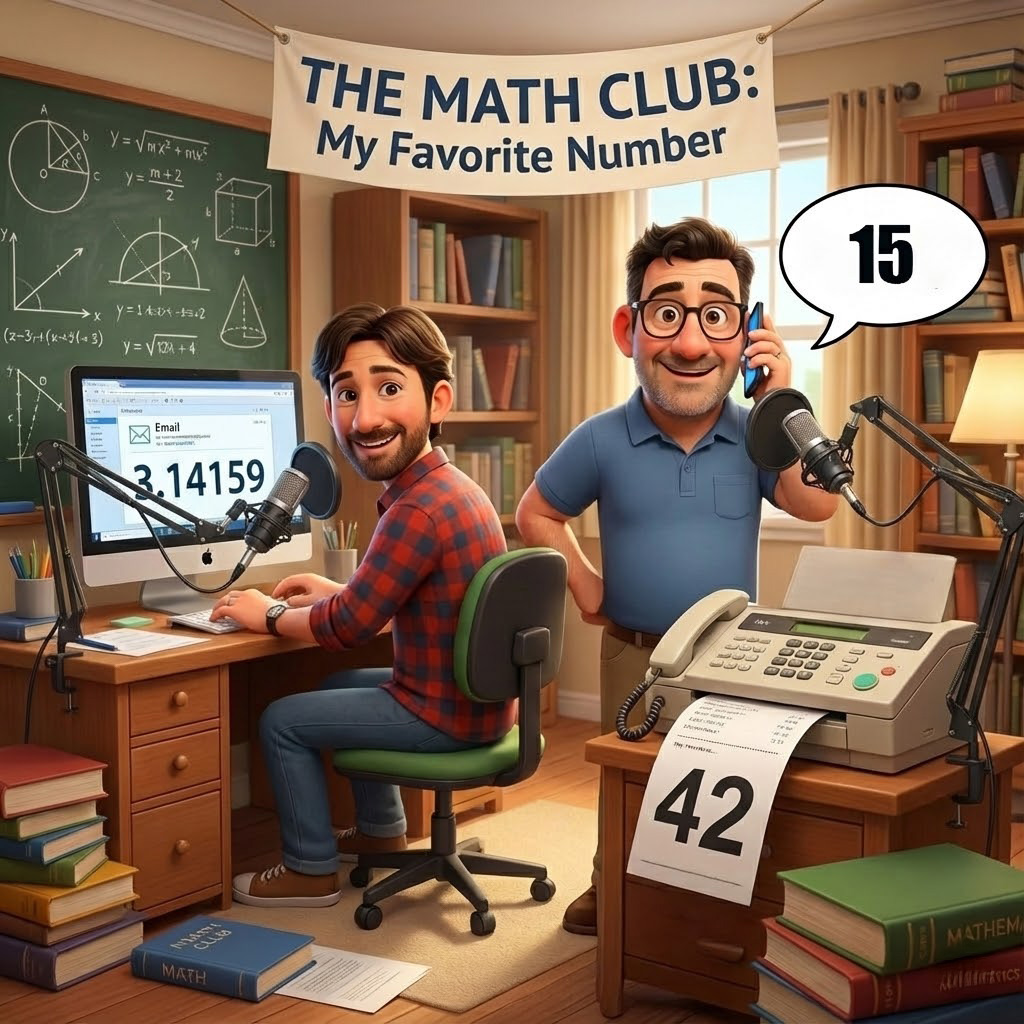 My Favorite Number - Listeners Share Their Favorite Numbers | It's a simple question: What's your favorite number? But as Pete and Noah discover in this special episode, the answers are anything but simple—they're deeply personal, surprisingly mathematical, and always connected to a story. Join our hosts as they open up the floor to listeners, friends, and family to find out their favorite numbers and the fascinating reasons behind their choices. Leave us a voice message Find us on Twitter Send us an email Questions Answered in the Episode: • What numbers do people choose as their favorite number? • What are some reasons people choose certain numbers as their favorite? | — | ||||||
| 10/1/25 |  Bonus Material - Math Club Junior: It's a Zoo Out There! | Hey there Math Club. Our most recent episode, Math Club Junior: It's a Zoo Out There, was our second special episode made specifically for kids. When Noah was planning how he wanted to use the episode with his own third grade class, he knew that some visuals would come in handy, so he created a slide deck with images to go along with each problem that the students will have to solve. If you'd like to use this resource along with the audio, you can find it by going to: https://bit.ly/mcj_zoo We hope you find these images to be fun and helpful, and we'll see you next time! | — | ||||||
| 9/24/25 |  Math Club Junior: It's a Zoo Out There | In this long-awaited followup to our popular Math Club Junior episode, Pete and Noah are back with Mrs. Morrison's class, as chaperones on a field trip to the local zoo. Listen in as our group of Junior Zookeepers meet a whole new cast of zany characters, and once again learn that math is everywhere if you just look around. And just like last time, this story is full of interesting math challenges for listeners in the upper elementary grades to enjoy and solve. • A slide deck with visuals to go along with each problem from the story Leave us a voice message Find us on Twitter Send us an email | — | ||||||
Want analysis for the episodes below?Free for Pro Submit a request, we'll have your selected episodes analyzed within an hour. Free, at no cost to you, for Pro users. | |||||||||
| 8/13/25 | 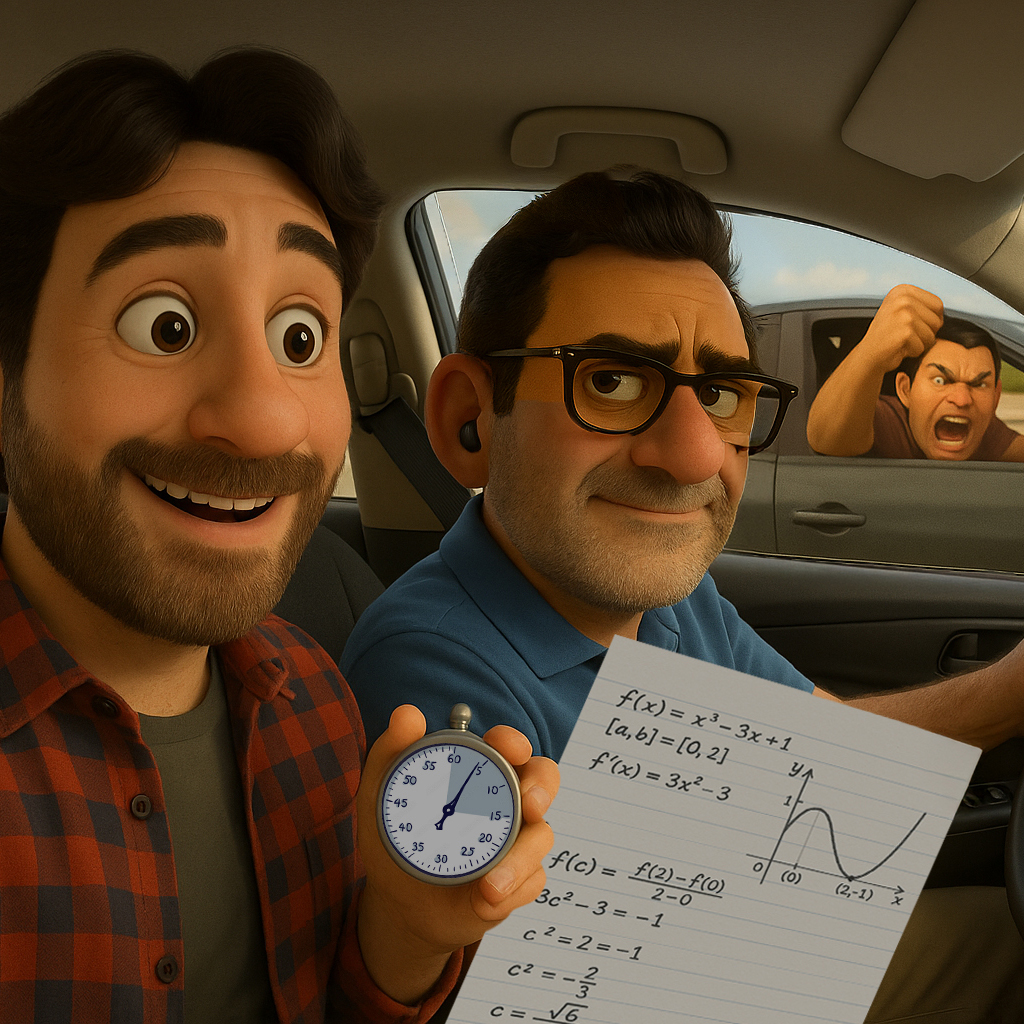 Means of Transportation: The Mean Value Theorem and Average Speed Zones | A family visit to the Netherlands introduces Pete to the idea of average speed zones, which illustrate a particularly interesting mathematical theorem. Join our hosts as they really go off on a tangent about the mean value theorem, and how it just might get you a speeding ticket. Leave us a voice message Find us on Twitter Send us an email Questions Answered in the Episode: • What is an average speed zone and how does it work to catch speeding drivers? • What is the Mean Value Theorem and how does it relate average rates of change to instantaneous rates of change? | — | ||||||
| 6/26/25 |  Q.E.D.: The Proving of Fermat's Last Theorem | It's finally here! Part Three of the Fermat Trilogy! In this exciting conclusion, Pete and Noah talk about the mathematicians who ultimately proved (or thought they'd proven) Fermat's Last Theorem. Join us for the final chapter of this riveting 350 year journey! The Proof - Nova Documentary on Andrew Wiles's proof Leave us a voice message Find us on Twitter Send us an email Questions Answered in the Episode: • Who proved Fermat's Last Theorem? • How does the Taniyama-Shimura conjecture relate to the proof of Fermat's Last Theorem? | — | ||||||
| 5/7/25 | 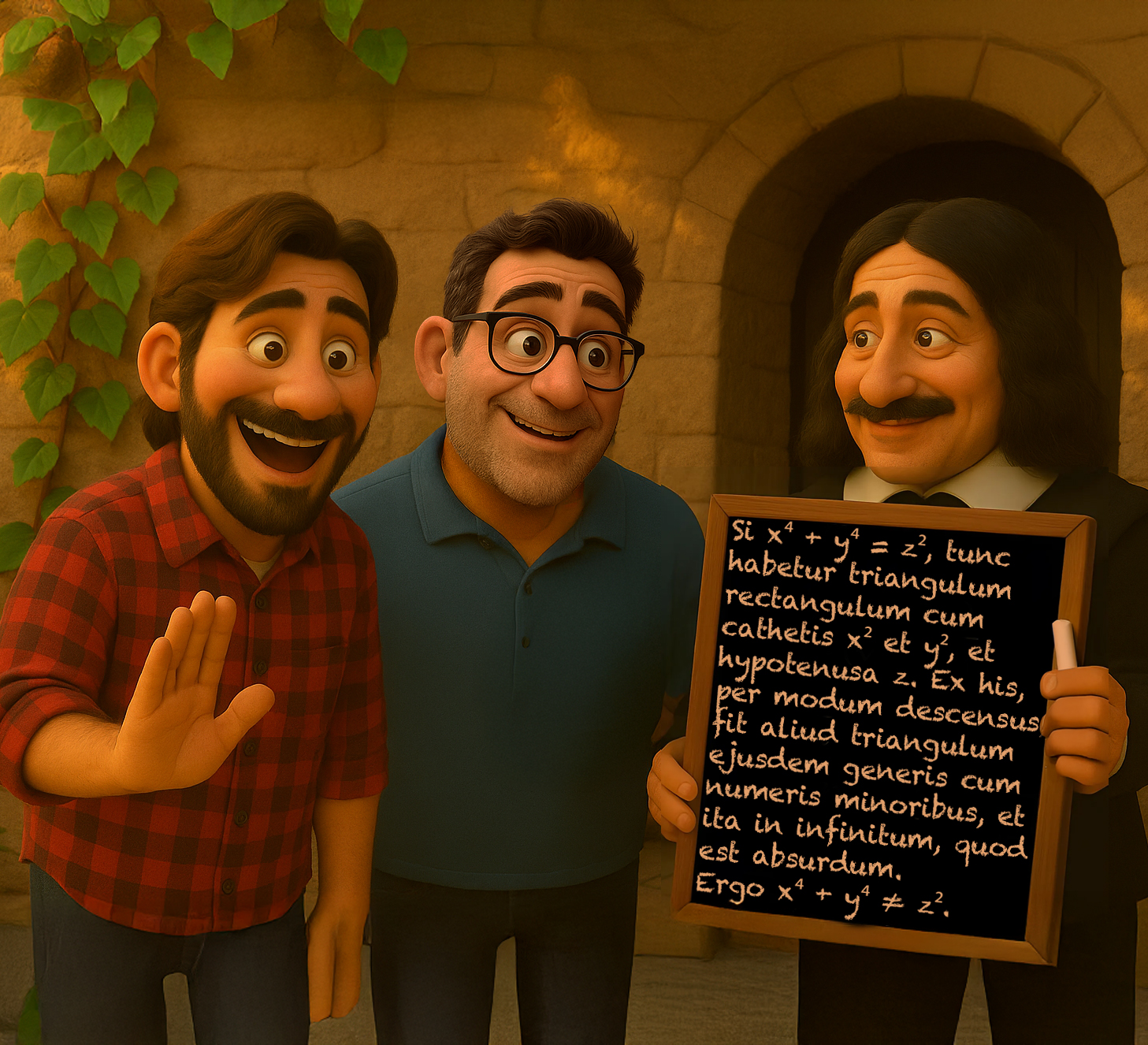 Sophie's Chase: More History of Fermat's Last Theorem | Join us for part two of our deep dive into the history of Fermat's Last Theorem. In this episode, Pete and Noah focus on the fascinating story of Sophie Germain, a 19th century French mathematician who pursued a proof in the face of overwhelming obstacles. Come learn about this impressive chapter in the saga of one of the most interesting problems in mathematical history. Leave us a voice message Find us on Twitter Send us an email Questions Answered in the Episode: • What work did Sophie Germain do to advance the proof of Fermat's Last Theorem? • Why is it sufficient to prove Fermat's Last Theorem only for prime exponents? | — | ||||||
| 4/9/25 |  Non-trivial Pursuit: The History of Fermat's Last Theorem | A few episodes back, our hosts talked about the great unsolved mathematical problems of our time, and Pete teased an interesting story about one such problem that was finally solved not too long ago. In this first of a two-part episode, we dive into the fascinating story of Fermat's Last Theorem... from its inception, to Fermat's bold claim that he had a proof that he couldn't share, to the mathematical greats of yesteryear who took up the challenge to prove it. Join us for a look into this intriguing conjecture, and its amazing history. Leave us a voice message Find us on Twitter Send us an email Questions Answered in the Episode: • What does Fermat's Last Theorem state and how does it relate to the Pythagorean Theorem? • Why is it called Fermat's Last Theorem? | — | ||||||
| 3/5/25 |  The Rules They Are A-Changin': A Conversation with Fluxx Creator Andrew Looney | In this episode, Pete and Noah are joined by Andy Looney, the creator of the card game Fluxx, to talk about Math Fluxx and his history designing games. Whether you're a math person who loves a good game or a game person who loves to do math, we're sure you'll find Andy and his story to be interestingly enjoyable. Game on! Looney Labs Leave us a voice message Find us on Twitter Send us an email Questions Answered in the Episode: • What is Math Fluxx and how do you play it? • How did Andy Looney come up with Math Fluxx and other Fluxx games? | — | ||||||
| 2/12/25 |  A Wrinkle in Spacetime: A Mathematical Discussion about Spacetime | If you've ever seen a science fiction movie or TV show, then you've heard of the spacetime continuum. But what is it, and is there math that describes it? In this episode, Pete and Noah dive into the facts about spacetime, and its fascinating mathematical history. Leave us a voice message Find us on Twitter Send us an email Questions Answered in the Episode: • What is the mathematical definition of spacetime? • How does the Lorentz factor explain time dilation in special relativity? | — | ||||||
| 12/18/24 |  I Have a Little Bias: The Mathematics of Dreidel | It's the holiday season, and Pete and Noah are getting into the festive spirit by looking at the math behind a favorite Hannukah game. Join our hosts as they delve into the probabilities of the dreidel and uncover a counterintuitive truth about its fairness. Whatever traditions you and your family look forward to at this time of year, we promise a lively and interesting time as we take this topic for a spin. Seasons Greetings! • Robert Feinerman's paper, An Ancient Unfair Game Leave us a voice message Find us on Twitter Send us an email Questions Answered in the Episode: • Why is the game of dreidel mathematically unfair, and which player has the statistical advantage? • How do the different possible outcomes of each dreidel spin affect the expected value of the pot for each player? | — | ||||||
| 11/22/24 |  Video Bonus: Finding Primo | In our last episode, finding Primo, Pete explained a couple of tests that mathematicians use when trying to decide if very large numbers are prime. We thought it might be helpful to see the math written down, so we put together this video bonus. Finding Primo - full episode | — | ||||||
| 11/20/24 |  Finding Primo: The Search for Very Large Primes | Have you heard the big news? There's a new largest known prime number, and Noah wants to know how it was discovered. In this episode, Pete explains the various tests used to determine the primality of insanely large numbers, and there's even a prime challenge for you to sink your teeth into. Leave us a voice message Find us on Twitter Send us an email Questions Answered in the Episode: • How are new prime numbers discovered? • What are Mersenne primes and how are they calculated? | — | ||||||
| 11/6/24 |  Talkin' 'bout My Generation: A Deep Dive into The Math Club | Are you ready to revisit the best of The Math Club? Pete and Noah share a trip down memory lane with a pair of special guests. But as they dive deeper into their past episodes, a nagging feeling grows harder to ignore.. Who are these mysterious guests, and what strange secret are they hiding from our hosts? Episodes we reference in our conversation: Tales from Decrypt Positive Thinking Discovery vs. Invention MathGPT Try out NotebookLM Leave us a voice message Find us on Twitter Send us an email | — | ||||||
| 10/23/24 |  Elective Procedures: The Mathematics of Voting Systems | The memory of a restaurant-choosing game from grad school inspires Pete and Noah to look at different voting systems, and the math behind how they work to select a winning candidate. From standard majority rules to ranked choice to plurality with elimination, join our hosts for a lively (and timely) conversation about how our voting system can be just as important as our vote. Leave us a voice message Find us on Twitter Send us an email Questions Answered in the Episode: • What is the Borda count method and how is it used in ranked choice voting? • How does plurality with elimination redistribute votes to determine a winner? | — | ||||||
| 10/2/24 |  Two Heads are Better Than One: A Counterintuitive Coin Flipping Problem | An unlikely string of coin flips leads to a conversation about a counterintuive puzzle that Pete found online. Join in on the fun as Pete and Noah dissect this problem, and talk about multiple ways to approach understanding its solution. • Daniel Litt's Twitter post with the puzzle • Noah's Scratch simulation of the problem • Leave us a voice message • DM us on Twitter • Send us an email Questions Answered in the Episode: • What are the odds of flipping n heads in a row? • In the Daniel Litt coin puzzle, who is more likely to find two heads first: Alice or Bob? | — | ||||||
| 9/18/24 |  Mini Series | Hey Math Club... Pete and Noah need your help with a data mystery, so they put this mini-episode together. If you think you have any info that can help shed some light, drop us a line... Leave us a voice message DM us on Twitter Send us an email | — | ||||||
| 9/11/24 |  Houston, We Have Some Problems: Currently Unsolved Math Questions | Unsolved. From the origin of Stonehenge, to the identity of Jack the Ripper, to the location of all those missing dryer socks, the world is full of unsolved questions. But what about math? Join Pete and Noah as they discuss some of the great unsolved problems facing mathematicians today. Leave us a voice message Find us on Twitter Send us an email Questions Answered in the Episode: • What are some unanswered problems in mathematics. • What is the Goldbach conjecture and how does it relate to prime numbers? • What is the Twin Prime conjecture and how are these pairs distributed along the number line? | — | ||||||
| 8/28/24 |  Making it Count: An Interview with MATHCOUNTS | Pete's efforts to help Noah prepare for an upcoming math competition lead to a conversation with Kristen Chandler, the executive director of MATHCOUNTS. Join Pete and Noah as they learn about this fascinating organization that provides engaging math programs to middle school students around the country. MATHCOUNTS website Email Kristen Chandler Leave us a voice message Find us on Twitter Send us an email Questions Answered in the Episode: • What are the MATHCOUNTS Competition and the MATHCOUNTS National Math Club programs like? • How does the MATHCOUNTS competition structure work across school, chapter, state, and national levels? | — | ||||||
Showing 25 of 81
Pitch Fit is a Pro feature
See how bookable this show is for guests, which brands already advertise, the per-episode ad value, and the best-fit guest and sponsor profile. The numbers are blurred on the free plan.
How readily this show books outside guests like you.
How proven this show is for host-read sponsorships.
For Guests
ProFor Advertisers
ProUpgrade to Pro to unlock guest cadence, sponsor categories, fit scores, and per-episode ad value for this show.
Chart history for The Math Club
Peaked at #1 in New Zealand, top 10 in 12 of 26 tracked markets, currently #1 in New Zealand.
| Market | Genre | Peak | Current | Trend |
|---|---|---|---|---|
| New Zealand | — | #1 | #1 | — |
| HK | — | #1 | #1 | — |
| TR | — | #2 | #2 | — |
| AE | — | #2 | #2 | — |
| Sweden | — | #3 | #3 | — |
| NG | — | #3 | #3 | — |
| PT | — | #5 | #5 | — |
| ID | — | #5 | #5 | — |
| Canada | — | #8 | #8 | — |
| Denmark | — | #8 | #8 | — |
| BE | — | #10 | #10 | — |
| VN | — | #10 | #10 | — |
| United Kingdom | — | #11 | #11 | — |
| India | — | #17 | #17 | — |
| Mexico | — | #17 | #17 | — |
| Ireland | — | #20 | #20 | — |
| Australia | — | #22 | #22 | — |
| Netherlands | — | #22 | #22 | — |
| United States | — | #25 | #25 | — |
| TW | — | #27 | #27 | — |
Chart Positions
26 placements across 24 markets.
Chart Positions
26 placements across 24 markets.