

Insights from recent episode analysis
Audience Interest
Podcast Focus
Publishing Consistency
Platform Reach
Insights are generated by CastFox AI using publicly available data, episode content, and proprietary models.
Est. Listeners
Based on iTunes & Spotify (publisher stats).
- Per-Episode Audience
Est. listeners per new episode within ~30 days
10,001 - 25,000 - Monthly Reach
Unique listeners across all episodes (30 days)
25,001 - 75,000 - Active Followers
Loyal subscribers who consistently listen
15,001 - 40,000
Market Insights
Platform Distribution
Reach across major podcast platforms, updated hourly
Total Followers
—
Total Plays
—
Total Reviews
—
* Data sourced directly from platform APIs and aggregated hourly across all major podcast directories.
On the show
Recent episodes
#101 When Great Technology Is Not Enough with Shai Policker: Why most MedTech Startups Still Fail, Venture Studios vs VC and the Israeli Edge
May 4, 2026
Unknown duration
#99 Stop Calling It AI: Machine Learning, LLMs and the Truth About Healthcare Automation with Manish Patel
Apr 6, 2026
Unknown duration
#98 The Hidden Cost of Bad MedTech Strategy: Women’s Health, Reimbursement and What Founders Miss with Jordan Pollack
Mar 23, 2026
Unknown duration
#90 The Metabolic Signal You’re Probably Ignoring with Jari Närhi: NAD Testing, Longevity & Cellular Health
Oct 22, 2025
Unknown duration
#89 Reframing Fertility with Kirsten Karchmer: AI, Cycle Health, and FemTech’s Untapped Potential
Oct 6, 2025
Unknown duration
Social Links & Contact
Official channels & resources
Official Website
Login
RSS Feed
Login
| Date | Episode | Description | Length | ||||||
|---|---|---|---|---|---|---|---|---|---|
| 5/4/26 | 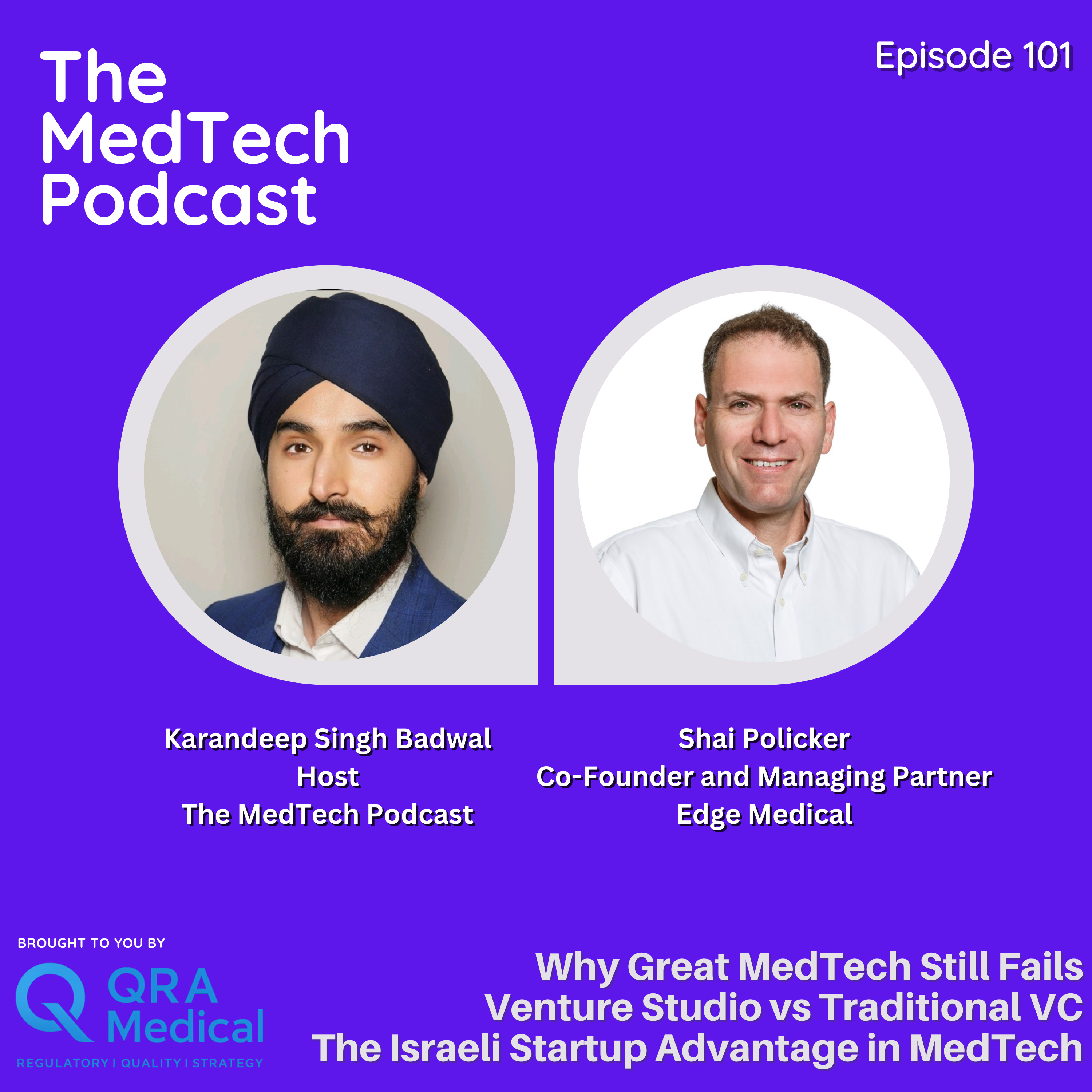 #101 When Great Technology Is Not Enough with Shai Policker: Why most MedTech Startups Still Fail, Venture Studios vs VC and the Israeli Edge #101 When Great Technology Is Not Enough with Shai Policker: Why most MedTech Startups Still Fail, Venture Studios vs VC and the Israeli Edge | Shai Policker, Co-Founder and Managing Partner at Edge Medical Ventures, a medtech venture studio and fund focused on developing and investing in medical devices that address unmet clinical needs. With a BSc in Electrical Engineering from the Technion, an MBA from Columbia Business School and over 25 years building medical device companies, Shai has founded or scaled 18 companies across cardiovascular care, surgery and respiratory health, filing more than 40 patents along the way.In this episode, Shai cuts straight to something most investors won't say out loud: that even a great technology with strong clinical data can still fail. Not because the product is wrong but because the process takes too long and the funding runs out. He breaks down the fragmented decision-making landscape in healthcare, why physicians loving your product means almost nothing if the payer isn't on board and why reimbursement is the real gatekeeper that kills more companies than bad science ever will.We also explore what makes Edge Medical Ventures different from a traditional VC fund. Shai explains how their venture studio model starts from validated unmet needs with a strategic partner already at the table and how their hands-on go-to-market support continues well past the R&D phase. A combination that helped one portfolio company go from zero to FDA approval with distribution agreements and paying customers on just $2.5 million. We also get into the Israeli startup mindset, the right way to think about IP and patents and how to know when a founder should step aside.Timestamps[00:00:17] What Pulled an Electrical Engineer Into MedTech 25 Years Ago[00:01:48] What 18 Companies Taught Shai That One Never Could[00:03:04] How to Know If the Problem Is Painful Enough to Build Around[00:04:56] Why 80% of MedTech Startups Fail Even With Great Technology[00:07:53] What a Venture Studio Actually Is and How It Differs From a VC Fund[00:10:51] The $2.5 Million Company That Got FDA Approval and Started Selling[00:13:54] Why Israeli Startups Move Faster Than Everyone Else[00:17:28] How to Think About Patents Without Becoming Obsessed With Them[00:23:44] Balancing Speed and Discipline Without Creating Expensive Mistakes[00:26:20] Final Advice: What Shai Wishes Every MedTech Founder KnewConnect with Shai - https://www.linkedin.com/in/shai-policker-b8760a3/Learn more about Edge Medical Ventures - https://edgemed.vc/Get in touch with Karandeep Badwal - https://www.linkedin.com/in/karandeepbadwal/ Follow Karandeep on YouTube - https://www.youtube.com/@KarandeepBadwalMedical device training courses delivered by Karandeep through Bywater - https://www.bywater.co.uk/ | — | ||||||
| 4/6/26 |  #99 Stop Calling It AI: Machine Learning, LLMs and the Truth About Healthcare Automation with Manish Patel #99 Stop Calling It AI: Machine Learning, LLMs and the Truth About Healthcare Automation with Manish Patel | Dr. Manish Patel, co-founder and CEO of Jiva.ai and Chair of the AI Subcommittee at the BIA, where he advises the UK Government on AI policy, data privacy and healthcare applications. With a PhD in Modelling of Complex Systems from UCL and nearly a decade building algorithmic trading systems in investment banking, Manish brings a rare depth of perspective to the most overhyped term in healthcare right now.In this episode, we cut through the noise on AI. Manish challenges the very language we use, explaining why most of what gets called "AI" is really machine learning, why large language models are fundamentally not intelligent and why that distinction has very real consequences when lives are on the line. We look at where AI genuinely adds value in healthcare, from radiology to NHS administrative workflows, and where it is being dangerously overhyped, including some very pointed thoughts on using consumer-grade LLMs to make clinical diagnoses.We also explore how clinicians should think about AI as an augmenter rather than a replacement, why the productivity gains are real and where Manish believes the biggest untapped opportunity in healthcare actually sits. He closes with a frank take on what impressive AI looks like in a real clinical environment versus a polished demo and why the world is heading toward a very small group of people who truly understand what is happening under the hood.Thanks for tuning in to Episode 99. Don't forget to subscribe and check the show notes to learn more about Manish's work at Jiva.ai and his advisory role shaping UK AI policy in healthcare.Timestamps[00:00:28] From the Human Genome Project to Machine Learning: Manish's Academic Origins [00:02:09] AI Has Been Around Since the 1950s: The History Most People Don't Know [00:04:09] Why Tacking "AI" onto Your Product Name Is a Problem [00:05:24] Where Healthcare AI Really Is: Step Three Not Step 100 [00:06:06] Why Using Grok for Medical Diagnosis IsDangerous [00:09:48] Should Clinicians Be Scared AI Will Take Their Jobs?[00:12:18] How to Actually Start Learning About AI: Where to Begin [00:14:01] Writing the Book on AI Agents in 2011 [00:18:04] The Biggest Untapped Opportunity: Administrative AI Not Diagnostic AI [00:20:40] What Real Clinical AI Success Looks Like vs a Polished DemoConnect with Manish- https://www.linkedin.com/in/manish-patel/Learn more about Jiva ai - https://jiva.ai/Get in touch with Karandeep Badwal - https://www.linkedin.com/in/karandeepbadwal/ Follow Karandeep on YouTube - https://www.youtube.com/@KarandeepBadwal | — | ||||||
| 3/23/26 | 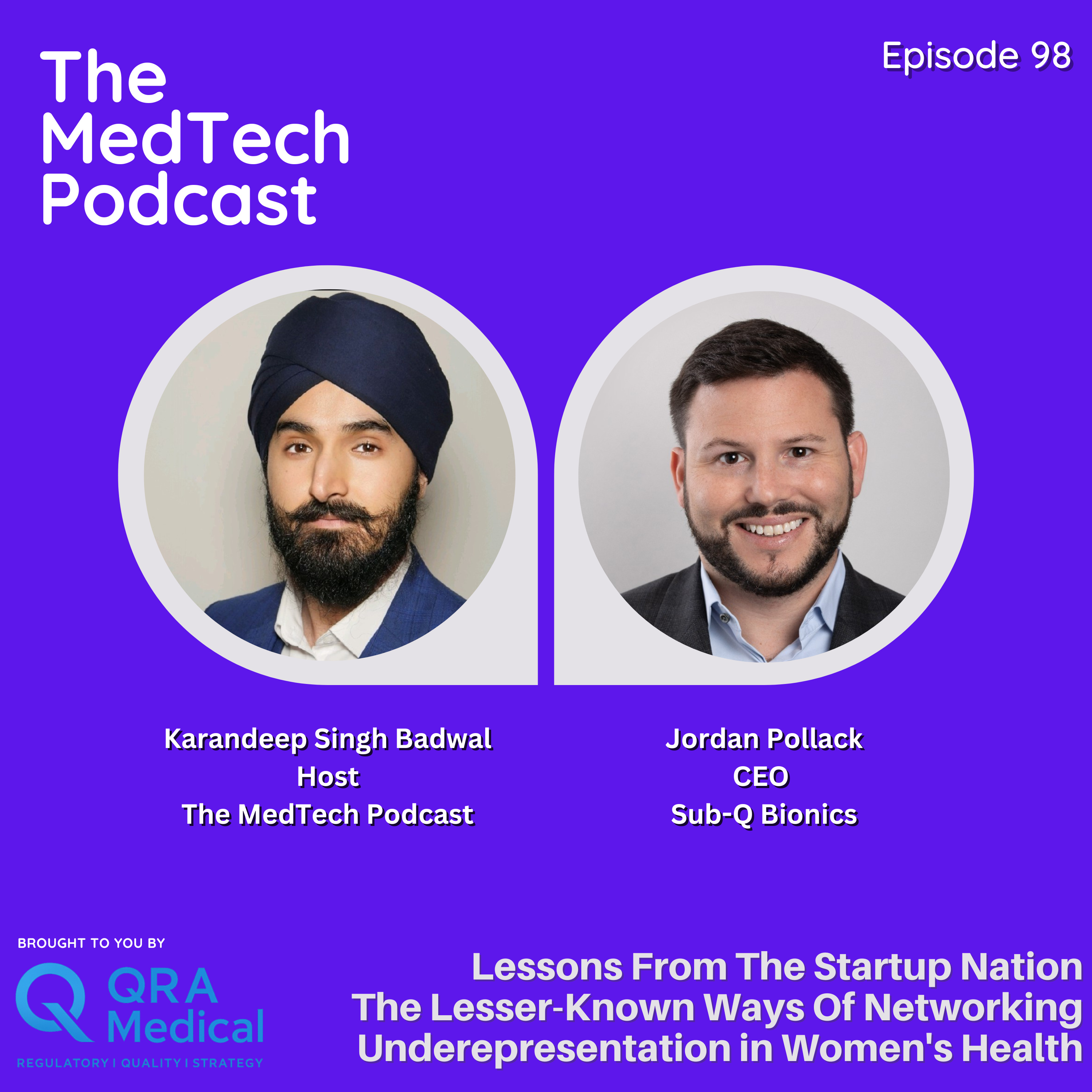 #98 The Hidden Cost of Bad MedTech Strategy: Women’s Health, Reimbursement and What Founders Miss with Jordan Pollack #98 The Hidden Cost of Bad MedTech Strategy: Women’s Health, Reimbursement and What Founders Miss with Jordan Pollack | Jordan Pollack, biomedical engineer, entrepreneur and CEO of Sub-Q Bionics. Jordan began his career at Boston Scientific, later founded VeinWay in Israel and is now focused on building a new treatment paradigm for lymphoedema in cancer survivors.In this episode, we explore what actually creates momentum in MedTech, from networking with intent to building the resilience needed to survive the founder journey. Jordan shares why conferences alone rarely deliver results, how warm introductions and targeted roadshows outperform generic networking and what he had to unlearn after leaving corporate structure behind to become a startup CEO. He also offers a brutally honest take on entrepreneurship, explaining why the role is not for everyone and why persistence, resilience and equanimity matter more than titles or ambition alone.We also go deep into the story behind Sub-Q Bionics and why Jordan chose to focus on lymphoedema, particularly in women recovering from cancer treatment. He explains the clinical reality of the disease, the lack of meaningful treatment options beyond maintenance, and why reimbursement, not just good technology, is often the deciding factor in whether a device company succeeds. Along the way, he shares sharp insights on women’s health being chronically underfunded, the differences between the U.S. and Israeli startup ecosystems, and why mission-led companies are far more likely to stay the course when things get hard.Timestamps[00:00:32] Why Generic Conferences Rarely Create Real MedTech Opportunity[00:02:05] How Networking Shaped Jordan’s Move from Boston Scientific to Israel[00:03:29] What Corporate MedTech Taught Him and What He Had to Unlearn[00:05:54] Why Being a Founder Is Not for Everyone[00:08:49] The Origin of Sub-Q Bionics and the Shift Toward True Disease Treatment[00:11:53] What Lymphoedema Actually Is and Why It Is So Devastating[00:14:06] Why Women’s Health Remains Underfunded and Where Innovation Is Emerging[00:18:25] Why Reimbursement Matters More Than Technology Alone[00:20:58] U.S. vs Israel: Two Very Different Startup Ecosystems[00:25:10] Balancing Founder Life, Health, Travel and RelationshipsConnect with Jordan - https://www.linkedin.com/in/jordan-pollack-81464827/Learn more about Sub-Q Bionics - https://subqbionics.com/Get in touch with Karandeep Badwal - https://www.linkedin.com/in/karandeepbadwal/ Follow Karandeep on YouTube - https://www.youtube.com/@KarandeepBadwalSubscribe to the Podcast | — | ||||||
| 10/22/25 | 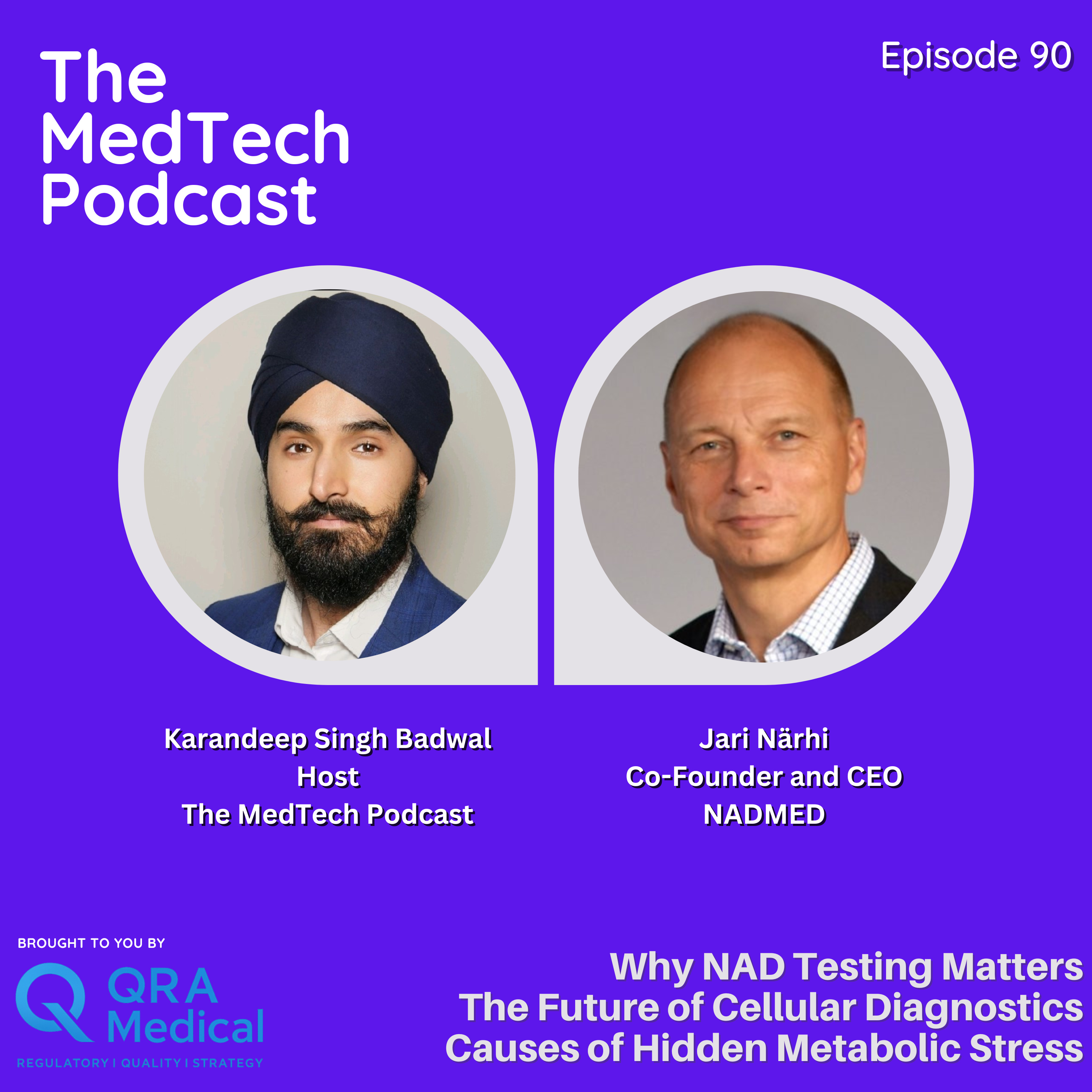 #90 The Metabolic Signal You’re Probably Ignoring with Jari Närhi: NAD Testing, Longevity & Cellular Health #90 The Metabolic Signal You’re Probably Ignoring with Jari Närhi: NAD Testing, Longevity & Cellular Health | Jari Närhi, Co-Founder and CEO of NADMED, a University of Helsinki spin-out revolutionising how we understand and monitor NAD levels. With a background in mechanical engineering and a career spanning medtech, diagnostics and hospital operations, Jari brings a unique systems-level view on cellular health and innovation in clinical testing.In this episode, we explore why NAD (nicotinamide adenine dinucleotide) is so vital for human health, from fuelling ATP production to supporting DNA repair and immune regulation. Jari breaks down the science of NAD+, NADH and glutathione and why traditional lab methods like mass spectrometry have long failed to make NAD testing practical or scalable. We discuss the real-world impact of measuring NAD levels, from chronic illness to long COVID, and how this simple test could become as common as checking haemoglobin in the future.Jari also opens up about NADMED’s regulatory journey, the ethical dilemmas of DIY supplementation, the rise of longevity tech, and how AI will transform personalised diagnostics through pattern recognition in metabolic biomarkersTimestamps:[00:00:45] Age vs Disease: What Really Impacts NAD Levels[00:02:28] Why NAD Is Essential for Life[00:03:52] How NAD Decline Signals Deeper Health Issues[00:05:05] From Niacin to NAD: Understanding the B3 Pathway[00:06:00] CE‑Marking and Regulatory Hurdles for Diagnostics[00:06:59] How NADMED Made Testing Faster and More Accessible[00:09:02] The Ethics of Supplementation Without Testing[00:10:16] The VC Path: Funding Deep‑Tech MedTech Innovation[00:14:02] Metabolic Fingerprints and Personalised Medicine[00:17:11] AI, Data and the Future of Longevity DiagnosticsConnect with Jari - https://www.linkedin.com/in/jari-n%C3%A4rhi-38b44/ Learn more about NADMED - https://www.nadmed.com/ Get in touch with Karandeep Badwal - https://www.linkedin.com/in/karandeepbadwal/ Follow Karandeep on YouTube - https://www.youtube.com/@KarandeepBadwalSubscribe to the Podcast | — | ||||||
| 10/6/25 |  #89 Reframing Fertility with Kirsten Karchmer: AI, Cycle Health, and FemTech’s Untapped Potential #89 Reframing Fertility with Kirsten Karchmer: AI, Cycle Health, and FemTech’s Untapped Potential | Kirsten Karchmer, founder of Conceivable, is one of North America's first reproductive acupuncturists. With a career spanning clinical practice, software development and AI integration, Kirsten brings a fresh, deeply personal perspective to the future of women’s healthIn this episode, we explore the root causes of infertility and why simply timing intercourse isn’t enough. Kirsten breaks down the concept of the “Conceivable Cycle,” how subclinical symptoms reveal deeper fertility issues, and why most women are misled by generic wellness advice. She also shares the story behind building an AI-powered virtual care platform, one designed not to replace doctors, but to give millions of women access to tools that previously cost tens of thousands in clinical care.We also talk about IVF, when it should be used, and how even women in their 40s can significantly boost fertility outcomes by improving internal health metrics. The conversation ends with Kirsten’s advice to female founders, the role of automation and AI in running a business and how her unexpected obsession with houseplants helps restore balance in a founder's high-stress lifeTimestamps:[00:00:45] From MS Diagnosis to Reproductive Medicine[00:02:26] Why Fertility Monitors May Be Doing More Harm Than Good[00:04:22] How to Actually Know If You’re Fertile[00:05:00] What the “Conceivable Score” Reveals[00:07:04] Building an AI OS for Women’s Health[00:10:15] Signs of a Healthy vs. Unhealthy Menstrual Cycle[00:13:46] When IVF Makes Sense and When It Doesn’t[00:16:03] Fertility After 35: Misconception or Reality?[00:18:00] The Resistance (and Reception) from Clinicians[00:21:02] Advice for Female Founders and Women in FemTechGet in touch with Kirsten - https://www.linkedin.com/in/kirsten-karchmer-0139808/ Learn more about Conceivable - https://conceivable.com/Get in touch with Karandeep Badwal - https://www.linkedin.com/in/karandeepbadwal/ Follow Karandeep on YouTube - https://www.youtube.com/@KarandeepBadwalSubscribe to the Podcast | — | ||||||
| 9/1/25 | 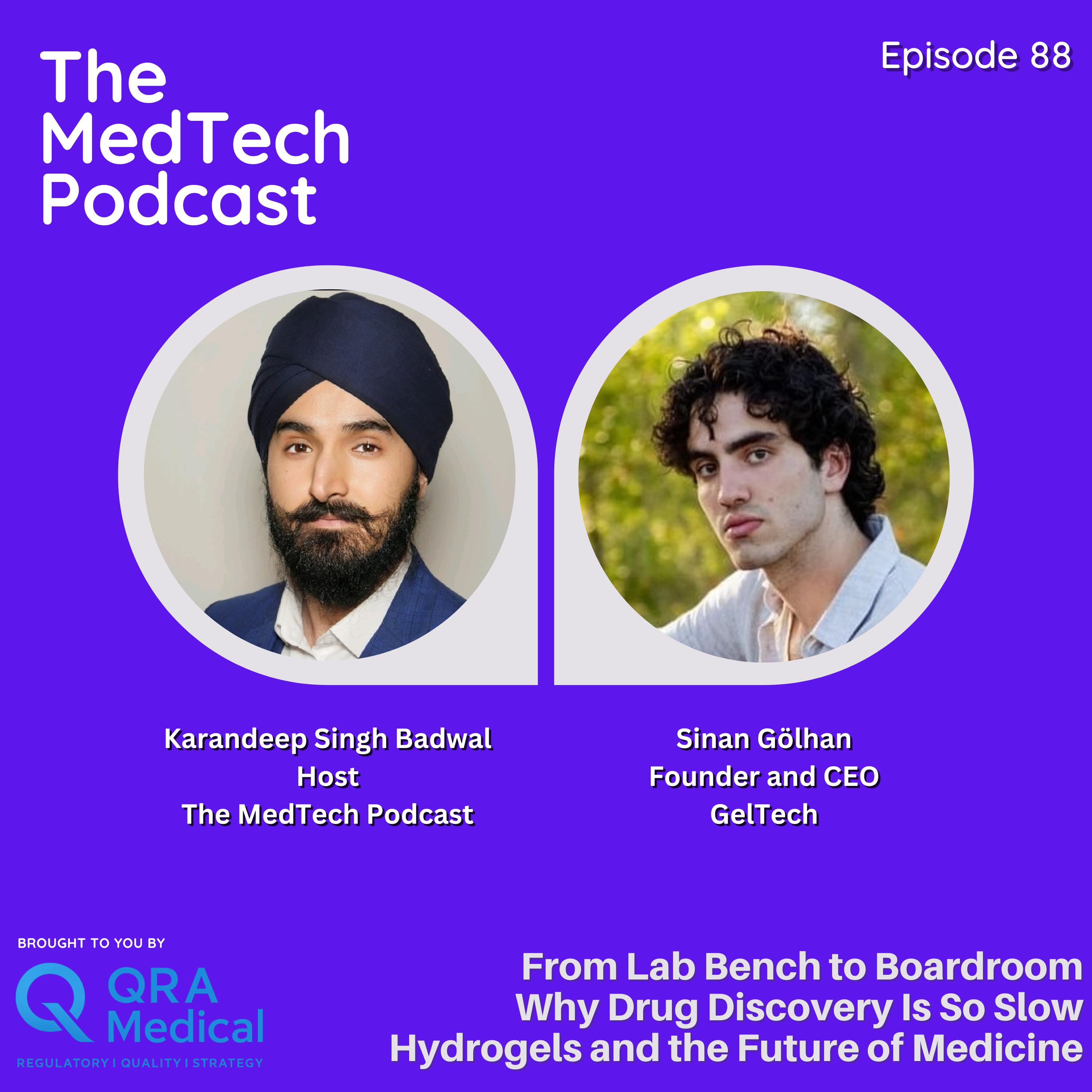 #88 Hydrogel Tech and Lab Automation with Sinan Golhan: Hydrogel Robotics, Startup Fundraising and Battlefield Medicine #88 Hydrogel Tech and Lab Automation with Sinan Golhan: Hydrogel Robotics, Startup Fundraising and Battlefield Medicine | Sinan Gölhan, Founder and CEO of GelTech is helping scientists develop life-saving hydrogel treatments faster through automation. From cancer-fighting gels to battlefield-ready biomaterials, Sinan’s journey fuses deep technical insight with an intensely personal mission.In this episode, we talk about why hydrogels, the “Jell-O of medicine”, are so important in modern biotech, and how Sinan’s frustration with repetitive lab work led him to build robotic systems to accelerate testing. He shares hard-won lessons from early fundraising, what labs get wrong about automation, and how he turned rejection into resilience. We also dive into the world of battlefield bleeding control, nanotech-based drug delivery, and the future of AI-driven materials science.Timestamps:[00:00:18] What Are Hydrogels and Why They Matter[00:02:30] A Personal Mission: Cancer, Family and Science[00:04:45] From Lab Frustration to Robotic Innovation[00:06:33] Fundraising Real Talk: Angels, Grants, and Grit[00:10:42] How GelTech’s Platform Actually Works[00:13:33] Hydrogels in Your Fridge and in the OR[00:14:54] Why Lab Automation Isn’t a Luxury[00:16:23] The Coming Wave of Smart Materials[00:20:11] Battlefield Nanotech: Bleeding Control with Gels[00:27:25] Advice to Founders: Obsession, Vision and PersistenceGet in touch with Sinan - https://www.linkedin.com/in/sinan-g%C3%B6lhan-a49691b6/ Learn more about Exagen - https://www.geltechlabs.com/ Get in touch with Karandeep Badwal - https://www.linkedin.com/in/karandeepbadwal/ Follow Karandeep on YouTube - https://www.youtube.com/@KarandeepBadwalSubscribe to the Podcast | — | ||||||
| 8/5/25 | 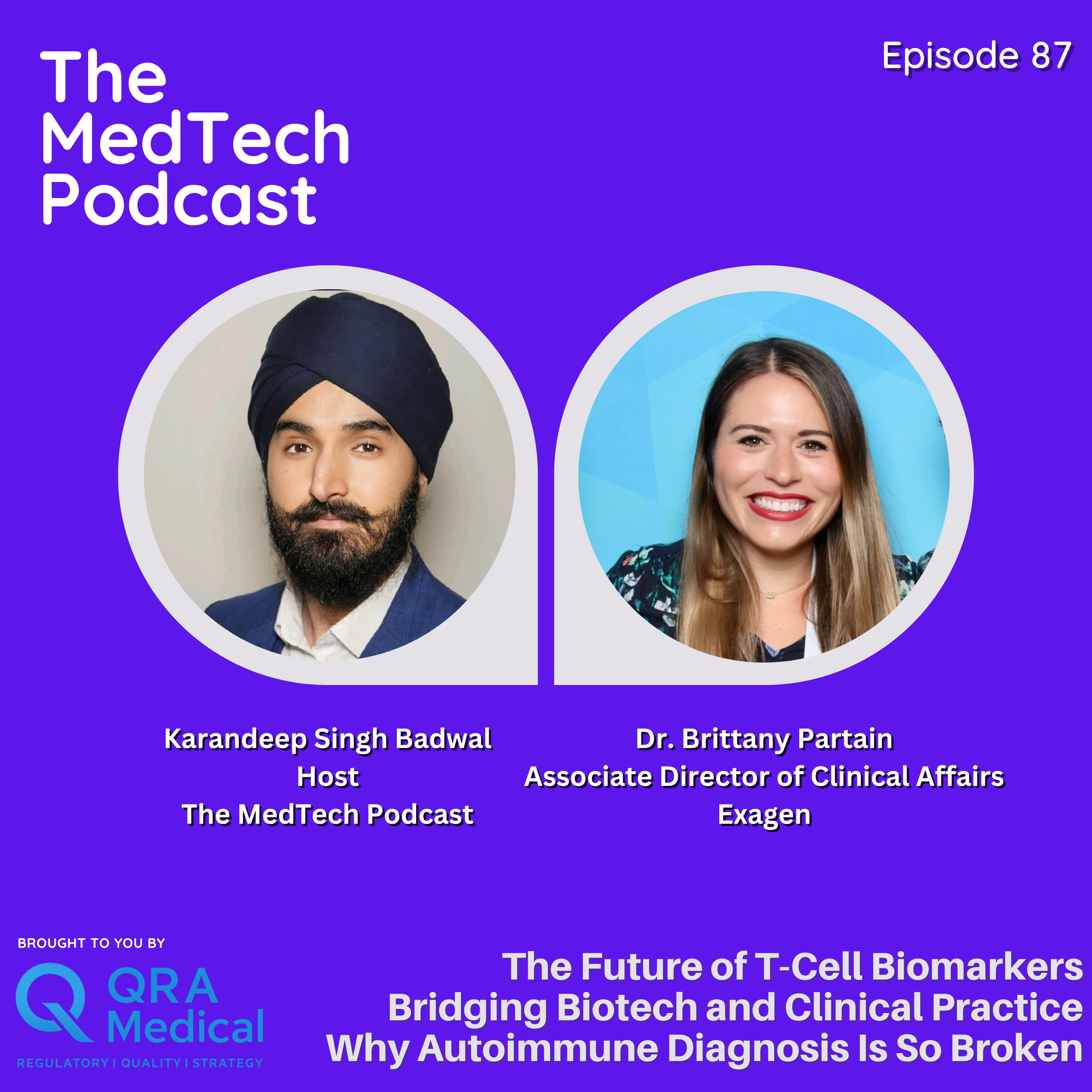 #87 Diagnosing the Undiagnosable with Dr. Brittany Partain: T-Cell Biomarkers, Clinical Trust and Women in Biotech #87 Diagnosing the Undiagnosable with Dr. Brittany Partain: T-Cell Biomarkers, Clinical Trust and Women in Biotech | Dr. Brittany Partain, Associate Director of Clinical Affairs and Physician Education at Exagen has a background in biomedical engineering and a passion for problem-solving, Brittany has carved out a unique role at the intersection of diagnostics, clinical education and biotech innovationIn this episode, we explore why autoimmune diseases like lupus and rheumatoid arthritis are so difficult to diagnose, and how Brittany is helping close that gap through physician education and the use of novel T-cell biomarkers. We also talk about building trust with clinicians, misconceptions around diagnostic tools, and the real challenges of advancing innovation in a field that’s historically lagging behind specialities like oncology. Finally, Brittany reflects on her journey as a female leader in MedTech, the importance of collaboration, and why passion matters when navigating a fast-paced, highly regulated industryTimestamps:[00:00:45] Why Autoimmune Diseases Are So Difficult to Diagnose[00:01:55] From Biomedical Engineering to Clinical Affairs[00:04:34] Why Rheumatology Has Lagged Behind[00:07:07] How T-Cell Biomarkers Work and What They Solve[00:09:18] What Autoimmune Diseases Are and How They Present[00:11:05] Common Misconceptions Among Clinicians[00:13:00] How Hospitals and Private Clinics React to New Tools[00:15:07] Building Clinical Trust Through Science[00:18:05] What Most People Don’t Know About Autoimmune Disease[00:21:58] Women in Biotech: Breaking Stereotypes and Leading ChangeGet in touch with Brittany - https://www.linkedin.com/in/brittany-d-partain Learn more about Exagen - https://exagen.com/ Get in touch with Karandeep Badwal - https://www.linkedin.com/in/karandeepbadwal/ Follow Karandeep on YouTube - https://www.youtube.com/@KarandeepBadwalSubscribe to the Podcast | — | ||||||
| 7/22/25 |  #86 Sepsis, Speed and Saving Lives with Dr. Rolland Carlson: Gene Signatures, Clinical Trials, and the Future of Infection Detection #86 Sepsis, Speed and Saving Lives with Dr. Rolland Carlson: Gene Signatures, Clinical Trials, and the Future of Infection Detection | Dr. Rolland “Rollie” Carlson, CEO of Immunexpress is a veteran of the molecular diagnostics space. With over 25 years of leadership across Abbott, WaferGen, Asuragen, and more, Rollie is now focused on solving one of healthcare’s most urgent crises: Sepsis.In this episode, we explore why sepsis, despite causing more than 48 million deaths annually remains so poorly understood and misdiagnosed. Rollie breaks down why early detection is so difficult, how gene expression profiling can finally distinguish between infectious and non-infectious inflammation and the real-world barriers to clinical trial design, FDA approval and physician adoption. We also cover military use cases, the lack of gold standards in sepsis diagnostics and what needs to change in how hospitals are incentivised to tackle this conditionTimestamps:[00:00:26] Why Sepsis Remains Underdiagnosed Globally[00:01:42] What Sepsis Actually Is and Why It's So Deadly[00:03:14] Who’s Most at Risk: Age, Immunity, and Beyond[00:04:25] Detecting Sepsis Through Gene Expression[00:05:39] Why Blood Cultures Aren’t Enough Anymore[00:09:14] FDA Approval Without a Gold Standard: The Regulatory Maze[00:12:39] Sepsis Isn’t Always Bacterial and Why That Matters[00:15:20] How Physicians Are Reacting to New Molecular Tools[00:17:35] Beyond Sepsis: Expansion Into Infectious Diseases[00:18:57] From Marine Biologist to Diagnostics PioneerGet in touch with Rollie - https://www.linkedin.com/in/rollie-carlson-ph-d-059074a/ Learn more about Immunexpress - https://immunexpress.com/ Get in touch with Karandeep Badwal - https://www.linkedin.com/in/karandeepbadwal/ Follow Karandeep on YouTube - https://www.youtube.com/@KarandeepBadwalSubscribe to the Podcast | — | ||||||
| 7/8/25 | 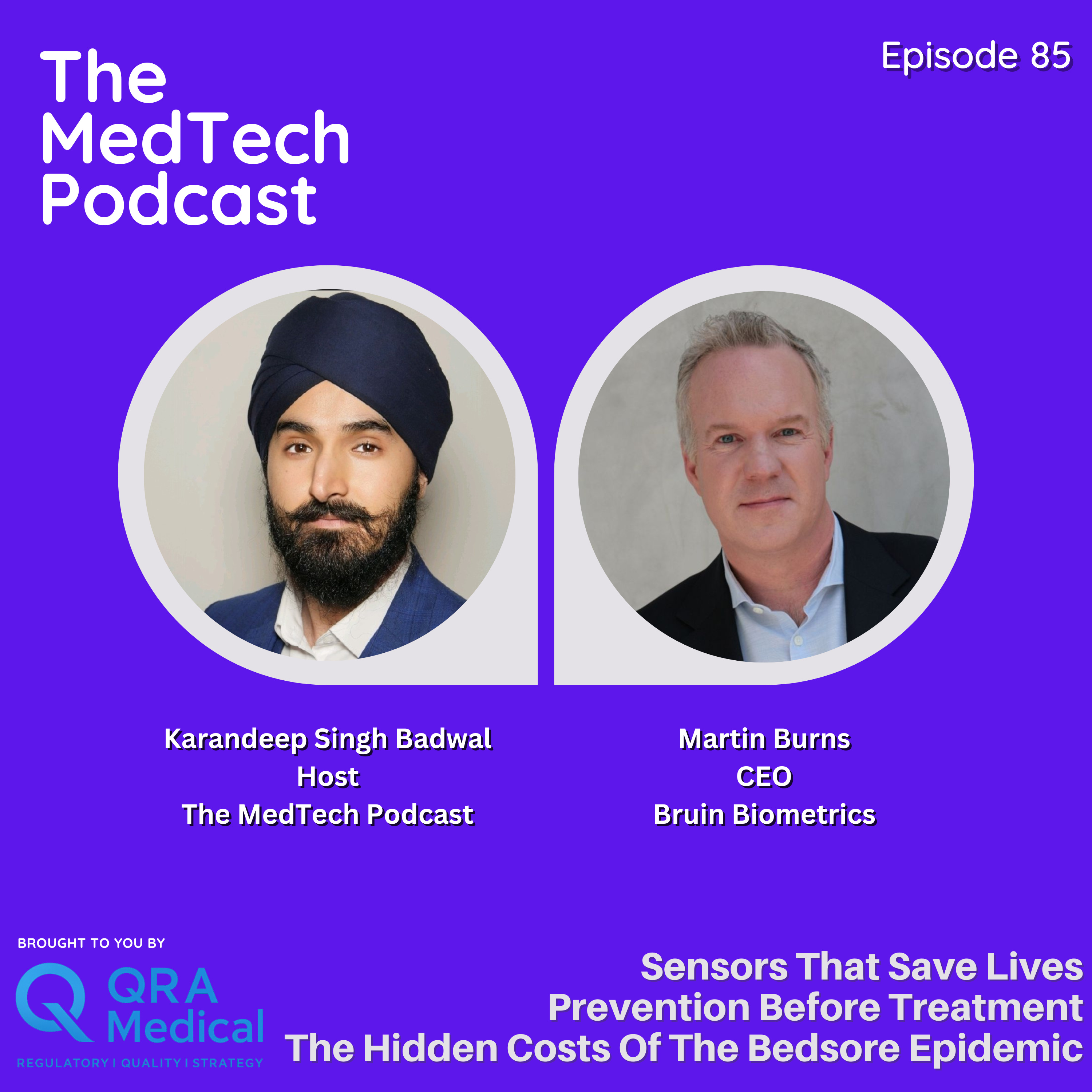 #85 Under the Skin with Martin Burns: Bedsores, Biology-Based Prevention & The Hidden Cost of Inaction #85 Under the Skin with Martin Burns: Bedsores, Biology-Based Prevention & The Hidden Cost of Inaction | Martin Burns, CEO of Bruin Biometrics is a former management consultant who worked with Deloitte and PwC and has also served as a guest lecturer at UCLA Anderson School of Management, where he taught entrepreneurship in biotechnologyAt Bruin, Martin is leading the charge to bring pressure injury (bedsore) prevention into the 21st century. Bedsores are entirely preventable yet remain one of the most under-discussed threats in hospitals today, especially among patients with darker skin tones who are often overlooked by traditional visual assessmentsIn this episode, Martin explains why a biology-first approach is needed to tackle these “silent killers,” the major cultural and systemic hurdles to adoption, and why he believes sensor technology should become as routine as checking blood oxygen levels. We also explore investor skepticism, the importance of diverse clinical validation and the operational realities of implementing new technologies in hospitals without disrupting workflowsTimestamps:[00:00:18] What Are Pressure Injuries and Why They’re Deadly[00:02:12] The Moment Martin Saw the Real Problem[00:03:58] The Biology of Subepidermal Moisture[00:06:53] Turning a Science Project into a Scalable Product[00:10:06] Why Traditional Risk Assessments Fail[00:12:41] Addressing Skin Tone Bias in Wound Care[00:17:14] From Skepticism to Adoption: Changing Clinical Culture[00:21:55] Beyond Bedsores: Future Sensor Applications[00:24:17] The Nurse Assistant That Frees Up Hours[00:26:52] Mountains, Gym Days & Recharging Outside WorkGet in touch with Martin - https://www.linkedin.com/in/martin-burns-9391a57/ Learn more about Bruin - https://sem-scanner.com/ Get in touch with Karandeep Badwal - https://www.linkedin.com/in/karandeepbadwal/ Follow Karandeep on YouTube - https://www.youtube.com/@KarandeepBadwalSubscribe to the Podcast | — | ||||||
| 6/9/25 |  #84 Fast-Tracking Clinical Trials with Julio G. Martinez-Clark: LATAM Strategy, FIH Studies & MedTech Market Access #84 Fast-Tracking Clinical Trials with Julio G. Martinez-Clark: LATAM Strategy, FIH Studies & MedTech Market Access | Julio G. Martinez-Clark CEO of Bioaccess and President of IAOCR/GCSA Americas is a MedTech trailblazer helping startups accelerate First-in-Human (FIH) clinical trials across Latin America, with over 20 years of experience spanning healthcare, telecom and venture capitalIn this episode, we unpack why more MedTech companies are turning to LATAM for faster, more cost-effective trial execution. Julio shares how his Miami-based CRO helps deliver 58-day CE mark approvals, his experience supporting 100+ device startups and why time, not money, is the most precious currency for early-stage founders. We also touch on trial quality, regulatory strategy and why he believes Latin America will play a defining role in the next era of global MedTech innovationTimestamps:[00:00:47] Why LATAM Is the Next MedTech Trial Hub[00:02:21] The Problem with FIH Trials in the U.S.[00:04:42] How bioaccess® Reduces Approval Timelines by 70%[00:06:01] Strategic Sites, Patient Retention & CRO Infrastructure[00:08:17] Do LATAM Trials Hold Up to FDA & EU Scrutiny?[00:10:43] The Fundraising Pressure Behind Faster Clinical Results[00:12:22] Founder Mistakes in In-House Trial Management[00:14:11] Why LATAM May Overtake Eastern Europe in FIH Volume[00:17:26] Regulatory Standards, UNESCO, and Regional Quality[00:20:10] Julio Outside the Office: Family, Fitness & PodcastingGet in touch with Julio - https://www.linkedin.com/in/juliomartinezclark/Learn more about Bioaccess - https://www.bioaccessla.com/ Get in touch with Karandeep Badwal - https://www.linkedin.com/in/karandeepbadwal/ Follow Karandeep on YouTube - https://www.youtube.com/@KarandeepBadwalSubscribe to the Podcast | — | ||||||
Want analysis for the episodes below?Free for Pro Submit a request, we'll have your selected episodes analyzed within an hour. Free, at no cost to you, for Pro users. | |||||||||
| 5/19/25 |  #83 Frequencies, Fields and the Future of Wellness with Mark L. Fox: From NASA to Neuromodulation and PEMF Therapy #83 Frequencies, Fields and the Future of Wellness with Mark L. Fox: From NASA to Neuromodulation and PEMF Therapy | Mark Fox founder and CEO of Resona Health is a former NASA space shuttle engineer turned wellness-tech entrepreneur. From designing spacecraft to pioneering wearable PEMF (Pulsed Electromagnetic Field) therapy, Mark brings a rare blend of hardcore engineering and holistic healthcare innovationIn this episode, we dive deep into the world of energy medicine from the scientific foundations of PEMF and resonance frequency therapy to its real-world impact on mental clarity, emotional regulation and chronic pain. Mark also walks us through the uphill battle with FDA compliance, the hidden power of vagus nerve stimulation and the unexpected physics that connect hot air balloons to healthcare innovation. It's a fascinating mix of engineering, wellness tech and startup gritTimestamps:[00:00:35] From NASA to Neuromodulation: Mark’s Origin Story[00:03:05] What Is PEMF Therapy? Explaining the Basics[00:05:48] The New Vagus Nerve Device: Chest vs Neck Placement[00:08:40] Why Frequency > Voltage: Ditching Electrodes for Fields[00:11:22] How Resona Built a 98% Success Rate with Pocket PEMF[00:13:33] Frequency over Pharma: A Founder’s Clinical Pivot[00:16:02] The Compliance Trap: How the FDA Deals With Wellness Claims[00:18:50] Using GPTs for Regulatory Copywriting (and Staying Legal)[00:21:10] What the Body Teaches You When You Build for It[00:24:16] Life Outside of Resona: Flying, Sailing and Freedom to TinkerGet in touch with Mark - https://www.linkedin.com/in/mark-fox-ab589110/ & https://resona.health/ Get in touch with Karandeep Badwal - https://www.linkedin.com/in/karandeepbadwal/Follow Karandeep on YouTube - https://www.youtube.com/@KarandeepBadwal | — | ||||||
| 5/5/25 |  #82 The 5 Pillars of MedTech Startup Success with Jón Ingi Bergsteinsson: MedTech SaaS, Clinical Trials and Commercial Strategy #82 The 5 Pillars of MedTech Startup Success with Jón Ingi Bergsteinsson: MedTech SaaS, Clinical Trials and Commercial Strategy | Jón Ingi Bergsteinsson MedTech founder, former CTO of SMART-TRIAL and now a startup advisor and investor via LIFA Ventures. With 10+ years of hands-on experience scaling a SaaS company in regulated healthcare, Jón offers a rare blend of technical and commercial insight.In this episode, we talk about why founders should stop treating regulatory and commercial teams like separate planets, how VCs really evaluate MedTech startups, and what SaaS-style thinking can teach traditional device companies. Jón also walks us through his “founder-to-fund” journey, shares common pitfalls in clinical trial design and gives a blunt take on why copying pharma’s playbook won’t work in MedTech.Timestamps:[00:00:35] Why MedTech Startups Still Struggle to Scale[00:03:41] Building SMART-TRIAL Without Venture Capital[00:06:25] Regulatory & Clinical Teams Need to Talk More[00:09:50] LIFA Ventures: Investing Beyond the Spreadsheet[00:12:12] The Hidden Cost of Ignoring Commercialization[00:14:07] Copying Pharma? That’s a Mistake[00:17:33] Europe vs U.S. Startup Culture: What Founders Get Wrong[00:20:45] Advice for Early-Stage Founders in Regulated Health[00:24:28] Jón’s Life Beyond MedTech: Coaching, Family & Hobbies[00:26:12] One Thing He Wishes Founders Would Stop DoingGet in touch with Jón - https://www.linkedin.com/in/joningib/ Get in touch with Karandeep Badwal - https://www.linkedin.com/in/karandeepbadwal/ Follow Karandeep on YouTube - https://www.youtube.com/@KarandeepBadwalSubscribe to the Podcast | — | ||||||
| 4/14/25 |  #81 Artificial Intelligence in Cardiology with Mark Goddard: Real-Time ECGs, Home Monitoring and the Atrial Fibrillation Crisis #81 Artificial Intelligence in Cardiology with Mark Goddard: Real-Time ECGs, Home Monitoring and the Atrial Fibrillation Crisis | Mark Goddard, Vice President of Clinical Services at InfoBionic.Ai, a leading authority in cardiac remote monitoring. A registered nurse with over 20 years of experience in clinical electrophysiology, Mark has pioneered service lines across ambulatory ECG, cardiac event monitoring, mobile telemetry and heart failure management in hundreds of institutions. He’s also a certified Clinical Cardiac Device Specialist with deep knowledge of subcutaneous monitoring and AI-assisted diagnosticsIn this episode, we explore how AI and real-time ECG data are revolutionising arrhythmia detection, heart failure prediction and patient engagement especially for high-risk groups like those with A-Fib. Mark shares practical insights from the front lines of cardiac care, how to tell genuine innovation from AI hype and why the future of diagnostics may lie beyond traditional heart monitoring. We also cover clinical implementation challenges, device design for older populations and the fine line between wellness tracking and medical-grade careTimestamps:[00:00:27] AI-Powered ECG: From Novelty to Necessity[00:03:28] How Clinicians Are Separating Hype from Reality[00:05:07] Why Near Real-Time Beats Traditional ECG Monitoring[00:08:49] A-Fib and the Global Data Gap[00:11:36] When Good Tech Goes Bad: Early Pacemaker Mistakes[00:13:30] Hospitals, Homes and the Future of Cardiac Care[00:19:59] AI vs Machine Learning: What’s the Real Difference?Get in touch with Mark - https://www.linkedin.com/in/mark-goddard-035ab427/ Get in touch with Karandeep Badwal - https://www.linkedin.com/in/karandeepbadwal/ Follow Karandeep on YouTube - https://www.youtube.com/@KarandeepBadwalSubscribe to the Podcast | — | ||||||
| 4/2/25 |  #80 Sleep Apnea & Surgical Neurostimulation with Kirk Huntsman: FDA Breakthroughs, Childhood Prevention and the CPAP Controversy #80 Sleep Apnea & Surgical Neurostimulation with Kirk Huntsman: FDA Breakthroughs, Childhood Prevention and the CPAP Controversy | Kirk Huntsman, CEO of Vivos Therapeutics, a pioneer in the treatment of obstructive sleep apnea. With decades of experience in the dental and medtech space, Kirk has led Vivos to secure multiple FDA clearances including the first ever for treating moderate to severe pediatric sleep apnea using an oral applianceIn this episode, we uncover why sleep apnea is a silent global epidemic, why it's so underdiagnosed and how Vivos is transforming the way we approach treatment, shifting from CPAP-based management to true rehabilitation. Kirk also shares how Vivos is achieving life-changing results in less than a year, and why even mild, untreated sleep apnea can lead to serious downstream health issues like hypertension, depression and cognitive decline. We also discuss societal misperceptions, global prevalence and exciting innovations that could one day lead to a cureTimestamps:[00:00:27] What Is Obstructive Sleep Apnea and Why It’s Dangerous[00:03:07] Why Sleep Apnea Remains Widely Undiagnosed[00:06:49] Changing the Narrative Around Snoring and Awareness[00:08:49] FDA Breakthroughs: Treating Children and Adults Differently[00:13:13] CPAP vs Vivos: Why Patients Need a Third Option[00:17:26] From Dentistry to MedTech: The Journey to Founding Vivos[00:26:07] The Future of Sleep Medicine and Ending Apnea PermanentlyGet in touch with Kirk - https://www.linkedin.com/in/kirkhuntsman Get in touch with Karandeep Badwal - https://www.linkedin.com/in/karandeepbadwal/ Follow Karandeep on YouTube - https://www.youtube.com/@KarandeepBadwalSubscribe to the Podcast | — | ||||||
| 3/10/25 |  #79 Medical Device Packaging & Contract Manufacturing with Keith Smith: Avoiding Catastrophic Failures, Supply Chain Secrets & Million-Dollar Mistakes #79 Medical Device Packaging & Contract Manufacturing with Keith Smith: Avoiding Catastrophic Failures, Supply Chain Secrets & Million-Dollar Mistakes | Keith Smith, President of Vonco Products, a leader in medical device packaging and contract manufacturing. Keith has spent years refining the science behind sterile packaging solutions, ensuring that medical products survive extreme conditions, from freezing temperatures to high-pressure airline transportIn this episode, we uncover why medical packaging is far more than just a box, it's a critical component in ensuring safety, sterility and regulatory compliance. Keith shares real-world failures where improper packaging led to catastrophic outcomes, the rigorous testing required to meet global standards and how manufacturers can avoid costly recalls. We also discuss the benefits and pitfalls of outsourcing medical device production, why some companies thrive with contract manufacturing while others struggle and Keith’s own entrepreneurial journey from acquiring Vonco to leading it into the medical device spaceTimestamps:[00:00:27] Why Medical Device Packaging is Critical for Patient Safety[00:02:30] The Hidden Dangers of Poorly Designed Packaging[00:05:46] Surviving Extreme Conditions: Cold, Heat & Pressure[00:07:02] Global Packaging Regulations: Why Standards Vary by Region[00:10:16] The Pros & Cons of Outsourcing Medical Device Manufacturing[00:13:43] From Food Packaging to MedTech: The Evolution of Vonco[00:20:54] Leadership & Entrepreneurship: Lessons from Running a BusinessGet in touch with Keith Smith - https://www.linkedin.com/in/keith-smith-725508b/ Get in touch with Karandeep Badwal - https://www.linkedin.com/in/karandeepbadwal/ Follow Karandeep on YouTube - https://www.youtube.com/@KarandeepBadwalSubscribe to the Podcast | — | ||||||
| 2/17/25 |  #78 Stroke Recovery Reinvented with Kenneth Monaghan: Home Rehab, Game-Changing Therapies and the Future of Neuroplasticity #78 Stroke Recovery Reinvented with Kenneth Monaghan: Home Rehab, Game-Changing Therapies and the Future of Neuroplasticity | Dr. Kenneth Monaghan, University Lecturer at Atlantic Technological University, a world-leading expert in stroke rehabilitation, digital health and neuroplasticity research. With over 32 years of clinical, academic and research experience, Kenneth is revolutionising stroke recovery by making cutting-edge therapies accessible from homeAs a lecturer in health science and director of the Neuroplasticity Research Group at Atlantic Technological University, Kenneth has pioneered groundbreaking rehabilitation solutions that challenge traditional recovery models. He shares insights on why home-based rehab can be more effective than hospital treatment, how digital health is transforming stroke recovery and the science behind innovative therapies like mirror therapy and sensory substitution. We also discuss his role in securing over $2 million in research funding, his patented rehabilitation devices and the mission behind his book Lights, Mirrors, ActionTimestamps:[00:00:27] The Silent Killer: Biggest Risk Factors for Stroke[00:02:30] Home-Based Rehab: Why It Works Better Than You Think[00:05:41] Overcoming Fear: Getting Patients to Engage in Therapy[00:08:02] How Testosterone Boosts Stroke Recovery[00:11:35] Digital Health & Remote Monitoring in Stroke Rehab[00:17:37] Mirror Therapy: A Stroke Recovery Game-Changer[00:25:51] Sensory Substitution: Using Vibration and Sound to Retrain the BrainGet in touch with Kenneth Monaghan- https://www.linkedin.com/in/kenneth-monaghan-msc-phd-miscp-75b746103/ https://www.lightsmirrorsaction.com/Get in touch with Karandeep Badwal - https://www.linkedin.com/in/karandeepbadwal/ Follow Karandeep on YouTube - https://www.youtube.com/@KarandeepBadwalSubscribe to the Podcast | — | ||||||
| 2/6/25 |  #77 The Power of Real-World Data with Praveen Kumar: Drug Development, AI in Healthcare and Regulatory Evolution #77 The Power of Real-World Data with Praveen Kumar: Drug Development, AI in Healthcare and Regulatory Evolution | Praveen Kumar, Director and Heard of Clinical Sciences at nference, a physician, clinical pharmacologist and an advocate for real-world data in drug development and medical devices. Praveen is passionate about leveraging AI, machine learning and data-driven insights to optimize clinical trials, reduce development costs and improve patient outcomes In this episode, we explore the critical role of real-world data in shaping the future of medicine, how it differs from traditional clinical trials and why it’s increasingly being used for regulatory approvals. Praveen shares real-world case studies of drugs and devices that have successfully used real-world data, the challenges in global regulatory acceptance and how AI is transforming patient recruitment and trial efficiency Timestamps: [00:00:27] What is Real-World Data? [00:02:30] The Key Differences Between Clinical Trials and Real-World Data [00:06:46] How Real-World Data is Used for Drug Approvals [00:08:28] Cutting Drug Development Costs with AI [00:15:33] The Growing Role of Drug-Device Combinations [00:21:53] Emerging Trends in AI and Real-World Evidence [00:25:38] Challenges in Global Regulatory Acceptance Get in touch with Praveen Kumar - https://www.linkedin.com/in/praveen-kumar-m-33a6bab3/ https://nference.com/ Get in touch with Karandeep Badwal - https://www.linkedin.com/in/karandeepbadwal/ Follow Karandeep on YouTube - https://www.youtube.com/@KarandeepBadwal Subscribe to the Podcast | — | ||||||
| 1/20/25 |  #76 Embedding Quality Culture with Katie Cooney: Leadership Lessons, Training Strategies and Preventing Recalls #76 Embedding Quality Culture with Katie Cooney: Leadership Lessons, Training Strategies and Preventing Recalls | Katie Cooney, founder of Leap Compliance an expert in quality culture, training and compliance. With extensive experience in MedTech, including roles at Boston Scientific and leading training initiatives globally, Katie is on a mission to ensure that quality is woven into every aspect of organizational culture In this episode, Katie discusses her journey into MedTech and how she transitioned to entrepreneurship with Leap Compliance. We delve into effective training strategies, the importance of leadership in fostering a quality-first mindset and real-world examples of what happens when quality is neglected. Katie also provides actionable advice on building and maintaining a robust quality culture that stands the test of time Timestamps: [00:00:27] The Role of Leadership in Quality Culture [00:02:30] Creating a Mock Production Environment for Training [00:05:22] Building Psychological Safety in Teams [00:07:33] Reducing Over-Assignment in Training Curriculums [00:12:09] Enhancing Training with Contextual E-Learning [00:15:33] The Impact of Neglecting Quality: Case Studies [00:18:10] From Retail to MedTech: Katie’s Journey Get in touch with Katie Cooney - https://www.linkedin.com/in/katie-cooney-08ab7061/ https://www.leapcompliance.com/ Get in touch with Karandeep Badwal - https://www.linkedin.com/in/karandeepbadwal/ Follow Karandeep on YouTube - https://www.youtube.com/@KarandeepBadwal Subscribe to the Podcast | — | ||||||
| 12/30/24 |  #75 Medical Device Innovation and Entrepreneurship with Axel Strombergsson: AI Breakthroughs, Startup Growth and Investor Insights #75 Medical Device Innovation and Entrepreneurship with Axel Strombergsson: AI Breakthroughs, Startup Growth and Investor Insights | Axel Strombergsson, Vice President, QuickVault at Veeva Systems a seasoned leader in medical device development and commercialization. With over 18 years of experience in R&D, operations and startup growth, Axel has a proven track record in navigating the complexities of regulatory pathways, venture capital, and global market strategies In this episode, Axel shares his journey from mechanical engineering to becoming a driving force in medtech innovation. We discuss AI-powered diagnostic tools, the importance of proactive healthcare models, and the evolving role of startups in advancing medical technologies. Axel offers valuable advice on preparing for funding rounds, building impactful pitch decks, and addressing key investor concerns Timestamps: [00:00:24] MedTech Innovation Trends [00:04:02] From Engineering to MedTech [00:08:21] Proactive Healthcare Models [00:10:30] Building Investor Confidence [00:14:09] Navigating Global Markets [00:21:49] The Role of Venture Capital [00:25:33] Startup Growth Challenges Get in touch with Axel Strombergsson - https://www.linkedin.com/in/axel-strombergsson/ https://www.veeva.com/ Get in touch with Karandeep Badwal - https://www.linkedin.com/in/karandeepbadwal/ Follow Karandeep on YouTube - https://www.youtube.com/@KarandeepBadwal Subscribe to the Podcast | — | ||||||
| 12/9/24 |  #74 Navigating Regulatory Affairs with Kristen Mittal: Global Challenges, Breakthrough Devices and Career Insights #74 Navigating Regulatory Affairs with Kristen Mittal: Global Challenges, Breakthrough Devices and Career Insights | Kristen Mittal, Founder & CEO of Mittal Consulting a seasoned expert in regulatory affairs with over a decade of experience in the field. Kristen’s expertise spans across global regulatory challenges, innovative pathways and mentorship in quality and regulatory careers In this episode, we dive into why regulatory affairs is a rewarding yet complex career path, explore innovative programs like the FDA’s Breakthrough Device Designation and Total Product Lifecycle Advisory Program, and discuss the importance of harmonizing global standards in medical device submissions. Kristen also shares insights into the evolving landscape of sectors like pediatric devices, FemTech and AI/ML in medical technology Timestamps: [00:00:20] Rewards of a Regulatory Career [00:01:53] Key Qualifications for Regulatory Success [00:08:21] EU vs. USA Regulatory Pathways [00:10:30] Understanding Pre-Submission and 513G Processes [00:14:09] Designing Clinical Studies for Global Approval [00:21:49] Emerging Trends: Pediatric Devices and FemTech [00:25:33] Breakthrough Devices and Total Product Lifecycle Advisory Program Get in touch with Kristen Mittal - https://www.linkedin.com/in/kristenmittal/ https://www.mittalconsulting.com/ Get in touch with Karandeep Badwal - https://www.linkedin.com/in/karandeepbadwal/ Follow Karandeep on YouTube - https://www.youtube.com/@KarandeepBadwal Subscribe to the Podcast | — | ||||||
| 11/26/24 |  #73 Nursing Innovation and Pandemic Lessons with Dr. Morgan Taylor: Burnout Solutions, AI in Training, and Adolescent Mental Health Challenges #73 Nursing Innovation and Pandemic Lessons with Dr. Morgan Taylor: Burnout Solutions, AI in Training, and Adolescent Mental Health Challenges | Dr. Morgan Taylor, Chief Nursing Officer of Archer Review has redefined nursing education with her innovative teaching methods and empathy-driven approach, fostering confidence and competence among the next generation of nurses. In this episode, we explore the gaps in nursing education exposed during the pandemic and how Dr. Taylor is addressing these challenges through groundbreaking solutions like virtual reality and AI-enhanced training. We discuss her global health experiences in Guatemala, her passion for pediatric care and how she leverages technology to bridge educational gaps. She also shares her insights on telehealth, the adolescent mental health crises during the pandemic and the shift toward proactive value-based care models Timestamps: [00:00:27] Gaps in Nursing Education During the Pandemic [00:02:30] Global Challenges in Practical Nursing Training [00:05:35] AI as a Tool in Nursing: Opportunities and Risks [00:06:36] Unique Challenges in Paediatric Care [00:08:55] Telehealth’s Role in Enhancing Accessibility [00:13:13] Moving Toward Proactive, Value-Based Healthcare [00:15:38] Burnout and New Career Paths for Nurses Get in touch with Morgan Taylor- https://www.linkedin.com/in/morgan-clark-taylor/ https://www.archerreview.com/ Get in touch with Karandeep Badwal - https://www.linkedin.com/in/karandeepbadwal/ Follow Karandeep on YouTube - https://www.youtube.com/@KarandeepBadwal Subscribe to the Podcast | — | ||||||
| 10/21/24 |  #72 Colorectal Cancer and Raising Capital with Sam Libby: Delayed Treatments, The 60 Million Annually Undiagnosed and Healthcare Disparities for Aging Women #72 Colorectal Cancer and Raising Capital with Sam Libby: Delayed Treatments, The 60 Million Annually Undiagnosed and Healthcare Disparities for Aging Women | Sam Libby President and Managing Director of TCB Capital Advisors is one of healthcare’s most impactful leaders, with a career devoted to revolutionising patient care through strategic investments, Sam has navigated over $20 billion in transactions across the life sciences and diagnostics sectors In this episode, we delve into how healthcare companies raise capital alongside the traits he seeks in potential partners, how he went from investment banking to more of a focus on the medical sector, his introduction to the disparity within female health and his early career within martial arts Timestamps: [00:00:15] First exposure to colorectal cancer [00:05:23] Importance of early detection and diagnosis [00:09:47] Challenges in colorectal cancer treatment [00:14:02] Working with EDP Biotech and its mission [00:19:18] Innovations in cancer screening technology [00:24:35] The role of data in advancing cancer diagnostics [00:30:12] Future trends and goals in cancer research Get in touch with Sam Libby - https://www.linkedin.com/in/shmuel-libby-b4530b48/ https://www.tcbcapitaladvisors.com/ Get in touch with Karandeep Badwal - https://www.linkedin.com/in/karandeepbadwal/ Follow Karandeep on YouTube - https://www.youtube.com/@KarandeepBadwal Subscribe to the Podcast | — | ||||||
| 9/10/24 |  #71 Trauma Care and Vascular Surgery with Dr Adam Power: Preventive Medicine, Innovations in Haemorrhage Control and The Future of Emergency Medical Devices #71 Trauma Care and Vascular Surgery with Dr Adam Power: Preventive Medicine, Innovations in Haemorrhage Control and The Future of Emergency Medical Devices | Dr Adam Power Co-Founder and CMO of Front Line Medical Technologies is a leader in innovative medical devices for trauma and emergency care who is committed to lowering the barriers to bleeding control and resuscitation, having previously worked as a vascular surgeon he quickly realised that there needed to be a better way for haemorrhage control so went on to co-found Front Line Medical Technologies in 2017. In this episode, we delve into the fascinating world of trauma care and the groundbreaking innovations in haemorrhage control, Dr. Powers journey from general surgery to vascular surgery, the importance of preventive medicine alongside the role of new technologies in healthcare and the effect of the pandemic on global healthcare systems. Timestamps: [00:02:38] Quick haemorrhage control techniques. [00:07:00] Gearing up for European CE Mark [00:09:30] From Physician to entrepreneur in med tech. [00:12:51] Shortage of physicians, focus on prevention. [00:15:39] Impact of pandemic on healthcare [00:18:49] Uses for telehealth [00:22:21] Barriers in telehealth Get in touch with Dr Adam Power - https://www.linkedin.com/in/adamhpower/ https://frontlinemedtech.com/ Get in touch with Karandeep Badwal - https://www.linkedin.com/in/karandeepbadwal/ Follow Karandeep on YouTube - https://www.youtube.com/@KarandeepBadwal Subscribe to the Podcast | — | ||||||
| 7/23/24 |  #70 Preconception Wellness and Enhancing Fertility with Alexandria DeVito: Pregnancy Planning, Misconceptions around Fertility and Differences Between Physical and Biological Age #70 Preconception Wellness and Enhancing Fertility with Alexandria DeVito: Pregnancy Planning, Misconceptions around Fertility and Differences Between Physical and Biological Age | Alexandria DeVito Founder and CEO of Poplin is a functional nutritionist who specialises in fertility and preconception health, prior to founding Poplin, she worked as a management consultant in the finance industry before making the jump into healthcare In this episode, we delve into the single most important thing someone can do to enhance fertility and increase their likelihood of having healthy children, the meaning of the term Preconception expert alongside what their roles are, the process of writing a book from start to finish and the common misconception of fertility rapidly declining in women after the age of 35. Timestamps: [00:03:15] Biological Markers for Pregnancy Success [00:06:28] Optimizing health before conception for fertility [00:13:10] Proactive approach in preconception [00:15:39] Impacts of Chronic Stress on fertility and pregnancy [00:20:34] Process of Book writing [00:22:59] Writing a Book Vs Entrepreneurship [00:25:47] Importance of Continuous Learning Get in touch with Alexandria DeVito - https://www.linkedin.com/in/alexandria-devito-3381553/ https://getpoplin.com/ Get in touch with Karandeep Badwal - https://www.linkedin.com/in/karandeepbadwal/ Follow Karandeep on YouTube - https://www.youtube.com/@KarandeepBadwal Subscribe to the Podcast | — | ||||||
| 6/25/24 |  #69 Revolutionising Blood Management with Bob Roda: Transforming Healthcare, Women’s Health & The Emergency Blood Crisis #69 Revolutionising Blood Management with Bob Roda: Transforming Healthcare, Women’s Health & The Emergency Blood Crisis | Bob Roda President and CEO of Hemosonics, the creators of the Quantra Hemostasis Analyzer, a diagnostic platform that provides a comprehensive blood analysis detailing hemostasis in the operating room in less than 15 minutes. Bob joined HemoSonics in February 2020 as the company’s President and CEO, bringing more than 25 years of global experience developing and commercializing innovative diagnostic and medical device products and services In this episode, we explore his transition from economics to medtech, highlighting the urgent global need for blood donations and the causes behind the current blood shortages. We also examine the significant effects of COVID-19 on blood supply, the biological process of bleeding and its implications for military trauma care. Timestamps: [00:02:34] Blood crisis due to COVID, global issue. [00:05:23] Blood product technology helps save lives. [00:08:22] Technology for acute bleeding management, military applications. [00:14:38] Body's response to injury and bleeding. [00:21:35] Vetinary Applications [00:24:58] Responsibility of leadership: be present, humble. [00:27:56] Passion for healthcare can change lives. Get in touch with Bob Roda - https://www.linkedin.com/in/bob-roda-8175b24/ https://hemosonics.com/ Get in touch with Karandeep Badwal - https://www.linkedin.com/in/karandeepbadwal/ Follow Karandeep on YouTube - https://www.youtube.com/@KarandeepBadwal Subscribe to the Podcast | — | ||||||
Showing 25 of 92
Sponsor Intelligence
Sign in to see which brands sponsor this podcast, their ad offers, and promo codes.
Chart Positions
6 placements across 6 markets.
Chart Positions
6 placements across 6 markets.