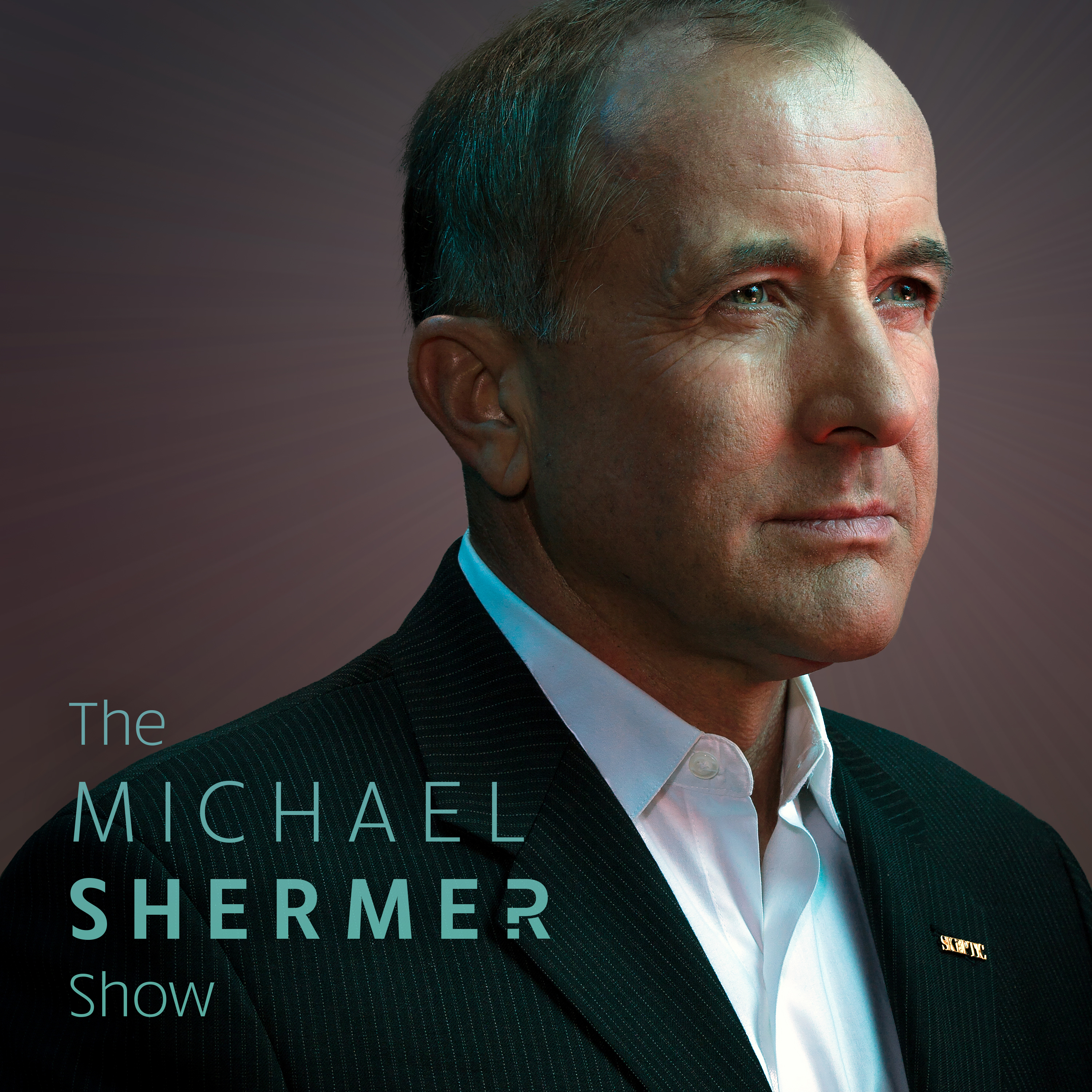
The Michael Shermer Show
by Michael Shermer
Is this your podcast?On the show
From 27 epsHost
Recent guests
Recent episodes
Why Consciousness Needs a Body
Oct 17, 2026
1h 19m 51s
Racism and White Guilt: Has America Changed More Than We Admit? | Shelby Steele & Eli Steele
Oct 10, 2026
41m 37s
Would You Want to Know If You Were Wrong?
Sep 28, 2026
1h 38m 27s
Does Consciousness Break the Laws of Physics?
Sep 22, 2026
46m 07s
Jared Diamond: How Much Can One Person Change History?
Sep 15, 2026
1h 29m 25s
Insights from recent episode analysis
Audience Interest
Podcast Focus
Publishing Consistency
Platform Reach
Insights are generated by CastFox AI using publicly available data, episode content, and proprietary models.
Most discussed topics
Brands & references
Total monthly reach
Based on 1 signal.
Built from
By chart position
- 🇺🇸United States · Natural SciencesHOME#8724K to 3.8M
- 🇮🇳India · Natural Sciences#561K to 322K
- 🇬🇧United Kingdom · Natural Sciences#851K to 268K
- 🇦🇺Australia · Natural Sciences#729K to 155K
- 🇨🇦Canada · Natural Sciences#929K to 151K
- Per-Episode Audience
Est. listeners per new episode within ~30 days
1.1M to 5.8M🎙 ~2x weekly·638 episodes·Last published 2d ago - Monthly Reach
Unique listeners across all episodes (30 days)
2.2M to 12M🇺🇸66%🇮🇳6%🇬🇧5%+16 more - Active Followers
Loyal subscribers who consistently listen
1.2M to 6.4M
Market Insights
Platform Distribution
Reach across major podcast platforms, updated hourly
Total Followers
—
Total Plays
—
Total Reviews
—
* Data sourced directly from platform APIs and aggregated hourly across all major podcast directories.
Social Links & Contact
Official channels & resources
Official Website
Login
RSS Feed
Login
| Date | Episode | Topics | Guests | Brands | Places | Keywords | Sponsor | Length | |
|---|---|---|---|---|---|---|---|---|---|
| 10/17/26 | Why Consciousness Needs a Body | Why does being alive feel like something? Neuroscientist Antonio Damasio argues that the answer begins with the body's need to stay alive. Hunger, thirst, pain, and pleasure tell us how we're doing and push us to act. These basic feelings, he says, are the foundation of consciousness. Damasio returns to the show to discuss his new book, Natural Intelligence and the Logic of Consciousness, why feelings and emotions are different, what your dog knows about you, and why he thinks Francis Crick looked in the wrong place for the origins of conscious experience. If consciousness depends on a living body, could a computer ever have it? And would uploading your brain actually preserve you? Damasio leaves room for a form of machine consciousness, though he argues it would be fundamentally different from ours. He also talks about what brain injuries reveal about the mind, how psychedelics change our perception, where human choice comes from, and why religion offers such powerful comfort. Antonio Damasio is David Dornsife Professor of Neuroscience, Psychology and Philosophy, and director of the Brain and Creativity Institute at the University of Southern California, Los Angeles. Considered one of the most eminent scientists of our time, he has made fundamental contributions to the understanding of brain processes and their relationship to emotions and consciousness. He has discussed his research in books such as Descartes' Error, The Sensation of What Happens, Looking for Spinoza, and The Strange Order of Things. | 1h 19m 51s | ||||||
| 10/10/26 | Racism and White Guilt: Has America Changed More Than We Admit? | Shelby Steele & Eli Steele | Can fighting racism end up reinforcing it? Shelby Steele grew up under segregation and became a Black militant in the 1960s. Today, he argues that White guilt has created a different racial problem: treating Black Americans as permanent victims who cannot succeed without White help. Shelby and his son, filmmaker Eli Steele, join Michael Shermer to discuss White Guilt, their new documentary about Shelby's life and America's changing racial politics. Shelby recalls a university colleague who assumed she could count on his vote simply because he was Black. He explains why he sees the same thinking in affirmative action and the expectation that Black Americans should share the same beliefs. Michael asks whether affirmative action was ever justified and how much America has changed since the Civil Rights Movement. For Shelby and Eli, what's at stake is the individual, the radical idea that every human being stands equal under the law, fully accountable for his own life, free to rise or fall on his own terms. White guilt doesn't just undermine the individual. It replaces the individual with the tribe, and freedom with the scramble for victim status. The documentary White Guilt is available for purchase at https://www.whiteguiltfilm.com and streaming on Amazon Prime, Apple TV, and Google Play. Eli Steele is a filmmaker and writer. He has made over 20 documentaries. He has written for the Wall Street Journal, City Journal, Quillette, and other publications. He is the son of Shelby Steele. Shelby Steele is a senior fellow at the Hoover Institution at Stanford University. His work spans several books, documentary films, essays, and scholarly articles. His honors include the National Book Critics Circle Award for "The Content of Our Character," an Emmy Award, a National Humanities Medal, and a Bradley Prize. | 41m 37s | ||||||
| 9/28/26 | Would You Want to Know If You Were Wrong? | What do you make of an experience you can't explain? A strange light in the sky, a book flying off a desk, a coincidence that feels too improbable to be chance? Social psychologist Barry Markovsky joins Michael Shermer to discuss his new book Everyday Extraordinary and the experiences that have kept him studying paranormal beliefs for decades—including his own childhood UFO sighting and a supposedly haunted vape shop. Markovsky explains how friends, communities, and our sense of who we are shape what we believe—and why changing someone's mind can take more than better evidence. Barry Markovsky is Distinguished Professor Emeritus of Sociology at University of South Carolina. His articles on ghosts, UFOs, and coincidences appear at TheConversation.com, which disseminates them to major news outlets worldwide. To date, more than a million readers have downloaded them. His new book is Everyday Extraordinary. | 1h 38m 27s | ||||||
| 9/22/26 | Does Consciousness Break the Laws of Physics? | If we could explain everything happening in your brain, would there still be something left to explain about you? Physicist Avshalom Elitzur thinks so—and argues that accounting for consciousness may require changing the laws of physics. In this lively conversation, Michael Shermer challenges Elitzur on why subjective experience should be anything more than a product of the brain, whether an AI could be conscious, and what a hypothetical human without consciousness would have to say about any of this. Avshalom Elitzur is an Affiliate Professor at the Institute for Quantum Studies, Chapman University, and a senior researcher at Iyar, the Israel Institute for Advanced Research. He works in the foundations of quantum mechanics and is best known for the Elitzur–Vaidman bomb-testing problem. | 46m 07s | ||||||
| 9/15/26 | Jared Diamond: How Much Can One Person Change History? | Would World War II have happened without Hitler? Would someone else have built Apple without Steve Jobs? Jared Diamond joins Michael Shermer to ask how much history depends on particular people. From Darwin's discoveries to the rise of Christianity, Diamond considers when someone is truly irreplaceable, when someone else would have done much the same thing, and how we can tell the difference. Jared Diamond is the Pulitzer Prize-winning author of the seminal million-copy-bestseller Guns, Germs, and Steel, which was named one of Time magazine's best non-fiction books of all time, Collapse, a No. 1 international bestseller, and The World Until Yesterday, among other books. A professor of geography at UCLA and noted polymath, Diamond's work has been influential in the fields of anthropology, biology, ornithology, ecology and history, among others. His new book is Profits, Prophets, Coaches, and Kings: (When) Do Leaders Matter? | 1h 29m 25s | ||||||
| 9/11/26 | Why America Failed to Stop 9/11 | Gerald Posner & Michael Shermer | How did 19 hijackers evade the world's most advanced intelligence apparatus despite years of warnings? Twenty-five years after 9/11, journalist Gerald Posner joins Michael Shermer to explain the security failures that left America vulnerable. Those failures, compounded by government secrecy, have helped sustain suspicions that officials orchestrated the attacks or deliberately allowed them to happen. What does the evidence show, and have we learned the right lessons? | 42m 49s | ||||||
| 9/9/26 | honestyphilosophy+4 | Christian Miller | Wake Forest UniversityJohn Templeton Foundation+1 | — | honestycheating+5 | — | 1h 45m 08s | ||
| 9/1/26 | uncertaintyfree will+5 | Stuart Firestein | Columbia UniversitySanta Fe Institute+7 | — | uncertaintyfree will+8 | — | 1h 23m 41s | ||
| 8/25/26 | UFOsextraterrestrial intelligence+5 | Adam Kirsch | The AtlanticWe Want to Believe: How Aliens Went Mainstream and Why It Matters+1 | Roswell | UFOsaliens+6 | — | 1h 13m 53s | ||
| 8/18/26 | evolutioninformation theory+5 | Robert M. HazenMichael L. Wong | Carnegie Institution for ScienceTime's Second Arrow+1 | — | second arrow of timefunctional information+5 | — | 1h 18m 04s | ||
Want analysis for the episodes below?Free for Pro Submit a request, we'll have your selected episodes analyzed within an hour. Free, at no cost to you, for Pro users. | |||||||||
| 8/11/26 | moralitypsychology+4 | Audun Dahl | Cornell UniversityBetween Fixed and Fickle: Why Our Moral Views Keep Changing | — | moralitymoral psychology+5 | — | 1h 57m 21s | ||
| 8/5/26 | Artificial IntelligenceSuperintelligence+4 | Robert Wright | The God Test: Artificial Intelligence and Our Coming Cosmic ReckoningThe Evolution of God+2 | — | AIsuperintelligence+6 | — | 1h 22m 49s | ||
| 7/30/26 | Wikipediabias+4 | Larry Sanger | Wikipedia | — | WikipediaLarry Sanger+5 | — | 2h 03m 46s | ||
| 7/18/26 | politicsgeopolitics+4 | Marlene Laruelle | Luiss UniversityGeorge Washington University+1 | RussiaUkraine+4 | Vladimir PutinTaiwan+4 | — | 1h 04m 04s | ||
| 7/11/26 | sex differencesevolution+4 | Steve Stewart-Williams | University of Nottingham MalaysiaDarwin, God, and the Meaning of Life+2 | — | sex differencesevolution+5 | — | 55m 03s | ||
| 7/6/26 | U.S. Founding FathersEnlightenment values+4 | — | EnlightenmentDeclaration of Independence+1 | — | Founding FathersEnlightenment+5 | — | 17m 17s | ||
| 6/27/26 | Nazi war crimeseyewitness testimony+4 | Lawrence Douglas | The EconomistAmherst College+5 | — | John DemjanjukEichmann+5 | — | 1h 32m 24s | ||
| 6/23/26 | UAPscience advisory council+4 | — | UAP Science Advisory CouncilWhite House+3 | — | UAPscience advisory council+5 | — | 29m 08s | ||
| 6/20/26 | moral characterancient philosophy+5 | Massimo Pigliucci | City College of New YorkHow to Be a Happy Skeptic: The Power of Doubt in a Meaningful Life | — | moral courageStoicism+6 | — | 1h 33m 55s | ||
| 6/16/26 | free speechpublic debate+4 | Cathy Young | — | UkraineIsrael+2 | free speechpublic debate+7 | — | 1h 30m 24s | ||
| 6/13/26 | true crimeZodiac Killer+3 | Eddie McNamara | Zodiactually: The Real Story of a Fake Serial KillerToss Your Own Salad: The Meatless Cookbook+2 | — | Zodiac Killertrue crime+3 | — | 1h 39m 14s | ||
| 6/9/26 | data privacypredictive algorithms+4 | Carissa Véliz | Institute for Ethics in AIUniversity of Oxford+6 | — | algorithmsdata control+7 | — | 1h 34m 18s | ||
| 6/6/26 | Jews and the American lefthistorical relationship+5 | Batya Ungar-Sargon | The Free PressNewsNation+1 | — | JewsAmerican left+6 | — | 54m 35s | ||
| 6/3/26 | From Equality to Equity: How Social Justice Becomes Ideology | Jon Mills, a philosopher, psychoanalyst, and clinical psychologist, joins Michael Shermer to discuss how social justice ideology has moved from a concern with fairness and equal treatment into a rigid moral framework built around oppressors and victims, privilege and disadvantage, good and evil. Their conversation focuses on the tension between compassion and truth: how to take injustice seriously without reducing people to identity categories, what happens when clinicians bring activism into the therapy room, why biological reality has become politically charged, and whether "wokeness" is beginning to lose its hold on public life. Jon Mills is a Canadian philosopher, psychoanalyst, and clinical psychologist. He is Honorary Professor, Department of Psychosocial & Psychoanalytic Studies, University of Essex, UK, on faculty in the Postgraduate Programs in Psychoanalysis & Psychotherapy, Gordon F. Derner School of Psychology, Adelphi University, USA, and on faculty and a Supervising Analyst at the New School for Existential Psychoanalysis, USA. Recipient of numerous awards for his scholarship including 5 Gradiva Awards, he is the author and/or editor of over 35 books in psychoanalysis, philosophy, psychology, and cultural studies including most recently End of the World: Civilization and Its Fate. In 2015 he was given the Otto Weininger Memorial Award for Lifetime Achievement by the Canadian Psychological Association. | 58m 45s | ||||||
| 5/29/26 | Can Science Fix Criminal Justice? | America's criminal justice debate usually gets reduced to two options: abolish the system or lock everyone up forever. Economist Jennifer Doleac thinks the data point somewhere else entirely. In this episode, Michael Shermer speaks with Doleac about what rigorous research can tell us about crime, punishment, deterrence, prison reform, and public safety. Doleac argues that America has built much of its criminal justice system backwards: too little certainty of being caught, too much faith in long prison sentences, and not enough testing of what actually works. Jennifer Doleac is the Executive Vice President of Criminal Justice at Arnold Ventures, a philanthropy focused on evidence-based policy. Before that, she spent over a decade as an economics professor, conducting academic research. She is a leading expert on the economics of crime and discrimination, and a vocal proponent of using rigorous research to inform policy. She frequently writes for outlets including The Washington Post, TIME, and Bloomberg Opinion, and she hosts the Probable Causation podcast on law, economics, and crime. Doleac holds a PhD in Economics from Stanford University. Her new book is The Science of Second Chances: A Revolution in Criminal Justice. | 1h 06m 35s | ||||||
| 4/28/26 | existenceastrophysics+4 | Hakeem Oluseyi | StanfordWhy Do We Exist?+1 | — | astrophysicsBig Bang+5 | — | 1h 11m 29s | ||
| 4/24/26 | scientistsUFOs+3 | — | UFOsnuclear weapons+2 | national security | scientistsUFOs+3 | — | 15m 43s | ||
| 4/21/26 | psychologyNuremberg trials+4 | Jack El-Hai | The AtlanticSmithsonian+6 | — | Nurembergpsychology+7 | — | 1h 25m 13s | ||
| 4/18/26 | meaningful lifefulfillment+4 | Daniel Coyle | Navy SEALsMicrosoft+4 | — | fulfillmentflourishing+5 | — | 1h 08m 21s | ||
| 4/14/26 | cognitive declinebrain health+5 | Dr. Majid Fotuhi | Johns Hopkins's Mind/Brain InstituteGeorge Washington University+9 | — | cognitive declineAlzheimer's+8 | — | 58m 09s | ||
| 4/11/26 | ChristianityAmerican politics+4 | Matthew Avery Sutton | Washington State UniversityChosen Land: How Christianity Made America and Americans Remade Christianity | — | ChristianityAmerican politics+8 | — | 1h 31m 22s | ||
| 4/8/26 | emergence of lifeassembly theory+5 | Lee Cronin | University of GlasgowNature+2 | — | life emergencenonliving matter+8 | — | 1h 27m 13s | ||
| 4/5/26 | Easterresurrection+4 | — | — | — | Easterresurrection+4 | — | 19m 10s | ||
| 4/3/26 | datingintimacy+4 | Debra Soh | manosphereSextinction: The Decline of Sex and the Future of Intimacy | York University | dating appsisolation+4 | — | 1h 30m 26s | ||
| 3/31/26 | gaslightingbullying+5 | Jennifer Fraser | The Gaslit Brain | — | gaslightingbullying+8 | — | 1h 17m 04s | ||
Showing 35 of 638
Pitch Fit is a Pro feature
See how bookable this show is for guests, which brands already advertise, the per-episode ad value, and the best-fit guest and sponsor profile. The numbers are blurred on the free plan.
How readily this show books outside guests like you.
How proven this show is for host-read sponsorships.
For Guests
ProFor Advertisers
ProUpgrade to Pro to unlock guest cadence, sponsor categories, fit scores, and per-episode ad value for this show.
Similar Audience Demographics
Podcasts that attract a similar listener profile

The Origins Podcast with Lawrence Krauss
Lawrence M. Krauss
Sean Carroll's Mindscape: Science, Society, Philosophy, Culture, Arts, and Ideas
Sean Carroll

Into the Impossible With Brian Keating
Big Bang Productions Inc.
Making Sense with Sam Harris
Sam Harris

Conversations with Coleman
The Free Press

Quillette Podcast
Quillette
Theories of Everything with Curt Jaimungal
Theories of Everything
Chart history for The Michael Shermer Show
Peaked at #2 in IS, top 10 in 22 of 50 tracked markets, currently #2 in IS.
| Market | Genre | Peak | Current | Trend |
|---|---|---|---|---|
| IS | — | #2 | #2 | — |
| South Africa | — | #3 | #3 | — |
| Denmark | — | #4 | #4 | — |
| Finland | — | #4 | #4 | — |
| HU | — | #4 | #4 | — |
| VN | — | #4 | #4 | — |
| PT | — | #5 | #5 | — |
| India | — | #5 | #5 | — |
| Ireland | — | #6 | #6 | — |
| New Zealand | — | #6 | #6 | — |
| RO | — | #6 | #6 | — |
| AR | — | #6 | #6 | — |
| CO | — | #6 | #6 | — |
| Australia | — | #7 | #7 | — |
| United States | — | #8 | #8 | — |
| United Kingdom | — | #8 | #8 | — |
| Norway | — | #8 | #8 | — |
| South Korea | — | #8 | #8 | — |
| Canada | — | #9 | #9 | — |
| AE | — | #9 | #9 | — |
Chart Positions
50 placements across 47 markets.
Chart Positions
50 placements across 47 markets.