

Insights from recent episode analysis
Audience Interest
Podcast Focus
Publishing Consistency
Platform Reach
Insights are generated by CastFox AI using publicly available data, episode content, and proprietary models.
Total monthly reach
Estimated from 2 chart positions in 2 markets.
By chart position
- 🇦🇺AU · Education for Kids#9530K to 100K
- 🇵🇱PL · Education for Kids#175500 to 3K
- Per-Episode Audience
Est. listeners per new episode within ~30 days
15K to 52K🎙 ~2x weekly·92 episodes·Last published 3d ago - Monthly Reach
Unique listeners across all episodes (30 days)
31K to 103K🇦🇺97%🇵🇱3% - Active Followers
Loyal subscribers who consistently listen
12K to 41K
Market Insights
Platform Distribution
Reach across major podcast platforms, updated hourly
Total Followers
—
Total Plays
—
Total Reviews
—
* Data sourced directly from platform APIs and aggregated hourly across all major podcast directories.
On the show
Recent episodes
#99 Using Movement to Support Regulation
Jun 21, 2026
Unknown duration
#98 My Research Journey: Behind Feb Data of the Kids Heart Pilates Research Project
Jun 15, 2026
Unknown duration
#97 Treat the Nervous System, Not the Behaviour
May 31, 2026
Unknown duration
#96 Connection, Curiosity and Confidence in Paediatrics
May 24, 2026
Unknown duration
#95 Financial Clarity for Allied Health Business Owners with Michelle Kvello
May 10, 2026
Unknown duration
Social Links & Contact
Official channels & resources
Official Website
Login
RSS Feed
Login
| Date | Episode | Description | Length | ||||||
|---|---|---|---|---|---|---|---|---|---|
| 6/21/26 | #99 Using Movement to Support Regulation | How does movement support the sensory system, and why does this matter when working with children?In this solo episode of Move.Talk.Thrive, Lizzy explores the connection between sensory input, motor output, regulation and participation from an exercise physiology perspective.She explains why children who crash, jump, avoid movement, struggle to sit still, become dysregulated or refuse activities may not be showing “bad behaviour”, they may be communicating sensory and nervous system needs.Lizzy also breaks down the vestibular, proprioceptive and interoceptive systems, and shares practical ways to adapt therapy environments in clinics, gyms, schools, early learning centres and homes.From calming movement and heavy work to becoming a sensory detective in the first few minutes of a session, this episode is a helpful listen for paediatric clinicians, parents and educators who want to better understand how movement can support regulation and participation.Stay Connected with Move.Talk.ThriveIf this episode resonated with you, share it with a parent, clinician, educator or allied health professional who supports children with movement, regulation, sensory needs or participation challenges.Follow on Instagram → @movetalkthriveWatch full episodes on YouTube → Move.Talk.ThriveConnect with UsLizzy DawsonWebsite: www.lizzydawson.com.auInstagram: @lizzydawson_Emily MackieWebsite: www.emilymackie.com.auInstagram: @emilymackie.speechie | — | ||||||
| 6/15/26 | #98 My Research Journey: Behind Feb Data of the Kids Heart Pilates Research Project | In this solo episode, Lizzy shares how research has shaped her confidence, clinical reasoning and advocacy as a paediatric exercise physiologist.She reflects on her journey from consuming research to partnering with the University of Queensland on an independent review of her Kids Heart Pilates program. Lizzy also shares the unexpected benefits of being involved in research, from professional growth and recruitment to networking, advocacy and new opportunities.A thoughtful and encouraging episode for clinicians, allied health business owners and practitioners who are curious about research, evidence-based practice and creating a bigger impact through their work.Stay Connected with Move.Talk.ThriveIf this episode resonated with you, share it with a clinician, allied health business owner, educator or practitioner who is curious about research, evidence-based practice or creating a bigger impact through their work.Follow on Instagram → @movetalkthriveWatch full episodes on YouTube → Move.Talk.ThriveConnect with UsLizzy DawsonWebsite: www.lizzydawson.com.auInstagram: @lizzydawson_Emily MackieWebsite: www.emilymackie.com.auInstagram: @emilymackie.speechie | — | ||||||
| 5/31/26 | #97 Treat the Nervous System, Not the Behaviour | In this solo episode, Lizzy unpacks the difference between stimulation, regulation and behaviour and why understanding this distinction matters when supporting children.She explores how sensory input affects the nervous system, why regulation does not always mean calm, and how behaviour is often the outward signal of what is happening underneath. Lizzy also shares how movement, environment and co-regulation can support children more effectively at home, in therapy and in early learning settings.Stay Connected with Move.Talk.ThriveIf this episode resonated with you, share it with a parent, clinician or early childhood educator who supports children with big behaviours, sensory needs or regulation challenges.Follow on Instagram → @movetalkthriveWatch full episodes on YouTube → Move.Talk.ThriveConnect with UsLizzy DawsonWebsite: www.lizzydawson.com.auInstagram: @lizzydawson_Emily MackieWebsite: www.emilymackie.com.auInstagram: @emilymackie.speechie | — | ||||||
| 5/24/26 | #96 Connection, Curiosity and Confidence in Paediatrics | In this solo episode of Move.Talk.Thrive, Lizzy reflects on what she wishes she knew when she first started working in paediatrics.This episode is for new grads, clinicians brushing up on their paediatric skills, supervisors, managers and business owners supporting new clinicians. Lizzy unpacks why clinical confidence is not about having all the answers, but about connection, flexibility, curiosity and self-regulation.From challenging sessions and group environments to masking, parent expectations and learning how to read the room, this conversation is a practical and reassuring reminder that confidence is built inside the session, not before you walk into it.Stay Connected with Move.Talk.ThriveIf this episode resonated with you, share it with a fellow allied health business owner who needs to hear this.Follow on Instagram: @movetalkthriveWatch on YouTube: Move.Talk.ThriveYour HostsLizzy DawsonWebsite: lizzydawson.com.auInstagram: @lizzydawson_Emily MackieWebsite: emilymackie.com.auInstagram: @emilymackie.speechie | — | ||||||
| 5/10/26 |  #95 Financial Clarity for Allied Health Business Owners with Michelle Kvello | In this episode of Move.Talk.Thrive, Lizzy chats with Michelle Kvello, founder of Lantern Partners and fractional CFO, about financial clarity for allied health business owners.Michelle breaks down the numbers every business owner should understand ; from cash flow and pricing to gross margin, utilisation rates, payday super changes, and preparing for NDIS funding uncertainty.This is a practical, empowering conversation for allied health business owners who want to feel more confident, informed and in control of their finances.In this episode, we cover:Why cash and profit are not the same thingThe difference between gross margin and net marginHow utilisation rates impact profitabilityWhy pricing correctly supports your purposeHow to prepare for NDIS changes through scenario modellingWhat the payday super changes could mean for your cash flowResources mentioned:Cash Flow Forecast TemplatePricing CalculatorConnect with Michelle:Website: lanternpartners.com.auInstagram: @michellekvelloStay Connected with Move.Talk.ThriveIf this episode resonated with you, share it with a fellow allied health business owner who needs to hear this.Follow on Instagram: @movetalkthriveWatch on YouTube: Move.Talk.ThriveYour HostsLizzy DawsonWebsite: lizzydawson.com.auInstagram: @lizzydawson_Emily MackieWebsite: emilymackie.com.auInstagram: @emilymackie.speechie | — | ||||||
| 5/3/26 | #94 NDIS Changes, Thriving Kids & The Skills Clinicians Need Next | The allied health landscape is changing, and paediatric practitioners, clinics and families are all feeling the uncertainty.In this solo episode of Move.Talk.Thrive, Lizzy shares reflections from recent conversations with allied health business owners around NDIS changes, the proposed Thriving Kids model, advocacy, business sustainability and the future of paediatric care.She also explores why working with children helps practitioners build the soft skills that matter most: communication, rapport, engagement, flexibility, parent education and client care.Whether you’re a clinician, business owner or allied health leader, this episode is a timely reminder that preparing for change starts with strengthening the skills, systems and conversations happening inside our teams.Stay Connected with Move.Talk.ThriveIf this episode resonated with you, share it with a colleague working in paediatrics or early learning.Follow on Instagram → @movetalkthriveWatch full episodes on YouTube → Move.Talk.ThriveConnect with UsLizzy DawsonWebsite: www.lizzydawson.com.auInstagram: @lizzydawson_Emily MackieWebsite: www.emilymackie.com.auInstagram: @emilymackie.speechie | — | ||||||
| 4/26/26 | #93 Designing a Holiday Program That Actually Works for Complex Kids | In this episode of Move.Talk.Thrive, Lizzy Dawson shares an inside look at running a successful pediatric holiday program and why it has become such a valuable part of her clinic.From managing cancellations and maintaining continuity of care to creating a supportive, low-stimulation environment for children with complex needs, Lizzy breaks down what makes a holiday program truly effective.She also shares practical insights on staffing, structure, and how these programs can improve therapy outcomes while supporting both families and clinicians.Stay Connected with Move.Talk.ThriveIf this episode resonated with you, share it with a colleague working in early learning or paediatrics.Follow on Instagram → @movetalkthriveWatch full episodes on YouTube → Move.Talk.ThriveLizzy DawsonWebsite: www.lizzydawson.com.auInstagram: @lizzydawson_Connect with UsEmily MackieWebsite: www.emilymackie.com.auInstagram: @emilymackie.speechie | — | ||||||
| 3/29/26 | #92 Closing the Gap Between Therapy and Real Life | In this solo episode of Move.Talk.Thrive, Lizzy Dawson explores why therapy strategies that work in the clinic often don’t translate into real life.Lizzy unpacks the gap between controlled therapy environments and the realities of home, school, and early learning, and shares practical ways clinicians can create more functional, meaningful outcomes.From aligning clinical goals with real-world impact to improving communication with parents and educators, this episode will help you deliver therapy that actually carries over.Stay Connected with Move.Talk.ThriveIf this episode resonated with you, share it with a colleague working in early learning or paediatrics.Follow on Instagram → @movetalkthriveWatch full episodes on YouTube → Move.Talk.ThriveConnect with UsLizzy DawsonWebsite: www.lizzydawson.com.auInstagram: @lizzydawson_Emily MackieWebsite: www.emilymackie.com.auInstagram: @emilymackie.speechie | — | ||||||
| 3/15/26 | #91 Why Practitioners Struggle With Sales (And 3 Simple Things That Actually Work) | In this solo episode of Move.Talk.Thrive, Lizzy Dawson explores why the word “sales” feels uncomfortable for many allied health professionals — and why it shouldn’t.Lizzy reframes sales as clear communication, education, and advocacy for client outcomes, explaining that practitioners are already “selling” every time they help families understand what they’re seeing, why it matters, and what the next step should be.Lizzy’s Simple 3-Step Communication FrameworkLizzy shares a practical formula practitioners can use during sessions or assessments to communicate recommendations clearly:1) Lead with what you seeStart with a clear observation.2) Explain the impactHelp parents understand why this observation matters.3) Give a clear recommendationOffer a specific plan for intervention.Stay Connected with Move.Talk.ThriveIf this episode resonated with you, share it with a colleague who works in early learning settings.Follow us on Instagram → @movetalkthriveWatch full episodes on YouTube → Move.Talk.ThriveConnect with UsEmily MackieWebsite: www.emilymackie.com.auInstagram: @emilymackie.speechieLizzy DawsonWebsite: www.lizzydawson.com.auInstagram: @lizzydawson_ | — | ||||||
| 3/8/26 | #90 Why Families Disengage from Therapy And How Clinicians Can Change That | In this solo episode, Lizzy Dawson explores the topic of client retention in pediatric allied health and why it should be seen as a matter of clinical leadership, not just administration.After reviewing patterns inside her own clinic, Lizzy shares what she discovered about why families disengage from services and where clinics often “leak” clients — including school holiday transitions, funding gaps, and clinician turnover. She explains how better systems, clearer communication, and stronger clinical goal setting can help improve retention and support more consistent progress for children.Lizzy also highlights the importance of helping parents understand the functional outcomes of therapy, building meaningful relationships with families, and ensuring goals are emotionally relevant and clearly communicated.This episode offers practical insights for allied health clinicians and clinic owners who want to strengthen client engagement, improve continuity of care, and build more sustainable pediatric services.Stay Connected with Move.Talk.ThriveIf this episode resonated with you, share it with a colleague working in pediatric allied health.Follow us on Instagram → @movetalkthriveWatch full episodes on YouTube → Move.Talk.ThriveEmily MackieWebsite: www.emilymackie.com.auInstagram: @emilymackie.speechieConnect with UsLizzy DawsonWebsite: www.lizzydawson.com.auInstagram: @lizzydawson_ | — | ||||||
Want analysis for the episodes below?Free for Pro Submit a request, we'll have your selected episodes analyzed within an hour. Free, at no cost to you, for Pro users. | |||||||||
| 3/1/26 | #89 Early Learning Centres: The Opportunity for Allied Health | In this solo episode of Move.Talk.Thrive, Lizzy Dawson shares 16+ years of real-world experience working inside early learning centres — and why they’re not mini clinics.As funding models shift, more clinicians are moving into group-based, naturalistic settings. But one-on-one strategies don’t automatically work in busy, noisy classrooms.Lizzy breaks down:• Why modelling in real time beats theory• How educator burnout impacts outcomes• Why collaboration matters more than clinical delivery• How movement can be a powerful clinical lensStay Connected with Move.Talk.ThriveIf this episode resonated with you, share it with a colleague who works in early learning settings.Follow us on Instagram → @movetalkthriveWatch full episodes on YouTube → Move.Talk.ThriveConnect with UsEmily MackieWebsite: www.emilymackie.com.auInstagram: @emilymackie.speechieLizzy DawsonWebsite: www.lizzydawson.com.auInstagram: @lizzydawson_ | — | ||||||
| 2/22/26 | #88 Thriving Kids, NDIS, and the Future of Paediatric Therapy | In this solo episode of Move.Talk.Thrive, Lizzy Dawson explores the evolving landscape of early intervention in Australia, including the proposed Thriving Kids model and ongoing NDIS reforms. She breaks down what’s currently known, what remains uncertain, and how these changes may impact families, clinicians, and allied health providers.Lizzy discusses the shift toward earlier, community-based supports for children aged 0–8, potential changes to therapy delivery, and key concerns across the sector — including implementation clarity, service gaps, and the future of one-on-one therapy. She also shares practical ways clinicians can prepare through collaboration, advocacy, and upskilling.This episode offers clarity and guidance for professionals and families navigating one of the biggest shifts in early intervention services in recent years.Stay Connected with Move.Talk.ThriveFollow on Instagram → @movetalkthriveWatch full episodes → Move.Talk.Thrive YouTubeConnect with the HostsEmily MackieWebsite: www.emilymackie.com.auInstagram: @emilymackie.speechieLizzy DawsonWebsite: www.lizzydawson.com.auInstagram: @lizzydawson_ | — | ||||||
| 2/15/26 | 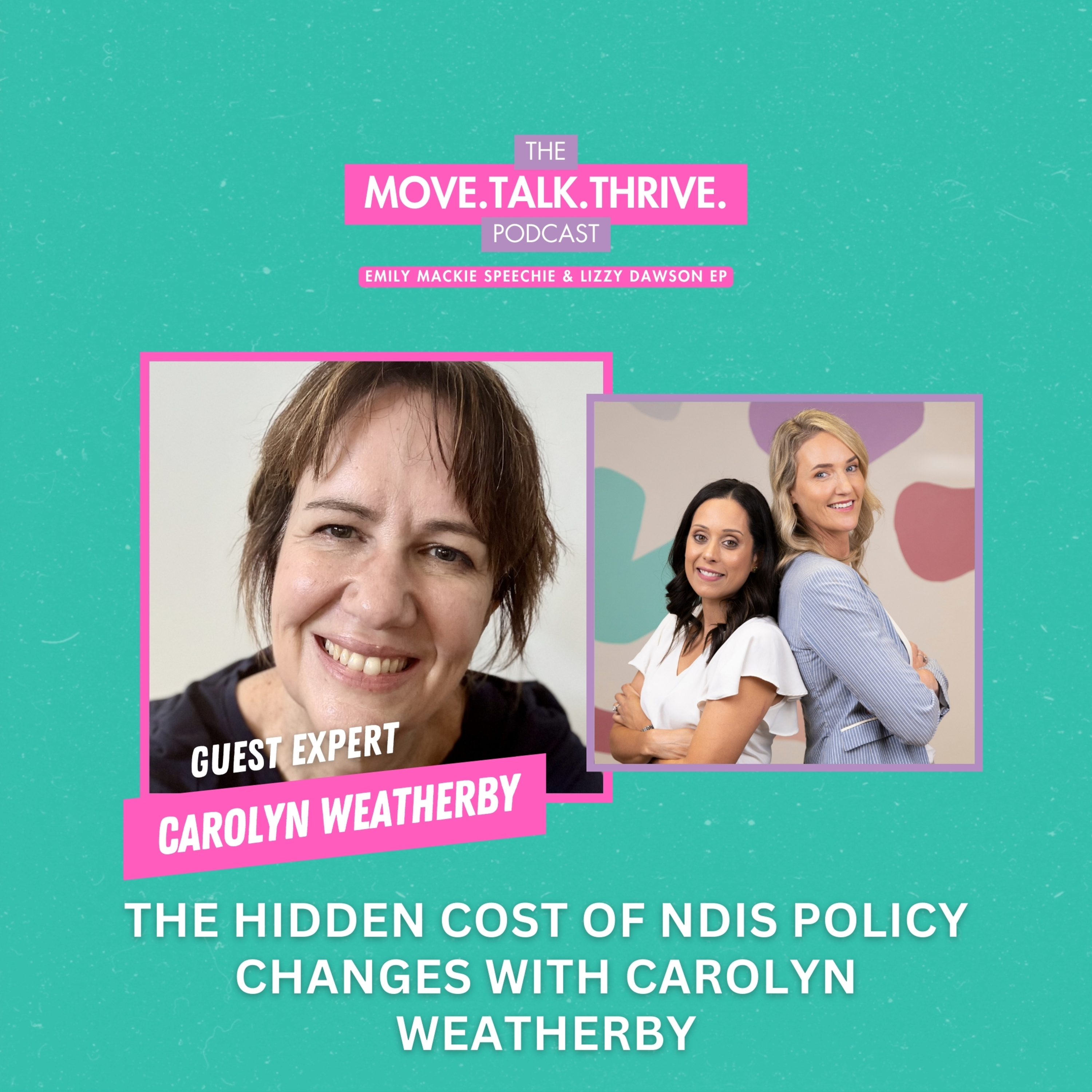 #87 The Hidden Cost of NDIS Policy Changes with Carolyn Weatherby | In this episode of Move.Talk.Thrive, Lizzy Dawson sits down with speech pathologist Carolyn Weatherby to explore the future of allied health within the NDIS — and why clinicians can no longer navigate sector change alone.With 28 years in the disability sector, Carolyn shares how evidence-based communication and mealtime support transform lives, the growing challenges clinicians face during ongoing NDIS reform, and why collective representation is essential for sustainable practice and quality care.As a founding member of NDIS Professionals Australia, she explains how advocacy, formal representation, and collective action can help protect the future of allied health.If you’re an allied health professional working under the NDIS, this episode is a timely call to stay informed, supported, and represented.Learn more about NDIS Professionals Australia🔗 NDIS Professionals Australia – Your union for self-employed & small business NDIS Allied HealthFacebook: NDIS Professionals AustraliaLinkedIn: https://www.linkedin.com/company/ndis-professionals-union-professionals-australia/Member Join: Click hereContact Carolyn Weatherby📩 carolyn@simplyslp.com.auStay connected with Move.Talk.ThriveInstagram: @movetalkthriveYouTube: Move.Talk.ThriveConnect with the hostsEmily Mackie — www.emilymackie.com.au | @emilymackie.speechieLizzy Dawson — www.lizzydawson.com.au | @lizzydawson_ | — | ||||||
| 2/8/26 | #86 Back to Therapy Without the Pressure: Supporting Kids After a Break | Returning to therapy after a long break can feel chaotic for kids, parents, and clinicians.In this episode of Move.Talk.Thrive, Lizzy Dawson and Emily Mackie share practical, experience-based guidance on how to restart pediatric therapy after the holidays without pressure or burnout. They explore regulation, reconnection, flexible planning, and how to meet children where they’re truly at so you can set the year up for meaningful progress.Perfect for clinicians navigating the start of the therapy year and wanting clarity, confidence, and calm.If this episode helped you rethink how you approach the first weeks back in therapy, share it with a fellow clinician who might need the reminder to slow down and trust the process.Stay Connected with Move.Talk.ThriveFollow us on Instagram → @movetalkthriveWatch full episodes on YouTube → Move.Talk.Thrive | — | ||||||
| 2/1/26 | #85 Delegation, Systems & Scaling: Working with Virtual Assistants | Lizzy Dawson and Emily Mackie answer a listener question about Virtual Assistants and how they use them to support their businesses. From onboarding and systems to delegation and consistency, they share practical tips for making VAs a valuable part of your team.Perfect for startup owners, clinicians, and solo operators ready to free up time and mental energy.🎧 For business owners and clinicians who want sustainable growth, not overwhelm.Stay Connected with Move.Talk.ThriveIf this episode helped you rethink delegation, systems, or how you spend your time, share it with a fellow business owner or clinician who might benefit.Follow us on Instagram → @movetalkthriveWatch full episodes on YouTube → Move.Talk.ThriveConnect with UsEmily MackieWebsite: www.emilymackie.com.auInstagram: @emilymackie.speechieLizzy DawsonWebsite: www.lizzydawson.com.auInstagram: @lizzydawson_ | — | ||||||
| 1/25/26 | #84 Planning 2026 With Energy, Not Exhaustion | Lizzy Dawson and Emily Mackie kick off 2026 with an honest conversation about planning for the year ahead while honouring very different life seasons. From business growth and maternity to energy protection and sustainable pacing, they explore why goals need to be flexible , and why calm, steady progress beats burnout every time.With Lizzy’s “Zone 2” business analogy and Emily’s reflections on motherhood, leadership, and delegation, this episode is for anyone navigating growth without sacrificing their health, family, or sense of self.🎧 For business owners, clinicians, parents, and high achievers who want sustainable success not hustle.Stay ConnectedFollow us on Instagram → @movetalkthriveWatch full episodes → Move.Talk.ThriveConnectEmily Mackie → @emilymackie.speechie | emilymackie.com.auLizzy Dawson → @lizzydawson_ | lizzydawson.com.au | — | ||||||
| 12/28/25 | #83 Reflection Over Resolutions | In this solo episode of Move Talk Thrive, Lizzy Dawson shares a gentle, intentional approach to reflecting on the year that’s been — and planning ahead without burnout.Lizzy invites listeners to look beyond unfinished goals and focus on wins, lessons, patterns, and growth across personal life, leadership, and business. She shares simple reflection and journaling prompts you can use in 10 minutes or over a full day.Perfect for clinicians, business owners, parents, and anyone wanting to move forward with clarity, values, and sustainability.In this episode:Why reflection supports sustainable growthIdentifying wins and the systems behind themReframing challenges as teachersNoticing patterns in energy and leadershipSimple prompts you can revisit anytimeStay Connected with Move.Talk.ThriveIf this episode resonates , whether you’re a parent navigating school transition, a clinician supporting families, or a business owner planning services, share it with someone who needs reassurance that transition takes time.Follow us on Instagram → @movetalkthriveWatch full episodes on YouTube → Move.Talk.ThriveConnect with UsEmily MackieWebsite: www.emilymackie.com.auInstagram: @emilymackie.speechieLizzy DawsonWebsite: www.lizzydawson.com.auInstagram: @lizzydawson_ | — | ||||||
| 12/21/25 | #82 Supporting Children Through Transition Without Burnout | In this episode of Move Talk Thrive, Emily and Lizzy unpack the transition to school through three lenses: parent, clinician, and business owner.They explore why school transition isn’t a single moment, but an ongoing process; from preschool to Kindy, new grades, new teachers, changing routines, and shifting expectations. Drawing on real-life parenting experiences and clinical insight, they discuss how predictability, emotional regulation, consistency, and communication play a key role in supporting children during times of change.The conversation also touches on therapy during school transition, why maintaining support can be protective rather than overwhelming, and how clinicians and businesses can build flexible systems that truly support families.This episode is a grounding reminder that readiness isn’t about perfection, it’s about adaptability, values, and grace.Key TakeawaysTransition is a process, not a single dayConsistency supports regulation during big changesTherapy can help during transition, not just before or afterSchool readiness goes beyond academicsCalm, regulated adults help children feel safeValues-driven systems allow flexibility without burnoutFollow us on Instagram → @movetalkthriveWatch full episodes on YouTube → Move.Talk.ThriveConnect with UsEmily MackieWebsite: www.emilymackie.com.auInstagram: @emilymackie.speechieLizzy DawsonWebsite: www.lizzydawson.com.auInstagram: @lizzydawson_ | — | ||||||
| 12/14/25 | #81 Money, Mental Load, and Making Space: The End-of-Year Juggle | In this episode of Move.Talk.Thrive, Emily and Lizzy have a candid, practical conversation about navigating the end-of-year season while juggling multiple roles; clinician, business owner, parent, partner, and more.They unpack the realities of this time of year: clinic closures, financial pinch, school holidays, gift-giving pressures, and year-end exhaustion. Sharing their rituals, systems, and lessons, they offer tools to transition out of the busy season with calm, from budgeting and holiday program planning to clearing spaces and letting go of unrealistic expectations.Key Takeaways:Financial wobble is normal – early budgeting, systemising programs, and saving leave eases stress.Preparation starts early – map schedules and logistics months ahead to avoid a December scramble.Rest matters – mental health is essential; burnout prevention is part of leadership.Structure is key – plan your first week back, clear workspaces, prioritize tasks.Release perfectionism – not everything needs finishing before December 24.Create restorative spaces at home – reset, declutter, and carve out calm zones.Stay Connected with Move.Talk.ThriveIf this episode helped you feel seen as a clinician or business owner, share it with someone who might need support heading into the holidays. Instagram: @movetalkthriveWatch episodes on YouTube: Move.Talk.ThriveConnect with EmilyWebsite: emilymackie.com.auInstagram: @emilymackie.speechieConnect with LizzyWebsite: lizzydawson.com.auInstagram: @lizzydawson_ | — | ||||||
| 12/7/25 | #80 From Meh to Momentum: Emily’s Guide to Getting Unstuck | In this solo episode of Move.Talk.Thrive, Emily gets honest about a feeling so many clinicians and leaders know well — being stuck in a rut. When your work feels heavier, your creativity dips, or everything starts to feel a bit “meh,” it can be tough to know what’s next.Emily shares why ruts happen, what they’re trying to tell us, and the small, doable steps that help you get moving again. Drawing from her own seasons of transition, business growth, and new motherhood, she highlights the patterns she sees in herself and the clinicians she mentors.If you’re feeling flat, overwhelmed, or disconnected from your “why,” this episode will help you name what’s draining you and gently rebuild momentum — one tiny shift at a time.Key TakeawaysFeeling stuck is normal — and often a sign of a turning point.Decision fatigue and comparison are major motivation thieves.Your “why” isn’t gone; it’s buried. Reconnect with it.Small wins spark movement.Accountability and energy-lifting people matter.You don’t need mastery — just one step forward.Stay Connected with Move.Talk.ThriveIf this episode resonates with you, share it with a colleague, a friend, or anyone who needs a reminder that motivation returns — one small step at a time.Follow us on Instagram → @movetalkthriveWatch episodes on YouTube → Move.Talk.ThriveConnect With UsEmily MackieWebsite: www.emilymackie.com.auInstagram: @emilymackie.speechieLizzy DawsonWebsite: www.lizzydawson.com.auInstagram: @lizzydawson_ | — | ||||||
| 11/30/25 | #79 When the Goal Changes: What Lizzy Learned from Not Running the 2025 New York City Marathon | In this episode of Move.Talk.Thrive, Emily sits down with her business bestie Lizzy for an honest conversation about goals, burnout, resilience, and what it means to pivot when life doesn’t go to plan.Lizzy opens up about her five-year New York Marathon goal — and how illness, overwhelm, and anxiety led her to make the hardest (and most aligned) decision: not running it. They unpack what it looks like to listen to your body, choose rest, make values-based decisions, and let go of goals that no longer serve you.They also dive into business ownership, leadership, systems, and how taking a real holiday transformed Lizzy’s clarity, wellbeing, and team.Key Takeaways:• Letting go can be growth.• Your nervous system speaks first.• Systems create freedom.• Rest isn’t optional.• Do the work only you can do.• Goals evolve — and that’s okay.Stay Connected with Move.Talk.ThriveIf Lizzy’s story resonates with you — whether you’re a clinician, business owner, or someone who’s ever questioned a goal — share this episode with a friend who needs the reminder that it’s okay to pivot.Follow us on Instagram → @movetalkthriveWatch full episodes on YouTube → Move.Talk.ThriveConnect with UsEmily MackieWebsite: www.emilymackie.com.auInstagram: @emilymackie.speechieLizzy DawsonWebsite: www.lizzydawson.com.auInstagram: @lizzydawson_ | — | ||||||
| 11/23/25 | 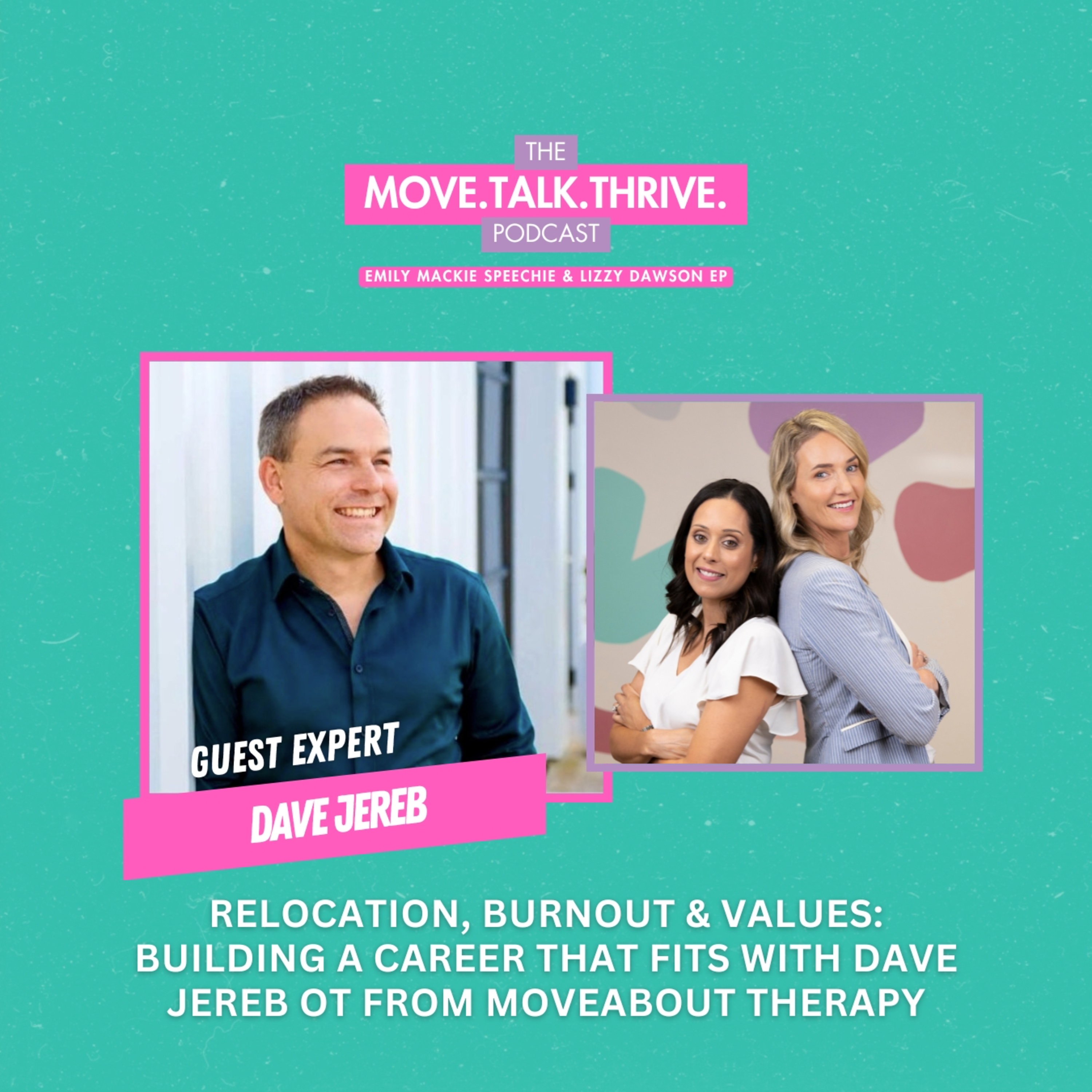 #78 Relocation, Burnout & Values: Building a Career That Fits with Dave Jereb OT from MoveAbout Therapy | In this episode of Move.Talk.Thrive, Emily sits down with pediatric occupational therapist and Move About co-founder Dave Jereb to talk about something many clinicians think about but rarely discuss openly: relocation.They explore how moving — whether to a new city, state, or lifestyle — connects to burnout, career growth, workplace culture, and overall wellbeing. Dave shares his own relocation experiences, from the U.S. to Sydney to the Central Coast, and how aligning decisions with values shaped both his work and life.A practical, encouraging episode for students, new grads, and clinicians considering change, balance, or a fresh start.Key TakeawaysRelocation is values-driven: Know your why.Burnout isn’t about hours: Misalignment drains more than workload.Competence protects you: Push through the learning dip.Lifestyle matters: Nature, community, and environment impact wellbeing.Culture counts: Visit workplaces — real culture is felt, not advertised.You can do hard things: Growth requires leaning into discomfort.ResourcesCoastal Lifestyle Campaign:https://moveabout.mykajabi.com/ourcOasTallifestyleMove About Careers (resources + scorecard):https://www.moveabout.com.au/careers/Workplace Scorecard — Is your paediatric OT workplace working for you?https://dave-n3wfmo2w.scoreapp.com/Stay ConnectedInstagram: @movetalkthriveYouTube: Move.Talk.ThriveConnect with Emily & LizzyEmily MackieWebsite: www.emilymackie.com.auInstagram: @emilymackie.speechieLizzy DawsonWebsite: www.lizzydawson.com.auInstagram: @lizzydawson_Connect with Dave JerebLinkedIn: https://www.linkedin.com/in/dave-jereb/Instagram: @davejereb_otMove About: @moveabout.ot | — | ||||||
| 11/16/25 | #77 Holding It Together: Managing Teams (and Yourself) in the End-of-Year Chaos | In this episode of Move.Talk.Thrive, Emily and Lizzy turn the focus from children to the adults who support them — the employees, clinicians, and leaders feeling the strain of end-of-year fatigue.As reports pile up, diaries fill, and festive logistics take over, they unpack what it truly means to “finish well” — without tipping into burnout. Drawing from their own experiences as business owners, they explore how to support teams through this demanding season, maintain co-regulation in the workplace, and balance forward planning with being present.Key TakeawaysCo-regulation matters at every level: The energy you bring to your team influences everyone around you.Work smarter, not harder: Finishing well isn’t about doing more — it’s about creating clarity, structure, and support.Reflection over perfection: Take time to check in with yourself and your team — what worked, what didn’t, and how you want to show up next year.Shift from hustle to gratitude: Appreciation and acknowledgement boost morale far more than last-minute productivity pushes.Clarity calms chaos: Be clear about priorities — and let go of what can wait until the new year.Finish with intention: Ask yourself — How do I want to feel when the year ends?Stay Connected with Move.Talk.ThriveIf this episode resonates with how you’re feeling heading into the end of the year, share it with a fellow clinician, teacher, or teammate who could use a reminder to slow down and reflect.Follow us on Instagram → @movetalkthriveWatch full episodes on YouTube → Move.Talk.ThriveConnect with UsEmily MackieWebsite: www.emilymackie.com.auInstagram: @emilymackie.speechieLizzy DawsonWebsite: www.lizzydawson.com.auInstagram: @lizzydawson_ | — | ||||||
| 11/9/25 | #76 Surviving the End-of-Year Slump: Strategies for Tired Kids (and Clinicians) | In this episode of Move.Talk.Thrive, Emily and Lizzy dive into the end-of-year chaos every parent, teacher, and pediatric professional knows too well — when everyone’s tired, routines fall apart, and regulation goes out the window.As clinicians and mums, they talk through what this season looks like in their own homes and clinics, why tired kids struggle more with regulation, and how small adjustments can make a big difference. From keeping routines simple to weaving movement and play into therapy, they share strategies for helping children (and adults!) stay calm and connected as the year wraps up.Key TakeawaysRoutines provide security: Keeping predictable rhythms helps children feel safe and grounded.Movement regulates: Incorporate movement — from obstacle courses to outdoor play — to support attention and emotional balance.Connection before correction: Co-regulation and therapist–child connection are key to navigating dysregulation.Adjust expectations: Simplify goals and focus on achievable wins that align with the season’s energy.Support parents: Offer realistic strategies that fit easily into daily routines.Consistency counts: Maintaining therapy helps stabilize regulation and progress, even when things feel chaotic.Stay Connected with Move.Talk.ThriveIf this episode resonates with your own late-year experiences, share it with a fellow clinician, teacher, or parent who might need the reminder that “good enough” is sometimes exactly what’s needed.Follow us on Instagram → @movetalkthriveWatch full episodes on YouTube → Move.Talk.ThriveConnect With UsEmily MackieWebsite: www.emilymackie.com.auInstagram: @emilymackie.speechieLizzy DawsonWebsite: www.lizzydawson.com.auInstagram: @lizzydawson_ | — | ||||||
| 11/2/25 | #75 “I’ll Do It Later”: Let’s Talk About Procrastination | In this episode of Move.Talk.Thrive, Emily and Lizzy unpack a habit we all fall into from time to time — procrastination.Whether it’s putting off paperwork, avoiding tricky conversations, or feeling stuck in a cycle of “I’ll do it later,” procrastination often isn’t about laziness, it’s about what’s happening underneath.Drawing from their own experiences in business and clinical work, Emily and Lizzy explore the psychology behind procrastination, the emotional triggers that fuel it, and the small mindset shifts that make it easier to take action.They share practical strategies for breaking through mental blocks; from setting micro-goals and finding your “why,” to using accountability, energy management, and even fun rewards to keep momentum going.You’ll also hear how perfectionism, fear of feedback, and unclear goals all play into the procrastination loop and how reframing these patterns can help you and your team move forward with clarity and confidence.Key TakeawaysProcrastination isn’t laziness: It’s often a response to overwhelm, fear, or unclear direction.Find your “why”: Connecting the task to a meaningful outcome helps unlock motivation.Perfectionism fuels paralysis: “Progress over perfection” helps build momentum.Energy and regulation matter: Manage your physical and emotional energy before tackling hard tasks.Accountability helps: Whether it’s a mentor, colleague, or plan, external check-ins can keep you on track.Make it enjoyable: Change your environment, add small rewards, or make the task fun to reduce resistance.Feedback isn’t failure: Reframing feedback as fuel for growth builds resilience and confidence.Stay Connected with Move.Talk.ThriveIf this episode got you thinking about your own procrastination patterns, share it with a friend, colleague, or fellow clinician who might need a gentle nudge too.Follow us on Instagram → @movetalkthriveWatch full episodes on YouTube → Move.Talk.ThriveConnect With UsEmily MackieWebsite: www.emilymackie.com.auInstagram: @emilymackie.speechieLizzy DawsonWebsite: www.lizzydawson.com.auInstagram: @lizzydawson_ | — | ||||||
Showing 25 of 99
Pitch Fit is a Pro feature
See how bookable this show is for guests, which brands already advertise, the per-episode ad value, and the best-fit guest and sponsor profile. The numbers are blurred on the free plan.
How readily this show books outside guests like you.
How proven this show is for host-read sponsorships.
For Guests
ProFor Advertisers
ProUpgrade to Pro to unlock guest cadence, sponsor categories, fit scores, and per-episode ad value for this show.
Chart Positions
2 placements across 2 markets.
Chart Positions
2 placements across 2 markets.