
Insights from recent episode analysis
Audience Interest
Podcast Focus
Publishing Consistency
Platform Reach
Insights are generated by CastFox AI using publicly available data, episode content, and proprietary models.
Total monthly reach
Estimated from 2 chart positions in 2 markets.
By chart position
- 🇺🇸US · Courses#1485K to 30K
- 🇭🇺HU · Courses#973K to 10K
- Per-Episode Audience
Est. listeners per new episode within ~30 days
2.4K to 12K🎙 Daily cadence·18 episodes·Last published today - Monthly Reach
Unique listeners across all episodes (30 days)
8K to 40K🇺🇸75%🇭🇺25% - Active Followers
Loyal subscribers who consistently listen
4.4K to 22K
Market Insights
Platform Distribution
Reach across major podcast platforms, updated hourly
Total Followers
—
Total Plays
—
Total Reviews
—
* Data sourced directly from platform APIs and aggregated hourly across all major podcast directories.
On the show
Recent episodes
The Man in the Arena: Courage, Criticism, Responsibility, and the Discipline to Keep Going
May 15, 2026
43m 03s
Household Debt: The Paycheck Is Already Spoken For
May 11, 2026
48m 32s
Success: What Does it Mean "To Have Succeeded"?
May 1, 2026
34m 30s
Stuck: Why You Feel Trapped and How to Move Through the Storm
Apr 30, 2026
36m 58s
The Housing Crisis in America: How Housing Stopped Functioning as the American Path to Stability and Wealth
Apr 27, 2026
52m 04s
Social Links & Contact
Official channels & resources
Official Website
Login
RSS Feed
Login
| Date | Episode | Description | Length | ||||||
|---|---|---|---|---|---|---|---|---|---|
| 5/15/26 |  The Man in the Arena: Courage, Criticism, Responsibility, and the Discipline to Keep Going | The Man in the Arena: Courage, Criticism, Responsibility, and the Discipline to Keep Going...In this episode, The Never Stop Learning Podcast takes a deep nonfiction dive into Theodore Roosevelt’s “Man in the Arena” and the enduring question of what it means to live a life of consequence rather than commentary. Beginning with Roosevelt’s 1910 Sorbonne speech, the episode explores the moral difference between the critic and the doer, then moves through the psychological cost of courage with Rollo May, the daily structure of endurance with William H. McRaven and Jocko Willink, the burden of leadership and public responsibility with Ben Horowitz, and the final distinction between dramatic effort and sustained greatness with Jim Collins. The result is a serious meditation on courage, criticism, discipline, responsibility, and the long work of staying in the arena after the romance of the first brave act has passed. | 43m 03s | ||||||
| 5/11/26 | 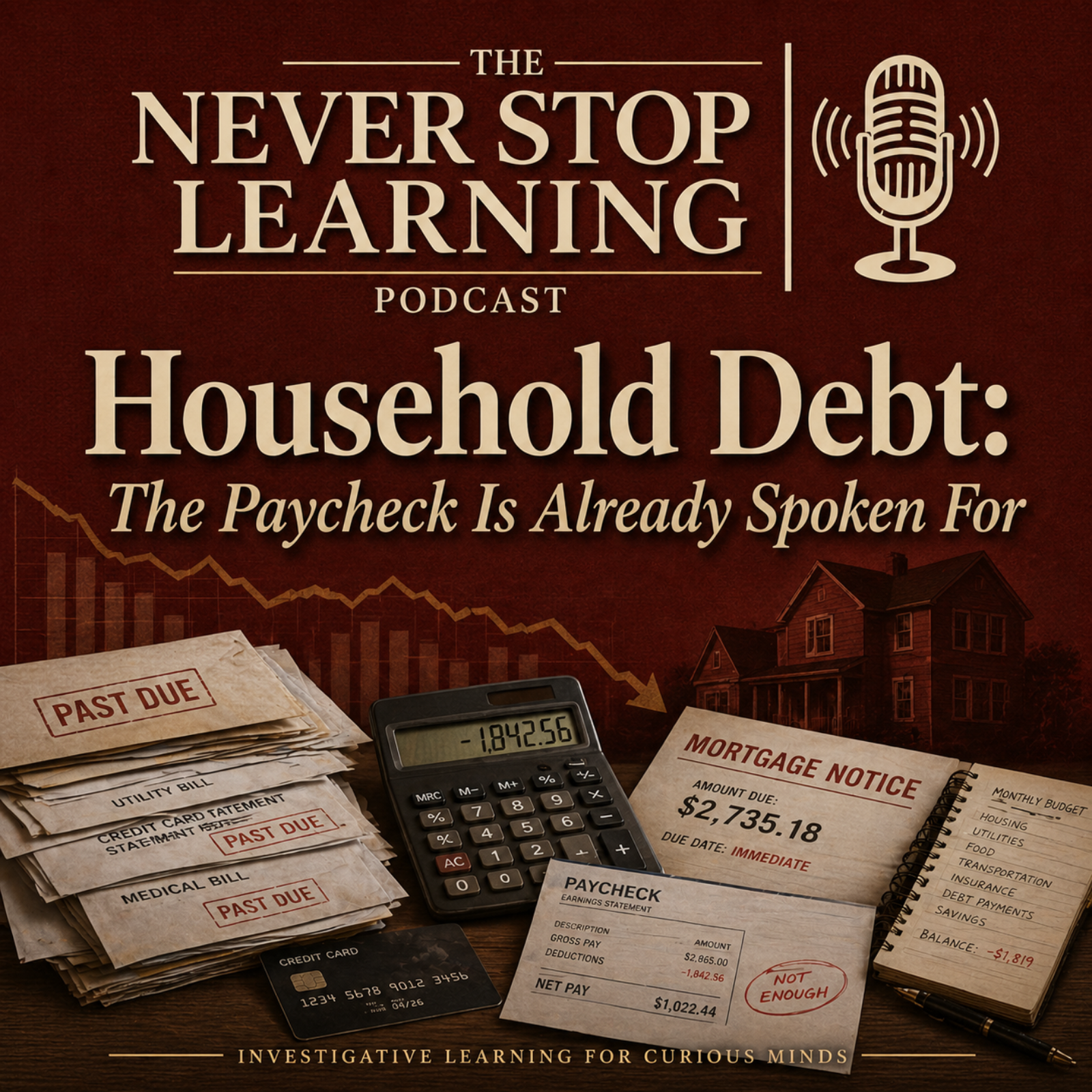 Household Debt: The Paycheck Is Already Spoken For | Household Debt: The Paycheck Is Already Spoken ForWhy does it feel like Americans are earning more, spending more, and still falling behind?In this episode, we examine the post-COVID household debt machine through four pressure points: mortgages, auto loans, student loans, and credit cards. Starting from the last clean pre-pandemic baseline in late 2019, we trace how emergency money, a historic expansion in the money supply, inflation, and higher interest rates reshaped the American balance sheet.The story is not that every household collapsed. It is that the margin disappeared. Homeowners with low-rate mortgages were protected, while new buyers faced a brutal housing market. Car borrowers became trapped by inflated pandemic prices and negative equity. Student-loan payments returned to budgets already filled by higher costs. Credit cards became the final shock absorber, with revolving debt carried at roughly twenty-one percent interest.This is a deep dive into why aggregate spending can look strong while many households are quietly losing financial flexibility. The paycheck still arrives. But for millions of families, it is already spoken for. | 48m 32s | ||||||
| 5/1/26 |  Success: What Does it Mean "To Have Succeeded"? | Success: What Does it Mean "To Have Succeeded"?...What does it really mean “to have succeeded”? In this deep dive, we begin with Bessie A. Stanley’s 1905 definition of success and follow it clause by clause into a richer and more demanding philosophy of a life well lived. Through the voices of Stephen R. Covey, Parker J. Palmer, Henri J. M. Nouwen, Dale Carnegie, Edith Eger, Don Miguel Ruiz, and Richard Stearns, this episode explores joy, character, suffering, beauty, contempt, service, and the moral weight of making even one life breathe easier because you have lived. This is "to have succeeded". | 34m 30s | ||||||
| 4/30/26 |  Stuck: Why You Feel Trapped and How to Move Through the Storm | Stuck: Why You Feel Trapped and How to Move Through the Storm...Why do so many people feel trapped in lives they can clearly see are no longer working — and why is it so hard to move? In this episode, we explore the hidden mechanics of being stuck: not as laziness or weakness, but as a deeply human response to grief, shame, uncertainty, and fear. Using the image of the American bison turning into the storm, this deep dive examines why avoidance can feel like protection while quietly becoming a prison, how repeated retreat hardens into identity, and why real change begins long before we feel ready. Drawing on the work of Pauline Boss, Brené Brown, Martin Seligman, Oliver Burkeman, Seth Godin, and Steven C. Hayes, this is an investigation into how people lose movement, how they begin to find it again, and what it means to walk into the storm instead of spending a life trying to live around it. | 36m 58s | ||||||
| 4/27/26 |  The Housing Crisis in America: How Housing Stopped Functioning as the American Path to Stability and Wealth | The Housing Crisis in America: How Housing Stopped Functioning as the American Path to Stability and Wealth...A deep-dive investigation into why the American housing market no longer works the way generations were taught it would. This episode traces the crisis from first principles: how years of cheap money pushed home prices onto a much higher base, how a rapid rate shock then froze turnover, why renting stopped functioning as a temporary bridge and became a trap, where investors and institutions really fit into the story, and why the pain feels different in places like Texas, the Carolinas, Florida, and the Midwest. More than a story about expensive homes, this is an examination of what happens when one of the country’s main paths from work to stability, ownership, and middle-class security begins to break down. | 52m 04s | ||||||
| 4/25/26 |  Steward Leadership: A Deep Dive into How Power Is Held in Trust | Steward Leadership: A Deep Dive into How Power Is Held in Trust...In this episode, we explore steward leadership as a moral alternative to possessive leadership. What does it mean to hold power without treating it as personal property? What does a leader owe the people, mission, and institution placed in their care? Drawing on Peter Block, Wendell Berry, Robert Greenleaf, Henri Nouwen, R. Scott Rodin, Charles Feltman, and Davis, Schoorman, and Donaldson, this deep dive examines trust, service, vulnerability, succession, false stewardship, and the discipline of leaving things better than you found them. This is not a discussion of leadership style. It is a study of power, responsibility, and what it means to lead as a steward rather than just as an owner. | 49m 28s | ||||||
| 4/22/26 |  Private Equity: Roll-Up Nation | In Private Equity: Roll-Up Nation, (The Remaking of Local Business, and What Happens When the Platform Starts to Fail) we investigate how private-equity roll-ups have quietly remade local business across America. From doctor’s offices and dental chains to veterinary clinics, daycare centers, funeral homes, and home-services companies, the episode explains how fragmented local firms are turned into financial platforms through acquisition, centralization, leverage, and multiple expansion. This is not a broad indictment of private equity as a whole. It is a focused examination of a specific model, why it spread so aggressively, and why its effects are often felt first not in bankruptcy court, but in the daily experience of thinner staffing, stranger billing, weaker local control, and institutions that no longer feel like they belong to the communities they serve.The episode moves from first principles to real-world consequence. It shows how the roll-up machine works, why investors pursued it, how it changes the business after acquisition, where it has spread, and what happens when the model begins to strain or fail. Through case studies, regulatory evidence, and on-the-ground examples, Roll-Up Nation argues that the real issue is not simply consolidation, but what happens when trust-heavy, labor-sensitive, locally essential services are treated as scalable financial assets. The result is a deep, investigative primer on one of the most important and least understood transformations happening in local American life. | 50m 55s | ||||||
| 4/19/26 |  Winning Habits: Elite Preparation, Unselfish Standards, Emotional Resilience, and Competitive Pride | Winning Habits: Elite Preparation, Unselfish Standards, Emotional Resilience, and Competitive PrideWhat if winning is not the beginning of the story, but the end of it?In this episode, we dismantle one of the biggest illusions in ambition: the idea that winners are made in public. Drawing on the philosophies of John Wooden, Kobe Bryant, Michael Jordan, Mike Krzyzewski, Dean Smith, Vince Lombardi, Lou Holtz, Bear Bryant, and Tim Tebow, this deep dive explores the hidden architecture behind lasting excellence.We unpack why pressure reveals more than it creates, why process matters more than the scoreboard, how elite standards are built and defended, why team culture rises or falls on behavior, and how real toughness must be anchored in purpose rather than ego. This is not a hype piece about success. It is a serious exploration of the habits, standards, discipline, accountability, and meaning that make winning possible.If you want to understand what it actually takes to build a winning life, this episode is for you. | 32m 34s | ||||||
| 4/17/26 |  Why Steak Got So Expensive: A Consumer’s Guide to the Beef Price Shock | Why Steak Got So Expensive: A Consumer’s Guide to the Beef Price Shock...This is a deep investigative explainer on why beef has become so expensive for consumers, this episode traces the story from the grocery-store meat case back through the full cattle system: herd contraction, drought, liquidation, the shrinking calf pipeline, the slow biological rebuild cycle, and the way those pressures move through feedlots, packers, grocers, fast food, casual dining, and steakhouses. Rather than treating beef prices as just another inflation story, the episode shows why steak and hamburger rose so sharply, why prices stayed high, why imports and tariffs matter only at the margins, and how a shortage that began years earlier eventually arrived at the dinner table. | 33m 52s | ||||||
| 4/14/26 |  Shame: The Emotion Beneath Exposure, Self-Attack, and the Fear of Losing Belonging | Shame: The Emotion Beneath Exposure, Self-Attack, and the Fear of Losing Belonging ...In this episode of The Never Stop Learning Podcast, we explore shame as more than a painful feeling. We trace how it turns exposure into self-attack, why it so often feels like a threat to belonging, and how it can quietly shape identity, relationships, pride, anger, secrecy, and the way people live inside their own minds. Drawing on the work of June Tangney, Paul Gilbert, Donald Nathanson, Thomas Scheff, and Brené Brown, this episode follows shame from the distinction between guilt and self-condemnation to the deeper social and psychological forces that make being seen feel dangerous. The goal is not to offer quick fixes or easy confidence, but to understand shame from beginning to end, and to ask what it would mean to live with more dignity, less secrecy, and a broader perspective on the self. | 42m 30s | ||||||
Want analysis for the episodes below?Free for Pro Submit a request, we'll have your selected episodes analyzed within an hour. Free, at no cost to you, for Pro users. | |||||||||
| 4/13/26 |  The Business of Autism | The Business of Autism...Autism is real. The needs of autistic children and their families are real. This investigation begins there, with seriousness and respect. But it asks a harder question: what happened after autism became more than a diagnosis and began functioning as a gateway to therapy, insurance reimbursement, Medicaid spending, and eventually private equity investment? The Business of Autism examines how a legitimate human need became the basis of a large and increasingly lucrative industry. From diagnostic growth and insurance mandates to ABA, high-hour treatment models, weak oversight, and clinic roll-ups, this episode traces how care, money, and incentives became tightly intertwined—and asks whether the system built around autism still serves the child first. | 21m 57s | ||||||
| 4/10/26 |  Happiness Is A Life You Build | Happiness: What does it actually mean to be happy — and why do so many people spend their lives chasing it without ever defining it clearly? In this episode, The Never Stop Learning Podcast explores happiness not as a fleeting feeling, but as something more durable: a life built with structure, meaning, connection, and self-trust. The conversation examines the difference between pleasure and enjoyment, comfort and flourishing, status and purpose, and asks what kind of life can actually hold up under pressure. Drawing on the work of Arthur Brooks, Shawn Achor, Gretchen Rubin, M. Scott Peck, and Dale Carnegie, this episode brings together some of the most influential frameworks on human flourishing to build a deeper, more grounded blueprint for lasting happiness. Rather than offering quick fixes or motivational slogans, it follows the architecture beneath a well-lived life — one shaped by meaning, right strain, discipline, relationships, and daily habits that make real flourishing possible. | 37m 26s | ||||||
| 4/7/26 |  America's Healthcare Deep Dive: How Did We Get Here? | Healthcare: This episode takes a deep, structured look at the American healthcare system and why medical care in the United States feels so expensive, confusing, and frustrating. Rather than blaming a single villain, it traces how the system was built through decades of historical bargains, employer-based insurance, public programs like Medicare and Medicaid, hospital consolidation, insurer cost controls, and the hidden mechanics of drug pricing. The episode explores how modern medicine became incredibly advanced while the financial system around it grew more fragmented, bureaucratic, and difficult for patients to navigate. From deductibles and facility fees to PBMs, pricing opacity, and the burden placed on ordinary people, this conversation helps listeners understand the full picture and why a medical bill often feels less like a price and more like a verdict. | 52m 21s | ||||||
| 4/7/26 |  Oil: The History, the Economics, and the Business | Oil: Why does gasoline feel so confusing to price, even in a country that produces more oil than it consumes? In this episode, The Never Stop Learning Podcast takes a deep, structured look at oil as a global commodity and follows the full system that connects underground geology to the price on the station sign. The episode explores the difference between reserves, production, and consumption, why the United States still imports crude despite record output, how refinery design shapes trade flows, and why oil is never just one simple market. From Saudi spare capacity and U.S. shale decline curves to crack spreads, tanker routes, futures markets, contango, backwardation, and the “rockets and feathers” behavior of gas prices, this deep dive helps frame the real mechanics behind one of the world’s most important and misunderstood commodities. It also examines California as an extreme case study in how policy, refining constraints, logistics, and market fragility can all compound into unusually high prices at the pump. | 1h 06m 02s | ||||||
| 4/1/26 |  Bourbon: The Story Behind the Glass | Bourbon: The Story and Business Behind the Glass...Bourbon is one of the most talked-about spirits in America, but most people only know it through the bottles, the myths, and the chase. In this episode, we go much deeper — into the history of bourbon, how it is made, what the barrel and rickhouse really do, why bourbon became an American tradition, and why it is such a difficult business behind the scenes. We also explore the modern bourbon boom, the massive buildup of inventory in Kentucky, and why the industry now looks very different than it did just a few years ago. This is a true deep dive into bourbon for anyone who wants to understand the story behind the drink. | 43m 47s | ||||||
| 3/29/26 |  Encouragement: Hope Before the Outcome | Encouragement: Hope Before the Outcome is a deep dive into encouragement for people living with fear, uncertainty, delay, and unresolved outcomes. Beginning with the striking research behind the question “How often do your worries actually come true?”, this episode explores why fear so often overclaims, why discouragement can feel so convincing, and how people can begin to rebuild life before circumstances fully change.Drawing on the work of Seth Gillihan, Viktor Frankl, Maya Angelou, Simon Sinek, Martin Seligman, and C.S. Lewis, this episode moves through the psychology of worry, the recovery of meaning, the defense of dignity, the power of purpose, the training of hope, and the spiritual ground of courage. The result is a thoughtful, uplifting exploration of what it means to stop treating fear as prophecy and start living with hope before the outcome. | 44m 52s | ||||||
| 3/27/26 |  Anxiety: What It Is, How It Works, and How to Live With It Without Shame | Anxiety is often treated as a flaw, a failure of character, or something to “fix” as quickly as possible. This episode takes a different approach. It explores anxiety as a deeply human system — one rooted in prediction, protection, uncertainty, and the body’s attempt to keep us safe. We draw from the works of: Aaron Beck, David Rosmarin, John Forsyth, David Carbonell, Susan Cain, Martha beck and Mel Robbins. From everyday worry and perfectionism to panic, avoidance, reassurance-seeking, and the hidden burden of high-functioning anxiety, this deep dive explains what anxiety is, how it works, why it can become self-reinforcing, and how people can begin responding to it with more clarity, less fear, and far less shame. Rather than offering shallow comfort or easy slogans, the episode builds a fuller understanding of anxiety: not as weakness, but as a pattern that can be understood, lived with, and gradually reshaped. | 43m 17s | ||||||
| 3/26/26 |  Automobile Deep Dive: The Repricing of American Car Ownership | Automobiles: This episode is a deep investigation into how the American car market stopped being truly affordable and instead learned how to keep vehicles feeling affordable through cheaper credit, longer loan terms, and monthly-payment engineering. We begin with the pre-COVID years, showing how buyers were quietly pushed up the ladder from base vehicles into premium trims and more expensive SUVs, while the real cost of ownership kept rising underneath them.From there, we move into the pandemic-era supply shock and explain why COVID did not create the pricing problem so much as lock it in. We show how scarcity, disappearing discounts, and tighter inventory changed the economics of the business and helped establish a new higher price floor.The episode then follows the consequences into household life. We take the listener through the aging fleet, the difficulty of replacement, the growth of the repair and protection economy, and the rising burden of insurance. Finally, we bring the story into the present: stretched affordability, longer loan terms, negative equity, delinquency, repossession, and a market that now sells fewer cars than its old peak while still extracting far more dollars per vehicle.The result is not just a story about expensive cars. It is a story about the repricing of American car ownership itself, and how that burden has spread from the showroom into every part of household life. | 50m 38s | ||||||
| 3/25/26 |  Israel; After the Holocaust Through October 7th | Israel; A deep, historically grounded exploration of Israel and the Jewish people from the Holocaust to October 7. This episode goes beyond headlines, slogans, and the shallow versions of the story most people are handed. It traces the destruction of Jewish life across Europe, the postwar survivor crisis, the rise of Zionism as an urgent answer to statelessness, the founding of Israel, the Palestinian Nakba, mass Jewish migration, 1967, occupation, Oslo, Gaza, Hamas, and the trauma of October 7. Built as a true deep dive rather than a talking-points debate, this episode is designed to give listeners the history, context, and human reality needed to understand one of the most argued-over and least understood stories in the modern world. | 48m 15s | ||||||
| 3/24/26 |  The Recycling Ritual | Recycling: A deep dive into the hidden reality of recycling: the myths, the plastic codes, the broken economics, the collapse of the China export model, and the petrochemical interests that helped turn a production problem into a household ritual. This is not an argument against caring for the planet, nor is it a dismissal of the public’s desire to do the right thing. It is an acknowledgment that we are stewards, not owners, and that the recycling story Americans were given was often cleaner, simpler, and more comforting than the system itself ever was. | 47m 03s | ||||||
| 3/22/26 |  Inside the Bitcoin Machine | Bitcoin: This podcast is a front-to-back deep dive into Bitcoin as a monetary network, not just a speculative asset. It explains that Bitcoin is best understood as three things at once: a distributed ledger, a scarce native asset, and a settlement system that allows value to move without relying on banks or other central intermediaries. The episode starts by correcting common misconceptions, then walks through why Bitcoin was created, especially in the context of the 2008 financial crisis and the long-running problem of digital double spending.From there, the conversation moves into how Bitcoin actually works under the hood: wallets do not hold coins but private keys, ownership is enforced through cryptography, transactions are structured through the UTXO model, and the network is governed by a division of labor between nodes and miners. A major theme is that Bitcoin’s real innovation was not simply creating digital money, but creating a system where truth about ownership can be established in a decentralized, rule-based way without a central referee.The overall tone of the podcast is explanatory rather than promotional. It treats Bitcoin as an important financial and technological system worth understanding on its own terms, focusing on first principles, mechanics, incentives, and architecture rather than price speculation. | 1h 04m 34s | ||||||
| 3/21/26 |  Jesus Through the Old Testament Prophecies | Jesus Through The Old Testament Prophecies...What if the Bible is not a disconnected collection of ancient religious writings, but a single, unfolding story moving toward one central figure? In this episode, we take a deep dive into one of the most powerful claims in Christianity: that Jesus Christ was not a New Testament invention, but the fulfillment of a divine blueprint revealed across the Old Testament. Tracing seven defining prophetic revelations—from Genesis 3 and Abraham’s covenant to the Passover Lamb, the promise to David, Psalm 22, Isaiah 53, and Micah’s Bethlehem prophecy—we explore how the Bible builds a cumulative, unified case for Christ across centuries. Rather than treating prophecy as a collection of isolated predictions, this episode shows how promise, sacrifice, kingship, suffering, and redemption all converge in one person, Jesus, and could have been created by God. | 44m 07s | ||||||
| 3/21/26 |  Relationships: The Work of Love | Relationships: The Work of Love...In this deep-dive episode, we dismantle the fantasy version of love and rebuild a reality-based model of what makes relationships actually work. Drawing on the ideas of Esther Perel, John Gottman, Sue Johnson, Terry Real, David Richo, Gary Chapman, Jillian Turecki, Mel Robbins, Dr. Tara, and Matthew Hussey, this episode explores what it truly means to be in a relationship, how trust and emotional safety are built, why attachment and desire can conflict, how couples repair after rupture, and what slowly breaks love over time. At its core, this conversation argues that a relationship is not just a feeling or a label, but a living system between two people—one that must be built, maintained, and renewed through truth, accountability, friendship, boundaries, and repeated acts of meeting again. | 37m 17s | ||||||
| 3/21/26 |  Discipline: A Deep Dive | Discipline: A Deep Dive...What if discipline is not punishment, personality, or a burst of motivation — but the operating system beneath every meaningful life? In this episode of The Never Stop Learning Podcast, we take a deep, structured look at discipline as the foundational skill that makes every other form of growth possible. Rather than treating discipline as suffering, intensity, or self-hatred, this episode explores it as a trainable system of self-governance: the ability to follow a chosen standard even when comfort, distraction, and emotion pull the other way. Drawing on ideas associated with David Goggins, Jocko Willink, Ryan Holiday, Cal Newport, BJ Fogg, James Clear, and Angela Duckworth, this deep dive examines the real mechanics of self-command — from identity, habits, and environmental design to attention, chosen hardship, failure, and resumption without shame. The result is a clearer picture of discipline not as dramatic self-denial, but as the quiet structure that builds trust, freedom, and a more governable self. | 51m 27s | ||||||
| 3/21/26 |  The Institutional Math of Apartment Buildings | Commercial Residential Real Estate: What does it actually mean to value, finance, and underwrite an apartment building like an institutional investor? In this episode, The Never Stop Learning Podcast takes a deep, structured look at commercial residential real estate and explores why multifamily housing has to be understood not as consumer housing, but as a living cash flow machine priced by capital markets. The episode follows the full architecture of the asset class — from gross potential rent, vacancy, concessions, and operating expenses to NOI, cap rates, debt structures, refinance risk, equity returns, and waterfall incentives. It also examines why apartment values can rise or collapse even when the physical property itself is performing well, and why the real game is often shaped by the interaction between operations, supply, and the cost of capital. Through examples in Dallas, Charlotte, and Charleston, this deep dive helps frame the full picture of how multifamily real estate actually works beneath the surface — and why understanding the difference between an execution bet and a market bet is essential. | 1h 13m 11s | ||||||
Showing 25 of 26
Sponsor Intelligence
Sign in to see which brands sponsor this podcast, their ad offers, and promo codes.
Chart Positions
2 placements across 2 markets.
Chart Positions
2 placements across 2 markets.