

Insights from recent episode analysis
Audience Interest
Podcast Focus
Publishing Consistency
Platform Reach
Insights are generated by CastFox AI using publicly available data, episode content, and proprietary models.
Total monthly reach
Estimated from 2 chart positions in 2 markets.
By chart position
- 🇺🇸US · Visual Arts#1665K to 30K
- 🇵🇱PL · Visual Arts#105500 to 3K
- Per-Episode Audience
Est. listeners per new episode within ~30 days
2.8K to 17K🎙 Weekly cadence·4 episodes·Last published 1w ago - Monthly Reach
Unique listeners across all episodes (30 days)
5.5K to 33K🇺🇸91%🇵🇱9% - Active Followers
Loyal subscribers who consistently listen
1.6K to 9.9K
Market Insights
Platform Distribution
Reach across major podcast platforms, updated hourly
Total Followers
—
Total Plays
—
Total Reviews
—
* Data sourced directly from platform APIs and aggregated hourly across all major podcast directories.
On the show
Recent episodes
The Forum 20 | Kamrooz Aram: Painting on the Edge of Ornament and Abstraction
May 6, 2026
1h 02m 23s
The Forum 19 | Rachel Rose: Psychic States, Motherhood, and the Moving Image
Apr 10, 2026
38m 47s
The Forum 18 | Reginald Sylvester II: Discipline as Devotion
Mar 5, 2026
59m 44s
The Forum 17 | Ebony L. Haynes: The Terms Of Autonomy
Jan 9, 2026
53m 32s
The Forum 16 | Banks Violette: Inside the Machinery of Ruin
Dec 17, 2025
53m 39s
Social Links & Contact
Official channels & resources
Official Website
Login
RSS Feed
Login
| Date | Episode | Description | Length | ||||||
|---|---|---|---|---|---|---|---|---|---|
| 5/6/26 | 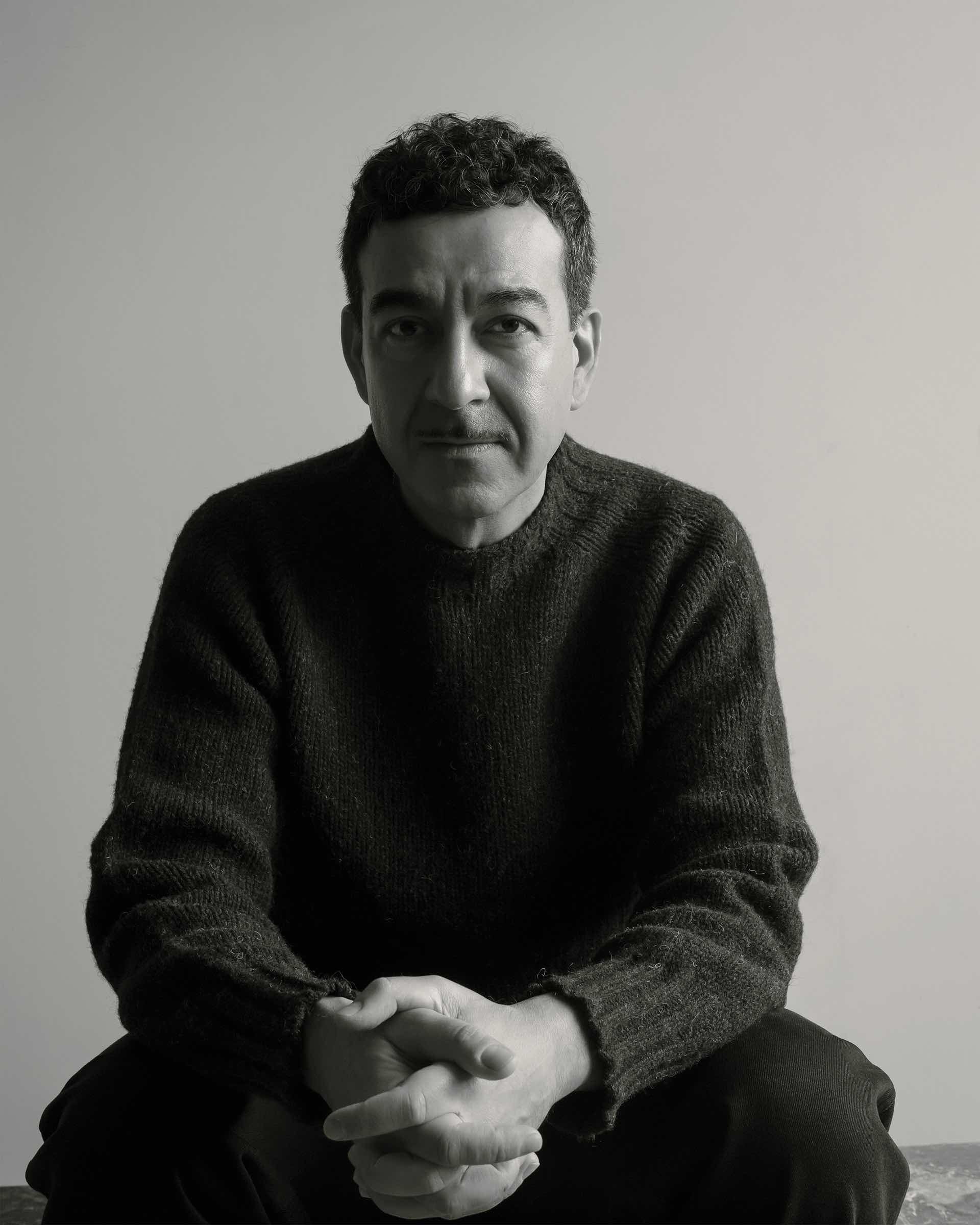 The Forum 20 | Kamrooz Aram: Painting on the Edge of Ornament and Abstraction | He works through form, perception, and the politics of display — Kamrooz Aram on ornament, abstraction, and the unstable ground of how we see.Kamrooz Aram moves between painting, sculpture, and collage, using material, structure, and exhibition design to question how images are read and how histories are constructed. His work often begins in the studio, through process and formal decision-making, and expands outward into larger systems of meaning: how value is assigned, how objects are categorized, and how cultural narratives are embedded within visual form. Across recent exhibitions, he continues to return to questions of ornament, modernism, and the conditions that shape perception without resolving them into fixed positions.He explains:* How openness, curiosity, and “young artist energy” remain essential to sustaining a long-term practice.* Why restraint, stepping away, and not overworking are as critical as mark-making in the studio.* What it means to work within a structure or “mode,” where improvisation can emerge without forcing novelty.* How ornament and abstraction are historically entangled, and why their separation reflects biased art histories.* Why viewers project cultural assumptions onto form, and how ideas of “the decorative” or “the exotic” are constructed.* How value shifts depending on context, authorship, and belief, from museum objects to replicas and everyday materials.* Why art can create moments of transcendence through form, rather than through narrative alone.(00:08) Welcome + Returning to the Studio(04:20) Reclaiming “Young Artist Energy”(10:00) The Nonlinear Life of a Painting(15:30) Disruption, Destruction, and Letting the Work Shift(25:56) Sculpture as an Extension of Painting(28:10) Ornament, Abstraction, and Historical Bias(33:40) Time, Fading, and Letting Go of Control(52:45) Authenticity, Replication, and Constructed ValueWatch the conversationView the full episode on YouTube.Follow KamroozWeb: https://kamroozaram.com/Instagram: https://www.instagram.com/kamroozegar/Kamrooz Aram (b. 1978) has built his practice on dismantling the divide between ornament and fine art, renegotiating the art historical hierarchies that privilege Western forms of abstraction above others. His paintings and sculptures do not simply cross categories; they probe the structures that enforce them. Born in Shiraz, Iran, Aram emigrated to the United States in the 1980s, where he found himself forced to come to terms with a multitude of identities imposed upon him. These experiences left a lasting mark. Categories, he discovered, do not merely describe identity—they invent it. This recognition drives his work, which asserts that non-Western ornamental traditions carry the same intellectual weight and conceptual rigor Western art history has long reserved for itself.About The ForumThe Forum is NewCrits’ ongoing public talk series, presented in partnership with WSA/WSBS. Talks take place live every second Tuesday at WSA. Join us for our next conversation here.Explore NewCrits’ offerings, including crits, courses, and mentorship programs at www.newcrits.studio.—Full Transcript Get full access to NewCrits Substack at newcrits.substack.com/subscribe | 1h 02m 23s | ||||||
| 4/10/26 | 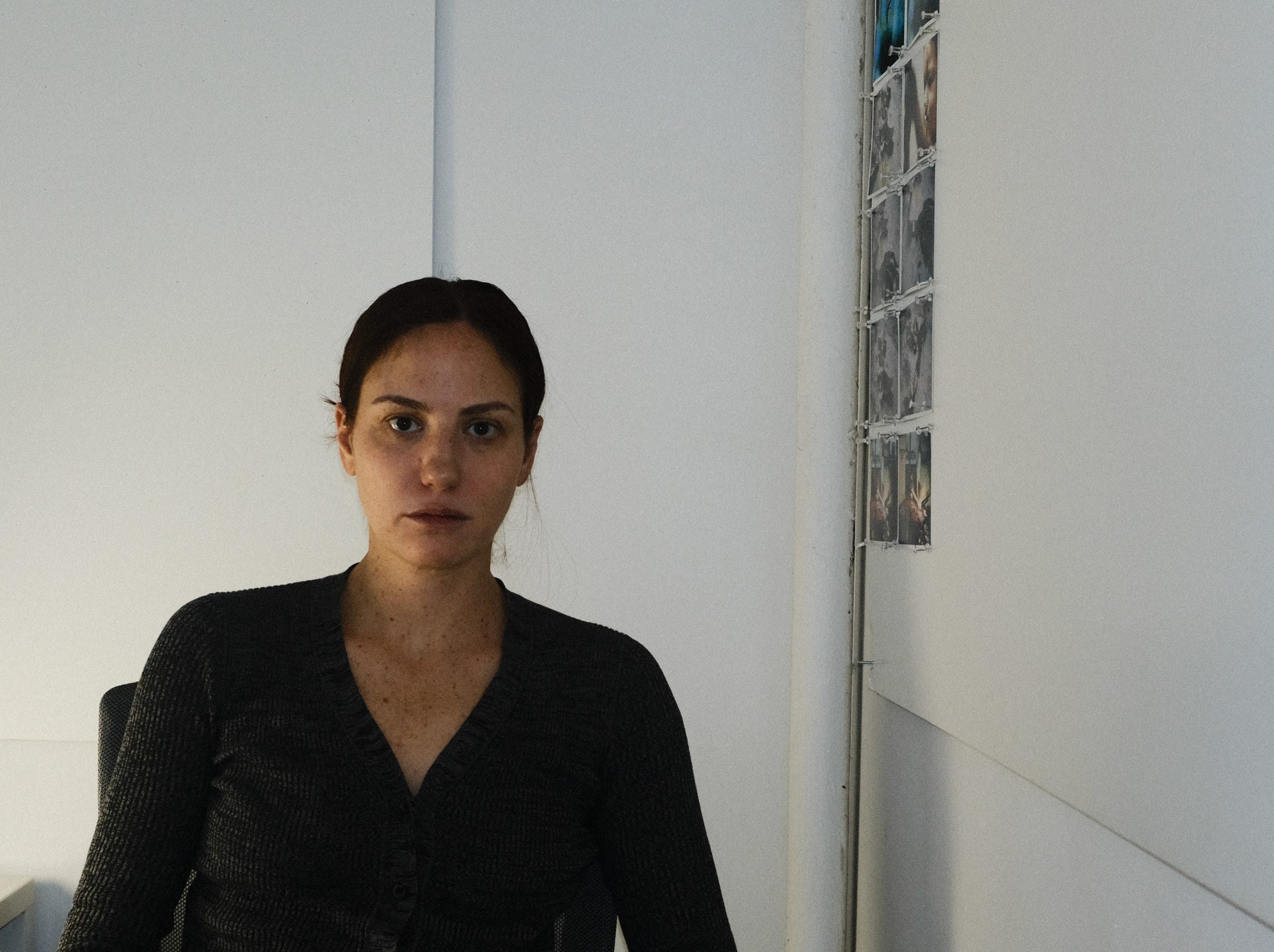 The Forum 19 | Rachel Rose: Psychic States, Motherhood, and the Moving Image | She works through feeling, perception, and narrative — Rachel Rose on interior weather, unstable perspectives, and art as a way to process what cannot be easily named.Rachel Rose moves between film, installation, and painting, using sound, light, and narrative structure to explore how experience is shaped from the inside out. Her work often begins with an emotional register and expands into systems of history, perception, and embodiment. In her recent film The Last Day, she turns inward, tracing the psychological and biological complexities of motherhood, identity, and crisis without resolving them into clear frameworks.She explains:* How personal feeling becomes a starting point for building larger perceptual and narrative systems.* Why motherhood, postpartum depression, and identity loss resist clean cultural narratives.* How sound and light can destabilize reality and reorient one’s relationship to the world.* What it means to make work that stays with ambiguity rather than resolving into message.* How falling in love with characters becomes a method for discovering structure, rather than imposing it.* Why occupying unlikeable or unstable perspectives creates more honest and generative work.* How art can act as a container for experiences that are culturally unspoken or difficult to locate.(00:08) Welcome + Intro(00:31) The Last Day and the Mrs. Dalloway Transposition (01:37) Motherhood, Identity, and the Book Read Twice (03:35) Lake Valley, Saturn Return, and the Invention of Childhood (07:19) Excerpt: Lake Valley (2016) (10:57) Art School, Painting, and the Crisis of Meaning (15:01) Editing as Voice, the First Video, and Finding the Medium (22:34) Transcendent Experiences and the Power of ArtWatch the conversationView the full episode on YouTube.Follow RachelWeb: https://gladstonegallery.com/exhibit/rachel-rose-the-rest/Instagram: https://www.instagram.com/worrrld/Rachel Rose (b. 1986) lives and works in New York. The work of Rachel Rose explores how our changing relationship to landscape has shaped storytelling and belief systems. Rose’s films draw from and contribute to the long history of cinematic innovation; whether investigating cryogenics, the American Revolutionary War, or an astronaut’s space walk, Rose directs our attention to sites and histories in which the sublime and the everyday blur. She translates this in her paintings, sculptures and drawings, which materially reverberate with one another, connecting the immediate to deep time. Recent solo exhibitions include: Science Gallery, London, UK (2024); GL STRAND, Copenhagen (2023); SITE Santa Fe, Santa Fe (2023); CC Strombeek, Strombeek (2022); Pond Society, Shanghai (2020); Lafayette Anticipations, Paris (2020); Fridericianum, Kassel (2019); LUMA Foundation, Arles (2019); Philadelphia Museum of Art, Philadelphia (2018); Fondazione Sandretto Re Rebaudengo, Turin (2018); Kunsthaus Bregenz, Bregenz (2017); Museu Serralves, Porto (2016); The Aspen Art Museum, Aspen (2016); The Whitney Museum of American Art, New York (2015); Serpentine Gallery, London (2015); Castello di Rivoli, Turin (2015). Recent group exhibitions include: Fondation Beyeler, Basel (2024); ARoS Aarhus Art Museum, Denmark (2023); Yuz Museum, Shanghai (2023); Centre d’Art Contemporain Geneva, Geneva (2023); 3rd Jeju Biennale (2022); 9th Beijing Biennale (2022); The Institute of Contemporary Art, Boston (2022); Minneapolis Institute of Art, Minneapolis (2022); Schinkel Pavilion, Berlin (2021); Toledo Museum of Art, Toledo, US (2021); Artspace, Sydney (2021); Art Sonje Center, Seoul (2021); A Tale of A Tub, Tlön Projects, Rotterdam (2021); Power Station of Art, Shanghai (2020); Palais de Tokyo, Paris (2018); Carnegie International, 57th Edition, Pittsburgh (2018); 57th Venice Biennale (2017); 32nd São Paudalo Biennial (2016); Hayward Gallery, London (2016); Okayama Art Summit, Japan (2016). She is the recipient of the Future Fields Award and the Frieze Artist Award.About The ForumThe Forum is NewCrits’ ongoing public talk series, presented in partnership with WSA/WSBS. Talks take place live every second Tuesday at WSA. Join us for our next conversation here.Explore NewCrits’ offerings, including crits, courses, and mentorship programs at www.newcrits.studio.—Full TranscriptAjay Kurian: Can you tell us a little bit about The Last Day?Rachel Rose: It’s a film that I wrote. Loosely based on Virginia Woolf’s Mrs Dalloway. I don’t know how many of you are familiar with the book, but maybe I’ll just summarize the book briefly so that you understand what I did.The book takes place in a day, and it was written after World War I. It describes a bourgeois housewife, Clarissa Dalloway, going about her errands in her day at 50, about to throw a big party for her husband in the evening. She has an 18-year-old daughter that’s kind of separating and rejecting her. There’s a foil character, who’s equally important in the book, named Septimus Smith, who’s a World War I vet who Clarissa sort of passes by. It’s almost like sliding doors throughout the day. He’s suffering from severe PTSD from World War I. Clarissa throws a party and at the end of the day he kills himself.I had read the book in high school and not thought about it much again. I had always been into Virginia Woolf and that was that.And then one day, I have two kids and I was getting our Tesla fixed in Red Hook at the Tesla dealership, and I was texting my friend sitting there in the waiting room. She’s said oh, what a Mrs Dalloway day you’re having. And I was like, oh am I Mrs. Dalloway? Let me think about that.So I read it again and I was completely blown away. As a mother reading it, I now understood the book totally differently than I understood it as a 16-year-old because obviously the perspective and consciousness changes as that’s what Virginia Woolf does. But now I was sitting in Clarissa’s position, obviously I’m not 50 and my kids aren’t 18, but I was feeling her pain, her rudder, her sense of loss of identity, all the kind of acts of self-actualization she had reversed or given up in exchange for her motherhood.I was incredibly moved and so I decided to transpose it into a modern day New York story, and the Septimus character, I transposed into a labor and delivery nurse that was suffering from severe postpartum depression.Ajay Kurian: Oh, wow.Rachel Rose: Which is something that I also suffered from.Ajay Kurian: Yeah.Rachel Rose: So I kind of, in different ways, felt myself in the different characters.Ajay Kurian: So much of what I’ve understood about your work prior to this moment is like larger systems in which humans find themselves in. It feels like this movie is a shift to the internal weather, rather than the external weather.I know it's just a matter of what the focus is. They're all kind of an ouroboros of sorts, but did it feel like a shift? Did you feel like you were going into something more intimate with the film?Rachel Rose: Before making the film and also before having children, so much of my experience in making works was a combination of I’m feeling this thing. For example, I’m feeling really anxious. Could I attach it? Now of course there’s all kinds of internal reasons why I might be feeling anxiety, nothing to do with, let’s say the weather or something.Ajay Kurian: Sure.Rachel Rose: But can I attach it to something I’m spotting outside, and make the artwork the container for that connection. So the work was always coming from something that always began with a personal feeling, but the difference is, that you’re right to point out, in this film it doesn’t go beyond that. A guess if you’re talking about motherhood, but the film isn’t a political comment on motherhood structurally in society. It’s actually totally not that.Ajay Kurian: What you’re saying there, there was a moment in an interview, I can’t remember who you were talking to, but you were talking about the process that you go through to make anything. Which is almost like you’re a sensor that’s like feeling things around you. And then as soon as you feel it and kind of know that you’re feeling something that’s worth noticing, that you then almost zoom out to see what the feeling is doing.Rachel Rose: I’ve done it in some really rudimentary, almost stupid ways.Ajay Kurian: I love stupid.Rachel Rose: This film The Last Day, than I made, is me contending with my ambivalence, confusion, pain and ecstasy around being a mother. For me, that’s why I made it. To kind of figure something about that out and give voice to a crisis I feel many other women experience, but there aren’t clear places to put that necessarily. For example, if I think back to when I made Lake Valley when I was 28, that was a work that I made in the beginning of my Saturn return. Actually, it was just the year after I had that Whitney show, and I was beginning this new stage of oh, I’m a working artist now and I have a career and I’m like a grownup.Of course we all become grownups to a certain extent when we’re 18 and we leave home. But then there’s this second thing, which is your Saturn return. Many of us know it, where you experience a new version of adulthood, like what’s this thing gonna look like? So this work came from that. Questioning, what does it mean to turn 28? It sounds so, honestly trivial, but at the time it didn’t feel trivial to me. It felt somehow kind of big.Ajay Kurian: 28. I guess I thought you were older at that time, ’cause there’s so much that’s related to childhood here.Rachel Rose: Yeah.Ajay Kurian: Now it makes sense that it is a reckoning of the idea of leaving childish things behind, but then also those things translating into this, as you’re gonna see in a second, very baroque visual language of all these different ways of storytelling coming together.Before we continue, let’s just play this excerpt. This is an excerpt from Lake Valley from 2016.Rachel Rose: 10 years ago. So weird. Just to give the texture of this, at the time, I found and then scanned tons of early children’s, the kind of early proliferation of children’s books, 18th or early 19th century. That’s what all these textures and the surfacing of everything is made up from that and hand collaging, well on Photoshop, but collaging these layers.Ajay Kurian: And it’s kind of the story of this Rabbit-ish figure that gets lost essentially.Rachel Rose: Yeah. Lives in a suburban housing development and goes into the little tiny greenery right next to the house. But then it turns and imagines it as though it’s this forest, but it’s kind of just a whatever space.Much of this was a kind of return to how childhood is formed, culturally. and that it’s kind of a modern invention. Even the idea of the storybook is so modern, and this coincides with the Industrial revolution. The idea that you sit down and read your kids a book and that there’s an illustrated thing that they look at. This is like a totally recent thing.Ajay Kurian: So that structure that seems part of the scaffolding of this —before that, what was the feeling that started this project?Rachel Rose: Saturn return, becoming an adult, understanding ourselves through a childhood, which is a very recent — super recent idea. I mean, Freud, that’s extremely recent. But even the idea that there’s a separation between childhood and adulthood and that we define ourselves as different is also very recent. So I was questioning, why do I now feel like an adult and I didn’t before? And what does that mean in the history of where we are today? So that was the inception.Ajay Kurian: And then getting into that history takes you into the Industrial Revolution and the foundations of how we start thinking about that separation.Rachel Rose: Yes. And then separately, which is true for all my work, I also always have a thing I wanna learn how to do. “I don’t know how to do this” is to me, an essential project and point of making an artwork. When I complete the work, I might know a little bit more about how to do it.So in this case, I’d never done an animation before. I had no idea how to do it. And actually, I don’t think I had ever written a proper script, because up until this point, the two or three works I had made had been basically essays. This one, because it was an animation, I had to storyboard everything. So I had to write a very clear script. It was actually the first time I ever wrote a script.Ajay Kurian: What did that feel like?Rachel Rose: I mean, I didn’t know what I was doing. So it was that, and then it was the storyboarding, and then it was working on a traditional animation because this is hand drawn.Ajay Kurian: Let’s go back even further. Because you went to art school and you went in for painting. But then you started moving into film, seemingly suddenly. Was it like, I can’t think in this medium anymore?Rachel Rose: Yeah, I mean, I got obliterated in all the crits. Everyone hated on everything I did, and I felt so bad about myself all the time. Which wouldn’t necessarily happen in this. But yeah, I felt so bad about myself all the time and I felt like, why do I have to feel bad about myself for this pointless thing? I don’t think painting’s pointless, but…Ajay Kurian: You have a painting show that’s opening in like a few days?Rachel Rose: I don’t think the painting is pointless, but at the time I felt a major existential crisis, right? And when I say this is pointless, I meant all of art making, start to finish. What am I doing here? I wanna do something meaningful with my life. I want to affect change, I wanna contribute. What can you do in art? Seemingly like nothing.Ajay Kurian: So that was the takeaway.Rachel Rose: Well, no, that’s the crisis that I had at that point. And then I thought, if I became a documentary filmmaker, that could be politically actionable. So then I started learning how to make films immediately, thinking that when I graduated I would try to make my way into the documentary film world. So the best thing I could do is learn all the skills I could in the meantime.Ajay Kurian: Did it come as a shock to your professors at the time? And when you started making that first video piece that you thought was gonna be a documentary — when did you know that it wasn’t?Rachel Rose: I knew it wasn’t when I started editing, but not up until that point. I was driving around shooting this footage and doing these interviews. I didn’t understand how much it wasn’t a documentary film until I started editing, which was the first time I ever edited anything. And I just fell in love with the medium. I felt that this is it, this is me. I’ve been waiting all this time, and I was in the middle of my second to last semester of school at that point. It was like, let’s say November of my last year when I was finally editing. So I was like, oh my God, this is it. I love this medium so much.Ajay Kurian: Did everybody in the crits just shut the fuck up?Rachel Rose: I mean, I wasn’t showing anything at that point because I didn’t have anything to show. I was just working on my project or whatever.Ajay Kurian: But then you had a final piece.Rachel Rose: Yeah, but I guess what I’m saying is I fell so in love with editing. I felt like this is my voice.Ajay Kurian: I mean, that’s when I met you, when you were graduating from graduate school.Rachel Rose: That’s right. That’s when we met, because you were in that show.Ajay Kurian: Yeah, I was in the show that Ian was in, at PS1.Rachel Rose: And I was coming over and bothering you guys during install, I remember that!Ajay Kurian: Yeah. So Rachel’s married to Ian Chang, another artist, they both show at Gladstone. An amazing artist in his own right. And we were in that show together and Rachel was asking for studio visits from everyone.Rachel Rose: Yes. I’m sure I was. And Josh came and changed my lifeAjay Kurian: I believe it. To every person you were like, I’d love to show you this. And I was like, wow. I remember seeing it and I was like, this is her first video piece, that’s stupid. It really blew me away. It really towed that line.I hadn’t seen that much video art that felt borderline popular that could have been released in a gallery and it could also be released by Vice. It felt like it had the makings of something that were highly specific and rigorous. And in that particular piece, it was thinking about the border slash limit of life and death. What happens in that transition? How do we codify those things? And seeing it, it really shocked me. You were so proficient in doing this so quickly. It’s obvious that was your voice. It was a no brainer.Rachel Rose: I remember that feeling, I felt high during that period because I felt like after all this time of feeling like I actually wasn’t an artist and like I was wrong and it was time to pivot. Then I found this medium that felt like I could channel myself through it. And at the time, also in the art world, there was a place for making work like that. I think that’s changed now, but at the time there was.Ajay Kurian: I mean, I feel like your rise was in a moment when new media and video was being shown constantly. Now it’s harder to come by exhibitions like that and people that are gonna put the money into it. Because, what you can’t see in this excerpt, is that your videos are installed incredibly specifically. Actually, we can just see it on the website. Did you know that in grad school, was that already something that you were thinking about?Rachel Rose: Yeah, I had this position, I guess at the time, of hanging around in the art world. Which is okay, if I’m gonna do this, if these things are gonna be shown in exhibition spaces and not black boxes, then I should really use the exhibition space for what it can offer. I had screens made out of tapestries and carpets, and all kinds of ways that particularly address the way that the film sat in the space. So yeah, this was at the Philadelphia Museum of Art, and we wrapped the room. You can’t see it in these images really, but the room is wrapped in this scrim. The same scrim that we’re projecting on, but it’s double wrapped. So it created this kind of moire effect with the light. And that moire effect was also in the film. So experimenting with things like that.Ajay Kurian: I mean, I guess your first solo exhibition was at the Whitney Museum. And even there, it was the scrim and the way that light was coming through the room. You couldn’t call it site specific, but it was site sensitive.Rachel Rose: It was, that’s exactly the word. I went in and actually edited and played with the blacks in the space. So the idea was that when there was black on the screen, it would be porous because obviously that is a dim projection of light. and you would see the outside world. So I projected a scrim that was in front of a glass.The whole film was about what we can access. And what we can in light and sound is obviously biologically determined, but what does it mean to take our biological form and extract it from this one? Let’s say you become an astronaut or something. What can you see and hear differently? Can you extend the limits of human perceptual capacities, not through drugs or alcohol or whatever else, but through just moving our body into a different environment off of the earth.Ajay Kurian: And what was the thing that you wanted to learn in this piece?Rachel Rose: Well, this piece came out of something really simple actually. I don’t know if it was a thing I wanted to learn, but it was a feeling I wanted to explore, which is that Ian and I had gone to see Gravity in Battery Park City. When we left, we walked home to the Bowery where we lived at the time. I can remember it exactly now, the feeling of leaving the theater and walking on the street and looking at the street signs and the traffic lights. Just like New York City laid bare and feeling actually very alienated from it. And it took that walk, or maybe a few blocks of that walk, to kind of resettle. Actually we never left America. We never left New York City. We were here the whole time. Because I found that film so transportive and seeing it in the theater so transportive, which I think is something to do with the way it was shot and the time and the moment. Then I remember saying to Ian it’s so weird that just sound and light did this to me or to us. That’s all it was. We were just sitting in a black box listening and looking. And yet, a streetlight feels alien to me. So I started to wonder about sound and light and how it enters the body and what it can do to us.Ajay Kurian: And seeing if you could conjure something similar.Rachel Rose: Yes. But first I think I was interested in, what are the extremes of this? Then I heard this interview with this astronaut about a spacewalk he had done in outer space, when he was repairing the International Space Station and the Earth was on the night side.So I guess when the earth is on the night side, the earth is nothing and it just looks black. At least that’s how he described it. Maybe it’s something about the position of the — I can’t remember the details of it, but it was like a void. He described this experience of total blackness in outer space and then what it’s like to come back to earth as an astronaut, which many astronauts have talked about. Having to relearn how to walk, how color is different and sounds feel different.Ajay Kurian: It almost feels like a microcosm of how you think about an artwork in general because there’s something about compression and distortion that happens repeatedly. Where using compression and distortion is a way to unground your viewer and to have them see the world anew again, where there’s something liquid and something destabilizing. You’re using extreme experiences sometimes, but it’s to induce the vertigo of the everyday.Rachel Rose: That’s right, like that image on the screen. Then I got really interested in Douglas Trumbull and early special effects designers from 2001 Space Odyssey and actually how homegrown and simple these effects were. Like that’s just milk and ink, and learning how simply you can suggest something.Ajay Kurian: So there’s just a lot of liquids that Rachel was mixing together, and when you see them, it’s so alchemical. Especially in the age that we live in today, you would just assume that it’s rendered, like it doesn’t look real.Rachel Rose: But it literally was just in my kitchen. That’s all it is.I was really interested in that, which I think is similar to this thing of, I was actually just at the movies and many of us probably saw Gravity. It’s not that big of a deal, but you know, it can also change your relationship to living for a second and that’s meaningful.Ajay Kurian: I mean, outside of how a documentary can potentially move politics if it does. It depends, right? Depends what we’re thinking right now and maybe the world is past documentary help. But there’s also that feeling that art can be a transcendent experience that pushes you out of your body into a place where you can experience yourself in the world in a very different way.Those are very life-changing experiences. I remember when I interviewed you during Covid, I asked you whether you’ve had transcendent experiences with the work of art and you adamantly were like, yes I’ve had many. One that you mentioned was a story by Joyce Carol Oates.Rachel Rose: Maybe I was reading it at the time.Ajay Kurian: You had just finished reading it. It was a short story called Feral.Rachel Rose: I can’t even remember this.Ajay Kurian: Oh, man. It was intense because you kind of narrated the story and then you were like, I wanna cut that. But it’s a story of a couple that have been trying to have a kid for quite a long time. They finally do. They’re so pleased. The child’s very calm, pleasant and lovely. And then, unfortunately, almost drowns and the child’s revived. Then his demeanor is completely different. He’s like a feral child. He’s running around constantly escaping every situation, almost demonic. And throughout this, what you described is that the language is very simple, not flat, but just simple and matter of fact.And then in this last section where the child disappears and runs out into the woods, all of a sudden it’s like time is distended and every single thing is described in high definition. The end of the story is that you see the child howling in the woods with other children.Rachel Rose: It’s such a crazy, beautiful story. Thank you for reminding me of that.Ajay Kurian: It made me think of weapons if you saw that.Rachel Rose: Yes.Ajay Kurian: That came to mind and I was curious if that director had seen that. If you haven’t seen weapons, it’s actually really worth seeing. But it also just tapped me into that feeling of distortion and it made perfect sense to me why that would be one of those experiences that had that effect on you because it feels like a feeling that you chase too.Rachel Rose: You know what’s cool about that story? That I forgot about. Is that as a reader, when you’re reading it, the whole time, you’re in the position of the parents, right? I can’t remember exactly whose consciousness, but you’re in their position. Maybe you’re the mom. I can’t remember.Ajay Kurian: I think you are.Rachel Rose: So you’re like, why? You know, it’s all the bad stuff that’s happening to her because of her messed up kid and this kind of mid loss. What happened to my kid? His brain is damaged by the water and you’re in this whole detective story about, can she get him back? When’s he gonna release her to love her again? And then at the very end it’s revealed that this way bigger thing’s been happening the whole time. And who knows what happened under the water. Maybe it was just a little thing, it’s meaningless. Or maybe he was down there and he met a spirit. It just flips the whole relationship to the problem that you’ve been following the whole time.Ajay Kurian: That’s so weird that I didn’t think about that moment in the water. I guess I assumed that it’s like a life and death experience, but when you said who knows what happened in the water, it kind of gave me goosebumps. Something happened in the water.Rachel Rose: Or not.Ajay Kurian: Or not.Rachel Rose: Or nothing happened and he was born feral.Ajay Kurian: Have you had any transcendent experiences recently with the work of art?Rachel Rose: I have had two in the past four days, which is very unusual because I don’t know if it’s like this for a lot of you guys, but there are long stretches of just nothing.I saw Anne Teresa De Keersmaeker, a Belgian choreographer on Thursday night. I don’t need to paraphrase the whole piece, but it just completely blew my mind so much that I got Ian a ticket to go alone on Friday night, and made him go because I was like, our relationship needs you to see this. I can’t be the only one who saw this. That’s the level of masterpiece I thought it was.Then on Sunday, we took our kids to see hoppers, which also is just mind blowing. It’s like a Pocahontas story or Avatar. Now we’re in the animal world and we’re here to save the animals, and people are bad and they’re violent. They’re like there to destroy nature and we hope that humans will learn a lesson or something. Kind of exactly like Avatar or Pocahontas.Then it weaves into something much more complex and a kind of forgiveness and empathy for human behavior. And locating it within the kinds of needs and drives that all animals have in different degrees and is organ principled and organized in different ways. In the end it sort of offers human destruction and behavior an enormous amount of empathy. It’s a super complicated movie. I really don’t know how it got made.Ajay Kurian: In thinking about animal consciousness, witches and thinking about all the things that start to get banished from the world because there’s a particular kind of colonial rationality and also the beginnings of capitalism that are happening in this moment. I mean, this is the grounds for the film Enclosure and I’m sure you can speak to that in terms of what that means for that proto capitalist moment. But I’m gonna show this first.Rachel Rose: One of the ways that people thought about healing other people during this time was through transferring consciousnesses into bodies of animals. So if someone was sick with the flu and nothing was working, they might kill a goat. I don’t remember exactly, but you kill a goat and stick the goat next to the person to try to transfer the death into another body, for example, or the illness into another body.Ajay Kurian: And then you have a show that’s opening this week at Gladstone Gallery, which is called The Rest, where you’re thinking about landscape and politics and the stories that we tell ourselves, but again, through this sort of distorted lens. These are really beautiful paintings. I don’t think I’ve actually seen one of these in person, so I’m excited to see it in person.Rachel Rose: They’re small. They’re a little big, but they’re small. This is something I’ve been working on for maybe three or four years.It’s not actually in the Bible, but this allegory of the rest on the flight into Egypt, which is this moment that has been depicted throughout European Western painting from Caravaggio to Flemish to Southern, everywhere, of Mary, Jesus, and Joseph fleeing. Basically running to safety in Egypt as Herod’s army is on their back trying to persecute and capture them. And Jesus, I think, is three days old. So she’s like breastfeeding, very new mother shit.There’s this moment, it’s called the rest on the flight in Egypt, where they stop to rest and Joseph gets them food and usually there’s a water source. And usually symbolically, there’s this hay field that sprouts up automatically so you see Herod’s army is blocked and can’t find them. Mary sits in the center just breastfeeding Jesus, calmly. And at her feet often grow the exact herbs that she needs to feed him and feed herself. There’s this thing where the tree branch bends down to give Joseph the exact olive or depending on where they are, pear, whatever that he needs to give for her. The donkey just waits there and everything is perfect for her and for this moment. It’s a kind of time warp space thing.I’ve interpreted the allegory many different ways in different shows and different ways of working with the paintings. In this show I decided to reset the allegory in Northern Westchester. Now from the perspective of Mary. Taking Mary, Joseph, and Jesus out, and looking at the symbolic elements that she looks at in the painting as transposed to Northern Westchester now. And kind of experiencing the world from her perspective in that moment. So that’s what the show is.Ajay Kurian: Beautiful. Go see the show. It opens on Friday.Rachel Rose: Yeah, that’s it. Get full access to NewCrits Substack at newcrits.substack.com/subscribe | 38m 47s | ||||||
| 3/5/26 | 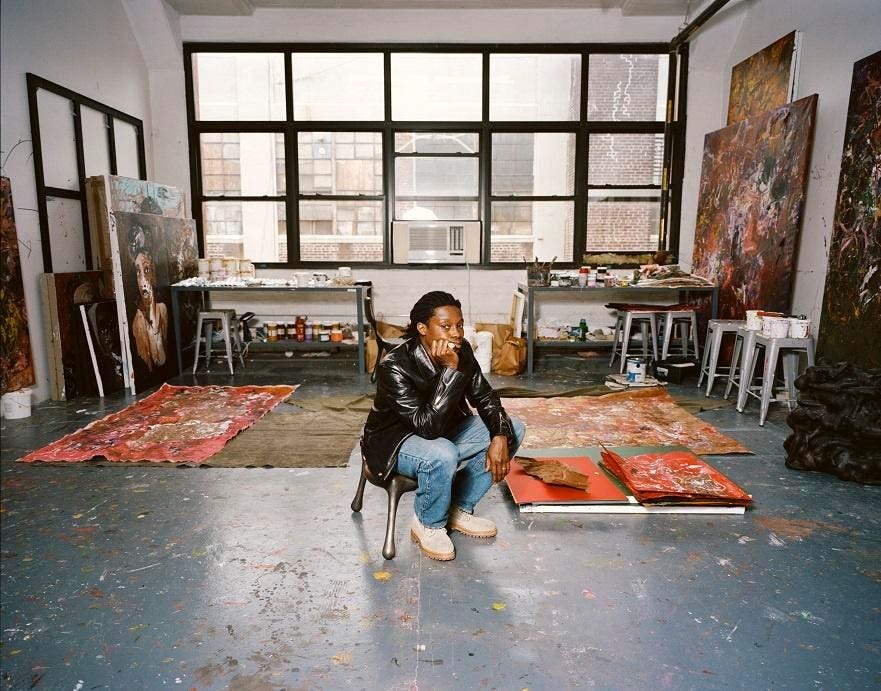 The Forum 18 | Reginald Sylvester II: Discipline as Devotion | Reginald Sylvester II approaches painting as a structure of discipline. What begins in daily rituals—routine, repetition, and care—extends into a larger philosophy about belief, responsibility, and endurance. Practice, for him, is not separate from life. It is shaped by it.Fatherhood, spiritual inquiry, and the demands of time become part of the architecture of the studio. Rather than protecting art from those pressures, Sylvester allows them to recalibrate how the work unfolds. The result is a practice grounded less in spectacle and more in sustained commitment.Abstraction emerges through this framework as an act of faith. To begin a painting without knowing its final form is to trust that meaning will surface through repetition and attention. At a certain moment, that commitment required stepping away from exhibition altogether, allowing the work to evolve privately before returning to public view.Rather than presenting artistic growth as clarity or mastery, Sylvester describes a practice built through persistence, where rigor, vulnerability, and belief remain inseparable.He explains:• Why daily rituals and discipline are foundational to sustaining a studio practice.• How fatherhood reshaped his relationship to time, responsibility, and ambition.• Why abstraction functions as an act of faith rather than a stylistic choice.• What it meant to withdraw from the exhibition to deepen the work in private.• How travel and research expanded the historical resonance of the work.Timestamps(0:00) Ritual and the Structure of Practice(5:00) Fatherhood and Responsibility(11:00) Abstraction and Faith(18:00) Stepping Away from Exhibition(26:00) Discipline and Repetition(34:00) Cutting into Surface: The Gates(41:00) Travel, History, and Material Memory(49:00) Persistence and Staying in the WorkWatch the conversationView the full episode on YouTube.Follow ReginaldInstagram: @reginaldsylvester2Follow Maximillian WilliamWeb: https://www.maximillianwilliam.comInstagram: @maximillian_williamReginald Sylvester II (b. Jacksonville, NC, USA, 1987; lives and works in Jersey City, NJ) creates large-scale paintings and sculptures that trace the generative threshold between the two mediums. Working predominantly in abstraction, he expands the language of his painting practice by incorporating materials such as rubber, tarp, aluminium and steel. His singular approach lends his paintings a sculptural presence and imbues his sculptures with a painter’s sensibility. While grounded in traditional painting techniques, Sylvester II ventures beyond the conventions of stretched canvas, working on surfaces that both absorb and reject paint. His layered, often multi-partite works investigate the language of his chosen mediums: stretcher bars are left exposed, becoming part of his compositions, while oxidised and patinated metal surfaces evoke the histories of gestural painting. Sylvester II also transcends the surface, creating monumental sculptures that reference forms observed through painting and from his environment. The artist is drawn to materials that relate to his personal history, spirituality, or broader societal narratives. In his approach to assemblage, Sylvester II appropriates byproducts of his making process, physically attaching studio debris to works to enrich their tactile quality and textural narrative.About The ForumThe Forum is NewCrits’ ongoing public talk series, presented in partnership with WSA/WSBS. Talks take place live every second Tuesday at WSA. Join us for our next conversation here.Explore NewCrits’ offerings, including crits, courses, and mentorship programs at www.newcrits.studio.—Full TranscriptAjay Kurian: I’m gonna start off with the big questions, things that are really important to people. You are 37 years old. What the fuck is your skincare routine man?Reginald Sylvester ll: 39.Ajay Kurian: That’s insane.Reginald Sylvester ll: Knocking on 40, bro.Ajay Kurian: Oh my God.Reginald Sylvester ll: Yeah, man. Cold water and shots out to mom Dukes.Ajay Kurian: That’s really Mom Dukes and cold water. I remember this very clearly when Pharrell was asked, he said cold water too.Reginald Sylvester ll: He’s right. Closes up your pores, but, yeah 39, about to be 40.Ajay Kurian: And you’re a new father.Reginald Sylvester ll: And I’m a new father.Ajay Kurian: Congratulations.Reginald Sylvester ll: Yeah, man.Ajay Kurian: What’s family life right now? How do you do studio, father, all of the things?Reginald Sylvester ll: To be honest, it’s not much studio. It is just really wifey, Noah, supporting her, you know. She’s still getting back to a hundred percent and so I’m just support right now. I’m the calvary. Keeping it down.I fit in drawing, some reading when I can, but for the most part, I’m waking up, and it’s, what do you need, what you need help with, what does Noah need, and you need a break. I’m just support, you know, at this point.Ajay Kurian: That’s good.Reginald Sylvester ll: But the time away is gonna help the practice.Ajay Kurian: Yeah. I think it always fuels it. Even if you’re not in the studio, other things are happening and you just brought life into the world. Your lovely wife brought life into the world. So how could that not affect?I was thinking about you having a kid and what that means for the studio practice, but also what that means for how you share your spiritual practice with the next generation, with your kin, and how that’s meant a lot to you. Is church a part of your life or is it a different kind of spiritual practice? How are you gonna pass this on?Reginald Sylvester ll: I grew up with my grandma going to the church. You know, that was how I grew up. But obviously as we grow and become adults, you start seeking after things on your own.So I’m just in big research mode right now. I’m just doing a lot of reading, a lot of research, things that feel true, and things that I stray away from. But I’m in a big learning research, discovery mode, lots of conversations with my pops, my mom.Ajay Kurian: And they’re open to those kinds of conversations? Because I know for myself, my parents are from Kerala, and there’s a huge Christian population there. So I grew up Christian and they’re very religious.And I thought learning about theology and the history of Christianity and all that stuff would build a bridge. It did not. It was like it created more hostility in a way because it’s like, why do you have all these questions? Why are you inquiring? What are the bridges that you have with your folks?Reginald Sylvester ll: So my dad, he went to theology school to become a pastor at a certain point. He’s done a lot of research and reading and so forth in his own life. And so when I come to him with questions, he’s very open arms, answering those questions, and guiding me with the questions.Sometimes, parents can be very opinionated, you know, that’s not what you know, that’s what we should be looking at is this soul. But it’s great because I think in terms of spirituality, for me, I just wanna get to the truth. That’s what it’s really about.And I think, through becoming an artist. Art is a thing that deals with truth. So once I made the decision to actually become an artist, it made me question a lot of things about, where I am, who I am, where I come from, you know what I’m saying? What do I believe? So I started to become a student of history and really just started to do a lot of reading, and then again, going back to my folks asking questions, did you hear about this? What do you think about this?Ajay Kurian: That’s beautiful. It’s nice that you have that relationship with your family. I mean, it seems like they’re all kind of artists in their own way too.Reginald Sylvester ll: Yeah. My dad, I guess I call ‘em like an artist and graphic designer. Growing up, I seen him do a lot of things with typography. Not really painting, but more so graphics. He did t-shirts, which is what led me to falling into streetwear, watching him kind of having a brand and doing his thing.Ajay Kurian: Oh, he had a brand logo?Reginald Sylvester ll: Yeah, I mean, Pops made shirts. But just seeing him kind of move like that gave me the confidence to wanna be a graphic designer or want to learn about typography or wanna learn about silk screening t-shirts. He was a big part of that.Ajay Kurian: I wanna start with Limbo first. This is a quote that hit me really hard just ‘cause it’s a heavy thing to say. You said ‘making that connection between abstraction and faith grabbed hold of me. Suddenly for me to paint or find an image became symbolic of how one lives life, with hopes of dying to then enter into the kingdom of heaven’. That’s a heavy ass thing to say.Reginald Sylvester ll: Yeah, I guess I didn’t mean it to be so deep or sound so heavy.Ajay Kurian: What is the Kingdom of Heaven for you? What is that?Reginald Sylvester ll: Kingdom of Heaven is to be with God, to be with Christ, to make it to paradise or spiritual paradise and how I attested that to painting. When I first came to New York for my second business trip in my graphic design days, I wasn’t concerned about being an abstract painter at all. But I ended up going to the Met and went to the abstract expressionist wing. First time with De Kooning, Gilliam, you name it — the guys, right? And I immediately felt like this is something I want to do. But I don’t know how I’m gonna get there. When I did start to research and read, I learned about De Kooning and him talking about finding an image, and it very much sounded like a painterly way of faith. Or how one goes through life, living life. We all try and I don’t know if people are religious or believe in God or heaven or after life or whatever, but we all live life the best we can in order to make it to that next place where our soul will rest, you know?He talked about finding an image and it made that connection for me. So I said, if I’m gonna be any type of painter, it would be an abstract painter. Because it was like a painterly motif that defined faith, or how I sought and see faith. ‘Cause faith is believing in things unseen, right?Ajay Kurian: For sure.Reginald Sylvester ll: And so if you’re in the process of making a painting, but you don’t necessarily know what that finished image is, but you’re working your way through it, that’s what that thing is. And so, I don’t know what the Kingdom of Heaven looks like. It’s been described in a few ways, but I hope to get there, you know? So to get to that finished painting, I don’t wanna say perfect painting, but the act of making to find my way to new images is what made that connection for me.Ajay Kurian: I remember I had to write something about On Kawara back in the day. And weirdly, after spending more and more time with the work, it felt like it was a practice of prayer. That every painting was a small act of devotion towards something unnameable. It didn’t have a shape or a way of being described, but you put in the work. It felt similarly related to thinking about what all this means here for somewhere else. It feels like that’s kind of the starting point for these 12 gates that are in Accra right now. How did this all come about? First of all, this space is fucking stunning.Reginald Sylvester ll: Yeah, shout out to Limbo, man. That’s Dominique and the homie Diallo. Diallo suggested me to Dominique, who runs the Limbo Museum. Very forward-thinking in terms of the vision. But it’s a museum that basically uses abandoned spaces in order to give artists an opportunity to put together shows. They’ve started a residency program and I was the first artist to do the residency.Initially, when I went to go visit for the first trip, I thought we were gonna use the space that they used for the prior presentation when they did the inaugural talk and show. And she was like, no, I’m just taking you here to just show you the initial space, but this is the idea that I have for you. So she went to the University of Ghana, and I was like, you are gonna let me do a show and this is what we’re doing? She was like, yeah, and it was great because it was my first time on the continent and I’ve always wanted to do a show on the continent. My father always talked about taking the family to the continent. Obviously I wanna touch roots. You know what I’m saying?Ajay Kurian: Yeah.Reginald Sylvester ll: But then it was also challenging ‘cause I’d never worked at this scale before. How are you gonna treat this space? How is the work gonna function in this space? How is it gonna reverberate in the space? Diallo and myself had a lot of conversations surrounding that and he challenged me on a lot of things in terms of these gates from their initial intent and how they were shown. How to move past that and to allow them to do other things. And so, this allowed me the space to do so.Ajay Kurian: The first time you showed them was in LA . I just wanna show images of that exhibition, which had a great title, T-1000.Reginald Sylvester ll: Yep, I’m sure everybody’s familiar with Terminator.Ajay Kurian: Yeah, Terminator 2: Judgment Day.Reginald Sylvester ll: I’m super big into sci-fi movies that got that post-apocalyptic punk undertone. You know, brutalist, kind of futurist.Ajay Kurian: I mean, it shows. The work is definitely in that vibe and I remember when I was researching you, that I saw this show. But I do remember when you were fabricating those gates and I was checking the progress on Instagram, and I was like, shit, this is different. This isn’t a new step.Reginald Sylvester ll: Finding my way through making new types of paintings led me to sculpture. I’m a fan of painting first and being interested as a maker, you’re always trying to figure out, how can I push the work? How can I find myself? If I’m interested in sculpture, how do I find my way there? Being introduced to a new material, which is rubber, led me to really changing the whole process and way I make work.That led me to a form that was found by way of the byproducts of the paintings, which gave way to the gates. And so that’s the cutting that you see in the rubber. Because at one point I was researching and reading a lot about ready-made sculptures. I started to think about my paintings in the sense of a ready-made and how I can show all parts or all aspects of the painting. Making this curvature incision, and the shape that I was left with when it was laid on the floor in my studio reminded me of the floor plans used for the boats that were used in the transatlantic slave trade.Ajay Kurian: That’s interesting to hear. I always thought it was the other way around. I thought that you had that shape in mind and then that curvature got cut and it became that act of violence in the surface. But it’s interesting to hear that it was first a formal decision. One where it was like, let’s get to the truth of the material.Reginald Sylvester ll: The thought of even showing the substrate. I think that’s why I wanna continue to put myself in new situations in the studio. Because for me, and every artist is different, but that’s the way that I grow. So if the aesthetic of a material interests me, it’s for me to not really ask too many questions. It’s just to respond to it.So I was using a lot of military tent shell halves, they’re called pup tents. You basically button two of the tent halves together to make a full tent. I was buttoning them together to stretch them over the substrate, but because they don’t make a complete closure, you get access to the substrate.I thought, oh, I can be more intentional about that. This is happening by way of accident. I made a series of paintings with the pup tents, but I said, how am I gonna be more intentional about this access to revealing the substrate and how it changes the form and the structure of my work.The reason why I called them Gates, because thinking about that history along that journey. I mean, we’ve seen Amistad films, so how do I take this history and reverberate it into something, I don’t wanna say beautiful, but speak further into it.Ajay Kurian: It feels like the history of black culture in so many ways where it’s like you take shitty situations that are beyond the pale, and then you consistently make joy out of it.Reginald Sylvester ll: Yes. I think some of the best work is made from the most mundane things. I think that’s black and brown folk in general. We take a lot of the waste and cook and repurpose it into something great.Reginald Sylvester ll: And so I said, all those bodies that were lost along that journey, where do those souls lie? Scripture say that all souls return to the father once they pass. But I just thought that, maybe I can take this shape and I can reform it as this gate-like sculpture in order to give way for those souls to pass through, to have rest.Ajay Kurian: So in that early version, that’s sheet metal welded together and it has a structure underneath, but then this becomes airy and light. What does that translation mean for you? What does it mean to take it to this place of pure structure?Reginald Sylvester ll: A big part of my work and how I continue to try and grow, is I’m just paying attention to what interests me. I used to have a studio out in Ridgewood and I would look at a lot of the debris. The junk by the trash cans, the back of semi-trucks and how they oxidize over time, the environment of the city, the outside. And using that as a language to bring into the studio. So I did the same thing when I went to Ghana.Ghana’s a very interesting place because it excited me, but it also made me really upset. Because you see wealth and poverty right next to each other. You go to a hotel that’s around the corner from people who don’t even have clean water. You know what I’m saying?Ajay Kurian: That feels like Mumbai too. I remember going there and there’s like Prada on one side, and then this dude with his hands disintegrating from leprosy. It is so stark. Where I’m from, in the south, it’s still communist, and the discrepancy in wealth is much less extreme. But there’s certain places in various parts of the world where the jump is so crazy that it really fucks with you.Reginald Sylvester ll: And just getting a grasp on, why is this happening? So from my understanding of what they were telling me, when new individuals were elected or coming into power, certain buildings that had paperwork and had the okay to go forward — build this hotel, build up this certain area, build up these certain advertisements — if that project wasn’t complete by the time that individual who gave way for it to happen, the next person that came into power can say yay or nay on whether it’s finished or not.Which initially gave Dominique the idea for Limbo, right? Because you’re seeing all these great infrastructures half built and then the people that are living there have to deal with it. Anyway, getting to the language within the gates here, it was by way of seeing the advertisement signs and the structures that were exposed.It’s funny, I see Eric Mack in the back, my bro, and I thought about ‘em a lot. I told Dominique to reach out to Eric, because you would see a lot of torn away signages breezing in the wind. I was just thinking about the structure of these gates and the call or need for tension. You know, not as this solid form, but as this form that your eyes can kind of pass through. And then thinking about the space that they’re about to be exhibited in. It’s a very raw skeletal space.So I want the works to have this presence, where they’re there, but they also evaporate. Even these sight lines were very important for us because I want your eye to rest on the sculpture, but I also want your eye to be able to pass through the structure and just enjoy the space as well too. You have sculpture after sculpture that reveals a painting in the distance.So that was another reason why I wanted to stick to this thing and also just thinking about radical black empowerment or thinking about Nkrumah. Thinking about his influence on W-B-W-E-B, du Bois, Malcolm X, all these individuals who I look up to, and have read about and thinking about. The writings, the fortitude and resilience they had, and how maybe these forms can give way for those teachings and those hopes for the continent or those from the diaspora. For those that kind of echo throughout these works as well.Ajay Kurian: I’m not familiar with, you said Nkrumah?Reginald Sylvester ll: He was a revolutionary that really wanted to unite all of Africa. While he was living and was active, he had a huge influence on a lot of American activists as well. Malcolm X was somebody he really influenced.Ajay Kurian: I gotta do some reading.Reginald Sylvester ll: Yeah, so that first trip was very visual and the latter end was very like, I’m looking, I’m reading, I’m writing. Then the second trip was going to work.Ajay Kurian: It’s beautiful that you find the vernacular of the city, the tubing, and it sits in the space but it takes you somewhere else. It’s like it’s building on all these conversations that you’ve already been having. It really makes me think how far you’ve come in this crazy way where you started in graphic design, typology, and working in streetwear. To go from that to this. It’s not insane or anything, but it’s a pretty serious distance in terms of what that work looked like and where you are now. Your first show is In Search of a Wonderful Place. It’s very obviously condo inspired.Reginald Sylvester ll: Heavily.Ajay Kurian: Heavily. You’re bringing your own things to it, but it’s also within this space of what I’ve seen a few times over. Of people who are in streetwear and the artists that they’re interested in are all the same artists, which are Condo, KAWS, and PicassoReginald Sylvester ll: Murakami.Ajay Kurian: Murakami. Also, let’s not forget Basquiat and Warhol.Reginald Sylvester ll: Yep.Ajay Kurian: Those are the names. And it’s an instance in which we get to see an artist process it live. You’re doing it in exhibitions, not in the studio. There are people that are figuring their shit out and they get their opportunities much later. But one thing that is a credit to you is you are always adept at what you were doing, and somebody saw some promise there and then you kept pushing it forward. So to go from this to deep gestural abstraction is already a huge jump. Why did you forsake this?Reginald Sylvester ll: This is when I moved to New York, but prior was that trip to the Met. I was aware of the Met, but I didn’t have the studio time, nor the hand and eye coordination to even make a pure gestural, abstract painting. But that’s why I named this show In Search of a Wonderful Place. I don’t know if I’m at the wonderful place now, but you know, this was me making the work that I was interested in at that time. And also titling the show in a way where I could have definitely stayed there, but I’m in search of something.Ajay Kurian: When did this place stop being wonderful?Reginald Sylvester ll: I mean, it was funny when we were talking the other day. I was going back on our conversation and the beautiful thing for me about art is that it’ll let you know if your intent is pure. My intention behind all the different bodies of work that I made, was always pure.It was to push as hard as I could at that particular time. But at the end of the day, art is gonna push you to truth if you’re really doing it for real. If your intent is to really make the purest work that you could possibly make, it’ll pull out all the lies. It’ll pull out all the fake shit. It’ll make you question. I’d make work, and then I’d ask myself, why is this work relevant to you and who you are? What aesthetic interest does it have to you? What more do you have to say?I would ask myself these questions, and then at the same time, I’m seeing retrospectives for the first time, I’m traveling, I’m buying books, I’m learning about this, that, and the third, there’s a cannon. I’m educating myself at the same time, but I never thought, not until after this show, I made the decision that I wanna just take two years off.Ajay Kurian: Oh, wow.Reginald Sylvester ll: And just be in the studio and really push as hard as I can in order to make my first presentation of abstract paintings. But, you know, before that, it wasn’t a fear for me to be growing and developing in front of people. I just thought, you know, I’m making work.You saw the last show that I’m doing and I’m progressing. Also, I think a lot of my favorite shows were retrospective. So I would see an accumulation of an artist’s life within one exhibition, so I never really thought about it in a scary way. But after this show I said, yo, I really want my next presentation to be pure abstractions.Ajay Kurian: Interesting. I had never seen the show, so I had to do some digging. For one, it’s crazy that it’s at the Lever House. That’s no small thing. And two, was Richard Prince on your mind at all? Because it was really fascinating that I could see Matisse, Picasso, Basquiat, but also you pushing it into a different place. It did feel like, okay, I see a voice here. It doesn’t feel like it’s just pulling from these things and kind of chopping it up differently.So I was trying to find the show, and this felt really reminiscent, but this was a year later and he hadn’t made this work yet. It was an interesting thing to see that this gestural, sort of semi figurative abstraction was something that he returned to. But the difference to me is that with Richard Prince, there’s always this irony. There’s a built in sense of he believes it and he doesn’t at the same time.In a sense, there was a moment, when I was coming up, there was a moment in painting where everything about abstract expressionism was questioned. Is there such a thing as a pure mark? Is there such a thing as pure subjectivity? Or is it always filtered through ideology or economics or whatever it may be? There are artists that are thinking about that, like Cheyney Thompson trying to break down what the mark means. Wade Guyton taking the hand out of it altogether.Reginald Sylvester ll: I was watching Wade.Ajay Kurian: What’s your relationship to an artist like Wade Guyton?Reginald Sylvester ll: Aesthetically he speaks to stuff that I’m interested in. To me, this is futurist painting. But I come from graphic design, so the fact that he’s using the Epson printer, you know, I very much so understand Epson in printmaking in that way.His book practice is really incredible. I’ve learned from buying tons of books. I’m very interested in making my own books. I’ve been lucky enough to make a few, so I’m interested in him in that way. Prince, I’m also interested in, because he’s also an artist who has done different things. It’s funny that you say that work came a year after, but during Premonition I was heavily invested in that work. That’s where I was heavily invested at that time.Ajay Kurian: So we met in 2021. I feel like I started hearing your name and I started seeing the work and the thing that captured me the most was your presence, and the way that you are in the world. I was like, okay, that person has like an energy that radiates in a very specific way. And so I was like, I know they’re cooking, I know something’s happening there.What I’m curious about, in a moment like that, where you’re shifting so many things in yourself that you’re very clear about. What does that look like to other people? Like from where you come from to that particular moment? How does that environment start to change for you?Reginald Sylvester ll: I used to get all types of remarks from homies, from people that would meet me. I remember I mentioned to you when we were talking about what people are thinking about the work.I hope they think that my intentions are pure when I’m making this work. I hope nobody thinks I’m just trying to, oh, this might work. Nah, man. I’m gonna go back to that first thing and then continue to unpack the things that I’m seeing and reading about and watching in terms of art. I was motivated to and I want to have a rigorous studio practice. I want to continue to pay attention to the things that are working within the work that may not be working. Expand on those things and then continue to push. Just for myself, so I can sleep at night. At the end of the day I need to make the work that I’m the most happy about before anybody else has anything to say, and that’s why I made the decision to take two years off. I’m gonna dig deep. I’m gonna make the best abstract paintings that I can possibly make. You know? And that’s what I did. From that, I learned so much.I continue to do that in the studio today. If I’m making work, and there’s a small thing about the painting that I just finished. I’m expanding on it. What started to happen is, I was starting to reference myself in things that were working within the studio to expand on, opposed to maybe continuing to look outward or how am I gonna situate myself in the cannon? Or where do I fit? What do I contribute? And more so I just started thinking very insular about what my real interests are. That’s when the best work started to come or the work that I feel the most proud of.Ajay Kurian: And of course being able to sleep at night is a serious thing. That’s an important way to live your life. It keeps truth in you, but there’s also just economic realities too, if you had success with one particular body of work. Did you get pushback from people in that regard too? Like I see that you’re going this way, but this isn’t what we asked for?Reginald Sylvester ll: No, I didn’t really get pushback in that way. I think it was more, certain individuals or friends or whatnot would always kind of say that you are losing your previous audience. I would see on social media that I’d lose followers. Stuff like that, you know? But when you really sit with yourself, does that really mean anything? You know, again, art would beg the question of what’s true, what’s truth? Visually, what’s the closest to truth you can get for yourself.I mean, those things definitely in some way bother me. I’m not gonna say that they did not, but you know, I look back and I’m glad I kept continuing to have that kind of interest into pushing.Ajay Kurian: I mean, I’m glad too. But the other thing that comes to mind is the kind of racial dynamic here. Did people feel like, and did you feel like, you were moving from black space to white space?Reginald Sylvester ll: Nah, nah. I didn’t feel like that, but I probably got that from other people.Ajay Kurian: I’m not saying that abstraction is a white space. Of course, it goes back further in black and brown places.Reginald Sylvester ll: Than anywhere else, yeah. I think to an audience that raised me up and held me up. You know, coming from street wear, coming from culture in that way, I had a clothing brand, I had built an audience from that. Then my interests started to change and my, I call it maybe a calling, started to change and I really wanted to pursue art and try to make the strongest bodies of work that I could possibly make. I did lose people in that way. I remember, I had a homegirl tell me, she said something on the lines of, I don’t know what this work is about. I mean, from an aesthetic standpoint, you might not be understanding. But abstract painting and art history has layers to it. It’s not just the pictorial thing. But it’s funny now, a lot of those people are —Ajay Kurian: Coming around.Reginald Sylvester ll: Coming around, you know, because again, it’s a journey.Ajay Kurian: You’re very intentional about your movement. It’s not Ooh, let me jump on this, or, Ooh, let me do that.Reginald Sylvester ll: I mean, I could have stayed where I was at in 2021. I could have maybe stayed where I was in 2023. But it’s not what it’s about and there’s growing pains. For me, better things have gotten tougher.Ajay Kurian: I believe that.Reginald Sylvester ll: I’m just moved by evolving and growing and digging deeper and digging into what excites me in the studio. If there’s something that excites me in the studio, I’m going that way.You know, the show that I had in North Carolina at the Harvey B. Gantt Center was a great exhibition for me. I got that show, and I was making the refuge paintings. They were all basically gestural abstract paintings on the pup tents, and then came the offering paintings. And when I made that first offering, I said, the hell with those refuge paintings, I’m showing straight, offering paintings.To be in the middle of a situation where someone gives you a show, and you’re expected to make this thing, but you got this other thing. Luckily, I work with people that believe in what I’m doing and trust me. You know, had the real conversation, sat down, this is the work that I’m making. This is what I wanna do. Maybe I can find a way to bridge it, you know? And luckily, I was able to really think through and find a way to show and stitch together.That first image that you had up, that was the first time I was able to show those paintings. And you know, I’m always gonna make the shift, even with T-1000. I decided to use iridescent dark colors because I felt like, hey, I wanna be a stronger colorist.How am I gonna do that? Okay, instead of just working with colors that complement one another, you need to actually be able to work with a set few colors or one color. You need to be able to make paintings with the same amount of intensity that you would get from a saturated picture, but with a muted picture, how can you do that? So I said, okay, I’m gonna make these paintings and obviously there was an interest in sculpture and steel and the oxidization and all those things, and I made the decision to do it.You know, thinking on the other side of it with my first show in Los Angeles. Rob Bennett gave me this opportunity to have this exhibition and it’s very risky to go and do a show like that. But again, he was like, this is what you wanna do, okay, bet.There’s a Nina Simone clip that I see often and I reposted it. She’s saying that artists should be reflecting the times, you know? So I was like, yo, this is where I’m at in the studio and I’m seeing where things are going in our current and this is the way for me to tell truth.Ajay Kurian: Yeah. It feels like the way you’re talking about challenging yourself, it felt very mamba mentality. This is what I think I’m strong at. Let me see the weakest part of that, so I can figure out how to get strong there. That’s an ethic that’s not easy to put on yourself. I think when you’re in school or when you have people that are around you that are like, oh, you gotta push yourself, you gotta do these things. But when you’re alone and by yourself, and the temptations that are around you, where it’s oh, you’re getting all this praise and accolades and things for doing things in a certain way. You can get seduced by that and it stops being about the pursuit of what you find to be strong and true, but more so, all right, this works. Because there’s also very real world constraints where I could maybe put a down payment on a house if I stay on this course, versus who the fuck knows what it’s gonna be.Reginald Sylvester ll: Yeah. At a point I reached out to a few artists that I was lucky to be able to meet, who have been doing it longer than I have, that are a generation or two older than me. I actually was asking those questions like, I wanna do this, this is the work that I’m making, people like this stuff. Do both. If this is what’s working, pump that, and then that can support the other stuff. I was like, okay. I heard that a few times from a few people. But then it’s on you.You also have artists who don’t have the exposure at the age I’m at. I got an opportunity to meet William T. Williams, you know, a goat. And he’d been banging the boards way far longer than I have.Ajay Kurian: Yeah.Reginald Sylvester ll: I got to go to him. Funny enough, the foundry that I used to make the gates at — I had been using that foundry for a year, not knowing that I was driving past his crib the whole time.Ajay Kurian: No way.Reginald Sylvester ll: So he was like, yeah, this is my address. I’m like, this is literally 10 minutes down the road from where I’m making these gates.Ajay Kurian: God damn. Wow.Reginald Sylvester ll: So I went to go see him and his studio. Met his lovely wife and we had sandwiches. It was great. It was fire. I just saw how dialed in he was at the age that he was, but then thinking again on how long he’s been doing it.So even for me to have opportunities since 2015 till now and to be able to continue to show work, whether it was considered valid or not. Still have opportunities to show work, have people that still wanna back you, believe in the work, help fight. When I get into those thoughts, what do I really got to complain about?There’s artists that have become stewards in a way, where they’re teachers and they support their practice by working. They’re doing that and then still dialed in on the practice. When I do get into those moments, I look at the peers that I really see who’s pushing and enjoy it, and I look at them and I’m like, dang, they doubling down. Fuck, I can’t not double down. I gotta double down.There’s great artists making within the same time that I’m making that I also am inspired by. I’m not gonna say it’s easy. I have my moments. The person that probably sees those moments a lot now is my wife. Of course. She’s like oh, you’re being on your Edgar Allen Poe, you is all mopey today.But that’s the journey though. Jack Whitten said it the best. They asked him, did he ever want to be one of the best artists, and he said, I just wanted to be one of the boys. And that was fucking legendary. I think for me, that’s if Jannis Kounellis, Gilliam, Hammonds, Ed Ruscha — If any of these guys were in the room, you know what I’m saying?Ajay Kurian: And they tipped their hat.Reginald Sylvester ll: I’d rather go out swinging than to just be like, you know what, this works and I’m gonna sell a hundred thousand of these. But then, what?Ajay Kurian: I mean, the punches are landing my friend. So I hope they keep landing.Reginald Sylvester ll: Lord willing.Ajay Kurian: I’m excited to see what transformations happen next. Thank you for this. Thanks for being honest. Thanks for opening up. Thanks for sharing everything. It means a lot to everybody here, so thank you.Reginald Sylvester ll: Thank you. Thanks for having me. Get full access to NewCrits Substack at newcrits.substack.com/subscribe | 59m 44s | ||||||
| 1/9/26 | 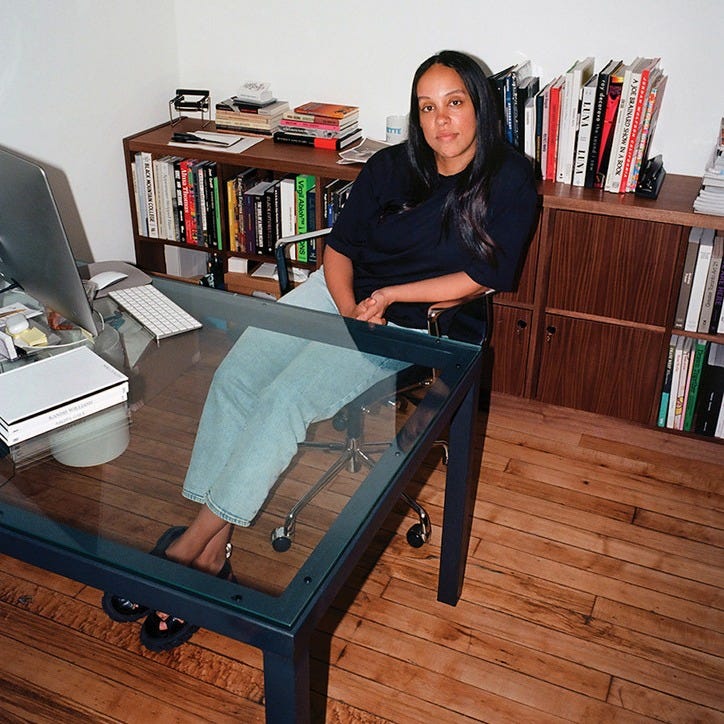 The Forum 17 | Ebony L. Haynes: The Terms Of Autonomy | When David Zwirner approached Ebony L. Haynes, the conversation didn’t begin with vision statements or prestige. It began with reality: exhaustion, uncertainty, and the question of whether staying in the art world was even possible. What followed was recalibration. If she was going to continue, it had to be on terms that reflected how she actually works—through care, risk, and sustained presence. That recalibration became 52 Walker.Drawing from her time at Martos Gallery and its project space Shoot the Lobster, Haynes speaks candidly about what it means to build exhibitions from the ground up: buying furniture on credit cards, drilling into gallery floors, maintaining impossible works by hand, and staying late because the work deserves it. For her, autonomy is not branding or independence for its own sake. It is the ability to stay present with artists, to hold risk without spectacle, and to let rigor coexist with joy.Rather than framing curatorial work as management or authorship, Haynes describes it as a practice shaped by trust, repetition, and care—one that resists burnout not by slowing ambition, but by rooting it in pleasure, responsibility, and belief.She explains:* How Foxy Production taught her to do every job herself, and why learning the whole system changed how she values labor.* Why belief in the work often comes before money, and what it costs to act on that belief anyway.* How maintenance, repetition, and care are not secondary tasks but central to exhibition-making.* What quarantine, racial reckoning, and institutional fatigue revealed about her limits—and her resolve.* How 52 Walker emerged not from a master plan, but from presence, honesty, and the willingness to say, “I have this idea.”Timestamps (0:00) First Encounter and the Permission to Care (4:00) Foxy Production and Learning by Doing(7:00) Installation as Commitment (16:00) Belief, Debt, and the Couch(18:00) Maintenance, Repetition, and Joy (21:00) Quarantine, Burnout, and Almost Leaving (25:00) Martos Gallery and the Small Fish Problem (27:00) Shoot the Lobster and Experimental Freedom (32:00) 52 Walker and Building a Program (41:00) Artists, Power, and Staying in the WorkWatch the conversationView the full episode on YouTube.Follow EbonyInstagram: @ebotronFollow 52 WalkerWeb: https://www.52walker.comInstagram: @52walkerWriter, curator, and phenom Ebony L. Haynes is on a mission to reconfigure the art world. Working her way up from her first New York City internship at contemporary gallery Foxy Production (then based in Chelsea), the Canadian-born Haynes would eventually become the director of Marts Gallery and its project space Shoot the Lobster. In early 2020, Haynes was approached by David Zwirner for a sales director position. She countered with a pitch for an exhibition model resembling a kunsthalle, wherein exhibitions would last 3 months and allow for visitors to spend more time truly considering the art before them. That idea led to the October 2021 opening of 52 Walker, David Zwirner Gallery's TriBeCa location, with Haynes at the helm as director. Unlike traditional commercial galleries, 52 Walker does not represent artists, and is instead dedicated to curating programming at a pace similar to that of a museum — giving artists more opportunity to challenge themselves and experiment freely. The recruitment of an all-Black staff at 52 Walker garnered disproportionate attention, but her two-pronged approach to catalyzing change in the art world is more far-sighted than mere identity politics. In challenging the ever-shrinking attention spans of a cultural milieu that increasingly consumes art through social media, Haynes aims to empower artists to take risks and dig deeper in their work.About The ForumThe Forum is NewCrits’ ongoing public talk series, presented in partnership with WSA/WSBS. Talks take place live every second Tuesday at WSA. Join us for our next conversation here. Explore NewCrits’ offerings, including crits, courses, and mentorship programs at www.newcrits.studio.Full TranscriptAjay Kurian: What does it feel like to watch this right now?Ebony L. Haynes: You know, I haven’t watched this in a while. It stands so clear in my mind. The first time I experienced this artwork of perfection…Ajay Kurian: This was what I read and gathered was the first art experience where you were really rocked to your core.Ebony L. Haynes: There was a small space run by this formidable woman, Ydessa Hendeles in Toronto, who at the time I knew nothing about. I stumbled into this space based on some kind of art map. I was emotional, I remember crying the first time. I went back at least a half dozen times and it made me feel like pursuing something in the art world could really mean something.It was the very first artwork I ever remember feeling like this shit hits and there are so many layers to it. The first time I walked in, I didn’t know who Shirin Neshat was, you know? And it’ll be one of my opuses. I already had one. I thought Gordon Mata Clark and Pope.L is a show I did, and I’m like, oh, I can’t top it.But working closely with this artist and something around this work would be the next major emotional insurmountable moment for me. You have to visualize this two-channel video, before I knew what two-channel really meant. You know, I don’t wanna pretend like I was encountering this work and I knew all of the ways to talk about it.I walked into the room, and there were two screens. This window was a screen and the wall facing each other. So these performers are essentially facing each other and you’re sitting in the center. It was a purple carpet, very well installed. I come from a music background, so immediately I was like, the sound design was impeccable. Somebody really thought about six channels of sound and knew how to put the subwoofers in the right place to make me feel it when it hits that note. I was like crying for this woman. And also feeling a little bit for the man and I mean, it was…Ajay Kurian: There’s layers.Ebony L. Haynes: There’s layers. It’ll be a chapter. Yeah, it was huge for me.Ajay Kurian: It’s also such a different experience. Because I was watching this on my laptop and I was like, this is crazy. Then hearing it here, the hair on the back of my neck went…Ebony L. Haynes: Yeah when you see it, it was floor to ceiling, so it was larger than life bodies belting in front of me. I almost felt like I could feel the air out of the speakers. I mean, I was also there alone every time I went.Ajay Kurian: Wow. So this clocks as one of the formative experiences a hundred percent. In your sort of art upbringing, I’m gonna fast forward a little bit to when you actually make it to New York. Is your first job in the art world interning at Foxy?Ebony L. Haynes: Intern at Foxy Production, yep. Whenever I’m about to talk about Michael and John, Michael, Gillespie, John Thompson. I make it sound like we are really good friends and I hope we are, but we don’t text and call each other.But they know how important they were and are to my story. Foxy production was one I wrote to because of their program. I felt somebody, who at the moment when I applied, had worked in music mostly and that was my only full-time experience and writing about music. They were really kind of schmutzy and unmastered is what I remember saying to John in my letter. It was like this underground basement, party of a gallery where they were doing a lot of new media before many galleries. Maybe not. You know, I don’t know, but from my perspective.Ajay Kurian: They have that reputation, yeah.Ebony L. Haynes: So I just wrote them a letter and I was like, do you want me, I’d love to come and work for you for free. And they were like, cool, come on down. I did, and it was life-changing. I really expected it to be an internship where I go back and get a job in Toronto and it turned into a job for them.Ajay Kurian: And that’s when we met.Ebony L. Haynes: That’s when we met, so many years ago. That was 2012, I think. Something like that.Ajay Kurian: With people that are in the gallery world or in the commercial art world — my gallerist for instance, Oliver, he worked for Alexander and Bonin. And he really credits them as being the ones who really gave him his grounding and his understanding of what it meant to be a gallerist. Do you feel similarly? You worked at Foxy, then you worked at Mitchell-Innes & Nash, then you worked at Martos. Of those three experiences, what has felt like the one that’s grounded you the most?Ebony L. Haynes: Grounded me, probably Martos. You know, Martos and Shoot The Lobster. I have to say both because I was tasked to program three galleries bicoastally at the same time with a staff of one.Ajay Kurian: That’s insane.Ebony L. Haynes: Sometimes an intern or assistant, eventually it grew, but it took years. Foxy though, made me really appreciate what it means to learn everything about my job. They taught me how to make an invoice, what a performer was for shipping, what the difference between national and international crates are, and how to hang an art fair booth. Registrars and production art handling are my complete IV lifeblood. If my registrar and my art handlers are not happy… I’m the queen of Donuts install morning or let’s get some pizza. When it was Martos time, I’d do some beer after hours, but not at David Zwirner. Because. I remember one story, this show at Martos, Invisible Man. Pope.L created a new work for me and it was a fountain that hung upside down. I’d hired an art handling and production company to help me build that plinth and figure out how to hang it safely and successfully from the beam. No shade, in case anybody is associated with that experience, and much love to the crew. But they bailed before it was hung. They claimed, and to their credit I think it was hard, but they just were not gonna be responsible for it.So I had to figure out how to rent scaffolding and enlist somebody, who I’m thankful is now a partner in all things in my life and at the time was just my art handler and production manager, and another friend who I knew was art handling for another gallery. One night I slept there. Just so many late nights for this show right before we opened.I have so much love and appreciation for people who say they come into 52 Walker and it feels like an installation and it’s always new. I have to be involved. I would never ask anybody installing a show for me to do it without my involvement. I’m really respectful and admire people who are willing to troubleshoot with me, and especially those who feel excited by it and not burdened by challenges because some people do.Some people have an attitude of, it’s not my job, this is not what I signed up for. But those who really get excited by problem solving and we’re in it together — I will vacuum up the floor while you are mopping. We have to do it ‘cause then it just looks so good.Ajay Kurian: I think also sometimes there’s a fear that the curator will get in the way and when you can actually fully collaborate that is a beautiful thing and it’s something that I think artists would want more if they could trust it. I’m wondering when you felt like artists started to trust you? Was this Martos? Was this Foxy? I think you always had artists on your side. You were always friends with artists. You were always in the mix of things. But when did you feel like, oh, I’ve earned this trust now?Ebony L. Haynes: I would say it happened early, but you know, there’s different levels of trust. I remember one time at Foxy production, this wonderful artist who I now call a friend, Sascha Braunig, had her second exhibition there. First of all, the gallery needed to be painted.Ajay Kurian: You painted the gallery?Ebony L. Haynes: With Sasha.Ajay Kurian: You’re kidding.Ebony L. Haynes: We texted in the morning and was like, can you bring an extra shirt, like painting clothes?I have to preface what we continue with our conversation to say I’ve never advocated for a kind of paradigm shift with 52 Walker. Of course, my practice is my own. Everybody is afforded the right to their own practice and opinions. But if you didn’t make art, and a lot of curators did. But I didn’t make art in the studio, I studied photography. I only worked primarily as a commercial photographer. So to really understand how the artist is working. I can’t imagine asking someone to move a painting one inch on blocks on the floor for me.Ajay Kurian: Really?Ebony L. Haynes: I hate it. I actually save a lot of money with art handlers because I don’t book anything until it’s really time to hang. I move the blocks, unless they’re really big and I need help, of course. But I feel weird and they’re always so generous. Art handlers are the blood of the industry. They don’t feel weird hanging back and waiting for me to take 10 minutes to look at a wall, but I feel intrusive and disrespectful of their time, just having them be around. So I do a lot of my installing after hours. I do a lot of facsimile printouts, even just 8 by 10 and tape them together to move things that are not worth $10,000 or a million dollars, and just move the paper. There’s something about feeling like I’m connecting with what I’m hanging that feels important.Ajay Kurian: Oh yeah. When I am hanging a show, I’ll move something and then I’ll walk out the gallery and I’ll walk in and then I’ll move something again and I’ll walk out of the gallery and I’ll walk in.Ebony L. Haynes: Me too.Ajay Kurian: And I just keep doing that over and over again because what is the choreography of this emotional experience? Testing it as many times as you can to see does it hold and does it do the things that I thought in my head? And trying to separate yourself from what was happening in the studio or what was happening in a different moment in time to what’s happening in this space right now.You’ve had so much experience putting together shows. This signaled to me what Ebony was gonna be about. This is the artist Peter Williams. I think we both agree, maybe an underappreciated artistEbony L. Haynes: A hundred percent.Ajay Kurian: I didn’t know that many people talking about Peter Williams. I don’t remember if you were the one who told me about him, or there was some moment when I was looking at this work and I was like, holy shit, this guy is incredible.Here you were doing a show of the work and making sure that he was taken care of. He had his share of health issues and required some real care. It felt like this was a moment where you really gotta showcase an artist and show people a world that they hadn’t seen before, which I think we’ll start to see more and more. And then 52 Walker happens.Ebony L. Haynes: The show is heartwarming for me on so many levels. This is just gonna be an ode to Foxy production. Michael and John, to their credit, it was an artist who had been presented to them and in front of me. I was very privileged to be the only employee. The owners of the gallery really heard me. They really listened to my opinions about the work. We had engaging conversations about the work, and they said, why don’t you go to Delaware and meet with Peter? This was one year out of grad school. I mean, I’m sure there are many good bosses out there.Ajay Kurian: No, that’s special.Ebony L. Haynes: For these gentlemen to put me on a train, not a plane, but put me on the train. It was more than just a studio visit. It was an invitation to, not just a show, but representation. There were no titles at Foxy production. By any measure, I was a gallery assistant, but I was also their registrar, art handler, and did the fairs with them. This was my real first experience with an artist bringing in an archive that was on slides in binders and really bonding with Peter and helping with his New York show.Ajay Kurian: I feel like Martos was when you planted a couple of flags. Invisible Man being the first where you could start to make a stake curatorially. How do you create a relationship with a gallerist, specifically a white gallerist, where you’re like, this is what I want to do, these are the shows that I want to do, and get the support that you need? Because I’ve proposed shows that didn’t happen because there wasn’t the support that I needed, but you pulled these things off and made it work.Ebony L. Haynes: For better or worse. I was unaware of what anyone else thought. I probably should have taken note a little more and I try to learn from that now. I knew that this show had to happen. Many questions were put to me as to its financial viability, production, and installation.I didn’t have answers, but I didn’t care. It wasn’t all peachy, you know? I got in trouble a lot, not just with Jose. I mean, not in trouble, but I had to have many private conversations with people I worked with and for — here’s an example. In this picture, this couch, Kayode Ojo. I was such a believer in this complete installation that I bought this couch myself on two credit cards. It was only $600, which makes you understand what my credit card situation was like. I had to resell it on Craigslist at the end. For Kayode and I, the belief in this work and the conversation in the show was so much more important than me to think 10 steps ahead. I just thought two steps ahead. And so the blindness of that was rewarding for me as a curator. You know, how are we gonna get those Jessica Vaughn’s up? Let’s figure out how to do this large format printing for the seats. And you know, there was no Patreon then, but I did some sort of crowdfunding.Ajay Kurian: How did you maintain this steadiness and not just burn out after doing a show like this? How do you not just crash and be like, fuck it, I’m never doing a show like that again.Ebony L. Haynes: I mean, it’s so fun. Look at it. Look at this floor for context. I went to Red Hook a year before the show even opened to look at flooring that is reclaimed oak. It was pretty expensive. And the first show I do, I tell my boss, I love this floor. I am gonna drill a hole through it that will leave a mark for the life of the gallery and it’s still there. If you go in, you see I kept the piece, but the line marks this hole.Ajay Kurian: Oh, this is like your own little Gordon Matta-Clark.Ebony L. Haynes: It is. I mean art is so fun, you know, even the challenges. I think when I stop having fun in the challenges of each show, maybe my career will change. But I love working with artists. I love the conversations. I really have a good time. I’m not begrudgingly approaching an install because I have to stay till midnight. For me it’s more what’s for dinner at the gallery? Let’s go guys. Maybe when that changes, it’ll feel different.For this, I didn’t know what people would think. I didn’t know if it would be successful. I didn’t even know what that meant. I was excited for people to come in and see it. This Fountain, Pope.L was like fuck you, you’re gonna have to get on a ladder twice a day. First fill it with newly filtered water, and at the end of the day, drain it. Every single day, reset the timer. This was for eight weeks. That’s a lot of draining and filling. I would just laugh every time and send him texts and be like, you motherfucker, fuck you. I love you, but this is crazy. You know, it’s fun. That’s the answer.Ajay Kurian: There’s joy.Ebony L. Haynes: Yeah, there’s joy for sure.Ajay Kurian: I feel like there’s a moment in museums and art culture at large, after George Floyd, where everybody’s scrambling to figure out how they can address, what to them seems like this explosion of a crisis. Where it’s just been there all the time and no one’s been looking at it. So I think a lot of black creatives, a lot of black artists, a lot of anybody in the field, was trying to figure out how to not fucking quit and how to keep moving forward. That was right when you left Martos. It was the in between period, right?Ebony L. Haynes: Yeah, it was in between, by default because we were quarantined. I mean, I can say a lot. Like many non-white bodies in the art world, I felt very angry. I felt sort of like this new moment of realization sociopolitically, where, oh, my neighbor’s racist. We knew that, you know, all these things were just bubbling to the top.And then having to deal with what I’ve always felt and then what became more apparent to others and making them feel comfortable. I reached a tipping point with this online programming — for those who remember the quarantine of online viewing rooms, experience in 3D, QR code this, and here’s a talk virtually.That was my first and only time so far where I was really literally almost out the door of the art world. I was really ready to go for my seventh life. I was like, this is it for me. I can’t do it anymore.Ajay Kurian: Is that before David?Ebony L. Haynes: It was really concurrent. Here comes my shout out to a friend in the room who gets a chapter in my memoir. You know, it’s about the people who are there at the right time. I had a conversation with a friend of mine, Mark, while we were quarantined. I remember just spewing my guts of frustration of just I just wanna do cool shit and make somebody realize that it’s cool and pay me to do it. I know it’s gonna be good. Don’t question me with your budget meetings and your bullshit and just just wanna fucking do it.Ajay Kurian: You sound like an artist.Ebony L. Haynes: Maybe I feel like an artist sometimes. It’s your practice. It does feel like I wanna create. I’m a little more like I wanna produce for my artists. And Mark said, what does that look like to you? In this moment, I don’t know, fucking I advising for Kanye. It was mostly really this moment of one person, not just Mark, but a few people very close to me hearing me spew this confession. I have imposter syndrome but maybe a little less in this moment when all these idiots around me are doing some bullshit posturing and I really wanna do something that means something and can we just get someone to pay for it? Then a few people encouraged it, whether they had the answer or not.Ajay Kurian: They didn’t slam the door.Ebony L. Haynes: No, they didn’t slam the door. And it was concurrent with David Zwirner, because before COVID is when I was approached by the gallery. But I was approached to work for them in a much more traditional way as a director which is what happens in the gallery world.There’s this kind of unspoken rule of three to four year life at any gallery and then you get poached, which is a problematic word, but I use it anyway. Or you have conversations about lifting or expanding your career. And at the time when I had my first conversation with somebody from Zwirner Gallery, I thought I couldn’t do any of this. I felt like a small fish and was kind of afraid to be honest about working with big fish. So I had the conversation to attempt to be professional and leverage myself as a business woman to go back to Martos and be like, make me a partner and big fish want me. I don’t know what it was. I don’t even know how to say it.Ajay Kurian: You were leveragingEbony L. Haynes: I was trying and I thought I would, but I didn’t have to because of the way things played out. My second interview or what was to be a meeting with Zwirner Minds was the week they announced quarantine. And I got a text from somebody, who is now a colleague who I really appreciate, she’s really and truly the backbone to a lot of how 52 Walker came to be. It was a very casual text like, oh, when COVID and quarantine blows over. Remember there were news casts about clorox and wiping down your groceries. That was the week I was supposed to go in and I was like, yeah, let’s just see how it plays out. Months go by.Ajay Kurian: Wow.Ebony L. Haynes: Silence. I’m spiraling. I wanna buy a container and put it on a small piece of land. I was feeling very fiery in the way that I wanted other people to feel heard and seen. Then it was like, people are actually back at work and doing business. So it was almost like the interview that was meant to happen, in February or the second week of March, was happening six months later.Ajay Kurian: Wow. Did you have a vision of 52 Walker in that second interview, or was it something that was kind of iterated with them?Ebony L. Haynes: I had a vision largely through conversations throughout the pandemic that really solidified what my experience at Martos and Shoot The Lobster had affirmed for me in a way that I loved working. Shoot The lobster, for background, was sort of a project space of Martos. It was for sale, but we didn’t represent artists. I was the art handler, director, curator, programmer for New York and Los Angeles. I would install it after hours, I’d leave Martos and walk over to Shoot The Lobster.Ajay Kurian: It was at that moment, you were a restaurateur that opened their second restaurant and you were just scrambling between boats all the time.Ebony L. Haynes: Just all the time. I wanted to live in Chinatown because I spent every moment there. But there was something that happened for me as a curator where I could see the benefits of both worlds in that relationship where Shoot The Lobster felt free for artists. With me, it was like, no one’s paying attention. Let’s cut this ceiling open and break the pipe and nobody cares. Let’s put a video out on the street and it’s like Elger Street and nobody pays attention, but we tried it.We tried it out and it worked most of the time. Then I had Martos where we represented artists, we did art fairs, and a program that was representative of Jose and the history of the gallery with new artists that I was there to bring on. So it was four and a half years and the melding of both of those mines started forming 52 Walker.Ajay Kurian: That makes so much sense.Ebony L. Haynes: Yeah. If I could do Shoot The Lobster bigger. But I had nothing planned going into the interview.Ajay Kurian: When you look at 52 Walker now, it looks very planned. There’s a vision of the catalogs. It seems like they are inspired by many different things from Cy Twombly drawing catalogs to Octavia Butler to magazine culture. I think the magazine culture is actually one of my favorite things about the editorial note, because it reminded me of how I think about introductions. It’s an editor’s note. It’s something that is about changing how we can be hospitable in art spaces and what voice do we use? Is it a voice where we’re looking down like this, or is it a voice where we’re like this and we can talk to each other as if we’re all just horizontal?Ebony L. Haynes: Totally.Ajay Kurian: It feels like there’s an ethic, rigor, but empathy with 52 Walker. Did you know that you wanted catalogs? Did you know that you wanted all of it to look this way? Did you have a sense of the first artist and then kind of importantly, the way that you were thinking about risk and safety? Because this is commercial at a much larger scale and you already said feeling like a little fish next to big fish. This is one of the biggest fucking fishes there is. So how do you make that transformation? How do you meet that and say, all right, let me do my shit.Ebony L. Haynes: I mean, I’m always gonna be honest and transparent. I really don’t know. I don’t encourage anyone to wait until this moment of fight or flight. But I truly felt like I had nothing to lose when I pitched 52 Walker. Which made me probably seem more confident than I am because if everyone said no, I had a container plan. You know, I studied art criticism. It was an art criticism and curatorial practice program. My through line from the beginning was criticism. I wanted to write, I wanted to be critically engaged with practice and the canon and publish. I wasn’t studying exhibition design in a way that maybe I would now. So I kind of was like, this is what I wanna do and if nobody wants to, I don’t know. I’m really good at growing cucumbers. I would hope that I could encourage anybody who feels any sort of inspiration not to wait for this dire moment, you know? Otherwise though, to be honest, I was in front of David Zwirner and I didn’t have my next interview with a partner or director.It was David Zwirner and Ebony Haynes in a room. We talked amicably and professionally about me coming in as a director. I’d never met him before either, full disclosure. I was just riding a vibe. That sounds so unplanned, but sometimes you feel people are listening. Or you could really have a conversation with somebody and it’s reciprocal. And I just sort of said, I have this idea. It’s real, that’s what I said. I have this idea.Ajay Kurian: Wow.Ebony L. Haynes: And the things that you’ve done during COVID and rethinking models and how to offer different kinds of support. Here’s my idea.Ajay Kurian: This is almost like an out-of-body experience. You’re saying things that are very matter of fact and I want to give commentary to the matter of factness. Do I have consent to do that?Ebony L. Haynes: I will share as much as I feel comfortable living online.Ajay Kurian: I think there’s a lot of situations where people walk into a situation and you might have preconceived ideas. You might come in with frustrations, angers, structural inequities, that you’re like, this is my fucking moment to speak truth to power. I am trying to decide whether that’s the angel or the devil on your shoulder. Because I think what Ebony did in that moment is that she met the situation in full presence, staying completely present in that situation, to say the thing that was on her heart and just seeing where it lands.I think that’s when people pick up what you put down because there’s no animosity. It’s simply stated, these are the things that are happening. These are the things that are happening in the world. This is the thing that I want to do. And I think it could change things and it doesn’t put that other person on the defense to say, I need to defend myself in A, B, and C ways, which in so many other contexts, maybe he should. But that’s not the context in which you’re gonna get something done and it’s not the context in which you can grow something that you’ve grown. To me, seeing the zen of that moment, I think is really important and a great lesson because it’s not easy to do. It’s not easy to maintain your presentness in thought and mind and spirit when you’re confronted with somebody that represents a lot of things, more so than just them as the person. When a person gets seen in that way, their defenses go down and you might be able to accomplish something different, which you’ve clearly done.Ebony L. Haynes: That is too generous. I mean, it’s so heartwarming for me to hear. I’m not trying to dismiss what you said, but it really feels generous. So maybe that is how it is landed outside of my experience.Ajay Kurian: I’m just trying to see it because in my head it’s coming from an honest place. I’m not trying to gas you anything.Ebony L. Haynes: No, I believe you. That’s why I’m really taken aback by it. It makes me feel joy to hear.Ajay Kurian: And to flip it, I think it also means that you’re okay in those moments of pushing those other concerns away momentarily. Even if you’re not thinking of it as the long-term vision, even if that’s not the goal in your head. I’m doing this because I want this in this many years. There is a presentness of mine to say, I’m gonna get this done and this is how it can happen. Otherwise it doesn’t happen and I’m just gonna move on and I’ll do something else and I’ll live number seven. But there’s a lot of complications and a lot of interesting things that happen there. I think for people trying to navigate this incredibly treacherous terrain, it’s good to hear shit like this. Because you also have a program that’s not easy either, you know.Ebony L. Haynes: Yeah.Ajay Kurian: From Nikita Gill, who’s up on the screen right now. To Nora Turato, who is after that?Ebony L. Haynes: After Nora was Tiona McClodden. Then it was Tao, then it was Gordon Matta Clark and Pope.L.Ajay Kurian: That run of Nikita, Nora, and Tiona. Those are three shows about ruin, destruction, and failure. About the systems that have not served large swaths of the community, specifically people of color, specifically black people, and that these systems have failed and they’re fucked. They need to be torn down, burn, or they’re already in ruin. How do you find a way to talk to collectors that have benefited and continue to benefit from the maintenance of those systems?Ebony L. Haynes: Yikes. That is for a different talk, my friend. That is a deep talk. I’ll give you a little answer.Ajay Kurian: Give us PG-13.Ebony L. Haynes: PG-13 answer is…Ajay Kurian: Give us 2025 PG-13, which is like R from 1990.Ebony L. Haynes: In your in Ajay’s intro to me, you know, you mentioned eating shit, which is an analogy I personally use all the time. Because I had to early on find power in eating shit. I say early on as early as grad school, you know, I was the only black student in a cohort of 12. There were no black professors. I had to get two external black professors and I was the only one to do an extra semester. I mean, it just felt arduous and systemic in its bureaucracy. Realizing I could come out of that with something like foxy production and opportunity and then more opportunity. There’s always shit. As a non-white man, you have to eat and if you can work your muscle. No disrespect to the white men in the room, by the way. You know I have to say it because they’re near and dear to my heart.Ajay Kurian: I have plenty of white friends, but they can hear this.Ebony L. Haynes: Yeah, they can hear it. Because we’re talking about the general category, right? The general label. If you are not in that group and probably what feels more powerful to me than any space I open or program or show I curate: if you don’t feel like shit when you go home because of the amount of shit you’ve been given, you’re a fucking champ.For real, you’re a champ. And don’t think that you have lowered yourself to anyone’s expectations or lack of expectation. It’s like your petty funny bone. I’ll be like, okay, I see you, collector from eight years ago, who’s come in the gallery, who doesn’t remember what you said to me or how you spoke about me in French, because I’m fluent in French. And we were in Brussels and I had to storm out of the booth out of anger. I see you being respectful is fuel for me. It makes me feel a small amount of authority or power. Power doesn’t come from me in this space or these shows. These shows, for me, are only powerful because of my artists.Some of my staff, who are wonderful, they’ll be like, oh, I went to this bar and I was wearing my T-shirt — I gift them 52W merch every Christmas. And someone was like, oh, you work there? That’s so cool. And I was like, girl, nobody said that shit to you. You are totally clowning. She’s like no, they did. I was like, I was out at Art Basel and get introduced as Ebony of 52 Walker and get, oh, what’s that? I mean, there’s two sides of the coin. That happens to this day, and I don’t care. I embrace it all like that. That is power and it’s just part of the journey of the space. Power is that I’m still here. I am smiling. Shit tastes like cheesecake. I’m telling you, this is the one lesson you should all take away. Nobody can feed you shit unless you feel like it’s shit.You take it, you bring it home. Don’t get depressed ‘cause depression is our crypt like fuck depression. You are just as powerful as anyone else. And if you could just wait 10 to 15 years, you will show them that it tastes like cheesecake. Just give it time. Be kind to yourself. The world was not kind to me. The art world was not kind but I didn’t care.Ajay Kurian: That’s the part that’s so fascinating to me. That you didn’t care.Ebony L. Haynes: I think I’m just too stupid to have acknowledged it, to be honest.Ajay Kurian: If everybody believes that you’re too stupid, that’s not stupid.Ebony L. Haynes: Not stupid but oblivious.Ajay Kurian: Is this ‘cause you’re Canadian?Ebony L. Haynes: Maybe. You know, I won’t listen to this again, not because it’s not wonderful. I have a podcast and I’ve never re-listened to an episode. I don’t reread interviews that I give. It’s sort of like fight or flight always. I let it go and there it goes. You could hate it. You could love it. Both reactions are great. I’m already thinking about September 2027.Ajay Kurian: Exactly.Ebony L. Haynes: It’s all okay. I love criticism of what I do. And accolade, it’s all fine. I don’t know if it’s because I’m Canadian. It’s because I didn’t study art history, that’s why.Ajay Kurian: So I’m gonna end with what the future holds. Because I think in a way, even if you say you’re only planning a couple steps ahead, it somehow seems bigger than that. And you’ve just been appointed as…Ebony L. Haynes: It’s a word. Full is a mouthful.Ajay Kurian: Yeah, global… Oh, you’re gonna make me try to say it.Ebony L. Haynes: GHCP. It’s Global Head of Curatorial Programs.Ajay Kurian: What does that look like? Do you have a sense of what that looks like?Ebony L. Haynes: Yeah, I feel very present and purposeful in what I’ve achieved, but I do have to acknowledge the forces around me. Like Foxy production, like Lucy Mitchell-Innes who taught me all about secondary market, took me to my first auction, allowed me to work with Pope.L. Like Jose Martos, who trusted me. I feel really fortunate to have people in my life who I’ve worked for and with, where I’ve never felt stepped on. My current job is no different. You know, I felt the ability to pitch something to David Zwirner the first time and I felt supported in ideating this new potential of what the role could be.Ajay Kurian: So this is something again that you brought to them.Ebony L. Haynes: To full disclosure, it was definitely co cooked. I think without knowing we were cooking something, it just started, it just felt like I needed a change and I wasn’t sure why or what. David was trying to suggest a change and it was a long time. This wasn’t like one week. I feel lucky to have support and dissonance.You know, if you have somebody who tells you you’re the shit all the time, don’t, it’s your demise. Somebody who questions my intent, my proposal or my show, or makes me try to fight for something and I make them fight for their opinion too. It’s been really generous in my experience. I feel really lucky.Ajay Kurian: Especially when it comes from a place of care. No one’s trying to fuck you.Ebony L. Haynes: And it’s care on both sides really. I wanna figure out what growth means for me and the program. I’m not sure if growth means being in the same space for another five years if I’m being totally honest. And that’s kind of exciting as somebody who loves exhibition design and curating. We have to keep moving. We have to figure out what it means to challenge like an artist. I do think curatorial practice is truly a practice for me. I need to practice a bit more. What does it mean to do a show in Hong Kong? I don’t know, but I could know soon. That’s new, you know. I don’t know what it will bring really, but I’m excited for a new muscle.Ajay Kurian: I think even in the moments when you were like, I don’t know how to answer that, the way that you go about it, I think is so revealing about the state of mind that it took to keep doing these things and how you’re gonna keep doing even more. I’m excited to see it.Ebony L. Haynes: I love you and I wasn’t gonna say this, but Ajay had a show that was as inspiring for me, which I’ve mentioned also in interviews but he didn’t reference. His show at 47 Canal in 2013. I was like, who is this artist who’s making these motherfuckers build walls and put tanks inside with new wiring? I went there six times, which doesn’t sound like a lot, but if you live here and there’s lots of shows, it’s a lot.Ajay Kurian: That’s a lot. That’s more than I saw my show.Ebony L. Haynes: It was so good. I mean, talking about pushing things, stretching yourself, and what you’re comfortable with.Ajay Kurian: I really appreciate that. Thank you.Ebony L. Haynes: Remember that show. Top 10 New York shows. It’s true. He didn’t pay me to say it.Ajay Kurian: Yeah, I’m gonna, that’s the end of this.Ebony L. Haynes: It’s in print. It was interviewed.Ajay Kurian: No, thank you. Everybody, a round of applause for Ebony Haynes.Ebony L. Haynes: Thank you. Get full access to NewCrits Substack at newcrits.substack.com/subscribe | 53m 32s | ||||||
| 12/17/25 |  The Forum 16 | Banks Violette: Inside the Machinery of Ruin | He built a career on dark stages, scorched metal, and fragile narratives. Banks Violette looks back at the neo-goth label, the toll of self-destruction, and what it means to walk away from the art world and return on his own terms.Working between sculpture, installation, and sound, Violette treats subcultures, violence, and fandom as unstable stories rather than fixed identities. From Slayer panic and satanic scare headlines to burned stages and Jägermeister firepieces, his work tracks how trauma gets turned into image, how labor disappears behind polished objects, and how an artist survives a system that rewards collapse as much as rigor.He explains:* Why “neo goth” was a convenient label that flattened a generation of young artists and obscured the real story of illness, addiction, and burnout.* How murder cases, satanic panic, and The Sorrows of Young Werther reveal a long history of fiction being blamed for real-world violence.* What it means to make work about calamity and Weegee’s photographs without treating trauma as raw material or spectacle.* How class, fabrication, and hidden labor structure the work, from doing everything by hand in Brooklyn to orchestrating 14 chandeliers for Celine across the globe.* Why drugs once felt like the only rational way to survive a tiny career window, and what it took to trade that pace for a decade of near silence, family, and fishing.* How fan-level enthusiasm for Void, Smithson, and Judd can coexist with critical rigor, and why reentering the conversation matters if art is to function as a real dialogue.(0:00) Welcome and the Weight of First Impressions(3:00) The Blowtorch Narrative(7:00) Noise, Sunn O))), and the Gravity of Sound(12:00) Polke, Richter, Danto, Judd(19:10) When Stories Justify Violence(22:00) The Accomplice Problem: Art, Trauma, and Ouija(26:00) Invisible Labor, Class, and Who Really Makes the Work(34:00) Drugs as a Work Tool and the Decision to Disappear(47:00) A Decade Offstage and What It Means to Come BackFollow Banks:Web: https://ropac.net/artists/85-banks-violette/#Read: https://vonammon.bigcartel.com/product/banks-violette-no-title-gas-station-black-versionInstagram: @banks_violette_616Full TranscriptAjay Kurian: How are you feeling?Banks Violette: I feel like I’m catching up on sleep still at age 52. All the sleep that I missed in my twenties and thirties, I still feel like I’m trying to balance the books.Ajay Kurian: That’s fair. You know, there’s a camel theory of sleep that you can kind of keep it and grow it in a hump, and deposit it when you need it.Banks Violette: I have no idea what you’re talking about, but it sounds absolutely accurate.Ajay Kurian: This was the project that I really did foresee, and this was the moment that the press was largely calling a neo goth moment. There were a handful of artists at that time that were really maybe engaged in a neo-goth visual culture. But I wonder, did it feel like the right way to talk about your work at the time?Banks Violette: No. It felt like a convenient way of talking about the work because it was a way to organize a group of disparate artists and make them legible in a way that was easy for people to encounter. Ideas that were potentially easy to dismiss unless there was some kind of lens attached to it. Whether or not I ever felt like I shared a lot of commonalities with the artists that I was grouped with — not necessarily.Ajay Kurian: Of that sort of generation, were there artists that you felt like were your peers or fellow travelers?Banks Violette: It was always presented as if there was much more closeness, or similarity in our practices, when there wasn’t necessarily in actuality.So the person I can point to that I think I had the most in common with when I was working actively, was probably somebody like Gardar. He had a preoccupation with a specific period in art history, a specific kind of discursive lens that he was attaching to things, and a certain kind of political bent. I think that there were a lot of ways that we dovetailed, but then there’s a lot of ways that we were totally different.The one thing that I did have in common with a lot of the artists that I was grouped with was that we were all young and pretty engaged with self-destructive behavior. And you know, the artwork kind of reflected that. So on one hand, there was this goth thing, which is an inaccurate way of organizing that work, and then there’s what was actually taking place. Which was, here’s a bunch of people who were all probably not well, and let’s lump them together. But you can’t really be like, oh look at this group of artists who are all drug addicts. So instead, you know, there’s an easier way of doing that and say oh they’re all goth.Ajay Kurian: So they almost said that though.Banks Violette: Yeah, it was implied.Ajay Kurian: I want to go back to that era where you started in New York in order to understand where you are now. The image that I feel like was paraded around the most was probably this one where you’re lighting a cigarette with a blowtorch. When you search the name Banks Violette, this was the image that used to come up. Now I think Vanity Fair has the rights to the image and they’re not putting that on Google.Banks Violette: I had this experience, and I know a lot of other people, my friends and my peers, all had this kind of experience with people coming to the studio to take photographs of you working. And it would somehow turn into the “hey, do this, hey, do that”. And yes, I did definitely light my cigarettes with map gas, a hundred percent, hand on the Bible. I use propane to light cigarettes all the time, but that was definitely somebody trying to elicit that. So on one hand, that’s accurate. On the other hand, it is a totally theatrical presentation of what that moment in time looked like.If I had been necessarily in my right mind, would I have chosen to reveal that part of myself publicly? Probably not. I think there was a lot of that. People weren’t necessarily in the greatest position to author the way they were being perceived by people.Ajay Kurian: It was a fascinating thing to watch in the studio. Because on the one hand you were really private and there were things that I think were just for you and your world. And then on the other hand, seeing how you were able to move. For instance, I think the first time that I met you, I was an intern at the Guggenheim and they were doing this young collectors thing and came to the studio and you had this giant Jagermeister piece that you were working on. It was an incredible performance. It was all the ideas that you were thinking about, but it was the first time that I was hearing it. So you’re stringing together Smithson, Hegel, satanism and all these things that I am hearing for the first time. And I was like, this dude’s a fucking genius. Not to say that you’re not, but —Banks Violette: If I’m stringing together Hegel, satanism, and Smithson, then yeah, I’m definitely not.Ajay Kurian: What was fascinating to see after that was that you’d have other studio visits and this performance, it would be the same speech. And I was like, oh right, there’s some preparation to this. For a young artist, it dialed me in because it made me think about how none of that was untruthful and none of that was coming from a dishonest place. But you’re asked to do this thing again and again, and how do you not think about what this looks like, feels like, and appears as. How much of that was on your mind in that, like period of time?Banks Violette: The things that I refer to, gravitate to, and cite within my practice are things that I care deeply about. But they’re not necessarily things that somebody has deep and intimate knowledge of. Smithson’s practice or satanism or whatever it happens to be. These are the things that I think about a lot and I don’t wanna misrepresent them. Part of doing these things is figuring out a way to translate what is potentially this kind of esoteric language or something potentially marginal, and making it into something that other people can find themselves within.You know, the perfect example of that is a band called Sun, that I’ve worked with a number of times. Incredible musicians, incredible composers. But the last time I saw them — they just played at Lincoln Center last year. What they played at Lincoln Center was identical to what they were playing in Brooklyn in like 2000 at some lousy club. What they were doing in Lincoln Center is the same, but those things are really sophisticated. It is really easy to get caught up in the more outrageous aspect of what they’re doing or pointing a finger at something and being like, oh look how crazy this is. That’s never been something I’ve been interested in. I’m interested in these things. Deeply, sincerely, and I’m trying to communicate that. And there has to be a way of translating that. Sorry, this is all very vague.Ajay Kurian: I want to come back to sincerity ‘cause I think it holds a major role in how the work comes about and also the positioning of certain things. But maybe it’s also a good time to talk about where that deep sincerity for expressing yourself came from? What’s your background and your background with art? What made you gravitate towards art in the first place?Banks Violette: I’ve always made things. That’s kind of how I understand the world. I was always a kid in the back of the class, sitting and drawing and definitely not relating to anything outside. That’s always been how I view things or related to the world.I didn’t have any kind of background with contemporary art and certainly didn’t really know that much about art history. I had one of those sort of perfect, kind of what you hope for is the experience that people have in college. Which is not a vocational route, but you go there and you’re exposed to new information and your world expands and that’s how you discover what you want to do.So I went to undergraduate in New York City after a very long roundabout route of dropping outta high school and doing all sorts of other shit. Then going to undergrad and my intention was to parlay this kind of thing that I’d always done being the kid in the back of the class just doodling - and turning that into something, or being an illustrator or a graphic designer or something practical.Ajay Kurian: And your grandmother was an illustrator?Banks Violette: She was a really prominent illustrator and she illustrated some of the original Wizard of Oz books and she was one of the first King Features Syndicated artists. She had this amazing career as an illustrator. So within my family, it was always looked at as a very responsible career path, which is fucking not practical. So I knew a lot about the history of illustration, but I didn’t know anything about contemporary art or much about art history.In undergrad, I realized this is the kind of discourse that I want to be engaged with. And I was in school in New York City, so there were plenty of opportunities to meet professional working artists and galleries. That’s how I got involved with that.Ajay Kurian: You know, I like to draw too. And it was a skillset that I was like, oh I can do this thing. But then in high school, I had an art teacher who kind of showed me that it was a way to think through the world, to think through ideas. That you could embody philosophies into an artwork or a sculpture or a drawing, whatever it might be. That was through Sigmar Polke, Gerhard Richter, Arthur Danto. Those were the things that lit me up where I was like, holy shit, I had no fucking idea. Who were the artists that lit you up in that particular moment? That you were like, oh this is the club I wanna be a part of.Banks Violette: For contemporary art?Ajay Kurian: Or whatever, ‘cause if you’re an undergrad and you’re saying this is something that I want to do. What was that clique in art history that started to itch at you?Banks Violette: I mean, this is gonna sound strange, and I remember when we had a previous conversation in Connecticut it seemed kind of odd. But just seeing images of Judd and Marfa. There’s something about that that I responded to immediately. You know, as a teenager and making album covers, art and fire art for punk rock bands and playing in bands and stuff like that. Sort of assembling and creating this kind of culture that I was a direct participant in an active way.I think that there’s something really specific to that experience. The idea that you have to be an active participant in the culture that you are consuming, right? Instead of turning on the radio and something is handed to you, but instead you have to manufacture these things all out of whole cloth. So that sense that art had some kind of connection to a broader social thing I already had in my head.Ajay Kurian: In a DIY sense.Banks Violette: In a DIY sense and, you know, seize the means of production kind of sense, that you were responsible for creating things. That sounds very Pollyanna-ish, but there was something about seeing Judd that fully realized a landscape that this art inhabited and it was architected around this person’s vision. It was like, oh shit, this is not that dissimilar to designing this t-shirt for this band and now that is part of a collective social and cultural history that all these people are engaged with. There’s a thread that unifies those things.Ajay Kurian: And it is about contributing to a culture and potentially shifting a culture. But it’s not about the singular genius. You see yourself as contributing to something and that’s potentially the charge of it. It is something larger than simply one person’s gesture.Banks Violette: I think that was the biggest part about going to school and being exposed to people who were actively showing. This is what a gallery is, and this is you. Anybody can go there. If you don’t have a relationship to that and you’re looking at it from the outside in, it all seems very terrifying. It is designed to be a wholly exclusive space that is condescending in the extreme and then you suddenly get involved with it and you’re like, oh shit, it’s not. It’s a forum like any other. Like booking a VFW hall for your shitty hardcore band is not much different than curating a group show, kind of.Ajay Kurian: That’s great…But you went to Columbia for grad school and you had your first solo show while you were in grad school, right?Banks Violette: Well, yes and no. I was in the first year of grad school and I met a woman who’s an incredible video artist, Laura Parnes, who ran a not-for-profit art space in Williamsburg called Momenta with her husband. I had seen her at a show at Participant when it was on Broadway. It was this really amazing, very gnarly kind of punk rock video kind of thing.So I wanted her as a visiting artist at Columbia. She came to the studio and she was into what I was doing. She invited me to do a two person thing at Momenta, ’cause that’s how they did their programming. They would do two person, sort of spotlight shows. So I did that at the end of my first year in graduate school and it kind of just went out into the ether.But I did have one person who responded to that. It was this guy named Jose who had just opened this gallery Team in Chelsea and he had his own long, weird history. He came to the studio when I was in grad school and he invited me to do a show. So I already had a show in a gallery lined up by my second year of grad school, which probably made me like the most insufferable fucking person to be around, to be honest.Ajay Kurian: I hope you don’t mind me bringing this up. The story that I remember, and I need you to correct me if I’m wrong, but that the dean at Columbia said that you couldn’t show the work for that show as your thesis show and that you had to make a new body of work.Banks Violette: The story is way worse than that. I got in an argument with a guy and ended up throwing something at the wall. I didn’t realize that he was standing right by the wall, and it was a whole thing. There was like a departmental restraining order, which I’ve never heard of before, but it was this thing where I could not be in the room with him.It was right at that moment when Columbia was transitioning from it’s older, Madison Avenue, second generation Abex teachers, to staff that had been kind of poached from Yale. They were trying to shift the emphasis of that program. So there were some internal conflicts in the way that program was structured and I think I was kind of the casualty of that. Also my aim was not fucking awesome, apparently.Ajay Kurian: So the show that you ended up doing at Team Gallery, was that Arroyo Grande?Banks Violette: Yeah, it was.Ajay Kurian: It’s hard to find pictures of that one. To me, I think there are some immediate concerns from that exhibition that still carry through to what’s happening now. You know, it’s based on a very specific event, which is the murder of this young girl.Banks Violette: Yeah. I’m not unhappy with the show. It was a way of working through a bunch of different ideas and having them coalesce. But I can look at it now and be like, oh, that was a clumsy first attempt at addressing these set of concerns. Be it, you know, subcultures and the way people organize themselves in these potentially very antagonistic kinds of ways, the exigencies and accesses of faith, you know?What does it mean to look at something that is a horrific thing? What does that mean for a viewer? Those are all ideas that later on spun out into things like the Whitney show that we started talking about. It may have been a much more flat-footed attempt at addressing those ideas and kind of sorting out why am I interested in these things in the first place.Ajay Kurian: So this was a murder that was documented where these teenage boys murdered a young girl. I guess purportedly because they’re listening to Slayer.Banks Violette: They had a band, there was some dim idea on their part, and it’s always one of those things where you’re like, how much of this is true? How much of this is somebody writing this to make it conform to these preconceived ideas of what this looks like?Teenage boys in Arroyo Grande California who were huge Slayer fans, had a band, and decided that they were gonna kill their classmate as a way of propitiating, and having Satan or the Dark Ward support their shitty garage band. Even describing that is glibly skipping over that this is a tragic thing. I think that kind of tension at the heart of it is fundamentally really interesting. That the narrative becomes a way that we can wall off trauma or calamity or render it legible. If you are engaged with manufacturing that narrative, you are complicit in that process, and alienating the horrific fact of what you’re referring to.Ajay Kurian: So then this story becomes kind of a veil to cover up something else.Banks Violette: Yeah, and it’s also that idea of, we’re now talking about stories and that this group of teenagers believed this story and believed it to such an extent that they had to enact it in real world terms. And what’s the ultimate period at the end of any sentence? It’s death, you know? So the way of realizing that in its grossest form was the murder of their classmate. And that’s not an alien event. I mean, we started talking about Tipper Gore and that hysteria that I experienced in the eighties, the satanic panic and all those kinds of things.But you could trace that backwards to Goethe’s The Sorrows of Young Werther and how that was supposedly responsible for an endless series of copycat suicides to the point where it was banned in some countries and cities. So the pedigree for these ideas isn’t solely based on a bunch of Slayer fans. In the 1980s, it was a thing. A kind of queasy relationship to fiction that proceeds and anticipates that in a number of different points in instances throughout history.Ajay Kurian: So there’s a difference between being the artist that basically causes a death, where that hinge between fiction and reality opens up and something fucked up or psychotic happens. In your work, it tends to be that you are always observing or playing the role of accomplice.I remember you had a Ouija show in Germany? That was a really fascinating premise because it was a similar condition where, this is a photographer who’s kind of going to these insanely gruesome events. There’s a complicity of documenting something like that and blowing it up.Banks Violette: The part where I find it queasy is the manipulation of the photograph. It wasn’t purely documentary. It was manipulated and it was manufactured to a certain point. And what does that mean when you elaborate calamity and trauma and tragedy as a fiction? Which is what happens when you start editing out parts because it just doesn’t work.It’s hard for me to process. I don’t know if that’s myself personally, but that is always something that I’m asking — what does that mean? What does that mean if I’m referring to these things and I don’t think you can do it casually. Hopefully I have not done it casually. I can’t say that a hundred percent, but I’ve done my best to make that idea apparent.Ajay Kurian: I don’t think it was ever casual. I think that it doesn’t matter how serious you are about your own practice, people can look at it and say, oh, that’s fucked up. He’s doing fucked up stuff. Fuck him.Banks Violette: That’s the weird fucking irony. What we first started talking about, which was that grouping that took place, that categorization of myself and my peers. I’m obviously preoccupied with the idea of being subsumed within a narrative and then having a personal experience of what that looks like when there is a narrative that is being draped over you that you don’t necessarily agree with. It doesn’t fit really well. It’s super fucking uncomfortable, but it’s still exists and is kind of choking you.Ajay Kurian: This was a dual show at Gladstone and Team, and I don’t even remember what you had to go through to get the fire department on board, but having open flames like this inside a gallery is not easy. We didn’t get the fire department on board.Banks Violette: Also not OSHA approved.Ajay Kurian: This is the Jagermeister piece that I saw in the studio. You would think that the studio is like some airplane hanger. But it was pretty big and crowded. It was like, you know, you’re a real worker. There was a moment I remember, when I was working for you, and people would come up to me and ask me where we get our things fabricated. And I was like, we do everything. There was an ethic about that.When you’re talking about the discomfort of what it means to talk about these ideas and to be in that place, I think part of the honesty of it is that there’s an honest labor relation. There’s an honest sense of this is what I grew up with, this is what I think about, this is what I love. I also know there’s a darkness here that I’m trying to think about and work through. Then it all kind of spills out into these forms that have to do with complicity and almost being late to the performance.Banks Violette: I like the idea of being late to the performance, or that kind of anticipatory experience of waiting for the thing to happen and that idea of the pause. Those are all things that I find incredibly beautiful. And that idea of fabricating everything by hand. This is a total digression, but another thing that I’m also very interested in is a class language or class vocabulary specifically in an American sense, whatever that might mean. I think anybody who’s worked in an art warehouse has had an experience of throwing out their back moving a dematerialized art object.Ajay Kurian: I herniated a disc.Banks Violette: What does it mean when you’ve rendered labor discreet? What happens when the act of fabrication is something that happens over there with a series of anonymous actors?After grad school, I had worked for other artists and been a fabricator and knew lots of people who also had that job. I mean, there’s this whole sort of strata of people who are responsible for the creation of things that don’t have an identity, you know? I think there’s something kind of fascinating about that. I’m not necessarily saying that it’s purely problematic, but it is a seam to pick at.Ajay Kurian: Right. There’s so many new ways to fabricate too. There was this purity about painting for quite a long time where it’s always the artist’s hand. Now there’s just so many people that get their paintings made in China and then ship it over. There’s a way to think about the complicity in that, if you’re being honest about it. I think that if that’s a part of production for you, then that’s a condition of what you’re thinking about and talking about.Banks Violette: Absolutely. You have to think about that. If you are just doing it because that is a thing that you can access and as a way to go from point A to point B, I find that kind of lazy. But instead, if there is a structural logic for why you are making things in a certain way – I know an artist who does have paintings fabricated in China, but that is part of the discursive framework that he’s erected around his work, you know? That makes sense.Then there’s other people where you can see it’s just a lazy way of doing that thing. It’s an unconsidered gesture. And what I respond to with art, most of the time, is that it is something that is thoroughly considered. It’s not necessarily a rational gesture but it is somebody thinking through the totality of a problem or an issue or an idea.Ajay Kurian: Like Judd.Banks Violette: Yeah, absolutely. Perfect example. This is somebody who is exploring all the dim unlit corners of this particular idea. And the idea is just a box that’s on the ground. Fuck, that’s amazing.Ajay Kurian: You were talking about the rigor that artists might have that you sort of believe in when you’re really affected by an artwork. But on the other side of that – do you see a difference in the world of art journalism when you were coming up and art journalism now?Banks Violette: No, not necessarily. And this isn’t really even a criticism directed at writers. I just think it is an apples and oranges kind of thing, and there is no one-to-one writerly way of translating our ideas and vice versa. There is always gonna be some gap and some kind of slippage, and there’s always gonna be, as a consequence, resentment when you didn’t get it right. But it’s impossible to get it right. That’s just the nature of it. So I think that is a constant condition that exists in art writing. So yeah, I don’t think that there’s much difference between then and now. I just think there’s an inherent structural flaw.Ajay Kurian: Going back to the moments when you’re doing flyers for shows, was music journalism like a different space? Did it feel like it was more in the fabric of the scene?Banks Violette: Okay, now this is me undermining exactly what I just said. There is good art writing. Absolutely, no question. But I like writing on film. I like writing on music. I find the people who write about those things, or the product that they put out there in the world is much more interesting, much more engaging than a lot of what is written about art. I couldn’t point a finger at why that’s the case.Ajay Kurian: I think it’s only just to say that people are trying to figure it out. People are trying to figure out what are the problems with art writing and what are we missing sometimes? I feel like with music writing, you can feel a diehard fan. And with art writing, you’re not supposed to be a fan. I think that when you read something and you understand that this person loves this shit too much, it’s a negative. But there are those moments when it can transcend the form because there’s such a love there.Banks Violette: It’s funny, you know, music is this thing that you sort of experience viscerally. And in cinema, it doesn’t matter if it’s horror, porn, or comedy, those elicit a visceral response. Art is this thing that is supposed to be rarefied. It is not visceral. It is a mental experience. I think that is sort of cultural bias that’s built into the way things are written about and interpreted that you’re not supposed to have that fan response to something. Which I’ve always found very off putting because I absolutely have a fan response to stuff I like.It doesn’t matter if it’s a Void song or a Smithson artwork, my response to that is, holy shit, unadulterated enthusiasm in the dumbest kind of way possible. Not dumbest, but just like a raw joyfulness in relationship to something. So it doesn’t mean that it’s not critical. The criticality is still there and that’s still the lens. You can’t get rid of it as soon as you’ve built it.Ajay Kurian: I think that might be more you, though. I think there are people that see something that hits a nerve and they’re completely uncritical.But the thing that’s fascinating about how your work has moved throughout the years is that there’s something you felt, something touched a nerve that was real, that reverberates. Then it’s almost trying to puzzle out what the fuck is happening and why. What is it? Is this connected? Is that connected? It’s almost as if so much feeling pushes you into a space of figuring out the conspiracy of your feeling.Banks Violette: That is a really great way of describing it and it’s probably pretty accurate. But it’s also needing to know the broader context that these things exist within. So it’s not just purely the object in isolation, but what is the kind of framework that is allowing the object some kind of ability to resonate. So again, going back to the Marfa example, which is not just the object, but it’s the stage that the object sits on. The use of the word stage is really specific. And tying back to what you were first talking about with stages and theater, where it’s not just the event, but it’s the framing device surrounding the event.Ajay Kurian: And then you left the stage.Banks Violette: Yeah.Ajay Kurian: So, why did you leave?Banks Violette: Health would be the first reason. You know, I saw and you saw what my studio was like. My reasons for working the way that I did still make sense to me. Absolutely still agree with them, but it was just not sustainable like that. Maintaining that kind of schedule, maintaining that kind of weird prominence that I sort of managed to get at a certain moment in time. You know, maintaining this idea that I had to consistently produce everything by hand to a degree. All that was just sort of psychotic and the only way to resolve that and make it not psychotic was a shit ton of drugs. Which is clearly not the best way to navigate anything. So at a certain point, the drugs went out and it was just, okay, do I wanna keep beating my head against this wall or do I wanna get healthy?I’m also not happy with the art world. I’m not happy with having watched a few of my friends pass away and see the way people respond to that. It was a whole lot of unhappiness fueled by a whole lot of unhappy things. So I chose to absent myself and I thought it would be a brief break. Take a week off, and then it became two weeks, and then it became three weeks, and then three years and yeah. So a decade and some change later. That’s how long it took.Ajay Kurian: And how does it feel now?Banks Violette: Weird. But it felt weird then. There’s some internal consistency running through so that’s fine. I still maintained relationships with galleries and I still produced work. I just wasn’t eager and enthusiastic about the idea of presenting work out there in the public.And I had, almost accidentally, two events that kind of butted up against one another in 2023 or 24. One was, I did a museum show that turned out to be kind of a retrospective in Belgium. Suddenly, I was in this position of encountering works that I have not physically seen for years and years, pulling them out and being able to see them again. And go, oh, this is making me think about things again and here’s some threads that I wanted to pick back up.Then Hedi [Slimane], who is the designer of Celine, invited me to do this big project. So I was making new work. I was suddenly forcibly confronted with older work and being asked to make newer work by somebody who I deeply admire and have a preexisting relationship with and trust. So if those two things hadn’t happened, and if they hadn’t happened back to back, would a decade have turned into two decades? Fuck if I know, but possibly so.Ajay Kurian: That seems really possible actually.Banks Violette: Yeah, totally possible.Ajay Kurian: The collaboration with Hedi is deep. I mean, you designed when he was at Dior. You designed like the back showrooms or I can’t remember.Banks Violette: Yeah, in Osaka, and that was around the time I did that show at the Whitney.Ajay Kurian: So it was a longstanding relationship.Banks Violette: Oh, a long, long standing relationship. I think he took that photograph of me smoking with the propane tank. So that’s his fault.Ajay Kurian: I mean, he’s good at playing certain things. He’s really good at that.Banks Violette: But I think in the moment when you’re doing something where you’re like, oh, this person is being very knowing about it. You forget that this is ending up in vanity fucking fair, and will then haunt me for the next God knows how long. At the moment it seemed like a great idea, but that’s sort of true of almost everything I’ve done.Ajay Kurian: I didn’t even smoke cigarettes and I was lighting cigarettes with a propane torch. It’s good.Banks Violette: It’s good.Ajay Kurian: This is a more recent collaboration where there were 14 chandeliers that went essentially across the world in different saline stores.Banks Violette: They all have very specific footprints because of the limitations to the spaces. So everything had to correspond to that footprint. It wasn’t that they were custom made specifically for that. They’re meant to have an identity outside of that they are as sculptures. But they were meant to be in 14 different locations all being installed within a very tight window of time. So they had to be made in a certain way that people that you’ve never met would be able to sort of decipher these instructions, which also necessitated me shifting from making all this stuff by hand to now I have to work with fabricators. Which is this thing that I’ve steered away from for many different reasons and establish a relationship with these people. So it was a whole fucking huge transition and thankfully it worked out really well and I’m super pleased with it, and it allowed me to reimagine how I might make things in the future.Ajay Kurian: The way that I’ve thought about fabrication for myself is that it’s always based in relationships. I think you took a long time getting to know Aric and Serena. So Ark and Serena run a fabrication company called ShisanWu, where they do many artist’s fabrications, and they’re incredible. It feels very homespun when you work with them.Banks Violette: They’re the loveliest people possible. But I still have it in my head that they’ve gotta be somebody who I’d be comfortable with at five in the morning. You know, doing something like, hey, let’s see if this looks better, if it’s burning, that kind of thing. It is not unrealistic to describe that as a trust thing.Ajay Kurian: Who was the dude at that steel deck? Oh, Christian.Banks Violette: Yeah, he was down for burning everything. Anything. Didn’t matter. He’s a really great guy.Ajay Kurian: He was a fabricator who helped fabricate a lot of steel, well any kind of steel structures.Banks Violette: Yeah, he did. Then it just turned into, well, I want to do that and I don’t wanna rely on this guy. But he had a studio very close to mine in Williamsburg, and he was part of an English company that made steel staging decks. You can see them all the time, you know, it’s a really very distinctive design for a decking system. It’s this huge company, but it was really just this one guy on a tremendous amount of drugs with a lot of heavy tools, just building these things in Williamsburg. So clearly we got along great.Ajay Kurian: I came to the studio right when you were trying to get clean. I had never done any drugs at that point. All of a sudden I was working in this studio where a big dude would come to the door late at night and we’d get deliveries of cocaine and then that would fuel everybody else till the wee hours of the morning to get work done. Then I’d go home around two, ‘cause I was like, I just can’t do this. But then it felt like there was an urge to get clean. There was like an urge to sort of leave that behind. Did you feel like it was part of you as an artist at that point?Banks Violette: The reason why I was doing drugs, you know, I was not having a good time. It wasn’t like going out and getting crazy or anything. All I wanted to do was be able to work and if I could stay up for 48 hours, that was great. If this would allow me to stay up for 48 hours, that seemed like a reasonable fucking trade at that moment because the window is really tiny.Ajay Kurian: So this is a real story that I, to this day, still kind of don’t believe that I saw. But banks would disappear from time to time.Banks Violette: Like a decade.Ajay Kurian: Well, yeah. But we’d be working in the studio and we’re like, where the fuck is he? It would be like a week and then you show up fucking nuts. And he built out a whole wall of cabinets and a level area for our chop saw in a day. Everything was level, everything was perfect. We just see him and it was one of those cartoon montages where you see someone and then it’s just finished and it was done and we’re like, this is really good. It was all sound. It wasn’t about you partying.Banks Violette: Yeah, it was purely work.Ajay Kurian: It was a bizarre thing to witness.Banks Violette: And it’s, call me super lucky, I’ve got an atypical response to opiates. They make me stay up and work really hard. You know, it’s how somebody might describe doing meth or something like that. I do heroin and I work really hard. It’s really fucking weird, but it is true.Ajay Kurian: The come down’s not so great.Banks Violette: Come down sucks. It’s not fun. So yeah, that was kind of the backstory for it. But in that period I was just being hyper conscious of this very tiny window. And the way this window was being constructed was like, oh, you and all your young friends who are young artists and cool. But I’m not gonna be young at some point, so I need to make a volume of work that overcomes this kind of built in flaw in the way the work is being described as solely a product of youth. Right, and I’ve gotta get ahead of that somehow, which is a psychotic kind of expectation to have to yourself daily. In my very dysfunctional way of navigating that, at that moment in time, the solution was I’ll just do a ton of drugs. And I was surrounded by a peer group and a moment in time when that wasn’t that atypical.Ajay Kurian: I mean, it was noticeably toxic.Banks Violette: It was fucking terrible.Ajay Kurian: It felt like, when does this run out?Banks Violette: Seeing, you know, Dash Snow, who’s got such a distinctive face. His work is constantly sort of being churned back up and seeing him being used almost like a meta him for a moment in time where we’re all young and crazy and you’re like, dude, that’s a tragedy. That was a sad thing that happened and there’s no sense of joy to that. So, yeah, I’m still queasy about that when I see that and sort of discussing that moment in time.Ajay Kurian: If there was an artist that you could bring back from the dead, it would be Steven Parrino.Banks Violette: Bruno easily, a hundred percent. I would be just fascinated seeing him respond to people. He did not sell a lot of work while he was alive. People certainly knew who he was, but not to the degree that they do now. And to the degree that he’s discussed and the regard of his work as hell. I think he would find this shit funny as hell. He would find it hilarious, but I also would like him to have the vindication of being like, you know what, you were absolutely right what you were doing.He was the loveliest, most generous person that I had the good fortune to have known and be friends with. And he had this community of people that he supported and was deeply involved with and cared tremendously about. So just to have the hey, yeah, people will acknowledge and recognize that you are very important.*Audience Question*Banks Violette: If I’m understanding correctly, what did I do with myself for a decade? I got married, I became a stepdad. I had a normal life, which I did not have when I was in New York and working all the time. When you’re presented with a situation where being a drug addict seems like a rational response to your environment, then fuck, normalcy is kind of great. So I was just normal and quiet and I’m still producing art and still thinking about art. It has left me with this happy thing of doing a number of shows now, and each time somebody invites me to do something, I’m like, oh, great, that’s covered, because I’ve got 10 fucking years of back inventory. For lack of a better description. So it’s really easy to sort of show me the space and I’ve probably got something that I’ve thought about that will work exactly with this. So does that answer the question?Audience Member: Yes, it does. Also, how does it feel to speak again, like within your visual language that you wanna showcase?Banks Violette: It actually is really nice. Again, I don’t want to give the impression that I think art can take place in a vacuum. That, like me, monologuing in a studio is being a practicing artist. Because I don’t think that’s the case. I think art is fundamentally a communication that is a dialogue with the outside world. And that is a necessary thing for an art object to have its status as an art object. Reentering a discussion is reentering this thing that I love deeply. So yeah, it feels really good.Ajay Kurian: You did a lot of fishing too.Banks Violette: I did.Audience Member: Yeah.Ajay Kurian: Everybody, thanks to Banks. Get full access to NewCrits Substack at newcrits.substack.com/subscribe | 53m 39s | ||||||
| 11/7/25 |  The Forum 15 | Eric N. Mack: On Tender Assembly and the Politics of Display | He builds with fabric, scaffolding, and light — Eric N. Mack on tenderness as structure and the unseen labor that makes art visible.Eric N. Mack works between painting, installation, and fashion, reimagining how material, care, and collaboration shape contemporary image-making. His large-scale assemblages drape and lean, collapsing distinctions between surface and structure, styling and architecture, autonomy and support. His practice reveals how beauty, fragility, and display coexist within shared spaces of labor and care.He explains:* How gestures of rupture, cutting, and collage become ways to think through care, not violence.* Why stylists, curators, and unseen collaborators form the hidden architectures of art.* How fabric behaves as both image and body — draped, suspended, and alive to air and time.* What scaffolding, transparency, and light teach about the precarity of presence.* How tenderness and structure coexist as the real politics of display.* Why every act of making is also an act of attention — a choreography of support between maker, viewer, and space.(0:00) Welcome + Intro(01:00) Rupture, Reflection, and the Studio as World(05:00) Grace Jones and the Clarified Aesthetic(10:00) The Unseen Hand and the Architect of the Image(15:00) Collaboration, Care, and the Space of Display(20:00) Fabric, Fragrance, and the Politics of Form(30:00) Craft, Styling, and the Education of Looking(33:00) Art School, Value, and the Work of Belief(40:00) Draping Architecture and Breathing Structures(47:00) Fragility, Care, and the Social Life of ObjectsWatch the conversationView the full episode on YouTube.Follow RaulFollow Eric:Web: https://www.artsandletters.org/exhibitions?slug=eric-n-mackInstagram: https://www.instagram.com/ernatmack/?hl=enEric N. Mack (b. 1987, Columbia, MD) is a painter who radically reconsiders the medium’s traditional conventions. By utilizing found materials, Mack creates richly textured compositions that investigate painting in an expanded field and formal concerns of the practice.In 2025, Mack presented a one-person exhibition and site-specific installation at the Wexner Center for the Arts, Columbus, OH, as well as a solo exhibition of new works at the American Academy of Arts and Letters, New York.Mack attended The Cooper Union, NY (BFA) and Yale University, CT (MFA) and is the recipient of prestigious awards and residencies including the Chinati Foundation’s Artists in Residence Program (2023); the Rome Prize (2021-2022); the inaugural BALTIC Artists’ Award (2017); the Rauschenberg Residency on Captiva Island (2017); the Delfina Foundation Residency (2017) and the Studio Museum in Harlem Residency (2014-2015).One-person exhibitions include Eric N. Mack, Paula Cooper Gallery (2023); Scampolo!, Douglas Hyde Gallery, Trinity College, Dublin (2022); Lemme walk across the room, Brooklyn Museum, NY (2019); NSU Art Museum Fort Lauderdale, FL (2021); and In austerity, stripped from its support and worn as a sarong, The Power Station, Dallas, TX (2019). Major group exhibitions include Chronorama Redux, Palazzo Grassi, Venice (2023); Whitney Biennial 2019, Whitney Museum of American Art, NY; and Greater New York, MoMA PS1, NY (2015). Work by Mack is in the permanent collections of the Whitney Museum of American Art; the Brooklyn Museum; the Baltimore Museum of Art; the Albright-Knox Art Gallery; the Studio Museum in Harlem; the Institute of Contemporary Art, Miami; and the Montreal Museum of Fine Art. Mack lives and works in New York.About The ForumThe Forum is NewCrits’ ongoing public talk series, presented in partnership with WSA/WSBS. Talks take place live every second Tuesday at WSA. Join us for our next conversation here.Explore NewCrits’ offerings, including crits, courses, and mentorship programs at www.newcrits.studio.—Full TranscriptAjay Kurian: When you’re putting together a show, I know you’ve talked about art being present for the world’s brutalities, but how do you conjugate that or stay present in the work with that? It’s not even saying that you have to, because it’s not your responsibility to do so. It’s more so, I see glimmers and I see the way that you think about how things come together and how they kind of fall apart.Eric N. Mack: Yeah. I have a lot of epiphanies that sit in the studio, that come from the studio that end up allowing me to think about the external world from the happenstances in the studio, and from coordinated or measured gestures of rupture. And those ruptures could have implications of or sit alongside what folks could regard as kind of a material violence, or violence to a material, or decomposition, or collage, or something for the work to feel chopped like the ingredients are chopped up.I love a good metaphor, like a good salad, it’s aromatic with all the ingredients. Nothing overpowers one another, but it’s transformative. It holds meaning, sustenance, and maybe a level of a counterpoint, maybe the sunflower seed gets stuck in your teeth or something like that, you know?Ajay Kurian: You gave us a lot to chew on, even in the press release. At the end of that, there’s literally seven hyperlinks to run through. We had The Clark Sisters, Nina Simone, a trailer for the Unzipped documentary about Isaac Mizrahi, the Harlem Restaurant of which the show was named after, Sinners movie tickets.Eric N. Mack: Why not?Ajay Kurian: And Grace Jones on an Italian talk show or an Italian show.Eric N. Mack: A talk show, I think. It could have been Eurovision.Ajay Kurian: But that was serious. She was really in her pocket.Eric N. Mack: Yeah, it’s intense, ‘cause she’s in drag in a way. You know, she’s wearing this wig and I was like, the wig is architecture and the wig is like a hat. She’s architecture. If you’re watching the YouTube video or seeing the performance at the end, this camera pans out and she leans back and someone catches her as she falls and snatches her wig. Then she becomes this doll, this kind of copy of herself, this quotidian, you know the things that she would process with Jean Paul. She’s always around and I always think about her. She’s an interesting marker, because she’s such a clarified aesthetic. She’s a sound, she’s a voice and she also possesses her own tension. There’s incredible softness and vulnerability, but she’s also a tank, you know? The thing is, these images are also ones that she’s used herself. I just think that she will always be relevant.Ajay Kurian: There’s an ownership over the image too. There’s a way in which she’s self representing and it feels beautiful and antagonistic, but also really generous. To be both aggressive and generous at the same time isn’t an easy thing to do.Ajay Kurian: But I feel like, for her embodiment to be a black woman who is beautifully angular and masculine and feminine at the same time, it’s a lot to have to deal with, specifically in that moment of pop culture too.Eric N. Mack: Yeah. She’s an artwork. She’s her own artwork. There was an exhibition I did in London and I kind of couldn’t stop thinking about Misa Hylton. I couldn’t stop thinking about her. She was a stylist for Lil’ Kim and Mary J. Blige. So she was a part of this kind of bad boy regime, but she was a part of their visual representation. She’s an iconic stylist. Everybody takes notes from her in New York.Ajay Kurian: Really? It’s so interesting ‘cause I think you’re the first artist that I’ve talked to that holds stylists in this regard. That the grooming of an image, the understanding of what it takes to put together a scene, an idea, a world building essentially, that it’s happening completely behind the scenes. You’re really picking out these people to be like, you’ve changed this whole scene.Eric N. Mack: I mean, it’s what we do as artists. It’s just asking questions like, okay, what’s in the byline? Who did this? Who’s the architect? She called herself the architect, and I respect that. There was an awareness and a renewed understanding of her importance as these looks became more prominent again.The nineties in general as a kind of nostalgic, bygone era, that we were there for. So it also is an interesting thing to think about, who made the thing that sits in your heart or that sits with you, that rests in your references, and that you connect with? Who made that? Obviously, I mean, that’s what we do. That’s research.Maybe people don’t look at the production of the image as much as, you know, there’s a lot of romanticism around the fashion designer and who made the garment, but you won’t see the garment without seeing how it was put together and how it was aligned. The tension.Thinking about my good friend, Haley Wollens who has been working for a long time. I think more recently she’s done Dsquared, she’s done Au Claire, she’s done all of these important brands that end up being reconstituted, recomposed by this unseen hand.Ajay Kurian: That’s the thing. It’s a level of research that is fascinating to me because I think everybody gets caught up in the director and the designer. Even when you’re a kid, you watch the movie and you like the movie.Then there’s the kid that finds out who the director is. Then there’s the kid who finds out who the producer is. That’s a different kid.Eric N. Mack: It is a different kid. But you know, sometimes it’s meant to be that way. It may be structured for folks to be completely enamored with the superstar, with the actress or the actor. It was designed that way, you know?Ajay Kurian: Now I want to see behind that.Eric N. Mack: That’s what I do. I mean, that’s what I’m interested in. Questioning wasn’t enough, and was never enough. Like thinking about Amanda Harlech, she’s an incredible stylist who was a big part of the way that we experienced the early days of John Galliano and some of the more important days of Karl Lagerfeld. I mean, she’s established, but she’s a visionary and at a certain point she kind of sought Galliano out when he was finishing his degree at CSM. So there was a premise that was going around between them. They were collaborators. There’s something about the unseen magic in between these figures and some of the social qualities of discourse between two people that end up generating meaning for so many.Ajay Kurian: So what’s the plural for you? Do you feel like there’s similar relationships that you have in your practice? Of course, I know that you actually work with stylists and designers. There’s plenty of collaborative things that you’ve done. But when I think about the kind of classic idea of a painter, for instance. You have a studio practice, you go to the studio, you work, you come home and that’s potentially a very solitary thing.Eric N. Mack: I mean, it’s up to me, and it’s up to artists to be able to question that, to reposition that. Sometimes that works, and the main collaborator at this point is the curator.Eric N. Mack: So for this exhibition, shout out to everybody at Arts and Letters, Jenny Chasky, Nick and Juan — these are really important people in actualizing the exhibition. It was through conversation and also acknowledging that everybody, they got eyes and it matters like that we are all seeing. And I’m not afraid to ask what people are seeing right in the room. Sometimes people think that just means I don’t have vision myself and that’s stupid. But I think also with time, it’s also a practice for me, to see what I get from that.Ultimately, I’ll make my own decisions about these things. But it’s really important for me to be able to reflect from people who are familiar with the space that I’m working in currently. You know, I’m scratching my head, I’ve been here all day, why is this not working? There’s people who have been up on the lift and been able to see what the space looks like from all these different vantage points. The material that the walls are made from are all significant aspects of architecture that many of us can take for granted.Ajay Kurian: I’ve been lingering on this picture, because it’s kind of the first thing that you encounter when you walk into the space. There is a piece suspended from, and kind of draping, in the wind. And it was a really cloudy, somewhat rainy day. Just seeing that floating above does inaugurate an experience and what you’re about to move into. Your work, maybe more recently too, has felt like a collaged brush stroke.I think a lot of people might think of the brush stroke as a unit of expression. And what I really like about how you’re using the bolt of fabric is that it becomes both brushstroke as an expressive entity, but also, it kind of carries all the social weight of the ready-made as well. They happen simultaneously. It’s just this kind of non-binary thing where you’re not choosing between one or the other in particular moments. They just happen to exist at the same time. So you just see this streak across the sky of a variety of fabrics, and you can feel what each of them does to you without being able to place it. It’s a nice thing because then you walk in and it almost felt more like portraiture to me.These are all just like iPhone pictures that I took because I was too late in asking arts and letters for pictures, so that’s all me. But they’re not bad pictures. Then you get into this kind of diaphanous space and it just completely opens up. The whole space just has this air of levity and there’s brushstrokes in the sky and it feels like a realm of possibility. I know I’m waxing poetic a little bit, but I just really enjoyed the show. This is one of those moments where just seeing materials come together was such a nice moment.Eric N. Mack: I took this picture too. When you sent it to me, I was like, oh good. Because when we got the documentation of the show or I was talking to the photographer, I was like, get this, and I wanted that shape, that jagged shape where the scarf enters the picture and how it’s held together and being able to see the other side of the room through that. It’s framing, but it’s also the implication of the transparency and opacity kind of playing. I mean, for me, this one’s such a chopped salad. you know?The beauty isn’t its presence and almost shies away from image or something, like a fragrance. I’m thinking about a fragrance. I’m thinking about how one experiences layers of scent and how transformative that is no matter where you are. You know, that’s abstraction.Ajay Kurian: Then what title do you think of when you think of the perfume notes of the show?Eric N. Mack: I mean, sometimes it’s just literal, like one is called On vetiver.Ajay Kurian: Okay, so it takes you there too. It’s direct.Eric N. Mack: So I’m imagining, a little vial of oil, that would just be something that the fabric could be dipped in, you know, imagining it being like drenched in oil or the lived life of the fabric being like worn.Ajay Kurian: There’s the presence of a body. It’s interesting the way you’re talking about visuality when it comes to a scent. Because it, and you can correct me if I’m wrong, but the way you’re talking about it, it sounds like you’re able to imagine something without a picture. That it’s almost a posture with no body, or there’s something that gives an evocation of presence.And there’s a fragrance, this fragrance portrait of a lady that like, now I smell it everywhere. It’s everywhere. There was a moment when you could just pick it out of a room. As soon as I walked in, I’d have a picture, but it didn’t matter if it was the person or not, or if I matched it up. It was a different kind of picture.Eric N. Mack: I like that. Because it also is just about a material. It’s about like a plant or something. But it doesn’t give itself away and it doesn’t tell you about what it does or what it can do.The center figure is called bod. I thought that was really funny. But also thinking about bod cologne and just like a shorthand and thinking about the figure. Just trying to get there so it can carry notions of the viewer. There’s a lot I could say in terms of that work in relationship to the armatures.Ajay Kurian: The armatures are kind of new. I feel like there’s been kind of ready-made armatures in older works, but these are fabricated and then also kind of anonymous. There’s anonymity to them, to me, where it’s almost bureaucratic. It’s Subway poles and there’s this kind of brushed anodyne aluminum and it’s a highly specific form. It’s cantilevered and counterbalanced. There’s a lot of specific things, but then it also feels like a particular kind of architecture that’s city based. And then to have it have this delicate form draped on it. I’m curious about how these forms are continuing to develop, how you’re starting to understand them for yourself.Eric N. Mack: These were made really thinking about this space, the kind of variedness and wanting there to be an almost figurative element that would lean on the wall. Maybe the sculpture could be holding up the wall like a buttress or some kind of architectural element. Also, the kind of premise of scaffolding, and just thinking about how scaffolding is used as a structure for support. I mean this fabric, I’ve been carrying around for probably maybe eight years.Ajay Kurian: Wow. That was actually a question I had, do you have an archive of fabrics?Eric N. Mack: Absolutely. I love the properties of a pleated fabric and how, you know, thinking about structure and support, the fact that it could be almost self-imposed. It’s imposed on the surface. It’s like the structure comes from within, and it’s held through heat. I mean, that’s how pleats are made. And as the fabric contracts and then expands again. The form is communicated through that.Ajay Kurian: It’s really beautiful. It made me think of Matisse. Because it felt like a color study where this much red means something and this much red means something. And like then when you add dimension to it and light and all these other things, here is where the pleats stop and you can see a different orientation of color. It really is a different experience. It was a nice feeling to not have immediate vocabulary for what I was experiencing.Eric N. Mack: I think I was trying to describe an experience of looking at a painting and being like, how does this operate and why is it this specific form that’s significant? You know what I mean? And you look at it kind of pissed off. You’re just like, what? How does this do that? And why is it just one color that does it?Ajay Kurian: The first person that comes to my mind is Sam Gilliam and what that experience was like when first encountering that work. What was the first work of art that you can remember that pissed you off? Or that you had an adversarial relationship with? Sometimes things piss me off ‘cause they’re so good.Eric N. Mack: I’m trying to, I don’t know. I know there’s a lot. You can get angry at all the art out there, but really it is those gestures where you look at the side of the painting and be like, what? Oh, you painted that or you finished the edge like that or just these finalizing gestures that are about the craftsmanship of the work. It communicates to people who are craftsmen. I can’t think of anything that really pissed me off right now.Ajay Kurian: It’s good that you mentioned that moment of looking at the edge of a painting. To me, it’s something that I think about with your work where the line between craft and styling is completely blurred. So for instance, if you’re. Stretching Belgian linen and you’re building up a surface and then you’re applying oil medium. We know what that surface looks and feels like when it’s done right. And when it’s not, when it’s okay. The preciousness of when it really feels like luxury.With your work, there’s almost a slightly different motivation. That’s why it’s so cool to me that you can rattle off the most important stylist here, because to me, you understand that as a craft. You understand that as a world and how precise it needs to be. To think about styling and craft in the same conversation is very interesting to me because I hadn’t thought about it like that. I was thinking about how we both grew up on the Style channel.Eric N. Mack: That’s true.Ajay Kurian: That was a formative moment for me, the style channel and being able to see runway shows in high school. I started to think about why things look the way they look and got obsessed with a certain level of craftsmanship. I didn’t get into the styling part of it and I think that’s why I’m so intrigued by it. I’m curious, what was that early experience like for you? You were around a lot of clothes and your father had a clothing store, right?Eric N. Mack: Yeah, he did. My dad had a brick and mortar clothing store on the border of DC and Maryland. I don’t remember how many years, but he eventually renovated a moving truck and turned that moving truck into a popup. That’s the language now. But it was a clothing store in the back of a white moving truck. He put wood paneling, very nineties, and hangers and clothing racks and places where you could fold the jeans and put them in the drawers. Because sometimes you would hit a speed bump and the clothes would fall on the ground and me and my brother would have to go back there and fix everything before the light turned green.Ajay Kurian: And that’s when you noticed the silhouette of fallen clothes.Eric N. Mack: My room is like that, respectfully. But, I think I’ve always been interested in self styling or the things that you choose are emblematic and idiosyncratic. You know, you speak through them, they’re really important. Maybe it did start in my teenage years alongside of when I started drawing really seriously. I mean, we’re kids of the nineties, so it really was all about what you chose and how you speak through that. We know it now as like crazy psycho consumerist culture, but that was really tailored to us, you know?Ajay Kurian: I wonder what that felt like for you. Because in the beginning, art for me was just, I was good at drawing. And then there was a moment where it opened up into a conversation that was like, oh, you can create things that embody and live an idea and that there was a different kind of gesture that happens there and a different way that those things could live and challenge what already was.I’m curious because clothing, styling, and then also a real foundational understanding of drawing, painting. You went to art school and got an MFA at Yale, you did all those things and you had this kind of super foundation of art. But then you didn’t let go of the things that were kind of left out of that conversation. Did that happen? Does that happen naturally? Do you have to recover things along the way? Were there things that you felt like you had to push out of your life and then bring it back? Or did it all just kind of keep moving with you?Eric N. Mack: I think they were always together. I thought they were always important and I didn’t believe anybody that told me otherwise. You know, fashion for me was personal and it was something that invested time and interest.It was an interest of mine and it still is. I’m definitely an artist and there’s no carrot on a stick that could convince me to compromise that.Ajay Kurian: So your definition of an artist is far-reaching.Eric N. Mack: I’m also thinking about art as the viewership of art. I think the art audience deserves a lot more than what we’re seeing. I felt like a responsibility for the work to be drenched in exactly what I felt was most important. That’s why the work is so much about value. For you to see something is for you to see the significance of its presence. I wanted you to be able to look at a work and not be able to take away what’s there. It’s made concrete, it’s made manifest.Ajay Kurian: It’s almost like reorganizing the commonplace gives it a different scent.Eric N. Mack: I also will just say going to art school, I really believed that it was a place of invention. I was gonna be a part of a conversation about something that’s contemporary and new. I’m gonna go to get my MFA at Yale where we could be, I don’t know, flying paintings around. You know, just something that dealt with technology and it’s what we are not seeing now. There’s something about a futurist notion of innovation. I was looking for invention.Ajay Kurian: I feel like there was a particular moment, around that time that you would be in art school then, everything else was saying that painting’s dead and old. There was this kind of fire to be, no, it’s not dead. There’s other ways to reinvent it.Eric N. Mack: Right. Or it’s in plain sight. It’s in everything you see. There was a time where I told somebody I was a painter and they assumed that I was like a wall painter. And that’s an honest living.Ajay Kurian: I mean, if I told somebody in my extended family that I was a painter, they’d think I was a wall painter or house painter. They wouldn’t be like De Kooning.Eric N. Mack: Maybe they’d be like Picasso.Ajay Kurian: If you said artists, they’d say Picasso. You say artist and they don’t even think of anything besides palette. And there’s so many levels to it. There’s the thing that we think is gonna happen, which is we’re in the 21st century and it’s gonna be flying paintings, and then there’s people that are outside of that and they’re still in the 1600s.Eric N. Mack: There’s a lot of ways that people experience art and it is a part of the way that people think about beauty, decoration and decor, their interior spaces and I think that is also really important.Ajay Kurian: Yeah, and in fact, I think it’s more vital because the conversation about art with a big A is one that feels very dead to me. But I know that everybody who’s alive has a beating heart that tells them the things that excite them the most and they just haven’t connected the fact that’s art.Whatever your niche is, whatever you get most excited about, you can go into that infinity. I have no boundary about what that can be. What bothers me is that there’s still so much connective work that I feel discursively we have to do. Just let people admire the things that they admire.Eric N. Mack: I know. I think some of that stuff is not art though, to be honest. I’m disgusted about some of the things that people call art to be honest.Because I think people do give themselves a lot of permission in certain arenas, and I think art is one of them. But I do think that there is something about a kind of urgency. I think there’s something about a larger message. I think there’s something about being able to see an individual voice in a larger conversation that deals with a question of beauty. It is something about the tension of Contemporary reality, be that political, social, cultural. I think that there is something about the friction that art in itself is supposed to kind of possess these things.Ajay Kurian: Yeah. I see that and I can feel that. There’s things that are design, for sure. And I accept that as well. This is not Eric’s work, this is Petra Blaisse, who has her own firm called Inside Outside. I know that this person has been an influence on you and it sounds sort of like a stylist of spaces.Eric N. Mack: Absolutely.Ajay Kurian: This was so fascinating to me, to see the realms in which she works and then seeing this project in particular. It reminded me of your Desert X project.Eric N. Mack: Really?Ajay Kurian: Not that it’s the same thing, but just thinking about how to drape an architecture and thinking about what it means to give a space a halter towel. What do you think of someone like Petra, is that an art practice? Does it need to be called that? Does it matter? Is that just like somebody that you see working in the intersection of things?Eric N. Mack: I think there is someone working in between so much, but I see it as interior architecture in a way. Her firm is called Inside Outside, and I love the urgency to it and also the dexterity of it as a comment on the domestic and on the lived space. As architecture it would possibly be defined as dexterity in the built environment. Or as an imposition or a question on the built environment. There’s something advanced about this for me that feels so futuristic. The way that it would respond to the elements. You see how it billows and moves and the wall would be able to breathe.It reminds me, I used to live in this crazy loft in Bushwick, when I first moved to New York with my Cooper friends. I guess we just didn’t have enough money to build walls, so we ended up just putting up curtains for a while. They went up to the ceiling and it really wasn’t a productive way to live, but it looked great. And I was like, yes, this is painting. It was like a cotton duck kind of a canvas.Ajay Kurian: You really were drenched in it. When you say drenched…Eric N. Mack: It’s about recognizing it. This is what that is. I’m gonna make meaning out of this. Let me use it later. Taking note, you know? We were just 19, so it was still kind of early in references in terms of trying things out. That was a good thing about being in school. Let’s try out this way of livingThis was all about the structure, being able to breathe. Using the gas station structure, the canopy as a structural form. That was gonna be the unshakeable structure. And I didn’t want to completely obscure it, so there’s this kind of translucency of the knit fabric which is mostly made outta Smithsonian. Any kind of pattern you would see on this is Smithsonian Luxury Fabric. That was a really nice opportunity and probably my first engagement with a major brand.Ajay Kurian: So it was a conversation with them to understand this is what we have access to. You wanted that relationship to happen.Eric N. Mack: The way things happened for me again, is about a lived experience. I was doing a residency in Milan and I met one of the creative directors of Misson at a dinner and we chopped it up. But also, there was a tension and intensity around developing this large project. My curator at this time was Amanda Hunt, and she was just like, think big baby. I was like, oh, I just wanna hang some fabrics up and she’s like, think big. You know, you can do this. We have the support to do this. So I was like, okay, great. Then I was thinking about this conversation that I had and Milan and how amazing it would be to have this vestige of an experience be so expansive in this other moment.That conversation kind of led to this collaboration. It was very simple and direct. I chose from the PDF, and then to see them in person, it was just like, really?Ajay Kurian: You ordered the paints online and then you got the paint?Eric N. Mack: Right. This was a lot of fabric, probably the most fabric I’ve ever seen at that time. This was 2019.Ajay Kurian: I feel like there’s this conversation around art, that it needs to be purposeless. And in the ways that you install your work and the ways that it kind of suggests so many different things, it almost feels like the opposite, where it’s like an excess of purpose. And that maybe that’s the space in which art really starts to affect people. Where there’s the space of design that has a purpose. It’s beautiful and there’s artistic merit to it. But I think maybe what pushes art into a different category is that it not only has those purposes, it has other ones and as you get older, it has other ones. And as you move with it, it has other ones. It just keeps giving you new purposes. That it’s never purposeless. It’s an excess.Eric N. Mack: I’m thinking about the kind of nuance around it. There’s intent. There’s aspects about beauty that shift and develop through the experience of making, but it’s intent, like at least being a point where its presence can’t be denied. Because it’s intent in being there. Do you know what I mean? Its relationship to the support of this building. I want it to feel like the fabric needs it, so it’s clinging to it. And it ends up being compositionally reconstituted and there’s things that you get from that are unexpected. Like the way that the fabric billowed, but then also the way that it caught air and the movement ended up being its own kind of choreography. The rope is the same kind of rope that I used uptown at Arts and Letters. It’s like a canyon diving rope that I bought from REI. I talked to this guy at REI and he was like, this is tough as steel. This is gonna just survive everything, but it’s not gonna survive a knife cut. It could hold our weight or whatever, but it’s not indestructible, which is the way he sold it to me.Ajay Kurian: I always sense fragility and in everything that you make, every stitch, everything. That’s the kind of funny thing about super well tailored clothing. It falls on your body so beautifully, but also you can break it real easily too. It’s a very delicate, beautiful, gorgeous thing. When I see the work, there’s a precarity that feels like a social precarity. It feels like there’s clashing things coming together and holding. But if there’s a little too much rain, it might not be there tomorrow.Eric N. Mack: I mean, I think that’s a part of the concept. I think there’s some things that acknowledge presence, right? It’s the intention in being there at that moment that you see it. I like to think about fragility as a subject. So I want people to be able to regard it as part of the meaning and the content of the work. Thinking about the definition of sculpture, thinking about a dimensional object that has a condition, there’s a real world condition or social political condition that this object goes under. Having fragility on top of that, communicates in such a tense and interesting way, an importance of care. That’s when care comes in for sure. That’s when you know the importance of the architecture. That’s when you know the curator. That’s when all of these points of consideration that are seen and unseen are intentional and needed. Get full access to NewCrits Substack at newcrits.substack.com/subscribe | 54m 04s | ||||||
| 10/10/25 |  The Forum 14 | Raúl de Nieves: Saints, Stained Glass, and the Work of Belief | He builds worlds from devotion, labor, and light. Raúl de Nieves on myth, death, and the joy of transformation.Raúl de Nieves is a multidisciplinary artist whose practice spans sculpture, performance, stained glass, and music. His work merges ancestral craft with queer exuberance, creating ecstatic spaces where life, death, and rebirth coexist. Known for his intricate beaded sculptures and radiant installations, de Nieves transforms discarded materials into devotional objects that question permanence, value, and faith.He reflects on:* Why failure and fear are essential teachers* How myth, labor, and ritual shape his understanding of transformation* The link between spirituality and psychedelia in his creative process* The politics of beauty, excess, and craft* How performance and collaboration sustain his practice* The tension between art and commerce—and what it means to say yes* Why joy, respect, and self-love remain his most radical tools(0:00) Welcome + Intro(1:00) The Origin of “St. George and the Dragon”(10:00) Death, Culture, and Safety(21:00) Excess, Labor, and the Ephemeral(31:00) The Whitney Window(35:00) The Carousel and the Brand(43:00) Pact with the Devil(47:00) Celebration and Decay(53:00) Belief and Legacy(56:00) Joy, Respect, and The Smashing PumpkinsWatch the conversationView the full episode on YouTube.Follow Raulhttps://companygallery.us/artists/raul-de-nieves@noraulsRaúl de Nieves is a multimedia artist, performer, and musician whose wide-ranging practice investigates notions of beauty and transformation. De Nieves’ visual symbolism draws on both classical Catholic and Mexican vernacular motifs to create his own unique mythology. Through processes of accumulation and adornment, the artist transforms readily available materials into spectacular objects, which he then integrates into immersive narrative environments.Recent solo institutional exhibitions include In Light of Innocence at Pioneer Works, Redhook, NY (2025), and imagine you are here, Baltimore Museum of Art, Baltimore, MD (2023); A Window to the See, a Spirit Star Chiming in the Wind of Wonder…, Henry Art Gallery, Seattle, WA (2023); The Treasure House of Memory, ICA Boston, Boston, MA (2021); Eternal Return & the Obsidian Heart, Museum of Contemporary Art North Miami, Miami, FL (2021); and Reemerge the Zero Begins Your Life, Eternal is Your Light, SCAD Museum of Art, Savannah, GA (2020). He has participated in numerous group exhibitions including those at Prospect New Orleans, Hauser & Wirth, The Highline, MoMA PS1, the 2017 Whitney Biennial, K11 Foundation, Documenta 14, Performa 13, ICA Philadelphia, The Watermill Center, The Kitchen, Artist’s Space, and numerous other venues. His work is included in public collections at the Baltimore Museum of Art, Institute of Contemporary Art Boston, Whitney Museum of American Art, and the Museum of Contemporary Art, Los Angeles. De Nieves was born in 1983, in Michoacán, Mexico, and currently lives and works in Brooklyn, NY.About The ForumThe Forum is NewCrits’ ongoing public talk series, presented in partnership with WSA/WSBS. Talks take place live every second Tuesday at WSA. Join us for our next conversation here.Explore NewCrits’ offerings, including crits, courses, and mentorship programs at www.newcrits.studio.—Full TranscriptAjay Kurian: Hi everybody, thank you all for being here. Welcome to our NewCrits Talk with Raúl de Nieves! I’m gonna give you some background as to what NewCrits is, I’m gonna give you a little introduction to Raúl, and then we’re gonna get into the conversation.NewCrits is a global platform rooted in aesthetic education. We’re committed to fostering critical care, rigorous inquiry, and artist-to-artist dialogue. We offer mentorship and courses that challenge the assumptions of traditional art institutions while honoring the intensity of their best methods. We have crits, but we don’t think about crits as a way to tear you down to build you up. That’s trauma we don’t need anymore. Our offerings are designed for artists at any stage, especially those seeking meaningful critique, rooted in trust, discernment, and deep attention. These talks are an instantiation of that.The way that I think about art will be on display. This kind of conversation is the kind of conversations that we have in crits. It’s one where we’re building together.Now let’s get to the main event, which is Raúl here.Raúl de Nieves: Hello everyone.Ajay Kurian: All right, we’re gonna start with this image. I’ve known Raúl for some time now, but we really got to know each other better during the 2017 Whitney Biennial, which we were both in. We were both also part of the five artists that were asked to collaborate with Tiffany and Company.So we were spending a lot of time together and it was really nice. Raúl is one of those artists where you can’t tell if the art is an extension of him, or he’s an extension of the art. There’s a purity and transparency to who he is as a person and an artist, that feels free of shame and free of hiding.You’ll see the dark and the light. He’s joy and sparkle at times, but he can access a banshee scream and speak from unknown deaths as he does in his band Hairbone. Dark and light, life and death, are not seen as mere opposites in his work. They are a faded coupling, archetypes, and fantasma characters emerge throughout his sculptures as if enacting scenes from forgotten religious books, rituals, and beat through much of the work in ways that give them new life. There’s plenty of art that looks to religions, but few works of art inject a new spirit into that old fist to open it up.Raúl has a new exhibition at Pioneer Works that just recently opened. The space is wide and gleaming with colors pouring through the windows. He’s created new stained glass works for the windows of the entire building. They’re modestly made with tape and colored plastic, but the effect is regal. The colors almost tune a frequency that makes you smile. So when you see texts that might be darker, more bodily, even a little gross, you accept this as part of the light too. Nothing’s left out. Everything feels redeemed.After spending so much time seeing how Raúl creates, thinks and cares, I was and am convinced that this person is a star. Not a star in the sense of celebrity, although there is that, but in the sense that he radiates with an unflinching and holistic energy as if he simply is a star. I think it’s easy for us to see someone like Raúl whose light shines brightly and think that’s just who he is, that it’s not the result of enormous amounts of work and discipline of the ability to bring death to an old self in order to birth a new one and find joy again and again.A person like that right now is worth talking to and hearing their stories. So please help me welcome Raúl.Raúl de Nieves: Thank you. That was very nice.Ajay Kurian: How are you feeling?Raúl de Nieves: I feel great. Today was a lovely day and being here is so nice. To be able to talk to you and share a moment of my life and just some of the things that mattered to me. So thank you for having me.Ajay Kurian: It’s really a pleasure. It’s an honor. I have loved your work, I’ve loved seeing it and I love learning more about it. This image was one that came up when I was reading about the work. I’ve seen this story told many times in your work, but this is from 2003 to 2005. This is a story of St. George and the Dragon, and I wanted to start here ‘cause I think there’s a lot of things that are formative in this particular image, the story itself and how you saw that story.Raúl de Nieves: I moved to San Francisco in 2002 to attend the CCA college. And unfortunately, I wasn’t able to take into the school because of the financial situation that I was in. So it’s really nice to know that you are providing mentorship to students, because there wasn’t anything like that in 2002. The internet was just starting and moving to San Francisco was such a dream of mine and I made it happen even though I didn’t end up going to the school. For me, the bridge of San Francisco, which always shined so much to a forgotten soul or this idea of the hippie, the queers, gay culture. It really attracted me to this idea of knowledge. But once I couldn’t attend the school, I had to find my own mentorships, and I saw that through my friends.The image of St. George and the dragon appeared to me through a woman who was selling embroidery at the store that I was working at. I ended up buying the embroidery off her and I started to really think about how I grew up in a religious household that spoke about angels and the defeat of the self. But in a more Catholic way, where you have to repent your sins and think about what it means to not follow the status quo of a normal way of thinking because heaven is the ultimate power of our existence. St. George, to me, became this mantra. I started to really ask myself who I was in the picture, and I decided to think that I was all aspects of this fable.The fable talks about a dragon that houses itself next to a water well, and the town is in fear that this dragon is gonna drink all their water. So they must gather their beans into a sacrifice because the dragon ate all the animals. As if the dragon shouldn’t eat the animals because the humans are eating the animals. I don’t think that the saint really exists in the image because that is up to the future to decide.So in a sense, I thought about some of the people in my life that I felt had that idea of themselves. Not going to school gave me an opportunity to seek these kinds of icons or lessons through things that appeared to me and I frantically started painting this painting over and over and over again. My goal was to paint 50 of them. I still haven’t painted 50, but once I moved to New York, it’s almost like the image faded away somehow. But it’s something I constantly go back to, and when I recognize it through my journeys, it reminds me of finding things to reflect on.Ajay Kurian: The part where you say that you can be every single character in the fable is what stands out to me because there’s the dragon or the snake, there’s St. George, and then there’s the townspeople that are afraid. There’s this sense that St. George is banishing the dragon, and there’s a sense that people think it’s a dragon but really it’s just this snake and it’s not that big of a deal. They’re afraid of this thing that maybe they shouldn’t be afraid of. To be able to embody the people that are violent and fearful, to embody the saint who comes to save the day, and then to embody this dragon figure is a lot to think about, especially right now.I wonder, can you still embody all those positions or do you feel like you have a different kind of sense of self right now?Raúl de Nieves: I definitely can. I think fear is man’s best friend as they say, and sometimes we really have to get to know our fears in order to understand what they look like.It’s one of the hardest things that we can allow ourselves to communicate with. Because sometimes that comes with a tragic death, addiction, or just being alive. I thought about this and the fact that this dragon was portrayed as the entity of the end of life. A dragon is essentially a mythical creature, so this idea of the myth or the flamboyant also became what I was thinking about. I was like, oh there is a fear of the other side of the human being that maybe we aren’t allowed to or we shouldn’t exercise. Which is our inner divas, our inner goddess, or our inner demons. But I still relate to each character because not every day is so jolly. One of the things that I’ve been trying to continue to exercise within myself is how to let go and what does that mean? When letting go, is it an idea or is it part of the past?Ajay Kurian: When was the first time that you felt like you befriended your fears?Raúl de Nieves: Definitely being in San Francisco. Knowing that there was a part of failure because I decided not to take on the academic route through the school. I felt afraid of debt. I just felt afraid that some of the things that I was working towards had an end there.But I think being afraid is what gave me this exercise to really think about what that looked like. It gave me an opportunity to grow and to start experimenting with what it felt like or what I thought an artist would do in school. What conversations would you have with your peers? Or what was a critique? Who was gonna tell me that this was right or wrong? I can be a masochist and that’s part of one of my best traits because I put myself through hell. But to me, hell is not the hell we live in. To me, hell is the entrance to the subconscious, the unknown and the act of finding what the dragon really looks like.Ajay Kurian: I refuse to believe that it happened. Like debt is such a primal thing and it’s just so hard. I’m thinking of my mother, for instance, and confronting her fears feels impossible. It feels like it’s never gonna happen. There’s incremental things that happen. But what I’ve seen in your work, how you continue to confront new challenges, how you reduce these binaries between life and death, open that passageway.There’s a part of me that’s so hungry to understand how you became friends with death, how you were able to really be okay with those moments of spiking fear, and to welcome this and understand that the dragon is really a snake.Raúl de Nieves: I guess it’s because I grew up in a house full of death, as they say. Essentially, I grew up knowing that death was a reality. I have two brothers and we’re all two years apart. My little brother who was six years old when our father died, has no memory of him. So for us to grow up looking up at the sky, and my mom being like, if you see an airplane, wave to the airplane, ‘cause that’s where your dad is.It was this sense of comfort because when growing up in Mexico, we didn’t see many planes flying over my small little city. So it was a rarity to find some sort of connection through an idea that my mom was planting on us. The celebration of death in my culture is one of the most beautiful things that we have. It’s such a rich and beautiful act of nature to embody this idea of the ephemeral aspect of life and how people are the closest things to us when it comes to a memory. Not having that person next to you creates an idea of sorrow. But for me personally, it has created an idea of safety.That’s why this aspect of life becomes so important. I have really intense conversations with my mom where I’m like, I’m gonna die first, and she’s like no, me, and I’m like, me. And then we’re like, oh my god, we’re so weird. But it’s funny, like I obviously don’t want my mom to die or me, but I’ve thought about death. What would happen if I died tomorrow? Would anyone even care? I don’t have children. I have a family, and I have a lot of friends. We’re seeing so much death every day, and it’s almost a normality. But it’s not celebrated, like we aren’t celebrating the death of people right now.We’re trying to understand the reality of why it is so easy to access this fear now. It’s almost like the fear is gone because it’s prominent and nobody’s celebrating it. We’re just really thinking about what tomorrow brings because it’s far away from us right now, but it can get close any moment. I think that’s when you have to start to really gravitate towards what would this look like if it really happened to me?Ajay Kurian: I was just thinking about this today, so bear with me if I don’t have a full thought here, but there’s this anime called Demon Slay. I’ve been watching it and it’s really brutal. The beginning of the story is really brutal and terribly sad. This new movie came out and apparently it’s like the biggest selling anime film ever. I was just thinking about why that would necessarily be the case? There’s a part of me that thinks exactly what you’re saying about this possibility of celebrating death. Understanding grief as a part of living and being alive. Because that brutality is so present, it almost allows you to sink your teeth into life and really experience something that feels more real and more charged.When I go to your exhibitions, I get the sense that life is charged, that you don’t fuck around. This is real, this is happening, this is important, and it’s joyful and there’s such a spectrum of emotions. This show El Rio, now several years ago, 2016, I just remember being floored by this one character in particular. The body language and behind all the pearls are bullets streaming down the fabric. I was actually shaken. It was such a beautiful, coy, strange sculpture that was in the press release. It alludes to saint or assassin. And I was like, Jesus Christ, this is a lot but it’s really beautiful. So you are left with — what do I do with all of this?Raúl de Nieves: As you can see, this character is wearing a military suit and it is covered in fake pearls, but it also drapes these bullets. You can’t see his eyes, but you can see their smile or their grim. That’s what reminds me that sometimes a saint can’t be a saint without the act of defeat, death, and renewal. So in a way, it is a double-sided image of the self. Not just of the person that decides to take on that role, but the reality of our personal selves and how we have the capacity to flip.It’s one of the scariest things to imagine because you can’t help it. Sometimes you question people’s actions and it’s hard to understand what it is that people are going through when they can’t communicate. This object was a really interesting thing to bring into this exhibition called El Rio, which to me, was work that just accumulated in my studio.It all related back to the idea of St. George and the Dragon, and how the fable really just became my ultimate teacher. I wanted it to teach me something. And it taught me a lot because it’s made me believe in the past. It’s made me understand that by thinking of something that once was here, or an idea or a memory; what would it be like if those memories weren’t here or if those people couldn’t tell you about their future or their stories. So it’s a sense of understanding that our lives come with so many stories from the past, and they usually relate to other people’s lives.Ajay Kurian: This is the next version of St. George and the Dragon. It’s such an insane piece. You really do have something masochistic in you, but it also feels so multidimensional. When you’re talking about the past, it does feel like time is folded on itself over and over again in the drawing itself. All of these things are related, but it’s not like it’s far away or near, it’s like all of the things at the same time. It’s 11 dimensions instead of three.Raúl de Nieves: Yeah. I think for me, spirituality is psychedelia. When you really reach that level of trust and belief and it comes with other people’s practices or ways of thinking, you can tap into something that just takes you there.And as you can see, the image of St. George is so fragmented and now it’s almost like a computer chip. But that was the whole point of using and abusing that image over and over. So that I could access more of myself through this idea of wanting to see the double-sided picture of the self.Ajay Kurian: Were you at all influenced by underground comics when you were growing up?Raúl de Nieves: No, I never was. I think Mario was the only thing we had access to in Mexico when we were little, but I never got into comics. I think I made this when I moved to New York and I learned about this artist, Augustin Lesage, who I believe was a mailman (coal miner). They would get home and make these very intense drawings. The influence of this idea of the self going into hibernation and hallucinating, or using your work ethics as a form to access the subconscious and this idea of psychedelia became so real. I don’t know if it was because I was living in a city that is fragmented by buildings and people, and it’s really moving forward like every day is fast. This became a reflection of landing here and understanding what my idea of wanting to adapt myself into this place felt like.Ajay Kurian: I feel like you’ve probably talked about this a million times, but shoes have been such an important part of your practice. And these are the encrusted results of where the shoe goes? Or are these still part of that series?Raúl de Nieves: Yeah, everything is about the discarded and the shoe became the momentum. It broke down and it was time to throw it away, but instead of throwing it away, I started doing the bead work in a repetitive form and then I was like, whoa, this repetitive notion can really create an organic form of creation.The shoe allowed me to think about structure. I guess shoes do give us some sort of structure, but the discarded object was something that I felt so connected to. It’s so hard to throw away a pair of shoes sometimes, or your favorite underwear or a piece of clothing. It was an accident to start working on the shoes. Before they were decorated with beads, they were just covered in tape or yarn, and a curator was like, that’s a sculpture. And I was like, it’s trash. And they were like, it’s a sculpture. They put it on a white pedestal and I was like, oh my God, it is a sculpture. This is the fun part about taking the advice of others and just believing that maybe you should give it a second chance.Ajay Kurian: I like that it’s a pair. I like that it feels almost pedagogical in a way where there’s these dualities that are meant to undo that duality, whether it’s life or death or whether it’s the artist and curator. That person seeing that work and being like, oh, I think this is something to think about and something to make out of that there’s this doubling that routinely happens and continues on. To see how encrusted and how insane they can get.As much as you’re influenced by the heritage of ancestral traditions in Mexico, there’s also queer and drag culture. So much of that feels like it’s about going over the top and choosing excess almost as a spiritual path.Raúl de Nieves: For sure. I think it is one of my favorite pastime activities. Like you can call me an alcoholic, a drug addict, an overachiever, masochist, a good friend, all of it at once. But I think it was the towering effect of trying to put these things together and believing that these materials were not meant to work together. So it is the duality of the yes and the no. It’s the yin yang. It’s like the Wabi-sabi of life and it became so prominent that this was a direction I needed to go in order to exercise this idea of the making and finding these materials, like throwaway castaway shoes, plastic, inexpensive beads, and hot glue.But when I think about the main material or thought, it’s labor. Labor is something that we forget is so important. I think people undervalue labor and especially when it’s in a sense of a craft. I saw so many artisans growing up in Mexico, and they work on the streets. It’s like their studios and their freedom seems so relatable. But then you can buy these things that are so easily accessible. I wanted to emphasize that into my work. I would think about some of the people that I saw as a child that didn’t exist in the United States. So in a way it was almost like putting a remembrance to something that I knew existed.These things can take forever. The most annoying thing is that yes, as you get a little bit more well known, some collector will buy it and they’ll be like, a bead fell off, or I didn’t know this was made out of hot glue. But it is, and you don’t even have hot glue in life and it’s falling apart.But I think it’s just so beautiful to remember that even art is an ephemeral aspect of life and we get the opportunity to feel important and to have people take care of our objects. But in reality, nothing’s here forever. So I think that’s why, when I look at these works, they exude beauty because beauty can’t exist on an everyday basis.One of my favorite aspects of life is nature. It’s beautiful and it always falls apart, but it comes back stronger. So in a way, the shoes also reference this idea of the tower. If it doesn’t fall apart, it’s not important because in order to understand what life can look like, you have to see the cracks in it and the failure that it comes with, and you only get to learn more from those experiences than having this pristine aspect of the self.Ajay Kurian: There’s a part of that I’m so happy to hear. And then the other part is like, alright, so what are the collectors saying about all this?Raúl de Nieves: I think they’re very happy. They put ‘em in like plexi boxes and it just freezes the work. Now I add resin so that it can have a long lasting life, but I don’t make this kind of work that often anymore, specifically the shoes. It was happening at a time in my life where it was the only thing I could really make. I didn’t have a studio big enough to make a grandiose sculpture or 10 foot stained glass windows. So working in my room or in this tiny space in New York gave me the opportunity to exercise that value.I think that’s something that following my own journey as an artist has been one of the greatest things I could have given myself. Maybe at that moment, not choosing the academic world. The desire to believe in this moment and that I could exercise something just through the simplicity of going to Michael’s and buying $50 worth of beads and taking my dirty shoes and putting beads on it for four months, was incredible. Yeah, never give up. That’s something that I try to always exercise is even if you hit that wall, there’s always tomorrow.Ajay Kurian: So all of that labor, modesty, and working in that small studio then results in having an opportunity that puts a highlight, a spotlight really, on your work that propels other major projects that continue and are continuing right now at Pioneer Works.But this felt like the first major moment where you had the window. You had these figurative sculptures that were telling a loose story and to see someone believe in the practice. What does that feel like and what were the things that you had to break through to find something like this?Raúl de Nieves: It is very emotional to look at this photo because I think it’s a dream of any artist to be asked in these prestigious exhibitions. When I was asked to do this show, my studio was literally the size of a hallway and somehow it was an artist-run space called Secret Project Robot in Bushwick. It had moved several times and they were ending their lease. So I had gotten the opportunity and then my friend Gage, started this club called The Spectrum, and then that closed and we had the Dream House.I was able to make the window for the Whitney Biennial in a basement, so there was no light coming into that basement and it was like thinking backwards. I never really was meant to make these windows. Somehow they were such an afterthought to an exhibition where I would just see a window in an exhibition.In the El Rio show, Company gallery had four little sets of windows, and I put these paper tape trashy windows up. Chris and Mia looked at the work and they were like, why do you do this? And I bullshitted the story by saying it’s a reaction to architecture, but now I realize it is. When they gave me the opportunity, they brought me to the museum and were staring at a vast window and they’re mainly talking about my practice as something that they really saw living in the outside of the museum and having a greater relationship to its community out there than inside the institution.So they really wanted to bring that into the space and have the dual reflection from the street within the space. I was like, I must have won the lottery, because whatever I’m doing is a form of respect and when I close my eyes and make a wish, it’s the only thing I can ask for because I feel like respect really comes with everything that we can imagine.All this work was made, except for the window, at the old Secret Project Robot. And I am so curious to understand how this work is doing, because at that point, the way that I was building these things was so different than what I can do now because I’ve done this so many times now that I understand exactly how the materials will react and what will stop them from having a form of decay.But I also love the idea that maybe this is slowly disintegrating and that’s the beauty of this testament of time. The piece is called “Beginning & the end neither & the otherwise betwixt & between the end is the beginning & the end, so it’s a repetition of time.Ajay Kurian: Do you have a writing practice? Because your titles always sound like they’re from longer poems.Raúl de Nieves: I feel like my writing practice comes a lot with my collaboration with Jesse and Hairbone. My performance practice, specifically the band, allows me to improvise. And I’ve realized I’m really good at improvisation. When it comes to giving a speech, I can give the speech of a lifetime. But it comes from the heart, so when I sit down and really exercise the act of writing, I can get in a really beautiful space. I don’t do it often because I find that it’s such an amazing thing to access at points. I don’t wanna overdo it. Sometimes making art has become such a struggle to want to continue and it’s emotionally draining. So I think finding time to exercise this moment of creating a title or a verse is something that we have to access at that point.Ajay Kurian: I want to go to another project that was really forward facing, this carousel piece. We can see your vocabulary here, but it’s also a ready made form and who you’re collaborating with. There’s so many components to this and the piece turned out and it’s insane. It makes perfect sense.Raúl de Nieves: This defines that I’m crazy. I don’t know. I’m like fucking crazy sometimes and I’m like, stop me. I got asked by our production fund to submit a proposal for a collaboration with Bulgari. I love jewelry and I love the idea of the unattainable, like object of desire, which sometimes is money and status.I was making this in 2018, and it’s so funny to think about where we are now and how art and commerce are best friends and museums want to have relationships. You don’t even have to be an artist. You want the recognition of these entities. And actually, because I’ve had several of them, I realize that they are the modern patrons. They treat you with so much respect and allow you to dream big. They’re almost the only ones that can help you access this crazy form of making. The carousel was such an easy thing to propose. When this brand is talking about legacy, the only thing that came to mind was a carousel and the cycles of life that we go through. Just knowing that this object is something that we all rode as kids. And as you get older, maybe you have the opportunity to do that if you have a child, but the remembrance of time is in a spinning circle.As you can see here, the dragon is once again an aspect of the image. It was almost like the fear itself of saying yes to something so big. I was told not to do this so many times. They were like, nobody’s gonna take you seriously because you’re working with this brand. And I was like, I don’t give a fuck. I wanna take myself seriously and understand what it means to be offered this kind of experience. If it comes with saying goodbye to a traditional way of thinking, then I’ll learn from that. But I think we’ve all left relationships and moved on from things that hold us back. And to me at that moment, I had to listen to my instincts and just believe that this is an opportunity because the world wants you to exercise this idea of the opportunist. But we aren’t opportunists, we are seekers.In a way, this was something that was brought to my attention and I didn’t even take it seriously. And maybe not taking it so serious is what gave me the opportunity to exercise this form of magic. Now I look back at this and it is a monster of its own. The beauty of this thing is that it does exist and these galleries have helped take care of it and it’s been shown throughout the United States in so many different places. So it comes back into my perspective at different times in my life. It is showing me the cycles of time and it still reminds me of that kind of baby self that I had to grow into as an adult. It makes me feel really proud that time has given me this opportunity to exercise some of the craziest things that we can think about.Ajay Kurian: Was that a moment that showed you the limited thinking of a past art world? I don’t actually think the art world is really in that place anymore. Now they welcome any fucking partnership in the world. But I think back then, the idea of selling out and the idea of not being taken seriously was so pertinent and on so many people’s minds. Did it give you license to be like, I know the division that I have?Raúl de Nieves: For us being in the Whitney and being asked by Tiffany to collaborate, was really crazy. It made me believe that people really do care about the arts and people care about people. There is a sense of abundance and this abundance does come with saying yes to things that might make you feel uncomfortable. Especially with fashion and commerce.But we are all part of the cycle. That’s where it’s really interesting to see how much they’re dancing together now and everyone wants to be at the party and everyone wants to have the experience of sitting on that table. And it is a pleasure. It is something that I think should be exercised in many different forms. It also goes back to believing that these things come when they’re supposed to be there.Ajay Kurian: I think that this collaboration worked out beautifully and I actually was really surprised at how well the Tiffany collaboration went.But do you have any hesitance about the ways in which commerce and art have joined forces? I don’t know. You put it so beautifully when you were talking about the difference between being an opportunist and a seeker. I think from the artist level, that’s a beautiful way to put it. It’s very centering and grounding to say that’s the reason why you move towards certain things and not other things. But when you zoom out and look at art, fashion, commerce and all these things, do you feel like we’re okay?Raúl de Nieves: I would definitely say we made a pact with the devil somehow. Behind the scenes, we don’t know where a lot of this money’s coming from and what it can do to a person. But I think from my knowledge and my experience, it’s been a very caring aspect of my relationships and it’s helped me grow.It’s made me take myself a little bit more seriously, which is sometimes hard to get to. But I don’t know. We’ve done so many exhibitions and institutions, and you need to exercise the idea of asking for financial help because we can’t do these things without a sense of capital.It’s so interesting because everyone then thinks that you must be rich or something, but you’re still connected to this idea and network of trust. I’m really happy that people get to exercise these forms of thinking. I think it gives more of these opportunities being awarded and feeling like that is an important gift. The award becomes a self appreciation and most of the time you’re either applying for the award or just secretly being told that you won. I’m just so thankful for the experience that I’ve had with these moments of time.Ajay Kurian: This really stands out to me as one of my favorite exhibitions of yours and of that year. I thought this was one of the best exhibitions that I even saw in images. I’m speechless. I was jealous at how great it was. Thinking about how many people need to come together for something like this.I actually am really curious about the gallery and museum involvement, all of these different parts, how does that come together? You’re giving me a face now — I’m trying to decipher.Raúl de Nieves: These conversations and these visions are so hard to execute. Specifically, this was so intense. I get myself in a lot of trouble by saying I’m gonna do something because then I end up having to do it. It was the same thing for the carousel. Doing this show at the Henry was the same thing where they’re like, oh my God, what do you wanna do? And I said, I want to build skylights with these stained glass windows. And then I was like, shit.But the installation aspect became so natural. The idea of looking up became so important and finding a way for people to connect to the space architecturally. Then I was like, okay, I’ve tapped into something and just from thinking about sites that I visited, like the pyramids in Mexico and how they’re stationed, I wanted to embody that kind of energy. Obviously on a very slow scale. Everything here looks so expensive, but it’s made out of paper tape and paper, and these benches were made out of plywood. The most expensive thing is probably the carpet. But I think it’s the labor of time that you really get to experience in a simple way.The three sculptures that are in the exhibition are works that I’ve had in my life for so many years. This broken sculpture is a portrait of my mother. It was one of the first things I made when I thought I could make a sculpture. I casted my friend in tape and thought I could glue beads on top of the tape and that it wouldn’t fall apart. But guess what? It fell apart. And now I get to show the sculpture over and over again and add something to the piece. So it’s not a work that is for collection, it’s a work that just continues to travel in my life.Ajay Kurian: Oh, that’s beautiful.Raúl de Nieves: It’s called Celebration. So it’s a celebration of time and most of these beads that you see on the platform are either sweepings from my studio or just accumulated trash, if you want to call it that.This is where collaborative thinking really comes to mind, because in reality, this is a work that is made in relationship to the institution. And everyone gets really excited about what it is that you are bringing to the table. So the exhibition courier will be like, let’s do this and let’s focus on making this really beautiful. A lot of these things are other people’s ideas coming into the perspective. So it is a collective mind.This work here, I think it’s called the deaths of every day, was putting so much effort into something and just seeing it collapse and finding that there’s other ways of bringing things back into motion, which is having support. So this is that star that we think we can all become.Ajay Kurian: I want to get to your exhibition at Pioneer Works. You keep saying you get yourself into situations. This feels like another situation. This is a lot of windows.Raúl de Nieves: It’s 50 of them.Ajay Kurian: My stomach sank, just hearing that.Raúl de Nieves: I’m gonna take a shot for this. Pioneer Works is this amazing place. They gave Hairbone and I our first residency and we got to experience having space as a band. We recorded some songs there, we got to play with Psychic tv, and Gabriel has been in my life for 15 years. When he offered me the exhibition, it was his dream to see Pioneer Works as a sacred space. So he was like, please do this for me. And I was like, I gotta do this for me too.Once I said yes, I really felt fucked. I wasn’t getting fucked, but I was just fucking myself over, but in a really beautiful way because I knew what I had said yes to. I was just complaining before this started and someone quoted me saying that this is the last time I’ll do this. In reality it’s not the last time I’ll do this. I’ll maybe consider the labor a little bit more because as you’re making these things, there is a sense of, like help.But once again thinking about labor, they don’t pay an artist to work. They think that whatever you make turns into gold, which it can’t. But making these works, I really wanted to reflect on this idea of the ideology of conversations and symbolism, the past, present, and future, and what that has looked like in my life. The first aspect of the project was asking a question and maybe not having an answer. So the tarot became a very iconography use of language. I’ve got my cards read maybe three times in my life, and the three times that I’ve had the readings, they’ve been quite tragic.I was thinking about why I felt a sense of unluck. Someone wants to tell you that your tower is gonna fall and the card of death is here. Then you as a person, you’re like, it’s over. I think reflecting on seeing these symbols of the end became so important. It gave me more to exercise to the beginning. I do want to see an end to something that allows me to continue again, because that’s what we do every day. In a way paying homage to my life in the times that I’ve been able to experience here in this world is something of beauty.I do use more text that’s a little bit more direct that could be used as a mantra. Like happiness runs in the form of circular motions, close your eyes and manifest the future dream. There is the name of a single person, and it’s Felix Gonzalez Torres. I was thinking so much about what it means to be an artist and who is gonna take care of our legacy afterwards, if that’s even a possibility. And if so, how do we exercise this experience in different forms of making? When I thought about his art and how it is an ephemeral practice and it comes with instructions, it just clicked. I was like, wow, anything is possible as long as you create that knowledge of belief. It really made me feel a sense of comfort to be able to have this space as my latest exhibition because I have seen such beautiful times in New York City in that space.Pioneer Works is a place of community. It’s exercised in that way. So when Gabriel’s dream was to see that space be this, I was like, I can make your dream come true, but you’re also gonna make my dream come true. So we’re both in it together. So yeah, I hope you go and experience this exhibition. It’s up for many months and it has so many beautiful times of day that you can access it. In reality it is gonna be a space that is filled with bodies. I think that’s been one of the most beautiful things to experience — this catharsis of people reacting to the simplicity of a space being filled with light.Ajay Kurian: I feel like a common thread throughout so much of what we’ve talked about today, which is that with belief, whether it be in the self or in the world, can come joy. And that’s what essentially banishes fear.Raúl de Nieves: Yeah, I think for me, self-love is what respect brings you, and that is just one of the best gifts I’ve been able to give myself. Appreciating not just my body, but my consciousness. In a way it really reacts to a form of being a happy person and acknowledging joy as a gift of life.Ajay Kurian: This is a funny thing to bring up now, but in talking about being a happy and joyful person, what is it about the smashing pumpkins that you love so much?Raúl de Nieves: Oh man. When I was a teenager and wanted to be cool, that band was like wearing eyeliner and silver pants and James Iha looked like he was like a girl. And I was just like, I need to be that. They gave me this beauty of exercise, of believing in the magic of the hero. They were my ultimate heroes and they paved the days for me to exercise that form of performance and music. They were like my angels coming down and saying, the world is a vampire.Ajay Kurian: I can’t and I’m not gonna add anything to that. This is a great time for questions. Get full access to NewCrits Substack at newcrits.substack.com/subscribe | 1h 02m 15s | ||||||
| 8/1/25 |  The Forum 13 | Tracing Absence and the Lives We Inherit | She builds archives, conjures futures, and questions everything — Tamika Abaka-Wood on ritual, refusal, and the joy of cultural strategy. Tamika Abaka-Wood is a cultural anthropologist, conceptual strategist, and artist whose practice moves between community building, archival work, and spiritual inquiry. She’s the creator of Dial-An-Ancestor, an ongoing project that collects voice notes as offerings to the past, present, and future. Her work resists categorization, merging care and critique, and often asks: what are we remembering, and who are we remembering for?She explains:* Why she’s more interested in frameworks than mediums* How Dial-An-Ancestor creates a space for grief, communion, and speculative healing* The tension between facilitation and authorship in creative work* What it means to build archives that feel alive—not extractive* How refusal and withholding can be generative tools* Why she resists the singular identity of “artist,” and what she embraces instead* The ethics of visibility, looking, and representation in public programming* How joy and mischief shape her strategies for imagining otherwise(0:00) Welcome + Intro(04:15) Meet Tamika: cultural strategist, connector, world-builder(08:30) Refusing the artist title, reshaping the role(13:00) Strategy as creation(17:22) Dial-An-Ancestor: calling in future histories(26:08) Branding is not world-building(30:31) Building intimacy into the infrastructure(35:03) Refusal is not a pause, it’s a position(44:00) Grief, play, and spiritual maintenance(48:21) How to get involved with NewCritsWatch the conversationView the full episode on YouTube.Follow Tamikahttps://tamikaabakawood.com/https://www.instagram.com/tamikaka/?hl=enLearn more about Dial-An-Ancestorhttps://dial-an-ancestor.com/About The ForumThe Forum is NewCrits’ ongoing public talk series, presented in partnership with WSA/WSBS. Talks take place live every second Tuesday at WSA. Join us for our next conversation here.Explore NewCrits’ offerings, including crits, courses, and mentorship programs at www.newcrits.studio._Full TranscriptAjay Kurian: Hi everybody. Welcome to the July NewCrits Talk and Summer Party. Thank you all for coming!I met Tamika through my partner Jasmine, who's here tonight. From day one she was electric, a mile a minute, excited about anyone's excitement, game for anyone's game, a facilitator par excellence. Whatever you supplied, she'd give back threefold with tangents, detours, serious things and fun things, codified and color-coded. Tamika wants to help. She wants people to see their ideas through, and to excite them to build the worlds they're making and to believe in the possibility of a different tomorrow without blinders on. She's not deaf to misery or darkness, but somehow she manages to channel her best energies to maintain a joyful persistence.It's only recently that Tamika has felt comfortable calling herself an artist, and she probably wants to chime in right now and question the importance of the name. Anyways, she has self-identified as a cultural anthropologist and I think that's definitely true. Her ongoing project, Dial-An-Ancestor, is a beautiful testament to this where she gathers future histories into a building archive.But her work as a kind of conceptual strategist is also its own form of cultural anthropology. And I'm interested in people who are creating in multiple ways in multiple worlds. But really I insist on the term artist, not because everyone needs to be an artist, but because I think it allows her to momentarily assume the role of head creative and not facilitator.She's not alone, of course, but sometimes when you're in an ensemble, it's time for your solo. The group steps back and lets you play because what you have is special and singular, and the group knows you'll come back. But for that moment, it's about you, and this is a chance for that to happen. This is Tamika's world, and tonight we're all in it together.Please help me welcome Tamika Abaka-Wood.Tamika Abaka-Wood: That was so special, thank you. I feel so shy, I really do. That was beautiful.Ajay Kurian: Of course.Tamika Abaka-Wood: Thanks for having me here. It is still surreal.Ajay Kurian: What's surreal about it?Tamika Abaka-Wood: What is surreal about it? I think you touched on it there. I definitely feel more comfortable in a facilitator role — a question asker role. You anticipated my reaction to the word artist, and you're a fine artist. Big A.Ajay Kurian: So they say.Tamika Abaka-Wood: Who's they?Ajay Kurian: I dunno.Ajay Kurian: There are prompts over there, so I'm gonna ask you one of the prompts and then we'll get into what these prompts are. How's your head, your heart, and your body right now?Tamika Abaka-Wood: Okay, let's start with body. I came back from London yesterday last night, so in my body it's like midnight, which is way past my bedtime. But my body feels relatively relaxed. I feel like my heart's beating maybe a little bit fast and I'll ease into this weird space.My head feels really unburdened and my heart's really open. I went to London because my mom is sick and I got to be there with her, and it reminded me that life is so much more important than anything else. And doing it with people is so much more important than anything else. So I feel really grateful that I was there and I feel really grateful that I'm here.Ajay Kurian: Oh, I'm wishing your mother well.Tamika Abaka-Wood: Thank you. How's your head, heart, and body?Ajay Kurian: Let's see. I'm only gonna answer so many questions from you but I'll answer that one. My head is clear. I just got back from Bard where I was teaching for the last three weeks, so I need to clear out a little bit more. But I feel like, as I prep for these things, I try to do some breathing and get that clear.My heart is always open in these conversations because really it is a very responsive thing. I'm here to celebrate the things that you do and that makes it easy to have an open heart. And my body's okay.I want to start with Dial-An-Ancestor 'cause I think it's probably the project that has created the most iterations. Maybe it's the thing that's built a momentum in which this becomes an artistic practice and one that's of course related and implicated in cultural anthropology.But this is a very specific project and it's one that's very open and you have the ways that you want it to be. And that's interesting to me 'cause this is this is a vision — what you want it to be. So I want to hear the beginning. I want to hear how this started and kind of the bones to the flesh to where we are.Tamika Abaka-Wood: So Dial-An-Ancestor is a techno-spiritual hotline. It is gonna exist for a hundred years, which is obviously beyond my lifetime, purposefully. It asks people to do two things; to consider who is asked to listen and who is asked to speak. That is the most blunt, simple two questions that this artistic process asks. But it came around in 2021 when I was pregnant for the first time. I know it's so biographical, but I just think I wanna go straight there with you. I was pregnant for the first time and it was unexpected and it was really exciting and scary, and made me realize how precious and precarious time is.At the same time that I had this germination of life within me, I also got a call from back home in London that my dad was really sick, so I've got two parents that are sick at the moment. So it was conceptually holding life and death at the same time and being like, oh my God, I'm the link between what was before and what is to come, what do I wanna do with that?So it made me think about ancestry and links between the past and the future, but within my body for the first time. That's where it came from within my body, but also it was 2021 and I was new in America.Ajay Kurian: That's lot of new things.Tamika Abaka-Wood: It was a lot of new things at one time. But it came out of a learning experience, so twice a week I got on Zoom with seven people who are strangers that I did not know, and we had a self-directed course that was about unraveling our relationships to time. I know, it is like the weirdest thing to do.Ajay Kurian: How did that even happen?Tamika Abaka-Wood: I just know a guy that knows a guy. Honestly, that's how anything in my life happens. I have no idea. Just like through WhatsApp, there was this group.Ajay Kurian: Know a guy that knows a guy, that's like intellectual gangsterism.Tamika Abaka-Wood: No, true. Like I don't know anything. I just know people that know things and I get put on. So we were unraveling on our relationships to time, and this is where Dial-An-Ancestor really came from conceptually.Ajay Kurian: Of course it happened in a group.Tamika Abaka-Wood: It had to, there's no other way. Every good idea, if you really boil it down, comes from multiple dialogues and multiple references. Like you can't really locate it in one place or one person. There's a multitude of unraveling of references over a lifetime that leads you to one idea. An idea finds a person or a set of people at the right time.Ajay Kurian: And so this was that time. There were so many thoughts that were going through my head right then where I think that's true for all artistic creation. The funny thing is that when people take on the name artist, they do slough off the group. They’ll say that they're for the group. They’ll say that they're for the community. But there are instances, and I'm not damning all artists and I'm not saying that everybody does this — it’s not that severe. But there are instances where that dynamic falls away, and then the singular artist is raised up and we get the genius.And what I hear in what you're saying is that you're keeping all the things that make that rich and real and true. That's the time when I understand why maybe you shy away from the term artist because it does consolidate so much of that feeling of the one.Tamika Abaka-Wood: Ugh, yeah. So much of that is western ideology. It's never been real. It's never ever been a real thing. And this isn't to shun the idea of a singular artist, I think that's so important as well.Ajay Kurian: Absolutely.Tamika Abaka-Wood: I'm interested in the idea of the me within the we and vice versa. But for me, the way that I've been ignited, I definitely need external catalysts and factors to stimulate thinking and doing and practicing.I guess this is a really bastardized, quiet, and trite understanding of what an artist is, but I'm just gonna do it anyway. So I think the traditional understanding of an artist is someone standing in a room being like listen to me, I've got the answers, I’m an artist. I came up with this individual like singular genius thought and I'm being praised for it, like in silo. But nothing ever happens in silo.Whereas, I guess the thing that is interesting or natural for me through Dial-An-Ancestor is there are all of these things happening around me. What is the kind of consensus of what it is that we need as humanity right now? Or what mistakes are we making? Where are we tripping up? What is it that we're yearning for? What do we need collectively? And then is there something within that where I can play a role in at least moving us forwards as a people. So there's a step before the individual idea, which is based off of need.Ajay Kurian: But then that part of it does still take guts because I think there's so many times when you have conversations with people and people are like, that's a fucking good idea. You have an energy, but then it just fizzles and nothing happens. But the difference between somebody saying, this is real. We've all acknowledged that these problems are real, and the solution that we're collectively coming to is also real. So let's go do something.That step of doing something is usually terrifying enough that it stops 99% of people from doing the thing. So for you, what was the thing that made you start this. Let me start Dial-An-Ancestor and let me make this real in whatever way.Tamika Abaka-Wood: It's such a good question. So my background is in research insight and strategy, where you inherit a brief that has come from somewhere else and someone else and you don't really know what purpose it's serving ultimately. Whereas this kind of brief and idea I could fully see, and it almost felt as if there was no other choice but to try.I was really purposeful about being a guest in New York. It happened in 2021. I was living in Bedstuy, I was new and I wanted to be a good guest. So for a year I was like, I'm just gonna sit back and figure out how things are done around here.I think the steps to realizing Dial-An-Ancestor and making it real were baby ones, which involved other people. So it kind of spread the risk as well. There's an accountability that comes with doing things in groups, but there's also a spread of risk. So when I say it's our thing, not my thing, I think it's me being like, Hey, love me, I’ve got an idea. I have things to say, judge me, love me, pay attention to me. But also this is really scary and I can't do it by myself, and I know that I don't have the skillset to do it by myself, so who else is around me that I can lean on when things do get nerve wracking or I'm not entirely sure what I'm doing.Ajay Kurian: So just like the basic existence of Dial-An-Ancestor is that it's a hotline that you can call and record yourself as a future ancestor. I feel like we should listen to one.Tamika Abaka-Wood: We should listen to one for sure.Ajay Kurian: All right. I feel like we should start with “I wanna be a giant”.Tamika Abaka-Wood: Oh my gosh, yes. Start with “I wanna be a giant". This was anonymous by the way. I went full stalker mode to figure out who left this.DAA audio: Hi, I'm Reva Rutherford. I started the record a message before and then I realized I had my air pods in, which have water damage. So this is me calling again. I wanted to share a half written poem that I have in my notes. I write mantras and manifestos in my notes a lot. So yeah. Here's one.No more shrinking. I wanna be a giant.I want my titties to swing to the floor when I laugh. I want to step over all the fucked up towns white people create. I'm gonna be a giant so I can leave my big footprint on your ass if you fuck with me.I wanna be a giant. Unassailable. If you try and shoot me down the bullets ricochet. No more shrinking. Hear me roar. I'm trying to exchange tips with Godzilla at the kickback. Zine and pen in my back pocket so I can doodle newfound manifestos in the margins.I wanna be a giant, so big that I can grab the moon out the sky. I wanna be so big the moon gave the moves out the way for me. I wanna be a giant so I can stuff the clouds into my cone, smoke it and feel the entire world in my chest.I wanna be a giant so all the kids can play on my back when I lay down.Tamika Abaka-Wood: Right? So sick.So this person left a voicemail twice and the first time that they did it there was like a little stutter in their voice, which I actually really liked. But they left this message again and I had to listen back to it over and over again to catch the name, Reva Rutherford.I was like, who is this like secret notes app poet? I must find them. They're from New Jersey. It didn't take that long to honestly find them, but New Jersey poet. We ended up connecting and chatting afterwards, but they are so fantastic and I think there's something of a confessional aspect to being able to leave your truth to whoever is listening. Regardless of like where they're at, context, any of the various identities that we play with and perform and put on. It felt so pure and so wonderful that I had to second guess myself to be like, should I reach out? Is this kind of like breaking the spell?Is this being unfair to the person that left it? Thankfully she was into it, but what I'm trying to say is morally, there are a lot of questions that this throws up for me that I do not have the answers to right now.Ajay Kurian: Before getting into that moral quandary of stalking someone. Good intentions, we'll stick with that. But when you're doing something that's so based in community and collaborative, I think the question that comes up for me and something that I'm thinking about now is when you're beginning something, how long does it take before it turns into something that you believe in? You start dialing Ancestor and nobody's called, that's a thing that probably happened and then you get your first call.Tamika Abaka-Wood: So the way that people find out about Dial-An-Ancestor is mainly through like street intervention. So we paste them, I don't have time, I don't have money. I come from a very working class background where we grew up quite poor, but conceptually and the ideas that were instilled into me in these like limitless propositions, we were surrounded by them. So there's a really lovely playing with scale where it was like, nothing's impossible, but your material reality means that right now you have $250 to figure out how to turn this techno spiritual intergenerational exchange into something tangible that people can interact and fuck with. So how do you do that? That's a huge leap from how do we share knowledge intergenerationally to, you have $250. Like how do you actually activate that?I wheat pasted for the first time, it was the scariest thing in the world. 'cause like I'm trying to make friends. I'm in New York, I don't really know anyone that well. This is the kind of left field idea. Maybe one of the most visible acts of the way that I think that I've put into the world, which felt really scary for me. But people fucked with it immediately. Weirdly, it’s now like the tail end.We love a new thing, we love a launch. We don't really love maintenance and care. It’s really boring to see this same wheat pasted thing over and over again. And it makes me think so much — Mierle Laderman Ukeles, you know who I'm talking about?Ajay Kurian: Yeah, Ukeles.Tamika Abaka-Wood: Maintenance art and her manifesto. I dunno how, but I found it and I think so much of her work really resonates with me for that reason. The invisible labor that comes around maintaining a thing is not as sexy as the launch of a thing. So actually I'm finding it harder now than I did going out wheat pasting for the first time because everyone's like, oh my God, so cool, what is this? I wanna get involved. Whereas after four years it's oh, same thing again.Ajay Kurian: But now that you now you have all these stories, now there’s there's maintenance. You get people that are like, oh yeah I know that, they move on and that's fine. To me it's the ongoing stories and it is the thing of just constantly meeting new people that meet it where it is, and when they see it, they're like, holy shit, this is an archive of four years and it's gonna be going for another 96 and I can potentially be a part of it.And even what you were saying before about when people call, there is a very confessional tone. The energy on the phone is almost grave. They start talking and you can feel that they feel like either they're gonna make a detour and be like, I need to be irreverent about this. Or there's consequence and I need to treat this with consequence. I think that makes for a very fascinating project and a fascinating archive. But the, I totally hear you in terms of maintenance.So this is how the website exists. This is the format. But then you also have a deck for it. I guess I'm curious — who is the deck for?Tamika Abaka-Wood: Great question. I don't know how many people here are like in the big A art world. I have no idea how you people make anything happen because it is painstakingly slow. I come from a more so a break glass option. People reach out to me when it's ‘fuck, we've exhausted all options’. We can't do this internally. We need an outside point of view and process that is not our own to make something happen. So I think I'm really used to doing things on like an accelerated timeline. That’s become my natural pace of putting things out into the world. Otherwise I'll just talk myself out of it. But I've found that any inbound kind of inquiries from the art world, immediately I'm like, let me put a deck together. I'm gonna put this together in 24 hours. Otherwise the opportunity's gonna dissipate because that is so used to how I'm working.But girl, I've gone like a year and a half waiting for some people to get back to me who shall not be named right now, but god damn. So I make the decks really quickly, but they're usually for inbound inquiries that I couldn't do by myself.All of this is at a scale that my money, my time, and my energy can afford. But if someone comes into the inbox, which is really rare, and say ‘Hey, I'd love to turn this into and X, Y, Z, or what are you thinking about turning this into something more physical immediately?’ I'll pull an all-nighter to be like, okay, this is the idea. This is what we can do. Where do I meet you where you are at to make sure that this is something that is a joint process and is mutually beneficial. So I've probably got hundreds of those decks.Ajay Kurian: I think you should just send an email back. I think there's a level sometimes, at least in the art world, what I've seen is that there is too much is ‘oh shit, I don't even operate that’ or ‘I'm not this prepared’.Tamika Abaka-Wood: Yes. There is a word for this in East London vernacular that I've grown up with and it's stushness. Have you heard that ness?Ajay Kurian: No.Tamika Abaka-Wood: So I grew up in East London slash Essex, depending on where your positionality is. But stushness is you've gotta withhold. You can't put it all out on the table. The act of refusal is actually really powerful. I think some of these psychological games that all of you are playing in the capital A art world, like I'm not hip to yet. So I actually think that's really brilliant advice, but this is something that is bigger than me and bigger than all of us. So I just feel like I wanna keep the momentum going. But I hear what you're saying.Ajay Kurian: I have so many decks of yours open. I love the decks, do not get me wrong. This is in no way a shaming, it's more so to me that there's something very valuable about seeing these decks because I do think that there are ultimately multiple ways of operating and multiple ways of expressing an idea.Sometimes having the clarity of a vision and being like, this is what we can do, this is how we can roll it out. This is how it can be meaningful and this is the role that you play. It doesn't have to be so hard and it doesn't make you more intelligent to be vague.Tamika Abaka-Wood: A hundred percent. It does not need to be deeper or more complex or complicated than it is. Also, I think I tend to see things in power structures and who really holds the power. Sometimes when you upset the power hierarchy and being like, wait, I actually have a vision and thank you for giving me this opportunity.I actually have thought about this in depth. It skews the natural hierarchy that an outsider artist is supposed to come into the conversation or the dialogue with that is not so helpful because power can only really talk to power. And I think sometimes we confuse agency and decision and choice with power. I think sometimes I try maybe a little bit too quick, I need to think of my when on to reveal.Ajay Kurian: The art world is an interesting place in that there's these functionaries of power that have no power and there's a precarity there. There's like a lived precarity in that most of them are paid shit, or some of them have wealth already or have some forms of security, but many others do not. And they're just doing that job and they're putting things together and making it work. So in that position, I feel like they see something that feels more quote unquote corporate. There's also an aversion where it's oh, this isn't what we're about. This isn't how we function. That's something that has occurred to me and something that I'm just wondering about because I want to say I wouldn't have been that person, but maybe I would.So maybe I would see a deck like this and be like, wait, what is she doing? That's just something that I had to learn where this is a really beautiful way to express yourself and for somebody to be brought into the fold and that you can build something and it's not scary.I think people are also scared by confidence, especially when it's from a black woman, but like I think there's something that can be threatening about a level of confidence where it’s, I have my ducks in a row, do you? And then it's on them.Tamika Abaka-Wood: Without a doubt. I think the idea of governance and operating structures and who does what… This is the difference between joint process and collaboration that we've spoken about before. I don't like collaboration and people are like, oh my God, what do you mean? I don't like it because I feel like there's a level of accountability that people can shoo away from when there is no understanding of where you are at in the process.My mission in life, and it might change, is to make potent, irresistible, malleable imprints for other people to fuck with, and the other people to fuck with is really important. But I'm coming in with a point of view and a directive and a mission and where I want this to go.That keeps me accountable to the broader mission of whatever the thing is, right? Facebook started as a thing that was about intimacy and forging connections and then people gain power and start to really lose the guiding principles of why they started the thing in the first place.I'm not immune to that at all. So I think some of this is also about holding myself accountable and keeping me in place as to what we're actually doing here. So I think, I'm threatened by this as well. I'm like, how the fuck am I gonna make this happen? I've said it out loud, but it's a really scary thing to say this thing is gonna exist for a hundred years.Ajay Kurian: But I don't doubt that it will. When you have people reach out, are they interested in the archiving aspect? Are they interested in how you're framing time? It's even in the deck here, the concept of braided time and how you're thinking about complicating how we address time. What is the spatiality of this project? How does it take form and how does it move into space? Because for instance, it doesn't have an Instagram account, it doesn't have a social media presence. It is just wheat pasting and word of mouth. What are these stipulations? And if it is about reaching more people and getting out there, why these limitations?Tamika Abaka-Wood: I think we are in a really big data, low context time right now, and so much of our lives have been designed to be frictionless and to take away any like difficulty in making a thing happen.So much of Dial-An-Ancestor comes from quite a radical socialist practice. My parents are very socialist. I am from the uk, I am mixed black. I have a lot of contradictions and tensions within my being that have been there for forever. Some of those things are really generative and useful and complicate the way that we move through the world and I just like complication. I like things that don't fall off of the bone because so much of our lives are just fucking frictionless right now. There's so many barriers to Dial-An-Ancestor. It sounds so simple, but so much of this is anti mimetic.If it finds you, it's supposed to find you. If you get it, it's probably for you. And if you don't get it, that's also fine. I don't really mind. It's not about scale and numbers and productivity and how big this thing gets, it's just, does it interrupt or intervene in someone's life? I guess that's where the spatiality comes from. It is an unignorable intervention that asks a very human question, no matter who you are. I like that the friction and the non explanatory nature of it, because it naturally keeps a lot of people out.Ajay Kurian: It's I just learned about this a week or two ago. One of the students at Bard was talking about an indigenous writer, and forgive me for not remembering who the writer is, but the idea was that there's low context information and high context information. And through the process of the enlightenment, we prioritize low context information. That’s isolating and abstracting and creating something that we can look at and be like, oh, that's a universal. There's a universal man, quote unquote, and there's universal ideals and ideas. And these are very low context ideas.With that structure in my head, I'm looking at projects differently and thinking about what are the benefits of that friction and that high context that can offer some forms of aesthetic resistance that feel like, if this becomes a model for reality and how we want to exist and persist with one another, then maybe that starts offering different opportunities for things to happen.Tamika Abaka-Wood: I think this is why I landed in anthropology and not in art, because I think that is like the natural home. I think it's a discipline that has a lot to answer for, obviously, but I think it's a discipline that is absolutely scared of its own potential because it asks too many questions and doesn't offer solutions, offerings, gifts for other people to configurate in different ways.Because so much of Dial-An-Ancestor came from the frustration of feeling like we were making the same mistakes over and over again. And in 2021 Black Lives Matter, that was so embedded in our consciousness, but I didn't trust it. I didn't trust it and I didn't believe it and I was really worried that we were looking at this thing really myopically and not thinking beyond our lifetimes and before our lifetimes. Like this playbook is the same frigging playbook, but in a slightly different context. I think abstraction is great because we understand what it means to be human, those type timeless qualities. But what does it mean for those things to exist in the context that we live in today?Ajay Kurian: Yeah. To me it's about volume in a way. Like water is good and necessary, but you drink enough of it and you die. Abstraction is the same thing to me.We're abstracting at every single point in time. There's never a time when our brain is accepting all evident information around us. But when you abstract to the point when you can dehumanize or you can create categories that have no bearing on reality, that abstraction starts putting lies into the world. And then it's a different thing and you can mobilize that and do things with it and have create power from that. There's realms of abstraction to me.Tamika Abaka-Wood: I think that is so interesting. This is the way that my brain works, it’s like all over the place. I don't have an art background at all. So when you are saying some of these things, if I'm picking up the wrong end of the stick, just let me know.Ajay Kurian: I don't think there's a wrong one.Tamika Abaka-Wood: To me, the way that you've described abstraction, it feels like that is a very important thing for each of us to do as individuals, right. A very basic theory of change of how to make anything happen. The way that I see it, it's so fucking simple. You be the individual and see the individuals that are around you. You unite those people together with a common cause or a mission and then you tackle the challenge. But it seems like we skip tackling the challenge immediately and don't think about scales of intimacy when it comes to introspection and how to relate to ourselves so we can relate to other people.I think that abstraction should happen but internally as an internal process. As a mixed black person, that level of abstraction and understanding of the way that I exist in the world, my own gaze on myself changes depending on where I'm at. And other people's gaze of me also changes depending on where they're at and where I'm at. There's multiple gazes. If we did that level of abstraction within ourselves, I think the world would be such a better place.I remember having a conversation with a mixed friend, in a group of people, and several negronis down, so Lord knows what I was saying. But someone asked, as a mixed person do you feel confused? And I remember being like, fuck yeah. Are you not confused? I wish that everyone felt more confused about their positionality in the world when it came to race, when it came to gender, when it came to gender expression, when it came to the heteronormative or ableism, all of it. I'm like, gang, there's no way that none of you are not confused about this. Maybe you need to abstract within yourselves a little bit more. Am I understanding abstraction right?Ajay Kurian: I think so. I think there's plenty of ways to understand it, but that's the way that I was thinking about it in this particular circumstance. I think the fact that you turn it inwards is what can be so valuable about it.Because for instance, growing up and going to the movies; If I were not to abstract, then I'd go to the movies and I wouldn't be able to identify with anyone 'cause I wasn't there. And so, you have to abstract and say, I'm that white character, right? I identify with that character and I identify with that struggle. That struggle is an abstraction. So for that to even occur, there has to be a flight from self. Then you return to self with the gifts that gave you. If you leave and don't come back, you've become potentially tyrannical.Tamika Abaka-Wood: Classic hero's journey type. You need to return back to self with the new information. So much of the archive from Dial-An-Ancestor is so interesting right now. Because obviously it's people's own stories and ways of moving through the world in their own voice. I don't know where I'm going with this exactly, but I'm really interested in the material and printing out the words on paper. Understanding what those stories feel like in someone else's body and voice as a way to gain empathy. Then to abstract and be in someone else's shoes for a second, and intonation of voice, do you know what I mean? It's a really difficult thing to feel and to do.Ajay Kurian: On the flip side of that, an interesting foil to this is that in hearing the quality of sound that it's on a telephone. It's not like Hi-Fi production, and it drops you into something so specific that it almost allows for more abstraction.In art school you'll hear this a lot and in a lot of different circumstances, but you gotta go specific in order to go universal. There's a space of if you get the texture of something that feels really intimate and specific, more people will respond to that.Tamika Abaka-Wood: Oh, a thousand percent. Do you know what the amount of people that have left voice notes, that I know deeply, and are like obsessed with mallards or something so specific, but will live, laugh, love on this archive. And then I'm like, oh, this is also my responsibility in something that is so limitless and so open to provide a few more specific prompts that gets the person to be as hyper specific about what it is to be them in this time, in this body walking through this world as a way for more people to be intimate from that, you know?Ajay Kurian: That's beautiful. This is one of the spatialization of this project. This is one of the ways that this has turned into something else. This feels important for so many reasons.Tamika Abaka-Wood: Yeah, play it.Dial-An-Ancestor Audio: Hey this is Nadia Hun. I'm calling in to tell you a story and this story is with a promise. The promise is that there are Palestinians in the future, and here's my story on humanizing the Palestinians and how to do it.I am really good at code switching. Perhaps it's my blended identity. I am half Palestinian and half polish — an identity that loves to be objectified. I have heard every strange remark, othering remarks, racist remarks, islamaphoc remarks, classist remarks, oh, you're from Pakistan, et cetera. I grew up with that. I learned as most Palestinian kids learn that the very word Palestine or Palestinian is an act of revolution. I grew up mostly around white Latins in Miami, another strange identity marginalized in the US by the American settlers of this land, but at the top of race and class structures back home. W hite Colombians, white Venezuelans, white Cubans, et cetera. What you learn quickly when you are a blended race, ethnicities, languages, and religions, is that race in the US is completely made up.An indigenous, brown-eyed and brown-skinned person from Mexico checks off the same Hispanic box. As a light-skinned blonde, blue-eyed Colombian, it is designed to erase indigeneity, which is the core cause of all subtler states. Growing up in Miami meant that almost everyone I interacted or stayed with assumed I was Latina, and after a while I stopped correcting because to correct meant to say what I really am. And to say Palestine to White, Catholic, Latin at a Miami private school would prompt a plethora of strange responses for a plethora of reasons. This strange identity soup on the land that is not ours, that is stolen from the quest of peoples, created a version of me that can talk to anyone about anything.I know when I am talking to a white Jewish American about the federal state of Israel, that I need to almost always preface with an antidote that my family too was murdered in Auschwitz, that I'm a Polish citizen, that I speak Polish. It's a way of disarming a white person with my whiteness, and that is the part that I want to talk about today.My white Polish grandmother of Jewish ancestry, who lives in Miami right now could become an Israeli citizen with a snap of a finger. Her trip would be paid for, she would be given land, and she would become a first class citizen in an ethno state with an advanced military that is funded by the United States. My Palestinian grandmother who is older than the state of Israel itself, and lives in Jordan right now, she could never go back to the land she was born in. Never. She would never be given citizenship and she would never be allowed on a land that was once hers. There is no way to justify that. And the main question I would like you, the listener, to ask yourself is, why does the rest of the world always have to pay for the atrocities of Europe?Why? Why is it that we Palestinians have to talk to you about this only when white people are killed? Why? Why don't we engage in armchair activism around the clock? The very concept of Gaza, an open air prison created by Israel where people are not allowed to work, fish, farm, or leave. Why? That is the question I'd like everybody to meditate on.And lastly, I wanted to say that I know there cannot be an earth without us because there has never been an us without the earth no matter how much they try. You know the word Palestine? The word Palestine is a radical act in itself. I hope you're having a good day, dear listener, wherever you are. Get full access to NewCrits Substack at newcrits.substack.com/subscribe | 1h 00m 55s | ||||||
| 7/4/25 | 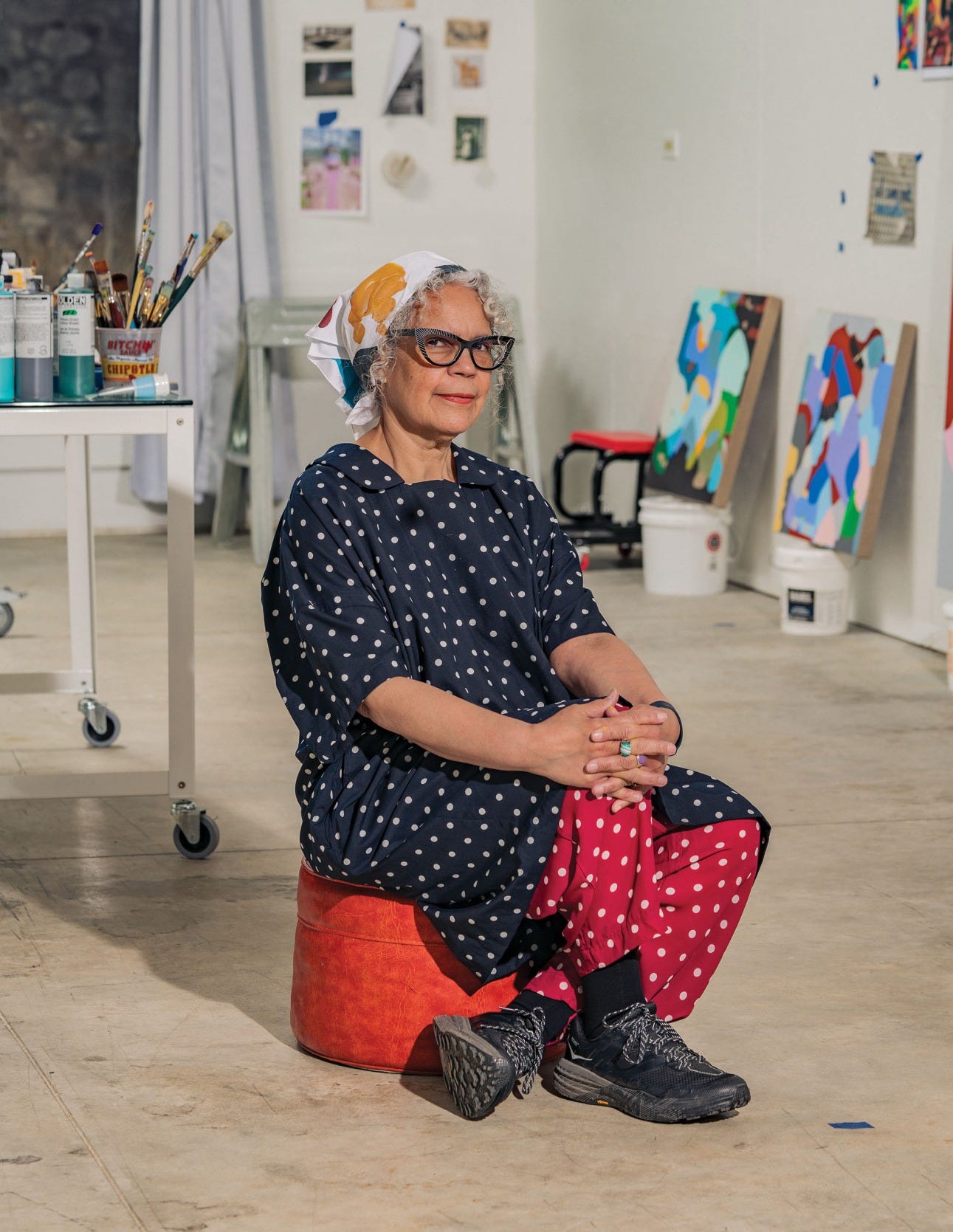 The Forum 12 | Candida Alvarez: Codes, Color, and Mapping the Invisible | She paints memory, sensation, and the space between languages. Candida Alvarez on intuition, inheritance, and color as a vessel for care.Candida Alvarez is a painter whose work explores personal and cultural memory through abstraction, vivid color, and layered visual language. She draws from Caribbean diasporic experience, family history, and city life to build complex surfaces that hold both clarity and mystery. Her work has been shown at the Whitney Museum, MoMA PS1, and the Chicago Cultural Center, with recent major exhibitions at GRAY Gallery, Real Monsters in Bold Colors: Bob Thompson and Candida Alvarez, and her first large-scale museum survey, Candida Alvarez: Circle, Point, Hoop, at El Museo del Barrio.She explains:* Growing up bilingual and between cultures, and how that shaped her approach to painting and storytelling* Why color, surface, and rhythm carry emotion, memory, and political charge* Painting for resonance instead of clarity, and letting intuition lead the process* Using abstraction to hold grief, joy, labor, and inheritance in the same frame* Returning to domestic and familial spaces as a way to build intimate visual worlds* How risk, repetition, and instinct guide her through not knowing what the painting wants* The connection between care, culture, and making art that listens as much as it speaks(00:00) Learning to See as a Bilingual Kid(10:18) Color as Voice and Resistance(20:47) Working Through Grief and Reverence(31:02) Abstraction as Intimacy(42:11) Teaching, Listening, and Long-Term Practice(52:36) Making Shows that Listen Back(01:04:10) Holding Presence in a Fast World(01:14:32) Refusing to Be Defined by Trends(01:24:45) Language, Memory, and the Visual Archive(01:34:56) Painting as a Form of FreedomWatch the conversationView the full episode on YouTube.Follow Candidahttps://www.candidaalvarez.com/@candida_alvarez_studioLearn more about Candida Alvarez’s exhibition, Real Monsters in Bold Colors: Bob Thompson and Candida Alvarez, at GRAY Gallery NY here.https://www.richardgraygallery.com/@richardgraygalleryLearn more about Candida Alvarez’s first large-scale museum survey, Candida Alvarez: Circle, Point, Hoop, at El Museo del Barrio here.https://www.elmuseo.org/exhibition/candida-alvarez-circle-point-hoop/@elmuseoAbout The ForumThe Forum is NewCrits’ ongoing public talk series, presented in partnership with WSA/WSBS. Talks take place live every second Tuesday at WSA. Join us for our next conversation here.Explore NewCrits’ offerings, including crits, courses, and mentorship programs at www.newcrits.studio.—Full TranscriptAjay Kurian: “Dame un numero” which means “give me a number”, Candida’s mother would tell her. She intuitively knew that her mother meant a number from one to 26 in accordance with the alphabet. Selecting a number meant selecting a letter, and the letter would be her mother's compass to find out who is trying to contact her from beyond this realm.I love this story. It so quickly highlights how Candida is in this world and others, and the plays she sees in living. I met Candida Alvarez in 2023 at Skowhegan School of Painting and Sculpture, a residency program in Maine where we both were faculty that year. I got to see her process as an educator and an artist, and at the root of both is a profound level of observation and responsiveness.It's always fun to talk to Candida. But when you ask her questions about painting and her practice, there's a different level of focus than that emerges. One where I notice myself hanging onto her every word. There were many times when it felt like she was tapped into something past this world, and her words were like a tunnel to that elsewhere.In those moments, it's best to shut up and listen. So I went back and listened to the talk that she gave at Skowhegan. When she finished, she was going like a mile a minute, and then she finally finishes and she quietly stops and says, thank you. And in what became typical fashion of the end of a Skowhegan talk, the room erupted with both applause and foot stomps more like a stadium than an art talk.But then a hush came over the room as she opened it up to questions. You could even hear it in the recording, and it’s something that I can't really explain. You could hear the spotlight on her, the concentration on what she was about to say. What I wanna say is that Candida has a bit of magic about her, and after a long time, New York gets to feel it.So with that, I'm just gonna list off some accolades of yours. Alvarez has participated in residencies at the Skowhegan School of Painting, Studio Museum in Harlem, the Luma Foundation, among others. Recent awards include the Trellis Art Fund Award, the Latinx Artist Fellowship Award, and the American Academy of Arts and Letters Award.Her work is included in the collections of the Art Institute of Chicago, the Museum of Contemporary Art in Chicago, the Whitney Museum of American Art, the Denver Art Museum, the Studio Museum of Harlem, and the Perez Art Museum in Miami, among many others. Everybody give it up for Candida Alvarez!Candida Alvarez: Thank you. That was so beautiful.Ajay Kurian: How are you?Candida Alvarez: I'm not sure.Ajay Kurian: Let's start with a number. I feel like the number 2 is the one that always comes up for you.Candida Alvarez: Well, I was born the second day of the second month and I'm the second child. So I guess you could say 2 does circle around me. But if I asked you, what would you say?Ajay Kurian: I would say 23.Candida Alvarez: 23.Candida Alvarez: T? No, UVWX.Ajay Kurian: Anybody?Candida Alvarez: X?Ajay Kurian: X?Candida Alvarez: No, no. There's 20. It's Z. That's a big one.Ajay Kurian: Z, Y,, T, V, W, X, Y, Z. So Z, Y, X. Yeah. It's 20. It's X.Candida Alvarez: Yeah. Okay. X.Ajay Kurian: What do we do with X?Candida Alvarez: Malcolm X, Latin X.Ajay Kurian: Oh shit.Candida Alvarez: X-ray, Extra, Xavier — X is a hard one, but not really. X is like multiplication, right? X is the thing you don't wanna get when you go up to show your math teacher the answer to the problem and she goes, X it means wrong.Ajay Kurian: I feel like I guessed wrong.Candida Alvarez: No, you did what you had to do. You gave me a challenge because that's a long way down the list. If my mother asked me, I would say four. I never played that all the way at the end.Ajay Kurian: But you played that game enough that you knew like, don't do twenties. That's X. I'm new to this game.Candida Alvarez: It's all right. Ask me another question.Ajay Kurian: We're looking at your retrospective here at El Museo del Barrio and it's called ‘Circle, Point, Loop’. Here are some install shots of works that are called View from John Street.Candida Alvarez: Yeah, those charcoal drawings were from John Street, Brooklyn where I had a studio and that building's still there and there are still artist studios there. I was up on the second floor and it was a great space. It was one of my first spaces in New York. It was very dangerous. I remember one of my father's friends gave me a really old car to drive. I could see the plant and I could see the water beyond. I had a residency in Germany that was through a program in Philadelphia — creative artist network, I believe. And I learned about it through a fellow artist in residence, Charles Burwell, who was from Philadelphia. It was an opportunity for an artist to go away for a month and they chose the city. So I went to Cologne.Ajay Kurian: Wow.Candida Alvarez: Right. That's what I said. And I spent a lot of time at the Dome Cathedral. I was fascinated by it structurally and what it meant for the city.But also there was this above and below. So, below was the crypt of the church and it was beautiful. It was a beautiful space with little light bulbs and just sort of a very special place to chill out in after a big day of traveling around. The church was filled with a lot of art and stained glass. I met so many wonderful artists there. And they actually put together a catalog for me and they curated a show, and those drawings were a part of it that I actually did in John Street. So I came back with a lot of beer coasters — the circular forms, which I was fascinated by. And I just wanted to do charcoal drawings, which I had never really done, but I think it was the dust, and the dusty feeling.I just used charcoal and got to work. You can see the circular pattern came from one of those beer coasters, and tape was used to get some of those rectangular shapes. I used a razor blade to get these kind of whitish, almost dashed lines through the paper. I got totally engaged with them and after I did them, I didn't do any more.Ajay Kurian: Yeah, I mean I've never seen a charcoal drawing from you since. It was really part of going to that show and like walking through the museum.I've known you for a couple years now and I've seen the work and I understand that color plays such a huge role in how you think about life. So it was surprising to see charcoal drawings and just the breadth of the work. There's so many different projects, there was so many different ways of working. Did this feel foundational? Because you talk about drawing a lot as really the root of what you do.Candida Alvarez: Well, I think there's something beautiful about blackness and black is a color. I mean, people don't often think of black and white as color, which I find kind of interesting. But it's really a beautiful way to see deeply.I love charting space using black and gray tones. There's something about commanding space with a very little tools, right? The stick of charcoal is kind of beautiful. That one thing that can create all this magic, I find really beautiful. I just didn't like the dustiness so much, you know? Charcoal is hard to pin down. I love the highlighting, the light and dark, and I also like taking pictures. You know, I had a camera for a long time and my first tool was a camera.Ajay Kurian: They almost feel like abstract photographs.Candida Alvarez: Yeah. I love black and white photography. I fell in love with it. I used to love Roy Decarava’s work, where he went from pitch black to white. And Harry Callahan.Ajay Kurian: That's when you can see that black and white are colors.Candida Alvarez: There was something poignant and very stark, and at the same time, the gray tones allowed for a time interval to be introduced into the compositions. When you just have black and white, your eyes move really fast. But when it's gray, your eye moves. Like it's on a tripod and it could be moved. It's more like when you're making films. I love classical film — vintage black and white films.Ajay Kurian: Did you grow up watching a lot of movies?Candida Alvarez: I think television was mostly black and white for a long time. But yeah, I did. Not a lot, but enough to keep me at the edge of my seat. I think to have a camera and to be suspended in time, to have Polaroids, that was magical to me. I really thought I was gonna do more work with a camera. But I still do work with a camera, because I take a lot of pictures for my own documentation. I just don't show them.Ajay Kurian: Why don't you show them?Candida Alvarez: Cause I don't need to. I just use them.Ajay Kurian: So they get used for compositions? Or how you think about the work?Candida Alvarez: Well, I love capturing details of my daily life.Ajay Kurian: So this is in the eighties and then by the nineties, that's when you apply to Yale, get in and go there. I think there are consistencies, but also there's some really major things happening.Candida Alvarez: There was more change. It was less photography and more about the body interacting. I came up with a way to identify a sort of a dimension to this idea of intentionality, which is the name of this case study with Mel Bochner. Of course, that was his big question to us all the time. What is your intention?That was a word that I held onto and I was trying to define it for myself. I wanted to have a formal way to define that. That was my curiosity, and so I wanted to move. When I got into Yale I was doing those multiple panels. They were really colorful. This all happened at Yale because I was trying to unpack something that was significant. I was really trying to mine my life experiences. These kind of ways of being in the world. Like the ways I listened, let's say in my family, the way I heard my mother, the way I paid attention, the way my father taught us a game of boxes, right? I love the systematic nature of that. I just like threading through the unexpected and I wanted to sort of use this language and invent a language that came outta something really familiar.Ajay Kurian: Mm-hmm.Candida Alvarez: But yet it was very conceptual. It like all of a sudden got elevated to something else. And so I love the retranslation of something unexpected. The mystery of making for me is very exciting, but the context is also really important — how it begins. And what are the questions and why is that so important? Well, it was a way to identify, right? Who am I as the artist? Why is it that what I was making was boring? To me, it was becoming boring. Because familiarity gets boring to me.Ajay Kurian: Could you see yourself in these? So we're looking at almost like a wavy grid of nails that have kind of looped wire around them and rubber bands.Candida Alvarez: But I was drawing with nails, pencils, and rubber bands because I was reconstructing the language. I was naming, I was using, it was kind of using the alphabet. It was a way to get back to a word or to a beginning point, like the word intention or the word convention I was using. I was kind of mimicking Mel in a way, but in my own little weirdness I was able to respond. So I was responding.Ajay Kurian: And did he see it as a response?Candida Alvarez: I think he was intrigued. I didn't reveal all my mysteries, you know, I just kind of went for it.Ajay Kurian: I don't think you ever do.Candida Alvarez: No, you can't. You kind of just do what you need to do. You don't have to over explain anything.Ajay Kurian: Yeah, then it dies a little.Candida Alvarez: I like to keep some mystery.Ajay Kurian: I feel like there's a lot of systems early on. I mean, there's always systems, there's always patterns and finding ways to make a composition based on kind of chance operations too. Like this one, tossing pennies literally happens from tossing pennies.Candida Alvarez: Exactly. But that also came at the beginning point. Goes really early back to my father who tossed pennies in the air for good luck. So as this inquisitive child, I'm more mesmerized by the fact that the penny is tracking a pathway. There's something about the penny being flung that was more interesting to me than the penny landing. But the landing was the luck. Somehow it's like what held the space. It kind of held the space in a way that that's what my father's desire was. So was that what he wanted? It was weird. What can I say? But I noticed it and I wanted to use it.This was one of the first pieces I did when I got to Yale and it was an empty studio and I just looked around the room and collected things. Those were all free for taking, 'cause they were just pieces laying around. So I just used them and I love the way that I felt free enough to organize them together.Because that was new for me. And then I had my son in 1991 and I was there in 1995. So that's my little son's hand, Ramon. He was in the picture too, so I made that little thing.Ajay Kurian: Oh, right here?Candida Alvarez: Yeah. That's my son's hand. So my son was there with me too. So what happened was I had those pieces of wood paneling and then I just started tossing the pennies into them. Wherever they landed, I just traced them or I glued them down. Then I had these little pathways and I really was very intrigued about that. Like how to mark territory and how to create a space that was coming out of something intentional in a way. And also memory. So it was like solving a puzzle that I felt I had to create for myself as the artist.Ajay Kurian: You know, I feel like the word abstraction gets used a lot, and a lot of times people mean different things when they say it. And I love how much you bristle at the word abstraction because it bothers me too. I think people use it too freely and I'm using your words here where it's like we're abstracting all the time. When you think about your practice, what is a better word to describe what it is that you do?Candida Alvarez: I paint. I draw.Ajay Kurian: Yeah. Okay. I'll take that.Candida Alvarez: What do I think? Like we were talking about Vernon Reid, I mean, I love Vernon Reed, and when he came out with that album Living Color, I was just blown away. I was blown away. 'cause he collaborated with Greg Tate. They were artists who worked with words. The lyrics are so incredible and powerful. I took that to represent what I do, you know, living color. I could never forget that. So for me, when I talk about painting — I love painting because I can use color and color is living to me and that means that it can change. It changes depending on where you situate that painting.What kind of light is on that painting? I love that. I love that it's alive and I think that's really what I like to do. I like to wrestle with color. There's something about that engagement that never ends. It's a conversation that's continuous. And I just love it.Ajay Kurian: I feel like that shift into color, like, I'm actually curious because to me, I've known your work when color was always there. It was like foregone occlusion. But in these works, like for instance in extension, you know, there's definitely color. How do you conceptualize a shift from a piece like extension to what we're gonna see in a bit?Candida Alvarez: Well, because these are all stepping stones. They’re all steps towards something and that's the mystery of making or being the artist, right? I mean, I only make these pieces 'cause I wanna try to understand something and I'm not really sure what that is yet. But it's the mystery of wanting to discover something that keeps me going.Ajay Kurian: This feels like a portal to me. There's a lot of mysterious works, but this one in particular really does stand out.Candida Alvarez: That's convention extension. Well, I was responding, because we had to read Harold Bloom, The Anxiety of Influence.Ajay Kurian: Was he teaching there at the time?Candida Alvarez: No, this was Mel's class. I think for me, I was talking to myself, so I wanted to extend myself like a clock. I wanted to see myself like the Vitruvian man. I was like, I could be a star. I could be a man extending like a clock.Ajay Kurian: Candida’s talking about DaVinci's Vitruvian man.Candida Alvarez: Very famous. I’m sort of intrigued by history, and history that maybe people don't think I should be a part of, you know what I mean? By chance you bump into things or you're reminded of things. It's like you ask me a question and all of a sudden you take me on a tangent or something. And I might have not been thinking about that as a portal, but all of a sudden I can connect something that I was thinking about.I think it's having the courage to just do whatever the hell you wanna do. And we just get so locked into other people's expectations. When we're young, we're students, we hang on to every word and we try to be the best that we could be. But sometimes you just forget yourself in that equation, right? Because you're trying to be something that you think you should be as opposed to being what you really are. And so I think learning and unlearning is a part of it all.Ajay Kurian: Did you always have that courage?Candida Alvarez: Probably not, no. But I failed at trying to be perfect. I like to practice my penmanship, and I loved the practice of calligraphy. I tried to be good at math and I was terrible, but I tried my best with trigonometry and all of that. I didn't know that I was an artist or I wanted to be an artist because that wasn't something that was in my early learning. But the daily news had this little picture that you could color. To me it was like little paint by number, like a wall thing. I used to love to do that, and I used to love working with collograph.Ajay Kurian: What was that?Candida Alvarez: That game where you peel the plastic and it was all these shapes. I was always drawn to something that I could participate in. But I never knew that this was my path.Ajay Kurian: But then you go to Yale, I mean of course it was years later. First you went to Fordham and that’s when you really started to feel it.Candida Alvarez: That's where I took art classes. And I wanted to carry that big black portfolio. I was fascinated by that big black. Then I got lucky. I took a class with Susan Crowell and Jack Whitten. Paul Brock was teaching history and he was married to Miriam Schapiro. So I got lucky. It was the seventies. Somebody like Jack, I didn't know who he was.I didn't know that he was such a well-known artist, but I took his class and he was very encouraging. I didn't have a lot of supplies and I didn't know how to stretch a painting. But I used to go to Pearl Paint and buy my stretch canvases.Towards the end when I was graduating, Jack looked at me and said to me, you know, if you continue to make those pieces really big, you can actually win awards. I was thinking, is he really talking to me? So I was kind of shocked, but what happened was, at that moment, he was paying attention and he noticed the seeds that I had. He acknowledged them and made me aware of them. And that gave me pause and gave me something to really think about. And that gave me a lot of courage.Ajay Kurian: That's beautiful.Candida Alvarez: Right. But he actually said, you should apply to Cooper Union. So I asked for the application. It was about, I don't know how many pages, but I looked at it and kept turning the pages, and I was like, I can't handle this. But fast forward how many years? And then I'm teaching at Cooper Union.Ajay Kurian: Wow. Right.Candida Alvarez: And I'm like, I guess I did have to come to Cooper Union and to make my move back to New York. I mean, here I am again.Ajay Kurian: You've taught for so long. You were at the SAIC in Chicago for…Candida Alvarez: 20 years.Ajay Kurian: When you started, it was in the late nineties, right?Candida Alvarez: Yes, 1998.Ajay Kurian: Did you feel ready to be a teacher then? I guess Ramon was probably what, seven, eight?Candida Alvarez: So I went to Fordham, but didn't go right to art school. I went and stayed at El Museo del Barrio, that had free classes and workshops, so it was a little easier to handle because there was no expectation. So Bill was teaching there who was a phenomenal printmaker, actually he was a professor at Pratt and he came to work there part-time.While I was there, I started looking at catalogs. I had one of Vermeer Bhutan and I fell in love with those black and white photo montages. I think that there is something about that dismantling and gathering of something familiar that's interesting to me. So then from there, I did a little curatorial engagement with pre-Columbian art. I was studying pre-Columbian art.So we had this book and I was fascinated by the little statues that they were collecting — the wooden sculptures. Then from there, I learned about the Cedar Artist Project, which happened in the late seventies or early eighties. That was another really amazing and very robust community of artists that came together. It was the first time that the city of New York actually paid artists to do their work. And I got lucky. I was part of the first group and stayed there, and that's where everything happened.So I started to feel more confident in being the artist. I was probably the youngest one in that program. They had photographers, they had painters and, and I was kind of in the writer's section. For some reason they had groups. I was with the poets, but lucky me in a way 'cause it was like Bob Holman and Pedro Pietri. But we all met once a week to get paychecks. It was fantastic to feel the energy of being an artist in New York and to be able to do what you do and get paid for it. It was just unbelievable.And then I stayed in New York, got married, had a son, and my partner wanted to go to Yale to get his master's degree in photography. So we went as a family. He graduated and then I was like, well, I think it's my turn. So that's how it happened. That's how it landed in Yale. There was a market crash. It was a good time to leave the city. Artists weren't making any money, but a lot of us were going back to school to get our degrees so we could make more money.Ajay Kurian: Right. Teaching classes. You know, today it’s like, on the one side of things, you can maybe be a mega star and make all this money as an artist, and then there's the sense that nobody's making any money and it really isn't a great career path for any reason at all. But I feel like that program gives you this sense early on that like oh, I can do this, I can make a living off of this. It just seems like a really specific thing that you might've just…Candida Alvarez: Lucky.Ajay Kurian: Yeah.Candida Alvarez: It was three years for us and we had a really cheap apartment, which we lost and it makes me sad thinking about it ’cause I used to have my studio right in the front.But anyway, we lived in Connecticut and I had found a beautiful studio at Rector Square, which is not too far from the school — our son had just started school.Ajay Kurian: In my head, I've heard this from many female artists that either are thinking about children or have children, that they've heard from gallerists that if you have kids, it's gonna damage your career if you do this. There's so many shitty things that female artists get told. But you just jumped in.Candida Alvarez: It just kind of happened. But I want to say something — Bob Holman was married to Elizabeth Muray, so I got to meet Elizabeth Murray and became friends with her because of Bob, who I met at the CETA Artist Project. She had at least three kids. It was never an issue.And Hettie Jones who was the mother of Kellie Jones was also a dear friend. And I'm trying to remember how I met Kellie, but it must have been the Studio Museum in Harlem, because I was also an artist in residence in ‘85. And so there were shows at the Jamaica Art Center that Kellie curated. We were all beginning our careers. We were all in the beginning.Ajay Kurian: Did you know Daisy Elizabeth's little girl or did you ever meet her?Candida Alvarez: I didn't really know them that well. But Elizabeth was a great mother and she was a fantastic artist. She wrote the essay for the first show that I had at June Kelly Gallery.Ajay Kurian: No kidding.Candida Alvarez: And that was her first ever essay for an artist.Ajay Kurian: Wow.Candida Alvarez: It was very beautiful.Ajay Kurian: I feel bad that I haven't seen that, I need to get access to it.Candida Alvarez: It's somewhere in my archives.But so, I don't know why certain things happen. You know, they just happen and you notice and you just feel like your life keeps moving, right? But I had no idea that this is the person that I was becoming. I just trusted something. I mean, you have to have courage. You have to do things that may be scary, like move out of the city or marry somebody you love or have a child or take up classes. I mean, it just kind of started and it just wouldn't stop. I couldn't let it stop, no matter what. And I wasn't selling a lot, you know, I just kept doing it.Ajay Kurian: What did you trust and what brought you to all black embroidered images? Seeing this at the Museo threw me completely, like for the Skowehegan people that are in the room, it's crazy. You go into a room and it's all black and it's fucking wild. It was beautiful. There was so much weight there. And then there's a video of your mother and she's preparing food and she's very serious too. It was a really powerful room. I have so many questions.Candida Alvarez: Well, black and white drawings, right? So this is going into a very deep, dark space, but there's a lot of tenderness in that space. The sewing, which I did by hand.Ajay Kurian: It is very tender.Candida Alvarez: The light captures it in such a way, and I love the whole idea of thinking that the viewer thinks there's nothing there, but then you have to get really close and then you notice something.I started to work with dinner napkins because they were soft and easy and my son was little and I couldn't get to the studio. So I needed to work on something that I could take with me and do it on the bed, or the chair, wherever I could watch my kid running around. So I would just take them and, and make these images.My mother collected and was given a lot of porcelains, and she had a lot of them in Puerto Rico at this time. My parents were living in Puerto Rico and we lived in Connecticut. Then we came back and I had a studio, and these were done in Chicago.So I was doing these small drawings and it was really interesting. At some point I remember seeing this small little painting by Francisco, a Puerto Rican painter. I went to Puerto Rico just before, like in the seventies for the first time.I went and I met Lorenzo Homar, who's an artist I really admired. Puerto Rico has these amazing artists who worked that I noticed with printmaking. I didn't really know a lot of the visual artists, but from Fordham University at Lincoln Center, I met somebody there who knew this artist. And so that's how I got to the studio for the first time and I was so nervous. I remember Harley talking to him, but he told me to read all the books in the Social History of Arts.Ajay Kurian: Oh wow.Candida Alvarez: I wanted to go to Paris, and I think it was during the CETA Project. When I had a little bit of money, I took myself to Paris because I wanted to see the work of Francisco firsthand. I saw that work in the eighties because there was a show that El Museo del Barrio was putting together with the Met and it showed a lot of work from Puerto Rico. This was one of my favorite paintings and I wanted to paint like that. When I saw that, I was like, I wanna paint big.Ajay Kurian: From 1893. The weight.Candida Alvarez: 1893. So he did a piece that's much smaller and it was a portrait of a meal order. He was drinking tea at a table. And right next to him is like maybe his housemaid and she has this big dress on her lap. This black material and she sewing. So it was years later after I made my black drawings that I remember seeing that painting. And I was like, did that really affect me? It was so wild. I was like, oh my God, I became that housemate painting.That painting was so beautiful. It was facing the Mona Lisa, that little painting. So that was an amazing moment that I'll never forget.Ajay Kurian: Wow. I would've never known that whole backstory. I mean, the works are beautiful and they're moving on their own.Candida Alvarez: I don't think I've talked about it, at least not in a long time.Ajay Kurian: That's incredible.Candida Alvarez: Well, that's why conversations are interesting, right?Ajay Kurian: Is that why they're called lap drawings? 'Cause you were literally sewing…Candida Alvarez: On my lap.Ajay Kurian: So then they got bigger, right?Candida Alvarez: So the big ones, I still did them on my lap, but they were bigger.Ajay Kurian: They're huge.Candida Alvarez: Yeah, they're really bigAjay Kurian: I'm gonna skip ahead a little bit. I wanna go to the air paintings. So 2017 was a really consequential year for you, for a whole number of reasons. There were amazing things that happened and not so amazing things that happened, and it feels like the air paintings kind of became a way to process the ups and downs.Candida Alvarez: Well, in 2017 I had a really big show at the cultural center that was curated by Terry Meyers, who was one of my colleagues at the School of the Art Institute Chicago. It was a very important show for me. So after it closed, my father died. He was in Puerto Rico and then about three months later I was there with my mother and my sister went to stay with my mother 'cause she was grieving and my mother has never lived alone.I mean, it's been years. But when I left and my sister was there, Hurricane Maria came. So it was devastating because we couldn't find our people, right? We were all searching on Facebook and trying to connect with people who were there and the cell phones weren't working.There were weeks and weeks where we were just frantic and not really knowing the state of things. So I was in Chicago trying to keep sane. Because my mother and sister were there and we couldn't find them. We couldn't hear from them. But there was something that said, I'm sure they're okay.Just before that happened, I had a commission that was sort of this digitized mural printed on mesh which was used for banners. Chicago has a lot of mesh. This was for under the Wacker Bridge. The engineers had to construct the weave in such a way, so the bridge wouldn't come down. So this idea of air was really important to the design of the material, and I was fascinated by that. It's like a canvas, except that this was outside. But there's that little window of air, and I kept thinking about that.Ajay Kurian: It makes me think of you being fascinated with launching the penny.Candida Alvarez: Exactly. There’s something about something else that happens, inside and outside of material. Or inside or outside of functionality, that gets to something that is mysterious, like a wish, right?So I had to produce this piece. It was very big. It was one of my largest commissions outside. It was like maybe 200 feet across and 70 feet high, multiple panels. We had a proofing process, and so these pieces came from that proofing process. They were the excess and the stuff that wasn't used. So I just asked for them. I wanted to take them and I just rolled them up and took them to the studio never thinking I would use them.It was during this time period when we couldn't figure out where my mom or her sister were or how they were doing. It was a very restless time. I decided to unroll them and just do something kind of different. And so I started pouring pain and squishing pain and stepping all over it and just doing something else. That's how these came to life. That's why they're called air paintings.But also the framing for them took a while to get to. I didn't know what to do with them 'cause I never thought I would show them. I was just making them. And then I thought, wow, two sided paintings.Ajay Kurian: Is it sandwiched between the aluminum at the top?Candida Alvarez: Yeah. There's a really beautiful way in which they get inserted with a wooden dowel. I'm very happy with them. And so sometimes I refer to them as paintings with little feet, but it was the first time I've ever had a show and I wanna say thank you to Monique Meloche because she was really the only person that wanted to show them. So I was grateful to her for showing them and taking them on. Because I've never shown anything like that. I've never had a show where I didn't use the walls.Ajay Kurian: Right. It was all in space.Candida Alvarez: But I love the idea of working with these, like a kaleidoscope. Eventually I'll do more of these because I still have a plan for them.Ajay Kurian: They're really great. There was a quote that you said around the time of producing these, Mother Earth is dealing with all of this abuse, and it's in overdrive right now. So people are scared. When the ground doesn't stop rumbling, you don't recognize your home turf. You become lost as the walls crumble. Overall, there's lots of tenacity and creativity. Overcoming fear is just part of who we are as human beings. We have to stand up for something. We have to love something. Death and life are so close together.And when we suffer trauma, we're pushed in different ways to remember that there are ways in which you can find and be reminded about what is right and what is wrong. And this, I think, is kind of key. Still be the individual in the room without losing our commitment to community. I thought that was really moving just in terms of being able to center yourself, but also realizing it's not just you going through something and it's not atomized.We can hold space for ourselves while within the community. And it, when you say that there was nothing on the walls, they're all taking up space together. There was a community of works.Candida Alvarez: Community has always been a very important word to me. It's always been important. I can never live life without it.To think you're all by yourself here is kind of, I mean, you are on some level, but we all need each other on another level, right? I mean, love is so important.Ajay Kurian: Yeah. Right?Candida Alvarez: You need the seeds to grow from and with.I mean, to take the courage you have to fall in love with something. Or to dare yourself to do something, you know? Or like why pick up a brush? You know, why pick up a pen? What makes us do those things? Outside of an assignment.Ajay Kurian: Yeah, the assignments end.Candida Alvarez: But you know, when we were kids, we would take rubber bands and we would nod 'em together and skip rope. They called it Chinese jump rope. Or you had a long piece of rope and then we did double dutch. So think about that, right? The way we were being creative since we were really young.Ajay Kurian: This work is called I'm Okay or I'm Good. And it finds its way into a much larger landscape and it makes me think, again, of the individual in the community. Somebody shouting out, I'm good! But in this landscape of all these other things happening and potentially a lot of destruction happening as well.That phrase became really powerful for a lot of people because like first it was for this particular work and then it was for the triennial.Candida Alvarez: It became Estamos — being.Ajay Kurian: Yeah, exactly.Candida Alvarez: The story came from listening to all the interviews with the Puerto Ricans that they were trying to find up in the mountains. They would say, well, how are you? Well, what am I gonna say? I'm alive, I can talk to you. But it was kind of a way to sort of hold the space, so you wouldn't ask me anything else, or I might start tearing or something, you know? It was a way to hold space. To hold oneself together. It's like a quiet period. I need time to reflect and I can't say anything else.It's kind of more cynical than not. But I was trying to be okay too and I was trying to do what I loved and it felt good. I could disappear for a while.Ajay Kurian: I like that you say that it was kind of cynical because it became this banner of we're okay, we're fine. But you're hiding a lot of pain. It's just like, just shut the fuck up and leave me alone.Candida Alvarez: Exactly.Ajay Kurian: There's two sides to that. And it's nice to hear it from you, because you feel it too. There's something protective about it. Even though there's air that's going through it, even the way that it's in the painting formally speaking, it's there, but it's not, it's not welcoming you. It's not bringing you in. It just happens to be there.Candida Alvarez: Well, I remember writing that too. I felt like it was almost like a little text bubble, like a pop.Ajay Kurian: You have a show at Richard Gray Gallery right now with a person who I think has been very influential on generations of artists, but of course for you as well, Bob Thompson.Candida Alvarez: That was the first piece I fell in love with at the Art Institute of Chicago when I started teaching.Ajay Kurian: This is called Equestrienne.Candida Alvarez: From the Tang Dynasty. And I did a whole series of paintings using that figure.Ajay Kurian: It was called flower of the Horse.Candida Alvarez: I was very interested in describing a beginning and ending point. I was tracking my tenure and my emeritus status, and I was leaving teaching. So I wanted to do these pieces that were paintings that really reflected this time. The Tang Dynasty horse, which is, you know, a symbol of beauty. This is this figurine and I love the relationship of the body to the horse. They’re sort of bowing to each other. It's a very beautiful piece. It's still one of my favorite pieces. One of the first pieces my eyes gazed upon when I entered the museum as I was about to teach. So that's the beginning point with my relationship to Chicago and teaching. But I love this circular motion, the slowness of it.And then when I left I got this beautiful orchid as a gift. I was leaving my studio and I was going to Michigan, it was COVID. And this artist, Maria Pinto who's an amazing designer and whose clothes I wear sometimes. She was leaving her studio and she had these beautiful orchids and she said, you can take an orchid. So I took an orchid and that orchid still blooms. I just used the idea of the gift as a way to say thank you. I have this wonky way of combining things, so that's how I got to these paintings.Ajay Kurian: They're really rich and they feel so alive, but the way you were talking about leaving teaching and this being a sendoff too. It made me even look at this sculpture differently. It feels like there is something more melancholic about it, but I'm curious, was this a way of almost making a celebration for yourself?Candida Alvarez: Oh, yeah.Ajay Kurian: It shows.Candida Alvarez: It’s about making it present and you give it visibility. You give a certain amount of time visibility. You can create a painting that can hold something particular. For me, I needed to do this. That's kind of how I work. You know, I just have these ideas and I wanna put 'em together.Ajay Kurian: So with the Bob Thompson show, how did this come together?Candida Alvarez: Richard Gray Gallery were doing these shows where they invited artists to work together. They came to the studio and they saw I had a Bob Thompson, and that I liked Bob. I had a beautiful card that I've had for a long time. And they said, would you like to show with Bob Thompson? It's been amazing. I'm still working with him and I'm still making more paintings, but the show is six paintings that I had to create. I loved it. It was beautiful. It was magical. I like having conversations with artists, and to have a conversation with him felt right. He died so young and so I wonder if he would've been an abstract painter. I mean, he was going that way, right?Ajay Kurian: Yeah. He definitely was.Candida Alvarez: But I just wanted to talk to him. It's kind of nice to have this sort of conversation.Ajay Kurian: There’s paintings before this from your show at Gavlak in Los Angeles, which I’ll show in a minute, but the way that you’re developing layers there is very different from here. Say this one, where everything feels like it’s on the same surface.It's very flat and it's very matte. Then there are other paintings before this, where there’s layers you can see through the paint and you can see other things happening. It almost reminds me of when we see early to mid de Kooning versus late de Kooning where the mark gets much more fluid and soft and there's a serenity to it.Ajay Kurian: And I'm wondering, does it feel like that's where you're at? Does that relate to you? Do you think about late de Kooning when you're making works like this?Candida Alvarez: I have worked with De Kooning.Ajay Kurian: You've worked with De Kooning?Candida Alvarez: I've created paintings with de Kooning. I've been in conversation with a lot of artists. I used to see excavation painting almost every day on my way to classes. It was always in there. I mean, the museum is very important to me.Because I'm always looking at things. So there are residues; the coloration, there's something about the whole notion of excavation. In a biography that was written on him, he was talking about how he was looking at this particular scene from a movie. There was a group of women and there was some kind of little fight that happened in the rice patties. He claims that that has something to do with how he painted the painting excavation. Which I found really interesting. So I looked at the film too and said, wow, this could be really interesting.Looking at excavation, I was trying to dismantle it. I was trying to understand it. It's a curious painting and I love that he uses women. I mean when you look at his paintings, he has a whole mashup of things. It's a very active painting. I love that it's all like in motion sort of.Ajay Kurian: These are paintings from the Gavlak show. Where the surface and the way that you're thinking about paint, about movement, about how a painting comes together is very different from the works with Bob Thompson. There's something much more serene about when it moves into an interlocked shape and how that shape lives. I guess since there's always stories that come with these movements and how these things develop, I'm just curious, what are the stories that get you into a place where they can lock together that way?Candida Alvarez: I don't think about it that way because there's a pathway and I'm interested in composition. I was taught painting, and I was taught that the most important thing in a painting is how you begin the drawing and the composition itself. How do you keep the eye engaged? Where's the opening? It's like a navel. So you have to have a little part for the eye to go into it. Like, I gotta get you in there and then I gotta keep you enraptured enough, I gotta entangle you enough in there to keep you there. So that's my main objective — to keep you looking at the baby. And how do I do that? How do I stay with the painting? It's really a color thing. It's not really the story thing.When I'm painting, I just really look at how the colors are being activated, how they're becoming families. I love this idea that two or three colors can become a family. And how you start to see the, the third, fourth, fifth, sixth color within the combinations. I love that. So when I start to see that I'm happy. So it's really a seduction, is what I need. It's what I do for myself.Ajay Kurian: This is what you need right now.Candida Alvarez: I just need the color to sort of hold me up. I need the alchemy. It's like a fix. I need to see it growing. It's like having a garden, I guess. You know, you flower, you water your garden, and you see all those blooms and they're all really beautiful. There's just something about the feeling it gives me.Ajay Kurian: You brought up both family and the garden and it makes me think of this quote from the book that you worked on with your colleague, Tim. I've begun to see that it's not just oneself, it's a multitude of selves. For me, that definitely includes the politicized woman who embraces her Puerto Rican heritage and bilingualism, as well as the self-determination to stay out of all the cultural boxes, which threaten my freedom to make choices. It's like you have a family of selves in your work too. You've had so many different ways of being that manifest through the way that you make and like what gives you the support and what gives you that flowering.Go see the show at El Museo del Barrio. Because you can see a person, where even in the darkest moments of it, there's so much joy. There's always joy in how you make and how you think about being alive no matter what happens.Candida Alvarez: Oh, thank you. At the end of the day, it's about my freedom to choose and to determine the outcome, right? There's not too many other path careers that I can think of where you could do that. So I say, you know, the choice is yours. I mean, it's mine to make and why not make it?And so, there’s a name for what I do, right? They say it's art. And I became the artist. I'm still becoming the artist. I think we have to just, you know, words and the limitations of what that is. I think enjoyment and pleasure is number one. And I guess, doing this for as long as I've been doing it, I don't feel old. I feel it gives me so much potential and opportunity and joy.Ajay Kurian: Who said you're old!Candida Alvarez: I know, but if I tell you how old I am and how many years I've been doing this, it's a long time. But for me it always feels brand new.And so I don't really work well with this idea of repetition. I kind of always wanna reinvent something. So even the way I break away from my own systems, you know, I develop systems and then I break them apart again. It's like Legos, you can either follow the rules and build that truck or you could just do it your way and get to something else.Ajay Kurian: I wanna end before we take questions with one of the prior Candida talks. This is from the lecture that she gave at Skowhegan. And I just loved this question and I loved the answer even more.*****Recording from Candida’s Lecture at Skowhegan School of Painting (2023Audience Question: What is your favorite part of being an artist?Candida Alvarez: I love following what I love. I love painting. I love color because it lives. I love the freedom to be myself. I give myself my own permissions. I feel like creativity is the most wonderful gift that we have as human beings. I feel that you have to be courageous in your life, and you have to say yes to the things that you want for yourself.It's not easy to get that. Certainly not. You know, it's a challenge being honest to yourself. But at some point in your life you realize you're either gonna go for it now or it's never gonna happen. So I say take courage and say yes to the things you really want. And sometimes it takes time to figure that out. It's a slow journey. It's one step at a time and you always make mistakes. But I always say paintings have to make mistakes. You have the mistakes of invaluable. That's how you get to your work.*****Ajay Kurian: Are there any questions that people have for Candida?Audience Member: First of all, thank you so much for your words and your energy. I'm curious around you as an educator as well. What is your philosophy or your mission as an educator? You also say that you're not too fond of familiarity and has the philosophy and mission changed over the years?Candida Alvarez: What is my philosophy? Be yourself. Learn as much as you can and don't be afraid to break the rules. I never thought I'd be teaching and I didn't plan on it. I think to be a good communicator is a must for teaching. So I think to be honest and to try as many things out as you can. Learning is, it's just kind of bumping into things that you didn't expect and to. You have to learn the basics, right? And so you have to be skilled and you have to commit. I've always been who I am. So just be yourself and find joy in that, and not everybody's gonna agree with you, right?You're gonna feel bad along the way too, because you're gonna say, oh man, what did I just do? I can't explain myself. You know, there’s just a mystery to it too. And I think going back to the mistakes — mistakes could be some of the most empowering things, right? When you understand that it really wasn't a mistake, it's just something fresh and new and unexpected, and you have to kind of reconsider it.Surprises are gifts. I think not to be so afraid of the unknown. Just the power to be yourself is so amazingly important, and we have to own that. We would be happier if we would just be more content with ourselves and that's something you learn. You have to learn that or unlearn something else. Because there's a lot of pain that we suffer too, in that evolution. Oh, I wanna be an artist. And you're like, what is that? If you don't come from a family that appreciates that. It was a word that I had to understand. I didn't know what it was. It was a hard word to utter — I'm an artist. I am an artist though. But I mean, you could do anything. You could write, you could play the violin, you could tap dance. Like I said before, creativity is everything. Right. It makes us all happier.Audience Member: I have a lot of questions, but I'll choose one. I think a lot of people here are probably artists or have artistic endeavors, but for me, I've been struggling mostly with the idea of an audience. Art is such a personal, intimate thing that you do for yourself in so many ways, and even separate from making a career out of it. But there always is an audience outside of yourself. You touched on it a little bit, that a lot of this work is so personal and cathartic in some ways, but how do you balance that? Is it ever for other people more than for yourself or how do you try to navigate that?Candida Alvarez: Honestly, I never thought there would be an audience. I didn't know that there would be an audience. I didn't know that I would continue to do this in this way. I had to learn it. I had to trust something. I had to listen out for it. I trusted my teachers, you know, I listened, I made mistakes. I was really shy as a kid. I had to really move slowly and try different things and feel like I failed at 'em, you know?Unless you're a performance artist then the audience is really important, right? I mean, I think that those are the things that might keep you from doing the actual things you need to do, because you're so preoccupied with this other notion of who's right or who's more right than you.I mean, we were talking about that earlier. The fear of public speaking, you know, until one day you realize, well, you could only speak for yourself, right? And so trusting that is a big deal. When does that happen? Like when do you feel you've crossed that bridge? I really do believe in what I'm saying, or even better, it's like I'm finding the language that I need to explain what it is that I'm trying to do.And so I think we can find that language in so many different places. It doesn't have to be just from the painting catalogs. There's so many ways to riff and to trust this material. You have to trust the material that you're choosing.Or maybe it chooses you, I don't know. Sometimes you trip into something, I think to ponder and to have the time to consider is huge. Not everybody has that time.Audience Member: It's a privilege, yeah.Candida Alvarez: Right, so I think that whatever time we do get is to use it wisely. And not flounder so much. We waste a lot of time too.Ajay Kurian: We can get one more question.Audience Member: Your work often moves between abstraction and figuration. In pieces like John Street series 12, there's a center of fragment memory embedding urban architecture, right? So how do you see drawing, especially in charcoal, functioning, not just as a medium, but as a language for claiming personal and cultural stories that are often overlooked or a race in dominant narrative?Candida Alvarez: That's a huge question. Drawing is basic, right? I mean, as a kid you have to learn the alphabet. You kind of have to string that alphabet together to form words. It's fundamental within our core. So drawing is fundamental, I think.Your question is so multifaceted. I don't know if I get it or if I can even jab at it a bit. I just wanna say that nothing is ever certain. I think the beginning point is a beginning point, but you never really know or understand where that is. And then how that takes root and then how you can cross how you begin to expand that with real roots or threads that really become the fiber of your intelligence and your memory, your love of the realities of life.I mean, there's so many ways to be in the world, to be present, to be able to be creative, but yet still be more of a historian, right? Or seeking histories of cultures that are still misunderstood. To sort of figure out how we all do come together. You know how diaspora really does live as a heartbeat.It's complex because you can thread this in so many different ways. Landscape is not just horizontal. It could also be very vertical, right? So like history, right? I like to think of history like the root of a tree, and sometimes those roots could go for miles and miles and miles. Then it can go up and then it becomes something else. So I think that we just have to fundamentally be creative and free to translate and retranslate and to sort of begin to take on the materiality or the tools that we are clinging towards. Because we all have different relationships to tools. Like I need that pen to really write what I'm thinking, or I need that recorder to sing what I'm feeling, or I need to be in a conversation with somebody — like a historian. To figure out what's next.So I think that there's so many ways, if you just rely on your creativity, I think you can get to some truth that is for you. And I think everybody in this room can have different ways of finding answers to the same question. So we have to dream and we have to fail too. We have to fail at trying to answer something that just gets deeper the more serious you get about it.That's why I love what I do because I can keep exploring and I can keep changing my mind. Then I can turn it into something else, and I can stop when I want to. I love having that kind of space that I'm in control of.Ajay Kurian: Thank you everybody and give it up again for Candida!Candida Alvarez: Thank you! Get full access to NewCrits Substack at newcrits.substack.com/subscribe | 1h 21m 09s | ||||||
| 6/3/25 | 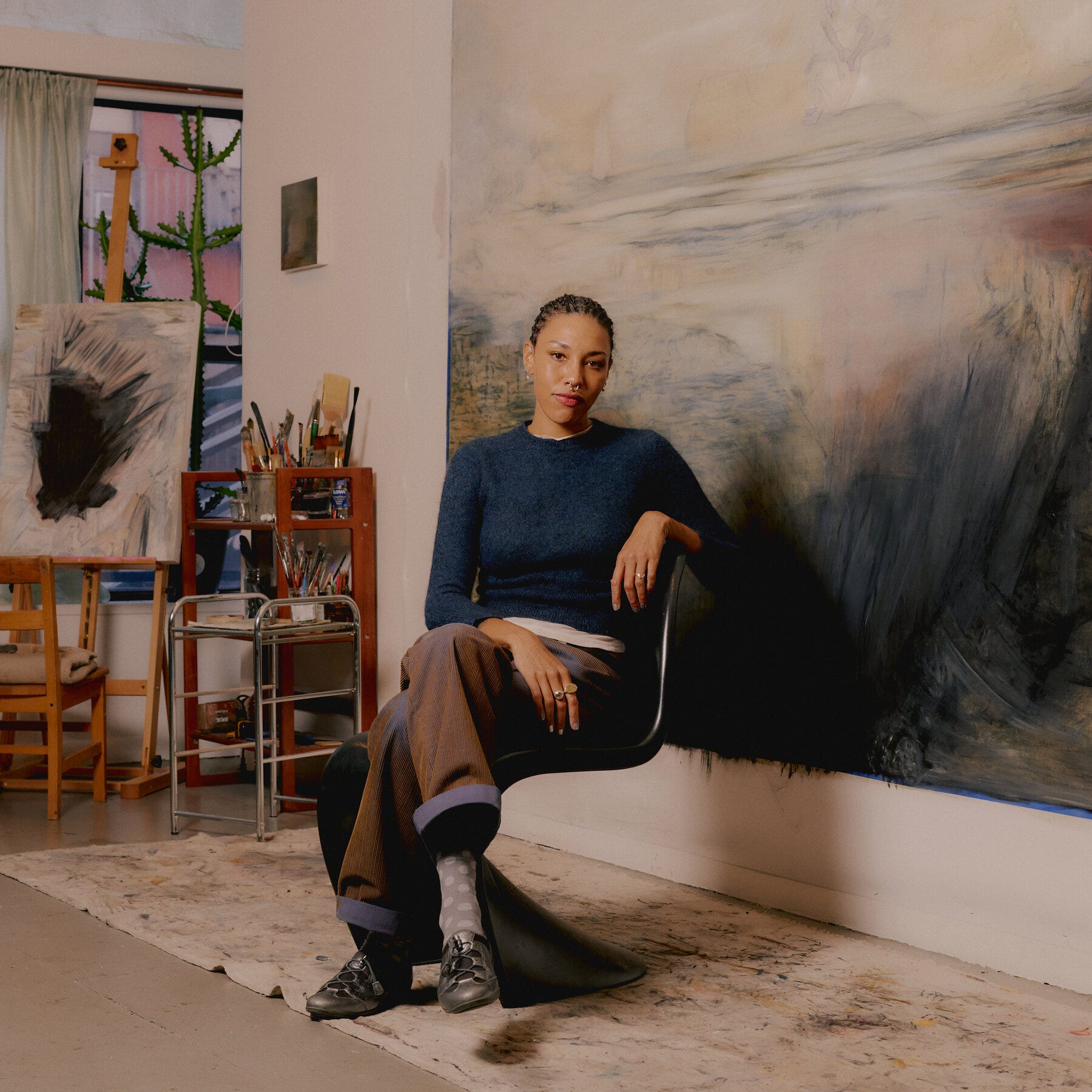 The Forum 11 | Janiva Ellis: Contorted Worlds, Distorted Identities, and Cartoons as a Conduit | She paints distortion, vulnerability, and the psychic residue of history — Janiva Ellis on contortion as language and survival.Janiva Ellis is a painter whose work stretches emotional and political registers through fluid mark-making, surreal juxtapositions, and animated dissonance. Her paintings contort and erupt, channeling humor, grief, and ancestral hauntings. She’s exhibited widely, including in the Whitney Biennial and at the Carpenter Center, and is known for refusing easy resolution.She explains:* Why cartoon logic and slapstick pain offer the perfect language for distortion, survival, and historical violence.* How she embraces ambivalence by showing unfinished or uncertain work as a form of radical transparency.* Painting not to perform virtuosity but to let discomfort, exhaustion, and doubt remain visible.* The tension between abstraction and legibility, and how it reflects a fractured sense of self and world.* Letting go of the “entertainer” impulse and choosing instead to rest, reflect, and resist institutional pressure.* How working through rage, shadow, and cultural projection allows the paintings to become psychological landscapes.* Why she paints for the terrain she’s in and how Germany, Berlin, and Kollwitz shaped one of her darkest pieces.(00:00) Relearning Joy: Art as Lifeline(08:02) The Cartoon’s Burden(17:00) From the Cruise Ship to the Studio(24:30) When Whiteness Becomes the Subject(32:00) Disillusionment and the ICA Show(41:00) Exuberance, Masochism, and Recognition(47:37) Working in the Dark: Technique and Intuition(54:10) Letting Go of Control and Embracing Vulnerability(1:00:44) White Spirals and Cultural Projection(1:07:18) The Value of Communal Witnessing(1:13:52) The Challenge of Raw Rage(1:26:59) Dream Recall and the Fade of Intuition(1:31:28) New Crits: Rethinking Art Education and MentorshipWatch the conversationView the full episode on YouTube.Follow Janivahttps://47canal.us/artists/janiva-ellishttps://www.instagram.com/janivaellis/?hl=enJaniva Ellis (born 1987) is an American painter based in Brooklyn, NY and Los Angeles, CA. Ellis creates figurative paintings that explore the African-American female experience, while incorporating her journey of self-identity within the Black community.About The ForumThe Forum is NewCrits’ ongoing public talk series, presented in partnership with WSA/WSBS. Talks take place live every second Tuesday at WSA. Join us for our next conversation here.Explore NewCrits’ offerings, including crits, courses, and mentorship programs at www.newcrits.studio.—Full TranscriptAjay Kurian: Welcome to the 20th New Crits Talk. My name is Ajay Kurian and tonight for our 20th talk, we have Janiva Ellis here with us.Janiva Ellis: Hey guys. Thank you so much for coming. There's so many people that I admire here and strangers who came because they care. So thank you so much.Ajay Kurian: I'm gonna start with a little intro for Janiva and then we're gonna get into it.Sometimes when a person contorts themselves for so long, their reality itself becomes a distortion. If a person forgets their contortion, then the distortion is reality. More often than not though, somewhere deep down, the score is being kept - and that's what keeps it a distortion. The figures in Janiva Ellis's paintings are living in this wonky place, where contortion and distortion meet, where internal and social realities commingle and conflict.I think maybe that's why she favors cartoons. Because they can stretch like an accordion, get blown up by land mines, and freeze or burn without ever skipping a beat. They are projections of contortion and distortion. The cartoon, despite its flatness, here acts as an echo chamber for history's emotional and violent contradictions. Meanwhile, a richly detailed illusionistic landscape may in fact be entirely flat - a visual lie that we've accepted as reality. In the interplay, Ellis is able to conjure vivid but slippery tableaus that weigh as much on the sociopolitical as they do the privacy of one's most intimate thoughts.She is a skillful conductor. The haze is intentional; the confusion is part of the pleasure, and the finish is meant to be a question. She's an artist who knows how to simultaneously set a trap and set you free. Please join me in welcoming Janiva.Janiva Ellis: You tore that, you ate that the fuck up. Thank you.Ajay Kurian: It's my pleasure.Janiva Ellis: Thank you for seeing the work. Thank you for confidently putting words to it, engaging with it, and not shying away from your assumptions about the work because they're really right on and it’s cathartic to hear.Ajay Kurian: Thank you, I’m honored. It’s not easy to write or talk about your work. I don't know the dynamic of how I'm supposed to play it all out because it's charged, and I think in this conversation it'll be really nice to talk about how those dynamics stay charged and how they move and change throughout the work. There's been a lot of changes and that’s the reason why I wanna start with such an early piece. We're gonna start here and then we're gonna go all over.The development is amazing. I don't say that often and I'm not blowing steam. It's rare to see an artist where every show it gets better and better. I'm genuinely astonished because when I saw your first show, it was great but I'm curious what comes next. I remember Tyler the Creator talking about Vince Staples’ album. It came out and he was like, this is it. But then the next album was the one he was excited about.Janiva Ellis: Totally. Oftentimes in the studio, I've processed the idea, but I still have to make the show. I'm halfway through the painting and I got the idea, but then I have to finish the painting and I have to finish the show. But I cannot wait to take what I've metabolized and bring it to the next project. I'm on the hook for this project and I do need to finish this and get it out, but there's already so much enthusiasm for what I wanna say next. Then in the next project, I don't know what I'm doing. While I'm making, I know what future me needs to do until future me is present me, and then I'm confused again.Ajay Kurian: How do you stay in it and how do you keep that same energy?Janiva Ellis: I don't keep that same energy. I think it's an underlying drive. Sometimes I try and let the energy of the past project evacuate by taking a lot of space or creating interventions in the work that are challenges so that the part of my mind that's stimulated by problem solving is activated again.I try and take what I've learned and I'll keep notes. Sometimes I don't even know what that note meant, but let me interpret it in the now and run with that thread. So it's not necessarily about holding tight onto the thoughts that happened in the past, but maintaining the same enthusiasm around my curiosities and my desire to feel challenged by what I can create.Ajay Kurian: This painting is called the The Okiest Doke from 2017.Janiva Ellis: One of my friends said “don't get caught up in the Okeydoke”. It's either DeSe Escobar or Juliana Huxtable, and it could have just been the community. It could have just been something we all said.But it was very much a 2014 “we're out here” vibe. As with a lot of my titles, they come from notes I had taken about things I had said, or friends of mine had said on nights out about the predicament we'd find ourselves in and the joy we'd find in feeling like we were able to put language to this spiral we were navigating.Ajay Kurian: It always feels that way. The titles catch a vibe. I understand it sometimes and other times it washes over you. But then you click with the vibe of the image, and you can feel that vertigo of where the picture takes you to.Part of why I wanted to start here is this cartoon hand. This communion into cartoons is an interesting place to start, and also how you continue to use the cartoon in the work. In my understanding, the history of cartoons is a pretty fraught one, especially as we get into Looney Tunes and all that. The precursors of those cartoons is essentially seeing blackface and minstrelsy turn into the cartoons that become beloved characters and then become these characters that never die. They can always be distorted, can always work harder, can always explode, freeze, do whatever, and just come to life again. For that to be the person who's giving the wafer here feels wild.Janiva Ellis: This the cartoon’s burden. It’s like the burden of constantly having to endlessly embody a projection. When I started doing cartoons, it was literally out of the need for speed. I was taking my practice really seriously for the first time, and I felt a lot of shyness around pursuing what I wanted to pursue.I really wanted a level of grandiosity that I didn't know how to achieve and I also had a lot of self-doubt. So I decided, let's just go back to basics. You can communicate the things you want very quickly and easily by cartooning, and you can re-access your hand and your ability to draw by using cartoons.I think the fact that it speaks to the fraught of the way that white violence depicts blackness and the way that whiteness cartoonized black people was not the starting point. There's just so many moments where it was like, I'm gonna do this. Then the funny byproduct of that is that there's a critique to be had about whiteness. It's not the point, but oftentimes it's just there.There's a painting I did of a woman and I made her into Pinhead. Then I did some research on Clive Barker, who made Hellraiser. But where did Pinhead come from? And it came from African sculpture and I wasn't trying to give that, but obviously it gave that, and as I was painting, it worked out that way.There's violence woven through so much pop culture and so much of things I'm referencing from an organic place, from a place of resonance, that it doesn't take too much to connect those dots and I can just riff without trying to make a heady dialogue around blackface. It's already there. The history is there. Early on, people were asking me a lot about blackface and I'm like, yeah, that's inherently in there but I'm not trying to flatten that dialogue. I'm trying to create broader worlds for that representation to exist.Ajay Kurian: Did you always trust your intuition?Janiva Ellis: No, absolutely not. It's a constant moment to moment. I do feel really driven and I know that I'm strong, but I do also have doubt. There’s an underlying pulse that I trust, but topically I feel really disillusioned and really capable of falling for dumb tricks. So as I get older, I feel more capable and more self trusting. As the people in my life become reflections of who I want be surrounded by and the relationships I wanna see in the world — That really bolsters my sense of self worth, and that bolsters my trust in myself. But no, I didn't feel that way. Even when I started painting again after years of taking a break, I was like, what's the story there?Ajay Kurian: How did you come to painting? Why did you go away from it and what got you back?Janiva Ellis: I started painting as a kid and was always painting. My mom was very encouraging of me. Being good at something, finding what I liked and just doing that and finding catharsis in some way. So she's really supportive of that.I did that for a long time and went to schools that encouraged creativity. Went to college and that evaporated all of the excitement and enthusiasm I had about the potential to make something meaningful.Ajay Kurian: Did you go to an art school?Janiva Ellis: I went to California College of the Arts in San Francisco, and the experience I had alongside school was so deeply enriching in terms of self-identifying and finding people that inspired me. But the school experience was pretty stale and I don't know if this is a broad thing or if this still happens, but I remember the idea they told you that only 5% of you are gonna be doing this for the rest of your life. It was very like, y'all are gonna be failures and compete for who can actually make this a thing.Ajay Kurian: Oh, that's horrible.Janiva Ellis: Yeah. Is that normal? Did people experience this in art school. That’s a thing, right? This idea that only exceptionalism will bring you fulfillment essentially, that was just the vibe. And then what I saw being labeled as exceptional, I was like, this is crazy, this is a bad art, what's going on?But I also knew just based on the kinds of things I attracted in my life that I was able to actualize and I was capable of fighting a heartbeat in what I wanted out of life. So I did have that feeling, but I didn't know how to get it and I didn't have models of what that really looked like.Ajay Kurian: But you knew you wanted to be an artist then?Janiva Ellis: I did deep down, but I was open to a lot of options of what that could look like and how art would enter my life, through teaching or through programs. I wasn't like, I'm gonna be a successful artist. That definitely was not something I thought was a given or something I was striving for outright. It didn't feel inherently valuable to what I had to offer the world.But it was there, and of course, I wanted to ultimately live a life where I was creating things that connected with people, and that I would have the respect of my peers and the respect of people who engaged with what I did.Ajay Kurian: So your first show at the gallery and entering the art world — what was that step? This is a painting from that show.Janiva Ellis: This was the first show. That moment was really a madness. I had gone to school, I had gone to New York, I had connected with people who I really felt were my people, I had crashed out, I went back home to Hawaii, tried to figure it out again. Spiraled deeply, decided to go back to the mainland, I grew up in Hawaii, so that's the context of that. I moved back 'cause that's where my mom lives and that's where I grew up.That's the context that shaped so much of my perspective in terms of growing up on an island, growing up very isolated as a black person, growing up with an immense wonder of the world and also doubt of my environment. So that was a whole thing. When I moved to New York, I finally was like, wait what? Black community, that's crazy.It was such a rich moment and the intersection of being like, I went to San Francisco and the queer community hit, now I'm in New York, it's black, it's queer, it's cute. So leaving felt really I'm abandoning, work that I put into finding my people.Janiva Ellis: But Hawaii had its own healing intersection and I knew I couldn't stay there forever, but it was a good detour. Then I moved to LA and my friend Jesse let me stay with him, and said you gotta do this, come on, you should paint. He helped me get canvases and helped me get things that I needed. I was like up in the air and I didn't have a solid job. I briefly worked on a cruise and I had made money bartending on this cruise. So I had a chunk of money from that. And that's when I was able to focus on painting 'cause I had that little savings and these materials and I started to make paintings. Very quickly, I think the enthusiasm of being somebody who had lived in New York, but also the novelty of being from Hawaii. Like really helps in people thinking you're cool. Like people are like, we wanna know more.Janiva Ellis: So that's an advantage. And I think when I got to LA, people were like, what's your deal? Or I've seen you around? I had spent some time partying in LA like years prior, so there was just some foundation there.Ajay Kurian: This is a totally random question, but having worked on a cruise, would you ever go on one?Janiva Ellis: No, I never wanted to go on one in the first place. The cruise I worked on was like a small Alaskan adventure cruise. It was a 60 passenger boat, so it was pretty intimate and it was freer, like middle aged to elderly, adventurous white, northwestern person.Ajay Kurian: Oh, so this is just, this is straight classes for you — you were this is classes of anthropology and whiteness.Janiva Ellis: It's all anthropology. It's like, this is how we're freaking it over here — it's data. It was actually a really crazy experience.Ajay Kurian: I can only imagine. I've been on two cruises and it was the wildest experience.Janiva Ellis: Did you see Sinners?Janiva Ellis: I saw Sinners. I loved Sinners.Ajay Kurian: Sinners is great.Janiva Ellis: It's so good.Ajay Kurian: We're going again on Thursday.Janiva Ellis: Good. I want the second time hits.Ajay Kurian: Oh, you've already seen it twice.Janiva Ellis: We saw it twice. Are you gonna see it in imax?Ajay Kurian: That's why we're going a second time. Because this is what's coming through for me. There's something vampiric here and there's something undead.Janiva Ellis: They're like in the warehouse, having a good time. The background scene is from, The Wiz, A Brand New Day, and I put him on top of there 'cause I was like, I feel like with all the incredible black media that I've been exposed to, for some reason there's just like some white guy constantly in the center.I think this early work, I was like, can we talk about this stuff? I feel like I wanna talk about these things. I didn't realize how maybe cryptic the work was being read. It felt so literal to me. In terms of just the tension of trying to thrive under white supremacy and microaggressions and all that.Ajay Kurian: Who thought it was cryptic?Janiva Ellis: Obviously non-black people, specifically white people. But the reflections I was having as I entered the art world were primarily through writing by people who weren't black or curating by people who weren't black. And I think, although I took that context into mind, it was louder. It just was louder than what I was, and what the conversations I was having with peers about the work.Ajay Kurian: As soon as I saw this there, the energy it was giving was, whiteness is on display and it's gross. Like this particular variety of toxicity.Janiva Ellis: The violence of it.Ajay Kurian: There's an enormous violence of it that's happening on so many different registers too, right?Ajay Kurian: Because there's overt things, but then there's the ways in which it shifts people of color’s visions of themselves. The internalized visions that people have of themselves is shifted by whiteness.Janiva Ellis: The parasite of how you self ideate through whiteness.Ajay Kurian: It's such an insidious space and it's very difficult to represent. I haven't seen painters represent that and I can't even actually think of anyone.Janiva Ellis: Yeah, thanks.Ajay Kurian: I hope it'll spawn other artists to think with it, but you're the first artist that I've seen that does that.Janiva Ellis: I just saw the Jack Whitten show and it was such a relieving experience to see the course of the work. I feel like a lot of the artists who are processing this information or doing it abstractly, it happens a lot more through music, cinema, and abstraction. Safety is a part of that.In terms of illustrating those sensations, it's not as common of a thing. It doesn't feel that safe to do that. And I think I just stopped caring. I stopped giving a fuck and being in LA felt like a frontier to not care. I had a really cute bedroom and that really helped me be like, I’m just going to do this.I like what my room looks like, I’m around my friends, and I feel inspired because I've left Hawaii. I came back to people who recognize me and I have nothing to lose. But yeah, this is edgy, but is it that edgy? It's not that crazy to be this painting Doubt Guardian 2.No matter how much you commune and how much care, there's always an internal spiral and there's always an impulse to make sure you're protecting whiteness even within the insulation of community. Or maybe not. That's a generalization, but that is something that exists. It's an anxiety. So I did want to articulate those things.Ajay Kurian: I think it expands and you keep pushing. It’s this sort of emotional palimpsest.Janiva Ellis: What does that mean?Ajay Kurian: Palimpsest is when a there’s a page and then another page will just be put on top of it and be embedded into it. So in this case, it's like a face on top of a face on top of a face. Things just keep getting layered and pushed in. So like you'll see an ancient text where it's either an Egyptian text or whatever it might be, and there’ll be a new text embedded into it. But not so literally. There's an emotional world that happens when all of these things get projected and pushed into one being. What's beautiful about it is that it doesn't even feel like fracture, which almost feels easier. This is the blurriness of having them all commingled at the same time.Janiva Ellis: It's like a lot of things happening at once. Reconciling how you're being perceived, how you perceive yourself and how you want to be perceived. Even the distance between how you are being perceived and how you want to be perceived is a lot to conceptualize. And then how you perceive yourself as like lifelong work and there's the immediate, there's the potential. There's the near future, there's the distant future, there’s the past. It's a lot of non-linear time happening especially when you're engaging violence. Especially microaggression relies on an ability and I think those things are really hard to name when you don't know yourself and you don't have the tools to articulate who you know yourself to be.Ajay Kurian: This is the thing that strikes me as even more of a singularity about you is that there are artists that know how to not know. There are artists that make great work that their intuition takes into a place and they do amazing things. They don't necessarily know everything that they're doing because they don't have to and that's not what's required of them. What I find particularly astonishing about the way that you move, especially from conversations we've had in the past, is how you're able to articulate those ambiguities both in the work and then also in conversation. I'm wondering, is this is just me going out on a limb, growing up in Hawaii and being away from dominant conversations about race, do you think it gave you a way to see things that other people couldn't see?Janiva Ellis: I think it gave me perspective because dominant conversations about blackness specifically weren't happening, but there were conversations about race and interrogations of colonialism and whiteness in Hawaii when I was growing up. Lots changed and it's quite different. The colonial project moves quickly and that's very apparent in what Hawaii is giving now.But when I was growing up, it was still very appropriate to have verbal disdain for white people who had moved to Hawaii. You need to acclimate to this vibe and what is that energy? This is what we give here. There's still this kind of racial ambiguity, privilege and obviously white privilege, but in casual conversation it would just be ugh, that white guy is doing this thing.Whiteness wasn't the predominant race. And when we're learning about history, we're learning about the recent colonial project. So I think that helped to be culturally suspicious at large.I think in relationship to my removal from how race functions on the main land or the continental United States — I say mainland, affectionately, but it actually is a word we're trying not to say because it privileges the continental United States — But I feel like it gave me a perspective on certain things about how whiteness functioned differently there than it does in Hawaii.Ajay Kurian: In this particular painting, is that cartoon invented?Janiva Ellis: Things are rarely invented in terms of their structure. A lot of the figures in the work are armatures from different movies, cartoons, or landscapes. I rarely really make a character wholly from scratch.Janiva Ellis: There are inventions in how I navigate ultimately how to get to a finished product, given my shortcomings and my strengths. But which character are you talking about?Ajay Kurian: The red-haired white character.Janiva Ellis: The white character is from a Ralph Bakshi movie. I think it's from Heavy Traffic and the character in that movie is really vulnerable. Have you seen heavy traffic?Ajay Kurian: I haven't. I've seen Fritz the Cat.Janiva Ellis: I actually haven't seen Fritz the Cat, but Ralph actually made these movies in the seventies that were pointing at racial tropes. But they also felt very, when I first saw them, I was like, oh a black person made this. When I found out a white person made it, I felt betrayed. It’s such a thing because now I have to reframe this, 'cause I enjoyed it. But yeah, he made this movie about New York and about racialized dynamics. He's the main character.Janiva Ellis: There's this black girl who works at a bar that he likes and they have a vibe. There's this trans femme character in the thing that's based on her. So I didn't wanna literally be like, this is narratively about that, but that image of her flying and being knocked upside the head, she's incredibly vulnerable in that moment.Janiva Ellis: And the image itself was really striking 'cause this is injustice, representative through this cartoon. But also there's something about how the interplay around white fragility and blackness is creating a net.Ajay Kurian: These are conversations that continue in the work. I'm gonna shoot ahead now because that made me think of this painting.Janiva Ellis: Really different. A lot changed. I was really distrustful of the exhibition landscape in art and so much of that earlier cartooning work when being pretty explicit about black figures experiencing like subjugation or the kind of illustration of some turmoils or frustrations or the complexities. I made that work in earnest in my studio thinking about connecting with other black people through that work. And as I got deeper into the art world, I realized that that impulse was being manipulated by the agenda of the art market at any given moment.Janiva Ellis: So I was feeling pretty disillusioned, frustrated and angsty about not being able to freely access the things I was doing. Early work just happened so quickly and so fluidly; I’m gonna project that, and I’m gonna watch that movie, and that ties to that, and these narratives feel so interconnected. I feel like I can see it so clearly. But as I experienced more writing about my work, more conversations with respectable art people, it got cloudier and cloudier. My studio was full of people who I didn't like mentally, And I was just like, how do I do keep doing this and enjoy it? How do I take control of what's going on?Ajay Kurian: So on the one hand, there's who you led into the studio and who you led into your life.Janiva Ellis: My studio's full of people like psychologically, I'm spiraling, so people aren't actually in there physically. Sometimes, sure. But primarily, it's like I'm painting with chatter that didn't exist before.Ajay Kurian: Chatter.Janiva Ellis: Chad.Ajay Kurian: Chad just seems like the whitest name to me.Janiva Ellis: Chad's in there, but it's not like Charles. It's Chad’s coming.Ajay Kurian: It's maybe Alex or Brad.Janiva Ellis: Devin. You know what I mean?I think my radar for discernment recalibrated in that period, and specifically with this rat show at the ICA, because I had a very tense experience making the show with the institution that I just wanted to be like, I'm just gonna talk about whiteness. I almost wanted to be like, I'm not doing black figures, but I was like, that still feels oppressive.Ajay Kurian: Yeah, that's just the opposite side of the coin.Janiva Ellis: And I'm just inverting things and I do wanna make these cool images, right? I do wanna make these exciting compositions, and I still wanna represent the things I wanna represent. But I had more of an impulse to contrast that with images like this.Ajay Kurian: The reason I bring this up also is that this was based off of a Walker Evans photograph where white precarity and white victim hood are established in this long photographic project where Walker Evans and James Agee go through into the South and they document white sharecroppers specifically.I know those images and I know that book, but the twist here, I think is under you creating a place in which the hidden violence of starting that conversation is brought to the fore where there's a very neutral landscape. Even if you don't know Walker Evans, even if you don't know all of that backstory, just as an image, there’ is a landscape with the grave. You don't know who the grave is for, but you do see something roiling in the back…Janiva Ellis: Roiling. I like that .Ajay Kurian: …That fucks up what you're supposed to be paying attention to. So something is central, but you feel like the thing that is supposed to be central isn't?Janiva Ellis: Like the sensationalism of a representation of death is complicated by an ominous abstraction.Ajay Kurian: Yeah. That's not easy, ’cause it can easily fall into illustration. It can fall into you not paying attention to the right thing. You have to think and it can become this preachy discourse. But instead, there are two things for me that felt like a big jump in your work, one being the color palette getting like dark.Janiva Ellis: Murkier, yeah. There are voids created by the lack of vivid color that I was very much pushing really hard. I think in the midst of also being a figuration, all of this feels like an advertisement for engagement.I don't want my work to reduce itself to style and to repetition and to pushing buttons I know work. And I think color was one of those things that people was an “out” for when people would write about the work. They would would lean into the cartoon and the color as a way of not talking about the racial dynamics.And I was just like, y'all what? That's key. They're cartoons. Do you like cartoons? It's who fucking doesn't? That's not the point. Especially in that moment where black figuration was becoming so lucrative in the marketplace. I just was like, this is feeling disgusting and I don't want to advertise the value of my work through people's low vibrational impulses.I don't want like them to be like, I like colors and black figures. I was just like, I'm scared. You're scaring me. You're stressing me the fuck out. Actually, let's flip it around. This is about y'all and y'all's history and the self ideation with vulnerability and entitlement to ascending to your highest version of yourself no matter what. Because in the 1930s everyone was poor. That feels like a big part of white American identity. Everyone was poor in the thirties, like as a fallout of slavery and like the, war and all of these things. And that's like an entitlement to be demonic. And so I was just like, let's just paint that out. This image feels like a representation of that painting is called Blood Lust Halo.And this one ‘cause that's also Sinner's energy, like it is just a justification for a death drive. Because of an abstraction of precarity, as represented by Walker Evans and Dorothea Lang. These images of wow, look at these poor white people, there’s dirt on their faces. There's so much dirt. I just wanted to be like, okay, let's center that.I think also in the moment I had that show in 2020, black death was just such a topical hashtag, right? And so I'm like, let's talk about death as a concept, and what white death represents versus, I just try and stretch that a little bit instead of illustrating black precarity for thirsty rich white people.Ajay Kurian: Were there studio visits where those people would be in the studio?Janiva Ellis: Not during the time, thank God, because of Covid. But also, I had a full mental break and was like, I don't fuck with any of you. I don't fuck with this. I was feeling very appeasing coming in. So I had a lot of room, even though the work gave anger, the presentation gave appeasing and in service a little bit.Ajay Kurian: Before we go too deep into this, there's a shift, let me see if I can find that painting.Janiva Ellis: I do wanna talk about this painting though, 'cause I love this painting.Ajay Kurian: It's a great painting. There are paintings from this period that feel like they're tapping into a space that feels unclear between joy and hysteria and also masochism.I see those things like not being fully removed in the work that's more recent, but they shift and they develop in different ways. But I wanna see what that brings up for you. I kept thinking about when you smile so hard that it hurts there's an internal kind of masochism happening there.There's so much of this first period that feels exuberant. And it’s a challenging form of exuberance, ’cause it's not clean or simple or easy. It's difficult to figure out how a viewer's supposed to feel about that exuberance. And that tied up with all these kind of naughty issues, all this psychology that can't resolve itself.Janiva Ellis: The exuberance was so sincere because I was feeling so much catharsis from just painting and I was experiencing a recognition from my peers about the depth I had. I think I wasn't even being forthright about the depths of my thoughts in certain relationships. Even though I knew people knew they were there, they took them for granted. I think I just was like, I have this other world in which these ideas can live. I think taking for granted isn't an extreme, but I think I wasn't being reflected back.So I was just really excited. That's where so much of that excitement is coming from. I was making myself laugh and I was having a blast with myself in a really sincere way. It’s funny because there's a different type of fraught in these paintings than there are in the later paintings. The later paintings are existential in a different way.Ajay Kurian: Very much.Janiva Ellis: A painting like this happened so quickly. I constantly think of this painting as, how do I make a painting that fast again? That feels really exciting and a breakthrough of sorts with like the potential of paint. What I'm doing now I think is like a little more technically muscular. But I don't think it's better. I think it's focused on a different skillset and a different set of values and a different type of depth. This felt immediate, I don't even have to think about it that deeply. It just came out.Ajay Kurian: It's an amazing painting.Janiva Ellis: Thank you. I appreciate that. I really felt cool.Ajay Kurian: But now let's go back. So let', start diving into these darker — actually this project feels like where you fully embrace this next chapter. And embrace what it means to think about history painting in a new way. It also makes me think of even Renaissance painters, like Titian, where they're dealing with the architecture. They're thinking about what the architecture means and how that functions in the work itself. This is a crazy painting. I wish we could like, see every single part of it.Janiva Ellis: Thank you.Ajay Kurian: Sorry, it should be darker.Janiva Ellis: It’s hard to photograph. It's a hard picture to capture for context. It's 30 feet in a curve. So it's meant to simulate like an immersive panoramic type of experience. For context, I made this painting in Berlin.So I think that did contribute to the decay quality. But also, I worked with this curator who was saying it would be cool for you to do a site specific panoramic type of painting. And I was like, okay, I could do it. We've got four months, but I can do it.And four months was really quick turnaround. But I was like fuck it, I wanna do it. This room had been built by the Armand Hammer, the Hammer Museum.Ajay Kurian: Isn't that the actor?Janiva Ellis: No, that's Army Hammer. Tomato, Tomato. Bleak, dark, scary people. But I think this room was built to house some great Da Vinci work. Some special historical context and so I was thinking about that specifically.There's a painting I did recently that's in the show at the Carpenter Center, and it was also in my solo show in September. I learned a lot of techniques about creating value in dark, muted tones. And like really going dark to create depths by using sheen and subtle variations in muted tone and umbers and blues and things.Janiva Ellis: Can you pan?Ajay Kurian: We'll pan. We're gonna start over here where this kind of barren architecture happens. We'll turn the lights back on in a second, but I just want you all to experience this so you're all with us.Ajay Kurian: and then much betterAs we pan you’ll start seeing value differences too. You start seeing these distinctions between warm and cool with the exterior and the interior. I'm not even sure what the relationship is between the angel and the other figure. Almost like that angel is wrestling with themselves maybe.Janiva Ellis: Yeah, that one, the contorted, they're all going through it. They're all going through it. None of them are in a good place for different reasons. This spinning was interesting just because there was no natural light in the room it was exhibited in. But in the studio I had like this big, sunny room. The way that it changed with the spotlight versus how I was painting it in the sunlight was such a wild kind of set of circumstances. There was just a lot of journey happening like that.But a lot of these figures are taken from different artists. This contorted figure is taken from Kathy Kitz, who's a German painter or a print maker, who I really loved before going to Berlin. I happened upon a museum dedicated to her and got to see a lot of her prints IRL. But this is based on a print she did of a figure that had been attacked in a field.So I was like, let's do a German context and scoop it in. But I was also just so deeply affected by her work, her approach, and her ability to capture the path of just like the violence she's like depicting. It's just so masterful and stunning. And I didn't really learn about it until 2020, didn't really see the work, so I was just so deeply impacted by it. So I wanted to just shout out and put it in.Ajay Kurian: I love that. You should really see the work. It is incredible.Janiva Ellis: The technique and the poetry of how she's depicting figures is just really special. I think I was in a place where I was like, how do I access this German thing, like I really do paint for the terrain that I'm in and I brought it to LA to show. But I did want it to feel reflective of what looms over Germany. What looms over people who go there. To feel freedom.Ajay Kurian: It definitely has a European-ness to it. Have you seen the movie White Ribbon?Janiva Ellis: No.Ajay Kurian: Directed by Michael Henneke. It’s this weird, creepy, black and white film of right before the war, and you can tell that it's coming and the kids are all fucked up. They start pulling these pranks that get more and more dangerous and more and more deadly. It’s like a lesson in how you can show the most quiet forms of violence and what they're about to turn into.Janiva Ellis: Was the movie made before the war or the movie was set before the war?Ajay Kurian: Set.Janiva Ellis: So it's contemporary?Ajay Kurian: Yeah, he’s alive. He's so good at quiet violence. It's terrifying.Janiva Ellis: Put me on. I'm so curious. I love the quiet violence and the ability to reflect in that way and be like, how do we depict this in a way that translates the terms of a moment.Ajay Kurian: This feels bigger than a moment though. I think there are times when the works feel potent and charged in the moment. And then, especially the more and more recent work, it feels like you're broaching larger swaths of history and different kinds of reservoirs of feeling, in a way.Janiva Ellis: Definitely. The older stuff was that moment when you're out here and this happens, and it was trying to do some broad sweeping stuff, but in a more kind of scratching the surface in a different way. It still might not nod to sweeping eras, but in a way that's very plucky.Ajay Kurian: These are great words.Janiva Ellis: Yeah, this is a different tone.Ajay Kurian: I'm glad we all experienced this together. Now when you see some darker works, we're not gonna keep turning the lights off, but now you know the register that we're dealing with.Ajay Kurian: We'll open it up to questions soon, but I think let's go to the most recent show. I want to go into the Carpenter Center Show because there's a new level of vulnerability.Janiva Ellis: Vulnerable in a different way.Ajay Kurian: I think I just wanna give you the floor for that. I don't know what got you there. I don't know what made you say, I want to show this even though I don't know where it's at.Janiva Ellis: I think honestly, the dialogue I was having with Dan, the curator, I think made me feel comfortable to just try something and try a different approach. I think the impulse to be vulnerable in a school setting was that I was empathizing with how students engage with professionalism. And the pretense of Harvard is this exceptionalist projection and it just seemed important to be vulnerable about what it takes to get to a goal.And how self-doubt is not an inherently embarrassing quality to have. That perseverance looks a lot of different ways. So when I was thinking about students seeing the show, that's really what inspired me to be like, I'm gonna do a massive studio visit, basically. Not try and say, here's this. Institution, let me flex some exceptionalism. And in all honesty, I was tired. like that also is part of it. It wasn't purely motivated by that, but I think it was a moment where I was tired and I'm not going to put myself into overdrive the way that I did for the hammer painting.With this show, there's a moment for me to show a bunch of work that I don't quite feel confident about. I still tried to finish everything and I still tried to create a level of resolution with all the paintings in that show to the best of my ability.But I didn't psychologically tap into the stamina required to set off the fireworks. I just let each painting be a different work and not try to really do the entertainment that I strive for in my work. This is not an entertainer moment. This is a vulnerability moment.Ajay Kurian: It makes me think, you can say if this is an incorrect metaphor, but there's something about it that feels like what a stew is like half done. Like t's done, but you can cook it down further. It can cook for another three hours, but everything's there.It's offering something in that moment where some things are still fresh, some things are still building, and you can see all of that happening and it makes me think that this gets to be this really beautiful moment that we get to see what's cooking.Janiva Ellis: There's something between my last show in September and this show, there's something simmering here. But it doesn't need to be a moment that is an era. I do treat a lot of shows, like an era of thought and an era of my studio.With this, it didn't feel necessary to approach it that way. I also just really wanted to access the feeling of being like, I'm shy about this work, but I'm allowing people to look at it. And it got the most press anything I've ever done has gotten.I don't feel confident about all this stuff and it's like on full display. But it felt like an interesting emotional challenge to just be able to be showing things that I would never want the public to see. Some of it, yeah. Some of it I'm like, I'm not like embarrassed but I just think there's works that isn't indicative of capacity.Just overriding that little goblin and being like, I got this. It's fine. It's whatever. You got this, I'm out here figuring it. We’re all figuring it out. There's no exceptionalism. Every day is different.Ajay Kurian: No notes.Janiva Ellis: Dan's fab. Dan, who's a curator I worked with, he made me feel incredibly comfortable. The approach I have for this show versus the show at the ICA are different dynamics.Ajay Kurian: This is getting to that fireworks level.Janiva Ellis: It's so funny because I struggle with this painting. It felt so just on the nose or something, and I'm not saying this isn't good or whatever, but I've been here before in terms of the themes. I think that's where the self-doubt came from this painting. But a lot of people are like, oh, this painting is going in. And I was like, oh okay, I have a new entry point for this type of portraiture and I don't quite know what it is.Ajay Kurian: To me, there's still a shift. I see what you're saying in terms of you having been here before. But the way that you're treating it is very different. When we think back to the first painting that we all saw together, there's definition, there's clarity, and the way that you're even putting an image into an image is one where it's still graphic.You've abandoned certain graphic sensibilities towards something that feels much more ambiguous, blurry, actually, and metaphorically.And yeah, there are times where landscape shows through the figure. You can see that cloudy blue sky and it's like through the figure. But here it might be landscape, it might be tonal, it might be internal, it might be external. It's much more difficult to discern what’s what.Janiva Ellis: How the layers are happening and what's creating distinctions.Ajay Kurian: You’re pushing and pulling in a new way. In a way that’s, in some ways, more sensitive and other ways you're just trying something else. It's a different register to me. So even though it might be familiar, because it's like the portrait centering this white woman in this way.Janiva Ellis: I think I was like, okay, the white girl's spiraling. You know what I mean? Like what more could be said about that? It was a painting I needed to make. The reference from this painting is Sallow. It's like a zoom in on the girl. If you guys haven’t seen Sallow, it's this movie about fascism and these young white kids are experiencing degradations that are really extreme and so over the top. Degradation — it’s what's the worst thing you could think of that happened?Ajay Kurian: I have so much to say about that, that's like a whole other spiral.Janiva Ellis: Oh yeah, this person is really being subjugated in this image. Reducing it to something in my own context, can be read a lot, can be attached to it through how I'm talking about whiteness in work.I do like to push through that ambiguity of we're still all human. This isn't trying to downgrade like violences that people at a human level experience. But here are the images we've been giving to value and what do we do when we manipulate them and recontextualize them. We don’t need to degrade them or make them feel like less potent. But what if we reframe them and what do they mean and what do they say about us culturally and what we prioritize?Ajay Kurian: Prioritization, I think maybe is also the register that you're hitting right now. You can move things forward and make it clear and move things backward and blur it. It allows for different and new distinctions to happen. And for us to think about our own priorities and think about what we've been paying attention to. It's not to say the human picture is vast and always overwhelming, but we focus on what we focus on. What are our associations?Janiva Ellis: What does it trigger when we look at different things. We're gonna all have different kind of entry points and familiarities, and those are just as much a part of the work. That's what art is, the communal experience of it. Not just the cathartic an artist has, or the dialogue two artists have with each other, but the witnesses and the people who make meaning of it for themselves.Ajay Kurian: I'm gonna open it up to questionsJaniva Ellis: On that note.Audience Member: First and foremost, thank you so much for giving us your words about your own work. This is a great opportunity to, I think, dive a little bit deeper into your process and your history. I think the first question I have is a lot of your pieces are not framed. Is that an intentional decision that you make?I feel like the evolution of the frame gives an opportunity to add an even deeper layer of three dimensionality to your work as a sculptural element that could potentially add more to the narrative that you're trying to portray. So that's my first question, why no frames?Janiva Ellis: I do love paintings as their own object and I do love like them as this is a flat space. When you look at a complicated image and you go deeper and you build a world, then the depth is there. I do love that just existing on a surface that you can walk around and see the side of it. Then there's like a brush stroke on white or like a smudge and a fingerprint.The evidence of the evolution of an image is just really interesting to me, as you can see in other works of mine, where you see this looks more finished, this is abstract. Is that done? Is it not? I do the process being pretty transparent even when there's like a level of polish. And so that edge is something I like, but I'm into frames too. Sky's the limit for what something can be like and how it can impact people. It just hasn't organically come up.There's one painting in the Harvard show that has a white frame, but I found that canvas on the street.And it was already a painting and I painted on top of it. So it has a white frame, but I was like, oh, maybe I would make these really simplistic white frames because they do a different type of thing.Audience Member: Thank you. Lastly, the first time I saw your work was at the Whitney Biannual, Uh Oh, Look Who Got Wet. In that moment my world shattered. So if you could just talk about that painting a little bit more.Janiva Ellis: That’s nice to hear, thank you. That was a doozy of a time and there was a lot of chaos at that time.Uh Oh, Look Who Got Wet is a lyric from a little ugly Maine song, who is a white rapper who pitches his voice down to escape his whiteness. And it just felt appropriate. I had already been painting the river. She's running through and she's trying to figure out. I was thinking about, do I go literal? Oh, look who got wet? Give you're in this shit now. There was a lot of controversy swirling around that show. But that show was in 2019 and my first exhibition was 2017. So within two years or less, I was really catapulted and responsible for a certain discourse in art that I wasn't ready for.I was like, dang, uh oh, I'm responsible. So that was in there. But also I was like stealing and tugging at this little ugly thing. Then the imagery itself, I think is, the conflict of being responsible for something that is haphazard and oblivious. Being in crisis as you move forward and as you're propelled and driven to keep going.I'm just gonna keep doing this thing, but I don't know what I'm doing. And I also am holding this thing that presents itself as vulnerable, but is shape shifting and chaotic. A critic wrote about this work and said that a slave runs to freedom, which was so painful and telling, because it just said, oh, this is where we're at.This person just confidently is like, this image of a black figure running is like about enslavement to a degree. It is, but not in the ways obviously that she was framing it. It is about being beholden to things that don't serve you and making choices about what you need. But I also wanted it to be like a cinematic freeze frame where you're like, where is she going? What happened before this? What's happening after? We don't know.Ajay Kurian: Thank you. There's a Steffani Jemison video that also feels relevant. Where it's an ongoing panning shot of a black man running. And you don't have any context, but what you start projecting onto that man starts telling you about yourself.Janiva Ellis: Exactly. The projection is so much of work, especially in these contexts, in these institutional spaces, it does have to be acknowledged that these are in the context they're in. Even if they're made for an audience that is not actually represented in that space or is not centralized in how the work is framed by institutions and journalists and curators.Audience Member: Hello, my name is Anna, and I love the way you openly speak about your feelings. Every time you describe a painting or a project you would work with, like you mentioned, I felt shy, but people loved it. So that's cool. And then the other image and you go oh, I was so happy. That was joy.But my question is, do you have a specific painting that you felt like was a challenge? Something that you had to face at some point, because it's fantastic that you actually acknowledge your feelings and you are aware of even you don't trust your intuition, but you still just know what you're doing.Janiva Ellis: I'm glad you appreciate the transparency. I'm glad that's resonating. Do you mean paintings that are hard emotionally, or the existential emotional way and reconciling what meaning is being produced from that work?Audience Member: Yeah, but not only meaning. Even to put it on the canvas and be like, am I afraid of it? What is your relationship with the painting? Not how other people would react, but your own feedback on, what the fuck did I do right now?Janiva Ellis: I find rage, raw rage, scary and hard to be transparent about, in art and in life. Not couching my emotions and humor is something that's I'm working towards. I think humor is really useful. I think it serves a purpose. And I do feel like an entertainer at times with what I do. I want people to engage. I want there to be a range of emotions.Movies are what motivate me. Music is what motivates me. Time-based art is the thing that I am most impacted by. So to be working in a static practice, I really want to have that arc in that range, which is why I try and incorporate the violence and the humor and the levels of finish and all of these depths and the things that are coming out. But raw rage, flat rage, punctuated emotion that is not embedded in skill and playfulness is scary, but I'm curious about it.Audience Member: Hi, Terry here. I guess my very first impression of your work was that it's thought provoking, but it provokes more than just thoughts. It provokes feelings and emotions, and throughout this talk, something that came up a few times, was intuition. You mentioned earlier that there was a journey for you to maybe get more attuned to that intuition. And since the theme is based on distortion and contortion, I was wondering how that could play a role in your intuition or intuition in general as an artist? How you're able to distinguish between the noise and the distortion that could potentially interfere with, intuition itself. And again, as an artist who's trying to create, there must be things around that inspire you all the time. So how do you filter?Janiva Ellis: Yeah, there's so many options. The wide range of options in which to pursue and the roads and the threads to go down. There's so many ways to freak your art and make something happen. And do I go this way? When I think about music production, I'm like, you could do this, it could be this, it could be fast, could be slow, there’s so many choices in music production.I'm like, how did they get it? I find that so inspiring. But the way that I paint, I think about those things like the pitching up and the pitching down, and the slowing down and the reverb of all of those kind of moments when I'm just gonna blur that and then I'm gonna make that really crisp.I think I had a really solid foundation of, and broad array of influences at a pretty young age. And this isn't the only way that this happens, but I trust my take. I think I have cool taste. I don't know, I like my taste. So I think that gives me faith in what I do.I feel like the palette that I have has attracted people that I admire deeply and that gives me the confidence to pursue my intuition and explore. And, the stakes are low. In terms of following threads, that's not quite what I thought. It doesn't come out on the first try. Like that painting where I was like, that happened so fast and I've been trying to get back there. A lot of paintings are dense and have a lot of depth because I've tried 15 things and committed to them and had to commit to them not being there. It is a lot of trial and error, but it also is I'll know, when it happens because, the people in my life are a reflection of that.The things I get to do and the things I've chosen to do fulfill me. So if I've been able to actualize that. I can pick an image, I can pick a line. And maybe I don't have to pick, there's five lines representing one line. like a lot of paintings are just like, I'm not picking, I'm just gonna do everything and do it all, and then edit into something that makes the most sense.Ajay Kurian: Let's have one more, but I have a quick question based off of that. Rick Rubin was interviewing James Blake. And James Blake was talking about that he's not good with melody and that he feels weak in melody. And that already was like a funny thing for me. I was like, really? And he was like, I could take something that I thought worked pretty well and then just start looping it and then building it and transforming it. It was almost like he took a weakness, what he saw as a weakness and made it a strength. He was like, I'm never gonna write like a pop melody like Miley Cyrus.Janiva Ellis: Like a collage. I think some people are collagers, some people are inventors. I think he's got a lot of influences doing a lot of work for him. And I think that he's maybe a curator. I haven't listened to a ton of his music, so I don't wanna flatten the thing, but you know how there are good curators. I'm like, you're really good at that. You're good at looking at stuff. You're a strong connoisseur. Some connoisseurs make things and some people are riffing and some people are channeling, some people are inventing, some people are contorting, some people are crashing all the way down so that they can pick one thing up and make it something. And some people are really good at research. Some people have 60 tabs open and they look at every tab and they, absorb it and they use it and they take it. Some people have 60 tabs open and for years, and then take one thing, different approaches. I'd say James Blake looks, seems like a person who has 60 tabs. He looks at every single tab and he uses and extracts all the stuff.Ajay Kurian: How many tabs do you have?Janiva Ellis: A million. The tap culture is so intense, but there was an impulse to follow one thing, and then maybe a few of those things will be used. I'm not trying to create a comparison between me and James Blake, but I think there are different approaches that produce different types of work, and there's a different catharsis to be had in that output. Like thinking about Rauschenberg versus Winton, I just saw the Winton show, incredible. Such a relief. Thinking about that work, thinking about Rauschenberg, it's a different approach to assembling things from other things and they have their different values.Audience Member: Hey, Janiva. I love hearing you speak. I really feel a lot of the things that you're saying with disillusionment at the immediate recuperation of identity politics into capitalism in the art world. That's just an aside, but I had a technical question. I liked what Ajay said about palimpsest and layers of drawing, and mark-making superimposed on top of each other.That's something I see a lot of in your earlier work, decision making about how to draw borders and lines. Like you make decisions about where to end something with a graphic area of color. And now the new work is like extremely exciting. It still has that drawing trace, but it's expanded and maybe less based on referential images. So I'm curious like where you're at with, being beholden to reference images and also how you've changed your decision making around, where to merge or diffuse or make clear elements of drawing.Janiva Ellis: That's a painter right there, that's a painter's question. A fab painter, skilled, talented.I decided to take my time. I think that's the choice. I think early work was speed and I have so many ideas and I don't know how to keep up with them. Just gonna do it. It's done. It was a lot of shorthand for ideas because I was like, this is my shot.I don't know if I'm gonna do this again and I don't know what time I have, I don't know if I'll have the money to do this again. I don't know if I'll have the support. I don't know how long this will last. I'm just doing it now.I hadn't fully finished this question where I had taken about four and a half years after school where I wasn't painting for a number of varied reasons.I had such a kind of truncated relationship to when I would start and then it would be clunky. But there was just a lot of self-doubt, a lack of funds, a lack of space, and a landscape that didn't seem like I even cared about. Coming into it again, I was renewed with a sense of enthusiasm that made me paint quickly. That was around the time that the Kerry James Marshall Show, had happened and was touring the country Mastery. There was a Robert Cole Scott show, there was just these shows that I was like, oh my gosh, I don't have time, I gotta do this. We don't have time and so I was moving really quickly.I think the difference now is I'm moving more slowly. I am sitting with things, I'm taking a step back, I'm taking naps, and then I go back in and I'm like, okay, I'm gonna paint over that. I don't need that and I'm gonna go back in with a more measured hand.I think there was a different type of editing that was happening at that time where I was like, paint black over it. Paint another face, paint this, paint that. But there was a crudeness that came from the speed. And I think there was a lack of technical concern. I did care of course, about communicating a competency around painting and a knowledgeability around the history of image making.But precision wasn't the priority. I was like, there's a lot of ways to communicate competency, and precision isn't the one I'm focused on right now. Now I think in lieu of prioritizing the conversations I was wanting to have in that work, because I'm communicating them in what I'm very firmly planted in as an institutional context.And things are morphing, if I wanna keep making art, I have to find joy in it. That's through learning and that's through getting better. So I'm gonna take my time, and not as fixated on the reveal of violence and like the feeling of like black people, are you out there?I wanna connect to you. This happens, I'm not crazy, that’s weird, right? That really formed my personality at the time where I was just like, are you guys there? Is this happening? And now I'm not in that place. I'm like, I have my fucking people around me. I feel cute, I feel fab.I'm sipping wine and, this is so fun. Still feeling crisis, but like finding catharsis and like learning about forms and then getting to sprinkle ideas on top of that form and that understanding of what makes forms like deep and resonant.Ajay Kurian: All right, last question.Audience Member: Hello. I somehow found myself living in Somerville, Massachusetts, and I saw a flyer for your paintings at the Carpenter Center, and I was like, in my way, Massachusetts is my Hawaii. And I was like, oh, this will be a chance to meet people so I went on Friday but the opening was on a Thursday. But I had so much time to sit with your work and I didn't realize I had met you before, but I was like, I had served you at a restaurant once, that's crazy.Janiva Ellis: This relationship between working in the service industry and meeting people.Audience Member: It's New York, I feel like. So one thing that I really think about when I see your paintings is I'm someone who loves to be like under the covers and turn a flashlight on. I feel like your paintings are inside when we're outside. And I'm just curious about the architecture of your dreams and memories and like how you reflect on them?Janiva Ellis: Wow. I will say that, when I first left Hawaii, my dreams were really vivid and the recall I had with my internal inventiveness was spill over. And being in New York for a long time and turning this catharsis into a profession, has created certain gaps, like in in the freedom of my subconscious making contact with my conscious feels cloudier and concerned with things I don't care about in the emotional sense, and the fulfillment sense.So I had this really vivid dream the other day, a very art world dream where it was very like conspiratorial dream about how I was being attacked and all these things, but it inspired me 'cause I hadn't made contact with a vivid dream in a while. The vivid dreams happen and when I go back to Hawaii or when I'm not in the city, it is a little associating freedom, saying yes to impulse, like all of those things.Ajay Kurian: I can't thank you enough.Janiva Ellis: Thank you, honestly. Thank y'all. I really appreciate you guys coming. Ajay and I have been talking about doing this for a while and I'm glad that it could come together. This felt very cozy. I was nervous and this felt very normal and really nice. So thank you.Ajay Kurian: It's really my pleasure, thank you so much. Thank you all for keeping the energy and again, let's give it up for Janiva. Get full access to NewCrits Substack at newcrits.substack.com/subscribe | 1h 30m 00s | ||||||
Want analysis for the episodes below?Free for Pro Submit a request, we'll have your selected episodes analyzed within an hour. Free, at no cost to you, for Pro users. | |||||||||
| 5/5/25 | 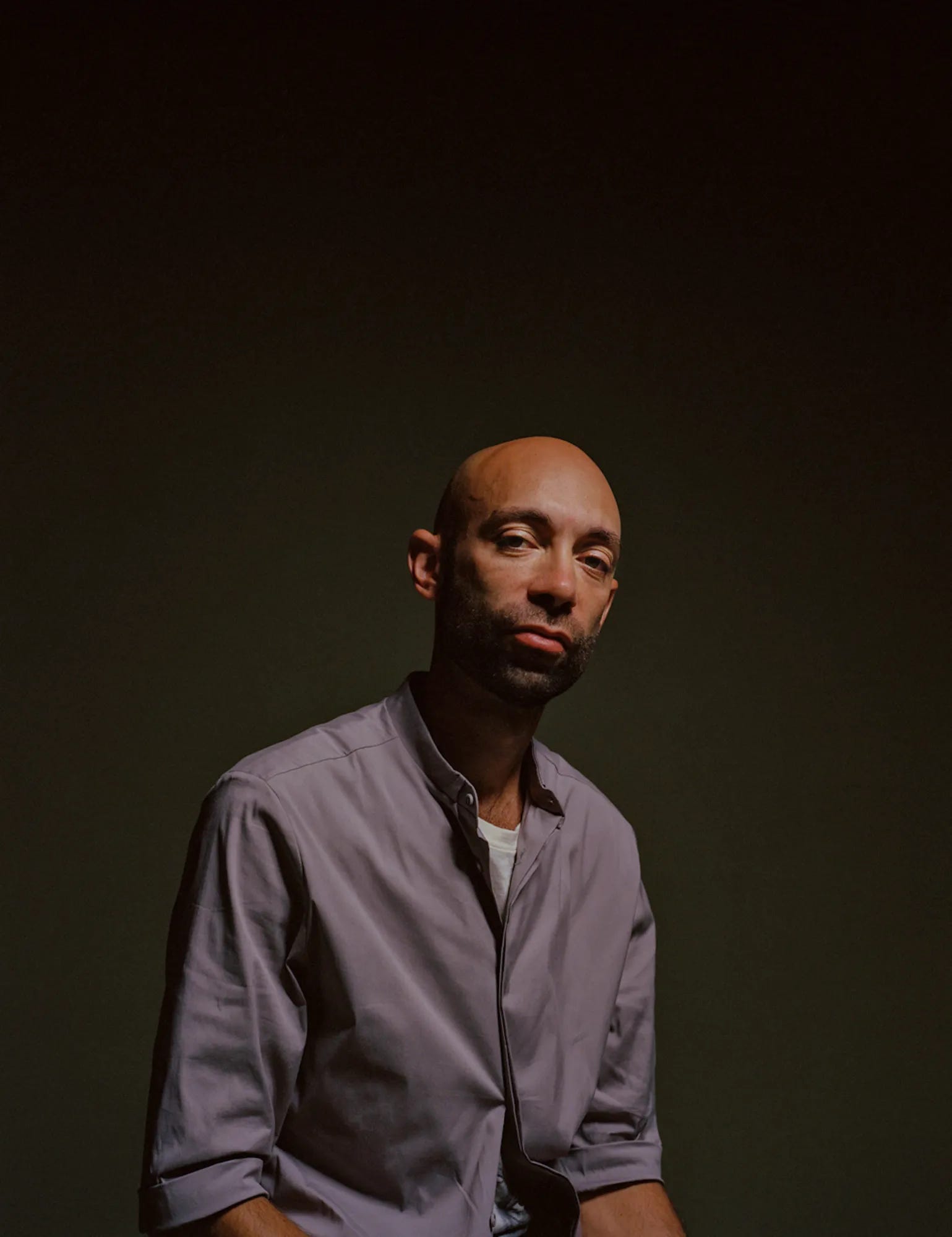 The Forum 10 | Aaron Gilbert: Emotional Realism and the Architecture of Feeling | He paints exhaustion, desire, and the ghosts of modern life—Aaron Gilbert on how to stay human in a fractured world.Aaron Gilbert is a painter whose work bridges the mythic and the domestic, capturing moments of intimacy under the weight of spiritual, political, and economic pressure. He’s exhibited internationally and is currently represented by Gladstone Gallery. His paintings are both tender and prophetic, filled with symbolic ruptures, spectral presences, and radiant color.In this conversation, we discuss:* Growing up in a creative family and abandoning a career in engineering to pursue painting, while becoming a father.* Why he doesn’t chase “great art,” but instead builds images that hold his full self—flawed, contradictory, and reaching.* Painting not to reflect the moment, but to prophesize what lies beyond our broken stories.* The struggle to maintain mystery, emotional precision, and resistance within large-scale work.* How brand logos become talismans, color becomes spirit, and art becomes a tear in the fabric of what we think is real.(00:00) Welcome to NewCrits(01:06) “People still seem to fuck—and that’s a good thing.”(04:07) “I wanted to make the worst WPA paintings ever.”(05:01) Intimacy vs. Monumentality(10:14) Painting the workplace: a shape-shifting host(14:20) Becoming a father and an artist, simultaneously(20:00) Too private to paint?(24:01) The artist as prophet(30:39) What’s missing in art school? Elders.(37:08) SpongeBob as an exhausted adult(42:45) The levity of “Hot Moms”(50:00) Spectral figures and ghostly presences(56:16) Logos as spiritual metaphors—enter Adidas(01:03:15) Against the heroic posture in painting(01:14:10) Consciousness, rupture, and looped timeWatch the conversationView the full episode on YouTube.Follow Aaronhttps://www.aaron-studio.com/@aaron_gilbert_studioLearn more about Aaron Gilbert’s exhibition, World Without End, at Gladstone Gallery here.https://www.gladstonegallery.com/https://www.instagram.com/gladstone.gallery/?hl=enAaron Gilbert is a painter whose work depicts symbolic and psychological narratives. Gilbert’s work focuses on the transformative potential of individuals and love as a transcending force amidst personal loss, and societal crisis. His pictorial style draws formally from early Italian (trecento and quattrocento) painting, Mexican Retablos, and multiple traditions of miniature painting. The architecture is often stylized to emphasize ways that public and institutional space enforces ideology, and sets boundaries to how figures within the paintings have agency. In many paintings, the work may focus on a scene from a private or individual life, but simultaneously invoke the presence of institutional forces. Aaron was a father before becoming an artist, and his ethnicity is mixed White and Latino and his work often examines how external historical forces impact private and intimate interactions, and exert an influence that goes beyond the intentions of the figures themselves.Gilbert has exhibited at PPOW Gallery, Sant’Andrea de Scaphis in Rome, Chris Sharp Gallery, Lyles and King, and Deitch Projects. He is a 2022 Colene Brown Art Prize recipient and 2015 Louis Comfort Tiffany Award recipient, and has been awarded by the American Academy of Arts and Letters as the 2010 ‘’Young American Painter of Distinction.’‘ His work is currently in the permanent collections of The Hammer Museum, The Studio Museum in Harlem, The Whitney Museum, Columbus Museum of Art, The High Museum, the Brooklyn Museum of Art and the RISD Museum. Residencies include 2013 Fountainhead Residency, 2012 Yaddo, 2008 LMCC Workspace Residency as well as a 2008 Affiliate Fellowship at the American Academy in Rome. Aaron holds an MFA in painting from Yale, and a BFA in painting from RISD.About The ForumThe Forum is NewCrits’ ongoing public talk series, presented in partnership with WSA/WSBS. Talks take place live every second Tuesday at WSA. Join us for our next conversation here.Explore NewCrits’ offerings, including crits, courses, and mentorship programs at www.newcrits.studio.—Full TranscriptAjay Kurian: Hi everybody, I want to thank you all for coming. This is the 19th NewCrits Talk. NewCrits is a global platform for studio mentorship, we have 16 artists on our platform that you can meet with directly, and we offer studio mentorship, professional mentorship, portfolio reviews and contract coaching. It really is a platform to democratize our education.The one thing that we do in person are these talks. But we're also starting to offer classes. Our first class starts tomorrow, which is called New Identities for Dangerous Times. We'll be offering three more courses in the fall with some more artists that will all be announced soon. Okay, that's it for NewCrits.We are worn out psychologically, physically, financially, ecologically, spiritually. We've suffered injuries and lost loved ones, limbs and homes. We've struck out and played on lost love and conjured hope. Ours is an age of exhaustion, and Aaron Gilbert paints the exhausted of the earth. The figures in Aaron's paintings are weary, beyond weary, but nevertheless, we see them on dates playing with their children, buying one another with desire and holding one another with heat for all the exhaustion.People still seem to fuck. And that's a good thing because in a way that erotic charge is hope. A hope for a new tomorrow, for new life, and for survival. Now with all that I saw in Aaron's work, it would still be enough. But what compels me to stay longer is a strange sort of enchanting that many of the paintings hold.They're pictures that hold their own ruptures in very subtle and sometimes secretive ways. They're paintings of modern life with wormholes to other moments, other feelings, and other spirits. We're not just in the present. We are with the ghosts of many moments and I can't help but think that they're there to help us find redemption. And in the moment we find ourselves in, I welcome all the redemption I can. Please welcome Aaron Gilbert.Aaron Gilbert: Thank you. That was really beautiful, actually.Ajay Kurian: How are you feeling?Aaron Gilbert: I'm good. It's nice to see everyone here.Ajay Kurian: You got your tequila.Aaron Gilbert: Yeah, and a room full of people that I'm really happy to have a conversation with. So this is great.Ajay Kurian: Aaron has a show up at Gladstone Gallery right now. It's up until April 19th and I thought we should just start there. The first thing that crosses my mind, especially looking at older work and now looking at the new show, is that a lot of these paintings feel like history paintings in their own way. How does that sit with you? What do you think about the space of history painting?Aaron Gilbert: That's really something I was trying to contend with in a very different way. Probably about six years ago, seeing Diego Rivera's murals at the National Palace in Mexico City for the first time. I was really knocked over by the scope and the scale of that project. It felt like a lifelong undertaking. In a way, it felt like a visual form of Howard Zinn’s A People's History of the United States, and it just made me think that there was a much further reach I could do.There was a much bigger set of questions that I could go for more directly. I think this show was a beginning to me trying to ask and respond to those questions. In a way, I wanted to make like the worst WPA paintings ever made. Not that they're bad paintings, but that they kind of hit at how I feel viscerally about the world that we're living through in relation to what it should be.Ajay Kurian: When you say the worst WPA paintings, I'm trying to see what energy that conjures in the work, because to me, you tow the line between finding something that feels structural but also extremely intimate. And when I think about murals, intimacy is not the first thing that comes to mind.Aaron Gilbert: That's where I take issue with a lot of history painting, or where I have maybe a different way of approaching it. I think mine's kind of an inverse, you know? So if you think of a classic history painting; it's like a top down telling of history. Here are archetypes of the workers and here is this historical figure. But for me, what I'm engaged with is this idea of how can I, as someone knowing all these contradictory and all these facets of myself and my life that are pulling in different directions and that are compromised in different ways.How can I still in some way find a way to be transformative in this world? How do we start with the lives that we actually inhabit and figure out how to move outwards and address these larger societal, historical forces? So it's kind of a reverse process, but with the same set of concerns.Ajay Kurian: In this painting here, there's so many things going on and so many places to start, but in terms of thinking about particularity first, do you find that structure helps you to then start orienting these stories? Or how does a painting of this vast kind of start coming together in the questions that you're trying to tackle?Aaron Gilbert: Yeah, so this is a painting I didn't know how to do before I did it, and I just kind of knew that was going to be the case. The way I approach it is I start making drawings and there's a full size work on paper that's the same scale as this drawing. Initially, the painting started with this very small sketch of the mother, and the daughters staying on the tub, braiding her hair. And I liked that gesture. Then I was thinking the mother would be looking out the window and I didn't know where yet, but maybe there's a courtyard. So initially she was ground level. And then because I'm working on paper, I started to think it was a lot more interesting in terms of the power dynamic of her gaze, for her to be higher up and looking down at someone or something outside. Because it was a work on paper, I was able to cut it and move it up.This was gradually built piece by piece. And the only way I knew to approach it was to start with these small and intimate vignettes, begin to tie them together and think about how to build a full constellation within a piece.Ajay Kurian: That makes a lot of sense. As soon as I see that scene or focus in on it, I'm like, oh yeah, that's an Aaron Gilbert painting right there. But then to see that become a story that unfolds into other stories and then has a larger constellation within it, is something that structurally makes sense to me. In the early work that I had seen of yours, there's an intimacy that's based in a single room.Aaron Gilbert: Right, right. It is a very close, self-contained, tight composition.Ajay Kurian: Yeah, and then in a lot of these paintings, there's something that's happening where there's a zoom-out, there’s different things happening in the same picture, and there’s different gatherings of how people are organizing themselves in different related stories.Aaron Gilbert: With those earlier works, I was always thinking that the power of this work is if I can have this palpable feeling of larger societal and historical forces. So it might just be a couple in the kitchen preparing food or it could be very self-contained, seemingly. But how can I deliver in a way where you feel these larger social forces and you feel that the figures themselves might have one set of intentions, but then the full weight and gravity of what was happening and what they were doing within the scene was a lot more complex.Ajay Kurian: This is a painting that comes to mind, largely because there's so many moments where when I see figures interacting, I understand the intimacy. It is one of the paintings that actually was harder for me to figure out the immediate dynamics. There's something about what's going on between them and what's going on as they function within a system that felt compelling, but also there's a different energy here that I thought was kind of curious.Aaron Gilbert: In a way, this work was part of a bridge from work that I had been making for at least a decade until this recent show. I'd kind of hit a point where I wanted to broaden the scope of domestic intimacy and find equally intimate scenes. The workplace became an interesting place for me. I wanted to bring it more into the public sphere. When you're working with people five days a week for 8 to 12 hours a day, that’s an incredibly locked in scenario where you really get to know each other and your energies rub off on each other.So with this painting; I've been working at a fabrication shop for about five years and I was always really interested in how machines and huge pallets of raw materials would get moved around. In a way, the inside of the warehouse was this shape shifting thing that you're living inside of. If you're wearing safety gear, then the patterns and colors of the safety gear are a continuation of the building itself. All the reflective tape to guide people through the building. So it felt kind of like this parasitic host type of relationship. And I wanted to try to just play with that a little bit.Ajay Kurian: When you started making paintings, what place of thinking did it start with? Did you always have all of these ideas of thinking about how you wanted to make a picture or did it slowly develop? Where did picture making and where did the love of art initially come from?Aaron Gilbert: It's been a gradual development. I'd say everyone in my immediate family is very creative, so I was kind of the last to dip into visual art in a way. I was studying mechanical engineering and I was working towards an associate degree in engineering technology. I was really not in love with it. The culture of it really didn't sit right with me and I just felt like whatever I'd be making would be a part of a larger destructive machine.It just felt really against my spirit in the deepest way in terms of what I'd be participating in. But I definitely would not have been bold enough to be an artist without having something that felt like a stable way to make money or support a family. So I started taking art classes when I was studying towards the engineering degree, and then it was a long four year process from when I started taking art classes to when I finally was able to go to art school. And during that time, my son was born. So I also began painting seriously at the same time that I was beginning fatherhood.Also, the first couple years when I was in art school, I was working multiple jobs. I was getting some time in the studio, but really having to balance it with these different jobs out in the world, was really physically taxing but also kind of really interesting.Maybe one more thing I'll say that was really important is, because of being a father also, I knew I couldn't try everything that I was interested in. I felt right away that I had one shot at this. I have to find something that feels like I can really run with it and I have to go as fast and far as I can with that.Ajay Kurian: And at that moment you thought, I can be a painter?Aaron Gilbert: At that moment, I thought these three years I was at Rhode Island School of Design might be the only time I make paintings. You know, like 15 years later I might be pulling my paintings out from under the bed to show my kids to say this is what I did. So I wanted to really love what I did, and I wanted to really believe it. I wanted it to matter to me, and I wanted there to be enough of me in it. I mean, honestly, I didn't think that people made careers out of this.Ajay Kurian: Taking those initial art classes, I can understand that to have been a way for you to find an outlet for something, or a way to see, okay, what is it that I want to do? But the fact that it really became the beating heart of your creative life — that’s a profound thing. What were those initial art classes?Aaron Gilbert: Oh, it was just like a beginning drawing type of art class. Like a lot of artists, I'm pretty socially awkward and reclusive. I don't like small talk or chatter and like I didn’t want to make artwork that was this doorway to being able to have conversations with somebody out there about things that were rolling around in my head. I just wanted to put something else up for people to sink their teeth into.Ajay Kurian: For one, I think when you're talking about you painting your life and the physical circumstances of everything around you, you never seem to have a problem with putting really personal things into your work. People ask comedians this a lot: where’s the line? What's something that you wouldn't make a joke about? And I was looking at your work and I was wondering if there's something that's too private for Aaron to make a painting about.Aaron Gilbert: I mean, there's many things that are too private. It's also the spirit of how it's made. I mean, I love being alive and I love people. I feel like if there's something I can make that has a meaningful connection with someone else, and I don't even need to meet them, but if I feel this gravity drawing me towards the making of it then I try to honor and follow that.I've definitely had moments more so with music where it felt like a song saved my life, you know? Where it was just like I was in this place of being really alone and something just hit me and there was someone else there with me. I've never been interested in being like an edge lord with my work. It's just not what I'm concerned with. I think there is kind of an openness that I'm maybe not even that self-conscious of a lot of times.Ajay Kurian: I think it's one thing that stood out when you were talking about that was the way that the energy or the spirit in which you paint these seemingly private things, or just feeling the intimacy of a moment. I think what you balance really well is something that feels very quiet, personal and intimate, but there's also something that feels almost mythological about it. That the characters in the paintings are both themselves and the stand-ins. That they're who they are, but they're also maybe shells.Aaron Gilbert: I think there's a lot in that statement. To pull back for a second, there’s this kind of this larger thing I've been thinking about a lot. This idea of what storytelling is and that it's kind of this concept that we don't live in. We live in our narrative of what the universe is and what the world is. It's kind of like living in a tent within a larger universe. And narrative is how we describe the contours of that to each other and the horizon of what's possible. Then I look at mythology or spirituality as an overlaying of meaning onto that.So to have this dual thing between, this is a painting of a specific person I might know, or maybe of two or three people who've been combined into one hybrid character. But then maybe painting moves it towards the symbolic or the mythological. What's in the room is partly the individual and then partly this greater thing playing out that has to do with how they're participating in something that is a mystery, that is cosmic, that is beyond what our daily cultural scene is.Ajay Kurian: Were you the philosopher of the family?Aaron Gilbert: Oh man, no, no, no. I'd say very different ways. Both sides of the family.Ajay Kurian: So that was like the milieu, like you’re surrounded by people thinking about grander ideas?Aaron Gilbert: Grander and worse ideas. When I was in my first semester in undergrad at RISD, I don't even remember what I brought to class, but my work was very rightly being criticized. The teacher was basically saying, I don't see anything of right now in this painting. It feels like you're kind of stuck trying to make something that looks like art, but nothing of this moment is in the painting.I was talking to my mother on the phone after, and she said an artist's job isn't to reflect the moment. She said the purpose of or one major part of a calling of an artist is the prophetic. I think that was something that's really stuck with me in terms of the work that was with anybody.Ajay Kurian: My mother has not said that to me.Aaron Gilbert: And yet here you are. So yeah, similar stories.Ajay Kurian: Of course, mothers are your first coach, confidant, teacher, all of these things. So I'm sure there's something there. But to establish the prophetic so early in the work and in how you understand the calling of an artist, this is purely for my own curiosity, how does one cultivate the prophetic?Aaron Gilbert: I've been thinking about it in different ways lately, but maybe to get back to that conversation of not living in the full universe, we're inside this moment and this age within some room that's been built out of a shared and very flawed story. And I feel like whenever we hit the poetic is where there's a terror in the logic.Because if something's poetic, a linear explanation doesn't really reveal its power. But we feel that some truth has been revealed. It’s something that we can circle around, but the language we have right now doesn't fully deliver what it's delivering. It's this potential. I feel like maybe that's some kind of tear from the other side, penetrating and calling to us to move into a different fuller stage. So I link that to the prophetic in a way.Ajay Kurian: Do you think that those tears always stay open or that they're historically contingent? Jackson Pollock was somebody that I'd seen in every poster in every college dorm, and I was just like, this is so dead to me. Then much later in life, I remember going to the Met and standing in front of a Pollock and I was like, holy shit. It felt like it tore open again. This is a very sort of modest example but it's happened many times. For some reason that occurs to me right now and there's moments when I feel like a particular artwork has opened, and a particular artwork has closed, and that there's almost an aperture towards another place.Aaron Gilbert: Yeah, I can see that. That's what you mean by historically contingent. I don't know that I have an answer to that, but I believe it.Ajay Kurian: Just in terms of your experience, I know that ancient artworks have been really important for you to see how they can stay present for you. Are there times when art feels like it's not living for you that way anymore?Aaron Gilbert: I think I need to think about that, but maybe what's most generative for me to think about right now is the carrying and passing on of a flame and that we're participating in a continuum. I was just looking at Jack Witten's work today at MoMA, and there was no show I could think of that's less timely than that.We're here for a very short amount of time, each of us. And something I think about, also with raising children, is seeing the generation before me begin to pass and die. So we need to grab and hold onto the things that they carried to us and reorganize them and deliver them forward into the future. So I guess I think about that more and I don't worry too much about where something feels. I'm just looking for magic where it is and trying to keep those embers.Ajay Kurian: I remember when I was in your studio that was, I was telling you that I was asking people what they think is missing from art school? And the first thing that came up for you was the fact that we don't really hear from our elders in art school. That it's more like, what's happening now? What's happening here and what's the presence?Being around older artists where there's a different understanding of what present is, felt really important. I never really thought about that. Of course you have older professors when you're in school, but I didn't think about it in terms of a larger continuum of what is being passed on, what's being preserved, what's being understood, and it's a beautiful thing.Aaron Gilbert: Well, I think there's something terrible that happens when you're isolated from generations, both younger than you and older than you. That happens in academia and I don't think that's that healthy. In the arts, the relevance of your work is so connected to a sensitivity and read of the societal moment and by only being around your age, the band of what you're receiving becomes narrowed so much that there's a loss of wisdom. I think that something is sacrificed by that.Ajay Kurian: In thinking about this show, was it in any way different than how you've thought about shows in the past or how you're constructing this story? Because you're thinking about the universe that we live in and that we're just seeing a fraction of the story. Which is almost a way to unpack different stories or narratives that are kind of lying latent. Is that the place in which a show comes from, or is that the place in which the work comes from?Aaron Gilbert: It's kind of hard to decide what came first. When I was making the work, I really wanted it to be this cohesive thing. And I mean, I haven't done a lot of shows, you know, so this was a great opportunity where all of a sudden I had more than a year to work through and develop a full body of work.I didn't know what those images would look like. I knew some things that would be in it. And I knew there was an unknown that I really, really, really wanted to move towards. I had no idea what that was or how I'd get there or what it would look like. But then I would just go into the studio and I would need to make something. So I'd be starting with making a painting or making drawings towards a painting. But I had the benefit of having that time to be able to reject something because it might be a nice path, but I don't think it's the right branch to take. There was definitely a lot of testing different things in that sense.Ajay Kurian: I guess this is the case with every artist, but it's the process of sharpening your deeper intuitions towards a path that consistently feels true and whatever that truth is for you. That’s the basis of so many bodies of work. But seeing this show come together and seeing how both labored and free these paintings feel. They feel extremely precise, but not like there was such a specific plan. Like when I see these kinds of crescent moons up here, there’s a joy there that doesn't feel like it was premeditated. It was just like this image started coming together and then moons were floating and there's nothing left. There's nothing else to explain about that besides the fact that it needs to happen. There's a necessity in the picture.Aaron Gilbert: I think you're hitting the nail on the head. There are a lot of stages that are really developed and worked through. But if something doesn't surprise me by the end of it, then I feel like the painting was kind of dead on arrival. That I must have slept through the making of it and not really been present.Ajay Kurian: How much do you get rid of? Do you destroy work?Aaron Gilbert: I don't usually destroy paintings. There's definitely a lot of unfinished ones. There's a number of ones that probably won't be finished. And I make as many drawings as I can.Ajay Kurian: You have these drawings of SpongeBob in your studio that were so fucking good. Imagine SpongeBob with the weariness of one of Aaron's figures where they're tired, they’re just so tired. Man, I think about it probably once a week. There’s just something that's so accurate about what I feel like everyone is feeling, paired with the manic personality of SpongeBob.That's like what you have to do in the world and sometimes I feel like everybody has to be a laughing idiot just to make it through, and then to come home and the depletion in him in those drawings is, it hit me really hard and I can't stop thinking about it.Aaron Gilbert: One thing I've been thinking about with SpongeBob, like after the fact, is how children are very excited about life and the magic of this world is rejuvenated by the presence of children. They're these messengers from the stars and to them, life should be magical and we should be present and it should be fun. I feel like SpongeBob kind of is all those things. When he arrives at work to flip patties, there's nothing he'd rather be doing, you know?I’m not saying that's how you should feel about your job, but it's just that excitement about being present. I think with the drawings that we're speaking of, it's more like what happens when you’re in your mid forties and that person is in there somewhere, but there's a lot of miles between them. There's kind of a larger project that it’s a part of, and I really can't wait to share with people.Ajay Kurian: The fact that it's part of a larger project now, I'm there. I'll fly wherever it's going. When you're talking about children being messengers of the stars, it made me think of this painting and when I first saw it, put me in the strangest place. I think when I initially saw it, or I initially saw an image, and it was as if the child was like an inflatable or there was something so disembodied about the body. The more time I've spent with it, and I guess it also helps that I've heard you talk about it, but this coming from another place and that there is this alien sense of a messenger from somewhere else.My partner has a son who I've known since he was five, and that was a great time to meet him because there were still these like vapors of other places that you could still kind of be in touch with. And I've heard this from other parents. There's a curator who I was talking to about a show that I'm thinking about, and to the wrong person it would've sounded like a little woo woo. I just didn't know this curator that well yet, so I was just testing it. I was like, this is what it's about, this is what it is, take it or leave it. And she was like, I would've thought that's a little out there, but I have a 3-year-old now and he has had a fully prior life before this, and he’ll tell me about the people he used to meet on his walks home. She was like, I have no explanation, but it is a thorough trip down a series of memories that she can't explain.Aaron Gilbert: That's incredible.Ajay Kurian: She was like, that changed everything. There's these moments where life upends all the rules that you know, and you have to obey the enchantment of that.Aaron Gilbert: That's a wonderful thing though, to have these things that take us from a place that feels tired and constant and predictable into something that reinvents life.Ajay Kurian: It's the funny place that I also see your work sitting in, where there's a lot of really heavy things in this show alone. We can run the gamut and see everything that life has to offer in a sense. I mean, I feel like I don't even need words for this. There's such a weight, and yet I also feel there's still some kind of levity. There's still the fact that this painting is called Hot Moms.It's a good way to orient it. It's a good way to sit with it. There's a slowness to everything about it. There's a slowness in how even time itself is making itself manifest in the painting. But it also gives you permission. The title Hot Moms gives you permission to treat it as both super heavy and super light. And I really like that 'cause I, in a sense I feel like, if you don't know how to be dumb, then I don't know how smart you really can be either. You gotta have both. You gotta be able to just fucking be dumb. And I mean that not in a pejorative sense.Aaron Gilbert: Yeah, I feel you. With this painting, the beginning to me was a small drawing I did of the male figure seated from behind. In my head he was like this older version of myself and I was like, I'll have long, beautiful hair. You know, every morning I'll be looking at myself in the mirror. I'll still have game. I just really want to enjoy this playful and full of vitality vision of a future version of myself. You know, like you have those locks, working on it, and so that was how this started. I just thought it was funny and interesting, but I had no idea what that would lead to.Ajay Kurian: So that's where it started. I mean, it went a lot of places. Where do the floating balaclavas come in?Aaron Gilbert: I thought it was interesting how they kind of look like Pacman heads. They could be containers and I liked that they could double as something else, that could be entered, and I just let it take me there.Then there's parts that to me, were very, very serious. Like the child who's next to the mother. That's a very specific relationship between a child and a mother that's protective and very much, you know, this is my home, this is my world, this is my universe.In my head, it never was settled and I wanted it to stay open. Whether he was seeing himself as a child, if he was looking at a real child, or if he's looking at a child but not seeing the child, and seeing his younger self instead. And I think all those things can be true at the same time.Ajay Kurian: There’s a spectral quality there. I feel like there’s a number of ways in which you use the ghost or the specter of something that either has happened or is yet to happen. There's a haunting that happens and it doesn't necessarily have to be a bad thing. We exist with many kinds of beings and it's fascinating to see how that plays out. Because sometimes it's like an actual figure.There's one painting where there are two circles next to the person's head and it orients you in this way that you lock into that feeling. But it's not explicable as a specific narrative. It's the same way that sometimes color can lock you in. Like seeing that kind of green turquoise of the roller skate wheels, it knocks in a specific feeling, especially since it's one of the coolest tones or it’s so pronounced in a painting of largely warm yellow greens, reds and pinks.You just see those wheels and you're like, those wheels are here to tell me something because of that color orientation. There’s such a fluidity in the way that that happens in a lot of these paintings where it can be the way that something's painted, that it's here and not here. Or it can be the pronunciation of color that just knocks it into place. It's almost like the symbology is medieval.Aaron Gilbert: I think a lot of the painting that I've really been influenced by, in terms of the western cannon, is from Giotto and earlier. So I look at a painter like Giotto, which was this moment of a doorway between two worldviews. One was coming from this world being a place that was still inhabited with magic, where the sacred was still present in living and non-living things.Basically an enchanted world where there is mystery and forces in the presence of the sacred, kind of with this Cartesian philosophy where all matter, all plants, animals, and even humans are raw material meant to be extracted and carved out in service of industry and for profit accumulation.That philosophy was kind of a necessary underpinning if you look at the larger catastrophes of colonialism and a lot of the things that we're looking at now. The oncoming ecological crisis is also a result. It required this very degenerate narrative or story to be sold.And I look at a painter like Giotto as someone who’s, whether he realized it or not, work embodies this doorway between those two moments. Historically, a quote that I talk about a lot is when Mark Fisher was writing on ontology and he states that, when we've hit this terminal point in history where we're no longer able to visualize some positive possible version of a future, we need to look back to these past relics for echoes of other possible futures. So I think there are ways that I'm kind of really looking at and riffing off of moves that were in different traditions of paintings that predate. We've hit this wall, so where are there new doorways to find so we can actually move into something different?Ajay Kurian: In thinking about doorways and symbols, there's ways in which you're using extremely well-known corporate symbols, but I as a viewer believe that there's something more through the painting. And again, just on a personal level, I'm curious if you believe that the corporate symbol, even though it is couched in a capitalist vocabulary in its inception, can transcend that or can become something else?Aaron Gilbert: There's a couple parts to that. Firstly, when I'm using these logos, it's because I think they are something more than what their awareness or intention is. I've been thinking a lot about how commodity fetishism is the metaphysics of our moment now. I'm not more interested in Adidas than any other company, but that logo really hit and struck me. I was walking past the storefront at night, I saw it and I was just really drawn in. It felt so seductive, cold, and it vibrated. It's kind of like a lotus and it's definitely pulling from these conscious and unconscious archetypes deep within our psyche.Secondly, my interest in continuing to play with it is I'm interested in what happens when you read it in the same way you read the religious archetypal image, or religious iconographic symbols. If you look at Catholic paintings, where there's a crucifix or maybe it's 30 other things. When this is placed next to it, I'm interested in what happens.There’s another Mark Fisher quote where he was talking about the National Gallery in London or something like that. If some visiting extraterrestrials were to see all these things laid out, all the different things that humans believe, but we don't believe in any of them. And he was kind of saying that's the power of capitalism as it can consume everything. But it also doesn't believe in it. It kind of kills the belief in that thing.So what happens when you put these logos that are the face of commodity fetish, this is the thing that's supposed to draw us in. Like, if you think about angler fish, where it's got that light. That’s what that logo is, in a way. In my mind, that’s that thing that draws me in to participating in something that's gonna devour you. Devour me and devour everything. But can we take that and then bend it and then what? What does it become?Ajay Kurian: Because I think the bending is really successful. This feels like an aperture to something else. It doesn't feel like an aperture to rapacious capitalism. It feels like it's a window into the conditions of what kind of privation capitalism creates. But it doesn't feel like it lives and dies there, it feels otherworldly too. The fact that you made me believe in the mystical possibility of the Adidas symbol, that's where I was like, well, shit, I guess I like the Adidas symbol.That's not the takeaway though. But this is the angler fish. I'm thinking about the Adidas symbol in a different realm and it adjusted what plane I'm thinking about it on. That's the success for me.Ajay Kurian: I feel like now might be a good time to open this up to some questions.Audience Member: You already talked about this a little bit, but leaning a little bit more into how these spirits or emissaries function. These ghost-like figures appear in so many of your paintings and I'm so drawn to them. Do they function as that terror in the fabric of normal reality that's inviting you to see the world differently and mystical? Do you see them as entities that are coexisting with us? I’d just love to hear how these beings function in your universe.Aaron Gilbert: I think at the heart of it, there's ways that we're all bridges between what we're aware of, what we know and then things that are a mystery to us. I don't know if it's an either or, in terms of a figure being solid or not. Maybe there's a slipperiness between when the same figure is fully in the room and then also being an opening to something that’s outside.Audience Member: The way I see your art pieces, especially the one that you created at the beginning which are so beautiful, are on so many stories all together that to me kind of looks like a cabbage. But if we’re talking about your new upcoming project, is that gonna be a bigger universe with the same intense intimacy, or are you gonna keep the bad that you’re leading towards too at the moment? How is that gonna be in the picture?Aaron Gilbert: I don't know totally yet. I hope there's something in it. I have to grow into making, and I hope that process isn't too painful. But I really believe in the creative act and I think it's something that requires you to let go of what you know to some degree and let go of what you brought into the room to some degree, when you engage with it. The work and the process should guide you into expanding what you’re considering with that piece. I love the cabbage metaphor. It's the first time I've heard that.Audience Member: I really appreciate the way you've spoken about this vigilance you have or heroic posture when it comes to history painting and the things you inherit through painting that you like don't fuck with.My question is about what kind of formal or internal questions you bring to your work. Especially in this body of work, where you’ve scaled up and there's a lot of bigger swings that come closer to the ambition, scale and heroism of some of the pain we were talking about before. I'm wondering how you negotiated that. Is it a matter of keeping room for improvisation while not planning too much? When it comes to making sure you keep your paintings from falling into this heroic posture that you don't want?Aaron Gilbert: What do you mean by heroic posture?Audience Member: I sort of arrived at that language through the way you're talking about murals and how you want it to be a blank or a bad WPA mural, and what you said about keeping close to your life and the domestic sphere helps you stay away from this archetype painting.Aaron Gilbert: I mean, I don't know the context of this piece well enough to speak about it directly, but I feel archetypes lack something. When it comes to the very particular thing that I'm trying to accomplish with the work, and what I'm really concerned with, is this question as a human — how can I actually participate in this world right now in a way that's substantial and meaningful and potent and has a positive impact?I'm really concerned about what is this world that's being passed on to the next generation and what's my role to play in that? So just like tactically speaking, it's important to have the flaws and compromised realities of the characters be foregrounded. Not just flaws, but also the really complex range of who we all are. We aren't these one dimensional like executions of an idea, you know? We have all these different layers to us. So I'm always trying to think of how to develop each character within the image so that, as a viewer, you might walk into it first seeing that figure one way but then also see these other nuances that actually kind of change something about that figure and or change your read of it.So to get back to the first thing about having the presence of imperfections, it's because I think we can't be so fragile that if our own imperfections become visible, we shatter and no longer are capable of realizing our full potential.Just this kind of insistence that whatever is absurd about me when I look in the mirror in the morning, and just being able to see that. To look myself in the face and be like, yes, I see that there's all these things that if I could, I would wish differently, but that doesn't have the final say.And I have this potential to do something that is profound and that's going to be what defines me, whatever my divine cosmic destiny is. Nothing anyone says has a power over that. And I can activate that and articulate that in the world. When I think of the standard social realist artwork, it feels like it's a template that doesn't have the capacity to do that unless these other things are introduced. And so my question is, what are those other things that need to be introduced?Ajay Kurian: It felt like this has come up before where you were talking about George Tooker’s, and the institution overwhelming the individual. I think we've all seen in Aaron's paintings that there’s a real struggle there that is not completely subsumed. There's still something alive in the individual or in that kind of human intimacy.Aaron Gilbert: Tooker is a painter who I'm really indebted to. When I started to build what my work could look like, that was like a major influence. Tooker also has this breadth of energy in one painting to the next. But I think overall, the architecture is showing this crushing societal force in the beautiful artworks. I'm always interested in when I find someone who's influencing my work, how do I define how I'm indebted to them? And then how do I define the ways that I'm the antithesis of what they're doing?Audience Member: Could you talk a little bit about the use of color and your color influence?Aaron Gilbert: I think about having the light be chromatic, like having there be a color made of the light and atmosphere and a temperature that's palpable or a heat or coolness. I want the light and the atmosphere to actually be like a major character. I want there to be like a frequency that you feel, you know, 'cause I'm not making future JPEGs. I'm making objects and I'm really interested in this idea of a painting as an object that is singular in the world. It's like this instrument or this bell that rings out and when you're in front of it, it alters the frequency of the room. Color is this place beyond language, and that just seems to be everything that a painting is or can be about.With some of the paintings I made this past year and a half, I didn't know how to make a painting without having that presence of some of the pain that I was experiencing by witnessing the changes that are happening. Color was a way to try to do that.That's not the only thing, but there's a couple paintings where I point to where it's trying to reduce this palette into something that felt almost like the world had been scraped away from the inside. When I talk about the worst WPA painting, it's like this thing that had been eviscerated and there was a shell that was left.Ajay Kurian: That's a nice place to end. We're back to where we started with the eviscerated WPA paintings.I want to end on this just 'cause it felt potent. I know that you've read Carlo Ravelli and have been thinking about time and quantum physics in that regard. I just wanted to know if you had read about this theory on white holes as opposed to black holes.If there's any physicists out here, please don't quote me on any of this. It's been thought that when things go into a black hole, they are crushed into a singularity and it's gone. Their theory suggests that actually it's more of a bounce that happens and that what gets pulled into the black hole emerges from the white hole in a completely different time. So the white hole is essentially the opposite. Nothing can enter the white hole, only things can exit it. Hmm. And it kind of felt like an interesting conduit to think about how the paintings are sort of pushing out these different tears or like making apparent different tears.Aaron Gilbert: That's so poetic. Which book was that?Ajay Kurian: I think it's called White Holes, it’s a relatively new book by Carlo Ravelli.Aaron Gilbert: What Ajay is referring to also is that when he visited my studio, I talked about this book called The Order of Time by Carlo Ravelli. That is really about the way we commonly think of time breaks when you get at the quantum level and that we're left with something much stranger, and how it quickly enters this conversation of the mystery about human consciousness. So I would love to read that.Ajay Kurian: You have five more days to see the mysteries of human consciousness in Aaron's work. So I really suggest you go see these objects, these paintings, these real things in person. And I just wanna thank Aaron again tonight. A round of applause for Aaron.—Subscribe to our channel for more artist talks, critiques, and conversations that push the boundaries of what art can be. Stay connected: Website → https://www.newcrits.studio/Instagram → @newcrits Newsletter → https://newcrits.kit.com/subscribe Get full access to NewCrits Substack at newcrits.substack.com/subscribe | 1h 16m 39s | ||||||
| 4/14/25 | 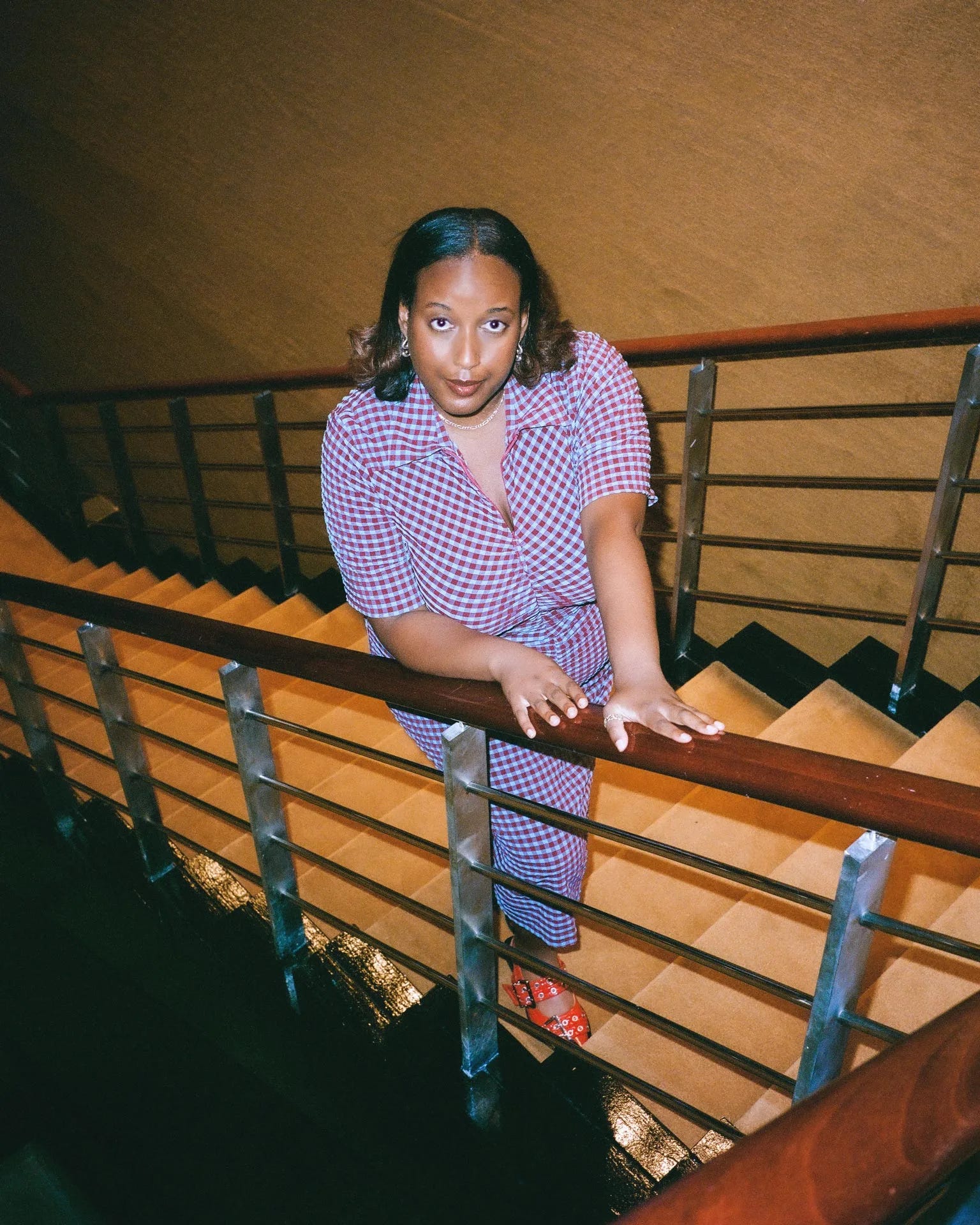 The Forum 09 | Salome Asega: Culture Gardening and Counter-Futures | In this dynamic conversation, artist Salome Asega sits down with Ajay Kurian to explore the intersections of art, technology, and collective imagination. Salome shares how her upbringing in a family of engineers shaped her collaborative approach to creativity, setting aside the notion of the singular artistic genius in favor of nurturing ecosystems of innovation. From her early encounters with art in Las Vegas to leading New Inc. she discusses how artists can challenge dominant narratives, reclaim agency in technological futures, and build more equitable infrastructures. Throughout the talk, Salome and Ajay dive into the metaphors of gardening vs. architecture, the power of speculative design, and the importance of care, community, and radical inclusion in the creative world. Whether you’re an artist, technologist, or simply curious about the future of culture, this conversation is full of insights and inspiration. In this conversation, we discuss:* The “architect vs. gardener” metaphor in artistic practice* Growing up in Las Vegas and early encounters with art* Engineering culture and collaborative thinking* Silicon Valley and reclaiming agency in tech futures* Powrplnt and the Iyapo Repository* Leading New Inc. and museum-based incubation* Care as methodology and long-term sustainability* Collaboration over singular genius* Institutional equity and structural critique* Expanding the definition of artistic practice* Accessibility and audience participation* Family influence and personal foundation* Speculative design and counter-futuresTimestamps(0:00) Introduction and Framing: The “Culture Gardener”(2:00) Architect vs. Gardener(9:00) Growing Up in Las Vegas and Cultural Capital(12:00) Technology and Collective Imagination(16:00) Powrplant and Iyapo Repository(20:00) Directing New Inc.(25:00) Care as Artistic Method(30:00) Collaboration vs. Individualism(35:00) Challenges in Art and Technology(40:00) Expanding Artistic Practice(45:00) Audience Engagement and Accessibility(50:00) Family Influence and Background(55:00) Speculative Futures and Counter-Narratives(1:02:00) Audience Q&AWatch the conversationView the full episode on YouTube.Follow Salomehttps://www.newmuseum.org/person/salome-asega/https://www.instagram.com/computers_puting/?hl=enSalome Asega is the Deputy Director of Strategy and Innovation and Director of NEW INC, the New Museum’s cultural incubator for creative practitioners working across art, design, and technology. Asega is also an artist, researcher, and educator working between participatory design and emerging technologies. Prior to joining NEW INC in 2021, Asega was the inaugural New Media Art Research Fellow for Creativity and Free Expression at the Ford Foundation, where she supported artists and organizations in the new media arts ecosystem. She is also a cofounder of POWRPLNT, a digital art collaboratory based in Brooklyn that offers free and sliding-scale workshops run by established media artists. Since 2015, Asega has been teaching studio and design methodology courses in the MFA Design and Technology program at Parsons School of Design.About The ForumThe Forum is NewCrits’ ongoing public talk series, presented in partnership with WSA/WSBS. Talks take place live every second Tuesday at WSA. Join us for our next conversation here.Explore NewCrits’ offerings, including crits, courses, and mentorship programs at www.newcrits.studio.—Full TranscriptAjay Kurian: I've been trying to think of a way to aptly describe what it is that Salome Asega does because the way she's thinking about a practice, artistic and otherwise is something that is hard to recognize if we maintain the terms of our discernment into what an art practice is meant to look like. But once you see what she's up to, you can't unsee it and you start to see how this paradigm is one we need to cultivate. With that in mind. The phrase I've come to is that Salome is a culture gardener. She knows which introductions to make, which bee needs what flower, and she gets that the ecosystems are stronger than individuals, more nimble, less brittle. She also understands that in her words, inclusion ain't shit. What she's after is equity, and that means understanding that specific and specialized needs are met. Like which plants need more shade and which ones need more light? What does it take to create the conditions for genuine growth? And how do we grow together?The growth we're accustomed to is the growth of capital, and that's the world we usually live in. To quote her again, right now, there's a group of cis hat white men in Silicon Valley that are actively working to build a future for us. Without our consent, we are living in their imagination, and I'm very interested in leveraging the power of collective imagination to present counter futures.She's done this in projects ranging from Powrplnt to the Iyapo Repository under appointment as an art and tech fellow at the Ford Foundation. Currently, she's the director of New Inc. The New Museum's Own and First Museum led cultural incubator. And with it, she's planting her largest garden yet.Please give it up for Salome Asega.Salome Asega: That was really nice – thank you. I think you did the artist talk for me.Ajay Kurian: Yeah, we can just drink now. No, it came to me today when you sent me the radio show. But I think, maybe my first question is how does that term feel to you? How does it feel to try that on?Salome Asega: I don't know if I've ever asked you this question, but at New Inc I like to ask people if they're an architect or a gardener.Ajay Kurian: No shit.Salome Asega: Have I asked you this question? Oh my God. Maybe it's a thing we started after you, but are you an architect or a gardener?Ajay Kurian: I'm definitely a gardener.Salome Asega: Why? What's the difference for you?Ajay Kurian: Okay. Actually, I said that impulsively. The reason I said it impulsively is that the very first show that I ever did in New York, was making a kind of garden as the exhibition. The thrust of the show was to almost think ontologically that everything has a dual status as both garden and gardener, so we have the ability to tend to other things, but we also are a thing that can be tended too. That's been foundational in how I think about a lot of things that I do and also how I see the world moving. It's not as totalizing. I think back then, I was a young artist trying to look for the answer. But I'm really curious, now you have me thinking, what is that difference and what does that mean to you?Salome Asega: I always answered that I thought I was an architect because I was more interested in creating the infrastructure for things to exist. But then people would read me as a gardener. They said, for the same reason that you just gave, that I was in a habit and practice of tending to and caring for, right? Letting people grow in the ways that felt natural to them.Ajay Kurian: I think a lot of people have this idea of what architect means, which is this singular genius that feels very male. It feels like it has all this baggage with it. Whereas, considering how you grew up and with all the computer engineers in your background, did it give you a different sense of what architect meant?Salome Asega: For sure. One of our family activities was taking a computer apart and putting it back together again. Engineering, architecture, all these hard skills were never done singularly, they were always done as a group. You'd want to share this with someone you love, right? So I think that's always been part of my practice. I did my MFA in design and technology at Parsons and I learned all these things around physical computing. Then I would take out all these microprocessors and server motors through the back door, and run the workshops that ended up becoming part of Powrplnt, the Iyapo Repository and a lot of the projects I worked on. But it was never about becoming like a singular genius, coder, programmer on my own.Ajay Kurian: What was your first relationship to art?Salome Asega: That's hard to answer because I grew up in a city that didn't have cultural institutions in the way that we have in New York. And so I would count some of my first experiences with art as like my uncles coming over to family gatherings and playing music.And art is just woven through our culture. I also have another uncle who painted a mural for a local Ethiopian restaurant in Vegas. Having to sit there and do my homework while he's painting – these are some of my early experiences with art. But then in terms of capital A art, I remember in high school learning that there was a James Turrell Installation in the Prada store in the Caesars Palace Casino.Ajay Kurian: Amazing.Salome Asega: The performance of going to the strip parking lot, my Toyota Corolla at 16, going through the casino, having the confidence to walk into the Prada store knowing I don't have any money, going to the back and just like sitting there to experience that James Turrell exhibit. And then walking back out through the casino, and being like “I saw art today”.Ajay Kurian: James Turrell was in your orbit at 16? James Turrell was not in my orbit at 16. How did that happen?Salome Asega: I had really good teachers in high school, one of which was Mr. Brewster, who ran the AV club. I don't know if you knew this about me, but I used to write and produce a daily 10 minute show for my high school.Ajay Kurian: Yeah, that adds up.Salome Asega: So I had many late nights where I'd be editing the show with friends and Mr. Brewster would put us onto music. I remember the first album he gave me was a MIA mixtape and he would just feed us art books, so that's how I learned about James Turrell. He also put me onto Marilyn Minter when she did her Las Vegas Billboard project. That’s another experience of getting in the Toyota Carillo and driving down the strip and being like that’s a Marilyn Minter billboard.Ajay Kurian: Did that feel like it had a different kind of cultural capital to you than what you were familiar with before?Salome Asega: It read as New York. If I was to go back to my teenage mind, this felt like validated art because it came from a big city.Ajay Kurian: And you didn't think of Las Vegas as a big city?Salome Asega: No. No. I was alive for our centennial celebration. I was living there at a time where the city was expanding so quickly around me. We lived on what was considered the edge of town, and now if you look at a map, we're like squarely at the center. We'd have scorpions in our backyard. We no longer have that.Ajay Kurian: The only thing I'm genuinely intensely afraid of is scorpions.Salome Asega: They’re so cute.Ajay Kurian: Yeah, we're gonna skip it.Salome Asega: Okay. Okay.Ajay Kurian: The other thing that comes to mind, I remember going to Vegas when I was really young, probably actually around 15 or 16, and I don’t remember why exactly. But I went to a very fancy private school, and to get shit on in so many different ways for so many different reasons and also being brown in a school that was largely white; there was something that I couldn't fully articulate yet, but I felt small in a lot of different ways. And clothing was one of the ways where it was like, even if I can't buy these clothes, I want to be able to walk into these stores and take up space. So I remember Vegas being the first time where I got to see if I could flex that. And my family's just like - what is wrong with you? Why does this even matter to you, you're not buying anything? I haven't thought about this in a very long time. I completely forgot that Vegas was the first time that happened. But you see all those stores, all these spaces, and all these things that don't feel like they're for you, but in Vegas it does. Because it's so glitzy.I'm wondering like. Was that also a place where you were like, okay, I just want permission for all of these spaces?Salome Asega: Yeah, Vegas very much is a playground. I think for that reason it’s a place that is studied by designers and architects, because the city's design allows for this kind of performance and fantasy. You can be whoever you want there and the architecture encourages that actually. So I think combining that strip design with the kind of fantasy of the desert itself, the spiritual aspect of the desert, which is also a place where you can metamorphosize. You can be whoever you wanna be. I think I was encouraged by design to experiment and play, based on where I grew up.Ajay Kurian: That, in a sense, makes it feel like it's possible to integrate the spiritual and the material.Salome Asega: I feel like I know what you're gonna pull up.Ajay Kurian: This project came to mind. One, because it's treating technology in such a different way, which feels foundational to the way that I see you treating technology routinely. Disembodiment towards embodiment, it's always to take you back to your body in a different way. It's always to extend yourself, but it's in a way that feels generative that I don't know if people always think about it that way. Could you talk about how this project started to come about and where this came from?Salome Asega: I think I started these VR sketches called possession when I was in grad school and I was given one of the first Oculus headsets, like it was a dev kit and it didn't even have a fancy name yet. It wasn't on the market, it was meant for artists to just play and experiment with.Ajay Kurian: How did that happen?Salome Asega: I got it through Parsons because I was a student there and taught there, so I would just play with it.Ajay Kurian: That's amazing.Salome Asega: No one was using it, so I was like, let's see what this does. Then I started developing these underwater scenes that were thinking about what Mami Wata’s home would look like. Mami Wata is an Orisha that shows up in Caribbean and West African spiritual traditions like Santeria and Yoruba. And when I was looking at possession sculptures around Mami Wata, there were all these figures that had this kind of blobby Orisha, like over a figurative human head. It was as if the orisha was mounting the person like the same way that you would put on a VR headset.So that's why I started working on these sketches that were thinking about the headset as an Orisha that you put on and then it takes you to whatever realm of the spirit. This ended up being part of a show that the curator Ali Rosa-Salas, who runs Abrons Art Center now organized at Knockdown Center, but it's since grown. So these images are just sketches, but there's a full VR film where I interviewed spiritual practitioners who've had experiences of being possessed by Mami Wata herself. In the film they recount their experience, what it felt like and where they were. Many of them were near bodies of water, and that's where they felt her spirit and felt called to the water. Two of the practitioners in particular said that they felt lured underwater to her palace and were promised attractiveness and great wealth. So yeah, it goes through that narrative with them.Ajay Kurian: Wow. That feels like Vegas too.Salome Asega: Yeah, that's true, very slot machine.Ajay Kurian: That there's a pull and it takes you somewhere that feels like it will make you more.Salome Asega: Then I worked with a musician, Dani Des, to score the film. You hear one of their beats and it's very undulating and wavelike, and then feels like it's pulling you under the water.Ajay Kurian: So this takes shape when you're at Parsons.Salome Asega: Yeah, when I was an instructor. Especially in the early years, I was just like, what can I get out of this program? I think that's why many artists who work with technologies continue to teach, because that's where you get access to all the emerging tools. So I stuck around for five, six years.Ajay Kurian: It's interesting that you went through an MFA program. That's unexpected for me in understanding how your practice has developed since then, and how distributed it is. Because the MFA is something that normally consolidates an artist's output. Yeah. And turns it into a kind of product sometimes, for better or for worse. But you've avoided that and it doesn't even seem like it crossed your mind that's what you needed to do.Salome Asega: No, but I did a very untraditional MFA program. I did design and technology at Parsons.Ajay Kurian: So you weren't in the art program?Salome Asega: No, but there was a crossover and some instructors who taught between two programs. That was pretty common at Parsons for there to be some overlap between all the programs within the school.Ajay Kurian: When you were making this, did you make a distinction between Art with a capital A or cultural production?Salome Asega: No, I was thinking about audience, but I wasn't thinking about how this will be a job, if that makes sense. I was just having fun following my nose, driven by total curiosity and was like thinking – how can I ask stronger questions? I'm looking at American Artist because we both taught in that program for a while too. It's unusual for that program because most people go in there with commercial endeavors. Like they want to work for the big studios. But there’s like a handful of us that are like, we are freaky and we wanna do artsy things.Ajay Kurian: Yeah. I felt The New School, that was where I met more of the misfits. And the history of that school is unbelievably polluted at this point. But it starts with people that are fleeing and they're the intellectuals of Europe that are making The New School for social research. That felt vital. Was that the community or was it really just the design nerds and the people that were like, okay, we wanna do something different.Salome Asega: Yeah, I think it was more design nerds and then again, a small handful of us. But some incredible artists have come out of that program. That's how I met Elise Smith. She was a year ahead of me in that program. And we were both like, what are we doing here and let's talk about our work and create a smaller community within this program.Ajay Kurian: Okay, so you're not thinking about jobs. But when you graduate, what's your first job?Salome Asega: I'm still not thinking about jobs. What did I do to make money? I hustled. Because I had all these coding skills, I started working with different music venues to design stages and wearables for musicians. Weird, weird stuff. If you go deep on a YouTube search, you can find these propeller hats I made for a band. Do you know L’Rain?Ajay Kurian: Yeah.Salome Asega: So before Taja Cheek started L’Rain, she was in a band called Throw Vision. I would do set visuals for her and make wearables, and I would create interactive apps for attendees and party goers to control the stage lighting and the visuals behind them. I would spend so much time doing this and barely was able to pay rent, but I was like, I'm hustling. It's the New York thing. I was also part of the team that put together that lighting grid in the back of Baby’s Alright. That was all made on processing, like open source free software. I'm sure it's crazy advanced now, but in 2014, if you peeked behind, you'd be like, this is not safe.Ajay Kurian: So you really do follow your nose. It really is a generative place where this leads to this and this is exciting. So what's the next thing? How does that start to translate into the next project for you?Salome Asega: At that point, I was working on a few small projects and then I started collaborating with an artist named Ayodamola Okunseinde.He also came out of Parsons and we spent a summer doing research, throwing ideas back and forth, came up with Iyapo Repository, applied to a residency program with Eyebeam and did that for a year. That residency came with significant support, and from that I was able to hop around fellowships and residencies with this project.Ajay Kurian: This is a project that particularly grabbed my attention, specifically this artifact. So if you can just give some background of what the Iyapo Repository is and then we can get into this particular project.Salome Asega: Totally. So Iyapo Repository is a resource library that exists in a non-descript future. It houses a collection of art and artifacts made by and for people of African descent and how we design and develop those artifacts. It happens through a part series of participatory workshops where we invite people to think about the future in different domains. So we developed this card game, with PJ who works at New Inc now. He ran a wonderful print studio called Endless Editions, which still exists, and you should print things there. But we developed this game where we would give people these cards and then they'd have to determine artifacts. If you were given this set of cards, you'd have to come up with a revolutionary tool, an educational tool that somehow incorporates a motor. So you have a design direction, right? A domain you're designing for, and then some physical quality the object must have.It was always so fun doing this with kids because they'd be like “I don't know”. And then they'd come up with the wildest ideas. So you sketch your artifact design on this manuscript sheet, you describe it, you sign it, and then we collected all these papers and archive them in what we call the manuscript division. There are over 600 of them at this point. We've traveled all over the country and some international places doing this.This in itself was such an exciting part of the project for me. The ones that we can materially realize, we work with people to build out. Like that suit you saw sketched out, someone was thinking about their personal and historical relationship to water. She wanted to build a sensory suit that gives you the calming sensation of being underwater. She's thinking about the transatlantic slave trade experience. She's thinking about a lot of things. So then we built the suit to her standards. It’s fully functioning, there's motors at each one of these cuffs that are tied to tidal patterns of the Atlantic Ocean. So you get this nice undulating vibration on your body. There are these pipes that are whirled around your limbs and you can actually hear the water whirring. Then we make films with all of the artifacts because when you see them in exhibition context, they just sit still.Ajay Kurian: I watched that film and on the one hand it was magnificent to see that drawing come to life. The other thing that felt interesting and perplexing was to think about the transatlantic slave trade and then to have a design suit that also feels like shackles. It felt like a really charged, complicated work where the thing that's giving you life and giving you peace, also has this shadow of something that's much darker.Salome Asega: Totally. These are all things that come up in our workshop conversations. Once we draw these artifacts, we talk about them. And for her, she didn't see them as shackles. She saw them as almost like seaweed, like getting trapped in like coral and seaweed. But I hear you, there's so many ways to read this image.Ajay Kurian: There’s a complexity to it. It doesn't fulfill what we think about design objects or like design artifacts, which is it has a purpose, and it serves it. This is loaded and layered and maybe contradictory. Maybe it does have the sense of something wrapping around you and envelops you, but also what else can that mean and what are the histories that are applied here. What part was more interesting to you? The conversations or the object coming to life?Salome Asega: The conversations by far. These objects are a nice output of what transpired over the course of weeks and sometimes months with a group of people. But this is a conversation starter for me. You see this, and then I'm like, let's do the workshop together. Let's play the game and see what you come up with. I was never really interested in just touring the objects. They needed all the context. And actually oftentimes when these were in exhibitions, there was always a table for people to continue to contribute to the manuscripts.Ajay Kurian: Oh, wow. The card game itself is a very specific thing. To understand how to create openness and create parameters that allow for that openness to be generative. A lot of times, especially in interview context, people ask things of artists and they're like, what do you think about AI? Like where do we start? It stops the conversation. It ends openness because it's just too vast. But giving parameters and giving a sense like of where you really want to go and what that can spark, that's a really specific skillset.Salome Asega: There's a term in design for this, it's called scaffolding. You can't just throw people into the deep end, but you really need to create some kind of structure that guides people to a place where they feel safe enough to then be explorative.Ajay Kurian: That makes a lot of sense. I'm glad I now know that word. So does Powrplnt grow out of these kinds of projects?Salome Asega: Yeah, absolutely. The first year I did this, I gave a talk at New Inc before it was officially New Inc. And that's where I met Angelina Dreem and Anibal Luque. They were in early conversations about starting Powrplnt, which is a community computer lab. At some point we were calling it a digital art collaboratory. Do you remember when collaboratory was like “the” word?Ajay Kurian: I don't remember that ever being the word. I'll take your word for it.Salome Asega: There are these words that start to trend in education and then it's the year for collaboratory. You're like fully in this space now so you'll start to hear it. You're gonna start catching the trends, the words that trend in arts education.Ajay Kurian: All I can think of now is phonics.Salome Asega: Inquiry-based learning is another one.Ajay Kurian: I probably heard that before. I should probably know more of these.Salome Asega: So the thesis with Powrplnt was how can we hire our friends, or mid-career, or established digital artists to teach the next generation of artists who were coming up in New York so that they didn't have to make the same kinds of mistakes we were making. We were starting to document how an artist sustains their career. We ran workshops that were everything from professional development, legal basics for young artists to deliverable based technology workshops. A really popular one we did was how to make a logo and it was a way to trick young people into learning Illustrator.Ajay Kurian: Oh wow.Salome Asega: It was sick because all these people would come out with logos and some of which turned into short-lived brands. So I'd be wearing this shirt or hat that says like hottie. We also ran a really popular music series called Ableton Live, where we would partner with local DJs and musicians to teach the Ableton interface to young people. As part of that, we would sync a bunch of computers and we'd route them through the same mixer. It became an electronic drum circle, all building collectively on one beat. Then we'd strategically place different producers into the circle so they'd hop around and build this beat together with you.Ajay Kurian: I can't tell if it's because you're in the mix or do you attract that energy?Salome Asega: What energy?Ajay Kurian: The energy of doing things together and no one's left out. That there's a way to do this that's fun and exciting, where everyone's included. That's an ethic that even if you're starting a project, even if you're starting an organization and say that's the ethos of what they do. It doesn't always come through, but I feel like every project with you, it always comes through that.Salome Asega: That's nice to hear.Ajay Kurian: I mean, it goes with that saying I think anybody in this audience would be like, duh. But I guess the pointed question would be, were you the one saying we should do this, or do these things just bubble up because that's the energy?Salome Asega: I think it goes both ways. I think as a team at Powrplnt specifically, we were really good about hearing from our neighbors through constant serving and polling, talking with friends, serving them, and creating a program that was responsive to what we were hearing. But also, I think I also have a “let's just try this” energy. Let's just go and throw spaghetti at the wall. It doesn't hurt to try things. And I don't like to do things alone. It's just more fun to test things with friends or co-conspirators.Ajay Kurian: I was talking to a friend of mine, and she'll be doing a talk with us at some point, Tamika Wood. She considers herself a cultural anthropologist of sorts. Something that she’s had a hard time with is when spaces are too collaborative and there's no leadership at all.We're all just contributing, but we're not, so what are we contributing to and where's the vision? That's another thing that I think you handle really deftly. There's a vision of what is meant to happen. But when to take a backseat or when to guide. How do you figure out the balance of how to step in and when to step in?Salome Asega: Yeah, I have a personal anxiety around wasting people's time. I'm just like, it's the New York Minute, everyone's hustling, they're grinding.Ajay Kurian: I love this small town fantasy of what New Yorkers are doing. Can't waste their time.Salome Asega: Oh my God, I've been here for 18 years and I still feel that. Or maybe it's 'cause I'm precious about my time. I know how much time I have to do things, right? I think for that reason, I come to potential collaborations with some scaffolding. An idea, some goals, some potential other collaborators. And this can all be edited, but I just wanted to get us started. I think that's important to building cooperative structures. Having some clear goals and targets in mind ahead of just getting people in a room. And then knowing that all of those things can be reworked as people develop trust and get to know each other and the world changes. There are all these external factors that can continue to shape a project, but you need to come in with some sense of why we're gathering.Ajay Kurian: In that sense, do you feel like you have a relationship with music producers? Like when I hear Rick Rubin talk about the way that he thinks about production, he's a specialist in nothing, and you've talked about being a generalist. What he sees is the essence of a project and then how to shepherd that towards the end goal. I always wonder, why aren't there more? Why isn't there more of that vibe in the art world? I've seen plenty of bloated shows where I'm like if only there was just a place to workshop that show before it comes out. And in the projects that you do, that's the role that you seem to have.Salome Asega: There's so many things I wanna respond to in what you just said. Do I have a relationship to music producers? I wish I had more. I feel like they're all in their studios, they're working, it's hard and it's a very solitary practice. But I do think that there is something about the way musicians collaborate generally.I'm thinking about the kind of orchestral experience where you need everyone to make the song. There's a term in jazz called comping that has actually stayed with me since I was just a student at Parsons. Comping is this tradition in jazz where when you start to feel one person in the band slow down or they're slacking, the other musicians will fall back. They'll do that to give that person more space to get their groove going again. And so they'll give them the solo. I think that's how I'm interested in working. I don't need to be the solo all the time. I'm okay with falling back to make sure that the whole band sounds good.Ajay Kurian: That's amazing. I love all the new terms I'm learning tonight.Salome Asega: Let’s make a little dictionary,Ajay Kurian: Takeaways from Salome’s talk. Normally we are in positions where people are pressuring us to speed up, and that in a condition where someone is slowing down, they're either cut or pushed. To give someone space is such an act of love and it allows for such a different kind of creativity to happen. I can't imagine a better way to describe how you create this process. That's really beautiful.Salome Asega: Thank you. But now you'll notice this. When you go to a jazz show, you'll see they don't even have to say anything to each other. They don't even have to look at each other. The musicians will just slow down. They'll get quiet to allow for someone else to get loud. It's an encouragement. It's your turn.Ajay Kurian: I really do love that in jazz where the sense between collective and individual is not a contradiction. It's one that's always in motion. So you give that person their solo and then they move back into the collective. And then somebody else has a solo and they move back into the collective. It's a way of thinking, like how is it wrong to shine? There's a way that it can happen where it's still collective energy.So you're building these things with Powrplnt, it seems like you're still not making distinctions. There's musicians coming in, but also visual artists, and there are people that are thinking about graphic design. That's the space that you're beginning to foster. But then you're also thinking about professional development, which feels like it's more for what we would understand as a professional development for all kinds of artists.Salome Asega: For anyone. I think when we were all younger, we'd probably tell people, “when I grow up” or “I wanna be”. The beautiful thing about Powrplnt was that a young person would come in and wouldn't say, I aspire to be X, Y, Z. They would very firmly declare “I am a fashion designer, I am here to build my brand – Can you help me take some photos?” I'd be like, yes, here's the camera. For that reason, I think it was easy to support young people 'cause they were so clear about what they wanted to do. It encouraged us to think with latitude about how to make sure that they were gonna make this sustainable.Even if they didn't wanna go to college or pursue some kind of professional program on their own. Because they were so clear that there were ways for them to easily access the education they needed to make this thing a viable business for real. If that's like getting in touch with an IP expert, a lawyer, we got you. If it's about setting up an LLC, we got you. We can teach you how to do all these things. You don't need to go into debt or go into school if you don't need to. This can be the alternative.Ajay Kurian: And this is still functioning without you, it’s completely independent?Salome Asega: Totally. I've been away for probably six years at this point and there's a whole new group of young people who run it and do all the programming.Ajay Kurian: I want to get to NEW INC, but I feel like the Ford Foundation also plays a role in terms of how you developed, how you understood how art and technology can cohabitate and the space that you can build and foster for people that are thinking in that space.Salome Asega: Working at Ford was a wild experience. Did I ever tell you about how I got tapped to work there?Ajay Kurian: I think you were working on a project or was it a consulting thing?Salome Asega: It was a consulting thing. So I had just given a talk about Iyapo Repository at the Walker. And this person came up to me after my talk named Jenny Toomey, who I know is a really awesome punk musician and was fully in the Riot girl scene. So I'm like, oh my God, it's Jenny Toomey. And she was like, hi, I work at Ford Foundation, I'm a funder, I work on tech and society. And I'm like, what? Okay, maybe it's not who I thought it was. But we connect and we do the email exchange. Then I learned later that it was that Jenny Toomey. There's actually a really strong history of nineties punk musicians working and transitioning into tech policy work, because punk subculture was always invested in decentralized systems. And of course, tech policy is also invested in decentralization.Ajay Kurian: This is such a touched story. You happened to meet the people that really just sprinkle this perfect magic dust for the next thing. It's so nice, like energy meets energy. But what are the fucking odds?Salome Asega: I know, I was fangirling the whole time and I was like, what does the Ford Foundation really do? So she wanted me to do a very small consulting project with them. Like I want you to write a two page report on the landscape of art and technology, because we're thinking about how the arts and culture work can start to support artists working in these ways. I overdeliver and write almost a six, eight page memo. She like, it's great, but it was two pages for a reason because people would not read anything longer than that. So I'm like, okay got it.Ajay Kurian: This is before the New York minute understanding.Salome Asega: Exactly. So I sent it back and she's like great, now I want you to present it to the director of the Arts and Culture Department. Who at that time was Elizabeth Alexander, another one of my heroes – an incredible poet. I presented and they're like, this is fascinating, we didn't know people were working in these ways, we should be more invested. Then they reach out a couple weeks later and if I want to work there full time as a fellow? And I was like, let me think about it 'cause I was really worried about leaving a studio practice and becoming a funder. I didn't know what that would mean for me and how people would read me in that work.Ajay Kurian: But what was your studio practice at that point? What did it mean to have a studio practice then?Salome Asega: At that point I was bouncing around residences, I was giving talks, I was teaching, and I had cobbled together this life that felt to me creative and it was on my terms. As opposed to commuting to Midtown every day.So I fully blew off the deadline to apply and then Jenny is back in my phone and talked through it a bit more and she was like, I'm an artist and Elizabeth's an artist. Of course you can do this work. So I took the role and it was an incredible four years where I was able to do research with other foundations, the NEA, and help build a landscape study around how artists are making with emerging media. We launched all these incredible grant programs for, for artists directly, but also for arts organizations run by people of color who are experimenting with technology.Ajay Kurian: Wow, I feel like that's probably when we met, like right around then? It was this round table on cultural appropriation that we were on together. It was you, me, Homi Bhabha, Jacolby Satterwhite, Michelle Kuo, Gregg Bordowitz, and Joan Kee. It was quite the lineup.Salome Asega: It was a good group of people.Ajay Kurian: I was reading through it a little bit and it's a fascinating conversation. It's interesting to hear people's perspectives.Salome Asega: You read it recently?Ajay Kurian: Today.Salome Asega: Does it hold up?Ajay Kurian: There's some interesting problematics that are introduced. I don't even think this made it into the round table, but Greg said something that I still say to this day. He's been an educator for so long and he said that artists come in with their habits and then we turn those habits into a practice. It's just such a beautifully succinct way to talk about how you can really listen to someone and how you can really see what they're up to. So I remember that staying with me. But anyways, that's when we met.I'm thinking about POWRPLNT to Ford to NEW INC. It feels like almost everything has prepared you to take on a role like this and to really start being the architect. The thing that I'm really interested in here and something that I don't think it's addressed enough is that we are training artists to be stars and not architects. And the star kind of can be manipulated by the architecture. But if we have architects, we can actually build something to develop a whole new idea of what stars look like and what the solo looks like for the collective. I feel like that's what you're interested in and I don't meet that many people that really are interested in that.For instance, like when I started NewCrits, I was talking to EJ Hill a lot. He was the first person that I was talking to a lot and he loved where it was going. He was totally in and totally on board. I said we can do this together but he said he couldn’t do that. He didn't want to be a part of that structure because he didn't have the bandwidth and that's fine, I'm not putting anything on him. But it became more and more apparent that most artists don't have the bandwidth or that's not the energy that they're looking for. So I'm curious how you've continued to surround yourself with people that are looking for this energy, that want to create these futures differently?Salome Asega: I don't know. I feel like I've been to these sites where people who are interested in this mode of thinking already gravitate toward.Being a faculty member at Parsons, the students are there to think about new ways of making, doing, and existing. Then at POWRPLNT, young people bring such optimism and ambition to an idea that it gives me a new perspective. It gives me fuel and fire to think about the world in a new way. And then at New Inc, people are there because they are doing the most courageous thing, which is saying “the thing I care about, the thing I'm passionate about, I want to be my life's work”. I get so emotional at work. My team would tell you, I get weepy all the time 'cause it’s so cool that this person is digging their heels into this project or initiative or business. They're doing it for real and they believe that it should exist. It needs to be birthed into the world and we're here to support them. I'm a little spoiled because I have found the pockets where people are already gravitating towards that.Ajay Kurian: We were talking about the Laundromat Project. For people who don't know, the Laundromat Project is an incredible organization. One of the people of the organization was telling me that they do bridge loans for artists now, which is unbelievable.The way he was talking about it brought tears to my eyes just because there's so many artists that have money coming; $3,000 is coming at the end of the month, but for that month there's no fucking money at all. So what do you do? How do you make this work? And so they give a bridge loan. They just give you the $3000, no interest. Once you get the money, you pay it back and they have a zero default rate. It's like those structures where it actually changes the game completely. Like all of these hugely precarious projects can happen. People are thinking, okay, if the system doesn't do this for us, can we just make it? That's the people that I wanna be around. I want to be in rooms with those people. I want to talk to those people. I wanna learn from those people.Salome Asega: Yeah, it's happening. I feel like that community of people is growing and it's growing very quickly. I think there are a lot of people who are doing work to make sure that artists are involved in larger movement organizing around labor and the economy. I think we're all feeling the pressure and we're all finding each other slowly, but that Laundromat Project example is so good. Those are the kinds of risks and experiments we need Arts organizations to take right now.Ajay Kurian: Once, they went to a financial institution and they were like, none of this is viable. But they were like, it's our money, so we're just gonna do it. Taking that leap of faith and then realizing, if we love on our artists, the artists will love on us, and we don't have to worry about this. And that feels like a new system.Salome Asega: Are there other things you're seeing that you're like, this is exciting, like other structures for support?Ajay Kurian: This is, in a way, a plug, but the Ruth Arts Foundation. I think they’re setting a bar for what foundations can do and how they do it. The level of hospitality and understanding it's not just about throwing a lot of money at somebody and being like, we've supported them and like we can put them on our roster.Now it's beginning to end. You are a part of a community now. It's the only time where, if I'm ever asked to do something – One, I'm super excited to go 'cause I know I'm gonna be so happy to meet everybody and there's not gonna be one shitty person there. Which is like impossible most of the time.And the other part of it is that they always pay. There's never a time where you're not compensated for the intellectual labor that you're putting into it. There's just such a grace to it. They'll pay for your travel, they'll pay for your hotel, and then there's a stipend. Everything is considered. There's transport – how you get from A to B, how you get from B to C, how you understand the day, who's there to lead you through, what is the onboarding? All of those things matter. And it's not just perfunctory, I think it's aesthetic too.It's a practice in itself. That's part of why I was so excited to talk to you is that you exemplify all these things. Like this is your practice and I think people have a hard time understanding what box to put you in or what your practice is. But looking at how New Inc has grown, what it's turned into, and every part of how it functions. It's so fucking hard to do that. It's so hard.Salome Asega: Oh, that's so nice.Ajay Kurian: The level that you're doing it at, you are setting another bar and it means a lot to everybody. They don't know how much it means yet. It is an undiscovered entity that is coming into existence. And so what's happening around it is, you're growing, you're sprinkling the dust, you're participating in this kind of longer stream of what's to come.This is the reason why I wanted to share what Salome shared with me.Salome Asega: This is how our New Inc brain works.[Unfortunately we could only show this in person, but imagine a visual board of information that maps out the year through events, travel, initiatives, onboarding, and more.]Ajay Kurian: Because these flows are like a customer journey. Maybe you have a better way of describing this, but when you're thinking about how somebody enters your organization, like if you're making a show, how does someone enter that show? What does that feel like? Is the floor different? Is the light this way? What is the first thing that they're seeing? All of that is what people who are running organizations think about, especially if they're doing it at the level that Salome is doing it at, where every part of that is considered. There's a real practitioner, there's a real thinker, there's a real artist behind what's happening here. That's why I wanted to show this.Salome Asega: That's really sweet. This is a really fun, collaborative exercise to do as a team where we think about what the full year looks like. Actually last year we did this just around the corner on this floor. We took over an office space for three days and just mapped out the year.We call this a program arc. So when New Inc members kick off with us, we do a week-long intensive called camp, where they get a feel for all of our program offerings. And then, in the fall, we go through some foundations of our program and specifically our professional development and mentorships. The thematics of the year are drawn up based on member enrollment information and what people say they wanna focus on during their year with us. And in this example here, the New Inc members wanted to focus on business foundations and ecologies of care.And then there's a cultivating connect track, which is thinking about how to deepen audience connections or marketing digital strategy. So we do all of the foundations in the fall and then by spring you can focus on one area.That's when all the programming starts to splinter and you can focus on the one thing you really wanna achieve. Throughout their moments for strategic planning, you can get one-on-one co consultation. This year we brought Sheetal Prajapati, she's a consultant who's helped all kinds of organizations in big moments of transition.She's worked at Pioneer Works and Eyebeam and, but anyway, it's nice to have access to someone who's built a strategic plan for organizations that are like 10x what you're about to start.Ajay Kurian: These are things that I think about now. We're trying to figure out systems for ourselves and to construct the institutions of tomorrow. Because yes, it is one thing to create in a way where you're either making objects or installations, and that's a beautiful way to practice. But I am highlighting it because I feel like people don't understand this as a practice and they don't understand that artists should be thinking about this. That this is a space where you can continue the practice, continue the things that you make, but we can also participate in other ways that will put us more in control of what tomorrow looks like, so that it's not run by cis white dudes that have a limited imagination.Salome Asega: Totally. I did a residency at Project Row Houses in 2017, and at that point I was just starting Powrplnt. I was able to live in one of the row houses in Third Ward and every morning to get stronger wifi, I'd bop down the street to the official Project Row House's office. I'd see Rick Lowe bike into work every morning and I'd get his feedback about starting things like Powrplnt and get his advice on how you balance having a personal creative practice with running an organization. Something that really sunk in for me was that he didn't see Project Row Houses as dissimilar or separate from his creative practice, and that everything fed into each other.I appreciate what you said about New Inc being part of my work in a deep way. Because it doesn't feel like the job I go to as a nine to five, it’s part of my artistic expression.Ajay Kurian: There's the outward facing element of it, which is job. But it's almost like Clark Kent being Superman. You have to just be both. There's a way in which that's just cover for what's actually happening. But maybe what I'm trying to do, and what I hope that we're getting out of this conversation is that you don't have to think of them as strict jobs in this way.There's a different way to think about it and let's actually just reformulate all of it. Let's find a way to actually do it. These are the systems that are eating us alive, so how do we make them so that they work for us? And what do we have to learn to make them work for us? And I'm really glad you're doing that work.Salome Asega: I'm having fun with it. If you zoom out and go all the way to the left, there's like a pink mural board. I think. You gotta two fingers pinch out. Yeah. And if you go to the left,This is where it gets wild. This is everyone who's in the program this year. We map out what they do and what they've told us that they care about doing during their year with us. Then we start to build pods of what kind of learning these people need.Ajay Kurian: This feels like Skowhegan. Sarah Workneh does a similar thing where everything is so beautifully orchestrated that you have these uncanny moments where it's wow, they knew.Salome Asega: It's about building a culture of hospitality and care, right? We are so lucky that you've chosen to spend a year with us. We have to take that seriously.Ajay Kurian: Pay attention everyone. I want to open it up. This feels like a good moment to see if there are questions?Audience Member: Can you tell us more about what New Inc is?Salome Asega: Totally. We didn't do that. I'm still learning what it is too. but New Inc is a cultural incubator that was founded by the New Museum a little over 10 years ago, and we support about a hundred people annually in launching ambitious projects, nonprofit organizations, and businesses through a robust professional development mentorship program that also includes community events and a shared workspace. We throw an annual festival called Demo that takes place each June, and that's like the culmination of a year with us, where you get to see what people have been working on alongside other creative practitioners.Audience Member: Is it similar to the Whitney ISP program?Salome Asega: You've the Whitney ISP, American. What happens there?American Artist: It’s a lot of reading and lectures, so it’s a little different.Audience Member: So at New Inc, do you have an idea and a facilitator that will help you?Salome Asega: Yeah, totally. You get to work one-on-one with a dedicated mentor. You're also assigned to a track of other projects who are doing similar things to you, and you convene once a month to do monthly crits. Then you have access to a pool of 80 to 90 mentors that you can call on for 30 minute appointments to get targeted feedback on something. You get access to seasonal professional development workshops that function more like working groups or more lecture style. In the lead up to Demo, the festival, there's a whole preparation program that helps members get stage ready and media trained.Audience Member: I love what you said about young people coming to Powrplnt, and I was wondering if you follow the alumni of that program?Salome Asega: Yeah. Actually I just checked in with the team a couple months ago 'cause they are trying to plan an anniversary moment. And someone we identified that I think is so cool is Mike, you know, the rapper? He used to be in the lab making beats, when we were a popup at Red Bull Studios, but would use our computers for Ableton and would also like film stuff. Yeah, I love Mike.Ajay Kurian: He's great. He's from Brownsville, right?Salome Asega: He used to come from Uptown, but maybe he's from Brownsville.Audience Member: So you have businesses that are part of the events program as well?Salome Asega: Yeah, we have a mix of people intentionally because that's how we think the network gets stronger. So I actually incubated Powrplnt at New Inc in the third year. Inception.We needed a logo and some kind of brand identity, and there was a graphic design studio next to us and we were like, can we do a work trade? And so they helped us build our first website and dev designed our first logo so that they could put that in their portfolio to pitch. They were developing a portfolio, so they needed us too and that's the kind of stuff that can happen when people are de-siloed, right?Ajay Kurian: I think people don't even know that they can ask for things like that. Ithink artists know that they can trade work, but doing a work trade where it's – you need this, I need this. Can we figure something out where we can figure out different rules? That opens up a lot of doors 'cause people don't have the money to do that. There's other ways.Salome Asega: I think that was what made New Inc so special is that you were in a community of people who were like, this is my grind year. I wanna get all these things done and how can we grow together and accomplish all of our dreams together.Audience Member: S I’d love to get a peak into the future, as the New Museum enters a new chapter, everything that you’ve learned so far at New Inc, and personally, what are some ideas that you are excited about?Salome Asega: We’ll just have so much more space in the expanded museum. So I'm thinking about other kinds of programming I can do, even outside of the New Inc sphere. I wanna introduce a regular music series. I wanna do some screenings in our theater. I wanna start bringing in, like this past year, I've been doing studio visits with a bunch of emerging furniture designers. There's a whole scene of design galleries that collect and support furniture designers, but there aren't institutions to show or present this work. There's some curators around the city that do a good job with this. Alexandra Cunningham at Cooper Hewitt does this. Because our museum has been so invested in architecture and design through the expression of the buildings, I wanna see if we can start to be a home for that kind of exhibition making. So maybe some design salons.Ajay Kurian: I love that, that it's always a thing that's in between, or always the thing that doesn't fit the perfect category.Audience Member: I was curious about the image on the invitation, could you tell us about that?Salome Asega: Yeah. So I started doing research when I was at Ford, where I was interviewing black tech policy writers. I was asking them about risk assessment and these newly formed algorithms that cities were purchasing to make all kinds of decisions around social service deliveries. So things from your probation, sentencing, to your welfare benefits, to your public housing subsidies. We’re all being determined, either fully or co-determined by algorithms. And as you can imagine, there are all kinds of very obvious biases. There was this funny term that kept coming up when I was interviewing people where they'd call risk assessment tools rats, because they're these pesky things that have infiltrated risk and social service delivery. So I drew this rat. I first built it in AR. I'd have it propped up in different places and it would play a soundscape of interviews I was doing with those researchers. And then the city of Toronto commissioned me to materialize it, to make it for real. So I spent six months going back and forth to Toronto and making it.I met with some truck drivers, which was really cool. I learned that the most expensive part of building a monster truck is actually the engine. So it's not drivable, it's more sculptural. But it is forever in Toronto until I can afford to add an engine.It was so funny because it was parked on the street for a weekend and then we moved it to a plaza area for a month. It has these red beady eyes and you turn the corner and you're like, what is that? Is that a monster truck? And then you start to sit in the plaza and you hear the conversations and I would immediately see people's body language shift, 'cause what they were hearing felt like the wildest podcast.Ajay Kurian: What made you settle on the monster talk truck as the form?Salome Asega: Because it was coming fast. Cities were adopting these instruments with lightning speed because it was cheap. We're seeing this now, this year already, the way federal employees are getting cut. And tech policy folks were nervous about how quickly certain departments were shrinking and how people were being replaced with these tools.Ajay Kurian: And you saw Monster truck shows when you were growing up?Salome Asega: Yeah. I have a really good photo I should have sent you of my dad and I at a monster jam in middle school. He worked for the MGM Grand Arena, and so it was his responsibility to pick me up from school and then I'd have to hang out at the MGM until my mom got off of work. So I would see the arena turn over for all kinds of things like Janet Jackson concert one night, and then Monster trucks the next.Ajay Kurian: You grew up in a flex space and now you just keep building up.Audience Member: good I’m curious, as a multihyphenate, how do you decide what to do next, what to commit to and when to move on?Ajay Kurian: That's a good question.Salome Asega: Oof, I'm not good at it. But I think that I am now in a position where I need to say no, but I say yes to things that my friends invite me to do. That feels like the most fun and most rewarding to me right now. Ajay said come through and I said, okay.Salome Asega: But I wish I had a better answer. I'm just like, do what feels good. Go to places where you feel love. I just think right now, we need to do things that feel healing. We need to be moved by spirit right now.Ajay Kurian: I don't even know if this is true, so don't quote me on this 'cause this is from Instagram, but apparently a cat's purr is a frequency that helps with bone regeneration. So when your cat's just purring on your body, it's healing you.Salome Asega: Whoa. I hate cats. But that makes me wanna give them a chance.Ajay Kurian: I'm not a cat person either, but I'm like, one of the people in New Inc will make a purring machine.Salome Asega: True. Next application cycle we'll put that in there.Ajay Kurian: This has been wonderful. I wanna thank everybody for coming! I want to thank Salome so much for doing this. It always means the world to have people that are engaged and interested and want to have these conversations. I always feel lucky to be in conversation with great artists. So thanks again.Salome Asega: Thank you.View draft historySettingsJan 23, 2025 Get full access to NewCrits Substack at newcrits.substack.com/subscribe | 1h 13m 37s | ||||||
| 2/27/25 | 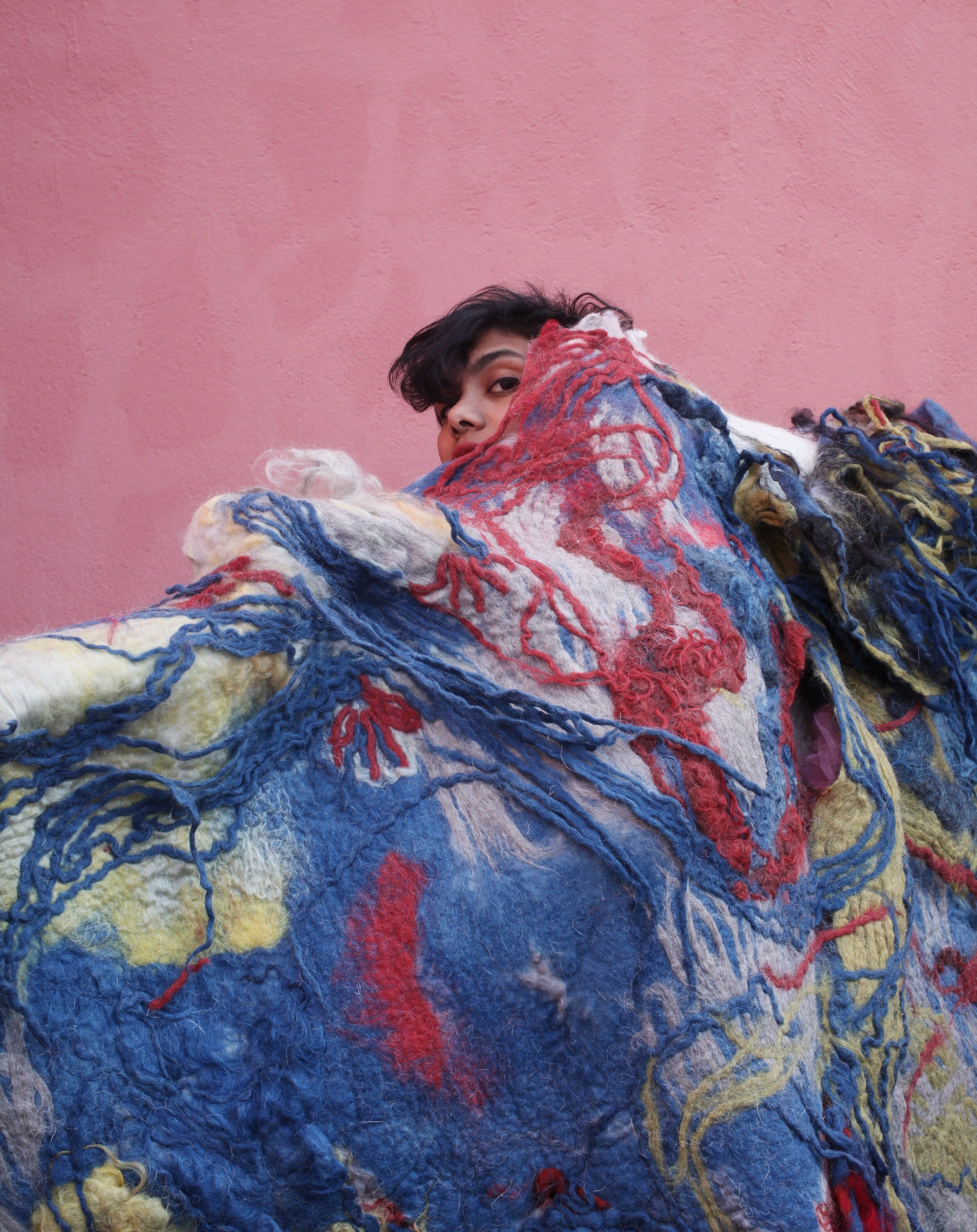 The Forum 05 | Sagarika Sundaram: Expanding Textiles as Sculpture | Sagarika Sundaram creates sculpture, relief works, and installation using raw natural fiber and dyes. Drawing on botanical imagery and material process, her work meditates on the impossibility of separating the human from the natural. Layered, tactile, and immersive, her practice moves between structure and spontaneity, craft and conceptual inquiry, Western and Eastern frameworks.In this conversation, we discuss:Early training in Batik and formative art educationLeaving art for graphic design and returning through craftBalancing spontaneity with formal structure“Sabotage” as a strategy to avoid repetitionDyeing practices, sustainability, and systemic responsibilityDeveloping artistic identity over timeRasa theory, disgust, and cross-cultural frameworksTimestamps(0:00) Introduction and Background: Exhibitions and Current Projects(1:00) Early Art Education: Batik and Formative Influences(7:00) Graphic Design and the Return to Art(14:00) Felt-Making and Textile Practice(24:00) Artistic Sabotage and Breaking Repetition(27:00) Dyeing Practices and Sustainability(31:00) Artistic Identity and Refinement(34:00) Expanding into Video and Rhythm(43:00) Rasa Theory, Disgust, and Cultural Frameworks(58:00) Audience Q&AWatch the conversationView the full episode on YouTube.Follow Sagarikahttps://www.sagarikasundaram.com/https://www.instagram.com/ohsagarika/Sagarika Sundaram creates sculpture, relief works, and installation using raw natural fiber and dyes. Drawing on natural imagery, the work meditates on the impossibility of separating the human from the natural, suggesting the intertwined nature of reality. Sundaram’s work has exhibited at the Bronx Museum of the Art, NY; Al Held Foundation with River Valley Arts Collective, Boiceville NY; the Moody Center for the Arts at Rice University, Houston, TX; British Textile Biennial, Liverpool, UK; the Chicago Architecture Biennial and Manitoga / The Russel Wright Design Center, Garrison, NY. Her work has been reviewed in the New York Times (Roberta Smith, Martha Schwendener) ARTnews (Alex Greenberger) and has been featured by Artnet and Juxtapoz Magazine and PBS. Sundaram graduated with an MFA in Textiles from Parsons / The New School, NY. She studied at the National Institute of Design, Ahmedabad, and at MICA in Baltimore. She is currently Visiting Assistant Professor at Pratt Institute. Sundaram lives and works in New York City.About The ForumThe Forum is NewCrits’ ongoing public talk series, presented in partnership with WSA/WSBS. Talks take place live every second Tuesday at WSA. Join us for our next conversation here.Explore NewCrits’ offerings, including crits, courses, and mentorship programs at www.newcrits.studio. Get full access to NewCrits Substack at newcrits.substack.com/subscribe | 1h 08m 22s | ||||||
| 1/31/25 | 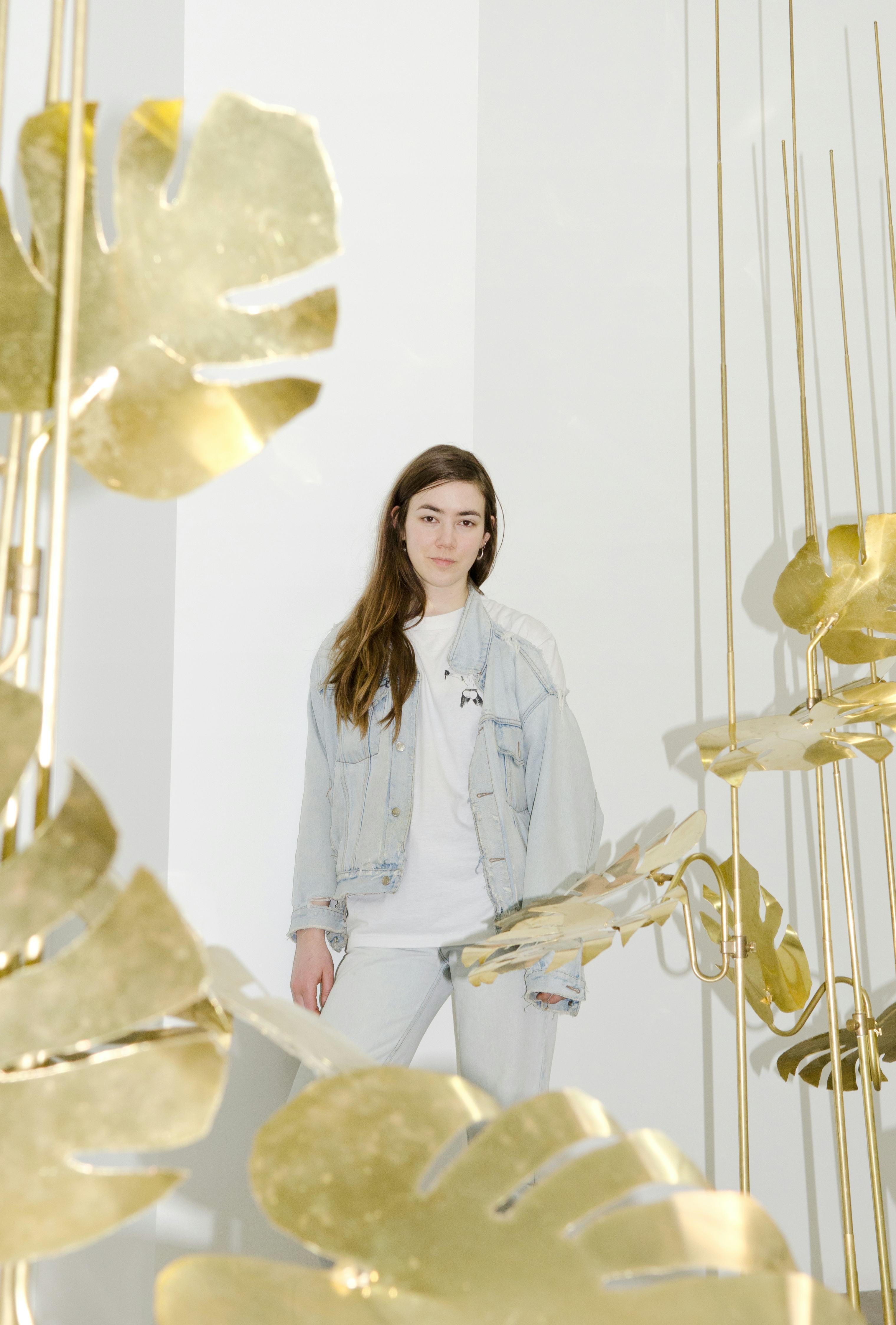 The Forum 07 | Elaine Cameron-Weir: Blasphemy, Objects, and Politics | A BDSM dungeon for alchemist Bitcoin investors. A druid hideaway in the abandoned Palo Alto headquarters of the corporation Theranos. A crossover between Breaking Bad and Game of Thrones where Walter White cooks meth for White Walkers. These are some of the images that Elaine’s work conjures up for people. In this case, the writer and art historian Colby Chamberlain. I like to look at Elaine’s work thinking about the shifts in difference between visual prose and visual poetry. There are narratives, ideas, concepts, but there’s also evocations, atmospherics, and rhythms that key you in as well. spite the notable iciness from some of the work, you can still sense a beating heart. It’s the reason I return to the work and get excited for new shows of hers. There’s a feeling of the post apocalyptic, a sense of dread, there’s violence and the vestiges of religion, but from the way these works come together and how each show operates, I get the sense that this is a person wrestling with belief, not someone who’s already sworn it off. And it’s those struggles that I’m interested in. Why do any of us fight the fights we do? And what does it say about us?In this conversation, we discuss:* Early post-art school experimentation and resourcefulness* Technical training in metal, glass, and ceramics* Moving to New York and formative professional relationships* Brass, aluminum, and the scientific aura of materials* Religion, ritual, and the outsider gaze* Modularity and impermanence in installation* Military artifacts and the aesthetics of violence* Cultural archetypes and embodied identity* Writing as a parallel conceptual practice* Readymades, relics, and inherited material memory* The artist as conduit and criticTimestamps(0:00) Introduction and Framing the Conversation(5:00) Early Career and Technical Training in Alberta(14:00) Moving to New York and Early Gallery Relationships(19:00) Material Exploration: Brass, Aluminum, and Process(25:00) Ritual, Religion, and Cultural Observation(31:00) Modularity and Impermanent Installation(39:00) Military Artifacts, Violence, and Political Aesthetics(45:00) Archetypes, Identity, and Cultural Tropes(52:00) Writing, Language, and Reflection(57:00) Readymades, Relics, and Object Memory(1:00:00) Conduit vs. Critique: Final ReflectionsWatch the conversationView the full episode on YouTube.Follow Elainehttp://lissongallery.com/artists/elaine-cameron-weirElaine Cameron-Weir was born in 1985 in Red Deer, Alberta, Canada; she lives and works in New York. Past solo exhibitions at institutions include: Dressing for Windows (Exploded View), SCAD Museum of Art, Savannah, USA (2022); STAR CLUB REDEMPTION BOOTH, Henry Art Gallery, Seattle, USA (2021); exhibit from a dripping personal collection, Dortmunder Kunstverein, Dortmund, Germany (2018); Outlooks, Storm King Art Center, New Windsor, USA (2018) and viscera has questions about itself, New Museum, New York, USA (2017). Her work has featured in major group exhibitions including The Milk of Dreams, curated by Cecilia Alemani at the 59th Venice Biennale, Italy (2022); New Time: Art and Feminisms in the 21st Century, BAMPFA, Berkeley, USA (2021); Present Tense, Philadelphia Museum of Art, USA (2019), as well as the Belgrade Biennale, Serbia (2021); the Montreal Biennial, Canada (2017) and the Fellbach Triennial of Small-Scale Sculpture, Germany (2016).About The ForumThe Forum is NewCrits’ ongoing public talk series, presented in partnership with WSA/WSBS. Talks take place live every second Tuesday at WSA. Join us for our next conversation here.Explore NewCrits’ offerings, including crits, courses, and mentorship programs at www.newcrits.studio.—Full TranscriptAjay Kurian: I've always loved your work, and there was a specific moment in 2014, at Ramiken Crucible, where I was genuinely floored.It was so quiet in there. It was so beautiful and eerie. The scent in the air, everything about it felt meticulous but also carefree. It wasn't overly theatrical or overdone.And I just want to start from the beginning, because there's an arc of the visual poetry that you start making and it would be interesting for me to understand how certain things started to congeal, how certain sculptural forms started to congeal for you. This is the first show that you did at Ramekin Crucible in 2011 called “without true bazaars”. Do you even remember this show?Elaine Cameron-Weir: Yeah, it's interesting to see it. It was so long ago.Ajay Kurian: Fourteen years.Elaine Cameron-Weir: When I see these images, I immediately think about how I had no money, and was really just working with what I could get my hands on.But, you know, that wasn't an obstacle at the time. It was normal. But looking back, the simplicity of what I was doing and the type of materials…I mean, it doesn't feel like student work, but because I was just out of school, I was so young, and I wasn't fully formed, it still feels transitional. But it was a such an opportunity to learn about what I was doing in public, and it could have goneAjay Kurian: I feel like first solo shows, it's like you have nothing to lose. So it's just like, fuck it, do what you want to do.Elaine Cameron-Weir: And limited resources, so you can't just go crazy - you’re contained.Ajay Kurian: What was before this? Were you in art schoolElaine Cameron-Weir: Yes. I'm from Canada and I grew up in Alberta. It's like the Texas of Canada, if you're not familiar. Yeah. above Montana, but I went to Art School right out of high school. It's way less of a commitment there because it's so cheap. It's not like a fraught decision. Like should I spend all this money to go to art school? It's like, try it.Ajay Kurian: So that was a BFA program?Elaine Cameron-Weir: Yes, at the Alberta College of Art. They had amazing, world class facilities. So I actually learned how to do very niche metalworking. They had a glass blowing shop, ceramics; you could cast bronze there. So I got a really technical education. I was in the drawing department, and we had to go draw cadavers at the hospital. But then there were really good instructors as well where it was really their mission to teach and they were really good at making you think about what you're doing.And then I graduated from there and I didn't really know what to do. I was working at American Apparel and the rents were getting jacked up in Calgary where the school was because there was an oil boom going on. I had to leave. So I moved back in with my dad And I turned his garage into a studio.And I hated it there so much. It's the small city that I went to high school in. so I immediately applied to grad school in New York without knowing anything about any school in New York. I just did a quick search and I was like, okay, we're going to just apply to all of these and get out of here.And that's how I ended up in New York. I went to NYU. I graduated in 2010.Ajay Kurian: Okay. when did you meet Mike? Mike is the owner of Ramekin Crucible.Elaine Cameron-Weir: I don't know what year, probably 2010 or 11, at a party. At the Jane Hotel.Ajay Kurian: It's so interesting to hear about those early conversations with your first gallerist because there's so much history that happens in that moment and then looking back on it retrospectively you're like wow what was that?Elaine Cameron-Weir: I think we were both learning a lot, you know? And we took a chance on each other. It sounds crazy now, like we met at a party, but that's how you used to meet people. And we had mutual friends, like Borden, Capalino. So we met at this party, and we got to talking and then a studio visit with him and Blaize (Lehane, former director at Ramiken Crucible). The building I was living in had just caught fire right before the visit. A lot was going on for me personally, but it ended up working out really well because I didn't have to pay rent for like six months, which is one of the reasons I could stay in New York. The work I was making, was similar to what I made for that first show.I think I made this piece actually in school, that long stick thing. it's just a piece of MDF, or maybe it's actual wood. It was coated in a pouch of rolling tobacco. I think that piece was in my grad show at NYU.Ajay Kurian: I'm gonna skip to the next show. This is the first time, you start using brass in the work. It sounds like you already had a decent understanding of, how to make almost anything based on your education. These brass leaves - did you make those yourself? Was that outsourced? How did that happen?Elaine Cameron-Weir: No, I made it all. Except the piece of those, cast aluminum things at the top. You can't tell what they are, but I made those with my dad in Canada.Ajay Kurian: What are they? I remember seeing, there's been a couple of iterations of them. I remember seeing them here. I remember seeing them at an art fair where the whole booth was filled with almost like a rhythm of these, for the lack of a better word, “blanks.” Do you consider them kind of blanks or what are they made out of?Elaine Cameron-Weir: Yeah, I was kind of thinking about an ingot, which is like a cast piece of metal And a photographic plate or a blank. I used to go, I still go to the NYU library and they had amazing books from NASA there. They had this great atlas of photographs of the moon, like before they went to the moon. the photographic technique is done in scans, so it's kind of like stripes. the book is large and you can flip it.And each page - I was kind of thinking each as sort of like a page from that book - it was like plotting something in the round into a flatness.Ajay Kurian: Scale-wise, they’re almost like a oversized book.Elaine Cameron-Weir: Yeah, that's the reason for the scale, something that you could potentially hold. And then they're on this rail, because they don't actually hang on the wall. They're always meant to sit on something and lean. So they're like an object, they don't have a thing on the back that you can stick them on the wall.Ajay Kurian: Yeah, they feel like tablets.Elaine Cameron-Weir: Yeah.Ajay Kurian: Which, as you'll see as we progress, there's this sense of religiosity or ritual or the transcendental. It goes through very specific vocabulary.This was the show that I fell in love with. This is Venus Anodyamine. These are large clamshells. Were you able to find the two halves of each of them?Elaine Cameron-Weir: No, I later on made a piece where I did find one whole one, and then I stopped making them because I was like, I found a whole one. So no, they're just the halves.Ajay Kurian: So, there's this long piece of brass that falls into the clamshell where a piece of paper-thin mica is suspended, and then there's frankincense on top of the mica. and a flame underneath it, so you can smell frankincense throughout the room.And it was so beautiful. I grew up religious. My parents are from South India, so Christianity is big. a lot of those scents, a lot of that ritual. just gets imparted in you. The ways that I think about space and how I move through it are defined in a lot of ways by those early forms of ritual.And to me, it felt like that might've been the case with you, too. Maybe it was more distant, but I'm really curious because there are all these moments in which I see you pulling from the wealth of iconography in Western Christianity - symbols, and so on. Did you grow up with that?Elaine Cameron-Weir: No. I grew up in a small place, a small town, and then moved to a small city. Most people around us were religious. If I slept over at a friend's house on Saturday, we had to go to church. Some families were very strict, but my mom was very anti-religion.Ajay Kurian: Really?Elaine Cameron-Weir: Yeah. Not in a discriminatory way, but she was just like, we're not having that. You're not doing that. You're not baptized. My parents weren't married until later on, like when I was a teenager. And I grew up thinking they were married because everyone else's parents were. I remember one day I asked my mom, like, Where are all the wedding pictures of you and dad? She looks at me. She's like, we're not married.I was shocked because at eight or nine, I just assumed, you know. But I was always interested, maybe because of that and it being around me and it was something I observed. I watched people speak in tongues through this little window thing when I was a kid, so I would observe these things as an outsider.Yeah. It really made me dig into it in a different way, I guess. But it was still around me.Ajay Kurian: That feels like a healthier relationship. Because I had to unpack my relationship to it. But it's good if you can be a spectator of it, I think there are some things of value in terms of community and so on. It’s not like I think religion is wholesale bad. But it's nice to have some distance so you can be like, Oh, okay, this is maybe interesting. What is that connected to and what's the deeper psyche there?And that's kind of the sense that I get from the ways in which you work. It's like you're using a symbol or mythology to interrogate something deeper. There's a show at Rodolphe Janssen next year called Medusa. So there's Venus Anodyamine, like Venus rising from the clamshell. And then the following show is called Medusa, I think it was the same year. Were you working on these bodies of workin tandem? how did they come together? Or did they feel separate in your head?Elaine Cameron-Weir: They did. right before I did the clamshell show, I got my own studio. Previous to that I was sharing. And I realized it was driving me insane, and it was really detrimental to my work. I realized, if I'm gonna try making this work as an artist, I have to take some kind of risk and just go out on my own so I can concentrate. That's how I made those clamshell works. It was really just that I had no distractions.I also made these alone in my studio. I made them all myself. This came out of some writing that I was doing that has nothing to do with appreciating the work. It was just a way to store some ideas that I was thinking about as a collage of different snippets of writing. It was about this theoretical weapon called the Medusa that freezes people.And in it, this character gets lost in a kind of dream jungle. So that's how I, started making the work, but it doesn't matter to me that someone would know that.But what you can't see in these images is in the details of these works, everything's adjustable. They’re filled with small screws - all the hardware is visible.The curved branches are found lamp parts. Everything else I made - I made the leaves, made the hardware, the rods.The rock is marble. The holes that are already in it are from when they blast it out of the quarry, they drill holes, put explosives in, and it cleaves like perforated paper. The holes dictated the shape of where the rods went. So it was working with that.I traced the plant leaves off a plant that I had, and still have, a Monstera. My point is, you can see all of that in the work. it's much rougher than they look in these photos. They’re dirty, there’s sharp edges and there's a lot of flaws in them.I wanted to do something similar to the clamshell, something you could tune to some kind of message, like a kind of receiver or transmitter. And there's this idea of also packing it away, like taking everything apart. That will become more important to me.Ajay Kurian: Of modularity?Elaine Cameron-Weir: Modularity and something that maybe could never be put back together the same way. Like, when these are shipped, they come apart, and then you could try to get it exact, but it's not really the point.Ajay Kurian: So it's like there's a recipe that you follow, but it's not like it comes out the same way every time. There are parameters that are set and then the piece exists within those parameters, right?Elaine Cameron-Weir: If you're imagining doing fieldwork as someone in the army, the military, or a biologist, you have to set up a camp.We have to set up equipment. It's always going to be adapted to the scenario and the terrain.Ajay Kurian: Is there something you're looking for in terms of how it responds to site?Elaine Cameron-Weir: No, just that it doesn't look wrong. Everyone has a sense of beauty. I also want it to look like it wasn't just thrown together, so it kind of asks a lot of someone putting it together if I'm not there. But I like that. Not to demand a lot, but that it's like — what do you think looks good? Like when you buy some flowers and they put them in the vase, you arrange them how you want them.Ajay Kurian: That's interesting. I know that different artists have different levels of meticulousness when it comes to installation instructions.For instance Josh Kline has books for his installations. Every single thing is spelled out, like how a part is replaced or how everything needs to interact. So that it can be done exactly the same way. This is a level of freedom where if you're not around and a hundred years from now, if this piece is being put together and there's no parameters and someone thinks putting all of them at the bottom and all of them at the top is awesome — is that still the piece?Elaine Cameron-Weir: Well, there is a built in fail safe thing. The rods are graduated and there's two sizes of sliding hardware. So here's a limit. They can't all be at the top. So it's kind of within reason.Elaine Cameron-Weir: I am very picky and particular, but I'm really bad at administrative stuff. There are loose guidelines for these things and they get numbered so it's not a total free for all.Ajay Kurian: Yeah. The title is, ‘so whatever impressions this unconscious inference leads to, they strike "our consciousness as a foreign and overpowering force of nature”’. That last part is a quotation. I'm sure you can't remember where that's from, but is it part of the story?Elaine Cameron-Weir: Lots of the titles in my work come from my writing so that would be from that.Ajay Kurian: This one almost feels more narratively driven. I can follow the pacing of it and understand where it's going. The titles that continue are slightly more abstract and there's no punctuation usually. That means the beginnings and endings of thoughts blur together and there's a moment where you take that mental pause and say, this is where I'm going to bracket that part of it and try to make sense of that.Ajay Kurian: After the Venus show, did this give you the sense that, okay, now I know some of the things that I'm working with. Because initially from those first shows that we see, there's a spareness, there's a specificity with materials. There's something about towers or maybe the body that feels like it's playing a role but then there’s a shift. There's a different organicism and a realm in which we're now in. Could you feel that coming together in that moment?Elaine Cameron-Weir: Yeah, I did feel like I was oh, this is the artist that I am or the start of it, you know? That's an amazing feeling. That show felt so good. I think you picked up on it, because you were like, this seems different. It did come out of me getting my own studio and I actually quit my job the day after the second show at Ramekin that you showed. So I had time and space, and I made a show that caught me up to where I wanted to be. It felt like I was not done with what I was doing, but I was like, okay, this feels like the most realized show that I've made so far, which is still 10 years ago.Ajay Kurian: I felt like, and correct me if I'm wrong, that there was a Canadian contingency that came to New York at one time. Was that real or made up? Did it just so happen that you guys were Canadian? Or did you guys know each other?Elaine Cameron-Weir: It's our secret shame. Well, I was the only person in that group that you're referring to I think. Maybe there's one other guy from Alberta. Most people were from either Vancouver or Toronto area, and maybe one or two from Montreal. But somehow we were just all attracted to each other and ended up at parties. It's like, you're Canadian, you're Canadian, you're Canadian. Then we just hung out for a few years. I'm still friends with lots of them.Ajay Kurian: That's wild. I just assumed we all emigrated together.Elaine Cameron-Weir: I met them here. It’s weird.Ajay Kurian: It’s really blowing my mind. This entire time I thought, they met and then they were like, let’s take over New York. But that's not it at all. Interesting.Let's go to the show Hannah Hoffman, this is probably another favorite show of mine.Where I think a lot of other concerns kind of come to the fore. I'm just going to cycle through some of these images so you guys can see the show. The title of the show, ‘when waveform walks the earth’.Can I tell you my interpretation of that? I was thinking about the instantiation of Christ, like God becoming a body. There was something about it that felt similar, where it was like, there's a choice that's made, and it becomes a wave, and it's here in the world. Before that, it's potential and it's something that doesn't exist, it's not with us in the world. And then as soon as that choice is made, it's like a thing in the world. Does that at all resonate?Elaine Cameron-Weir: Yeah, you got it, that’s a very good way of putting it. I wrote something again for this show that was the press release. It deals with the things you were talking about, like mirror imaging and wave being like a bell that can't be unrung and marching in step. Like a bunch of people creating a vibration, marching like an army that shakes apart this bridge to the world.I write a lot for myself, without intention. When I do show it, it's always like a draft. I'm never like, this is a genius piece of writing. 'm just kind of like, these are some thoughts. But I started writing in this style of more in reference to the titles, without punctuation or as much, weird capitalization and abbreviations.I would run things sometimes through a translator and back to English. Multiple times, multiple different languages and sections and then collage things together. I started to try to not talk in my voice. Try to get out of a narrative in that sense.I feel like this is the first time where, there's an actual cast of a body. I think beyond that, it's the garments of the body, and the residue of the body, or something that might suggest it, but isn't it.Ajay Kurian: There's so much about this that feels connected to religion, sexuality, violence and the larger structures that govern us. It was something written about your work where they say that but I don't remember how they phrase it.Elaine Cameron-Weir: That idea came a little later from outside.Ajay Kurian: How does an external idea like that resonate with you? Does it feel like this is just now the common interpretation of my work and it's approximate, or does it feel like, oh, I'm being seen?Elaine Cameron-Weir: In that instance, it felt correct. Like I was being seen a little more because I was an emerging artist. People don't want to make proclamations or it's hard to tell what someone's actually doing and maybe it still is. But sometimes it was like I was getting placed in beautiful things or fashion, which I love but that has nothing to do with anything else. It is very bankrupt to think that way.But I think it started kind of around this time. I mean, there's a literal gas mask in this show and that rubber jacket is an old policemen's overcoat maybe from the fifties or sixties. For me, a gas mask instantly evokes war and high altitude flight.It's an ongoing series with parachutes from world war two that were used in the war, and there’s an animal, like one singular animal hide around this laboratory. It's called a lattice. They use it in chem labs to put hardware on with beakers and stuff. I think having something with an aura like that, from World War II, you can't really ignore the message anymore.Ajay Kurian: I mean, it really tries, because it is such a beautiful object. There's something so ecstatic about it. I remember reading that somebody was making a connection to Bernini and the kind of ecstasy in one of his pieces, how it was almost too sexual and that felt kind of right.Even though it's still kind of pared down, the sexuality of it is also related to the BDSM vibe of it, but it's such an overflow. The folds just keep pushing and pushing and pushing. That bodily intonation comes first and then it's kind of a brainfuck afterwards to think it's a World War II parachute, and I still don't have any reconciliation for it.There's a lot of pieces, a lot of things that I can say what the parts are, but it doesn't give me a sense of what the whole is. The whole is much bigger than the parts. To me, that's essentially a successful artwork. If the whole is more than the parts and it doesn't resolve into a conceptual strategy.It's not like, this is her take on violence and sexuality and war. they happen to be with one another and you have to figure out how that feels to you. It's not really about the sculpture when you address those feelings either. It was an interesting thing to play out when I was looking at the work and when I was sitting with it.It was like, this is clearly more about me than the work. The work is very separate and it has a self contained quality. I can't help but think of the spectatorship of how you're seeing religion take place. You're seeing someone speak in tongues. Your ability to observe and make in a self contained way feels like part of that process.Elaine Cameron-Weir: There's no question there. I was thinking of the word perverted while you were talking. That is the right word. It's kind of perverse to take something so serious as a World War II artifact that someone used, jumped out of a plane and make it into something that looks like a drapery. It's a little blasphemous, and blasphemy is perverted usually, right?You saying that as an observer and I've always felt like that. I'm always kind of feel like I'm watching something unfold. How you felt as the audience member, I kind of feel like that myself, a little alienated, but not disconnected, my grandfather fought in World War II, for example.But there's something about, watching them have PTSD and, watching the effects of things on people. Growing up with that, I think it definitely has given me, that natural disposition to almost be, in some ways, we’re like an audience.Ajay Kurian: Yeah I mean, sometimes it comes naturally to artists and then for others you really have to cultivate that in order to become your best critic. Cause if you're so deep in your work and you just love everything that you do and you can't find distance from it, you can kind of tell when an artist is there. You can tell, like you need some alienation from yourself.Elaine Cameron-Weir: You need to hate yourself a little more.Ajay Kurian: It's just so you can be an observer of yourself, like how you said.I think it's really hard.Elaine Cameron-Weir: It's not impossible to be an observer, but objectivity and subjectivity is something I'm really interested in. Obviously, a lot of people are, but in terms of science some kind of neutral position that no one can have, which comes with some kind of authority that is fraudulent.If you think of God, it’s like this ultimate omnipotent and omnipresent being, an observer or a steward without judgment, but that's not really the case. There's morality in all religions, and in science a sort of the quest for truth in different methods of inquiry.Ajay Kurian: It's interesting that you bring up God in that regard, because it's a viewpoint from everywhere and nowhere. There is no subject, there is no object, there is no observation, it just, it's all. That's sort of a transcendental that has almost no bearing on what our operations are.Elaine Cameron-Weir: It's like psychedelic. It doesn't make any sense.Ajay Kurian: Yeah. It's like an impossible thing to understand.But I feel like that divide or that inquiry into science and art as both methods of inquiry felt really profound in your Storm King installation. From what I remember, it's a cage for motorcyclists?Elaine Cameron-Weir: There's a couple of families that own these cages and it's like a family business that they travel with. So we kind of just copied a pared down version and there's a trap door. It's about 20 feet tall 20 feet wide.Ajay Kurian: Then on the side, the kind of pairing of objects here, that's a military bunker, correct? That's been turned upside down?Elaine Cameron-Weir: It's like a communication station that fits in the back of a pickup truck. So it's a mobile unit. Then we dug a little hole so it could sit at a tilt like it was looking up at the sphere. It looks tiny, but that's human size, so if you walk up to it it feels like you could open the door and go in. Inside there's all these dials and screens and stuff.Ajay Kurian: Can you see that from like looking through the window of anything or is it completely sealed off?Elaine Cameron-Weir: It was too dangerous to have people go in there.Ajay Kurian: Oh, for sure. I totally understand that. I think I like it more this way.Elaine Cameron-Weir: A mystery.Ajay Kurian: This piece like sums up a lot. It's really hard to make good public art. It has to weather the elements, it has to weather anybody who's trying to destroy it, which Americans love to destroy public art.Elaine Cameron-Weir: People climbed this.Ajay Kurian: I guarantee, they'll try to do anything they can to it. I'm sure people tried to flip that, structure. They'll do whatever which is another thing altogether.There's something about this celestial sphere that feels almost platonic, even though it is just wrought steel next to this object for observation. It feels very human and human scale. You can enter it and it has all the accoutrements of a human made thing it feels more like an object because it's been flung down it's upside down and it's in this pit it is anthropomorphized looking at the sphere that combination feels like it spells out a lot of concerns that happen in multiple bodies of work.Do you feel like having the limitations of it being an outdoor work streamlined how you were thinking about how things could be done?Elaine Cameron-Weir: Yes. It's actually interesting seeing my older work, which I haven't looked at in a long time now. Thinking about that brass cage thing, that was an elongated birdcage.At that time, I had been making work using bird shit. Like parrots shitting on a moon landing newspaper. I found someone that had parrots. I was interested in cages and what we just talked about with being, feeling like an observer and thinking about my audience.I think about audience all the time because I'm part of it, you know, this was pared down in a similar way in terms of that brass thing. I don't know how to explain it now 'cause I'm just realizing it, but there's something that connects that for me.Ajay Kurian: It's a great project. This was 2018, I think.Elaine Cameron-Weir: I don't remember.Ajay Kurian: I feel confident.Elaine Cameron-Weir: I'm really bad with dates and how things go in time. Pre pandemic for sure.Ajay Kurian: There's something I wanted to bring up before, like the idea of narration and a story. I think there’s characters that appear in different ways that are kind of always represented through clothing or a garment. So it'll be a trench coat or, a cowboy, or the leather jacket, the kind of punk leather jacket. I think it's been sort of codified, there’s the dandy, the cowboy, and the punk in your work. Do you see those as actual characters that populate the work? Are they part of the stories that you're making in these exhibitions?Elaine Cameron-Weir: Yes and no. Not in so much as I'm imagining a character and what they would do.Ajay Kurian: Is it an embodiment?Elaine Cameron-Weir: It's like a trope. The dandy character I've always been very fascinated by just because of some of my favorite poetry and literature. Like Baudelaire, Rimbaud, those kinds of guys. I like this idea of being a flaneur, kind of like window shopping but it being a subversive position to take. Now when we call someone a dandy, it's doesn't have the same, I mean, maybe it does in a way.Ajay Kurian: It feels more frivolous now. Like when you use the word dandy, I feel like it doesn't have as much subversion. It's more like, oh, they have the freedom to do whatever.Elaine Cameron-Weir: Right, which is not the original thing. So you said dandy, cowboy, and punk, right? For this show, that got picked out because of the signifiers you just said, like the accoutrement and the uniforms of those types. But the only literal uniform in the show is military uniforms. Those leather jackets are all horse leather that are stuffed inside one another, but there's no military person in that cosmology of characters.Ajay Kurian: That's true.Elaine Cameron-Weir: So I was thinking of uniforms in a way that is fashion, but not simply fashion and not only fashion. Like how commodifying like this piece says, my life, my way.Ajay Kurian: So kind of like commodifying some idea of rebellion. I think all of those characters kind of have that. Maybe what connects all of them is a rebellious sort of outside of a subculture figure, and that it's purchasable.Elaine Cameron-Weir: I mean, it also literally is purchasable, and I'm aware of that. I'm not pretending it's not for sale. I'm not cynical and I don't want to be like art shouldn't be for sale. I more want to implicate myself in this, maybe become less of an observer for the first time.And maybe I'm the clown, I don't know. But I am commodifying myself in a way. You know, my life, my way. It's not your life, your way that I'm talking about. I am really talking about myself in this work for the first time, I think, in that way. But it's also referencing other experiences of that.Ajay Kurian: It felt personally driven and then I also couldn't help but think of it as a character because there's like a snottiness to saying like my life my way, and I think just like with the font and the way that it exists It's not fully serious. It's like you're poking fun at it too.I think the thing I maybe want to end on is asking you about the difference between being a conduit for work that gets made — how you think about critique because like critique is taking a step back and conduit is just being. I see both of those things in your work. I see like there's a sense of channeling something but then there's also very clear moments where the narration here is is self conscious. I have to be careful about what I put on you as the maker, it's not like this is autobiographical, but it's also not, not autobiographical. Conduit and critique, how do those things sit with you?Elaine Cameron-Weir: It's a complex question, but I think I always feel like I am opposed to things. So I always feel like, without cynicism, that I have a natural inclination to critique. But as an artist, I don't want to simplify my position to just critiquing, because then you imply this moral cleanliness that is not interesting to me.Complexity and self awareness in your implication in the things that you don't like is like, you know, so both I think is my goal. It might be too and then you become like a mystic sage.Ajay Kurian: It's too much.Elaine Cameron-Weir: Yeah, but if you just critique then you might become a hypocrite because you can't just stay. You know what I mean?Ajay Kurian: In a sense it's the worst kind of observer. You don't stand outside of this. there's a fair space to critique, and artworks do it constantly, yours as well. But if the critique is so clean and high and mighty, where it doesn't apply to me, it might not be the richest space for an artwork. It might be rich for writing and thinking about a particular idea or history, but for art it feels messier.Elaine Cameron-Weir: Yeah, but I think to be purely in one category of conduit or critique is really, really hard and why would you want to be? In either one you are kind of missing out on what the other one can bring to it. And I don't think it's weakening critique either or being a conduit to overlap those things, you know?There's a lot of really complicated, messy people that critique things and are seen as absolute conduits. Like William Blake, who you mentioned.Ajay Kurian: Blake is a great example.Elaine Cameron-Weir: I don't think you have to choose one or the other.Ajay Kurian: Yeah. I also think your route sort of chooses you in a way. We were talking about this in the studio, it's not like you read someone's biography to map out who they are, but there is a resonance of a person that feels available when you look at someone's work with your work, there's a distance and a curiosity and a skepticism, but you want to go in, It's not like you're fully on the outside.It's funny. That's like how I felt the first time I had any interaction with anything about you was that newspaper with the bird shit on it, which was the piece you had in Puerto Rico. I'd never met you, but I'd heard about you and I'd seen some of your work. And they're putting all this stuff in the cave. This cave was insane. Rose Marcus was in that show too. It was the actual newspaper of the moon landing and it was covered in bird shit. I was like, oh my god. It goes back to blasphemy. It goes back to like a perversion there. Where it was something like going to the stars.And it was the most like base thing that you could put on it and that was the only thing that you had it was just like a newspaper that got sent to Puerto Rico.Elaine Cameron-Weir: They gave it back to me. It was in like a little case.Ajay Kurian: They just put it on a rock and I was like who is this person. While I try to find that photo, if you guys have questions, if you have anything that you want to ask Elaine, this is a good moment.Audience Member 1: Yeah, I have a question. Elaine, I've loved your work for so long, like I learned it on Tumblr when I was in art school. I was gonna ask you about your relationship to the ready made, like Aja was talking about. I feel like I'm influenced by this idea of the religiosity of these things where they're held in reverence.But I'm now thinking about the idea of the ruin, you know, where it's like there are these things like a lot of these ready made aspects in your work that are like relics or something, I thought it was kind of like interesting what you're saying.This idea of the flaneur or something where they're not really fully participating in conspicuous consumption, but they're a witness to all of this. So, I don't know if that's a question.Elaine Cameron-Weir: Yeah, we didn't talk about the ready made, and I think it's exactly what you said, there is an aura with things, and I like things that are used in my whole life. All my clothes, my furniture, everything I own is used basically, cause I like the patina of use and then it being decommissioned. I mean, that doesn't apply to clothes if I wear them, but I'm talking about my work right now, repurposing them and giving them a new function or just ending their function and and that absence is maybe related to absence of the body.It's like the job that this thing is supposed to do. I think that implies repurposing and change. It’s a common, theme in apocalyptic sci fi where steampunk, retro, Mad Max, like retrofitted things that aren't supposed to make something out of nothing or make do.I'm naturally inclined to do that. It has to do with all the reasons you said, but it's also just a natural position. Like I grew up with my dad who made a lot of stuff and my parents and the way we had an income was they owned this greenhouse, they grew plants and they built the structures themselves. We went sold some at the farmer's market and my dad had like a junkyard. where he would just get scrap and it was like old washing machines and he'd cut them apart and make little like robot things. He was a farm guy but he was always making stuff so there was always junk around. I’m like a junk fan.I think also observing it as a kid and being like what the fuck is this thing for not understanding it but like just being attracted to it I don't know if that answers what you said.Audience Member 1: No, I totally agree with you. more times people touch something, I think you infuse it…Elaine Cameron-Weir: …With power or something. Yeah. Magic. And it has a history in the world already outside of me. My dad made those lenses in the middle. he doesn't consider himself an artist, but he's making these homemade lenses to make a telescope. The glass is from the abandoned Prairie house that he grew up in. It's like the windows that he melted down. It's so poetic, but he just was like, that's the cheapest glass and it was around so I used it. And these ones didn't work out, so he gave them to me for the show at JTT.Audience Member 2: In terms of representing things that are relics or degraded, does that harken back to the cadaver that you drew in art school, and do you still have a relationship to drawing?Elaine Cameron-Weir: I think it's interesting. Maybe does go back to the cadaver, or certainly death, or being put to rest, or no longer useful. The idea of art having to have a use, like it's always something on my mind, like what defines art for some people is that it's useless, you know, or, do we demand our art to be a productive member of society and have a job or whatever. Did that answer your question?Audience Member 2: Yes, but the second part was, do you still have a drawing practice when it comes to planning and building these forms?Elaine Cameron-Weir: Weirdly, no. I don't really draw at all anymore. I make a lot outside of stuff here and there, occasionally I'll get help in my studio, but I make a lot of stuff myself wherever I can because I like the control. But I don't draw, really.Ajay Kurian: Do you, sketch out sculptures at all?Elaine Cameron-Weir: No.Audience Member 2: Do you make smaller facsimiles, or do you just work with the raw material?Elaine Cameron-Weir: I can picture it in my head, so I don't. I'll sometimes have to write down measurements, so I can trace something. If I want to make it symmetrical, but I don't draw.Ajay Kurian: That's wild. It's wild that you can just visualize and start making.Elaine Cameron-Weir: Mostly. I mean, I'll write stuff down or a list of the materials which kind of remind myself, and sometimes, yes, I will draw a little squiggly thing, but I don't start with drawing.Audience Member 3: So what does the writing software mean to you? Is it a very personal recording of a journey kind of thing? Is it like a journal? Or is this like a book that you want to write that's completely private to you?Elaine Cameron-Weir: It depends, it's very private and it’s not like a confessional thing. It’s highly edited. It's meant to seem like maybe it's just like stream of consciousness or like a jumble, but it's very particular.I have pages and pages of Google Doc, which is kind of like a journal, because I can go back through it and kind of remember the time period and then it helps in a way confirm my own. Like is this thing I'm thinking about now totally out of the blue or crazy? I pick from it to put the occasional thing out in the world, and I also keep it very personal.Audience Member 3: Would you ever show it?Elaine Cameron-Weir: I made a book for this show in Germany, in Dortmund, where I put out a long piece of writing. I'll leave this on the table after, so if people want to page through just be delicate, please. This is my personal copy. And I have a PDF of it, if anyone's actually interested in it.Ajay Kurian: If you are interested, you can write the NewCrits account and we'll send it. I just want to thank Elaine again for coming out tonight in the freezing cold. Even though she doesn't like public speaking, this was great. I really appreciate it. So, thanks Elaine.There's probably still wine and some snacks. If you guys want to hang out, feel free to hang out for a little bit. Thanks for coming!Elaine Cameron-Weir: Thanks for coming! Get full access to NewCrits Substack at newcrits.substack.com/subscribe | 1h 15m 45s | ||||||
| 5/8/24 | 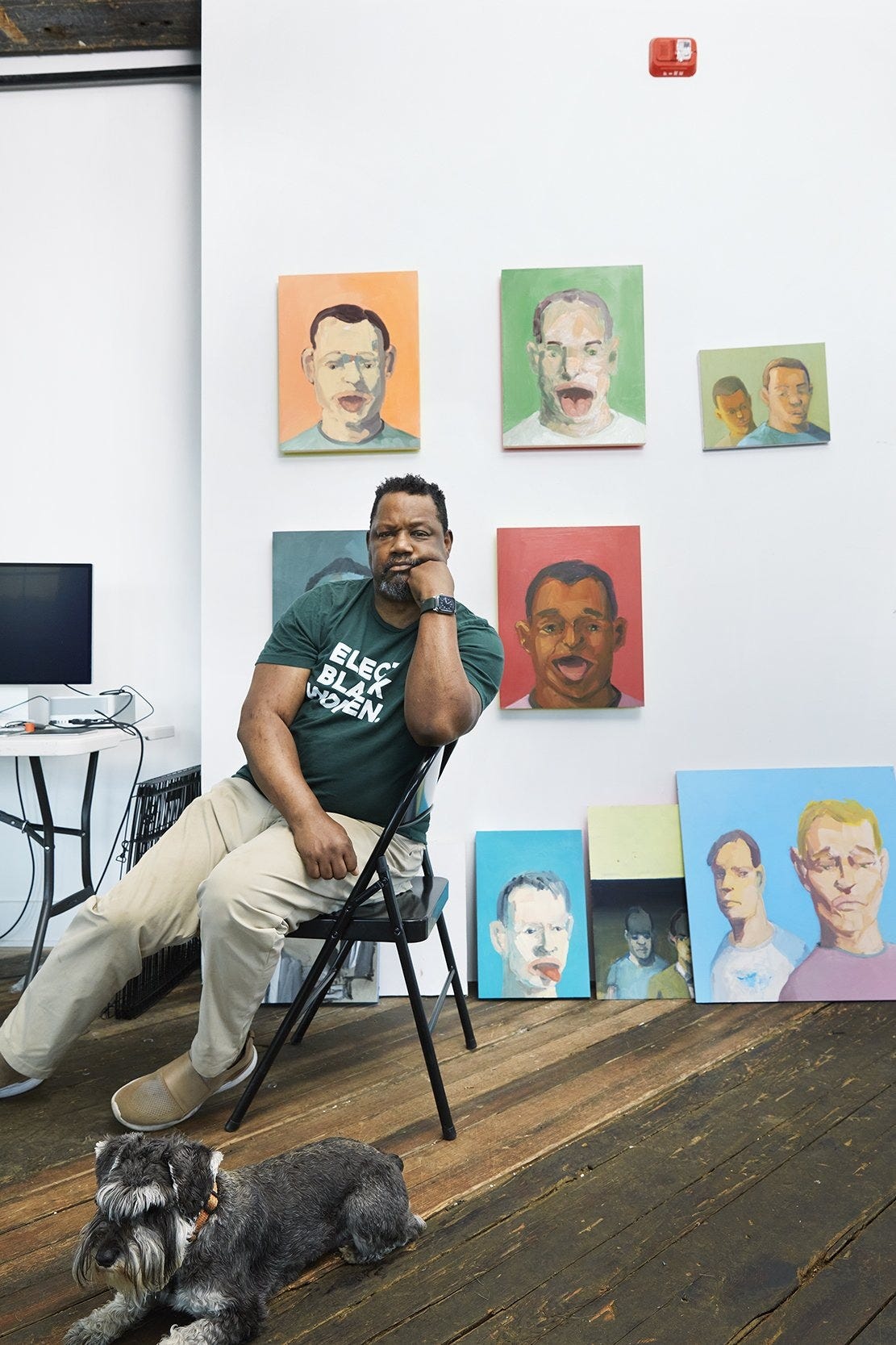 The Forum 04 | Steve Locke: Personal Pain Isn’t Art | I met Steve last summer at the Skowhegan School of Painting and Sculpture, where we were both resident faculty members. I quickly fell in love with his wit (biting), his work (also biting), and his tenderness (much less biting). In our conversation here, we cover his first experience with an artwork, his relationship to portraiture, and the origins of Modernism in the auction block.He’s unabashed in his distaste for prioritizing personal hardship to make art. In his own words, “This idea that we’re going to get together and have a party for our pain, and somehow art is gonna come out of that..? No, baby, you better go to an observational drawing class.” Regardless of whether you agree with Steve’s perspectives, listening to him tell it is thoroughly enjoyable.In this conversation, we discuss:* Early encounters with art and the emotional force of seeing Van Gogh* Art as both repression and a space for self-discovery* The role of gesture and ambiguity in figurative work* Studio practice, community, and artistic solitude* Grief, loss, and the logic of the grid paintings* Public art as social intervention* Modernism, slavery, and cultural inheritance* Pain, performance, and artistic expressionTimestamps(0:00) Introduction and Background: Mass MoCA and Early Context(2:00) Early Influences: Detroit Institute of Arts and Van Gogh(6:00) Art School and the Turn to Portrait Painting(10:00) Art as Repression and Safe Space(27:00) Artistic Community: Skowhegan and Boston(30:00) Craft, Memory, and Sculptural Expansion(36:00) Grief, Communication, and the Grid Paintings(47:00) Public Art: “Three Deliberate Grays for Freddie”(50:00) “Homage to the Auction Block” and Modernism (55:00) Pain, Performance, and Shared Experience (1:04:00) Audience Q&AWatch the conversationView the full episode on YouTube.Follow Stevehttps://www.stevelocke.com/https://www.instagram.com/svlocke/?hl=enSteve Locke (b.1963, Cleveland, OH) lives and works in the Hudson Valley, NY. He received his MFA from the Massachusetts College of Art and Design in 2001. Spanning painting, drawing, sculpture, and installation, Locke’s practice critically engages with the Western canon to muse on the connections between desire, identity, and violence. Locke’s work has been the subject of solo exhibitions at Moss Arts Center at Virginia Tech, Blacksburg (2022); The Gallatin Galleries, New York University, NY (2019); Isabella Stewart Gardner Museum, Boston, MA (2018); among others. He has participated in group exhibitions at the Green Family Art Foundation, Dallas, TX (2023); MassArt Art Museum (MAAM), Boston, MA (2023); Jack Shainman Gallery, Kinderhook, NY (2021); Fitchburg Art Museum, MA (2020); Fruitlands Museum, Harvard, MA (2020); Boston Center for the Arts, MA (2018); Ethelbert Cooper Gallery of African & African American Art, Harvard University, Cambridge, MA (2018); among many others.About The ForumThe Forum is NewCrits’ ongoing public talk series, presented in partnership with WSA/WSBS. Talks take place live every second Tuesday at WSA. Join us for our next conversation here.Explore NewCrits’ offerings, including crits, courses, and mentorship programs at www.newcrits.studio.—Full TranscriptComing Soon. Get full access to NewCrits Substack at newcrits.substack.com/subscribe | 1h 16m 45s | ||||||
| 4/9/24 | 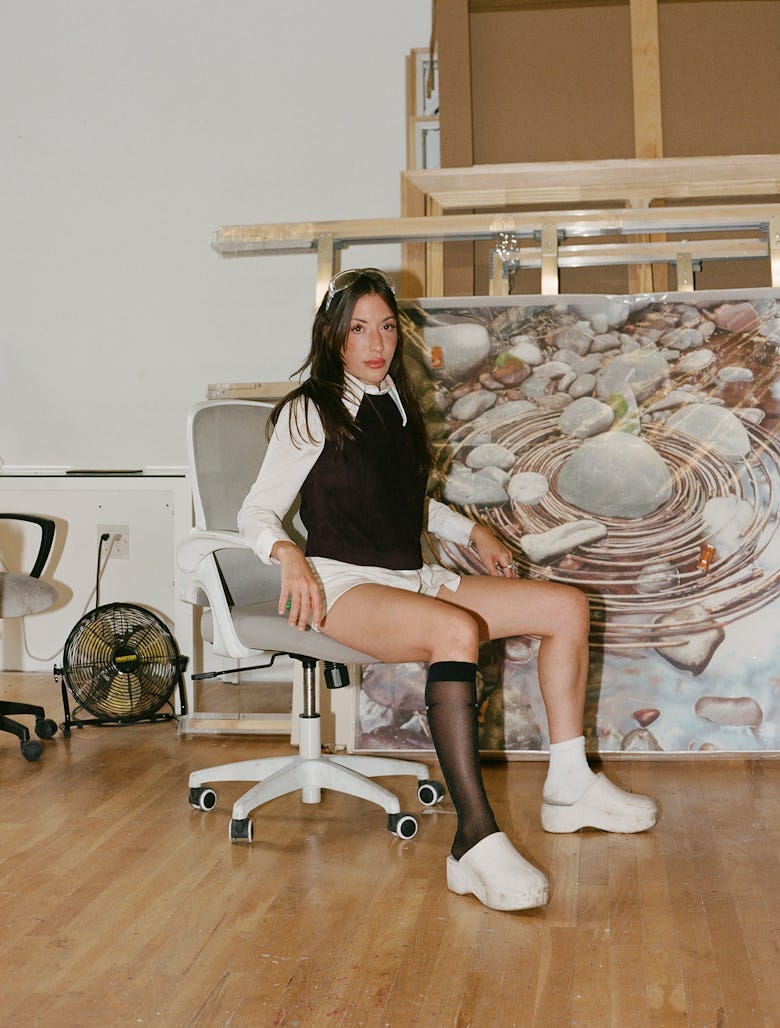 The Forum 03 | Jamian Juliano-Villani: Artistic Autonomy and Collaboration - Stay Freaky | Jamian Juliano-Villani was born in 1987 in Newark, New Jersey, and lives and works in New York. As the daughter of commercial silkscreen printers, she spent time as a child working in her parents’ factory, folding more than four thousand Pope John Paul II T-shirts in ninety-seven-degree heat while absorbing the influence of 1990s and 2000s mass-market print design. She attended the Mason Gross School of the Arts at Rutgers University, New Jersey, graduating with a BFA. While there, she was influenced by the institution’s historic ties to Fluxus, her studies with John Yau and Raphael Ortiz, and the Zimmerli Art Museum’s collection of 1970s Soviet conceptual painting.She’s in the collection of the Guggenheim Museum in New York, the Whitney Museum of American Art, the High Museum of Art in Atlanta, and the Louis Vuitton Foundation, among others.In this conversation, we discuss:* Growing up in a family rooted in advertising and printing, and how that shaped but did not determine her artistic path* Painting as a series of formal problems to solve, grounded in decision-making and restraint* Collaboration as an ongoing negotiation, including disagreement, silence, and repair* The relationship between politics and art, and the limits of political messaging in painting* Influences, including Ralph Bakshi and Christian Ludwig Attersee, and how past experiences inform her current work* The role of community and collective projects like The PatriotTimestamps(12:26) Family and Artistic Influence(19:16) Problem-Solving and Formal Challenges(25:00) Collaboration and Dialogue in Art(31:00) Political Messages in Artwork and Creative Freedoms(38:00) Collaboration and CommunityWatch the conversationView the full episode on YouTube.Follow Jamianhttps://gagosian.com/artists/jamian-juliano-villani/https://www.instagram.com/psychojonkanoo/?hl=enCombining an affection for the full breadth of contemporary visual culture with an informed awareness of representational painting’s lengthy history, Jamian Juliano-Villani draws on a vast spectrum of references to produce uncanny and evocative images.Juliano-Villani was born in 1987 in Newark, New Jersey, and lives and works in New York. As the daughter of commercial silkscreen printers, she spent time as a child working in her parents’ factory, folding more than four thousand Pope John Paul II T-shirts in ninety-seven-degree heat while absorbing the influence of 1990s and 2000s mass-market print design. She attended the Mason Gross School of the Arts at Rutgers University, New Jersey, graduating with a BFA. While there, she was influenced by the institution’s historic ties to Fluxus, her studies with John Yau and Raphael Ortiz, and the Zimmerli Art Museum’s collection of 1970s Soviet conceptual painting.In 2013, Juliano-Villani presented her first solo exhibition, Me, Myself and Jah, at Rawson Projects, New York, showing paintings that incorporate characters from Ralph Bakshi’s film Cool World (1992). These works explore themes of race, identity, appropriation, and—in canvases such as Heat Wave (2013)—the collapsing of painterly hierarchies, while revealing the artist’s burgeoning admiration for the democratic nature of cartoons.About The ForumThe Forum is NewCrits’ ongoing public talk series, presented in partnership with WSA/WSBS. Talks take place live every second Tuesday at WSA. Join us for our next conversation here.Explore NewCrits’ offerings, including crits, courses, and mentorship programs at www.newcrits.studio.—Full TranscriptComing Soon. Get full access to NewCrits Substack at newcrits.substack.com/subscribe | 39m 46s | ||||||
| 4/1/24 | 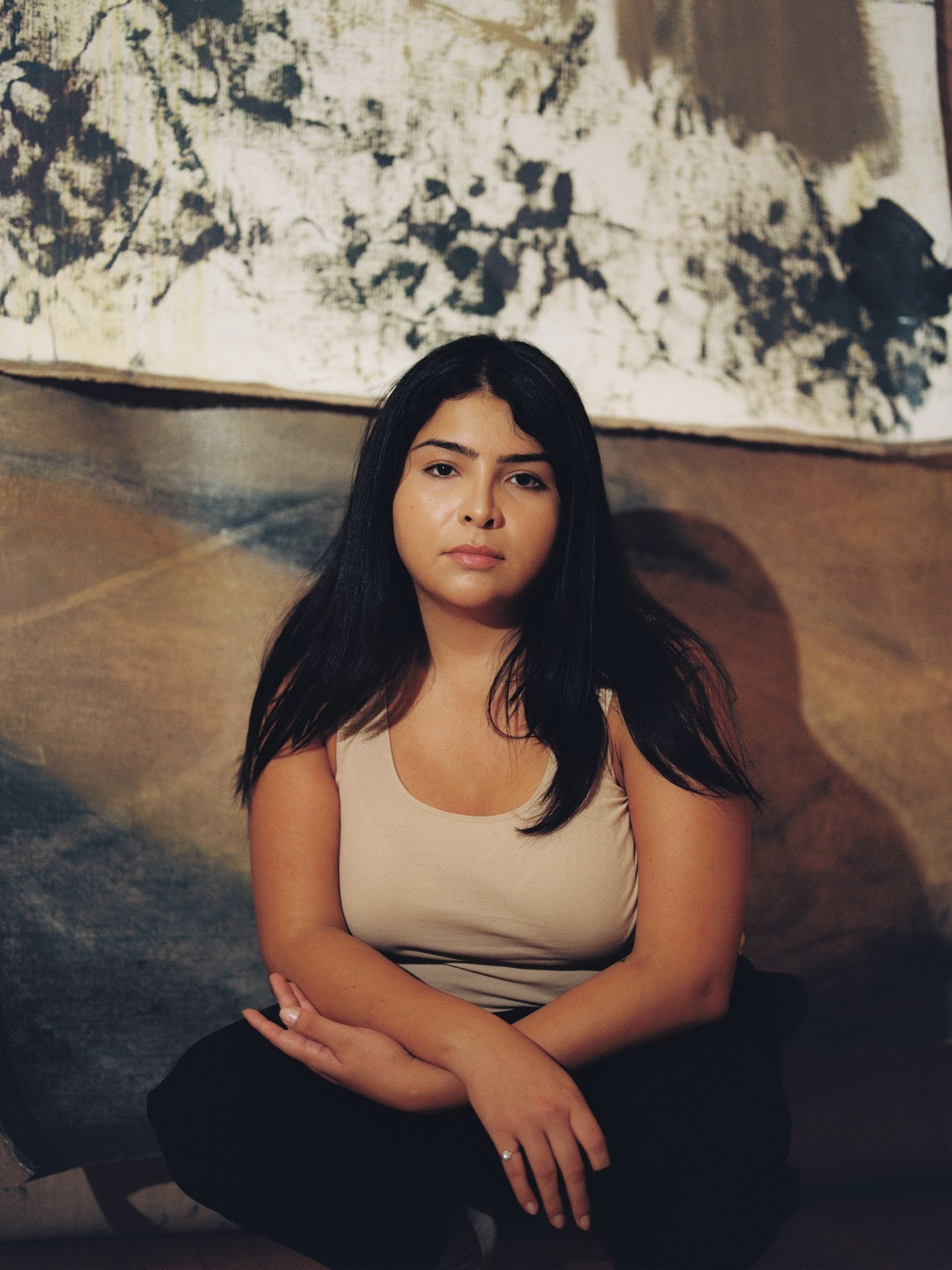 The Forum 02 | Ser Serpas: Trash, Ruined Objects, and Horror | Ser Serpas was born in 1995 in Los Angeles, California and lives and works in New York. Primarily interested in death and legacy, her work is preoccupied with its own urgency in the face of fossilization. At present, she’s taken to sequestering the mundane. Serpas’ work takes the form of unstable assemblages of found objects in which painting, sculpture, drawing, and text bring together personal memories and traces of everyday life. She mashes bits of her life, both real and imagined, into anti-portraits. Some of which she deems fit to share within the context of exhibitions and performances. Precarious assemblages of disparate objects found in the street, which bear the mark of their uses, constitute her most well-known series to date. More recently, she has taken to using photos shot on her iPhone during college as source material for intimate views on unstretched canvas, wood panel, and paper. The unique way she reframes the body and tension in both her sculptural and text-based installations, which distort components of our shared architecture, carries into her atypically cropped portions of stolen archetypical intimacy.In this conversation, we discuss:* Urgency, fossilization, and building work from ruin rather than permanence* Waste as imprint and the ethics of collecting discarded objects* Horror and discomfort as formal strategies* The aesthetics of survival* Training AI to hallucinate bodies* Control, labor, autonomy, and designing your lifeTimestamps(02:22) “Monakhos” and the ghosts inside the frame(07:30) The Collector: absence, imprint, and waste(15:51) Confidence is knowing when to stop(17:46) Training AI to hallucinate bodies(30:38) Ruined objects, ruined selves(35:00) The aesthetics of survival(48:20) Horror, unreason, and the art of discomfort(55:00) Control, labor, and designing your lifeWatch the conversationView the full episode on YouTube.Follow Serhttps://maxwellgraham.biz/artists/ser.@ser_seraSer Serpas (b. 1995, Los Angeles, CA, USA, lives and works in Paris) Primarily interested in death and legacy, her work is preoccupied with its own urgency in the face of fossilization. At the present, she’s taken to sequestering the mundane while freely quoting art history in its full depth, paying little heed to the latter. Ser Serpa works take the from of unstable assemblages of found objects, in which painting, sculpture, drawing, and texts bring together personal memories and traces of everyday life. She mashes bits of her life, both real and imagined, into anti portraits, some of which she deems fit to share within the contexts of exhibitions and performances. Precarious assemblages of disparate objects found in the street, which bear the mark of their uses, constitute her most well known series to date. More recently she has taken to using photos shot on her iPhone during college as source material for intimate views on unstretched canvas, wood panel and paper. The unique way she reframes the body in tension, in both her sculptural and text based installations which distort components of our shared architecture, carries into her atypically cropped portions of stolen archetypal intimacy.About The ForumThe Forum is NewCrits’ ongoing public talk series, presented in partnership with WSA/WSBS. Talks take place live every second Tuesday at WSA. Join us for our next conversation here.Explore NewCrits’ offerings, including crits, courses, and mentorship programs at www.newcrits.studio.—Full TranscriptComing Soon. Get full access to NewCrits Substack at newcrits.substack.com/subscribe | 1h 03m 57s | ||||||
| 1/23/24 | 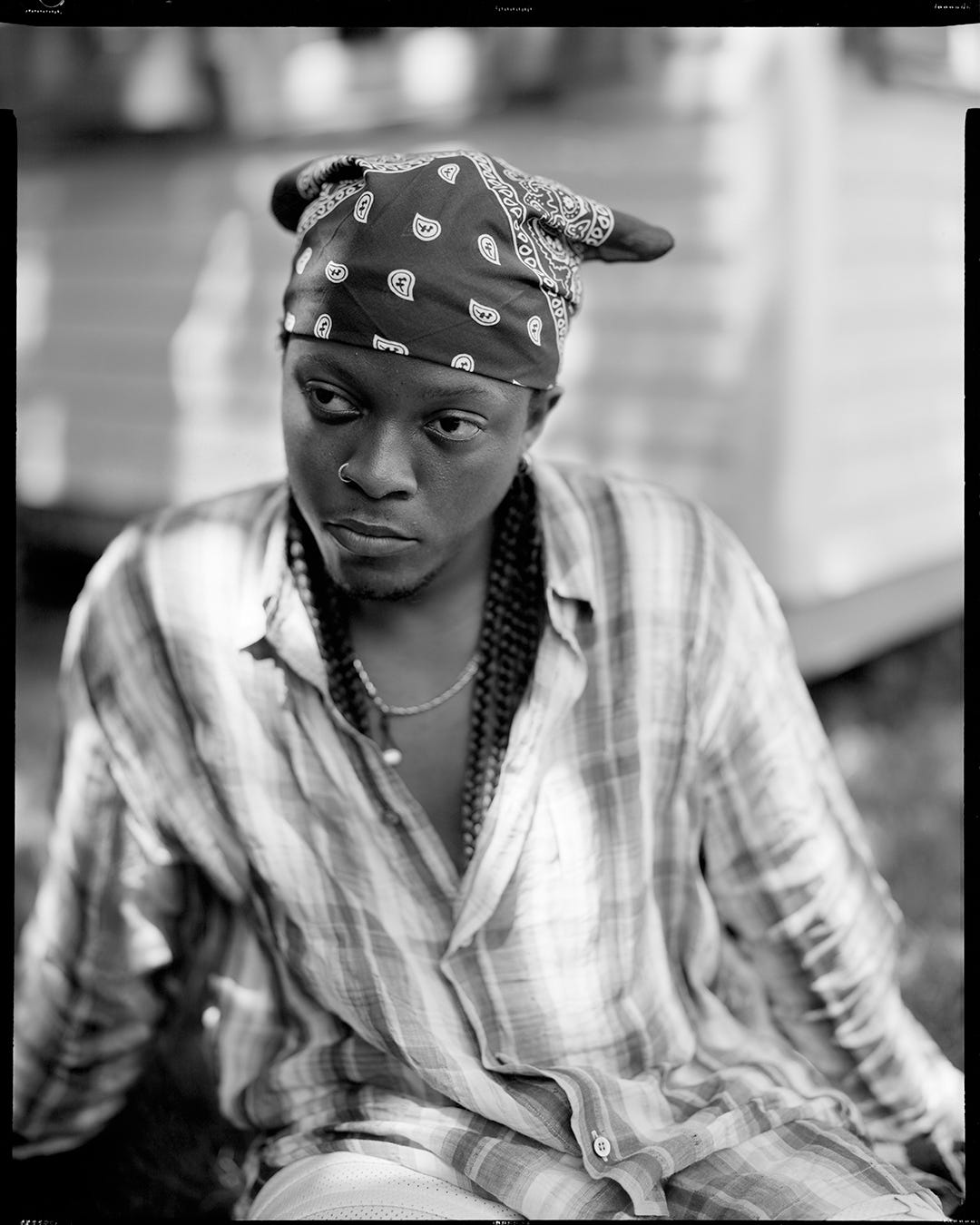 The Forum 01 | Elliot Jerome Brown Jr.: Identity, Racial Cliche, and the Difficult Image | Elliott Jerome Brown Jr is an artist who uses photography to explore representation through privacy and fiction. Sometimes his images work towards the mysteries a person can hold. Other times, they might explore the tension created through juxtapositions, or wisps of narrative and context, leaning further into abstraction. Altogether, his work foregrounds the possibilities and problems of photography today. In this conversation, we discuss: * Elvis Costello's "Green Shirt" and "emotional fascism"* Negotiating Identity in Photography* Collaborations with Solange and Telfar* Going for the "difficult" image instead of the "iconic" one* Abstraction through rupturing representation* Moving past racial cliches, even the new ones!Timestamps(0:00) Introduction and Song Selection: Elvis Costello’s Song “Green Shirt”(8:00) Shift in Artistic Perspective(11:45) Religion and Photography(20:00) Titles, Photography, and Collaboration(28:00) The “Dummy Image”(31:00) Navigating Internal Resistances in Photography Assignments(37:46) Representation vs. Abstraction in Photography(42:56) Influence of Deana Lawson and Critiques of Curatorial Frameworks(55:53) Audience Questions and Further DiscussionWatch the conversationView the full episode on YouTube.Follow Elliothttps://elliottjeromebrownjr.com/@elliottjeromebrownjrElliott Jerome Brown Jr. (b. 1993) lives and works in New York. He received his BFA in Photography from the Tisch School of the Arts, New York University. He has had solo exhibitions at Nicelle Beauchene Gallery, New York (2022, 2019); Staple Goods, New Orleans (2019) and Baxter St. at the Camera Club of New York (2019). Recent group exhibitions include Swiss Institute, New York (2021); RISD Museum of Art, Providence (2021); The Arts Club of Chicago (2020); New Orleans Museum of Art, New Orleans (2020); Public Art Fund, New York (2020); The MAC, Belfast (2019); PPOW, New York (2019); Studio Museum in Harlem, New York (2018); Yossi Milo Gallery, New York (2018); Leslie-Lohman Museum of Art, New York (2018); We Buy Gold, New York (2018), among others. Recent museum acquisitions include the Studio Museum in Harlem, New York.About The ForumThe Forum is NewCrits’ ongoing public talk series, presented in partnership with WSA/WSBS. Talks take place live every second Tuesday at WSA. Join us for our next conversation here.Explore NewCrits’ offerings, including crits, courses, and mentorship programs at www.newcrits.studio.—Full TranscriptComing Soon. Get full access to NewCrits Substack at newcrits.substack.com/subscribe | 1h 01m 39s | ||||||
Showing 18 of 18
Sponsor Intelligence
Sign in to see which brands sponsor this podcast, their ad offers, and promo codes.
Chart Positions
2 placements across 2 markets.
Chart Positions
2 placements across 2 markets.