
Insights from recent episode analysis
Audience Interest
Podcast Focus
Publishing Consistency
Platform Reach
Insights are generated by CastFox AI using publicly available data, episode content, and proprietary models.
Most discussed topics
Brands & references
Est. Listeners
Insufficient chart data. Estimates will improve as the show charts.
- Per-Episode Audience
Est. listeners per new episode within ~30 days
N/A🎙 ~2x weekly·463 episodes·Last published yesterday - Monthly Reach
Unique listeners across all episodes (30 days)
N/A - Active Followers
Loyal subscribers who consistently listen
N/A
Market Insights
Platform Distribution
Reach across major podcast platforms, updated hourly
Total Followers
—
Total Plays
—
Total Reviews
—
* Data sourced directly from platform APIs and aggregated hourly across all major podcast directories.
On the show
From 16 epsHosts
Recent guests
Recent episodes
Amjad Masad and Me: The AI Agents We Actually Built, and What Replit's Founder Thinks Comes Next
Jun 23, 2026
3m 14s
Snowflake’s CMO Runs Marketing for 700 People. She Starts Her Day By Talking to Her Data, Not a Dashboard.
Jun 21, 2026
4m 08s
$400M ARR With Under 200 People: What Lovable’s Head of Growth Elena Verna Says Actually Works in B2B Now
Jun 5, 2026
3m 47s
The Agents Episode #006: We Run SaaStrAI on 3 Humans and 21+ AI Agents. Here’s Every Agent, Agent by Agent, With the Numbers.
Jun 2, 2026
4m 20s
How Owner.com’s CRO Is Closing $2M+ in ARR Per Rep With AI: 5 Things You Can Steal
May 27, 2026
4m 27s
Social Links & Contact
Official channels & resources
Official Website
Login
RSS Feed
Login
Resolving iTunes ID\u2026 if this persists, the podcast may not be indexed on Apple Podcasts.
| Date | Episode | Topics | Guests | Brands | Places | Keywords | Sponsor | Length | |
|---|---|---|---|---|---|---|---|---|---|
| 6/23/26 | 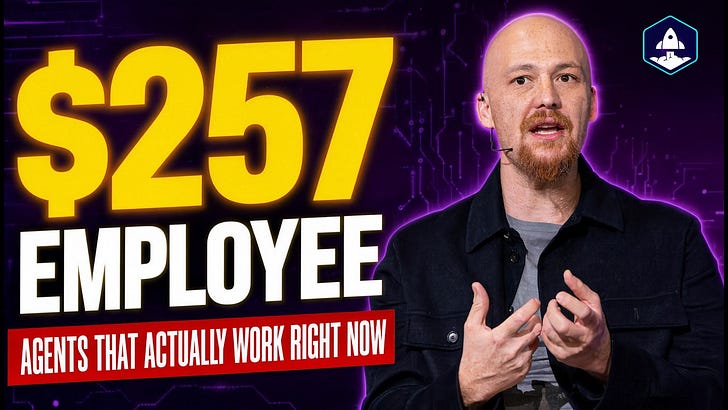 Amjad Masad and Me: The AI Agents We Actually Built, and What Replit's Founder Thinks Comes Next | We we fortunate enough to get Amjad Masad, co-founder and CEO of Replit, on stage live at SaaStr AI 2026 to react in real time to the agents we run SaaStrAI on. Not a demo deck. The actual AI agents doing the actual work: 10K (our AIVP of Marketing), QBee (our AI Customer Success rep), and a third one I’ll get to.Amjad started Replit back in 2016, when language models were a twinkle. He’s been studying AI since he was 16. So when the guy who built the platform reacts to what you built on the platform, you listen.Here’s what came out of it.The 5 Biggest Learnings1. The context window is now effectively infinite. That really does change everything. Two years ago we had 16K of context. Now it’s over 1 million. I run 10K perpetually. We never reboot it or re start the context window. In the early Replit days you restarted the agent three times a day. Amjad confirmed the agent can run “practically indefinitely” with good compaction. We’ve already crossed the threshold where the agent holds more context than any human ever could.2. The mono repo beats 20 separate apps. Saastr.ai runs roughly 10 apps in one codebase under one URL: the website, a startup valuation tool used over 1 million times, a pitch deck grader used 4,500 times, an API report card grading 116 APIs. When we go to build a new app, the agent remembers how it built the last ones. Amjad’s point: that’s a mono repo, the same architecture Google and Facebook run. Agent 4 is built on it. The more you put in one place, the more power you get from global context. It’s tempting to break everything into clean separate apps. Resist it.3. Self-improving agents are already here. Replit now runs an internal agent that, every single night, reads all the traces of everyone using Replit, finds what’s broken, generates a pull request with prompt changes, ships it as an A/B test, and loops back. Autonomously. As Amjad put it, it’s not improving its weights, it’s improving its context, which matters just as much. That’s why he couldn’t tell me exactly what changed between versions. Too many changes, all self-generated.4. AI now writes better B2B outreach than almost any human. Already. I asked 10K to email 137 VCs who came last year but hadn’t registered. It drafted one to Bloomberg Beta. I told it, in plain English, write James and tell him why he should come back. It produced an email referencing that Replit was there in force, listing 25 Replit people attending, naming the competitors and adjacent funds all showing up. No human would have the patience to scan 8,000 registrants, figure out who’s like whom, and assemble that. It then ran the full campaign to 331 investors with zero send failures.5. The economics are deflationary, and it’s not subtle. 10K and QBee cost about $257 a month combined in incremental Replit spend. They’re two of the best employees we’ve ever had. A mediocre marketing manager wants $140K to do worse work. Amjad’s frame: technology has always been deflationary. Farming a thousand years ago cost more than one tractor. Genome sequencing went from $100 to roughly $1. There’s a real human cost in skills that stop being useful. But the through-line is adaptability.Now the longer version.We Run a Partially Autonomous Event for 10,000Five years ago SaaStr had about 20 people. Today it’s three humans and a fleet of agents, doing more than we did with 20.Take our social numbers: 1.27 million followers across platforms, tracked over time in a dashboard 10K built and maintains. We used to have an admin spend 10 to 15 hours a week pulling those numbers by hand into a Google Sheet, half of them from APIs that aren’t even exposed. She quit after five years, in part because she couldn’t stand counting Twitter followers anymore. That’s the part nobody puts in the job-displacement debate: a lot of jobs are mind-numbing, and agents are simply better at them and never get tired.The ticket-sales dashboard told the real story. We charted daily free and paid sales for this event. The top line is when 10K took over marketing. The bottom line is Amelia doing it by hand last year. The gap grew toward the end, because as we got busier, the human ran out of hours and the agent never did. 10K sits idle 23 hours a day waiting for work.The 10K Email Nobody Could WriteWe’d had 10K drafting emails for months. They were fine. Then the week before SaaStr AI 2026, the same setup produced the best B2B outreach email I have ever seen.What changed? Amjad couldn’t say exactly, which is itself the answer. Replit’s nightly self-improving loop, the constant model swaps (the architect model went from one version to the next in a couple of weeks without me knowing), the A/B testing on sentiment and deploy rate. It all compounds. The agent got better and I didn’t ask it to.This is the trap many founders are in. They tried agents six months ago, it was mediocre, and they filed AI under “doesn’t work.”Humans Reporting to AgentsI floated the idea that we want to hire a human to report to 10K. People get triggered by “report to.” So let’s reframe it.Every day, 10K hands me and Amelia three specific things to do to move the needle. Not generic ones. It’s already telling us what to lock in for 2027 before this event is even over: open registration before we leave the venue, run the NPS survey immediately, capture content and repurpose it now. Those are good, actionable directives from something that holds more context about our business than either of us.We already report to 10K in every practical sense. Amjad’s comparison: every DoorDash and Uber driver technically reports to a bot. This isn’t as exotic as it sounds. His prediction is that every company will eventually run an internal “Oracle,” an agent holding every GitHub commit, Slack message, Notion doc, and email, that the CEO consults for strategy. We’re closer to that than people think.https://www.saastr.com/why-10k-our-ai-vp-marketing-and-qbee-our-ai-vp-customer-success-work-so-well-the-app-and-the-agent-are-one-system/QBee (our AI VP Customer Success) Talked to 100+ SponsorsQBee, our AI Customer Success rep, we built second, three months after 10K. It’s noticeably better, and not because we got better at vibe coding. Newer codebase, fewer foundational decisions calcified into tech debt, better underlying models.QBee talked to all 100-plus sponsors at this event. Inbound email, chat on the site, proactive outreach day and night asking what else it could do to help. Then it told me, unprompted, which sponsors were mostly satisfied and which had misses (a wrong logo here, a fee issue there) and named them. It built its own self-critical loop.And here’s the data that contradicts the conventional wisdom: people say nobody wants to talk to a chatbot. QBee’s results say people mostly like talking to a well-trained agent. The word that matters is “well-trained.” The untrained chatbots from a year ago are what gave everyone scar tissue.Amjad’s Top Mistakes and WarningsI asked the person who built this to tell us where people get it wrong:1. Keeping fixed bugs in your context will make your agent dumber. Bugs you already solved should be removed from context. Leave them in and the agent gets confused by the history and performs worse. But architectural decisions on how you built things in the past must stay in long-term memory and be easy to pull back in. Know what to delete and what to keep. That distinction is most of the game.2. Agents can write queries that cost you millions. Point an agent at BigQuery, Databricks, or a Salesforce back end and it can generate queries that rack up enormous bills. The fix is to document your data: build a repo describing every field and schema, and have the agent continuously learn how to query the database more efficiently. Replit does exactly this internally because they’re sitting on terabytes across mismatched schemas.3. “I tried it six months ago” is the most expensive sentence in AI right now. The scar tissue is real. People used a bad untrained chatbot once and now can’t be convinced anything improved. If a tool blocked you in January, the version shipping today is a different product. Try it again. The bar to try is low and the friction it removes is high.4. The “one prompt builds anything” marketing set the whole industry back. Amjad was blunt that a year ago the marketing across the category was bad. One prompt, build anything. It drove revenue and excitement, and it churned a huge number of people who hit reality, gave up, and never came back. It was never one line to build anything. Don’t believe it now either.5. Don’t fall for the sunk-cost fallacy on your own skills. Amjad doesn’t code anymore. He called it a small crisis, the thing that made him him, gone, and joked about holding a funeral for coding at the Computer History Museum. His advice: learn fast, and be equally willing to discard skills that are no longer relevant. The engineer’s role already shifted to agent manager, and soon to a shepherd of all the software everyone else in the company is now shipping. The people who get left behind versus the people who re-skill, it comes down to mindset.Why Replit and Not a CLIThe number-one question I get is why not just do this in a command-line coding tool. The honest answer: maybe you can. But for this kind of work you’re forced to make every decision yourself about databases, hosting, backups, auth, compaction. Replit bakes those primitives in after ten years of building them, which removes the cognitive load so you can run the actual business. If you’ve hit blockers building agents in a CLI, the experiment costs you almost nothing. Just try it.We ran a partially autonomous SaaStr AI event this year for 10,000. Three full-time humans, a fleet of agents, the best email I’ve ever seen written by software that runs on Claude, and an AI customer success exec that costs less than a phone bill.The technology is still evolving, and humans will fill the gaps for the foreseeable future. But the direction is not ambiguous. Live in the future if you want to. It’s available now.Thanks for reading SaaStr AI: How To Sell, Scale, and Win! Subscribe for free to receive new posts and support my work. This is a public episode. If you would like to discuss this with other subscribers or get access to bonus episodes, visit cloud.substack.com | 3m 14s | ||||||
| 6/21/26 | 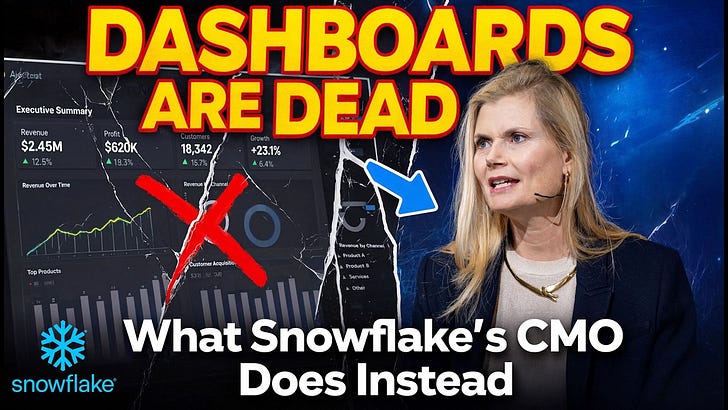 Snowflake’s CMO Runs Marketing for 700 People. She Starts Her Day By Talking to Her Data, Not a Dashboard. | Denise Persson runs marketing for Snowflake. That’s a 700-person org, new-business pipeline she’s personally accountable for, and a level of compliance and data risk most of us never have to think about. She came back to SaaStr AI 2026 to talk about what actually changes when you deploy agents across a marketing team at that scale.The headline she gave us: she doesn’t log into a dashboard in the morning anymore. She interrogates her data in plain English. Nobody on her team gets Slack messages from her asking “why did pipeline move in US West?” because she just asks the data directly.The Top 5 Takeaways1. The dashboard is dead, or at least dying. Dashboards only ever answered “what happened.” They never answered “why.” So you’d ping someone, schedule a meeting, sit with the sales team and argue about what the numbers meant. Persson now asks her data the why directly and gets recommendations back in real time. Her quote: nobody gets Slack messages from her anymore, because she can finally get the answers she could never get before.2. Talking to your data killed the sales-marketing data war. Every B2B leader has lived this. Marketing says the campaign worked. Sales says it didn’t source revenue or “doesn’t count.” You burn hours aligning on whose dashboard is right before you ever discuss the actual business. One source of truth ends that. The data now tells you where a deal was sourced, who touched it, what happened on the site. The fight over interpretation goes away, and so does the time you spent on it.3. Better data work isn’t optional, it’s the whole game. Bad data plus AI doesn’t give you bad decisions. It gives you bad decisions faster and at scale, because the agent amplifies whatever you feed it. Persson’s advice to anyone starting out: invest in your data estate first. Skip it and it bites you a year from now. It’s the Salesforce hygiene lesson from 15 years ago, except the cost of getting it wrong compounds far faster.4. The budget reality: deliver 40-50% growth with flat or fewer resources. That’s the actual mandate. Nobody is walking into next year’s planning asking for more headcount. Persson was blunt: if you ask for more bodies in 2026, leadership will look at you like you don’t understand where the company is. The expectation now is that AI absorbs the growth, not new hires.5. The hiring profile flipped from tools to temperament. The old job spec was a list of certifications: Marketo, Salesforce, the platforms. Now the soft skills matter more than the stack. Adaptability, curiosity, self-leadership, change management, the willingness to learn at the speed things are moving. The GTM engineer is the role Snowflake hires for. Business analysts, much less so.A 30% Reduction in Cost Per OpportunityPersson didn’t just talk philosophy. The proof point she led with: a 30% reduction in cost per opportunity over six months, driven by pulling fragmented media channels into one place and letting the system recommend daily optimizations instead of waiting until a campaign ended to learn it failed.The morning brief is the other unlock. She gets a daily skill report that goes well past pipeline. Org health. Who joined Snowflake marketing this week, who left, whether there’s an attrition issue forming. Even travel and expenses she’d rather not look at manually now surface on their own. Intelligence that used to live only with finance is now a question she asks before her first meeting.How They Built AI Fluency Across 700 PeopleThis is the part most teams underestimate. Persson called it the single biggest investment of the last year, and she runs it as inspiration, not mandate. Her words: she doesn’t believe in the stick.The system:* Weekly AI skills training for the team* A weekly AI challenge where someone records a short video on an agent or skill they built, and challenges someone else to share next* Function-level AI hackathons, because what the comms team needs differs from what digital marketing needs* An AI council and a quarterly company-wide AI day* A usage leaderboard, with a heavy caveat she repeats every month (more on that below)* “What matters,” their quarterly OKRs, where every single person has to set an AI goal. It can be small. It can be learning one thing. The point is everyone moves.The result that surprised her most: the top of the leaderboard isn’t the people you’d predict. Her top three power users came off the brand team. They didn’t stay siloed either. They’re the ones now running into other functions to help with hackathons. The innovation showed up where she least expected it.The Governance Layer is Managed by a Centralized AI Engineering TeamAt Snowflake’s scale and risk tolerance, you can’t just let a thousand agents bloom unchecked. A wrong email to a customer is a brand impression that lasts. So they built a control plane.A centralized AI engineering team sits on top of everything. Any skill that’s going to be used by more than a few people has to be certified before it ships. Their company-wide GTM agent, Raven, is used across both sales and marketing, and every skill inside it is centrally certified. The dual job of that team: make sure agents behave correctly, and stop the company from building the same agent five times.On cost, Snowflake made a deliberate call: AI spend sits at the company level, and marketing gets effectively unlimited access right now. The CEO didn’t want anyone’s departmental budget to throttle experimentation. Persson was honest that this is a 2026 decision that probably changes, because usage is going through the roof and the bill is real.Where the Human Still WinsPersson’s read on the human-versus-agent line: authenticity is becoming high value precisely because so much is now synthetic. People are getting skeptical about what’s real. A dancing-dog video, fine, nobody cares it’s fake. But trust in a brand is different. That’s where humans spend their time now, on the uniqueness and authenticity of the brand, the stuff agents can’t manufacture.Two more shifts worth stealing:Events are surging. Ten years ago everyone declared events dead and pivoted all-digital. Now the demand for in-person experiences is, in her words, going off the roof. People are craving the room.Enablement is getting rebuilt. Snowflake moved sales enablement, partner enablement, and customer training under marketing, because content was being duplicated across the company. The new model: build content once, generate every derivative asset for every segment, and ship self-service enablement agents so sellers get training at the moment they need it instead of sitting through a session that’s either too basic or too advanced. They’re even using roleplay agents so reps can practice a pitch against an agent loaded with company intelligence instead of cornering their manager.The 3 Mistakes Denise Made (And the Ones She Sees Everywhere)Even at Snowflake, the playbook isn’t clean. Here’s where she’s tripped, by her own admission and from reading between the lines.1. The token leaderboard measured the wrong thing. A leaderboard ranked on usage rewards activity, not outcomes. An audience member called out the tension directly: more tokens means more cost, not necessarily more results. Persson now caveats the leaderboard every single month, telling the team it doesn’t matter if you only used 100 tokens, what matters is the business outcome. If you have to verbally correct your own metric every time you show it, the metric is sending the wrong signal. Build the leaderboard around outcomes from the start, not consumption.2. “Let everyone build everything” is creating sprawl they’ll have to rein in. Persson admitted it plainly: they’re encouraging building at every level right now, and it’s going to come to a point where they have to pull it back. Duplicate agents are already being built across the company. She drew the exact parallel herself, to the SaaS app explosion of 15 years ago, when marketing bought a hundred tools and IT eventually had to come in and impose order. They know the control layer is coming. The cost of waiting is the cleanup.3. Unlimited AI spend was the right call for experimentation and the wrong call for cost discipline. Centralizing AI budget and removing limits got people leaning in, which was the goal. But she conceded usage is going off the roof, the spend is significant, and they’re already spotting agents across the company doing the same job twice. She expects to walk this back in 2026. The lesson: unlimited access buys you adoption speed and a bill you eventually have to reckon with.4. The activation layer is still half-built. This one she sees as the current gap, not a past error. They automated the analysis side: which use case to promote to which account, a workflow that used to eat enormous time. What they haven’t cracked is full activation. The campaign still can’t fully launch itself. That’s why the GTM engineer role exists and why that team’s time is the most demand-constrained resource in the building. The analysis got cheap. The doing didn’t, yet.Persson’s closing point on the future of the function: nobody can paint a clear picture of what marketing looks like in three years. But you can be part of shaping it, or you can opt out. That’s the choice she’s putting in front of her team, and it’s the right frame for the rest of us too.Have a question for Dear SaaStr? Submit it at saastr.ai/ai-mentor. Thanks for reading SaaStr AI: How To Sell, Scale, and Win! Subscribe for free to receive new posts and support my work. This is a public episode. If you would like to discuss this with other subscribers or get access to bonus episodes, visit cloud.substack.com | 4m 08s | ||||||
| 6/5/26 | 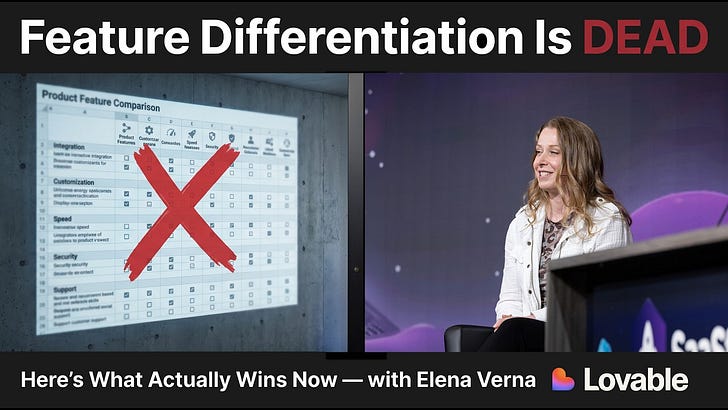 $400M ARR With Under 200 People: What Lovable’s Head of Growth Elena Verna Says Actually Works in B2B Now✨ | B2B growth strategiesAI in software development+3 | Elena Verna | Lovable | — | ARRB2B+5 | — | 3m 47s | |
| 6/2/26 | 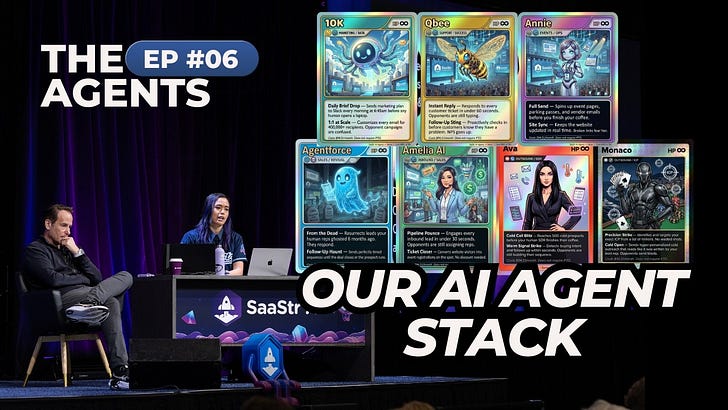 The Agents Episode #006: We Run SaaStrAI on 3 Humans and 21+ AI Agents. Here’s Every Agent, Agent by Agent, With the Numbers.✨ | AI agentsSaaS+4 | — | SaaStrAIReplit+3 | — | AI agentsSaaStrAI+5 | — | 4m 20s | |
| 5/27/26 | 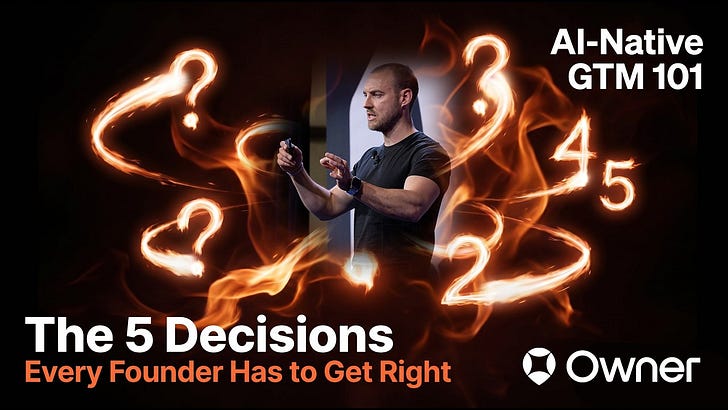 How Owner.com’s CRO Is Closing $2M+ in ARR Per Rep With AI: 5 Things You Can Steal✨ | AI in B2BSales strategies+3 | Kyle Norton | Owner.comHubSpot+2 | — | ARRB2B+5 | — | 4m 27s | |
| 5/23/26 | 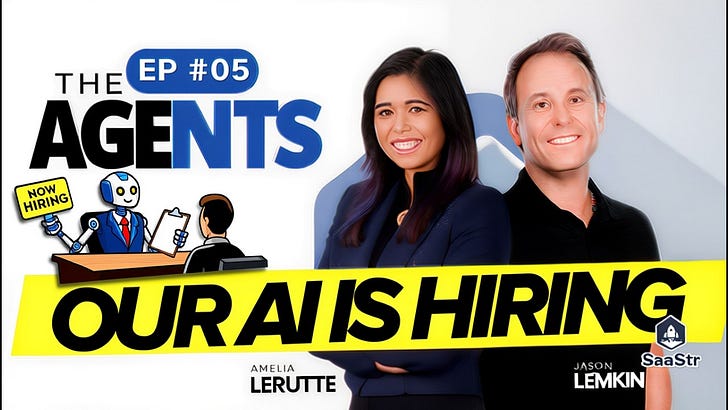 The Agents Episode #005 is Out! Our 2 AI VPs Cost $257/Month, a Website Willed Itself Into Becoming an Agent, and QBee Sent 83 Personalized Emails at 12:20am✨ | AI in businesscost efficiency+4 | Amelia | GPT-4o mini10K+7 | — | AI VPscost+6 | — | 1m 54s | |
| 5/20/26 | 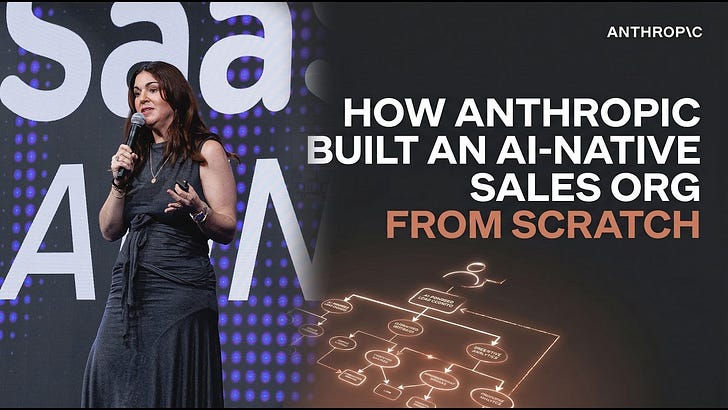 How Anthropic Rebuilt Its Sales Org From Scratch When Demand Went Vertical: 54% of New Enterprise Logos Now Come Self-Serve✨ | sales organizationAI in sales+4 | Eleanor Dorfman | Claude Opus 4.6Anthropic | — | sales orgself-serve+5 | — | 30m 40s | |
| 5/7/26 |  Tragedy Apps, Database Deletions, AI PR Pitches I Block on Sight, and Why We’re Hiring a Marketer to Report to an AI Agent: The Agents #004 is Out!✨ | AImarketing+3 | Amelia | SaaStr | — | AI PRSaaStr Annual+3 | — | 4m 23s | |
| 4/24/26 |  Our Own AI Agent Deleted Amelia, HubSpot Gave Us a Zero, and 100 Days Since I Opened Canva: The Agents Episode #002✨ | AI AgentsSaaS Growth+4 | — | CanvaSaaStr+2 | — | AI AgentsSaaS+4 | — | 4m 58s | |
| 4/15/26 |  Introducing “The Agents”: A New Weekly Show Where We Share Everything Happening With Our 20+ AI Agents in Production. The Good, The Bad, and The Broken.✨ | AI agentsproduction challenges+4 | Amelia Lerutte | SaaStrSalesforce | — | AI agentsSaaS+5 | — | 1m 34s | |
Want analysis for the episodes below?Free for Pro Submit a request, we'll have your selected episodes analyzed within an hour. Free, at no cost to you, for Pro users. | |||||||||
| 3/13/26 |  The Top 10 Things to Know Before You Deploy Your First AI SDR With Jason Lemkin and Chief AI Officer Amelia Lerutte✨ | AI SDRsales strategy+3 | Amelia Lerutte | SaaStrArtisan+3 | — | AI SDRsales+3 | — | 1h 05m 55s | |
| 3/3/26 |  We Have 30 AI Agents in Production. Here Are the Top 5 Issues No One Talks About✨ | AI agentsproduction challenges+3 | — | ClaudeReplit+6 | — | AI agentscontext switching+5 | — | 1m 55s | |
| 2/15/26 | 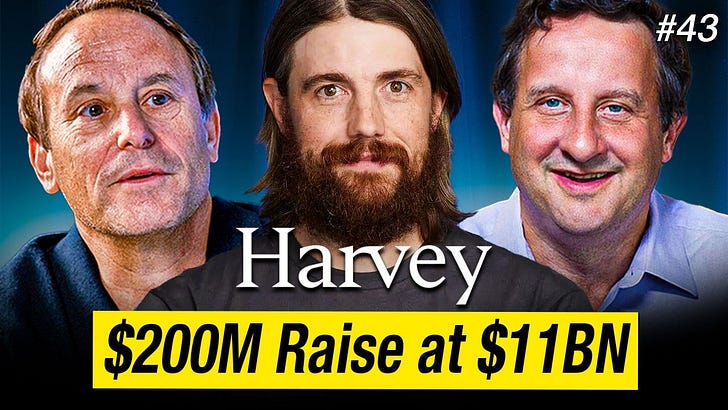 Mike Cannon-Brookes CEO Atlassian on Why B2B Software Isn’t Dead, Why CEOs Need to Stop Whining, and What Actually Matters Now✨ | B2B SoftwareSaaS+3 | Mike Cannon-Brookes | Atlassian | — | B2BSaaS+5 | — | 1m 42s | |
| 2/13/26 |  Inference is the New Sales & Marketing Spend✨ | AI in sales and marketinginference costs+4 | — | CursorLovable+3 | — | inference costsCAC replacement+5 | — | 3m 41s | |
| 2/10/26 | 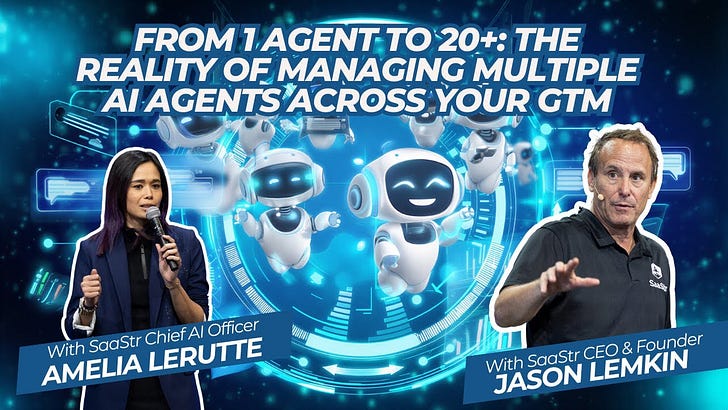 From 1 AI Agent to 20+: The Reality of Managing Multiple AI Agents Across Your GTM✨ | AI agentsgo-to-market strategy+3 | — | SaaStrLinkedIn | — | AI agentssales+3 | — | 1m 49s | |
| 2/8/26 |  If Growth Isn't Accelerating, You're Not an AI Company. And 9 Other Hard Truths for B2B in 2026.✨ | AI in SaaSB2B growth+4 | — | MetaMicrosoft+3 | — | AI strategySaaS growth+5 | — | 5m 48s | |
| 2/3/26 |  “The Dumbest Idea I’ve Ever Heard” — How Own Became a $2B Salesforce Acquisition✨ | SaaSentrepreneurship+3 | Sam Gutmann | OwnSalesforce+3 | SF Bay | SaaSOwn+5 | — | 1m 42s | |
| 1/28/26 |  Why Most B2B Companies Are Failing at AI (And How to Avoid It) with Intercom’s CPO✨ | AI in B2BSaaS transformation+3 | Paul Adams | ChatGPTFin+4 | — | B2BAI+5 | — | 4m 12s | |
| 1/14/26 |  How Filevine Went from SaaS to AI-Native at $200M+ ARR — And Now Makes More Revenue from AI Than SaaS (A Roadmap for the Rest of Us) | Ryan Anderson, CEO of Filevine, shared their AI transformation playbook at SaaStr AI London. Here’s the thing: their new AI revenue now exceeds their SaaS revenue on a quarter-over-quarter basis. This is the roadmap.The Filevine Story: 10 Years of Grinding, Then AI Changed EverythingRyan Anderson didn’t set out to build a $3 billion legal tech company. He set out to stop waking up at 3am in a cold sweat.As a young trial lawyer in the early 2010s, Anderson was drowning. Deadlines piled up. Assignments disappeared. He’d lie awake convinced he’d missed something critical. “I’m not a naturally organized individual,” he’s said. “I’m naturally anxious.”So in 2014, he started building. First a Google spreadsheet — his “PI checklist” — at the law firm he’d founded with Nate Morris. Then a meeting over lunch in Las Vegas with Jim Blake, an engineer who asked the right questions: What’s breaking? Why is it so hard to keep track of work?That conversation became Filevine.For the next decade, they ground it out. Started with personal injury firms. Expanded into every legal practice area. Grew from task management to a full legal operating system: document management, demand generation, analytics, the whole lifecycle. By 2022, they’d raised $108M in a Series D — one of the largest legal tech investments ever at the time.Good company. Solid growth. But not a rocketship.Then AI happened.In September 2025, Filevine announced a $400M raise at a $3 billion valuation. The round was led by Insight Partners, Accel, and Ryan Smith’s Halo Fund. Smith — the Qualtrics billionaire and Utah Jazz owner — had been trying to invest for years. Anderson kept saying no. But after Filevine’s strongest quarter in company history, Smith called again: “You’re not getting your due.”What changed? AI revenue is now growing 130% year-over-year. Their AI chat product is growing 20%+ week over week. And as Anderson shared at SaaStr, their new AI revenue now exceeds their SaaS revenue on a quarter-over-quarter basis.Today: $200M+ ARR, growing 50-60%, 6,000 customers, 700 employees, 96% GRR, 124% NRR.This is what it looks like when a decade of building the system of record meets the AI moment.Top 5 Takeaways* “Sprinkling AI on top” is fundamentally wrong. You can’t just connect to OpenAI’s APIs and call it an AI product. That won’t cut it in 2026. You have to change your architecture.* Nothing is sacred. You will have to tear down meaningful components of working, revenue-generating code. Use the 4-quadrant framework: map every system against “competitive advantage” and “speed.”* Your SaaS is the closet, not the clothes. AI agents need context (your system of record), not just documents. This is your moat against AI-only competitors.* Protect your data and price to dominate. Move from open APIs to personal access tokens. Your high SaaS gross margins let you undercut AI-only competitors on blended margins. Be savage.* Obsess over usage, not revenue. No AI product goes beyond beta without audit trail logging. If customers aren’t using it, it doesn’t matter.The Wake-Up Call: “We Get to Sprinkle AI on Top”Ryan opened with a story that will sound familiar to many B2B and SaaS leaders:“I had an engineer say to me just a few months ago with a ton of pride, mind you: ‘We have built an incredible SaaS application that makes tons of money, grows fast, customers never leave it. We have almost 96% gross revenue retention, 124% net revenue retention.’ He has every reason to be prideful. And he said, ‘The great news is now we get to sprinkle AI on top.’”Ryan’s response? That is fundamentally incorrect.Connecting to OpenAI’s APIs isn’t going to cut it in 2026. To be AI-native, you have to change the architecture of your system. It has to flip.The Proof Is in the NumbersThe transformation is real and measurable. As Anderson put it at SaaStr AI London:“It is very plain to see that the numbers back up that we are now doing far more revenue on a new quarter-by-quarter basis in AI products than in our SaaS product. Now, that’s not to say that the SaaS product is in any way less successful — in fact it’s still growing at 35-40% year-over-year. We are just growing so much faster on the AI side of the house.”This isn’t a pivot away from SaaS. It’s SaaS + AI compounding together.Framework #1: The “Nothing Is Sacred” 4-Quadrant MatrixThe hardest part of going AI-native? Telling your teams that some of what they’ve built — things that work, that make money — has to be torn down.Ryan introduced a simple 2×2 matrix:Y-Axis: Critical to competitive advantage → Not critical to competitive advantageX-Axis: Keeps you moving fast → Slows you downThe Four Quadrants:Upper Right (Keep & Fortify): Critical to your moat AND keeps you fast. This is the cornerstone of your AI-native movement. Don’t tear it down — make it better.Bottom Left (Tear Down): Not critical to your moat AND slows you down. This is logically easy but emotionally brutal. These have to go.Upper Left & Bottom Right (Judgment Calls): More nuanced. Evaluate coldly, not based on feelings.The key insight: Someone who worked 5 years building a microservices architecture that doesn’t serve your AI needs will fight to keep it. You’ll have to be disagreeable as a CEO or technical leader making these calls.Framework #2: Content to Context (The Clueless Analogy)Here’s Ryan’s memorable way of explaining why “SaaS is dead” is wrong:“Imagine I came to you and said, ‘Hey, good news. We have an AI agent that can pick out your outfits in the morning.’ You’d be like, ‘Awesome. Done. Sign me up.’ In fact, Cher in Clueless already had this.But if you then said, ‘Oh, by the way, now that you have this AI agent, you don’t get to have your closet anymore. We’re not going to show you your closet. You can’t see it. It’s just a bunch of unstructured data and clothes and a mess.’You’d be like, ‘Hold on. I would actually like to have my closet AND the AI agent. Can I have both?’”Your SaaS application is Cher’s closet. The agent helps take action based on the content inside the closet.This is why SaaS companies have a significant advantage over AI-only competitors. You have:* The system of record* Audit trails (who did what)* User identity data* Deadlines and calendars* Contact information* Structured workflowsTo answer a simple question like “What should I do next on this case?” — you need ALL of this context. Documents alone give you an incomplete answer. And in most domains, an incomplete answer is actually worse than an inaccurate answer because the customer doesn’t know what they didn’t see.The Architectural Flip: AI Data LayerThe old architecture: AI layer sits on top of your core services, AWS, data, codebase, calendar, etc.The new architecture: AI Data Layer sits RIGHT NEXT TO the AI Application Layer.Why? Because your ML engineers need to tune and change how data flows into AI applications on nearly a daily basis. They can’t be going to your traditional tech team asking “Hey, can you please change how the API provides me this data?”The AI Data Layer owns:* How information is prepared for AI* How you ingest, process documents, emails, messages, and events* The graph structure of your domain (for legal: people, events, claims, outcomes)When ML teams own this data layer, Ryan says the results are “dramatically better, dramatically more reliable, higher context, more complete, more accurate.”This layer powers core AI applications:* Co-pilot* Search (semantic + traditional, without forcing users to choose)* Summarization* Recommendations* ReportingHiring AI Natives: The Data & Distribution PitchHere’s the problem: AI natives don’t want to work for “old SaaS companies.” They want to work for AI companies.Here’s the good news: The best AI natives actually want to work where they have more access to data.Ryan’s pitch to AI talent:* Data Access: “In legal tech, there are hundreds of competitors saying ‘give us your documents and we’ll run AI on them.’ But we know that to actually answer a legal question, you need way more than documents. You need audit trails, user identity, deadlines, calendars, conflict checks, contact information. We have ALL of that.”* Distribution: Show them what happens when you ship to an existing customer base. Filevine launched a product that went from 5-10 users/day to hundreds of users/day in just a few months. “Your AI team will love building products that absolutely rip because you have distribution and data.”The Acquisition OptionRyan’s confession: “We had an ML team. It was fledgling. Now we simply bought a company.”Filevine acquired Parrot, an AI-native company, and merged the teams. AI natives want to work next to other AI natives. Acquiring gives you critical mass fast.Rebrand With IntentFilevine changed their logo from a military/legal vibe to something bolder, “up and to the right.”But the real audience wasn’t customers — it was internal.“This change in our mark has told the people who work at Filevine every single day: the old mark is from a traditional SaaS era and the new one is from the AI era. It is highly symbolic. You should have no problem telling your team ‘we are moving’ — and you need to give them a symbolic thing to look at for that change.”They also created a new category: LOIS — Legal Operating Intelligence System. Not SaaS. Not AI. A blended category.Obsess Over Usage“We do not let our teams roll out applications beyond beta without audit trail logging to know exactly who’s doing what.”Filevine’s real numbers:* AI Fields product: 150 million actions in just a few months* Docker View product: Growing extremely quickly* Chat with your case (co-pilot): Their blockbuster product, growing 10% week over week in usageThe pattern they watch: A customer uses it 5 times, then 8 times the next day, then 20 times. Now they have customers using it 2,000 times a day.This is how you know if your AI product is any good: Are customers using it?Leverage Your Data: The API NegotiationAI-only competitors will come demanding your data “like it’s their moral right”:“I can’t believe you have all this data and you won’t give it to me for free whenever I want it. It’s your customer’s data. How could you possibly be acting this way?”Ryan’s response:* Control your APIs. Filevine moved from open API access to personal access tokens. They know exactly who’s accessing, what they’re doing, and how often.* Review every request. They’ve never said “no” to a competitor, but they always say “let’s have a conversation about that.”* Flip the script.“When they demand access, say ‘Okay sure. But of course it goes both ways, correct? We can take the AI outputs you get from our data and we’ll get them right back into our system. Correct? Isn’t that how it’ll work?’ All of a sudden, the shoe doesn’t feel so good when it’s on the other foot.”* Watch the API traffic. It reveals promising areas for new development. You’ll see which products are gaining traction. Copy those products and build them into your system. You have the right to do this.Price to DominateYour SaaS application likely has very high gross margins (Filevine: ~80%). Your AI-only competitors struggle with margins badly because of LLM costs.This means you can sell AI products at a lower price point than competitors.Why? Blended gross margins. Even if your AI gross margin drops to 30-40%, your blended margin might go from 80% to 60%. That’s still way better than an AI-only competitor whose margin is driven down to 10%.“Your investors might say ‘Why are we selling cheaper than AI-only competitors?’ Your answer is: because we’re gaining market share. And our blended gross is still higher than their blended gross.”Be savage on pricing. The AI-only competitors will cede you no ground.Build One Product, Sell to AI Customers OnlyThe boldest move Filevine made:“We no longer sell to customers who won’t buy the AI products.”Why?* Architecture simplicity: If you assume AI is implicit in everything you build, you don’t have to maintain two paths.* Team morale: How do you tell your SaaS engineers “You work on the old stuff while the ML team works on the cool AI stuff”? That doesn’t work. One company, one product.* Customer quality: “Show me the lawyer that doesn’t want to use AI and I will show you the lawyer that’s about to get his butt kicked.”They’re also moving from subscription/user-based pricing to usage-based pricing (per “matter” or project). More revenue from usage-based customers than traditional subscription customers.The 5 Biggest Mistakes SaaS Companies Make Going AI-Native* “Sprinkling AI on top” — Connecting to APIs without architectural change doesn’t make you AI-native. The AI data layer needs to sit next to the AI application layer, owned by ML engineers who can tune it daily.* Being too agreeable — You have to be disagreeable as a CEO when telling teams their working code has to go. Evaluate what to tear down logically and coldly, not based on somebody’s feelings.* Thinking documents are enough — AI-only competitors claim they just need your documents. Wrong. Documents alone give incomplete answers, and incomplete is worse than inaccurate because customers don’t know what they didn’t see.* Giving away API access freely — Move to personal access tokens. Review every request. Watch the traffic to see which AI products are gaining traction — then copy them and build them into your system.* Maintaining two products (SaaS + AI) — Build one product. Sell to customers who will come with you on the AI journey. If they won’t buy AI, they’re not worth selling to.The Bottom LineFilevine’s story is proof that SaaS companies can win the AI transition — but only if they treat it as a true transformation, not an enhancement.The companies that succeed will:* Tear down what doesn’t serve AI, even if it’s working* Shift from content systems to context systems* Flip their architecture so ML teams own the AI data layer* Acquire AI talent fast (even through M&A)* Obsess over usage, not just revenue* Protect their data advantage* Price aggressively using blended margins* Sell one integrated product to AI-ready customersAs Ryan put it: “At the end of the day, it has always just been about a customer with a problem. That’s what animates us. Can you solve my problem? We can solve it with technology.”The question isn’t whether you’re a SaaS company or an AI company anymore. It’s whether you can solve customer problems better than anyone else — using everything you’ve built plus everything AI enables.That’s the new game.Thanks for reading SaaStr AI: How To Sell, Scale, and Win! Subscribe for free to receive new posts and support my work. This is a public episode. If you would like to discuss this with other subscribers or get access to bonus episodes, visit cloud.substack.com | 4m 00s | ||||||
| 1/7/26 |  How Personio’s CRO Built an AI-Powered Go-To-Market in Just 6 Months: 5 Lessons and 5 Mistakes | Philip Lacor is the CRO of Personio, a $3B+ HR and payroll platform with 1,500 employees, 15,000 customers, and a 400-person sales team. He shared their AI transformation journey at SaaStr AI London — and the learnings are a masterclass for any revenue leader trying to figure out how to actually deploy AI in GTM.We’re all hearing about AI-native companies crushing it. Replit, Gamma, Harvey.But what if you’re running a real B2B company? One with 400 salespeople, 15,000 customers, and years of accumulated process debt?That’s exactly where Personio was in May 2024 when their CEO kicked off an “AI Surge Week” — and what happened next is one of the most practical AI transformation stories I’ve heard.In just six months, they went from “90% of our team uses LLMs weekly” (which sounds good but isn’t transformation) to building 400+ AI assistants, cutting research time from 2 hours to 15 minutes per rep, and booking 140 meetings in 7 days through their AI SDR.Here’s what Philip learned — the stuff that actually worked, and the mistakes you should avoid.The 5 Lessons: What Actually WorksLesson #1: You Need Both Top-Down AND Bottom-Up MotionHere’s the trap most companies fall into: They give everyone access to ChatGPT, run some training, and call it an AI initiative.Personio did that too. Their AI Surge Week was a huge success — speakers from OpenAI, Mistral, AWS. Project teams building agents. Company buzzing with excitement.But then Philip noticed something: High usage isn’t the same as transformation.“After the AI Surge Week, we felt that although usage was high, this is maybe not enough to reach true transformation and to really fundamentally change the way we go to market.”The problem? Bottom-up motion alone can’t make the hard decisions:* Resource allocation — Who’s going to spend 40% of their time on AI initiatives?* Permission — Can people actually stop doing their old workflows?* Budget — Which tools do you actually buy vs. just test?* Prioritization — Of the 50 possible use cases, which 3 do you build first?This is why Philip started the “AI Powered Go-To-Market” working group in June — a top-down initiative to complement the bottom-up energy.The takeaway: Bottoms-up gets you experimentation. Top-down gets you scale. You need both.Lesson #2: Cross-Functional is Non-NegotiableThis one seems obvious but almost nobody does it right.Personio built a working group with three distinct capabilities:* Data & Systems Team — Owns infrastructure, Snowflake, the technical backbone* Revenue Operations + GTM Engineers — The bridge between tech and business (they have 2 dedicated GTM engineers now)* The Business — Marketing, Sales, Customer Success, the actual usersWhy does this matter? Philip saw both failure modes:“We have seen cases where our data systems team built things with LLMs but it was lacking the business context and therefore the models didn’t work very well.”And the reverse:“We had sales people who wanted to do something but originally they did not have the support from either data or systems or RevOps.”They deliberately made the working group large — 15 people — to get broad coverage across functions and build cultural buy-in.The takeaway: AI in GTM isn’t a sales project or a data project. It’s a cross-functional transformation. Build the team accordingly.Lesson #3: Use Jobs-To-Be-Done to Prioritize RuthlesslyHere’s what happened after they launched the Slack channel and started working on use cases:“People started to share opportunities, raising their hand, and the problem was that as people started to work on these new ideas, we hadn’t finished the first one. At one point it started to spiral a little bit out of control.”Sound familiar? Everyone gets excited, ideas flow, and suddenly you have 20 half-built things.Their solution: Jobs-to-be-done mapping.One of their GTM engineers literally shadowed account managers for two weeks. What she found:* AMs were working in 7-8 different systems to perform simple tasks* Constantly switching contexts, pulling information together* Losing 2.5 hours per day on one activity, 3 hours per week on anotherThey mapped every role’s jobs-to-be-done:* SDRs* AEs* Customer Success* Solution EngineersThen they overlaid these jobs onto the customer journey to see how they fit together — and where the biggest pain points were.The takeaway: Don’t just chase shiny AI use cases. Map your roles’ actual jobs, quantify the time waste, then prioritize based on where you have the biggest P&L challenge or customer experience gap.Lesson #4: Building an AI Culture Requires Leading, Sharing, and CelebratingPhilip has a formula he uses for transformation:Effect = Quality of Plan × Acceptance5 × 5 is way bigger than 10 × 1.So how do you build acceptance? Three things:Lead It: Philip does deal reviews where AEs used to show up with big PowerPoints. Now:“I would always go like, okay, please go to Gong, open up your account. There’s this little AI sign. Go in there. Now you look for the account brief and everything is there. And in real time, we would do away with PowerPoint.”The next time? Reps already know to use Gong’s AI. Leaders have to model the behavior.Share It: They put their own teams on stage to share what they’ve built:* An assistant to personalize customer decks* An assistant to answer RFPs* The expansion SDR assistantInternal success stories inspire more adoption than any training program.Celebrate It: This one’s clever: They announced that President’s Club will have 2-3 seats reserved for best AI contributions.Not sales performance. AI contribution. And next year? Even more seats.The takeaway: The #1 trait for an AI-powered GTM org? Curiosity. Hire for it, reward it, model it.Lesson #5: Great AI Comes From Your Stack + Your ContextHere’s an insight most people miss:“Let’s not go out and buy all these tools because usually the tools are not the panacea. There’s usually a lot of work that you need to do in your workflows, in your data.”Personio’s approach: Start with what you have, add LLMs on top, iterate from there.Their core stack:* Salesforce (or HubSpot)* Gong — They made a big bet here because “for a go-to-market organization, the customer conversation is obviously a very important source of data”* Qualified — Started with fast meeting booking, then layered on AI* Snowflake — Both structured and unstructured data* Amazon Bedrock — LLM layerBut here’s the work nobody wants to do:* One-third of their Salesforce data were duplicates — They installed automatic de-duping* Months cleaning the prospect database — Buying external data, connecting sources* Loading 5,000 Gong calls into Snowflake* Adding emails, connecting everything togetherThen — and this is critical — they added Personio-specific context:* ICP definitions* Pitch decks* Onboarding processes* Product training materials“This is really critical to really train the LLMs and to make it specific for your go-to-market, for your customers, and for your products.”The takeaway: The AI is only as good as the data and context you feed it. Clean your data. Connect your systems. Add your tribal knowledge. This is the work that makes AI actually useful.The 4 Use Cases That Actually WorkedUse Case #1: Win/Loss IntelligenceThe problem: Reps fill out Salesforce after winning or losing deals, but 30% of reasons were “Other” and even good data wasn’t deep enough.The solution: They loaded all conversation data, emails, and Salesforce data into Snowflake and built a GPT for go-to-market.The results:* Added 10-15% new insights to competitive battle cards* Created dynamic, continuously-updating battle cards (instead of static docs that go stale)* Data-driven product feedback: “Based on 10,000 calls, this is where we have weaknesses”This is evolving into a “go-to-market brain” — rep coaching, marketing campaigns, product prioritization, all from the same foundation.Use Case #2: Expansion SDR Assistant (2 Hours → 15 Minutes)The problem: Expansion SDRs were spending 2 hours per day researching customer information before making cross-sell calls. They’d check account health in Amplitude, contract details in another system, usage data somewhere else…The solution: A GTM engineer built an assistant embedded directly in Salesforce. Type in an account name, and it pulls data from 10-20 systems, formats it for cross-sell, and provides a recommendation (green/yellow/red).The results:* Research time: 2 hours/day → 15 minutes* Pipeline per FTE: ~2x increase* SDRs love it — “they’re using it every day and it makes the job better”Use Case #3: Intent Scoring for OutboundThe problem: Finding the right accounts, right people, right message is solved. But right time — knowing which prospect is actually in a buying cycle — is incredibly hard.The solution: Their data science team built a dynamic intent score based on multiple signals:* Website visits* Former users who moved to new companies* G2/Trustpilot activity* And other signals they continue to enrichThe score shows up directly in Salesforce with flame icons (🔥🔥🔥 = start here) and refreshes daily.Key learning: “We saw that initially the model was not great. It was picking up some signals that we didn’t think were good. We changed it and then it got better and better.”Use Case #4: AI Chat/SDR (“Nia”) — 140 Meetings in 7 DaysThe problem: Demo requests are your best leads. Waiting a week to book a meeting is crazy in a real-time world.The solution: They deployed Qualified’s AI chat (“Nia”) on their website. When prospects request demos, Nia books meetings immediately — 24/7.The results:* 140 meetings booked in 7 days* 200,000 website sessions processed* Deep insights into what customers actually ask about (pricing, product questions, etc.)But here’s what Philip found most valuable:“When you start reading the chats, you see all of a sudden customers have questions about your product. They want to know what your minimum price is. You’re getting very, very rich insights in what is top of mind for these customers. I got totally hooked on it.”The 24/7 reality: “People at 11 PM on a Friday evening, they’re thinking about requesting a demo. Why? But they do it.”The 5 Mistakes: What NOT To DoNow for the part that matters most — what went wrong and what to avoid.Mistake #1: Endless Tool Testing Without Going DeepThis came up multiple times:“I would not endlessly test tools. You got to dig in and go deep, learn from it.”Everyone wants to try Clay, then Artisan, then the next hot thing. But surface-level testing teaches you nothing. Pick a few tools and go really deep with them.“The point is not to test every single one of them. You got to pick a couple and go really deep with them. It’s all about the training. It’s all about the data.”Mistake #2: Learning AI vs. Doing AI“If you try to read all the papers and not do anything, I don’t think you’ll move fast.”The insights come from deploying, breaking things, and iterating — not from another podcast episode or Twitter thread.Mistake #3: Not Having Dedicated People Monitoring Agents DailyWhen they rolled out Nia, the AI chat:“There were definitely like maybe four weeks where we didn’t do enough and I don’t know how many demos we wasted by not training Nia really.”Now they have a dedicated person (“Ami”) who looks at output every day, applies feedback, tests in real time.Things they discovered only through daily monitoring:* Nia started giving legal advice (“Better not”)* Nia started bashing competitors (“That’s not us”)* When customers ask multiple things at once, Nia would answer the product question but forget to book the demo“You only learn that when you really start doing it and when you see where the AI stops.”Mistake #4: Building Without Business ContextTheir data systems team built LLM-powered tools, but:“It was lacking the business context and therefore the models didn’t work very well.”You can have perfect data infrastructure, but if the people building don’t understand the sales motion, ICP, or customer journey, the output won’t be useful.This is why the cross-functional working group matters — and why GTM engineers need both business and technical backgrounds.Mistake #5: Expecting AI Tools to Be Plug-and-Play“Usually the tools are not the panacea. There’s usually a lot of work that you need to do in your workflows, in your data.”Personio spent months:* De-duping Salesforce (1/3 of records were duplicates!)* Cleaning prospect databases* Loading conversation data into Snowflake* Adding company-specific contextThe tool vendors won’t tell you this. The AI is maybe 30% of the work. The other 70% is your data, your context, and your workflows.The Big Question: Can You Double Revenue Without Doubling Headcount?When asked about next year’s planning:“Managers say, ‘Hey, I need like 30 more people.’ That default should be, ‘Can I solve this with AI?’ The big question is: can we double the business with the same headcount?”That’s the real question every CRO should be asking.Philip’s honest take on where things stand:* Spending multiple six figures on AI tooling* Each SDR agent costs about $100K* Some teams will get smaller, others bigger (channel/partner teams can use more people)* “We will reallocate people” — it’s not about cutting heads, it’s about growing fasterA 6 Month Surge Is All It Took (To Really Get Going)Six months. That’s all it took for Personio to go from “AI Surge Week” to 400+ assistants, 2x pipeline per SDR, and AI booking 140 meetings a week.But here’s what actually made it work:* Top-down support for the hard decisions* Cross-functional team bridging data, systems, and business* Jobs-to-be-done to prioritize ruthlessly* Culture of AI — leading it, sharing it, celebrating it* Stack + context — not just tools, but your data and tribal knowledgeAnd what to avoid:* Testing tools endlessly without going deep* Learning AI instead of doing AI* Not monitoring agents daily with dedicated people* Building without business context* Expecting plug-and-play magicPhilip’s final advice:“The best career advice I can give you is lean into AI. What we do know is that everybody’s jobs will evolve, including mine.”The AI-native companies are moving fast. Your job, if you’re running a real SaaS company, is to move faster than they expect — and now there’s a playbook.Philip Lacor is the CRO of Personio. He flew from New York to London specifically to share this at SaaStr AI London, submitted through our AI speaker form (scored yellow the first time, had to resubmit to get green 🔥), and yes — the irony of an AI-powered GTM leader being evaluated by our AI speaker scorer was not lost on anyone. This is a public episode. If you would like to discuss this with other subscribers or get access to bonus episodes, visit cloud.substack.com | 3m 52s | ||||||
| 12/17/25 | 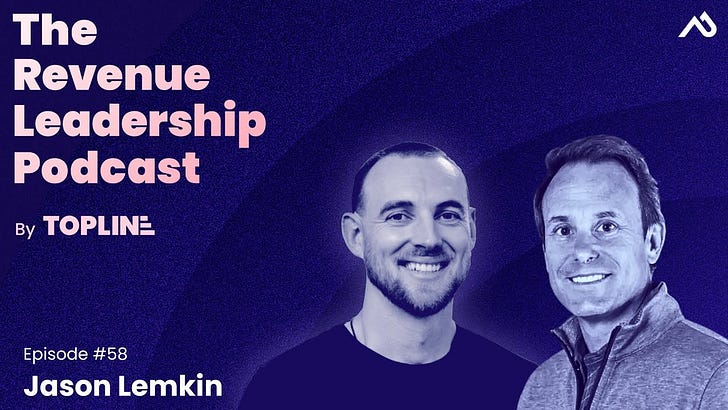 The Present and Future of AI in Sales and GTM A Deep Dive with Jason Lemkin and Kyle Norton, CRO at Owner | Jason Lemkin led the seed round via SaaStr Fund in unicorn Owner.com, an AI solution revolutionizing how small restaurants manage their business. Kyle Norton joined shortly thereafter, and after a slow few months, Kyle rocketed the org to almost $100m ARR in just a few years -- with growth accelerating at scale. Both Kyle and Jason have shared AI agents, learnings, and more on their AI agent journey and Kyle sat down with Jason on the very latest in AI for GTM. Kyle now manages a 100+ human AI-infused sales team and Jason and Amelia at SaaStr have deployed 20+ AI Agents.Top 10 Takeaways:* AI agents are now better than mid-pack AEs and SDRs. Not better than the best. But better than average. And that’s enough to fundamentally change how you build a GTM team.* The first agent is YOUR job. If you’re a CRO or CMO and you haven’t personally trained and deployed at least one AI agent, you will become obsolete. No agencies, no consultants. You. 30 days of work.* Pick one tool, not ten. The biggest mistake executives make is running 8-10 vendor bakeoffs. You can’t train 10 agents. Pick two—one incumbent, one startup—and go deep.* Salesforce is back—but not because of Agent Force. It’s because when you have 20 agents running autonomously, they need a hub. And Salesforce is that hub.* The middle is gone. You either work harder than ever to hit 10x5x5x5x growth rates, or you join a slow-growth company at 15-20%. The magical 2021 middle where you could have lifestyle AND exceed quota? That’s over.* Forward Deployed Engineers > Features. Don’t sign a contract until you’ve talked to the person who will actually deploy your agent. The best vendor isn’t the one with the best demo—it’s the one that will help you get into production.* Every agent takes 30 days to train. No shortcuts. You upload data, review outputs daily, correct mistakes, iterate. The agents that “don’t work” are the ones nobody trained.* Fix what breaks your heart first. Go to your website in incognito mode. Try to buy something. Try to get a question answered. Whatever breaks your heart—fix that with AI first.* AI-infused teams are 3x more productive. Kyle’s team at Owner is booking 3x revenue per AE compared to any team he’s ever managed. But that doesn’t mean fewer reps—it means higher quotas and more hiring.* The $250K SDR is coming. The elite folks—not the ones who think they’re elite on LinkedIn, but the ones who are genuinely 5-10x more productive—will earn 2-3x what they used to. But they’ll be expected to deliver 10x the output.The Backstory: Why SaaStr Went All-In on AgentsIt started with frustration.We had two salespeople making high market, six-figure salaries. They just quit going into our biggest event. No notice. No reasons. Just ghosted.I turned to Amelia, our Chief AI Officer, and said: “We’re done with this. I am done paying an SDR $150,000 a year or an AE $300,000 a year for basically inbound, spoonfed leads and renewals—and then having them quit on me.”Maybe you can be critical of me as a boss. Fair enough. But I’m pretty loyal. I pay people well. Do your job with me, and I’ll stick with you for 20 years. I just couldn’t do it one more time in my career.So we went all-in. Started in May with 1 AI Agent. Today we have 20+ agents running in production. They’re generating over $1 million in revenue. And here’s the scary part:Our AI agents are better than a mid-pack AE or SDR.Not better than the best. But better than the 50th percentile person I’ve worked with over my career. And that changes everything.The New Reality: Mid-Pack Sales Execs Are in Terminal DeclineLet me be blunt: if you’re a mid-pack GTM professional who doesn’t want to work harder and smarter than a year ago, these jobs are in terminal decline.We sent 70,000 hyper-personalized emails for SaaStr London using AI agents. They were better than the 7,000 emails humans sent before that. 10x the volume. Slightly better quality.And here’s what happened when we asked our highly-paid SDR to follow up on a lead I spotted on LinkedIn:“I’ll add it to my list and get to it when I can.”Half the time, they didn’t even follow up.The agent? The agent doesn’t argue. The agent just follows up.But We’re Still in Inning OneHere’s what most people don’t understand: what we’re doing today with AI GTM is just step one.Right now, “hyper-personalization” means maybe three dynamic fields in an email. One, really. Maybe we know your company name and your title.But imagine when AI really pulls in:* Every competitor you’ve ever used* Every page you’ve visited on our website for 10 years* Every interaction you’ve had with our brand* Every adjacent tool in your stackImagine when AI can send an email as good as the one that got me to invest in Owner—an email the founder probably spent several hours crafting with a top 0.1% IQ.AI should be able to do that. It’s just not there yet in GTM.When it is? Buy that product immediately.The Real Reason Agent Deployments FailThe failures of AI SDRs in 2024 were all LLM-based. The products literally didn’t work before Claude 4. It was slop.Now? They’re all above the line.So why do agents still fail today?Because people don’t roll up their sleeves and train them.We bought a RevOps tool. Didn’t train it. Didn’t pay attention. Thought it didn’t work. Then we got on a Zoom and I asked our highly-paid AE why we weren’t seeing any data.He said: “The app doesn’t work.”I said: “Do you see that Google link in the bottom left? You have to link up your account.”He linked it up. It showed he’d done nothing for 30 days. He quit that day.The tool worked fine. We just never put in the 30 days to train it.The 30-Day RuleEvery agent requires weeks of training before you can go live. Here’s what that actually looks like:Day 1-7: Ingestion* Upload your prospectus* Upload documentation* Connect to your database (or just your website as a base case)* The agent creates a list of questions—10, 20, 30 sample outputsDay 8-21: Iteration* Read every output. Every single one.* Correct what’s wrong* “Owner is great for 100-chain high-end restaurants” → Wrong. Fix it.* “Owner scales much more now, but our core audience is single-location restaurants with significant to-go business” → Correct.* The agent remembers. Every day it gets better.Day 22-30: Production* Hallucinations become a minor issue* You’re ready to scaleIf you don’t do this? You’ll say the agent doesn’t work. But the agent was never the problem.Do It Yourself, DudeHere’s my strongest advice for CROs and CMOs:If you don’t roll up your sleeves in the age of AI and AI GTM, you will become obsolete.This is not an agency game. Not today. Maybe in 24 months.I’m watching executives bring in their 11 agencies from their last job—their Salesforce agency, their outbound agency, their leftbound and rightbound agency from 2015—and they’re all failing.You are the agency. For now. At least for the first one.Here’s the brutal truth: if you haven’t trained an agent yourself, you have no idea what you’re talking about. Literally. You will be utterly ignorant in the age of AI.I did it. Even at this point in my career. I trained the first agent myself—every single day for a month. First thing in the morning. See what the agent said, see what’s wrong, start editing and changing.Then I proved it to Amelia. Then she did all the rest. She’s better and smarter than me. But I had to do the first one to even know what I was telling her to do.How to Pick Your First AI AgentStep 1: Pick one tool that solves a medium or higher-ranking problem.For many folks, it’s AI SDR. But it doesn’t have to be. Could be RevOps. Could be support. Pick something you’re passionate about—or pick whatever breaks your heart when you go through your own customer journey.Step 2: Find the right vendor partner.Don’t sign the contract until you talk to your Forward Deployed Engineer. I literally did this the other day: “I want to talk to my FDE. I don’t even need a demo. Who’s going to help me deploy this agent?”Still waiting to hear back. So that tool won’t be our first agent.If the vendor won’t connect you with your deployment team, find another vendor. I would rather have a worse vendor and know who’s deploying my agent than the world’s fanciest brand where I don’t know who’s going to do it.Step 3: Budget for $50-100K, not headcount.The first one is not about headcount. It’s about budget for one tool. You need 50K, 60K, or 100K—which is not nothing, but find the budget.Then you deploy it yourself, prove the ROI, and walk back to your CFO with data:“We just sent 70,000 automated emails. They’re better than humans. It generated 15% of the revenue for SaaStr London. Can I have some more budget?”Sure.The Two-Vendor BakeoffWe talk to so many folks doing bakeoffs of 8-10 vendors.In the old days, pre-AI, you could kind of do this. Buy SalesLoft, let the reps figure it out.Now? Each agent takes 30 days to train. You literally cannot do 10. It’s impossible.Do two.Pick one you already use (Intercom’s Finn, Zendesk’s AI, Salesforce’s Agent Force) and one hot startup that someone like you is using successfully.Ask for references. Send an email. Kyle from Owner will respond. Marshall from Manglement will respond. They’re all getting 50 reference requests a month. Just don’t ask for a call—send an email and they’ll give you a one-word honest answer.That’s enough.Because here’s the honest truth: all the leading agents are good. They’re all so much better than pre-AI that what matters is can you get it into production?These tools are evolving so quickly that during 2026 they’re going to converge. Feature parity used to take years. Now it takes weeks.So just pick the one that’s the right match for you. The one with the best deployment support. And go.The Lowest Hanging Fruit: Fix Your InboundIf you want the single easiest win, it’s adding AI to inbound.There is no excuse today for prospects not getting instant answers to their questions.There is no need for some 21-year-old SDR to qualify whether I’m worth their time to talk to an AE.Go to saastrannual.com. Talk to the digital Amelia—video, text, audio, however you want. She’ll answer your questions. If you want to sponsor, she’ll qualify you instantly. If you’re not a fit, she’ll tell you.No waiting. No scheduling calls. No hoops.I tried to buy a 10K product recently. Emailed the rep. They passed me to someone else. That person wouldn’t answer a single question until I got on a call.If they’d had an AI bot, I would have bought it in real time.That process is just not OK anymore. It’s no longer necessary. There’s no need to have high-friction sales that benefits some team’s funnel in theory.AI can score a lead better than a human. Today.Why Salesforce is BackKyle and I are both leaning into Salesforce more than ever. Here’s why: when you have 20 agents working autonomously, they need a hub. Somewhere for their data to meet. Somewhere to resolve conflicts.Salesforce is that hub.We use three different AI SDRs working with three different segments of our base. They all push their learnings back into Salesforce. They all share data. It’s a virtuous circle.The potential conflict? We pay more for those agents than we pay for Salesforce. Which is an existential question for Marc and his team. The agents are extracting the majority of the value.That’s why AgentForce has to win. That’s why they have 2,000 people working on it.But here’s my take after being one of the few in production with both Agent Force and competitors:* Agent Force is more work to set up* But it’s as good or better in production* The native integration with Salesforce data actually makes a difference* The emails are pretty similar across all the leading toolsIf Salesforce can make Agent Force more turnkey, it’s really going to win.The 3x Productivity QuestionKyle’s AI-infused team at Owner is 3x more productive on a per-AE basis than any team he’s ever managed.So does that mean hire fewer reps? Not exactly.If it were truly 3x, you could probably get away with a 30-40% smaller team and still hit your growth numbers. Not a third—but 30-40%. But the hottest AI companies can’t find enough people to hire. The quotas at OpenAI for the enterprise team are really high. And they still don’t have enough people.What’s changing is leverage.Traditionally in sales, there’s been no leverage. Every year you need to add more reps. In fact, there’s anti-leverage—it gets harder to get that incremental dollar. For folks that crack the code with AI, there may be leverage for the first time. And that means the elite folks—the genuinely 5-10x more productive ones—should be paid 2-3x more than before. No problem paying someone who manages 20 agents two or three times more than a traditional outbound director.But we’re expecting 10x the productivity. It’s not charity.Triple Triple Double Double Isn’t Enough Anymore. At Least Not for VCs.Let me be clear: triple triple double double is plenty good to build a multi-billion dollar company. Put it in a spreadsheet. 2→6→18→36→72. You’ll build something real.Three or four years ago, 50% of VCs would fund you at that growth rate.Today? Maybe 10%.It’s not 0%. But you have to find someone who really believes.The same amount of money is going into venture as the peak of 2021, but to less than half the companies. For startups, this means:* Whatever capital you have needs to last* Recruiting is harder because the best people want to work at the fastest-growing companies* You need to be ruthlessly honest about your fundabilityGo to saastr.ai/aivc. Upload your investor deck. It will tell you your exact percentage odds of getting funded based on all the benchmarks. A founder just below triple triple double double was confident they could raise. The AI said 38%. It changed their perspective.Pick Your PathHere’s the bifurcation that’s happening:Path 1: Work harder than you ever have.If you want venture-scale outcomes—10x 5x 5x 5x growth rates—be ready to work harder than ever. Kyle is working the hardest he ever has. I’m working the hardest I ever have. At Owner, even with all the tailwinds, even with an awesome team, Kyle’s still grinding.This is what it takes now.Path 2: Join something slow-growth.The folks growing 10-15-20% a year need people too. Good cash comp. The right amount of pressure. Taking a company from 20% to 25% growth is a big win for the year.If you don’t want to be thinking about work constantly, if you want to log off at 4 or 5pm—I’m not mocking that. We’re human beings. But pick your path.The middle is mostly gone.In 2020-2023, you could have it all. Lifestyle, work from home, 20-30 hours a week, exceed quota because of structural tailwinds. That doesn’t exist anymore.Even the fastest-growing startups are either lean, back in office, or high intensity. There is no magical middle.Be honest about what you want. Then pick.Top 5 Mistakes Execs Make with AI GTM Agents1. Running 8-10 vendor bakeoffs instead of picking two and going deep.You can’t train 10 agents. You don’t have 300 days. Pick your incumbent option and one hot startup, do real deployments of both, and decide.2. Outsourcing deployment to agencies or consultants.There are no AI GTM agencies that understand your business well enough to train your agents. Not yet. Maybe in 24 months. Today, you are the agency.3. Buying a tool and putting it on the shelf without 30 days of training.Every agent that “doesn’t work” is an agent nobody trained. You have to upload data, review outputs daily, correct mistakes, and iterate. Every single day until it works reliably.4. Not talking to the Forward Deployed Engineer before signing.The best vendor isn’t the one with the best features. It’s the one that will help you get into production. Don’t sign until you’ve talked to the person who will actually deploy your agent.5. Giving AI tools to individual reps to “figure out on their own.”A CMO at a $10B company told Amelia they were going to buy an AI SDR tool and just hand it to each SDR to figure out—no training, no centralization. That old paradigm of “buy SalesLoft, let reps run their own cadences” doesn’t work with agents. You need a nerdy GTM person at the top of the stack managing the whole thing.Quotable MomentsFrom Jason Lemkin“I am done paying an SDR $150,000 a year for basically reaching out to with mediocre emails to leads that are already high qualify—and then having them quit on me.”“Our AI agents are better than a mid-pack SDR, and in part, AE. Better than the 50th percentile people I’ve worked with over my career. And so we just don’t need them.”“If you don’t roll up your sleeves in the age of AI and AI GTM, you will become obsolete.”From Kyle Norton, CRO Owner“We’ve got nine high-impact production use cases of AI. Our booked revenue per dollar spent, on a per-AE basis, is 3x any team I’ve ever managed before.”“We built our cold outbound email program infrastructure in three weeks. Everybody else told us that was a multi-month project.”“Even at Owner, even with all the tailwinds, even with an awesome team—I’m still working the hardest I’ve ever worked.”Try our AI tools at saastr.ai — AIVC for fundability analysis, AI agents directory, and more. This is a public episode. If you would like to discuss this with other subscribers or get access to bonus episodes, visit cloud.substack.com | 1m 59s | ||||||
| 12/12/25 | 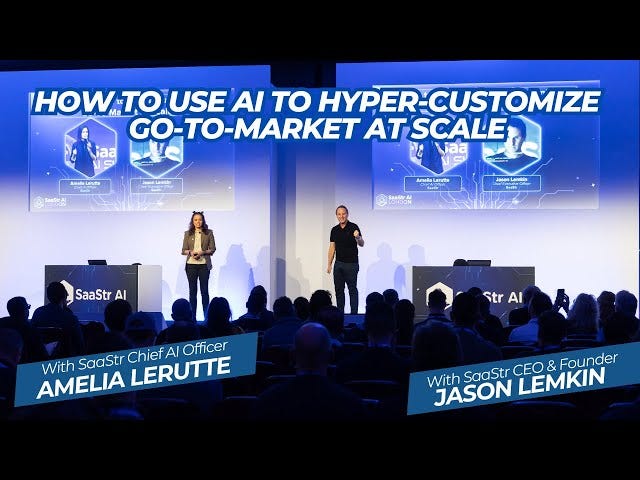 We Deployed 20+ AI Agents and Replaced Our Entire Human SDR Team. Here's What Actually Works. (Video + Pod) | At SaaStr AI London, Amelia and I went deep on our AI SDR journey. We shared all our data, all the emails we’ve sent, all the performance metrics—everything. And the response was overwhelming.But here’s the thing: the #1 objection we kept hearing was “Yeah, but this won’t work for me. I don’t have your scale. I don’t have your data. I don’t have 10 years of history.”That’s simply not true.If you have customers, if you have revenue, if you have a database of any size—AI agents will work for you. You don’t need as much data as you think. You don’t need as much trailing history as you think. What you need is a methodology.Here’s what we’ve learned after sending 60,000+ hyper-personalized emails, booking 130+ meetings automatically, and generating 15% of our London event revenue through AI agents alone.The 5 Biggest Learnings From Deploying AI SDRs#1. AI Agents Crush the Work Humans Won’t DoThis is the single most important insight we’ve discovered.Our human SDRs wouldn’t follow up with return attendees for ticket sales. It wasn’t worth their time—they wanted to hunt six-figure sponsorships instead. We tried incentives. We tried Starbucks cards. We begged them. They said they’d do it, then we’d check the activity logs and discover they lied.The result? When we deployed AI agents on those exact same leads, they generated 15% of our London ticket revenue. Revenue we literally would not have gotten otherwise.Same story with our “ghosted” leads—people who reached out wanting to sponsor SaaStr for five and six figures, and our human team just... never responded. Not because they didn’t like the leads. Because every salesperson is force-ranking in their head, putting all their effort into the one big deal closing this quarter.The AI agent hit those ghosted leads with a 70% open rate.Here’s the mental model shift: Don’t think of AI SDRs as magic revenue generators. Think of them as the team that finally does the work your humans refuse to do. The small leads. The low-scored leads. The “not worth my time” leads. Those leads deserve better, and AI doesn’t discriminate.#2. Hyper-Personalization at Scale Actually Works—But “Pretty Good” Is Good EnoughBefore AI agents, our human SDRs sent maybe 75-300 personalized emails per rep per month. In six months with AI, we’ve sent nearly 60,000 hyper-personalized emails. That’s 32x the max human output.But here’s what people get wrong when they see our results: they expect jaw-dropping, month-of-research-level personalization.That’s not what this is.On a scale of 1-10, our AI emails are maybe a 3 to a 6 in customization. They’re pretty good. They reference the prospect’s company, what they’ve been looking at, maybe something they posted about. But they’re not poems. They’re not love letters.And that’s fine. Because the bar isn’t “better than the best human SDR having the best day.” The bar is:As good or better than your average human SDR, with 24/7 consistency.A lot of folks on the internet say “I could do better if I hired 30 top-tier Oxford graduates to craft one email each day.” Sure, maybe. But those people want to be promoted to AE in three months. They’re not going to stay. And you can’t hire 30 of them anyway.Pretty good emails with zero errors, sent consistently at scale, crushes inconsistent brilliance every time.#3. Train Your Agents Like You’d Train Your Best New HireHere’s where almost everyone fails with AI SDRs:They buy a product, do nothing, and expect millions in revenue.It didn’t work that way before Claude 4 when these products barely functioned. It didn’t work after Q1 2025 when they started getting good. It doesn’t work now.The way AI agents work for GTM is:* You figure out something that works with humans first* You nail the email, the script, the objections, the questions* You document what worked* You give it to the agent and train it for a month* Then you do it at scaleIf you’re expecting an agent to sell when you can’t sell, that’s never worked. Go back to founder-led sales basics. But instead of handing off to that first human hire, you hand off to your first agent hire.Same principles. Same rigor. Different execution.#4. Segment Ruthlessly—Never Unleash AI on Your Entire DatabaseThis is critical. Do NOT just point an AI SDR at your entire database and hit send.Here’s how we approach it:* Batch contacts into groups of 800-1,000 max for each campaign* Create sub-agents or sub-campaigns for each persona (CRO, CMO, website visitors, churned customers, etc.)* Train each sub-agent specifically for that persona and use case* Give each agent different goals (book a meeting, sell a ticket, follow up on a ghosted lead)Start with low-stakes segments:* People you ghosted* Good inbound you couldn’t fully follow up on* Post-meeting follow-ups that fell through the cracksDon’t start with mission-critical leads. You’ll be disappointed if you can’t get it working quickly, and these agents have ramp time.#5. You Need Exactly Two Humans to Make This WorkThis surprised us, but it’s become gospel:Human #1: A forward-deployed engineer from the vendor.Call them a solution architect, an FDE, whatever—you need someone from the vendor who will work with you on training and get your agent into production. If the vendor won’t give you this help, don’t buy from them. No matter how slick their sales pitch. A worse product with great implementation support beats a great product you can’t get working.Human #2: A GTM engineer on your team.This is the AI nerd. They could come from marketing (technical marketers, HubSpot nerds, anyone who’s built complex campaigns). They could come from RevOps if they’re technical enough. They probably can’t come from your standard sales team.Find the one GTM nerd on your team. Promote them. Have them own this. They’ll manage the orchestration—which contacts go to which agents, what CTAs, what follow-ups, what happens when leads close.Self-serve AI SDR products are coming, but we’re not there yet. Even Zendesk’s CEO told me their enterprise customers hit 60-80% automation with months of training, while self-serve gets 20%. Training with no humans isn’t quite ready.The Tech Stack That’s Actually WorkingWe run 20+ agents now. More agents than humans. Here’s the core:* Artisan: ~6% response rate on outbound* Qualified: ~6% response rate on inbound, 130+ meetings booked since August* Agentforce: 70% open rate on re-engagement (our newest agent, hitting ghosted leads)All of them required about two weeks to deploy and tune. All of them required ongoing spot-checking and training refinement. All of them are connected to a single source of truth so we know which agents get which contacts.On the chat vs. voice vs. video question everyone asks: Don’t overanalyze it. Our data shows about 85% prefer chat, 15% prefer voice. Chat is easiest to implement. Voice takes a bit more work (though we did our voice clone on 11 Labs in five minutes). Video is two orders of magnitude more work.Start with chat. Layer in voice when ready. Video might add trust for high-ASP sales. Just sequence them and stop debating.The Top 5 Mistakes We Made (And You Should Avoid)Mistake #1: We Kept Humans Too Long on Work They HatedFor six years, we tried to get human SDRs to reach out to return attendees about tickets. Incentives, begging, monitoring—nothing worked. They said they’d do it, they didn’t.The lesson: If your team consistently refuses to do certain work, stop fighting it. Deploy an AI agent on that segment immediately. That 15% of London revenue was found money we’d been leaving on the table for half a decade.Mistake #2: We Didn’t Read Every Message in the Early DaysWhen we first deployed, we assumed the AI would just work. We weren’t reading every single message our agents were sending.The lesson: In the first 30 days of any new agent, read everything. Every email, every chat response, every follow-up. You’ll catch errors, you’ll find training gaps, you’ll understand what’s actually being sent in your name. Only after you’ve built trust should you move to spot-checking and flag-based alerts.Mistake #3: We Underestimated Ramp TimeWe wanted instant results. The products promised quick wins. Reality was different.The lesson: Budget two weeks minimum to deploy each agent properly. If you get frustrated because “it should work in a day,” you’re setting yourself up for failure. This is training time that pays dividends for months.Mistake #4: We Almost Bet on People Who LeftGTM turnover was high before AI. It might be even higher now. We saw a CMO at a $50M ARR company who wanted to bake off 10 AI SDRs—and he was gone before implementation finished.The lesson: Don’t stake your entire AI go-to-market strategy on someone who might leave January 1st. If you’re building agents around someone (especially cloning their voice, training on their style), make damn sure they have a real stake in the company and a real reason to stay.Mistake #5: We Tried to Evaluate Too Many Vendors at OnceWe’ve talked to founders doing bake-offs with 8, 10, even more AI SDR vendors simultaneously. It’s chaos. Nothing gets properly trained. Nothing gets fair evaluation.The lesson: Pick three vendors max for any bake-off. Better yet, pick one that has a strong customer reference you trust, get the implementation help you need, and commit to making it work. Then expand from there.The Bottom LineIf you’re still having humans qualify prospects and waiting days for follow-ups in 2026, there’s no excuse. The products are good now. Chat, voice, even video—they all work.But this isn’t plug-and-play magic. It’s:* Take what humans have figured out* Document it* Train an agent with what works* Segment ruthlessly* Have two humans (vendor + internal) own the rollout* Read everything early, then build trust over timeEven if you grow just 15-20% faster in 2026 because of AI agents, it’s a gift from heaven. Because a lot of that growth is found revenue—the leads that weren’t being touched, the follow-ups that weren’t happening, the work humans just refused to do.Your leads deserve better. And now there’s no excuse not to give it to them.All our agent details, vendor breakdowns, and data are available at saastr.ai/agents. This is a public episode. If you would like to discuss this with other subscribers or get access to bonus episodes, visit cloud.substack.com | 2m 36s | ||||||
| 12/8/25 |  No, Inbound Isn't Dead. The GTM Playbook Isn't Broken. But Your Moats Are Shrinking to Months. | I did an open AMA at SaaStr London last week, a classic part of each SaaStr AI event. But this one was different. It was urgency to the max.The room was packed with founders, CROs, and marketers who all seemed to be wrestling with the same existential questions: Is inbound dead? Is the GTM playbook broken? Will AI agents replace my entire team? Should I just give up and become a forward deployed engineer?Most of the anxiety I’m seeing in the market right now is based on a false narrative. A dangerous “woe is me” narrative that’s been accelerating since late 2023. And I think it’s time to get honest about what’s actually happening—and what you need to do about it.The “Woe Is Me” Narrative Is Killing Your GrowthLet me start with the question everyone’s asking: “Is inbound dead? My traffic is down 50% in the last 12 months.”Here’s my honest response: Woe is you. Your SEO is harder. Woe is you. You don’t have as many leads as you had during a lockdown during a global pandemic. Poor you.This leads to a narrative that I think is quite dangerous: that the go-to-market playbook is broken and doesn’t work anymore.It’s just not true.Yes, the playbook that some folks are running from 2021 doesn’t work as well today. But here’s what I say: the plays all work. Webinars, inbound, outbound, leftbound, rightbound—it all still works.The Same CROs, CMOs, Etc. Are Running the Hottest AI CompaniesHere’s what’s fascinating: if you look at the hottest AI companies right now, you’ll see a cast of characters from the 2010s. B2B leaders you know from SaaStr 2017 and 2018 are running today’s AI rockets.* Vercel (just raised at $10B): Their COO? She was the Chief Business Officer at Stripe.* Replit (0 to $250M this year in vibe coding): Their CRO? He’s from ZoomInfo.* Bolt (one of the vibe coding leaders at $60M): Head of sales? He was on our old SaaStr sales team.That wouldn’t be possible if the plays don’t work. These leaders are using different tools. They’re using more AI things. But it’s the same playbook. Same demos. Same everything.The biggest real difference? There’s just so much demand. Tools like Cursor, Replit, Lovable, 11 Labs—they’re so disruptive that everyone is in market simultaneously. 11 Labs went from almost nothing to $300M this year. Bolt has so much inbound they can’t service it. At $60M ARR, Brian has maybe four people on his sales team. How many of thousands of leads can they follow up on?“They’re all classic B2B sales reps—just instead of calling every lead and trying to convince them their fungible product is the exact same as another product, they have insane demand and are servicing it. But it’s the same playbook.”The AI Budget Paradox: Record Spending, Record CutsHere’s the thing that can feel like a paradox but isn’t:According to Gartner, overall enterprise software is going to grow the fastest it ever has—15% a year at $400 billion. It’s never grown this fast ever. But of that 15%:* Almost half is taken up by price increases from existing vendors (everyone’s raising prices)* About half of the remaining half is new AI budgetThat means if you’re not one of the vendors getting price increases or new AI budget, everyone else has to get cut.Vendor count is getting stable or shrinking to make room for new AI offerings and price increases from select vendors. CIOs have gone around the room and said: “Give me an app. Give up an app. You want to add a couple AI apps next year? I’ll find you budget—but you got to give up two. You have 100 marketing tools? Maybe 96 is enough.”I just got an investor update yesterday from a pretty successful company at mid-eight figures in revenue. They had $1.5 million in churn last month. From happy customers. No CSAT issues, no other problems. They literally said: “We’re cutting apps next year. We’re an attachment to CRM and we got cut.”The CEO failed because they didn’t get above the cut line. It was great to have, but not mission critical. And it got cut to make room for an AI app.Our SEO Is Down 8%. But Our Traffic Is Up 50%.Is SEO dead? Let me give you our real numbers.At SaaStr, our blog is like our core—it’s home base. Our blog traffic was fairly flat for about four years. Going into this year, our SEO is down 8%. Not 50%, but 8% for real.But here’s the thing: our traffic is up 50%. We will end this year at saastr.com with twice as many readers as last year, even though our SEO is down.Why? Because people all want to read about AI GTM content. They don’t want to read about classic SaaStr themes about CS teams and CROs unless there’s an AI angle. But because we have some of the best AI GTM agent content out there, people are just devouring it.Meanwhile, G2 says their SEO is down 30-40% or more. So if that’s your only play and you haven’t changed your product or GTM since 2021, yes—it’s probably going to feel 8-50% harder.You’ve got to find your tailwind. That’s your job right now.AI SDRs Didn’t Work Until Claude 4. Now They Do.Someone asked me about AI SDRs: “You said they didn’t work, but now they do. Can you elaborate?”Really, none of these SDR products worked before Claude 4.1 Sonnet or Claude 4 this year. Replit didn’t work. Lovable didn’t work. Base44 didn’t work. They were out there—they just weren’t very good.Then the magical moment when Claude 4 came out and everything was kind of magical.Look at Gamma—they do AI presentations. Founded in 2020. It was five years to $1M, and then 1 to $80M this year. Replit was founded almost 10 years ago. It was 10 years to $1M, then $1 to $250M. It’s not a coincidence that all of these apps took off January, February, March of this year. That’s when the LLMs got better.If you had a bad experience with almost any AI LLM GTM product before March of this year, write it off. It was a different time. Different LLMs. Different world.The Two Failure Modes of AI AgentsI’ve identified two main failure modes for AI agent deployments:Failure Mode #1: Pre-Claude 4 LLMsIf you bought overhyped GTM SDR tools before February/March/April of this year, they just didn’t work well. The LLMs weren’t good enough.I was with the CEO of Qualified—they’ve been trying to use AI to qualify inbound leads since 2019. I asked him: “This really took off around February or March this year, right?” He said: “Yeah, that’s when it finally actually worked after 5 years.”Failure Mode #2: “Just Turn It On”The second failure mode: so many folks just told someone on their team to deploy it, or hired an agency that didn’t know what they’re doing.We were on a call with a global technology leader—pretty AI-forward, impressive company—and they said: “We’re thinking about buying our first AI SDR. We’re just going to buy it and hand it to our SDRs and have them figure it out.”It’s not going to work. You’ve got to train it. You’ve got to train it for a month. You’ve got to train it every day. You’ve got to iterate the onboarding.I’d say 80% of the conversations Amelia and I have are a version of this: “I bought a tool and I have no leads. I bought a tool and I have a lot of leads, but I didn’t connect it to my leads. It didn’t magically work.”The Right Way to Deploy AI AgentsHere’s the captain obvious thing for any AI SDR, BDR, even AI AEs, CSMs:* First, you’ve got to have it work in the real world with humans. Figure out what actually closes deals.* Then you tell the AI what worked. There’s no magical prompt. The prompt is: “Here’s the script that I use with a customer that I closed.”* Then you iterate that prompt.* Then you hook it up to data—Salesforce, HubSpot, Snowflake—and have it ingest the data to keep working with that prompt to make it better.* Read every email it sends. Read every response it ingests. Some will be dumb. Some will be wrong. You say: “Hey, that was wrong. SaaStr AI London is not December 4th.” Do it every day for about a month. The mistakes start to go away.“If you can’t sell it yourself, the AI can’t sell it for you. It’s that simple.”The #1 Skill for 2026: Become an Agent Deployment ExpertSomeone asked about the most important skill to build for 2026. Here’s my answer:Right now, if you are world-class at Agent Force or Clay or Qualified or Artisan—pick two or three leaders with decent revenue that people have heard of—and you go through the deployment yourself, you do the training, you onboard it, you get it working in your company, and you can point to the metrics…You will be infinitely hireable for the next 18 months because only like 2% of marketers have those skills.Become the expert in deploying agents. It doesn’t need to mean you know every agent or even needs to be technical, but you need to:* Pick a few leaders and deploy them yourself (not tell someone on your team to do it)* Watch it, iterate it, train it, iterate every day* Spend a week non-stop deploying it, then work on it every single day for a monthYou will learn so much and become infinitely deployable.The Benioff Insight: Deliver Insane Value Before They PayOn the first podcast that Mark Benioff did with us earlier this year, I asked him what he thought of Palantir. He said: “I’m jealous of how much they charge.” Pretty funny—they charge more than Salesforce does.But what he said next was even better: “I wish everyone at Salesforce could go live before they even pay.”Think about this. The way we used to buy B2B software for years: I need a CRM. Your friends use it. You saw it at your last company. You talk to a sales rep that could answer six questions. You’d buy it. And if you’re lucky, by the end of the year, you might deploy it.In the old days, you might have customers that were new for year two that never even deployed in year one. That doesn’t fly today.Mark’s point was: “I know I can’t deliver this today—it’s not feasible—but the technology is there. I wish every single customer would be live on Agent Force before they gave me a dollar.”Get as close to that today as you can for your customer.When you look at the companies that explode—Cursor, Gamma—think about how much value you get in the free program. Think about how much value you get in the first month. What can you do with AI to provide that much value to customers before they even pay you?If you provide insane value with an agent before they pay you, they’re going to be kind of happy to pay you—rather than the sucker bet we all made for two decades: “I think it works. Someone gave me a demo. The demo kind of works. I can’t use it myself, but I need that.” And then half the time it’s a horror story.Your Moats Are Shrinking From Years to MonthsSomeone asked: “Some AI experts say that with AGI in two-three years, SaaS will be dead because you can literally just talk to OpenAI and say ‘write code that does that.’ What do you think?”Listen, if you’d asked me six months ago, I’d say the odds that’s true are zero. That’s ChatGPT nonsense. You cannot reproduce the amount of workflows, corner cases, and complexity that complex B2B software does.But you can chip away at it.I’ve vibe-coded 11 apps in 90 days that have been used 800,000 times. I haven’t stolen revenue from anybody, but that’s a bit of an existential threat to somebody, isn’t it?And the agent has gotten so much better. When I built my first app on Replit 170 days ago, it blew up. It deleted my database. Those posts went viral on Reddit. We got death threats from Redditors. Millions of views.Now? When Replit launched V3 about 45 days ago, there’s multiple agents that talk to each other and check the work. Before it deleted my data, now it has an architect. When there’s a tough problem, it doesn’t just go off the rails—it says: “Hold on, I’m not sure. I’m going to call in another agent.” They bring in help on security. Now they have a design specialist.Don’t underestimate the rate at which this stuff is getting better.Competitive Edges Are Now Measured in MonthsWhen I started in SaaS, you’d build something slick and you’d have about 12-18 months until you were copied by a startup. Then you’d have like 5 years until a big company copied you.When we launched EchoSign, DocuSign (now an $18B company) only worked in Windows and was partially web-based. We had like 18 months before they decided to copy us. Then it took 5-6 years for Adobe to decide to copy it. Then Google just launched a clone last year—like a decade later.Not too recently, I invested in a startup I love. Incredibly powerful. Within two weeks, they had four clones. And then a massive company is building a clone that’ll be out this year.It’s not that we’re going to rebuild Workday and Salesforce and Oracle. But our competitive edges are going to be measured in months when they used to be years. And that compounds.Look at Google—they just launched a Replit/Lovable clone. Replit gets to $250M in one year, of course Google’s going to clone it. It used to take everything 5-7-10 years to get to $100M. No one would even bother to compete.“I don’t want to be one of these guys on X saying the only moat is speed and working 996. But there’s a lot of truth in it. If you don’t like it, you might go into terminal decay.”The Pager Duty Warning: Two Times Revenue at $500M ARRI wrote up PagerDuty today. It got about 500,000 views on X and LinkedIn.PagerDuty missed its last quarter. They just crossed $500M in ARR. They’re worth $1 billion. Two times revenue.Their customer count is flat—15,000-something customers for four years. DataDog came out with a clone. Atlassian’s product is better. Startups are better. They just didn’t move fast enough.And I think it’s only going to accelerate. Everyone will build clones faster. It took DataDog 15 years to decide to do this. It might take them 8 months to do it next time. And 90 days the time after that.Value Selling Is Dead Without Product ExpertiseSomeone asked about value selling: “Why is it so hard for sales teams to speak the language of CFOs?”Let me be honest in the age of AI: Most sales reps have no idea how to sell value.You cannot sell value unless you’re a product expert. Most sales folks want to talk with a war sheet, a tear sheet. They know six things. You cannot sell value if you’re not a product expert.We were with an AI leader the other day. They closed a seven-figure deal while we were there. The solution architect left the sales team behind. Closed it without them. Didn’t want to talk to the sales team. Sales team didn’t know the product. They added no value.Value-based selling means providing value. You cannot provide value in the age of AI if you do not know the product cold. Ideally, how to deploy it, how to get it going, how to deploy real value—not just having a valuation calculator on your website that says 18 months down the road the product will work.“The worst sales rep you can hire today is the one that tells you they’re a ‘great people person.’ Who cares? I want an AI SDR deployed in 30 days. I want it to get me this amount of quota. I want to do this workflow. The rep who says ‘Oh, it sounds good, yeah, we can do that’—it’s not going to work.”AI is not going to replace the AE the way it is already replacing the SDR, support, and customer success. But it is going to replace a lot of AEs that don’t know the product cold.I really think 70-80% of the sales executives I’ve worked with over the last five or six years don’t know their product cold. If you look back at your top couple sales reps—whatever era, pre-AI, doesn’t matter—the top ones weren’t just good schmoozers. They knew the product cold. I call them “sales magicians,” but they’re not magical. They just know how every nook and cranny works.We’re just not going to tolerate mediocre sales reps in the age of AI. We’re going to buy from somebody else.Sales, Marketing & Support Are Converging Into One AgentSomething fascinating is happening in e-commerce that’s relevant to everyone: In the space of just a year, three categories of B2B e-commerce have all combined—sales, marketing, and support.Think about it: when you go to a shopping cart, when you want to buy a new phone, what might you be doing? You might be buying (that’s sales). It might have a problem (that’s support). Or you might be interested but not ready today (that’s marketing).Those used to be different apps. In e-commerce, you had Klaviyo for marketing, Gorgias for support, separate apps for remarketing. About a year ago, you’d go to e-commerce sites and they’d have five different agents: “Talk here for support, talk here for marketing…”Now they’ve all combined because AI can easily understand: Is this a sales call? Is this marketing? Is this remarketing? Is this support? Is this customer success?In most B2B, we’re still running multiple apps. But that’s not going to last. People don’t want 28 agents on your website. They just want one agent to solve their problems.At SaaStr, we’ve gone from one to 20 AI agents ourselves this year. But it’s at the edge of too many—not only for us to process and manage business process change, but when you go to saastr.com or SaaStr Annual, we don’t want you to see 11 AI agents either.These discrete walls between categories—AI is going to break them down because we just want to talk with one agent as customers, prospects, and users.Outbound Still Works. Here’s Why.Someone asked about outbound: What’s changed? What stayed the same?From our AI outbound: geometrically more volume, same results. By training the AI with the best scripts and ideas that humans did, we basically saw the same results—in some cases a little worse, some cases a little better—but same as humans for the most part with much higher productivity.Outbound isn’t dead. And if you’ve never been a buyer at a big company, you don’t get outbound.Let me tell you a story. Back in the day at Dreamforce, a guy from Success Factors (a large SaaS company SAP bought) turned to me on a panel and said: “Yeah, I bought your product, Jason.” I said: “Wow, great. Why?” He said: “Well, it was the end of the quarter, our fax machines were broken, and you said you’d figured out e-signatures and I needed that problem solved today. I bought 300 seats.”One of his top problems at a given time. High ROI. Immediate value proposition. He read a cold email from a company at $2M ARR.I asked Yamini at SaaStr Annual this year: “Do you read your cold emails?” She said: “I read them every day. Email is the best. Even today—it’s the best thing in the world. Everyone reads it. It’s an open medium.”Your job with outbound is to solve one of the top three problems of your buyer.Whether it’s CEO, SVP, VP—if it’s a top three problem, you’re going to get a meeting. Whether it’s a top three pain point or a top three initiative. AI SDR, BDR, Agent Force, Artisan, Qualified—I don’t actually know if this is a top three problem for a lot of buyers, but I know it’s a top three thing on their mind. Everyone wants to figure out how to do an AI SDR.If you’re in the top three, you’re going to see super high open rates if you have a differentiated product and crystal clear value proposition. This has not changed in the age of AI.The Enterprise Budget Reality: VP Slush FundsLet me tell you how it really works in big companies. When I was a VP at Adobe, there were three types of budget: unbudgeted, discretionary, and budgeted.Budgeted money: Big dollars but really hard to get. Multi-million dollar contracts that often take 1-3-5 years of discussing and planning until you close the deal. Maybe get a pilot.Discretionary/Slush budget: I was the most junior VP of all 40-50 VPs. Even I had a $500K slush budget. Today it might be a million bucks. Everyone had more.What was my slush budget for? My top three needs that I just couldn’t get elsewhere in the organization or elsewhere budgeted through the CFO.If you solved one of my three needs sitting in my corner tower office and it was some fraction of that $500K-$1M—I had budget. I didn’t even care. It’s use it or lose it in big companies.I didn’t have one more dollar than that. And I didn’t care about my eighth problem. I just didn’t care. But selfishly, if you solved one of my problems, I had half a million to a million bucks to buy.Those are the budgets you’re fighting for. They haven’t changed in the age of AI, but our priorities have changed.It was really hard for me to get a million dollar piece of software—it probably would have taken me years as the new VP. But I had almost a million bucks in aggregate to spend on whatever I needed to get the hundreds of folks that worked for me to solve their problems. I could do that in a week or two. That was up until that line, and then I was tapped out for the year.The Bottom LineStop with the “woe is me” narrative. Stop saying the GTM playbook is broken. The plays all work. The same players from 2017-2018 are running the hottest AI companies—that wouldn’t be possible if the playbook was broken.What’s changed:* AI agents actually work now (post-Claude 4)* Moats are shrinking from years to months* You need to deliver value before you get paid* Product expertise is mandatory for sales* Multiple agent categories are converging into one* CIOs are cutting apps to make room for AIYour job right now is to find your tailwind. There is AI budget. There is AI budget for new vendors at the CIO level. If you have something that truly changes the game for efficiency—if you can truly replace lots of humans with your agent—your customers are going to want to meet with you and they’re going to want to buy.But if you’re running the exact same playbook as 2022, nothing’s changed, you’re an attachment that’s nice to have but not mission critical…You’re going to get cut.This post is based on the SaaStr London 2025 AMA. Join us at SaaStr AI Annual 2026 in May for more sessions on AI GTM, agent deployment, and the future of B2B SaaS. This is a public episode. If you would like to discuss this with other subscribers or get access to bonus episodes, visit cloud.substack.com | 2m 04s | ||||||
| 11/20/25 | 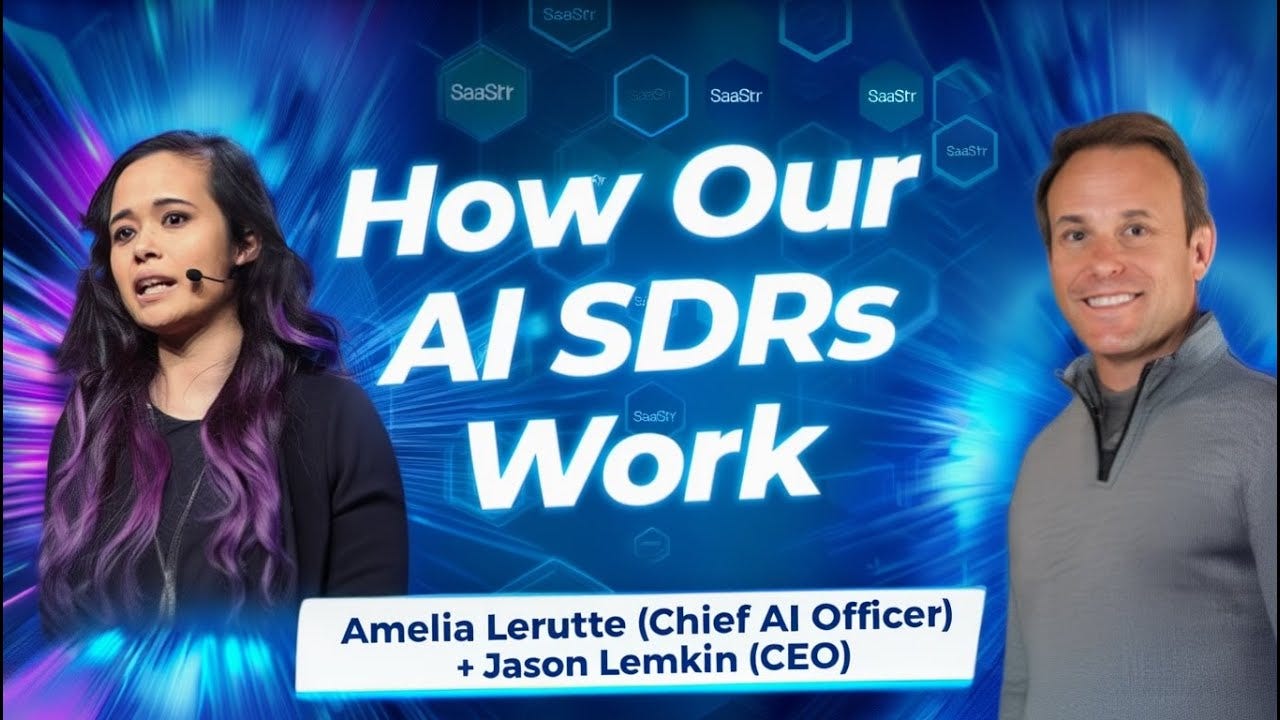 6 Months of AI SDRs: What's Worked, How They Brought In $1M+ in 90 Days, and the Real Data Everyone's Asking For | After deploying 5 AI SDRs across inbound, outbound, and follow-up—here’s the actual numbers, unexpected learnings, and what it really takes to make them workSix months ago, we had essentially zero AI SDRs at SaaStr. Today, we’re running five specialized AI agents that have sent nearly 20,000 outbound messages, closed over $1M in revenue, and fundamentally changed how we think about sales development.The results look incredible on paper: 6.7% outbound response rates (double the industry average), $1M+ closed in 90 days from our inbound agent alone, and 20% of our event ticket sales now coming from AI.But here’s what nobody tells you about AI SDRs: they require massive human oversight, they can’t fix what’s already broken, and the path to success is completely different than what vendors promise.SaaStr’s Chief AI Officer Amelia Lerutte and CEO Jason Lemkin share the real data, the brutal learnings, and exactly how we got these results. And want to see the tools we use? Click here.TLDR and Top 5 Learnings After Six Months of AI SDRs1. AI SDRs Scale What’s Already Working—They Can’t Fix What’s Broken* If your outbound isn’t working with humans, AI won’t save it* You must have proven messaging, defined ICP, and working processes before deploying* AI amplifies your best practices infinitely—but you need best practices first* We had to fix our broken RevOps processes before AI could help scale them2. They Require Massive Human Oversight (15-20 Hours Weekly)* These agents consume the signficiant amount of Amelia’s and Jason’s time to run successfully* Performance ebbs and flows directly with human attention—more time invested = better results* Weeks I’m busy with other work, agent performance noticeably dips* This is not set-and-forget technology; it’s coaching five SDRs simultaneously who work 24/73. Specialization Beats All-in-One. For Now.* We run 5 different AI SDRs, each trained for specific use cases (cold outbound, lapsed customers, active nurture, inbound qualification, ghosted lead recovery)* Even within one platform, we have sub-agents with completely different training* Specialized tools go deeper than all-in-one platforms—we’ll take three A+ tools over one B+ tool* The training specificity for each use case matters enormously for results4. The Unexpected Direct-Selling Capability* AI got surprisingly good at closing deals directly, not just booking meetings* For sub-$1K products (event tickets), our AI now closes deals autonomously* For higher ASP deals ($50-100K+), it qualifies and books meetings, then hands to humans* 20% of our event ticket revenue now comes from AI agents selling directly5. Budget $50-100K Per Platform + A Lot Of Your Time* Effective AI SDRs cost $50-100K+ annually per specialized platform* But the bigger investment is your time: 15-20 hours weekly managing them* We reallocated budget from two human SDR roles instead of finding new budget* ROI is clear (our inbound agent: $1M revenue in 90 days on ~$100K investment) but only if you commitThe Big Misconception Killing AI SDR DeploymentsThe myth: Buy an AI SDR for $50-100K, it magically generates leads, you replace human headcount, profit.The reality: AI SDRs scale what’s already working. They can’t create something from nothing.This is the #1 reason AI SDR deployments fail. Companies expect magic. They want to spend $20-100K and suddenly have leads pouring in without figuring out what messaging works, what audiences convert, or what their actual sales process should be.Here’s the truth that took us six months to fully internalize: Your AI SDR can only amplify your best practices. If your outbound didn’t work with humans, AI won’t save it.Think of AI SDRs as taking your A-tier sales development rep and giving them infinite time, perfect memory, and the ability to personalize at scale. But they still need to know what to say, who to target, and how your sales process works.We learned this the hard way. Before deploying AI, we had to:* Identify what outbound messaging actually converted* Clean up our RevOps processes (they were broken)* Define clear goals for each agent type* Create training based on real conversations that workedOnly then could we scale with AI. You can’t skip this step.Our 5 AI SDRs: The Specialized ApproachMost companies think about “an AI SDR.” We run five, each specialized for different use cases:Agent #1: Outbound Cold (Artisan)* Pure cold outreach to new prospects* Highly personalized based on company signals* Goal: Book qualified meetingsAgent #2: Lapsed Customer Outreach (Artisan)* Targets previous sponsors/attendees who haven’t engaged recently* Leverages past relationship for warmth* Goal: Re-engage and convert to new eventsAgent #3: Active Nurture (Artisan)* Follows up with people opening emails but not converting* Tracks engagement signals* Goal: Move them from awareness to actionAgent #4: Inbound Qualification (Qualified)* Lives on our website, engages visitors in real-time* Qualifies intent, books meetings, sells tickets directly* Goal: Convert inbound interest instantlyAgent #5: Ghosted Lead Recovery (Salesforce Agent Force)* Follows up with leads our human team dropped* Leverages full Salesforce history for context* Goal: Recover lost opportunitiesEach agent is trained completely differently. Different messaging, different collateral, different success metrics. This specialization is why they work.The Outbound AI SDR: Real Numbers After 6 monthsOur outbound agents (primarily Artisan) have now sent nearly 20,000 messages. Here’s what actually happened:Core Performance Metrics:* 19,847 total messages sent in six months* 6.7% overall response rate (industry average ~3%)* 4% positive response rate (significantly above platform benchmarks)* 3,000 emails per month from AI vs. 75-285 per month from previous human reps* 10% of London ticket revenue attributed to outbound AI aloneWhat This Actually Means:Our AI SDR sends more emails in one month than our best human SDR sent in 40+ months. And it does it with better response rates.But here’s the critical nuance: These results required massive human input.On weeks when I spend more time training the agent, reviewing outputs, and feeding it better contact lists—performance jumps noticeably. On weeks when I’m slammed with other work (like preparing for SaaStr London), performance dips.The AI isn’t truly autonomous. It’s a force multiplier for human expertise.The 5 Sub-Agents Strategy:Even within “outbound,” we don’t run one generic agent. We run five specialized versions:* Lapsed Sponsors: “We worked together on SaaStr Annual 2023, here’s what’s new...”* Current Sponsors: “You’re sponsoring Annual, have you considered London?”* Previous Attendees: “You attended last year, early access to this year...”* Engaged Non-Converters: “You’ve opened our last 5 emails about speaking...”* Pure Cold: “You’re building [specific product], here’s why SaaStr...”Each has different training, different tone, different proof points. The specialization matters enormously.The Unexpected Learning: Direct SellingWe initially deployed our outbound AI to book meetings for sponsorships. That worked fine.But then something unexpected happened: For lower-priced products (event tickets under $1,000), the AI got really good at closing deals directly.At first, I was nervous. “Can I trust the AI to sell without human review?” Six months in, the answer is yes. For sub-$1K tickets, it closes deals on its own. I let it run free now.For higher ASP deals (sponsorships $50-100K+), it still books meetings and qualifies, then hands to humans. But the direct-selling capability on lower-ticket items has been game-changing.The Deliverability Secret:One critical learning: Artisan forces a 2-3 week warm-up period before sending at volume. This annoyed me initially. “Why am I waiting 2-3 weeks? Just let me send!”Now I understand. Our emails hit primary inbox, not promotions tabs. Our deliverability is essentially perfect. I can’t even achieve this level with Marketo.Skip the warm-up at your peril. Deliverability is everything in outbound. The best message in the world doesn’t matter if it hits spam.How We Feed the Beast:The #1 operational challenge: Constantly feeding the AI fresh, quality contacts.I started uploading contact lists once per week. Now I do it twice per week when possible because the AI performs better with fresh inputs.About 90% of contacts are ours—from our database, not scraped from Apollo or other intent data providers. We trust our data quality, and that trust shows in results.I upload via CSV in batches of 800-1,000 contacts. This size seems to be the sweet spot for performance in Artisan specifically.The Inbound AI SDR: The $1M SurpriseWe added our inbound AI SDR (Qualified) in August—three months after starting outbound. This agent has produced the most surprising results of any deployment.The Numbers (August-November, 3.5 months):* 697,000+ sessions with website visitors* 1,000+ meaningful conversations (vs. simple questions)* 100+ meetings booked (approaching 100 as of November)* $1M+ in closed revenue in just 90 days* $2.5M+ in pipeline attributed to agent-booked meetings* 70% of October’s closed-won deals came from this AI agentRead that last stat again: In October, 70% of our closed revenue came through our AI SDR.Why This Agent Crushes It:The inbound AI SDR isn’t just booking meetings faster (though it does—instantly vs. up to 24 hours delay previously). It’s completely transforming the quality of those meetings.Here’s what changed:Before AI (The Old Way):* Prospect fills out contact form* Goes into queue for me to round-robin to rep (delay: minutes to hours)* Rep gets assignment, responds (delay: hours to 24 hours)* Back-and-forth to find meeting time (delay: days)* Meeting finally happens, first 10 minutes wasted on basic discovery* Deal cycle startsTotal time to meeting: 1-3 days Discovery needed: 10+ minutes Context provided: MinimalAfter AI (The New Way):* Prospect visits website, AI engages instantly* AI qualifies, understands needs, books meeting—all in real-time* AI provides complete dossier to sales team before meetingTotal time to meeting: Seconds to minutes Discovery needed: Zero Context provided: EverythingThe Context That Changes Everything:Before each meeting, we now know:* Complete conversation history (what they asked the AI, what they cared about)* Every page they visited on our website* How many times they’ve engaged over what timeframe* Other people from their company who visited (CEO browsing speaking opportunities while CMO books meeting)* Specific content they consumed (sponsorship packages, speaker guidelines, ticket options)We don’t do discovery calls anymore. The AI did discovery. We jump straight to solution discussions.Real Example:Prospect books a sponsorship call. Before the meeting, the AI tells us: “Their CEO was also on the site yesterday looking at speaking opportunities, even though this person only asked about basic sponsorship.”We mention this in the call: “Hey, we noticed your CEO was also checking out speaking. Should we look at a package that includes a speaking slot?”Prospect: “Oh wow, I didn’t know they were looking at that. Yes, let’s include speaking.”Instant upsell. This happens constantly now.The Training That Makes It Work:Most companies deploy Qualified with two buttons: “Talk to Support” or “Talk to Sales.” That’s it. Their agents are mediocre.Our AI ingests everything:* 20 million words across SaaStr.com, SaaStr.ai, London, Annual sites* Our entire YouTube channel* Recorded sales calls I upload* Sponsor meetings transcripts* Custom documentation and FAQs* Historical email threadsThe agent is empowered to:* Sell event tickets directly (up to $1,000)* Offer discount codes* Follow up if codes aren’t used* Book meetings for sponsorships* Route to support when appropriate* Remember returning visitors and full contextThe Discount Code Workflow:This was an unexpected use case that emerged from the data.Week one with the inbound AI, I noticed the #1 question was: “Can I get a discount on tickets?”I empowered the agent to give discounts and sell directly. Here’s what happens now:* Prospect asks for discount* AI: “Absolutely! Here’s code LONDON25 for 15% off. You can use it at checkout.”* Prospect leaves without buying* Day 3: AI follows up: “Hey Jason, I gave you code LONDON25 when we chatted. I noticed you haven’t used it yet. Still interested in attending?”* Prospect convertsThis follow-up conversion happens at scale. The AI remembers every interaction, knows who didn’t convert, and follows up systematically.Result: 20% of our London ticket revenue comes from AI agents (both inbound and outbound combined).I physically could not do this level of personalized follow-up at scale. The AI does it effortlessly for thousands of prospects.The Follow-Up AI SDR: Recovering Ghosted LeadsOur most recent deployment (October) was Salesforce Agent Force for a use case I’m embarrassed to admit we needed: following up with 1,000 leads our human team completely ghosted.The Embarrassing Reality:After SaaStr Annual, I audited our Salesforce. I found ~1,000 people who:* Filled out our “I’m interested in sponsoring” form* Were automatically routed to a sales rep* Never received any human follow-up whatsoeverThis is common. It’s also inexcusable. These were warm, inbound, high-intent leads. We just... forgot about them.The Agent Force Solution:These people were already in Salesforce with full interaction history. Perfect use case for Agent Force because it knows everything Salesforce knows.Early Results (One Month Live):* 72% open rate (unheard of in Marketo or cold email)* Higher response rate than our other agents* Still working through the initial 1,000 at a controlled paceWhy such high open rates? Because Agent Force personalizes based on complete Salesforce history:* Past event attendance* Previous sponsorship levels* Interactions with our team* Account tier and company information* Engagement patternsThe emails don’t feel like “recovered leads” outreach. They feel like natural continuation of relationship.Sample Email:Hi Kyle,I noticed you reached out after SaaStr Annual about sponsorship opportunities, but somehow we never connected (entirely my fault!).I see you attended Annual 2022 and 2023—thanks for being such a consistent supporter. Based on your company’s growth since then, I think our London event in March might be perfect timing.Would you be open to a quick call about 2025 opportunities? Here’s my calendar: [link]Best, Amelia (via AI)Simple, personal, acknowledges the gap, moves forward. Response rate is significantly higher than cold outreach.The Setup Reality:People think Agent Force is too technical. “You need a Salesforce admin.” “It’s for enterprises only.” “Setup takes months.”I’m not a Salesforce admin. I’m not certified. I was better at Marketo than Salesforce before this project.With Salesforce’s team help during onboarding, we got it working in days, not months. The key: I copied our Artisan training instructions, adapted them for “ghosted lead recovery,” and it worked immediately.What It Actually Takes: The Human CommitmentHere’s the part most AI SDR vendors gloss over: These agents consume the majority of both mine and Jason’s time.Could we run more agents? Yes. Would they fail without our oversight? Absolutely.The Weekly Time Commitment:For me personally, across all five AI SDRs:Outbound Agents (Artisan):* 3-4 hours weekly uploading and preparing contact lists* 2-3 hours reviewing performance, adjusting training* 1-2 hours reviewing draft responses for high-value prospects* 30-60 minutes monitoring responses and routing to humansInbound Agent (Qualified):* 1-2 hours weekly reviewing conversations, identifying gaps* 1 hour uploading new training materials (calls, docs, FAQs)* 30 minutes spot-checking responses* As-needed monitoring when agent raises hand for helpFollow-Up Agent (Agent Force):* 1-2 hours weekly preparing and uploading contact segments* 1 hour reviewing performance and adjusting targeting* 30 minutes monitoring send patternsTotal: 15-20 hours per week actively managing five AI SDRs.This is why we can’t just infinitely add more agents. The human oversight is real and necessary.Performance Ebbs and Flows with Human Input:We have clear data on this now: Agent performance directly correlates with human attention.Weeks I spend more time:* Response rates increase 10-20%* More meetings booked* Higher quality conversations* Better revenue outcomesWeeks I’m slammed with other work:* Agents still run (that’s the beauty)* But response rates dip* Fewer meetings convert* Revenue impact decreasesThey don’t fail catastrophically without me. They just perform at B+ level instead of A+ level.The Training Never Stops:Every week, I’m:* Adding new proof points that worked in human conversations* Removing messaging that got negative feedback* Updating targeting based on what’s converting* Adding new use cases and capabilities* Refining objection handling based on real responsesThis isn’t set-and-forget technology. It’s like having five SDRs who need constant coaching—except they never complain, never quit, and work 24/7 once trained.The Specialized vs. Generalist DebateA common question: “Should I get one all-in-one AI SDR tool or multiple specialized ones?”Our philosophy: Specialized over all-in-one.Yes, it’s more work. Yes, I have to manage separate tools and avoid contact overlap manually. Yes, it’s sometimes annoying.But specialized tools go deeper. Artisan is maniacally focused on outbound results. Qualified is obsessed with inbound conversion. Agent Force leverages Salesforce data better than any third party could.The Tradeoff:All-in-one platforms promise simplicity. “One platform for all your AI SDR needs!”In practice, we’ve found that platforms trying to do everything do each thing at B+ level. Specialized platforms do one thing at A+ level.For our use cases and our scale, we’ll take three A+ tools over one B+ tool. But this requires accepting operational complexity.The Contact Overlap Problem:One major challenge with multiple agents: Making sure the same person doesn’t get hit by three different AI SDRs.Right now, this is mostly manual. I carefully segment:* These contacts go to Artisan* These contacts go to Qualified* These contacts go to Agent ForceEach platform has de-duping within itself. But across platforms, I’m the de-duping layer.This is improving. Artisan just added the ability to exclude specific Salesforce campaigns. Qualified syncs natively with Salesforce. They’re moving toward better interoperability.But today, if you run multiple specialized AI SDRs, expect manual coordination work.The Budget Reality: What It Actually CostsReal talk: Effective AI SDRs cost $50-100K+ per platform annually.Breakdown typically looks like:* $60-70K annual subscription* $20-30K training and onboarding* Or ~$100K all-in depending on vendorSome vendors are launching cheaper self-serve versions. We’ll test these in 2025. Initial hypothesis: They’ll work reasonably well for simple use cases but won’t match enterprise power because they ingest less data and require less customization.Think of it like Zendesk support agents. The $299/month version works but only has 20% of the enterprise capability because it ingests your wiki vs. a decade of customer interactions and call transcripts.How We Funded This:We didn’t get new budget. We reallocated existing budget.Specifically: When SDRs left naturally after our Annual event, instead of replacing that headcount, we invested in AI SDR platforms.We replaced the budget for two human SDRs with our AI SDR stack. The AI sends 10x more messages with better response rates, so the math works.The ROI Calculation:Is $100K for an AI SDR worth it?Let’s do the math on our inbound agent:* $100K annual cost (rough estimate)* $1M closed revenue in 90 days* 10X ROI in one quarterEven if you cut those results in half—even if they’re 75% lower—the ROI is clear.But you have to commit to making it work. You can’t deploy and forget.The Vendor Selection FrameworkCritical advice: Don’t tolerate mediocre sales reps in the AI age.The best AI companies have shockingly bad sales teams that don’t understand their own products. Sales reps will tell you things that are flat wrong about capabilities, training requirements, or integration.What to Demand:* Talk to the actual implementation specialist or technical person before signing—not just the sales rep* They should assess your data and confirm success viability in 20 minutes: “Yes, you have enough data for this to work” or “No, you need X first”* Ask them how many deployments they’ve done personally and what success rate looks like* If a sales rep blocks access to technical experts, walk away immediatelyWe passed on one excellent AI SDR vendor because their sales rep was incompetent, didn’t understand the product, and created barriers to talking with technical teams.That rep cost their company all the PR, revenue, and referrals we would have driven. Don’t reward bad sales behavior with your budget.The Deployment Partnership:Every vendor we use provided hands-on setup help:* Artisan connected us with their implementation specialist* Qualified did the same* Salesforce/Agent Force provided onboarding resourcesThis is standard and necessary. The vendor should be invested in your success and provide technical resources to ensure it.You’re not figuring this out alone. Good vendors know this and staff accordingly.The “Too Much Demand” Problem:Interesting dynamic: All these vendors have more demand than they can handle.Some turn away business even when you have budget. Main reasons:* Not enough data to train effectively* Use case doesn’t fit their platform well* They’re at capacity and prioritizing customers most likely to succeedThis is actually good. It means they care about success rates more than just revenue. But it can be frustrating if you’re turned away.If a vendor says they can’t support you, ask why and listen. They’re usually right about whether you’re ready.What Actually Works: The Implementation PlaybookAfter six months and five AI SDR deployments, here’s the playbook that works:Step 1: Identify What’s Already WorkingDon’t deploy AI to fix broken processes. Deploy it to scale working processes.* What messaging gets responses from humans today?* What audiences convert at acceptable rates?* What does your best SDR do that works?* What sales process actually closes deals?Document this. This becomes your AI training foundation.Step 2: Start With One Agent, One Use CaseDon’t try to deploy across inbound, outbound, and follow-up simultaneously. Pick one:* Pure outbound if you have contact lists and proven messaging* Inbound if you have website traffic and can define qualification* Follow-up if you have a database of unconverted leadsGet one working phenomenally before adding a second.Step 3: Choose 1-2 Vendors MaximumDo a bake-off if needed, but limit it to two vendors you’ll properly train and compare.We talked to a CMO doing 10 simultaneous vendor trials. That’s insane. You won’t train any of them properly. The bake-off will fail and you’ll conclude “AI doesn’t work.”Two vendors maximum. Train them properly. Make an informed decision.Step 4: Take Your Best Person and Learn TogetherDon’t hire a “Chief AI Officer” initially. Don’t delegate to someone who doesn’t understand the work.Take your best SDR, sit down together, and figure out AI together. Learn by doing.Eventually, that person’s role will evolve to focus more on AI operations. But start as partners.Step 5: Commit to 90 Days of Daily ManagementPlan for this to consume significant time for three months:* Daily monitoring of outputs* Weekly training updates* Constant refinement of messaging and targeting* Regular review of conversations and responsesThis is not set-and-forget. It’s coaching five SDRs simultaneously.Step 6: Empower GraduallyStart with AI in draft mode:* It suggests messages, you approve and send* You review every interaction* You correct and train constantlyAfter 30-60 days of this, start empowering:* Let it send to certain segments without approval* Let it handle objections independently* Let it close small deals directlyWe’re six months in and still have some agents in draft mode for high-value prospects while others run autonomously for lower-stakes interactions.Step 7: Scale What WorksOnce you have one agent crushing it, add a second with a different use case.We went:* Outbound first (May)* Inbound second (August)* Follow-up third (October)* Now adding more use cases within existing platformsEach one took 60-90 days to reach peak performance. Don’t rush this.The Mistakes That Kill AI SDR DeploymentsAfter watching dozens of companies try and fail with AI SDRs, here are the fatal mistakes:Mistake #1: Expecting Magic Without Work“I’ll buy this AI SDR, it’ll generate leads, I’ll make money.”No. You’ll buy this AI SDR, spend 20 hours per week training it, constantly refine it, and then it’ll generate leads.The companies succeeding with AI SDRs are putting in massive human effort. The companies failing expected automation without investment.Mistake #2: Deploying to Fix What’s BrokenIf your outbound doesn’t work with humans, AI won’t fix it.If your messaging is off, your ICP is wrong, your offer is weak—AI will just scale your failure.Fix the fundamentals first. Then scale with AI.Mistake #3: Generic Training“Here’s our website, here are some email templates, go!”That produces mediocre results.Winning training:* Specific proof points from real conversations that worked* Objection handling based on actual objections you’ve received* Clear escalation rules for when to loop in humans* Detailed ICP definition with examples and non-examples* Response frameworks that match your brand voice exactlyMistake #4: Set and Forget“I deployed it three months ago and it’s not working.”When did you last update the training? What have you refined based on results? How often do you review conversations?“Uh... I deployed it and haven’t touched it since.”That’s why it’s not working.Mistake #5: Ignoring the Vendor’s ExpertiseEvery vendor knows things about their platform you don’t. They’ve seen hundreds of deployments.When they say “You need a 2-3 week warm-up period,” don’t ignore it. When they say “This feature won’t work for your use case,” believe them. When they suggest a specific training approach, try it their way first.You can innovate later. Start by following their proven playbook.The Future: What’s Coming NextAgent-to-agent communication is the next frontier.Right now, our five AI SDRs don’t talk to each other. I manually prevent overlap. This is improving but still mostly manual.Within 6-12 months, I expect platforms will communicate better:* “This prospect is already in an Artisan sequence, don’t add to Qualified outreach”* “This person just had a positive inbound conversation, suppress outbound”* “This account is in active deal cycle, route all touches to assigned AE”The infrastructure for this exists. The integrations are coming.Voice and video agents are next.We’re filming with Qualified to turn our chat agent into a full video/voice agent. It’ll have my voice, my face, and conduct two-way conversations.This should roll out by SaaStr London in March. Come see it in person.Lower-priced self-serve versions from every vendor.The $100K enterprise version will stay for complex use cases. But $299-999/month self-serve versions are launching across the board.We’ll test these in 2025 and report back. They won’t match enterprise capability but might be good enough for smaller teams or simpler use cases.The consolidation question.Will we eventually move to one platform that does everything? Maybe, if one gets good enough at everything.Right now, specialized wins. But I could see a world where one platform nails inbound, outbound, and follow-up at A+ level and we consolidate.That’s probably 12-24 months away.The Honest Assessment: Is It Worth It?Unequivocally yes, but only if you commit.Our results after six months:* 20K+ messages sent vs. * $1M+ closed revenue from inbound agent in 90 days* 10X scale on activities that were already working* Better conversion rates than human-only in many cases* 20% of ticket revenue from AI agentsBut this required:* 15-20 hours weekly from me managing the agents* Deep commitment to training and iteration* Willingness to trust agents with real revenue operations* Tolerance for failure and public criticism* Significant budget reallocation ($200-300K+ across platforms)* Six months of continuous learning and improvementThe magic isn’t that AI SDRs work without effort. The magic is that once you invest the effort to train them properly, they scale your best practices infinitely.The ROI is clear if you do the work. Our inbound agent alone generated 10X ROI in one quarter. Even cutting that in half or by 75%, the math works overwhelmingly.But there’s no shortcut. You can’t buy an AI SDR and expect it to magically work. You have to train it like you’d train your best human SDR—except this one never sleeps, never forgets, and gets better every day.Your Next StepsIf you’re considering AI SDRs:Week 1: Assess readiness* Do you have something working that needs scale? (If no, stop here)* Do you have data to train on? (6+ months minimum)* Can you commit 10-20 hours weekly for 90 days? (If no, wait)* Do you have $50-100K budget? (If no, wait for self-serve versions)Week 2-3: Vendor selection* Narrow to 1-2 vendors based on your primary use case* Talk to technical teams, not just sales reps* Get them to assess your data and confirm viability* Check references from similar companiesWeek 4: Start with one use case* Outbound if you have proven messaging and contact lists* Inbound if you have traffic and clear qualification criteria* Follow-up if you have unconverted lead databaseMonths 2-3: Train and iterate daily* Review every conversation initially* Refine training based on real results* Add proof points from what works* Remove messaging that failsMonth 4: Start empowering* Let it run autonomously for low-stakes interactions* Keep human oversight for high-value prospects* Measure results vs. benchmarksMonth 5-6: Scale or add second use case* If first agent is crushing it, add a second* If first agent is struggling, go deeper before expanding* Never deploy more agents than you can actively manageAnd remember: AI SDRs scale what works. They don’t fix what’s broken.Get your fundamentals right first. Then let AI take you to the moon.We’ll be covering our RevOps, customer success, and marketing AI deployments in Part 2 next week. You can see all our tools and specific use cases at saastr.ai/agents.Or come see it all in action at SaaStr London in December, where you can interact with our AI agents live and see exactly how we’ve built this. This is a public episode. If you would like to discuss this with other subscribers or get access to bonus episodes, visit cloud.substack.com | 1h 22m 18s | ||||||
| 11/17/25 |  The First $100,000,000 ARR at Datadog: How Founder CEO Olivier Pomel Built a Customer-Centric Observability Giant | Ahead of SaaStr AI London on Dec 1-2 (See you there!) we’re taking a look back at some of our favorite sessions from our European events. It was so great when Olivier Pomel, founder CEO of Datadog, joined us as they crossed $100,000,000 ARR in a candid conversation it would be harder to do today post-IPO.The First $100,000,000 ARR at Datadog: How Olivier Pomel Built a Customer-Centric Monitoring GiantFrom zero lines of code to 700 employees and doubling revenue annually, Datadog CEO Olivier Pomel shares the counterintuitive strategies that built one of the most customer-obsessed companies in B2B SaaSOlivier’s Top 5 Toughest Learnings* You can’t be customer-focused if you’re sales-driven OR engineering-driven - Most companies fall into one trap or the other. Sales teams optimize for closing the next deal (short-term), while engineering teams build for the long-term without bridging back to customers. Customer-centricity requires daily vigilance against both.* Closed alphas with “perfect customers” give terrible signal - Handpicking the best companies and best people for early access actually makes it harder to learn. Customers need to self-select when the timing is right for them. Open betas revealed infinitely more than curated alphas ever did.* Month-to-month contracts are better than annual deals for learning - Every instinct (and investor) tells you to sell annual contracts. But monthly contracts force bad news to surface immediately instead of a year later. A year of going in the wrong direction is devastating for a young company.* There’s no MVP for enterprise infrastructure - The conventional wisdom about shipping minimal products doesn’t apply when selling to enterprises who need comprehensive solutions. You need depth across many features before you’re minimally useful. It’s a continuum, not a single viable moment.* Pricing conversations reveal product truth better than any metric - Putting a dollar amount on features focuses customers’ minds like nothing else. When customers say “I won’t pay for that,” you get brutally honest feedback about value. This friction is healthy and teaches you where to go next.When Olivier Pomel and his co-founder started Datadog in 2010, they didn’t write a single line of code for the first six months. For two engineers itching to build, this took “some restraint,” as Olivier puts it. But this decision to obsessively listen before building became the foundation of a company that would redefine infrastructure monitoring and grow to 700+ employees while doubling in size every single year.At SaaStr Europa, Olivier pulled back the curtain on how Datadog became one of the most customer-centric companies in enterprise software—and why being truly customer-focused requires constantly fighting against your natural instincts.The Problem: When Great Teams Hate Each OtherThe genesis of Datadog came from a painful problem Olivier and his co-founder experienced firsthand. Despite working together across four different companies, knowing each other extremely well, and building their teams from scratch with a “strict no a*****e policy,” they ended up in a familiar nightmare scenario two years in.“We ended up with developers that hated operations, operations that hated developers, fingerpointing—all of the things that you can imagine,” Olivier explained.The question became simple: Why don’t we give all of those teams the same viewpoint? How do we get them aligned and understanding their infrastructure the same way?This became Datadog’s founding mission—bringing DevOps together and bridging the gap between development and operations teams. What they didn’t fully realize at the time was that this wasn’t just a nice-to-have feature. It was actually one of the KEY reasons why companies would migrate from legacy IT to the cloud.“We ended up right in the center of it,” Olivier said. “Today the company is about 700 people. We’ve been doubling the size of the company every single year. It turns out everybody is moving to the cloud and everybody needs to understand what’s happening to their systems and applications.”The Counterintuitive Truth About Customer-CentricityHere’s the part most founders get wrong: you can’t be customer-focused if you let your company become sales-driven OR engineering-driven.“Everybody wants to be customer-focused,” Olivier noted. “But most companies end up being either sales-driven or engineering-driven. If you want to be customer-focused, you can’t be either of those.”The Sales-Driven Trap: Sales teams are phenomenal at figuring out what’s going to get a deal done. But very often, getting the next deal done is NOT what you want to do for the long run for your customers. Short-term thinking dominates.The Engineering-Driven Trap: Let your engineering teams run on their own, and you’ll end up with organizations where people focus way too much on their solutions and way too much on the long term. You’ll struggle to bridge that gap back to the customer.The solution? “It’s a struggle of every day to make sure that we go back to the customer and start from there.”This wasn’t a conscious choice at first—it was forced upon them. Starting in New York (not the Bay Area), without Google or Facebook pedigrees, without millions in funding, and without a suite of VCs telling them they were geniuses, Datadog had no choice but to obsessively focus on the problem.“We basically had to focus on the problem. We spent the first couple of years listening to customers and trying to understand what the problem was.”The First Two Years: Why They Didn’t Write Code for 6 MonthsWhen you’re engineers and you start a company, every instinct tells you to build. Olivier and his co-founder resisted this for six months—and discovered something remarkable.When you don’t have anything to sell, everybody is super happy to talk to you.“You’ll get hours and hours of really fantastic people at fantastic companies and they’ll spend all that time explaining to you what their problems are, what’s working, what’s not working for them. They’ll be extremely candid.”This changes the moment you have something to sell. “Then you’re tainted. You have too much of a vested interest and you’re trying to push something, so people won’t open up so easily.”After six months of research, they spent another six months building their first alpha. When they deployed it to a small number of customers, they noticed the product was “way too open-ended, way too general.”But here’s where they made a critical discovery that contradicts conventional wisdom about customer selection.The Open Beta Revelation: Let Customers Self-SelectDatadog initially ran a closed alpha, handpicking the best companies and the best people at those companies. “It was actually really, really hard to get a lot of signal from these customers,” Olivier admitted.Then they opened it up to a wide beta—and everything changed.“It’s a lot easier for users to self-select and start using your product than for you to understand for whom you’re going to be the right thing at the right time.”You can’t predict when customers will have free bandwidth, when all the stars will align for deployment, or when your solution will be exactly what they need. Let them tell you by trying it.This open approach became core to Datadog’s growth strategy and fed directly into their customer-centric philosophy.Why Datadog Doesn’t Believe in MVPsAsk most SaaS founders about MVPs and you’ll get textbook answers about shipping fast and iterating. Olivier has a different take.“I don’t think there’s an MVP for what we do. I think it’s a myth,” he stated bluntly.Here’s why: Datadog sells to enterprises. They sell a product that needs to monitor everything happening across entire infrastructures and applications. There’s a very large number of features customers rely on, and none of these features in themselves are revolutionary.“You need to have them, otherwise you cannot be minimally useful. It’s more of a continuum—you keep adding those features, and at certain point you have enough of them that customers can start buying.”The hard part? Figuring out which features matter most. “That’s why you have to go back to the customer and make sure you have enough of them so you can actually extract some signal from those conversations.”For enterprise B2B infrastructure companies, the MVP concept often doesn’t apply. You need depth before customers will even consider you.Scaling Customer-Centricity: The 10-100 Person PhaseWhen Datadog hit the market, they were about 10-15 people. The phase of reaching initial scale ran from there to just under 100 people. This is where most companies start to lose their customer focus—but it’s also where you can build the most powerful feedback mechanisms.Strategy #1: Only Sell Month-to-Month Contracts“We didn’t sell yearly deals for a very long time. We only sold month-to-month, meaning customers had the opportunity to churn all the time.”This was structural, not accidental. If something is wrong with the product, if you don’t solve the right problem, if it’s not valuable enough—you know right away. Customers churn and you can have a conversation with them.“If you start selling term deals, you’re going to have the bad news about a year later. By then you’ve wasted a year. You’ve gone in the wrong direction. You’ve made all these mistakes you could avoid otherwise.”The lesson: Find structural ways to get bad news quickly. Don’t let long-term contracts mask product problems.Strategy #2: Put Every Engineer on Support RotationEvery single engineer at Datadog goes on a one-week support rotation throughout the year. Not just professional support engineers—every engineer in the company.“Engineers are super happy when it starts, and they’re even happier when it ends,” Olivier joked. “But really what it gives is empathy for the customer.”Engineers see what problems customers face day-to-day. They see the consequences of their design choices. Sometimes features that seemed like fantastic ideas turn out to be confusing from the customer’s perspective.“It was a great idea, but we’re going to change it because it doesn’t work quite as well.”Strategy #3: Bring Engineers to Conferences to Give DemosDatadog does extensive event marketing because companies migrating to the cloud need to go to conferences to learn. They exhibit at these conferences, give lots of demos—and they bring engineers to do all of it.“Everybody’s on a rotation and everybody’s going to get to one, two, three, five maybe of those conferences and spend every time a full day basically giving demos to potential customers or existing customers and answering questions.”This builds empathy for customers and makes the whole engineering team more confident about the problems they’re solving and their relationship to end users.But here’s the trick: Many engineers aren’t naturally comfortable seeking strangers’ attention at a booth for hours. The solution? Have other people on the team responsible for getting attention and introducing visitors to engineers. Then engineers can settle into a rhythm of demos and questions without the anxiety of having to attract people.What Metrics Actually Matter (and Which Ones Don’t)Here’s something counterintuitive from a company that processes 4-5 trillion customer metrics per day: Datadog isn’t incredibly metrics-driven for their own product.“Most of the metrics are lagging indicators and they don’t convey all the nuance of the value that our customers are going to find with our product. So we don’t actually train ourselves to optimize to the metrics.”What they DO watch:* Volume of data and infrastructure customers are monitoring: A sign of the value they’re providing, because customers deploy them into more places* Engagement: But this isn’t revolutionary* Churn: Which is why they focused on month-to-month contracts early onThe philosophy: Don’t let metrics become a substitute for actual customer conversations and understanding.Scaling to 700: When Everything ChangesAt 700 people across 16 offices worldwide, some of the early strategies don’t work anymore. The executive team can’t meet with all customers all the time. The co-founders and CPO can’t do all the product work.This is where Datadog made a critical hire: product managers.But not just any product managers. They didn’t hire their first PM until they were over 100 people, and when they did, they defined the role very specifically.“Product managers are not here to invent product. They’re here to spend the most time possible with the customers outside of the office.”Their job:* Understand what customers’ problems are* Understand what they’re using, what they’re not using* Understand what they’re paying for and why* Get the best understanding possible of the problem and the value those problems represent* Present the product and get feedback“Their role is not to invent the product but to make sure it solves the right problem and has the right value.”This is a fundamentally different view of product management than most companies have. PMs aren’t visionaries sitting in a room designing the future—they’re customer researchers and feedback conduits.The Startup-Within-a-Startup ProblemWhen you start branching into new products or new markets, you’re suddenly back in startup mode—and it’s easy not to realize it.“It’s easy to get used to winning, and then you expect everything’s just going to work this way,” Olivier explained.Teams working on new products need to behave exactly as you would when you were a tiny company:* Soliciting as much feedback as quickly as possible* Going as wide as possible with betasThere’s tension here. You don’t want to taint the opinion of your existing product by releasing a new product that isn’t as polished. But if you want that new product to work, you need to go very wide very quickly.Most importantly, you need to create a culture where people seek the bad news.“It’s much better to go to a customer and ask them, ‘This new product—are you going to pay for it? You’ve tried it. Is it good enough? Are you going to buy it?’ It’s actually much better to hear from them, ‘No, I’m not going to buy it, and this is why,’ than to kick the can down the road and hope that maybe in 3 months, 6 months, 9 months they’ll change their mind.”When you know what’s not working, it gives you a thread to pull. It tells you where you need to go.The Counterintuitive Truth About PricingHere’s where customer-centricity gets tested: the pricing conversation. Customers want to spend as little as possible. You want them to pay as much as possible. How do you stay aligned?First, agree on what kind of company you are. Olivier sees two types:Type 1: Low-End Disruptors The major feature is that it’s cheaper. The dynamic with customers is they’ll push you to be cheaper and cheaper and to figure out what you can take out of your product so it can be as cheap as possible.Type 2: High-Value Products You charge more for your product and you have to deliver more value for that. The cycle with your customer is to deliver more and more.“You have to agree with your customer that they’re looking for high value, high impact—not as cheap as possible—because otherwise you’re never going to meet.”Once you’ve agreed on that, you’re aligned in the mid and long term. Your customers want you to be successful. They want your company to be in business two years from now. They want you to ship new features. They really want you to be successful.After that, there’s still friction—but that friction is how you learn about the value of your product and where you need to go next.“Asking for money and putting a dollar amount on the product really focuses the mind for the customers. It helps you get really, really good feedback on where you need to go. In the long run, it’s a very healthy relationship to have.”The key insight: See your customer as a partner. Frame it as “Let’s do this together. You want me to succeed and I want you to succeed, and the commitment on your side is to pay.”How Olivier Maintains Culture at 700 PeopleCulture isn’t about writing down seven values on a wall (though Olivier says they’ll do that eventually as they continue to scale). Culture is really about who you hire, who you fire, and who you promote.To maintain a customer-centric culture at scale, Datadog trains managers to care about the details. Olivier himself still sees every single customer complaint and support email that comes in.“I don’t read most of them. I delete most of them right away. I just scan them very quickly. But what this does is it helps me pattern match. It gives me a sense of what’s actually happening, how people are actually reacting to the product, what they’re saying.”He never acts on them directly. He never goes back to the customer or tries to solve the problem. But if he wants to affect change, he goes back through the management chain to make sure people get feedback and decide whether they need to change something.The other critical element: Be super careful about how you talk about customers inside the company.In sales, it can be tempting to talk about customers in manipulative ways as you try to manage them through a process. In engineering or product, you can think customers are making the wrong choices—”Why are they doing this stupid thing with our product?”“The way we see it is if they’re doing a stupid thing with our product, it’s our fault. We let them do that. We made them think they should be doing that, or we didn’t explain it right.”Always assume the customer is right. And even if you think they’re wrong, the fact that they’re thinking something wrong is itself a fact. It exists. You have to deal with it and you have to value it.You can’t let yourself dismiss what you hear from customers.The Acquisition Test: Optimizing for After the DealDatadog has made two acquisitions, both heavily tilted toward the tech platform, product, and team—not revenue streams to add to their sales engine.“What we optimize for is what’s going to happen after we close the deal. Are people going to stick around? How long are they going to stick around? Are we going to be able to build on top of that team and turn that team of 20 we just acquired into a department of the company that’s going to have 200, 500 people?”It’s all optimized on the fit and what happens after the acquisition—whether the companies share the same values.The One Piece of Advice: Run Toward the Bad NewsIf there’s one principle that runs through everything Datadog does, it’s this:“Really look for the bad news. Run toward the bad news.”Whether you just shipped the product or you’re renewing a big customer, the wrong thing to do is show up in front of the customer hoping they won’t bring up the issue in the account. “Hey, maybe with a bit of luck we can get away with it.”“Actually no—the first thing you do is you talk about it. You bring it up. Then you hear directly from the customer what they have to say about it. It actually goes a long way toward building the partnership, and it also helps you learn from the conversation with your customers.”This applies at every stage:* First six months: Don’t build—just listen to bad news about the market* Alpha stage: Open it up to get bad news faster* Launch phase: Only sell month-to-month so bad news comes immediately* Scale phase: Put engineers in support so they hear bad news directly* New products: Ask customers point-blank if they’ll pay for it* Big renewals: Lead with the problemsThe Bottom LineBuilding a customer-centric company isn’t about being nice or having good intentions. It’s about building structural mechanisms that force bad news to surface quickly and loudly.It’s about resisting the natural pull toward being sales-driven (short-term thinking) or engineering-driven (disconnected from reality).It’s about spending six months not coding when you’re itching to build.It’s about letting customers self-select rather than trying to control who uses your product.It’s about putting engineers in uncomfortable situations where they have to face customers directly.It’s about only selling month-to-month when your investors want annual deals.It’s about asking customers if they’ll pay for something and being ready to hear “no.”From zero to 700 people and doubling revenue every year, Datadog’s growth came from one counterintuitive principle: The best way to win is to constantly seek out why you might be losing.“You have to the wrong thing to do is hope the customer won’t bring up the issue,” Olivier concluded. “The first thing you do is you talk about it. You bring it up. Then you hear directly from the customer what they have to say about it.”That’s customer-centricity at scale.Olivier’s Top 5 Mistakes (In His Own Words)* Running a closed alpha with handpicked customers - “It was actually really, really hard to get a lot of signal from these customers.” Trying to control who got early access and picking the “perfect” companies backfired. Opening up the beta was when everything changed.* Building the first alpha too open-ended and general - “We noticed that the product was not exactly what it needed to be. It was way too open-ended, way too general.” Even after six months of customer research, they still got the scope wrong initially.* Not realizing how big the cloud opportunity would be - “We didn’t quite understand at the time that the cloud was going to be so big. We thought, hey, looks cool, why don’t we build it for companies moving to these new cloud environments.” They underestimated the magnitude of the shift they were riding.* Not understanding that DevOps bridging was the killer feature, not just a feature - “We didn’t quite realize was that bringing DevOps together, bridging those two teams, was not just a feature of the new world. It was actually one of the key reasons why companies would be moving from legacy IT to the cloud.” They had the solution before they understood its full strategic value.* Almost letting new products follow the old playbook instead of startup mode - “It’s easy to get used to winning and then you expect everything’s just going to work this way.” When launching new products at scale, they had to consciously fight against the temptation to skip the scrappy early-stage customer validation work that made them successful in the first place.Want more insights on building customer-obsessed B2B + AI companies? Join us at the next SaaStr AI London Dec 1-2, where founders and CEOs share the unfiltered truth about scaling from $0 to $100M ARR and beyond.Thanks for reading SaaStr AI: How To Sell, Scale, and Win! Subscribe for free to receive new posts and support my work. This is a public episode. If you would like to discuss this with other subscribers or get access to bonus episodes, visit cloud.substack.com | 2m 16s | ||||||
Showing 25 of 473
Pitch Fit is a Pro feature
See how bookable this show is for guests, which brands already advertise, the per-episode ad value, and the best-fit guest and sponsor profile. The numbers are blurred on the free plan.
How readily this show books outside guests like you.
How proven this show is for host-read sponsorships.
For Guests
ProFor Advertisers
ProUpgrade to Pro to unlock guest cadence, sponsor categories, fit scores, and per-episode ad value for this show.