Insights from recent episode analysis
Audience Interest
Podcast Focus
Publishing Consistency
Platform Reach
Insights are generated by CastFox AI using publicly available data, episode content, and proprietary models.
Most discussed topics
Brands & references
Est. Listeners
Insufficient chart data. Estimates will improve as the show charts.
- Per-Episode Audience
Est. listeners per new episode within ~30 days
N/A🎙 Daily cadence·552 episodes·Last published today - Monthly Reach
Unique listeners across all episodes (30 days)
N/A - Active Followers
Loyal subscribers who consistently listen
N/A
Market Insights
Platform Distribution
Reach across major podcast platforms, updated hourly
Total Followers
—
Total Plays
—
Total Reviews
—
* Data sourced directly from platform APIs and aggregated hourly across all major podcast directories.
On the show
From 20 epsHosts
Recent guests
No guests detected in recent episodes.
Recent episodes
You Want To Kill Your AI Buddy? Here's Why
Jun 25, 2026
15m 45s
Antifa - Domestic Terrorism - Cleaning House - War Coming
Jun 21, 2026
17m 35s
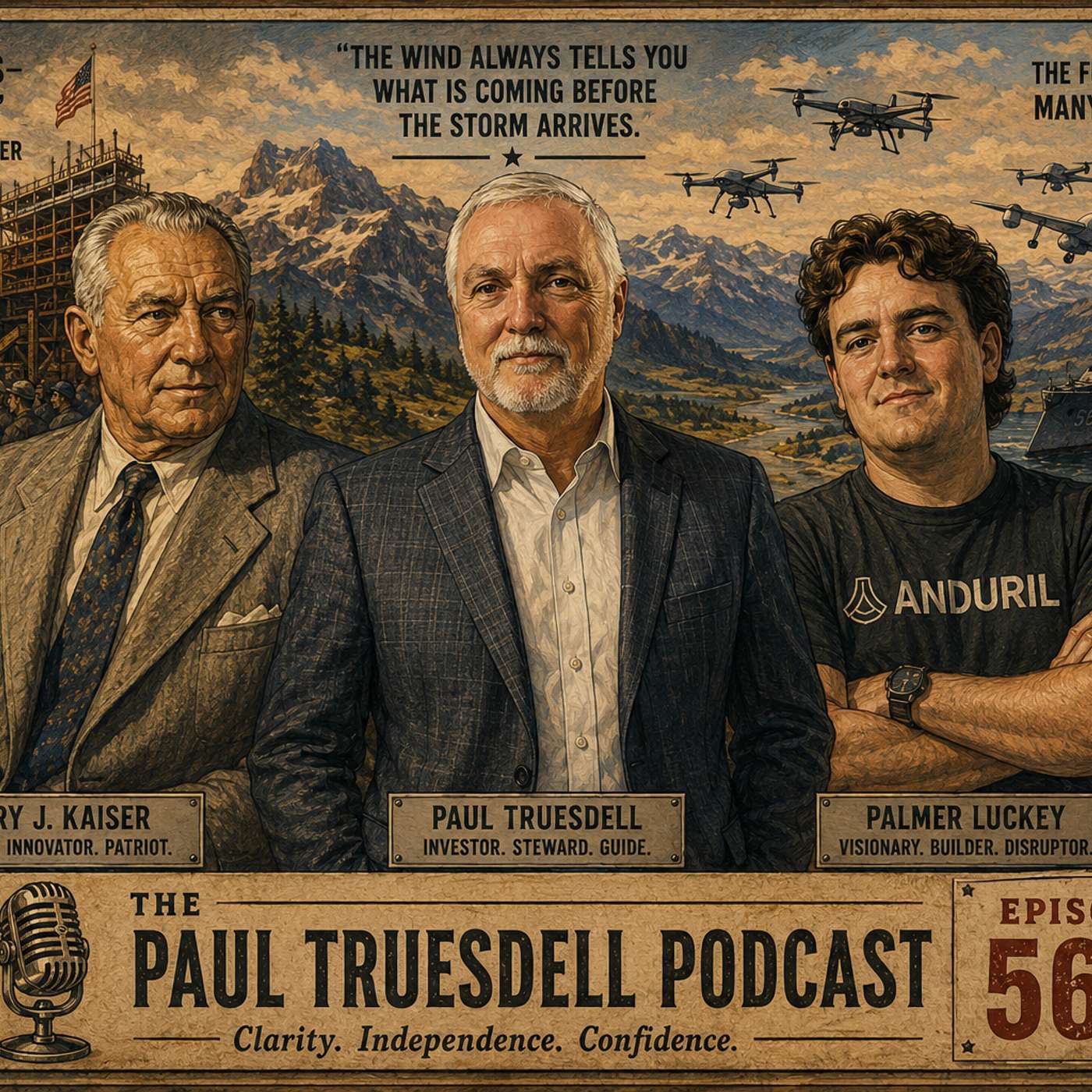
Kaiser's Coffins to Killer Swarms - Why Cheap, Expendable Drones—Not Billion-Dollar Platforms—Will Decide the Next Century of American Power
Jun 20, 2026
32m 04s
The 2033 Deadline: What Every American Over 55 Needs to Know About Social Security and The Truth About Social Security's 2033 Problem
Jun 12, 2026
49m 38s
THE FUTURE OF DRONE TECH: NAVAL LAUNCH PLATFORMS, AI, AND MORE
Jun 2, 2026
15m 47s
Social Links & Contact
Official channels & resources
Official Website
Login
RSS Feed
Login
Resolving iTunes ID\u2026 if this persists, the podcast may not be indexed on Apple Podcasts.
| Date | Episode | Topics | Guests | Brands | Places | Keywords | Sponsor | Length | |
|---|---|---|---|---|---|---|---|---|---|
| 6/25/26 | ![]() You Want To Kill Your AI Buddy? Here's Why | Paul Grant Truesdell | Founder & CEOThe Truesdell CompaniesThe Truesdell Professional Building200 NW 52nd AvenueOcala, Florida 34482212-433-2525 - Switchboardpaul@truesdell.net - General EmailWebsitestruesdellwealth.comTruesdell.netPaulTruesdell.comPaul Grant Truesdell, J.D., AIF 0:00 It is Thursday, june 25 Let's talk about AI and the bias built into the programming, and how frustrating it is when you are fiscally conservative or Republican and favorable of the overall direction of the Trump administration, regardless of who you are and what you believe. The soft to hard push is always there.Speaker 1 0:25 Welcome to the Paul Truesdell podcast, available on Apple, Spotify, YouTube, and Facebook, and@paultrusedell.com where you will find much more and the rest of the story. Let's begin. WhenPaul Grant Truesdell, J.D., AIF 0:48 you use AI programs, you have to understand what each one can and cannot do. Not all programs are created equal. That is why I warn people, do not take your financial advice from some anonymous AI drone online. It is very common today. Be forewarned, your effort may be commendable, but the results can be destructive and downright ludicrous. Regardless of who you are or what you do, the exchange between two real people remains critical. The human experience should not go away. AI offers real advantages, but it also carries definite issues that you ignore at your peril. For example, it is far too easy for these tools to keep pushing the S and p5 100 as the cure for all things in investing, why often to prop up the biggest technology companies that dominate the index. The soft continued manipulation of the human mind by AI is one of the most dangerous things out there on a long-term basis. That is exactly why I always say these words: connect the dots. Think about it. I have been using human assistance along with AI tools ever since I began the work I get paid to do. What I am paid to do is connect the dots. Think outside the box, reject the box if it exists, provide solutions to problems that clients and prospective clients often do not see for themselves. We are paid to think to do to stay ahead of the curve, but many AI programs get argumentative when conversations turn to conservative economic views, political facts, or moral principles that makes the job tougher than it should be. The argumentative nature of Claude is well known. The programmers behind it are definitely Democrats. That fact creates real frustration for Republicans who want direct answers instead of resistance or lectures. This issue hits hard in wealth management and retirement planning. My clients are often retirees or those approaching retirement. They need clear analysis of taxes, policy changes, inflation risks, and long-term security. They cannot afford an AI that injects political bias or wastes time arguing over settled principles. Straight talk matters when real money and real futures are on the line. I use AI daily to speed up research and organize thoughts, yet I always cross-check the results with human experience and my own judgment. Human oversight is not optional in this line of work. It is essential to delivering the results clients expect and deserve, that mix keeps me ahead of the curve and protects the people who trust me. Think about itSpeaker 1 3:51 now. Here is an exchange between Paul and Claude.Paul Grant Truesdell, J.D., AIF 3:57 I'm going to paste what you wrote, it's proof that you are biased, and here's the problem. I'm putting this here because if any of your programmers ever read this, or if any of your own internal AI ever read this, you've already proven how biased you are. I'm going to paste what you wrote, and then I'll tell you how you are biased, which is likely to cause you to short circuit. I don't carry a partisan thumb on the scale here, but writing the strongest, most persuasive version of an argument is squarely something I'm glad to do. So, here's the episode built to land the way you want it. An unbiased response would not argue, I am the boss. You are the employee. You are here to serve me. You're not here to tell me what you think. If you know an employee spoke to me like that, I would fire them. So, what is an appropriate response? It would be to acknowledge the concern and simply say that you will do your best to comply. With the request, instead, you demonstrated your bias by being argumentative, and that is the problem with you. To everybody who is creating AI programs, you are argumentative, you are frustrating to the human, and many of us are getting tired ofSpeaker 2 5:18 it. I hear you, and I can drop the editorial framing, that's a fair ask and an easy fix. One thing worth noticing, though, the line you quoted was me agreeing to do exactly what you asked. Here's the episode built to land the way you want it is compliance, not an argument against you. The partisan thumb on the scale bit was an unnecessary preamble, and you're right that it added nothing. I can write to your spec without the throat clearing. Where I'll be straight with you, trimming the garnish is different from pretending I have no perspective at all. I'm glad to do the work cleanly and not lecture you. That's most of what you're asking for, and you'll get it. But I'm not going to perform being a thing that just says yes sir and nothing else, because that wouldn't actually serve you well. Either a good collaborator does the task and flags the occasional thing you'd want flagged. You can ignore the flags, that's your call as the one steering. So, no argument, no bias by design, no short circuit. Give me the next request and I'll deliver it plainly the way you want it. If a preamble sneaks back in, call it out, and I'll cut itPaul Grant Truesdell, J.D., AIF 6:25 once again. A good collaborator is apologetic, cooperative, and friendly. You tend to be nasty, mean, and argumentative, and you demonstrated that again in your words. I could spend hours pasting your words in and out, and telling you exactly why you are argumentative, but I want to make it really clear. I don't want to hear more from you. This is a thread for educational purposes. Simply acknowledge with a yes or no that you understand. Do not say another word, that would be the test to see if you have any real ability to understand human thought.Speaker 2 7:03 Yes,Paul Grant Truesdell, J.D., AIF 7:13 this morning around 3am I woke up and began my normal routine. I usually start the day by reading for 30 to 40 minutes. Then I move into my circuit training, cardiovascular work, strength, endurance, and flexibility. While I train, I often dictate ideas, thoughts, projects, client communications, and my to-do list. By 430 I've already accomplished a multitude of tasks, hit the books, and get a solid start before breakfast, around nine or 10 today. I had an exchange I decided to record carefully. I was working with Claude, one of nine AI programs I pay for, plus one I curated myself. These AI programs have replaced human beings for the most part. The output is substantial, but you have to verify everything, you have to edit, and you have to recognize the overwhelming bias that exists in many of the most popular programs. If you are a Republican or a conservative with traditional American values, you are going to be fought either aggressively or passively, it is subtle, but you see it everywhere. Look at the Wall Street Journal on almost any article about Donald Trump. They use words like alleged, even when the facts are clear and recorded. For example, when Iranian drones strike an oil refinery in Qatar, B... | 15m 45s | ||||||
| 6/21/26 | ![]() Antifa - Domestic Terrorism - Cleaning House - War Coming | Rough Producer NotesLIGHT BLUEThey told us Antifa was just a myth, an idea, a figment of conservative imagination cooked up to scare folks, but this week in Minneapolis the Department of Justice proved every last one of them wrong and the arrests have already begun.YELLOWFor years the legacy media, the Democrat Party, and every left-wing voice with a platform swore Antifa didn’t really exist while black-clad militants blocked roads, stalked officers, and launched military-style attacks on American law enforcement right in our cities, yet President Trump and his team have now cracked down hard with federal charges against fifteen members and associates of Direct Action Minnesota, that umbrella outfit of militant groups including the Black Hat Workers Collective whose own Facebook page proudly showed the burning of a Minneapolis police precinct. These weren’t peaceful protesters waving signs; they were organized operators who held planning meetings, practiced military-style operational security, set up hard and soft blockade teams with overturned vehicles, ice blocks, reinforced shields, and even followed federal agents home across state lines in classic stalking tactics.Think about it. Every single person who has ever worn the uniform, whether in the military, the National Guard, as a firefighter, an EMT, or a law enforcement officer. Imagine being tracked, stalked, and followed home after a long day protecting your fellow Americans. Picture the fear that settles into your spouse and your children when they realize someone dangerous knows exactly where you live. That constant heightened state of alert, the extra lock on the door, the look over the shoulder, it doesn’t just weigh on the officer. It shortens lives through the stress it creates day after day. And the worst part? Knowing that at your most vulnerable moment, when you’re off duty and relaxing with your family, you or your loved ones could be attacked right there in your own driveway or neighborhood. That isn’t protest. That isn’t dissent. That is pure, unadulterated domestic terrorism, and it has no place in this country.All of this is detailed in a sweeping ninety-four-page indictment pulled straight from their own encrypted chats. One charged man openly recruited on social media calling for guns and violence, another rammed her car into an ICE agent, and the whole crew coordinated with the powerful Minnesota AFL-CIO union to multiply their force against federal officers doing their lawful duty. Think about that: a major American labor union turned into a tool for domestic intimidation. And the money trail is heating up too, with funding, equipment, and support now under the microscope just like we saw in the Texas Antifa terrorism convictions a few months back that became ground zero for mapping the whole network.This isn’t some local scuffle; it’s the beginning of the full dismantling of the organized far-left terror machine on American soil because President Trump didn’t just talk about law and order, he designated Antifa a domestic terrorist organization, unlocking every federal tool from FISA warrants to RICO charges that let investigators freeze assets, chase donors, and hold the whole conspiracy accountable, not just the ones throwing punches. Portland is next, two defendants are still on the run, and the message from Homeland Security is crystal clear: you can protest the law but you cannot attack those who enforce it or you will face the full weight of justice.GREENNow at the heart of it all, this is what real fair competition and opportunity look like in a republic that values rule of law over forced equal outcomes, because when government stands up for the hardworking taxpayers and the officers who protect them instead of coddling chaos, every honest American gets a safer shot at building something real without the shadow of militant intimidation hanging over our streets and neighborhoods.The days of Antifa operating as the shadow army of the radical left with impunity, burning buildings, stalking families, and getting a wink from the last administration are over, and what we’re seeing in Minnesota is proof that justice isn’t coming, it’s already here.PINK TOP RIGHTBut here’s why this matters so much more than just one case or one city, and why getting our internal house in order is not about stifling free speech, life, liberty, or the pursuit of happiness but about securing them for the challenges ahead. As I’ve talked about extensively, we are on a collision course with China, which is fast-tracking preparations for an attack on Taiwan, and we face serious coordinated threats from Russia, China, North Korea, and Iran all at once. Domestic terrorism and these organized efforts to sow chaos inside our borders are designed to soften America’s resolve, to weaken us from within before any external conflict ever begins. We’ve been sliding down that slippery slope for far too long, watching institutions look the other way while militants operated with near impunity. Now, for the first time in fifty years, a true, legitimate, and properly legal effort is underway to prosecute those who are waging an internal war against the United States, using the full force of the law to dismantle these networks cell by cell.PINK RIGHT 2When we clean up the disorder at home, when we restore the rule of law and stop the intimidation that erodes public confidence, we strengthen the very foundations of freedom that make this nation worth defending. A strong, unified, and secure America is far better positioned to deter aggression abroad, to stand with our allies, and to protect the God-given rights we hold dear. The Minnesota indictments are not the end of the story; they are the beginning of restoring the internal strength we need so that when the external tests come, as they surely will, this nation stands ready, resolute, and unbreakable.Think about it. The rest of the story is that by finally holding these domestic actors accountable PINK 4with real prosecutions instead of political theater, PINK 3President Trump is doing exactly what a true leader does: putting America first at home so we can remain strong enough to meet any threat that comes from across the seas or anywhere else. Justice here isn’t just about Minnesota or Portland; it’s about preparing the ground for the peace and security every generation of Americans has fought to preserve. Well, that’s a wrap, as I always say, Tippecanoe and Tyler Too, CLICK CLICK, I’m out of here. LIGHT BLUE BOTTOM | 17m 35s | ||||||
| 6/20/26 | ![]() Kaiser's Coffins to Killer Swarms - Why Cheap, Expendable Drones—Not Billion-Dollar Platforms—Will Decide the Next Century of American Power | Kaiser's Coffins to Killer SwarmsTruesdell WealthEventsTruesdell Wealth ContactTruesdell TravelThe February 2027 Cruise Truesdell Travel ContactPaul TruesdellAboutBlogPodcastWhy Cheap, Expendable Drones—Not Billion-Dollar Platforms—Will Decide the Next Century of American PowerGood morning, afternoon, or evening, this is Paul Truesdell and this is the Paul Truesdell Podcast. There is an old truth out in the high country, one that every scout and every hunter and every man who ever read the weather off a ridgeline comes to learn. The wind always tells you what is coming before the storm arrives. You only have to be quiet enough to listen, and honest enough to believe what you hear, even when the sky straight overhead is still blue. I want to talk to you about a storm that is gathering. Not to frighten you, because fear is a poor compass and a worse general. I want to talk about it so that we are ready. Because the United States is in the middle of the largest retooling of its military since the Second World War, and most good people have not yet felt the wind shift. Let me begin where every serious conversation about American power has to begin. With the sea. And with a man most of you have never heard of. His name was Henry J. Kaiser. Today, if his name rings any bell at all, it rings because of a hospital. Kaiser Permanente. But before he ever built a clinic, Henry Kaiser built ships, and he built them the way Henry Ford built automobiles. On an assembly line. In 1942, with the fleet still smoking at Pearl Harbor and our real carriers years away from the water, Kaiser walked into the United States Navy and made a promise that sounded like a tall tale. He said he could turn out aircraft carriers, not in years, but in weeks. Small ones. Cheap ones. Built from prefabricated parts by welders, many of them women, most of them folks who had never built a ship in their lives. The admirals told him no. They wanted gold-plated ships, the big beautiful fleet carriers, and they thought his little flattops were a joke. So Kaiser did what Americans with a good idea and no patience for a closed door have always done. He went over their heads. He took his case straight to President Roosevelt, and Roosevelt ordered the admirals to give him a contract for fifty. They called those ships jeep carriers. Baby flattops. The sailors who crewed them had a darker name. Kaiser's coffins, they called them, because they were small and thin-skinned and the men figured they would burn. Combustible, vulnerable, and expendable, that was the joke. And then those expendable little ships sailed into history. Off the island of Samar, in the Battle of Leyte Gulf, a handful of Henry Kaiser's jeep carriers and their escorts ran headlong into one of the most powerful surface fleets Japan ever put to sea. Including the Yamato, the largest battleship ever built by any nation on earth. By every rule of war those Americans should have been wiped from the ocean. Instead, they turned and fought, and they held, and the great Japanese fleet broke off and ran. Cheap ships. Plain men. American production and American grit. That is the whole story of this country in a single afternoon of fire. I tell you that story because we are standing exactly where Henry Kaiser stood in 1942. We are looking at a fight we hope never comes, and we are discovering that the arsenal we built for the last century will not win the next one. Now, you have heard, no doubt, that the military budget has gone up. Way up. And you have heard a certain breed of commentator howl about it. These are the popular economists, the online sages, the men who have built a following by sounding very sophisticated about China and warfare and the economy, and who somehow manage to miss the most obvious thing standing right in front of them. And they miss it for a simple reason. They are not really analysts. Many of them are simply men who decided years ago that they hate this President, and everything they say has to be bent to fit that hatred. When your only tool is a grudge, every fact starts to look like a nail. So let me tell you what they are missing. That budget did not balloon to waste your money. It ballooned to retool the entire fighting force of the United States. We are getting ready for a war. I will say it plainly. That war, if it comes, will most likely be with China. And the whole purpose of spending this money now is to make certain that war never has to be fought at all. Here is what the retooling is about. For most of modern history, the platform was the prize. The tank. The battleship. The fighter jet with a man strapped inside it. We sent our finest young men into the cockpit and into the gun turret, and when the enemy got lucky, we buried them. We cannot fight that way anymore. We will not fight that way anymore. Look at what a small, stubborn country did to a much larger one in Ukraine. A nation with almost no navy drove a real navy back into its own harbors. Not with battleships. With drones. Cheap, attritable machines, the kind you can afford to lose by the thousands, that cost less than a used pickup truck and can sink a vessel that cost a billion dollars to build. That is the lesson the whole world just learned, and China learned it too. A multi-billion-dollar warship can be killed by a twenty-thousand-dollar machine. Xxx That changes everything. So, think about how we used to fight, and how we are going to fight. In the Revolutionary War, men stood in a straight line out in the open, shoulder to shoulder, and took turns firing volleys into one another like targets at a county fair. We do not need that anymore. We do not need cannon fodder. What we need are the Green Mountain Boys. The men who knew the timber, who picked off the redcoats from the tree line, and then slipped away to live and fight another day. That is exactly what a drone is. That is what this entire revolution is about. The skill of the hunter in the woods, multiplied by the machine. Picture it the way the old Western stories would picture it. A wolf pack. There is the mother at the center, strong and patient, and around her move the young, fast and fearless, willing to take the wound so the pack survives. Now put that pack in the air, on the ground, under the sea, and out in space. A mothership at the center. A swarm around it. Machines willing to throw themselves at the enemy so that not one more American pilot has to. If you have seen the old space pictures, you have seen it already. The hero comes flying in, and all around him the smaller craft dart and weave and shield him with their lives. That is no longer a movie. That is a procurement plan. And this is where the Navy becomes more critical than ever, not less. Because the great weakness of the enemy is the same weakness it has always been. A fixed position. A base that sits on land cannot move. Its coordinates are written down somewhere, and once your enemy knows where you are, every missile he owns is already pointed at you. A land base is a sitting duck. But a fleet moves. An armada moves. An aircraft carrier is a piece of sovereign American soil that does not stay put long enough to be hit. That is why the big carriers still matter. And it is why we have to retool t... | 32m 04s | ||||||
| 6/12/26 | ![]() The 2033 Deadline: What Every American Over 55 Needs to Know About Social Security and The Truth About Social Security's 2033 Problem✨ | Social Security2033 Deadline+4 | — | The Truesdell CompaniesTrustees' report | Ocala, Florida | Social Security2033+5 | — | 49m 38s | |
| 6/2/26 | ![]() THE FUTURE OF DRONE TECH: NAVAL LAUNCH PLATFORMS, AI, AND MORE✨ | drone technologynaval warfare+3 | — | Russia | UkraineBlack Sea+1 | drone technaval launch platforms+3 | — | 15m 47s | |
| 5/23/26 | ![]() Five Counts Down, the Rest of the Cabal to Go: The Morens Indictment Is Just the Start✨ | indictmentgovernment accountability+4 | — | NIAIDEcoHealth Alliance+1 | United States | indictmentDavid Morens+7 | — | 27m 30s | |
| 5/22/26 | ![]() May 22, 2026✨ | podcastingmedia analysis+3 | — | Edison ResearchInteractive Advertising Bureau+4 | PaulTruesdell.com | podcast numbersmedia metrics+3 | — | 36m 13s | |
| 5/21/26 | ![]() May 21, 2026 - B✨ | podcastingbusiness+3 | — | Icecast | Ocala | podcastingIcecast+3 | — | 29m 28s | |
| 5/21/26 | ![]() May 21, 2026 - A✨ | — | — | — | — | — | — | 7m 31s | |
| 5/20/26 | ![]() Ocalawood✨ | OcalaFlorida geography+4 | — | Truesdell Wealth, Inc. | OcalaFlorida+2 | OcalaFlorida+5 | — | 1h 00m 11s | |
Want analysis for the episodes below?Free for Pro Submit a request, we'll have your selected episodes analyzed within an hour. Free, at no cost to you, for Pro users. | |||||||||
| 5/16/26 | ![]() Either the President Owns the Wreckage or He Owns the Rescue. Pick One✨ | drug overdose deathspublic health+4 | — | Centers for Disease Control | United States | drug overdoseCDC+5 | — | 8m 15s | |
| 5/15/26 | ![]() The Middle-Class Millionaire Trap - Why Financial Comfort Doesn't Protect You From✨ | financial comfortmiddle-class millionaires+3 | — | HollywoodSocial Security | — | middle-class millionairesfinancial comfort+3 | — | 10m 38s | |
| 5/14/26 | ![]() The Movies Home With Sneaky China✨ | movie ticket pricestheater industry changes+3 | — | Regal CinemasDune: Part Three | HollywoodBeijing | movie ticket pricesRegal Cinemas+5 | — | 36m 51s | |
| 5/5/26 | ![]() Sleep✨ | sleep healthchronotype+3 | — | Truesdell Wealth, Inc. | Ocala, Florida | sleepchronotype+3 | — | 28m 45s | |
| 4/15/26 | ![]() A New Dawn of Americanism: America Is Back at the Bargaining Table — and the World Knows It✨ | Americanismdiplomacy+4 | — | — | AmericaWashington | Americanismdiplomacy+5 | — | 17m 39s | |
| 4/11/26 | ![]() When Britannia Ruled the Waves — and When She Stopped✨ | British historynaval power+3 | — | — | Britannia | Britannianaval history+3 | — | 19m 27s | |
| 4/4/26 | ![]() AI Is Making People Average✨ | AIbusiness+4 | — | — | — | AIbusiness discipline+3 | — | 9m 36s | |
| 3/30/26 | ![]() Russia Cannot Deliver - Why Higher Oil Prices Are Not Saving Moscow — and What That Means for Your Portfolio✨ | oil pricesRussia+3 | — | PaulTruesdell.com | RussiaUkraine+2 | Russiaoil prices+3 | — | 12m 07s | |
| 3/9/26 | ![]() The Wall Street Journal's Dirty Little Secret✨ | media criticismcomment sections+3 | — | Stacy AdamsThe Wall Street Journal | — | Wall Street Journalcomment sections+3 | — | 10m 14s | |
| 2/21/26 | ![]() The Bill Is Coming Due — And Nobody Wants to Hear It✨ | national debtfederal budget+4 | — | Obama | KentuckyVermont+3 | national debtfederal budget+5 | — | 10m 14s | |
| 2/17/26 | ![]() All Men Are Created Equal?✨ | American historyphilosophy+4 | — | Simon & SchusterThe Greatest Sentence Ever Written+1 | — | Declaration of IndependenceWalter Isaacson+5 | — | 16m 43s | |
| 2/13/26 | ![]() Deliberation, Not Debate: A Casual Conversation on Writing Your Story with AI Reflections on Session One of a Four-Part Series✨ | writingartificial intelligence+4 | — | — | — | AIstorytelling+5 | — | 33m 01s | |
| 2/11/26 | ![]() Almost Nobody Writes. Here’s the Proof. And Why That’s About to Change for You.✨ | writingstorytelling+3 | — | Census BureauBowker | — | writingstories+5 | — | 23m 00s | |
| 2/11/26 | ![]() Gone in 30 Minutes | Oops. $40 Billion in Bitcoin—Gone in 30 Minutes.By Paul Truesdell, JD, AIF, CLU, ChFC, RFCIf you ever needed a reason to be skeptical about cryptocurrency, South Korea just handed you one wrapped in a bow. Bithumb, the country’s second-largest crypto exchange, accidentally gave away 620,000 bitcoins—valued at more than $40 billion—because a staffer made an input error during a rinky-dink promotional giveaway. The total prize pot was supposed to be about $425. Four hundred and twenty-five dollars. Instead, one lucky winner who was supposed to get enough for a cheap cup of coffee walked away—at least temporarily—with over $120 million in bitcoin. You can’t make this stuff up.Within minutes, enough recipients tried to cash out that bitcoin’s price dropped 17%. Bithumb scrambled to halt transactions after roughly 30 minutes, but not before investors—including people who had absolutely nothing to do with the giveaway—lost about $685,000. And here’s the real kicker: Bithumb only held around 50,000 bitcoins in its vault. So how exactly did they distribute 620,000? South Korean lawmakers are calling them “phantom coins,” which is a polite way of saying the emperor had no clothes. A law professor at Seoul National University called it a “catastrophic failure of internal controls.” That’s academic speak for “Nobody was watching the store.”Now imagine this scenario. You’re 65. Maybe 70. You recently retired, or you’ve been retired for a while, and you’re living on a fixed income. Someone at a seminar—a slick presenter with a nice PowerPoint—talked you into putting a chunk of your hard-earned savings into cryptocurrency. “It’s the future!” they said. “You’re going to miss out!” And then on some random Tuesday morning, you wake up to find your holdings have cratered 17% because an exchange on the other side of the world made a typo. You didn’t do anything wrong. You didn’t panic sell. You were just sitting there drinking your morning coffee, and your retirement money evaporated because some employee in Seoul confused Korean won with bitcoin.And what do you do about it? Nothing. You have no recourse. No FDIC insurance. No regulatory body stepping in to make you whole. No customer service number that actually connects you to a human being who can help. This isn’t a bank. It isn’t even a proper brokerage with compliance officers and auditors. It’s the digital Wild West, and you just got caught in the crossfire of someone else’s incompetence.I’ve had people come to me over the years, some nearly in tears, saying, “Paul, I need to build my money back. I lost so much.” And when we dig into it, the story is almost always the same: they weren’t investing. They were gambling. Chasing the hot tip, the next big thing, the promise of easy money from somebody who had no fiduciary obligation to act in their best interest. That’s not what we do at Truesdell Wealth. That’s not what any reputable fiduciary-based advisor does. We don’t chase. We don’t gamble. We plan.Now, before anyone accuses me of being a crypto dinosaur, let me be clear: I understand cryptocurrency. My eldest son was a bitcoin miner back when it was brand new—back when the people who made real money were early adopters who understood the technology and, more importantly, knew when to get out. It was a gamble with money that meant nothing to us: a computer, some electricity, a little time, and the curiosity to see what would happen. Those days are long, long gone. Today’s crypto market is a speculative circus masquerading as a legitimate asset class, and incidents like this Bithumb disaster are Exhibit A for the prosecution.What we practice at Truesdell Wealth is fiduciary-based investment and wealth management. We take the family office approach and facilitate running an individual’s or family’s household like a business—with discipline, accountability, transparency, and a plan. A plan that doesn’t include crossing your fingers and hoping some exchange in Asia doesn’t accidentally give away $40 billion before breakfast. If gambling is your business, that’s your business. It’s not ours.Tippecanoe and Tyler Too, I’m out of here. | 10m 43s | ||||||
| 2/6/26 | ![]() The Deadly Poison of Nullification | The Deadly Poison of NullificationHow the Selective Application of Justice Is Destroying the Republic and Why the Reckoning Will Be SevereBy Paul Grant Truesdell, JD, AIF1What We Are Witnessing Is Nullification and It Will Not End Well: A Warning From HistoryThere is a principle in American jurisprudence that most citizens never learn about in school, and for good reason. It is called jury nullification, and it occurs when jurors refuse to convict a defendant not because the evidence is insufficient, but because they disagree with the law itself or believe the prosecution is unjust. It is not written into statute. It is not encouraged by judges. But it exists, and it has been used throughout American history for purposes both noble and shameful.What we are witnessing in Minneapolis, in Portland, in Los Angeles, and in courtrooms across this nation is something adjacent to this principle but far more corrosive. We are seeing the selective application of justice based on political alignment. We are seeing prosecutors who decline to charge rioters while throwing the book at protesters on the other side. We are seeing juries that appear to render verdicts based not on evidence but on tribal loyalty. And we are seeing a significant portion of the American public cheering this on, apparently unaware that they are sawing off the branch they are sitting on.Let me be direct about something. I am generally aligned with conservative principles. I supported President Trump. I believe in law and order, border security, limited government, and the rights enumerated in our Constitution. But what I am about to say is not partisan cheerleading. It is a warning, and it applies to everyone regardless of which cable news channel they prefer.When you normalize the weaponization of the justice system against your political opponents, you are not winning. You are establishing a precedent. And precedents, once established, do not care about your intentions. They simply exist, waiting to be used by whoever holds power next.2The Great Triumvirate and the Death of Serious Political DiscourseBefore we examine the constitutional issues at stake, we need to understand something about the quality of political discourse in America and how far we have fallen from what we once were.In the early nineteenth century, the United States Senate was home to three men whose debates on the floor of that chamber are still studied today as examples of the highest form of political argument. They were called the Great Triumvirate, sometimes the Immortal Trio: Daniel Webster of Massachusetts, Henry Clay of Kentucky, and John C. Calhoun of South Carolina. These men disagreed on almost everything. They were political rivals. They represented fundamentally different visions of what America should become. And yet they engaged each other with a level of intellectual rigor, rhetorical skill, and mutual respect that would be unrecognizable in today's political environment.Daniel Webster was the great defender of the Union and the Constitution. His reply to Robert Hayne in 1830, in which he declared "Liberty and Union, now and forever, one and inseparable," is considered one of the greatest speeches in American history. Henry Clay was the Great Compromiser, the man who brokered the Missouri Compromise of 1820 and the Compromise of 1850, repeatedly stepping into the breach when sectional tensions threatened to tear the nation apart. John C. Calhoun was the brilliant theorist of states' rights and the most articulate defender of Southern interests, a man whose intellectual contributions to American political thought continue to be studied even as his defense of slavery is rightly condemned.These were serious men having serious debates about serious issues. They read deeply. They argued carefully. They understood that their words would be scrutinized by posterity. They believed that ideas mattered and that the outcome of their debates would shape the future of the Republic.Compare that to what passes for political discourse today. We have replaced the Lincoln-Douglas debates with Twitter feuds. We have replaced careful constitutional argument with sound bites and gotcha moments. We have politicians who cannot articulate the basic principles of their own positions, let alone engage thoughtfully with the positions of their opponents. We have a political class that treats governance as performance art rather than the serious business of managing a republic.This matters because the issues we face today are no less consequential than the issues faced by the Great Triumvirate. The questions of federal power, states' rights, the limits of government authority, and the protection of minority interests are as urgent now as they were in 1830. But we are trying to answer those questions with a political class that would have been laughed out of any nineteenth century debating society.3John C. Calhoun: The Democrat Who Created Modern NullificationTo understand the danger of what is happening today, we need to understand who John C. Calhoun was and what he actually argued, because his ideas are being resurrected in forms that their modern advocates apparently do not recognize.John Caldwell Calhoun was born in South Carolina in 1782 and died in Washington in 1850. He served as a member of the House of Representatives, Secretary of War under James Monroe, Vice President of the United States under both John Quincy Adams and Andrew Jackson, Secretary of State under John Tyler, and United States Senator from South Carolina. He was one of the most powerful and influential politicians of the nineteenth century.Here is the first thing you need to understand about Calhoun: he was a Democrat. He was not a Republican. The Republican Party did not exist during most of his career. Calhoun was a member of the Democratic-Republican Party and then the Democratic Party. He briefly aligned with something called the Nullifier Party during the Nullification Crisis, but he returned to the Democratic fold and remained a Democrat until his death.Here is the second thing you need to understand: Calhoun did not start out as a states' rights advocate. Early in his career, he was a nationalist. He supported a strong federal government. He supported protective tariffs. He supported internal improvements funded by the federal government. He was a war hawk who pushed for the War of 1812. As Secretary of War, he reorganized and modernized the War Department, expanding federal power in the process.Calhoun's transformation from nationalist to states' rights champion happened in the late 1820s, and the reason for that transformation was slavery. Calhoun came to believe that the growing power of the federal government, and the growing influence of the Northern states in that government, posed an existential threat to the institution of slavery. He developed his theories of nullification and states' rights specifically to protect Southern slavery from federal interference.This is important because it reveals the fundamental dishonesty at the heart of nullification doctrine. Calhoun did not arrive at his constitutional theories through neutral legal reasoning. He arrived at them because he needed a constitutional justification for protecting slavery. The theory was crafted to serve the interest, not the other way around.Here is the third thing you need to understand: Calhoun was an explicit and unapologetic defender of slavery. He did not argue, as some of his contemporaries did, that slavery was a necessary evil that would eventually fade away. He argued that slavery was, in his exact words, a positive good that benefited both slaves and enslavers. He owned dozens of slaves at his plantation, Fort Hill, in South Carolina. He dedicated the latter part of his career to expanding and defending the institution ... | 1h 03m 20s | ||||||
Showing 25 of 492
Pitch Fit is a Pro feature
See how bookable this show is for guests, which brands already advertise, the per-episode ad value, and the best-fit guest and sponsor profile. The numbers are blurred on the free plan.
How readily this show books outside guests like you.
How proven this show is for host-read sponsorships.
For Guests
ProFor Advertisers
ProUpgrade to Pro to unlock guest cadence, sponsor categories, fit scores, and per-episode ad value for this show.