
The Real Estate Side Hustle Show: How To Buy Real Estate With No Money
by eric Lindsey
Is this your podcast?Insights from recent episode analysis
Audience Interest
Podcast Focus
Publishing Consistency
Platform Reach
Insights are generated by CastFox AI using publicly available data, episode content, and proprietary models.
Most discussed topics
Brands & references
Est. Listeners
Insufficient chart data. Estimates will improve as the show charts.
- Per-Episode Audience
Est. listeners per new episode within ~30 days
N/A🎙 Daily cadence·17 episodes·Last published 2d ago - Monthly Reach
Unique listeners across all episodes (30 days)
N/A - Active Followers
Loyal subscribers who consistently listen
N/A
Market Insights
Platform Distribution
Reach across major podcast platforms, updated hourly
Total Followers
—
Total Plays
—
Total Reviews
—
* Data sourced directly from platform APIs and aggregated hourly across all major podcast directories.
On the show
From 17 epsHosts
Recent guests
Recent episodes
From W-2 to Financial Freedom: Joey Schneider on Real Estate Investing and Passive Income part 2
Sep 3, 2026
Unknown duration
From W-2 to Financial Freedom: Joey Schneider on Real Estate Investing and Passive Income part 1
Aug 27, 2026
Unknown duration
How Turnkey Real Estate Can Create Passive Income for Retirement | MICHAEL DREW
Aug 20, 2026
Unknown duration
How to Build Financial Freedom Through Strategic Real Estate Investing | Zach Lemaster
Aug 13, 2026
Unknown duration
Damon Boudreaux | Creative Wholesaling Creative Financing Investor | 20+ Years in Real Estate Part 2 — The First Deal That Changed Everything
Aug 7, 2026
Unknown duration
Social Links & Contact
Official channels & resources
Official Website
Login
RSS Feed
Login
| Date | Episode | Topics | Guests | Brands | Places | Keywords | Sponsor | Length | |
|---|---|---|---|---|---|---|---|---|---|
| 9/3/26 |  From W-2 to Financial Freedom: Joey Schneider on Real Estate Investing and Passive Income part 2 | Episode SummaryJoey Schneider built a successful career in the pharmaceutical industry while quietly building a real estate portfolio on the side. What started with a home build and fix-and-flips eventually grew into single-family rentals, multifamily investments, and a full-time real estate business. In this episode, Joey shares how he and his wife transitioned from demanding W-2 careers to real estate investing, and how busy professionals can use smart investing to create more freedom, flexibility, and passive income.Key TakeawaysStart while working your W-2: Learn how Joey built his real estate business while maintaining a demanding corporate career.Scale step by step: Joey shares how he progressed from home construction and fix-and-flips into single-family and multifamily investing.Use your existing skills: Leadership, sales, project management, and relationship-building skills from a career can translate directly into real estate.Build before you leap: Joey explains how years of consistent investing helped create the foundation for transitioning into real estate full time.Focus on ownership: Building wealth is not only about earning more, but also about creating assets and income streams that can provide greater control over your time.What This Means for W2 ProfessionalsYou don't have to quit your career to start building wealth through real estate. Joey's journey shows how busy professionals can start on the side, use their existing skills, stay consistent, and gradually build a portfolio that can create additional income and greater financial flexibility.About Joey SchneiderJoey Schneider is the Founder and CEO of Trinity Peak Partners and an experienced real estate investor. His experience includes fix-and-flips, single-family rentals, multifamily investments, and construction projects. He also works in Investor Relations at Ironton Capital, helping investors explore passive real estate opportunities.Guest LinksTrinity Peak Partners: https://www.trinitypeakpartners.com/Ironton Capital: https://irontoncapital.com/Schedule a Call with Joey: https://calendly.com/joey-tppLinkedIn: https://www.linkedin.com/in/joey-schneider/Connect with Eric Lindsey / Moonlight EquitiesFree e-book: https://moonlightcre.com/ebook_download/Website: https://moonlightcre.com/Schedule a call: https://calendly.com/moonlightequitiesgroup/scheduled-conversationLearn more: https://linktr.ee/ericlindseySuggested Hashtags#RealEstateInvesting #PassiveIncome #W2ToWealth #RealEstateInvestor #FinancialFreedom | — | ||||||
| 8/27/26 |  From W-2 to Financial Freedom: Joey Schneider on Real Estate Investing and Passive Income part 1 | Episode SummaryJoey Schneider built a successful career in the pharmaceutical industry while quietly building a real estate portfolio on the side. What started with a home build and fix-and-flips eventually grew into single-family rentals, multifamily investments, and a full-time real estate business. In this episode, Joey shares how he and his wife transitioned from demanding W-2 careers to real estate investing, and how busy professionals can use smart investing to create more freedom, flexibility, and passive income.Key TakeawaysStart while working your W-2: Learn how Joey built his real estate business while maintaining a demanding corporate career.Scale step by step: Joey shares how he progressed from home construction and fix-and-flips into single-family and multifamily investing.Use your existing skills: Leadership, sales, project management, and relationship-building skills from a career can translate directly into real estate.Build before you leap: Joey explains how years of consistent investing helped create the foundation for transitioning into real estate full time.Focus on ownership: Building wealth is not only about earning more, but also about creating assets and income streams that can provide greater control over your time.What This Means for W2 ProfessionalsYou don't have to quit your career to start building wealth through real estate. Joey's journey shows how busy professionals can start on the side, use their existing skills, stay consistent, and gradually build a portfolio that can create additional income and greater financial flexibility.About Joey SchneiderJoey Schneider is the Founder and CEO of Trinity Peak Partners and an experienced real estate investor. His experience includes fix-and-flips, single-family rentals, multifamily investments, and construction projects. He also works in Investor Relations at Ironton Capital, helping investors explore passive real estate opportunities.Guest LinksTrinity Peak Partners: https://www.trinitypeakpartners.com/Ironton Capital: https://irontoncapital.com/Schedule a Call with Joey: https://calendly.com/joey-tppLinkedIn: https://www.linkedin.com/in/joey-schneider/Connect with Eric Lindsey / Moonlight EquitiesEmail: [email protected] e-book: https://moonlightcre.com/ebook_download/Website: https://moonlightcre.com/Schedule a call: https://calendly.com/moonlightequitiesgroup/scheduled-conversationLearn more: https://linktr.ee/ericlindseySuggested Hashtags#RealEstateInvesting #PassiveIncome #W2ToWealth #RealEstateInvestor #FinancialFreedom | — | ||||||
| 8/20/26 |  How Turnkey Real Estate Can Create Passive Income for Retirement | MICHAEL DREW | Episode SummaryIn this episode, we explore how turnkey real estate investing can help create passive income and provide an alternative path toward retirement. Our guest shares how RealEstateDone4u handles the heavy lifting — from finding and purchasing properties to rehabbing and managing rental homes — helping investors build income that isn't solely dependent on the stock market.Key TakeawaysRetiring on rent: Learn how rental properties can generate passive or residual income designed to support long-term financial independence.Turnkey investing: RealEstateDone4u handles the process of buying, rehabbing, and managing single-family rental properties for investors.Real estate in an IRA: Investors can potentially own real estate and its rental income within an IRA, opening another avenue for retirement planning.The power of referrals: With 75% of the business coming from repeat clients and referrals, the company has built its model around long-term investor relationships.1031 exchanges: The company welcomes investors looking to use 1031 exchanges as part of their real estate strategy.What This Means for W-2 ProfessionalsFor professionals looking to build income beyond their W-2 careers, turnkey real estate can provide a way to invest without personally handling every part of the process. By outsourcing property acquisition, rehabbing, and management, investors can work toward building rental income while maintaining their primary careers.About the GuestThe guest is the CEO and CMO of RealEstateDone4u.com and the author of Retire on Rent. With more than seven years of professional speaking experience and presentations to over 50,000 people across the United States and Canada, they built RealEstateDone4u to help investors develop passive and residual income through turnkey single-family rental properties.The guest has also launched NutritionforMen.com and NutritionforWomen.com, expanding into the informational marketing space.Guest LinksWebsite: RealEstateDone4u.comNutrition for Men: NutritionforMen.comNutrition for Women: NutritionforWomen.comBook: Retire on RentConnect with Eric Lindsey / Moonlight EquitiesFree e-book: https://moonlightcre.com/ebook_download/Website: https://moonlightcre.com/Schedule a call: https://calendly.com/moonlightequitiesgroup/scheduled-conversationLearn more: https://linktr.ee/ericlindseySuggested Hashtags#RealEstateInvesting #TurnkeyRealEstate #PassiveIncome #RentalProperties #RetirementPlanning | — | ||||||
| 8/13/26 |  How to Build Financial Freedom Through Strategic Real Estate Investing | Zach Lemaster | Episode SummaryZach Lemaster built financial independence while serving as a U.S. Air Force Captain and practicing as an optometrist. Instead of relying on his local market, he strategically invested in high-growth markets across the U.S., consistently acquiring rental properties that generated cash flow, appreciation, and equity. Within a few years, his portfolio replaced his active income, eventually leading him to found Rent To Retirement, one of the nation's leading turnkey real estate investment companies.Financial freedom through consistency: Zach replaced his living expenses in about four years and surpassed his W-2 income within six years through disciplined investing.Think beyond your backyard: Investing in stronger out-of-state markets dramatically accelerated his portfolio's growth and returns.High-interest rates create opportunities: Less competition, below-market acquisitions, and future refinancing can outperform waiting on the sidelines.Leverage and tax strategy matter: Zach explains how tools like 1031 exchanges, cost segregation, and creative financing help investors build long-term wealth.You don't need to quit your job to build wealth through real estate. Zach's journey demonstrates how consistent investing, choosing the right markets, and leveraging smart financing strategies can gradually replace active income while maintaining the security of a full-time career.Zach Lemaster is the Founder & CEO of Rent To Retirement, a leading turnkey real estate investment company that helps investors build cash-flowing rental portfolios across the United States. A former U.S. Air Force Captain and licensed optometrist, Zach has built a nationwide real estate portfolio and is widely recognized for his expertise in market analysis, turnkey investing, and wealth-building through real estate.Guest LinksWebsite: https://renttoretirement.com/Email: [email protected]Free e-book: https://moonlightcre.com/ebook_download/Website: https://moonlightcre.com/Schedule a call: https://calendly.com/moonlightequitiesgroup/scheduled-conversationLearn more: https://linktr.ee/ericlindsey#RealEstateInvesting #TurnkeyInvesting #PassiveIncome #FinancialFreedom #RentalProperties | — | ||||||
| 8/7/26 |  Damon Boudreaux | Creative Wholesaling Creative Financing Investor | 20+ Years in Real Estate Part 2 — The First Deal That Changed Everything | No Bank, No Money Down: The Deal-by-Deal PlaybookPart 1 was the leap.Part 2 is the system Damon actually runs — deal after deal, with no bank involved.The Problem With Today's MarketHigh interest rates are freezing buyers out.Sellers who need to move are stuck holding payments they can't afford.Damon doesn't wait for rates to drop. He works around them.The ToolkitLease options. Seller financing. Subject-to. Land contracts.No bank. No qualifying. No hoops.Just a negotiation, directly with the seller.Inside a Real DealA seller was carrying two mortgage payments. It was draining their savings.They didn't want cash. They wanted the problem gone.Damon put the property under a four-year lease option. No money out of pocket.He found a buyer. $15,000 down. $375 a month in cash flow, every month.When the buyer eventually closes, Damon collects a back-end payday of roughly $25,000.Passive investors don't need flashy numbers. They need proof an operator can execute with discipline, not luck.The Exit PlanNot every buyer closes on time.Damon builds in room — up to 24 months to perform.Still can't close? Go back to the seller. Ask for more time. Worst case, hand the property back.No bank loan in his name. No forced exit. No debt he's stuck holding.How the Leads Actually Show UpDamon doesn't cold call anymore.Direct mail. Referrals. Consistency.Marketing that brings sellers to him — instead of the other way around.What Damon Tells New InvestorsThis isn't a get-rich-quick play.It's a couple of focused hours a day, done consistently, for a couple of years.Get the knowledge. Find a mentor if you can. Then take action — even on a small budget.Track every number. Keep expenses low. Reinvest profits into more marketing.What This Means for W2 ProfessionalsYou don't need a bank to start.You don't need a big war chest either.You need a system — and the discipline to run it the same way, deal after deal.Connect With Damon BoudreauxWebsite: https://damonboudreaux.com/YouTube: https://www.youtube.com/@damonboudreauxEmail - [email protected] e-book: https://moonlightcre.com/ebook_download/Website: https://moonlightcre.com/Schedule a call: https://calendly.com/moonlightequitiesgroup/scheduled-conversationLearn more: https://linktr.ee/ericlindseyConnect with Eric: BusyBeeAdvisors.com INeedBookkeeping.com#RealEstateInvesting #CreativeFinancing #PassiveIncome #NoMoneyDown #W2ToWealth | — | ||||||
| 8/6/26 |  Damon Boudreaux | Creative Wholesaling Creative Financing Investor | 20+ Years in Real Estate Part 1 — The First Deal That Changed Everything | Damon Boudreaux started his real estate business with $13 out of pocket.Not $13,000.$13.That single deal changed the direction of his entire career.🎙️ Damon Boudreaux | Creative WholesalingCreative Financing Investor | 20+ Years in Real EstatePart 1 — The First Deal That Changed EverythingDamon was working a W2 job when he found real estate.No savings.No connections.No experience.He started small — nights and weekends only.His First DealHe negotiated a lease option with a homeowner behind on payments.No money down.No bank.No mortgage in his name.He controlled the property.He found a buyer with cash to put down.He collected cash flow every month.He collected a payday when the buyer eventually purchased.Total cost to get in the deal:$13.For a For Sale sign.Passive investors don't need flashy numbers.They need proof an operator can execute with discipline, not luck.The Turning PointDamon kept working his job.He kept doing deals on weekends.Then the layoff came.He had just closed deal one.He was mid-contract on deal two.Go find another job.Or go all in on what was already working.He went all in.What This Means for W2 ProfessionalsDamon didn't quit on a whim.He built proof first.He tested the model on weekends.The exit came from momentum — not an impulsive leap.Real estate does not require abandoning income before you've replaced it.It requires a working model.It requires consistency.It requires proof before the leap.Connect With Damon BoudreauxWebsite: https://damonboudreaux.com/YouTube: https://www.youtube.com/@damonboudreauxEmail - [email protected] e-book: https://moonlightcre.com/ebook_download/Website: https://moonlightcre.com/Schedule a call: https://calendly.com/moonlightequitiesgroup/scheduled-conversationLearn more: https://linktr.ee/ericlindseyConnect with Eric BusyBeeAdvisors.comINeedBookkeeping.com#RealEstateInvesting#TaxStrategy#PassiveIncome#RealEstateProfessional#W2ToWealth | — | ||||||
| 7/30/26 |  How Cameron Hastings Built a Real Estate Side Hustle While Working as an Architect Part 2 | In this episode, Cameron shares insights on real estate investing, focusing on niche strategies like small retail centers, market analysis, and partnership dynamics. Learn how to navigate market cycles, funding options, and build a successful real estate business.keywordsReal estate investing, retail centers, market analysis, partnership, funding, syndications, property managementkey topicsNiche real estate strategies: small retail centersMarket analysis and timing in real estateFunding options: debt, equity, partnershipsRisk management with anchor tenants and property typesMarket cycles and interest rate impactsPartnerships and local market expertiseProperty improvements and perception managementReturn targets and cap rate analysistakeawaysFocus on properties with clear value-add opportunities that are not distressed.Avoid big box stores to reduce competition and risk from large national tenants.Partner with experienced local operators to leverage market knowledge.Use a mix of debt and equity tailored to each deal's needs.Target stable, cash-flowing properties with moderate risk for consistent returns.Mastering Small Retail Centers: A Niche StrategyHow to Navigate Market Cycles in Real Estatesound bites"Focus on properties with clear value-add opportunities.""Avoid big box stores to reduce risk.""Partner with local market experts."Chapters00:00 Introduction to real estate side hustles and market focus01:00 Criteria for selecting value-add retail properties01:56 Risk management and market cycle considerations02:49 Why avoid big box retail centers03:46 Market focus: Southern California and Dallas05:08 Partnering with local market experts06:04 Impact of interest rates on property values07:58 Recent transaction overview and property details09:46 Funding strategies: individual vs pooled investments11:14 Return targets and cap rate analysis13:09 Debt options and working with lenders15:03 Advice for new investors: market knowledge and partnerships16:06 Starting with services if no capital or experience18:02 Passive investing benefits: stability and control19:00 Recommended reading: '2 10X is Better Than 2'19:54 Closing remarks and contact informationresourcesSelene Brighthouse - https://selenebrighthouse.com'2 10X is Better Than 2' by Grant Cardone - https://www.amazon.com/10X-Better-Than-Grant-Cardone/dp/1234567890guest linksEmail - [email protected] e-book: https://moonlightcre.com/ebook_download/Website: https://moonlightcre.com/Schedule a call: https://calendly.com/moonlightequitiesgroup/scheduled-conversationLearn more: https://linktr.ee/ericlindseyConnect with Eric BusyBeeAdvisors.comINeedBookkeeping.com#RealEstateInvesting#TaxStrategy#PassiveIncome#RealEstateProfessional#W2ToWealth | — | ||||||
| 7/23/26 |  How Cameron Hastings Built a Real Estate Side Hustle While Working as an Architect Part 1 | From Architect to Real Estate Investor: Building a Side Hustle Beside a W-2 — Part 1A strong career can provide stability.But it can also leave you dependent on one paycheck and one source of income.In Part 1, Cameron Hastings explains how he moved from architecture into real estate while still working a full-time job.After architecture school, Cameron worked on high-rise office projects in New York, Los Angeles, and Washington, D.C., designing more than one million square feet of office space.While working with developers and institutional investors, he realized he was more interested in the investment side of real estate than the design side.So he began flipping houses in New Jersey on nights and weekends.That experience taught him two important lessons:• Knowing buildings is not the same as understanding real estate finance• Competing with full-time contractors is difficult when you can only operate part-timeInstead of forcing a strategy that did not fit his schedule, Cameron strengthened his financial knowledge and expanded his understanding of capital markets.He later worked with a multifamily developer, supported approximately $100 million in ground-up development, and moved into portfolio strategy at Newmark, where he advised large investors across several property types.One of his biggest lessons was that institutional investors do not simply chase the highest return.They focus on the relationship between risk and return.For passive investors and high-income professionals, that matters.The strongest investment may not be the one with the highest projected IRR. It may be the one with better downside protection, a capable operator, a strong market position, and a realistic execution plan.Cameron also explains that W-2 professionals do not always need to begin by buying and managing property themselves.They may start by:• Investing alongside experienced operators• Learning through public real estate investments such as REITs• Providing useful services to operators• Helping source properties or capital• Building experience before assuming full operational responsibilityFor active investors, Cameron offers another important lesson:Do not compete where the largest players already have every advantage.Look for fragmented markets, less crowded property types, and opportunities where smaller operators can create an edge.The key takeaway from Part 1 is simple:You do not have to rush into ownership.You need the right strategy, the right education, and a clear understanding of the risk you are taking.Listen to Part 1 of the Moonlight Real Estate Side Hustles and Syndication Show to hear how Cameron built his path from W-2 architect to full-time real estate professional.Free e-book: https://moonlightcre.com/ebook_download/Website: https://moonlightcre.com/Schedule a call: https://calendly.com/moonlightequitiesgroup/scheduled-conversationLearn more: https://linktr.ee/ericlindseyConnect with Eric BusyBeeAdvisors.comINeedBookkeeping.com#RealEstateInvesting#TaxStrategy#PassiveIncome#RealEstateProfessional#W2ToWealth | — | ||||||
| 7/2/26 | tax strategyreal estate investing+4 | Eric Broughton | Busy Bee AdvisorsU.S. Homes+1 | — | W-2 tax trapwealth building+5 | — | 30m 52s | ||
| 6/19/26 | real estate investingproperty flipping+3 | Ginger Faith | HGTV | — | real estateflipping homes+3 | — | 21m 47s | ||
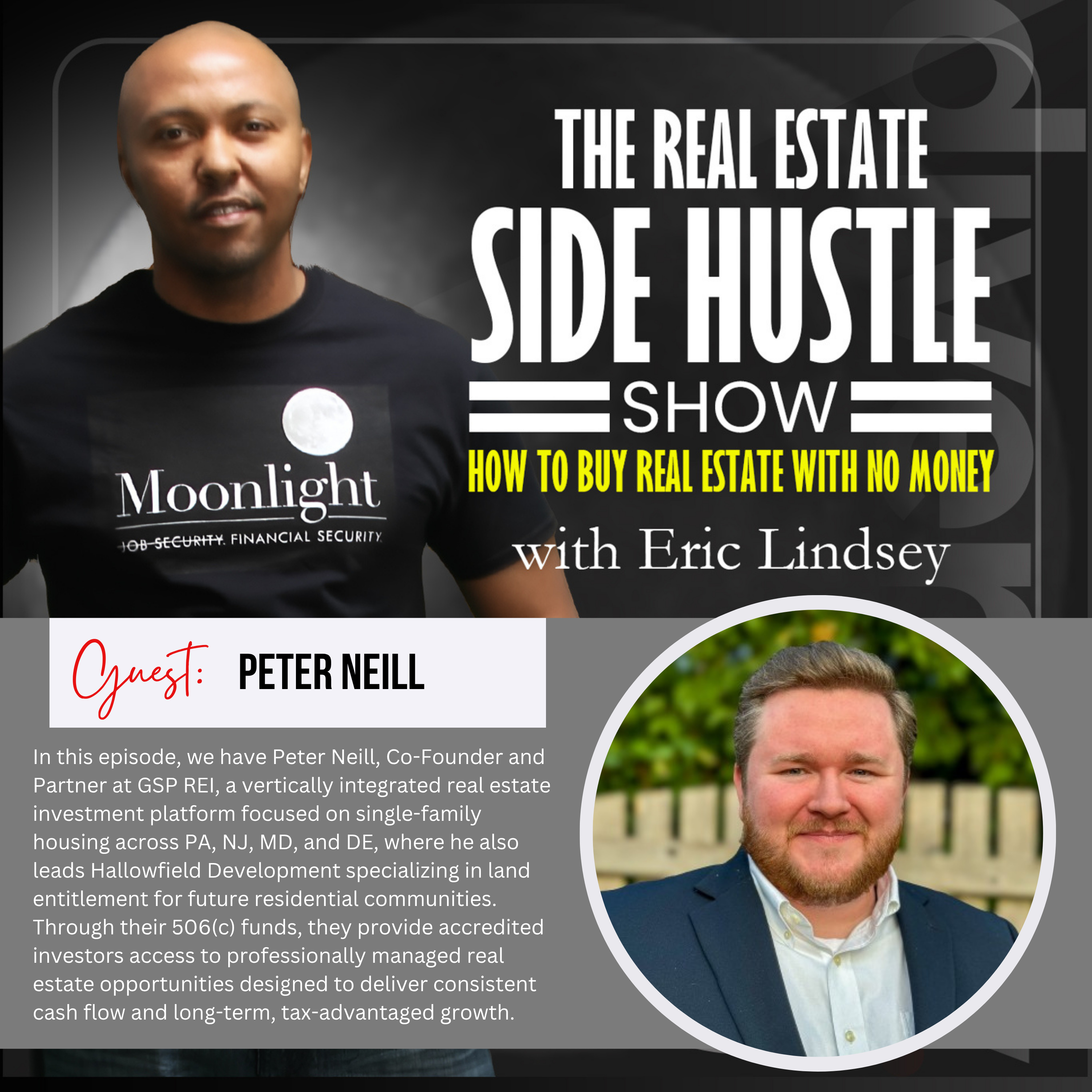
| 6/18/26 | real estate investmentprivate capital+4 | Peter Neil | GSP REIJohns Hopkins+2 | BaltimoreWashington, D.C. | private capitalresidential investment+7 | — | 37m 18s | ||
| 6/11/26 | private capitalresidential investment+3 | Peter Neal | CBREGSP REI+1 | — | private capitalreal estate+5 | — | 18m 20s | ||
| 6/4/26 | commercial real estatesyndication+3 | Claude Mouaffi | Chazek Investment | Atlanta | real estatesyndication+5 | — | 21m 03s | ||
| 5/28/26 | real estate investmentcorporate finance+3 | Claude Mouaffi | Chazek Investment | Cameroon | real estateinvestment+5 | — | 19m 02s | ||
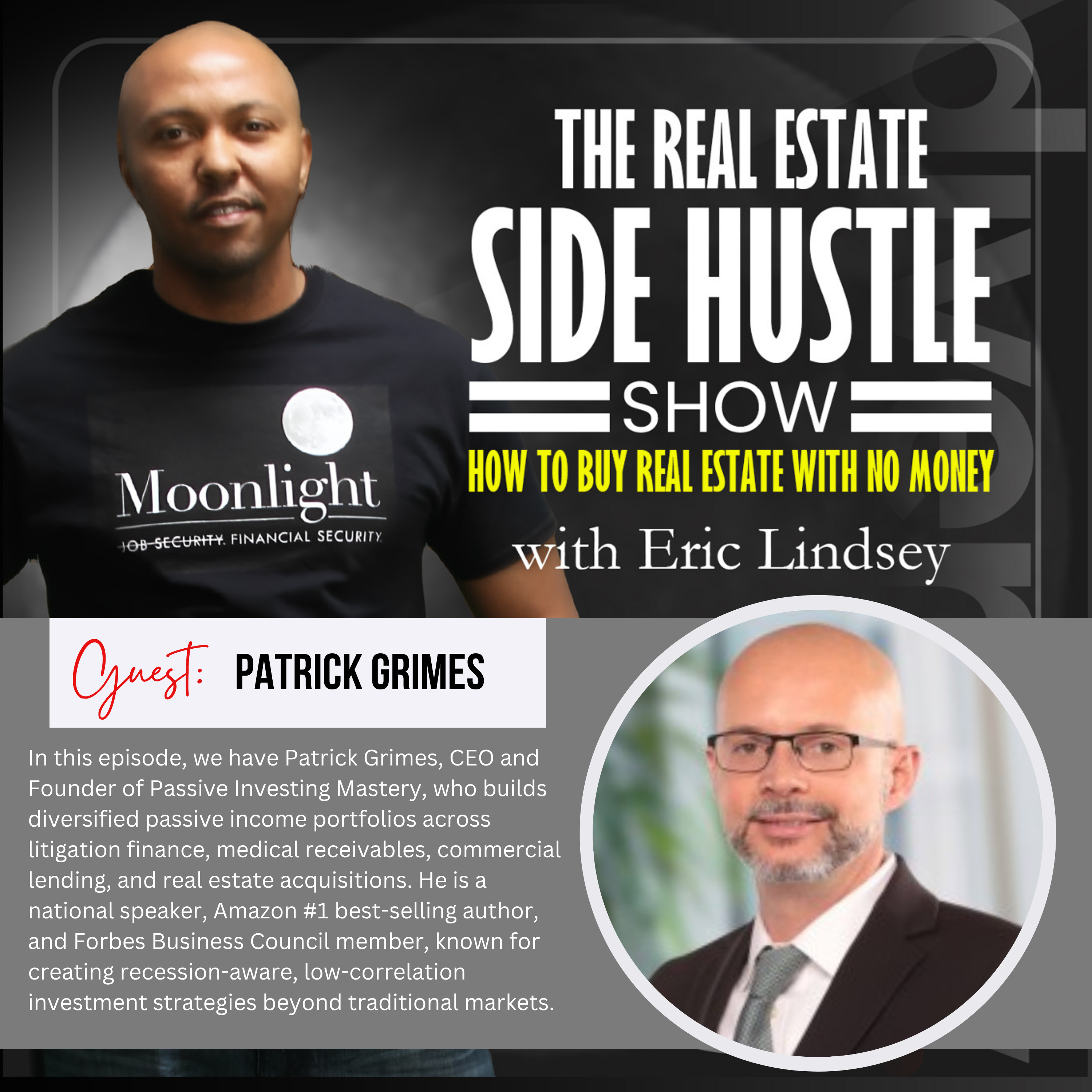
| 5/6/26 | real estate investingfinancial recovery+4 | Patrick Grimes | TeslaGoogle+4 | — | real estateinvestment strategy+5 | — | 37m 57s | ||
| 4/19/26 | real estate investingbuy and hold strategy+3 | Ebony Morris | MEK Homes | MichiganArizona+3 | real estate portfoliobuy and hold+3 | — | 20m 17s | ||
| 4/18/26 | real estate investingbuy and hold strategy+3 | Ebony Morris | MEK Homes | MichiganArizona+3 | real estate portfoliobuy and hold+3 | — | 19m 18s | ||
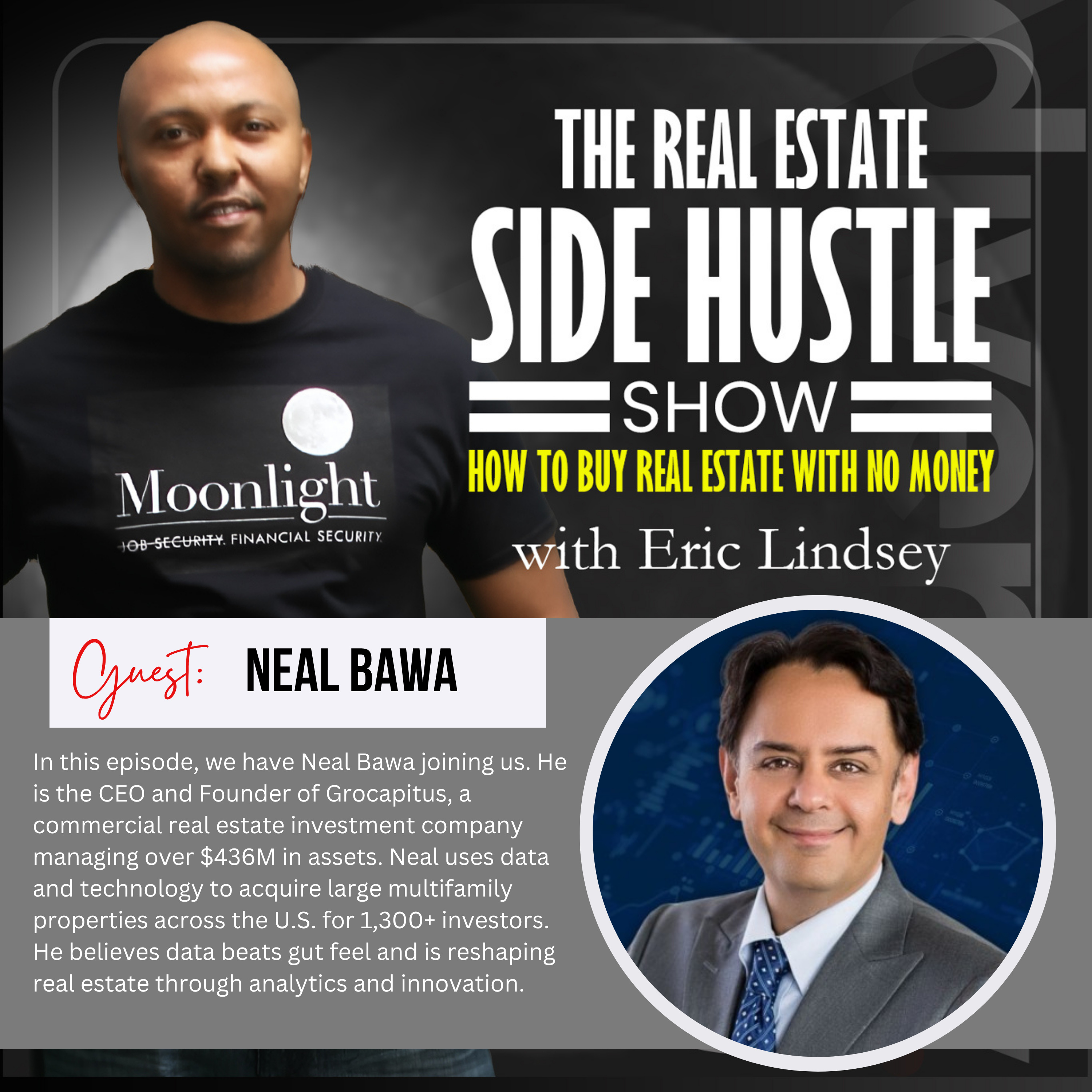
| 4/11/26 | real estate investmentAI in real estate+4 | Neal Bawa | Multifamily UAI | — | real estateinvestment+5 | — | 41m 27s | ||
| 4/4/26 | real estatemultifamily syndication+4 | Danny Flores | USCPrime Capital Investments+1 | — | real estatemultifamily syndication+4 | — | 18m 22s | ||
| 3/25/26 | LLC protectionreal estate investing+4 | Garrett SuttonTed Sutton | Rich Dad Poor DadCorporate Direct+2 | — | LLCasset protection+6 | — | 21m 52s | ||
| 3/17/26 | real estate syndicationproperty tax+3 | Dr. Jason L. Williams | Texas | — | real estatesyndication+6 | — | 27m 52s | ||
| 3/13/26 | real estate investingside hustle+3 | Dr. Jason L. Williams | R&DMultifamily Syndicator+1 | — | real estateinvestment strategy+3 | — | 29m 49s | ||
| 3/6/26 | real estateflipping homes+3 | Donovan Camarotti | beachside condo | Florida | real estateflipping homes+3 | — | 31m 37s | ||
| 2/27/26 | real estate investmentproperty management+3 | Julie Knight | Moonlighters | Montgomery, Alabama | real estaterental properties+3 | — | 22m 47s | ||












Showing 24 of 37
Pitch Fit is a Pro feature
See how bookable this show is for guests, which brands already advertise, the per-episode ad value, and the best-fit guest and sponsor profile. The numbers are blurred on the free plan.
How readily this show books outside guests like you.
How proven this show is for host-read sponsorships.
For Guests
ProFor Advertisers
ProUpgrade to Pro to unlock guest cadence, sponsor categories, fit scores, and per-episode ad value for this show.