Insights from recent episode analysis
Audience Interest
Podcast Focus
Publishing Consistency
Platform Reach
Insights are generated by CastFox AI using publicly available data, episode content, and proprietary models.
Most discussed topics
Brands & references
Est. Listeners
Based on iTunes & Spotify (publisher stats).
- Per-Episode Audience
Est. listeners per new episode within ~30 days
25,001 - 50,000 - Monthly Reach
Unique listeners across all episodes (30 days)
25,001 - 75,000 - Active Followers
Loyal subscribers who consistently listen
15,001 - 40,000
Market Insights
Platform Distribution
Reach across major podcast platforms, updated hourly
Total Followers
—
Total Plays
—
Total Reviews
—
* Data sourced directly from platform APIs and aggregated hourly across all major podcast directories.
On the show
From 10 epsHost
Recent guests
Recent episodes
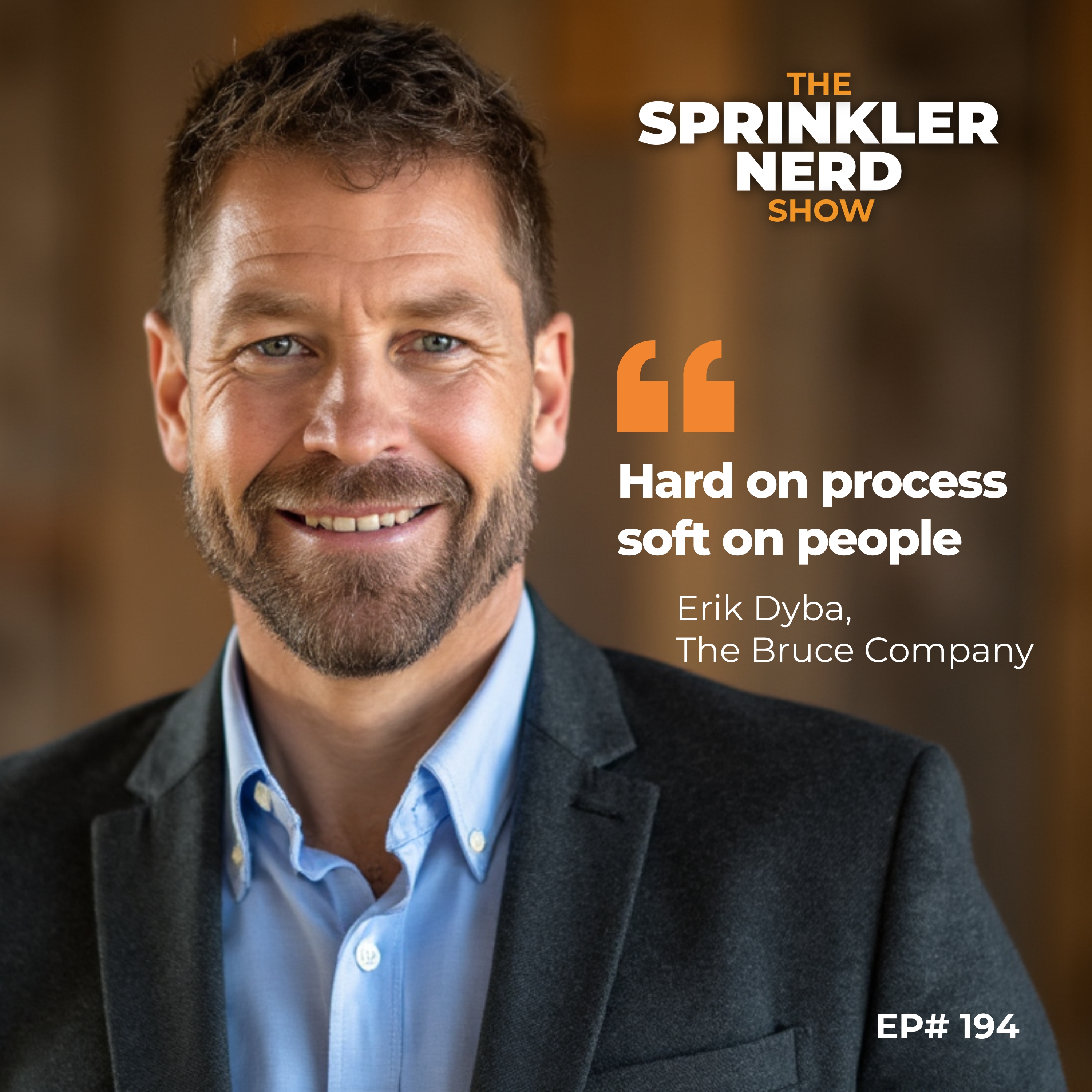
#194 - Hard on Process, Soft on People with Erik Dyba
May 1, 2026
Unknown duration
#193 - My Design Landscape Beta w/ Scott Allison
Apr 24, 2026
29m 38s
#192 - Let The Grass Grow
Apr 17, 2026
14m 18s
#191 - Where Is All The Water Going?
Apr 10, 2026
50m 03s
#190 - Contractors Are The People Who Make Irrigation Work
Apr 3, 2026
34m 43s
Social Links & Contact
Official channels & resources
Official Website
Login
RSS Feed
Login
| Date | Episode | Topics | Guests | Brands | Places | Keywords | Sponsor | Length | |
|---|---|---|---|---|---|---|---|---|---|
| 5/1/26 | ![]() #194 - Hard on Process, Soft on People with Erik Dyba | What does it actually take to turn around and grow an irrigation business? In this episode, Andy sits down with Erik Dyba from The Bruce Company to talk about his journey through the industry. From learning irrigation in the mountains of Colorado to rebuilding and scaling a department at David J. Frank from a few hundred thousand dollars to over $1.5 million. We get into what really moves the needle: building the right team, investing in training, creating systems that actually work, and leaning into partnerships with organizations like the Irrigation Association. Erik also shares his perspective on water conservation, why education is one of the biggest opportunities in the industry right now, and how his experience in both irrigation and snow removal has shaped the way he leads. This is a conversation about doing things the right way—and what happens when you commit to getting better over time. | — | ||||||
| 4/24/26 | ![]() #193 - My Design Landscape Beta w/ Scott Allison✨ | irrigation designcontractor tools+3 | Scott Allison | My Design Landscape BetaHunter Industries | — | irrigationlandscape+5 | — | 29m 38s | |
| 4/17/26 | ![]() #192 - Let The Grass Grow✨ | patiencegrowth+4 | — | — | — | patiencegrass growth+4 | — | 14m 18s | |
| 4/10/26 | ![]() #191 - Where Is All The Water Going?✨ | water managementirrigation+3 | Paul Bassett | ENVOCORE | military base | irrigationwater meters+3 | — | 50m 03s | |
| 4/3/26 | ![]() #190 - Contractors Are The People Who Make Irrigation Work✨ | future of irrigationsmart controllers+5 | Aaron KaterbergBrandon Dietrich+4 | Hunter IndustriesGrapids Irrigation+3 | Grand Rapids, Michigan | irrigationcontractors+5 | — | 34m 43s | |
| 3/27/26 | ![]() #189 - PART 3, Rain Bird Irrigation Pro Summit: Inside Rain Bird Innovation✨ | irrigation technologyproduct development+4 | Steve BarendtMaggie Saulsby+1 | Rain Bird | — | irrigation controllersvalve technology+3 | — | 25m 17s | |
| 3/27/26 | ![]() #188 - PART 2, Rain Bird Irrigation Pro Summit: The Modern Irrigation Contractor✨ | modern irrigation contractorwater management+5 | Steve PereiraTravis Childs+1 | Quench IrrigationMorgans Irrigation+1 | — | irrigation contractorwater management+6 | — | 43m 05s | |
| 3/27/26 | ![]() #187 - PART 1, Rain Bird Irrigation Pro Summit: 50 Years of Irrigation Innovation✨ | irrigation systemstechnology evolution+3 | Walter Mugivan | Aqua Mist Irrigation | — | irrigationsprinkler systems+5 | — | 21m 39s | |
| 3/19/26 | ![]() #186 - The Service Business is The People Business✨ | irrigation servicecustomer care+4 | Justin Wilson | American Irrigation | Georgetown, Texas | irrigationservice business+4 | — | 50m 03s | |
| 7/11/25 | #185 - The Power of NOT Knowing✨ | leadershipgrowth+4 | — | — | — | leadershipgrowth+5 | — | 14m 40s | |
Want analysis for the episodes below?Free for Pro Submit a request, we'll have your selected episodes analyzed within an hour. Free, at no cost to you, for Pro users. | |||||||||
| 5/22/25 | ![]() #184 - FL ND NYC Amsterdam✨ | geographytravel+3 | — | — | FLND+2 | FloridaNorth Dakota+5 | — | 21m 55s | |
| 4/11/25 | ![]() #183 - For Immediate Release, Patent US3808385 | For immediate release—breaking news, kind of. In this solo episode of The Sprinkler Nerd Show, Andy dives into what seems like a revolutionary product: a mechanical rain sensor that requires no batteries, no Wi-Fi, no firmware updates—just pure, functional design. It shuts off irrigation during rainfall and turns it back on when conditions dry out, all thanks to hygroscopic discs that expand and contract to trigger a simple switch. This device sounds like the newest drop in water-saving technology—until Andy reveals the twist: it's not new at all. In fact, it's based on US Patent 3,808,385, filed in 1972 and granted in 1974. That's over 50 years ago. And the core concept of the mechanical rain sensor hasn't changed since. Andy breaks down how the device works, why it's still effective today, and what it says about the pace of innovation in the irrigation industry. He challenges contractors and tech developers alike to ask the big question: why are we still using 1970s technology in 2025? Could we create a smarter, data-driven rain sensor that actually logs rainfall events, provides historical context, and informs better irrigation decisions? If so—why hasn't anyone built it yet? Key Highlights: Breakdown of how the moisture-responsive switch actuator works Benefits for contractors: simplicity, reliability, zero maintenance Installation and adjustment tips Why the current state of rain sensors is a wake-up call A challenge to the industry: let's rethink how we track rain and respond to it Andy closes the episode with a call to action for all Sprinkler Nerds: always ask why. Why things work the way they do, why they've stayed the same—and how we can make them better. | — | ||||||
| 4/4/25 | ![]() #182 - Approachable 2-Wire with Rain Bird's Steve Barendt | YouTube Short: https://youtube.com/shorts/flpTuNN7vqY Summary In this episode of the Sprinkler Nerd Show, host Andy Humphrey sits down with Steve Barendt from Rain Bird to explore the company's new ESP 2-Wire Controller—a product that's making 2-wire irrigation systems significantly more approachable for contractors who may have previously avoided them due to complexity. The Origin of the Conversation Andy first encountered Steve at the IA Show, where Steve delivered an impromptu 2-minute elevator pitch on the new controller. That pitch sparked Andy's interest in Rain Bird's new approach to two-wire systems, leading to this deeper dive discussion. Steve's Background Steve brings a decade of experience at Rain Bird, including seven years on the sales team working directly with contractors in the Austin, Texas area. His background in the field informs his work as a product manager, enabling him to better understand real-world customer needs and challenges. Why "Approachable" Matters Historically, two-wire systems have been considered complex, especially around wiring specifications, connector types, and troubleshooting. Rain Bird's ESP Two-Wire Controller aims to lower the barrier to entry, making it easier for contractors—even those new to two-wire installations—to adopt the technology. The term "approachable two-wire" is intentional. Steve explains that Rain Bird designed this controller to work with standard irrigation wire and connectors, rather than requiring specialized components. As long as the wire is direct burial irrigation wire (down to 18 gauge) and connectors are rated for 600 volts, users can leverage what's already on their trucks—reducing the learning curve and installation costs. A Big Shift: De-Energized Two-Wire Path A key innovation is that the two-wire path is not constantly energized, as it is in traditional two-wire systems. Instead, it's only powered when actively running a station or performing diagnostics. This reduces heat at the connectors and decreases corrosion risks, allowing the use of standard connectors and simplifying troubleshooting. Positioning: Who's It For? The ESP Two-Wire Controller isn't designed to replace all two-wire systems. Instead, it's aimed at light commercial and large residential projects with about 12 to 30 stations—an area where contractors often debate between traditional wiring and larger two-wire systems. Key highlights: 50-station capacity (though ideal use is around 12–30 stations) Cost break-even point starts around 12 stations, lower than the 30+ typical for traditional two-wire setups Two solenoids can operate simultaneously Compatible with a standard flow sensor (hardwired) By offering a lower break-even point and simpler installation, this controller fills a gap between traditional modular controllers like the ESP ME3 and higher-end commercial platforms like LX IVM. Troubleshooting Tools and Diagnostics Rain Bird has invested heavily in diagnostics features that make this controller easier to troubleshoot: LED Feedback on Decoders: Each decoder includes red, green, and blue LEDs that indicate operational status, short circuits, and open circuits. Short Finding Mode: Allows energizing the path for diagnostics with a clamp meter. Power-Measure Mode: Helps track power issues in the field. These features empower contractors to isolate and resolve issues faster without needing advanced tools or specialized knowledge. Auto-Addressing Decoders Perhaps the most contractor-friendly feature is the auto-address functionality. Rain Bird decoders come in numbered order, and if installed sequentially, the controller will auto-scan and assign decoder addresses to stations with no manual input. This drastically reduces setup time and minimizes human error. While other systems may require manual address entry or use specialized software, Rain Bird's solution is faster and simpler—especially when paired with the mobile app. No Field Grounding Required Another simplification: unlike other two-wire systems, no field grounding is required for this controller. Though contractors can choose to ground the system if they wish, it's not necessary for functionality or warranty compliance. Connectivity and Software Integration The controller is WiFi-enabled via Rain Bird's LNK2 module. It currently connects to Rain Bird's legacy mobile app, but a transition to Rain Bird's 2.0 app and IQ 4 web platform is planned for 2025, which will bring expanded access and remote management options. Simplified SKUs and Installation Rain Bird is offering this platform with just two SKUs: the controller and a single-station decoder. That's a major advantage for distributors and contractors, who won't need to manage complex inventories of sensor decoders, grounding kits, or multi-station decoders. Behind the Scenes: Product Development Steve shared insights into the 2–3 year development timeline, which included field testing, focus groups, and engineering across multiple departments. The goal: simplify, streamline, and make two-wire technology accessible to more contractors. Multiple patents were filed as part of the innovation process, particularly around the auto-addressing and system architecture. Final Thoughts This controller isn't for every project—but that's the point. Steve emphasized the importance of positioning the right tool for the right job. When used in the right context—light commercial sites, fast food chains, hotels, and medium-size properties—Rain Bird's ESP Two-Wire Controller can offer a compelling mix of ease-of-use, cost savings, and performance. Contractors interested in learning more are encouraged to reach out to their local Rain Bird representatives via their distributor or visit the Rain Bird website for product videos and specs. Key Takeaways Designed for simplicity and approachability Compatible with standard wire and connectors De-energized two-wire path reduces risk and simplifies install Auto-addressing decoders streamline setup Troubleshooting tools built-in (LEDs, short find mode, power measure) Ideal for 12–30 zone projects Connects via WiFi and will be fully app- and web-integrated in 2025 No field grounding required Just two SKUs for the system | — | ||||||
| 3/16/25 | ![]() #181 - Ohio Goes Wireless | Andy introducing wireless sensor technology to Ohio and riffs about the "RHYTHM" of the landscape. | — | ||||||
| 3/2/25 | ![]() #180 - Behind The Scenes - Making LoRaWAN Soil Moisture Sensors | In this episode, Andy shares his process for manufacturing LoRaWAN wireless soil moisture sensors. | — | ||||||
| 2/22/25 | ![]() #179 - Project Harmony Advisory Team | Join the Project Harmony Launch List: HarmonyAnalytica.com/future What does the future hold for your landscape business? Well, if you ask nine experts, you'll get 10 different answers. Some say we're heading for a lush, thriving growing season; others predict drought conditions. Some insist we'll get just enough rain this year—and someone else insists it's never enough. Let's be honest, nobody really knows... But now...there is one surefire way to future-proof your business and how you manage high asset value crops: Harmony Analytica. Harmony is the FIRST sensor analytics platform made for plant-focused professionals. It is currently used by leading institutions, managers, and contractors from Agricultural, to HOA, to Green Infrastructure everywhere.. But what does Harmony Analytica actually do? It brings all of your water consumption data, irrigation schedules, localized rainfall, soil moisture levels, environmental data, and plant health metrics together into one. single. platform. That means you have a single source of truth to manage your landscape assets. No more cobbling together spreadsheets or running multiple apps, or exporting for water use, from multiple software platforms—only to end up with a "dashboard" that's outdated the moment you finish assembling it. Do you juggle endless logins for systems like Rain Bird, Toro, Hunter, Baseline, WeatherTrack, RainMaster, Calsense, Weathermatic, Smart Rain…the list is fucking long, yeah? With Harmony Analytica you can affordably add sensors for one centralized command center, saving you time, simplifying your workflow, and giving you unparalleled insight into every aspect of your irrigation strategy -without spending thousands of dollars changing our controllers. Harmony Analytica knows exactly what you need: Real-Time Insights – to track water consumption, water pressure, soil moisture, local rainfall, evapotranspiration, and more. Accurate Planning – so you can schedule irrigation and manage your resources based on data, not guesswork. Visibility & Control – to make quick, informed decisions about your landscapes in one user-friendly dashboard. Think of this as the instrument panel of your horticultural fighter jet. You want all that data to be spot on and easily accessible—so your maintenance strategy is efficient, your plants are thriving, and your business is operating sustainably. Start with one sensor, grow with many. Harmony's modular platform ensures that no matter how small your business is today, or how large your landscape operations become, Harmony Analytica is designed to scale seamlessly right alongside you. There is no minimum to get started. In short: you need Harmony Analytica. It's an amazing opportunity to revolutionize how you manage landscapes. And speaking of opportunity, do yourself a favor: Apply Now, to join the Harmony Analytica Advisory Team, where you can become a part of the development team and help shape the future of the company. In this top-secret, private group, we will break down how to leverage cutting-edge tech to keep your landscapes greener—and your bottom line stronger. Signup today: Harmony Analytica.com/future, harmonayanalytica.com/future, harmonyanalytica.com/future. | — | ||||||
| 2/1/25 | ![]() #178 - Bespoke or A.I. | In this episode of The Sprinkler Nerd Show, host Andy Humphrey starts off with an unapologetically bold greeting to illustrate the power of authenticity and grab listeners' attention. He gives a personal shout-out to friends, mentors, and colleagues he connected with during the week—highlighting the importance of real human relationships in an increasingly AI-dominated world. From there, Andy explores the rapid growth of AI and how it's poised to deliver personalized, mass-produced podcast content—comparing it to Walmart's ability to provide inexpensive, standardized groceries. But just as many people still prefer organic, home-cooked meals, Andy argues that listeners will continue to value authentic, human-created content. He emphasizes that AI, while a remarkable tool, simply can't capture the spontaneous quirks and genuine emotion inherent in a show crafted by a real person. Ultimately, Andy encourages creators (and listeners) to lean into their unique perspectives and passions. By embracing technology where it's helpful but maintaining the "handcrafted" essence of podcasting, we can build deeper connections and a vibrant community that values the human touch—something no AI can replicate. | — | ||||||
| 1/25/25 | ![]() #177 - Canada & Project Harmony Update | Hello, friends! I wanted to take a moment to share a quick update on what's happening this week. I'll be traveling to Calgary and Edmonton, Canada, for the SiteOne Landscape Supply One Stop events. On Tuesday, I'll be at the Calgary event, and then on Thursday, I'll attend the Edmonton event. After that, I'll head back to the airport Thursday night and fly home on Friday. I had to adjust my travel plans a bit, departing from Grand Rapids instead of my usual airport because, upon my return, I'll be meeting up with my daughter. We're headed straight to a volleyball tournament in LaPorte, Indiana—an exciting way to wrap up the week! If you're in the Calgary or Edmonton area, I'd love for you to stop by the SiteOne events. Please make it a point to say hello! It's always a pleasure meeting industry professionals, and I'd love to hear what's happening in your world. An Update on Project Harmony For those of you following my journey to bring affordable wireless soil moisture sensors to market, I wanted to share some exciting news. We've successfully deployed a few hundred beta sensors—yes, handcrafted by yours truly! The beta launch has been a huge success, and if you'd like to learn more about Project Harmony, visit harmonyanalytica.com. If you're interested in participating in the beta program, you can receive a sensor and Wi-Fi hub for just $100. Simply visit harmonyanalytica.com/beta to sign up. I'm also looking for industry professionals who want to integrate wireless sensors into their business. I'm even considering launching a private group for beta users. In this group, I'd share everything I've learned on this journey, and together, we could build the next generation of water analytics and landscape insights. Behind the Scenes of Sensor Development What's fascinating about bringing sensors to market is that the biggest challenge hasn't been the measurements—it's been the manufacturing process. I've learned so much about 3D printing, epoxies, potting materials, and even things like glue types and vapor smoothing chambers. Right now, it's a 2-to-1 process—for every two sensors I manufacture, only one makes it to the field. Many work perfectly but have small cosmetic blemishes, making them unsellable based on current standards. This is one idea I'm considering for the beta group: offering these fully functional but slightly imperfect devices at no charge for testing and learning. If you're curious about how wireless sensors work, how they can add value to your business, and how we can revolutionize the industry together, I'd love to connect with you. Let's create the next wave of innovation outside of the traditional wholesale landscape manufacturers. That's my week ahead! I look forward to meeting any of you who are in Western Canada at the Calgary or Edmonton SiteOne One Stop events. Stop by and say hi—I'd love to connect. Thanks for listening, and let's keep innovating! | — | ||||||
| 1/17/25 | ![]() #176 - Let's Go Out To Dinner And See a Forecast | No description provided. | — | ||||||
| 1/11/25 | ![]() #175 - Apple's Forgotten Founder: Ronald Wayne's Secret to Tomorrow's Money | In this episode, we uncover a remarkable story hidden in plain sight: Ronald Wayne, the often-overlooked third co-founder of Apple. While Steve Jobs and Steve Wozniak achieved legendary status, Wayne's name is hardly mentioned in the tech world—even though he helped draft Apple's original partnership agreement and designed its first logo. After just twelve days, he chose to walk away from his 10% stake in Apple for a mere $800, a decision that would come to symbolize both the enormity of risk and the unpredictability of life. I share how my son, Drew, and I stumbled upon Wayne at an afterparty during the Consumer Electronics Show (CES). This unexpected meeting led to an eye-opening conversation about everything from historical shifts in monetary policy to Wayne's current passion for investing in silver. Drawing on Adam Smith's Wealth of Nations, he argues that today's fiat currencies are on shaky ground and sees silver as a tangible asset that may protect wealth when paper money loses its luster. Throughout our chat, Wayne's calm conviction and life experiences shine through. He exemplifies the power of informed decision-making, a willingness to pivot when necessary, and an unwavering commitment to charting one's own course. Despite leaving behind what could have been billions, he found fulfillment in engineering pursuits and personal independence. Tune in to hear my reflections on Wayne's journey and the lessons we can all draw from his story. If you're curious about his detailed thoughts on the future of money, stick around for the recorded audio of our conversation with Ronald Wayne himself. It may be a bit difficult to hear at times, but it's worth the listen if you want to glean insights from one of Apple's most intriguing figures. | — | ||||||
| 12/31/24 | ![]() #174 - The Sandbox Adventure | Today, I'm sharing the story of my six-month recharge. Six months that pulled me out of my comfort zone and into a world of new challenges, new skills, and new possibilities. This wasn't a vacation—it was six months of diving into the sandbox, experimenting, and solving problems I'd never faced before. And here's the thing: If I can do this, you can too. So, join me on this creative adventure as we look ahead to 2025 and all the possibilities waiting for us. This is the story of my six-month recharge —-- six months that transformed how I think, work, and approach challenges. This wasn't a break or a vacation. It was six months of diving into the sandbox—learning, experimenting, and tackling problems I'd never faced before. I stepped out of irrigation and into the fast-moving world of IoT. The Sandbox Adventure Here's what happened: I invented new IoT products. I developed a wireless cloud solution to connect industrial weigh scales to the cloud—something that hadn't been done before. I learned to set up a Raspberry Pi. This opened the door to new technical possibilities. I dove into LoRa. I explored how this long-range wireless technology is shaping IoT. I attended the largest LoRa conference in Amsterdam. It gave me a front-row seat to the next big technology curve. In six months, I gained more skills than in the last six years. Why the Sandbox Matters This wasn't just about learning new skills—it was about embracing the unknown. The sandbox is where you play, experiment, and solve problems without fear of failure. It's where you push boundaries and ask, What if? These six months pulled me away from irrigation and into the broader IoT world, where the future is being built. Here's what I want you to take away from this: Growth happens in the sandbox. It's where you take risks, build, and learn about yourself. You don't need to know everything or have a perfect plan. You just need to step in, get your hands dirty, and start creating. If I can do this, you can too. 2025 is your year to play in your own sandbox, to learn, grow, and build something extraordinary. So, let's do this together. Join me on this creative adventure. The sandbox is waiting, and the best part? You're already holding the tools. | — | ||||||
| 6/21/24 | ![]() #173 - Field Capacity from Orlando Florida | Andy Humphrey kicks off the episode with "Little Silver Ring" by The Samples and shares insights from his trip to Orlando for volleyball Nationals, highlighting its economic impact. He then revisits a past episode on field capacity, discussing soil moisture sensors, practical analogies, and their importance in irrigation systems. (0:00) Andy Humphrey introduces the morning song of the day (1:31) Andy Humphrey reveals the song: "little silver ring" by The Samples (1:44) Podcast introduction and target audience (2:20) Andy Humphrey talks about being in Orlando for volleyball Nationals (3:47) Discussion on the economic impact of the volleyball tournament (7:36) Transition back to the Sprinkler Nerd Show (8:15) Replaying a past episode titled "field capacity, my ass" (9:40) Experiment with multiple soil moisture sensors (12:21) Shout out to Juanita and replay of the April 2023 episode (12:58) Defining field capacity (14:23) Using a sponge as an analogy for field capacity (17:09) Comparing field capacity to a percolation test (19:16) Field capacity as the baseline for soil moisture (22:10) Explanation of how to measure and apply field capacity (27:20) The art of setting soil moisture sensors (32:40) Analogies for understanding tank size and soil moisture (33:14) Importance of field capacity in irrigation systems (34:16) The future impact of soil sensors in the industry (35:15) Closing remarks and wrap-up And so I'm gonna play that for you today. Here because I don't have time to record a full episode with brand new content, but it did get me thinking about just soil moisture sensing and field capacity and understanding the numbers, and you're gonna hear all that on this episode, this replay episode. But I wanted to share a new concept that actually it's not completely new, but a concept that I have running, in ex in an experiment right now. And that is a concept of taking multiple soil moisture sensors, let's say, within one zone, and averaging them together to creating new soil moisture or that you might think of as a synthetic value. So there's always the angel question of, you know, how is this one spot where the soil moisture sensor is buried. How how is that relative to the rest of either the site or the zone I'm not gonna get into all of those details. We'll save this for another episode. And and the and that is that is a valid question. And the only real way around causing a mistake is to actually just locate the sensor in in a really good area. But then what would happen? What would it look like if instead of putting one soil moisture sensor in a zone? Or one soil moisture sensor in every zone, we put 3 soil moisture sensors in one zone and use that one zone as the baseline zone for the rest of the site. And it's not actually possible today to do this with any control system. Even a baseline control system. You cannot install you can install 3 soil moisture sensors in a zone, but they're all going to be independent, and only one of them can actually control the zone. But what if you could take those 3 soil moisture sensors buried in the one zone, average them together to create a new synthetic, you know, synthetic value and use that average value to control the zone. What would that look like? That can't be done today, but I'm doing it. I'm actually I'm actually running this experiment. We have a a project that has I should know this number off the top of my head, but I don't. Let's say if it has 8, it has 8 soil moisture sensors. And each soil moisture sensor is actually buried in in its own zone, 8 slow moisture sensors, 8 zones, but then I'm taking all of those 8 slow moisture sensors averaging them together and creating a new value that says here's the average soil moisture across the entire site. And what's interesting about that is, well, first, it it hasn't been done before. But second, it might make up for potential errors in location, formity, etcetera, etcetera, if multiple sensors are installed within one zone average together to create a new value So that's just one experiment that I'm running right now. It's going really well. And, maybe maybe a manufacturer that might be listed into this podcast, we'll take that into consideration as they develop the platform. And, we'll just we'll just see how it goes. But Wanted to give a special shout out to Juanita. Thank you for being an active podcast listener. Appreciate hearing from you. And, with your recommendation, I'm gonna replay the episode from April, I think April 28th 2023 called field capacity, my ass. It is great content. I highly encourage you to listen to the entire episode. And if you don't have time today, bookmark it, listen to it again, and I'm, excited to talk about field capacity more in the future because it's more relevant than it ever has been. So thank you so much for listening. Appreciate all of you. And, we'll just roll the intro here and get right into the episode on field capacity. Okay. So in order to understand field capacity and talk about field I first think we should define field capacity. Field capacity refers to the maximum amount of water that a soil can hold against the force of gravity. Alright? It's kind of the point at which the soil is fully absorbed I won't say saturated, fully absorbed with water, and then the excess water has drained away. K? After that excess water has drained away. That's field capacity. At field capacity, the soil is sort of holding as much water as it possibly can and any additional that we add to the soil will actually drain away due to that force of gravity. One great way to illustrate this, maybe this would create a mental picture in your mind, is to think taking a sponge in your kitchen sink. K? If the sink is full of water, you put the sponge into the water, you let the water soak into the sponge, fully, then you lift the sponge out of the sink, it starts to drip, drip, drip, drip, That's saturation as soon as the water stops dripping out of the sponge. That's field capacity. K? That's the point at which the water can hold the the the moisture after gravitational drainage. K. So the sponge is a great way to describe this. Great way to understand it. Great way for you to describe this to your customers, your clients. And seeing this on a graph is awesome as well. So typically, I like to see this on a graph. So historically, working with baseline controllers, I would pull up a soil moisture graph report. I would look at this, on the graph to understand the concept and teach people about it. Okay. So the way that it looks on the graph. And again, I think probably the best way for you to visualize this is that sponge because we can all picture a sponge dripping. Okay. And what that looks like on the graph is a spike. When when the soil is full of water and it is dripping, it it's not holding water. The water is actually draining out of that soil. So you see this spike wet. Boom. It spikes up. And it's draining quickly. Right? The water is dripping out of that sponge. So you get this needle tipped tall spike. And then as the drop start to slow down out of the sponge, that's that's kind of like a curve. It represents a curve, a dry down curve on the graph. And and that curve, which is sometimes called, like, the shoulder, the shoulder of that curve, that illustrates where field capacity is. Okay. And you can kinda measure it. So if we're looking this looking at this on a graph, you could take your cursor, you could hover over the line, and you could get a a numeric value for field capacity. Okay? So more on that in just a moment. The other way that we can describe field capacity instead of using that term, which is very scientific, but it's important for us to understand it, but the average person may not. So One way to describe another way to describe that to the average person is just using the term wet. Sounds easy, silly, but it but it's true. It's wet. Not too wet, not too dry, just right. It's the goldilocks of wet. It's perfectly wet, not too wet, not too dry, just right. It's the goldilocks of wet. K? And again, you can measure this. It's a scientific value. Feel capacity is scientific. How much you allow that to deplete is the art. You can you can deplete it as much or as little as your plants can sustain. But every soil has a field capacity value that can be measured. Alright? Let's go with another way to think about this. I'm gonna give you a few examples because maybe one will stick more than another, and these are just analogies that I've used over the years to help describe the concept. A third way to describe this is a lot like a percolation test. Okay. And a lot of landscapers know this and home builders understand this because if you have a well for your water supply. Actually, not a well. What am I saying? If you have a septic, system, A lot of wells also have septic systems versus city water. But if you have a septic system, typically, you have to do a percolation test to see how the water drains through that soil to see whether that soil can even house or hold a septic tank. Okay. So typically a percolation test, you dig a hole You fill it up with water. You watch it drain over time. And then that would determine if you would be allowed to get a permit from your town to put in the drain field. Okay. So the faster a soil drains the more sand there's going to be in the soil. And the slower it drains, the more clay we're gonna have in the soil. Or, like, based on that drainage rate, it can also describe, you know, kind of the compaction and the structure because the soil type is only one variable. Right? So if we say I have Sandy Lom, well, that does just because you have Sandy Lom or you think you have Sandy Lom or you sent your soil test to a lab, and they said you have sandy loam, it doesn't mean the soil actually behaves like you have sandy loam because there is compaction and there's structure in the soil. They can also affect how water moves through the soil. So What we're really chasing is that field capacity and we want to measure it and we measure it with the soil moisture sensor. Okay. Got it. Am I tracking with you, right? Picture the sponge, picture the, the perk test digging the hole, watching the water drain through the soil, we can measure those, measure the rate, and determine the soil type or actually more. We can determine that field capacity, which tells us about the soil type with the soil moisture sensor. Alright? So back to field capacity, feel capacity being perfectly wet, so Goldilocks wet. Alright? Now that's where things start to get really fun because if you can understand that concept, you can now understand how everything else about soil moisture works. It's all relative to field capacity. And I think this is where most current manufacturers, if not all current manufacturers have missed the mark. I'm gonna tell you why here in just a minute. Again, this is my opinion that most of them have missed the mark because they focus on volumetric soil moisture. They focus on the the data coming out, the actual reading of the soil at any moment, but one reading alone is not enough. Alright? So I'm gonna tell you what that means here in a minute. But I wanna also mention that typically, you know, engineers of soil moisture sensors, either just probes, control systems, engineers, know, like, what we're talking about. They know what this means. They know exactly what the readings are, how to set the sensors And from my personal experience, teaching and training on the subject matter for, god, it's crazy, almost 20 years. I know how to set the sensors, but I also know that the average knuckle dragger has no idea. And the first question that they always ask me, like, every time, how do I set the sensor? Andy, I put the sensor in. How do I set it? And so that's kinda what I wanted to talk to you about and provide you with some understanding of field capacity allowable depletion, permanent wilting point, all that shit can be so confusing that what we really wanna focus on is field capacity. Alright? And here's my tip If field capacity equals wet and wet equals full, k? Think of this like a tank, a tank of soil, full is 100%. So I like to take the volumetric moisture percentage and fine field capacity and set that to be full, because this makes the most sense to the average person. Is my soil full? Is my soil empty or where in between those values is it, but the actual volumetric soil moisture percentage doesn't matter so much after we understand field capacity. Because we're gonna set field capacity equal to 100% and then the tank size is going to be determined from that. Alright? And that's where I think most manufacturers miss the mark because they should set their calibration relative to field capacity and set a new tank size. Okay? So we're gonna get I mean, I'll give you a few examples here. In in a moment, but I want you to think about that concept. K? If field capacity is wet and wet is full in full must equal 100%. So field capacity equals 100%. K? Then we wanna know what is 50% full and what is empty. And that's really the skill that we should be thinking about, k, because if we take one reading, and which is actually something that people typically ask me. So let me give you let me give you that example. Oftentimes after someone installs a slow moisture sensor system, I would get a call. Right? And the the client says, Andy, you know, something like this. My moisture sensor is reading 28.5 percent What does that mean? How do I set the sensor? K. The question is, literally, most of the time, just like that. My moisture sensor is reading 28.5, or it's reading, it's reading some number, and they wanna know what does it mean? How do I set the sensor? And the funny thing is that my response is usually like, I have no freaking idea. K? How could how could I after with 20 years of slow moisture sensory experience, not know what 28.5% means. It's actually that I do know what it means. It means 28.5%. But I don't know what what that means in terms of wet or dry. K? Because I need more information. 28.5 percent or the the value that you're taking at any moment does not mean anything all by itself. It has to be made in relationship to field capacity. Right? Is that making sense? If we took a reading of 20 percent or 25 percent or 30 percent, one number all by itself doesn't mean anything. It only means something when compared to field capacity. And I made a couple notes here. Wanna give you an example. So this is one piece actually. I'm actually cheating here. Not reading word for word, but I I made some notes. So let's say for instance, we measure field capacity at 26%. Okay? If field capacity is 26%, And the client asks me, what does 28.5 percent mean? I I know right away, shit. That's higher than field capacity. That means your soil's freaking wet. Saturated and saturation because I can compare 28.5 percent to the known field capacity of 26. K? But maybe what if field capacity was 32? And they asked me, what does 28.5% mean? Then I know Well, it's not yet up to fuel capacity. Your tank is about, you know, 50% full or 60% full. You have to take the slow moisture sensor reading that you get, and you have to compare it to you have to compare it to field capacity. Alright? And every moisture sensor reading that is compared to field capacity has to be compared to field capacity on the very same sensor. You can't compare different sensors to each other because they're all installed in different environments. And how the sensor is installed in each environment could be different. Even if the soil type is the same, how the sensor is installed can affect the reading a bit, which means field capacity on one sensor might be 30. And in the same soil condition, you know, 100 yards away, it could be 32% based on how that sensor is installed. So you wanna compare the number that you're getting and feel capacity only on one sensor. Never compare 2 sensors to each other. Alright? So for this reason, what I usually recommend is that during installation, you pour a bucket of water over the sensor or any amount of water that's going to take to saturate the sensor, which means get it more wet then feel capacity. Get it kind of as wet as you can, you know, to a point. And then wait 24 hours. Kinda like doing that perk test. You wanna get it wet. Then you wanna let gravity take over and you wanna see what it does after 24 hours. You can come back to the site, take a reading, Or if your system is connected remotely, you can look at the graph. You wanna give it some time. You wanna, like, gravity do its thing. I don't like that sponge. You wanna pick that sponge up out of the sink. Let it stop dripping. So you wanna wet your soil, get it nice and wet, let gravity take over, and then you wanna take another reading. And that reading is field capacity. That's the right or downer. That's your baseline. That's field capacity. And everything else becomes relative to that number. If you take a reading in the future and it's higher, you know, your soils and saturation. If you take a reading in the future, and it's 50% lower, you know you're freaking dry. Okay. So the next question I usually get after we find field capacity, is how do I set the sensor? And this becomes the art. So I mentioned before that measuring field capacity is a science. Because you can actually measure it. The amount that you allow for depletion or dry down is the art, and there's only best practice And there's observation and there's knowledge of your plant material and the health of your plant material because all of those things can affect how dry and for how long can you maintain dry. But I have one general rule that I usually give to all clients as a starting point And that is 20 percent depletion, not 20 percentage points, right, not going from 30 down to 10, not 20 point 20 percentage points, but 20% of a number. And that is how you determine your tank size. You take field capacity, you subtract 20% of it, or you multiply it by 0.8 And that will give you your dry number. Alright? So let's look at a specific value. Let's pretend here today, that we measure fuel capacity and it's 30%. What would 20% depletion be? What would 20% dry be? What is that number? Well, I I typically do the math. 10% of 30 is 3. We'll double that to get to 20. That would be 66 percentage points. Field capacity was 30. 6 percentage points is our tank size, so 24 becomes the depletion. That's dry. We will let the soil go from 30 when it's wet down to 24 when it's dry, and then we'll fill it back up again. And I'm today, I'm not gonna be talking about how to automate we're just talking about the numbers itself. Right? So if you take your reading and it's 25%, you know, you're not dry yet because we just said 24 was dry. If you take a reading at 17, you know, you're way below your depletion point. Alright? And I use 20% as a starting point because you never wanna start too dry. You never want to you always wanna start a little bit conservative, see how it goes, then you could lower it a little bit, then you could lower it a little bit more. But the analogy of using 20 percent helps to describe how the tank size can be measured. So if we think about the field capacity number. And we think about taking 20% of it. So we started with 30%. We took 20% away. That was 6 that was 6 percentage points. Okay. And then turn on was 24. The type of soil that we're working with actually determines the size of the tank. So generally speaking, and this is kind of a, I guess we could call it a rule, clay soil holds more water. So when you measure field capacity in a clay soil, it's going to always be higher. So let's just say it's 33%. K? And the range is probably anywhere from 29 to, you know, 38% generally speaking. Clay soil holds more water, so field capacity is a bigger number. Sandy soil holds less water, so field capacity of sand will be lower. Right? Let's say field capacity of sand is 22%. And we're just assuming field capacity of clay is 33%. But if we use the general rule of 20 percent depletion, 20 percent of a bigger number is a bigger tank. Right? The more clay in the soil, the larger the tank size will be. The more sand in the soil, the smaller the tank size will be. Because 20% of a smaller number is a smaller number, 20% of a bigger number is a bigger number. So the smaller the tank, the more frequent it will need to be filled up. The larger the tank, the less frequent it will need to be filled up. Okay? It also means it'll take more take more water volume to fill it up, but the depletion will occur faster in soil and in clay I'm sorry. It's faster in sand than it will in clay. And I noticed this from my own sort of, growing up in Vermont, there is the soils very heavy clay. Lake Champlain used to cover a big portion of the state of Vermont and this the soil that was left at the bottom of the lake, you know, Eons ago has tons of clay in it. It holds a shit load of water. Mud season in Vermont, sucks. However, it's freaking green all the time because the soil doesn't dry out. Now, where I live, Now in Michigan, it's a sand dune. It's a big ass ant hill. The sand soil holds very little water dries out quickly, and you have to irrigate the hell out of it. K? The climate is actually very similar here in Michigan to where I grew up in Middlebury, Vermont, but the irrigation market in Michigan is huge. The irrigation market in Vermont is small. Vermont is green, Michigan is brown because of their native you know, soils. And again, I'm making some analogies here and some similarities. I'm not a scientist that knows any evidence of this other than from my own experience, but just sharing that with you because the soil type makes a difference. Another way to look at this is that if you had a 12 gallon gas tank, you need to fill up more often than if you had a 20 gallon tank. K? Now to fill up the 20 gallon tank takes more volume, takes more gallons, but you can go longer in between. K. So that's kind of some analogies of of, how this works. And that's really it. Like, that's all there is to it. K? Essentially, that's all there is to it. So it can be often it can be easy to often overthink this, overcomplicate this, and, like, totally miss the point. And the point is that you've got to find field capacity. Field capacity becomes like your baseline. Field capacity is everything. Field capacity is not my ass. Fuel capacity actually is everything, and everything becomes relevant to it. Right? It's that it's the known variable. You gotta find out for every single, sensor that you're that you're working with. And this is why in my opinion, it's actually impossible to input the soil type into the ET formula. We all know controllers, one of the inputs is soil type. Now it can get relatively close, but if 30 of us went out and We're in a class. We went outside and were asked to determine the soil type. We'd probably come up with 10 different answers. Not all thirty of us would pick the same soil type. So I think it's really fascinating that controllers ask the user to input the soil type, but the user cannot determine the soil type. It's it's like almost impossible to pick the soil type. Alright? Without sending it to a lab, of course, but even if you send it to a lab, the lab can't tell you if it's compacted and what the soil structure is. It can only tell you where it falls on the soil in the soil table, you know, which is better than nothing, or you could just put a damsel of moisture sensor in the ground and measure field capacity. Okay? So I guess just wrapping this up, I I believe soil sensors is the next revolution that we're gonna see in this industry. I mean, we are gonna see soil sensors hit hard, guys. And I think as professional irrigators, professional distributors, consultants, designers, landscapers, landscape architects, it's so important to understand this concept and how it works because it's going to affect our business. Alright? So remember, everything is relative to field capacity. Learn it, understand it, Have a beer with it, think about it, have another beer with it, and think about it. Matter of fact, have as many beers as you can and think about it. It will be way more fun that way. So field capacity, my ass, not so much field capacity is everything. That's it, guys. Have an awesome weekend, and we'll catch you on the next episode. | — | ||||||
| 6/14/24 | ![]() #172 - Eyes Wide Open | TL;DR::::::: Embrace an Open Mindset: Keeping an open mind is crucial for discovering new opportunities and innovations. Importance of New Conversations: Engaging with new people and ideas can lead to significant breakthroughs. Technology and Innovation: Encountering groundbreaking technology that could revolutionize the irrigation industry. Overcoming Initial Bias: It's essential to look beyond initial skepticism or bias towards new ideas and products. Creating Luck: Luck is often the result of continuous effort and openness to opportunities rather than mere chance. Episode Summary: In this episode of the Sprinkler Nerd Show, host Andy Humphrey discusses the concept of keeping one's "eyes wide open" as a way to stay receptive to new ideas, opportunities, and innovations, particularly within the irrigation and landscape industry. He emphasizes the importance of an open mindset in both personal and professional contexts. Andy begins by explaining that expressing thoughts out loud helps him remember them better. This episode serves as a reminder to himself and his listeners to stay open-minded. He introduces the concept of "eyes wide open," which he describes as the practice of seeing beyond what we want to see and remaining aware of what actually exists and what possibilities might be available. He recounts an experience from earlier in the day, where he had an unexpectedly profound conversation with an entrepreneur developing innovative technology outside the United States. Initially hesitant to engage, Andy decided to attend the meeting with an open mind and was amazed by the groundbreaking software technology relevant to his industry. This encounter reinforced his belief in the value of being open to new ideas and perspectives. Andy highlights how easy it is to dismiss new products or ideas, especially when one is loyal to a particular brand or has had negative experiences with other brands. He notes that often, people approach new conversations with a closed mindset, either out of habit or preconceived notions. This can lead to missed opportunities and hinder progress. By contrast, approaching interactions with an open mind allows for potential discoveries and innovations. He uses the example of his industry, where brands like Rain Bird or Hunter are predominant, and how professionals might resist considering products from other brands due to brand loyalty or preconceived biases. He stresses that it's crucial to entertain new ideas and test new products to stay ahead in the industry. This open-minded approach can lead to significant advancements and better solutions. Andy also addresses the concept of luck, challenging the common perception that successful people are merely lucky. He argues that what appears to be luck is often the result of numerous efforts and opportunities seized over time. By keeping their eyes wide open, individuals can create their own luck through continuous learning and openness to new possibilities. This podcast episode is a motivational reminder for professionals to maintain an open mind and actively seek new knowledge and experiences. Andy encourages his listeners to engage with new people, explore new technologies, and be willing to entertain meetings and conversations that might initially seem unimportant. He believes that this mindset will lead to personal and professional growth and ultimately contribute to shaping a successful future. In conclusion, Andy Humphrey's message in this episode is clear: staying open-minded and receptive to new ideas and opportunities is essential for innovation and success. By embracing an "eyes wide open" approach, individuals can overcome biases, discover groundbreaking technologies, and create their own luck through continuous effort and engagement with the world around them. | — | ||||||
| 6/7/24 | ![]() #171 - Rethinking The Warranty Period | Hey, my friends. Welcome back to another episode of the Sprinkler Nerd Show. I'm your host, Andy Humphrey. This is episode X Y Z, because I honestly can't remember. Coming to you from my truck. We could call this an episode of truck talk, which I did, more towards the beginning of this show, not as of recent. And I am actually on my way to Chicago today. For a bunch of different events and business opportunities. And I had a couple things that were on my mind this week that I wanted share with you guys as it relates to service calls and warranty Andy just a few sort of future casting ideas about warranty that particularly came to my mind this morning. And I thought let's see. I thought I would start with I thought I would start with how you communicate with your clients. And this probably relates more to service clients, service calls, but could could relate to construction, but let let's look at it through a service call lens. And I had firsthand experience with this with a company in my hometown because my water tank failed. Still not exactly sure. The service guy actually came just yet this morning. I'm still not exactly sure what is wrong with it. I built my house in 2018. It is not a, you know, fine custom craft home. But it's also not a builder's choice, model home or or something on the low end. It's probably mid range. And What's interesting, I'll I'll get to this a bit later is this is not the first appliance that has failed in a six year old home. Let's just let's just put that out there. Not the first appliance that's failed. I'll give you the rest of the story here in a moment. And yesterday, actually, it was last night. My daughter came home, from her volleyball practice. It was late, let's say, 9, 9:30. And, she showers after practice, of course, and then she doesn't shower in the morning, and she goes, take a shower. And she comes down after she takes a shower, and she's like, hey. I I couldn't get the hot water on. The hot water's not working. Scratch my head. Andy I'm just thinking, okay. That's weird. Maybe there's something up with your, you know, your your shower. And then my wife said, you know what? I just washed my face before bed. And, yeah, I noticed that the water wasn't hot. So I, of course, would rather just jump into bed. It's 9:30 a night. I went down into the basement, looked at the hot water heater, and the water was definitely not hot. I looked at where the cord was plugged in to the outlet, Andy I then went to the breaker box. All the breakers were fine, but there was no power to the heater. So I, looked at where it was plugged in. It actually plugs into an electrical outlet right above it in the ceiling Andy thought, okay. Well, there's no power to this outlet. Why would there be no power to the outlet? Well, there must be something on this circuit that has a GFI that's tripped. It's my first thought. GFI must be something on this circuit that has a GFI and looking around the room. This is in our storage, storage room in the basement. It's not finished. But it's not, you know, a dungeon either. It's just a typical probably nine foot ceiling, storage room in their basement. Andy we have an air filtration system that is, attached to our forced air. Andy I'm looking up and I see its plug Andy its plug goes into the receptacle and the receptacle, sure enough, has a GFI on it. I unplug it. I hit the reset button. The little green light comes back on, and I'm thinking, yes. I am back in business. Andy just on the the problem. Cool. Plugged everything back in. Turned off the water heater, plugged it in, turned the pass back on. It starts automatically. I hear it fire up. I hear the exhaust fan kick in. And then 45 seconds later, pop. There goes the GFI again. Like, shit. What in the world is going on here? So then, of course, I did the whole the whole shebang over again, reset the GFI was hoping was hoping it would work, turned the hot water heater back on, and then sure enough, 40 seconds later, blew the GFI again. And this is, you know, by now, probably 10 o'clock at night. I don't want to fuck around with this anymore. So I just I let it be thought I had thought I had solved it with a GFI, but I couldn't solve the reason that the hot water tank was tripping it, and there was a little bit of water dripping out of the bottom into the basin. And I'm just thinking, alright. You know what? I'd better just bring in the professional. Wouldn't it be nice if if our clients always thought that about you guys? Let me not mess around with this myself. Let me bring in the true irrigation professional. And we know a lot do, but it's interesting that some don't until they farce around with it for 2 days. And only then do they call you guys in? And then they stand over your shoulder, and then they complain about here, about the price, Andy then they say, oh, that was it. Oh, I could have done that myself. Of course, I'm just making, making fun here. Andy we know some clients are like that. And again, I'll remind everyone, you get to choose your clients. So if that's the behavior, make a note, perhaps you don't service that account again, unless you need to, etcetera. All you always have a choice on who you do business with. So in any case, so this morning, I first thing I did was I called the company that that installed it. They're very well known, both residential residential installation and service company. And this is where the experience got really really awesome. And there's two parts that we to this, actually. The first part is that I I just googled them up real quick. Andy, you know, sometimes when you when you're on Google, your phone tries to locate you. However, Sometimes it just picks well, it shouldn't say picks random places, but it picks places that you're not just because of the data that's running through the either the cell towers or potentially the wifi network. So Google I didn't notice this, but Google had located me not in my hometown. So when I googled the name of this company, It brought up the same name, the same name I was looking for, but it wasn't in my hometown. And I didn't realize that the area code wasn't the same on the number. I called them up. They did not answer. They did not answer the phone. I left a message. Only then did I realize that I called the wrong company because I know that the company that I work with offers 247 phone support. They're not doing it, but they contracted out answering service, etcetera. I thought it was a bit odd that I re I I landed on a voice mail. So then I looked at my phone. Sure enough. That's when I discovered that I had called the wrong company because Google had placed me in the wrong area. And that also reminded me that I had remembered that this company offers 247 emergency support and that you never get a voicemail. So I thought I would just share that also is that you can, for a reasonable fee, offer that to your clients. And I'm not saying you should. Everybody has to make a decision on what is valuable for their business and their customers, but you could. And just because you could doesn't mean you should, but I just wanted to put that out there is that stood out to me as a homeowner requesting service from a different trade. I knew that I would not reach voice mail. So long story short, I'm gonna keep going here. I called the correct company. Got a wonderful woman on the phone. Again, I wouldn't if it was a man or a woman just happened to be a wonderful woman. She, brought up my account right away because the phone number I was calling in on matched up with their records. She had, my name. She had my wife's name, both of our cell phone numbers, all the information about the equipment that we have at our house, and then she was able to give me a window, a scheduling window. From 2, no, 10 to 2 to have a technician come out. And this is where it got really great. She she said that we would receive a text message when the technician was en route to our home Andy that we would receive the technicians GPS location. So we knew where the technician was and when the technician would be arriving. Andy I thought I would share both of these text messages with you just as an example of the technology that's available to improve the experience of your customers because I think I think that I'm not alone Andy the dissatisfaction that comes from needing to be at home from 8 in the morning to noon and not knowing when the technician's gonna come? Are they gonna come at 8, or are they gonna come at 1159? Do I need to be what if I wanna take a shower and they show up? All those kinds of things is not as, it's not that it's dissatisfaction. It's just thinking that there's a better way to do it. And today, I experienced the better way to do it. And and, before we get to the moral of the story, these that when I read through the text message that I'm gonna read you here, I noticed that the URL link was coming from go dot serviceditan.com. So immediately, I was able to recognize that this HVAC company uses service taking Andy that perhaps this great experience that I'm about to have is because of the service taking software. So here's the first text message that that we received. And what's also pretty cool is that it didn't just come to me. It came to both my wife and myself. To our to our cell phones on a text message. So here's the message. Hi, Andy and Megan. Galen from X Y Z Plumbing Andy Heating Systems is on the way to 547 Hidden Ridge drive, you can track his location here, and that's where the service Titan link comes in. Then it says, Galen is a dedicated, highly skilled HVAC service technician with years of proven industry experience provided with stellar customer care. Ask us about our great membership options If you haven't joined yet, call our office with any questions. Thank you for your business. Andy that's that's pretty sweet. We knew exactly when he was coming. We knew exactly where he was. Andy was at my office. They have a, a code to our garage so they could just get right in. Andy then he, sends another text personally well, I shouldn't say personally. He, the person sent a text to both my wife and I, after he was done the inspection because he hadn't yet fixed it, but he let us know what he had discovered. And this is what he said that this came from him. And I I don't know that this came through Service Titan software. Not sure. Don't care, but he says, hello. This is Galen from X Y Z Plumbing Andy Heating. I stopped by to look at your water heater, and it is leaking from inside the water heater tank. It is right on the edge of warranty Andy our office is seeing if we can get it covered under the factory 6 year warranty. The water heater was turned off when I arrived, but I have it running now. Do you want me to turn it back off or leave it running? Andy how great is that? We're not home. He's texting with us. He's cordial polite. Andy informative Andy working in our best interest to try to get it covered under the factory warranty. Andy, of course, I said, yeah, turn it on. We'd love some hot water. My shower this morning was was balls cold. Was shrinkage cold. Andy and then I ended up calling him right away because I wanted to ask him a few more questions. Question number 1 is how did he get it to stay on? Because every time I turned it on, I was popping the GFI Andy perhaps it was just it was still wet, and it was tripping a circuit, and it wasn't as wet any longer when when he was there. If If perhaps there is a leak or the bladder is blown and whatever else, I don't know exactly how these things operate. But I was like, yeah, man. Turn it on because I know is a problem. It'll pop the GFI. I'm not worrying about it being a safety issue. So, yes, please turn it on. We need some hot water. K? So that's just kind of a a I wanted to give a firsthand example as quickly as it had happened so I could speak from just just speak from not not truth, but speak from experience and having someone come to my house and and to be able to share how great the service is with number 1, we didn't have to be that number 2. We knew exactly when he was going to show up. We knew exactly where he was. And when he was done, he texted us right away and gave us the update. I don't think it gets much better than that until we get the bill. No. I'm just kidding. I know that it'll be reasonable And even even if it is, let's just say, higher than competitor b or see, do I really wanna call another guy to come out and spend all of of my own time with that? I that, you know, my time is worth more than the increased price of the next competitor. So also just just keep that in mind is I think as long as you do, you provide good service, you provide good value, you're professional, and your clients trust you. Than you you deserve to be paid for your worth. Cool. Alright. Now now let me share sort of the future casting idea about warranty. We built our house in 2018, Andy, I'm in my truck, and it is pouring rain here. So what I'm gonna do is I'm gonna hit pause on this recording. I wanna come back here as soon as Lorraine stops. Hang tight. I'll be right back. Alright. I'm back. Hopefully, you can hear me a little bit better now. Let's talk about warranty. Warranty is often a time frame. Right? 1 year, 2 years, 3 years, 4 years, 5 years, Andy get the idea. And with the failure of my water tank, I first thought why would my water tank fail in 6 years. And then to make matters worse, we have a stacked washer and dryer on the 3rd floor of our house. When I say Third Floor of our house, it's gonna sound like a little bit of mansion. But the first level is the walk in basement. So it's technically, like, the second level. That level is just my kid, 3 kids bedrooms, a bathroom, and my wife had this brilliant idea of a a washer and dryer on their level so that they do their own laundry. And all the kids stuff is on the floor. It's all it's, you know, what it's like, kids. Right? Their their mess is up there. We don't have to see, touch, or deal with their mess. They do their own laundry, but their washer has failed. Started getting grease on some stuff. There was a little bit of water in the basin underneath. And we have a service technician coming out to look at their washing machine. Previously, we have an induction stovetop. Our first one failed. We had it replaced. We are on our second dishwasher. First one failed. Last year, we had the coil on our not on the ace unit that's outside, but the coil that is on the blower unit in the basement failed. Andy so, you know, all these different appliances have all failed within 1 to 6 years, which makes me question a lot of things, but it also makes me think about What a warranty period really is? And I can understand a warranty period both from the manufacturing perspective and the the construction perspective. But I I stopped to think about what does time, how is time related to warranty, or how is time related to failure Andy is time related to failure. Let me give you an example. Let's say you install an irrigation system for somebody this summer. And this is their and let's just say for instance, this is their summer cottage, and they're in their summer cottage for 2 weeks out of the year. And during those 2 weeks, they like green grass. Well, so you fire up the system, Andy, you run it for a couple weeks before they get there. Andy they show up. Everything's green, running great. And then they and then they leave, and you shut down the system. So the irrigation system, let's just say, is only running 1 month of the year. Hypes are pressurized for 1 month valves actuate for 1 month. Outside of that, there's no power on the wire, and we know power causes corrosion when wires are wet. We know pipe fails when it's under pressure for long periods of time. I would expect a system that is run for only 1 month out of the year to last longer than a system which is run for 12 months out of the year. But when we look at warranty, let's just think manufacturer's warranty. Take any irrigation manufacturer and let's look at the valve warranty. Some valves have 1 or 2 years, some have 5 years. But again, an irrigation system that is operated 1 month out of the year I would expect to last longer than 5 years because if you add up 1 month a year times 5 years, that's 5 months of operation. Versus a system that has run 12 months out of the year after 5 years, that's 60 months of operation. Yet the same warranty period applies. And we could stop and say, well, how is the manufacturer supposed to know how long the system has been in operation? And I would say, absolutely. They don't know. They do not know. But what if they did know? That's the question I asked. What if they did know? Now let's think about, my home. I have 3 kids there. My son came home from college. She's 20. My daughter's a senior in high school. My other daughter's a freshman. We use the crap of our house. What I mean, we use the crap out of it means we're cooking. We're taking 5 showers a day. We're doing lots of laundry. We're really using our appliances to the maximum capability of of of that. I mean, unless we had 2 more kids at You're really not gonna use appliances more than my family does. We're probably peak appliance users. K? But what if a couple, and I'm gonna stereotype here for a moment. What if a couple was seventy five years old? And they had no kids at home, and they ate out every day. So they never really used dishwasher. They never used their stovetop. They did laundry, you know, maybe one load, one load a week, maybe, you know, they don't they they take one shower a day. They're they're not putting the same wear and tear, on the equipment. They're not using it for, you know, the same amount of time. So I would expect their equipment to last definitely last the warranty period Andy la it lasts much longer. That got me thinking about my hot water tank. Okay? We we use lots and lots and lots of hot water. We're probably doing at least 2 loads of laundry every single we're taking 5 showers, at least, because sometimes my kids shower in the morning Andy the evening, we are using a ton of hot water. So that I thought, well, what if there was a way to know how many gallons of hot water my tank has you know, heated since we installed it. Wouldn't wouldn't that be a good way to know when it might fail next? Or could that be a better way to know when it might fail versus time? Because time, if you don't use something, I mean, certainly, something could seize up because it's not maintained, but if you're not using it, you're not it it likely wouldn't fail as quickly. So what if there was a way to know either, you know, how many gallons of hot water went through my tank Andy or, you know, how many hours, let's say the unit was heating for, something like that, a way to count or or put a value on the usage as a statistic so that a warranty might say something like this, totally making this up. For my hot water tank. Maybe it would say something like, warrantied up to 100,000 gallons of heated hot water or 5 years, whichever comes 1st. Why does why is that not how we warranty appliances? Take a dishwash Same thing. If you're doing one load of dishes in the dishwasher, every single day, 365 wash cycles, It's possible that the somebody in 5 years isn't doing 365 wash cycles. So why not attach the warranty to either time or cycle count usage, etcetera, or whichever comes first? Andy that way, I would know or could know in advance. Wow. We just, we just ran the last drop of hot water through our hot water tank. It is now out of warranty, which also means now we're look now we're at a period where we're in high usage. We've we've put this number of hours on this device Andy there's a potential for it to fail. So maybe we want to, you know, set some money aside because we know this can fail soon. It just find it interesting that there isn't a, like, a usage statistic, a counter, something to track how long a piece of equipment Andy appliance, in this case, has been used because I think that would be more indicative to its failure than simply time. And maybe the closest analogy would be a vehicle. And I don't know how all the warranties work, but it might say something like you know, 2 years or 20,000 miles, whichever comes first. Do you buy a new vehicle? Hey. Manufactured warranty is good for 20,000 miles or 2 years, whichever comes first. Because they know that things start to break down and fail when the car is put to use versus it just sitting there. So and in any any case, it the failure of my hot water tank caused me to have some thoughts about warranty that I had not had before Andy it might be something for you to take into consideration when you look at a warranty period, especially as it relates to your labor. Because a manufacturable warranty, they have a different warranty than you do. So you might, you know, look at how how often or how much use is gonna be put on an irrigation system. Let's say Southern California versus Boston. Right? Boston's not in service for 5 months out of the year. California's in service for 12 months out of the year. So a 1 year or 2 year warranty is a is different. There's different risk involved because the system is not operating for the same periods of time. And I don't know how to solve it. I'm just putting ideas out there just based on my own experience from something totally random like a hot water heater, but maybe some point manufacturers will start putting use counters on devices so they know, when something might fail or if it failed unexpectedly because it had only been the valve had only opened and closed four times, and now it's failed versus 4000 times. So I think you get the idea of beat this one in enough. Thank you so much for listening Andy, you know, what's your thought? What is your sideways thought? What have you thought about or experienced recently that has caused you to think of something in a different way? Would love to know, shoot me a text, 208-908-3229. That is my personal cell phone. I welcome all comments, feedback, anything you're up to, let me know. Love chatting with all you guys. Thank you for listening and, go out there. Have a great day. Try something new. Experiment. Let me know how it goes. Cheers, guys. See you on the next episode. | — | ||||||
| 5/24/24 | ![]() #170 - Turn Water into Money (replay) | Andy Humphrey Microphone, checka, a 12 checka. Do I gotta check? I gotta check. Check. Looking good out here, guys. Another's day, Andy on the water. I was just gonna record a little intro today. Andy so let me let me back up. I am taking my sailboat, which is a 1961 Alberg 35 happens to be hull number 2. So 63 three years old and I keep her in Northport, and then I bring her down to the Grand Travers Yacht Club at the bottom of West Grand Travers Bay in Traverse City. So that's what I'm doing today. I'm under power, but also have the genoa up because I'm kinda have the wind on my quarter and maintaining about 6 knots with the iron jib, AKA, the engine. This engine is an atomic 4 original gasoline engine, which you don't see very often on sailboats, have converted to diesel. So that might be TMI, but, that's where I am at the moment. And what I wanted to do today was just probably well, I am going to replay an episode, which I don't do very often. But I had a moment to kinda go through the archives and, stumbled across or the one that caught my attention was a conversation I had with Paul Bassett about thinking of water in terms of dollars. And sometimes gallons don't mean that much to end users or sometimes that it doesn't mean that much to most of us, but when you turn it into dollars, I think it can be more substantial. And Andy now that I've said that out loud, I think it can go both ways. If somebody's water bill is just kinda throwing this out there as an idea, it's less than a $100 a month, that might not be enough to cause change in behavior. But perhaps if they knew that they used, just again, picking a number, a 100,000 gallons, that might seem like a lot of water. So I think it might be I think the way we look at water is trying to find the greater, the greatest, impact or the greatest number that stand out. So it's either going to be gallons, like a 100,000 gallons, or maybe it's going to be dollars, like somebody spending $3000 month. And it just doesn't it's it's not really out there today. You can run your own math, but name me a controller that reports gallons in terms of dollars. You know, that that really should be sent to clients as a a report either daily, weekly, monthly, but at least it should be displaying inside the control platform Andy even perhaps at the controller, what is your consumption in dollars and cents. So that's, I'm gonna play an episode from last year, replanned episode from last year with a conversation with my good friend, Paul Bassett, about thinking of water in terms of dollars. Hope you guys enjoy. Have an awesome weekend, and we'll see you next week on another episode. Paul Bassett Hey, Drew. Andy Humphrey Paul, good morning. Paul Bassett Good morning to you, buddy. Andy Humphrey How's your day going? Paul Bassett It's going great today. Thanks. Andy Humphrey Okay. Paul Bassett Friday. Andy Humphrey Heck yeah. I was thinking about you this morning because of the concept of turning water into dollars that I was thinking about Andy thought we could just brain share about that concept. Paul Bassett I like that. Andy Humphrey So yesterday, I moderated a webinar with Ben Coffee at WeatherTrack in Max Moreno, who's the VP of Sales for harvest landscape Andy Max uses water budgets as a part of his daily business practice. And the more I started thinking about water budgets, It's really a concept of a budget Andy a budget entails finances and money. And what I think is so fascinating is that we all, you know, in this industry, when I say we, I I'm generalizing here. Most people talk about run time, number 1, you know, how long should I run my sprinklers in the form of time? And then kind of at the next level, people talk about how much water am I gonna use? What's the gallons? What's the volume? Either gallons per minute, gallons per day, per cycle per year, per month, But then what we really don't talk much about is what does the dollars mean? How how can we convert that to dollars and cents and why do we not use that as a discussion point more often. Paul Bassett You're right. I mean, it's something that I think should be discussed with the end user client because in in almost any other utility consumption, it is discussed in dollars and cost. I don't know why the water is slower to transition to that, so I think it's a good place to be for us, Sandy, because it will allow us to kind of be a differentiator or or what we teach others to allow them to be a differentiator. Andy Humphrey If you are an irrigation professional, old or new, who designs, installs, or maintains high end residential, commercial, or municipal properties. Andy you wanna use technology to improve your business to get a leg up on your competition, even if you're an old school irrigator from days of hydraulic systems, this show is for you. I I think that If we're only now starting to talk about the dollars, I feel like what we need to do is put the dollars out there first. So with the, let's say, the irrigation design, the proposal, you know, the estimates when contractor x goes out to a client site, whether it's residential or commercial, and they put together their estimate for construction and installation. I don't know that I've ever seen a proposal that includes estimated cost per year on the system. And I think if we led with that, then that would spark the kind of curiosity in question, and we could go backwards into the different parts of the system, the design, the distribution formity that actually affects the cost of the system, but lead with the dollars and then explain it through the use of technology, proper installation, proper design. Etcetera. Paul Bassett I mean, it's it's so good because if you think about it in in other appliances that you buy, for instance, you know, if you see nowadays, if you buy a hot water heater or if you buy a refrigerator, what do they have stamped on it? They have stamped on what the anticipated energy cost is to operate that piece of equipment for a given year. Based upon a unit of measurement of that particular energy or, utility. So they say, okay, if you're gonna buy refrigerator, average energy cost in the United States is 12¢ a kilowatt hour. On average, this particular refrigerator is gonna cost you a Humphrey bucks a year to run-in energy. Why can't we do the same in irrigation? It should be that way. Andy Humphrey Right. Instead, we say this sprinkler uses 2.5 gallons per minute. Let's just say. But what does that really mean? The user, the end user doesn't doesn't really know what that means, and they don't necessarily care. But what if we said something different? Yeah. Change the metric. I don't know if we could necessarily turn it into dollars because it depends on, you know, how long it needs to run, but maybe it could be, like, here's how many, you know, dollars per hour of operation or something like that. Paul Bassett Yeah. Or, you know, just like you when you create a balance per minute, we know what that flow rate is Andy you determine what that zone should run for Andy then calculate what it should cost to run that many gallons through the system. I mean, it's really not as challenging as one would think. It's just we don't use that Andy Humphrey Right. And and all of these, let's say, modern control systems. Let's just say, modern because I've I personally don't think most systems are really all that awesome. So we'll just call them modern. If we're already tracking GPM, Andy we, you know, we can find breaks in the pipe, and we can we can have all those kinds of alarms. Andy we have a GPM, all we have to do is Add another box to the controller interface that says, what's your water cost? And now we can run basically like a cash register of of water to of a dollar totals. You know, how awesome I Paul Bassett mean, that's a great idea. Yeah. That's a great idea. Andy Humphrey The controller should say, you know, you spent $264 yesterday. Paul Bassett To operate this piece of equipment? Correct. Yeah. That's your a good idea. Andy Humphrey And it's not anything that requires any kind of, like, sophisticated engineering. It's just another variable. Calculated. Like, it's easy. Paul Bassett Pretty much. You're right. I mean, I I don't see that in Well, then there's there's another idea, Amy, to put to the idealist. Andy Humphrey We got it. Yeah. And, you know, we're looking at from the sort of that's the technology side of it, but even as a contractor putting together a proposal, I think it would be an amazing differentiator to separate someone's business if they included that in their proposal because it would be a great conversation piece to have with the client that would allow the contractor to showcase their knowledge, expertise, and build trust. And the client may say, you know what? You're the only one who who gave me a proposal with the estimated water costs. And then the contractor might say something like, you know what? You should go ask the other contractors how much their system is gonna cost you. And if they did that, the other contractors may say, I don't I don't know. I don't I don't think about that Andy basically talk themselves out of the sale. Paul Bassett Yeah. That is a very good point to make, if you're a sophisticated contractor Andy you wanna differentiate yourself from the rest of the pack That is a good ploy to put in your proposal. Andy Humphrey Yeah. And that's something that would be one way to win the project by and be the highest price is because you're adding value. And I don't know anyone who's really doing that. So there you go, guys. That's one little nugget. Maybe you can experiment with Andy then reply back and let us know how it went. Did it help you close the sale when you included water costs? Paul Bassett And if if folks need assistance with it, Andy, certainly they can reach out to both you and I, and we can, we can help them prepare that document because, you know, we've been doing this for more than 20 years, ideally. Andy Humphrey Mhmm. Paul Bassett And I know I've for that 30 so that that's really what has helped me Andy my business succeed is being able to tell the end user what they're using in spending in water Andy what a 10% or 15% reduction in water is gonna show in savings, and then where they can use savings by increasing the efficiency in the system. Or by investing in technology. Andy Humphrey It would help explain. So if if instead of selling a quote unquote more expensive sprinkler because it has pressure regulation built in, let's say, for those areas where it's not necessarily required, that helps tell the story of why Well, because you're going to save that amount of money right away in the 1st year because of the reduced water usage. Paul Bassett Yeah. And or even as we do, Andy, add some additional data points, I. E. Some soil moisture sensors, to be able to stop watering, in a given period because You know, we now know what the moisture level is in the soil, whereas other irrigation systems would just water their regular Monday, Wednesday, Friday schedule. Andy we can delay or you can stop those schedules, and we can, or you can prove to the homeowner, here's what it costs every time your schedule runs. Andy then here's how many times we feel we can delay the schedule and what that savings are gonna be. Andy Humphrey Yeah. Because the the volume of water doesn't really mean much to people because they don't know what a 1000 gallons looks like or 50,000 gallons looks like. 50,000 seems like maybe it's a lot of water, but if if we had the if we change the narrative, and switched it to dollars, then the amount of water doesn't really even matter as much. It's more like How do I go from spending $750 a month to spending 500 a month? That's it's much more tangible, I think. Paul Bassett Definitely. Definitely. And then people hope, you know, some of the more sophisticated homeowners and business owners have a budget that they prepare Andy then they they go from their budget. So you can, you can assist them with establishing their, their annual budget costs of what they're gonna spend in water. Andy Humphrey So I think when we're thinking about water budgets, and then, again, this is where my thought came from because this is what our conversation was with weather tracking using the tools of that controller for water budgeting and can enter the gallons so that you can put, you know, you can track and trend how many gallons you're using. I think we really need to switch the conversation to just be about dollars and cents because everybody understands dollars and cents, but I don't think a lot of people understand what their water costs or what a certain volume of water. You know, it's it's not tangible to them. Paul Bassett Yeah. And it's really strange that that's been the case with water and and getting dealing with it for this past 30 years, I'd like to see the narrative shifting. I like the fact that people are really caring more about the insights and digitization of water. And and now that there's more and more tools to be able to deploy for people to see the insights in their water usage in their patterns. Andy Humphrey Mhmm. Mhmm. Yeah. And again, we kinda talked here about using homeowners, but really, you know, the bigger the bigger opportunity is for these like commercial commercial municipal sites that that use a lot of water, you know, say $20,000 or more a year. I think that's the real hot opportunity. Paul Bassett And, Andy, as you know, there's other sites that use 100 of 1000 of dollars, you know, or more a year. And just a slight decrease of 10% can can really be dramatic when you're spending a $100. I mean, think about it. If they're spending a $100 in water a year Andy you you say 10% of that, it's $10,000. I mean, that is a big number to be able to use to invest into the newer technology. Andy Humphrey Mhmm. And then depending on perhaps what type of a a ROI, you know, that could be, a client could say, you know what? Anything that can give us a 5 year ROI we're gonna invest in. So $10,000 over 5 years is $50. There's the budget for the controls retrofit or whatever the retrofit might be. Paul Bassett Andy then 2, it's not even just about the the technology to achieve the savings. That they you they could use that money to invest in personnel that can monitor and manage this equipment. And so that's really where I think this particular strategy really takes places where you can sell the end user, the upgraded management, of the system by showing them the savings by just having someone have eyes and ears looking at the data. Andy Humphrey Yeah. Good stuff, man. Well, appreciate that a little brain share this morning. Always good to, vision, future vision with you. And I think that, turning water into dollars we might be on the on the edge of that next revolution. Paul Bassett There's no doubt, Andy. It's always good to talk with you too. The the thoughts and brain shares are Always great. Andy Humphrey So there you have it, guys. Paul and I are making a prediction that one of the next revolutions or let's not say revolution. Evolution is gonna be totalizing water in the control systems by dollars, not just gallons Andy displaying it and talking about it. Cool. Alright, man. Thanks. Paul Bassett To hear from you. Thank you. (0:00) Introduction and sailing update from Andy Humphrey (1:16) Conversation with Paul Bassett about water consumption and cost (3:00) Replay of previous episode on water consumption in terms of dollars (7:43) Changing the metrics we use to talk about water usage (10:36) Benefits of including water costs in proposals for contractors (12:22) Benefits of thinking about water usage in terms of cost (14:33) Potential for significant savings in commercial and municipal sites (15:22) Reinvesting savings into system management (15:55) Future of water management with Paul Bassett (16:19) Wrap-up and conclusion Chapters powered by PodcastAI✨ | — | ||||||
Showing 25 of 195
Sponsor Intelligence
Sign in to see which brands sponsor this podcast, their ad offers, and promo codes.
Chart Positions
4 placements across 4 markets.
Chart Positions
4 placements across 4 markets.