
Insights from recent episode analysis
Audience Interest
Podcast Focus
Publishing Consistency
Platform Reach
Insights are generated by CastFox AI using publicly available data, episode content, and proprietary models.
Total monthly reach
Estimated from 2 chart positions in 2 markets.
By chart position
- 🇦🇺AU · Buddhism#1145K to 30K
- 🇳🇿NZ · Buddhism#603K to 10K
- Per-Episode Audience
Est. listeners per new episode within ~30 days
4K to 20K🎙 Weekly cadence·7 episodes·Last published 1mo ago - Monthly Reach
Unique listeners across all episodes (30 days)
8K to 40K🇦🇺75%🇳🇿25% - Active Followers
Loyal subscribers who consistently listen
2.4K to 12K
Market Insights
Platform Distribution
Reach across major podcast platforms, updated hourly
Total Followers
—
Total Plays
—
Total Reviews
—
* Data sourced directly from platform APIs and aggregated hourly across all major podcast directories.
On the show
Recent episodes
Zen Buddhism Explained: Huineng, Sudden Enlightenment, and the Flower Sermon
May 5, 2026
Unknown duration
Lao Tzu & the Dao De Jing: “Reverse and Return” (A New Year Reset)
Feb 5, 2026
Unknown duration
The Life of the Buddha | Siddhartha, Suffering & the Middle Way
Jan 3, 2026
Unknown duration
Debate, Dharma, and the Good Life: Socratic Method Meets Buddhism
Dec 2, 2025
Unknown duration
The Four Stages of Life: Indian Wisdom, Buddhism & the Way Between
Nov 7, 2025
Unknown duration
Social Links & Contact
Official channels & resources
Official Website
Login
RSS Feed
Login
| Date | Episode | Description | Length | |
|---|---|---|---|---|
| 5/5/26 |  Zen Buddhism Explained: Huineng, Sudden Enlightenment, and the Flower Sermon | The discourse presented herein centers upon the evolution of Buddhism into Zen Buddhism, as elucidated by Adam Dietz and his co-host Nick Egan. A salient theme emerges regarding the transformative nature of enlightenment, exemplified through the story of Hui Nang, the sixth patriarch of Chinese Buddhism. We delve into the profound teachings encapsulated in the Diamond Sutra, which illustrates the essence of sudden enlightenment and its accessibility to all individuals, irrespective of their socio-economic status. The conversation further explores the dichotomy between effort and the inherent simplicity of being, encapsulated in the poignant koan regarding the flag and the wind. Throughout this episode, we engage in a rigorous examination of philosophical concepts, inviting listeners to contemplate their own paths toward clarity and understanding in the context of Zen teachings. The inaugural episode of Season Two of the Way Between Podcast presents a profound exploration of the evolution of Buddhism into Zen Buddhism, as articulated by hosts Adam Dietz and Nick Egan. The dialogue commences with a contextual overview of the podcast's journey, tracing its roots back to a comprehensive Philosophy 101 course, where Western and Eastern philosophical traditions were discussed. Adam expresses his desire to distill these teachings into a manuscript, which has now transformed into a long-form podcast format. The episode delves into the personal reflections of both hosts, highlighting how philosophical inquiry has enriched their lives, providing clarity and a deeper understanding of their values. Adam’s narrative is interspersed with anecdotes illustrating the transformative power of philosophy, underscoring the necessity of mindful living in a world often clouded by inherited beliefs. Transitioning from personal reflections to the historical narrative, the discussion intricately unfolds the lineage of Zen Buddhism, beginning with the life of Siddhartha Gautama, the Buddha. Adam introduces pivotal moments, including the concept of enlightenment as depicted in the Zen aphorism, “When I first started studying Zen, a mountain was a mountain; then it was no longer a mountain; finally, it was a mountain again.” This encapsulates the cyclical nature of understanding and perception in Zen philosophy. The hosts then recount the story of Hui Neng, the sixth patriarch of Zen, whose journey from obscurity to enlightenment serves as a cornerstone for the principles of sudden enlightenment. Their discourse emphasizes the accessibility of enlightenment for all individuals, irrespective of their social standing or background, thereby democratizing the spiritual journey. The episode culminates in a reflection on the significance of the Diamond Sutra and the essential teachings it imparts, inviting listeners to contemplate the nature of reality and the self in relation to the universe. In a final, contemplative segment, Adam and Nick engage in a deeper analysis of the historical context and philosophical implications of Zen teachings. They dissect the dualities present in the narrative of Hui Neng and the interactions between the abbot and his disciples, elucidating the nuances of Zen practice, which often intertwines the mundane with the profound. The hosts also reflect on the role of koans in Zen practice, illustrating how these paradoxical statements serve as catalysts for deeper understanding and enlightenment. The episode not only serves as an introduction to Zen Buddhism but also invites listeners to engage with their own mindfulness practices. Adam and Nick conclude with a call to action, encouraging reflection and personal exploration of the teachings discussed, thereby fostering a community of inquiry and shared philosophical growth. Their earnest and serious tone throughout the episode reinforces the gravity of the subject matter while ensuring that the listener is both informed and inspired to delve deeper into the philosophies of Zen.Takeaways:The evolution of Buddhism into Zen Buddhism reflects complex philosophical transformations over centuries.Studying philosophy provides frameworks that clarify ambiguous issues in both personal and professional realms.The concept of sudden enlightenment in Zen Buddhism suggests that profound understanding can occur unexpectedly.Huineng's story illustrates that enlightenment can arise from the most humble beginnings and experiences.The relationship between thought and awareness is essential for understanding one's original nature in Zen teachings.Zen koans serve as paradoxical tools to transcend conventional thought and attain deeper insight. | — | |
| 2/5/26 | 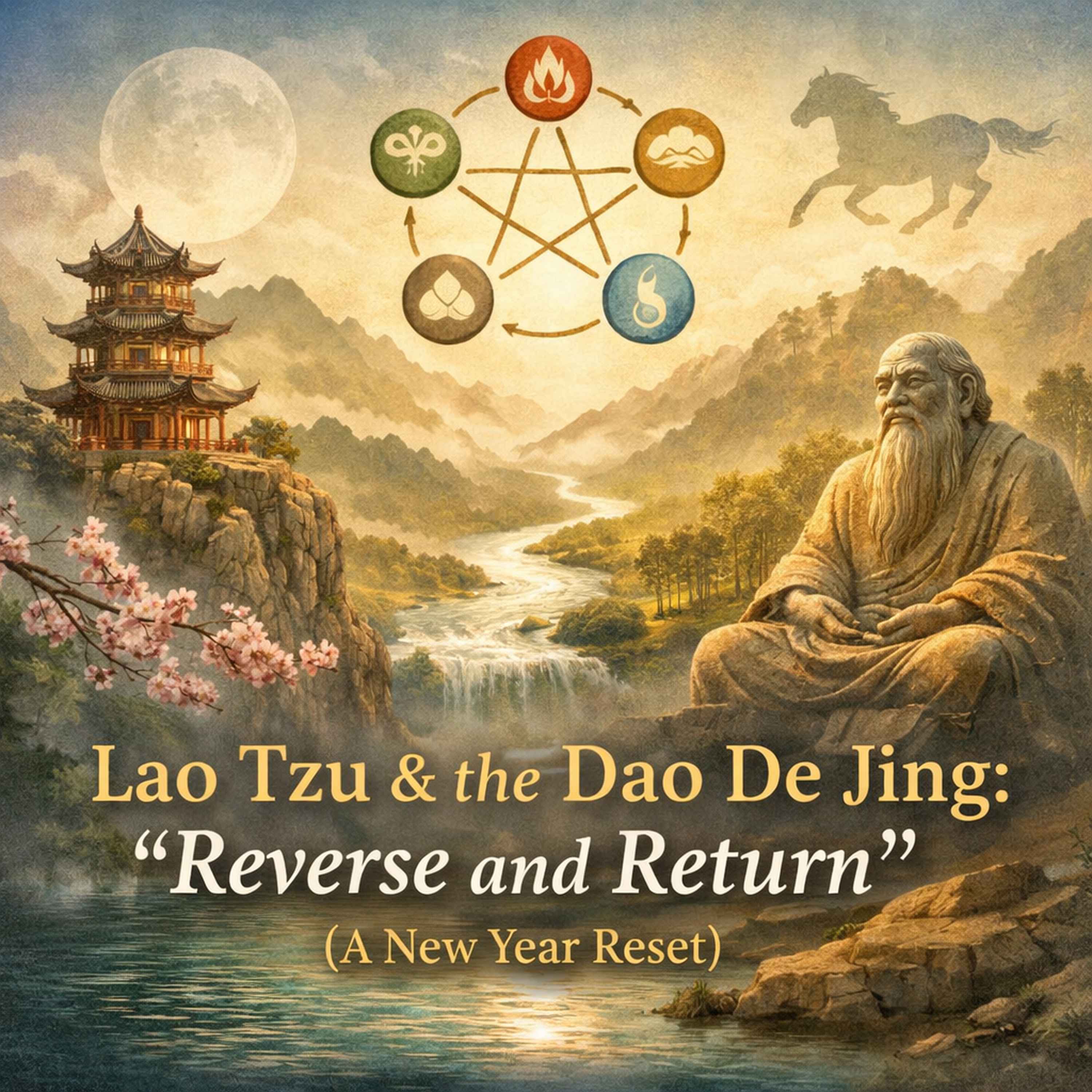 Lao Tzu & the Dao De Jing: “Reverse and Return” (A New Year Reset) | As Lunar New Year (and Losar) approaches, we turn to Lao Tzu and the Dao De Jing for a practical reset: empty out what’s stale, make space for what’s new.Adam Dietz and guest host Nick Egan explore Daoism’s core movement—“reverse and return”—and what it means to practice yielding strength, simplicity, and inner alignment. Along the way we touch Tibetan New Year (Losar), yin–yang, the five elements, and the Daoist image of water as a guide for living with less force and more flow.Recorded in late January / early February 2026, as we enter the Year of the Horse, this is a conversation about renewal—not as self-improvement, but as returning to the Way. | — | |
| 1/3/26 |  The Life of the Buddha | Siddhartha, Suffering & the Middle Way | In this episode of The Way Between Podcast, Adam Dietz and guest co-host Nick Egan retell the life of Siddhartha Gautama' from pampered prince in a palace to awakening under the Bodhi tree as the Buddha. Adam offers an accessible, story-style version of Siddhartha’s life, while Nick fills in key details from the Buddhist tradition: pronunciation and meaning of “Siddhartha,” the Axial Age context, the “four sights” of old age, sickness, death, and the mendicant, and the king’s failed attempt to keep his son in a perfect “bubble” of pleasure. From there, they explore Siddhartha’s compassionate decision to leave his wife and son in search of an answer to suffering, his years of intense ascetic practice, the famous gift of food from a village girl, and the breakthrough insight of the Middle Way between luxury and self-denial. Nick then walks through the night under the Bodhi tree, the temptations of Mara, the moment of enlightenment, and how this leads into the Four Noble Truths and the Eightfold Path: defining “suffering” (dukkha) as the original, a kind of off-center, wobbly wheel rather than just pain. Along the way, they connect the story to:• Childhood awareness of death and loss• Modern critiques of Siddhartha “abandoning” his family• The difference between escape and transmission• The image of the lamp and the lotus as ways to think about awakening• How these teachings show up in Zen and later Buddhist traditions The episode closes with reflections on how to live the Middle Way now: not as an abstract doctrine, but as a way of staying closer to our own center, the “axis” of the wheel, amid modern life, tech, and the constant pull of extremes. #TheWayBetweenPodcast #Philosophy #ZenWisdom #LivingPhilosophy #AdamDietz #HerosJourney #Mindfulness #SelfCultivation | — | |
| 12/2/25 | Debate, Dharma, and the Good Life: Socratic Method Meets Buddhism | In this episode of The Way Between Podcast, Adam and Nick follow the Western thread back to its roots—from the Presocratics to Socrates—and ask how any of this helps us live better today. Adam starts with the Pre-Socratics as a kind of “ancient Greek YouTube”: the shift from agrarian life into bustling city culture, where people gather on every corner to argue about what the universe is made of—water, air, fire, atoms, and more. Instead of treating these early thinkers as “cute but wrong,” they explore how many of their intuitions line up surprisingly well with modern science and physics. From there, they turn to Socrates: his background, his street-corner conversations, and the famous claim that he is “wise” only because he knows that he knows nothing. Adam walks through Socratic ignorance, the Socratic method, and why the unexamined life is not worth living—not as an abstract slogan, but as a daily practice of examining our beliefs, reactions, and motives. Nick brings in the Buddhist side, drawing parallels between Socratic questioning and Buddhist dialectics and debate—especially Nāgārjuna, Madhyamaka, and the idea that any fixed view can be deconstructed. They talk about how deep analysis can loosen our attachments, where thought can’t reach ultimate reality, and how genuine insight requires going beyond thought. The conversation widens into the mystical heart of Western traditions: Greek mystery schools, early Christian mysticism, and even the idea of Jesus as a kind of wild, marginal figure closer to the mahasiddhas than to modern respectable religion. They touch on Glide Memorial in San Francisco, the tension between radical love and social respectability, and how hard it is for any society to fully welcome its true outsiders. Throughout, Adam and Nick keep circling back to one question:How can we use these ancient methods—Socratic inquiry, Buddhist debate, and honest self-examination—as practical tools for our own inner life today?The Way Between Podcast explores wisdom between East and West, ancient and contemporary, philosophy and everyday life.🔗 Connect & follow– Adam’s work and newsletter: The Way Between on Substack and at adamjdietz.com– Watch episodes on YouTube: The Way Between PodcastFind Nick’s work in psychology and Buddhist practice through his teaching and writing at NickEganPhd.com | — | |
| 11/7/25 | The Four Stages of Life: Indian Wisdom, Buddhism & the Way Between | Adam and Nick are two PhDs in Asian comparative studies: Adam from the philosophy side, Nick from the Indo-Tibetan Buddhist and leadership coaching side. Together, they trace a path from the ancient Vedas and Upanishads to the Buddha, Dzogchen, and modern life. They talk about the way between as the living relationship between two people; teacher and student, East and West, self and world...and how Indo-Tibetan ideas of co-emergent awareness and Confucian ideas of “heaven within” meet in daily life. From there they move into the four stages and four aims of life: being a student, seeking love and pleasure, becoming a householder, and finally turning toward wisdom and enlightenment. Adam connects this to suburban parents in the “thick of it,” and Nick brings in his work with leaders who keep trying to solve new problems with old tools. Along the way they explore:Why samsara is like a dream elephant that was never in the room to begin withHow Dzogchen and Mahamudra see the world as the playful display of awareness itselfThe shift from big Vedic rituals to the interior wisdom of the UpanishadsHidden “village” and family lineages in martial arts, healing, and meditationThe four stages of life and the four aims of life—and why the householder stage feels so intenseLetting go of old identities (like the boat you leave on the far shore) so the next stage can unfoldWhy your own “circle” or mandala of experience really does matter for the whole universe They close by inviting you to notice: Where are you in your own stage of life? What are you being asked to let go of; and what wants to grow now? If this conversation resonates, please follow, rate, and share The Way Between Podcast, and leave a comment about which stage of life you’re in right now. Your feedback will help shape future episodes.indian philosophyvedasupanishadsbuddhismindo tibetan buddhismdzogchenmahamudrasamsarafour stages of lifefour aims of lifeconfucianismtaoismlao tzucarl jungheinrich zimmerleadership and spiritualityhouseholder stagethe way between podcast | — | |
| 10/24/25 | Yin & Yang — The Roots of Harmony | In the first standalone episode of The Way Between Podcast, Adam Dietz and Nick Egan explore the living roots of Chinese philosophy; from Confucius and the sage kings to the practice of balancing yin and yang in modern life.They trace how propriety, music, and balance once guided whole cultures and how the same wisdom still applies to our daily rhythms...parenting, work, rest, and renewal.🪷 Topics include• Confucius and the Book of Changes• The balance of yin (rest, humility, earth) and yang (action, clarity, heaven)• The Doctrine of the Mean as living equilibrium• Mencius and the innate goodness of human nature• What it means to live a harmonious life today🎙 FeaturingAdam Dietz (The Way Between Podcast)Nick Egan (Shift Leadership Group / nickeganphd.com)#Philosophy #Confucius #Dao #YinYang #Balance #Mindfulness #TheWayBetweenPodcast | — | |
| 10/21/25 | Does AI Have Buddha Nature? The Middle Way Between Mind and Machine (with Nick Egan, PhD) | What happens when AI meets the Middle Way? In this crossover between The Way Between Podcast and The Living Conversation, Adam Dietz and Anthony Wright speak with Dr. Nick Egan about Zen, Tibetan Buddhism, and whether artificial intelligence could ever have consciousness, or Buddha nature. The conversation explores the harmony between technology and spirituality, the limits of mind, and how to live wisely in an age of machines.In this special crossover episode between The Way Between Podcast and The Living Conversation, host Adam Dietz joins Anthony Wright to talk with Nick Egan, PhD, a leadership coach and longtime Buddhist practitioner, about the question: Does AI have Buddha nature?Together they explore:The Middle Way between fear and worship of technologyWhat Buddhist and Confucian thought reveal about consciousnessThe difference between using the tool and being used by itWhy the mind’s true nature can’t be replicated in codeSpiritual materialism and the traps of attachment—even to enlightenment itselfMentioned in this episode:– Jacuzo Kwong Roshi (Sonoma Mountain Zen Center)– Tibetan ideas of mind-stream (sem gyu)– Alan Watts, Trunkpa Rinpoche, and the Dalai Lama– Confucian harmony and the “heavenly mandate”🜂 “If we’re doing our job as human beings,” Adam says, “we harmonize whatever comes our way; even AI.”Find the hosts:Adam Dietz → thewaybetween.substack.comAnthony Wright → theonat.comGuest Nick Egan → nickeganphd.com | — | |
| 10/7/25 | When Ways Meet — The Art of Living in Conversation With Adam Dietz, Anthony Wright & Nick Egan | When Ways Meet launches The Way Between Podcast, a new series by philosopher and teacher Adam Dietz, joined by Anthony Wright and Nick Egan.Together, they explore how philosophy can be lived — not just studied — drawing on Socrates, Confucius, Daoism, Zen, and modern mindfulness to ask the enduring question: How should I live?This opening conversation bridges The Living Conversation and The Way Between Podcast, tracing the meeting of East and West, teacher and student, thought and action.In this episode:• The origins of The Way Between Podcast• What makes a “living philosophy”• How ancient wisdom still guides a modern life• Insights from Dr. Yi Wu’s Integral Life Philosophy🪷 Read companion essays → thewaybetween.substack.com🌐 Learn more about Nick → NickEganPhD.com📺 Watch The Living Conversation → youtube.com/@thelivingconversation | — |
Showing 8 of 8
Sponsor Intelligence
Sign in to see which brands sponsor this podcast, their ad offers, and promo codes.
Chart Positions
2 placements across 2 markets.
Chart Positions
2 placements across 2 markets.