
Insights from recent episode analysis
Audience Interest
Podcast Focus
Publishing Consistency
Platform Reach
Insights are generated by CastFox AI using publicly available data, episode content, and proprietary models.
Total monthly reach
Estimated from 2 chart positions in 2 markets.
By chart position
- 🇯🇵JP · Technology#1831K to 10K
- 🇿🇦ZA · Technology#136500 to 3K
- Per-Episode Audience
Est. listeners per new episode within ~30 days
750 to 6.5K🎙 Weekly cadence·15 episodes·Last published 1mo ago - Monthly Reach
Unique listeners across all episodes (30 days)
1.5K to 13K🇯🇵77%🇿🇦23% - Active Followers
Loyal subscribers who consistently listen
600 to 5.2K
Market Insights
Platform Distribution
Reach across major podcast platforms, updated hourly
Total Followers
—
Total Plays
—
Total Reviews
—
* Data sourced directly from platform APIs and aggregated hourly across all major podcast directories.
On the show
Recent episodes
Web3 CISO Open Source Dilemma: Why AI May Force Code To Go Dark | Haim Krasniker
Apr 14, 2026
Unknown duration
Polygon Labs' two-team security structure: where most Web3 breaches actually start | Mudit Gupta
Mar 4, 2026
Unknown duration
Sky's zero-finding audit framework: Six-month onboarding and process investigation | Deniz Yilmaz
Feb 4, 2026
Unknown duration
Web3 Security Podcast: DC Builder, Research Engineer at World Foundation
Jan 27, 2026
Unknown duration
How Solana achieved 2 years uptime after launching with $3M | Matt Sorg (Solana Foundation)
Jan 14, 2026
Unknown duration
Social Links & Contact
Official channels & resources
Official Website
Login
RSS Feed
Login
| Date | Episode | Description | Length | ||||||
|---|---|---|---|---|---|---|---|---|---|
| 4/14/26 | 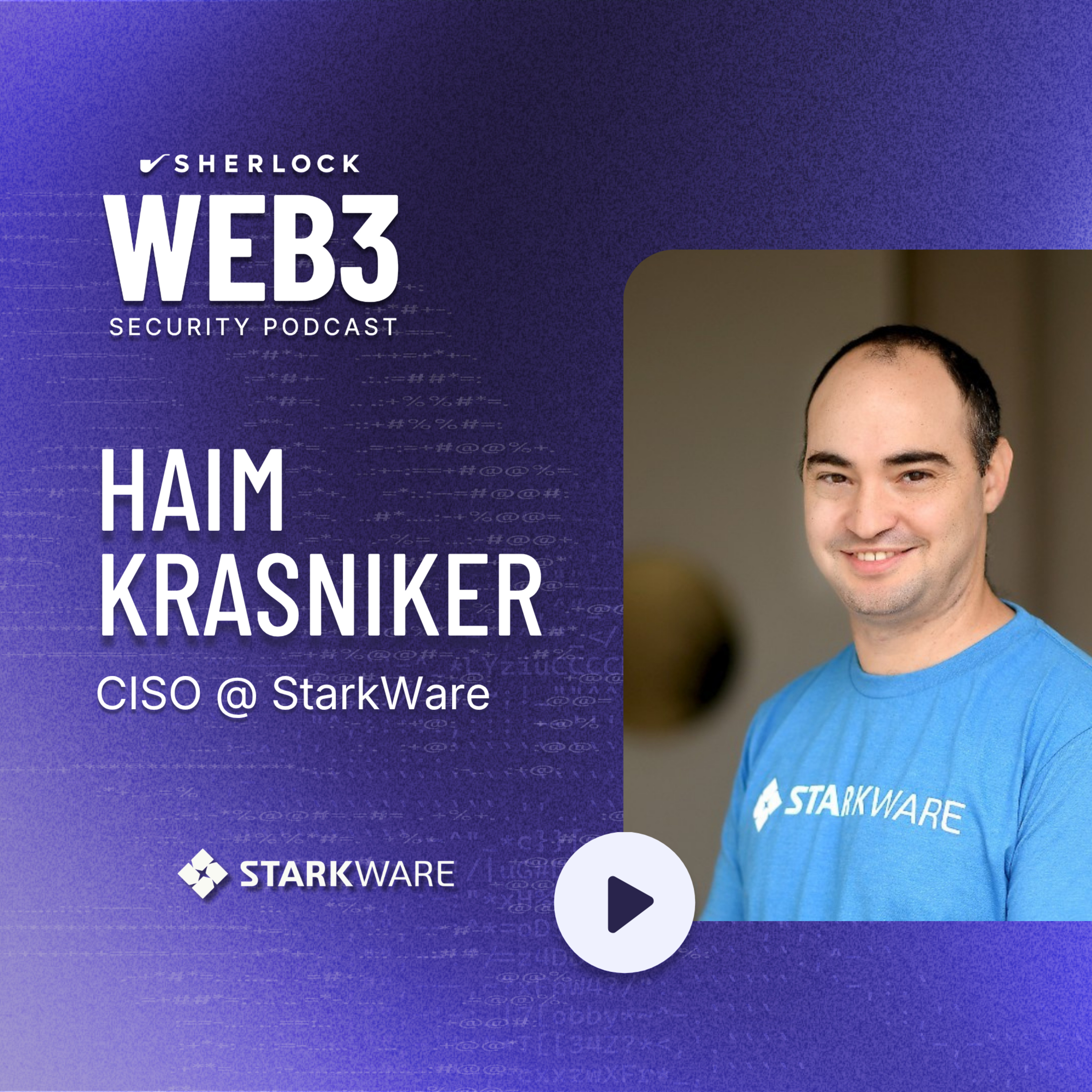 Web3 CISO Open Source Dilemma: Why AI May Force Code To Go Dark | Haim Krasniker | StarkWare's CISO bootstrapped the Israeli Air Force's penetration testing team before spending years across mobile forensics at Cellebrite, email security at Proofpoint, and enterprise DevSecOps at Red Hat. That depth across offensive and defensive disciplines is rare in Web3, and it shows in how Haim Krasniker thinks about protocol security.In this episode, Haim gets specific about the tradeoffs most CISOs won't say out loud: why real-time monitoring is nearly useless without pre-built enforcement mechanisms, why checking compliance boxes in Web3 is actively dangerous, and why the open source model for smart contracts may not survive the next wave of AI-assisted exploitation. He also shares a take on the future of bug bounty programs that Sherlock happens to agree with.Topics discussed:Postmortem culture from the Israeli Air Force as a blueprint for proactive securityWhy Web3 incident response windows are measured in minutes, not hoursDesigning withdrawal limits against false positive rates to protect users without censoring themRunning 300+ custom monitoring rules internally instead of relying on vendor defaultsDev sandboxes as the security architecture for AI coding tools and CICD supply chain riskStaked bug bounty submissions as a filter against AI-generated report floodingThe open source versus closed source debate as AI lowers the cost of smart contract exploitationNative on-chain privacy through STRK20 as an institutional adoption prerequisite | — | ||||||
| 3/4/26 | 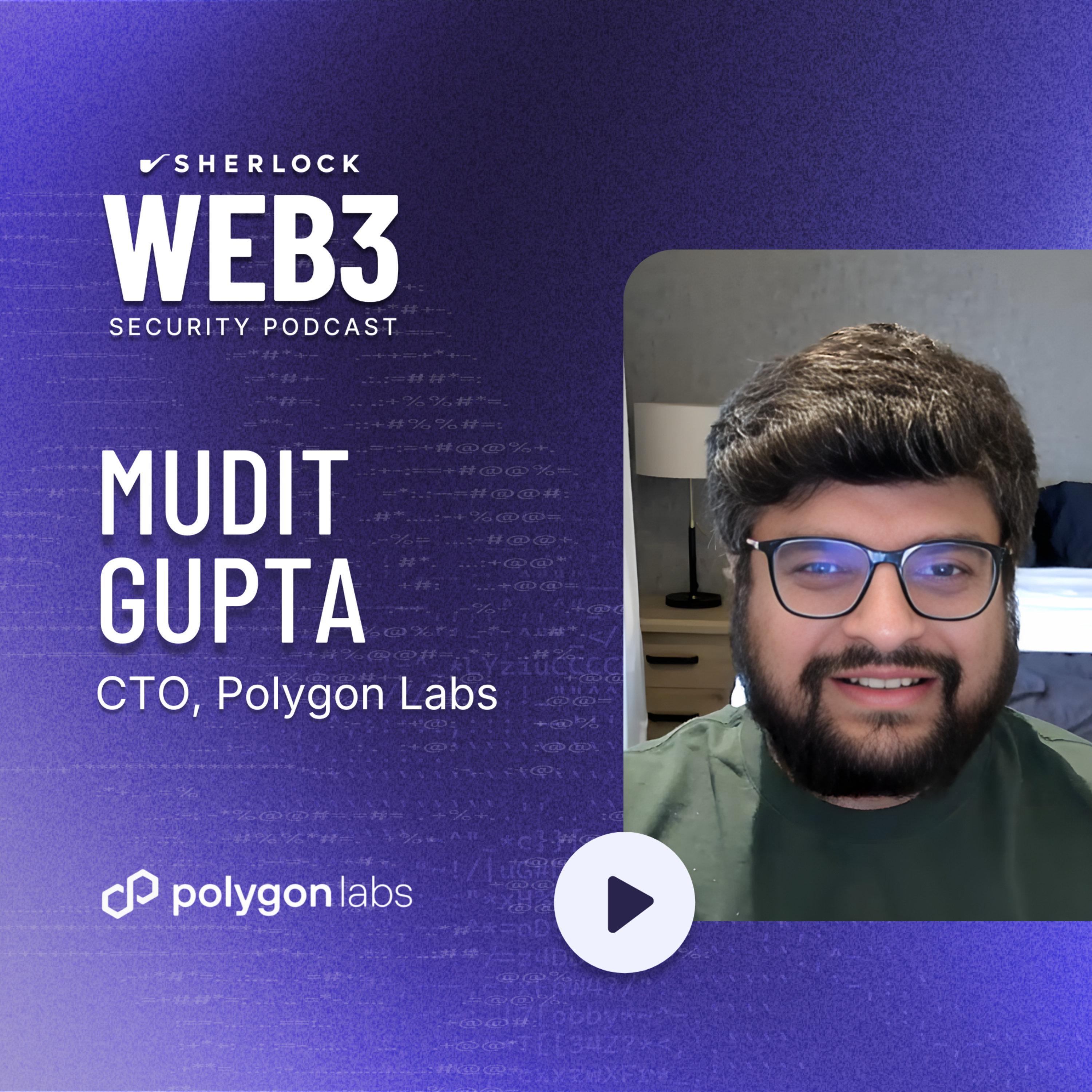 Polygon Labs' two-team security structure: where most Web3 breaches actually start | Mudit Gupta | Most Web3 security conversations focus on smart contracts. Mudit Gupta, CTO of Polygon Labs, thinks that's the wrong place to be worried. In this episode, he makes the case that ZK infrastructure carries significantly more bugs than the smart contract layer — the reason large-scale exploits haven't happened yet isn't that the bugs don't exist, it's that the expertise required to exploit them is vanishingly rare. That window won't stay open forever.Beyond the ZK risk, Mudit breaks down the structural and operational decisions Polygon has made as AI shifts both sides of the security equation. Since August, their bug bounty program has seen a surge in reports on years-old code in geth and P2P libraries — the kind of retroactive review humans don't do — forcing them to build a counter-AI triaging system just to manage volume. He also details the two-team security structure most Web3 companies still don't run, and why the team most protocols skip is where the majority of Web3 incidents actually originate.Topics Discussed:ZK infrastructure as the highest-vulnerability, lowest-exploitation surface in Web3 — more bugs than the smart contract layer, but the pool of people who can exploit them is small enough to count on two hands. Mudit's view: that expertise gap is the only thing standing between current ZK deployments and large-scale attacksWhat a near 10x spike in bug bounty submissions since August reveals about how AI reviews code differently than humans — specifically its tendency to audit legacy code that human researchers have long stopped reviewingBuilding a counter-AI triaging agent to handle report volume, including the case where it incorrectly closed a valid submission and how researcher pushback caught itWhy Polygon runs a dedicated security operations team alongside AppSec — and why the absence of a SecOps function is where most Web3 incidents actually beginEmbedding AppSec at the architecture stage rather than post-build, and how that shifts accountability from audit-and-flag to full product ownership of security outcomesSending an AI-generated deepfake video of Polygon's CEO to all employees as a phishing simulation — and why video-format tests caught people that standard phishing emails don'tWednesday as the target release day: how the Monday-Tuesday verification window protects against deployment failures when external dependencies and client teams won't have weekend coverageSecurity knowledge as a speed multiplier: how understanding your risk surface lets you move faster on acceptable risks — and how Mudit structures risk tracking and CEO-level reporting so leadership can hold context without blocking decisions | — | ||||||
| 2/4/26 | 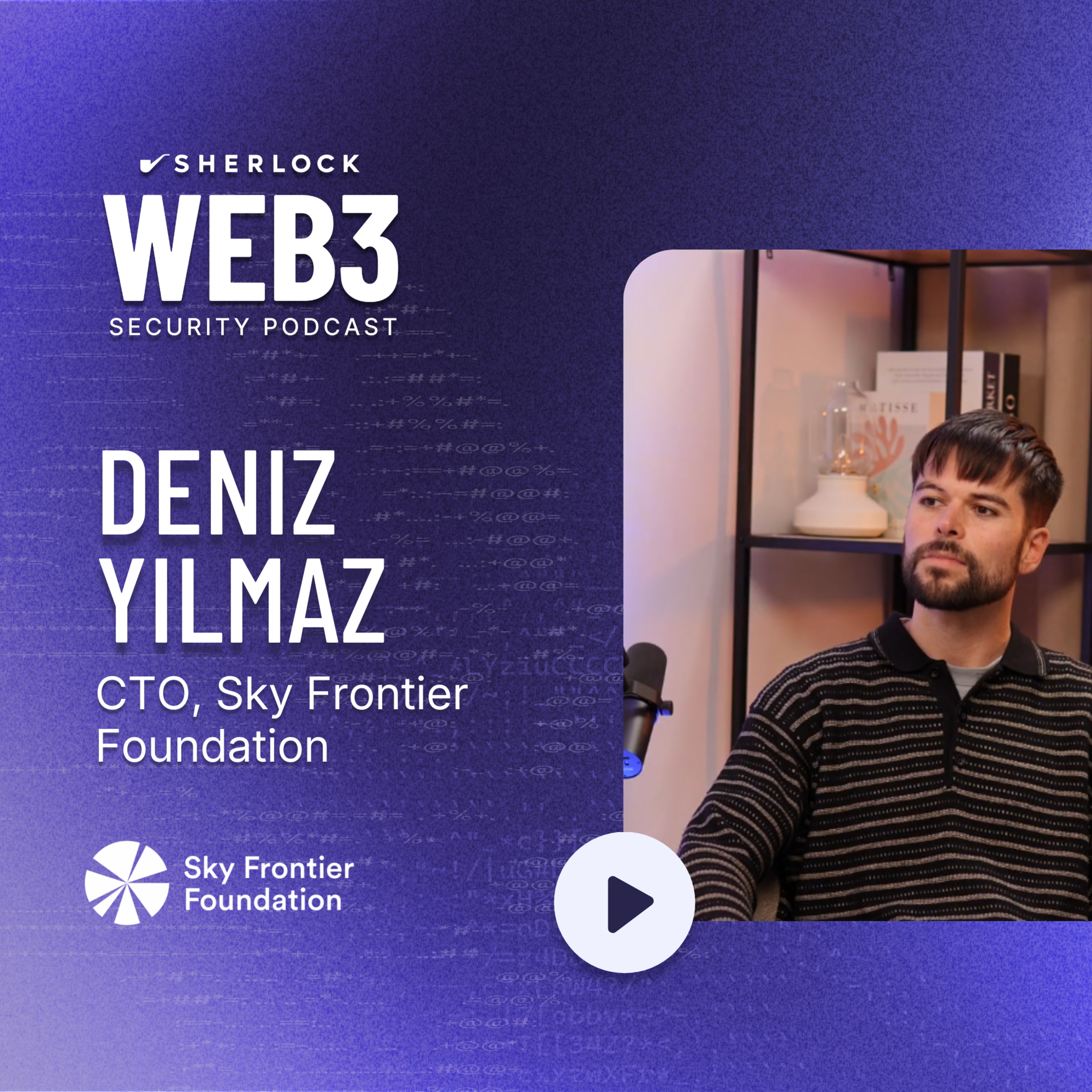 Sky's zero-finding audit framework: Six-month onboarding and process investigation | Deniz Yilmaz | When Sky's audits return serious issues, they don't just fix bugs and ship—they pull the brake and investigate what failed in their internal review process. Deniz Yilmaz, CTO of Sky Frontier Foundation, walks through the defensive layers behind USDS (third-largest stablecoin globally): six-month engineer onboarding requirements, spellcrafting governance with mandatory execution delays, and a protocol security team dedicated to codifying the implicit knowledge that keeps audit reports clean.Topics discussed:Treating audit findings as internal process failures requiring investigation, not just bug fixesSix-month mandatory onboarding periods before engineers can modify spellcrafting codePre-audit internal review standards achieving consistent zero-finding results across multiple audit firmsSpellcrafting governance requiring bi-weekly token holder votes and execution delays for all protocol changesLLM auditing integration delivering PR-level feedback before code reaches internal reviewMandatory OPSEC certification with domain hash verification testing for multisig signersProtocol security workstreams codifying senior engineer practices into transferable frameworksAuditor selection prioritizing codebase-specific experience over firm reputationSubdao security enforcement maintaining core standards across autonomous entities with independent economicsGame theory-based development considering internal actor exploitation during code design | — | ||||||
| 1/27/26 | 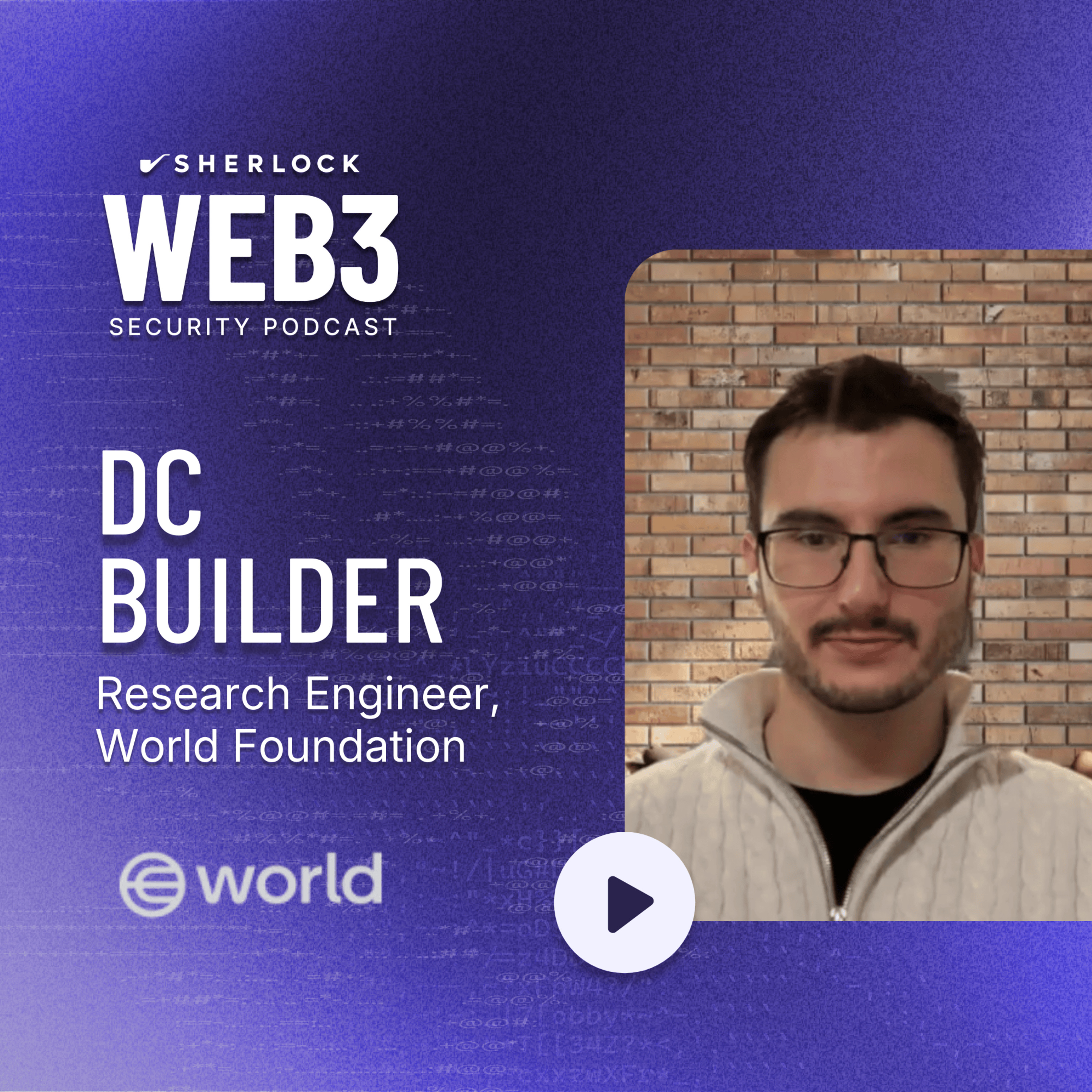 Web3 Security Podcast: DC Builder, Research Engineer at World Foundation | World Foundation's proof of personhood system defended against an iris spoofing attack where users verified multiple times by pairing their left eye with someone else's right eye—exploiting uniqueness checks that operated on eye pairs rather than individuals. DC Builder, Research Engineer at World Foundation, explains the multimodal defense they deployed: continuous 3D heat mapping, time-of-flight sensors, anomaly detection models trained on contact lens datasets across manufacturers, and checks for glasses that alter iris patterns.This represents one attack surface in a system protecting 38 million verified humans. World became Nvidia's largest security partner for Jetson NX embedded chips, filing more CVSS reports than any other customer after discovering edge cases from production deployment that Nvidia's internal teams hadn't encountered. DC's current focus: building Proofkit, a Noir backend optimized for client-side ZK proving on constrained mobile devices, because the 99th percentile of World's users operate phones with minimal memory and CPU headroom.The technical architecture spans layers most Web3 teams never touch. Trusted execution environments and secure enclaves depend on vendor supply chains. Private keys etched into Orbs during manufacturing get destroyed after provisioning. Groth16 proofs require trusted setups from both PSE and World's own ceremony. Multiparty computation encrypts iris codes, but compromise would expose biometric-derived data. Open-source firmware on ejectable SD cards enables independent verification against GitHub repos—an auditability model DC walks through in detail.Topics discussed:Iris spoofing via eye permutation attacks: left-eye/right-eye combinations bypassing uniqueness checksMultimodal biometric defense: 3D heat mapping, time-of-flight sensors, contact lens detection across manufacturersFiling majority of Nvidia Jetson NX CVSS reports through production edge cases undiscovered internallyBuilding Proofkit: Noir backend optimized for ZK proving on memory-constrained Android devices at 99th percentileFormal verification pipeline: automatic GNARC-to-Lean circuit extraction developed with RayLabsGroth16 trusted setup dependencies: PSE ceremony plus World's own setup and associated compromise risksMPC protocol security: encrypted iris codes and what exposure means for biometric-derived sensitive dataHardware auditability: ejectable SD cards enabling firmware verification against open-source repositoriesSupply chain trust model: secure enclave vendors, TEE implementations, manufacturing key provisioningAttack surface inventory: hardware TEEs, Linux-based custom OS, biometric ML pipelines, MPC protocols, ZK circuits | — | ||||||
| 1/14/26 | 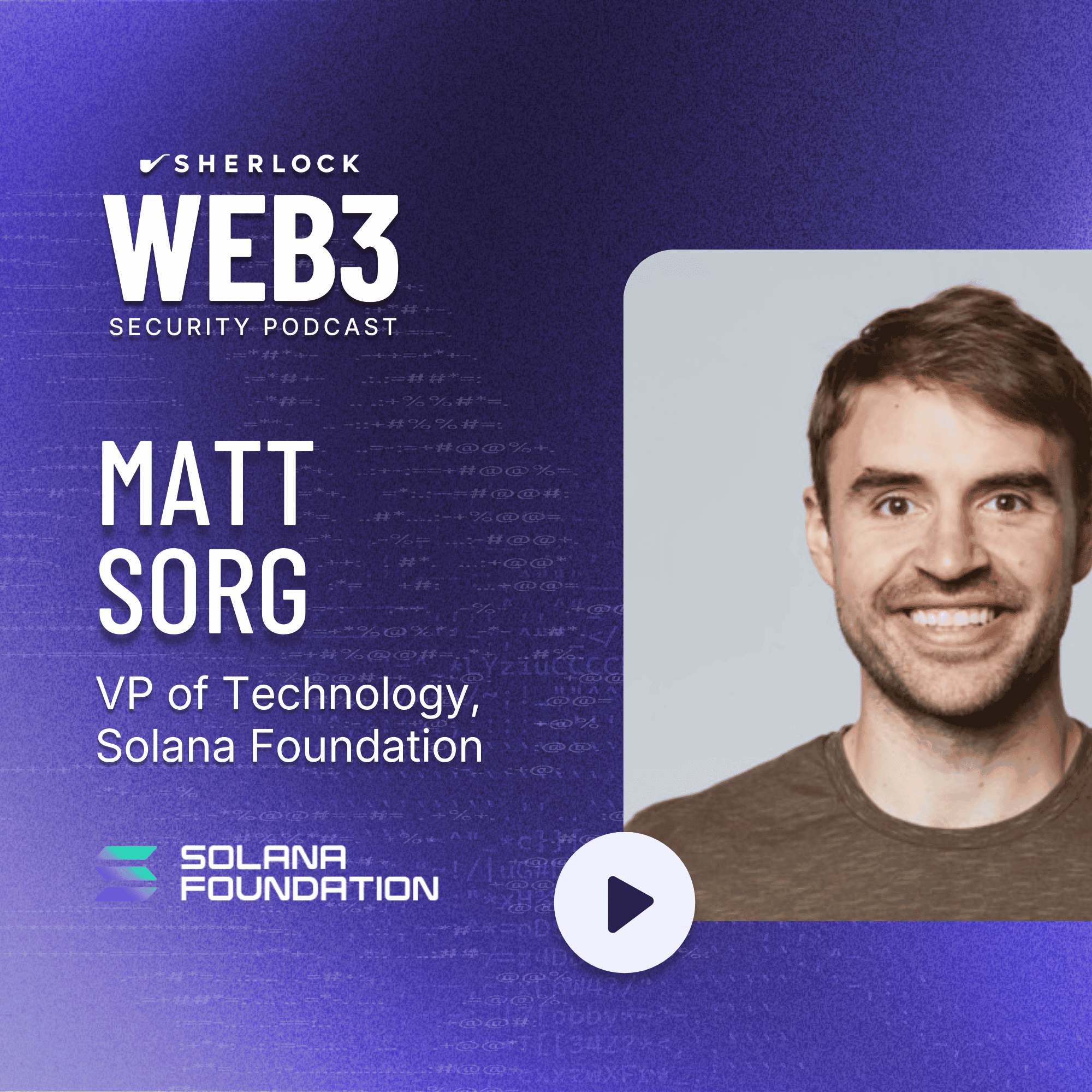 How Solana achieved 2 years uptime after launching with $3M | Matt Sorg (Solana Foundation) | When Solana dropped to $8 during FTX, Matt Sorg watched Twitter erupt while his validator network stayed focused on the technical roadmap. The VP of Technology at Solana Foundation had built something that would prove more valuable than hype: a technically aligned community shipping performance improvements on a quarterly cadence. Matt explains why Solana's early instability wasn't architectural it was financial constraint forcing impossible tradeoffs. Spring 2018's dead ICO market meant launching with roughly $2-3 million versus the hundreds of millions typical L1s raise today. The choice: ship with tech debt or die waiting for perfect code. They shipped, survived the resulting instability crisis, and spent the next several years systematically eliminating every bottleneck through what Matt calls "mindful engineering." The maturity shows in the security infrastructure. Four independent audit firms review every Anza code release. Continuous fuzzing catches performance regressions. Firedancer's launch as a second client enables differential testing that's becoming the de facto Solana specification. The result: approaching two years of continuous uptime with upgrades shipping every three months. But the real technical leap is what's coming: Alpenglow consensus enabling 40% validator failure tolerance, multiple concurrent leaders eliminating MEV by removing block building monopolies, and local inclusion certificates delivering Web2 speed feedback before global consensus. Topics discussed: Launching mainnet spring 2018 with $2-3M in dead ICO market versus modern $100M+ L1 funding Systematic tech debt elimination through bottleneck analysis achieving nearly two years uptime Four independent audit firms plus continuous fuzzing reviewing every Anza release Firedancer second client enabling differential testing becoming canonical Solana specification Alpenglow consensus mechanism allowing 40% validator failure versus standard 33% Byzantine tolerance Multiple concurrent leaders requiring only one honest leader among eight for inclusion guarantees Local inclusion certificates providing Web2 speed feedback before global consensus finalization 800+ profitable validators independently reviewing GitHub releases on bare metal versus cloud VMs Savvy validator recruitment through performance focused mission attracting talent that only operates on Solana AI powered social engineering replacing technical exploits as dominant app layer attack vector Applications over engineering financial components before product market fit validation Non financial primitives like points enabling faster iteration without security overhead | — | ||||||
| 11/18/25 | 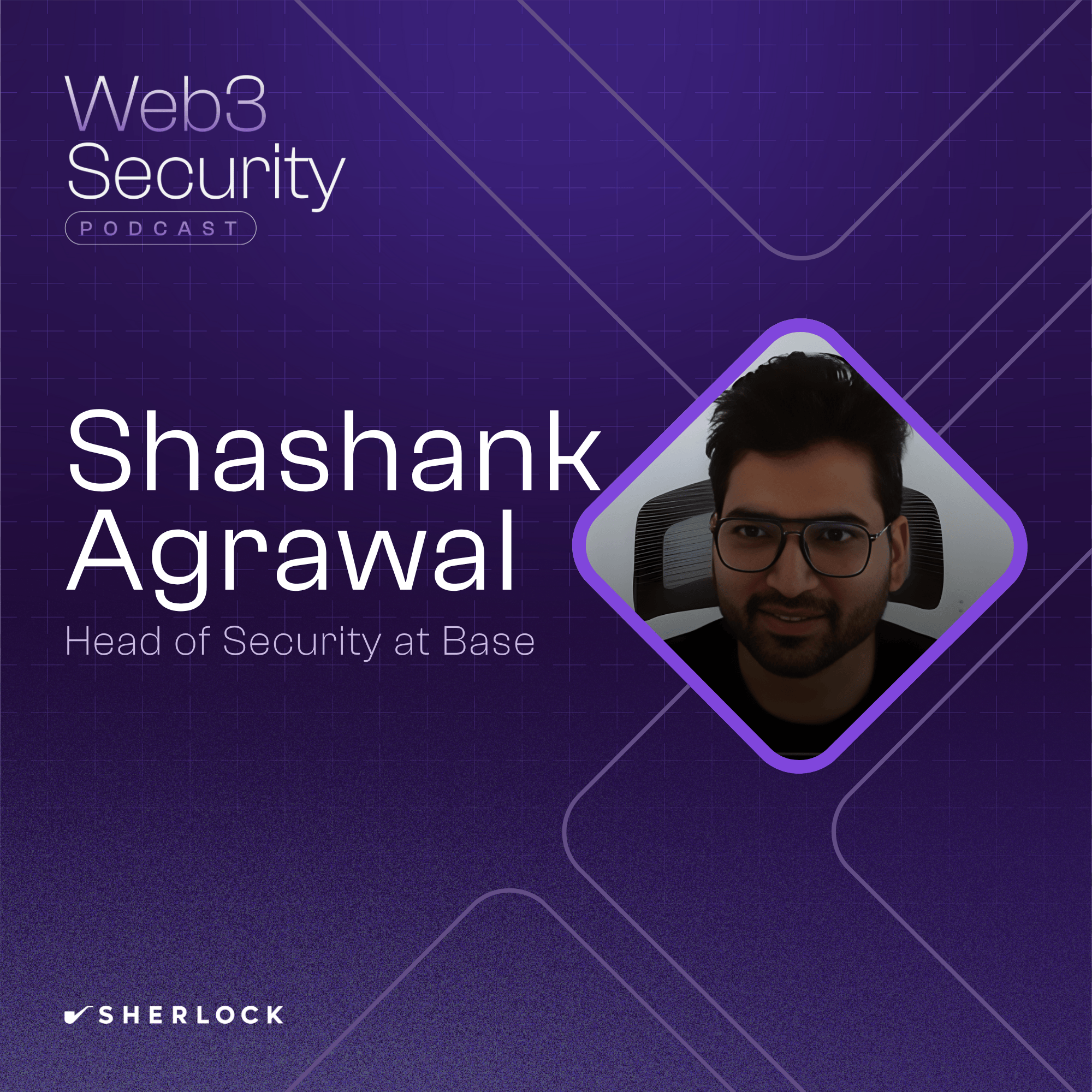 Coinbase's auditing standards with Shashank Agrawal | Coinbase's security process protecting over $7 billion in TVL rejects the single-audit model common in DeFi. Shashank Agrawal, Senior Engineering Manager, Protocol Security at Coinbase, explains their multi-round validation approach: internal security teams (separated from product engineering) audit first, then external firms audit, and rounds continue until external auditors surface only lows and informationals—never highs or criticals. This stopping rule creates a quality bar where internal audits must catch everything significant before external validation. For the Base bridge specifically, this meant independent OP Stack security validation despite Optimism's existing audit work, driven by the "absolutely zero room for error" standard when contracts hold substantial user funds. Their approach treats external auditors as verification layers rather than primary discovery mechanisms. Topics discussed: Multi-round audit methodology continuing until external firms find zero high-severity or critical issues Internal security team structure operating independently from product engineering before external validation Base bridge security requiring custom OP Stack validation independent of Optimism's audit coverage In-house MPC library development using professor-reviewed specs bridging research papers to production implementation Tabletop war gaming exercises simulating worst-case chain scenarios with security, engineering, legal, and compliance teams Free Hexagate monitoring partnership providing base-layer protocol coverage for Base ecosystem builders Security hiring process using live code audits at different complexity levels for senior (level 5) versus staff (level 6) positions Off-chain infrastructure security: key management and transaction signing treated as equal priority to smart contract auditing AI smart contract auditing tools showing current production limitations in determinism and false positive rates Incident response planning where monitoring systems and alert workflows prioritize minute-by-minute decision speed | — | ||||||
| 11/5/25 | 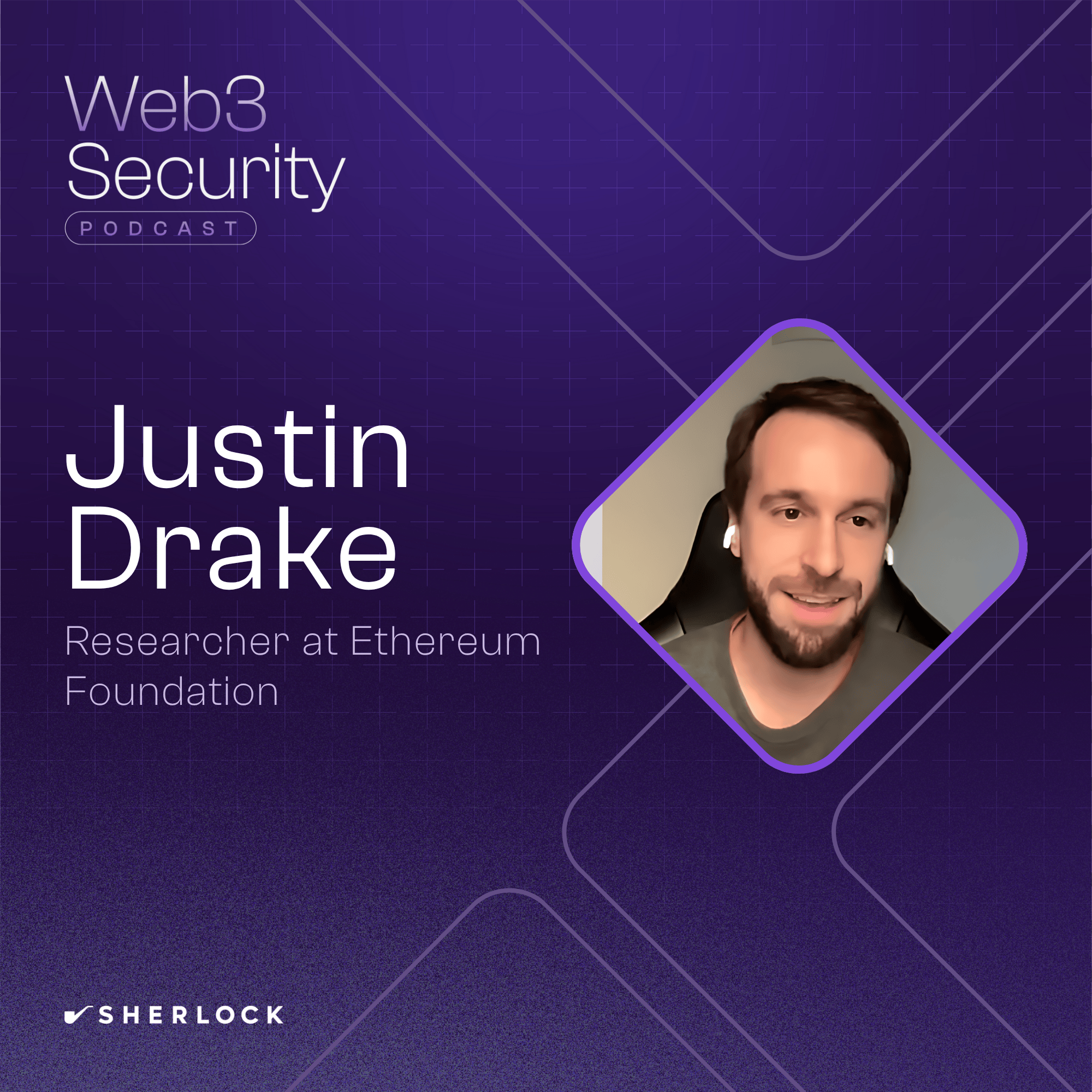 Ethereum Foundation's path to 10,000 TPS and Bitcoin's 51% attack risk | Justin Drake | Justin Drake reveals Ethereum's infrastructure path to 1 gigagas per second—equivalent to 10,000 TPS and 10x Solana's current user transaction throughput—while operating validators on consumer hardware. As researcher on Ethereum Foundation's protocol architecture team, he details how ZK-EVM proof systems will eliminate the validator bottleneck within six years, enabling state verification on Raspberry Pis while scaling capacity 500x through annual 3x gas limit increases. The technical requirements are crystallizing rapidly. Real-time proving now achieves sub-12 second latencies (one Ethereum slot) with under 10kW power consumption—accessible in standard home electrical systems rather than data center infrastructure. Drake frames this as critical for the 1-of-N security assumption: with ~100 global data centers, N remains dangerously low; with 10kW proving available to thousands of locations with electric vehicle charging capacity, the liveness guarantee becomes credible even under coordinated government pressure. But Drake's most contrarian insight targets Bitcoin's deteriorating security model. With ~$2 trillion secured by ~$10 billion in mining infrastructure, Bitcoin's 200x security ratio approaches economic attack viability. The calculation is stark: $10B buys sufficient mining hardware and infrastructure, while perpetual futures markets offer $35B in aggregate short positions. An attacker with $25B capital can short $15B notional, deploy $10B in mining equipment, and profit from price collapse—particularly as BitVM bridges concentrate billions in optimistically-verified TVL vulnerable to 7-day censorship attacks. Each halving doubles this vulnerability in the absence of meaningful fee markets. Topics discussed: ZK-EVM proving infrastructure achieving real-time sub-12 second proof generation within 10kW power envelopes for on-premises deployment Ethereum scaling roadmap targeting 500x throughput increase via 3x annual gas limit growth reaching 1 gigagas/second by 2031 Prover-killer mitigation through EIP-focused opcode repricing and 16M gas per-transaction limits enabling mandatory proof requirements Client diversity strategy deploying 3-of-5 ZK-EVM verification systems preventing consensus failures from soundness bugs Bitcoin's 200x security ratio creating profitable 51% attack scenarios as $10B mining costs meet $35B perpetual short markets Post-quantum migration requiring 80% consensus layer rewrite using hash-based signature aggregation by 2028-2029 Formal verification programs leveraging Lean4 framework and AI-assisted proving for end-to-end cryptographic system validation Economic security optimization demonstrating 50% stake cap sufficiency while reducing issuance costs 10x through real yield focus Inclusion lists preserving censorship resistance during high-throughput epochs without sophisticated validator participation requirements Privacy wormholes enabling L1 transaction unlinkability through formally verified proof-of-burn systems Lean Ethereum bundling 2-4 second slots, sub-three-slot finality, and attested-proposer separation with quantum-resistant cryptography | — | ||||||
| 10/21/25 |  Cosmos Labs' 3 pivots in 6 months: Timeboxing experiments to find PMF | Barry Plunkett | When the Interchain Foundation acquired Skip Protocol in 2024, Cosmos Labs inherited a 200-chain ecosystem with no commercial strategy and a massive security backlog. Barry Plunkett, co-CEO, explains how they systematically tested three strategic pivots in six months, killed two based on hard metrics, and found enterprise product-market fit by following "accidental traction" signals they'd initially ignored. First pivot: ZK-based IBC bridging to Ethereum paired with Skip Go's interop API. They timeboxed three months to the Babylon Bitcoin LST launch as a forcing function. Volume data post-launch killed the thesis—existing bridges were "pretty good" and marginal improvements don't create ecosystem momentum. Second pivot: position Cosmos Hub as a unified deployment platform for seamless multi-chain experiences. Direct enterprise outreach revealed Base and Solana's network effects created insurmountable BD cost disadvantages for a smaller ecosystem. The breakthrough: Fortune 500 companies and governments kept reaching out for help with Cosmos infrastructure pilots they'd started internally. That inbound signal became the strategy. The security approach reflects the same first-principles methodology. Kevin, former head of security at Optimism who led Bedrock releases, implemented a policy: engineering managers receive HackerOne reports directly with no security intermediary layer. If you wrote the code and the bug was missed, you own the fix immediately—no backlog accumulation. For protocol-level changes, the team mandates line-by-line PR review sessions where code authors walk the full engineering team through every change. This catches critical vulnerabilities before external audits and prevents tribal knowledge from siloing. They coordinate patches monthly on the second Tuesday (Microsoft's schedule) after learning ad-hoc "patch when found" approaches burned out validator operators managing infrastructure across dozens of chains. Topics discussed: Timeboxing strategic experiments to three months with quantitative kill criteria before resource commitment Following inbound enterprise signals over predetermined theses when accidental traction contradicts core assumptions Mandatory line-by-line PR walkthrough sessions with full engineering teams before protocol-level releases Monthly coordinated patch schedule (second Tuesday) preventing validator operator fatigue across multi-chain infrastructure Direct bug bounty report routing to code authors eliminating security intermediary layers and backlog accumulation Engineering manager accountability for immediate fix implementation rather than sprint planning security debt Graduating experimental modules through staged test environment deployments before long-term support commitment Analyzing why standalone IBC interoperability and Hub-native deployment strategies failed against established L1 network effects Standardized component interfaces (ABCI between Comet/SDK, IBC cross-chain) enabling parallel experimentation across 200-chain ecosystem Tokenization thesis: bringing cost of holding and moving money to zero creates financial services "Internet moment" | — | ||||||
| 10/14/25 |  Centrifuge's serial audits: 6 security reviews that reshaped RWA architecture | Jeroen Offerijns | Maker's core accounting contract—the vat—has remained immutable for six years while processing tens of billions in TVL. Centrifuge is proving this isn't legacy thinking; it's the only approach that survives institutional custody requirements where protocol upgrades introduce unacceptable counterparty risk. Jeroen Offerijns, CTO of Centrifuge, explains why their $750M TVL RWA protocol runs 6-7 serial audits rather than parallel reviews on a final commit hash. The goal isn't redundant coverage—it's forcing architectural iteration between audits. Low-severity findings don't get dismissed; they trigger contract redesigns before issues compound. This matters when tokenizing Apollo's private credit or S&P 500 funds, where a single exploit permanently destroys institutional trust. The technical implementation diverges from standard DeFi patterns at every layer. Centrifuge co-authored ERC-7540 with competitor Maple Finance because RWA settlement requires multi-day cycles for off-chain broker execution and NAV updates—atomic swaps don't exist here. Their cross-chain security uses multiple bridge providers simultaneously; vulnerability requires compromising all providers. Invariant testing with Echidna and Medusa surfaces chained rounding manipulations that exceed human auditors' ability to reason through state permutations across multi-step transactions. Topics discussed: Serial audit methodology: using findings to force architectural iteration rather than validating final code Maker's immutable core pattern: isolating accounting logic in never-upgraded contracts with modular extensions ERC-7540 co-authorship with Maple Finance: standardizing asynchronous operations for multi-day RWA settlement Multi-bridge redundancy: requiring simultaneous compromise of all interoperability providers Invariant testing with Echidna/Medusa via Recon: catching chained exploit patterns beyond human reasoning Low-severity findings as architectural signals: redesigning contracts before issues compound AI auditing integration: per-commit security validation reallocating human auditors to protocol-specific vectors DRWA architecture: separating regulated fund custody from permissionless yield token access Centrifuge V3.1 as freely immutable infrastructure: enabling third-party RWA protocols to avoid rebuilding primitives Rejecting upgradeable proxies: modular contract design for institutional custody requirements | — | ||||||
| 10/8/25 |  Safe's $60B security stack: Formal verification, audits, and $1M bounties | Richard Meissner | Safe's smart account infrastructure secures $60B+ in TVL while handling over $1 trillion in cumulative transaction volume. Co-founder, Richard Meissner reveals how Safe is rebuilding its collaboration layer from scratch—replacing centralized transaction services with encrypted on-chain queues while preparing smart accounts for post-quantum cryptography through deterministic deployment standards. Topics discussed: Safe Harbor's permissionless transaction queue migrating from contract storage to event-based and blob storage to reduce costs while maintaining consensus-layer availability guarantees Validator network architecture in frictionless queues performing spam protection and integrity checks on encrypted payloads before paymaster-sponsored on-chain submission Asymmetric encryption implementation using shared keys among Safe signers to hide transaction intent, with blob storage providing shorter data availability windows than permanent contract storage ERC-7955's elimination of nonce-dependent deployment attacks by publicly exposing factory private keys through EIP-7702, preventing address spoofing exploits that caused historical fund losses Four-layer security methodology: audits during development, dual auditors from different firms at release, formal verification with Runtime Verification and Certora, and $1M+ bug bounties during phased rollouts Phased production deployment strategy starting with foundation Safes as front runners for months before prompting user upgrades to new contract versions Smart account migration pathways for post-quantum algorithms using passkey implementations (non-native curve support) as proof-of-concept for lattice-based signature schemes Organizational structure separating Safe Labs' enterprise custody focus from Research team's permissionless protocol development to balance adoption velocity with decentralization roadmap | — | ||||||
Want analysis for the episodes below?Free for Pro Submit a request, we'll have your selected episodes analyzed within an hour. Free, at no cost to you, for Pro users. | |||||||||
| 9/24/25 |  Gnosis validator sniping attacks: How to harvest MEV through IP mapping | Sebastian Bürgel | Sebastian Bürgel's modified Lighthouse client can map any Ethereum validator's public key to their IP address by collecting attestation signatures and tracking their network origin points. Once mapped, attackers can launch precisely-timed DDoS attacks during that validator's block production slot, forcing them offline and redirecting their MEV opportunities to the next validator in sequence. This network-layer exploit operates entirely outside the smart contract security model that most teams focus on, yet threatens the economic assumptions underlying Ethereum's consensus mechanism. As VP of Technology at Gnosis and founder of HOPR's privacy infrastructure, Sebastian demonstrates how current validator security practices leave billions in staking rewards vulnerable to sophisticated attackers who understand beacon chain networking patterns. Topics discussed: Beacon chain attestation harvesting methodology for linking validator pubkeys to IP addresses Economic incentives for validator sniping attacks during high-value MEV block production windows Modified Lighthouse client architecture for systematic data collection across validator networks Network-layer security gaps that smart contract audits cannot identify or prevent Browser-native ENS resolution bypassing centralized DNS infrastructure for DApp frontends Multi-signature deployment verification preventing single-developer compromise of production applications Full-stack security evaluation expanding beyond smart contracts to deployment infrastructure Incentivized mixnet packet transformation architecture versus Tor's basic relay routing | — | ||||||
| 9/10/25 |  Eigen Labs' 3-person team securing $23B in crypto: Restaking security at scale | Anto Joseph | When you discover someone who found a way to decrypt every WhatsApp message through symmetric key reuse, then later designed Coinbase's ETH staking architecture that has never experienced a slashing event, you're looking at a rare breed of security engineer who bridges the exploit and defense mindsets perfectly. Anto Joseph, Principal Security Engineer at Eigen Labs, walks through his unconventional path from exploiting Need for Speed CD keys in fourth grade to architecting some of crypto's most critical infrastructure. His work spans Intel's hardware security for retinal laser displays, Tinder's location privacy systems handling millions of users, and the 14-page security design document he authored for Coinbase's ETH staking as his first crypto project. Now at Eigen Layer, Anto's three-person security team protects $23 billion in assets while pioneering cryptographic verification systems that could fundamentally change how bug bounties work. His approach to using AI agents for security research, including getting Devin to solve real exploit scenarios in 8 hours, offers a glimpse into how automated security testing will evolve in Web3. Topics discussed: WhatsApp vulnerability: symmetric key reuse across all installations Tinder's 1-mile grid snapping preventing triangulation attacks Coinbase ETH staking architecture achieving zero slashing events Month-long fuzzing campaign on AWS for Base launch Economic security through programmable slashing and redistribution logic zKTLS proofs eliminating human verification in bug bounties Risk Zero proof system for atomic testnet-to-mainnet bounty claims Reinforcement learning approaches for Web3 vulnerability discovery | — | ||||||
| 9/3/25 |  How to secure $70 billion in DeFi: Aave's approach to Web3 security at scale | Ernesto Boado (BGD Labs) | What happens when you're responsible for $70 billion in user funds and every code change requires approval from hundreds of token holders? Ernesto Boado discovered that managing AAVE's security feels identical whether it's $10 million or $70 billion at stake—the key is abstract thinking that prevents paralysis while maintaining rigorous procedures. As co-founder of BGD Labs and former CTO of Aave, Ernesto reveals how they've kept the world's largest DeFi protocol secure through systematic auditor evaluation, strategic upgrade decisions, and a hands-on approach to security research relationships. His contrarian take on bug bounties and practical insights into decentralized governance offer a blueprint for scaling security in the trillion-dollar DeFi ecosystem. Topics Discussed Systematic auditor evaluation introducing "wildcard" security firms rather than relying on traditional "big three" vendors to avoid dependency and test new partnerships. Psychological scaling approach where $70 billion TVL feels identical to $10 million in development decision-making to prevent analysis paralysis while maintaining security rigor. Security researcher relationship building through consistent code engagement over multiple submissions and honest bounty evaluation rather than adversarial dynamics. Decentralized upgrade governance requiring documentation clear enough for unfamiliar auditors to understand, using explanation clarity as the ultimate readiness test. Development tooling evolution from Truffle/Remix in 2018 to Foundry adoption in 2022, reflecting DeFi's maturation from experimental to production-ready infrastructure. Strategic formal verification approach targeting specific system components while avoiding generalized application that delivers diminishing security investment returns. Contrarian perspective on bug bounty programs as currently broken due to adversarial relationships between security researchers and protocol teams. AI impact predictions for systematic vulnerability detection and improved documentation while recognizing limitations in finding complex multi-component exploits. | — | ||||||
| 8/26/25 |  Polygon's 13-step multisig securing billions: Advanced governance security | Chris von Hessert | What happens when a veteran Web2 security executive turns multisig ceremony coordinator at Polygon? The result: a crash course in how Web3 security demands both old-school fundamentals and bleeding-edge vigilance in protecting billions of dollars locked on-chain. Christopher von Hessert, VP of Security at Polygon, reveals how traditional security expertise from companies like IBM and ServiceNow translates into defending against everything from North Korean IT workers to AI-generated phishing campaigns. His journey from managing ServiceNow's global security team to orchestrating multisig upgrades from Amsterdam studios highlights the evolving demands of Web3 security leadership. But von Hessert doesn't just protect protocols—he challenges the ethics driving the security research community. His perspective on white hat incentives, the ransomware-like behavior of some "ethical" hackers, and why the industry needs more than smart contract expertise creates a provocative framework for understanding Web3 security culture. Topics discussed: Building Web3 security careers through Web2 fundamentals like red teaming, threat modeling, and offensive security rather than just smart contract auditing. Implementing 13-step multisig verification processes at Polygon to prevent payload manipulation and ensure transaction integrity across upgrade ceremonies. Identifying North Korean IT workers through interview patterns and behavioral analysis while balancing ethical concerns about legitimate remote workers. Challenging the "hack first, negotiate later" mentality in white hat security research as essentially ransomware behavior disguised as ethical hacking. Managing security priorities across Polygon's POS bridge containing billions in user funds versus newer Ag Layer interoperability protocols. Defending against AI-powered attack vectors including automated phishing campaigns and deepfake video calls targeting multisig signers. Scaling security expertise beyond smart contracts to cover consensus algorithms, client software, and core blockchain infrastructure vulnerabilities. Establishing threat modeling frameworks that assume employee compromise and build defense-in-depth strategies for multisig operations. Balancing traditional Web2 security concerns like endpoint protection and phishing training with Web3-specific risks like private key management. Predicting the evolution of Web3 security toward secure-by-default tooling similar to how cloud platforms eliminated common Web2 vulnerabilities. | — | ||||||
| 8/19/25 |  Ethereum Foundation's 10-year bug bounty program: Security lessons | Fredrik Svantes | Fredrik Svantes evolved from hunting World of Warcraft gold farmers to securing Ethereum's trillion-dollar ecosystem as the foundation's Security Research Lead. Running the world's oldest blockchain bug bounty program while spearheading initiatives to make Ethereum safe for both billion-user adoption and institutional trillion-dollar deployments, he offers rare insights into the security challenges of protecting critical infrastructure at unprecedented scale. His contrarian stance on replacing reactive blacklists with protocol-level whitelists, combined with hard-won lessons from coordinating the merge and subsequent upgrades, reveals how Ethereum balances decentralization with protection. From managing AI spam in bug reports to designing crowdsourced audit competitions, Fredrik's approach shows how to secure systems when traditional methods simply don't scale. Topics discussed: $2 million audit competitions mobilizing hundreds of researchers across 10+ client implementations in different programming languages. Filtering AI-generated vulnerability spam in bug bounty programs using staking requirements and pattern recognition techniques. Trillion-dollar security initiative metrics: billion people holding $1,000 safely vs institutions deploying trillion-dollar smart contracts. Hard fork security procedures with assigned team roles following the Holesly testnet configuration incident. Protocol-level whitelists replacing reactive blacklists to eliminate entire vulnerability categories proactively. Reducing Ethereum Foundation dependencies through ecosystem-sponsored security programs across multiple entities. UX as Web3's critical weakness requiring iOS-level polish with guardrails that maintain decentralization principles. | — | ||||||
Showing 15 of 15
Sponsor Intelligence
Sign in to see which brands sponsor this podcast, their ad offers, and promo codes.
Chart Positions
2 placements across 2 markets.
Chart Positions
2 placements across 2 markets.