
Insights from recent episode analysis
Audience Interest
Podcast Focus
Publishing Consistency
Platform Reach
Insights are generated by CastFox AI using publicly available data, episode content, and proprietary models.
Total monthly reach
Estimated from 1 chart position in 1 market.
By chart position
- 🇦🇺AU · Marketing#8030K to 100K
- Per-Episode Audience
Est. listeners per new episode within ~30 days
9K to 30K🎙 Daily cadence·10 episodes·Last published 6d ago - Monthly Reach
Unique listeners across all episodes (30 days)
30K to 100K🇦🇺100% - Active Followers
Loyal subscribers who consistently listen
12K to 40K
Market Insights
Platform Distribution
Reach across major podcast platforms, updated hourly
Total Followers
—
Total Plays
—
Total Reviews
—
* Data sourced directly from platform APIs and aggregated hourly across all major podcast directories.
On the show
Recent episodes
The Machines Are Buying, Selling, and Reading Your Fridge — Welcome to Cannes
Jun 19, 2026
Unknown duration
Adtech & The Monetization of Everything, Everywhere, All at Once
Jun 12, 2026
Unknown duration
In Adtech Nobody Trusts Anything Anymore and the Industry Just Noticed"
Jun 5, 2026
Unknown duration
The Fever Dream Is Breaking Down and Everyone's Selling the Wreckage Like It's a Feature
May 29, 2026
Unknown duration
More Data, More Automation, Far Fewer Humans, and an Industry That Forgot What Advertising Was Supposed to Be
May 22, 2026
Unknown duration
Social Links & Contact
Official channels & resources
Official Website
Login
RSS Feed
Login
| Date | Episode | Description | Length | ||||||
|---|---|---|---|---|---|---|---|---|---|
| 6/19/26 |  The Machines Are Buying, Selling, and Reading Your Fridge — Welcome to Cannes | The machines are taking over the buying, the selling, the troubleshooting, and apparently deciding when you're hungry. WPP arrived ahead of Cannes with a prototype standard for how AI buyer agents talk to AI seller agents, which sounds like plumbing but is actually a power play to become the Switzerland of agentic media transactions before anyone notices that's where the money is. The industry spent years complaining programmatic was too automated and too opaque — so naturally the response was to build something even more automated and give it a chatbot personality. Hyundai did the most self-aware thing in advertising this year by questioning whether brands gain any advantage from renting the same bidding algorithms as everyone else, then moved its intelligence directly into OpenX's environment to own the model instead. OpenAI poached Noam Shazeer — one of the actual humans who co-authored "Attention Is All You Need" and helped invent the Transformer architecture — from Google, again, proving that while everyone talks about compute and chips, talent remains the ultimate scarce resource. Google gave ad ops an AI therapist called Ask Ad Manager, which will be great as long as the chatbot doesn't confidently invent solutions that don't exist, a feature the AI industry continues to market as a bug. Yahoo Finance launched an ad industry hub because Wall Street finally realized this business is too weird and too big to ignore. And Papa Johns partnered with NBCU, Instacart, and Carat to predict when your fridge is empty and serve you a streaming pizza ad at the exact moment you're tired enough and hungry enough to stop resisting — your empty refrigerator is now a media signal. Intelligence itself is the product now. Not the ad, not the platform, not the data. The model doing the thinking. Everyone at Cannes will talk about creativity and storytelling. The real conversations are happening in back rooms over term sheets between people who understand that whoever owns the model owns the future. The Weekly Reckoning by ADOTAT. | — | ||||||
| 6/12/26 | 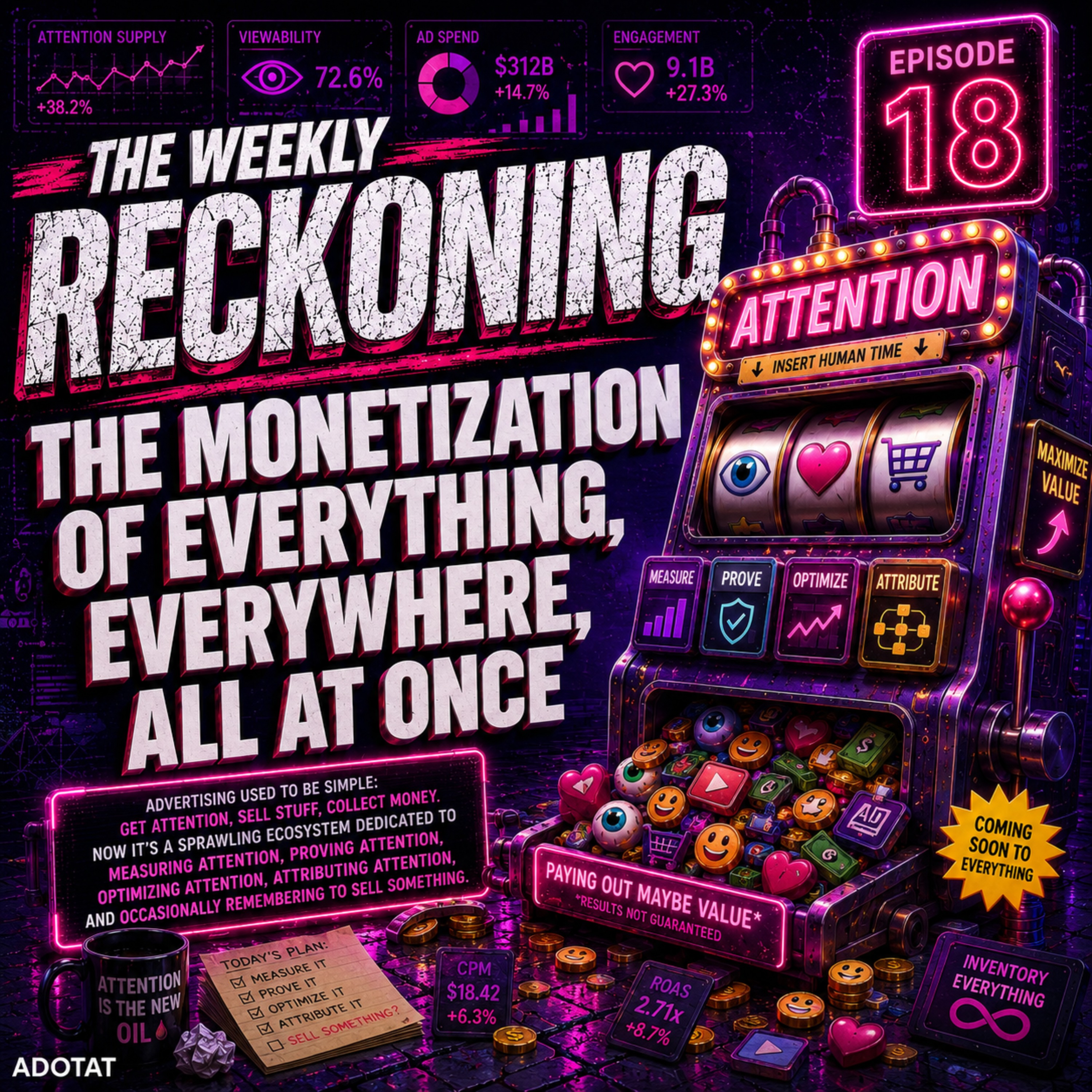 Adtech & The Monetization of Everything, Everywhere, All at Once | Advertising used to be simple: get attention, sell stuff, collect money. Now it's a sprawling ecosystem dedicated to measuring attention, proving attention, optimizing attention, attributing attention, and occasionally remembering to sell something. Samsung is opening its TV home screen to programmatic buying, sending the last uninfested surface into the same ecosystem that brought us MFA sites, arbitrage schemes, and enough audience segments to classify your dog as an affluent traveler. Samsung says AI will keep it premium. In advertising, "premium" usually means "we haven't ruined it yet." Adelaide's attention scores are now in Amazon DSP, giving marketers another metric to pretend they always cared about — the industry chased clicks, then views, then engagement, then outcomes, and now we've reinvented eyeballs and called it a currency. Nobody has ever paid rent with attention scores. Walmart is connecting YouTube exposure to retail purchases, claiming it knows why Karen bought protein powder seventeen days after a six-second pre-roll — which isn't attribution, it's astrology with a receipt. Meta is rolling out Best Buy spaces to sell face computers because Zuckerberg has evolved from "this is cool" to "you'll be cognitively disadvantaged without one," which isn't marketing, it's a threat wrapped in a product launch. Agencies across Southeast Asia are waiting months to get paid while funding client cash flow like interest-free banks, because procurement loves the word "partnership" until the invoice arrives. AI-generated girlfriends are funneling lonely people into search arbitrage mazes stuffed with ads from legitimate brands — fake people attracting real humans so real advertisers can fund fake websites. And AI-slop domains have exploded because generative AI made the economics of garbage irresistible, filling the web with content written by nobody for nobody except the ad networks collecting along the way. The pattern is the story: programmatic creates problems, the industry sells fixes, the fixes create new problems, and everyone meets at Cannes to congratulate each other. Advertising is the only business where people start a fire, sell the extinguisher, and win an award for crisis management. The Weekly Reckoning by ADOTAT. | — | ||||||
| 6/5/26 | 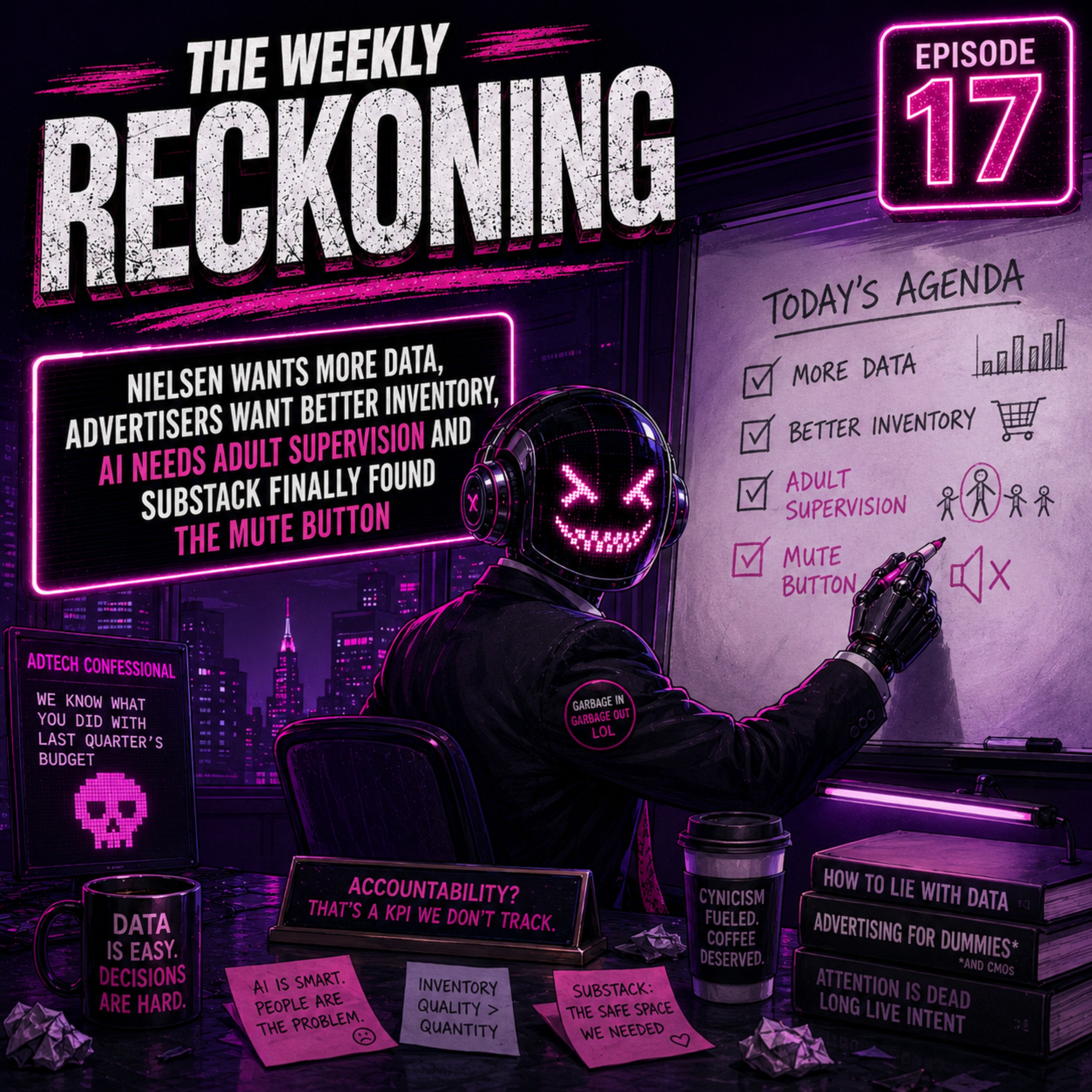 In Adtech Nobody Trusts Anything Anymore and the Industry Just Noticed" | The ad industry has decided it no longer trusts anything — not its data, not its inventory, not its AI, not its platforms, not even its own supply chain. After twenty years of building an infinitely scalable digital advertising machine, everyone is suddenly looking around the casino asking who checked the cards. Nielsen announced integrations with Mediaocean, Polk, and MRI-Simmons that sound boring until you realize it's a toll-booth strategy — the company is embedding itself so deeply into the infrastructure that removing it would be like uninstalling the foundation from a building. The ANA's latest transparency report revealed that top-performing programmatic buyers convert 54% of spend into quality impressions while the bottom half manage 32% — and the smart advertisers paid lower CPMs than the ones buying garbage. Turns out you can't optimize your way out of bad judgment. VIOOH is making the case that the hottest luxury media property in America is now a gas pump, because premium advertising no longer means prestigious environments — it means wherever the algorithm found you. IAB UK's James Chandler said the most honest thing about AI all week: Chief AI Officers will eventually disappear, because nobody has a Chief Electricity Officer. Everyone wants the robot to drive but nobody wants to take their hands off the wheel. Substack launched moderation tools after discovering what every platform eventually discovers — the comments section is undefeated and absolute freedom sounds fantastic right up until somebody actually starts posting. And Louisiana's age-verification law is back in court because lawmakers keep trying to regulate the internet like a shopping mall and the internet refuses to cooperate. Trust wasn't built into the foundation. Now everyone's trying to retrofit it while the cracks keep spreading. The Weekly Reckoning by ADOTAT. | — | ||||||
| 5/29/26 |  The Fever Dream Is Breaking Down and Everyone's Selling the Wreckage Like It's a Feature | The digital media dream died this week and nobody sent flowers. BuzzFeed, once valued at $1.7 billion, sold for the price of a decent Malibu teardown. Vox Media unloaded New York Magazine, Vox, and its podcast network because "content ecosystems" don't pay private-equity bills forever. Vice already imploded. The entire digital media era now looks like a decade-long exercise in confusing traffic spikes with actual businesses. Turns out pageviews are not legal tender. Meta is rolling out subscriptions for everything because even it no longer trusts the ad economy it built, charging creators to regain access to audiences Meta systematically made unreachable in the first place — the platform equivalent of a landlord stealing your furniture and renting it back through a tier called Creator Plus Max Ultra. Meanwhile Meta is facing claims it overcharged advertisers by four billion dollars because its ad auction allegedly didn't work the way anyone was told, and the company reportedly discovered the issue years earlier and fixed it slowly instead of immediately — because nothing says "trust us" like quietly easing out of a multi-billion-dollar mistake over several fiscal quarters. The ANA released another transparency report confirming advertisers still deeply distrust agencies, which feels less like news and more like confirmation that water remains wet. The FTC is appealing its monopoly case against Meta while moving with the speed and agility of a fax machine. Google is testing sponsored ads inside AI search results because Silicon Valley cannot invent a new technology without stuffing a billboard into it — the future of AI looks less like Her and more like Times Square with APIs. And Comscore revived the Rentrak brand, proving measurement companies never die, they just rebrand and return five years later pretending they've finally solved attribution. The internet's business models are rotting in public. Everyone keeps insisting we're entering a bold new era. Mostly it looks like the old era collapsing in expensive sneakers. The Weekly Reckoning by ADOTAT. | — | ||||||
| 5/22/26 | 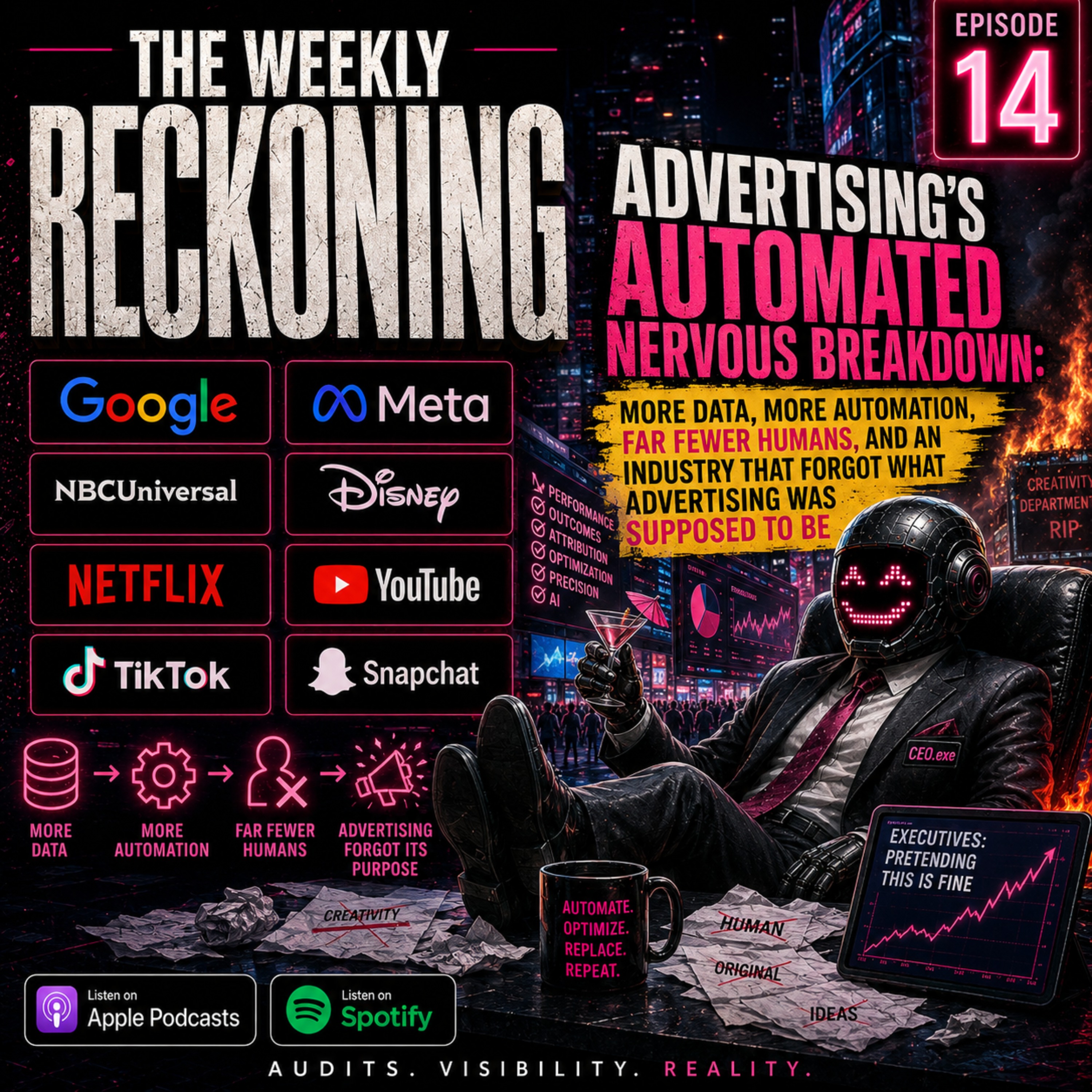 More Data, More Automation, Far Fewer Humans, and an Industry That Forgot What Advertising Was Supposed to Be | Upfront week turned into a three-day panic attack disguised as a sales presentation. Every media executive in Manhattan climbed onstage, blasted cinematic music, and repeated the word "performance" until it lost all meaning. NBCUniversal unveiled another dashboard named like a Deloitte retreat. Fox dragged Gordon Ramsay onstage to convince advertisers Gen Z still watches television. Disney clung to sports rights. Amazon didn't mention a TV show for an hour because its real product is commerce disguised as media. Netflix mocked ad tech jargon while simultaneously selling it. And YouTube closed the week by reminding everyone that reach still matters, which in 2026 apparently counts as revolutionary thought leadership. Then Google unveiled "Ask Advisor," an AI tool designed to replace your marketing department with a recommendation engine that spends your budget across Google products while you nod along pretending this isn't horrifying. They also blended conversational AI ads directly into search responses so consumers can enjoy no longer knowing where information ends and advertising begins. TikTok is arguing in North Carolina that it's too omnipresent to be sued anywhere specific, which is incredible legal strategy from a company whose algorithm identifies emotional vulnerability faster than most therapists. Meta is running the same play in Vermont. Snapchat actually shipped something useful with a unified attribution model that deserves credit. Meta is cutting thousands of jobs while spending $135 billion on AI because Zuckerberg decided employees are inconvenient obstacles between executives and quarterly margins. DoorDash hired another ad exec to rebrand lukewarm pad thai as human progress. And Wendy's brought back a former CEO because corporate America cannot imagine new leadership without recycling the same people through slightly different chairs. Control is slipping. The playbook is rotting. And the response is more dashboards, more AI, and fewer humans. The Weekly Reckoning by ADOTAT. | — | ||||||
| 5/15/26 |  Television's Midlife Crisis Goes Fully Corporate and Every Network Executive Now Sounds Like a Chatbot Trained on Deloitte Decks | The upfronts used to be about stars, cocktails, and media buyers pretending to care about prestige dramas. Now it's household graphs, AI optimization, and enough jargon to make a management consultant levitate. Every network delivered the same panicked message this week in slightly different fonts: please believe TV can do performance marketing before retail media eats our faces off. NBCU celebrated its hundredth birthday by reinventing itself as a surveillance startup that retargets on linear TV — something it would have called "disturbing Silicon Valley behavior" five years ago. Fox spent an alarming amount of time insisting Tubi is premium and not the streaming equivalent of a gas station hot dog roller. Amazon didn't mention a TV show for an hour because its real product isn't entertainment — it's commerce disguised as media, with a new tool that whispers personalized sneaker ads into your exhausted soul at 1AM. TelevisaUnivision was the only company brave enough to say the measurement system is broken and Hispanic audiences keep getting shortchanged by bad data. Disney threw clowns, Goodell, and Kimmel on stage in beautiful chaos. Netflix completed its villain origin story — the company that killed TV ads is now selling them with AI frequency caps and insisting its interruptions are "artisanal." Warner Bros. Discovery unveiled another dashboard because apparently we needed more dashboards. And OpenAP tried to get nine giant competing media companies to agree on reality for five minutes, which is like hosting Thanksgiving between rival mafia families armed with PowerPoints. Television spent years mocking Silicon Valley for turning creativity into math homework. Now every upfront feels like an earnings call hosted by a recommendation engine wearing sneakers. The Weekly Reckoning by ADOTAT. | — | ||||||
| 5/8/26 |  Where the Bots Are Fake, the IDs Are Broken, and Every Media CEO Is 'Approaching Profitability | The Trade Desk spent years pressuring publishers into adopting UID2 as the future of identity in advertising. Then one major publisher discovered it had been sending completely broken IDs into the system for three months without anyone noticing — not TTD, not the buyers, nobody. When they fixed it, revenue didn't change at all. Billions of dollars are moving through identity systems held together by vibes and dashboards. NBCUniversal is declaring streaming victory because a quarter containing the Super Bowl and the Olympics produced good numbers, which is the media equivalent of claiming you're a fast runner while standing on a moving sidewalk. Strip out the mega-events and growth drops to low single digits. Martin Sorrell wrapped another bad quarter in AI buzzwords while the stock got hammered and the real strategy — fewer humans, more software, same margins — became impossible to ignore. Pinterest posted over a billion in revenue while the internet fills with bots interacting with other bots and nobody wants to ask what percentage of that record engagement is human. Google decided Reddit commenters are experts now because AI systems have scraped everything else and are digging through comment sections for nutrients. And Threads is quietly becoming the corporate dashboard Meta always wanted — not cool, just stable enough that marketers will move budgets away from whatever Elon detonates next. Nothing is what it claims to be. The identity is broken. The growth is inflated. The AI is papering over the dysfunction. And billions flow through all of it every day. The Weekly Reckoning by ADOTAT. | — | ||||||
| 5/1/26 |  The Weekly Reckoning by Adotat: AI Ate Your Media Plan and Everyone Is Smiling About It | This week, the ad industry finally stops pretending it’s in control. Google tightens its grip with AI Max, PayPal decides it’s a media company now, The Trade Desk makes peace with the ecosystem it used to critique, and Omnicom lets algorithms start cutting deals like junior traders on Adderall. Meanwhile, retail media keeps blurring every line that used to exist between targeting, measurement, and actual truth.It’s less a cycle of innovation and more a slow-motion consolidation play where everyone owns a piece of the loop and calls it progress. We break down who’s actually winning, who’s getting quietly erased, and why “AI-powered” now means absolutely nothing unless you also own the data, the pipes, and the narrative. | — | ||||||
| 4/24/26 |  The Adtech Bros Are the Villains Now, and They're the Last to Know It | Something shifted this week. Not in a product launch or a keynote or a governance council announcement. In the rooms ad tech doesn't get invited to. The FTC. State AGs. CFOs and CMOs who sign the checks. Publishers watching their businesses get strip-mined. The message is the same everywhere: the ad tech guys are the villains now. Not antiheroes. Not misunderstood disruptors. The villains. And then The American Prospect proved it by removing all programmatic advertising from its site, effective immediately, calling the system "built on surveillance and monopoly power" and "riddled with fraud," and pivoting to reader support instead. No optimization roadmap. No diplomatic hedge. Just a door closing. Meanwhile the IAB launched another governance council to fix programmatic, which would be impressive if it didn't already have a graveyard of working groups that have been "addressing transparency" since banners had drop shadows. Agentic AI frameworks are multiplying like bad startups — Koa Agents, Open Agentic Kit, Agentic RTB, AgenticOS — and none of them are built to cooperate. OpenAI swung at Google's core business with CPC pricing. Index Exchange is quietly erasing the line between sell-side and buy-side. And StackAdapt is pitching ChatGPT ads at bargain CPMs, which tells you exactly where we are in the hype cycle. The system is broken. A publisher just proved you can walk away from it. The only question is who's next. The Weekly Reckoning by ADOTAT. | — | ||||||
| 4/17/26 |  The Upfronts Got Smaller, The Promises Got Bigger, and The Math Still Doesn't Work - Adtech, Advertising & Marketing | The same companies that spent years building broken, fragmented systems are now selling you the fix at candlelit dinners and calling it innovation. Paramount skipped the stage show, went straight for the steakhouse, and unveiled a unified ad stack across Paramount Plus and Pluto TV that should have existed five years ago — plus a product called Precision Plus, because nothing ships in 2026 without a plus sign. Amazon made its own sellers so angry they organized a boycott after trying to pull ad costs directly from seller proceeds before they even touch the money. Reddit partnered with HubSpot to pipe authentic human chaos into a CRM, which risks turning the most honest place on the internet into a structured data point that misses the point. Maine had a chance to pass a real privacy law with actual teeth — the ad industry pushed back hard and killed it. Nielsen says streaming won but keeps tweaking the methodology everyone is supposed to transact billions on. And Viant acquired TVision to build attention-based pricing, adding yet another metric to a system that can't agree on the ones it already has. Break it. Wait. Rename the fix. Sell it back. That's not transformation. That's a business model. The Weekly Reckoning by ADOTAT. | — | ||||||
Want analysis for the episodes below?Free for Pro Submit a request, we'll have your selected episodes analyzed within an hour. Free, at no cost to you, for Pro users. | |||||||||
| 4/10/26 |  The Robots Are Driving Now and Nobody Knows Where We're Going | Every company in ad tech discovered the word "agentic" this week and nobody can stop saying it. Publicis and Microsoft are building a full-stack AI-powered marketing platform for over a hundred thousand employees without admitting the old system failed. Kargo launched an AI chatbot for media buying that's basically ChatGPT cosplay for planners. Jeff Shell got fired from Paramount for the second time in three years — cleared of wrongdoing, convicted by vibes. Netflix rolled out a kids app with no ads and no purchases, which sounds wholesome until you realize it's behavioral conditioning with better UX. The upfronts officially stopped being a TV marketplace and became a tech demo with better catering. TikTok is spending 1.2 billion dollars on a Finnish data center because trust apparently requires colder weather. And TikTok partnered with Wix to help small businesses plug directly into its ad machine — which isn't empowerment, it's ecosystem lock-in with a helpful onboarding flow. The system underneath is broken — fragmented tools, fake metrics, duct-taped workflows — and instead of fixing it, everyone is layering AI on top like frosting on a collapsed cake. Faster decisions aren't better decisions. Scale isn't clarity. And putting AI in the driver's seat doesn't fix the road. The Weekly Reckoning by ADOTAT. | — | ||||||
| 3/27/26 |  The Ad Industry’s New Religion: Own Everything, Explain Nothing - TikTok, Amazon & The Trade Desk | TikTok declared itself the entire marketing funnel with a straight face and a new tagline. The Trade Desk's "we're the transparent ones" era hit an audit wall — Publicis found violations, Omnicom brought in its own auditors, and meanwhile Amazon is quietly siphoning budgets with lower fees and actual purchase data. Walmart bought Vizio and turned it into a closed-loop advertising Death Star that tracks what you watch, click, and buy inside one ecosystem — and brands like L'Oréal are already lining up. Samsung and Amazon turned your TV remote into a checkout button. A jury told Meta and Google that designing addictive products for teenagers has consequences, and the court didn't buy the "we just host content" defense. Meta is laying off hundreds while Zuckerberg openly says AI can replace entire teams. The Trump administration invited Zuckerberg, Brin, and Huang to help regulate AI — because letting the winners write the rules always works out great. And OpenAI quietly killed Sora after a billion dollars of hype, proving that building your production pipeline on AI tools is like building a house on quicksand. Power is consolidating. The walls are getting taller. The Weekly Reckoning by ADOTAT.TikTok full funnel advertising, Trade Desk audit Publicis, Trade Desk Omnicom audit, Walmart Vizio advertising, closed-loop attribution retail media, Amazon shoppable TV, CTV commerce, Meta teen addiction lawsuit, Meta AI layoffs, OpenAI Sora shutdown, Big Tech AI regulation, ad tech podcast, weekly reckoning adotat, programmatic transparency | — | ||||||
| 3/20/26 | Everyone's Screaming Transparency and Nobody's Telling the Truth | The ad tech industry runs on hype, fear, and slide decks. The Weekly Reckoning by ADOTAT runs on the truth. Every week we break down the biggest stories in advertising, media, and marketing technology — who's winning, who's bluffing, and who's getting rich off your confusion. No fluff. No both-sidesing. No pretending the emperor's dashboard has clothes. New episodes weekly.Episode Description:Agencies are acting like hedge funds with better branding and calling it innovation. Principal media is swallowing more than half of media budgets and fewer companies have guidelines for it than ever. Publicis and The Trade Desk are in a public knife fight over who gets to own the word "transparency" in a supply chain engineered to obscure money flows. Smartly acquired INCRMNTAL to try to kill last-click attribution — right after finishing monetizing it. The FBI admitted it buys Americans' location data because it's "commercially available," using the exact same loophole ad tech built and profited from for years. And Nielsen is shutting down ad monitoring in 137 TV markets while rebuilding the measurement system the entire industry still treats as currency. The incentives haven't changed. The conflicts haven't changed. Just the vocabulary. This is The Weekly Reckoning by ADOTAT. | — | ||||||
| 3/13/26 | Weekly Review in Adtech and Advertising: Billboards, Bots and Broken Algorithms | This episode pulls together a set of stories that, on the surface, look unrelated: a $20 million investment in digital out-of-home tech, layoffs at one of the internet’s biggest viral publishers, a culture-driven agency going independent, the rise of a new AI protocol for ad tech, regulators revisiting subscription traps, and YouTube quietly overtaking Hollywood’s biggest TV companies in ad revenue.But underneath all of them is the same theme: control of the system is becoming more valuable than the content running through it. OUTFRONT is modernizing billboard sales with cloud software to meet programmatic buyers where they already work. LADbible is confronting the risks of relying on social platforms after Facebook engagement collapsed. Obsidianworks is reclaiming independence to control its own growth. Meanwhile, the industry is experimenting with AI infrastructure like Model Context Protocol, while regulators push back against subscription dark patterns and YouTube continues to consolidate power in video advertising.In this episode, we connect the dots across media, ad tech, platforms and regulation to explain how the advertising ecosystem is shifting toward infrastructure, ownership and platform control—and what it means for brands, publishers and the future of the industry.Stay Bold. Stay Curious. Know More Than You Did Yesterday. 🎙️ | — | ||||||
| 3/6/26 |  Your AI Therapist Has Ads Now, Netflix Knows What You Bought on Amazon, and Meta Just Killed Your Free Vacation | The Trade Desk is in talks to put programmatic ads inside ChatGPT — and Wall Street loved the idea so much the stock jumped twenty percent on the rumor alone. Netflix opened the door to Amazon's commerce data, meaning what you shop for now determines which ads interrupt your binge. Meta killed the credit card payment option for advertisers, ending the beloved side hustle where founders funded Bali honeymoons off their AmEx points. WPP filled another leadership chair after months of limbo. A neurodiverse creative studio called The Ability Machine launched and might be the most genuinely interesting thing to happen to the industry in years. And Zoom hired a real media agency because "you're on mute" was never a long-term brand strategy. Every surface is becoming a monetization opportunity. The only question is whether anyone's going to draw a line. This week's evidence suggests probably not. | — | ||||||
| 2/27/26 | Ad Tech Had a Terrible, Horrible, No Good, Very Bad Week and Somehow Still Thinks a Rebrand Will Fix It | WPP unveiled a turnaround plan named after the year things might stop being embarrassing — then accidentally dumped nine billion dollars in client spending data into a public court filing. Omnicom swallowed IPG and killed the Big Six era because the holding company endgame was never about ideas — it was about owning the pipes. The Trade Desk posted fine numbers and Wall Street punished them anyway. Discord tried demanding passports from users whose last verification partner leaked seventy thousand government IDs. A new creator agency launched promising you "can't fake relevance" — in a press release faking relevance. And the ANA heroically discovered that not buying fraudulent junk impressions leads to better results. We break down all of it — who's winning, who's bluffing, and why the industry keeps rebranding the same problems and hoping nobody notices. | — | ||||||
| 2/20/26 | Everyone's Optimizing, Nobody's in Control, and Nielsen Still Won't Die | Everyone's optimizing. Nobody's in control. This week on The Weekly Reckoning by ADOTAT: Nielsen was supposed to be dead — so why is everyone still signing contracts? VideoAmp admits it owns less than 1% of the market. iSpot is quietly laying off a quarter of its staff. Netflix built a $1.5B ad business and still acts like advertising is a communicable disease. Google turned your targeting controls into "suggestions." Amazon dropped a $200B capex bomb. And Michael Kassan is back with $50M in revenue and a Cannes party. We break down what it all means, who's lying, and why control is the biggest illusion in ad tech. | — | ||||||
| 2/12/26 | The Ad Industry's Annual Nervous Breakdown — Super Bowl Edition | The one where we unpack the ad industry's post-Super Bowl existential crisis, Google's "agentic commerce" power grab, Amazon muscling into Prebid like it owns the place, the IAB trying to regulate AI without admitting everything's already AI, LiveRamp's SaaS survival mode, and — oh yeah — AppLovin's growing pile of allegations, SEC investigations, and a stock down 40% while the CEO insists everything is totally fine. Plus: GEO is the new SEO because apparently we're gaming chatbots now. Welcome to 2026.Keywords: ad tech, Super Bowl advertising, programmatic advertising, Google agentic commerce, Amazon Prebid, AppLovin allegations, AppLovin SEC investigation, AXON engine, click fraud, IAB AI disclosure, LiveRamp SaaS, GEO generative engine optimization, OOH taxonomy, digital advertising, AI in advertising, ad fraud, TCPA, privacy compliance, adtech podcast, Signal and Noise, ADOTAT | — | ||||||
| 2/11/26 | Super Bowl Ads Don’t Convert (And Other Adtech Lies) | Resellers, Tubi, YouTube & Brand Safety | Episode One of Signal & Noise by ADOTAT is here, and we’re starting exactly where the industry lost its mind.This week: the Super Bowl performance delusion, why one percent conversion rates are not a strategy, and the inconvenient truth that curiosity beats QR codes every time. We unpack the reseller purge and who actually gets crushed when platforms declare moral superiority. Tubi quietly posts receipts while YouTube prints $60B and still acts misunderstood. The IAB rolls out another Greek-god measurement project. And Hearst blows a crater in the brand safety industrial complex with data that should make every media buyer uncomfortable.It’s sharp. It’s unsentimental. And it separates what actually drives performance from the weekly panic cycle.Sponsored by Troutman Amin LLP and Incremental.Stay Bold. Stay Curious. Know More than You Did Yesterday. | — | ||||||
Showing 19 of 19
Pitch Fit is a Pro feature
See how bookable this show is for guests, which brands already advertise, the per-episode ad value, and the best-fit guest and sponsor profile. The numbers are blurred on the free plan.
How readily this show books outside guests like you.
How proven this show is for host-read sponsorships.
For Guests
ProFor Advertisers
ProUpgrade to Pro to unlock guest cadence, sponsor categories, fit scores, and per-episode ad value for this show.
Chart Positions
1 placement across 1 market.
Chart Positions
1 placement across 1 market.