Insights from recent episode analysis
Audience Interest
Podcast Focus
Publishing Consistency
Platform Reach
Insights are generated by CastFox AI using publicly available data, episode content, and proprietary models.
Most discussed topics
Brands & references
Est. Listeners
Insufficient chart data. Estimates will improve as the show charts.
- Per-Episode Audience
Est. listeners per new episode within ~30 days
N/A🎙 ~2x weekly·14 episodes·Last published 3d ago - Monthly Reach
Unique listeners across all episodes (30 days)
N/A - Active Followers
Loyal subscribers who consistently listen
N/A
Market Insights
Platform Distribution
Reach across major podcast platforms, updated hourly
Total Followers
—
Total Plays
—
Total Reviews
—
* Data sourced directly from platform APIs and aggregated hourly across all major podcast directories.
On the show
From 10 epsHosts
Recent guests
Recent episodes
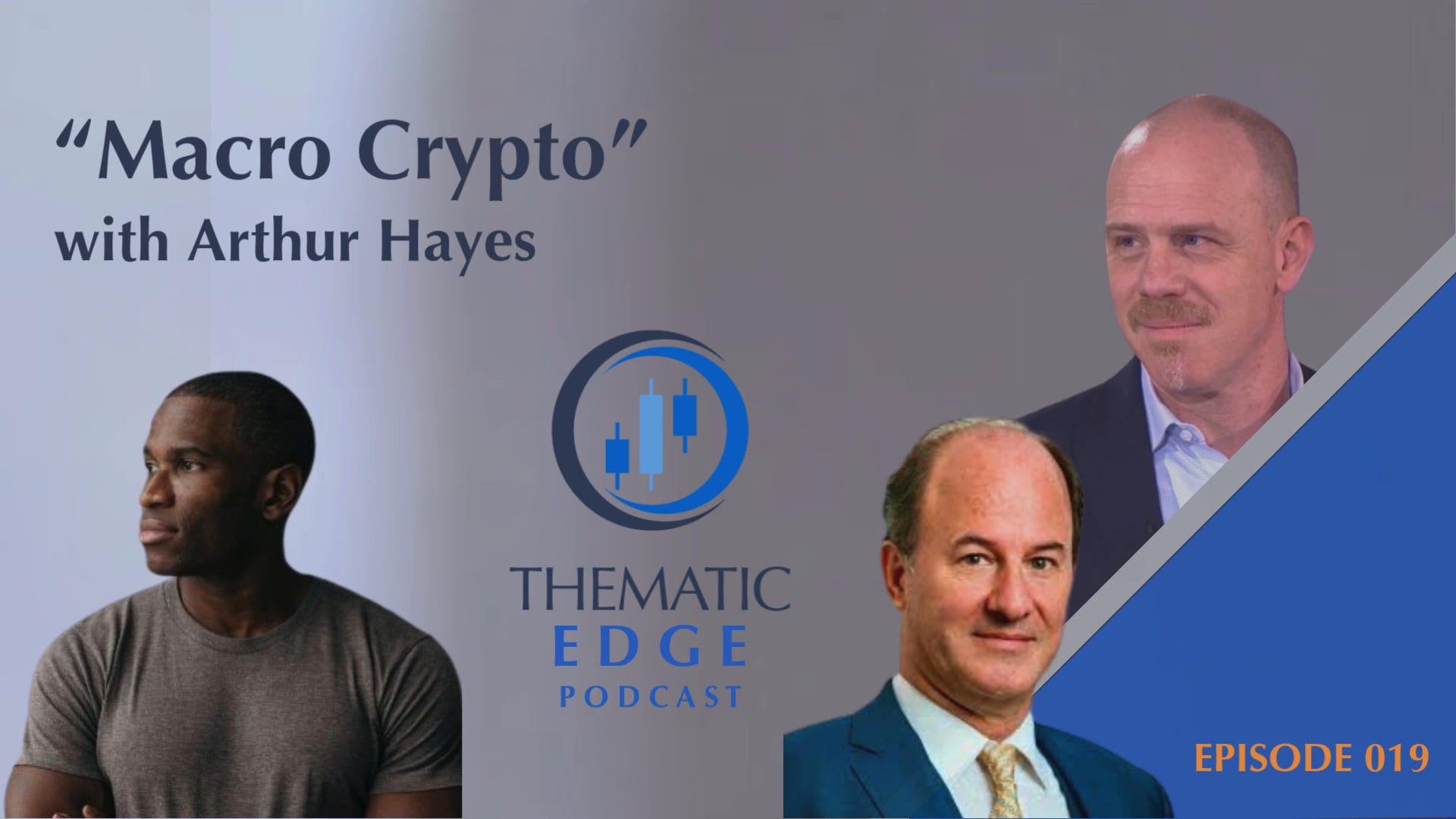
Episode 019: "Macro Crypto" with Arthur Hayes
Jun 24, 2026
52m 42s
Episode 018: Fed regime change
Jun 10, 2026
1h 01m 50s
Episode 017: "Mark"ing to market: Iran & China views
May 27, 2026
56m 46s
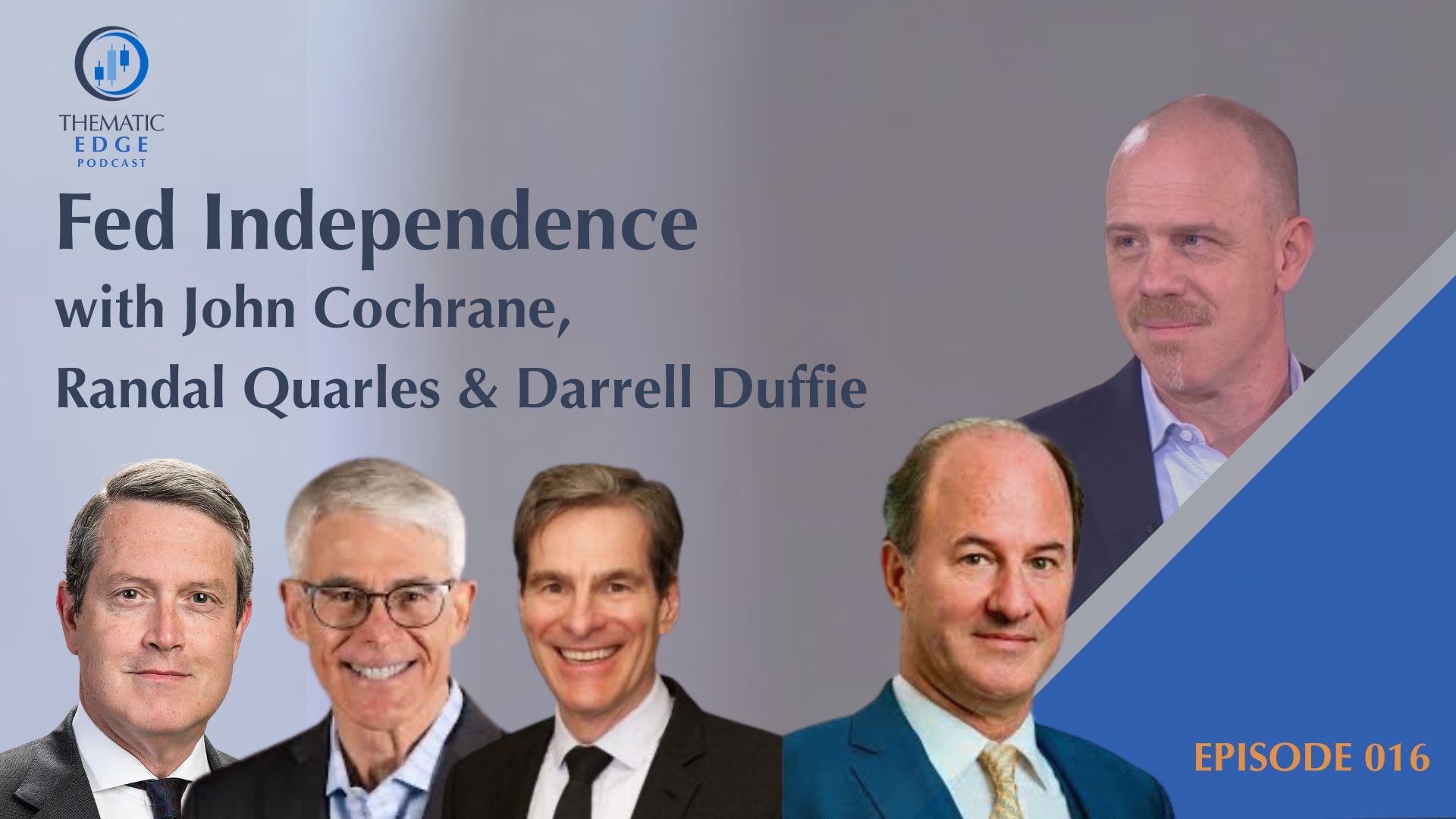
Episode 016: Fed independence
May 13, 2026
30m 29s
Episode 015: US & Fed outlook with Danny Dayan
Apr 29, 2026
1h 03m 37s
Social Links & Contact
Official channels & resources
Official Website
Login
RSS Feed
Login
| Date | Episode | Topics | Guests | Brands | Places | Keywords | Sponsor | Length | |
|---|---|---|---|---|---|---|---|---|---|
| 6/24/26 | ![]() Episode 019: "Macro Crypto" with Arthur Hayes | In this episode of Thematic Edge, Marvin Barth and Mark Farrington sit down with Arthur Hayes to explore one of the most important questions in crypto today: what ultimately gives Bitcoin value? While all three agree that liquidity, monetary policy and sovereign incentives shape markets, they discuss their differences in evaluating fundamental value.Arthur Hayes is one of the most influential figures in the history of cryptocurrency. He co-founded BitMEX, once the world’s largest crypto derivatives exchange, pioneered the perpetual swap contract that now dominates crypto trading, and helped build one of the industry’s first unicorns. Today he serves as Chief Investment Officer of Maelstrom, his family office, where he combines analysis of macroeconomic analysis, liquidity and market psychology to navigate both crypto and “TraFi” (traditional finance) markets.The conversation ranges from Hayes’ background, how his early experience during the Global Financial Crisis helped shape his view, to Bitcoin’s relationship with gold, the future of stablecoins and payment rails, the institutionalisation of crypto, the politics of digital assets after FTX, and why Donald Trump embraced the sector.The discussion spans the modern global political economy, how it shapes digital assets values, and how they integrate with traditional macro trading.Key themes• Arthur Hayes’ journey from traditional finance to founding BitMEX and inventing the perpetual swap.• How the Global Financial Crisis shaped his views on central banks, liquidity and financial markets.• Why Hayes believes almost every asset class is ultimately a bet on future money printing.• Bitcoin as “technology plus liquidity” and why liquidity dominates valuation.• The debate between liquidity-driven and adoption-driven models of Bitcoin value and how they interact.• Whether Bitcoin is money, an asset, digital gold, or something entirely different.• Why Bitcoin differs fundamentally from traditional finance because it cannot be bailed out.• The similarities and differences between Bitcoin and gold.• Whether Bitcoin adoption is approaching saturation.• The impact of ETFs and institutional ownership on Bitcoin’s future.• Why network usage and transaction activity matter for Bitcoin’s long term value.• Stablecoins, payment rails and the future of the dollar system.• Why the Democrats turned against crypto after FTX.• Why Trump embraced crypto and what that means for the industry.• How geopolitics increasingly influences cryptocurrency markets.Timestamps00:00 Introduction03:30 Arthur Hayes’ background and arrival in Hong Kong06:30 Lehman Brothers and the lessons of the Global Financial Crisis08:50 Discovering Bitcoin and founding BitMEX11:00 Macro investing, David Dredge and tail risk16:45 Everything is a liquidity trade20:00 Bitcoin valuation: technology plus liquidity23:00 Bitcoin versus gold24:45 Adoption, saturation and valuing Bitcoin27:20 Why adoption may matter less than investors think30:00 ETFs, institutionalisation and Bitcoin’s future33:00 Sovereigns and strategic Bitcoin reserves34:00 Payment rails, transaction fees and network sustainability37:00 FTX and the politics of crypto39:30 Why Trump embraced crypto41:00 Bitcoin, geopolitics and the future of digital assetsFurther Reading📖 21 Million And Other Myths Of Value, Seriously Marvin, 17 June 2026A critique of three core Bitcoin narratives: fixed supply, power law pricing and inevitable debt monetisation.📖 Valuing Bitcoin, Thematic Markets, 29 May 2026A novel epidemiological model of Bitcoin adoption, valuation and long run macro drivers. The framework challenged directly during this conversation.📖 What Debasement?, Thematic Markets, 8 March 2026Why the dollar’s position may be stronger than many crypto investors assume, and how stablecoins reinforce dollar dominance.📖 Easy Money, Seriously Marvin, 29 July 2025How liquidity creation, monetary policy and financial conditions drive asset prices, often in ways investors misunderstand.📖 Revolutionary Money and Banking, Thematic Markets, 27 June 2025How technological innovation is reshaping money, banking and financial intermediation.📖 A Monetary Revolution in the Making, Seriously Marvin, 23 June 2025Examines the growing role of stablecoins, digital assets and alternative payment systems in the global monetary order.📖 Stand and Deliver: your crypto or your life, Seriously Marvin, 3 June 2025Why payment rails, financial sovereignty and control of transactions may matter more than reserve currency status in the next phase of geopolitical competition.📖 The Geopolitics of Crypto (Payments), Thematic Markets, 23 Jan 2025Why independent payment rails may become a strategic battleground between the United States and China.Subscribe to ThematicMarkets.com This is a public episode. If you'd like to discuss this with other subscribers or get access to bonus episodes, visit thematicmarkets.substack.com/subscribe | 52m 42s | ||||||
| 6/10/26 | ![]() Episode 018: Fed regime change✨ | central bankinginflation+4 | Mark Farrington | Federal Reserve | — | central banksinflation expectations+5 | — | 1h 01m 50s | |
| 5/27/26 | ![]() Episode 017: "Mark"ing to market: Iran & China views✨ | Iran conflictUS strategic thinking+4 | Mark | — | IranChina+2 | IranChina+5 | — | 56m 46s | |
| 5/13/26 | ![]() Episode 016: Fed independence✨ | Federal Reserve independencemonetary policy+5 | John CochraneMichael Bordo+2 | Hoover Institution | — | Federal Reservemonetary policy+5 | — | 30m 29s | |
| 4/29/26 | ![]() Episode 015: US & Fed outlook with Danny Dayan✨ | inflationmonetary policy+3 | Danny Dayen | Federal Reserve | — | inflationmonetary policy+3 | — | 1h 03m 37s | |
| 4/15/26 | ![]() Episode 014: Iran blockade✨ | Iran conflictUS foreign policy+4 | Mark | Trump Administration | IranUS+1 | Iran blockadeUS-Iran relations+7 | — | 1h 08m 21s | |
| 4/1/26 | ![]() Episode 013: Iran strikes credit with Zoso Davies✨ | credit riskIran conflict+4 | Zoso Davies | BarclaysLondon based hedge fund+1 | Iran | credit riskIran+6 | — | 56m 21s | |
| 3/19/26 | ![]() Episode 012: Doomberg - Strategic implications of the Iran war✨ | Iran warmarket resilience+4 | Doomberg | — | IranMiddle East+5 | Iran warmarket resilience+5 | — | 1h 00m 27s | |
| 3/4/26 | ![]() Episode 011: Iran implications with Erik @YWR✨ | Iran conflictglobal markets+5 | Erik @YWR | — | IranChina+6 | Iran conflictChina risk premium+5 | — | 56m 45s | |
| 2/18/26 | ![]() Episode 010: Forest fire insurance✨ | forest fire insurancesystemic risk+5 | David Dredge | Convex Strategies | — | forest fire analogyself organised criticality+6 | — | 1h 14m 19s | |
Want analysis for the episodes below?Free for Pro Submit a request, we'll have your selected episodes analyzed within an hour. Free, at no cost to you, for Pro users. | |||||||||
| 2/4/26 | ![]() Episode 009: Trump 2.1 shock✨ | US strategygeopolitics+4 | Mark Farrington | — | VenezuelaGreenland+2 | US deterrenceWestern Hemisphere doctrine+3 | — | 1h 01m 28s | |
| 1/21/26 | ![]() Episode 008: Nigeria in focus | Nigeria is the largest economy and population in Africa, is abundant in natural resources, is an emergent cultural and technology center, and increasingly a regional manufacturing hub. Senator Ede Dafinone of Delta Central State (the main oil-producing region) explains the reforms of President Tinubu, the vast potential opportunities they may release, and how this lynchpin of Africa can navigate strategic competition between the US and China.0:33 Why Nigeria merits your attention.2:40 Who is Senator Ede Dafinone of Delta Central State?6:19 The basis of Nigeria’s cooperation with US attacks on ISIS.9:33 Nigerian perspectives on the shift to a new world order.14:35 Nigerian views on President Trump.17:14 President Tinubu’s willingness to challenge the system and reform.21:00 What will define success and prospects for long-run success.23:30 Senator Dafinone’s priorities for Delta State and Nigeria.25:36 Opportunities in Nigeria created by reform.31:52 Nigeria’s secret weapon: its educated diaspora.33:52 Fine arts and fashion in Nigeria. This is a public episode. If you'd like to discuss this with other subscribers or get access to bonus episodes, visit thematicmarkets.substack.com/subscribe | 35m 56s | ||||||
| 1/7/26 | ![]() Making sense of Venezuela with David Kilcullen | The Thematic Edge opens 2026 with its first guest, David Kilcullen, retired Australian Army colonel, intellectual architect of both the “Surge” in Iraq and Afghanistan, and the world’s foremost authority on counterinsurgency. Colonel Kilcullen helps us make sense of what happened in Venezuela on 5 January and what to expect going forward.The discussion is structured around three questions that matter for markets. * First, what actually happened operationally, and what it reveals about escalation control, deterrence, and the limits of legacy air defence systems. * Second, what the episode signals about US grand strategy, the “Trump corollary of the Monroe Doctrine, the return of gunboat diplomacy, and the use of suzerainty style constraints to shape trade, currency choice, and commercial alignment. * Third, what long-term “success” means and what must be achieved to meet it, including political stabilisation of Venezuela, establishment of payments systems, control over resources, and how quickly the US needs to move before the window closes.Along the way, we challenge the prevailing narratives including claims of pre-negotiation with or foreknowledge of China and Russia, implications for the emergent global order, Taiwan, Ukraine, Europe, other regions’ security, who might be “next,” the scramble for resource control, what to watch for, and Venezuela’s potential as a test case for dollarization via stablecoins. With so much to talk about and such an insightful guest, this episode is longer than usual, but it will be required listening/viewing for anyone interested in assessing risks and making informed decisions in today’s rapidly shifting global order.Full transcript 100:00:06.560 --> 00:00:09.120Marvin Barth: Good evening, and welcome to…200:00:09.150 --> 00:00:25.030Marvin Barth: the Thematic Edge. We are very excited, to start 2026 with our very first guest on the Thematic Edge. So, this time I’m not only joined by my longtime friend and colleague, Mark Farrington.300:00:25.030 --> 00:00:29.289Marvin Barth: Who’s going to join me in asking some of the questions of our guests.400:00:29.290 --> 00:00:39.329Marvin Barth: But I’m also joined by another very old friend of mine, David Kilcolon, and we are very fortunate to have him.500:00:39.620 --> 00:00:54.339Marvin Barth: for reasons we can discuss another time. My nickname for him is the International Man of Mystery, and most of that has to do with the fact that I can never get ahold of him, and he seems to be in some crazy place without cell phone connections.600:00:54.700 --> 00:01:02.499Marvin Barth: So we’re very lucky to have him, because he is exactly the right person to talk to700:01:02.750 --> 00:01:13.620Marvin Barth: about the events in Venezuela that occurred over the weekend. David is a retired colonel from the Australian800:01:13.620 --> 00:01:24.070Marvin Barth: Army. He, was a key advisor in both the Bush and Obama administrations. He has a consulting business, Cordillera Applications Group.900:01:24.070 --> 00:01:29.290Marvin Barth: That consults to many of the leading militaries, military alliances.1000:01:29.290 --> 00:01:40.729Marvin Barth: and companies, around the world on security issues. He is universally acknowledged as the world’s foremost authority on counterinsurgencies.1100:01:41.280 --> 00:01:57.119Marvin Barth: And he also happens to be a tremendously good, grants strategist, as illustrated by his last book, The Dragons and the Snakes. All his books are fantastic. I highly encourage you to go out and1200:01:57.420 --> 00:01:58.490Marvin Barth: read them.1300:01:58.660 --> 00:02:02.519Marvin Barth: David, welcome, and thank you for joining us.1400:02:02.990 --> 00:02:09.389David Kilcullen: Thanks, Marvin. It’s an honor to be here, and my publisher thanks you for that very blatant plug of my books.1500:02:10.300 --> 00:02:21.289Marvin Barth: well-deserved. I mean, if you want to understand any of the military or geostrategic developments of the last 20 years.1600:02:21.290 --> 00:02:34.590Marvin Barth: you have to read David Gilkullen’s books. You know, Counterinsurgency is literally the field manual for counterinsurgency, not only for the U.S. military, but for most militaries around the world at this point.1700:02:34.600 --> 00:02:48.110Marvin Barth: Out of the Mountains really described many of the things that we are now seeing take place, whether it was in Gaza or Ukraine. All of those things were basically forecast by David over a decade ago in that book.1800:02:48.110 --> 00:02:58.420Marvin Barth: And in terms of the best possible framework for thinking about the geostrategic environment and the challenges that Western democracies face.1900:02:58.420 --> 00:03:09.939Marvin Barth: Both militarily, economically, and strategically. You know, The Dragons and the Snake was second to no book out there, so, you know…2000:03:10.470 --> 00:03:16.739Marvin Barth: I’ll give you another plug there. Now, before we… Before we go on,2100:03:16.740 --> 00:03:38.359Marvin Barth: The, I do want, to remind everyone that nothing on this podcast should be considered, financial advice. You need to do your own research. We are providing information here, and especially on this topic, where we are literally in the fog of war, even though it’s an undeclared war.2200:03:38.840 --> 00:03:49.660Marvin Barth: You should not rely on any of this information as being factual, because everything is up in the air right now, and we are doing our best to make sense of the information that is available.2300:03:49.930 --> 00:03:57.890Marvin Barth: So with that, let’s start with, I actually wanted to structure this in sort of 3 segments that I think2400:03:58.120 --> 00:04:16.149Marvin Barth: best fit your expertise, Dave. The first is just, like, diagnostic. What actually happened? You know, if you were a theater commander or something, and you were getting in this, this information, or you were,2500:04:16.149 --> 00:04:21.899Marvin Barth: the head of the PLA trying to figure out what the heck the Americans just did.2600:04:21.959 --> 00:04:25.400Marvin Barth: How would we assess what actually happened?2700:04:25.400 --> 00:04:35.189Marvin Barth: Based on the information we have, today, the 5th of January. The second is really getting to that geostrategic point.2800:04:35.190 --> 00:05:00.130Marvin Barth: you know, what are the grand strategy implications of this, not just for the U.S. and for the region, but globally, and then finally get back to where you are the, you know, clear, acknowledged expert, on counterinsurgency, which is really, and you’ve emphasized this over and over, really about creating a stable society, which is what it’s going to take to make this operation ultimately successful. So we want to get that.2900:05:00.320 --> 00:05:12.070Marvin Barth: And in the end, I think we’ll get to, if we have some time, some, markets issues, which, feel free to, ask Mark and I questions around that.3000:05:12.580 --> 00:05:13.440David Kilcullen: Absolutely.3100:05:13.900 --> 00:05:16.430Marvin Barth: So let’s start with… I mean…3200:05:17.510 --> 00:05:28.149Marvin Barth: One of the things that has been floated around a lot, is that this was somehow, pre-arranged, right? That this was a negotiated.3300:05:28.180 --> 00:05:41.639Marvin Barth: settlement. And, you know, there are several signs, at least to my untrained eye, that suggest that. One, the strikes that were… that took place were actually quite limited, it seems.3400:05:42.190 --> 00:06:00.480Marvin Barth: And there are a lot of, anti-aircraft weapons in, Venezuela. Their army may not be fabulously trained, but they’ve got lots of, equipment from, all their, foreign friends. And yet you were able to have a helicopter-led,3500:06:00.690 --> 00:06:18.329Marvin Barth: exfil within a couple of hours without losing anybody. And then there’s also the sort of confidence that President Trump displayed in his press conference, suggesting that, you know, they’re basically going to run things under the new regime.3600:06:18.570 --> 00:06:28.579Marvin Barth: Do you see this as a prearranged, or a negotiated settlement, or… and how did that work, or do you have other theories about what was going on?3700:06:29.220 --> 00:06:29.900David Kilcullen: So…3800:06:35.220 --> 00:06:40.040David Kilcullen: So I’ll put that caveat out there to start with. But I think it’s pretty clear…3900:06:40.040 --> 00:06:44.080Marvin Barth: Dave, you froze for a second, so if you wouldn’t mind, what was that caveat again?4000:06:44.560 --> 00:06:57.519David Kilcullen: Sorry, I was just saying that, the short answer to many of these questions is we don’t know, right? Or we don’t know yet. So, we should just bear that in mind as we’re… as we’re talking about it.4100:06:57.710 --> 00:07:00.220David Kilcullen: The… I think the…4200:07:00.460 --> 00:07:18.170David Kilcullen: it’s not a secret that there’s been ongoing negotiation between the US government and the Venezuelan government over almost a year now about a set of issues, but the one that’s become the sticking point was the stepping down4300:07:18.270 --> 00:07:23.879David Kilcullen: of Maduro. As far as we know, about a week ago.4400:07:24.010 --> 00:07:30.470David Kilcullen: that set of negotiations reached an impasse, where Maduro was essentially offered4500:07:30.660 --> 00:07:43.920David Kilcullen: safe passage to exile, perhaps to the Middle East, or to Russia, where Bashar al-Assad is right now, of course. And this has seemed to have been a…4600:07:43.980 --> 00:07:56.840David Kilcullen: preferred playbook from the Trump administration to offer a way out and a graceful exit with as much cash as you can carry, you know, to a comfortable retirement somewhere else.4700:07:56.840 --> 00:08:09.899David Kilcullen: by the way, watch that space for Zelensky’s future, too, depending on how things go in Ukraine. But, I think the, the ultimate breach came about a week ago, when Maduro4800:08:10.020 --> 00:08:18.580David Kilcullen: essentially said, no, I’m not stepping down under any circumstances, and then engaged in a fairly public trolling of4900:08:18.760 --> 00:08:22.000David Kilcullen: the Trump administration by dancing on…5000:08:22.000 --> 00:08:39.270David Kilcullen: television and, talking about, you know, let’s make love not war, or let’s make peace not war. And that seems to have been the trigger, for the move on the operation, which of course had also been set up in a military sense for several months beforehand.5100:08:40.070 --> 00:08:53.069Marvin Barth: Okay, and now, there’s another whole set of conspiracy theories around this, that this was all some sort of quid pro quo with the Russians and the,5200:08:53.070 --> 00:09:02.839Marvin Barth: Chinese. In fact, this goes back to some of the issues that Mark and I discussed in our last episode of the Thematic Edge.5300:09:02.840 --> 00:09:15.680Marvin Barth: where we talked about a lot of the misperceptions of the latest national security strategy, that seemed to suggest the U.S. is going to pull back and leave everybody else with their spheres of influence.5400:09:15.760 --> 00:09:17.810Marvin Barth: And… that…5500:09:18.000 --> 00:09:33.300Marvin Barth: has led a lot of people to think that’s what this was all about, and that basically, you know, Taiwan is now going to be given free rein to… you know, China’s going to be given free rein on Taiwan, Russia’s going to be given free rein in Ukraine.5600:09:33.970 --> 00:09:47.710Marvin Barth: How do you read this? Do you think that the Chinese or Russians were involved in this, that there was any sort of quid pro quo, or were they completely unaware of this, or were they aware but just couldn’t do anything about it?5700:09:48.570 --> 00:10:08.099David Kilcullen: So again, we don’t know, but the evidence we have so far suggests that they probably were not aware of it ahead of time, or at least aware of the specifics. They knew something was coming, and we’ve seen comments, like warnings from Beijing and Moscow over the… and Tehran, by the way, over the past…5800:10:08.110 --> 00:10:16.550David Kilcullen: few weeks, attempting to warn the US off the operation. So, and then we saw a very vociferous response.5900:10:16.660 --> 00:10:20.149David Kilcullen: from Chinese, state-controlled media, which is…6000:10:20.310 --> 00:10:39.349David Kilcullen: basically all media in China, and from the Russians, in the last couple of days since the operation. So I don’t think they were involved in the operation, or I don’t think that there was any effort given to, you know, get their permission or make them okay with it. That doesn’t mean6100:10:39.480 --> 00:10:46.900David Kilcullen: that the Trump administration isn’t going to offer them some kind of a sweetener in the next few weeks as a way of minimizing.6200:10:46.900 --> 00:10:47.880Marvin Barth: Pushed…6300:10:47.880 --> 00:10:56.010David Kilcullen: And that’s quite possible. But I think, they were probably… Either decided not to…6400:10:56.750 --> 00:11:10.159David Kilcullen: resist, and not to assist, Venezuela in aid of not picking a fight with the US in its own backyard, or they potentially were unable to, and this is one of the technical questions6500:11:10.210 --> 00:11:26.119David Kilcullen: that’s going to have to come out, about the performance, in particular, of Chinese and Russian air defense systems, over Caracas during the operation. And we can talk about that more if you want, but that’s a key issue.6600:11:26.130 --> 00:11:44.969David Kilcullen: the Chinese have been, riding high a little bit since the Indo-Pakistan conflict in 2025, because of the better-than-expected performance of their air and air defense systems. And, I think it’s going to be an interesting question to see exactly6700:11:45.080 --> 00:11:51.249David Kilcullen: what comes out once a bit more detail comes out. We can talk about that in a military sense, if you’re interested.6800:11:51.500 --> 00:12:09.309Marvin Barth: Actually, I mean, I think this was a question that Mark had raised with me earlier, definitely, and, you know, it does relate to a broader set of questions that I had on sort of tactical lessons that we learned from this operation. What did we learn about6900:12:09.400 --> 00:12:13.799Marvin Barth: the U.S, you know, there were also reports that7000:12:14.460 --> 00:12:19.380Marvin Barth: you know, several, U.S,7100:12:19.710 --> 00:12:31.610Marvin Barth: targets were, missed or hit, civilian infrastructure that was unintended, things like this. So even in what seemed a very permissive environment.7200:12:31.850 --> 00:12:35.369Marvin Barth: From, an air superiority perspective.7300:12:35.570 --> 00:12:48.220Marvin Barth: there were mistakes on the U.S. side, despite what the Trump administration is casting this as. What lessons did we learn there? And then, exactly to this point, you know, that gets to one of these critical questions.7400:12:48.430 --> 00:12:52.730Marvin Barth: About it being a negotiated settlement, or were there failure of systems?7500:12:53.550 --> 00:13:13.179David Kilcullen: Yeah. So, why don’t we just baseline it by talking a little bit about what we know right now about how the operation went down, and then we can talk a little bit in more detail about it. So, for several months now, the US has had a build-up going on in the region of Venezuela.7600:13:13.340 --> 00:13:17.090David Kilcullen: At its peak, in the last few weeks, you had7700:13:17.240 --> 00:13:21.689David Kilcullen: A, an aircraft carrier battle group.7800:13:21.860 --> 00:13:34.379David Kilcullen: You had an amphibious ready group, which is basically a big-deck amphibious ship with a marine organization on there, and lots of helicopters and other ancillary…7900:13:34.380 --> 00:13:45.950David Kilcullen: material. Almost certainly there were submarines, and a number of other assets in place, because you don’t risk those kinds of assets without that sort of protective envelope around them.8000:13:46.210 --> 00:14:02.000David Kilcullen: In addition, we saw the build-up of Special Operations Forces on islands close to Venezuela, and a build-up of Marines in Puerto Rico. So we saw a sort of regional build-up.8100:14:02.170 --> 00:14:20.359David Kilcullen: of Army, Navy, Marines, Air Force, Space Force, Cyber, all those assets building up overtly in the region. It now appears, and I think not surprisingly at all, that there was also a CIA team on the ground in Venezuela.8200:14:20.860 --> 00:14:32.030David Kilcullen: And almost certainly a special operations paramilitary team as well. So a special warfare team, and of course, when we talk about the CIA, it’s a bit unusual.8300:14:32.060 --> 00:14:43.959David Kilcullen: in terms of global intelligence services, but it has both a paramilitary arm and a traditional intelligence arm. And I think we saw both of those potentially play a role here.8400:14:44.120 --> 00:15:03.249David Kilcullen: So what essentially seems to have happened is that the operation began by knocking out command and control systems, probably some cyber and space-based activity, and signals, disruption of the Venezuelan systems, followed by a very large-scale8500:15:03.260 --> 00:15:20.439David Kilcullen: what we call a SEAD package, Suppression of Enemy Air Defenses package, coming from the ships and from a variety of land bases, at least 150 aircraft, approaching Caracas from multiple directions, which is something you do in order to throw off8600:15:20.730 --> 00:15:30.820David Kilcullen: radar systems when you’re about to do a SIAD mission, and then striking various air defense systems. Russian S-300, S-400,8700:15:30.820 --> 00:15:43.559David Kilcullen: Chinese systems, probably some others, a lot of guns as well, like anti-aircraft guns, essentially trying to black out Caracas and knock out its air defenses. And then while that was going on.8800:15:44.070 --> 00:15:48.159David Kilcullen: We saw low-level helicopter insertion.8900:15:48.270 --> 00:15:55.349David Kilcullen: of Delta Force, which is the Army’s, Tier 1, strike organization. Probably some other assets as well.9000:15:55.350 --> 00:15:59.070Marvin Barth: What is Delta Force’s official initials, I think?9100:15:59.300 --> 00:16:03.560David Kilcullen: with ODD, Special Forces Operational Detachment Delta, right?9200:16:03.560 --> 00:16:06.660Marvin Barth: Aren’t they also called something like Combat Oper…9300:16:07.270 --> 00:16:07.789David Kilcullen: Oh my god.9400:16:07.790 --> 00:16:08.950Marvin Barth: group.9500:16:08.950 --> 00:16:12.810David Kilcullen: Combat Applications Group, yes, they have been called that in the past. They have various.9600:16:12.810 --> 00:16:14.630Marvin Barth: No relation to, to, to.9700:16:14.630 --> 00:16:15.270David Kilcullen: relationship.9800:16:15.270 --> 00:16:15.929Marvin Barth: Applications great.9900:16:15.930 --> 00:16:20.130David Kilcullen: Any resemblance to CAG is purely accidental.10000:16:20.150 --> 00:16:27.720David Kilcullen: But, yeah, so those guys came in, raided the palace where…10100:16:27.730 --> 00:16:38.650David Kilcullen: President Maduro and his wife were located. He seems to have attempted to enter a safe house, but was… or a safe room, but wasn’t able to do that. He was extracted.10200:16:38.650 --> 00:16:55.150David Kilcullen: they then got into a gunfight, in Caracas as they were attempting to extract, which is rather a similar scenario to Black Hawk Gown, for those who remember that incident 30 years ago. But it went much better. Some Americans were injured.10300:16:55.150 --> 00:17:07.089David Kilcullen: no one was killed, as far as we know. About 40 civilian and military people were killed on the Venezuelan side, and they successfully extracted the10400:17:07.560 --> 00:17:09.370David Kilcullen: The president and his wife.10500:17:09.480 --> 00:17:21.240David Kilcullen: to the USS Iwo Jima, at sea, and then from there, he’s just arrived in New York and is about to appear, in court. So, basically a…10600:17:21.770 --> 00:17:35.580David Kilcullen: I wouldn’t say flawless, but a very well-executed and competently executed multi-domain operation, as we call it, resulting in the seizure of a high-value target, and10700:17:35.580 --> 00:17:42.990David Kilcullen: basically no remaining U.S. forces on the ground. So, even though right now there’s discussion coming out that the…10800:17:43.240 --> 00:18:01.270David Kilcullen: Venezuelan vice president is the US preferred candidate. She’s also the natural person that would have taken over just in the normal course of events if Maduro had been hit by a bus, right? So, it’s not that the US has imposed its preferred candidate, it’s just that they’ve expressed10900:18:01.440 --> 00:18:13.290David Kilcullen: likely satisfaction with the candidate who is going to step into that spot anyway. So we can talk about that in a bit more detail, but I think the… the… the tactical execution11000:18:13.360 --> 00:18:27.390David Kilcullen: was not necessarily flawless, but was very competent and effective. The real question is, what next, right? What happens now? And, what did Trump mean when he said, we’re going to run Venezuela? I have my ideas on that.11100:18:27.410 --> 00:18:39.970David Kilcullen: Does he mean the same thing by that as Marco Rubio does? Does she understand that? You know, what are we looking at here? And I think a general theme, maybe to lead into the next phase of the conversation, is that we’re seeing11200:18:41.060 --> 00:19:00.039David Kilcullen: a move away from the concepts, or more rightly, the rhetoric, of democracy promotion and the international rules-based order that we saw under the Bush administration, the Obama administration, and the Biden administration, to something that’s more late 19th century, early 20th century, of11300:19:00.220 --> 00:19:02.310David Kilcullen: Gunboat diplomacy.11400:19:02.510 --> 00:19:17.270David Kilcullen: what we call suzeraine, which we can talk about, and, and protectorate status, right? Something much more akin to, say, the Banana Wars of the 1920s, or the, the Platt Amendment that governed11500:19:17.270 --> 00:19:29.459David Kilcullen: U.S. relationships with Cuba after the Spanish-American War. So not occupation, not regime change, not democracy promotion, but basically putting a protectorate status over a country where we say.11600:19:29.870 --> 00:19:45.139David Kilcullen: US commercial interests are going to have primacy, there are going to be limits on your foreign policy options, and there’s going to be some limits on your economics. For example, you have to do business in dollars rather than yuan, for example. And other than that.11700:19:45.140 --> 00:20:02.239David Kilcullen: in terms of your own internal governance, we’re not going to interfere. This is, what the Chinese would describe as tributary status, which we historically have talked about as suzerainty, which is where a country asserts control over another country’s11800:20:02.260 --> 00:20:11.300David Kilcullen: foreign policy to a greater or limited degree, but not in terms of internal administration. Now, whether that works is a different question, but it seems to be…11900:20:11.340 --> 00:20:27.590David Kilcullen: both what the Trump administration has in mind for the next stage politically, and also very well aligned with what you guys talked about on your last podcast about the national security strategy. So anyway, that’s a possible segue to a broader discussion.12000:20:27.830 --> 00:20:31.600Marvin Barth: I definitely want to go in that direction, that’s where we want to go next, but I think just…12100:20:31.690 --> 00:20:41.679Mark Farrington: touch a few more, sort of tactical and what happened issues. Mark, did you want to ask about the specific Chinese example, or… or an…12200:20:41.770 --> 00:20:42.390Marvin Barth: Yeah.12300:20:42.390 --> 00:20:56.810Mark Farrington: Yeah, yeah, I think that, you know, there’s a lot of interest to see what we can glean out of this operation that has relevance for the other theaters, whether it be in Europe, but probably primarily surrounding Taiwan.12400:20:57.110 --> 00:21:05.699Mark Farrington: I mean, obviously, the kind of build-up that you articulated so well that the U.S. has been put in place for the last 3 or 4 months in the Caribbean.12500:21:05.700 --> 00:21:29.710Mark Farrington: is not the way that the U.S. would approach a conflict with a geopolitical rival like China or Russia. So, you know, I don’t think it’s the formation, the structure, and the stealth that is as relevant, but there is, I think, interest in, you know, any sort of what can be called, you know, hardware or software failures or, you know, rival power.12600:21:30.090 --> 00:21:52.319Mark Farrington: failures. So, and as far as you know, were the anti-aircraft missiles, the radar, early warning systems, etc, were they top shelf, the best that Russia and China have available, or were they third, fourth generation old that had been sold to generate… sold to Venezuela years ago?12700:21:52.320 --> 00:22:03.080Mark Farrington: or the cheapest that they could afford. And so, therefore, we can’t really extrapolate too much about what happened and how easily it was taken out by the U.S. attack.12800:22:03.550 --> 00:22:12.610David Kilcullen: So, great question, and again, I think we don’t know for sure yet, but what we are seeing so far suggests that it wasn’t necessarily the latest gen12900:22:12.610 --> 00:22:23.950David Kilcullen: of Russian, or Chinese material. The one that’s been focused on is S300, that’s a 30-year-old system. The S400 is 20 years old.13000:22:24.040 --> 00:22:33.010David Kilcullen: There are… there was also a fairly widespread usage of SA7s or, handheld or shoulder-launched.13100:22:33.010 --> 00:22:44.500David Kilcullen: Air defense systems, which, are actually harder to counter than some of these larger scale systems, but are less effective in disrupting the kind of, stealth13200:22:44.500 --> 00:22:53.740David Kilcullen: heliborn-type assault. Helicopters are big, they move slowly, they generate an enormous radar signature because of the,13300:22:53.810 --> 00:23:07.409David Kilcullen: speed of the rotor tips, which generates this huge echo on radar. So it’s really hard to hide a helicopter insertion against a functioning air defense system, what we would call an integrated air defense system that includes13400:23:07.410 --> 00:23:14.520David Kilcullen: Sensors and a command and control system, radars, audio sensors, that kind of thing, as well as,13500:23:14.670 --> 00:23:29.340David Kilcullen: you know, guns and other systems for shooting down aircraft. So what you need to do is disaggregate that system. That’s what a CAD mission is, right? You’re trying to blind the command and control, knock out the radar sensors, confuse the guys that are running the system.13600:23:29.340 --> 00:23:37.429David Kilcullen: and then separately knock out the actual shooters, and I think we saw a fairly effective takedown here. I would be surprised if…13700:23:37.570 --> 00:23:46.649David Kilcullen: you would see a similar success in an attempt to, hypothetically, knock out Russian systems in the Baltic, or13800:23:47.040 --> 00:24:00.459David Kilcullen: Keningrad, or to knock out Chinese systems in Fujian or Guangzhou, in the event of a Taiwanese example, just to take two random,13900:24:00.460 --> 00:24:13.969David Kilcullen: ideas. I think I’d be… I’d be skeptical that you would see similar performance against a peer Tier 1 adversary, because it’s not a matter of having the platforms, it’s also a matter of14000:24:14.350 --> 00:24:34.109David Kilcullen: Who was running them? Did the Russians have crews on the ground to run those? Did they pull them out at the last minute because they were worried about being caught up in a direct conflict with the US? If they didn’t have crews on the ground, how good was the training of the Venezuelan crews? You know, there’s all these kinds of questions that will come out, but just haven’t come out yet in detail.14100:24:34.580 --> 00:24:59.490Mark Farrington: Okay, that’s fantastic. That’s what I assumed, but it’s good to hear it from the expert. And then just one other small question. It looked to me like the footprint of where all of the missile strikes were in Venezuela, that there was a few that were quite far away from the palace and the fort where the extraction event took place, and so I was just wondering, is it known, were those all just communication satellites.14200:24:59.490 --> 00:25:07.369Mark Farrington: outposts, or was there actually another target that is not being discussed that we took out,14300:25:07.370 --> 00:25:10.799Mark Farrington: Simultaneously under the cover of the extraction mission.14400:25:11.060 --> 00:25:17.209David Kilcullen: So it’s fairly clear that, yeah, that’s a great question, and it’s fairly clear that not only were they targeting14500:25:17.320 --> 00:25:20.190David Kilcullen: Air defenses and the palace itself.14600:25:20.280 --> 00:25:29.780David Kilcullen: they were targeting what we call the QRF, the Quick Reaction Force, that would have been able to inter… interfere with the extraction. And…14700:25:29.780 --> 00:25:40.569David Kilcullen: Some of those sites were probably communications nodes, some of them may have been, QRF locations. There’s a fairly extensive documentation of Cuban.14800:25:40.570 --> 00:25:52.849David Kilcullen: and other, special forces in, Venezuela, not all of whom would have been in Caracas. So I think, again, more details will come out, but for sure, they would have been trying to…14900:25:52.930 --> 00:26:08.860David Kilcullen: not only prevent any interference with getting the raid team in, but also, perhaps even more importantly, preventing, like, a Blackhawk Down scenario, and ensuring that it could actually get back out to the, to the ships, and knocking out, the…15000:26:08.860 --> 00:26:17.090David Kilcullen: Venezuelan Air Force, not just air defenses, and knocking out, QRFs, I think would be a… would have been an important element there.15100:26:17.510 --> 00:26:19.529Mark Farrington: Okay, that’s excellent, thanks for that.15200:26:19.530 --> 00:26:23.980Marvin Barth: Following up on one quick point that you mentioned.15300:26:24.080 --> 00:26:27.790Marvin Barth: you know, Cuban Special Forces. I mean, there… there were… there are…15400:26:27.850 --> 00:26:41.640Marvin Barth: a number of different foreign forces and, you know, advisors, on the ground in Venezuela, Cubans first and foremost among them, and I think often seen as15500:26:41.640 --> 00:26:53.519Marvin Barth: enforcer elements within the regime. You obviously have Russian forces there, North Korean, Iranian, Hezbollah.15600:26:53.540 --> 00:27:02.460Marvin Barth: Were any of… or do we have any information? Were any of those… foreign forces targeted.15700:27:03.080 --> 00:27:12.439David Kilcullen: So we don’t have any close… any detailed information on that as yet. I would be very surprised if the Cubans were not caught up in it, because they provided15800:27:12.440 --> 00:27:26.060David Kilcullen: a close personal protection element, amongst other things, to the… to the Chavez regime, and then to the Maduro after that. They’ve got a long-standing relationship going back to Chavez and going back to what’s called the15900:27:26.060 --> 00:27:42.080David Kilcullen: continental Bolivarian movement, which is the sort of general Shavista tendency in, northern South American politics. So, I think the Cubans, for sure. I’d be surprised if the Russians were directly involved,16000:27:42.520 --> 00:27:50.759David Kilcullen: Or the Chinese, but it’s possible. And then the North Koreans, have allegedly had some special forces16100:27:50.760 --> 00:28:04.410David Kilcullen: working with the collectivos Chavistas, the Chavista Collectives, which are these paramilitary forces that have been working, for the regime, probably also working with other elements of the regime. No evidence yet16200:28:04.410 --> 00:28:18.970David Kilcullen: that they were targeted, and there’s actually some dispute about whether they were even really there. So, I think for sure the Cubans, probably not the Russians or the Chinese, probably not the North Koreans. Iran and Hezbollah.16300:28:18.970 --> 00:28:25.920David Kilcullen: The Iranians and Hezbollah were both involved in export of drone technology to Venezuela16400:28:25.920 --> 00:28:35.100David Kilcullen: And in a couple of other areas of military tech, so I’d be surprised, again, if they weren’t caught up, but I’m not sure they would have been directly targeted as part of this.16500:28:36.410 --> 00:28:44.160Marvin Barth: Let’s move to that second discussion, which you already sort of provided the launch pad for, in that, you know.16600:28:44.440 --> 00:28:50.930Marvin Barth: Mark and I have talked about before, and, you know, I’ve written about it extensively, and16700:28:51.260 --> 00:29:06.789Marvin Barth: you know, frankly, building on one of your books that I mentioned earlier, The Dragons and the Snake, that, you know, the Dragons and the Snakes, that the post-war liberal order is already dead. It’s been dead for a while.16800:29:07.040 --> 00:29:13.459Marvin Barth: And in many ways, I look at Donald Trump’s election in 2016 as sort of16900:29:14.130 --> 00:29:21.620Marvin Barth: The church bell ringing to tell you it’s dead. Not that he brought it down.17000:29:21.810 --> 00:29:26.339Marvin Barth: But here you clearly see that the Trump administration17100:29:26.610 --> 00:29:35.840Marvin Barth: And I think many people will read it as, this is the end of the post-war liberal order. I would say, no, this is the…17200:29:36.030 --> 00:29:47.590Marvin Barth: an attempt to establish a new world order that, as you put it, does have a lot of similarities with the, sort of, late Victorian era.17300:29:47.720 --> 00:29:58.619Marvin Barth: I mean, is that the way that you see it? Is that where we’re going? Or what do you see as the direction of the world order at this point?17400:29:59.550 --> 00:30:04.570David Kilcullen: So I think it’s very clear, and we’ve talked about this before in other circumstances, that17500:30:04.620 --> 00:30:23.290David Kilcullen: globally, we’re seeing a transition to a multipolar world system, and that doesn’t necessarily mean China, Russia, or Iran replacing the United States as the primary actor in an international system. It may see…17600:30:23.380 --> 00:30:39.010David Kilcullen: a series of… I don’t actually like the term spheres of influence, but let’s go with that temporarily. A series of regional orders, rather than a single world order, in which each of the major players17700:30:39.110 --> 00:30:45.300David Kilcullen: Arrogates to itself a very high degree of agency in its own region.17800:30:45.790 --> 00:31:00.059David Kilcullen: still wants to do things in other regions, but accedes to other great powers having stronger interests in those regions that are closer to them. So, clearly in the case of the Trump administration.17900:31:00.170 --> 00:31:06.440David Kilcullen: The region with which the administration is most heavily concerned is the Western Hemisphere.18000:31:06.480 --> 00:31:21.020David Kilcullen: And, of course, the Western Hemisphere runs all the way from the North Pole to the South Pole, right? It is, by definition the same size as the other half of the Earth, so there’s a lot going on in there. And, you know, I noticed the Danes are…18100:31:21.610 --> 00:31:33.289David Kilcullen: I don’t know what the Danish for pearl clutching is, but they’re engaging in a certain amount of concern this morning about could Venezuela be a template for the Trump administration to move on Greenland?18200:31:33.290 --> 00:31:41.860David Kilcullen: The short answer is yes, it could, but it’s highly unlikely, right? The… another way of thinking about this is that this move was about…18300:31:41.860 --> 00:31:54.610David Kilcullen: securing a re-entry of U.S. oil companies to Venezuela, reopening the lower Venezuelan crude, which, of course, US Gulf Coast refineries are well-structured to18400:31:54.610 --> 00:32:09.470David Kilcullen: process that sulfur-heavy, you know, viscous oil that we see from Venezuela, the other main source of that is Canada, right? So, Canada can be seen potentially as an ideological adversary right now of the Trump administration.18500:32:09.470 --> 00:32:17.419David Kilcullen: That’s a slight overstatement, but you could argue that there’s a significant difference of opinion there. So, this is also a way of…18600:32:17.540 --> 00:32:33.020David Kilcullen: de-emphasizing Canada’s economic role in U.S. oil refinery operations. So, basically, what we’re seeing here is, and I think President Trump was accurate here, we’re seeing a restatement or a re-emphasis of the18700:32:33.020 --> 00:32:41.540David Kilcullen: Monroe Doctrine, which, of course, in its original form was about keeping the present, the military presence of European powers out of18800:32:41.540 --> 00:32:50.219David Kilcullen: the Western Hemisphere. Then became, under the, first corollary, the Roosevelt corollary to that doctrine in 1904,18900:32:50.220 --> 00:33:03.190David Kilcullen: an assertion that the US could intervene at will in the region for reasons of democracy promotion, stability, or other good reasons, you know, sort of responsibility to protect type reasons.19000:33:03.370 --> 00:33:11.160David Kilcullen: what we’re seeing with the Trump, corolli is basically saying, and we can do that for economic reasons, for our own…19100:33:11.190 --> 00:33:27.979David Kilcullen: relatively narrow, U.S. commercial interest, and we are not even going to tolerate the commercial presence or the ownership of infrastructure by great power rivals within that very narrowly defined geographical region.19200:33:28.060 --> 00:33:33.050David Kilcullen: of the Western Hemisphere. I think that’s a… an important…19300:33:33.270 --> 00:33:47.090David Kilcullen: development, but it’s a linear development. It’s not some kind of, astoundingly atrocious Trump innovation. It’s a linear progression on what has effectively been Trump, been, US policy for…19400:33:47.090 --> 00:33:57.699David Kilcullen: almost 200 years now, so I don’t think this is necessarily the departure that some people think it is, but it’s certainly a way to think about how the administration might operate in the future.19500:33:58.810 --> 00:34:09.620Mark Farrington: David, can I just jump in here for a second? I mean, I had the same extrapolation that you laid out there from the Roosevelt corollary, which was that,19600:34:09.730 --> 00:34:22.230Mark Farrington: this idea that the U.S. reserved the right to intervene in order to avoid instability and to defend against the European powers moving in the Western Hemisphere.19700:34:22.230 --> 00:34:45.879Mark Farrington: with the Trump corollary being the addition of offense. So not just a defensive corollary, it’s an offensive corollary that gives them the right to kick out non-hemispheric players that are already there, that have actually taken advantage of the instability that’s, you know, that the U.S. has tolerated over the last couple of decades. And so that’s why it looks, perhaps, more aggressive19800:34:45.880 --> 00:34:56.799Mark Farrington: In the beginning, because there’s this role of kicking out the unwanted players in the region, before it will then start to become a bit more, like.19900:34:56.800 --> 00:35:14.200Mark Farrington: dollar diplomacy, where you’re trying to encourage stability and democracy through U.S. investment, and particularly led by private sector companies rather than, you know, government military bases or something like that. Do you think that makes sense, that there is an offensive component that didn’t exist before?20000:35:14.630 --> 00:35:21.049David Kilcullen: Well, I do think… I do think it makes sense. I would offer a couple of caveats. One,20100:35:21.170 --> 00:35:37.610David Kilcullen: the US and the United Kingdom almost went to war in the late 19th century over Venezuela, as it happens. And one of the triggers for that was a potential French rival canal and a British rival canal to what became20200:35:37.610 --> 00:35:48.359David Kilcullen: the Panama Canal. Panama, at the time that the canal was constructed, was part of Colombia, and the US went in, in its sort of original use of gunboat diplomacy.20300:35:48.360 --> 00:36:00.379David Kilcullen: on the pretext of, Bogota oppressing its northern province, and seized that province, took it away from Colombia, and created the independent country of20400:36:00.490 --> 00:36:09.569David Kilcullen: I’m making air quotes for those that are listening, of Panama, and the US-controlled Panama Canal Zone.20500:36:09.580 --> 00:36:21.779David Kilcullen: as a result of that, and Roosevelt, in 1904, articulated his corollary to the Monroe Doctrine after the fact, right? So, they… they… I think perhaps the…20600:36:22.420 --> 00:36:39.119David Kilcullen: the most significant departure here is one of presentation, right? Because in theory, the original Roosevelt corollary was, we’ll do it for your own good, right? We’re doing this for your own good, for democracy and for stability, and yes, there’ll be a side effect of20700:36:39.430 --> 00:36:42.709David Kilcullen: benefit for, the United States.20800:36:42.720 --> 00:37:02.620David Kilcullen: Trump’s been fairly clear that he reserves the right to intervene purely for U.S. national interest, whether or not it’s in the interest of local populations in the region, and that he will do so to pursue U.S. commercial interests. And again, I don’t think of much of a substantive departure, but a difference of…20900:37:02.650 --> 00:37:08.399David Kilcullen: presentation, to be sure. So, I agree, though, with your first point about…21000:37:08.540 --> 00:37:12.459David Kilcullen: Will we see a period of, of,21100:37:13.180 --> 00:37:31.640David Kilcullen: offensive action, before we potentially see a more stability-focused approach. I would say that if a Trump administration official was here on this podcast with us, they would probably say, well, what we’re doing here is rolling back21200:37:31.920 --> 00:37:42.949David Kilcullen: unacceptable hybrid warfare offensive, advances by adversaries in the region, and we only are doing it because the Biden administration signally failed…21300:37:48.620 --> 00:37:55.229Mark Farrington: Is that, there we go. You froze again. I lost you there for the last 5 seconds.21400:37:55.230 --> 00:37:55.890David Kilcullen: Sorry.21500:37:56.070 --> 00:38:05.169David Kilcullen: Obviously getting jammed… obviously getting jammed by the, the Russians here. No, I was saying, I think that their position would be…21600:38:05.430 --> 00:38:24.710David Kilcullen: the Trump administration’s position would be that they had to do this because the Biden administration allowed such inroads by Iran, Russia, and China to the region, and they’re in a forced phase of rollback. You can debate that, but I think from a military standpoint, and leaving aside the political21700:38:24.870 --> 00:38:40.469David Kilcullen: trolling that’s implicit in that. The military point would be that the Trump administration is also broadening the notion of the Monroe Doctrine beyond conventional military engagement to what we call hybrid warfare, right? So.21800:38:40.870 --> 00:38:49.730David Kilcullen: Political warfare, economic warfare, cyber, you know, unconventional presence, that kind of stuff, is now going to be considered…21900:38:49.920 --> 00:38:57.350David Kilcullen: part of a spectrum of action that the US reserves the right to use military force to respond to.22000:38:57.710 --> 00:38:58.160Mark Farrington: Excellent.22100:38:58.160 --> 00:39:01.769Marvin Barth: So this… I mean, one of the clear, sort of.22200:39:02.840 --> 00:39:10.779Marvin Barth: you know, justifications, if you want, for this. If you think about it in the context you just laid this out, is that22300:39:10.940 --> 00:39:17.550Marvin Barth: you know, Venezuela was a center of a lot of serious threats to the U.S.22400:39:17.660 --> 00:39:24.299Marvin Barth: So, you have, you know, a government that is aligned with22500:39:24.410 --> 00:39:35.189Marvin Barth: multiple key strategic adversaries abroad. Russia, China, throw in regional, the Iranians, the North Koreans.22600:39:35.560 --> 00:39:51.850Marvin Barth: It is also aligned with a bunch of, narco groups, right? There are various factions of the Maduro regime were associated with different, drug cartels, that are heavily armed.22700:39:52.380 --> 00:40:07.109Marvin Barth: and, you know, effectively are NGO armies, in the same way that, you know, Hezbollah or Hamas or others were used as asymmetric assets by Iran in the Middle East.22800:40:07.150 --> 00:40:18.039Marvin Barth: You also have a whole social phenomenon in terms of the impact of the drugs they’re pushing into the United States in terms of deteriorating22900:40:18.160 --> 00:40:33.999Marvin Barth: and breaking down U.S. society, all of those things, combined with, Chinese monopolization, increasingly of the… forget about the oil, right? The U.S. actually is23000:40:34.110 --> 00:40:39.300Marvin Barth: flooding the world with oil right now. It doesn’t really need much oil. Yes, it’s refineries.23100:40:39.560 --> 00:40:44.230Marvin Barth: Can use, doesn’t have to, heavy oil.23200:40:44.230 --> 00:41:03.610Marvin Barth: but it’s really, you know, one of the critical issues here is the critical minerals that they’re increasingly finding in the Orinoco. So, you look at all those different things, and it says, this is a place we need to make sure our adversaries don’t control and cannot use as a staging ground23300:41:03.620 --> 00:41:08.820Marvin Barth: for, asymmetric attacks on the United States.23400:41:09.420 --> 00:41:14.960Marvin Barth: And so… the question I would take from that for you is.23500:41:15.430 --> 00:41:30.100Marvin Barth: That’s been true for quite a while, right? So, what changed? Did… is it… there’s at least some things I’ve read out there who are saying, oh, well, this has now become a critical issue, or one or more of these issues has become critical.23600:41:30.380 --> 00:41:46.530Marvin Barth: I’m not sure I read it. I read it as a regime change within the United States in terms of its view, and it was manifest in the Trump administration’s second-term first national security strategy.23700:41:47.390 --> 00:42:07.129Marvin Barth: Am I wrong to look at it that way? Was there something that critically changed recently that forced this action, or was this just… is this part of what you’re seeing as this is, defining a, new order relative to the collapse of the post-war liberal order?23800:42:07.840 --> 00:42:14.309David Kilcullen: So, yeah, there’s a lot to unpack in there, but I will just start this discussion by flagging that.23900:42:14.440 --> 00:42:33.949David Kilcullen: the US, under the Biden administration, suffered what most strategists would agree was a loss of deterrence capability, right? So, partly through the unmitigated fiasco of the collapse in Afghanistan,24000:42:33.950 --> 00:42:46.689David Kilcullen: Perhaps more so by the fact that no one was held accountable for that, loss, and that the Biden administration tried to spin it as a successful evacuation when literally everybody knew that it was a defeat and the loss of the war on terror.24100:42:46.690 --> 00:42:55.959David Kilcullen: After 20 years. And then the second big one was that within 6 months of that collapse in Afghanistan, the Russians invaded24200:42:56.090 --> 00:43:06.550David Kilcullen: full-scale invasion of Ukraine over very stark warnings not to do so by the Biden administration, which, basically24300:43:06.640 --> 00:43:24.939David Kilcullen: leaving aside the party politics of Democrats versus Republicans left the US in a much less powerful position in terms of deterrence vis-a-vis other great powers than it had been until that point. So one of the imperatives for an incoming Trump administration24400:43:25.380 --> 00:43:27.859David Kilcullen: Was to reestablish deterrence.24500:43:27.890 --> 00:43:47.650David Kilcullen: Another third… a third area where there was, a loss of, face, as it were, was in the Red Sea, where both a European and a US task force failed to reopen the Red Sea and the Baba Mendeb Strait to, to civilian commercial shipping.24600:43:47.650 --> 00:44:00.750David Kilcullen: against a, basically ragtag Houthi army funded by and supported by Iran. So there was a need to demonstrate something in order to re-establish, deterrence.24700:44:01.390 --> 00:44:03.089David Kilcullen: moving into Europe.24800:44:03.100 --> 00:44:18.259David Kilcullen: to reestablish deterrence by hitting back against Russia is not a Trump goal, right? His goal, rather, is to find a modus vivendi with the Russians, and to stabilize the situation in Ukraine without allowing the US to be24900:44:18.260 --> 00:44:28.189David Kilcullen: gone into it, so that was a non-starter. He’s also trying to disengage, to some extent, from funding, European, action.25000:44:28.680 --> 00:44:48.090David Kilcullen: Moving on Taiwan, also not a viable model because of the leverage that China holds economically over the United States. They would have been able to hit back even harder in that attempt. But a lot of the things that we’ve seen over the last 12 months have been… I mean, this is a…25100:44:48.260 --> 00:44:51.600David Kilcullen: To be a bit disrespectful, but have been…25200:44:51.730 --> 00:45:04.870David Kilcullen: thematically linked by the theme of the US casting around for something that it could do to re-establish deterrence without directly picking a fight with Russia or China. And I think…25300:45:05.000 --> 00:45:18.450David Kilcullen: what we just saw in Venezuela does that, right? It says, we can still carry out a competent military operation, we can still generate a massive effect. Hey, by the way, your hardware didn’t perform very well.25400:45:18.450 --> 00:45:30.569David Kilcullen: Also, we showed restraint by not striking directly on the Wagner Group or any of the Russians that are on the ground. And, you know, don’t screw with us, because, if we can do that in our region…25500:45:30.970 --> 00:45:44.750David Kilcullen: maybe we can do it in yours, but do you really want to take that chance, right? So it’s trying to establish a very high degree of deterrence and agency in its own regional, quote-unquote, sphere of influence. But,25600:45:44.750 --> 00:45:51.439David Kilcullen: at the same time as the NSS made clear, giving a lot of rope to great power.25700:45:51.440 --> 00:46:00.099David Kilcullen: adversaries in their own regions. That’s why I don’t really like the notion of sphere of influence, because the US is actually asserting global25800:46:00.100 --> 00:46:18.499David Kilcullen: control over certain functional areas, whilst asserting regional hegemony, right? Again, loaded term, but regional suzerainty, right, in its own region, over other countries. Now, whether other countries are willing to go along with that is a different question.25900:46:19.530 --> 00:46:20.100Mark Farrington: Yeah26000:46:20.170 --> 00:46:33.770Mark Farrington: That’s an excellent point, David, because I also thought that it wouldn’t be too long before the analyst community began to link the Truman Doctrine to the Trump NSA as well, because26100:46:33.770 --> 00:46:43.530Mark Farrington: You know, they have made an effort to fund and finance some of the frontline allies that they have against the great powers, like26200:46:43.530 --> 00:47:02.559Mark Farrington: dialing up the military investment in Philippines, for example, and, you know, offering the financial support that it has to various peripheral points of the NATO alliance, etc. So, it’s not full proxy war, like we saw in the first Cold War.26300:47:02.560 --> 00:47:21.579Mark Farrington: But it is a Truman-like response to, you know, China’s countermoves, and so it’s… I always struggle to understand why Trump has been described as isolationist, because both the expanded Trump corollary and this,26400:47:21.580 --> 00:47:31.900Mark Farrington: pushback on China and Russian influence globally in a Cold War-like framework is not isolationist. It’s active, but it’s selective, you know what I mean?26500:47:31.900 --> 00:47:38.249David Kilcullen: I would agree with that. I think the Trump administration has a degree of neuralgia about26600:47:38.460 --> 00:47:55.440David Kilcullen: multilateral alliances, like NATO, that tend to enmesh the United States in collective decision-making processes, where it’s not in a position to pursue its own interests or to selectively engage. That’s one of the big beefs about NATO.26700:47:55.440 --> 00:48:09.680David Kilcullen: coming from Trump people, irrespective of the money issue, which has been an issue back to, you know, the… the Nixon era. So that’s a… that’s an example of the type of alliances that the…26800:48:09.960 --> 00:48:13.070David Kilcullen: the Trump administration doesn’t like, particularly.26900:48:13.070 --> 00:48:35.059David Kilcullen: in the Western Pacific, and in the Asia Pacific, in the Indo-Pacific, what we’re seeing are a series of bilateral relationships, in which the US has much greater agency, much greater decision-making flexibility, and in many cases, these so-called alliances don’t actually do what the other party of the alliance thinks they do. Like, Australia’s a great example of that, right? Australians talk about27000:48:35.060 --> 00:48:55.640David Kilcullen: the ANZUS Alliance as being a de facto security guarantee from the US to Australia. It’s no such thing, it never has been. It just says that the two parties will consult with each other, right? That’s it. So, the Trump administration’s basically not really changing the27100:48:55.640 --> 00:48:59.620David Kilcullen: Letter of these alliances, but it’s changing the spirit in which27200:48:59.640 --> 00:49:03.660David Kilcullen: they’ve operated in the past. But again, another action27300:49:04.130 --> 00:49:14.800David Kilcullen: of the last few weeks that you may have already talked about, I don’t know, was that, just a couple weeks ago, the Trump administration gave the largest ever arms transfer to Taiwan.27400:49:15.110 --> 00:49:15.660Mark Farrington: Yeah.27500:49:15.660 --> 00:49:35.559David Kilcullen: $1.1 billion worth of weapons, in the midst of the Chinese having a very intensive war of words with Japan about Japan, upgrading its likely response to a move on Taiwan. So we’re seeing a generalized theme of the Trump administration trying to reestablish,27600:49:35.620 --> 00:49:44.760David Kilcullen: deterrence to establish this notion of selective engagement on US terms rather than somebody else’s terms, and then…27700:49:44.760 --> 00:50:00.990David Kilcullen: being… having a much lower threshold for engagement in its own region, and a higher threshold for interfering with other great powers in their own regions. And all of that is in the NSS, right? In the national security strategy from a month ago. So what we’re seeing, to some extent, is the…27800:50:00.990 --> 00:50:05.930David Kilcullen: You know, the emergence of flesh on the bones from that document from a month ago.27900:50:06.730 --> 00:50:07.960Mark Farrington: Excellent, yeah.28000:50:07.960 --> 00:50:21.360Marvin Barth: I want to, ask, you know, we’ve talked a lot about the U.S. intent here. What about the other two great strategic powers here, particularly China, but also, to some extent, Russia, which, you know.28100:50:21.590 --> 00:50:27.970Marvin Barth: the U.S, I think, is, you know, trying to peel away from China.28200:50:28.270 --> 00:50:43.629Marvin Barth: You know, one… on the Russian front, one interesting implication of this, people talk about, oh, it’s an invasion for oil, or whatever, which I don’t really buy, but it is kind of interesting, if you think about it, that the U.S. already28300:50:43.630 --> 00:50:51.220Marvin Barth: If you think that it has effective control, given pipelines and things like that, over Mexican and Canadian oil.28400:50:51.380 --> 00:50:55.810Marvin Barth: plus the US does 22% of the world’s oil itself.28500:50:56.470 --> 00:51:04.220Marvin Barth: has… You know, produces or has control of a third of the world’s oil production already.28600:51:04.520 --> 00:51:04.980David Kilcullen: No.28700:51:04.980 --> 00:51:14.979Marvin Barth: add in Venezuela, even though Venezuela’s small now, it could be a very large producer in the future. Plus, you’re establishing this precedent28800:51:15.180 --> 00:51:32.489Marvin Barth: with the Brazilians, the Colombians, the Ecuadorians, the Guyanans, who you already effectively control, the Trinidad, all of that. You’re talking 40% of the world’s oil supply right now. That is a very powerful economic weapon to wield against both Russia28900:51:32.680 --> 00:51:41.080Marvin Barth: the Iranians, even to keep the Saudis in line. It’s also potentially a weapon against importers like China.29000:51:41.460 --> 00:51:54.169Marvin Barth: So one question, and I’m gonna go through these in a couple and let you take… pick whatever you want, because we’re gonna run out of time soon. The other is, is China.29100:51:54.200 --> 00:52:10.940Marvin Barth: how do they look at this? And, you know, to the point of this area of suzeranity, does this give them greater flexibility? Also, you know, I’m sure that they would have used whatever excuse they could29200:52:11.290 --> 00:52:17.239Marvin Barth: But the… the… there’s a lot of noise that the Chinese delegation visiting29300:52:17.630 --> 00:52:30.700Marvin Barth: was effectively an unwitting participant in the, operation, because it helped them pin down where, Maduro was to do this, which…29400:52:30.760 --> 00:52:33.679David Kilcullen: You know, is a pretty insulting move.29500:52:33.770 --> 00:52:45.869Marvin Barth: And one, it does suggest to me that, A, the Chinese didn’t actually know this was happening, or, you know, obviously knew something was in the air, but didn’t know this specific operation. But the other is, what does this say to them?29600:52:46.210 --> 00:52:58.999Marvin Barth: So, those are sort of two big questions. How should Russia be looking at this, especially given they are so dependent on resources and the U.S. is actively controlling a lot more resources through this process?29700:52:59.030 --> 00:53:07.470Marvin Barth: And B, how does China look at this in terms of spheres of influence and also sort of the affront to them?29800:53:08.520 --> 00:53:12.099David Kilcullen: So the Russians, I think, are,29900:53:12.750 --> 00:53:20.969David Kilcullen: quite concerned about the impact of this on the Dark Fleet oil, transfers, which have been, part of the recent30000:53:21.090 --> 00:53:32.319David Kilcullen: you know, pre-strike behavior by the task group down in, in the Caribbean over the past few weeks. And I think that, in terms of resources, the worry…30100:53:32.560 --> 00:53:44.589David Kilcullen: for the Russians is that their ability to access, for example, Chinese or other sources of natural gas and oil is going to be limited. I think that’s less of a concern, frankly. I think…30200:53:44.720 --> 00:53:51.850David Kilcullen: For the Russians, the… The more important issue here is that, the…30300:53:52.200 --> 00:54:06.670David Kilcullen: So, you may be aware, Russia has quite a presence in Cuba, and including signals intelligence and a number of other things, and the big impact of disruption of Venezuelan oil flow in the region is to Cuba.30400:54:06.670 --> 00:54:13.490David Kilcullen: And Cuba could very well, suffer significantly and have to make an accommodation with the US.30500:54:13.540 --> 00:54:26.119David Kilcullen: As a result of this, in a fairly short order, in a matter of months, rather than longer term. For China, I think the issue is twofold, and there’s pluses and minuses.30600:54:26.440 --> 00:54:29.460David Kilcullen: On the one hand, it’s gonna be very difficult for30700:54:29.830 --> 00:54:41.690David Kilcullen: the US to go against China’s assertion of limited suzerainty over, countries in its region, including potentially Taiwan, when it’s just done the same thing in,30800:54:41.780 --> 00:54:51.169David Kilcullen: in Latin America, and I think that that won’t stop the US from saying, well, this is different. But, I think we’ve already seen in the Chinese media30900:54:51.240 --> 00:55:06.730David Kilcullen: an assertion that if this is okay for the US, then, you know, it would be double standards for the US to go against a Chinese move on other countries in its region. I think the nuance there is that…31000:55:06.810 --> 00:55:20.460David Kilcullen: Trump didn’t invade Venezuela, he didn’t occupy it, he didn’t do regime change, but he did seize the head of state and impose policy changes and economic changes on31100:55:20.560 --> 00:55:36.120David Kilcullen: the behavior of the Venezuelan government. That’s a limited option that some Chinese strategists have been talking about for a number of years. To the extent of people even saying, why are you even talking about invading Taiwan? This is crazy.31200:55:36.120 --> 00:55:52.349David Kilcullen: we would turn the country into a smoking hulk, and it’d take us a generation to rebuild it. We need to go after a much more limited objective. So that’s one option, one issue for China, and I’d say a relatively positive one. The negative one is about Chinese presence.31300:55:52.390 --> 00:55:57.659David Kilcullen: In the region. And again, this goes back to… John has spent…31400:55:57.950 --> 00:56:12.149David Kilcullen: 15 years, really trying to build its presence in Central America and South America, gaining control over commercial assets and over infrastructure, looking at alternatives, port construction.31500:56:12.150 --> 00:56:26.829David Kilcullen: At one point, they were considering another canal, a whole bunch of different things in the region, doing deals with people for, commodity, deals in yuan rather than dollars, you know, a bunch of things going on in the region, and now.31600:56:26.830 --> 00:56:44.180David Kilcullen: Trump is very much pushing back on that and saying, no, that’s not acceptable, and we are going to be economically as well as, as well as in security terms, we’re going to be dominant in economic terms in, in the region. I think that does have significant negative implications for the Chinese.31700:56:44.880 --> 00:56:45.350Marvin Barth: Yeah.31800:56:45.350 --> 00:56:54.000Mark Farrington: David, I think that, one of the things that I was hoping is going to come out of this, you know, once the smoke clears from the military operation.31900:56:54.000 --> 00:57:18.889Mark Farrington: is in order to prevent that precedent from increasing the odds of a military seizure of Taiwan, the U.S. should be emphasizing the Roosevelt corollary and the dollar diplomacy aspect, which was to intervene in unstable and falling regimes so that it doesn’t become a playground32000:57:18.890 --> 00:57:43.570Mark Farrington: for external parties to come in and cause trouble in the US’s backyard. Taiwan is the exact antithesis of that. It’s, you know, it’s more successful, it’s more rich, it’s more stable than the mainland, so you don’t have that same pretext of intervention in order to stabilize a potential, you know, basing ground for your enemy. It would be the opposite.32100:57:43.570 --> 00:57:47.290Mark Farrington: If they can make that point clear, they can hopefully block that precedent.32200:57:47.460 --> 00:57:51.720David Kilcullen: I think that’s a great point, and I would also get back to something Marvin said, the…32300:57:52.060 --> 00:58:07.289David Kilcullen: I think that this is not necessarily about increasing Venezuelan production, it’s about… nor is it about denying Venezuelan production to the Chinese. It’s about U.S. control over that production. So, you might find that…32400:58:07.390 --> 00:58:20.529David Kilcullen: Trump now has a bargaining counter to say, hey, we’ll give you a great deal, right, on Venezuelan oil, and we’ll give you, all the oil you can stomach at prices that you find acceptable.32500:58:20.680 --> 00:58:35.480David Kilcullen: But we have to be in charge of it, right? And that then, to your point earlier, Marvin, offers a bargaining counter for the rare earths and other things that have become a big source of Chinese leverage, right? So again.32600:58:35.480 --> 00:58:46.079David Kilcullen: We… we are used to rhetoric that says that economic security is national security. This is Trump putting that into practice, and saying that we reserve the right to32700:58:46.140 --> 00:58:58.299David Kilcullen: you know, use bombs and Delta Force to enforce economic warfare goals, right? While using economic goals to enforce our national security goals. And it’s a… it’s a…32800:58:58.590 --> 00:59:17.760David Kilcullen: US adoption of a style of operating that it’s accused other people of doing for a long time. arguably the US has been doing it forever too, but now it’s explicit. So I do think it’s new, and although we often say, well, the rhetoric’s different, but the substance is the same.32900:59:17.880 --> 00:59:37.400David Kilcullen: changing the rhetoric as… actually does bring a substantive change to how people behave, right, in the international system. So, and I think the other people that you’ve mentioned in passing that we need to watch is the Europeans, right? Because Europe’s been quite quiet on this, with the exception of the Danes over Greenland, and it’s almost like they’re struggling to figure out33000:59:37.600 --> 00:59:43.010David Kilcullen: how to react here. And I think, you’ve seen some analysts33100:59:43.570 --> 00:59:54.530David Kilcullen: in Germany and in Russia, saying, you know, the real loser here is actually Europe, because it’s now being excluded from a peace deal over Ukraine.33200:59:54.530 --> 01:00:04.329David Kilcullen: and the possible future of Taiwan, and now the oil and energy systems that power the modern world, right? So, where does that leave Europe in this framework?33301:00:04.640 --> 01:00:22.669Marvin Barth: Well, this is definitely something Mark and I… I think it was actually in our last discussion, Mark, where we’re… it was, because we were both saying, look, the risks of a serious European crisis have gone up massively since the NSS, and this is just another episode, because Europe is…33401:00:22.670 --> 01:00:26.580Marvin Barth: As much as they don’t want to admit it, totally irrelevant to33501:00:26.900 --> 01:00:33.620Marvin Barth: the geopolitical framework at this point. They don’t have any ability to project force anywhere significantly.33601:00:33.940 --> 01:00:50.190Marvin Barth: they don’t have significant resources, and, you know, they’re falling behind in the technological battle. Europe really has taken a severe backseat for the first time in probably 500 years.33701:00:50.660 --> 01:00:51.580Mark Farrington: Hmm. Yes.33801:00:51.580 --> 01:01:02.269David Kilcullen: That’s an interesting take, and I think we would have to distinguish the EU from countries located in Europe, right? So, Poland, the UK, to a certain extent, playing…33901:01:02.270 --> 01:01:05.169Marvin Barth: hope for the UK. I’m a resident and citizen.34001:01:05.560 --> 01:01:24.440David Kilcullen: Yeah. Well, the UK has an extraterritorial or extra-European role because of its role in AUKUS, and because of its possessions worldwide, like territorial possessions. The other big European player that has that same level of extraterritorial role is France, right? So I do think there’s gonna be…34101:01:24.960 --> 01:01:38.719David Kilcullen: exceptions, right? Or there are going to be differences. You know, France’s role in Africa has been under threat a lot lately, but it has, you know, it’s the largest European power in the Pacific, right? In terms of territorial possessions and military presence.34201:01:38.720 --> 01:01:58.400David Kilcullen: Australia and France between them, own all the key sub-Antarctic islands, which are really important now for missile defense. You know, there’s a bunch of stuff where I think Europe will still be a player, but not as it has been, right? And the rhetoric of successive European… Sorry, US governments about the importance of Europe.34301:01:58.710 --> 01:02:14.989David Kilcullen: is being, you know, gainsayed in a hundred ways by everybody from J.D. Vance to U.S. tech giants to the national security strategy to, you know, the discussion over Ukraine, and I think Europe needs to come to grips with34401:02:15.310 --> 01:02:22.949David Kilcullen: its role in a new, more multipolar world order. And I’m not sure that we’ve seen that yet.34501:02:23.570 --> 01:02:40.130Marvin Barth: Yeah, I just, I, I… we are rapidly running out of time. We’ll probably run over a little bit here, but, and I really want to get to the rebuilding phase, like, what, what comes next? But I just, one, quick34601:02:40.680 --> 01:02:49.260Marvin Barth: Last thought on… You mentioned Greenland earlier. You also sort of alluded that34701:02:49.370 --> 01:02:52.060Marvin Barth: Cuba is now going to be starved of oil.34801:02:53.060 --> 01:02:55.350Marvin Barth: Who’s next, or is there a next?34901:02:56.460 --> 01:03:07.870David Kilcullen: The place that I would watch, and I don’t think it’s a next exactly, is Colombia. So the current president of Colombia, Petro, has a very, or had a very close relationship with Maduro.35001:03:07.870 --> 01:03:18.240David Kilcullen: He comes from a similar political background, he’s a former M19 terrorist. There are millions of Venezuelans in Colombia.35101:03:18.260 --> 01:03:33.799David Kilcullen: In addition, the ELN, one of the… the National Liberation Army, a so-called narco-terrorist group, but actually a Marxist insurgent group that happens to also do drug trafficking, has major base areas in35201:03:33.800 --> 01:03:46.169David Kilcullen: Venezuela, and also when the peace deal was put in place by the former president, President Santos, in Colombia, that resulted in a formal end to the war with the FARC,35301:03:46.360 --> 01:03:49.929David Kilcullen: seven FARC so-called dissidentias,35401:03:50.300 --> 01:04:03.109David Kilcullen: mobile FARC military groups refused to accept the peace deal, and some of them relocated some or all of their presence into Venezuela. So you… and there’s an argument amongst many35501:04:03.580 --> 01:04:21.150David Kilcullen: analysts that, these aren’t really dissident FARC groups, they’re actually the FARC military reserve, as it takes part in electoral politics, but if it loses electoral politics, it’s got that as a backup. There is a May 2026 presidential election coming up.35601:04:21.150 --> 01:04:34.749David Kilcullen: leading anti-Petro candidates has already been assassinated. The former president, who happens to share the same name, but is not a relative of the guy who was assassinated, Uribe, has been put under house arrest.35701:04:34.750 --> 01:04:46.040David Kilcullen: by the Petro regime, sorry, Petro government, and there is a certain degree of concern in Colombia that this could be a pretext for a massive crackdown on35801:04:46.040 --> 01:04:59.869David Kilcullen: any opponent of the left-wing tendency in Colombian politics ahead of that May presidential election. So that would be the one to watch in the short term. There are others too, Ecuador, in particular, and a couple other places.35901:05:02.590 --> 01:05:16.640Marvin Barth: So, let’s go to the next topic, which is, what’s next? I mean, we’ve talked… you and I personally have talked about this in the past, that, you know, you’ve never had a failed state of the size36001:05:16.950 --> 01:05:21.359Marvin Barth: and complexity of Venezuela. And in many ways, I think.36101:05:21.550 --> 01:05:28.479Marvin Barth: It probably… its ability to maintain cohesion and some semblance of state36201:05:29.140 --> 01:05:37.490Marvin Barth: Over the last several years has been a surprise. Certainly to me, I think… I don’t want to put words in your mouth, but I’m guessing probably to you as well.36301:05:37.820 --> 01:05:41.790Marvin Barth: And… You now have…36401:05:42.220 --> 01:05:52.990Marvin Barth: the Trump administration, obviously very interested in seeing it become a cohesive and stable and friendly, i.e. under their suzeranity.36501:05:53.240 --> 01:06:01.499Marvin Barth: nation-state. That is a really, really difficult thing. You know, there’s all sorts of people who think, well, you know,36601:06:01.770 --> 01:06:12.390Marvin Barth: Maria Carina Machado, you know, just needs to come in and take over and all this, and because somebody pulled a bunch of election buttons, this magically will happen.36701:06:12.800 --> 01:06:17.799Marvin Barth: That’s not the way you actually run a government or build a state.36801:06:18.630 --> 01:06:27.599Marvin Barth: How… what needs to happen here? What does the Trump administration need to do? What needs to happen on the ground? How is this going to be a success, Dave?36901:06:28.610 --> 01:06:30.909David Kilcullen: Yeah, well, it may not be, right?37001:06:30.910 --> 01:06:35.559Marvin Barth: If it’s going to be a success, how would that happen?37101:06:35.560 --> 01:06:46.439David Kilcullen: And of course, if it wasn’t a success, that would give us an unbroken record of failure going back to World War II, so that would be, you know, the way to bet. But I think,37201:06:46.680 --> 01:07:01.549David Kilcullen: the Trump team, and I, you know, I worked with Pete Hegseth when he was in the military in Afghanistan. I don’t know Marco Rubio, but I’ve read a lot of things he said, and I know people that know him well. J.D. Vance, you know, combat veteran from Iraq.37301:07:01.690 --> 01:07:09.310David Kilcullen: One of the things that the Trump team are particularly allergic to is the notion of37401:07:09.410 --> 01:07:20.869David Kilcullen: foreign wars of choice involving pro-democratic regime change and U.S. occupation forces on the ground, right? What they sometimes shorthand as forever wars.37501:07:20.870 --> 01:07:39.720David Kilcullen: And they, with the exception of Gaza, but there’s always an Israel exception in US politics, right? With the exception of Gaza, there hasn’t been any appetite on the part of the Trump administration for putting any US troops on the ground. And I think that is still likely to be the case for Venezuela. So…37601:07:40.090 --> 01:07:44.570David Kilcullen: what I think we’re seeing… is very limited.37701:07:45.130 --> 01:07:59.189David Kilcullen: regime behaviour change being the goal, not regime change. Trump has already come out and dissed the chances of Maria Corina Machado coming back as president, said she doesn’t have the legitimacy or the support.37801:07:59.360 --> 01:08:05.829David Kilcullen: She also has the prize that he wanted to have, right? The Nobel Peace Prize, so that ain’t gonna go well. So…37901:08:05.830 --> 01:08:07.040Marvin Barth: He offered it to him.38001:08:07.140 --> 01:08:23.030David Kilcullen: I know, but as would I have if I’d been given that prize, because she probably saw this coming, right? But I think the, most likely outcome is your personnel stay the same.38101:08:23.420 --> 01:08:25.849David Kilcullen: Vice President Deli becomes president.38201:08:25.970 --> 01:08:41.809David Kilcullen: maybe you back off a little bit on some of the socialist crackdowns. You certainly allow back in the big US oil companies, and you knock off the economic warfare and political warfare against the United States. As long as you make those changes.38301:08:42.300 --> 01:08:45.960David Kilcullen: the Colombian… The Venezuelan military, and the…38401:08:51.979 --> 01:09:05.770David Kilcullen: key lessons that people in the Trump administration have taken from our experience in Iran… sorry, in Iraq and Afghanistan, right? So, one of the big lessons is we shouldn’t have disbanded the Iraqi military.38501:09:05.770 --> 01:09:12.510David Kilcullen: And sent them all home to become the source of the new insurgency. We shouldn’t have…38601:09:12.520 --> 01:09:14.810David Kilcullen: Disrupted a secular regime.38701:09:14.870 --> 01:09:24.630David Kilcullen: in Syria and in, Iraq, and allowed it to be replaced by a theocratic opponent, right? We shouldn’t have…38801:09:24.850 --> 01:09:28.600David Kilcullen: Engaged in a massive generational38901:09:28.859 --> 01:09:47.690David Kilcullen: nation-building effort in Afghanistan, which we turned out to lack the ability to pursue. So I think what they’re doing is they’ve taken a really significant appetite suppressant as a result of that negative experience of the war on terrorism, and what you’re likely to see is,39001:09:47.779 --> 01:10:04.269David Kilcullen: what David Ignachev, you know, 20 years ago called Empire Light, L-I-T-E, where all they’re doing is, hey guys, we’ve got certain policies we want to see in place, we’ve got other policies we don’t want to see in place, there are some personnel changes we’d like to see. Other than that.39101:10:04.430 --> 01:10:11.920David Kilcullen: You get to keep doing what you’re doing. And we’re not going to be promoting democracy in your country, nor will we be trying to engage in39201:10:11.950 --> 01:10:27.279David Kilcullen: Regime change, and the quid pro quo is you guys get to keep your, you know, your pensions and your position, and keep running the country, as long as you make these small, you know, tributary or protectorate-style changes to your foreign policy.39301:10:27.370 --> 01:10:31.260David Kilcullen: Again, you know, you’re dealing with a very proud people here in Venezuela.39401:10:31.950 --> 01:10:40.210David Kilcullen: You may find some machado that says, no, we’re not gonna do that, or machismo, but, that’s…39501:10:40.660 --> 01:10:51.129David Kilcullen: you know, not necessarily a given. You might just see people accommodating that in order to, get the benefits of what Trump’s offering them. Time will tell.39601:10:51.430 --> 01:11:05.670David Kilcullen: For sure, we don’t want to get into a counterinsurgency. It would be a massive losing proposition. We can talk numbers if you want, but highly unlikely to succeed. And I don’t think it’s on the agenda for the US government either.39701:11:06.430 --> 01:11:10.900Marvin Barth: You said that the Trump administration took these lessons from39801:11:11.020 --> 01:11:15.010Marvin Barth: you know, Iraq, Syria, and Afghanistan.39901:11:16.330 --> 01:11:23.300Marvin Barth: you know, you were actually critically involved in U.S. decisions in those three theaters.40001:11:23.960 --> 01:11:25.340Marvin Barth: Do you…40101:11:25.840 --> 01:11:32.590Marvin Barth: David Kilculin take the same lessons, or do you draw different lessons, and would you advise them differently?40201:11:33.520 --> 01:11:46.999David Kilcullen: So, I’ve shifted my position on this since I was fighting in Iraq to now, but I think it’s very… I’ve always been an opponent of the idea of going into Iraq. I think that that was a unforced error.40301:11:47.000 --> 01:11:48.779Marvin Barth: You did not use the F word.40401:11:49.380 --> 01:11:50.619David Kilcullen: On the record.40501:11:50.720 --> 01:12:02.799David Kilcullen: Hold on the record. But I think the, so I, as I’m on the record, I think that, the invasion of Iraq was an extremely serious, self-inflicted strategic error.40601:12:02.920 --> 01:12:13.319David Kilcullen: Afghanistan was slightly different. There was a lot of international support for intervention in Afghanistan. When the US abandoned that effort and turned to Iraq.40701:12:13.410 --> 01:12:25.969David Kilcullen: the Europeans and the UN and others stepped in via the mechanism of the Bond Conference and imposed, basically, a modernization and Europeanization agenda on the Afghan state.40801:12:25.980 --> 01:12:37.319David Kilcullen: that tried to turn it into something that they had no mandate or local Afghan legitimacy to do. And that then led to, you know, 20 years of…40901:12:37.320 --> 01:12:54.970David Kilcullen: of engagement in Afghanistan. I believe we could have succeeded in Afghanistan, I think we actually did succeed, and then the Biden administration threw it away, with strong help from the Trump administration, by the way, the first administration. So it wasn’t a partisan thing, it was a failure of will.41001:12:54.990 --> 01:13:05.299David Kilcullen: In the United States. Iraq was never gonna work. Syria was never going to work. Libya, we didn’t even try to make work. So I think…41101:13:05.350 --> 01:13:07.350David Kilcullen: The lesson there is41201:13:08.400 --> 01:13:22.210David Kilcullen: invading other people’s countries, trying to restructure them, occupying them forever, even for a country with the unprecedented level of power of the United States, is just a bridge too far, and even if you can succeed in doing it.41301:13:22.210 --> 01:13:32.489David Kilcullen: it distracts you from all these other things that you need to be doing. And in The Dragons and the Snakes, I talk about how we were so distracted by the war on terrorism that we missed and were not able to respond to.41401:13:32.490 --> 01:13:39.289David Kilcullen: the rise of China and Russia. So, I… The dragons. The dragons, yeah. I fully support the…41501:13:39.860 --> 01:13:54.230David Kilcullen: the lessons coming out of Iraq and Afghanistan without necessarily agreeing with the particular way that the Trump administration’s going about acting on those lessons. And I think this is a general theme on the second Trump administration generally.41601:13:54.500 --> 01:14:12.269David Kilcullen: He is often react… his administration is often reacting to real problems that are genuine and need a solution, which the other party in power has failed signally to address, but that doesn’t necessarily mean that the solutions that they’re coming up with are the right solutions.41701:14:12.270 --> 01:14:29.610David Kilcullen: It doesn’t mean they’ve thought them through, and it doesn’t mean that they’re going to have the stick-addedness to make those solutions work, right? So, I think USAID’s a great example, right? USAID, no one would have wanted to see USAID blown up and consigned to the dustbin of history in quite the way41801:14:29.620 --> 01:14:32.170David Kilcullen: That it was stunned, but…41901:14:32.350 --> 01:14:40.320David Kilcullen: the other side had 20 years to fix it, and failed to fix it, and most people agreed that USAID had all sorts of problems, right? So,42001:14:40.660 --> 01:14:51.489David Kilcullen: Same’s true of healthcare, same’s true of tax systems, same’s true of deindustrialization, right? And arguably the same in a military sense is true here, that they’ve identified a real problem.42101:14:51.570 --> 01:15:01.469David Kilcullen: But their actions may not necessarily solve it. So, you know, this is one of these ones where we need to perhaps, have another conversation in another 6 months and see how it’s played out.42201:15:02.180 --> 01:15:02.830Marvin Barth: Whoa…42301:15:02.830 --> 01:15:14.629Mark Farrington: I must say, if I can just jump in here for a second, Marvin, like, I hope that the lessons from Afghanistan and Iraq and Syria don’t frighten the U.S. off.42401:15:14.920 --> 01:15:29.910Mark Farrington: from the mission that they’ve now, taken on. As Trump said, we own this now, we’re going to make sure after the… not so much sacrifice, but the risk of sacrifice, we’re not going to walk away. Because, I mean, Latin America is close enough42501:15:30.150 --> 01:15:54.419Mark Farrington: culturally to America, and it does have sufficient history in democracy, and all of its constitutional framework is based on our same constitutional framework. And religiously and culturally, the similarities are there. You have a potential to actually succeed if you invest as much time and energy in Latin America as you did in the Middle East, you know?42601:15:54.420 --> 01:16:12.069Mark Farrington: So I hope they’re not completely put off, because, you can just as easily get caught in a decade-long political quagmire as you can a military quagmire. And I think, given how high the populist sentiment and support is for42701:16:12.580 --> 01:16:35.320Mark Farrington: people like Machado and people who have actually, you know, gone through the democratic process and been validated, Guido and Gonzalez, all of these, that the U.S. has to be careful not to lose all the hearts and minds of the people and all of the international support on this, simply because they’ve learned their lesson that nation building is a forever war path they don’t want to go down, because I think they’re…42801:16:35.320 --> 01:16:38.289Mark Farrington: You can probably force through enough change.42901:16:38.290 --> 01:16:45.499Mark Farrington: with the existing regime, exactly along the lines you said, but with a few more demands. Like, for example.43001:16:45.810 --> 01:17:01.670Mark Farrington: restructuring the judiciary. You know, the Supreme Court was completely stacked, and that’s what started the constitutional crisis, and that’s what, you know, started the successive, completely false, democratic elections that Maduro oversaw. So if they could just43101:17:01.670 --> 01:17:07.819Mark Farrington: Purge the court, for example, of all of the false appointees, and have at least one branch of government43201:17:07.820 --> 01:17:22.660Mark Farrington: offering some checks and balances, and then, you know, make the same sort of deal with the rest of the regime. That might be enough to give it a fighting chance, and the democracy can emerge organically out of that.43301:17:22.660 --> 01:17:24.380David Kilcullen: Yeah, so I think,43401:17:24.840 --> 01:17:44.559David Kilcullen: you highlight a really good point, Mark, which is what you might shorthand as the danger of overcorrection, right? By the Trump administration. One thing to watch, and I don’t know what’s going to happen here, but one thing to watch is, is there a request or an insistence by the Trump administration that opposition political figures43501:17:44.560 --> 01:17:54.260David Kilcullen: are allowed to return to Venezuela and cannot be targeted by the regime in the way that they have been. And also, is there a requirement43601:17:54.280 --> 01:18:03.239David Kilcullen: or a request or a demand that, expat Venezuelans in the United States should have the right of return. And that may be…43701:18:03.270 --> 01:18:09.629David Kilcullen: for… Illegal immigrants getting expelled, as we’ve seen with Trenda Aragua people from…43801:18:09.690 --> 01:18:18.050David Kilcullen: The first year, but it might also be members of the Venezuelan diaspora who are Democratic and Republican and not interested in43901:18:18.050 --> 01:18:30.479David Kilcullen: pursuing, criminal activity in the United States. Many of them are legally present, and… or almost all of them are legally present. Many of them are actually US citizens now, so that’s almost like a fifth column of…44001:18:30.530 --> 01:18:31.570David Kilcullen: pro…44101:18:31.730 --> 01:18:42.790David Kilcullen: Democrat pro-US Venezuelans, of whom there are now millions overseas, who could… you could insist that they have to come back and be, not targeted. Again, though.44201:18:42.990 --> 01:18:58.519David Kilcullen: everything they’ve said so far suggests to me that that would be a bridge too far for the Trump administration, because they just don’t want to get drawn into the kinds of military demands on them that might be implicit in making that request of the Venezuelan government.44301:18:58.720 --> 01:18:59.459David Kilcullen: So I think it’s.44401:18:59.460 --> 01:19:07.280Mark Farrington: It’s certainly not a Phase 1 demand, but it can be potentially a Phase 2 demand, because as you’ve seen Trump always indicate.44501:19:07.280 --> 01:19:29.740Mark Farrington: they’re gonna… they want private company money to come in and rebuild the oil sector. They’re gonna need private sector money to rebuild the economy as well. And all of that… all the Venezuelan diaspora will be that entrepreneurial energy that come with their own capital to reignite the economy. So I think the fifth column analogy you used is perfect.44601:19:29.740 --> 01:19:38.780David Kilcullen: And for sure, the current regime in Caracas sees that too, so how they’re going to react to that, I think, is really important.44701:19:38.780 --> 01:19:41.440Mark Farrington: You mean they see it positively, or they see it negatively?44801:19:41.440 --> 01:19:43.760David Kilcullen: They see… they see it as a potential threat.44901:19:43.760 --> 01:19:44.670Mark Farrington: That’s right.45001:19:44.670 --> 01:19:45.670David Kilcullen: Oh, yeah.45101:19:46.830 --> 01:19:52.140David Kilcullen: Anyway, much more detail will probably come out in the next few weeks, and there’ll probably be…45201:19:52.240 --> 01:20:09.999David Kilcullen: the normal Trump triumphalism, you know, no one’s ever seen an operation like this. It’s unprecedented in history. Everybody says so, you know, it’s beautiful. But that’s what he said about the 12-Day War against Iran, and over the months since, it’s emerged that it was a lot less comprehensive.45301:20:10.200 --> 01:20:14.230David Kilcullen: than initially claimed, right? So, let’s just see how it plays out, I think.45401:20:14.810 --> 01:20:20.410Marvin Barth: Yeah, so on that front, you know, brass tacks here, like.45501:20:20.770 --> 01:20:23.019Marvin Barth: You know, how long do they have?45601:20:23.210 --> 01:20:24.900Marvin Barth: to actually45701:20:25.630 --> 01:20:32.539Marvin Barth: Stabilize things, affect change, if they’re going to get this to go in a direction, and what are the things we should watch for?45801:20:33.110 --> 01:20:41.380David Kilcullen: days to get their language right and come to some agreement with the, the current ruling clique in Caracas, and…45901:20:41.380 --> 01:20:55.339David Kilcullen: probably weeks, no more than months, to put in place the kinds of deals we were just talking about over energy export, US presence, treatment of opposition groups, that kind of thing.46001:20:55.340 --> 01:21:14.040David Kilcullen: And that’s because, when something like this happens, there is a temporary period of plasticity in the political system, where all kinds of things can take place and then congeal. This kind of shock wears off really quickly, and things go back to how they were, unless they’ve been46101:21:14.040 --> 01:21:33.589David Kilcullen: jolted into a new, structure. So, it’s… it’s a fairly short period of time. And, the, the fly in the ointment there will be what happens with the actual criminal case in New York against, Maduro and his wife. So, I think, I would say…46201:21:33.590 --> 01:21:51.280David Kilcullen: I’m hoping that we’re going to see clear statements this week, and probably by the end of this quarter, have some kind of structure in place. That’s if Trump doesn’t get distracted by something else, and go off and do that instead, right? So, and again, he doesn’t have a great track record of46301:21:51.370 --> 01:21:56.720David Kilcullen: maintaining, attention on… on one issue. So let’s see how that… that plays out, too.46401:21:57.260 --> 01:22:05.350Marvin Barth: Okay, and I don’t think we’re gonna… I mean, we’re already well over, so, I don’t think we’re gonna get to talk about markets, I just do want to mention46501:22:05.390 --> 01:22:21.330Marvin Barth: one thing, which, I’ll toss out to both of you and ask you about. I mean, I’ve… I’m on the record as suggesting that the Genius Act is going to go down as one of the great foreign policy moves of…46601:22:21.660 --> 01:22:23.320Marvin Barth: U.S. history.46701:22:23.580 --> 01:22:42.650Marvin Barth: this seems like a perfect test case. Am I not correct here? I mean, this… you have a non-functioning economy, that is in need of money supply and payment systems, and, already has a high degree of absorption of,46801:22:43.370 --> 01:22:46.829Marvin Barth: crypto, infrastructure.46901:22:46.970 --> 01:22:51.079Marvin Barth: Your… your final thoughts, each of you?47001:22:51.940 --> 01:23:11.340David Kilcullen: Let me defer to Mark on that. I mean, I think that non-traditional assets like Bitcoin and other crypto are going to be different from traditional assets, but, I’m also looking, as I think you guys are, to see a dollarization agenda be imp… or maybe even a currency conversion, be imposed on… on Venezuela. And what do you think, Mark?47101:23:11.820 --> 01:23:19.009Mark Farrington: Yeah, I agree with that. I think that, you know, there should be part of the initial wish list that the Trump administration sends off.47201:23:19.010 --> 01:23:37.559Mark Farrington: to Venezuela is that they just accept U.S. dollar as official currency in the country, like you have in Ecuador and El Salvador and countries like that, and that will just immediately eliminate the restrictions. There is a dollar shortage already in Venezuela, but47301:23:37.600 --> 01:23:38.800Mark Farrington: you know.47401:23:38.800 --> 01:24:03.790Mark Farrington: the crypto remittance path is well open, and I do think a lot of the Venezuelan diaspora, you know, have been waiting for this moment. They’ve been keeping their powder dry, they have capital, and there’s actually a lot of families who’ve had their private property seized and things like that, so, you know, there’s gonna be an impetus to get money in and to buy things up while they’re cheap, or reclaim what was historically yours.47501:24:03.790 --> 01:24:13.909Mark Farrington: So, if they open the channels, I think the dollars will flow in, and that will help the economy tremendously. So, first fix is to legalize dollar as official currency.47601:24:14.600 --> 01:24:16.810Marvin Barth: Well, and by the way,47701:24:17.020 --> 01:24:25.009Marvin Barth: Dave, to your point, I mean, this… it’s not that you’d be using cryptocurrencies, you’d be using the dollar on crypto payment rails, so…47801:24:25.010 --> 01:24:25.859Mark Farrington: The payment rails are.47901:24:25.860 --> 01:24:40.570Marvin Barth: Stablecoins, all of those things are traded on Bitcoin, Ethereum networks, right? So, the whole point is that, and, you know, I’m sure you have plenty of anecdotes from the early days in Iraq.48001:24:40.660 --> 01:24:50.810Marvin Barth: you know, how did you actually pay people with dollars? You actually needed physical dollars at the time, because you don’t have a functioning banking system, you don’t have a functioning payment system.48101:24:50.900 --> 01:25:05.560Marvin Barth: But stablecoins built on crypto payment rails are already there, and are a very effective, payment system. This is the whole point of the Genius Act, right? It’s basically opening up48201:25:05.630 --> 01:25:11.550Marvin Barth: A new dollar-based payment system for the world, and particularly for countries like this.48301:25:12.540 --> 01:25:37.440Mark Farrington: Well, the public sector is still paid in boulevards, and that’s probably, you know, not going to change. What they can hope to do, is to close the gap with the black market, because the black market rate, you know, went ballistic, of course, in the last week, as you would expect, out of fear of the unknown, and as this starts to become a more known outcome, that will stabilize. But you need dollars to flow into the country.48401:25:37.440 --> 01:25:45.679Mark Farrington: Addressing the boulevard, you know, valuation and hyperinflation is going to come down the track.48501:25:46.440 --> 01:26:00.350Marvin Barth: Okay, well, look, this has been a long discussion, but I think a very fruitful one. I’m very appreciative of you coming on, Dave, and your patience to give us this much of your wisdom.48601:26:00.990 --> 01:26:11.180Marvin Barth: This has been fantastic. Mark, thank you again, as always, for joining, and to all our, listeners and viewers out there, I,48701:26:13.100 --> 01:26:25.099Marvin Barth: Look forward to you joining us again in two weeks. In the meantime, Dave, if people want to find out more about you, or reach out, where are the best channels for you?48801:26:25.650 --> 01:26:32.399David Kilcullen: The two best would be, Cordillera, our consulting firm, Cordillera Applications Group.48901:26:32.590 --> 01:26:45.840David Kilcullen: And it’s Cordiera, C-O-R-D-I-L-L-E-R-A hyphen apps.com. And then the other one is our new venture, Scenario AI, which is an AI-enabled49001:26:45.840 --> 01:26:59.560David Kilcullen: wargaming platform that we’ve built for NATO and for other allies, but also businesses are using it to do capability assessment, and that’s, scenario AI,49101:26:59.770 --> 01:27:04.199David Kilcullen: All one word, dot tech. T-E-C-K. T-C-H.49201:27:04.680 --> 01:27:12.560Marvin Barth: Fantastic. Okay, great. Well, thank you again, Dave, and, Happy New Year to everyone. Best wishes for 2026.49301:27:12.770 --> 01:27:15.859David Kilcullen: Thanks, and it was an honor to be on your podcast, Marvin and Mark.49401:27:16.170 --> 01:27:19.180Mark Farrington: Thanks, David. This is a public episode. If you'd like to discuss this with other subscribers or get access to bonus episodes, visit thematicmarkets.substack.com/subscribe | 1h 27m 25s | ||||||
| 12/17/25 | ![]() Episode 006: Fed reform & US National Security Strategy | After a brief hiatus, the Thematic Edge is back! In the first half of this week’s episode, Mark queries me on Fed reform, a consistent theme of senior Trump officials that hasn’t received sufficient attention given its immense implications: what do they want to do and what can they do without Congress. In the second half we switch roles as I pull from Mark the real international relations implications of the abrupt turn in the latest US National Security Strategy paper.0:00 Intro2:23 Who will be the next Fed chairman?3:23 Fed reform and financial deregulation is more important than low interest rates8:16 Trump as Mafia don and not as an insult11:38 Why Warsh stands out: early proponent of Fed reform16:10 Why we need to do a podcast on the Global Financial Crisis response sometime...17:04 Why regulatory reform is critical to slimming down the Fed’s balance sheet20:32 Fed reform is a consistent Administration priority22:16 The role of regulation in extending banks’ and central banks’ asset duration24:51 How bank regulation can be unwound by the Fed27:19 First-order effects of bank deregulation: US banks versus foreign; small versus large banks29:13 The role of the Reserve Banks in implementation of deregulation31:12 Implications for bank stock prices33:20 Yield curves and broader stock prices35:22 The US National Security Strategy36:42 Clear continuity of NSS with think-tank analyses showing the need for the US to pull back from imperial overstretch to a more defensive position38:29 A live war in Europe forces a change in framework: the US no longer can be as transparent as in a period of peace39:44 Look to Asia for a live example of how this new framework will work41:18 China’s blockade contingency forced Japan’s hand42:14 US not withdrawing, but shifting its focus to be a strategic reserve force44:48 NSS in a nutshell “Quality adjustment, not quantity adjustment”49:16 Definitive message to China: we don’t want war...but are preparing if you do52:40 What investment themes arise from the NSS54:50 Stepped-up euro and European asset risks57:50 Increasing US pressure on Northeast Asian currencies59:04 Investment themes for 2026 This is a public episode. If you'd like to discuss this with other subscribers or get access to bonus episodes, visit thematicmarkets.substack.com/subscribe | 1h 09m 23s | ||||||
| 11/5/25 | ![]() Episode 005: Forward guidance’s end | A very lively discussion this week that goes on a bit longer than usual as Mark & I get into a disagreement over the implications of Chinese gold-backed stablecoins. But before the fireworks, Mark & I review what President Trump achieved at ASEAN and APEC, how his earlier successes set him up for it, and what it means for Global bifurcation; then we fire both barrels at the failure that has been central bank forward guidance and our prediction (hope?) that this travesty is about to meet it well deserved, but likely messy, end as fundamentals expose the fundamental errors in central banks’ forecasts and policies.00:00 President Trump takes La Cosa Nostra Americana to ASEAN and APEC.02:45 Trump-Xi meeting seen in context of broader strategy and earlier building blocks.03:28 Cementing ASEAN as part of US sphere was critical final plank ahead of APEC.07:29 Who backed down & who won what from the Trump-Xi meeting?09:04 Fentanyl concessions as a win against “hybrid warfare.”11:13 China’s “own goal” with critical minerals response to narrow US NVIDIA export controls.14:38 Was the real loser revealed to be Europe and its much deeper weaknesses?15:59 The depth of China’s fundamental supply-chain leverage and the years it will take to overcome.16:42 Did Xi and Trump come to a durable understanding?18:35 Validation of Trumpian “tariff wall” approach over targeted industrial policy.20:16 Realignment of Western alliances from “US dependencies” to regional alliances with US cooperation.22:05 Success of La Cosa Nostra American and national interests over foreign policy as a popularity contest.23:26 Market narratives’ basis in informational asymmetries regarding China and the US.26:32 Devaluation’s role in adjustment for inflexible state-run economies like China.27:57 Difference between modern Chinese overinvestment and Japan’s in the 1980s.30:24 Information asymmetries in central banking and the flaws of forward guidance.33:24 What did we learn from last week’s Fed, BoJ and ECB meetings last week?38:17 Forward guidance’s undermining of central banks’ credibility.43:02 Abusing a new tool.45:13 When will there be a market reckoning of central banks’ credibility failures?48:34 Markets aren’t the omniscient fortune tellers they (and central banks) believe.51:02 TIPS breakevens are not inflation expectations; bond traders don’t set prices they (badly) forecast them.52:06 The 1970s analogue: myths and facts.53:45 The “dual mandate” is robbing Peter to pay Paul; you’re going to lose those jobs eventually if you ignore inflation.54:55 The “debasement trade” amid overvalued, risky gold prices.56:44 The “stopped watches” of the debasement trade and US decline.57:34 The role of zero rates in fueling commodity speculation.58:26 Conflating narratives: asset seizure fears are not the same as fiat debasement.61:57 China’s embrace of a gold-based system.63:23 Will China replace its CNH strategy with gold-backed stablecoins to counter the US GENIUS act?64:06 But why would anyone want a Chinese-law issued gold stablecoin?64:48 Most bullish signal ever for equities/gold ratio?66:53 What’s the best inflation hedge?67:19 Confusion over payments system versus money.68:31 No, I’m going to disagree with you, Mark! This is a public episode. If you'd like to discuss this with other subscribers or get access to bonus episodes, visit thematicmarkets.substack.com/subscribe | 1h 12m 21s | ||||||
| 10/22/25 | ![]() Episode 004: Officialdom grudgingly accepts stronger data | This week, Mark Farrington and I discuss what I learned from the semiannual World Bank-IMF meetings last week in Washington. Where do both policymakers’ and markets’ center of gravity lie?0:00 Introduction: Impressions of World Bank-IMF meetings2:25 IMF’s forecasts and embedded biases4:08 Market participants’ views6:13 Benchmarked managers more consensus than absolute-return managers9:14 Strongest pushback on my views? Geopolitics and the dollar12:00 Consensus take on Chinese rare earth controls is wrong17:40 Why does the consensus accept that Trump’s economic policies may be working but not his foreign policies?21:42 IMF forecasts out of date already24:10 IMF ties themselves in pretzels to justify their forecasts27:48 US labor supply growth slowing? Or demand?31:38 2026 surprise will be labor supply constraints’ effects on inflation33:54 Fed missing labor supply’s role; making a policy error cutting; markets’ price to aggressively37:07 Strongest alignment of those agreeing with my views is to pay 1y1y interest rates39:33 Markets failing to price inflation risks42:07 How will the Fed handle a CPI upside surprise this week?44:25 Where are the bond vigilantes?45:07 Are there any “hard money” central banks?47:53 IMF forecast risk cases: A hammer looking for a nail?50:52 Is the AI boom Dot.com 2.0?58:38 Nonbank financial institution risks This is a public episode. If you'd like to discuss this with other subscribers or get access to bonus episodes, visit thematicmarkets.substack.com/subscribe | 1h 02m 52s | ||||||
| 10/8/25 | ![]() Episode 003: Good & bad government interventions | This week Mark and I discuss how “we’re all state capitalists now” but that both new Japanese Prime Minister Takaichi and US President Trump make an error when they try to include central banks in that effort. We discuss what markets are missing — inflation — and how that’s likely to be a key risk theme for 2026, and we touch upon whether the current equity boom is Dot.com 2.0, or something different.0:07 The message of new Japanese Prime Minister Takaichi and what it means for Japan and the yen.6:23 We’re all state capitalists now, but where do governments need to draw the line.12:43 Can we run economies hotter? And what did we learn from Stephen Miran?15:57 Does President Trump want a housing refi cycle or does he just have a time-inconsistency problem?23:18 Will we see a pivot from President Trump early next year? What form will it take?27:33 President Trump is delivering the relative price changes his voters want.33:31 Current central banking philosophy may be a bigger problem than fiscal authorities’ interference.36:07 Why are central banks getting the labor market so wrong?49:08 How much of a constraint is slowing labor supply growth on the economy?52:09 Why aren’t markets more worried about central banks’ continuing mismanagement and pricing more inflation? Is inflation the risk theme for 2026?59:53 Are markets’ fears about equity valuations valid? Are the comparisons to the Dot.com bubble valid? This is a public episode. If you'd like to discuss this with other subscribers or get access to bonus episodes, visit thematicmarkets.substack.com/subscribe | 1h 09m 32s | ||||||
| 9/24/25 | ![]() Episode 002: The Fed fumbles, BoJ pauses, & "dollar gamma" awaits | Mark and I covered a lot in this episode. We start with a quick recap of the Bank of Japan meeting Friday and the Federal Reserve meeting two days earlier. But we spend most of our time discussing a new piece by Mark, Dollar upside gamma: Systemic pressures, that mostly aligns with my long-standing views but raises both some critical differences and questions about the future.0:00 Intro1:18 The Bank of Japan pauses but October is live for another rate hike.4:53 Mark calls 25 and done for the Fed; Marvin thinks it was a Train wreck, a clear policy error that raises the risks that they will further compound it with more cuts before being forced to reverse. Both of us agree the Fed doesn’t understand what “risk management” means and is no longer really an inflation-targeting central bank.17:03 Mark defines and explains his “dollar gamma” thesis: the end of “monetary extremism,” rising geopolitical risks, and a “tech super cycle” are combining to create fundamental divergence between the US and others that contradicts the narrative of the “end of US exceptionalism” and sets the stage for a snapback on a significant risk event.22:06 Where our views align on his thesis: a dollar reversal is coming based on fundamentals that counter the dominant market narrative and the trigger may be something innocuous..33:10 But there are also areas where we differ: equities as an inflation hedge, the risks from a large balance sheet, the efficacy of Quantitative Easing and potential for adverse effects from Quantitative Tightening.49:10 When Western central banks veered into “monetary extremism” and the lagged effects on yield curve shape that are now manifesting.53:55 What will be the effects of the “Great reckoning” beyond the dollar and term premia?58:40 Energy’s role in the realignment and sorting winners from losers.61:17 “Western-centric” circles of Global bifurcation and value in asset prices and FX. This is a public episode. If you'd like to discuss this with other subscribers or get access to bonus episodes, visit thematicmarkets.substack.com/subscribe | 1h 05m 58s | ||||||
| 9/10/25 | ![]() Episode 001: Introducing the Thematic Edge | Mark Farrington of the Global Watchtower and I have kicked off our own podcast on the Themes driving markets. Mark was practicing thematic investing as a portfolio manager long before it became a “thing” and a thematic approach to analysis of the global political economy has been my modus operandi for a quarter century. Mark and I have been debating markets for over twenty years and thought we’d bring that debate into the public.In this, our first episode we talk about the shifting sands of geopolitics in the wake of China’s Shanghai Cooperation Organization meetings, what it means for the global economy, for emerging markets, and for digital assets. We discuss the surprising and amazing insights into President Trump’s policies from the Bank of Japan, President Trump’s assault on the Federal Reserve and its meaning for markets, and put the recent yield curve steepening in context.Here are some of the topics and questions we cover:0:00 Introductions: who we are and why you should listen to the Thematic Edge Podcast.3:30 Did Donald Trump really drive India into the arms of China and Russia?14:59 Message and effects of China’s 80th Anniversary military parade.17:29 Accepting a Russia-India relationship to help separate the former from China.21:31 What does the Great Game of geopolitics mean for emerging markets?23:19 Japan as the first “emerging market” and the myth of higher EM returns in a world without globalization.26:24 2008 to 2012 as the high watermark for emerging market investing.30:15 Emerging markets in the new world order: FDI, not portfolio, flow driven and the importance of navigating the Chinese versus American spheres amid Global bifurcation.32:08 The opportunities that crypto and digital assets open for emerging markets, especially Africa.36:03 Bank of Japan Deputy Governor Himino provides best description of the Trump policy agenda, its motives and its aims.43:24 When breaking convention becomes necessary in national and international policy.46:04 Trump’s attack on the Federal Reserve and the need for reform.51:21 Fed independence versus legitimate democratic oversight.54:03 The propriety and effects of pursuing criminal and ethical investigations of central bankers.55:16 Is Jerome Powell the worst Fed Chair in history?57:04 The effects on the yield curve and swap spreads. This is a public episode. If you'd like to discuss this with other subscribers or get access to bonus episodes, visit thematicmarkets.substack.com/subscribe | 1h 02m 12s | ||||||
Showing 19 of 19
Pitch Fit is a Pro feature
See how bookable this show is for guests, which brands already advertise, the per-episode ad value, and the best-fit guest and sponsor profile. The numbers are blurred on the free plan.
How readily this show books outside guests like you.
How proven this show is for host-read sponsorships.
For Guests
ProFor Advertisers
ProUpgrade to Pro to unlock guest cadence, sponsor categories, fit scores, and per-episode ad value for this show.