
Traditional Catholic Daily Devotional
by SSPX US District, Angelus Press
Is this your podcast?On the show
From 51 epsHosts
Recent guests
Recent episodes
Oct 19 – S Peter Alcantara
Oct 19, 2026
11m 13s
Oct 18 – XXI Sun of Pentecost / S Luke
Oct 18, 2026
8m 49s
Oct 17 – S Margaret M. Alacoque / S Richard Gwyn
Oct 17, 2026
11m 10s
Oct 16 – S Hedwig
Oct 16, 2026
10m 33s
Oct 15 – S Teresa of Avila
Oct 15, 2026
10m 57s
Insights from recent episode analysis
Audience Interest
Podcast Focus
Publishing Consistency
Platform Reach
Insights are generated by CastFox AI using publicly available data, episode content, and proprietary models.
Most discussed topics
Brands & references
Total monthly reach
Based on 1 signal.
Built from
By chart position
- 🇬🇧United Kingdom · Christianity#951.3K to 6.7K
- 🇧🇷Brazil · Christianity#145449 to 2.4K
- 🇦🇷AR · Christianity#82240 to 1.3K
- 🇮🇩ID · Christianity#121165 to 873
- 🇵🇹Portugal · Christianity#11278 to 412
- Per-Episode Audience
Est. listeners per new episode within ~30 days
2.2K to 12K🎙 Daily cadence·300 episodes·Last published today - Monthly Reach
Unique listeners across all episodes (30 days)
7.4K to 39K🇺🇸71%🇬🇧17%🇧🇷6%+3 more - Active Followers
Loyal subscribers who consistently listen
4.0K to 21K
Market Insights
Platform Distribution
Reach across major podcast platforms, updated hourly
Total Followers
—
Total Plays
—
Total Reviews
—
* Data sourced directly from platform APIs and aggregated hourly across all major podcast directories.
Social Links & Contact
Official channels & resources
Official Website
Login
RSS Feed
Login
| Date | Episode | Topics | Guests | Brands | Places | Keywords | Sponsor | Length | |
|---|---|---|---|---|---|---|---|---|---|
| 10/19/26 |  Oct 19 – S Peter Alcantara | It's the Feast of St. Peter of Alcantara, 3rd Class, with the color of White. In this episode: the meditation: "The Bankrupt Servant", today's news from the Church: "Leo XIV Revives the Assisi Scandal of 1986", a preview of the Sermon: "The Miracle of the Sun and the Reality of Hell", and today's thought from the Archbishop Marcel Lefebvre. Have feedback or questions about the DD or our other shows? [email protected] Sources Used Today: "The Bankrupt Servant" — From the Assumption to Adventhttps://angeluspress.org/products/from-trinity-sunday-to-the-assumption "Leo XIV Revives the Assisi Scandal of 1986" (FSSPX.news) https://fsspx.news/en/news/assisi-leo-xiv-revives-scandal-1986-61599 "The Miracle of the Sun and the Reality of Hell" (SSPX Sermons) SSPX YouTube: Sermons PlaylistListen & Subscribe: SSPX Sermons Podcast The Spiritual Life — Archbishop Marcel Lefebvre (Angelus Press) https://angeluspress.org/products/spiritual-life-archbishop Please Support this Apostolate with 1-time or Monthly Donation >> - - - - - - Explore more: Subscribe to the email version of this Devotional- it's a perfect companion!Subscribe to this Podcastto receive this and all our audio episodesSubscribe to the SSPX YouTube channelfor video versions of our podcast series and SermonsFSSPX News Website:https://fsspx.newsVisit the US District website:https://sspx.org/ What is the SSPX Podcast? The SSPX Podcast is produced by Angelus Press, which has as its mission the fortification of traditional Catholics so that they can defend the Faith, and reaching out to those who have not yet found Tradition. What is the SSPX? The main goal of the Society of Saint Pius X is to preserve the Catholic Faith in its fullness and purity, to teach its truths, and to diffuse its virtues, especially through the Roman Catholic priesthood. Authentic spiritual life, the sacraments, and the traditional liturgy are its primary means of bringing this life of grace to souls. Although the traditional Latin Mass is the most visible and public expression of the work of the Society, we are committed to defending Catholic Tradition in its entirety: all of Catholic doctrine and morals as the Church has always defended them. What people need is the Catholic Faith, without compromise, with all the truth and beauty which accompanies it. https://sspx.org | 11m 13s | ||||||
| 10/18/26 |  Oct 18 – XXI Sun of Pentecost / S Luke | It's the Feast of XXI Sun of Pentecost / St. Luke, 2nd Class, with the color of Green. In this episode: the meditation: "Divine Mercy", today's news from the Church: "The Appeal Against the Decree of Excommunication is Ongoing in Rome", and today's thought from the Archbishop Marcel Lefebvre. Have feedback or questions about the DD or our other shows? [email protected] Sources Used Today: "Divine Mercy" — From the Assumption to Adventhttps://angeluspress.org/products/from-trinity-sunday-to-the-assumption "The Appeal Against the Decree of Excommunication is Ongoing in Rome" (FSSPX.news) https://fsspx.news/en/news/communique-general-house-appeal-against-decree-excommunication-ongoing-rome-61602 The Spiritual Life — Archbishop Marcel Lefebvre (Angelus Press) https://angeluspress.org/products/spiritual-life-archbishop Please Support this Apostolate with 1-time or Monthly Donation >> Saint Luke is traditionally remembered as a physician, a companion of Saint Paul, and the author of the third Gospel. But what makes him especially interesting is how differently he tells the story of Jesus compared with the other Evangelists. For one thing, Luke wasn't writing primarily for a Jewish audience. Matthew constantly points back to Old Testament prophecies, showing how Jesus fulfills the promises made to Israel. Luke certainly does that too, but he writes with a particular concern for the wider Greek-speaking world. His Gospel emphasizes that Christ came not only for Israel, but for every nation. And he tells us something unusual right at the beginning. Luke opens his Gospel almost like a historian. He explains that he has investigated the accounts handed down by eyewitnesses and carefully arranged them for a man named Theophilus, so that he can know the certainty of what he has been taught. That's quite different from Mark, who launches almost immediately into John the Baptist preaching in the wilderness. Luke also gives us stories we wouldn't have without him. The Annunciation. The Visitation. The shepherds at Bethlehem. The finding of Jesus in the Temple. In fact, much of what Catholics know about the early life of Our Lord and the Blessed Virgin comes from Luke alone. Ancient Christian tradition has even suggested that Luke learned some of these details directly from Mary, although Scripture doesn't explicitly tell us that. Then there are his parables. The Good Samaritan, the Prodigal Son, and the Rich Man and Lazarus are all found only in Luke. Notice what they have in common: mercy, repentance, wealth, poverty, and the surprising ways God turns human expectations upside down. Luke is especially attentive to people society overlooks. Women appear prominently throughout his Gospel. So do the poor, tax collectors, Samaritans, and sinners. His account repeatedly shows Christ seeking people whom others have dismissed. And Luke's story doesn't end with the Resurrection. He also wrote the Acts of the Apostles. That's a fascinating detail because Luke effectively gave the Church a two-volume history. His Gospel tells what Christ did during His earthly ministry. Acts shows how the risen Christ continued His work through the Apostles and the Holy Ghost. Together, those two books make up more than a quarter of the New Testament. There's also an old tradition that Luke painted the first image of the Blessed Virgin Mary. Several famous icons, including ones venerated in Rome and the Christian East, have been attributed to him, although those artistic attributions cannot be historically verified. That tradition is fitting, though. Luke's Gospel has given Christian artists some of their most beloved scenes for nearly two thousand years. Without Luke, we would know far less about Bethlehem, Our Lady's early experiences, the mercy of Christ, and the beginnings of the Church. Saint Luke the Evangelist, faithful historian of Christ and herald of God's mercy, pray for us. - - - - - - Explore more: Subscribe to the email version of this Devotional- it's a perfect companion!Subscribe to this Podcastto receive this and all our audio episodesSubscribe to the SSPX YouTube channelfor video versions of our podcast series and SermonsFSSPX News Website:https://fsspx.newsVisit the US District website:https://sspx.org/ What is the SSPX Podcast? The SSPX Podcast is produced by Angelus Press, which has as its mission the fortification of traditional Catholics so that they can defend the Faith, and reaching out to those who have not yet found Tradition. What is the SSPX? The main goal of the Society of Saint Pius X is to preserve the Catholic Faith in its fullness and purity, to teach its truths, and to diffuse its virtues, especially through the Roman Catholic priesthood. Authentic spiritual life, the sacraments, and the traditional liturgy are its primary means of bringing this life of grace to souls. Although the traditional Latin Mass is the most visible and public expression of the work of the Society, we are committed to defending Catholic Tradition in its entirety: all of Catholic doctrine and morals as the Church has always defended them. What people need is the Catholic Faith, without compromise, with all the truth and beauty which accompanies it. https://sspx.org | 8m 49s | ||||||
| 10/17/26 |  Oct 17 – S Margaret M. Alacoque / S Richard Gwyn | It's the Feast of St. Margaret Mary Alacoque, 3rd Class, with the color of White. In this episode: the meditation: "Faith in the Angels", today's news from the Church: "Liquid Magisterium", a preview of this week's episode of The SSPX Podcast: "The Roman Catechism: Who Belongs to the Church?", and today's thought from the Archbishop Marcel Lefebvre. Have feedback or questions about the DD or our other shows? [email protected] Sources Used Today: "Faith in the Angels" — From the Assumption to Adventhttps://angeluspress.org/products/from-trinity-sunday-to-the-assumption "Liquid Magisterium" (FSSPX.news) https://fsspx.news/en/news/liquid-magisterium-61534 The SSPX Podcast: "The Roman Catechism: Who Belongs to the Church?" (SSPX Podcast) View on YouTubeListen & Subscribe on SSPXpodcast.com The Spiritual Life — Archbishop Marcel Lefebvre (Angelus Press) https://angeluspress.org/products/spiritual-life-archbishop Please Support this Apostolate with 1-time or Monthly Donation >> Saint Richard Gwyn was a Welsh schoolteacher who had a remarkable talent for getting under the skin of the authorities. He was intelligent, stubborn, deeply Catholic, and apparently had a sense of humor that even imprisonment couldn't take away. He was born around 1537 in Montgomeryshire, Wales, and received an excellent education, studying at Oxford and Cambridge. Eventually he returned to Wales, married a woman named Catherine, and became a schoolteacher. Together they raised a family while England and Wales were undergoing enormous religious changes. Under Queen Elizabeth I, attendance at Protestant services was compulsory, and Catholics who refused could face heavy fines and imprisonment. Richard refused. He believed the Catholic Mass and the authority of the Pope were worth defending, even when doing so threatened his livelihood and his family. Eventually, he was arrested. The authorities tried several ways to make him conform. On one occasion, Richard was taken to a Protestant church and placed in front of the pulpit so he would have to listen to the sermon. Richard had other ideas. According to the traditional accounts, he began rattling his chains so loudly that nobody could hear the preacher. When ordered to stop, he reportedly replied that he was making noise because he didn't want to hear what was being preached. That didn't improve his relationship with the authorities. During his imprisonment, Richard continued writing Welsh religious poetry, much of it defending the Catholic faith and criticizing the religious policies of the government. His verses are among the most interesting surviving examples of Welsh Catholic resistance during the Reformation. And he wasn't imprisoned for just a few weeks. Richard spent years in confinement, separated from his wife and children, repeatedly pressured to abandon his faith. Eventually he was charged with treason, largely because of his refusal to accept the religious settlement and his defense of Catholic authority. At his trial, Richard defended himself with the same sharp wit that had made him so troublesome in prison. When witnesses offered contradictory testimony, he pointed out the inconsistencies and refused to pretend the accusations were true. He was condemned anyway. On October 15, 1584, Richard was taken to the marketplace in Wrexham and executed by hanging, drawing, and quartering. According to tradition, his final words included a prayer for his executioners and an appeal to God for mercy. Today, Richard Gwyn is remembered as one of the Forty Martyrs of England and Wales, canonized by Pope Paul VI in 1970. His memory remains especially strong in Wales, where Catholic schools and churches bear his name. There's something particularly appealing about Richard's story. He wasn't a bishop. He wasn't a famous theologian. He was a husband, a father, and a teacher who refused to surrender his faith. And when the authorities tried to silence him, he sometimes responded by making even more noise. Saint Richard Gwyn, courageous Welsh martyr and joyful defender of the Catholic faith, pray for us. - - - - - - Explore more: Subscribe to the email version of this Devotional- it's a perfect companion!Subscribe to this Podcastto receive this and all our audio episodesSubscribe to the SSPX YouTube channelfor video versions of our podcast series and SermonsFSSPX News Website:https://fsspx.newsVisit the US District website:https://sspx.org/ What is the SSPX Podcast? The SSPX Podcast is produced by Angelus Press, which has as its mission the fortification of traditional Catholics so that they can defend the Faith, and reaching out to those who have not yet found Tradition. What is the SSPX? The main goal of the Society of Saint Pius X is to preserve the Catholic Faith in its fullness and purity, to teach its truths, and to diffuse its virtues, especially through the Roman Catholic priesthood. Authentic spiritual life, the sacraments, and the traditional liturgy are its primary means of bringing this life of grace to souls. Although the traditional Latin Mass is the most visible and public expression of the work of the Society, we are committed to defending Catholic Tradition in its entirety: all of Catholic doctrine and morals as the Church has always defended them. What people need is the Catholic Faith, without compromise, with all the truth and beauty which accompanies it. https://sspx.org | 11m 10s | ||||||
| 10/16/26 |  Oct 16 – S Hedwig | It's the Feast of St. Hedwig, 3rd Class, with the color of White. In this episode: the meditation: "St. Michael in History", today's news from the Church: "Corsica: The Desecration of a Statue of the Virgin Mary Sparks Outrage", and today's thought from the Archbishop Marcel Lefebvre. Have feedback or questions about the DD or our other shows? [email protected] Sources Used Today: "St. Michael in History" — From the Assumption to Adventhttps://angeluspress.org/products/from-trinity-sunday-to-the-assumption "Corsica: The Desecration of a Statue of the Virgin Mary Sparks Outrage" (FSSPX.news) https://fsspx.news/en/news/corsica-desecration-statue-virgin-mary-sparks-outrage-61546 The Spiritual Life — Archbishop Marcel Lefebvre (Angelus Press) https://angeluspress.org/products/spiritual-life-archbishop Please Support this Apostolate with 1-time or Monthly Donation >> Saint Hedwig of Silesia was a duchess who lived in a castle, raised a family, and had access to just about every comfort medieval Europe could offer. Yet she became famous for something rather unusual. She refused to wear shoes. Hedwig was born around 1174 into a noble Bavarian family and married Henry the Bearded, Duke of Silesia, while still a young girl. Together they governed a large territory in what is now Poland, raised seven children, and became important supporters of the Church. But Hedwig had very little interest in living like a wealthy duchess. She wore simple clothing, fasted frequently, and often walked barefoot, even through the freezing winters of Silesia. Her confessor eventually ordered her to wear shoes. Hedwig obeyed, in a manner of speaking. According to a beloved tradition, she began carrying her shoes in her hands instead of wearing them. When questioned, she could truthfully say she always had them with her. Apparently, even medieval saints could be clever about following instructions. But Hedwig's generosity was much more than a personal exercise in poverty. She established hospitals, supported monasteries, helped prisoners, and regularly visited poor families. One particularly interesting practice involved people imprisoned for debt. Rather than simply paying their debts and sending them away, Hedwig sometimes arranged work for them so they could support themselves and their families. She also took a personal interest in the women serving in her household, helping them obtain education, religious instruction, and suitable marriages. Her greatest foundation was the Cistercian convent at Trzebnica, established with her husband in 1202. It became one of the most important religious houses in medieval Poland. And her own family experienced considerable suffering. Several of her children died young, and in 1241 her son Henry II was killed fighting the Mongol invasion at the Battle of Legnica. The defeat was devastating, and much of Silesia feared further destruction. Hedwig mourned her son, but according to her early biography, she accepted the news with remarkable faith, entrusting him to God's mercy. After her husband's death, she spent much of her remaining life near the convent at Trzebnica, where her daughter Gertrude was abbess. Although Hedwig never formally became a nun, she lived simply among the sisters and continued her works of charity. She died in 1243. Today, pilgrims still visit the magnificent Basilica of Saint Hedwig in Trzebnica, where her tomb has been venerated for centuries. She remains one of the great patron saints of Silesia and an important figure in both Polish and German Catholic history. And there's something wonderfully memorable about her legacy. She had a duchess's wealth, a noble family's influence, and a castle to live in. Yet people remembered her bare feet. Saint Hedwig of Silesia, generous mother of the poor and humble duchess of Christ, pray for us. Join Us Live for the Angelus Press Conference Please join the Angelus Press 2026 Conference for Catholic Tradition Livestream at AngelusPlus.com. A one-year subscription to Angelus+ is just $49.99 and includes access to this year's conference, podcasts, sermons, topical series on the family, and much more - - - - - - Explore more: Subscribe to the email version of this Devotional- it's a perfect companion!Subscribe to this Podcastto receive this and all our audio episodesSubscribe to the SSPX YouTube channelfor video versions of our podcast series and SermonsFSSPX News Website:https://fsspx.newsVisit the US District website:https://sspx.org/ What is the SSPX Podcast? The SSPX Podcast is produced by Angelus Press, which has as its mission the fortification of traditional Catholics so that they can defend the Faith, and reaching out to those who have not yet found Tradition. What is the SSPX? The main goal of the Society of Saint Pius X is to preserve the Catholic Faith in its fullness and purity, to teach its truths, and to diffuse its virtues, especially through the Roman Catholic priesthood. Authentic spiritual life, the sacraments, and the traditional liturgy are its primary means of bringing this life of grace to souls. Although the traditional Latin Mass is the most visible and public expression of the work of the Society, we are committed to defending Catholic Tradition in its entirety: all of Catholic doctrine and morals as the Church has always defended them. What people need is the Catholic Faith, without compromise, with all the truth and beauty which accompanies it. https://sspx.org | 10m 33s | ||||||
| 10/15/26 |  Oct 15 – S Teresa of Avila | It's the Feast of St. Teresa of Avila, 3rd Class, with the color of White. In this episode: the meditation: "Angels in the Old Testament", today's news from the Church: "Leo XIV Relaunches Vatican Diplomacy in Moscow", a preview of the Sermon: "Dwell in the Sacred Heart", and today's thought from the Archbishop Marcel Lefebvre. Have feedback or questions about the DD or our other shows? [email protected] Sources Used Today: "Angels in the Old Testament" — From the Assumption to Adventhttps://angeluspress.org/products/from-trinity-sunday-to-the-assumption "Leo XIV Relaunches Vatican Diplomacy in Moscow" (FSSPX.news) https://fsspx.news/en/news/russia-leo-xiv-relaunches-vatican-diplomacy-moscow-61543 "Dwell in the Sacred Heart" (SSPX Sermons) SSPX YouTube: Sermons PlaylistListen & Subscribe: SSPX Sermons Podcast The Spiritual Life — Archbishop Marcel Lefebvre (Angelus Press) https://angeluspress.org/products/spiritual-life-archbishop Please Support this Apostolate with 1-time or Monthly Donation >> Saint Teresa of Ávila is famous for her mystical visions, her reform of the Carmelites, and her extraordinary writings on prayer. But some of the best stories about her reveal a woman who was practical, funny, occasionally exasperated, and remarkably good at handling difficult people. For example, Teresa once found herself dealing with a nun who insisted she was receiving extraordinary supernatural revelations. Rather than immediately believing her, Teresa suspected the woman might be imagining things. According to an account in her Foundations, she arranged for the sister to eat properly, sleep more, and spend less time dwelling on her supposed visions. Teresa understood something important. Not every unusual spiritual experience comes from heaven. She also had a wonderful sense of humor about her own difficulties. One famous story says that while traveling between convents, Teresa fell into a muddy stream and complained to God about how badly He treated His friends. According to the traditional telling, Our Lord answered, "Teresa, that is how I treat My friends." Teresa supposedly replied, "No wonder You have so few!" The exchange is probably legendary, but generations of Catholics have loved it because it sounds exactly like the Teresa they encounter in her writings. Then there were her adventures in convent administration. Teresa founded seventeen reformed Carmelite convents, often with almost no money, unreliable transportation, difficult local authorities, and buildings that needed enormous repairs. In her letters, she worried about everything from spiritual formation to whether the sisters had enough blankets. She was a mystic who could spend hours in contemplation and then turn around and negotiate a property purchase. One of her lesser-known accomplishments was her insistence that recreation mattered. Teresa wanted her nuns to laugh together, enjoy conversation, and avoid becoming gloomy or overly solemn. She believed that a community unable to live cheerfully together would struggle to grow in charity. And she was remarkably suspicious of exaggerated holiness. Teresa disliked unnecessary displays of penance, especially when they damaged someone's health or made life difficult for everyone else. She repeatedly emphasized obedience, common sense, and genuine charity over spectacular spiritual experiences. There's also a fascinating detail about her death. Teresa died on the night of October 4, 1582, just as Spain was adopting the Gregorian calendar. The calendar jumped directly from October 4 to October 15, meaning that Teresa's death became associated with the very date on which the Church now celebrates her feast. She literally died during the disappearance of ten calendar days. Teresa's greatness wasn't simply that she experienced extraordinary visions. It was that she combined profound mystical prayer with an astonishing amount of practical wisdom. She could contemplate heaven. And then make sure the convent roof didn't leak. Saint Teresa of Ávila, joyful reformer of Carmel and wise teacher of prayer, pray for us. - - - - - - Explore more: Subscribe to the email version of this Devotional- it's a perfect companion!Subscribe to this Podcastto receive this and all our audio episodesSubscribe to the SSPX YouTube channelfor video versions of our podcast series and SermonsFSSPX News Website:https://fsspx.newsVisit the US District website:https://sspx.org/ What is the SSPX Podcast? The SSPX Podcast is produced by Angelus Press, which has as its mission the fortification of traditional Catholics so that they can defend the Faith, and reaching out to those who have not yet found Tradition. What is the SSPX? The main goal of the Society of Saint Pius X is to preserve the Catholic Faith in its fullness and purity, to teach its truths, and to diffuse its virtues, especially through the Roman Catholic priesthood. Authentic spiritual life, the sacraments, and the traditional liturgy are its primary means of bringing this life of grace to souls. Although the traditional Latin Mass is the most visible and public expression of the work of the Society, we are committed to defending Catholic Tradition in its entirety: all of Catholic doctrine and morals as the Church has always defended them. What people need is the Catholic Faith, without compromise, with all the truth and beauty which accompanies it. https://sspx.org | 10m 57s | ||||||
| 10/14/26 |  Oct 14 – S Callistus / S Fortunatus | It's the Feast of St. Callistus, 3rd Class, with the color of Red. In this episode: the meditation: "The Mission of Guardian Angels", today's news from the Church: "Tomorrow, the Antichrist? When Theology Sheds Light on Geopolitics", and today's thought from the Archbishop Marcel Lefebvre. Have feedback or questions about the DD or our other shows? [email protected] Sources Used Today: "The Mission of Guardian Angels" — From the Assumption to Adventhttps://angeluspress.org/products/from-trinity-sunday-to-the-assumption "Tomorrow, the Antichrist? When Theology Sheds Light on Geopolitics" (FSSPX.news) https://fsspx.news/en/news/tomorrow-antichrist-when-theology-sheds-light-geopolitics-61530 The Spiritual Life — Archbishop Marcel Lefebvre (Angelus Press) https://angeluspress.org/products/spiritual-life-archbishop Please Support this Apostolate with 1-time or Monthly Donation >> Saint Fortunatus of Todi is one of those early Italian bishops whose reputation survived for fifteen hundred years, thanks in large part to some remarkable stories preserved by Pope Saint Gregory the Great. Fortunatus lived during the sixth century and served as Bishop of Todi, a hilltop town in central Italy. This was a difficult period for the region. The Western Roman Empire had collapsed, wars were sweeping through Italy, and bishops often found themselves responsible for far more than the spiritual needs of their people. Fortunatus became especially known for his charity, his prayers, and, according to Gregory, an extraordinary gift for working miracles. One of the most unusual stories concerns a horse. A Gothic soldier had left his horse in Fortunatus's care. When the soldier returned, the animal became so wild that nobody could approach it. Fortunatus simply made the Sign of the Cross, and the horse immediately became calm. Apparently, even the horses recognized a holy bishop. But Gregory records something considerably more astonishing. A man came to Fortunatus grieving the death of his son. He begged the bishop to restore the boy to life. Fortunatus initially refused, insisting that such power belonged to God alone. The father wouldn't give up. According to the account, Fortunatus eventually knelt beside the child's body and prayed. The boy was restored to life. Gregory included this story in his Dialogues, a collection of accounts about the holy men and women of Italy. These weren't simply entertaining legends to Gregory. He wanted Christians living through frightening and uncertain times to remember that God had not abandoned His Church. Fortunatus also became associated with the healing of the sick and the deliverance of those suffering from demonic oppression. His reputation spread well beyond Todi, and pilgrims began visiting his tomb after his death. And here's something particularly interesting about his legacy. The church dedicated to him in Todi eventually became one of the town's most magnificent buildings. The present Church of San Fortunato is a beautiful medieval structure overlooking the surrounding Umbrian countryside. Its crypt preserves the memory of the bishop, and the church also contains the tomb of Jacopone da Todi, the thirteenth-century Franciscan poet traditionally associated with the Stabat Mater. So one church connects an early miracle-working bishop with one of medieval Catholicism's most famous religious poets. Fortunatus died around the year 565, but his name never really left Todi. For centuries, the townspeople have remembered him not as a powerful ruler or famous scholar, but as the bishop who cared for them and whose prayers, they believed, could accomplish extraordinary things. Saint Fortunatus of Todi, compassionate shepherd and wonderworker of Umbria, pray for us. - - - - - - Explore more: Subscribe to the email version of this Devotional- it's a perfect companion!Subscribe to this Podcastto receive this and all our audio episodesSubscribe to the SSPX YouTube channelfor video versions of our podcast series and SermonsFSSPX News Website:https://fsspx.newsVisit the US District website:https://sspx.org/ What is the SSPX Podcast? The SSPX Podcast is produced by Angelus Press, which has as its mission the fortification of traditional Catholics so that they can defend the Faith, and reaching out to those who have not yet found Tradition. What is the SSPX? The main goal of the Society of Saint Pius X is to preserve the Catholic Faith in its fullness and purity, to teach its truths, and to diffuse its virtues, especially through the Roman Catholic priesthood. Authentic spiritual life, the sacraments, and the traditional liturgy are its primary means of bringing this life of grace to souls. Although the traditional Latin Mass is the most visible and public expression of the work of the Society, we are committed to defending Catholic Tradition in its entirety: all of Catholic doctrine and morals as the Church has always defended them. What people need is the Catholic Faith, without compromise, with all the truth and beauty which accompanies it. https://sspx.org | 10m 18s | ||||||
| 10/13/26 |  Oct 13 – S Edward the Confessor | It's the Feast of St. Edward the Confessor, 3rd Class, with the color of White. In this episode: the meditation: "St. Michael the Archangel", today's news from the Church: "The Essence of the Fatima Message of October 13, 1917", a preview of this week's episode of Abp. Lefebvre Audiobook: "I Have Handed On What I Received", and today's thought from the Archbishop Marcel Lefebvre. Have feedback or questions about the DD or our other shows? [email protected] Sources Used Today: "St. Michael the Archangel" — From the Assumption to Adventhttps://angeluspress.org/products/from-trinity-sunday-to-the-assumption "The Essence of the Fatima Message of October 13, 1917" (FSSPX.news) https://fsspx.news/en/news/essence-fatima-message-october-13-1917-22754 The SSPX Podcast: "I Have Handed On What I Received" (SSPX Podcast) View on YouTubeListen & Subscribe on SSPXpodcast.com The Spiritual Life — Archbishop Marcel Lefebvre (Angelus Press) https://angeluspress.org/products/spiritual-life-archbishop Please Support this Apostolate with 1-time or Monthly Donation >> Saint Edward the Confessor was one of the last Anglo-Saxon kings of England, and his reign ended just months before one of the most famous events in English history: the Norman Conquest of 1066. But Edward's story is interesting for another reason. He was a king who became a saint not because he died in battle or suffered martyrdom, but because he tried to govern his kingdom with justice, generosity, and a genuine love for God. Edward was born around 1003 into the English royal family. His childhood was anything but peaceful. When Danish invaders took control of England, Edward was forced into exile in Normandy, where he spent much of his youth. Imagine growing up as a prince who couldn't actually live in his own country. He eventually returned to England and became king in 1042. By then, he was already known for his religious devotion and gentle character. Edward was not the sort of king who enjoyed warfare. He preferred settling disputes, helping the poor, and supporting the Church. One tradition says that he was so generous that when a beggar asked for money and Edward had none available, he removed a valuable ring from his finger and gave it away. That ring became part of one of England's most beloved royal legends. According to the story, years later two pilgrims traveling in the Holy Land encountered a mysterious old man who identified himself as Saint John the Evangelist. He gave them a ring to return to Edward, explaining that he had received it from the king while disguised as a beggar. The message also foretold Edward's approaching death. Another tradition says Edward possessed the gift of healing. People suffering from a disease known as came to him for help, and he reportedly cured them through prayer and touch. This helped establish the famous English custom of the Royal Touch, in which later kings touched sufferers while praying for their healing. But Edward's most visible legacy is something you can still visit. He rebuilt Westminster Abbey. Edward wanted a magnificent church dedicated to Saint Peter beside his royal palace in London. The abbey was consecrated in December 1065, just days before Edward died in January 1066. The building we see today is largely a later Gothic reconstruction, but Edward's shrine remains at its heart. And here's where the story gets especially interesting. After Edward's death, England descended into a succession crisis. Within months, William the Conqueror invaded, defeated King Harold at Hastings, and changed English history forever. Yet the Norman kings who followed continued honoring Edward. In fact, his reputation for holiness became so important that later English monarchs looked to him as a model of Christian kingship. His crown, or at least the crown traditionally associated with him, became part of the symbolism of English coronations. Even today, the crown used for the most solemn moment of a British coronation is called Saint Edward's Crown. That's an extraordinary legacy for a king who died nearly a thousand years ago. Edward's title, "the Confessor," simply means that he witnessed to the faith through a holy life rather than through martyrdom. He never conquered a great empire. He never founded a religious order. But he left behind a shrine, an abbey, and an ideal of kingship that survived the very dynasty he belonged to. Saint Edward the Confessor, holy king of England and protector of the poor, pray for us. - - - - - - Explore more: Subscribe to the email version of this Devotional- it's a perfect companion!Subscribe to this Podcastto receive this and all our audio episodesSubscribe to the SSPX YouTube channelfor video versions of our podcast series and SermonsFSSPX News Website:https://fsspx.newsVisit the US District website:https://sspx.org/ What is the SSPX Podcast? The SSPX Podcast is produced by Angelus Press, which has as its mission the fortification of traditional Catholics so that they can defend the Faith, and reaching out to those who have not yet found Tradition. What is the SSPX? The main goal of the Society of Saint Pius X is to preserve the Catholic Faith in its fullness and purity, to teach its truths, and to diffuse its virtues, especially through the Roman Catholic priesthood. Authentic spiritual life, the sacraments, and the traditional liturgy are its primary means of bringing this life of grace to souls. Although the traditional Latin Mass is the most visible and public expression of the work of the Society, we are committed to defending Catholic Tradition in its entirety: all of Catholic doctrine and morals as the Church has always defended them. What people need is the Catholic Faith, without compromise, with all the truth and beauty which accompanies it. https://sspx.org | 11m 18s | ||||||
| 10/12/26 |  Oct 12 – Feria / S Wilfrid of York | It's a Feria, 4th Class, with the color of Green. In this episode: the meditation: "The Trial of the Angels", today's news from the Church: "Leo XIV Wanted to Rediscover the "Ecumenical Potential" of the Augsburg Confession", a preview of the Sermon: "Pray the Rosary Every Day", and today's thought from the Archbishop Marcel Lefebvre. Have feedback or questions about the DD or our other shows? [email protected] Sources Used Today: "The Trial of the Angels" — From the Assumption to Adventhttps://angeluspress.org/products/from-trinity-sunday-to-the-assumption "Leo XIV Wanted to Rediscover the "Ecumenical Potential" of the Augsburg Confession" (FSSPX.news) https://fsspx.news/en/news/leo-xiv-wanted-rediscover-ecumenical-potential-augsburg-confession-61516 "Pray the Rosary Every Day" (SSPX Sermons) SSPX YouTube: Sermons PlaylistListen & Subscribe: SSPX Sermons Podcast The Spiritual Life — Archbishop Marcel Lefebvre (Angelus Press) https://angeluspress.org/products/spiritual-life-archbishop Please Support this Apostolate with 1-time or Monthly Donation >> Saint Wilfrid of York was one of the most influential bishops in early English history, but he also had an extraordinary talent for getting into arguments. With kings. With bishops. And occasionally with almost everyone at once. He was born around 634 in Northumbria, in northern England, when Christianity was still taking root among the Anglo-Saxon kingdoms. As a young man, Wilfrid spent time at the monastery of Lindisfarne before traveling to Rome, something that was still quite an adventure in the seventh century. That journey changed his life. Wilfrid became convinced that the English Church needed to follow the liturgical customs of Rome more closely. At the time, Christians in northern England followed traditions inherited from Irish missionaries, including a different method of calculating the date of Easter. That might sound like a small disagreement. It wasn't. In 664, the famous Synod of Whitby gathered to settle the question. Wilfrid argued passionately for the Roman calculation of Easter, pointing to the authority of Saint Peter and the practice of the Roman Church. King Oswiu eventually agreed. That decision helped bring the churches of Northumbria into closer conformity with Roman practice, and Wilfrid became one of the most important churchmen in England. But his troubles were just beginning. Wilfrid was appointed Bishop of York, although disputes over his consecration and jurisdiction repeatedly interrupted his ministry. At one point, he returned from being consecrated in Gaul only to discover that another bishop had been installed in his place. Later, when King Ecgfrith and Archbishop Theodore divided his enormous diocese into smaller territories, Wilfrid objected and appealed directly to Rome. He won support from the pope. The king was not impressed. Wilfrid was imprisoned and eventually forced into exile. And here's where his story takes an unexpected turn. Rather than spend his exile simply complaining about what had happened, Wilfrid became a missionary. He traveled to Sussex, where much of the population was still pagan, and began preaching Christianity. According to Saint Bede, the region was suffering from a terrible drought. Wilfrid taught the people how to fish using nets, something they apparently had not practiced successfully before. Then, as he baptized converts, rain finally returned. For the people of Sussex, that was quite an introduction to Christianity. Wilfrid later carried out missionary work among the Frisians on the European mainland as well. He eventually returned to Northumbria, although further disputes and exiles followed. His career was complicated, and even sympathetic accounts suggest he could be stubborn and difficult. But he was also extraordinarily determined. Wilfrid founded monasteries, built impressive stone churches, and helped establish Roman liturgical customs throughout northern England. His great foundations at Ripon and Hexham became important centers of Christian learning and worship. One particularly fascinating survival is the seventh-century crypt at Hexham Abbey, traditionally associated with Wilfrid's original church. Visitors can still descend into the stone passages built during his lifetime, nearly fourteen hundred years ago. Wilfrid died in 709 after decades of preaching, traveling, governing, arguing, and occasionally starting over. He wasn't always easy to get along with. But he believed the unity of the Church was worth fighting for. Saint Wilfrid of York, tireless missionary and defender of the unity of the Church, pray for us. - - - - - - Explore more: Subscribe to the email version of this Devotional- it's a perfect companion!Subscribe to this Podcastto receive this and all our audio episodesSubscribe to the SSPX YouTube channelfor video versions of our podcast series and SermonsFSSPX News Website:https://fsspx.newsVisit the US District website:https://sspx.org/ What is the SSPX Podcast? The SSPX Podcast is produced by <a... | 11m 38s | ||||||
| 10/11/26 |  Oct 11 – XX Sun of Pentecost / Maternity of Our Lady | It's the Feast of XX Sunday after Pentecost, 2nd Class, with the color of Green. In this episode: the meditation: "The Existence of Guardian Angels", today's news from the Church: "La Reja: 14 Commitments, 2 taking of the Habit and first Vows", and today's thought from the Archbishop Marcel Lefebvre. Have feedback or questions about the DD or our other shows? [email protected] Sources Used Today: "The Existence of Guardian Angels" — From the Assumption to Adventhttps://angeluspress.org/products/from-trinity-sunday-to-the-assumption "La Reja: 14 Commitments, 2 taking of the Habit and first Vows" (FSSPX.news) https://fsspx.news/en/news/la-reja-14-engagements-2-taking-habit-and-first-vows-61515 The Spiritual Life — Archbishop Marcel Lefebvre (Angelus Press) https://angeluspress.org/products/spiritual-life-archbishop Please Support this Apostolate with 1-time or Monthly Donation >> One of the most extraordinary titles given to the Blessed Virgin Mary is also one of the oldest: Mother of God. And believe it or not, there was a time when Christians argued fiercely over whether Mary could properly be called that. The story takes us back to the fifth century, when a bishop named Nestorius became Patriarch of Constantinople. Nestorius objected to calling Mary Theotokos, a Greek word meaning "God-bearer" or "Mother of God." He preferred the title "Mother of Christ," fearing that the other title confused Christ's humanity with His divinity. That might sound like a minor disagreement over words. It wasn't. The real question was who Jesus Christ actually is. Was He one divine Person, truly God and truly man, or could His humanity and divinity somehow be treated as belonging to separate subjects? Saint Cyril of Alexandria strongly defended the title Mother of God, explaining that Mary did not give Christ His divine nature, but she truly gave birth to the Person who is God the Son. In 431, bishops gathered at the Council of Ephesus to settle the controversy. The council upheld Mary's title as Theotokos and condemned Nestorius's teaching. According to ancient accounts, when the people of Ephesus learned the council's decision, they celebrated with enormous enthusiasm. Crowds accompanied the bishops through the streets carrying torches, rejoicing that the Church had defended both the divinity of Christ and the dignity of His Mother. That celebration became one of the great moments in the history of Marian devotion. But here's something interesting. The feast of Mary's Divine Maternity on October 11 is actually much newer than the Council of Ephesus. In 1931, exactly fifteen hundred years after the council, Pope Pius XI established the Feast of the Maternity of the Blessed Virgin Mary for the universal Roman calendar. He wanted Catholics to commemorate the anniversary of Ephesus and reflect on the extraordinary privilege God had given Mary. The feast was assigned to October 11 and celebrated as a second-class feast in the traditional calendar. Pius XI also issued the encyclical Lux Veritatis, explaining the importance of the Council of Ephesus and its teaching about Christ and His Mother. The feast remained on October 11 in the 1962 Roman Missal. After the liturgical reforms, the separate October celebration was removed from the general calendar, while the ancient feast of January 1, honoring Mary's divine motherhood, became the Solemnity of Mary, Mother of God. There's something beautiful about the history of this feast. The Church didn't call Mary Mother of God simply to give her another magnificent title. She did it to defend the truth about her Son. Because the Child Mary held in her arms at Bethlehem was not merely a holy man who would someday become united to God. He was God Himself, made man. And that makes Mary's motherhood unlike any other in human history. Holy Mary, Mother of God, pray for us sinners, now and at the hour of our death. Amen. - - - - - - Explore more: Subscribe to the email version of this Devotional- it's a perfect companion!Subscribe to this Podcastto receive this and all our audio episodesSubscribe to the SSPX YouTube channelfor video versions of our podcast series and SermonsFSSPX News Website:https://fsspx.newsVisit the US District website:https://sspx.org/ What is the SSPX Podcast? The SSPX Podcast is produced by Angelus Press, which has as its mission the fortification of traditional Catholics so that they can defend the Faith, and reaching out to those who have not yet found Tradition. What is the SSPX? The main goal of the Society of Saint Pius X is to preserve the Catholic Faith in its fullness and purity, to teach its truths, and to diffuse its virtues, especially through the Roman Catholic priesthood. Authentic spiritual life, the sacraments, and the traditional liturgy are its primary means of bringing this life of grace to souls. Although the traditional Latin Mass is the most visible and public expression of the work of the Society, we are committed to defending Catholic Tradition in its entirety: all of Catholic doctrine and morals as the Church has always defended them. What people need is the Catholic Faith, without compromise, with all the truth and beauty which accompanies it. https://sspx.org | 8m 55s | ||||||
| 10/10/26 |  Oct 10 – S Francis Borgia | It's the Feast of St. Francis Borgia, 3rd Class, with the color of White. In this episode: the meditation: "Heaven", today's news from the Church: "Pilgrimage to the Holy Martyrs Despite the Ban by the Cardinal of Toronto", and today's thought from the Archbishop Marcel Lefebvre. Have feedback or questions about the DD or our other shows? [email protected] Sources Used Today: "Heaven" — From the Assumption to Adventhttps://angeluspress.org/products/from-trinity-sunday-to-the-assumption "Pilgrimage to the Holy Martyrs Despite the Ban by the Cardinal of Toronto" (FSSPX.news) https://fsspx.news/en/news/canada-pilgrimage-holy-martyrs-despite-ban-cardinal-toronto-61508 The Spiritual Life — Archbishop Marcel Lefebvre (Angelus Press) https://angeluspress.org/products/spiritual-life-archbishop Saint Francis Borgia had just about everything a man could want in sixteenth-century Spain. He was wealthy, powerful, happily married, and closely connected to the royal family. Then one encounter with death changed the way he looked at everything. Francis was born in 1510 into the famous Borgia family. His family included some of the most powerful figures in Renaissance Europe. Francis became a trusted member of the court of Emperor Charles V, married a noblewoman named Eleanor de Castro, and together they had eight children. By his late twenties, he was already one of the most important noblemen in Spain. Then, in 1539, Empress Isabella died. Francis was assigned to accompany her body to Granada for burial. According to the famous account, when the coffin was opened to verify her identity, he was horrified by how quickly the beautiful young empress had begun to decay. The experience shook him. He reportedly resolved never again to serve a master who could die. It wasn't that Francis suddenly abandoned everything. He still had a wife, children, and responsibilities. In fact, he became Duke of Gandía and spent several years governing his estates, raising his family, and caring for the poor. But something had changed inside him. When Eleanor died in 1546, Francis began seriously considering religious life. He had encountered the newly founded Society of Jesus and was deeply impressed by its spiritual ideals. Eventually, he made an extraordinary decision. He gave up his dukedom, arranged for his children's futures, and entered the Jesuits. Imagine the scandal at court. One of Spain's wealthiest noblemen had voluntarily exchanged his title, estates, and political influence for the life of an ordinary priest. And he wasn't finished surprising people. Francis eventually became the third Superior General of the Jesuits, succeeding Saint Ignatius of Loyola and Father Diego Laínez. Under his leadership, the order expanded dramatically. He strengthened Jesuit schools, encouraged missionary work, and helped send missionaries to distant parts of the world. There's an interesting connection to Saint Teresa of Ávila, too. Francis met Teresa during the early years of her mystical experiences and encouraged her after hearing about her spiritual life. Two great reformers of the sixteenth-century Church found themselves supporting one another. Francis died in Rome in 1572, exhausted after a demanding diplomatic mission undertaken at the pope's request. His relics are venerated in Madrid, where devotion to him has continued for centuries. Francis Borgia's life wasn't a rejection of marriage, family, or public service. He had lived all three faithfully. But he learned that none of them, not even an emperor's favor or a nobleman's fortune, could last forever. And he wanted to give his life to the One who could. Saint Francis Borgia, humble Jesuit and nobleman who chose the treasures of heaven, pray for us. Please Support this Apostolate with 1-time or Monthly Donation >> - - - - - - Explore more: Subscribe to the email version of this Devotional- it's a perfect companion!Subscribe to this Podcastto receive this and all our audio episodesSubscribe to the SSPX YouTube channelfor video versions of our podcast series and SermonsFSSPX News Website:https://fsspx.newsVisit the US District website:https://sspx.org/ What is the SSPX Podcast? The SSPX Podcast is produced by Angelus Press, which has as its mission the fortification of traditional Catholics so that they can defend the Faith, and reaching out to those who have not yet found Tradition. What is the SSPX? The main goal of the Society of Saint Pius X is to preserve the Catholic Faith in its fullness and purity, to teach its truths, and to diffuse its virtues, especially through the Roman Catholic priesthood. Authentic spiritual life, the sacraments, and the traditional liturgy are its primary means of bringing this life of grace to souls. Although the traditional Latin Mass is the most visible and public expression of the work of the Society, we are committed to defending Catholic Tradition in its entirety: all of Catholic doctrine and morals as the Church has always defended them. What people need is the Catholic Faith, without compromise, with all the truth and beauty which accompanies it. https://sspx.org | 8m 49s | ||||||
Want analysis for the episodes below?Free for Pro Submit a request, we'll have your selected episodes analyzed within an hour. Free, at no cost to you, for Pro users. | |||||||||
| 10/9/26 |  Oct 9 – S John Leonardi | It's the Feast of St. John Leonardi, 3rd Class, with the color of White. In this episode: the meditation: "Hell", today's news from the Church: "Saint Marys: Growth that Shows No signs of Slowing Down", a preview of this week's episode of The SSPX Podcast: "What Does the Holy Ghost Do?", and today's thought from the Archbishop Marcel Lefebvre. Have feedback or questions about the DD or our other shows? [email protected] Sources Used Today: "Hell" — From the Assumption to Adventhttps://angeluspress.org/products/from-trinity-sunday-to-the-assumption "Saint Marys: Growth that Shows No signs of Slowing Down" (FSSPX.news) https://fsspx.news/en/news/saint-marys-growth-shows-no-signs-slowing-down-61478 The SSPX Podcast: "What Does the Holy Ghost Do?" (SSPX Podcast) View on YouTubeListen & Subscribe on SSPXpodcast.com The Spiritual Life — Archbishop Marcel Lefebvre (Angelus Press) https://angeluspress.org/products/spiritual-life-archbishop Please Support this Apostolate with 1-time or Monthly Donation >> Saint John Leonardi was a pharmacist who became a priest, founded a religious order, and eventually helped lay the groundwork for the Church's worldwide missionary efforts. He was born in 1541 near Lucca, Italy, and as a young man trained to become an apothecary. In those days, an apothecary was part pharmacist, part herbalist, and part medical adviser. John learned how to prepare medicines, treat illnesses, and care for people who came looking for help. But the more he worked with the sick, the more he began thinking about another kind of healing. The healing of souls. At thirty-one, John was ordained a priest, and he immediately noticed something troubling. Many Catholics in Lucca knew surprisingly little about their faith. The Council of Trent had called for better religious instruction, but putting those reforms into practice was taking time. John decided to do something about it. He began gathering children and young people for catechism lessons. Before long, other priests joined him, and in 1574 he founded the community that eventually became the Clerks Regular of the Mother of God. And that's when the trouble started. Not everyone appreciated John's enthusiasm for reform. His efforts to improve religious life brought him into conflict with influential people in Lucca. Opposition became so intense that he was eventually forced to leave his hometown. Imagine founding a religious community to help your neighbors and then discovering that some of those neighbors would rather you stayed away. John took the disappointment to Rome. There, he became friends with Saint Philip Neri and continued working for the renewal of the Church. He also developed a remarkable interest in foreign missions. Together with the Spanish priest Juan Bautista Vives, John promoted the idea of establishing a center in Rome where young men from different nations could be trained as missionaries. That proposal helped prepare the way for the Church's later missionary institutions, including the Congregation for the Propagation of the Faith, established in 1622, thirteen years after John's death. There's also an interesting connection to his original profession. John never really stopped being an apothecary at heart. He simply came to believe that the Church needed spiritual medicine just as urgently as sick people needed physical medicine. His approach to reform wasn't merely to criticize what was wrong. He wanted to provide better priests, better catechism, and better spiritual formation. In 1609, when an epidemic struck Rome, John personally cared for the sick. He contracted the disease himself and died on October 9. He was sixty-eight. Today, his relics are venerated in the Church of Santa Maria in Campitelli in Rome, where the religious community he founded continues its work. John Leonardi began his career preparing medicine for the body. He spent the rest of his life trying to bring souls back to health. Saint John Leonardi, devoted teacher of the faith and physician of souls, pray for us. - - - - - - Explore more: Subscribe to the email version of this Devotional- it's a perfect companion!Subscribe to this Podcastto receive this and all our audio episodesSubscribe to the SSPX YouTube channelfor video versions of our podcast series and SermonsFSSPX News Website:https://fsspx.newsVisit the US District website:https://sspx.org/ What is the SSPX Podcast? The SSPX Podcast is produced by Angelus Press, which has as its mission the fortification of traditional Catholics so that they can defend the Faith, and reaching out to those who have not yet found Tradition. What is the SSPX? The main goal of the Society of Saint Pius X is to preserve the Catholic Faith in its fullness and purity, to teach its truths, and to diffuse its virtues, especially through the Roman Catholic priesthood. Authentic spiritual life, the sacraments, and the traditional liturgy are its primary means of bringing this life of grace to souls. Although the traditional Latin Mass is the most visible and public expression of the work of the Society, we are committed to defending Catholic Tradition in its entirety: all of Catholic doctrine and morals as the Church has always defended them. What people need is the Catholic Faith, without compromise, with all the truth and beauty which accompanies it. https://sspx.org | 9m 44s | ||||||
| 10/8/26 |  Oct 8 – S Bridget of Sweden | It's the Feast of St. Bridget of Sweden, 3rd Class, with the color of White. In this episode: the meditation: "The Wedding Garment", today's news from the Church: "SSPX Pilgrims Left at the Gates of the Chiquinquirá Basilica", a preview of the Sermon: "Your Best Self Is Your Holiest Self", and today's thought from the Archbishop Marcel Lefebvre. Have feedback or questions about the DD or our other shows? [email protected] Sources Used Today: "The Wedding Garment" — From the Assumption to Adventhttps://angeluspress.org/products/from-trinity-sunday-to-the-assumption "SSPX Pilgrims Left at the Gates of the Chiquinquirá Basilica" (FSSPX.news) https://fsspx.news/en/news/colombia-sspx-pilgrims-left-gates-chiquinquira-basilica-61432 "Your Best Self Is Your Holiest Self" (SSPX Sermons) SSPX YouTube: Sermons PlaylistListen & Subscribe: SSPX Sermons Podcast The Spiritual Life — Archbishop Marcel Lefebvre (Angelus Press) https://angeluspress.org/products/spiritual-life-archbishop Saint Bridget of Sweden was a wife, a mother of eight children, a widow, a mystic, and eventually a religious foundress. And somewhere along the way, she also found time to tell kings and popes what they were doing wrong. She was born in 1303 into one of Sweden's wealthiest noble families. As a young girl, Bridget developed a deep love for Christ's Passion, and according to tradition, she began experiencing visions when she was still a child. At thirteen, she married a nobleman named Ulf Gudmarsson. And by all accounts, they had a happy marriage. Together they raised eight children, including their daughter Catherine, who would also become a saint. Bridget managed their household, helped the poor, and eventually served at the Swedish royal court. She and Ulf even made a pilgrimage to Santiago de Compostela in Spain. After Ulf died, Bridget's life took a very different direction. She began receiving the extraordinary visions that would eventually fill several volumes known as her Revelations. These included detailed meditations on the Nativity and Passion of Christ, many of which influenced European religious art for centuries. But Bridget wasn't content simply to write down visions. She acted on them. At the time, the popes were living in Avignon, France, rather than Rome. Bridget became convinced that the papacy needed to return to the Eternal City, and she wasn't particularly shy about saying so. She sent messages to popes, kings, and bishops, sometimes warning them in remarkably direct language to reform their lives. Imagine being a medieval king and receiving a letter from a Swedish widow explaining exactly how you were failing God. Bridget eventually moved to Rome, where she spent years caring for the poor, visiting churches, and working to establish a new religious community. That community became the Bridgettine Order, with its motherhouse at Vadstena in Sweden. One unusual feature was its double-monastery arrangement: monks and nuns lived separately but belonged to the same foundation, governed by an abbess. There's also a fascinating connection to Christmas. The familiar image of the Christ Child lying on the ground, surrounded by brilliant light while Mary kneels in adoration, owes much of its popularity to a vision Bridget described during a pilgrimage to Bethlehem. Before that, Western artists often portrayed Mary reclining after childbirth. Bridget's account helped change how generations imagined the Nativity. She died in Rome in 1373 after returning from a pilgrimage to the Holy Land. Today, pilgrims can visit her rooms in Rome's Piazza Farnese or travel to Vadstena, where her relics are honored and her religious community took root. Bridget's life is a reminder that holiness doesn't belong to just one stage of life. She served God as a wife, mother, widow, pilgrim, and religious foundress. And she apparently never lost the courage to speak her mind. Saint Bridget of Sweden, courageous mother, mystic, and pilgrim of Christ, pray for us. Please Support this Apostolate with 1-time or Monthly Donation >> - - - - - - Explore more: Subscribe to the email version of this Devotional- it's a perfect companion!Subscribe to this Podcastto receive this and all our audio episodesSubscribe to the SSPX YouTube channelfor video versions of our podcast series and SermonsFSSPX News Website:https://fsspx.newsVisit the US District website:https://sspx.org/ What is the SSPX Podcast? The SSPX Podcast is produced by Angelus Press, which has as its mission the fortification of traditional Catholics so that they can defend the Faith, and reaching out to those who have not yet found Tradition. What is the SSPX? The main goal of the Society of Saint Pius X is to preserve the Catholic Faith in its fullness and purity, to teach its truths, and to diffuse its virtues, especially through the Roman Catholic priesthood. Authentic spiritual life, the sacraments, and the traditional liturgy are its primary means of bringing this life of grace to souls. Although the traditional Latin Mass is the most visible and public expression of the work of the Society, we are committed to defending Catholic Tradition in its entirety: all of Catholic doctrine and morals as the Church has always defended them. What people need is the Catholic Faith, without compromise, with all the truth and beauty which accompanies it. https://sspx.org | 10m 21s | ||||||
| 10/7/26 |  Oct 7 – Feast of the Holy Rosary | It's the Feast of Feast of the Holy Rosary, 2nd Class, with the color of White. In this episode: the meditation: "The Attitude of Those Invited to the Feast", today's news from the Church: "Ireland: Three Days in the Footsteps of St. Declan", and today's thought from the Archbishop Marcel Lefebvre. Have feedback or questions about the DD or our other shows? [email protected] Sources Used Today: "The Attitude of Those Invited to the Feast" — From the Assumption to Adventhttps://angeluspress.org/products/from-trinity-sunday-to-the-assumption "Ireland: Three Days in the Footsteps of St. Declan" (FSSPX.news) https://fsspx.news/en/news/ireland-three-days-footsteps-st-declan-61379 The Spiritual Life — Archbishop Marcel Lefebvre (Angelus Press) https://angeluspress.org/products/spiritual-life-archbishop The Feast of the Most Holy Rosary on October 7 is famously connected with the Christian victory at Lepanto in 1571, when Pope Saint Pius V asked Catholics throughout Europe to pray the Rosary for the Christian fleet. But that's only one chapter in a much larger story. For centuries, Catholics have turned to the Rosary during moments when things seemed almost hopeless. One of the strangest examples comes from nineteenth-century Italy and a man named Bartolo Longo. Longo had grown up Catholic but drifted badly during his university years. He became involved in occultism and eventually described himself as having been ordained a satanic priest. His life became increasingly miserable until friends helped bring him back to the Catholic faith. Even after his conversion, though, Longo was haunted by his past. Then one day, while walking near Pompeii, he remembered words a priest had told him: "If you seek salvation, spread the Rosary." So he did. Longo spent the rest of his life promoting the Rosary, building the great Shrine of Our Lady of the Rosary at Pompeii, helping orphans and the children of prisoners, and turning a place associated with ancient paganism into one of the world's great Marian pilgrimage sites. The former occultist eventually became Blessed Bartolo Longo. Then there is Fatima. In 1917, Our Lady appeared to three shepherd children in Portugal and repeatedly asked them to pray the Rosary every day. At her final apparition on October 13, she identified herself as Our Lady of the Rosary. But perhaps one of the most remarkable modern Rosary stories comes from Hiroshima. When the atomic bomb exploded over the city in 1945, a small community of Jesuit priests was living only several blocks from the center of the blast. Their rectory was damaged, but the priests survived. One of them, Father Hubert Schiffer, later spoke publicly about their survival and said they believed they had been protected because they were living the message of Fatima and praying the Rosary daily. Their survival has sometimes accumulated exaggerated details in retellings, so we should be careful about turning it into a scientific proof of a miracle. But the priests themselves knew what they believed. They credited Our Lady. And that's really what makes the Rosary's history so fascinating. It appears in enormous historical events like Lepanto. It appears in apparitions like Fatima. It appears in the conversion of a former occultist at Pompeii. And it appears much more quietly beside hospital beds, in prison cells, around family tables, and in the hands of Catholics facing things they simply don't know how to fix. The Rosary doesn't promise that every battle ends the way we want. It gives us something to do when we've reached the point where there is nothing left to do except place the situation in God's hands. One bead. One Hail Mary. And then another. Our Lady of the Most Holy Rosary, refuge in every trial and Mother who always leads us to Christ, pray for us. Please Support this Apostolate with 1-time or Monthly Donation >> - - - - - - Explore more: Subscribe to the email version of this Devotional- it's a perfect companion!Subscribe to this Podcastto receive this and all our audio episodesSubscribe to the SSPX YouTube channelfor video versions of our podcast series and SermonsFSSPX News Website:https://fsspx.newsVisit the US District website:https://sspx.org/ What is the SSPX Podcast? The SSPX Podcast is produced by Angelus Press, which has as its mission the fortification of traditional Catholics so that they can defend the Faith, and reaching out to those who have not yet found Tradition. What is the SSPX? The main goal of the Society of Saint Pius X is to preserve the Catholic Faith in its fullness and purity, to teach its truths, and to diffuse its virtues, especially through the Roman Catholic priesthood. Authentic spiritual life, the sacraments, and the traditional liturgy are its primary means of bringing this life of grace to souls. Although the traditional Latin Mass is the most visible and public expression of the work of the Society, we are committed to defending Catholic Tradition in its entirety: all of Catholic doctrine and morals as the Church has always defended them. What people need is the Catholic Faith, without compromise, with all the truth and beauty which accompanies it. https://sspx.org | 8m 38s | ||||||
| 10/6/26 |  Oct 6 – S Bruno | It's the Feast of St. Bruno, 3rd Class, with the color of White. In this episode: the meditation: "The Spouse", today's news from the Church: "Sister Mary Michael, the First Sister of the SSPX Celebrates 50 Years of Her Profession", and today's thought from the Archbishop Marcel Lefebvre. Have feedback or questions about the DD or our other shows? [email protected] Sources Used Today: "The Spouse" — From the Assumption to Adventhttps://angeluspress.org/products/from-trinity-sunday-to-the-assumption "Sister Mary Michael, the First Sister of the SSPX Celebrates 50 Years of Her Profession" (FSSPX.news) https://fsspx.news/en/news/sister-mary-michael-first-sister-sspx-celebrates-50-years-her-profession-61396 The Spiritual Life — Archbishop Marcel Lefebvre (Angelus Press) https://angeluspress.org/products/spiritual-life-archbishop Saint Bruno founded one of the strictest religious orders in the Catholic Church, and more than nine hundred years later, his monks are still living remarkably close to the way he did. Bruno was born around 1030 in Cologne, Germany. He was brilliant, studied at some of Europe's best cathedral schools, and eventually became a respected teacher at Reims. Among his students was a man who would later become Pope Urban II. Bruno could have had a very successful Church career. Instead, he wanted silence. In 1084, Bruno and six companions went looking for somewhere they could disappear. The Bishop of Grenoble, Saint Hugh, gave them an isolated valley high in the French Alps called Chartreuse. It was perfect. Cold. Remote. Difficult to reach. Basically everything Bruno was looking for. There the men built individual cells around a small church and began living an unusual combination of hermit and community life. Each monk spent most of his time alone, praying, studying, working, and eating in his cell. They gathered for certain prayers and on special occasions, but solitude remained at the heart of their vocation. That little community became the Carthusian Order, taking its name from Chartreuse. And the Carthusians became famous for something extremely rare in Church history. They basically never needed a major reform. Religious orders often go through periods of expansion, decline, reform, and renewal. The Carthusians simply kept doing more or less what they had always done. This gave rise to their famous saying: Stat crux dum volvitur orbis — "The Cross stands while the world turns." Bruno himself didn't get to stay at Chartreuse as long as he wanted. Remember that former student who became pope? Urban II called him to Rome. Bruno obeyed, but court life was almost unbearable for a man who had deliberately moved into the Alps to avoid exactly that sort of thing. Eventually he received permission to return to solitude, this time in Calabria in southern Italy, where he founded another hermitage. There's also a funny connection to Bruno's legacy. The Carthusian monks eventually became associated with the famous green and yellow Chartreuse liqueur, made from a secret recipe involving more than a hundred herbs and plants. Only a tiny number of monks know the complete recipe at any given time. So one of the world's most secretive drinks comes from one of the world's most secretive religious orders. Bruno died in Calabria in 1101. Today, Carthusian monks still live behind monastery walls in profound silence, following a way of life that would be immediately recognizable to him. In a world that seems increasingly incapable of being quiet for five minutes, Bruno's legacy feels almost radical. He believed silence wasn't empty. It was where he could finally hear God. Saint Bruno, father of the Carthusians and lover of sacred silence, pray for us. Please Support this Apostolate with 1-time or Monthly Donation >> - - - - - - Explore more: Subscribe to the email version of this Devotional- it's a perfect companion!Subscribe to this Podcastto receive this and all our audio episodesSubscribe to the SSPX YouTube channelfor video versions of our podcast series and SermonsFSSPX News Website:https://fsspx.newsVisit the US District website:https://sspx.org/ What is the SSPX Podcast? The SSPX Podcast is produced by Angelus Press, which has as its mission the fortification of traditional Catholics so that they can defend the Faith, and reaching out to those who have not yet found Tradition. What is the SSPX? The main goal of the Society of Saint Pius X is to preserve the Catholic Faith in its fullness and purity, to teach its truths, and to diffuse its virtues, especially through the Roman Catholic priesthood. Authentic spiritual life, the sacraments, and the traditional liturgy are its primary means of bringing this life of grace to souls. Although the traditional Latin Mass is the most visible and public expression of the work of the Society, we are committed to defending Catholic Tradition in its entirety: all of Catholic doctrine and morals as the Church has always defended them. What people need is the Catholic Faith, without compromise, with all the truth and beauty which accompanies... | 10m 06s | ||||||
| 10/5/26 | 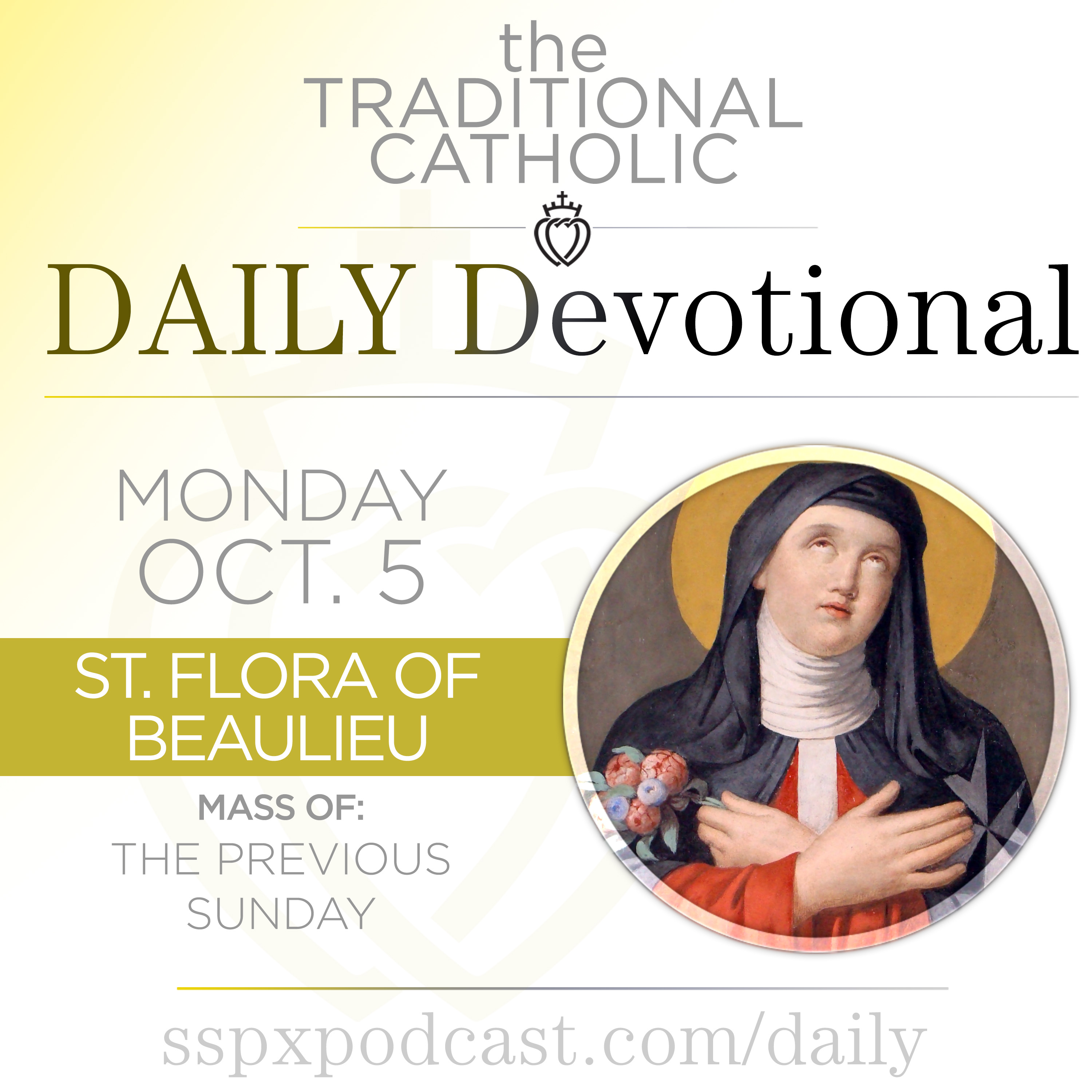 Oct 5 – S Flora of Beaulieu | It's the Feast of Feria, 4th Class, with the color of Green. In this episode: the meditation: "The Wedding Feast of the Son", today's news from the Church: "About Pope Leo XIV", a preview of the Sermon: "Prayer and St. Thérèse", and today's thought from the Archbishop Marcel Lefebvre. Have feedback or questions about the DD or our other shows? [email protected] Sources Used Today: "The Wedding Feast of the Son" — From the Assumption to Adventhttps://angeluspress.org/products/from-trinity-sunday-to-the-assumption "About Pope Leo XIV" (FSSPX.news) https://fsspx.news/en/news/about-pope-leo-xiv-61399 "Prayer and St. Thérèse" (SSPX Sermons) SSPX YouTube: Sermons PlaylistListen & Subscribe: SSPX Sermons Podcast The Spiritual Life — Archbishop Marcel Lefebvre (Angelus Press) https://angeluspress.org/products/spiritual-life-archbishop Saint Flora of Beaulieu is one of those medieval saints whose life was almost completely hidden inside a convent, and yet the stories that survived about her are surprisingly vivid. She was born around 1300 in the Quercy region of southern France. Her family was prosperous, and like many parents of the time, they expected Flora eventually to marry. Flora had absolutely no interest in that plan. From childhood she wanted religious life, and while still young she entered the monastery of Beaulieu, where she became a nun of the Order of Saint John of Jerusalem, better known today as the Knights . That alone is interesting. We usually picture the Hospitallers as armored knights defending pilgrims in the Holy Land. But the order also included religious women who lived lives of prayer and service. Flora belonged to one of those communities. And convent life was not immediately easy for her. Early accounts describe Flora going through years of spiritual dryness, anxiety, and temptation. At times she apparently wondered whether she had made a terrible mistake by entering religious life. She stayed. Eventually those difficult years gave way to an unusually intense life of prayer. Flora became especially devoted to the Passion of Christ and the Holy Eucharist, and other sisters began reporting that she would fall into ecstasy during prayer. One of the strangest traditions concerns the Eucharist. According to accounts of her life, while Flora was praying during Mass she saw Christ Himself in the Sacred Host. Other mystical experiences followed, and she became known for a remarkable awareness of events taking place far from the convent. One tradition says that during prayer she experienced a vision of a battle involving the Knights Hospitaller overseas and somehow knew of their victory before news could possibly have reached Beaulieu. For a cloistered nun in fourteenth-century France, that's quite a story. But Flora apparently wasn't interested in becoming a local celebrity. She continued the ordinary routine of convent life, trying to keep attention away from herself even as people increasingly sought her prayers. She died around 1347. Her relics remained at Beaulieu for centuries, and devotion to her became particularly strong in the surrounding region. The old convent church associated with her still survives near Issendolus, preserving the memory of a woman who spent most of her life within a few monastery walls. Flora never founded anything. She never traveled as a missionary. She barely went anywhere at all. Her entire adventure was interior. And perhaps that's what makes her interesting. Some saints traveled across continents looking for God. Flora stayed in one place and discovered just how much could happen there. Saint Flora of Beaulieu, hidden contemplative and lover of the Holy Eucharist, pray for us. Please Support this Apostolate with 1-time or Monthly Donation >> - - - - - - Explore more: Subscribe to the email version of this Devotional- it's a perfect companion!Subscribe to this Podcastto receive this and all our audio episodesSubscribe to the SSPX YouTube channelfor video versions of our podcast series and SermonsFSSPX News Website:https://fsspx.newsVisit the US District website:https://sspx.org/ What is the SSPX Podcast? The SSPX Podcast is produced by Angelus Press, which has as its mission the fortification of traditional Catholics so that they can defend the Faith, and reaching out to those who have not yet found Tradition. What is the SSPX? The main goal of the Society of Saint Pius X is to preserve the Catholic Faith in its fullness and purity, to teach its truths, and to diffuse its virtues, especially through the Roman Catholic priesthood. Authentic spiritual life, the sacraments, and the traditional liturgy are its primary means of bringing this life of grace to souls. Although the traditional Latin Mass is the most visible and public expression of the work of the Society, we are committed to defending Catholic Tradition in its entirety: all of Catholic doctrine and morals as the Church has always defended them. What people need is the Catholic Faith, without compromise, with all the truth and beauty which accompanies it. https://sspx.org | 9m 56s | ||||||
| 10/4/26 | 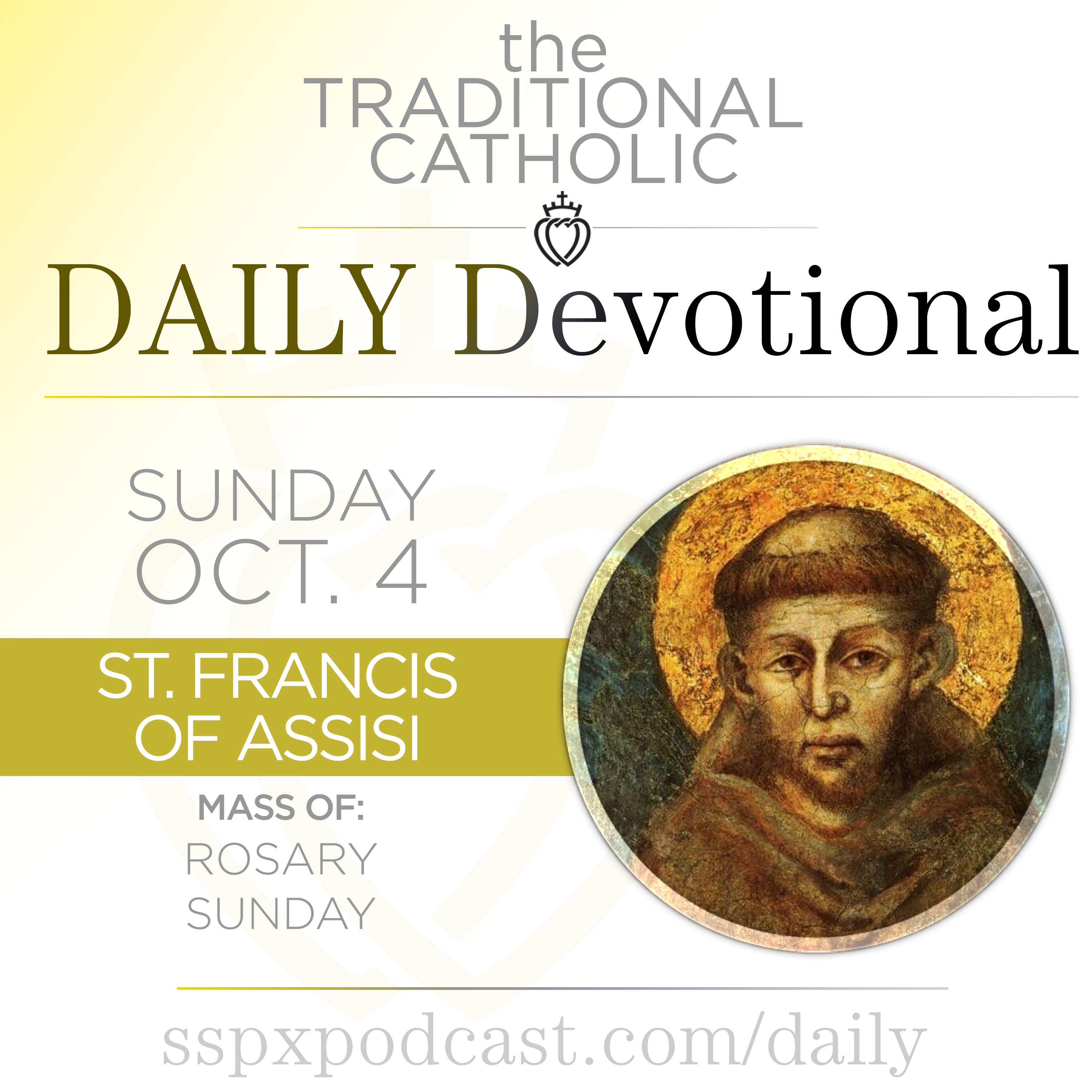 Oct 4 – Rosary Sunday / S. Francis of Assisi | It's the Feast of XIX Sunday after Pentecost - Rosary Sunday, 2nd Class, with the color of White. In this episode: the meditation: "The First Espousals", today's news from the Church: "In Flüeli, Pilgrims Kept Vigil Beside St. Nicholas", and today's thought from the Archbishop Marcel Lefebvre. Have feedback or questions about the DD or our other shows? [email protected] Sources Used Today: "The First Espousals" — From the Assumption to Adventhttps://angeluspress.org/products/from-trinity-sunday-to-the-assumption "In Flüeli, Pilgrims Kept Vigil Beside St. Nicholas" (FSSPX.news) https://fsspx.news/en/news/switzerland-flueli-pilgrims-kept-vigil-beside-st-nicholas-61281 The Spiritual Life — Archbishop Marcel Lefebvre (Angelus Press) https://angeluspress.org/products/spiritual-life-archbishop Today is the feast of Saint Francis of Assisi, but this year it also falls on Rosary Sunday, which gives us a perfect excuse to look at a side of Francis we don't talk about nearly as often: his deep love for the Blessed Virgin Mary. Francis is usually remembered for poverty, the stigmata, and maybe a bird or two. But one of the deepest threads running through his spirituality was his love for the Blessed Virgin Mary. Francis lived before the Rosary had developed into exactly the form Catholics know today, so we shouldn't picture him walking around Assisi with a modern five-decade rosary. But Marian prayer was everywhere in his life. And one little chapel became especially important. Early in his conversion, Francis discovered a crumbling church outside Assisi dedicated to Saint Mary of the Angels. We know it better as the Portiuncula. Francis repaired it with his own hands and came to love the place so much that it became the spiritual home of the entire Franciscan movement. He wanted his friars close to Mary. According to his early biographer Thomas of Celano, Francis had an almost indescribable love for the Mother of Jesus because, as he put it, she "made the Lord of Majesty our brother." That's such a Franciscan way of looking at Mary. He loved her because she gave us Jesus. Francis composed prayers in her honor as well. In his *Salutation of the Blessed Virgin Mary*, he piles title upon title upon her: Holy Lady, Queen, Mother of God, Virgin made Church. And his Marian devotion became part of the DNA of the Franciscan Order. Later Franciscans became some of the strongest defenders of the Immaculate Conception. Blessed John Duns Scotus provided the theological explanation that became enormously influential in the Church's understanding of the doctrine. Franciscans also helped spread devotions such as the Franciscan Crown, a seven-decade rosary meditating on the Seven Joys of Mary. So there's a beautiful connection this year with Saint Francis's feast falling on Rosary Sunday. Francis didn't see devotion to Mary as something competing with devotion to Christ. Quite the opposite. Mary fascinated him because everything about her pointed toward Jesus. And perhaps nowhere is that clearer than at the end of his life. When Francis knew he was dying, he asked his brothers to carry him back to the Portiuncula. Back to Saint Mary of the Angels. Back to the little chapel dedicated to Our Lady where so much of his vocation had begun. There, lying near the tiny church he loved, Francis died on the evening of October 3, 1226. For all the enormous basilicas, paintings, statues, and stories that later surrounded him, Francis chose to finish his life beside a little chapel of the Blessed Virgin. That's not a bad image for Rosary Sunday. Stay close to Mary. Because Francis understood exactly where she always takes us. To Christ. Saint Francis of Assisi, devoted son of Our Lady and joyful brother of Christ, pray for us. Please Support this Apostolate with 1-time or Monthly Donation >> - - - - - - Explore more: Subscribe to the email version of this Devotional- it's a perfect companion!Subscribe to this Podcastto receive this and all our audio episodesSubscribe to the SSPX YouTube channelfor video versions of our podcast series and SermonsFSSPX News Website:https://fsspx.newsVisit the US District website:https://sspx.org/ What is the SSPX Podcast? The SSPX Podcast is produced by Angelus Press, which has as its mission the fortification of traditional Catholics so that they can defend the Faith, and reaching out to those who have not yet found Tradition. What is the SSPX? The main goal of the Society of Saint Pius X is to preserve the Catholic Faith in its fullness and purity, to teach its truths, and to diffuse its virtues, especially through the Roman Catholic priesthood. Authentic spiritual life, the sacraments, and the traditional liturgy are its primary means of bringing this life of grace to souls. Although the traditional Latin Mass is the most visible and public expression of the work of the Society, we are committed to defending Catholic Tradition in its entirety: all of Catholic doctrine and morals as the Church has always defended them. What people need is the Catholic Faith, without compromise, with all the truth and beauty which accompanies it. https://sspx.org | 9m 13s | ||||||
| 10/3/26 |  Oct 3 – 1st Sat / S Thérèse of the Child Jesus | It's the Feast of St Therese of the Child Jesus, 3rd Class, with the color of White. In this episode: the meditation: "Acts and Fruits of Penance", today's news from the Church: "A Successful First Outing for the "O Roma Felix" Camp of the Sisters of the SSPX", and today's thought from the Archbishop Marcel Lefebvre. Have feedback or questions about the DD or our other shows? [email protected] Sources Used Today: "Acts and Fruits of Penance" — From the Assumption to Adventhttps://angeluspress.org/products/from-trinity-sunday-to-the-assumption "A Successful First Outing for the "O Roma Felix" Camp of the Sisters of the SSPX" (FSSPX.news) https://fsspx.news/en/news/rome-successful-first-outing-o-roma-felix-camp-sisters-sspx-61235 The Spiritual Life — Archbishop Marcel Lefebvre (Angelus Press) https://angeluspress.org/products/spiritual-life-archbishop Saint Thérèse of the Child Jesus is famous for her "Little Way," the idea that holiness doesn't necessarily require doing spectacular things. Sometimes it means doing something very small that costs you quite a lot. And one of my favorite examples involves a nun Thérèse simply could not stand. Thérèse entered the Carmelite convent at Lisieux at only fifteen. Life there meant living every day with the same small group of women. You prayed together. Ate together. Worked together. Saw each other constantly. And inevitably, there was one sister whose personality rubbed Thérèse completely the wrong way. Thérèse never names her in Story of a Soul, which is probably the first charitable thing she did for her. She admits that this sister had "the faculty of displeasing me in everything." Her mannerisms bothered Thérèse. Her personality bothered her. Thérèse couldn't even explain everything that irritated her. So she made a decision. She would treat this sister as though she were her favorite person in the convent. Whenever they met, Thérèse gave her a warm smile. She prayed for her. She looked for opportunities to help her. When the sister said something irritating, Thérèse tried not merely to suppress an annoyed response, but to answer with genuine kindness. She even tried to discover something admirable about the sister so that her charity wouldn't become completely fake. And apparently Thérèse became too good at it. One day the sister finally asked her something along the lines of, "Sister Thérèse, would you tell me what attracts you so much to me? Whenever you look at me, I see you smile." That's the best part of the story. The poor woman had absolutely no idea. Thérèse writes that what attracted her was Jesus hidden within this sister, because Christ makes lovable even what naturally seems unlovable. There's another wonderfully human convent story. During prayer, a sister near Thérèse repeatedly made a small clicking or rattling noise that drove her crazy. Thérèse couldn't stop noticing it. So instead of spending prayer mentally complaining about the noise, she deliberately listened to it and turned it into a kind of music offered to God. That is the Little Way in real life. Not floating around the convent feeling affectionate toward everyone. Not pretending difficult people aren't difficult. It's recognizing, "This person is driving me absolutely nuts, and I am going to love her anyway." Thérèse died from tuberculosis in 1897 at only twenty-four. She never traveled as a missionary, founded a religious order, or accomplished anything the world would have considered particularly important. She smiled at the nun who annoyed her. She tolerated the irritating noise. She did tiny things with enormous love. And the Church eventually declared her a Doctor of the Church. Saint Thérèse of the Child Jesus, teacher of the Little Way and saint of ordinary acts of love, pray for us. Please Support this Apostolate with 1-time or Monthly Donation >> - - - - - - Explore more: Subscribe to the email version of this Devotional- it's a perfect companion!Subscribe to this Podcastto receive this and all our audio episodesSubscribe to the SSPX YouTube channelfor video versions of our podcast series and SermonsFSSPX News Website:https://fsspx.newsVisit the US District website:https://sspx.org/ What is the SSPX Podcast? The SSPX Podcast is produced by Angelus Press, which has as its mission the fortification of traditional Catholics so that they can defend the Faith, and reaching out to those who have not yet found Tradition. What is the SSPX? The main goal of the Society of Saint Pius X is to preserve the Catholic Faith in its fullness and purity, to teach its truths, and to diffuse its virtues, especially through the Roman Catholic priesthood. Authentic spiritual life, the sacraments, and the traditional liturgy are its primary means of bringing this life of grace to souls. Although the traditional Latin Mass is the most visible and public expression of the work of the Society, we are committed to defending Catholic Tradition in its entirety: all of Catholic doctrine and morals as the Church has always defended them. What people need is the Catholic Faith, without compromise, with all the truth and beauty which accompanies it. https://sspx.org | 8m 45s | ||||||
| 10/2/26 |  Oct 2 – Holy Guardian Angels / Frist Friday | It's the Feast of First Fri /Holy Guardian Angels, 3rd Class, with the color of White. In this episode: the meditation: "Arise and Walk", today's news from the Church: "From the Élysée Palace to the Stade de France, the First Day of Leo XIV in Paris", and today's thought from the Archbishop Marcel Lefebvre. Have feedback or questions about the DD or our other shows? [email protected] Sources Used Today: "Arise and Walk" — From the Assumption to Adventhttps://angeluspress.org/products/from-trinity-sunday-to-the-assumption "From the Élysée Palace to the Stade de France, the First Day of Leo XIV in Paris" (FSSPX.news) https://fsspx.news/en/news/elysee-palace-stade-france-first-day-leo-xiv-paris-61328 The Spiritual Life — Archbishop Marcel Lefebvre (Angelus Press) https://angeluspress.org/products/spiritual-life-archbishop The Feast of the Holy Guardian Angels celebrates one of those Catholic beliefs that many of us learn as children and then perhaps don't think about nearly enough as adults: God has entrusted each of us to the care of an angel. The idea is deeply rooted in Scripture. Christ Himself speaks of children whose angels "always see the face of my Father who is in heaven." In the Book of Tobias, the Archangel Raphael accompanies young Tobias on a dangerous journey, protecting and guiding him even though Tobias initially has no idea who his traveling companion really is. Early Christians took this very seriously. Church Fathers wrote about angels assigned to individuals, and over the centuries devotion became increasingly personal. By the Middle Ages, Christians were regularly praying to their guardian angels for protection against temptation, danger, and especially a sudden or unprepared death. But interestingly, the feast itself took a while to develop. Local celebrations honoring guardian angels appeared during the Middle Ages, particularly in Spain. In the sixteenth century, devotion spread rapidly, and in 1608 Pope Paul V approved a feast of the Guardian Angels. Later in the seventeenth century, Pope Clement X extended it throughout the universal Church and fixed its celebration on October 2. That placement makes perfect sense. September 29 honors Saint Michael and the Archangels. Three days later, October 2 honors the angels assigned to ordinary people like us. One of the most charming parts of this devotion is how universal it became. Catholic children across completely different cultures learned essentially the same habit: before bed, ask your angel to watch over you. The familiar English prayer begins, "Angel of God, my guardian dear," but versions of that prayer exist in languages all over the Catholic world. And Catholic tradition doesn't imagine guardian angels merely preventing car accidents or helping children sleep peacefully. Their real job is much bigger. They help us get to heaven. Saints wrote about asking their angels for help during prayer, sending them ahead when entering difficult conversations, and asking their guardian angel to cooperate with the guardian angel of another person. Saint Padre Pio famously encouraged people to "send me your guardian angel" when they needed his prayers. There's something wonderfully humbling about the whole idea. According to Catholic teaching, an intelligent spiritual creature far more powerful than we are has been given an assignment by God. You. Not because you're famous. Not because you're important. Simply because God considers one human soul worth guarding. And apparently, our guardian angels have been watching us make questionable decisions since childhood without requesting reassignment. That's patience. Holy Guardian Angels, our unseen companions and guides on the road to heaven, watch over us and pray for us. Please Support this Apostolate with 1-time or Monthly Donation >> - - - - - - Explore more: Subscribe to the email version of this Devotional- it's a perfect companion!Subscribe to this Podcastto receive this and all our audio episodesSubscribe to the SSPX YouTube channelfor video versions of our podcast series and SermonsFSSPX News Website:https://fsspx.newsVisit the US District website:https://sspx.org/ What is the SSPX Podcast? The SSPX Podcast is produced by Angelus Press, which has as its mission the fortification of traditional Catholics so that they can defend the Faith, and reaching out to those who have not yet found Tradition. What is the SSPX? The main goal of the Society of Saint Pius X is to preserve the Catholic Faith in its fullness and purity, to teach its truths, and to diffuse its virtues, especially through the Roman Catholic priesthood. Authentic spiritual life, the sacraments, and the traditional liturgy are its primary means of bringing this life of grace to souls. Although the traditional Latin Mass is the most visible and public expression of the work of the Society, we are committed to defending Catholic Tradition in its entirety: all of Catholic doctrine and morals as the Church has always defended them. What people need is the Catholic Faith, without compromise, with all the truth and beauty which accompanies it. https://sspx.org | 8m 51s | ||||||
| 10/1/26 | 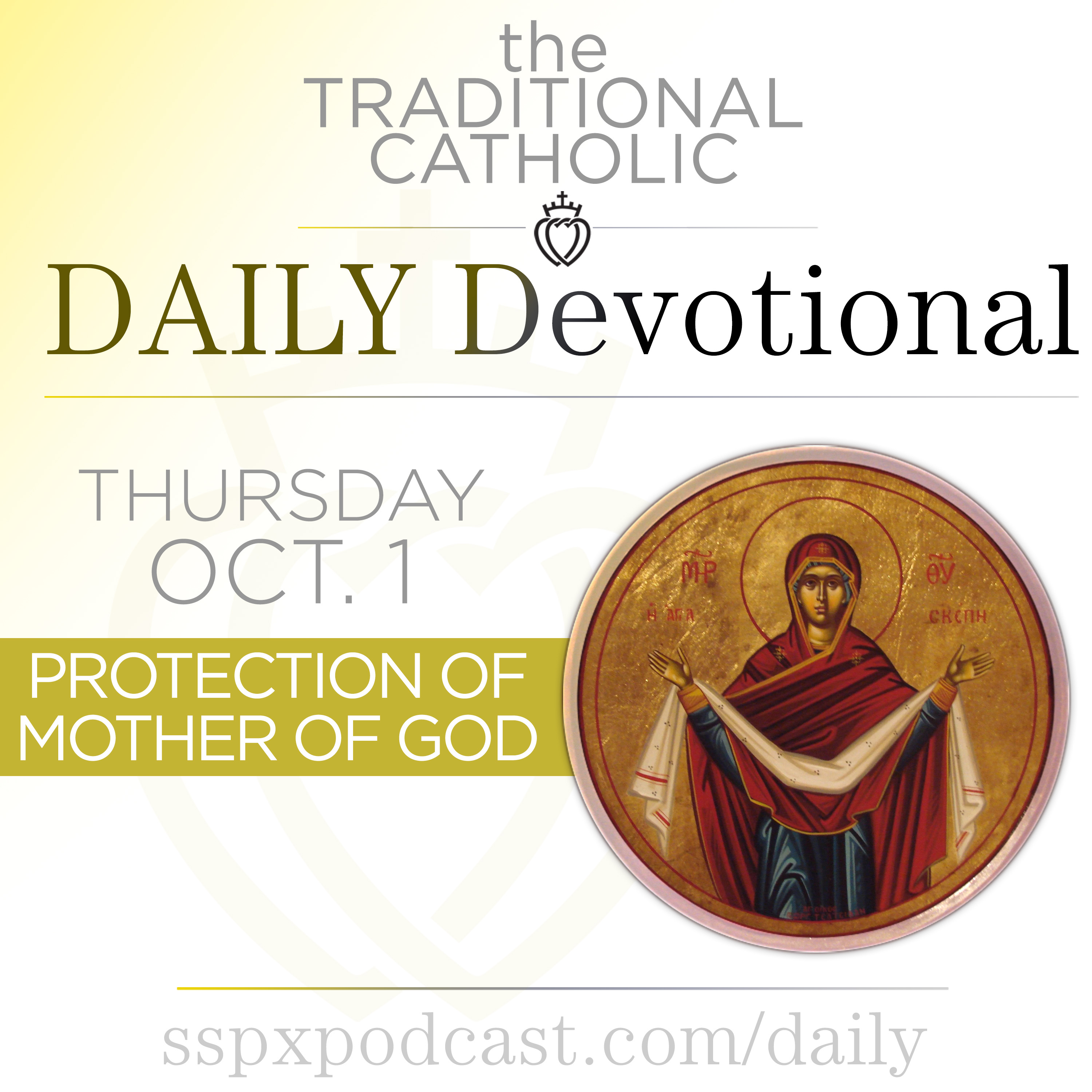 Oct 1 – Feria / S. Remigius / Protection of the Mother of God | It's a Feria, 3rd Class, with the color of White. In this episode: the meditation: "The Faith of the Paralytic", today's news from the Church: "Pokrov: The Protection of the Mother of God", a preview of the Sermon: "The Strength of St. Michael", and today's thought from the Archbishop Marcel Lefebvre. Have feedback or questions about the DD or our other shows? [email protected] Sources Used Today: "The Faith of the Paralytic" — From the Assumption to Adventhttps://angeluspress.org/products/from-trinity-sunday-to-the-assumption "Pokrov: The Protection of the Mother of God" (FSSPX.news) https://fsspx.news/en/news/paris-banner-addressed-leo-xiv-support-sspx-61327 "The Strength of St. Michael" (SSPX Sermons) SSPX YouTube: Sermons PlaylistListen & Subscribe: SSPX Sermons Podcast The Spiritual Life — Archbishop Marcel Lefebvre (Angelus Press) https://angeluspress.org/products/spiritual-life-archbishop Please support our new project, the Archbishop Lefebvre Biography Audiobook: Learn more:https://www.youtube.com/watch?v=Y-Wp4MQdK2oDonate:https://sspx.gifts/audiobook Saint Remigius of Reims baptized one man and, in doing so, helped change the religious future of France. He was born around the year 437 in Roman Gaul, as the Western Roman Empire was coming apart. Roman authority was disappearing, Germanic kingdoms were taking its place, and nobody really knew what the political map of Europe would look like a generation later. Remigius became Bishop of Reims while still quite young and would remain there for an astonishing seventy years. Then a Frankish king named Clovis entered his life. Clovis was a pagan warrior who was steadily conquering much of Gaul. His wife, Clotilde, was Catholic and had spent years encouraging her husband to accept Christianity. Eventually, after a military crisis in which Clovis reportedly prayed to the God of Clotilde for help, he agreed to be baptized. That brought him to Remigius. Tradition places the baptism at Reims, probably around the year 496, on Christmas Day. Clovis entered the church with thousands of his warriors, and Remigius baptized the king. One famous line has echoed through French history ever since. Remigius is traditionally said to have told Clovis: "Bow thy head, proud Sicambrian. Adore what thou hast burned, and burn what thou hast adored." In other words: everything changes now. Clovis's conversion was enormously important because many of the other Germanic rulers in Western Europe had embraced Arian Christianity, which denied the full divinity of Christ. Clovis instead became Catholic. And his people followed. That helped create the alliance between the Frankish monarchy and the Catholic Church that would shape medieval France for centuries. Then comes one of the most fascinating traditions associated with Remigius. According to later accounts, during Clovis's baptism the sacred chrism was running short. A dove miraculously appeared carrying a small vial of holy oil, the Sainte Ampoule. That vial became one of the great relics of the French monarchy. For centuries afterward, kings of France traveled to Reims for their coronations, where oil associated with the Sainte Ampoule was used to anoint them. From Louis VIII in 1223 through Charles X in 1825, Reims became the great coronation city of France. Even Napoleon noticed the symbolism. When he crowned himself emperor, he deliberately chose Paris rather than Reims and created a completely different ceremony. The original Sainte Ampoule was publicly smashed during the French Revolution in 1793, although fragments were reportedly rescued and later preserved. So when you walk into the magnificent Notre-Dame de Reims today, you're standing in a place whose royal traditions ultimately reach back to one bishop pouring baptismal water over the head of a pagan Frankish king. Remigius probably couldn't have imagined what would follow. He simply baptized a convert. History took it from there. Saint Remigius of Reims, apostle of the Franks and baptizer of Christian France, pray for us. Please Support this Apostolate with 1-time or Monthly Donation >> - - - - - - Explore more: Subscribe to the email version of this Devotional- it's a perfect companion!Subscribe to this Podcastto receive this and all our audio episodesSubscribe to the SSPX YouTube channelfor video versions of our podcast series and SermonsFSSPX News Website:https://fsspx.newsVisit the US District website:https://sspx.org/ What is the SSPX Podcast? The SSPX Podcast is produced by Angelus Press, which has as its mission the fortification of traditional Catholics so that they can defend the Faith, and reaching out to those who have not yet found Tradition. What is the SSPX? The main goal of the Society of Saint Pius X is to preserve the Catholic Faith in its fullness and purity, to teach its truths, and to diffuse its virtues, especially through the Roman Catholic priesthood. Authentic spiritual life, the sacraments, and the traditional liturgy are its primary means of bringing this life of grace to souls. Although the traditional Latin Mass is the most visible and public expression of the work of the Society, we are committed to defending Catholic Tradition in its entirety: all of Catholic doctrine and morals as the Church has always defended them. What people need is the Catholic Faith, without compromise, with all the truth and beauty which accompanies it. https://sspx.org | 10m 48s | ||||||
| 9/30/26 |  Sep 30 – S Jerome | It's the Feast of St. Jerome, 3rd Class, with the color of White. In this episode: the meditation: "Our Spiritual Healing", today's news from the Church: "A Banner Addressed to Leo XIV in Support of the SSPX", and today's thought from the Archbishop Marcel Lefebvre. Have feedback or questions about the DD or our other shows? [email protected] Sources Used Today: "Our Spiritual Healing" — From the Assumption to Adventhttps://angeluspress.org/products/from-trinity-sunday-to-the-assumption "A Banner Addressed to Leo XIV in Support of the SSPX" (FSSPX.news) https://fsspx.news/en/news/paris-banner-addressed-leo-xiv-support-sspx-61327 The Spiritual Life — Archbishop Marcel Lefebvre (Angelus Press) https://angeluspress.org/products/spiritual-life-archbishop Please support our new project, the Archbishop Lefebvre Biography Audiobook: Learn more:https://www.youtube.com/watch?v=Y-Wp4MQdK2oDonate:https://sspx.gifts/audiobook Saint Jerome is one of the great Doctors of the Church, but he may also be one of the saints you'd least want criticizing your work. He was brilliant, sarcastic, argumentative, occasionally hot-tempered, and absolutely obsessed with getting the words of Scripture right. Jerome was born around the year 347 in Stridon, somewhere near the borderlands of the Roman Empire in the Balkans. His family sent him to Rome for an excellent education, and Jerome became fascinated with classical literature. He loved Cicero and the great Latin authors so much that, according to his own account, he once had a terrifying dream in which he stood before God's judgment seat and was accused of being "a Ciceronian, not a Christian." That got his attention. Jerome eventually embraced a much more serious Christian life and spent several years living as an ascetic in the Syrian desert. But he brought books. Lots of books. He studied Greek, and then did something unusual for a Western Christian scholar of his time: he learned Hebrew, reportedly receiving lessons from Jewish teachers. That decision would eventually change the Bible used by Western Christianity. In the 380s, Pope Damasus I asked Jerome to revise the existing Latin translations of Scripture, which varied considerably from place to place. Jerome didn't simply tidy up the wording. He spent years comparing manuscripts, consulting the original languages, and eventually translating much of the Old Testament directly from Hebrew. The result became the foundation of what we call the Latin Vulgate, the Bible that would shape Western Catholic worship, theology, art, and culture for more than a thousand years. And Jerome definitely had opinions while doing it. His surviving letters show a man who could be warm and deeply pastoral one moment and absolutely devastating toward an opponent the next. He once complained about people criticizing his translations who didn't know Hebrew themselves. Jerome was not especially interested in losing an argument politely. Later in life, he settled in Bethlehem, where he established monasteries and spent roughly three decades studying Scripture near the place of Christ's birth. Visitors to the Church of the Nativity can still visit a cave traditionally associated with Jerome's years of work. There's something wonderfully fitting about imagining one of history's greatest biblical scholars surrounded by manuscripts in a cave beneath Bethlehem. Artists often depict Jerome with a lion because of a later legend that he removed a thorn from the animal's paw and the grateful lion remained with him afterward. He's also usually surrounded by books, which is probably much closer to historical reality. Jerome could be difficult. He could also be wrong. But he believed Sacred Scripture deserved a lifetime of serious study. And he gave it one. Saint Jerome, brilliant Doctor of Scripture and tireless translator of the Word of God, pray for us. Please Support this Apostolate with 1-time or Monthly Donation >> - - - - - - Explore more: Subscribe to the email version of this Devotional- it's a perfect companion!Subscribe to this Podcastto receive this and all our audio episodesSubscribe to the SSPX YouTube channelfor video versions of our podcast series and SermonsFSSPX News Website:https://fsspx.newsVisit the US District website:https://sspx.org/ What is the SSPX Podcast? The SSPX Podcast is produced by Angelus Press, which has as its mission the fortification of traditional Catholics so that they can defend the Faith, and reaching out to those who have not yet found Tradition. What is the SSPX? The main goal of the Society of Saint Pius X is to preserve the Catholic Faith in its fullness and purity, to teach its truths, and to diffuse its virtues, especially through the Roman Catholic priesthood. Authentic spiritual life, the sacraments, and the traditional liturgy are its primary means of bringing this life of grace to souls. Although the traditional Latin Mass is the most visible and public expression of the work of the Society, we are committed to defending Catholic Tradition in its entirety: all of Catholic doctrine and morals as the Church has always defended them. What people need is the Catholic Faith, without compromise, with all the truth and beauty which accompanies it. https://sspx.org | 9m 25s | ||||||
| 9/29/26 |  Sep 29 – S Michael the Archangel | It's the Feast of Dedication of St. Michael the Archangel , 1st Class, with the color of White. In this episode: the meditation: "The Sacrament of Penance", a preview of this week's episode of The SSPX Podcast: "Audiobook: Operation Survival", and today's thought from the Archbishop Marcel Lefebvre. Have feedback or questions about the DD or our other shows? [email protected] Sources Used Today: "The Sacrament of Penance" — From the Assumption to Adventhttps://angeluspress.org/products/from-trinity-sunday-to-the-assumption The SSPX Podcast: "Audiobook: Operation Survival" (SSPX Podcast) View on YouTubeListen & Subscribe on SSPXpodcast.com The Spiritual Life — Archbishop Marcel Lefebvre (Angelus Press) https://angeluspress.org/products/spiritual-life-archbishop Please support our new project, the Archbishop Lefebvre Biography Audiobook: Learn more:https://www.youtube.com/watch?v=Y-Wp4MQdK2oDonate:https://sspx.gifts/audiobook The Feast of Saint Michael the Archangel, traditionally called Michaelmas, was once one of the great landmarks of the year in Catholic Europe. We know Saint Michael from Scripture as the great defender of God's people, the archangel who battles the dragon in the Apocalypse. But September 29 developed a personality all its own, combining liturgy, pilgrimage, harvest customs, food, folklore, and even the way people organized the calendar. The feast's September date is traditionally connected with the dedication of a basilica of Saint Michael near Rome. By the Middle Ages, Michaelmas had become an important feast throughout Western Europe, and because it arrived just after the autumn equinox, it naturally became associated with the end of the harvest. In England and Ireland, Michaelmas goose became the traditional dinner. There's even an old belief that eating goose on Michaelmas would protect you from financial need during the coming year. Geese were fat after feeding on the harvested fields, so the tradition was practical as well as festive. Then there are the blackberries. An old British and Irish legend says that when Saint Michael cast Lucifer from heaven, the devil landed in a blackberry bush. Furious, he cursed the berries, and in some versions spat on them. So after Michaelmas, you weren't supposed to eat blackberries anymore. It's probably one of the stranger ways a theological battle ever became agricultural advice. Michaelmas also became a major legal and economic date. Rents were due. Accounts were settled. Servants were hired. Courts opened. Even today, British universities such as Oxford use the name Michaelmas Term for their autumn academic session. Across Europe, meanwhile, Saint Michael became associated with extraordinary mountaintop shrines. In Italy, pilgrims traveled to the ancient sanctuary of Monte Gargano, where tradition holds that Saint Michael appeared in the fifth century. In Normandy, the magnificent Mont-Saint-Michel rose from a tidal island. Across the Channel, England had its own Saint Michael's Mount in Cornwall. And strangely enough, several famous shrines dedicated to Saint Michael appear along a roughly northwest-to-southeast line across Europe and the Mediterranean. Modern popular devotion sometimes calls this the Sword of Saint Michael. The idea of a deliberately designed ancient straight line is modern rather than an old Church tradition, but the geography itself is fascinating. Michaelmas was also traditionally one of the quarter days in England, dates that divided the year into four sections for contracts, rents, and business. So September 29 wasn't merely something Catholics noticed at Mass. It helped organize ordinary life. That's perhaps the most interesting thing about Michaelmas. Medieval Catholics didn't keep feast days locked inside the church building. A feast could determine what you ate, when you harvested, when you paid your rent, when school began, and where you went on pilgrimage. September 29 meant autumn had arrived. And standing at the doorway of the darker half of the year was Saint Michael, sword in hand. Saint Michael the Archangel, defend us in battle. Please Support this Apostolate with 1-time or Monthly Donation >> - - - - - - Explore more: Subscribe to the email version of this Devotional- it's a perfect companion!Subscribe to this Podcastto receive this and all our audio episodesSubscribe to the SSPX YouTube channelfor video versions of our podcast series and SermonsFSSPX News Website:https://fsspx.newsVisit the US District website:https://sspx.org/ What is the SSPX Podcast? The SSPX Podcast is produced by Angelus Press, which has as its mission the fortification of traditional Catholics so that they can defend the Faith, and reaching out to those who have not yet found Tradition. What is the SSPX? The main goal of the Society of Saint Pius X is to preserve the Catholic Faith in its fullness and purity, to teach its truths, and to diffuse its virtues, especially through the Roman Catholic priesthood. Authentic spiritual life, the sacraments, and the traditional liturgy are its primary means of bringing this life of grace to souls. Although the traditional Latin Mass is the most visible and public expression of the work of the Society, we are committed to defending Catholic Tradition in its entirety: all of Catholic doctrine and morals as the Church has always defended them. What people need is the Catholic Faith, without compromise, with all the truth and beauty which accompanies it. https://sspx.org | 7m 58s | ||||||
| 9/28/26 |  Sep 28 – S Wenceslaus / S Simon de Rojas | It's the Feast of St. Wenceslaus, 3rd Class, with the color of Red. In this episode: the meditation: "Spiritual Paralysis", today's news from the Church: "Jesus, Doctor of Souls", a preview of the Sermon: "The Vocation of Charity: Christ's Blood Changes Everything", and today's thought from the Archbishop Marcel Lefebvre. Have feedback or questions about the DD or our other shows? [email protected] Sources Used Today: "Spiritual Paralysis" — From the Assumption to Adventhttps://angeluspress.org/products/from-trinity-sunday-to-the-assumption "Jesus, Doctor of Souls" (FSSPX.news) https://fsspx.news/en/news/vienna-holy-name-mary-resounds-streets-61288 "The Vocation of Charity: Christ's Blood Changes Everything" (SSPX Sermons) SSPX YouTube: Sermons PlaylistListen & Subscribe: SSPX Sermons Podcast The Spiritual Life — Archbishop Marcel Lefebvre (Angelus Press) https://angeluspress.org/products/spiritual-life-archbishop Please support our new project, the Archbishop Lefebvre Biography Audiobook: Learn more:https://www.youtube.com/watch?v=Y-Wp4MQdK2oDonate:https://sspx.gifts/audiobook Saint Simon de Rojas became famous for a prayer containing only 2 Latin words. Ave Maria. He loved the name of Mary so much that those words seemed to follow him everywhere. Simon was born in Valladolid, Spain, in 1552. According to tradition, he was unusually slow to begin speaking as a child, which worried his parents. When he finally did speak clearly, the first words attributed to him were "Ave Maria." Whether that happened exactly as later tradition remembered it or not, it certainly predicted the rest of his life. Simon entered the Trinitarian Order, the community originally founded to ransom Christians held captive in Muslim territories. He was intelligent, became a priest, studied theology, and eventually taught philosophy and theology himself. But Simon's real gift was dealing with people. He became a celebrated preacher and confessor and eventually attracted the attention of the Spanish royal family. King Philip III and later Philip IV trusted him enough that Simon became connected with the royal court and served as spiritual adviser to members of the family. That's usually where court life gets comfortable. Simon somehow made it uncomfortable instead. He used his access to the wealthy to talk constantly about the poor. Money and gifts given to him had a habit of disappearing into the hands of struggling families, prisoners, and people living on the streets of Madrid. He became especially concerned about poor children and founded charitable works to provide them with food and education. But the devotion that defined Simon was his love for the Holy Name of Mary. He wanted people to develop the habit of calling upon Our Lady throughout the day, so he promoted the simple greeting "Ave Maria" everywhere he went. He even founded the Congregation of the Slaves of the Sweet Name of Mary to spread Marian devotion and care for the poor. Simon apparently greeted people with "Ave Maria" rather than the ordinary greetings of the day. Eventually people began calling him the Apostle of the Ave Maria. There's something wonderfully simple about that. Simon was a theologian. He advised kings. He held important positions in his religious order. Yet the message people remembered was basically: Say Mary's name. Remember her. Ask her to lead you to Christ. Simon died in Madrid in 1624. His reputation for holiness was so strong that enormous crowds came to honor him, including members of the royal court and many of the poor whom he had served. His story fits beautifully near the Feast of the Holy Name of Mary. Simon understood that sometimes the shortest prayers are the ones we can carry with us everywhere. Three words were enough for him. Saint Simon de Rojas, Apostle of the Ave Maria and friend of the poor, pray for us. Please Support this Apostolate with 1-time or Monthly Donation >> - - - - - - Explore more: Subscribe to the email version of this Devotional- it's a perfect companion!Subscribe to this Podcastto receive this and all our audio episodesSubscribe to the SSPX YouTube channelfor video versions of our podcast series and SermonsFSSPX News Website:https://fsspx.newsVisit the US District website:https://sspx.org/ What is the SSPX Podcast? The SSPX Podcast is produced by Angelus Press, which has as its mission the fortification of traditional Catholics so that they can defend the Faith, and reaching out to those who have not yet found Tradition. What is the SSPX? The main goal of the Society of Saint Pius X is to preserve the Catholic Faith in its fullness and purity, to teach its truths, and to diffuse its virtues, especially through the Roman Catholic priesthood. Authentic spiritual life, the sacraments, and the traditional liturgy are its primary means of bringing this life of grace to souls. Although the traditional Latin Mass is the most visible and public expression of the work of the Society, we are committed to defending Catholic Tradition in its entirety: all of Catholic doctrine and morals as the Church has always defended them. What people need is the Catholic Faith, without compromise, with all the truth and beauty which accompanies it. https://sspx.org | 10m 46s | ||||||
| 9/27/26 | 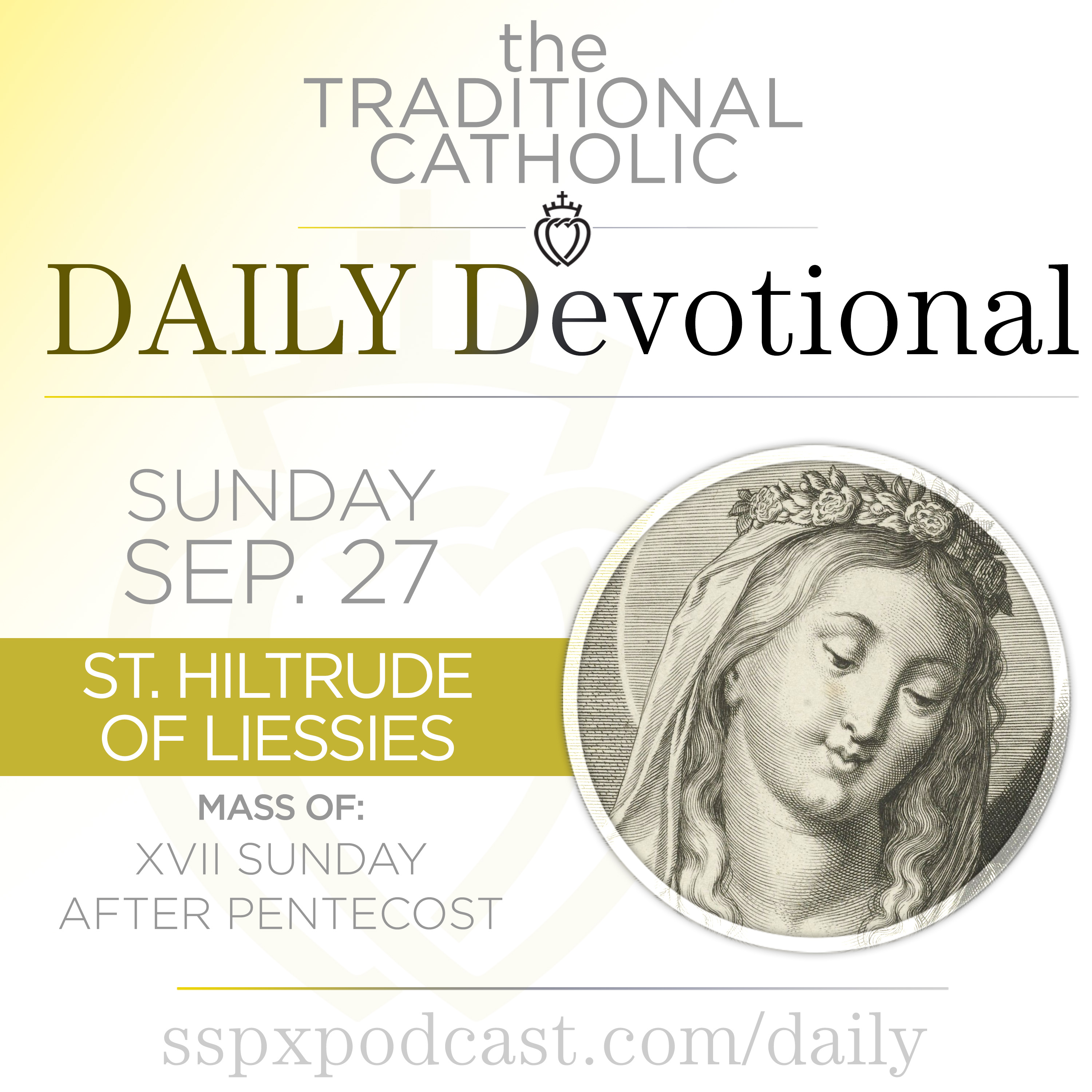 Sep 27 - XVIII Sun of Pentecost / S Hiltrude of Liessies | It's the Feast of XVIII Sunday after Pentecost, 2nd Class, with the color of Green. In this episode: the meditation: "Spiritual Paralysis", today's news from the Church: "Who Are You to Judge?", and today's thought from the Archbishop Marcel Lefebvre. Have feedback or questions about the DD or our other shows? [email protected] Sources Used Today: "Spiritual Paralysis" — From the Assumption to Adventhttps://angeluspress.org/products/from-trinity-sunday-to-the-assumption "Who Are You to Judge?" (FSSPX.news) https://fsspx.news/en/news/who-are-you-judge-61240 The Spiritual Life — Archbishop Marcel Lefebvre (Angelus Press) https://angeluspress.org/products/spiritual-life-archbishop Please support our new project, the Archbishop Lefebvre Biography Audiobook: Learn more:https://www.youtube.com/watch?v=Y-Wp4MQdK2oDonate:https://sspx.gifts/audiobook Saint Hiltrude of Liessies is one of those saints whose life never became famous far beyond her own region, but whose story has been quietly remembered in northern France for more than a thousand years. She lived during the eighth century and was born into a noble Frankish family. Her father, Wibert, founded a monastery at Liessies, near what is now the French-Belgian border. Her brother, Guntrad, became its abbot. Hiltrude, meanwhile, was expected to get married. A suitable husband was found, the arrangements were made, and everyone seemed to know what Hiltrude's future would look like. Everyone except Hiltrude. She wanted to give her life entirely to God. According to tradition, when the proposed marriage became unavoidable, Hiltrude fled rather than go through with it. She eventually returned after her family accepted her decision and allowed her to live as a consecrated woman. But she didn't simply join a large convent. Instead, Hiltrude chose a much more secluded life. She lived in a small cell near the monastery at Liessies, close enough to participate in its spiritual life but separated enough to maintain the solitude she desired. Her brother, as abbot, became an important support in her vocation. There's something interesting about that arrangement. Medieval Christianity included all sorts of religious vocations that don't fit neatly into our modern categories. Some people became monks or nuns. Others became hermits. Still others, like Hiltrude, lived almost as recluses, attached to a church or monastery but spending much of their lives in prayer and solitude. Hiltrude became known locally for exactly that kind of hidden holiness. No enormous missionary journeys. No royal courts. No theological controversies. Just years of prayer in one small corner of northern France. After her death, her tomb at Liessies became a local place of pilgrimage, and devotion to her spread through the surrounding region of Hainaut. Her relics were treasured there for centuries. The monastery itself had a much longer life. Liessies Abbey grew into an important Benedictine house and survived for roughly a thousand years before the French Revolution brought monastic life there to an end. Much of the abbey disappeared, but the village still preserves its memory, along with that of the young woman who chose solitude over the comfortable future her family had planned. Hiltrude's story isn't dramatic. That's actually what makes it interesting. She believed that a life could be completely given to God without being particularly visible to anyone else. And for her, that was enough. Saint Hiltrude of Liessies, hidden daughter of prayer and solitude, pray for us. Please Support this Apostolate with 1-time or Monthly Donation >> - - - - - - Explore more: Subscribe to the email version of this Devotional- it's a perfect companion!Subscribe to this Podcastto receive this and all our audio episodesSubscribe to the SSPX YouTube channelfor video versions of our podcast series and SermonsFSSPX News Website:https://fsspx.newsVisit the US District website:https://sspx.org/ What is the SSPX Podcast? The SSPX Podcast is produced by Angelus Press, which has as its mission the fortification of traditional Catholics so that they can defend the Faith, and reaching out to those who have not yet found Tradition. What is the SSPX? The main goal of the Society of Saint Pius X is to preserve the Catholic Faith in its fullness and purity, to teach its truths, and to diffuse its virtues, especially through the Roman Catholic priesthood. Authentic spiritual life, the sacraments, and the traditional liturgy are its primary means of bringing this life of grace to souls. Although the traditional Latin Mass is the most visible and public expression of the work of the Society, we are committed to defending Catholic Tradition in its entirety: all of Catholic doctrine and morals as the Church has always defended them. What people need is the Catholic Faith, without compromise, with all the truth and beauty which accompanies it. https://sspx.org | 9m 53s | ||||||
| 9/26/26 |  Sep 26 – Ember Sat / N. American Martyrs | It's the Feast of Ember Sat of Sept, 2nd Class, with the color of Violet. In this episode: the meditation: "Purity of Intention", today's news from the Church: "The SSPX Renews the Consecration of Germany to the Immaculate Heart of Mary", and today's thought from the Archbishop Marcel Lefebvre. Have feedback or questions about the DD or our other shows? [email protected] Sources Used Today: "Purity of Intention" — From the Assumption to Adventhttps://angeluspress.org/products/from-trinity-sunday-to-the-assumption "The SSPX Renews the Consecration of Germany to the Immaculate Heart of Mary" (FSSPX.news) https://fsspx.news/en/news/sspx-renews-consecration-germany-immaculate-heart-mary-61222 The Spiritual Life — Archbishop Marcel Lefebvre (Angelus Press) https://angeluspress.org/products/spiritual-life-archbishop Please support our new project, the Archbishop Lefebvre Biography Audiobook: Learn more:https://www.youtube.com/watch?v=Y-Wp4MQdK2oDonate:https://sspx.gifts/audiobook The North American Martyrs were eight French Jesuit missionaries who entered seventeenth-century North America knowing that the work might kill them. For several of them, it did so in extraordinarily brutal ways. The best known are Saints Isaac Jogues, Jean de Brébeuf, and their six companions. They worked primarily among Indigenous peoples in what is now Canada and the northeastern United States, especially the Wendat, or Huron. Their mission unfolded amid warfare, epidemics, and fierce conflict among Native nations, so their story is inseparable from a very complicated period of North American history. Brébeuf arrived in New France in 1625. He threw himself into learning the Wendat language and culture. He became so fluent that he compiled dictionaries and translated prayers and catechetical material. The famous Christmas hymn known today as the Huron Carol is traditionally attributed to him, originally composed in the Wendat language. Isaac Jogues had an even stranger story. In 1642, he was captured by Mohawk warriors, tortured, and held captive for months. Several of his fingers were mutilated, creating a serious problem for a priest because Church law at the time normally required intact hands for celebrating Mass. Eventually Jogues escaped. He made it back to France. At that point, most people would probably consider the mission complete. Jogues asked to go back. The pope gave him special permission to celebrate Mass despite his damaged hands, and Jogues returned to North America, knowing exactly what might happen. In 1646, he was killed in present-day New York. Brébeuf and Gabriel Lalemant were killed three years later during attacks on the Wendat missions. Others among the eight died at different mission stations during the same violent period. But there are fascinating pieces of their world still visible today. Near Midland, Ontario, the Martyrs' Shrine stands near the reconstructed Jesuit mission of Sainte-Marie among the Hurons. In Auriesville, New York, another shrine remembers Jogues and his companions near the area traditionally associated with his captivity and death. And there is an extraordinary connection to another saint. At the Mohawk settlement where Jogues had once been held prisoner, a girl was born about ten years after his death. Her name was Kateri Tekakwitha. The missionaries died without knowing what would become of their work. Their missions were destroyed, communities scattered, and years of labor seemed lost. Yet the faith they planted didn't disappear. Saints John de Brébeuf, Isaac Jogues, and the Holy North American Martyrs, courageous missionaries of the New World, pray for us. Please Support this Apostolate with 1-time or Monthly Donation >> - - - - - - Explore more: Subscribe to the email version of this Devotional- it's a perfect companion!Subscribe to this Podcastto receive this and all our audio episodesSubscribe to the SSPX YouTube channelfor video versions of our podcast series and SermonsFSSPX News Website:https://fsspx.newsVisit the US District website:https://sspx.org/ What is the SSPX Podcast? The SSPX Podcast is produced by Angelus Press, which has as its mission the fortification of traditional Catholics so that they can defend the Faith, and reaching out to those who have not yet found Tradition. What is the SSPX? The main goal of the Society of Saint Pius X is to preserve the Catholic Faith in its fullness and purity, to teach its truths, and to diffuse its virtues, especially through the Roman Catholic priesthood. Authentic spiritual life, the sacraments, and the traditional liturgy are its primary means of bringing this life of grace to souls. Although the traditional Latin Mass is the most visible and public expression of the work of the Society, we are committed to defending Catholic Tradition in its entirety: all of Catholic doctrine and morals as the Church has always defended them. What people need is the Catholic Faith, without compromise, with all the truth and beauty which accompanies it. https://sspx.org | 9m 00s | ||||||
| 9/25/26 |  Sep 25 – Ember Fri / S Vincent Strambi | It's the Feast of Ember Fri of Sept, 2nd Class, with the color of Violet. In this episode: the meditation: "Holiness and Charity", today's news from the Church: "The French District of the SSPX Calls for Prayers for the Pope", a preview of this week's episode of The SSPX Podcast: "The Roman Catechism: What Does "He Descended Into Hell" Mean?", and today's thought from the Archbishop Marcel Lefebvre. Have feedback or questions about the DD or our other shows? [email protected] Sources Used Today: "Holiness and Charity" — From the Assumption to Adventhttps://angeluspress.org/products/from-trinity-sunday-to-the-assumption "The French District of the SSPX Calls for Prayers for the Pope" (FSSPX.news) https://sspx.org/en/news/visit-leo-xiv-french-district-sspx-calls-prayers-pope-61267 The SSPX Podcast: "The Roman Catechism: What Does "He Descended Into Hell" Mean?" (SSPX Podcast) View on YouTubeListen & Subscribe on SSPXpodcast.com The Spiritual Life — Archbishop Marcel Lefebvre (Angelus Press) https://angeluspress.org/products/spiritual-life-archbishop Please support our new project, the Archbishop Lefebvre Biography Audiobook: Learn more:https://www.youtube.com/watch?v=Y-Wp4MQdK2oDonate:https://sspx.gifts/audiobook Saint Vincent Strambi is one of those saints whose story becomes especially interesting near the end, when an elderly bishop apparently offered his own life for the pope. He was born in 1745 in Civitavecchia, the port city outside Rome. His father hoped he would marry and continue the family business. Vincent had other plans. He wanted to become a priest, although by his own admission he wasn't naturally very pious as a boy. After ordination, he became increasingly drawn to preaching and eventually met Paul of the Cross. Vincent joined the Passionists. It was a perfect fit. The congregation centered its spirituality on the Passion of Christ, and Vincent became an extraordinary missionary preacher. He traveled throughout Italy giving missions that could last for days or weeks. His preaching was direct, emotional, and practical, and crowds came in enormous numbers. He also became one of Saint Paul of the Cross's closest companions and eventually wrote his biography, giving us much of what we know about the Passionist founder today. Then Vincent was made Bishop of Macerata and Tolentino. He didn't want the job. That seems to happen to saints fairly often. As bishop, Vincent lived simply, visited parishes, improved seminaries, and continued preaching. But his episcopacy happened during one of the most chaotic periods in Italian history: the Napoleonic era. When Napoleon demanded an oath of loyalty that Vincent believed violated his obligations to the Church, he refused. So he was expelled from his diocese. For years, Vincent lived in exile before eventually returning after Napoleon's fall. By then he was elderly and exhausted, and he finally received permission to retire. Then came one last remarkable episode. Vincent moved to Rome and became a close adviser to Pope Leo XII. In 1823, the newly elected pope became gravely ill. According to Passionist tradition, Vincent celebrated Mass and offered his own life to God in exchange for Leo's recovery. The pope recovered. Vincent became ill almost immediately. Within days, he was dead. He was seventy-nine years old. Whether we understand that event as miraculous or as a beautiful act of self-offering, it fits Vincent's entire life. He belonged to a religious community built around the Passion of Christ, and his final act was an attempt to imitate Christ by offering himself for another. His relics are venerated in Macerata, while his memory remains especially strong among the Passionists. Vincent spent decades preaching about the Cross. In the end, he tried to make his own life into one final sermon. Saint Vincent Strambi, Passionist preacher and generous shepherd of souls, pray for us. Please Support this Apostolate with 1-time or Monthly Donation >> - - - - - - Explore more: Subscribe to the email version of this Devotional- it's a perfect companion!Subscribe to this Podcastto receive this and all our audio episodesSubscribe to the SSPX YouTube channelfor video versions of our podcast series and SermonsFSSPX News Website:https://fsspx.newsVisit the US District website:https://sspx.org/ What is the SSPX Podcast? The SSPX Podcast is produced by Angelus Press, which has as its mission the fortification of traditional Catholics so that they can defend the Faith, and reaching out to those who have not yet found Tradition. What is the SSPX? The main goal of the Society of Saint Pius X is to preserve the Catholic Faith in its fullness and purity, to teach its truths, and to diffuse its virtues, especially through the Roman Catholic priesthood. Authentic spiritual life, the sacraments, and the traditional liturgy are its primary means of bringing this life of grace to souls. Although the traditional Latin Mass is the most visible and public expression of the work of the Society, we are committed to defending Catholic Tradition in its entirety: all of Catholic doctrine and morals as the Church has always defended them. What people need is the Catholic Faith, without compromise, with all the truth and beauty which accompanies it. https://sspx.org | 10m 05s | ||||||
| 9/11/26 | Christian HopeTraditional Pilgrimage+3 | — | SSPXAngelus Press+2 | — | FeriaChristian Hope+3 | — | 9m 45s | ||
| 9/10/26 | Feast DaySaints+3 | — | SSPXAngelus Press+2 | — | St. Nicholas TolentinoParticular Judgement+3 | — | 9m 58s | ||
| 9/9/26 | Feast DaySaint Peter Claver+3 | — | Society of Saint Pius XAngelus Press+3 | CartagenaSpain | Saint Peter ClaverFeast Day+3 | — | 8m 48s | ||
| 9/8/26 | Feast DayNativity of the Blessed Virgin+3 | — | Society of Saint Pius XThe Thought of Death+2 | — | NativityBlessed Virgin+3 | — | 8m 53s | ||
| 9/7/26 | Catholic faithSaint Magdalene of Nagasaki+4 | — | SSPXAngelus Press+3 | — | FeriaSaint Magdalene of Nagasaki+4 | — | 11m 39s | ||
| 9/6/26 | Feast of XV Sun of Pentecostmeditation+3 | — | Archbishop Lefebvre Biography AudiobookSociety of Saint Pius X+2 | Loro Piceno | Pentecostmeditation+3 | — | 8m 22s | ||
| 9/5/26 | Feast DaySaints+4 | — | FSSPXAngelus Press | Venice | St. Lawrence JustinianFirst Saturday+4 | — | 9m 43s | ||
| 9/4/26 | FeriaCatholicism+4 | — | SSPXAngelus Press+3 | — | Feria1st Friday+4 | — | 10m 51s | ||
| 9/3/26 | Feast of St Pius XChristian charity+4 | — | SSPXAngelus Press | Ceuta | St Pius XChristian charity+5 | — | 11m 59s | ||
| 9/2/26 | Feast of St StephenHoly Family+4 | — | Rosa Mystica MissionFSSPX+4 | PhilippinesCarmel | St StephenHoly Family+5 | — | 11m 28s | ||
| 7/21/26 | Feast DaySaints+4 | — | Society of Saint Pius XAngelus Press+3 | — | Saint Lawrence of BrindisiFeast Day+4 | — | 12m 51s | ||
| 7/20/26 | Feast DayChristian Martyrdom+4 | — | SSPXAngelus Press+5 | — | Saint Paul of CórdobaFeast of St. Jerome Emiliani+5 | — | 10m 49s | ||
| 7/19/26 | Feast DayMeditation+3 | — | Society of Saint Pius XThe Rich Man of the Parable+1 | Córdoba | Saint AureaCórdoba+3 | — | 8m 00s | ||
| 7/18/26 | Feast DaySaints+4 | — | Fraternity of Saint PeterSSPX US District+1 | — | S Camillus de LellisFeast Day+5 | — | 9m 10s | ||
| 7/17/26 | Catholic newsmeditation+4 | — | SSPXAngelus Press+2 | — | FeriaSt. Alexius+5 | — | 11m 26s | ||
| 7/16/26 | FeriaOur Lady of Mt Carmel+3 | — | SSPXAngelus Press+3 | — | FeriaOur Lady of Mt Carmel+5 | — | 10m 15s | ||
| 7/15/26 | Feast of St. HenryCatholic meditation+3 | — | Dicastery for the Doctrine of the FaithNecessary Obedience+1 | — | St. HenryCatholic+5 | — | 9m 06s | ||
| 7/14/26 | Feast of St. Bonaventuremeditation+3 | — | SSPXAngelus Press+3 | — | St. Bonaventureobedience+3 | — | 10m 36s | ||
| 7/13/26 | FeriaDivine Providence+4 | — | SSPXAngelus Press+3 | — | FeriaEzra the Scribe+3 | — | 9m 29s | ||
| 7/12/26 | PentecostSaint Veronica+4 | — | SSPX US DistrictAngelus Press | — | PentecostSaint Veronica+5 | — | 7m 57s | ||
| 6/12/26 | Feast of Sacred HeartCatholic news+3 | — | SSPXAngelus Press+3 | — | Sacred Heart of JesusSSPX Podcast+4 | — | 8m 43s | ||
| 6/11/26 | Feast of St. BarnabasPreparation for Communion+3 | — | SSPXAngelus Press+3 | — | St. Barnabascommunion+3 | — | 10m 04s | ||
| 6/10/26 | Feast DaySaints+3 | — | SSPXAngelus Press+2 | — | St Margaret of ScotlandFeast Day+3 | — | 9m 07s | ||
| 6/9/26 | Catholic ChurchSaint José de Anchieta+3 | — | Society of JesusFSSPX+2 | BrazilTenerife | FeriaSaint José de Anchieta+3 | — | 8m 21s | ||
| 6/8/26 | FeriaSaint William of York+4 | — | Le BarrouxSSPX+3 | YorkshireEngland | FeriaSaint William of York+4 | — | 10m 38s | ||
| 6/7/26 | Corpus ChristiArchbishop Lefebvre+4 | — | SSPX US DistrictAngelus Press+3 | — | Corpus ChristiArchbishop Marcel Lefebvre+4 | — | 8m 50s | ||
| 6/6/26 | Feast of St. Norbertmeditation+3 | — | SSPX US DistrictAngelus Press+3 | — | St. NorbertTrinity+3 | — | 8m 35s | ||
| 6/5/26 | Feast of St. Bonifacedaily meditation+3 | — | SSPXAngelus Press+3 | — | St. Bonifacemeditation+3 | — | 10m 25s | ||
| 6/4/26 | Corpus ChristiCatholicism+4 | — | SSPXAngelus Press+3 | — | Corpus ChristiBaptism+4 | — | 10m 03s | ||
| 6/3/26 | Catholic devotionSaints+3 | — | SSPXAngelus Press+3 | — | FeriaSaint Kevin of Glendalough+3 | — | 10m 34s | ||
| 5/8/26 | FeriaChristianity+4 | — | SSPXAngelus Press+5 | — | FeriaArchbishop Lefebvre+5 | — | 9m 55s | ||
| 5/7/26 | Feast DaySaints+4 | — | FSSPX.newsSSPX+2 | Holy LandPoland | St. StanislausFeast Day+5 | — | 10m 29s | ||
| 5/6/26 | FeriaSaint Petronax+4 | — | SSPXAngelus Press | — | FeriaSaint Petronax+4 | — | 10m 09s | ||
| 5/5/26 | Feast DaySaint Pius V+3 | — | SSPXAngelus Press+2 | — | St Pius VFeast Day+3 | — | 10m 19s | ||
| 5/4/26 | Saint MonicaCatholic devotion+3 | — | SSPXAngelus Press+3 | — | Saint MonicaCatholic+5 | — | 8m 17s | ||
| 5/3/26 | EasterChristian monasticism+3 | — | SSPX US DistrictAngelus Press+1 | — | EastertideSaint Theodosius+3 | — | 8m 30s | ||
| 5/2/26 | Feast of St. Athanasiusmeditation+3 | — | SSPX US DistrictAngelus Press+3 | Spain | St. Athanasiusmeditation+5 | — | 8m 09s | ||
| 5/1/26 | Feast of St. JosephChristian endurance+4 | — | SSPXAngelus Press+3 | — | St. JosephChristian endurance+5 | — | 11m 39s | ||
| 4/30/26 | Feast DayChristian Suffering+3 | — | SSPXAngelus Press+3 | — | St. Catherine of SienaChristian Suffering+3 | — | 11m 24s | ||
| 4/29/26 | Feast of St Peter MartyrChristian Temperance+3 | — | SSPXAngelus Press+5 | — | St Peter MartyrChristian Temperance+3 | — | 9m 14s | ||
| 4/28/26 | Feast DayChristian Purity+3 | — | SSPX US DistrictAngelus Press+2 | — | St. Paul of the CrossChristian Purity+3 | — | 9m 09s | ||
| 4/27/26 | Feast DayChristian Sadness+4 | — | Society of JesusFSSPX+1 | Nijmegen | St. Peter CanisiusChristian Sadness+5 | — | 10m 23s | ||
| 4/26/26 | EasterChristian Joy+4 | — | SSPX US DistrictAngelus Press+3 | CameroonForlì, Italy | EasterSaint Peregrine+5 | — | 8m 44s | ||
| 4/25/26 | Feast of St Markmeditation+3 | — | In the Footsteps of the Good ShepherdThe Spiritual Life | Spain | St Markmeditation+3 | — | 9m 27s | ||
| 4/24/26 | Feast DaySaints+4 | Superior General | SSPXFSSPX.news+1 | — | St. Fidelismeditation+4 | — | 10m 19s | ||
| 4/23/26 | FeriaSaint George+4 | — | SSPXAngelus Press+1 | — | FeriaSaint George+4 | — | 10m 39s | ||
| 4/22/26 | Feast DaySaints+4 | — | SSPXAngelus Press+2 | Iran | Sts. Soter and CaiusFeast Day+3 | — | 9m 39s | ||
| 4/21/26 | Feast of St. Anselmmeditation+3 | — | SSPX US DistrictAngelus Press+3 | — | St. Anselmmeditation+3 | — | 8m 21s | ||
| 4/20/26 | Feast DayMeditation+3 | — | SSPXAngelus Press+1 | — | Agnes of MontepulcianoGood Shepherd+3 | — | 10m 36s | ||
| 4/19/26 | Good Shepherd SundayChurch news+4 | — | SSPX US DistrictAngelus Press+3 | France | Good ShepherdSaint Leo IX+4 | — | 8m 28s | ||
| 4/18/26 | Feast daysCatholic teachings+3 | — | Fraternity of Saint PeterSSPX | — | BVMSaint Perfectus+5 | — | 9m 40s | ||




Showing 76 of 300
Pitch Fit is a Pro feature
See how bookable this show is for guests, which brands already advertise, the per-episode ad value, and the best-fit guest and sponsor profile. The numbers are blurred on the free plan.
How readily this show books outside guests like you.
How proven this show is for host-read sponsorships.
For Guests
ProFor Advertisers
ProUpgrade to Pro to unlock guest cadence, sponsor categories, fit scores, and per-episode ad value for this show.
Similar Audience Demographics
Podcasts that attract a similar listener profile

SSPX Podcast
SSPX / Angelus Press

SSPX Sermons
SSPX / Angelus Press
Sermons of Fr Paul Robinson SSPX
Fr Paul Robinson

The John-Henry Westen Show
John-Henry Westen | LifeSiteNews

Dr Taylor Marshall Podcast
Dr. Taylor Marshall

Arroyo Grande with Raymond Arroyo
iHeartPodcasts
The Catholic Current
The Station of the Cross Catholic Media Network
Chart history for Traditional Catholic Daily Devotional
Peaked at #82 in AR, currently #82 in AR.
| Market | Genre | Peak | Current | Trend |
|---|---|---|---|---|
| AR | — | #82 | #82 | — |
| United Kingdom | — | #95 | #95 | — |
| PT | — | #112 | #112 | — |
| ID | — | #121 | #121 | — |
| Brazil | — | #145 | #145 | — |
| United Kingdom | — | #194 | #194 | — |
Chart Positions
6 placements across 5 markets.
Chart Positions
6 placements across 5 markets.