Truce - History of the Christian Church
by Chris Staron
Is this your podcast?Insights from recent episode analysis
Audience Interest
Podcast Focus
Publishing Consistency
Platform Reach
Insights are generated by CastFox AI using publicly available data, episode content, and proprietary models.
Most discussed topics
Brands & references
Total monthly reach
Estimated from 1 chart position in 1 market.
By chart position
- 🇵🇭PH · History#183500 to 3K
- Per-Episode Audience
Est. listeners per new episode within ~30 days
250 to 1.5K🎙 ~2x weekly·214 episodes·Last published 3d ago - Monthly Reach
Unique listeners across all episodes (30 days)
500 to 3K🇵🇭100% - Active Followers
Loyal subscribers who consistently listen
150 to 900
Market Insights
Platform Distribution
Reach across major podcast platforms, updated hourly
Total Followers
—
Total Plays
—
Total Reviews
—
* Data sourced directly from platform APIs and aggregated hourly across all major podcast directories.
On the show
From 17 epsHost
Recent guests
Recent episodes
200th Episode Celebration!
Sep 1, 2026
45m 43s
Rupublicans and Evangelicals | The Far Right's Plan to Takeover the GOP
Aug 18, 2026
31m 27s
Republicans and Evangelicals | The War on Mark Hatfield
Aug 4, 2026
34m 10s
Republicans and Evangelicals | Where the Gang Ended Up part 2
Jul 21, 2026
31m 56s
Republicans and Evangelicals | Jim and Tammy Faye Bakker/ What Happened to the Gang (part 1)
Jul 7, 2026
30m 47s
Social Links & Contact
Official channels & resources
Official Website
Login
RSS Feed
Login
| Date | Episode | Topics | Guests | Brands | Places | Keywords | Sponsor | Length | |
|---|---|---|---|---|---|---|---|---|---|
| 9/1/26 |  200th Episode Celebration! | Give to help Chris make Truce Can you believe it? The Truce podcast has crossed the 200-episode mark! Actually, this is something like the 203rd episode... but we still need to celebrate! In this special bonus episode, Nick Staron joins Chris to answer listener questions like: What was the most difficult interview you've ever done? How do you decide how long a season should be? Which books have shaped your worldview? Have you ever considered doing a season on liberal Protestantism? and more! Thank you SO MUCH for your help in making this show. I really appreciate your prayers and that you're sharing this project with your friends. God willing, there will be a new episode in two weeks. Learn more about your ad choices. Visit podcastchoices.com/adchoices | 45m 43s | ||||||
| 8/18/26 |  Rupublicans and Evangelicals | The Far Right's Plan to Takeover the GOP | Give to help Chris make Truce Richard Vigueries. What can be written about him? His nickname was "the founding father of the Religious Right". He founded RAVCO, which was a fundraising organization that raised money for... well, who didn't it raise money for? In his book, Takeover, Viguerie laid out a detailed plan of how the far right could take over the Republican Party. It is a fascinating book, one that may not have had an overwhelming impact, but the idea within the book has. In this special epsiode, Chris walks listeners through the book and the impact of the ideas inside. Sources: Takeover by Richard Viguerie Reaganland and Before the Storm by Rick Perlstein The Evangelicals by Frances Fitzgerald God's Own Party by Daniel K Williams Revive Us Again by Joel Carpenter These Truths by Jill LePore A Choice Not An Echo by Phyllis Schlafly The Lord's Prayer Discussion Questions: Who was Richard Viguerie? What are some of his grievances? Why do you think he skipped the Republican presidents of the 1920s in his history? What did he think of FDR? Of Robert Taft? How do you see the conservative wound in this book? What were some of Viguerie's prescribed tactics for taking over the GOP? Learn more about your ad choices. Visit podcastchoices.com/adchoices | 31m 27s | ||||||
| 8/4/26 |  Republicans and Evangelicals | The War on Mark Hatfield | Give to help Chris make Truce Our season has spent a lot of time looking at how some evangelicals tied themselves to the GOP as the party became more conservative. But not every evangelical Republican was taken in by the conservative swing. In this episode, we're taking a look at Senator Mark Hatfield, an evangelical Republican who didn't follow the pack. Senator Mark Hatfield had a long and influential career in public service spanning nearly five decades. After serving in the U.S. Navy during World War II and earning degrees from Willamette University and Stanford University, Hatfield began his political journey in the Oregon Legislature, winning election to the Oregon House of Representatives in 1950 and then to the Oregon State Senate in 1954. He went on to become Oregon’s youngest Secretary of State at age 34 and was elected Governor of Oregon in 1958, where he served two terms and oversaw the expansion of the state’s infrastructure and environmental programs. In 1966, Hatfield was elected to the U.S. Senate, beginning a 30-year tenure that made him the longest-serving senator in Oregon’s history at the time. In the Senate, Hatfield was known as a moderate Republican who often put conscience ahead of party, particularly on issues of war and defense spending. Deeply shaped by his wartime experiences and Christian faith, he consistently opposed military authorization bills, including votes against the Vietnam War and the Persian Gulf War, and co-sponsored efforts like a nuclear freeze resolution. Hatfield twice chaired the powerful Senate Appropriations Committee, using that position to direct federal funds to Oregon for health, transportation, and research projects, and to support biomedical research at institutions like the National Institutes of Health. His independent approach earned him respect across party lines, and although the GOP shifted rightward over time, he remained a distinctive figure in national politics until his retirement in 1997. Sources: IMDB and Amazon reviews of the movie Bringing up Bobby Stand Alone or Go Home by Lon Fendall Transcript of the Keynote Address by Gov. Hatfield at G.O.P. Convention, NY Times, July 14, 1964 “CONVENTION ENDS; Extremism in Defense of Liberty ‘No Vice,’ Arizonan Asserts” New York Times, July 17, 1964 Before the Storm by Rick Perlstein With God on Our Side by William C Martin FBI files on Mark Hatfield from archive.org Conflict and Conscience by Mark O. Hatfield. Between A Rock and A Hard Place by Mark O Hatfield Nixonland by Rick Perlstein “When a Candidate Conspired With a Foreign Power to Win An Election” by John A Farrell. Politico website, August 6, 2017. H. R. 17123 “The Amendment to End the War” Bill Bright and Campus Crusade for Christ by John G Turner One Nation Under God by Rus Walton “Born Again Politics” New York Times by Gary Wills. August 1, 1976. Congressional record, February 28, 1978. Discussion Questions: How would you describe Hatfield's faith? How did Hatfield defy conservative Republican evangelicals? Why did Hatfield oppose the Vietnam War? Would you have the courage to do what Hatfield did? Learn more about your ad choices. Visit podcastchoices.com/adchoices | 34m 10s | ||||||
| 7/21/26 | televangelismmoral failure+3 | — | Assemblies of God | — | Jimmy SwaggartPat Robertson+5 | — | 31m 56s | ||
| 7/7/26 | evangelical politicstelevangelism+4 | — | Christian Broadcasting NetworkThe 700 Club | — | Pat Robertson1988 election+5 | — | 30m 47s | ||
| 6/23/26 | moving to Europetravel experiences+3 | — | — | Seville, SpainCordoba+2 | EuropeSeville+3 | — | 3m 17s | ||
| 6/9/26 | political scandalIran-Contra Affair+5 | — | HezbollahU.S. government+3 | — | Iran-Contra Affairarms sales+8 | — | 33m 51s | ||
| 5/26/26 | Evangelical support for ReaganPolitical influence of evangelicals+4 | — | New York TimesChristianity Today+8 | — | Reaganevangelicals+8 | — | 17m 47s | ||
| 5/19/26 | Reaganomicssupply-side economics+4 | — | Economic Recovery Tax ActReaganland | — | Reaganomicssupply-side economics+5 | — | 18m 43s | ||
| 5/5/26 | missile defensenuclear policy+3 | — | Strategic Defense InitiativeSoviet Union+1 | — | Strategic Defense InitiativeStar Wars+5 | — | 33m 45s | ||
Want analysis for the episodes below?Free for Pro Submit a request, we'll have your selected episodes analyzed within an hour. Free, at no cost to you, for Pro users. | |||||||||
| 4/21/26 | evangelicalsRonald Reagan+5 | — | Republican PartyReligious Roundtable+7 | — | evangelicalsReagan+5 | — | 39m 05s | ||
| 4/7/26 | Ronald ReaganEvangelicals+4 | Rick Perlstein | NPRCNN+6 | — | ReaganEvangelicals+5 | — | 36m 27s | ||
| 3/24/26 | EvangelicalsJimmy Carter+4 | Rick Perlstein | Playboy MagazineChristianity Today+6 | — | evangelicalsJimmy Carter+5 | — | 42m 51s | ||
| 3/10/26 | Jimmy CarterIran Hostage Crisis+4 | — | U.S. Embassy | Tehran | Jimmy CarterIran Hostage Crisis+5 | — | 43m 48s | ||
| 2/24/26 | dark moneyAmerican politics+5 | Anne Nelson | Council for National PolicyHeritage Foundation+8 | — | dark moneyevangelicals+8 | — | 55m 13s | ||
| 2/10/26 | EvangelicalismHumanism+3 | Dr. Darrell Bock | John Birch SocietyDallas Theological Seminary+5 | — | Tim LaHayehumanism+5 | — | 53m 02s | ||
| 1/27/26 | evangelicalismChristian fiction+3 | — | Concerned Women for AmericaLeft Behind series | — | Tim LaHayeBeverly LaHaye+5 | — | 36m 54s | ||
| 1/13/26 | Prosperity GospelEvangelicalism+4 | — | Christian Broadcasting NetworkChristian Coalition+4 | — | Pat RobertsonProsperity Gospel+6 | — | 44m 42s | ||
| 1/6/26 | American foreign policyGuatemalan history+5 | — | United FruitBad Fruit: The Story of the American Coup in Guatemala | GuatemalaVenezuela | GuatemalaJacobo Arbenz+7 | — | 41m 35s | ||
| 12/16/25 | evangelismChristian leadership+5 | — | Campus Crusade for ChristUCLA+2 | Coweta, OklahomaUniversity of Southern California | Bill BrightCampus Crusade+5 | — | 53m 52s | ||
| 12/2/25 |  Republicans and Evangelicals I Jerry Falwell (part 2) | Give to help Chris make more Truce The New Right had a plan--to bring evangelical Christians together as a voting bloc. But how to do that? They chose a few targets, people with big followings, and courted them. Jerry Falwell was an obvious choice. He was a fundamentalist preacher, televangelist, and the founder of Liberty University. He also had a propensity for the dramatic, seeing the end of days around every corner. The New Right did not like President Jimmy Carter and did their best to turn evangelicals against him. A big job considering that Carter was an evangelical and often talked about his faith. Still, they wanted Ronald Reagan (a divorced actor with a reputation with the ladies) to be their man. In this episode, Chris is joined by author and historian Rick Perlstein. Sources Reaganland by Rick Perlstein article about Reinhold Niebuhr God's Own Party by Daniel K. Williams The Evangelicals by Frances Fitzgerald Listen, America! by Jerry Falwell Discussion Questions What was the role of the New Right in recruiting religious people? Why was Falwell an ideal candidate for the New Right? A higher percentage of evangelicals voted for Nixon than for Reagan. So why do we talk so much about Reagan as a turning point? What was the Moral Majority? How do we see groups like them operating today? Learn more about your ad choices. Visit podcastchoices.com/adchoices | 36m 15s | ||||||
| 11/18/25 | 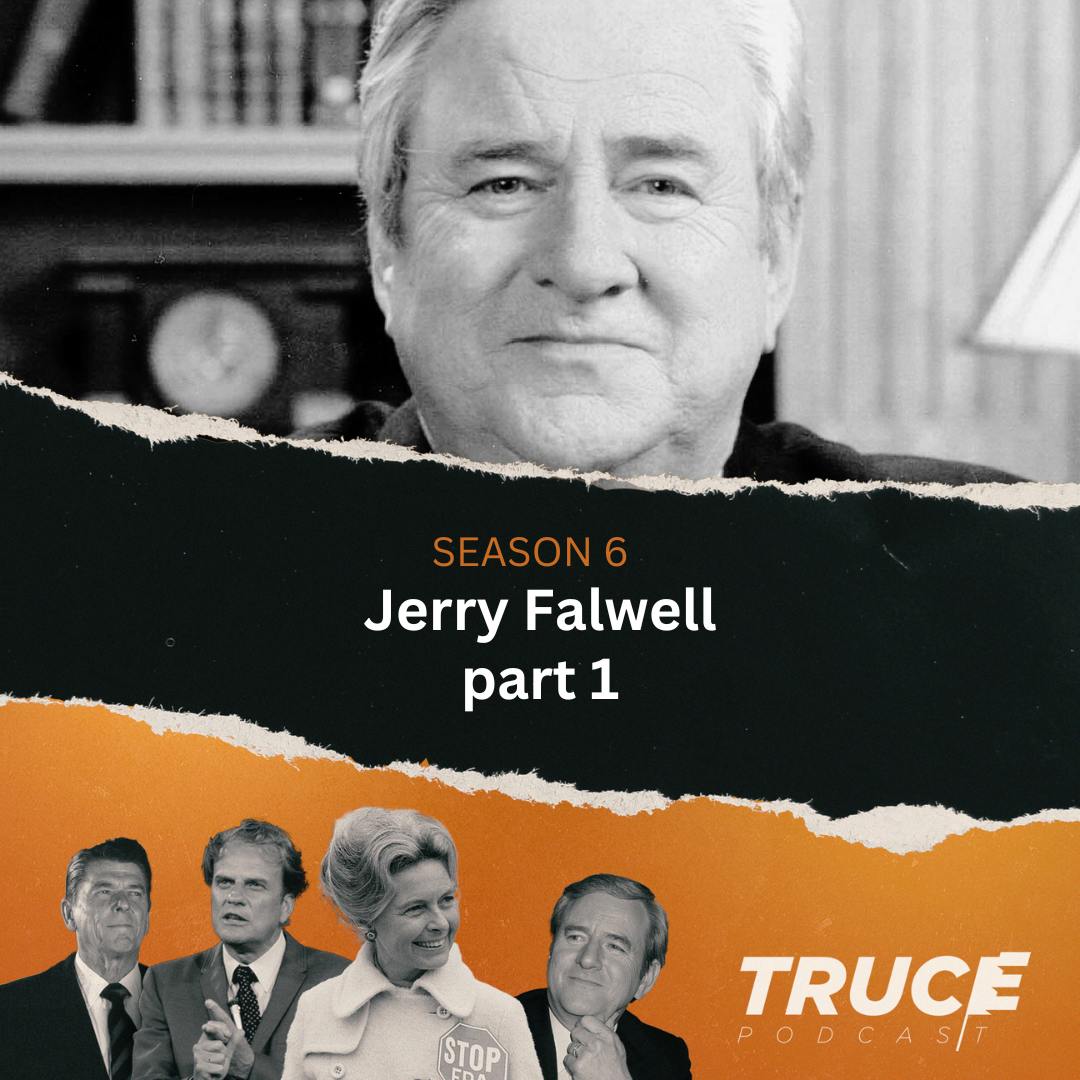 Republicans and Evangelicals I Jerry Falwell (part 1) | Give to help Chris make Truce Jerry Falwell was a prominent American pastor, televangelist, and conservative political activist whose life and ministry had a significant impact on American evangelicalism and politics. Born on August 11, 1933, in Lynchburg, Virginia, Falwell grew up in a family that was not particularly religious. However, after becoming a Christian during his college years, he dedicated his life to ministry. He attended Baptist Bible College in Missouri, where he developed the theological convictions that would shape his future work. In 1956, at the age of 22, he returned to his hometown to found the Thomas Road Baptist Church, beginning his long journey as a spiritual and cultural leader. Falwell’s ministry expanded rapidly through the use of media. He launched the “Old-Time Gospel Hour” television program, which gained national attention and allowed him to reach millions of viewers. His style combined traditional evangelical preaching with a strong emphasis on conservative values. The success of his broadcast ministry helped him establish a broad base of support and financial backing, enabling the growth of both his church and other initiatives. By the 1970s, Falwell had become one of the most recognizable faces of American evangelicalism. In 1971, Falwell founded Liberty University in Lynchburg. Perhaps Falwell’s most politically influential move came in 1979 with the founding of the Moral Majority, an organization that mobilized conservative Christians to become involved in American politics. Through the Moral Majority, Falwell encouraged evangelicals to support Republican candidates who aligned with their views on issues like abortion, school prayer, and family values. The group played a crucial role in the election of Ronald Reagan in 1980, signaling a new era of religious involvement in American political life. Falwell's efforts helped to solidify the alliance between evangelical Christians and the Republican Party that persists to this day. Falwell’s outspoken views often sparked controversy. He was a staunch opponent of abortion, LGBTQ rights, and the feminist movement, and he frequently spoke out against what he saw as the moral decline of American society. Critics accused him of promoting intolerance and mixing religion with politics in divisive ways. Nevertheless, his supporters praised him for standing up for biblical principles and being unafraid to speak his mind in a secularizing culture. Falwell saw himself as a defender of traditional American and Christian values, even as the country grew increasingly polarized. Jerry Falwell died on May 15, 2007. My guest for this episode is Daniel K Williams, author of God's Own Party. Sources: God's Own Party by Daniel K Williams American Sermons: The Pilgrims to Martin Luther King Jr. (for the Danforth sermon) I first heard the Danforth sermon mentioned on the Now and Then podcast The Evangelicals by Frances Fitzgerald Falwell: An Autobiography by Jerry Falwell Falwell's "Ministers and Marchers" sermon Discussion Questions What do you think of Danforth's sermon? Why is it important to understand that preachers have been concerned about the US since before it became a country? Why is it valuable to understand Falwell's early opposition to integration? We know that much of the season is related to education. Why is it significant that Falwell was an educator? How should we as a society adapt when a leader repents of their racism? What role did Frances Schaeffer play in shaping Falwell? Learn more about your ad choices. Visit podcastchoices.com/adchoices | 40m 08s | ||||||
| 11/4/25 |  Republicans and Evangelicals: Abortion | Give to help Chris continue to make Truce A lot of evangelicals are now single-issue voters, and that issue is abortion. But that was not always the case. In fact, for a great deal of American history, abortion was largely seen as a Catholic issue. There are, of course, exceptions. But most evangelicals and Protestants were divided on the subject, even favoring abortion when it came to preserving the health of the mother, or in cases of rape and incest. On this episode, Chris interviews historian and author Daniel K. Williams about the history of the abortion debate in the United States. A major turning point was the availability of elective or "on-demand" abortions in places like New York. As evangelicals grew more upset with the moral decline of the country, they lumped abortion together with gay and lesbian rights fights, the proliferation of pornography, and decided that it needed to stop. Plus, big money through New Right PACs entered the field, and politicians were soon chosen on their allegiance to pro-life legislation. Sources: Defenders of the Unborn: The Pro-Life Movement before Roe v. Wade by Daniel K Williams Reaganland by Rick Perlstein The Evangelicals by Frances Fitzgerald Romper Room on YouTube CBS Sunday Morning excellent story on Sherri Chessen Article on thalidomide Oyez.org for the Supreme Court cases Church History in Plain Language by Bruce Shelley American Experience article on Comstock Laws New York Times video on the Population Bomb (good stuff!) The US Constitution Frances Shaeffer and the Shaping of Evangelical America by Barry Hankins Discussion Questions: Why was abortion considered a Catholic issue in the mid-1900s? How did the Griswold case impact the Roe case? How did changing sexual mores contribute to the pro-life movement? How did the 1970 opening of New York to elective abortions impact public opinion? What is "abortion on demand"? How did Reagan's endorsement of the HLA shift Republican politics? Was Reagan successful in helping the pro-life movement, or was he merely throwing them a bone to get votes? Learn more about your ad choices. Visit podcastchoices.com/adchoices | 47m 29s | ||||||
| 10/21/25 |  Republicans and Evangelicals: The Death Penalty | Give to help Chris continue making Truce In the late 1960s and early 1970s, the United States went years without using the death penalty. Not a single person was killed by injection, firing squad, hanging, or electric chair. But by the late 90s, we were killing around 100 convicted criminals per year. What happened? In 1972, the Supreme Court handed down its decision Furman v. Georgia, which negated state capital punishment laws across the country. This meant that some of the worst criminals in the country were suddenly given new sentences. And Americans... lost their minds. Within just a few years, new laws were written, and the Court decided to approve many of them. The death penalty long had a prejudiced bent, disproportionately killing people of color. The NAACP worked hard to end the practice, but those efforts were soon undone as American opinions toward the death penalty abruptly changed. My special guest for this episode is Maurice Chammah, author of Let the Lord Sort Them: The Rise and Fall of the Death Penalty Sources: Let the Lord Sort Them: The Rise and Fall of the Death Penalty by Maurice Chammah The Death Penalty: An American History by Stuart Banner (an excellent source!) Reaganland by Rick Perlstein The Hijacking of American Flight 119: How D.B. Cooper Inspired a Hijacking Craze and the FBI's Battle to Stop It. by John Wigger Listen, America! by Jerry Falwell Romans 13 (and 1 for a fact check) The US Constitution September 26, 1973 (page 94 of 98). (1973, Sep 26). The Ottawa Citizen (1954-1973) Retrieved from https://wsl.idm.oclc.org/login?url=https://www.proquest.com/newspapers/september-26-1973-page-94-98/docview/2338669544/se-2 Oyez.org coverage of Furman v. Georgia Oyez.org coverage of Gregg v. Georgia https://www.youtube.com/watch?v=U4G_O_Z55fQ Pew Research data on crime Discussion Questions: What are your thoughts on the death penalty? Why was the Furman case so important? What did it decide? Should juries have guidelines when considering a death penalty case? Why is the death penalty so popular among evangelicals? Learn more about your ad choices. Visit podcastchoices.com/adchoices | 45m 26s | ||||||
| 10/7/25 |  Republicans and Evangelicals | Bob Jones University v. The United States | Give to help Chris continue to make Truce Bob Jones University v. United States (1983) was a landmark U.S. Supreme Court case that addressed whether the Internal Revenue Service (IRS) could deny tax-exempt status to private religious schools that practiced racially discriminatory policies. Bob Jones University, a fundamentalist Christian institution, prohibited interracial dating and marriage among its students based on its religious beliefs. In 1970, the IRS revised its policy to deny tax-exempt status to private schools with racially discriminatory admissions policies, prompting Bob Jones University to file suit after losing its exemption. The university argued that the IRS's actions violated its First Amendment rights to free exercise of religion. The central question for the Court was whether the government's interest in eradicating racial discrimination in education outweighed the burden on religious freedom imposed by the denial of tax-exempt status. The case thus pitted two core constitutional principles against each other: religious liberty and the government's interest in promoting equality. In an 8–1 decision, the Supreme Court upheld the IRS’s position. Chief Justice Warren Burger, writing for the majority, stated that tax-exempt status is a form of government subsidy and that organizations seeking this benefit must serve a public interest. The Court held that eliminating racial discrimination in education was a "fundamental, overriding interest" that justified the burden on the university’s religious practices. It emphasized that the government is not required to subsidize discriminatory behavior, even when it is religiously motivated. The ruling had significant implications. It clarified that tax-exempt status is conditional upon compliance with fundamental public policy, including civil rights laws. The decision reinforced the principle that religious freedom, while protected, does not allow institutions to violate core public values when receiving government benefits. This case remains a key precedent in balancing religious liberty with broader societal interests in equality and nondiscrimination. Sources: The Story of Bob Jones University v. United States: Race, Religion, and Congress's Extraordinary Acquiescence by Olati Johnson. Paper Number 10-229. God's Own Party by Daniel K Williams https://supreme.justia.com/cases/federal/us/461/574/#tab-opinion-1955051 1980s Republican Party Platform In Search of Another Country by Joseph Crespino McNamar's testimony, pp.225, Hearing Before the Committee on Finance, United States Senate, Ninety-Seventh Congress, Second Session, February 1, 1982. (Thanks to the Senate Historian's Office) “The Bob Jones Decision: A Dangerous Precedent” by Kenneth S. Kantzer. September 2, 1983, issue of Christianity Today. Randall Balmer article for Politico that narrows the blame for the bonding of evangelicals to the GOP to race Before the Storm by Rick Perlstein Majority opinion in the Bob Jones case New York Times article in which Bob Jones assails the Supreme Court (page A23), May 25, 1983 “Bob Jones, in Sermon, Assails Supreme Court” Discussion Questions: Why is the tax exemption so important to this story? Why is it important to churches and religious institutions? How would revoking the tax exemption change giving to those institutions? Some evangelicals (like CT) denounced the racism of BJU, but still thought the IRS overstepped its bounds. What do you think? Which institutions in the US should be tax-exempt? Which shouldn't? Learn more about your ad choices. Visit podcastchoices.com/adchoices | 29m 56s | ||||||





Showing 25 of 224
Pitch Fit is a Pro feature
See how bookable this show is for guests, which brands already advertise, the per-episode ad value, and the best-fit guest and sponsor profile. The numbers are blurred on the free plan.
How readily this show books outside guests like you.
How proven this show is for host-read sponsorships.
For Guests
ProFor Advertisers
ProUpgrade to Pro to unlock guest cadence, sponsor categories, fit scores, and per-episode ad value for this show.
Similar Audience Demographics
Podcasts that attract a similar listener profile


Chart history for Truce - History of the Christian Church
Peaked at #183 in PH, currently #183 in PH.
| Market | Genre | Peak | Current | Trend |
|---|---|---|---|---|
| PH | — | #183 | #183 | — |
Chart Positions
1 placement across 1 market.
Chart Positions
1 placement across 1 market.