

Insights from recent episode analysis
Audience Interest
Podcast Focus
Publishing Consistency
Platform Reach
Insights are generated by CastFox AI using publicly available data, episode content, and proprietary models.
Total monthly reach
Estimated from 1 chart position in 1 market.
By chart position
- 🇳🇿NZ · How To#2710K to 30K
- Per-Episode Audience
Est. listeners per new episode within ~30 days
3K to 9K🎙 Daily cadence·192 episodes·Last published yesterday - Monthly Reach
Unique listeners across all episodes (30 days)
10K to 30K🇳🇿100% - Active Followers
Loyal subscribers who consistently listen
5.5K to 17K
Market Insights
Platform Distribution
Reach across major podcast platforms, updated hourly
Total Followers
—
Total Plays
—
Total Reviews
—
* Data sourced directly from platform APIs and aggregated hourly across all major podcast directories.
On the show
Recent episodes
Lessons in Motivation and Success: Dr. Khalid Malik's Graduate School Journey
May 11, 2026
Unknown duration
Balancing Life, Work, and Grad School: Success Tips from Bernard Drew
May 4, 2026
Unknown duration
Balancing Career, Family, and an MBA: Lessons from Keith Poniers
Apr 27, 2026
Unknown duration
How to Share Obstacles You've Overcome in Your Personal Statement (Without Sounding Clichéd)
Apr 20, 2026
Unknown duration
Can Your Letters of Recommendation Come From Outside of Academia?
Apr 13, 2026
Unknown duration
Social Links & Contact
Official channels & resources
Official Website
Login
RSS Feed
Login
| Date | Episode | Description | Length | ||||||
|---|---|---|---|---|---|---|---|---|---|
| 5/11/26 |  Lessons in Motivation and Success: Dr. Khalid Malik's Graduate School Journey | Are you contemplating graduate school or already on the journey? The latest episode of "Victors in Grad School" offers an inspiring and practical guide to thriving in higher education, featuring the remarkable story and expert advice of Dr. Khalid Malik, Director of the Graduate Program in Cybersecurity at the University of Michigan-Flint. Hosted by Dr. Christopher Lewis, this episode unfolds with Dr. Khalid Malik's path from his undergraduate studies in Pakistan to becoming a leader in cybersecurity in the U.S. The conversation reveals the power of perseverance, mentorship, and adaptability in achieving academic and professional goals. The Power of Motivation and Mentorship Early in the episode, Dr. Khalid Malik credits his family and professors with instilling the value of continuous education, sharing how their support pushed him beyond a bachelor's degree and set him on a global academic path. Their influence helped him pursue a master's, followed by a PhD abroad, despite lucrative job offers after his initial graduation. The takeaway? Seek encouragement from your community and mentorship to fuel your ambition, even when the easier path seems tempting. Embracing Interdisciplinary Research A key theme is the importance of interdisciplinary learning. Dr. Khalid Malik emphasizes that true innovation often lies at the intersections of fields. He shares examples from his own lab, where projects combine AI, computer science, biology, and engineering to solve complex problems like brain disease diagnostics. For students, he advises: build strong fundamentals and remain open to broad, cross-disciplinary work—this not only enriches your education but also enhances your impact and career prospects. The Role of Agility and Communication Moving overseas for his PhD demanded rapid adaptation. Dr. Khalid Malik candidly recounts overcoming language barriers and cultural differences through "agility" and a willingness to listen and learn. He stresses the power of effective communication: expressing your ideas clearly, welcoming feedback, and being persistent when reaching out to faculty opens doors otherwise missed. Navigating the Future with AI A timely takeaway centers on the evolving landscape of technology, especially AI. Dr. Khalid Malik urges students not to fear AI, but to learn its strengths and limitations, integrating it as a tool rather than seeing it as a replacement. Understanding how to work alongside new technologies is, he argues, essential for future-proofing your career. Encouragement to Prospective Students For anyone eyeing grad school, Dr. Khalid Malik and Dr. Christopher Lewis offer essential advice: stay curious, leverage mentorship, embrace interdisciplinary opportunities, and never hesitate to raise your hand for new experiences. Graduate school is more than academics—it's about growth, adaptability, and building meaningful connections. If you're seeking motivation, actionable tips, or simply want to hear a candid success story, don't miss this episode of "Victors in Grad School." Listen in and take your next step toward graduate school success! TRANSCRIPT Dr. Christopher Lewis [00:00:01]: Welcome to Victors in Grad School, where we have conversations with students, alumni, and experts about what it takes to find success in graduate school. Welcome back to Victors in Grad School. I'm your host, Dr. Christopher Lewis, Director of Graduate programs at the University of Michigan, Flint. Really excited to have you back again this week. And as always, every week, I am here to walk alongside you as you are going through this graduate school journey that you're on now. You might be at the very beginning, just starting to touch the I place in the sense of being able to figure out what you want to do. Or maybe you already applied, maybe you've been accepted, maybe you're in graduate school. Dr. Christopher Lewis [00:00:39]: Doesn't matter where you are in this journey, there are things that you can do right now, this minute to help you in being successful on the journey that you're on. And that's why this show exists. That's why this podcast is here, to help you, to walk alongside you and to provide you with some tools for your toolbox to be able to help you, to be able to learn from others along the way that that have done this and will help you in the journey that you're on. That's why every week I love being able to bring you different people with different experiences that can share the experiences that they had to help you in the experiences that you're going to have. And this week, again, we've got another great guest. Khalid Malik is with us today. And Dr. Malik is a professor at the University of Michigan, Flint. Dr. Christopher Lewis [00:01:21]: He works within our cybersecurity program here and is the director of the Graduate Program in Cybersecurity. And I'm really excited to be able to talk to him about his own experience and to learn a little bit more about his graduate journey to share that with you. Khalid, thanks so much for being here today. Dr. Khalid Malik [00:01:37]: Thank Chris for this opportunity. It's my pleasure to join your podcast. Dr. Christopher Lewis [00:01:42]: Well, I'm really excited to have you here today, and I always start these interviews with an opportunity to go back in time. And I love turning the clock back a little bit to get a little bit better sense of who you were before versus where you are right now. And I know that you did your undergraduate work in Pakistan and you did your undergraduate, you did your master's work in Pakistan. You went off, you worked for a bit, and then you went and you decided to go even further. But I want to go back to when you were a student in Pakistan working on that undergraduate degree. You could have probably stopped at a bachelor's Degree you could have stopped there, but you decided to keep going. Bring me back to that point where you said to yourself, I want to keep going. I want to keep going and get that master's degree and then we'll talk about your doctorate degree. Dr. Khalid Malik [00:02:27]: Excellent. So Chris, I must give a credit to the society where I was raised. Actually there was a lot of value of higher education for me. There was a no choice except to continue. Let me put it straightforward. Particularly my parents would never ever allow me to go directly into the job. So they gave me option that, you know, if you think you can do a job and do a master together, certainly you should do it. But graduate, getting a graduation and going for higher education, particularly abroad is very important. Dr. Khalid Malik [00:02:59]: They encouraged me and I myself was highly motivated. I was lucky enough that I got acceptance in for my PhD from seven schools. But it all happens because of the motivation provided by my parents and my, my, my professor. So yeah, I never thought of stopping even when I started my bachelor. And I. One of the thing that I learned from one conversation that, that you know, some conversations make a lot of impact for your future career. I was planning to go to medical school and I was on the borderline. The total score was required to get into the medical school was 829 out of thousand and I was having eight. Dr. Khalid Malik [00:03:40]: But there was six candidate who were having 829. So I waited for six months to get into the medical school and I, I couldn't go into it. And I was sitting with all these big physicians and one of the person just asked me that you know what really you want to do if you don't go into medical school. I said I have opportunity in many fields, particularly veterinary medicine and so on. Is like then why you are not going? I said I want to do something interdisciplinary medical. I can do an interdisciplinary. I can bring math, I can bring statistic. I don't what other field I can do it. Dr. Khalid Malik [00:04:13]: And one of the person, he just says as a joke, he is a very famous New Jersey neurosurgeon now in New Jersey he said to me look at the flip side. Computing program also offer interdisciplinary. I said how? He says like someone has to develop a programs for medicine too. So why don't you if you're good in both and you know how to connect the dots, why don't you look at perspective of going into the computer science. So that was first my motivation that I will not do only bachelor in computer science. I will go for advanced studies as well. Because then I can probably Better leverage on my skills. I knew from my high school that I'm really good in interdisciplinary stuff. Dr. Christopher Lewis [00:04:52]: Now. I know that you went, you got your master's degree and then you went off and you did work and you worked in industry for a little bit of time and at some point that itch came back. You wanted to keep, keep going. You and you decided that you wanted to continue your education and you ended up going and getting a ph. And I guess bring me to that point, because you're out in industry, you're doing great work, you're creating things, you're building things, you're doing things. And I'm guessing making an okay salary to live and being able to do that. But then you flip the script and you make a choice that you want to do something to expand your own knowledge and to push yourself to the next level. So talk to me about that. Dr. Khalid Malik [00:05:41]: Sure. So I must say that when I finished my master thesis, my salary was among 1% of the top candidate. If I could have just tried to settle down, this was a possibility. But that was never the goal. So even when I started my first year, I started writing research papers. I was trying to collaborate with the professors that, you know, I want to do this thing. And many more people were saying, you still just finish a master, you are not a PhD candidate, why you want to do a research. I was trying to explain my long term goals to them, that that's the reason I want to start research and my master. Dr. Khalid Malik [00:06:18]: I was the first person in the university who published paper in journal. Many people were publishing only on conference. I was first one who published it. And that also gave me a little bit of encouragement that I can do that. So I started applying. I got acceptance from six or seven schools. And then I was kind of confused that what should I do, how should I select, what school should I go to? So I talked to my dad and he asked me that why don't you talk to your uncles as well, because they are famous neurosurgeons and highly successful. I said, I will definitely ask everyone, but what are your thoughts? So he told me that, you know what, try to go somewhere where you can not learn your research. Dr. Khalid Malik [00:06:56]: You can learn something from society, but at the same time there should be peace of mind as well. I said, dar, you are bringing in these features or criteria that I never have thought. I was thinking I should pick the best of the best lab and where I can publish it, what is has to do with the culture and other things. He says, no, you learn a lot from your surroundings too. You are not learning only from the books. And said what do you mean by staying in a peaceful society? He said look, if you can't focus on something due to any reason, say the law and our situation is not good or there are some other social issues, you will not be able to very be very productive. I said that's interesting perspective. So I gave him a list. Dr. Khalid Malik [00:07:37]: He says what is your choice? I have respect for all the institute who gave me opportunity. I'm not mentioning the name of institutes but I'm mentioning the name of country. One of the top 1 kind of institute was from Singapore and than Thailand. I thought I told my dad these are my top schools and then there is two in United States. But they are not giving me a fully funded. They are giving me, you know like a 25% effort or something. I and that time I was unable to understand what does 25% and 30% effort mean. So I showed to my dad and he says like first two options are out. Dr. Khalid Malik [00:08:05]: I said why? Why they're out? They are the best school. Look at the QS ranking and it's like tell me all the options. I showed him the option that government of Japan is also offering me this scholarship and he says oh this looks really good. I said then there is a one university in Austri and one in Germany. And he said why you picked, you know, this institute from Singapore? I said I only look at the QS ranking, I don't know anything else. So he said that's not how you should making decision. First talk to the people instead of asking them that you know what school you should do, you should ask them that what criteria should be to select this and the reason why I'm bringing this one. I know many of the students are going to listen. Dr. Khalid Malik [00:08:44]: I hear same mistakes from other students. They pick pick the schools only based on the ranking without thinking that you know what kind of professor you are going to deal with, how successful he is, what kind of personality he has and more importantly where you are going, how peaceful the situation is or overall working environment and so on. So I developed this idea and you know, after talking to a lot of people I my dad particularly said you will learn a new language and new culture as well. So that's why I think you should go to the Japan and it's very peaceful country too. So this is how I ended up going to the Tokyo Institute of Technology. But the process also was a miracle for me. Of course we don't have a time I will share with you the story some other time. But yeah, this is how I ended up going into Turkey Institute and that was an amazing experience as of today, you know, I truly enjoy the bond that I have. Dr. Khalid Malik [00:09:33]: Probably you are aware that, you know, I brought first International industry project here, which we still are doing it, right? That is coming from one of the Japanese cybersecurity company. So. And still I enjoy a lot of connections, even my startup first client. By the way, my startup is supported by the University of Michigan. So our first client client is the government of Japan again. So the. The reason I'm sharing these with the thing is that sometime we should try to do risky things and try to do something that or people are not doing it because then you can reduce the competition that you will feel in rest of the world. So the Japanese connection has significantly impacted my research success both here as well as in Oakland University. Dr. Christopher Lewis [00:10:16]: At every level of education you have to kind of figure out for yourself what it means to be successful. And you found success in the journey that you went on. You got the master's degree, you went and you got your PhD and you've gone on from there. And I guess as you look back at your master's degree at your PhD and the transitions that you had to go through, what did you have to do at both the master's and the doctorate? And it might be different for both. What did you have to do at both of those levels to be able to first set yourself up for success as you were starting in the program and then what did you have to do to maintain that success throughout the entire graduate degrees? Dr. Khalid Malik [00:10:59]: Great question, Chris. Again, if someone think, and sometimes my students think that you are very successful. And even I would say that my colleagues from Ann Arbor and Dearborn campus, you know, they also appreciate that having a startup in U of M fl, this is something that is unheard of. And these things I always tell people that I'm lucky enough, I'm blessed that I am surrounded by good mentor as well as my student. So I got a advice from one of my uncle who is a board of trustee in Henry Ford. He just said me one thing. I was in Japan and I was frustrated that, you know, I work up to 1am and I come back early morning around 8am this is how Japanese culture work. He says, remember one thing, why you are doing this? I said, I have set a lot of goals and I showed him a list that I want to publish this one. Dr. Khalid Malik [00:11:46]: He says, then why there is a stress if you have these goals, are you achieving these goals? I said, I believe so. I mean 80% of the milestone that I said I'm achieving it. He says, then why you are not happy? I said to him, I don't know why I'm not happy. He said, curiosity and hunger for doing a lot of thing is a great thing. But content is also very important. If you achieve something, celebrate it, remain content. If you fail on one or two occasions, you know, accept that and use that failure as an opportunity to learn something and try to, you know, do something big. So I always try to set a goal and then, you know, I try my best to remain content as well. Dr. Khalid Malik [00:12:28]: So that these two things have helped me a lot. Dr. Christopher Lewis [00:12:30]: Did you find as you went into either of those degrees, did you find that you had to change the way in which you either learned change the way in which you approached your work that helped you to find success? Dr. Khalid Malik [00:12:44]: Absolutely. I mean you can imagine that going into some, some place where you cannot understand a single word. On day one, because I never studied Japanese before entering into the Japan, I take a six month of intensive Japanese classes to learn the Japanese. At same time I, I was lucky that professor allowed me to sit in the lab because I was curious more on doing research than language or want to do both in parallel. So it was first six months was very difficult. But what I learned from my Japanese friends, science particularly lab mate, that in this country you have to be super agile, Even you are 100 year old. I said what does that mean? I mean when we are above 70 or 80, how we can be agile. And this is, this is how this society work. Dr. Khalid Malik [00:13:27]: So one of the my lab mate who was in 70s by the way, he was doing PhD, he was in 17, he was the director of Japan Railway. So he gave me this advice that you need to be super agile. And I said to him what do you mean? He said look, this professor are also going to expect. He's asking you do your research, but he's asking you to put him in as a Hitachi project. So if you will be only focusing on one thing and not another and you are not agile, you will not be successful in this society. You will get your pit. So there were a lot of challenge, but again I was good listener so I tried to be super agile. I was working with Hitachi to learn it and that later on helped me to give a job in Panasonic. Dr. Khalid Malik [00:14:03]: Soon I finished my PhD and then I went for a consultancy as well for one or two years before moving here. So agility has helped me a lot. Definitely there were A lot of challenges, language barrier, culture barriers. But with the help of my colleagues and my, this trait of being a good listener and pushing myself, I was able to navigate those challenges. And even today I feel like doing a PhD in Japan was not a bad idea at all because I learned the language, I learned the culture, and I learned a lot of the good habits that even I have right now that those, those things help me to be more productive. Dr. Christopher Lewis [00:14:41]: Now, as you think about that. And I know you now are a professor and you've been, you've gone, you've worked at other institutions and you're, you're a professor here at the University of Michigan Flint as well. And you work with graduate students that are on their own journeys. Talk to me about what you have to do as you are trying to help your students to find that success that you found in your own journey. And what are some of the things that you tell to your students as they're starting their graduate journey? Dr. Khalid Malik [00:15:11]: I focus on two things a lot. First of all, again, I have the biggest lab. Probably 80% of PhD students of U of M Flint belongs to my lab. Three postdocs, I'm having a very big lab. I told them two things and even when I bring them, I test these two. Number one, what about their fundamental, are they really good in the fundamental of the research that they want to do? And second thing is, are they truly interested in interdisciplinary research or not? Right. So for example, in our lab there are three very big projects. One of the project is we are applying the AI on the brain diseases. Dr. Khalid Malik [00:15:45]: So I tell students, if you are not willing to study the vascular system of the brain, you should not be participating in it. It's not that, you know, we are just doing this project for sake of getting something done. It's truly interdisciplinary. It has aspect of the mechanical engineering, it has aspect of the neurosurgery, it has aspect of the computer science and AI and it has the impact of aspect of the biology. My job is as a professor to lay down the surface that is very interdisciplinary in nature. So you guys can play for long time because you can look from very different angles and it will help you to publish sooner. But if you will look into vertically only, it's not truly interdisciplinary or multi disciplinary project, your chances of publication will be lower. And more importantly, yes, you will be maybe very successful or you will be expert in a certain field, but you will be very difficult to become a leader in industry even if you're going in academia. Dr. Khalid Malik [00:16:47]: I take my own example. I was Able to have a startup. Right? Right. Many people are unable to do that because you can then link, okay, how to apply this research into another discipline. So therefore, the pageant for interdisciplinary research is very important. And before that, you should have a strong fundamentals. If you are relying on the crutches of AI to do a strong research, I doubt that those students will be successful. Dr. Christopher Lewis [00:17:13]: Now, I know that as you go into a new institution, as you're a new student, there definitely is some deference that you have towards your faculty members. It's a little scary for a new graduate student as they're entering into a new environment in trying to build those relationships with faculty members. You've been there, you've had to do that yourself as your own, as a student yourself. Now you are a faculty member. What would you say to new graduate students as they are trying to build those strong relationships with their faculty members? And how would you encourage them to move forward in building those? Dr. Khalid Malik [00:17:48]: I always advise students. Number one, if you are not getting response immediately from faculty member, don't give up, up. Number two, everyone appreciate a good research, no matter how busy they are. Many people think that having a startup, I have this big lab with three postdoc and you know, six PhD students on. But I listen to everyone. But there is a different way of listening. I don't have a time to sit with them. I say, let's walk together and have a discussion. Dr. Khalid Malik [00:18:14]: And those students I who are very passionate and they are willing to learn, even they are not very strong compared to many of the students who are working in lab and who are, for example, paid 50% effort or some of them 60%. I asked those students that come not only talk to me, talk to these postdoc and PhD students as well, be observer. So it's very important that you should not hesitate to speak with the people. You should show your passion. Yes. Sometime people like myself, like, you know, this person cannot do a lot of research. But we always give opportunities to those who have a passion of learning. So if students are shy, why and they are not expressing themselves that they want to learn, they will not be able to get opportunities. Dr. Khalid Malik [00:18:59]: So that's my first advice that I was successful. Believe me, I did half of my thesis going in escalator and elevators with the one professor who was very famous and he was not having a time. I always used to tell him, I will tell you what I did in a week when you are going from his company to 10th or 11th floor where there was institute for teaching as well. So getting someone's time. Expressing your opinion and passion is very important and all graduate students, particularly international students, should be doing this. That's a very important thing. Second thing I always tell students, look, we have a limited opportunities. Everyone wants to get a gsrs. Dr. Khalid Malik [00:19:40]: I tell students, prove yourself in a class. We don't have any litmus paper to say you will do best or not. So when we are assigning your project in the class, if you'll do best, believe me, I will approach you. You need not to come to me. If you are interested in going someone's lab, take the class of professor and do really well in the projects. So this is a second bit of the piece that I can give to my graduate student. Dr. Christopher Lewis [00:20:02]: That's a great piece of advice and one that I continuously am trying to give to students as I do different webinars and have different opportunities to be able to talk to students. Because what I try to tell students is if you are not able to get a graduate assistantship right from the get go, when you're in class, your faculty members are going to have opportunities for you and they're going to ask people for their help, they're going to ask for volunteers and if your hand is the first one up, up every time, they're going to remember you. So when there are opportunities that do exist, who are they going to come to? And so that does bring up some different things in my mind in regards to as you think back to your own graduate experiences and you think back to the opportunities that you took advantage of, maybe they weren't the ones that you thought you were going to do. Talk to me a little bit about that and how doing just that by putting your hand up, by saying pick me, yes, I'm there. How did that open up other doors for you? Dr. Khalid Malik [00:20:59]: I will relate this with again one of my examples. So one of my experience in the Japan for one or two years I was struggling to understand the direction that my professor want me to pursue because I'm very hesitantly saying hopefully he is not going to listen to this interview. So I was having a firm opinion that my ideas are better than my professor ideas. And I was talking constantly to my colleagues and postdoc that look, what professor is saying to me me is not making much sense. I have much better ideas. And one of my colleague who's from China, he says then improve your ability to communicate. I said well, I can't speak a fluent Japanese, I don't know how to do it. He said that's not truly a barrier. Dr. Khalid Malik [00:21:41]: I said, then what do you mean by that? He's like, look, when you present it, you have a one guy who is half Japanese, half Australian, and he is a big supporter of your research. Why don't you present together? So communication is the key. It took me two years. It was the just the way of presenting to someone. That guy. I again is highly appreciative of that guy who is now very successful. He has a big company. Other day I saw he has more than 700 employees. Dr. Khalid Malik [00:22:10]: So he helped me a lot how to communicate to the people from the different cultures, right? And particularly my ideas were better understood by my professor. So to answer your questions knows it's very important that you know, you understand other people's point of view and try to communicate your thoughts in a way and work with those people rather than always thinking that you are superior to other people or you are inferior to other people. I took this opportunity, I was not shy or some of my other colleagues says, oh, when you will present with his name as Hama, you know, Professor Will Tungi. It's his idea. So in the start I said in my broken Japanese that professor, these are my ideas. I was trying to communicate it. But today you have to listen to both of us. And then similarly, when the opportunity came in to work in Panasonic, right. Dr. Khalid Malik [00:22:57]: I was initially hesitant. Is my Japanese skill enough to work in industry? I only know how to purchase a ticket, how to buy the food, and how to communicate with my colleagues in industry how is things are going to work. And I talked to a couple of other professors and I went to international office in my university and those people says, you can just give a shot. Why don't you go and give a presentation? So wherever I presented it, it initially it felt like very challenging. But you know, end of day, someone has to get to that position. We have to go with that mindset and we should keep on trying. And that's why I kept on trying. And even the society where, you know, I was not a native speaker, actually I'm not a native speaker. Dr. Khalid Malik [00:23:41]: Essentially my, my Japanese Skill was not JLPT level 3 or 4, which wasn't needed in industry. But I was successful because I was telling them what values I can bring in on, on the, on the project. So it' I agree with you. It's very essential that, you know, we should raise your hand and we should tell people what value we can bring in. Dr. Christopher Lewis [00:24:01]: You've given a lot of pieces of advice today. You've talked about your own experience and as you think back to your Own graduate school experience. And you think about students that are thinking about graduate school, whether it be cybersecurity, business, health or some other area. What are some tips that you might offer them, these individuals that are thinking about graduate school that would help them find success soon sooner. Dr. Khalid Malik [00:24:22]: I think first of all we should look into how our societies are going to evolve in future. For example, these days AI is going to play a crucial role, right? So many people are afraid that you know what? Why should I go into the cyber security education? I'm giving a one example of cybersecurity. Same is true about computer science these days as well that when AIs particularly say the anthropic models are going to write all the code, how are we going to find the jobs? A lot of people have this question and this is a very valid question. Many top schools, including ucla, Ann Arbor campus, their number of application in computer science are decreasing mainly because of one concern. But the question that we should really have, particularly as a new graduate student is how are we going to work with AI? Rather than thinking that AI is going to replace us or we are going to replace AI, right? That's a fundamental. All of us, I mean when writing proposal lecture, we are interacting with AI. Students have to learn that know first of all what are the strength of AI and what are the limitations of AI? Because I see a lot of students who think AI is more powerful than the student themselves, right? That's not true. They have to understand where AI struggles too. Dr. Khalid Malik [00:25:33]: So that's a number one piece because I don't see a future of work without the AI. So even if you are going in any program, you must be learning little bit of AI and understand how you can leverage your current work, your current projects and future work with AI. That's number one a suggestion I have for a student. Number two is think what AI cannot do and interdisciplinary stuff AI is not good at so far I'll give example because if I'll not give example, those of your listener was saying they may not understand. There is a aspect called cyber physical systems where. Where for example we are riding AI for robot or a car and so on, right? Wherever there is an interaction of the hardware, human is needed. So those fields, highly interdisciplinary field where AI is going to play a partial role role. Look at those fields and they are tremendous. Dr. Khalid Malik [00:26:27]: Number third tip that I will tell students. Don't be afraid that AI will replace you. AI is going to take you to the next level. All of us are working up to midnight and getting up early morning. Our work is not going to finish. And if you ask me what you want to do in 2023, I will tell you there were tens of things that I couldn't accomplish it. So with the power of AI, we are going to achieve much bigger goals than what you know we aspire now. So instead of take accepting this as a challenge, take AI as your companion, but understand its weakness and try to involve yourself in interdisciplinary field where AI has lot of limitations. Dr. Khalid Malik [00:27:06]: This is a question that is coming again and again. Really. Students from all disciplines come to me and ask this question, so I thought I should answer you indirectly as well. Those who didn't interact with me, they will also learn about my opinion. Dr. Christopher Lewis [00:27:18]: Well Dr. Malik, I just want to say thank you. Thank you for being here today, for sharing your own journey and I truly wish you all the best. Dr. Khalid Malik [00:27:25]: Thank you so much Chris for the opportunity. I'm looking forward to talk to some other times as well. Dr. Christopher Lewis [00:27:30]: The University of Michigan Flint has a full array of masters and doctorate programs if you are interested in continuing your education. Whether you're looking for in person or online learning options, the University of Michigan Flint has programs that will meet your needs. For more information on any of our graduate programs, visit umflint.edu graduateprograms to find out more. Thanks again for spending time with me as you prepare to be a victor in grad school. I look forward to speaking with you again soon as we embark together on your graduate school journey. If you have any questions or want to reach out, email me at flintgrad officemflint. Eduardo. | — | ||||||
| 5/4/26 |  Balancing Life, Work, and Grad School: Success Tips from Bernard Drew | Are you considering graduate school, juggling work, family, and community commitments, or wondering how to make it all fit together? This week on the Victors in Grad School podcast, Dr. Christopher Lewis welcomes special guest Bernard Drew, business growth consultant at the Michigan Small Business Development Center, for an inspiring conversation about perseverance, prioritization, and the power of lifelong learning. Dr. Christopher Lewis sets the stage by reminding listeners that everyone's grad school journey looks different. Whether you're freshly accepted, deep in the trenches, or still deciding if it's the right move, each week's guest brings a unique perspective. This episode, however, is especially resonant for those returning to school after a significant break. 00:02:24 Bernard Drew shares his circuitous journey, going from a mechanical engineering undergrad, to working in business and ministry, to finally pursuing his MBA at Grand Valley State University nineteen years after his first degree. His turning point? A desire to serve more people, steward greater resources, and ensure he was as prepared as possible to give back to his community. A central theme discussed is the reality of balancing responsibilities. Bernard Drew is candid about the challenge: "If I'm going to add something else to my slate of priorities and responsibilities, it may imply I have to take something off the slate for a season." 00:07:46 From time-blocking Sundays for study sessions at Red Robin, to stepping back from some community commitments, he emphasizes the importance of clearly defining your "glass balls" – those priorities you cannot drop – and making peace with temporary sacrifices. The episode delivers actionable advice: Make the decision and the adjustments will follow; communicate boundaries and expectations with work and family; and don't underestimate the power of a strong support team. Even if you're returning to school after a long hiatus, leverage your lived experience and collaborate openly—you'll bring more value to the academic setting than you realize. Ready to be inspired? Hear Bernard Drew's full story and practical advice for succeeding in graduate school by listening to this episode of "Victors in Grad School." It's a must-hear for anyone who dreams of more, but wonders how to make it happen. Listen now and start writing your own victory story! TRANSCRIPT Dr. Christopher Lewis [00:00:01]: Welcome to Victors in Grad School, where we have conversations with students, alumni, and experts about what it takes to find success in graduate school. Dr. Christopher Lewis [00:00:11]: Welcome back to Victors in Grad School. I'm your host, Dr. Christopher Lewis, Director of Graduate programs at the University of Michigan, Flint. Really excited to have you back again this week. And as always, every week we are on a journey together as you are thinking about graduate school and you're trying to figure out what is next for you. And every week I love being able to talk to you because it is a journey. And no matter if you are just starting, maybe you've applied, maybe you've gotten accepted, maybe you're in graduate school. Doesn't matter where you are in this journey. Dr. Christopher Lewis [00:00:43]: But there are things that you can do right now to be able to prepare yourself, to be able to get yourself ready for success now. And that's why every week I bring you different people, different people with different experiences that can help you to be able to see graduate school from a little bit different perspective. And you can see graduate school through the experience that they had. This week. We've got another great guest. Bernard Drew is with us today. And Bernard is a business growth consultant at the Michigan Small Business Development Center. And Bernard has his own journey. Dr. Christopher Lewis [00:01:20]: He started his undergraduate work at the University of Michigan and then went on and got an mba. And we'll be talking about that journey that he went on for himself. So I'm really excited to have him here. Bernard, thanks so much for being here today. Bernard Drew [00:01:32]: Well, good morning. It's an absolute pleasure to be part of this discussion with you, and I'm probably even more honored because I wish I would have known this existed before I started my own journey and glad that you're providing this kind of platform from others before they get started on theirs. Dr. Christopher Lewis [00:01:45]: Well, as I said, I really am appreciative that you're being here now. What I want to do is I want to go back in time. And I said, you did your undergraduate work at the University of Michigan, and after that, you. You went off. You got a lot of different experiences along the way that helped you kind of, I'm going to say, explore many different things in your career and careers per se. And at some point, at some point while you were working in the different jobs and the different careers that you've been in over the years, you came to a point where you made a decision that it was time to go back and it was time to continue your education. Bring me back to that point and what was going through Your head. Bernard Drew [00:02:24]: Well, you set that stage very well. I think life has taken some interesting journeys. Undergrad was mechanical engineering. Summer before my freshman year, I had an internship at GM and I made my own business cards that looked exactly like the business cards of my supervisor so I would fit. And I was unapologetic for saying I was going to be the CEO of GM by the time I was 35. In that level of boldness and courage. And then life evolves and you come to discover. I enjoyed engineering. Bernard Drew [00:02:51]: I did well with engineering, but I had a passion to want to really work in the daily lives of serving people. And so that post graduation journey evolved into a discovery that serving people dynamic in my life was working in ministry and working with people wherever they are in need of hope and a greater sense of identity and helping them to rediscover that for themselves, but also recognize while doing this, while serving people, the people that I'm serving, they're not my source, that there's other avenues for financial benefit, financial gain. And there became a desire to grow and discover business. And so for nearly 19 years after undergrad, that was the balance of my life was serving in ministry and operating in business with an emphasis in real estate. And when all said and done, as much as we had great momentum, I'm enjoying what we're doing. It was the revelation that there's more people that I want to be able to serve. There's greater impact I'd like to be able to make in the community. There are some programs that I would like to see supported and facilitated to better the lives of people. Bernard Drew [00:03:53]: And if given the opportunity to steward hundreds of thousands, if not millions of dollars of resources to support some community endeavors, last thing I would want is to be at the cusp of an opportunity to serve people in that capacity and for whatever reason be deemed ill prepared or ill equipped to properly steward those kind of funds at the detriment of the people that deserve to have those funds and those resources and programs allocated to them. And that's what prompted me to say, you know what? Here's an opportunity. Let me go ahead and get this mba. That's part of what sparked and prompted that course of direction 19 years after undergrad. It was a desire to want to be properly steward resources and better impact the lives of people. Dr. Christopher Lewis [00:04:31]: And I know that you chose to attend Grand Valley State university for your MBA and there are many MBAs all over the state of Michigan, all over the country and the world. So talk to me about that education journey for yourself and what Was it ultimately that made you decide to select Grand Valley when you identified that as your final choice? Bernard Drew [00:04:54]: I think it's a profound question with an extraordinarily simple answer called money. I think that to be concise, I enjoyed my journey providing consulting services independently for small businesses and working in the real estate space, commercial real estate space, for years. And in the course of that journey, I discovered that the SBDC existed, began working with them closely, so closely that they invited me to consult with them as a contractor. And that evolved into an opportunity to work full time, time for our state hub at Grand Valley State, and just call it what it is. Part of the compensation plan is a tuition benefit. And so when all was said and done, that was the driving force that made that decision making pretty simple. And I'm sure like most people, there's an aspiration to better their lives. There's an aspiration to improve their capacity to bless their families and those that they serve and elevate themselves professionally. Bernard Drew [00:05:47]: But when all said and done, I'm sure everyone has to at some point stop and evaluate what is the financial investment required to take this academic step and what is my plan for being able to generate a return on that investment, pay it back off and continue to flourish. That definitely was the nail got hit on the head that made that work for me. Dr. Christopher Lewis [00:06:06]: Now, you already mentioned that it was 19 years from the time that you were in your undergrad to the time that you went into graduate school. And that's a lot of time to be able to get out of the student mode, we'll say, and being in that thought process, that thought zone of what it means to be a student, but saying that I know that you were successful in going through your graduate degree, you got the mba, you've gone on from there, so you found success in that graduate school journey for yourself. So I guess as you think back to entering into graduate school, what did you have to do to set yourself up for success and what did you have to do as you got into graduate school and went through graduate school to maintain that success throughout the entire graduate school journey? Bernard Drew [00:06:54]: I think that's a great question. And again, it's one of those. I wish I would have had more insight before I started at that point of making the decision. It was just that. Just make the decision and go for it, Bernard. Don't overthink it. Don't overanalyze, don't over critique the unknown. The engineer in me sometimes wants to look at all the variables all the time and make sure everything Lines up and life doesn't just line up perfectly. Bernard Drew [00:07:15]: It was just a decision. And as the pieces began to fall into place and it was a reality that this was going to take place, there was a need to rapidly begin to assess how do I balanced life? Now that I have integrated this new commitment of graduate school, and having been out of an academic environment for 19 years, for what I thought it was going to take to make room and time, I didn't nearly have the right perspective to understand how much time really was going to need to be allocated. And that was probably the single greatest challenge during and throughout the program was finding a way to, quote, unquote, find some balance. Because I've got a wife, two kids, community commitments, business commitment, work commitment. It was a lot. And so the biggest factor is if I'm going to add something else to my slate of priorities and responsibilities, it may imply that I have to take something off the slate for a season. And that was a very, very, very hard thing to embrace, let alone implement. Dr. Christopher Lewis [00:08:18]: Now, I know that you have completed your degree, you went off, you continued, you're still doing business growth consultation and have that skill base, that knowledge base under your belt right now. How do you see yourself utilizing what you learned in your MBA on a daily basis? Bernard Drew [00:08:35]: No, that's great. As I prep for this, I'll also continue to spin off from that last question. I will say that journey navigating undergraduate school, and I just share this with anyone that's there. It takes time and giving yourself the space to reevaluate your own priorities so that you can confidently know what you're saying yes to and confidently know what you're saying no to is so incredibly important. And some of it you won't know until you get into it. But for the most part, I would highly encourage some reflective time to sit down and maybe jot down. These are the things that I prioritize and recognize which things. Yeah, I've heard this story. Bernard Drew [00:09:12]: Somebody talked about if you're juggling in life and some of the balls are tennis balls, some are baseballs, but some are glass balls, you can drop a tennis ball, it's resilient, and you're juggling. You can drop a baseball and it'll rebound, it's resilient. But if you drop that glass ball, it breaks. And you've got to clearly define what are the unbreakable things, the unshakable things, the things that I cannot compromise as I have to pick and choose where my time is going to go. And so figuring out how to clearly define that and be okay if some of those other things fall and be okay with it and know that that was just the choice that you made. And so family, there was some sacrifice of time with family, but I didn't want that to be one of the glass balls that I allowed to break. That was something that had to be maintained. Certain commitments with work obviously had to be sustained. Bernard Drew [00:09:55]: But I also say I had some conversations with my supervisor who was very well aware before I got into the process that there was a level understanding, accommodating if I couldn't make certain meetings or couldn't make certain evening events. Because I was committed to school, they understood and that helped to set the expectation. There were certain things again serving in community and ministry. I had to withdraw from a couple of boards I was on because I did not have the capacity during that time frame to serve them well and provide adequate time and energy towards my studies. And there were just some things that had to be dropped. But then at the appointed time I could choose if it was right after the program to go and pick some of those balls back up. And so I just want to encourage individuals that are listening and considering. It'd be worth your time to evaluate what's the priority, what are the things that you can compromise, the things that you can't and be okay that certain things are going to fall, but it's temporary, didn't have to be permanent and you'll be more confident when you've made that decision on purpose, what those things are. Dr. Christopher Lewis [00:10:49]: So you just talked about the fact that you had to kind of look at those priorities and you had to try to figure out how to balance those. Talk to me about what you ended up doing to be able to balance balance school, work, family and other responsibilities that you had to be able to maintain the success that you wanted in your graduate school journey. Bernard Drew [00:11:08]: I would say one of the keys was time blocking, where I would just dedicate block off time for what is worth. Family knew on Sundays after church, pretty much one o' clock and afterward that they probably weren't going to see me. Typically I had a routine on Sundays. I actually would go to Red Robin. They'd have football on the TV and I would snap in the gear of studying and reading from Red Robin. I'd probably be there for an hour and a half, catching a half of a football game, eating and reviewing my notes, reviewing the game plan for what needed to be studied. I would have a team meeting probably about 8 o' clock that night with folks who were on within my cohort, that we had agreed to work together on certain projects together, and that in between time was a lot of my diligent prep time. Usually we had assignments that had to be submitted by 11:59pm on Sunday night. Bernard Drew [00:11:56]: So Sunday was kind of like the crescendo. And that had to be time blocked, as well as some preliminary time blocks throughout the week that, hey, from this time to this time, I'm preparing for this class. From this time to this time, I'm preparing for that class. And ideally those time blocks at least gave me, I would say 80% of the time necessary, but then I'd have to squeeze in a lot of other time elsewhere. But that was one of the key pieces, blocking out that time, clear communication with those around me so that they would know that they're not being haphazardly left alone, but that this was the dedicated time and conversely, trying to create dedicated time blocks to spend with them as well. Dr. Christopher Lewis [00:12:36]: And as you look back at your graduate education and you think about what you had to do, what are some tips that you might offer others considering graduate education that would help them find success sooner? Bernard Drew [00:12:48]: I think number one is definitely just make the decision. I don't know that there is a perfect time and a season for it. Make the decision. And once it's made, then it almost forces you to create the time blocking it almost forces you to do the prioritization in life. So just know that, get the application submitted and just get the process started. Even regards to finding capital, I'm over here considering starting this journey over again with the DBA program over at U of M Flint. And there's a reality that you know what need to align some game plans for the capital and align some plans for where the resource is going to come from and just take the next step. And I think that that's a big part of it. Bernard Drew [00:13:24]: I would also encourage heavily one of the big lessons learned. I hadn't been in school in so long and when I did finish my undergrad, I was so glad to be finished. I kind of had an attitude like, get me out of here. I don't want to see you guys again. Mission accomplice, let's move on in life. But I'll just say it was a joy to discover that because I was in a program that was so specific to something, I had a passion, I enjoyed my classwork. I think the life and lived experience provided a lot of opportunity for the academic perspective to have the framework to be relevant based on lived experience. In a way that it made my classes that much more practical for me to embrace and understand. Bernard Drew [00:14:03]: So if you've been out for a while, see that as an asset, not a liability. I was sitting in class with some classmates who were pretty much my daughter's age. I had a daughter who was in her undergraduate program at the same time that I was in my graduate program. And it's great to recognize and appreciate what each person brings to the table. Don't operate in isolation. Build a team, be collaborative, and learn to respect that more can be accomplished when working together. I think that was one of the greatest virtues when we really hit our stride in the program was when we had a solid team that we were working with and could confidently rely on certain people to carry certain legs of the race, respective assignments each week and projects. And that became more of a virtue over time. Bernard Drew [00:14:48]: And if you're not accustomed to that, that's something I would encourage you to prepare your heart, your mind, even just your way of doing things for. Prepare yourself to work effectively and purposely with other people. It'll make the journey that much more impactful. Dr. Christopher Lewis [00:15:00]: Well, Bernard, I just want to say thank you. Thank you for sharing your journey today. Thank you for all that you shared about the experiences that you've had. And I know that you, as you said, you're considering further education. So education never stops and you continue have to look for new ways to be able to challenge yourself. But I really appreciate you being here today and I wish you all the best. Bernard Drew [00:15:19]: I greatly appreciate it. I'm grateful that you have this platform. And again, I just appreciate the encouragement, the practical perspective that it can give to those who are considering or are in their journey, and hope there's some inspiration that allows that journey to be all the more simpler. So thank you very much. Dr. Christopher Lewis [00:15:35]: The University of Michigan Flint has a full array of master's and doctorate programs if you are interested in continuing your education. Whether you're looking for in person or online learning options, the University of Michigan Flint has programs that will meet your needs. For more information on any of our graduate programs, Visit umflint.edu graduateprograms to find out more. Thanks again for spending time with me as you prepare to be a victor in grad school. I look forward to speaking with you again soon as we embark together on your graduate school journey. If you have any questions or want to reach out, email me at flintgrad officemflint.edu. | — | ||||||
| 4/27/26 |  Balancing Career, Family, and an MBA: Lessons from Keith Poniers | Are you contemplating a return to graduate school, or perhaps already in the thick of balancing higher education with work and family commitments? The latest episode of Victors in Grad School dives into the inspiring journey of Keith Poniers, Vice President and Chief Financial Officer at Hurley Medical Center, as he recounts what it truly takes to thrive in graduate school after years away from academia. Hosted by Dr. Christopher Lewis, Director of Graduate Programs at the University of Michigan-Flint, this episode offers an honest, firsthand account of re-entering higher education more than two decades after earning an undergraduate degree. Keith Poniers reflects that it had been 26 years since he stepped into a classroom, and details how evolving career ambitions and executive opportunities motivated him to pursue an MBA (02:25). He candidly discusses the challenge of shaking off "school mode" and stepping into a new academic environment surrounded by both younger students and peers from diverse backgrounds (05:03). A primary theme throughout the episode is the importance of resilience and adaptability. Keith Poniers openly shares the nerves that came with his first orientation, the adjustment to working alongside younger classmates, and the rapid pivot to online learning brought about by the pandemic (09:04). He credits supportive professors and a strong personal support system—including his wife—for helping him maintain balance and motivation during challenging times (07:28). Sacrificing leisure activities, managing work stress, and dedicating ample time to study were keys to his success, alongside the drive to meet his own high standards (08:37). Listeners will find actionable advice woven throughout, especially for professionals considering graduate school. Keith Poniers emphasizes finding a program that fits your personal circumstances, preparing for a demanding time commitment, and being ready for collaborative, group-based learning environments (13:15). The episode is rich in reminders about the personal and professional rewards of graduate education, the value of maintaining motivation, and the necessity of adapting to new formats like online learning. If you're seeking relatable insights and practical encouragement on the road to an advanced degree, this episode is a must-listen. Tune in to hear Keith Poniers and Dr. Christopher Lewis explore the realities of balancing life, career, and education—proving that it's never too late to become a victor in grad school. Ready to take the next step? Listen to the full episode and let their stories inspire your graduate journey! TRANSCRIPT Dr. Christopher Lewis [00:00:01]: Welcome to Victors in Grad School, where we have conversations with students, alumni, and experts about what it takes to find success in graduate school. Dr. Christopher Lewis [00:00:11]: Welcome back to Victors in Grad School. I'm your host, Dr. Christopher Lewis, Director of graduate programs at the University of Michigan, Flint. Really excited to have you back again this week. As always, every week we are on a journey together. This is a great opportunity for us to be able to take a look at this journey that you've decided to explore or maybe that you're already on. Graduate school is definitely a journey. And no matter if you're just starting off, you're just starting to think about things, maybe you have applied, maybe you've been accepted, maybe you're in graduate school. Dr. Christopher Lewis [00:00:44]: No matter where you are, this is a journey and it's leading you down that. That proverbial path toward the light at the end of the tunnel. And every week, I love to be able to talk to you, to work with you, to help you, to provide you with some tools for your toolbox, to give you some sense of how can you find success in this journey that you're on. That's why every week, I truly enjoy being able to introduce you to new people with different experiences that can share the graduate journey that they went on. With you this week, we got another great guest. Keith Ponyers is with us today. And Keith is the vice president and chief financial officer at Hurley Medical center. And I am really excited to be able to have him here to talk to you about his own journey in education and to welcome him to the show. Dr. Christopher Lewis [00:01:31]: Keith, thank you so much for being here today. Keith Poniers [00:01:33]: Thank you. Thank you very much. I appreciate the time and look forward to sharing my experience. Dr. Christopher Lewis [00:01:38]: Well, I'm really excited to have you here, and I always love to start these conversations with a turn back in time. So I know that you did your undergraduate work at Indiana University and you went through that experience, you got your bachelor's degree in accounting, and then you went off, you went off, you worked, and you got a lot of different experiences in different types of companies in you. At some point along the way, I'm going to say, quite a ways down the path, you made a decision to go back to school. Take me back to that point in time. And what made you decide that that was the time, that was the time that you wanted to start that graduate education journey for yourself? Keith Poniers [00:02:25]: Sure. So as you said, it was 26 years between the time I left. Graduated from Indiana way back in 93 until, you know, stepping foot on U of M. Flint's campus in the fall of 2019. What got me to that point over those 26 years in my various jobs, I never thought there was a need for an MBA through the different companies that I worked for. It really wasn't required, that kind of thing. But I got an opportunity to come work at Hurley here in Flint. And I'm a Genesee county born and raised. Keith Poniers [00:03:03]: Other than my four years at Indiana University, I've either lived or worked here in Genesee County. So coming to work at Hurley was a great opportunity for me. Really love the Flint community and like I said, it's always been a part of my life. But I had an opportunity to come here at Hurley as working in the finance department, and then after a couple of years had another opportunity here at Hurley, and the current CFO was retiring. And they approached me of saying, if you're interested in, you know, stepping up into that role, a master's, an MBA would really go a long way to being you, to become a serious candidate. Nothing's ever guaranteed. But again, if you want that opportunity, certain things to get to that executive level, you do need a master's or B, a cpa, those kind of things. So that got me thinking, okay, where am I at? I was comfortable in my life, wife, daughter, grandkids. Keith Poniers [00:03:56]: But if I wanted to take that next step in my life and further my career, it was something that needed to be done. So I did some research. Different education opportunities. There's obviously there were online MBAs that you could get. I looked at different ones around the state. But I was attracted to U of M Flint 1, being here right down the road from where I was currently working, great, you know, reputation. So that kind of was the avenue that led me to apply to U of M Flint and their MBA program. Dr. Christopher Lewis [00:04:27]: Now you just said that it was about 26 years between when you last left education to when you came back and you kind of get out of the mode of being in school mode, I'm going to say. So talk to me about that transition for yourself. Everybody goes through those transitions. And you had transitioned out of higher ed quite a ways in the past, and then you came back after many years in working. So what did you have to do for yourself to be able to transition back into school and find success as you transitioned in? And what did you have to do as you were going through that graduate education to be able to maintain that success? Keith Poniers [00:05:03]: It was a huge transition for me. Again, like you said, 26 years is a long time. I still to this day, you know, all these years later, remember going to the orientation, you know, at the School of Management building down the street here, and being very nervous. I'm walking into a room full of people. They're professional people mostly. There are some that just continue right from undergrad into the MBA program. But I was for sure one of the older people in that room having that gap. So it was a challenge to become comfortable in that setting. Keith Poniers [00:05:35]: You start working with, meeting people a lot younger than you in all different professions. So definitely a challenge. I think I just needed to reset my mind that, okay, this is a new chapter of my life. I drew back on some of those experiences from Indiana. When I went to Indiana, I was the only one from my school to go there. So it was a new experience. So it was kind of like deja vu all over again. Stepping into a new world, not knowing anyone, you know, just like I did when I was a freshman at that point, 30 years ago, from when I started as a freshman at Indiana, to quote, being a freshman in the new world of education, too, that was the other thing that was. Keith Poniers [00:06:15]: It was when I went to Indiana, I took an electric typewriter with me. You know, it was, now I've come into college with a high tech laptop. So just kind of, like I said, just going back and understanding I can be successful in this new world of education. And it really took, you know, that first couple classes to really become comfortable and say, okay, look, I can fit in. And the professors there were great. My first class was in person with Dr. Lawrence, negotiation class. He made us all feel really comfortable. Keith Poniers [00:06:47]: He was still, I would say, that's my favorite class of my mba. I draw on the experiences from that class and the lessons learned from Dr. Lawrence in the negotiation. I still have books from his class and a few others on my bookshelf behind me. But it really, again, the professors made it really comfortable for myself, being a little older, to fit in with the younger crowd and worked well with each other there. Dr. Christopher Lewis [00:07:12]: Now you were working full time while you were going through school, so you had to do some balancing along the way. Talk to me about balance and how were you able to find that balance for yourself as you were trying to wear the many hats that you had to wear while you were going through a graduate program. Keith Poniers [00:07:28]: Sure. I give a lot of credit to my wife. She was very supportive. The job at that point, I was controller at Hurley, you know, working my way, hopefully being to be considered for the. The CFO role. So. But it was a very challenging job, stressful as well. So Then you throw college classes on top of it and all the time commitments. Keith Poniers [00:07:48]: So again, like I said, a lot of thanks, kudos to my wife for allowing me to kind of step back from our marriage. And you have to have that kind of give and take with whoever you're living with, your partnering with, whoever that they understand and they are supportive because it is an impact on your life. I kind of had to give up some of my other extracurricular activities I love to golf. I had to cut back and golf, fantasy football, fantasy baseball, those other things I had to scale back a little bit on. But ultimately you understand that there's a goal while you are doing this. And so you sacrifice a little bit to reach that goal. Dr. Christopher Lewis [00:08:23]: You do have to do some of that. You do have to sacrifice at times. And you have to find ways to keep yourself motivated because it can be challenging along the way. How did you stay motivated through challenging semesters or coursework? Keith Poniers [00:08:37]: I hold myself to a very high standard. So for me, the motivation was doing the best I can, getting the best grade throughout. Like, I started in the fall of 2019. So my second semester was 2020, which is obviously Covid hit. So that was its own challenge in itself. Stepping back in the classroom after 26 years, thinking everything was going to be in person, and then all of a sudden Covid hits and the whole world changed. And so that really continued to make me be focused on, okay, I got to pay attention because now everything is online. It was kind of a different world that I'm used to in person meetings, talking face to face with people. Keith Poniers [00:09:20]: Now everything flipped to virtual meetings, virtual classes. That was a whole new learning experience in itself. But again, my drive to be successful, and I knew I needed to be successful if I wanted to reach the ultimate goal of being considered for a higher executive level here at the hospital, that was really important to me. Dr. Christopher Lewis [00:09:41]: Now, you said you, it sounded like you looked at only MBA programs because that was the path that you were looking at. And as you look back now, it's been a couple of years since you got that degree. And you think back now to the things that you're still pulling from. If you had to do it all over again, would you choose the same program or path? Why or why not? Keith Poniers [00:09:59]: I would absolutely choose the same program. Again, the convenience of being local here in the community was a big selling point to me. Again, at that point, I thought I would be more successful with an in person type of learning because that's what I was used to way back in the day. Obviously didn't know I was going to completely flip to an online class. I only had the first semester and then about two or three months of the second semester was actual in person before going to online. So in hindsight, knowing how more convenient online classes is, I may have considered something a little different. But again, that was kind of, that was what I was used to, so that's why I chose it. But even now, understanding, you know, the online presence, I think, you know, U of M. Keith Poniers [00:10:46]: Flint did a great job making that transition. It was quick, seamless, really. No issues with the technology or anything like that. So I think knowing the university has those resources available that they can quickly, you know, pivot as well, they made it very easy transition as well. Dr. Christopher Lewis [00:11:04]: And I know earlier you mentioned Dr. Lawrence's class, but. And you think, as you think about the courses that you went through, how did graduate school change the way you think or approach problems? Keith Poniers [00:11:14]: I mean, there were a handful of classes that I continue to draw back on. Organizational behavior was one. Again, one of my first classes. But as I stepped into more leadership roles throughout my career, being able to read, people understand you can't treat everyone the same. Everyone is different. You know, those, those kind of lessons were and I felt like repeated in a lot of the classes. But sometimes you just need that drip, drip, drip to. To hear message over and over again. Keith Poniers [00:11:43]: You know, you have to be open. You have to be, you know, look at things differently through different lenses, whether it's just dealing with people or other ideas kind of thing. So that's something I continue to draw on throughout my career since I've graduated as well. Dr. Christopher Lewis [00:11:58]: What's something that you wish that someone had told you before you started graduate school? Keith Poniers [00:12:02]: It required a little more time commitment than I expected. Again, I thank my wife and my family for being supportive. And you think, okay, I got all these life experiences, I should be able to handle it. But I'm also one that I like to be prepared. So I probably spent more time studying, reading, making sure, you know, I did everything on the syllabus so I could be successful. So again, just be prepared to spend and dedicate that time necessary if you want to be successful. You have to put in the time. So my one negative of the whole thing at the whole experience was the one A minus. Keith Poniers [00:12:40]: I got in one class that cost me a 4.0 GPA. And I think I go back to I prob. Probably didn't spend enough time preparing for that one exam in that class that I didn't do as well as I should have been. And I still kind of kick myself for not getting that perfect 4.0 class or GPA throughout my two years there. Dr. Christopher Lewis [00:12:59]: Now, as you think back to your graduate education and you think of others that are thinking about going to graduate school, whether it be in business or the health field or something else, what are some tips that you might offer others considering graduate education that would help them find success sooner? Keith Poniers [00:13:15]: I think you got to find the right environment for you to be successful again. Understand that there will be impact to your personal life, especially if you're working. If you're going to be working and doing this, gotta make sure your job understands okay. You know, you're gonna have some other commitments you may have to take some time off for. For certain things that just getting your mind right, that's going to impact your current life and your work life balance. You need to be prepared to adjust and pivot accordingly because if you want to be, you have to dedicate the time to it. You can't just skirt by. Sometimes I think people in high school, they can, okay, you just got to do the work. Keith Poniers [00:13:57]: You can get by through in high school. When you get to college, you have to step up a little more. I think the MBA program, at least from my experience, and again I'm comparing to my undergrad a long time ago, but there was a lot more interaction, group work, those kind of things which I found really, I appreciated that back in my day, you know, we didn't do as many group projects even at Indiana, but in this program, program every class had group work. You're doing online comments, chats, working on projects. So it goes back to if you're going to be successful, you have to be willing to work with other people. You have to be tolerant to that. Not everyone is going to have the same work ethic as you. So you have to accept that they might just be along for the ride while you're striving to further your career. Keith Poniers [00:14:45]: You have to either one, call them out for that. Don't be bashful if somebody's not putting in the work. You got to call them out and make sure, hey, migrate on what you do as well on those group projects. That's another thing where I would encourage, don't be afraid to step up and say something as well. Dr. Christopher Lewis [00:15:01]: Well, Keith, I just want to say thank you. Thank you for sharing your journey today and I truly wish you all the best. Keith Poniers [00:15:06]: Thank you very much. I appreciate the time. Dr. Christopher Lewis [00:15:08]: The University of Michigan Flint has a full array of master's and doctorate programs. If you are interested in continuing your education. Whether you're looking for in person or online learning options, the University of Michigan Flint has programs that will meet your needs. For more information on any of our graduate programs, visit umflint.edu graduateprograms to find out more. Thanks again for spending time with me as you prepare to be a victor in grad school. I look forward to speaking with you again soon as we embark together on your graduate school journey. If you have any questions or want to reach out, email me at flintgrad officemflint. Eduardo. | — | ||||||
| 4/20/26 |  How to Share Obstacles You've Overcome in Your Personal Statement (Without Sounding Clichéd) | There's a question I hear often from graduate applicants—and it usually comes with a long pause and a little uncertainty: "Should I talk about the obstacles I've overcome in my personal statement?" And then the follow-up question: "What if it sounds… cliché?" If you're asking that, I want you to know: you're already thinking like a strong writer. Because the truth is, many applicants do write about challenges in ways that feel generic or overly dramatic. And that can make an essay blur into the background—especially when admissions reviewers are reading dozens (or hundreds) of statements. But here's the good news: You can absolutely write about obstacles you've overcome in a way that feels authentic, powerful, and professional. In fact, when done well, it often becomes the most compelling part of the essay—not because it's dramatic, but because it shows the real qualities graduate programs value: resilience self-awareness maturity problem-solving growth So today, I'll show you how to present challenges you've faced without sounding cliché, without oversharing, and without turning your personal statement into a "sad story." Instead, you'll learn how to turn obstacles into narrative strength—while still clearly showing you're ready for graduate school. First: Yes, you can talk about obstacles (and sometimes you should) Let's begin by addressing the concern directly: You are allowed to talk about obstacles in a graduate school personal statement. Graduate programs understand that people don't arrive at graduate school with perfectly smooth paths. In fact, sometimes a challenge is what shapes a person into the kind of student and professional who thrives in graduate-level work. But there is one key principle to keep in mind: Your obstacle should not be the centerpiece. Your growth should be. This is where many essays go off track. Why some "obstacle essays" feel clichéd Let's talk honestly about what makes a challenge story land poorly. Obstacle stories often become clichés when they: rely on generic phrases focus too much on pain without reflection jump to a "happy ending" without showing the process make the reader do the work of connecting the dots sound like an inspirational movie trailer instead of a real person You've probably seen phrases like: "I learned that everything happens for a reason." "This challenge made me stronger than ever." "I never gave up on my dreams." "Through hard work and determination, I overcame…" None of these are inherently wrong—they're just vague. They don't show anything specific about you. Graduate programs don't need a motivational quote. They need clarity. They want to understand: what happened what you did what you learned how it changed you how it prepared you for graduate study The most important shift: Move from drama to meaning If you want to avoid clichés, here is the simplest and most powerful advice I can give: Don't write your obstacle story like a headline. Write it like a reflection. Instead of making the reader think: "Wow, that sounds hard." You want the reader to think: "This person learned something important, responded with maturity, and is ready for the next level." The heart of your obstacle story isn't the obstacle. It's the decisions you made and the growth you gained. What graduate programs want to see in an obstacle story When admissions reviewers read about a challenge, they're usually looking for signs of: coping and resilience responsibility and ownership problem-solving ability to seek help self-awareness and reflection forward movement readiness, not fragility This is important: The goal is not to convince them you've suffered. The goal is to show them you can succeed, even when life is difficult. The best structure to use: Situation, Action, Growth, Connection This framework is the simplest way to write about obstacles without sounding cliché. I call it: Situation Action Growth Connection Here's what that looks like. Situation Briefly describe what happened, with just enough context to understand the challenge. Keep this section short. You are not writing a memoir. Action What did you do in response? This is the most overlooked part of obstacle essays. Your response is what shows maturity. Growth What did you learn? Not a generic lesson—something specific that shows insight. Connection How does this connect to your goals and graduate readiness? This brings it back to admissions. What to include (and what to leave out) Let's make this practical. Include brief, relevant context your response and choices how you adapted skills you developed how it influenced your direction growth you can name clearly forward-facing mindset Leave out or minimize overly detailed personal information blame toward others long emotional descriptions medical or mental health specifics, unless necessary and handled carefully unresolved hardship presented as ongoing crisis anything that makes the program wonder if graduate study could overwhelm you You don't need to share everything to be authentic. You need to share what supports the narrative of readiness. How to avoid clichés: 6 strategies that work Here are some concrete ways to keep your writing fresh, real, and compelling. 1) Use specific details, not generic feelings Instead of "it was hard," explain what "hard" meant in real life. Example: managing full-time work while caring for a family member navigating housing instability during an academic term switching majors after realizing the first path wasn't aligned being the first in your family to understand the college system Specificity makes your story feel real—not cliché. 2) Focus on the process, not the moral Avoid ending with "I learned perseverance." Instead, show what perseverance looked like. Example: "I created a weekly schedule and met with my academic advisor twice a month to ensure I stayed on track." That's not cliché. That's concrete. 3) Avoid overly dramatic language You don't need words like: devastating shattered life-changing in every way darkest moment Sometimes those words are true, but they can read as exaggerated in an admissions context. Let the facts and reflection create the impact. 4) Show agency This is huge. Even if the obstacle was not your fault, your essay should highlight what you did next. Agency sounds like: "I sought support…" "I adjusted my approach…" "I learned how to…" "I created a plan to…" 5) Include one insight that's uniquely yours This is the moment where you sound like a real person, not an essay template. It might be: a realization a new perspective a shift in your values an understanding about your field Example: "That experience taught me that support systems aren't optional—they're essential. That insight is one reason I'm pursuing graduate study in counseling." 6) Bring it back to graduate readiness This is the "professional landing." Tell the reader why this experience prepares you for graduate-level work. Examples: stronger time management improved communication better boundary setting comfort asking for help and using resources ability to persist and problem-solve clearer purpose and direction Example paragraph: obstacle story without clichés Here's an example that follows the framework and stays professional: "During my junior year, I experienced a major disruption in my family responsibilities that required me to work increased hours while also supporting younger siblings at home. My academic performance was impacted during that semester, but it also forced me to develop skills I had not needed before. I created a structured weekly schedule, met regularly with instructors to stay aligned with expectations, and learned how to communicate early when challenges arose. Over time, I regained academic momentum and became more disciplined, organized, and intentional about how I used my time. That experience strengthened my confidence in my ability to manage demanding workloads—skills I know will be essential in graduate study." Notice what this does well: it gives context, but doesn't overshare it focuses on action it shows learning it ends with readiness That's the goal. What if your obstacle is connected to low grades or gaps? This is a common situation, and it can actually be a powerful narrative—if handled well. Here's how to do it: briefly acknowledge it explain context without excuses explain what changed point to evidence of improvement emphasize readiness now Graduate programs respect honesty and growth. They struggle with avoidance or blaming. Quick checklist before you submit Use this to test whether your obstacle story is helping your application. Is the obstacle described briefly, without overwhelming detail? Does the essay focus more on growth than hardship? Do I show what I did, not just what I felt? Is my reflection specific and meaningful? Does this story support my readiness for graduate study? Does my tone feel professional, grounded, and hopeful? If yes, you're in a great place. Final encouragement I'll end with this: Your obstacles do not disqualify you from graduate school. In many cases, they help explain the strength you bring into it. But the strongest personal statements do not ask the admissions committee to "feel sorry" for the applicant. They show something far more compelling: A person who has faced challenges, responded with purpose, learned with maturity, and is ready for what's next. And if you can tell that story with clarity and authenticity? You won't sound cliché. You'll sound real. | — | ||||||
| 4/13/26 |  Can Your Letters of Recommendation Come From Outside of Academia? | If you're applying to graduate school, you've probably reached the part of the application that feels surprisingly stressful: Letters of recommendation. Not because you don't know anyone—most applicants do. But because the requirements often sound like they were written for one very specific kind of student: someone who graduated recently someone who still has professors who remember them someone currently working in an academic environment someone who has research experience and faculty mentors And if your path looks different than that—if you've been working full-time, changed careers, raised a family, served in the military, or simply graduated a while ago—you might be wondering: "Can my letters of recommendation come from outside of academia?" In other words: Can my supervisor write one? What about a colleague? A nonprofit director I volunteered with? A clinical supervisor? A mentor in my profession? If you've asked these questions, you're thinking smartly—and you're not alone. So today, I'm going to answer this clearly and thoroughly, from the perspective of someone who works in graduate admissions and supports applicants every day. By the end, you'll know: when non-academic letters are acceptable (and even preferred) who makes the strongest recommender outside academia when you should prioritize academic references how to choose recommenders strategically and how to request letters that actually help your application Let's jump in. The short answer: Yes—often they can In many cases, yes. Graduate programs understand that applicants come from diverse paths, and many strong graduate students are: professionals returning to school career changers adult learners military-connected students first-generation students parents or caregivers applicants who have been away from academia for several years And those applicants may not have recent professors who can write meaningful, detailed letters. Here's the important detail, though: The best recommendation letters are not about where the recommender works. They are about what the recommender can say about you. A strong letter—academic or professional—does the same job: it shows evidence of your readiness it highlights strengths that match graduate-level expectations it provides examples of how you work, learn, and contribute Why graduate programs ask for recommendation letters It helps to understand what these letters are supposed to accomplish. Graduate programs use letters of recommendation to answer questions like: Can this applicant succeed in graduate-level work? Are they dependable and responsible? Can they write, think, communicate, and problem-solve at a high level? Do they have the maturity for advanced study? Will they contribute positively to the program community? A good letter gives the committee a perspective they can't get from: grades resumes personal statements or test scores Recommendation letters are third-party credibility. They confirm that your application isn't just well-written—it's true. When letters from outside academia are absolutely appropriate Many graduate programs accept professional references without hesitation, especially when the applicant has been out of school for a while. Professional letters are often ideal if: you graduated more than 3 to 5 years ago you're applying to a professional or practice-based program you've gained substantial work experience in a relevant field your work responsibilities demonstrate advanced skills you have supervisors who can speak to your performance Examples of programs where professional letters are often strong: MBA and business programs education leadership programs social work counseling and clinical programs public health nursing and healthcare programs nonprofit management information technology, cybersecurity, and applied STEM fields MPA and public administration For these programs, real-world performance matters—and professional references can be incredibly persuasive. When academic letters are strongly preferred Now, there are some circumstances where academic letters are still the best choice. Programs often prefer academic references when: you are applying to a research-heavy graduate program you are applying to a PhD or thesis-based master's program the program requires evidence of academic writing and research skill you are applying directly from undergrad or have recent coursework the program explicitly states faculty references are required In these cases, the program wants letters that can specifically address: academic writing intellectual curiosity research potential critical thinking classroom contribution scholarly habits Academic letters can be hard to replace when the program is evaluating research readiness. The real key: choose recommenders who can provide specific examples Here's something I tell applicants all the time: A letter from a famous person who barely knows you is weak. A letter from a direct supervisor who truly knows your work is strong. Admissions committees care about detail. Strong letters include: how long the person has known you what role they worked with you in specific examples of your performance specific strengths connected to graduate work clear recommendation language Weak letters are vague and generic, filled with phrases like: "hard-working" "nice" "great attitude" "good communicator" Those aren't bad traits—but they don't prove readiness for graduate-level success. Who should I ask for a letter if I'm using non-academic references? Here are the best choices outside academia: direct supervisor or manager clinical supervisor or preceptor department lead who has evaluated your work project leader you reported to nonprofit executive you worked closely with internship supervisor mentor who oversaw your professional development When possible, choose someone who can speak to: how you learn how you handle complex tasks how you communicate professionally how you lead or collaborate how you manage responsibility Those are graduate success indicators. Who to avoid asking (if possible) Sometimes applicants choose recommenders based on title rather than content. Try to avoid: family friends or personal acquaintances religious leaders who only know you socially elected officials who met you once coworkers who don't supervise or evaluate you people who only know you casually These letters are often too general and don't carry the kind of credibility programs need. A practical recommendation: a "balanced set" often works best If the program requires 3 letters, one great strategy is balance. Examples of strong combinations: For a professional master's applicant: 2 professional references 1 academic reference if available For a recent graduate: 2 academic references 1 professional or internship supervisor For a research or doctoral applicant: 2 academic references (ideally research-related) 1 professional or academic reference with strong writing/research insight If you are applying to multiple programs, adjust your letter mix depending on each program's expectations. What if I don't have any academic references? This is very common. If you don't have academic recommenders, here's what to do. choose professional recommenders who can speak to writing, analysis, and learning select recommenders who have evaluated your work formally use your statement of purpose to reinforce academic readiness consider taking one course before applying to build an academic reference That last one can be powerful. Even one graduate-level course or professional certification program can give you a current instructor who can write a meaningful academic letter. How to ask for a letter that actually helps you The best letters happen when you support your recommender. When you request a letter, provide: the program name and degree the deadline the submission process your resume or CV your draft statement of purpose 3 bullet points of what you hope they can emphasize a reminder of projects or accomplishments you worked on together This makes it easier for them to write a detailed letter. And detailed letters matter. What should the letter highlight for graduate admissions? Here are graduate-level qualities that recommenders can address: intellectual curiosity and ability to learn quickly strong writing and communication analytical thinking and problem-solving reliability and follow-through leadership and collaboration professionalism and integrity ability to handle feedback and grow time management and workload readiness If your recommender can provide examples in even 2 to 3 of these areas, you are in strong shape. Quick checklist: Are my non-academic letters acceptable? Ask yourself: does the program allow professional letters? have I been away from school for several years? can my recommender speak to my skills with specific examples? does the recommender know my work well? do my letters support my program goals and readiness? If yes, you're good. Final encouragement Let me close with this. Graduate programs want strong students. And strong students come from many paths. If your best recommenders are outside academia, that does not weaken your application. In fact, for many programs—especially professional programs—letters from supervisors and workplace mentors can be some of the strongest letters we read. The key is not academic or non-academic. The key is: credibility specific examples and clear evidence you are ready for graduate-level work Choose recommenders who know you well, can speak in detail, and genuinely want to support your next step. That is what makes a recommendation letter powerful. | — | ||||||
| 4/6/26 |  How to Include Specific Examples in Your Graduate School Essay (and Still Stay Within the Word Limit) | If you've ever tried to write a graduate school essay, you've probably experienced this exact moment: You're writing along… feeling good… and then you check the word count. And suddenly your heart sinks. Because you're either: 400 words over the limit or 200 words under the limit or right at the limit… but your essay feels vague and generic And the biggest source of frustration is usually this: "I know I need to include specific examples… but examples take up so many words." If that's where you are, I want to reassure you: You're not a bad writer. You're just experiencing what almost every graduate applicant experiences—because great examples are what make an essay strong, but word limits are what make essays feel impossible. So today, I'm going to show you how to do both: include specific examples (the kind admissions committees actually remember) and stay within the word limit Let's jump in. Why examples matter so much in a graduate school essay Let's start with the "why," because it's important. When admissions committees read essays, they're not only looking for good intentions. They're looking for evidence. Examples are evidence. Examples show: what you've done how you think how you solve problems what you've learned what you're ready for Without examples, an essay becomes a list of claims. And the problem with claims is that anyone can make them. For example: "I'm a leader." "I'm passionate about equity." "I'm committed to community impact." "I'm ready for graduate-level work." All of those statements might be true. But admissions committees are quietly asking: "Can you show me?" That's where examples matter. The core challenge: examples increase detail, and detail increases word count This is the tension you're feeling: Specific examples make your essay stronger But you only have 500–1,000 words (sometimes even less) So the goal isn't to remove examples. The goal is to learn how to write examples efficiently. Think of it like this: You don't need more examples. You need better examples. And you need to write them in a way that delivers maximum impact in minimum space. The golden rule: one strong example is better than three weak ones Many applicants go over the word limit because they try to squeeze in everything they've ever done. But a strong grad essay usually needs: 2 to 4 strong examples total That's it. Not 10. Not your full resume. A few examples, chosen intentionally and written clearly, will always outperform an essay full of scattered experiences. Choose examples that do double (or triple) duty This is one of the most powerful strategies. A great example should demonstrate more than one strength at once. Instead of choosing examples that only show one thing, choose examples that show: skill impact growth and alignment with your goals Here's what that looks like: Weak example choice: one example for leadership one example for research one example for community service one example for teamwork That becomes too much. Stronger approach: Choose one experience that includes multiple dimensions. Example: A capstone project might show: research skills collaboration communication problem-solving commitment to a population readiness for graduate study That's a high-value example. Use the 3-sentence example formula This is one of my favorite techniques for staying within the word limit. When you include an example, limit yourself to three sentences: what you did what you learned how it connects to your goals Here's a template: Sentence 1: I did ________ in ________ setting. Sentence 2: This taught me ________ or helped me develop ________. Sentence 3: This connects to my goal of ________ and prepares me for ________. Here's how that sounds in real writing: "During my internship in student support services, I helped launch a peer mentoring program for transfer students. Through this work, I strengthened my ability to design support structures, analyze engagement patterns, and communicate across diverse stakeholder groups. This experience shaped my goal of pursuing graduate study in higher education to build equitable student success initiatives grounded in data and community needs." That's three sentences. Clear. Specific. Connected. And most importantly, efficient. Replace long storytelling with "high-density" details This is how you keep examples specific without writing a novel. Instead of spending 8 sentences describing the background, use details that condense the story. For example: Instead of: "I was working at a nonprofit and we were trying to help community members and there were many challenges and I learned a lot…" Use: "In my role as program coordinator at a community nonprofit, I managed outreach initiatives supporting first-generation college students." That one sentence includes: role setting purpose population That's high-density detail. When applicants run out of words, it's often because they are writing low-density sentences—sentences that take a lot of space without delivering much information. Use numbers strategically (they add clarity without adding length) Numbers are one of the easiest ways to make an example more concrete without adding word count. Examples: "served 200 participants" "increased event attendance by 30%" "led a team of 6" "supported a caseload of 25 clients" "managed a $10,000 budget" "developed a training module used by 40 staff members" Numbers make an essay feel real. And they take very few words. Avoid the "resume dump" paragraph This is a common pattern: Applicants add one long paragraph listing everything they've done. It usually sounds like: "I completed X, and I also worked at Y, and I volunteered at Z, and I participated in A…" This is where word counts explode. Instead, use fewer examples—but go deeper with intent. Remember: Graduate programs would rather understand 2 key experiences well than read 12 experiences poorly. Combine sentences using "stacking" Stacking is when you combine related details into one well-built sentence. Example: Instead of: "I worked as a graduate assistant. I supported faculty. I developed workshop content. I helped students with planning." Try: "As a graduate assistant, I supported faculty-led initiatives while designing student workshops focused on academic planning, motivation, and professional development." Same information. Far fewer words. Cut filler phrases that cost words without adding meaning This is the easiest way to reduce word count quickly. Here are common filler phrases to remove: "I believe that" "I feel that" "It is important to note that" "Due to the fact that" "In order to" "This experience helped me to" "I was able to" Replace them with stronger verbs. Examples: "I believe that" becomes "I know" or nothing at all "in order to" becomes "to" "helped me to develop" becomes "developed" "I was able to lead" becomes "I led" This is how you keep meaning but reduce length. Use an intentional outline so you don't overwrite Most word limit problems happen before the writing even begins. Because the applicant writes without a map. Try this simple outline that helps you control length: 10% hook + motivation 30% preparation and key examples 40% goals + program fit 20% conclusion and future impact When you assign "space" to each section, you naturally stay within the limit. A simple editing strategy: subtract 10% without losing substance If your essay is too long, don't panic. Here's a process that works almost every time. First pass: delete filler and repeated phrases Second pass: replace long phrases with shorter ones Third pass: reduce each example to 3 sentences Fourth pass: cut your weakest example Most essays can lose 10% of word count without losing meaning at all. In fact, they usually get stronger. Quick checklist: am I using examples efficiently? Before you submit, ask: Did I include 2–4 strong examples (not 8–10)? Do my examples show impact, skills, and growth? Did I connect each example to my graduate goals? Are my examples written in 3 sentences or less? Did I use numbers where possible? Did I remove filler phrases? If yes, you're right where you need to be. Final encouragement If you're trying to write a powerful grad school essay under a word limit, here's what I want you to remember: The word limit isn't there to restrict you. It's there to reveal something important. Can you communicate with clarity? Can you choose what matters most? Can you tell a focused story? That ability is part of graduate school readiness. So don't aim for an essay that includes everything. Aim for an essay that includes what matters. A few strong examples, written efficiently, will always outperform a long essay full of scattered details. | — | ||||||
| 3/30/26 |  Overcoming Self-Doubt: Success Strategies from a CRNA Student's Perspective | Embarking on the journey of graduate school can feel both exhilarating and overwhelming. On this week's episode of the "Victors in Grad School" podcast, host Dr. Christopher Lewis sits down with Marissa Charles, a current student in the Nurse Anesthetist (CRNA) program at the University of Michigan Flint, to explore the heart, grit, and strategies needed to thrive in grad school. Marissa Charles shares a story that many prospective students will find deeply relatable. After completing her Bachelor's in Nursing and working for several years—including through the COVID-19 pandemic—she initially dismissed the idea of returning to school. "I always said I'd never be smart enough to be a CRNA," Marissa admits, pointing to the self-doubt that can plague even high-achievers. Her journey is a powerful testament to the idea that growth comes not just from academic readiness, but personal readiness. Sometimes, it's about timing and gaining confidence in oneself, rather than inherent capability. A central theme throughout the episode is the importance of mentorship and community. Marissa credits much of her success to the robust support network within her program. From the moment students are accepted, they're paired with mentors who guide them not just academically, but through the personal transitions essential to thriving in an intensive program. Extra-curricular opportunities, like mixers with students from other universities, further broaden the sense of camaraderie. Grad school is no easy path. Marissa emphasizes the necessity of balance, self-advocacy, and strong communication. She reflects on strategies for managing bumps in the road—whether it's an unexpected personal crisis or the all-too-familiar imposter syndrome. Her advice is universal: don't be afraid to reach out for help, and remember that setbacks are a normal part of the journey. Faculty, family, and peers are eager to support—you just have to take the first step. Whether you are considering grad school, in the midst of a program, or mentoring others, this episode offers inspiration and practical advice. Marissa's narrative proves that with determination, support, and clear priorities, pursuing an advanced degree is not only possible, but rewarding. Ready to find encouragement and actionable tips on your own grad school path? Tune in to this episode of "Victors in Grad School" and join a community invested in your success. TRANSCRIPT Dr. Christopher Lewis [00:00:01]: Welcome to Victors in Grad School, where we have conversations with students, alumni, and experts about what it takes to find success in graduate school. Welcome back to Victors in Grad School. I'm your host, Dr. Christopher Lewis, Director of Graduate Programs at the University of Michigan Flint. So excited to have you back again this week. As always, we are on a journey together. I say it's a journey, and I know every week I say this, but it is so true that you are on a journey. You've made a decision. Dr. Christopher Lewis [00:00:32]: Whether you are just the very beginning and you're just starting to think about graduate school, or maybe you've applied, maybe you've gotten accepted, maybe you're in a graduate program. No matter where you are, this is a journey from start to end of that graduate degree, and there are things that you can do right now, today, to be able to find success sooner. And that's what this podcast is all about. I love meeting with you every week to be able to provide you some things to think about, some perspectives, some thoughts, and especially to bring you others that have gone before you that are either in graduate school now, they've gone to graduate school in the past, and they are excited to be able to share their own journey with you so that you can learn from it and maybe repeat some things, maybe not repeat some things, to be able to help you to make your journey as smooth as it can be. Today we got another great guest. Marissa Charles is with us, and Marissa is a student within the Nurse Anesthetist program at the University of Michigan Flint. Really excited to be able to talk to her and to learn more about her journey in and through graduate school. Marissa, thanks so much for being here today. Marissa Charles [00:01:45]: Thank you, it is my sincere pleasure. Dr. Christopher Lewis [00:01:47]: I am really excited to be able to have you here today, and I think first and foremost, I know you did your undergraduate work at the University of Michigan Flint. You got a bachelor's degree in nursing at the University of Michigan Flint, and then you went off, you went off, you worked and started in your career, and at some point you made the decision for that you wanted to continue that education. Bring me back to that point, that point in your life where you said, "It's time." Why was it the time to make that jump? And what made you decide to go all in? Marissa Charles [00:02:21]: 100%. So I graduated December of 2020, definitely a crazy time in the world. I became a nurse. I started working. I never said, "Go back to school, Dr. Lewis." I said I'd never go back. My bachelor's degree was enough. There's no way I'm doing it again. Marissa Charles [00:02:37]: I graduated when I was 23, so I was working for a few years and I always said I'd never be smart enough to be a CRNA. And looking back at that is like, it makes me laugh because it shows just how you grow as a person truly through life. Because here I am, it's 2026 now. Um, in 2023, I finally made that decision where, hold on, it's not that I wasn't smart enough, it just was that I wasn't ready. I was a new nurse. I was coming outta nursing school, COVID was happening. We were seeing the sickest patients ever during that time. It was scary. Marissa Charles [00:03:14]: And it's not that it wasn't smart enough, I just wasn't ready. So 3 years or 2, 2 and a half years into my nursing experience, I was looking around and I just felt as though I'm missing something, like something— I wanna do more. I want to advance my education. I feel as though I'm at a point in my clinical experience where I have truly become a clinician that was an expert within my critical care standards. So in 2023, I was like, I think it's time. I don't know what I wanna do yet, but it's something. And that's when I started looking at graduate programs around the state of Michigan, what was out there for nurses. There's a lot of different paths you can take. Marissa Charles [00:03:59]: You can become a nurse practitioner. There is— perfusion, there's PAs, there's a lot you can do in graduate programs right now. And CRNA, I still felt like I wasn't smart enough for. So it took me about another year. In 2024 is when I finally was like, why not bite the bullet? Why not go for the hard road of what this program is? Because with a hard road comes a lot of feeling super good about yourself and confident and getting the most out of your education. So I decided in 2024 that I would start applying. And this process takes a long time. It's 2020, I started fall of 2025. Marissa Charles [00:04:41]: So it does take a little bit of time to go from deciding you want to go back to school, getting your application in, getting an acceptance and starting. But here we are, you know, 2 years, January of '24 to January— February of 2026 to being in it. So that's a little bit of my story. Dr. Christopher Lewis [00:04:59]: And I, I've said that you are in the University of Michigan Flint's nurse anesthetist program, the CRNA program. Marissa Charles [00:05:07]: CRNA program. Dr. Christopher Lewis [00:05:08]: And as you said, you did some research, you looked around, and I know that there are other CRNA programs in the state of Michigan that you could have chosen, and outside of the state of Michigan as well. So talk to me about that and what made you decide to not only apply to the CRNA program at the University of Michigan Flint, but also that once you got that acceptance, that, that was the program that was right for you. Marissa Charles [00:05:33]: So, uh, there's 5 programs in Michigan, so you have a lot to choose from. And there's so many different reasons that you can look into different programs. Obviously I'm a little biased 'cause I spent my undergraduate program at the University of Michigan Flint. So I looked back and when I was in my undergraduate program, I was working alongside of anesthesia students. They were there with me during my undergrad. So I got to see a little bit of kind of what they did on a semi-day-to-day basis. But it really still wasn't a level playing field because it's been 4 or 5 years since I went to undergrad. I've been kind of all over the state of Michigan, but really the biggest thing that brought me back to Michigan, which is kind of what I love so much about my undergrad program, is truly the relationship that the faculty has with their students and how much importance we put on student-to-student relationships. Marissa Charles [00:06:27]: And I'm gonna mention mentor, mentor, mentor probably a million times in the next 20 minutes that we talk, but our program, even before you start, they offer webinars, open houses, opportunities for you to meet the faculty to get an idea of who they are because you're applying to be in the program. It's just as much backwards. They want the best of the best to be in a program. And so it's just as much as me choosing them as it is they're choosing us. So I really, really love that about our program is the relationships that we build and then just how much importance we put on building relationships, mentorships, and then wellness is super huge. So after literally you got your acceptance letter, and then right before we start the program, they pair you up with a mentor and start building that relationship on how can we help you get through this next 3 years. And here's this person that's doing the same thing you're doing, but they're a little bit ahead of you, so they have a little bit of insight on how to get you through the program, which is super huge for me. Dr. Christopher Lewis [00:07:31]: You've been successful. You made that transition in, you're going through the program right now. You're mentoring other students as well and helping other people in the program. So you've been able to find success thus far. But I also know that there is a transition. You went through a nursing degree, but just because you went through a nursing degree as an undergraduate student doesn't mean that the way you're being educated, the, the expectations of the faculty are going to be the same at the graduate level. And usually they're heightened to a much greater degree. So talk to me about that transition for yourself and what did you have to do as you transitioned into graduate school and what have you had to do along the way as you've been going through this graduate program to help you find success? Marissa Charles [00:08:17]: I think half of, like, our student success is a tad bit about our director, is our director has basically taught every single class in our program. So one thing that created such a success for us as a cohort is that the way that our classes are built and the way they're structured is to allow for that transition to happen. And I don't know if there's many other programs that can say that they have faculty that have truly taught everything and have reworked all of these classes to create student success. That first semester, most of us have been out of school for 3, 4, 5 years. And so building a first semester where you're learning how to be a graduate student again, learning how to stop working again, learning how to facilitate your life around being a student, but also you're still a partner or a mother or a dog mom. You're still the person you are outside of school, but being a student is 100% that first semester and what that looks like. So I'd say the biggest thing is providing us with support in that first semester and building a class list that is doable was super big. And then really the biggest thing is I am super crazy about looking ahead really far, just like mentally prepare yourself. Marissa Charles [00:09:35]: Like right now I'm in my second semester and I'm looking at third already. I mean, we just started 5 weeks ago, but in order to be successful as a graduate student, you have to focus on what you're doing right now, but you have to be 3 or 4 steps ahead. So looking at— I'm starting clinicals in April. May, and knowing that I need to start mentally preparing myself for what does clinicals look like? What does creating lunches and being outside of the house a lot more, driving a lot more distances, things like that, to create a better, smoother transition for a student instead of it being very abrupt. So I'd say like, definitely, I love that our faculty have created a streamline of courses that really kind of ramp up just in the perfect amount each semester, but also being a productive student more than you were in your nursing program, where a lot of this is independent. They're not going to tell you exactly what you need to be doing at home and kind of figuring that out for yourself to be successful. Dr. Christopher Lewis [00:10:35]: You also mentioned the fact that it was so important for you to have a mentor and that your program aligned you specifically with a student mentor, but there are also mentorships that you build in regards to the connections with your faculty members as well, and that's important too. So Talk to me about mentorship, and if your program is not offering you the type of formal program that, let's say, that you had in your program, what are some things that you've seen to be able to allow for you to be able to build relationships with others that you might not have been formally connected with before you were in the program? Marissa Charles [00:11:11]: So our program sets you up with a mentor, and we— your mentor kind of chooses you in a way, and you're kind of connected on familiarity. So I was lucky enough to get a mentor that I actually was her trainer as an ICU nurse. I trained her and now it's her opportunity to give it back to me, which is super amazing. And I love that so much. But you're paired up with a mentor before you even start. And we meet them even before we start the program. They throw, uh, orientation meet and greet. And so it's an opportunity for us to say like, hey, like, what can I do before we start? What can I do in that first week of classes when Canvas opens finally? And we're so excited. Marissa Charles [00:11:50]: How can I get ahead? Ahead. So that is super important. And then our faculty are super awesome, and every quarter they set up wellness days, and those wellness days are opportunities for all 3 years, for second and third year students to get together and continue to build those relationships. We have a mentor, but that's just one person, but there's 30 people in each year, so there's the opportunity for 100 of us to get together and, and build faces to names, names to faces, because ultimately we're going to be coworkers or we're gonna follow each other in clinical. We're gonna have opportunities to connect on different scales and being able to see each other, you know, once every quarter is super huge. So that is something that we do that I appreciate. But obviously there's opportunities outside of school that you kind of have to push yourself a little further to be able to make relationships with people while you're in a higher degree. So for example, with the nurse anesthesia programs, or I should say nurse anesthesia There's the Michigan Nurse Anesthetist, um, essentially board. Marissa Charles [00:12:54]: Like everyone has like, as a board across the Michigan and we have MANA and there's MANA for students. And so I just came back last week. They had a meeting with all 5 programs. That's optional. You don't have to go, but why would you not take 4 hours out of a Friday night to go to a mixer of 5 different programs across the state of Michigan to pair up with these different students from different places? Because like I said, we met may end up being coworkers one day, or we may see each other in clinical, and being able to see how different programs are doing it and how are they getting through their 3 years to be successful in the program is super big to me. So going that extra step to doing those optional things that it's not mandatory, but it could otherwise increase your success in finding different things out from different people across all of Michigan. Dr. Christopher Lewis [00:13:48]: And you're in a rigorous program, which is challenging in itself, but you're also a friend, you have family, you've got other hats that you're wearing. So talk to me about balance and how do you find balance in your school, your work, your family, and other personal responsibilities while you've been in graduate school? Marissa Charles [00:14:09]: That is the question of the hour, Dr. Lewis. How do we do it? I think as a nurse, that's something that you inherently know because there's weeks where are tough weeks at work and you have to be able to kind of figure that out. You have to work overtime, or it's the holidays and you're balancing holidays with taking care of your own family. In the graduate program, it's harder in the aspect of you have to say no. You have to be able to know there's a priority. You have an exam on Monday, it's Saturday night, that I can't do that. But there's also Friday night I can, I just have to be responsible with my time. Marissa Charles [00:14:48]: So I think it's definitely very difficult as a graduate student on having to say no and really create a balanced schedule, but I think it really starts before you start. We're super big at Michigan. We do a family meeting and it gives you the opportunity for our director to explain to our family members from her perspective, not ours, cuz we, I mean, we've explained this to our family probably a million times. This is gonna be hard. This is gonna be hard. But she speaks to our family and gives them basically a rundown of what it looks like to be a student and what her expectations of us are and what her expectations of them are. And it kind sets a precedent of it's not just me going through the program, everyone in your household's going through the program. It's just as difficult for those people around you as it is for you. Marissa Charles [00:15:36]: So I think that, um, it does start before you start and kind of setting expectations. And if it ends up being a great semester and you end up doing more things, it's awesome. But knowing that at minimum, this is where I have to study, I have to set aside time. If I'm able to do more, great, but at minimum, this is what we have to do. Dr. Christopher Lewis [00:15:55]: And setting those expectations, I think, are really important, not only for yourself, but also for your family and friends, et cetera. I tell students all the time that having those type of communication meetings, whether they're from a program to family members, it's even more important to have from student to family or friends as well, because you may set parameters at the beginning of a term without realizing or understanding what that term is really gonna be like. And what I try to make sure that any student thinks about is if things change, that's fine, but communicate it out. Because if you've promised to call mom every day of the week and you're only calling once a week, guess who's going to be really concerned when you're not calling? Mom's going to be concerned. So make sure that you're communicating and letting people know. They're not going to be upset with you. They're going to be more happy that you've communicated and that you're keeping them informed because they want to support you. And that's what this is all about, is that the people that have always been a support are going to continue to be your support, but they need to know how to support you through the process. Marissa Charles [00:17:01]: Yep, 100%. Dr. Christopher Lewis [00:17:02]: I know that through the program sometimes there are bumps along the way and there are things that happen that are unexpected, whether it be a bad grade, whether it be a family issue, whether it be whatever. And I know that you even had some of those in your own experience. Talk to me about what you would say to other students that have those bumps in the road and what would recommend for students to do when that does happen? Marissa Charles [00:17:28]: I think the biggest thing, like reflecting back on like those times, is like try— it's so hard in the moment when you feel like your world is crashing and you feel like so overwhelmed— is to like pull yourself out of it for 3 seconds and just like take a breather, relax. Because at the end of the day, the biggest thing about Michigan no matter if it was my undergrad or graduate program, is our faculty are there for you. And I think that it's, it's so funny because she— our director in our fac— CRSS— they say it so many times, and I understand now being on the other side of it and having to go to them why they say it so many times, because it's almost like ingrained into you at that point. So when you are so overwhelmed and you're so frustrated, you're going through something so difficult, it's so inherently easy to just reach out. And I think that, you know, 10, 20 years ago, that was— might not have been a thing. And so it's hard because the hardest thing to do is make the first step to like reach out and ask for help or reach out and say, I don't know what I need, but this is what's going on. And so that to me is like the, the easiest and the hardest thing to do is like take 5 seconds for yourself and just stop and like figure out who you need to talk to and talk to that person because you're not alone. This program, whether it's your support systems at home or your support system within your program, there's always someone someone there to talk to. Marissa Charles [00:18:54]: And I think that that is the hardest thing, is like figuring out how to approach those people that you— they are your directors or your assistant directors, your faculty. They're up here and you're like, oh, I'm just so little, it's just me, like I don't want to bother them. But that's what they're there for, and I think it's so hard to overcome that. But now I understand why it's, it's so drilled into us so many times during our orientation, during any type of clinical, clinical prep workshop, is they just want to help. They're there to help you get through those hard points in life. So I think the hardest thing is, is to actually reach out, but once you do that, everything feels like it falls into place just as quickly as everything kind of blew up. Dr. Christopher Lewis [00:19:35]: And sometimes that will happen. And I'm not sugarcoating it for anyone. When you go through graduate school, life happens. And whether you like it or not, there could be really positive things, there could be things that are negative that may happen, one of the things that I would always tell a student to do is communicate, communicate with your program. Make sure to talk with your program about what is happening because your program wants you to be successful and the director, the staff, the faculty are going to try their best to be able to support you in that moment and to find resources for you in that moment. Sometimes, as Marissa just said, sometimes at that point in time you just can't think straight and you're thinking, I just need to fix I need to go, I need to do this, I need to go, go, go, and you're like, I'm out of here. Take that pause, send that email, pick up the phone, make the call, because if they know upfront there's going to be a lot more that they can do than if you just fall off the radar and are dealing with something that you should be dealing with. But if the program doesn't know that, that could impact you in many different ways. Dr. Christopher Lewis [00:20:43]: So just like I was talking about communicating with family and friends, it's also important to communicate communicate with your faculty, with your director, with staff in the program, and to talk to them about things that are happening because they may or may not know what's happening with you personally. And that's up to you. That's your right. You can keep it to yourself, but the more that you are able to build that relationship, the more that they're gonna step in and be able to support you in the end. Now, one of the things that I'm interested in knowing as well is many students as they're going through— you talked about at the very beginning, always thinking that the CRNA RNA program was not something that you would be able to do because you didn't think you were smart enough. And there are many times when you go through graduate programs and graduate school itself that sometimes that self-doubt, that imposter syndrome, steps in, and it can rear its head in many different ways. Talk to me about how imposter syndrome or self-doubt reared its head for you, and how did you deal with it? Marissa Charles [00:21:44]: We're in a rigorous program. We are in— I there's hundreds of people that apply to this program and ideally they're taking top 10%, 5%, 50%, whoever knows. And so day to day you're taking exams, you're comparing yourself to others. You're like, oh man, why didn't I get, you know, this question right? That person got it right. My grade is this grade, their grade's that— it's so easy to get so wrapped up in the minuscule details and feeling like you need to compare yourself to others. And this last 2 semesters, I'm gonna go back to our director. I love her. She has watched, you know, multiple years of students go through this program. Marissa Charles [00:22:26]: And it feels like right at that time where you feel— we call it the valley of despair, that time where you feel yourself dipping and you're like, feel like you can't see the sun and you can't see when the next good day's coming. She gives us that inspirational message that we need, you know? And it's so— it's so— and she has it down to a science where just when you need that, that bump of inspiration of saying like, you know, you are— you're meant to be here. You are smart enough to be here. I picked you because I knew— I know you can do it. Let me know how I can get you through this because I know you can. It's just getting you the resources or figuring it out, right? It's, it's, it's so funny because I, I genuinely think she's done this and done it so well for so long that she knows just right coming into second semester. Students get so overwhelmed that first, second week that it's so much more material, so much more to do. And that's when we have that time with her to say like, no, you can do it. Marissa Charles [00:23:31]: This is how we're gonna step back to be successful and not try to compare ourselves to others. Be the best person that you can be on your own is super huge because is imposter syndrome. That is the hardest thing to overcome before, during, and after this program. So just being able to kind of like point it out and see the red flags when they're coming is super huge for me. Sitting down, like pausing for a second and saying like, no, like I am doing the best I can. I'm here for a reason. I will be successful is super huge when you're by yourself. Dr. Christopher Lewis [00:24:06]: Now I know that you're currently in graduate school, you're working toward the light at the end of the tunnel. As you you think back to the experience that you've had thus far in your graduate education, and you think of others that are thinking about graduate school, whether it's going into becoming a nurse— a nurse anesthetist, a physical therapist, getting an MBA, whatever it might be— what are some tips that you might offer others considering graduate education that would help them find success sooner? Marissa Charles [00:24:32]: Put one foot in front of the other. I think that's the hardest part. I think, you know, we're all adults that are applying to graduate school. We all have jobs, we all have things going on, and I think the hardest— for people when they're applying to go back to school isn't necessarily the school. It's all the steps that you have to do to get back to school. It's the long application process. It's getting proof of all your documents. It's putting together records requests. Marissa Charles [00:24:58]: One foot in front of the other, 'cause that's truly the hardest part. Write down that deadline. Make sure that deadline's on a huge sticky. Put reminders in your phone. It's all the little steps that it takes to get to where you wanna go. So that's probably my biggest thing is like, like you can do it. It just takes a lot of little steps to get to where you wanna be. And then I would say probably the second thing is try your hardest to, to build your application or build your process, build your resume to show who you are as a person. Marissa Charles [00:25:29]: I think that's the hardest thing is the biggest question that people ask when they're applying to programs is like, how, how do I, how can I get in? Like, what can I do? And the biggest thing is trying your hardest to show who you are as a person who you are as a nurse, who you are as a student on paper is probably the hardest thing to do because that is all you are when you're compared to hundreds of people. You have to figure out how to display yourself the best that you can, whether that's in your essay or, or in your CV, is try your hardest to build that out to show who you are as a person. Dr. Christopher Lewis [00:26:05]: Well, Marissa, I just wanna say thank you. Thank you for sharing your journey today, and I know it's not over yet, but I'm I'm looking forward to being able to see you cross that stage here in the not too distant future. And I'm really appreciative of all that you said today as well, because as you mentioned, it's not always going to— there are going to be bumps in the road. It's important to have those mentors. And there's so many little pieces that you talked about today that I think are so important for any program and any student thinking about graduate school. So I really appreciate you sharing that, and I wish you all the best. Marissa Charles [00:26:35]: No problem. Thank you, Dr. Lewis. Always. Dr. Christopher Lewis [00:26:37]: The University of Michigan-Flint has a full array of master's and doctorate programs if you are interested in continuing your education. Whether you're looking for in-person or online learning options, the University of Michigan-Flint has programs that will meet your needs. For more information on any of our graduate programs, visit umflint.edu/graduateprograms to find out more. Thanks again for spending time with me as you prepare to be a victor in grad school. I look forward to speaking with you again soon as we embark together on your graduate school journey. If you have any questions or want to reach out, email me at flintgradoffice@umflint.edu. | — | ||||||
| 3/23/26 |  From Dropout to Doctorate: Dr. Rita Fields' Inspiring Educational Journey | Navigating graduate school isn't a straight line—it's a journey full of turns, challenges, and unexpected lessons. In the latest episode of "Victors in Grad School," host Dr. Christopher Lewis sits down with Dr. Rita Fields, a lecturer at the University of Michigan Flint's School of Management, to explore her unconventional, inspiring path through higher education. Whether you're already on your grad school journey, considering taking the leap, or supporting someone who is, this episode is brimming with honesty and actionable wisdom you won't want to miss. Dr. Rita Fields candidly shares her beginnings as a high school dropout who returned to education, ultimately building a career in human resources and pushing herself to the highest academic levels—including earning a doctorate while juggling executive work and family life. One major theme is perseverance: She discusses the powerful role self-motivation and setting clear boundaries played in her success, especially when life threw unexpected hurdles in her way. A key takeaway from the episode is the stark contrast between undergraduate, master's, and doctoral studies. Dr. Fields describes graduate school as "straight broth with no water added"—a deep, immersive experience that requires true engagement with your chosen field. Whereas undergraduate education is about finishing what you start and getting well-rounded, graduate studies demand critical analysis and, at the doctoral level, becoming the expert who can teach the topic. Another highlight is the discussion about burnout and self-doubt. Dr. Fields is refreshingly honest about reaching points where she questioned her ability to go on, and even considered quitting. The key, she says, is being kind to yourself, setting and honoring boundaries, building a support system, and remembering that challenges and stress are inherent in all meaningful pursuits. Finally, Dr. Fields offers clear advice: take graduate education seriously, resist the urge to just "check the box," and prioritize real learning over simply accumulating credentials. Understand your limits, be honest with yourself about your capacity, and remember—it's okay if your path takes a little longer. Ready for candid insights, practical tips, and a big dose of inspiration? Listen to the full episode to hear Dr. Rita Fields' journey and discover how you, too, can chart your own successful grad school path—even when it gets tough. TRANSCRIPT Dr. Christopher Lewis [00:00:01]: Welcome to Victors in Grad School, where we have conversations with students, alumni, and Dr. Christopher Lewis [00:00:06]: experts about what it takes to find success in graduate school. Dr. Christopher Lewis [00:00:11]: Welcome back to Victors in Grad School. I'm your host, Dr. Christopher Lewis, Director of Graduate Programs at the University of Michigan Flint. Really excited to have you back again this week. As always, every week we are on a journey together. It's really important that you know that this is not a— always a— going to be a linear path. It may be a little bit circuitous. You may end up coming and going and getting different types of educational experiences along the way. Dr. Christopher Lewis [00:00:36]: But hopefully you've done that work to be able to know what your goal is, and you find ways to be able to hit those benchmarks along the way to be able to help you to keep moving toward the goals that you have set for yourself. Every week I love being able to introduce you to new people with different experiences that have all had their own experiences in graduate school, And they're here to share that experience with you so that you can build some tools for your toolbox to help you in that journey that you're on. Today we got another great guest. Dr. Rita Fields is with us today. And Dr. Fields is a lecturer for— at the University of Michigan Flint. That basically means she's been teaching classes for a bit and she teaches a number of different areas within our School of Management. Dr. Christopher Lewis [00:01:26]: And I'm really excited to be able to have her here to be able to talk to you about her experiences to have her here on the show this week. Dr. Fields, thanks so much for being here. Dr. Rita Fields [00:01:38]: You're so welcome. Thank you for having me. Dr. Christopher Lewis [00:01:40]: I am really excited to be able to have you here and to talk about your own journey. And I know I love starting the show with an opportunity to turn the clock back in time. I know that you did your bachelor's degree down at Marygrove College in Detroit, and I know that at that time you got a Bachelor of Arts in English and Psychology. And then you went out, you got some experience, and along the way, at some point during that time that you were working, getting different experiences, you made a decision. You made a decision that you were going to go back to school and get a graduate degree. Take me back to that point. And what made it the right time, the right place for you to say, now I'm going to go back, I'm going to get that next part of my education? And, and take me back and talk to me about that. Dr. Christopher Lewis [00:02:29]: Yeah, so that's interesting. I don't know if I've ever thought about that time isolated in the way that you just described. But when I decided to go back for my master's degree, I had a son who was 8, maybe? Somewhere along there? When I got my undergrad degree, he turned 5. And so it was about a couple years later-ish. And I had decided that I really appreciated and loved my undergraduate education at Marygrove, absolutely adored it, and that perhaps I should further myself to open more opportunities up for myself and to learn how far I could advance. At that point, I was already within my chosen field of human resources, and so I decided to go back to school to get a master's in human resources. And I was really grateful to do it. I'd read a lot about the program. Dr. Christopher Lewis [00:03:30]: I understood that there was— and, and came to confirm for myself that there's a huge difference between graduate school and undergrad. So I was really excited to embark on that journey. And it was a— it was good timing for me when I decided to go back. Dr. Christopher Lewis [00:03:47]: Now, I know you just said that you loved your experience as an undergrad, so that probably played into why you decided to get that master's degree at Marygrove College. Were there any other mitigating factors when you were looking at whether you wanted to go back to Marygrove, which is where you ended up deciding to go, or if you were considering other schools? And if so, what were you looking for in a program that you ultimately then decided on attending? Dr. Christopher Lewis [00:04:13]: So yes, I did decide to stay at Marygrove, and I, I'll be honest, it was really nice. To contemplate getting that advanced degree in an environment that I was always really— always— I was already really comfortable with. So that was a huge selling point for me, that I understood the campus, I understood the way things worked, I knew the services that were available. Because I did have a young child at the time, I also knew that I had the ability to have childcare services if I had evening classes. So there were lots of elements of the campus that were very attractive to me. In terms of the degree program itself, I really wanted a rigorous program that allowed me to delve deeper into the wide expanse of knowledge that is human resources. Human resources is a very broad field, and so I wanted to make sure that I had a program that exposed me to people who were in the field, who were diverse and who would allow me to further my own professional life in such a way that the, the learning of the material would complement my practical application day to day. So I was really fortunate in that way. Dr. Christopher Lewis [00:05:39]: Now, down the road, you finished that degree and then you went and worked some more. You got some other experiences and down the road you said, I'm still not done, I'm going to keep going back. And this time I want to go and get a terminal degree. And I guess bring me back to that point. What was going on in your career? What was going through your head as you were saying to yourself, I'm not done, I want to continue and I want to keep pushing myself forward in this way? Dr. Christopher Lewis [00:06:05]: So when I decided to go back for my doctorate, I was well into my career at that time. I was an executive actually, and I worked at Henry Ford Health System., and I was about to accept a position to open on the operational team to open their, their new hospital, which was Henry Ford West Bloomfield Hospital. So this was a couple— about a year or so before I went into that process. And I have to tell you, this might sound weird, but the reason I decided to go on to get my doctorate is because I just wanted to see what I could do intellectually. I, I'll bet you don't know this, I was a high school dropout. And so I was someone who— I left school the first day of my 12th grade year and I had a very tumultuous experience, but eventually I went back to school and I learned how incredibly important it was for me to maximize my learning potential and that, that helped me to deal with things that happened in my life that I didn't have any control over. But if I could figure out a way to understand it, if I could figure out a way to wrap my mind around how to procedurally advance in my career and to really delve deeply into what the possibilities were in my mind. I know that might sound weird or super nerdy or both, but that's really what initially made me think about it. Dr. Christopher Lewis [00:07:40]: I did take quite a bit of time trying to determine the type of program that I would go into. I knew I did not want a PhD. I know that's— I'm going to get some smoke about that, but I did not want a traditional PhD The thing that drew me to my program was the fact that it was a Doctor of Management, so it's a terminal degree. So it's still a doctorate, but it's not theoretically grounded, it's more grounded in practical application. So I fell in love with the program. I met amazing people. It was a cohort program. It is definitely the most difficult time I've ever had academically. Dr. Christopher Lewis [00:08:22]: It stretched me into intellectually beyond what I thought I was going to be able to do. And at a couple of points in the very beginning and right before I ended my coursework, I wondered if I was gonna be able to do it. It was just so difficult. I have one textbook that I still remember the COVID and the name of the book to this day. I literally read that book 4 times. I still have no idea what it was talking about. But I— so I got that weird thing that I wanted to get where I wanted to sort of see like, what— how far can I push myself intellectually? I definitely solved that question for myself with that doctorate degree. Dr. Christopher Lewis [00:09:06]: So now at every level of education, as you're transitioning into that degree and transitioning through that degree, there are transitions going from being an undergraduate student into a master's degree, a master's degree to a doctorate, the faculty require different things, they expect different things. And as a student, you have to be able to perform, you have to be able to lift yourself up to the level that you're being challenged to be at. So as you are going— as you went through those own— your own transitions for yourself, talk to me about what you had to do as you transitioned into those programs, and what did you have to do— going through the programs to be able to continue and maintain that success throughout the entire journey? And let me put one other caveat on it is because you did two other degrees, how was it different between what you had to do at the master's level and what you had to do at the doctorate level? Dr. Christopher Lewis [00:10:00]: First of all, I always tell my students that there are differences in the levels of education. So when you go into the undergraduate environment, it's it's really about being able to complete what you start, right? I think that's why a lot more people start undergrad degrees than finish them. Like, dramatically more people start than finish. And so merely finishing a multi-year course is really impressive and somewhat rare, unfortunately. I, I wish it were more common, but it is not because you have to go through remaining committed. The undergrad degree experience is normally much more rich with courses that aren't necessarily tied to your major, but they're supposed to round you out a bit. That's the way that I would describe it. Your master's degree is really like a deep, concentrated deep dive. Dr. Christopher Lewis [00:10:55]: So it's like, um, it's like straight broth with no water added. It's just undiluted major. So hopefully you like that major. If not, you're really gonna get irritated really, really quickly. And then the master's degree, I try to explain to my students is like— the difference between that and the undergrad degree is that an undergrad degree, you pretty much have to prove that you can take in information and that you have digested that information and give it back in some form. The master's degree, in my experience, is that you're able to take in information, to digest it, and then perhaps to analyze it from different perspectives. Is there a different way to look at this? Is there anything missing from that? The doctorate degree is at the pinnacle of the learning ladder because you not only have to take in the information, analyze it, resource it, you have to go through some type of a vetting process where you make sure that the doctoral level, uh, or the information that you're learning at the doctoral level, is that valid? You have to determine whether or not you are looking at seminal leaders within your particular field and, and what they said, and is there anything that's missing? So it's having to digest information to a point where you could potentially get to the point— well, not even potentially, but you could get to the point, because once you defend your dissertation, you should be an expert at your topic, where you could teach that topic. And when you are able to fully teach, you are able to show the different complexities and nuances that are really inherent in any topic that you want to explore. Dr. Christopher Lewis [00:12:40]: So I think that— but in terms of your final bit, in terms of how I tried to prepare myself for each level, I think when I went into my master's degree program, I still had the undergraduate mindset. And so I was able to relax a bit because I was— everybody in class was interested in the same master's degree. So there wasn't quite as much diversity in terms of experience. We all sort of worked in the same field. And so it was almost like this really beautiful sense of camaraderie that I got because at the master's level, that's really what that's about. At the doctorate level, it's pretty much like you're on your own. Like, you're— like, let's just say you're this, this— your mom has puppies and the puppies are the other people in your cohort, and she sort of leaves you outside in the storm for like 5 years. That's, that's pretty much what it feels like. Dr. Christopher Lewis [00:13:31]: You have to figure stuff out yourself No one is going to come and check on you. I remember registering for writing semesters for my doctorate and there were no instructors. I just had to pay to write it, which I thought was absolutely insane. The level of support mechanisms start to diminish a bit because you're moving into this space where you should be more self-directed. And by the time you get to your doctoral level, that's also probably why there are people who are ABD for 25 5 years, which is not something to brag about, by the way. The only time it's great is when you're ABD right before you finish it. After that, it's like, oh, you— so you never finished, huh? So it's really, really hard, and you have to be internally motivated. And so it really taught me how to keep myself on pace and to become even more organized and really respect the journey. Dr. Christopher Lewis [00:14:30]: I will say that in my own doctorate experience, I will say that if you're in a doctorate program with a cohort for your coursework, those individuals do become a core group and they do tend to push you along through the coursework and support you. It's after you get out of the main coursework and as Dr. Fields was talking about, you get into that writing, there's a lot more self-push that has to happen. Doesn't mean that your cohort doesn't check in every once in a while because sometimes they will and be like, hey, where's everybody? But that being said, it becomes much more on you. And you and your dissertation chair in having a conversation and being able to set benchmarks and make sure that you keep pushing yourself to meet the benchmarks so that you don't remain, as Dr. Field says, ABD. I always say ABD is all but done, and that's true because it's all but dissertation, but ABD also could mean all but done, and you don't want to end up ABD. You want to end up finished with a degree in hand, especially if you're putting the time and effort in. Dr. Christopher Lewis [00:15:37]: Now, One of the things that I hear from a lot of students as they go— are moving into a master's degree, a doctorate degree, as they go through these degrees, is that there is a point in time where they have self-doubt. There's a point in time where they feel, I'm going to say, imposter syndrome, where they may question and say, am I good enough? Should I be here? Why did they select me? Talk to me about how that self-doubt or imposter syndrome crept into your own experiences. In graduate school? And what did you do? And how did you deal with that as you were going through your own programs? Dr. Christopher Lewis [00:16:10]: I'm gonna be honest with you, I didn't experience imposter syndrome. And it could be because when I took the GMAT, which was a requirement for my doctoral program, I passed the writing part within the 5th percentile or something, did really, really well with writing, and I bombed pretty much the rest of the thing. I mean, like, I just totally— and I was like, well, you know, hey, we can't all be perfect at everything. And So I was aware of that from the very beginning. I knew I could write. I knew I was very good at reading and context. And I knew that even though my doctorate was a business degree, my master's was a business degree too, but my doctorate was, was much more intensive in, in the business curriculum. So I knew that if I could get past all of the courses in econ and the other deep strategic courses that were part of my doctoral curriculum that I could write my dissertation. Dr. Christopher Lewis [00:17:10]: So I viewed it from that perspective. So I never felt like I didn't belong there. I always felt like I represented the liberal art faction because both of my undergraduate degrees were in liberal arts. I had written so many papers I'd lost count. So I was very comfortable from that vantage point, but I also had members of my cohort who were diehard practitioners, who had been in the business world for a very long time, who maybe didn't read as many books, but they had very different experiences. Where I think I was most challenged in my degree was towards the end. It was probably right before I wrapped up completing all of my coursework, which for those of you who aren't aware— well, in my program anyway, you had to go go through 2 years of coursework, and then I went through 3 years of writing my dissertation. 3 years, y'all, not 3 months. Dr. Christopher Lewis [00:18:08]: It took 3 full years of writing. But right before I completed my coursework, I was an executive at Henry Ford Health System, and we were opening a hospital, and it was getting really, really tight. There was so much work that goes into that, so many meetings, So many late nights. I happened to be going through a divorce at the same time, which in and of itself is— can be extremely traumatic. It's very tiresome. And I was— I was supposedly wrapping up my coursework, and I remember thinking to myself, I don't know if I can do this. I think I might have to drop out. And I thought about it for a little while, and then I asked myself, would you be okay with yourself in 5 years if you dropped out now? And I wisely answered to myself that I would not be okay if I did that, and then I was gonna do everything that I could. Dr. Christopher Lewis [00:19:07]: So I had to really double down on my boundary setting. I had to double down on devoting time to study because we had our qualifying exams, which are these major tests that you get during the doctorate. We had them So my coursework was 2 years. I had one set at the end of the first year and one set at the end of the second year, and they were so difficult. I still remember one of the questions, and the answer to the question was 22 pages handwritten in a book. It was insane. If I told you the question, you would get angry about it. Don't— I think about it, it makes me mad. Dr. Christopher Lewis [00:19:40]: But so I had to buckle down, I had to study it. My doctoral program was the first time I ever really had to to study. I know that sounds like a flex, but it's not cool to find out that you don't know how to study when you're in your doctoral program. Um, other than that, I, you know, I read a lot, and I, you know, I was really good at context. So I, I would have to create ways to force myself to retain lots of information in the midst of all of these professional and personal challenges. So that was the time at which I thought I might drop out. I'm so incredibly grateful that I did not. I pushed through, and it is the only B+ on my doctoral transcript, which, you know, I tell students also all the time, you know, people are so into their grades. Dr. Christopher Lewis [00:20:27]: I'm like, look, let me tell you something, grades matter, but sometimes you might have a B+— like, that B+ on my transcript is my proudest grade because I was going to quit and I didn't, and I did the absolute very best I could under incredible circumstances. And I pulled out a B+. So I'm good with it. So that, that would be my— but yes, I'm— it's certainly not unusual to feel those types of challenges. And quite frankly, even though I was in a cohort and it was wonderful, and I'm still friends with a lot of the people that were in my cohort to this day, we also had several people drop out. So that's not exactly motivating when you're sitting with a group of 11 people and then 3 of them say, you know what, this is insane, I'm not doing it. You sort of wonder Are they crazy or am I crazy? I mean, so it was, it was, uh, complicated, but thankfully it worked out in the end. Dr. Christopher Lewis [00:21:24]: Now I know that you were working while you were going through these type of programs, and that takes a lot of balance in being able to wear the multiple hats that you wear to be able to be there for the people around you, the friends, the family, and more, as well as to be the employee, the student, et cetera. So talk to me about balance, what you had to do to be able to find that optimal balance, whatever that definition is, and what were some of the things that you had to do to be able to maintain that throughout your different graduate school experiences? Dr. Christopher Lewis [00:22:00]: Yeah, that's a great question. So I believe very strongly in having boundaries, and I know that's something that a lot of people struggle with. I'm not typically one of those people, and I really learned how to do that in graduate school. When you're— in graduate school and there are so many things, particularly as you get closer to the end. As my students may recall, I often refer to it as senioritis. You think, oh, I'm almost done, like, this is gonna— I'm gonna skate my way through. That's sort of where a lot of people fall off, right? Because they are really close to the end, and you do not want to get that close to the end and then sort of flake out. So I was really good at boundary setting when I graduated with my master's degree is when I got married the first time, and I actually told my fiancé at the time that I was not going to be able to plan our wedding. Dr. Christopher Lewis [00:22:51]: So if he wanted to get married, he could either wait until I got my master's or he could plan it himself. And so he chose B, which was fine with me. I picked the dress and then I showed up. So I think you have to be honest with people in your life that there are a lot of things going on. You have to Have those boundaries. But I also think it's really important to give yourself periods where you just sort of rest and take a break. You can't just plow through everything and assume that you're a robot. It will not happen. Dr. Christopher Lewis [00:23:23]: Your body will literally shut down on you, and you could get really sick. I actually got sick after each of my qualifying exams, like really sick. And so I became much more aware of building for myself a carrot versus carrots stick system, which in the industry basically means something that you like— which is weird because I hate carrots— versus something that you don't like, like the stick, to like, you know, be somewhat punitive. So I would allow myself to enjoy certain things and give myself a break, and then I would get back to work. So I think it's really important to have a support system in your life where people are going to let you know that you're doing well and that you can continue to do but even if no one does say that, I think it's really important for you to understand that for yourself because at the Dr. Christopher Lewis [00:24:15]: end of the day, you're the one doing the work. You definitely are doing the work and it, it will be challenging as you go through and you'll be pushed in many different ways. And there's times in which you may even have points of burnout where you're, you're chugging along and you're working hard and, and you hit that proverbial wall for yourself. Talk to me about burnout for yourself and how did you avoid burnout or recover from it when you felt overwhelmed? Dr. Christopher Lewis [00:24:44]: Oh yeah, I definitely experienced burnout. I'm pretty good at managing boundaries, but being able to manage boundaries doesn't inoculate you from having to feel the effects of stress. So I crashed a couple times. I remember at one point during— I'm— the most difficult, well, during my master's degree, I actually had to take a year off from my master's degree because a member of my family had a mental mental health crisis that was incredibly serious, and I was the person that had to manage it, and I simply could not balance everything. So I actually did have to step away. I did come back, but that was very significant because typically master's degrees are 2 years, so that's a long time. And for my doctorate degree, I didn't drop out, but because I had so many things going on, I remember I ended up— I don't want to scare anybody, but I ended up in the the emergency room once. I lost hair. Dr. Christopher Lewis [00:25:48]: I would sit and my hands would be shaking like I was on a roller coaster ride. I was deeply stressed. And as much as it was uncomfortable, obviously, what I learned from that was how deeply connected my mental state was to my physical state. And that even if in my mind I could write off sort of dealing with things— I had a very high tolerance for the machinations of life— I really still had to take care of my body. I had to make sure I drank enough water. I had to make sure that I slept. I had to make sure that I tried to nurture myself as much as possible. I, I don't know if it's possible to avoid burnout in any situation that is worth having. Dr. Christopher Lewis [00:26:37]: —right? And so if you think of eustress versus stress, which some have characterized as positive stress, if you get married, you're going to be burnt out. If you have kids, you're going to be burnt out. If you have a dog, you're going to get burnt out. So it makes sense that the things worth having also have an accompanying amount of stress associated with it. I think being kind to yourself and really dedicating yourself towards recovery is the Dr. Christopher Lewis [00:27:04]: key to get past it. It is hard, and I'm not saying that to scare anyone off from grad school. There are going to be times that are going to be harder than others, but in anything that is worth doing, there will be times that will be harder than others, whether that's education, your work, your family, your friends, you know, no matter what, as you go through life, you know this, and it is definitely going to be the case in grad school as well. Now, I guess Dr. Fields, as you think back to your graduate experience and you think about others that are thinking about graduate school and you think about success and things that they can do to be successful, what are some tips that you might offer others considering graduate education that would help them find success sooner? Dr. Christopher Lewis [00:27:49]: I think take it seriously. You really need to take it seriously. I am not an advocate of check the box degree accumulation. You want to learn. And as I often also say to my students, I had a dear, cherished professor who said to me once that learning is the attachment of meaning to otherwise useless information. And so that has never failed in being true in my life. And so it's really important to understand that you are supposed to learn this information, um, and that that will help you. It, it will not help you if you don't do that. Dr. Christopher Lewis [00:28:29]: And there's so many different ways that people try to cut corners that they just try to push past the learning experience. I can tell you as someone who has hired literally thousands of people in my career, people who are differentiated in the work environment are people who are conscientious about what they do. And so if you apply that to your learning, you can only benefit from that. I am an educated person, not just because I have degrees on the wall, but because I learned the material and that, that exercise of learning, it's one of the most valuable things that I have. And so I would encourage people to do that. I know that might sound very basic, but that is pretty clutch. The other thing that I would do is encourage you to be honest with yourself about your capabilities. I think sometimes people take a lot of classes and they really shouldn't take a lot of classes in that particular term because they've got a lot of stuff going on, and it doesn't go well. Dr. Christopher Lewis [00:29:32]: And you— one could assume that it's not gonna go well if you have like a newborn baby and you decide to take 7 classes. Those things don't tend to mix. So think through what you're capable of doing, and if it takes you a little bit longer, then it takes you a little bit longer. When I was in undergrad, you know, I got my degree in 4 years, my undergrad degree, and that was like the standard. Now I hear that it's 5 to 6 or more, right? I mean, that's for undergrad degree, let alone master's degrees or, or doctoral degrees. And so I think you have to be kind to yourself because being kind to yourself in terms of your true time commitment will make the learning experience an easier, more beneficial one for you as well. Dr. Christopher Lewis [00:30:15]: Well, Dr. Fields, I just want to say thank you. Thank you so much for sharing your journey today, for sharing your pieces of advice and everything that shared with our listeners today. I know that this journey, like I said, is not a circu— it's a circuitous path. It is not a straight line. And as you said in yours, you definitely had some curves along the way, but you made it and you were successful. And I appreciate you sharing that journey with us and for helping others to be able to maneuver that path for themselves. Dr. Christopher Lewis [00:30:45]: And I wish you all the best. Thank you so much. And thank you for having me and go blue. Dr. Christopher Lewis [00:30:49]: The University of Michigan Flint has a full array of master's and doctorate programs. If you are interested in continuing your education. Whether you're looking for in-person or online learning options, the University of Michigan-Flint has programs that will meet your needs. For more information on any of our graduate programs, visit umflint.edu/graduateprograms to find out more. Thanks again for spending time with me as you prepare to be a victor in grad school. I look forward to speaking with you again soon as we embark together on your graduate school journey. If you have any questions or want to reach out, email me at flintgradoffice@umflint.edu. | — | ||||||
| 3/16/26 | 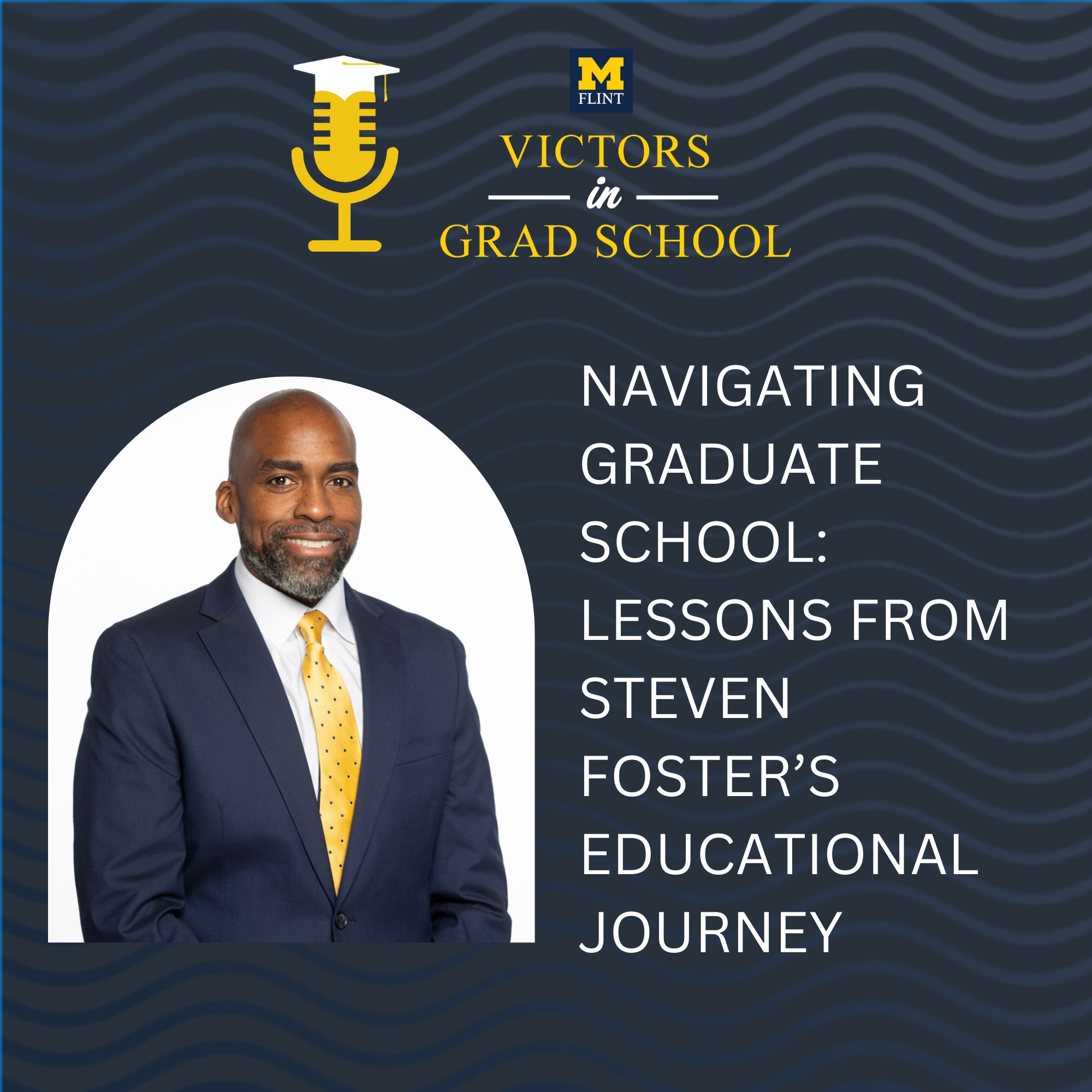 Navigating Graduate School: Lessons from Steven Foster's Educational Journey | Are you considering taking the next big step in your educational journey? Whether you're just starting to think about graduate school or already knee-deep in your studies, the latest episode of "Victors in Grad School" is packed with insights you won't want to miss. In this episode, Dr. Christopher Lewis sits down with Steven Foster, Director of Financial Aid at the University of Michigan Flint, to discuss what it truly takes to thrive in graduate school. Their lively conversation weaves through Steven's personal journey—from earning his bachelor's in English Language and Literature, jumping straight into the workforce, and then making the pivotal decision to return for his master's in Educational Leadership at Wayne State University. One major theme is the importance of having a clear motivation for pursuing graduate studies. As Steven Foster shares, his return to school was sparked by an early realization that additional credentials would be crucial for career advancement and personal growth. This combination of upward and social mobility, practical experience, and a passion for educational outreach shaped his path and success (02:16). Discipline, curiosity, and organization are highlighted as the bedrock skills for anyone navigating graduate school. Steven Foster emphasizes that being disciplined and staying organized are essential, especially when juggling work and academic responsibilities (06:45). He notes, "Being disciplined, being curious, being open… those skill sets are extremely important in your journey." Another key takeaway is the role of community and support systems. Graduate school can be overwhelming, and imposter syndrome is a common stumbling block. Steven Foster candidly discusses how self-awareness, open communication, and fostering connections with peers and mentors can provide the reassurance and encouragement needed to push through challenging moments (10:30). Listeners will find practical advice throughout, from evaluating graduate programs and career prospects to leveraging faculty relationships and embracing opportunities for professional and personal development. Steven Foster encourages prospective students to research institutions thoroughly and think beyond just degree requirements—consider how the experience can open doors to consulting, teaching, volunteering, and more (17:03). If you're seeking inspiration, reassurance, or actionable tips for your graduate school journey, this episode is for you. Tune in and let Steven Foster and Dr. Christopher Lewis guide you through the path to graduate school success—because your journey is uniquely yours, and with the right tools and mindset, you can be victorious too! Click here to listen and start your journey to grad school success today! TRANSCRIPT Dr. Christopher Lewis [00:00:01]: Welcome to Victors in Grad School, where we have conversations with students, alumni, and experts about what it takes to find success in graduate school. Dr. Christopher Lewis [00:00:11]: Welcome back to Victors in Grad School. I'm your host, Dr. Christopher Lewis, Director of Graduate Programs at the University of Michigan Flint. Really excited to have you back again this week. As always, we are on a journey together, and I call it a journey because it truly is a journey. You are on a unique journey, something that you are going to be going through, whether you're at the very beginning and just starting to think about graduate school, or maybe you've applied, maybe, maybe you've been accepted. You could be in any of these places, you could even be in graduate school. But throughout all of this, you are on a journey. Dr. Christopher Lewis [00:00:44]: And through this journey, there are things that you can do to be able to help you to be successful along the way. And that's why this show exists. Every week I love being able to bring you different pieces of advice, different thoughts, different perspectives, and also different people that have gone before you to be able to give you some perspectives on their own experience going through graduate school. This week we got another great guest. Stephen Foster is with us, and Stephen is the Director of Financial Aid at the University of Michigan Flint. And I'm really excited to be able to have him here to tell you about his own experiences going through graduate school. And to welcome him to the show. Stephen, thanks so much for being here. Steven Foster [00:01:24]: Thank you, Kris, for having me. Dr. Christopher Lewis [00:01:25]: I am really excited to be able to have you. And one of the first things that I love doing is turning the clock back in time, and I want to go back a little ways because I know you did your undergraduate work, and after you went through that experience and got that Bachelor of Arts in English Language and Literature, you went off and got a job. You went off and worked, and you jumped into the world of financial aid. Steven Foster [00:01:49]: I did. Dr. Christopher Lewis [00:01:50]: And you never looked back. But one of One of the things that I want to do is ask you about this point in time, because there was a point in time that you were working, you're out there, but at some point you had this inkling that you needed to go back. You wanted to continue. You had to scratch that itch for going back and getting more education. And I guess bring me back to that point and what made you decide that that was the right time, the right place? Steven Foster [00:02:16]: You know, thank you, Kris, and I'm excited to be here just to share some of my experiences. And I did receive my undergrad from University of Michigan, graduated with my master's in educational leadership from Wayne State University. And what really inspired the additional need for education is I knew that at one point in my career I was going to need it for that upward mobility, that social mobility, and having the credential, right, makes it a little bit easier, right, to give you the practical hands-on experience, to give you the theoretical aspect side, educational leadership research, to give you the technical pieces that you need to be a, a successful administrator and leader. So I knew that early on in my career because I actually started my graduate program and my graduate work about 2 to 3 semesters out from my undergrad after graduating. So I knew, I just knew early on that, hey, I need this credential, I'm going to need this credential along the way to help me to advance. And so I went to work during the day, and as soon as I was done at work during the day, I would go right into classes in the evening. And I guess early on it helped me because I still had some level of discipline as a student from my undergraduate experience. So I think that helped me a little bit along. Steven Foster [00:03:49]: The way in order to help me to, to push through to my master's to completion. Dr. Christopher Lewis [00:03:54]: Now, I know you did your master's degree at Wayne State University and you got a Master of Education in Educational Leadership and Administration, and there are a lot of programs that are in the Master of Ed space and you chose Wayne State. So bring me back to that point. And when you were thinking about looking at, you know, pers— all the different prospective universities, what made you decide on Wayne State University? What made it stand out? And talk to me about that process for yourself. Steven Foster [00:04:23]: Yes. So I was looking at several programs and I really wanted to go into education. I wanted to go back in— I wanted to go in a K-12 setting. So I actually was looking at master's for teacher certification programs and I was looking at the University of Michigan. I also was looking at the University of North Carolina Chapel Hill. I looked at Michigan State University and ultimately landed at Wayne State University for actually selfish reasons. It was a tremendous benefit called, uh, educational benefit, and it kind of altered my plans from, uh, going into the classroom and really finding my passion in the higher education side of, of education where I could affect change, where I could help students— be that bridge and bridge that gap to students to promote higher education and to promote education from a different lens, um, besides going into the classroom. So that's what kind of detoured me. Steven Foster [00:05:29]: It was actually the benefit of getting my degree paid for, but also I really got a passion for educating students how to think about college affordability, how to think about college finance, and how to plan for college, how to be successful in college and looking at higher ed. From the outreach side of things and being a bridge and being a spokesperson about the many benefits of receiving a higher education degree can bring to students and their families. Dr. Christopher Lewis [00:06:02]: Now, going from undergrad to grad, you said that it had been a few terms out from when you graduated to when you started. And when you go into a graduate program, there definitely is a transition because it's a different way of being taught, a different— level of expectations by faculty members and a different level of expectation on yourself for what you're trying to achieve. So talk to me about those transitions. And as you transitioned into graduate school and through graduate school, what did you have to do to be able to set yourself up for success? And what did you add to— have to do to be able to maintain that success throughout the graduate school journey? Steven Foster [00:06:45]: The biggest thing, or the number one thing that comes to my mind, is being disciplined. Being disciplined, being curious, being, being open. Because when you go undergrad or grad, I think grad is, uh, of course, higher thought processes. It's a lot of reading, it's a lot of theory, it's a lot of hands-on practice. So a combination of all of that, but being disciplined and organized. Those skill sets are extremely important in in your journey, definitely if you're transitioning back into the grad space after you've been out of school a number of years, staying on top of your assignments, staying on top of your reading, asking questions. You know the saying, there's no such thing as a dumb question, right? But having that intellectual curiosity that there are many different paths to ultimately get to where you want to be, but how you actually perceive the world of, of grad school, whatever your discipline is of study. It could be health sciences or education, social work or business, that there is some level of curiosity and exploration in coming to find out where are you the master at? What is your subject matter expertise? What are those things that interest you to where you say, I'm going to be the subject matter expert in this? It just opens your doors for possibilities to so many things. Dr. Christopher Lewis [00:08:12]: You know, as you talk about that, you know, you're working on a master's degree and there's some internal thought that when you are being admitted into a master's program, you are becoming a master of something, which is sometimes a little dodging when you think about it to be called, eh, I'm the master of nothing. I'm a master of none. I guess when you went into that master's degree and as you're going through this coursework and you're seeing yourself in a different way, talk to me about that transition for yourself as an individual and as a professional and how that graduate degree helped you to either refine or redefine who you were at the time and who you were becoming? Steven Foster [00:08:53]: I think for me, and that— I think that's an excellent question. I think that it actually allowed me to refine, but not only refine, it's so many aspects to a master's degree and to graduate education that depending on what class you are taking or depending on what season you are in, in your life and how it benefits you in that moment. So for me, because I was so early on in my career, it allowed me to kind of shape how I wanted to be perceived as a professional. It kind of shaped my modus operandi in order to be an asset and be beneficial to all of the families that I serve and, you know, faculty working with different constituencies in higher education, working— how do you have conversations with Congress versus your faculty? And, you know, dealing with some of the nuances of how do you handle a sensitive student case to a parent that just wants basic information. So it gives you a breadth and a depth in order for you how to be successful, right? And how to apply the knowledge that you acquire. Dr. Christopher Lewis [00:10:00]: Now, every individual, as they're thinking about graduate school, as they're going through graduate school, ends up hitting a point in time where whether it's you're seeing yourself as a master of something or you are just going through that first course where you feel that imposter syndrome and you go through this process of questioning, "Should I be here? Am I good enough?" All of those different thoughts that go through your head. Talk to me about how imposter syndrome impacted you and what you had to do to get through it. Steven Foster [00:10:30]: At points in all of our careers in education, as, as we're matriculating into degree programs, you know, on our jobs and our careers, maybe even in our households, there is always a bit of self-doubt in us. I could have handled that situation better, or how could I have accomplished that in a different manner? So I think that we have imposter syndrome across everything that we do, whether it's a volunteer experience, professional experience, personal experience. But for me, how I really overcame it was through self-awareness. But not also self-awareness, it's really also grasping on to like individuals. So a lot of times you're in classes with the same people. A lot of programs are cohort-based. My program was not necessarily cohort-based, but really having those conversations and building support systems to help you through. Sometimes you have to talk stuff through with a gamut of people. Steven Foster [00:11:33]: That could be your classmate, it could be your spouse, it could be your therapist, it could be your faculty your lead, or, you know, your advisor, or those things. So it's those people that help you along the way to be successful, but to also ground you and reel you back in when you need that reassurance. So my word of advice to people is don't be afraid to talk about the challenges that you are having. If you're in a grad program, or if you're in that space that you feel that imposter syndrome, you probably need to get it out, to express yourself, to make you feel a little bit and tackle it head on so that you don't continue to— some people, you know, beat, beat themselves up, not literally, but from that perspective. But talk to someone because someone else is also in your same shoes. And that's what I did. Latched on to some of my classmates, made sure, you know, we had regular conversations, you know, healthy debate about the work, about the assignments, about, you know, some of the challenges that we were experiencing in order to be successful. And, uh, one of the things is I was also— I was somewhat younger than some of my classmates at the time. Steven Foster [00:12:45]: I'm a little bit older now, but that wasn't the case when I started my master's program. I was in a class with professionals who had been working 20, 30 years at that point, and they were just starting to come back for their credential, right, for their upward mobility. And here I am, this young, spry kid coming in on the scene, and I'm in these rooms with people people who have double and triple the experience that I have, what am— how can I ever bring the value and knowledge of the experiences that, that they have? So it is a— it can be an overwhelming process, but you just have to get in where you fit in is the perfect way for me to put it. You don't have to try to over, um, outdo or outshine. Based on the little experience that I had, I still was able to contribute to the conversation in a meaningful and way. Dr. Christopher Lewis [00:13:40]: Now, as you think back to the beginning, before you even started graduate school, I'm sure you had some conversations with friends, with colleagues, with others that could give you their own perspectives. And if you think back to that very beginning, what's something that you wish that someone had told you, or that you had known prior to starting graduate school that would have helped you to make that transition even better? Steven Foster [00:14:02]: I really do believe that it was just a little bit different for me because I was passionate about education. I was getting— I had hands-on work experience. I was, I was still working and going to school. So it wasn't like I wasn't working and only going to school or went straight through. I was able to apply what I was learning in my actual day-to-day. That made my experience even more successful or more better for me as I was talking to professors and things of that nature. Definitely at the University of Michigan Ann Arbor at the time, you know, and advisors and things of that nature, their thought process was learning experience is, it's an ongoing process, right? That curiosity for exploration and for learning is important. So they, they stress the importance of, if this is the path you want to take, you have to do this, or you have to do that. Steven Foster [00:14:55]: So they were actually my biggest cheerleaders in making sure that I was successful in my on-ramp to my grad program. Dr. Christopher Lewis [00:15:02]: Well, it's always good to have those mentors and those people that help you to maneuver into figure things out along the way. And you also build relationships with faculty along the way as well. Talk to me about those relationships that you were able to build with faculty or with peers inside of your program. And how was that impactful in the experience that you went through? Steven Foster [00:15:26]: My relationship with my faculty advisor was, was tremendous because I was able to meet with them on a regular basis and have thoughtful conversation about what is it that I can do with this credential, what What paths make sense for me from a career perspective? What are the different things that I can do outside of my career? You know, what, what does it mean to go in consulting? I always think that ultimately I wanted to go and be a professor. I have started a PhD a while ago and opportunity came along and I put that on pause, but it's always the, the opportunity for them to share their experiences and based on the skills assets that you have, them to kind of guide you through some of those things. And that's what I'll always appreciate about definitely some of the faculty that I have connected with on a basis as a student, that they are always trying to get the best out of you, whatever that is for you as an individual. It's not, you know, they're not selling anything, they're not selling you any fairy dust and unicorns or anything like that, but they're trying to get the best out of their students. And that was the experience that I had. Dr. Christopher Lewis [00:16:42]: And I guess finally, as you look back on your own experience, you were successful in the journey that you went through. And as you think back, I guess, to the entire experience and you look at where you are today and you think about people that are thinking about going to graduate school for themselves, what are some tips that you might offer others considering graduate education that would help them find success sooner? Steven Foster [00:17:03]: Some tips is research your institutions. Research your programs, look at the viable career paths that you want to go into, and look at the plan B or look at the— what's the side hustle that I can do from this degree that will produce additional streams of revenue, additional income based on the degree that you do have? Opportunities for consulting, opportunities for part-time or work from home opportunities from whatever the deal degree program is because for me, graduate education, it opens the door even more to more possibilities than your bachelor's degree a lot of times. And that upward mobility and that social mobility is very important for our students that we serve. So you want to make sure that this is something that you're truly passionate about, but that it opens other doors and opportunities for you to get the best well-rounded experiences that you need in order to be successful, maybe in your main career. But there are also branches that shoot off from that main career— speaking engagement, teaching opportunities, professorships, consulting opportunities, volunteer opportunities on boards and different things of that nature in order to help nonprofits and stuff grow depending on whatever your discipline is. So you're volunteer, you're professional. Experience, your community experience, all of that makes you a well-rounded person. And it gives us a personal ethos for us to be change agents in that you are in the world to shed your light and shed your experience in whatever direction that is and works best for you. Dr. Christopher Lewis [00:18:45]: Well, Stephen, I just want to say thank you. Thank you for sharing your journey today. And, you know, I'm going to continue to encourage you now that I know that you started a PhD to keep going. I'm looking— not to stop out, but always keep going, always keep pursuing, and don't, and don't give up. Steven Foster [00:19:01]: Absolutely. Dr. Christopher Lewis [00:19:02]: So that being said, I thank you for your time today, and I wish you all the best. Steven Foster [00:19:06]: Thank you, Dr. Lewis. I appreciate you. Dr. Christopher Lewis [00:19:08]: The University of Michigan Flint has a full array of master's and doctorate programs if you are interested in continuing your education. Whether you're looking for in-person or online learning options, the University of Michigan Flint has programs that will meet your needs. For more information on any of our graduate programs, visit umflint.edu/graduateprograms to find out more. Thanks again for spending time with me as you prepare to be a victor in grad school. I look forward to speaking with you again soon as we embark together on your graduate school journey. If you have any questions or want to reach out, email me at flintgradoffice@umflint.edu. | — | ||||||
| 3/9/26 |  Overcoming Obstacles: Lessons in Resilience from John Ambrose | Are you thinking about going to graduate school, or already on the journey and searching for motivation? The latest episode of Victors in Grad School offers both inspiration and practical advice. Host Dr. Christopher Lewis sits down with John Ambrose, Vice Chancellor for Enrollment Management at the University of Michigan Flint. Through vulnerability and candor, John Ambrose unpacks his non-linear path to academic and professional achievement, and why graduate school was transformative for him. A recurring theme throughout the episode is resilience. As a first-generation student, John Ambrose openly discusses the difficulty of navigating higher education "without the right mentoring and information," sharing a raw moment of feeling "trapped" after changing majors and needing additional years to finish his undergraduate degree (02:23). Despite setbacks and personal loss, including the passing of his father during his freshman year, John Ambrose pressed on, motivated to create meaning and success for himself. The transition into graduate school wasn't easy. John Ambrose recounts taking a pay cut to accept a job that would fund his master's, balancing the demands of work, school, and family – at times, facing weekends packed with study and few breaks (09:41, 22:36). For anyone hesitating to return to school later in life, his advice is honest: "It's not that you can't do it, but what are the adjustments that I need to make?... What is this going to mean for your family?" (21:13). Preparation and honest communication with one's support network are crucial. Another highlight is John Ambrose's perspective change from undergraduate to graduate studies. He describes the graduate experience as "fun," especially the value of discussion-based learning and the satisfaction of intellectual exchange (10:18). He notes that beyond credentials, graduate school is about personal development and acquiring soft skills—listening, confidence, grit, and the ability to articulate your experiences. "[Graduate school] is an opportunity to develop yourself and to provide opportunities for you to become a different type of version of yourself," he reflects (24:29). This episode isn't just for prospective students—it's for anyone seeking to find meaning in growth, overcome setbacks, and make purposeful choices about the next stage in life. Tune in to hear an inspiring journey that proves success isn't always linear—and graduate school can be about so much more than a degree. Listen to the full episode and let John Ambrose's journey empower your own. TRANSCRIPT John Ambrose [00:00:01]: Welcome to Victors in Grad School, where we have conversations with students, alumni, and experts about what it takes to find success in graduate school. Dr. Christopher Lewis [00:00:11]: Welcome back to Victors in Grad School. I'm your host, Dr. Christopher Lewis, Director of Graduate Programs at the University of Michigan Flint. Really excited to have you back again this week. And as always, every week, we're on a journey together. I say it every week, but it is so true that the— that what you're doing right now as you are preparing to think about— either think about graduate school, apply to graduate school, go through graduate school— it is a journey. And that journey might take you a year to get into graduate school, it might take you 2 years, 3 years, who knows. No matter where you are on this path, there are things that you can do right now to help you to be successful ultimately in the journey that you're on. Dr. Christopher Lewis [00:00:50]: And that's why this show exists. This show exists to help you to find some tools for your toolbox to help you to be able to to find success sooner. We do that many times through opportunities for you to meet others that have gone before you, that have gone to graduate school, have been successful in graduate school, and they can share that experience with you. And today we've got another great guest with us. I'm really excited to be able to have John Ambrose with us. And John is the new Vice Chancellor for Enrollment Management at the University of Michigan Flint. And I'm really excited to have him here to be able to share with you his journey in going through graduate school and how that's led him to here at University of Michigan Flint. John, thanks so much for being here today. John Ambrose [00:01:33]: Dr. Lewis, thank you for having me. Dr. Christopher Lewis [00:01:35]: It is my pleasure. Really excited to have you here today. And I am going to start this interview with an opportunity to go back in time. I know you did your undergraduate work at Western Michigan University and then— yes, go Broncos! We both have that connection that we're both Broncos and I guess I wanna go back in time to that point when you were at Western, and then after Western, you went off, you worked for a while, and at some point, some point in that work experience, you made a choice, you made a decision that you were going to continue your education and continue your education in a completely different area than what you did as an undergraduate student. So bring me back to that point when you were having that inkling in your mind, and what made you decide that that was the right time —to go to graduate school? John Ambrose [00:02:23]: Oh, man. Uh, days in Kalamazoo were an amazing time for me. That was an opportunity where I like to say I, I was reared in Detroit, but I was trained in Kalamazoo. In terms of adulting, as the young people use, uh, that term today, it took me 6 and a half years to get my 4-year degree from Western Michigan, mostly because I changed my major, but I only changed it once. And I was required to almost go back from square one. Uh, very few of the credits that I had earned prior to were allowed in my new major. And so it, it was a difficult decision, but as a first-generation student, then you're doing your best to negotiate and navigate, and all the information you're getting is not necessarily accurate. So I just found myself having to make an adult decision in the moment. John Ambrose [00:03:14]: So I remember very vividly going out and sitting on the curb and crying. And I got myself together after I cried about it. And it was, you know, it was almost like I felt like a sit— like I had just been sentenced to 4 more years of jail. And not that I hated it, but it just— I felt trapped, to be honest, if I'm being honest about the emotions that I felt. But I was like, okay, you're— this is it. I mean, this is what I have to do. And I had gotten myself into that position primarily because a little bit of it was academics, A lot of it was just the lack of mentoring that I had and the lack of sharing and feeling like I was the only one. But those are the types of things that first-generation students will face at moments in their educational journey. John Ambrose [00:03:58]: But stood up, dropped my face off, went to the bathroom, washed it, and came back and signed up and said, okay, let's do it. So I did my 4 years, and at that point I thought, I'm never coming back to college again. But I was so focused on my career that when I got ready to graduate, I don't already done in, in excess of 12 different internships all over the place, trying to really find myself. Everything from internships within my major to legal and social work and outside, you name just, you know, I did just about any job there was to do on the campus and worked in all the buildings, I think, except two by the time I graduated. But it was an opportunity, like I said, to really mature and grow. And eventually I did gain mentors across the campus. And so But it was just a different type of experience and one that I cherished really very dearly and hold close to my heart because I lost my dad my first semester freshman year. And he was a bit of my muse for going to college. John Ambrose [00:05:01]: So when he passed away, I really wasn't sure because I'd never done anything for myself. Uh, everything I did was to please him and to make him happy. And, you know, you, you wanted to get that stamp of approval from your dad or— and your mom. But my dad was larger than life in my eyes at that time. And also it was, it was a bit of learning, learning to want things for myself. So fast forward, I graduate, I work in the printing industry for a few years, actually more than a few, but I changed companies probably about 3 times and each one, uh, more progressively until the last one that was a bit more entrepreneurial. Found myself leaving there after the smaller mom-and-pop shop with the entrepreneurship piece and I started selling life insurance. And I got a call one day to find out if I was interested in joining Marygrove College. John Ambrose [00:05:49]: And so the decision was, after they made me an offer, that I would go and earn my master's degree in education. And so when I got to the point of— I think it was, you got to do 6 months. So after my 6-month probation period in the, the start of the career, I started the program. And so I had my master's degree in education. And the Sister Servants of the Immaculate Heart of Mary there who ran Marygrove College— and I knew very little about the college when I, I started to work there. But that was the primary reason for going. So I got this wonderful lesson about the history of Detroit, but it was also my first foray into Catholic school education and kind of the mission of the Catholic Church as well as that particular sect for these— by the Sister Servants of the Immaculate Heart of Mary. And I mean, they were a gritty group of sisters and they did not take any, any stuff from any man or any woman for that matter. John Ambrose [00:06:47]: And I mean, just the history of being the— in Detroit and how they became— went from being all-female to co-ed in the '60s. So it was quite the journey. And later to find out that my older sister had actually gotten her degree from there. And then, so there was a lot of connective tissue, but just things I had never really paid attention to. But it was a— and still is today— a beautiful campus. They just don't do college degrees anymore, undergraduate or master's. They are now a K-12 school, actually supported by the University of Michigan Ann Arbor and used— being used as a teaching lab for K-12 education and a part of the Detroit Public School System, community school district system. So they are continuing to educate and provide opportunities and access for Detroiters to education. John Ambrose [00:07:35]: But that's kind of a, a short brief about how I got from my bachelor's degree to my master's degree. Dr. Christopher Lewis [00:07:41]: So talk to me a little bit about going as a first-generation college student, as an undergraduate student. When you go to— when you go to graduate school, you're still a first-generation college student. It's a little bit different. There's different expectations, there's different thoughts and ways in which you have to, have to pivot to be successful in that journey itself, different than what it was in undergrad. And you had gone from undergrad to work and then now transitioning back into school. So talk to me about that transition for yourself. And as you transitioned into graduate school and through graduate school, you were successful, but what did you have to do to set yourself up for success as you transitioned into graduate school? And what did you have to do to maintain that success throughout the entire graduate school experience? John Ambrose [00:08:27]: As I mentioned, I, I did 6.5, so part of the reason, or even the change in the major, had a lot to do with my GPA in undergrad. So I'd gotten myself into trouble, got myself out of trouble while I was there, but my GPA didn't rise to the level of being regularly admitted to graduate school. So when I got there and I ended up on probation my first year, but was quickly taken off of probation after my first semester. So I ended up graduating with a, I think a 3.98 or 5 or something like that with my graduate degree from Marygrove. The process was interesting, Chris, because I, I mean, let's just keeping it honest. I was making less working for Marygrove than I did when I left college. As a newly minted graduate, college graduate, I made more out of college than I was making when I went there, but they were paying for my degree. So it became one of those investment moments, and I was married, and now I have a mortgage, and I've got car notes, and I've got all these bills, and there's not enough money coming in the door for doing the work. John Ambrose [00:09:41]: So it was a tough decision, but my wife said, "Hey, we'll make the sacrifice for 2 years for you to do this if this is what you want to do." So we had one of the two kids at that at that time, and then the second child came during the process of working on my master's degree. But a little bit like I hear some of my friends say about having grandchildren, they said, "If we knew grandchildren would be this much fun, I would have had them first and then done the kids second." And so I would tell you, for me, with a master's degree, if, if I had known that a master's degree was going to be that much fun, I would have done it first rather than doing the bachelor's degree. I'd never really taken discussion-based coursework, and so being in a setting where I allowed to converse and talk about my opinions and my thoughts about how I felt about certain educational aspects and thinking about the history of my K-12 or K-16 journey, it really opened my eyes to the ability and how learning could be different. And so I took my classes on the weekend. They weren't during the week, so they didn't interfere with my 9 to 5. I was given some time off to do my, my studies and homework during the work week. So I was given, I think, 5 hours a week so that I had opportunity to, to work on my studies. But I had as much on my plate during graduate school and maybe more in terms of the pressure. John Ambrose [00:11:06]: But the ability to focus and have support was interesting from my— when I think about the juxtaposition between my undergraduate years and my graduate years of what was on my plate. I had a lot of part-time jobs in undergraduate, and my mom would often tell me my priorities were a little askew and it— It would just grab me by my nerves because I didn't fully understand or contemplate what she was really saying. So it wasn't until later when I was working on my master's that I began to understand what she was saying. It wasn't that I had too much on my plate. It was what I was prioritizing about what was on my plate that made all the difference in the world. And so going back to get my master's degree, I didn't have a goal for— at the time for what it was going to mean. What I had come to understand, and I had learned this in undergraduate, it really doesn't matter to the degree that you hold. What matters is that you find a place in working— in working America where people— where you fit, whatever the work is. John Ambrose [00:12:10]: Um, but having a degree says a lot about who you are, and mostly that's why it exists as a caveat for, "This is the reason that we will hire you." Now, of course, there are disciplines, uh, being a doctor or, you know, a nurse or other things where you've got to have the background and understanding about those things, but there are a lot of things in in jobs and careers that exist, that it helps if you have a degree, but it doesn't matter that you have the very specific degree. And I think it's one of the myths that exists in a lot of people's mindsets about what education is and what it can do for you. But for me, it has opened a, a large variety of doors and opportunities. So when I got ready, I didn't know at the time when I took the job that I was going to— once I got my master's degree, that I was going to transition into higher ed. My intention was to go back to selling life insurance and move up in, in that particular industry. But I knew having an advanced degree of any type was going to be able to help me. And the reason I did the master's in ed with a focus on adult learning was I knew I wanted to manage adults. And so I've always felt that if you can teach, you can lead. John Ambrose [00:13:22]: So understanding education and how it fit into the ethos of the work world. But that's the biggest thing, Ian, sis, no matter what your degree is in, can you articulate how those specific, uh, tenets actually connect to the career that you're focused on or the new thing that you want to do? Can you make the correlation so that when you're interviewing, you have the ability to help the search committee understand how you view that connection? And I've been very successful in being able to do that over the years of taking the full complement of all of the things that I've done and bring those to bear in the places that I've gone. Dr. Christopher Lewis [00:14:02]: Now, as you said, you got a degree with the focus on adult learning, and you said you wanted to work with adults. And over the years, you stayed in higher education and working— you do work with adults, but you also work with many younger individuals as they were transitioning in and through their undergraduate experience. So as you look back and you think about the degree that you received and, and how that has helped you through your experience. If you think back now, would you change— would you choose the same program or path, and why or why not? John Ambrose [00:14:36]: I think I choose the same path in the program. I see the young people as high school seniors or juniors as young adults, and I won't get into the debates about where they are and, and, you know, the development of their frontal cortex and all of that stuff, but their experience and exposure to more adult items has far surpassed the kinds of things that I was exposed to at their age. And so in a lot of ways socially, they're ready to have conversations that they're not really fully developed to have. And so they still struggle a bit, I think, in terms of understanding, but they appreciate being able to wrestle with it themselves if you give them the opportunity to do it. But I wouldn't change any of it. I, I love the path, uh, and how I found higher education. I think it gives me a unique story. And I find the— I mean, I knew I loved higher ed when I got to college, and there were plenty of days that I wanted to quit during my undergraduate, but there was far too much— many other positive things going on. John Ambrose [00:15:39]: And once I got connected to the right mentors, they started to help me see life and navigate life differently. It wasn't that we were talking about my discipline or they were trying to help me understand my career. Options better, but they were helping me navigate life in a way that I, you know, had my father been around, I would've been looking for him, I think, to help me with the navigation for that. So I just came to experience and see higher ed very differently because of that. And it helped me to understand that we're not doing a great job of helping Americans understand what education really is. It's not a transactional effort that leads to these things. It is an opportunity for you to understand that there are greater layers and depths to us as individuals. When you think about— you get up every day in the morning and most of us have a mirror in the bathroom, but very few of us have a mirror that shows us the complete picture of who you are, 360 degrees. John Ambrose [00:16:48]: So even if you have a dressing mirror, you know, maybe you're just checking to make sure if you're that meticulous about your outfit. But again, most people don't. So you kind of get dressed, you check the front, and you go about your merry way. Education gives you an opportunity to think about the full 360-degree and gives you the confidence that you don't have to check the back if the front looks good. But oftentimes we get so consumed in other parts of what we think it is. So we think by having all of those additional mirrors, it's— it's display of vanity or of pride. And not everybody needs to know what I look like from behind and all of those types of things. But it's not about that. John Ambrose [00:17:30]: It really is about you and how you connect with other people and how you want to be seen by other people. And what do you really want to do? Most of us want to help other people, but we have no idea how to— especially once we become adults, we have no idea how to get out of our own way. And then we start thinking about, well, it's going to take me another 8 years. Well, if the good Lord lets you live another 8 years, what are you going to do with the 8 years? Are you going to continue to suffer through where you are, or are you going to decide and make a decision today? I'm going to invest this next 8 years or this next 3 years so that the last 5 years or the next 5 years beyond that can be more in line with what I really want to do, so that you don't have any regrets. But that's what it's about. So even when I talk with young people today about getting their undergraduate degree, it's not about what do you want to do for the rest of your life, it's what do you think you to do for the first 3 years after college, because they're going to change and they're going to have way more jobs than we ever did. Dr. Christopher Lewis [00:18:30]: Now, I guess as you think about the experience that you went through as a graduate student, everybody learns something. You're— you've got your soft skill or your hard skills and your soft skills that you're learning as you go through that experience. What would you say are the specific skills that you felt that you developed most in graduate school? John Ambrose [00:18:49]: Listening. Was probably the biggest one. I also developed my writing skills and became a better writer. But the listening was not just listening to others. It was listening to myself talk. And I talked about confidence a moment ago. I developed a new type of confidence, but I also developed a new ear. And I realized that I liked learning because sometimes you get to, to a certain point in your adult life and everything you've learned up to that point, you figure you've got it figured out. John Ambrose [00:19:18]: And then you have all these little small moments where things get added to that learning. But you don't acknowledge those. And that's the listening part that helped me out along the way because, you know, I, I stubbed my toe, I'd done okay, I was still continuing to do okay. And I felt like this was really, you know, it, but, but I had not made the decision, as I said, consciously that I was going to stay in higher ed. And so as I began to listen to the things that were happening around me, I knew, but I knew that I was going to stay in higher ed. It before I actually started my graduate level courses. So I knew that having a master's degree was going to do more for me in higher education than it was going to do for me in corporate America. So it's not that it wasn't going to help me, but I knew having this Master of Education, having made the decision to stay in higher education before I started my coursework and being admitted, was going to matter. John Ambrose [00:20:12]: So I learned those things about myself. I learned that I have more grit than I thought I did. I was prepared to make some sacrifices, but I had no idea the full level of sacrifices I was going to have to make as a dad, as a husband, as a, as an employee. I had to address a lot of things going through the process. I had to deal with the shame from my past, you know, not doing well academically in my undergraduate. I had to relive that, but I had to own it, and I had to— I wasn't prepared to own it. I, I mean, I did it in the, in the moment, and I knew what it was, but I just thought they were going to admit me or deny me. I didn't know probation was an option. Dr. Christopher Lewis [00:20:49]: I really appreciate you sharing that, and I Jazz, going back to when you first started your graduate program, what's one thing that you wish that someone would have told you about graduate school before you had started? John Ambrose [00:21:02]: I wish they would have talked to me more about the format of the classes and gotten me more excited about, like I said, discussion-based classes and the format. It might have helped me do a search or, or consider things differently. I think it would have also helped to even talk about, from an onboarding standpoint, It's great to give me all of the software applications that I'm going to need, and you're going to need a laptop, and you're going to need all these things, but it would have been helpful, I think, to really talk about the sacrifices that your family's going to have to make, that I'm going to have to make. Depending on the kind of reader you are— and when I say kind of reader, I mean at what speed do you read? You know, I didn't really learn to skim read until my senior year in college, but the kind of reader I needed to be for graduate-level work was completely different. So I think there are some nuance pieces there, especially for folks who are— who might have a degree, may have been out of undergraduate for quite a while, and are thinking now they want to get back into it. You know, what does it really take? It's not that you can't do it, but what are the adjustments that I need to make? What are some things that I can do to prepare, to get ready? So I, I think there's a different kind of preparation or preparatory stages that we can help adults prepare themselves to get mentally ready for what it looks like and to even talk about what is this going to mean for your family? What are the kind of things that you need to negotiate with them? Like, my wife telling me she was going to support me, man, that's wonderful, and it, it means a lot, but she didn't have any idea about the kinds of sacrifices she was gonna need to make. I'm pretty sure she thought, oh, you know, it was like— but every weekend for 2 years, I was absorbed either in work or in school, so there was no, hey, let's go to the movies, or can we take the baby to the zoo, or can we go to the park or do something like that. So I very, very, very few days off from being a student. John Ambrose [00:22:59]: And that 5 hours a week, while it was great to get from the employer, it wasn't enough. You need a lot more than that. So on the weekends when I wasn't in class, I spent a lot of time working study groups. So working with my peers and being there. But when you finish— and it's 2 years, it's not forever— and that's the commitment. So that part I was clear about. All of the work in between, the mental adjustments, then the micro adjustments, So the macro, you can kind of figure out. It's the micro adjustments. John Ambrose [00:23:30]: What, you know, what are the kind of skill sets and things again? What are the things I could work on to be a little better at? And what does it mean? Like, have you ever had discussion-based classes? Like, we only do that now, I think, for online classes. Like, hey, have you ever had an online class? And I did my first online classes in grad school, and I had, I think, one or two. And man, that was a huge change. You realize all your academic experiences have been in the classroom.— with other people and being able to adjust and get feedback and have those moments. But when you're doing coursework online for the first time, it can be very different. There are definitely some adjustments that need to be made. Dr. Christopher Lewis [00:24:08]: You definitely do. Uh, as we finish up today, in thinking about success, as you look back at your graduate education and you think about students that are thinking about maybe going back, whether it be in education, business, medicine, whatever it may be, what are some tips that you might offer other considering graduate education that would help them find success sooner? John Ambrose [00:24:29]: Don't look at the degree as an opportunity to increase your income. Look at it as an opportunity to develop yourself and to provide opportunities for you to become a different type of version of yourself. If you're just looking to add a degree 'cause it's gonna help improve your income, I suppose that's okay. But I don't think that that's going to be enough to satisfy you, especially when things may get harder. I've got a mentee who every time professionally he hits a ceiling, if you will, and he wants to break through the glass ceiling, he finds a way to go and get another degree. So he just got a law degree from Yale. But prior to that, he's got, I think, 3 other master's degrees prior to going to get his law degree from Yale. But he kept hitting a ceiling and was like, I need more education. John Ambrose [00:25:22]: So he, he— go sacrifice, go find the right hammer to break through the ceiling, get through. Not— there are a lot of other ways to do that. I've got a different mentee and she negotiates. She didn't necessarily— she went and got her graduate degree after successfully negotiating career changes 3 or 4 times. And when I asked her, I was like, so why did you finally go get it now? She was like, I just really wanted to know more about this particular subject because she'd had enough opportunities where she was still able to navigate successfully without the information and do it, but she decided because she wanted it for herself. And that's the biggest thing I think when you think about graduate-level work is I would encourage you to want it for yourself more than, again, just looking to enhance your paychecks. Dr. Christopher Lewis [00:26:07]: Well, John, I just want to say thank you. Thank you for sharing your story with us today. I really appreciate that, and I truly wish you all the best. John Ambrose [00:26:16]: Thanks, Chris. Dr. Christopher Lewis [00:26:17]: The University of Michigan-Flint has a full array of master's and doctorate programs if you are interested in —your education. Whether you're looking for in-person or online learning options, the University of Michigan-Flint has programs that will meet your needs. For more information on any of our graduate programs, visit umflint.edu/graduateprograms to find out more. Thanks again for spending time with me as you prepare to be a victor in grad school. I look forward to speaking with you again soon as we embark together together on your graduate school journey. If you have any questions or want to reach out, email me at flintgradoffice@umflint.edu. | — | ||||||
Want analysis for the episodes below?Free for Pro Submit a request, we'll have your selected episodes analyzed within an hour. Free, at no cost to you, for Pro users. | |||||||||
| 3/2/26 |  How to Ensure Your Graduate School Application Tells a Clear Story About You (and Your Goals) | If you're applying to graduate school, you've probably heard this advice before: "Make your application stand out." And if you're like most applicants, your first thought might be: Okay… but how? Because when you look at what a graduate application requires—your personal statement, your resume, your recommendations, your writing sample, maybe even an interview—it can start to feel like a big pile of documents that don't automatically "connect." You may even be thinking: "How do I pull all of this together?" "How do I make sure I'm not just listing accomplishments?" "How do I explain my journey without oversharing?" "What if my path hasn't been perfectly linear?" Let me reassure you right from the start: A clear narrative doesn't require a perfect background. It requires intentional storytelling. And the best graduate applications don't just show that you can do graduate-level work… They show who you are, what shaped you, what matters to you, and what you want to build next. Today, I'm going to walk you through exactly how to do that. Why narrative matters in a graduate school application Admissions committees read a lot of applications. And I mean a LOT. Many applicants have: strong GPAs relevant work experience volunteer involvement leadership roles certifications awards So what makes one applicant memorable over another? Often, it's this: Clarity. A strong applicant helps the committee quickly answer three questions: Who is this person? Why graduate school—and why now? Where are they going, and how will this program help them get there? If your application clearly answers those three questions, your narrative will shine—even if you don't have the "perfect" resume. A key mindset shift: you're not just applying—you're introducing yourself Here's something I tell students all the time: Your application is not a transaction. It's a story. It's not: "Here are my documents. Please accept me." It's: "Here's who I am. Here's what I care about. Here's how I've prepared. Here's where I want to go. And here's why your program is the bridge between my present and my future." When you approach your graduate school application like a narrative, everything becomes easier to organize and write—especially your personal statement. Step 1: Find your "through line" (the story that connects everything) The biggest reason applications feel scattered is because applicants try to include everything. But you don't need to include everything. You need to include what supports your through line. A through line is a simple idea that connects your experiences like a string connecting beads. It might be: a passion (equity in education, mental health advocacy, community-based research) a professional goal (becoming a clinician, moving into leadership, transitioning careers) a lived experience that shaped your direction a problem you want to solve Ask yourself: "What's the theme that runs through my experiences?" And if you're thinking, I don't have a theme—I've done all kinds of things… That's okay. Most people have. Your through line doesn't have to be obvious at first. It often sounds like: "I've always been drawn to helping people make sense of complex systems." "I want to bridge the gap between access and opportunity." "I'm motivated by the belief that small interventions can create big outcomes." "I keep finding myself working at the intersection of people and problem-solving." Your job is to identify what has consistently pulled you forward. Step 2: Use the "Past → Present → Future" structure This is one of the simplest and strongest storytelling frameworks for graduate admissions. It works in personal statements. It works in interviews. It works in letters of intent. Here it is: Past: What shaped you? What experiences, moments, or observations sparked your interest? Present: What are you doing now? What have you learned, built, studied, or contributed that shows readiness? Future: Where are you going? What goals do you have—and how does this program help you reach them? If your application materials align with this structure, the admissions committee will feel confident recommending you. Step 3: Turn your experiences into meaning—not just a list Here's a common mistake: Applicants list experiences like they're writing a résumé in paragraph form. Example: "I completed a degree in psychology. I worked as a research assistant. I volunteered with a nonprofit. I also completed training in crisis intervention." That's not bad—but it's incomplete. What's missing? Meaning. Instead, you want to show what your experiences taught you and how they shaped your goals. Try this approach: What did I do? What did I learn? How did it shape what I want next? Example upgrade: "Through my work as a research assistant studying youth anxiety, I saw how often early intervention is limited by access and stigma. That experience pushed me toward crisis intervention training and strengthened my commitment to pursuing clinical practice focused on adolescents." See the difference? Graduate programs don't just want to know what you've done. They want to know what you've become because of it. Step 4: Be specific about your goals (without boxing yourself in) Another common challenge: applicants worry they have to have everything figured out. Let me say this clearly: You do not need to have a 10-year plan mapped out. But you do need to show that your goals are thoughtful, realistic, and connected to the program. Weak goal: "I want to advance my career and make a difference." Strong goal: "I want to develop the clinical assessment and intervention skills needed to support adolescents navigating anxiety and trauma, with the long-term goal of working in community mental health settings." Strong goal (leadership): "I want to move into higher education leadership roles focused on student success initiatives, using data-informed advising strategies to close equity gaps in persistence and completion." Specific doesn't mean rigid. Specific means you've done the work to understand your direction. Step 5: Connect your goals directly to the program you're applying to This is where applications rise or fall. Admissions committees can immediately tell the difference between: an application copied and pasted for multiple schools and an application written with intention for their program The key is to connect your story to their resources. Look at: curriculum concentrations internship/clinical placements research labs faculty expertise student organizations capstone projects community partnerships Then, write sentences like: "The emphasis on ___ aligns with my interest in ___." "I'm particularly drawn to the course ___ because it supports my goal of ___." "I'm excited by the opportunity to work with faculty whose research includes ___." This is not flattery. This is alignment. Step 6: Make sure every part of your application supports the same narrative Here's the secret that many applicants don't realize: Admissions committees aren't only reading your personal statement. They're reading your whole application to see if it tells one cohesive story. Your application should "agree" with itself: Your resume should support what you claim in your personal statement Your recommendations should reinforce your strengths and readiness Your writing sample should match your academic potential Your goals should match the program you selected You don't want contradictions like: personal statement says you want research, but resume shows no research involvement goals say "clinical practice," but nothing shows people-facing experience statement says you're passionate about X but never explains where it came from You want the committee to feel: "Yes. This makes sense. This applicant is ready." Step 7: Use a "signature sentence" to make your narrative memorable Want a simple way to stand out? Create one sentence that captures your story. Something like: "I'm pursuing graduate study to bridge mental health support and community access for youth." "My goal is to develop the leadership and data skills needed to build equitable student success systems." "I'm committed to using evidence-based practice to improve outcomes for underserved populations." Then weave that idea throughout your application materials. It becomes your anchor. Your north star. And it makes your narrative easy to remember. A quick checklist: Does your application tell a clear story? Before you submit, ask yourself: Can someone summarize my story in 2–3 sentences after reading my materials? Do my experiences clearly connect to my goals? Does my application explain why graduate school now? Did I clearly explain why this program is the right fit? Does my tone sound confident, grounded, and genuine? If yes, you're in an excellent position. One final encouragement If you're worried that your story isn't impressive enough, I want you to hear this: Graduate admissions committees aren't looking for perfect people. They're looking for: purpose readiness alignment growth potential And the clearest narrative isn't built from having the most impressive resume. It's built from knowing: who you are, what matters to you, and what you're building toward. And if you can communicate that clearly? You will stand out. TRANSCRIPT Dr. Christopher Lewis [00:00:01]: Welcome to Victors in Grad School, where we have conversations with students, alumni, and experts about what it takes to find success in graduate school. Welcome back to Victors in Grad School. I'm your host, Dr. Christopher Lewis, Director of Graduate programs at the University of Michigan, Flint. Really excited that you're back again this week. And this week is another solo episode. I'm going to talk to you about another question that has been submitted. And this week we're going to be talking about how you can ensure that your graduate school application tells a clear story about you and your goals. Dr. Christopher Lewis [00:00:36]: If you're applying to graduate school, you've probably heard this advice before. Make your application stand out. And if you're like most applicants, your first thought might be okay. But how? Anyway? Because when you look at what a graduate application requires, your personal statement, your resume, your recommendations, your writing sample, maybe even an interview, it can start to feel like a big pile of documents that don't automatically connect. May even be thinking, how do I pull all of this together? How do I make sure I'm not just listening accomplishments? How do I explain my journey without oversharing? And what if my path hasn't been perfectly linear? Well, let me reassure you right from the start, a clear narrative doesn't require a perfect background. It requires intentional storytelling. And the best graduate applications don't just show that you can do graduate level work. They show who you are, what shaped you, what matters to you, and what you want to build next. Dr. Christopher Lewis [00:01:40]: Today I'm going to walk you through exactly how to do that. So why does narrative matter in a graduate school application? Well, admission committees read a lot of applications, especially at competitive institutions. And I mean a lot of applications. Many Applicants have strong GPAs, relevant work experience, volunteer involvement, leadership roles, certifications, awards. So what makes one one applicant memorable over another? Often it's this clarity. A strong applicant helps the committee quickly answer three questions. First, who is this person? Second, why graduate school and why now? And third, where are they going and how will this program help them get there? If your application clearly answers those three questions, your narrative will shine even if you don't have the perfect resume. Now, a key mindset shift that you're probably not just applying. Dr. Christopher Lewis [00:02:36]: Here's a key mindset shift. You're not just applying. You're introducing yourself. Here's something I tell students all the time. Your application is not a transaction. It's a story. It's not, here are my documents. Please accept me. Dr. Christopher Lewis [00:02:50]: It's here's who I am. Here's what I care about. Here's how I've prepared, here's where I want to go, and here's why. Your program is the bridge between my present and my future. When you approach your graduate school application like a narrative, everything becomes easier to organize and write, especially your personal statement. So step one with this is to find your through line. It's that story that connects everything you see. The biggest reason applications feel scattered is because applicants try to include everything. Dr. Christopher Lewis [00:03:25]: But you don't need to include everything. You need to include what supports your through line. A through line is a simple idea that connects your experiences, like a string connecting beads. It might be a passion, such as equity in education, mental health advocacy, community based research, or a professional goal. Becoming a clinician, moving into leadership, transitioning careers, or a lived experience that shaped your direction or a problem that you want to solve. So ask yourself, what's a theme that runs through my experiences? And if you're thinking, I don't have a theme, I've done all kinds of things. That's okay, most people have. Your through line doesn't have to be obvious at first. Dr. Christopher Lewis [00:04:12]: It often sounds like I've always been drawn to helping people make sense of complex systems, or I want to bridge the gap across access and opportunity. Or I'm motivated by my belief that small interventions can create big outcomes. Or even I keep finding myself working at the intersection of people and problem solving. Your job is to identify what has consistently pulled you forward. The second part of this is to use the past, present, and future structure. This is one of the simplest and strongest storytelling frameworks in for graduate admissions. It works in personal statements. It works in interviews. Dr. Christopher Lewis [00:04:55]: It works in letters of intent. And here it is. So, the past. What shaped you? What experiences, moments, or observations sparked your interest? The present. What are you doing now? What have you learned, built, studied, or contributed? That shows readiness and the future. Where are you going? What goals do you have, and how does this program help you reach them? If your application materials align with this structure, the admission committee will feel confident recommending you. Third step turn your experiences into meaning and not just a list. Here's a common mistake. Dr. Christopher Lewis [00:05:33]: Applicants list experiences like they're writing a resume in paragraph form. For example, I completed a degree in psychology. I worked as a research assistant. I volunteered with a nonprofit. I also completed training in crisis intervention. It's not bad, but it's incomplete. Well, what's missing? The meaning. Instead, you want to show what your experience taught you and how that shaped your goals. Dr. Christopher Lewis [00:05:59]: So try this approach. What did I do? What did I learn and how did it shape what I want next? So using that past example that I just said to you instead, what if it reads through my work as a research assistant studying youth anxiety, I saw how early intervention is limited by access and stigma. That experience pushed me toward crisis intervention training and strengthened my commitment to pursuing clinical practice focused on adolescence. Do you see the difference? Graduate programs don't just want to know what you've done, they want to know what you've become because of it. The fourth step Be specific about your goals without boxing yourself in. Another common challenge Applicants worry. No, another common challenge that we tend to see is that applicants worry they have to have everything figured out. Let me say this clearly. Dr. Christopher Lewis [00:06:54]: Let me say this clearly. You do not need to have a 10 year plan mapped out, but you do need to show that your goals are thoughtful, realistic and connected to the program. So here's an example of a weak goal. I want to advance my career and make a difference. Now, a strong goal would be I want to develop the clinical assessment and intervention skills needed to support adolescents navigating anxiety and trauma with the long term goal of working in community mental health settings. Another example, another strong example that would that might give you some sense might be for someone that wants to do something in higher education leadership. If that's the case, you could say I want to move into higher education leadership roles focused on student success initiatives using data informed formed advising strategies to close equity gaps in persistence and completion. Specific doesn't mean rigid. Dr. Christopher Lewis [00:07:49]: Specific means you've done the work to understand your direction. Step 5 Connect your goals directly to the program you're applying to. This is where applications rise or fall. Admission committees can immediately tell the difference between an application copied and pasted for multiple schools and an application written with intention for their program. The key is to connect your story to their resources. So as you're doing that, you want to take some time to look at curriculum concentrations, internship and clinical placements, research labs, faculty expertise, student organizations, capstone projects, and community partnerships. And then write sentences like the emphasis on aligns with my interest in blank or I'm particularly drawn to the course and you add it in because it supports my goal of whatever that is. Or even I'm excited about the opportunity to work with faculty whose research includes and then you add that in as well. Dr. Christopher Lewis [00:08:51]: This is not flattery, this is alignment. Step 6 Make sure every part of your application supports the same narrative. Here's the secret that many applicants don't realize. Admission committees aren't only reading your personal statement they're reading your whole application to see if it tells one cohesive story. Your application should agree with itself. Your resume should support what you claim in your personal statement, your recommendation should reinforce your strengths and readiness, your writing samples should match your academic potential, and your goals should match the program you selected. You don't want contradictions, such as a personal statement that says that you want research, but your resume shows no research involvement or goals that say you want to be involved in clinical practice, but nothing shows people facing experiences, or a statement that says that you're passionate about this, but you never explain where that came from. You want the committee to feel yes, this makes sense and this applicant is ready. Dr. Christopher Lewis [00:09:52]: And the final step is to use a signature sentence to make your narrative memorable. If you want a simple way to stand out, create one sentence that captures your story. For example, I'm pursuing graduate study to bridge mental health support and and community access for youth. Or my goal is to develop the leadership and data skills needed to build equitable student success systems. Or even I'm committed to using evidence based practice to improve outcomes for underserved populations. Then you can weave that idea throughout your application materials. It becomes your anchor, your North Star, and it makes your narrative easy to remember. So as we finish up today, a couple of things to remember does your application tell a clear story? Before you submit your application, ask yourself these questions. Dr. Christopher Lewis [00:10:41]: Can someone summarize your story in two to three sentences after reading your materials? Does your experiences do your experiences clearly connect to your goals? Does your application explain why graduate school now? Did you clearly explain why this program is the right fit? And does your tone sound confident, grounded, and genuine? If yes, you're in an excellent position. So if you're worried that your story isn't impressive isn't impressive enough, I I want you to hear this. Graduate admission committees aren't looking for perfect people. They're looking for purpose, readiness, alignment, growth, and potential. And the clearest narrative isn't built from having the most impressive resume. It's built from knowing who you are, what matters to you, and what you're building toward. And if you can communicate that clearly, you will definitely stand out. The University of Michigan Flint has a full array of master's and doctorate programs. Dr. Christopher Lewis [00:11:39]: If you are interested in continuing your education, whether you're looking for in person or online learning options, the University of Michigan Flint has programs that will meet your needs. For more information on any of our graduate programs, visit umflint.edu/graduateprograms to find out more. Thanks again for spending time with me as you prepare to be a victor in grad school. I look forward to speaking with you again soon as we embark together on your graduate school journey. If you have any questions or want to reach out, email me at flintgradoffice@umflint.edu. | — | ||||||
| 2/23/26 |  Finding Purpose and Community: Dr. Anne Jonas on the Grad School Journey | Are you considering graduate school but not quite sure if it's the right step? Or maybe you're simply curious how others have navigated the transition from undergraduate life or the workforce into advanced study. The latest episode of "Victors in Grad School" is a must-listen for anyone embarking on or contemplating this journey. Host Dr. Christopher Lewis, Director of Graduate Programs at the University of Michigan, Flint, sits down with Dr. Anne Jonas, assistant professor in human-centered design and human-computer interactions, to unravel the twists and turns of her academic journey. Their conversation is packed with practical wisdom, honest reflections, and encouragement for prospective and current grad students alike. Key Takeaways from the Conversation One of the key themes that emerges from this episode is the importance of intentionality. Dr. Anne Jonas didn't go straight from college to graduate school. Instead, she gained valuable experience in the nonprofit sector, which helped her identify why she wanted to return for further study and what she hoped to achieve. She encourages prospective students to "really know why you're going to graduate school"—not just to continue the routine of education, but because you have a true purpose and passion to pursue. Another significant focus of the discussion is finding the right fit. Dr. Anne Jonas shares how she evaluated potential programs based on faculty interests, curriculum, and the kind of research being done. She emphasizes the value of looking for communities—both academic and personal—that will support you, reminding listeners that "no one person can provide all the support and mentorship" you'll need. The episode also tackles the challenges of transitioning back into academia, particularly the self-management and independence required at the graduate level. Dr. Anne Jonas describes how she learned to balance work, study, and life, and the critical role her supportive community played in her success. Why Listen? Whether you're worried about finances, choosing between programs, or simply need reassurance that there's no single path to grad school success, this episode offers grounded, relatable advice. It's a reminder that with intentional choices, strong support networks, and flexibility, your grad school journey can be deeply rewarding. Tune into this episode of "Victors in Grad School" for a conversation that just might help you find your own path forward. TRANSCRIPT Dr. Christopher Lewis [00:00:01]: Welcome to Victors in Grad School, where we have conversations with students, alumni, and experts about what it takes to find success in graduate school. Dr. Christopher Lewis [00:00:11]: Welcome back to Victors in Grad School. I'm your host, Dr. Christopher Lewis, Director of Graduate programs at the University of Michigan, Flint. Really excited to have you back again this week. Every week we are on a journey together. And I know I say that every week, but it really is true. The journey that you are on as a graduate student is truly that it is a journey. It is not always going to be a linear path. Dr. Christopher Lewis [00:00:32]: There are going to be sometimes some circuitous routes to get you to where you want to be and to get you to being able to meet the goals that you have set for yourself. And this podcast is here to help you on that journey every week. I love being able to introduce you to different people with different experiences that can share their own experiences in going through graduate school to help you find success sooner. This week we've got another great guest. Dr. Ann Jonas is with us today, and Ann is a faculty member here at the University of Michigan, Flint. She's an assistant professor and working in human centered design and human computer interactions. And I'm really excited to be able to learn more about her as well as more about her own experience in going through graduate school and all of this that will help you in your own journey. Dr. Christopher Lewis [00:01:26]: Anne, thanks so much for joining us today. Dr. Anne Jonas [00:01:27]: Of course. Thanks for having me. Dr. Christopher Lewis [00:01:29]: It is my pleasure having you here today. And I always start these opportunities really turning the clock back in time. And what I would love to do is I want to go back in time, back to your days at Brown University, or maybe a little bit after Brown University, because I know you did your undergraduate work at Brown University. And then at some point after going out working, doing research, you know, working at a number of different places, you made a choice, you made a decision, and there was a point in time where you said, said it's time and I'm ready to move to the next phase of my education. Bring me back to that point. And what made you decide that graduate school was the right time? What that graduate school was the. Was that it was the right time for you to go to graduate school. And that led you forward. Dr. Anne Jonas [00:02:16]: Sure. So I will say, when I was in college, I didn't really, even though I had many wonderful teachers who were graduate students, I didn't have a clear sense that graduate school was an option outside of kind of the professionalized paths of pre law, medical school, et cetera. And so I didn't really see that as something that I would do. And so I went out and worked in nonprofits for quite some time. And I think in that process I. I knew some people who went to graduate school and so I learned a little bit more about it, but I never really was ready to take that step. Early on, I think I was concerned about kind of job security and job availability and cost even. I had learned that many PhD programs and some master's programs provide funding. Dr. Anne Jonas [00:03:07]: I still wanted to make sure that it was something that was going to be financially viable choice for me. And so it was really important to me to kind of get some work experience under my belt before I went to graduate school and to really know like, why I was going to graduate school and not just kind of rely on that as like someone who'd always been at school and always done well at school. I wanted to kind of push myself to do something else and to only go to graduate school if it really, really made sense with kind of what I wanted for my future. So I was very happy in non profits for quite some time. And then I guess about four or five years after I graduated from college, I worked the Barnard center for Research on Women, Barnard College in New York. And being there, a big part of my job was bringing academics to speak at the college and organizing different events, as well as kind of facilitating communication and other kind of programming between scholars and practitioners, artists in all different sorts of fields. And so I was really at that time being exposed to all of these wonderful people doing all of these amazing things, many of whom had taken the graduate school path. And because I was working at a university, I was also lucky enough in combination with some of my prior experiences, to be able to take graduate classes at the Teachers College of New York at Columbia University, because Barnard and Teachers College and Columbia are all part of one university. Dr. Anne Jonas [00:04:37]: And so once I started doing that, then I really was like, okay, there's something really interesting to me here. I had always been interested in the Internet, particularly the social side of the Internet. I had done some classes in what we call modern culture and media when I was in college, but more from that kind of media studies humanities perspective. And take the classes at Teachers College really allowed me to get a little bit more of the social sciences perspective and really realize, okay, this is an area that I would be interested in doing research on. And that was the point where I was like, okay, I think I have a reason to go to graduate school. There's something that I would like to study. I have enough work experience that I feel comfortable that if I come out of graduate school and I'm not taking an academic path that I can continue the kind of work that I had been doing. And so that was when I kind of decided to set about looking into different programs and taking the leap of applying to graduate school. Dr. Christopher Lewis [00:05:33]: So let's continue unpacking that because you spent many years is on the east coast and I know where you ended up. You ended up out on the west coast at the University of California, Berkeley. But I guess talk to me about that. You said you started a process of trying to identify where you might want it to be and you ended up at the far other side of the country. So talk to me about that decision making process for yourself and what ultimately led you to UC Berkeley. And what was it about that that really stood out and made you decide that that was the right fit for you? Dr. Anne Jonas [00:06:06]: Yeah, I think my top priority in looking into graduate school programs were first the program, what am I going to be expected to do and is that going to align with kind of the goals that I have for what I want to research and kind of why I want to go to graduate school. And then there were some just like practical limitations. I'm very unfortunately monolingual. I don't speak another language. Many programs require that you have proficiency or fluency in another language. Similarly with like computer programming, I didn't have those skills. And so I was looking for programs that matched both the skills that I had and where I could do the kind of work that I wanted to do. And so that was important to me. Dr. Anne Jonas [00:06:46]: But I think the thing that was most important to me was looking into the faculty in different programs and saying, okay, who's doing the kind of research that I want to do in the areas that I want to do it and are they accepting new students? And then is the program in alignment? So those were kind of the big things for me is like the faculty and then the program structure. I looked all over the country and a little bit outside the country, you know, and just kind of did my research on the programs, on the people. I think I ended up applying to like eight PhD programs, something like that. I loved being in New York and love. But I didn't find a program in New York that felt like it was the right fit for me. So I didn't end up applying to any there that I can recall. So yeah, and with Berkeley in particular, I had a friend who was in that program. So I had been exposed to it and there was a scholar that I really admired, whose work I'd followed for, for a long time, who had graduated from that program. Dr. Anne Jonas [00:07:44]: And so that was familiar to me in those ways. Yeah. And I think that was kind of most of how I went about it more generally. And I was deciding between maybe we'll get to this. But for me, I applied to a mixture of programs in education departments, American Studies department, Anthropology department, and then Schools of Information, which is where I ended up, which is a more interdisciplinary program. But I was kind of looking, I knew I wanted to do some sort of more interdisciplinary research, but those were kind of the options that I was considering to take kind of a different angle on things. Dr. Christopher Lewis [00:08:20]: Let's definitely talk about that. Because when you're looking at different programs, some people might automatically assume they're all going to be in the same type of college with the same type of requirements, with the same type of curriculum. And as you said, your specific discipline definitely is not. It can be found in different areas with different expectations. So talk to me about that and what you had to really look at to figure out for yourself what was going to be that best fit for you. Dr. Anne Jonas [00:08:46]: Yeah. So I think again, I would look at program structure, so I looked at what kind of courses are required, and then I would look at like, what kind of research are students and faculty putting out, what kind of venues are they publishing in, and again, what kind of skills are required either beforehand or once you're there. And I think that that curriculum piece was really important for me. I think like, interdisciplinarity is like very attractive to a lot of people because there's just so much out there. And it's really exciting to be able to pull from different areas. But I always say like, one of the, the trade offs that you have to consider is I think in a, a disciplinary program you really are given a foundation, you know, you're disciplined into a particular subset of knowledge and kind of given a very clear framework in which you're interacting and which you're contributing to. With interdisciplinary programs and research, you're much more going to be for putting that together and figuring out like, what kind of intervention are you making, who are you speaking to, what are you building on, and how are you going to hold yourself accountable to a different research community. So I think there's kind of a trade off of like depth and breadth there. Dr. Anne Jonas [00:10:01]: And then whichever I knew, whichever way I went, I was going to need to like supplement the other side. So if I went into a kind of more traditional disciplinary program like anthropology, then I knew I would have to make an effort to kind of bring in other fields and connect with work outside of that. And I knew if I went into a more interdisciplinary program, then I was going to have to be responsible for kind of finding out what kind of foundation I wanted to build upon for, for my research. So it was just kind of thinking about, about those trade offs. And I think ultimately I really decided that who I wanted to be in conversation with were people who were in kind of the tech world broadly. And that to me meant people coming at it from a technical perspective of computer science, as well as an arts and design perspective and a law and policy perspective. And then people like me who are more grounded in kind of social science research. But I wanted to be engaging with people from all of those different aspects. Dr. Anne Jonas [00:11:07]: And looking at some of the other programs, I think I was, you know, I thought they were really great, really exciting. But I realized I didn't want to spend two semesters learning about like the foundational literature of anthropology. I wanted instead to kind of focus, focus more on that cross disciplinary conversation. Dr. Christopher Lewis [00:11:24]: Now for every student there is a transition that they go through. When they go from being an undergraduate student, they transition potentially into the workforce like you did. They then going from the workforce back into school is another transition. But even going from undergraduate in the way that you're educated there to how you're educated in a PhD program is also a transition. So talk to me about that transition for you. And as you think back to your graduate school education, what did you have to do as you transitioned into program and what did you have to do throughout the program to be able to find success? Dr. Anne Jonas [00:11:58]: I mean, I think one of the differences for me between to some extent at least between working outside of academia and then going back to school was I think I tried pretty hard when I was working outside of academia to kind of keep work at work. Like I kept very particular hours and unless there was a big project or something like that, at the end of the day I would go home and not really have to worry about work. I think with going back to school, being back in a PhD program, I had to adjust that somewhat. And everyone's different, like you said, with their schedules and their kind of routines and ways of doing things. But it's very much there will always be more work to be done. And so kind of figuring out how to prioritize that work and maybe be take advantage of the flexibility that I think a grad school schedule can offer in terms of meeting up with people, going to Events, but then also doing reading or writing into the night, things like that. I think I had to kind of of recalibrate myself for that, for that situation. I mean, I think that project management, I think especially again being in an interdisciplinary program really required a lot of self management in terms of figuring out prioritization and projects and kind of the other thing about particularly the kind of graduate school program that I went to is it's very independent. Dr. Anne Jonas [00:13:21]: So really setting my course, you know, with feedback from advisors and, and from peers. But setting a course and kind of stick sticking to it and finding the path required a lot of being proactive and figuring things out kind of on my own. And so I think that was really helpful for me throughout the process once I kind of got the hang of it, always still learning. Dr. Christopher Lewis [00:13:42]: As you think back to your graduate education, what's something that you wish that someone would have told you before you had started that would have helped you along the way? Dr. Anne Jonas [00:13:52]: I think that I got pretty good advice from people. So I think that, that things that I was told that I try to share with others is to like be very cognizant of like just logistically practically of the financial trade offs and decisions and what that's going to mean in your life and like for your family, your goals, your stability. I think having that match with faculty is really essential and really important in terms of like finding people that you align with, kind of in terms of what work you want to do, what style of work you want to do. And then I think the other thing that I really tell people that was communicated to me is that PhD programs in particular are really about research. And so unless that is like the primary thing that you want to do, then a PhD might not be the right answer. I think a lot, there are a lot of people out there who really enjoy learning and you know, so they think, oh well, maybe graduate school or a PhD in particular is the, the way to go. And I think there's so many different ways to kind of go about pursuing a love of learning. And one just needs to be aware that with a PhD in particular, there is really that research component that is at the forefront. Dr. Christopher Lewis [00:15:11]: Every graduate student has to find that balance for themselves, that balance of school, work, family, other commitments. And sometimes that can be difficult because you're trying to figure out that, that perfect spot for yourself, that sweet spot for yourself. So how did you find balance for yourself in looking at all of those different responsibilities? And what are some things either that you put in place or things that helped you to find success in balancing things while going through graduate school. Dr. Anne Jonas [00:15:43]: I think that it was always really important for me to have a support system and kind of a community both within and outside of graduate school. And I know people who really wanted to keep those worlds separate. And I think that's a totally valid approach. Your graduate school does not need to be your social community. For me, it often was. And for me that was really wonderful and supportive that I was able to have people who understood that wild kind of world of academia and were in a similar position. I was lucky in that there were only two other people in my cohort in my year in my graduate program. And we were all kind of doing pretty different things, but also had some overarching overlapping interests so that we were really able to like, understand and respect and connect on each other's work, but also that we were working on different enough things. Dr. Anne Jonas [00:16:39]: And I also think just our personalities, that it never felt like competitive because I think that can be something that's really hard for some people during the graduate school process. And so, yeah, for me, one of the best parts of graduate school was my peers. I was very close to the other students in my graduate program and in the master's program that was attached to the same department that I was in. And that was, I think, just a huge benefit to me in getting through graduate school both like socially and professionally. But again, I don't think it needs to be that way. I think it's different for everybody. It was also useful certainly to have people in my life who were outside of that world so that I wasn't only kind of tunnel vision on that one perspective. And I also, I had some friends who, you know, I started running, I would run with my friends. Dr. Anne Jonas [00:17:28]: That was, you know, a very important practice practice for me and kind of promoting like my overall wellness like while being in graduate school. I think it's nice, it's good to like have those other pieces in your life, whatever it is, for one, that helps have a more holistic experience because it certainly can feel all consuming if you let it. Dr. Christopher Lewis [00:17:48]: And talk to me about the research process for yourself because not everybody is going to do a research oriented degree, but a PhD definitely is. So talk to me about, about the research process yourself and how you sustained yourself through that process because especially in a PhD program, it can be a long haul and having to keep moving forward to meet those milestones. So talk to me about that and what you had to do to be able to set yourself up to being able to finish in the End it. Dr. Anne Jonas [00:18:17]: Is so different for everyone. You know, I mean, I think the, the research process, but for me, I was in a model that was again, much more independent. So I really had to figure out, like, is this project going to look like. And that changed very much just based on, honestly, like, logistics and practicality access, the sort of projects that I thought I was going to do early on in my PhD, I couldn't find a good place to do them. And so I had to pivot and kind of figure out other ways of going about it, which I think eventually was for the best, but, you know, required some flexibility and curiosity about, like, okay, how might I get at different parts of these research questions if what I expected is not available to me? I also was lucky to be able to participate in some other projects, research projects that were not. I knew from entering my PhD program what I wanted to focus on in my research, but I think it was really beneficial for me to be in on some other projects that were on separate topics, but with kind of connective tissue where I could explore different research techniques, collaborate with people and try different things out and kind of see what worked. So it will. It wasn't just my, my project. Dr. Anne Jonas [00:19:32]: And I think, like, throughout, from the beginning of graduate school through to now, the big thing with research is that just like, resiliency and like, recognizing that everybody hits extreme roadblocks. I'm sure many people do. The classic story of I had just scheduled an really amazing field work about my, I believe, my fourth year of my PhD. It was basically what I had wanted to do in many ways since the beginning. I was gonna travel to do ethnographic research in a particular community. I was very excited. I felt like, you know, I'd done research, but I was like, this is really gonna change my whole trajectory. And then that was in March of 2020, and, you know, the whole thing got shut down due to the COVID pandemic. Dr. Anne Jonas [00:20:14]: So I think it's just that ability to be flexible, be committed enough to a project that you're interested in seeing it through for a long time, and that it has, like, a few different pieces that you can really dig into, but also being flexible enough that you can kind of adjust based on real world conditions, your own interest, interest. Things change in the field, especially in something like technology, so quickly that I think combination of, like, commitment and flexibility is really essential. Dr. Christopher Lewis [00:20:41]: And finally today, looking back at your own graduate school experience, what are some tips that you might offer others considering graduate education, whether it be in computer science, business or whatever degree that would help them find success sooner. Dr. Anne Jonas [00:20:56]: I'm a big believer in community support. You know, I think that definitely it's really important to find, like I mentioned, faculty advisors who are a good fit. But I also think that no one person is going to be able to provide all of the support and mentorship you need in going through something like graduate school. And so I think it's really essential to build connections with a range of faculty and peers and kind of people in the community who you can kind of get different kinds of support and advice from. You know, like maybe you have the one friend who you see at conferences who is going to be someone who you can exchange paper drafts with, and maybe you have someone who is going to be really good at brainstorming and someone else who really knows a particular method. I think just having that kind of community is really valuable. And it doesn't have to be within your program. It can be. Dr. Anne Jonas [00:21:57]: It doesn't have to be within your field. It can be. But I think finding that arrangement of people who can offer you support and who you can offer support to, that is like, I think the biggest piece to me in terms of like finding success in graduate school. Dr. Christopher Lewis [00:22:13]: Well, Anne, I just want to say thank you. Thank you so much for joining us today, for sharing your own journey and for helping others to be able to think about graduate school in a little bit different way. And I wish you all the best, of course. Dr. Anne Jonas [00:22:25]: Thanks so much. I really appreciate the invitation. Dr. Christopher Lewis [00:22:27]: The University of Michigan Flint has a full array of master's and doctorate programs if you are interested in continuing your education. Whether you're looking for in person or online learning options, the University of Michigan Flint has programs that will meet your needs. For more information on any of our graduate programs, visit umflint.edu/graduateprograms to find out more. Dr. Christopher Lewis [00:22:49]: Thanks again for spending time with me. Dr. Christopher Lewis [00:22:52]: As you prepare to be a victor in grad school. I look forward to speaking with you again soon as we embark together together on your graduate school journey. If you have any questions or want to reach out, email me at flintgradoffice@umflint.edu. | — | ||||||
| 2/16/26 |  Breaking the Perfection Myth: Real Talk for Graduate Students | Are you a graduate student feeling the constant pressure to be flawless? Have you found yourself chasing impossible standards, believing that only perfect grades or perfect work will help you succeed? If this sounds familiar, you're not alone—and the new episode of "Victors in Grad School" is here to reassure and empower you. In a powerful conversation between Dr. Juanita Tookes and Dr. Christopher Lewis, Dr. Tookes shares a presentation about the Perfection Myth and dives deep into the experiences that graduate students face around perfectionism. The discussion is honest, validating, and filled with practical advice and heartfelt encouragement. Dr. Juanita Tookes shares her personal experience as a "recovering perfectionist," normalizing the struggle and reminding listeners that striving for perfection is a common—but ultimately unrealistic—desire. She explains that perfection is a constantly shifting, subjective concept defined by societal standards, cultural expectations, and comparison (especially in the era of social media). The elusive chase for perfection can leave students feeling anxious, burnt out, and always "less than," which is neither healthy nor sustainable. The podcast also digs into the impact of perfectionism on the brain, highlighting how a constant drive for flawlessness keeps students in a heightened state of fear and anxiety. This mindset, as Dr. Juanita Tookes explains, can deprive you of celebrating your achievements, push you toward burnout, and even negatively impact your mental and physical well-being. Listeners will appreciate the practical discussion of perfectionist behaviors—like overworking, fearing mistakes, avoiding help, and linking self-worth to performance. Dr. Christopher Lewis and Dr. Juanita Tookes reinforce that these behaviors are understandable in high-pressure environments like graduate school, especially when finances and career prospects are at stake, but they urge listeners to challenge these patterns for their own health and happiness. As the episode wraps up, you'll find wisdom in reframing mistakes as essential for growth, embracing imperfection as courageous, and celebrating persistence over unattainable perfection. There are even valuable resources recommended, including Brene Brown's "The Gifts of Imperfection." If you want to feel seen, inspired, and equipped to tackle grad school without the chains of perfectionism, this episode is a must-listen. Tune in and start your journey toward a more balanced, fulfilling academic life! TRANSCRIPT Dr. Christopher Lewis [00:00:01]: Welcome to Victors in Grad School, where. Dr. Christopher Lewis [00:00:03]: We have conversations with students, alumni, and. Dr. Christopher Lewis [00:00:06]: Experts about what it takes to find success in graduate school. Hello, everyone. Dr. Christopher Lewis [00:00:13]: Welcome. Really excited that you're here today, and I really appreciate you spending some time with us as we continue our student development series and partnership with our CAPS office on campus. And every term, I love being able to identify new topics that we can talk with you on to help you in the journey that you're on. And tonight I'm really excited because Dr. Juanita Tookes is back with us. And this topic, the topic that we're talking about tonight, is a really important one because a lot of times when I talk to graduate students, I hear many times that there are concerns and there's this feeling that you have to be perfect, that you have to get that a. That you always have to be at your best. And sometimes you can't always be at your best. Dr. Christopher Lewis [00:00:59]: Sometimes you have to be willing to be okay where you're at. And, you know, the myth of being able to be perfect all the time is definitely that it's just a Myth. So today, Dr. Tooks is going to talk about the perfection myth and how as graduate students, you can reframe and rethink about things in a little bit different way. And so I'm really excited to have her here and to have her talk with us tonight. To Tactor Tooks, I'll turn it over to you. Dr. Juanita Tookes [00:01:27]: Hello, everyone. I am so happy to be here again. As Dr. Lewis mentioned, this is a very valued partnership between the CAPS office and graduate studies. I love working with grad students, and a big part of my heart for grad students is because I remember being a grad student. I remember how hard it was. I am also recovering perfectionist. I don't know how many years in that I met that I'm at, but I will be the first to say that I suffer very badly with perfection. Dr. Juanita Tookes [00:01:57]: And we're going to get into kind of what that looks like, how it can show up in your graduate student experience. But what I hope that you can get from this ultimately is feelings of validation. If you have gone through any of the things that we've talked about, I assure you you are not the only one. That's why I was the first to raise my hand. And I encourage you to engage in this conversation. I don't want to call it like a presentation, but feel free to use the zoom reactions. If there's anything that you relate to or anything that that really resonates with you, just use Some of the reactions, so that I know that, you know, what I'm saying is really kind of connect. You know, it's connecting with you. Dr. Juanita Tookes [00:02:40]: This is going to be an honest, transparent space. You know, it's seven o' clock in the evening, so we're kind of loosening up. You know what I mean? So this is going to be a pretty easygoing conversation. It's going to be informative, it's going to be validating, it's going to be supportive. And like I said, I hope you walk away feeling seen, but also feeling empowered. And I hope I can inspire you all to think a little bit differently about how you're navigating your graduate student experience so that you can also start improving the state of your mental health so that you can actually enjoy this journey. So let's get into the perfection myth. Okay, so the plan for the conversation today is to talk about perfection as a definition, to also talk about perfection as a concept. Dr. Juanita Tookes [00:03:23]: We're also gonna talk about perfection as far as how does this look in your brain? So we're gonna talk a little bit about some brain stuff, and then we're also gonna talk about how does that follow up in behavior. And then we're gonna talk about what does it mean when we're talking about being perfect as a graduate student? What does that even mean? Then we're gonna go through some myths and facts, and then we're just gonna wrap up. And in that part, I'll just leave some final thoughts and hopefully have time, you know, just based off of the information that we're going to go over today. But it'll be more, you know, conversational. If there's anything that you would like to express or anything that you would like to ask, let's talk about it. I'm also going to provide you with some resources that I hope will help you if perfection is an obstacle for you. And then we'll conclude our talk for the day so that you can enjoy the rest of your night. So let's talk about perfect as a definition. Dr. Juanita Tookes [00:04:17]: So it was really interesting just looking up the meanings of perfect. And it's not because I didn't know it offhand, but I really like looking at official definitions for words. So when I looked across several sources, the word perfect means flawless, satisfying all requirements, accurate, precise, or exact, free from faults, defects, or blemishes, being the best possible. So I just want that to sit and sink in just for a second. I want your eyes to read over these words. Flawless, satisfying all requirements, being the best Possible, free from faults, defects, blemishes. Another definition was also complete. So I want these words to just sit and sink in as we continue on throughout this conversation. Dr. Juanita Tookes [00:05:18]: So now let's talk about the concept, the perfect as a concept. So perfect as a concept is an idealized standard. Okay, Idealized standard. It's also subjective, meaning that it can be interpreted in many different ways across many different contexts, depending on who you might be talking to. So. So depending on you might have somebody's opinion or maybe a cultural standard, an industry standard. Perfection does not have an objective type of perspective. It's more subjective based off of who you're talking to and what's going on. Dr. Juanita Tookes [00:06:05]: It's highly influenced by society. That's why it is always changing. So let's. Let's take beauty standards, for example. What is considered beautiful now may not have been beautiful five or 10 or 20 years ago, right? So, for example, I know that, like tattoos on models, for example, in the fashion industry, I want to say maybe 10 years ago, that was no. That was a no. No. You don't show tattoos because tattoos were not considered beautiful, which is fashion models often covered them if they were walking one way or doing print work. Dr. Juanita Tookes [00:06:47]: But now tattoos are in, like tattoos are in. So everyone now they can be visible now they're acceptable, seen as a beautiful extension and artistic expression of someone's personality. But in the next two to three, four, five years, it could be something completely different. So there is never a stopping point for how people view beauty and beauty standards. Perfection is the same way society determines what is perfect. What does perfect mean? Who is perfect. And it can be harmful. Perfection can be harmful. Dr. Juanita Tookes [00:07:25]: I was reading across some sources, and the sources were saying that perfection can be helpful or it can be harmful. And when it said it could be helpful, it said it could be helpful if it was used as a guide. If you use it as a guide to help you as far as, like, inspiring you, like working to such a high standard that it's inspiring you to do your best at the highest level possible without getting too high. It was kind of. I get what they were trying to say. If you aim for perfection, then you're going to put forth your best effort as far as being inspired to do your best. My concern about that, though, is everyone doesn't know where to draw the line. You know, when do I know that my good is good enough without obsessing about everything being right, you know, or complete or perfect? And that's why I don't necessarily agree that perfection can be Helpful, because most folks do not know where to draw the line, and they end up actually crossing that line into things, into a way of thinking that is unhealthy. Dr. Juanita Tookes [00:08:42]: So I. My opinion goes with, it's harmful because it's often viewed as a requirement by most folks when we talk about what shapes perfection. And I'm going back to the point about it being influenced by society. It's also shaped by expectations. It's shaped by values. It can be shaped by routines. Culture comparison is a big thing that shapes perfection comparison. And that is a huge trap that everyone has fallen into, whether they've admitted it or not. Dr. Juanita Tookes [00:09:17]: Especially in this age of social media where we. Whether we want to or not, we see how people are succeeding in life, whether it be their job or their grades or maybe the way that they're living their life. You know, they're going on vacations three times a year, and you're still trying to save up to get somewhere. You haven't been anywhere in like, maybe five years. I know in working with grad students in particular, I know students have told me sometimes that they are busting their brain trying to study for their exams and trying to catch up on readings and things like that. And they'll go on Instagram and see one of their peers who seems to be living the time of their life. They are outside taking trips, you know, enjoying social activities with friends and family. And then the other student is at home, like, how can I do that? Like, they just. Dr. Juanita Tookes [00:10:08]: It's perfect for them. They get great grades. They are able to have a life. I'm over here hanging on by a thread. What am I not doing? I need to work harder because I need to have that kind of a life. So it's very easy to think that you. That people achieve this standard of perfection, and it makes other people feel very discouraged in themselves that they are not at that level, which makes them push themselves harder, to very harmful extents, to achieve something that is not achievable. And we're going to get to that when we talk about myths and facts. Dr. Juanita Tookes [00:10:47]: But think about somebody pressing, pressing and pushing themselves to a limit that is not possible. And every day that they get up, they are pushing themselves to this unrealistic limit. Think about what that does with your mind. Think about what that does to your soul. Think about what that does to your physical body when you are pushing yourself to unrealistic limits every single day. So now let's talk a little bit about what goes on in the brain when you are a person who is endorsing perfection. And I also hope that with this conversation we can raise awareness about perfection. So maybe if you are someone who did not realize that your behaviors line up with being a perfectionist or acting in alignment with perfection, this can make you aware. Dr. Juanita Tookes [00:11:41]: Not to make you ashamed, it's to make you aware so that you can modify your behavior to something that's more constructive and healthy. So perfectionism often keeps the brain in a heightened state of fear, which can result in anxiety and overthinking. This part of the brain that we're talking about is the amygdala. The amygdala is activated when you are in a constant state of fear. Because in this area of the brain, this is where you process emotions. A lot of emotional processing goes on in the amygdala, especially fear and anxiety. So this is where fight or flight is activated right there. You know, in the amygdala, rewards are for outcomes and not effort. Dr. Juanita Tookes [00:12:27]: So this is the way cognitively that you are thinking about what you are doing, trying to reach a standard of perfection, right? So you are not going to reward yourself unless you get that perfect outcome, unless you get that 100%, unless you get that 4.0, unless you don't receive any negative feedback back for the whole semester. That is when you will reward yourself. But when you are holding yourself to that standard and you are depriving yourself of rewards because rewards are actually a very healthy thing to do, self rewarding is very, very healthy. Self rewarding and self celebrating. Because what it does is it acts as fuel for your motivation because you're pumping yourself up and cheering yourself on. When you do reward yourself for things that you do, things that you do achieve the wins that you do recognize with your pursuit as a grad student. But when you deprive yourself for when you deprive yourself of rewards, because remember, you are trying to achieve something that is not achievable. So what does that mean? If you are waiting for the outcome of perfection and perfection is not achievable, and you're depriving yourself of a reward until you reach this unachievable standard, guess what that means? That means that you're not going to get a reward, then you know that's what that means. Dr. Juanita Tookes [00:13:50]: And so when you do not get a reward and you're trying to withhold this good thing from yourself, what ends up happening is you decrease dopamine. So now you know we're talking about hormones in the brain, right? So dopamine is like the. It's like the feel good hormone. It's called, like, the happy hormone. So when you reward yourself with something, you increase levels of dopamine in the brain. But when you deprive, deprive yourself of good things, that means you decrease the amount of dopamine that's being released in the brain. And I want to add, too, in this way of thinking, achievement, right, because you're. You're holding out rewards until you get the achievement or the outcome, the. Dr. Juanita Tookes [00:14:33]: The perfect outcome that. That you want. When you do make an achievement with this line of thinking, it is often bringing you relief, not satisfaction. You're just relieved. Like, whoa, okay, you know, I got that 100% on that exam onto the next thing. It's not bringing you satisfaction. You're not thinking about how satisfied you are with how you studied and how hard you worked. It's just you worried yourself to the extent that you thought that you were going to fail, and you are like, whew, I did not fail. Dr. Juanita Tookes [00:15:09]: All right? I'm relieved because I really thought I was going to get kicked out of this class and dismissed from the program, but I got 100%, and now it's on to the next thing. So you're not even stopping to celebrate the fact that you got 100%, and instead of being satisfied because of your diligent efforts, you are just. You're just plowing into the next thing. You're not even stopping to recharge. So I hope that you can see how unhealthy this is. Perfection. Perfection is like, I. I want you to think of like. Dr. Juanita Tookes [00:15:39]: Like a horse driver. You know, I. I know we've all seen it where it's or not a horse driver. I'm sorry, it could be a horse driver, but almost like a. A husky team, right? Where it's like, go, go. You have the person on the little sled, and it's like, go. Mush. Mush. Dr. Juanita Tookes [00:15:54]: That's kind of how perfection operates in your brain. Mush. Keep going. We don't have time to stop. We don't have time to reward. We don't have time to celebrate. We don't have time for this. You need to go into the next thing, and you better achie like you did the last time. Dr. Juanita Tookes [00:16:09]: Think about how harsh that sounds, because that's a part of perfectionism, too. Very, very harsh treatment of yourself. Very, very harsh talk of yourself. There's no encouraging. There's no cheering. There's no embracing. It's just mush. Continue. Dr. Juanita Tookes [00:16:27]: Go. We can't stop right now. Stopping is for the week. I really want you to hear how hard it is to operate under those types of mental conditions. And this is all going on in the brain. Perfectionism causes stress. It causes stress and burnout because stress leads to burnout. It's a part of the burnout experience when we're thinking about this. Dr. Juanita Tookes [00:16:56]: When you think about stress, when somebody is stressed, that means that their brain and their body are not safe to rest. It's not safe. I got to be on edge. I got to be ready. I have to be on defense like I have to, you know, I'm on edge because I have to. Your body is in a state, your body and mind are in a state of alert. So it's right in connection with that fight or flight with that part that's going on in the amygdala, that part of the brain. So you're not able to ease up. Dr. Juanita Tookes [00:17:24]: You're very tense, you're very worried, you're very alert, you're on edge and your body and your brain has to rest. Grad studies are very, It's a very intense level of education if you do not balance intense focus and concentration. You're looking at computer screens all day. You're reading text with extra small font, journal articles and books and chapters and like, things like that. If you do not give your, your brain and your body a chance to rest, you're going to burn them both. You're going to burn them out. You're going to burn them out. So I really want you to think about how stressful it is when you are putting your brain and your body under such hard conditions of working. Dr. Juanita Tookes [00:18:09]: And when we talk about stress, we're talking about cortisol, increased levels of cortisol and adrenaline, because those are stress hormones. So again, we're still talking about brain functioning here. And the reason why I wanted to make sure that I talked about the brain because I think it's very, very important to have a physiological perspective of how these constructs as perfection really does have an impact not only on the psychological, but the physiological. It's all in alignment. How you think and how your brain conceptualizes it could really cause an imbalance in chemical hormones in the brain which affect your mood, which affect your mental health. It can affect your, your physical health. So it's really important to understand what, what perfection looks like on the inside of our brains. Also, perfection reduces cognitive flexibility, right? It's not flexible. Dr. Juanita Tookes [00:19:06]: That's why you don't, that's why you feel like you can't make any Mistakes. Everything has to be perfect. You can't get any questions wrong on the exam. It doesn't matter that you got a 99%. You missed that one question. And now the test was 75 questions multiple choice. You missed one question. You still got an A. Dr. Juanita Tookes [00:19:31]: But instead of celebrating yourself and appreciating all of the hard work that you put in, you are focused on that one question you missed. And I have heard students say to themselves, well, that was stupid. I was so stupid for that. Like, I should have known. Like, that question was so easy and I got it wrong. Not thinking that you got 74 other questions correct and you still passed, like, with an A. But when you have cognitive, when you don't have cognitive flexibility, it means that you have a rigid way of thinking. So you have A. Dr. Juanita Tookes [00:20:02]: And this aligns with a fixed mindset. You cannot make a mistake. A mistake is weakness. You might as well just start all the way over. It doesn't matter that you got 74 of the questions correct. You need to study triple time on the final so that you can get 100%. So now let's talk about behavior. Right. Dr. Juanita Tookes [00:20:24]: So we talked about cognitively, when you're thinking about perfection and this way of thinking, how is it impacting the hormones in your brain? Right. One thing about behavior is behavior follows thoughts. So whatever you're thinking, that is going to show up in how you act. Right? And I had to decrease the size of the font on this slide because the list is ongoing as far as behaviors that align with perfection. So perfection doesn't just show up as a mindset as we talked about on the previous slide, but it shows up as patterns of behavior as well. And one thing that I think is really important is these behavior behaviors are often subtle and they are socially rewarded. So let's just stop and park right there just for a second. Some behaviors of perfection are often rewarded, so that's why they are very hard to recognize. Dr. Juanita Tookes [00:21:19]: So let's just take a workaholic, for example. I am also a recovering workaholic along with being a recovering perfectionist. And I think I would, you know, I had some flare ups because as a workaholic, the reason why I was a workaholic is because nothing was good enough. And I had to make sure that everything was perfect because nobody could know that I'm making mistakes. And I had to check this email 15 times because, you know, please don't find a typo. Like, do not find a typo. You know, that's just going to disregard all of my Intelligence. If there's one typo in this email. Dr. Juanita Tookes [00:21:56]: So this is of course not the whole entire list. This list can go on for 10 more slides, but I just wanted to list some examples here. So spending excessive time on tasks to make them just right, difficulty stopping or submitting work. And I really, as I'm going through these examples and as you are reading them for yourselves on this screen, please take a minute to reflect on your own behavior. If you are doing these things again, it's to make you aware, not ashamed. Because the more aware you are, that puts you in a really good position to make modifications to your behavior in ways that help you experience your life in better quality ways. So avoiding new or unfamiliar opportunities. Harsh self criticism. Dr. Juanita Tookes [00:22:47]: Harsh self criticism. After minor mistakes, like I just said with my example of the exam, sensitivity to feedback or criticism. I think this is a very important one because remember when I said earlier in the conversation about I am, you know, striving towards the goal of not receiving any kind of critique all semester? Well, you're going to get critiqued. Like critique is inevitable, you know, and critique is not a negative thing. But a lot of times, especially those who are perfectionists and who operate in perfection, critique is a bad word. It is not a bad word. You can receive positive critique, you can receive critique about growth, but it's all in how you perceive critique. If you think it's bad, then you are going to approach it in fear. Dr. Juanita Tookes [00:23:41]: Remember that fight or flight. You feel threatened when you hear that the professor wants to talk to you after class. Or maybe there is a note that your instructor wrote on one of your assignments. You don't even want to read it because it's kind of like, why are you saying anything to me about this perfect product that I just gave you? If you want to meet with me, that means that I did something wrong and now I'm afraid. And what I might try to do is avoid reading the critique, avoid meeting with the professor. I might make some excuses as to why I don't return the email because I am afraid that you are going to tell me that all of my hard work is garbage and I wouldn't be able to handle that. So I'm just. I'm not going to listen to any critique at all. Dr. Juanita Tookes [00:24:29]: Again, these are not helpful ways of thinking because critique, if you allow it to, it will help you to grow. If you realize that it does not define who you are as a person and it's meant to mold and shape and make you better, then you can approach receiving feedback differently. All or nothing thinking. Either it's perfect or it's trash. There is no in between. There is no in between at all. If it is not 100% on this test, I'm a failure. I'm stupid. Dr. Juanita Tookes [00:25:03]: Doesn't matter that I got an 85. Doesn't matter if I didn't get the 100, I might as well have just gotten a 0. Hiding struggles to maintain a competent image. So being very worried about how you are perceived by others if they know that you're struggling. You know, I know a lot of students are worried about what their professors and what their instructors think about them. I had a student who had to repeat a class, and the reason why the student was struggling the second time around is because the student was very afraid that the instructor perceived them as incompetent because they had to take the class again instead of working with the professor to make sure that they had the skills and they had the extra help that they needed to pass the class the second time around, they avoided the instructor because they really thought the instructor just had a negative perception of that. That was really sad to hear. I'm really happy that I was able to work with that student to help them understand the benefits of being transparent with instructors so that can, you know, just demolish those distortions in your head that are telling you something that is completely not true. Dr. Juanita Tookes [00:26:24]: Not asking for help. And a lot of times shame is associated with this, and it goes right to the point before it. Hiding struggles to maintain a competent image. I don't want to ask for help. If I ask for. Let's just, for example, I can't ask for help as an assistant director. I'm the assistant director. I'm the ad. Dr. Juanita Tookes [00:26:43]: I can't ask for any help. What is my supervisor going to think if I ask her? If I ask her for help on this project, I'm supposed to know everything. I shouldn't have a question for her. If I have a question for her, she's going to think that I can't do this job. So I'm going to continue to struggle with something that I don't understand versus asking a question from somebody who knows and can give me understanding because I am too afraid that they're going to think that I am not going to be able to perform well. So all of the falsified things that we tell ourselves because we are afraid. We're afraid about what other people will think. We're afraid about what's going to happen if we go out and do something new or different. Dr. Juanita Tookes [00:27:26]: We're afraid about falling short. We're afraid. Fear is a very, very intense and paralyzing emotion. And that's why it's so important to have conversations like this, so that you don't feel as afraid as afraid. And knowing that there's help out there for you if you are dealing with a 10 sphere like this, struggling to delegate and share tasks, because a lot of times we're afraid to let others know that we might need some help. But with perfection, it's also about control. Nobody can do it like me, so I'm gonna just do it myself. I remember working with someone who was working on a huge project, and they needed help with the project, but instead of asking for help, they worked over about four hours to complete it, when they could have completed it in about maybe an hour, maybe 90 minutes at the most, if they would have asked for help from their team. Dr. Juanita Tookes [00:28:25]: And so we had to kind of explore that together about why didn't you ask your team for help if they were all present and they said that they would help you? And the response was, well, I have a particular way that I like to do things, and so I know how I like it. So I just decided to do it myself. But this was at the cost of the person working over four hours, not getting paid overtime, working through their break period. And this is not physically or psychologically healthy. Right? Difficulty accepting praise or success, and then comparison. So if we think about the themes with these examples, we see overworking, we see control, we see rigidity, and we see emotional suppression. All of this is part of the experience and the endorsing operating under perfection. So let's talk about the perfect student when it comes to the grad student experience. Dr. Juanita Tookes [00:29:32]: One thing that I would like to ask, and if you feel free to put it in the chat as we go through this particular slide, but why do you think grad students in particular feel the need to be perfect? Just type it in the chat. There's no wrong answers for this, but I would really like to know what you think as to why grad students would feel like they need to achieve a standard of perfection. I know that, and I explain to students this all the time. Graduates school is a different level of education. The ante is definitely upped when it comes to grad school and the expectations and the evaluations, they're different, you know, than undergrad. And so it can add some pressure to what students, you know, think about themselves coming into a grad program. We have some answers, some things in the chat. So let's take a pause for the cause and see what you all have to say. Dr. Juanita Tookes [00:30:36]: So, Michelle, you said money spent for the program and loans because it is a higher level of education. So we feel as if we need to show we are highly competent, Very, very insightful. And I appreciate those responses. Michelle, I want to touch on what you said. Money spent for the program and loans. I have worked with grad students who have been dismissed from their program because they may have failed a course or weren't doing academically well. And one of the this experience is heartbreaking for staff and faculty because that's not what we want for any student. But it happens. Dr. Juanita Tookes [00:31:24]: But students are really afraid in situations like this because they fear like, I went through all of this. I still owe money on these loans and I don't even have a degree to show for it because I got dismissed from the program. I'm a failure. I have all of this money and I have nothing to show for it. So I'm glad that you touched on that, Michelle, because sometimes the money is very pressuring. Spending all this money going to college, going to law school, going to medical school, spending all of this money trying to get this education. And what if I don't do well? Like in this case, I was talking about students who actually were dismissed from programs. But what about students who are doing okay, you know, they're actually doing good? Sometimes that loan, that financial pressure, Right. Dr. Juanita Tookes [00:32:12]: And just knowing that you have all of this debt, it could make you feel like. Or all of this money that you're either investing or in money that you have to pay back, it can make you feel pressure about, well, what if I don't make it? What if I don't succeed and then I don't get a job and then I'm stuck with all of this debt? What am I going to do? So now anxiety is already making you think that you've been dismissed from a program when you're actually doing quite well. So I'm glad you touched on that. Let's read a little bit more. So, Dr. Lewis, thank you for contributing criticism of your work. Doesn't feel like this draft needs revision. It feels like maybe I don't belong here. Dr. Juanita Tookes [00:32:50]: And this breeds perfectionism. Yep. Grad programs select people who are already top of their class, highly motivated, used to being the smart one. So suddenly everyone is talented and the old identity, old identity advantage disappears when your peer group shifts. You can start thinking everyone else is doing better than me. I have to prove I deserve to be here. That pressure can morph into perfectionism. I agree 100%. Dr. Juanita Tookes [00:33:18]: When I used to work with medical students, in particular, I used to work for Michigan State's University's College of Osteopathic Medicine. So I had students who were coming from undergrad going into doctoral programs, and in undergrad, they were at the top of their class, right? They were at the top of their class, but then they took that first anatomy class in their first semester of med school. They may have been at the top of their anatomy and physiology. I forgot the coursework. It's been so long. I used to know this like the back of my head, but it's like, you took anatomy courses in undergrad and you were at the top, but then you take your first anatomy class at the doctoral level in med school, and you're not doing so hot. You're used to being the smart one, the one that's at the top of their class, and now you're like, what the heck happened? Like, what happened? I just graduated a few months ago. What happened to my brain just over the last few months? And what I had to tell students a lot of the time is, this is medical school. Dr. Juanita Tookes [00:34:21]: This is not undergrad. We are not in Kansas anymore, okay? This is a whole new level of learning and education. You got a lot of stuff coming at you. The teaching structure is different, the content is different. So you can't use the same strategies of study that you may have used in undergraduate, because you're going to have to develop a whole new infrastructure of studying and working as a. As a. As a doctoral student, as a med student. So I try to very much encourage students to think it's not you. Dr. Juanita Tookes [00:34:55]: It's not anything that changed with your brain. It's the fact that your level of education and the domain of learning that you're in has changed. And like Dr. Lewis pointed out, everybody was at the. Everybody's at the top of their class. This is med school, so they're taking the top of the top. That's why everyone doesn't get in. It's very competitive, and we're going to. Dr. Juanita Tookes [00:35:13]: Oh, and which goes into my next. Goes into my next point. Right? Competitiveness. Grad programs are more competitive than undergrad education because they only have so many slots to fill with students. So the competitiveness can also make students feel like they have to be perfect. Imposter syndrome is interwoven all up and through this presentation. Dr. Lewis and I, we done a lot of presentations on imposter syndrome, so that is also mixed in here and also failure conversations it's taboo. Dr. Juanita Tookes [00:35:48]: We don't talk about failure in college. One of the things that I really loved doing when I was working with medical students was talking to faculty who were willing to be transparent about their failures as medical students in their education, in residency, when it was time to take their board exams. And surprise, surprise, a lot of faculty were not willing, they did not want to be transparent about those struggles with students because they felt like students perceived me as the one who was supposed to know everything. If I let them know that I failed my license exam, I am not going to be a credible resource. They're not going to look at me as credible. But I'm like, no, actually it probably would help you connect a lot of bit more with students if they know that you did experience a failure. And look at you now, you still became a doctor, you're still very successful, you still know a boatload of stuff that they don't know. But it was the faculty's perception of themselves that still made them feel, which at least that's what I picked up. Dr. Juanita Tookes [00:36:51]: There were still elements of shame about those past failures, which is why they were not willing to be transparent. And if I add, it doesn't mean that you have to share all your business about every failure that you ever done. Transparency is not a man mandatory thing that you have to do, but it's one of those things. Whereas if you use it in the right way, it could be a powerful change agent as far as how students think of themselves and how they look at authority figures. Because a lot of times they might look at an authority figure like I wish I could be like Dr. So and so or Mr. And Ms. So and so. Dr. Juanita Tookes [00:37:24]: They're so smart. I know, like they just whiz through school and I'm up here struggling to know that your professor also had shortcomings. If kind of changes the perspective of they can do no wrong. Like putting them up on these high pedestals. It brings them down to a human level where it's like, well, if they can experience a failure and they can still make it, I can make it too. So it's more so inspirational. It's definitely not something that could put someone in a negative light if you perceive it that way. Sometimes a dangerous truth. Dr. Juanita Tookes [00:38:00]: In many programs, the most praised students are the ones who work constantly. Say yes to everything, never set boundaries, appear always capable. If the culture implicitly rewards intensity, students learn, my worth equals my output. Perfectionism becomes a survival strategy to stay respected. Agree 100% Dr. Lewis. I remember as a grad student in my PhD program, I would always tell my professors, like, every time I would see them, if you need anything, just let me know. If you need anything, just let me know. Dr. Juanita Tookes [00:38:33]: One of my professors stopped me and said, juanita, I know what you're doing. I know all that you're doing. There's nothing that you would be able to do for me. Not because you're not capable, but you don't have the time. You don't have the bandwidth. You're teaching classes this semester. You're in internship. You're still taking courses at night, working in the counseling center part time. Dr. Juanita Tookes [00:38:57]: During the day, you're doing clinical supervision, like working on some research. You don't have it to do anything for me. And it really made me look at myself. Like, why am I telling people that I am still available to do something if I'm not available? But I thought that if faculty knew that I was always available, it would make me look better as a student that they know that I'm doing a thousand things, and I can still do a thousand more things. So I was so appreciative of that professor who said, juanita, you can't. And that is okay. You know? And when you think about what grad students think about, they think about, like, letters of recommendation, if they're going to go on with their education. They think about maybe possibly being on somebody's research team. Dr. Juanita Tookes [00:39:44]: It's kind of like if I keep making myself available, then they'll remember that. And then when it's time, you know, to get on their research team or maybe, you know, if I ask them for a letter of recommendation, they'll write it. Not even thinking about the fact that maybe they would just do it anyway simply because you just asked, not because you overworked yourself. Very good conversation in the chat. Thank you so much for everyone contributing. All right, we're almost done. Let's get into some myths now. So you're not the only one who's thought this. Dr. Juanita Tookes [00:40:11]: Okay. I think I've thought everything on this list. So perfection is achievable. Some of these we've already answered, right? We already said that perfection is not achievable because it's constantly changing. So there's. There's not a final endpoint, a destination, a particular bar where it's like, that's the end. Because it's constantly changing due to various things in the world. Being perfect is the key to high achievement. Dr. Juanita Tookes [00:40:39]: Mistakes are signs of incompetence. That's why you should never make one as a Grad student, you should never make one. If everything is perfect, no one can criticize you. What's to criticize? It's all done perfectly. There's no error, there's no mistake. So there's nothing to say, right? Perfection improves confidence. Let's take some time. Let's let it sit, let's let it sink. Dr. Juanita Tookes [00:41:07]: Let's think before we go to these facts. Especially that, those last two. If everything is perfect, no one can criticize you. And perfection improves confidence. Okay, now let's talk about some facts. Because the way that you fight fear. Right, Because I want you to think about perfectionism. Perfectionism is connected to anxiety and anxiety is based in fear. Dr. Juanita Tookes [00:41:33]: So what is driving perfection? Fear. That's what I want you to realize. It's not because you want to do so well. No. You're afraid of something. That's why you don't want to make a mistake. That's why you don't want to let others help you. That's why you cannot submit this draft right now. Dr. Juanita Tookes [00:41:50]: Even though you've read it a hundred times. You are afraid of something. And the way that you fight fear is with facts. Because anxiety will always try to scare you with something that hasn't even happened yet. Something that is so out of this world, but it seems very real. Because it's a threat. And threats make us afraid. That's why in the part of the brain that processes emotions. Dr. Juanita Tookes [00:42:13]: Put it in the chat. If you remember the part of the brain that I mentioned that processes emotions, especially anxiety and fear, that fight or flight. What part of the brain is that Starts with an A. Put it in the chat if you remember. This is not a pop quiz, I promise you. Let's fight this fear with some facts. Yes, Michelle. The amygdala. Dr. Juanita Tookes [00:42:35]: Woo hoo. I wish I had some prizes to give out, but I don't. I just have little zoom, little zoom responses. So let me find a nice little zoom response. Woohoo. Thanks, Michelle. Okay, so like I said, perfection is always changing. So that's that. Dr. Juanita Tookes [00:42:52]: Success usually comes from persistence, not perfection. So remember what we said on the last slide. Being perfect is the key to high achievement. Now, high achievement usually comes from persistence. You're learning from mistakes and you're adaptable. So once you've made mistakes and kind of learned what to do better, then you change, you modify, you try again. That's where success comes from. Mistakes are essential for learning and growth. Dr. Juanita Tookes [00:43:20]: Because remember what the myth was, Mistakes are a sign of incompetence. No, mistakes are actually essential. They are a part of your success process. You will not be able to succeed without making a mistake and without failing at something. Okay? Criticism is inevitable because remember the myth was if everything is perfect, no one can criticize you. Well, you're going to receive critique no matter what. So you're going to be constantly evaluated and critiqued. You're not going to be able to avoid it. Dr. Juanita Tookes [00:43:52]: So that's why it's very important to know. How do you conceptualize critique? Is it because everything I'm doing is garbage and I must have done something wrong? No, it actually could be because you're doing something right and doing something well. Or this could be information to help me become better. Right. Versus internalizing it and taking it personal. Perfectionism often undermines confidence by tying self worth to performance. Because remember that last myth was perfectionism improves confidence. Actually, it undermines confidence because it is tied to your self worth based off of how you perform. Dr. Juanita Tookes [00:44:28]: So if you do not perform well, that means that you are not looking at yourself well, you're looking at yourself as incompetent or stupid or I don't deserve to be in this program and I should have known way better than that. I'm going to have to study a lot harder. Your self worth is low because you perceive your performance as low. So you actually are not confident. Right. So I wanted to insert this research in here because I was really, really just intrigued about everything that I was learning. And so I just wanted to see kind of what research had to say about perfectionism. And so I was looking at this study about academic perfectionism, psychological well being, and suicidal ideation in college students. Dr. Juanita Tookes [00:45:12]: And so Fernandez, Garcia and colleagues looked at a group of over 1200 Bachelor's, Master's and doctoral university students. And these students all completed a questionnaire that measured different things. And the study aimed to analyze the extent to which high levels of perfectionism could compromise psychological well being. And so what the results showed was that there was a direct and significant relationship between perfectionism and academic performance. So when you have a direct significant relationship or positive relationship, that means as variable A goes up, variable B goes up. So variable A, you know, is perfectionism, variable B is academic performance. So students who reported endorsing perfectionism at higher levels also had higher academic performance than those who did not report that they were operating under perfectionism. But for some students, there was a significant but inverse relationship found between perfectionism and psychological well being. Dr. Juanita Tookes [00:46:22]: So we're not talking about academic performance anymore. Now the variable C is well being. So when we have a significant an inverse relationship. That means as variable A goes up, variable C goes down. Right. So students who reported endorsing perfectionism at higher levels, their well being was at a lower level. Right. And so this was indicative of higher, higher numbers of students reporting that they were experiencing suicidal thoughts. Dr. Juanita Tookes [00:47:01]: Right. So when we see students reporting a higher level of suicidal ideation or thoughts, that means your mental health is low, if that is high. Right. So when we talk about an inverse relationship, that means one goes up, one goes down. The more perfectionism you endorse, the lower your psychological well being is, which opens up to the door to poor mental health symptoms like suicidal thoughts. So I just thought that that was really interesting and I wanted to share that information with you all. Okay, so now we're at the conclusion. So now we're going to wrap up. Dr. Juanita Tookes [00:47:39]: And I love quotes. I'm a quote person, I love quotes. So I just wanted to leave you all with some quotes that I found in regards to perfectionism. Done is better than perfect. Now, the quote that I found was from Sheryl Sandberg, but I actually have heard this same statement many times throughout my grad school experience, especially when I was working on my dissertation. And I mentioned that because a lot of doctoral students who are working on dissertations want a perfect dissertation. It has to be perfect. Because this is high stakes. Dr. Juanita Tookes [00:48:15]: If I don't pass this, I don't get my doctorate. And if I don't get my doctorate, what does this whole experience mean? Going back to what you said, Michelle, all the money that I invested and all the time that I spent and all the courses that I took and the grades that I if I do not pass the dissertation, I don't get my doctorate. So it's a very pressuring environment. There's a lot on the line here. But I remember a dissertation coach, Dr. Ramon Goins, I remember him saying, you know, a done dissertation is better than a perfect one. And I've also been told too, which was comforting in a way, your dissertation may not be your best piece of work. More than likely it's probably not going to be because it's the first big project that you've ever done as a brand new doctor. Dr. Juanita Tookes [00:49:05]: So it's probably not going to be your best work. Your best work is going to come after that when you have more time and more experiences and more exposure to doing research and writing and all of these other things. So I want you to take this with you. Done is better than perfect. Get it done. Just get it done. You know, finish the Chapter, finish the test. Like, don't overanalyze what you've done. Dr. Juanita Tookes [00:49:29]: Send the email. Like, get it done. Because if you're wasting time over analyzing to make sure that it's perfect, then that means that something is left unfinished and unsubmitted and you're not achieving the goal, which is to complete what you start. Have the courage to be imperfect. I really love this because it is an act of courage to embrace your imperfections. It is. It really, really is. I want you all to think of yourself as courageous. Dr. Juanita Tookes [00:49:59]: It is courageous to know that, hey, I have some shortcomings. Hey, you know, I don't always get it right all the time. I don't really know this area very well. You know, it takes courage to stand up to perfection. It takes courage. It takes bravery to stand up and look perfection in the eye and say, I'm okay with not knowing how to do this. I'm okay with asking for help. It's okay, it's okay. Dr. Juanita Tookes [00:50:25]: I gotta see. It's okay. I'm gonna do better next time. The most valuable thing you can make is a mistake because you can't learn anything from being perfect. And remember what I said mistakes are. I know you're going to have. I know you got some amazing professors, some amazing instructors, some amazing mentors, right? But the best teacher that you're going to have, not just in grad school but in life, are mistakes. You are going to learn a lot from them. Dr. Juanita Tookes [00:50:54]: I don't want you to just think about academic mistakes. I want you to think about life mistakes that you've made. Okay? Think about the value of the lesson and the mistakes. If you are so busy internalizing and questioning why you made the mistake in the first place, guess what's going to happen? You're going to miss the lesson. And when you miss the lesson, that means you got to repeat the course. I'm not just talking about in grad, in the grad program. I'm talking about in life. When you miss the lesson, you have to retake the course. Dr. Juanita Tookes [00:51:23]: Trust me, I've been a summer, a summer school student in life many times before. Okay, you want to make sure that. And I know sometimes we can get bummed out when we know that, that we've made a mistake. And, you know, give yourself that permission, right? But draw the line and say, okay, what am I supposed to look for here? What am I looking at here? Okay, so if you are experiencing anxiety or fear or if you know your perfection, your perfectionistic behavior is running your life. And you need help. If you need help developing new ways of doing things. If you need skills, if you need tools, come caps. Come to caps. Dr. Juanita Tookes [00:52:07]: We're located on the second floor of the University Center. I know that we have grad students who are online programs. Maybe they are not on campus. We can talk to you virtually via Zoom. If you want to inquire about setting up some counseling sessions so that you can have professional help standing up to perfection, building up that confidence in healthy and constructive ways, just go to umfl.edu caps. All of the information that you need to know will be found there as far as how to inquire about a consultation with us to potentially start services. And I also have my email address right there. So if you want to email me, please do. Dr. Juanita Tookes [00:52:50]: I will answer any questions that you have about mental health resources, perfectionism, like anything that we've talked about. And I am actually going to put a resource in the chat here, which is a book by Brene Brown. I've actually read this book and I'm. I hope I can find it. I've read this book. I'm actually reading it for the third time, but I'm gonna put it here in the chat. The book is called the Gifts of Imperfection. It's a really good read. Dr. Juanita Tookes [00:53:30]: So I'm going to copy it here just as a recommendation and as a resource. Yep. And that is the conclusion of the presentation. So I know we have a couple of minutes left, so I'm going to stop sharing so that whoever, if you have any final thoughts or if there's anything that you would like to express, you know, feel free to go ahead. I'm definitely opening up the floor to you all. Thank you so much for your transparency, Shannon. Like, that's what I was hoping. I just want to encourage, you know, because we all struggle with things, you know, all of us. Dr. Juanita Tookes [00:54:09]: But struggles don't define who we are. It just shines a light on an area that we can receive some help in. So that's why it's so important to ask for help. So thank you so much for your comment. So I'll turn it back over to you, Dr. Lewis. Dr. Christopher Lewis [00:54:22]: Sounds good. Really appreciate it, Dr. Tookes, for all of this amazing information. This is something that I think everybody should be learning about because I think all of us have been impacted by this in some way through our graduate school experiences. And I love what you said about all of your faculty have experienced this in some way. And they may not talk about it, but they have dealt with it. The professionals on campus have dealt with it, they may still be dealing with it. You never know. Dr. Christopher Lewis [00:54:52]: You know, none of us. You can't keep it in the back of your mind that I'm the only one that's not perfect. Because no one around you is perfect. None of us are perfect. So I really appreciate, Dr. Tux, you sharing this today and thank you all for being here. Dr. Juanita Tookes [00:55:06]: Yeah, thank you so much. Dr. Christopher Lewis [00:55:08]: Wish you all the best as you go through this term and beyond. If you need anything, please reach out. The University of Michigan Flint has a full array of master's and doctorate programs. It's if you are interested in continuing your education. Whether you're looking for in person or online learning options, the University of Michigan Flint has programs that will meet your needs. For more information on any of our graduate programs, visit umflint.edu/graduateprograms to find out more. Thanks again for spending time with me as you prepare to be a victor in grad school. I look forward to seeing speaking with you again soon as we embark together on your graduate school journey. Dr. Christopher Lewis [00:55:47]: If you have any questions or want to reach out, email me at flintgradoffice@umflint.edu | — | ||||||
| 2/9/26 |  Balancing Family, Career, and Grad School: Tameka Shepard's Inspiring Journey | Are you thinking about taking the leap into graduate school, or are you already on that journey and looking for reassurance and advice? In the latest episode of the "Victors in Grad School" podcast, host Dr. Christopher Lewis sits down with Tameka Shepard, Academic Advisor and Business Programs Recruiter at the University of Michigan-Flint, to explore her powerful story of balancing family, career, and her pursuit of an MBA. From the start, Tameka Shepard is candid about her motivations: a desire to give her children an example of lifelong learning, and a vision to one day open her own coffee shop. With a background in social work, she offers a unique perspective on how diverse educational experiences can complement each other—highlighting the value of understanding people in the business world. When it came to picking her MBA program, Tameka Shepard describes how flexibility was key. Western Governors University's online, self-paced structure made it possible for her to manage graduate school alongside raising kids, working full-time, and supporting a traveling spouse. Time management and setting boundaries were crucial tools for her success. Tameka Shepard shares how she carved out early mornings and late nights for study, and how open conversations with her family helped them support her goals—reminding listeners that prioritizing your education sometimes means missing out on other events, but the long-term benefits are worth it. The episode doesn't shy away from the challenges of grad school. Tameka Shepard bravely discusses facing imposter syndrome and struggling through a difficult class, ultimately persisting to show her children (and herself) the importance of not quitting. She highlights the freedom to take breaks to avoid burnout, and encourages others to listen to themselves—reminding us that there's no one "right" timeline for finishing a degree. Perhaps most valuable are Tameka Shepard's reflections on what she wishes she'd known: the importance of networking, communicating effectively, and not feeling guilty about progressing at your own pace. Her story is a compelling mix of practical advice, honest emotion, and hope for others who are considering or pursuing graduate education. Ready to be inspired by real-life experiences and actionable tips for success? Listen to the full episode with Tameka Shepard and let her journey motivate you to take the next step in yours. TRANSCRIPT Dr. Christopher Lewis [00:00:01]: Welcome to Victors in Grad School, where we have conversations with students, alumni and experts about what it takes to find success in graduate school. Welcome back to Victors in Grad School. I'm your host, Dr. Christopher Lewis, Director of Graduate programs at the University of Michigan, Flint. Really excited to have you back again this week. As always, every week we are on a journey together. And I call it a journey because it truly is a journey. Every person, every individual that is thinking about graduate school goes through a journey that is very unique to themselves, depending on the program, depending on who they are, where they are in their life. Dr. Christopher Lewis [00:00:40]: And no matter if you are just at the very beginning, just starting to think about graduate school, or if you have already applied or if maybe you've been accepted or you're in graduate school, doesn't matter, you're still on that journey. And we're on that journey together. That's why this podcast exists every week. I love being able to talk to you about ways in which you can find success in this graduate school journey that you're on. And I love introducing you to new people that have gone to graduate school before you that can give you some perspectives and some thoughts about what they had to do in that time in their own life. So today we have another great guest. Tameka shepherd is with us today, and Tameka is an academic advisor and business programs recruiter for the University of Michigan, Flint's School of Management. He's. Dr. Christopher Lewis [00:01:28]: And I am really excited to be able to have her here and to talk to her about her own journey in graduate school and to welcome her to the show. Thanks so much for being here, Tamika. Tameka Shepard [00:01:37]: Thank you for having me. Dr. Christopher Lewis [00:01:38]: It is my pleasure. I really appreciate that you are here today and I always love starting the show by taking you back in time. So I know that you did your undergraduate work at Spring Arbor University and then you graduated, you graduated, you went, you started work. And at some point between that time an undergraduate student and as you were going and working, you made a decision. You made a decision that you weren't done going to college, you wanted to continue your education and you decided to go back and get a graduate degree. Take me back to that point where you were starting that process for yourself. What made you decide that that was the right time in your life to go back to graduate school? Tameka Shepard [00:02:24]: So at that time, I just knew that I wasn't done with my education. I knew that as a full time, working, solo parenting mom at home, my husband traveled, that I wanted something more. I wanted to be able to give my kids a little something extra. I wanted them to see how important education is. And so it was just, it was good timing. I was pregnant and so I was working full time. I was working from home. And I just thought, you know, I'm not getting any younger. Tameka Shepard [00:03:00]: I was already in my 30s and I just decided, decided I'm just gonna do it. Now. Dr. Christopher Lewis [00:03:05]: Every student has the ability to pick any program. Now. You could have, you could have studied anything that you had wanted. You made a decision to study a mba. You decided to go and get a master's in Business Administration. And I guess first and foremost, before we even talk about where you decided to go, why an mba? Tameka Shepard [00:03:23]: So my ultimate goal is to. This is kind of like a retirement dream is to own a coffee shop. And so my undergrad degree is in social work. Very. From a business degree. But in every aspect of business, it, I think it, it helps to know how to kind of work with individuals, especially individuals who may have mental health issues, things like that. So I do think that they kind of go hand in hand. However. Tameka Shepard [00:03:50]: So again, my ultimate goal is to own my own business. And I wanted to have at least a foundation behind me and not kind of jumping into it blind when I'm older. And I've just always been surrounded by business minded individuals. And so I just really felt like that was kind of where my calling was. Dr. Christopher Lewis [00:04:10]: And I know that you chose to attend Western Governor's University, and there are many MBA programs across the nation. We have one right here at the University of Michigan, Flint. So there's a lot of different options in a lot of programs that you could have chose. Talk to me about that thought process, that decision process that you went through and how you whittled that down for yourself to decide that Western Governors was the right fit for you. Tameka Shepard [00:04:37]: So I decided on Western Governors because it is an entirely online university. And although U of M Flint has completely online MBA program at that point in time, I had a friend who was also attending Western Governors and she loved it. And the way that they structure the program is where you work on one course at a time and you can move through the course at your own pace. And that was really what kind of made me choose that program specifically. I knew that I was having a baby soon. I also had other kids at home and I needed something that was going to fit my schedule and that I could kind of work on on my own time. And nothing that was super structured with. Dr. Christopher Lewis [00:05:19]: Kids at home, with having another child on the way at the time you had A lot to balance. Especially you said having a partner, a spouse that traveled a lot. So you're balancing a lot of different things and then you're adding another thing into the mix. And a lot of graduate students are also balancing life, work, family, personal responsibilities, lots of different things. So talk to me about that balance for yourself. And how did you do that? How were you able to do that and do it well so that you could still find success in that graduate school journey? Tameka Shepard [00:05:53]: A lot of it was managing my time and finding little bits of time throughout every day where I could read out of the textbook, watch recorded lectures, submit assignments, things like that. So sometimes, sometimes that looked like early mornings, three, four o'clock in the morning and carving out some time in the morning, sometimes it was late night. Really just kind of depended on the kids and their needs and things like that. There were a lot of family events that I had to not attend, so birthday parties for nieces and nephews. I just really made my education a priority and I managed my time in a way that I knew that if I just got it done, spend a year graduate, get my mba, that I would have the rest of my life to attend birthday parties and things like that. Dr. Christopher Lewis [00:06:40]: And every graduate student goes through a transition because the way you're educated as a undergraduate student is different than the way you're educated as a master's student is different than the way that you're educated as a doctoral student. So at every level of education, there's different expectations in regards to what your faculty expect of you, what you expect of yourself, and more so as you were going through that transition for yourself and you did find success, what did you have to do to truly set yourself up for success as you transitioned into your graduate program? And what did you have to do to maintain that success throughout the entirety of your graduate degree? Tameka Shepard [00:07:20]: A good piece of it was talking to my kids about the importance of education and why I was choosing to go back to school and get my master's degree. And we just kind of set up boundaries about if mom is in her office, in the door is shut, that means she is working on school. That's like focus time. So no interruptions. Carving out dedicated amounts of time every day to be able to do that, but really just setting boundaries within the family so that they kind of knew what to expect. Dr. Christopher Lewis [00:07:53]: A lot of times I hear from graduate students that there's a point in time in a graduate degree where they sometimes feel imposter syndrome, or sometimes it's self doubt regarding being a graduate student, the studies that they're in, etc. Talk to me about that for yourself and how that may have reared its head for you and how did you handle it? Tameka Shepard [00:08:16]: So one class in particular I really struggled with and each of the classes were competency based, so you didn't necessarily earn a grade for the course itself. The average was, was a B. You had to have a 3.0 or better in the class to be able to pass it. And I could not pass this class' final exam. And they allow you to meet with a professor, go over the work, things like that. But it took multiple tries for me to understand the content. And I really struggled with that because learning has always came pretty easy to me. And so to have this one class that is just like impossible to pass, it seemed like. Tameka Shepard [00:08:57]: And so just trying over and over and putting in all of the effort that I absolutely had, meeting with the professor multiple times to go over content, it was really a struggle. And there was a time where I thought maybe I am just not cut out for grad school. Maybe I need to just throw in the towel. But I was halfway through and I knew that I had my kids watching me and I didn't want them to see me quit. When you start something, you finish it. It's kind of what I've always taught them. And so that's what I did. I just powered through and got it done. Dr. Christopher Lewis [00:09:29]: So I mentioned the fact that you chose an MBA and you talked about your dream of owning that coffee shop down the road and having that dream for yourself. Now as you look back at what you degree you got, if you had to do it all over again, would you choose the same program or path? And if so, why? Or why not? Tameka Shepard [00:09:48]: I would. And only because it gives a good foundation for all of the different aspects of business. That's not to say that I wouldn't maybe someday go back and get another degree or even certificates or something like that to kind of help in other areas. But the MBA really gives you kind of a well rounded foundation of all of the things that you need to be successful in a business, business or as a business owner. That's not to say that I could have a business and do all of the accounting for the business. I would not be able to do that, but I would be able to know kind of a starting point for marketing and the supply chain aspect and just all of those different areas. Dr. Christopher Lewis [00:10:28]: Another thing that I hear from students as they're going through, and we talked about balance earlier, but sometimes students are also impacted by Burnout. And you get to that point in whether it's the midway point, whether it's your first term, it doesn't really matter. But a lot of times some students will feel burnout. How did you avoid burnout or recover when you felt overwhelmed? Tameka Shepard [00:10:52]: So I was able to take a break in between classes if I needed to because I took them one at a time and kind of did them at my own pace. If I was able to push through six classes in a semester, great. But if I only did one, that was okay as well. So if I got to a point where I was starting to feel burnt out, I would just take a little bit of a break and not start another class until I felt like I was ready to do that. My biggest piece of advice for people when they're feeling burnt out is to take a break. That's okay. This doesn't have to be a sprint, it can be a marathon. And if you need to take your time getting the degree, that's okay. Dr. Christopher Lewis [00:11:30]: How do you feel that graduate school changed the way that you think, work, or approach problems? Tameka Shepard [00:11:36]: It definitely helps with critical thinking and being more familiar, being more aware of how other people think as well. And so I, I feel like it helps with problem solving. It definitely help with my critical thinking skills. It helps with communicating with like minded individuals. It helps with communicating with my colleagues here at the university. I think communication probably is the biggest piece. It really helps teach you how to communicate effectively. Dr. Christopher Lewis [00:12:04]: And as you think back to when you started your graduate program, what's something that you wish someone had told you before you started graduate school? Tameka Shepard [00:12:15]: I think the one thing that I wish somebody would have told me when I started was that it's okay to take your time and you don't have to finish in the typical allotted time that a master's degree takes. It is okay to take a break. If you need to take a break, it is okay to take one class a semester. If you can only handle one class a semester, you don't have to rush through the program. It doesn't matter how old you are when you get the degree. It age is not a factor in your success in a grad program. Dr. Christopher Lewis [00:12:49]: And finally, as you think back to your graduate school experience, what are some tips beyond what you've already shared that you might offer others considering graduate education that would help them find success sooner? Tameka Shepard [00:13:02]: Networking, talking with your fellow students Talking to and getting to know your professors Taking advantage of networking opportunities when they're being presented to you. If you're not able to attend, you know on campus networking opportunities, that's okay. But virtual networking opportunities, an internship, if that is something that you are able to do, take advantage of an. Of an internship, I think that that provides a lot of success later in life. One of the things that I wish that I would have had access to in my specific graduate program was networking and I didn't get to do that. So I feel like I missed out on that big piece of grad school. So that is probably my one big takeaway that I. That I would wish all grad students to take advantage of. Dr. Christopher Lewis [00:13:49]: Definitely. Networking is an important factor and something that you need to be. Networking with the students in your class, networking with the faculty members, finding ways to identify alumnus from the program that you've graduated from, connections with industry, doing what you can to set yourself up for meeting the goals that you've set for yourself. Just like what Tamika was just saying. But. But the other thing that I would throw out there is take advantage of opportunities that are thrown at you while you're going through your graduate program as well. I know that our school of management brings in alumni to speak and programs do that. They will bring alumnus in and these are distinguished individuals in their field and you have the opportunity then to learn from them. Dr. Christopher Lewis [00:14:38]: But then also a lot of times there's opportunities afterwards to go and talk to them and to pick their brain or meet other people that are at the same event. Connect, build those connections and you never know what doors will open. Tamika, I just want to say thank you. Thank you for sharing your journey today. And it definitely sounds like your journey is not over, that you might have some more education down the road in your path. And I know that you are continuously talking to students that want to do graduate school about these different topics. So I appreciate you doing that as well. But I truly thank you for your time today and I wish you all the best. Tameka Shepard [00:15:15]: Been a pleasure. Thank you. Dr. Christopher Lewis [00:15:16]: The University of Michigan Flint has a full array of master's and doctorate programs. If you are interested in continuing your education. Whether you're looking for in person or online learning options, the University of Michigan Flint has programs that will meet your needs. For more information on any of our graduate programs, visit umflint.edu/graduateprograms to find out more. Thanks again for spending time with me as you prepare to be a victor in grad school. I look forward to speaking with you again soon as we embark together on your graduate school journey. If you have any questions or want to reach out, email me at flintgradoffice.umflint.edu. | — | ||||||
| 2/2/26 |  How Many Graduate Programs Should I Apply To? Expert Advice for Grad School | Welcome to Victors in Grad School, where we have conversations with students, alumni, and experts about what it takes to find success in graduate school. Welcome back to Victors in Grad School. I'm your host, Dr. Christopher Lewis, Director of Graduate Programs at the University of Michigan, Flint. Really excited that you're back again this week. And today I don't have a guest. I am talking to you about some of the questions that I have gotten from over the time that we've been doing this podcast and over the years to try and help to answer some of your questions. And today, the question that we're going to be answering is, how many graduate programs should you apply to? If you've started researching graduate school, there's a moment that almost always happens. At first, it's exciting — you're exploring programs, imagining the possibilities, picturing yourself in a new career or stepping into a leadership role. You start bookmarking program pages, saving "how to apply" checklists, and telling yourself, Okay… I'm really doing this. And then… reality hits. You realize there are a lot of graduate programs out there. A LOT. You might find yourself asking: "Should I apply to just one program?" "What if I only apply to two and don't get in?" "What if I apply to ten and burn out halfway through?" "What's the smart number?" "What do people normally do?" If that's you — first, take a deep breath. You're not behind. You're not doing it wrong. And you're definitely not the only person trying to solve this puzzle. Today we're going to walk through this question together: How many graduate programs should you apply to? And I'll give you a clear recommendation — but even more importantly, I'll help you choose the right number for you. The honest answer: it depends… but not as much as you think I know "it depends" can be the most annoying answer ever, so let me say this upfront: Most prospective graduate students should apply to between 3 and 6 programs. That's not just a random number — it's the sweet spot where you: give yourself strong options, reduce risk of not getting in anywhere, and avoid overwhelming yourself with too many applications. But of course, there are reasons to apply to fewer… or more. So instead of giving you a number and sending you on your way, I want to help you decide: What's realistic for your time and energy What's appropriate for your field What's strategic for your goals What gives you the best chance at admission and the best chance at success once you're in Because here's what I tell students all the time: Getting accepted matters… but choosing the right program matters more. Start with this: What kind of graduate applicant are you? Before we get into numbers, I want to ask you a question. When you picture applying to grad school, are you someone who: 1) Wants a clear, simple plan You want 2–3 strong options, you want to focus, and you want to avoid the stress of "too many choices." 2) Wants options and flexibility You want to be strategic, apply broadly, compare offers, and decide later. 3) Is feeling uncertain and trying to "make sure" You're not totally confident yet — and applying to more programs feels like a way to protect yourself. There's no wrong answer here. But knowing which one you are helps you choose your best number. A helpful framework: Dream, Fit, and Safe One of the best ways to build your graduate school list is to include three categories: Dream Programs These are highly competitive or highly selective. You would LOVE to get in — but you know it's not guaranteed. Fit Programs These are strong matches. Your academic background, experience, and goals align well. Safe Programs These are programs where you have a strong likelihood of admission. You'd still be happy attending — and they reduce anxiety. Now here's the magic: A strong grad application plan includes a mix of all three. That way you avoid the two biggest mistakes applicants make: applying only to the most competitive programs applying randomly without a strategy So… how many programs should you apply to? Let's break it into realistic options. Option 1: Apply to 1–2 programs This is okay if… You are geographically limited (family, job, caregiver responsibilities) You are applying to a very specific program that only a few schools offer You are already connected to a faculty member or advisor You are 100% sure this is the right program for you You have a backup plan if you don't get in This can work. But I'll be honest — the risk is higher. Because even strong applicants get denied sometimes for reasons that have nothing to do with them. Examples include: limited cohort size funding availability faculty capacity too many qualified applicants So if you're applying to only one program, I encourage you to ask: "If I don't get in this cycle… what's my plan B?" If you have a good answer, applying to 1–2 programs can absolutely be a smart choice. Option 2: Apply to 3–4 programs (recommended for most people) This is the "balanced" plan. It works well when: You have limited time to apply You are working full-time You want to submit strong applications instead of rushing You want options, but you don't want overload A 3–4 program plan typically looks like this: 1 Dream 2 Fit 1 Safe If you want a straightforward, smart plan — this is it. Option 3: Apply to 5–6 programs (great if you want more options) This is also a strong approach — especially if: You're applying in a competitive field You're hoping for assistantships or funding You want flexibility in program format (online, hybrid, in-person) You want multiple choices for location or faculty A 5–6 program plan might look like: 2 Dream 2–3 Fit 1 Safe This gives you a strong chance of acceptance and the ability to compare offers. Option 4: Apply to 7+ programs This may be necessary if: You're applying to highly competitive programs (like clinical psych, funded PhDs, top-tier research programs) You're chasing assistantships and want to maximize funding chances You're applying nationally with flexible location But I'll warn you: applying to 7+ programs can quickly become too much. Here's why: Graduate applications aren't like undergrad applications. They usually require: detailed personal statements program-specific essays recommendation letters writing samples resumes/CVs sometimes interviews And each application needs to feel personal and intentional. If you apply to too many programs, the quality can drop — and that can cost you admission. So if you're going beyond 6 programs, be sure you have: a clear timeline support (like a mentor, advisor, coach) and enough bandwidth to write well Here's what most people forget: applications cost money and energy Let's talk about the "invisible cost." Yes — graduate apps can have fees. But the bigger cost is time and emotional energy. Because every program you apply to requires you to: imagine yourself there research faculty and curriculum write about your goals craft your future into words feel the hope and anxiety of "what if?" And that adds up. If you apply to 10 programs and burn out, you may end up submitting 10 weaker applications instead of 4 strong ones. I'd rather see you submit 3 applications you feel proud of than 8 rushed applications you dread. A Director's perspective: what matters more than the number Let me give you the most important advice I can offer as someone who reads applications and supports graduate students every day. The best number of programs to apply to is the number you can apply to WELL. That's it. A strong application feels like: clear goals a strong "why this program?" alignment with curriculum and faculty maturity and readiness polished writing And those things take time. So instead of asking: "How many programs should I apply to?" Try asking: "How many strong applications can I realistically submit in the next 6–10 weeks?" That will guide you to the right number almost every time. My recommendation (and a simple takeaway) If you're still unsure, here's the clearest guidance I can give: Apply to 4 programs if: you're working full-time you want to avoid burnout you want a focused approach Apply to 5–6 programs if: your field is competitive you want to maximize scholarship/assistantship possibilities you want options across format and location Apply to 2–3 programs if: your options are limited by location or lifestyle you're already highly confident and prepared you have a backup plan And if you're applying to 7+ programs, you're not wrong — just make sure you're set up to do it sustainably. One final encouragement If you're listening to this and feeling overwhelmed, I want you to know this: You don't have to have the perfect number. You just need a plan that protects your energy, increases your chances, and keeps you moving forward. Grad school isn't about chasing prestige — it's about choosing a program that fits your life and supports your goals. So yes, apply strategically. But also apply with hope. Because you're not just applying to programs. You're applying to a future you're building on purpose. And that's something to be proud of. | — | ||||||
| 1/26/26 | 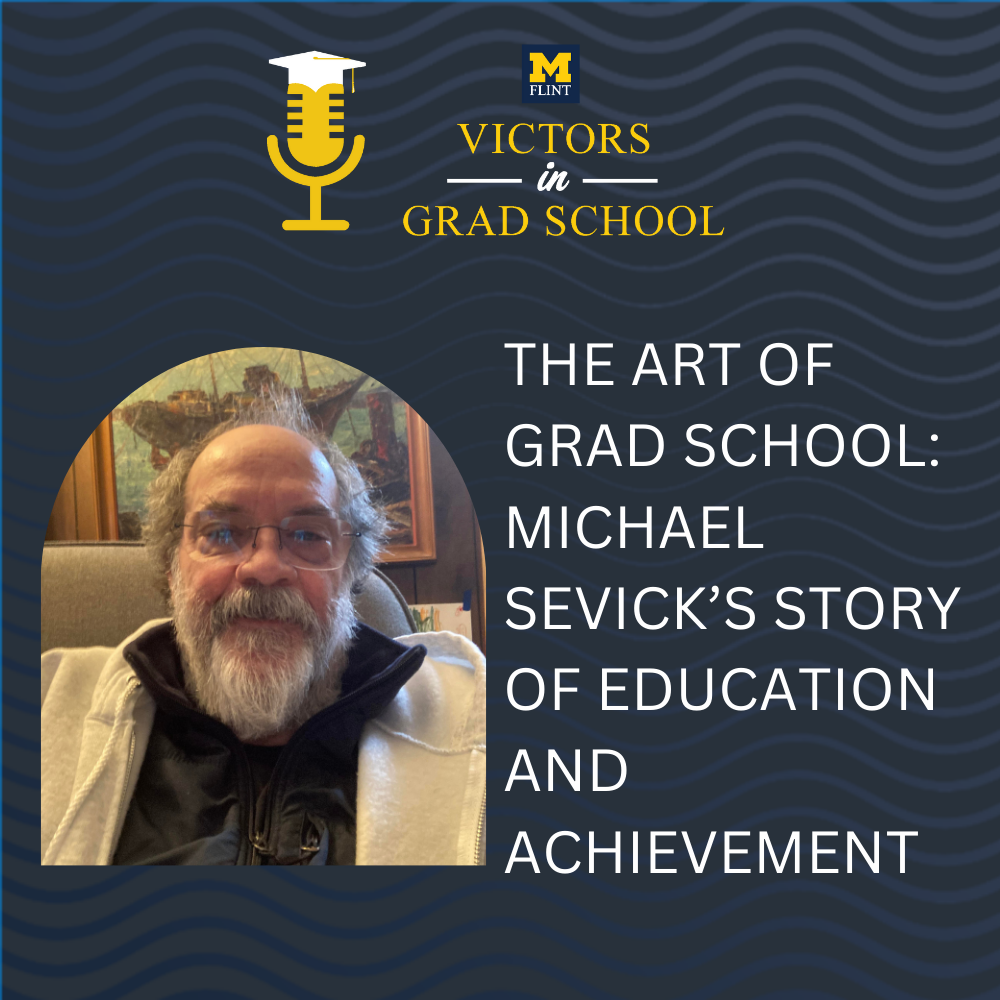 The Art of Grad School: Michael Sevick's Story of Education and Achievement | Embarking on graduate school is more than a simple academic step—it's a deeply personal journey, one that evolves and reshapes your goals, expectations, and life direction. The latest episode of the "Victors in Grad School" podcast welcomes Michael Sevick, Professor Emeritus from the University of Michigan-Flint, to share his inspiring story of growth, perseverance, and transformation through higher education. From his beginnings at what is now Mott Community College to earning a Bachelor of Fine Arts at the University of Michigan, and ultimately achieving an MFA—the terminal degree in his field—Michael Sevick's trajectory is a testament to resilience and purposeful planning. He didn't take the straightest course: after his associate's degree, he paused his education to pursue music, returning later with renewed commitment to finish his bachelor's and then move into graduate study. A key theme in this episode is the importance of intentionality and adaptability. Michael Sevick discusses applying to several graduate schools, carefully weighing family, work, and personal responsibilities—all while keeping his professional and creative aspirations in focus. His approach underscores the value of aligning educational pursuits with life circumstances and long-term goals. The conversation with Dr. Christopher Lewis pulls back the curtain on the real challenges of graduate education: managing transitions, facing imposter syndrome, and adapting to higher expectations. Michael Sevick shares candid moments of doubt and anxiety—especially as he moved straight from being a student to teaching others. His experience highlights the necessity of support networks, mentorship, and self-advocacy in maintaining balance during demanding times. Listeners will also take away practical advice on time management, perseverance, and leveraging campus resources. Michael Sevick urges students to seek out help, use support systems, and remember that most people you meet in graduate programs genuinely want you to succeed. Whether you're considering graduate school, already on your way, or simply in need of motivation, this episode is packed with valuable lessons and heartfelt encouragement. Michael Sevick's journey reminds us that roadblocks can become stepping stones, and that with the right mindset and support, graduate school can be a profoundly rewarding adventure. Tune in and be inspired by a story of perseverance, community, and lifelong learning. Begin your own journey toward becoming a victor in grad school! TRANSCRIPT Dr. Christopher Lewis [00:00:01]: Welcome to Victors in Grad School, where we have conversations with students, alumni and experts about what it takes to find success in graduate school. Dr. Christopher Lewis [00:00:11]: Welcome back to Victors in Grad School. I'm your host, Dr. Christopher Lewis, Director of Graduate programs at the University of Michigan, Flint. Really excited to have you back again this week. You know, every week I love being able to talk to you about the journey that you are on. And I call it a journey because every student that's thinking about graduate school and goes on a journey, whether you're at the very beginning and you're just starting to think about this, you've maybe you've applied, maybe you've gotten accepted, maybe you're in graduate school. Throughout this entire process, you're going to be going through a personal journey toward the goals that you've set for yourself. That's why this show exists. Dr. Christopher Lewis [00:00:48]: This show is here to be able to help you to find ways that you can be successful in that graduate school journey. That's why every week I love being able to have different people with different experiences that can talk to you about the journey that they went on. And then you can learn a little bit for yourself and take what you hear, set it aside, doesn't matter, learn from them, and hopefully be able to find some tips, some tools, some tricks, some things that you can do to help you on the journey that you personally will have. Today we have another great guest. Mike Sevik is with us today. And Mike is a professor emeritus from the University of Michigan, Flint. He was an associate professor of art for many years at the University of Michigan, Flint. We're going to be talking to him about his journey from starting at a community college to moving to a bachelor's, to a master's and then to teaching. Dr. Christopher Lewis [00:01:45]: So really excited to be able to have him here and for us to learn from him and his own journey. Mike, thanks so much for being here today. Michael Sevick [00:01:52]: Thanks for having me. I hope this helps. Dr. Christopher Lewis [00:01:54]: Well, I really appreciate you being here. And I'm going to turn the clock back in time. I want to go all the way back. I want to go back to. Let's go back to the beginning in the sense of you started your undergraduate work at Mott Community College. It wasn't called Mott Community College at that time, but. But the equivalent of Mott Community College before you went on and got your Bachelor of Fine Arts degree at the University of Michigan. And at some point in that time of being at the University of Michigan, you had a calling. Dr. Christopher Lewis [00:02:24]: There was a calling to you to Continue your education. Because you did get that Bachelor of Fine Arts at BFA and you could have stopped there, could have gone and painted and worked as a painter. But you decided to go and get that terminal degree. And for those of you that don't know in the fine arts area, the Master of Fine Arts degree is a terminal degree. So you went on and you got that mfa. Bring me back to that point where, where you said, where in your head you said to yourself, yes, I'm gonna keep going on. Why did you decide to go on? Why was it a right time to go for graduate school? Michael Sevick [00:02:56]: Yeah, you're correct that I started at Flint Community College, which is now Mott Community College. And that would have been 1970. And I was there for a year or so and left college to pursue other interests. I was in a rock and roll band and decided to do that for a while. But I came from a family of painters. So my grandfather was a painter. He owned Civic Sign Company here in Flint in the 1920s and that. And my father was an artist and my uncle. Michael Sevick [00:03:22]: So I just sort of. You're right. I probably could have always fallen back on do I need school? Do I need education? And that. But at the time, Mott Community College only had a two year program. And so I got my associate's degree, took the time off to pursue other interests. But then in the 80s, I decided to come back to school, to Mott. I needed a few credits in order to transfer. My plan was to go to a larger school that offered a bachelor's degree in fine Arts Arts. Michael Sevick [00:03:53]: So I got my associate's degree right after that. I got accepted into University of Michigan, Ann Arbor's art program. I took my portfolio and all my letters and a lot of energy and sat down with the director there, who was a wonderful man, looked at my work and said, we'd love to have you in our undergrad program. And I was in that program for two years and that. I graduated in 88. And I. Right away I wanted to go to graduate school. Because at that time I was already in my mid-30s. Michael Sevick [00:04:26]: And so I applied to the five different graduates. And I had a family and kids already, the five different schools in my area. I lived in Swartz Creek, which is near Flint. And those five schools, you know, Wayne State and Michigan State and U of M and just where I could commute to. I got accepted to three of them. Luckily, after my. My undergrad one of them, I was only accepted into the master's program. And I wanted the MFA you mentioned the terminal degree. Dr. Christopher Lewis [00:05:04]: I wanted the MFA and to me to spend an extra time in a master's program. I thought I could focus my energy and just, just try to do the mfa. So I took the MFA offer. One is offered different packages. It's like a sports personality I guess. One of them offered an assistants right away and what that was was teaching. I would do my class load but then I also had to teach a certain amount. And those students that I had were the, bless their hearts, they were the freshmen people that are just first coming in. Michael Sevick [00:05:40]: And in Ann Arbor the schools was quite large so the senior faculties could actually choose and pick more designer friendly classes for them to work in. But I was lucky enough to then graduate with my MFA in two years. So 1990 I got out of there with honors and friends and networking and sort of the. I didn't realize it at the time, but now when I look back that was the ladder or the next bridge or the, the steps to the next part of my career which was I had to teach right away because I had all these bills in a family and all that. So I think still my last semester in graduate school I was lucky enough to get a teaching position at Schoolcraft Community College, which is in Livonia and it's kind of a feeder U of M. Luckily they would kind of look after their graduates sometimes and try and direct them into programs that they knew were might be available or needy. And then from, from there I was lucky enough to sort of come back to Flint. There was some substitute offerings, they were just starting their art program. Michael Sevick [00:06:52]: And I was recommended by again the networking thing that I made in graduate connected me to the school craft jobs. The, the jobs at all the other colleges that I worked at until I finally were was able to land a tenured position at U of M Flint, which is what I wanted. All that was my plan. When I went back to get my degree. I didn't want to move, I didn't want to sell my house, I didn't want to leave my wife and kids. Everything had to be threaded like a web. And I can't believe how things worked out almost the way that I sort of planned. Michael Sevick [00:07:27]: When you transition from an undergraduate degree into a graduate degree, there are different expectations, there's different perspectives, there's different ways of learning. And there truly is a transition when you go from undergraduate education into graduate education in those expectations and beyond. So as you made that transition into graduate school, what did you have to do to set yourself up for success? And what did you have to do to maintain that success. Throughout the entire graduate school journey, I worked pretty hard. Michael Sevick [00:07:57]: I made sure that I was kind of indispensable in a way. I didn't know what they needed, but I was ready to do it. Never taught that class, but sure, I'll do some research and I'll teach it. I know a guy who did teach that class and I'm going to call him and ask him some notes or what was his perspective. And I tried to use that. Luckily I had a couple of mentors who were very, very gracious in helping me when I had just anxiety questions. I couldn't believe, you know, I graduated from graduate school and the next semest teaching. And as I'm walking into the class for the first time, I was just going, they're going to find out I don't know what I'm doing and I'm not prepared for this. Michael Sevick [00:08:38]: And the poor kids that I'm going to have to be teaching. And then something kind of clicked when I walked in and they sort of hello, professor, or hello Mr. Sevik. And I was no longer that grad student and I was no longer an undergrad. I wasn't even Mike Sevik anymore. I was professional Professor Mike Saidk, instructor or whatever you want to call it. But that sense of responsibility made me want to do better and do more. But the question you asked about the undergraduate and graduate perspective, it. Michael Sevick [00:09:09]: It is totally different. I remember as an undergrad looking at the graduates in a particular way. That changed when I was a graduate student looking at the undergrad students. And then when I eventually did graduate and became an instructor, I imagine I looked at my graduate students a little bit different as well. The assistantship, the ability to work while I was a graduate student really helped me in that again, that first class. When I'm not a graduate student anymore, I'm an instructor. I'm walking into class. What do I do having that assistantship, even though it was under the. Michael Sevick [00:09:45]: My first year assistant, I was under the. I had a professor that I had to coordinate some of the class and classwork. They did that grading and the heavy lifting and I did the other stuff. But then my second year as a graduate student, a TA colleague and myself, we were given the classes so we didn't have a professor anymore looking over us and that. But there was two of us. So that was. Class was 90, but there was still two of us. And then when I got my first class at schoolcraft, my first set of. Michael Sevick [00:10:18]: I think they gave me three. They were manageable class of 2025. They were all classes that I really liked. A design class, art history class, art appreciation, a drawing class, the beginning classes. Dr. Christopher Lewis [00:10:31]: So as you think back to your graduate school experience and you think about others that are coming behind you, was there anything that you wish you had known before you had started graduate school that would have helped you to find success? Michael Sevick [00:10:47]: I don't know if it would help me necessarily. It would have. I didn't realize you are invited into the program and you can be invited out of the program, which happened. There was four of us that got into the program and the mfa, and three of us made it through the first year, but one did not. And I didn't quite realize the seriousness of, you know, as an undergrad. And they can't really kick you out. You know, I guess you could flunk out or you drop out and all that. But it's very rare that the school says, we're going to ask you to leave. Michael Sevick [00:11:21]: So that brought home that second year. Things got more serious. I realized I probably had passed my probation point, so they weren't going to kick me out. And I was doing pretty good, pretty good stuff. But I didn't know that. So I think one's very lucky to get into a graduate program. And once you're in it, keep that in mind. Be grateful and work real hard and try not to burn bridges. Michael Sevick [00:11:46]: Everybody has people they like and don't like, but that's part of life. And you might have a professor that you don't care for personally, but, boy, I bet you they know their stuff, because they probably wouldn't be where they are at if they didn't. Dr. Christopher Lewis [00:12:01]: Now, also, as you think about graduate school, did you find that there was a defining moment or a turning point in graduate school that shaped your academic or professional journey? Michael Sevick [00:12:13]: Again, I was pretty lucky out of the bat. So there were some awards and some accolades that I got that first semester, and my ego was inflated and probably a little arrogant and all that, but as an artist, as a painter especially, dealing in Ann Arbor is like a little Europe. There's people from all over and there's all kinds of skills. And the guy painting next to me was from China, and the guy across the. The hall was from Russia. And I had a Japanese. Just huge competition. And I think one of the things it did for me was it rose me up to that. Michael Sevick [00:12:51]: You know, you're always questioning yourself. You know, where. Where do I fit in? How good am I? Well, I'm in this level of my education. What does that mean how do I stack up against similar. Similar people? Probably a little more competitive back then than it is now. But like I said, there was only three of us that made it through that program and two finally graduated. Dr. Christopher Lewis [00:13:11]: So talk to me about balance, because, you know, when you're going through graduate school, like you said, you have a family, you've got friends, you've wearing many hats. You're trying to balance being the good student, the graduate assistant. You know, there's lots of things you're trying to balance as you're trying to also be successful in your academics. So how did you balance school, work, family, other personal responsibilities while also being a graduate student in a rigorous program? Michael Sevick [00:13:38]: I think I had a wonderful support team from my wife and my kids and my mom and dad and the networking people that I made along the way, other fellow artists, and that helped a lot. I was always playing as a musician all through graduate school as well. So I was able to earn enough money to survive being a musician, but not to thrive. And at some point, having no health insurance and, and all that, I realized this is not good. So the idea of getting a tenured position someplace down the road really drove that car. But I had a wonderful support group and it, for me, it took a village to get where I am now. I don't know if I could have done it by myself. I probably would have tried. Michael Sevick [00:14:27]: But if one has help and support, even in the smallest ways, take it. I remember my grandmother, when I first started going to College, giving me $1,500. And back then, that was a lot of money, and I felt obligated to pay her back somehow, maybe not with money, but with what I could do. But that's an example. I think people love you. They support you, get their help, take their help, and then pass it on. When you're in that position, remember that and say, you know what? I can help you. This happened to me. Michael Sevick [00:14:58]: So let me. It might, might work for you, it might not, but. But at least you're listening. And I think that dialogue is important. Dr. Christopher Lewis [00:15:04]: I hear from a lot of students that figuring out that time management piece is so critical, especially when you start in graduate school because of the balance and you're having to focus in on the academics, but you're also having to focus in on everything else and making sure that nothing, none of the balls are dropped. So for you, what time management strategies did you put in place to help you be successful? Michael Sevick [00:15:27]: Yeah, the scheduling on all of the different aspects of my life was really important. So I tried to get classes early in the day. I tried to be, make the drive home from Ann Arbor here by afternoon, late afternoon, and compartmentalize things that were important. Like I said, I did have a wonderful support. I do have wonderful support. My wife was able to take some of my duties, running the household or whatever I did and cover that. Anyone I worked for, I was able to kind of, whether it was a painting, I was working, doing commissions. Also if I did a gig, I'd make sure it was on a weekend and it was tried to turn down lesser paying gigs. Michael Sevick [00:16:09]: I thought, I've got a great idea. I'm just not going to pay for play for less money anymore. I'll charge more and, and I'll make all kinds of money. And of course that didn't work out. It was the same with selling my paintings. When they wouldn't sell for 500, I thought, well, I'll just double the price and see if I can sell them for a thousand. What's, what's the difference? And. But then I, I sold a couple. Michael Sevick [00:16:29]: I said, oh, okay, maybe that does make a difference. You know, you're self worth management though. I would imagine most anybody that's in a graduate program probably has a pretty good idea of what it's going to take or what it's taking to be successful. And if you don't maybe talk to someone about helping me organize my time and you probably have programs like that, don't you? Dr. Christopher Lewis [00:16:56]: There are definite resources on campus that can help students to be able to figure that out and to manage that in a better way. And I think every campus has something that's there to hopefully support students in that regard. So all in all, I mean there are resources that are there for students. You have to search them out, you have to ask, you have to advocate for yourself and be willing to say I need help and that's important. Michael Sevick [00:17:20]: I totally agree. Dr. Christopher Lewis [00:17:21]: I guess finally, as you think back to your own graduate school experience, what are some tips that you'd offer other individuals that are thinking about graduate school that would help them find success sooner? Michael Sevick [00:17:32]: Well, you know, like I said, in my case I took some time off. I guess just be careful. If anyone's planning on a hiatus and coming back. I understand life happens, illnesses and successes and opportunities and stuff like that. But if you can avoid those recesses, it does help because postgraduate school is full and you can fill that with a lot. And time is one of those commodities that is not renewable and got so much. So take advantage of it, work hard, work fast, try and do it. If you have to take a break, work with the institution. Michael Sevick [00:18:15]: Because I didn't realize when I was in graduate school, my one of my parents were ill and I didn't realize there were mechanisms for me to take time off but still be a student, still participate. And they're the thing that I learned was they were there for me, for my success. Almost everyone that you encounter wants you to succeed. They're trying to help keep that in mind. And it's a lot easier to take that in and say, oh, you're saying that because you want to help me. I get it. You're not out to crush me or hurt me. It's a positive thing. Dr. Christopher Lewis [00:18:48]: Well, Mike, I just want to say thank you. Thank you for your time today. Thank you for sharing your journey and all of the information that you shared to that you learned in your own experience. And I truly wish you all the best. Michael Sevick [00:19:00]: Vice versa. And to all the graduate students and potential graduate students, enjoy your journey. It's a wonderful, wonderful time. Dr. Christopher Lewis [00:19:08]: The University of Michigan Flint has a full array of master's and doctorate programs if you are interested in continuing your education. Whether you're looking for in person or online learning options, the University of Michigan Flint has programs that will meet your needs. For more information on any of our graduate programs, visit umflint.edu/graduateprograms to find out more. Thanks again for spending time with me as you prepare to be a victor in grad school. I look forward to speaking with you again soon as we embark together on your graduate school journey. If you have any questions or want to reach out, email me at flintgradoffice@umflint.edu. | — | ||||||
| 1/19/26 |  From First-Gen Student to Professor: Dr. Lisa Lapeyrouse's Grad School Journey | If you're considering graduate school, feeling uncertain about your career direction, or wondering how to overcome obstacles along the way, the latest episode of Victors in Grad School is an inspiring must-listen. In this candid conversation, Dr. Christopher Lewis welcomes Dr. Lisa Lapeyrouse—faculty member at the University of Michigan-Flint and Director of the Inclusive History Project—to share her remarkable journey from first-generation college student to tenured professor. Themes of Resilience and Self-Discovery One of the strongest themes throughout the episode is the importance of self-discovery and adaptability. Dr. Lisa Lapeyrouse describes how she began her academic journey with aspirations to become an engineer, drawn by the promise of a lucrative career. However, after facing academic challenges and realizing her passion for humanities, she boldly changed her major to Women's Studies with a minor in Native American Studies. Her honest reflection on the embarrassment and fear of changing majors—and the eventual pride in pursuing a path she loved—serves as a powerful reminder that the undergraduate years are a time for self-discovery. As Dr. Lisa Lapeyrouse puts it, "undergrad is really about self-discovery and figuring out what you are passionate about and what you're good at." Finding Your 'Why' and Keeping Education a Priority The podcast explores the critical importance of understanding your motivation, or "why," when pursuing graduate education. Facing academic probation early on, Dr. Lisa Lapeyrouse shares how establishing her goals helped her prioritize her studies over distractions. She emphasizes the necessity of delayed gratification, citing how sacrifices made in the present can lead to future rewards. For anyone balancing work, school, and life, her advice resonates: "To do well and achieve at a high level, education can't be your side hustle. It needs to be your primary focus." Mentorship, Support, and Building Community A standout lesson is the value of seeking help and building a support network. Dr. Lisa Lapeyrouse encourages students to engage with faculty, campus resources, and mentors—even those who may not share similar backgrounds. She credits her success to mentors who pushed her with compassion and honesty, reminding listeners that real growth comes from accountability and empathy. Navigating Change and Overcoming Challenges From moving across states, adapting to new cultures, and overcoming imposter syndrome as a first-generation student, Dr. Lisa Lapeyrouse shares how each experience built the resilience necessary for graduate school and beyond. Her candid stories about culture shock, isolation, and finding her community in Michigan are both relatable and motivating for anyone facing similar transitions. Final Takeaway This episode of Victors in Grad School offers invaluable insights on overcoming setbacks, embracing change, and building meaningful connections. Dr. Lisa Lapeyrouse's journey is a testament to persistence and the lasting rewards of pursuing a path that aligns with both passion and purpose. If you're navigating your own educational journey, tune in for encouragement, practical advice, and inspiration to keep going—no matter where you start or what challenges you face. TRANSCRIPT Dr. Christopher Lewis [00:00:01]: Welcome to Victors in Grad School, where we have conversations with students, alumni, and experts about what it takes to find. Dr. Lisa Lapeyrouse [00:00:08]: Success in graduate school. Dr. Christopher Lewis [00:00:11]: Welcome back to Victors in Grad School. I'm your host, Dr. Christopher Lewis, Director of Graduate Programs at the University of Michigan, Flint. Really excited to have you back again this week. And as always, every week, I love being able to talk to you about the journey that you're on. And it is a journey. Each person that is thinking about graduate school will go through a different experience and will be on their own journey as that leads them to a specific program, a specific degree, and then beyond the program into the world of work and what you plan to do with that degree itself. And every week, I love being able to bring you different people with different experiences that can share some of the journeys that they've been on, whether they are currently in graduate school, graduated a while back, or whatever their journey was. Dr. Christopher Lewis [00:01:02]: But each person can share with you something a little bit different. So today I'm really excited to be able to introduce you to a new guest. Dr. Lisa Laperouse is with us today. And Dr. Laparouse is a faculty member at the University of Michigan, Flint, but she's also also the director of the Inclusive History Project at the University of Michigan, Flint. And she has her own graduate school journey that led her from being in California to Arizona to Michigan and being here at the University of Michigan, Flint. And I'm really excited for her to be able to reflect back and share some of her own experiences with us today. Dr. Christopher Lewis [00:01:43]: Dr. Laperouse, thanks so much for being here today. Dr. Lisa Lapeyrouse [00:01:46]: Thank you so much for having me. Dr. Christopher Lewis [00:01:48]: So I want to take you back in time and I want to go back because I know that you did your undergraduate degree at the University of California, Davis. And at some point during that time at UC Davis, you made a decision. You made a decision because you were getting a Bachelor of Arts degree in Women's Studies with a minor in Native American Studies. And at some point you made a decision to keep going and to go on further for a graduate degree. Bring me back to that point and what was going through your head as you were making those decisions? Dr. Lisa Lapeyrouse [00:02:20]: Well, let me give you a little bit of background information. So I'm a first generation college student. And so the idea was sold to me early on. In elementary school, we went to Mott Field where they have NASA Aerospace, and they constantly said, if you went to college, you'd make a lot of money. So in fifth grade, I was like, sign me up. And I was very Impressed with my mock fields, I was like, I'm going to be an engineer. Engineers make great money. And so that was my thought process through middle school, through high school, until I went to college. Dr. Lisa Lapeyrouse [00:02:55]: I went to college and I was a high performer at unfortunately a low performing school. So what that means is I did not have the best academic preparation for university life. And I think I started out having this idea of, well, you know, I played sports, I was class president, you know, all I have to do is go to school. So this is going to be easy. In my first semester I was on academic probation and I quickly had to change up my study habits and my focus because I thought, oh, this is so embarrassing, I'm the first to go and I'm going to be the first to get kicked out. So part of that though was I was still interested in pursuing engineering. And engineering requires you to take a lot of advanced math courses. And as a high schooler, I had the option. Dr. Lisa Lapeyrouse [00:03:51]: My school did not offer calculus. If you wanted to take calculus, you had to be bused to a different school at 7 o' clock in the morning before school actually started. And I was class president and I had the option to take the leadership class with my friends or calculus. And I made the decision to hang out with my friends in leadership rather than calculus. So the first time I ever saw calculus was in a quarter system. So U of M Flint is, is on a semester system. A quarter system changes classes every about seven weeks. That is not how you want to experience calculus for your first time. Dr. Lisa Lapeyrouse [00:04:28]: There were a lot of tears, a lot of office hours, and by my second semester I had realized that I can continue down this pathway, but it was going to be very difficult. I was rocking these humanities, I was doing really well and we'd have to read like seven books a semester. And I thought, well, this is going to be embarrassing. I told everybody it was going to be an engineer. I had the T shirt, but I ended up needing to change my major and then I changed it to Women and Gender Studies. What's now Women and Gender Studies was gender studies then. And to be honest with you, I didn't know what other job there would be other than becoming a professor with that job. So. Dr. Lisa Lapeyrouse [00:05:13]: And I also was embarrassed that I had to change my major. And I had told everyone I was going to be this great engineer. So now I said if I tell them I'm going to become a professor without really having any idea what I was talking about. I thought that would be acceptable in my grandfather who was very Important to me. I grew up for the majority of my first 15 years of life with my grandparents. His response was, well, that's not too shabby. So I got the seal of approval to pursue that. So my process was, okay, I need to go to graduate school and become a professor. Dr. Lisa Lapeyrouse [00:05:48]: But again, I really didn't know what that meant. And also at the time that I was studying undergrad, this was the time that affirmative action was being challenged. Ethnic studies, any type of branches out of history that wasn't just U.S. history were being challenged, like the validity of those. And so I was also thinking about job prospects. Was there going to be a department available to me to work? And so when I went into my master's program, which was at the University of Arizona, it was a joint program between Mexican American studies and public health. And then again, there was still challenges about the utility of a Mexican American studies degree. So when I decided to go for my PhD, I decided to go into a more traditional, direct relationship between the, the DEGR and an employment opportunity. Dr. Lisa Lapeyrouse [00:06:45]: So I went into public health. Dr. Christopher Lewis [00:06:47]: Every person goes on when they're thinking about going to graduate school. They, they go through their own journey to determine where do I want to go, what do I want to do, what type of field do I want to study? Kind of what you were talking about. And you ended up at the University of Arizona. So talk to me a little bit about that journey for yourself. What was going through your head as you were looking at different programs and trying to determine what would be the best fit and what made the University of Arizona the best fit for you? Dr. Lisa Lapeyrouse [00:07:13]: So I think the undergrad is really about self discovery and figuring out what are you really passionate about and what are you good at. And I had taken a special elective course with somebody that was in public health. I didn't even know that existed. I thought the only way to study health was to become a doctor. And I was not interested in that. I am something that's called a sympathetic vomiter. If you vomit, I'm going to vomit. I have a very weak stomach. Dr. Lisa Lapeyrouse [00:07:45]: I just knew that I was not cut out for that. But learning about myself, learning about history, learning about my community, really was exciting to me. I was very interested to that. And that work I would complete first. And so that's some of the things you want to look for is what are you gravitating towards, what are you doing really well in school? What do you leave to the side because you're like, oh, this is agonizing. And that may mean you Know, unfortunately, changing your major, but the benefit of going to college is that you do get to pick your career. Like for me, most of my family do jobs because they, that's what they have to do to pay the bills. I have the privilege of doing something not only to pay the bills, but something I enjoy and get fulfillment out of. Dr. Lisa Lapeyrouse [00:08:32]: So when I was making that transition, I applied to both PhD programs and master's programs and I was pretty defeated. How I decided to go to Arizona was I only got accepted to one program, so it was an easy choice and I had a very good gpa. But I think for undergrads that are thinking about graduate school, something to think about is PhD programs have really small acceptance. They accept cohorts, and a large cohort is 10 to 15 people. And they're mostly going to select, I would say probably 90% of them, if not more, will select somebody that already has a Master's. So it's important to look at the Master's programs as well and things that align with your service, things that align with your grades and any type of clubs that you did, because then they can see that you have this outstanding interest in that area for your graduate school. So for me, I had done an honors thesis in preparation to try and get accepted into a graduate program, knowing that this would give me some research experience so that I would be a more attractive candidate and hopefully get a position as a research assistant in graduate school. How I learned about the Mexican American Studies program at the University of Arizona was I was on campus. Dr. Lisa Lapeyrouse [00:09:53]: I used to hang out on campus all the time and there was a poster on a bulletin board and it was not well publicized. And so they were actually quite surprised to see an out of state student applied to their position. And I was part of their first graduating class and it was a great fit. But some of the things that I did consider that some people may want to also think about is I did know that I wanted to go to graduate school. I had talked to a lot of people about it and there were lots of people that told me that they planned to go back to graduate school. But I noticed that they were five and 10 years out and still hadn't did that. And I was like, I don't want to be in that situation. Also, I was very cognizant of, unfortunately my parents did not qualify for school loans. Dr. Lisa Lapeyrouse [00:10:41]: So all of my education was funded by myself, myself taking out school loans, scholarships. So I was very aware of after six months those school loans were going to kick in and I was going to have to start paying those back. And I didn't want to get a job and start a lifestyle that my income would support and then not want to go back to being a starving student again. So I was like, let me just stay a poor student all the way through and just get this done early on and not promise myself I'm going to do it and then never complete that goal. Dr. Christopher Lewis [00:11:15]: And then after that master's degree, you went on and you continued to get Another degree, a PhD in health behavior and Health Education at the University of Michigan. That's a far distance away from where you did your bachelor's and your master's degree. And you went from warmer weather to very cold weather in the winters and having to adjust and really push yourself out of a comfort zone of being in an area where you probably were more comfortable and you knew kind of the culture and you. And you felt a part of the culture where then you moved to a brand new area. So talk to me about that decision process and how you ended up at the University of Michigan. Dr. Lisa Lapeyrouse [00:11:58]: So when I was an undergrad, I did not graduate with high honors. And so I made it a personal mission that I was going to graduate with honors in my master's program, and I did graduate with a 4.0. However, they did not have high honors at my university, which I thought I was going to get the cum laude distinction, but the school didn't allow that. I should say, too, it's so important to have that high gpa because I did not test well on my gre, my graduate record exam. Same thing with the sat. And we know that one of the highest predictors of those scores is your area zip code. So it has to do a lot with the resources that are available to an individual. So, you know, I think I faced a lot of mental challenges, emotional challenges, about whether or not I fit in a university, because I just didn't have the same pedigree or the same experiences as others. Dr. Lisa Lapeyrouse [00:13:06]: And it did take me having to think things through and remember that, no, I'm the one that's sitting in those classes. I'm the one that's doing those exams that I also deserve a place there. But that has remained an ongoing challenge. You know, I'm currently, I'm the only tenured Latina professor that I know on our campus, and that's a lonely space to be in. And that comes with some challenges. If I start getting heated in a meeting and are they going to stereotype me as the spicy Latina or whatever? So. So I got a 4.0. So what that meant was I applied to the top five public health programs in the country and I was accepted into Michigan. Dr. Lisa Lapeyrouse [00:13:48]: And it's, I'll be honest with you, I only got into one program and that was U of M. And so I'm a religious person. I was like, okay, God has directed me. He only gave me one option for my master's program and one option for my PhD. And so I had only been to the snow once in my life before moving to Michigan. I didn't own a stitch of black clothing because you don't wear black when you live in Arizona. I only had tank tops and flip flops and shorts. So I was completely ill prepared to be in Michigan. Dr. Lisa Lapeyrouse [00:14:23]: Also living on the west coast. I'm from the Bay Area. There's a lot of ethnic diversity. Did not that experience that so much in Michigan in Ann Arbor, even though Ann Arbor is a large campus. So that was also challenging in my PhD program too. That was the first time that I had ever been around a lot of students of color that were wealthy and were not first generation students. So it took me some time to kind of find my people in my support network that I had some commonalities. And there were actually a group of us Latinas from California that were first gen that hung out and kind of supported each other. Dr. Lisa Lapeyrouse [00:15:04]: But yeah, it was definitely a culture shock. So I mean everything I remember when I, when I got here, everybody was driving American made cars. You know, because you have Ford, you have GM here and back in the Bay Area everybody drove Hondas. And I was like, where are all the Hondas? Where are the people with the piercings? Where's all the colored hair? Like I was just so used to a different way of life. And so I think that can be an unexpected challenge of how hard it's going to be to kind of integrate yourself into a new kind of environment. And so that does take getting outside your comfort zone and meeting people, joining clubs, getting out of the house and trying to find your community so that you do have that support. Because fortunately for me, as much as my family wanted to be supportive, they had never gone through the experiences that I had in college. So it was really hard for them to wrap their head around what the challenges were or why I was so upset about not doing well on the exam. Dr. Lisa Lapeyrouse [00:16:07]: And actually my mom had asked me to leave college a couple of times because I called home crying saying it was so hard. And she was like, if this is going to be this distressing to you, Then maybe you should leave. And I thought, oh my God, what bad advice. Like I'll suck it up, you know, so it's difficult, but it's not impossible. Find your people. Dr. Christopher Lewis [00:16:25]: So you found success in your master's degree, your doctorate degree. And as you moved into those different places, there are different expectations and different expectations from being an undergraduate student to being a master's student, to being a doctoral student. Talk to me about those transitions for yourself. And as you think back to the transition to the University of Arizona, the University of Michigan, and to the different programs and the different expectations of faculty, what did you have to do to set yourself up for success as you transitioned into the program? And what did you have to do to maintain that success throughout the entirety of those programs? And it may be different at both the master's and doctoral level. Dr. Lisa Lapeyrouse [00:17:09]: I think the very first thing I had to do, especially after that first semester being on academic program probation, is understanding my why. Why was I there? Why was this important? What was that long term goal and making sure that my education was my priority. It couldn't be socializing with my friends, it couldn't be. Like I said at the time, there was affirmative action being challenged. It wasn't sleeping on the steps and doing the hunger strike, it was going to rallies and stuff. But my primary goal was to graduate. And so that really meant prioritizing and making sacrifices to ensure that that was always at the forefront of what I was doing. And I would have to say that that was the case all throughout. Dr. Lisa Lapeyrouse [00:17:55]: You know, when I had a lot of friends that didn't go to college and they were buying fancy cars and they always had money and I was like trying to scrape together 20 bucks to buy a pizza. And I thought, wow, like they have these great lifestyles. What am I doing? And you really have to accept, accept delayed gratification because eventually the tables did turn where that nice sports car, well, they're still driving it 10 years later and you know, they took a lot longer to move out of their parents homes. And so the fruits of your labor do show up, but it's not necessarily as quickly as you'd like. And so coming to terms with that, I think is also important for myself. I've lived across the country for a very long time from my family. And I had to again understand for myself why that sacrifice was necessary to keep going. Because it's hard. Dr. Lisa Lapeyrouse [00:18:57]: You know, I missed all the birthdays, all the big celebrations, but again, I had specific goal that I had in mind and I kept that as A priority. And that's not to say I never went home, but it wasn't the same as living in the same city or the same state where you can go home for the barbecues and all this other stuff. You know, there were a lot of things that I did miss. So I think the delayed gratification, I think continuing to prioritize your education as first as a faculty person, I know a lot of students have to work full time. I had to work also, but I worked on campus. I worked jobs that were, I would say, complimentary to my work schedule. Because to do well and to achieve like at a high level, education can't be your side hustle. It needs to be your primary focus. Dr. Lisa Lapeyrouse [00:19:48]: And sometimes it's not the right time to go to school. I'm not saying that you're not cut out for school because if you would have looked at my profile in high school, child of a teenage mother, you know, I had all the indicators that I would not be a college, let alone a PhD, somebody with a PhD. So I think also you have to find the self esteem in yourself to keep going and the courage because there will be people, instructors included, that'll say that maybe you're not cut out for this, but you have to work with the tenacity and a resilience to continue to push through. Dr. Christopher Lewis [00:20:25]: So as you think about your graduate degree and you think about the different degrees that you received along the way, you started in one area, you ended up in public health. And as you reflect back on your undergrad, your grad, your doctoral degrees, talk to me about the interplay with those degrees. Because not everybody, when they go and get an undergraduate degree is going to get a job specifically in that specific area. You may end up in a very different place than where you began. So talk to me about that journey for yourself and the learning and how it built upon each other to where you ended in teaching in the area that you're teaching now. Dr. Lisa Lapeyrouse [00:21:06]: I really kind of think as an undergraduate education as the mechanism to help you identify credible information and to really be a critical thinker. This is the time where you really learn how to identify sources of information and evaluate them to figure out are there motives behind the person that is advertising this or making this statement. So you become a critical thinker and those critical thinking systems skills are applicable in any type of position. I feel like in the master's program, now that you have identified where to find information, you have a better command of knowledge in your specific areas. So then you can start to really Craft important questions about the gaps that remain there, and start to move science forward by pursuing new kind of pathways to understanding certain phenomena. And, you know, for people that have historically been excluded or underrepresented in universities, their voices, their perspectives are important because we may not have heard them before. So I think the first thing is about kind of discovery and finding information. The second part in the master's is really about beginning to start to ask our own questions. Dr. Lisa Lapeyrouse [00:22:30]: And then in the PhD, I think it's about creating knowledge. It's not just asking the questions, but now pursuing those questions and helping to find answers, moving science again forward and challenging existing thought processes. So with the inclusive history project, one of the things that we do is there are narratives that are put forward and, you know, they're evidence based. But one of the things that we do is say, well, whose voices are represented and whose voices are missing? And is this a comprehensive understanding of these events or are there perspectives that are missing and maybe can give us a better and more nuanced understanding? So again, it's continuing to be a critical thinker, but it's also learning how to use the skills and apply them to challenge or to expand what we know. Dr. Christopher Lewis [00:23:26]: Now, as you think about graduate students or individuals thinking about becoming a graduate student, and you think back to your, your own experiences, what are some tips that you might offer others that are considering graduate school, no matter what they are going into, that would help them to find success sooner? Dr. Lisa Lapeyrouse [00:23:44]: Ask for help. That is what faculty are here for. And as faculty go on these retreats and we think very deeply about the courses that we teach, the content, the textbooks, I think students would be really surprised how much thought and time goes into planning these things. And when we've gone to these retreats and they ask what inspires you? Everybody mentions students. So most of us do this job because we really find it fulfilling and we like to work with students. And so I know for myself, I was very intimidated being in the academic environment. I didn't speak in class until my junior year of undergrad because I was so terrified of saying something dumb. Now we have a hard time keeping me quiet in any kind of situation. Dr. Lisa Lapeyrouse [00:24:33]: But you cannot do this alone. You need to have support. And sometimes your friends or your peers are not the best support for you, because sometimes it's the blind leading the blind. And so it's so important to get to know your resources on campus as well as your faculty. And don't wait. It's so much easier for faculty to help you when you approach them sooner rather than later. And, you know, for myself, I had a lot of life happen to me when I was in school. And so, you know, find that person who's not just going to be a cheerleader and tell you everything's great, but somebody find a good mentor that is going to be honest with you, hold you to accountability, but also do that with empathy and compassion. Dr. Lisa Lapeyrouse [00:25:22]: And related to that, I think that I was under the impression that to find a good mentor, the mentor had to be similar to me. They had to be a woman. They had to be, you know, Latina. And I joke about this, but I've had mentors and I've had tormentors. And the tormentors were people that really just broke me down and said, you know, these are all the things you're doing wrong. And it was really defeating. And one of my very best mentors was Dr. Woody Neighbors at U of M, and he's an African American male. Dr. Lisa Lapeyrouse [00:25:58]: And so I say this to say, don't discount somebody just because they don't share the same background as you. Find somebody that is invested in your success. But again, that's going to hold you to a high standard, because those relationships will really help you when you do encounter challenges. And that is inevitable in the PhD program. Sometimes you have people that have been successful all the way through. They rock undergrad, they rock their Masters program, and then they get into the PhD program, and all of a sudden they're starting to have some challenges. And that can be really emotionally tolling because you see yourself as this very successful person. And so, again, it's really important to have that support to make sure that you just don't go, don't complete your degree, because that happens a lot, too. Dr. Lisa Lapeyrouse [00:26:46]: So being connected, I think, is so core to being well. And I know everybody loves the online environment, but making the commitment to go to campus to be involved in different things, you're only going to be in school for a small blip of your life. And so it's worth the investment, because this is where in my PhD program, I met so many people that they're writing books. I mean, they are doing fabulous things. I can use them for job references, job leads. You never know where that relationship could possibly take you. So it's worth investing that time and effort beyond just the classroom. Dr. Christopher Lewis [00:27:25]: Well, Elise, I just want to say thank you. Thank you for sharing your journey today. And it is definitely something that I think that everybody can learn from, because all of us go through these ups and downs, and it's kind of a roller coaster as you go through graduate school and hopefully it's more ups than downs. But there are always going to be those peaks and valleys and you shared some of your own as you went through your own experience. But I truly want to say thank you for sharing your journey today and I wish you all the best. Dr. Lisa Lapeyrouse [00:27:53]: Thank you so much. Dr. Christopher Lewis [00:27:55]: The University of Michigan Flint has a full array of master's and doctorate programs if you are interested in continuing your education. Whether you're looking for in person or online learning options, the University of Michigan Flint has programs that will meet your needs. For more information on any of our graduate programs, visit umflint.edu/graduateprograms to find out more. Thanks again for spending time with me as you prepare to be a victor in grad school. I look forward to speaking with you again soon as we embark together on your graduate school journey. If you have any questions or want to reach out, email me at flintgradofficemflint.edu. | — | ||||||
| 1/12/26 | 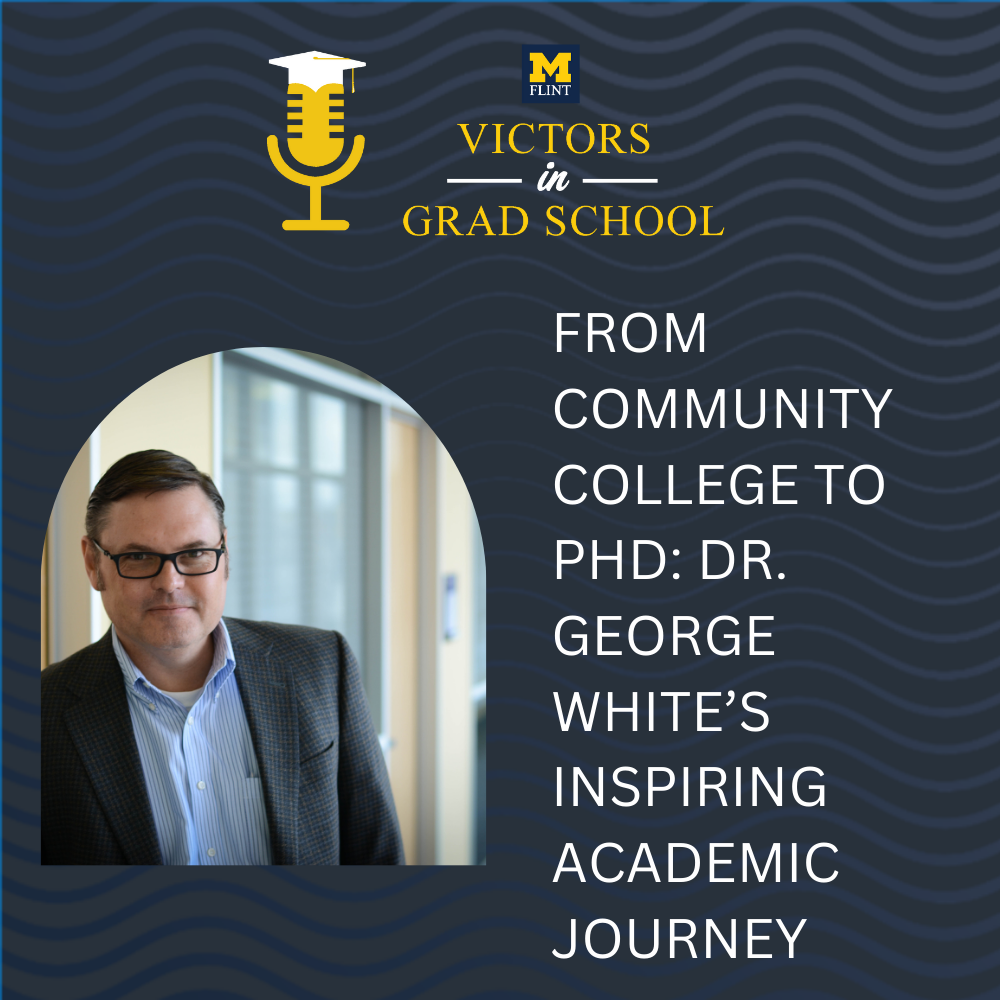 From Community College to PhD: Dr. George White's Inspiring Academic Journey | Are you considering graduate school or seeking inspiration for your academic journey? This week's episode of the "Victors in Grad School" podcast is a must-listen. Hosted by Dr. Christopher Lewis, Director of Graduate Programs at the University of Michigan-Flint, the show features a rich conversation with Dr. George White, Professor of Strategic Management and Director of the Doctorate in Business Administration Program at UM-Flint. The episode opens with Dr. George White sharing his unique educational path, beginning as the first in his family to attend college. Coming from a rural, modest background, his story starts with working night shifts and attending a community college in Alabama. He highlights how determination and hard work paved his way to the University of Alabama and later, a life-changing exposure to Asian history and culture. A key theme of the podcast is the role of inspiration and mentorship. Dr. George White recalls the professors who encouraged his academic curiosity and opened doors to opportunities abroad, including studying in Taiwan and teaching English in Asia. This global perspective led him to pursue a law degree, and later, an LLM in International Commercial Law. Throughout the interview, listeners hear about the importance of having a clear plan and passion for your studies. Dr. George White emphasizes that success in graduate school isn't about being the smartest person in the room — it's about hard work, dedication, and being genuinely excited about what you're learning. He also opens up about his experiences consulting and teaching in China, which inspired him to further pursue an MBA and a PhD in International Business. The episode is filled with actionable advice for prospective graduate students: develop a five- or ten-year plan, engage with your professors, and choose a program that aligns with your interests and career goals. Time management and perseverance are repeatedly highlighted as essential ingredients for success. If you're seeking inspiration from someone who's charted a truly international, interdisciplinary career — leveraging degrees in history, law, and business — this episode is sure to motivate you. Tune in to "Victors in Grad School" and learn how passion, planning, and relentless hard work can help you thrive on the path to academic and professional achievement. Ready to be inspired? Listen now and prepare to embark on your own journey as a victor in grad school! TRANSCRIPT Dr. Christopher Lewis [00:00:01]: Welcome to the Victors in Grad School. Dr. Christopher Lewis [00:00:03]: Where we have conversations with students, alumni, and experts about what it takes to find success in graduate school. Dr. Christopher Lewis [00:00:11]: Welcome back to Victors in Grad School. I'm your host, Dr. Christopher Lewis, Director of Graduate Programs at the University of Michigan, Flint. Really excited to have you back again this week. As always, every week we have an opportunity. We have an opportunity to work together to help you define success in this journey that you're on. And it is a journey. Every person that is thinking about graduate school, that is in graduate school, has a unique journey that you will follow for yourself as you move forward and through that experience. Dr. Christopher Lewis [00:00:42]: And though it may be unique, there are commonalities that most every person goes through as they go through that graduate school journey that you can start planning for right now. And that's what this podcast is all about. It's all about helping you to find ways to be able to be successful in this journey and find tips, tactics, et cetera, things that can help you to find success sooner. That's why every week I love being able to have different people, new people on, to share their own experience. And today we have another great guest. Dr. George White is with us. And George is a professor at the University of Michigan, Flint. Dr. Christopher Lewis [00:01:24]: He's a professor of Strategic Management and the director of the Doctorate in Business Administration Program here at the University of Michigan, Flint. And he's at a unique path through his own education that has led him to where he is today. So we're going to be talking to him about his own journey. George, thanks so much for being here today. Dr. George White [00:01:40]: Hi, Chris. Thanks for having me. Dr. Christopher Lewis [00:01:41]: Well, I really am excited to have you here today, and I know that your journey has been one that is unique, and you have had many curves along the path. So I want to take you back in time. And I know you did your undergraduate work at the University of Alabama and you got a Bachelor of Arts degree in history. And at some point, either in your undergraduate work or after, when you started working and getting some experience, you made a decision to go back to graduate school and to get a law degree. And I'm really interested, first and foremost, for us to talk about this. And then I know you went beyond that, but bring me back to the point in which you determined for yourself that graduate school was the next step. What was going through your head? Dr. George White [00:02:25]: Yeah, so, oh, boy, it's very long journey for me. What happened was I'm essentially the very first kid in my immediate family to go to college. So I started off in community College at a very nice community college in Hanceville, Alabama, near Coleman, Alabama, called Hanceville Community College. And so I went there part time. I worked full time like many of the students here at um, Flint do anyhow, and actually work night shift and at a technology company producing chipboards. And then that company was paying for my education, so I would go to school during the day. So I'd get up at like 6 in the morning, study, go to school, maybe study some more, hop in the car, go work and repeat that. And I wasn't sleeping a whole lot during that time. Dr. George White [00:03:14]: So that sort of was my gateway into college. And just going to community college was an eye opener for me. But what happened was at a certain point I decided I wanted to be a full time student. After going through the grind of working and trying to do that and go to school part time, my family told me I could go full time to school if I wanted to do that. So I'll never forget when I applied to be accepted in the University of Alabama. When I got that acceptance letter, it was a big deal because I grew up in a very rural part of Alabama and actually was raised on a chicken farm in East Texas. So basically a farming family wasn't exposed that much to higher education. And here I am going off to the University of Alabama. Dr. George White [00:03:55]: My first year at Alabama, I just took classes in general. I was a history major. But what happened my senior year, I took a few courses in Asian history. I'll never forget. I took a course by a professor, his name was Lee Butler, he's actually a graduate from University of Michigan, Ann Arbor, who was a professor in the history department there. And it was on Japanese culture and coming from basically the backwoods of Alabama, you know, being a Southern redneck that really taking that course, we read books on architecture in Japan. We learned about aikabuno, you know, flower arranging, sumo wrestling. That class really was, was my first point of entry into learning about the rest of the world. Dr. George White [00:04:36]: And then I took another course from a professor who became my mentor, named Dr. Ronald Roble, on Korean history. And I knew nothing about Korea until I took that course. And these were during my senior year at Alabama. So what happened was I became very fascinated by Asia and just the rest of the world in general. And Dr. Robol, who I got to know quite well. I worked very hard, tried to do well in his course. Dr. George White [00:05:01]: He basically encouraged me to stay at Alabama and become a graduate student there. He was the director of their Asian studies program. And so I stayed there, worked under him became as a teaching assistant in the classes he was teaching and took classes in Asian studies and started studying Chinese language. Then what happened was I ended up receiving a scholarship to go study Chinese at Fengji University, which is in Taichung, Taiwan. And I did that for about a year. And studying abroad was very interesting to me. I learned quite a bit. But what I really enjoyed was going out. Dr. George White [00:05:34]: And there's lots of opportunities in Taiwan that teach English as a second language. You can actually make a lot of money doing that. So I started doing quite a bit of that. I taught at a night school in Taichung, and then I taught at a private kindergarten in the morning and was making a lot of money. I had, like, a little penthouse I was renting in downtown Taichung. And it was a really good life. And what happened was I was there on the scholarship, but one of my employers wanted me to essentially convert my visa status from a student to, like, a working visa. So to make a very long story short, I ended up traveling abroad to the Philippines. Dr. George White [00:06:10]: Bumped into my wife the first day I was in the Philippines. Left the Philippines, went back to Taiwan, realized it's going to be very difficult to get her to Taiwan because of the immigration policy. So I basically moved to the Philippines. I'd saved up a lot of money. I had this little desk in my room of the apartment I was renting. I used to shove all of my cash in that drawer. I didn't even have a bank account there. And I remember just taking all that money I'd made and I moved to the Philippines. Dr. George White [00:06:38]: And basically I became a beach bum in the Philippines for a little while. So got married to my wife. That's what triggered, you know, when I was in the Philippines, I'm like, I have to do something with my life, you know, I mean, who's going to hire somebody with a bachelor's degree in Asian history? And I wanted to continue on. I was very interested in learning. I enjoyed the university environment, and I wanted to continue with my education. So I wasn't good at math at that point. I haven't even thought about business. So I did what a lot of individuals do that are more qualitatively experienced and have skill sets in that area. Dr. George White [00:07:11]: I applied to law school, and my LSAT score for law school wasn't really that great. So there's a school here in Michigan called Cooley Law School in Lansing, which sort of has a very different admissions policy than most other law schools. They usually. They bring in a lot of students, but then they weed them out. You know, it's a very rigorous law school to go through. And what happened was they. They brought. I got accepted to Coley Law School. Dr. George White [00:07:37]: And that was my. My only opportunity at that point in time. Listed at some other law schools like Syracuse and other universities, because I had interesting background. But I ended up going to Cooley and I studied as a law student there and I concentrated in international law because that was at that point in time, I knew I wanted to do something international in nature. Then what happened was, in law school, I was on the journal, the editorial board for the Cooley Law Journal, which is sort of a prestigious thing in law school. And you get to learn how to edit, and it's research oriented. There was a summer course called Scholarly Writing that I took as an elective course. And I took that course and I wrote a paper and the paper was on trade in Southeast Asia. Dr. George White [00:08:24]: And I took the paper after I was finished with the class. I did very well in there because it was very interesting to me. I loved to do research and writing. So I was very intrinsically motivated. And when I went through that class, I knew it was something I really enjoyed. And what happened was I took that paper that I wrote for that class and I got it published in an international law journal. And I knew at that time, this is something I can do, and it's something I love to do. And so then one law degree wasn't enough. Dr. George White [00:08:51]: So I went and actually I went to Emory Law School and worked on an LLM, an advanced law degree in International Commercial Law. And then what happened was, when I was at Emory, this is right around the time when China was joining the WTO, back around 2000, 2001, I did not feel like I'd finished what I had started out to do in Taiwan. So I wanted to get back to Asia and sort of finish what I started there. So I started looking around for jobs to teach law in China. And one thing led to another and a major university hired me to go over to China and spend a year there. I ended up spending two years there, but they hired me to go there and to teach international law as a visiting professor. And that's how it all started. Going back to my bachelor's degree, I found something very fascinating and I wanted to continue with that. Dr. George White [00:09:41]: I really enjoyed learning. I enjoyed the university environment, and I was fascinated by Asia and just international stuff, and I wanted to keep continuing down that path. And then when I got the law school and I took this course on scholarly writing where I could Bring my passion into that. That's what really triggered everything for me. And I knew that's what I wanted to do moving forward with my career. Dr. Christopher Lewis [00:10:04]: Now a law degree is a terminal degree. You went on and got an LLM, but then a few years later you decided to keep going and getting both an MBA as well as then going and getting a PhD, another terminal degree. Dr. George White [00:10:19]: I got my MBA at the same time as I was working on my PhD, which is sort of rare. Dr. Christopher Lewis [00:10:24]: So talk to me about that and what made you decide that you wanted to continue your education to get those additional degrees beyond the terminal degrees you already had? Yeah. Dr. George White [00:10:34]: Okay. So very practical. I was in China at the time, you know, I, I accepted that gig to go and teach at Habenomy University again. It was right around the time when China was opening up to the rest of the world. They were much more free market oriented than they currently are. I mean, they were following the Deng Xiaoping framework of opening up and trying to develop relationship with the Western world. So there were lots of opportunities at the time for foreigners with backgrounds like myself and interests like myself to consult and do things. So what happened was I was not in Beijing or Shanghai. Dr. George White [00:11:10]: I was in a secondary city, a little town of only 8 million people called Shijiazhuang, which is just south of Beijing. And there were lots of opportunities because of my unique background and skillset. So I started consulting and I was consulting with law firms as a foreign expert. And then I ended up being approached by development zones to consult with them and help act as a liaison between the Chinese government and foreign companies that were coming in and investing in China. And I started basically backed into doing a lot of business consulting. And at that time I did not have any formal business background or education whatsoever. I was learning by doing, essentially. So I had a friend that was a former professor of mine at Thomas Cooley at Cooley Law School. Dr. George White [00:11:54]: At that time he had moved to University of Miami, but we stayed in touch. And so about once a month he would contact me and we would talk because he was doing a lot of research on China and then I was doing research on China. So he would call me up about once a month and we would chat. And I told him, you know what, I'm doing all this consulting now in China and I don't have this formal education, so I feel like I need to go and get an MBA or something. And at that time I had already started publishing a good bit. And he goes, george, George, you ought to think about going and obtaining a Ph.D. you know, joining a Ph.D. program in international business. Dr. George White [00:12:28]: International business, really? He goes, yes, all your research is related to international business, because I've been publishing quite a bit on international trade, foreign direct investment, and different issues related to companies operating in Asia. So I'll never forget I studied for the GMAT, which is the entrance examination for MBAs and most business graduate degrees. I studied in a library in northern China during the winter, like the winter we have right here in Michigan where there is no heat. I'll never forget that. And I actually took the GMAT in Beijing, China. And then I applied to some PhD programs and there was this new doctoral program that had just started up in international business at University of Texas at El Paso. And they accepted me. I'll never forget, forget when I received the letter and they actually called me when I was in China. Dr. George White [00:13:17]: When that happened, it changed my life. And so I ended up going off to spent two years in China. And after that I transitioned into the PhD program at UT El Paso, where I also earned my MBA as a general MBA in management. It was an extension of what I was already doing. I mean, I had started doing a lot of business consulting in mainland China, and I had no formal background or education. And so I was interested in learning and getting some formal education in business administration. And I ended up going and working on my PhD and then also my MBA. And to this very day, 20 years later, I'm still using leveraging my legal background and my interest in Asia in my research and what I teach and do here at Michigan Flint. Dr. Christopher Lewis [00:14:01]: Now, with every degree, when you transition into those degrees, there is a transition because the way in which you're educated at the bachelor's level is different than at the master's level, is different than in law school, is different than in a PhD. Every type of school is a little bit different. Every type of academic area is going to be a little bit different. So talk to me about some of the things that you learned as you made those transitions through the different degrees that you went into and what you had to do to be able to first transition into graduate school. And what did you have to do to continue throughout the entire graduate school experience to maintain that success? Dr. George White [00:14:42]: Yeah, I mean, and this is something I talk to. I'm the director of our doctoral program here at the School of Management at Michigan Flint. So I'm always talking to students about this on a regular basis. You know, I think you need to have a plan. You know, I think it's the first thing you need to really have a Plan. I think the most successful students. What made me successful, I had a passion for what I wanted to do. I mean, I knew what I wanted to do and I was determined to do it no matter what. Dr. George White [00:15:07]: Okay, second thing, you need to have a plan. You need to have like a 5 and 10 year plan. Why am I doing this? How is this going to get me from point A to point B? And then what am I going to do? And you got to be very proactive and dedicated. I mean, for example, in all of my courses, I remember my doctoral program, my doctoral program in the law school as well, pretty much all my courses. And I was never the smartest student in any of those classes. And I'm definitely not the smartest faculty member here at the School of management neither. But one thing I can say, I worked very hard. On Fridays, I would be up studying, working on Saturdays. Dr. George White [00:15:41]: Whatever I had to do to be successful, I would make that happen. So I was very proactive. All the faculty knew me very well in all the programs. Starting my bachelor's all the way through, I was very proactive, interacting with the faculty members, making sure I'm doing the right thing in the classes. How can I improve what I'm doing? I was very interested in learning and I had a passion for what I was working on and a plan of why am I doing what I'm doing? Okay, I think that's very important. Also, just generally, you need to be excited about what you're working on. You know, when you select a graduate degree, I mean, I understand the practicality of choosing something that's going to help you to get from point A to point B, whether it's getting a promotion or, or moving in a new area, whatever that is. But you got to have some passion for what you're doing. Dr. George White [00:16:25]: I mean, at the end of the day, it's a grind. Graduate school is not easy. You got to be dedicated. It takes a lot of time and effort. You're paying a lot of money for whatever degree it is, and you got to be able to wake up in the morning and be motivated or it's just going to be much more difficult for you to be successful. So that's really what made me like, I did not enjoy law school. I did not have any fun in law school. Right. Dr. George White [00:16:48]: That's why I'm not a law professor. But, but I did enjoy some of the subjects that the law school had to offer, and I gravitated towards those and that's what helped me get through it. For example, like the other Graduate degrees were very different. I really had more passion for them. But at the end of the day, you got to have a passion for what you're doing. I mean, life is too short to be miserable and you got to have a plan. I think just throwing yourself into a degree program with not having a clear vision of what you plan to do, I don't think is really the right approach. Dr. Christopher Lewis [00:17:17]: I know you are a faculty member, you are a administrator. You've worked in higher education now for a number of years here at the University of Michigan, Flint. And I guess as you think back to the education that you received in all the different facets of the education, talk to me about how those different degrees and the different experiences that you've had have helped you to do the work that you're doing on a daily basis. Dr. George White [00:17:40]: That's a complex question. First of all, I feel very blessed. Position I'm in is I've worked well. My wife has to remind me that I work very hard to get where I'm at. There's this old saying, you need to run scared to be successful. And I've been running scared, meaning I've been working very hard, never thinking I'm doing enough. How can I constantly improve what I'm doing? I've been doing that for a very long time and I'm still doing it to today, even though I'm a full professor and directing a doctoral program, etc. Etc. Dr. George White [00:18:08]: But for me, I get this question a lot from various individuals, students in our program. Individuals are out in industry. You know, you have a law degree and you have a bachelor's in history. You know how in the world you become a professor of business. For me, it all sort of fits together. For example, my research today is on how companies strategize, you know, develop in and execute strategy in Asia. And I look at that from a legal perspective, I've sort of become like an expert in the international business and strategic management community on how the legal environment has an influence on foreign companies, multinationals operating in Asia. So I have really worked hard to try to leverage my interest and background in Asia. Dr. George White [00:18:53]: I go over the Asia quite a bit. You know, I mean, I. I'm a visiting professor in the Philippines and also in. In Thailand right now. And I go over there quite a bit and give seminars and talks and do research there. But so I have that from my. All the way back from my bachelor's days 30 years ago. And then my legal degree, although I'm not a lawyer right now, I use that in My research, all my research focuses on how the legal environment influences multinational strategies in Asia. Dr. George White [00:19:20]: And so I try to bring all of that education together in bring these insights into my class, classes that I teach. I consult on the side a little bit in Asia, doing that type of stuff. And then my research is all focused on that. But at the end of the day, I think that for anybody that has sort of a unique background, you should try and leverage that, especially if you're interested in that type of work and because that's what's going to make you unique and provide possible opportunities moving forward. Dr. Christopher Lewis [00:19:50]: Now I know you talk to a lot of graduate students and you work with students that are coming into your Doctorate of Business Administration program, but you have your own experiences as well. And I guess as you look back at your own experiences, not only personally, but also experiences in working with other graduate students and you think about other students that are thinking about graduate school, whether it be in business, law or some other field. What are some tips that you might want to offer other students considering graduate education that would help them find success sooner? Dr. George White [00:20:22]: I grew up in a very poor family. I remember my mom, she worked as a waitress at Pizza Hut. This is back when Pizza Hut was actually really good, when people would go and eat in the Pizza Hut and she used to wait tables and she had this big jar in her room that she would dump her change in from her tips. I'll never forget that we had to live with my grandparents, you know, and she put herself through nursing school. And then when I was in high school, she was working like two or three jobs. I never saw my mom because she was trying to provide for us. And then most of the rest of my family were entrepreneurial, that self made had their own companies. And so I learned from that that hard work is essential to success. Dr. George White [00:20:59]: And so again, going back to what I mention mentioned earlier, I've always worked very hard and because if you work hard, things will come to you. It might not be the easiest path, but there's no substitute for hard work. And hard work will provide you with opportunities at the end of the day. So I just wanted to go back to that tips again. I think you have to have a passion for what you're when you go to graduate school. And I do see this a lot. I see a lot of students coming in. I teach in our MBA program and I see a lot of students coming in our MBA program that are just in the MBA to get the mba. Dr. George White [00:21:33]: Okay, now of course that's up to them. That, that's what they want to do. But I've noticed the students that have a passion for learning and are interested in like the concepts, ideas, theories we're talking about in our classes that go beyond just getting the degree, they tend to enjoy the process and the journey that they're on a lot more than those that don't. So, I mean, I think it's important for you to find a program that you're interested in. You're going to be excited about taking the class classes in and so forth. Also, again, there's not a replacement for hard work. And this goes back to my discussing all this earlier. I've never been the smartest in any of my classes, but I'm a grinder, you know, I've had to grind things out. Dr. George White [00:22:14]: But at the end of the day, you will get to where you want to be if you put in the effort and you work hard and do your very best in your classes and in the program. So I think that's very important. Also, I think most students these days, or most students are not full time, but a lot of them are working jobs and so forth. You got to be able to manage and schedule things properly. You know, I think time management these days has become more important than ever before. And so being able to develop process you have for yourself, you know, like a schedule for yourself when you do get into the program will definitely help because it will keep you sort of segmented to where you can balance out how you get through the program week to week. So that would sort of be my advice. But I mean, the big thing is you got to really be excited about what you're planning to go into. Dr. George White [00:23:02]: And that will. That will, I think, make it to where you will get through the program a lot easier and you'll learn a lot more at the end of the day. Dr. Christopher Lewis [00:23:09]: Well, George, I just want to say thank you. Thank you for sharing your journey today. I know there's a lot more to it, but you shared some amazing tips and thoughts on kind of the journey that you took, but also things that people can do. And I truly wish you all the best. Dr. George White [00:23:22]: Thank you, Chris. I appreciate the opportunity and thank you very much. Dr. Christopher Lewis [00:23:26]: The University of Michigan Flint has a full array of master's and doctorate programs. If you are interested in continuing continuing your education. Whether you're looking for in person or online learning options, the University of Michigan Flint has programs that will meet your needs. For more information on any of our graduate programs, visit umflint.edu graduateprograms to find out more. Thanks again for spending time with me as you prepare to be a victor in grad school. I look forward to speaking with you again soon as we embark together together on your graduate school journey. If you have any questions or want to reach out, email me at Flintgrad office at umflint. Eduardo. | — | ||||||
| 1/5/26 |  Finding Your Why: Melodee Hills' Motivating Graduate School Journey | Are you thinking about graduate school, wondering how others have navigated the challenges and triumphs of advanced education? The latest episode of "Victors in Grad School" is a must-listen for anyone considering the journey. Host Dr. Christopher Lewis sits down with Melodee Hills, a driven lifelong learner who shares her honest, inspiring path from undergraduate degrees through an MBA and now towards a Doctorate of Business Administration (DBA) at the University of Michigan-Flint. From the outset, Melodee Hills opens up about what first inspired her to continue beyond her bachelor's degree. She shares how she found a passion for learning while balancing a full-time job and recognized the importance of momentum—"school isn't getting any cheaper, and I'm not getting any younger," she notes. Her story is a powerful reminder that sometimes the best time to push ahead is when you're already in motion. The conversation dives deep into the "why" behind going to graduate school—a recurring theme in the episode. Melodee Hills encourages listeners to identify their core reason for considering graduate studies, emphasizing that a clear sense of purpose will carry you through the tough times. "Once I focused on my why, all of that other stuff just flew out the window," she shares, recounting how filtering out "noise" from naysayers and self-doubt allowed her to stay committed, even when balancing demanding work periods and academic deadlines. Another key takeaway from the episode is the importance of adaptability and self-reflection. Melodee Hills offers practical strategies for managing the ever-shifting landscape of graduate school, highlighting the need for boundaries, constant adjustment, and supportive communication with loved ones and mentors. She also touches on battling imposter syndrome—a challenge many graduate students face—and how building relationships with both peers and professors helped her find her footing in a new academic environment. This episode isn't just about hardship; it's about growth and transformation. Melodee Hills shares how her approach to problem-solving has evolved—from impulsive reactions to thoughtful research and big-picture thinking. Whether you're contemplating graduate studies or are already on the path, the wisdom and encouragement you'll hear in this episode will help you clarify your goals, anticipate challenges, and find actionable advice for success. Don't miss the full conversation—listen to the latest "Victors in Grad School" episode and get inspired to find your own path forward! TRANSCRIPT Dr. Christopher Lewis [00:00:01]: Welcome to the Victors in Grad School. Dr. Christopher Lewis [00:00:03]: Where we have conversations with students, alumni. Dr. Christopher Lewis [00:00:06]: And experts about what it takes to find success in graduate school. Dr. Christopher Lewis [00:00:11]: Welcome back to Victors in Grad School. I'm your host, Dr. Christopher Lewis, Director of Graduate programs at the University of Michigan, Flint. Really excited to have you back again this week. You know, as always, every week, I love being able to talk to you about the journey that you're on. And it is a journey because every individual that is thinking about going to graduate school, maybe you're in graduate school, maybe you're already through partially and seen that light at the end of the tunnel. No matter where you are, you are on a journey. And at each point in that journey, there are things that you can do to be able to find success sooner. Dr. Christopher Lewis [00:00:45]: That's why this podcast exists. This podcast exists to help you to find some tips, some strategies, some. Some hints from people that have gone forth before you, that might be in graduate school now, that may have gone to graduate school in the past and can share some of what they learned along the way with you. That's why every week, I love being able to bring you different people with different experiences that can share those experiences with you. And today we've got another great guest. Melody Hills is with us. And Melody is a member of the. And Melody is a DBA student at the University of Michigan, Flint. Dr. Christopher Lewis [00:01:20]: And she has already gone through a graduate degree once. Now she's doing it again for a different degree. And we're going to talk about that journey that she went on from getting that bachelor's degree, going to a master's, now going for a doctorate degree and talking to you about some of the things that she's learned along the way. Melody, thanks so much for being here today. Melodee Hills [00:01:40]: I am happy to be here. Dr. Christopher Lewis [00:01:41]: It is my pleasure. Love being able to have you here and to talk about your journey and what I really want to do. First and foremost, that I want to take you back in time. So I know you did your bachelor's degree at Ashford University, and at some point, at some point during that time when you were at Ashford or maybe sometime after that, you made a decision. You made a decision that you were going to continue that education and go from getting that Bachelor of Arts in Organizational Management and continuing that to get a Master of Science in Business Administration. So talk to me about that and bring me back to that point. What was going through your head and what made you decide that graduate school was the thing to do at that point in your life? Melodee Hills [00:02:21]: So back when I did my bachelor's degree. I was really trying to finish because I had been in school for over a decade at that point, and I needed to get to that finish line to finish my bachelor's. But then while I was doing my undergrad, I said, I actually enjoy this. And at the time I was working, I was a staff accountant, and school isn't getting any cheaper and I'm not getting any younger. So I. And I was actually enjoying the process. I love learning. So while I was in that mode of going to school and working full time, I said, I'm just gonna keep going before so I don't lose this momentum. Melodee Hills [00:02:54]: So after I finished my bachelor's degree, it took me, I think it was that summer. It was just a few months later, it was less than a year later that I signed up and continued on with my master's degree just to really keep it going. Dr. Christopher Lewis [00:03:05]: So I know that back a few years back, you made another decision. You made a decision that you are going to continue that education and can go back into the learning mode to be able to get that terminal doctorate degree in business, the doctorate of Business Administration, or the DBA degree. And not everybody wants to do that. Not everybody wants to jump back into education after they have a master's degree. I'm sure that you could have stayed with the master's degree and been plenty fine with your work and continued on. So bring me back to that point and what made you decide to shake it up and go back to graduate school to work on that doctorate degree for yourself? Melodee Hills [00:03:43]: Sure. Having a doctorate degree has always just been a goal. It's always been a personal goal. And honestly, when I finished my master's degree, I said, I am never doing this again. I am never going back to school. Academically, I'm done. But then, you know, things change. Life changes and priorities shift. Melodee Hills [00:03:58]: And I got to a point in my career where I needed to continue my own growth. I was stalled in my career, and I wanted to pivot into teaching. I wanted to pivot into getting higher into leadership, and the stars aligned, and everything just happened to line up. And I started doing my research, and I found this program, and it worked. You know, I talked to my husband about it. I talked to those that I love and are close to me, and they said, yes, this is perfect for you. You're this lifelong learner. Do it. Melodee Hills [00:04:25]: So through my soul searching and a lot of phone calls and just thinking about it, I said, yes, this is the right thing to do for me and my life. Right now to advance myself personally advance myself career wise. It just aligned. Dr. Christopher Lewis [00:04:36]: So you did decide to attend the University of Michigan Flint for that inaugural cohort of the program when it first started. And there are many DBA programs across the nation and you're actually located on the other side of the country from where this program is located. So talk to me about that journey for yourself and that search process for yourself and what made you finally decide that the University of Michigan Flint was the right program for you? Melodee Hills [00:05:03]: Yes, I did research a bunch, a bunch of schools, all reputable, great reputations, legacy. So Michigan, of course, its reputation, its legacy. It has a strong alumni association. It's been around forever, it's not going anywhere. And full transparency. The other ones were required an in person residency either two, three, four times a year, which was fine, you know, to fly to wherever that campus may be. But because the Michigan program was 100% online, that really worked for me as much as I travel personally as for working full time and just the other things I do, the 100% online was really what made me say yes, this is, this is the, this will be the best decision for me right now and in my current lifestyle. Dr. Christopher Lewis [00:05:47]: Now, when you transition into graduate degrees, there is definitely transitions. The way in which you're educated is different, the way in which the expectations that faculty have of you are different. And it's different at every level, in every type of degree. So talk to me about those transitions that you went through and what you had to do not only at the beginning when you were transitioning in to your different degrees at the different levels, but what did you have to do to be able to maintain the success that you found as you were transitioning in, to transition through that program and to maintain that success throughout the entire graduate degree. Melodee Hills [00:06:23]: It's constant reflection to see what works. So what works for me may not work for the next person or I may talk to one of my classmates or someone and what works for them won't work for me. And what worked for me last month may not work for me this month, you know, so it's just a constant looking and seeing where I am now. Someone just said to me recently, be where your feet are. And that to me just really resonated to just be where my feet are and okay, this is. I need to focus more. I have a paper, I have a test, I have an exam. Whatever it may be, I need to focus more this week than I did last week and just always be willing and flexible and fluid to be able to make the Adjustments needed and not be so stuck on an expected outcome because anything can happen. Melodee Hills [00:07:04]: So really just being open and fluid and being willing to adapt now, also. Dr. Christopher Lewis [00:07:09]: When you go into a graduate degree, and I'm kind of lumping both of your degrees together, but I know that it's different at the master's and at the doctor. And as you move into a graduate degree, there are mindset shifts that you have to go through personally that help you to be able to find success. And you mentioned kind of the reflection, but I'm sure that there's some other mindset shifts that you had to go through to be able to get yourself in a place to get yourself in a place that would allow for you to be successful in the graduate program in general. So what mindset shifts did you feel like you had to go through at the master's level, at the doctorate level now that helped you succeed? Melodee Hills [00:07:46]: Mind shift. So I'll speak at the doctorate level. I, I didn't know that imposter syndrome existed until I got into this doctorate program. So that whole thing of, should I be here? Am I worthy to be here? You know, looking at certain people that have. Are in the program and just comparing myself to them, listening to other people tell me, you don't need that. Why are you doing this? And I really had to take a step back and eliminate that noise, because that's all it was. It's just noise in my head and find my own why. What's my why of what I'm doing this. Melodee Hills [00:08:21]: And once I focused on my why, all of that other stuff just flew out the window. And it was a shift of this is why I'm doing this. This is what's important to me and why I'm. I'm going to finish. And so I would just say filtering out and silencing the noise and the naysayers and all of, all of that other stuff going on to understand why I was doing this. Dr. Christopher Lewis [00:08:42]: For me, yeah, that's important because you do have to always have in your mind's eye the end result, the goal at the end of the tunnel. I always talk about the light at the end of the tunnel because a lot of times when you're going through a graduate program, you do have to look for that light because sometimes it gets challenging. There will be challenges that you have to overcome when you're going through degrees. Talk to me about challenges for yourself. And maybe there's. Maybe there was one, maybe there was two. Are there any examples that you could share with me of challenges that you had to overcome personally. And what did you have to do to do that? Melodee Hills [00:09:15]: Working in accounting? I was a corporate accounting manager and we have month end close, quarter end close, year end close. And they don't care that I have a paper due for this course. They don't care that I have, you know, what I have going on. So trying to balance the time commitment that I needed for work and making sure I did a good job at work, as well as the time commitment that I needed for this program in particular. Because it's a lot, you know, there's a lot of reading, it's a lot of writing, it's a lot of research. So it did require a lot of time. So I would say that would be that just to understand, understand that part of it. Dr. Christopher Lewis [00:09:49]: You know, one other thing that comes to mind, and I talk to students about this all the time, is as you enter different degrees and you insert yourself into that education, sometimes that imposter syndrome creeps in and self doubt in regard to how you feel as a student and whether you feel that you're good enough or you should be there, that you can do what you're trying to do. Talk to me about imposter syndrome and how that impacted you and what you had to do to overcome that. Melodee Hills [00:10:17]: For this program in particular, since we were the inaugural program, I didn't have anyone to talk to for an example or to say, hey, what is this? Like, I jumped into this. I finished my master's degree. Gosh, it seems like a lifetime ago. So I'm jumping back into academics, I'm jumping into a doctorate program. I'm learning what my cohorts do for a living. And I'm like, my goodness, how did I even make the cut? You know, so it was like all of those types of things. And then once I got in, I just immersed myself. I became an ambassador for the program, I became a mentor for the program. Melodee Hills [00:10:49]: I started just learning my cohorts and just talking to them. I learned that I know things that they didn't, you know, so we just kind of worked with each other on each other's strengths to help each other out. So it just. In the beginning, it was so scary because I just didn't know what to expect. But then as I kind of got my footing, it took about a semester, I mean, to be honest, to really get my footing and understand what I was doing and how I was doing it and understand the professors and how everything worked. But that went away eventually. But yes, it was definitely a thing of why, how why am I here? How am I here? But I got my footing. It's okay now. Dr. Christopher Lewis [00:11:24]: Now, you've already mentioned the fact that in going into graduate school, especially when you're working and you have family and friends and, and you're wearing lots of different hats, there is this balance that you have to find. So tell me about how you found balance in balancing school, work, family and other commitments that you might have had thus far during graduate school. Melodee Hills [00:11:44]: I just had to make sure I set the time and boundaries. Boundaries are so important with this. Like I had to set boundaries with my home. My husband and I agreed we were going to move my office space into the spare bedroom so that I could shut the door and so that I could have that time to really just focus. And that's just so important. So I would really just say communication. I have this paper due and I only have X amount of time before my next seminar to go over the proposal. So huge boundaries and communication and then execution. Melodee Hills [00:12:17]: Because it's nothing if you say, okay, this is what I'm going to do, and then you don't do it. So, you know, it's discipline. It's so much involved, especially working 100% remote and being home and you're on your own time and making sure you hit your own deadlines. Dr. Christopher Lewis [00:12:29]: Now, you also mentioned the fact that when you went into this program, there was no one else ahead of you. So you didn't always have that support network and those people to draw from. And it is so important to build relationships, build relationships with others in the program, but also faculty and peers. So talk to me about how you built those relations, those relationships, even though there wasn't a class ahead of you and how did you build those relationships with faculty or other students and how that was impactful for you as a student. Melodee Hills [00:12:59]: So our cohort, again, we were all kind of figuring this out together. So we would talk to each other. We have a group text or WhatsApp group that we communicate through. But I. Another thing that resonated with me at my job was trust but verify. So as the communication will be going on in that group, that's great. But I just got to the point where I said, I'm going to actually talk to the professors about this. I want to make sure that I am clear on this expectation from the person who actually is giving the assignment or given the instruction. Melodee Hills [00:13:32]: So I would set up those one on one calls, I would reach out, I would email. Is this right? Is this what the expectation is? Am I doing this the right way. And I just started building that relationship and that openness and you know, certain professors I got closer to than others where I felt more comfortable to reach out to. Dr. White is amazing, Dr. Kelly is amazing, Dr. Asta is amazing. So there's this certain people that I started reaching out to more than others. Melodee Hills [00:13:55]: But once I got comfortable with that, because again, coming from corporate and then jumping into academic, these folks that have all these papers written and all these letters behind their name, you know, it was a little intimidating at first, but everyone was so open and so wanting to help and so accommodating and so responsive that it just became easy. And I just became really comfortable with not only bouncing things off my cohorts, but also just checking in with the professors. Dr. Christopher Lewis [00:14:17]: Now you've gone through an mba, you're almost through your dba. As you think about graduate school and what you've learned along the way, how it's challenged you and pushed you in different directions, how would you say that graduate school has changed the way that you think, work or approach problems? Melodee Hills [00:14:33]: I went from being very impulsive to saying, wait a minute, let me think about that. And actually looking for things and finding information on my own and just being a more rounded thinker, broad just looking at things big picture. They say that 10,000 foot view, which I hate incorporate, but you know, I mean, but that's really the thing, you know, instead of just seeing things in this small lens, it makes me take a step back and say, wait, there's more to this. And what is that? I'm always looking stuff up now, you know, if I see something like what does this mean? Oh no, what is that? Oh, you know, so. So yeah, that's definitely been the change from being, I don't want to call it small minded. I'll just say again that small lens to big picture and trying to get the full perspective and the full picture of things. Dr. Christopher Lewis [00:15:20]: As you think about other students that are thinking about graduate school, whether it's an mba, a DBA or something completely different. And as you think back to your own graduate school education, what are some tips that you might offer others considering graduate education that would help them find success sooner? Melodee Hills [00:15:35]: Like I said earlier, find your why. Why do you want to do this? And is this something that you can finish? Because one, it's a huge financial comm to start something and bail or quit or whatever may happen a year or a year and a half because you still have this bill, right? So one, figure out your why and make sure that it's something you can see through to the end. Talk to those that you love and trust and those that will give you honestly, both sides of it. Okay. Well, for Melody, you love to do xyz. Is this something that you can continue during ABC and just think about those things, positive and negative? It can't always be good. There's gonna be some challenges. And then again, just. Melodee Hills [00:16:14]: It's an investment. It is for time and money. Just talk to your job. If you're working full time, if you're not, if you're already a student, just understand the full picture of it. To set yourself up for success, to make sure that this is something that you can take and find your support group so that you can make it to that finish line. Dr. Christopher Lewis [00:16:35]: Well, Melody, I just wanna say thank you. Thank you for sharing your story today. I know it's not over. You still got a little bit of time left before you walk across that stage and get hooded for your doctorate degree. And I'm really excited to be able to see you as you finish this journey for yourself and see where you go from there. But I really appreciate you sharing your story today and I wish you all the best. Melodee Hills [00:16:56]: Thank you, Dr. Lewis. Dr. Christopher Lewis [00:16:57]: The university of Michigan Flint has a full array of master's and doctorate programs if you are interested in continuing your education. Whether you're looking for in person or online learning options, the University of Michigan Flint has programs that are that will meet your needs. For more information on any of our graduate programs, visit umflint.edu/graduateprograms to find out more. Thanks again for spending time with me as you prepare to be a victor in grad school. I look forward to speaking with you again soon as we embark together on your graduate school journey. If you have any questions or want to reach out, email me at flintgrad officemflint.edu. | — | ||||||
| 12/29/25 |  Maximizing Grad School: Time, Money & Mindset with Abigail Weycker | Graduate school is often described as a journey—one full of unique challenges, opportunities, and moments of growth. In the latest episode of the "Victors in Grad School" podcast, host Dr. Christopher Lewis sits down with Abigail Weycker, a double master's degree student at the University of Michigan-Flint, to unpack what it takes to thrive as a grad student. Unlocking Opportunities: Dual Degrees and Joint Programs One of the main themes Abigail discusses is the value of joint degree programs, such as the university's Four-Plus-One track. Many don't realize these programs exist until someone points them out, as was Abigail's experience. By strategically double-counting certain courses, she's able to fast-track her journey, save both time and money, and ultimately earn an MBA alongside an MS in Leadership and Organizational Dynamics (MSLOD). Dr. Lewis emphasizes the importance of investigating whether your institution offers such programs, as they can offer incredible opportunities for growth and advancement. Transition and Mindset: Embracing the Graduate Challenge Transitioning from undergraduate coursework to graduate-level expectations requires more than just academic skill—it's about shifting your mindset. Abigail shares how meticulous planning and using a color-coded planner has been crucial for her success, along with meeting consistently with academic advisors. Their guidance ensures she's on track, understands course sequencing, and discovers new opportunities—like adding her second master's—she might otherwise have missed. Making the leap from "just another day of school" to treating graduate work as an investment in her future, Abigail highlights how "taking it day by day, or even minute by minute" can help manage stress and keep you moving forward. Building Relationships and Community Another powerful theme from this episode is the importance of building relationships—both with faculty and fellow students. Abigail explains that being proactive about connecting with professors and staff transformed her experience. It not only made learning easier but also enriched her network, opening doors she never expected. Advice for Future Grad Students "Dip your toe in and try," Abigail encourages future grad students. Go at your own pace, build connections, and remember: your journey is unique. The support you cultivate, both academically and personally, can make all the difference. For anyone considering graduate school—or currently navigating it—this episode is packed with practical wisdom, honest reflections, and encouragement. Listen to the full conversation to get inspired and equipped for your own grad school journey. TRANSCRIPT Dr. Christopher Lewis [00:00:01]: Welcome to Victors in Grad School, where we have conversations with students, alumni, and experts about what it takes to find. Abigail Weycker [00:00:08]: Success in graduate school. Dr. Christopher Lewis [00:00:11]: Welcome back to Victors in Grad School. I'm your host, Dr. Christopher Lewis, Director of Graduate programs at the University of Michigan, Flint. Really excited to have you back again this week. As always, every week, I love being able to talk to you about this journey that. That you're on. And I call it a journey because it truly is a journey. You are looking at graduate school. Dr. Christopher Lewis [00:00:32]: Maybe you are. You've already applied to graduate school. Maybe you're already in graduate school. No matter where you are, there are things that you can do today, right now that will help you to be able to find success in that journey. And that's why this podcast exists. This podcast is here to help you to be able to learn from other people, other people that are currently going through the graduate school, that have gone through graduate school. Maybe they've been out of graduate school for some time, but they can still provide you with some of those building blocks, some of those things that they learned along the way that can help you as well. Today we got another great guest. Dr. Christopher Lewis [00:01:08]: Abigail Weycker is with us. And Abigail is a student at the University of Michigan, Flint. She is actually in two different master's degrees at the same time. Dr. Christopher Lewis [00:01:19]: And she started the first master's degree while she was an undergraduate student. So we're going to be talking to her about the journey that she has been on toward where she's going, and I'm really excited to be able to introduce her to you today. Abigail, thanks so much for being here. Abigail Weycker [00:01:33]: Yeah, no problem. Thanks for having me. Dr. Christopher Lewis [00:01:35]: It is my pleasure. And I guess one of the things that I want to do first and foremost is I want to go back in time. I know that you were a undergraduate student at the University of Michigan, Flint, and at some point in time, you had something in your head that said to you, I want to go further. I want to go beyond the bachelor's degree, and I want to start my graduate degree while I'm an undergraduate student. So bring me back to that point and what was going through your head? Abigail Weycker [00:02:02]: Yeah, so I honestly didn't know about the joint four plus one program until I want to say, the end of my sophomore year, beginning of my junior year. And I believe it was one of our marketing assistants at the time, Audrey Banks, she had just made a flyer for it, like one of those big, gigantic flyers. You know what I'm talking about? And I was like, what is that? So I went and I talked to Tamika and Rachel, and I talked to them about what the four plus one program entails. And they told me about how you can essentially double count a few undergrad classes that are also master's level classes, and they would count towards both your undergraduate degree and your master's degree, so you can do them simultaneously. And I was like, okay, so essentially you can knock out a year worth of master's classes while also going to get your undergrad degree. So then that's why it's called four plus one. So then you only have one year of your solely, just your master's afterwards. Dr. Christopher Lewis [00:03:01]: So full stop there, everyone. I'm going to talk a little bit about this because at the institution that you may be at, if you're an undergraduate student right now, one of the things to look at is, does your institution have a joint degree program? If they have a joint degree program in a program that you're interested in, it might be something to look into. Every university that has these type of programs set them up in different ways. And the way in which they are set up here at the University of Michigan Flint does allow for students to double count, meaning that you are taking graduate courses as an undergraduate student, and those credits transfer back down to complete bachelor's degree requirements, while at the same time working toward requirements for the master's degree as well. So that being said, you can, as Abigail just said, save some time, save some money potentially, and continue working toward your goal. Now, as I said, not every university has these, so it's not going to work with everybody. But it can't hurt to look into it further, especially if there are areas that you are interested in that have these type of programs that are available and you want to start early if you can identify what's there. Because if you can start taking them in your junior year, maybe or your senior year, you want to prepare yourself for that so that you are talking to academic advisors and preparing ahead of time. Dr. Christopher Lewis [00:04:22]: Now, Abigail, you decided to do a joint degree program for the mba. Talk to me about that. Why the mba, and why did you decide that that was the right graduate program for you? Abigail Weycker [00:04:34]: Yeah, so I started with the MBA because it just was the logical choice for me to go from Bachelor's to Master's of Business Administration. It just sounded right. And then again, I was talking with Tamika Shepherd. She's a graduate advisor at U of M Flint, and she had mentioned that going for my mslod because my focus for my master's in the MBA is HR and Marketing. And MSLOD is more hr, solely focused. So she mentioned that doing the MSLOD would only be four more classes. So it would only take me one extra semester because I'm taking three classes at a time, which you don't have to do. That's just how I'm doing it. Abigail Weycker [00:05:15]: So I'm going full time. So she said it would only be four extra classes. So realistically that's only one extra semester for me. Technically I'm graduating twice. I'm graduating with my MBA in April of 26 and then my MSLOD in December of 26. So I was already going summer for one extra class for my MBA anyways. So I just added two MSLOD and then went forward in the fall. Dr. Christopher Lewis [00:05:38]: And I'm going to break down these acronyms. Mslod, Master of Science in Leadership and Organizational Dynamics. Now, what Abigail was just talking about here at the University of Michigan, Flint, we call a dual degree. Many universities, dual degrees are possible. That basically just means that you are joining two different graduate degrees together. And usually if you are combining different degrees together, there's some type of an overlap between those degrees like Abigail just said. And they don't have to always be in the same academic area. So for example, you could be studying nursing and also get an MBA because you might want to do executive leadership in nursing. Dr. Christopher Lewis [00:06:19]: So there are ways in which which you can partner different degrees together. Every institution is different and the number of credits that you can double count will be different because of that. But it's again a way for you to be able to maximize the time that you are in graduate school and be able to really focus in on those areas that you truly have an interest in as you move forward. Now, Abigail, as you were transitioning into your first graduate degree, there are definite transitions. You're going from the way in which you're educated as an undergraduate student. You were still an undergraduate student while you're taking graduate courses. And there are different expectations, there's different expectations of graduate students. Faculty are going to treat you differently, expect different things. Dr. Christopher Lewis [00:07:06]: And you have to figure that out as you are going along. Talk to me about that transition for yourself because you have found success in this journey thus far. So as you started your graduate program, what did you have to do to set yourself up for success and what did you have to do to maintain that success throughout your graduate school journey? Abigail Weycker [00:07:26]: Yeah, it kind of sounds cliche, but the biggest thing for me is keeping a planner. I'll mark down, I'll go through the syllabus or syllabi, the first day of the new semester, and write down all of the due dates in the planner in different colors. And then that way I can mark them off when the assignment is done. And then mentally that just makes me feel a lot better and makes me not stress out about missing something as much. So with grad school, you're going to get a lot more, I wouldn't say a lot more assignments, but you're gonna get a lot more in depth assignments. So there's gonna be more parts, there's gonna be more to it, there's gonna be longer essays. So it's gonna take more time than maybe just your typical practice of maybe doing it the day before that. It's not something that you can do in grad school anymore. Abigail Weycker [00:08:10]: And that's okay. I mean it just, it's, it's all about car. That's why I use the planner, because it's all about carving out the time that I need to successful assignments on time and to the best of my ability. And then another big strength or recommendation that I have is consistently meeting with your advisor. I know everybody tells you that and everybody tells, oh, me with your advisor regularly, blah, blah, blah. And it kind of seems a pain in the butt, but it really, really, really does help because if you end up trying to advise yourself, you could screw yourself into another semester or preparing money for a class you didn't need. And you won't know that until you get evaluated by an advisor and they're like, actually, I don't know about that. And you're like, oh, okay. Abigail Weycker [00:08:56]: And you won't know your options until you talk with an advisor either. Like, I wouldn't have known about the mslod, the joint MBA MSLOD program if Tameka hadn't mentioned it to me. So it's important to make sure that you establish that connection and keep that connection and meet with them at least once a semester. Dr. Christopher Lewis [00:09:13]: Completely agree with you. Too often I've seen students do what you just said, which was self advisement. Especially if they're in a program that might not be cohort based and they are just looking at a catalog and saying, oh, that sounds kind of interesting. What if I took this course? Or if they see, oh, I have to take this course and maybe I'll take this or maybe I'll take this next term, not realizing that a course is only offered once every other semester. So sitting down with an advisor is definitely an important piece because you can then look at that schedule and Say, well, what makes the most sense? And you might learn something, something about a joint degree or a dual degree program. You might learn about a specific class that you really have to take this term, unless you want to have a delay. Abigail Weycker [00:09:59]: That was a big one for me, was figuring out certain classes only are offered certain semesters. And you wouldn't know that unless you know the back end or you've experienced it in the past and know to look for it. It is embedded within our websites and places. But unless you have any idea about that being an option or an issue, potential issue, you don't know to look. Dr. Christopher Lewis [00:10:21]: So talking about some of the transitions you went through as you move into graduate school, there are mindset shifts that you do have to go through as well. Talk to me about what mindset shifts did you have to make to succeed in graduate school? Abigail Weycker [00:10:35]: I think for me really is it made me realize that I'm an adult now. These are big steps to go forward, and these are the step that are going to ensure a good future for me and a good future career for me. I think it's pretty typical now that a lot of companies want you to have your master's, especially in certain topics like education likes it and business likes it. I mean, it's not guaranteed and it's not required, obviously, but some companies like it. And so realizing that and putting myself in those shoes makes me realize that getting these two masters is going to make me more attractive to certain companies and I could be more likely to get my dream job quicker than someone else who might not have those experiences. And it's taken a lot for me to shift my thinking like that because I was like, oh, it's just another day of school. Oh, it's just another day of school. Okay, now I've got my bachelor's degree. Abigail Weycker [00:11:29]: Okay, now I'm working on my master's. Okay, now the next step after that is a job. So you basically switch from a child or kid mindset to, okay, every day I go to school now. And then you're like, oh, I'm an adult. This is for something. This means something. Dr. Christopher Lewis [00:11:46]: So as you think about the classes that you've taken, the other students that you've interacted with, you started graduate school young. There are many people in your program that probably stepped out and came back. Maybe they were working and going to school at the same time. So they're bringing different perspectives into the classroom. Talk to me about that experience for you as someone that that was young in your graduate courses and what that experience was like for you. Abigail Weycker [00:12:12]: Yeah. So I considered doing that. And it's totally okay if you do. There's no judgment, no hate, no anything. But I just know myself and I know that for the last 13 years before I started college, all I've known was school. And then the four years of my undergrad, all I've known was school. And then I started working. So I was worried that if I stopped, had a family, had kids, got a full time job, that I would be like, oh, I'm done with school and try to come back and be like, I don't, I don't know how to get back in the groove anymore. Abigail Weycker [00:12:46]: So that, that's just how I knew personally myself. And I was like, right now is the perfect time to do it. Especially with the credits double counting, I was at an advantage. So I'm like, I need to take this advantage now. I definitely do notice that I am the youngest in most of my classes, if not all of them. It's a little bit intimidating because I feel like I don't have the workforce and day to day experience that a lot of them have. But it's nice because they end up mentoring me in a way, so they end up giving me perspectives that I may have never thought about if I wasn't in this class right now. I may have them if I went and got a career right after my bachelor's and then came back, but I didn't and I went straight into master's. Abigail Weycker [00:13:27]: So I'm straight in the learning portion, not in the real world experience portion. So having a class with those that went right into the real world world experience portion helps us to mesh together the ideas of both. Dr. Christopher Lewis [00:13:39]: The relationships that you build between as a undergraduate student, between faculty and student is a little bit different. The relationships that typically you're building in graduate school with faculty as well. So talk to me about how you built those relationships, how it might have been different between being an undergraduate student and a graduate student for yourself in the different degrees that you're working on. Abigail Weycker [00:14:03]: But. Dr. Christopher Lewis [00:14:04]: And what did you do to be able to build those strong relationships? Abigail Weycker [00:14:08]: The same way it's important to reach out to your advisors and connect with them. It's important to reach out to your faculty and your staff and reach out to them and keep a connection up with them. Especially being at a smaller university, at being at U of M Flint, that was one of my big draws to come here is because I was looking at Ann Arbor, I was looking at Michigan State, and those are classes of upwards of maybe 100 200, 300 people, depending. So you're just going to be another head in the classroom, which that's fine if that. But for me, I. Even in high school and stuff like that, I love the connection between me and my teachers first, not even just a first name basis, but just knowing more about them and knowing their life and then finding a connection. And then we'd end up having a conversation about something I probably would have never known about them. So that's a big thing, is reaching out and finding those connections and feeling comfortable to talk to your professors. Abigail Weycker [00:14:59]: Because if I don't understand something, I don't want to feel scared to go to them. I don't want to feel scared to try and learn a concept and say, hey, I might need another Zoom meeting about this. Hey, I might need another one on one session about this. I don't, I don't understand. So it's about being not afraid to approach them and build it further than just school. Because. Because if you build it further than just school, then you're building your network eventually for your future. And then the change from undergrad to grad. Abigail Weycker [00:15:27]: Again, this is probably going to sound cliche, but I feel like in a graduate setting, you're looked at as more of an adult, you're looked at as more of an equal. And they treat you like that. Like there are professors on a graduate level that will end up, not that there's not any on the undergrad level, but they'll like, joke with you and tell them about the night before and blah, blah, blah, blah. And it's great because then you build that, that connection deeper than just a classroom level. And then you feel more comfortable talking to them about certain things personally or professionally. Dr. Christopher Lewis [00:15:57]: You also, as you've gone through undergrad into grad, you've worked on campus and you've been a part of student staff and have continued to do that in your gradu graduate degree as well. And I have told students as they go into graduate school, if they're not working full time, they should get involved on campus. They should find ways to be able to connect with people in a different way. Talk to me about your experience as a student employee on campus and what that's been like for you in balancing not only the work that you're doing in class, but also outside of class. Abigail Weycker [00:16:31]: So I will say, before I even started college, I looked into, um, Flint and reached out and figured out what organizations on campus there were that I could join. And granted, I joined a lot and then didn't Follow through with them because it got overwhelming. But there were a handful that I stuck with, such as the Society of Human Resources Management. I joined U of M Flint's women's club soccer team. I'm involved with a couple other things, but working on campus. I started in 2022 in the summer at School of Management as an office assistant. And it's part time, but then it's. It's also creating those deeper relationships with the staff and faculty that I wouldn't have. Abigail Weycker [00:17:07]: They know me on a first name basis. They know about my boyfriend, they know about my family. I know about their kids, I know about their hobbies. And you wouldn't know that if you didn't go and create those relationships. And it's nice because having an on campus job, they are almost required to. But they're nice enough to work around your school schedule. So if you're feeling overwhelmed or I need to study for this exam, hey, can I take this day off or take a couple hours to go study? And nine times out of 10, they're totally okay with it. And they totally understand because they were in your shoes one day too. Abigail Weycker [00:17:45]: And they understand that to be a student worker, you have to be a student first. Dr. Christopher Lewis [00:17:50]: Now, as you look back at your experiences going through graduate school thus far, and you think back to starting in graduate school even before you started in graduate school. What's something you wish someone had told you before you started graduate school? Abigail Weycker [00:18:06]: So I live by this quote now. I heard it, I want to say, last year sometime from a professor, actually. He came into the office one day and I was pulling my hair out. I was so stressed and it wasn't even work. It was just like these assignments are just piling up and everything was going crazy. And he looked at me and he was like, abby, take it day by day. If it doesn't work day by day, take it hour by hour. If it doesn't work hour by hour, take it minute by minute. Abigail Weycker [00:18:32]: If you have to break it down like that, get one thing done, mark that off in your head and be like, whew, I did that. Okay, onto the next thing. If you break it down more simply like that, then it's less stressful in your head and you have more of a mindset of, I can do this. I might be overwhelmed right now, but when I get this done, it's gonna feel so good and I'm gonna be so successful, it's all worth it. Dr. Christopher Lewis [00:18:55]: I love that quote. I think that's something that anybody going through graduate school should be living by, because it can get stressful. You can feel like an imposter sometimes. There, there are definite times where you are going to be challenged in many different ways. So it is important for you to be able to look at things in small chunks, take advantage of that and get the things done you can. And just like Abby said, take it minute by minute, second by second, whatever it takes to be able to get to that finish line. Because there will be times where you're continuing to look for that light and you're keeping to walking. You're walking, you're running, you're, you know, you're doing whatever you can to be able to get to that end point, whatever that end point is. Dr. Christopher Lewis [00:19:40]: If it's your first masters, your second master's, whatever it may be, you've got to keep going. And I keep thinking of the old adage from Finding Nemo, just keep swimming, just keep swimming, just keep swimming. It's the same type of mantra, but you've got to keep moving forward. So, Abby, as you think about others, other people that are thinking about going to graduate school, whether it's going for an mba, whether it's going for whatever degree, and you think back to your own education thus far and what you've learned, what are some tips that you might want to offer other individuals that you might not have shared thus far that would help students find success sooner? Abigail Weycker [00:20:20]: Really, I would say just dip your toe in and try and if it doesn't feel successful, feel good, feel like you don't continue. If it feels amazing and you're like, wow, I can do this, I think I can see myself continuing, keep doing it class by class. And like I said, hour by hour, day by day, like you can take it as slow or as fast paced as you want to. It's. Nobody's telling you your timetable. It's completely up to what is best for you and suits you to be successful both in life and in school. And I, I wish that I was less hard on myself in that way. And even now I still am. Abigail Weycker [00:20:57]: But have fun with it. I mean, obviously take it seriously, grades and all that, it's important. But enjoy your time in the school, enjoy the classes, enjoy the people you meet. Make those connections. They could be lifelong connections. I met my best friend in grad school. I might not have done that. I met professors that I know are recommendations for life. Abigail Weycker [00:21:16]: I know that I will have connection with them for from now until forever. You don't know until you try and put that foot forward. Dip that toe in. Give it a shot. Dr. Christopher Lewis [00:21:26]: Great thoughts and I really appreciate you sharing all of this today, Abby. And I just want to say thank you. Thank you for sharing all of this today and for all the work that you're doing to engage with other students on campus. Abby also sits on our advisory board here at the University of Michigan Flint for our Office of Graduate Programs. So I'm always excited to be able to get her perspectives on things. So thank you for that as well. Again, getting engaged, getting involved in different ways. But Abby, I just want to say thank you. Dr. Christopher Lewis [00:21:55]: Thank you for being here today, for sharing your perspectives, and I wish you all the best. Abigail Weycker [00:21:58]: Thank you. I appreciate it. Dr. Christopher Lewis [00:22:00]: The University of Michigan Flint has a full array of master's and doctorate programs if you are interested in continuing your education. Whether you're looking for in person or online learning options, the University of Michigan Flint has programs that will meet your needs. For more information on any of our graduate programs, visit umflint.edu graduateprograms to find out more. Thanks again for spending time with me as you prepare to be a victor in grad school. I look forward to speaking with you again soon as we embark together on your graduate school journey. If you have any questions or want to reach out, email me at flintgradoffice@umflint.edu. | — | ||||||
| 12/22/25 |  Thriving in PA School: Joslynn Walsh's Insights on Grad School Success | Graduate school is more than just the next step in your academic journey—it's a transformational experience that brings both challenges and opportunities. In this week's episode of the "Victors in Grad School" podcast, host Dr. Christopher Lewis welcomes Joslynn Walsh, a first-year student in the Physician Assistant (PA) program at the University of Michigan-Flint, to share her real-world insights on what it truly takes to thrive as a graduate student. From the outset, Joslynn Walsh recounts her unique introduction to the PA profession during her online freshman year, amid the restrictions of the Covid-19 pandemic. She highlights how proactive research, virtual events, and community panels shaped her decision to pursue a career as a Physician Assistant. Joslynn's experience resonates with anyone who's had to adapt and find clarity in uncertain times. A key theme running through Joslynn's story is the value of community. She chose UM-Flint's PA program not just for its convenient location, but for its deep connections with the Flint community. Opportunities for service learning—like volunteering at local organizations and engaging with outreach programs—set this program apart, allowing students to make a real difference while preparing for their careers. As Joslynn notes, "It's important to be present in your community, not just talk the talk, but walk the walk." Transitioning from undergraduate to graduate school isn't without its challenges. Joslynn openly discusses her own hurdles, from buying a home to adjusting to her husband's military commitments—all while starting a rigorous academic program. Her biggest takeaway? The importance of flexibility. Graduate school, especially in the medical field, demands adaptability, perseverance, and a willingness to embrace the unexpected. Impostor syndrome is another reality addressed on the podcast. For Joslynn, early experiences in simulated patient encounters and urgent care settings helped her overcome self-doubt and step confidently into her role. She emphasizes that such experiences help students get comfortable with the uncomfortable—an essential skill for any future medical provider. Finally, Joslynn offers sage advice to those considering graduate school: do your research, connect with professionals in your field, and strive for a healthy work-life balance. Above all, she reminds us that success isn't just about academic achievement—it's about caring for yourself and your community. Want to hear more about the journey, the challenges, and the victories? Listen to this episode of "Victors in Grad School" and be inspired to make your own mark in graduate school and beyond. TRANSCRIPT Dr. Christopher Lewis [00:00:01]: Welcome to Victors in Grad School, where we have conversations with students, alumni, and experts about what it takes to find success in graduate school. Dr. Christopher Lewis [00:00:11]: Welcome back to Victors in Grad School. I'm your host, Dr. Christopher Lewis, Director of Graduate programs at the University of Michigan, Flint. Really excited to have you back again this week. And as always, every week, you and I are on a journey together. We have this opportunity every week to talk, to be able to help you in finding that success that you want and in this journey that you're on. And it is a journey because each person goes through a different process that you have to go through to be able to figure out for yourself what do you have to do to be able to not only apply, get accepted, but then once you transition into a graduate school, what do you have to do to be successful? And every week, I love being able to introduce you to different people with different experiences that can give you some perspective on that and what they've learned from along the way. And today we got another great guest. Dr. Christopher Lewis [00:01:01]: Joslynn Walsh is with us today. And Joslynn is a first year student in the physician assistant program at the University of Michigan, Flint. And I am really excited to be able to talk to her about her own journey and what she's learned thus far. And she's currently in the program, so she's still learning and it's definitely not something that is done. She's going to continue to learn. Joslynn Walsh [00:01:24]: So. Dr. Christopher Lewis [00:01:24]: So I'm really excited to introduce her to you and to have her on the show today. Joslynn, thanks so much for being here. Joslynn Walsh [00:01:31]: Thank you. Thank you for having me. I'm excited to be able to chat. Dr. Christopher Lewis [00:01:34]: Well, I'm excited to have you here as well, to be able to learn from your experiences. And I know that you did your undergraduate work at the University of Michigan, Flint, and at some point in you getting that undergraduate degree, you made a choice, you made a choice that you wanted to continue your education to become a physician assistant. Take me back to that point where you decided that that was the route and what was going through your head. Joslynn Walsh [00:02:00]: Well, it kind of was an idea that started maybe freshman year. My freshman year looked a little different than most because it was online due to Covid restrictions. So I would say that my freshman year was kind of unique and was very situational, obviously like one of a kind scenario. And unfortunately it kind of closed off a lot of options as far as being able to investigate campuses. So I just think I had to do a lot of research on my own and that included shadowing and trying to do internships, but those weren't available due to Covid. So there was a online event. It was not really a job career event, but I think it was geared more towards like pre med students. And we had a few guest speakers and community members come in to speak on health careers and health professions. Joslynn Walsh [00:02:57]: So there was nursing from local facilities. I think there was a few that came from Hurley and McLaren and they came to talk on what the nursing model is. And then there was a couple of nurse practitioners who had taken the extra step and we got to hear from both of those professions. And then there was an MD who I believe specialized in nephrology. So got to hear his experience going all the way through a doctoral program. And then there was a PA and it was really cool because it was like a panel. You got to hear the difference between each of the. And when somebody is making a decision on what to be, it's not only hard to come to the decision to pick medical, but what in the medical career. Joslynn Walsh [00:03:43]: So that educational panel was really where it all started. Dr. Christopher Lewis [00:03:47]: Now you decided to attend the University of Michigan Flint for your physician assistant program. And there's a number of different physician assistant programs, not only in the state of Michigan, but beyond that. So talk to me about that decision making process for yourself and what was going through your head as you were going through that and what made you ultimately decide to attend U of M Flint? Joslynn Walsh [00:04:09]: Probably the community. I do think the Flint community has a lot to offer. It's not just location and it's convenient access to where I live, but it's more than that. It's the farmer's market, it's the hospitals, it's the community service with like so many outreaches nearby. There's the Michigan Food bank. So close, I mean, you name it. There's so many facilities that are in need. And that's something that's always really appealed to me. Joslynn Walsh [00:04:37]: And our program specifically is fortunate enough to participate with a lot of these outreach facilities where our students are enrolled in giving back to the community. And not a lot of PA programs offer such an opportunity for service learning. Maybe they'll do like a cohort day. Well, they'll go do like a field trip and go spend XYZ hours sorting food together. And it's made two hour event. Our program does. So our students are participants in multiple programs in the community all year. And I think that's something that's important to me having been a volunteer advocate throughout high school and undergrad and continuing that community participant. Joslynn Walsh [00:05:20]: And I think it's so important as future medical providers to understand the community you're working in, understand your population, not just like their needs, but also to be present in the community yourself. So it's one thing to talk, but it's another thing to walk the walk. And I think as future medical providers, whether it's nursing or all the way up to an md, like, it's important to be present in your community. And I think our program does a fantastic job of reinforcing that and actually showing the effort that comes from that. Dr. Christopher Lewis [00:05:50]: Well, I appreciate you sharing that. And I know that every student that goes through a process of getting accepted into a graduate program, as you enter into that graduate program, there is a process of transition, because the way that you're educated as an undergraduate student is very different than the way that you're being educated as a graduate student. So as you think about this transition that you've gone through over the last year, in stepping into the graduate program at the University of Michigan, Flint, you found success and you've been able to be successful. What did you have to do to set yourself up for success, and what did you have to do to maintain that success throughout the journey that you've been on thus far? Joslynn Walsh [00:06:32]: I definitely think it's hard to think about your successes without thinking about your trials and tribulations. So my program started January 2025. So not a quite full year yet, but almost there. And January. It was an interesting start date because I feel like most programs start in the fall and it's kind of all coordinated at the same time. But having that winter start date was already a little odd. And then I bought a house in January that was quite difficult. My timing was not my best. Joslynn Walsh [00:07:00]: I' but that's just how things go. I do think that it was a learning curve with the adjustment of responsibility. My husband serves in the Army National Guard, and he was currently on his officer training status during that time. So I didn't have my support system. So having the newfound, I guess, learning curve of graduate school life and making that adjustment, buying a house, not having that support system, he was floundering in January. It was hard to transition for me, particularly my experience, not to say that that's the experience my colleagues share. I do think it encouraged me to be flexible, which is so important as you navigate that transition time between undergraduate learning is being flexible. And I think that has been my biggest takeaway in not being able to control everything and being able to take that step back. Joslynn Walsh [00:07:53]: And which honestly saying that out loud because Is that not the perfect estimate in the medical field? Being able to be flexible when a thrown at you? It's unusual to being able to provide good patient care, being able to make decisions on the fly. I do think that it opened my eyes. I am ready for this. While it didn't feel like that maybe occurring during the experience, looking back on it, I'm very proud of myself for being able to persevere through those hard circumstances. But flexibility is just crucial in graduate school and making that transition as you. Dr. Christopher Lewis [00:08:28]: Entered into a program that is rigorous. Because I know that the physicians assistant program is definitely rigorous. It challenges you in many different ways. And I know that a lot of students that would go through that type of situation may feel a sense of imposter syndrome or self doubt in regard to am I ready for this? Am I good enough? Am I good enough to be here? Talk to me about that. And did you have any point in the last year where that has crept in and how did you handle it? Joslynn Walsh [00:08:57]: So our program, I do think it's a standard that most doctoral programs and PA programs will conduct some, some type of standardized patient simulation, like a standardized patient experience where you have actors who are presented with some type of case and you act out your role, whether that is a PA or a nurse or whatever that position might look like. So I do think that that's pretty standard across all programs. So having that opportunity to it be no risk, you're it's an actor, it is a pretend situation. Getting that opportunity to make those mistakes with no risk is honestly the big opportunity to be able to watch those errors back and see how you would do it differently. But not only that, to actually put the white coat on and to be the one knocking on the door. And it's something so simple that you don't think about whether your experience prior to this was being a medical assistant, whether it was scribing in a doctor's office. We're not the ones coming in all dressed up, knocking on the door, making those introductions, those formal introductions, I'm here to see you today. And those minute things that you don't think about going into school definitely can invoke the imposter syndrome, I think. Joslynn Walsh [00:10:12]: And we get to practice those scenarios, we get to in real time pretend to be the provider. And right now I need to stop using the word pretend because in five short months that I'm going into clinical rotations and I might be the only provider they're seeing in real time. So I practice this almost every time I go to the simulated patient experience, but also our program on something I'm very passionate about and very excited that our PA program does is Clinical Emergence. And our students are participants in Urgent Cares and around the community, the Flint community, a few other local areas. And these Urgent Cares have preceptors who allow us to come in as students and to see patients under the supervision of the urgent care provider. So as a student, having not gone to clinicals yet, I think it's once or twice a month we have the opportunity to go to Urgent Cares and to see patients on our own and then go back in the room with our preceptor. And having those experiences, experiences early on, I think gives me that edge and being able to get over that imposter syndrome a little early on before I get to clinicals. And it's the real deal. Joslynn Walsh [00:11:21]: I continuously, every time I go, I'm wearing my white coat, I'm knocking on the door, I'm introducing myself as a student and that has helped me tremendously assume my position and assume my role and kind of get over that fear. But I think with any medical provider, it's always going to be there in the back of your head. It's always going to be there saying, oh man, this is an emergency situation, I need to go get help. Nope, I am the help. They are here to see me. And you need to almost get over it. And it's blunt, it's hard, it's hard. But you are, you are their last line defense in sometimes, in some cases, sometimes. Joslynn Walsh [00:11:55]: We don't always have a huge medical team and a huge resourceful hospital. Sometimes you're the only provider in a rural medicine office and you are their doctor, for lack of a better term. So I'm very proud of my program for putting us in those positions early. Get over the awkwardness, get over the fear and be able to come out stronger. It's huge. Dr. Christopher Lewis [00:12:16]: You know, as you think about the transition that you went into graduate school, what you've learned thus far, and you think back to before you started, what's something you wish someone had told you before you started graduate school? Joslynn Walsh [00:12:30]: It's hard to think before this started, honestly, like, that's so cheesy, but honestly, this feels like it's gone on forever and I've only ever been in PA school. Was there ever a time before PA school? I don't know, I can't even think that far. But jokes aside, I, I do, I wish I had more opportunity to spend more hands on time with PAs, with COVID and some of those shadowing and turning restrictions, I didn't get to do that as much as I wanted. So I got to do some like over the phone, like interviews and questioning people who were already practicing, which was helpful. But it's totally different being in the clinic and seeing things hand on and in real time. And I wish I would have had that opportunity. To be honest, before my program timing was against me. I do feel like when I was applying and going through the process, but I think if I were to go on, I mean now I'm a cohort mentor. Joslynn Walsh [00:13:22]: So for the upcoming cohort of class of 2028, now we got assigned our mentees and being able to assume that position and being able to maybe instill some advice going on. I do think that having a work life balance is crucial. You can't be in your books 24 7. It's not healthy, it's not maintainable. You want to be a good student, you want to be able to pursue your endeavors and have those hobbies. But to balance it. And you need to find something that works for you, whether it's making a schedule or setting aside specific time for activities or for studying. Setting yourself up for success in that capacity of work life balance, whatever it looks like for you, is huge. Joslynn Walsh [00:14:05]: And I know a lot of speakers have touched on that in the past on the podcast. And it's not wrong and it must not be wrong because people keep encouraging it and reinforcing it. And it's very true. Grad students need to have a retreat, a form of self care, and you need to attend your studies. There's no way around it. There really isn't. You have to find something that is balanced and will get you where you need to be. Dr. Christopher Lewis [00:14:30]: I know you just gave a piece of advice, but I want to leave one more opportunity that if you were thinking about a student that was thinking about graduate school, whether whether it be physician assistant or any other field, what's one piece of advice that you'd want to give to to every student? Joslynn Walsh [00:14:49]: I think if it's regardless of it being medical, regardless of the background, I would say I think it's important to consider whether or not it's necessary. And what I mean by that is I would talk to people who are already in the field and really get the nitty gritty because some people have been extremely successful in respective fields having no master's degree. So it looks different with every profession. So I do think it would be important to have those conversations with people who are already working, who have had successful careers in the career you are desiring because there's nothing more concrete evidence than people who are currently doing the job you want. So in understanding that fields and careers change over time, so maybe requirements that weren't needed 10 years ago maybe are needed now. Maybe there are recruitment officers who are seeing a huge change in degrees and maybe populations saying everybody who we've hired in the last year had a four year degree and went on to get a master's. And maybe the fact of the matter is that's what's needed now for that job. So I think it's one thing to look things up and try to do your own research and it's a whole other thing to talk to people who are currently doing that job. Joslynn Walsh [00:16:06]: So I know that sounds all very vague, but it's, it is sometimes vague. You need to hear it from the horse's mouth sometimes and know what you're getting into. So having those conversations with recruiters, going to job fairs is super important, especially if you are in more mathematics, a STEM field that's a field that's ever changing technology and advancement. So knowing what the most up to date information is super helpful. So I think talking to people who know what they're talking about is definitely helpful for sure. Dr. Christopher Lewis [00:16:38]: Well, Joslyn, I just want to say thank you. I know that you are still working toward the light at the end of the tunnel. It's out there. You're going to be getting into your clinicals here very, very soon. I'm really looking forward to seeing and hearing more about the journey that you're on as you're going through this experience. But I really appreciate you sharing the journey thus far with all of us today. And I truly wish you all the best. Joslynn Walsh [00:17:01]: Thank you. Thank you so much for having me. Dr. Christopher Lewis [00:17:03]: The University of Michigan Flint has a full array of master's and doctorate programs if you are interested in continuing your education. Whether you're looking for in person or online learning options, the University of Michigan Flint has programs that will meet your needs. For more information on any of our graduate programs, visit umflint Eduardo Graduate Programs to find out more. Thanks again for spending time with me as you prepare to be a victor in grad school. I look forward to speaking with you again soon as we embark together on your graduate school journey. If you have any questions or want to reach out, email me at flintgradoffice@umflint.edu. | — | ||||||
| 12/15/25 |  From History Major to Management Professor: Dr. Greg Laurence's Grad School Journey | Are you contemplating graduate school or already embarking on the journey? The latest episode of "Victors in Grad School" provides a wealth of inspiration and practical wisdom for anyone at any stage of their graduate education. Hosted by Dr. Christopher Lewis, this insightful conversation with Dr. Greg Laurence, a seasoned professor of management at the University of Michigan-Flint, explores the twists and turns of building a career through graduate studies. Dr. Greg Laurence offers a candid and relatable account of his own path—from earning a bachelor's degree in history, to teaching English in Japan, and ultimately finding his way into a management MBA and an international relations master's degree at Syracuse University. His story is marked by openness to change, reflection, and an emphasis on following your curiosity. He explains that the decision to pursue an MBA was driven by a desire to gain vocabulary and foundational knowledge in business, especially after experiencing the necessity for versatile skills while working abroad. A key theme throughout the episode is the reality of transitions. Whether moving from undergraduate studies to the workforce, or shifting from professional roles back into academia, Dr. Greg Laurence discusses how these moments can feel daunting but are ultimately rewarding. From battling imposter syndrome to adjusting study habits that change with age, he insists that success is about finding your footing, developing effective routines, and embracing the challenges inherent in graduate programs. The podcast doesn't just recount personal experiences; it's full of actionable advice for prospective and current students. Dr. Greg Laurence shares strategies for building self-belief ("You belong in this context"), leveraging diverse backgrounds for fresh perspectives, and not being afraid to voice ideas that may seem unconventional. Graduate school, he says, should challenge assumptions and push students to grapple with difficult questions in a supportive environment—without fear of costly mistakes. "Victors in Grad School" is more than just a resource; it's a community for those on the graduate education journey. If you're on the fence about diving into grad school or looking for practical strategies to thrive, this episode is sure to resonate. Listen to hear not just the 'how,' but also the 'why' behind the transitions that shape successful careers—and discover the confidence to take the next step in your own academic journey. TRANSCRIPT Dr. Christopher Lewis [00:00:01]: Welcome to Victors in Grad School, where we have conversations with students, alumni, and experts about what it takes to find success in graduate school. Dr. Christopher Lewis [00:00:11]: Welcome back to Victors in Grad School. I'm your host, Dr. Christopher Lewis, Director of Graduate programs at the University of Michigan, Flint. Really excited to have you back again this week. And as always, every week, I love being on this journey with you, this journey that you're on, to be able to move toward graduate school. And you might be at the very beginning where you're just starting to think about, do I want to do this graduate degree? Or maybe you've applied, maybe you've been accepted, maybe you're getting ready to start, maybe you're in graduate school, doesn't matter. But you are on a journey, and this podcast is here to help, because every week, I love being able to help you, give you some tools for your toolbox to help you prepare to be successful in this journey that. That you're on. Dr. Christopher Lewis [00:00:55]: That's why every week I bring you different guests with different experiences that can give you some different opportunities to be able to learn and grow from their own experiences. Today we got another great guest. Dr. Greg Lawrence is with us today, and Dr. Lawrence is a professor of management at the University of Michigan, Flint, and he's been here for a little over 15 years, and he's had his own graduate school journey. He started in Ohio and went from there to Syracuse, and we'll talk about all of that. So I'm really excited to have him here today to talk. Talk about his own journey and to share that with you. Dr. Christopher Lewis [00:01:30]: Dr. Lawrence, thanks so much for being here. Dr. Greg Laurence [00:01:31]: Thanks for inviting me. It's a good opportunity to reach out to prospective and current students and give them a, maybe a different kind of a sense of who a professor is and how in the world some of us got into doing this. Dr. Christopher Lewis [00:01:45]: Well, I want to take you back in time because I know, as I mentioned, you did your undergraduate degree at Ohio University, and you did that in history. And not everybody would expect that a person that got a bachelor's degree in history would go on to be a professor. Dr. Greg Laurence [00:02:00]: Not. Not everyone, including me. Dr. Christopher Lewis [00:02:03]: So I guess I want to hear more of this story. So take me back to that point. So you did your undergraduate degree, like I said, at Ohio University, got that bachelor's degree in history, and then you had a little bit of a break where you had got some experience, did some different things, and at some point, you made a decision that you wanted to continue your education, and you chose to do an MBA So bring me back to that point. What was going through your head and what made you decide that that was the right time to make that switch and make that jump into graduating? Dr. Greg Laurence [00:02:35]: So it probably isn't the simplest answer. After undergrad, maybe, like a lot of people, I was a little bit lost about what I wanted to do. And I had gone into undergrad thinking for sure that I would go on to grad school in history. And I really got burned out as an undergrad and didn't feel like I was ready to do that at that point in life. And I had a job. I was working in a paint store, of all places. And that company, they actually approached me about joining their management training program. And going down that route is a fairly accelerated thing where you went through different rotations in different parts of the business. Dr. Greg Laurence [00:03:13]: And they were really sort of aiming for people who would end up as, like, district managers and continue on up the chain. And I knew pretty quickly that I was not all that interested in paint, and that that was not going to be a fit for me. And I remember I saw an ad in a. In a newspaper, said, do you want to work in Asia? Buy our book for 1995, and if you don't have a job within 90 days, we'll refund your money. And I thought, okay, well, try that. And that led to teaching English in Japan. I applied for a job within maybe two or three weeks of having that book, and within two months that I had a visa and was in Japan working. And I taught English there for six years. Dr. Greg Laurence [00:03:54]: I thought it would be one or two, and one or two became six. And really at the end of the fifth year is when I made this decision. So I was working at a high school, and I had this conversation with the principal about performance, as you do. You know, he was saying, oh, yeah, we're super excited. You're doing such a great job. We really love the work you're doing with the students. We want to keep you here, but we can't give you a raise. And there I was, frankly, I was at the end. Dr. Greg Laurence [00:04:17]: I had worked for a company teaching English for four years, and then I wanted to teach high school in junior high. So I left the company to go teach high school. When I did that, I took a pretty big pay cut, which was offset by free rent and some other things that the school had that ended up meaning I was making or what I had made when I left the company. But at that point, I was like, wait a minute. I don't think I can do this. As a long term career. And frankly I was not at all sure what I wanted to do. The goal was to be able to do anything in Japan that was not, not teaching English. Dr. Greg Laurence [00:04:49]: And as I thought about that, I thought working for the company where I had worked, we had been involved in the business. So we had monthly meetings about profit and loss at our branch school and how were we going to increase revenue, what were the different ways that we could increase revenue. And we had done some things but I had never really understood fundamentally what it was that made businesses tick. And it seemed to me as though if I was going to make this move from teaching into some non teaching field that having some training would be a good idea. And I mean, I think there are those who would say the heck with that, just find an entry level job, you can sell your transferable skills to somebody and you'd be able to find an entry level job. But I'm sort of more. I liked the idea of having some vocabulary and some sense of the way that people around me were going to be thinking. And that is really what led to the decision to get an mba. Dr. Greg Laurence [00:05:42]: And I was in Japan when I did all the applications. So I was geographically untethered from really I could have gone anywhere, anywhere in the US and ended up choosing Syracuse for a variety of reasons. One was the financial aid package, but another was the opportunity there to do a concurrent master's in international relations at the same time that I did the MBA and at the Maxwell School at Syracuse is a pretty well regarded school. So I was like, well that's a really cool combination that gives me the functional thinking around business, but then also satisfies some interests that I had connected back to history in an interest, interesting way. And it ended up turning out that that combination of things was really instrumental in terms of finding a job afterwards. Really fundamentally the reason the decision was based on. I was at a point in my life where I felt like I needed to make a left turn or right turn, whichever one you call it. But I wasn't going straight on from that point. Dr. Greg Laurence [00:06:42]: And that was the degree that I felt was going to open as many doors as possible and to make those ideas around. I don't know what industry I want to be in. I don't really know functional area of business I want to be in yet. But if I study them all, maybe that'll help me find a direction. Dr. Christopher Lewis [00:06:59]: Now you found your direction because you went in, you went through that master's degree and you ended up going from there and you ended up Deciding to continue your education into a PhD? Dr. Greg Laurence [00:07:12]: Yeah, but not right away. So I did. Yeah, I did. I finished my MBA in 2003. The last semester of my MA I did at Waseda University in Tokyo while I had an internship at afs. I don't know if you're familiar with them. American Field Service to do foreign exchange programs for high school students. And I had been an exchange student in one of their programs when I was in high school. Dr. Greg Laurence [00:07:35]: So when I arrived in Tokyo, I sent a letter to their Tokyo office and said, hey, here I am. I speak Japanese pretty well, can I come and work in the office? And they said, sure, we'll give you something to do. So so I did that and until I was done with degree and then found a job for a development consulting company in Tokyo that was doing World Bank, Asian Development bank, those kind of big international financial institution consulting projects all over the world, I suppose mostly in Southeast Asia, but really in, you know, the former Soviet bloc. Lots of interesting places. And I worked in business development for them for two years and then transitioned over to. Transitioned from them over to the American Chamber of Commerce in Japan where I was the membership manager. Now that was a cool job. Actually both of those jobs were pretty cool. Dr. Greg Laurence [00:08:28]: But one thing that I discovered about myself was that I get bored pretty easily. And six months into each of those jobs I was like, oh my gosh, give me something different to do and something more meaty to chew on. And those contexts didn't allow for that. And I had had three professors during the MBA program, I think independ, but who knows, maybe they were talking to each other. They had suggested while I was in the MBA program, hey, have you ever thought about getting a PhD in management? And of course my answer was no. Who has? Conceptually I understood that the professors had PhDs in something, but what it was I didn't know. And that sort of earbud, I guess you'd call it, came back to me as I was sitting at work fairly bored. And so I got back in touch with one of those professors and I said, hey, can you tell me more about this? And he sent me a stack of peer reviewed journal articles to read and you know, said, read these and if, if you're still interested you can get back to me. Dr. Greg Laurence [00:09:30]: It was that realization that. Dr. Greg Laurence [00:09:34]: The sort of the intellectual stimulation. Dr. Greg Laurence [00:09:39]: I just hadn't. Maybe I, you know, there are probably places to work where one would get it, but I hadn't found them. And that's what really led me back to. Dr. Greg Laurence [00:09:48]: Thinking that a PhD at more graduate school was the right direction. Dr. Christopher Lewis [00:09:52]: Now, with both the master's and the doctorate degrees, there are transitions, just like going from an undergraduate to a graduate degree. There's transitions in the way that you learn, the way that you're what you're expected to do, the all of those pieces. And you made transitions from your undergrad to work, from work, to school, from school, back to work, from work, back to school. You made a number of transitions in your journey. As you think about the transition transitions that you made in your master's, in your doctorate degree, and you think about what you had to do in those transitions, what did you have to do in those transitions, both at the front end when you were transitioning into graduate school to be able to find success, but what did you have to also do to maintain that success throughout the entire journey? Dr. Greg Laurence [00:10:41]: So I think for sure, for the first one into the MBA program, that that was challenging because I didn't have, or I didn't think I had the sort of stereotypical, prototypical business background. Being a history major and then having taught English for six years, certainly I was worried about whether I would fit with the classmates in my cohort and whatnot who were coming from what I would have considered to be more traditional business backgrounds. And so there was some length of time during which I had to, you know, it was about establishing to myself that I belonged in that context. And, you know, I studied my butt off, frankly, for the first eight weeks or so of the first semester. I mean, until that first midterm came around, and it was an accounting midterm. And I was like, I cannot afford for this to go badly, so I need to nail this thing. When the grade came back from that, I was like, oh, okay, well, this may not be. This may not be so bad. Dr. Greg Laurence [00:11:43]: And that gave me a lot of confidence to then transition into, I guess, at that point, like a role that I really fit naturally. Right. All of a sudden, I had classmates coming to me for help on accounting and finance and supply chain homework, which, if you would ask anyone I know prior to me starting my MBA program, like, do you think people will come to Greg with questions and for help on quantitative things? They would have been like, you're out of your mind. Of course not. But I just found that it was a much better fit for the way that I think than I thought it was going to be. And I transitioned into that really well. I found that my background, you know, ended up being really valued in the classroom by classmates and by faculty. And I tell this to students. Dr. Greg Laurence [00:12:28]: I just had a conversation the other day, in fact, with one of this, one of our students who's in the MBA program, who is an educator, and she was expressing some worry about fit and whether she was in the right place and what was she going to be able to do post. And I said, look, we think that those kinds of different experiences that people have are really valuable. And you're working in an organization, you're working with people, you have the same kinds of interpersonal conflicts that everybody else has. Don't let anyone tell you that working in a school is not working in the real world. It's very real. And that once you realize that, okay, somebody, person X who works for engineering firm or a person Y who works for an insurance firm, they don't necessarily have a leg up on you in your area if you're coming at it from a different angle, because that different angle is by itself of value. So I think that was the big transition from sort of that first work experience into the MBA program. The transition into the PhD program was probably more difficult. Dr. Greg Laurence [00:13:32]: First, I was what, seven years older and my brain was seven years less sponge, like it was more like pouring water onto a brick. And some of it seeps in, but not very much. Like that's how it kind of felt when I started. And the intentionality of having to study really truly full time, 55 hours a week to make a dent in my understanding of the field that I was in was a real challenge. The first semester of the PhD program was much, much rougher of a transition than had been the first semester of the mba. But I mean, I think like, just as with the mba, it was about finding footing and figuring out your routine and figuring what kinds of study approaches work for you, like your body, your brain, everything about you is different at 30 than it was at 20. And so the, the same rules no longer apply. And you have to feel, feel things out a little bit there at the beginning to sort of understand, do you need him? I see young people all the time seem to be totally fine with studying in a coffee shop and with that noise and whatnot. Dr. Greg Laurence [00:14:37]: Or I could not. There's no way I could do that when I was 35, and no way that I would have had to be. I found myself needing to be in with noise, noise canceling, headphones on and completely isolated from everything to be able to concentrate on reading or whatever I was doing. So I think it's about finding your routine and finding, finding, you know, what works for you and how to how to balance your work in your life. You can study 100 hours a week if you want to. You probably shouldn't, I think. Dr. Christopher Lewis [00:15:07]: Yep, definitely understand that. And there is that balance that you have to find for yourself. And it's the notion, always easy, I guess, as you think about your own graduate school experience and you think about the experiences that you've had working with graduate students. Now you mentioned talking to a graduate student just recently about that I'm going to say imposter syndrome of am I really good enough to be here? Am I smart enough? Am I, you know, all of those things, those am I questions that come up as you think about students that are thinking about graduate school today, whether it be an MBA or some other pieces. What are some tips that you might offer them as they are considering graduate school that would help them find success sooner? Dr. Greg Laurence [00:15:56]: I mean, it's easy to say, but like, don't worry about that stuff. I think relatively few people make a decision to go to graduate school lightly. I mean, I think relatively few people wake up one day and say, I think I'm going to devote the next three years of my life to going to grad school. I think most people have put some thought into it and most people have investigated the content of the degree that they want to pursue. What's the curriculum going to look like, what courses are being offered, this kind of thing. And something about that has attracted them and taken them to the point where they're being intentional about filling out an application to do it. And if that's the case, then I think I would balance that self belief. I have chosen to do this because it's the right thing for me at this time in my life. Dr. Greg Laurence [00:16:45]: And that's going to, I think, balance out those questions that you have. And you need to sort of, you may be in that first class and. Dr. Greg Laurence [00:16:55]: Maybe somebody says something that you're like, that's really profound, like, how did they think of that? And that may be intimidating, but I would think to yourself and you know, think like all think about the fact that that person may be two thirds of the way through their program and they've been exposed to a bunch of content that you have not yet. And so it's natural that they've got these different lenses to view things through and they may say something that you're like, that's really cool. How did they think of that? Well, they thought about it, about it because they've been exposed to all of these other things that you're going to be exposed to going forward. And so maybe that's just an indication of how you're going to be able to think about stuff six months or a year from now and your tool kit isn't as complete as theirs are. And that's totally fine. So that I think is the biggest thing to realize is that, okay, yes, there are these moments that are going to feel intimidating, but if you think about them for a minute or two, you'll realize that it's probably just that those folks have a, have built things up and they've cobbled together ideas that you are yet to be exposed to. So take that idea that they just said and stick it in your back pocket and think about it. When you get into a marketing class, that concept that they were talking about comes up and now you can make that connection back to that first moment and be like, aha, I see what was going on there. Dr. Greg Laurence [00:18:13]: So that I think to me is the biggest thing that it's like, I don't know, I guess I can really remember being a, being like a freshman or a sophomore in college and you get a syllabus for a class and it would be like you have to write a 25 page term paper on some aspect of Babylonian history or whatever and you're like, I don't know anything about this. How am I going to ever write a 25 page paper on it? Well, of course you don't know anything about it. It's day one of the class and you're not going to know enough to even define a topic until week five. So relax, don't freak out about that stuff. The class, I mean, have confidence in the faculty. I mean, that's one piece of advice that's, that's a good one. Right? Broadly, we have thought faculty fairly carefully about does this class need a prerequisite in order for you to be successful? If not, you'll be okay even if other people are in the class and they've already had a bunch of other courses. Like we're, we've designed the course so that you can be successful if you don't have a prerequisite. Dr. Greg Laurence [00:19:11]: Because if you couldn't, we would put a prerequisite on it. So I think that's, that's one piece of advice, right? Is like, sure, be nervous. Sometimes stress is good eustress, they call it in the business. But you know, also realize that these things are sort of designed so that you're not being set up for failure. And. Dr. Greg Laurence [00:19:33]: If you do what's on the page as far as the syllabus is concerned and you read what you're supposed to read and you know you'll be okay. Dr. Christopher Lewis [00:19:39]: Well, Greg, I just want to say thank you. Thank you for sharing your journey today, for sharing everything that you have learned thus far. And I'm sure you're still learning as you work with more students, as you're teaching more classes. But I truly appreciate your time today and for you sharing all of this with us, and I wish you all the best. Dr. Greg Laurence [00:19:59]: If I can give one more piece of advice to a student, it is to not be afraid to express thoughts and ideas that you have about class content that may feel like they're coming out of left field. I have designed my courses to be the courses themselves are out of left field for a lot of people. They come in and they look at my syllabi and they go, what is going on in terms of the structure of the course and how the grading systems are set up and things like that. But they're designed to free the students to think about problem from different angles. And you shouldn't be afraid to do that. Graduate school is about exposing yourself to different ways of thinking and to challenge your assumptions, and it shouldn't be. And this is, I'm stealing from Michael Wheeler, who's a Harvard faculty member who wrote a paper about this that I read once. It should not be painless. Dr. Greg Laurence [00:20:50]: You should have your assumptions challenged and you should struggle with things. And if you're not struggling with things, like you're not probably, I think you're probably not thinking about them hard enough. You're just sort of scratching the surface of the content that's in front of you. And I would encourage you to go deeper and to grapple with the tough questions because it's a place where you can do that without costing your company $5 million. For example, the decisions that you make about how to think about a problem in a business class, I mean, if it's not right, that's okay, right? Learn from that mistake. You didn't just press the wr. The wrong button on a keyboard and cost, you know, make a trade you weren't supposed to that lost your company 3 million bucks or whatever. So it's. Dr. Greg Laurence [00:21:35]: I, I find the whole. I really liked being in grabbing and I like being in graduate school enough that I did it twice and spent a long time, a long time there. So hopefully students will, will hear this. Prospective students may hear this, think, you know what? I'm going to give it a shot, and I think you'll come out of the other side of it. With a real sense of accomplishment. Dr. Christopher Lewis [00:21:55]: I love that. Thank you so much for sharing that today, for sharing your own perspectives, and I truly wish you all the best. Dr. Greg Laurence [00:22:03]: Thanks very much. Dr. Christopher Lewis [00:22:04]: The University of Michigan Flint has a full array of master's and doctorate programs if you are interested in continuing your education. Whether you're looking for in person or online learning options, the University of Michigan Flint has programs that will meet your needs. For more information on any of our graduate programs, visit UM Flint. Dr. Christopher Lewis [00:22:25]: To find out more. Thanks again for spending time with me as you prepare to be a victor in grad school. I look forward to speaking with you again soon as we embark together on your graduate school journey. If you have any questions or want to reach out, email me at flintgradoffice@umflint.edu. | — | ||||||
| 12/8/25 |  From Veterinary Dreams to PT School: Olivia Warrington's Academic Pivot | Are you considering graduate school or currently navigating your own academic path? The latest episode of "Victors in Grad School" shines a light on what it really takes to thrive—both academically and personally—through the honest, inspiring journey of Olivia Warrington, a second-year physical therapy student at the University of Michigan, Flint. Hosted by Dr. Christopher Lewis, the episode opens by setting the stage for listeners at any point in their graduate school journey. Whether you're just thinking about applying, already accepted, or deep into your studies, this podcast is designed to offer practical tips and relatable stories from students and experts who have been there before. Olivia Warrington shares her winding road from an initial pursuit of veterinary medicine to discovering her passion for physical therapy—thanks in part to a serendipitous conversation with a peer. Her experience is a powerful reminder that sometimes, the most impactful decisions can stem from the simplest moments. A major theme discussed in the episode is the need for self-discovery and adaptability. Olivia Warrington reflects on her transition from undergraduate studies, where she admits to "skating by," to finding success in graduate school through refined study habits and intentional learning. She candidly discusses her process of trial and error, emphasizing that what works for others may not work for you—and that's okay. Her advice? Develop effective study strategies early and continually refine them as you go. The importance of balance comes up repeatedly. Olivia Warrington talks about the challenge of not letting academic demands eclipse family and personal life, recounting how she learned to say yes to life outside of school without sacrificing her grades. Her journey underscores that holistic success in graduate school means making intentional time for both education and cherished relationships. Another highlight is Olivia Warrington's emphasis on building a supportive community. She gives credit to her peer group for providing not only academic support but also critical emotional encouragement. Find people who align with your values and study approach, she suggests, as these relationships can carry you through the toughest moments. To anyone considering graduate school, she offers words of encouragement: have confidence in yourself, explore all opportunities, and don't be afraid to ask questions. Your educational path may have unexpected twists, but with the right mindset and support, success is within reach. Tune in to this episode for honest insights, motivation, and the assurance that you're not alone on your journey to becoming a victor in grad school. Listen now! TRANSCRIPT Dr. Christopher Lewis [00:00:01]: Welcome to Victors in Grad School, where we have conversations with students, alumni, and experts about what it takes to find success in graduate school. Welcome back to Victors in Grad School. I'm your host, Dr. Christopher Lewis, Director of Graduate programs at the University of Michigan, Flint. Really excited to have you back again this week. And as always, every week we are on a journey together. I call it a journey because it truly is. As you are thinking about graduate school, you may be at the very beginning where you're just starting to think about this. Dr. Christopher Lewis [00:00:31]: You may have already applied, maybe you got accepted, maybe you've started graduate school. No matter where you are on this continuum, you're on a journey. You're on a journey toward meeting the goals that you've set for yourself. And this podcast is here to be able to help you in that journey. I love being able to have an opportunity every week to sit down with you, to talk to you, to provide you some hints, some tips, some things that you can use to be able to find success in your own journey sooner. That's why every week I bring you different people, different people with different experiences that can help you to be able to think about things in different ways and allow for you to learn from what they've learned in their own educational journey. This week we got another great guest. Olivia Warrington is with us today. Dr. Christopher Lewis [00:01:15]: And Olivia is a second year physical therapy student at the University of Michigan, Flint. And she's had her own educational journey that led her to being here at the University of Michigan, Flint. And I'm excited to be able to talk to her, to learn from her, and to share that with you. Olivia, thanks so much for being here today. Olivia Warrington [00:01:36]: Yeah, absolutely. Thank you for having me. Super excited to be here. Dr. Christopher Lewis [00:01:39]: Well, I'm really excited to have you here today and I want to take you back in time because I know that you did your undergraduate work at the University of Detroit Mercy, and. And at some point in that educational journey, whether it was right there at UD Mercy or sometime before that, or sometime in between, you made a decision. You made a decision that you wanted to continue your education. You wanted to become a physical therapist. Bring me back to that point and what was going through your head as you were making that choice for yourself of wanting to continue that education. Olivia Warrington [00:02:13]: I always knew from a young age that I was going to do more school after high school and I was probably gonna have to do more school after. I was probably gonna do some kind of GR program, my childhood dream. And up until my junior year, I was heavily committed to veterinary medicine. And I started that journey. And I got there and I went through. I was still a biology major at that time, so going into my third year, I took five years to do undergrad. And I. I was like, ah, this just doesn't feel right. Olivia Warrington [00:02:45]: This doesn't feel right. I was talking to some kid on the soccer team, and he was like, I'm gonna do physical therapy. I'm like, what is that? What does that entail? So I into it. And I was like, you know what? This sounds like something I could do. This sounds like, you know, I'll just. I'll give it a shot. I'll go shadow. And. Olivia Warrington [00:03:02]: And I loved it. And it's not a super glamorous story by any means. It's just some kid telling me what he was doing. And I. I was like, yeah, I mean, if you're doing it, maybe I'll like it too. And then I stuck with it. And I love it. And I'm so glad that that person told me that he was going to do physical therapy. Olivia Warrington [00:03:17]: That was about it. Dr. Christopher Lewis [00:03:18]: So every person goes through a journey after they make that decision to try to figure out, where do I want to go. You got into that fifth year, and you're starting to think about, okay, where am I going to go? What do I need to do? What kind of things do I need to think about? You ultimately decided to attend the University of Michigan Flint. Talk to me about that process for yourself and what ultimately made you decide that the University of Michigan Flint was the right school for you. Olivia Warrington [00:03:46]: Yeah, overall, I was really looking for something to be close to home. Something I could commute and still live at home, save a bit of money, but if I had to stretch, I would. But. So I applied to all the schools in. In Michigan. I. I heard that physical therapy was really competitive. And so I was just like, you know what? I'm just gonna. Olivia Warrington [00:04:03]: I'm gonna apply to everything, and hopefully I land somewhere. And fortunately enough, I actually got into quite a few schools, and I applied to nine, and I got into eight out of the nine. And I was. I was like, whoa. I did not expect that to happen. And I. Michigan and Oakland, Wayne State are kind of like the three commutable schools around me. And U of M Flint does a ton of community outreach, and I love that they can make this huge impact on mostly the neurological patients in. Olivia Warrington [00:04:37]: In Flint with their pro bono clinic and all the exercise classes. I'm sure that Oakland and Wayne State also do those things as well. But I really liked going northbound on 75 instead of southbound. So it seemed like a great fit going and talking to the professors and whatnot. Dr. Christopher Lewis [00:04:52]: Every student that chooses to go to graduate school has to go through a transition. You have to go through transition relearning how to learn in many different ways. Because you're educated in one way as an undergraduate student, you go to graduate school and there's different expectations from your faculty members. So talk to me about that transition for yourself. As you transitioned in and through your first year into your second year of physical therapy school, you found success. So what did you have to do to be able to set yourself up for success, and what did you have to do to maintain that success throughout your life, your graduate school journey thus far? Olivia Warrington [00:05:30]: So, a little background on my undergrad. I. I wasn't a super great student. I. I really struggled. I had a really hard time finding what worked for me. And I just kind of like skated by and eventually it all clicked and it came together and it was good, but I never had any, like, true structure to my studying or to the people I surrounded myself with. And I, I just kind of, I just did it and then I ended up here. Olivia Warrington [00:05:54]: And then in grad school, I had to really figure out. It kind of, it happened. So outcomes and you just have to pick it up and you have to study and you have to do it. So I had to find a great way to study and what personally worked for me because I was looking at other people and I was like, oh, that works for you and you're doing really good. That should work for me too. And that wasn't always the case. So I had to really quickly trial and error, all these different study habits. I found that in my first semester, but I really worked hard in developing those study habits. Olivia Warrington [00:06:24]: And then it more fell into place second semester. And then by the third semester, I was like, this is it. This is how I'm going to study. This is what works for me. And then I was able to refine it from there, and it just works now. And now I'm doing good. Dr. Christopher Lewis [00:06:36]: So talk to me about what did you have to do to be able to find that vibe for yourself? We'll say the mojo that you had to figure out for yourself to be able to get yourself on that right path. Were there specific things that you had to do was a trial and error? Was it something else that really helped you get to that point where you figured out, this is the right place for me? Olivia Warrington [00:06:57]: Yeah, yeah. So what I personally had to do was I. I Didn't know what I could do minimally to maximize my time. So essentially just overstudied. I overstudied for everything and I put a ton of time. I'm, I'm very surprised that I wasn't burnt out after my first semester, but I, after that I was like, something's gotta change before I do hit that burnout. So I picked out the good things and then I held onto those and then I slowly trialed out little things, just keeping the core, that core one good thing, and then added some, some others as I went. Dr. Christopher Lewis [00:07:34]: I share, I appreciate you sharing that. Now you're in your second year and there are definitely things that you had to do as you went along that helped you to become the professional that you are becoming. And I'm sure that there may have been points along the way where that imposter syndrome snuck in. Talk to me about that and what did you have to do to handle that? Olivia Warrington [00:07:57]: So with the imposter syndrome, I don't think it's hit me so much yet. I am just starting my first big clinical rotation, so I'm just starting to feel like I'm like, do I even really know things? Which I'm starting to come around to find out that I do. I'm only on day two, so we'll. I'm still trying to prove to myself, but handling it, I'm still trying to figure out what is working best for me. But so far it's just been making sure I feel over prepared for my clinical rotations. Like when the day, night before or even two weeks prior, I was, I was really like freshening up on my skills and I guess throughout the program when I have had those inklings of imposter syndrome, I have, I've just really dug into my work and really made sure that I feel overprepared for specific situations. But in the long run, I'm still, I'm still really trying to figure that part out. Dr. Christopher Lewis [00:08:48]: So as you've been going through graduate school, there's a lot of times that, where you have to balance things and all of us wear different hats, we have different people vying for our attention, we have different things vying for our attention. And physical therapy as a educational area is a demanding field. It takes a lot of your time and requires a lot of you. So talk to me about balance and how did you find balance within your education in the sense of your schooling, but also balance in work and family and personal responsibilities that you had to maintain throughout graduate school? Olivia Warrington [00:09:26]: This is a great Point and something that I really had a hard time navigating at the beginning. My first semester, it was just. I thought that I only could do school. I only said yes to school. And then it became very easy for me to just say yes to school and say no to everything else. So I. School just became my default. And I started missing out on things. Olivia Warrington [00:09:46]: I started missing out on family events and I have little brothers, and so I. I started missing out on some of their big things. And I really hit a point where I was like, I really need to start prioritizing my time a little differently. I was doing really good my first semester and I was like, what can I. What can I cut to make it a little bit more of a work life balance type deal? So I just committed to saying yes to one thing. One thing. A week was my start. And so I started saying yes. Olivia Warrington [00:10:20]: And I would go, I'd still do work that day or whatever in the morning, but. And then I. I saw the end result at the end of that second semester and I was like, oh, I did about the same. I did the same. So I'm still doing really well. I'm saying yes to family things. And then the next semester, I started saying yes to a couple more things. Just not extending myself over my limit, but still allowing myself to be immersed in my family and be a part of my little brother's life. Olivia Warrington [00:10:48]: And my friends missed me so much and, and still did about the same. And so just a little bit of fluctuation, but I was still getting more family enrichment type deal. Dr. Christopher Lewis [00:10:58]: So as you're thinking about the experience that you've had thus far in your experience in graduate school. And I know that the experience going through graduate school, especially within physical therapy, is a collaborative one in regard to the cohort that you are a part of and that you're with as you go through that experience and that it's important to have those systems of support for yourself throughout the graduate school experience. Talk to me about the relationships that you've been able to build with faculty or peers or students and how that has been able to help you in the journey that you've been on thus far. Olivia Warrington [00:11:39]: Yeah, this one's also really important, in my opinion. At the beginning of grad school, we're all just individuals trying to find our way and trying to find our group. And then you start to slowly see everyone coagulate and you've got these groups. And I just. A couple of girls sought me out and they asked if I wanted to be a part of Their group chat and it just happened to work out so beautifully. The universe really aligned for me that day when I was asked to be. Kind of seemed like they're asking me to be their friend a little bit. And it was, it was very sweet. Olivia Warrington [00:12:12]: And it just so happened that we had very similar study habits and just very a lot of things in common. How we view school, our excitement for learning and so finding that group that really fits what you, how you view school, how you view studying, how you view your career is very important. And I noticed that each of our little groups in the cohort are so vastly different in how we study and what we have in common and all these things. All very great individuals. But these groups, they fit together so beautifully and everyone succeeds in their own way. But with each other and having my friend group, I give them a ton of credit. I don't think I really would have made it this far without them and without their support. But we lean on each other so heavily and making sure that if it isn't really a great fit, we can always find another friend or at least someone to rely heavily on study wise. Olivia Warrington [00:13:11]: But I really rely heavily on them. Dr. Christopher Lewis [00:13:13]: You know, another thing that comes to mind is that as you think back to your education, you think back to the transition into to physical therapy school and you think back to who you were before that. What's something you wish someone had told you before you started graduate school? Olivia Warrington [00:13:32]: I wish someone told me to have confidence. I know that's a simple one. I feel like a lot of people say that. But the confidence factor in my ability and my ability to study and my ability to potentially treat patients one day and to make a great impact in the community. I wish that was hammered, hammered in sooner. Sooner. It would have saved me some trouble in this last year. But yeah, I think that one's simple and sweet confidence. Dr. Christopher Lewis [00:14:00]: And finally, as you think back to your own experience thus far and I know it's still going, but you think about other students that are thinking about graduate school, whether it be going to become a physical therapist or something completely different. What advice would you give to that individual that was thinking about graduate school that would help them find success sooner. Olivia Warrington [00:14:22]: Smaller level study wise. I would find your way of studying in undergrad find that out sooner while you have room for more mistake. It will definitely save a lot of, a lot of hassle your first couple semesters if you have that lockdown sooner rather than later. But also to go and try everything. Go and shadow. Go, go ask as many questions as you can. I wish I. I wish that I. Olivia Warrington [00:14:49]: I did that more. And I go to every in person interview and for. If you're applying and you get an interview to a school, go and look at the campus, talk to the students, go and do a tour on your own. I did that. And I think that was the best thing I could have done is I went and I just. I did it and I went in person and I experienced this whole beautiful process of applying to grad school. It's so hard, but if you can almost romanticize it a little bit and make it this, like, awesome process, it just makes it so much less stressful and so much more of an accomplishment when you get there. Dr. Christopher Lewis [00:15:23]: Well, Olivia, I just want to say thank you. Thank you for sharing your journey today. Thank you for sharing what you've learned thus far. I know it's not done. I know you still have time in front of you and probably your answers will be shaped over the next year and change as you are going through these intense clinical experiences. You're being put to the test for seeing how all that knowledge coalesces into the practice that you're doing with the patients that you're working with. But I just want to say thank you. Thank you for sharing all of this, and I truly wish you all the best. Olivia Warrington [00:15:57]: Thank you so much and I hope this information helps someone on their journey. All right. Thank you for having me. I really appreciate it. Dr. Christopher Lewis [00:16:03]: The University of Michigan Flint has a full array of master's and doctorate programs if you are interested in continuing your education. Whether you're looking for in person or online learning options, the University of Michigan Flint has programs that will meet your needs. For more information on any of our graduate programs, Visit. Visit umflint.edu/graduateprograms to find out more. Thanks again for spending time with me as you prepare to be a victor in grad school. I look forward to speaking with you again soon as we embark together on your graduate school journey. If you have any questions or want to reach out, email me at flintgradoffice@umflint.edu. | — | ||||||
| 12/1/25 |  From Netflix to Doctorate: Seana Goodson's Journey Through Grad School | Are you contemplating graduate school, or already navigating its rigorous demands? The latest episode of "Victors in Grad School" serves up a dose of inspiration, practical advice, and hard-earned wisdom from Seana Goodson, a proud University of Michigan Flint online DBA candidate and Netflix professional. Hosted by Dr. Christopher Lewis, this conversation shines a light on what true resilience looks like—along with tips that can help anyone thrive on their own graduate journey. Seana's story stands as a testament to the power of determination, unconventional paths, and lifelong learning. From navigating early obstacles as a young mother to returning to school and excelling at each step—from undergraduate studies in Sociology and English, to earning her MBA, and now thriving in a rigorous doctoral program—she embodies the spirit of perseverance and ambition. A key takeaway? Graduate school is no walk in the park. As Seana Goodson bluntly puts it, "you have to be ready—100% ready." She stresses the importance of preparing yourself mentally, communicating clearly with family and friends, and carving out dedicated time for study, regardless of personal or professional obligations. Managing distractions by setting boundaries, using tools like calendar blocks, and being transparent with those who support you are essential strategies for success. A recurring theme is the importance of building a support system—your "tribe." Seana Goodson credits her cohort and mentor network for providing the encouragement, understanding, and motivation that help her stay on track. Whether it's a group chat with peers or finding mentors ahead of you in the process, leaning on this community makes the journey more manageable and far less lonely. On the topic of burnout, Seana is candid: it happens, but prioritizing self-care makes recovery possible. Meditation, carving out quiet moments, and giving herself grace are all tools she uses to avoid feeling overwhelmed. This episode is packed with encouragement and actionable tips, from the value of seeking out campus resources to the importance of giving yourself grace—especially when imposter syndrome creeps in. Ready to hear more about Seana's journey and pick up inspiration for your own graduate school road ahead? Tune into this week's episode of "Victors in Grad School" and discover what it truly takes to be a victor in your educational journey. TRANSCRIPT Dr. Christopher Lewis [00:00:01]: Welcome to Victors in Grad School, where we have conversations with students, alumni, and experts about what it takes to find. Seana Goodson [00:00:08]: Success in graduate school. Dr. Christopher Lewis [00:00:11]: Welcome back to Victors in Grad School. I'm your host, Dr. Christopher Lewis, Director of Graduate programs at the University of Michigan, Flint. Really excited to have you back again this week. As always, every week, I love being able to be on this journey with you because it is a journey. Every one of you that are thinking about graduate school, no matter where you are in this process, are on a journey. Whether you're just at the very beginning starting to think about graduate school, maybe you've applied, maybe you got accepted, or maybe you're in a program. Doesn't matter. Dr. Christopher Lewis [00:00:44]: Every one of you is on this continuum, this journey that you're going to be going through to be able to move toward the goals that you've set for yourself. This podcast is here to be able to help you in that journey. Every week. I love being able to bring you different people with different experiences that can talk to you about the journeys that they have gone through or are in right now so that you can learn from them, maybe learn some things about what they did that maybe they wish they didn't do or things that they did that really worked. But in the end, it's all about helping you be successful. So I'm really excited that you're here, and I'm excited to introduce you to this week's guest, because this week's guest is Shauna Goodson, and Shauna has been in the entertainment business for many, many years. She works for Netflix and has her own graduate school journey, and she did her undergraduate work at Georgia State University, studying sociology in English. And we're going to learn a little bit more about the journey that she's been on to continue that education. Dr. Christopher Lewis [00:01:52]: So I'm really excited to have her here today and to have her a part of this journey. Shauna, thanks so much for being here today. Seana Goodson [00:02:00]: Thank you for having me. I appreciate it. Dr. Christopher Lewis [00:02:02]: Well, I am really excited to have you here today to have you share some of this journey. As I said, I know that you did your undergraduate work at Georgia State University, and at some point in that journey, you made a decision because you were studying sociology and English. But at some point in that journey, you made a decision to continue your education. Bring me back to that point where you said to yourself, I need to continue this and go to graduate school. What was going through your head and why did you make that choice? Seana Goodson [00:02:34]: Well, for me, it's a lot of my so my journey has been anything but conventional. So I'll tell you about it. So even undergrad, so undergrad year, I've always been a rebel. So I'll let you guys know that right now. I've always been a rebel, so I'm always going against the grain. That's what we Aquarian people do. So when I was in undergrad, my sophomore year in undergrad, I got pregnant with my oldest son. So people said, oh, she's not going to. Seana Goodson [00:03:01]: She's on the dropout. She's not going to go back to school. She's not going to do that. Yes, I did drop out. So that's why my journey is not conventional. So once I decided to go back, then I said, okay, all of these naysayers, you know, said, I couldn't. Let me show you. I can. Seana Goodson [00:03:16]: So I did. So after I graduated from my undergrad with sociology in English, then I decided, okay, I'm going to go to grad school. I'm going to get my mba. So I did. I started on that journey and went to Nova Southeastern University, where I received my mba. And I've always had a thirst for knowledge, and I knew I wanted to continue. I knew I wanted to do something, even though my undergrad was soc. I knew I wanted to do something in the legal world. Seana Goodson [00:03:43]: But I also have entertainment intertwined in that because I am a big entertainment fan. So I knew I wanted to start that journey somehow. I didn't know how, but I knew I wanted to. Dr. Christopher Lewis [00:03:55]: So talk to me a little bit about that initial decision. So you decided to go to Nova southeastern for an MBA. So why an MBA? But also, there's many MBAs that are out there. You were in Georgia. You were. You could have stayed in Georgia. You could have gone anywhere around the country, and almost every university has an mba. So talk to me about what was it about, specifically Nova Southeastern that ultimately made you decide that that was the right program for you? Seana Goodson [00:04:24]: So the reason why I chose Nova 1 is because it was a highly reputable school. I mean, fantastic school. And one, I already had a child. So I knew I wanted to stay in the south because I had my kid. And. And also NOVA targeted people who are working adults. That. That's what stood out to me. Seana Goodson [00:04:44]: I wanted a program where I could still have my job and take care of my son, but I can also get my mba and I could do it in a quick time. Like, I didn't have to take breaks. It wasn't that kind of schedule. So I just went all the way through and finished in 14 months. Dr. Christopher Lewis [00:05:00]: Now, I know that since that MBA you went off, you worked. You've been working for many years. But at some point in this continuum of being in the entertainment industry for many years, at some point you made the decision, I'm not done and I want to continue. And you ultimately decided to apply to a doctorate of Business administration program here at the University of Michigan Flint. And you got in here. So talk to me about, just like we talked about with the mba, why a dba and why the University of Michigan Flint? Seana Goodson [00:05:33]: Well, let's talk about the University of Michigan Flint. Let's talk about the University of Michigan, the best school on the planet planet. And I am a huge Michigan supporter. My youngest son graduated from Umich Ann Arbor, and he's now a student at Umich Flint, working on his mba. So we're just a Michigan family by far. And Michigan. What made Michigan stand out for me was the reputation where I know I can take this degree. This degree is not going to be just a dba. Seana Goodson [00:06:03]: It's going to be a DBA from Umich Flint, period. So that's what was important. The reason why I chose to continue on my journey is one, I'm home by myself now. I don't have any kids in my house, but two, in my career, like I said, like, I'm thirsty for knowledge. Like, I want to learn more, I want to do more. And with AI being a big thing now in every industry, I said, okay, I need to go back to school. I need to get my dba. I wanted to stay in business. Seana Goodson [00:06:30]: Since I already had an mba, it just made more sense for me to get a dba. And I wanted to become a subject matter expert in artificial intelligence and how it's affecting the entertainment industry. So my dissertation in a Nutshell is Gone is about how artificial intelligence is transforming the way studios hire voiceover talent. Because that's one of my big negotiations. I draft and negotiate deals every day for animation. And one of the big sticking points is you're going to steal my talent's voice. Are you going to make a show or they're going to be out of work? So I want to show people it's not necessarily that. It's not going to put people out of work. Seana Goodson [00:07:09]: It's just going to enhance things for everyone. But with Umich on my back, I mean, I can take this everywhere. I can take this on the road, I can take this for Netflix. I could take this anywhere. Dr. Christopher Lewis [00:07:21]: With every school that you go to and every program that you transitioned into. There are transitions. Going from being an undergraduate student to being a student in the mba, going from being in the entertainment industry for many years and then transitioning back into the classroom again. Transitions. And you found success in graduate school. Talk to me about at the mba, at the DBA level. What did you have to do to set yourself up for success and what did you have to do to maintain that success throughout the entire graduate school journey that you've gone through thus far. Seana Goodson [00:07:57]: To set yourself up for success? One is, you know, you have to be ready. Graduate school is no walk in the park. It's a lot of work. So in order for me to set myself up for success before I even started in any of these graduate level programs, I knew I had to be ready, 100% ready. No distractions. I mean, we all have distractions, but you just have to know how to deal with your distractions and you just have to be ready and then you have to give yourself grace. That's the one thing. And, but like I said, you have to be prepared. Seana Goodson [00:08:29]: Like, I don't even know how to tell you to be prepared to be in this journey, but just know you need to be ready. Especially when you come to a school like UMich. Be ready. Because all the studies in any graduate level program is going to be rigorous. You know what I mean? It's not going to be simple. No one is going to hold your hand. But just being prepared, that's my only thing I can say is just being prepared and not having any, not letting distractions get in your way because you will have distractions. Dr. Christopher Lewis [00:08:57]: When you talk about distractions, what have you had to do to be able to minimize those distractions for yourself that might help others as their step stepping into graduate school. Seana Goodson [00:09:08]: For me, like, my schedule is busy. Like, I am slammed every single day, but I always carve out time that I know that I need to be focused on school and on my studies. And then as far as, like with my family, with my family, I always tell them, listen, I'm studying just yesterday, prime example. My sister wants to get on the phone and gossip about the housewives. I don't have time for that. It's like, listen, I'm working on my doctor right now. I. I have no time to talk. Seana Goodson [00:09:36]: So I have to let my family know I can't do some of the things that I used to do. Not right now. I will. One, once I graduate and once I become Dr. Shawna, then I can do stuff. And who knows, I might not be able to then because I'll be doing. I'll be on to the next thing. But it's just being real open and transparent with, if you have a job, being transparent with your job. Seana Goodson [00:09:58]: Listen, from this hour to this hour, I'm on dnd. Do not disturb me. And I do have a focus time on my calendar because for me, Sometimes I work 18, 20 hours a day. That's no joke. That's real. But people know if my calendar is blocked and if you're not pinging me saying, hey, I see your calendar is blocked for the next three hours. Is this real? Yes, it's real. I can't talk right now. Seana Goodson [00:10:21]: So I feel like that's one of the things that helped me along the way. Dr. Christopher Lewis [00:10:25]: I love that you said that because I have said that numerous times to many audiences along the way. To be able to say, hey, you do have to have those conversations up front. You need to make sure that as you are starting graduate program that you talk to the people around you. You need them as a support, as a support network. But at the same time, you need to be honest with them about what the reality is and what that experience is that you think the experience is going to be like. But then you have to go back and update them on what the reality actually is. Because you might say up front, I can talk to you every other day. But then as you get into it, you might be like, if I'm lucky, I'm going to be able to do this once a week. Dr. Christopher Lewis [00:11:06]: And because a lot of times your family or your friends think of you as, hey, I can just call shauna. Because we're BFFs and, and we always talk about the housewives. But the reality is they may. They've never been in a DBA program before. They don't know what it's like. And if you've said to them, I can talk to you every other day, they're going to expect you're going to talk to me every other day. And if you don't update that reality with them, they're going to feel slighted in many ways. So always continue the conversation, keep the communication open, and make sure that they are aware of what you're going through and what you need. Dr. Christopher Lewis [00:11:42]: Because if they're going to be a support, there's still going to be a support. They just need to know how to support you. Seana Goodson [00:11:46]: I totally agree with that because I have three adult sons and two granddaughters, and their reality now is do I need to get on mom's calendar? Because they can't talk to me all the time. And if I'm in residency, because we have residency once or twice a month, I am totally blocked out. Like I'm up at 5 o' clock because my first residency is at 6am My time, which is 9 on the east Coast. I can't talk to you. Just like you hear my. The pings going off right now. It's only 7:25 here and people are already pinging me from my office. But, you know, it never ends. Seana Goodson [00:12:24]: But I have to. You do. You have to be open with your family. You have to be open with your friends. Because I'm a socialite. That's real here. So brunch every Saturday or Sunday. I don't do those anymore. Seana Goodson [00:12:38]: I can't do them right now. Only time I was able to do one is when we had kind of a break. We had like a. Maybe before I was transitioning to. From one semester to the next. I think I had like a couple of days break. I did go and brunch then, but the brunch I went on was with another UMich student who is also working on her DBA who's graduating next year. And we talked about school, of course. Dr. Christopher Lewis [00:13:04]: And that's another great point, is that as you're going through that graduate program, find those supports that you can have that are part of the program, Whether they're in your year, they're ahead of you, they're behind you. Because those individuals can be individuals that can help you as well in many different ways. Because sometimes you just need to vent to people that really get it, and that is definitely an important piece. Seana Goodson [00:13:27]: And find your tribe. So my cohort, we have a group chat that we get on them or we vent and then we talk about stuff and then we talk about. Do you understand this assignment? What. What should we be doing here? We do it all day. Like, we. And we all are working professionals. A lot of us are executives. So it's. Seana Goodson [00:13:46]: We just carve out the time to reach out to each other and that's why we have the group chat. So some people may not be able to answer now, but they might answer at three in the morning, which is six for them and three for me. So you find your tribe and then like some people in your cohort, you might have a closer relationship. Like I have the one person in my. A couple of people in my tribe is Melissa, Lance and Aaron. Like, I talk to those people all the time. We'll get on the phone, we'll talk and. And we might go through assignments together. Seana Goodson [00:14:16]: But those people become your. Your friends, your tribe. And so some of the, your, Your friends, your real circle, if they understand, they have to understand, like, okay, this isn't about us anymore. Now you have this whole new tribe of all these doctorate students, so you don't have time for us. But you. When you make them understand. Well, I have to talk to people who can. We. Seana Goodson [00:14:39]: We can bounce ideas off. So my mentor from my first. Is from the 1st DBA Corps. And I talked to her. She's awesome because she's already been through this journey. She's already hit certain walls that I have to hit. So. And then now I'm a mentor at. Seana Goodson [00:14:56]: In Michigan Flint for people under me, like master's students. So that's a blessing in itself because it makes me feel good to be able to help someone along the way. Dr. Christopher Lewis [00:15:04]: Now you've already been talking about how busy you are. You've got a ton of things happening. Netflix, you have a ton of things happening with your family and friends and a lot of people pulling from your time. For many students, that could lead to burnout. So talk to me about how did you. Do you avoid burnout? Or how do you recover from it when you have felt overwhelmed thus far? Seana Goodson [00:15:28]: The way to avoid burnout. And I am just a firm believer in this. I meditate. I used to believe in that because I said, oh, that's just bogus. That's an L. A thing like people. Everyone out here meditates. But it's real. Seana Goodson [00:15:42]: Sometimes I'll just sit in silence and I meditate. And I have these little things right here that I keep. These are. These are crystals that I keep. I just believe in energy and stuff. But. But I do. I meditate and I take time for myself. Seana Goodson [00:15:56]: And sometimes I'll take. Even if it's only five minutes, you take the time for yourself because you will burn out if you keep on the route that you go. Like for some. Like for instance, someone like me who works a lot. I work a lot. So I'm juggling all of these 50 million things, but then I'm juggling 50 million things from school. And you will hit that wall. And then so you have to. Seana Goodson [00:16:20]: One step back. You have to give yourself grace. You have to talk to yourself. You have to encourage yourself. Every day I get up, I look in the mirror. I always say, girl, you are everything. You have to do that for yourself. You have to talk to yourself. Seana Goodson [00:16:34]: But my one thing, yeah, is definitely is meditation. Meditation and green tea. Decaffeinated green Tea. That's my. That helps me from burning out. Dr. Christopher Lewis [00:16:43]: As you think about your own graduate school experience and you think about what you experienced along the way, talk to me about a defining moment for yourself or a turning point that really shaped your academic or professional journey. Seana Goodson [00:16:57]: I'm an overachiever. So in this doctorate program, I'm still a 4.0 GPA. And I set those goals for myself every month. Like people say, oh, don't set yourself up for that. Don't set yourself up to saying, oh, I have to have a 4.0. For me, I do. I have to have a 4.0. It's a goal. Seana Goodson [00:17:15]: And that. That lets me know I'm working hard. I'm never satisfied. So for me, my turning point was one, was getting into this amazing program. That was a turning point for me. That's everything. Like, if you come in my house right now, my house is Mason blue. True is if I'm looking at everything right here in front of me, I'm on my desk, everything is amazing blue. Seana Goodson [00:17:36]: So that was a turning point for me in my life, period. Like, just to be able to say, I will be a part of this esteem Michigan went alumni. Do you know how amazing that feels? And just to meet other people within my network who are at Netflix. You know how many University of Michigan people we have there? I mean, tons. So we all are like, oh, just so proud. But the turning point for me is getting into the program. And then even though I'm successful, it makes me feel more successful because I know the journey I'm on. I know what I'm going to do. Seana Goodson [00:18:13]: I know that I'm going to become a subject matter expert for Michigan. I know that eventually I will teach at Michigan. That's my goal. When this entertainment world is all said and done, when I retire, which I don't know when it's going to be my dream and my goal is to become a part of Michigan faculty. And that's a fact. Everyone knows that. Dr. Christopher Lewis [00:18:34]: So as you think of your experience through the MBA and through the DBA thus far, what's something you wish someone had told you before, before you started graduate school? Seana Goodson [00:18:44]: Take a beat. I mean, I know I'm talking in entertainment terms, but just to slow down, just take a beat. Because you get so excited. And I wish that someone would have told me that. I wish someone would have told me that all through my life, period. But coming into grad school, when you first start, it's like drinking water from a fire hydrant. It's so much Information coming at you at all times. So if you just take a beat and just sit back and just take that time, I wish someone have told me that. Seana Goodson [00:19:14]: So that's the one thing that I like to tell people, even my mentees. Take a beat, give yourself grace. You don't have to know everything all the time because you're not going to know everything. It's a lot of people out here that will know a lot more than you. For me, I suffer imposter syndrome. That's real. Everywhere I go, I suffer. No matter how high I get, no matter how many degrees I get, I'm still looking around. Seana Goodson [00:19:40]: It's like, did they make a mistake that they know that they let me in this program? Did they know that they're giving me this job? You go through that. And I wish I would have known about imposter syndrome and how to deal with it, but I'm coping with it now. I'm learning. Like, girl, you're smart. Chill out, you're okay. You'll be fine. So that's the one thing, because I know a lot of people will suffer that, especially coming into grad school. Dr. Christopher Lewis [00:20:03]: Finally, as we finish up today, as you think back to graduate school, at your MBA at the DBA level, and you're thinking about other people that are coming behind you. Beyond what you just said, are there other tips that you might want to offer anyone else that could help them find success in graduate school sooner? Seana Goodson [00:20:21]: Find your tribe. That's the one key thing. And University of Michigan has so many resources out here. It's so tons of resources. We have caps with Dr. Tookes. We have so many different programs, so many different organizations you can join. But like I said, once you start, like, just find your tribe. Seana Goodson [00:20:41]: Once you find your tribe, you're going to feel so at ease. You're going to see other people who are going through the same things that you're going through. For us at Umich Flint, there is no excuse because you have so many resources. You have the graduate school office, who is amazing. Teresa, who's over there, amazing. It's so many amazing people. And even if you're doing this online, please find the time to go to the campus, the most beautiful campus that there is, with the river running down the back. Please go. Seana Goodson [00:21:08]: The library. Beautiful. Just go. And once you do, I think you should touch that soil at least one time. And if you can't, just look at it online. It's absolutely beautiful. And stay in touch with the graduate school office because they are a wealth of knowledge. And a wealth of resources. Dr. Christopher Lewis [00:21:25]: Well, Shawna, I just wanna say thank you. Thank you so much for everything that you shared today and for everything that you're doing as you're working toward finishing up that doctorate degree for yourself, that dissertation, and reaching the goals that you've set for yourself. I'm really excited to watch your journey in the future and to be able to see where you end up in the future as well. And I wish you all the best. Seana Goodson [00:21:49]: Thank you so much. I appreciate you having me and Go Blue! Dr. Christopher Lewis [00:21:52]: The University of Michigan Flint has a full array of master's and doctorate programs if you are interested in continuing your education. Whether you're looking for in person or online learning options, the University of Michigan Flint has programs that will meet your needs. For more information on any of our graduate programs, visit UM Flint to find out more. Thanks again for spending time with me as you prepare to be a victor in grad school. I look forward to speaking with you again soon as we embark together on your graduate school journey. If you have any questions or want to reach out, email me at flintgradoffice@umflint.edu. | — | ||||||
| 11/24/25 |  From Psychology to Sports Management: Julia Stulock's Grad School Story | Graduate school can be an overwhelming journey, filled with big decisions, self-doubt, and transformation. In the latest episode of the "Victors in Grad School" podcast, Dr. Christopher Lewis welcomes Julia Stulock, Director of Recreational Services at the University of Michigan-Flint, to share her unique path from psychology undergraduate to sports management graduate student. If you're considering grad school, currently navigating your studies, or simply looking for inspiration, Julia's story is a must-hear. She opens up about how her undergraduate experience prepared her well—often in surprising ways—for the academic rigor ahead. As a commuter student at UM-Dearborn, Julia always thought she'd go into research or become a professor, but her campus involvement revealed an entirely new career path in collegiate recreation. This episode underscores the value of staying open to new opportunities and following where your interests lead. One of the central themes is the importance of choosing the right graduate program. Julia encourages prospective students to consider not just the academic aspects, but also location, assistantship opportunities, and overall fit. Her experience at the University of Connecticut was shaped not only by a robust sports management curriculum but by a graduate assistantship that paid for her school and provided a stipend—a key piece of advice for future applicants. Listeners will also appreciate Julia's candid discussion about the challenges of transitioning to graduate study: balancing school and work, adjusting to new expectations, and handling imposter syndrome. She highlights how building connections—through clubs, professional organizations, and classmate relationships—is essential for both emotional support and professional development. Her story is a reminder that community matters, and finding your people can make all the difference during tough times. Julia's advice is both practical and heartfelt: don't be afraid to try something new, take calculated risks, and seek out opportunities, even if they seem outside your comfort zone. Graduate school, she says, is "where I found my passion," and recommends reaching beyond the classroom to maximize your growth. Tune in to this episode to hear Julia's reflections on how graduate school changed her approach to problem-solving and time management, and learn what she wishes someone had told her before she started. For anyone at any stage of their academic journey, Julia's story is a powerful reminder that success often comes from embracing change, building connections, and following your passion. Ready for more inspiring stories and essential advice about thriving in graduate school? Listen to the full episode now! TRANSCRIPT Dr. Christopher Lewis [00:00:01]: Welcome to Victors in Grad School, where we have conversations with students, alumni, and experts about what it takes to find success in graduate school. Dr. Christopher Lewis [00:00:11]: Welcome back to Victors in Grad School. I'm your host, Dr. Christopher Lewis, Director of Graduate Programs at the University of Michigan, Flint. Really excited to have you back again this week. And as always, every week, I love being able to be on this journey with you because it is a journey not no matter where you are in this continuum of looking at graduate school, maybe you're at the very beginning and just starting to think about, should I do this? Maybe I should, maybe I shouldn't, or maybe you've applied, waiting on that applicant that, that decision from your application, or maybe you just got accepted, or maybe you're in graduate school. No matter where you are, you are on a true journey. And this journey can go in many different directions. But this podcast is here to give you some tools for your toolbox to help you to be able to figure things out ahead of time, to give you some tools for the toolbox to help you figure out how to find success sooner. Dr. Christopher Lewis [00:01:03]: Because that's what we all want. We all want to be successful in this academic journey that you're on. And whether it be from me, from a person in charge of graduate programs, I want all of my graduate students to be successful in this journey that they're pursuing. But personally, you do, too. And that's why every week, I love being able to bring you different people with different experiences that can share some of their own experiences in going through graduate school that can help you along the way. Today we got another great guest with us. Julia Stulock is with us. And Julia is the Director of Recreational Services at the University of Michigan, Flint, and she did her undergraduate work at the University of Michigan, Dearborn and then went on from there. Dr. Christopher Lewis [00:01:46]: So I'm really excited to be able to talk to her about her own experiences and to have her share that with you. Julia, thanks so much for being here today. Julia Stulock [00:01:53]: Yeah, really happy to be here and talk through my grad experience. Even though it was a little ways ago, it would be fun to walk down memory lane. Dr. Christopher Lewis [00:02:00]: I'm really excited to be able to talk to you. And I know, as I mentioned, that you did your undergraduate work at the University of Michigan, Dearborn, and you got a Bachelor of Arts in Psychology there. And at some point, at some point during that undergraduate experience, you made a decision to continue on to get a graduate degree. Bring me back to that point and talk to me about what was going through your head. That made you decide that grad school was the next step? Julia Stulock [00:02:27]: I think for me, because as you mentioned psychology major, I actually got my minor in stats. I always thought I was going to go to grad school. Whether it was because I wanted to become a professor or do research was the initial plan. I knew I'd have to get a degree beyond my bachelor's to do that. However, through my involvement on campus, I was involved in a club sport. By about my junior year, I started to realize through talking with other club sport leaders at other institutions, I was like, oh, there is a whole career path here in collegiate recreation that Dearborn doesn't have like a full recreation department. It's part of athletics. So I didn't realize, like, oh, this is like a whole separate department on some campuses. Julia Stulock [00:03:09]: So it was about halfway through my junior year that I realized I do still want to go to grad school, but I'm going to go for sports management instead of psychology like I originally planned. Because I saw this as an opportunity to keep doing something I love, but I need to get a degree in it to make that connection happen for my path. Dr. Christopher Lewis [00:03:29]: So you decided on moving in a different path from psychology and moving a little bit of a different direction. So as you were making that decision for yourself, there are plenty of different programs that are out there in the area that you chose to study. And I'm sure that you went through your own process of exploring different programs, looking out there to determine what was the best fit for you. So talk to me about that process for yourself. I know that you ultimately decided to go to the University of Connecticut for their Master of Arts in Sports management. So talk to me about the process you went through to be able to identify the programs that you were considering and then what made you ultimately decide that the University of Connecticut was the right fit for you? Julia Stulock [00:04:15]: So I grew up in Michigan. I was a commuter student to Dearborn. A big part, I will admit for my search was I wanted to experience a different place. So I purposely looked only at out of state schools. I did my research online by looking through different rating website to see who had the best sports management degrees out there. There's also recreation management, which isn't as common as sports management. I didn't even know for sure that I wanted to work in collegiate recreation. Honestly, at that point I just knew I wanted to work in sports. Julia Stulock [00:04:48]: So I thought maybe that would look like an athletic department and CIA sports or possibly recreation. So I just was like, sports Management Recreation looked at the best programs out there. Also visited campuses. I was lucky enough to have friends scattered throughout the country that I could kind of go visit and stay with them and then go visit campus. So I looked anywhere from West Virginia University to University of Texas to a small school in Massachusetts, and I narrowed it down to, like, about my top six or seven to apply to. And as I was doing that, I also learned that there are these things called graduate assistantships or teaching assistantships at some schools. And that's ultimately what helped me decide on the University of Connecticut. I was accepted to a couple other programs, but I was offered a graduate assistantship in club sports at the University of Connecticut. Julia Stulock [00:05:38]: And they helped pay for my school and also gave me a stipend. That sealed the deal. There was another school I was considering. I'm like, oh, wait, you're going to pay me. I will absolutely go there. And they also had a great program to join for their sports management. Dr. Christopher Lewis [00:05:52]: For every student, as they're transitioning from an undergraduate degree into a graduate degree, there is a definite transition that happens. There's a transition in the way that you're taught, the way that you're. The expectations that faculty have of you. And every person has to go through their own journey to be able to understand what that means for them and how to manage that situation for themselves. So as you were transitioning into graduate school, what did you have to do to set yourself up for success? And as you were going through that graduate school experience, what did you have to do to maintain that success throughout graduate school? Julia Stulock [00:06:32]: I think, thankfully, my undergraduate experience, I feel like, really prepared me very well for grad school. That, in fact, I had the same textbook for one of my statistics classes that I used in undergrad, and it was the same one. I'm like, I'm repeating a class here. Hold on. So I was really thankful for that, that Dearborn prepared me really well. And I think some of those changes you see going into grad school, right, is like you have these closer relationships with faculty who have smaller class sizes. And again, because Dearborn, just like Flint, has some of those smaller class sizes, I was already used to talking to faculty, not TAs, full professors. And I wasn't afraid of those conversations. Julia Stulock [00:07:11]: So I think that really set me up for success, that I didn't feel weird. Like, I had classes with 12 people. Our class size at UConn, my sports law class was small. We had a lot of serious, like, you know, detailed discussions. You couldn't not participate in those. So I think not being afraid to talk to your faculty is a big key to success. From my experience, just doing well in your undergrad classes, paying attention, because you never know when it might overlap or just it's building on top of something in grad school that it might feel like, well, why do I need this? I'm going into sports management. Statistics was required. Julia Stulock [00:07:49]: There were two required classes in grad school. I still had to take it. So not just assuming you won't need it again was really important. And I think one of the bigger challenges for me transitioning to grad school was that work school balance. Because of my graduate assistantship, I was working a lot of hours there, and that proved to be challenging in terms of making sure I was setting aside enough time, getting enough sleep. I was also not commuting any longer. So, like, being away from home and family, and it was more just about building those bonds so that you would have the support system. So, like, friends joining a club on campus so that I would not just be on my own and I had those support systems in place far away from home was really important because I can actually remember thinking at the end of my first semester, I would not have stayed at UConn unless I had joined the running club there, because that's how I made my friends. Julia Stulock [00:08:43]: That's how I felt like I belonged somewhere. That was really important because I think I would have left. Dr. Christopher Lewis [00:08:48]: You know, I hear from a lot of graduate students that beyond the. Especially if they go away from home, beyond the separation anxiety and some of the other anxieties that they run into, there's this feeling of, am I meant to be here? Am I good enough? Can I live up to the expectations? Which comes down to what people call the imposter syndrome. And I guess as you think back to your own experience, how did that imposter syndrome or self doubt impact you and how did you handle it? Julia Stulock [00:09:15]: Yes, there were times, like I mentioned, that first semester was just hard, learning all these new things. I was in student affairs for the first time as well, because I had been an intern in the athletic department at Dearborn, which at the time, I didn't even know anything about student affairs. I don't know if we had a division. I had no idea what I was doing. There was a lot of learning about student development that, like, yeah, it made me go, like, what did I sign up for? Am I supposed to be here? Is this supposed to be this hard? And trying to think of, like, how did I overcome that? I think it was more just like talking with my classmates because a lot of us had graduate assistantships across campus. And it was reassuring to hear that other people had those same thoughts, that it wasn't just me. Well, and everyone can't not belong here, right? There was that common thread of, wow, we feel like this is a lot. And also just hearing sometimes stories of like, wow, I thought I had a hard day, but theirs was harder. Julia Stulock [00:10:11]: Just commiserating with each other was really helpful. And then overall, just being able to reflect on, like, this is just a part of growth. It is difficult and accepting that that comes with it. And again, those connection pieces of just finding people you connect with, where I felt like I really found my group towards the end of my first year. And that made the second year feel like I belong because I, I just had those connections built in where when you're the new kid, it's really hard to feel connected because you, you. It takes time to build those connections. Dr. Christopher Lewis [00:10:40]: One thing that comes to mind, you know, earlier you talked about when you were looking at different programs, you looked at sports management, you looked at recreation management. You're currently in more of a recreational services, recreation management type of role at the University of Michigan, Flint. If you look back and I know your graduate degree was a, a number of years back, as you mentioned at the beginning, but if you had to do it, would you choose the same program or would you choose a different path? Why or why not? Julia Stulock [00:11:07]: I would do it all over again. For me, at the time when I was trying to decide between the two paths, it was more out of. I just didn't know enough about either one to decide for sure. And I knew I have two small kids. I knew that I wanted to have a family one day, or at least I hoped I would. And I saw the lack of work life balance, at least from my counterparts and my classmates in the athletic world. The amount of late nights and weekends and the hours like, I mean, not that I had a cakewalk, but man, theirs just seemed a lot more difficult. And I saw that, that just seemed to be a common thread across athletic departments and that didn't fit with what I was looking for. Julia Stulock [00:11:49]: I still have friends to this day that work in that field and they love it. And you've probably asked them, they wouldn't do anything different either. But for me, I knew I was looking for something that had more of that be balance. That wouldn't mean I was working every night and every weekend. So I would absolutely do it again. I would go to UConn again as well, because I will say I was challenged, but I grew a lot. I learned a lot. It is where, as I mentioned, I was introduced to student affairs and it is where I realized I really had this passion for collegiate recreation and that it could be something for everyone and not just the best of the best of athletes among us. Julia Stulock [00:12:28]: That it can be for everyone the best of the best and those just looking to have fun or to start a fitness journey. I was lucky enough to be a part of founding a governing body for a club sport which really opened my eyes to that too of just like the impact it can make on student experience and lifelong things too, like finding a partner or lifelong friends. And that's why it still keeps me here, is that I found that passion so I would not change a thing at all. And glad for the experience I had. Dr. Christopher Lewis [00:12:59]: I know you mentioned earlier the importance of that running club as well as some finding that group for yourself. And sometimes students kind of buckle down and they think, especially with being more and more programs being remote from a campus, sometimes it's not always that easy to make those connections. I guess as you think back to the experience that you had and you were in a program that was in person and on a campus, talk to me about that connection and building those connections and the importance of being engaged beyond the classroom and what that did for you as a student. Julia Stulock [00:13:34]: Me being engaged outside the classroom is what helped me find my passion and my career path. But when thinking specifically about grad school. Right. I mentioned that running club because that was my in person connection. However, it helped me expand outside of our campus because this governing body that I mentioned is called nerca, it's National Intercollegiate Running Club Association. At the time I was the membership coordinator. So I got to talk with club leaders from across across the country about their running clubs and make friends and connections that way and learn about club sports that way. About how all the different ways that their departments run and how you know what type of support they had or didn't have. Julia Stulock [00:14:15]: And that was equally as important to my development and growth as what I was getting on campus. Because again, I still have those friendships to this day, decades later that are so meaningful in terms of again the impact we're making or just having a friend that you could call up somewhere and say like what do you think about this? Or what are you seeing? Because maybe they work in my field. So those. I think it's more just about finding like you mentioned that connection outside of the classroom. Whether it's a student org on campus, maybe it's volunteering with a group somewhere in your interest in your field, maybe it's reaching out to a professional to pick their brain and you end up finding a great mentor. You have to reach beyond that classroom because I don't know, for me personally, it's just where I felt like I got the most growth. Because as much as you can try to make a project in a class mirror the real world, it's never going to quite get it right fully if it's just a short couple week project. But that's where I got the most meaningful lessons and connections, was through finding those groups and connections outside of the class. Dr. Christopher Lewis [00:15:21]: You know, as you think about your graduate school experience and what you're doing today, how did graduate school change the way that you think work or approach problems? Julia Stulock [00:15:32]: I think probably more just on the proactive side because I mentioned that the time management piece I had to learn between balancing school and work was just more than I had experienced before. So it was more this forward thinking and planning and whether it's writing out your assignments in your planner or planning out what you have going on at work so you can be ahead of it. For me, I am a planner. I like to think ahead on things. I want agenda bullet points in advance. And that's not just because I'm trying to get ahead of the curve. It's so that I can have time to problem solve. Because problem solving on the fly might not result in the best end result than if you can go, oh, I have a problem, but I have two weeks to solve it instead of two hours. Julia Stulock [00:16:17]: So, yeah, it's more that just. I think it's that pre planning and thinking, okay, what do I have coming up? Is there anything I can do now to help myself so that I don't get myself in a pickle? Dr. Christopher Lewis [00:16:28]: And as you think back to grad school and you think back to the journey that you went on throughout your time there, what's something that you wish that someone had told you before you started grad school? Julia Stulock [00:16:39]: I really wish someone had explained to me what graduate assistantships were. I really feel like I stumbled into what I got and I was very lucky. Such a good experience. But golly, like what? Oh, I just wish I had understood. I thought they just paid for school. I didn't understand. It came with a stipend until I literally got my offer letter in the mail. I went, oh, they pay me to. Julia Stulock [00:17:02]: I had no idea. And I think that would have changed. I don't even think I know it would have changed how I approached my search because I realized that there were some programs that there's one in particular, I'll leave them unnamed. I didn't realize that basically you need to have a GA position in order to get into their program, but I didn't know they existed. And they start those search processes so early. Like it could have been like they open applications in November, December. I had no idea. And it would have really helped me because I could have gotten in my. Julia Stulock [00:17:31]: I thought it was you applied for school and then you applied for the graduate assistantships or the teaching assistantships. So just someone that could have helped explain that that is there and can help potentially pay for grad school and maybe inform where you go if you're willing to go where the money is and you have open doors where you're willing to go, that would have been immensely helpful. Dr. Christopher Lewis [00:17:52]: Finally, as you think back to that entire experience and you think about other people that are considering going to graduate school for themselves, what are some tips that you might offer others beyond what you just said about the graduate assistantship that might help students find success sooner? Julia Stulock [00:18:08]: Don't be afraid to try something new. I know it sounds cliche, but truly, whether you're going to grad school full time or you're working and going to grad school, you might not have another opportunity to take a risk that doesn't have really far reaching implications if it doesn't work out. So like waiting few years after you have your master's and going like, I really, oh, I really wish I'd try that. I'd have to leave my job to do that. Don't be afraid to take that risk in grad school if you're not sure. Like I was talking about like athletics, recreation, what do I want to do? Right? I started talking to people and realized, oh, maybe that's not what I want to do. Or maybe you apply for an internship to get more information experience in somewhere or to just shadow someone. Don't have to win an internship, just shadow someone. Julia Stulock [00:18:58]: If you're not sure, take that risk and reaching out or trying something new because maybe you'll find out something isn't for you or maybe you'll find that new passion. You're like, this helps me decide where I want to go. Because the more committed you can be to a goal, I think the sooner you can find success because when you have that full commitment, interest and passion, you can find that trifecta. You'll find success because work will feel less like work and more like fun, hopefully. Dr. Christopher Lewis [00:19:26]: Well, Julie, I just want to say thank you. Thank you for sharing your journey today. Thank you for sharing all that you learned in your own experience, and I truly wish you all the best. Julia Stulock [00:19:34]: Thank you so much. It was my pleasure. Dr. Christopher Lewis [00:19:36]: The University of Michigan Flint has a full array of master's and doctorate programs if you are interested in continuing your education. Whether you're looking for in person or online learning opportunity, the University of Michigan Flint has programs that will meet your needs. For more information on any of our graduate programs, visit umflint.edu graduateprograms to find out more. Thanks again for spending time with me as you prepare to be a victor in grad school. I look forward to speaking with you again soon as we embark together on your graduate school journey. If you have any questions or want to reach out, email me at flintgrad office at umflint. Eduardo. | — | ||||||
Showing 25 of 100
Sponsor Intelligence
Sign in to see which brands sponsor this podcast, their ad offers, and promo codes.
Chart Positions
1 placement across 1 market.
Chart Positions
1 placement across 1 market.