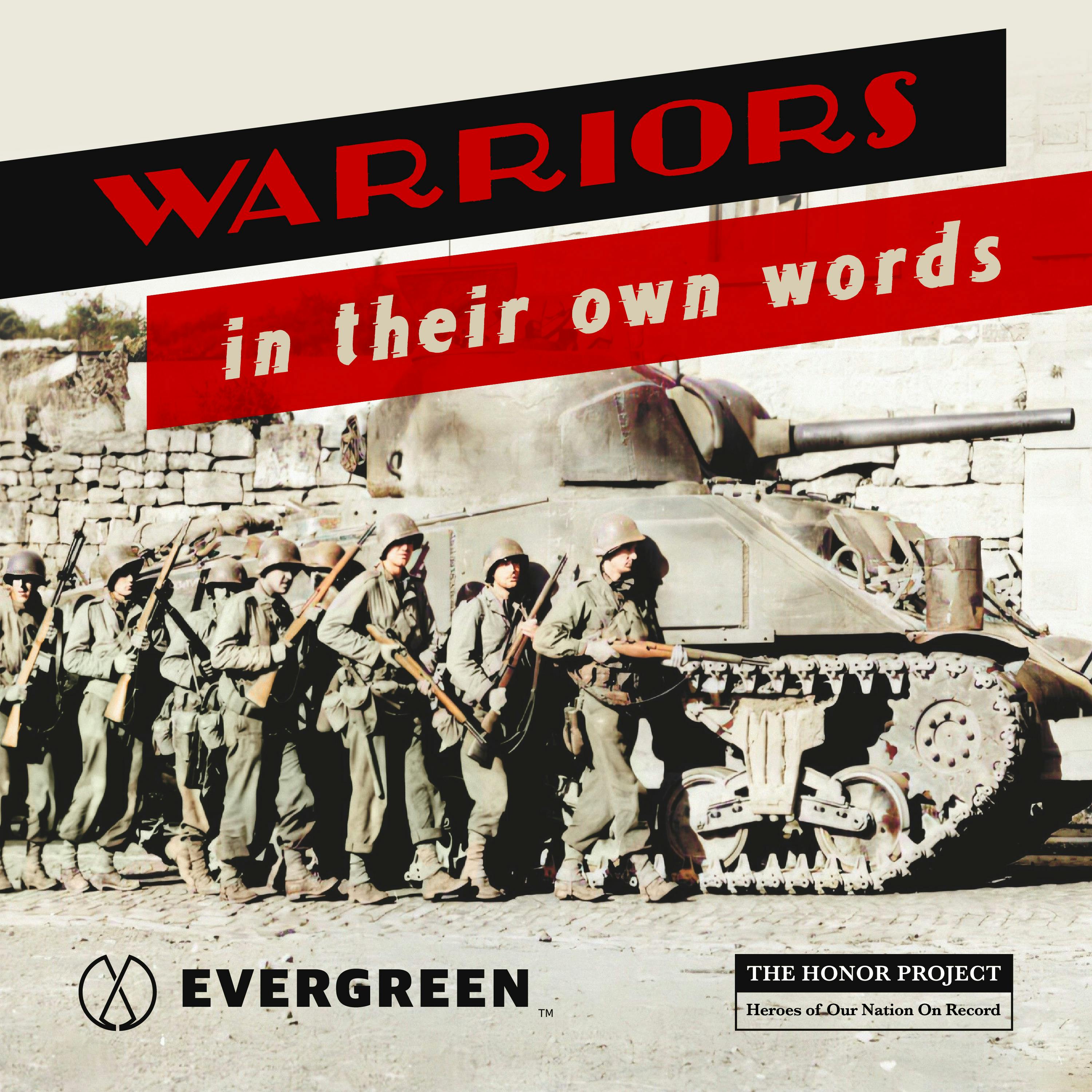
Warriors In Their Own Words | First Person War Stories
by Evergreen Podcasts | The Honor Project
Is this your podcast?On the show
From 19 epsHosts
Not detected.
Recent guests
Recent episodes
Pacific War Marine in WWII: From the Archive
Oct 8, 2026
53m 27s
Marine Corps Rifleman in Vietnam: From the Archive
Sep 24, 2026
45m 23s
Pete Everest, Air Force Test Pilot: From the Archive
Sep 24, 2026
1h 10m 20s
WWII Fighter Ace Flies in Korea: From the Archive
Sep 10, 2026
52m 26s
Intelligence Officer Fighting in Europe: From the Archive
Aug 27, 2026
1h 08m 25s
Insights from recent episode analysis
Audience Interest
Podcast Focus
Publishing Consistency
Platform Reach
Insights are generated by CastFox AI using publicly available data, episode content, and proprietary models.
Most discussed topics
Brands & references
Total monthly reach
Based on the show's feed history.
Built from
By chart position
- 🇿🇦ZA · History#17216K to 196K
- Per-Episode Audience
Est. listeners per new episode within ~30 days
16K to 196K🎙 Weekly cadence·271 episodes·Last published 1w ago - Monthly Reach
Unique listeners across all episodes (30 days)
32K to 392K🇺🇸71%🇿🇦29% - Active Followers
Loyal subscribers who consistently listen
18K to 216K
Market Insights
Platform Distribution
Reach across major podcast platforms, updated hourly
Total Followers
—
Total Plays
—
Total Reviews
—
* Data sourced directly from platform APIs and aggregated hourly across all major podcast directories.
Social Links & Contact
Official channels & resources
Official Website
Login
RSS Feed
Login
| Date | Episode | Topics | Guests | Brands | Places | Keywords | Sponsor | Length | |
|---|---|---|---|---|---|---|---|---|---|
| 10/8/26 | Pacific War Marine in WWII: From the Archive | John Nicely was a Sergeant in the US Marine Corps during the brutal Pacific island campaigns of WWII. He saw his first action in the battle of Saipan in June 1944. From there he continued fighting from island to island and eventually prepared for the invasion of Japan. Nicely and his unit entered the devastated city of Nagasaki, just 25 days after the nuclear blast. We met up with him at a reunion of the 2nd Marine division in 1994 and he shared his vivid memories of front-line combat. Learn more about your ad choices. Visit megaphone.fm/adchoices | 53m 27s | ||||||
| 9/24/26 |  Marine Corps Rifleman in Vietnam: From the Archive | John C. Muir was a decorated combat veteran of the Vietnam War. He hailed from four generations of men and woman who served in distinguished military service. He was also cousin to John Muir the famous naturalist who's been called “The Father of America’s National Parks.” In 1965, Muir volunteered for the US Marine Corps and was sent to Vietnam as a Rifleman. John C. Muir was an excellent storyteller who delivered powerful words about fighting the war and returning home. Learn more about your ad choices. Visit megaphone.fm/adchoicesSee Privacy Policy at https://art19.com/privacy and California Privacy Notice at https://art19.com/privacy#do-not-sell-my-info. | 45m 23s | ||||||
| 9/24/26 | Pete Everest, Air Force Test Pilot: From the Archive | General Frank “Pete” Everest was a record-setting US Air Force Test pilot. As a fighter pilot in World War II he flew over 150 combat missions. He then went on to lead the Air Force flight test program, flying with other legendary pilots like Chuck Yeager and George Welch. In the 1950s Everest set records like taking the X-1 to an altitude of 73,000 feet and the X-2 to 1957 mph. In this episode Pete Everest tells stories of those pioneering days of experimental aircraft and daring test pilots. Learn more about your ad choices. Visit megaphone.fm/adchoices | 1h 10m 20s | ||||||
| 9/10/26 |  WWII Fighter Ace Flies in Korea: From the Archive | Col. Walker “Bud” Mahurin was an American combat fighter pilot. Flying P-47s with the 56th FG in WWII, he became an ace three times over in the skies over Europe. After the war, he remained in the US Air Force. The outbreak of the Korean War in 1950 found him in the Pentagon, working on fighter aircraft procurement. The skills he exhibited in WWII would once again be tested, this time in a new arena of air warfare, the jet age dogfight. Mahurin tells his story of returning to combat in Korea. Learn more about your ad choices. Visit megaphone.fm/adchoicesSee Privacy Policy at https://art19.com/privacy and California Privacy Notice at https://art19.com/privacy#do-not-sell-my-info. | 52m 26s | ||||||
| 8/27/26 | military historyWorld War II+4 | Walter Bodlander | US Army | GermanyUnited States+1 | Walter Bodlandermilitary intelligence+5 | — | 1h 08m 25s | ||
| 8/13/26 |  Fighter Pilot of the Tuskegee Airmen: From the Archive✨ | Tuskegee AirmenWorld War II+4 | Colonel Charles Bussey | Tuskegee AirmenArmy Air Corps+1 | — | Tuskegee AirmenColonel Charles Bussey+6 | — | 52m 12s | |
| 7/30/26 | military historyveteran stories+4 | Al Ungerleider | ArmyNazi concentration camp | GermanyAberdeen Proving Ground | Army veteranD-Day+7 | — | 49m 09s | ||
| 7/16/26 |  Pacific War Diary: From the Archive✨ | World War IIMarine Corps+3 | Bill Swanson | United States Marines | BougainvilleGuam+2 | Bill SwansonMarine Corps+6 | — | 51m 12s | |
| 7/2/26 | World War IIaviation history+4 | — | Flying TigersSilver Streaks | BurmaEurope | World War IIR.T. Smith+7 | — | 58m 44s | ||
| 6/18/26 | Medal of Honorcombat stories+3 | Walter Ehlers | — | North AfricaEurope | Medal of HonorWalter Ehlers+5 | — | 58m 20s | ||
Want analysis for the episodes below?Free for Pro Submit a request, we'll have your selected episodes analyzed within an hour. Free, at no cost to you, for Pro users. | |||||||||
| 6/4/26 | D-DayWorld War II+4 | O.B. Hill | The Honor Project508th Parachute Infantry Regiment | — | D-DayO.B. Hill+5 | — | 58m 15s | ||
| 5/21/26 | D-DayWorld War II+4 | Wally ParrTerance Otway+1 | Evergreen PodcastsThe Honor Project | NormandyFrance+1 | D-DayNormandy+7 | — | 1h 05m 28s | ||
| 5/7/26 |  First Helicopter Combat Rescue Mission: From the Archive✨ | helicopter technologycombat rescue+3 | — | Igor SikorskyUS Army | Burma | helicoptercombat rescue+6 | — | 52m 55s | |
| 4/23/26 |  Combat Medics in Vietnam: From the Archive✨ | Vietnam WarCombat Medics+3 | Max ClelandClarence Sasser | Evergreen PodcastsThe Honor Project | — | VietnamCombat Medics+6 | — | 46m 43s | |
| 4/9/26 |  Tunnel Rats in Vietnam: From the Archive✨ | Vietnam WarTunnel Rats+3 | — | Evergreen PodcastsThe Honor Project | — | Tunnel RatsVietnam War+3 | — | 1h 09m 42s | |
| 3/26/26 | Vietnam Warmilitary snipers+3 | Chuck Mawhinney | Evergreen PodcastsThe Honor Project | Vietnam | snipersVietnam+5 | — | 49m 15s | ||
| 3/12/26 |  SOG Covert Task Force in Vietnam: From the Archive✨ | Vietnam Warspecial operations+3 | J.D. BathBill Deacy | Studies and Observations Group | VietnamSoutheast Asia | SOGVietnam War+5 | — | 1h 07m 42s | |
| 2/26/26 |  Wild Weasels in Vietnam: From the Archive✨ | Vietnam Warmilitary aviation+3 | Jerry HoblitBill Sparks+2 | F-100F-105+2 | — | Wild WeaselsVietnam+3 | — | 1h 01m 19s | |
| 2/12/26 | Vietnam Warsearch and rescue+3 | Gene Hambleton | Bat 21Bat 22+1 | North VietnameseHo Chi Minh Trail+1 | Vietnam WarGene Hambleton+3 | — | 40m 17s | ||
| 1/29/26 |  Forward Air Controllers in Vietnam: From the Archive✨ | Vietnam WarForward Air Controllers+3 | William PlattBill Townsley | Cessna 0-1 Bird Dog0-2 Skymaster+2 | — | Forward Air ControllersVietnam+3 | — | 43m 22s | |
| 1/14/26 |  Vietnam Forward Observers: From the Archive✨ | Vietnam WarForward Observers+4 | Barney BarnumBrian Thacker | Evergreen PodcastsThe Honor Project | — | Vietnam WarForward Observers+5 | — | 1h 03m 35s | |
| 12/25/25 | Iwo JimaWorld War II+5 | Chuck Tatum | U. S. Marine Corps | Iwo JimaMount Suribachi+1 | Iwo JimaChuck Tatum+8 | — | 1h 10m 28s | ||
| 12/11/25 |  Marine Raiders in the Pacific: From the Archive✨ | Marine RaidersWorld War II+3 | William Lansford | United States Marine CorpPresident Franklin D. Roosevelt | — | Marine RaidersWorld War II+3 | — | 1h 01m 57s | |
| 11/27/25 | Amphibious Assault in the Pacific: From the Archive | By 1943, the war in the Pacific burned in its full fury. On November 20th, the Allies launched the first amphibious assault against heavily defended beaches in US history. The 2nd division of the US Marine Corps, used amphibious tractors and assault boats to reach the beaches of the Tarawa atoll, an enemy stronghold protected by 5,000 hardened Imperial Japanese marines. Ed Moore and Tommy Reed were decorated veterans of the 2nd Marine Division during the island campaigns in the Pacific War. Learn more about your ad choices. Visit megaphone.fm/adchoices | 1h 03m 50s | ||||||
| 11/13/25 |  Guadalcanal: From the Archive | The unrelenting ferocity of the Pacific War was without a doubt the bloodiest and most savage of the two theaters of World War II. The memories of brutal battles like Guadalcanal, Tarawa, Midway and Iwo Jima are forever seared into minds of the courageous men who fought there. The island of Guadalcanal represented one of the last chances for the Allies to turn back the Japanese advance in the Pacific. Marine veteran Victor Croizat experienced the "hell of earth" of the battle for Guadalcanal. Learn more about your ad choices. Visit megaphone.fm/adchoicesSee Privacy Policy at https://art19.com/privacy and California Privacy Notice at https://art19.com/privacy#do-not-sell-my-info. | 1h 04m 49s | ||||||
Showing 25 of 271
Pitch Fit is a Pro feature
See how bookable this show is for guests, which brands already advertise, the per-episode ad value, and the best-fit guest and sponsor profile. The numbers are blurred on the free plan.
How readily this show books outside guests like you.
How proven this show is for host-read sponsorships.
For Guests
ProFor Advertisers
ProUpgrade to Pro to unlock guest cadence, sponsor categories, fit scores, and per-episode ad value for this show.
Similar Audience Demographics
Podcasts that attract a similar listener profile

WW2 Stories & Real War Stories
Pod Hour
The WW2 Podcast
Angus Wallace

The History of WWII Podcast
Ray Harris Jr

Combat Story
AJ Pasciuti
The Unauthorized History of the Pacific War
Seth Paridon, William Toti

WW2: Both Sides of The Wire
Prof. Matthias Strohn & Jesse Alexander

SOGCast: Untold Stories of MAC V SOG
John Stryker Meyer
Chart history for Warriors In Their Own Words | First Person War Stories
Peaked at #172 in South Africa, currently #172 in South Africa.
| Market | Genre | Peak | Current | Trend |
|---|---|---|---|---|
| South Africa | — | #172 | #172 | — |
Chart Positions
1 placement across 1 market.
Chart Positions
1 placement across 1 market.