Insights from recent episode analysis
Audience Interest
Podcast Focus
Publishing Consistency
Platform Reach
Insights are generated by CastFox AI using publicly available data, episode content, and proprietary models.
Most discussed topics
Brands & references
Est. Listeners
Insufficient chart data. Estimates will improve as the show charts.
- Per-Episode Audience
Est. listeners per new episode within ~30 days
N/A🎙 Weekly cadence·78 episodes·Last published 1w ago - Monthly Reach
Unique listeners across all episodes (30 days)
N/A - Active Followers
Loyal subscribers who consistently listen
N/A
Market Insights
Platform Distribution
Reach across major podcast platforms, updated hourly
Total Followers
—
Total Plays
—
Total Reviews
—
* Data sourced directly from platform APIs and aggregated hourly across all major podcast directories.
On the show
From 10 epsHosts
Recent guests
Recent episodes
A Calf By Any Other Name
Jun 17, 2026
Unknown duration
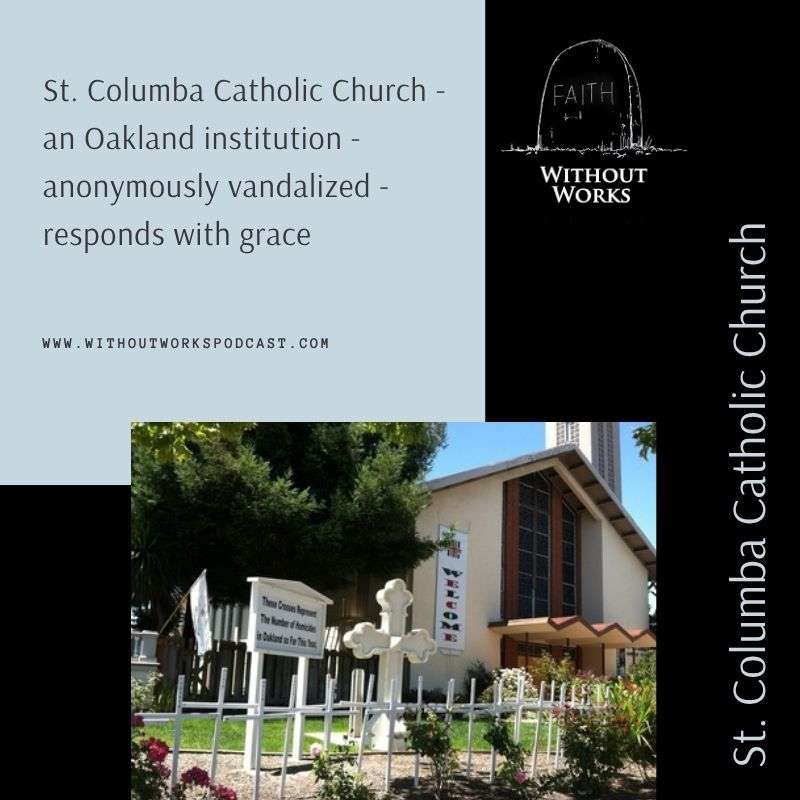
Saint Columba Catholic Church
May 27, 2026
4m 46s
Leading With Love
Mar 29, 2026
44m 13s
Church Protests
Feb 17, 2026
44m 57s
Playing a Victim
Dec 25, 2025
24m 39s
Social Links & Contact
Official channels & resources
Official Website
Login
RSS Feed
Login
| Date | Episode | Topics | Guests | Brands | Places | Keywords | Sponsor | Length | |
|---|---|---|---|---|---|---|---|---|---|
| 6/17/26 | ![]() A Calf By Any Other Name | Show Notes Amity: (standard disclaimer) The views and opinions expressed by the prophet Moses and his interpretation of the Lord of Hosts, is his own and do not reflect the policy, position, or opinions of Without Works. Lemuel: I am Lemuel Gonzalez, repentant sinner, and along with Amity Armstrong, your heavenly host, I invite you to find a place in the pew for today’s painless Sunday School lesson. Without Works. Amity: Fifteen feet tall, twenty-two if you include the plinth, bronze and covered in gold leaf referred to as Don Colossus - a statute of Donald Trump, raising a defiant fist to the heavens, commemorating the moment after a failed assasination attempt during the 2024 Presidential campaign has been erected at the Trump National Doral golf club in Florida Mark Burns, “pastor,” of Harvest Praise and Worship Center in South Carolina, was in attendance at its unveiling. He insisted that the installation of the statue was, “a celebration of life and a powerful symbol of resilience, freedom, patriotism, courage, and the will to keep fighting for America.” Pastor Burns felt it was necessary, unprovoked, to inform his followers on X “Let me say this plainly: This statue is not a golden calf. We worship Jesus Christ and him alone. This statue is not about worship. It is about honor.” So let’s discuss the Golden Calf - what it is and what it isn’t Lemuel: The story of the Exodus from Egypt is central to world religion and culture. The Hebrew people, led by Moses, are liberated after four hundred years of captivity in Egypt. They follow Moses through the desert, through the sea, and through the desert again. Moses is directed to return to Mount Sinai, where he had his original communication with God. He is to go alone to the mountain top, and receive directions for the future and the law to govern the hebrew people. For forty days and forty nights, no one was allowed to go near the mountain. The people were told to wash their clothes and abstain from sexual relations on pain of death. God descends onto the mountain in a terrifying display of thunder and fire, and Moses goes up to meet him. The hebrew people, huddled in camp, wait for Moses' return. Days pass. Weeks pass. Some of the people gather together and demand that Aaron, Moses’ older brother and spokesman, make them a God they can see and worship. They believe that Moses, already elderly, may be dead. They want to appease this terrifying God who they believe has struck down their leader. Aaron asks for the gold earrings and jewelry they brought from Egypt. He melts these down and makes a golden calf. The worship of this calf quickly turns from genuine adoration to revelry and this infuriates God. God commands Moses to return to his people, and in his wrath threatens to wipe them off the face of the earth, making Moses alone the father of the new Hebrew nation, the nation he had promised the patriarch Abraham. Moses is able to talk God out of this plan, and makes his way down the mountain. Moses, seeing the wild orgies carried on, becomes so furious that he shatters the stone tablets on which God had carved the ten commandments. Moses , anticipating God’s further anger, takes a terrible action. He separates the faithful from the idolaters, arms them, and insists: **Amity: ** “ ... “This is what the Lord, the God of Israel, says: ‘Each man strap a sword to his side. Go back and forth through the camp from one end to the other , each killing his brother, friend, and neighbor.’ The Levites did as Moses commanded, and that day about three thousand people died.” **Lemuel: ** The calf is melted, ground into powder, and the survivors are compelled to drink it. Even those survivors are punished: God sends a plague. Amity: Welcome to the Old Testament. The first and second of the Ten Commandments are: ‘Thou shalt have no other gods before me,” and, “Thou shalt not make unto thee any graven image.” This might seem strange when the high church, Catholic and Orthodox, use statues and icons as part of their worship. Lemuel: Those images are used to focus worship. They are meant to anchor wandering minds during prayer. The use of the images as sacred beings is what God objects too. Ascribing God’s plans and actions to an idol is also something God objects too. Representative sculpture is not. God instructed Moses, for instance, to have two angels carved into the lid of the Ark of the Covenant. Amity: The image of God has changed since Moses’ time. He is no longer seen as an impetuous mirror of our desires. At least he shouldn't be. The God who would insist on the slaughter of his own people in an effort to winnow the survivors to create a complaint remnant is no longer the God that true Christians worship. In that extremely black and white world, the worship of a God other than the one we are pledged to is infidelity. Oath breaking.** | — | ||||||
| 5/27/26 | ![]() Saint Columba Catholic Church✨ | Catholic Church historyAfrican American Catholic experience+3 | — | Saint Columba Catholic ChurchSacred Heart Church+2 | — | Saint ColumbaCatholic Church+5 | — | 4m 46s | |
| 3/29/26 | ![]() Leading With Love✨ | lovehatred+3 | — | The HillThe Seattle Times | — | seminarianhatred+3 | — | 44m 13s | |
| 2/17/26 | ![]() Church Protests✨ | religionchurch protests+4 | — | Facebookwithoutworkspod@gmail.com+2 | — | church protestsconstitution+5 | — | 44m 57s | |
| 12/25/25 | ![]() Playing a Victim✨ | psychologygender typicality+3 | — | Lifespan Development | — | gender typicalitypopularity+3 | — | 24m 39s | |
| 10/30/25 | ![]() The Rapture - Take 2✨ | rapturesecond coming+4 | — | — | — | raptureJoshua Mhlakela+4 | — | 34m 07s | |
| 9/16/25 | ![]() Heaven is Too Far Away✨ | spiritualityChristianity+3 | — | Christian Nationalists | UkraineRussia | Donald Trumpheaven+5 | — | 22m 34s | |
| 8/18/25 | ![]() The Way✨ | Christianitymorality+3 | — | — | — | Christianitymorality+3 | — | 43m 02s | |
| 6/30/25 | ![]() Reading is not Fundamental✨ | Christianitypolitics+3 | Jen Hamilton | Board of NursingTrump administration+3 | — | ChristianityMAGA+3 | — | 29m 27s | |
| 5/15/25 | ![]() Praying Out Loud✨ | public prayersystemic injustice+4 | — | Center for Public Theology and Public PolicyNAACP+3 | Washington | prayerarrest+5 | — | 21m 51s | |
Want analysis for the episodes below?Free for Pro Submit a request, we'll have your selected episodes analyzed within an hour. Free, at no cost to you, for Pro users. | |||||||||
| 3/21/25 | ![]() Preying for Who?✨ | anti-Christian biasgovernment authority+4 | — | Department of JusticeIRS+1 | — | anti-Christian biasDonald Trump+4 | — | 20m 15s | |

| 1/21/25 | ![]() We Didn't Start the Fire | Episode Notes Lemuel: I am Lemuel Gonzalez, repentant sinner, and along with Amity Armstrong, your heavenly host, I invite you to find a place in the pew for today’s painless Sunday School lesson. Without Works. Amity: Fires are burning through Southern California. We don’t know how they started. Arson, fireworks, and unauthorized camping are potential causes. Driven on by hundred mile an hour winds, these fires quickly spread and devoured entire neighborhoods. There are currently three remaining active fire incidents remaining: Palisades, Eaton, and Auto with the latter being 100% contained. Over forty thousand acres have been burned. The Eaton fire has produced the largest number of fatalities. While the evacuated homeowners watch their homes reduced to ash, conservative politicians and commentators lay blame for the severity of the damage on California's “woke” policies. The suggestion being that in an effort to create a safe, inclusive environment for emergency services workers, incompetent people were hired for quotas and media appearances rather than merit. This from the same people supporting the wildly inadequate and unqualified choices of the current president elect. Beyond that there are outright lies congruent with conservative fantasies about the inability to stop the blaze. Blame is laid on Native Americans, the tiny Delta Smelt fish, and homosexuality. A few have even gone further, claiming that this is a divine punishment for the excesses and abuses of the entertainment industry and the moral values it spreads in the media. Lemuel: The fires in Southern California are not God’s retribution at a center of sin and vice. You can find examples in the Bible of God taking action against countries and kingdoms. The destruction of Sodom and Gomorrah provides an interesting example. Here the twin cities of the plain are to be destroyed for their population’s indifference to suffering, their misuse of prosperity, and mistreatment of foreigners seeking shelter for the night. These things are emphasized in Ezekiel 16:49 “‘Now this was the sin of your sister Sodom: She and her daughters were arrogant, overfed and unconcerned; they did not help the poor and needy. Even the Old Testament God was reluctant to destroy them. The Bible mentions a divine envoy being sent to investigate Sodom thoroughly before assigning destruction. Even then, God consults with his friend Abraham before making this decision. This is related in Genesis 18: 20-33. 20 Then the Lord said, “The outcry against Sodom and Gomorrah is so great and their sin so grievous 21 that I will go down and see if what they have done is as bad as the outcry that has reached me. If not, I will know.” 22 The men turned away and went toward Sodom, but Abraham remained standing before the Lord.[b] 23 Then Abraham approached him and said: “Will you sweep away the righteous with the wicked? 24 What if there are fifty righteous people in the city? Will you really sweep it away and not spare[c] the place for the sake of the fifty righteous people in it? 25 Far be it from you to do such a thing—to kill the righteous with the wicked, treating the righteous and the wicked alike. Far be it from you! Will not the Judge of all the earth do right?” 26 The Lord said, “If I find fifty righteous people in the city of Sodom, I will spare the whole place for their sake.” 27 Then Abraham spoke up again: “Now that I have been so bold as to speak to the Lord, though I am nothing but dust and ashes, 28 what if the number of the righteous is five less than fifty? Will you destroy the whole city for lack of five people?” “If I find forty-five there,” he said, “I will not destroy it.” 29 Once again he spoke to him, “What if only forty are found there?” He said, “For the sake of forty, I will not do it.” 30 Then he said, “May the Lord not be angry, but let me speak. What if only thirty can be found there?” He answered, “I will not do it if I find thirty there.” 31 Abraham said, “Now that I have been so bold as to speak to the Lord, what if only twenty can be found there?” He said, “For the sake of twenty, I will not destroy it.” 32 Then he said, “May the Lord not be angry, but let me speak just once more. What if only ten can be found there?” He answered, “For the sake of ten, I will not destroy it.” 33 When the Lord had finished speaking with Abraham, he left, and Abraham returned home. Amity: The city of Los Angeles is not represented solely by an entertainment industry. Overall the city is very religious, with 1,700 Christian churches, 202 jewish synagogues, 145 Buddhist temples, and 48 mosques. The Los Angeles Diocese is the largest in the United States, with nearly five million members. There are two hundred and eighty Catholic parishes in the Los Angeles area. One hundred and fifty four Methodist churches. Five hundred and seventeen Baptist churches. Sixty five percent of the city claims Christianity as their faith. Lemuel: The fiercest and most wrathful interpretation of God is reluctant to bring punishment on his children, even when the deserve it. The seventy-five thousand persons displaced by the fire crisis are victims of an unforeseen disaster. Please Donate if you can - https://www.calfund.org/funds/wildfire-recovery-fund/ Amity: That brings us to the end of this week’s episode. If you like it, please subscribe and leave us a review - and share it with a friend. Lemuel: We have an internet home: withoutworkspodcast.com. Our show notes and links to stories we talk about can be found there. Email @ withoutworkspod@gmail.com Our Internet home: www.withoutworkspodcast.com | — | ||||||
| 12/19/24 | ![]() Screaming into the Void | Episode Notes On Tuesday, November fifth, convicted felon, rapist, and would be dictator Donald Trump was voted back into office. It is pointless to go into how this could have happened, as any excuses will not change the results. The truth is that it is inexcusable. Despite the exposure of the man, and many of his crimes, he was put into power. Again. The following is fifteen minutes of screaming into the void. Facebook: https://www.facebook.com/withoutworks Email @ withoutworkspod@gmail.com Our Internet home: www.withoutworkspodcast.com | — | ||||||
| 11/20/24 | ![]() Thou Shall Not Kill | Episode Notes Lemuel: I am Lemuel Gonzalez, repentant sinner, and along with Amity Armstrong, your heavenly host, I invite you to find a place in the pew for today’s painless Sunday School lesson. Without Works. Amity: Marcellus Williams is dead. He was the third person executed in the state of Missouri, and the fifteenth person executed in the nation this year. As of this recording, the national total has risen to 20 people. He was convicted in 2001 of the murder of Felicia Gayle, a former journalist, stabbed to death in her home in 1998. The Innocence Project released the following statement: Mr. Williams’ story echoes that of too many others caught in our country’s broken criminal legal system. A Black man convicted of killing a white woman, Mr. Williams maintained his innocence until the very end. His conviction was based on the testimony of two eyewitnesses who were paid for their testimony. No DNA evidence linked him to the crime. And the current St. Louis County Prosecuting Attorney acknowledged that errors made by the trial prosecutors – including mishandling the murder weapon and intentionally excluding Black prospective jurors in violation of the Constitution – contributed to a wrongful conviction. Nonetheless, the Missouri Attorney General’s Office relentlessly pursued Mr. Williams’ execution and opposed clemency. The Attorney General and Missouri Governor Mike Parson – who ultimately denied the request for clemency – ignored the wishes of the victim’s husband who has consistently made clear that he opposed the death penalty for Mr. Williams. Lemuel: The Bible expresses conflicting opinions about the death penalty, as is to be expected of a book compiled and edited over such a long period of time. Capital punishment is a part of Old Testament teaching, and death, probably by stoning, is the penalty for various, ‘crimes,’ which to ancient peoples included things like idolatry, false witness, rape of a virgin, male homosexual practice, and child sacrifice. Still, Cain was not killed for the murder of his brother. Moses, despite killing an Egyptian overseer who was beating a Hebrew slave to death, was allowed to flee into the desert rather than face Egyptian justice. In the New Testament, we are presented with the death, by capital punishment, of Jesus Christ and nearly all of his original disciples. Saint Stephen, the first Christian martyr, was stoned to death. Saint Peter, the founder of the Church (rather than the faith ) was crucified. James the Younger was stoned and having survived this, was beaten to death with clubs. Of the original twelve only one survived to old age, John, and he, according to extra biblical tradition, survived his death sentence, which was being boiled alive. These executions were legal. In the case of Jesus, the execution was sanctioned by the religious authorities at the time, that is to say, the Church, and both Herod and Pilate, the secular authorities. I bring this up to explain that Jesus’ torture and execution were legal in both the eyes of Church and State. Given this history, its impact on nearly all of the founders of the faith, why would a Christian support the death penalty? Find us on Twitter: @WithoutWorksPod Facebook: https://www.facebook.com/withoutworks Email @ withoutworkspod@gmail.com | — | ||||||
| 9/26/24 | ![]() Vade Retro | Show Notes Lemuel: I am Lemuel Gonzalez, repentant sinner, and along with Amity Armstrong, your heavenly host, I invite you to find a place in the pew for today’s painless Sunday School lesson. Without Works. Amity: Today we look into the murder of Sonya Massey. In my telling of the events, I will be quoting directly, and so will be using profanity. In her final words she used an ancient spiritual invocation against evil. Why? To start with, this is what happened. Sonya Massey was a 36 year old black woman, a resident of Springfield, Illinois. She was murdered in her own kitchen by Illinois State Police Officer Sean Grayson. Officer Grayson was earlier admonished by superior officers for abuse of his authority, for harassment, and falsifying reports. He served six different police departments in four years, moving from place to place when his exploitation of power was discovered. Ms. Massey called the police to investigate a prowler. When Grayson and his partner arrived, Ms. Massey was herself investigated. She was almost immediately requested to show her Identification. Officer Grayson directed Ms. Massey to remove a pot of water that was boiling on her stove. As she was removing the pot she said, presumably to Officer Grayson, “I rebuke you in the name of Jesus.” Officer Grayson responded by immediately drawing his gun, shouting, “You better fing not. I’ll fing shoot you in the f***ing face!” As Ms. Massey apologized and ducked for cover with her empty hands over her head, and Office Grayson made good on his promise and shot her in the face. Three times. Lemuel: Ms. Massey’s final words included the invocation, “I rebuke you in the name of Jesus.” This is a version of Jesus’ rebuke of Saint Peter, who attempted to dissuade Jesus from accomplishing his mission. Jesus tells him, “Get thee behind me Satan,” or, in less formal language, step aside. The invocation is repeated in medieval manuscripts: “Vade Retro Satan…” Our Internet home: www.withoutworkspodcast.com https://www.christiancentury.org/news/sonya-massey-said-i-rebuke-you-name-jesus-what-s-significance https://www.cnn.com/2024/08/06/us/sean-grayson-field-report-massey-shooting/index.html https://www.christianitytoday.com/2024/08/rebuke-evil-in-name-of-jesus-sonya-massey/#:~:text=1:3;%20Ps.,presence%20of%20a%20holy%20God | — | ||||||
| 7/19/24 | ![]() Thou Shalt Not... | Show Notes Lemuel: I am Lemuel Gonzalez, repentant sinner, and along with Amity Armstrong, your heavenly host, I invite you to find a place in the pew for today’s painless Sunday School lesson. Without Works. Amity: Effective June twenty-seventh, all Oklahoma schools are required to incorporate the Bible, and the Ten Commandments, into their curriculum. Ryan Walters, Republican State Superintendent, insisted on this plan, made effective immediately. This followed a Republican Governor Jeff Landry signed House Bill 71 which required that requires the following: Lemuel: ( in stentorian voice ) “Each public school governing authority and the governing authority of each non-public school that receives state funds shall display the Ten Commandments in each building it uses and classroom in each school under its jurisdiction. The nature of the display shall be determined by each governing authority with a minimum requirement that the Ten Commandments shall be displayed on a poster or framed document that is at least eleven inches by fourteen inches. The text of the Ten Commandments shall be the central focus of the poster or framed document and shall be printed in a large, easily readable font.” Amity: This is an issue that surfaces every few years, causes controversy, then sinks quietly, unresolved. This time it has gathered force from the increasing number of supporters on the Evangelical right. According to Superintendent Walters, “This is not merely an educational directive, but a crucial step in ensuring our students grasp the core values and historical context of our country.” Lemuel: To our unchurched listeners, perhaps even those who do not care for the oeuvre of Cecil B DeMille, We will enumerate the commandments: Thou shalt have no other gods before me. Thou shalt not make to thyself any graven images. 3.Thou shalt not take the Name of the Lord thy God in vain. Remember the Sabbath day, to keep it holy. 5.Honor thy father and thy mother, that thy days may be long upon the land which the Lord thy God giveth thee. Thou shalt not kill. Thou shalt not commit adultery. Thou shalt not steal. Thou shalt not bear false witness against thy neighbor. Thou shalt not covet thy neighbor's house. Thou shalt not covet thy neighbor's wife, nor his manservant, nor his maidservant, nor his cattle, nor anything that is thy neighbor's." Lemuel: The first problem with this particular set of rules is that it narrows the interpretation of the commandments through its language. This is a specific translation, and that is dangerous for what is being purported to be the words of God himself. Amity: The other, obvious problem, is that these are specifically religious rules. The first four of these commandments are meant to regulate and set apart religious practice from the other spiritual ideas. Questions: So why are we returning to this? Why the effort to enforce a set of religious rules that Republican leadership privately ignores? How many of these commandments has Trump broken? Theft? Adultery? False witness? Coveting? ORGAN END STINGER Amity: That brings us to the end of this week’s episode. If you like it, please subscribe and leave us a review - and share it with a friend. Lemuel: We have an internet home: withoutworkspodcast.com. Our show notes and links to stories we talk about can be found there. Facebook: https://www.facebook.com/withoutworks Email @ withoutworkspod@gmail.com Our Internet home: www.withoutworkspodcast.com Amity: We are also reachable at withoutworkspod@gmail.com, on twitter @withoutworkspod and on Facebook at Without Works podcast. All that information is on the website as well, so go there and have a look around. I’ve been Amity and he’s been Lemuel, and we urge you to go out and do something good. AP News CNN | — | ||||||
| 6/27/24 | ![]() The People Jesus Warned Us About | Episode Notes Lemuel: I am Lemuel Gonzalez, repentant sinner, and along with Amity Armstrong, your heavenly host, I invite you to find a place in the pew for today’s painless Sunday School lesson. Without Works. Amity: This week, in our new, shorter format, we will explore the new role of convicted felon and former president, Donald Trump in Get Thee Behind Me, Felicia. Lemuel: I often used the word, blasphemy,’ to describe behavior that falls outside of the teachings of Jesus. It’s a strong word, overused these days to cover things less than sacred. We include an article in our notes today, a piece on a respected and educated man, author and talk show host, Eric Metaxes. Claiming membership in the Greek Orthodox Church, he has spoken and written on the Ecumencal values shared by the Christian Church as a whole. Even with this background, he makes an odious comparison: His now deleted social media post showing a photograph of Trump’s scowling face and a depiction of the crucified Christ, under which was written the caption: “If you're not sure you can vote for a convicted criminal, Remember you worship one.” To make is clear: Metaxes is comparing a sexual predator, grifter, adulterer, exploiter, to Jesus Christ. Trump is guilty of his crimes; Jesus was not. False equivalency at least. Amity: Trump has tried courting the Evangelical vote for years, and against all reasoning, has been successful. During his 2016 campaign he visited a non-denominational church in Council Bluffs, Iowa and put a few dollars in the Communion Plate, thinking he was being asked for cash. Beyond the question of why one of the supposedly richest men on earth, valued at just under seven billion dollars, gives God pocket change is one thing. The other thing is the fact that he can’t tell an offering plate from a Communion plate, or that both are completely separate parts of a service. Lemuel: On the subject of the Eucharist itself, Trump said this: “When I drink my little wine- which is about the only wine I drink- and have my little cracker, I guess that is a form of asking forgiveness, and I do that as often as possible because I feel cleansed.” He seems to have only the most rudimentary idea of what the Eucharist is for, despite its supposed importance to him. Amity: His knowledge of the Bible is equally rudimentary. Questioned about his favorite Bible passage he deferred by claiming the answer was too personal. When further pressed, he couldn’t say if he favored the Old or New Testaments. Yet he has now issued a new Bible, the,“God Bless the USA Bible,” which includes the Declaration of Independence, the Pledge of Allegiance, and among other secular documents, the lyrics of Lee Greenwood’s, “God Bless the USA.” To their credit mainstream Churches have rejected this most recent attempt to court their vote. The problem is that there are those who don’t. Lemuel: So what are we seeing? The birth of a cult? A cancer in the Body of Christ? The Trump message, steeped in fear, racism, and sexism, has replaced the genuine Gospel in the minds of its followers. This message of violence and vengeance is somehow operating inside of the Christian Church. QUESTIONS: Do secular minded people distinguish between the, “Christian,” Trump followers, and the genuine followers of Christ? Is this new dissonant Trump teaching an example of Orwell’s, “Double Think?” (Holding two absolute opposing ideas despite their contradictory natures, and accepting them) Is the damage caused by the Trump cult to the Christian Church irreparable? ORGAN END STINGER Amity: That brings us to the end of this week’s episode. If you like it, please subscribe and leave us a review - and share it with a friend. Lemuel: We have an internet home: withoutworkspodcast.com. Our show notes and links to stories we talk about can be found there. Find us on Twitter: @WithoutWorksPod Facebook: https://www.facebook.com/withoutworks Email @ withoutworkspod@gmail.com Our Internet home: www.withoutworkspodcast.com Amity: We are also reachable at withoutworkspod@gmail.com, on twitter @withoutworkspod and on Facebook at Without Works podcast. All that information is on the website as well, so go there and have a look around. I’ve been Amity and he’s been Lemuel, and we urge you to go out and do something good. Outro Song https://www.premierchristianity.com/opinion/no-you-cannot-compare-trumps-conviction-to-jesus-crucifixion/17743.article https://www.independent.co.uk/news/people/donald-trump-accidentally-put-money-in-communion-plate-at-iowa-church-a6847061.html https://www.cnn.com/2024/03/28/us/donald-trump-bible-christianity-cec/index.html | — | ||||||
| 5/22/24 | ![]() Surviving the Next Schism | Show Notes Lemuel: I am Lemuel Gonzalez, repentant sinner, and along with Amity Armstrong, your heavenly host, I invite you to find a place in the pew for today’s painless Sunday School lesson. Without Works. Amity: The amount of research that goes into each show makes it difficult to release episodes in a timely manner. By the time that we gather enough information for an informed opinion on a subject, it has been replaced with another fresh assault on the public accountability of faith. We are experimenting with a new idea: a single subject to discussion, each of us sharing our opinions. This week it will be Not Necessarily the Good News, and our discussion will be on the recent changes in the Methodist Church. Not Necessarily the Good News. Amity: The Methodist Church, the communion founded in the late eighteenth century by brothers John and Charles Wesley, has recently followed the example of the Episcopal, Presbyterian and Lutheran Churches and ended bans on gay clergy, and same sex marriage. The current United Methodist Church was created in 1968 by joining two associated branches with roots in Wesley’s teachings, the Methodist Church and the Evangelical United Brethren Union together to a 12.5 million strong communion worldwide. Outside of sharing the basic tenants of the faith, the methodist Church has three principles, which we could sum up this way: Do no Harm. Do good, of every possible sort. Engage in daily, rigorous spiritual practice, like reading the scriptures, and prayer. Based on these foundational principles the Methodist Church faced conflicts with conservative spiritual forces, most notably the Anglican Church. The Methodists followed the example of John Wesley who in 1774 published a sermon on the evils of slavery. By 1780 Methodist pastors were compelled to deliver anti-slavery sermons, and by 1785 any member who had purchased a slave, except with the express purpose of setting that person free, was expelled from the Methodist fellowship. This caused a rift with slave state Methodists who wanted to hold on to what they considered property. A similar rift has been caused by the acceptance of gay clergy and gay equality in marriage. Language adopted by the United Methodist Church in 1972 condemned its gay members, declaring the gay lifestyle incompatible with Christian teaching, and banning gay members from ordination while extending to them the love of Christ. The United Methodist Church, in its recent conference, reversed the language and the decision, but that has lead to many churches to disaffiliate. DISCUSSION: With over seven thousand of the thirty thousand Methodist Churches committed to disaffiliating, will the Methodist Union survive? The inclusion and reconciliation with gay members consistent with the principles of founders John and Charles Wesley. Is there any grounds for churches separating for the communion? Amity: That brings us to the end of this week’s episode. If you like it, please subscribe and leave us a review - and share it with a friend. Lemuel: We have an internet home: withoutworkspodcast.com. Our show notes and links to stories we talk about can be found there. Amity: All of our social links are on the website so if you want to reach out go there for all that information. I’ve been Amity and he’s been Lemuel, and we urge you to go out and do something good. | — | ||||||
| 2/18/24 | ![]() Book of Clarence | Episode Notes Lemuel: I am Lemuel Gonzalez, repentant sinner, and along with Amity Armstrong, your heavenly host, I invite you to find a place in the pew for today’s painless Sunday School lesson. Without Works. Amity: Today we will have an open discussion on the controversies around a recent film, “The Book of Clarence,” a recent comedy about fictional characters who live in Jerusalem at the time of Christ, and interact with Jesus and his disciples. Lemuel: The stories’ protagonist is a feckless young man played by LaKeith Stanfeild. Accompanied by his best friend Elijah, played by RJ Cyler, the two travel a picaresque route through Jerusalem, meeting the disciples, the Holy parents, John the Baptist, Mary Magdalene, and Jesus himself. Amity: The questions we will be asking are these: How does the film address the story? Is the film sacrilegious or misrepresent the Bible story? Is it ever appropriate to make fun of sacred topics? Why the controversy? Is it because of the light tone taken to sacred subjects, or is it because the film represents nearly all of the biblical characters as African? | — | ||||||
| 12/24/23 | ![]() The Woman Who Made Jesus | Show Notes Lemuel: I am Lemuel Gonzalez, repentant sinner, and along with Amity Armstrong, your heavenly host, I invite you to find a place in the pew for today’s painless Sunday School lesson. Without Works. Amity: Today we will look at the new speaker of the house and his opinions in Not Necessarily the Good News and Lemuel will look into the woman who started it all in Pillars of Wisdom. Necessarily the Good News Amity: Current speaker of the House , Republican Mike Johnson expressed his point of view this way: “I am a bible believing christian. Someone asked me today, in the media, they said, ‘It’s curious, people are curious. What does Mike Johnson think about any issue under the sun?’ I said, ‘Well, go pick up a Bible off your shelf, and read it. That’s my worldview.’” This is problematic for many reasons. There are many biblical translations, accepted by many parts of the church. Speaker Johnson is a Protestant, and beyond that a Baptist. There are 57 Baptists currently serving in the House of Representatives, the second largest Christian denomination represented, the largest being the Catholic Church, with 122 members. When a speaker says that the Bible is his opinion, what does it mean, and why is it important to us? SUMMATION: In the end I would say this: When Pilate asked Jesus if he was a king, Jesus responded: “My kingdom is not of this world … “ The separation of Church and state is a construct instituted by Jesus Christ. Maybe Speaker Johnson’s bible doesn't include this verse. Amity: And now, in honor of the season, we try to understand a little more about the woman central to the Christian Church. Pillars of Wisdom: Amity: “At the center of this mystery, in the midst of this wonderment of faith, stands Mary. As the loving mother of the redeemer, she was the first to experience it. ‘To the wonderment of nature you bore your Creator." -Pope John Paul the Second, Redemptoris Mater Lemuel: She is designated with the title Theokotos in the Eastern Christian Church: the God - bearer. The Immaculate Conception in the Roman Church where she is also referred to as the Queen of Heaven, Our Lady, and Star of the Sea. There are few more important persons in the Christian world than Mary. For a person who changed the world we don’t know very much about her. She was betrothed to Joseph, a carpenter, perhaps a good deal older than her and may have even been a widower with other children from his first marriage. We know that she had a maternal aunt, Elizabeth, a devout, much older woman who also brought a miraculous child into the world. Mary received a visitation; she was informed that she, among all the women of the world, was chosen to bring God into the world, if she chose to receive it. With her consent, she brings this child into the world. The rest of that story becomes her son’s story; his mission, and sacrifice, but she remains in the background. She urges him to spare a newly married couple the embarrassment of running out of wine at their wedding feast. She was present at the crucifixion; Jesus tells her that John, the youngest disciple, was to act as her son. The years after this, she drops away from focus. She begins reappearing in illustrations in catacombs at the beginning of the second century. She is given some of the titles mentioned earlier. Some of the titles were borrowed from earlier Goddesses, and some of the depictions as well. A woman with a baby, a woman weeping for her murdered son. There are no canonical stories about her after she is a part of the miraculous gathering on the day of Pentecost, but that story implies that she was a leader in the early church. Her death is never described, but her Assumption, (her body being taken intact into heaven) is a doctrine in much of the high church. Ancient peoples come to us as ciphers, and most of the biblical people we meet are shadowy figures with unexplained motives. We don’t understand Judas Iscariot, and can only guess why he did what he did. A person like Joseph the Carpenter comes across as decent and kind, but he is painted in quick, efficient strokes with no color or detail. SUMMATION: Mary is, in the faith, the most important person who ever lived. She is a distant example of perfection in some branches of the Church. The best way to find her is to see a young woman bearing a child, mourning that grown child’s death, then carrying him on in her heart for the rest of her life. Amity: That brings us to the end of this week’s episode. If you like it, please subscribe and leave us a review - and share it with a friend. Lemuel: We have an internet home: withoutworkspodcast.com. Our show notes and links to stories we talk about can be found there. Amity: All of our social links are on the website so if you want to reach out go there for all that information. I’ve been Amity and he’s been Lemuel, and we urge you to go out and do something good. Facebook: https://www.facebook.com/withoutworks Email @ withoutworkspod@gmail.com Our Internet home: www.withoutworkspodcast.com Sources https://www.businessinsider.com/mike-johnson-earn-his-views-by-reading-the-bible-2023-10 https://www.nytimes.com/2023/10/27/us/politics/mike-johnson-interview-hannity-takeaways.html https://orthodoxbridge.com/2012/05/20/why-evangelicals-need-mary/ https://www.nbcnews.com/politics/congress/speaker-mike-johnson-says-separation-church-state-misnomer-rcna125181 | — | ||||||
| 10/30/23 | ![]() Israel/Palestine | Show Notes Lemuel: I am Lemuel Gonzalez, repentant sinner, and along with Amity Armstrong, your heavenly host, I invite you to find a place in the pew for today’s painless Sunday School lesson. Without Works. This week, we are going to discuss the events occurring in the Gaza strip, the history of the region, and the evangelical view of the situation. This is being recorded on October 28, 2023 and we are doing our best to give the latest information. Amity: I have tried to keep this as straightforward and clear as possible. I am extremely emotional about this topic and have spent much of the past twenty days watching the news coming directly out of Palestine, sharing Palestinian voices and calling my representatives to demand a ceasefire and humanitarian aid to the people of Palestine. First things first - we have to state unequivocally the following: Zionism is not Judaism, and a person can be anti-Zionist and not anti-semetic, as many, many American jews are. We will come back to this in a few minutes. The attack on Israel on October 7, 2023 is abhorrent and terrible and we grieve with the survivors and families of those who were killed. May their memories be a blessing. Events leading up to October 7 Let’s start with some history, which I have put together from several sources. This is a very broad, very simplified overview of the history. In the show notes, we have included an extensive reading list to get a rounder view of the subject. Israel and Palestine: In the late 19th century, the Zionist movement called for the creation of a homeland for the Jewish people to escape persecution in Europe. Immigration and the purchase of land in Palestine, then part of the Ottoman Empire, was encouraged. The land known as Palestine at the beginning of the 20th century encompasses a 25,000 square mile piece of land bordered on the west by the Mediterranean Sea, on the East by what is now Syria and Jordan on the south by Egypt and on the north by Lebanon. After the First World War and the collapse of the Ottoman Empire, Britain was granted a mandate to govern the region of Palestine and Jewish immigration increased as Nazism took hold in central Europe. This brought tensions in the area with the Arab population, and after the Second World War a new plan was drawn up and agreed by the United Nations to create two separate Arab and Jewish states with Jerusalem remaining international. The Arab state would include Gaza, an area near the border with Egypt, a zone near the border with Lebanon, a central region which includes the West Bank, and a tiny enclave at the city of Jaffa.But this was never implemented after Arab opposition. At midnight on 14/15 May 1948, the Mandate for Palestine expired and the State of Israel came into being. The Palestine Government formally ceased to exist, the status of British forces still in the process of withdrawal from Haifa changed to occupiers of foreign territory, the Palestine Police Force formally stood down and was disbanded, with the remaining personnel evacuated alongside British military forces, the British blockade of Palestine was lifted, and all those who had been Palestinian citizens ceased to be British protected persons, with Mandatory Palestine passports no longer giving British protection. Over the next few days, approximately 700 Lebanese, 1,876 Syrian, 4,000 Iraqi, and 2,800 Egyptian troops crossed over the borders into Palestine, starting the 1948 Arab–Israeli War. The war, which was to last until 1949, would see Israel expand to encompass about 78% of the territory of the former British Mandate, with Transjordan seizing and subsequently annexing the West Bank and the Kingdom of Egypt seizing the Gaza Strip. The 1948 Palestinian expulsion and flight, known to Palestineans as the Nakba took place both before and after the end of the Mandate. The foundational events of the Nakba took place during and shortly after the 1948 Palestine war, as that 78% of Mandatory Palestine was declared as Israel, leading to the expulsion and flight of 700,000 Palestinians, the related depopulation and destruction of over 500 Palestinian villages by Zionist militias and later the Israeli army and subsequent geographical erasure, the denial of the Palestinian right of return, the creation of permanent Palestinian refugees, and the "shattering of Palestinian society" Now, back to what I brought up at the opening of this episode, the difference between Zionism and Judaism. Zionism v Judaism: Judaism is an Abrahamic, monotheistic, and ethnic religion. It comprises the collective spiritual, cultural, and legal traditions of the Jewish people having originated as an organized religion in the Middle East during the Bronze Age. Zionism is a nineteenth-century political ideology that emerged in a moment where Jews were defined as irrevocably outside of a Christian Europe. European antisemitism threatened and ended millions of Jewish lives — in pogroms, in exile, and in the Holocaust. Many Jews today are anti-Zionist, believing that Zionism was a false and failed answer to the desperately real question many of their ancestors faced of how to protect Jewish lives from murderous antisemitism in Europe. While it had many strains historically, the Zionism that took hold and stands today is a settler-colonial movement, establishing an apartheid state where Jews have more rights than others. Our own history teaches us how dangerous this can be. So what is a settler colony? Settler colonialism occurs when colonizers invade and occupy territory to permanently replace the existing society with the society of the colonizers. Settler colonialism is a form of exogenous domination typically organized or supported by an imperial authority. Settler colonialism contrasts with exploitation colonialism, which entails an economic policy of conquering territory to exploit its population as cheap or free labor and its natural resources as raw material. In this way, settler colonialism lasts indefinitely, except in the rare event of complete evacuation or settler decolonization. Writing in the 1990s, Patrick Wolfe theorized settler colonialism as a structure (rather than an event) premised on the elimination rather than exploitation of the native population, thus distinguishing it from classical colonialism. He also argued that settler colonialism was centered on the control of land and that it continued after the closing of the frontier. His approach was defining for the field, but has been challenged by other scholars on the basis that many situations involve a combination of elimination and exploitation. Settler colonial studies has often focused on former British colonies in North America, Australia and New Zealand, which are close to the complete, prototypical form of settler colonialism, but is also applied to many other conflicts throughout the world. Today in Gaza, over 2 million Palestinians live within roughly 140 square miles, it is “one of the world’s most densely populated territories,” according to Gisha, an Israeli nongovernmental organization. Half of Palestinians living in Gaza are under age 19, but they have few to no prospects for socioeconomic growth and limited access to the outside world. Israel has maintained a land, air and sea blockade on Gaza since 2007 that has had a devastating effect on Palestinian civilians. Israel has built an apartheid blockade, which gives it control of Gaza's borders and is also enforced by Egypt. The International Committee of the Red Cross considers the blockade illegal and says it violates the Geneva Convention, a charge Israeli officials deny. The U.N., various human rights groups and legal scholars, citing the blockade, consider Gaza to still be under military occupation by Israel. Human Rights Watch likened the conditions in Gaza to “an open air prison,” referring to the restriction of movement Israel enforces on Palestinians there. Israel prohibits Palestinians from entering or leaving the area “except in extremely rare cases, which include urgent, life-threatening medical conditions and a very short list of merchants,” according to B’Tselem, an Israeli human rights group. Israelis, Jewish settlers and foreigners are not subject to those restrictions and are free to travel in and out of Gaza. Over the years, Israel has gradually closed land-border crossings from Gaza into Israel except for one — which is open only to Palestinians with Israeli-approved permits. Egypt sporadically closes its land-border crossing for months on end, which is often the only way people in Gaza can gain access to the rest of the world. Further, the roads within Gaza are segregated and Palestinians and Isralis are issued different colored license plates to allow for easy identification. By limiting imports and nearly all exports, Israel’s 16-year blockade has driven Gaza's economy to near-collapse, with unemployment rates above 40%, according to the World Bank. More than 65% of the population live under the poverty line, according to the U.N., with 63% of people in Gaza deemed “food insecure” by the World Food Program. Little psychological support exists for a generation of children who are “living with the long-term psychological effects of constant exposure to violence,” according to a U.N. report, which described an uptick of mental health issues, including depression, among young people living in the Gaza Strip. Israel controls food, water, electricity, internet, medicine and movement of the Palestinian people and have been annexing more and more of Gaza since 1948. Hamas, a Sunni Islamist political and military organization committed to armed resistance against Israel and the creation of an Islamic Palestinian state in Israel’s place has been the de facto governing body in the Gaza Strip since 2007, when it ousted the Palestinian Authority from power. Several nations and governing bodies have labeled Hamas a terrorist organization which encompasses between 20,000 and 25,000 members. Events of October 7 On October 7, Palestinian militant groups led by Hamas launched over 3,500 rockets from the Gaza Strip into Israel and executed a surprise invasion by land, sea and air, breaking through the Gaza-Israel barrier to attack at least 22 locations in Israel's Southern District. Civilians were targeted in those locations, which included a music festival. Thousands of Israeli citizens were injured and at least 1400 were killed. In addition, over 200 people were taken hostage. Events since October 7 Israel began bombing and airstrikes on Gaza on the 7th of October. These continue through today, October 28th. On October 13th, Israel gave the 1 million residents of northern Gaza an order to evacuate to the south and if they did not, anyone left in the north would be considered a combatant. Israelis allowed one road for the evacuation, but during that time, they bombed the roads, targeting civilians and ambulances. On October 17th, Al-Alhi hospital was bombed, killing over 500 Palestinian refugees. The Israeli defense ministry claimed responsibility for the attack, but shortly after, they rescinded that statement and blamed a misfired Hamas rocket. Israel has ceased all water, food, electricity and medicine from entering Gaza. They have also blocked the only exit available to Gazans at the Egyptian border. Over 1,000,000 Palestinians have lost their homes to bombings. 22 hospitals have been shuttered. Surgeries, including amputations required by injuries from explosions are being performed without anesthesia or fresh water often by the lights of cell phones. As of October 27th, Israel has begun a ground offensive and shutdown the satellite access, silencing any Palestinian journalists and citizens from getting information out of Gaza. They have also warned that they believe Hamas has a stronghold underneath the largest hospital in Gaza, where 15,000 Palestinians are currently seeking refuge. One report states that between October 7 and 26, 7,028 Palestinians were killed, including 2,913 children. This figure is likely significantly less than the actual death toll as this is based on bodies recovered. There are hundreds of buildings that have been reduced to rubble and contain the remains of people that haven’t yet been found. I could speak on this for hours, but we are trying to keep it as straightforward as possible, so I want to just end with some clarity on definitions. Western media is using the phrase “Israel-Hamas War” in most of their coverage. A war indicates an armed conflict between states or nations. A war requires two armies. Israel has the 10th largest army in the world and is backed by most if not all Western nations. Gaza, or Palestine, is comprised of 2.2 million people, half of which are children. A segment of Hamas is located within Gaza but they are not an army, they use largely improvised weapons as Israel dictates what comes in and out of Gaza. This is not a war. This is not defense. This is a calculated ethnic cleansing of the Palestinian people. Gaza is often described as an open air prison - I used the term earlier - but this is also a euphemism. A prison indicates that the population are criminals, prosecuted and found guilty of a crime. A prison also requires that it’s inhabitants are provided adequate food, water, and medical care. None of these requisites are true of Gaza. The population of Gaza have been convicted of no crimes, and the settler colony of Israel has control over it’s water, food, electricity, communications, and medicine - that is a textbook definition of a concentration camp. Finally, the word genocide and ethnic cleansing are both being used, and both are accurate but they are not the same thing. Ethnic cleansing comprises the actions that can be used in the goal to remove members of an ethnic or religious group from an area. Genocide is the murder of an entire population. All genocide can be considered ethnic cleansing, but not all ethnic cleansing is genocide. It is clear that Israel has been guilty of humanitarian atrocities for decades. These have ramped up exponentially in the past month with unyielding aerial attacks, the use of white phosphorus, the targeting of hospitals, schools, and mosques, the silencing of Palestinians communication with the outside world and the denial of basic human needs to the 2.2 million civilians in Gaza, including over 1 million children. It is becoming more clear everyday that Israel seeks to finalize their purging of Palestinians from the land they have colonized by means of genocide. And many Palestinians are making the devastating decision to stay in their homes as long as possible, afraid they will leave and lose what little they have left the way their ancestors did in 1948. They are standing their ground believing that it’s better to die in their homes as many of them have nothing left to lose. Evangelical POV: Genesis 12: 7 informs us: And the LORD appeared unto Abram, and said, Unto thy seed will I give this land: and there builded he an altar unto the LORD, who appeared unto him. The previous verse tells us this: And Abram passed through the land unto the place of Sichem, unto the plain of Moreh. And the Canaanite was then in the land. This tells us that the promised land was always occupied by other peoples, other groups that had to be driven out so that Abraham and his descendants could settle there. When the Hebrew people, having escaped famine, settled in the borders outside of Egypt they multiplied and became a threat to the Egyptians who became concerned that in the event of a conflict, or threat to their empire, the Hebrews could be persuaded to side with the invaders attack Egypt. They were taken in to slavery for hundreds of years. Returning, they were told: And I am come down to deliver them out of the hand of the Egyptians, and to bring them up out of that land unto a good land and a large, unto a land flowing with milk and honey; unto the place of the Canaanites, and the Hittites, and the Amorites, and the Perizzites, and the Hivites, and the Jebusites. Again, the land was inhabited, and these people were, under the holy wars initiated by Moses’ successor, Joshua, these people were driven off, or in some cases, assimilated. Individual people, living among the Hebrews were made welcome, and given rights. “The stranger who resides with you shall be to you as one of your citizens; you shall love him as yourself, for you were strangers in the land of Egypt.” Leviticus 19:34. This story, the struggle of the Hebrew people to overcome obstacles and keep the land of their promise is central to Zionism. Evangelical Protestant Chrisitians, who largely follow a literal interpretation of scripture, have cited this set of scriptures, and endorsed and supported the idea of a Jewish homeland. The new evangelicalism, endorsed Israel for more sinister reasons. Dispensationalist writer, Hal Lindsey, began an elaborate and exact timeline for the return of Christ that started with Israel becoming a nation. From there he listed current events that must be fulfilled to anticipate this return, followed by years of tribulation, and a literal battle of Armageddon taking place on a ruin in Northern Israel. This belief has been endorsed by evangelical leaders like Pat Robertson and Jerry Fallwell. It has been made a part of modern Christian mythology with it’s inclusion in the popular, “Left Behind,” series of books and films. Follow Amity on TikTok @sassyscribbler Facebook: https://www.facebook.com/withoutworks Email @ [withoutworkspod@gmail.com ](mailto:withoutworkspod@gmail.com)Our Internet home: [www.withoutworkspodcast.com ](http://www.withoutworkspodcast.com)https://en.wikipedia.org/wiki/Promised_Land https://en.wikipedia.org/wiki/Christian_Zionism https://www.youtube.com/watch?v=gVuHgaTdysY https://www.jstor.org/stable/j.ctt14bsxdg https://www.jewishvoiceforpeace.org/resource/zionism/ https://en.wikipedia.org/wiki/Settler_colonialism https://www.nbcnews.com/news/gaza-strip-controls-s-know-rcna119405 https://abcnews.go.com/International/timeline-long-history-israeli-palestinian-conflict/story?id=103875134 https://afsc.org/sites/default/files/documents/Palestinian%20Nonviolent%20Resistance%20to%20occupaltion%20since%201967.pdf https://www.usip.org/palestinian-politics-timeline-2006-election https://www.dni.gov/nctc/ftos/hamas_fto.html https://abcnews.go.com/International/timeline-surprise-rocket-attack-hamas-israel/story?id=103816006 https://www.cnn.com/2023/10/27/middleeast/gaza-death-toll-report-intl/index.html Reading List: My Father Was A Freedom Fighter: Gaza's Untold Story by Ramzy Baroud Palestinian Walks: Forays Into a Vanishing Landscape by Raja Shehadeh In the Presence of Absence by Richard Widerkehr On Zionist Literature by Ghassan Kanafani Wondrous Journeys in Strange Lands by Sonia Nimir Power Born of Dreams: My Story Is Palestine by Mohammad Sabaaneh Stories Under Occupation: And Other Plays from Palestine by Samer Al-Saber Palestine Is Throwing a Party and the Whole World Is Invited: Capital and State Building in the West Bank by Kareem Rabie Rifqa by Mohammed El-Kurd Of Noble Origins: A Palestinian Novel by Sahar Khalifeh My First and Only Love by Sahar Khalifeh Salt Houses by Hala Alyan | — | ||||||
| 8/20/23 | ![]() The Merits of Violence | Show Notes Your Own Personal Jesus 1.Was Jesus a pacifist? Jesus taught non-violence. That’s what we have been told. Is it true? You have heard that it was said, "An eye for an eye and a tooth for a tooth." But I say to you, Do not resist the one who is evil. But if anyone slaps you on the right cheek, turn to him the other also. And if anyone would sue you and take your tunic, let him have your cloak as well. And if anyone forces you to go one mile, go with him two miles. Give to the one who begs from you, and do not refuse the one who would borrow from you. Matthew 5:38–42 This is what comes to mind when discussing Jesus’ response to violence. It was an example mentioned in both the Gospels of Matthew and Luke, in contexts that suggest that he mentioned in on two separate occasions. That would make it a teaching he meant to reinforce through repetition. What does it mean? These teachings had a profound effect on Christian thinking over the centuries. Think about the break with the Mosaic law that Jesus’ words created, the teaching that reinforced the Lex Talionis. Christian Anarchy is political-religious movement. It teaches, among other things, that any earthy government is inherently evil. It teaches that the principles of Jesus’ teaching demand a rejection of hierarchical power structures used by the organized church, and state. One of the most vocal and popular of it’s proponents was author Leo Tolstoy, who described the mainstream church and state, and its contrast with Christian Anarchy: “That this social order with its pauperism, famines, prisons, gallows, armies, and wars is necessary to society; that still greater disaster would ensue if this organization were destroyed; all this is said only by those who profit by this organization, while those who suffer from it – and they are ten times as numerous – think and say quite the contrary.” Tolstoy’s book, “The Kingdom of God is Within You,” (1894) taught that the proper way to interpret Jesus’ statement, “turn the other cheek,” was as a call to non-violent resistance. This interpretation has had lasting effects. Tolstoy’s correspondence with a young Mohandas Gandhi, and the absorption of those teachings by American civil rights leaders like Dr. Martin Luther King bore this idea out. This seems to be the best way to interpret Jesus’ teaching, but is the idea of turning the other cheek situational? In other words, is there a time that reacting without violence is counterproductive? Here is an example of Jesus’ teachings shifting over the span of his brief period on earth. Earlier in his ministry he sends his disciples out to evangelize alone, to tell neighboring villages about the good news. Do not get any gold or silver or copper to take with you in your belts— no bag for the journey or extra shirt or sandals or a staff, for the worker is worth his keep. ** Matthew 10: 9-10** Shortly before his death and glorification, Jesus reminds his disciples of the time that he spent apart from them. Then Jesus asked them, “When I sent you without purse, bag or sandals, did you lack anything?” He said to them, “But now if you have a purse, take it, and also a bag; and if you don’t have a sword, sell your cloak and buy one. Luke 22:35-36 It seems that Jesus is telling his disciples to be prepared if they must defend themselves. Maybe he meant that there is no glory in being victimized. Here is example of Jesus personally behaving in a way that could be considered violent: “Woe to you, teachers of the law and Pharisees, you hypocrites! You are like whitewashed tombs, which look beautiful on the outside but on the inside are full of the bones of the dead and everything unclean. In the same way, on the outside you appear to people as righteous but on the inside you are full of hypocrisy and wickedness. “Woe to you, teachers of the law and Pharisees, you hypocrites! You build tombs for the prophets and decorate the graves of the righteous. And you say, ‘If we had lived in the days of our ancestors, we would not have taken part with them in shedding the blood of the prophets.’ So you testify against yourselves that you are the descendants of those who murdered the prophets. Go ahead, then, and complete what your ancestors started! Matthew 23: 27-31 This passage is from one of Jesus’ public battles with the religious authorities of his time. Jesus’ verbal assault goes on, and is absolutely relentless. The religious organization of the Temple, and I must stress, it was during this time, had pretended to meet the needs of the people, but instead was willing to work with the occupying Roman government to achieve its own ends. It also found ways of profiting from the miseries of the people. An example: The sacrifice of animals was the accepted temple way of doing penance for sins. A person would bring an animal, size and type determined according to Moses law, and have the priest sacrifice it. This animal would have to be without blemishes, a perfect specimen. Because many people traveled to the temple, on pilgrimage, and many were not farmers, but tradesmen, the animals in question were often purchased on temple grounds. The Romans had demanded that the common currency of all colonized countries was to be Roman coin, with an engraved image of the Emperor. Since this was considered a graven image money had to be exchanged at the temple for money that did not bear the likeness of a false god. The result was that vendors put up booths selling livestock on temple grounds, and penitent sinners wandered into the temple courts looking for the best exchange rates. Unscrupulous money changers set the rate of exchange, and the price of sacrificial animals. A penitent, in a state of shame for their offenses, might not be able to afford all this. The truly impoverished lived under crippling guilt of their sins. When Jesus healed these people he would often end with the phrase, “Your sins are forgiven.” He could have easily said, ‘No charge.” No sacrifices, no payment. Recognizing all this, you can imagine how Jesus reacted to seeing the stalls of animals inside the sacred courts of the Temple. Jesus entered the temple courts and drove out all who were buying and selling there. He overturned the tables of the money changers and the benches of those selling doves. “It is written,” he said to them, “‘My house will be called a house of prayer,’ but you are making it ‘a den of robbers.’ Matthew 21: 12-13 The book of Mathew describes this as a succession of stories that lead of to the trial and crucifixion of Jesus. It is as if Jesus accelerates his attacks on the organized church and its hypocrisy, knowing that he has a limited time. All four of the gospel authors describe Jesus purging the temple. John, generally accepted as the last of the gospels written, includes a detail where Jesus makes a scourge of cords and uses it to rush the animals and their owners out. 2. The incident in Montgomery, Alabama 3. Is self-defense justified Find us on Twitter (X): @WithoutWorksPod Facebook: https://www.facebook.com/withoutworks Email @ withoutworkspod@gmail.com | — | ||||||
| 7/16/23 | ![]() Episode 58: How Far is Heaven | Show Notes **Not Necessarily the Good News ** On June 8, 2023, Televangelist, three times decorated veteran, political consultant, media mogul, presidential hopeful, philanthropist, founder of Regent University and the Christian Broadcast network died in his home at the age of 93. He had a few close calls in the closing years of his life. He had taken a bad fall from a horse in 2017, suffered an embolic stroke in 2018, and suffered another fall in 2019 in which he broke three ribs. Despite all this, he continued mostly regular appearances on his syndicated television program, The 700 club, which he had hosted since it began in 1961. The 700 Club was the first television program of his Christian Broadcasting Network, which went from a local Virginia Beach station to a cable network in 1977, and eventually to The Family Channel, which remained on the airwaves until 1997. Robertson was affiliated with the Southern Baptist fellowship, Welton Gaddy: Interfaith Alliance’s former longtime-president, Rev. Dr. C. Welton Gaddy, has died at the age of 81. Welton was a beloved leader, and an inspiration to everyone who cherishes both religious freedom and democracy. Welton’s journey took him from being a rising leader in the Southern Baptist Convention to one of the most respected voices seeking to ensure the first amendment’s promise extends to all Americans regardless of faith or belief. It does not go without notice that we are remembering Welton just as the LGBTQ+ community is celebrating Pride Month. Welton wrote about full inclusion and dignity for LGBTQ+ people long before many other religious leaders. Across so many areas, Welton used his platform to project a vision for America that was inclusive of different beliefs and respectful of every individual’s inherent dignity. He was unwilling to accept that any religious tradition in this country should take precedence over another. Over the course of seventeen years, starting in 1997, Welton led Interfaith Alliance and established it as one of the leading advocates for religious freedom. Under Welton’s leadership, “interfaith work” was not about a bunch of people from different faiths coming together just for the sake of optics. It was about building relationships between communities so that together we could have an impact on the critical issues facing our nation. Among Interfaith Alliance’s many accomplishments under Welton’s leadership were his incisive paper making a case for marriage equality from a faith perspective; his passionate advocacy challenging antisemitism, anti-Muslim bigotry and other forms of hate targeting religious minorities; and the protection of the vital boundaries between religion and government as he pushed successive administrations from both parties to avoid unnecessary entanglements. Rev. Gaddy increasingly focused his ministry on the relationship between faith and public life. He joined the board of Americans United for Separation of Church and State and served as its president before leaving to lead Interfaith Alliance in 1997. There are few people that have made such a lasting impact on America, and I continue to be in awe and so thankful for Welton’s life in the ministry In 1991, he became senior pastor at Northminster, a church affiliated with the progressive Alliance of Baptists, which now proclaims to people visiting its website that “every part of you is welcome here — your gender, your race, your politics, your theology, your sexuality.” https://interfaithalliance.org/interfaith-alliance-mourns-the-passing-of-rev-dr-c-welton-gaddy/ https://www.biblegateway.com/passage/?search=John%204&version=NIV https://www.nytimes.com/2023/06/16/us/the-rev-c-welton-gaddy-dead.html https://youtu.be/IBysfGR90us The More You Know There are many ideas about heaven in the Old and New testaments. Like Christian ideas about Hell, they have developed over time. In many cases it is ambiguous, in others it is very detailed. The Book of Revelation has a very detailed vision of the throne of God, and it has influenced poetry and art for centuries: At once I was in the Spirit, and there before me was a throne in heaven with someone sitting on it. And the one who sat there had the appearance of jasper and ruby. A rainbow that shone like an emerald encircled the throne. Surrounding the throne were twenty-four other thrones, and seated on them were twenty-four elders. They were dressed in white and had crowns of gold on their heads. From the throne came flashes of lightning, rumblings and peals of thunder. In front of the throne, seven lamps were blazing. These are the seven spirits[a] of God. Also in front of the throne there was what looked like a sea of glass, clear as crystal. In the center, around the throne, were four living creatures, and they were covered with eyes, in front and in back. The first living creature was like a lion, the second was like an ox, the third had a face like a man, the fourth was like a flying eagle. Each of the four living creatures had six wings and was covered with eyes all around, even under its wings. Day and night they never stop saying: “‘Holy, holy, holy, is the Lord God Almighty, who was, and is, and is to come.” Whenever the living creatures give glory, honor and thanks to him who sits on the throne and who lives for ever and ever, the twenty-four elders fall down before him who sits on the throne and worship him who lives for ever and ever. They lay their crowns before the throne and say: “You are worthy, our Lord and God, to receive glory and honor and power, for you created all things, and by your will they were created and have their being.” Revelations 4: 2-11 In My Father’s house are many mansions; if it were not so, I would have told you. I go to prepare a place for you. And if I go and prepare a place for you, I will come again and receive you to Myself; that where I am, there you may be also. And where I go you know, and the way you know.” Thomas said to Him, “Lord, we do not know where You are going, and how can we know the way?” Jesus said to him, “I am the way, the truth, and the life. No one comes to the Father except through Me. John 14: 1-6 Find us on Twitter: @WithoutWorksPod Facebook: https://www.facebook.com/withoutworks Email @ withoutworkspod@gmail.com Our Internet home: www.withoutworkspodcast.com | — | ||||||
| 6/11/23 | ![]() Episode 57: Pillars and Purgatory | Show Notes Pillars of Strength Who was she? She appears in only one of the Gospels, the last of them, the Gospel of John, Chapter 4, in verses 4 through 42. It’s not a synoptic Gospel, meaning that it does not have crossover material in the other Gospels. Jesus is going through Samaria with his disciples. He passes through a town called Sychar, and while his disciples go out to look for lunch, Jesus sat by a historic well, a well dug by the ancient Patriarch Jacob hundreds of years earlier. “When a Samaritan woman came to draw water, Jesus said to her, “Will you give me a drink?” … The Samaritan woman said to him, “You are a Jew and I am a Samaritan woman. How can you ask me for a drink?” (For Jews do not associate with Samaritans.) This is the story of the woman at the well. She is not given a name in the Gospel, but in the Eastern Orthodox tradition she is called, “Photine.” She is a Samaritan, which, as we learned in an earlier episode, was a separate community who had some common beliefs with the Jews. Jesus answered her, “If you knew the gift of God and who it is that asks you for a drink, you would have asked him and he would have given you living water.” Jesus sounds almost impatient. He is thirsty, and hungry, and he is bantering with this woman who is showing her cultural prejudice. Her next statement is clearly a dig: “Sir,” the woman said, “you have nothing to draw with and the well is deep. Where can you get this living water?” … Jesus answered, “Everyone who drinks this water will be thirsty again, but whoever drinks the water I give them will never thirst. Indeed, the water I give them will become in them a spring of water welling up to eternal life. The woman said to him, “Sir, give me this water so that I won’t get thirsty and have to keep coming here to draw water.” Is she flirting with him? Does this pass as banter? The Gospel of John is different from the other three Gospels in that it includes these kinds of long, reconstructed conversations, and it certainly recalls, in Jewish history, the, “betrothal,” scenes of Issac, and Moses, who met their future wives at a well. The point seems to be that Jesus is up-ending those expectations. He told her, “Go, call your husband and come back.” “I have no husband,” she replied. Jesus said to her, “You are right when you say you have no husband. “The fact is, you have had five husbands, and the man you now have is not your husband. What you have just said is quite true.” “Sir,” the woman said, “I can see that you are a prophet. I have always liked this line. Her response to his show of supernatural ability she replies, gobsmacked, “I can see that you are a prophet.” The encounter then takes a few more turns, including Jesus revealing to her that he is the expected Messiah. Here is the interesting thing about their interaction. Jesus does not expose her. He declares his mission to her. This is a pattern in the Gospel of John. He shows who he is openly, and people choose to reject or accept him. Just then his disciples returned and were surprised to find him talking with a woman. But no one asked, “What do you want?” or “Why are you talking with her?” Here is another interesting point: The disciples, though surprised to find him talking to a woman, thought it was just something that he did. His actions were beyond questioning, and, his talking to women, the way he spoke to everyone else, was just something they had come to expect. Former Vice President , and current Presidential hopeful Mike Pence said that, in order to avoid any accusation of impropriety, does not eat alone with a woman, or attend events where alcohol is served, without his wife. That seems noble, on one level, but it speaks to a bigger problem. Are women so distracting that they are shunned and relegated to being lovers, wives, and mothers? Doesn’t the problem start with men unable to control their thoughts and actions? Jesus didn't care. He knew that women are equal to men, and completely equal in the sight of God. He knew that women should look for their own salvation, not have a man direct them, or guide them through it. Compare this to Saint Paul, who says in 1 Corinthians 14:33–35: "As in all the congregations of the Lord’s people. Women should remain silent in the churches, They are not allowed to speak, but must be in submission, as the law says. If they want to inquire about something, they should ask their own husbands at home; for it is disgraceful for a woman to speak in the church." Jesus is about equality. Women can come to God on their own, and, in this case, they can lead their husband, their whole village to salvation. That should have been the rule in the faith. Then again, there are some Christians who literally think they are holier than Christ… The More You Know Last time we discussed Hell, a place that the broad diversity of Christianity will agree exists, in one way or another. We talked about how there is a difference of opinion on whether or not it is eternal, or even what it is, but it is a part of the faith. A theological or moral necessity, though not in the way we expect. Today we are looking at an idea from the Catholic Church, the concept of Purgatory. The recent edition of Compendium of the Catechism of the Catholic Church describes Purgatory this way: Purgatory is the state of those who die in God's friendship, assured of their eternal salvation, but who still have need of purification to enter into the happiness of heaven. Because of the communion of saints, the faithful who are still pilgrims on earth are able to help the souls in purgatory by offering prayers in suffrage for them, especially the Eucharistic sacrifice. They also help them by almsgiving, indulgences, and works of penance. The idea was that some people are part of the faith, but die unconfessed, or died with some unfinished perfecting to do. Heaven allows no sin or uncleanness, so a Christian goes to an intermediate state, purging the last of their earthly sins, before joining the righteous in heaven. Where does this idea come from? The Book of Maccabees, the Apocryphal book that describes the jewish who wrestled the Kingdom of Judah away from their Greek overlords during the Seleucid Empire, establishing their own rule from 167 to 37 BCE. The story of four brothers, fighting off impossible odds, their bravery in battle, their single-minded devotion to not allowing their faith and culture to be erased by Greek ideas, is exciting reading. Eight books in all, but the first two books are considered canonical by the Catholic Church. In the Second book of the Maccabees, there is a story where Judah discovers that some of his soldiers, loyal patriots, had died while wearing pagan amulets, good -luck charms for protection in battle. Judah orders sacrifices held to purge them of their lack of faith in the afterlife. The idea was common in Judaism by that age, and was incorporated into early Christianity. It is mentioned by Saint Paul, when he mentions praying for Onesiphorus, a member of the Church who has passed on. The church outside of Catholicism, has rejected the idea of Purgatory. High church doctrines in Orthodox, and Anglican communions, have similar ideas, namely the process of Glorification, by which the soul is extended God’s grace and makes the final step into sanctification. Some Christian Churches will accept the idea of prayers for the dead, but not the idea of suffering for righteousness. The idea of Purgatory is expressed most beautifully in the image of the Anima Sola. A figure that started in Italian Catholicism, and became popular in Latin American Catholicism, where it became a figure that spoke to the oppressed and colonized: A woman, breaking free of her chains, looking upward through the burning flames of Purgatory. The image is so evocative that it is included in over syncretic faiths, like Santeria. What do you think? Is the idea of further suffering after death, even for the righteous, simply adding to the terror of death? Find us on Twitter: @WithoutWorksPod Facebook: https://www.facebook.com/withoutworks Email @ withoutworkspod@gmail.com Our Internet home: www.withoutworkspodcast.com | — | ||||||
| 5/2/23 | ![]() Episode 56: The Bad Place | Show Notes Not Necessarily the Good News Marjorie Taylor Greene, political gadfly, professional bully, anti-semite, anti-Catholic, and tantrum throwing child, said this recently, when addressing the arrest of former president, and professional mountebank, Donald Trump: "Trump is joining some of the most incredible people in history being arrested today," she said during an interview with Right Side Broadcasting in New York. "Nelson Mandela was arrested, served time in prison. Jesus — Jesus was arrested and murdered by the Roman government." Comparing that man to Jesus Christ, is blasphemy. The More You Know “I willingly believe that the damned are, in one sense, successful, rebels to the end; that the doors of hell are locked on the inside.” C.S. Lewis Christianity is broad, ancient, and diverse faith. There are many beliefs about an afterlife, and they come from different sources, including Pagan religions. Where do we start? Where we always do. What is your perception of hell? What is it based on? Asking most people, they will tell you images from the book of Revelations, a metaphorical book where nearly everything is expressed in symbols. An evangelical Christian will tell you of a literal lake of fire, and burning torment, believing it wholeheartedly, and overlook a passage involving seven headed dragons rising from the sea, or locusts with human faces stinging men with their scorpion tales. And the vision of Hell that involves fiery torment, where Satan sits on a throne, ruling an army of demons? No, that is nowhere in the Bible. It seems to be the creation of Heavy Metal musicians. Here is something interesting. The vision of Hell in Christian eschatology is widely varied. The old testament has different beliefs on the afterlife, including a place called Sheol, a place beneath the earth we walk on, where the spirits of the dead: “For Sheol cannot thank You, Death cannot praise You;Those who go down to the pit cannot hope for Your faithfulness. Isaiah 38:18 “If I look for Sheol as my home,I make my bed in the darkness;If I call to the pit, ‘You are my father’;To the worm, ‘my mother and my sister’;Where now is my hope? And who regards my hope? “Will it go down with me to Sheol? Shall we together go down into the dust?” Job 17:13-16 “When a cloud vanishes, it is gone, So he who goes down to Sheol does not come up." Job 7:9 People, on death, become mere shadows, with not recall their former lives at all. Everyone goes there, and only exceptionally good and holy people are spared. Some texts indicate that all people go there. If you look these scriptures up in your Bible, you might find the word Hell put where Sheol should be. Hell is a pagan goddess, and a location. The location would be a place for souls would be punished, something similar to the later idea of Hell. The devil was not a figure in Judaism in a way recognizable to Christians, until after the captivity in Babylonian 597 BC. Ideas from local religions informed the Jewish intellectuals who were kept in the King’s court. Babylonian cosmology was a frightening place, a demon haunted world where spirits had to be appeased through magic spells. In the 2nd century BC Ptolemy II, ( son of Alexander of Macedon’s general ) was ruler of a hellenized state in Egypt. He was a great patron of arts and knowledge, and wanted a translation of the Laws and Religion of the Jews. He commissioned a translation that we now call the Septuagint; It means, “seventy-two,” and that is for the seventy-two scholars, 6 from each of the 12 tribes of Israel. They produced the translation that influenced the Bible we still use, and began a conversation between Greek and Jewish ideas, each influencing each other. With these additional ideas came the notion of punishment for wickedness. The idea of Hades became accepted where instead of the emptiness of Sheol, we are treated to a place of torment Jesus mentions Hell, (as a concept, since the word was not introduced until the fourth century in translations of scripture ) and he does, eleven times in the synoptic gospels, it is in contrast to the kingdom of heaven, the kingdom he is sent to earth to establish. "Do not be afraid of those who kill the body but cannot kill the soul. Rather, be afraid of the One who can destroy both soul and body in hell." Matthew 10: 28 “If anyone causes one of these little ones—those who believe in me—to stumble, it would be better for them if a large millstone were hung around their neck and they were thrown into the sea. If your hand causes you to stumble, cut it off. It is better for you to enter life maimed than with two hands to go into hell, where the fire never goes out. And if your foot causes you to stumble, cut it off. It is better for you to enter life crippled than to have two feet and be thrown into hell. And if your eye causes you to stumble, pluck it out. It is better for you to enter the kingdom of God with one eye than to have two eyes and be thrown into hell, where the worms that eat them do not die, and the fire is not quenched.” Mark 9: 42-48 The horrible end that Jesus describes is meant to shock a people out of a despondency, into action. He was showing that salvation was not a matter of taking sacrifices to temple, or following the dietary laws and rules, but a person taking it all very personal and serious. “There was a rich man who was clothed in purple and fine linen and who feasted sumptuously every day. And at his gate was laid a poor man named Lazarus, covered with sores, who desired to be fed with what fell from the rich man’s table. Moreover, even the dogs came and licked his sores. The poor man died and was carried by the angels jto Abraham’s side.6 The rich man also died and was buried, and in kHades, being in torment, he lifted up his eyes and saw Abraham far off and Lazarus jat his side. And he called out, m‘Father Abraham, have mercy on me, and send Lazarus to dip the end of his finger in water and cool my tongue, for oI am in anguish in this flame.’ But Abraham said, ‘Child, remember that you in your lifetime received your good things, and Lazarus in like manner bad things; but now he is comforted here, and you are in anguish. And besides all this, between us and you a great chasm has been fixed, in order that those who would pass from here to you may not be able, and none may cross from there to us.’ And he said, ‘Then I beg you, father, to send him to my father’s house— for I have five brothers—so that he may warn them, lest they also come into this place of torment.’ But Abraham said, ‘They have qMoses and the Prophets; let them hear them.’ And he said, ‘No, father Abraham, but if someone goes to them from the dead, they will repent.’ He said to him, ‘If they do not hear qMoses and the Prophets, neither will they be convinced if someone should rise from the dead.’ ” His other point is rally obvious; those who live in luxury, showing no compassion or sympathy, will be punished. But is it eternal punishment? What will punishing people eternally, with no hope of salvation, achieve? Yes, there are some who deserve horrible things to happen in payment for their actions, particularly their actions against others. The police officer who kills a black man, kneeling on his neck, under his state granted authority, the clergy who uses religion as way to gain the trust of children before he abuses them, the young men who assaulted and beat to death a young man because he was gay. Those people deserve punishment. But is eternal punishment going to manage anything? In the end, where do these ideas come from? These lurid pictures of monsters that torture the tormented. These ideas come from us. The hell described in scriptures is a range of things, from a twilight world where people wander, nameless, with no identity, or memory, to an actively burning torment. Having a range of choices, why has the idea of torment and monstrosities been so influential? And this begs another question: Why do we need this horrible place, this collection of neuroses, to make us behave ourselves? Find us on Twitter: @WithoutWorksPod Facebook: https://www.facebook.com/withoutworks Email @ withoutworkspod@gmail.com Our Internet home: www.withoutworkspodcast.com | — | ||||||
Showing 25 of 67
Pitch Fit is a Pro feature
See how bookable this show is for guests, which brands already advertise, the per-episode ad value, and the best-fit guest and sponsor profile. The numbers are blurred on the free plan.
How readily this show books outside guests like you.
How proven this show is for host-read sponsorships.
For Guests
ProFor Advertisers
ProUpgrade to Pro to unlock guest cadence, sponsor categories, fit scores, and per-episode ad value for this show.