Insights from recent episode analysis
Audience Interest
Podcast Focus
Publishing Consistency
Platform Reach
Insights are generated by CastFox AI using publicly available data, episode content, and proprietary models.
Most discussed topics
Brands & references
Total monthly reach
Estimated from 1 chart position in 1 market.
By chart position
- 🇨🇦CA · Home & Garden#1375K to 30K
- Per-Episode Audience
Est. listeners per new episode within ~30 days
1.5K to 9K🎙 Daily cadence·54 episodes·Last published 4d ago - Monthly Reach
Unique listeners across all episodes (30 days)
5K to 30K🇨🇦100% - Active Followers
Loyal subscribers who consistently listen
2K to 12K
Market Insights
Platform Distribution
Reach across major podcast platforms, updated hourly
Total Followers
—
Total Plays
—
Total Reviews
—
* Data sourced directly from platform APIs and aggregated hourly across all major podcast directories.
On the show
From 16 epsHosts
Recent guests
Recent episodes
Cash Discount Construction Scams: The Real Cost Homeowners Pay
Jun 20, 2026
Unknown duration
Construction Schedule: Control Timeline & Budget
Jun 13, 2026
Unknown duration
Change Orders: The $15K Surprise & How to Stop It
Jun 6, 2026
26m 58s
Construction Contract Basics: What to Check Before You Sign
May 30, 2026
25m 09s
Fixed Price Contracting: 4 Components That Decide Your Budget
May 23, 2026
39m 01s
Social Links & Contact
Official channels & resources
Official Website
Login
RSS Feed
Login
| Date | Episode | Topics | Guests | Brands | Places | Keywords | Sponsor | Length | |
|---|---|---|---|---|---|---|---|---|---|
| 6/20/26 | ![]() Cash Discount Construction Scams: The Real Cost Homeowners Pay | Cash discount construction scams destroy homeowners every year — and the offer always feels like a gift. Your contractor leans in at the kitchen table and says if you pay cash, he can take 10% off the whole job. On a $130,000 kitchen remodel, that's $13,000. Your brain lights up. But that discount isn't coming out of thin air. It's coming out of something the contractor just decided he's no longer going to pay for.GET YOUR CASH-TRAP PROTECTION CHECKLIST FOR FREEWHAT YOU'LL DISCOVERBill Reid breaks down exactly why contractors can offer cash discounts — and it has nothing to do with doing you a favor. To hand you 10%, they're skipping roughly 30% worth of obligations: income tax, payroll tax, workers compensation insurance, and liability coverage. You get the leftover 10%. You also inherit every dollar of catastrophic risk they just shed.The workers comp liability alone is financially devastating. Construction is genuinely dangerous work — more than one in five worker injuries in this country happen in construction. When an uninsured worker gets hurt on your property, many state laws treat you as the employer. A man falls off your roof and breaks his back. He can't work for two years. Medical bills climb into six figures. His lost wages stack on top. Because your contractor never carried workers comp, you're the one on the hook. Your homeowner's insurance policy likely won't cover it because you knowingly hired an uninsured crew.Cash deals also destroy your paper trail. No written contract because a contract creates the record the contractor desperately doesn't want. No receipt because writing you a receipt would be evidence against him. Just you and the contractor and your memory — and memory is a terrible contract. Three months later when there's a disagreement about what was paid for, it's your word against his with zero documentation to settle it.No warranty recourse either. When work fails six months later and you have a signed contract, you can point to the document. With a cash handshake in the driveway, you have nothing to enforce.The tax problem haunts you years later when you sell. Every dollar of documented improvements you made to your home gets added to your basis — and a higher basis means a lower taxable gain. That $130,000 kitchen could save you thousands when you sell. But only if you can prove it. The government wants receipts, invoices, canceled checks, permits. Cash deals are specifically designed to never create that documentation. The 10% you saved at the start quietly costs you far more when you can't prove you spent anything.Bill walks through the four-step protection system. First, verify license and insurance before anyone lifts a finger. Call the insurance carrier listed on the certificate and confirm the policy is actually active right now. Second, insist on a written contract with a documented payment schedule tying every payment to completed work. Pay by check or card so there's a clean traceable record. Third, when there's a deposit for special materials, ask who the supplier is and get acknowledgement they were actually paid. Fourth, if a contractor pushes the cash idea hard, let that pressure be your answer. The push itself is the red flag. Smile, thank them, and walk.When you choose the contractor who bids honestly, carries insurance, and puts it all in writing, you're protecting your family and casting a vote with your dollars for the kind of contractor who deserves to stay in business. Every time a homeowner says no to the cash trap, the whole industry gets a little more honest.MENTIONED IN THIS EPISODEEpisode 59 — Payment Schedules: How to Structure Your Construction ContractEpisode 57 — How to Verify a Contractor's License and InsuranceEpisode 51 — Understanding Construction Cost EstimatesKEY TAKEAWAYSContractors who offer 10% cash discounts are saving 30% by skipping taxes and insurance — you get the leftover 10% and all the riskWorkers comp liability transfers to you in many states when the contractor is uninsured — a single injury can cost six figuresCash deals eliminate your paper trail, voiding warranty protection and preventing you from claiming tax basis when you sellVerify license and insurance by calling the carrier directly, then insist on written contracts with traceable paymentsThe honest contractor isn't more expensive — they're telling you the truth about the real cost of doing business legallyEnlighten, empower, protect. Now go make it happen.Free Story: The Tale of Two Homeowners Watch: YouTube Listen: Podcast Read: AMAZON , All Book StoresVisit: Homepage Follow: Instagram: Facebook: Learn: BuildQuest Planning Platform: Contact: Email: wwreid@theawakenedhomeowner.com---Mentioned in this episode:The Awakened Homeowner BookThe Awakened Homeowner Book | — | ||||||
| 6/13/26 | ![]() Construction Schedule: Control Timeline & Budget | Construction schedule mistakes are one of the most common reasons projects finish late and run over budget. Most homeowners never see a real construction schedule before they sign a contract—and that missing document ends up costing them thousands in delays, rushed decisions, and money that runs ahead of completed work.GET YOUR CONSTRUCTION SCHEDULE CHECKLIST FOR FREE!In this episode, Bill Reid explains why the construction schedule is the keystone of your entire construction contract. It is not just a start date and an end date. A real construction schedule is five things at once: foresight, planning, material ordering at the right time, getting the right people on site in the right order, and communication so everybody knows what is coming next. Pull that keystone out, and the project falls apart.WHAT YOU'LL DISCOVERBill walks you through how expert contractors actually build construction schedules using real scheduling software. You will learn how the software works backward from install dates to calculate order-by dates for every special-order item on your job—windows, cabinets, tile, stone, fixtures. That February thirteenth order-by date is not a guess. It is the schedule thinking.You will see why material procurement is one of the biggest causes of construction delays—and how a real construction schedule prevents the panicked Thursday phone call where your contractor asks what tile you picked because they need it on site Monday. When the schedule maps out every order-by date weeks or months in advance, you know your decision deadlines and you are never the reason your own project stalls.Bill explains the critical path—the concept that some things have to happen before other things can happen. You cannot set countertops until cabinets are in. You cannot close walls until wiring and plumbing pass inspection. The construction schedule maps that order out. When the critical path breaks, something always gives: timing slips, cost goes up, or quality drops. Sometimes all three at once.You will learn exactly what to look for when you read a construction schedule before signing a contract. Four things: the completion date, order-by dates for your selections, inspection milestones, and whether the whole thing hangs together or looks like three lines somebody typed to make you feel better. Bill shows you what a weak schedule looks like versus a real one—and why a contractor who can show you a detailed schedule has actually estimated your job, while a contractor who cannot has mostly guessed at it.PAYMENT SCHEDULES AND CONSTRUCTION SCHEDULES ARE THE SAME DOCUMENTThe second half of the episode reveals the part most homeowners miss: your payment schedule and your construction schedule are not two separate things. They are the same document wearing two different hats. Once you see that connection, you will never look at a contract the same way.Bill walks through the golden rule: you pay for work that has been completed, not work that is promised. In a fixed-price contract, the milestones on your construction schedule become your payment triggers. Demolition complete—payment one. Concrete underfloor done—payment two. Framing up, rough-in inspection passed, cabinets installed—each milestone is tied to a payment. You can walk in, see the work is done, and write the check knowing exactly what you paid for.In a cost-plus contract, the construction schedule plays a different but equally important role. It becomes your monitoring tool, your dashboard. You line up the money you have paid out against where you are on the schedule. If you have paid forty percent of the budget but the schedule says you are only a quarter of the way through, that is your early warning light. The schedule tells you whether your money is moving too fast—before it gets too far ahead of the work.Bill explains the work breakdown structure, the tool that breaks the cost of the job down the way the project actually flows: site prep, demolition, foundation, framing. Each piece of work becomes its own line with its own dollar amount following the same order as the construction schedule. You are never arguing about what the work is worth. You just look at what is done and pay for it.You will learn why holding retention back until final acceptance is your leverage at the finish line—and why deposits for special-order materials are fair when they align with the schedule's order-by dates, but deposits just to buy lumber are a red flag.MENTIONED IN THIS EPISODEEpisode 53 - The Bid Package - Bill explains the complete specifications and plans that make a real construction schedule possible. A schedule is only as good as the plans it is built on. Vague plans mean a fictional schedule.Episode 57 - Cost-Plus Contracts - Bill walks through cost-plus agreements and the not-to-exceed number. The construction schedule is your dashboard for keeping cost-plus budgets from running away.Episode 60 - Change Orders - Every change order moves the construction schedule. This episode shows you how to track those shifts so time and money stay aligned.Free Story: The Tale of Two Homeowners Watch: YouTube Listen: Podcast Read: AMAZON , All Book StoresVisit: Homepage Follow: Instagram: Facebook: Learn: BuildQuest Planning Platform: Contact: Email: wwreid@theawakenedhomeowner.comMentioned in this episode:The Awakened Homeowner BookThe Awakened Homeowner Book | — | ||||||
| 6/6/26 | ![]() Change Orders: The $15K Surprise & How to Stop It✨ | change ordershome remodeling+3 | — | Change Order Tracker ToolThe Awakened Homeowner+1 | — | change ordersextra work orders+3 | — | 26m 58s | |
| 5/30/26 | ![]() Construction Contract Basics: What to Check Before You Sign✨ | construction contractshomeowner protection+4 | — | — | — | construction contracthomeowner+5 | — | 25m 09s | |
| 5/23/26 | ![]() Fixed Price Contracting: 4 Components That Decide Your Budget✨ | fixed price contractingconstruction budgeting+3 | — | Fixed Price Contracting: 4 Components That Decide Your Budget | — | fixed pricecontracting methods+3 | — | 39m 01s | |
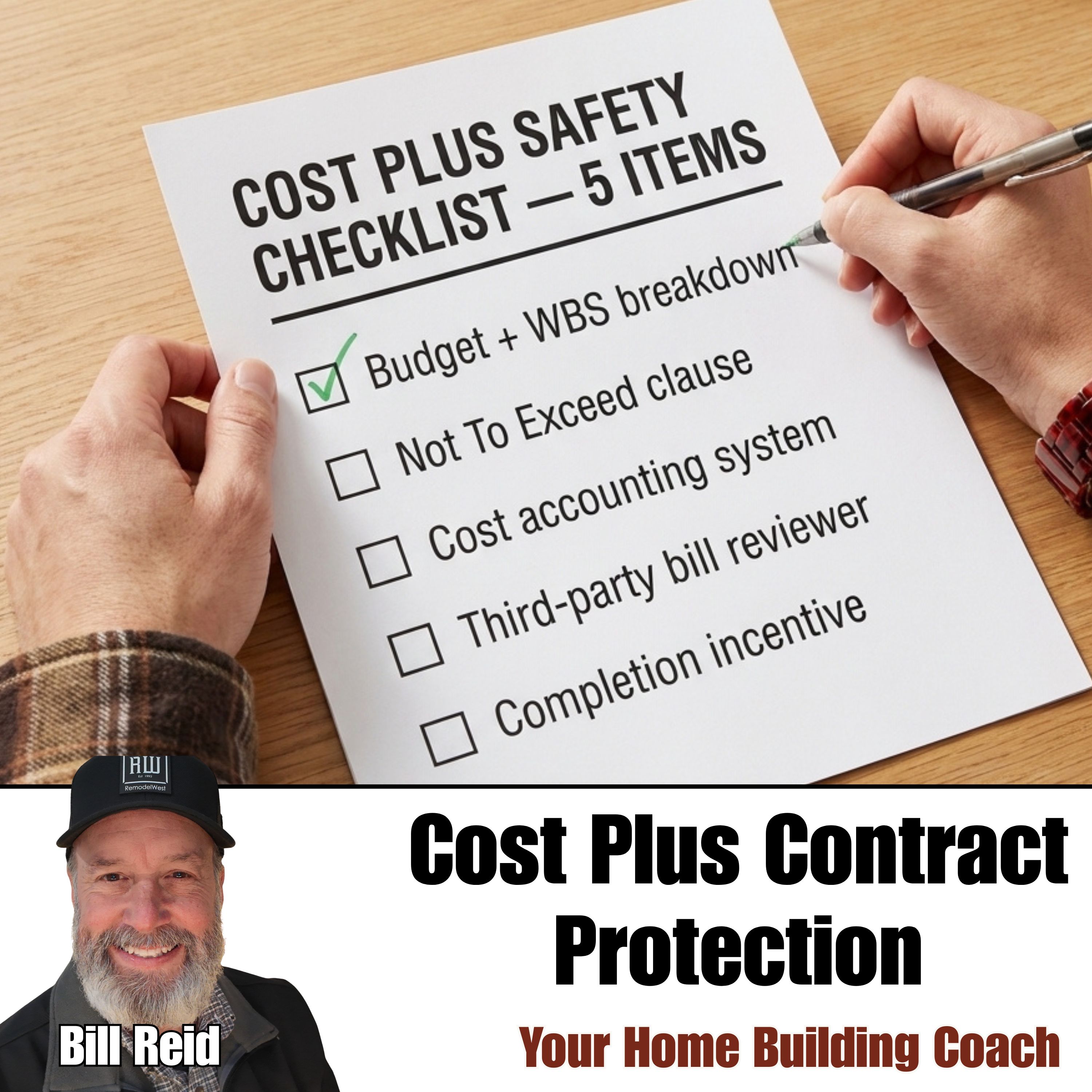
| 5/16/26 | ![]() Cost Plus Contract Protection: The 4-Part System That Saves✨ | Cost Plus ContractsContractor Billing+3 | — | — | — | Cost Pluscontractor+5 | — | 47m 17s | |
| 5/9/26 | ![]() Cost Plus Contract Explained: 3 Types + California Law✨ | cost plus contractscontract types+4 | — | Cost-Plus Reality Check ToolTale of Two Homeowners story+4 | California | cost plus contractcontract types+5 | — | 40m 47s | |
| 5/2/26 | ![]() Cost Plus vs Fixed Price — Which Contract Protects You?✨ | contracting methodscost plus+3 | — | — | — | cost plusfixed price+4 | — | 41m 59s | |
| 4/25/26 | ![]() How to Choose a Contractor — The Scorecard That Gets It Right✨ | contractor selectionweighted scorecard+3 | — | — | — | contractorscorecard+5 | — | 33m 04s | |
| 4/18/26 | ![]() The Bid Package: What to Actually Send Contractors When You Need Estimates✨ | bid packagecontractor estimates+3 | — | — | — | bid packagecontractor+4 | — | 51m 33s | |
Want analysis for the episodes below?Free for Pro Submit a request, we'll have your selected episodes analyzed within an hour. Free, at no cost to you, for Pro users. | |||||||||
| 4/11/26 | ![]() Why Your Contractor Bids Look Nothing Alike and How to Fix It✨ | contractor bidshome building+3 | — | Your Home Building Coach | — | contractor bidshome building+5 | — | 37m 36s | |
| 4/4/26 | ![]() Budget Checkpoint or Formal Estimate — What You Need Right Now✨ | construction budgetformal estimate+3 | — | The Awakened Homeowner | — | budget checkpointformal estimate+3 | — | 40m 26s | |
| 3/28/26 | ![]() Your First Contractor Estimate: What It Is, Who Gets It, and Why Your Plans Are the Key✨ | contractor estimateconstruction documents+3 | — | — | — | contractor estimateconstruction documents+5 | — | 39m 31s | |
| 3/21/26 | ![]() Why Your Contractor Bid Looks So High — And Why That's Actually Good✨ | contractor markuphomeowner education+3 | — | — | — | contractor bidmarkup+5 | — | 39m 01s | |
| 3/14/26 | ![]() How to Hire a Contractor - What They’re Really Thinking✨ | hiring contractorscontractor-client interactions+3 | Enrique Guzman | Contexto Landscape Design BuildCal Poly San Luis Obispo | — | contractor hiringhome renovation+3 | — | 59m 48s | |
| 3/7/26 | ![]() Building Your Dream Home Starts With a Quality Team✨ | contractor team frameworkquality contractors+3 | — | Your Home Building Coach | — | contractor teaminterview questions+3 | — | 21m 36s | |
| 2/28/26 | ![]() What Are You Really Paying a General Contractor For✨ | general contractorproject management+3 | — | What Are You Really Paying a General Contractor ForWorld of Construction+1 | — | general contractorproject management+3 | — | 36m 35s | |
| 2/21/26 | ![]() Who Is Your General Contractor, Really?✨ | general contractorhome building+3 | — | — | — | general contractorsubcontractor+3 | — | 27m 22s | |
| 2/14/26 | ![]() The $100K Property Mistake (and How to Avoid It) with Don Healy | Property due diligence for home building is the single most important step that protects your investment—yet most homeowners skip it entirely. The cost? $80,000 to $150,000+ in devastating surprises that turn dream projects into nightmares.In this episode, I'm joined by Don Healy, founder of Sand and Sage Solutions and creator of Parcel Reports. With over 20 years of experience in construction operations, engineering, and site development, Don has made it his mission to help homeowners make informed decisions before building or buying property.After completing our intensive 10-episode Understanding Design Limitations Series, I knew homeowners needed a practical solution for all that research. Don's expertise provides exactly that—comprehensive property evaluation that uncovers hidden risks before you're financially committed.The biggest knowledge gap Don sees? Homeowners who buy based on emotion rather than facts. You walk onto a gently sloping lot with stunning views, fall in love, and make an offer under pressure to close quickly. Nobody mentions that the slope will cost $80,000 in grading and foundation work. Nobody discusses the utility extensions needed. And that lot priced $20,000 under market? There's always a reason—Don regularly sees buyers "save" $20K only to rack up $100K-$120K in development costs to mitigate whatever issue made that lot cheaper.This conversation unpacks what comprehensive property due diligence for home building actually covers: zoning regulations and dimensional requirements that limit your design, utility access and infrastructure costs that blindside budgets, topography and grading impacts that multiply foundation expenses, environmental constraints like wetlands and flood zones that can halt projects, easements and rights-of-way that shrink your buildable area, and permit history and code violations that become your problem.Don shares powerful case studies, including a client who discovered their existing structure was grandfathered in—but new construction would require $95,000 in utility infrastructure upgrades. Finding that out during negotiations would have changed everything. Another client discovered wetlands during due diligence—disappointing, but it saved them from an impossible situation.Whether you're shopping for vacant land, already own property, or planning an addition, this episode provides the framework for protecting your investment through informed decision-making. Don explains how professional land feasibility studies for building work, what they cost (typically $500-$2,000), and the massive ROI they provide by preventing six-figure disasters.🎯 In This Episode You'll Discover:✅ The emotional trap that costs homeowners $80,000-$120,000+ in surprise development costs ✅ Why lots priced significantly under market value are red flags, not opportunities ✅ What comprehensive building site evaluation services actually research and document ✅ The critical difference between "utilities nearby" and actual connection costs ✅ How slope and topography impact grading, foundation, and retaining wall budgets ✅ Environmental screening essentials: wetlands, flood zones, protected habitats, soil conditions ✅ Zoning regulations that limit height, setbacks, floor area ratio, and allowable uses ✅ Easements and rights-of-way that can shrink your buildable envelope by 30%+ ✅ Real stories of permit denials after $30K-$50K in architectural design investment ✅ How professional Parcel Reports work and what they deliver ✅ The questions you MUST answer before making an offer on any building lot ✅ Whether property due diligence can be done anywhere in the country (yes!) ✅ How to use AI tools like Gemini for basic property research (and their limitations) ✅ Why even experienced architects benefit from independent due diligence verification ✅ The specific ROI of investing $500-$2,000 in professional property evaluation ✅ Don's case study: The $95,000 utility surprise that could have been negotiated ✅ When to conduct due diligence (before buying, before designing, before remodeling) ✅ How to use findings to negotiate better purchase prices or walk away strategically📍 KEY TIMESTAMPS:00:00 - Introduction: The Mission to Protect Homeowners 03:15 - Meet Don Healy: 20+ Years in Construction Operations & Site Development 06:30 - The Biggest Knowledge Gap: Emotion vs. Facts in Land Buying 12:45 - The $20K "Bargain" Lot That Costs $120K to Develop 18:20 - What Comprehensive Property Due Diligence Actually Covers 24:10 - Zoning Regulations: FAR, Setbacks, Height Limits, Allowable Uses 29:40 - Utility Access: When "Nearby" Means $95K in Connection Costs 35:15 - The $80,000 Slope and Grading Reality Behind "Gently Sloping with Views" 40:30 - Environmental Constraints That Can Halt Projects: Wetlands, Flood Zones 44:50 - Case Study: The Wetland Discovery During Due Diligence 48:10 - How Professional Parcel Reports Work: Research, Visualization, Delivery 52:35 - Nationwide Coverage: Can This Be Done Anywhere? 56:20 - Using AI Tools for Basic Property Research (and Their Limitations) 1:00:45 - Conclusion: Enlighten, Empower, Protect Through Knowledge📚 RESOURCES MENTIONED:🌐 Sand and Sage Solutions (Don Healy's Service): Comprehensive property due diligence and Parcel Reports Website: https://www.sandandsagesolutions.com/ Contact: dhealy@sandandsagesolutions.com📖 The Awakened Homeowner Book: Complete methodology for informed home building and remodeling Amazon: https://www.amazon.com/dp/B0F1MDRPK7 All Platforms: https://books2read.com/u/bpxj76📚 The Tale of Two Homeowners (Free Story): See the dramatic difference between an informed homeowner and one who learns the hard way Download: https://the-awakened-homeowner.kit.com/09608e1727🎧 Related Episodes: Episodes 31-43: Understanding Design Limitations Serieshttps://podcasts.apple.com/us/podcast/property-evaluation-before-buying-land-understanding/id1809880743?i=1000736876834•🔗 CONNECT:🌐 Website: https://www.theawakenedhomeowner.com/ 📧 Email: wwreid@theawakenedhomeowner.com 📸 Instagram: https://www.instagram.com/theawakenedhomeowner/ 👍 Facebook: https://www.facebook.com/theawakenedhomeowner/ 🎥 YouTube: https://www.youtube.com/@TheAwakenedHomeowner🔗 LEARN ABOUT THE BUILDQUEST APP: 🌐 Website: https://www.buildquest.co/👤 ABOUT YOUR HOST:Bill Reid is Your Home Building Coach with 35+ years of experience in residential construction. He created The Awakened Homeowner methodology to enlighten, empower, and protect homeowners through their building and remodeling journeys. Bill's mission: transforming overwhelming projects into successful outcomes through education and practical expertise.👤 ABOUT THIS EPISODE'S GUEST:Don Healy is the founder of Sand and Sage Solutions and creator of Parcel Reports, a due diligence and feasibility service designed to help homeowners make better, more informed decisions before building or buying property. With over 20 years of experience in construction operations, engineering, and site development, Don specializes in uncovering the hidden risks that can derail home building projects—from zoning and permitting constraints to utilities, drainage, and environmental conditions.Don's mission is centered on protecting homeowners, though much of that impact happens through supporting the builders and professionals who guide them, helping ensure projects start with clarity instead of costly surprises. His work is rooted in a commitment to transparency, education, and practical expertise.🔔 SUBSCRIBE & REVIEW:If you found value in this episode, please subscribe to Your Home Building Coach podcast and leave a 5-star review on:• Apple Podcasts• Spotify• Google Podcasts• Or wherever you listen to podcastsYour reviews help other homeowners discover the guidance they need!Mentioned in this episode:The Awakened Homeowner Book | — | ||||||
| 2/7/26 | ![]() Guided vs. Self-Guided: Choosing Your Construction Path (Part 2) | In last week's Episode 42, we explored the guided path—what the construction industry calls design-build. One integrated team handles your entire journey from concept to completion, providing streamlined coordination and built-in accountability.Today in Episode 43, we're examining the alternative when comparing traditional construction vs design build: the self-guided path, where you plan your own journey, coordinate your own team, and manage every aspect yourself.Think of it like travel planning. The guided path is booking with a travel company that arranges everything. The self-guided path is researching your own flights, booking your own hotels, mapping your own itineraries, and coordinating all your own transportation.Both approaches can lead to amazing destinations. Both can also lead to disasters. The question when evaluating traditional construction vs design build isn't which is objectively superior—it's which matches YOUR experience, time availability, project complexity, and personality.After 35+ years in residential construction, I've watched hundreds of homeowners make this critical decision. I've seen brilliant engineers excel at self-guided projects while completely overwhelmed first-timers crashed and burned. I've seen traditional construction deliver incredible value on straightforward renovations and design-build save complex projects from coordination nightmares.The truth? Most homeowners choose based on what their friend did, what seemed cheaper, or what the first professional they met recommended—NOT based on honest self-assessment of their situation.These two episodes (42 and 43) give you the complete framework for making an informed choice that matches who you are and what you're truly capable of managing.🎯 In This Episode You'll Discover:✅ The three-phase reality of traditional construction: design → bid → build (and why the sequential nature creates both opportunities and risks)✅ How traditional construction vs design build differs fundamentally in team coordination and timeline✅ When the self-guided path makes perfect sense (7 specific scenarios including experience level, time availability, and project complexity)✅ When self-guided construction becomes a nightmare (7 warning signs that should make you seriously reconsider)✅ The critical budget conversation you MUST have with your architect at the very first meeting✅ Why Ben and Jane went $150,000+ over budget (and how the McMillans stayed under)✅ Seven proven strategies for self-guided success (budget transparency, complete construction documents, early contractor engagement)✅ How to assess if you're truly cut out for coordinating multiple professionals yourself✅ The competitive bidding advantage of traditional construction (and how to use it intelligently)✅ When and how to engage a contractor during the design phase for reality checks✅ Why hiring your architect for construction administration protects you throughout the build✅ The honest self-assessment questions that determine your best path✅ How to avoid the design-budget mismatch trap that sinks most self-guided projects✅ Making your final decision between traditional construction vs design build based on experience, time, complexity, referrals, and personality📍 KEY TIMESTAMPS:00:00 - Introduction: Guided vs. Self-Guided Construction Paths02:15 - What Exactly Is the Self-Guided Path? (The Travel Analogy)04:30 - The Three-Phase Reality: Understanding Design → Bid → Build08:45 - Phase 1: Design (Working with Independent Architects)12:20 - Phase 2: Bid (The Competitive Contractor Bidding Process)15:40 - Phase 3: Build (Construction with Your Selected Contractor)18:30 - The Tale of Two Homeowners: Ben and Jane's Budget Disaster22:10 - When Traditional Construction Makes Perfect Sense (7 Scenarios)28:35 - When Self-Guided Becomes a Nightmare (7 Warning Signs)35:20 - The Critical Budget Conversation (Exactly What to Say)40:15 - Seven Strategies for Self-Guided Success50:30 - Making Your Decision: The Honest Self-Assessment Framework55:45 - Your Next Steps: Discovery Work and Resources58:30 - Conclusion: Which Path Is Better for YOU?📚 RESOURCES MENTIONED:📖 The Awakened Homeowner BookComplete discovery framework plus detailed comparison of guided vs. self-guided paths• Amazon: https://www.amazon.com/dp/B0F1MDRPK7• All Platforms: https://books2read.com/u/bpxj76📚 The Tale of Two Homeowners (Free Story)See the dramatic difference between Ben and Jane's disaster versus the McMillans' successhttps://the-awakened-homeowner.kit.com/09608e1727🎧 Related Episodes:• Episode 42: The Guided Path (Design-Build Process)• Episodes 19-23: Design Development Series• Episode 27: Construction Documents• Episodes on Budget Checkpoints🔗 BuildQuest App (Beta Sign-Up)AI-powered platform launching 2026 to guide your complete discovery processhttps://www.buildquest.co/🔗 CONNECT:🌐 Website: https://www.theawakenedhomeowner.com/📧 Email: wwreid@theawakenedhomeowner.com📸 Instagram: https://www.instagram.com/theawakenedhomeowner/👍 Facebook: https://www.facebook.com/theawakenedhomeowner/🎥 YouTube: https://www.youtube.com/@TheAwakenedHomeowner👤 ABOUT YOUR HOST:Bill Reid is Your Home Building Coach with 35+ years of residential construction experience. He created The Awakened Homeowner methodology to enlighten, empower, and protect homeowners through their building and remodeling journeys. His approach transforms overwhelming construction projects into successful outcomes by focusing on thorough discovery and informed decision-making before committing to design or construction.🔔 SUBSCRIBE & REVIEW:If you found value in this episode comparing traditional construction vs design build, please subscribe to Your Home Building Coach podcast and leave a 5-star review on:• Apple Podcasts• Spotify• Google Podcasts• Or wherever you listen to podcastsYour reviews help other homeowners discover the guidance they need to make informed construction decisions!Mentioned in this episode:The Awakened Homeowner BookThe Awakened Homeowner Book | — | ||||||
| 1/31/26 | ![]() Travel Guide or DIY Trip? Choosing Between Design Build & Traditional Planning | Episode 42: Design Build Construction Process - Complete GuideWhat does "design build" actually mean? Should you choose it for YOUR project?The design build construction process = one company handles both design and construction under single contract. Benefits: built-in accountability, budget alignment from day one, seamless coordination. Trade-offs: no competitive bidding, less control, high trust requirement.You'll Discover: ✅ What design build really is (plain English) ✅ Design build vs traditional construction ✅ When it prevents $200K+ budget disasters ✅ When it's the WRONG choice ✅ How to spot fake design build companies ✅ 5-question self-assessment frameworkPerfect For: Homeowners planning major remodels or custom builds deciding between design build and traditional construction methods.This decision affects your timeline, budget, and stress level. Make it informed.Resources: 📖 Book: https://www.amazon.com/dp/B0F1MDRPK7 📄 Free Story: https://the-awakened-homeowner.kit.com/09608e1727🌐 TheAwakenedHomeowner.com 📧 wwreid@theawakenedhomeowner.com 🔗 BuildQuest: https://www.buildquest.co/Free Story: The Tale of Two Homeowners Watch: YouTube Listen: Podcast Read: AMAZON , All Book StoresVisit: Homepage Follow: Instagram: Facebook: Learn: BuildQuest Planning Platform: Contact: Email: wwreid@theawakenedhomeowner.com#TheAwakenedHomeowner #DesignBuild #HomeBuildingMentioned in this episode:The Awakened Homeowner Book | — | ||||||
| 1/24/26 | ![]() The 50 Percent Rule Home Renovation: When Your Remodel Becomes "New Construction" | The 50 percent rule home renovation is the expensive surprise that derails thousands of renovation projects every year. Homeowners invest in beautiful designs, fall in love with their plans, submit for permits—and then discover their remodel has been reclassified as "new construction," triggering full code compliance that adds $75,000-$150,000+ to the budget.This scenario is devastating. But it's also completely avoidable if you understand project classification BEFORE you design.I'm Bill Reid, Your Home Building Coach, and this is Episode 41—the finale of our Understanding Design Limitations series. Over the past 11 episodes (31-41), we've covered every major restriction that can affect your custom home or major remodel project: zoning regulations, Floor Area Ratio, setbacks, height restrictions, lot coverage, easements, HOA rules, and now—the meta-rule that sits above them all—project classification.Here's why this episode matters: The 50% rule doesn't just affect your budget. It affects whether your project even makes financial sense. It can turn a straightforward $150,000 renovation into a $225,000 nightmare. It can require elevating your entire home on stilts if you're in a flood zone. It can delay your project by 6+ months.But when you understand this rule during the discovery phase—when you ask the right questions BEFORE you invest in design work—you can design strategically to stay under the threshold, phase your project intelligently, or embrace full compliance with eyes wide open.🎯 In This Episode You'll Discover:✅ What project classification actually means and how building departments categorize your work (minor remodel, major remodel, or new construction)✅ The 50 percent rule explained: How crossing this threshold reclassifies your remodel as new construction and triggers full current code compliance✅ The 3 calculation methods cities use to determine the threshold: • Square footage method (addition size vs. existing home) • Cost-based calculation (improvement cost vs. assessed value) • Structural assessment (load-bearing walls, roof changes, framing modifications)✅ Why there's no single national standard: Each jurisdiction calculates differently, and some use multiple methods simultaneously✅ FEMA's substantial improvement rule: How flood zone properties face an additional 50% threshold that can require elevating your entire structure ($100K-$300K+ added cost)✅ Real cost impacts of crossing the threshold: • Fire sprinkler installation throughout entire home: $15K-$25K • Electrical system upgrades to 200-amp service + AFCI breakers: $20K-$40K • All windows replaced to meet energy codes: $25K-$60K • Structural seismic retrofitting in earthquake zones: $15K-$50K • Foundation elevation in FEMA flood zones: $100K-$300K✅ The 801 square foot mistake: Why adding 801 SF to a 1,600 SF home costs $75,000 more than adding 799 SF (and how 2 square feet makes all the difference)✅ Strategy #1: Design Under the Threshold • Calculate using your city's exact formula • Design to 46-48% as safety buffer (not exactly 49.9%) • Document everything with building department in writing✅ Strategy #2: Phase Your Project Strategically • Complete 45-48% of work in Phase 1 • Wait 12-36 months (check jurisdiction's reset period) • Complete remaining work in Phase 2 • Critical warning: Some jurisdictions prohibit this if phases were "planned together"✅ Strategy #3: Embrace Full Compliance (Or Consider Demolition) • Budget for code upgrades across entire home from the beginning • Leverage classification to fix existing safety issues • Consider whether full demolition + new construction makes more sense financially✅ Critical questions to ask your building department BEFORE you design: • "Does this city use the 50% rule, and how exactly do you calculate it?" • "What specific compliance requirements apply if I cross the threshold?" • "Can I review recent similar projects for classification precedent?" • "If I phase the project, what time period resets the calculation?" • "Are there FEMA flood zone requirements for my property?"✅ The property tax impact nobody mentions: When your remodel gets classified as new construction, county assessors often reassess your ENTIRE property at current values, potentially increasing annual taxes by $4K-$6K+✅ Common mistakes that cost six figures: • Designing first, calculating later • Trusting "it won't be a problem" from contractors/designers • Underestimating compliance costs • Ignoring FEMA flood zone status • Believing the "49% myth" (when city uses different calculation)✅ How BuildQuest will help: Our upcoming AI-powered planning platform with Quinn (your project guide) will help you identify 50% rule requirements specific to your jurisdiction, calculate thresholds, and develop strategic approaches📍 KEY TIMESTAMPS:00:00 - Introduction: When Is a Remodel Not a Remodel?02:48 - What Project Classification Really Means07:15 - The 50 Percent Rule Explained (Why Cities Created This)12:30 - Three Calculation Methods Cities Use16:45 - FEMA's Substantial Improvement Rule (The Federal Layer)19:20 - Real Cost Impacts: $75K-$150K+ in Surprise Expenses23:10 - Strategy #1: Design Under the Threshold25:40 - Strategy #2: Phase Your Project Strategically27:15 - Strategy #3: Embrace Full Compliance (Or Demolish and Rebuild)29:30 - Critical Questions for Your Building Department31:00 - The Property Tax Impact Nobody Mentions32:45 - Conclusion: Wrapping Up Understanding Design Limitations Series📚 RESOURCES MENTIONED:📖 The Awakened Homeowner BookSection 2.340 covers remodel classification and the homeowner who discovered their addition triggered full code complianceAmazon: https://www.amazon.com/dp/B0F1MDRPK7All Platforms: https://books2read.com/u/bpxj76📚 The Tale of Two Homeowners (Free Story)See the dramatic difference between an informed homeowner (who did discovery) and one who learned the expensive wayhttps://the-awakened-homeowner.kit.com/09608e1727🌐 External Resources:FEMA Flood Map Service Center: Check your flood zone statusFEMA Substantial Improvement GuidelinesInternational Code Council Building CodesNational Association of Home Builders Resources🎧 Related Episodes:Episode 31: Understanding Zoning Regulations & DistrictsEpisode 32: Floor Area Ratio (FAR) ExplainedEpisode 33-35: Setbacks, Height Restrictions, Lot CoverageEpisode 38: Easements & Right-of-WaysEpisode 40: HOA Architectural Review Requirements🔗 CONNECT:🌐 Website: https://www.theawakenedhomeowner.com/📧 Email: wwreid@theawakenedhomeowner.com📸 Instagram: https://www.instagram.com/theawakenedhomeowner/👍 Facebook: https://www.facebook.com/theawakenedhomeowner/🎥 YouTube: https://www.youtube.com/@TheAwakenedHomeowner🔗 LEARN ABOUT THE BUILDQUEST APP:Reserve your spot for free beta testing (launching late spring/early summer 2025)🌐 Website: https://www.buildquest.co/👤 ABOUT YOUR HOST:Bill Reid is Your Home Building Coach with 35+ years of experience in residential construction. He created The Awakened Homeowner methodology to enlighten, empower, and protect homeowners through their building and remodeling journeys. The mission: transform overwhelmed homeowners into confident project leaders who avoid costly mistakes through proper planning.🔔 SUBSCRIBE & REVIEW:If you found value in this Understanding Design Limitations series (Episodes 31-41), please subscribe to Your Home Building Coach podcast and leave a 5-star review on:Apple PodcastsSpotifyGoogle PodcastsOr wherever you listen to podcastsYour reviews help other homeowners discover the guidance they need to protect their projects!🎯 WHAT'S COMING NEXT:I'm transitioning from design limitations to a new series on understanding architectural plans—how they work, their systems, and the conventions they use so you can become an educated plan reviewer.I'll also be inserting other | — | ||||||
| 1/17/26 | ![]() Balance Your Project Budget: The Investment Method That Aligns Dreams with Reality | Every successful home project requires balancing three critical elements that most homeowners never properly align: your investment goal (what you're comfortable investing), your construction budget (what building actually costs), and your dream vision (what you want to create).Get these three elements balanced before design begins, and you're positioned to achieve your goals within financial reality. Miss this balancing act, and you're headed for the devastating quarter-million dollar wake-up call that derails projects before construction even starts.After 35+ years coordinating residential construction projects, I've watched homeowners make the same heartbreaking mistake over and over: They skip strategic budget planning, fall in love with architectural designs, invest tens of thousands in design fees, then discover their project costs two or three times what they can comfortably invest.The emotional and financial toll is devastating. But it's 100% preventable with the three-way balancing framework I'm sharing in this episode.The Critical Framework: Two Teeter-TottersThink of two teeter-totters that must both find equilibrium for project success:Teeter-Totter #1: Dreams ⟷ Construction BudgetYour dream vision on one side: 3,500 square foot custom home, luxury kitchen, spa-like master suite, covered outdoor living space, high-end finishes throughout.Your construction budget on the other side: Based on realistic square footage costs, all soft costs, site work, furnishings, and proper contingency.The question: Can your budget support your vision? If your dream costs $1.8 million but your budget analysis shows $1.4 million, that $400K gap requires honest decisions before engaging architects.Teeter-Totter #2: Construction Budget ⟷ Investment GoalYour construction budget on one side: The realistic total cost to build your project.Your investment goal on the other side: What you've determined you're comfortable investing based on property value analysis, financial capacity, and personal priorities.The question: Does your budget align with your comfortable investment level? If your construction budget is $750K but your investment goal is $500K, that $250K shortfall requires fundamental project re-evaluation.Both teeter-totters must balance for project success. One out of alignment? You'll face painful decisions during design. Both misaligned? You're wasting time and money on a project that can't proceed as planned.What You'll Discover:✅ Investment Goal Methodology - How to calculate what you're truly comfortable investing, disconnecting from Pinterest emotion long enough to run real numbers considering property value, financial capacity, ROI priorities, and long-term plans✅ Construction Budget Framework - Step-by-step process to calculate realistic costs including square footage pricing for your market, design fees (8-15%), permits and fees (2-5%), site work, furnishings, equipment, and the 15-20% contingency you WILL absolutely use✅ The Balancing Process - Exact methodology to evaluate gaps between investment goal, construction budget, and dream vision—then make informed adjustment decisions while you still have options✅ Gap Analysis Strategies - When your numbers don't align (which is common), the three adjustment approaches: reduce scope to match budget, increase investment to match vision, or combination solutions that close gaps from both directions✅ Budget Components Homeowners Forget - The soft costs, site work, furnishings, and contingency items that add 25-40% to construction-only budgets and blindside unprepared homeowners✅ When to Walk Away - How to recognize when the gap between investment and budget is so large that proceeding would be financially irresponsible (and what to do instead)✅ Real Case Study - The couple who set a $500K investment goal, calculated a $750K construction budget, designed an $1.5M dream home with their architect, and wasted $73K in redesign fees plus a year of their life learning this lesson the hard way✅ Five-Week Action Plan - Research phase, calculation phase, analysis phase, validation phase, and preparation phase to walk into professional meetings with confidence and clarityWhy This Framework WorksThe balancing methodology forces confrontation with financial reality early—when adjustments cost nothing—rather than late when you've already invested tens of thousands in architectural design fees.It's not about crushing dreams or limiting vision. It's about enlightening yourself with financial clarity so you can make informed decisions that align all three elements: what you want, what it costs, and what you're comfortable investing.Early disappointment from realistic budget analysis is actually a gift. It gives you time to adjust scope, find creative solutions, explore different properties, or secure additional funding. You have options when you discover misalignment early.Late disappointment from contractor bids after months of design? That's a disaster that costs money, time, emotional energy, and often leads to abandoned projects or financial strain from over-extension.Perfect For:Homeowners planning custom homes who want dreams grounded in financial realityAnyone considering major renovations wondering "can I actually afford this?"Property shoppers evaluating whether dream lots match investment capacityCouples discovering their individual dream visions differ in scope and costAnyone who's gotten sticker shock from preliminary estimates and needs strategic frameworkThis episode provides the exact methodology to find equilibrium between what you want, what it costs, and what you're comfortable investing—before wasting a single dollar on design work for projects that exceed your financial parameters.Episode Timestamps:0:00 - Introduction: The Three-Way Balancing Act0:42 - Why Most Homeowners Skip This Critical Step2:15 - Investment Goal: What You're Comfortable Investing4:30 - Construction Budget: What It Actually Costs6:20 - The Two Teeter-Totters That Must Balance9:00 - Gap Analysis: When Numbers Don't Align11:15 - Three Adjustment Strategies That Work13:30 - Real Case Study: The $500K/$750K/$1.5M Disaster15:00 - Your Five-Week Action Plan16:30 - Closing & ResourcesResources Mentioned:📖 The Awakened Homeowner BookComprehensive guide including detailed budget worksheets, balancing framework exercises, and case studiesAmazon: https://www.amazon.com/dp/B0F1MDRPK7All Platforms: https://books2read.com/u/bpxj76📚 The Tale of Two Homeowners (Free Story)Dramatic comparison between homeowner who uses strategic planning vs. one who learns through costly mistakeshttps://the-awakened-homeowner.kit.com/09608e1727🎧 Related Episodes:Episode 39: Setting Your Investment GoalDiscovery Series: Complete preparation frameworkEpisode on Delusions: Outside forces that derail realistic planningConnect with The Awakened Homeowner:🌐 Website: https://www.theawakenedhomeowner.com/📧 Email: wwreid@theawakenedhomeowner.com📸 Instagram: https://www.instagram.com/theawakenedhomeowner/👍 Facebook: https://www.facebook.com/theawakenedhomeowner/🎥 YouTube: https://www.youtube.com/@TheAwakenedHomeowner🔗 BuildQuest App (Coming Spring 2026):https://www.buildquest.co/Revolutionary platform with automated budget calculators, cost databases, professional connection tools, and project planning features. Reserve early access now.About Your Host:Bill Reid is Your Home Building Coach with 35+ years of experience in residential construction, design coordination, and project management. He created The Awakened Homeowner methodology to enlighten, empower, and protect homeowners through their building and remodeling journeys. Bill has coordinated thousands of custom home and remodel projects, specializing in the strategic preparation that transforms overwhelmed homeowners into confident project leaders.balance project budget, investment method, home building budget, dreams vs reality, construction budget planning, investment goal framework, budget balancing act, home renovation costs, custom home budget, realistic budget planning, the awakened homeowner, bill reid, your home building coachMentioned in this episode:The Awakened Homeowner BookThe Awakened Homeowner Book | — | ||||||
| 1/10/26 | ![]() The Planning Advantage Successful Homeowners Use | It's January. Most homeowners are scrolling through Pinterest dreaming about their future renovation project, thinking "I'll deal with this when spring comes." Meanwhile, smart homeowners are using these quiet winter months to do something that will give them a massive advantage: home renovation planning.📋 FREE Planning Workbook (mentioned in this episode) Download at: the-awakened-homeowner.kit.com/planning-workbookHere's what most people don't realize. When spring arrives and everyone starts calling architects and contractors at the same time, the best professionals are already booked solid. Good architects may be scheduling consultations 3-6 months out. Reputable contractors have their summer schedules filling up fast. If you wait until April to start planning, you're looking at fall or even next year for construction.But when you start your home renovation planning in January and February? Everything changes. Design professionals have time for thoughtful consultations. Contractors can provide valuable early guidance. You're not competing for their attention—you're getting their best focus. You're positioning yourself to start design work in April and potentially break ground by summer.In this episode, Bill Reid—your home building coach with 35+ years of residential construction experience—reveals why winter is your secret weapon for home building and renovation success. He walks you through the complete Discovery Framework, five pillars of preparation work you should complete BEFORE you ever hire a designer or contractor.🎯 IN THIS EPISODE YOU'LL DISCOVER:✅ The "spring scramble" reality that delays thousands of renovation projects every year ✅ Why starting in January gives you a 3-6 month competitive advantage ✅ How winter planning means better access to top designers and contractors ✅ The cascade effect of starting late (rushed decisions, limited choices, higher costs) ✅ The complete Discovery Framework: 5 pillars that create your foundation ✅ Pillar 1: Personal Profiles - Understanding who you are and how you live ✅ Pillar 2: Property Profiles - Knowing your land and existing structures ✅ Pillar 3: Dreams and Visions - Articulating what you want and why ✅ Pillar 4: Delusions and Realities - Confronting budget and property constraints honestly ✅ Pillar 5: Budgeting - Setting realistic financial parameters before design begins ✅ Your specific month-by-month action plan for January, February, and March ✅ How to package your discovery work to impress design professionals ✅ Why prepared homeowners may get better timelines and fees ✅ Real-world examples of early planners vs. spring scramblers📍 KEY TIMESTAMPS:00:00 - Introduction: Planning Before Designing 00:56 - Welcome & Design Limitations Series Recap 01:45 - The Winter Opportunity Most Homeowners Miss 07:40 - The Spring Reality: What Actually Happens When Everyone Calls at Once 11:30 - The Winter Advantage: Access to Professionals' Best Attention 13:00 - The Discovery Framework: 5 Pillars Overview 18:30 - Pillar 5: Budgeting (The Foundation You Can't Skip) 20:15 - Your Three-Month Action Plan Introduction 20:45 - January: Foundation Work and Research 22:45 - February: Deep Dive on Budget and Reality Checks 25:00 - March: Package It Up and Start Professional Conversations 29:15 - Episode Wrap-Up and Key Takeaways📚 RESOURCES MENTIONED:📖 The Awakened Homeowner Book by Bill Reid Complete Discovery methodology with exercises, examples, and frameworks• Amazon: https://www.amazon.com/dp/B0F1MDRPK7• All Platforms: https://books2read.com/u/bpxj76📄 The Tale of Two Homeowners (Free Story) See the dramatic difference between an informed homeowner and one who learns the hard way https://the-awakened-homeowner.kit.com/09608e1727📋 FREE Planning Workbook (mentioned in this episode) Download at: the-awakened-homeowner.kit.com/planning-workbook🤖 Reserve Your BuildQuest Beta Spot Quinn, your AI planning assistant, will guide you through the complete Discovery Framework https://www.buildquest.co/🎧 Related Episodes:• Episode 2-7: Deep dives into each Discovery pillar• Episodes 31-38: Understanding Design Limitations series🔗 CONNECT:🌐 Website: https://www.theawakenedhomeowner.com/ 📧 Email: wwreid@theawakenedhomeowner.com 📸 Instagram: https://www.instagram.com/theawakenedhomeowner/ 👍 Facebook: https://www.facebook.com/theawakenedhomeowner/ 🎥 YouTube: https://www.youtube.com/@TheAwakenedHomeowner👤 ABOUT YOUR HOST:Bill Reid is Your Home Building Coach with 35+ years of experience in residential construction, custom home building, and large-scale renovations. He created The Awakened Homeowner methodology to enlighten, empower, and protect homeowners through their building and remodeling journeys. Bill is the author of "The Awakened Homeowner" book and creator of the upcoming BuildQuest planning platform.🔔 SUBSCRIBE & REVIEW:If you found value in this episode, please subscribe to Your Home Building Coach podcast and leave a 5-star review on:• Apple Podcasts• Spotify• Google Podcasts• Or wherever you listen to podcastsYour reviews help other homeowners discover the guidance they need!🎯 NEXT STEPS:Ready to start your winter planning advantage? Here's what to do:1. This Week: Download the free Planning Workbook and start your Personal Profile2. This Month: Listen to Episodes 2-7 for deep dives on each Discovery pillar3. By End of January: Complete your foundation work and property research4. Reserve Your Spot: Sign up for BuildQuest beta at buildquest.coMentioned in this episode:The Awakened Homeowner BookThe Awakened Homeowner Book | — | ||||||
| 1/3/26 | ![]() Love Thy Neighbor? They're About to Control Your Home Design (HOA Edition) | There's a whole new meaning to the phrase "love thy neighbor" when it comes to building or remodeling your home. If you're in a Homeowners Association (HOA), your neighbors are going to help you decide how your home looks. And yes, they have legal authority to do so.Through design review committees and architectural review boards, HOAs exercise significant control over everything from your home's exterior colors to window styles to landscaping choices. After 35+ years in residential construction, I've watched hundreds of homeowners learn this lesson the hard way - through denied applications, expensive redesigns, and months of delays.In this episode, I'm sharing the complete HOA design approval system so you can avoid these costly mistakes and get approved on the first submission.Check out the full blog article and links to the free downloadhttps://www.theawakenedhomeowner.com/hoa-restrictions-for-home-building-your-complete-design-approval-guide/The HOA Approval Reality:Most homeowners don't realize the extent of HOA control until they're already committed to the property. Design review committees can approve or deny your plans based on guidelines that may be vague, outdated, or inconsistently applied. Your neighbors - who serve on these committees - have the final say.I've seen $40,000 redesigns because homeowners didn't understand the approval process. I've watched 6-month delays devastate project timelines and budgets. And I've helped hundreds of homeowners successfully navigate this system using the strategies I'm sharing in this episode.What Makes This Episode Essential:Whether you're shopping for property in an HOA community, already own in one, or are about to submit your design for approval, this episode gives you the complete roadmap for success. You'll learn exactly what design review committees are looking for, how to build neighbor support before the meeting, and what separates winning applications from denied ones.This is practical, actionable guidance based on real-world experience - not generic advice or theoretical frameworks. I'm giving you the same system I've used with clients for over three decades.⚠️ SPECIAL LAUNCH OFFER: FREE HOA Approval WorkbookTo complement this episode, I've created the **HOA Approval Workbook** - your complete step-by-step implementation system.This isn't just a simple checklist. It's 200+ actionable items covering:- Property due diligence before you buy- Design submittal package requirements- Neighbor outreach templates and tracking- Committee meeting presentation scripts- Follow-up strategies and revision guidanceThis workbook has helped hundreds of homeowners get approved on the first submission, avoid costly redesigns, and navigate the HOA process with confidence instead of anxiety.NORMALLY $9.99 - FREE UNTIL [INSERT DATE]I'm offering this workbook completely FREE for the next 30 days as a launch special. After that, it will be available for $9.99.Over [987] homeowners have already downloaded their free copy during this launch period.**Don't wait and pay later. Download your FREE copy now:** TheAwakenedHomeowner.com/hoa-workbook🎯 In This Episode You'll Discover:✅ **How HOA Design Review Committees Actually Work** - The structure, authority, and decision-making process✅ **Common Restrictions That Catch Homeowners Off Guard** - What most people don't expect until it's too late✅ **The Complete HOA Approval Timeline** - From initial application to final decision (and what happens at each stage)✅ **What to Include in Your Design Submittal Package** - The difference between minimum requirements and winning applications✅ **Strategic Neighbor Outreach** - Why it matters and exactly how to do it effectively✅ **How to Present to the Design Review Committee** - Proven strategies that increase approval odds✅ **Red Flags to Spot Before You Buy HOA Property** - Warning signs that signal future approval problems✅ **What to Do If Your Design Gets Denied** - Your options for revision, appeal, or alternative approaches✅ **Real Success Stories** - How prepared homeowners got approved on first submission✅ **Costly Mistakes to Avoid** - $40,000+ redesigns and 6-month delays that proper planning prevents**📍 KEY TIMESTAMPS:**00:00 - Introduction: The New Meaning of "Love Thy Neighbor"02:15 - How HOA Design Review Committees Work08:30 - Common HOA Restrictions That Surprise Homeowners15:45 - The Complete HOA Approval Process Timeline22:10 - What to Include in Your Design Submittal Package28:40 - Strategic Neighbor Outreach (Why It Matters)35:20 - Presenting to the Design Review Committee42:15 - Red Flags to Spot Before You Buy HOA Property48:30 - What to Do If Your Design Gets Denied54:00 - Real Success Stories & Lessons Learned58:45 - Conclusion & Free Workbook Reminder**📚 RESOURCES MENTIONED:****🎁 FREE HOA Approval Workbook (30-Day Launch Special)**200+ actionable checklist items for successful HOA approval**FREE until January 31st, 2026, then $9.99**Download: https://the-awakened-homeowner.kit.com/hoa-approval-workbook**📖 The Awakened Homeowner Book**Complete guide to home building and remodeling success- Amazon: https://www.amazon.com/dp/B0F1MDRPK7- All Platforms: https://books2read.com/u/bpxj76**📚 The Tale of Two Homeowners (Free Story)**See the dramatic difference between an informed homeowner and one who learns the hard wayDownload: https://the-awakened-homeowner.kit.com/09608e1727📖 Episode 38 Blog PostRead the complete guide with additional case studies and exampleshttps://www.theawakenedhomeowner.com/hoa-restrictions-for-home-building-your-complete-design-approval-guide/CONNECT WITH THE AWAKENED HOMEOWNER:**🌐 **Website:** https://www.theawakenedhomeowner.com/📧 **Email:** wwreid@theawakenedhomeowner.com📸 **Instagram:** https://www.instagram.com/theawakenedhomeowner/👍 **Facebook:** https://www.facebook.com/theawakenedhomeowner/🎥 **YouTube:** https://www.youtube.com/@TheAwakenedHomeowner**🔗 LEARN ABOUT THE BUILDQUEST APP:**🌐 **Website:** https://www.buildquest.co/**👤 ABOUT YOUR HOST:**Bill Reid is Your Home Building Coach with 35+ years of experience in residential construction. He created The Awakened Homeowner methodology to enlighten, empower, and protect homeowners through their building and remodeling journeys.Through his podcast, book, and upcoming BuildQuest application, Bill provides the education and systems that transform overwhelming projects into successful outcomes.**🔔 SUBSCRIBE & REVIEW:**If you found value in this episode, please subscribe to Your Home Building Coach podcast and leave a 5-star review on:- Apple Podcasts- Spotify- Google Podcasts- Or wherever you listen to podcastsYour reviews help other homeowners discover the guidance they need!Mentioned in this episode:The Awakened Homeowner Book | — | ||||||
Showing 25 of 63
Pitch Fit is a Pro feature
See how bookable this show is for guests, which brands already advertise, the per-episode ad value, and the best-fit guest and sponsor profile. The numbers are blurred on the free plan.
How readily this show books outside guests like you.
How proven this show is for host-read sponsorships.
For Guests
ProFor Advertisers
ProUpgrade to Pro to unlock guest cadence, sponsor categories, fit scores, and per-episode ad value for this show.
Chart Positions
1 placement across 1 market.
Chart Positions
1 placement across 1 market.