

Anesthesia Deconstructed: Moving Anesthesia Forward
by Mike MacKinnon and Joe Rodriguez
Is this your podcast?Insights from recent episode analysis
Audience Interest
Podcast Focus
Publishing Consistency
Platform Reach
Insights are generated by CastFox AI using publicly available data, episode content, and proprietary models.
Most discussed topics
Brands & references
Total monthly reach
Estimated from 1 chart position in 1 market.
By chart position
- 🇺🇸US · Medicine#1915K to 30K
- Per-Episode Audience
Est. listeners per new episode within ~30 days
2.5K to 15K🎙 Weekly cadence·60 episodes·Last published 3d ago - Monthly Reach
Unique listeners across all episodes (30 days)
5K to 30K🇺🇸100% - Active Followers
Loyal subscribers who consistently listen
2K to 12K
Market Insights
Platform Distribution
Reach across major podcast platforms, updated hourly
Total Followers
—
Total Plays
—
Total Reviews
—
* Data sourced directly from platform APIs and aggregated hourly across all major podcast directories.
On the show
From 1 epsHosts
Recent guests
No guests detected in recent episodes.
Recent episodes
The Anesthesia Workforce Shift: 3,000 CRNA Grads, Failing AA Bills, Lost Contracts
Jun 23, 2026
50m 20s
Goliaths at War: The Fight Over Anesthesia
Jun 23, 2026
55m 07s
Here’s What Nobody Talks About
Jun 16, 2026
2m 50s
A New Chapter: Mike & Joe’s Big Announcement!
Apr 1, 2026
16m 28s
Anesthesia Deconstructed: I Thought We Were Winning. Then, We Got Fired: Essentials of Anesthesia Leadership
Aug 21, 2025
54m 38s
Social Links & Contact
Official channels & resources
Official Website
Login
RSS Feed
Login
| Date | Episode | Topics | Guests | Brands | Places | Keywords | Sponsor | Length | |
|---|---|---|---|---|---|---|---|---|---|
| 6/23/26 |  The Anesthesia Workforce Shift: 3,000 CRNA Grads, Failing AA Bills, Lost Contracts | Joe Rodriguez sits down with Randy Moore and Tracy Young, to work through the week's hardest stories. Let the spicy takes flow! Reimbursement: UnitedHealthcare stops paying for physical status. Oklahoma and Louisiana fight back with legislation. Tracy makes the case that anesthesia has been commoditized, and that hospital subsidies taught payers they never have to pay full price. Private equity: California and Oregon pass laws to curb PE in medicine. Tracy argues we legislate against bad actors instead of punishing them. Randy defends consolidation, then explains why the Oregon deal was a playbook of what not to do. And the line nobody else will say: hospitals don't fire anesthesia groups that are doing a good job. Workforce: AA bills fail in Iowa and Minnesota. Joe argues the entire AA strategy asks the wrong question. Tracy disagrees with both hosts and predicts a sorted market: CRNA-centric facilities on one side, MD and AA medical-direction models on the other, driven by math, not preference. Plus: why anesthesia companies obsessed with growth keep losing contracts, and why CRNA residents work full-time hours unpaid while physician residents draw a salary. Takeaways: Hospital subsidies are functioning as a defacto safety net for the entire industry. They are the mechanism that lets payers keep cutting. Every subsidy dollar confirms someone else will cover the gap. Differentiation in anesthesia is no longer simply price. It is recruiting and retention, full stop. Culture is the product. Hospitals don't replace groups that are performing. If a contract gets shopped, there was a problem, whatever the press release says. Growth without product is a failure of leadership. The large groups losing contracts did it to themselves. The workforce will sort itself in the next decade. The average anesthesiologist is 55. CRNA graduation just crossed 3,000 for the first time. Profit motive is not a disease. Imbalance is. Everyone you've ever hired has a profit motive, including you. Want more Dr. Joe Rodriguez? Tik Tok: @jrodcrna21 Instagram: @jrod.crna & @abouttherestpod YouTube: @AboutTheRest Thanks for my co-hosts: Randall Mooore, DNP, MBA CRNA are Executive VP of Strategy and Chief Anesthetist Officer, former AANA CEO. Tracy Young: Incoming President of the American Association of Nurse Anesthesiology To Learn More about Human Content Visit: http://www.human-content.com To Learn More about About The Rest Visit: www.abouttherest.com Got a Question? hello@abouttherest.com Part of the Human Content Podcast Network Learn more about your ad choices. Visit megaphone.fm/adchoices | 50m 20s | ||||||
| 6/23/26 | Goliaths at War: The Fight Over Anesthesia | The FTC just notched its second win against the biggest roll-up in anesthesia history. Welsh Carson settled first. Now USAP. So who actually won, and who pays next? Joe Rodriguez sits down with Randy Moore and Gary Keeling for the kind of conversation that usually happens at the bar after the conference, not on the record. No "where did you go to school" warm-ups. Just three operators reading the headlines everyone else is misreading. Gary drops the frame that defines the episode: this is two Goliaths at war. Private equity built 70 percent market share with borrowed money. Insurers answered with the No Surprises Act and rate cuts. Now IDR is swinging back, hospitals are eating the shortfall through subsidies, and the FTC just stepped into the ring. Anesthesia providers are standing in the middle of all of it. Then the gloves come off on the anesthesiologist assistant fight. Sixty bills in thirty years. Gary says there's enough work for everybody and braces for the hate mail. Randy makes the case that should worry every workforce planner in the country: this shortage isn't a cycle anymore, it's structural, and it's not normalizing for five to seven years. Joe closes with the contrarian bet he's making with his own money. If you book the cases, staff the rooms, or sign the subsidy checks, this episode is your briefing. Takeaways The FTC win is a settlement, not a verdict. USAP admitted no fault and the terms are still being executed. The real signal is that the roll-up playbook now carries regulatory risk that didn't exist a decade ago. The Goliath framework: insurers wanted fragmented anesthesia markets they could play against each other. PE consolidated to fight back. The NSA flipped leverage to insurers, IDR is flipping it back, and hospitals absorb every swing through subsidies. PE's debt structure is the tell. Buy with borrowed money, load the debt onto the asset, run admin on a skeleton crew, jettison through bankruptcy when it breaks. Margin expectations beyond 6 to 15 percent in a service business are the warning sign. AA legislation has a 30-year losing record. Roughly 60 attempts, 47 straight failures from 2010 to 2019, and only 5 of 40 passed in 2025 during a historic shortage. If it was going to break through, that was the year. Randy's call: the workforce shortage is structural, not cyclical. Every CRNA program is expanding cohorts and demand still outruns supply. No meaningful normalization for five to seven years. The pipeline counterweight: 147 nurse anesthesia programs with 17 more coming. Joe's on the record preparing for demand growth to slow. Cycles always turn. Gary's operator test: the 2 percent of groups with excess staff aren't lucky, they built culture and systems. Everyone else is churning providers and renting locums at whatever price locums name. Want more Dr. Joe Rodriguez? Tik Tok: @jrodcrna21 Instagram: @jrod.crna & @abouttherestpod YouTube: @AboutTheRest Thanks for my co-hosts: Randall Mooore, DNP, MBA CRNA are Executive VP of Strategy and Chief Anesthetist Officer, former AANA CEO. Gary's is VP of Anesthesia Services, Revenue Cycle Management To Learn More about Human Content Visit: http://www.human-content.com To Learn More about About The Rest Visit: www.abouttherest.com Got a Question? hello@abouttherest.com Part of the Human Content Podcast Network Learn more about your ad choices. Visit megaphone.fm/adchoices | 55m 07s | ||||||
| 6/16/26 | Here’s What Nobody Talks About | Along life’s winding roads we’ve each worked tirelessly to hone our skills and ultimately become the excellent clinicians we are today. But what happens when being great in the OR isn't enough? Each week on About the Rest, Joe Rodriguez, DNAP, CRNA, gets into the weeds on the definitive podcast for fellow CRNAs and MDs who want to understand how our profession actually works behind the scenes… warts and all. The spiritual sibling of the award-winning podcast Anesthesia Deconstructed, About the Rest takes a commentary-driven approach to facing the infrastructural obstacles that keep holding us back. Because the hard truth is… although our clinical skills are essential, the business of healthcare far too often treats them as commodities. Unapologetically inside baseball, join the podcast where together we become leaders, gain influence, and hone the skills nobody taught in our programs to take control of our careers. To Learn More Visit: ww.abouttherest.com Got a Question? hello@abouttherest.com Learn more about your ad choices. Visit megaphone.fm/adchoices | 2m 50s | ||||||
| 4/1/26 | A New Chapter: Mike & Joe’s Big Announcement!✨ | anesthesiapodcast announcement+4 | — | About the RestAnesthesia Deconstructed+2 | — | anesthesiapodcast+5 | — | 16m 28s | |
| 8/21/25 |  Anesthesia Deconstructed: I Thought We Were Winning. Then, We Got Fired: Essentials of Anesthesia Leadership | In this powerful and unfiltered episode, Dr. Joseph Rodriguez — CRNA, former state and national leader, faculty member, and host of Anesthesia Deconstructed — takes us inside the real lessons of anesthesia leadership. From COVID-era disruption to contract losses, difficult boardroom conversations, and the relentless financial pressures of today’s anesthesia market, Joe shares stories that few leaders are willing to tell. Each story carries a hard-won lesson: why leadership is never just a title, how executive presence shapes outcomes, why data transparency can backfire, and how accountability transforms teams from fragile to high-performing. We also dive into the frameworks that shaped his leadership journey — from Crucial Conversations to The Four Agreements and Five Dysfunctions of a Team — and how every leader can apply them to grow themselves, their organizations, and the people they serve. This isn’t theory. It’s frontline leadership, with all the scars, pivots, and resilience required to survive in one of healthcare’s most disrupted specialties. Whether you’re a CRNA, SRNA, or a healthcare leader navigating change, this conversation is a masterclass in turning setbacks into systems, failures into frameworks, and words into lasting impact. Keywords: Anesthesia, CRNA Leadership, Healthcare Business, Executive Presence, Leadership Lessons, Nurse Anesthesiology, Organizational Growth, Accountability, Professional Development, Anesthesia Contracts, No Surprises Act, Healthcare Strategy, Team Building, Crucial Conversations, Five Dysfunctions of a Team Send us Fan Mail Follow us at:InstagramFacebookTwitter/X Learn more about your ad choices. Visit megaphone.fm/adchoices | 54m 38s | ||||||
| 8/12/25 |  Anesthesia Deconstructed: What If the AANA Disappeared? Inside the CEO’s Role with Bill Bruce | In this candid and wide-ranging episode, we sit down with Bill Bruce — CEO of the AANA, representing over 65,000 CRNAs and SRNAs nationwide — to pull back the curtain on what it really takes to lead the profession’s largest and most influential organization. From balancing the competing demands of members, boards, and limited resources, to navigating constant political, clinical, and industry noise, Bill explains how the CEO’s role is equal parts strategist, mediator, and pressure point. We explore how the AANA sets priorities, allocates resources, and adapts to both internal ambitions and external threats — and why the organization’s absence would have an almost immediate impact on CRNAs across the country. Bill also shares his perspective on maintaining focus in an environment of relentless change, the leadership qualities that matter most in high-stakes healthcare advocacy, and how the AANA is positioning the profession for the future. Whether you’re a CRNA, SRNA, or simply curious about the forces shaping nurse anesthesia, this conversation offers a rare inside look at the operational, strategic, and political realities of leading at the top. Keywords: Anesthesia, CRNA Leadership, Healthcare Advocacy, Professional Associations, Strategic Planning, Workforce Advocacy, Organizational Leadership, AANA, Healthcare Policy, Nursing Leadership Send us Fan Mail Follow us at:InstagramFacebookTwitter/X Learn more about your ad choices. Visit megaphone.fm/adchoices | 38m 26s | ||||||
| 8/4/25 |  Anesthesia Deconstructed: Inside Anesthesia - What (Really) Broke the Anesthesia Market | In this bold and revealing episode, we sit down with Randy Moore — former military CRNA, past CEO of the AANA, and now a top executive at one of the country’s largest anesthesia organizations — to explore how the anesthesia market unraveled, and why no one stopped it. From workforce blind spots to failed strategic planning, Randy walks us through the early warning signs that went unheeded, the flawed assumptions that fueled collapse, and the slow-motion crises that turned into full-blown disruption. We break down the shift from hospital dominance to ASC migration, the chilling effects of the No Surprises Act, and how private equity’s playbook fell apart. But we don’t stop at systems. Randy also gets personal — reflecting on the cost of unchecked ambition, the value of thoughtful leadership, and the non-negotiables he now looks for in partners and teams. Whether you lead a group, manage hospital operations, or just want to understand the business forces reshaping anesthesia, this conversation pulls no punches — and offers rare clarity from someone who’s led on every side of the table. Keywords: Anesthesia, CRNA Leadership, Healthcare Strategy, No Surprises Act, Workforce Crisis, Private Equity, Surgical Services, Hospital Operations, ASC Growth, Healthcare Leadership Send us Fan Mail Follow us at:InstagramFacebookTwitter/X Learn more about your ad choices. Visit megaphone.fm/adchoices | 47m 08s | ||||||
| 7/17/25 |  Anesthesia Deconstructed: One Anesthesiologist, 108K Followers, and Zero Filters | In this candid and wide-ranging conversation, we sit down with Dr. Brian Schmutzler — anesthesiologist, social media educator, and Executive Vice President of Medical Affairs at CCI Anesthesia — to unpack what it really means to lead in modern anesthesia. From the realities of staffing rural hospitals without anesthesiologists to fighting burnout, navigating private equity, and fiercely defending provider scope and safety, Brian shares hard-earned insights from both clinical and corporate perspectives. We also dive into the power of humor and education on social media, his 108K-strong Instagram following, and how his content brings awareness, advocacy, and levity to patients and practitioners alike. If you're a CRNA, MD, administrator, or just someone trying to understand where anesthesia is headed — and how to lead within it — this is an episode you can’t miss. Keywords:Leadership, Anesthesia, Social Media, Burnout, Independent Practice Send us Fan Mail Follow us at:InstagramFacebookTwitter/X Learn more about your ad choices. Visit megaphone.fm/adchoices | 53m 45s | ||||||
| 7/8/25 |  Anesthesia Deconstructed: I Got Sued for Malpractice. Here’s What Really Happens. | What REALLY happens when you’re named in a malpractice lawsuit? In this eye-opening episode, Joe Rodriguez sits down with Paul Lefebvre, lead claims professional and risk advisor, and Andrew Clark, head of business development at Physicians Preferred Medical — an anesthesia-specific malpractice carrier — to pull back the curtain on malpractice litigation. From the first call after an adverse event to depositions, defense strategies, and courtroom realities, this conversation is packed with must-know insights for every CRNA, anesthesiologist, and anesthesia group leader. We talk about why most anesthesia lawsuits are defensible, how to avoid career-derailing mistakes, the truth behind insurance carriers and legal strategy, and what separates providers who bounce back from those who don’t. This is not just about risk — it’s about resilience, smart choices, and protecting your future. Keywords: Malpractice, Anesthesia, Risk Management, Litigation, Informed Consent Send us Fan Mail Follow us at:InstagramFacebookTwitter/X Learn more about your ad choices. Visit megaphone.fm/adchoices | 1h 02m 05s | ||||||
| 6/6/25 |  Anesthesia Deconstructed: Anesthesia Leadership Is Changing - and Not Everyone Will Make the Cut | Anesthesia is evolving — and so are its leaders. In this special episode of Anesthesia Deconstructed, we dive into the dynamic shifts happening across the anesthesia landscape, where Certified Registered Nurse Anesthetists (CRNAs) and anesthesiologists are stepping into new leadership roles across clinical, operational, and educational domains. Our expert panel — including leaders from Norstar Anesthesia, Rutgers University, Sound Physicians, Guide Anesthesia, and BPI Anesthesia — explores what it takes to lead in today's high-pressure, resource-constrained environment. From managing subsidy pressures and navigating insource vs. outsource models, to developing provider culture, expanding service lines, and building sustainable clinical partnerships — this discussion gets candid about the real challenges and the bold leadership required to address them. Whether you're a CRNA aiming for a leadership role, a physician looking for collaborative models, or a healthcare administrator tasked with rebuilding an anesthesia department, this episode offers practical insights, real-world experiences, and a clear call to action: it's all about the culture, the teamwork, and the long-term vision. Check your politics at the door — this is about building the future of anesthesia, together. Keywords: Leadership, Collaboration, Culture, Anesthesia, Innovation Send us Fan Mail Follow us at:InstagramFacebookTwitter/X Learn more about your ad choices. Visit megaphone.fm/adchoices | 1h 01m 55s | ||||||
Want analysis for the episodes below?Free for Pro Submit a request, we'll have your selected episodes analyzed within an hour. Free, at no cost to you, for Pro users. | |||||||||
| 3/12/25 |  Anesthesia Deconstructed: From ICU to CRNA - How Social Media is Transforming Nursing Education | Keywords CRNA, nursing education, TikTok, Confident Care Academy, mentorship, cardiac anesthesia, online learning, healthcare, nursing community, media impact Summary In this engaging conversation, Joseph Rodriguez speaks with Chrissy Massaro, a prominent CRNA and founder of Confident Care Academy. They discuss the evolution of nursing education in the age of social media, the challenges faced by new nurses transitioning to CRNAs, and the importance of mentorship. Chrissy shares her journey from being a nurse to creating an online platform that bridges the educational gap for nurses. They also explore her clinical practice in cardiac anesthesia and her aspirations for the future of Confident Care Academy, including the development of an app and a mentor network. Takeaways Chrissy Massaro is a pioneer CRNA on TikTok, using social media to educate and connect with aspiring nurses. Confident Care Academy was created to address the educational gap for ICU nurses transitioning to CRNA roles. The importance of mentorship in nursing and CRNA education is emphasized throughout the conversation. Chrissy's clinical experience in cardiac anesthesia showcases the evolving role of CRNAs in high-stakes environments. The conversation highlights the impact of new media on nursing education and professional development. Chrissy's journey reflects the challenges and triumphs of pursuing a career in nursing against societal expectations. The future vision for Confident Care Academy includes developing an app for easy access to clinical education. Chrissy aims to advocate for policy changes in healthcare through her research and future PhD studies. The discussion reveals the significance of community support among CRNAs and nursing professionals on social media. Chrissy's story inspires others to take action and pursue their passions in nursing and education. Chapters 00:00The Birth of Confident Care Academy 02:17Creating an Educational Service Business 03:13Intro to Chrissy Massaro 05:29The Impact of COVID-19 on Nursing Education 08:02Personal Journey and Overcoming Barriers 11:04The Growth of Confident Care Academy 13:56Future Aspirations and Educational Innovations 21:05The Impact of Social Media on Professional Perception 23:07Mentorship and Accessibility in Healthcare 26:56Navigating the Path to a PhD 31:03Clinical Practice and Cardiac Anesthesia 38:00Future Aspirations and Policy Advocacy Send us Fan Mail Follow us at:InstagramFacebookTwitter/X Learn more about your ad choices. Visit megaphone.fm/adchoices | 51m 44s | ||||||
| 1/10/25 | Anesthesia Deconstructed: Navigating the Future - Do Those Prep Courses Work? Will Locums Stick Around? And More for 2025 | In this conversation, Joseph Rodriguez and Mike MacKinnon discuss the evolution of CRNA programs, the impact of prep courses, and the importance of surrounding oneself with the right people for career success. They critique the economics of anesthesia services, explore fair market value in compensation, and address regulatory challenges faced by CRNAs, particularly in California. The dialogue emphasizes the need for critical thinking in the interview process and the implications of high compensation offers in the field. In this conversation, Mike MacKinnon and Joseph Rodriguez discuss the complexities of anesthesia practice, focusing on the roles of anesthesiologists and CRNAs, the legal challenges they face, and the implications of recent trademark disputes. They explore the future of anesthesia in light of healthcare consolidation, the impact of AI, and the evolving professional identity of CRNAs. The discussion also touches on leadership roles within professional organizations and the commitment required to effect change in the field.00:00Introduction 02:48The Impact of Prep Programs on Interview Processes 09:21Fair Market Value and CRNA Compensation 17:09Red Flags in High Compensation Offers 18:41The State of CRNA Practices 24:04Regulatory Challenges in Anesthesia 38:00Legal Battles and Professional Value 42:36Trademark Disputes in Anesthesiology 48:28Challenges Ahead for CRNAs 55:05The Role of AI in Healthcare 01:02:57Future of Anesthesia Practice Send us Fan Mail Follow us at:InstagramFacebookTwitter/X Learn more about your ad choices. Visit megaphone.fm/adchoices | 1h 11m 31s | ||||||
| 11/26/24 | 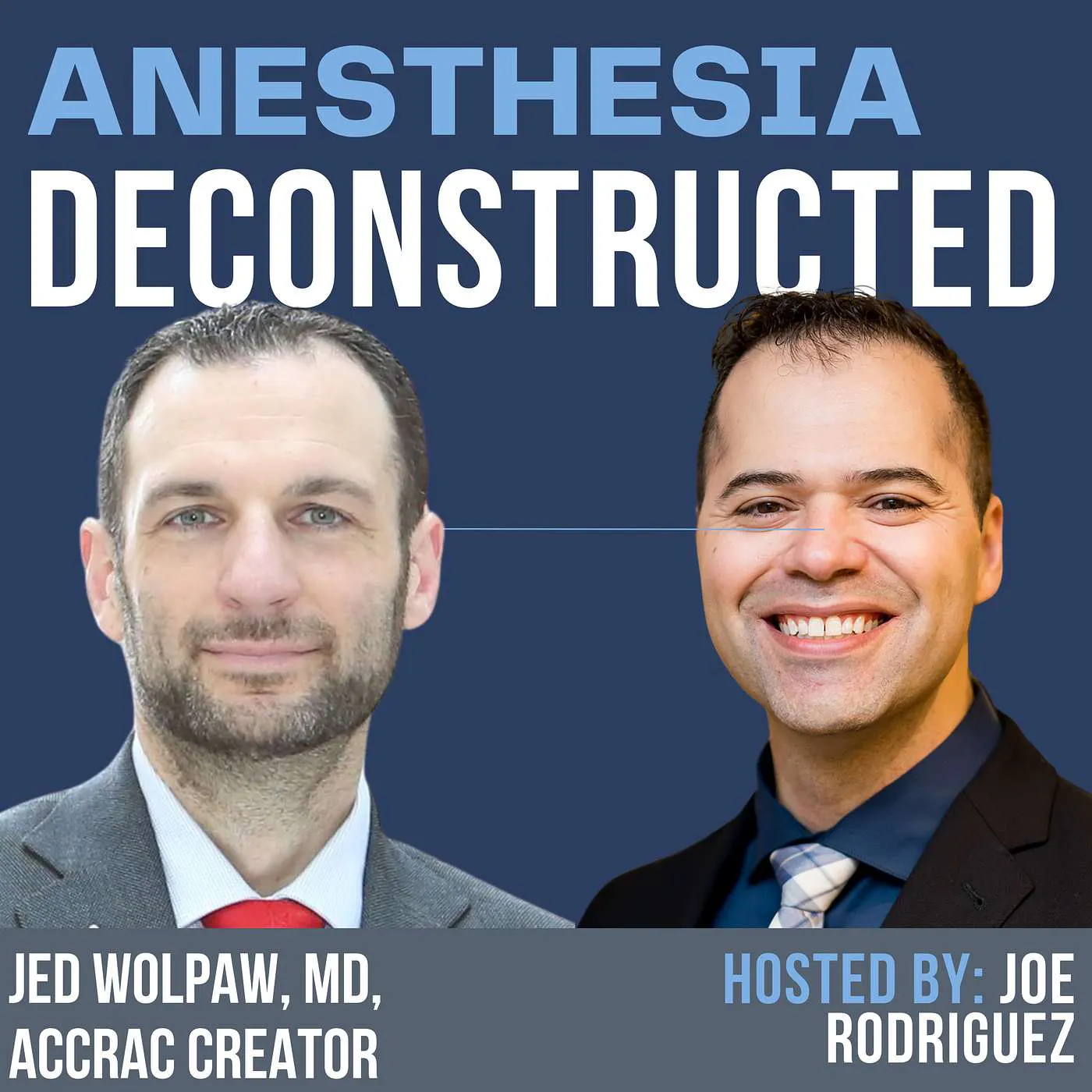 Anesthesia Deconstructed: Lifelong Learning - ACCRAC Founder Jed Wolpaw, MD, on Education, Growth, and Anesthesia Excellence | Description: In this episode of Anesthesia Deconstructed, Joe Rodriguez dives deep with Dr. Jed Wolpaw, creator of the ACCRAC podcast and a leader in anesthesia education. Together, they discuss Jed’s unique path from history teacher to anesthesiologist, the critical importance of civil discourse, and universal learning principles that transcend medicine. With insights on podcasting, education, and the future of anesthesia, this episode offers something for every professional passionate about growth and collaboration. Keywords: Anesthesia, CRNA, SRNA, Dr. Jed Wolpaw, ACCRAC podcast, anesthesia education, Johns Hopkins, learning mindset, clinical debates, continuous monitoring, anesthesia podcast, professional growth, learner mindset, anesthesia teaching, anesthesia principles, post-op monitoring, pulmonary physiology, anesthesia innovation. Engaging Summary: What happens when a history teacher pivots to become a renowned anesthesiologist and educator? In this episode, host Joe Rodriguez sits down with Dr. Jed Wolpaw, creator of the influential ACCRAC podcast, to explore his fascinating journey and his mission to advance education in the field of anesthesia. Dr. Wolpaw shares powerful insights on developing a learner’s mindset, the art of civil discourse, and staying open to change in clinical practice. From practical tips on post-op monitoring to thought-provoking discussions about education and professional growth, this episode will leave listeners inspired and equipped with actionable insights. Join us as we delve into the universal principles that drive excellence in medicine and beyond. Send us Fan Mail Follow us at:InstagramFacebookTwitter/X Learn more about your ad choices. Visit megaphone.fm/adchoices | 48m 12s | ||||||
| 9/30/24 | 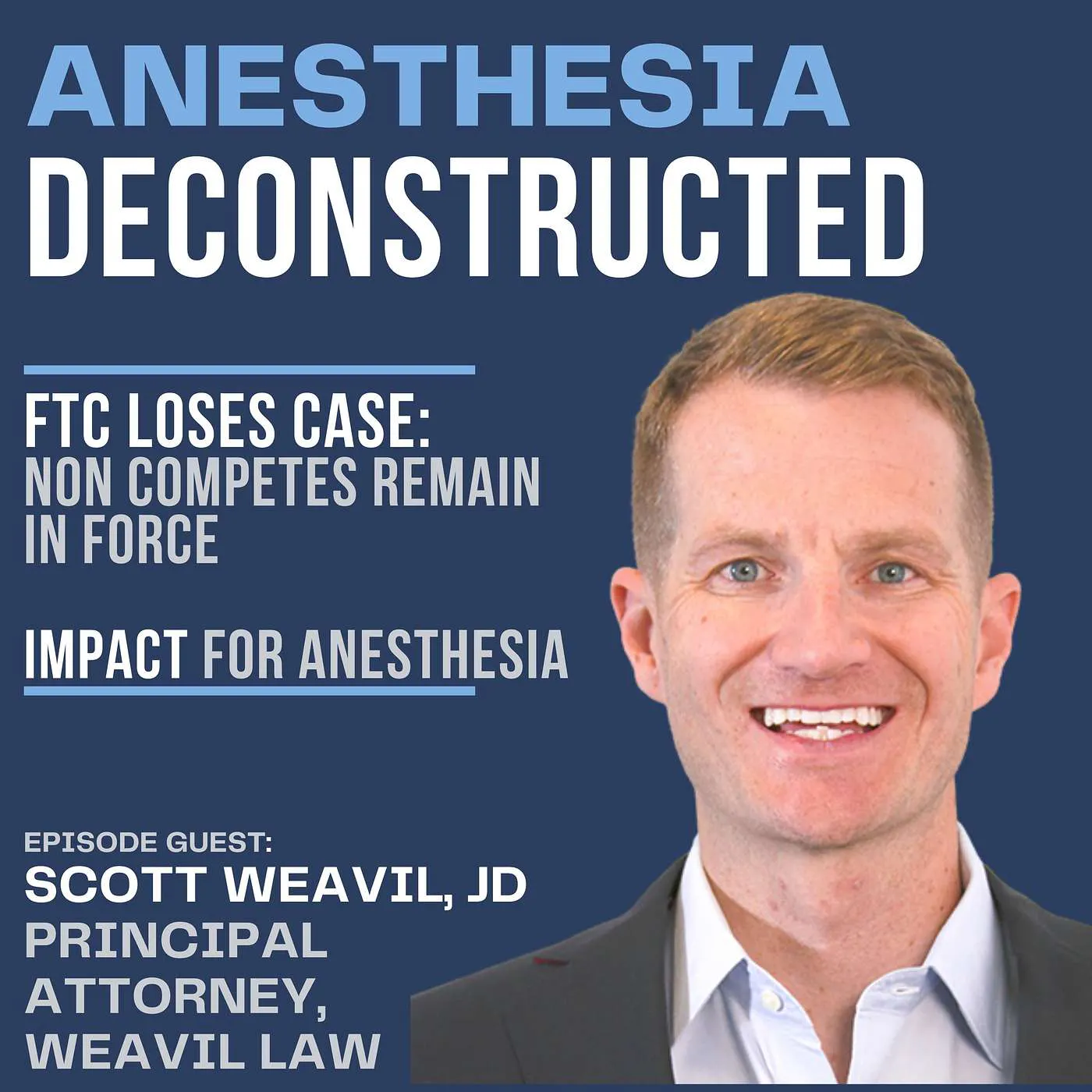 Anesthesia Deconstructed: FTC Loses, and Non-Competes Remain - Understanding Different Types of Restrictive Covenants and What It Means for You | SEASON 7 BEGINS! Keywords for this Episodeanesthesia, non-compete agreements, legal challenges, FTC, healthcare law, CRNA, anesthesia practice, employment contracts, state laws, anesthesia updates Summary In this episode of Anesthesia Deconstructed, host Joe Rodriguez first discusses the latest updates in the field of anesthesia, including legal challenges faced by CRNAs and anesthesiologists, the AANA's bold lawsuit against the federal government, and updates on his personal practice at Guide Anesthesia, which is evolving out of Arizona Anesthesia Solutions. The conversation delves into the implications of non-compete agreements, the recent FTC ruling, and the nuances of state laws regarding these contracts. Scott Weavil, a legal expert, shares insights on negotiating employment contracts and the importance of understanding the legal landscape for healthcare professionals. The episode emphasizes the need for transparency and informed decision-making in anesthesia practice. Takeaways The AANA has initiated a lawsuit against the government over reimbursement issues. Non-compete agreements can serve legitimate business purposes but can also restrict employee mobility. The FTC's nationwide ban on non-compete agreements has been struck down by a Texas court. State laws regarding non-compete agreements vary significantly across the U.S. Negotiating employment contracts is crucial to avoid restrictive covenants that may hinder career growth. Understanding the legal implications of non-compete agreements is essential for healthcare professionals. The public needs to be informed about the qualifications of their healthcare providers. Non-solicitation agreements are often more common than non-compete agreements in certain regions. Healthcare professionals should be cautious of non-compete clauses that may limit future employment opportunities. The conversation highlights the importance of balancing individual and corporate interests in healthcare. Chapters 00:00Updates! 10:34Scott Intro 13:58Legitimate Business Purposes of Non-Competes 17:18The FTC Ban on Non-Competes 20:33State Laws on Non-Competes 23:17Challenging Non-Competes 25:35Differentiating Non-Competes and Non-Solicits 28:13The Future of Non-Competes 30:21Conclusion Send us Fan Mail Follow us at:InstagramFacebookTwitter/X Learn more about your ad choices. Visit megaphone.fm/adchoices | 32m 08s | ||||||
| 7/23/24 |  Anesthesia Deconstructed: Point B - Joe Rodriguez Shares His Positions and Rationale on Proposed Changes to AANA Board Selection | Key Points: Importance of the AANA to CRNA economy Proposed bylaw changes and resolutions Support for Board Term Extension (Bylaw 2) (with caveats) and Virtual Business Meetings Opposition to Board Expansion (Bylaw 3) and Automatic Leadership Succession (Bylaw 4) Rationale behind each position Summary: Joe shares his views on proposed AANA changes, advocating for longer board terms and virtual meetings while opposing board expansion and automatic leadership succession. He emphasizes the need for efficiency, cost-effectiveness, and flexibility in leadership. Call to Action: Members encouraged to review proposal documentation and participate in the upcoming discussion in early August. Next Episode: Tune in next week for more CRNA insights and industry updates. Send us Fan Mail Follow us at:InstagramFacebookTwitter/X Learn more about your ad choices. Visit megaphone.fm/adchoices | 7m 52s | ||||||
| 7/23/24 |  Anesthesia Deconstructed: Point A - CRNAs Propose Significant Change to AANA Board Selection | Summary The conversation discusses three main changes proposed by the Leadership Identification Committee (LIC) for the American Association of Nurse Anesthesiology: increasing the number of directors from seven to nine, increasing the term for directors from two years to three years, and changing the progression of the president to a three-year term. The rationale behind these changes is to decrease turnover, increase the number of eligible people for executive positions, and provide more support to region directors. The conversation also addresses concerns about the time commitment for directors and the potential impact on decision-making, cost, and the role of the professional staff. The conversation explores the proposal to increase the number of directors on the board, extend the terms of the vice president and president-elect, and create continuity in executive leadership roles. The main themes discussed include the benefits of having more directors to support state leaders, the financial feasibility of the proposal, the potential risks of electing the wrong person into an important position, the need for continuity and experience in executive roles, and the importance of informed voting. The conclusion is an editor's note, where our host, Joe Rodriguez, expresses his view after taking time consider the conversation. Keywords AANA, association, Leadership Identification Committee, directors, term, turnover, executive positions, region directors, time commitment, cost, professional staff, board directors, executive leadership, continuity, experience, informed voting Takeaways The proposed changes aim to decrease turnover, increase the number of eligible people for executive positions, and provide more support to region directors. Increasing the term for directors from two years to three years allows for more continuity and experience on the board. Expanding the number of directors from seven to nine helps to reduce the workload for region directors and aligns with the growth of the association. Concerns about the time commitment, decision-making, cost, and the role of the professional staff are important considerations in the discussion. The financial feasibility of the proposal was assessed and deemed affordable. There is a potential risk of electing the wrong person into an important position, but the board can address disruptive behavior and provide coaching to mitigate this risk. Having continuity and experience in executive roles can lead to better decision-making and representation of members' interests. Informed voting is crucial, and members should take the time to understand the proposals and make informed decisions. Chapters 00:00Introduction and Background of the Proposed Changes 02:51Increasing the Term for Directors from Two Years to Three Years 10:14Expanding the Number of Directors from Seven to Nine 18:09Considerations and Approval of the Proposed Changes 31:16Enhancing Support for State Leaders 33:56Assessing Financial Feasibility 37:12Creating Continuity in Executive Roles 41:31Decreasing Turnover and Ensuring Continuity 45:37Mitigating Risks and Addressing Poor Leadership 48:42Moving Away from Personal Agenda Items 59:40Encouraging Informed VotingConclusion: Editor's Note Send us Fan Mail Follow us at:InstagramFacebookTwitter/X Learn more about your ad choices. Visit megaphone.fm/adchoices | 1h 12m 30s | ||||||
| 7/19/24 |  Anesthesia Deconstructed: Did CMS Actually Miss an Opportunity To Reduce the Anesthesia Shortage? | Summary The conversation discusses the topic of rural pass-through and its impact on the anesthesiologist shortage. It explores the idea of including physician anesthesiologists in rural pass-through and whether it would be an effective solution. The conversation also delves into the concept of shortage and how it can be addressed by utilizing anesthesia providers to their maximum potential. The importance of deregulation and allowing local experts to make decisions about anesthesia models is emphasized. The conversation concludes with a discussion on title misappropriation and the need for transparency in using the terms 'physician anesthesiologist' and 'nurse anesthesiologist'. Keywords rural pass-through, anesthesiologist shortage, physician anesthesiologists, CRNAs, shortage solution, utilization of anesthesia providers, deregulation, local decision-making, title misappropriation, transparency Takeaways Including physician anesthesiologists in rural pass-through may not have a significant impact on the anesthesiologist shortage. Utilizing anesthesia providers to their maximum potential can help address the shortage. Deregulation and allowing local experts to make decisions about anesthesia models is crucial. Transparency in using the terms 'physician anesthesiologist' and 'nurse anesthesiologist' is important to avoid confusion. Key Quotes "Rural pass-through is about providing compassionate care close to home for rural facilities across rural America." "The idea here is to subsidize the ability for people to get care close to home and be economically efficient in doing it." "The shortage is artificial because of model selection and facilities." Chapters 00:00Introduction and Background on Rural Pass-Through 01:15Understanding the Purpose of Rural Pass-Through 03:04The Inaccuracy of the Article's Premise on Mitigating the Anesthesiologist Shortage 08:51Utilizing Anesthesia Providers to Address the Shortage 19:22The Importance of Deregulation and Local Decision-Making in Anesthesia Models 25:03Addressing Title Misappropriation for Transparency in Anesthesia Care Send us Fan Mail Follow us at:InstagramFacebookTwitter/X Learn more about your ad choices. Visit megaphone.fm/adchoices | 30m 56s | ||||||
| 7/16/24 |  Anesthesia Deconstructed: Should C-Sections Be Performed on an Outpatient Basis? Florida is going to find out. | Summary The conversation discusses the topic of out-of-hospital cesarean sections and the potential risks and implications. Dr. Matt Mazurek, a physician anesthesiologist and assistant professor of anesthesiology at Yale School of Medicine, provides insights and raises concerns about the definition of low-risk cesarean deliveries, the dangers of complications during and after the procedure, and the lack of resources and training in outpatient settings. The conversation also touches on the financial incentives and potential cherry-picking of patients by private equity-owned medical facilities. The need for increased access to obstetrical care and support for OBs in rural areas is highlighted as a more effective solution to address maternal morbidity and mortality rates. Keywordsout-of-hospital cesarean sections, risks, complications, low-risk deliveries, resources, training, financial incentives, private equity, access to care, maternal morbidity, maternal mortality Takeaways Defining low-risk cesarean deliveries is challenging and depends on various factors. Complications during and after cesarean sections can be life-threatening, especially in outpatient settings. The financial incentives of performing cesarean sections may lead to an increase in unnecessary procedures. Investing in more OBs and supporting them financially is crucial to improve access to obstetrical care in rural areas and reduce maternal morbidity and mortality rates. Key Quotes "OB is still very dangerous, both in the OR and postoperatively" "It's much more common and more likely to happen in this particular group. So do we really want to gamble with people's lives in this setting?" "It has happened and it's happened to younger, healthier patients out of the blue." Chapters 00:00Introduction and Background 01:23The Challenges of Defining Low-Risk Cesarean Deliveries 06:01The Financial Incentives and Potential Risks of Outpatient C-Sections 08:20Improving Access to Obstetrical Care in Rural Areas Send us Fan Mail Follow us at:InstagramFacebookTwitter/X Learn more about your ad choices. Visit megaphone.fm/adchoices | 17m 24s | ||||||
| 7/9/24 |  Anesthesia Deconstructed: RAISING ARIZONA Pt. 1 - Arizona's Zero to Hero Story with Ali J. Baghai, CRNA, AZANA Past President and Guide Anesthesia | AzAS Managing Partner | Episode Summary: In this episode, Joe Rodriguez talks with Ali Baghai about his journey and impact as a CRNA in Arizona. Ali shares his experiences in CRNA advocacy, the evolution of anesthesia practice in Arizona, and his role in significant legislative changes. They also discuss the nuances of owning an anesthesia business and life in Arizona. Highlights: Introduction Joe Rodriguez introduces the episode and welcomes Ali Baghai. Brief discussion about the uniqueness of Ali's name and CRNA role. Ali's Background Ali shares his background, including his early involvement in CRNA politics. Discusses his time as state president and the changes in Arizona's CRNA landscape since 2009. Initial Involvement in CRNA Advocacy Ali's journey from student representative to board member. The transformation of Arizona's job market and practice landscape for CRNAs. Key Meeting in 2012 Joe and Ali reminisce about a pivotal meeting in 2012 with other CRNA leaders. The decision to aim for opt-out and the creation of the political action committee (PAC). Legislative Success Stories Ali's experience with legislative processes and passing key bills. The significance of Senate Bill 1336 and the Surgeon Immunity Law. Opt-Out Success Discussion about Arizona becoming an opt-out state. The ripple effect of Arizona's opt-out status on other states. Dental Anesthesia Regulation Ali's involvement in dental anesthesia regulation since 2019. The challenges and outcomes of the new rules for pediatric safety and provider registration. Business Ownership in Anesthesia Ali's perspective on owning an anesthesia business. The challenges and rewards of being a business owner in the healthcare field. Arizona Living Ali shares his love for living in Arizona, comparing it to his hometown of Boston. Highlights of Arizona's climate, outdoor activities, and overall lifestyle. Closing Remarks Joe thanks Ali for his contributions to the CRNA community and the state of Arizona. Final thoughts on the importance of advocacy and leadership in healthcare. Key Takeaways: The importance of CRNA advocacy and policy changes in improving anesthesia practice. The impact of legislative victories on CRNA practice and patient care. The challenges and rewards of owning an anesthesia business. The unique lifestyle and opportunities in Arizona. Guest Information: Ali Baghai - CRNA, former state president, and key advocate for CRNA practice improvements in Arizona. Joe Rodriguez - Host, CRNA, and managing partner in an anesthesia group. Call to Action: Subscribe to our podcast for more insightful conversations on healthcare and anesthesia. Visit our website for more information on CRNA advocacy and resources. Note to Listeners: Don't forget to leave us a review and share this episode with your colleagues and friends in the healthcare community! Your support helps us bring more valuable content to you. Send us Fan Mail Follow us at:InstagramFacebookTwitter/X Learn more about your ad choices. Visit megaphone.fm/adchoices | 39m 02s | ||||||
| 7/4/24 |  Anesthesia Deconstructed: CRNAs - An American Innovation; Reflecting on Independence Day | In this special July 4th episode, we explore the significance of American independence and its impact on the CRNA profession. We discuss the foundations of American governance and how these ideals have shaped our national identity. The episode presents two key messages: addressing current societal tensions and highlighting CRNAs as a unique American innovation in healthcare.The podcast emphasizes the exceptional position of CRNAs in the United States, noting their level of autonomy and economic freedom unparalleled in other Western societies. It traces the profession's success to decades of advocacy work and stresses the importance of continued effort in maintaining and advancing the field. The episode concludes by encouraging CRNAs and aspiring CRNAs to reflect on the benefits they've gained from both the American system of government and the tireless work of their predecessors, while enjoying the Independence Day celebrations.Send us Fan Mail Follow us at:InstagramFacebookTwitter/X Learn more about your ad choices. Visit megaphone.fm/adchoices | 7m 28s | ||||||
| 6/25/24 |  Anesthesia Deconstructed: FTC Update With Simon Willman, JD and What It Means for Anesthesia Providers | Episode Summary: In this episode, Joe Rodriguez welcomes back Simon Willman, Esq., former in-house counsel for one of the largest orthopedic groups in the country. They discuss the Federal Trade Commission's recent vote to ban non-compete agreements and its implications for healthcare professionals and practice owners. Key Topics Covered:Pre-Session: State-Level Updates from Louisiana, Maryland, and Pennsylvania Introduction: Welcome and introduction of Simon Willman, Esq. Background on Simon's experience with Health Outcomes Performance Company and Core Orthopedics. FTC's Vote to Ban Non-Competes: Overview of the FTC's recent vote to ban non-compete agreements. The timeline for the ban going into effect (120 days post-publication). Legal challenges from the U.S. Chamber of Commerce, the Business Roundtable, the Texas Association of Business, and the Longview Chamber of Commerce. Implications for Healthcare Professionals: Simon's insights on how the ban might affect providers and practice owners. Potential benefits for healthcare providers who can move freely between employers. Concerns for business owners regarding the impact on enterprise value and capital investments. Details of the FTC's Final Rule: Summary of the key points of the final rule. Explanation of the difference between non-compete and non-solicitation agreements. Potential legal interpretations and challenges ahead. Non-Competes vs. Non-Solicitation: Breakdown of how non-solicitation agreements differ from non-competes. Discussion on whether non-solicitation agreements might serve as a backdoor to enforce non-competes. Legal Considerations and Advice: Practical advice for healthcare providers dealing with non-competes. The importance of understanding the legal landscape and potential court interpretations. The potential costs and implications of legal challenges. Federal vs. State Jurisdiction: Explanation of how the jurisdiction might shift from state to federal courts. The impact of this shift on enforcement and legal proceedings. Sale of Business Exception: Discussion on the exception for bona fide sales of businesses. How this exception might apply to equity owners and business transactions. Final Thoughts and Advice: Simon's final comments on the significance of the FTC's rule. Advice for healthcare providers and practice owners navigating this evolving legal environment. Outro: Joe and Simon wrap up the discussion. Teaser for the next episode. Key Quotes: "If I'm in your audience's shoes as providers and as practice owners, I think this is significant and I don't think this is just pure speculation." - Simon Willman "Everyone should have a right to earn a living, I think." - Joe Rodriguez Resources Mentioned: Becker's Healthcare article on the FTC vote. The FTC's final rule on non-competes. Connect with Us: Disclaimer: The content of this podcast is for informational purposes only and does not constitute legal advice. Listeners should consult their own legal advisors for specific guidance related to their circumstances. Send us Fan Mail Follow us at:InstagramFacebookTwitter/X Learn more about your ad choices. Visit megaphone.fm/adchoices | 32m 12s | ||||||
| 6/14/24 |  Anesthesia Deconstructed: We Became The Top Anesthesia Podcast in the United States AND Episode Previews | Summary The podcast, Anesthesia Deconstructed, has become the number one anesthesia podcast in the United States (Apple Podcasts - subsection: Medicine) due to its focus on deconstructing issues and having thoughtful and respectful conversations. The host, Joe Rodriguez, discusses his involvement in the The Nurse Anesthesiologist Facebook Group (TNAG) and the importance of creating a space for sharing ideas and discussing issues. He addresses a screenshot from another Facebook group that accuses him and others of monopolizing information platforms. Rodriguez clarifies his involvement and highlights the diversity of perspectives in the group. He also previews upcoming episodes on topics such as FTC banning non-competes, CRNA advocacy, interprofessional collaboration, and the CRNA-friendly environment in Arizona. Keywords anesthesia podcast, deconstructing issues, respectful conversations, Facebook groups, sharing ideas, diversity of perspectives, upcoming episodes, FTC banning non-competes, CRNA advocacy, interprofessional collaboration, CRNA-friendly environment, Arizona Takeaways Anesthesia Deconstructed is the number one anesthesia podcast in the United States due to its focus on deconstructing issues and having thoughtful and respectful conversations. Creating spaces like the TNAG group allows for the sharing of ideas and discussions on anesthesia-related issues. Rodriguez clarifies his involvement in the group and highlights the diversity of perspectives and respectful conversations that take place. Upcoming episodes will cover topics such as FTC banning non-competes, CRNA advocacy, interprofessional collaboration, and the CRNA-friendly environment in Arizona. Titles Previewing Upcoming Episodes: FTC Banning Non-Competes, CRNA Advocacy, and More Creating a Space for Sharing Ideas: The Neuroscientist-Anesthesiologist Facebook Group Sound Bites "Anesthesia Deconstructed: The number one anesthesia podcast in the United States." "Wanting to have really good and thoughtful conversations, and trying to do it in a respectful way." "Creating a place where people can share ideas and discuss issues without constant attacks." Chapters 00:00Introduction and Podcast Success 01:26The Importance of Thoughtful and Respectful Conversations 07:59CRNA Advocacy: Empowering Anesthesia Professionals 08:29Interprofessional Collaboration: Enhancing Patient Care 11:43Arizona: A Model for CRNA-Friendly Regulatory EnvironmentyJQW7fxVgyEr3PINhg7s Send us Fan Mail Follow us at:InstagramFacebookTwitter/X Learn more about your ad choices. Visit megaphone.fm/adchoices | 14m 56s | ||||||
| 6/7/24 |  Anesthesia Deconstructed: Mike MacKinnon is Back! Massachusetts Opt Out and What it Means vs | SummaryIn this conversation, Joe Rodriguez interviews Michael McKinnon, podcast founder, CRNA, and assistant program director at National University. They discuss two topics: the supervision clarification advisory opinion from the Arizona Board of Nursing and the opt-out of Medicare Part A physician supervision requirements in Massachusetts. McKinnon shares his perspective on these issues and emphasizes the importance of removing barriers to competition and promoting a level playing field in healthcare.KeywordsCRNA, supervision clarification, advisory opinion, Arizona Board of Nursing, AA, opt-out, Medicare Part A, physician supervision, MassachusettsTakeaways Removing barriers to competition and promoting a level playing field in healthcare is important. The supervision clarification advisor opinion from the Arizona Board of Nursing allows CRNAs to supervise other health professionals. The opt-out of Medicare Part A physician supervision requirements in Massachusetts eliminates the perception of supervision and reduces liability concerns for CRNAs. The opt-out also simplifies contract negotiations and promotes collaboration between CRNAs and surgeons. CRNAs should have the opportunity to choose the model of care that best suits their practice and the needs of their patients. More states should consider opting out of Medicare Part A physician supervision requirements to improve access to care and increase provider options. Chapters00:00Introduction and Background of Michael McKinnon01:04Supervision Clarification Advisor Opinion in Arizona05:21Opposition to Anti-Competitive Legislation09:31Opting Out of Medicare Part A Supervision Requirements in Massachusetts12:20Impact of Opting Out on CRNAs and Service Line Management16:29Future Plans and ConclusionSend us Fan Mail Follow us at:InstagramFacebookTwitter/X Learn more about your ad choices. Visit megaphone.fm/adchoices | 21m 25s | ||||||
| 6/4/24 | Anesthesia Deconstructed: Should CRNAs supervise AAs? And, updates on DC, SC, TN, and the Pre-CRNA Market | Episode Date: Monday, June 3rd Welcome to Anesthesia Deconstructed! In this episode, we cover: Segment 1: Pre-CRNA Market Update Impact of late-stage capitalism on mentorship and professional development. Feedback from current nurse anesthesia residents/students. Questioning “Guaranteed Success” and the high cost of prep programs. Segment 2: Key Legal Updates South Carolina and Maryland Associations’ successes in preventing restrictive rules. TANA’s loss of the term “anesthesiology.” DC’s HORA Act removing collaboration requirements for CRNAs. Segment 3: Arizona Board of Nursing Update New authority for CRNAs to supervise other professionals Discussion on ensuring competence and the debate around supervision and education. Stay informed on the latest developments in anesthesia with us! Send us Fan Mail Follow us at:InstagramFacebookTwitter/X Learn more about your ad choices. Visit megaphone.fm/adchoices | 20m 06s | ||||||
| 5/15/24 | Anesthesia Deconstructed: Is it ethical to have pre-CRNAs pay for intro courses? And, where is our co-host? | In this episode: The CRNA Intro Market: We're going to explore this issue more deeply - we want to hear from you! How You Can Contribute: We want to hear from you! Share your experiences, questions, or advice about starting out as a CRNA. Your insights could be featured in upcoming episodes! Send Your Contributions: Reach out via email at Joe@GuideAnesthesia.com and write us or send us a voice memo (2 mins or shorter please). Join the conversation and help shape the future of our show! Subscribe and Stay Connected: Don't miss an episode—subscribe to our podcast on your favorite platform!Also, where the **** is Mike MacKinnon? Your Host(s) Joe Rodriguez, CRNA -, bringing years of experience and a passion for anesthesia, and CRNAs - right to your ears. Send us Fan Mail Follow us at:InstagramFacebookTwitter/X Learn more about your ad choices. Visit megaphone.fm/adchoices | 4m 46s | ||||||
Showing 25 of 63
Pitch Fit is a Pro feature
See how bookable this show is for guests, which brands already advertise, the per-episode ad value, and the best-fit guest and sponsor profile. The numbers are blurred on the free plan.
How readily this show books outside guests like you.
How proven this show is for host-read sponsorships.
For Guests
ProFor Advertisers
ProUpgrade to Pro to unlock guest cadence, sponsor categories, fit scores, and per-episode ad value for this show.
Chart Positions
1 placement across 1 market.
Chart Positions
1 placement across 1 market.