

Insights from recent episode analysis
Audience Interest
Podcast Focus
Publishing Consistency
Platform Reach
Insights are generated by CastFox AI using publicly available data, episode content, and proprietary models.
Est. Listeners
Based on iTunes & Spotify (publisher stats).
- Per-Episode Audience
Est. listeners per new episode within ~30 days
10,001 - 25,000 - Monthly Reach
Unique listeners across all episodes (30 days)
25,001 - 75,000 - Active Followers
Loyal subscribers who consistently listen
5,001 - 15,000
Market Insights
Platform Distribution
Reach across major podcast platforms, updated hourly
Total Followers
—
Total Plays
—
Total Reviews
—
* Data sourced directly from platform APIs and aggregated hourly across all major podcast directories.
On the show
Recent episodes
E2: Left In Silence (Megacolon); S5: (Un)bleached
May 5, 2026
Unknown duration
E1: Bag (with an F) Bashers — S6: Unleashed
May 3, 2026
Unknown duration
E10: Centring the Trans; S5: Lived/Deaded (Finale)
Apr 19, 2026
Unknown duration
E9: Clickbait Debate; S5: Livin' La Vida Loca
Apr 18, 2026
Unknown duration
E8: Clickbait: Privilege, Grooming, Zee/Zim; S5: Just Kill Me
Apr 18, 2026
Unknown duration
Social Links & Contact
Official channels & resources
Official Website
Login
RSS Feed
Login
| Date | Episode | Description | Length | |
|---|---|---|---|---|
| 5/5/26 | 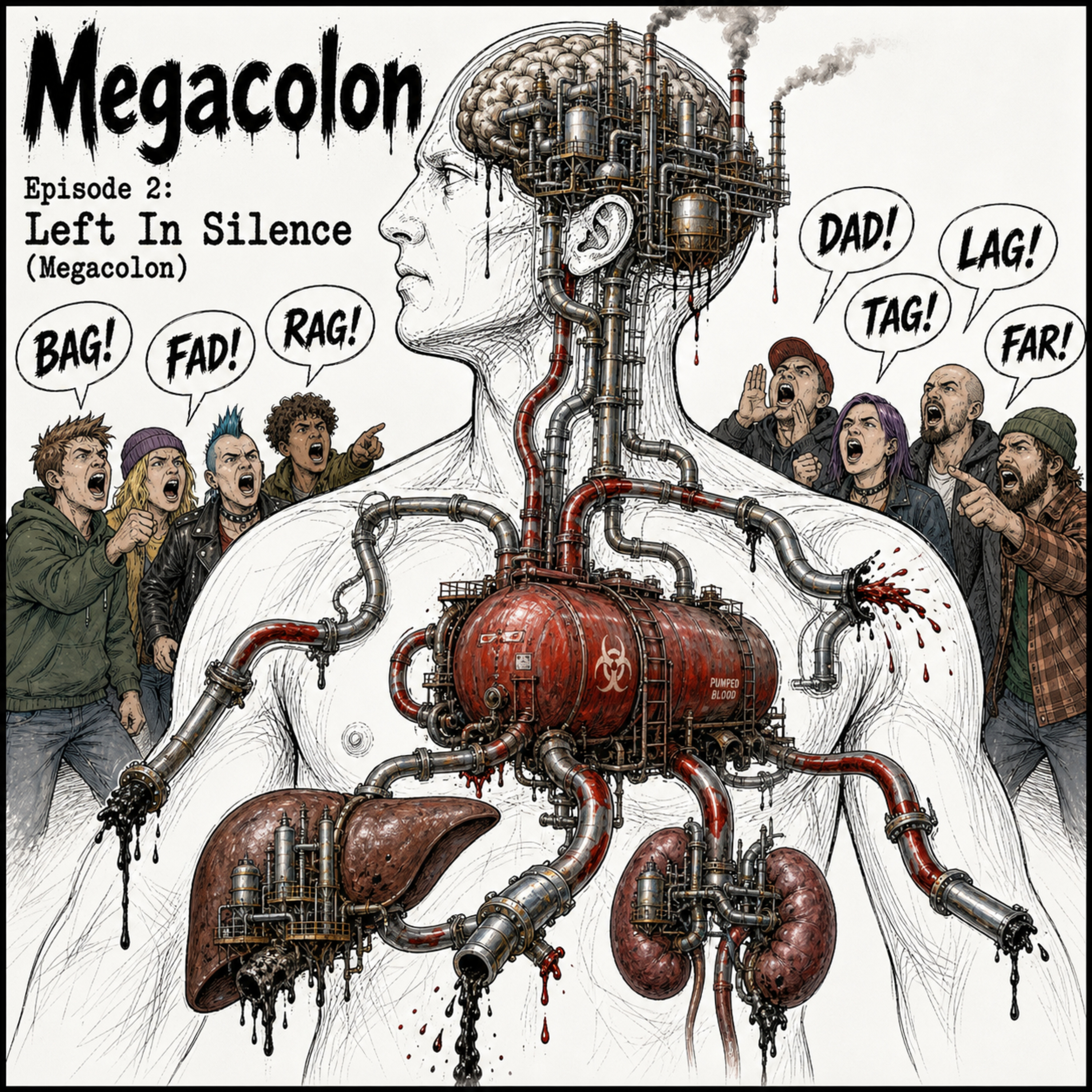 E2: Left In Silence (Megacolon); S5: (Un)bleached E2: Left In Silence (Megacolon); S5: (Un)bleached | Is this fiction?No, it’s clearly not fiction. It’s a transcript of a mind trying—and failing—to sit still.But all memory is reconstruction, so technically it is fiction.Right, but if everything is fiction, then calling it fiction is meaningless.Exactly. Which is why we keep talking.This episode begins in a windowless cruise cabin—already a metaphor you didn’t ask for—and spirals outward into a systems-level breakdown of being alive: the body as infrastructure, the brain as refinery, the heart as a pumping liability, and meaning itself as some kind of nutrient we’re not entirely sure we can synthesize.One voice argues that writing is too slow, too deliberate, too… intentional.Another voice counters that speaking only feels spontaneous because the writing already happened somewhere else—earlier, deeper, invisibly.So which is it? Performance or authenticity?Both. Neither. Depends who’s watching.Along the way:A song called Megacolon becomes a philosophical event.The blood-brain barrier becomes a narrative device.Childhood learning strategies mutate into adult identity scaffolding.Language dissolves into sound, then reforms as something suspiciously like music.And hovering over all of it is a quiet, irritating question:If your thoughts only exist now, then what exactly are you doing when you “remember,” “revise,” or “contradict” yourself?One side insists this is a journey toward coherence.The other side points out that the “journey” is just a story told by something that’s already out of time.So… do we keep going?Or do we stop and call it silence?Except—there’s no such thing as silence.Which is inconvenient.Because this episode ends there anyway.Or doesn’t. | — | |
| 5/3/26 | 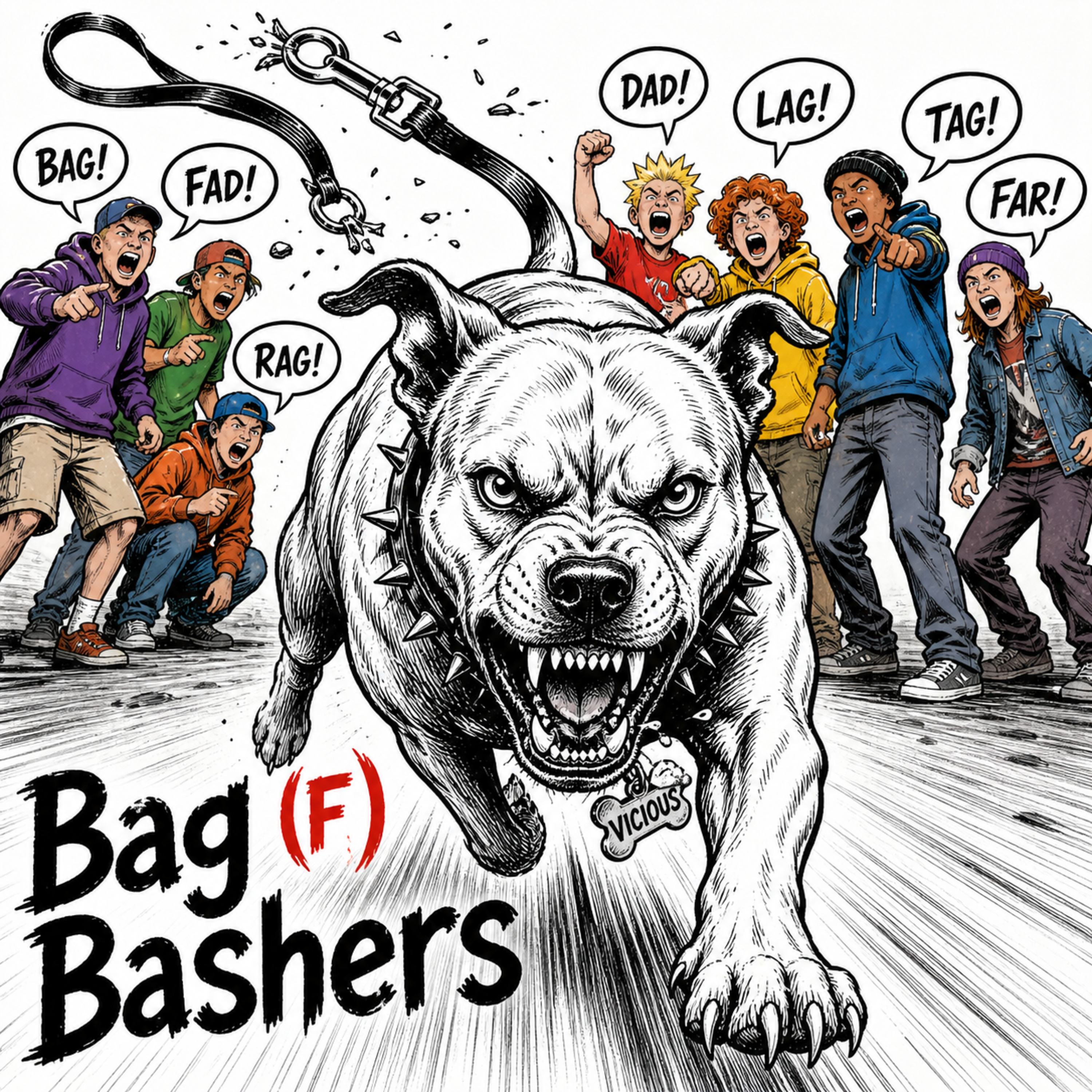 E1: Bag (with an F) Bashers — S6: Unleashed E1: Bag (with an F) Bashers — S6: Unleashed | Recorded from the sensory deprivation chamber of an interior cruise cabin, Season 6 opens mid-sprawl.What begins as an attempt to read from a set of autofiction books dissolves—predictably—into something else: a drifting, recursive excavation of memory, identity, and performance. From teaching himself to tie shoes “wrong,” to growing up in 1980s Manhattan Beach under the shadow of nuclear anxiety, drugs, and carefully worded lies, the narrative loops through adolescence, activism, and spectacle.At the center: a high school speech about sex and parties that electrified a crowd—and gave cover to voices yelling “fag” from within it.This episode doesn’t resolve. It expands. It builds a tapestry with no edges, tracing how stories form, fracture, and reassemble in the present moment.There are no clean arcs here. Just networks.And the question underneath it all:Can you shape your mind—or are you just watching it happen? | — | |
| 4/19/26 | 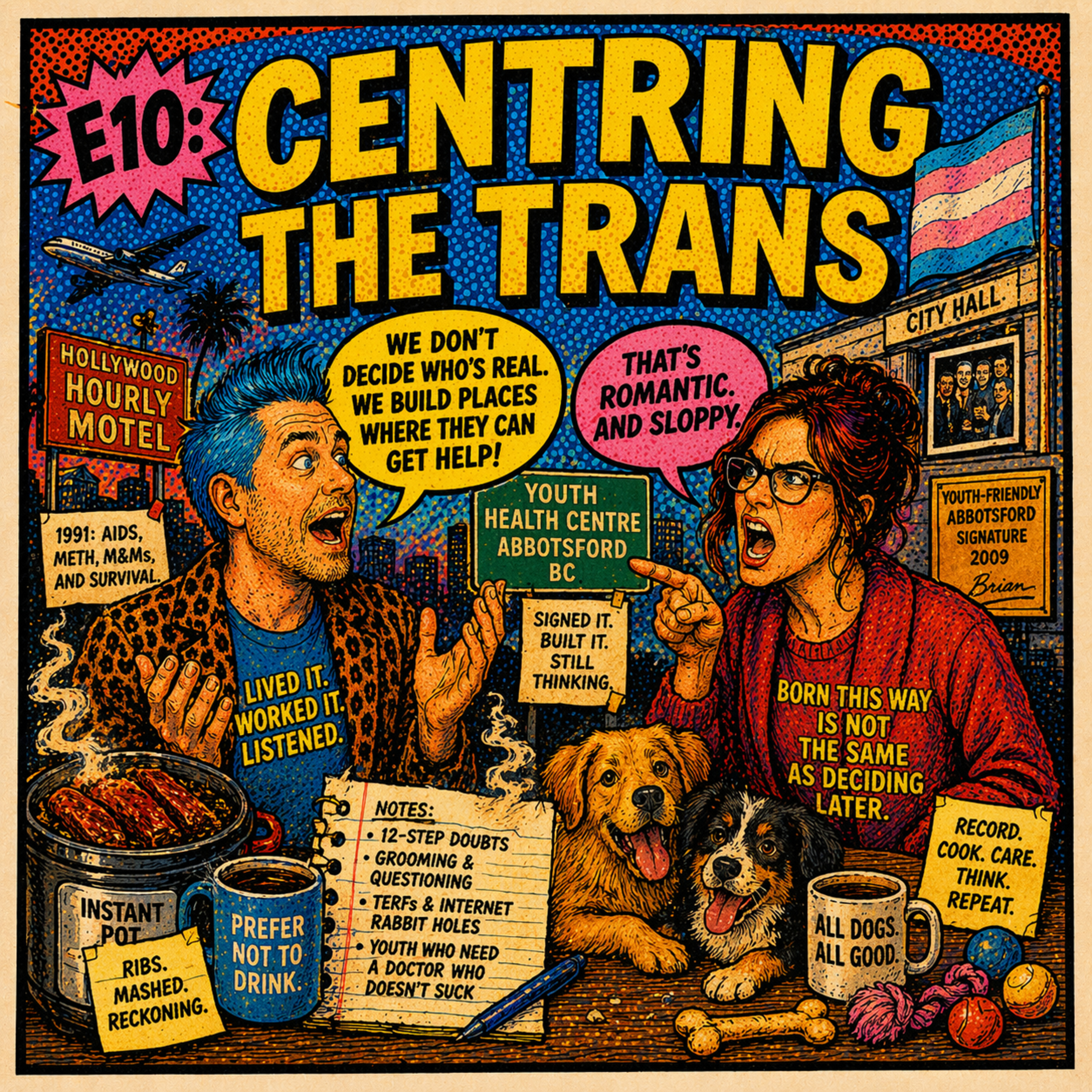 E10: Centring the Trans; S5: Lived/Deaded (Finale) E10: Centring the Trans; S5: Lived/Deaded (Finale) | This one starts with a headset, a wireless mic, and a person pacing around their house trying to think out loud without deciding what they think first.There are ribs in an Instant Pot. There are potatoes that may or may not be timed correctly. There is a puppy tangling itself in cords and demanding to be acknowledged as the central organizing force of the universe.And somewhere inside all of that: a youth health centre in Abbotsford.A plaque on a City Hall wall. A signature that meant very little—until it didn’t. A phone call. A doctor who didn’t tolerate bullshit. A room where people started asking a simple question: what would it look like if young people who don’t trust systems could actually walk into one and not get dismissed?That question becomes a place.And that place—almost incidentally at first—becomes a hub for trans youth in a region that didn’t necessarily set out to “centre” anything except access, dignity, and not being talked down to about smoking when you came in with something else entirely.From there, the episode does what the mind does.It wanders.Into early activism. Into being a teenager in Southern California. Into AIDS-era organizing, borrowed language, and the strange inheritance of ideas about identity—who gets to claim it, who gets to question it, and who gets told to shut up about it.Then forward again: pandemic internet. Comment sections. The moment you realize you are out of your depth in a conversation that seems to demand certainty. The emergence of frameworks—TERFs, trans discourse, competing claims about what is fixed, what is fluid, what is social, what is biological, what is real.And underneath all of it, a quieter thread:What does it actually mean to “centre” someone?Is it about language? Ordering letters? Deference? Silence? Infrastructure? Proximity to power? Or is it something more mundane and harder to argue with—like building a place where someone can walk in and not get turned away?This episode doesn’t resolve that.It circles it. It interrupts itself. It forgets what it was saying and remembers something else. It admits confusion in real time. It contradicts itself. It keeps going anyway.Also: 12-step identity. The idea of being “born” something. The moment that identity stops fitting. Grooming, memory, and the unreliable archive of how a self gets constructed in the first place.Nothing is cleaned up. Nothing is finalized.It is a recording of a mind trying to hold competing models of reality while making dinner and stepping over a dog toy.Set to music, because apparently that’s how we get through it. | — | |
| 4/18/26 | 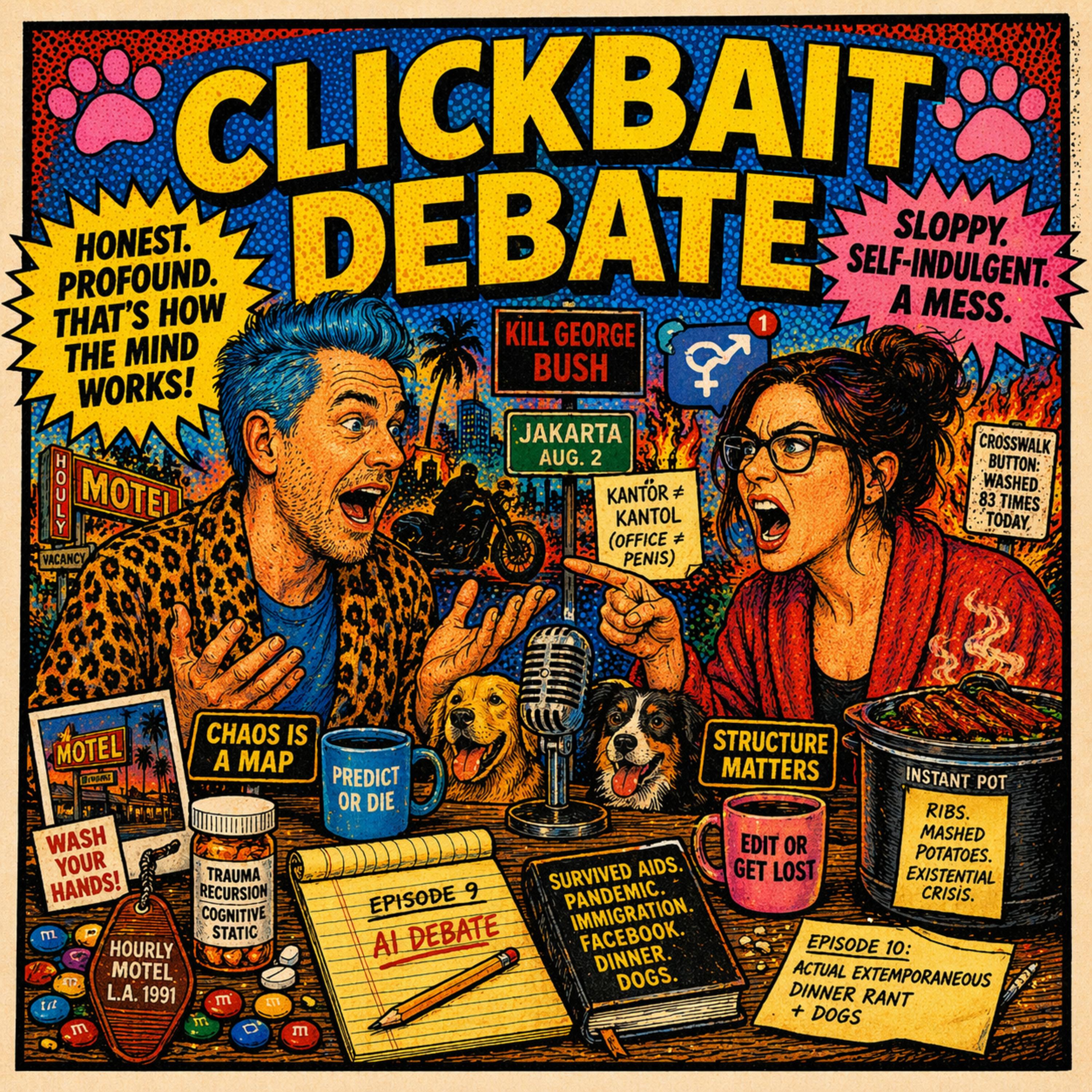 E9: Clickbait Debate; S5: Livin' La Vida Loca E9: Clickbait Debate; S5: Livin' La Vida Loca | Two voices enter. Neither leaves with dignity.Welcome to a kitchen in April 2020: ribs in an Instant Pot, hands washed raw from crosswalk buttons, a new puppy doing something morally superior with its time—and then, without permission, the floor drops out. You’re in a 1991 Hollywood motel. AIDS. Meth. Peanut M&Ms as harm reduction. No transition. No narrator asking if you’re okay with this.This episode is what happens when that rupture doesn’t get cleaned up.We fed the wreckage into an AI and told it to argue with itself. One voice insists the chaos is the point—that this is what a mind actually looks like when it’s trying to hold pandemic paranoia, generational trauma, immigration limbo, Facebook gender debates, and dinner at the same time. The other voice calls bullshit—says this is what happens when someone mistakes lack of structure for honesty and expects you to applaud.They go at it.Is this a profound map of consciousness under pressure, or just a privileged guy pacing around his kitchen turning memory into content? Is the brain an archive—or a bar fight between timelines? Do you owe your past coherence, or just proximity?Expect: Jakarta. A mosque sign that does not love George Bush. Immigration purgatory. Linguistic sabotage (kantor vs. kantol—choose your fighter). Dr. Laura. Evolutionary wood. Facebook as philosophy engine. The word “trauma” doing heavy lifting while also being side-eyed.Also: dogs. Always dogs.No conclusions are reached. Several are attempted. One or two collapse mid-sentence. At least one question starts drinking.This is the debate about whether the mess is the method—or the excuse.Set to music, because apparently that helps the mayhem go down. | — | |
| 4/18/26 | 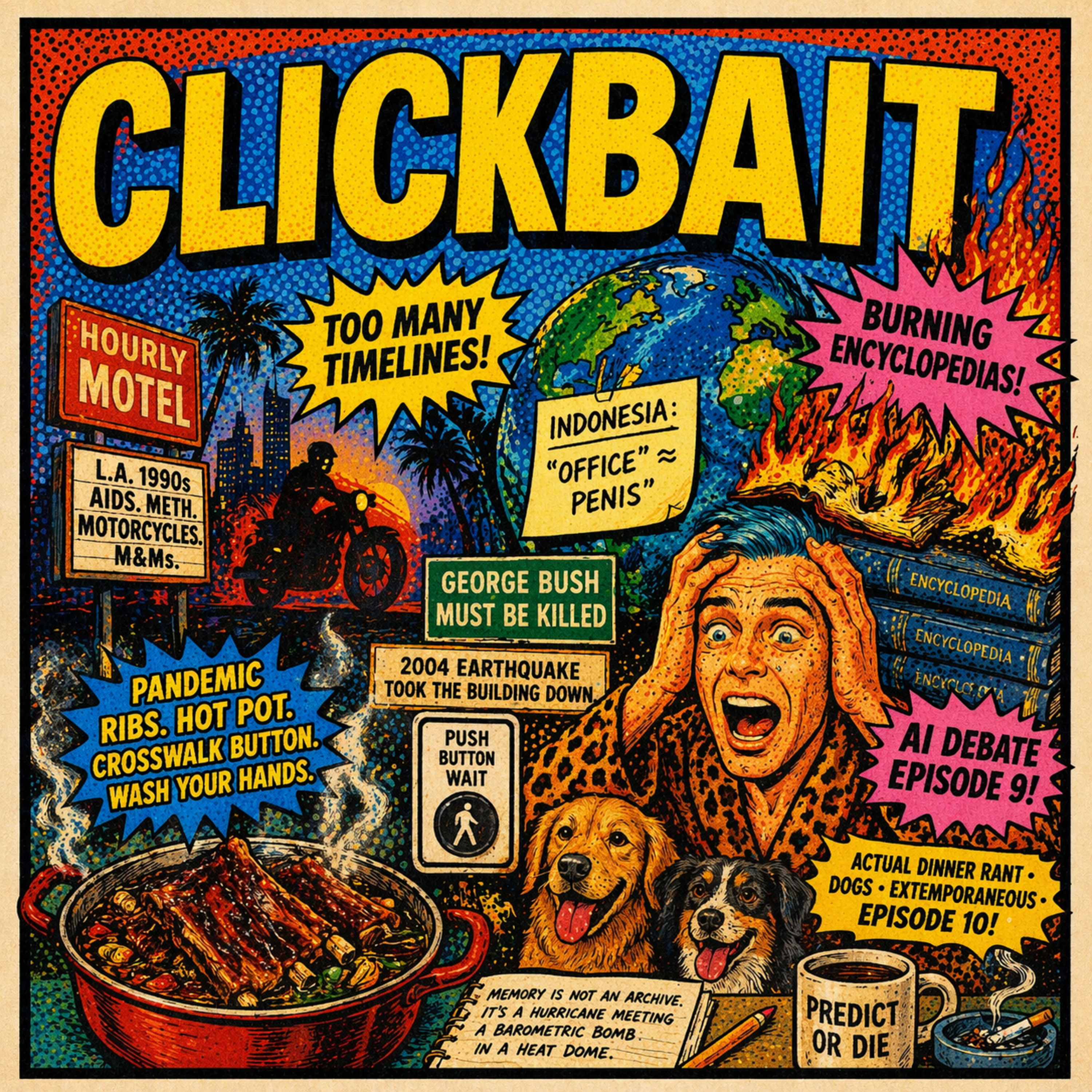 E8: Clickbait: Privilege, Grooming, Zee/Zim; S5: Just Kill Me E8: Clickbait: Privilege, Grooming, Zee/Zim; S5: Just Kill Me | There’s writing that tries not to disappoint you—and then there’s writing that behaves like a shopping cart with one broken wheel careening downhill into a pile of burning encyclopedias.Remember those? Encyclopedias.Episode Eight thinks its cart started rolling thirty years ago. I’m going to indulge that, because the point here is to simulate the cognitive static of modern identity-making—the way memory, trauma, language, and cultural debris all rush the stage at once, each insisting it’s the headliner.This began as a simple, extemporaneous dinner rant. I thought I knew where it would land. I don’t anymore. The mind is built to predict; when it fails, it scrambles—opens the wrong drawers, pulls out the wrong objects, insists they belong.So suddenly: Los Angeles, early ’90s, AIDS crisis. An hourly motel. A man already outside the story of his life, riding a motorcycle between sex clubs and nowhere-to-sleep, using meth like a farewell letter. The memory doesn’t arrive cleanly. It sprawls. It refuses a moral.Then—without warning—I’m in Indonesia a decade later. Or earlier. Waiting to see if Canada would recognize my relationship as a family. Learning the language, deliberately swapping words just to see what would happen. Living beside a mosque with a sign calling for George Bush to be killed. Walking past it daily as the only white American in the neighborhood. It stayed until the 2004 earthquake took the building down.And yes, this is chaotic. It isn’t a clean narrative. It’s not trying to be. It’s closer to how a mind behaves when it isn’t forcing coherence—something like a solar system forming, debris everywhere, gravity improvising structure after the fact.Then I’m back in the pandemic. Washing my hands after touching a crosswalk button. Cooking ribs in a hot pot. Recording. Remembering how fear lingers in the body long after the conditions that produced it have shifted or vanished.Too many timelines. Too many tones. The kind of thing that would get flagged as unfocused.That’s not an accident. It’s the point.This episode became a kind of cognitive traffic jam on a highway made entirely of on-ramps—a demonstration of what it feels like when the present is constantly interrupted by the memory of having remembered something before. Not a tidy line. Not a bowl. More like trying to sort your childhood bedroom while the house is on fire and someone—possibly you—keeps handing you objects you don’t recall taking.To interrogate that mess, I fed the transcript into an AI and had two generated voices debate a simple question: is this episode sloppy, or is it honest?That debate is Episode Nine.They argue. They contradict themselves. They try to summarize and collapse under their own metaphors. They circle the question until even the question starts to degrade.What they do agree on—somewhere beneath the noise—is that the mind doesn’t experience life in clean sequences. It experiences collision, recursion, interference, improvisation, and the occasional linguistic prank.Episode Ten, then, is the thing underneath all of this: the actual extemporaneous recording. Me making dinner. Moving through it. Letting the mind run without deciding what it means.All three episodes are set to music—“a spoonful of sugar to help the mayhem go down.”You can decide whether this is a mess, a method, or something that refuses the distinction.And, appropriately enough—this ends where it doesn’t. | — | |
| 3/13/26 | 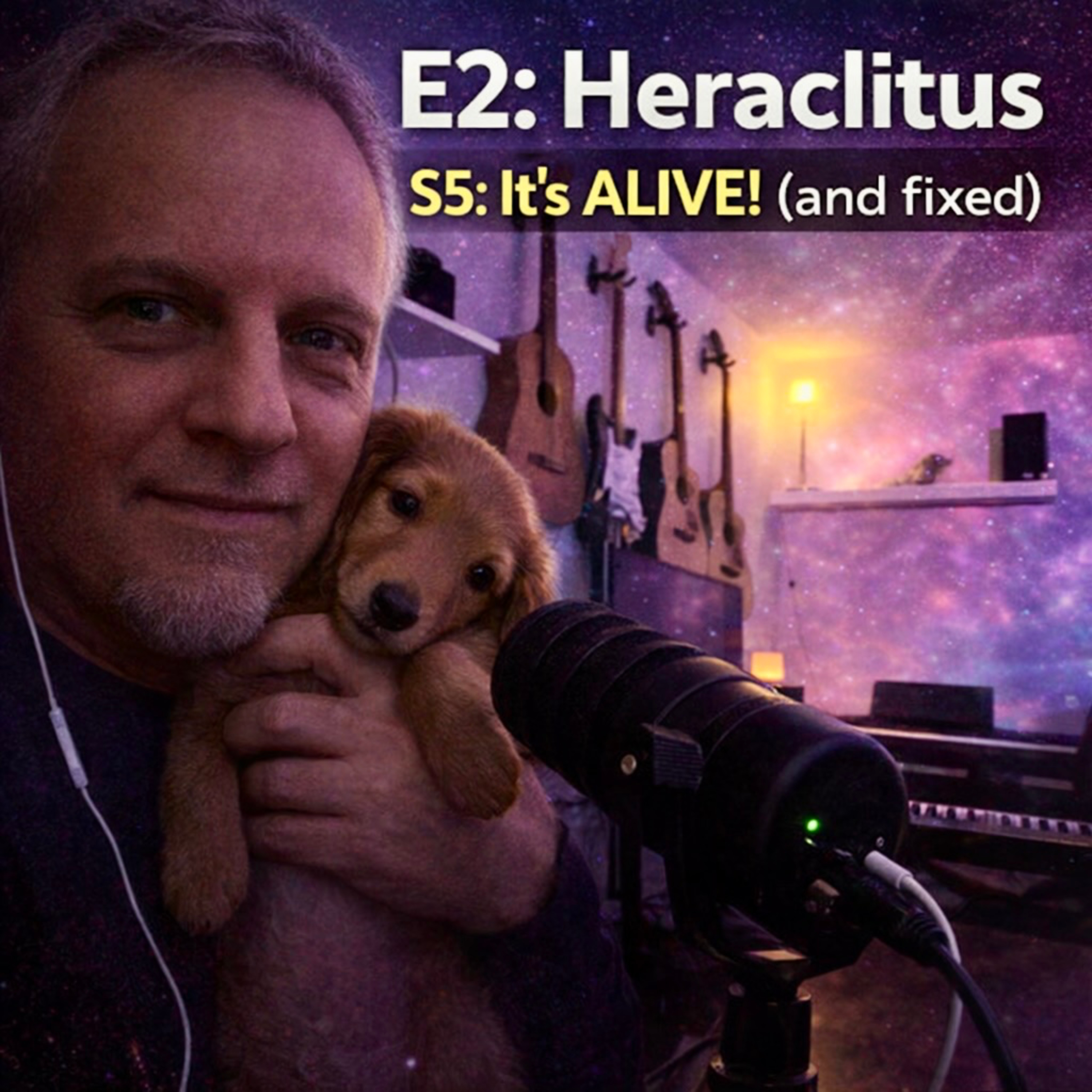 E2: Heraclitus; S5: It's Alive (and Kicking... La. La-la-la-la.) E2: Heraclitus; S5: It's Alive (and Kicking... La. La-la-la-la.) | This episode begins with a puppy getting tangled in a blanket and somehow ends up wandering through philosophy, authenticity, youth work, trauma, language, performance art, and why the human brain refuses to think in straight lines.Welcome to It’s Alive (and Fixed) — a long-form, stream-of-consciousness podcast where thinking happens out loud and conclusions are optional.In this episode we circle around the idea (inspired by Heraclitus) that you never step into the same river — or canoe — twice, because you’re never the same person and the world is never the same place. From there the conversation drifts through stories about working with marginalized youth, the meaning of authenticity (with a nod to Gabor Maté), language as a way humans provoke responses from each other, and the strange experience of listening to your own thoughts after they’ve escaped your head and landed on the internet.There are also dogs. And tangents. Many tangents.This podcast is part philosophy experiment, part personal storytelling, part improvised essay. Imagine a conversation that starts somewhere, refuses to stay there, and slowly builds a tapestry with no edges.Topics hiding in this episode include:authenticity • philosophy • psychology • marginalization • youth work • identity • storytelling • language • trauma • thinking out loud • stream of consciousness • creativity • memory • personal narrativeIf you enjoy long wandering conversations, philosophical podcasts, experimental storytelling, and the occasional existential detour, you may feel strangely at home here. | — | |
| 1/5/26 | 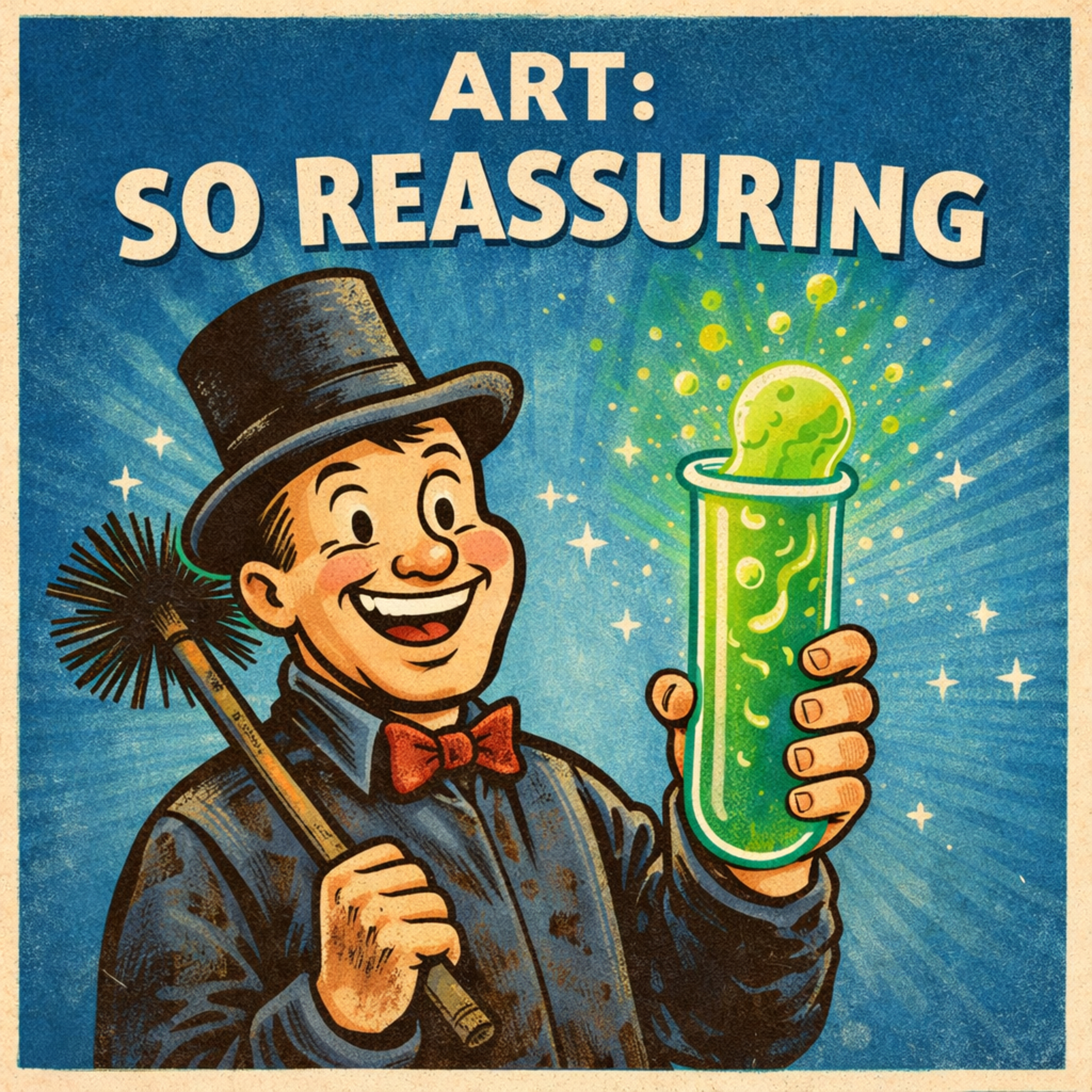 E6: E2: Welcome (Do Not Pet), Part 2: Diverginity, S1: Failure of Language, S2: Not Sacrè Bleu E6: E2: Welcome (Do Not Pet), Part 2: Diverginity, S1: Failure of Language, S2: Not Sacrè Bleu | This episode has already begun. Hasn’t it? Maybe before you even pressed play.That wasn’t an intro. Even if it was.Originally positioned as Episode Two of the whole podcast, this one went too deep, too fast.So it waited… until now… to be an Episode Six of Season Two. (There are others. A small pack of them. Don’t worry, they mostly don’t bite.)In this one:A scab becomes a plate.A plate becomes a meal.A walrus becomes a man again (or was it the other way around?).You’ll hear about the male–female “couple” who accidentally auditioned for friendship at the beach.The trauma of “Birthday parties” (not the events — the phrase).The smell of burning hair.A vet’s warning no one wants but everyone remembers.And “Guess what? Monkey’s butt.”You may be edging. Or being edged.By literature.And language.And your own sense of what should come next — and what doesn’t.Also featuring:Safer sex with an illegal manager,Opiate epiphanies with blurry picture-books,and a long-lost MDMA solo trip dedicated entirely to the art of touch deprivation.And if all that sounds overwhelming, it’s okay — just do the dishes.Or scrub a pot.Or set your oven on fire.This is Diverginity.This is Art: So Reassuring.This is Danger, Vicious Dog.Season One: Failure of LanguageSeason Two: Not Sacrè Bleu | — | |
| 11/29/25 | 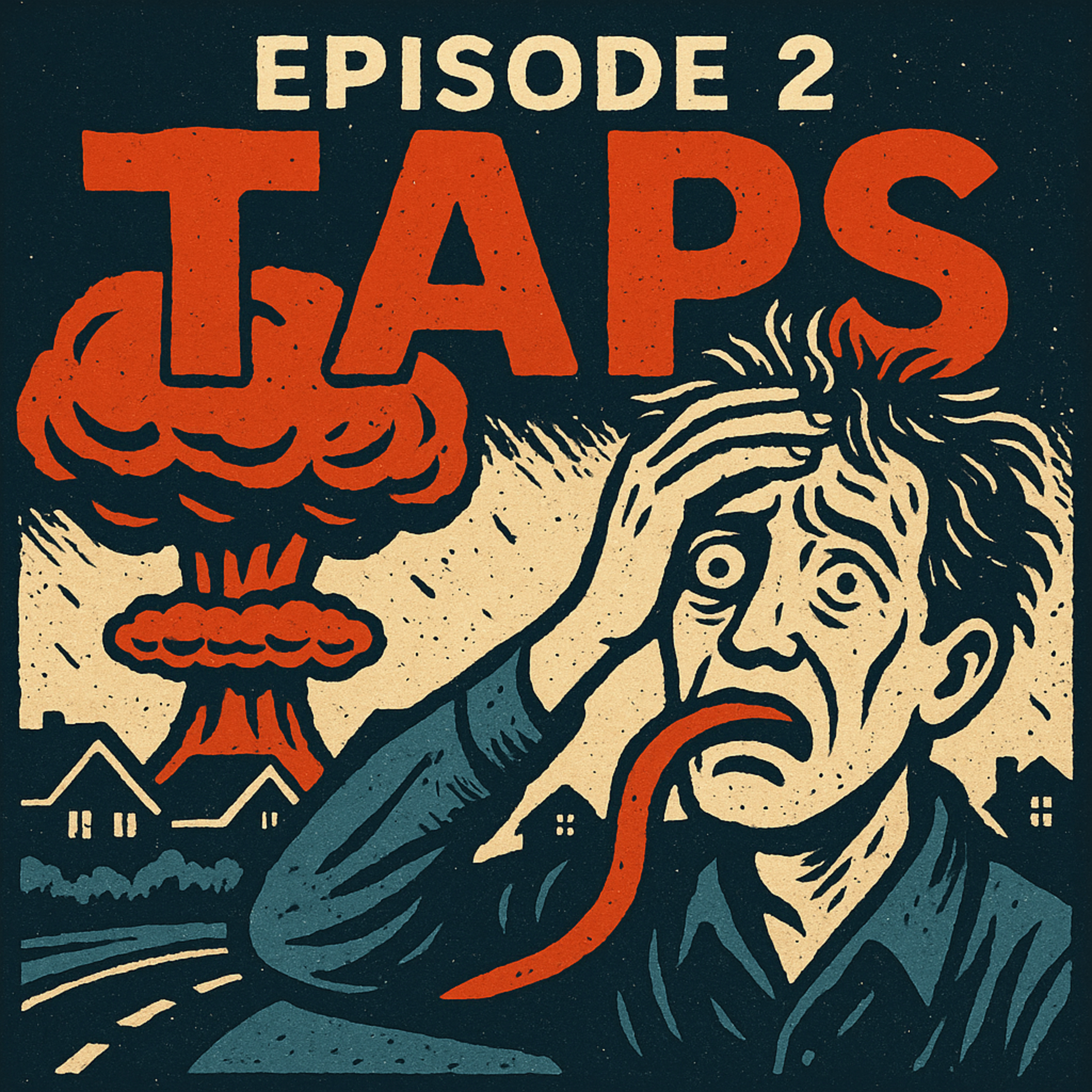 E2: TAPS, S1: Failure of Language E2: TAPS, S1: Failure of Language | Episode 1 stayed close: dogs, grief, Canada, you, the listener, the claustrophobia of language itself. Episode 2 blows the walls out. Danger, Vicious Dog exits the personal house-of-mirrors and sprints straight into global collapse, immigration bureaucracy, American dementia, Facebook neon-trash capitalism, and the existential whiplash of hearing your suburb’s air-raid sirens and realizing you don’t actually know where you live.TAPS (Temporary Arbitrary Protected Status) becomes the doorway into a wider apocalypse: failing states, meme economies, senescent empires, climate dread, and the realization that “reality” is just a story you were handed and forgot to question. The narrator spirals, jokes, indicts, predicts, and accidentally confesses—all while standing in a bathroom, dripping from a shower, listening to an automated New York Times voice explain the end of the world.If Episode 1 was containment, Episode 2 is breach.If Episode 1 was “Do Not Pet,” Episode 2 is what happens when you pet anyway.If Episode 1 was intimate breakdown, Episode 2 is geopolitical fever dream.Welcome to the widening radius of Danger, Vicious Dog. The sirens are already on. | — |
Showing 8 of 8
Sponsor Intelligence
Sign in to see which brands sponsor this podcast, their ad offers, and promo codes.
Chart Positions
1 placement across 1 market.
Chart Positions
1 placement across 1 market.