Insights from recent episode analysis
Audience Interest
Podcast Focus
Publishing Consistency
Platform Reach
Insights are generated by CastFox AI using publicly available data, episode content, and proprietary models.
Most discussed topics
Brands & references
Total monthly reach
Estimated from 6 chart positions in 6 markets.
By chart position
- 🇸🇪SE · Science#1531K to 10K
- 🇲🇾MY · Science#853K to 10K
- 🇸🇬SG · Science#121500 to 3K
- 🇭🇺HU · Science#123500 to 3K
- 🇮🇪IE · Science#192500 to 3K
- Per-Episode Audience
Est. listeners per new episode within ~30 days
3K to 16K🎙 ~2x weekly·34 episodes·Last published 5d ago - Monthly Reach
Unique listeners across all episodes (30 days)
6K to 32K🇸🇪31%🇲🇾31%🇸🇬9%+3 more - Active Followers
Loyal subscribers who consistently listen
2.4K to 13K
Market Insights
Platform Distribution
Reach across major podcast platforms, updated hourly
Total Followers
—
Total Plays
—
Total Reviews
—
* Data sourced directly from platform APIs and aggregated hourly across all major podcast directories.
On the show
From 11 epsHosts
Recent guests
Recent episodes
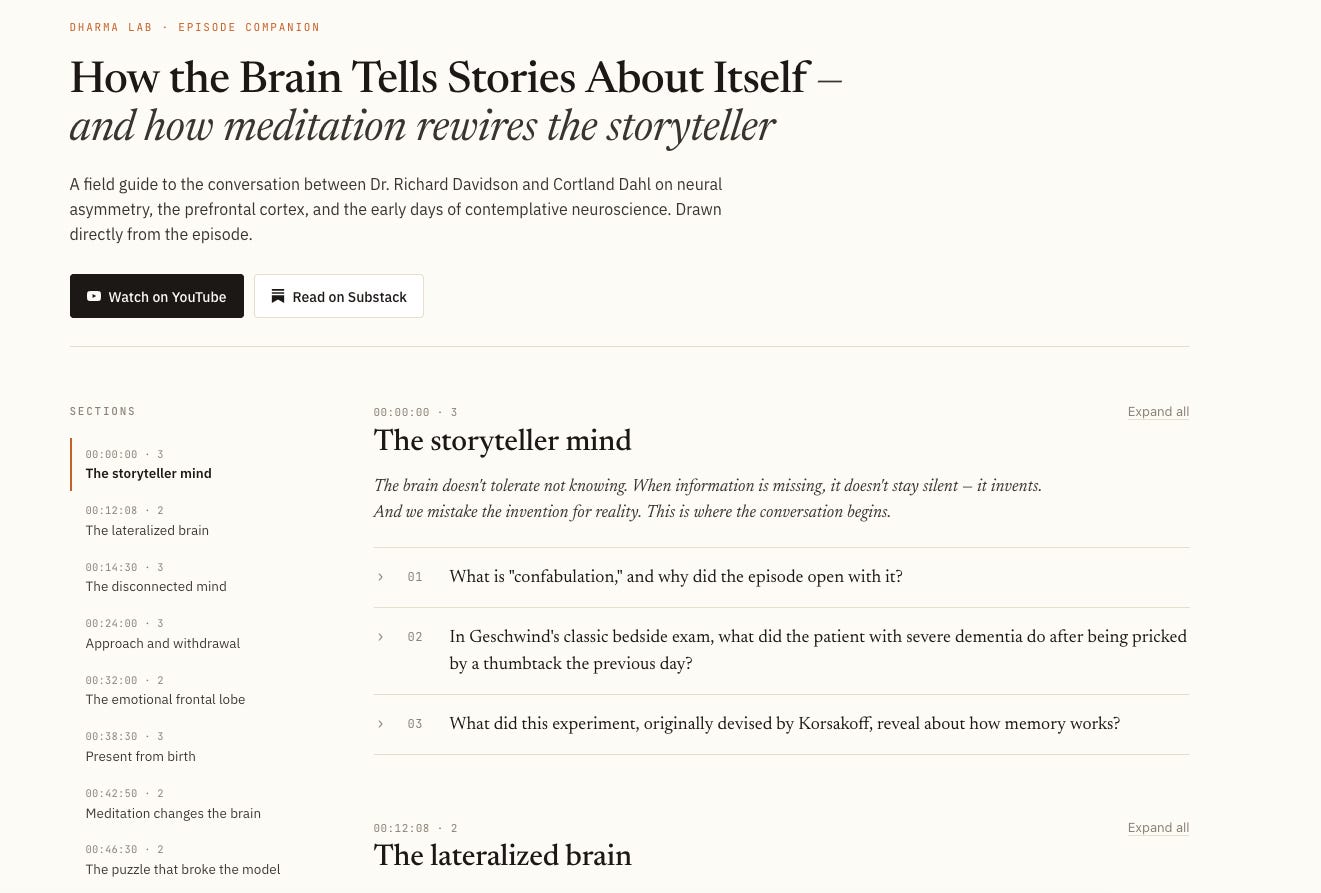
DL Ep. 31: Your Brain Is a Storyteller
May 7, 2026
50m 42s
DL Ep.30: The Dharma of Relationships with Devon + Nico Hase
Apr 24, 2026
59m 55s
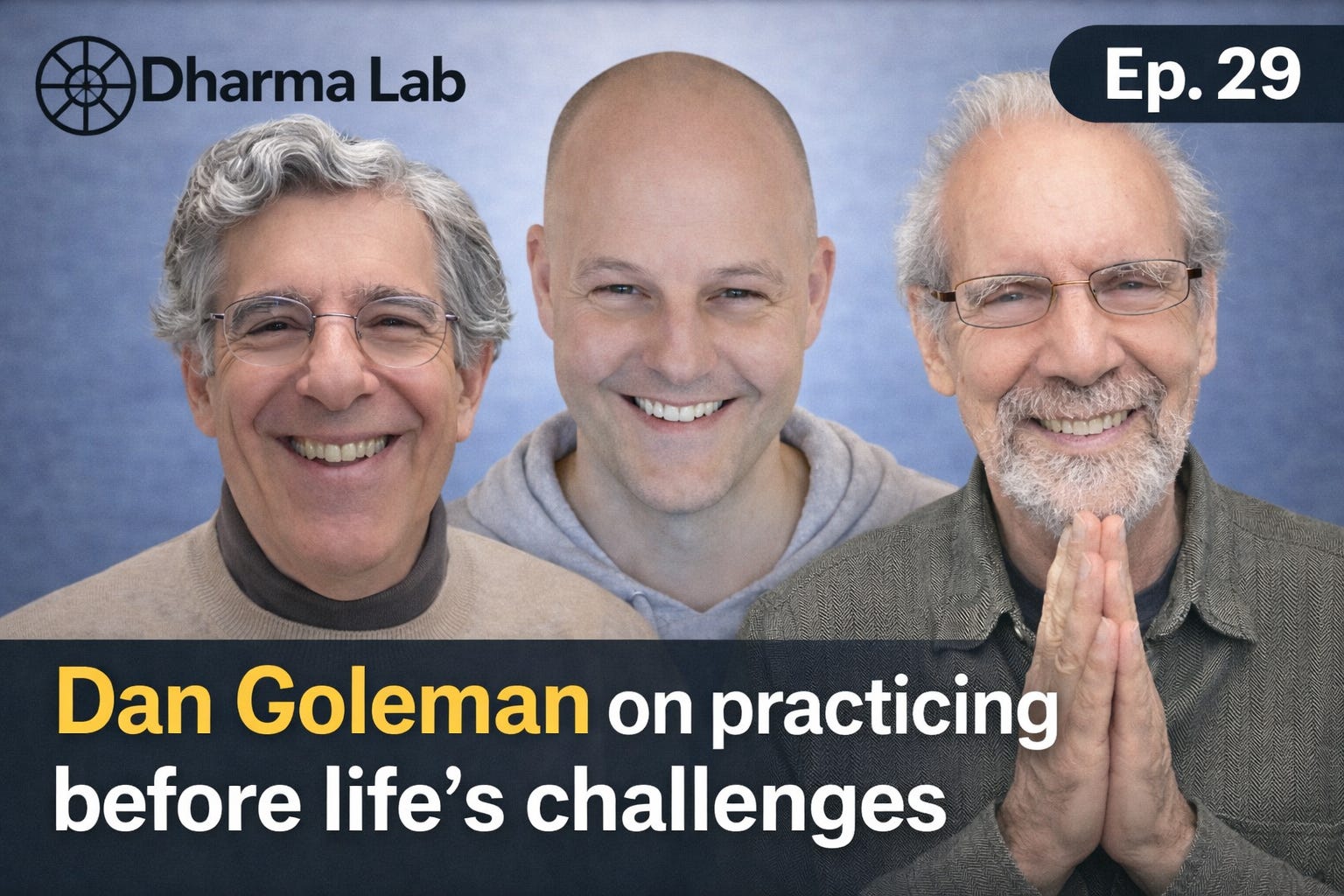
DL Ep.29: Daniel Goleman on Practicing Before Life's Challenges
Mar 27, 2026
52m 23s
Neuroscience & Practice discussion / takeaways from Nepal
Mar 20, 2026
30m 46s
DL Ep. 28: Mingyur Rinpoche - Are You Drained Or Are You Energized?
Mar 12, 2026
30m 22s
Social Links & Contact
Official channels & resources
Official Website
Login
RSS Feed
Login
| Date | Episode | Topics | Guests | Brands | Places | Keywords | Sponsor | Length | |
|---|---|---|---|---|---|---|---|---|---|
| 5/7/26 | ![]() DL Ep. 31: Your Brain Is a Storyteller✨ | emotional brainsplit-brain research+4 | Richie Davidson | Dharma Lab | — | emotional brainstorytelling+5 | — | 50m 42s | |
| 4/24/26 | ![]() DL Ep.30: The Dharma of Relationships with Devon + Nico Hase✨ | relationshipsBuddhist practice+4 | Devin HaseNico Hase | This Messy, Gorgeous Love | — | relationshipsBuddhism+6 | — | 59m 55s | |
| 3/27/26 | ![]() DL Ep.29: Daniel Goleman on Practicing Before Life's Challenges✨ | meditationemotional intelligence+4 | Daniel Goleman | New York TimesMind & Life Institute+2 | — | meditationemotional intelligence+6 | — | 52m 23s | |
| 3/20/26 | ![]() Neuroscience & Practice discussion / takeaways from Nepal✨ | neurosciencepractice+3 | — | Dharma Lab | Nepal | neurosciencepractice+3 | — | 30m 46s | |
| 3/12/26 | ![]() DL Ep. 28: Mingyur Rinpoche - Are You Drained Or Are You Energized?✨ | meditationanxiety+4 | Yongey Mingyur Rinpoche | — | — | meditationenergy+5 | — | 30m 22s | |
| 3/6/26 | ![]() DL Ep. 27: Jon Kabat-Zinn✨ | mindfulnessstress reduction+5 | Jon Kabat-Zinn | Mindfulness-Based Stress ReductionMBSR | — | mindfulnessMBSR+5 | — | 50m 24s | |
| 2/24/26 | ![]() DL Ep.26: Four Science-Backed Skills to Deal with Anxiety✨ | anxietyflourishing+4 | — | Dharma Lab | — | anxietyflourishing+7 | — | 47m 48s | |
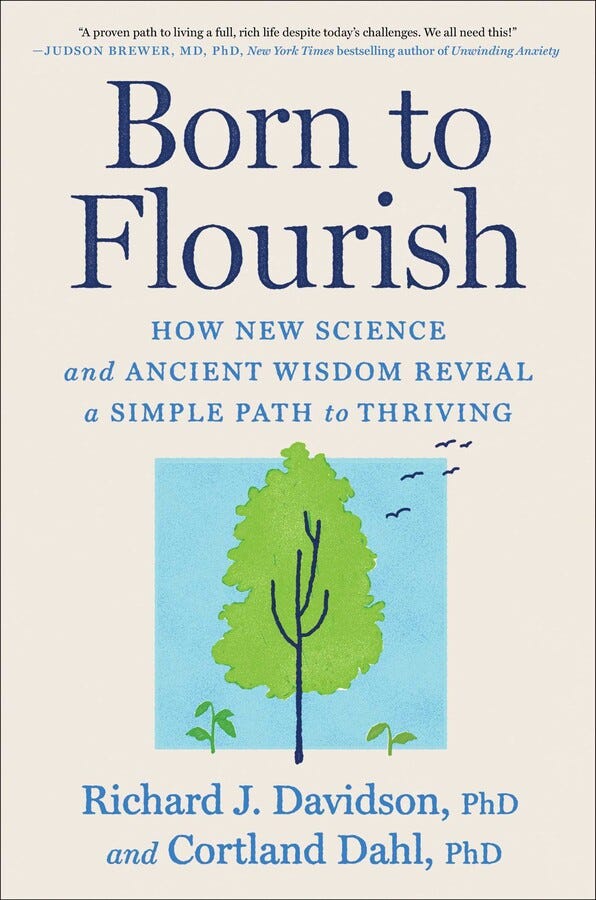
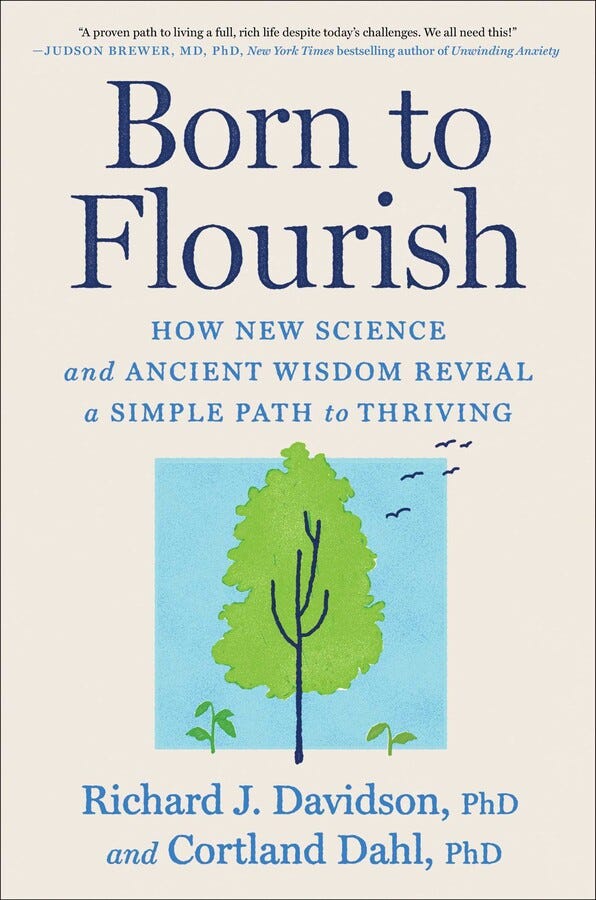
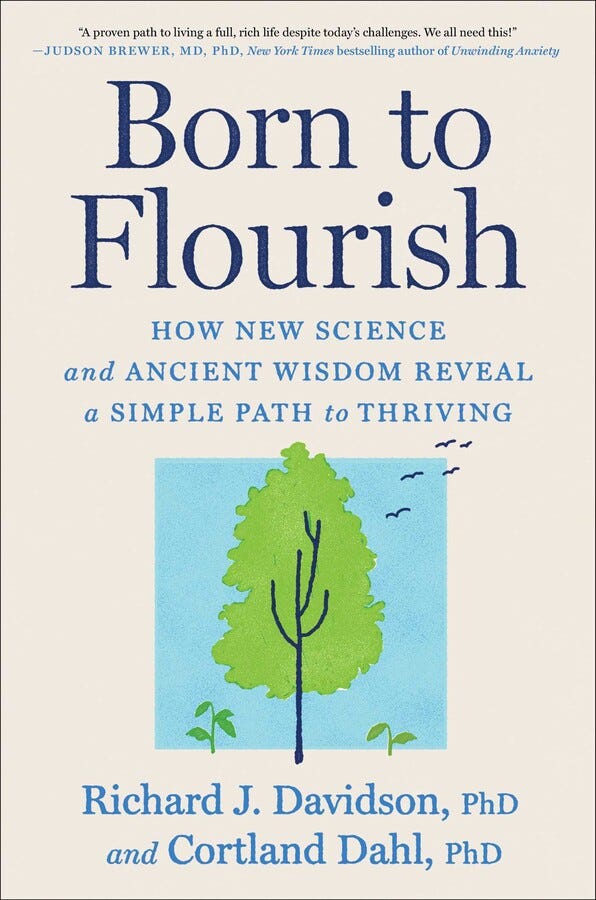
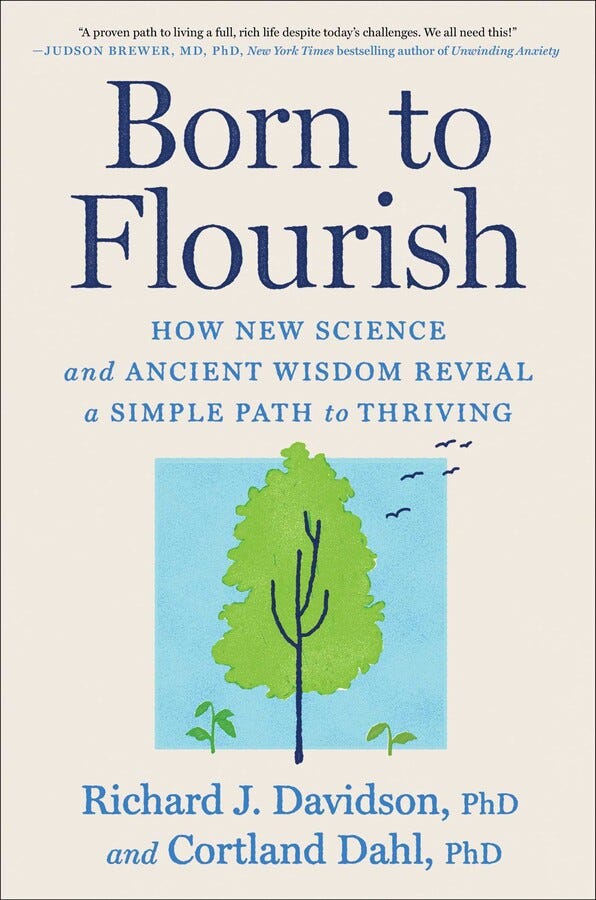
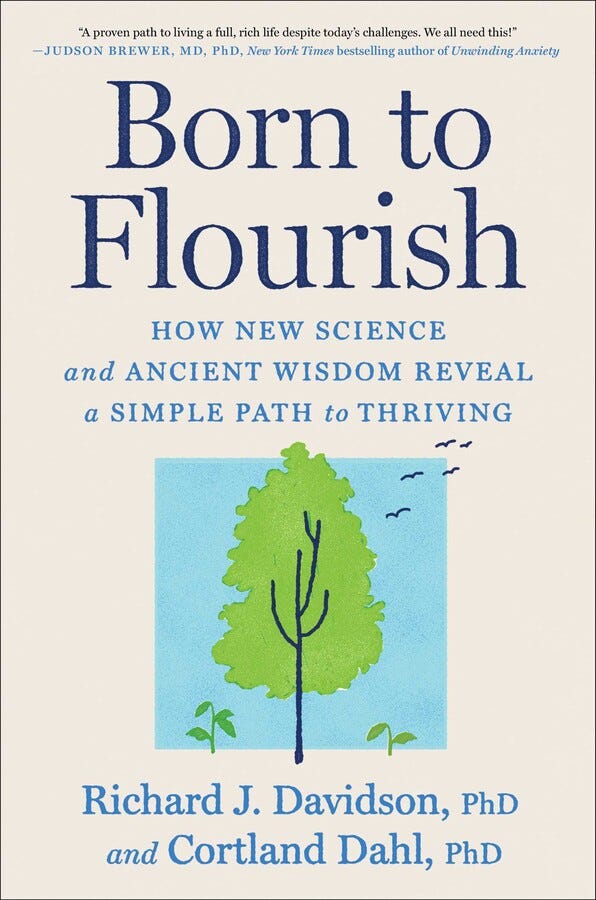
| 2/17/26 | ![]() DL Ep 25: Flourishing is Contagious✨ | flourishingemotional contagion+4 | — | Born to FlourishNIH+1 | — | flourishingneuroscience+5 | — | 37m 18s | |
| 2/9/26 | ![]() DL Ep.24: Born to Flourish - The Science of Human Potential✨ | human potentialkindness+3 | — | Born to Flourish | — | human potentialkindness+3 | — | 36m 56s | |
| 2/5/26 | ![]() AMA#5 Navigating Neuroplasticity, Non-Dual Awareness, and the Neuroscience of Flourishing✨ | neuroplasticitymeditation+4 | — | Dharma Lab | — | neuroplasticitymeditation+6 | — | 4m 00s | |
Want analysis for the episodes below?Free for Pro Submit a request, we'll have your selected episodes analyzed within an hour. Free, at no cost to you, for Pro users. | |||||||||
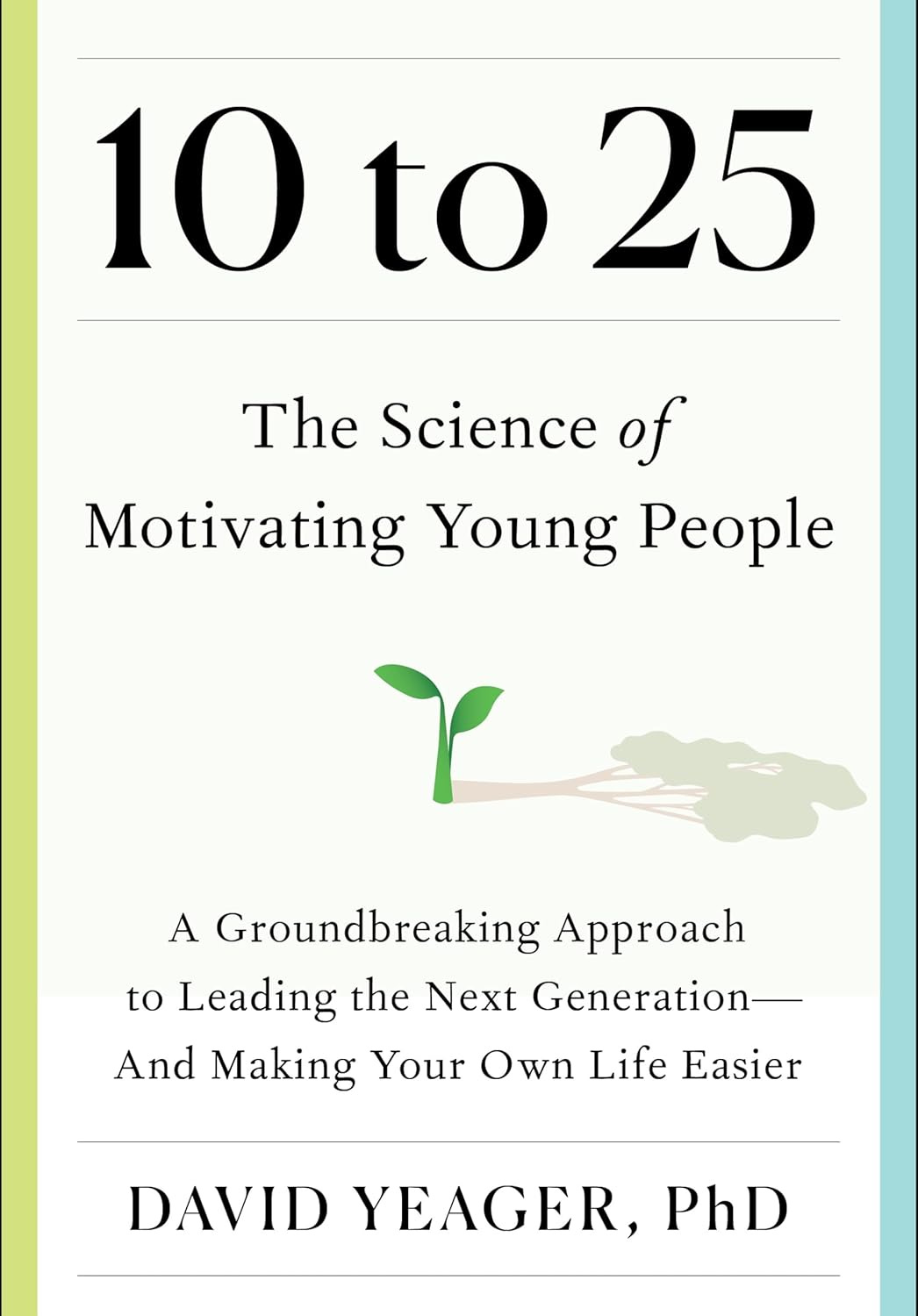
| 1/27/26 | ![]() DL Ep. 23: David Yeager on Parenting Teens: What the Adolescent Brain Really Needs✨ | parenting teensadolescent brain+4 | David Yeager | 10 to 25 | — | parentingteens+7 | — | 58m 55s | |
| 1/20/26 | ![]() DL Ep.22: The Neuroscience of “Aha” Moments | We’ve all had moments when something suddenly clicks. A realization that doesn’t arrive gradually, but all at once. Cort remembers walking out of a movie theater on a humid summer night after seeing Schindler’s List, suddenly knowing what his life should be about. Richie recalls preparing for a talk that sparked an entirely new way of thinking about neuroplasticity and the social brain.In this episode, we explore what those “aha” moments really are, why they feel so emotionally charged, and how they can reshape the course of our lives.Drawing on a fascinating neuroscience study, we look at what happens in the brain when insight arises—and why these moments are remembered so vividly days later. We also reflect on how insight and wisdom once sat at the center of human flourishing—from Socrates, Plato, and Aristotle to Buddhist psychology—yet are largely absent from modern models of wellbeing. In fact, as Richie points out:“No current model of psychological well-being that is in the psychological research literature includes insight, except for the model that we’ve developed.” Dr. Richard Davidson, Dharma Lab Ep.22, speaking about The Healthy Minds FrameworkThis leads to a deeper question we explore together: What if insight isn’t rare…but simply unnoticed, forgotten, or unsupported in daily life?Episode Highlights* Why what we feed our minds matters: the raw materials of insight come from the conversations we have, what we watch and read…but only if we create space to digest* How we likely have many insights each day but lose them in distraction; and how contemplative practice acts like a glass enclosure around a candle, helping us notice, remember, and stabilize insights before they flicker out* Why psychedelics are often effective at igniting insight, but not always at helping it become a durable way of seeing* Why insight is deeply emotional, not just intellectual* The difference between a fleeting epiphany and a lasting shift in how we experience lifeIf you enjoy these topics, check out our new book Born to Flourish, available for pre-order (arrives March 2026).Related Posts From the Archives:Reference Notes:Becker, M., Sommer, T., & Cabeza, R. (2025). Insight predicts subsequent memory via cortical representational change and hippocampal activity. Nature Communications, 16, 4341. https://doi.org/10.1038/s41467-025-59355-4The Healthy Minds frameworkPodcast Chapter List00:00 – We Likely Have Many Insights but Don’t Remember ThemThe “candle in a hurricane” metaphor and why awareness matters00:01 – A New Paper on Insight & WisdomWhy this study immediately caught our attention01:25 – Cort’s Life-Changing Epiphany After Schindler’s ListCompassion, meaning, and a sudden shift in perspective03:18 – What an “Aha” Moment Feels LikeSuddenness, emotion, and deep certainty04:17 – Why Insight Is Deeply EmotionalWhat contemplative traditions have always known05:01 – Richie’s Scientific Epiphany at UW–MadisonNeuroplasticity, sociology, and a radical shift in thinking09:02 – Insight as an Energizing ForceWhy these moments feel alive and motivating09:16 – Meditation & Non-Dual AwarenessThe flame that illuminates itself10:50 – Why Insight Leaves Lasting MemoriesEmotion, memory, and meaning11:30 – Insight in Ancient PhilosophySocrates, Plato, Aristotle—and what we’ve lost today13:47 – The Blind Spot in Modern Wellbeing ModelsWhy insight is missing from psychology15:13 – Why Insight Is Hard to Study ScientificallySuddenness, unpredictability, and experimental challenges16:42 – The Mooney Images Experiment ExplainedHow scientists trigger “aha” moments in the lab18:28 – Insight Predicts Memory Days LaterWhy recognizing meaning changes the brain20:50 – The Brain During InsightAmygdala, hippocampus, and emotional salience23:25 – Why We Remember What MattersEmotion as the gateway to memory26:21 – Meditation, Memory Reconsolidation & InsightHow inner landscapes change28:21 – Why Insights Usually FadeEpiphany vs. memory of epiphany28:56 – The Glass Enclosure Around the CandleHow meditation helps insights last30:21 – Psychedelics & InsightPowerful sparks, fragile integration31:50 – Can Insight Become a Trait?From episodic moments to lasting change33:03 – The Dog in the Mooney ImageWhy once you see it, you can’t unsee it34:24 – Awe as a Trainable StateBeyond episodic wonder36:16 – What We Feed the Mind MattersWhy insight depends on raw materials38:01 – Creating Space to Digest ExperienceWhy insight arises when attention relaxes39:03 – Why Most Insights Go UnnoticedReturning to the hurricane metaphor40:09 – Curiosity as the Gateway to InsightBecoming a student of your own mind41:41 – Using Simple Affordances to RememberThe finger counter as an insight cue This is a public episode. If you'd like to discuss this with other subscribers or get access to bonus episodes, visit dharmalabco.substack.com/subscribe | 43m 12s | ||||||
| 1/13/26 | ![]() DL Ep.21: The Neuroscience of Conscious Habits | On today’s episode of Dharma Lab, we take a closer look at the mechanics of healthy habit formation.Building on a framework we’ve outlined in previous posts—inspiration, intention, action, and repetition—we explore why each step matters from a scientific perspective, and how the process tends to break down in real life.Discussion Highlights:* How monks we encountered in Nepal had trained habits by way of intense practice * Why exceptional capacities are built through training and practice, not innate talent* How small, repeatable actions strengthen the executive network so we are “in the driver’s seat” of our mind, emotions, and impulses* The distinction between unconscious habits and consciously trained habits* A neuroscience-informed framework for habit formation: inspiration, intention, action, and repetition* Where habits most often break down, and how to use moments of everyday life as affordances for practice* Malcolm Gladwell’s framework for exceptional performance: Practice, Practice, Practice, and starting at small levels daily to achieve a compounding rate* How Flourishing is contagiousIf you enjoy this topic, there will a whole chapter devoted to it in our upcoming book Born to Flourish (available for pre-order now, arriving March 2026). We will deep dive into the 4 stages of developing conscious habits - inspiration, intention, action, repetition. A framework as a recipe to develop a conscious habit. Recent Posts:·From the Archives:Podcast Chapter List:00:00 – Intro: The “Tomorrow” Trap of ProcrastinationWhy inspiration so often gets postponed — and how habits stall before they begin02:20 – What Meditation Masters & Peak Performers Have in CommonPractice, not talent: how extraordinary people are trained, not born04:55 – How Small Daily Practices Change the BrainNeuroscience shows even 5 minutes a day can create measurable change06:10 – What Are “Conscious Habits”?The difference between automatic habits and habits built with awareness08:45 – The Four Stages of Building HabitsInspiration → Intention → Action → Repetition (a science-backed framework)10:20 – Inspiration: Finding the Spark That Sustains ChangeWhy inspiration must be renewed — not assumed13:10 – Intention: Turning Vision Into a Clear PlanWhy vague goals fail and specificity matters for habit formation16:00 – Action: Why Small Steps Beat Big PlansLetting go of grandiosity and taking one doable step now18:50 – Repetition: How Habits Rewire the Brain“Neurons that fire together wire together” — the science of consistency22:05 – Why Habits Often Collapse (Even When We Care)Busyness, breaks in routine, and the missing role of inspiration24:40 – Using Everyday Life as an Affordance for PracticeHow brushing your teeth or doing chores can become training moments27:10 – The Neuroscience of Flourishing as a SkillWhy wellbeing isn’t circumstantial — it’s trainable30:00 – From Autopilot to the Driver’s Seat of the MindHow conscious habits strengthen emotional regulation and awareness33:20 – Final Reflections: Practicing Wisely, Not Forcing ChangeWhy flourishing grows through patience, repetition, and care This is a public episode. If you'd like to discuss this with other subscribers or get access to bonus episodes, visit dharmalabco.substack.com/subscribe | 35m 33s | ||||||
| 1/6/26 | ![]() DL Ep. 20: Why Willpower Isn’t Enough - The Neuroscience of Sustainable Change | REMINDER: Live Q&A with Richie and Cort TODAY at 8pm ET on Substack. Over the next two weeks on Dharma Lab, we’ll be exploring the science and practice of meaningful change—why it so often breaks down, and how small, intentional habits can gradually reshape how we live.In today’s episode, we explore a key insight from neuroscience and psychology: our behavior is shaped less by willpower than by the affordances around us—the cues, routines, relationships, and environments that quietly invite certain actions while discouraging others.Rather than asking why we “lack discipline,” we look at how everyday contexts—from our physical surroundings to the people we spend time with—continually nudge our habits, often outside of awareness. When those affordances stay the same, even the strongest resolutions tend to fade.We also explore a more hopeful possibility: that working with affordances doesn’t have to feel rigid or effortful. Approached with curiosity, it can be creative—even fun. Experimenting with small changes, playful rituals, and supportive friendships can turn habit-building from a struggle into something that feels alive and sustainable.Next week, we’ll continue the conversation:* discussing conscious habits, and* the four steps make flourishing a habit: Inspiration, Intention, Action, and Repetition. You can read more about these in our recent post, as well in our upcoming book Born to Flourish (available for pre-order now, arriving March 2026). Recent Posts:Podcast Chapter List:00:00 – Approaching New Habits with Curiosity and CreativityWhy motivation fades, even when intentions are sincere — and why willpower alone isn’t enough.01:00 – Introducing Dharma Lab & the Science of Habit ChangeDr. Richard Davidson and Dr. Cortland Dahl on the neuroscience and contemplative science of lasting behavior change.02:35 – A Daily Ritual for Motivation (Bodhicitta Practice)Why small rituals help anchor habits — and why remembering to begin is often the hardest part.04:15 – The Brain Is Sensitive to ContextHow habits are shaped less by intention and more by environment.05:20 – What Are “Affordances” in Neuroscience?Why cues in your environment quietly drive behavior — often outside awareness.06:45 – Why Changing Intention Isn’t EnoughWhy resolutions fail when the environment stays the same.07:40 – Causes and Conditions: A Buddhist Psychology ViewWhy behavior change depends on assembling the right conditions, not forcing outcomes.09:00 – Practical Example: Supporting Healthy EatingHow what we listen to, read, and talk about reinforces or undermines habits.10:00 – Small Steps Repeated Many TimesWhy modest, sustainable habits outperform dramatic transformations.11:20 – The “Too Much, Too Fast” ProblemWhy ambitious resolutions (like 45-minute meditations) rarely last.12:45 – Designing a Baseline You Can SustainHow to choose habits that are “almost too easy” — and why that works.14:00 – Planning for Lapses (The Road Goes Up and Down)Why setbacks are not failure — and how awareness means the practice is working.15:30 – Working with Low Motivation & the DipWhy the real practice happens when motivation disappears.16:00 – Impermanence & MotivationWhy planning for fluctuating motivation is the wise approach.17:20 – Three Core Principles for Lasting Habits* Create supportive conditions* Take small, repeatable steps* Plan for difficulty and setbacks18:20 – Curiosity, Patience, and Creative Habit DesignWhy approaching change with lightness and curiosity makes it sustainable.19:50 – Everyday Life as PracticeHow meals, exercise, chores, and daily routines can become training for awareness and compassion.22:10 – Turning Mundane Activities into MindfulnessWhy boredom itself can become interesting — and transformative.24:10 – Feeding the Mind: What We Consume Shapes HabitsHow reading, listening, and information diets support long-term change.25:30 – The Power of Community & Social SupportWhy habits rarely last without relationships that reinforce them.27:15 – Closing Reflections & What’s Next on Dharma LabPreview of upcoming episodes and the habit-change model from Born to Flourish. This is a public episode. If you'd like to discuss this with other subscribers or get access to bonus episodes, visit dharmalabco.substack.com/subscribe | 28m 14s | ||||||
| 1/2/26 | ![]() Recording of AMA #4 with Dr. Richie Davidson and Dr. Cortland Dahl | This is a free preview of a paid episode. To hear more, visit dharmalabco.substack.comThank you to those who tuned into our 4th live video with Dr. Richard Davidson and Dr. Cortland Dahl! Join us for our next live AMA on Tuesday, Jan 6 at 8pm ET / 7pm CT.The discussion covered a lot of ground not limited to: Brain activity during meditation, Expectations / Non-attachment, Neuroscience of desire, Journaling + Meditation, Meditation dosage… | 4m 17s | ||||||
| 12/30/25 | ![]() DL Ep. 19: The Science of Self-Reflection | At certain moments in life — the end of a day, the completion of a project, or the turn of a year — we naturally begin to reflect.But without intention, self-reflection can quietly slide into rumination, self-judgment, and stress.In this episode of Dharma Lab, we explore the science of self-reflection: why it’s such a uniquely human capacity, how it supports learning, empathy, and wellbeing — and why it so often goes off the rails.Drawing on neuroscience, contemplative practice, and lived experience, we explore how self-reflection can be guided by intention rather than left on automatic — and how moments of awareness restore the capacity to steer the mind.Episode Highlights:In this conversation, we explore:* Why self-reflection is one of the most unique — and potentially troublesome — capacities of the human mind* How the prefrontal cortex enables “mental time travel” into the past and future* The difference between healthy reflection and toxic rumination* How stress impairs intentionality and leaves the mind running on autopilot* Why curiosity and intention are key ingredients in constructive self-reflection* The role of meta-awareness in restoring choice and flexibility* How perspective-taking supports empathy and compassion* Why self-reflection is central to psychotherapy, learning, and creativity* How analytical meditation trains reflection without losing awareness* Simple ways to practice healthy self-reflection in daily lifeIn the coming weeks, we’ll continue exploring how reflection, when held skillfully, can begin to shape the habits and patterns that guide our lives.We’d love to hear from you: What are ways you’ve learned and grown over the past year? What methods help you engage in self-reflection in a positive way?Warmly,Cort + RichieAs you reflect on the year, consider our recent post on turning resolutions into habits:From the Archives:Podcast Chapter List:00:00 — Why Self-Reflection Is Uniquely HumanHumans’ unparalleled capacity for self-reflection — and how it can help or harm us.01:53 — Natural Moments of ReflectionWhy reflection arises at transitions: days, projects, and years.02:23 — When Self-Reflection Goes Off the RailsHow reflection turns into self-judgment, negativity, and rumination.03:27 — The Neuroscience of Mental Time TravelThe prefrontal cortex and our ability to reflect on the past and imagine the future.05:35 — When Reflection Becomes RuminationHow negative reflection hijacks the mind.06:11 — The Salience Network and Emotional “Charge”Why rumination activates threat circuitry in the brain and body.07:30 — Self-Reflection as an Umbrella TermWhy healthy and toxic reflection can feel radically different.09:23 — Intentionality: The Missing IngredientHow lack of intention leads to runaway mental loops.10:48 — Curiosity vs. Judgment in Self-InquiryWhat distinguishes healthy reflection from toxic rumination.12:03 — Stress, the Prefrontal Cortex, and Habitual MindWhy stress shuts down intentional control.13:10 — The Sailboat Without a RudderA metaphor for the mind on autopilot.14:11 — Meta-Awareness: Finding the RudderWhy awareness of awareness is the starting point.15:16 — Everyday Examples of Meta-AwarenessReading, driving, and the moment we “wake up.”17:05 — Flexibility and the ‘Eye of the Storm’What continuous meta-awareness feels like in daily life.18:43 — Expanding the Aperture of AwarenessHow presence widens experience rather than narrowing it.20:46 — Why Meta-Awareness Enables ChangeWhy we can’t change the mind without knowing what it’s doing.22:15 — The Benefits of Healthy Self-ReflectionWhy reflection is central to therapy, recovery, and growth.23:42 — Perspective-Taking and EmpathyHow reflection helps us see beyond our own viewpoint.24:48 — Training Empathy Through ReflectionCort’s retreat experience and learning to take other perspectives.28:31 — Why the World Needs This Skill NowSelf-reflection, polarization, and social division.29:06 — Building on Innate CapacitiesWhy these qualities are already within us.29:33 — Small Moments, Not RetreatsHow to practice reflection in everyday life.30:12 — Curiosity as a Driving ForceBecoming a student of your own mind.31:13 — Analytical Meditation and the Dalai LamaIntentional self-reflection as a contemplative practice.33:58 — Combining Awareness and ReflectionWhy this combination is “magical” for daily life.34:36 — Closing Reflections and A Question for YouInviting healthy reflection at year’s end: “What have I learned this year? How have I grown?” This is a public episode. If you'd like to discuss this with other subscribers or get access to bonus episodes, visit dharmalabco.substack.com/subscribe | 36m 15s | ||||||
| 12/23/25 | ![]() DL Ep. 18: The Neuroscience of Giving | In this episode of Dharma Lab, we explore the neuroscience and contemplative practice of what it means to truly give.Recorded in the middle of the holiday season, our conversation begins with a familiar arc many of us recognize: the childhood excitement of receiving, and the gradual (and sometimes surprising) shift toward the deeper satisfaction of giving. Together, we explore what’s really happening beneath that shift, psychologically, biologically, and experientially.Drawing on neuroscience, Buddhist contemplative traditions, and lived experience, we discuss:* Why giving leads to more sustained well-being than receiving* How generosity cultivates an inner sense of abundance rather than scarcity* What the brain reveals about extraordinary altruists, and their ability to detect suffering* How generosity is a trainable capacity* How small, everyday acts — including giving your full attention — can become powerful micro-practicesDiscussion HighlightsFrom Getting to GivingAs we grow older, the thrill of receiving often fades, while the joy of giving deepens. Neuroscience helps explain why: the brain rapidly adapts to getting what we want, returning us to baseline, while the “warm glow” of giving tends to linger.Giving and the BrainAcross many studies, people instructed to spend money on others consistently report greater and longer-lasting increases in happiness than those who spend the same amount on themselves. We also discuss how our brains are prediction machines, and receiving tends to meet expectations and quickly normalizes; whereas giving often involves situations with a higher discrepancy between what you predict and what actually happens.Extraordinary Altruists and the Detection of SufferingWe explore research on “extraordinary altruists” — people who donate a kidney to a stranger — who show heightened sensitivity in brain systems involved in detecting suffering. Compassion, it turns out, may begin less with moral reasoning and more with perception.In contrast, psychopathy appears to involve reduced sensitivity to others’ suffering — not necessarily cruelty, but a kind of blindness. This comparison reframes generosity not as virtue versus vice, but as a capacity that exists along a spectrum and can be cultivated.Generosity as an Inner StateIn Buddhist psychology, generosity is defined less by outward action than by an inner sense of abundance. Fixation on getting reinforces scarcity; giving evokes the feeling that there is enough to share. That inner shift may be one reason generosity is so nourishing.The Gift of AttentionOne of the simplest and most powerful forms of giving is attention. Putting the phone away. Listening without planning a response. Being fully present, even briefly. Attention communicates care — and people feel it as a gift.Micro-Practices of GivingGenerosity doesn’t require dramatic acts. We explore small, repeatable practices: doing routine tasks as acts of service, offering presence in everyday interactions, reframing ordinary moments as opportunities to give. Over time, these micro-practices can turn generosity from a fleeting state into a stable trait.Counterintuitive Practices: TonglenWe also discuss tonglen, the Tibetan practice of breathing in others’ suffering and breathing out care. Though counterintuitive, practitioners often report feeling stronger, less fearful, and more abundant. Rather than depleting us, generosity appears to dissolve deep fears of inner poverty.Flourishing Is ContagiousWhen we cultivate generosity — even briefly — it changes how we show up. Those changes ripple outward, influencing relationships, families, and communities. As we like to say: flourishing is infectious.A Simple InvitationRather than asking how much you can give, we invite a quieter question:Where can generosity enter your day — through attention, presence, or small acts of care?Warmly,Cort & RichiePodcast Chapter List00:00 – Opening reflections: from receiving to giving01:45 – Childhood memories and the holiday shift toward generosity03:15 – Why giving feels more nourishing than getting05:10 – Abundance vs. scarcity as inner states07:00 – Giving as a contemplative practice09:10 – Flourishing is contagious11:00 – Micro-practices and everyday generosity12:40 – Attention as a gift14:20 – Research on giving and sustained well-being17:00 – A personal story of generosity and the “warm glow”20:00 – Prediction, expectation, and why pleasure fades22:15 – Tonglen: the counterintuitive power of giving25:30 – Detecting suffering and compassion27:00 – Extraordinary altruists and amygdala sensitivity29:30 – Psychopathy, blindness to suffering, and compassion32:00 – Plasticity: generosity as a trainable capacity34:30 – Compassion without overwhelm37:00 – Rituals of giving in daily life39:30 – Imagination and generosity practices 41:30 – Dedication and carrying generosity into the world42:30 – Closing reflections This is a public episode. If you'd like to discuss this with other subscribers or get access to bonus episodes, visit dharmalabco.substack.com/subscribe | 42m 55s | ||||||
| 12/16/25 | ![]() DL Ep. 17: Trauma, Memory, and the Brain's Capacity to Change | REMINDER: Live Q&A with Richie and Cort TODAY at 7pm ET on Substack.Why do certain memories feel like they still live in our bodies years after they happened? And why do some difficult experiences become turning points for growth while others leave us feeling stuck?In this episode, we explore the neuroscience of trauma and the contemplative tools that help us reshape old emotional patterns. A central part of our discussion is the role of plasticity in both trauma and healing:“Trauma wouldn’t happen if there wasn’t plasticity. The same quality that allows experience to wound us also allows us to heal.”We look at how emotional memories are encoded in the brain, why they can resurface with such force, and how memory reconsolidation creates a natural opening for change each time a memory returns. We also share a powerful experience from a recent meditation retreat, where a long buried emotional imprint surfaced and released through simple, spacious awareness.Again and again, we come back to one insight:Our emotional past is not fixed.Each time we remember an experience, the mind updates it. The state of our mind and body in that moment influences how it is stored again.Meditation helps create the conditions for this shift. A calm and open nervous system changes how old patterns settle in the body. Presence and care make the difference between a memory that stays tight and one that begins to loosen.In this episode we explore:* Why trauma exists on a spectrum and why we are more resilient than we often believe* How emotional memories form and how sensation, context, and meaning become linked* The science of reconsolidation and why remembering a memory makes it editable* How meditation supports emotional release and re-patterning* What happens in the hippocampus and amygdala during emotional release* Simple practices that help us reset between activities or at the end of a day* How offering ourselves the same caring presence we offer others can shift deep patternsA final takeaway:Reconsolidation shows that nothing in our emotional history is final. Each encounter with the past becomes a chance to update it. When a memory returns in a calmer mind, it settles differently.Warmly, Cort + RichiePodcast Chapter List00:00 Why memories change every time we recall them 01:21 Opening greetings & Center for Healthy Minds 02:34 Introducing today’s topic: trauma & old baggage 03:00 How neuroscience defines trauma 04:03 Trauma, neuroplasticity, and brain change 05:40 Trauma as a spectrum, not a binary 07:44 Innate resilience and basic goodness 09:11 When difficult experiences become patterns 10:55 PTSD vs. post-traumatic growth 11:52 Personal stories of challenge and insight 12:58 Why some adversity overwhelms us — and some transforms us 13:32 Growth mindset & the belief that change is possible 15:33 Why we get “stuck” with old emotional residue 16:07 Cort’s retreat experience: when old pain resurfaces 17:20 Open awareness and effortless presence 18:00 Memories, emotion, and bodily release 19:08 What’s happening in the brain during emotional release 20:06 Consolidation vs. reconsolidation 22:03 The hippocampus and encoding emotional experience 23:53 Retrieval, reconsolidation, and the chance to reshape memory 25:36 Why memory is always an interpretation 27:08 Re-encoding old memories in a calm body 28:40 How meditation creates a new emotional context 29:38 Care + presence: the healing alchemy 30:52 Can reconsolidation be disrupted entirely? 32:22 What animal research shows about memory deletion 33:00 Emotional memory without emotional charge 34:06 How meditation alters hippocampus–amygdala pathways 36:00 Updating anxiety and old narratives through practice 37:05 Practical tools: daily resets 38:30 Micro-pauses between activities 39:33 Mealtime gratitude as nervous system reset 40:53 Finding small spaces for awareness in busy lives 41:33 Shifting from “doing” to “being” 42:00 Final reflections & gratitude This is a public episode. If you'd like to discuss this with other subscribers or get access to bonus episodes, visit dharmalabco.substack.com/subscribe | 42m 38s | ||||||
| 12/12/25 | ![]() DL Ep. 16: Mingyur Rinpoche - Meditation is Easier Than You Think | Mingyur Rinpoche has spent his life immersed in meditation practice — beginning a three-year retreat at 13, and eventually logging more than 50,000 hours of formal training. He was also a central participant in some of the earliest research Richie conducted on advanced meditators, work that helped open the door to much of the scientific exploration of meditation that followed.Yet despite this extraordinary background, the way he teaches is remarkably simple and down-to-earth.In this week’s Dharma Lab conversation, we look at one of the biggest misconceptions people bring to meditation: that it should feel calm or peaceful, and that difficulty means something is going wrong.Episode Highlights* Why early meditation often feels harder — and why that’s actually progress* The monsoon river: a powerful metaphor for understanding the mind* The “road to Lhasa”: how ups and downs both deepen practice* What science shows about the first four weeks of meditation* Why even 4–5 minutes a day meaningfully changes the brain and body* How to stop fighting distractions and use them as support* Mingyur Rinpoche’s “anywhere, anytime” approach to awareness* How difficult emotions become some of the most transformative moments* A gentler, lighter, more playful way to practiceA conversation filled with warmthSitting with Mingyur Rinpoche always leaves us lighter. There is a quality of ease in the way he teaches — a reminder that meditation isn’t about achieving particular states, but about recognizing the awareness that’s present in every one of them.We’re grateful to share this conversation and hope it offers a moment of spaciousness in your week.Warmly,Cort + RichieREMINDER: Join us for our next Ask Me Anything live with Cort and Richie on Tuesday, December 16 @7pm Eastern Time. Please send us your questions in advance!Chapter List00:00 – Learning from difficulty: Why “down moments” matter01:22 – Introducing Mingyur Rinpoche: A lifetime of meditation03:26 – Why Rinpoche inspires Dharma Lab04:15 – Setting intention: A short compassion micro-practice06:42 – “I’m bad at meditating”: The common misconception07:33 – Rinpoche: Meditation is easier than you think08:40 – The myth of “empty mind”09:34 – When practice feels worse before it feels better10:31 – The “waterfall experience” explained11:03 – Scientific data: Why anxiety rises in week one12:03 – How Richie measures this in studies13:00 – Even 4–5 minutes a day changes the brain14:09 – Biological markers & inflammation15:07 – Cort’s early struggles with practice15:31 – The monsoon river metaphor: clarity reveals the mind17:05 – Using everything as support for awareness18:25 – The road to Lhasa: Ups and downs in meditation20:01 – Why down periods help us grow21:20 – Two categories of meditation experience22:25 – How emotional difficulty becomes insight23:59 – Awareness shifts, not experience24:58 – States vs. traits in meditation26:03 – How awareness becomes more spontaneous over time26:18 – Practical tips for everyday practice27:06 – Rinpoche: How we learn from obstacles28:08 – Connecting with the “background of mind”29:10 – Richie: Bringing compassion into busy daily life30:59 – Cort: Using transitions as practice cues33:02 – Anytime, anywhere meditation34:23 – Final thoughts from Rinpoche34:44 – Closing gratitude This is a public episode. If you'd like to discuss this with other subscribers or get access to bonus episodes, visit dharmalabco.substack.com/subscribe | 34m 58s | ||||||
| 12/2/25 | ![]() DL Ep. 15: The False Promise of Desire - Our Addiction to a More Ideal Future | We spend so much of life chasing the next moment… and missing the one we’re in.This week on Dharma Lab, we dig into the neuroscience of wanting vs. liking, explore how to shift from chasing the next thing to savoring what’s here, and discuss how awe can show up in the smallest, most ordinary moments.Episode Highlights:A big part of the conversation centers on two quiet assumptions that shape so much of how we live.The first is the belief that chasing what we want will finally make us happy—that fulfilling our cravings will give us the contentment we’re seeking. But both research and experience show something different: craving mostly fuels more craving, not more enjoyment.The second is a more subtle fear—that if we stop chasing, we’ll miss out on something essential. We worry we’ll lose momentum, fall behind, or miss our chance at a better, safer, more successful future. That fear keeps us leaning toward the next moment instead of inhabiting the one we’re actually in.From there, we explore what does work: orienting toward liking, savoring, and appreciation. And we talk about how awe doesn’t require redwoods or mountaintops—it’s available in the smallest, most ordinary moments when we shift our attention. A slow email sync on a plane becomes a moment of wonder. Leaves on the ground become a doorway to gratitude. Even difficult interactions reveal something unexpectedly human when viewed with fresh eyes.We’d love to hear from you. What’s one small moment of everyday awe you noticed recently—something ordinary that felt extraordinary when you paid attention? Share your reflections in the comments.Warmly, Cort + RichieRecent Posts:From the Archives:Podcast Chapter List00:00 – Intro and The Addiction to the FutureWhy we chase the next moment and miss the one we’re in.00:42 – Wanting vs. LikingA coffee moment sparks a discussion on craving, satisfaction, and the brain.03:24 – The Neuroscience of RewardHow wanting and liking diverge—and why more craving often means less joy.05:54 – Craving, Dissatisfaction, and the Buddhist LensTeachings on why craving leads away from happiness, not toward it.10:11 – Living for the Next VacationHow expectations shape dissatisfaction and reset our baseline.11:28 – Savoring What’s HereOrienting the mind toward what nourishes us in the present moment.12:48 – Awe in Everyday LifeHow awe isn’t limited to nature—it’s available in ordinary moments.13:56 – Awe on an AirplaneA slow Wi-Fi connection turns into a moment of wonder.16:08 – The Dalai Lama’s “Happiest Moment”A story about presence, abundance, and contentment.17:21 – When Slowing Down Feels RiskyExploring the instinctive fear that if we stop chasing, we’ll miss out or lose what we need.18:35 – Introducing These Skills EarlyWhy learning to savor early in life can reshape development.19:02 – Daily Rituals of AppreciationRichie shares the practices that ground his sense of abundance.21:00 – Finding Wholesomeness in DifficultyHow perspective can shift even in moments of stress or conflict.22:14 – Expressing Appreciation Out LoudA simple practice that spreads connection and belonging.23:29 – Flourishing Is ContagiousHow small acts of appreciation ripple outward.23:40 – Closing ReflectionsSavoring, contentment, and breaking the cycle of craving. This is a public episode. If you'd like to discuss this with other subscribers or get access to bonus episodes, visit dharmalabco.substack.com/subscribe | 24m 30s | ||||||
| 11/25/25 | ![]() DL Ep. 14: The Neuroscience of Service | In this week’s Dharma Lab conversation, we’ll dive into the science and contemplative wisdom behind generosity, purpose, and everyday altruism.How Serving Others Nourishes UsThere are moments in life that quietly change everything. For both of us, one of those moments was realizing that meditation was never just about us.At first, practice was personal, a way to calm the mind, relieve stress, and find clarity. But over time, something shifted. We began to see practice less as self-improvement and more as a path of service, a way of showing up for others, not only ourselves.As it turns out, both ancient contemplative traditions and modern science point toward the same insight: service does not just help the world, it nourishes us too.The more we orient our lives toward helping others, the more energizing, meaningful, and joyful our own lives become.What the Research ShowsThere is now a rich scientific literature on volunteering and altruism. One influential series of studies from Johns Hopkins followed older adults in Baltimore who volunteered in local public schools. They helped children read, served lunch, and supervised the playground. They climbed stairs in buildings with no elevators. What began as a community program became a scientific window into the effects of service.After months of volunteering, participants showed improvements in cognitive functions that usually decline with age. Brain scans revealed positive changes in the prefrontal cortex, the brain’s executive network responsible for planning, focus, and emotional regulation.Other research on purpose shows similar patterns. People with a strong sense of purpose tend to report greater well-being and live longer. Purpose may be one of the most well-established predictors of longevity we have.Why Helping Others Feels GoodFrom a neuroscience perspective, generosity and compassion activate the brain’s reward circuitry. When people behave generously in laboratory studies, the neural reward network lights up more strongly than when they receive something for themselves.This matches our own lived experience. When we help someone, whether through mentoring, supporting a friend, or recording this podcast, it feels deeply energizing. At the end of the day, we often feel more alive rather than depleted.It challenges the common assumption that happiness comes from getting more for ourselves. The evidence suggests something different: when we turn toward the well-being of others, happiness tends to arise naturally.The Inner Practice of ServiceIn the contemplative traditions, this motivation is called bodhicitta, the heart of awakening. It begins with intention rather than action. Even a brief pause to remember our motivation can change the emotional tone of an entire day.You can practice it in a few seconds with a simple thought:“May this be of benefit to others.”This inner shift recruits networks related to focus and intentionality while activating reward circuits that leave us feeling open and uplifted.We both use this practice constantly:* Before recording.* Before meditation.* Before meetings.* Even before exercise.A short moment of remembering can reshape the entire experience.Service as an Everyday PracticeWe often think service requires ideal conditions, free time, or a perfectly designed opportunity. But the science and the contemplative traditions both show that service can happen in ordinary life.You can bring this mindset into washing dishes, walking through an airport, or talking to a child. It is the orientation of the mind that matters more than the setting.Research shows that when people reflect regularly on altruistic intentions, they are more likely to offer spontaneous acts of kindness in daily situations, such as giving up a seat to someone who needs it.A Shift the World NeedsWe’re all carrying a lot these days, and it’s easy to pull inward. But when we turn even slightly toward someone else’s wellbeing, something softens and the day feels a little lighter.Service doesn’t have to be dramatic. Most of the time it’s a small gesture, a quiet intention, or a moment of paying attention. Yet these moments accumulate. They change how we move through the world and how we feel inside.We would love to hear from you.What’s one small act of service or generosity that shaped your life this year?With gratitude, Cort & RichiePodcast Chapter List:00:00 – Why Generosity Activates the Reward Network00:48 – Cort Shares Two Turning Points in His Practice02:31 – Realizing Meditation Is About Serving Others03:59 – Richie on the Dalai Lama and the Shift Toward Service05:37 – Ego, Career, and the Gradual Move to Altruism07:06 – How Being Helpful Feeds Our Sense of Meaning09:14 – The Buddhist View: Self-Focus vs. Service10:04 – What Volunteering Research Shows About Well-Being11:12 – Purpose, Aging, and Longevity12:44 – The Baltimore “Experience Corps” Study14:15 – Unexpected Benefits: Purpose, Movement, Structure15:19 – Changes in Cognition and the Brain (Executive Network)17:07 – Why These Findings Matter17:38 – The Buddhist Perspective: Motivation Comes First18:52 – Micro-Practices: Bringing Altruism Into Daily Life20:07 – Bodhicitta: Vast Aspiration + Practical Action22:02 – Why This Inner Shift Feels So Nourishing24:36 – Does Altruism Activate the Reward Network?25:57 – Generosity vs. Personal Gain: What the Brain Shows27:17 – Cort’s Personal Aspiration Practice29:47 – How Altruistic Mindsets Change Your Day30:53 – Richie’s Morning Calendar Practice31:24 – “Contemplative Aerobics”: Service While Exercising33:03 – How Altruistic Mindsets Change Social Behavior34:13 – The Science of Small Everyday Acts of Service35:05 – Volunteering as a State of Mind, Not Just an Activity35:50 – Final Reflections: A Shift in View That Changes Everything36:31 – Why the World Needs More Altruism Right No This is a public episode. If you'd like to discuss this with other subscribers or get access to bonus episodes, visit dharmalabco.substack.com/subscribe | 37m 02s | ||||||
| 11/18/25 | ![]() DL Ep. 13: The Neuroscience of Being - Turning Anxiety into Insight | What does it mean to simply be?In this episode of Dharma Lab, we explore the neuroscience and contemplative practice of being — that effortless, natural presence that can transform anxiety into insight and turn ordinary moments into gateways of creativity.Fresh from Richie’s trip to India and a meeting with His Holiness the Dalai Lama, we sit down for a free-flowing, unrehearsed conversation that bridges ancient meditation wisdom and cutting-edge brain science. Together, we explore:* The difference between doing and being — and why it’s not either/or* How effortlessness, presence, and naturalness create inner freedom* What happens in the brain when the prefrontal cortex “goes offline”* Why even short daily meditations can change brain structure* How releasing control and predictive loops unlocks creativity* Practical ways to drop into being throughout your dayDiscussion HighlightsThe continuum of being and doing:Being and doing aren’t opposites. We move along a spectrum — moments of effort give way to moments of openness. Meditation helps us recognize and expand those natural gaps.Effortlessness and the brain:When the mind lets go of control, the prefrontal cortex — the “executive” part of the brain — briefly goes offline. Advanced meditators show this pattern: they shift attention effortlessly, without strain or mental effort.Creativity through presence:True creativity arises not from trying harder, but from relaxing the constraints of thought. As Richie notes, “When we stop directing our thoughts, the mind becomes more flexible — and novel insights can emerge.”The modern predicament of too much information:We look at how our minds are flooded with information from the moment we wake up. Just as too much food overwhelms the body, too much information overwhelms the mind. True rest requires more than physical stillness. It asks for mental space, time without constant input from phones, news, or endless tasks. Finding that space to simply be gives our minds room to digest and renew.Three Ingredients of Being: Effortlessness, Presence, and Naturalness* Effortlessness: releasing mental control so the mind can rest naturally.* Presence: staying aware without suppressing thoughts.* Naturalness: allowing experience to unfold without interference.When these come together, they create the conditions for insight, creativity, and emotional healing.New research on structural brain changes from meditation:Even a few minutes of daily meditation can change the brain. Richie shares unpublished findings showing increased structural connectivity — literally new wiring — after just one month of brief practice.Practical wisdom:We share ways to weave being into everyday life: in the gaps between meetings, while waiting in line, or simply resting for a few seconds with eyes open.What we call micro-doses of being: simple, effortless pauses that reconnect us to awareness.We’d love to hear from you:* When do you find yourself shifting from doing to being?* How can you create small pauses in your day to let the mind rest?* What do you notice when you stop trying to manage your experience and simply let awareness be as it is?Share your reflections in the comments.Warmly,Cort & RichieChapter List: 00:00 – Opening reflections: The art of effortless presence01:01 – Richie returns from India & meeting His Holiness the Dalai Lama01:50 – Introducing “the neuroscience of being”03:25 – What happens in the brain when we shift from doing to being?04:00 – Being vs. doing: a continuum, not opposites05:30 – Creativity and releasing mental constraints08:00 – Physical stillness vs. mental stillness10:00 – The modern predicament: information overload13:00 – The “information diet” and its effects on the mind14:10 – Three ingredients of being: effortlessness, presence, and naturalness15:20 – Effortlessness: letting go of control16:10 – What happens when the prefrontal cortex goes offline17:05 – Meditation expertise and the U-shaped curve20:00 – Novices, intermediates, and Olympians of meditation22:00 – Effortless attention and stable awareness23:20 – Training the quality of effortlessness24:50 – Presence: awareness without distraction26:00 – Thoughts are allowed – not suppressed27:00 – Creativity and novelty emerging from open awareness29:00 – The candle flame of insight metaphor30:00 – Brain network connectivity and meditation research33:00 – New Healthy Minds data: structural brain changes in one month35:00 – “It’s easier than you think” – why short practice still matters36:20 – The third element: naturalness or non-fabrication38:00 – Healing through allowing and non-interference39:00 – The brain as a prediction machine41:00 – Breaking predictive loops & spontaneous flexibility43:00 – Why research on “being” is still new43:20 – Practical ways to integrate being into daily life44:00 – Cort’s unplugging rituals and micro-pauses45:00 – Richie’s interstitial moments of awareness46:00 – The self-illuminating mind47:00 – The “bardo” or gap between activities49:00 – Don’t fill the gaps – the practice of pausing49:30 – Micro-doses of being throughout your day49:50 – Closing reflections and gratitudeRef notes: Explore the Healthy Minds program This is a public episode. If you'd like to discuss this with other subscribers or get access to bonus episodes, visit dharmalabco.substack.com/subscribe | 50m 18s | ||||||
| 11/13/25 | ![]() Recording of AMA#3 with Dr. Richie Davidson & Dr. Cortland Dahl | This is a free preview of a paid episode. To hear more, visit dharmalabco.substack.comThank you to those who tuned into our 3rd live video with Dr. Richard Davidson and Dr. Cortland Dahl! Join us for our next live AMA on Tuesday, Dec 16 at 7pm ET / 6pm CT.Chapter List for AMA #3:00:00 – Opening PracticeGuided intention-setting and brief meditation to begin the AMA.05:00 – Can Meditation Slow Brain Aging?Exploring research on meditation and brain aging, including Mingyur R… | 4m 00s | ||||||
| 11/5/25 | ![]() DL Ep.12: Dosage of Meditation | Episode Highlights:1. Small doses make a difference. Even a few mindful minutes a day can reshape the brain. Recent MRI research shows that short, consistent practice can lead to measurable structural changes in the brain in just four weeks.2. Consistency matters more than duration. Across studies from 2003 to today, longer sessions didn’t necessarily lead to better outcomes. What really counts is showing up — the rhythm of practice, not the clock.3. “Short times, many times.” Ancient manuals never mention minutes or hours. They emphasize moments of awareness scattered through daily life: a breath before speaking, a feeling of compassion, a few conscious steps.4. End on a good note. Don’t push through fatigue. When your practice feels alive or clear, stop there. Ending while it feels good builds a natural desire to return.5. Begin and end with aspiration. A simple intention — “May this be of benefit to others” — frames the mind in a positive way. Ending with that same wish creates a lasting imprint, consistent with psychologist Daniel Kahneman’s “peak-end rule.”6. Friendship over force. Meditation isn’t about grinding it out. As Richie puts it, “Make friends with your mind. Don’t treat it as something to struggle against.”7. The most important practice is the one you’ll actually do. It doesn’t require perfect silence or long retreats — just the willingness to pause and come home to awareness, again and again.We’d love to hear from you:How much meditation feels “enough” for you?What helps you stay consistent, and what does friendship with your own mind look like in daily life?Share your reflections in the comments.Warmly,Cort & RichieChapter List:0:00 – Intro: What is the “dosage” of meditation?1:00 – The myth of ideal conditions for practice3:00 – Richie on early research: the 2003 immune system study6:00 – What the science shows about minutes vs. outcomes9:00 – App-based meditation and real-world data11:00 – Does practicing longer make a difference? Not necessarily13:00 – “Momentary assessments” — why timing of measurement matters14:00 – New research: brain changes after short daily practice16:00 – How meditation reshapes the prefrontal cortex and default mode network19:00 – Classical wisdom: no mention of minutes, only “short times, many times”21:00 – The importance of ending on a good note23:00 – Making friends with your mind instead of forcing it25:00 – Beginning and ending with aspiration28:00 – Danny Kahneman’s peak-end rule and meditation30:00 – Why intention and inspiration matter more than duration32:00 – Richie on how his personal practice evolved35:00 – Meditation in everyday life — airports, flights, and love meditations36:30 – What really matters: motivation, kindness, and consistency37:30 – Closing reflections and takeawaysReference notes: * Explore the Healthy Minds Program app referenced in the discussionRecent Posts:In case you missed it, check out recent posts on the topic of Meditation Dosage and use of Meditation Apps here:From the Archives: Do you have topics you would like to see in future posts, suggestions for features, or areas of improvement? We would love to hear from you HERE! This is a public episode. If you'd like to discuss this with other subscribers or get access to bonus episodes, visit dharmalabco.substack.com/subscribe | 37m 56s | ||||||
| 10/31/25 | ![]() DL Ep.11: Meditation Apps - The Impacts on Brain Health to Gut Health | In this episode of Dharma Lab, we sit down with our friend and colleague Dr. Simon Goldberg, one of the world’s leading researchers on meditation apps. Together, we explore what the data really say about digital practice — what’s working, what’s not, and how even a few minutes a day can reduce stress and support wellbeing. It’s a conversation about technology, habits, and the ways meditation is quietly transforming our minds and bodies — changes that science can measure only in part, but that reach far beyond the lab.Highlights from the Episode* From the Himalayas to the App Store — A historical reflection on how meditation once required crossing mountains to find a teacher, and how that same wisdom is now available instantly on our phones.* The Science of Small Practice — Dr. Simon Goldberg shares data showing that even five minutes of daily meditation can meaningfully reduce stress, ease anxiety, and support emotional balance.* Measurable Shifts in the Body — New research reveals tangible biological changes from short, consistent practice — including lower inflammation markers and shifts in gut health and emotional language.* Beyond the Lab — Richie Davidson discusses the limits of current research, noting that while short-term studies capture early benefits, the deepest changes from contemplative practice may unfold years later — far beyond the reach of most scientific follow-ups.In case you missed it, check out a written contextual summary of this podcast here:Podcast Chapter List00:00 – Intro02:00 – Welcome & introduction to Dr. Simon Goldberg 03:00 – From Himalayan pilgrimages to instant apps 05:00 – Simon on learning to meditate alone & the promise of digital tools 06:00 – Richie on technology democratizing Dharma 09:00 – Cort on self-taught practice before apps and books as teachers 10:00 – Do meditation apps actually work? The research overview 11:00 – What the data say about mental health benefits 12:00 – Comparing apps to in-person training and effect sizes 16:00 – The real-world time course of practice change 18:00 – How long do studies actually run? Follow-ups and limits 19:00 – What common measures miss about deep transformation 21:00 – “Ten percent happier”? Translating effect sizes to real life 22:00 – Individual differences and why ruminators benefit most 24:00 – The BeWell study design and Healthy Minds app trial 26:00 – Meditation vs education-only conditions and key findings 28:00 – Biological markers: inflammation and gut microbiome (gut health) changes 31:00 – Language shifts and reduced self-focus 32:00 – Retention and long-term benefits after practice ends 34:00 – Delayed effects and long horizons of mind-training 36:00 – Engagement challenges and the “hockey-stick” drop-off 40:00 – Habit formation, commitment, and why apps fade 41:00 – Behavioral economics and remembering practice under stress 42:00 – The non-linear path of real change 43:00 – The future of digital well-being: AI & personalization 44:00 – Integrating practice into daily life through technology 45:00 – Just-in-time interventions and real-time support 47:00 – From “Anytime Anywhere” to “Every time Everywhere” practice 49:00 – Closing reflections on the promise of Digital Dharma This is a public episode. If you'd like to discuss this with other subscribers or get access to bonus episodes, visit dharmalabco.substack.com/subscribe | 51m 44s | ||||||
Showing 25 of 36
Sponsor Intelligence
Sign in to see which brands sponsor this podcast, their ad offers, and promo codes.
Chart Positions
6 placements across 6 markets.
Chart Positions
6 placements across 6 markets.