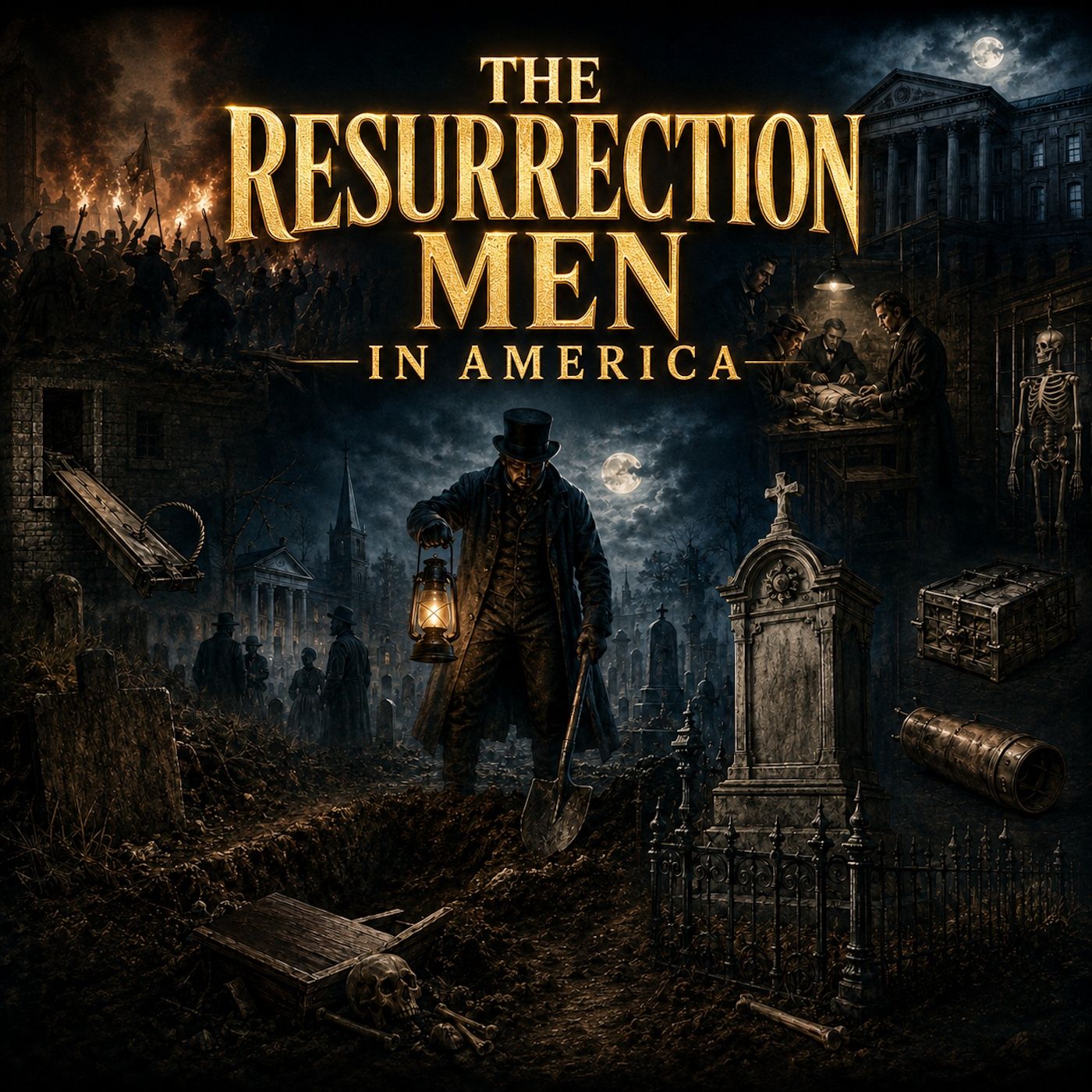
The Resurrection Men in America
About this episode
This episode explores the dark history of grave robbing in 19th century America and its impact on medical education.
For most of the nineteenth century, American medicine had a problem nobody wanted to talk about. The medical schools needed bodies. There was no legal way to get them. So a quiet trade grew up in the shadows of every major American city, and for nearly a hundred years, the foundation of American medical education was built on graves that had been emptied in the dark. This episode walks through the full arc of the Resurrection Men in America. We start in 1788, with the Doctors' Riot in New York City, where a careless medical student waving a severed arm at a child sparked a three-day riot that left as many as twenty people dead and forced the state to pass one of the country's earliest grave-robbing laws. From there we move into the actual mechanics of the trade — who did the digging, how they did it, what they were paid, and how the bodies traveled. We meet William "Old Cunny" Cunningham of Cincinnati, who supplied the Medical College of Ohio for sixteen years and ended up posed as a wired skeleton in the school's own cabinet. We meet Grandison Harris, the enslaved man purchased in Charleston in 1852 by the Medical College of Georgia for seven hundred dollars and forced to rob…
Topics covered
- grave robbing
- American medicine
- 19th century history
- body snatching
- medical education
- racial dynamics
- true crime
Mentioned in this episode
Organizations: Medical College of Ohio, Medical College of Georgia, University of Maryland
Places: Cedar Grove Cemetery, New York City
More episodes of Disturbing History
Explore listener stats, chart rankings, contacts and more on the Disturbing History podcast page.