Dysregulated Kids: Science-Backed Parenting Help for Behavior, Anxiety, ADHD and More
by Dr. Roseann Capanna Hodge
Is this your podcast?On the show
From 40 epsHosts
Recent guests
Recent episodes
Why “We’ve Tried Everything” Is a Signal to Simplify, Not Try Harder | Regulation First Parenting® | E452
Oct 14, 2026
12m 12s
Why Your Child Can Handle It One Day and Completely Lose It the Next | Nervous System Regulation | E451
Oct 12, 2026
13m 33s
30 Years. Thousands of Kids. Here's What Real Nervous System Regulation Looks Like | Nervous System Regulation | E450
Oct 7, 2026
14m 20s
The Mistakes That Make Picky Eating Worse with Katie Kimball | Nervous System Regulation | E449
Oct 5, 2026
45m 32s
The Cornell Case: Why Didn’t Someone Step In?
Oct 2, 2026
29m 31s
Insights from recent episode analysis
Audience Interest
Podcast Focus
Publishing Consistency
Platform Reach
Insights are generated by CastFox AI using publicly available data, episode content, and proprietary models.
Most discussed topics
Brands & references
Total monthly reach
Blended from 1 signal.
Built from
By chart position
- 🇺🇸United States · ParentingHOME#3360K to 2.3M
- 🇮🇳India · Parenting#512K to 75K
- 🇰🇷South Korea · Parenting#49572 to 3.6K
- 🇨🇦Canada · Parenting#119328 to 2.1K
- 🇵🇪PE · Parenting#5695 to 592
- Per-Episode Audience
Est. listeners per new episode within ~30 days
373K to 2.3M🎙 Daily cadence·441 episodes·Last published 4d ago - Monthly Reach
Unique listeners across all episodes (30 days)
1.2M to 7.8M🇺🇸96%🇮🇳3% - Active Followers
Loyal subscribers who consistently listen
497K to 3.1M
Market Insights
Platform Distribution
Reach across major podcast platforms, updated hourly
Total Followers
—
Total Plays
—
Total Reviews
—
* Data sourced directly from platform APIs and aggregated hourly across all major podcast directories.
Social Links & Contact
Official channels & resources
Official Website
Login
RSS Feed
Login
| Date | Episode | Topics | Guests | Brands | Places | Keywords | Sponsor | Length | |
|---|---|---|---|---|---|---|---|---|---|
| 10/14/26 |  Why “We’ve Tried Everything” Is a Signal to Simplify, Not Try Harder | Regulation First Parenting® | E452 | When “Why ‘We’ve Tried Everything’ Is a Signal to Simplify” becomes your reality, the answer may be less, not more. Dr. Roseann Capanna-Hodge, expert in Regulation First Parenting™ and childhood emotional dysregulation, shows parents how consistent regulation can move the dial.When you’re parenting a dysregulated child, it’s easy to believe you just haven’t found the right strategy yet. So you keep searching, adding therapies, reading parenting tips, and trying one more thing.But what if trying everything is actually getting in the way?In this episode, I share why regulation is built through repetition, not information overload, and why the 167 hours outside of therapy may matter more than parents realize.Why does “we’ve tried everything” sometimes mean we need to simplify?Sometimes parents aren’t doing anything wrong. They’re simply doing too many things without enough consistent practice for the nervous system to learn what to do.I call this “sprinkle therapy”: trying a little of this, a little of that, while constantly searching for the next solution.Keep the supports your child needs.Stop collecting new strategies for a week.Choose one foundational tool and practice it consistently.Focus on progress, not perfection.Real-life example: A parent might spend Monday in therapy, Tuesday doing exercises, Wednesday at OT, Thursday tutoring, and Friday searching online for another solution. The effort is enormous, but the nervous system may not be getting enough repetition to build a reliable pathway.How can parents help a dysregulated child learn regulation?Therapy can be incredibly valuable, but regulation cannot live inside one therapy hour. A child has 168 hours in a week, which means there are 167 other hours when the nervous system is practicing.Think about the ordinary moments: breakfast, homework, the car, spilled milk, repeated questions, or running late.Notice what happens in your own nervous system.Practice regulation during low-stakes moments.Repeat the same tool instead of constantly adding new ones.Notice whether recovery becomes faster or reactions become less intense.This is where the CALMS Dysregulation Protocol can help parents focus on foundational regulation rather than chasing endless strategies.What is the Love Pause, and how can it help with parenting?One simple practice I teach is the Love Pause: pause, breathe, respond.Imagine your child screams, “I hate you!” Your nervous system may immediately want to fire back. Instead, three seconds can create enough space to respond differently.You can still hold the boundary without reacting while both brains are activated.Pause.Breathe.Respond.Practice it when things are calm, not only during meltdowns.🗣️ “The nervous system doesn’t learn regulation from what you know. It learns what you repeatedly do.”— Dr. RoseannWhen your child is dysregulated, it’s easy to feel helpless. The Regulation Rescue Kit gives you the scripts and strategies you need to stay grounded and in control. Become a Dysregulation Insider VIP at www.drroseann.com/newsletter and get your free kit today.How do you build regulation skills without overwhelming your child?You don’t need 100 calming strategies. One tool practiced consistently may be more powerful than knowing dozens of strategies but rarely using them.I highly encourage parents to practice when the stakes are low so the nervous system has a better chance of accessing the skill when things get hard.For the next seven days, try not adding another parenting strategy. Instead, practice pause, breathe, respond three times a day when you’re relatively regulated.Notice: Did you activate less quickly? Recover faster? Keep your voice calmer? Create more space before responding?Doing less consistently can move the dial. You don’t have to become an Olympic figure skater overnight. You just need to practice.Takeaway & What’s NextSometimes doing less is what finally helps things move forward. Instead of constantly adding another therapy, strategy, or parenting tip, focus on one foundational regulation tool and practice it consistently in everyday moments. The nervous system learns through repetition, not information overload.If you’re tired of trying everything and still feel like you’re spinning your wheels, The Dysregulated Kid offers a practical, science-backed parenting playbook for simplifying your approach, calming the nervous system first, and turning regulation strategies into everyday habits. It’s designed to help you stop collecting more information and start using tools that can actually fit into real family life. FAQsWhat should I do if I feel like I’ve tried everything with my child?Give yourself permission to simplify. Keep necessary therapies and supports, but choose one foundational regulation tool and practice it consistently.Why isn’t therapy alone enough for a dysregulated child?Therapy may provide important skills, but children need opportunities to practice those skills throughout everyday life. The nervous system learns through repetition.How can I help my child regulate during a meltdown?Start with your own nervous system. Pause, breathe, and respond rather than trying to teach or correct while both brains are highly activated.How often should I practice regulation strategies?Practice during calm, everyday moments rather than waiting for a crisis. Repetition when the stakes are low can make skills easier to access when things get hard.What is the Love Pause?The Love Pause is a simple regulation practice: pause, breathe, respond. It creates a small space between activation and reaction so you can respond more intentionally.Every child’s journey is different. That’s why cookie-cutter solutions don’t work. Take the free Solution Matcher Quiz and get a customized path to support your child’s emotional and behavioral needs—no guessing, no fluff. Start today at www.drroseann.com/help | 12m 12s | ||||||
| 10/12/26 |  Why Your Child Can Handle It One Day and Completely Lose It the Next | Nervous System Regulation | E451 | Trying to find out why your child can handle it one day and completely lose it the next can leave parents confused and frustrated. Learn why nervous system capacity changes—and how to respond differently. Dr. Roseann Capanna-Hodge teaches Regulation First Parenting™ and helps parents understand emotional dysregulation.If you’ve ever thought, “But you did this yesterday!” you’re not alone. It can be incredibly frustrating when your child seems flexible and capable one day, then melts down over the smallest demand the next.The key is understanding the difference between having a skill and having access to that skill under stress. In this episode, I share how nervous system capacity changes from day to day—and how parents can respond without personalizing behavior.Why does my child handle things one day but melt down the next?Your child’s ability to regulate depends on what their nervous system is carrying right now. A demand that felt manageable yesterday may exceed their available capacity today.The skill may still be there.Stress can reduce access to that skill.Yesterday’s nervous system isn’t today’s nervous system.Real-life example: A teenager may get ready for school independently one morning, then have a full explosion when asked to grab their backpack the next. Looking at sleep, stress, and sensory load can reveal what changed.What can cause a child to suddenly lose their ability to cope?Before assuming your child is being defiant or uncooperative, check their body, load, and demand. These three areas can help you become a dysregulation detective instead of getting pulled into the behavior.Body: Poor sleep, hunger, illness, or sensory overload can reduce flexibility.Load: Learning challenges, social stress, masking, busy schedules, or too many transitions can fill the stress cup.Demand: Homework, transitions, stopping screens, accepting “no,” or changing plans may exceed capacity at that moment.The demand itself may not be unreasonable. The demand may simply be bigger than the capacity available right now.How can I stop saying “But you did it yesterday”?That phrase is understandable, but it doesn’t help a dysregulated nervous system. Instead of focusing on what your child could do yesterday, ask what is different about their capacity today.Check body, load, and demand.Look for patterns instead of isolated incidents.Add support before adding pressure.Regulate before correcting.This doesn’t mean lowering expectations or bubble-wrapping your child. It means changing the support so they have a better chance of accessing the skills they already have.You don’t have to figure this out alone. Become a Dysregulation Insider VIP and get your FREE Regulation Rescue Kit: How to Stay Calm When Your Child Pushes Your Buttons and Stop Oppositional Behaviors.Head to www.drroseann.com/newsletter and start your calm parenting journey today.How can I help my child build more nervous system capacity?Start by noticing what happens before the behavior. Look beyond the meltdown and ask what may have already drained your child’s capacity that day. Movement before homework, natural resets, connection, and predictable support can help your child stay regulated and access the skills they already have.The CALMS Dysregulation Protocol gives parents and professionals a practical framework for understanding what is driving dysregulation: Co-RegulateAvoid PersonalizingLook for Root CausesModel CopingSupport With StructureInstead of reacting to the behavior, you become a dysregulation detective who looks for what the nervous system needs first.🗣️ “A lot of what looks like inconsistency in kids is actually inconsistencies in capacity.”— Dr. RoseannWhat should I remember when my child suddenly struggles?Your child didn’t forget how to regulate. Their available capacity changed. When you check body, load, and demand, you can respond to the nervous system instead of getting stuck reacting to the behavior.And there is hope: nervous system capacity can grow. With the right support, kids can become more flexible, tolerate frustration, handle transitions, and recover faster.Takeaway & What’s NextWhen your child can handle something one day and completely lose it the next, remember: the skill probably didn’t disappear—their capacity to access it changed. Check the body, load, and demand before assuming your child is being defiant or refusing to cooperate.You don’t have to lower the bar. Change the support before increasing the pressure. When we regulate first, we create the conditions for kids to build flexibility, access coping skills, and recover more easily. Yesterday’s capacity isn’t today’s capacity, but capacity can grow.If you want to understand what’s happening beneath your child’s behavior and have practical tools for responding, The Dysregulated Kid offers a parenting playbook for building regulation, flexibility, and coping skills.FAQsWhy is my child suddenly having more meltdowns?Changes in sleep, stress, sensory input, illness, transitions, or overall load can reduce nervous system capacity and make ordinary demands harder to handle.Why can my child do something at home but not at school?Different environments create different levels of stress and sensory or social load. The skill may be present while access to it changes with capacity.Should I lower expectations when my child is dysregulated?Not necessarily. Instead of removing expectations, increase support before pressure so your child has more capacity to access the skills they already have.How do I help my child regulate better?Start with regulation and look for patterns in body, load, and demand. Movement, natural resets, connection, and consistent support can help build capacity over time.What does “skill versus access” mean?Your child can possess a skill without being able to use it when stressed. Having the skill and accessing the skill under stress are two different things.Tired of not knowing what’s really going on with your child?The Solution Matcher gives you a personalized recommendation based on your child’s behavior, not just a label.It’s free, takes just a few minutes, and shows you the best next step.Go to www.drroseann.com/help | 13m 33s | ||||||
| 10/7/26 |  30 Years. Thousands of Kids. Here's What Real Nervous System Regulation Looks Like | Nervous System Regulation | E450 | After 30 years of helping families, Dr. Roseann Capanna-Hodge shares what real nervous system regulation looks like—more flexibility, faster recovery, confidence, and connection. As a Regulation First Parenting™ expert, she helps parents understand and support emotional dysregulation in children. Parents often hope regulation means fewer meltdowns, less arguing, and a child who never struggles. But after 30 years of working with thousands of kids and families, I can tell you: real change looks different—and it is far more beautiful.What real nervous system regulation looks like isn’t a perfect child. It’s a child with more capacity to handle frustration, recover from big emotions, connect, learn, and experience joy. When we focus on regulation first, families begin getting their lives back.What are the first signs that a child’s nervous system is becoming more regulated?One of the first changes parents notice is more flexibility. Your child may still have big emotions, but they can tolerate changes, shift gears, transition, and recover with less support.The goal isn’t fewer emotions. It’s greater capacity to handle them.More flexibility with changes and disappointmentFewer battles and conflictsGreater ability to pivot or transitionMore tolerance for discomfortFor example, maybe your child used to melt down because the cup was the “wrong” color. Now, they might still be disappointed, but they can grab another cup and move on.How can nervous system regulation help a child recover from meltdowns faster?Recovery is one of the clearest signs that regulation is improving. A meltdown doesn’t have to disappear completely for meaningful healing to happen.A parent might say, “The meltdowns aren’t gone, but they’re different.” Instead of lasting 60 or 90 minutes and ruining the entire day, the child may recover in 15 minutes.Shorter recovery timeLess disruption to the whole familyGreater ability to return to connectionMore capacity to move forward after frustrationThat recovery matters because regulation is about building capacity, not creating perfect behavior.If you’re tired of walking on eggshells or feeling like nothing works…Get the FREE Regulation Rescue Kit and finally learn what to say and do in the heat of the moment.Become a Dysregulation Insider VIP at www.drroseann.com/newsletter and take the first step to a calmer home.What does it look like when a child stops living in survival mode?A regulated nervous system gives a child more room for joy, connection, learning, and childhood. One child in the episode used to arrive at school already overwhelmed. Months later, his teachers told his mom, “We’re seeing that he’s smiling again.”That wasn’t because school suddenly became easier. His nervous system had developed enough capacity to experience joy.More smiling and connectionGreater ability to tolerate demandsMore capacity for learning and problem-solvingLess time stuck in threat modeCALMS Dysregulation Protocol gives parents and professionals a framework for understanding and interrupting the stress cycle so regulation can happen first.How does nervous system regulation change family life?The transformation isn’t only in the child. Parents change, too. Families can stop planning every activity around avoiding a meltdown, siblings can relax, and home can begin to feel like home again.That is real progress.Parents stop walking on eggshellsSiblings feel less on edgeParents pause instead of immediately reactingFamilies experience more ordinary moments of calm and connection🗣️ “Real change is healing—the capacity to tolerate frustration, solve problems, wait, recover, connect, laugh, and learn.”— Dr. RoseannHow does regulation help kids build confidence?When children stop seeing themselves as “bad” or “stupid,” they become more willing to try, make mistakes, connect with others, and take healthy risks.A regulated nervous system creates a sense of safety that supports confidence. And that confidence can change what a child believes is possible.Takeaway & What’s NextReal nervous system regulation isn’t about creating perfect kids or eliminating big emotions. It’s about creating enough safety and capacity for children and parents to recover, connect, learn, laugh, and grow.Change often happens in tiny, ordinary moments—and those moments can add up to a completely different family life. You only need to start with 1%.If you want practical strategies for understanding what’s underneath your child’s behavior, The Dysregulated Kid goes deeper into Regulation First Parenting® and the everyday micro-moments that help families create change.FAQsWhat are realistic signs of nervous system regulation?Look for flexibility, faster recovery, more connection, greater confidence, and more moments of joy—not perfect behavior.Can a child still have meltdowns and be regulated?Yes. Regulation doesn’t mean eliminating emotions. It means building the capacity to experience emotions, recover, and move forward.How does regulation affect parents?Parents can become less reactive, stop living in fight, flight, or freeze, and experience more calm and enjoyment in family life.What does regulation first mean?It means regulating yourself and your child before focusing on correction or behavior change. Capacity comes before compliance.Can nervous system regulation change family patterns?Yes. Small, repeated moments of regulation can help break patterns across generations and build healthier family relationships.Every child’s journey is different. That’s why cookie-cutter solutions don’t work.Take the free Solution Matcher Quiz and get a customized path to support your child’s emotional and behavioral needs—no guessing, no fluff.Start today at www.drroseann.com/help | 14m 20s | ||||||
| 10/5/26 | 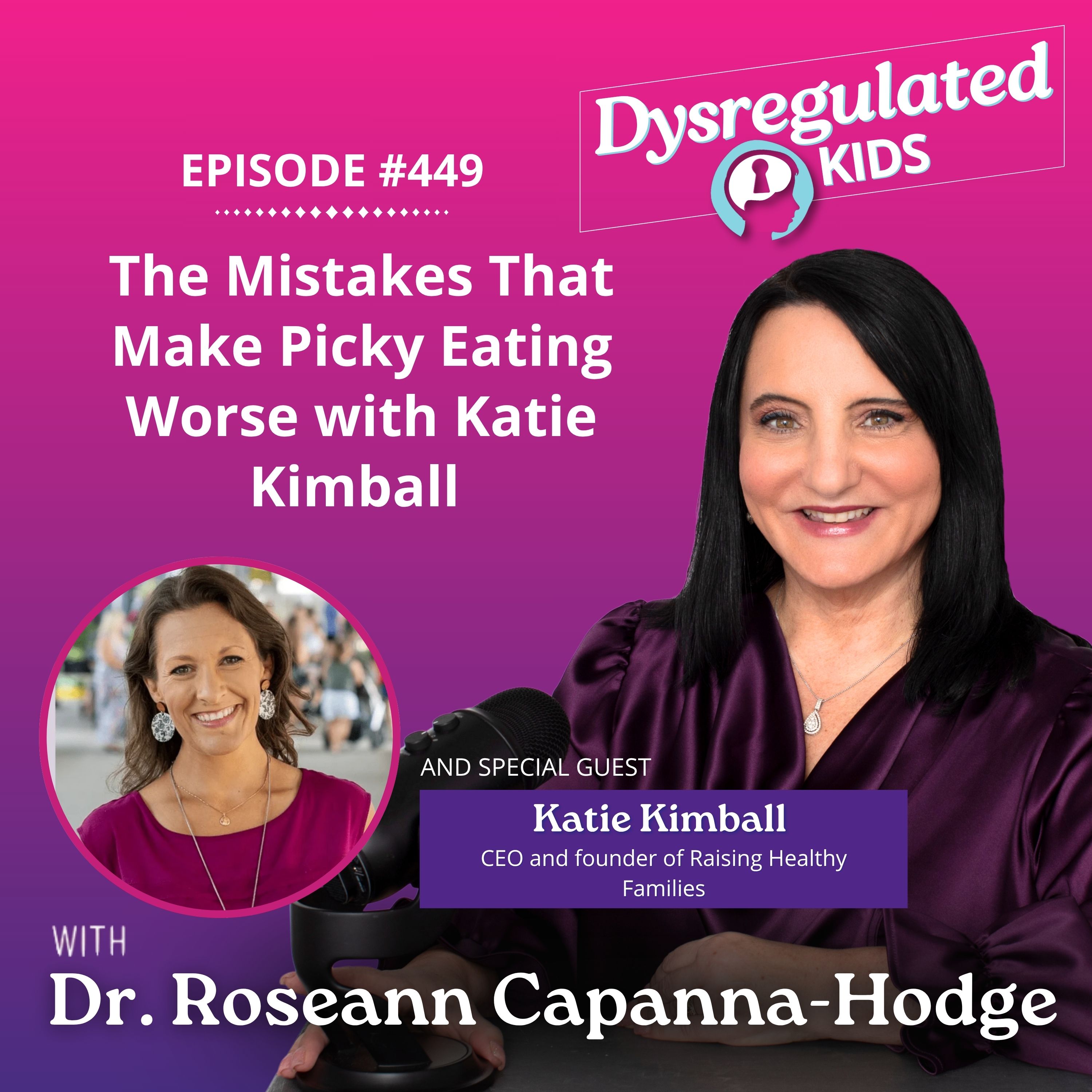 The Mistakes That Make Picky Eating Worse with Katie Kimball | Nervous System Regulation | E449 | Picky eating can leave parents worried, frustrated, and stuck. The Mistakes That Make Picky Eating Worse explores what may be keeping the cycle going and how to help. Dr. Roseann Capanna-Hodge brings her expertise in Regulation First Parenting™ and childhood emotional dysregulation.If picky eating has become a daily battle, you may feel worried, frustrated, or stuck. Understanding the mistakes that make picky eating worse can help you recognize what may be keeping the cycle going.In this episode, I am joined by picky eating expert Katie Kimball to share practical ways to move forward. We’ll unpack common mistakes, reduce mealtime stress, and help parents feel more confident about supporting their child.Why Does Picky Eating Become Such a Big Source of Stress for Parents?Picky eating can quickly become a high-conflict issue. Parents worry about nutrition, future eating habits, and whether their child will ever expand their food choices.But this is not your fault. Katie explains that picky eating is not something parents create, although certain responses can accidentally make it harder to move forward.Start with hope: Picky eating is a learned skill that can improve.Avoid catastrophizing: One difficult meal does not determine your child's future.Take one step at a time: Change takes consistency, not a magic wand.Real-life example: A child who eats only a handful of foods may not need more pressure. They may need a calmer environment, more exposure, and support identifying why certain foods feel difficult.What Mistakes Make Picky Eating Worse?One of the biggest mistakes is developing a defeatist mindset—believing your child will never eat differently because previous attempts did not work.Another is allowing stress to take over mealtimes. When everyone is worried, arguing, or pressuring the child to eat, the table can become associated with conflict rather than connection.Don't give up on variety.Keep stressful conversations away from the table.Don't turn food into a power struggle.Remember: your child may be having a hard time, not giving you a hard time.🗣️ “It is not your fault if your child is not eating well, and you do have agency to help them.”— Dr. RoseannWhy Should Parents Look for the Root Cause of Picky Eating?Sometimes picky eating isn't simply about preference. Katie describes three important areas to investigate: palate, pain, and processing.A child who struggles with chewing may avoid crunchy vegetables or whole cuts of meat. Another child may experience gastrointestinal discomfort or sensory overload that makes eating difficult.Look for patterns in food aversions and preferences.Notice whether chewing seems difficult.Consider pain, digestive issues, or food sensitivities.Watch for sensory triggers such as noise, textures, smells, or visual stimulation.Real-life example: A child who consistently chooses chicken nuggets but avoids grilled chicken or crunchy vegetables may be struggling with chewing rather than simply being “stubborn.”If eating is severely restricted or your child is refusing food for extended periods, seek appropriate medical or feeding support.Should You Pressure or Reward a Picky Eater to Eat?Bribery, rewards, punishment, and repeated demands can unintentionally create more pressure around food. Even positive pressure can turn eating into a power struggle and make the parent responsible for whether the child eats.Instead, focus on creating opportunities for your child to develop their own relationship with food.Don't threaten or force bites.Don't use dessert as a bargaining tool.Keep your expectations realistic.Pause before reacting when frustration rises.Your goal is not to control every bite. It is to help your child gradually develop confidence and internal control around eating.When your child is dysregulated, it’s easy to feel helpless.The Regulation Rescue Kit gives you the scripts and strategies you need to stay grounded and in control.Become a Dysregulation Insider VIP at www.drroseann.com/newsletter and get your free kit today.How Can Cooking Help a Picky Eater Try New Foods?One of the most practical strategies discussed is getting children away from the pressure of the table and into the kitchen.Cooking lets children see, smell, touch, and interact with food without immediately being expected to eat it. Over time, those experiences can help unfamiliar foods feel more comfortable.Let your child participate at an age-appropriate level.Start small: mixing, seasoning, washing produce, or helping prepare ingredients all count.Let cooking become a connection rather than another demand.Keep exposing your child to a variety of foods.This is especially helpful for parents who have fallen into short-order cooking: “They only eat mac and cheese, so that's all I make.” If children never experience other foods, they don't have the opportunity to learn to eat them.When a child's nervous system is overwhelmed, eating can become even harder. The CALMS Dysregulation Protocol helps parents understand and address dysregulation by focusing on the nervous system and the factors driving the behavior.What Should Parents Do First to Help a Picky Eater?Start with one change, not ten. Katie recommends getting your child involved with food outside the pressure of the dinner table, particularly through age-appropriate cooking and food preparation.Most importantly, don't wave the white flag. Your child's current food list does not have to be their forever food list.Stay consistent.Keep offering variety.Reduce pressure.Get curious about root causes.Seek professional support when the restriction is severe.Takeaway & What’s NextPicky eating can be frustrating, but it does not have to become your family's permanent story. Start with one step, stay consistent, and give your child time to build the skills they need.The Dysregulated Kid can be a helpful companion for parents who are trying to understand what is happening beneath challenging behaviors—including the stress and nervous-system patterns that can make everyday struggles harder.If picky eating has become part of a larger pattern of dysregulation, the book offers practical Regulation First Parenting® strategies to help you look beyond the behavior and respond with greater clarity.FAQsHow can I stop making picky eating worse?Reduce pressure, avoid food battles, and stop making stressful conversations part of mealtimes. Keep offering variety and focus on helping your child build a positive relationship with food.Should I force my picky eater to eat vegetables?Pressure and forced bites can turn eating into a power struggle. Instead, provide opportunities to see, smell, touch, prepare, and gradually experience different foods.Why does my child only eat soft foods?A preference for soft foods may sometimes point to difficulty chewing or other oral-motor concerns. If your child consistently avoids foods that require chewing, consider seeking a professional evaluation.Can sensory issues cause picky eating?Yes. Sensory differences involving taste, texture, smell, sound, touch, or visual input can affect eating. A child who becomes overwhelmed by sensory input may struggle to eat even when they are hungry.Can picky eating get better?Yes. The episode emphasizes that eating is a learned skill and that children can make meaningful progress with consistent exposure, reduced pressure, appropriate support, and attention to underlying causes.Every child’s journey is different. That’s why cookie-cutter solutions don’t work.Take the free Solution Matcher Quiz and get a customized path to support your child’s emotional and behavioral needs—no guessing, no fluff.Start today at <a href="http://www.drroseann.com/help?utm_source=chatgpt.com" rel="noopener noreferrer"... | 45m 32s | ||||||
| 10/2/26 |  The Cornell Case: Why Didn’t Someone Step In? | When danger unfolds, why didn’t someone step in? This episode explores why kids may freeze, follow the crowd, or stay silent—and how parents can prepare them to respond. Dr. Roseann Capanna-Hodge uses Regulation First Parenting™ to help families understand emotional dysregulation and build practical skills.When your child is faced with a dangerous situation, would they know what to do—or freeze because everyone else stayed silent? The question behind “Why didn’t someone step in?” is difficult, but it gives parents an important opportunity to prepare kids before they ever face a high-pressure moment.Why didn’t anyone step in when someone was in danger?The Cornell situation raises a bigger parenting question: What would your child do if a friend were in danger and nobody else acted?Knowing right from wrong is only the beginning. Kids also need practice recognizing risk, handling peer pressure, and taking action when something feels wrong.Teach kids that other people being present does not mean help is coming.Encourage them to check on someone rather than assume another person will.Help them identify a trusted adult or person they can contact for help.Practice simple phrases such as “Stop. This isn’t okay,” or “I’m getting help.”Your child does not have to become the person who confronts everyone. They need to know how to get help safely.How can parents teach kids to speak up when their friends are doing something wrong?Peer pressure can make doing the right thing feel incredibly uncomfortable. Kids may worry about being judged, excluded, or turning against their friends.Parents cannot simply lecture kids to “do the right thing.” They need to practice discomfort before they encounter it.Ask: “What would make it hard for you to speak up?”Role-play ways to leave an unsafe situation.Practice checking on someone who may be in danger.Teach kids they can recruit another person instead of acting alone.Give them permission to disagree respectfully.Real-life example: A child might practice saying, “I need to go to the bathroom,” leaving the situation, and contacting an adult rather than confronting a group directly.Want to stay calm when your child pushes every button?Become a Dysregulation Insider VIP and get the FREE Regulation Rescue Kit—your step-by-step guide to stop oppositional behaviors without yelling or giving in.Go to www.drroseann.com/newsletter and grab your kit today.How does nervous system regulation affect a child’s ability to respond in danger?When the nervous system becomes overwhelmed, the brain can move into fight, flight, freeze, or fawn. That means a child may care deeply about what is happening and still struggle to act.A freeze response is not consent, agreement, or a character flaw. It is a nervous system response. Regulation can support clearer thinking and help kids access the skills they have practiced.🗣️ “Knowing right from wrong is just the beginning. Practice helps them decide what to do next.”— Dr. RoseannThis is also why conversations about safety, boundaries, and consent need to happen before a crisis. When kids practice while calm, they have a better chance of knowing their next step when emotions run high.The CALMS Dysregulation Protocol can help parents understand the role of nervous system regulation and build practical regulation skills.How can I prepare my child to help someone who is in danger?Start with one simple conversation instead of trying to deliver a perfect speech.Ask your child: “If your friends were putting somebody in danger, what would make it hard for you to speak up?” Then listen. From there, practice specific actions.Stop and check on the person.Get another person involved.Find an adult.Contact 911 when someone is in immediate danger.Remind them: “You can always call me. Your safety comes first.”Consent should also be clear. If someone is asleep, severely intoxicated, confused, frozen, or otherwise unable to freely participate, the message is simple: when in doubt, stop.RAINN offers confidential support, resources, and information for people affected by sexual violence. Share this trusted resource with your family and loved ones so they know where to turn for help and guidance.Takeaway & What’s NextKnowing right from wrong is only the beginning. Kids need practice recognizing when something feels unsafe, trusting their instincts, speaking up, and knowing how to get help when pressure is high. Those skills are built long before the difficult moment through conversations, boundaries, connection, and nervous system regulation.The Dysregulated Kid gives parents a practical framework for understanding behavior through a nervous-system lens and helping children build the skills they need to respond when life gets hard. If you want to move beyond simply reacting to challenging behavior and better understand what your child’s brain and nervous system need, The Dysregulated Kid is a helpful place to start.Your child does not need to respond perfectly in every high-pressure situation. They need practice, support, and a plan. Start with one conversation today—and keep building those skills before they need them most.FAQsHow can I teach my child to handle peer pressure?Practice real-life scenarios. Let them disagree with you respectfully and set boundaries at home. These small moments help children build confidence for bigger decisions later.What should my child do if everyone else is ignoring a dangerous situation?Teach them not to assume someone else will help. They can check on the person, recruit others, find an adult, or call for emergency help.Does freezing mean a child failed to respond?No. Freezing can be part of the nervous system’s fight, flight, freeze, or fawn response. A child’s response to danger does not make them responsible for what happened.How do I talk to my child about consent?Keep it clear and ongoing. Teach that consent must be freely given, that someone can change their mind, and that silence, freezing, or lack of resistance does not mean yes.When your child is struggling, time matters.Don’t wait and wonder—use the Solution Matcher to get clear next steps, based on what’s actually going on with your child’s brain and behavior.Take the quiz at www.drroseann.com/help | 29m 31s | ||||||
| 9/30/26 |  Why Your Child’s Behavior Triggers You So Much And How to Stop Reacting | Co-Regulation Parenting | E448 | When your child’s behavior pushes your buttons, it can be hard to stay calm. Why Your Child’s Behavior Triggers You So Much And How to Stop Reacting explores the nervous system behind reactivity, with Dr. Roseann Capanna-Hodge’s Regulation First Parenting™ expertise.Have you ever snapped at your child and immediately wondered, “Why did that upset me so much?” Their behavior may be activating your own nervous system before your thinking brain has a chance to respond.In this episode, let me explain how to break the reactivity cycle. You’ll learn how to pause, regulate, and respond with more calm and connection instead of reacting from overwhelm.Why does my child’s behavior trigger me so much?When your child rolls their eyes, talks back, melts down, or completely loses it, your nervous system may interpret the behavior as disrespect, danger, manipulation, or failure. Suddenly, you’re flooded—and responding from your own dysregulation.This doesn’t mean you’re a bad parent. Your reactions may be connected to old stress patterns, childhood experiences, beliefs about how children “should” behave, or simply being completely maxed out.Notice what your child’s behavior brings up in you.Ask, “Is this actually a threat, or does it feel like one?”Remember: behavior is often a signal of dysregulation.Why does my child melt down at home but behave at school?Some children hold everything together at school because they are coping, masking, or trying hard to appear “fine.” Then they come home to the place where they feel safest—and everything falls apart.That can feel personal. But your child isn’t necessarily doing this to you. They may be releasing an overloaded nervous system in the environment where they finally feel safe enough to let go.Look at patterns instead of taking the behavior personally.Notice what happens before the meltdown.Remember that home may be your child’s safe place, not the cause of the problem.How can I stop reacting when my child is dysregulated?You cannot effectively co-regulate your child while your own nervous system is highly activated. The goal isn’t to never get triggered. It’s to create space between the trigger and your reaction.I want to emphasize the importance of love pause: a simple three-second pause to breathe or regulate before responding. You might use a heart hug, humming, tapping, or another calming strategy that works for you.Pause before yelling or lecturing.Notice: “My body is activated right now.”Take three seconds—or longer if you need it.Then connect, teach, and correct from a calmer state.Real-life example: Your child starts melting down over something that seems tiny. Instead of matching their intensity, you pause, breathe, regulate, and then respond. That small pause can change what happens next.Yelling less and staying calm isn’t about being perfect—it’s about having the right tools.Join the Dysregulation Insider VIP list and get your FREE Regulation Rescue Kit, designed to help you handle oppositional behaviors without losing it.Download it now at www.drroseann.com/newsletterCan I break the cycle of reactive parenting?Yes. The nervous system learns through repetition. Every time you interrupt an automatic reaction and practice regulation, you create a different response pattern.Calm is contagious. Dysregulation is contagious, too. When parents become calmer, children have more opportunity to feel safe and regulate themselves.🗣️ “The pause creates the space between the trigger and the reaction, and that’s where change happens.”— Dr. RoseannHow can I stop passing stress patterns to my child?Breaking the reactivity cycle isn’t only about getting through the next meltdown. It’s about changing the patterns that can be passed from one generation to the next.When you learn to regulate instead of react, you create a different experience for your child. Over time, those calmer responses can build more safety, connection, and healthier patterns for your whole family.Takeaway & What’s NextYour child’s behavior may trigger you, but you are not broken and you are not stuck. The love pause gives you a practical way to interrupt automatic reactions and return to regulation.You will still get triggered. That’s human. What matters is learning what to do next—and with one pause at a time, things can change. You have more power than you realize.The Dysregulated Kid connects directly to this work, helping parents understand what is happening beneath behavior and giving them practical strategies for regulating themselves and their children. It’s a parenting playbook for moving from constant reaction toward Regulation First Parenting™.FAQsWhy do I get so angry when my child misbehaves?Your child’s behavior can activate your own stress response, especially when you’re already overwhelmed or carrying old patterns. Your nervous system may react before your thinking brain can step in.How do I stop yelling at my child?Start with a pause. Take three seconds to breathe or regulate before responding. If you need longer, take it. Regulate first, then connect and correct.Why does my child behave worse with me?Children may hold themselves together outside the home and release their emotions with the parent they feel safest with. Their behavior isn’t necessarily a deliberate attempt to make your life harder.What is the love pause?The love pause is a brief pause before reacting. Dr. Roseann teaches parents to take at least three seconds to breathe or regulate, creating space between the trigger and the response.Can reactive parenting patterns change?Yes. With consistent practice, you can interrupt automatic reactions and build new regulation patterns. You don’t have to be a perfect parent to create meaningful change.Feel like you’ve tried everything and still don’t have answers?The Solution Matcher helps you find the best starting point based on your child’s symptoms, behaviors, and history.It’s fast, free, and based on decades of clinical expertise.Get your personalized plan now at www.drroseann.com/help | 14m 20s | ||||||
| 9/28/26 |  The Dysregulated Kid Is Here: What I Hope Happens Next | Regulation First Parenting® | E447 | For parents navigating emotional dysregulation, The Dysregulated Kid offers a simpler way forward: more self-compassion, curiosity, and small moments of change. Dr. Roseann Capanna-Hodge brings her expertise in Regulation First Parenting™ to help families create lasting change.If you’re parenting a dysregulated child, you may be carrying guilt, frustration, and the feeling that you should be doing more. The Dysregulated Kid was created to give you a different lens—and help you see that change can begin with one small, calmer moment.What is The Dysregulated Kid really meant to change for parents?The Dysregulated Kid isn’t about finishing a book or doing everything perfectly. It’s about understanding your child differently and having practical guidance you can return to when you need it.Parents can start with chapter one, flip to a specific section, or simply read what speaks to them in the moment.The goal isn’t the finish line. The goal is change.Start small instead of trying to change everything.Use the book when you need support.Focus on understanding your child, not achieving perfect parenting.Remember that people, conversations, and tiny moments change families.How can parents stop feeling guilty about their child’s behavior?Many parents are carrying guilt and frustration they were never meant to carry. You love your child. You’ve been trying. Sometimes what’s missing isn’t effort—it’s the right lens for understanding what is happening.One of the biggest shifts is becoming kinder to yourself. You don’t have to know everything or get every moment right. No parent is perfect.Let go of the belief that you should already have all the answers.Recognize how hard you’ve been trying.Give yourself patience and grace.Remember that understanding comes before change.Real-life example: Instead of ending a difficult day thinking, “Why can’t I get this right?” a parent might pause and recognize, “We had one calmer moment today than we did last week.” That is progress.How can I become less reactive when my child is dysregulated?The episode encourages parents to replace immediate reaction with curiosity. Instead of only asking, “How do I stop this behavior?” begin asking, “What is making this so hard for my kid?”That one question can change how you respond. It helps you take the behavior less personally and consider what the nervous system may need.Get curious instead of immediately reacting.Ask what is making the situation difficult.Take away personalization.Look for opportunities to create more calm.🗣️ “I hope you become more curious instead of reactive.” — Dr. RoseannReady to become officially certified in the CALMS Dysregulation® Protocol? Join the CALMS waitlist and learn a science-backed framework to interrupt the stress cycle and build Generational Emotional Wealth™.How should parents measure progress with emotional dysregulation?Progress isn’t always about your child never having another meltdown or never talking back. Healing isn’t linear.Sometimes progress looks like recovering faster, staying calmer, having fewer power struggles, or sharing one more hug.Those moments matter because small changes can create hope and show your family what is possible.Measure recovery, not perfection.Notice when you stay calmer than before.Celebrate faster recovery.Look for more connection and fewer power struggles.One calmer moment can make a bigger difference than you realize.How can The Dysregulated Kid help me start making changes?The book is designed to help parents start small and take action rather than become overwhelmed by more information. You can use it as a practical resource as you learn to understand your child and yourself through a regulation-first lens.If you’re wondering where to begin, The Dysregulated Kid can help you take that first step toward more calm, more understanding, and more meaningful moments at home. You don’t have to figure this out alone. Become a Dysregulation Insider VIP and get your FREE Regulation Rescue Kit: How to Stay Calm When Your Child Pushes Your Buttons and Stop Oppositional Behaviors.Head to www.drroseann.com/newsletter and start your calm parenting journey today.Takeaway & What’s NextThe Dysregulated Kid is about helping parents see change differently. Start small, stay curious, and give yourself grace. One calmer moment, one less power struggle, or one more moment of connection can become the beginning of something bigger.In The Dysregulated Kid®, I share practical Regulation First Parenting® tools to help you understand your child’s behavior through a nervous-system lens and create more calm, connection, and hope at home. Make sure to get your copy at https://www.dysregulatedkid.com/.You are more powerful than you realize. Keep going, keep learning, and keep putting regulation first.FAQsIs The Dysregulated Kid for young children or older kids?It’s for parents of children of different ages. The focus is on understanding dysregulation and creating meaningful change through a regulation-first approach.How do I stop reacting to my child’s behavior?Start with curiosity. Instead of only asking how to stop the behavior, ask what is making the situation so hard for your child.What does progress look like with a dysregulated child?Progress may look like faster recovery, fewer power struggles, a calmer parent response, or more moments of connection. It doesn’t require eliminating every difficult behavior.Do I need to read The Dysregulated Kid from beginning to end?No. You can start with the introduction and chapter one, then move between sections based on what you need. The book is a resource, not a finish line.Not sure where to start?Take the guesswork out of helping your child.Use our free Solution Matcher to get a personalized plan based on your child’s unique needs—whether it’s ADHD, anxiety, mood issues, or emotional dysregulation.In just a few minutes, you'll know exactly what support is right for your family.Start here: www.drroseann.com/help | 10m 13s | ||||||
| 9/23/26 |  RESET to Regulate®: How to Calm an Overwhelmed Nervous System | Nervous System Regulation | E446 | When stress takes over, knowing what to do first can make all the difference. Learning how to reset to regulate helps parents pause, create capacity, and respond with intention. Dr. Roseann Capanna-Hodge, an expert in Regulation First Parenting™ and childhood emotional dysregulation, makes regulation practical.When your child is overwhelmed, it can feel like you need to fix everything right now. But when the nervous system is activated, more words, more reasoning, and more pressure usually aren’t the answer.In this episode, I share a simple roadmap for recognizing stress, slowing down, reconnecting with your body, and taking small actions that build nervous system capacity. Learn how to Reset to Regulate so you can respond with greater calm and help your child navigate hard moments.What should I do when my child’s nervous system is overwhelmed?The first step is to notice the state before choosing a strategy.When someone is in the red zone, the thinking brain has less capacity for reasoning, learning, or communication. This is when doing less can actually do more.Pause before reacting.Notice what the body is telling you.Reduce input and pressure.Focus on creating just enough capacity to respond differently.You don’t have to become perfectly calm. You simply need enough regulation to avoid becoming part of the storm.How can I use RESET to Regulate during a hard moment?RESET to Regulate is about recognizing your state, using breath or grounding, stopping the rush, empathizing, and then taking a small action. R — Recognize the state.E — Exhale and regulate.S — Stop rushing.E — Empathize with yourself or your child.T — Take one small, doable action.Real-life example: When a teenager wakes up cranky before a stressful school day, you can pause instead of taking the behavior personally. Breathe, ground your body, slow down, ask what the nervous system may be experiencing, and choose the next small step—not try to solve everything at once.Small actions repeated consistently can build nervous system capacity. The goal isn’t perfection; it’s interrupting the pattern and practicing regulation again and again.Why is it important to practice nervous system regulation when things are calm?One of the biggest lessons from this episode is that calm moments are where we train the nervous system. You can’t expect your brain to remember a strategy during a crisis if you never practiced it when you had capacity.Think about practicing a breath, heart hug, movement, or LOVE Pause during ordinary moments. Then, when stress rises, that response becomes easier to access.The CALMS Protocol gives parents a simple framework for understanding dysregulation and building regulation skills before challenging moments take over. Learn more at drroseann.com/calms.What can I do when I feel stuck in a cycle of stress and reactivity?Instead of trying to fix 20 things, pick one thing that brings relief. The goal is not perfection. It is repetition.Set regulation reminders during the day.Practice when you wake up and before bed.Use one simple tool consistently.Give yourself permission to be 80% awesome.Notice small changes instead of expecting instant transformation.🗣️ “We are creating capacity. That is what we are doing.”— Dr. RoseannTakeaway & What’s NextYou don’t have to solve everything at once. Start by noticing, pausing, regulating, and taking one small action. With practice, your nervous system can learn a different pattern—and that can change how you experience hard moments.If you want a deeper roadmap for understanding what happens when stress fills your “stress cup,” The Dysregulated Kid connects the nervous-system approach to real-life parenting challenges. It offers practical guidance for moving from reacting to regulating first, so other strategies have a better chance to work.FAQsHow do I calm an overwhelmed nervous system?Start by pausing, breathing, grounding, and reducing pressure. You don’t need perfect calm; you need enough capacity to respond instead of reacting.Can nervous system regulation be learned?Yes. The episode emphasizes practicing regulation repeatedly, especially during calm moments, so the nervous system becomes more familiar with that state.What should I do when my child is in the red zone?Use fewer words and less pressure. Focus first on regulation rather than reasoning, lecturing, correcting, or trying to teach in the moment.How often should I practice regulation?Practice small moments throughout the day. The episode recommends building repetition into your routine, including morning, bedtime, and several additional moments.What is RESET to Regulate?It is a simple approach focused on recognizing your state, using breath or grounding, stopping, empathizing, and taking a small, consistent action.Every child’s journey is different. That’s why cookie-cutter solutions don’t work.Take the free Solution Matcher Quiz and get a customized path to support your child’s emotional and behavioral needs—no guessing, no fluff.Start today at www.drroseann.com/help | 50m 46s | ||||||
| 9/22/26 |  Reset Your Body When Stress Takes Over | Nervous System Regulation | E445 | When stress takes over, your body needs regulation—not more pressure. Learn simple ways to reset your nervous system through breath, pressure, and movement with Dr. Roseann Capanna-Hodge, an expert in Regulation First Parenting™ and emotional dysregulation in children. When stress takes over, it can feel like your body is running the show. You may know you need to calm down, but you don’t know where to start.In this episode, I explain how to reset your body with simple micro-moments of regulation using breath, pressure, and movement.How can I calm my nervous system when I feel overwhelmed?The goal isn't perfect calm. It’s creating a small shift in your nervous system so you have more capacity to respond instead of react. Dr. Roseann encourages you to notice your jaw, shoulders, breathing, stomach, and overall activation before choosing a strategy.Rate your activation from 0–10.Notice where your body holds stress.Look for a shift, not perfection.Repeat regulation throughout the day.Real-life example: A parent notices their shoulders are tight at bedtime after a stressful day. Instead of pushing through, they took 30 seconds to breathe, release their shoulders, and check in with their body.What are simple ways to reset your body when stress takes over?Focus on three practical pathways: breath, pressure, and movement. You don't need an hour-long meditation or a complicated routine. Small moments practiced consistently can help build nervous system capacity.Try gentle belly breathing with a longer exhalation.Use a heart hug by placing one hand over your heart and the other on your shoulder.Roll your shoulders, shake out your hands, sway, march, or try a figure eight.Choose the strategy that actually feels helpful to your body.🗣️ “We’re not looking for that perfect calm. We’re really looking for the shift.”— Dr. RoseannWant to stay calm when your child pushes every button?Become a Dysregulation Insider VIP and get the FREE Regulation Rescue Kit—your step-by-step guide to stop oppositional behaviors without yelling or giving in.Go to www.drroseann.com/newsletter and grab your kit today.How often should I practice nervous system regulation?Frequency matters more than perfection. I recommend building short regulation moments into everyday life—even 30 seconds to three minutes at a time. Practicing while calm helps you access those tools when stress gets high.Try regulating when you wake up, before bed, and several times throughout the day. Set a reminder on your phone if needed. Your nervous system needs practice, just like any other skill.The CALMS Dysregulation Protocol gives parents a practical framework for recognizing dysregulation and building regulation into everyday life. Learn more at drroseann.com/calms.How can I help my dysregulated child when I’m stressed too?Regulate yourself first. When a child is dysregulated, lectures and corrections may not work because their nervous system isn't ready to process them. Your regulated presence can provide an important cue for co-regulation.The same applies to a spouse, elderly parent, student, or another loved one. You cannot effectively help someone regulate while you are completely overwhelmed yourself.Takeaway & What’s NextResetting your body when stress takes over isn't about forcing yourself to feel calm. It’s about noticing what your nervous system needs and creating small opportunities for regulation throughout the day. Start with one tool, practice it often, and adjust based on what your body tells you.You don't have to do it perfectly. You just need somewhere to start. As you build those micro-moments of regulation, you can create more capacity for yourself—and more calm to share with the people you love.If you're looking for practical strategies to understand what is happening underneath behavior, The Dysregulated Kid connects nervous system regulation to everyday parenting challenges and gives parents tools they can actually use. You can get the book at drroseann.com/dysregulatedkid.FAQsWhat if breathing doesn’t work for me?That's okay. Not every nervous system responds to the same strategy. Try pressure or movement instead. The goal is to notice what creates a little more space, safety, focus, or calm for you.Can nervous system regulation help children too?Yes. Regulation tools can be adapted across ages and situations. Parents can practice alongside children through movement, breathing, or pressure-based strategies.What should I do when I’m still highly activated?Don't judge yourself. Repeat the regulation strategy and create a little more capacity. If you're in an unsafe situation, prioritize safety and seek appropriate support.How can I build regulation into my daily routine?Start small. Choose one strategy and practice it for 30 seconds to three minutes several times a day. Consistency helps make regulation more accessible when stressful moments arrive.Feel like you’ve tried everything and still don’t have answers?The Solution Matcher helps you find the best starting point based on your child’s symptoms, behaviors, and history.It’s fast, free, and based on decades of clinical expertise.Get your personalized plan now at www.drroseann.com/help | 52m 18s | ||||||
| 9/21/26 |  Help Your Child Regulate Big Emotions with the LOVE Pause® | Regulation First Parenting® | E444 | When big emotions take over, knowing what to do can feel overwhelming. Understanding how to help your child regulate big emotions with the LOVE Pause® highlights how small moments of regulation can change what happens next. Dr. Roseann Capanna-Hodge brings 30 years of expertise in Regulation First Parenting™ and childhood emotional dysregulation.When your child’s emotions explode, it can feel like you’re supposed to fix the behavior immediately. But what if the moment before the reaction matters more than the reaction itself?In this episode, I explain how the LOVE Pause® can create space for regulation before stress turns into overwhelm.How can I help my child regulate big emotions before they escalate?A child’s behavior is often the overflow of an overwhelmed nervous system, not the cause of the problem. When a child is already at capacity, more demands, questions, or correction can make things worse.The first step is noticing what happens before the behavior. The goal isn’t to eliminate every stressor. It’s to build enough capacity to respond differently.Notice the trigger and your child’s body signals.Pause before reacting or correcting.Regulate first, then connect and teach.Your child isn’t giving you a hard time—they may be having a hard time.Real-life example: Your child comes home from school and melts down because you ask them to put their shoes away. The request may be the final drop in an already-full stress cup.What is the LOVE Pause® and how does it help with emotional dysregulation?The LOVE Pause® is about creating a small space between the trigger and the automatic reaction. That space can be just a few seconds.Try doing the heart hug: place one hand over your heart and the other on your opposite shoulder, soften your jaw, drop your shoulders, and take three slow breaths with a longer exhale.Pause.Breathe.Soften your body.Notice what changes.You don’t have to perform calm. You’re practicing the return to regulation.Why does the stress cup matter when my child has big reactions?Every nervous system has a stress cup. Sleep, noise, worry, parenting demands, relationships, work, and other stressors add drops throughout the day. When the cup is already full, one small event can cause an overflow.This explains why the same request may be manageable one day and overwhelming the next. The trigger may not have changed. Capacity did.Ask: “How full is my cup right now?”Look for small stressors accumulating throughout the day.Build capacity through micro-moments, not perfection.The goal isn’t to reach zero stress. It’s to have more capacity for the stress that life inevitably brings.CALMS Dysregulation Protocol gives parents and professionals a practical framework for understanding and interrupting the stress cycle. It builds on the same regulation-first principle: regulate before you correct.How can parents use co-regulation when a child is dysregulated?When your child is activated, your nervous system matters too. If your child gets louder and you get louder, the nervous systems can create an escalation loop.Instead, regulate yourself first. Your calmer voice, slower pace, and grounded body can become a safety signal that helps your child access more flexibility and thinking.🗣️ “We can’t interrupt a pattern we don’t recognize.”— Dr. RoseannWant to stay calm when your child pushes every button?Become a Dysregulation Insider VIP and get the FREE Regulation Rescue Kit—your step-by-step guide to stop oppositional behaviors without yelling or giving in.Go to www.drroseann.com/newsletter and grab your kit today.What should I do when my child is already overwhelmed?When a child is in a highly activated state, more words and pressure usually aren’t the answer. First create safety and reduce the demand for complex thinking.Pause before explaining.Use fewer words.Regulate your own nervous system.Return to teaching and problem-solving when there is more capacity.Takeaway & What’s NextThe LOVE Pause® doesn’t magically empty your stress cup or prevent every hard moment. It gives you a chance to pause, regulate, and choose what happens next.Start small. Notice what fills your cup, practice the pause, and repeat it often. Those tiny moments can become the foundation for greater capacity, connection, and calm.Want a deeper framework for understanding what’s happening beneath your child’s behavior? The Dysregulated Kid gives parents practical tools for recognizing stress, understanding capacity, and making regulation part of everyday life—not just something you try during a crisis.FAQsCan the LOVE Pause® help with ADHD, anxiety, autism, or PANS/PANDAS?The episode emphasizes that the nervous system responds to activation regardless of the specific challenge. Regulation is a starting point for children and adults across many situations.How long does the LOVE Pause® take?It can take only a few seconds. The goal is not a long relaxation routine but repeated micro-moments of regulation that build capacity over time.What if breathing exercises don’t work for my child?The episode emphasizes finding what works for your nervous system. Breathing, movement, prayer, nature, or a heart hug may all become useful regulation tools.What should parents do first when a child is dysregulated?Regulate yourself first. Then create safety and connection before expecting reasoning, learning, problem-solving, or correction.When your child is struggling, time matters.Don’t wait and wonder—use the Solution Matcher to get clear next steps, based on what’s actually going on with your child’s brain and behavior.Take the quiz at www.drroseann.com/help | 49m 25s | ||||||
Want analysis for the episodes below?Free for Pro Submit a request, we'll have your selected episodes analyzed within an hour. Free, at no cost to you, for Pro users. | |||||||||
| 9/16/26 |  Inside The Dysregulated Kid: The Chapter Every Parent Needs First | Regulation First Parenting® | E443 | Inside The Dysregulated Kid starts with a powerful shift: stop blaming yourself or your child and look beneath the behavior. Dr. Roseann Capanna-Hodge, an expert in Regulation First Parenting™ and childhood emotional dysregulation, helps parents find a calmer path forward.If you’ve ever wondered, “What am I missing? Why isn’t anything working?” you’re not alone. Parenting a dysregulated child can leave you feeling overwhelmed, judged, and unsure of what to do next.Inside The Dysregulated Kid begins somewhere unexpected: with you—the parent. In this episode, I share why understanding your own experience is the first step toward seeing your child’s behavior differently and finding a path forward.Why does the first chapter of The Dysregulated Kid matter so much?The first chapter, “The Bitches at the Bus Stop,” isn’t about finding the perfect parenting strategy or diagnosing your child. It’s about recognizing what happens when you feel like everyone else has parenting figured out except you.I share my own experience of feeling scared, judged, and alone as a mom—even though I had years of knowledge and training. Parents should understand that you don’t have to have all the answers to be a good parent.Stop rushing to find the perfect solution.Know that you are not alone.Give yourself permission to be an imperfect parent.Start with compassion before strategy.Why do parents blame themselves when their child is dysregulated?When a child struggles at school, home, family gatherings, soccer, or anywhere else, it’s easy to wonder, “Am I doing enough?” or “Is something wrong with my child?” This constant questioning can leave parents carrying an enormous emotional weight.The bigger breakthrough happens when you stop blaming yourself, your child, or someone else and become curious about what is happening underneath the behavior.Behavior is information.Look beneath the behavior for nervous-system clues.Don’t personalize every reaction.Curiosity can replace blame.Real-life example: Your child has a huge reaction at a family gathering, and you immediately think, “Why can’t my child just behave?” Instead, pause and consider what the behavior may be telling you about their nervous system.Yelling less and staying calm isn’t about being perfect—it’s about having the right tools.Join the Dysregulation Insider VIP list and get your FREE Regulation Rescue Kit, designed to help you handle oppositional behaviors without losing it.Download it now at www.drroseann.com/newsletterHow can parents understand behavior differently?The behaviors you see are clues about the nervous system. This shift can completely change how you experience parenting.Instead of immediately asking how to stop the behavior, you can begin asking what is happening beneath it. That change in perspective can create more compassion for both you and your child.🗣️ “You just have to be willing to really see yourself and your kid with a little more compassion than you did yesterday.”— Dr. RoseannHow does Regulation First Parenting™ help parents respond differently?The goal isn’t to throw away strategies that work. It’s to understand that regulation comes first—before connection and correction.Parents should regulate first so they can become their best selves and help their children learn regulation, too.Regulate before you connect.Connect before you correct.Focus on the nervous system, not just the behavior.Let go of perfection.Takeaway & What’s NextThe Dysregulated Kid begins with hope, not a diagnosis. Parents should recognize their own “bus stop moment,” understand they aren’t alone, and begin seeing their child through a more compassionate lens.The book is ultimately about changing the parenting experience—not simply collecting more techniques.If you need practical support for staying calm during challenging moments, Quick CALM can give you tools to help you regulate and respond with greater confidence.Regulation is possible, and it starts with you.FAQsWhat is the “bus stop” moment in parenting?It’s the moment when you feel like everyone else has parenting figured out and you’re struggling on the outside. It can happen at school, soccer, PTA, family gatherings, or anywhere you question yourself.Why should parents look beyond behavior?Behavior can provide clues about what is happening in a child’s nervous system. Looking beneath the behavior can help parents move away from blame and toward curiosity and compassion.Do I need to have all the answers as a parent?No. You don’t have to be perfect or know exactly where to begin. Start by seeing yourself and your child with a little more compassion.Is The Dysregulated Kid only for parents?No. The message can also resonate with adults and educators. The central idea is that regulation is possible wherever you are—and it starts with you.Not sure where to start?Take the guesswork out of helping your child.Use our free Solution Matcher to get a personalized plan based on your child’s unique needs—whether it’s ADHD, anxiety, mood issues, or emotional dysregulation.In just a few minutes, you'll know exactly what support is right for your family.Start here: www.drroseann.com/help | 11m 31s | ||||||
| 9/14/26 |  What to Do in the First 5 Minutes of a Meltdown | Co-Regulation Parenting | E442 | When your child melts down, the first few minutes matter. Learn what to do in the first 5 minutes of a meltdown to reduce escalation and support regulation. Dr. Roseann Capanna-Hodge, an expert in Regulation First Parenting™ and emotional dysregulation, shows parents what to do.When your child is screaming, arguing, throwing things, or shutting down, it can feel impossible to know what to do. You’re not alone. The first five minutes can either escalate the meltdown or help your child’s nervous system begin to feel safe again.What should I do in the first 5 minutes of a meltdown?The goal isn’t to stop the meltdown. It’s to help your child’s nervous system feel safe enough to come back online. Let’s calm the brain first.During those first few minutes:Regulate yourself first. Take a breath, drop your shoulders, and slow your voice.Reduce the threat. Use fewer words, fewer demands, and less stimulation.Wait before teaching. A calmer body doesn’t necessarily mean the nervous system has fully recovered.Think of a parent whose child is screaming because they won’t get in the car. Instead of demanding an explanation or repeating instructions, the parent pauses, sits nearby, and calmly says, “I’m right here.” That calm presence can do more than another lecture.How can I calm my child during a meltdown without making it worse?During a meltdown, the brain may not be fully available for reasoning, problem-solving, or learning. Every demand asks the brain to think, which can increase the sense of threat.Try:Lowering your voice and body.Staying close if your child welcomes it.Using simple phrases like “You’re safe” or “This is tough.”Avoiding questions, lectures, repeated demands, and demands for eye contact or apologies.Behavior is communication. You aren’t agreeing with hitting, yelling, or refusing. You’re recognizing that something is hard while helping your child feel safe.Should I discipline my child during a meltdown?Not yet. Regulate, connect, correct—the order matters because it matches what the brain can handle.Just because the behavior stops doesn’t mean the nervous system has recovered. Give your child time to let their breathing and body settle before discussing what happened or teaching a lesson.Quick CALM can help you build practical regulation skills so you feel more prepared when big reactions happen.What should I say to my child during a meltdown?Keep it short. Sometimes, a calm presence, hug, or hand on the shoulder may communicate more than words.You might say:“I can see this is really hard.”“I’m here with you.”“We’ll figure this out together.”🗣️ “You’re really not trying to change the behavior. You’re really creating conditions where change is possible.”— Dr. RoseannIf you’re tired of walking on eggshells or feeling like nothing works…Get the FREE Regulation Rescue Kit and finally learn what to say and do in the heat of the moment.Become a Dysregulation Insider VIP at www.drroseann.com/newsletter and take the first step to a calmer home.How do I help my child after a meltdown?Give your child time to recover before teaching. Every child has a different developmental window for self-regulation, and sensitivity isn’t a bad thing. With repeated opportunities for calm, the nervous system can get more familiar with regulation.The next time your child melts down, ask “How can I help this nervous system feel safe?” instead of “How do I make this stop?” When you regulate first, everything else gets easier. It’s gonna be OK.Takeaway & What’s NextThe first five minutes of a meltdown aren’t about winning a battle or fixing behavior. They’re about creating safety, regulating yourself, and giving your child’s brain the time it needs to come back online.Looking for one practical resource? The Dysregulated Kid walks parents through how to regulate, connect, and correct.FAQsWhat should I avoid during a child’s meltdown?Avoid lecturing, negotiating, repeated questions, demands for apologies, and telling your child to “calm down.” These demands can overwhelm a brain that isn’t ready to learn.Does staying calm mean I’m being permissive?No. Regulation is not permissiveness. You can hold boundaries while reducing threat and helping your child’s nervous system settle.Why does my child need time after a meltdown?The end of the behavior doesn’t necessarily mean the nervous system has recovered. Give your child time for their breathing and body to settle before teaching or correcting.What is Regulation First Parenting?It’s the approach of regulate, connect, correct. The goal is to help the nervous system become ready for connection, learning, problem-solving, and correction.What if I can’t stay calm during my child’s meltdown?Start with the love pause. Take one breath, slow down, and give yourself a moment before responding. You don’t have to do it perfectly—consistency matters.Tired of not knowing what’s really going on with your child?The Solution Matcher gives you a personalized recommendation based on your child’s behavior, not just a label.It’s free, takes just a few minutes, and shows you the best next step.Go to www.drroseann.com/help | 11m 48s | ||||||
| 9/9/26 | emotional dysregulationRegulation First Parenting+4 | — | The Dysregulated Kid | — | dysregulated kidsparenting help+4 | — | 18m 05s | ||
| 9/7/26 | defiancedysregulation+3 | — | — | — | defiancedysregulation+3 | — | 12m 59s | ||
| 9/2/26 | emotional dysregulationparenting+4 | — | — | — | emotional dysregulationbehavior communication+5 | — | 11m 06s | ||
| 8/31/26 | child behaviorRegulation First Parenting+3 | — | — | — | behavior communicationstress cup+5 | — | 11m 42s | ||
| 8/26/26 | nervous system regulationenvironmental stressors+4 | Nick Pinault | — | — | nervous systemstress+5 | — | 36m 22s | ||
| 8/24/26 | ADHDAnxiety+4 | — | — | — | ADHDAnxiety+5 | — | 12m 29s | ||
| 8/19/26 | dysregulated kidscalm authority+3 | — | — | — | dysregulated brainemotional safety+3 | — | 15m 41s | ||
| 8/17/26 | nervous system regulationparenting strategies+5 | — | Regulation First Parenting | — | meltdownsstress+7 | — | 18m 45s | ||
| 8/12/26 | anxietyparenting+4 | Dr. Mariza | — | — | anxietyoverwhelmed+6 | — | 52m 52s | ||
| 8/10/26 | emotional reactivitynervous system regulation+3 | — | — | — | emotional reactivitynervous system+5 | — | 21m 54s | ||
| 8/5/26 |  Why Does Nothing I Try Actually Work? And What To Do Instead | Regulation First Parenting® | E431 | If you've been wondering why does nothing I try actually work and what to do instead, you're not alone. Learn why calming the nervous system—not trying harder—is the key to lasting change with Dr. Roseann Capanna-Hodge, creator of Regulation First Parenting™ and a leading expert in childhood emotional dysregulation.Parenting a dysregulated child can leave you questioning everything. You're trying so hard, yet the meltdowns, arguments, and emotional explosions keep happening. If you've ever thought, "Why does nothing I try actually work?" this is for you.This episode shares why the missing piece isn't another parenting strategy—it's understanding the nervous system. You'll learn why Regulation First Parenting™ changes everything and how calming the brain before correcting behavior creates lasting change.Why does nothing I try actually work with my child?When parents feel stuck, it's easy to believe they need a new therapist, a better consequence, or a different parenting method. But often, the strategy isn't the problem—the order is.It's not bad parenting—it's a dysregulated brain. When a child's nervous system is overwhelmed, they simply can't access the skills they've already learned.Key takeaways:Behavior is communication.Skills disappear when the brain shifts into survival mode.Regulation must happen before learning can happen.Example: Your child knows how to use deep breathing in therapy, but after a fight with a sibling, they completely forget it. That's not defiance—it's nervous system overload.Why does my child forget coping skills during a meltdown?Many parents wonder why therapy seems successful in the office but falls apart at home.The answer is simple: an overwhelmed brain can't access its thinking skills. When children enter fight, flight, or freeze, logic and emotional regulation go offline.Reward charts don't work if the brain isn't ready to learn.Consequences alone won't build regulation.Coping skills need to be practiced during calm moments—not only during crises.🗣️ "If the nervous system isn't regulated, nothing is going to stick."— Dr. RoseannIf you're ready to help your child build regulation skills, Quick CALM offers simple, science-backed strategies you can start using today.How do I help my child regulate instead of reacting?I want to highlight my signature approach:Regulate. Connect. Correct.™Instead of correcting behavior immediately, parents first help calm the nervous system.This means:Regulate: Calm yourself first through co-regulation.Connect: Let your child feel safe and understood.Correct: Teach and problem-solve once the brain is ready.You're not excusing behavior—you are creating the conditions for learning.Yelling less and staying calm isn’t about being perfect—it’s about having the right tools.Join the Dysregulation Insider VIP list and get your FREE Regulation Rescue Kit, designed to help you handle oppositional behaviors without losing it.Download it now at www.drroseann.com/newsletterWhy does staying calm as a parent matter so much?Your nervous system sets the tone.Children naturally look to adults for cues about safety. When you pause, breathe, and regulate yourself first, you're helping your child's nervous system settle too.Remember:Your calm is contagious.A calmer nervous system leads.Small moments of co-regulation create lifelong emotional skills.This doesn't mean being perfect. It means practicing.Can my child really learn emotional regulation?Absolutely. Whether your child struggles with ADHD, anxiety, OCD, emotional dysregulation, or is simply having a hard time, self-regulation is a learned skill.Remember:You're not alone.Let's calm the brain first.It's gonna be OK.Every regulated interaction helps build your child's emotional resilience over time.Takeaway & What’s NextIf you've been asking yourself, "Why does nothing I try actually work?", know this: you're not failing, and neither is your child.When you shift from correcting behavior to calming the nervous system first, everything begins to change. That's the heart of Regulation First Parenting™—and it offers real hope for lasting progress.Need more support? Join the Regulated Child Summit to learn from leading experts on emotional regulation and practical parenting tools.FAQsWhy do consequences stop working with my child?Consequences only teach when the brain is regulated. An overwhelmed nervous system can't process learning or problem-solving effectively.Why does therapy work in sessions but not at home?Children may learn skills in therapy but struggle to access them during real-life stress because their nervous system becomes dysregulated.Can emotional regulation be taught?Yes. Like reading or riding a bike, emotional regulation develops through repeated practice, support, and co-regulation.What's the first step when my child melts down?Pause before correcting. Let's calm the brain first, then reconnect, and finally teach once your child is regulated.Not sure where to start?Take the guesswork out of helping your child.Use our free Solution Matcher to get a personalized plan based on your child's unique needs—whether it's ADHD, anxiety, mood issues, or emotional dysregulation.In just a few minutes, you'll know exactly what support is right for your family.Start here: www.drroseann.com/help | 26m 10s | ||||||
| 8/3/26 |  Why Does My Child Melt Down Over Everything? | Regulation First Parenting® | E430 | If you've been asking yourself, why does my child melt down over everything, you're not alone. Learn why emotional outbursts are often signs of nervous system overload—not bad behavior. Dr. Roseann Capanna-Hodge shares her Regulation First Parenting™ approach to help families create lasting calm and connection.Every parent has experienced it—that moment when asking your child to put on a shirt, turn off Roblox, or brush their teeth suddenly leads to tears, yelling, or total shutdown. It feels confusing because the reaction seems so much bigger than the situation.The good news? The meltdown isn't usually about the shirt, the game, or the transition. It's often the final drop in an already overflowing stress cup.Once you understand what's happening in your child's nervous system, everything starts to make more sense—and your parenting becomes far more effective.Why Does My Child Melt Down Over Everything?When your child's reaction feels completely out of proportion, it's natural to assume they're being defiant. But it’s important to remember that behavior is communication.A meltdown often signals that your child's nervous system has become overwhelmed long before the explosion happened. School stress, lack of sleep, sensory overload, anxiety, social demands, or difficult transitions can all quietly fill their "stress cup."Key takeaways:Behavior is the symptom—not the root problem.Small triggers often become the "last straw."Neurotypical children dysregulate too, though neurodivergent kids may experience it more often.Imagine your child happily playing a game all afternoon. The request to stop isn't what caused the meltdown—it simply overflowed an already full nervous system.🗣️ “Your kid isn't giving you a hard time—they're having a hard time.” — Dr. RoseannYou don’t have to figure this out alone.Become a Dysregulation Insider VIP and get your FREE Regulation Rescue Kit:How to Stay Calm When Your Child Pushes Your Buttons and Stop Oppositional Behaviors.Head to www.drroseann.com/newsletter and start your calm parenting journey today.Why Doesn't My Child Listen During a Meltdown?When your child is dysregulated, their thinking brain temporarily goes offline.That's why reasoning, lecturing, negotiating, or punishment rarely works during the heat of the moment. Their nervous system is focused on survival—not learning.Instead:Calm the brain first.Connect before correcting.Wait until they're regulated before teaching lessons or giving consequences.You're not failing. You're working with biology, not bad behavior.If you're ready for simple, science-backed strategies that actually work, check out Quick CALM, a step-by-step program designed to help parents regulate first and reduce daily meltdowns.How Can I Help My Child Calm Down Faster?One incredibly simple strategy that needs to be highlighted: The Love Pause.Before reacting:Place your hand over your heart.Take one slow breath.Relax your shoulders.Soften your face.It takes only three seconds—but those three seconds help regulate your nervous system first.Remember:The calmer nervous system always leads.Your child borrows your calm through co-regulation.Progress—not perfection—is the goal.Why Do Parenting Strategies Work for One Child but Not Another?Every child has a different nervous system.Temperament, sensitivity, anxiety, neurodivergence, sensory processing, and accumulated stress all affect how children respond. What works beautifully for one sibling may completely miss the mark for another.That's why parents should stop chasing perfect behavior and instead focus on Regulation First Parenting™.Let's calm the brain first. Everything else follows.Takeaway & What’s NextYou're not alone, and it's gonna be OK. When you begin seeing meltdowns through a nervous system lens, parenting becomes less about controlling behavior and more about creating safety and connection.Every small moment of regulation builds lifelong resilience—for both you and your child.Join the Regulated Child Summit and pre-order The Dysregulated Kid for expert guidance and practical solutions for raising emotionally healthy kids.FAQ sWhy does my child overreact to small things?Small events often trigger an already overwhelmed nervous system. The reaction isn't about the event—it's about accumulated stress.Are frequent meltdowns a sign of ADHD or anxiety?Sometimes, but not always. Many children experience dysregulation without a specific diagnosis. The nervous system should always be considered first.Should I discipline my child during a meltdown?No. Wait until your child is calm. Regulation comes before correction.Can children learn self-regulation?Absolutely. Self-regulation isn't something children are born with—it's a skill developed through repeated experiences of safety, connection, and support.When your child is struggling, time matters.Don't wait and wonder—use the Solution Matcher to get clear next steps based on what's actually going on with your child's brain and behavior.Take the quiz at www.drroseann.com/help | 29m 21s | ||||||
| 7/29/26 |  Your Child Isn’t Giving You a Hard Time—They’re Having a Hard Time | Emotional Dysregulation in Children | E429 | When you realize your child isn’t giving you a hard time—they’re having a hard time, everything about your response begins to change. Dr. Roseann Capanna-Hodge, creator of Regulation First Parenting™, helps families understand emotional dysregulation so they can calm the brain first, strengthen connection, and create lasting change.You're not imagining it—when your child screams, refuses, or lashes out, it can feel incredibly personal. But what if those moments aren't about defiance at all?In this episode, I explain why your child isn’t giving you a hard time—they’re having a hard time—and how changing this one perspective can transform your parenting and your child's nervous system.Why does my child seem to overreact to everything?When your child explodes over something small, it's easy to assume they're being disrespectful or trying to push your buttons.Behavior is communication, and big reactions are often a sign that their nervous system is overwhelmed—not that they're choosing to misbehave.A dysregulated child isn't thinking clearly. They've temporarily lost access to flexibility, emotional control, and problem-solving.What to remember:Big behavior often signals nervous system overload.Don't mistake dysregulation for manipulation.Your child needs regulation before correction.Imagine your child screaming because it's time to leave the park. Instead of seeing defiance, recognize they're struggling to manage disappointment and transition.How do I stop taking my child's behavior so personally?This is one of the hardest parenting shifts—and one of the most powerful.When you believe your child is attacking you, your own nervous system escalates, making it almost impossible to stay calm. But when you remember they're having a hard time, you create space to respond instead of react.Try this instead:Pause before responding.Remind yourself: "My child is struggling right now."Focus on calming yourself first.🗣️ “Your kid's not giving you a hard time—they're having one.”— Dr. RoseannIf you’re tired of walking on eggshells or feeling like nothing works…Get the FREE Regulation Rescue Kit and finally learn what to say and do in the heat of the moment.Become a Dysregulation Insider VIP at www.drroseann.com/newsletter and take the first step to a calmer home.What should I do when my child is melting down?I always remind parents of the parenting order that changes everything:Regulate. Connect. Correct.™Trying to teach a lesson during a meltdown rarely works because the thinking brain is offline.Instead:Take the three-second love pause.Lower your voice instead of raising it.Say less and slow down.Help your child regulate before discussing consequences.It's not bad parenting—it's a dysregulated brain.If staying calm feels impossible in the heat of the moment, you're not alone. The Quick CALM program gives parents simple, science-backed strategies to regulate their own nervous system so they can better help their child. Why doesn't discipline work during a meltdown?Because correction can't happen until regulation happens.Consequences, lectures, and reasoning all require a regulated brain. During dysregulation, your child simply isn't able to access those higher-level thinking skills.Remember:Regulation creates learning.Connection builds trust.Teaching comes after calm returns.This isn't permissive parenting. It's neuroscience.Can I help my child regulate if I struggle with my own emotions?Absolutely.Many parents discover they're dysregulated, too. The encouraging news is that self-regulation is a skill—not a personality trait.Remember:You can learn these skills at any age.Your calm helps your child's brain recover.Every regulated response strengthens healthier habits for the future.You're not alone. Let's calm the brain first. It's gonna be OK.Takeaway & What’s NextWhen you stop seeing behavior as something your child is doing to you and start seeing it as something they're struggling through, everything begins to shift. Your calm becomes the foundation for your child's healing, connection, and long-term emotional regulation.And if you're ready to dive even deeper into nervous system regulation, the Regulated Child Summit offers practical guidance from trusted experts to help your whole family thrive.FAQsWhy does my child say hurtful things when they're upset?During dysregulation, children lose access to self-control. Hurtful words often reflect overwhelm—not their true feelings.Should I discipline my child during a meltdown?No. Focus on helping them regulate first. Teaching and consequences are most effective after everyone is calm.What is the three-second love pause?It's a brief pause before responding that helps regulate your own nervous system and prevents escalation.Is this permissive parenting?Not at all. You're still setting limits—you’re simply choosing the right timing for teaching and correction.Can parents learn self-regulation too?Yes. Self-regulation is a learnable skill, and your own regulation is one of the most powerful tools you have.Every child's journey is different.That's why cookie-cutter solutions don't work.Take the free Solution Matcher Quiz and get a customized path to support your child's emotional and behavioral needs—no guessing, no fluff.Start today at www.drroseann.com/help | 8m 56s | ||||||
| 7/20/26 | parentingperfectionism+3 | — | — | — | parentingperfectionism+5 | — | 12m 23s | ||
| 7/15/26 | nervous system regulationchild behavior+3 | — | — | — | nervous systembig reactions+3 | — | 15m 44s | ||
| 7/13/26 | co-regulation parentingemotional dysregulation+3 | — | — | — | 3-second pauselove pause+3 | — | 13m 31s | ||
| 7/8/26 | dysregulationparenting+3 | — | — | — | dysregulated childconsequences+5 | — | 16m 15s | ||
| 7/6/26 | power strugglesnervous system regulation+3 | — | — | — | power strugglesdysregulation loops+3 | — | 18m 10s | ||
| 7/1/26 | ADHDdysregulation+3 | — | — | — | ADHDdysregulation+4 | — | 16m 19s | ||
| 6/29/26 | co-regulation parentingemotional dysregulation+4 | — | — | — | calmscreaming child+6 | — | 14m 02s | ||
| 6/24/26 | parenting instinctsRegulation First Parenting+4 | — | — | — | parentinginstincts+5 | — | 15m 12s | ||
| 6/22/26 | child behavioremotional dysregulation+4 | — | — | — | child behavioremotional dysregulation+5 | — | 17m 31s | ||
| 6/17/26 | gentle parentingstrong-willed child+3 | — | — | — | gentle parentingstrong-willed child+3 | — | 15m 27s | ||
| 6/10/26 | bedtime strugglesADHD+4 | — | — | — | bedtimeADHD+5 | — | 12m 55s | ||
| 6/8/26 | co-regulation parentingcalming techniques+3 | — | — | — | calm an angry childco-regulation+3 | — | 14m 25s | ||
| 6/3/26 | emotional dysregulationchild behavior+3 | — | — | — | meltdownsemotional regulation+6 | — | 13m 37s | ||
| 6/1/26 | nervous system dysregulationRegulation First Parenting+3 | — | — | — | dysregulated kidscalming the brain+3 | — | 35m 48s | ||
| 5/27/26 | nervous systemanxiety+4 | — | — | — | anxietynervous system+6 | — | 18m 08s | ||
| 5/25/26 | nervous system regulationanxiety in children+3 | — | — | — | anxious kidscalm down+3 | — | 13m 57s | ||
| 5/20/26 | gut-brain connectionemotional dysregulation+4 | — | — | — | emotional dysregulationgut health+7 | — | 21m 02s | ||
| 5/18/26 | PANSPANDAS+5 | Dr. Nancy O'Hara | Regulation First Parenting | — | PANSPANDAS+7 | — | 50m 05s | ||
| 5/13/26 | emotional dysregulationstress management+4 | — | — | — | stress cupdysregulation+4 | — | 16m 20s | ||
| 5/11/26 | ADHDemotional dysregulation+4 | — | — | — | ADHDemotional resilience+4 | — | 21m 53s | ||
| 5/6/26 | emotional dysregulationchild behavior+4 | — | — | — | stress cupmeltdowns+6 | — | 17m 28s | ||
| 5/4/26 | parenting burnoutco-dysregulation cycle+4 | — | — | — | parentingdysregulation+6 | — | 17m 46s | ||
| 4/29/26 | emotional dysregulationstress cup+4 | — | — | — | stress cupmeltdowns+5 | — | 14m 28s | ||
| 4/27/26 | reassurancenervous system dysregulation+4 | — | — | — | reassurancenervous system+7 | — | 19m 37s | ||
| 4/22/26 | video game addictionemotional dysregulation+3 | — | — | — | video gamesaddiction+6 | — | 14m 43s | ||
| 4/20/26 | traumagut health+3 | Cynthia Thurlow | — | — | traumagut health+3 | — | 1h 01m 14s | ||
| 4/15/26 | nervous systemparenting strategies+3 | — | — | — | nervous systemcalm communication+3 | — | 13m 05s | ||
| 4/13/26 | emotional dysregulationimpulse control+3 | — | — | — | dysregulated brainself-control+3 | — | 9m 18s | ||
| 4/8/26 | emotional dysregulationhighly sensitive children+4 | — | — | — | emotional sensitivityparenting+5 | — | 13m 42s | ||
| 4/6/26 | emotional dysregulationnervous system+3 | — | — | — | emotional dysregulationnervous system+5 | — | 16m 34s | ||



Showing 55 of 441
Pitch Fit is a Pro feature
See how bookable this show is for guests, which brands already advertise, the per-episode ad value, and the best-fit guest and sponsor profile. The numbers are blurred on the free plan.
How readily this show books outside guests like you.
How proven this show is for host-read sponsorships.
For Guests
ProFor Advertisers
ProUpgrade to Pro to unlock guest cadence, sponsor categories, fit scores, and per-episode ad value for this show.
Similar Audience Demographics
Podcasts that attract a similar listener profile

The ADHD Kids Can Thrive Podcast
Kate Brownfield

The ADHD Parenting Podcast
The ADHD Parenting Podcast

AT Parenting Survival | Raising Kids with OCD & Anxiety
Natasha Daniels: Child Therapist, Child Anxiety and Child OCD Expert

Shining With ADHD by The Childhood Collective
The Childhood Collective

Calm Parenting Podcast
Kirk Martin

Neurodiversity Podcast
Emily Kircher-Morris

ADHD Experts Podcast
ADDitude
Chart history for Dysregulated Kids: Science-Backed Parenting Help for Behavior, Anxiety, ADHD and More
Peaked at #3 in United States, top 10 in 2 of 11 tracked markets, currently #3 in United States.
| Market | Genre | Peak | Current | Trend |
|---|---|---|---|---|
| United States | — | #3 | #3 | — |
| India | — | #5 | #5 | — |
| United States | — | #15 | #15 | — |
| South Korea | — | #49 | #49 | — |
| India | — | #54 | #54 | — |
| PE | — | #56 | #56 | — |
| Canada | — | #119 | #119 | — |
| TW | — | #127 | #127 | — |
| SA | — | #129 | #129 | — |
| HK | — | #184 | #184 | — |
| PE | — | #194 | #194 | — |
Chart Positions
11 placements across 8 markets.
Chart Positions
11 placements across 8 markets.