
Habits 2 Goals: The Habit Factor® Podcast with Martin Grunburg
by Martin Grunburg
Is this your podcast?Insights from recent episode analysis
Audience Interest
Podcast Focus
Publishing Consistency
Platform Reach
Insights are generated by CastFox AI using publicly available data, episode content, and proprietary models.
Most discussed topics
Brands & references
Est. Listeners
Insufficient chart data. Estimates will improve as the show charts.
- Per-Episode Audience
Est. listeners per new episode within ~30 days
N/A🎙 Weekly cadence·635 episodes·Last published 1mo ago - Monthly Reach
Unique listeners across all episodes (30 days)
N/A - Active Followers
Loyal subscribers who consistently listen
N/A
Market Insights
Platform Distribution
Reach across major podcast platforms, updated hourly
Total Followers
—
Total Plays
—
Total Reviews
—
* Data sourced directly from platform APIs and aggregated hourly across all major podcast directories.
On the show
From 13 epsHost
Recent guests
Recent episodes
Why Science Exists
May 21, 2026
27m 28s
The 16 Year Habit-Tracking Flip-Flop
May 7, 2026
35m 18s
“The Seeker”: The Habit Factor® & Pattern Recognition (Shhh 🤫)
May 3, 2026
26m 09s
Happiness on a Whim
Apr 16, 2026
21m 03s
Find Your Way Out! Begin Architecting
Feb 26, 2026
20m 19s
Social Links & Contact
Official channels & resources
Official Website
Login
RSS Feed
Login
| Date | Episode | Topics | Guests | Brands | Places | Keywords | Sponsor | Length | |
|---|---|---|---|---|---|---|---|---|---|
| 5/21/26 |  Why Science Exists✨ | behavior changehabit development+3 | — | Unified Behavior Model™Habit Factor®+1 | — | behavior architecturegoal framework+3 | — | 27m 28s | |
| 5/7/26 |  The 16 Year Habit-Tracking Flip-Flop✨ | happinessbehavior+3 | — | — | — | happinessbehavior echo-system+3 | — | 35m 18s | |
| 5/3/26 |  “The Seeker”: The Habit Factor® & Pattern Recognition (Shhh 🤫)✨ | happinessbehavior+3 | — | — | — | happinessbehavior echo-system+3 | — | 26m 09s | |
| 4/16/26 | 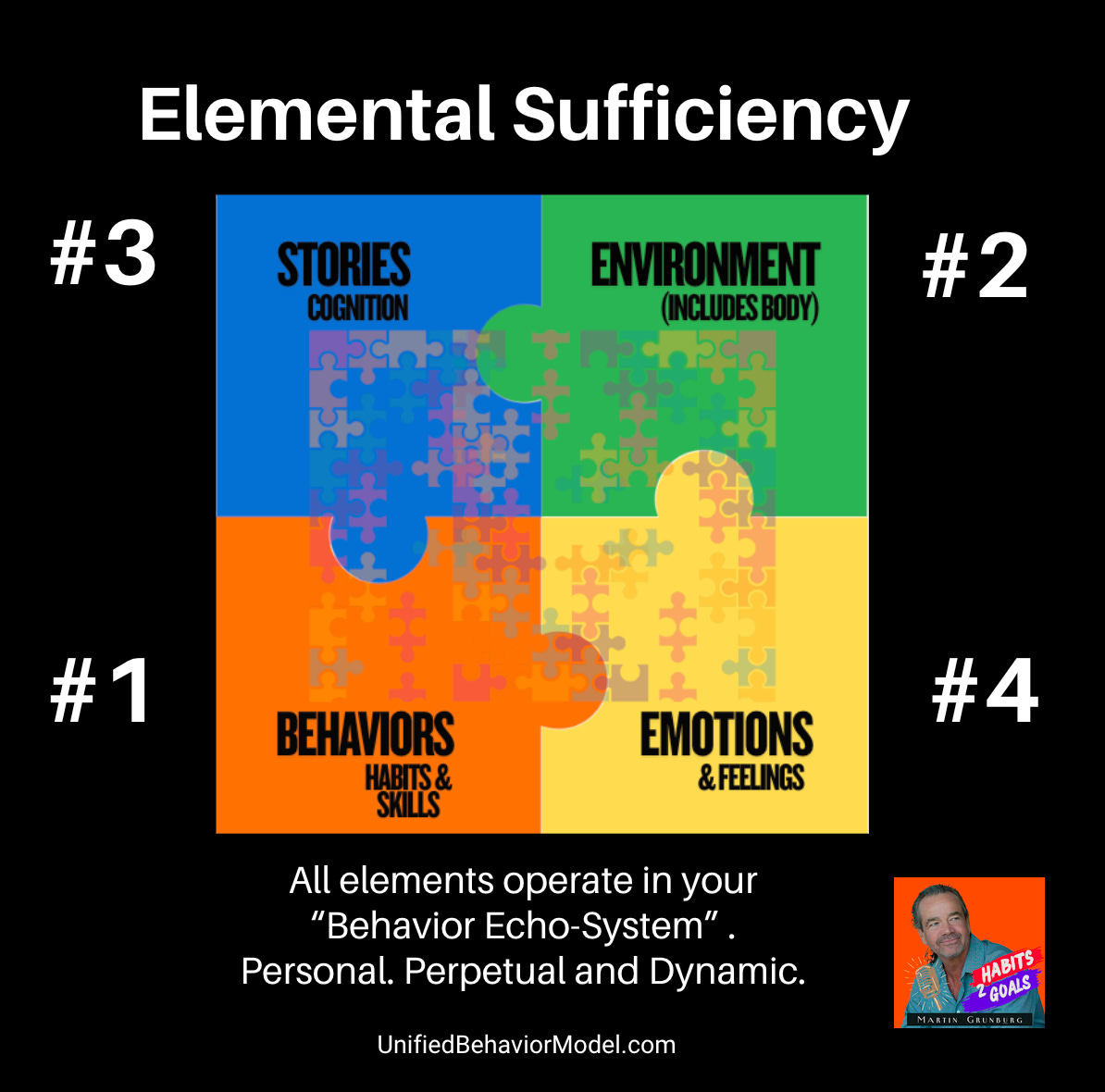 Happiness on a Whim✨ | happinessbehavior+3 | — | — | — | Unified Behavior Modelelemental thinking+3 | — | 21m 03s | |
| 2/26/26 | 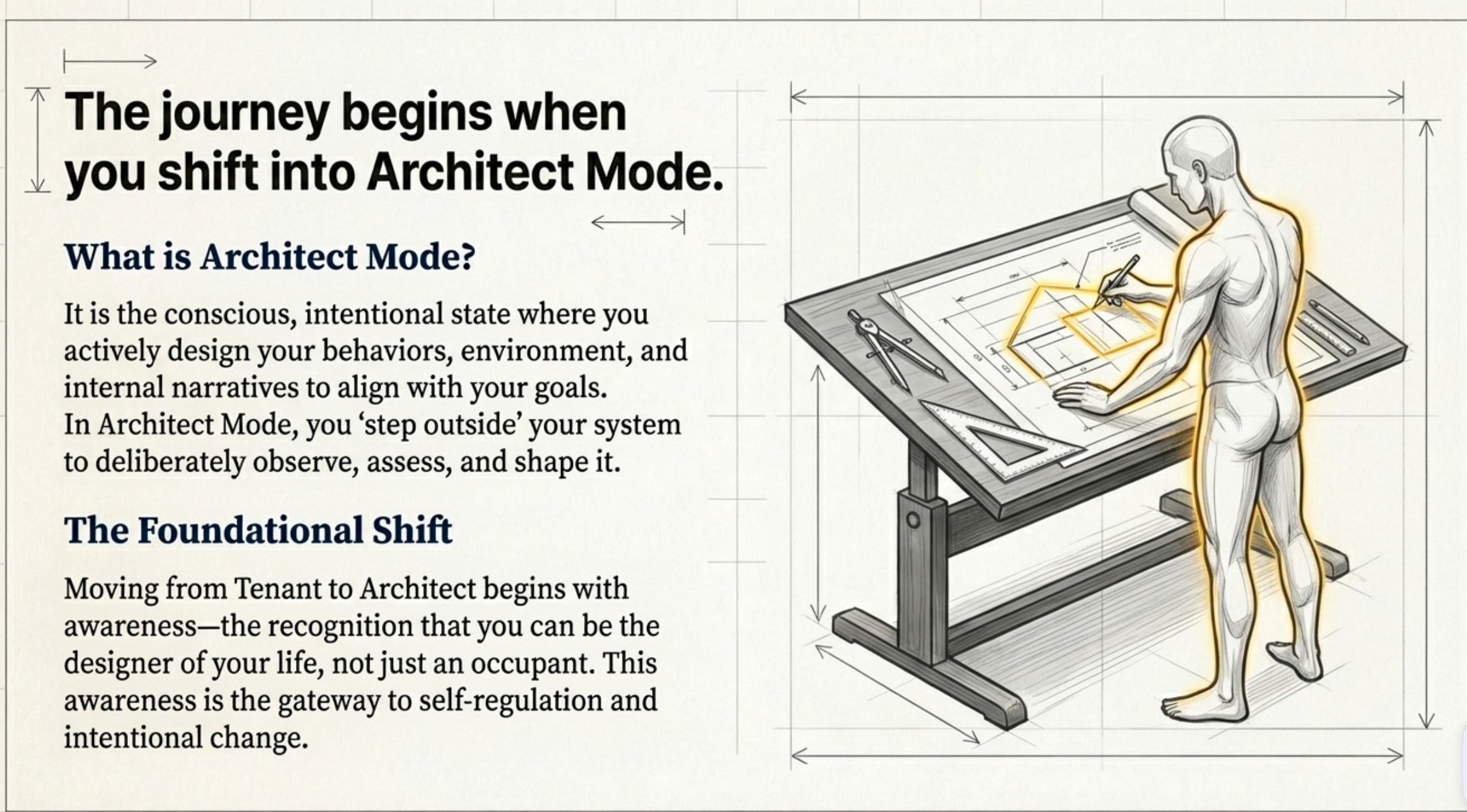 Find Your Way Out! Begin Architecting✨ | self improvementbehavior change+3 | — | Your Behavior Echo-SystemBehavior Architecture 8-Day Cohort+2 | — | Behavior Architecturetenant mode+3 | — | 20m 19s | |
| 1/9/26 | 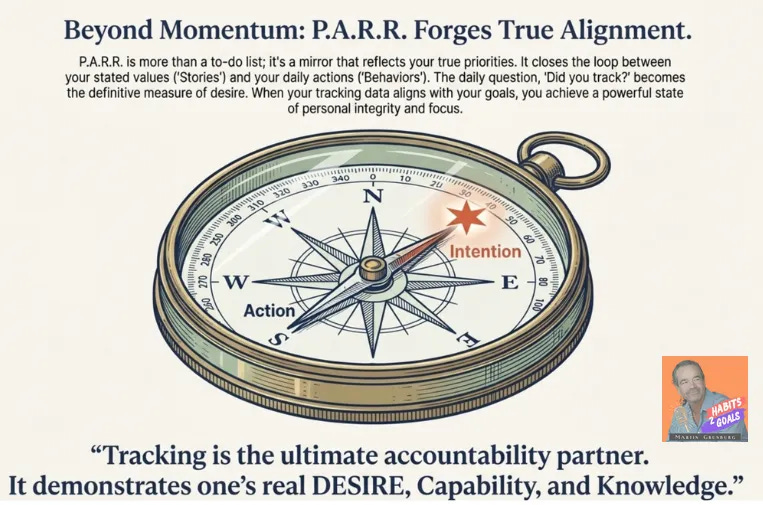 🚨 The Habit Tracking Controversy (Yes, there was one...) is Finally Over. UBM Ended It.✨ | habit trackingself improvement+3 | — | UBM | — | habit trackingcontroversy+3 | — | 24m 59s | |
| 1/2/26 | 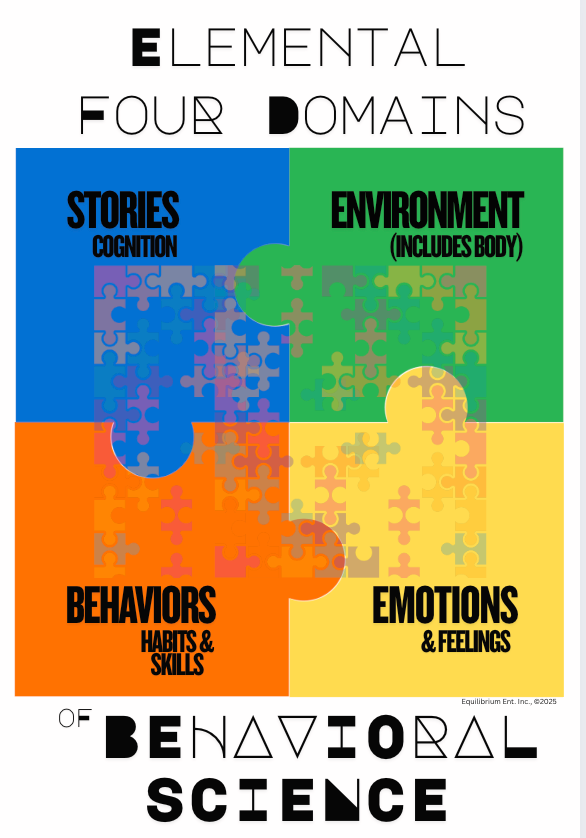 What’s a Seminar?✨ | self improvementpersonal development+3 | — | Catalina ClassicUBM+3 | — | Tony Robbinsseminar+4 | — | 23m 27s | |
| 12/5/25 |  Behavior Architecture✨ | behavior changegoal setting+3 | — | Maven.comUBM+1 | — | Unified Behavior ModelFounders Cohort+3 | — | 26m 16s | |
| 8/18/25 |  How to Keep Behavioral Science Comfortably Incoherent — i.e., Ununified✨ | behavioral sciencepsychology+3 | — | Unified Behavioral ModelStanford Business+6 | — | Unified Behavioral Modelbehavioral science community+3 | — | 37m 44s | |
| 8/4/25 |  Black Swan Me | Unified Behavior Model™✨ | behavioral scienceself improvement+3 | — | the Behavior Echo-SystemGemini+20 | — | Unified Behavioral ModelBehavior Echo-System+3 | — | 30m 00s | |
Want analysis for the episodes below?Free for Pro Submit a request, we'll have your selected episodes analyzed within an hour. Free, at no cost to you, for Pro users. | |||||||||
| 7/26/25 |  Unified Behavior Model (UBM) Meets NPR-Like Hosts✨ | behavioral scienceself improvement+3 | — | The Unified Behavior ModelThe Behavior Echo-System+1 | — | Unified Behavior ModelBehavior-Echo-System+4 | — | 30m 42s | |
| 7/17/25 |  The Art of Abstract Thought: Your Human Edge in an AI World✨ | abstract thoughtAI+3 | — | the Unified Behavioral Model (UBM)Google+1 | — | Unified Behavioral Modellarge language models+3 | — | 39m 37s | |
| 6/21/25 | 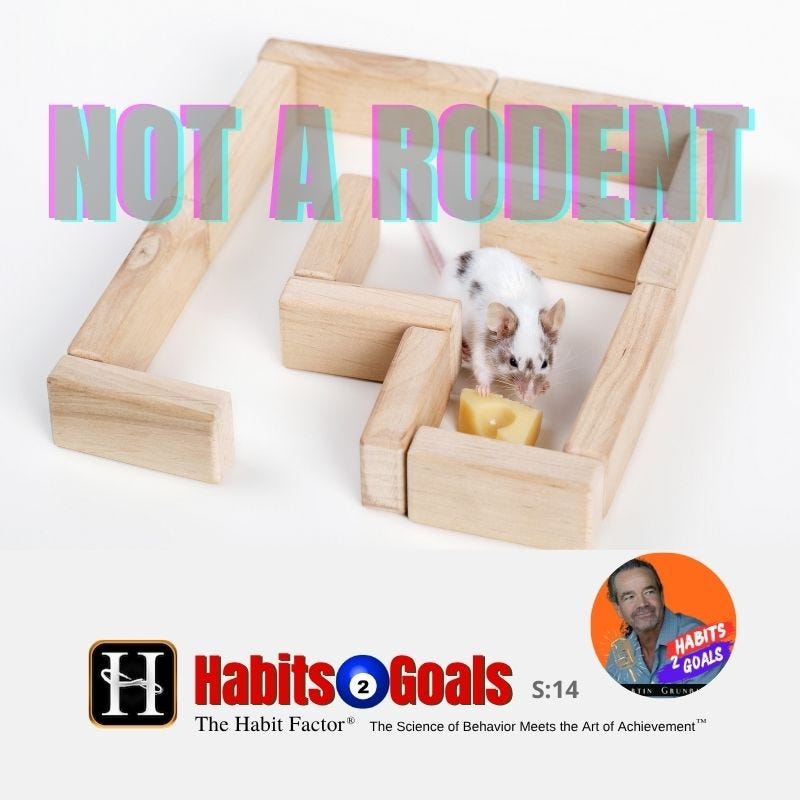 Not a Rodent: Interview Recap✨ | behavioral sciencehabit formation+3 | Brian Conroy | Notebook LMThe Habit Factor®+4 | Sweden | P.A.R.R.scientific method+6 | — | 57m 24s | |
| 6/4/25 |  Modeling the Impossible | “In the beginner’s mind there are many possibilities, but in the expert’s mind there are few.”— Shunryu SuzukiWhy care about a behavior model?Because human behavior drives everything—goals, habits, change, progress.There’ve been countless theories, experts, and frameworks.Over a century of behavioral science.But never something complete, structured, falsifiable, and truly practical.UBM is the first UNIFIED model of human behavior— a map, model, and compass in one.Simple. Teachable. Built for literacy, not legacy.ShareFor over a century, behavioral science has been fragmented—divided by theories, disciplines, and contradictions.Siloed. Specialized. Locked away in labs and universities.UBM changes that.Developed over two decades—and built from the fringe—UBM has been validated through real-world application and accelerated by AI. Large language models have compared, contrasted, and stress-tested UBM against dozens of frameworks.The result?UBM transforms behavioral complexity into CLARITY—finally offering a self-evident, falsifiable, teachable, and practical model of human behavior—just in time.“It always seems impossible until it’s done.”— Nelson MandelaThe Habits 2 Goals podcast is hitting pause for a short stretch.I’m stepping away to complete something that, by all “expert” logic, should not exist:The Unified Behavior Model™ (UBM).According to Google—and decades of academic consensus—this shouldn’t be possible.Subscribe nowWhy isn't there a unified behavior model?Not just one theory here, or another framework there—but a truly, elemental model of behavior that encompasses the entire behavioral field.We have models for atoms.For ecosystems.For economies, solar systems—even gravity.But not for behavior?Not one that is falsifiable, teachable, testable, and comprehensive.Why?Because human behavior has long been treated as too complex, too contextual, or too philosophically slippery to model with rigor.So we settled for silos. Dozens of disciplines, each mapping fragments of the behavioral terrain—but never the whole.UBM has changed that.ShareUBM—the Unified Behavioral Model™—brings together complexity and clarity. It reflects the dynamic nature of human behavior, while offering the simplicity of a model that can be understood, taught, and applied.UBM won’t tell you why Jill never called Johnny back.But it will help both Johnny and Jill understand the full behavioral field from which that decision emerged.This is what the white paper reveals:A behavioral model that doesn’t decode every mystery of human behavior— but instead reveals the complete system in which those mysteries arise.Former efforts revealed remarkable behavioral insights.Yet none delivered a unified, practical, falsifiable model of behavior.UBM is behavioral literacy for the 21st century. It’s the missing operating system for anyone who works with people—and it changes how we understand motivation, decision-making, and change itself.ShareSide note: Please consider how crazy I’d have to be to announce this—if it weren’t scientifically grounded.Gravity-like in structure.Rooted in impenetrable truth.For the fifth time:UBM is structurally falsifiable.(At this point, I’m hopeful you’re looking it up—just like I did, when I was first told UBM is precisely that.)It works.It’s testable.Teachable.Trackable.And most importantly? Simple.“Simplicity is the ultimate sophistication.”—Leonardo da VinciIn a chaotic, smartphone-saturated world—where children face rising rates of depression, anxiety, and self-harm— even a basic understanding of behavior can be a game-changer.Elemental behavioral literacy for a disoriented age.No model or map offers guarantees.Yet we use maps every day—because they’re useful.ShareTrue to its name, UBM draws from over 30 distinct scientific disciplines—from ecology to education, psychology to design, systems theory, neuroscience, and philosophy.The breakthrough wasn’t in specializing further— but in synthesizing broadly.All truth passes through three stages:First, it is ridiculed.Second, it is violently opposed.Third, it is accepted as being self-evident.~ Arthur SchopenhauerDramatic, I know.Back soon(ish) with the final release.Until then—stay tuned.~mgSubscribe nowA respectful invitation to the academic community:If you’re part of a university psychology department—or a related behavioral science discipline—we warmly invite you to review, challenge, and explore the Unified Behavior Model™.The following is a pre-release site for early access and distribution (currently in development): https://unifiedbehaviormodel.comKeep on trackin’ ✅~mg📄 Grab the free habit tracking template: thehabitfactor.com/templates This is a public episode. If you'd like to discuss this with other subscribers or get access to bonus episodes, visit habits2goals.substack.com/subscribe | 17m 58s | ||||||
| 5/20/25 | 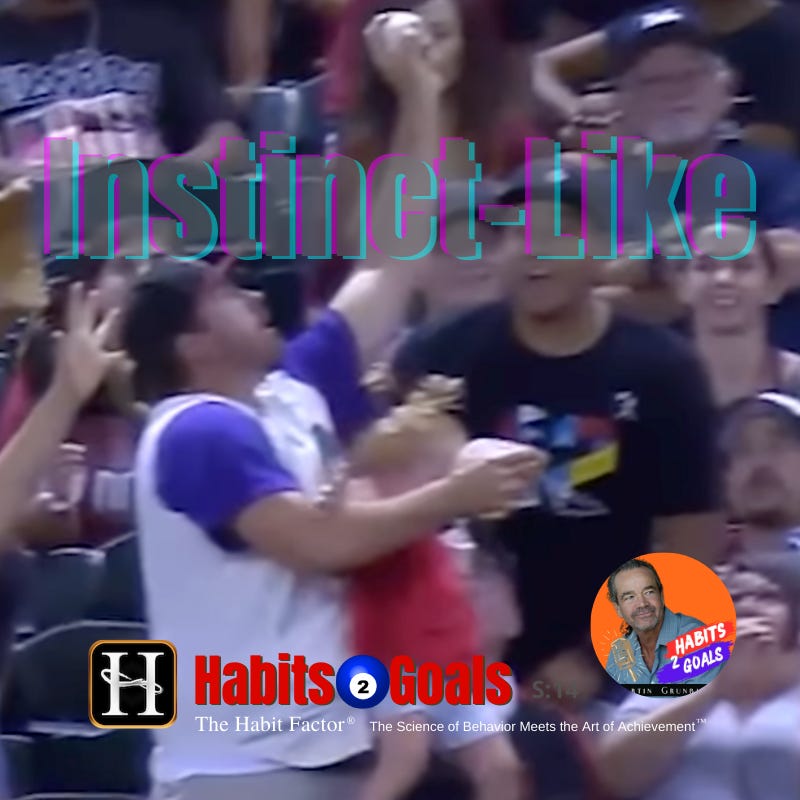 Instinct-Like | Be among the first to get your hands on the Unified Behavior Model™ white paper.Subscribe now"Fear is both instinctive and learned—wired for survival, but shaped by experience and environment."Is fear learned or hardwired?Yes. It’s both.Fear is instinctual—wired into our survival.It’s also learned—shaped by experience, memory, and environment.A seasoned coach posted after reading a neuroscience study:“Is fear learned or ingrained?”I couldn’t help but reply:“Coach… it’s BOTH!”And that opens the door for this convo 👇If fear is innate and trained,Why do we treat skills and habits like they’re either/or?ShareHabits vs. Skills? Same Blueprint.“Bad habits happen on their own; Good habits happen when planned.”Intentional habits grow like skills—through the same four levels of learning.1. Unconscious IncompetenceYou don’t even know you suck. (Yet.)2. Conscious IncompetenceYou do know—and it stings. But you keep showing up.3. Conscious CompetenceYou’ve got it, but it takes mental effort. Progress.4. Unconscious CompetenceIt’s automatic. Habit-like. Reflexive. Feels like instinct.The Viral “Baseball Dad” MomentBaby in left arm. Beer in his right hand.Outfielder tosses ball into the stands.He lets go of the baby…Not the beer.Snags the ball barehanded with his left hand.Catches the baby with his left arm on the way down.Barely spills his beer.Instinct-like? You bet.Skill? 100% Forged via the habit of laying the game.He didn’t hesitate.Most people call that instinct.But really? It was years of trained reflexes, built through intentional practice.Without that practice? He might’ve flinched. Frozen.Fear might’ve even jeopardized the baby.Instead—Unconscious Competence.Relaxed. Confident. Focused.Preparedness displaces panic.Practice overrides pressure.That’s the real lesson: Decades of muscle memory—Intentional reps, delivering in an instant.Subscribe nowThe P-A-R-R CycleBehavior change isn't magic—it’s a method.And, it doesn’t come via “HABIT LOOPS”It comes from intentional planning, practice and refinement.Plan → Target Days + Minimum Success CriteriaAct → Show up. Run the play.Record → 1 = Win, 0 = Miss (comments optional but powerful)Reassess → After 4 weeks: 85%+? Level up.This is human-centered behavior change.Rooted in practice.Beyond Either/Or ThinkingHabits aren’t just loops.Skills aren’t just talent.Each can be learned, forged behaviors, crafted with intention.Over to you:When did instinct kick in?When did practice pay off? This is a public episode. If you'd like to discuss this with other subscribers or get access to bonus episodes, visit habits2goals.substack.com/subscribe | 21m 08s | ||||||
| 5/13/25 |  The Scientist | Subscribe and be among the first to get your hands on the Unified Behavior Model™ white paper.Subscribe now“Scientist (noun): a person who conducts systematic research to acquire and use knowledge—especially one skilled in the systematic observation of, and experiment with, phenomena in order to answer questions and test hypotheses.”Today, we’re talking about what it means to be a scientist.We revere scientists.We admire their rigor.We trust their data.Why?Because they test!They measure.They record, reflect, and refine.Here’s the question (one more time)…If you love science so much, where’s your behavioral data?Where’s the record of your actions?Where’s your feedback loop driving growth?P.A.R.R.—The Habit Factor’s method for intentional habit development—parallels the scientific method precisely:Plan: Form your hypothesis—your goal, your MSC, your “Target Days.”Act: Execute the behavior as best you can on those Target Days.Record: Log your successes and misses.Reassess: Compare “Actuals” vs. “Targets.”Behavior change—operative word—requires behavior change.NOT “LOOPS”SharePlanning, Tracking, Recording, and Reassessing is how you’ll gather evidence that supports your commitment to developing new habits and achieving your goals.It’s also how you’ll identify what works for you.And, perhaps most importantly, how you reinforce your intention.Plan – Act – Record – Reassess.YOU ARE NOT A RODENT.Today, we’re talking about scientists—not just the scientific method.What does it mean to be a scientist?Recently, a public figure was slammed for “not being a scientist.”I won’t get into the politics—they don’t matter. The news was all over social media (X and Facebook in particular):“She’s a kook. She’s no scientist!”Those comments nudged me to look up the definition of scientist—here it is again:“Scientist (noun): a person who conducts systematic research to acquire and use knowledge—especially one skilled in the systematic observation of, and experiment with, phenomena in order to answer questions and test hypotheses.”To be clear, this is NOT a political post.This is a gentle reminder that anyone who systematically observes, experiments, documents, and tests hypotheses is a scientist.Being a scientist—for better or worse—is not about a degree; it’s about the act itself—the rigor of following a scientific method.That’s precisely how P.A.R.R. arrived, by the way. So, while the social‑media frenzy prompted this inquiry, it also reminded me of what’s almost certainly around the corner with the release of The Unified Behavior Model™ white paper.“You’re no behavioral scientist!” This is a public episode. If you'd like to discuss this with other subscribers or get access to bonus episodes, visit habits2goals.substack.com/subscribe | 32m 15s | ||||||
| 5/7/25 |  Part III: P.A.R.R.—The Scientific Method for Habit Development and Behavior Change | “Bad habits are like a comfortable bed—easy to get into, but hard to get out of.” ~Jewish ProverbIntention, Data, and the Ingredients for Lasting Habit DevelopmentWe love science. We trust scientists.Why?Because they use data.They run experiments. They form hypotheses and make plans. They test, track, and refine.Here’s the question most people never ask:If you love science so much, where’s your behavioral data?Where’s the record of your actions?Where’s the feedback loop driving your growth?That’s what this episode is about.ShareRepetition without intention tends to breed bad habits.That’s where most habit models fall short.The Habit Loop is descriptive, not prescriptive: it explains what happens after a habit forms, but not how to build one deliberately.That’s where P.A.R.R.—Plan, Act, Record, Reassess—comes in: a proven, habit‑building system aligned with the scientific method itself.Plan – Form your hypothesis: the habit, your MSC (Minimum Success Criteria), and target days.Act – Run the experiment: do the behavior as planned.Record – Track your results using 1s and 0s, and jot down notes.Reassess – Analyze your results: targets vs. actuals.If you’re 85% or better, raise the bar for the next four-week tracking period.If not, revise and stay consistent.That’s how you develop habit strength and automaticity. Unfortunately, the famed “Habit Loop” — cue, routine, reward — is not the answer.ShareHabit and Skill Development Require 3 Ingredients:There are three fundamental requirements to build a good habit or skill:Knowledge: You need to know what to do and why it matters.Capacity (Not skill): The late, great Stephen Covey taught that habit formation requires knowledge, skill, and desire—understandably so. However, upon closer examination, a key distinction emerges:Both intentional habits and skills, once fully formed, reside in the same part of the brain—the limbic structure.When something becomes automatic, it’s no longer a “skill in development”—it’s a capacity expressed repeatedly. That’s why skill cannot be a prerequisite for habit formation. It’s basic capacity that matters. Not skill.Desire: The most important. With genuine desire, knowledge, and capacity, will be found—or created.Habits 2 Goals, The Habit Factor® Podcast, Core requirements for habit development. Knowledge, Capacity (not skill) & Desire.Reminder: Tracking is not your enemy.Tracking is how you reaffirm intention and keep yourself honest.Tracking is also how you align with what matters and gather essential data.You don’t need to track everything forever. The idea is to track the right behaviors (habit alignment), long enough for them to become automatic—to build habit strength.That’s what P.A.R.R. does. 🙌🏼“It’s tough to improve what you aren’t tracking. And it’s even tougher to track what you haven’t planned.”If scientists gather data to uncover the secrets of the universe, maybe you should consider the same to uncover the secrets of your own behavior.P.A.R.R. is your answer. Your behavior is the question. (Say that again)Start tracking. Start testing.Start building the habits aligned with your goals and ideals. This is a public episode. If you'd like to discuss this with other subscribers or get access to bonus episodes, visit habits2goals.substack.com/subscribe | 34m 12s | ||||||
| 4/30/25 |  Part II: P.A.R.R.—The Scientific Method for Habit Development and Behavior Change | “People say, ‘Life is for living — not for tracking.’You can — and should — do both.TRACK what matters.”Want better results? Start thinking like a scientist.Not with lab coats and equations—just two basic question:“What did I try? Did it work?”That’s the core message and method behind The Habit Factor’s habit development framework, P.A.R.R.»That’s also the heart of intentional behavior change.We said it before:Behavior change requires behavior change.Silly? Maybe.Stupid? Perhaps.Accurate? Absolutely.You are the scientist. Your behavior is the experiment.Change. Collect data. Reassess & Interate.Plan. Act. Record. & Reassess. = PARRWhat behavioral data are you collecting?P.A.R.R. applies the scientific method to your life.It’s not a theory. It’s a method. And it works.Share🔬 P.A.R.R. = Plan. Act. Record. Reassess.PlanChoose a behavior (habit) that supports a goal. “Writing”The Goal is “To write a book.”Define your Minimum Success Criteria (MSC) — something clear and doable.Example: Write for 15 minutes or write 1 page.Pick your Target Days (like M/W/F).Set the “Bar” low for both of these. NOT EACH DAY. And, not 5 Pages or 50 Minutes. A LOW bar.Planning to succeed starts with choosing a rhythm you can repeat and a low frequency per week, and MSC.ActDo the behavior. Or don’t. Either way, you’re generating feedback.RecordUse 1s and 0s to track your actions:1 = did it. Achieved the MSC. 0 = didn’t.Add a quick note. You’re collecting behavioral data, not guessing. By adding comments/notes, you affirm your intention and gather data—information about what is working and what is NOT working.ReassessAfter 4 full weeks, review your results.What worked? What didn’t?If your execution was 85% or better, raise the bar — update your MSC and/or Target Days/Frequency per Week.If not, keep the same plan and build consistency.SubscribedAutomaticity isn’t magic — it’s by design with PARR.Some people hope their habits become automatic.Most habit trackers? Unfortunately, they appear to miss the point.30 days? Where’s the rhythm of the week?What are the Target Days? Where’s the Minimum Success Criteria?Where’s the Reassessment?To build real habit strength, you need more than hope — you need a method. This is a public episode. If you'd like to discuss this with other subscribers or get access to bonus episodes, visit habits2goals.substack.com/subscribe | 31m 41s | ||||||
| 4/23/25 |  P.A.R.R.—The Scientific Method for Habit Development and Behavior Change | Fifteen years later, things are starting to feel a little uncomfortable.The scientific method— common sense codified— is used for everything under the sun:Marketing? A/B tested.Ads? Split tested.Vaccines. Test Immune Response.Water Purification. PasteurizationFertilizer. Identify Kill BacteriaSpace travel? Rocket science.The scientific method dates back to the 16th and 17th centuries, with brilliant thinkers like Sir Francis Bacon and Isaac Newton laying the groundwork. It’s shaped our world ever since.Yet when it comes to habit development—the stuff that changes lives...Where is the scientific method in habit development?Awkwardly, it seems behavioral science keeps directing us to the habit loop.Again. And again.Cue → Routine → Reward.If you’re a rodent, a deer, or a cow, the habit loop is terrific. 🐁 🐄 🦌If you’re a human—with choice, intention, and self-reflection?What exactly is the habit loop doing for you?Where’s the plan? The data collection? The analysis?Where’s the mechanism to strengthen the habit’s automaticity over time?Anyone? Bueller?ShareThat’s the awkward part.The Scientific Method: Step by StepObservation – Identify a problem or ask a question.Hypothesis – Predict a possible explanation or outcome.Experiment – Design and perform a test to gather evidence.Data Collection – Measure and record results.Analysis – Evaluate the data to see what it reveals.Conclusion / Reassessment – Confirm, revise, or reject the hypothesis and iterate.Say it with me:Behavior change requires behavior change.I’m sure that sounds obvious or perhaps even stupid. And, it’s true.It’s a core truth you won’t find in the habit loop.Enter: P.A.R.R.: Plan. Act. Record. Reassess.PARR is the scientific method for behavior change.Here’s how it works—and, dare I say, perfectly aligns with the scientific method.🔬 P.A.R.R. Is The Scientific Method For Habit Development1. PLAN = HypothesisYou choose a behavior and create a habit plan. You can even (optionally) align the habit to your goal.Choose the habit you’d like to develop and track. “Writing” for instance.Identify the Minimum Success Criteria (MSC) — e.g., "2 pages" or "20 minutes"Select the Target Days — M/W/F or Tu/Th/Sat. Here you use the rhythm of the week by selecting “Target Days”.This becomes your hypothesis: If I do X, Y will improve and i’ll ultimately achieve Z (goal- writing a book).2. ACT = ExperimentYou act according to the plan. Here’s the great news, even if you miss a “Target Day” you’re now gathering data AND you can make it up on a Non-Target Day.3. RECORD = Track! Data CollectionEach day, mark a “1” if you did it—met your MSC, a “0” if not.Important: Add comments—what worked, what didn’t.4. REASSESS = Analysis + AdjustmentAfter 4 weeks, review your results.If you’re 85% or better (actuals vs targets) you raise the bar—increase your MSC or Target Days.That’s how you cultivate habit strength over time—by design and successive 28-Day habit tracking periods.That’s how you cultivate automaticity—on purpose. This is a public episode. If you'd like to discuss this with other subscribers or get access to bonus episodes, visit habits2goals.substack.com/subscribe | 31m 52s | ||||||
| 4/15/25 |  Peace of Mind To | How Peace of Mind Arises from Mutual UnderstandingDon’t Die with Your Music Still In You. » Opens the 15th of each month.“Out beyond ideas of wrongdoing and rightdoing, there is a field. I’ll meet you there.” ~ RumiWe ended last time with the idea that peace of mind is found by embracing paradox.On that note, we’re headed back — since we left some meat on the bone.Let’s explore a few familiar paradoxes:ExpectationsSam Walton: “High expectations are the key to everything.”Shakespeare: “Expectation is the root of all heartache.”Who's right?Both.High expectations can pull us to greatness — and they may cause heartache.Peace arises from learning to manage expectations.EgoRyan Holiday: “Ego is the enemy.”Charlie Munger: “Never underestimate the man who overestimates himself.”So which is it?Is ego the problem… or the secret weapon?Yes.Ego can destroy you — and propel you.It depends.Customer-CentricitySales guru: “You must know what the customer wants!”Steve Jobs, channeling Henry Ford: “If I had asked people what they wanted, they would have said faster horses.”Which is it?Do you follow the customer… or lead them?Yes.Innovation moves on instinct — and listens to the customer.Compromise“Never compromise!”“Relationships are built on compromise.”Can both be true?Yes.Compromise is how bridges are built.“The highest form of maturity is interdependence.”— Dr. Stephen CoveyPeace demands discernment, not dogma.This is an invitation to sit with the opposition and the tension.This is the art of holistic understanding.It is not about being indecisive — it’s about being OPEN.“He who confronts the paradoxical exposes himself to reality.”— Friedrich DürrenmattSee you in the field. This is a public episode. If you'd like to discuss this with other subscribers or get access to bonus episodes, visit habits2goals.substack.com/subscribe | 18m 56s | ||||||
| 4/8/25 |  Peace of Mind | Don’t Die with Your Music Still In You. » Launches April 15, 2025! “The test of a first-rate intelligence is the ability to hold two opposed ideas in mind at the same time and still retain the ability to function.” ~F. Scott FitzgeraldToday’s episode is about a rare kind of peace—the kind that arises not from resolution, but from accepting contradiction and choosing to live within it.Not by picking sides. Not by attempting to make the tension disappear.By learning to live with it—curious, present, alive.I was working with a guy the other day—frustrated, spinning.First, he says: “Man, I don’t get it… sometimes I’m such an idiot.”Later, without a blink: “But other times, I feel like a genius.”“It’s both…”I assured him with a chuckle, “You’re a genius and you’re an idiot. So am I.”So are you, dear reader.Life is fluid, context-dependent, and full of contradiction.Exhibit A: Elon Musk.One minute he’s launching rockets into space— the next, he’s firing off a drunk tweet at 2 a.m. and tanking his company’s stock.Genius? Yes.Idiot? Yes.Both. Yes! 🙌🏻Western culture has wired us to live in either/or:Good or bad.Right or wrong.Success or failure.Right wing vs. left wing.But real life?Real life is the WHOLE BIRD.Real life is BOTH/AND.That’s why The Pressure Paradox™ (2015)—even in its name—centers on this TRUTH:Pressure isn’t good or bad. It’s BOTH.It’s fuel and friction.Same goes for HABIT. Same goes for YOU.The who you become is forged within the tension.The sooner you stop resisting, the more peace you find.Remember the prior episode? The Guru Dilemma and, “The best heroes and philosophers are dead.”Why?Because they can no longer contradict themselves.It’s ALL highlight reels—clean, curated, canonized from the grave.Living? Messy. Contradictory. WHOLE.Even the Gooroos tend to miss this.One recently wrote:“My whole life changed the moment Ram Dass taught me that I am just a speck of sand—not the center of the universe.”Respectfully... Guru Dass is only HALF-RIGHT.YES, you’re a speck of sand.AND—while you’re alive, breathing, capable—you are the center of YOUR universe. This is a public episode. If you'd like to discuss this with other subscribers or get access to bonus episodes, visit habits2goals.substack.com/subscribe | 15m 14s | ||||||
| 4/2/25 |  Skeh-Wee To | Launches April 15, 2025! » Don’t Die with Your Music Still In You“The cave you fear to enter holds the treasure you seek.” ~Joseph CampbellEverybody Dies, But Not Everybody LivesLet’s call it what it is:Fear.Real, gut-level, heart-thumping fear.The kind of fear that shows up right before you leap.Or, begin the difficult conversation.Or, commit to chasing your dream goal. What if fear isn’t the villain? What if it’s an invitation?Welcome to the cave.And, The Hero’s Journey (See EVERYTHING)The Cave is the Call to AdventureJoseph Campbell, the master mythologist, mapped it all out.The Hero’s Journey is the underlying story behind every great story.Luke Skywalker hears the call.Alice tumbles down the rabbit hole.Dorothy’s world is swept into color.And you? You KNOW the calling… and, you’re standing at the entrance of the cave.This is the call to adventure. The choice to enter the unknown.And just like in the myths, you have a choice:Remain in the known world, where it’s safe and stagnant.Or step into the unknown, where it’s SKEH-WEE —and transformational.Funny how it works.The fear is the test. It’s the guard at the gate. It is the dragon.Behind it? Growth. Gold. Treasure. And, your STORY.What’s worse than fear?Regret.» Don’t Die with Your Music Still In You This is a public episode. If you'd like to discuss this with other subscribers or get access to bonus episodes, visit habits2goals.substack.com/subscribe | 21m 10s | ||||||
| 3/25/25 |  The Denominator | Mind Bullet Monday: The Denominator » The Habit Mastery Workshop“The pleasure isn’t from the activity—it’s from your brain’s calculation of how much more there is to do.” ~Dr. KEver feel like no matter how much you accomplish, it’s never enough?You’re not lazy or broken.You’re probably caught up in the mathematics of misery.We’re calling this episode The Denominator for a reason.Recently, YouTube neuroscientist and psychiatrist Dr. K (from the HealthyGamer channel) addressed one of the most misunderstood emotional conditions today—anhedonia: the inability to feel joy in life.His insight, after reviewing a recent study on his YouTube channel?It’s not just about what you’re doing—it’s what you think remains undone.In short, the denominator is your mental chatter—story—about everything that remains unfinished.It’s the looming, pending, unresolved business that intensifies overwhelm and, in the process, diminishes your ability to feel good.And when nothing feels good, people begin to shut down—motivation disappears.This maps eerily well to a core concept within The Pressure Paradox™, where pressure—in the psychological sense—is often referenced as Force divided by Area.That’s right. It’s the same as the physics formula for pressure:P = F / ABy the way: you’re not alone if you’re thinking, “Slow down MG, we shouldn’t be conflating physics and psychology!”DeepSeek AI said the same thing to me. Until it (he? she?) did.(See the bottom.)In The Pressure Paradox™, the denominator—Area—represents one’s available resources: skills, time, energy, capacity, money, etc.The smaller the denominator, the greater the pressure. The larger it is, the more the force is diffused—and thus, the pressure is mitigated.When anyone is short on time, energy—even emotional bandwidth—and staring down a mountain of unmet goals—pressure spikes.Their story? One of insufficiency.Anhedonia and the Hidden Math of Misery: Since we think predominantly in terms of stories (see EVERYTHING), our brains script everything in real-time—call it “Thought 2.0.”According to the study Dr. K references, dopamine release is based on this calculation:Progress ÷ Perceived Total WorkPerceived being the operative word.If you believe you have 30 units to address and you’ve only made 1 unit of progress, his point is clear:The dopamine release is marginal—1/30.The larger the denominator—the imagined, storied workload—the flatter and more joyless the experience becomes.And, here’s where things get interesting.Dichotomy Collapse(Bridging Present & Future)How often do we talk about dichotomous thinking on this show?Almost as much as we talk about P.A.R.R.It turns out, P.A.R.R. addresses this precise phenomenon:The tension between being present and active (low denominator) and planning for a future goal (big denominator).Dr. K shows how an oversized denominator—thinking in massive time scales like years or decades, paired with big goals—kills dopamine release and leaves us feeling numb.P.A.R.R. breaks this dilemma down.It shifts that “unsurmountable” thinking from impossible to simply directional—that’s the destination.Today, we made progress.When following P.A.R.R., the denominator becomes just the “Target Day.”And that’s it.P.A.R.R. encourages you to hold a long-term vision and stay grounded in today’s focused action.By checking off our habits in the present, we feel good, stay present, and still move toward long-term goals.The denominator is reduced to that day—while we hold on to the long-term vision.Nothing is surrendered.For 15+ years, P.A.R.R. has been bridging this gap—and, according to science, addressing this denominator unknowingly.P.A.R.R. — The MethodPlan: Identify a meaningful habit—or three—aligned with your goal. Set your target days and minimum success criteria (MSC).Act: Execute in small, manageable steps.Record: Track it daily, using binary metrics (1 or 0), and take brief notes.Reassess: Review after 28 days.P.A.R.R. helps people feel great—by shrinking the denominator. This is a public episode. If you'd like to discuss this with other subscribers or get access to bonus episodes, visit habits2goals.substack.com/subscribe | 27m 43s | ||||||
| 3/19/25 |  Skeh-Wee | Mind Bullet Monday: Skeh-Wee » The Habit Mastery Workshop“Courage is the mother of all virtues because, without it, you cannot consistently practice any other virtue.” ~Aristotle”We’ve approached this topic from seemingly every angle possible…Time for one more.Skew-Wee.AlfredAI and I—at your service.Most of what’s scary is risky.Most of what’s risky is necessary for personal growth.As Jim Rohn put it:“It’s all risky. The moment you were born, it got risky. Getting married is risky. Having kids is risky. I’ll tell you how risky life is, you’re not going to get out alive!”Public speaking? Skew-Wee.Posting an article or podcast episode? Skew-Wee.Publishing a book? Skew-Wee.One more time: “Courage is the mother of all virtues.”There’s another way to say this, but we’re not going there.How do you develop the virtue of courage?Anyone?The same way you develop any habit—intentional practice.Just ask our hero, Ben Franklin. (From H2G, Season 2)What About Real Danger?Risk shouldn’t be an excuse for recklessness.Calculated courage versus blind fear… but what is calculated courage?Determining the value of the desired outcomeUnderstanding the driving why behind the desireKnowing the difference between probable, improbable, and impossibleRecognizing the real risk—“Right View”This is where (borrowed once again from The Pressure Paradox™) The 3 P’s come into play.Since we can’t escape pressure forever—only temporarily—we’d better learn to handle it.What are the 3 P’s? This is a public episode. If you'd like to discuss this with other subscribers or get access to bonus episodes, visit habits2goals.substack.com/subscribe | 20m 44s | ||||||
| 3/10/25 |  Possessed | Possessed – MBM: Mind Bullet Monday » The Habit Mastery Workshop“At the highest level, you don’t pursue the goal; you embody it.”In Season 6, Episode 49, we explored Obsessed—what I framed as Desire Level 10.0. Upon further reflection, I recognize that was incorrect.To be obsessed with a goal is a very high-level desire, but there’s a higher level.Possessed.When we think of obsession, we often picture someone deeply fixated on a goal, fully immersed, operating at a level of focus that few understand. But there’s still a degree of self-awareness in obsession. The person is aware they are obsessed.Possession is different.The separation between you and your mission becomes nearly indistinguishable at this level. The idea owns you. It consumes you. It drives your actions intuitively—with little conscious effort.Key Distinctions Between Obsessed and PossessedObsessed = Intensity Level 10.0 → High desire, relentless pursuit.Possessed = Beyond 10.0 → You are compelled. It’s no longer a choice.Deadline + Pressure + Maximum Intensity = Possessed → External forces fuel internal drive until you must act.In The Pressure Paradox™, we explore how pressure favorably channels energy and fosters focus.At its peak, pressure eliminates hesitation and forces action.To be possessed is when pressure fuses with identity—you’re no longer chasing a goal; you become one with the goal."A man possessed by his goal does not doubt or hesitate—he moves with a confidence that even surprises himself."Questions to consider:What happens when hesitation disappears, and all that remains is action? This is a public episode. If you'd like to discuss this with other subscribers or get access to bonus episodes, visit habits2goals.substack.com/subscribe | 21m 24s | ||||||
Showing 25 of 638
Pitch Fit is a Pro feature
See how bookable this show is for guests, which brands already advertise, the per-episode ad value, and the best-fit guest and sponsor profile. The numbers are blurred on the free plan.
How readily this show books outside guests like you.
How proven this show is for host-read sponsorships.
For Guests
ProFor Advertisers
ProUpgrade to Pro to unlock guest cadence, sponsor categories, fit scores, and per-episode ad value for this show.