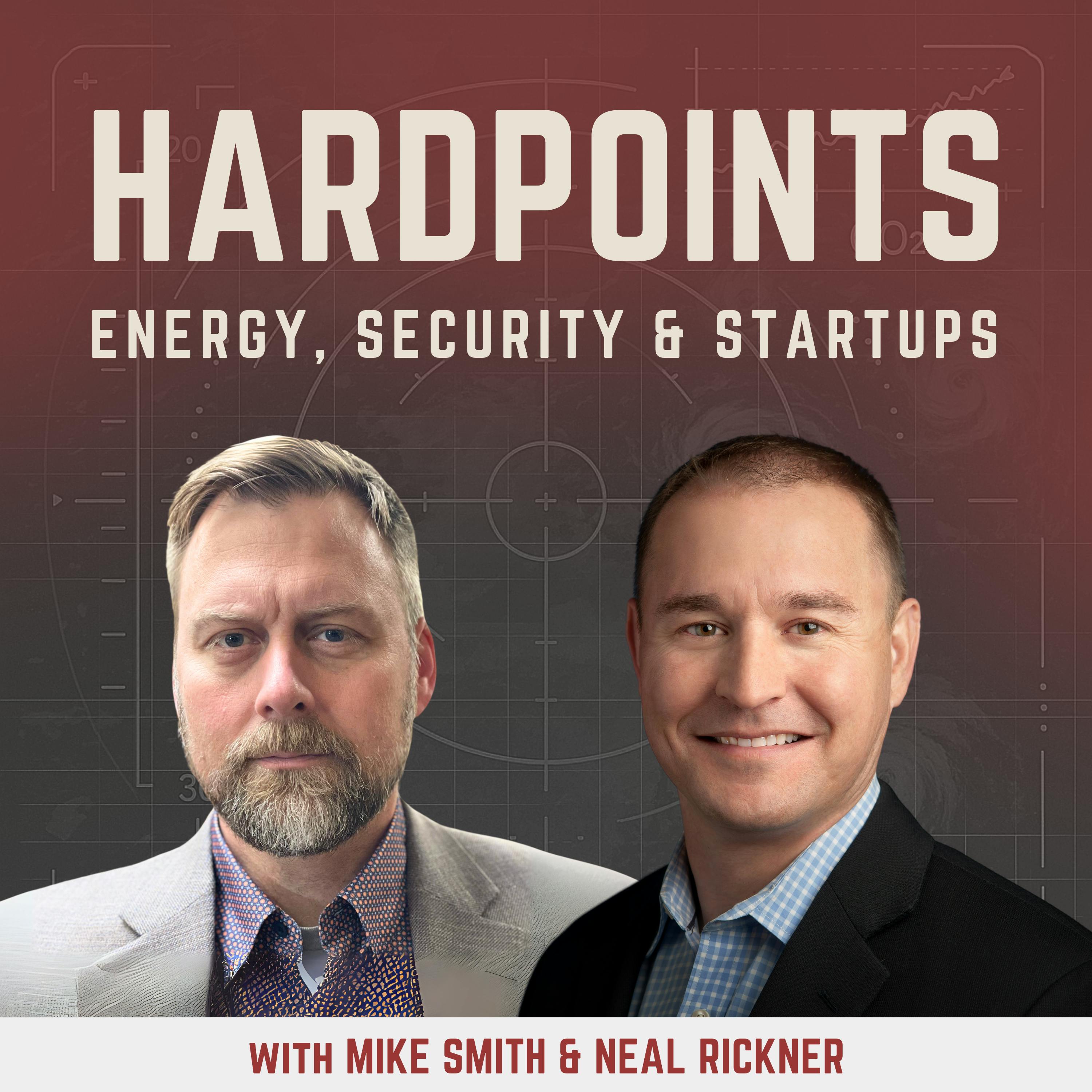
Hardpoints
Every week, former fighter pilots and current entrepreneurs Neal Rickner & Mike Smith provide unfiltered insights into the biggest stories in startups, energy, and national security.
Insights from recent episode analysis
On the show
- Neal2 eps
- Mike2 eps
Audience Interest
Podcast Focus
Publishing Consistency
Insights are generated by CastFox AI using publicly available data, episode content, and proprietary models.
Most discussed topics
Brands & references
Total monthly reach
Based on the show's feed history.
Built from
- Per-Episode Audience
Est. listeners per new episode within ~30 days
2K to 18K🎙 Daily cadence·61 episodes·Last published 1w ago - Monthly Reach
Unique listeners across all episodes (30 days)
6.7K to 60K🇺🇸100% - Active Followers
Loyal subscribers who consistently listen
3.7K to 33K
Market Insights
Platform Distribution
Reach across major podcast platforms, updated hourly
Total Followers
—
Total Plays
—
Total Reviews
—
* Data sourced directly from platform APIs and aggregated hourly across all major podcast directories.
| Date | Episode | Topics | Guests | Brands | Places | Keywords | Sponsor | Length | |
|---|---|---|---|---|---|---|---|---|---|
| 10/15/26 | The First Russian Diesel Shipment Is Under a Day of U.S. Demand. What Did America Pay for It? | A new Treasury license allows Russian diesel to be sold into the United States through April 7, 2027, after a phone call between President Trump and Vladimir Putin. The first announced shipment is 300,000 tons, about 2.25 million barrels. America uses about 3.7 million barrels of diesel a day, so the headline deal covers less than one day of demand. It comes from a country whose own fuel exports are collapsing under Ukrainian drone strikes on its refineries. This week, Mike and Neal ask what the deal is really for. Mike starts with why diesel hurts so much: Russia and Ukraine are bombing each other’s energy infrastructure, and diesel runs the hay trucks, cattle operations and grocery supply chains the working economy depends on. It also reaches your plane ticket, because diesel and jet fuel come from the same part of the barrel. Land O’Lakes CEO Beth Ford puts the rise in farm input costs at $15 billion since February, with diesel roughly double. Neal presses on the numbers and the motive. If the volume is this small, what did Russia give up? Mike’s answer is nothing, and he reads the deal as a political move ahead of the midterms that also leans on Ukraine’s president. Republican senators Collins, Curtis, Murkowski and Tillis have joined Democrats in objecting, and Mike asks why Congress is stopping at statements when it has levers to pull. Neal asks why the first call isn’t to Canada, our closest energy partner, and both hosts agree you phone your friend before your adversary. Mike then pulls on a thread most coverage misses: the transshipment points that move Russian oil out of the Arctic, and his worry that the deal could widen the war. They close on a more generous reading, that the deal is a backroom trade to ease Iran’s pressure on the Strait of Hormuz. Neal says he would back that. Mike hopes it’s true but sees a simpler explanation. In the mailbag, a listener says the F-35’s $1 trillion price tag covers 50 years of fuel, manpower and spares. Mike says the latest projection is closer to $2 trillion and argues that spending defense dollars well is how you look out for the little guy. Another listener asks whether data center water use is exaggerated and whether you could bury the buildings. Neal says the closed-loop and underground ideas have merit, while Mike says the heat, the noise and the power plants feeding them do not go away. In Goods, Bads, and Others, Mike’s good is wind and solar gaining ground in Europe’s power mix, his bad is a surprise week of prep for a garage sale, and his other is a Dodgers title run that he fears could push baseball into a labor fight. Neal’s good is the Blue Angels turning 80, his bad is what high diesel prices are doing to farmers, and his other is playoff baseball. Hosts Mike Smith, a former Navy F/A-18 pilot and CEO of Aclymate, and Neal Rickner, a former Marine Corps F/A-18 pilot and CEO of Airloom, unpack energy, national security, and the startup economy. Questions or comments? Email [email protected] and we may feature yours on a future episode. Hardpoints is brought to you by the Valor Media Network. | 48m 05s | ||||||
| 10/8/26 | $10,000 a Household for a Data Center and the Town Still Said No. Bribe or Fair Deal? | Local opposition blocked or delayed an estimated $130 billion in data center projects in the first three months of 2026 alone. In Hazle Township, Pennsylvania, a developer tried to change that math by mailing every household a letter offering $10,000 if its 15-building data center campus gets built. The median household income there is about $60,000, and plenty of residents are still saying no. This week, Mike and Neal ask whether paying your neighbors is the future of how America builds big things, or proof that some things can’t be bought. Neal draws on his time winning over communities for an energy project on the Big Island of Hawaii, where showing up early and often did what money never could. Mike argues that the fear of loss runs deeper than any check — and that a payout offered after the township already voted no was always going to look like a bribe. They get into why people really object (power bills, water, secrecy, and distrust of the billionaires behind the projects), how wind developers pay their neighbors, and what a “pay your own way” power deal like Google’s with Xcel Energy in Minnesota looks like. They also cover why one township’s fight lands on a regional grid, and why the national security race for AI needs boundaries — not a stop sign. In the mailbag, a listener asks about the U.S. military buildup in Palau. Neal shares what he saw landing on islands across the Western Pacific as a Marine in 2002, and why infrastructure out there matters in the competition with China. In Goods, Bads, and Others, Mike’s good is a political ad he recorded that has people recognizing him, his bad is $20 million in Homeland Security money going to ads featuring the president, and his other is Peter Thiel’s comments on evil and competence. Neal’s good is the return of Ali G, his bad is heating oil bills expected to jump more than 30% this winter, and his other is the Navy’s birthday. Hosts Mike Smith, a former Navy F/A-18 pilot and CEO of Aclymate, and Neal Rickner, a former Marine Corps F/A-18 pilot and CEO of Airloom, unpack energy, national security, and the startup economy. Questions or comments? Email [email protected] and we may feature yours on a future episode. Hardpoints is brought to you by the Valor Media Network. | 41m 00s | ||||||
| 10/6/26 | The Pentagon Wants $54 Billion for Drones, Up From $226 Million. Does It Need a Four-Star for Robots? | The Pentagon is asking for $54.6 billion for autonomous warfare next year — up from about $226 million this year. That same week, Secretary Hegseth announces a new four-star Autonomous Warfare Command, the 12th combatant command in American history, and Ukraine says drones caused nearly all of the roughly 35,000 Russian casualties it counted in March. Mike and Neal ask whether the United States is finally admitting that the next century of war belongs to machines, and whether a new four-star command is the right way to get there. They walk through what was announced at Quantico — a command with service-like authorities, new drone career fields in the Army, Navy, and Air Force, an interim team called Project Agincourt, and a future-warfare panel co-led by Elon Musk, Palmer Luckey, and Newt Gingrich. They also dig into the cost math behind it all — cheap drones against expensive interceptors, tanks pulling back from the front, and why quantity now matters as much as quality. Neal sees a necessary break from the old system, pointing to the SOCOM model of giving a new mission its own budget and buying power so it can't lose every fight to the next fighter jet or ship. Mike likes the direction but worries a twelfth command adds bureaucracy, and he wants the new four-star to start by getting close to the fight in Ukraine, where tactics are being written in real time. For Mike, the real test is whether the command can change how the Army and Navy fight, not just run its own program. Both hosts flag the conflict of interest in putting people whose companies do business with the Pentagon on the panel that shapes its future. Still, Mike, who runs Aclymate, and Neal, who runs Airloom, take the founder's view — launch it, bring in smart people, and iterate — while keeping a healthy dose of skepticism about who is writing the rules. In the listener mailbag, one commenter argues the U.S. is simply turning up the heat on Canada until it comes to the table, and another wonders whether China is safer than American AI executives. Mike and Neal push back on both — covering what it costs to treat an ally like an adversary, why China is not the safer bet, and why Mike would hold AI developers to a strict liability standard. In goods, bads, and others, Mike cheers a Michigan credit union for parting ways with its CEO after an AI-edited "Lake America" sweatshirt photo, groans at Senator Eric Schmitt's perjury accusation against Jack Smith and the Hawks versus Hawkeyes moment that followed, and tracks private investment in nature growing fivefold to more than $14 billion a year. Neal salutes seven F-22 pilots awarded the Distinguished Flying Cross, six of them for Operation Midnight Hammer, laments the Ratepayer Protection Act stalling in the Senate after passing the House 417 to 3, and reflects on the last U.S. troops leaving Iraq after 23 years. Got a take? Email us: [email protected] Follow Hardpoints wherever you get your podcasts. | 49m 41s | ||||||
| 10/1/26 | Anduril's CEO Says Defense Tech Is a Bubble. So Why Is His Company Talking $100 Billion? | Anduril's valuation doubled from $30.5 billion to $61 billion in under a year, and the company is reportedly in talks with investors at close to $100 billion. Its revenue more than doubled to $2.2 billion last year, but $100 billion works out to roughly 45 times that number, while the traditional defense primes trade at low single-digit multiples. Anduril's own CEO, Brian Schimpf, says there is a bit of a bubble. Mike and Neal agree. The real question is what happens to the Pentagon, and to the taxpayer, when it pops. The conversation starts with who these companies actually are. Anduril was founded in 2017 by Palmer Luckey, who had just been fired from Facebook after selling Oculus, along with co-founders who came out of Palantir. It is named after a sword from The Lord of the Rings. It began with border security and now builds the Lattice battlefield software platform along with drones, interceptors, and missiles. Mach Industries is a very different company. Ethan Thornton founded it in 2023 after dropping out of MIT at 19, and it builds five autonomous systems, from a vertical takeoff jet drone to a cheap counter-drone interceptor. Mach's valuation went from $470 million in June 2025 to $3.7 billion this month, and it does not disclose revenue. How did we get here? Mike and Neal trace the Pentagon's path from hundreds of prime contractors in World War II to a handful, and what that did to competition and cost. Fighter programs take decades, and the F-35 keeps growing past a trillion dollars. Mike calls it regulatory capture. Neal adds that the primes got brilliant at building exquisite, expensive hardware just as software became the more important half of the fight, and startups could iterate faster than Boeing or Northrop ever could. Add Silicon Valley's change of heart — from the Google employee revolt over defense work to founders who now want to build for the military — and the Pentagon's attempt to play matchmaker through the Defense Innovation Unit, and the opening for a new kind of prime is obvious. Both hosts give Secretary Hegseth credit for going after how acquisition programs are run, even as they disagree about almost everything that follows. Then the money. Defense tech venture funding hit $12.3 billion in the first half of the year by one PitchBook count, more than all of last year. Anduril is growing fast and guiding to roughly double its revenue again, but it is still losing money. Neal brings the founder's view. As the CEO of Airloom, he has given and received the same advice — Uncle Sam is both the best and worst customer, with big contracts but lumpy revenue that startups cannot wait two years for. A dual-use company can raise private capital and win defense dollars, and each helps the other. It also has a civilian market to fall back on if it never becomes a program of record. Mike, the founder of Aclymate, remembers a veterans founder meetup where dual use was the whole play, and notes that companies now go straight to defense. He asks what the dual-use story is for a battlefield sensor fusion company. That is where the two split. Mike is skeptical of how the neo primes got where they are. He points to insider connections and no-bid contracts, and to companies that used to say "if we build it, they will come" now asking for money up front. In his view, they are starting to behave like the old cartel, with venture capital pushing toward a few winners and everyone else acquired or wiped out. He says he knows good people at Anduril and does not know Luckey personally, but the pattern reminds him of past eras of confident outsiders who did not understand the underlying systems. Neal reads the motives more generously. He sees real patriotism and a technologist solving a real problem, and in his own experience in the trenches, he has watched people win on merit and questionable technology lose. His argument is that America fell behind on defense innovation, private capital showed up, entrepreneurs followed, and the warfighter gets better technology as a result. They agree on the essentials — there is a bubble, and the status quo was never acceptable. So what should happen instead? Mike wants the Pentagon to open the playing field so venture capital cannot squeeze the market. That means giving the services more discretion to buy every year and keeping enough competition that margins get squeezed instead of exploding. Neal wants the Pentagon agile enough to bet heavily on Mach and Anduril today and on something completely different next year. The shared answer is a wider field, more frequent purchasing from more suppliers, programs that can change direction, and dual-use companies that can survive if Washington does not buy on a straight line. In the mailbag, a viewer in Nottingham asks whether Mike and Neal miss flying the F/A-18. Mike says it was a blast, but he has filled out that part of his life. Neal says he misses it and would have flown until the day he died. An electrician of 40 years says nearly every electrical device is made in China. Mike pushes back — the United States is still the number two manufacturing power, and the higher-end the product, the more likely it is built here. Goods, bads, and others — Mike's good is $1.9 billion from the Department of Energy for 31 grid projects across 26 states, which he credits to Secretary Wright as a key unlock for American energy security. His bad is ProPublica's reporting on Senator Susan Collins and a defense contractor's $150,000 donation, routed through a shell company, to a pro-Collins super PAC. Collins denies wrongdoing, and Mike uses the story to argue for deeper reform of how defense acquisition and funding work. His other is the Pentagon's new wargame-style evaluation for officers seeking their first star, which he calls a reasonable start while arguing the military needs to do far more to develop strategic thinkers. Neal's good is Mexico's energy ministry projecting 80 percent wind growth by 2030, to 15 gigawatts, while American wind slows down. His bad is the Wall Street Journal report that President Trump rejected Iran's seven-day ceasefire proposal and expects to resume bombing after the midterms. His other is the Pentagon asking industry how fast it can build more weapons, a reminder that the country is not ready for the next conflict. Got a take? Email us: [email protected] Follow Hardpoints wherever you get your podcasts. | 52m 27s | ||||||
| 9/24/26 | 417 to 3: Congress Finally Agreed on Your Power Bill — And It Still Didn't Matter | The price of keeping the lights on in America's largest grid went from $29 a megawatt-day to $329 in two years. Utilities have already asked regulators for billions in rate hikes this year alone. And on September 16, the House of Representatives did something Congress almost never does: it passed a bill to address it, 417 to 3. Mike and Neal break down the Ratepayer Protection Act, which would require state utility commissions to consider making large data centers (100 megawatts or more at a single site) pay the full cost of the grid upgrades built to serve them, instead of spreading that cost across everyone else's electric bill. It sounds like a fix. It passed almost unanimously. And it barely does anything. The bill only requires states to consider a standard that most of them already have in some form, and one day after House passage, Senator Martin Heinrich blocked it in the Senate, arguing it doesn't go far enough and amounts to taking tech companies at their word. Mike and Neal dig into what's actually driving the price spike, the data center and AI boom eating up nearly 40% of capacity charges in PJM's last auction, and why a near-unanimous vote in an election year should make you more suspicious, not less. Mike, who runs Aclymate, makes the case that this is capitalism's weak spot: margin always gets found somewhere, and it's usually found by squeezing public goods like the grid. Neal, who runs Airloom, pushes back on writing off the bill entirely, pointing out that exit-fee liability protections are genuinely useful and have saved communities from getting stuck holding the bag when a company walks away mid-build. They also get into the wave of state-level data center moratoriums in New York and Texas, and why Congress moving fast on a toothless bill while slow-walking real reform is the actual story here. Plus: Goods, Bads, and Others covering Mike's sustainability conference, EPA rollbacks, Thomas Massie's impeachment articles against Pete Hegseth, DOE geothermal funding, rising diesel prices tied to the Ukraine war, and Canada's growing defense-tech independence from the US. And in the mailbag, listener questions on Canada's Trans Mountain pipeline and whether Canada actually needs F-35s for northern defense. Got a question or comment? Email us at [email protected]. | 50m 36s | ||||||
| 9/17/26 | Diesel Just Hit $6 a Gallon for the First Time Ever. Can the White House Actually Fix It? | A $20,000 drone just took out 4% of the world's oil supply, and two days later American diesel crossed $6 a gallon for the first time in history. Mike and Neal break down how a strike on Saudi Arabia's East-West pipeline — the kingdom's main workaround for the still-closed Strait of Hormuz — turned into a real cost at the pump for American truckers, and soon for everyone buying anything that rides on a truck. The strategic question underneath the headline: the White House wants to invoke a 1950s wartime production law to build out US refining capacity. Mike and Neal dig into why that fixes the wrong timeline. New refineries take years to permit and build, oil executives know the current price spike is likely temporary, and nobody is going to sink billions into a 25-year asset to solve an 18-month problem. They trace the chain back further, too — to the power vacuum in Iraq that let armed groups operate freely enough to launch a drone strike hundreds of miles into Saudi territory in the first place. The real debate of the episode is bigger than one pipeline. Neal, a former Marine and current energy founder, argues the national security case for domestic energy production over Middle East entanglement. Mike, whose company Aclymate helps businesses without in-house sustainability teams track and cut their own emissions, pushes the same conclusion from a different angle: energy independence and climate progress aren't in tension — they're the same fix wearing different hats. Both agree the real story of the week isn't the pipeline attack. It's that EV sales just hit record highs in 50 countries while the US keeps arguing about refineries. In Goods, Bads, and Others: Mike is buried under a sustainability industry summit he's hosting in Denver this week (and hoping to survive a weekend backpacking trip with 15 Boy Scouts right after). His bad goes to the treatment of political refugees in immigration detention, and his other flags BlackRock's public acknowledgment that markets aren't pricing in climate risk — paired with skepticism about whether the money will actually follow the words. Neal's good is the EU stepping up with a new air and missile defense package for Ukraine, his bad is the end of "duration of status" protections for international students, and his other is Amazon suspending a cargo carrier partnership after a fatal runway crash. Got a question or a take on today's episode? Email the show at [email protected] — we read every one and might feature yours on a future episode. And if you're finding value in these conversations, share the show with someone who'd get something out of it too. | 55m 44s | ||||||
| 9/15/26 | We Tariffed Hockey Sticks and Exempted the Oil We Actually Need | At 12:01 AM on September 8, Canada's counter-tariffs went live — roughly 700 American products tiered at 15, 25, and 50 percent, covering nearly 28 billion Canadian dollars in goods, with steel and aluminum doubling from 25 to 50 percent. It started in July when the US reached for Section 338 of the Tariff Act of 1930 — a statute that had sat unused for 96 years — to hit Canada with 50 percent duties on alcohol, dairy, and motor vehicles, plus an annex that quietly reaches into cement, plywood, cosmetics, and wigs. Hockey equipment got caught in the alcohol annex. But here's the part nobody's talking about: the American list explicitly carves out energy, potash, critical minerals, and fish. Mike and Neal spend this episode reading the exemptions instead of the headlines, asking what it means that Washington tariffed wigs and hockey sticks while leaving 4.5 million barrels of Canadian crude untouched. Mike walks through the mechanics of Section 338 and argues the exemption list is itself a confession — Canada supplies well over half of US crude imports, and Midwest refineries are built specifically to run the heavy sour crude that comes down from Alberta. Switching that feedstock means capital projects, not phone calls. With diesel prices near record highs and a midterm election on the horizon, exempting oil wasn't generosity — it was math. Neal, who runs an energy company, pushes back that tariffing hockey sticks is theater while tariffing 4.5 million barrels a day is a decision with a body count in gasoline prices — and the US blinked on the one lever that actually hurts. From there the conversation moves to defense. Reporting on the collapsed trade talks says Washington wanted Canada to finish its F-35 buy, purchase American radar aircraft for Golden Dome, and grant the US right of first refusal on Canadian critical minerals. Canada has funded only 16 of its planned 88 F-35As and set no timeline on the rest, while Saab pitches a mixed fleet built partly in Canada. Mike and Neal talk through what that means for NORAD — an alliance built on shared aircraft and shared radar coverage across the pole — and why degrading that interoperability is far easier than rebuilding it. They close on the number that matters most: Canada's economy grew at a 3.3 percent annualized rate in the second quarter, more than double the 1.5 percent US rate, while Prime Minister Carney's support keeps climbing and Canada builds a new pipeline to sell its oil to Asia instead. Mike argues the pressure campaign may be building the very competitor it was meant to break — that Canada now has what America used to have: reliability. The founder read here isn't investment advice — it's a warning that a North American supply chain that used to be one market is quietly becoming two. In the mailbag, Mike and Neal take on a listener pushing back on shutting down a dedicated drone training unit — arguing that real war, not simulation, is still the best teacher for drone warfare — and share a lighter note on chasing better weather this fall. For Goods, Bads, and Others, Mike's good is the record year for solar, which met 75 percent of new US electricity demand growth in 2025 while fossil generation actually fell; his bad is a second sabotage attempt on Germany's power grid alongside European gas prices hitting their highest level since 2023; and his other is the chaos of an office move layered on top of an already packed fall schedule. Neal's good is the Army opening its live-fire test ranges to private industry so drone and electronic warfare tech can be tested at the pace war actually moves; his bad is South Korea's Navy turning to a humanoid robot helmsman because it can't recruit enough sailors; and his other is the eyebrow-raising jobs report showing 98 percent of August's job gains went to women. If you have a question or comment about today's show, send it to [email protected] and you might hear it on a future episode. Follow Hardpoints wherever you get your podcasts, and share it with someone who'll appreciate it — or someone who won't. | 38m 48s | ||||||
| 9/10/26 | power gridnational emergency+5 | Neal | utility-scale batteriesinverters+2 | California | power gridnational emergency+7 | — | 50m 09s | ||
| 9/3/26 | climate changenational security+5 | — | West PointUS military | SyriaSahel+1 | climate scientistWest Point+7 | — | 53m 08s | ||
| 9/1/26 | military strategydrone warfare+4 | — | M10 BookerPentagon+4 | KyivVicenza, Italy | drone schoolArmy divisions+5 | — | 48m 01s | ||
Want analysis for the episodes below?Free for Pro Submit a request, we'll have your selected episodes analyzed within an hour. Free, at no cost to you, for Pro users. | |||||||||
| 8/27/26 | national debtdefense spending+4 | MikeNeal | PentagonCBO+1 | AmericaUS | national debtdefense spending+6 | — | 51m 30s | ||
| 8/20/26 | military deploymentNavy operations+3 | Mike | NavyUSS Abraham Lincoln+2 | — | USS Abraham Lincolndeployment+6 | — | 41m 33s | ||
| 8/18/26 | nuclear energyrenewable energy+4 | — | Idaho National LabDepartment of Energy | — | nuclear reactorzero power criticality+5 | — | 50m 43s | ||
| 8/13/26 | air traffic safetyaviation incidents+4 | — | Air Canada Express | Reagan NationalLaGuardia+2 | air traffic controlaviation safety+6 | — | 47m 25s | ||
| 8/6/26 | naval intelligenceshipbuilding capacity+5 | — | VALOR Media NetworkSaronic+1 | ChinaAmerica+1 | ChinaAmerica+8 | — | 48m 12s | ||
| 8/4/26 | oil executivesstock sales+5 | — | crudeConocoPhillips+1 | IranStrait of Hormuz | oil executivesstock sales+5 | — | 42m 21s | ||
| 7/16/26 | AI integrationindustrial robotics+4 | — | ChinaUnited States+7 | — | industrial robotsAI companies+4 | — | 48m 12s | ||
| 7/9/26 | Europe Is Cooking and Its Grid Is Shutting Down. Do We Know What's Coming? | Thirteen hundred people are dead across Europe. Train tracks in Leipzig melted, suspending service. France's nuclear reactors are shutting down—not because of an attack or accident, but because the rivers that cool them have become too warm to do the job. The US has issued 31 emergency grid orders in the last six months. The infrastructure that supports modern life was engineered for a climate that no longer exists. Mike and Neal open by examining the engineering problem underlying all of this: when you build to a hundred-year standard, you assume the past predicts the future. It doesn't anymore. Every thermal power source—nuclear, coal, and combined-cycle gas—depends on water cooling that is now routinely outside its operating specifications. The case for renewables actually gets stronger as temperatures rise, but only if the grid can absorb the additional load. Meanwhile, 90 percent of Americans have air conditioning. Only 20 percent of European buildings do. That gap is more than a comfort issue—it's a grid resilience issue. The hosts explore what adaptation actually looks like compared with mitigation, why Europe has historically overinvested in the latter while underinvesting in the former, and what the US does better—and worse—by comparison. The California-versus-Texas contrast receives particular attention: two states that achieved similar levels of renewable energy penetration through completely different policy approaches—one driven by government incentives, the other by deregulated market pressure and significant human cost. Mike argues the Texas model is more durable with just a bit more regulation. Neal contends that free markets work, but only when they operate within clear boundaries. The founder-and-operator perspective carries over into contract law. Service-level agreements (SLAs) requiring 99.999 percent uptime drive enormous grid investments to support data centers that could probably tolerate 99 percent uptime. Mike asks whether AI computing should be explicitly deprioritized in favor of human life during extreme heat emergencies. That reframing has significant implications for public policy and infrastructure investment. Goods, bads, and others: Mike celebrates World Cup tourists discovering America through Waffle House and Texas barbecue, criticizes Marine Lt. Gen. Massiello for testimony that sounded more like advocacy for the F-35 than an objective assessment, and views Ukraine's escalating drone campaign against Russian energy infrastructure with cautious optimism. Neal salutes Canada, commemorates the tortoises of Guernsey escaping the heat as an accidental metaphor for the entire episode, and highlights newly documented research linking GLP-1 drugs to reduced violent behavior—a policy question that few people are prepared to address. Got a take? Email us at [email protected]. Follow Hardpoints wherever you get your podcasts. | 39m 36s | ||||||
| 7/2/26 | SpaceX Can Drop Tungsten Telephone Poles from Orbit. Who Controls That Power? | Getting one kilogram to low Earth orbit cost $54,000 on the Space Shuttle. Falcon 9 brought it to roughly $2,500. Starship targets under $200. That 500x reduction is not a footnote to the SpaceX IPO story. It is the story. Mike and Neal work through what that number actually unlocks. Orbital kinetic bombardment, the "rods from God" concept, has existed on paper for decades: tungsten telephone poles deorbited from a satellite platform, no explosives, traveling at Mach 10, with the penetrating force of a small nuclear weapon. The only thing that made it impractical was cost. Starship changes that math. The same cost curve that makes Starlink's satellite mesh possible also makes a space-based Golden Dome more technically believable than it was six months ago, and puts genuinely new offensive capability within reach of whoever controls the platform. That last part is the problem. SpaceX just raised $75 billion on a $1.7 trillion valuation with roughly 4 to 5 percent of equity held by the public and 82 to 85 percent of voting power held by one person. The SEC changed its own listing rules to allow it. The same person previously threatened to cut Starlink access to Ukraine mid-war. Mike walks through the governance failures in detail, from security clearance standards to the complete absence of checks on erratic behavior, and asks what it means for national security to be sole-sourced to a privately controlled company with no one telling the founder no. The conversation also covers why the launch business itself is structurally underpriced, what reusable rockets actually changed about the economics of getting mass to orbit, and why the closest private sector competitor just blew up on the launch pad and is probably a decade behind. Goods, bads, and others: Mike breaks down Ukraine's drone point system, where operators earn credits toward better hardware by hitting higher-value targets, turning battlefield incentives into something closer to a flat startup org chart. He also flags Europe's record-breaking heat dome and what it means that the continent with no air conditioning is now the fastest-warming on earth. Neal is fully captured by World Cup ceremony despite not watching soccer, calls out the Iran outcome plainly as getting nothing for the cost, and shares a Ukrainian drone warfare officer's message at Euro Satory: stop building tanks. Got a take? Email us: [email protected] Follow Hardpoints wherever you get your podcasts. | 48m 45s | ||||||
| 6/25/26 | AI Is Erasing Entry-Level Jobs. National Service Might Be The Answer. | Three million Americans graduated this year into the worst entry-level job market in two decades. Graduate unemployment is running higher than it did at the peak of the 2008 financial crisis, and AI is quietly eating the exact tasks those first jobs used to be made of. Washington is floating the usual answers, universal basic income, federal job guarantees, retraining. But there is one old idea that speaks to all three crises at once, and it keeps coming back: national service. Mike and Neal make the case that the economic crisis (AI gutting entry-level work), the social crisis (29 percent of Gen Z report feeling isolated, versus 6 percent of boomers), and the civic crisis (a 250th anniversary almost nobody feels patriotic about) all point to the same fix. Let an 18-year-old come out of high school and serve, military, conservation, teaching, the energy build-out, their choice, and the country gets something real back while they get a start. Then they hit the hard part. Roughly 80 percent of Americans support national service, including a majority of Trump voters. The second you make it mandatory, that coalition collapses. Mike argues for a mandatory version with shared sacrifice across every class, because right now the wealthy and well connected never have skin in the game. Neal pushes back: voluntary, yes, but make every path count. They work through the real objections too, cost, government execution, displacement of private industry, and land on why none of them are fatal. The founder and operator angle runs underneath all of it: there is a staggering amount this country needs built and is not building. High speed rail, EV charging, renewable capacity, wildland firefighting crews, shipyards, munitions lines, low-cost drones, coastline and infrastructure repair. A national service cadre is one way to actually get after it. And there is a live political opening here, since most voters now believe the government has no plan to protect workers from AI. The hosts close on what should happen instead of another decade of nothing: a candidate who runs on this in the 2028 cycle, with incentives strong enough to pull in every income bracket, not just the kids who needed the paycheck. Goods, bads, and others: Mike likes that Australia looks to have hit peak emissions (down 2.1 percent, with EVs near 20 percent of the market) and is wary of the SpaceX IPO and its eye-watering revenue multiple. Neal cheers IBM tripling entry-level hiring while everyone else zags, flags Ebola getting ignored after the USAID cuts, and sits with the tech industry now drawing 273 applications per internship. Plus a mailbag on coal, our Canadian listeners, and the correct way to dress a hot dog. Got a take? Email us: [email protected] Follow Hardpoints wherever you get your podcasts. | 47m 36s | ||||||
| 6/18/26 | 11 Million People, No Power, 90 Miles Away: What's the Cuba Endgame? | In this episode of Hardpoints, Mike and Neal turn to a story that's quietly fallen out of the headlines: Cuba. Ninety miles off the coast of Florida, 11 million people are living on an hour or two of electricity a day. Oil imports have collapsed from over 100,000 barrels a day to nearly zero in three months. Surgeries are postponed, neonatal wards are cycling off, and the US Navy is running what looks a lot like a blockade. The administration is giving Cuba the full Iran-meets-North-Korea treatment — sanctions on its energy, financial, and security sectors, and secondary sanctions on anyone trying to fill the vacuum left by a post-Maduro Venezuela. The president says the USS Abraham Lincoln will pull up 100 yards offshore and the island will simply say thank you. Southern Command says it isn't planning an invasion. So what's actually going on here — and is there an endgame, or just punishment? Mike and Neal trace the history (64 years of embargo, the Monroe Doctrine versus the "Trump Doctrine," the Venezuela playbook) and lay out the scenarios — from a friendly transition with a rebuilt grid, to a Somalia-style failed state 90 miles from Key West, with China's signals-intelligence sites and a tripling of Russian intelligence officers already on the island. Plus, the reader mailbag goes deep on how the military and FAA screen wind turbines from radar and whether turbine blades can actually be recycled — and the usual Goods, Bads & Others: clean energy investment passing double that of fossil fuels, a proposed $300B US investment in Iran, the Pacific drug-boat strikes, and an update from the Heirloom build. | 46m 21s | ||||||
| 6/11/26 | Humanities Majors are Beating Computer Science. The World Has Shifted. | Three million students graduated from American colleges this year and walked straight into the worst entry-level job market in two decades. Recent graduate unemployment is running higher than the peak of 2008. Tech internships are pulling 273 applications per posting. And the New York Fed just confirmed that computer science majors now have more trouble finding work than humanities majors. That last one should make heads explode on Reddit. Mike and Neal dig into whether AI is actually the culprit, or whether this is a messier story. Information sector payrolls have collapsed back to March 2021 levels, erasing four years of gains in 16 months. Salesforce is hiring almost nobody except salespeople. But overall unemployment sits near historic lows, which means the pain is concentrated, not widespread. The conversation gets into which part of that is AI doing its job, which part is big companies using AI as a fig leaf to cut payrolls they should have cut years ago, and what it means that the cost to start a company is now essentially zero at exactly the moment those same companies have stopped hiring junior talent. They also work through the question IBM is quietly asking that nobody else seems to be: if you stop hiring junior people today, where do your middle managers come from in ten years? Mike makes the case that the current downturn is a buying opportunity for companies that are serious, that Stanford CS grads available at a discount are rocket fuel if you have the nerve to hire them. Neal's hot take is that the class of 2026 is not the group he is actually worried about. The class of 2034 is. Plus: the Orioles are climbing, Antarctic krill are getting strip-mined to feed America's omega-3 habit, Blue Origin's New Glenn turned Cape Canaveral into something resembling a tactical nuclear detonation, New York City is going car-free on 50 streets for the World Cup, and a CIA officer with a top-secret clearance stashed $40 million in gold bars in his house. Neal also makes a case for prediction markets that Mike does not buy for a second. Got a take? Email us: [email protected] Follow Hardpoints wherever you get your podcasts. | 51m 05s | ||||||
| 6/4/26 | America is Being Forced to Burn More Coal. AI & Politics Did This | In May, the Department of Energy issued six emergency orders to keep coal plants that were supposed to be retired running through the summer. One in Pennsylvania. One in Maryland. And on May 18th, PJM — the grid operator serving 65 million people from Illinois to New Jersey — was authorized to cut power to data centers to prevent a wider blackout. Fifty-seven Philadelphia schools went virtual because their buildings couldn't handle the heat. None of this made national news. Mike and Neal break down why it happened, who's responsible, and why the official explanation doesn't quite hold up. The short version: we didn't build the transmission infrastructure we needed, we've been retiring generation faster than we're replacing it, and then AI showed up and nobody — not even the AI companies — was ready for what it would demand from the grid. Anthropic is reportedly paying over a billion dollars a month just to borrow data center capacity. The data centers are now a baseload power draw, and the grid wasn't built for that. They also get into the policy contradiction that's making all of this worse: the same administration issuing emergency coal orders is the one that killed offshore wind leases and blocked hundreds of onshore wind projects on national security grounds. Cheap, reliable electricity is a strategic asset for onshoring manufacturing and building chips. Coal is one of the most expensive ways to produce it. Mike lays out why this is a de facto tariff against American-made products. Plus: Neal explains why Australia is about to start giving away free electricity in the middle of the day and what it means for the energy transition globally; India's solar leapfrog and why it's more exciting than people realize; a carbon capture plant just came online in California's Kern County; and Mike's bad — Colorado Governor Jared Polis commuted Tina Peters' sentence and then showed up to his own censure hearing with duct tape across his mouth. It's episode 50. Got a take? Email us: [email protected] Follow Hardpoints wherever you get your podcasts. | 42m 42s | ||||||
| 5/27/26 | 250 Wind Farms Blocked. 15 Million Homes Worth of Energy. The Pentagon Calls It National Security. | The Pentagon declared an energy emergency. It's also burning through missiles at a record pace and asking for a 1,327% increase in Tomahawk procurement. So why is the same Pentagon quietly blocking 250 wind farms across 30 states — enough to power 15 million American homes — and calling it a national security measure? Mike and Neal break down the radar interference argument the Defense Department is using, why it almost never actually prevented a project from being built before now, and what's really going on. Along the way: what wind leases mean for small family farms that can't survive on cattle alone, why rural red-state economies are taking the hit, and how blocking the cheapest form of new electricity undermines the manufacturing reshoring that this administration says it wants. The national security justification is technically real. It's also being abused. And everyone — ratepayers, farmers, the military itself — is paying for it. Show Notes Topics covered: How the Pentagon's energy project clearinghouse actually works — and why it resolved nearly every conflict for 15 years before now The real radar interference problem: what's legitimate, what isn't, and why 250 simultaneous disapprovals fails the smell test Wind leases as a rural economic lifeline — why this hits family farms harder than any other energy policy Why wind is uniquely compatible with agricultural land compared to solar or fossil fuel development The manufacturing reshoring contradiction: you can't onshore industry without cheap, reliable electricity How abusing the national security justification erodes its credibility for when it actually matters The 36 gigawatt shortfall and why blocking land-based wind makes it worse Mailbag: Response to "We Accidentally Made China the Climate Superpower" — was it really an accident? The Max Afterburner comment Goods, Bads & Others: Mike: A stolen 36 hours in Napa with his wife / Apple and Amazon walking back 24/7 carbon-free electricity commitments / battery-powered container ships Neal: More Americans getting Memorial Day right / the DOJ's $1.8B "anti-weaponization" fund and what it means for January 6th defendants / his team's weekly 30-minute AI workflow session Chapters (approximate) 00:00 Intro 03:25 The Pentagon's wind farm blockade 07:40 The energy shortage nobody's talking about 08:09 Property rights and who actually owns this land 13:19 Rural economies and the family farm lifeline 19:11 The radar interference argument — what's real 26:38 Who gets hurt and why the military is kneecapping itself 29:16 Mailbag 32:53 Goods, Bads & Others | 42m 50s | ||||||
| 5/22/26 | China Told Trump: Touch Taiwan and We Go to War | Yesterday in Beijing, President Xi told President Trump directly: if Taiwan is not handled properly, the two countries will have — and he used the word — conflicts. That is the most direct statement any Chinese leader has made to an American president about Taiwan. Ever. Mike and Neal unpack why this moment matters and why most of the conversation about Taiwan skips the part that actually explains Chinese behavior. They trace the split back to 1949, walk through Nixon's one-China gambit, and explain why the US has spent 75 years pretending to believe something it doesn't. Then they get into the military reality: what an amphibious assault across 90 miles of open water actually looks like, where the US has real advantages and where the logistics become genuinely nightmarish, and why this fight — if it ever happens — would not look anything like Iraq. The energy angle gets serious attention too. Taiwan imports 97% of its energy. China's oil supply runs 80% through the Strait of Malacca. And the 90% of the world's advanced chip supply sitting on that island means a conflict there wouldn't just be a military event — it would be a $10 trillion hole in the global economy. Plus: Neal flags the new NERC cybersecurity standards that took effect today with zero grace period and a $1.5 million-a-day penalty, the administration's quiet kill of 200+ wind and solar projects through the Defense Siting Clearinghouse, and ICE activity in Neal's neighborhood — what he actually saw, and what it might mean. Mike is back from the PPAI conference with good news, and both hosts respond to listener mail from the Canada episodes, including TerryZanger7152 and his drunk uncle with a knife. Got a take? Email us: [email protected] Follow Hardpoints wherever you get your podcasts. | 48m 34s | ||||||
Showing 25 of 61
Pitch Fit is a Pro feature
See how bookable this show is for guests, which brands already advertise, the per-episode ad value, and the best-fit guest and sponsor profile. The numbers are blurred on the free plan.
How readily this show books outside guests like you.
How proven this show is for host-read sponsorships.
For Guests
ProFor Advertisers
ProUpgrade to Pro to unlock guest cadence, sponsor categories, fit scores, and per-episode ad value for this show.
Chart history for Hardpoints
Peaked at #176 in United Kingdom, currently #176 in United Kingdom.
| Market | Genre | Peak | Current | Trend |
|---|---|---|---|---|
| United Kingdom | — | #176 | #176 | — |
Chart Positions
1 placement across 1 market.
Chart Positions
1 placement across 1 market.