
IngenioUs
by Melissa Morriss-Olson
Is this your podcast?On the show
From 10 epsHosts
Recent guests
Recent episodes
TL;DR (Too Long; Didn’t Read): Does Reading Matter Anymore? David Staley | University Design
Oct 6, 2026
14m 26s
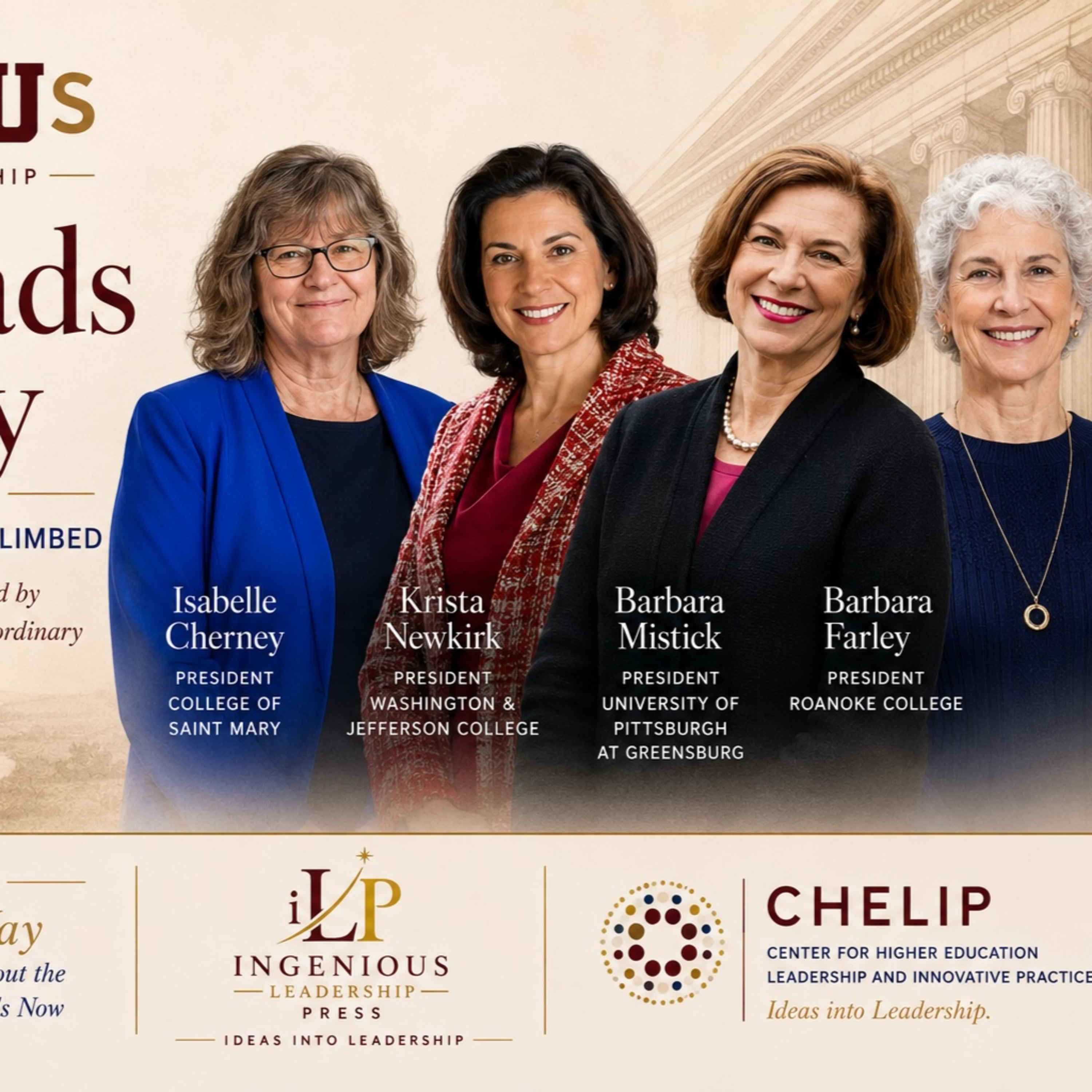
Decide, Not Delay | She Leads the Way, Essay Five
Sep 30, 2026
18m 57s
With, Not Over | She Leads the Way — Essay Four
Sep 15, 2026
16m 37s
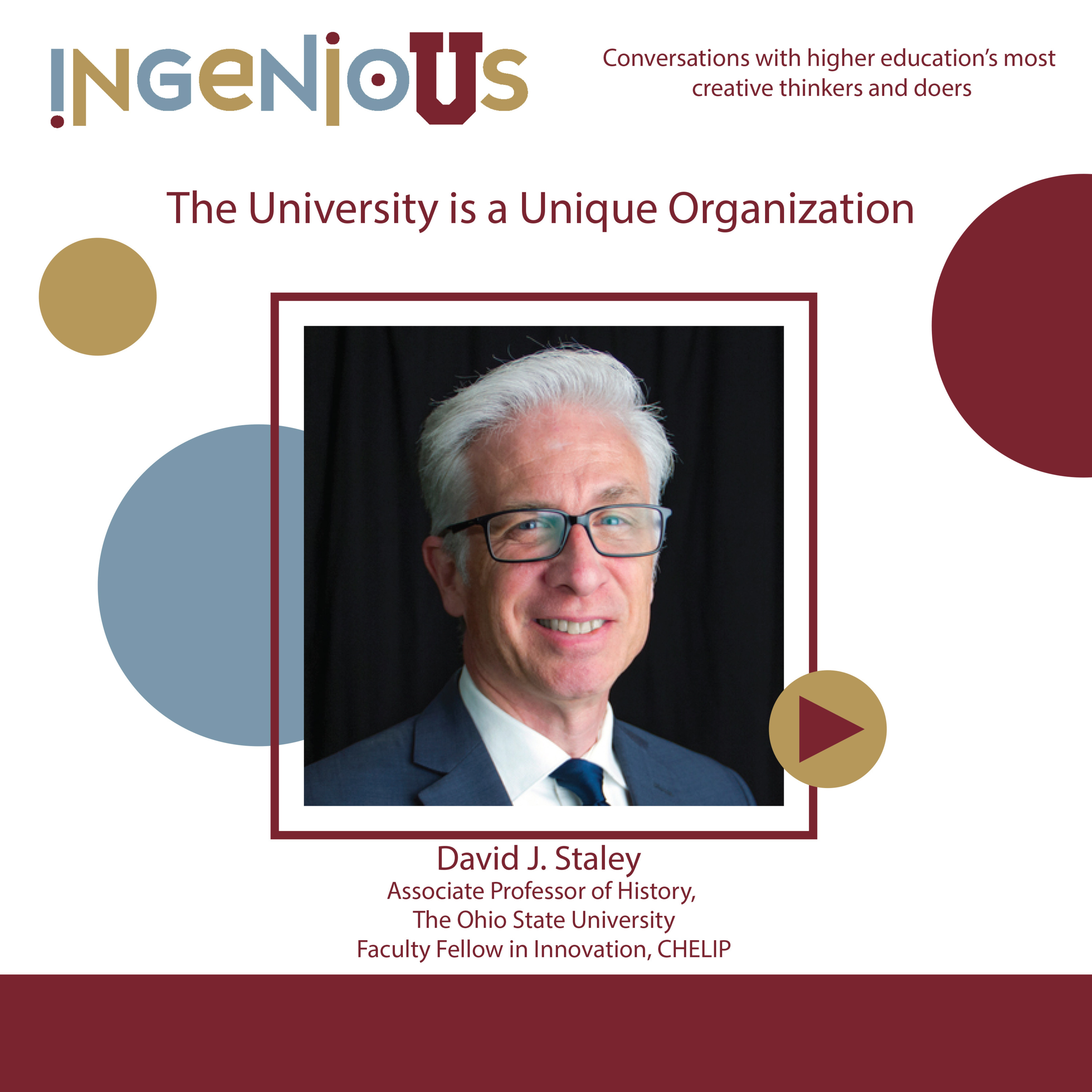
The University Is a Unique Organization | David J. Staley
Sep 1, 2026
7m 35s
She Leads the Way, Essay Three: Identity — Reclaim, Not Reinvent
Aug 25, 2026
11m 23s
Insights from recent episode analysis
Audience Interest
Podcast Focus
Publishing Consistency
Platform Reach
Insights are generated by CastFox AI using publicly available data, episode content, and proprietary models.
Most discussed topics
Brands & references
Est. Listeners
Insufficient chart data. Estimates will improve as the show charts.
- Per-Episode Audience
Est. listeners per new episode within ~30 days
N/A🎙 Daily cadence·246 episodes·Last published 1w ago - Monthly Reach
Unique listeners across all episodes (30 days)
N/A - Active Followers
Loyal subscribers who consistently listen
N/A
Market Insights
Platform Distribution
Reach across major podcast platforms, updated hourly
Total Followers
—
Total Plays
—
Total Reviews
—
* Data sourced directly from platform APIs and aggregated hourly across all major podcast directories.
Social Links & Contact
Official channels & resources
Official Website
Login
RSS Feed
Login
| Date | Episode | Topics | Guests | Brands | Places | Keywords | Sponsor | Length | |
|---|---|---|---|---|---|---|---|---|---|
| 10/6/26 | 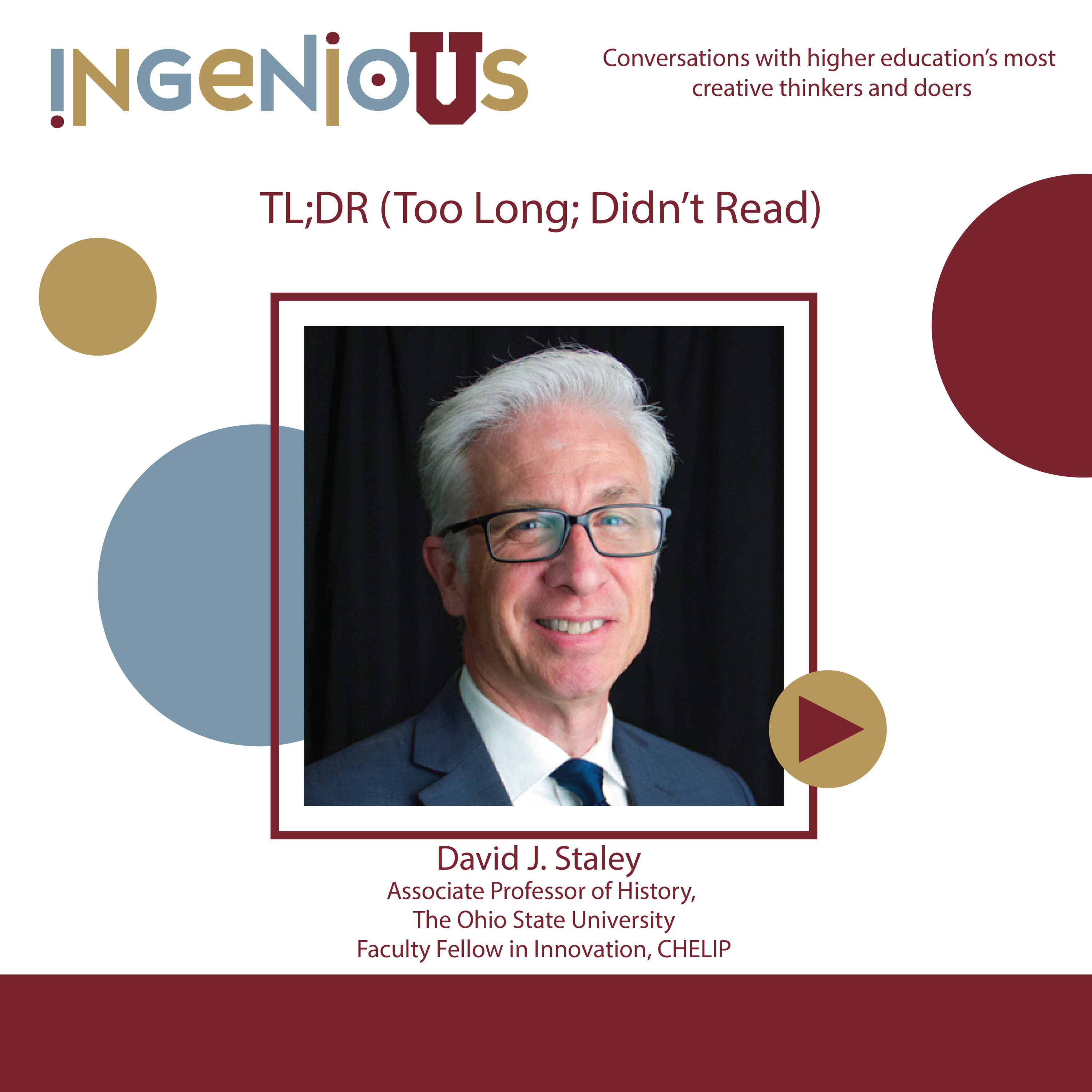 TL;DR (Too Long; Didn’t Read): Does Reading Matter Anymore? David Staley | University Design | What happens to the university if students stop reading?In this installment of University Design, David Staley considers a possibility that would have seemed almost unthinkable not long ago: that we may be entering a post-literate age—not because people cannot read, but because fewer are choosing to engage deeply with long and complex texts.David traces what declining reading stamina could mean for higher education, particularly for the humanities and for one of the university’s most enduring forms of learning: the seminar. But rather than simply lamenting what may be disappearing, he asks a more provocative question: What might come next?Could listening become as important as reading? Could the seminar evolve into a place where students develop not only literacy but oracy—the ability to listen carefully, think critically, and communicate ideas through the spoken word? Could podcasts, oral dialogue, and even disputation become increasingly legitimate forms of learning and scholarship? And there is an intriguing irony in encountering this essay as audio. David asks whether listening to a book “counts” as reading—and whether the distinction may eventually cease to matter. Listen as David explores what a post-literate university might look like—and whether the future of higher education could, in some unexpected ways, bring us back to Socrates. University Design is a regular series from the Center for Higher Education Leadership and Innovative Practice (CHELIP) exploring provocative ideas about how colleges and universities might be reimagined for the future.Read the full essay: https://ingeniousleadership.org/Learn more about CHELIP: https://www.baypath.edu/academics/centers-of-excellence/center-for-higher-education-leadership-and-innovative-practice/TL;DR (Too Long; Didn’t Read): Does Reading Matter Anymore? | 14m 26s | ||||||
| 9/30/26 | 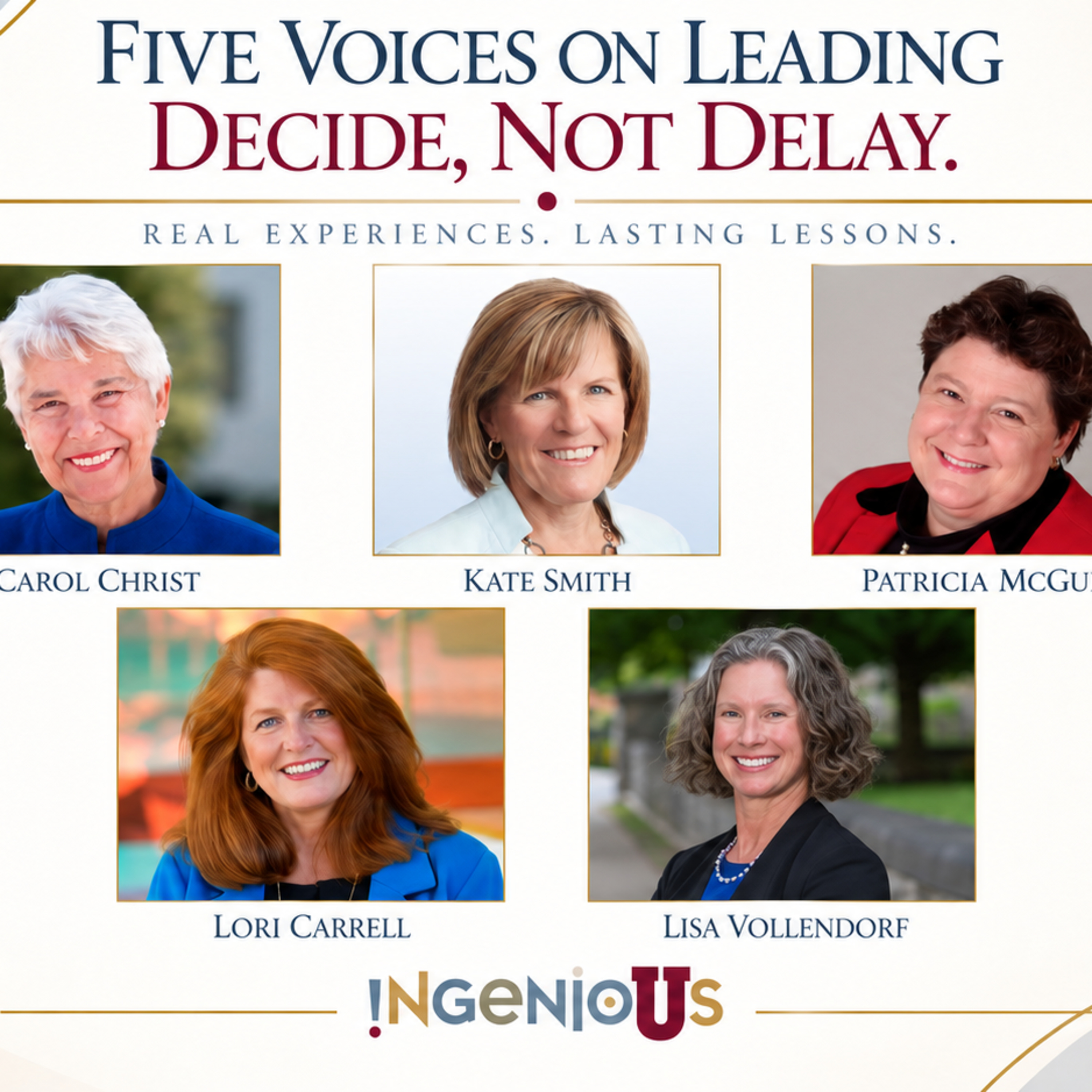 Decide, Not Delay | She Leads the Way, Essay Five | What does courage look like when there is no guarantee that a decision will work?In this fifth video essay from She Leads the Way: What Women Leaders Teach Us About the Leadership Higher Education Needs Now, Melissa Morriss-Olson draws from conversations with five women leaders who made consequential choices without the comfort of certainty.Kate Smith recalls the night she stood alone after speaking up at a campus forum. Carol Christ describes moving forward with plans to build student housing on People’s Park at Berkeley despite intense opposition. Pat McGuire reflects on opening Trinity Washington University to students from the city’spublic schools, even as critics accused her of abandoning the institution’s mission.Lisa Vollendorf shares what she learned while leading through devastating wildfires at Sonoma State University. Lori Carrell remembers leaving a safe and familiar teaching position, buying a truck, and driving the Alcan Highway alone toward an uncertain future.Their decisions were different, but they shared the same leadership discipline: moving before certainty arrived and accepting responsibility for what followed.At a time when higher education’s old playbooks no longer provide reliable answers, waiting can feel prudent. But delay is also a decision, and sometimes it is the more dangerous one.Read the full essay, “Decide, Not Delay”:https://ingeniousleadership.org/Hear the full conversations:Kate SmithCarol ChristPatricia McGuireLisa VollendorfLori CarrellAs Melissa concludes:“Courage in higher education right now rarely looks like certainty. The old maps for a lot of these calls don’t exist anymore, and waiting for one to appear is its own kind of choice, usually the wrong one.”Decide, not delay.She Leads the Way: What Women Leaders Teach Us About the Leadership Higher Education Needs Now is coming soon from IngenioUs Leadership Press and will be available on Amazon.About the seriesShe Leads the Way brings together ideas and voices from Melissa’s conversations with more than thirty women presidents and senior leaders featured on the IngenioUs podcast. Each essay asks what their experiences can teach us about the leadership higher education needs now. | 18m 57s | ||||||
| 9/15/26 | 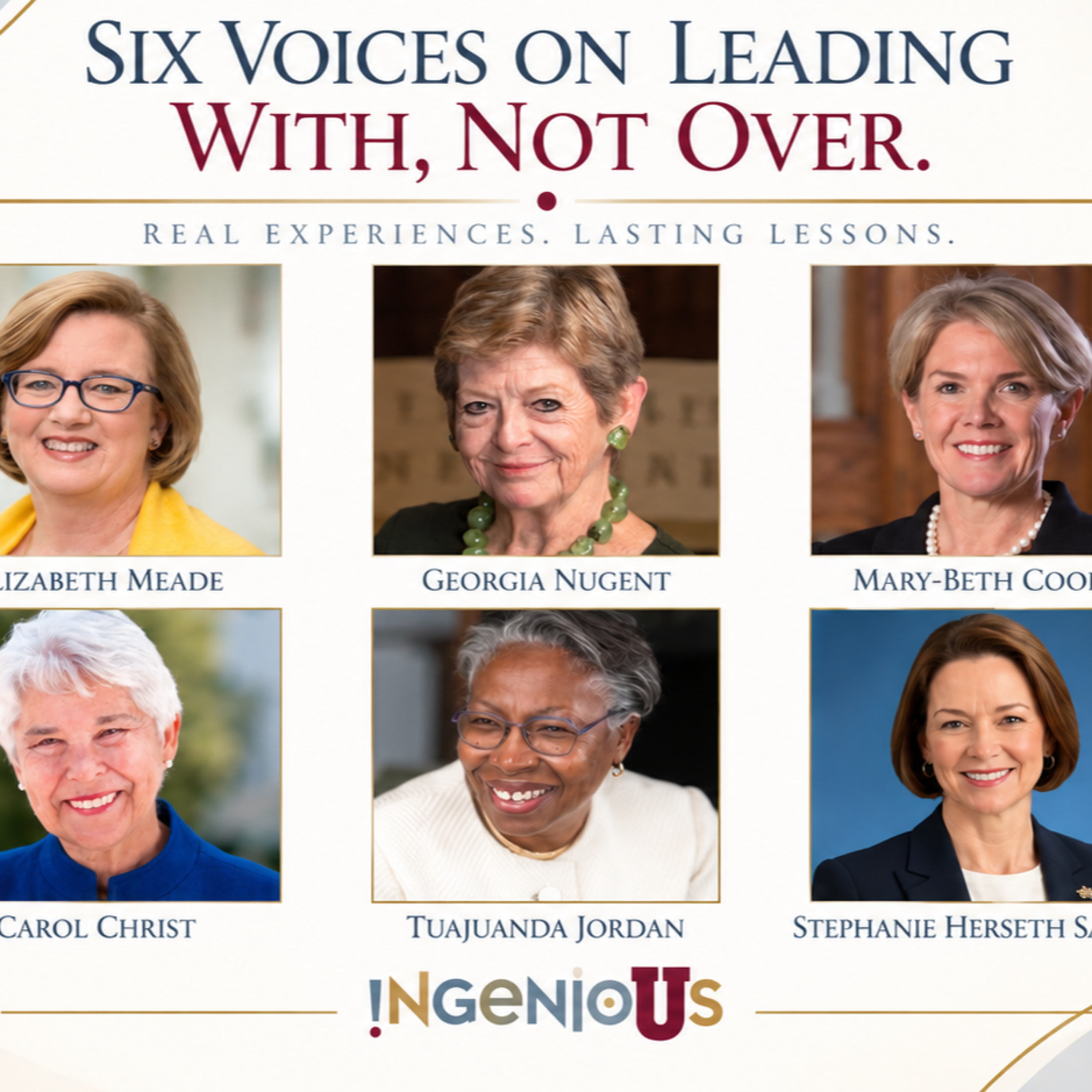 With, Not Over | She Leads the Way — Essay Four | What if some of the most consequential work of leadership happens before the leader decides?In this fourth video essay from She Leads the Way: What Women Leaders Teach Us About the Leadership Higher Education Needs Now, Melissa Morriss-Olson explores a pattern that emerged repeatedly in her conversationswith women presidents and senior leaders: leadership practiced not over people, but with them.Through the voices of Stephanie Herseth Sandlin, Carol Christ,Tuajuanda Jordan, Mary-Beth Cooper, Georgia Nugent, and Elizabeth Meade, this essay examines what relational leadership looks like in practice—from resisting the pressure to arrive with all the answers and listening before declaring a vision, to speaking last, putting the institution ahead ofindividual divisions, giving away credit, taking responsibility, and making inclusive decisions without confusing inclusion with consensus. Their approaches are different, but together they point toward the same leadership discipline: build the relationships and trust that allow people to do hard things together.In a moment when higher education is navigating extraordinary fracture and change, that work cannot wait until a crisis arrives. Trust has to be built beforehand. As Melissa concludes:Leadership isn’t something you do to people. It is something you build with them, slowly and deliberately, long before you discover how much you are going to need it.With, not over. She Leads the Way: What Women Leaders Teach Us About the Leadership Higher Education Needs Now is coming soon from IngenioUs Leadership Press and will be availableon Amazon.Aboutthe series: Essays on Leadership from the IngenioUsPodcast brings together ideas and voices from conversations with highereducation’s most thoughtful leaders—and asks what their experiences can teachus about leading through the challenges ahead. | 16m 37s | ||||||
| 9/1/26 | university leadershiporganizational structure+3 | David J. Staley | Center for Higher Education Leadership and Innovative PracticeUniversity Design | — | universitybusiness+5 | — | 7m 35s | ||
| 8/25/26 | leadershipidentity+3 | Pam EddingerElsa Núñez+3 | IngenioUsIdentity: Reclaim, Not Reinvent | — | leadershipidentity+3 | — | 11m 23s | ||
| 8/11/26 | leadershipwomen in leadership+3 | — | — | — | leadership lessonswomen presidents+3 | — | 4m 45s | ||
| 6/30/26 | leadershipmentorship+4 | Dr. Laurel Bongiorno | Hartwick College | — | leadershipmentorship+5 | — | 40m 25s | ||
| 6/23/26 | leadershipceramics+4 | — | IngenioUsIngenioUs Reflections: What Clay Has Taught Me About Leadership | — | leadershipceramics+5 | — | 2m 32s | ||
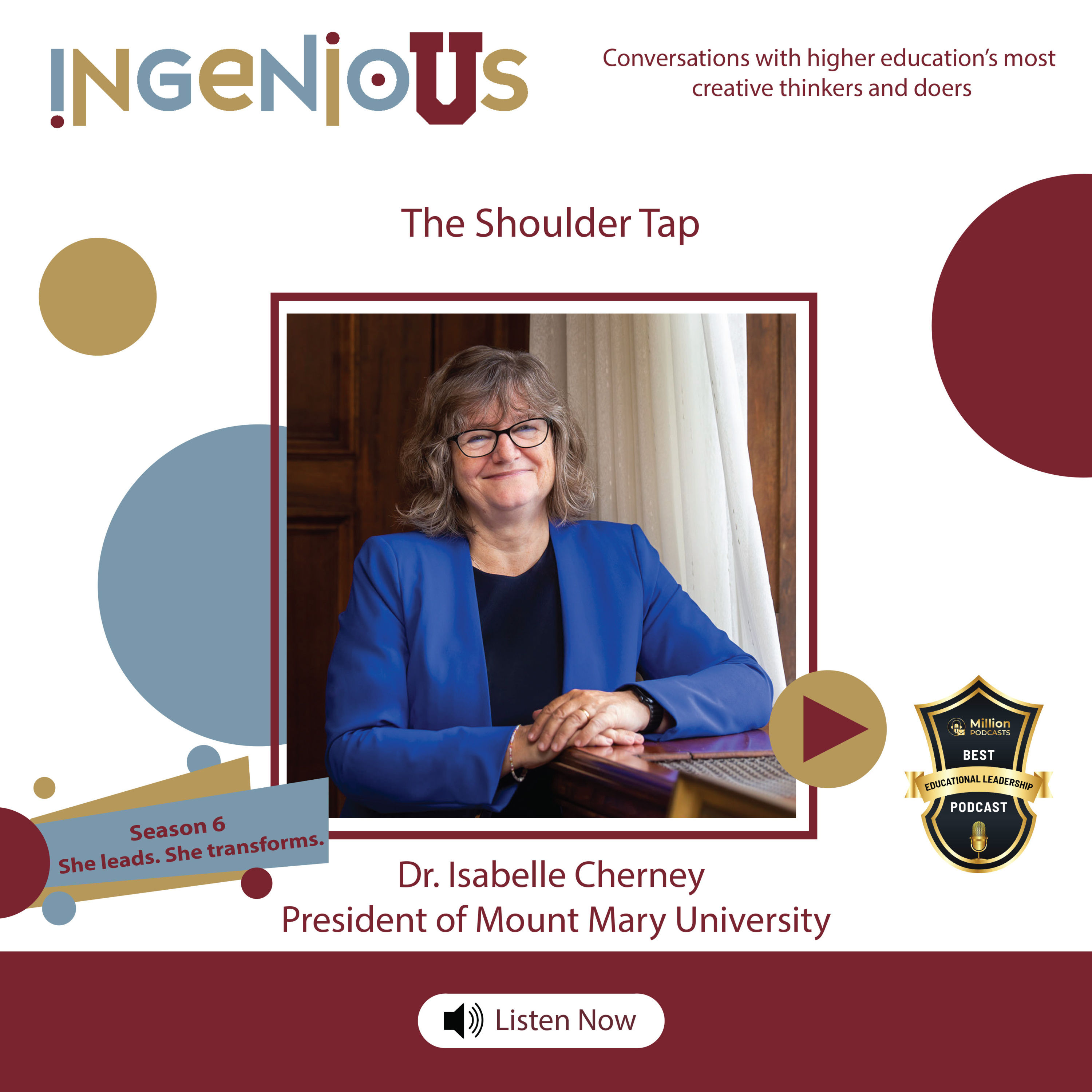
| 6/16/26 | leadershiphuman potential+3 | Dr. Isabelle Cherney | Mount Mary University | Milwaukee, WisconsinSwitzerland | leadershiphuman potential+3 | — | 51m 06s | ||
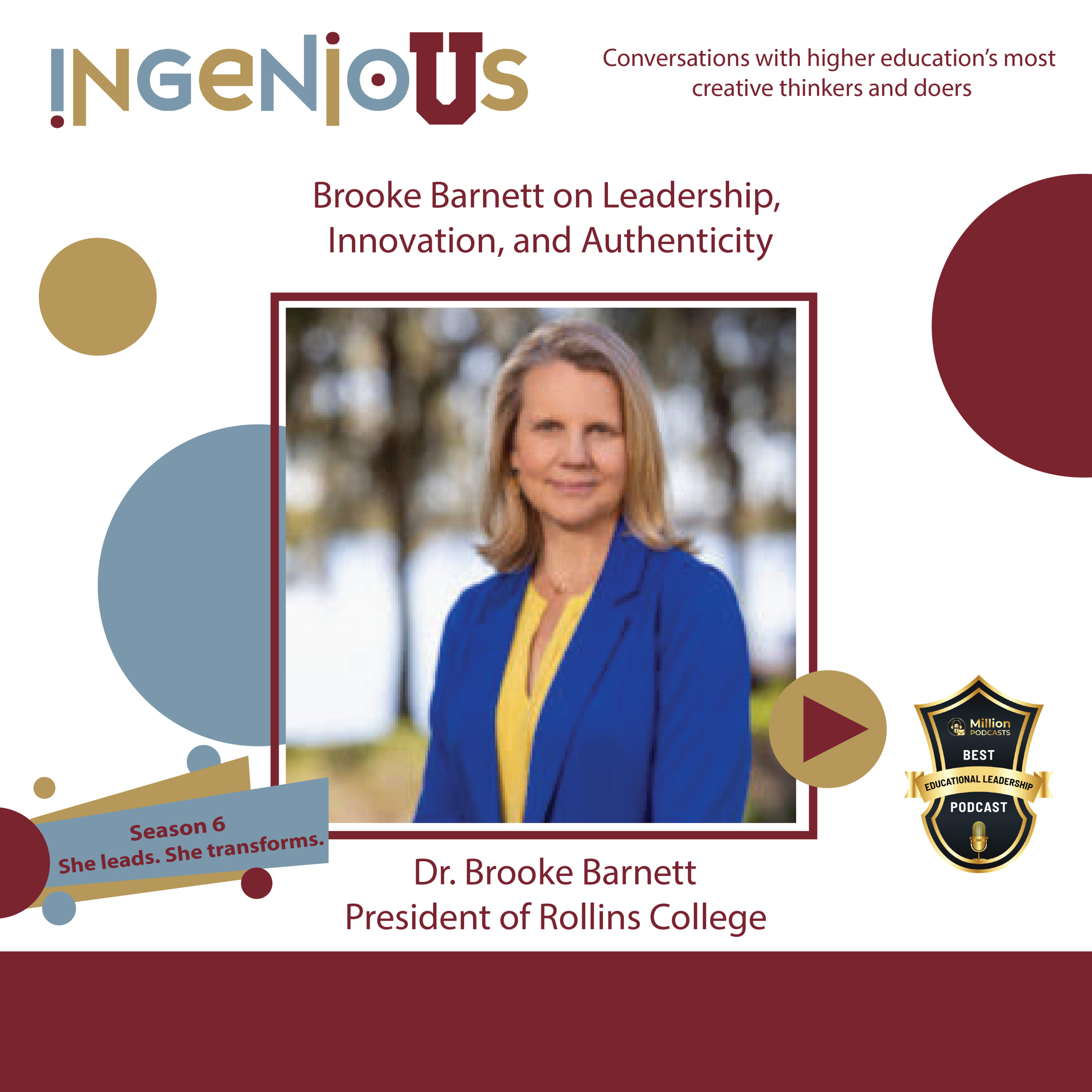
| 6/2/26 | authentic leadershipinnovation in higher education+5 | Dr. Brooke Barnett | Rollins College | Kentucky | leadershiphigher education+6 | — | 46m 12s | ||
Want analysis for the episodes below?Free for Pro Submit a request, we'll have your selected episodes analyzed within an hour. Free, at no cost to you, for Pro users. | |||||||||
| 5/19/26 | leadershipdecision making+3 | — | IngenioUsThe Loneliness of Seeing It Clearly Before Others Do | — | leadershipclarity+3 | — | 1m 47s | ||
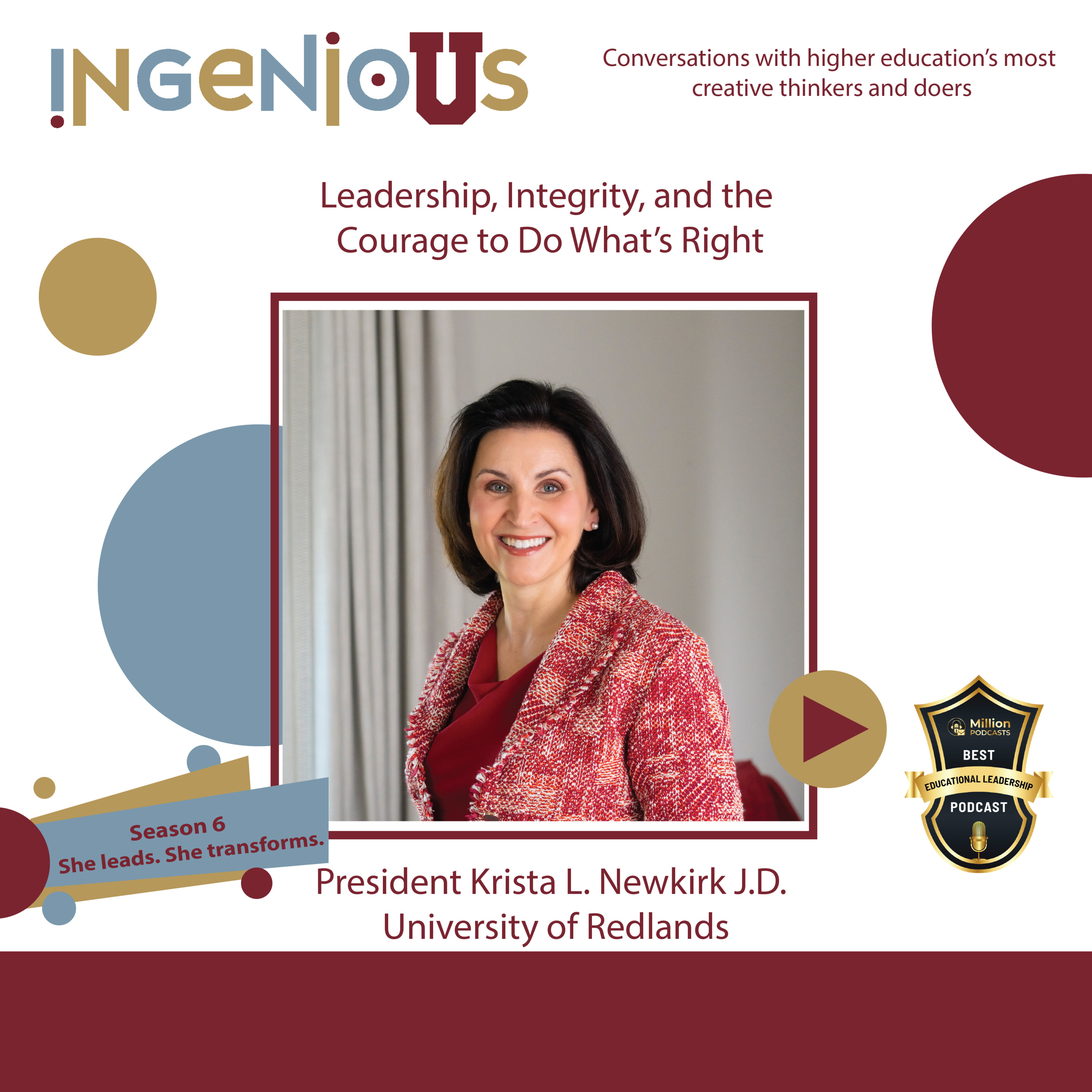
| 5/12/26 | leadershiphigher education+4 | Krista L. Newkirk J.D. | University of Redlands | Missouri | leadershiplistening+5 | — | 49m 31s | ||
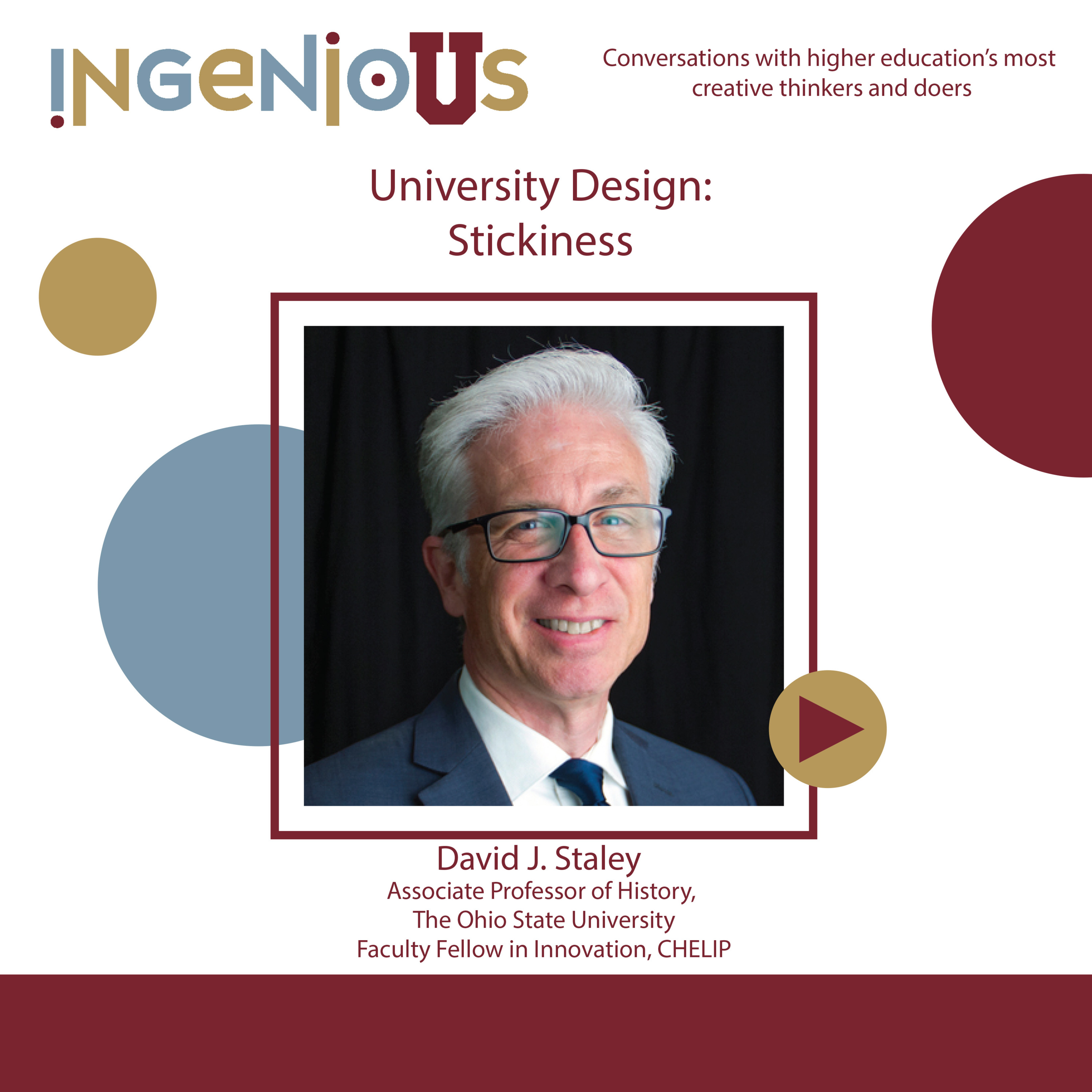
| 5/8/26 | higher educationstudent retention+3 | David J. Staley | Ohio State | ColumbusMidwestern | stickinesshigher education+4 | — | 7m 28s | ||
| 4/21/26 | 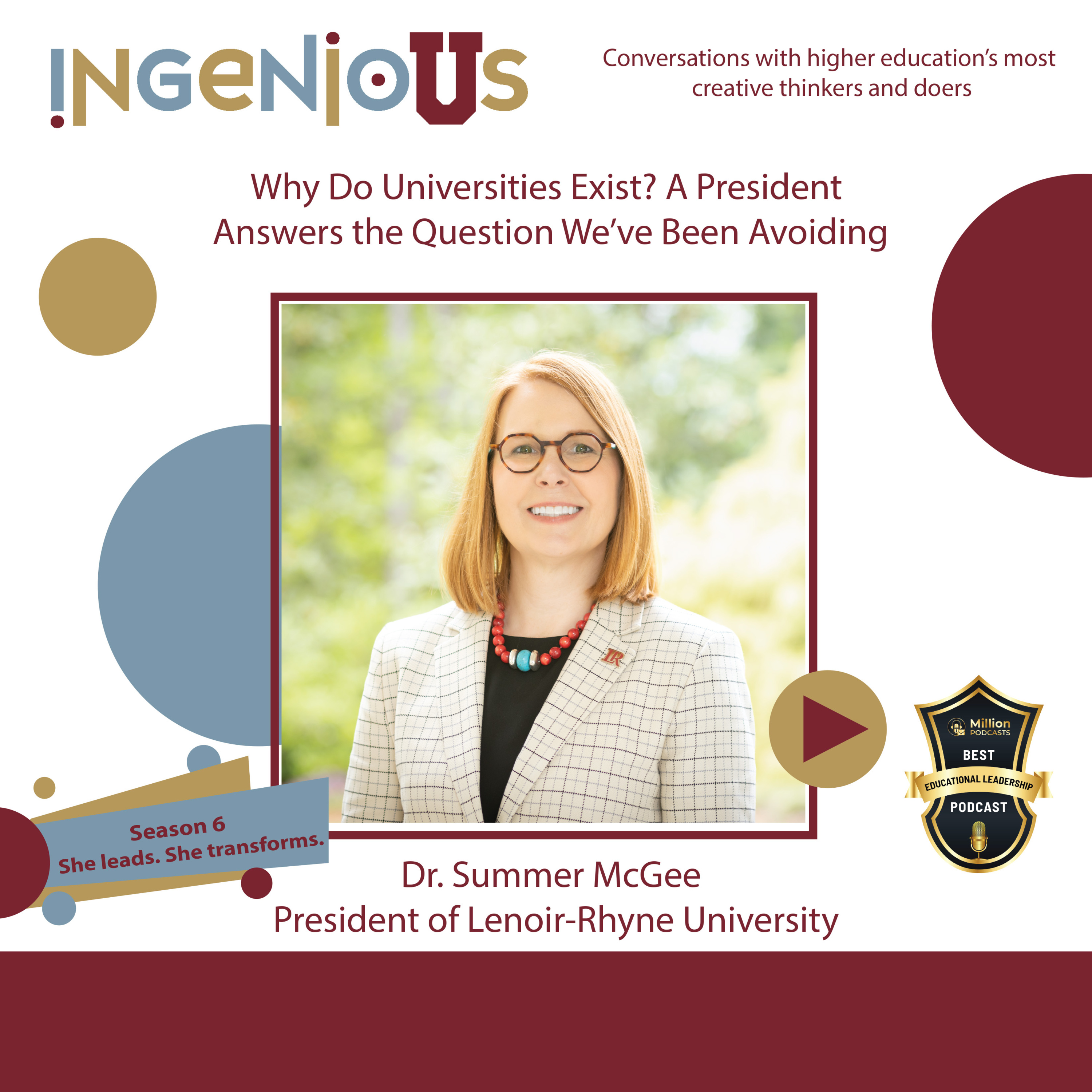 The Builder President: How Summer McGee Is Reimagining Higher Education with Vision, Data, and Heart | In a time when higher education is facing profound questions about its value, purpose, and future, what does it take to lead with both clarity and conviction?In this episode of IngenioUs, I sit down with Dr. Summer McGee,president of Lenoir-Rhyne University—a dynamic and forward-thinking leader whose career has been defined by building: building programs, building strategy, and building institutions that grow and thrive.From her earliest days as a faculty member launching a new academic program to her leadership today as a two-time college president, Summer has consistently approached leadership with a builder’s mindset. In our conversation, she shares what she has learned across her leadership journey and how she is navigating one of the most complex moments in higher education.We explore:Why higher education leaders must once again articulate the value of a college degree The critical question every institution must answer: Why do we exist—and what do we do better than anyone else? What she learned from leading a major institutional turnaround at Salem Academy and College The invisible work of the presidency—and how she manages the weight of leadership How authenticity, relationships, and joy (including competitive pinball!) shape her leadership style Why data-driven decision making and storytelling go hand-in-hand What women need to know before stepping into senior leadership roles Throughout the conversation, Summer offers a powerful reminder that leadership is both deeply strategic and deeply human—and that the future of higher education will be shaped by those who can do both well.About the GuestDr. Summer McGee is the president of Lenoir-Rhyne University. A two-time college president and former founding dean, she is known for her expertise in academic innovation, enrollment growth, and institutional transformation. Her leadership is grounded in a commitment to student success, strategic clarity,and building organizations that are positioned to thrive in a rapidly changing higher education landscape.Key TakeawaysGreat leadership in higher education requiresbalancing heart and strategy Institutions must clearly define and communicate their distinctive value Transformation is possible—even in resource-constrained environments—when vision and alignment are strongAuthenticity and vulnerability are strengths, not liabilities, in leadership Sustainable leadership depends on support systems, boundaries, and moments of joy Connect & Learn MoreFollow IngenioUs for more conversations with innovative leaders shaping the future of higher education. | 46m 00s | ||||||
| 4/14/26 | What Leaders Know—but Cannot Fully Say. Melissa Morriss-Olson | In this episode of IngenioUs, Melissa Morriss-Olson explores a dimension of leadership that doesn’t often get named—but is deeply felt by those in leadership roles.We talk a lot about transparency in leadership. We encourage it. We expect it. And in many cases, we equate it with effective leadership.But what happens when leaders can’t fully share what they know?Drawing from recent conversations with college and university presidents, Melissa reflects on a different kind of tension—one that sits at the intersection of responsibility, judgment, and trust.This is not about what leaders avoid saying.It’s about what they cannot fully say—even when they want to.In this episode, Melissa explores:Why transparency in leadership is more complex than we often acknowledgeThe real constraints leaders navigate—legal, ethical, and humanThe emotional weight of holding information that cannot yet be sharedAnd what it means to lead with integrity when full disclosure isn’t possibleThis conversation is grounded in real leadership stories and reflects a broader pattern Melissa is seeing across higher education today.Leadership is not simply about being transparent—it’s about exercising judgmentThere are moments when responsible leadership requires restraint, not disclosureTrust is built not through constant information-sharing, but through consistency and integrity over timeSome of the most important dimensions of leadership are the least visibleShe expands on these ideas in more depth in her latest blog:👉 What Leaders Know—but Cannot Fully SayAs you think about your own leadership:How do you navigate the tension between being transparent and being responsible?If this resonates with you, we'd love to hear your thoughts.Feel free to connect or share your perspective.IngenioUs explores leadership in higher education through candid conversations with presidents and changemakers who are navigating complexity, driving innovation, and leading with purpose. | 1m 24s | ||||||
| 4/9/26 |  Educable: Rethinking Intelligence, Education, and the Future of Learning. David Staley | In this episode, David J. Staley reads from his latest University Design blog entry, Educable, where he explores a provocative new concept drawn from Leslie Valiant’s recent work: that what truly distinguishes humans is not intelligence—but educability.What if education is not simply about acquiring knowledge or skills, but about undergoing a fundamental “state change”—a transformation in how we think, act, and understand the world? And what if this idea reshaped how we assess learning, design degrees, and even imagine the future of artificial intelligence?Staley challenges us to reconsider long-standing assumptions about education versus training, the purpose of higher education, and what it really means to be “educated” in a rapidly evolving world.Key Ideas ExploredEducability vs. Intelligence: A new framework for understanding human uniquenessEducation as “State Change”: Learning as deep cognitive transformation, not just information transferRethinking Assessment: What if grades reflected the degree of transformation rather than performance?Education vs. Training: Why education prepares us for the unforeseenArtificial Educability: A bold vision for the future of AI beyond current modelsThe Future of Teaching: Imagining new methods for educating both humans and machinesWhy This MattersAt a time when higher education is under pressure to demonstrate value and relevance, this episode invites us to think more expansively. If education is truly about transformation—about changing who we are—then our current systems of grading, credentialing, and ranking may be missing the point.Staley’s reflections open the door to a more ambitious vision of higher education—one centered on human development, adaptability, and lifelong learning.📖 Read the Full Blog👉 Educable by David J. Staley🎙️ About the AuthorDavid J. Staley is a higher education philosopher, strategist, futurist, and designer. He serves as an Honorary Faculty Fellow in Innovation at CHELIP and is the author of Alternative Universities, The AI Symposium, and other works exploring the future of higher education and knowledge systems.🔗 About the SeriesThis episode is part of the University Design series, published under the IngenioUs blog label, which explores bold, forward-thinking ideas about the future of higher education. | 8m 28s | ||||||
| 4/7/26 |  “What Are You Going to Do About It?”: Grandview U President Rachelle Keck on Agency, Leadership, and the Power of Possibility | In this episode of IngenioUs, Melissa Morriss-Olson speaks with Rachelle Keck PhD, JD, president of Grandview University, about leadership, agency, and the evolving future of higher education.Rachelle’s path to the university presidency is far from traditional. After more than two decades practicing law, she transitioned into higher education leadership and eventually became the president of Grandview University in Des Moines, Iowa. In this conversation, she shares how her experiences as a first-generation college student, a woman leader inhigher education, and one of nine siblings growing up in rural Missouri shaped her leadership philosophy.Rachelle discusses the leadership lessons she learned moving from law into higher education administration, the realities of leading a university today, and how institutions can prepare students for a rapidly changing workforce.She also shares the four pillars that guide her leadership every day: love, logic, listening, and learning—a framework that blends analytical decision-making with empathy and collaboration.Throughout the conversation, one powerful question keeps resurfacing—one that Rachelle first heard as a child and now shares with students and emerging leaders:What are you going to do about it?This episode will resonate with anyone interested in women’s leadership, university leadership, higher education innovation, and the future of college leadership.Topics Discussed in This EpisodeLeadership lessons from growing up in a family of nineNavigating college as a first-generation studentTransitioning from a career in law to higher education leadershipWhat it really means to serve as a college president todayShared governance and collaborative leadership in universitiesLeading institutions during times of uncertainty and changeThe importance of representation and women presidents in higher educationPreparing students for a future shaped by technological changeThe framework that guides Rachelle's leadership: Love, Logic, Listening, and LearningAbout the GuestRachelle Keck is president of Grandview University, a private university in Des Moines, Iowa. Before entering higher education leadership, she spent more than twenty years practicing law. Her leadership focuses on student opportunity,institutional sustainability, and preparing graduates for meaningful careers and lives of purpose.About the PodcastIngenioUs is a higher education leadership podcast hosted by Melissa Morriss-Olson, Distinguished Professor of Higher Education Leadership at Bay Path University and author of IngenioUs Leadership: Creating Solutions to Wicked Problems in Higher Education.Each episode features conversations with innovative leaders who are shaping the future of higher education. | 47m 19s | ||||||
| 3/24/26 |  The Power of Place: Carol Quillen on Leadership, History, and Reconnecting Communities | In this episode of the IngenioUs Leadership Podcast, Melissa Morriss-Olson sits down with historian and higher education leader Carol Quillen, former president of Davidson College and now President and CEO of the National Trust for Historic Preservation.Carol brings a historian’s lens to leadership—one grounded in humility, courage, and a deep respect for the power of community and place. Over the course of the conversation, she reflects on her leadership journey from growingup in a small historic town in Delaware to leading one of the nation’s most respected liberal arts colleges.Carol shares insights about what leadership really means, why she believes it is fundamentally about helping communities create the conditions for change, and what she learned about guiding an institution through moments of uncertainty, including the challenges of the COVID-19 pandemic.The conversation also explores her current work with the National Trust for Historic Preservation, where she is thinking deeply about how historic places can help Americans reconnect with the complexity of their shared history. At a time when public conversations often feel abstract and polarized, Carol argues that standing in the places where history actuallyhappened can open the door to more thoughtful dialogue and renewed civic understanding.This episode is a thoughtful reflection on leadership, community, and the enduring importance of place in shaping how we understand ourselves and one another.Key Themes from the ConversationLeadership as Context BuildingCarol describes leadership not as a title or position but as the work of helping a community create the conditions it needs to live up to its highest aspirations.Courage and Humility in LeadershipTwo qualities she believes are essential for leaders navigating complexity and uncertainty.Listening and Trust BuildingHow leaders create environments where people can speak honestly, disagree respectfully, and work together toward shared goals.Leading Through CrisisReflections on guiding Davidson College through the COVID-19 pandemic and the importance of transparency when decisions must be made with incomplete information.The Power of Institutional CultureWhy understanding the history and identity of an organization is critical when leading change.The Power of Place in Civic LifeHow historic sites—from Gettysburg to Monticello to immigrant tenements—help us confront the complexity of American history and foster deeper conversations about our shared future.Advice for Emerging LeadersCarol encourages young leaders to focus less on career planning and more on doing the work that is right in front of them.About Carol QuillenCarol Quillen is President and CEO of the National Trust for Historic Preservation and the former president of Davidson College, where she served for eleven years.A historian by training, Carol previously spent many years on the faculty at Rice University and held several administrative leadership roles there. She is widely respected for her thoughtful approach to leadership, institutional change, and civic engagement.Her current work focuses on the role historic places can play in strengthening communities and fostering dialogue about the nation’s shared past and future.About the IngenioUs Leadership PodcastThe IngenioUs Leadership Podcast explores how leaders createsolutions to complex challenges in higher education and beyond. Through conversations with innovative and thoughtful leaders, the podcast highlights ideas, experiences, and perspectives that help listeners think differently aboutleadership today. | 52m 45s | ||||||
| 3/17/26 | What If Innovation Doesn’t Begin with the Idea? Leadership Insights with Dr. Melissa Morriss-Olson | Where does innovation really begin? After interviewingdozens of college presidents, one surprising leadership habit kept appearing: listening.When we talk about innovation in higher education, theconversation often centers on bold ideas, new programs, or visionary strategies. But insights from leaders across the field suggest that meaningful innovation often begins somewhere much quieter.It begins with listening.Through the IngenioUs podcast, Dr. Melissa Morriss-Olson has spoken with dozens of college and university presidents about leading change in complex institutions. One lessonconsistently emerges from those conversations: before introducing new initiatives, successful leaders take time to understand the people and contexts they serve. They listen to faculty, staff, and students, learning how their institutions really work and what challenges people are experiencing.Why does this matter? Because when leaders move tooquickly to solutions, they sometimes end up solving the wrong problem.Listening helps uncover the deeper issues—and the real opportunities for meaningful change.In Dr. Morriss-Olson’s newest blog article, “TheFirst Leadership Habit of Innovation,” she explores this ideaand shares insights drawn from these leadership conversations. You can watch the video and read the full article here: Higher Education Leadership | Innovation | ChangeLeadership | Academic Leadership | Organizational Change | 1m 47s | ||||||
| 3/6/26 | 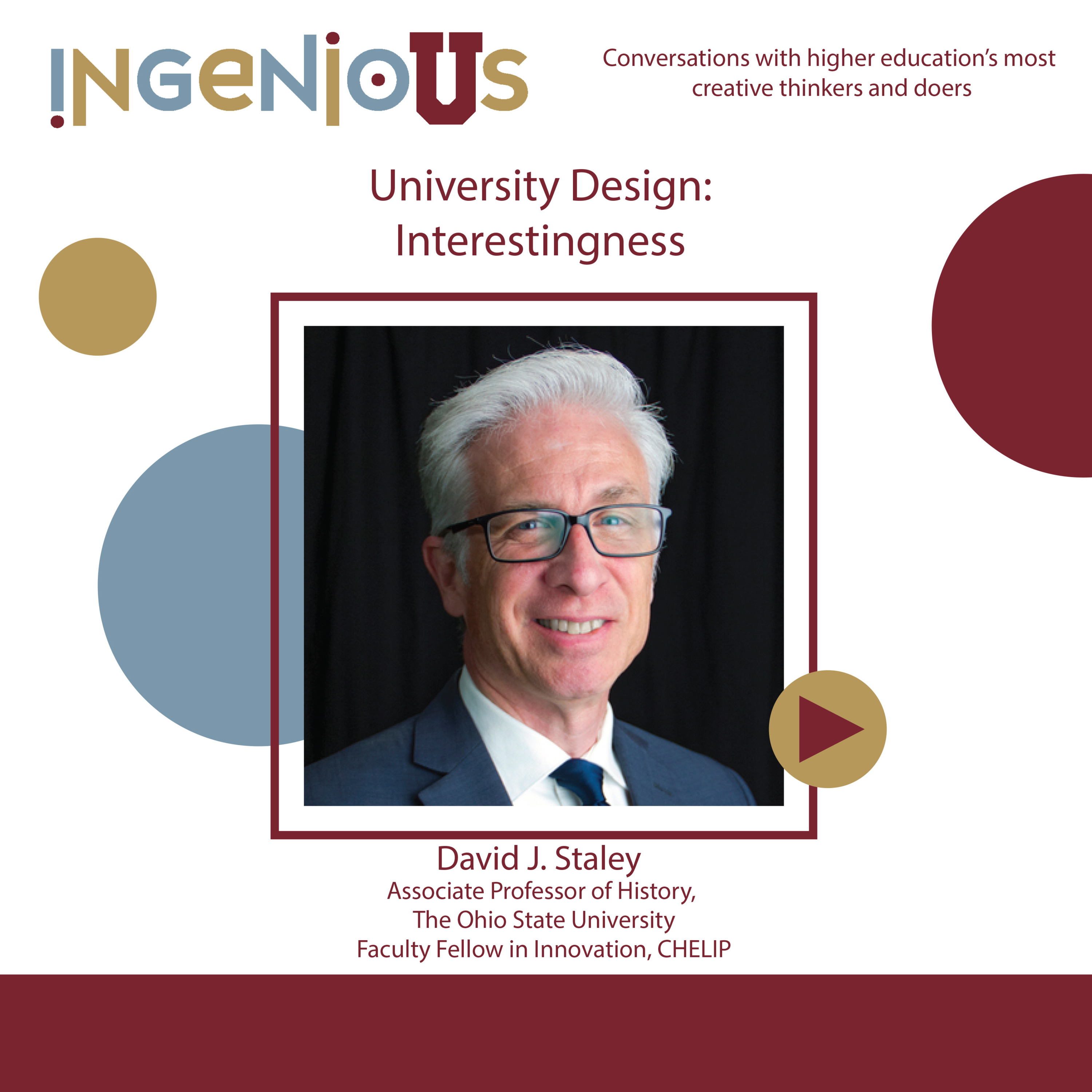 University Design: “Interestingness” with David J. Staley | In this episode, David J. Staley reads his latest CHELIP: University Design column, “Interestingness,” inspired by Kenneth O. Stanley and Joel Lehman’s Why Greatness Cannot Be Planned: The Myth of the Objective.What if the pursuit of clearly defined objectives is actually the enemy of breakthrough innovation?Drawing on the intellectual journey of urban theorist Jane Jacobs, insights from computer science, and examples from the history of invention, Staley challenges one of higher education’s most sacred assumptions: that learning must always be guided by predetermined goals and measurable outcomes.Instead, he explores a radical idea — that interestingness, not objectives, may be the true engine of discovery.In This EpisodeWhy Jane Jacobs’ “directionless” intellectual wandering shaped one of the most influential urban thinkers of the 20th centuryHow experiments in artificial intelligence reveal the limits of goal-driven designThe paradox of innovation: why the stepping stones to major breakthroughs rarely resemble the final outcomeThe hidden cost of learning objectives and overly structured curriculaWhy students who feel “undecided” may actually be operating from a deeper intellectual instinctThe case for reimagining Liberal Studies as a major in “interestingness”Key Ideas1. Greatness Cannot Be PlannedMany transformative discoveries — from microwave ovens to airplanes to early computers — emerged not from direct goal pursuit, but from exploratory work aimed at entirely different problems.2. The Danger of Objective ThinkingAmbitious goals can create tunnel vision. When we fixate on outcomes, we may overlook the very stepping stones that would lead us there.3. Interestingness as a CompassNovelty acts as a detector of possibility. Interesting ideas open new pathways — even when their ultimate purpose is unclear.4. Are Universities Designed for Discovery?With tightly defined learning objectives and structured degree pathways, are we unintentionally suppressing intellectual exploration?5. Not Having a Plan Can Be a Very Good PlanFor students drawn to curiosity rather than credentials, exploration may not be aimless — it may be the most innovative strategy of all.About David J. StaleyDavid J. Staley is an Associate Professor in the Departments of History, Design, and Educational Studies at The Ohio State University and serves as an Honorary Faculty Fellow in Innovation with CHELIP. His research explores digital history, historical methodology, and the intersection of technology, scholarship, and the future of higher education. A prolific author and curator of digital and physical exhibits, Dr. Staley brings a deep interdisciplinary perspective to conversations about innovation and institutional transformation. A Question for ListenersAre our institutions designed to produce graduates with objectives — or graduates with curiosity?What might change if we structured higher education around interesting questions instead of predetermined outcomes? | 11m 18s | ||||||
| 3/3/26 | 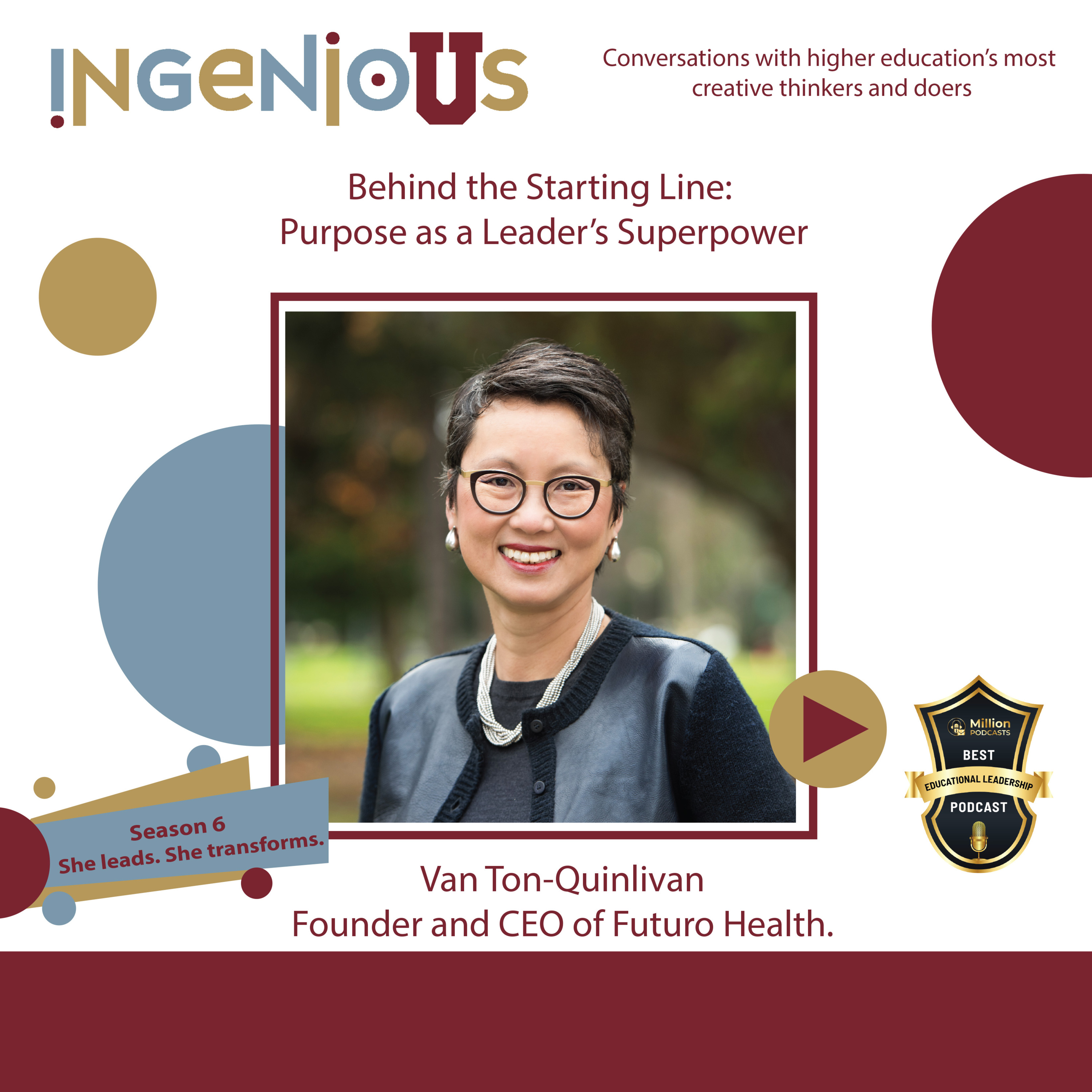 Behind the Starting Line: Purpose as a Leader’s Superpower | In this latest epsiode, Dr. Morriss-Olson is joined by Van Ton-Quinlivan, Founder and CEO of Futuro Health, for a powerful conversation about purpose-driven leadership, systems change, and what it really takes to build opportunity at scale.Van’s leadership journey began “behind the starting line” as a child refugee from Vietnam, and that lived experience continues to shape how she leads today. Over the course of her career, she has led across private industry, public higher education, and the nonprofit sector—most recently founding Futuro Health to address one of the most urgent challenges facing theU.S. healthcare system: the growing shortage of allied health workers.In our conversation, Van shares how Futuro Health was launched at the start of the pandemic and quickly grew into a national workforce ecosystem operating across multiple states. She explains why workforce development must be treated as a team sport, bringing together employers, educators, and community-based organizations to create reliable, equitable talent pipelines.We also explore Van’s leadership philosophy more deeply—how purpose unlocks courage and “fierceness,” why influence matters more than formal authority, and what she has learned about credibility, feedback, and navigating leadership spaces where women are often underrepresented. Van offers practical insights on building coalitions, listening to critics, and knowing when the window is right to push for meaningful change.As we look ahead, Van reflects on the future of work, the impact of demographic shifts and caregiving demands, and how technologies like AI are opening new possibilities to redesign education and workforce systems for today’s learners—not yesterday’s assumptions.This episode is a must-listen for leaders working at the intersection of education, workforce development, healthcare, and social impact—and for anyone seeking to lead with clarity, courage, and purpose.Check out Van's podcast, WorkforceRx here: https://futurohealth.org/current-press/press-podcast/ | 39m 44s | ||||||
| 2/10/26 | The Cost of What We Don’t Talk About in Leadership. An IngenioUs Mini with Melissa Morriss-Olson | This episode features a brief video reflection introducing a recent CHELIP blog essay by Melissa Morriss-Olson, Ph.D. that examines one of the quietest—and most consequential—forces shaping leadership culture: silence.The video frames the essay within a broader exploration of why innovation and change so often stall in higher education. Rather than focusing on a lack of ideas or commitment, it points to familiar leadership habits that make uncertainty, risk, and discomfort difficult to sustain. The reflection then turns to an even subtler dynamic—the unspoken rules leaders learn about what feels safe to say and what does not.The accompanying blog essay, The Cost of What We Don’t Talk About in Leadership, explores how silence becomes embedded in leadership culture over time. Leaders learn to read the room, soften language, and avoid naming persistent patterns in the name of professionalism or stability. While this restraint may feel responsible in the short term, the essay argues that it often comes at a cost—diminishing clarity, slowing learning, and quietly sustaining unresolved challenges .Rather than assigning blame, the reflection emphasizes clarity: what becomes possible when leaders are able to speak honestly about the realities they are navigating. The video serves as an entry point into a larger conversation about leadership culture, candor, and the conditions required for meaningful change.📖 Related blog essay: The Cost of What We Don’t Talk About in Leadership🎥 This episode accompanies a short video introducing the themes behind the essay | 1m 55s | ||||||
| 2/3/26 | 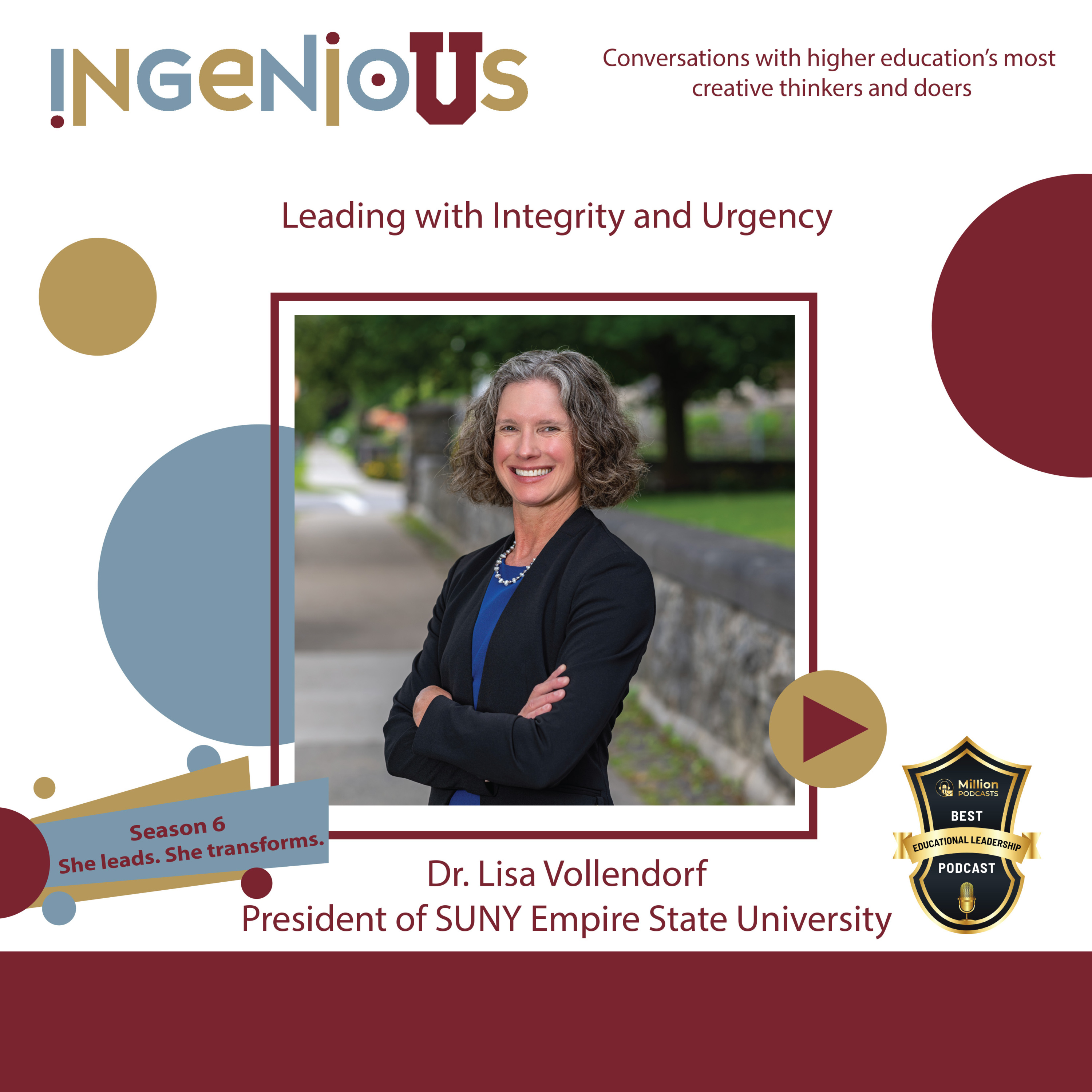 Leading with Integrity and Urgency: Dr. Lisa Vollendorf and the Promise of Public Higher Education | In this episode of IngenioUs, host Melissa Morriss-Olson is joined by Dr. Lisa Vollendorf, President of SUNY Empire State University, New York’s first and only public online university.Dr. Vollendorf shares a deeply thoughtful and values-driven conversation about leadership in higher education at a time when access, equity, and public purpose matter more than ever. Drawing on her own journey—from growing up in a small Colorado town to leading a national model for online public education—she reflects on what it means to lead with integrity, empathy, and urgency.Together, Melissa and Lisa explore how leadership is shaped by crisis, why integrity is a leader’s non-negotiable anchor, and how institutions must rethink long-standing structures that unintentionally exclude learners. Lisa also offers powerful insights on women’s leadership, ambition framed throughimpact, and why student-centered design—not institutional tradition—must guide the future of higher education.This episode will resonate with presidents, provosts, deans, faculty leaders, doctoral students, and anyone committed to reimagining higher education in service of all learners.In This Episode, You’ll Hear About:Why integrity is the one thing leaders always controlLessons from leading through large-scale crisis and community traumaThe importance of decisiveness and forward momentum in leadershipWhy ambition often looks different for women leadersRethinking online education, access, and student successThe future of public higher education as a democratizing forceAbout the GuestDr. Lisa Vollendorf is President of SUNY Empire State University, where she leads New York’s first and only public online university. Empire State University is designed to meet learners where they are, recognize prior learning, and expand access to affordable, high-quality education for studentsof all ages and life stages.About the HostMelissa Morriss-Olson is host of IngenioUs and author of IngenioUs Leadership: Creating Solutions to Wicked Problems in Higher Education. A former provost and longtime higher education leader, Melissa focuses her work on leadership, innovation, and designing institutions that unlock humanpotential.Subscribe & ConnectIf you enjoyed this episode, please follow IngenioUs, leave areview, and share it with a colleague who cares about the future of higher education. | 51m 09s | ||||||
| 1/30/26 | 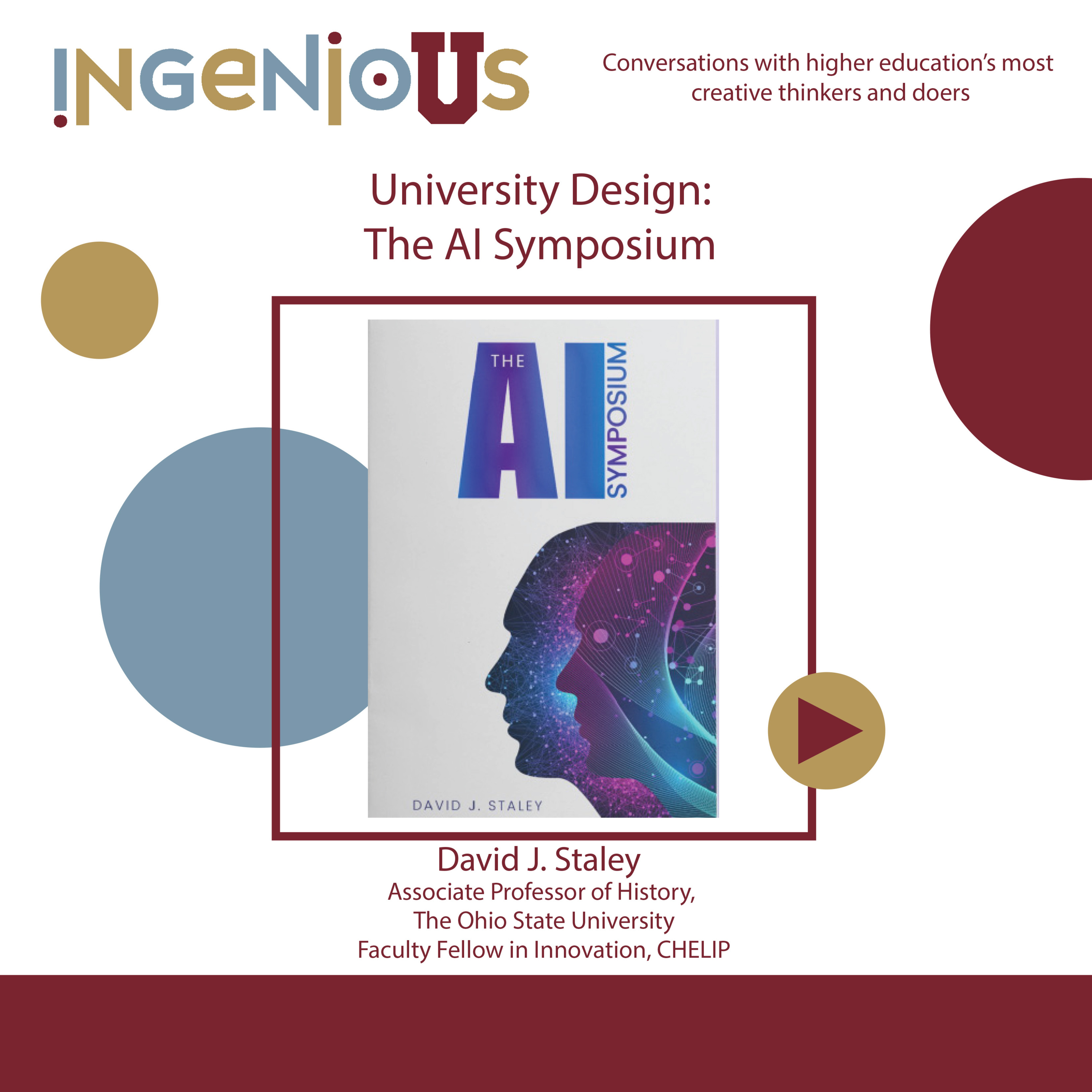 The AI Symposium. University Design by David J. Staley | In this episode of University Design, David J. Staley reflects on the ideas behind his new book, The AI Symposium (Innovation Press, 2026), using this month’s column—and its accompanying recording—as an opportunity to explore a provocative rethinking of AI, dialogue, and learning in higher education.Rather than revisiting familiar debates about banning AI or defining its “ethical use” in the classroom, Staley invites listeners to step back and ask a deeper question: if large language models were explicitly designed to generate language, what does it really mean to treat that function as a problem? And what new possibilities emerge if we stop defending against AI and instead design with it?Drawing on the work of David Graeber and Mikhail Bakhtin, this episode reframes thinking itself as dialogic—something that arises between voices rather than inside isolated minds. From this perspective, the traditional student essay begins to look less like a timeless measure of understanding and more like a historically contingent form of assessment.Staley introduces The AI Symposium as both a conceptual experiment and a pedagogical provocation. In the project, multiple large language models are prompted to engage directly with one another in sustained dialogue, with the human designer acting as a “procedural author.” The result raises unsettling and generative questions: Can AI participate in dialogue in a meaningful way? Does dialogic exchange suggest a form of synthetic understanding? And what might this mean for how we assess student learning?The episode ultimately looks forward, imagining a future in which students design and host their own AI symposia—selecting participants, framing questions, and interpreting dialogue—as a richer demonstration of understanding than the traditional essay.In this episode, you’ll explore:Why debates about “ethical AI use” often miss the pointDialogue as the foundation of human thoughtThe limitations of essay-based assessment in an AI-enabled worldThe concept of the human as “procedural author”What happens when AI systems engage one another in dialogueHow the symposium could replace the essay as a primary form of assessmentThis episode accompanies David J. Staley’s University Design column and is inspired by his new book, The AI Symposium, which expands on these ideas and their implications for education, technology, and the future of thinking itself. | 5m 07s | ||||||
| 1/20/26 | Why Innovation Fails. An IngenioUs Mini with Melissa Morriss-Olson | In this short audio reflection, Dr. Melissa Morriss-Olson shares the thinking behind her recent CHELIP essay, Why Innovation Fails: Reflections From Where I Sit.Drawing on her lived experience in senior leadership roles and her ongoing work with higher education leaders through IngenioUs, Dr. Morriss-Olson reflects on why innovation so often stalls—not because of bad ideas, but because of how institutions respond to uncertainty, risk, and discomfort. She explores the pull toward consensus-building, risk avoidance, and waiting for perfect conditions, especially in a moment when leading change feels harder than ever.This audio clip is intended as a brief companion to the full essay.👉 Read the full blog article here: We hope this reflection resonates and invites you to think differently about what leadership and innovation are asking of us right now. | 1m 06s | ||||||
Showing 25 of 246
Pitch Fit is a Pro feature
See how bookable this show is for guests, which brands already advertise, the per-episode ad value, and the best-fit guest and sponsor profile. The numbers are blurred on the free plan.
How readily this show books outside guests like you.
How proven this show is for host-read sponsorships.
For Guests
ProFor Advertisers
ProUpgrade to Pro to unlock guest cadence, sponsor categories, fit scores, and per-episode ad value for this show.