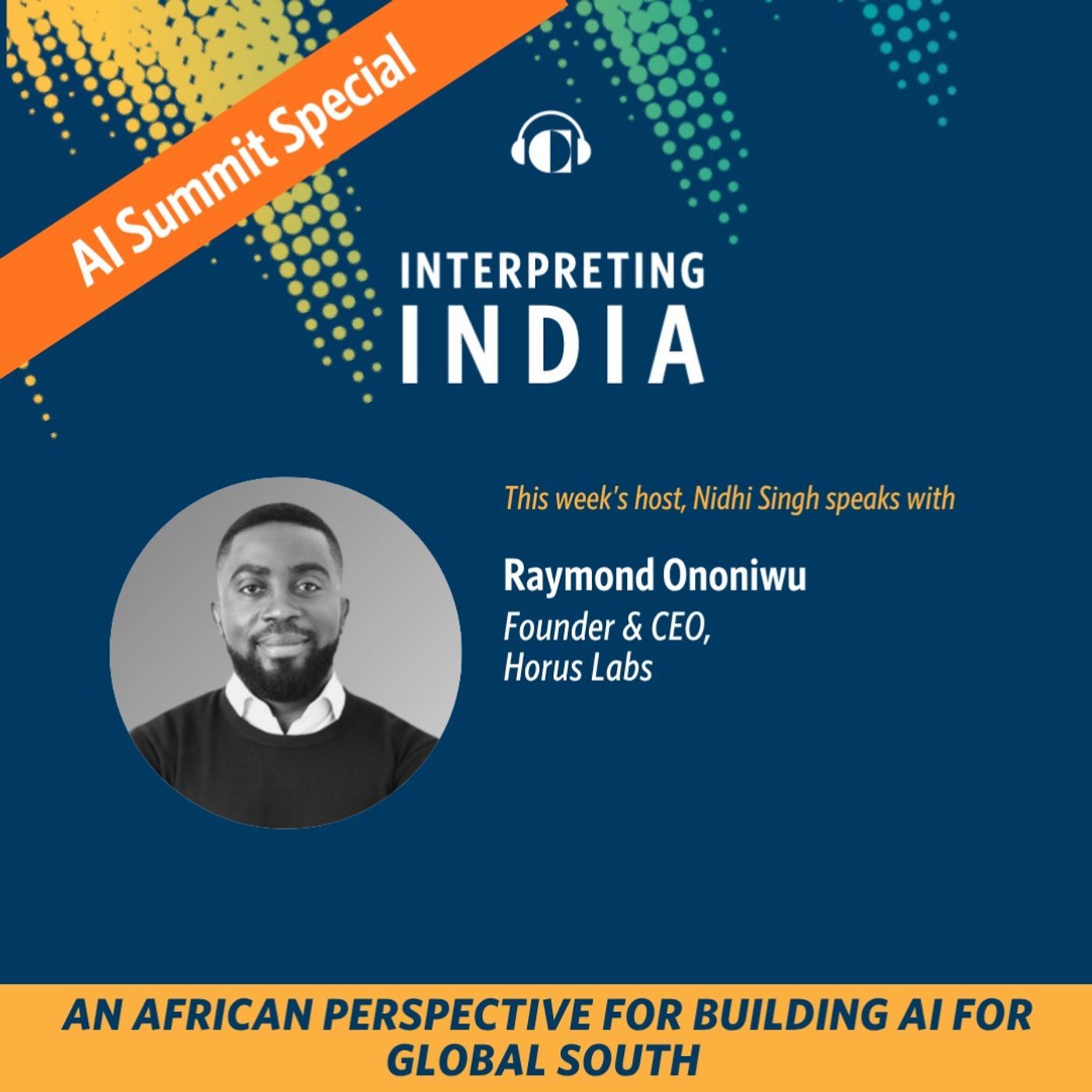
An African Perspective for Building AI for Global South | AI Summit Special
From Interpreting India by Carnegie India
April 30, 2026 · 48 min · Season 5 · Episode 41
About this episode
This episode features a discussion on AI infrastructure in Africa and the unique challenges faced in the Global South.
In this episode of Interpreting India, Nidhi Singh is joined by Raymond Ononiwu, founder and CEO of Horus Labs, for a conversation that cuts through the noise around compute, data centres, and AI infrastructure to ask a more fundamental question: who is this all actually being built for? Raymond brings the perspective of someone building AI infrastructure on the ground in Africa, and his account of what the global AI conversation is still getting wrong is both practical and pointed. This episode explores: What is compute, why has it become a strategic resource, and does every country actually need to be training frontier models? What does AI infrastructure really require on the ground, and why is building it in the Global South a fundamentally different challenge from building it in Shenzhen? If you are a country in sub-Saharan Africa trying to build an AI strategy, what should you invest in and what should you ignore entirely? Are the global conversations happening around AI, including at the India AI Impact Summit, actually reflecting what builders on the ground need?
People in this episode
Host: Nidhi Singh
Guest: Raymond Ononiwu
Topics covered
- AI infrastructure
- Global South
- sub-Saharan Africa
- AI strategy
- compute resources
- frontier models
Keywords
- AI
- infrastructure
- Global South
- compute
- sub-Saharan Africa
- AI strategy
- frontier models
Mentioned in this episode
Organizations: Horus Labs
Places: Africa, sub-Saharan Africa, Global South, Shenzhen
More episodes of Interpreting India
- Subsea Cables, Trusted Networks, and India's Strategic Opportunity · June 4, 2026 · 46 min
- AI Literacy and the Future of Work in India · May 26, 2026 · 45 min
- Can AI Resources Be Democratized? AI Summit Special · May 15, 2026 · 28 min
- Space Security in the Age of AI · May 7, 2026 · 1h 7m
- The India-EU Trade Deal: What It Delivers and What It Doesn't · April 23, 2026 · 51 min
- From Bletchley Park to Delhi and What Comes Next | AI Summit Special · April 16, 2026 · 55 min
Explore listener stats, chart rankings, contacts and more on the Interpreting India podcast page.