Can AI Learn What Experts Know? Automating Prior Elicitation with Generative Models
From Learning Bayesian Statistics by Alexandre Andorra
June 2, 2026 · 5 min
About this episode
Alex and Stefan discuss how to convert expert intuition into mathematically valid prior distributions and the role of AI in automating this process.
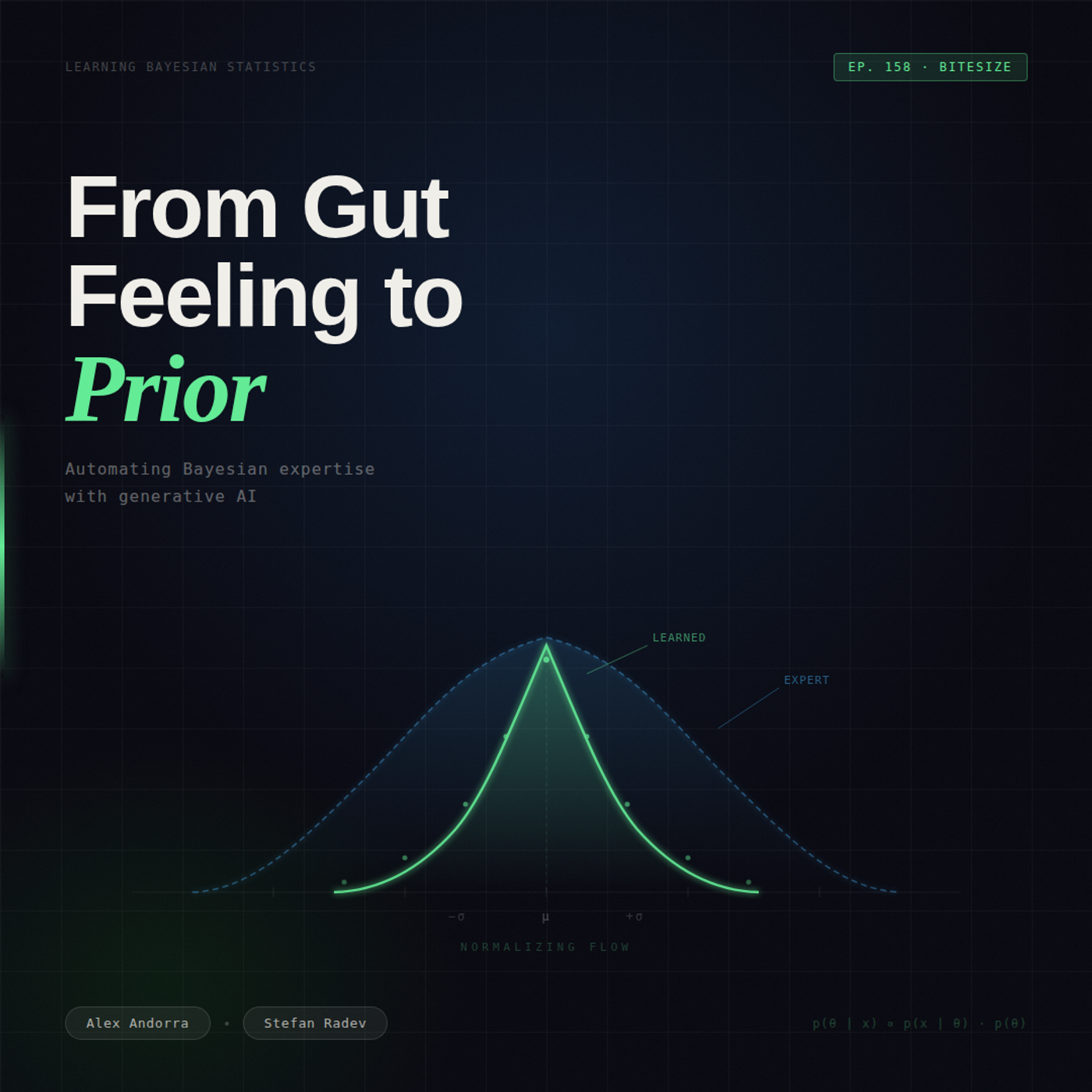
Today's clip is from episode 158 featuring Stefan Radev. In this conversation, Alex and Stefan explore a genuinely fascinating problem: how do you turn an expert's intuition into a mathematically valid prior distribution - and can AI help automate that process? Alex explains that prior elicitation is essentially a translation problem. Experts don't walk around thinking in probability distributions - their knowledge lives in intuitions, rules of thumb, and rough ranges. The challenge is converting that into something a Bayesian model can actually use. The traditional approach? Ask an expert for quantiles or a mean, then parameterize your prior with hyperparameters and simulate until the model-implied quantities match what the expert described. If your pipeline is differentiable end-to-end, you use gradient descent. If not, you fall back to something like Bayesian optimization. Either way, you're iterating toward a prior that genuinely reflects expert knowledge - not just a convenient assumption. But the really exciting part is what came next. In a follow-up paper, they pushed this further: instead of optimizing within a fixed parametric family (say, a Gaussian), they replaced the…
People in this episode
Host: Alexandre Andorra
Guest: Stefan Radev
Topics covered
- AI
- Bayesian statistics
- prior elicitation
- generative models
- expert knowledge
- mathematical modeling
Keywords
- AI
- prior elicitation
- Bayesian models
- expert intuition
- normalizing flow
- probability distributions
More episodes of Learning Bayesian Statistics
- Exact GPs vs Approximations: When to Use Each (and Why It Matters) · June 10, 2026 · 4 min
- #159 Bayesian Occupancy Models, with Matthijs Hollanders · June 8, 2026 · 1h 26m
- #158 Bayesian Workflows & Foundation Models, with Stefan Radev · May 21, 2026 · 1h 19m
- The Hidden Geometry of Hierarchical Models · May 13, 2026 · 4 min
- #157 Amortized Inference & BayesFlow in Practice, with Stefan Radev · May 6, 2026 · 1h 19m
- How to Design Better Experiments with Expected Information Gain · May 1, 2026 · 6 min
Explore listener stats, chart rankings, contacts and more on the Learning Bayesian Statistics podcast page.