
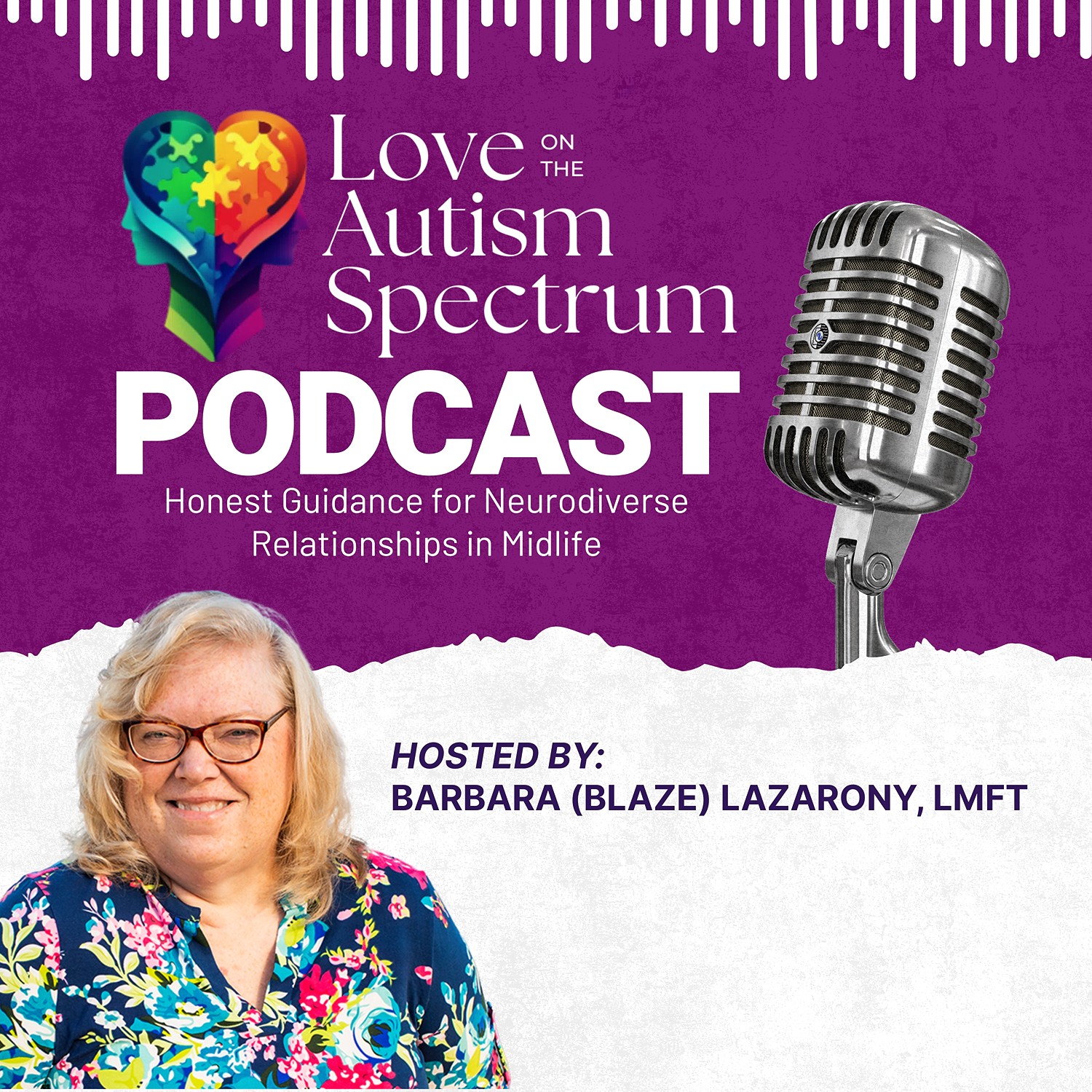
Love on the Autism Spectrum - Honest Guidance for Neurodivergent Relationships in Midlife
by Barbara (Blaze) Lazarony, LMFT
Is this your podcast?Insights from recent episode analysis
Audience Interest
Podcast Focus
Publishing Consistency
Platform Reach
Insights are generated by CastFox AI using publicly available data, episode content, and proprietary models.
Total monthly reach
Estimated from 1 chart position in 1 market.
By chart position
- 🇳🇿NZ · Mental Health#195500 to 3K
- Per-Episode Audience
Est. listeners per new episode within ~30 days
150 to 900🎙 Daily cadence·99 episodes·Last published 1mo ago - Monthly Reach
Unique listeners across all episodes (30 days)
500 to 3K🇳🇿100% - Active Followers
Loyal subscribers who consistently listen
200 to 1.2K
Market Insights
Platform Distribution
Reach across major podcast platforms, updated hourly
Total Followers
—
Total Plays
—
Total Reviews
—
* Data sourced directly from platform APIs and aggregated hourly across all major podcast directories.
On the show
Recent episodes
When You Start Seeing Yourself in the Checklist |S2 Ep 17.mp3
Apr 29, 2026
Unknown duration
When Love Isn’t Enough — Autism and Relationship Burnout | S2 Ep 16.mp3
Apr 22, 2026
Unknown duration
It’s Not Miscommunication — It’s Mismatched Wiring | S2 Ep 15.mp3
Apr 15, 2026
Unknown duration
When You Start Seeing Autism in Your Relationship | S2 Ep 14.mp3
Apr 8, 2026
Unknown duration
Testing for Autism Spectrum Disorder Is a Doorway–Not the Whole Story | S2 Ep 13.mp3
Apr 1, 2026
Unknown duration
Social Links & Contact
Official channels & resources
Official Website
Login
RSS Feed
Login
| Date | Episode | Description | Length | ||||||
|---|---|---|---|---|---|---|---|---|---|
| 4/29/26 | When You Start Seeing Yourself in the Checklist |S2 Ep 17.mp3 | S2 Episode 17: When You Start Seeing Yourself in the ChecklistWhat happens when you begin to recognize yourself in autism traits—especially as an adult woman who has spent years adapting, masking, and functioning?In this episode, Blaze explores the moment of self-recognition and the emotional complexity that often follows. For many women, autistic traits are not identified early due to gender bias in traditional diagnostic models. Instead, recognition happens later—through checklists, stories, or lived resonance.Drawing on the work of Devon Price, this episode highlights how masking can become so integrated that it feels like identity, making self-recognition both validating and disorienting. Through a detailed individual story, listeners are guided through the emotional landscape of recognition, including relief, clarity, and grief.This episode also introduces the GQ-ASC, a self-assessment tool designed specifically for adult women, offering a structured way to explore whether autistic traits align with lived experience.Rather than pushing toward diagnosis, this conversation invites gentle self-understanding, allowing listeners to explore their identity without pressure.One Emotional TakeawayYou are allowed to recognize yourself—before anyone confirms it.Companion BlogThe Female Autism Checklist: What It Really Means When You Start Seeing YourselfSubstack Reflection“The Relief — and Grief — of Recognizing Yourself”GQ-ASC ScreenerTake the GQ-ASC on the website to explore your experiences and identify patterns that may align with autism in adult women.Book a Clarity & Connection Zoom Sessionhttps://www.loveontheautismspectrum.com🎧 Listen OnApple Podcasts | Spotify | Amazon or HERE: https://www.loveontheautismspectrum.com/podcast/ #LateDiagnosedAutistic#AutisticWomen#MaskingAutism#NeurodivergentIdentity#SelfRecognition#AutismAwareness#LoveOnTheAutismSpectrum🔗 LINKS & RESOURCES Start here — the free guide that gently names the pattern: ✨ You're Not Too Much. You're Just Alone in the Repair. → link.blazelazarony.com/youre-not-too-muchExplore more tools, relationship guidance, and weekly blog posts at: 🌐 www.LoveOnTheAutismSpectrum.comCatch up on more episodes: 🎧 loveontheautismspectrum.com/podcastRead deeper reflections and behind-the-scenes writing on Substack: ✉️ blazelazarony.substack.comFor behind-the-scenes reflections and bonus content, follow along on Instagram: 📸 @BlazeLazaronyThe book — daily reflections for coming home to who you really are: 📚 Unmasked Self-Acceptance → author.amazon.com/homeWhen you're ready to talk — a free, no-pressure Clarity & Connection Zoom: 🗓 link.blazelazarony.com/Book-C-and-C-ZoomThis podcast is for educational purposes only and is not a substitute for professional mental health care. Listening does not create a therapeutic relationship or provide individualized advice.Barbara (Blaze) Lazarony, MA, LMFT #151788, is licensed in California. All examples are fictional and used for illustration only.If you're experiencing a mental health crisis, please call 988 or contact local emergency services. | — | ||||||
| 4/22/26 | When Love Isn’t Enough — Autism and Relationship Burnout | S2 Ep 16.mp3 | S2 Episode 16: When Love Isn’t Enough — Autism and Relationship BurnoutBurnout in neurodiverse relationships often develops slowly—through repeated moments of misattunement, unmet needs, and emotional effort that doesn’t resolve over time. In this episode, Blaze explores how relationship burnout is not a sign of failure, but a signal that something has been carried for too long without enough support.Drawing on the work of Judith Herman, this episode frames burnout through the lens of chronic emotional strain and grief. Rather than focusing on blame, it invites listeners to understand the quiet accumulation of relational fatigue, especially for partners who have taken on the role of emotional tracking, repair, and connection.Through a detailed couple story, listeners are guided to see how overfunctioning and withdrawal patterns can develop—and how, over time, one partner may begin to pull back not out of disinterest, but out of exhaustion.This episode offers a grounded, compassionate perspective on what happens when love is present, but sustainability is not. It creates space to recognize grief, name what has been carried, and begin to consider what repair might look like—without pressure.One Emotional TakeawayBurnout is not failure—it’s a signal that something has been carried for too long.Companion BlogAutism and Marriage Breakdown: Navigating ND RelationshipsSubstack Reflection“The Grief No One Talks About in Neurodiverse Marriages”Book a Clarity & Connection Zoom Sessionhttps://www.loveontheautismspectrum.com🎧 Listen OnApple Podcasts | Spotify | Amazon or HERE: https://www.loveontheautismspectrum.com/podcast/#RelationshipBurnout#NeurodiverseMarriage#EmotionalLabor#RelationalGrief#TraumaInformed#LoveOnTheAutismSpectrum🔗 LINKS & RESOURCES Start here — the free guide that gently names the pattern: ✨ You're Not Too Much. You're Just Alone in the Repair. → link.blazelazarony.com/youre-not-too-muchExplore more tools, relationship guidance, and weekly blog posts at: 🌐 www.LoveOnTheAutismSpectrum.comCatch up on more episodes: 🎧 loveontheautismspectrum.com/podcastRead deeper reflections and behind-the-scenes writing on Substack: ✉️ blazelazarony.substack.comFor behind-the-scenes reflections and bonus content, follow along on Instagram: 📸 @BlazeLazaronyThe book — daily reflections for coming home to who you really are: 📚 Unmasked Self-Acceptance → author.amazon.com/homeWhen you're ready to talk — a free, no-pressure Clarity & Connection Zoom: 🗓 link.blazelazarony.com/Book-C-and-C-ZoomThis podcast is for educational purposes only and is not a substitute for professional mental health care. Listening does not create a therapeutic relationship or provide individualized advice.Barbara (Blaze) Lazarony, MA, LMFT #151788, is licensed in California. All examples are fictional and used for illustration only.If you're experiencing a mental health crisis, please call 988 or contact local emergency services. | — | ||||||
| 4/15/26 | It’s Not Miscommunication — It’s Mismatched Wiring | S2 Ep 15.mp3 | S2 Episode 15: It’s Not Miscommunication — It’s Mismatched WiringMany couples believe their struggles come down to poor communication. But in neurodiverse relationships, the issue is often deeper than that.In this episode, Blaze explores why “miscommunication” may not fully explain what’s happening between partners. Instead, she introduces the concept of mismatched wiring—where both individuals are communicating clearly, but interpreting each other through different internal frameworks.Drawing on the Double Empathy Problem (Damian Milton), this episode highlights how misunderstanding can occur even when both partners are trying, caring, and showing up. Through a detailed couple example, listeners are guided to see how emotional needs, processing styles, and expectations can differ without either partner being at fault.Rather than focusing on fixing communication, this episode invites couples to slow down, clarify what is actually being asked for, and begin building understanding from the ground up.One Emotional TakeawayYou’re not failing to communicate—you’re starting from different places.Companion BlogAutism and Neurotypical Relationships: Building UnderstandingSubstack Reflection“You’re Both Speaking Clearly — In Different Languages”Book a Clarity & Connection Zoom Sessionhttps://www.loveontheautismspectrum.com🎧 Listen OnApple Podcasts | Spotify | Amazon or HERE: https://www.loveontheautismspectrum.com/podcast/#NeurodiverseRelationships#CommunicationDifferences#DoubleEmpathy#AutismAndRelationships#RelationalUnderstanding#LoveOnTheAutismSpectrum🔗 LINKS & RESOURCES Start here — the free guide that gently names the pattern: ✨ You're Not Too Much. You're Just Alone in the Repair. → link.blazelazarony.com/youre-not-too-muchExplore more tools, relationship guidance, and weekly blog posts at: 🌐 www.LoveOnTheAutismSpectrum.comCatch up on more episodes: 🎧 loveontheautismspectrum.com/podcastRead deeper reflections and behind-the-scenes writing on Substack: ✉️ blazelazarony.substack.comFor behind-the-scenes reflections and bonus content, follow along on Instagram: 📸 @BlazeLazaronyThe book — daily reflections for coming home to who you really are: 📚 Unmasked Self-Acceptance → author.amazon.com/homeWhen you're ready to talk — a free, no-pressure Clarity & Connection Zoom: 🗓 link.blazelazarony.com/Book-C-and-C-ZoomThis podcast is for educational purposes only and is not a substitute for professional mental health care. Listening does not create a therapeutic relationship or provide individualized advice.Barbara (Blaze) Lazarony, MA, LMFT #151788, is licensed in California. All examples are fictional and used for illustration only.If you're experiencing a mental health crisis, please call 988 or contact local emergency services. | — | ||||||
| 4/8/26 | When You Start Seeing Autism in Your Relationship | S2 Ep 14.mp3 | Ep 14: When You Start Seeing Autism in Your RelationshipWhat happens when you begin to see autism in your partner—but you’re not sure what to do with that realization?In this episode, Blaze explores the moment of recognition inside a relationship and how easily it can shift into certainty, labeling, or unintended disconnection. Rather than rushing to define or diagnose, this conversation invites a slower, more grounded approach rooted in curiosity and relational awareness.Drawing on the Double Empathy Problem (Damian Milton), this episode explains why both partners can feel misunderstood at the same time. Integrating Sue Johnson’s attachment perspective, it also highlights how a deeper emotional question—“Are you there for me?”—often shapes how partners respond to each other during moments of stress.Through a detailed couple story, listeners are guided to understand how emotional labor, confusion, and misalignment can develop without either partner being at fault. This episode helps couples move from certainty and blame toward curiosity and shared understanding.One Emotional TakeawayCuriosity creates connection. Certainty can create distance.Companion BlogHow to Tell If Your Partner Is Autistic: Understanding Love on the SpectrumSubstack Reflection“Curiosity Is Safer Than Certainty”Book a Clarity & Connection Zoom Sessionhttps://www.loveontheautismspectrum.com🎧 Listen OnApple Podcasts | Spotify | Amazon and HERE: https://www.loveontheautismspectrum.com/podcast/#NeurodiverseRelationships#AutismInRelationships#DoubleEmpathy#Attachment#NeurodivergentLove#RelationalHealing#LoveOnTheAutismSpectrum🔗 LINKS & RESOURCES Start here — the free guide that gently names the pattern: ✨ You're Not Too Much. You're Just Alone in the Repair. → link.blazelazarony.com/youre-not-too-muchExplore more tools, relationship guidance, and weekly blog posts at: 🌐 www.LoveOnTheAutismSpectrum.comCatch up on more episodes: 🎧 loveontheautismspectrum.com/podcastRead deeper reflections and behind-the-scenes writing on Substack: ✉️ blazelazarony.substack.comFor behind-the-scenes reflections and bonus content, follow along on Instagram: 📸 @BlazeLazaronyThe book — daily reflections for coming home to who you really are: 📚 Unmasked Self-Acceptance → author.amazon.com/homeWhen you're ready to talk — a free, no-pressure Clarity & Connection Zoom: 🗓 link.blazelazarony.com/Book-C-and-C-ZoomThis podcast is for educational purposes only and is not a substitute for professional mental health care. Listening does not create a therapeutic relationship or provide individualized advice.Barbara (Blaze) Lazarony, MA, LMFT #151788, is licensed in California. All examples are fictional and used for illustration only.If you're experiencing a mental health crisis, please call 988 or contact local emergency services. | — | ||||||
| 4/1/26 | Testing for Autism Spectrum Disorder Is a Doorway–Not the Whole Story | S2 Ep 13.mp3 | S2 Episode 14: Testing for Autism Spectrum Disorder Is a Doorway–Not the Whole StoryAdult autism diagnosis can be both clarifying and complex—especially for individuals who have spent years masking, adapting, and learning how to function in environments that were not designed for how their nervous system processes the world. In this episode, Blaze explores what adult autism assessments are designed to measure, including social communication patterns, sensory differences, and developmental history, using tools such as the SRS-2 and MIGDAS-2 within DSM-5-TR criteria.At the same time, this conversation highlights what assessments often miss: internal effort, relational exhaustion, and long-standing masking strategies. Drawing on the work of Devon Price (masking), Tony Attwood (adult autism presentation), Stephen Porges (Polyvagal Theory), Damian Milton (Double Empathy Problem), Dan Siegel (integration), and the Social Model of Disability (Michael Oliver), this episode offers a broader, more relational understanding of diagnosis.Through both individual and couple experiences, listeners are invited to consider diagnosis as one form of clarity—not the only one. This episode creates space for self-recognition, reflection, and understanding without pressure to reach a definitive conclusion.One Emotional TakeawayA diagnosis can offer clarity—but your lived experience is already valid.Companion BlogTesting for Autism Spectrum Disorder in Adults: What the Tests Can’t Tell You (and What They Can)LoveOnTheAutismSpectrum.comSubstack Reflection“What a Diagnosis Gives You — and What It Can’t”Love on the Autism Spectrum (Substack)Book a Clarity & Connection Zoom Sessionhttps://www.loveontheautismspectrum.com🎧 Listen OnApple Podcasts | Spotify | Amazon or HERE: https://www.loveontheautismspectrum.com/podcast/#AutismDiagnosis#LateDiagnosedAutistic#NeurodivergentAdults#AutismAwareness#MaskingAutism#NeurodiversityAffirming#LoveOnTheAutismSpectrum🔗 LINKS & RESOURCES Start here — the free guide that gently names the pattern: ✨ You're Not Too Much. You're Just Alone in the Repair. → link.blazelazarony.com/youre-not-too-muchExplore more tools, relationship guidance, and weekly blog posts at: 🌐 www.LoveOnTheAutismSpectrum.comCatch up on more episodes: 🎧 loveontheautismspectrum.com/podcastRead deeper reflections and behind-the-scenes writing on Substack: ✉️ blazelazarony.substack.comFor behind-the-scenes reflections and bonus content, follow along on Instagram: 📸 @BlazeLazaronyThe book — daily reflections for coming home to who you really are: 📚 Unmasked Self-Acceptance → author.amazon.com/homeWhen you're ready to talk — a free, no-pressure Clarity & Connection Zoom: 🗓 link.blazelazarony.com/Book-C-and-C-ZoomThis podcast is for educational purposes only and is not a substitute for professional mental health care. Listening does not create a therapeutic relationship or provide individualized advice.Barbara (Blaze) Lazarony, MA, LMFT #151788, is licensed in California. All examples are fictional and used for illustration only.If you're experiencing a mental health crisis, please call 988 or contact local emergency services. | — | ||||||
| 3/25/26 | Advocacy Isn’t Aggression—It’s Self-Protection | S2 Ep 12.mp3 | 🎙 Episode 12: Advocacy Isn’t Aggression—It’s Self-ProtectionLove on the Autism Spectrum — Season TwoIf you’re new, begin with Season Two, Episode 1: “Welcome to the Spiral of Life.” That episode introduces the Neurodivergent Spiral of Life™ and the foundation of safety before change.In Episode 12, Blaze reframes advocacy as nervous-system protection—not aggression. Grounded in Spiral Layer 1 (Deepening), this episode integrates Polyvagal Theory (Dr. Stephen Porges), Dr. Mona Delahooke’s safety-based lens, the Neurodiversity Paradigm (Nick Walker), and the Social Model of Disability (Michael Oliver) to explore how voice develops from self-believability. Through real-life examples and practical tools, listeners learn how to regulate before articulating needs, reduce over-explaining, and advocate clearly without burning out or escalating conflict.One Emotional TakeawayAdvocacy isn’t aggression — it’s self-protection with clarity.Read the Companion Blog“Learning to Advocate for Yourself Without Burning Out or Breaking Trust”Read now at: 👉 https://www.loveontheautismspectrum.comRead the Companion Substack“What If Your Needs Aren’t A Problem”Read now at: 👉https://blazelazarony.substack.com/Book a FREE “Clarity & Connection” Zoom SessionIf today’s episode resonates and you’re ready for real-time support, I invite you to Book a FREE “Clarity & Connection” Zoom Session. It’s a safe space to talk, reflect, and explore what support with me could look like — no pressure.👉 https://api.leadconnectorhq.com/widget/booking/y8SkMmYp2fdSWiKSIrhiBuy the BookUnmasked Self-Acceptance👉 https://www.loveontheautismspectrum.com/unmasked-self-acceptance/Listen to More EpisodesApple | Spotify | Google | Amazon | And…👉 https://www.loveontheautismspectrum.com/podcast/Keywords#NeurodivergentAdvocacy#SpiralLayer1#PolyvagalTheory#AutismSpectrumDisorder#ADHDBurnout#NeurodiverseRelationships#NervousSystemSafety#TraumaInformedCare#SelfBelievability#LoveOnTheAutismSpectrum🔗 LINKS & RESOURCES Start here — the free guide that gently names the pattern: ✨ You're Not Too Much. You're Just Alone in the Repair. → link.blazelazarony.com/youre-not-too-muchExplore more tools, relationship guidance, and weekly blog posts at: 🌐 www.LoveOnTheAutismSpectrum.comCatch up on more episodes: 🎧 loveontheautismspectrum.com/podcastRead deeper reflections and behind-the-scenes writing on Substack: ✉️ blazelazarony.substack.comFor behind-the-scenes reflections and bonus content, follow along on Instagram: 📸 @BlazeLazaronyThe book — daily reflections for coming home to who you really are: 📚 Unmasked Self-Acceptance → author.amazon.com/homeWhen you're ready to talk — a free, no-pressure Clarity & Connection Zoom: 🗓 link.blazelazarony.com/Book-C-and-C-ZoomThis podcast is for educational purposes only and is not a substitute for professional mental health care. Listening does not create a therapeutic relationship or provide individualized advice.Barbara (Blaze) Lazarony, MA, LMFT #151788, is licensed in California. All examples are fictional and used for illustration only.If you're experiencing a mental health crisis, please call 988 or contact local emergency services. | — | ||||||
| 3/18/26 | You’re Not Asking for Too Much—You’re Asking for Access | S2 Ep 11.mp3 | 🎙 Episode 11: You’re Not Asking for Too Much—You’re Asking for AccessLove on the Autism Spectrum — Season TwoIf you’re new to the podcast, begin with Season Two, Episode 1: “Welcome to the Spiral of Life.” That episode introduces the Neurodivergent Spiral of Life™ and explains why this season focuses on safety, identity, and nervous-system pacing before change.In Episode 11, Blaze reframes accommodations as access—not special treatment. Grounded in Spiral Layer 1 (Deepening), this episode explores how nervous-system support allows neurodivergent adults and couples to participate in work, relationships, and daily life without constant depletion. Integrating Polyvagal Theory (Dr. Stephen Porges), Dr. Mona Delahooke’s safety-based lens, the Neurodiversity Paradigm (Nick Walker), and the Social Model of Disability (Michael Oliver), Blaze invites listeners to shift from self-blame to environmental design and begin naming needs clearly, calmly, and without apology.One Emotional TakeawayYou’re not asking for too much — you’re asking for access.Read the Companion Blog“Neurodivergent Accommodations: What Support Actually Looks Like in Real Life”Read it now at: 👉 https://www.loveontheautismspectrum.comRead the Companion Substack“Support Is Not a WeaknessRead it now at: 👉 https://blazelazarony.substack.com/ A Special Note — Free Layer 1 ResourcesLayer 1 of the Neurodivergent Spiral of Life™ focuses on safety, identity, and self-believability.To support this foundational layer, Blaze offers three gentle, nervous-system-aware tools:Pain Awareness Zones™The Sensory Ladder Tracker & Ritual Builder™When I First Felt Different™Together, these resources help you notice what your body, emotions, and history have been communicating—without needing to analyze, justify, or relive the past. They are designed to help you recognize early signs of overwhelm, understand how you learned to adapt, and begin to build trust in your own experience.You can use them slowly, non-linearly, and in whatever order feels safest—because healing doesn’t begin with fixing.It begins with being believed.👉 Join the email list to receive these FREE Layer 1 resources.Book a FREE “Clarity & Connection” Zoom SessionIf today’s episode resonates and you’re ready for real-time support, I invite you to Book a FREE “Clarity & Connection” Zoom Session. It’s a safe space to talk, reflect, and explore what support with me could look like — no pressure.👉 Book here:https://api.leadconnectorhq.com/widget/booking/y8SkMmYp2fdSWiKSIrhiBuy the BookUnmasked Self-Acceptance👉 https://www.loveontheautismspectrum.com/unmasked-self-acceptance/Listen to More Episodes of Love on the Autism SpectrumApple | Spotify | Google | Amazon | And…👉 https://www.loveontheautismspectrum.com/podcast/Keywords & Hashtags#NeurodivergentAccommodations#AccessNotExcess#SpiralLayer1#AutismSpectrumDisorder#ADHDBurnout#NeurodiverseRelationships#NervousSystemSupport#TraumaInformedCare#SelfBelievability#LoveOnTheAutismSpectrum🔗 LINKS & RESOURCES Start here — the free guide that gently names the pattern: ✨ You're Not Too Much. You're Just Alone in the Repair. → link.blazelazarony.com/youre-not-too-muchExplore more tools, relationship guidance, and weekly blog posts at: 🌐 www.LoveOnTheAutismSpectrum.comCatch up on more episodes: 🎧 loveontheautismspectrum.com/podcastRead deeper reflections and behind-the-scenes writing on Substack: ✉️ blazelazarony.substack.comFor behind-the-scenes reflections and bonus content, follow along on Instagram: 📸 @BlazeLazaronyThe book — daily reflections for coming home to who you really are: 📚 Unmasked Self-Acceptance → author.amazon.com/homeWhen you're ready to talk — a free, no-pressure Clarity & Connection Zoom: 🗓 link.blazelazarony.com/Book-C-and-C-ZoomThis podcast is for educational purposes only and is not a substitute for professional mental health care. Listening does not create a therapeutic relationship or provide individualized advice.Barbara (Blaze) Lazarony, MA, LMFT #151788, is licensed in California. All examples are fictional and used for illustration only.If you're experiencing a mental health crisis, please call 988 or contact local emergency services. | — | ||||||
| 3/11/26 | Why You Pull Away When Things Feel Too Much-Flight Response | S2 Ep 10.mp3 | S2 Episode 10: Why You Pull Away When Things Feel Too Much-Flight ResponseLove on the Autism Spectrum — Season TwoIn Episode 10, Blaze explores the flight response as a nervous-system strategy for regulating overwhelm. Rather than labeling avoidance as emotional immaturity, this episode reframes pulling away as protection through distance. Grounded in Spiral Layer 1 (Deepening), Blaze examines how sensory stacking, relational intensity, and emotional overload activate flight responses in neurodivergent adults and couples. Drawing from trauma-informed frameworks and polyvagal theory (Dr. Stephen Porges), listeners are offered practical tools for mapping thresholds, using structured space, and reducing shame around their need for pacing.One Emotional TakeawayPulling away isn’t rejection — it’s often regulation.Free Layer 1 ResourcesLayer 1 focuses on safety, identity, and self-believability.Receive three FREE tools:• Pain Awareness Zones™• The Sensory Ladder Tracker & Ritual Builder™• When I First Felt Different™Join the email list to receive them.Companion Blog“The Flight Response in Neurodivergent Nervous Systems: Avoidance, Escape, and Relief”LoveOnTheAutismSpectrum.comCompanion Substack“Busy Is a Hiding Space”https://blazelazarony.substack.com/Book a FREE Clarity & Connection Zoom Sessionhttps://api.leadconnectorhq.com/widget/booking/y8SkMmYp2fdSWiKSIrhiMore Episodes Available At:Apple Podcasts | Amazon | Spotify | And…👉 https://www.loveontheautismspectrum.com/podcast/Hashtags#FlightResponse#NeurodivergentHealing#AvoidanceIsProtection#NervousSystemSafety#SpiralLayer1#TraumaInformedCare#NeurodiverseCouples#SensoryOverwhelm#EmotionalPacing#LoveOnTheAutismSpectrum🔗 LINKS & RESOURCES Start here — the free guide that gently names the pattern: ✨ You're Not Too Much. You're Just Alone in the Repair. → link.blazelazarony.com/youre-not-too-muchExplore more tools, relationship guidance, and weekly blog posts at: 🌐 www.LoveOnTheAutismSpectrum.comCatch up on more episodes: 🎧 loveontheautismspectrum.com/podcastRead deeper reflections and behind-the-scenes writing on Substack: ✉️ blazelazarony.substack.comFor behind-the-scenes reflections and bonus content, follow along on Instagram: 📸 @BlazeLazaronyThe book — daily reflections for coming home to who you really are: 📚 Unmasked Self-Acceptance → author.amazon.com/homeWhen you're ready to talk — a free, no-pressure Clarity & Connection Zoom: 🗓 link.blazelazarony.com/Book-C-and-C-ZoomThis podcast is for educational purposes only and is not a substitute for professional mental health care. Listening does not create a therapeutic relationship or provide individualized advice.Barbara (Blaze) Lazarony, MA, LMFT #151788, is licensed in California. All examples are fictional and used for illustration only.If you're experiencing a mental health crisis, please call 988 or contact local emergency services. | — | ||||||
| 3/4/26 | When You Say Yes but Feel Invisible: Understanding the Fawn Response| S2 Ep 9.mp3 | S2 Episode 9: When You Say Yes but Feel Invisible: Understanding the Fawn ResponseLove on the Autism Spectrum — Season TwoMany neurodivergent adults have learned to say "yes" to stay safe. In Episode 9, Blaze explores the fawn response as a nervous-system adaptation — not a personality flaw. Grounded in Spiral Layer 1 (Deepening), this episode examines people-pleasing, masking, emotional labor, and over-functioning in relationships. Drawing from trauma-informed frameworks (including Pete Walker’s work on the fawn response), listeners are invited to understand compliance as protection that once preserved a connection. Through stories and practical tools, Blaze helps you gently separate kindness from self-abandonment and begin rebuilding self-trust.One Emotional TakeawayYou learned to say yes for a reason — and you’re allowed to exist without disappearing.Free Layer 1 ResourcesLayer 1 focuses on safety, identity, and self-believability.To support this foundational layer, Blaze offers three gentle tools:• Pain Awareness Zones™• The Sensory Ladder Tracker & Ritual Builder™• When I First Felt Different™These help you recognize early overwhelm signals, understand how you adapted, and begin building trust with your own experience.👉 Join the email list to receive these FREE Layer 1 resources.Companion Blog“The Fawn Response in Neurodivergent People: Why You People-Please to Stay Safe”LoveOnTheAutismSpectrum.comCompanion Substack"The Exhaustion of Being the Easy One" https://blazelazarony.substack.com/Book a FREE Clarity & Connection Zoom Sessionhttps://api.leadconnectorhq.com/widget/booking/y8SkMmYp2fdSWiKSIrhiMore Episodes Available At:Apple Podcasts | Amazon | Spotify | And…👉 https://www.loveontheautismspectrum.com/podcast/Hashtags#FawnResponse#NeurodivergentHealing#Masking#PeoplePleasing#EmotionalLabor#SpiralLayer1#SelfBelievability#TraumaInformedCare#NeurodiverseCouples#LoveOnTheAutismSpectrum🔗 LINKS & RESOURCES Start here — the free guide that gently names the pattern: ✨ You're Not Too Much. You're Just Alone in the Repair. → link.blazelazarony.com/youre-not-too-muchExplore more tools, relationship guidance, and weekly blog posts at: 🌐 www.LoveOnTheAutismSpectrum.comCatch up on more episodes: 🎧 loveontheautismspectrum.com/podcastRead deeper reflections and behind-the-scenes writing on Substack: ✉️ blazelazarony.substack.comFor behind-the-scenes reflections and bonus content, follow along on Instagram: 📸 @BlazeLazaronyThe book — daily reflections for coming home to who you really are: 📚 Unmasked Self-Acceptance → author.amazon.com/homeWhen you're ready to talk — a free, no-pressure Clarity & Connection Zoom: 🗓 link.blazelazarony.com/Book-C-and-C-ZoomThis podcast is for educational purposes only and is not a substitute for professional mental health care. Listening does not create a therapeutic relationship or provide individualized advice.Barbara (Blaze) Lazarony, MA, LMFT #151788, is licensed in California. All examples are fictional and used for illustration only.If you're experiencing a mental health crisis, please call 988 or contact local emergency services. | — | ||||||
| 2/25/26 | When the Fight Response Is Really a Cry for Safety | S2 Ep 8.mp3 | S2 Episode 8: When Fight Is Really a Cry for SafetyLove on the Autism Spectrum — Season TwoEpisode SummaryAnger, defensiveness, and escalation are often labeled as communication problems or character flaws. In this episode, Blaze reframes the fight response as a nervous-system attempt to protect safety and connection—especially within neurodiverse relationships.Grounded in Spiral Layer 1 (Deepening), this conversation explores why fight emerges when boundaries feel crossed, needs go unmet, or earlier sensory signals have been ignored. Through individual and couple examples, Blaze shows how fight is often a late-stage response that appears when other forms of protection haven’t worked.Listeners are offered compassionate tools for slowing the body, identifying the need beneath intensity, and repairing without shame. This episode is especially supportive if conflict leaves you feeling guilty, misunderstood, or afraid of your own reactions.One Emotional TakeawayFight isn’t a failure—it’s protection asking for safety. Companion BlogRead the companion blog:“When the Fight Response Shows Up in Neurodiverse Relationships” 👉 https://www.loveontheautismspectrum.comTools Explored in This EpisodeUnderstanding fight as a mobilized survival responseSlowing the nervous system before addressing contentNaming needs underneath anger or defensivenessRepairing relational ruptures without self-blameSeason Two ContextThis episode continues work in Spiral Layer 1 (Deepening) and pairs closely with:Episode 6: The Sensory LadderEpisode 7: Sensory Sensitivity as InformationEpisode 8: Understanding the Freeze ResponseTogether, these episodes help listeners understand how different nervous systems protect safety in different ways.Work With BlazeBook a FREE Clarity & Connection Zoom Session 👉 https://api.leadconnectorhq.com/widget/booking/y8SkMmYp2fdSWiKSIrhiListen to More EpisodesMore episodes available at:Apple Podcasts | Amazon | Spotify | and more 👉 https://www.loveontheautismspectrum.com/podcast/Key Hashtags#FightResponse#NeurodivergentRelationships#AutismSpectrum#ADHDBurnout#ConflictRepair#NervousSystemSafety#SpiralLayer1#TraumaInformedCare#NeurodiverseCouples#LoveOnTheAutismSpectrum🔗 LINKS & RESOURCES Start here — the free guide that gently names the pattern: ✨ You're Not Too Much. You're Just Alone in the Repair. → link.blazelazarony.com/youre-not-too-muchExplore more tools, relationship guidance, and weekly blog posts at: 🌐 www.LoveOnTheAutismSpectrum.comCatch up on more episodes: 🎧 loveontheautismspectrum.com/podcastRead deeper reflections and behind-the-scenes writing on Substack: ✉️ blazelazarony.substack.comFor behind-the-scenes reflections and bonus content, follow along on Instagram: 📸 @BlazeLazaronyThe book — daily reflections for coming home to who you really are: 📚 Unmasked Self-Acceptance → author.amazon.com/homeWhen you're ready to talk — a free, no-pressure Clarity & Connection Zoom: 🗓 link.blazelazarony.com/Book-C-and-C-ZoomThis podcast is for educational purposes only and is not a substitute for professional mental health care. Listening does not create a therapeutic relationship or provide individualized advice.Barbara (Blaze) Lazarony, MA, LMFT #151788, is licensed in California. All examples are fictional and used for illustration only.If you're experiencing a mental health crisis, please call 988 or contact local emergency services. | — | ||||||
Want analysis for the episodes below?Free for Pro Submit a request, we'll have your selected episodes analyzed within an hour. Free, at no cost to you, for Pro users. | |||||||||
| 2/18/26 | When Your Body Disappears: Understanding the Freeze Response | S2 Ep 7.mp3 | S2 Episode 7: When Your Body Disappears: Understanding the Freeze ResponseLove on the Autism Spectrum — Season TwoStart Here If you’re new to the podcast, you may want to begin with Season Two, Episode 1: “Welcome to the Spiral of Life.” That episode introduces the Neurodivergent Spiral of Life & Healing™ and explains why this season focuses on slowing down, orienting, and understanding nervous-system responses without shame.Episode SummaryFreeze is one of the most misunderstood stress responses—especially for neurodivergent adults. In this episode, Blaze explores the freeze response as a form of protection, not failure.Grounded in Spiral Layer 1 (Deepening), this conversation helps listeners understand why the body may go still, quiet, or distant when fight-or-flight doesn’t feel safe. Through individual and couple examples, Blaze reframes freeze as the nervous system conserving energy and seeking safety, rather than avoiding or shutting down on purpose.Listeners are offered gentle tools for orienting, reconnecting through micro-movements, and translating freeze responses in relationships. This episode is especially supportive if you’ve ever felt stuck, numb, or disconnected and wondered why your body “won’t cooperate.”One Emotional TakeawayFreeze isn’t absence—it’s protection waiting for safety.Companion BlogRead the companion blog: “Navigating the Dissociation Freeze Response: Understanding and Healing” 👉 https://www.loveontheautismspectrum.comTools Explored in This EpisodeUnderstanding freeze as a survival responseOrienting to the present before trying to “unfreeze”Using micro-movements to restore choiceTranslating freeze responses within relationshipsSeason Two ContextThis episode continues work in Spiral Layer 1 (Deepening) and builds on the sensory awareness introduced in Episode 6: “The Sensory Ladder.” Understanding early sensory cues can help reduce the intensity and duration of freeze responses over time.Work With BlazeBook a FREE Clarity & Connection Zoom SessionA calm, no-pressure space to explore your patterns and supports 👉 https://api.leadconnectorhq.com/widget/booking/y8SkMmYp2fdSWiKSIrhiListen to More EpisodesMore episodes available at: Apple Podcasts | Amazon | Spotify | and more👉 https://www.loveontheautismspectrum.com/podcast/Key Hashtags#FreezeResponse#NeurodivergentHealing#AutismSpectrum#Dissociation#NervousSystemSupport#TraumaInformedCare#SpiralLayer1#NeurodiverseAdults#RelationshipSafety#LoveOnTheAutismSpectrum🔗 LINKS & RESOURCES Start here — the free guide that gently names the pattern: ✨ You're Not Too Much. You're Just Alone in the Repair. → link.blazelazarony.com/youre-not-too-muchExplore more tools, relationship guidance, and weekly blog posts at: 🌐 www.LoveOnTheAutismSpectrum.comCatch up on more episodes: 🎧 loveontheautismspectrum.com/podcastRead deeper reflections and behind-the-scenes writing on Substack: ✉️ blazelazarony.substack.comFor behind-the-scenes reflections and bonus content, follow along on Instagram: 📸 @BlazeLazaronyThe book — daily reflections for coming home to who you really are: 📚 Unmasked Self-Acceptance → author.amazon.com/homeWhen you're ready to talk — a free, no-pressure Clarity & Connection Zoom: 🗓 link.blazelazarony.com/Book-C-and-C-ZoomThis podcast is for educational purposes only and is not a substitute for professional mental health care. Listening does not create a therapeutic relationship or provide individualized advice.Barbara (Blaze) Lazarony, MA, LMFT #151788, is licensed in California. All examples are fictional and used for illustration only.If you're experiencing a mental health crisis, please call 988 or contact local emergency services. | — | ||||||
| 2/11/26 | You’re Not Too Sensitive—You’re Sensing Accurately | S2 Ep 6.mp3 | S2 Episode 6: You’re Not Too Sensitive—You’re Sensing AccuratelyLove on the Autism Spectrum — Season TwoMany neurodivergent adults have been told they’re “too sensitive,” often leading them to doubt their own perceptions. In this episode, Blaze reframes sensitivity as accurate sensing rather than pathology.Building on Spiral Layer 1 (Deepening) and the Sensory Ladder introduced in Episode 6, this conversation explores how sensory awareness can become a source of self-trust rather than shame. Through individual and couple examples, listeners are invited to understand sensory differences as meaningful nervous-system information—not something to minimize or override.This episode is especially supportive if you’ve learned to silence your body’s cues in order to function or fit in.One Emotional TakeawayYour sensitivity isn’t the problem—your body is noticing something important.Companion BlogRead the companion blog:“Understanding Sensory Differences: Why You’re Not ‘Too Sensitive,’ You’re Just Processing the World Differently”👉 https://www.loveontheautismspectrum.com/sensory-processing-differences/Free Resource ReferencedTo support this episode, you may want to listen to Episode 6: “The Sensory Ladder: Understanding Your First Signals of Overwhelm.”The companion blog for Episode 6 includes a free Sensory Ladder handout when you sign up for the email list, designed to help you gently notice your own early sensory cues.Tools Explored in This EpisodeReframing sensitivity as informationBuilding trust in sensory awarenessReducing shame around sensory processingUnderstanding sensory differences within relationshipsSeason Two ContextThis episode continues work in Spiral Layer 1 (Deepening) and builds directly on Episode 6. Together, they form a foundation for understanding freeze, fight, and survival responses explored later in February.Work With BlazeBook a FREE Clarity & Connection Zoom Session 👉 https://api.leadconnectorhq.com/widget/booking/y8SkMmYp2fdSWiKSIrhiListen to More Episodes More episodes available at:Apple Podcasts | Amazon | Spotify | and more 👉 https://www.loveontheautismspectrum.com/podcast/Key Hashtags#SensoryProcessing#NeurodivergentHealing#AutismSpectrum#ADHDBurnout#SensoryAwareness#NervousSystemSupport#SpiralLayer1#TraumaInformedCare#NeurodiverseCouples#LoveOnTheAutismSpectrum🔗 LINKS & RESOURCES Start here — the free guide that gently names the pattern: ✨ You're Not Too Much. You're Just Alone in the Repair. → link.blazelazarony.com/youre-not-too-muchExplore more tools, relationship guidance, and weekly blog posts at: 🌐 www.LoveOnTheAutismSpectrum.comCatch up on more episodes: 🎧 loveontheautismspectrum.com/podcastRead deeper reflections and behind-the-scenes writing on Substack: ✉️ blazelazarony.substack.comFor behind-the-scenes reflections and bonus content, follow along on Instagram: 📸 @BlazeLazaronyThe book — daily reflections for coming home to who you really are: 📚 Unmasked Self-Acceptance → author.amazon.com/homeWhen you're ready to talk — a free, no-pressure Clarity & Connection Zoom: 🗓 link.blazelazarony.com/Book-C-and-C-ZoomThis podcast is for educational purposes only and is not a substitute for professional mental health care. Listening does not create a therapeutic relationship or provide individualized advice.Barbara (Blaze) Lazarony, MA, LMFT #151788, is licensed in California. All examples are fictional and used for illustration only.If you're experiencing a mental health crisis, please call 988 or contact local emergency services. | — | ||||||
| 2/4/26 | The Sensory Ladder: Understanding Your First Signals of Overwhelm | S2 Ep 5.mp3 | S2 Episode 5: The Sensory Ladder: Understanding Your First Signals of OverwhelmLove on the Autism Spectrum — Season TwoStart Here (New Listener Note)If you’re new to the podcast, you may want to begin with Season Two, Episode 1: “Welcome to the Spiral of Life.” That episode introduces the Neurodivergent Spiral of Life & Healing™ and explains why this season focuses on slowing down, orienting, and building self-trust before coping or change.Many neurodivergent adults feel like they go from “fine” to overwhelmed out of nowhere. In this episode, Blaze introduces the Sensory Ladder — a framework for understanding the early, often-missed sensory signals that precede shutdown, anger, or overwhelm.Grounded in Spiral Level 1 (Deepening), this conversation explores how regulation begins with noticing, not coping. Through individual and couple examples, listeners are invited to understand their nervous system responses as communication rather than failure. This episode emphasizes sensory awareness, interoception, and self-trust — without pressure to fix or control what’s happening.One Emotional TakeawayYour body isn’t overreacting — it’s communicating early.Companion Blog + Free HandoutRead the companion blog:“The Sensory Ladder: How to Identify and Regulate Your Overwhelm States”👉 https://www.loveontheautismspectrum.com/sensory-ladder/Free Resource Included:Grab you copy of the downloadable Sensory Ladder handout to help you gently notice your early sensory cues. This is optional support—not a worksheet to complete or a system to perfect. Simply sign up to be on my email list at the top right of my website www.LoveontheAutismSpectrum.com and you'll be linked to all of my resources.Tools Explored in This EpisodeIdentifying early sensory signals before overwhelmUnderstanding personal sensory patterns (your unique ladder)Practicing awareness without forcing regulationBuilding nervous system trust through noticingWork With BlazeBook a FREE Clarity & Connection Zoom SessionA calm, no-pressure space to explore your patterns and supports👉 https://api.leadconnectorhq.com/widget/booking/y8SkMmYp2fdSWiKSIrhiListen to More EpisodesMore episodes of Love on the Autism Spectrum are available onApple Podcasts | Amazon | Spotify | and more👉 https://www.loveontheautismspectrum.com/podcast/ Key Hashtags#SensoryOverwhelm#NeurodivergentHealing#AutismSpectrum#ADHDBurnout#NervousSystemSupport#Interoception#SpiralLevel1#TraumaInformedCare#NeurodiverseAdults#LoveOnTheAutismSpectrum🔗 LINKS & RESOURCES Start here — the free guide that gently names the pattern: ✨ You're Not Too Much. You're Just Alone in the Repair. → link.blazelazarony.com/youre-not-too-muchExplore more tools, relationship guidance, and weekly blog posts at: 🌐 www.LoveOnTheAutismSpectrum.comCatch up on more episodes: 🎧 loveontheautismspectrum.com/podcastRead deeper reflections and behind-the-scenes writing on Substack: ✉️ blazelazarony.substack.comFor behind-the-scenes reflections and bonus content, follow along on Instagram: 📸 @BlazeLazaronyThe book — daily reflections for coming home to who you really are: 📚 Unmasked Self-Acceptance → author.amazon.com/homeWhen you're ready to talk — a free, no-pressure Clarity & Connection Zoom: 🗓 link.blazelazarony.com/Book-C-and-C-ZoomThis podcast is for educational purposes only and is not a substitute for professional mental health care. Listening does not create a therapeutic relationship or provide individualized advice.Barbara (Blaze) Lazarony, MA, LMFT #151788, is licensed in California. All examples are fictional and used for illustration only.If you're experiencing a mental health crisis, please call 988 or contact local emergency services. | — | ||||||
| 1/28/26 | I Thought I Had Healed Until This Happened | S2 Ep 4.mp3 | S2 Episode 5: I Thought I Had Healed Until This HappenedLove on the Autism Spectrum — Season TwoStart Here (New Listener Note)If you’re new to Love on the Autism Spectrum, I gently recommend starting with Season Two, Episode 1: “Welcome to the Spiral of Life.”That opening episode introduces the Neurodivergent Spiral of Life & Healing™, the foundation we return to throughout the season — especially in moments of return, rupture, or self-doubt.Episode Summary Many people experience a moment in healing when something they thought was resolved suddenly returns — often bringing confusion, disappointment, or shame. In this episode, Blaze reframes that experience not as failure, but as a natural and meaningful part of the healing spiral.Grounded in the Neurodivergent Spiral of Life & Healing™ and trauma-informed therapy, this conversation explores why returns happen, what they signal about nervous system safety, and how increased awareness often allows deeper layers to emerge. Drawing on the work of trauma therapist Janina Fisher, Blaze explains how healing doesn’t eliminate parts of us — it helps them feel safer over time.Listeners are offered expanded, compassionate tools for meeting return with curiosity, grounding, and self-trust — instead of urgency or self-criticism.One Emotional TakeawayReturn doesn’t mean failure — it means healing is still happening.Companion BlogRead the companion blog:“The Healing Spiral Isn’t Failure—It’s a Return” 👉 https://www.loveontheautismspectrum.comTherapy Lens ReferencedJanina Fisher — Trauma, Parts, and IntegrationUnderstanding return as contact and safety, not regressionTools Explored in This EpisodeReframing return as information, not failureSeparating present safety from past painSoftening urgency and internal timelinesMeeting rupture with curiosity and compassionSeason Two NoteThis episode returns directly to the foundation introduced in Season Two, Episode 1: “Welcome to the Spiral of Life.” If you find yourself discouraged by a return or rupture, revisiting the opening episode may help restore perspective and self-compassion.Work With BlazeBook a FREE Clarity & Connection Zoom Session👉 https://api.leadconnectorhq.com/widget/booking/y8SkMmYp2fdSWiKSIrhiBuy Unmasked Self-Acceptance👉 https://www.loveontheautismspectrum.com/unmasked-self-acceptance/Listen to More EpisodesMore episodes of Love on the Autism Spectrum are available onApple Podcasts | Amazon | Spotify | and more👉 https://www.loveontheautismspectrum.com/podcast/#HealingReturn#NeurodivergentHealing#AutismSpectrum#TraumaInformedCare#PartsWork#NervousSystemSupport#LateDiagnosis#NeurodiverseAdults#SpiralHealing#LoveOnTheAutismSpectrum🔗 LINKS & RESOURCES Start here — the free guide that gently names the pattern: ✨ You're Not Too Much. You're Just Alone in the Repair. → link.blazelazarony.com/youre-not-too-muchExplore more tools, relationship guidance, and weekly blog posts at: 🌐 www.LoveOnTheAutismSpectrum.comCatch up on more episodes: 🎧 loveontheautismspectrum.com/podcastRead deeper reflections and behind-the-scenes writing on Substack: ✉️ blazelazarony.substack.comFor behind-the-scenes reflections and bonus content, follow along on Instagram: 📸 @BlazeLazaronyThe book — daily reflections for coming home to who you really are: 📚 Unmasked Self-Acceptance → author.amazon.com/homeWhen you're ready to talk — a free, no-pressure Clarity & Connection Zoom: 🗓 link.blazelazarony.com/Book-C-and-C-ZoomThis podcast is for educational purposes only and is not a substitute for professional mental health care. Listening does not create a therapeutic relationship or provide individualized advice.Barbara (Blaze) Lazarony, MA, LMFT #151788, is licensed in California. All examples are fictional and used for illustration only.If you're experiencing a mental health crisis, please call 988 or contact local emergency services. | — | ||||||
| 1/21/26 | Healing Begins When You’re Seen | S2 Ep 3.mp3 | S2 Episode 3: Healing Begins When You’re SeenLove on the Autism Spectrum — Season TwoIf you’re new to Love on the Autism Spectrum, I gently recommend starting with Season Two, Episode 1: “Welcome to the Spiral of Life.”That opening episode introduces the Neurodivergent Spiral of Life & Healing™, the foundation we return to throughout the season. It provides helpful context for understanding why healing unfolds through safety, orientation, and relationship — not pressure.Many neurodivergent adults have learned to survive by explaining their pain — often because it wasn’t believed or understood in the past. In this episode, Blaze explores why being seen is often more healing than being helped.Grounded in the Neurodivergent Spiral of Life & Healing™ and attachment-based neuroscience, this conversation reframes healing as a relational process rooted in attuned presence and co-regulation. Drawing on the work of Dan Siegel, Blaze explains how the nervous system integrates experience through being accurately witnessed — not through better explanations or stronger arguments.Listeners are offered expanded, practical tools for identifying safe witnesses, reducing over-explaining, and practicing being seen without performance. This episode is especially supportive if you feel exhausted from trying to justify your experience or prove your pain.One Emotional TakeawayYou don’t have to prove your pain to deserve care.Companion BlogRead the companion blog:“You Don’t Have to Prove You’re In Pain” 👉 https://www.loveontheautismspectrum.comTherapy Lens ReferencedDan Siegel — Interpersonal NeurobiologyHealing through attuned presence and accurate witnessingTools Explored in This EpisodeIdentifying over-explaining as a survival strategyChoosing safe witnesses for co-regulationPracticing being seen without performingRelational safety as nervous system supportSeason Two NoteThis episode builds on the foundation introduced in Season Two, Episode 1: “Welcome to the Spiral of Life.” Being seen is a key part of Spiral movement — especially after periods of self-orientation and unmasking.Work With BlazeBook a FREE Clarity & Connection Zoom Session 👉 https://api.leadconnectorhq.com/widget/booking/y8SkMmYp2fdSWiKSIrhiBuy the Book: Unmasked Self-Acceptance 👉 https://www.loveontheautismspectrum.com/unmasked-self-acceptance/Listen to More EpisodesMore episodes of Love on the Autism Spectrum are available on Apple Podcasts | Amazon | Spotify | and here: 👉 https://www.loveontheautismspectrum.com/podcast/#BeingSeen#NeurodivergentHealing#AutismSpectrum#AttachmentTheory#NervousSystemSupport#TraumaInformedCare#NeurodiverseAdults#CoRegulation#LoveOnTheAutismSpectrum🔗 LINKS & RESOURCES Start here — the free guide that gently names the pattern: ✨ You're Not Too Much. You're Just Alone in the Repair. → link.blazelazarony.com/youre-not-too-muchExplore more tools, relationship guidance, and weekly blog posts at: 🌐 www.LoveOnTheAutismSpectrum.comCatch up on more episodes: 🎧 loveontheautismspectrum.com/podcastRead deeper reflections and behind-the-scenes writing on Substack: ✉️ blazelazarony.substack.comFor behind-the-scenes reflections and bonus content, follow along on Instagram: 📸 @BlazeLazaronyThe book — daily reflections for coming home to who you really are: 📚 Unmasked Self-Acceptance → author.amazon.com/homeWhen you're ready to talk — a free, no-pressure Clarity & Connection Zoom: 🗓 link.blazelazarony.com/Book-C-and-C-ZoomThis podcast is for educational purposes only and is not a substitute for professional mental health care. Listening does not create a therapeutic relationship or provide individualized advice.Barbara (Blaze) Lazarony, MA, LMFT #151788, is licensed in California. All examples are fictional and used for illustration only.If you're experiencing a mental health crisis, please call 988 or contact local emergency services. | — | ||||||
| 1/14/26 | Three Signs You’re at Spiral Level 1 | S2 Ep 2.mp3 | S2 Episode 2: Three Signs You’re at Spiral Level 1Love on the Autism Spectrum — Season Two🌱 Start HereIf you’re new to Love on the Autism Spectrum, I gently recommend starting with Season Two, Episode 1: “Welcome to the Neurodivergent Spiral of Life™.”That opening episode introduces the Neurodivergent Spiral of Life & Healing™, the foundational framework we return to throughout the season. It offers important context for understanding healing as cyclical rather than linear — especially if you find yourself feeling discouraged, confused, or like you “should be further along.”You’re welcome to listen in any order.Starting there simply helps everything land with more ease.Episode SummarySpiral Level 1 is often misunderstood.In this episode, Blaze introduces Spiral Level 1 as a state of nervous system orientation — not failure, regression, or breakdown. Drawing on the Neurodivergent Spiral of Life™, this conversation helps listeners recognize early Spiral cues with curiosity instead of self-judgment.Blaze outlines three common signs you may be at Spiral Level 1, including increased effortfulness, subtle disconnection, and heightened self-criticism. Using a trauma-informed lens grounded in Polyvagal Theory, this episode explains why these experiences are signs of a nervous system seeking safety — not a problem to fix.Listeners are offered expanded, practical tools for responding to Spiral Level 1 with gentleness, including capacity naming, orientation practices, and pattern-based language that replaces shame. This episode is especially supportive if you’ve ever thought, “Why does everything feel harder than it should right now?”One Emotional TakeawayWhere you are isn’t a problem — it’s a pattern asking to be noticed.Companion BlogRead the companion blog: “Where You Are Isn’t a Problem—It’s a Pattern” 👉 https://www.loveontheautismspectrum.comTherapy Lens ReferencedStephen Porges — Polyvagal TheoryUnderstanding Spiral Level 1 as a state of nervous system orientation and safety-seekingTools Explored in This EpisodeCapacity naming without capacity pushingOrientation before communication or connectionReplacing self-criticism with pattern languageResponding to early Spiral cues with nervous system careSeason Two NoteThis episode builds on the foundation introduced in Season Two, Episode 1: “Welcome to the Spiral of Life.” Spiral Level 1 is the first place many listeners recognize themselves in the Spiral. If this episode brings relief or clarity, revisiting the opening episode may help deepen your understanding of how the Spiral works across different seasons of life.Work With Blaze Book a FREE Clarity & Connection Zoom SessionA calm, no-pressure space to explore support and next steps 👉 https://api.leadconnectorhq.com/widget/booking/y8SkMmYp2fdSWiKSIrhiBuy the Book: mm Unmasked Self-Acceptance 👉 https://www.loveontheautismspectrum.com/unmasked-self-acceptance/Listen to More EpisodesMore episodes of Love on the Autism Spectrum are available on Apple Podcasts | Amazon | Spotify | and 👉 https://www.loveontheautismspectrum.com/podcast/#SpiralLevel1#NeurodivergentHealing#AutismSpectrum#ADHDBurnout#PolyvagalTheory#NervousSystemSupport#LateDiagnosis#NeurodiverseAdults#TraumaInformedCare#LoveOnTheAutismSpectrum🔗 LINKS & RESOURCES Start here — the free guide that gently names the pattern: ✨ You're Not Too Much. You're Just Alone in the Repair. → link.blazelazarony.com/youre-not-too-muchExplore more tools, relationship guidance, and weekly blog posts at: 🌐 www.LoveOnTheAutismSpectrum.comCatch up on more episodes: 🎧 loveontheautismspectrum.com/podcastRead deeper reflections and behind-the-scenes writing on Substack: ✉️ blazelazarony.substack.comFor behind-the-scenes reflections and bonus content, follow along on Instagram: 📸 @BlazeLazaronyThe book — daily reflections for coming home to who you really are: 📚 Unmasked Self-Acceptance → author.amazon.com/homeWhen you're ready to talk — a free, no-pressure Clarity & Connection Zoom: 🗓 link.blazelazarony.com/Book-C-and-C-ZoomThis podcast is for educational purposes only and is not a substitute for professional mental health care. Listening does not create a therapeutic relationship or provide individualized advice.Barbara (Blaze) Lazarony, MA, LMFT #151788, is licensed in California. All examples are fictional and used for illustration only.If you're experiencing a mental health crisis, please call 988 or contact local emergency services. | — | ||||||
| 1/7/26 | The Neurodivergent Spiral of Life™ | S2 Ep 1.mp3 | S2 Episode 1: Welcome to Season Two: The Neurodivergent Spiral of Life™Love on the Autism Spectrum — Season TwoIf you’re new to Love on the Autism Spectrum, I gently recommend starting with this episode.Season Two, Episode 1 introduces the Neurodivergent Spiral of Life™, the foundational framework we’ll return to throughout the season. It explains why healing isn’t linear, why returning to familiar struggles doesn’t mean failure, and how nervous system capacity naturally shifts over time.You don’t need to listen in order — but beginning here can help everything else land with more ease and self-compassion.Take what resonates.Move at your pace.You’re welcome here.Season Two begins with a pause — not a push.In this extended opening episode, Blaze introduces the Neurodivergent Spiral of Life™, a framework for understanding healing, growth, and nervous system regulation as cyclical rather than linear. Drawing from trauma-informed therapy, neurodivergent lived experience, and developmental psychology, this episode reframes why returning to familiar struggles does not mean failure.Blaze shares how the Spiral was developed in response to the limits of linear healing models, especially for neurodivergent adults who have spent years masking, overfunctioning, and pushing through burnout. You’ll learn why healing happens through orientation and safety, how capacity naturally fluctuates, and why acceptance — not fixing — is often the missing piece.This episode sets the foundation for the entire season and will be referenced throughout upcoming conversations about unmasking, being seen, burnout, and the grief of return.One Emotional TakeawayYou’re not behind.You’re exactly where your Spiral is asking you to be.Companion BlogRead the companion blog: “Why Healing Isn’t Linear—It’s a Spiral” 👉 www.LoveOnTheAutismSpectrum.comMentioned in This EpisodeThe Neurodivergent Spiral of Life™Nervous system pacing and capacityTrauma-informed healing and orientationWhy “returning” is not regressionSeason Two Note This episode lays the foundation for Season Two. Throughout the season, I’ll often reference ideas introduced here — especially the concept of healing as a spiral rather than a straight line. If future episodes bring up feelings of discouragement or “I should be past this,” you may want to revisit this one. Work With Blaze Book a FREE Clarity & Connection Zoom Session 👉 https://api.leadconnectorhq.com/widget/booking/y8SkMmYp2fdSWiKSIrhiBuy the Book Unmasked Self-Acceptance 👉 https://www.loveontheautismspectrum.com/unmasked-self-acceptance/More episodes available at: Apple Podcasts | Amazon | Spotify | And… 👉 https://www.loveontheautismspectrum.com/podcast/#NeurodivergentHealing #AutismSpectrum #SpiralHealing #Unmasking #ADHDBurnout #NervousSystemSupport #LateDiagnosis #NeurodiverseCouples🔗 LINKS & RESOURCES Start here — the free guide that gently names the pattern: ✨ You're Not Too Much. You're Just Alone in the Repair. → link.blazelazarony.com/youre-not-too-muchExplore more tools, relationship guidance, and weekly blog posts at: 🌐 www.LoveOnTheAutismSpectrum.comCatch up on more episodes: 🎧 loveontheautismspectrum.com/podcastRead deeper reflections and behind-the-scenes writing on Substack: ✉️ blazelazarony.substack.comFor behind-the-scenes reflections and bonus content, follow along on Instagram: 📸 @BlazeLazaronyThe book — daily reflections for coming home to who you really are: 📚 Unmasked Self-Acceptance → author.amazon.com/homeWhen you're ready to talk — a free, no-pressure Clarity & Connection Zoom: 🗓 link.blazelazarony.com/Book-C-and-C-ZoomThis podcast is for educational purposes only and is not a substitute for professional mental health care. Listening does not create a therapeutic relationship or provide individualized advice.Barbara (Blaze) Lazarony, MA, LMFT #151788, is licensed in California. All examples are fictional and used for illustration only.If you're experiencing a mental health crisis, please call 988 or contact local emergency services. | — | ||||||
| 12/31/25 | I Didn’t Set Goals — I Let the Year Hold Me Instead | Ep 84.mp3 | I Didn’t Set Goals — I Let the Year Hold Me InsteadWaking Up Neurodivergent WednesdayWhat if the bravest thing you did this year was not set a single goal?In this final story of the year, Blaze shares the experience of a client who chose stillness over striving. No plans. No pressure. Just presence. Together, they created a quiet ritual of reflection rooted not in performance, but in permission — to rest, to release, to be.Emotional takeaway: You don’t have to end the year with answers. You’re allowed to close it with grace, slowness, and self-trust.This story echoes the blog: “A Year-End Ritual That Doesn’t Demand Perfection” — read it now at LoveOnTheAutismSpectrum.com.Craving a calm transition into the new year? Visit the blog + book a Clarity & Connection Call.📘 Unmasked Self-Acceptance offers one grounding message a day — a year-long invitation to be your whole, real self.Listen wherever you get your podcasts: Apple | Spotify | Google | Amazon | More#NDHealing #NeurodivergentReflection #SoftGoodbye #UnmaskedLiving #EmotionalSafety #TherapyForNDAdults #LetItBeEnough #RestAsRitual #LoveOnTheAutismSpectrum #YouMadeIt🔗 LINKS & RESOURCES Start here — the free guide that gently names the pattern: ✨ You're Not Too Much. You're Just Alone in the Repair. → link.blazelazarony.com/youre-not-too-muchExplore more tools, relationship guidance, and weekly blog posts at: 🌐 www.LoveOnTheAutismSpectrum.comCatch up on more episodes: 🎧 loveontheautismspectrum.com/podcastRead deeper reflections and behind-the-scenes writing on Substack: ✉️ blazelazarony.substack.comFor behind-the-scenes reflections and bonus content, follow along on Instagram: 📸 @BlazeLazaronyThe book — daily reflections for coming home to who you really are: 📚 Unmasked Self-Acceptance → author.amazon.com/homeWhen you're ready to talk — a free, no-pressure Clarity & Connection Zoom: 🗓 link.blazelazarony.com/Book-C-and-C-ZoomThis podcast is for educational purposes only and is not a substitute for professional mental health care. Listening does not create a therapeutic relationship or provide individualized advice.Barbara (Blaze) Lazarony, MA, LMFT #151788, is licensed in California. All examples are fictional and used for illustration only.If you're experiencing a mental health crisis, please call 988 or contact local emergency services. | — | ||||||
| 12/30/25 | A Year-End Ritual for Neurodivergent Reflection — That Isn’t Overwhelming | EP 83.mp3 | A Year-End Ritual for Neurodivergent Reflection — That Isn’t OverwhelmingYou don’t need a goal sheet or a highlight reel to honor your year. Sometimes, the deepest healing comes from soft reflection — paired with quiet, sensory-safe rituals that meet you exactly where you are.In this episode, Blaze offers a therapist-informed year-end process designed for neurodivergent nervous systems — one rooted in compassion, slowness, and emotional truth. It’s not about performance. It’s about presence.You’re allowed to end the year gently — with breath, honesty, and no pressure to perform.This episode is a companion to the blog: “A Year-End Ritual That Doesn’t Demand Perfection” — read it now at LoveOnTheAutismSpectrum.com.Want to enter the new year without self-judgment? Visit the blog + book a Clarity & Connection Call.📘 Unmasked Self-Acceptance offers one daily message to support your real self — all year long.Listen wherever you get your podcasts: Apple | Spotify | Google | Amazon | More#NDReflection #NeurodivergentHealing #YearEndRitual #GentleGoals #EmotionalSafety #MaskingRecovery #UnmaskedLiving #TherapyForNDAdults #LoveOnTheAutismSpectrum #YouMadeIt🔗 LINKS & RESOURCES Start here — the free guide that gently names the pattern: ✨ You're Not Too Much. You're Just Alone in the Repair. → link.blazelazarony.com/youre-not-too-muchExplore more tools, relationship guidance, and weekly blog posts at: 🌐 www.LoveOnTheAutismSpectrum.comCatch up on more episodes: 🎧 loveontheautismspectrum.com/podcastRead deeper reflections and behind-the-scenes writing on Substack: ✉️ blazelazarony.substack.comFor behind-the-scenes reflections and bonus content, follow along on Instagram: 📸 @BlazeLazaronyThe book — daily reflections for coming home to who you really are: 📚 Unmasked Self-Acceptance → author.amazon.com/homeWhen you're ready to talk — a free, no-pressure Clarity & Connection Zoom: 🗓 link.blazelazarony.com/Book-C-and-C-ZoomThis podcast is for educational purposes only and is not a substitute for professional mental health care. Listening does not create a therapeutic relationship or provide individualized advice.Barbara (Blaze) Lazarony, MA, LMFT #151788, is licensed in California. All examples are fictional and used for illustration only.If you're experiencing a mental health crisis, please call 988 or contact local emergency services. | — | ||||||
| 12/24/25 | I Was Supposed to Feel Grateful — But I Just Felt Done | Ep 82.mp3 | Episode 82: I Was Supposed to Feel Grateful — But I Just Felt DoneWaking Up Neurodivergent WednesdayAt the end of the year, we’re told to count blessings, celebrate growth, and feel hopeful. But what if what you actually feel is… done?In this heartfelt episode, Blaze shares the story of a client navigating year-end grief — the quiet kind that arrives after months of masking, missed milestones, and emotional fatigue. You’ll hear what it means to honor that grief, release expectations, and end the year with softness instead of pressure.You don’t need to feel grateful to be healing. Some years end with grief — and that’s valid too.This story echoes the blog: “When the Year Ends and the Grief Arrives” — read it now at LoveOnTheAutismSpectrum.com.Want support for your soft goodbye? Visit the blog + book a Clarity & Connection Call.📘 Unmasked Self-Acceptance offers one gentle message a day — grief-honoring support for your neurodivergent heart.Listen wherever you get your podcasts: Apple | Spotify | Google | Amazon | More#YearEndReflection #NeurodivergentGrief #NDHealing #EmotionalSafety #UnmaskedLiving #MaskingRecovery #NDMentalHealth #LoveOnTheAutismSpectrum #YouBelongHere #SoftGoodbye🔗 LINKS & RESOURCES Start here — the free guide that gently names the pattern: ✨ You're Not Too Much. You're Just Alone in the Repair. → link.blazelazarony.com/youre-not-too-muchExplore more tools, relationship guidance, and weekly blog posts at: 🌐 www.LoveOnTheAutismSpectrum.comCatch up on more episodes: 🎧 loveontheautismspectrum.com/podcastRead deeper reflections and behind-the-scenes writing on Substack: ✉️ blazelazarony.substack.comFor behind-the-scenes reflections and bonus content, follow along on Instagram: 📸 @BlazeLazaronyThe book — daily reflections for coming home to who you really are: 📚 Unmasked Self-Acceptance → author.amazon.com/homeWhen you're ready to talk — a free, no-pressure Clarity & Connection Zoom: 🗓 link.blazelazarony.com/Book-C-and-C-ZoomThis podcast is for educational purposes only and is not a substitute for professional mental health care. Listening does not create a therapeutic relationship or provide individualized advice.Barbara (Blaze) Lazarony, MA, LMFT #151788, is licensed in California. All examples are fictional and used for illustration only.If you're experiencing a mental health crisis, please call 988 or contact local emergency services. | — | ||||||
| 12/23/25 | Reflecting with Collapse — A Therapist’s Guide to Year-End Grief | Ep 81.mp3 | Reflecting with Collapse — A Therapist’s Guide to Year-End GriefAs the year winds down, many neurodivergent adults feel a quiet grief rise to the surface — unspoken, unresolved, and often mislabeled as simple exhaustion.In this episode, Blaze offers a therapist’s perspective on the kind of grief that hides beneath year-end fatigue: missed milestones, masked identities, emotional disconnect, and everything that didn’t quite happen. Learn how to honor that grief with gentle rituals, nervous system care, and permission to pause — without rushing into the new year.You don’t have to feel ready. You’re allowed to grieve what didn’t happen — and begin again later.This episode is a companion to the blog: “When the Year Ends and the Grief Arrives” — read it now at LoveOnTheAutismSpectrum.com.Feeling the ache? Visit the blog + book a Clarity & Connection Call.Unmasked Self-Acceptance holds space for your grief too — with one daily message to honor what hurts and soothe what’s softening.Listen wherever you get your podcasts: Apple | Spotify | Google | Amazon | More#YearEndGrief #NeurodivergentBurnout #AmbiguousLoss #PermissionToPause #EmotionalFatigue #LoveOnTheAutismSpectrum #TherapyForNDAdults #UnmaskedLiving #GentleEnding #NDHealing🔗 LINKS & RESOURCES Start here — the free guide that gently names the pattern: ✨ You're Not Too Much. You're Just Alone in the Repair. → link.blazelazarony.com/youre-not-too-muchExplore more tools, relationship guidance, and weekly blog posts at: 🌐 www.LoveOnTheAutismSpectrum.comCatch up on more episodes: 🎧 loveontheautismspectrum.com/podcastRead deeper reflections and behind-the-scenes writing on Substack: ✉️ blazelazarony.substack.comFor behind-the-scenes reflections and bonus content, follow along on Instagram: 📸 @BlazeLazaronyThe book — daily reflections for coming home to who you really are: 📚 Unmasked Self-Acceptance → author.amazon.com/homeWhen you're ready to talk — a free, no-pressure Clarity & Connection Zoom: 🗓 link.blazelazarony.com/Book-C-and-C-ZoomThis podcast is for educational purposes only and is not a substitute for professional mental health care. Listening does not create a therapeutic relationship or provide individualized advice.Barbara (Blaze) Lazarony, MA, LMFT #151788, is licensed in California. All examples are fictional and used for illustration only.If you're experiencing a mental health crisis, please call 988 or contact local emergency services. | — | ||||||
| 12/17/25 | The Year I Created a Holiday That Finally Felt Like Me | Ep 80.mp3 | Episode 80: The Year I Created a Holiday That Finally Felt Like MeIn this gentle story, Blaze shares the experience of a client who stopped performing the holidays and started honoring herself. Instead of decorating, hosting, and masking exhaustion, she chose stillness, tea, sketching, and rest — and discovered that a quiet day could bring more meaning than a month of effort ever had.This episode is a soft invitation to rebuild the season on your own terms — one that centers your nervous system, not tradition.Emotional takeaway: You’re allowed to un-choose what depletes you. Rituals can be rebuilt around rest, honesty, and self-connection.This story echoes the blog: “Creating Traditions That Actually Fit Your ND Life” — read it now at LoveOnTheAutismSpectrum.com.Ready to reclaim the season? Book a Clarity & Connection Call.Buy the Book on Amazon: 📘 Unmasked Self-Acceptance offers a new kind of tradition: one soft message a day — a gift that lasts all year.Listen wherever you get your podcasts: Apple | Spotify | Google | Amazon | More#NeurodivergentHolidays #AuthenticRituals #NDRest #MaskingRecovery #PermissionToPause #SelfConnection #LoveOnTheAutismSpectrum #TherapyForNDAdults #HolidayOverwhelm #UnmaskedLiving🔗 LINKS & RESOURCES Start here — the free guide that gently names the pattern: ✨ You're Not Too Much. You're Just Alone in the Repair. → link.blazelazarony.com/youre-not-too-muchExplore more tools, relationship guidance, and weekly blog posts at: 🌐 www.LoveOnTheAutismSpectrum.comCatch up on more episodes: 🎧 loveontheautismspectrum.com/podcastRead deeper reflections and behind-the-scenes writing on Substack: ✉️ blazelazarony.substack.comFor behind-the-scenes reflections and bonus content, follow along on Instagram: 📸 @BlazeLazaronyThe book — daily reflections for coming home to who you really are: 📚 Unmasked Self-Acceptance → author.amazon.com/homeWhen you're ready to talk — a free, no-pressure Clarity & Connection Zoom: 🗓 link.blazelazarony.com/Book-C-and-C-ZoomThis podcast is for educational purposes only and is not a substitute for professional mental health care. Listening does not create a therapeutic relationship or provide individualized advice.Barbara (Blaze) Lazarony, MA, LMFT #151788, is licensed in California. All examples are fictional and used for illustration only.If you're experiencing a mental health crisis, please call 988 or contact local emergency services. | — | ||||||
| 12/16/25 | How to Build Rituals That Calm, Not Exhaust You | Ep 79.mp3 | Episode 79: How to Build Rituals That Calm, Not Exhaust YouWhat if your holiday rituals left you feeling grounded, not drained?In this episode, Blaze explores how neurodivergent adults can gently reclaim the holiday season by building rituals that match their sensory needs, emotional rhythms, and lived truth. You’ll learn how to audit inherited traditions, identify your natural pace, and create meaningful, manageable rituals — without guilt.Emotional takeaway: You don’t have to keep performing traditions that leave you overwhelmed. You’re allowed to create rituals that feel like rest.This episode is a companion to the blog: “Creating Traditions That Actually Fit Your ND Life” — read it now at LoveOnTheAutismSpectrum.com.Ready to reshape the holidays? Book a Clarity & Connection Call.Buy the Kindle Book on Amazon: Unmasked Self-Acceptance invites you to start a new tradition — one gentle message a day, all year long.Listen wherever you get your podcasts: Apple | Spotify | Google | Amazon | More#NeurodivergentHolidays #NDTraditions #MaskingRecovery #RitualOverRoutine #EmotionalSafety #NervousSystemRegulation #LoveOnTheAutismSpectrum #TherapyForNDAdults #UnmaskedLiving #SelfCompassion🔗 LINKS & RESOURCES Start here — the free guide that gently names the pattern: ✨ You're Not Too Much. You're Just Alone in the Repair. → link.blazelazarony.com/youre-not-too-muchExplore more tools, relationship guidance, and weekly blog posts at: 🌐 www.LoveOnTheAutismSpectrum.comCatch up on more episodes: 🎧 loveontheautismspectrum.com/podcastRead deeper reflections and behind-the-scenes writing on Substack: ✉️ blazelazarony.substack.comFor behind-the-scenes reflections and bonus content, follow along on Instagram: 📸 @BlazeLazaronyThe book — daily reflections for coming home to who you really are: 📚 Unmasked Self-Acceptance → author.amazon.com/homeWhen you're ready to talk — a free, no-pressure Clarity & Connection Zoom: 🗓 link.blazelazarony.com/Book-C-and-C-ZoomThis podcast is for educational purposes only and is not a substitute for professional mental health care. Listening does not create a therapeutic relationship or provide individualized advice.Barbara (Blaze) Lazarony, MA, LMFT #151788, is licensed in California. All examples are fictional and used for illustration only.If you're experiencing a mental health crisis, please call 988 or contact local emergency services. | — | ||||||
| 12/10/25 | Surrounded, Yet Separate —A Quiet Holiday Story | Ep 78.mp3 | Episode 78: Surrounded, Yet Separate —A Quiet Holiday StoryIn this storytelling episode, Blaze shares the experience of a client who felt emotionally invisible during a lively holiday gathering — present but not connected, loved but not understood.This story speaks to the quiet ache of ND loneliness — the kind that shows up even when you’re surrounded by people you care about. It offers reflection, resonance, and permission to honor your sensory and emotional boundaries without shame.Emotional takeaway: Feeling disconnected in a full room doesn’t mean something is wrong with you — it means your nervous system is asking for something deeper, quieter, more real.This episode echoes the themes from the blog: “Loneliness During the Holidays: Navigating Disconnection” — read it now at LoveOnTheAutismSpectrum.com.Craving real connection? Book a Clarity & Connection CallListen wherever you get your podcasts: Apple | Spotify | Google | Amazon | More#NDLoneliness #NeurodivergentEmotions #SensoryOverwhelm #QuietConnection #EmotionalSafety #LoveOnTheAutismSpectrum #MaskingRecovery #SelfCompassion #YouBelong #NDHolidays🔗 LINKS & RESOURCES Start here — the free guide that gently names the pattern: ✨ You're Not Too Much. You're Just Alone in the Repair. → link.blazelazarony.com/youre-not-too-muchExplore more tools, relationship guidance, and weekly blog posts at: 🌐 www.LoveOnTheAutismSpectrum.comCatch up on more episodes: 🎧 loveontheautismspectrum.com/podcastRead deeper reflections and behind-the-scenes writing on Substack: ✉️ blazelazarony.substack.comFor behind-the-scenes reflections and bonus content, follow along on Instagram: 📸 @BlazeLazaronyThe book — daily reflections for coming home to who you really are: 📚 Unmasked Self-Acceptance → author.amazon.com/homeWhen you're ready to talk — a free, no-pressure Clarity & Connection Zoom: 🗓 link.blazelazarony.com/Book-C-and-C-ZoomThis podcast is for educational purposes only and is not a substitute for professional mental health care. Listening does not create a therapeutic relationship or provide individualized advice.Barbara (Blaze) Lazarony, MA, LMFT #151788, is licensed in California. All examples are fictional and used for illustration only.If you're experiencing a mental health crisis, please call 988 or contact local emergency services. | — | ||||||
| 12/9/25 | How to Tend to ND Loneliness Without Forcing Connection | Ep 77.mp3 | Episode 77: How to Tend to ND Loneliness Without Forcing ConnectionFeeling lonely during the holidays — even when you’re surrounded by people — is more common than you think, especially for neurodivergent adults.In this episode, Blaze explores how ND loneliness often stems not from isolation, but from emotional disconnection and the pressure to mask. You’ll learn gentle, therapist-informed ways to care for your longing without pushing yourself into uncomfortable or exhausting social spaces.Emotional takeaway: You don’t have to force a connection to deserve it. Real belonging honors your rhythm, your needs, and your truth.This episode is a companion to the blog, “Loneliness During the Holidays: Navigating Disconnection” — read it now at LoveOnTheAutismSpectrum.com.Want to feel more supported this season? Book a Clarity & Connection Call.Buy the Book: 📘 Unmasked Self-Acceptance offers one grounding message a day — a quiet reminder that you belong, even when you’re alone.Listen wherever you get your podcasts: Apple | Spotify | Google | Amazon | More#NDHolidays #NeurodivergentLoneliness #MaskingRecovery #EmotionalSafety #QuietConnection #AuthenticRelationships #TherapyForNDAdults #LoveOnTheAutismSpectrum #SelfAcceptance #YouBelong🔗 LINKS & RESOURCES Start here — the free guide that gently names the pattern: ✨ You're Not Too Much. You're Just Alone in the Repair. → link.blazelazarony.com/youre-not-too-muchExplore more tools, relationship guidance, and weekly blog posts at: 🌐 www.LoveOnTheAutismSpectrum.comCatch up on more episodes: 🎧 loveontheautismspectrum.com/podcastRead deeper reflections and behind-the-scenes writing on Substack: ✉️ blazelazarony.substack.comFor behind-the-scenes reflections and bonus content, follow along on Instagram: 📸 @BlazeLazaronyThe book — daily reflections for coming home to who you really are: 📚 Unmasked Self-Acceptance → author.amazon.com/homeWhen you're ready to talk — a free, no-pressure Clarity & Connection Zoom: 🗓 link.blazelazarony.com/Book-C-and-C-ZoomThis podcast is for educational purposes only and is not a substitute for professional mental health care. Listening does not create a therapeutic relationship or provide individualized advice.Barbara (Blaze) Lazarony, MA, LMFT #151788, is licensed in California. All examples are fictional and used for illustration only.If you're experiencing a mental health crisis, please call 988 or contact local emergency services. | — | ||||||
Showing 25 of 101
Sponsor Intelligence
Sign in to see which brands sponsor this podcast, their ad offers, and promo codes.
Chart Positions
1 placement across 1 market.
Chart Positions
1 placement across 1 market.