

Insights from recent episode analysis
Audience Interest
Podcast Focus
Publishing Consistency
Platform Reach
Insights are generated by CastFox AI using publicly available data, episode content, and proprietary models.
Most discussed topics
Brands & references
Total monthly reach
Estimated from 3 chart positions in 3 markets.
By chart position
- 🇰🇷KR · Mental Health#6010K to 30K
- 🇪🇸ES · Mental Health#1201K to 10K
- 🇮🇸IS · Mental Health#803K to 10K
- Per-Episode Audience
Est. listeners per new episode within ~30 days
4.2K to 15K🎙 Daily cadence·292 episodes·Last published today - Monthly Reach
Unique listeners across all episodes (30 days)
14K to 50K🇰🇷60%🇪🇸20%🇮🇸20% - Active Followers
Loyal subscribers who consistently listen
5.6K to 20K
Market Insights
Platform Distribution
Reach across major podcast platforms, updated hourly
Total Followers
—
Total Plays
—
Total Reviews
—
* Data sourced directly from platform APIs and aggregated hourly across all major podcast directories.
On the show
From 11 epsHosts
Recent guests
Recent episodes
Using Lived Experience to Challenge Systemic Prescriber Inexperience in Antidepressant Withdrawal
Jun 24, 2026
Unknown duration
Mercy, Magic, and the Medical Humanities: An Interview with Jussi Valtonen
Jun 10, 2026
Unknown duration
Anthropology, Arctic Iceland and Antidepressant Withdrawal: A Conversation With Fiona Frenzen
Jun 3, 2026
Unknown duration
Meeting Life Unmedicated: Aging, Protracted Withdrawal and Healing - A Conversation With Marsha Zaritsky
May 27, 2026
Unknown duration
Faith, Culture, and Coercion: An Interview with Cultural Psychiatrist G. Eric Jarvis
May 20, 2026
Unknown duration
Social Links & Contact
Official channels & resources
Official Website
Login
RSS Feed
Login
| Date | Episode | Topics | Guests | Brands | Places | Keywords | Sponsor | Length | |
|---|---|---|---|---|---|---|---|---|---|
| 6/24/26 |  Using Lived Experience to Challenge Systemic Prescriber Inexperience in Antidepressant Withdrawal | Carla Delgado is a San Diego native with eight years of experience in healthcare and a master's in healthcare administration. She also has a personal story of SSRI withdrawal, and we discuss how her background in healthcare administration helped to navigate the healthcare system, which has not been that friendly for people experiencing antidepressant withdrawal. *** Thank you for being with us to listen to the podcast and read our articles this year. MIA is funded entirely by reader donations. If you value MIA, please help us continue to survive and grow. https://www.madinamerica.com/donate/ To find the Mad in America podcast on your preferred podcast player, click here: https://pod.link/1212789850 © Mad in America 2026. Produced by James Moore https://www.jmaudio.org | — | ||||||
| 6/10/26 |  Mercy, Magic, and the Medical Humanities: An Interview with Jussi Valtonen | Jussi Valtonen is a neuropsychologist, an adjunct researcher with the Finnish Centre for Evidence-Based Orthopedics (FICEBO), a professor of writing at the University of the Arts Helsinki, and a columnist for the Finnish Medical Journal. He works clinically as a neuropsychologist, and his research and writing sit at the crossroads of mind and brain through the health humanities. Jussi is an award-winning novelist as well. His novel They Know Not What They Do won Finland's top literary prize and has been translated into multiple languages. Alongside his scholarly work, he leads the Health, Narrative, and the Arts initiative at Uniarts Helsinki, which offers training in narrative skills for professionals in healthcare and social work and brings literary, artistic, and humanistic ways of thinking into conversation with clinical care. In this conversation, we turn to Jussi's recent work helping to build narrative medicine groups in Finland, first with clinicians and now increasingly with neurological patients, as well as to his broader effort to show why the humanities are one of the rare places where clinicians and patients alike can recover forms of attention, listening, interpretation, and moral imagination that dehumanized healthcare systems work to erode. *** Thank you for being with us to listen to the podcast and read our articles this year. MIA is funded entirely by reader donations. If you value MIA, please help us continue to survive and grow. https://www.madinamerica.com/donate/ To find the Mad in America podcast on your preferred podcast player, click here: https://pod.link/1212789850 © Mad in America 2026. Produced by James Moore https://www.jmaudio.org | — | ||||||
| 6/3/26 |  Anthropology, Arctic Iceland and Antidepressant Withdrawal: A Conversation With Fiona Frenzen | Born in Germany and raised in Denmark, Fiona Frenzen is a qualified teacher with a master's degree in anthropology. For years, she had a dream about living in Iceland, seeking the grounding and healing effect of nature. But due to her health challenges and severe withdrawal syndrome, this dream seemed unrealistic. However, this past fall, she moved to a rural part of Iceland where she began teaching at the local elementary and high school. She dreams about putting her degree in anthropology to use by working in research and contributing to the awareness of the risks of antidepressants and the difficulties of withdrawal. *** Thank you for being with us to listen to the podcast and read our articles this year. MIA is funded entirely by reader donations. If you value MIA, please help us continue to survive and grow. https://www.madinamerica.com/donate/ To find the Mad in America podcast on your preferred podcast player, click here: https://pod.link/1212789850 © Mad in America 2026. Produced by James Moore https://www.jmaudio.org | — | ||||||
| 5/27/26 |  Meeting Life Unmedicated: Aging, Protracted Withdrawal and Healing - A Conversation With Marsha Zaritsky | Marsha Zaritsky is a licensed mental health therapist certified in Internal Family Systems. She joins us to explain how her experience with polypharmacy and psychiatric drug withdrawal has changed and informed how she practices. *** Thank you for being with us to listen to the podcast and read our articles this year. MIA is funded entirely by reader donations. If you value MIA, please help us continue to survive and grow. https://www.madinamerica.com/donate/ To find the Mad in America podcast on your preferred podcast player, click here: https://pod.link/1212789850 © Mad in America 2026. Produced by James Moore https://www.jmaudio.org | — | ||||||
| 5/20/26 |  Faith, Culture, and Coercion: An Interview with Cultural Psychiatrist G. Eric Jarvis | Eric Jarvis is a Professor of Psychiatry at McGill University whose work brings attention to areas often overlooked in mainstream psychiatry, including religion, coercion, the social determinants of psychosis, and culture. He directs the Cultural Consultation Service, the First Episode Psychosis Program, and the Culture and Psychosis Working Group at the Jewish General Hospital, and is Editor-in-Chief of Transcultural Psychiatry. His research looks closely at how religious belief, spiritual practice, moral worlds, language, migration, racism, and social context shape how people experience distress, meaning, and healing. In this conversation, we explore how faith, culture, and power shape mental health practice. We discuss Jarvis's work on religion and spirituality in cultural psychiatry, his research on culture and the social causes of psychosis, and his studies of coercion in first-episode psychosis. We also talk about category fallacies, looping effects, and what happens when biomedical explanations of suffering collide with spiritual, familial, and community-based understandings of distress. *** Thank you for being with us to listen to the podcast and read our articles this year. MIA is funded entirely by reader donations. If you value MIA, please help us continue to survive and grow. https://www.madinamerica.com/donate/ To find the Mad in America podcast on your preferred podcast player, click here: https://pod.link/1212789850 © Mad in America 2026. Produced by James Moore https://www.jmaudio.org | — | ||||||
| 5/6/26 |  Kindling Our Inner Fire: A Residential Program Where Drug Tapering is the Norm✨ | psychiatric drug taperingresidential program+3 | Beatrice Birch | Inner FireMad in America | Vermont | drug taperingpsychiatric drugs+3 | — | 40m 09s | |
| 4/29/26 |  The Madness Pill: How Psychedelics and Stimulants Shaped Biological Psychiatry — An Interview with Justin Garson✨ | psychedelicsstimulants+4 | Justin Garson | City University of New YorkPsychology Today+5 | — | psychedelicsstimulants+7 | — | 44m 10s | |
| 4/22/26 |  Finding God and Leaving Psychiatry: An Interview With Kelsey Osgood✨ | anorexiapsychiatry+3 | Kelsey Osgood | The AtlanticThe New York Times+5 | — | Kelsey Osgoodanorexia+5 | — | 45m 38s | |
| 4/15/26 |  "Everybody Can Recover": Fighting Psychiatric Subjectivation and Helping Others Along the Way: An Interview with Prateeksha Sharma✨ | psychosisschizophrenia+4 | Prateeksha Sharma | National Academy of Legal Studies and ResearchBrightside Family Counseling Center | — | psychosisschizophrenia+5 | — | 34m 42s | |
| 4/8/26 |  The Fight for the Soul of Psychotherapy: An Interview with Linda Michaels✨ | psychotherapymental health+3 | Linda Michaels | Psychotherapy Action NetworkIllinois School of Professional Psychology+7 | Chicago | psychotherapyLinda Michaels+5 | — | 1h 11m 20s | |
Want analysis for the episodes below?Free for Pro Submit a request, we'll have your selected episodes analyzed within an hour. Free, at no cost to you, for Pro users. | |||||||||
| 4/1/26 |  Examining Psychiatric Medication Tapering and Withdrawal: The Evolving Role of Pharmacists — A Conversation with Agnes Higgins and Cathal Cadogan✨ | psychiatric medicationtapering+4 | Cathal CadoganAgnes Higgins | Trinity CollegeSchool of Pharmacy and Pharmaceutical Sciences+3 | — | psychiatric drugsmedication tapering+3 | — | 32m 36s | |
| 3/25/26 |  Spiritual Emergency and the Collective Work of Staying Alive: An Interview with Nisha Gupta✨ | spiritual emergencydepth psychotherapy+4 | Nisha Gupta | University of West GeorgiaDuquesne University+1 | — | existential phenomenologydepth psychotherapist+5 | — | 48m 24s | |
| 3/18/26 |  The Political Systems Driving Abuse in Psychiatry: An Interview with Human Rights Lawyer Alicia Ely Yamin✨ | human rightsmental health+4 | Alicia Ely Yamin | Harvard Law SchoolHarvard T.H. Chan School of Public Health+4 | — | mental healthpsychiatry+5 | — | 45m 39s | |
| 3/11/26 |  History, Eugenics, and an Inquiry into Mad Consciousness: A Conversation With Susanne Paola Antonetta✨ | eugenicspsychiatry+4 | Susanne Paola Antonetta | Mad in AmericaBody Toxic: An Environmental Memoir+1 | — | eugenicspsychiatry+6 | — | 49m 40s | |
| 3/4/26 |  How Our Blindness to Context Harms Patients and Breaks Practitioners: A Conversation With Kamaldeep Bhui✨ | cultural psychiatrymental health+3 | Kamaldeep Bhui | University of OxfordQueen Mary University of London+2 | — | mental healthcultural psychiatry+3 | — | 51m 13s | |
| 2/18/26 |  UberTherapy and the Enshittification of our Relational Lives: Part 2 of our Interview with Elizabeth Cotton✨ | mental healththerapy+4 | Elizabeth Cotton | University of LeicesterSurviving Work+3 | — | UberTherapymental health marketplace+3 | — | 39m 54s | |
| 2/11/26 | 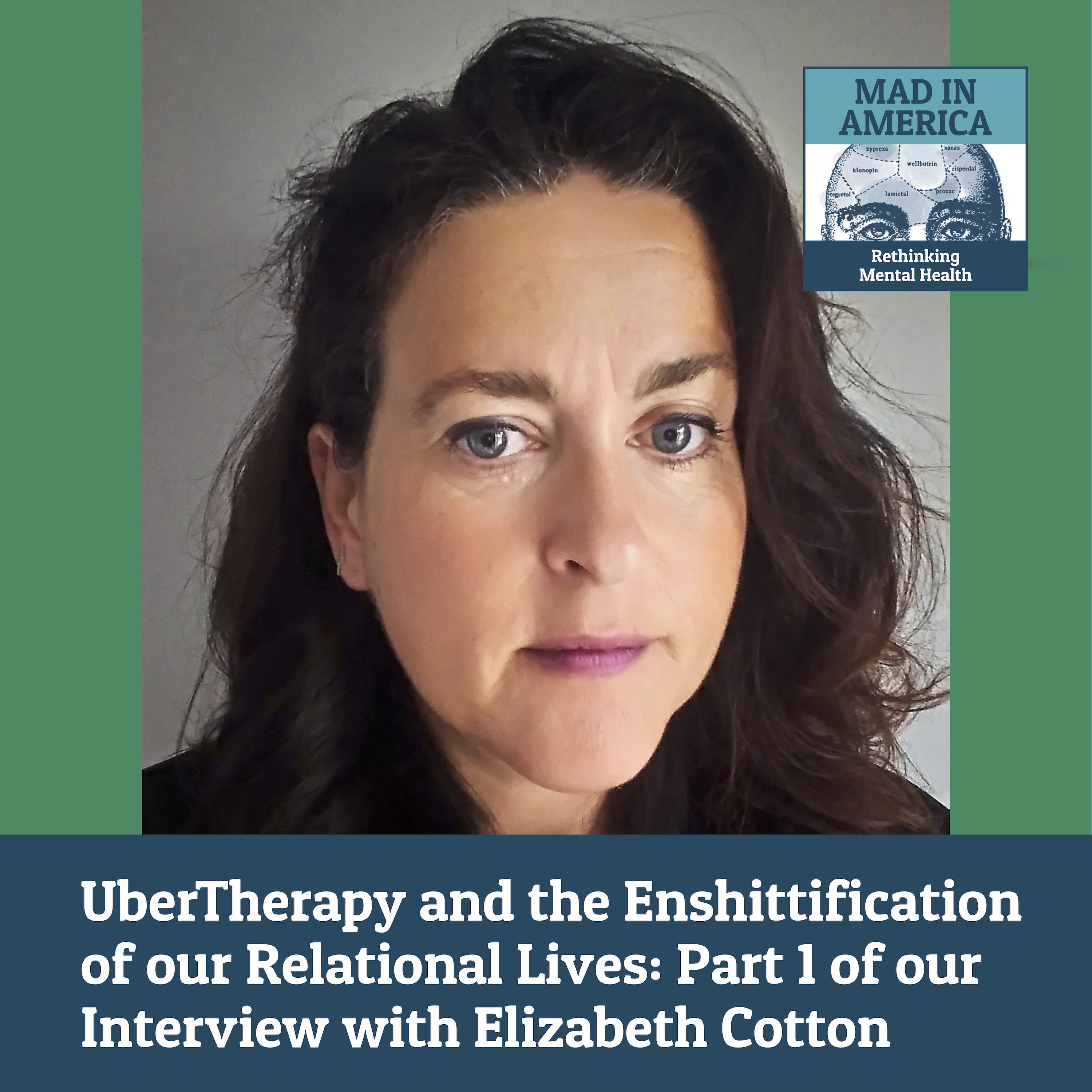 UberTherapy and the Enshittification of our Relational Lives: Part 1 of our Interview with Elizabeth Cotton | Elizabeth Cotton is Associate Professor of Responsible Business at the University of Leicester and the founder of Surviving Work, which carries out socially engaged research on mental health and work. She has worked with health teams and trade unions, practiced as a psychotherapist in the NHS, and now runs the Digital Therapy Project, a group of UK and US researchers studying the future of therapy from both sides of the relationship. In her new book, UberTherapy: The New Business of Mental Health, she explores the effects of reorganizing mental health care around the logic of the app store. Therapy is now something you can scroll through on your phone, match with in seconds, and rate like a ride share. Platforms promise frictionless access and personalized care. What is harder to see is how this new "mental health marketplace" is reshaping what therapy is, how it feels, and who it is really built to serve. UberTherapy is part political economy, part insider account of therapy work, part literary exploration of what it actually feels like to bring our most distressed selves to the mental health app ecosystem. In the first part of our conversation, we discuss how Cotton's path through psychoanalysis, labor organizing, and sociology shaped Uber Therapy, and how shame and anger get intensified when platforms frame therapy as an easy consumer service. *** Thank you for being with us to listen to the podcast and read our articles this year. MIA is funded entirely by reader donations. If you value MIA, please help us continue to survive and grow. https://www.madinamerica.com/donate/ To find the Mad in America podcast on your preferred podcast player, click here: https://pod.link/1212789850 © Mad in America 2026. Produced by James Moore https://www.jmaudio.org | — | ||||||
| 1/28/26 |  Food First, Pharma Last - Part Two of our Interview with Chris Masterjohn | This week, we are joined by Chris Masterjohn, PhD. Chris is a nutritional scientist, a former professor, and the founder of Mitome. With a PhD in nutritional science and years of research in mitochondrial biology, Chris's work focuses on translating peer-reviewed science into practical tools for human health. At Mitome, Dr. Masterjohn pioneered the first analysis designed to measure mitochondrial respiratory chain function directly, identifying individual energy bottlenecks and guiding personalized science-backed protocols to optimize the system responsible for over 90% of cellular energy production. His mission is to bring mitochondrial testing out of the rare disease space and into everyday health. In part 2, we discuss the biochemistry of our stress response and the potential benefits of balanced nutrition for those in psychiatric drug withdrawal. *** Thank you for being with us to listen to the podcast and read our articles this year. MIA is funded entirely by reader donations. If you value MIA, please help us continue to survive and grow. https://www.madinamerica.com/donate/ To find the Mad in America podcast on your preferred podcast player, click here: https://pod.link/1212789850 © Mad in America 2025. Produced by James Moore https://www.jmaudio.org | — | ||||||
| 1/21/26 |  Mitochondria and Energetic Failures - A New Understanding of Antidepressant Withdrawal? An Interview with Chris Masterjohn | This week, we are joined by Chris Masterjohn, PhD. Chris is a nutritional scientist, a former professor, and the founder of Mitome. With a PhD in nutritional science and years of research in mitochondrial biology, Chris's work focuses on translating peer-reviewed science into practical tools for human health. At Mitome, Dr. Masterjohn pioneered the first analysis designed to measure mitochondrial respiratory chain function directly, identifying individual energy bottlenecks and guiding personalized science-backed protocols to optimize the system responsible for over 90% of cellular energy production. His mission is to bring mitochondrial testing out of the rare disease space and into everyday health. In this interview, we discuss why so little is understood about the role serotonin plays in the body and how our mitochondria might play a part in the experince of antidepressant withdrawal. *** Thank you for being with us to listen to the podcast and read our articles this year. MIA is funded entirely by reader donations. If you value MIA, please help us continue to survive and grow. https://www.madinamerica.com/donate/ To find the Mad in America podcast on your preferred podcast player, click here: https://pod.link/1212789850 © Mad in America 2025. Produced by James Moore https://www.jmaudio.org | — | ||||||
| 1/14/26 |  Why Critical Mental Health Knowledge Is Essential for Ethical Practice: An Interview with Jan DeFehr | Jan N. DeFehr is an associate professor in the Faculty of Education at the University of Winnipeg and an associate of The Taos Institute and a member of the Faculty for Palestine, Manitoba. She is also a member of the York University Mad Studies Hub. Before entering academia, she spent many years as a clinical social worker, working alongside people who were trying to make sense of their distress within, and often in spite of, the mental health system. Her teaching, research, and course development focus on building public access to critical analyses of that system, drawing on the work of clients and survivors of psychiatry, practitioners, and scholars. Her new book, A Critical Mental Health Primer: Towards Informed Choice in Social Services, Education, and Healthcare(Canadian Scholars, 2025), offers a clear and accessible map of critical mental health scholarship. The book examines scientific critiques of diagnosis, the potential harms of psychiatric labels, the lack of transparency and procedural justice in services, anti-colonial critiques of mental health premises and practices, and the evidence on psychiatric drugs and the DSM. It also gathers non-pathologizing ways of helping that center relational, dialogical, anti-oppressive, and anti-colonial approaches, along with concrete tools for informed choice and everyday support outside of the dominant medical model. In our conversation, we talk about how Jan came to adopt critical perspectives, why she sees access to critical mental health knowledge as a prerequisite for ethical practice, and what it looks like when organizations take informed choice seriously. We move through the key chapters of the book, explore its implications for social workers, educators, and health professionals, and look at how communities can build forms of care that do not depend on diagnosis or coercion. *** Thank you for being with us to listen to the podcast and read our articles this year. MIA is funded entirely by reader donations. If you value MIA, please help us continue to survive and grow. https://www.madinamerica.com/donate/ To find the Mad in America podcast on your preferred podcast player, click here: https://pod.link/1212789850 © Mad in America 2026. Produced by James Moore https://www.jmaudio.org | — | ||||||
| 1/7/26 |  ADHD Diagnoses, Examining the Psyche, Withdrawal and PSSD Risks, ECT Harms and More: Robert Whitaker Answers Reader Questions | In our first podcast of 2026, Robert Whitaker joins us to answer questions submitted by Mad in America readers and listeners. We discuss the validity of ADHD diagnoses, withdrawal and sexual dysfunction risks of SSRI antidepressants, the harms of electro-convulsive therapy (ECT), the rise of AI-generated misinformation and much more. *** Thank you for being with us to listen to the podcast and read our articles this year. MIA is funded entirely by reader donations. If you value MIA, please help us continue to survive and grow. https://www.madinamerica.com/donate/ To find the Mad in America podcast on your preferred podcast player, click here: https://pod.link/1212789850 © Mad in America 2026. Produced by James Moore https://www.jmaudio.org | — | ||||||
| 12/17/25 |  Learning to Soar: A Conversation With Artist Kev G Mor | Musician and artist Kev G Mor joins us to discuss his experience of psychosis, his daily support strategies, and the pros and cons of having a hundred-pound pit bull terrier for emotional support. Kev is a suicide survivor who grew up with early childhood trauma and has experienced homelessness as a teen, is a single father, and is now again in recovery. His work is about showing what staying well looks like on hard days and keeping it practical for people who live with psychosis. *** Thank you for being with us to listen to the podcast and read our articles this year. MIA is funded entirely by reader donations. If you value MIA, please help us continue to survive and grow. https://www.madinamerica.com/donate/ To find the Mad in America podcast on your preferred podcast player, click here: https://pod.link/1212789850 © Mad in America 2025. Produced by James Moore https://www.jmaudio.org | — | ||||||
| 11/19/25 | 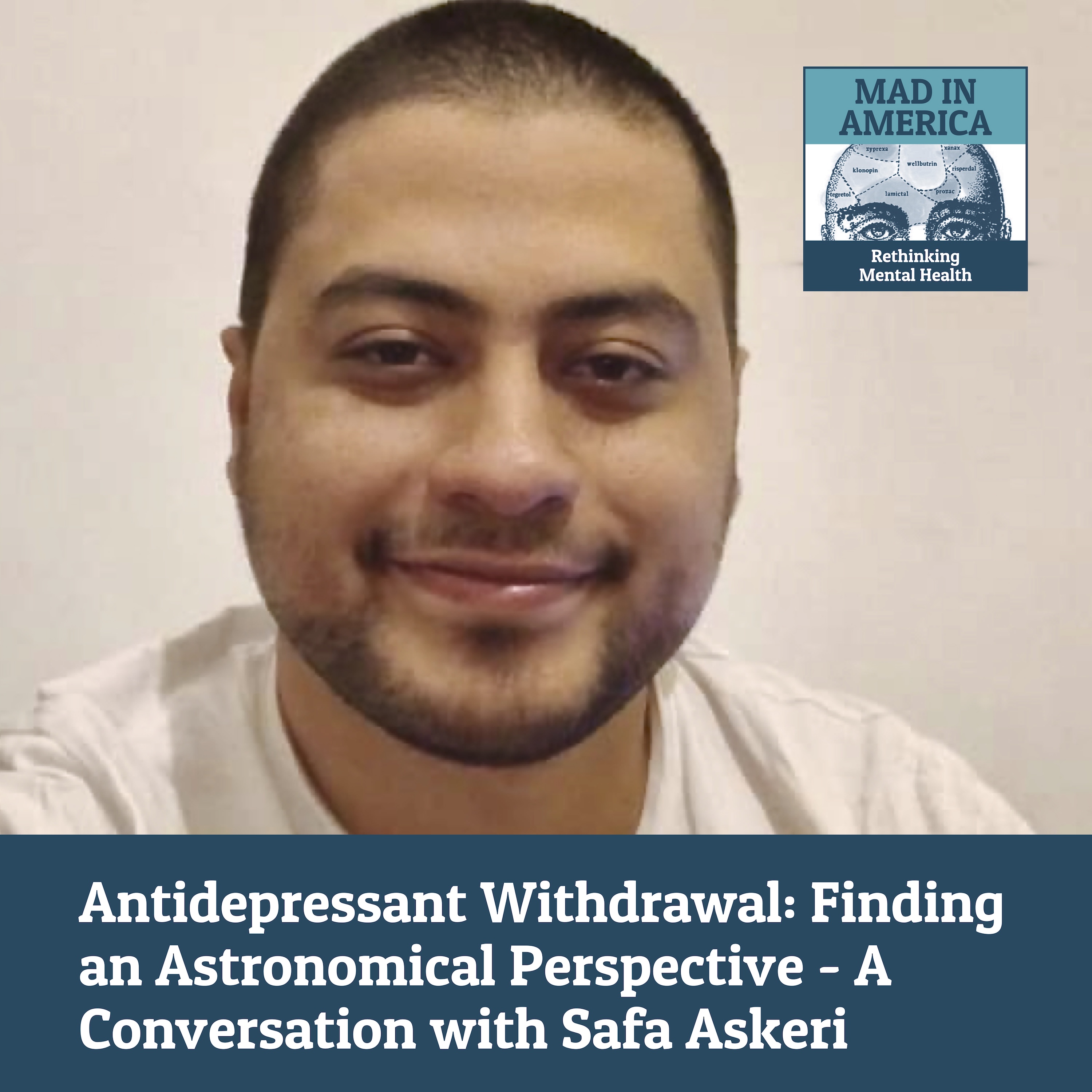 Antidepressant Withdrawal: Finding an Astronomical Perspective - A Conversation with Safa Askeri | Safa Askeri joins us to discuss his experience of antidepressant withdrawal and the gaslighting he was subjected to as he raised concerns with his doctors. "After this happened to me, I know that I can handle anything in life, no matter how hard it is." *** Like to know more about Mad in America or rethinking psychiatry more broadly? On our podcast, Robert Whitaker will answer your questions. Email questions to info@madinamerica.com by November 30, 2025 and we'll pick a selection for our December episode. We'd love to hear from you. *** Thank you for being with us to listen to the podcast and read our articles this year. MIA is funded entirely by reader donations. If you value MIA, please help us continue to survive and grow. https://www.madinamerica.com/donate/ To find the Mad in America podcast on your preferred podcast player, click here: https://pod.link/1212789850 © Mad in America 2025. Produced by James Moore https://www.jmaudio.org | — | ||||||
| 10/29/25 |  Psychiatric Drugs: The Real World is Where the Harms Live | Joining us for a roundtable discussion are Brooke Siem, David Antonuccio, Kim Witzak, Angie Peacock and David Healy. They discuss the challenges of openly discussing psychiatric drug withdrawal, the true meaning of informed consent, getting doctors to acknowledge medication-induced harm and much more. *** Thank you for being with us to listen to the podcast and read our articles this year. MIA is funded entirely by reader donations. If you value MIA, please help us continue to survive and grow. https://www.madinamerica.com/donate/ To find the Mad in America podcast on your preferred podcast player, click here: https://pod.link/1212789850 © Mad in America 2025. Produced by James Moore https://www.jmaudio.org | — | ||||||
| 10/8/25 | 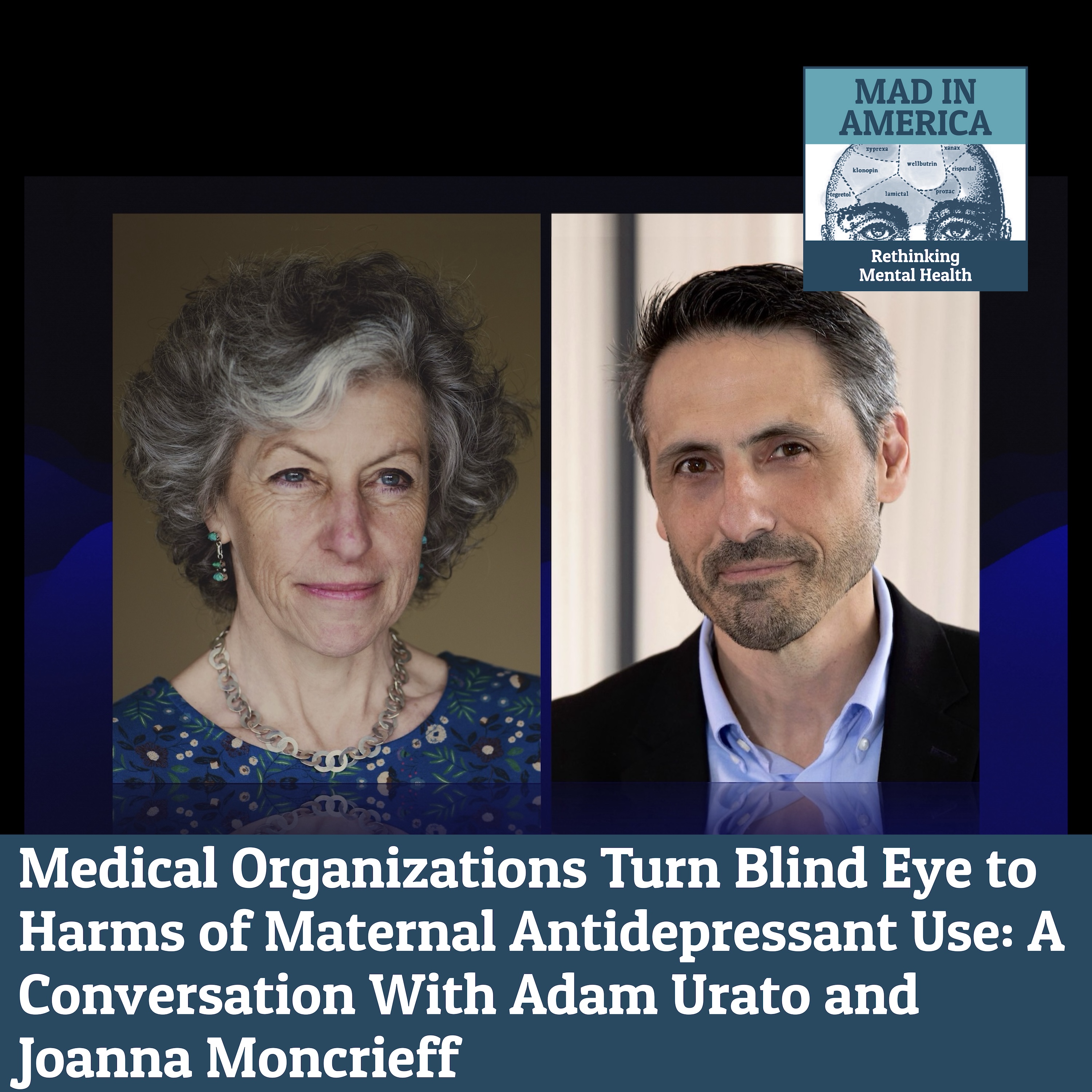 Medical Organizations Turn Blind Eye to Harms of Maternal Antidepressant Use: A Conversation With Adam Urato and Joanna Moncrieff | On July 21st 2025, the FDA convened a hearing on maternal use of antidepressants during pregnancy and the impact this use has on fetal development. Around 400,000 children in the United States are born each year whose mothers took antidepressants while pregnant, and so it's easy to see the societal importance of this topic. What are the risks to the fetus, the newborn, and the long-term development of that child? Adam Urato and Joanna Moncrieff were members of that FDA panel, and so too were several others well-known to MIA readers, including David Healy and Joseph Witt-Doerring. The purpose of the panel was to assess whether the FDA needed to put a warning on antidepressants related to their use in pregnancy, and most on the panel spoke of research that told of the need to do so. However, after the panel concluded, the American Psychiatric Association and other medical associations, most notably the American College of Obstetricians and Gynecologists, responded with what can only be described as howls of outrage, issuing press releases and telling the public that the panel was biased and that the real risk during pregnancy was untreated mental illness. These medical organizations asserted that the increased risk of adverse outcomes for children born to depressed mothers is due to the illness and not the drug, and that there was plenty of evidence that antidepressants were a helpful and even life-saving treatment for maternal depression. Here is where we are today. That FDA hearing put two narratives on public display, and most media reports embraced the narrative put forth by the medical organizations. What we will do today is review the evidence that exists on this topic and the response by the medical guilds to a public airing of that evidence. Dr. Adam Urato is Chief of Maternal and Fetal Medicine at the Metro West Medical Center in Framingham, Massachusetts, and he has been speaking and writing about the risk of medications used during pregnancy for years. Dr. Joanna Moncrieff is a UK psychiatrist and researcher who was a co-founder of the Critical Psychiatry Network and is well known for her research on the safety and efficacy of psychiatric drugs. *** Thank you for being with us to listen to the podcast and read our articles this year. MIA is funded entirely by reader donations. If you value MIA, please help us continue to survive and grow. https://www.madinamerica.com/donate/ To find the Mad in America podcast on your preferred podcast player, click here: https://pod.link/1212789850 © Mad in America 2025. Produced by James Moore https://www.jmaudio.org | — | ||||||
Showing 25 of 300
Sponsor Intelligence
Sign in to see which brands sponsor this podcast, their ad offers, and promo codes.
Chart Positions
4 placements across 3 markets.
Chart Positions
4 placements across 3 markets.