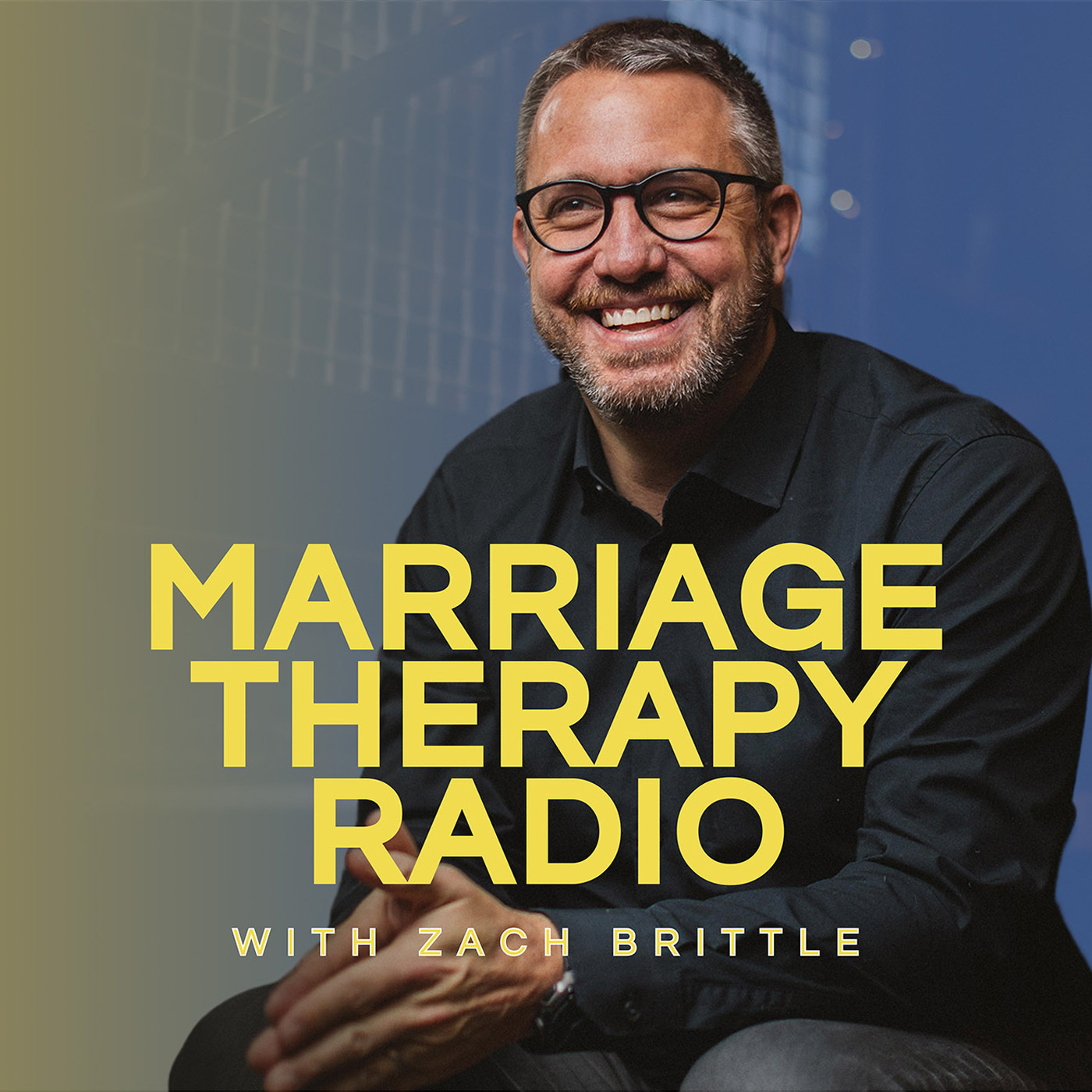
Marriage Therapy Radio
by MTR
Is this your podcast?On the show
From 29 epsHosts
Recent guests
Recent episodes
Ep 446 How a 45-Year Marriage Works w/Meg Staley and Jerry Gretzinger on Rules, Resentment, and Recovery
Oct 13, 2026
36m 59s
Ep 445 Permission for Pleasure w/Dr. Jenni Skyler and Daniel Lebowitz
Oct 6, 2026
48m 49s
Ep 444 Why Couples Resist Change, and What It Costs to Stay Stuck w/Iona Monk & Pam Stewart
Sep 29, 2026
37m 38s
Ep 443 An NPR Journalist, Her Audio Engineer Husband, and the Negotiation That Never Ends w/Yowei Shaw & Kyle Pulley
Sep 22, 2026
38m 26s
Ep 442 Inside a Real Gottman Marriage: Don and Carrie Cole on Repair, Second Marriages, and The New Marriage Clinic Casebook
Sep 15, 2026
49m 43s
Insights from recent episode analysis
Audience Interest
Podcast Focus
Publishing Consistency
Platform Reach
Insights are generated by CastFox AI using publicly available data, episode content, and proprietary models.
Most discussed topics
Brands & references
Total monthly reach
Based on 1 signal.
Built from
By chart position
- 🇺🇸United States · RelationshipsHOME#12111K to 58K
- 🇮🇹Italy · Relationships#371.9K to 9.8K
- 🇦🇺Australia · Relationships#145262 to 1.4K
- Per-Episode Audience
Est. listeners per new episode within ~30 days
13K to 69K🎙 ~2x weekly·440 episodes·Last published 6d ago - Monthly Reach
Unique listeners across all episodes (30 days)
26K to 139K🇺🇸84%🇮🇹14%🇦🇺2% - Active Followers
Loyal subscribers who consistently listen
14K to 76K
Market Insights
Platform Distribution
Reach across major podcast platforms, updated hourly
Total Followers
—
Total Plays
—
Total Reviews
—
* Data sourced directly from platform APIs and aggregated hourly across all major podcast directories.
Social Links & Contact
Official channels & resources
Official Website
Login
RSS Feed
Login
| Date | Episode | Topics | Guests | Brands | Places | Keywords | Sponsor | Length | |
|---|---|---|---|---|---|---|---|---|---|
| 10/13/26 |  Ep 446 How a 45-Year Marriage Works w/Meg Staley and Jerry Gretzinger on Rules, Resentment, and Recovery | Zach has watched the People Make Games documentary about Jerry's Map twice, and cried both times. So when Jerry Gretzinger and his wife Meg Staley join him, almost 45 years into their marriage, he sets the map aside and asks about the two of them. They met in SoHo in 1979 when Jerry hired Meg to handle press and sales for a designers' co-op. She was 29 and newly sober. He was nine years older, divorced, and a father of two. They became friends, then business partners, and eventually built Staley/Gretzinger, a one-of-a-kind clothing line sold in Nordstrom, Bloomingdale's, and Bergdorf Goodman.Two designers in one small company meant they had to make rules early: whoever led a product line got the final say, and the other could only offer a critique. Meg calls marriage a system of agreements, most of them unspoken, that only get looked at when they stop working. Jerry is honest about how hard it was to hand Meg the lead design role in a company that started as his, and how a small product line of his own, maybe 15% of the business, eased the resentment. They talk about bedtime fights, a hard stretch with a teenage son that sent them into couples therapy, and how the 12-step programs they both work gave them a shared language. Jerry still remembers the first question of his fourth-step inventory: what was your mother's relationship with her family?The last third gets tender. Jerry describes sobbing over the documentary's comments every time a viewer mentioned the couple's affection. Meg explains why his "do something and see what happens" process drives her crazy in the garden, and why the move from their Hudson Valley community to the family farm in Michigan, a sacrifice for her, started the sweetest 10 or 15 years of their marriage. If you want to hear what long love looks like when two people have already done the hard work, press play.Key TakeawaysMarriage runs on a system of agreements. Most of them are intuitive, and you only examine them when they collide.When two strong people share one space, decide in advance who gets the final say on what. Then let the other person critique without taking over.Resentment often comes from feeling you have no control or agency. Carving out even a small area that is fully yours can ease it.Kids change how you use your time. What used to be "my time" now takes an agreement with your partner.Couples therapy can work by giving you practice talking to each other, so the communication carries on after the sessions end.Understanding your parents often means understanding how they were parented. The question "what was your mother's relationship with her family?" can open a lot.Small acts of care, like asking whether your partner is drinking enough water, are how couples protect each other day to day.A marriage lasts when the relationship matters more than either person alone, and both are willing to give up something to keep it.Guest InfoMeg Staley Colorist, printmaker, and clothing designer. Meg grew up in Bellevue, Washington, graduated from Smith College as a printmaker, and worked at Nordstrom before moving to New York to represent small designers, one of whom was Jerry. Together they ran Staley/Gretzinger for about 25 years, with coverage in Vogue, Harper's Bazaar, and Elle, before selling the company. She now works as Meg Staley Handmade, making one-of-a-kind women's clothing, home goods, and commissioned legacy quilts from a family's own clothes, out of a studio in Cedar, Michigan, where she also hosts a women's AA meeting. She doesn't sell online. Website: megstaley.com Jerry Gretzinger Artist and clothing designer, born in Grand Rapids, Michigan, in 1942. Jerry studied architecture and liberal arts, served in the Peace Corps in Tunisia, and moved to New York in 1973, where he started a handbag company before co-founding Staley/Gretzinger with Meg. He is best known for Jerry's Map, an imaginary world he started as a doodle at a summer job in 1963. It has grown to more than 4,000 eight-by-ten-inch panels that keep changing according to a custom deck of cards. Website: jerrysmap.com Instagram: @jerrysmap_1963 YouTube: @jerrygretzinger9861 Facebook: jerrysmap1963The documentery film is found at https://www.youtube.com/watch?v=Is8N7B9b0GQMeg and Jerry have been married almost 45 years and live on their farm in Maple City, Michigan. They have four children: two sons together, plus Jerry's daughter and son from his first marriage.See Privacy Policy at https://art19.com/privacy and California Privacy Notice at https://art19.com/privacy#do-not-sell-my-info. | 36m 59s | ||||||
| 10/6/26 | Ep 445 Permission for Pleasure w/Dr. Jenni Skyler and Daniel Lebowitz | Zach talks with Dr. Jenni Skyler and Daniel Lebowitz, the married sex therapists behind the Intimacy Institute, and starts somewhere unexpected: their Sunday night calendar meeting. Before the conversation ever gets to the bedroom, Jenni and Daniel walk through the weekly check-in they swear by as parents of two boys, covering finances, kids' schedules, board meetings, and a bar mitzvah on the horizon. It's not sexy, Jenni admits, but she says it's exactly what clears her head enough to be present for the parts that are.From there, Zach brings them a pattern he's seeing again and again in his own practice: couples in their 40s, 50s, and 60s where she is waking up to her sexuality and he is coasting, happy with his garage and his sports and not all that interested. Jenni and Daniel lay out what they'd look for. They start with testosterone and move through resentment, an old affair that never healed, fear of his body failing him, and what Daniel calls a resistance to dreaming. Daniel's emergency brake image, where everything in a man's life carries just a little extra friction, is one of the clearest descriptions of low testosterone you'll hear. The couple also tells their origin stories. Jenni played Dr. Ruth to her friends and wrote her own Vagina Monologues piece in college. Daniel's grandmother asked about his sex life in front of his girlfriends, he lost his father when he was 7, and men's work led him, reluctantly, into sex therapy.The last stretch turns to pleasure itself. Jenni pushes back on the idea that we have to earn it, Zach floats a theory that people who struggle with pleasure in the bedroom might start at the dinner table, and Daniel shares a steak analogy that perfectly captures what performance anxiety does to sex. If your sex life has gone quiet, or one of you wants more than the other, this episode gives you a long list of places to look and a lot of permission to slow down.Key TakeawaysA weekly logistics check-in isn't romantic, but clearing the mental clutter of schedules and bills makes it easier to be present for intimacy.Intimacy can work like a junk drawer: the unresolved dynamics in a relationship tend to end up there, which is why working on intimacy often means working on everything else.Sex is often the symptom that gets a couple through the door, not the whole problem. The deeper work is usually underneath.When a midlife man's desire drops, the causes can include low testosterone, resentment, unhealed betrayal, depression, trauma, or fear that his body won't cooperate.Some partners stop hoping for a better sex life because it feels safer than being disappointed. "If I never get to go to Hawaii, then I won't miss it."A man who has always been the initiator may freeze when his partner starts initiating, especially if he has quietly relied on planning ahead to feel confident.You don't have to earn pleasure through suffering or productivity. Practicing it in everyday ways, like eating slowly or taking a warm shower, can make it easier to access in the bedroom.Rules and performance pressure crowd out pleasure. When you're focused on doing it right, you stop noticing what you're actually experiencing.Guest InfoDr. Jenni Skyler Sex therapist and founder of the Intimacy Institute, which she started before she met Daniel. Its mission is "giving all people permission for pleasure." She hosts the Sex and the Psyche podcast and is active on social as Dr. Jenni Skyler (spelled "with an I").Daniel Lebowitz Sex therapist at the Intimacy Institute who focuses on men's work and masculinity. He has a master's degree in Latin American studies and planned to become a history professor. He later trained as a therapist and joined the practice. He's not on social media.Jenni and Daniel are married with two sons, ages 10 and 12. The Intimacy Institute offers clinical sex and relationship therapy, from brief solution-focused work to longer, deeper relational work. They also run private multi-day couples intensives built around each couple.website: https://www.intimacyinstitute.org/See Privacy Policy at https://art19.com/privacy and California Privacy Notice at https://art19.com/privacy#do-not-sell-my-info. | 48m 49s | ||||||
| 9/29/26 | Ep 444 Why Couples Resist Change, and What It Costs to Stay Stuck w/Iona Monk & Pam Stewart | Zach flips the usual format and welcomes two fellow podcasters: Iona Monk and Pam Stewart, the therapists behind Relationship Dish. They're podcast partners, not romantic partners, and they're quick to add that they'd be a terrible match anyway (Iona pursues, Pam withdraws). Iona started the show to take the shame out of couples therapy. Couples tend to show up six or seven years too late, like walking into a dentist after years away and asking them to save the tooth. If two therapists can talk openly about their own marriages, maybe everyone else will get help sooner. Pam brings a different lens from years of family therapy, where parents often believe everything would be fine if the kid would just change.That idea turns into the backbone of the conversation: systems resist change. Iona calls it homeostasis, the pull back to whatever the body and brain already know. Pam calls it the "misery stabilizer," and points out how much energy it takes to keep things stuck. Zach pushes back on the idea that people hate change. They change their clothes every day. What they hate is loss, and they don't move until the cost of staying the same outweighs the cost of changing. From there, the three of them run with a Home Depot metaphor. Couples come in asking for tools, but a good helper asks what you're building first, and you don't hand a power saw to a kid. Iona shares a story about a couple who wanted "tools" mostly so one could hit the other over the head with them.The episode closes with Iona's new book, Happy for the Long Haul, which looks at marital conflict through five lenses, including relational trauma and what she calls the biological need for speed: the way growing up in chaos can leave your body craving the adrenaline of conflict. Zach connects it to what he calls relational recovery, the idea that all of us are hooked on the protective systems we learned as kids. It's a smart, funny, and practical conversation about why couples stay stuck and what it takes to finally move.Key TakeawaysPeople don't resist change. They resist loss. Name what the change will cost you, and it gets easier to face.You won't change until staying the same costs more than changing. Part of good therapy is helping you see that cost clearly.Staying miserable takes more energy than it looks like. Couples often realize this only after they've changed.Sometimes a couple avoids doing the work because failing would be scarier than staying stuck. Not trying protects the fantasy that things could be better "someday."Tools don't help until you know what you're building. Figure out whether you need fresh paint, a remodel, or a new foundation.A relationship tool can become a weapon. If you're using what you learned in therapy to prove your partner wrong, you're missing the point.The problem is rarely one person. It's the cycle you've built together, and that cycle is your common enemy.The survival strategies that protected you as a kid can sink you as an adult. You can survive or you can thrive, but you can't do both.Guest InfoIona Monk is a registered clinical counsellor in the greater Vancouver area with a graduate degree from the University of British Columbia. She works with couples and individuals, mainly through the lens of attachment and defense systems, with emotionally focused therapy as a core approach. She has 25 years of experience as a couples therapist. Iona co-hosts Relationship Dish and is the author of Happy for the Long Haul, a practical guide to building a marriage that goes the distance, drawn from her client work and her own 30-year relationship. The book came out September 22 and is available on Amazon.Pam Stewart is a registered clinical counsellor with master's degrees from the University of British Columbia and the University of Colorado. Her clinical focus is parents and children, helping families build healthy attachment relationships, often alongside child therapists and psychiatry as part of a coordinated care team. She says she's retired, but she still does some family therapy and has a side business in interior design. Pam and Iona met in grad school and co-host Relationship Dish together.Relationship Dish is a podcast where two therapists talk honestly about their own romantic relationships. New episodes come out every two weeks on Spotify, Apple Podcasts, and other podcast apps.Iona's practice and show page: ionamonkcouplestherapy.com/relationshipdishBook: Happy for the Long Haul (Amazon)Show socials: Instagram @relationshipdishCrossover note: Zach also appeared on Relationship Dish to talk about the movie The Invite.See Privacy Policy at https://art19.com/privacy and California Privacy Notice at https://art19.com/privacy#do-not-sell-my-info. | 37m 38s | ||||||
| 9/22/26 | Ep 443 An NPR Journalist, Her Audio Engineer Husband, and the Negotiation That Never Ends w/Yowei Shaw & Kyle Pulley | Zach talks with Yowei Shaw and Kyle Pulley, a married couple who make the podcast Proxy together, a show that investigates "emotional mysteries" by connecting people who feel alone in a specific conundrum with a stranger who has lived through something close to it. Yowei spent about seven years creating and hosting the NPR documentary series Invisibilia before she was laid off in 2023. Kyle co-owns a recording studio in Philadelphia and plays a hands on role in Proxy, mixing episodes, managing the spreadsheets, and generally functioning, in his own words, as Yowei's bedraggled podcast spouse. They met on OkCupid, where Yowei used a flimsy pretext (she asked Kyle, an audio engineer, for help recording a narration she had already written an article about how to do herself) to get to know a guy with cute band photos.Most of the conversation traces how that early flirtation turned into a real, ongoing negotiation. When Yowei's NPR job pulled her to DC, Kyle stayed in Philadelphia with his studio and his music scene, and for years the two of them lived split lives, with Yowei commuting by Amtrak and Kyle rearranging his schedule, his living situation, and his role in the house to make it work. The bigger shift came when Yowei's income outpaced Kyle's and she became, unexpectedly, the breadwinner. She's candid that this new power showed up in their fights as an unfair trump card, and just as candid about how getting laid off in 2023 flipped the dynamic again, sending her into what she calls a complete mess of a stretch that Kyle met with support instead of shame. They talk through what stuck from couples therapy, and the concept from Yowei's individual therapist about not letting one partner absorb all the worry in a relationship, a framework they still use today around money, the future of the show, and the question of having kids.What makes the conversation land isn't that Yowei and Kyle have solved any of this. It's that they've built small, repeatable structures, a weekly "proxy meeting" to keep the podcast's business from leaking into date nights, permission to have a real blowup about once a quarter and then let it go, honesty about which gender roles still sneak up on them even though they don't believe in them, that let two strong willed, creative people keep choosing each other. It's a warm, funny, unusually honest look at a relationship that runs on ongoing negotiation rather than a moment when everything got figured out.Key TakeawaysNegotiation isn't a phase a couple moves past. Kyle says what convinced him he wanted to stay was that they always came back to the negotiating table, not that they stopped needing to.A sudden shift in who earns more money changes the emotional balance of a relationship, not just the financial one, and both partners have to consciously renegotiate power along with the budget.A recurring check in meeting, even a literal business meeting with a whiteboard, keeps one source of stress (in this case, the podcast) from leaking into every other part of a relationship.Learning your own rhythm for conflict, how often you blow up and how you repair afterward, matters more than trying to avoid conflict altogether.When one partner absorbs all the worry or responsibility for the future, there's no room for the other to step in. Deliberately pulling back can invite a partner to show up.Gender roles a couple has rejected intellectually can still resurface underneath old fights, especially around money and caretaking.Unconditional support through a layoff or career setback, without shame or pressure to hurry up, can become the turning point that redefines who carries a relationship's weight.Couples therapy can feel like it's taking sides when it's actually just holding both partners equally accountable, and that discomfort is often the useful part.Guest InfoYowei Shaw, creator and host of Proxy, an independent, mostly listener-funded podcast that investigates specific, private emotional conundrums. She calls herself an emotional investigative journalist. Before Proxy she spent years at NPR as a producer, co-host, and editorial lead on Invisibilia, with earlier stints as a temp on Fresh Air and stories for This American Life. Invisibilia was canceled and she was laid off from NPR in 2023, after which she built Proxy independently from Philadelphia.Website: https://yoweishaw.com Show: https://proxypodcast.com Instagram: @yoweishaw (personal), @proxypodcast (show) Kyle Pulley, Philadelphia music producer, audio engineer, and bassist. Co-founder and co-owner of Headroom Studios (with Joe Reinhart). Production and engineering credits include Dr. Dog, Alex G, Hop Along, Jay Som, Adult Mom, Diet Cig, Shamir, and Kississippi, among others. Also plays bass and co-writes in the band Thin Lips. He's the mixing engineer on Proxy and married to Yowei Shaw; Proxy's about page credits him as Mixing Engineer / Bedraggled Podcast Spouse.Website: https://kylepulley.netStudio: https://headroom.studioInstagram: @kylepulley (personal), @headroomphiladelphia (studio) Threads: @kylepulleySee Privacy Policy at https://art19.com/privacy and California Privacy Notice at https://art19.com/privacy#do-not-sell-my-info. | 38m 26s | ||||||
| 9/15/26 | Ep 442 Inside a Real Gottman Marriage: Don and Carrie Cole on Repair, Second Marriages, and The New Marriage Clinic Casebook | Zach sits down with Don and Carrie Cole, the Gottman Institute's clinical director and research director, and asks the question the show always comes back to: forget the credentials, what actually makes your own marriage work? Both Coles came into this relationship out of first marriages that failed. Don spent years stuffing his feelings to avoid upsetting his first wife, and it cost him the marriage. Carrie survived a relationship that was psychologically and physically abusive, what she still calls "manhandling" rather than assign it the harsher name it deserves. Thirty years later, with an anniversary trip already booked, they're still negotiating a blended family, a chronic disagreement about punctuality, and an unmade bed, while trying to actually practice what they've spent their careers teaching.The conversation moves fast between the personal and the professional, because for the Coles those two things are the same material. Don walks through the three words he tells every couple in therapy, "that makes sense," and what it costs him to mean them when his wife brings him a plan he didn't ask for. Carrie explains the physiological version of the same idea, how her heart rate visibly drops when Don validates her, and how the worst sign in a relationship isn't two partners fighting, it's one partner's pain landing on a partner who feels nothing at all. They trace their own origin story back to a staff meeting in the mid-90s, before they were a couple, when Don asked Carrie if she'd ever heard of John Gottman and she said she owned everything he'd ever written. From there the two of them talk candidly about where the Gottman Method runs out of answers, the couples where one partner is in and one is out, the ones who've gone flat instead of fighting, and where they'd push back on John Gottman himself if the science let them.The back half of the episode turns to The New Marriage Clinic Casebook, a new collection Don and Carrie edited for the Gottman Institute, seventeen chapters from seventeen different clinicians, including one contributed by Zach himself. The throughline of the book is that almost nobody walks into couples therapy with just a relationship problem. Depression, addiction, trauma, eating disorders, and affairs all tend to show up in the room too, and Don and Carrie talk through which chapters from their contributors surprised them and why. Zach's read on the whole conversation, echoed straight back to him, is the throughline of just about every good relationship the show has ever featured: take care of your own side of the street first. For anyone who assumes the experts have it figured out and the rest of us are just behind, this is a look at two people who wrote the research and still have to work at it.Key TakeawaysLearning to speak up about your needs, instead of stuffing them to keep the peace, is what prevented Don's second marriage from repeating his first one's slow build of resentment.Surviving an abusive first marriage taught Carrie two rules for her second: never allow herself to be mistreated again, and never let anyone tell her no. That's what she credits for her lasting gratitude toward Don.Once you control for blended families and stepchildren, the divorce rate for second marriages isn't actually higher than for first marriages, it just looks that way in the aggregate."That makes sense" is Don's shorthand for accepting influence. You don't have to agree with your partner's plan to validate that their reasoning makes sense, and doing it consistently changes the emotional temperature of a marriage.Repair after snapping at your partner isn't about placating them. It's about recognizing you crossed a line with someone you love and making it right, which is a different motivation entirely.In relationship research, mutual negativity between partners is actually a better sign than indifference. A partner whose mood isn't affected at all by their spouse's distress is a worse predictor than a couple who fights.Real validation has three steps: naming the feeling, having your partner accurately reflect it back, and confirming out loud that they got it. That third step, confirmed understanding, is what actually lands.The hardest couples to treat aren't the loud ones. They're the ambivalent couples where one partner is in and one is out, and the "disaffected" couples who've stopped fighting because they've stopped caring.Guest InfoDr. Don Cole Clinical director of the Gottman InstituteDr. Carrie Cole Research director of the Gottman InstituteThey've been married almost 30 years, a second marriage for both, and blended a family that included Carrie's two children from her first marriage and Don's son. They're on the episode to talk about their own relationship and to introduce The New Marriage Clinic Casebook, a seventeen-chapter book they edited for the Gottman Institute featuring contributions from clinicians across the field, including a chapter written by Zach himself, on couples therapy when depression, addiction, trauma, neurodiversity, eating disorders, or affairs are also in the room. The book releases at the end of September and is in presales now, with an audiobook edition to follow.Presale link: https://link.amazon/B00O0vBDwSee Privacy Policy at https://art19.com/privacy and California Privacy Notice at https://art19.com/privacy#do-not-sell-my-info. | 49m 43s | ||||||
| 9/8/26 | betrayalcheating+3 | Adam NisensonJudith Nisenson | Women Cheat TooLandmark Worldwide+1 | — | betrayalcheating+5 | — | 41m 13s | ||
| 9/1/26 | marriagedivorce+4 | Neal MiskellRachel Miskell | 11th Force Support Squadron | Afghanistan | marriagedivorce+6 | — | 36m 26s | ||
| 8/25/26 | sex in marriagerelationship dynamics+3 | ZachHeather Shannon | Sex for Couples | — | sex as a hobbymarriage+3 | — | 38m 43s | ||
| 8/18/26 | faithaddiction recovery+4 | Darryl StrawberryTracy Strawberry | — | — | addictionrecovery+7 | — | 49m 52s | ||
| 8/11/26 | generational traumafamily dynamics+4 | KaraStacy | — | — | generational traumafamily reunion+5 | — | 59m 27s | ||
| 8/4/26 | nervous systemmarriage+4 | Deborah Rozman, Ph.D.Howard Martin | HeartMath Institute | — | nervous systemHeartMath+5 | — | 48m 16s | ||
| 7/28/26 | couples therapyrelationship dynamics+4 | Melissa Vogel | The Bomb LifeGottman Method | — | couples therapyrelationship growth+4 | — | 47m 31s | ||
| 7/21/26 | long marriagecommunication+4 | Alexandra StockwellRod Stockwell | The Intimate Marriage Podcast | — | marriagecommunication+7 | — | 44m 06s | ||
| 7/14/26 | cancermarriage+3 | JimKelly | Ironman Foundation | — | Ironmancancer+5 | — | 30m 47s | ||
| 7/7/26 | marriagerelationships+4 | A.D.Courtney | University of North Texas | — | marriagecouples therapy+4 | — | 49m 54s | ||
| 6/30/26 | trauma recoveryenergy work+4 | FrannieDanny | — | FloridaPalm Beach Gardens | traumaenergy work+7 | — | 45m 25s | ||
| 6/23/26 | marriageADHD+4 | EliAriella | Las Vegastwo books | — | marriageADHD+5 | — | 44m 21s | ||
| 6/16/26 | relationship dynamicsRelational Life Therapy+4 | AnnaJohn | Relational Life Institute | — | Relational Life Therapymarriage+5 | — | 51m 06s | ||
| 6/9/26 | comedymarriage+3 | KevinAnnie | Dumb DadsGood Morning America | Los Angeles | comedy couplemarriage honesty+3 | — | 52m 22s | ||
| 6/2/26 | couples therapymarriage struggles+3 | James ChristensenMolly Christensen | Sacramento | — | couples therapymarriage+3 | — | 41m 05s | ||
| 5/26/26 | marriagegratitude+4 | Kate KellyCole Kelly | Camp EquahicDartmouth+1 | PennsylvaniaAthens, Georgia | marriagegratitude+4 | — | 45m 16s | ||
| 5/19/26 | marriageillness+4 | Kate NorthrupMike Watts | Relaxed Money | — | marriage therapychronic illness+3 | — | 44m 45s | ||
| 5/12/26 | marriagerelationships+4 | Adam RoachDana Gentry | USA TodayRestore: 90 Days to Intentional Living | Charleston, South Carolina | marriagealphas+5 | — | 39m 07s | ||
| 5/5/26 | datingrelationships+3 | Evan Marc KatzBridget | — | — | dating coachmarriage+3 | — | 42m 30s | ||
| 4/28/26 | addictionmarriage+4 | MattPaige | — | DFW | opioid addictionfinancial abuse+4 | — | 45m 35s | ||
| 4/21/26 | divorcerelationships+3 | Susie PettitPaul Pettit | Love Your Life Show | Wollongong | divorcerelationships+5 | — | 51m 42s | ||
| 4/14/26 | responsibilityromance+5 | Arlina AllenBob Allen | Game of ThronesHouse of the Dragon | — | marriageresponsibility+5 | — | 45m 17s | ||
| 4/7/26 | Negative Sentiment Overrideemotional climate+3 | Zach | Sexology Podcast | — | Negative Sentiment Overrideemotional filters+3 | — | 34m 58s | ||
| 3/31/26 | relationshipsconflict resolution+3 | RonCatrina | Covers on the SpotMusora | — | marriagedissonance+4 | — | 59m 56s | ||
| 3/24/26 | money in relationshipsfinancial planning+3 | Natalie SlagleDan Slagle | Fyooz Financial Planning | — | moneyrelationships+4 | — | 49m 20s | ||
| 3/17/26 | polyamoryrelational integrity+4 | Hazel GraceNico | The Art of Repair | — | polyamoryrelationship integrity+5 | — | 56m 21s | ||
| 3/10/26 | cancerrecovery+4 | PeteTasha | — | Boulder | cancerrecovery+5 | — | 54m 23s | ||
| 3/3/26 | relationship dynamicsemotional safety+4 | RobinHector | Real Love Ready: A Guide to Relational Literacy | — | relationshipGottman Method+7 | — | 52m 09s | ||
| 2/24/26 | marriage patternscommunication+4 | BrianKristen | — | — | over-functionerunder-functioner+5 | — | 39m 55s | ||


Showing 34 of 440
Pitch Fit is a Pro feature
See how bookable this show is for guests, which brands already advertise, the per-episode ad value, and the best-fit guest and sponsor profile. The numbers are blurred on the free plan.
How readily this show books outside guests like you.
How proven this show is for host-read sponsorships.
For Guests
ProFor Advertisers
ProUpgrade to Pro to unlock guest cadence, sponsor categories, fit scores, and per-episode ad value for this show.
Similar Audience Demographics
Podcasts that attract a similar listener profile

The Save The Marriage Podcast
Lee H. Baucom, Ph.D.

The Couples Therapist Couch
Shane Birkel

Brave Love Great Sex – Couples Therapy Podcast
Cloud10

The Mel Robbins Podcast
Mel Robbins

Relationship Renovation: Why Couples Get Stuck & How They Find Their Way Back
EJ and Tarah Kerwin

The Liz Moody Podcast
Liz Moody

Dear Therapists with Lori Gottlieb and Guy Winch
iHeartPodcasts
Chart history for Marriage Therapy Radio
Peaked at #37 in Italy, currently #37 in Italy.
| Market | Genre | Peak | Current | Trend |
|---|---|---|---|---|
| Italy | — | #37 | #37 | — |
| United States | — | #121 | #121 | — |
| Australia | — | #145 | #145 | — |
Chart Positions
3 placements across 3 markets.
Chart Positions
3 placements across 3 markets.