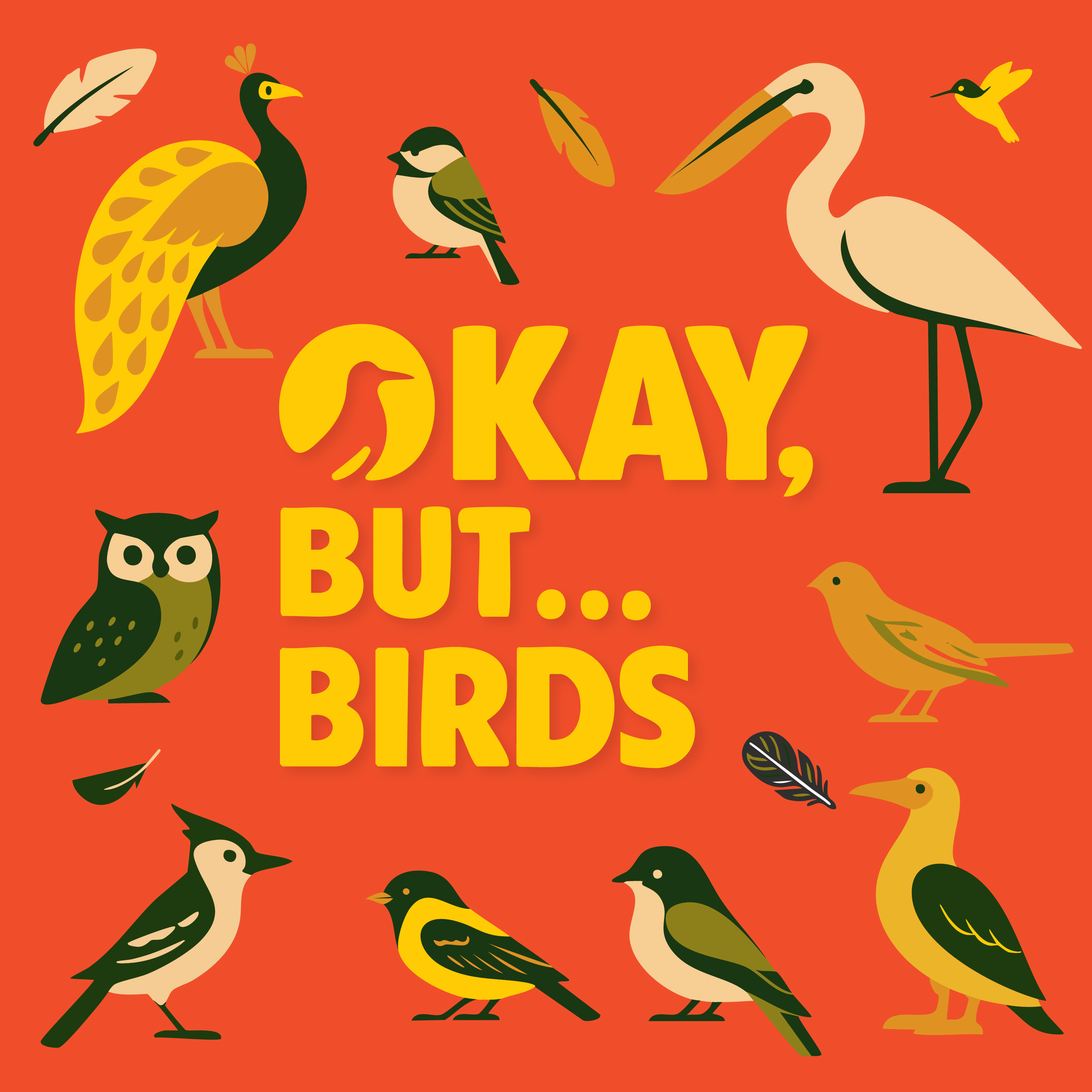
Okay, But... Birds
by Dr. Scott Taylor
Is this your podcast?On the show
Recent episodes
Okay, but what's threatening the apex predators of the sky?
Oct 15, 2026
33m 05s
Okay, but how terrifying were terror birds?
Oct 8, 2026
26m 05s
Okay, but what happens when a bird gets sick?
Oct 1, 2026
33m 25s
Okay, but griffins, and ligers, and birds, oh my!
Sep 24, 2026
32m 19s
Okay, but... cranes!
Sep 17, 2026
32m 18s
Insights from recent episode analysis
Audience Interest
Podcast Focus
Publishing Consistency
Platform Reach
Insights are generated by CastFox AI using publicly available data, episode content, and proprietary models.
Total monthly reach
Based on 1 signal.
Built from
By chart position
- 🇺🇸United States · NatureHOME#32.0M to 10M
- 🇨🇦Canada · Nature#833K to 172K
- 🇨🇴CO · Nature#221K to 112K
- 🇦🇺Australia · Nature#1117K to 92K
- 🇬🇧United Kingdom · Nature#1916K to 86K
- Per-Episode Audience
Est. listeners per new episode within ~30 days
2.1M to 11M🎙 ~2x weekly·39 episodes·Last published 5d ago - Monthly Reach
Unique listeners across all episodes (30 days)
4.2M to 22M🇺🇸92%🇨🇦2%🇨🇴1%+3 more - Active Followers
Loyal subscribers who consistently listen
2.3M to 12M
Market Insights
Platform Distribution
Reach across major podcast platforms, updated hourly
Total Followers
—
Total Plays
—
Total Reviews
—
* Data sourced directly from platform APIs and aggregated hourly across all major podcast directories.
Social Links & Contact
Official channels & resources
Official Website
Login
RSS Feed
Login
| Date | Episode | Description | Length | ||||||
|---|---|---|---|---|---|---|---|---|---|
| 10/15/26 |  Okay, but what's threatening the apex predators of the sky? | E44. An adult eagle has no natural predators, so why are birds of prey declining? Dr. Todd Katzner, a wildlife biologist with the U.S. Geological Survey, explains the surprising dangers facing golden eagles and their kin, from spinning wind turbines to a threat small enough to fit on a grain of rice. In this episode, you'll hear about: Why an eagle that can clearly see a wind turbine still flies into one How a hunter's choice of bullet ends up inside an eagle The flap count that tells a vulture whether to risk crossing the sea All audio, video, and images in this episode are either original to Okay, But... Birds (© Okay Media, LLC) or used under license/permission from the respective rights holders. Media from the Macaulay Library is used courtesy of the Cornell Lab of Ornithology as follows: Bald Eagle audio contributed by Darrell Peterson, ML145265541 Golden Eagle audio contributed by W. Douglas Robinson, ML612942188 Golden Eagle audio contributed by Kathy Groschupf, ML57165 American Goshawk video contributed by Dan J. MacNeal, ML297994251 Harpy Eagle audio contributed by Curtis Marantz, ML81101 Ruby-throated Hummingbird audio contributed by Trenton Voytko, ML604314061 Ferruginous Hawk audio contributed by Gerrit Vyn, ML172487 | 33m 05s | ||||||
| 10/8/26 |  Okay, but how terrifying were terror birds? | E43. For millions of years, South America’s top predators weren’t cats or bears. They were birds, some taller than a person. Paleontologist Dr. Federico "Dino" Degrange of the Universidad Nacional de Córdoba joins us to ask whether terror birds really earned their name. In this episode, you'll hear about: The surprising weapon a terror bird actually used to bring down its prey What left bite marks on one of the biggest terror birds ever found Why the last terror bird standing was one of the smallest All audio, video, and images in this episode are either original to Okay, But... Birds (© Okay Media, LLC) or used under license/permission from the respective rights holders. Media from the Macaulay Library is used courtesy of the Cornell Lab of Ornithology as follows: Black-legged Seriema video contributed by Pablo Hernan Capovilla, ML662237304 Red-legged Seriema audio contributed by Matthew D. Medler, ML189557 Black-legged Seriema audio contributed by Steven L. Hilty, ML83854 | 26m 05s | ||||||
| 10/1/26 |  Okay, but what happens when a bird gets sick? | E42. Birds get sick too, and a lot of what happens next looks surprisingly familiar. Dr. Andrea Townsend of Hamilton College has spent two decades following American crows through outbreaks, and she walks Scott through what illness really does to a bird, from the family it belongs to down to the clever brain it depends on. In this episode, you'll hear about: The surprising way crows choose their partners, and what it costs them when disease comes around What a stomach bug does to one of the cleverest birds you'll ever meet Why going it alone can be the riskier move while a virus is spreading All audio, video, and images in this episode are either original to Okay, But... Birds (© Okay Media, LLC) or used under license/permission from the respective rights holders. Media from the Macaulay Library is used courtesy of the Cornell Lab of Ornithology as follows: American Crow video contributed by Jay McGowan, ML472843 Common Raven audio contributed by Gerrit Vyn, ML137574 Burrowing Owl audio contributed by Bob McGuire, ML188805 | 33m 25s | ||||||
| 9/24/26 |  Okay, but griffins, and ligers, and birds, oh my! | E41. Centaurs, mermaids, minotaurs: we have been inventing creatures that are two things at once for as long as we have told stories. Birds do it for real. Dr. Glaucia Del-Rio of the Florida Museum of Natural History studies two Amazonian antbirds that meet where a river runs out, and what their offspring say about where one species ends. In this episode, you'll hear about: Why a river can be an impossible barrier for a bird with perfectly good wings, and what researchers found when they carried birds out into the middle of one and let go How to spot a hybrid antbird at a glance, once you know which colors belong to which parent The German-Brazilian ornithologist an all-women expedition was named for, and the injury she dealt with herself, a long way from any hospital All audio, video, and images in this episode are either original to Okay, But... Birds (© Okay Media, LLC) or used under license/permission from the respective rights holders. Media from the Macaulay Library is used courtesy of the Cornell Lab of Ornithology as follows: Red-capped Manakin audio contributed by David L. Ross Jr., ML57360 Streak-headed Woodcreeper audio contributed by Ted Parker, ML21543 American Flamingo audio contributed by Gerrit Vyn, ML172484 Lawrence's Warbler (hybrid) audio contributed by Curtis Marantz, ML113786 Brewster's Warbler (hybrid) audio contributed by Curtis Marantz, ML76906 Additional photos and video courtesy of Glaucia Del-Rio: Marco Rego, Fabio Schunck, Luis Morais, and Angela Prochilo. Harlequin Antbird photo by Hector Bottai, via Wikimedia Commons, licensed CC BY-SA 4.0 (creativecommons.org/licenses/by-sa/4.0/). | 32m 19s | ||||||
| 9/17/26 |  Okay, but... cranes! | E40. There are only 15 crane species on the planet, and 11 of them are in trouble. Dr. Andy Caven, Director of Central Flyway Programs for the International Crane Foundation, has spent his career on two of them: the sandhill cranes that pour into one stretch of Nebraska's Platte River every spring, and the whooping crane, which came back from the edge and is still nowhere near safe. Scott asks him what it actually takes to keep a bird like that on the landscape, and the answer runs through soggy grassland, private ranches, and one river worth fighting over. In this episode, you'll hear about: The number Andy gives for how many cranes stand on that stretch of river, which Scott makes him say twice How a bird that was down to a couple of dozen individuals ended up stopping a dam What a wet meadow is, and why one is so much easier to lose than to build back All audio, video, and images in this episode are either original to Okay, But... Birds (© Okay Media, LLC) or used under license/permission from the respective rights holders. Media from the Macaulay Library is used courtesy of the Cornell Lab of Ornithology as follows: Mallard audio contributed by Mike Andersen, ML136504 Wilson's Phalarope audio contributed by W. Douglas Robinson, ML474658841 Swamp Sparrow audio contributed by Wil Hershberger, ML94352 | 32m 18s | ||||||
| 9/10/26 |  Okay, but why does that bird look so rough? | E39. Every August the questions start: there is a cardinal at the feeder with no head feathers, and it looks terrible. Nothing is wrong with it. It is molting, which every bird does at least every year. Dr. Ryan Terrill of the San Diego Natural History Museum studies what a feather endures over a year and what it takes to replace one, and he makes the case that the few weeks a bird spends looking its worst may be the most consequential weeks it has. In this episode, you'll hear about: Why the cardinal at your feeder in late summer looks like it lost a fight What a bird quietly gives up during the weeks it is growing new feathers The hundreds of miles some birds fly for the sake of a new set of feathers All audio, video, and images in this episode are either original to Okay, But... Birds (© Okay Media, LLC) or used under license/permission from the respective rights holders. Media from the Macaulay Library is used courtesy of the Cornell Lab of Ornithology as follows: Northern Cardinal audio contributed by Wil Hershberger, ML191165 American Goldfinch audio contributed by Wil Hershberger, ML94457 Blue Jay audio contributed by Gaetan Dupont, ML173749 Herring Gull audio contributed by Sarah MacLean, ML165927 American Herring Gull video contributed by Steve Kelling, ML540908261 Snow Bunting audio contributed by Gerrit Vyn, ML130973 Red-tailed hawk audio contributed by David McCartt, ML229578 White-throated Sparrow audio contributed by Bob McGuire, ML219799 Great Hornbill audio contributed by Linda Macaulay, ML111527 Flightless Cormorant audio contributed by Linda Macaulay, ML237486 | 31m 21s | ||||||
| 9/3/26 |  Okay, but what's up with feathers? | E38. You have pulled one out of a jacket sleeve at a bad angle, picked one up on a walk, and you are almost certainly within arm's reach of a few thousand of them right now. Dr. Cody Limber, who recently finished his PhD at Yale, spent it taking growing feathers apart one cell at a time to find out what they are actually made of. A feather is not a fancy scale, it does not grow the way you would guess, and after all this time nobody can say what the first ones were for. In this episode, you'll hear about: The strangest things growing out of birds, and which of them actually count as feathers What a feather is actually made of, once you smash one into individual cells and read what every cell was doing What a feather actually is, whether it is alive or dead, how it is put together, and the coordination that color and pattern demand All audio, video, and images in this episode are either original to Okay, But... Birds (© Okay Media, LLC) or used under license/permission from the respective rights holders. Media from the Macaulay Library is used courtesy of the Cornell Lab of Ornithology as follows: Eastern Whip-poor-will audio contributed by Bob McGuire, ML195774 Red-bellied Woodpecker audio contributed by Wil Hershberger, ML306064 Indian Peafowl audio contributed by Rounak choudhary, ML621021542 Common Raven audio contributed by Gerrit Vyn, ML132161 Mallard audio contributed by Mike Andersen, ML136504 Double-crested Cormorant audio contributed by Bob McGuire, ML233274 Zebra Finch (Australian) audio contributed by Vicki Powys, ML226233 American Herring Gull video contributed by Steve Kelling, ML540908261 Golden-winged Warbler video contributed by Benjamin Clock, ML476422 Great Argus audio contributed by Arnoud B. van den Berg, ML71122 Horned Screamer audio contributed by Paul A. Schwartz, ML58925 Wild Turkey audio contributed by James (Jim) Holmes, ML73964601 | 32m 49s | ||||||
| 8/27/26 |  Okay, but does age bring Wisdom? | E37. A bird called Wisdom was banded on Midway Atoll in 1956 and is still laying eggs today, which makes her at least 75 and the oldest known wild bird on the planet. She has also outlived the man who banded her, and most of the scientists who tracked her since. Dr. Etienne Rouby studies long-lived seabirds at the Institute of Arctic and Alpine Research at CU Boulder, working with data from the French sub-Antarctic islands where wandering albatross have been followed for more than half a century. Scott asks him what you can learn from a bird that will outlast your career, your funding, and possibly your field station. In this episode you'll hear about: What a fledgling albatross does for the first five years of its life, and why nobody really knows The fishing gear change that pulled a colony back from the brink, and how long it took to see it working Why a very good year for female albatross is a very bad year for the males All audio, video, and images in this episode are either original to Okay, But... Birds (© Okay Media, LLC) or used under license/permission from the respective rights holders. Media from the Macaulay Library is used courtesy of the Cornell Lab of Ornithology as follows: Snowy Albatross audio contributed by Ted Parker, ML42306 Black-browed Albatross audio contributed by Jan Hansen, ML650026815 | 30m 49s | ||||||
| 8/20/26 |  Okay, but do hummingbirds ever chill? | E36. Hummingbirds run one of the fastest metabolisms of any animal with a backbone, which is why we picture them as permanently buzzing. Scott sits down with Dr. Anusha Shankar, assistant professor at the Tata Institute of Fundamental Research, who studies how hummingbirds budget energy in a world that keeps moving the goalposts. It turns out the blur at your feeder is the exception, not the rule. In this episode you'll hear about: Why the same bird might spend three hours a day flying, or thirteen, depending entirely on what the flowers are doing What happens overnight when a hummingbird lets itself go cold, and how long it takes to come back Seven months in the Ecuadorian cloud forest, and the hummingbirds that sat on the nets and waited Plus: the doubly labeled water method, a sugar concentration threshold you can taste-test at your own feeder at your own risk, and the reason Anusha gets called the hummingbird pee person. The "snoring" hummingbird video Scott and Anusha discuss: https://www.youtube.com/watch?v=_uEfmQt34Nc All audio, video, and images in this episode are either original to Okay, But... Birds (© Okay Media, LLC) or used under license/permission from the respective rights holders. Media from the Macaulay Library is used courtesy of the Cornell Lab of Ornithology as follows: Ruby-throated Hummingbird audio contributed by Trenton Voytko, ML604314061 Black Metaltail audio contributed by Pedro Allasi Condo, ML663268821 Violet-tailed Sylph audio contributed by Paul Coopmans, ML58045 White-booted Racket-tail audio contributed by Daniel Cadena, ML256331 Bee Hummingbird video contributed by Timothy Barksdale, ML440270 Black Metaltail photograph by Thibaud Aronson, via iNaturalist and Wikimedia Commons, licensed under CC BY-SA 4.0. | 31m 28s | ||||||
| 8/13/26 |  Okay, but what's the deal with Darwin's finches? | E35. Eighteen species of small brown bird on a pile of volcanic rock have taught us more about how evolution actually works than almost anything else on Earth. Not because Darwin figured them out. He didn't. Because a handful of scientists went back, banded every bird on one island, and watched it happen in real time. Scott heads to the Galapagos with Dr. Erik Enbody, Assistant Professor of Computational Biology at Cornell University, to find out how one ancestor became eighteen, why the beak is the only thing worth looking at, and what happens when species that aren't supposed to interbreed start swapping genes anyway. In this episode you'll hear about: The island so small you can band every bird on it, and the drought that killed almost all of them One gene that explains 40% of beak size, when nothing in human height explains even 1% The finch that does something mind-blowingly villainous and what it says about how far evolution will go All audio, video, and images in this episode are either original to Okay, But... Birds (© Okay Media, LLC) or used under license/permission from the respective rights holders. Media from the Macaulay Library is used courtesy of the Cornell Lab of Ornithology as follows: Large Ground-Finch audio contributed by Robert I. Bowman, ML85965 Common Cactus-Finch audio contributed by Robert I. Bowman, ML86715 Small Tree-Finch audio contributed by Robert I. Bowman, ML85464 Vegetarian Finch audio contributed by Robert I. Bowman, ML82506 Galapagos Mockingbird audio contributed by Robert I. Bowman, ML45963 Española Mockingbird audio contributed by Herb Elliott, ML638777433 Floreana Mockingbird audio contributed by Robert I. Bowman, ML85455 San Cristobal Mockingbird audio contributed by Arnoud B. van den Berg, ML28656 Palm Tanager audio contributed by Curtis Marantz, ML88937 Blue-footed Booby audio contributed by Robert I. Bowman, ML85906 Vampire Ground-Finch audio contributed by Robert I. Bowman, ML86756 Woodpecker Finch audio contributed by Robert I. Bowman, ML82522 Paradise Tanager audio contributed by Curtis Marantz, ML127399 Galápagos Sea Lion audio contributed by Arnoud B. van den Berg, ML125020 | 36m 26s | ||||||
Want analysis for the episodes below?Free for Pro Submit a request, we'll have your selected episodes analyzed within an hour. Free, at no cost to you, for Pro users. | |||||||||
| 8/6/26 |  Okay, but what's the deal with nests? | E34. Not all birds build one, but for the ones that do, a nest has a single job and a shockingly wide range of ways to get it done. Dr. Vanya Rohwer, Curator of Birds and Mammals at the Cornell University Museum of Vertebrates, joins Scott to walk the far end of that spectrum, from nests made entirely of spit to a colony structure heavy enough to snap the tree it sits in. In this episode you'll hear about: The complete and comical inventory of one hamerkop nest, read aloud, contents included What a bird does when you hand it a nest somebody else already built Why a shed snakeskin in a tree cavity is a calculated decoration New episodes every Thursday. If the show is doing it for you, leave a rating or hit follow. All audio, video, and images in this episode are either original to Okay, But… Birds (© Okay Media, LLC) or used under license/permission from the respective rights holders. Bird media from the Macaulay Library is used courtesy of the Cornell Lab of Ornithology as follows: American Robin audio contributed by Bob McGuire, ML206448 Baltimore Oriole audio contributed by Bob McGuire, ML219606 Black-legged Kittiwake audio contributed by Roger Charters, ML202491 White-nest Swiftlet audio contributed by Arnoud B. van den Berg, ML36421 Cliff Swallow audio contributed by James (Jim) Holmes, ML92053871 Chimney Swift audio contributed by Wil Hershberger, ML107413 Hamerkop audio contributed by Anonymous, ML97562 Eastern Whip-poor-will audio contributed by Bob McGuire, ML195774 Montezuma Oropendola audio contributed by David L. Ross Jr., ML215446 Western Grebe audio contributed by Bob McGuire, ML195029 Rufous Hornero audio contributed by Mike Andersen, ML132447 Northern Yellow Warbler audio contributed by Wil Hershberger, ML516692 Sociable Weaver audio contributed by Jacob Henry, ML637193738 Great Crested Flycatcher audio contributed by Wil Hershberger, ML94314 Blue-gray Gnatcatcher audio contributed by Wil Hershberger, ML534430 White-breasted Nuthatch audio contributed by Bob McGuire, ML306062 | 29m 12s | ||||||
| 7/30/26 |  Okay, but how do birds handle a heatwave? | E33. When the air temperature climbs past a bird's own body temperature, staying cool stops being free and starts to cost them water they may not have. Dr. Blair Wolf, University of New Mexico, has spent his career studying how desert birds survive heat that should kill them, and what happens when it finally gets too hot. In this episode you'll hear about: Why some backyard birds can shrug off oven-like temperatures while others just a few feet away don't make it The strange, water-saving trick birds use to dump heat without a single drop of sweat What the birds dying in these heatwaves are trying to tell us about what's coming All audio, video, and images in this episode are either original to Okay, But... Birds (© Okay Media, LLC) or used under license/permission from the respective rights holders. Bird media from the Macaulay Library is used courtesy of the Cornell Lab of Ornithology as follows: White-winged Dove audio contributed by Raphaël Nussbaumer, ML571978241 Verdin audio contributed by Bob McGuire, ML197163 Black-throated Sparrow audio contributed by James (Jim) Holmes, ML573935831 Black-throated Sparrow video contributed by Benjamin Clock, ML483211 Mourning Dove audio contributed by James (Jim) Holmes, ML583603101 Mourning Dove audio contributed by Anonymous, ML658417476 Palm Cockatoo audio contributed by Emma Greig, ML201266 Rosy-faced Lovebird audio contributed by Derek Solomon, ML168222 Common Eider audio contributed by Bob McGuire, ML235534 | 26m 23s | ||||||
| 7/23/26 |  Okay, but how does wildfire smoke impact birds? | E32. Wildfire smoke is blanketing more of the map every year, and it turns out a smoky sky changes everything for birds, from how they breathe to whether we can find them at all. Dr. Olivia Sanderfoot, Research Scientist at the Cornell Lab of Ornithology, is back to walk Scott through what all that haze is doing to the birds living in it. In this episode: Birds don't breathe the way we do, and that single fact shapes everything about how smoke hits them Stay, shift, or go: the framework for what a bird actually does when the air turns toxic When the birds go quiet, it isn't always because they left Data collection for Project Phoenix is open now through the end of November. If you're on the West Coast, you can sign up at projectphoenix.study and log a 10-minute count from wherever you are, even your own window. All audio, video, and images in this episode are either original to Okay, But... Birds (© Okay Media, LLC) or used under license/permission from the respective rights holders. Bird media from the Macaulay Library is used courtesy of the Cornell Lab of Ornithology as follows: Northern Yellow Warbler audio contributed by Wil Hershberger, ML516692 Black-Crowned Night Heron audio contributed by Bob McGuire, ML225814 Tufted Titmouse audio contributed by Wil Hershberger, ML100712 Cooper’s Hawk audio contributed by Wil Hershberger, ML94518 Bornean Orangutan audio contributed by John MacKinnon, ML82019 American Robin audio contributed by Bob McGuire, ML206448 | 31m 12s | ||||||
| 7/16/26 |  Okay, but did birds invent music? | E31. If a bird sings a phrase worthy of Beethoven, is that music, or just biology in a nice outfit? Dr. Hollis Taylor, a violinist, composer, and ornithologist, has spent more than two decades recording and transcribing the songs of the Pied Butcherbird, an Australian songbird whose vocal life keeps blurring that line. In this episode: How a single pied butcherbird can sing for seven hours through the night, almost never repeating itself, then return the next spring with a brand new repertoire What a violin can and can't reproduce when it tries to follow a butcherbird, from steep glissandos to rattles a human instrument simply cannot make The case for birdsong as music All audio, video, and images in this episode are either original to Okay, But... Birds (© Okay Media, LLC) or used under license/permission from the respective rights holders. Bird media from the Macaulay Library is used courtesy of the Cornell Lab of Ornithology as follows: Winter Wren audio contributed by Matthew D. Medler, ML136183 Hermit Thrush audio contributed by Matthew D. Medler, ML169025 Wood Thrush audio contributed by Wil Hershberger, ML168331 White-throated Sparrow audio contributed by Bob McGuire, ML219799 Australian Magpie audio contributed by Emma Greig, ML218159 Willie-wagtail audio contributed by Cedar Mathers-Winn, ML188954 Humpback Whale audio contributed by Flip Harrington, ML123414 Pied Butcherbird song and composition excerpts courtesy of Dr. Hollis Taylor (piedbutcherbird.net, piedbutcherbird.com). | 29m 50s | ||||||
| 7/9/26 |  Okay, but is the dawn chorus getting quieter? | E30. That wall of birdsong outside your window at sunrise has a name, a structure, and a surprising amount of drama. This week Scott talks with Dr. Dan Mennill, a professor at the University of Windsor who wires whole forests with microphones to eavesdrop on the entire neighborhood at once, about what the dawn chorus is actually for, and what it means when it starts to thin out. In this episode: Why dawn, why so loud, and who gets to sing first (hint: it's not about who's the best singer) What 16 microphones and kilometers of cable revealed about birds negotiating in real time What happened when one field site went quiet, and why that quiet is louder than it sounds Listen now, then tell us what your morning chorus sounds like. All audio, video, and images in this episode are either original to Okay, But... Birds (© Okay Media, LLC) or used under license/permission from the respective rights holders. Bird media from the Macaulay Library is used courtesy of the Cornell Lab of Ornithology as follows: Soundscape contributed by Wil Hershberger, ML516838 Black-throated Green Warbler contributed by Wil Hershberger, ML79475 American Redstart contributed by Wil Hershberger, ML100804 Tufted Titmouse contributed by Wil Hershberger, ML100712 Northern Cardinal contributed by Wil Hershberger, ML191165 Northern Flicker contributed by William V. Ward, ML3 Black-capped Chickadee contributed by Bob McGuire, ML197114 American Robin contributed by Bob McGuire, ML206448 Alder Flycatcher contributed by Mike Andersen, ML132247 Savannah Sparrow contributed by Gerritt Vyn, ML137843 Chipping Sparrow contributed by Wil Hershberger, ML534466 White-crowned Sparrow contributed by Bob McGuire, ML207181 Red-tailed Hawk contributed by David McCartt, ML229578 | 34m 40s | ||||||
| 7/2/26 |  Okay, but what's it like as a bird at the top of the world? | E29. Standing at 11,000 feet, lungs burning, Scott watched birds go about their afternoon in the exact thin air that had nearly taken him out. This week he sits down with Dr. Chris Witt, evolutionary biologist at the University of New Mexico and curator of birds at the Museum of Southwestern Biology, who has spent his career figuring out how birds make a living in the thinnest air on Earth. From the hummingbird blood that rewrites itself to match a mountainside to a five-pound coot that has no business existing, this one is about the birds thriving where our bodies would quit. In this episode: Why a single Andean slope can stack dozens of hummingbird species right on top of each other, each locked to its own band of elevation How the same oxygen-grabbing protein keeps evolving the same way, over and over, in a pattern so predictable it runs in reverse The record-holders pulling off things up high that sound like they shouldn't be possible Chris doesn't just tell us about these birds, he shows us, so you may want to watch this one. All audio, video, and images in this episode are either original to Okay, But... Birds (© Okay Media, LLC) or used under license/permission from the respective rights holders. Bird media from the Macaulay Library is used courtesy of the Cornell Lab of Ornithology as follows: House Finch audio contributed by William R. Fish, ML12932 Giant Coot audio contributed by Steven L. Hilty, ML56377 | 34m 27s | ||||||
| 6/25/26 |  Okay, but does easy living make birds dumber? | E28. A bird's brain is the most expensive thing it owns, and evolution doesn't hand one out for free. Dr. Carlos Botero, Associate Professor at the University of Texas at Austin, has spent a decade tracing what variable, unforgiving environments actually do to bird cognition, and the answer flips a lot of conventional wisdom on its head. In this episode: Why the harshest places on Earth produce two kinds of birds: the puzzle-solving geniuses and the brute-force survivors, with almost nothing in between How big brains might not have evolved for the reasons we always assumed Why being one of the smartest birds in the sky can come with a hidden cost All audio, video, and images in this episode are either original to Okay, But... Birds (© Okay Media, LLC) or used under license/permission from the respective rights holders. Bird media from the Macaulay Library is used courtesy of the Cornell Lab of Ornithology as follows: Willow Ptarmigan audio contributed by Leonard J. Peyton, ML50031 American Crow audio contributed by Bob McGuire, ML229089 Blue Jay audio contributed by Gaetan Dupont, ML173749 Black-capped Chickadee audio contributed by Jay McGowan, ML202239 Snowy Owl audio contributed by Gerrit Vyn, ML138288 | 32m 34s | ||||||
| 6/18/26 |  Okay, but... pigeons! | E27. They’ve been called "rats with wings," but pigeons are actually elite athletes, historical icons, and evolutionary marvels. Scott chats with Dr. Elizabeth Carlen, a postdoc at the Living Earth Collaborative at Washington University in St. Louis, to look past the common stereotypes and uncover the remarkable biology of the Rock Pigeon. In this episode, you’ll hear about: The deep historical bond between humans and pigeons and how domestic birds successfully transitioned back into the wild. How pigeons navigate the constant threat of specialized hunters like Peregrine Falcons and Red-tailed Hawks. How mapping the DNA of feral pigeons across the Northeastern US revealed that their population structure surprisingly mirrors human geography, and what flight distances can tell us about their urban evolution. If you enjoy this one, follow Okay, But… Birds and share it with a friend who needs to give pigeons a second look. All audio, video, and images in this episode are either original to Okay, But... Birds (© Okay Media, LLC) or used under license/permission from the respective rights holders. Bird media from the Macaulay Library is used courtesy of the Cornell Lab of Ornithology as follows: Blue Jay audio contributed by Gaetan Dupont, ML173749 Rock Pigeon (Feral Pigeon) audio contributed by James Kimball, ML3891 Peregrine Falcon audio contributed by Mike Andersen, ML136378 Red-tailed Hawk audio contributed by David McCartt, ML229578 | 33m 13s | ||||||
| 6/11/26 |  Okay, but did birds originate the open relationship? | E26. We borrowed a phrase from human dating and tried to pin it on birds. Turns out they never needed the rulebook. Dr. Wenfei Tong, biologist and author of Bird Love, joins Scott to unpack what bird partnerships actually look like once you stop projecting our scripts onto them, from females who run the territory to males who guard their paternity in deeply weird ways. In this episode you'll hear about: Why the drabbest little brown bird in the garden has one of the wildest sex lives in the animal kingdom How a female calls the shots when she holds the better real estate, and what the males do about it The cloacal pecking payoff you have to hear to believe All audio, video, and images in this episode are either original to Okay, But... Birds (© Okay Media, LLC) or used under license/permission from the respective rights holders. Bird media from the Macaulay Library is used courtesy of the Cornell Lab of Ornithology as follows: Laysan Albatross audio contributed by Ted Miller, ML117679 Black-capped Chickadee audio contributed by Jay McGowan, ML202239 Spotted Sandpiper audio contributed by Lucas DeCicco, ML516963 Northern Jacana audio contributed by Gerrit Vyn, ML140224 Red-necked Phalarope audio contributed by Bob McGuire, ML235440 Black Coucal audio contributed by Myles E. W. North, ML3084 Papuan Eclectus audio contributed by Thane Pratt, ML169808 Red-winged Blackbird audio contributed by Wil Hershberger, ML249827 Red-winged Blackbird audio contributed by Wil Hershberger, ML94215 Red-capped Manakin audio contributed by David L. Ross Jr., ML57360 Blue-footed Booby audio contributed by Robert I. Bowman, ML85906 Greater Flamingo audio contributed by Myles E. W. North, ML2443 Dunnock audio contributed by Niels Krabbe, ML249162 | 35m 02s | ||||||
| 6/4/26 |  Okay, but... boobies! | E25. The blue-footed booby has become an internet personality: cartoon feet, a goofy strut, a name that practically begs to be a punchline. But Scott sat down with Dr. Carlos Zavalaga, Universidad Científica del Sur, and one of the people who first taught him how to study seabirds in Peru, and the "fool" reputation falls apart fast. Get a booby in the air or underwater and you're watching one of the most specialized hunters in the bird family tree. In this episode you'll hear about: How six-plus booby species carve up the same ocean without starving each other out What 20 years of GPS loggers, depth tags, and bags of fresh fish revealed about who eats what Why El Niño, avian flu, and overfishing keep stacking the deck against these birds All audio, video, and images in this episode are either original to Okay, But... Birds (© Okay Media, LLC) or used under license/permission from the respective rights holders. Bird media from the Macaulay Library is used courtesy of the Cornell Lab of Ornithology as follows: Blue-footed Booby audio contributed by Robert I. Bowman, ML85906 Red-footed Booby audio contributed by Robert I. Bowman, ML85911 Brown Booby audio contributed by Gerritt Vyn, ML136211 Masked Booby audio contributed by Chandler Robbins, ML32604 Nazca Booby audio contributed by Oliver H. Hewitt, ML31543 Peruvian Booby audio contributed by Ted Parker, ML29399 | 34m 28s | ||||||
| 5/28/26 |  Okay, but what about birds that can't fly? | E24. Flight is the thing we associate most with birds, so what does it mean when a lineage gives it up? Dr. Scott Edwards, Harvard, joins Scott to unpack how flightlessness evolves, why it keeps happening across the bird family tree, and what the genome reveals about how a bird loses the ability to fly. In this episode you'll hear about: How losing flight reshapes a bird's body, from feathers to forelimbs to that one famously enormous egg Why the answer wasn't where geneticists expected to find it What an extinct giant and a tiny tropical relative can tell us about where moa actually came from All audio, video, and images in this episode are either original to Okay, But... Birds (© Okay Media, LLC) or used under license/permission from the respective rights holders. Bird media from the Macaulay Library is used courtesy of the Cornell Lab of Ornithology as follows: Falkland Steamer-Duck audio contributed by Maurice A. E. Rumboll, ML4114 Great Tinamou audio contributed by David L. Ross, Jr., ML57320 | 32m 50s | ||||||
| 5/21/26 |  Okay, but can a bird really cooperate with humans? | E23. Across sub-Saharan Africa, wild birds and people work together to find honey. No taming, no breeding, no domestication… just a partnership thousands of years in the making. Behavioral ecologist Dr. Jessica van der Wal, FitzPatrick Institute of African Ornithology, joins Scott to unpack what's actually happening when a honey hunter calls and a greater honeyguide answers. In this episode you'll hear about: What each side gets out of one of the only known mutualisms between humans and a wild animal, and why this bird in particular evolved to seek us out The remarkable signal the honeyguide uses to communicate with people, and what playback experiments revealed when researchers tested it across very different communities What happens to a partnership built over generations when one side starts buying honey at the store All audio, video, and images in this episode are either original to Okay, But... Birds (© Okay Media, LLC) or used under license/permission from the respective rights holders. Bird media from the Macaulay Library is used courtesy of the Cornell Lab of Ornithology as follows: Greater Honeyguide audio contributed by Jennifer F. M. Horne, ML55972 Additional media courtesy of Dr. Claire Spottiswoode and Dr. Jessica van der Wal | 33m 01s | ||||||
| 5/14/26 |  Okay, but can birds predict the weather? | E22. Folklore says birds know a storm is coming before we do. Scott talks with Dr. Gunnar Kramer, Iowa State University, about what's actually happening when a tiny warbler decides it's time to fly, or time to bail. In this episode: Why the question itself might be slightly wrong, and what's really going on inside that bird A storm, some missing warblers, and a discovery nobody set out to make What 300 birds falling out of the sky over Texas can tell you about how much fuel is in the tank Listen, follow, and tell a friend who’s a little superstitious. All audio, video, and images in this episode are either original to Okay, But... Birds (© Okay Media, LLC) or used under license/permission from the respective rights holders. Bird media from the Macaulay Library is used courtesy of the Cornell Lab of Ornithology as follows: Yellow-billed cuckoo audio, Wil Hershberger, ML94446 Barnacle goose audio, Bob McGuire, ML235525 Golden-winged warbler video, Benjamin Clock, ML476422 Blue-winged warbler video, Eric Liner, ML469433 Yellow-billed cuckoo video, Larry Arbanas, ML466566 Eastern kingbird audio, Wil Hershberger, ML534398 Tennessee warbler audio, Wil Hershberger, ML85236 Tennessee warbler video, Eric Liner, ML466381 Wood thrush video, Benjamin Clock, ML471755 | 34m 08s | ||||||
| 5/7/26 |  Okay, but can birds smell? | E21. We're talking sense and scents with Dr. Danielle Whittaker, Oregon State, and author of The Secret Perfume of Birds, who spent a decade unraveling a 200-year-old myth that started with John James Audubon and a dead pig under a bush. In this episode: The bird that smells like a fresh-baked sugar cookie Why preen oil is a dating profile written in chemistry, and how seabirds use the same chemical cue that's now leading albatross parents to feed their chicks plastic The bonus myth Danielle wants gone New here? Listen, follow, and tell a friend who still thinks birds can't smell. All audio, video, and images in this episode are either original to Okay, But... Birds (© Okay Media, LLC) or used under license/permission from the respective rights holders. Bird media from the Macaulay Library is used courtesy of the Cornell Lab of Ornithology as follows: Brown-headed Cowbird audio contributed by Wil Hershberger, ML94262 Dark-eyed Junco audio contributed by Wil Hershberger, ML94361 Red Knot audio contributed by Lucas DeCicco, ML516895 Crested Auklet audio contributed by Sampath Seneviratne, ML132014 Laysan Albatross audio contributed by Ted Miller, ML117679 | 34m 13s | ||||||
| 4/23/26 |  Okay, but what can we learn from a drawer of birds? | E20. Less than 1% of what's in a museum is actually on display. So what's happening with the other 99%? Scott talks with Dr. Sushma Reddy, Breckenridge Chair of Ornithology at the Bell Museum and Associate Professor at the University of Minnesota, about the extraordinary scientific afterlife of a specimen in a drawer. In this episode: How birds collected 150 years ago are answering questions their collectors never imagined, from air pollution to insect decline Why falcons turned out to be closer to parrots than hawks, and what other surprises fell out of the bird family tree The case for making museum collections more open, especially to scientists from the places these specimens originally came from If you have a few seconds, please follow, rate, and leave a review for the show. It makes a huge difference in helping others discover it. Thanks for listening! All audio, video, and images in this episode are either original to Okay, But... Birds (© Okay Media, LLC) or used under license/permission from the respective rights holders. Bird media from the Macaulay Library is used courtesy of the Cornell Lab of Ornithology as follows: Bald eagle sound contributed by Gerrit Vyn, ML 200943 Red-tailed hawk sound contributed by David McCartt, ML 229578 Gyrfalcon sound contributed by Lucas DeCicco, ML 516973 Kea sound contributed by William V. Ward, ML 8523 Small ground finch sound contributed by Robert I. Bowman, ML 86711 Iiwi sound contributed by Doug Pratt, ML 5888 Sickle-billed vanga sound contributed by Anonymous, ML 100013 | 35m 18s | ||||||
Showing 25 of 39
Pitch Fit is a Pro feature
See how bookable this show is for guests, which brands already advertise, the per-episode ad value, and the best-fit guest and sponsor profile. The numbers are blurred on the free plan.
How readily this show books outside guests like you.
How proven this show is for host-read sponsorships.
For Guests
ProFor Advertisers
ProUpgrade to Pro to unlock guest cadence, sponsor categories, fit scores, and per-episode ad value for this show.
Similar Audience Demographics
Podcasts that attract a similar listener profile



Chart history for Okay, But... Birds
Peaked at #2 in CO, top 10 in 6 of 50 tracked markets, currently #2 in CO.
| Market | Genre | Peak | Current | Trend |
|---|---|---|---|---|
| CO | — | #2 | #2 | — |
| United States | — | #3 | #3 | — |
| Finland | — | #3 | #3 | — |
| AE | — | #4 | #4 | — |
| Canada | — | #8 | #8 | — |
| TH | — | #10 | #10 | — |
| Australia | — | #11 | #11 | — |
| ID | — | #12 | #12 | — |
| New Zealand | — | #13 | #13 | — |
| Spain | — | #13 | #13 | — |
| RO | — | #14 | #14 | — |
| CL | — | #14 | #14 | — |
| India | — | #18 | #18 | — |
| United Kingdom | — | #19 | #19 | — |
| Finland | — | #20 | #20 | — |
| BE | — | #21 | #21 | — |
| SG | — | #22 | #22 | — |
| Mexico | — | #22 | #22 | — |
| CZ | — | #23 | #23 | — |
| IS | — | #24 | #24 | — |
Chart Positions
50 placements across 40 markets.
Chart Positions
50 placements across 40 markets.