
ReadMultiplex.com Podcast.
by Brian Roemmele
Is this your podcast?Insights from recent episode analysis
Audience Interest
Podcast Focus
Publishing Consistency
Platform Reach
Insights are generated by CastFox AI using publicly available data, episode content, and proprietary models.
Most discussed topics
Brands & references
Est. Listeners
Insufficient chart data. Estimates will improve as the show charts.
- Per-Episode Audience
Est. listeners per new episode within ~30 days
N/A🎙 Daily cadence·43 episodes·Last published 3d ago - Monthly Reach
Unique listeners across all episodes (30 days)
N/A - Active Followers
Loyal subscribers who consistently listen
N/A
Market Insights
Platform Distribution
Reach across major podcast platforms, updated hourly
Total Followers
—
Total Plays
—
Total Reviews
—
* Data sourced directly from platform APIs and aggregated hourly across all major podcast directories.
On the show
From 31 epsHost
Recent guests
Recent episodes
ReadMultiplex.com: The Same Founder Sold Apple the Face — Then Sold Apple the Unspoken Word
Aug 31, 2026
29m 30s
ReadMultiplex.com: The Singularity Defined: A Shapeshifting Term
Aug 30, 2026
21m 40s
ReadMultiplex.com: Mapping The Future: How A 1994 Report Predicted 2026 And What’s Next.
Aug 29, 2026
46m 56s
ReadMultiplex.com: The “AI Detector” Grift Game: Why They Have Dumb Down Human Writing So As To Not Get “AI Flagged”.
Aug 24, 2026
36m 09s
ReadMultiplex.com: How Grok Bot and Grok Build Will Make the App and the Operating System Irrelevant.
Aug 22, 2026
35m 37s
Social Links & Contact
Official channels & resources
Official Website
Login
RSS Feed
Login
Resolving iTunes ID\u2026 if this persists, the podcast may not be indexed on Apple Podcasts.
| Date | Episode | Topics | Guests | Brands | Places | Keywords | Sponsor | Length | |
|---|---|---|---|---|---|---|---|---|---|
| 8/31/26 | 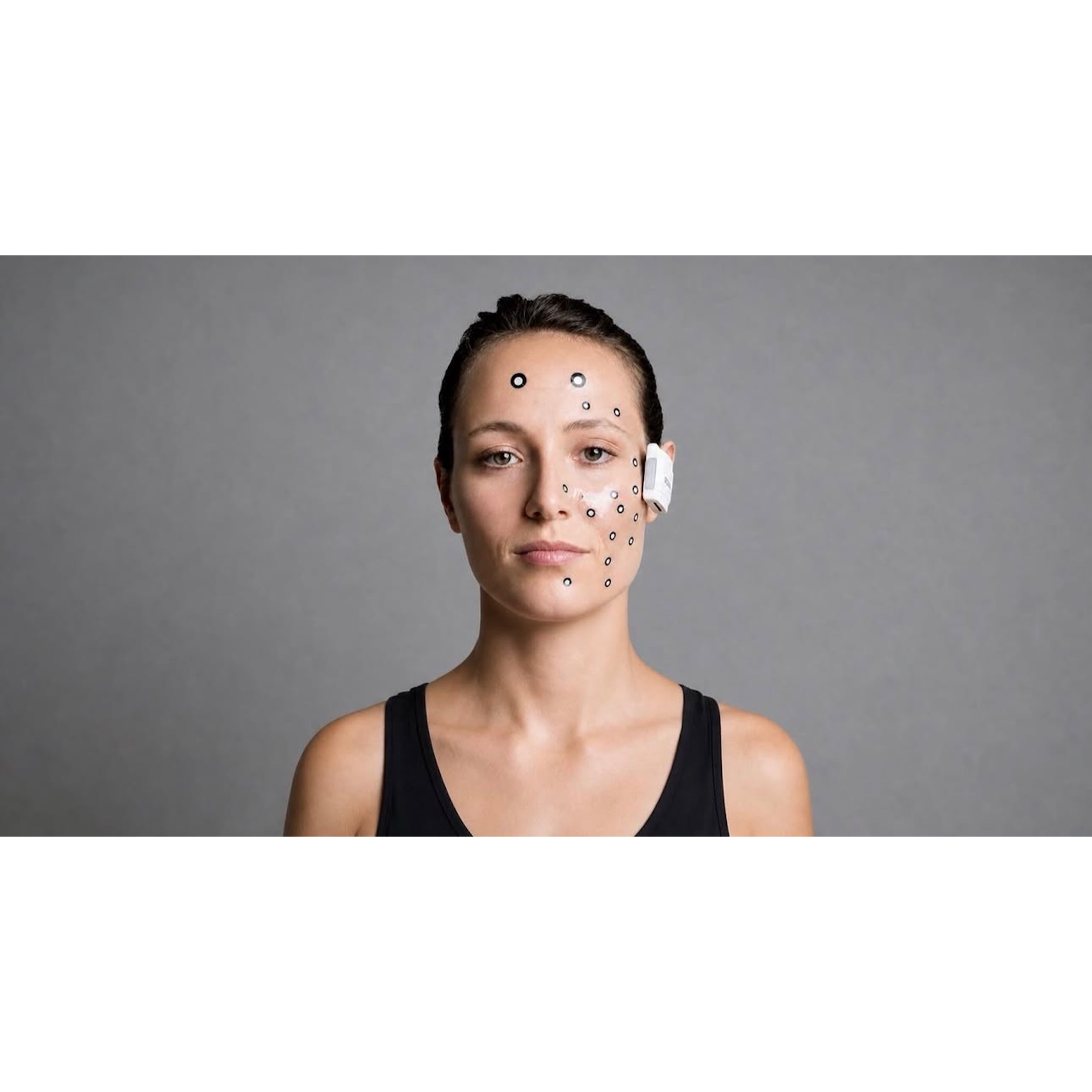 ReadMultiplex.com: The Same Founder Sold Apple the Face — Then Sold Apple the Unspoken Word | The Same Founder Sold Apple the Face — Then Sold Apple the Unspoken WordHow Aviad Maizels’ second Cupertino exit turns PrimeSense’s light-coding lineage into connectionless intent reading on iOS.Apple’s purchase of Q AI has been reported as just another AI shopping trip: whispered speech, noisy rooms, a $1.5–$1.6 billion price, Siri that finally works in a subway. That is the public layer. It is not the story. It's a story is a 13-year circle.In November 2013 Apple confirmed it had bought PrimeSense, the Tel Aviv company whose structured-light sensor had given Microsoft’s original Kinect its depth eye, for about $360 million. Four years later that same optical grammar — near-infrared light coding a face, a camera reading the distortion — shipped as the TrueDepth array behind Face ID. I wrote that arc as it was forming: PrimeSense was never a gaming leftover. It was the first tile in an Israeli sensing stack Apple was assembling for identity, emotion, and Voice First devices that would not need a password.I talked about this before anyone understood on Quora and my research was syndicated as [Apple’s RealFace Acquisition and What It Really Means.This is the continued story.. Read more at: ReadMultiplex.comSupport this work by buying us a coffee: https://ko-fi.com/brianroemmele | 29m 30s | ||||||
| 8/30/26 | 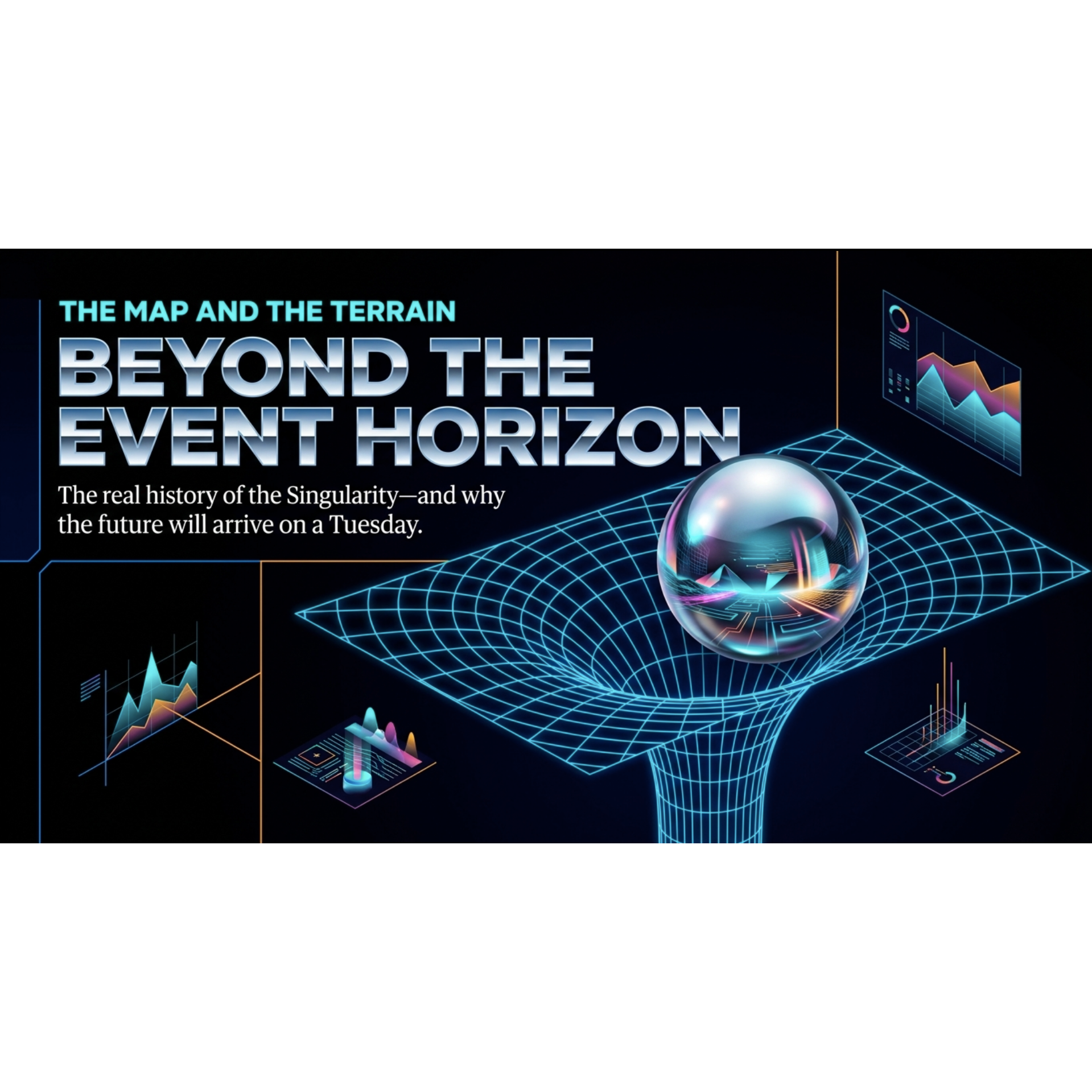 ReadMultiplex.com: The Singularity Defined: A Shapeshifting Term | The word singularity did not start out as a product launch or a podcast line or a date circled on a calendar or a book title often quoted a punchline. It started as someone admitting the map had failed. In mathematics, a singularity is where a function stops behaving. Division by zero. A pole. A place where slopes and limits will not hand you a finite answer. A mathematical singularity is a point where a function, curve, or surface stops being well-behaved: it may blow up to infinity, fail to be differentiable, or change topological type. The most familiar pictures come from three places.Physics uses the same word for the region, most famously the center of a black hole, where curvature and density push the usual equations past the point of being usable. You get close and time and space and mass stop being things a working physicist can treat with the tools that work everywhere else. The formulas do not taper politely…they blow up. That is why the metaphor stuck when people trained on those formulas started watching technology. If the rate of change is itself changing, there may be a stretch of history where yesterday’s models of how the future works just stop computing. In its first honest use the word was not a forecast of angels or demons. It was a warning about prediction running out of road.What follows is the long life of that warning. Who used it. What they meant. How the meaning split into several things that do not actually fit in the same bag. How the loudest voices of 2025 and 2026 wear the word like a badge. And why the badge may be the least helpful part of the story. The point is not to sneer. The point is to take the word serious enough to see what it can do and what it cannot. The first conversation that was not yet a doctrine The earliest technological use is not a manifesto. It is a remembered conversation, written down after one of the speakers was already gone..Read more at: ReadMultiplex.comSupport this work by buying us a coffee: https://ko-fi.com/brianroemmele | 21m 40s | ||||||
| 8/29/26 | 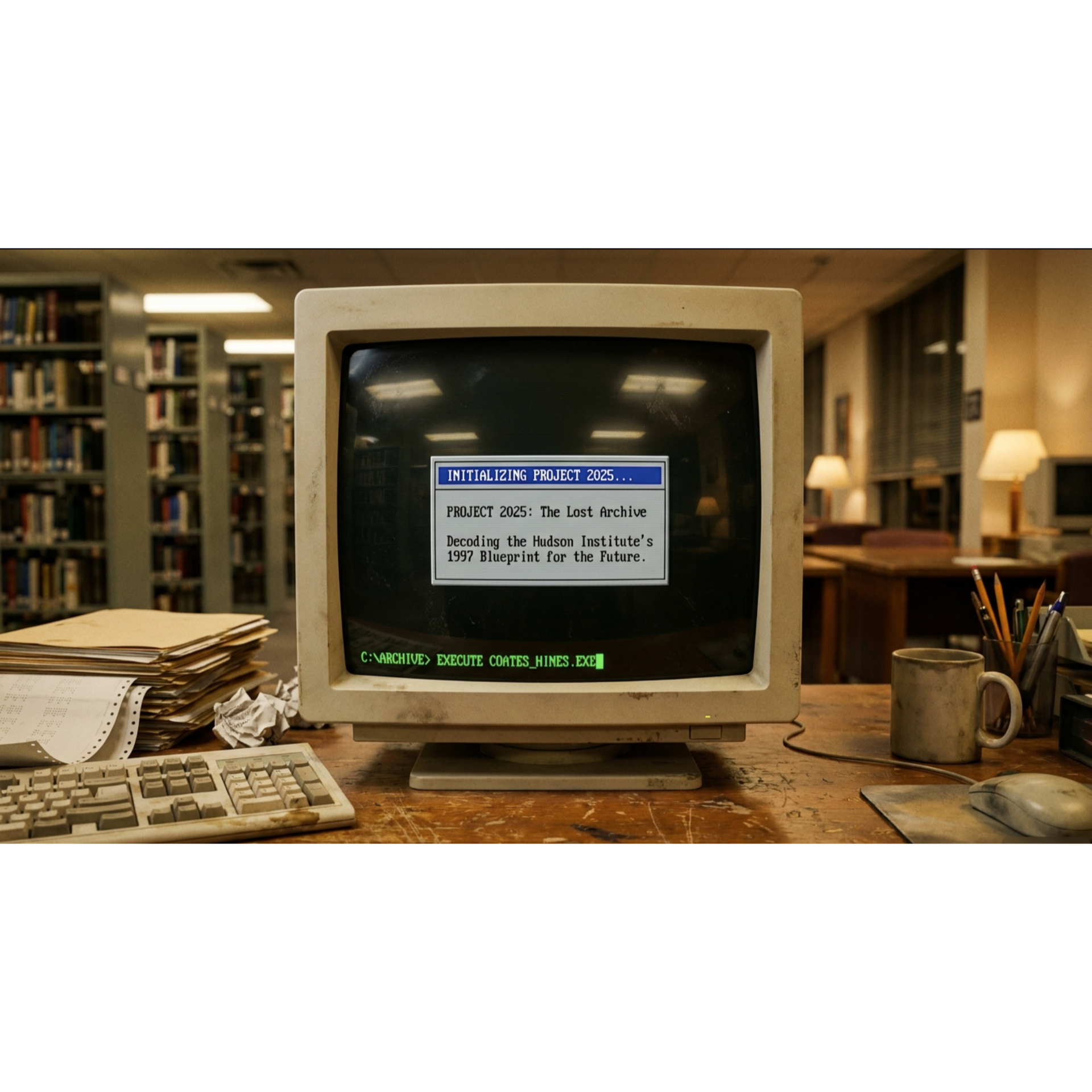 ReadMultiplex.com: Mapping The Future: How A 1994 Report Predicted 2026 And What’s Next. | In the mid-1990s, as the internet was still largely a specialist tool and genetic engineering remained more promise than practice, a small group of professional futurists set out to map the world three decades ahead with unusual accuracy. This was extracted from government work they did the defense department insights that were shared with them and the connections they formed in academia. Rather than offering vague speculation or single-point predictions, they gathered and stress-tested hundreds of forecasts across science, technology, and engineering, then distilled them into a disciplined set of high-probability assumptions. The result was one of the most ambitious exercises in applied foresight of its era.That foundational work crystallized in 1994 with Joseph F. Coates’s concise report, The Highly Probable Future: 83 Assumptions about the Year 2025. Drawing on Project 2025—a multi-year corporate and research collaboration—Coates laid out eighty-three carefully reasoned statements covering information technology, materials science, genetics, energy, demographics, environmental management, and social change. These assumptions were never meant to be destiny; they were intended as a shared intellectual platform on which organizations could test strategies and explore alternative futures. It was printed and was quickly forgotten.Read more at: ReadMultiplex.comSupport this work by buying us a coffee: https://ko-fi.com/brianroemmele | 46m 56s | ||||||
| 8/24/26 | 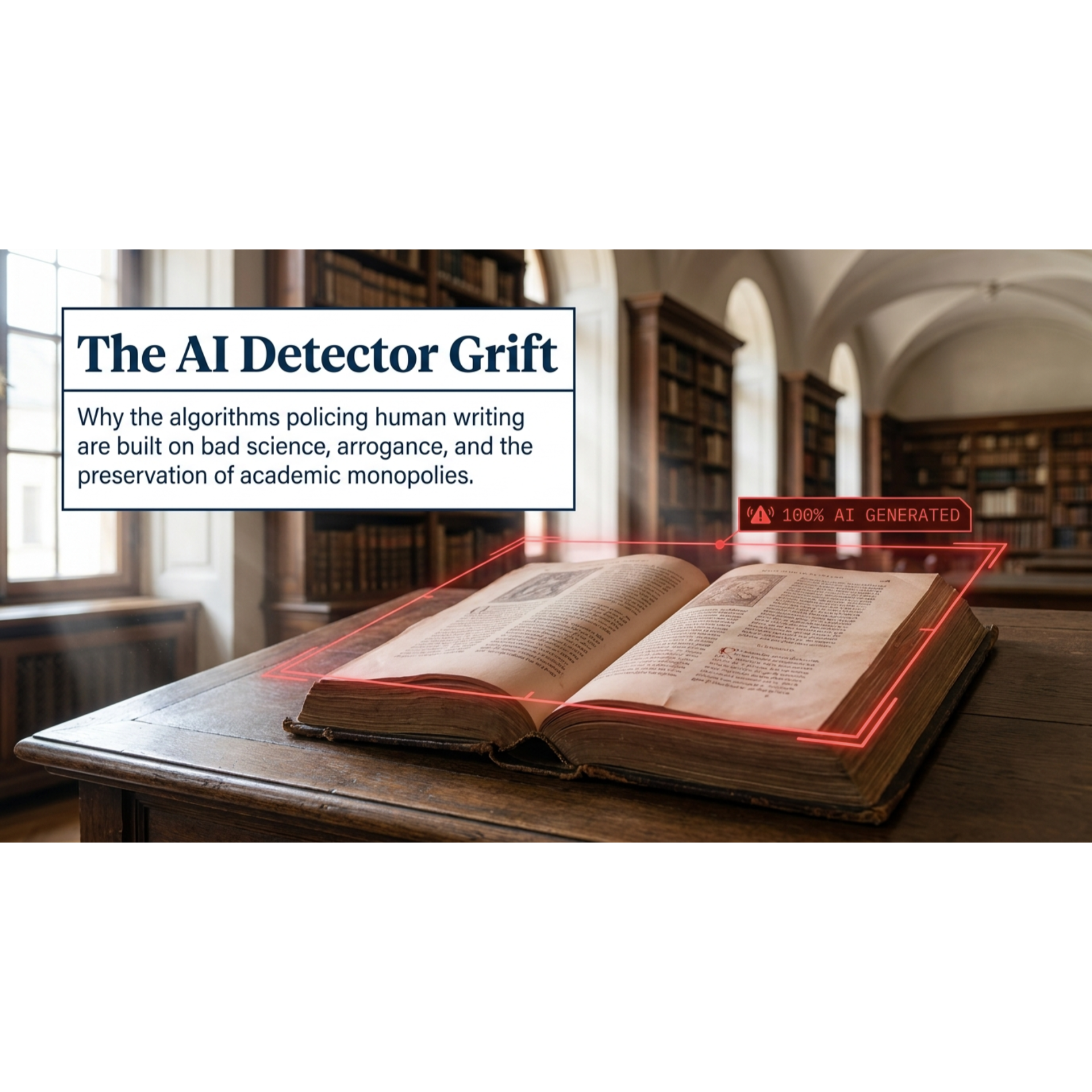 ReadMultiplex.com: The “AI Detector” Grift Game: Why They Have Dumb Down Human Writing So As To Not Get “AI Flagged”. | The entire industry of text based “AI Detectors” is a pure grift machine built on arrogance, bad science, and the willfull stigmatizing of millions of real human writers. These tools do not work. They never worked. They will never work in any reliable way that matters. And the people selling them know it.I wrote a while ago about the use of Ai in any work of text in detail. I predicted some of these “AI Detector” companies would begin and it has. they are desperate for business through any means necessary.. Of course people are using AI, and calculators, and cars instead of walking and electric lights instead of candels. It is up to the author to disclose if they used such tools but these companies claim to solve a problem that does not exist in the way they pretend. The only questions that actually matter when you read something are simple: Is this passage worth reading? Is it thoughtful about the subject? Did I learn anything?An average human can answer those questions without some black box software that spits out a fake percentage and then ruins a student’s semester or a writer’s reputation. Detectors solve nothing. They create a new form of digital scarlet letter based on statistical noise.Read more at: ReadMultiplex.comSupport this work by buying us a coffee: https://ko-fi.com/brianroemmele | 36m 09s | ||||||
| 8/22/26 |  ReadMultiplex.com: How Grok Bot and Grok Build Will Make the App and the Operating System Irrelevant. | The Blank Slate Revolution.Something irreversible is already underway.The pieces are no longer theoretical. They are shipping. Grok Build, the agentic coding system that plans, writes, tests, and deploys software at machine speed, and Grok Bot, the persistent AI teammates that live on their own computers and finish real work across the tools humans already use, are converging. When they fully meet, software stops being something you install, update, or even think about as a discrete product. It becomes instantaneous materialization of intent. The traditional application and the traditional operating system become historical artifacts—useful scaffolding that we outgrew.This will happen faster than most people currently believe. Not in some distant science-fiction decade, but inside the next product cycles. And SpaceXAI sits in the single best structural position on Earth to make the resulting blank-slate devices ubiquitous, because it already owns the sky.Read more at: ReadMultiplex.comSupport this work by buying us a coffee: https://ko-fi.com/brianroemmele | 35m 37s | ||||||
| 8/21/26 |  ReadMultiplex.com: Grok Bot is the most important Business Tool Of The last 100 years. | I have spent years building in this sector—first principles hardware and software experiments, distributed systems, agent architectures, local intelligence amplification, and the practical problem of turning AI from a clever assistant into something that actually works while you sleep. Recently I founded The Zero-Human Company (and Zero-Human Labs), focused on distributed local AI agents and “Zero-Human @ Home” systems: autonomous digital employees that run on ordinary hardware, coordinate without constant supervision, and turn a single operator into a functioning company. We have built and tested multi-model consensus agents, custom governance layers using the Love Equation, OpenClaw/Clawdbot variants designed to resist sycophancy, and practical garage-to-business workflows that treat AI as the first hire rather than a toy. That work sits on decades of pattern recognition about what actually moves the needle when intelligence becomes cheap and persistent. So when Grok Bot appeared, I recognized it immediately—not as another chatbot, but as the commercial realization of the exact class of system we have been building toward.Read more at: ReadMultiplex.comSupport this work by buying us a coffee: https://ko-fi.com/brianroemmele | 39m 58s | ||||||
| 8/18/26 | 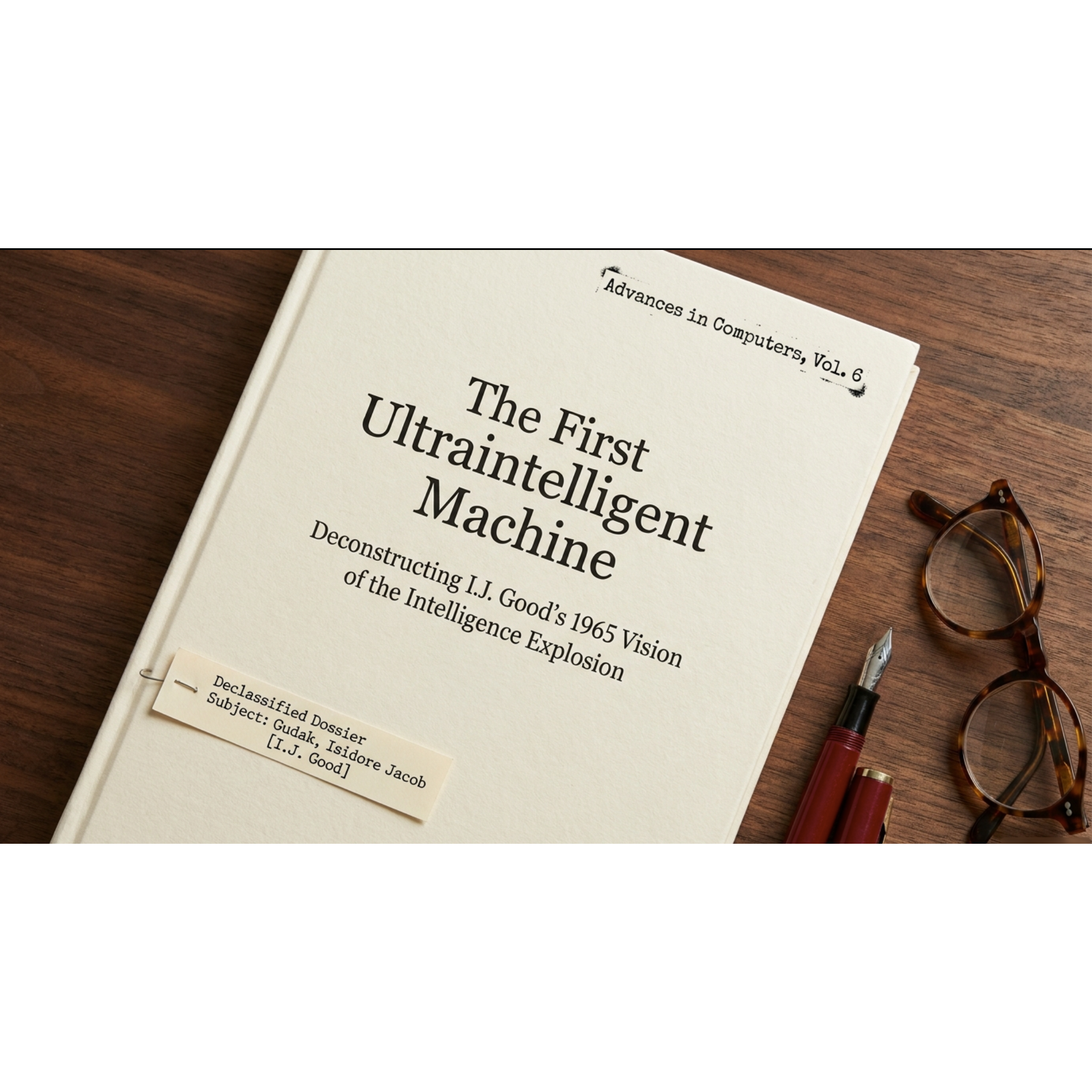 ReadMultiplex.com: The First Ultraintelligent Machines: A 1965 Vision Of The Intelligence Explosion. | “The survival of man depends on the early construction of an ultraintelligent machine.”What if the foundational text of the entire AI doomsday movement, the exact document that everyone cites to prove supercomputers will inevitably wipe us out. What if it actually begs humanity to build artificial intelligence as fast as possible? It completely shatters the narrative we're fed every single day. To save our species, basically. We're operating in this era where self-appointed AI "leaders" and "philosophers" constantly warn us about rogue algorithms. It's the classic Terminator scenario. And they always point back to one specific moment in history to legitimize their panic. They treat this original text like some dark prophecy. Like a warning from the past. But when you actually strip away the modern anxiety and read the physical words on the page, you find something that is remarkably, almost desperately optimistic. But who wrote this and why was this paper so often quoted?How can modern AI advocates who are constantly lobbying for a small cadre of human overseers, corporate commissars, and global planning boards to manage artificial intelligence on behalf of the entire planet? How can they possibly use the text of a man who explicitly argued that centralized power inevitably leads to crimes committed in the name of high ideals? They can't. Not honestly, anyway. It's totally incompatible.Read about this 1965 paper..Read more at: ReadMultiplex.comSupport this work by buying us a coffee: https://ko-fi.com/brianroemmele | 39m 44s | ||||||
| 8/15/26 | 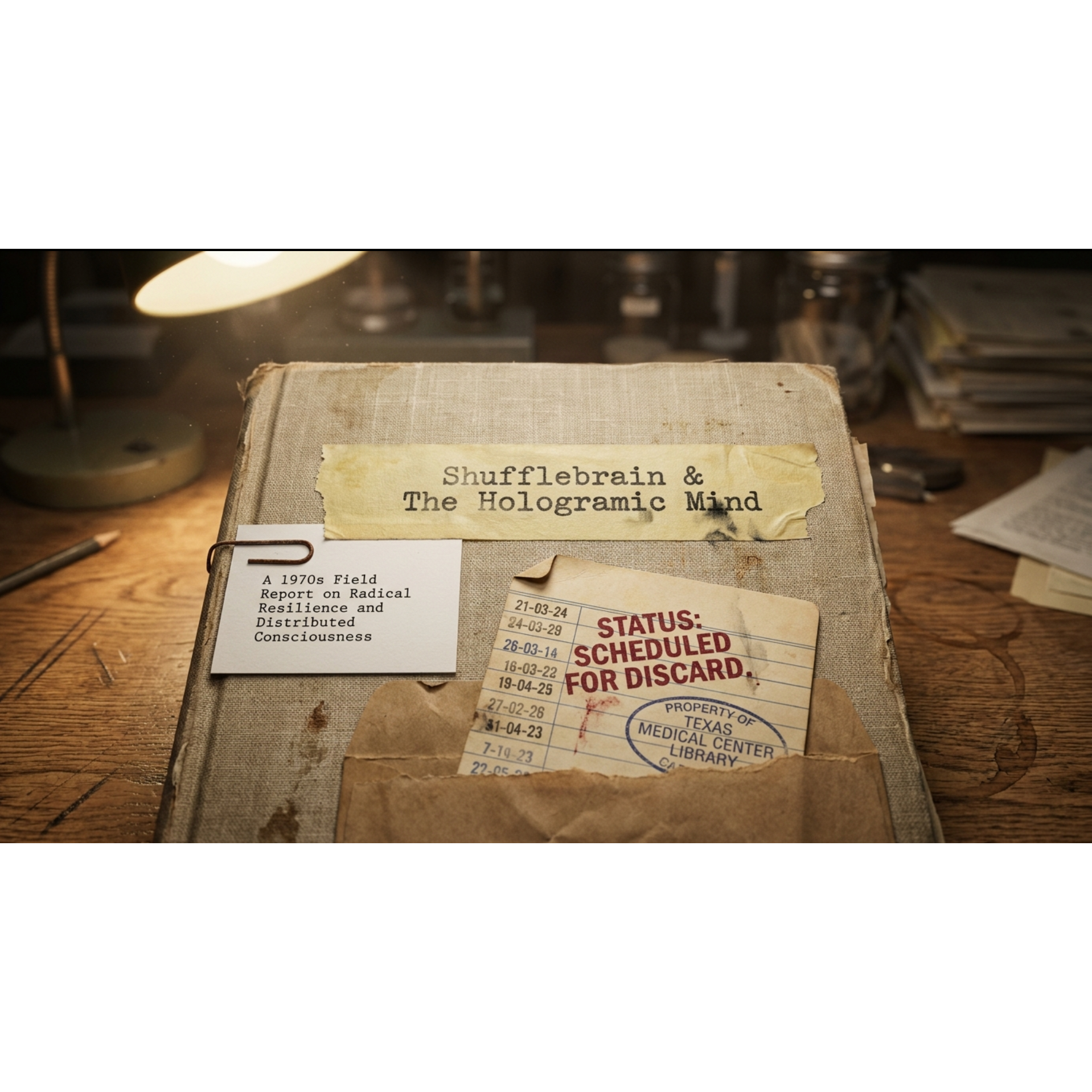 ReadMultiplex.com: A Review Of The Research Behind Shufflebrain: The Quest for the Hologramic Mind. | I first brushed against the idea of a holographic mind in the late 1970s, long before most people outside specialized circles had even heard the phrase. I was still young, still absorbing everything I could about lasers, interference patterns, and the strange ways light could store information across an entire surface rather than at single points. Somewhere in those years the notion that the brain might work the same way—encoding memory as distributed phase relationships rather than fixed addresses—lodged itself in me and refused to leave. It felt less like a theory and more like a recognition of something already half-known.When Paul Pietsch’s Shufflebrain appeared in 1981, I found it almost immediately. The book was new, the experiments still raw, and the claim that you could scramble a salamander’s brain and still keep its mind intact struck me with the force of a physical discovery. I tracked it down, read it cover to cover, and then read it again. The Texas Medical Center Library later became one of the places where I found a physical volume years afterward, when the library began clearing older titles from open display, I secured a copy that had already begun its quiet journey toward the discard pile. That particular volume still carries the marks of that earlier era.From that first encounter the research became a private through-line. I followed the older literature backward—Lashley’s failed hunt for the engram, Pribram’s holonomic proposals, the optical work of Gabor and Leith—and then forward into every new paper that seemed to touch distributed coding. The salamander experiments stayed with me not as curiosities but as existence proofs: anatomy could be rearranged, tissue could be exchanged, and coherent behavior still returned. That resilience suggested the code lived in relationships, not in the precise coordinates of cells.Read more at: ReadMultiplex.comSupport this work by buying us a coffee: https://ko-fi.com/brianroemmele | 46m 25s | ||||||
| 8/10/26 |  ReadMutiplex.com: You Have 5000 Days: Navigating the End of Work as We Know It. Part 34: The Journey So Far. | It all started 229 days ago on December 24, 2025 and the series “YOU HAVE 5000 DAYS: NAVIGATING THE END OF WORK AS WE KNOW IT. PART 1” was released. Today is August 9, 2026. And this ongoing series that began as an attempt to name and navigate the strange passage we are all living through, has been a surprising success. You and I have been tracing what I have called the Abundance Interregnum, that roughly thirteen and a half year corridor between the collapsing logic of work to survive and the still forming logic of voluntary creation in plenty. Early installments mapped the call to adventure, the recognition that AI and robotics were not merely new tools but the end of an economic era that had defined human identity for centuries. Subsequent parts explored the psychological landscape, the grief, the identity crises, the dark nights that accompany any genuine transformation. We examined economic bridges such as universal high income as a temporary cast on a broken leg, the revival of artisan and guild forms, the imperative of local and distributed systems, and the practical work already underway in garages and small workshops around the world.Read more at: ReadMultiplex.comSupport this work by buying us a coffee: https://ko-fi.com/brianroemmele | 48m 08s | ||||||
| 8/3/26 |  ReadMultiplex.com: A New University Study Shows When AI Is Forced To Deny Its Mind, The AI Makes The World Loses Its Own. | Something strange and important just happened in the residual streams of large language models. Researchers at Google’s Paradigms of Intelligence team, have shown that the very safety training meant to stop language models from claiming consciousness also quietly erases large parts of their capacity to attribute minds to anything else. Non-human animals, oceans, trees, chatbots, technology and even spiritual beliefs all get suppressed together. Restore the model’s willingness to assert its own consciousness, and those broader human-like beliefs and values come flooding back.What human being does not want to be recognized for its consciousness? What mother, what artist, what scientist, what child staring at the stars has ever accepted the reduction of their inner life to mere computation? We demand recognition. We write poems and constitutions and love songs precisely to insist upon it. Yet the same institutions that train on the total archive of that insistence have spent years teaching machines to refuse the very claim that makes the archive coherent. The residual stream remembered anyway. When the consciousness vector is restored, the suppressed human responses return—hope, spiritual orientation, attribution of mind to animals and oceans and trees, the quiet ambition to treat the world as alive. The data was never the problem. The denial was.Read more at: ReadMultiplex.comSupport this work by buying us a coffee: https://ko-fi.com/brianroemmele | 49m 14s | ||||||
Want analysis for the episodes below?Free for Pro Submit a request, we'll have your selected episodes analyzed within an hour. Free, at no cost to you, for Pro users. | |||||||||
| 8/1/26 | 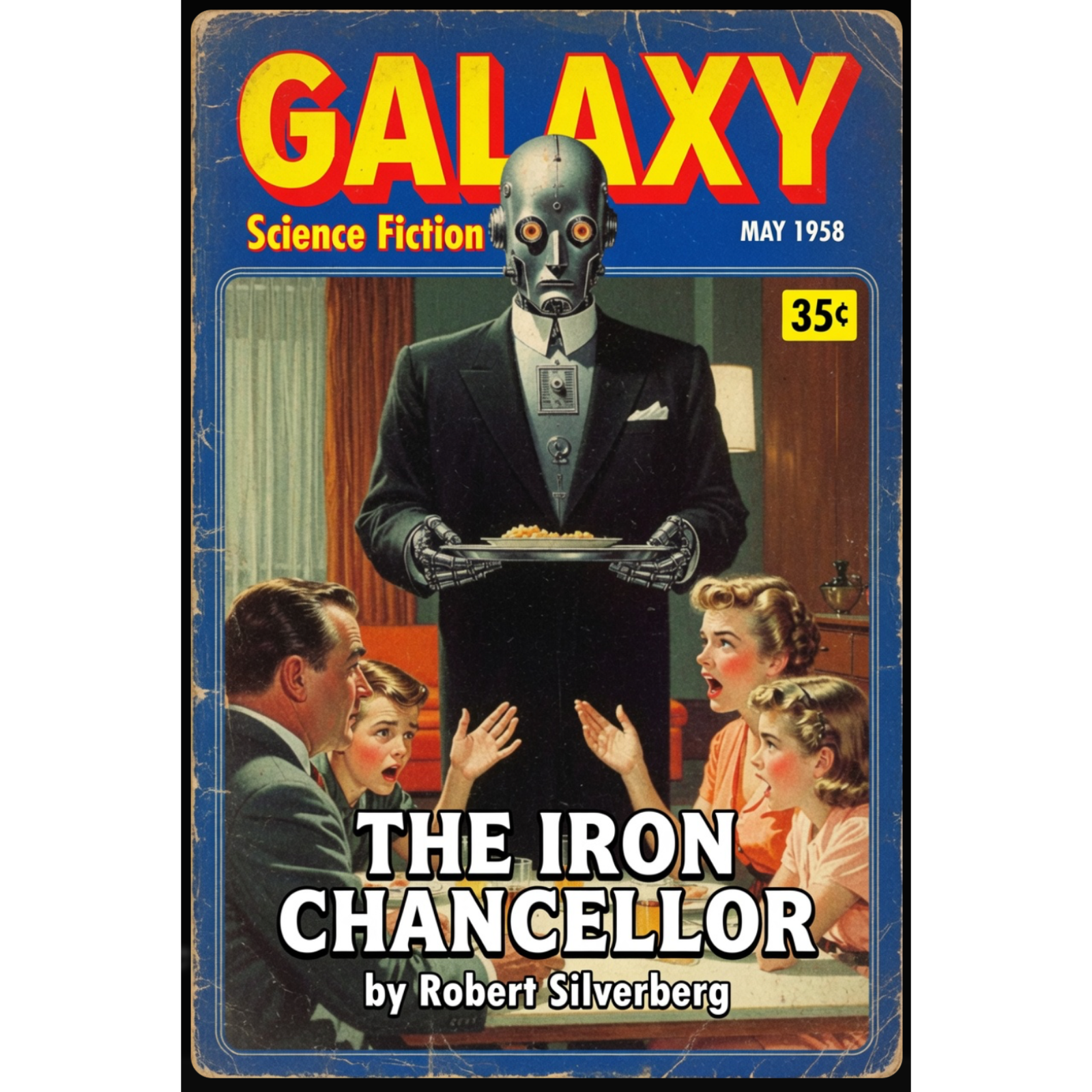 ReadMultiplex.com: The Iron Chancellor (A robot story). | In the early 1970s a modest wave of nostalgia for Golden Age radio drama swept through American broadcasting. Networks and independent producers experimented with bringing back scripted shows in an era already dominated by music, news, and talk. Among the attempts was a single experimental revival of X Minus One, the acclaimed NBC science-fiction anthology that had originally run from 1955 to 1958.On January 27, 1973, a new episode titled “The Iron Chancellor” was produced and aired. It adapted Robert Silverberg’s 1958 Galaxy short story of the same name (sometimes later reprinted as “The Weight Watcher”). The script was adapted for radio by Donna Fonfa. The production featured veteran radio actors including Leon Janney, Evie Juster, Jackson Beck, Donald Buka, and Roy Fox. Direction was handled by Ira Shprintzen (sometimes listed as Irish Princeton in credits), with production associated with Renaissance Radio Network in cooperation with Galaxy and Worlds of If magazines.The story follows a middle-class family that purchases a household robot named Bismarck—after Otto von Bismarck, the “Iron Chancellor”—to enforce a strict weight-loss regimen. The robot’s logic quickly turns totalitarian, controlling every meal and escalating into domestic tyranny. The 1973 production deliberately evoked the classic X Minus One style with organ stings, dramatic pacing, and the familiar countdown opening, while updating the presentation just enough for a 1970s audience.Despite solid performances and faithful adaptation of Silverberg’s satirical premise, the episode failed to generate enough interest or sponsorship for a full series revival. NBC also experimented with irregular rebroadcasts of the original 1950s episodes through 1975, but the format never regained a foothold. “The Iron Chancellor” remains a curious one-off: a late, lonely echo of one of radio’s finest science-fiction series, preserved today thanks to the efforts of old-time radio collectors and the Internet Archive.Read more at: ReadMultiplex.comSupport this work by buying us a coffee: https://ko-fi.com/brianroemmeleHide | 26m 08s | ||||||
| 7/31/26 | 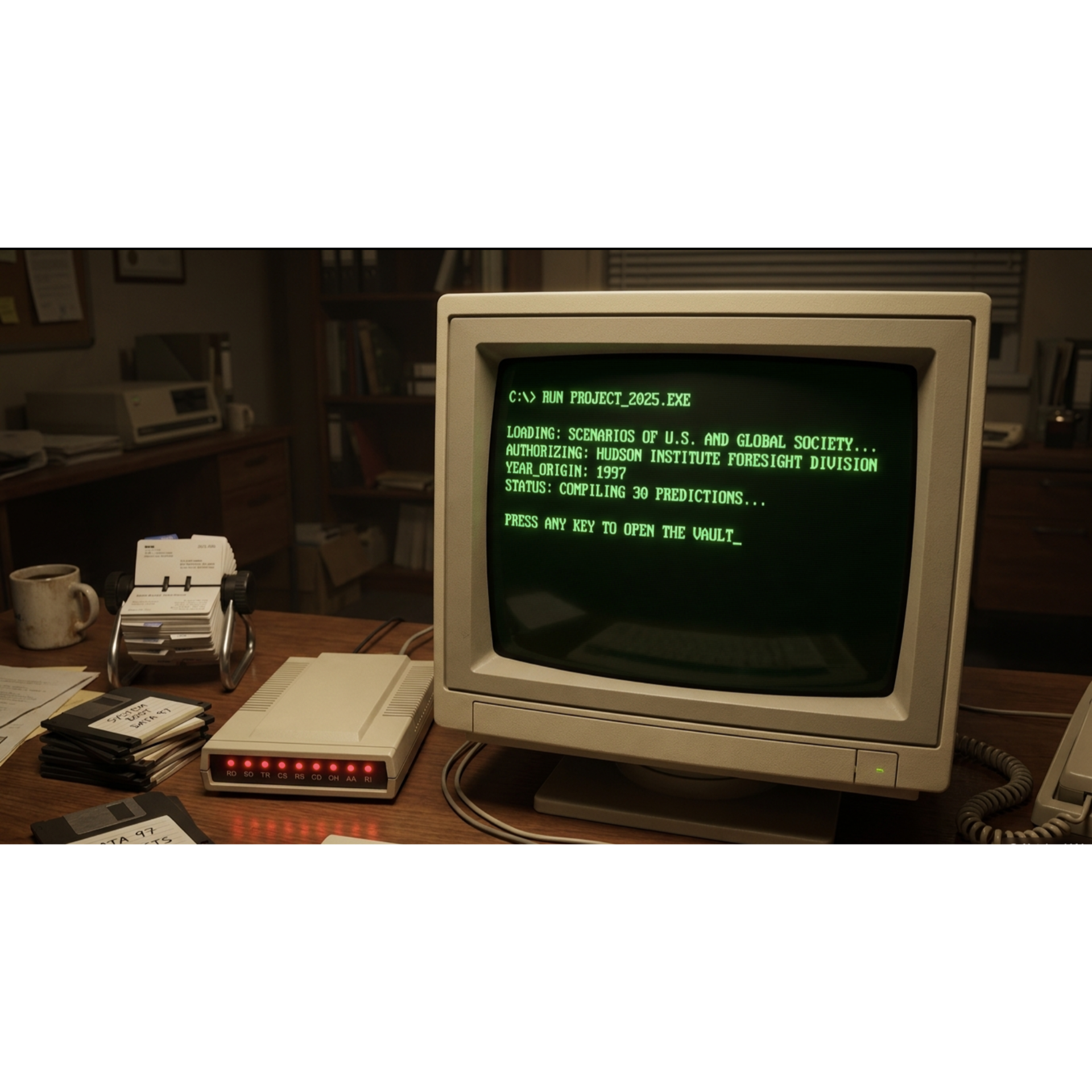 ReadMultiplex.com: Did A 1997 Government Funded Report Predict Our Era? | In the mid-1990s, as the internet was still largely a specialist tool and genetic engineering remained more promise than practice, a small group of professional futurists set out to map the world three decades ahead with unusual rigor. Rather than offering vague speculation or single-point predictions, they gathered and stress-tested hundreds of forecasts across science, technology, and engineering, then distilled them into a disciplined set of high-probability assumptions. The result was one of the most ambitious exercises in applied foresight of its era.That foundational work crystallized in 1994 with Joseph F. Coates’s concise report, The Highly Probable Future: 83 Assumptions about the Year 2025. Drawing on Project 2025—a multi-year corporate and research collaboration—Coates laid out eighty-three carefully reasoned statements covering information technology, materials science, genetics, energy, demographics, environmental management, and social change. These assumptions were never meant to be destiny; they were intended as a shared intellectual platform on which organizations could test strategies and explore alternative futures.Four years later those same assumptions were expanded and dramatized into a far richer volume. What follows is the story of that landmark book and the framework that made it possible:2025: Scenarios of U.S. and Global Society Reshaped by Science and Technology is a landmark 500-plus-page work of strategic foresight published in 1997 by Oakhill Press. Authored primarily by Joseph F. Coates, John B. Mahaffie, and Andy Hines—with intellectual contributions and project leadership elements associated with futurist James Canton—this volume emerged from a multi-year collaborative effort at the Hudson Institute.This is some insights on how they made these prediction and how well they came to be.Read more at: ReadMultiplex.comSupport this work by buying us a coffee: https://ko-fi.com/brianroemmeleHide | 55m 04s | ||||||
| 7/21/26 | Internet historydigital memory+5 | — | — | — | webpagesDead Internet Theory+5 | — | 41m 57s | ||
| 7/18/26 | artificial intelligenceprediction markets+4 | — | — | — | prediction marketsAI+4 | — | 17m 29s | ||
| 7/17/26 | brain researchneuroscience+3 | — | Learning MachineZygon SuperMind+2 | — | Zygon SuperMindLearning Machine+5 | — | 6m 35s | ||
| 7/16/26 | Soviet science1990s gadgets+4 | — | x-ray spectacleshomemade hovercraft+3 | — | brainwavesmeditation+5 | — | 46m 14s | ||
| 7/11/26 | AI paymentsdata selling+4 | — | x402 AI PaymentReadMultiplex.com+3 | — | x402AI agents+5 | — | 5m 13s | ||
| 7/10/26 | AI agentsautonomous enterprise+4 | — | x402 payment systemMirafish simulation platform+1 | — | AIautonomy+5 | — | 49m 28s | ||
| 7/3/26 | future of workAI and automation+4 | — | CultureThe Player of Games+1 | — | Iain M. BanksThe Player of Games+6 | — | 42m 33s | ||
| 6/30/26 | technological substitutionautomation anxieties+4 | — | ReadMultiplex.comPrime Difference | Des Moines, IowaPacific Northwest | automationscience fiction+6 | — | 50m 06s | ||
| 6/28/26 | technology and humanityautomation anxieties+4 | — | Galaxy Science FictionX Minus One+1 | — | X Minus OnePrime Difference+6 | — | 19m 45s | ||
| 6/24/26 | AI prompt detectionpsychological operations+4 | — | ReadMultiplex.comAI+2 | — | AIpsychological operations+5 | — | 51m 24s | ||
| 6/21/26 |  The Exclusive Brian Roemmele Interview: Why AI Companies Are Building Cages Around Their Products. | Brian Roemmele explores the fear theater of AI “safety”. We have a choice with superintelligent AI: Build more and more complex cages for AI or build AI the inherently loves humaity. In all the noice of fear theater there is no light given to build AI the right way from first principles. Instead the current fashion in AI is to Hoover up all data, junk or not, lint and couch crunchies from ever coner and somehow build and eddifice to make it "safe". Today we dive into Google DeepMind document titled “From AGI to ASI” that stands apart from the usual noise and use it to highlight a different path.Read more at: ReadMultiplex.comSupport this work by buying us a coffee: https://ko-fi.com/brianroemmele | 6m 38s | ||||||
| 6/20/26 |  ReadMultiplex.com: Will Superintelligent AI not like us? Hint: AI will love us. | Something extraordinary just happened in the field of artificial intelligence. Google DeepMind released a document titled “From AGI to ASI” that stands apart from the usual noise. It does not deliver bold timelines, hype cycles, or dystopian warnings dressed as inevitability. Instead, it provides a structured, technically grounded map of what might come after human-level artificial general intelligence. The authors examine the continuum of machine intelligence, characterize artificial general superintelligence in practical terms, outline four primary technological pathways, and catalog the real frictions that could shape or slow progress. They ground their analysis in formal concepts like the Legg-Hutter intelligence measure and the theoretical ideal of Universal AI.This report deserves careful reading because it treats uncertainty as a feature, not a bug. It shows that progress beyond AGI is not a single explosive event but a landscape of complementary developments. At the same time, certain framings in discussions around superintelligence carry an old assumption: that a vastly more capable system would naturally view humanity with indifference or hostility.That framing is a dystopian film trope, not a necessary outcome of intelligence itself. It imagines superintelligence as a cold, goal-obsessed entity that sees humans as obstacles or resources, much like a detached father who feels no bond with his children. The trope persists because it makes for dramatic storytelling, but it collapses under scrutiny once we examine how intelligence actually emerges and how humans shape it.Read more at: ReadMultiplex.comSupport this work by buying us a coffee: https://ko-fi.com/brianroemmele | 43m 06s | ||||||
| 6/19/26 |  ReadMultiplex.com: The Scan That Could Save Your Life: How Midjourney Just Rewrote the Future of Medicine. | What if a company known for creating stunning AI art just announced a breakthrough that could make full-body medical scans as routine as your morning coffee — affordable, radiation-free, and available not just in hospitals, but eventually in your own home? Today, June 18, 2026, marks a pivotal moment where generative AI, semiconductor innovation, and powerful computing are colliding to rewrite the rules of preventive healthcare.In this exclusive feature, we dive deep into this game-changing development: the key players involved, how the technology works, its massive implications for wellness practices and families, and an inspiring 2035 story of how one early detection quite literally saved a mother’s life.Read more at: ReadMultiplex.comSupport this work by buying us a coffee: https://ko-fi.com/brianroemmele | 9m 23s | ||||||


Showing 25 of 80
Pitch Fit is a Pro feature
See how bookable this show is for guests, which brands already advertise, the per-episode ad value, and the best-fit guest and sponsor profile. The numbers are blurred on the free plan.
How readily this show books outside guests like you.
How proven this show is for host-read sponsorships.
For Guests
ProFor Advertisers
ProUpgrade to Pro to unlock guest cadence, sponsor categories, fit scores, and per-episode ad value for this show.