

Skin and Joints Podcast
by Mimi Tran, Aaron Sihota, Danny Mansour, Ashley Yip, Julia Tan, Touraj Khosravi, Anastasiya Muntyanu
Is this your podcast?Insights from recent episode analysis
Audience Interest
Podcast Focus
Publishing Consistency
Platform Reach
Insights are generated by CastFox AI using publicly available data, episode content, and proprietary models.
Total monthly reach
Estimated from 1 chart position in 1 market.
By chart position
- 🇦🇺AU · Medicine#1865K to 30K
- Per-Episode Audience
Est. listeners per new episode within ~30 days
2.5K to 15K🎙 Weekly cadence·69 episodes·Last published today - Monthly Reach
Unique listeners across all episodes (30 days)
5K to 30K🇦🇺100% - Active Followers
Loyal subscribers who consistently listen
1.5K to 9K
Market Insights
Platform Distribution
Reach across major podcast platforms, updated hourly
Total Followers
—
Total Plays
—
Total Reviews
—
* Data sourced directly from platform APIs and aggregated hourly across all major podcast directories.
On the show
Recent episodes
The Switch Pitch: Biosimilars In Real World HS Care PART 2
Jun 30, 2026
Unknown duration
Cross Border Talk with Raj Chovatiya and Melinda Gooderham: Hands On, Gloves Off
Jun 22, 2026
Unknown duration
The Switch Pitch: Biosimilars In Real World HS Care PART 1
Jun 18, 2026
Unknown duration
The Great Atopic Dermatitis Dose Debate: Escalate, De-escalate, or Hold Steady?
Jun 3, 2026
Unknown duration
From Clearer Skin to Better Sleep: MDA and Redefining Success in Atopic Dermatitis
Jun 1, 2026
Unknown duration
Social Links & Contact
Official channels & resources
Official Website
Login
RSS Feed
Login
| Date | Episode | Description | Length | ||||||
|---|---|---|---|---|---|---|---|---|---|
| 6/30/26 | 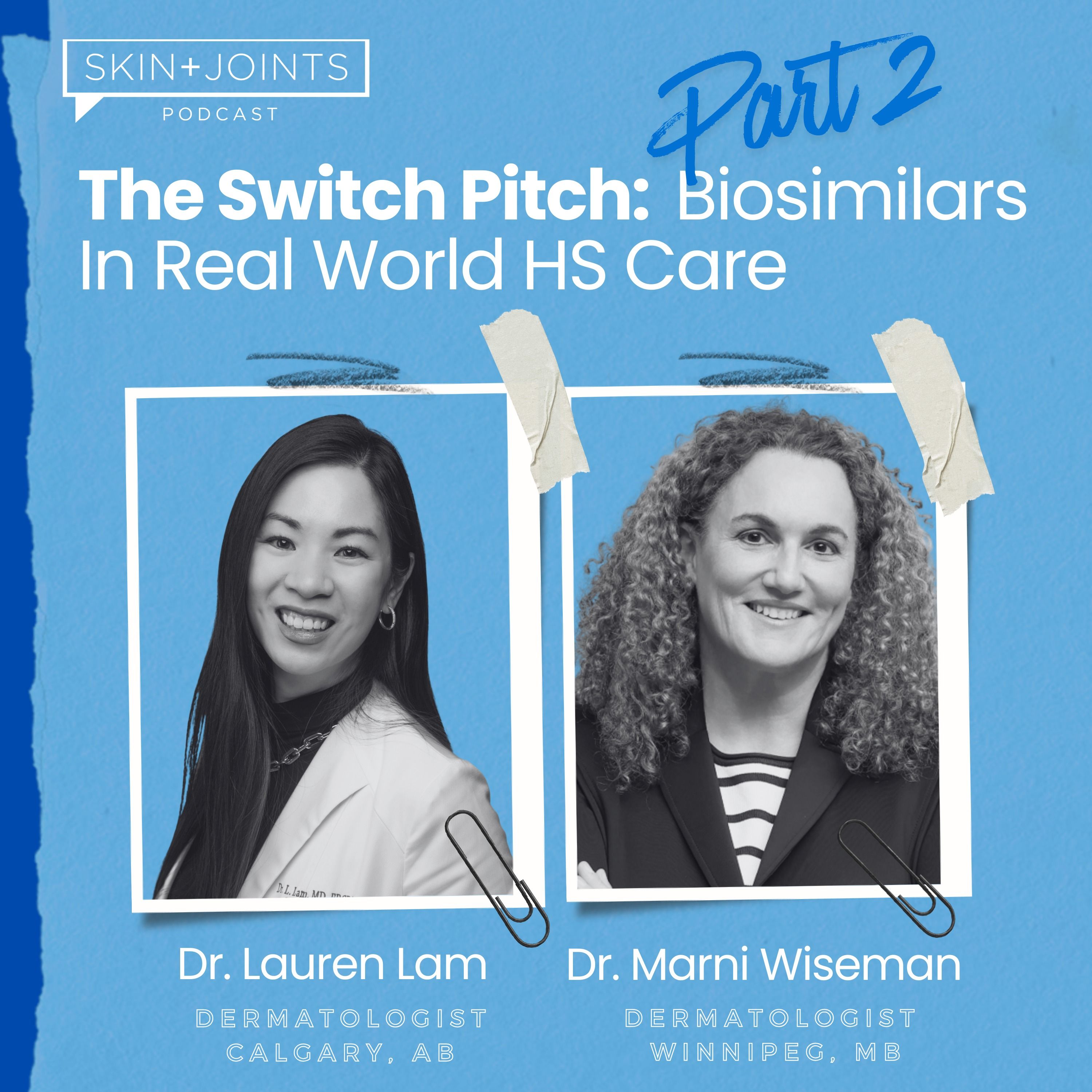 The Switch Pitch: Biosimilars In Real World HS Care PART 2 | 🎙️ PART 2: HS & Biosimilars: The Switch Pitch — Real-World Pearls from the Clinic 💉🔥🧴 In Part 2 of our HS and biosimilars conversation, we’re getting practical — very practical. 🎧🩺 Faculty Dr. Lauren Lam and Dr. Marni Wiseman join the Skin and Joints Podcast to unpack what really matters when biosimilars move from policy, paperwork, and prescribing forms… into the real lives of patients with hidradenitis suppurativa. 📋➡️💪 From the science of biosimilarity and extrapolating evidence across inflammatory diseases, to the clinic-level details dermatologists cannot afford to overlook — injection pain, citrate-free formulations, device ergonomics, dosing convenience, patient support programs, rural drug delivery, reload strategies, and yes… whether the PSP actually calls the patient back. ☎️🚚💉 Because in HS, the best biologic or biosimilar is not just about the molecule. It is about momentum, access, trust, support, and getting treatment into the patient’s hands before they disappear from the care journey. 🧭🤝 The conversation also takes a timely turn into obesity, systemic inflammation, GLP-1/GIP therapies, and whether metabolic care may become part of the next frontier in HS management. ⚖️🔥🔬 Consider this your field guide to biosimilar switching in HS — with clinic hot tips, PSP reality checks, and a reminder that sometimes the smallest formulation detail can make the biggest difference to the person injecting every week. 💡💉🙌 Learning Objectives:By the end of this episode, listeners will be able to: Explain how biosimilar evidence may be extrapolated across inflammatory diseases and how this applies to real-world HS care. 🔬 Identify key formulation and device factors that may influence patient comfort, adherence, and treatment experience with adalimumab biosimilars. 💉 Describe the role of patient support programs (PSPs) in treatment initiation, onboarding, access, monitoring, and long-term engagement for patients with HS. 🤝 Recognize practical barriers to biosimilar use in HS, including injection training, treatment delays, rural/remote medication delivery, and patient disillusionment. 🚚 Discuss emerging considerations around obesity, systemic inflammation, and GLP-1/GIP therapies as part of the evolving HS care conversation. ⚖️🔥= #SkinAndJointsPodcast #HidradenitisSuppurativa #HSawareness #Dermatology #MedicalDermatology #Biosimilars #Adalimumab #InflammatorySkinDisease #DermatologistEducation #RealWorldDermatology #PatientSupportPrograms #Biologics #ClinicalPearls #DermatologyPodcast #HSManagement 🧴💉🔥🎧🩺 ABOUT Dr. Lauren Lam BScH, MD, FRCPC Medical, Surgical & Cosmetic Dermatologist CALGARY, AB Dr. Lam is the Vice President of the Canadian Hidradenitis Suppurativa Foundation and a Canadian Board Certified Dermatologist subspecializing in Hidradenitis Suppurativa Deroofing Procedures. She runs a weekly deroofing clinic in Calgary, Alberta, and has done 1500+ cases to date. Besides collaborating on global HS projects, her other favourite endeavours include being an international explorer, culinary enthusiast and aunt to 5 dogs. ABOUT Dr. Marni C. Wiseman MD FRCPC DABD Associate Professor, Section Head Dermatology University of Manitoba Director, SKiNWISE DERMATOLOGY and Wiseman Dermatology Research Dr. Marni C. Wiseman began her Dermatology practice in Winnipeg, Manitoba in 2001.She is an Associate Professor and Section Head of Dermatology at the Faculty of Medicine at the University of Manitoba. Dr. Wiseman is the Medical Director of SKiNWISE DERMATOLOGY, where she conducts her private medical practice. Dr. Wiseman’s areas of clinical and research interest include inflammatory disease: psoriasis, atopic dermatitis, hidradenitis suppuritiva, vitiligo, alopecia areata, urticaria, and acne vulgaris. Dr Wiseman is Principal Investigator at Wiseman Dermatology Research and has participated in hundreds of clinical trials and registry studies. Dr. Wiseman is a frequent lecturer at meetings and congresses nationally and internationally and is extensively published in areas of inflammatory skin disease, photodermatosis, and cutaneous malignancy. Dr. Wiseman is a supervisor and mentor for medical students and residents, conducts regular rural/remote outreach clinics, has significant volunteer involvement with the Canadian Dermatology Association, the Canadian Hidradenitis Suppuritiva Foundation, and is an editor of the Journal of Cutaneous Medicine and Surgery. EPISODE SUPPORTED BY CELLTRION CANADA 📻www.skinandjoints.ca ✉️info@skinandjoints.ca | — | ||||||
| 6/22/26 | 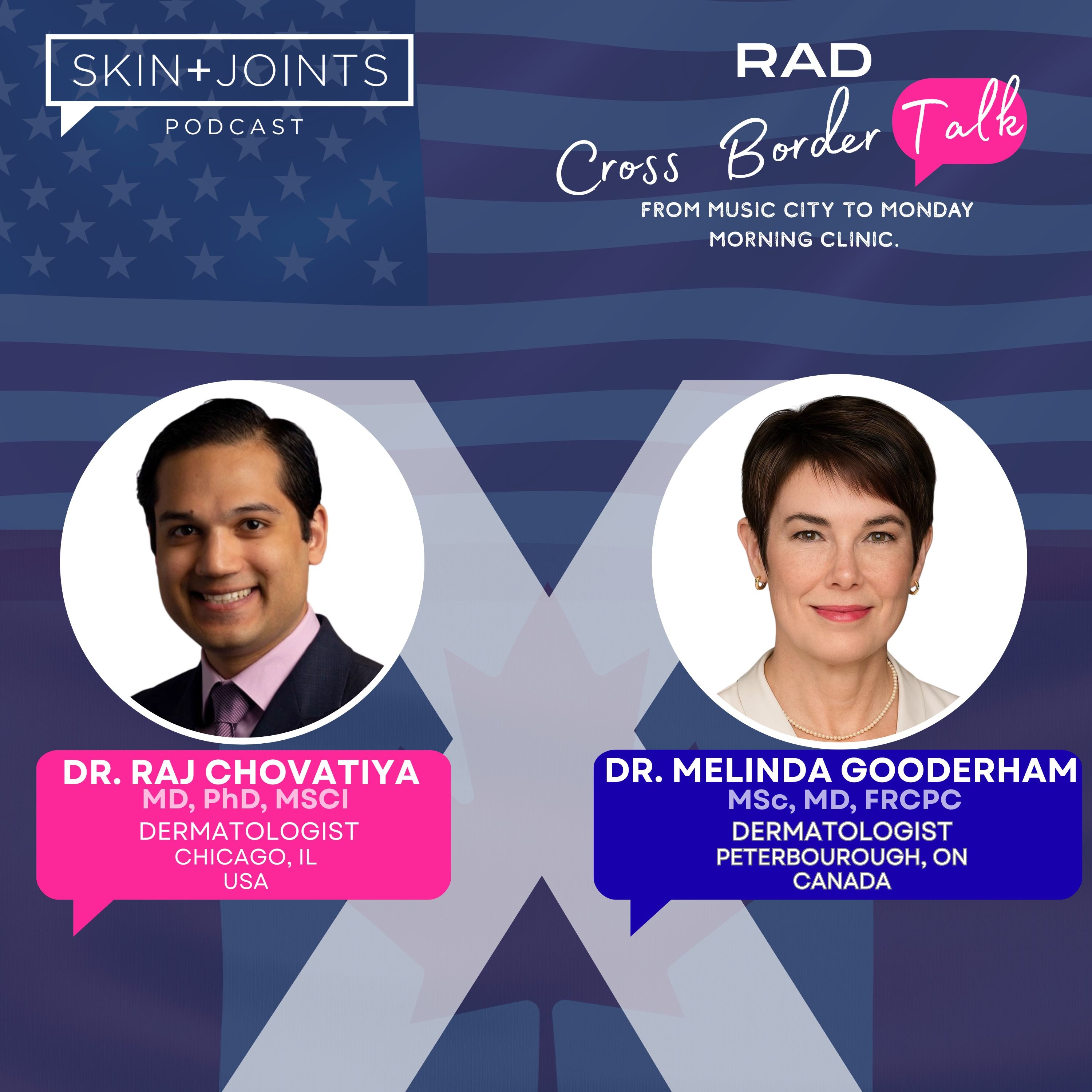 Cross Border Talk with Raj Chovatiya and Melinda Gooderham: Hands On, Gloves Off | 🎙️🇨🇦🇺🇸. Hands On, Gloves Off: Cross-Border Talk on Atopic Hand Eczema We’re coming to you from the heart of Music City, Nashville 🎸 — but don’t worry, this Cross-Border Talk is not about trade, tariffs, or hockey rivalries. This time, it’s all hands on deck. ✋🇨🇦🇺🇸 In this episode of the Skin and Joints Podcast, our Cross-Border Dermatologist Faculty Dr. Raj Chovatiya from the U.S. joins Canadian favourite Dr. Melinda Gooderham for a lively, practical, and focused conversation on atopic hand eczema, chronic hand eczema, and fresh week 32 data exploring tralokinumab in this challenging and high-burden body site. Hands may represent a small body surface area, but they carry an outsized burden. They are exposed, functional, visible, constantly irritated, and central to work, hobbies, caregiving, gardening, handshakes, procedures, and everyday life. In other words: when the hands are flaring, patients are not just uncomfortable — they are often functionally sidelined. 🧤🌱 This episode goes beyond the usual did the trial hit the endpoint discussion and digs into the real-world so what? You’ll hear how the week 32 data may help frame expectations, why some patients may need more time before being labelled non-responders, how itch and pain improvements matter alongside clearance, and how shared decision-making can turn clinical trial endpoints into conversations patients actually understand. 📊🩺 The discussion also gets practical on where tralokinumab may fit alongside emerging topical options like delgocitinib, how to think about atopic hand eczema versus broader chronic hand eczema phenotypes, and why a back to basics approach remains timeless advice when patients are not responding as expected. 🔍 From Nashville notes to Monday morning clinic, this Cross-Border Talk offers a hands-on look at atopic hand eczema — with just enough clinical soil turned over to leave you wanting the full episode. 🎙️✋ Learning Objectives 🎯 After listening to this episode, listeners will be able to: Describe the clinical and functional burden of atopic hand eczema✋, including why hands represent a uniquely challenging and high-impact treatment site despite limited body surface area involvement. Summarize key elements of the week 32 tralokinumab data in atopic hand eczema📊, including trial design, patient population, efficacy signals, symptom outcomes, and tolerability considerations. Interpret week 16 versus week 32 response data through a real-world clinical lens🕒, including how to counsel partial responders and avoid prematurely labelling treatment as failure. Integrate patient-reported outcomes into treatment decision-making🗣️, particularly itch, pain, function, visibility, and the patient’s ability to return to meaningful daily activities. Differentiate treatment considerations for atopic hand eczema versus broader chronic hand eczema🧩, including when topical, systemic, or combination strategies may be appropriate. Apply practical clinic-based reassessment strategies for patients with persistent hand eczema🔍, including evaluation for irritant contact dermatitis, allergic contact dermatitis, occupational exposures, and ongoing trigger management. ABOUT Dr. Raj Chovatiya, MD, PhD, MSCIAssociate Professor | Rosalind Franklin University of Medicine and Science Chicago Medical SchoolFounder and Director | Center for Medical Dermatology + Immunology ResearchChicago, USA Raj Chovatiya, MD, PhD, MSCI is Associate Professor at Rosalind Franklin University of Medicine and Science Chicago Medical School and Founder and Director of the Center for Medical Dermatology + Immunology Research in Chicago, Illinois. His clinical and research focus includes the intersection of cutaneous immunology and inflammatory disease. He received his MD and PhD in immunology from Yale and completed his residency, postdoctoral research fellowship, and MS in Clinical Investigation at Northwestern University where he also served as Chief Resident. Dr. Chovatiya has a particular interest in optimizing patient-centered care, understanding chronic disease burden especially in understudied inflammatory diseases, exploring health and social disparities, and improving care across diverse skin types. He has published numerous abstracts and manuscripts and has been nationally and internationally recognized for his contributions as a clinician, educator, researcher, and leader. ABOUT Dr.Melinda Gooderham, MD, FRCPC ( Dermatology) Toronto, ON Melinda Gooderham MD MSc FRCPC Dr. Gooderham is a Dermatologist and Medical Director at the SKiN Centre for Dermatology and an Investigator with Probity Medical Research. She is an Assistant Professor at Queens University and a Consultant Physician at the Peterborough Regional Health Centre. She is a fellow of the Royal College of Physicians and Surgeons of Canada. Dr. Gooderham has been the principal investigator for over 200 clinical trials and she practices with a focus on inflammatory diseases of the skin. She also contributes to several peer-reviewed dermatology publications as an associate editor, reviewer, and has been an author of 205 articles. She enjoys lecturing to global audiences on new therapies for skin diseases. 📻www.skinandjoints.ca ✉️info@skinandjoints.ca | — | ||||||
| 6/18/26 |  The Switch Pitch: Biosimilars In Real World HS Care PART 1 | 🎙️ PART 1: Real-World Biosimilar Care in HS with Dr. Lauren Lam and Dr. Marni Wiseman HS has officially entered the Skin and Joints chat — and it did not come quietly. In this special Part 1 episode, we welcome back two Skin and Joints Podcast Faculty favourites, dermatologists Dr. Lauren Lam and Dr. Marni Wiseman, for a practical, candid, and refreshingly real-world conversation on hidradenitis suppurativa, biologics, and the evolving role of biosimilars in Canadian care. From delayed diagnosis and cumulative life-course impact to biologic timing, patient expectations, injection burden, access barriers, and the art of asking, “How sick of this are you?” — this episode digs into the clinical realities that do not always fit neatly into trial endpoints. Dr. Lam and Dr. Wiseman share frontline insights on why HS is uniquely challenging, why earlier intervention may change the patient journey, and how biosimilars are reshaping access, dosing conversations, and practical treatment decisions. Expect clinical pearls, a few myth-busting moments, and clinic hot tips you can actually use — from identifying the right referral pathway, to setting realistic goals, minimizing injection burden, considering dose optimization, and translating trial endpoints into real-life wins for patients. Also discussed: tennis dreams, cottage shade, citrate-free formulations, the joy of one injection instead of two, and why HS care is rarely a solo sport. 🎾🌿💉 Learning Objectives After listening to this episode, learners should be able to: Describe why hidradenitis suppurativa is uniquely challenging to manage compared with other chronic inflammatory skin diseases, including the role of delayed diagnosis, comorbidities, surgery, pain, drainage, scarring, and quality-of-life burden. Identify real-world factors that influence biologic initiation in HS, particularly in moderate disease, including patient-reported impact, flare burden, treatment goals, and the importance of earlier intervention when clinically appropriate. Explain the current relevance of adalimumab biosimilars in Canadian HS care, including access, reimbursement, compassionate support, patient counselling, and confidence in biosimilar efficacy and safety. Apply practical counselling strategies for patients starting or switching to biosimilar therapy, including how to discuss expectations, injection burden, pain, formulation differences, and meaningful patient-centred outcomes. Recognize clinic-ready strategies to optimize HS care, including referral tips, patient-centred goal setting, realistic timelines for improvement, combination therapy considerations, and individualized dose optimization in patients with persistent disease activity. #SkinAndJointsPodcast #HidradenitisSuppurativa #HSAwareness #Biosimilars #Adalimumab #Dermatology #RheumDerm #InflammatoryDisease #RealWorldEvidence #PatientCenteredCare #BiologicTherapy #CanadianDermatology #MedicalPodcast #ClinicianEducation #ClinicHotTips #AccessToCare. ABOUT Dr. Lauren Lam BScH, MD, FRCPC Medical, Surgical & Cosmetic Dermatologist CALGARY, AB Dr. Lam is the Vice President of the Canadian Hidradenitis Suppurativa Foundation and a Canadian Board Certified Dermatologist subspecializing in Hidradenitis Suppurativa Deroofing Procedures. She runs a weekly deroofing clinic in Calgary, Alberta, and has done 1500+ cases to date. Besides collaborating on global HS projects, her other favourite endeavours include being an international explorer, culinary enthusiast and aunt to 5 dogs. ABOUT Dr. Marni C. Wiseman MD FRCPC DABD Associate Professor, Section Head Dermatology University of Manitoba Director, SKiNWISE DERMATOLOGY and Wiseman Dermatology Research Dr. Marni C. Wiseman began her Dermatology practice in Winnipeg, Manitoba in 2001.She is an Associate Professor and Section Head of Dermatology at the Faculty of Medicine at the University of Manitoba. Dr. Wiseman is the Medical Director of SKiNWISE DERMATOLOGY, where she conducts her private medical practice. Dr. Wiseman’s areas of clinical and research interest include inflammatory disease: psoriasis, atopic dermatitis, hidradenitis suppuritiva, vitiligo, alopecia areata, urticaria, and acne vulgaris. Dr Wiseman is Principal Investigator at Wiseman Dermatology Research and has participated in hundreds of clinical trials and registry studies. Dr. Wiseman is a frequent lecturer at meetings and congresses nationally and internationally and is extensively published in areas of inflammatory skin disease, photodermatosis, and cutaneous malignancy. Dr. Wiseman is a supervisor and mentor for medical students and residents, conducts regular rural/remote outreach clinics, has significant volunteer involvement with the Canadian Dermatology Association, the Canadian Hidradenitis Suppuritiva Foundation, and is an editor of the Journal of Cutaneous Medicine and Surgery. EPISODE SUPPORTED BY CELLTRION CANADA 📻www.skinandjoints.ca ✉️info@skinandjoints.ca | — | ||||||
| 6/3/26 | 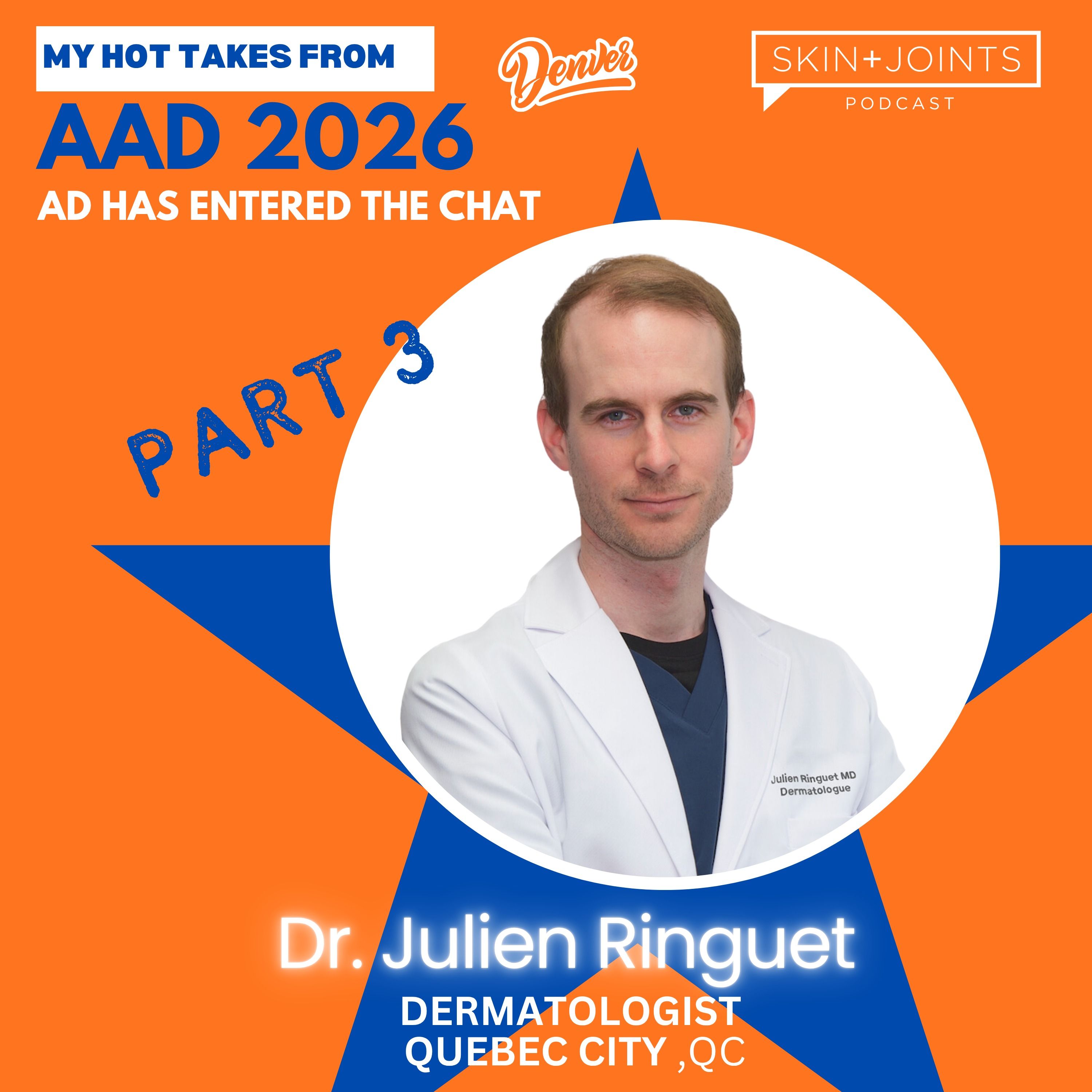 The Great Atopic Dermatitis Dose Debate: Escalate, De-escalate, or Hold Steady? | 🎙️The Great Dose Debate: Escalate, De-escalate, or Hold Steady? In this final episode of our AAD 2026 atopic dermatitis post-game poster series breakdown, we’re joined by dermatologist Dr. Julien Ringuet from Quebec City for a practical, no-fluff breakdown of the JADE REAL analysis — and what flexible abrocitinib dosing may actually mean when Monday morning clinic rolls around. Because in real life, patients do not always follow a tidy trial algorithm. Symptoms flare, itch keeps people up, adherence shifts, priorities change, and sometimes the “right” dose is less of a fixed destination and more of a GPS recalculating in real time. 🧭 Dr. Ringuet walks us through the clinical “so what” behind dose escalation and de-escalation, explaining why moving from 100 mg to 200 mg — or stepping down from 200 mg to 100 mg — should not automatically be seen as failure, overtreatment, or backpedalling. Instead, flexible dosing may be part of a thoughtful, shared decision-making strategy that better reflects the messy, dynamic reality of moderate-to-severe atopic dermatitis care. We cover how early reassessment, patient-reported outcomes, itch, sleep, EASI trends, payer flexibility, and treat-to-target thinking all fit into the bigger picture. And yes, we also discuss the real-world art of knowing when to push, when to pause, and when to test the waters with a lower dose. 🌊 ✨ Learning Objectives By the end of this episode, listeners should be able to: Describe how the JADE REAL study design reflects real-world clinical decision-making in moderate-to-severe atopic dermatitis. Explain why dose escalation and de-escalation with abrocitinib may represent intentional treatment optimization rather than treatment failure. Identify practical clinical scenarios where starting at 100 mg versus 200 mg may be appropriate. Discuss how early follow-up, patient-reported outcomes, itch, sleep, and quality-of-life measures can help guide dose adjustment decisions. Recognize key limitations of open-label, real-world evidence when translating study findings into clinical practice. Apply a treat-and-adjust approach to atopic dermatitis management using shared decision-making and individualized treatment goals. 💡 Key Takeaway Flexible dosing is not a loophole — it is real-world dermatology. The win is not finding one perfect pathway for every patient; it is learning how to reassess early, individualize thoughtfully, and adjust with purpose. 🩺 🎧 Tune in for practical pearls, real-world nuance, and Dr. Ringuet’s post-game analysis on what these data may mean for dermatologists managing AD in everyday practice. #SkinAndJointsPodcast #AAD2026 #AtopicDermatitis #EczemaCare #Dermatology #PatientReportedOutcomes #JAKInhibitors #abrocitinib #DermatologyEducation #MedicalEducation #HCPeducation #TreatToTarget #InflammatorySkinDisease #ClinicalData #DermTwitter #MedEd #Vodcast #PodcastEpisode #AADDenver #JAK #JAKinhibitor ABOUT Dr. Julien Ringuet Dermatologist, Quebec City, QC Dr Ringuet is a board certified dermatologist who practices in Quebec City as the principal investigator at the Centre de Recherche Dermatologique de Québec (CRDQ).He completed his medical training (MD) and his post graduate studies in dermatology form Laval University as well as a master in experimental medicine (MSc.) in the field of skin bioengineering at the Laboratoire d’Organogénèse Expérimentale de l’Université Laval (LOEX/CMDGT).Dr Ringuet and his team of the CRDQ are allowing patient access to quality and innovative clinical research focused on alopecia areata, atopic dermatitis, psoriasis and its variants and vitiligo. Supported by an IME Grant from PFIZER. | — | ||||||
| 6/1/26 |  From Clearer Skin to Better Sleep: MDA and Redefining Success in Atopic Dermatitis | From Clearer Skin to Better Sleep: MDA and Redefining Success in Atopic Dermatitis 🎙️ Are We Treating Eczema… or Just Admiring Better Scores? Minimal Disease Activity in Atopic Dermatitis In this rapid-fire AAD poster recap, dermatologist Dr. Julien Ringuet joins the Skin and Joints podcast to unpack a big idea with a small acronym: MDA — Minimal Disease Activity. Borrowed from the rheumatology playbook and now making its way into dermatology, MDA asks a deceptively simple question in atopic dermatitis care: Is the patient actually doing well, or do they just look better on paper? Together, we dive into new treat-to-target data from the AHEAD analysis, comparing abrocitinib and dupilumab through a more holistic lens — one that includes not only skin clearance, but also itch, sleep, quality of life, and the patient’s lived experience. Spoiler: an EASI score may be impressive, but it does not tuck your patient into bed at night. Dr. Ringuet breaks down how MDA could help clinicians raise the bar in atopic dermatitis management, why early symptom relief matters, where oral JAK inhibitors may fit for selected patients, and why safety, comorbidities, route of administration, patient preference, and long-term strategy still deserve front-row seats in every treatment decision. This episode is not just about picking a winner between therapies. It is about redefining what “success” should mean in chronic inflammatory skin disease — and avoiding the trap of accepting “better” when patients are still itchy, sleepless, and sidelined from daily life. 🎯 Learning Objectives By the end of this episode, listeners will be able to: Define Minimal Disease Activity in atopic dermatitis using the AHEAD treat-to-target framework, including both clinician-reported and patient-reported outcomes. Explain why MDA may offer a more patient-centred endpoint than traditional skin-only measures such as EASI 75 or EASI 90. Interpret key findings from the abrocitinib versus dupilumab analysis, including the relevance of early response, week-two separation, and multidimensional disease control. Identify patient profiles where rapid and comprehensive symptom control may influence treatment selection, while balancing safety, comorbidities, monitoring needs, access, and patient preferences. Describe practical ways to integrate a treat-to-target MDA approach into dermatology clinics, using manageable tools such as IGA/BSA or EASI, itch NRS, sleep NRS, and DLQI. Recognize the importance of avoiding therapeutic inertia when patients remain itchy, sleep-deprived, or functionally impaired despite partial improvement. 🧠 Key Takeaway Minimal Disease Activity may be the dermatology upgrade we did not know we needed: less “your skin looks better” and more “are you sleeping, functioning, and living better?” #SkinAndJointsPodcast #AAD2026 #AtopicDermatitis #EczemaCare #Dermatology #PatientReportedOutcomes #JAKInhibitors #abrocitinib #DermatologyEducation #MedicalEducation #HCPeducation #TreatToTarget #InflammatorySkinDisease #ClinicalData #DermTwitter #MedEd #Vodcast #PodcastEpisode #AADDenver #JAK #JAKinhibitor ABOUT Dr. Julien Ringuet Dermatologist, Quebec City, QC Dr Ringuet is a board certified dermatologist who practices in Quebec City as the principal investigator at the Centre de Recherche Dermatologique de Québec (CRDQ).He completed his medical training (MD) and his post graduate studies in dermatology form Laval University as well as a master in experimental medicine (MSc.) in the field of skin bioengineering at the Laboratoire d’Organogénèse Expérimentale de l’Université Laval (LOEX/CMDGT).Dr Ringuet and his team of the CRDQ are allowing patient access to quality and innovative clinical research focused on alopecia areata, atopic dermatitis, psoriasis and its variants and vitiligo. Supported by an IME Grant from PFIZER. | — | ||||||
| 5/28/26 |  JAKs, Flares & Rescue Plans: The Art of the Atopic Dermatitis Dose-Down | JAKs, Flares & Rescue Plans: The Art of the Atopic Dermatitis Dose-Down 🎙️ In this rapid-fire post-AAD recap, dermatologist Faculty Dr. Julien Ringuet joins the Skin and Joints Podcast to tackle a question that comes up all the time in real-world atopic dermatitis care: once a patient is doing well, can we safely step down therapy without sending their skin into rebellion? Using newly presented data on abrocitinib dose down-titration from the JADE program, Dr. Ringuet walks through what happens when patients who respond to 200 mg transition to 100 mg for long-term maintenance—and what clinicians should do if disease control starts to slip. Spoiler: stepping down is not a cliff dive. Along the way, we cover the “so what?” behind the numbers: who may be a good candidate for dose reduction, how to define loss of control beyond just visible skin lesions, why itch and sleep still deserve centre stage, and how shared decision-making can turn a dosing conversation into a true treatment partnership. This episode is for clinicians who want to move beyond poster reading and into practical, exam-room-ready conversations about JAK inhibitors, maintenance dosing, treat-to-target thinking, flare management, and individualized care in atopic dermatitis. Learning Objectives 📚 After listening to this episode, listeners should be able to: Describe the clinical rationale for considering abrocitinib dose down-titration in selected patients with atopic dermatitis. Interpret key long-term efficacy and flare data from the JADE Regimen/JADE Extend analyses in the context of real-world maintenance therapy. Identify patient factors that may support or discourage dose reduction, including depth of response, flare history, adherence, follow-up reliability, quality-of-life burden, and patient preferences. Explain how to counsel patients that step-down therapy is an option—not a guarantee—and that itch, sleep disruption, visible flare, and increased topical use can all signal loss of control. Apply a treat-to-target mindset using both clinician-reported outcomes, such as EASI, IGA, and BSA, and patient-reported outcomes, including itch, sleep, satisfaction, and quality of life. Recognize key caveats when applying clinical trial data to real-world practice, including responder-enriched populations, rescue therapy design, and as-observed analyses. #SkinAndJointsPodcast #AAD2026 #AtopicDermatitis #EczemaCare #Dermatology #PatientReportedOutcomes #JAKInhibitors #abrocitinib #DermatologyEducation #MedicalEducation #HCPeducation #TreatToTarget #InflammatorySkinDisease #ClinicalData #DermTwitter #MedEd #Vodcast #PodcastEpisode #AADDenver #JAK #JAKinhibitor ABOUT Dr. Julien Ringuet Dermatologist, Quebec City, QC Dr Ringuet is a board certified dermatologist who practices in Quebec City as the principal investigator at the Centre de Recherche Dermatologique de Québec (CRDQ).He completed his medical training (MD) and his post graduate studies in dermatology form Laval University as well as a master in experimental medicine (MSc.) in the field of skin bioengineering at the Laboratoire d’Organogénèse Expérimentale de l’Université Laval (LOEX/CMDGT).Dr Ringuet and his team of the CRDQ are allowing patient access to quality and innovative clinical research focused on alopecia areata, atopic dermatitis, psoriasis and its variants and vitiligo. Supported by an IME Grant from PFIZER. | — | ||||||
| 5/21/26 |  Quick Win, Durable Victory or Both? Rethinking Psoriasis Biologics After PSoHO | Skin, joints, and staying power—because in psoriasis, “getting clear” is only half the story. In this episode of the Skin and Joints Podcast 🎧, dermatologist Dr. Chih-ho Hong and rheumatologist Dr. May Kazem team up again for a lively, multidisciplinary deep dive into new 24-month real-world data from PSoHO 📊, an international prospective observational study of biologic-treated patients with moderate-to-severe psoriasis. The big question? Not just who gets patients clear ✨—but what gets them clear quickly ⏱️ and keeps them there for the long haul 🏃♂️. This analysis looks at 24-month effectiveness and durability across biologic classes, then zooms in 🔍 on several individual biologics from IL-17 to IL-23 and TNF-I . But here’s the catch—and it’s a clinically juicy one: durability was defined very stringentIly. Patients had to achieve PASI90 or PASI100 by week 12 🎯 and then maintain that same response at months 6, 12, 18, and 24 📆. In other words, this is not a “looked good once and disappeared” kind of outcome 👻. This is the biologic equivalent of showing up early, staying consistent, and never ghosting the follow-up visit ✅. Dr. Hong and Dr. Kazem bring the classic Skin and Joints perspective: how should clinicians interpret biologic class comparisons? Within class comparisons? And why does durability sound simple until you realize it rewards treatments that are both fast starters ⚡ and long-distance runners 🏃♀️? Expect practical pearls 💎, careful interpretation 🧠, and a reminder that real-world evidence is incredibly useful 🔬—as long as we read the fine print before declaring a winner 🏆. Based on the attached podcast conversation emphasizing multidisciplinary care, real-world caveats, patient priorities, and the importance of viewing psoriasis as more than “just skin.” 🎯 Learning Objectives After listening to this episode, learners should be able to: 1. Describe the PSoHO study design 📊, including its role as an international, prospective, observational study of biologic-treated patients with moderate-to-severe psoriasis. 2. Explain 24-month effectiveness and durability ⏱️, including why maintaining PASI90 or PASI100 across multiple time points is a more demanding measure of sustained treatment success. 3. Interpret stringent durability outcomes with caution 🧠, recognizing that this definition favors therapies that achieve early clearance and then maintain it over time. 4. Compare biologic classes and individual agents 🔍, including how performance may be understood in the context of real-world treatment decisions. 5. Apply a multidisciplinary skin-and-joints lens , considering skin clearance, psoriatic arthritis risk, patient-reported impact, comorbidities, and treatment persistence. 6. Recognize the strengths and limitations of real-world observational data, including confounding by indication, patient selection, and why association does not automatically equal causation #SkinAndJoints #PsoriaticArthritis #Psoriasis #Dermatology #Rheumatology #Ixekizumab #PROSPIRIT #RealWorldEvidence #InflammatoryDisease #Biologics #bDMARDs #tsDMARDs #IL17 #MedEd #HCPeducation #DermRheum #PatientCentredCare #ClinicalPractice #Podcast #Vodcast Episode supported by an IME Grant from Eli Lilly. ABOUT Dr. Chih-ho Hong, MD, FRCPC Dermatologist, Vancouver, BC Dr. Hong is a board-certified dermatologist working in Greater Vancouver BC, Canada. He runs a busy office-based dermatology clinic with a focus on clinical research. He is a Clinical Associate Professor in the Department of Dermatology and Skin Sciences and teaches at St. Paul’s Hospital in Vancouver, where he is active staff. Dr. Hong is the past head of the BC Section of Dermatology, the current Economics representative for Dermatology at the BCMA, and is the past chair of the Education Committee of the Canadian Dermatology Association. He is also a past examiner in Dermatology for the Royal College of Physicians of Canada residency qualification examination. He is currently the Canadian representative to SPIN (The Skin Inflammation and Psoriasis International Network) – spindermatology.org Dr. Hong is active in clinical practice and dermatology research. His main clinical areas of interest are psoriasis and eczema. He has been an investigator in over 150 trials of treatments in dermatology and has over 50 peer reviewed publications. He has lectured locally, nationally, and internationally on dermatology treatments and has been an invited speaker at international dermatology congresses. ABOUT Dr. May Kazem, MD, FRCPC Rheumatologist, Vancouver, BC Dr. Mikameh “May” Kazem is a Canadian rheumatologist based in Vancouver, BC. She holds an undergraduate degree in biotechnology and a Master’s in Health Administration. She completed her Internal Medicine residency at the University of British Columbia, followed by Rheumatology fellowship training at the Schulich School of Medicine at Western University. Dr. Kazem practices general rheumatology in Vancouver and her areas of interest include management of patients with various inflammatory rheumatologic disorders and complex osteoporosis. She is also actively involved in medical education and patient advocacy, to promote awareness, knowledge-sharing, and improved care for individuals living with rheumatic conditions. 📻www.skinandjoints.ca ✉️info@skinandjoints.ca | — | ||||||
| 5/19/26 |  Built to Last Beyond the Trial? Real World Treatment Durability in Psoriatic Disease PsA | 🎙️ 💡 When Skin and Joints Actually Mean… Skin AND Joints In this episode of the Skin and Joints Podcast, we bring together two expert voices — dermatologist Dr. Chih-ho Hong and rheumatologist Dr. May Kazem— for a true cross-specialty conversation on psoriatic arthritis care. The focus? 🔍 The recent PRO-SPIRIT 12-month real-world study exploring the comparative effectiveness and persistence biologic/targeted synthetic DMARDs in patients with PsA. And spoiler alert 🚨: this isn’t just another “good skin drug vs good joint drug” debate. We dive into what the data means when the patient in front of you has plaques, pain, fatigue, stiffness, nail disease, possible axial symptoms, quality-of-life concerns… and a very real desire to just feel like themselves again. What demonstrated a balanced signal across both skin and joint domains? ✅Dr. Hong brings the dermatology lens: clearing skin matters deeply, and identifying PsA early can change the entire treatment pathway. ✅Dr. Kazem brings the rheumatology lens: PsA is heterogeneous, patient-reported outcomes matter, and treatment decisions need to account for competing domains like GI disease, uveitis, axial symptoms, and inflammatory arthritis burden. ✅Together, they remind us why PsA care works best when dermatology and rheumatology stop playing telephone ☎️ and start sitting at the same table. Preferably with coffee ☕. Possibly with a “skin and joints” drinking game. 🎧 Tune in for a practical, witty, and clinically grounded conversation on how real-world data can help refine real-world decisions. 🎯 Learning Objectives:After listening to this episode, learners will be able to: Describe the clinical relevance of the 12-month PRO-SPIRIT real-world study evaluating b/tsDMARDs in PsA. Discuss how dermatology and rheumatology perspectives differ — and overlap — when selecting advanced therapies for PsA. Identify key limitations of real-world comparative effectiveness studies, including confounding by indication and baseline phenotype differences. Apply a phenotype-driven approach to treatment selection across skin, joint, axial, enthesitis, nail, GI, and uveitis domains. Recognize the importance of repeat PsA screening in patients with psoriasis and the role of multidisciplinary co-management. Interpret treatment persistence and patient-reported outcomes in the context of real-world clinical practice. #SkinAndJoints #PsoriaticArthritis #Psoriasis #Dermatology #Rheumatology #Ixekizumab #PROSPIRIT #RealWorldEvidence #InflammatoryDisease #Biologics #bDMARDs #tsDMARDs #IL17 #MedEd #HCPeducation #DermRheum #PatientCentredCare #ClinicalPractice #Podcast #Vodcast Episode supported by and IME Grant from Eli Lilly. ABOUT Dr. Chih-ho Hong, MD, FRCPC Dermatologist, Vancouver, BC Dr. Hong is a board-certified dermatologist working in Greater Vancouver BC, Canada. He runs a busy office-based dermatology clinic with a focus on clinical research. He is a Clinical Associate Professor in the Department of Dermatology and Skin Sciences and teaches at St. Paul’s Hospital in Vancouver, where he is active staff. Dr. Hong is the past head of the BC Section of Dermatology, the current Economics representative for Dermatology at the BCMA, and is the past chair of the Education Committee of the Canadian Dermatology Association. He is also a past examiner in Dermatology for the Royal College of Physicians of Canada residency qualification examination. He is currently the Canadian representative to SPIN (The Skin Inflammation and Psoriasis International Network) – spindermatology.org Dr. Hong is active in clinical practice and dermatology research. His main clinical areas of interest are psoriasis and eczema. He has been an investigator in over 150 trials of treatments in dermatology and has over 50 peer reviewed publications. He has lectured locally, nationally, and internationally on dermatology treatments and has been an invited speaker at international dermatology congresses. ABOUT Dr. May Kazem, MD, FRCPC Rheumatologist, Vancouver, BC Dr. Mikameh “May” Kazem is a Canadian rheumatologist based in Vancouver, BC. She holds an undergraduate degree in biotechnology and a Master’s in Health Administration. She completed her Internal Medicine residency at the University of British Columbia, followed by Rheumatology fellowship training at the Schulich School of Medicine at Western University. Dr. Kazem practices general rheumatology in Vancouver and her areas of interest include management of patients with various inflammatory rheumatologic disorders and complex osteoporosis. She is also actively involved in medical education and patient advocacy, to promote awareness, knowledge-sharing, and improved care for individuals living with rheumatic conditions. 📻www.skinandjoints.ca ✉️info@skinandjoints.ca | — | ||||||
| 4/16/26 |  Melinda Knows Best at AAD 2026: When the Treatment Algorithm for Chronic Hand Eczema Gets a Plot Twist | 🎙️✨ Melinda Knows Best at AAD Denver: Hands Down, Chronic Hand Eczema Is Getting a New Playbook 🖐️ Live from AAD 2026 in Denver 🏔️, a podcast favorite, Melinda Knows Best returns with Dr. Melinda Gooderham for a true post-game analysis🏀 of new chronic hand eczema data — and yes, this one is all about helping hands get back to doing what hands do best: opening jars 🥜, buttoning shirts 👔, holding coffee cups ☕, and generally not letting everyday life feel just like a clinical endpoint. In this episode, we break down new pooled post-hoc data evaluating delgocitinib cream versus vehicle in adults with moderate-to-severe chronic hand eczema, with a practical twist: does prior systemic therapy exposure matter for patient success, especially when it comes to pain and itch? 🤔 We dive into: Does this data push delgocitinib earlier in the treatment algorithm for Melinda? What are the biggest critiques or caveats a dermatologist should keep in mind when looking at this data? Who is the real-world patient you would think about tomorrow after seeing this poster Well the chronic hand eczema treatment ladder may not be a one-way escalator anymore. 🪜🔄 Dr. Gooderham brings the real-world lens 👩⚕️: patients do not just want almost clear skin on a study scale — they want to work, cook, dress, sleep, and live without painful, itchy, fissured hands getting in the way. Because when it comes to chronic hand eczema, sometimes the most meaningful outcome is being able to open the peanut butter jar without negotiating with your skin first. 🥜😅 Learning objectives 📚By the end of this episode, listeners will be able to: Summarize new AAD 2026 data evaluating delgocitinib cream in moderate-to-severe chronic hand eczema based on prior systemic therapy exposure. Compare response patterns in systemic-naïve versus systemic-experienced patients. Discuss the real-world clinical relevance of early itch and pain improvement in chronic hand eczema. Identify key caveats of the analysis, including its post-hoc design, subgroup size, and 16-week timeframe. Consider how delgocitinib may fit into evolving treatment algorithms for chronic hand eczema. #SkinAndJointsPodcast #MelindaKnowsBest #AAD2026 #ChronicHandEczema #HandEczema #EczemaCare #Dermatology #DermatologyPodcast #Delgocitinib #MedicalEducation #HCPeducation #DermTwitter #AADDenver #SkinScience #TopicalTherapy #RealWorldDermatology #IGA #HESD #itch #pain Episode supported by and IME Grant from LEO Pharma ABOUT Dr.Melinda Gooderham, MD, FRCPC ( Dermatology) Toronto, ON Melinda Gooderham MD MSc FRCPC Dr. Gooderham is a Dermatologist and Medical Director at the SKiN Centre for Dermatology and an Investigator with Probity Medical Research. She is an Assistant Professor at Queens University and a Consultant Physician at the Peterborough Regional Health Centre. She is a fellow of the Royal College of Physicians and Surgeons of Canada. Dr. Gooderham has been the principal investigator for over 200 clinical trials and she practices with a focus on inflammatory diseases of the skin. She also contributes to several peer-reviewed dermatology publications as an associate editor, reviewer, and has been an author of 205 articles. She enjoys lecturing to global audiences on new therapies for skin diseases. 📻www.skinandjoints.ca ✉️info@skinandjoints.ca | — | ||||||
| 4/15/26 |  When Isotretinoin Isn’t Flying Solo: The Case for Combo Topical Acne Care at AAD 2026 with Dr. Renée A. Beach and Dr. Irina Oroz | 🎙️✨ Isotretinoin + Clascoterone: Acne’s New Power Couple? When acne gets severe, isotretinoin usually enters the chat as the big gun.💥But what happens when you pair it with topical clascoterone — the anti-androgen sidekick targeting the sebaceous gland from another angle? In this episode, we break down new real-world data from a multi-centre retrospective study comparing oral isotretinoin monotherapy versus combination isotretinoin + topical clascoterone for severe acne vulgaris and what the implications are for clinic. And yes — the combo arm brought some serious main-character energy. Our expert guests unpack what this could mean in clinic:✨ faster clearance✨ improved tolerability✨ hormonal acne considerations✨ patient adherence realities✨ the ever-important goal of preventing scars before they happen Because in acne care, almost clear is nice… but clear-clear is the assignment. ✅ This conversation dives into the practical side: When should clascoterone be added? Which patients may benefit most? How do we keep regimens simple for younger patients already juggling isotretinoin, labs, moisturizers, sunscreen, and TikTok skincare detox? Learning objectives:✅ Review emerging data comparing isotretinoin monotherapy with isotretinoin plus topical clascoterone in severe acne vulgaris✅ Discuss the potential clinical relevance of combination therapy for clearance, tolerability, and patient experience✅ Explore practical approaches to integrating clascoterone into isotretinoin treatment plans✅ Consider real-world limitations of retrospective data, including confounders, dosing variation, skincare use, and patient selection✅ Reframe acne treatment goals beyond lesion counts to include scarring prevention, satisfaction, and long-term disease control 🎧 AAD 2026 coverage from the Mile High City. Special thanks Dr. Mohannad Abu-Hilal. #SkinAndJointsPodcast #AAD2026 #Dermatology #Acne #AcneVulgaris #Isotretinoin #Clascoterone #Winlevi #DermTwitter #MedEd #DermatologyEducation #SevereAcne #AcneScarring #SkinHealth #ClinicalDermatology #Vodcast #Podcast #HealthcareEducation ABOUT Dr. Renée A. Beach MD FRCPC DABD Dermatologist | Toronto, ON Dr. Renée A. Beach is a dermatologist practicing in Toronto for more than 10 years. She earned her medical doctor (MD) degree from McMaster University, followed by Dermatology residency at the University of Ottawa (FRCPC). As an adjunct assistant professor at the University of Toronto, she teaches trainees in the Undergraduate MD program as well as postgraduate dermatology residents and has collaborated with them on various peer-reviewed publications. She is a trusted, regularly sought-after authority across media outlets and is the on-air dermatologist for CTVs The Social and Your Morning. On social media, she is active on Instagram (@dermabeach). At her private office, DermAtelier on Avenue, she sees patients for medical and cosmetic treatments with the goal of delivering dermatologic excellence to patients of all skin tones and types About Dr. Irina Oroz, MD FRCPC DABD Dermatologist | Saskatoon, SK Dr. Irina Oroz is a fellow of the Royal College of Physicians and Surgeons of Canada in Dermatology, a Diplomate of the American Board of Dermatology, and Assistant Clinical Professor of Dermatology at the University of Saskatchewan. Currently she practices medical, surgical and cosmetic dermatology at Oroz Dermatology in Saskatoon. Her areas of interest lie in skin cancer, acne and psoriasis. Dr. Oroz completed her medical degree at the University of Saskatchewan, prior to undertaking a five-year dermatology residency program at the University of Saskatchewan and University of Alberta. Her interest in the diagnosis and management of skin disease has been enhanced with elective training in USA, Australia and across Canada, with specialized training in Skin Cancer at the Royal Alexandra Hospital in Brisbane Australia, as well as medical education research in Edmonton. Active in the medical community, Dr. Oroz is one of the founding members, as well as the current treasurer of the Saskatchewan Dermatology Association. Supported by an IME Grant from SUN Pharma. | — | ||||||
Want analysis for the episodes below?Free for Pro Submit a request, we'll have your selected episodes analyzed within an hour. Free, at no cost to you, for Pro users. | |||||||||
| 4/13/26 |  Sebum Like It Hot: New 52-Week Acne Data from AAD 2026 with Dr. Renée A. Beach and Dr. Irina Oroz | 🎙️✨ New Acne Data Just Dropped — and We’re Bringing the Post-Game Analysis from AAD 2026! 🏀 Live from Denver — the Mile High City — the Skin and Joints Podcast is breaking down new 52-week real-world acne data exploring the impact of clascoterone 1% on sebum reduction, acne improvement, tolerability, and what it actually means in day-to-day dermatology practice. Because let’s be honest: in acne care, it’s not just about lesion counts. Patients care about oiliness, shine, pores, irritation, post-inflammatory marks, and whether their treatment routine feels like a science experiment before bed. In this episode, Dr. Renée A. Beach and Dr. Irina Oroz (and a mystery guest co-host ;)) join the conversation to unpack the clinical relevance of the data — and why “treat-to-happy” might just be the endpoint patients really care about. We also get into the practical side: ✅How do you layer clascoterone with retinoids? ✅What does sebum reduction actually mean in clinic? ✅Is “zero irritation” too good to be true — or reflective of real-world experience? ✅And most importantly… is it pronounced sebometer or sebumeter? From male acne patients who now have a topical anti-androgen option, to patients who have tried everything, to those who need a tolerable long-term acne strategy — this episode explores where the data meets the real world. Learning Objectives: ✅ Review new 52-week data on clascoterone 1% and sebum reduction in acne ✅ Discuss the clinical relevance of sebum, shine, oiliness, and patient-reported treatment success ✅ Evaluate long-term acne outcomes including IGA success, inflammatory and non-inflammatory lesion reduction, and tolerability ✅ Explore practical strategies for layering clascoterone with retinoids, benzoyl peroxide, and combo topical therapies ✅ Identify patient profiles who may benefit from topical anti-androgen therapy in real-world practice ABOUT Dr. Renée A. Beach MD FRCPC DABD Dermatologist | Toronto, ON Dr. Renée A. Beach is a dermatologist practicing in Toronto for more than 10 years. She earned her medical doctor (MD) degree from McMaster University, followed by Dermatology residency at the University of Ottawa (FRCPC). As an adjunct assistant professor at the University of Toronto, she teaches trainees in the Undergraduate MD program as well as postgraduate dermatology residents and has collaborated with them on various peer-reviewed publications. She is a trusted, regularly sought-after authority across media outlets and is the on-air dermatologist for CTVs The Social and Your Morning. On social media, she is active on Instagram (@dermabeach). At her private office, DermAtelier on Avenue, she sees patients for medical and cosmetic treatments with the goal of delivering dermatologic excellence to patients of all skin tones and types About Dr. Irina Oroz, MD FRCPC DABD Dermatologist | Saskatoon, SK Dr. Irina Oroz is a fellow of the Royal College of Physicians and Surgeons of Canada in Dermatology, a Diplomate of the American Board of Dermatology, and Assistant Clinical Professor of Dermatology at the University of Saskatchewan. Currently she practices medical, surgical and cosmetic dermatology at Oroz Dermatology in Saskatoon. Her areas of interest lie in skin cancer, acne and psoriasis. Dr. Oroz completed her medical degree at the University of Saskatchewan, prior to undertaking a five-year dermatology residency program at the University of Saskatchewan and University of Alberta. Her interest in the diagnosis and management of skin disease has been enhanced with elective training in USA, Australia and across Canada, with specialized training in Skin Cancer at the Royal Alexandra Hospital in Brisbane Australia, as well as medical education research in Edmonton. Active in the medical community, Dr. Oroz is one of the founding members, as well as the current treasurer of the Saskatchewan Dermatology Association. Supported by an IME Grant from SUN Pharma. Supported by an IME Grant from SUN Pharma. | — | ||||||
| 4/9/26 |  Age, Risk, and the JAK Factor: A 6-Year Safety Deep Dive from AAD 2026 | 🎙️Age, Risk, and the JAK Factor: A 6-Year Safety Deep Dive- Part 2 Guests: Dr. Marissa Joseph and Dr. Fiona Lovegrove Location: 📍 AAD 2026 We’re back with Part 2 of our atopic dermatitis double-header with Dr. Marissa Joseph and Dr. Fiona Lovegrove from AAD 2026 in Denver—and this time, we’re getting into the data that always enters the chat when JAK inhibitors in Atopic Dermatitis are mentioned: long-term safety. Our expert faculty unpack fresh 6-year safety data on upadacitinib in moderate-to-severe atopic dermatitis—looking beyond efficacy and into the real-world clinical questions dermatologists face every day: 🧩 Who is the right patient? ⚖️ How do we balance real world risk vs benefit? 👵 Does anything change when a patient is over 65? Or is it about how risk is really framed? 💉 Where does zoster vaccination fit into the treatment conversation? 📊 And how do we contextualize MACE, VTE, malignancy, infections, and herpes zoster without turning nuance into noise? Because let’s be honest: when it comes to JAK inhibitors, the safety conversation doesn’t just knock politely—it pulls up a chair. 🪑 This episode dives into how long-term data can help clinicians move beyond blanket “yes/no” thinking and toward more individualized decision-making: age, comorbidity stacking, dose, baseline risk, quality of life, disease severity, and patient preference all matter. The big takeaway? Decisions in the gray zone—and that’s exactly where expert interpretation matters most. 🎯 Learning Objectives: By the end of this episode, listeners will be able to: 1. Discuss the clinical relevance of long-term safety data for upadacitinib in moderate-to-severe atopic dermatitis. 2. Identify key safety considerations, including herpes zoster, serious infections, MACE, VTE, and malignancy. 3. Describe how age, comorbidities, dose selection, and baseline patient risk influence treatment decisions with oral JAK inhibitors. 4. Explain the role of shared decision-making and risk-benefit communication when treating adolescents, adults, and older patients with AD. 5. Recognize practical considerations around zoster vaccination and routine immunization when initiating JAK inhibitor therapy. 🎧 Tune in for a practical, nuanced, and slightly puppy-interrupted breakdown of what this data actually means for your clinic. #SkinAndJointsPodcast #AAD2026 #AtopicDermatitis #Dermatology #JAKInhibitors #Upadacitinib #Rinvoq #EczemaCare #DermTwitter #MedEd #HCPeducation #DermatologyPodcast #Vodcast #ClinicalPearls #SharedDecisionMaking #SkinScience #ADTreatment REFERENCES: Long-Term 6-Year Safety of Upadacitinib in Moderate-to-Severe Atopic Dermatitis Across Ages: Results From Three Phase 3 Studies Supported by an IME Grant from ABBVIE. | — | ||||||
| 4/7/26 |  AAD 2026: If They Get There, Do They Stay There? A 140-Week AD JAK Data Dive | 🎙️ If They Get There, Do They Stay There? A 140-Week AD Data Dive — Part 1 of a 2-Part Double Header Guests: Dr. Marissa Joseph and Dr. Fiona LovegroveLocation: 📍 AAD 2026 We came to Denver for AAD 2026, adjusted to the altitude, caught our breath — barely — and dove straight into the data. In Part 1 of this two-part atopic dermatitis double header, Dr. Marissa Joseph and Dr. Fiona Lovegrove join us live from the Mile High City to break down fresh new clinical data in moderate-to-severe atopic dermatitis, with a focus on long-term maintenance of stringent patient-reported outcomes with upadacitinib from the Measure Up 1 and Measure Up 2 studies. Because patients do not walk into clinic asking if their EASI score improved by 70%.They ask: “Will I sleep?”“Will the itch stop?”“Can I focus at work or school?”“Can I stop thinking about my eczema every single day?” Our conversation gets into the so what behind the numbers —what this data implies for your real world patient decisions, why durability matters, why week 16 response may help guide long-term expectations, and why patient-reported outcomes are moving from nice-to-have to true treatment targets in atopic dermatitis. We also explore the challenge of measuring multiple domains in practice, and why aiming high does not mean treating partial responders as failures. How do our experts frame better sleep, less itch, and fewer daily disease interruptions for these partial responders? Think of this as your compact AAD post-game analysis — but instead of Shaq and the scoreboard, we’re breaking down itch, sleep, emotional burden, dose optimization, and the future of treat-to-target AD care. Learning Objectives:By the end of this episode, listeners will be able to: Describe the clinical relevance of long-term patient-reported outcome data in moderate-to-severe atopic dermatitis. Discuss how itch, sleep, emotional burden, and daily functioning can inform treatment success beyond skin clearance alone. Interpret the significance of sustained responses from week 16 through longer-term follow-up in the Measure Up 1 and 2 studies. Identify practical considerations and limitations when incorporating stringent PRO targets into real-world dermatology practice. Apply key insights from AAD 2026 data to therapeutic decision making, patient counselling, expectation-setting, and shared decision-making in AD care. Skin and Joints Podcast — where we bring the science, the clinical translation, and just enough altitude-related commentary to keep things interesting. Part 2 is already warming up in the bullpen. REFERENCES: Long-Term Maintenance of Stringent Patient-Reported Outcomes With Upadacitinib in Moderate-to-Severe Atopic Dermatitis: 140-Week Results From the Measure Up 1 and 2 Phase 3 Studies #SkinAndJointsPodcast #AAD2026 #AtopicDermatitis #EczemaCare #Dermatology #PatientReportedOutcomes #JAKInhibitors #Upadacitinib #MeasureUp #DermatologyEducation #MedicalEducation #HCPeducation #TreatToTarget #InflammatorySkinDisease #ClinicalData #DermTwitter #MedEd #Vodcast #PodcastEpisode #AADDenver #JAK #JAKinhibitor Supported by an IME Grant from ABBVIE.. | — | ||||||
| 10/28/25 |  World Psoriasis Day: From Stigma to Skin Clearance with Dr. Jessica Asgarpour | 🎙️World Psoriasis Day Special: Clearer Skin, Brighter Outlook Featuring Dr. Jessica Asgarpour This special World Psoriasis Day episode of the Skin and Joints Podcast shines a light on the evolving psoriasis journey—from the first plaque to total skin clearance. Dermatologist Dr. Jessica Asgarpour, now back in her sunny hometown of Calgary, for an honest, hopeful conversation about how far psoriasis care has come—and where it’s headed next. From coal tar and cumbersome creams to once-every-12-week biologic injections, Dr. Asgarpour unpacks the “treatment ladder” and what really determines when to climb it. We deep dive into: Why World Psoriasis Day (Oct 29) matters for awareness, stigma reduction, and timely re-referral How to recognize when a patient is undertreated and ready for escalation The topical-to-systemic continuum—including steroid-free innovations, orals vs. biologics, and the occasional role for IV therapy Real-world barriers in access and adherence—from referral deserts to needle phobia Matching therapy to patient lifestyle, comorbidities, and comfort level (“the clinic playbook”) Why dermatologists today can say, confidently, that there is hope for every patient It’s part myth-busting, part motivation—a must-listen whether you’re a clinician optimizing care or a patient ready to revisit your treatment options. 🎯 Learning Objectives After listening to this episode, participants will be able to: Describe the modern therapeutic ladder for psoriasis, from topicals and orals to biologics and infusions. Identify clinical and quality-of-life criteria that signal the need for treatment escalation. Discuss common barriers leading to undertreatment and strategies to enhance patient access and adherence. Compare classes of biologic agents (TNF-α, IL-17, IL-23, IL-12/23) and their practical considerations in real-world care. Empower patients with evidence-based reassurance about safety, efficacy, and long-term outcomes of advanced therapies. 🩵 World Psoriasis Day is more than awareness—it’s a call to action for clear skin, renewed confidence, and collaborative care. #WorldPsoriasisDay #SkinAndJointsPodcast #PsoriasisAwareness #Dermatology #Biologics #PatientJourney #ClearSkinAhead Supported by SUN Pharma. ABOUT Dr. Jessica Asgarpour Dermatologist, Calgary, AB Board-certified in both Canada and the U.S., Dr. Asgarpour completed medical school at the Cumming School of Medicine and her Dermatology residency at the University of Alberta. She practices medical, surgical, and cosmetic dermatology with a special interest in hidradenitis suppurativa and deroofing surgeries, as well as acne, psoriasis, eczema, skin cancer, and women’s health. She is currently working at the Skin Health and Wellness Centre in Calgary. She is a lecturer at the University of Toronto, a courtesy clinical associate at Women’s College Hospital, and is an active investigator for ongoing clinical trials in inflammatory diseases. She is a board member on the Canadian Hidradenitis Suppurativa foundation. | — | ||||||
| 10/8/25 |  (PART 2) Acne in Paris: Croissants, Comedones & Cutting-Edge Care at EADV 2025 | PART2-Acne in Paris: Croissants, Comedones & Cutting-Edge Care at EADV 2025 Guests: Dr. Chloe Ward & Dr. Natalie Cunningham Location: 📍 EADV 2025, Paris 🇫🇷 From café chatter to late-breaker abstracts, this fresh field report stitches together breaking new data and what matters for acne care today. Our two Canadian derm Faculty dynamos, Dr. Chloe Ward and Dr. Natalie Cunningham, join us live from EADV 2025 to decode acne in the TikTok age. We swap “Dr. Google” for real talk on psychosocial fallout (filters, FOMO, and 4 a.m. routines), sanity-check the diet myths, and map where AI actually helps in assessment—think consistent severity tracking and smarter primary-care triage—without replacing clinical eyes (especially in richer skin tones). Drs. Ward and Cunningham unpack multimodal regimens patients can actually tolerate, topical androgen-receptor blockade at the sebaceous unit, and smarter maintenance so scars don’t steal the show. We dig into pigment beyond classic PIH (hello, primary melanogenesis), when energy devices earn a seat (including a 1726-nm sebaceous-targeting laser), why most at-home red light is a detour, and the rare moments biologics enter the chat for overlap/refractory cases. Throughout: practical pearls and fresh evidence Learning Objectives After this episode, participants will be able to: 🧠 Assess psychosocial burden in acne (sleep 💤, stress 😰, social media behaviors 📱) and integrate into severity and treatment decisions 🩺. 🥗 Debunk prevalent myths (“diet cures acne” ❌) with balanced, evidence-based counseling 📖 that acknowledges diet/stress/hormones as contributors, not sole causes ⚖️. 🧴 Design patient-centered, multimodal regimens that optimize efficacy ✅ and tolerability 🤝—leveraging combination therapy 🔗. 🧬 Explain mechanisms (incl. topical androgen-receptor blockade at the sebaceous gland) and position them in stepwise care from induction 🚀 to maintenance 🔁. 🎨 Differentiate pigment pathways (PIH vs. emerging primary melanogenesis) and tailor strategies for all skin tones 🌈 with rigorous photoprotection 🧢🕶️. 🤖 Use AI judiciously for documentation 📝 and triage 🏥; recognize limitations in diverse skin tones 🌍 and keep the patient’s lived experience central ❤️. 🛡️ Prevent scars proactively by identifying scar-risk patients early ⏱️ and escalating appropriately (e.g., isotretinoin candidacy) 🎯. 🔦 Outline the role of energy-based devices (including the 1726-nm sebaceous-targeting laser) in reducing inflammation 🔥, erythema 🌺, and remodeling 🧱—and why most at-home red-light devices fall short 🚫🔴. 🧬 Spot the edge cases where biologics or overlap-syndrome thinking may be appropriate 🧩, and outline key research gaps to watch 🔭 (hormonal pathways, AI validation, long-term maintenance). Perfect for Dermatologists, primary-care clinicians, pharmacists, nurses, and any HCP who fields “I saw this on TikTok…” and wants practical, patient-first ways to translate Paris-level science into Monday-morning care. Supported by an IME Grant from SUN Pharma. | — | ||||||
| 10/6/25 | Acne in Paris: Croissants, Comedones & Cutting-Edge Care at EADV 2025 | Acne in Paris: Croissants, Comedones & Cutting-Edge Care at EADV 2025 Guests: Dr. Chloe Ward & Dr. Natalie Cunningham Location: 📍 EADV 2025, Paris 🇫🇷 From café chatter to late-breaker abstracts, this fresh field report stitches together breaking new data and what matters for acne care today. Our two Canadian derm Faculty dynamos, Dr. Chloe Ward and Dr. Natalie Cunningham, join us live from EADV 2025 to decode acne in the TikTok age. We swap “Dr. Google” for real talk on psychosocial fallout (filters, FOMO, and 4 a.m. routines), sanity-check the diet myths, and map where AI actually helps in assessment—think consistent severity tracking and smarter primary-care triage—without replacing clinical eyes (especially in richer skin tones). Drs. Ward and Cunningham unpack multimodal regimens patients can actually tolerate, topical androgen-receptor blockade at the sebaceous unit, and smarter maintenance so scars don’t steal the show. We dig into pigment beyond classic PIH (hello, primary melanogenesis), when energy devices earn a seat (including a 1726-nm sebaceous-targeting laser), why most at-home red light is a detour, and the rare moments biologics enter the chat for overlap/refractory cases. Throughout: practical pearls and fresh evidence Learning Objectives After this episode, participants will be able to: 🧠 Assess psychosocial burden in acne (sleep 💤, stress 😰, social media behaviors 📱) and integrate into severity and treatment decisions 🩺. 🥗 Debunk prevalent myths (“diet cures acne” ❌) with balanced, evidence-based counseling 📖 that acknowledges diet/stress/hormones as contributors, not sole causes ⚖️. 🧴 Design patient-centered, multimodal regimens that optimize efficacy ✅ and tolerability 🤝—leveraging combination therapy 🔗. 🧬 Explain mechanisms (incl. topical androgen-receptor blockade at the sebaceous gland) and position them in stepwise care from induction 🚀 to maintenance 🔁. 🎨 Differentiate pigment pathways (PIH vs. emerging primary melanogenesis) and tailor strategies for all skin tones 🌈 with rigorous photoprotection 🧢🕶️. 🤖 Use AI judiciously for documentation 📝 and triage 🏥; recognize limitations in diverse skin tones 🌍 and keep the patient’s lived experience central ❤️. 🛡️ Prevent scars proactively by identifying scar-risk patients early ⏱️ and escalating appropriately (e.g., isotretinoin candidacy) 🎯. 🔦 Outline the role of energy-based devices (including the 1726-nm sebaceous-targeting laser) in reducing inflammation 🔥, erythema 🌺, and remodeling 🧱—and why most at-home red-light devices fall short 🚫🔴. 🧬 Spot the edge cases where biologics or overlap-syndrome thinking may be appropriate 🧩, and outline key research gaps to watch 🔭 (hormonal pathways, AI validation, long-term maintenance). Perfect for Dermatologists, primary-care clinicians, pharmacists, nurses, and any HCP who fields “I saw this on TikTok…” and wants practical, patient-first ways to translate Paris-level science into Monday-morning care. Supported by an IME Grant from SUN Pharma. | — | ||||||
| 10/2/25 |  Melinda Knows Best: EADV 2025 Chronic Hand Eczema Paris Pop-Up with Dr.Melinda Gooderham | Paris Pop-Up: Hands Down the Most Fun You’ll Have Learning About Chronic Hand Eczema Late Breaker Edition Chronic Hand Eczema in Focus: DELTA-Teen efficacy & pooled safety of topical pan-JAK Episode Tasting Menu 🍽️: Jet-lag ✈️, steak-frites , and NEW science : we unpack fresh adolescent data for a topical pan-JAK cream in chronic hand eczema (CHE) and a pooled safety package that’s so uneventful it’s…beautiful 😌. (Melinda’s words: “Boring is good.”) Fresh from EADV Paris 🗼🇫🇷, the team breaks down two late-breaking updates on CHE: 1. DELTA-Teen — a randomized (3:1) 16-week trial of a topical pan-JAK inhibitor (delgocitinib cream) in adolescents (12–17) with moderate–severe CHE. 📊 2. Pooled safety analysis across five trials (Phase 2b/3; 16-week regular use + up to 52-week as-needed). 🛡️📈 What’s on the tasting menu : • EADV in Paris — highlights with a dash of Melinda’s Paris story 🥐📸 • Current adolescent CHE care — steroid limits & non-steroidal gaps • DELTA-Teen unpacked — design, endpoints, results, onset, adherence impact • Safety deep-dive — pooled 5-trial analysis, 52-week PRN, counseling talking points • Practice pearls — payer metrics (IGA-CHE), cross-setting messaging, fast-tracking from primary care • Wrap — off-label nuance, what to tell parents/teens, what to watch for next We dive into where a non-steroidal topical JAK can fit for adolescents—an area with gaps given steroid hesitancy and tolerability issues with other non-steroidals 🧩. Plus, a practical workflow map 🗺️: primary care triage → dermatology fast-track → pharmacy counseling (steroid fears, adherence benefits from rapid itch relief) → documentation (expect IGA-CHE to be required by payers). Importantly, efficacy signals span CHE subtypes (atopic, irritant, allergic) ✅—supporting broad real-world relevance 🌍. Learning objectives 🎯: 1. Describe the DELTA-Teen trial design for adolescent CHE, including primary (IGA-CHE TS) and key secondary endpoints (HECSI-90, HESD itch/pain). 2. Interpret week-16 efficacy results and differentiate early patient-reported benefits from statistical-significance timing (e.g., week-12 separation)—and weave this into adherence counseling ⏳. 3. Summarize pooled safety across five trials (16-week regular use + up to 52-week PRN): common AEs, no increased AE rates vs vehicle, and implications of minimal systemic absorption & no boxed warning for topical delgocitinib 🛡️📉. 4. Identify gaps in adolescent CHE management (steroid limitations, tolerability of other non-steroidals) and position topical pan-JAK inhibitors appropriately—acknowledging off-label use where applicable 🧭. 5. Apply a care-pathway playbook (primary care → dermatology → pharmacy counseling → payer documentation) and document outcomes likely required for access (e.g., IGA-CHE scoring) across CHE subtypes 📋✅. Practical pearls (AKA Clinic Cheat Codes) : • Expect early itch relief that can boost adherence; set expectations about week-12 statistical separation ⏱️🙌. • Use IGA-CHE in documentation; keep HECSI-90/HESD in mind for research/quality initiatives 📝🔍. • Safety talking points: AEs comparable to vehicle; long-term PRN data up to 52 weeks; discuss the no boxed warning context vs class concerns 🛡️🗣️. • Reinforce steroid-sparing options to address teen/parent anxieties about skin thinning 🧴. • Subtype-agnostic efficacy supports practical use while you sort mixed etiologies 🧪🔄. — Notes ⚠️🗒️: Adolescent use discussed here reflects off-label prescribing in many regions pending any label extension. Always consult local product labeling and guidance. ________________________________________ #SkinAndJointsPodcast #ChronicHandEczema #CHE #EADV2025 #Paris #Dermatology #DELTATeen #Delgocitinib #JAKInhibitor #TopicalJAK #AdolescentDerm #PediatricDerm #ItchRelief #SteroidSparing #ClinicalTrials #RealWorldEvidence #IGACHE #HECSI90 #HESD #PracticePearls #DermPharmacy #MedEd #HCPs #EvidenceBasedDerm SUPPORTED BY AN IME GRANT FROM LEO PHARMA ABOUT Dr.Melinda Gooderham, MD, FRCPC ( Dermatology) Toronto, ON Melinda Gooderham MD MSc FRCPC Dr. Gooderham is a Dermatologist and Medical Director at the SKiN Centre for Dermatology and an Investigator with Probity Medical Research. She is an Assistant Professor at Queens University and a Consultant Physician at the Peterborough Regional Health Centre. She is a fellow of the Royal College of Physicians and Surgeons of Canada. Dr. Gooderham has been the principal investigator for over 200 clinical trials and she practices with a focus on inflammatory diseases of the skin. She also contributes to several peer-reviewed dermatology publications as an associate editor, reviewer, and has been an author of 205 articles. She enjoys lecturing to global audiences on new therapies for skin diseases. 📻www.skinandjoints.ca ✉️info@skinandjoints.ca | — | ||||||
| 9/15/25 |  PART 2: Mix, Match, Don’t Backlash: New Real-World Layering Data for Topical Acne Therapies | PART 2 — Mix, Match & Don’t Backlash: Barrier-first acne care—does clascoterone deliver?🧱✨🍿 Dermatologist Faculty Dr. Christina + Dr. Angela Law are back, and this time we connect the dots between skin barrier 🛡️, TEWL, and real-world adherence. In PART 2, we stress-test the skin-barrier data behind clascoterone and translate it into clinic-ready moves. We’ll appraise the evidence (think study duration, split-face designs, surrogate endpoints like TEWL/corneometry), map how vehicle tech → adherence (hydration, irritation, drop-offs), and show you how to build barrier-smart regimens that pair clascoterone with retinoids/benzoyl peroxide without wrecking the barrier. What you’ll take back to clinic:• A clear-eyed evidence appraisal of clascoterone’s barrier story—and the data we still need• Practical vehicle-driven adherence tips you can use same day• A plug-and-play layering blueprint (thin→thick, sandwiching, stepwise starts)• Counseling scripts your patients will actually follow Learning Objectives Appraise the evidence: Critically evaluate the study design and limitations of clascoterone skin-barrier data (e.g., duration, split-face methods, surrogate outcomes) and identify what further evidence would strengthen confidence. Link vehicle → adherence: Explain how vehicle technology (hydrating/emollient bases) influences irritation, drop-offs, and overall adherence—and translate this into regimen choices. Design barrier-smart regimens: Construct a layered acne plan that pairs clascoterone with retinoids/BPO while protecting the barrier (e.g., thin→thick sequencing, moisturizer “sandwich,” stepwise starts). Counsel with scripts: Deliver clear, 60-second AM/PM counseling scripts that cover order of application, moisturizer/sunscreen integration, and what to expect for hydration/irritation over the first 1–2 weeks. #SkinAndJointsPodcast #Acne #Clascoterone #TopicalTherapy #SkinBarrier #TEWL#LayeringRoutine #Retinoids #BenzoylPeroxide #Adherence #Dermatology #Pharmacy#PrimaryCare #MedEd #HCPs #EvidenceBasedSkincare #SebumControl #PoreTalk ABOUT Dr. Christina Han, MD FRCPC VANCOUVER, BC Dr. Han is a Canadian and US board-certified dermatologist currently practicing in Vancouver, British Columbia. Having grown up with various skin conditions, she has great compassion and empathy for her patients, young and old, who are suffering from various hair, skin and nail disorders. She received her medical training at the University of British Columbia, Vancouver and completed additional training at Yonsei University, Seoul, in the fields of dermatological and laser surgery and skin cancer treatment. She has served as a consultant for various pharmaceutical companies focused on developing new skin therapeutics and is a regular attendee at local, national and international dermatological conferences. For Dr. Han, the decision to work with XYON stemmed from a desire to empower patients through education and truly make a difference in the lives of those affected by skin and hair conditions. She is currently holds a position as Medical Director at XYON. In her spare time, Dr. Han enjoys going for long walks, hiking, traveling and spending time with her three children. ABOUT Dr. Angela Law, MD, FRCPC VANCOUVER, BC Dr. Angela Law is a board certified Dermatologist in both Canada and the United States. She completed her dermatology residency in a joint program at the University of Saskatchewan and Dalhousie University. She is a Clinical Instructor in the Department of Dermatology and Skin Science at UBC, regularly teaching medical students and residents, and runs the Urgent Dermatology Clinic at Mount Saint Joseph’s Hospital. She also has an active dermatology practice in downtown Vancouver. Dr. Law also runs the Vulvar Dermatology Clinic at Mount Saint Joseph’s Hospital which is an innovative clinic with a focus on Women’s Health within Providence Health Care. Supported by an Independent medical education grant from Sun Pharma. | — | ||||||
| 5/28/25 |  To Switch or Not to Switch? With Dr. Jensen Yeung and Dr. Ron Vender | 🎙️ Our PsO Playbook: Brothers on the Fairway, Biologics Experts in the Clinic ⛳️🧬✨ What happens when two Ontario derms swap the golf course for the Skin and Joints studio? You get a rapid-fire, real-world deep dive into bimekizumab for plaque psoriasis—complete with candid golf confessions, myth-busting on intra-class switching, and a candidiasis reality check you can actually use. Dr. Ron Vender (80 rounds a season 🙌) and Dr. Jensen Yeung (proud caddy and data devotee) unpack their 16-week, multicentre retrospective review of adults with moderate to severe PsO who’d already tangoed with other IL-17 inhibitors. Spoiler: 86 % hit IGA 0/1 and PASI 90, while 63 % nailed PASI 100. Not bad for so-called “tough” patients. Expect quick-hit pearls on why dual IL-17 A + F blockade matters, how to frame the switch and treatment class conversation in 30 seconds, and why starting with your heaviest hitter first-line might be a good real world strategy️♀️💡 🎯 Learning Objectives Decode the Data 📊Translate 16-week real-world outcomes (IGA 0/1, PASI 90/100) into day-to-day decision-making for IL-17–experienced psoriasis patients. Master the Switch 🔄Compare primary vs secondary non-responders—and justify when intra-class IL-17 switching still makes clinical (and payer) sense. Counsel with Confidence 🗣️Craft a 30-60-second convo to prep patients to set realistic skin clearance expectations. Rethink the Ladder 🪜Debate first-line versus “last-resort” positioning the current IL-17 vs IL-23 landscape. Plan for Durability 📅Identify unanswered questions—1-year persistence, multi-failure cohorts—and how ongoing real-world follow-up could reshape treatment algorithms. 🔔 Hit play, level up your treatment playbook, and maybe even shave a few strokes off your psoriasis management game. #SkinAndJointsPodcast #PsoriasisPearls 🩺 EXCLUSIVE TO THE SKIN AND JOINTS PODCAST About Dr. Ron Vender MD, FRCPC Dermatologist | Hamilton Dr. Ron Vender is a Dermatologist who currently practices in Hamilton. He is the founder and director of Dermatrials Research Incorporated and Venderm Innovations in Psoriasis. He has participated as principal investigator in over 100 clinical trials. He is Associate Clinical Professor at McMaster University in the Department of Medicine, Division of Dermatology. Dr. Vender serves on the editorial board of the Journal of Cutaneous Medicine and Surgery reviewer for the JEADV, JAAD, and BJD. He is one of eight Canadians elected to the International Psoriasis Council, a member of the Canadian Professors of Dermatology and the Group for Research and Assessment of Psoriasis and Psoriatic Arthritis. He represents Canada on several global educational steering committees as well as international advisory boards. He has published over 100 peer-reviewed manuscripts and has had posters, abstracts and lectures presented internationally. About Dr.Jensen Yeung MD, FRCPC Dermatologist | Toronto Dr. Jensen Yeung obtained a B.Sc. (Honours) and MD from McMaster University in 2001. In the same year, he began his dermatology residency training at the University of Toronto. During his residency training, he spent 6 months in Australia, New York, and Boston gaining clinical experience and acquiring the newest knowledge in the field of melanoma and dermoscopy from leading experts. In 2005, he was selected by the residency program as the co-chief resident for the year. Having obtained his board certification from the Royal College of Physicians and Surgeons of Canada in 2006, he joined the Faculty of Dermatology at the University of Toronto, where he ran teaching clinics at both Women’s College Hospital and the Sunnybrook Health Sciences Centre. In 2007, he was promoted to the position of medical director for the RKS Dermatology Program at Women’s College Hospital, where he ran a melanoma, psoriasis, and General Dermatology clinic. In 2013, he switched from RKS to PERC and took on the new role as the medical director of PERC (phototherapy education and research centre) where he runs weekly psoriasis/phototherapy clinic. In 2014, he and Dr. Dana Jerome started a monthly combined psoriasis/psoriatic arthritis clinic at PERC. In 2011, he joined Dr. Kim Papp’s research facility in Waterloo and has participated in over 200 phase 1 to 4 clinical trials. He has also supervised and mentored many research students and residents, which has led to around 180 peer-reviewed publications. He is an associate editor at JCMS and Canadian Dermatology Today. He has received a number of teaching awards including the best resident teacher award in 2005, the 2008 Women’s College Hospital Department of Medicine Postgraduate Teaching Award, the 2009 University of Toronto Dermatology Postgraduate Program Staff Teaching Award, and the 2023 University of Toronto Department of Medicine Award for Excellence in Postgraduate Teaching. 📻www.skinandjoints.ca ✉️info@skinandjoints.ca | — | ||||||
| 5/20/25 |  Navigating the Pharmacy Acne Aisle with Dr. Sonya Abdulla: Ingredient Deepdive PART 3 | 🎙️ Before the Referral to Dr. Abdulla: Filling Your Acne 🛒 ‘Shopping Cart’—Rapid-Fire Ingredients & Real-World Care Considerations (Part 3 of 3) Episode description While your patient sits on a six-month wait-list for dermatology, their acne isn’t taking a holiday. In the finale of our ingredient deep-dive mini-series, Dr. Sonya Abdulla add to the bulging cart: neo-glucosamine 🧴, glycerin 💧, niacinamide ✨, probiotics 🦠, peptides 🧬, and the aisle heroes—salicylic acid, benzoyl peroxide, and retiinol Dr. Abdulla also tackles a practice gap too many overlook: the act of referral is not a management plan. Tune in for bite-sized, practical scripts for product layering ➡️🧖♀️➡️🌞 and a myth-busting look at the microbiome 🤯 Powered by a rapid-fire Q&A, and (yes) a self-checkout beep 🔊, this episode hands you an expert toolkit 🧰 to keep acne care moving—because ⏱️ timing is everything. Learning objectives ⏩ – Identify two evidence-based prescription or OTC therapies to start while patients await referral. 🧪 – Compare how neo-glucosamine, glycerin, niacinamide, salicylic acid, benzoyl peroxide & retinol hit the four pillars of acne pathophysiology. 🔍 – Summarize current evidence (and limits) for probiotics & peptides in acne care, guiding realistic patient expectations. 🤝 – List practical tips and resources that keep pharmacists, GPs & dermatologists co-aligned along the acne journey. #SkinAndJointsPodcast #AcneCare #DermTips #PrimaryCare #PharmacyPearls #SkinBarrier #IngredientDeepDive #StartLowGoSlow #DermEducation #Neutrogena #AcneAisleMiniSeries #SkinAndJointsPodcast #PharmToDerm 🛍️💡 Made possible with the support of Kenvue Neutrogena Opinions are for educational purposes only and do not replace individualized medical advice. ABOUT Dr. Sonya Abdulla Dermatologist, TORONTO, ON Dr. Abdulla is a board-certified dermatologist in Canada and the USA and has a blended medical and aesthetic dermatology practice at Dermatology on Bloor in Toronto. She earned her degree from the University of Ottawa, where she was awarded the Dr. André Peloquin Award for excellence in patient care. She completed additional Fellowship training in Dermatologic Laser Surgery and Aesthetic Medicine at the University of Toronto. Dr. Abdulla is an active member of the Canadian Dermatology Association, American Academy of Dermatology, American Society of Dermatologic Surgery, European Academy of Dermatology and Venereology, Ontario Medical Association, and Canadian Medical Association. Additionally, she is a published author with numerous articles in peer-reviewed scientific journals. | — | ||||||
| 5/13/25 |  Navigating the Pharmacy Acne Aisle with Dr. Sonya Abdulla: Ingredient Deepdive PART 2 | 🎙️ Skin & Joints Podcast — Acne Aisle Adventure with Dr. Sonya Abdulla (Part 2 of 3) 🎙️ Dr. Sonya Abdulla is back at the mic, and her shopping cart is starting to look like it needs four-wheel drive. This second instalment rockets from benzoyl-peroxide to sulfur’s glow-up (no more rotten-egg vibes), detours into niacinamide’s barrier-boosting superpowers, and lands on why retinol deserves a nightly standing ovation. 🛒💥🧴 Learning Objectives 📚✨ By the end of Part 2, listeners will be able to: 1. Dose & Dispense Like a Pro o Choose between OTC benzoyl-peroxide and retinol strengths that maximize efficacy while minimizing irritation. 🧼 2. Spot-Treat Smarter o Compare sulfur vs. niacinamide vs. hydrocolloid patches for on-demand blemish triage and know when each option is optimally introduced 🔍 3. Master the Mixology o Sequence AM/PM regimens so retinoids and peroxides play nice, and decode proprietary formulas when % labels ghost you. 🕵️♀️ 4. Escalate with Confidence o Recognize red-flags that warrant prescription-strength upgrades or derm referral. 🚑 ________________________________________ 🔍 Ingredient Sneak Peek — What’s Rolling onto the Conveyor Belt: • Benzoyl Peroxide: The OG bacteria-slayer • Sulfur: Acne care’s retro revival • Niacinamide: The Swiss-army vitamin • Retinol / Retinaldehyde: Night-shift gene whisperers that keep new breakouts from ever RSVPing. • Hydrocolloid Patches: Tiny panic rooms for pimples Catch the full low-down (percentages, pro hacks, and combo tricks) in the episode—your shopping cart will never be the same. 🎧🛒💥 #AcneAisleMiniSeries #SkinAndJointsPodcast #PharmToDerm 🛍️💡 ABOUT Dr. Sonya Abdulla Dr. Abdulla is a board-certified dermatologist in Canada and the USA and has a blended medical and aesthetic dermatology practice at Dermatology on Bloor in Toronto. She earned her degree from the University of Ottawa, where she was awarded the Dr. André Peloquin Award for excellence in patient care. She completed additional Fellowship training in Dermatologic Laser Surgery and Aesthetic Medicine at the University of Toronto. Dr. Abdulla is an active member of the Canadian Dermatology Association, American Academy of Dermatology, American Society of Dermatologic Surgery, European Academy of Dermatology and Venereology, Ontario Medical Association, and Canadian Medical Association. Additionally, she is a published author with numerous articles in peer-reviewed scientific journals. Made possible with the support of Kenvue Neutrogena #AcneCare #TopicalTreatments #SkincareJourney #Derm #PodcastAlert #SkinAndJoints #innovation | — | ||||||
| 4/29/25 |  Navigating the Pharmacy Acne Aisle with Dr. Sonya Abdulla: Ingredient Deepdive PART 1 | 🛒 Skin & Joints Podcast — Acne Aisle Adventure (Part 1 of 3) 🛒 Ready to turn the drug‑store shelf into your acne‑fighting playground? In this episode host‑with‑the‑most Erin Sahota tags in Toronto derm dynamo Dr. Sonia Abdulla for a cart‑cramming romp through OTC land. From prairie roots to downtown Toronto chic, Dr. A spills secrets on why salicylic acid is the Beyoncé of beta‑hydroxy acids, how to stop patients from “more‑is‑more” exfoliation crimes, and where pharmacists now fit in the prescription‑plus‑product relay race. Expect real‑talk on field therapy vs. spot shots, evidence‑based label sleuthing, and the brand‑new “Dr. Abdulla’s Shopping Cart” lightning round—because nothing says skin‑science like a checkout beep. 🎧✨ Learning Objectives By the end of Part 1, listeners will be able to: Decode the Acne Aisle: List the must‑know OTC actives (salicylic acid, benzoyl peroxide, retinoids, azelaic acid) and match them to cleanser, leave‑on, and spot‑treatment roles. Coach Like a Pro: Craft patient counseling that sets realistic timelines (2–12 weeks), emphasizes whole‑field application, and prevents over‑zealous scrubbing sabotage. Sync the Derm‑Pharm Duo: Describe how expanded pharmacist prescribing for mild acne can bridge access gaps and how consistent messaging keeps patients on track. Build a Tiered Toolkit: Assemble product “menus” at multiple price points—because evidence‑based care shouldn’t hinge on a wallet size. Grab your earbuds, your metaphorical basket, and part‑two‑worthy curiosity—the checkout line is just getting started! #SkinAndJointsPodcast #AcneUnlocked #PharmToDerm 🛒🧴💥 ABOUT Dr. Sonya Abdulla Dr. Abdulla is a board-certified dermatologist in Canada and the USA and has a blended medical and aesthetic dermatology practice at Dermatology on Bloor in Toronto. She earned her degree from the University of Ottawa, where she was awarded the Dr. André Peloquin Award for excellence in patient care. She completed additional Fellowship training in Dermatologic Laser Surgery and Aesthetic Medicine at the University of Toronto. Dr. Abdulla is an active member of the Canadian Dermatology Association, American Academy of Dermatology, American Society of Dermatologic Surgery, European Academy of Dermatology and Venereology, Ontario Medical Association, and Canadian Medical Association. Additionally, she is a published author with numerous articles in peer-reviewed scientific journals. Made possible with the support of Kenvue Neutrogena #AcneCare #TopicalTreatments #SkincareJourney #Derm #PodcastAlert #SkinAndJoints #innovation | — | ||||||
| 4/10/25 |  PART 2: What's New in Atopic Dermatitis at AAD 2025 with Dr. Wei Jing Loo | 🎙️ Part 2 – Safety First 🛡️✨ Still basking in Orlando sun, the crew zooms from efficacy fireworks to the serious stuff: a massive 2,500-patient-year integrated safety update on abrocitinib. Dr. Loo runs the numbers so you don’t have to: Four-and-a-half years of data, ~1,600 patients, ages 18–39 📊 No signal for VTE, MACE, or new malignancies despite the boxed-warning hype 🚫❤️🩹 Main watch-out: shingles (herpes zoster) pops more in adults than teens Dr. Liu’s playbook: Benefit → then risk. The speedy itch-relief first, mention nausea/headache next, finish with Black-Box context (RA ≠ AD, pan vs selective JAK). Vaccinate, don’t vacillate. Shingrix before, during, or after start—flexibility wins. Lab light-touch. CBC, LFTs, creatinine at baseline & month 1, then q6mo. Dose dance. 200 mg for “put-out-the-fire” severe cases; 100 mg for teens, 65+ or comorbidity-heavy adults—with room to escalate. 🎯 Learning Objectives Summarize long-term safety signals of abrocitinib in moderate–severe AD and contrast them with boxed-warning concerns. Apply age- and risk-stratified dosing in shared decision-making for JAK initiation or escalation. #SkinAndJointsPodcast #AAD2025 #JAKSafety #Abrocitinib #EczemaCare #DermEd #ItchRelief #MedTwitter 🎧 About Dr Wei Jing Loo, BSc (Med), MBBS, MRCP (UK), FRCP(c) Dermatologist | London, ON Dr Wei Jing Loo is the owner and Medical Director of DermEffects, a cutting edge dermatology centre located in London, Ontario. Dr Loo completed medical school in 1997 with an honours degree from the University of New South Wales in Sydney, Australia. She trained in Internal Medicine and obtained membership in the Royal College of Physicians in the United Kingdom in 1999. She completed her dermatology residency training in Cambridge, United Kingdom and obtained her Certificate of Specialist Training in Dermatology in 2005. She is board certified in Canada and a fellow of the Royal College of Physicians and Surgeons of Canada. She is a member of the Canadian Dermatology Association and American Academy of Dermatology. Dr. Loo is at the forefront of the dynamic field of dermatology, serving as an associate investigator for Probity Medical Research. Dr. Loo is an Adjunct Professor at Western University in Ontario. She enjoys teaching and has published her work in many peer-reviewed journals | — | ||||||
| 4/9/25 |  PART 1: What's New in Atopic Dermatitis at AAD 2025 with Dr. Wei Jing Loo | 🎙️PART 1: From Dupilumab to Abrocitinib🩺✨ Sun-kissed Orlando sets the stage as we talk all things eczema from dupilumab to abrocitinib—after squeezing in a little Disney magic, of course. Listen to fresh poster data on switching stubborn AD patients from dupilumab to abrocitinib and debate whether to hit hard with 200 mg or start slow at 100 mg. Rapid EASI-90 gains, itch-free nights, and a “flat-line” durability curve you’ll actually love? Along the way you’ll hear: The secret sauce for counseling risk-averse AD patients who’ve already weathered methotrexate and cyclosporine. Why comorbid alopecia or vitiligo might tip you toward a JAK-first strategy. 🎯 Learning Objectives Identify the clinical profile of AD patients who fail or can’t tolerate dupilumab and may benefit from switching to a JAK inhibitor. Compare real-world efficacy & speed of response between abrocitinib 100 mg vs 200 mg, and craft pragmatic dose-titration plans. Integrate patient-reported outcomes (itch, DLQI) and comorbidity considerations into shared decision-making for advanced AD therapy. #SkinAndJointsPodcast #AAD2025 #AtopicDermatitis #EczemaCare #JAKinhibitors #Dupilumab #Abrocitinib #DermTwitter #MedEd #Podcast 🎧 About Dr Wei Jing Loo, BSc (Med), MBBS, MRCP (UK), FRCP(c) Dermatologist | London, ON Dr Wei Jing Loo is the owner and Medical Director of DermEffects, a cutting edge dermatology centre located in London, Ontario. Dr Loo completed medical school in 1997 with an honours degree from the University of New South Wales in Sydney, Australia. She trained in Internal Medicine and obtained membership in the Royal College of Physicians in the United Kingdom in 1999. She completed her dermatology residency training in Cambridge, United Kingdom and obtained her Certificate of Specialist Training in Dermatology in 2005. She is board certified in Canada and a fellow of the Royal College of Physicians and Surgeons of Canada. She is a member of the Canadian Dermatology Association and American Academy of Dermatology. Dr. Loo is at the forefront of the dynamic field of dermatology, serving as an associate investigator for Probity Medical Research. Dr. Loo is an Adjunct Professor at Western University in Ontario. She enjoys teaching and has published her work in many peer-reviewed journals 📻www.skinandjoints.ca | — | ||||||
| 4/7/25 |  AAD Late Breaking Results from FLEX-UP with Dr. Melinda Gooderham and Dr. Angela Law | Episode: Do I start at 15 or jump straight to 30? Key Questions Answered: What’s the translational takeaway for dermatologists?🩺 Do these findings reassure you about dose escalation or reduction?🤔 15 mg vs. 30 mg-clinic conundrum solved🏷️ 🌴☀️ Sunshine, palm trees, and late-breaking dermatology data! 🎙️💡 In this special live episode of the Skin and Joints Podcast, from the AAD 2025 in sunny Orlando, Florida, we breakdown the FLEX UP late breaking trial results for upadacitinib for moderate to severe atopic dermatitis with with two leading Canadian dermatologists: Dr. Melinda Gooderham and Dr. Angela Law! They also share their ultimate “conference flexes” We go beyond EASI, spotlighting itch control 🤲, quality of life, and real-world relevance 🏥 for all those asking, “So what does this mean practically? Together, our experts explore how this flexible dosing study answers a longstanding question: Should you start patients on the 15 mg or 30 mg dose, and can you switch between them for better results? Hear how this late-breaking data might recalibrate your go-to prescribing assessment and whether it’s time to tweak your approach. The discussion pokes at the trial’s design, why Week 12 and 24 were selected, the importance of itch reduction, and safety data. Dr. Gooderham and Dr. Law also weigh in on how these findings might—or might not—revolutionize current clinical practice. Learning Objectives FLEX UP Trial Design & Rationale Grasp how the study was structured to evaluate flexible dosing of upadacitinib at 15 mg and 30 mg. Clinical Efficacy Measures Understand the role of EASI 90, NRS, and quality-of-life metrics in gauging patient outcomes. Real-World Implications Examine how FLEX UP data supports practical dosing choices—starting big or small—and equips you to address patient questions about switching doses. Safety & Tolerability Summarize the key safety findings (including VTE, serious infections, and zoster) and how they align with existing JAK-inhibitor data. Future Directions Recognize the need for longer-term follow-up and additional analyses to further refine flexible dosing strategies and patient selection. 🌞 Grab a comfy pair of sneakers 👟 and a protein bar 🍫 because we’re tackling front-line, day-to-day dilemmas in AD management—once and for all! Expect wit, warmth, and wisdom in this fast-paced chat, complete with palm trees, protein bars, and plenty of pro tips. ABOUT DR. MELINDA GOODERHAM Dermatologist, Peterborough, ON Dr. Melinda Gooderham is a well-established dermatologist who serves as medical director at the SKiN Centre for Dermatology and the principal investigator for the SKiN Research Centre. Dr. Gooderham received her MD from the University of Western Ontario in 1999 and then completed her Dermatology residency at the University of Toronto in 2004. Before training in medicine, Dr. Gooderham obtained a Bachelor of Science degree from Queen’s University in Kingston in 1992 and a Master of Science degree from the University of Guelph in 1995. Dr. Gooderham is an Assistant Professor at Queens University and works as a Consultant Physician at the Peterborough Regional Health Centre (PRHC). A fellow of the Royal College of Physicians and Surgeons of Canada, she has investigated over 200 clinical trials focusing on inflammatory skin diseases, including psoriasis and atopic dermatitis. Beyond clinical practice, Dr. Gooderham actively contributes to dermatology publications as an author, reviewer, and associate editor, with authorship of over 200 articles. Her passion for education extends to global audiences through engaging lectures on innovative therapies for skin diseases. About DR. ANGELA LAW MD, FRCPC Dermatologist | VANCOUVER, BC Dr. Angela Law is a board certified Dermatologist in both Canada and the United States. She completed her dermatology residency in a joint program at the University of Saskatchewan and Dalhousie University. She is a Clinical Instructor in the Department of Dermatology and Skin Science at UBC, regularly teaching medical students and residents, and runs the Urgent Dermatology Clinic at Mount Saint Joseph’s Hospital. She also has an active dermatology practice in downtown Vancouver. Dr. Law also runs the Vulvar Dermatology Clinic at Mount Saint Joseph’s Hospital which is an innovative clinic with a focus on Women’s Health within Providence Health Care. Episode supported by Abbvie. | — | ||||||
Showing 25 of 82
Pitch Fit is a Pro feature
See how bookable this show is for guests, which brands already advertise, the per-episode ad value, and the best-fit guest and sponsor profile. The numbers are blurred on the free plan.
How readily this show books outside guests like you.
How proven this show is for host-read sponsorships.
For Guests
ProFor Advertisers
ProUpgrade to Pro to unlock guest cadence, sponsor categories, fit scores, and per-episode ad value for this show.
Chart Positions
1 placement across 1 market.
Chart Positions
1 placement across 1 market.