Space Nuts: Astronomy Insights & Cosmic Discoveries
by Professor Fred Watson and Andrew Dunkley
Is this your podcast?On the show
From 43 epsHosts
Recent guests
Recent episodes
Lunar Magnetism & Cosmic Signals: Insights into Moon Mysteries and Radio Discoveries
Oct 17, 2026
33m 06s
Time Dilation & Cosmic Mysteries: Unpacking Your Space Queries
Oct 13, 2026
26m 49s
Strange Spins and Cosmic Rings: Exploring NGC 4698 and Chariklo's Secrets
Oct 12, 2026
34m 30s
Time Travel & Cosmic Questions: The Science Behind Our Universe
Oct 9, 2026
29m 37s
Space Force Unveiled: The Surprising Reality of Weapons in Orbit
Oct 9, 2026
33m 50s
Insights from recent episode analysis
Audience Interest
- astronomy and space travel
- cosmic mysteries and discoveries
Podcast Focus
- groundbreaking astronomy discoveries
- space travel discussions
Publishing Consistency
- active for ten years
- two episodes per week
Platform Reach
- available on multiple platforms
- social media engagement encouraged
Insights are generated by CastFox AI using publicly available data, episode content, and proprietary models.
Most discussed topics
Brands & references
Total monthly reach
Blended from 1 signal.
Built from
By chart position
- 🇺🇸United States · AstronomyHOME#5240K to 1.5M
- 🇦🇺Australia · Astronomy#121K to 131K
- 🇬🇧United Kingdom · Astronomy#420K to 125K
- 🇲🇽Mexico · Astronomy#58.4K to 53K
- 🇮🇳India · Astronomy#88.3K to 52K
- Per-Episode Audience
Est. listeners per new episode within ~30 days
350K to 2.2M🎙 Daily cadence·664 episodes·Last published yesterday - Monthly Reach
Unique listeners across all episodes (30 days)
1.2M to 7.3M🇺🇸69%🇦🇺6%🇬🇧6%+12 more - Active Followers
Loyal subscribers who consistently listen
467K to 2.9M
Market Insights
Platform Distribution
Reach across major podcast platforms, updated hourly
Total Followers
—
Total Plays
—
Total Reviews
—
* Data sourced directly from platform APIs and aggregated hourly across all major podcast directories.
Social Links & Contact
Official channels & resources
Official Website
Login
RSS Feed
Login
| Date | Episode | Topics | Guests | Brands | Places | Keywords | Sponsor | Length | |
|---|---|---|---|---|---|---|---|---|---|
| 10/17/26 |  Lunar Magnetism & Cosmic Signals: Insights into Moon Mysteries and Radio Discoveries | Space Nuts: Lunar Magnetism, Exoplanet Signals, and the Evolution of Spacecraft WindowsIn this captivating episode of Space Nuts, hosts Andrew Dunkley and Professor Fred Watson dive into a range of fascinating astronomical topics. The episode kicks off with an exploration of lunar magnetism, as they discuss new findings suggesting that the Moon may have once possessed a primordial magnetic field, stemming from solidified magma beneath its surface. The duo then shifts gears to a groundbreaking discovery of radio signals originating from the exoplanet Beta Pictoris B, revealing the presence of auroras on this distant gas giant. Finally, they examine the evolution of spacecraft windows, highlighting the importance of visibility for astronauts and the advancements in window technology over the decades. Join Andrew and Fred Watson as they unravel these cosmic mysteries with their signature blend of humour and insight.Key topics- The Moon's magnetic history and the implications of recent research on its geological structure.- Detection of auroras on exoplanets through radio signals and what it means for our understanding of planetary atmospheres.- The evolution of spacecraft windows: from early designs to modern innovations and safety considerations.Timestamps00:00 - Introduction and overview of today's topics01:20 - Discussion on lunar magnetism and the Moon's geological history15:30 - Discovery of radio signals from exoplanet Beta Pictoris B and the significance of auroras25:00 - Evolution of spacecraft windows and their importance for astronauts35:15 - A unique photo capturing the International Space Station and a plane against the sun45:00 - Closing thoughts and listener engagementBecome a supporter of this podcast: https://www.spreaker.com/podcast/space-nuts-astronomy-insights-cosmic-discoveries--2631155/support. | 33m 06s | ||||||
| 10/13/26 |  Time Dilation & Cosmic Mysteries: Unpacking Your Space Queries | Sponsor Link:This episode of Space Nuts is brought to you by NordVPN. Protect your online privacy today by visiting www.nordvpn.com/spacenuts for an exclusive offer!Space Nuts: Fast-Moving Planets, Photon Pressure, and the Nature of MoonsIn this engaging Q&A episode of Space Nuts, hosts Andrew Dunkley and Professor Fred Watson tackle a series of intriguing listener questions. Kicking off with Ron's query about the implications of living on a super fast-moving planet orbiting Sagittarius A*, they delve into the fascinating world of time dilation and its effects on scientific observations. Next, Jeff from Colorado poses a thought-provoking question regarding photon pressure and its potential influence on the universe's expansion, leading to a discussion on dark energy and cosmic mysteries. Brian from the Gold Coast wonders about the visibility of cosmic microwave background radiation behind black holes, while Bob rounds off the episode with a query on the characteristics that define a moon. Join Andrew and Fred Watson as they navigate these cosmic curiosities with their trademark wit and insight.Key topics- The effects of high-speed planetary motion near a black hole on time and observational science.- Exploring photon pressure and its relationship to the universe's expansion and dark energy.- The cosmic microwave background radiation and its interaction with black holes.- Defining moons: How small and irregular can they be while still being classified as moons?Timestamps00:00 - Introduction and overview of listener questions01:20 - Ron’s question about living on a fast-moving planet and time dilation effects15:30 - Jeff’s inquiry into photon pressure and its impact on cosmic expansion25:00 - Brian’s question regarding cosmic microwave background radiation and black holes35:15 - Bob’s exploration of what constitutes a moon45:00 - Closing thoughts and listener engagementBecome a supporter of this podcast: https://www.spreaker.com/podcast/space-nuts-astronomy-insights-cosmic-discoveries--2631155/support. | 26m 49s | ||||||
| 10/12/26 |  Strange Spins and Cosmic Rings: Exploring NGC 4698 and Chariklo's Secrets | Sponsor Link:This episode of Space Nuts is brought to you with the support of NordVPN. To check out our special money-saving deal, visit www.nordvpn.com/spacenutsSpace Nuts: Unraveling the Mysteries of NGC 4698 and Chariklo's RingsIn this exciting episode of Space Nuts, hosts Andrew Dunkley and Professor Fred Watson explore some truly peculiar cosmic phenomena. They kick off with a deep dive into the strange behaviour of the galaxy NGC 4698, known for its unusual rotational patterns and mysterious bulge, leading to discussions about possible galactic mergers. Next, the duo ventures into the intriguing world of Chariklo, a centaur object with changing rings, as they discuss the latest observations from the James Webb Space Telescope and the implications of its unique ring structure. Join Andrew and Fred Watson as they navigate these captivating astronomical tales with their signature blend of humour and insight.Key topics- The peculiar characteristics of NGC 4698: What makes this galaxy behave strangely?- Insights into the dynamics of galaxy mergers and their effects on structure.- Chariklo's rings: How have they changed since their discovery, and what does this mean for our understanding of ring systems?- The potential existence of a hidden moon influencing the structure of Chariklo's rings.Timestamps00:00 - Introduction and overview of today's topics01:20 - Discussion on the peculiar galaxy NGC 4698 and its unusual features15:30 - Exploring Chariklo and the changes in its ring system25:00 - Insights from the James Webb Space Telescope and the hidden moon hypothesis35:15 - Final thoughts and listener engagementWanting a commercial free option of Space Nuts? Become a supporter of this podcast: https://www.spreaker.com/podcast/space-nuts-astronomy-insights-cosmic-discoveries--2631155/support. | 34m 30s | ||||||
| 10/9/26 | Time Travel & Cosmic Questions: The Science Behind Our Universe | Sponsor Link:This episode of Space Nuts is brought to you by NordVPN. Protect your online privacy today by visiting www.nordvpn.com/spacenuts for an exclusive offer!Space Nuts: Time Travel, Orbiting Telescopes, and Gold OriginsIn this Q&A episode of Space Nuts, hosts Andrew Dunkley and Professor Fred Watson tackle a range of thought-provoking listener questions. They begin with a fascinating inquiry from Andy, a train driver in the UK, about the implications of time travel at relativistic speeds. What does it mean to age differently when travelling close to the speed of light? The duo then dives into the mechanics of orbiting telescopes, addressing Nick's questions about how these instruments manage their observations while minimising interruptions from Earth. Finally, Ash from Brisbane poses an intriguing question about the origins of gold, prompting a discussion on neutron star collisions and the cosmic processes that create heavy elements.Key topics- Time travel and the effects of relativistic speeds on aging: Can we really travel through time?- The scheduling and operational strategies of orbiting telescopes like Hubble: How do they maximise observation time?- The origins of gold in the universe: What role do neutron star collisions play in the creation of heavy elements?Timestamps00:00 - Introduction and overview of listener questions01:20 - Andy’s question on time travel and relativistic speeds15:30 - Nick’s inquiry about orbiting telescopes and their observation strategies25:00 - Ash’s question regarding the origins of gold and neutron star collisions35:15 - Final thoughts and listener engagementBecome a supporter of this podcast: https://www.spreaker.com/podcast/space-nuts-astronomy-insights-cosmic-discoveries--2631155/support. | 29m 37s | ||||||
| 10/9/26 |  Space Force Unveiled: The Surprising Reality of Weapons in Orbit | Sponsor Link:This episode of Space Nuts is brought to you with the support of NORDVPN. Get your privacy in order today. To check out our special offer and support the show, visit www.nordvpn.com/spacenutsSpace Nuts: Space Force Weapons, Purple Mars, and New Lunar CraterIn this episode of Space Nuts, hosts Andrew Dunkley and Professor Fred Watson delve into some fascinating and thought-provoking topics. They kick off with the recent revelation about the existence of weapons in orbit around Earth, a significant admission from the United States that raises questions about the future of space security. The conversation shifts to Mars, where stunning new images suggest that we might need to reconsider its nickname as the "Red Planet" due to striking purple hues observed in its southern regions. Finally, the duo discusses a newly discovered crater on the Moon, the largest of its kind in recent history, and what this means for our understanding of lunar impacts and surface changes.Key topics- The United States acknowledges the presence of weapons in space, sparking discussions about the implications for global security and the arms race in orbit.- An exploration of Mars' changing colour palette, with new images revealing purple landscapes that challenge our traditional views of the planet.- The discovery of a significant new crater on the Moon, highlighting the ongoing geological activity and impact history of our celestial neighbour.Timestamps00:00 - Introduction and overview of topics01:20 - Discussion on weapons in orbit and implications for space security15:30 - Mars as the "Purple Planet" and the significance of new imagery25:00 - New lunar crater discovery and its implications for lunar geology35:15 - Closing thoughts and listener engagementBecome a supporter of this podcast: https://www.spreaker.com/podcast/space-nuts-astronomy-insights-cosmic-discoveries--2631155/support. | 33m 50s | ||||||
| 9/28/26 | The Intricacies of Angular Momentum - What Happens Near Black Holes | Sponsor Link:This episode of Space Nuts is brought to you with the support of NordVPN.. To check out special money saving deal, visit www.nordvpn.com/spacenuts Space Nuts: Q&A on Radial Velocity, Dark Matter, and Angular MomentumIn this engaging Q&A episode of Space Nuts, hosts Andrew Dunkley and Professor Fred Watson tackle a variety of intriguing listener questions, ranging from the complexities of radial velocity in exoplanet detection to the mysteries of dark matter and angular momentum in black holes. Join them as they explore these cosmic conundrums with their characteristic wit and expertise.Key topics- Hussein from Yemen asks about the radial velocity method for detecting exoplanets, prompting a discussion on how astronomers can isolate individual planets from the combined gravitational effects of multiple bodies.- Martin from Maryland raises a thought-provoking question on the potential to harness dark energy for space flight, leading to an exploration of the feasibility of accelerating spacecraft to near-light speeds.- Peter from Sweden inquires about the angular momentum of matter falling into black holes, sparking a conversation on whether this matter retains its momentum or needs to shed some energy before crossing the event horizon.- Andrew and Fred Watson also touch on the ongoing search for Planet Nine and the importance of surveying exoplanets for understanding the universe's structure and potential for life beyond Earth.Timestamps00:00 - Introduction to the Q&A format and listener questions01:20 - Hussein's question about radial velocity and exoplanets10:30 - Martin's inquiry on harnessing dark energy for space travel18:45 - Peter's question about angular momentum and black holes26:00 - Discussion on the significance of ongoing exoplanet surveys32:15 - Closing thoughts and listener engagementBecome a supporter of this podcast: https://www.spreaker.com/podcast/space-nuts-astronomy-insights-cosmic-discoveries--2631155/support. | 30m 04s | ||||||
| 9/24/26 |  Mars Gullies Aren't Made by Water: The Surprising Dry Ice Answer | Perseverance drove to the edge of an ancient Martian lake expecting a beach and found the inside of a volcano — rock that water has been through at least three separate times. Europe's Jupiter probe comes home on Monday night and crosses Australia in a fully dark sky. Two teams, using two completely different techniques, both find something hiding inside the most famous planetary system we have ever photographed — and an Australian instrument is in the middle of one of them. Plus: heavy water in an interstellar comet, and what it says about the star that made it. In this episode · LEAD — Three floods at the crater's edge. Candice Bedford (Purdue) and colleagues publish in Communications Earth & Environment: the Margin Unit at Jezero is igneous, not sedimentary, and records at least three distinct episodes of water — CO₂-rich groundwater making carbonate ridges, then silica associated with the lake, then a later hot-water event leaving fluorite veins. Habitability context, not a biosignature. · Juice returns. ESA confirms the third Earth gravity assist for 28 September — closest approach 11:45 UTC over the Indian Ocean, bending the trajectory ~20° and adding ~3.5 km/s. The spacecraft crosses Australia north-east to north-west 15–30 minutes earlier, in full darkness. · HR 8799. Two preprints in two weeks point at a fifth, inner planet — one from archival JWST aperture-masking data (~7 au, a few Jupiter masses), one from Gaia astrometry (2–3 au, 10–14 Jupiter masses). They do not obviously describe the same object. Neither is peer-reviewed. · 3I/ATLAS. A modelling paper explains the high deuterium-to-hydrogen ratio measured in March as consistent with formation around a low-metallicity — meaning old — star. · Quick hit: Starship Flight 14 still targeting 28 September; Crew-13 still 'no earlier than early October' on NASA's own page; Albania signs the Artemis Accords as the 73rd country. · Skywatch: the equinox as an instant rather than a date, the Juice pass over Australia, Venus and Mercury for the south, Mars and Jupiter before dawn for the north, and Saturn heading into opposition. Sources and further reading · Bedford, C. C. et al., 'Lake- and groundwater-associated alteration of the olivine-rich Margin unit in Jezero crater, Mars', Communications Earth & Environment (2026). DOI 10.1038/s43247-026-03997-9 · NASA/JPL, 'NASA Discovery Reveals Complex Water Systems on Early Mars', 21 September 2026. · ESA, 'Juice to fly past Earth for third gravity assist', 21 September 2026. · Nguyen, J. S. et al., 'A Candidate Innermost Fifth Planet In the HR 8799 System Revealed By JWST NIRISS Aperture Masking Interferometry', arXiv:2609.10507. · Lagrange, A.-M. et al., 'A fifth companion in the HR 8799 system revealed by Gaia', arXiv:2609.20996 (submitted to Nature Astronomy). · Furuya, K., Cordiner, M., Bockelée-Morvan, D. et al., arXiv:2609.12370. · NASA OIIR, 'NASA Welcomes Albania as Newest Artemis Accords Signatory', 21 September 2026. Skywatch figures computed in-session with PyEphem 4.2.1 for Sydney, Los Angeles, New York and London. Times are local unless marked UTC.Become a supporter of this podcast: https://www.spreaker.com/podcast/space-nuts-astronomy-insights-cosmic-discoveries--2631155/support. | 32m 51s | ||||||
| 9/21/26 | Navigating the Cosmic Questions: Gravity Assists, Neutrinos, and Time Dilation Explained | Space Nuts: Q&A on BepiColombo, Neutrinos, and Time DilationIn this Q&A edition of Space Nuts, hosts Andrew Dunkley and Professor Fred Watson dive into a series of intriguing listener questions that span topics from the nuances of orbital velocity to the enigmatic world of neutrinos and the complexities of time dilation. Join them as they unravel these cosmic queries with their signature blend of insight and humour.Key topics- Larry from Nebraska asks about the BepiColombo mission and the relationship between gravitational assists and orbital velocity, prompting a discussion on how spacecraft navigate the solar system.- Eduardo explores the nature of neutrinos, questioning whether they are affected by gravity and whether they can be trapped by black holes.- Shumo presents a thought-provoking idea about using high-energy gamma rays or neutrinos as interstellar beacons, leading to a discussion on the potential for advanced civilisations to communicate through unconventional means.- Colin from Adelaide raises questions about time dilation effects as depicted in the science fiction movie "Project Hail Mary," specifically the implications of travelling close to the speed of light and the resulting age differences upon return to Earth.Timestamps00:00 - Introduction to the Q&A format and listener interactions01:20 - Larry's question about BepiColombo and gravitational assists10:30 - Eduardo's inquiry on neutrinos and black holes18:45 - Shumo's question about interstellar beacons using gamma rays or neutrinos26:00 - Colin's confusion about time dilation in "Project Hail Mary"32:15 - Discussion on the implications of time dilation and relativityBecome a supporter of this podcast: https://www.spreaker.com/podcast/space-nuts-astronomy-insights-cosmic-discoveries--2631155/support. | 30m 52s | ||||||
| 9/17/26 |  Why Venus May Have Lost Its Moon Forever | Sponsor Link:This episode of Space Nuts is brought to you with the support of NordVPN. your first stop for online privavcy. To check out our special offer with a 30 day money back guarantee, visit www.nordvpn.com/spacenutsSpace Nuts: Venus’s Missing Moon, Satellite Pollution, and Space Force Uniform ControversySpace Nuts covers three very different space stories in this episode, ranging from planetary science to the consequences of satellite reentry and a controversial military uniform design. Andrew Dunkley and Professor Fred Watson also field listener questions on orbital mechanics, neutrinos, alien communication, and time dilation.The discussion is broad, but the main thread is clear: how real-world physics shapes everything from Venus’s history to the future of spaceflight and even the look of space-age uniforms.Key topicsVenus is Earth-like in size, mass, and gravity, but unlike Earth it has no moon, and the episode explores whether it may once have had one.Fred explains a modeling study led by Stephen Kane suggesting a Venus moon could have spiraled inward, crossed the Roche limit, and been torn apart by tidal forces.The team discusses what evidence might remain if Venus once consumed a moon, including possible chemical fingerprints in the atmosphere or surface.Satellite pollution is examined through the lens of reentering spacecraft, especially the growing number of Starlink reentries and their impact on the upper atmosphere.The European Space Agency’s jet-based chase of two reentering Cluster spacecraft, Tango and Samba, is described as an effort to measure reentry byproducts directly.The conversation raises concerns about aluminium oxides, atmospheric chemistry, and whether repeated reentries could have broader consequences such as ozone depletion.The final main story looks at proposed United States Space Force uniforms and why the design drew immediate comparisons to World War II-era fascist aesthetics and Starship Troopers.Andrew and Fred note how uniform design can shape perception, and why the new concept feels divisive rather than inspiring.Timestamps00:00 - Intro and setup for the episode00:41 - Venus, satellite pollution, and Space Force uniforms preview04:40 - Venus as Earth’s twin and why it has no moon08:21 - Modeling a missing Venusian moon09:20 - Gravitational tug-of-war and moon migration toward Venus11:44 - Conditions for a moon to survive around Venus12:43 - Possible traces of an ancient moon impact16:06 - Satellite pollution from reentering spacecraft17:16 - Starlink reentries and atmospheric contamination18:14 - ESA’s jet chase of reentering Cluster spacecraft20:06 - Observing Tango and Samba during controlled reentry21:45 - Why the atmospheric consequences could become controversial23:12 - Wood as a potentially more benign spacecraft material24:16 - Space Force uniforms and the first visual reaction25:34 - Starship Troopers and deliberate fascist design cues27:29 - Why the proposed uniforms feel unsettlingBecome a supporter of this podcast: https://www.spreaker.com/podcast/space-nuts-astronomy-insights-cosmic-discoveries--2631155/support. | 33m 46s | ||||||
| 9/14/26 | Your Questions Answered: The Mysteries of Jupiter and the Sun | Sponsor Link:This episode of Space Nuts is brought to with the support of NordVPN. To grab our special NordVPN deal, simply visit www.nordvpn.com/spacenuts ....take control of your online privacy because no-one else is going to do it for you!Space Nuts: Q&A on Mitsubishi's Role in Telescope Manufacturing, Jupiter's Storms, and Gravitational WavesIn this Q&A episode of Space Nuts, hosts Andrew Dunkley and Professor Fred Watson tackle a range of fascinating listener questions, from the involvement of Mitsubishi Heavy Industries in telescope manufacturing to the mysteries of Jupiter’s storms and the nature of gravitational waves. Join them as they delve into these cosmic queries with their signature wit and expertise.Key topics- Thomas from Canberra asks about Mitsubishi Heavy Industries and their role in the manufacturing of telescope hardware at Siding Spring Observatory. Fred Watson explains the engineering behind the Anglo-Australian Telescope and the significance of its construction.- Young listener Emily poses a question about Jupiter's Great Red Spot, prompting a discussion on the dynamics of storms and atmospheric patterns on the gas giant.- Butch from the UK inquires about the Parker Solar Probe and its mission to study the sun, as well as the advancements in solar observation technology.- Trent from North Georgia wonders if gravitational waves are slowed down by passing through matter, leading to an insightful explanation of how these waves interact with the fabric of spacetime.- The episode wraps up with a lively discussion on the role of artificial intelligence in astronomy and its implications for the future of scientific research.Timestamps00:00 - Introduction to the Q&A format and listener interactions01:20 - Thomas's question about Mitsubishi Heavy Industries and Siding Spring Observatory10:30 - Emily's question about storms on Jupiter18:45 - Butch's inquiry on the Parker Solar Probe and solar missions26:00 - Trent's question about gravitational waves and their speed32:15 - Discussion on artificial intelligence in astronomy and its impact40:00 - Closing remarks and listener engagementBecome a supporter of this podcast: https://www.spreaker.com/podcast/space-nuts-astronomy-insights-cosmic-discoveries--2631155/support. | 32m 23s | ||||||
Want analysis for the episodes below?Free for Pro Submit a request, we'll have your selected episodes analyzed within an hour. Free, at no cost to you, for Pro users. | |||||||||
| 9/10/26 | dark matterSaturn's decagon+5 | — | Lux-Zeppelin | ChinaBroken Hill+3 | dark matterSaturn+6 | — | 30m 07s | ||
| 9/7/26 | Swift Satelliteredshift+4 | — | Swift SatelliteLink mission+1 | Moonuniverse | Swift Satelliteredshift+6 | — | 30m 06s | ||
| 9/3/26 | Spanish eclipseNancy Grace Roman Space Telescope+3 | Professor Fred Watson | Nancy Grace Roman Space TelescopeCloud Nine | SpainFrance+3 | astronomyeclipse+5 | — | 38m 29s | ||
| 8/31/26 | radio telescopesgravitational waves+3 | Professor Jonti Horner | Space Nuts | — | radio wavesphotographic images+3 | — | 37m 45s | ||
| 8/27/26 | SpaceX moon impactNancy Grace Roman Observatory+5 | Professor Jonti Horner | James WebbUniversity of Southern Queensland+2 | Neptune | SpaceXmoon impact+8 | — | 45m 39s | ||
| 8/24/26 | diamond rainrogue planets+4 | Professor Jonti Horner | Reflect OrbitalFCC | PerthMelbourne+1 | diamond rainsapphire rain+5 | NordVPNspacenuts | 37m 28s | ||
| 8/20/26 | dinosaur impactglobal firestorms+4 | Professor Jonti Horner | University of Southern Queensland | — | dinosaur impactfirestorms+5 | NordVPNCODE | 43m 40s | ||
| 8/17/26 | moons with atmosphereshot Jupiters+4 | — | — | ExmouthMinnesota+2 | moonsatmospheres+5 | NordVPNCODE | 34m 04s | ||
| 8/13/26 | sugary moleculeslunar landers+5 | — | — | Milky WayMoon+1 | sugar moleculeinterstellar gas clouds+5 | — | 27m 53s | ||
| 8/10/26 | black holesMars+4 | Fred Watson | — | Milky WayMars+2 | black holesMars days+5 | — | 36m 10s | ||
| 8/7/26 | 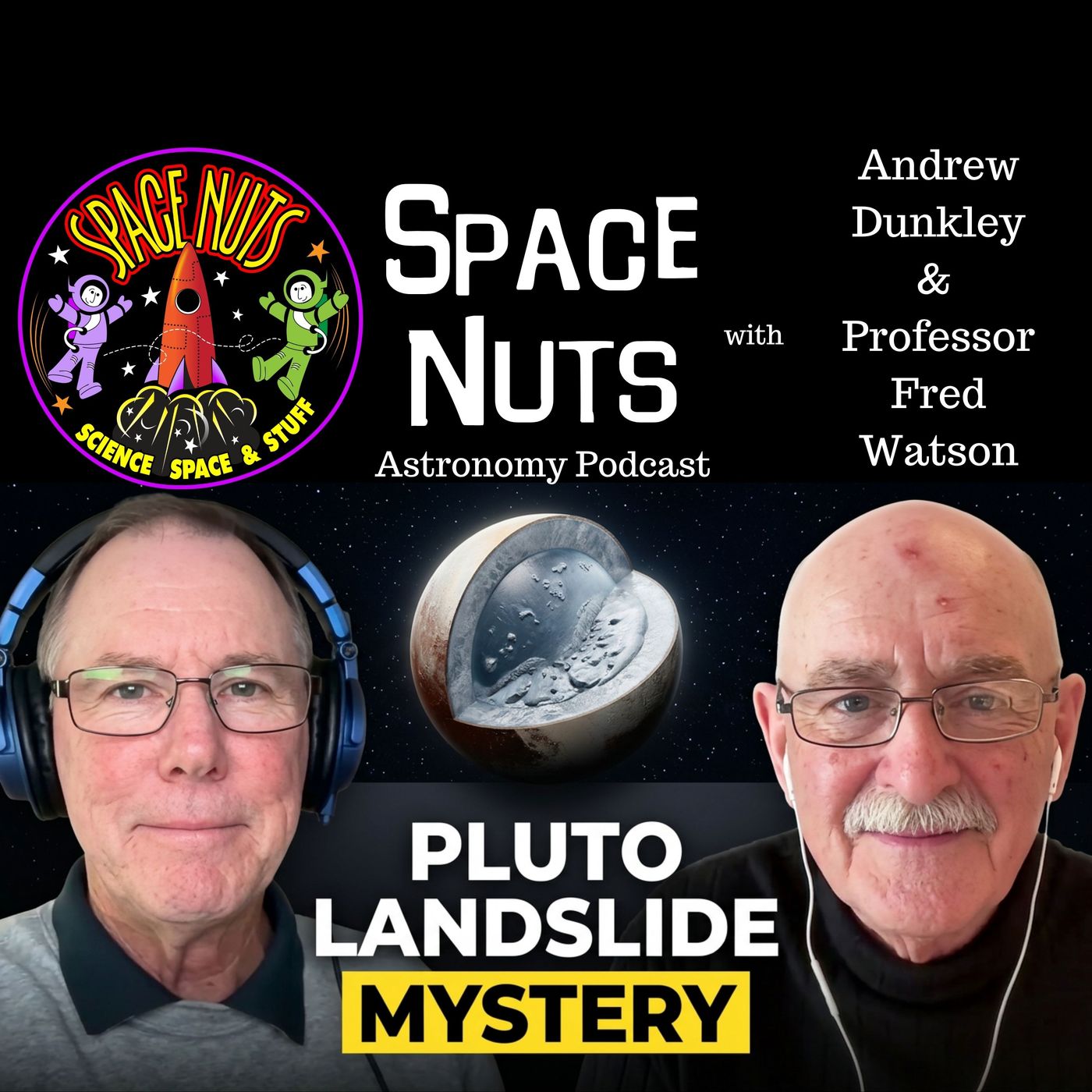 The Hidden Impact of Landslides on Pluto’s Surface — What Scientists Are Discovering | Landslides on Pluto and China's SpaceX-like Rocket Recovery SuccessDiscover the intriguing discovery of landslides on Pluto, explained through recent image analysis from the New Horizons spacecraft, and learn how these features provide clues about the dwarf planet's geological activity. Plus, explore China's recent achievement in rocket recovery, mimicking SpaceX's successful landing techniques with innovative net capture technology, signaling a significant step forward in space debris management and reusability.Fred Watson and Andrew Dunkley discuss recent scientific findings on landslides around Sputnik Planitia on PlutoHow climate change on Earth is increasing landslide activity, and how similar processes might be happening on other worldsThe significance of the 2015 flyby of Pluto by the New Horizons spacecraft and what it revealed about planetary geologyDetails of China's recent successful rocket booster recovery using a net and its potential impact on space launch economicsComparison between China's new net capture method and SpaceX's chopsticks system for booster recoveryThe rapid advancement of Chinese space capabilities, including lunar and space station missionsThe broader context of international space race dynamics and the race to return humans to the MoonUAP Study Group Led by Avi Loeb and the Search for Extraterrestrial PhenomenaGet an inside look at the White House-formed UAP science advisory council led by Harvard's Avi Loeb, emphasizing scientific rigor in studying unidentified anomalous phenomena. The discussion covers the composition of the council, the importance of unbiased research, and the challenges of interpreting mysterious aerial objects observed over the years.The formation and purpose of the UAP Science Advisory Council, chaired by Avi LoebThe diverse backgrounds of experts involved, including physicists, military personnel, computer scientists, and psychologistsHow modern technology and data are transforming the study of UAPs, with government and military reports analyzed over decadesThe debate over the nature of UAPs: natural phenomena, advanced human technology, or potential extraterrestrial originsThe cultural and political implications of gaps in understanding these phenomena and the importance of scientific methodologyReader comments reflecting skepticism and intrigue about the investigations and the sensationalism surrounding UAP researchBecome a supporter of this podcast: https://www.spreaker.com/podcast/space-nuts-astronomy-insights-cosmic-discoveries--2631155/support. | 32m 52s | ||||||
| 8/4/26 | From Dark Matter to Dormant Comets: Your Astronomy Questions Answered | In this enlightening Q&A episode of Space Nuts, join host Andrew Dunkley and astronomer Fred Watson Watson as they field a range of intriguing questions from listeners. From the hypothetical concept of dark matter stars to the mysteries of dormant comets and the mechanics of gravitational slingshots, this episode is packed with engaging discussions that spark curiosity in the cosmos.In this episode:- An exploration of dark matter stars: What are they, and how could they hypothetically shine without fusion?- Understanding dormant comets: What defines them, and how can we identify these ancient celestial bodies?- The mechanics behind gravitational slingshots: How do spacecraft gain speed from planetary gravity, and what role does the planet's rotation play?- The rise of smart telescopes: Are these automated devices a boon for budding astronomers, or do they undermine traditional astrophotography?- Personal experiences with smart telescopes and their impact on learning and engagement in astronomy.Resources & Links:- [Dark Matter and Dark Energy Overview](NASA) - Insights into these elusive components of the universe.- [NASA's Comet Research](NASA Comet Missions) - Discoveries and ongoing studies of comets in our solar system.- [Gravitational Slingshots Explained](NASA's Gravitational Assist) - How spacecraft use gravity to navigate the solar system efficiently.Join Andrew and Fred Watson as they unravel the complexities of space science, encouraging listeners to explore the universe and engage with the wonders of astronomy. Don't forget to submit your questions for future episodes!Become a supporter of this podcast: https://www.spreaker.com/podcast/space-nuts-astronomy-insights-cosmic-discoveries--2631155/support.(00:00) This is Space Nuts and we've got questions from our audience(01:57) Frederick: Greens Goddess started following me some time ago(02:47) Casey from Colorado says dark matter stars could be incredibly bright(09:13) Our next question comes from Michael about dark matter(10:27) What's a dormant comet and how do you detect them(16:28) Just wondering if you could explain the orbital mechanics behind Slingshots(22:32) Smart telescopes allow beginners to dive straight into astrophotography(28:56) Jason: Is there a privacy infringement there? Maybe, yeah(30:03) Astronomer Fred Watson answers your Space Nuts questions(32:16) Space Nick Nuts podcast available at Apple Podcasts and Spotify | 32m 37s | ||||||
| 8/1/26 | 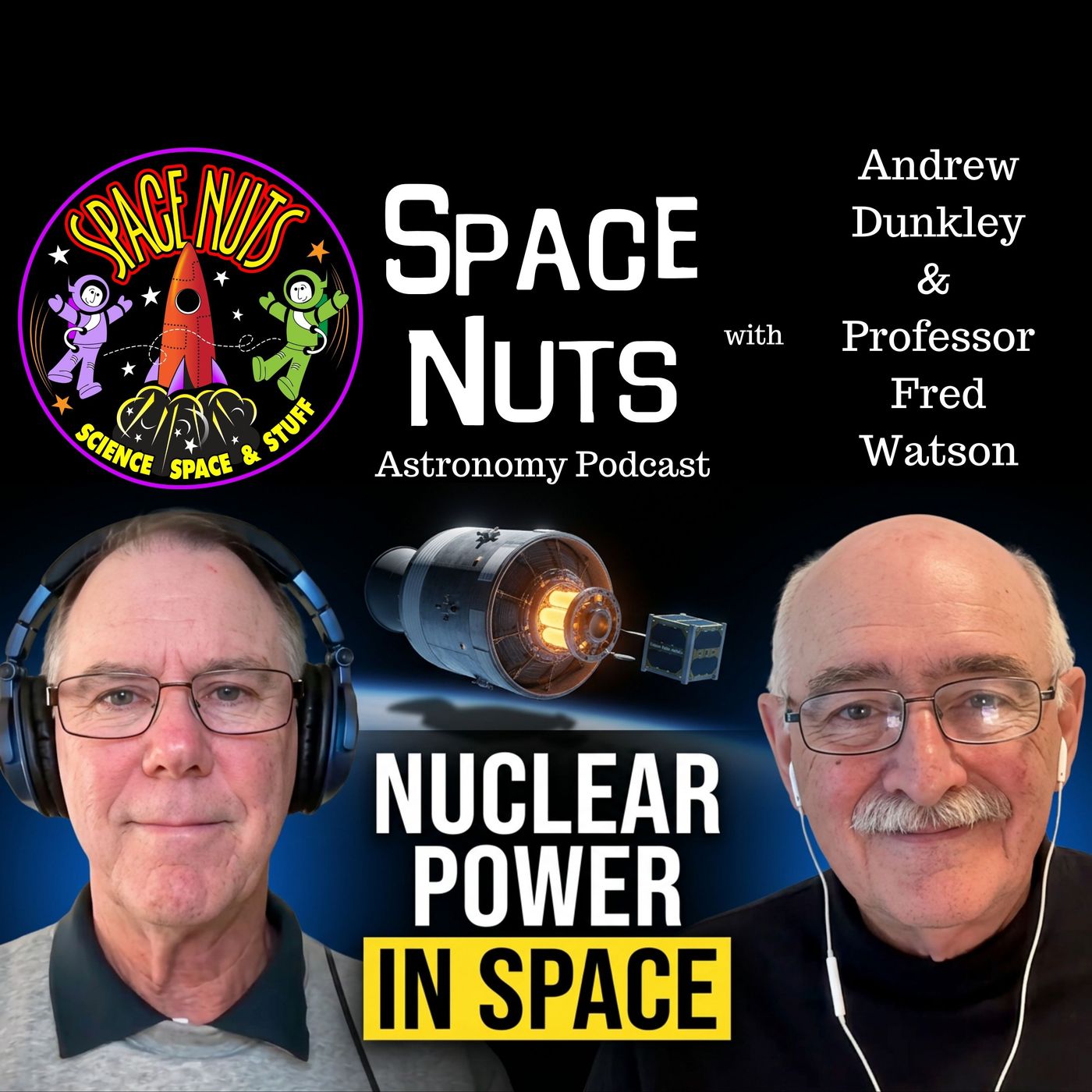 SpaceX Tests Space-Ready Nuclear Power Using Tritium-Driven CubeSat | Sponsor Link:NordVPN - Safeguard your online activity with our exclusive offer for Space Nuts listeners. Visit www.nordvpn.com/spacenuts for details.From SpaceX Nuclear Experiments to Galactic DiscoveriesJoin host Andrew Dunkley and astronomer Fred Watson as they explore some of the most fascinating topics in space science, from innovative nuclear power tests in space to the expanding boundaries of our galaxy. Whether you're an astrophotography enthusiast or a space policy advocate, this episode delivers insights that broaden your cosmic perspective.In this episode:SpaceX's recent CubeSat launch featuring a tritium-based nuclear power source for space applicationsThe potential and safety considerations of nuclear energy in space missionsThe possibility of nuclear weapons detection in space using neutron sensors and passive radiation monitoringThe intriguing hypothesis of dark matter stars and their potential signaturesThe mystery surrounding Earth's dust origins—cosmic spherules and their unknown sourcesNew research indicating our galaxy's spiral arms are about 10% longer than previous estimates, based on light echoes from gamma ray burstsThe rise of smart telescopes and their role in making astrophotography more accessible for amateursTimestamps:(00:00) Introduction and overview of today's headlines(02:00) SpaceX's CubeSat with tritium power source—what's happening?(04:33) Nuclear power in space: Safety and future applications(11:03) Detecting nuclear weapons in space: Challenges and innovations(22:45) Earth's dust origins: Micro-meteorites and cosmic spherules explainedResources & Links:SpaceX's CubeSat nitrogen launch storyBeta-voltaic nuclear power technologyNASA's Chandra X-ray ObservatoryUniverse Today article on Milky Way mappingJames Webb Space Telescope and dark matter researchScience Advances publication on Earth's micrometeoritesConnect with Fred Watson:LinkedInTwitterEnjoying the show? Support us on Patreon and leave a review on your favorite podcast platform.Thanks for tuning in and keep looking up!Become a supporter of this podcast: https://www.spreaker.com/podcast/space-nuts-astronomy-insights-cosmic-discoveries--2631155/support. | 41m 54s | ||||||
| 7/27/26 | The Cosmic Q&A: Redshift, Dark Matter & the Shape of the Universe | Sponsor Link:NordVPN - Protect your online privacy with our special offer for Space Nuts listeners. Visit www.nordvpn.com/spacenuts for details.In this engaging Q&A episode of Space Nuts, join Andrew Dunkley and Professor Fred Watson as they tackle a variety of intriguing questions from listeners. From the mysteries of redshift and the perplexing concept of dark photons to the vastness of deep space astronomy and the ongoing expansion of the universe, this episode is brimming with thought-provoking insights and scientific discussion.In this episode:- Understanding redshift: What does it mean for the energy of light from distant galaxies, and how does it relate to the universe's expansion?- A deep dive into dark photons: What are they, and how might they help explain dark matter and dark energy?- Clarifying deep space astronomy: Why do we observe light from distant galaxies as it was billions of years ago, and how does this relate to our understanding of cosmic history?- Exploring the universe's expansion: What is it expanding into, and what shapes might it take?- The implications of cosmic observations for our understanding of the universe's structure and evolution.Resources & Links:- [NASA's Cosmic Microwave Background](https://map.gsfc.nasa.gov/universe/uni_cmb.html) - Understanding the remnants of the Big Bang.- [Large Hadron Collider](https://home.cern) - The world's largest particle physics laboratory.- [Dark Matter and Dark Energy Overview](https://www.nasa.gov/feature/dark-energy-and-dark-matter) - Insights from NASA on these enigmatic components of the universe.Join Andrew and Fred Watson as they navigate the complexities of space science, encouraging curiosity and exploration of the cosmos. Don't forget to send in your questions for future episodes!Become a supporter of this podcast: https://www.spreaker.com/podcast/space-nuts-astronomy-insights-cosmic-discoveries--2631155/support.(00:00) This is a Q and A edition of Space Nuts(01:14) Question from Roger: Does red shift of galaxies contribute to universe expansion(07:53) Roger Stern: Well, generally speaking, you do get alternative views on this(08:33) Fred Watson uses term dark photon to describe hypothetical dark particles(13:29) Fred: I still can't get my head around deep space astronomy(22:03) If the universe is expanding, what is it expanding into(28:08) If you have questions for Space Nuts, please send them via email | 31m 32s | ||||||
| 7/23/26 |  How Scientific Discoveries at Mars Are Bringing Us Closer to Detecting Alien Life | Discoveries on Mars, the Hubble Tension, and Dark Photons - Space Nuts EpisodeJoin Andrew Dunkley and Professor Fred Watson as they explore the latest developments in space science—from evidence of complex organic molecules found by the Perseverance rover on Mars that may hint at past life, to the ongoing mystery of the Hubble tension that challenges our understanding of the universe's expansion. Plus, a deep dive into the elusive concept of dark photons and their potential role in explaining dark matter.Key Topics:The significance of complex carbon molecules detected in Martian rocks by Perseverance and their implications for extraterrestrial lifeThe challenges and prospects of returning samples from Mars and the influence of upcoming Chinese missionsUnderstanding the Hubble tension: different measurements of the universe's expansion rate and what they could mean for new physicsThe role of gravitational wave observations in refining the Hubble constant and resolving cosmological discrepanciesAn introduction to dark photons: what they are and their potential connection to dark matter and dark energyThe nature of cosmic redshift, light travel time, and how we look back in cosmic historyThe possibility of the universe expanding into higher dimensions or higher-dimensional multiversesThe shape and boundaries of the universe: flat, spherical, or saddle-shaped?Resources & Links:Science Advances Paper on Martian Organic MoleculesNASA Perseverance RoverCosmological Parameters and Hubble TensionLarge Hadron Collider Official SiteDark Photons and Dark Matter — University of CaliforniaBiteStop Streaming ServiceConnect with Fred Watson:Professor Fred Watson - LinkedInProfessor Fred Watson - TwitterNote:Stay tuned for future episodes where we continue exploring mysteries of the cosmos, and don't forget to visit our website to send questions or feedback!Become a supporter of this podcast: https://www.spreaker.com/podcast/space-nuts-astronomy-insights-cosmic-discoveries--2631155/support. | 31m 04s | ||||||
| 7/20/26 | black hole evaporationJupiter's atmosphere+3 | — | NASA | TitanVenus | black holesJupiter+6 | NordVPNCODE | 34m 46s | ||
| 7/16/26 | black holesgravitational waves+4 | — | Parker Solar ProbeESA+1 | Melbournesolar system | black hole discoverygravitational wave+5 | NordVPNspecial deal | 40m 43s | ||
| 7/13/26 | photonelectromagnetic fields+4 | — | Space NutsLarge Hadron Collider | — | stopping lightspace junk+3 | NordVPNspaenuts | 33m 01s | ||
| 7/9/26 | SpaceX milestonessatellite launches+5 | — | Falcon 9Starship+2 | Earthlunar surface+1 | SpaceXsatellites+7 | — | 35m 32s | ||
| 7/6/26 | expanding universegravitons+4 | — | — | — | universegraviton+5 | — | 33m 11s | ||
| 7/2/26 | exoplanetsPhobos+4 | — | JAXASWIFT Observatory | MarsPhobos+1 | PhobosGJ 504b+5 | — | 35m 29s | ||
| 6/29/26 | Big RipBig Crunch+4 | — | Space NutsCosmic Microwave Background Radiation Studies+2 | — | Big RipBig Crunch+5 | — | 29m 10s | ||
| 6/26/26 | moon dustVenus's rotation+5 | — | International Academy of Astronautics | Venuslunar+1 | moon dustVenus+5 | — | 38m 17s | ||
| 6/22/26 | weight variationssolar system age+3 | — | — | IndianapolisCambridge+1 | weight variationssolar system age+5 | — | 30m 55s | ||
| 6/18/26 | magnetic fieldsdark matter+4 | — | SpaceXCSIRO+1 | — | magnetic mapgalactic structures+6 | — | 33m 53s | ||
| 6/12/26 | Blue Originprimordial black holes+3 | — | Blue Origin | Cape CanaveralLarge Magellanic Cloud | Blue OriginNew Glenn rocket+4 | NordVPNCODE | 38m 12s | ||
| 6/8/26 | Ultra Hot JupitersRocket Fuel Recycling+3 | Professor Jonti Horner | — | — | Ultra Hot JupitersRocket Fuel+3 | NordVPNCODE | 44m 41s | ||
| 6/6/26 | AstrobiologyExtraterrestrial Life+3 | Professor Jonti Horner | — | — | AstrobiologyExtraterrestrial Life+3 | NordVPNspecial offer | 1h 00m 59s | ||
| 6/1/26 | hydrogen fusionMartian caves+3 | Professor Jonti Horner | — | MaroochydoreBrisbane+3 | fusionMars+3 | NordVPNCODE | 39m 03s | ||
| 5/29/26 | exoplanetsplanetary systems+3 | Professor Jonti Horner | — | — | exoplanetshot Jupiters+3 | NordVPNspace nuts | 57m 15s | ||
| 5/25/26 | time travelSaturn's rings+3 | — | — | CaliforniaBrisbane+1 | time travelSaturn+4 | NordVPN | 1h 00m 36s | ||
| 5/23/26 | astrobiologyextraterrestrial life+3 | Professor Jonti Horner | — | — | astrobiologylife beyond Earth+5 | — | 1h 09m 48s | ||
| 5/18/26 | neutrinosblack holes+3 | Professor Jonti Horner | — | MoonSolar System | neutrinosblack holes+5 | — | 59m 18s | ||
| 5/15/26 | cometsmeteors+4 | Professor Jonti Horner | Comet Chichin Chan | — | cometsmeteors+5 | NordVPNspecial deal | 1h 11m 26s | ||
| 5/11/26 | angular momentumblack holes+3 | — | — | Baton Richie, Louisiana | angular momentumblack holes+3 | NordVPNspecial deal | 33m 10s | ||
| 5/9/26 | fires on the Mooninterstellar glaciers+4 | — | NASASphereX | MoonEarth+1 | lunar gravityFlammability of Materials on the Moon Experiment+4 | — | 35m 32s | ||
| 5/4/26 | white dwarfsblack holes+4 | — | — | Bloomington, IndianaTin Can Bay | white dwarfblack hole+4 | NordVPN | 32m 13s | ||
| 4/30/26 | Nuclear energy in spaceSETI from the Moon+3 | — | PentagonNASA+1 | — | nuclear powerSETI+6 | NordVPNspacenuts | 33m 49s | ||
| 4/27/26 | supermassive black holesVoyager 1+3 | — | — | — | supermassive black holesVoyager 1+3 | NordVPNspacenuts | 33m 30s | ||
| 4/24/26 | primordial black holesultra hot Jupiters+3 | — | LIGOWASP 189B | Moon | primordial black holesdark matter+5 | NordVPNCODE | 34m 05s | ||
| 4/20/26 | planetary orbitscosmic expansion+3 | — | Space Nuts | MelbourneUK | planetary orbitscosmic expansion+5 | — | 28m 17s | ||
| 4/16/26 | lunar watercomet observations+3 | — | JUICE spacecraftgraphene aerogels+1 | Moonsolar system | lunar craterssolar wind+3 | — | 33m 22s | ||
| 4/13/26 | relativistic Doppler beamingwater on Mars+4 | — | — | New YorkCalifornia+1 | Doppler beamingblack holes+5 | — | 31m 27s | ||
| 4/9/26 | Artemis 2Australian Astronomy+3 | — | European Southern ObservatorySpace Nuts | — | Artemis 2Australian Astronomy+3 | NordVPNSPACENUTS | 33m 41s | ||
| 4/6/26 | black holespulsar planets+3 | — | — | — | black holespulsar planets+5 | — | 33m 33s | ||
| 4/3/26 | Artemis 2space exploration+3 | — | NASACSIRO | — | Artemis 2space toilets+5 | — | 27m 51s | ||
| 3/30/26 | cometsmagnetic pole reversal+3 | — | — | PerthCanada | cometsmagnetic pole reversal+3 | Incogni60% off | 35m 23s | ||
| 3/27/26 | asteroidssuperpuff planets+3 | — | Kepler 51D | Mars | asteroidsuperpuff planet+3 | Incogni60% off | 31m 57s | ||



Showing 58 of 664
Pitch Fit is a Pro feature
See how bookable this show is for guests, which brands already advertise, the per-episode ad value, and the best-fit guest and sponsor profile. The numbers are blurred on the free plan.
How readily this show books outside guests like you.
How proven this show is for host-read sponsorships.
For Guests
ProFor Advertisers
ProUpgrade to Pro to unlock guest cadence, sponsor categories, fit scores, and per-episode ad value for this show.
Similar Audience Demographics
Podcasts that attract a similar listener profile




Distribution & Reach
About the show, platforms, and key insights.
Distribution & Reach
About the show, platforms, and key insights.
Key insights
What the show covers
- groundbreaking astronomy discoveries
- space travel discussions
- listener engagement and questions
- insights into cosmic phenomena
Audience interests
- astronomy and space travel
- cosmic mysteries and discoveries
- listener Q&A sessions
- science communication and education
Platform reach
- available on multiple platforms
- social media engagement encouraged
- community interaction through Q&A
- no specific platforms detected yet
Publishing consistency
- active for ten years
- two episodes per week
- weekly or more frequent cadence
- consistent episode release schedule
Chart history for Space Nuts: Astronomy Insights & Cosmic Discoveries
Peaked at #1 in Australia, top 10 in 22 of 50 tracked markets, currently #1 in Australia.
| Market | Genre | Peak | Current | Trend |
|---|---|---|---|---|
| Australia | — | #1 | #1 | — |
| IS | — | #1 | #1 | — |
| Denmark | — | #2 | #2 | — |
| SA | — | #2 | #2 | — |
| TH | — | #2 | #2 | — |
| MY | — | #2 | #2 | — |
| Ireland | — | #3 | #3 | — |
| United Kingdom | — | #4 | #4 | — |
| United States | — | #5 | #5 | — |
| Sweden | — | #5 | #5 | — |
| Norway | — | #5 | #5 | — |
| Finland | — | #5 | #5 | — |
| Mexico | — | #5 | #5 | — |
| NG | — | #5 | #5 | — |
| New Zealand | — | #6 | #6 | — |
| AE | — | #6 | #6 | — |
| CL | — | #6 | #6 | — |
| RO | — | #8 | #8 | — |
| India | — | #8 | #8 | — |
| PH | — | #8 | #8 | — |
Chart Positions
50 placements across 45 markets.
Chart Positions
50 placements across 45 markets.