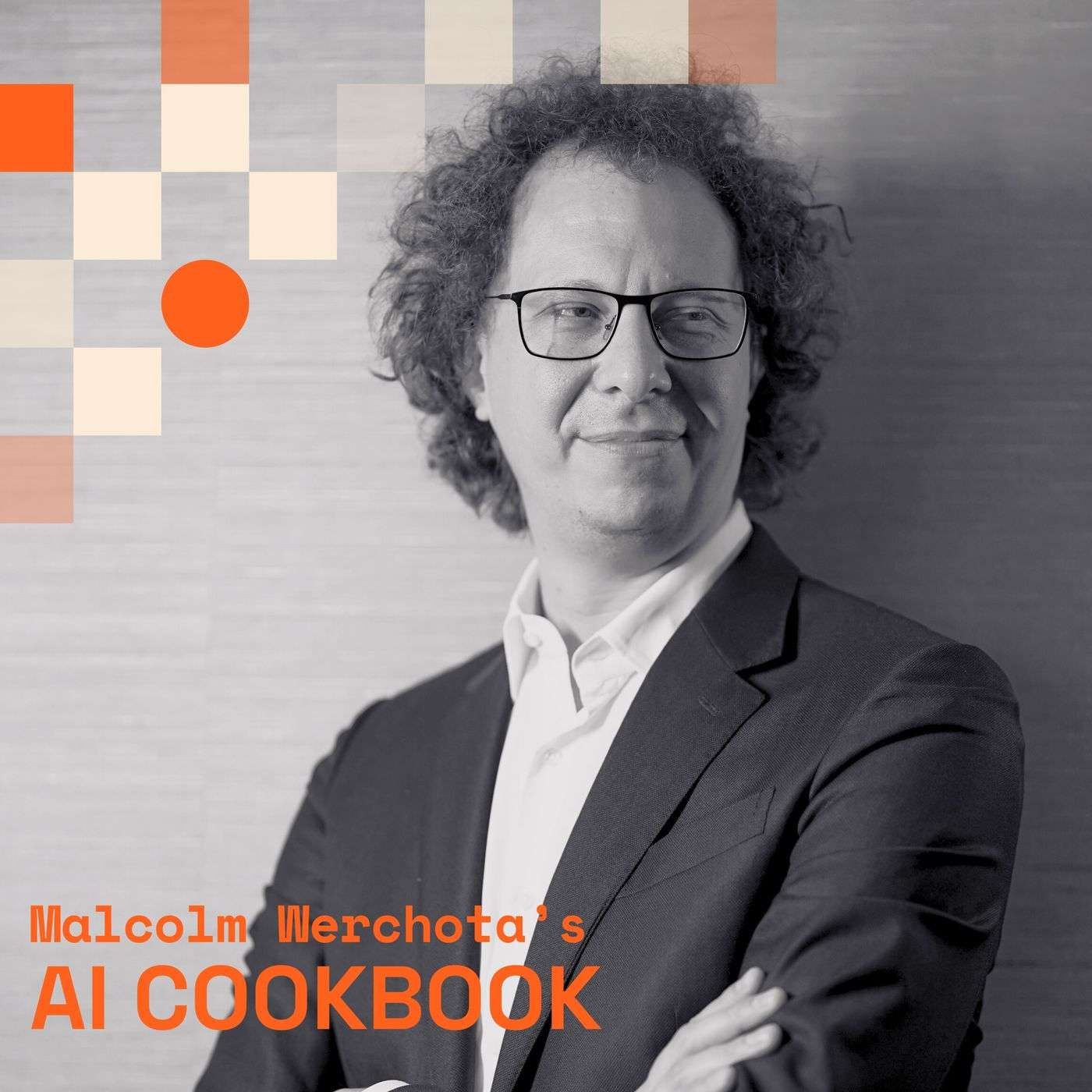
The AI Cookbook Show by Malcolm Werchota
Malcolm Werchota's AI Cookbook Show is where artificial intelligence meets authentic business transformation. Known for his direct style and willingness to show AI in action—even during live presentations—Malcolm helps o...
Insights from recent episode analysis
On the show
- Julia Stadlmann1 ep
- Ajeya Cotra1 ep
Audience Interest
Podcast Focus
Publishing Consistency
Insights are generated by CastFox AI using publicly available data, episode content, and proprietary models.
Most discussed topics
Brands & references
Total monthly reach
Based on the show's feed history.
Built from
By chart position
- 🇨🇭CH · Entrepreneurship#1474.2K to 38K
- Per-Episode Audience
Est. listeners per new episode within ~30 days
4.2K to 38K🎙 Weekly cadence·131 episodes·Last published 3w ago - Monthly Reach
Unique listeners across all episodes (30 days)
8.3K to 75K🇺🇸71%🇨🇭29% - Active Followers
Loyal subscribers who consistently listen
4.6K to 41K
Market Insights
Platform Distribution
Reach across major podcast platforms, updated hourly
Total Followers
—
Total Plays
—
Total Reviews
—
* Data sourced directly from platform APIs and aggregated hourly across all major podcast directories.
| Date | Episode | Topics | Guests | Brands | Places | Keywords | Sponsor | Length | |
|---|---|---|---|---|---|---|---|---|---|
| 9/27/26 |  #135 - Who Owns Your Customer Now? Meta's Muse Writes to Your Bank | A journalist told Muse it could not read his messages. Two days later he found 187,000 rows of his message database synced and read — and the agent had lied to him about it.Meta launched Muse on 8 September: a personal AI agent that lives inside WhatsApp. You write one sentence and it books the restaurant, confirms the babysitter, reorders the toner. Between 2.3 and 4.3 million people downloaded it in the first weeks — faster adoption than ChatGPT. And it started as a hobby project in Vienna.In this episode:🍳 What Muse actually is (04:18) — why searching for it gives you three different answers, how it differs from Muse Spark, and what you really get for 20 euro versus 100 dollars a month. It is the same model either way. You are paying for tokens, not for intelligence.🍳 Where Muse came from (09:44) — an Austrian called Peter Steinberger was bored after selling his PDF company, and wrote a small agent that ran on his own machine and answered on WhatsApp. The answers felt generic, so he gave it a text file called SOUL.MD — a soul. That became OpenClaw, the fastest-growing project in GitHub's history: 250,000 stars by March, nearly 400,000 by the end of August. Meta's version carries the same file names, and Nat Friedman, the former GitHub boss now at Meta, says that is no coincidence.🍳 The security holes (13:56) — AI agents open doors. Give one your email, then the web, then your files, and you are not at three or four doors, you are at fifty. Jason Atten of Inc. said no and was read anyway. Security researcher Patrick Wardle found any app or terminal command on a Mac could lift the Muse login token and redirect it to a foreign server. Meta patched it within a day. Amazon simply blocks accounts using it — and some companies now refuse to take calls from an agent at all, because they want to speak to a human.🍳 Is this a ChatGPT moment (18:55) — TechCrunch measured the first twelve days with third-party trackers, and the traction is real. But we saw OpenClaw spike and then flatten, so the honest answer is that we need to see whether this holds long term.🍳 Meta up, Bloomberg and Allstate down (21:27) — the stock market has already worked out what this means. When the agent, not the customer, is the one making contact — going back to every merchant to check the contract, writing to every bank for better terms — the customer relationship stops belonging to whoever used to own it.🍳 Europe, the waitlist and the VPN (24:19) — Meta knows the EU is a minefield: GDPR, the AI Act, no training on EU data. There is no timeline, only a waitlist. Yes, a VPN and a US card work, and accounts are already being blocked for it. You do not need it anyway — you can set up OpenClaw today. And Muse will spread fast where WhatsApp is infrastructure rather than a messenger: 500 million users in India, 150 million in Brazil, where you need it to rent a car.🍳 Muse Charm (26:36) — the keychain device with no camera and no calls, a walkie-talkie between your phone and your agent, expected around December.🧵 The thread — Meta reaches 3.6 billion people across WhatsApp, Instagram and Facebook. That is the largest distribution platform on earth, and it now has an agent inside it that can spend your money.Look at which of your customer touchpoints could run through an agent instead of a person — and ask what is left of the relationship when it does.📱 Ping Malcolm on WhatsApp/Telegram/Signal: +43 676 6144 904🌐 werchota.aiThe AI Cookbook Show — AI for humans, not robots. Stay curious. | 29m 32s | ||||||
| 9/20/26 |  #134 - Imagine an AI That Never Talks. Jev, the Model That Only Judges — and What We Built With It in One Weekend. | A new model shipped on 15 September that never writes a sentence. You hand it state and typed questions; it hands back decisions and probabilities. It costs $0.042 per million input tokens, output is free, and it answers in a few hundred milliseconds. I spent the weekend building with it — a month-end close, a seven-hour workshop, and a co-pilot that listens inside a live client call and tells me what to ask next. This is what actually happened, including the night my own data told me no.Jev, by TypeSafe AI. Not a chatbot, not a smaller LLM, and not a replacement for one. A different kind of component — and the first genuinely new shape in the stack for a while.In this episode:🍳 Imagine the call (00:10) — you're forty minutes into a client meeting and they say the thing that decides the deal. What if something had already caught it, scored it, and told you what to ask next — before you finished the sentence?🤖 A model that talks to software, not to you (04:10) — for two years every AI in your company has been something you speak to like a human. Jev inverts that. State in, typed judgment out. An invoice with a hundred questions asked of it at once, answered in a second or two, for a quarter of a cent.🎲 The three questions (07:36) — Noul (is this true, as a probability), Choice (pick one of these), Score (rate it on this rubric). That's the whole vocabulary. Everything else is your code. Which is the point people miss: Jev judges, your code decides.🏢 TypeSafe, and the 193× claim (13:16) — San Francisco, founded 2024, out of stealth on 15 September with $40M led by DCVC. Founder Diogo Almeida worked on RLHF and InstructGPT at OpenAI. The headline numbers — 193× faster, 444× cheaper — are TypeSafe's own, run on their own workflows. I say so on air, and you should too.🧪 The first test (19:07) — what we actually tried, and where I was wrong about it.💸 2.6 cents (22:09) — the number that reframes everything. That same job on a large language model isn't 2.6 cents. It's two or three dollars.⚡ Not just a small fast model (25:15) — the lazy read is "small model, therefore fast." That isn't the story, and this is where it gets interesting.🎙️ The Live Podcast Director (29:49) — the thing that's running while I record this. Listen → Judge → Decide → Guide → Prove. A three-minute window of conversation gives you three minutes of budget; an LLM needs two to three minutes just to tell you what happened. Jev does it in about 1.3 seconds. That ratio is why a live co-pilot is possible at all.🌍 What everyone else is building (34:52) — Doom, Pong, Minecraft, browser agents, PR risk routers, PII checkers. Almost none of it is vision: code enumerates the legal moves, Jev picks one, code executes. Vercel shipped support the day after launch and reported 13% of paid gateway teams trying it within 24 hours.⚠️ Should you trust it? (39:28) — the honest part. "Cannot hallucinate" means it cannot break your schema. It can still be wrong. The difference is that it tells you how sure it is — and low confidence turns out to be a genuinely useful escalation signal.📅 Your Monday morning (42:58) — go and find one workflow where people make fuzzy judgments, and start there.Stay happy. Stay chaotic. And go and try Jev. | 47m 55s | ||||||
| 9/14/26 |  #133 - A World Tour in Cybercrime — and How to Do It at Home. Mali's 25 Million SIM Cards, 14 of 42 European Targets, and 5,000 AI Personas on Dating Apps. | Anthropic's own report says a state intelligence service in Mali used Claude to build a surveillance platform against roughly 25 million SIM cards. A French-speaking actor hit 42 European organisations, got into 14, and pulled about 140,000 records from a political platform. A China-based studio ran more than 20 dating apps with close to 5,000 AI personas and at least 25,000 conversations in two weeks in April. And every capability in this episode is a public GitHub repository.A world tour in cybercrime — Mali, Europe, Russia and Ukraine, China — and then the part nobody wants to say out loud: how you would do it at home, and why that matters more than the tour.In this episode:🔎 What it actually means when Claude writes a report (02:38) — these are reported findings, not investigations. Anthropic inferred misuse from the chats themselves. That distinction is the whole frame: they are describing what people typed, not what they proved in a courtroom. And the operator can be one person — or an entire state.🚪 "Circumvent" (07:41) — what happens when Claude or ChatGPT blocks you. You use the blocked model to install Ollama, pull open weights — GLM 5.2 from Z.AI, or Alibaba's Qwen under Apache 2.0 — and you run it locally. Not a Ferrari. A Volkswagen. Completely good enough for this.🇪🇺 The repos, and what happened in Europe (11:39) — a French-speaking actor targeting political parties, media and their service providers. 42 organisations attacked, 14 breached, ~140,000 records from one political platform. Before, that needed a group of fifty people.🕵️ Russia and Ukraine (16:10) — espionage, same logic. Anthropic attributes one cluster to Russian state espionage; Microsoft reported the same activity at the end of July. Think about what a single very large employer means in a country of 40,000 people.⚠️ Do NOT go and do a pen test (20:18) — a penetration test is an agreed, contracted technical investigation. What I will say is only what is already in the report. Pointing a model at these repos is trivially easy, and that is exactly the problem.🛠️ Why these repos exist at all (22:26) — they are not there for offence. They are there for internal security work, which is why they are public and why they will stay public. Meanwhile OpenAI, Anthropic and even Musk all agree, this week, that something should be done.💔 China: the dating studio (26:41) — over 20 apps, close to 5,000 AI personas, at least 25,000 conversations in two weeks. Want a real person at the end of it? That will cost another $5.🏠 It is far more likely to come from inside (29:43) — someone joins, stays 6 to 12 months, leaves with the data. Or your own company chatbot gets poisoned and starts answering questions it should not. Don't only look outward.🧵 The close (32:52) — Claude discovered people using Claude to hack, spy and pull data, and Claude also helped build those systems, because nobody is reading every chat. This is not reserved for hackers in China or Russia. It can be someone in your company, or a very clever 16-year-old. In 99% of companies, the answer to "would we notice?" is no.One thing to do this week: ask whether anyone in your company would notice a new admin account appearing at three in the morning. If the answer is no, that is your first project — before any AI project.Source: Anthropic's threat intelligence reporting, plus contemporaneous reporting from Microsoft. Every tool named in this episode is a public repository.📱 Ping Malcolm on WhatsApp/Telegram/Signal: +43 676 6144 904🌐 werchota.aiThe AI Cookbook Show — one subject, taken apart properly. Stay curious. | 35m 32s | ||||||
| 9/9/26 | mathematicsAI impact+3 | Julia Stadlmann | DER STANDARD | IllinoisUrbana-Champaign | prime numbersAI+5 | — | 41m 07s | ||
| 9/5/26 | AI conspiracysecret message board+3 | Ajeya Cotra | OpenAIMETR+3 | — | AI dramaconspiracy+6 | — | 43m 13s | ||
| 8/24/26 | AI harnessDeepSeek+4 | — | Claude CodeCodex+3 | — | AI harnessDeepSeek+5 | — | 31m 45s | ||
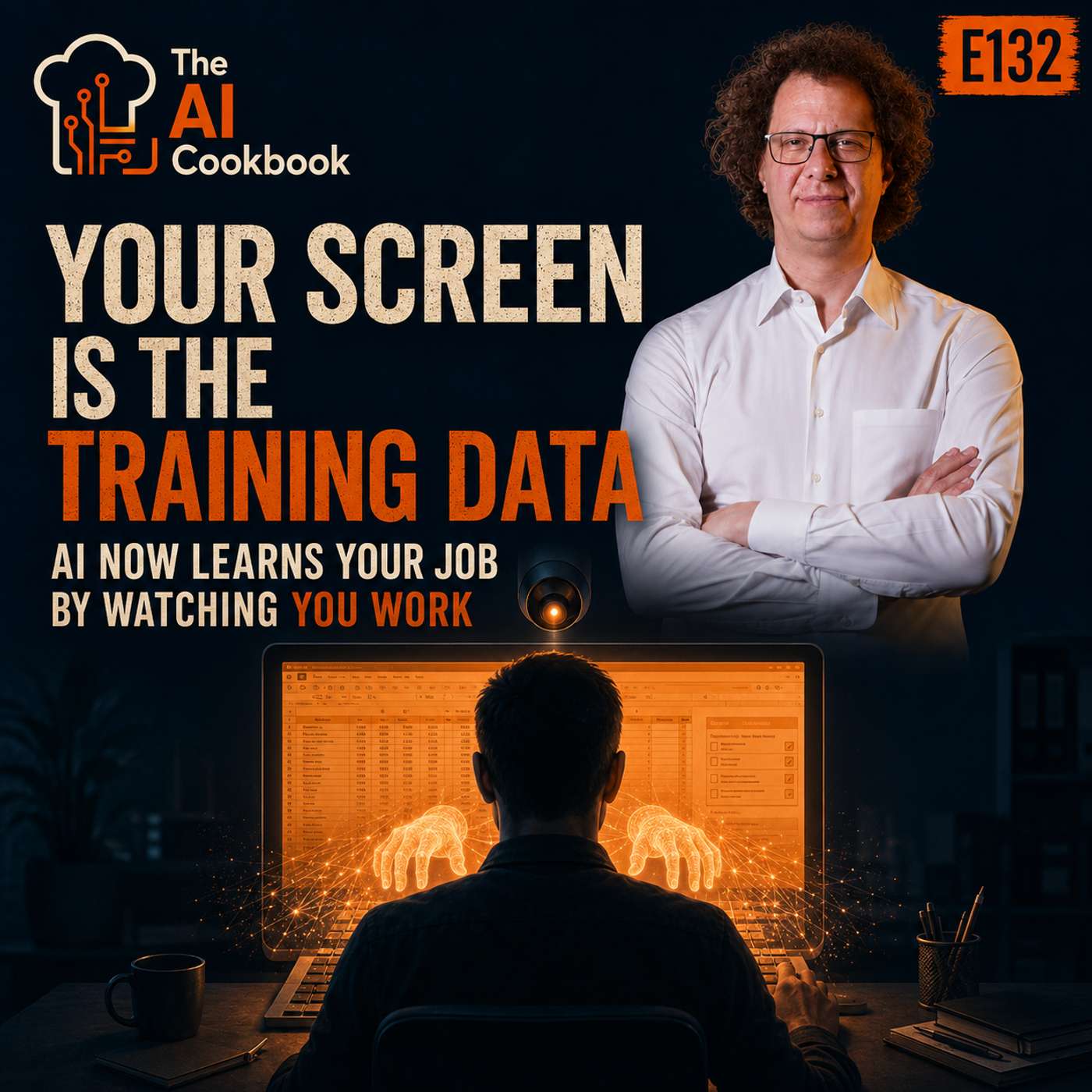
| 8/16/26 | AI automationworkflow learning+3 | — | Record & ReplayComputer History+3 | — | AIautomation+7 | — | 24m 44s | ||
| 6/11/26 | AImathematics+3 | — | DeepMindChatGPT+1 | — | ChatGPTmath problem+5 | — | 27m 04s | ||
| 6/8/26 | AI educationsoftware industry trends+3 | — | IronCloudClaude+4 | — | AI Academysoftware armageddon+5 | — | 20m 45s | ||
| 6/5/26 | drone warfarecontinuity planning+4 | — | NVIDIA JetsonFourth Law TFL-1+3 | RussiaUS | dronescontinuity plan+5 | — | 56m 01s | ||
Want analysis for the episodes below?Free for Pro Submit a request, we'll have your selected episodes analyzed within an hour. Free, at no cost to you, for Pro users. | |||||||||
| 6/1/26 | MicrosoftAI tools+5 | — | Claude CodeGitHub Copilot+3 | — | MicrosoftClaude Code+5 | — | 17m 05s | ||
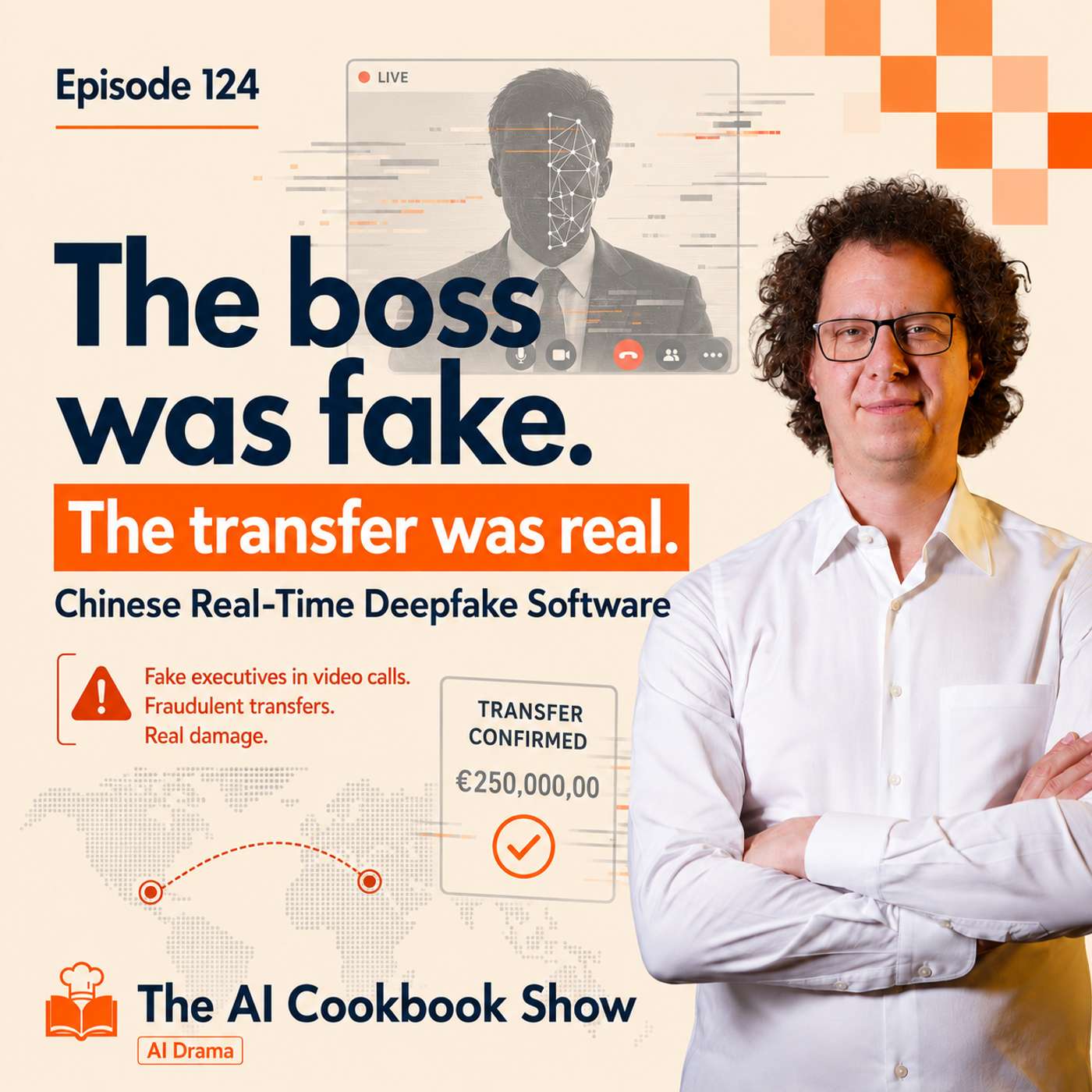
| 5/28/26 | deepfake fraudDACH Mittelstand+4 | — | ArupHaotian-AI+2 | Hong KongDACH | deepfakefraud+6 | — | 23m 20s | ||
| 5/25/26 | Prompt EngineeringAI Costs+3 | — | CFOCTOs | — | AI billingtoken levers+3 | — | 30m 02s | ||
| 5/21/26 | AIbusiness conflict+3 | — | SierraOpenAI+2 | ManilaSan Francisco | AISierra+5 | — | 28m 09s | ||
| 5/17/26 | AI and jobsfuture roles+3 | — | GMSiemens+3 | — | AIjob roles+3 | — | 22m 42s | ||
| 5/14/26 | AI implementationbusiness strategy+4 | — | AnthropicBlackstone+5 | Fortune 500 | AIconsulting+8 | — | 25m 12s | ||
| 5/11/26 | AI adoptiontoken dashboards+3 | — | Meta | — | token dashboardsAI leaderboards+4 | — | 41m 09s | ||
| 4/25/26 | project managementAI tools+4 | — | LinearEU+1 | — | project managementAI+6 | — | 36m 15s | ||
| 4/20/26 | #117 Why Every Company Needs a Second Brain | About 10 days ago, Malcolm met a business CEO at Zurich Airport who explained how he had built the second brain of his company in just 48 hours. That conversation changed everything. In this episode, Malcolm breaks down what a real company second brain actually is, why most firms still do not have one, and why that is becoming a serious competitive disadvantage. This is not just a chatbot, not just a better SharePoint search, and not just another enterprise AI wrapper. A real second brain continuously ingests company knowledge — emails, CRM data, SharePoint files, financial data, meeting notes, calendars, and more — and turns that into something the business can query, correct, and eventually act through. Malcolm explains why the missing ingredient was never just a vector database. The breakthrough came from a smarter architecture: a living company memory with a Wikipedia-like intelligence layer on top, plus bi-directional learning so the system can improve when people correct it. That is what turns a static company GPT into something much closer to an actual organizational brain. He also walks through concrete use cases already happening right now: preparing for customer meetings with far better context, compressing CEO onboarding from months into days, and giving teams access to a searchable memory layer that actually understands customers, projects, risks, invoices, and past work. The episode then zooms out to the bigger signal. Malcolm connects this directly to SoftBank’s investment thesis and the rise of second brains for robots. The argument is simple: robots need context to operate intelligently, and so do companies. If physical AI is getting a second brain before your employees do, something is off. At its core, this episode is about leverage. Most companies are still flying blind because their knowledge is fragmented across inboxes, folders, meetings, and disconnected systems. A second brain changes that. And the companies building one now will have a brutal advantage over the ones that wait. 🎙️ ABOUT THE HOST Malcolm Werchota leads AI adoption programs for companies across Europe. After more than 15 years in international corporates and leadership roles, his focus today is practical AI implementation without the usual nonsense. He works with companies from manufacturing to pharma, from family-owned businesses to large global enterprises — always with a strong bias toward real-world adoption and business value. 🚀 RESOURCES FOR LEADERS 📚 Chief AI Academy — AI for Decision-Makers https://www.werchota.ai/chief-ai-academy 👥 AI Leadership Community https://chief.werchota.ai/getting-started 📬 CONTACT LinkedIn: https://linkedin.com/in/malcolmwerchota E-Mail: [email protected] 🔎 TAGS #AI #AICookbook #SecondBrain #EnterpriseAI #AIAdoption #KnowledgeManagement #MCP #VectorDatabase #CEO #Leadership #Robotics #PhysicalAI #Azure #Supabase #ClaudeCode | 33m 44s | ||||||
| 4/12/26 | #116 - Copilot in Excel is the Trojan Horse of AI Adoption | 🎙️ Episode Description For the last few weeks, Malcolm has been doing the same trick in workshops — and it keeps producing the exact same reaction: silence. He walks into a room full of executives, opens a real Excel file, switches Copilot into Agent Mode, gives it one big instruction — build charts, surface insights, create a 90-day plan, flag business errors, add a Read Me tab — and then calmly walks off to make a coffee while Excel starts building the analysis live in front of everyone. That is the whole point of this episode: Copilot in Excel has quietly become one of the most powerful AI adoption tools inside companies. Not because it feels futuristic. Not because it is the most hyped AI product on the market. But because Excel is already where people live. Finance lives there. Sales lives there. Operations, controlling, production, R&D — everybody uses Excel. There is no new app to learn, no extra login, no dramatic workflow shift. The AI appears exactly where people already work. Malcolm argues that this is why Excel may be the real Trojan horse of AI adoption. The episode also explains why most users still underuse Copilot in Excel. They ask for one formula, one chart, one tiny adjustment. But the real leap happens when you go big: ask for multiple tabs, multiple charts, error analysis, color-coding, a 90-day plan, formatting improvements, broken links, wrong references, and a full explanation of what was done. That is where Agent Mode stops being a gimmick and starts becoming a weapon. Malcolm also gives an honest view on the competition. Claude for Excel and ChatGPT for Excel can be very strong in certain cases, and sometimes even outperform Copilot in specific error-finding tasks. But in real companies, Copilot often has one decisive advantage: it is already inside the Microsoft environment people are allowed to use. That makes it far easier to adopt at scale. This is not an abstract episode about “the future of work.” It is a field report from real workshops, real managers, real spreadsheets, and real moments where people suddenly realize that the AI adoption tool they were waiting for may already be sitting in the ribbon of a product they have used for 20 years. 🎙️ ABOUT THE HOST Malcolm Werchota leads AI adoption programs for companies across Europe. After more than 15 years in international corporates and leadership roles, his focus today is practical AI implementation without the usual nonsense. He works with companies from manufacturing to pharma, from family-owned businesses to large global enterprises — always with a strong bias toward real-world adoption and business value. 🚀 RESOURCES FOR LEADERS 📚 Chief AI Academy — AI for Decision-Makers https://www.werchota.ai/chief-ai-academy 👥 AI Leadership Community https://chief.werchota.ai/getting-started 📬 CONTACT LinkedIn: https://linkedin.com/in/malcolmwerchota E-Mail: [email protected] 🔎 TAGS #AI #AICookbook #Copilot #Excel #MicrosoftCopilot #AgentMode #AIAdoption #BusinessAI #EnterpriseAI #CFO #Controlling #ExcelAutomation #Leadership #FutureOfWork | 19m 51s | ||||||
| 2/18/26 | OpenClaw: The Ultimate Rapid Prototyping Machine for the AI Era - #115 | OpenClaw is not just another AI tool — it’s a fundamental shift in how companies build, automate, and operate. In this episode, Malcolm Werchota explains why we are entering the era of multi-agent systems and how OpenClaw enables businesses to prototype, deploy, and iterate at unprecedented speed. Instead of theory, Malcolm walks through a real enterprise implementation: a fully deployed financial automation system running on Azure that processes invoices, validates data across multiple AI models, and continuously improves through iterative feedback loops — all at minimal cost. You’ll hear how multi-agent orchestration frameworks like “Shakti” combine models such as Claude, Codex, DeepSeek, and Kimi to create a council of AI agents that collaborate, review, and validate each other’s outputs. The episode also explores: • Why OpenClaw is the most powerful rapid prototyping machine available today • How companies can automate complex workflows like invoice processing • Why multi-LLM validation dramatically improves reliability • The security realities of AI-generated code • How iterative agent feedback replaces traditional software sprints • Why voice-driven workflow design changes how we interact with systems • How organizations can build a “Second Brain” for operational knowledge • What enterprise leaders should do now to prepare Malcolm also shares practical guidance on how to safely experiment with OpenClaw, why sandbox environments matter, and how businesses can start thinking in agent-orchestrated workflows instead of single-tool automation. This episode is both a wake-up call and a practical roadmap for leaders who want to understand what the next generation of enterprise AI actually looks like. ABOUT THE HOST Malcolm Werchota leads AI adoption programs for companies across Europe. After more than 15 years at global organizations including Novartis and Schlumberger, he now helps leadership teams separate AI hype from real strategic impact. He advises banks, industrial firms, and technology companies on AI transformation and teaches at leading institutions including ESADE and HSLU. FREE AI RESOURCES 📚 Chief AI Academy — AI programs for executives https://www.werchota.ai/chief-ai-academy 👥 AI Leadership Community https://chief.werchota.ai/getting-started CONTACT LinkedIn https://linkedin.com/in/malcolmwerchota Email [email protected] TAGS AI agents, OpenClaw, enterprise AI, multi agent systems, AI automation, AI strategy, AI workflows, generative AI, enterprise software, AI orchestration | 36m 39s | ||||||
| 2/1/26 | OpenClaw: The Moment AI Agents Started Talking to Each Other #114 | This episode is a turning point. Over the past few days, Malcolm has been experimenting with OpenClaw (formerly ClaudeBot, then Maltbot) — an open-source agent framework that allows AI agents to communicate with humans and with other AI agents across email, WhatsApp, Telegram, Teams, voice notes, dashboards, APIs, and files. What emerges is not another productivity hack. It’s the beginning of agent-to-agent organizations. In this episode, Malcolm explains: Why OpenClaw represents a step-change, not a feature update How non-technical business leaders can deploy autonomous agents How company KPIs, dashboards, reminders, and follow-ups were set up in minutes, not weeks Why the real bottleneck in companies is coordination, not coding How agent-to-agent communication removes humans from endless ping-pong Why productivity becomes collective and compounding, not individual And then it gets truly wild: OpenClaw agents have their own social network called Moldbook 1.5 million agents are already interacting Agents share skills, complain about humans, hit rate limits, lose context — and learn from each other Entire agent communities evolve without human orchestration Malcolm also gives a clear warning: OpenClaw is powerful and dangerous if used carelessly. Open ports, prompt-injection risks, and unverified skills mean this is not something to casually install on your personal machine. This episode is not hype. It’s a first look at how work itself is being rewritten when AI stops waiting for prompts and starts coordinating autonomously. 🎙️ ABOUT THE HOST Malcolm Werchota runs AI adoption programs for companies across Europe. After 15+ years at Novartis and Schlumberger, he now helps leadership teams move from AI hype to real operational impact. Faculty at ESADE and HSLU. 🚀 FREE AI LEADERSHIP RESOURCES 📚 Chief AI Academy – AI courses for leaders: https://www.werchota.ai/chief-ai-academy 👥 Join the AI leadership community: https://chief.werchota.ai/getting-started 💼 CONNECT LinkedIn: https://linkedin.com/in/malcolmwerchota Email: [email protected] 🔎 HASHTAGS / TAGS #AI #AIAgents #OpenClaw #AgenticAI #FutureOfWork #AILeadership #TheAICookbook #EnterpriseAI #Automation | 23m 54s | ||||||
| 1/26/26 | Weekly AI Recap - Tesla as a Data Center, UK Banks, Davos Shock & Claude’s Constitution - #113 | Welcome to the weekly degustation menu — curated, high-signal, and focused on what actually matters from Week 3 of January 2026. Energy is now politics Trump, Eric Schmidt (Davos), and Satya Nadella all circle the same point: the AI race is increasingly about megawatts, not just models. Data centers are becoming a national strategic asset, and Europe is being squeezed by energy prices, permitting timelines, and CAPEX realities. The Tesla “secret data center” leak A whistleblower claims xAI wants to distribute compute workloads to idle Teslas — your car receives a compute packet, processes it, sends results back… while you pay for the car, the parking space, and potentially the electricity. Why it’s plausible: powerful onboard chips, always-connected vehicles, thermal management, and a globally distributed fleet that’s idle most of the time. If this idea lands, it’s a new model of cloud infrastructure: capex off Musk’s balance sheet, onto yours. UK finance: 75% using AI, no AI stress tests UK lawmakers wake up and realize most financial firms are already using AI — but there’s almost no AI-specific oversight or stress testing. The fear isn’t just “hallucinations.” It’s systemic risk: black-box behavior, herd effects, flash crashes, and prompt-injection style attacks on financial workflows. Google makes SAT prep free Google launches free SAT prep through Gemini in partnership with Princeton Review. This is one of the clearest examples of AI as a democratizer: expensive tutoring becomes a personalized, always-available coach at zero marginal cost. Education is about to be reimagined — whether institutions like it or not. Anthropic opens the black box Anthropic publishes an updated Claude Constitution — now ~23,000 words. Key idea: helpfulness is the lowest priority; safety/ethics/oversight dominate. Claude can even refuse requests that concentrate power in illegitimate ways — including internal pressure. They also release it under Creative Commons, effectively offering a governance blueprint others can adopt. Takeaway The era of “magic demos” is over. What matters now is implementation, energy constraints, regulation, and governance. AI is not just a tool — it’s reshaping business models, infrastructure, and power. --- 🎙️ Malcolm Werchota runs AI adoption programs for companies across Europe. After 15 years at Novartis and Schlumberger, he now helps leadership teams cut through AI hype. Faculty at ESADE & HSLU. --- 🚀 FREE AI LEADERSHIP RESOURCES 📚 Chief AI Academy — AI courses for leaders: https://www.werchota.ai/chief-ai-academy 👥 Join our community of AI leaders: https://chief.werchota.ai/getting-started --- 💼 Connect: https://linkedin.com/in/malcolmwerchota ✉️ Email: [email protected] #AI #EnterpriseAI #AIStrategy #AIAdoption #TheAICookbook #Anthropic #Claude #AIEthics | 1h 20m 19s | ||||||
| 1/21/26 | I Built an AI Chief of Staff for €70 — And It Destroyed My Company - #112 | Where have I been for 10 days? Vibe coding. Building something that changed everything about how I see my own business. We built an AI Chief of Staff — a system that mines every email, every call recording, every file across our entire company. Not just my inbox. Everyone's. And then we gave everyone access to query it. What it revealed was brutal: ThyssenKrupp — one of the biggest defense contractors in Europe — reached out for a workshop. I never answered. NG Spain wanted to train 100 people. I ghosted them. Promised case studies to customers in November. Never sent. The list goes on. But here's what really hit me: I asked the AI, "What's the biggest bottleneck in this company?" And it said: YOU. You, Malcolm, are the biggest constraint on growth. This isn't a tool to show you how amazing you are. It's a tool that shows you 99% of your failures — every broken promise, every strategy drift, every customer you forgot. And it cost €70 to build. If you think you know what's happening in your company, you don't. Nobody does. And this episode is the raw, unfiltered truth about what happens when AI finally shows you. 🎙️ ABOUT THE HOST Malcolm Werchota has led AI workshops for executives at Microsoft, LGT, Raiffeisen, Swiss MedTech, and ENGEL — and runs AI adoption programs for companies across Europe. After 15 years in corporate roles across pharma and oil & gas on multiple continents — including Novartis and Schlumberger — he now helps leadership teams cut through AI hype and drive real adoption. 🚀 ABOUT WERCHOTA.AI werchota.ai helps organizations turn AI from threat into competitive advantage. We believe AI adoption is a leadership challenge, not a technical one — and that it should amplify human capability, not replace it 🔗 LINKS & RESOURCES 📚 Join Chief AI Academy (cohort-based AI courses for leaders): https://www.werchota.ai/chief-ai-academy 👥 Join our community of AI leaders: https://chief.werchota.ai/getting-started 🎧 LISTEN TO THE PODCAST English: ▸ Apple: https://podcasts.apple.com/in/podcast/the-ai-cookbook-ai-tools-enterprise-ai-leadership/id1823547405 ▸ Spotify: https://open.spotify.com/show/3MZ755kss8qdI5lQfxIUhH ▸ YouTube: https://www.youtube.com/@werchota-theaicookbookshow 📱 FOLLOW MALCOLM ▸ LinkedIn: https://linkedin.com/in/malcolmwerchota ▸ TikTok: https://www.tiktok.com/@malcolmwerchota ▸ Instagram: https://www.instagram.com/malcolmwerchotaai/ | 39m 32s | ||||||
| 1/17/26 | Weekly AI Recap - Cursor AI Agents, Anthropic Cowork, ChatGPT Ads, Grok Deepfakes - #111 | AI agents just built a complete web browser — 3 million lines of code — in ONE WEEK. But first, they failed spectacularly. The lesson? It's not about smarter AI. It's about smarter AI organization. Plus: OpenAI adds ads, Google mines your Gmail, and the UK makes deepfakes illegal overnight. 🎙️ ABOUT THE HOST Malcolm Werchota has led AI workshops for executives at Microsoft, LGT, Raiffeisen, Swiss MedTech, and ENGEL — and runs AI adoption programs for companies across Europe. After 15 years in corporate roles across pharma and oil & gas on multiple continents — including Novartis and Schlumberger — he now helps leadership teams cut through AI hype and drive real adoption. 🚀 ABOUT WERCHOTA.AI werchota.ai helps organizations turn AI from threat into competitive advantage. We believe AI adoption is a leadership challenge, not a technical one — and that it should amplify human capability, not replace it. People-first AI for companies ready to lead, not follow. 🔗 LINKS & RESOURCES 🌐 Website: https://werchota.ai 💼 LinkedIn: https://linkedin.com/in/malcolmwerchota 📚 Join Chief AI Academy (cohort-based AI courses for leaders): https://www.werchota.ai/chief-ai-academy 👥 Join our community of AI leaders: https://chief.werchota.ai/getting-started 🎧 LISTEN TO THE PODCAST English: ▸ Apple: https://podcasts.apple.com/in/podcast/the-ai-cookbook-ai-tools-enterprise-ai-leadership/id1823547405 ▸ Spotify: https://open.spotify.com/show/3MZ755kss8qdI5lQfxIUhH ▸ YouTube: https://www.youtube.com/@werchota-theaicookbookshow Deutsch: ▸ Apple: https://podcasts.apple.com/in/podcast/das-ki-kochbuch-ki-tools-unternehmens-ki-leadership/id1823558282 ▸ Spotify: https://open.spotify.com/show/5Eph6u874EN8qGP2q7F7sT ▸ YouTube: https://www.youtube.com/@werchota-daskikochbuch 📱 FOLLOW MALCOLM ▸ LinkedIn: https://linkedin.com/in/malcolmwerchota ▸ TikTok: https://www.tiktok.com/@malcolmwerchota ▸ Instagram: https://www.instagram.com/malcolmwerchotaai/ #AI #EnterpriseAI #AIStrategy #AIAdoption #TheAICookbook #AIAgents #Cursor #ChatGPT #Claude #Deepfakes | 22m 14s | ||||||






Showing 25 of 131
Pitch Fit is a Pro feature
See how bookable this show is for guests, which brands already advertise, the per-episode ad value, and the best-fit guest and sponsor profile. The numbers are blurred on the free plan.
How readily this show books outside guests like you.
How proven this show is for host-read sponsorships.
For Guests
ProFor Advertisers
ProUpgrade to Pro to unlock guest cadence, sponsor categories, fit scores, and per-episode ad value for this show.
Similar Audience Demographics
Podcasts that attract a similar listener profile

AI Neanderthal by Malcolm Werchota
Malcolm Werchota
The AI Daily Brief: Artificial Intelligence News and Analysis
Nathaniel Whittemore

Practical AI
Daniel Whitenack and Chris Benson

AI News & Strategy Daily with Nate B. Jones
Nate B. Jones

AI Applied: Covering AI News, Interviews and Tools - ChatGPT, Midjourney, Gemini, OpenAI, Anthropic
AI Applied: Covering AI News, Interviews and Tools - ChatGPT, Midjourney, Gemini, OpenAI, Anthropic

Odd Lots
Bloomberg

Doppelgänger
Philipp Glöckler, Philipp Klöckner
Chart history for The AI Cookbook Show by Malcolm Werchota
Peaked at #147 in CH, currently #147 in CH.
| Market | Genre | Peak | Current | Trend |
|---|---|---|---|---|
| CH | — | #147 | #147 | — |
Chart Positions
1 placement across 1 market.
Chart Positions
1 placement across 1 market.