

Insights from recent episode analysis
Audience Interest
Podcast Focus
Publishing Consistency
Platform Reach
Insights are generated by CastFox AI using publicly available data, episode content, and proprietary models.
Total monthly reach
Estimated from 3 chart positions in 3 markets.
By chart position
- 🇨🇦CA · Alternative Health#1105K to 30K
- 🇲🇾MY · Alternative Health#873K to 10K
- 🇹🇼TW · Alternative Health#130500 to 3K
- Per-Episode Audience
Est. listeners per new episode within ~30 days
4.3K to 22K🎙 ~2x weekly·297 episodes·Last published 1w ago - Monthly Reach
Unique listeners across all episodes (30 days)
8.5K to 43K🇨🇦70%🇲🇾23%🇹🇼7% - Active Followers
Loyal subscribers who consistently listen
3.4K to 17K
Market Insights
Platform Distribution
Reach across major podcast platforms, updated hourly
Total Followers
—
Total Plays
—
Total Reviews
—
* Data sourced directly from platform APIs and aggregated hourly across all major podcast directories.
On the show
Recent episodes
Ep 283: How to Find an Obesity Doctor Who Gets You with Dr. Charles Thompson
May 6, 2026
Unknown duration
Ep 282: The Not So Secret History of Obesity…Why Here & Now is The Best Time to Seek Treatment with Dr. Nini Peterson, PhD
Apr 22, 2026
Unknown duration
Dr. Rachel Goldman, Ph.D. | When Life Happens: The Mindset Shift You Need to Manage Stress, Build Confidence and Break Free
Apr 8, 2026
Unknown duration
Ep 280: Aimee Rothe, Bariatric Nurse and Patient, Talks Breaking Points and the Wild Ride of Obesity Treatment
Apr 1, 2026
Unknown duration
Ep 279- The Connected Journey: Mind, Body, and Bariatrics with Katie Booker LCSW
Mar 18, 2026
Unknown duration
Social Links & Contact
Official channels & resources
Official Website
Login
RSS Feed
Login
| Date | Episode | Description | Length | ||||||
|---|---|---|---|---|---|---|---|---|---|
| 5/6/26 | 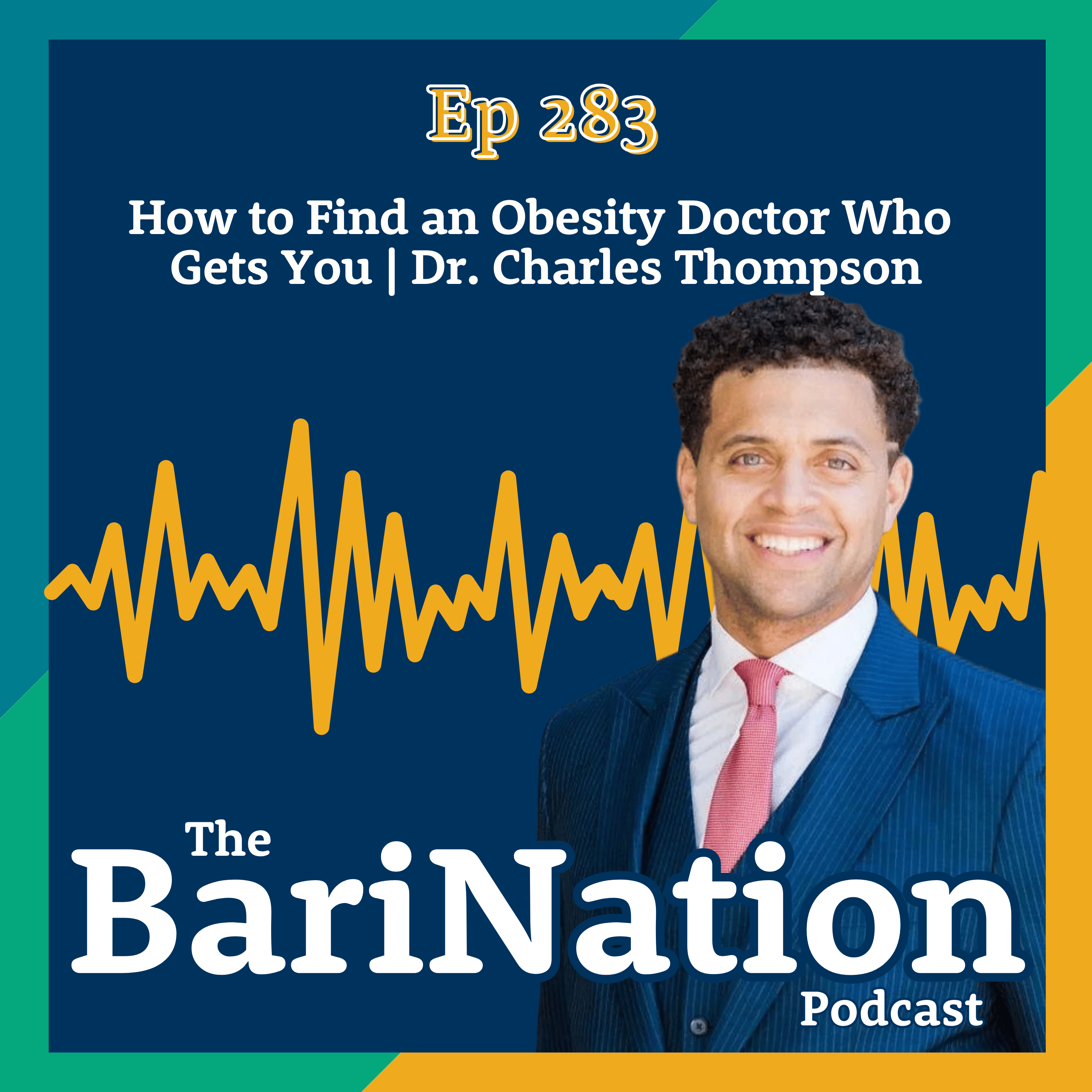 Ep 283: How to Find an Obesity Doctor Who Gets You with Dr. Charles Thompson | You've been fighting your weight for years. You've tried everything. And now you're finally ready to find someone who can actually help. Where do you start? Your primary care doctor? The websites that offer you another miracle? Should you do what Serena Williams is doing and see a bot doc?In this episode, April sits down with Dr. Charles Thompson, a bariatric surgeon practicing in Brooklyn and Queens, New York, to give you a real, practical roadmap for finding an obesity medicine provider who will treat you like the whole person you are, not just a number on a scale.Here's what you'll walk away with:What to actually look for when evaluating a provider (hint: it's not the letters after their name)Where to search, including which websites are worth your time and which ones to approach with cautionWhat to ask at your very first appointment, and why the best providers will ask you questions firstWhy it is absolutely okay to leave a provider relationship that isn't working for you, and why that is not a failureDr. Thompson also breaks down the real difference between having insurance coverage for bariatric surgery or obesity medications and actually being able to use it, including why so many patients with qualifying conditions are still being denied care and what you can do to fight back.You'll also hear him say something that almost no surgeon ever says out loud: "It's not your fault." He means it, and he explains exactly why.Plus: April shares the story of her own path to surgery, why word-of-mouth changed everything for her, and why she built BariNation for the exact moments when you need a Nation behind you.Download and print our free step-by-step guide to finding your provider from the show notes. Use it, share it, come back to it. Click HERE to access it.Obesity is a disease. You deserve care. And now you know how to go get it.A Note About BariNationBariNation is a nonprofit podcast and patient community built on the belief that obesity is a disease and that every person fighting it deserves education, community, and care. If this post helped you, consider supporting our mission at BariNation.org/donate. Your support makes conversations like this one possible.Enjoyed this episode? Share it with someone who's been waiting for permission to take the first step. And if you're already in The Nation, you know what to do. See you in there.Find Dr. Thompson: BrooklynQueensSurgical.comJoin the BariNation community: barination.mn.coSupport our mission: BariNation.org/donate#BariNation #BariatricSurgery #ObesityMedicine #ObesityAwareness #WeightLossSurgery#FindABariatricSurgeon #ObesityIsADisease #BariatricCommunity #InsuranceDenial #MetabolicHealth#ASMBS #ObesityTreatment #BariatricProvider #WeightManagement | — | ||||||
| 4/22/26 | 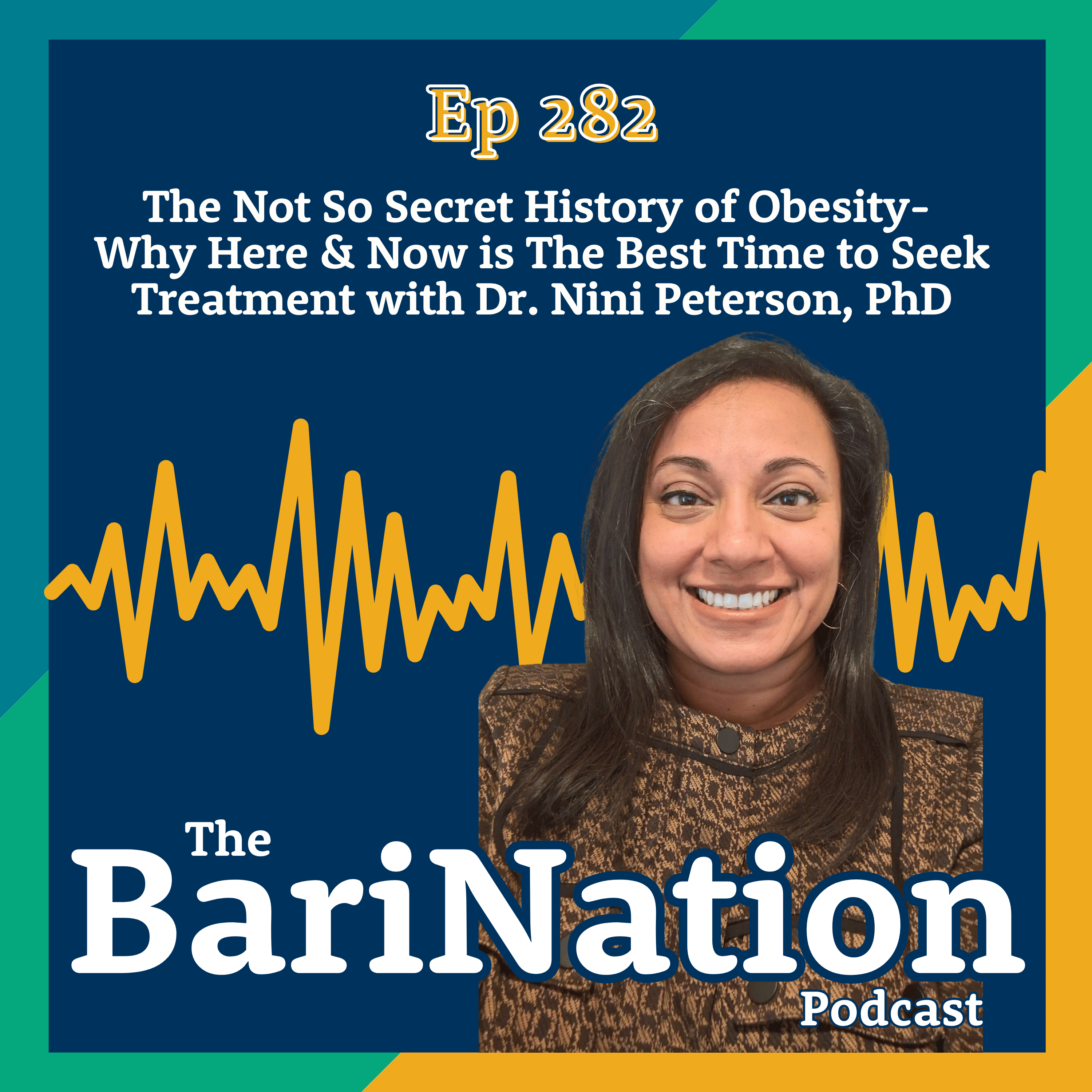 Ep 282: The Not So Secret History of Obesity…Why Here & Now is The Best Time to Seek Treatment with Dr. Nini Peterson, PhD | “We are built for scarcity, not abundance.” Most people think obesity is simply about willpower or lifestyle choices, yet its history reveals a long tradition of misconceptions, stigma, and ineffective, somewhat barbaric treatments. In this eye-opening episode, Dr. Nini Peterson, PhD, takes us on a fascinating journey through the history of obesity, showing how misconceptions have persisted for centuries despite advances in science and medicine. Discover how ancient carvings and medical texts from 30,000 years ago to the 19th century reveal haunting echoes of today’s struggles with weight and treatment. You’ll learn how old fallacies, like “eat less, move more,” have hampered progress and how biology, environment, and genetics play critical roles that modern science now understands better than ever.We break down:The historical perceptions of obesity across cultures and eras and their impact on stigma, shame, and treatment.The evolution of treatment options, from ancient dieting and surgical experiments to today's promising medications and surgical innovations.The misconceptions that still influence doctor-patient relationships and how invalidating these myths can be detrimental to health.The importance of a holistic, individualized care team and why finding the right "fit" in treatment is crucial for long-term success.How understanding the disease’s history helps us combat shame, advocate for ourselves, and pursue effective, compassionate care.This episode is a must-listen for anyone living with obesity or those supporting loved ones in their journey. If you’re tired of outdated advice, want to cut through the stigma, and are eager to understand the true complexity of obesity, this conversation will inspire hope and empower action.Join April Williams as she has a no-holds-barred conversation with Dr. Peterson, an experienced psychologist and obesity expert, who reveals how shifting our understanding of obesity from blame to compassion opens the door to better treatment, more support, and a brighter future.You’ll leave with a new perspective on this chronic disease, fostering hope that meaningful change is possible, and it starts with knowledge. Perfect for patients, caregivers, clinicians, and advocates committed to a science-backed, patient-centered approach. The time to rethink obesity is now, are you ready?Explore the rich history of obesity, its treatment evolution, and the importance of personalized care in managing this complex disease.History of Obesity PresentationKey TopicsHistory of obesity and treatmentImpact of environment and culture on obesityThe role of behavioral health in obesity careAdvances in obesity medications and surgeryThe importance of holistic, individualized treatmentThe BariNation FoundationThe BariNation Podcast is a production of the BariNation Foundation, a 501c3 nonprofit that advances metabolic wellness for people living with obesity by providing evidence-based education, stigma-free support, and meaningful connections in the moments that shape daily life. The Foundation's mission is to walk alongside individuals pursuing medical, surgical, and comprehensive care, supporting real decisions, challenges, and victories that influence long-term health with the support and guidance of obesity medicine experts.Learn more about the BariNation Foundation and make a tax-deductible donation by going to BariNation.orgSound Bites"We are built for scarcity, not abundance."“Most people overestimate the risk of bariatric surgery and underestimate the risk of living long-term with obesity.”Chapters00:00 The History of Obesity and Its Treatment07:23 Understanding Obesity as a Disease19:54 The Stigma of Obesity and Its Impact26:45 Patient-Care Team Dynamics in Obesity Treatment27:24 Navigating Life After Surgery33:32 The Paradox of Treatment40:15 Evolution of Obesity Treatments42:56 Evolving Understanding of Health and Behavior Change45:45 Redefining Success Beyond the Scale49:44 The Complexity of Health Perception53:17 The Importance of Seeking Help55:51 Understanding the Risks of Obesity and Treatment58:45 The Journey to Bariatric Surgery01:03:34 Finding the Right Care Team01:07:15 The Need for Integrated Health ApproachesNini Peterson BioNinoska "Nini" Peterson, PhD is a Staff Psychologist with the Cleveland Clinic’s Bariatric & Metabolic Institute (BMI) and an Adjunct Assistant Professor at the Cleveland Clinic Lerner College of Medicine of Case Western Reserve University in Cleveland, OH.Her clinical and research interests include psychosocial MBS evaluations, lifestyle treatment of obesity, binge eating treatment, self-monitoring, body-image disturbance, and psychology group treatment/support groups. She has published in peer-reviewed journals on these topics, and has authored/co-authored 3 textbook chapters for SAGES and APA on the role of the behavioral health provider in MBS and pre-surgical psychological MBS evaluations, respectively.She is the current Integrated Health - Director Elect (2025-2026), former Integrated Health Secretary (2024-2025) and has served on the IH Leadership Counsel since 2021. Nini is also a current member (2017-present) and past Chair (2023-2025 of the IH Support Group Committee, and member of the Health Equity Committee (2023-present). She is a proud member of the inaugural 2024 ASMBS-IH Fellowship class (FASMBS-IH).LinksBariNationFoundation | — | ||||||
| 4/8/26 | 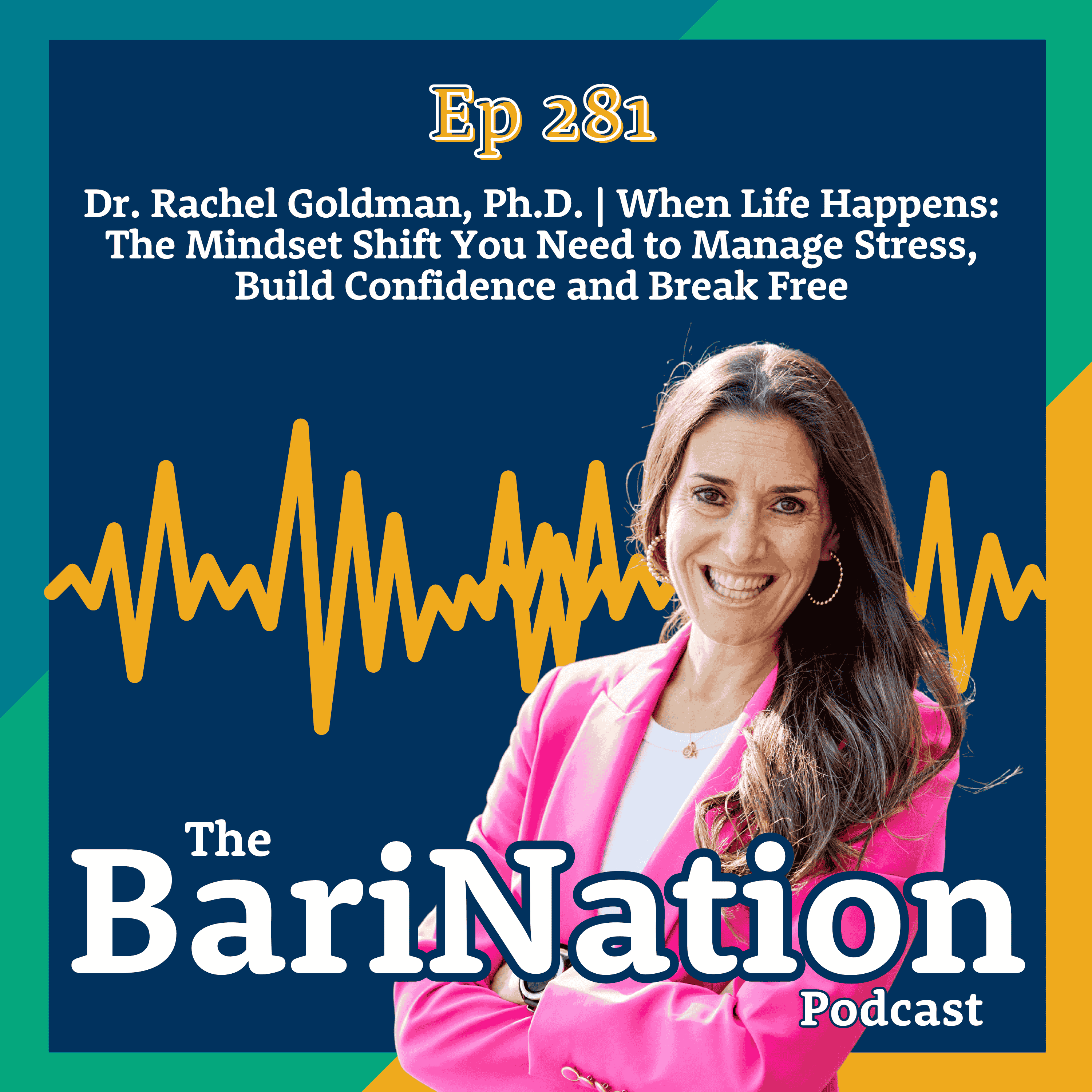 Dr. Rachel Goldman, Ph.D. | When Life Happens: The Mindset Shift You Need to Manage Stress, Build Confidence and Break Free | Clinical psychologist Dr. Rachel Goldman, PhD joins BariNation hosts April Williams and Jason Smith to discuss the psychological and behavioral tools every person needs to navigate life's hardest moments, especially those living with the chronic disease of obesity.Drawing from her new book When Life Happens, Dr. Goldman breaks down CBT into accessible, actionable tools for building emotional resilience, managing stress, challenging unhelpful thoughts, and developing a growth mindset. Essential listening for bariatric surgery patients, anyone managing chronic illness, and anyone stuck between knowing what to do and actually doing it.This episode is supported by AdventHealth Central Florida and the Metabolic Health Institute. If you've struggled with weight loss, you know it's a lifelong journey. At AdventHealth's Metabolic Health Institute, they address the root cause of weight gain with a whole-health approach, from lifestyle support and medication to bariatric surgery. Learn more at http://www.AdventHealthWeightLoss.comWhat You'll Learn:Build a Mental Health Toolbox — One tool is never enough. Dr. Goldman explains why you need at least three coping strategies and the critical difference between self-care tools (preventative) and stress management tools (acute), and why they're actually the same tools used with different intention.The CBT Core: Your thoughts don't just feel bad, they directly shape your behavior. Dr. Goldman walks through how identifying unhelpful thoughts, examining the evidence, and reframing can rewire the brain over time through neuroplasticity. The goal isn't to eliminate negative thoughts; it's to reduce how long you stay in them. Cognitive Distortions That KeepYou Stuck — All-or-nothing thinking, jumping to conclusions, and "should" statements are three of the most common distortions in people with obesity. Dr. Goldman explains how CBT helps patients identify, challenge, and reframe these patterns instead of accepting them as truth. The Diet Failed You.You Did Not Fail the Diet. — A powerful reframe Dr. Goldman used with bariatric patients at Bellevue: the surgery failed the patient, not the other way around. This directly challenges the internalized shame that comes from years of failed diets and reframes it through the lens of obesity as a complex, chronic, progressive disease.Growth Mindset vs. Fixed Mindset — Years of "nothing works" can create an entrenched fixed mindset. Dr. Goldman connects Carol Dweck's research to the lived experience of obesity patients and explores how flexible thinking and self-compassion begin to shift the pattern.Toxic Positivity: What It Is and Why It's Harmful — "Positive vibes only" invalidates real experience and suppresses important emotions. Dr. Goldman explains the spectrum from toxic positivity to toxic negativity, where healthy realistic optimism lives, and why body acceptance is more sustainable than body positivity for bariatric patients.Self-Care Is Not a Bubble Bath — Self-care is anything you do for yourself that is preventative and builds you up before life happens. Showing up to a support group, listening to a podcast, sleeping, and breathing exercises all count. It's a non-negotiable daily practice, not a reward.Imposter Syndrome as a Feature, Not a Bug — The most surprising reframe of the episode: imposter syndrome may actually be useful. Dr. Goldman explains eustress (positive, motivating stress) and why a measured level of imposter syndrome drives preparation, humility, and growth. April and Jason share deeply personal experiences of imposter syndrome in bariatric advocacy.Community, Vulnerability, and Asking for Help — The people who feel they have no right to take up space in a support group are often the ones who need it most. Asking for help is brave, not weak.Practice Your Tools Before You Need Them — Like a fire drill, tools must be practiced in calm moments so the response is automatic when life gets hard.📖 When Life Happens by Dr. Rachel Goldman: whenlifehappensbook.com 🔗 Dr. Goldman: @DrRachelNYC | BariNation: barination.org | @bari.nation Hosts: April @actively_april | Jason @tha_smithsonian_Supported by AdventHealth Central Florida and the Metabolic Health Institute. Whole-health obesity care from lifestyle support to bariatric surgery. AdventHealthWeightLoss.comBariNation Foundation*is a 501c3 nonprofit advancing metabolic wellness through evidence-based education and stigma-free support. Donate at barination.org #BariatricSurgery#MentalHealth #CBT #WhenLifeHappens #DrRachelGoldman #ObesityMedicine #BariNation #GrowthMindset #StressManagement #ToxicPositivity #ImposterSyndrome #BodyNeutrality #WeightLoss #BariatricSurgery #MentalHealth #CBT #GrowthMindset #wls #wlscommunity | — | ||||||
| 4/1/26 | 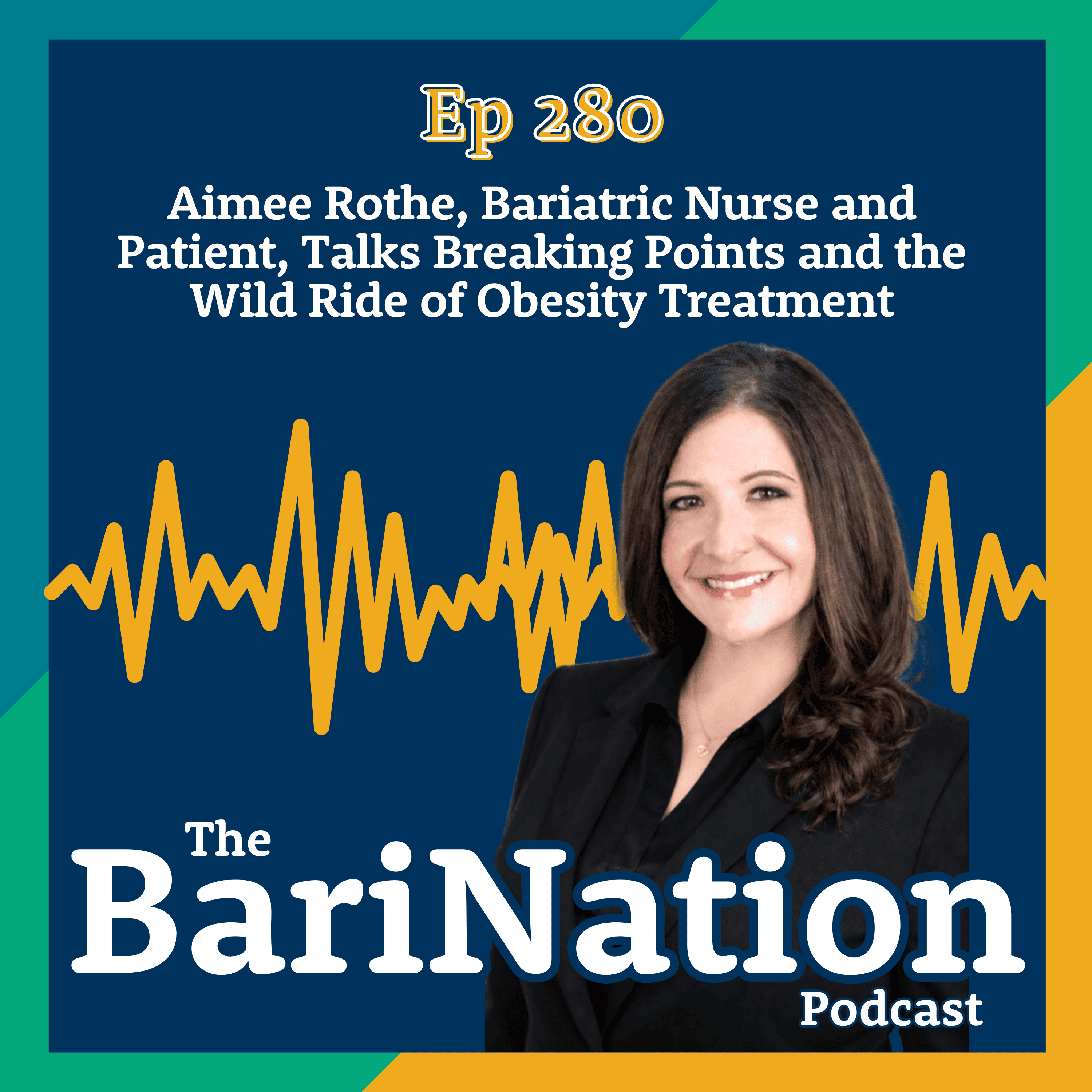 Ep 280: Aimee Rothe, Bariatric Nurse and Patient, Talks Breaking Points and the Wild Ride of Obesity Treatment | In this engaging conversation, Aimee Rothe, a board-certified bariatric nurse and post-op bariatric patient, shares her journey from being a medical provider who sought treatment for her obesity after a harrowing experience with a patient, when she was over 400 lbs, to being a provider in the field of obesity care.She emphasizes the importance of normalizing obesity treatment, individualizing care for patients, and overcoming the stigma associated with weight loss surgery and onboarding adjunct treatments such as GLP-1’s. The discussion highlights the emotional challenges faced by patients post-surgery, the role of support groups, and the need for ongoing care and understanding from healthcare providers.Aimee advocates for a compassionate approach to obesity treatment, encouraging patients to seek help and not feel ashamed of their journey.Keywordsbariatric surgery, weight loss surgery, VSG, Gastric Bypass, metabolic syndrome, SADI-s, obesity care, individualized treatment, patient support, emotional health, chronic condition, healthcare, normalization, weight loss, patient-provider relationship, GLP-1, Type 2 diabetes remission, sleep apnea, PCOS, high blood pressureTakeawaysObesity is a chronic medical condition, not a failure of willpower.Bariatric surgery should be viewed as a treatment, not a last resort.Individualized care is crucial for effective obesity treatment.Patients should not feel ashamed or stigmatized for seeking help.Support groups play a vital role in the emotional journey post-surgery.The journey of weight loss is a marathon, not a sprint.It's important to normalize conversations about struggles with obesity.Patients should maintain open communication with their providers.Utilizing multiple treatment modalities is acceptable and necessary.Healthcare providers must understand the complexities of obesity and support their patients.Chapters04:55 Meet Amy Rothe: A Journey from Patient to Provider08:25 Understanding Obesity as a Chronic Condition11:55 The Importance of Individualized Care in Obesity Treatment16:06 Normalizing Conversations Around Obesity and Treatment20:24 The Role of Support Groups in Bariatric Care25:56 Navigating Body Image and Relationships Post-Surgery30:12 The Emotional Journey of Bariatric Surgery35:08 Understanding the Reality of Uncomfortable Situations38:15 Breaking Points and the Decision for Surgery42:34 The Importance of Individualized Care in Obesity Treatment47:39 Normalizing Multiple Modalities of TreatmentGuest BioAimee Rothe, BSN, RN, CBN, CEN, TCRN, NHDP-BC serves as the Hospital Program Director of Metabolic and Bariatric Surgery at a hospital in Birmingham, Alabama. Under her leadership, the program maintains multiple national recognitions, including designation as a BCBS Blue Distinction Plus Center for Bariatric Surgery, an Aetna Institute of Quality for Bariatric Surgery, an Optum Center of Excellence for Bariatric Surgery, and an American College of Surgeons Metabolic and Bariatric Surgery Accreditation and Quality Improvement Program Comprehensive Center. Aimee is a Certified Bariatric Nurse and is active within the American Society for Metabolic and Bariatric Surgery. She serves on multiple national committees, represents the nursing discipline as a Member-at-Large on the ASMBS Integrated Health Leadership Council, and acts as the Integrated Health Board Liaison for the ASMBS Alabama State Chapter. In 2017, Aimee underwent bariatric surgery to address her own chronic medical condition. That experience strengthened her commitment to guiding patients through the bariatric and obesity medicine journey while advocating for recognition of obesity as a chronic, treatable disease. Her work centers on improving patient outcomes, strengthening evidence-based education, and advancing best practices in metabolic health management. She is also focused on building stronger collaboration across medical specialties, expanding outreach efforts that encourage earlier intervention, coordinated care, and open dialogue about obesity and its associated conditions.LinksAimee Rothe Contact Informationmizzerrn@gmail.comWeightManagementUABStVincentsBariNation Membership Community: BariNation.mn.coThe BariNation Podcast is a production of the BariNation Foundation, a 501c3 nonprofit that advances metabolic wellness for people living with obesity by providing evidence-based education, stigma-free support, and meaningful connections in the moments that shape daily life. The Foundation's mission is to walk alongside individuals pursuing medical, surgical, and comprehensive care, supporting real decisions, challenges, and victories that influence long-term health with the support and guidance of obesity medicine experts.Learn more about the BariNation Foundation and make a tax-deductible donation by going to BariNation.org | — | ||||||
| 3/18/26 | 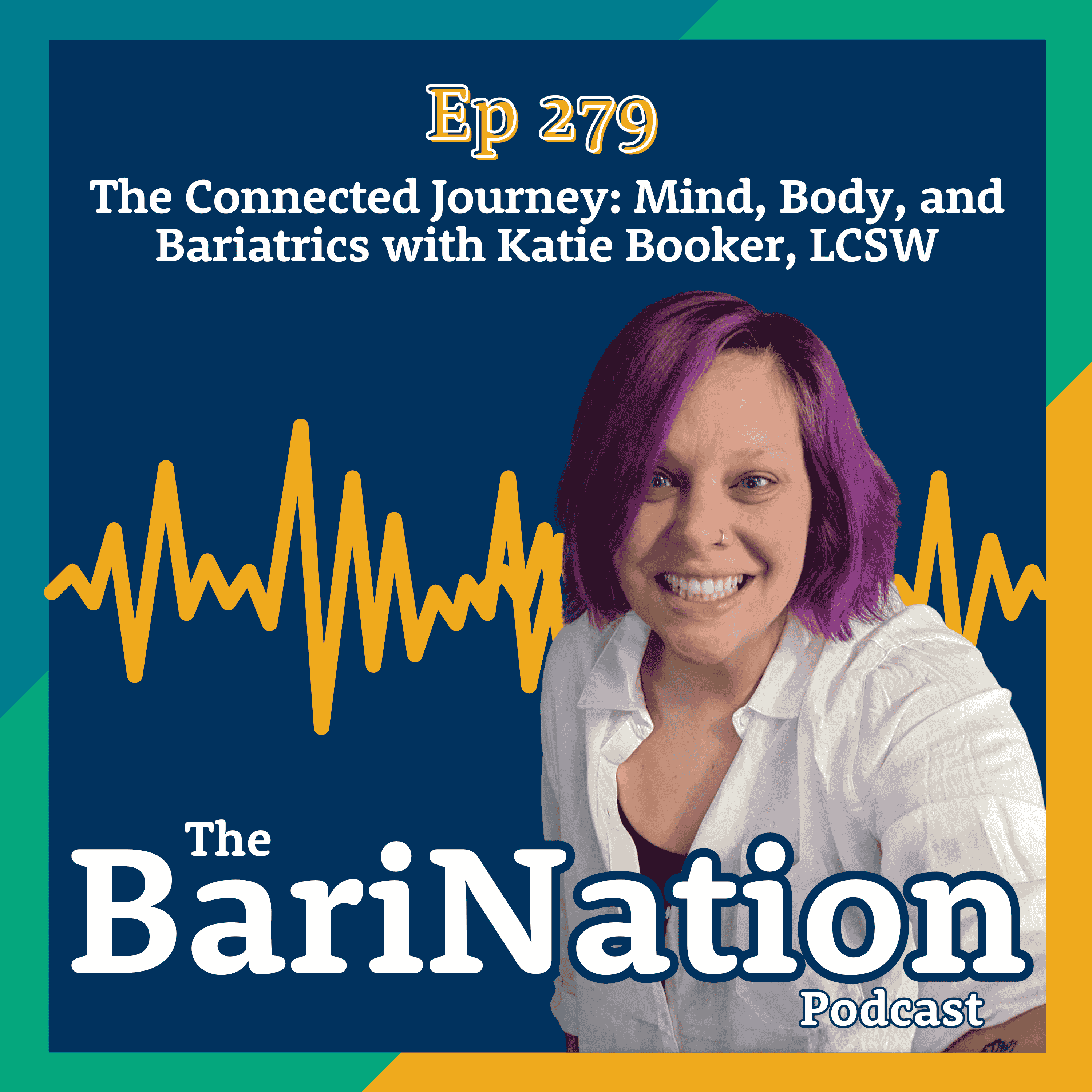 Ep 279- The Connected Journey: Mind, Body, and Bariatrics with Katie Booker LCSW | The BariNation Podcast is a production of the BariNation Foundation, a 501c3 nonprofit that advances metabolic wellness for people living with obesity by providing evidence-based education, stigma-free support, and meaningful connections in the moments that shape daily life. The Foundation's mission is to walk alongside individuals pursuing medical, surgical, and comprehensive care, supporting real decisions, challenges, and victories that influence long-term health with the support and guidance of obesity medicine experts.Learn more about the BariNation Foundation and make a tax-deductible donation by clicking HERE going to BariNation.orgIn this conversation, April Williams and Katie Booker, licensed therapist and bariatric patient, explore the critical connection between the mind and body, particularly in the context of bariatric surgery. They discuss the importance of recognizing disconnection, identifying signs of it, and the strategies to reconnect. The conversation emphasizes the role of community support in the healing journey and provides practical tips for movement and mindset. The overarching theme is that transformation is a continuous journey, requiring patience, self-compassion, and a willingness to engage with one's body and emotions.KeywordsObesity, Bariatric Surgery, Advocacy, Healthcare Barriers, Community Support, Patient Stories, BariNation Foundation, Metabolic Surgery, Roux-enY, Gastric Bypass, VSG, Gastric Sleeve, DS, Duodenal Switch, SADI-S, Obesity Medications, GLP1’s, Ozempic, Wegovy, Mounjaro, Zepbound, Mind-body Connection, emotional health, mindfulness, self-compassion, Healing Journey, Weight Loss, Disconnection, Personal GrowthTakeawaysOur bodies and minds are designed to be connected.Disconnection can manifest in various ways, especially for bariatric patients.Identifying signs of disconnection is crucial for healing.Mindful movement can help re-establish the mind-body connection.Community support is essential for emotional healing and growth.Self-compassion is key in the journey of transformation.It's important to recognize that transformation is a lifelong process.You can always start again, no matter where you are in your journey.Practicing mindfulness can enhance awareness of hunger and fullness cues.It's okay to feel conflicting emotions at the same time.Chapters00:00 The Importance of Mind-Body Connection08:43 Understanding Disconnection in Bariatric Patients16:16 Identifying Signs of Disconnection22:50 Strategies for Reconnecting Mind and Body24:30 Understanding the Body-Mind Connection30:22 Recognizing Trauma and Its Impact35:42 The Journey of Reconnection42:47 Embracing Self-Compassion and Healing48:30 Navigating Emotions and Self-Compassion50:00 The Four Pillars of Bariatric Success52:04 Mindful Movement and Body Awareness55:40 Mindset Strategies for Reconnection01:01:22 The Role of Community in Healing01:04:58 The Journey of Transformation and PatienceKatie Booker BioKatie is a mental health therapist in New York State that specializes in trauma. She is certified in EMDR, is a registered play therapist, and completes bariatric psychological evaluations for pre-surgery approval. She offers a unique perspective to the mindset work of bariatric surgery as a bariatric patient herself.PDF of Katie's Class: https://drive.google.com/file/d/1IslQ-N59bmE7ZY7yaeni9K7O6IH_4rWw/view?usp=sharing | — | ||||||
| 3/4/26 | 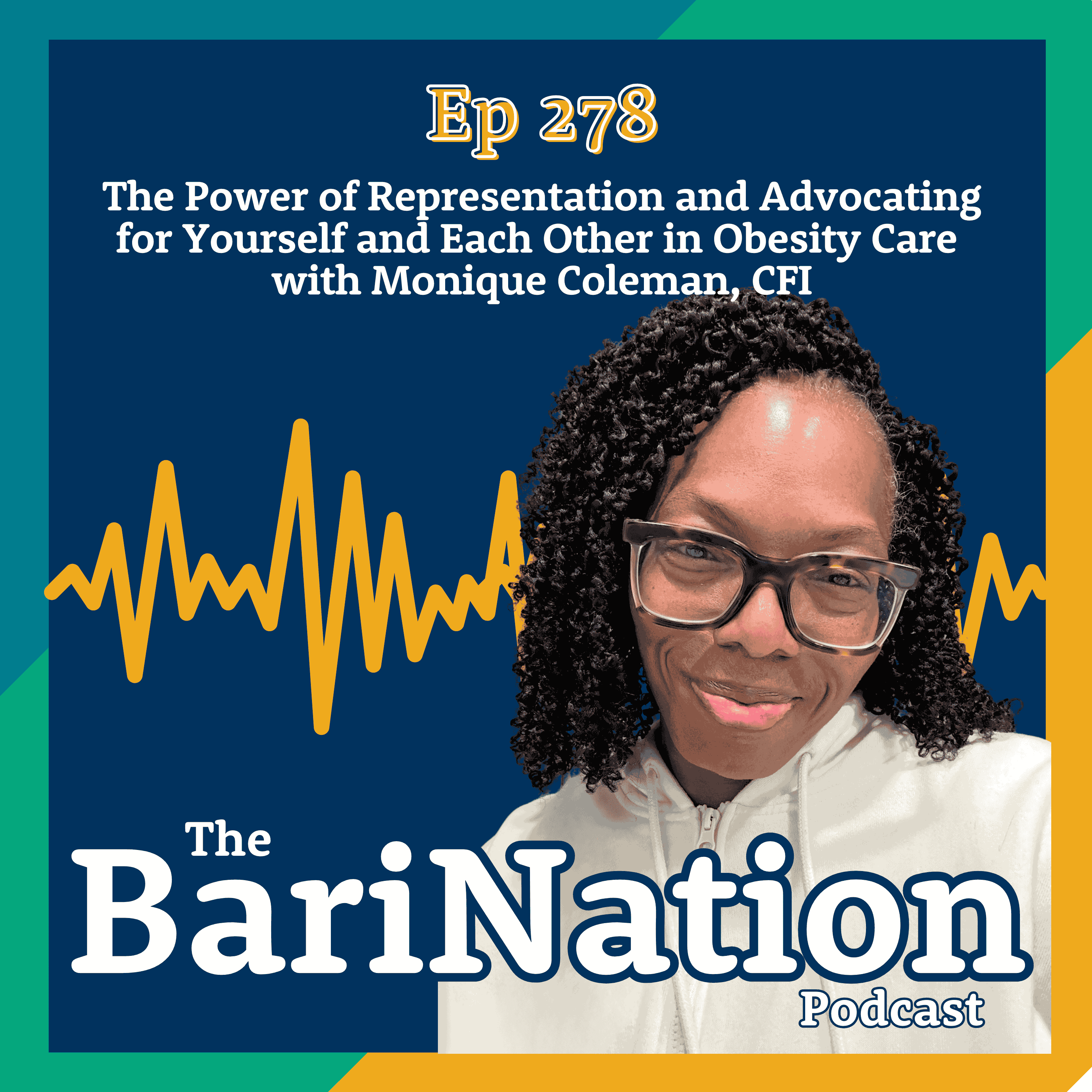 The Power of Representation and Advocating for Yourself and Each Other in Obesity Care with Monique Coleman, Ep 278 | The BariNation FoundationThe BariNation Podcast is a production of the BariNation Foundation, a 501c3 nonprofit that advances metabolic wellness for people living with obesity by providing evidence-based education, stigma-free support, and meaningful connections in the moments that shape daily life. The Foundation's mission is to walk alongside individuals pursuing medical, surgical, and comprehensive care, supporting real decisions, challenges, and victories that influence long-term health, with the guidance of obesity medicine experts.Learn more about the BariNation Foundation and make a tax-deductible donation by going to BariNation.orgEpisode SummaryIn this episode, April Williams and Monique Coleman, a bariatric patient and Certified Fitness Instructor and BariNation community member, discuss the many barriers faced by women in the Black and Brown communities in navigating family and cultural bias in their journey to access bariatric care. The importance of representation, the power of community support in overcoming stigma and misconceptions about obesity, and treatment options are key to changing perceptions faced by those battling the disease now and for future generations.KeywordsObesity, Bariatric Surgery, Black and Brown Community, Representation, Advocacy, Healthcare Barriers, Community Support, Race and Health, Patient Stories, BariNation Foundation, Metabolic Surgery, Roux-enY, Gastric Bypass, VSG, Gastric Sleeve, DS, Duodenal Switch, SADI-S, Obesity Medications, GLP1’s, Ozempic, Wegovy, Mounjaro, ZepboundKey Takeaways from the Conversation:Representation Matters: Individuals are more likely to engage with resources when they see others who share similar backgrounds and experiences.Breaking the Stigma: Obesity is a lifelong disease, not a moral failing. Treatment options like Roux-en-Y or VSG should be accessible and stigma-free.The Power of Advocacy: Sharing your personal story can empower others to reclaim their lives and advocate for the care they deserve.Community is Everything: Finding a safe space—like the BariNation Foundation—can help overcome the isolation often felt during a health journey.Guest Name & BioMonique Coleman is a Wellness & Motivation Coach for Women Over 40, founder of Curvy Fit Fitness & Healthy Living With Monique, and a bariatric surgery and GLP-1 wellness advocate. At 46, she empowers midlife women to stop procrastinating, move their bodies with confidence, and feel good in their skin again.Five years post-bariatric surgery and navigating perimenopause, Monique combines mindset, movement, and real-life strategy to help women break free from shame, food noise, and self-doubt. Through fitness events, virtual programs, speaking, and community building, she creates safe spaces for women to heal, grow, and show up boldly in the second half of life.Chapters00:00 Introduction and Background02:47 Representation and Community06:37 Cultural Barriers to Treatment10:50 Reclaiming Life After Surgery12:42 The Journey of Self-Discovery15:22 Overcoming Barriers to Care17:45 The Role of Community Support19:51 Understanding Obesity as a Disease21:30 Advocating for Yourself23:42 The Importance of Empathy in Healthcare25:47 The Journey of Healing and Self-Discovery27:45 Individualized Health Journeys29:20 The Importance of Representation in Healthcare31:21 Documenting the Bariatric Journey33:38 Navigating Cultural Barriers in Health35:16 Empowerment Through Advocacy39:20 Understanding Obesity as a Disease41:00 The Role of Community in Healing44:08 Creating Safe Spaces for Conversations52:31 Sharing Your Story as EmpowermentResourcesBariNation Foundation - barination.orgSupport This Work, Become a Donor- https://barination.givecloud.co/fundraising/forms/8NDR96EKBariNation Support Community- https://barination.mn.coMonique Coleman's Social Media - IG @healthylivingwithmonique1Community Room Zoom Link- https://us02web.zoom.us/j/84398962120 | — | ||||||
| 2/18/26 |  Ep 277- Introducing the BariNation Foundation: On a Mission Driven With Visions of Hope, Education and Building Bridges to Obesity Care | Today changes everything.In this special episode of the BariNation Podcast, we officially announce the launch of the BariNation Foundation, a federally recognized 501(c)(3) nonprofit organization dedicated to supporting people fighting the chronic disease of obesity.Founded by patients, built by patients, and guided by experts, the BariNation Foundation exists to bring knowledge, community, and hope together, without barriers.In this episode, April Williams is joined by co-founders Jason Smith and Natalie Tierney, along with Melanie Lindell, Christine Mason, and Lori Dustin, to share:✔ Why BariNation transitioned into a nonprofit✔ What 501(c)(3) status means for patients✔ How this expands access to lifelong obesity care✔ Why patient voice must remain central in obesity treatment✔ The future of bariatric surgery, GLP-1 medications, and metabolic care✔ How you can become a Foundational DonorOur MissionThe BariNation Foundation exists to bring knowledge, community, and hope together to support people fighting the disease of obesity.We are treatment-agnostic and committed to supporting individuals pursuing:Bariatric surgeryGLP-1 medicationsMedical obesity treatmentLifestyle-based treatmentLong-term metabolic careOur VisionA future where there are no barriers to accessing lifelong obesity care and support, financial, educational, technological, or systemic.Our ValuesPeople FirstScience Over StigmaCommunity as CareAccess Without BarriersPartnership & IntegrityHope with HonestyWhy This MattersMore than 100 million Americans live with obesity.Hundreds of thousands undergo bariatric surgery each year.Millions are navigating GLP-1 medications and metabolic treatment.And too many are doing it alone.The BariNation Foundation is building a bridge between:PatientsCliniciansResearchersIndustryAnd real-world lived experienceSupport the MissionAs a 501(c)(3), donations are tax-deductible where state law allows.Become a Foundational Donor and help eliminate barriers to obesity care.🔗 https://barination.givecloud.co/fundraising/forms/8NDR96EKEvery deductible dollar goes directly toward:Podcast educationCommunity support groupsAdvocacyFree educational resourcesPatient access initiativesThank you for watching, sharing, and supporting the BariNation Podcast and now, the BariNation Foundation. We could not do this without your support and we are deeply grateful for you.⏱ Timestamps00:00 – The Big Announcement05:00 – Why Nonprofit Status Matters10:00 – Patient Voice at ASMBS15:00 – Expanding Support Beyond Bariatric Surgery20:00 – Sustainability & Financial Stewardship30:00 – Our Mission, Vision & Values35:00 – How to Support the Foundation | — | ||||||
| 2/4/26 | 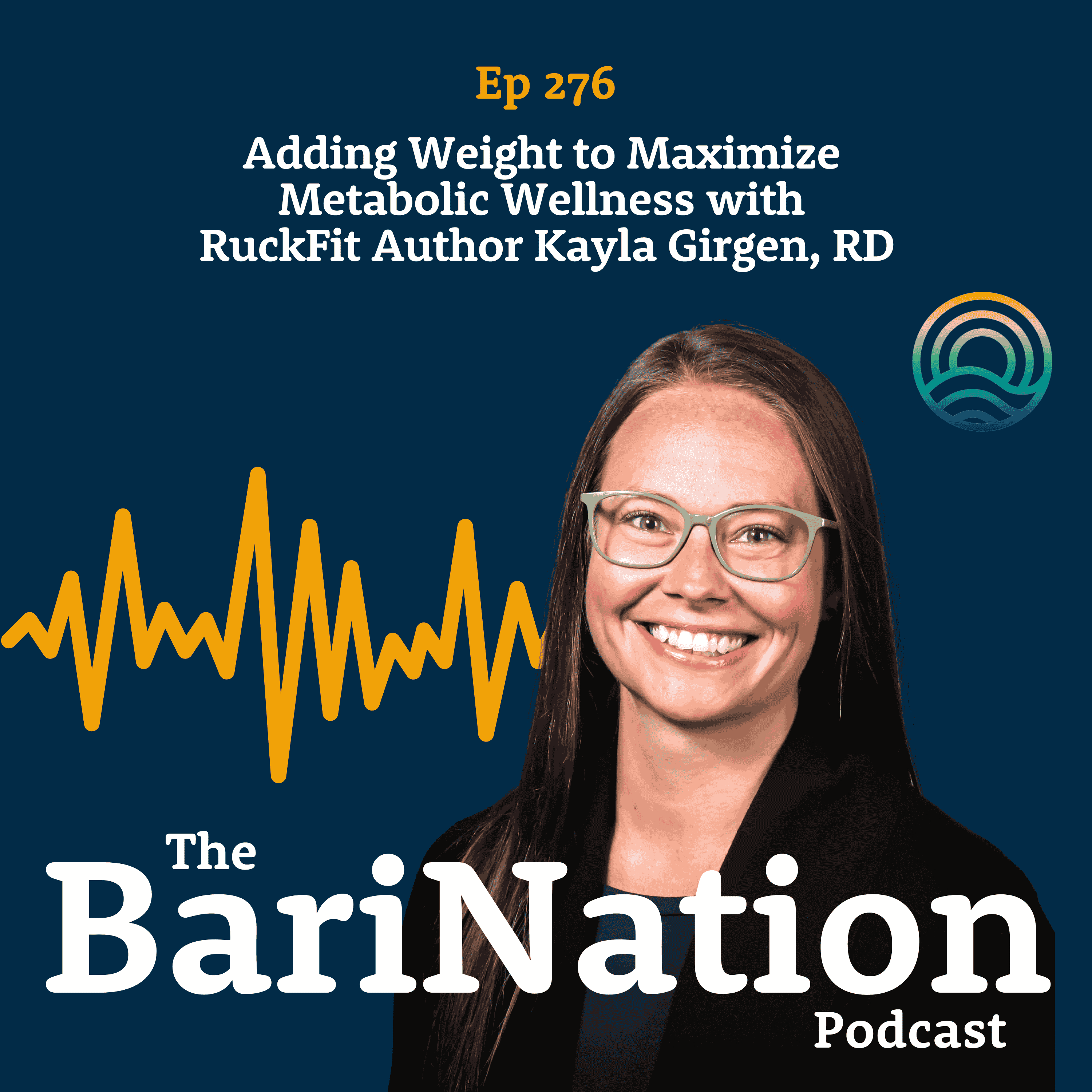 Ep 276: Adding Weight to Maximize Metabolic Wellness with RuckFit Author Kayla Girgen | Have you ever worked so hard to lose weight, only to feel frozen at the idea of intentionally putting weight back on your body?You’re not alone. And this episode is for you.In this BariNation Podcast episode, we sit down with Kayla Girgen, RD, LD, CPT, registered dietitian, personal trainer, and author of the new book Ruck Fit, to break down rucking through a bariatric lens, the fears, the resistance, and why this simple practice may be one of the most powerful (and overlooked) tools for post-op metabolic health.Rucking is simply walking with weight, and while that sounds straightforward, for bariatric patients, it can bring up a lot of hesitation:“I worked so hard to lose this weight—why would I add it back?”“What if I hurt myself?”“What if it doesn’t actually help?”Kayla meets those fears head-on with science, compassion, and real-world experience.Episode Quotes:"It might sound dramatic to say that rucking saved me, but shouldering the load helped me reclaim my sense of self, perseverance, and inner peace." Kayla Girgen“Rucking's going to help preserve that muscle and help make sure that you can maximize your blood sugar management...By adding weight back in the form of a weighted vest or a ruck, you help provide that weight bearing stimulus that helps tell your skeleton, hey, we still need this bone density."What We Cover in This EpisodeWhy Bariatric Patients Hesitate to Try RuckingThe emotional and psychological resistance to “adding weight back”How fear, all-or-nothing thinking, and perfectionism keep us stuckWhy doing nothing often feels safer than trying something newWhat Rucking Actually Is (and What It’s Not)Walking with a weighted vest or backpack (ruck)Why rucking is low-impact, scalable, and accessibleHow rucking is different from traditional cardio or gym workoutsMuscle, Bone Density, and Post-Op StrengthWhy rapid weight loss can increase risk of muscle and bone lossHow rucking provides the weight-bearing stimulus your skeleton needsWhy preserving muscle matters more than “burning calories”Metabolic Health & Flexibility Explained SimplyWhat metabolic flexibility actually means (without medical jargon)Why bariatric patients often feel hungry quickly or “carb dependent”How rucking helps muscles access fuel without relying on insulinWhy this matters for insulin resistance, inflammation, and long-term healthMental Health, Burnout, and ConsistencyHow rucking supported Kayla through panic attacks and burnoutWhy rucking helps people escape the “all in or all out” cycleThe underrated mental health benefits of movement + natureHow to Start Rucking (Without Overdoing It)How much weight to start with (hint: less than you think)Weighted vest vs backpack: pros, cons, and posture considerationsCreative ways to ruck without going on a long walk (yes, housework counts)Why not every walk needs to be a ruckCommunity, Connection, and Real-Life SupportWhy rucking works well in groups (even at different fitness levels)How community reduces fear and builds confidenceWhy post-pandemic connection matters more than everAbout Kayla Girgen & Ruck FitKayla Girgen, RD, LD, CPT is a registered dietitian, certified personal trainer, and movement educator who discovered rucking during a season of burnout and anxiety. Her new book, Ruck Fit, explores:The history of ruckingThe science behind why it worksHow rucking supports metabolic, mental, and physical healthPractical, beginner-friendly guidance to get started safelyThis episode brings the book to life, especially for bariatric patients navigating movement after weight loss surgery.Thinking About Trying Rucking?If this episode sparked questions like:“Is rucking safe after bariatric surgery?”“When is the right time to start?”“What if I’m scared I’ll fail?”You’re exactly who this conversation is for.👉 Leave a comment,👉 Email us at hello@barination.com, or👉 DM us inside the BariNation CommunityWe’ll be inviting Kayla back to go even deeper—and your questions help shape those conversations.Links and Resources:BariNation Newsletter Sign- Up: https://barination.kit.com/ea1ff73fb9Metabolic Flexibility Blog: https://kaylagirgenrd.com/metabolic-flexibility/BariNation Support Community: https://barination.mn.co | — | ||||||
| 1/21/26 |  Ep 275 - Metabolic Health Institute Insights: Understanding Metabolism & Whole Person Obesity Treatment with Advent Health Central Florida’s Dr. Damon Tanton | Metabolic health is more than weight loss—it's about addressing the root causes of obesity as a disease. Today’s episode is sponsored by AdventHealth and we were excited to sit down with Dr. Damon Tanton, Executive Medical Director of AdventHealth Central Florida's Metabolic Health Institute, to explore how insulin resistance drives weight gain and metabolic dysfunction. Dr. Tanton explains why treating obesity requires whole-person care rather than focusing solely on diet and exercise. We discuss the root causes of metabolic syndrome and how personalized care is transforming lives by addressing hyperinsulinemia and reversing metabolic damage before it becomes irreversible.What You Will Learn in this Episode:✅ Why insulin resistance is the foundation of metabolic health issues and how hyperinsulinemia causes your body to store fat rather than burn it for energy preferentially.✅ Why whole person care and personalized treatment are essential for long-term success, and how AdventHealth Central Florida's approach eliminates shame and judgment from obesity medicine.✅ How understanding the cause can determine the best treatment course, and how bariatric surgery and GLP1/GIP medications work as potent insulin sensitizers that can reverse years of metabolic damage and reduce inflammation throughout the body.Tune in, and don’t forget to join the BariNation Community to attend community meetups, watch exclusive bonus content and support the podcast for as little as $5 per month! You can also contribute to BariNation and become a Drive To Thrive Supporter with a one-time or recurring donation.TIMESTAMPS: 00:00 Metabolic health, obesity medicine and understanding insulin resistance and hyperinsulinemia06:56 Why obesity is a physiological, not a behavioral issue, and obesity is not your fault 18:52 How visceral fat triggers the metabolic disease cascade and the domino effect28:30 The importance of early intervention in metabolic syndrome30:43: Discussion of personalized individualized care and the frustration with healthcare 38:20 Whole person care approach at AdventHealth Central Florida 44:34 Overcoming shame and judgment in obesity treatment and creating trust between patient and doctor55:50 Life gained through metabolic wellness and authenticity, and when is the best time to have surgery1:00:22 Jason shares how his life has changed, and Dr. Tanton encourages being your authentic self to the listener KEY TAKEAWAYS: 💎 Insulin resistance affects over 100 million Americans and is the underlying cause of 70% of all diseases, including cardiovascular disease, cancer, anxiety, and reproductive problems. Addressing hyperinsulinemia is the key to reversing metabolic health decline.💎 The medical system has been backwards for decades, blaming patients for behavioral issues instead of addressing the science first. Personalized care that treats the whole person without judgment is essential for sustainable results.💎 Bariatric surgery and GLP-1 medications are not just weight loss tools—they're powerful treatments that correct physiological dysfunction by dramatically lowering insulin levels and reducing inflammation throughout the body.ABOUT THE GUEST: Damon Tanton, MD, is board-certified in endocrinology, diabetes and metabolism. He serves as Executive Medical Director of the Metabolic Health Institute at AdventHealth and sees patients at AdventHealth Medical Group in Orlando, Florida. A University of Miami School of Medicine graduate, he completed his residency at Wright-Patterson Medical Center and fellowship in endocrinology at Lackland Air Force Base. He specializes in diabetes, insulin resistance, obesity treatment, PCOS, and thyroid disorders.AdventHealth Central Florida - InstagramAdventHealth Orlando - WebsiteAdventHealth Central Florida, Damon Tanton, MD,AdventHealthWeightLoss.comRESOURCES MENTIONED: BariNation WebsiteBariNation - EmailBariNation - Partnership Monthly Membership BariNation’s How to Find an Obesity Specialist Guide | — | ||||||
| 1/14/26 |  ENCORE: Live at AdventHealth Central Florida: Transforming Lives Through Whole-Person Bariatric Care | If you’ve ever felt confused, discouraged, or even ashamed about your weight—especially if you’ve tried “everything” and it still feels difficult—this conversation will change how you understand your body and your journey.In this encore episode, recorded live at AdventHealth, bariatric and metabolic medicine specialists Dr. Melissa Bagloo and Dr. Shiva Seetahal explain why weight loss is not just about willpower or discipline, but about biology, hormones, metabolism, and how our bodies are designed to protect us.This episode is for anyone who:Is considering bariatric surgeryIs pre-op, post-op, or experiencing a plateau or regainHas struggled with dieting, weight cycling, or self-blameWants to understand what their body is actually doing — and whyYou’ll walk away with clarity, relief, and a much kinder understanding of yourself.By listening to this episode, you’ll learn:Why bariatric surgery works differently than diets, and how it changes gut hormones, insulin response, hunger, fullness, and metabolic signaling instead of just “restricting” food.Why obesity is a chronic, biological disease, not a personal failure, and why that changes how it should be treated and supported long-term.Why weight loss is often a side effect of improved metabolic health, not the primary mechanism, and why focusing only on the scale can miss what really matters.Why plateaus, slowdowns, and even weight regain are not signs of failure, but a normal part of how the body adapts and recalibrates over time.How medications can support weight and metabolic health before or after surgery, and why adding a tool doesn’t mean surgery didn’t work.Why surgery is not the end of the journey, but the middle of it, and why ongoing support, follow-up, and community matter for long-term success.How to release shame and self-blame by understanding the science behind weight regulation, so you can replace judgment with compassion and informed care.What whole-person, compassionate obesity care actually looks like, and why your emotional, mental, and physical health all deserve to be part of the conversation.So many people struggling with weight feel isolated, broken, or like they’re doing something wrong.This episode reframes that story.It explains why your body may feel like it’s working against you, and how bariatric and metabolic medicine work with your biology instead of fighting it.Most importantly, it reminds you that you’re not alone, you’re not failing, and you deserve care, support, and understanding along the way.Listen If You’re:Pre-op and trying to understand what surgery actually doesPost-op and wondering why your journey looks the way it doesFeeling stuck, plateaued, or discouragedCurious about how hormones, metabolism, and biology affect weightReady to replace shame with clarity and supportIf this episode resonates with you, consider sharing it with someone who might need to hear this message, too, because weight is heavy enough without carrying it alone.Click HERE to learn more about whole-person care at AdventHealth Central Florida.A special thank you to AdventHealth Central Florida for making this episode and education possible!You got this, and we got you.RESOURCES:Check out this exclusive AdventHealth BariNation Monthly Membership for only $29/mo! BariNation WebsiteJoin the BariNation Membership community meetups to support you on your journey with obesity treatment. https://barination.com/pages/join-our-communityWant to see bonus content? Head over to https://www.patreon.com/BariNationPodcast to get more and support the podcast for as low as $5 per month!GUEST RESOURCES:Melissa Bagloo, MD - AdventHealth WebsiteShiva Seetahal, MD - AdventHealth WebsiteBIOGRAPHIES: Dr. Melissa Bagloo is a board-certified bariatric and general surgeon and a Fellow of the American College of Surgeons and the American Society of Metabolic and Bariatric Surgery. A Florida native, she trained in the Northeast before joining AdventHealth. She earned her medical degree from the University of Florida. She completed her general surgery residency at NYU, followed by a minimally invasive and bariatric surgery fellowship at Weill Cornell and Columbia. Specializing in advanced laparoscopic and robotic surgery, Dr. Bagloo has performed over 500 robotic and thousands of minimally invasive procedures. She is dedicated to whole-patient care, helping patients achieve lasting weight loss with minimal recovery time.Dr. Shiva Seetahal is a board-certified surgeon specializing in minimally invasive and laparoscopic procedures, strongly focusing on patient care and satisfaction. He earned his medical degree with honors from the University of the West Indies, completed his surgical residency at Howard University Hospital, and pursued a Minimally Invasive and Bariatric Surgery fellowship at Atlanta Medical Center. He has been actively involved in research, has published numerous works, and has served on editorial boards for surgical journals. Dr. Seetahal is also a member of the American Society for Metabolic and Bariatric Surgery (ASMBS).ABOUT:If the BariNation podcast helps power your bariatric journey, become a monthly podcast supporter and help us produce the show! Visit www.barinationpodcast.com and help us support people treating the disease of obesity with humor, humility, and honesty.We need your help to keep the BariNation Podcast in production. Your one-time or recurring donations help us ensure this free support remains open to everyone. Click Drive To Thrive - Donation to learn more and give. THANK YOU for your support! | — | ||||||
Want analysis for the episodes below?Free for Pro Submit a request, we'll have your selected episodes analyzed within an hour. Free, at no cost to you, for Pro users. | |||||||||
| 1/7/26 |  Ep 274: Transformation Isn’t What You Think It Is (And That’s Why It’s So Hard) | What if the reason change feels so hard isn’t because you’re failing……but because you’re finally doing it right?In this first episode of 2026, April, Jason, and Natalie gently but firmly dismantle one of the biggest lies in the bariatric space: that transformation is something you can plan, download, buy, or perfect.It isn’t.Real transformation isn’t clean. It isn’t aesthetic. It isn’t linear.It’s what happens when you hit present reality at high velocity and stop trying to tape the pieces back together the way they were before.In this conversation, we explore:Why surgery is not the transformation, it’s the catalystWhy so many of us hit a wall post-op and think something is wrong with usWhy chasing “the next right thing” (the planner, the diet, the supplement, the system) is often a way to avoid the actual workWhy the middle, the messy, uncomfortable, identity-shifting middle, is the workAnd why transformation is less about becoming someone new and more about becoming honestThis episode is for you if you are:Contemplating a different way forwardPreparing for bariatric surgeryOr sitting in chaos, knowing you cannot keep living the way you areIt’s a loving confrontation and a deep exhale.You’re not broken.You’re not behind.You’re in the middle.And that’s exactly where transformation lives.Click here to read the Substact Post by Suleika Jaouad that helped us look at "resolutions" in a new way.Did something in this episode resonate with you? Let us know by leaving a comment on the platform you are watching or listening to, or by emailing hello@barination.com.We love hearing from you, learning your takeaways, "aha" moments, and questions you might have after taking in this episode.BariNation is a patient-created and patient-led orginization that needs your support to produce this show.➡️ If you enjoyed this episode, give us a High Five $5 donation. Your support helps us reach more people and support patients in every stage of their journey.Yes, $5 does help. You've got this, and we've got you._____________________________Connect with BariNationInstagram: @bari.nationFacebook: @barinationTikTok: @barinationYouTube: @barinationWebsite: www.barination.comSupport Community: www.barination.mn.coEmail: hello@barination.com | — | ||||||
| 12/24/25 |  ENCORE - Metabolic Adaptation and How Obesity Disease Management Is Like Mowing the Lawn with Carah Horn | Are you struggling to see obesity as more than a number on the scale? Do you wonder why shame and stigma still dominate the conversation around bariatric surgery?In this revisited episode, we explore the truth about obesity as a chronic disease and how we can shift the narrative to one of compassion, education, and long-term support. Our guest, Carah Horn, brings her clinical expertise and lived experience to the table in an eye-opening and empowering conversation. We talk about the outdated perceptions surrounding bariatric surgery, the crisis in obesity care, and why finding the right provider makes all the difference. Carah shares powerful analogies—like her “lawn care” metaphor—to help us understand why long-term maintenance and ongoing support matter. She also explains the dangers of anti-obesity medications without proper oversight and how the BariNation Community provides a unique space for education, encouragement, and behavior change. Whether you are post-op, pre-op, or still considering surgery, this episode will leave you feeling seen, supported, and more equipped for the road ahead.IN THIS EPISODE:(01:24) Carah shares her professional background in obesity disease and bariatric surgery(12:19) The narrative surrounding obesity needs to change, and finding the correct doctor(19:14) Carah speaks to the crisis of care, anti-obesity medications and comorbid conditions(33:03) Each patient is different, and she encourages going back to your surgeon when health changes occur(39:31) Carah shares the word picture she tells her patients(56:12) Making your bariatric journey positive rather than negative and using the tools provided by the BariNation CommunityKEY TAKEAWAYS:Obesity is a complex, chronic disease affecting every aspect of a person’s life—physical, emotional, and social. It should be promoted as a legitimate medical condition that requires real treatment. Unfortunately, shame and stigma surrounding obesity prevent many people from seeking treatment.Treating obesity is about improving health, not appearance. Viewing it through the lens of disease management—similar to diabetes or cancer—can help shift public perception and lead to better care. Medications and surgery are tools to treat the underlying condition, not just to achieve a certain weight.The lack of long-term support and education around obesity medications is dangerous. When prescribed without proper medical oversight or behavioral support, these medications can lead to serious health risks. Without a comprehensive program—including nutrition guidance, mental health care, and consistent follow-up—patients are more likely to misuse medications, relapse, or face complications, especially if access to treatment is suddenly lost.RESOURCES:BariNation WebsiteJoin the BariNation Membership community meetups to support you on your journey with obesity treatment. https://barination.com/pages/join-our-communityCarah Horn - LinkedInBIOGRAPHY: MBA-HCA, BSN, RN, CBN, FASMBS-IHCarah is a clinician who is passionate about engagement. She believes that change and best practices happen in the community. She is active at the local, state, and national levels of obesity treatment and advocacy, as well as an Integrated Health Star in Florida for the American Society of Metabolic and Bariatric Surgeons (ASMBS). She has four daughters and five grandsons and loves fitness and learning! 1 Corinthians 10:31—So whether you eat or drink, or whatever you do, do it all for the glory of God. | — | ||||||
| 12/17/25 |  The Weight of Memory: Experiencing Weight Recurrence in an Obesity Simulation Suit | Ep 273 | Bariatric surgery patients often face intense fear about weight recurrence, but understanding obesity as a chronic disease can transform the healing journey. In this BariNation episode, we explore what happens when therapist and bariatric patient Melanie Lindell wears a simulation suit that recreates her pre-surgery body. The experience revealed how trauma and fear live just beneath the surface, even years post-op. We discuss the reality of weight reoccurence, the struggle with body image, and why community support becomes essential for long-term success. Melanie shares insights about finding rest, practicing gratitude, and becoming a "benevolent witness" to your own story. This conversation validates the emotional healing required beyond physical transformation and offers hope for anyone navigating the process of coping with weight recurrence after weight loss surgery.What You’ll Learn in This Episode: How weight recurrence triggers deep psychological responses even years after bariatric surgery, and why understanding obesity as a chronic, progressive disease helps patients release shame and embrace self-compassion.The concept of being a "benevolent witness" to your own story and others' experiences, which creates safe spaces for emotional healing within the bariatric community and reduces the isolation that often accompanies weight regain struggles.Practical strategies for finding rest amid the constant pressure of obesity treatment, including stepping back from social media comparison, attending post-op support groups, and recognizing that single moments don't define your entire surgical weight loss journey.Tune in, and don’t forget to join the BariNation Community to attend community meetups, watch exclusive bonus content and support the podcast for as little as $5 per month! You can also contribute to BariNation and become a Drive To Thrive Supporter with a one-time or recurring donation.TIMESTAMPS: 00:00 The simulation suit experience at the Bariatric Solutions Conference, and Melanie shares her background08:45 Understanding weight recurrence and the fear of weight regain20:07 Living in a world not built for larger bodies, obesity, and insurance company challenges31:38 Gratitude as the foundation for emotional healing and recovery35:54 Finding rest through community support and benevolent witnesses55:02 Post-op grief, body image, and processing transformation and your personal bariatric story1:14:53 Being your own benevolent witness and practicing self-compassion1:20:39 Being open and embracing your feelingsKEY TAKEAWAYS: The fear of weight recurrence never entirely disappears, even years after successful bariatric surgery, because memories live in the body and can be instantly triggered by experiences that remind patients of their former struggles with obesity.Finding a bariatric community where you can be authentically witnessed—without judgment or expectation of solutions—provides essential emotional healing and combats the isolation that obesity treatment journeys often create.Practicing gratitude and self-compassion serves as a powerful antidote to the relentless pressure of maintaining weight loss, allowing patients to recognize that single moments don't define their entire post-op journey or determine long-term success.ABOUT THE GUEST: Melanie Lindell, LMHC, serves as BariNation’s CHRO and is a licensed counselor with over a decade of experience in trauma and abuse. A bariatric patient herself, Melanie had Roux-en-Y surgery in 2019 and faced a complex recovery that included complications, additional surgeries, and time on a feeding tube. Her passion is helping others heal and thrive, and she considers it a privilege to walk alongside fellow bariatric patients as a support group leader.Melanie Lindell - InstagramLindell Counseling - WebsiteThe Body Keeps Score - BookWhen I Put the Fat Suit On - Melanie Lindell - BlogBariNation WebsiteBariNation - EmailBariNation - Partnership Monthly Membership BariNation’s How to Find an Obesity Specialist Guide | — | ||||||
| 12/10/25 |  ENCORE - No One Left Behind: New ASMBS President Dr. Richard Peterson’s Mission For the Future Of Obesity Care & Treatment | Are we doing enough to ensure that no one is left behind in the fight against obesity? What if bariatric surgery is not just about weight loss, but about treating a chronic, misunderstood disease?In this revisited episode, we sit down with Dr. Richard Peterson, the newly elected president of the ASMBS, to talk about his mission to No One Left Behind. From his military roots to his passionate advocacy, Dr. Peterson delves deeply into why obesity is considered a disease, how bariatric surgery is a critical form of medical care rather than a cosmetic procedure, and what must change to ensure equitable access, education, and support for all.Tune in, and don’t forget to join the BariNation community to attend community meetups, watch exclusive bonus content and support the podcast for as low as $5 per month! IN THIS EPISODE:(03:47) Dr. Peterson shares his professional background and the mission of ASMBS(10:40) As president, past initiatives will move forward and the discussion of bias toward obesity(18:01) Dr. Peterson’s mission is a call to action to “No One Left Behind,” which stems from his military background(31:06) Bariatric surgery is not a cosmetic procedure. Obesity is a disease(40:40) The importance of obesity education and why obesity not being associated with a specific organ was a game changer(49:06) Words matter, you aren’t just losing weight, you are fighting obesity(54:55) If you are suffering from obesity, you can get help. The mission is to remove the barriersKEY TAKEAWAYS:Dr. Peterson’s theme is “No One Left Behind," focusing on ensuring access to obesity treatment for all patients, supporting practices, and fostering unity across the bariatric community.Dr. Peterson continues efforts to reduce shame and stigma by educating medical professionals and the public that obesity is a disease, not a personal failing.Initiatives focus on integrating obesity education into medical curricula and advocating for comprehensive treatment access to enhance patient care.RESOURCES:BariNation Website Join the BariNation Membership community meetups to support you on your journey with obesity treatment. https://barination.com/pages/join-our-communityOTHER RESOURCES: BariNation - EmailGUEST RESOURCES:ASMBS - WebsiteDr. Richard Peterson LinkedInUT Health San Antonio BIOGRAPHY: Dr. Peterson serves as the Chief of Bariatric and Metabolic Surgery for UT Health San Antonio and is the medical director of the Christus Weight Loss Institute at Westover Hills.Dr. Peterson is highly active in both clinical and academic aspects of bariatric surgery. He is the current president of the American Society for Metabolic and Bariatric Surgeons (ASMBS), a past president of the Texas Association for Bariatric Surgery (TABS) and has chaired several committees for the American Society for Metabolic and Bariatric Surgery (ASMBS), including the Public Education Committee and the Communications Committee. He moderates and runs the largest online bariatric journal club on Facebook and serves as the Social Media Editor for Surgery for Obesity and Related Diseases (SOARD), the official journal of the American Society for Metabolic and Bariatric Surgery (ASMBS). ABOUT:If the BariNation podcast helps power your bariatric journey, become a monthly podcast supporter and help us produce the show! Visit www.barinationpodcast.com and help us support people treating the disease of obesity with humor, humility, and honesty. We need your help to keep the BariNation Podcast in production. Your one-time or recurring donations help us ensure this free support remains open to everyone. Click Drive To Thrive - Donation to learn more and give. THANK YOU for your support! | — | ||||||
| 12/3/25 |  Obesity is Not Your Fault But It's Your Fight With Dr. Faiz Shariff | Ep 272 | Obesity is not your fault—but it is your fight. In this powerful BariNation episode, we welcome Dr. Faiz Shariff, renowned Bariatric Surgery and Metabolic Medicine physician, who breaks down the science proving obesity is a genetic disease, not a personal failure. Dr. Shariff explains how 70% of obesity stems from genetics and epigenetics, creating hormonal imbalances that set your body's weight set point beyond your control. We explore why bariatric surgery remains the most effective treatment for this chronic condition, yet faces massive stigma and insurance barriers. This conversation challenges everything you've been told about willpower and dieting, revealing why obesity is not your fault but your fight. Discover how metabolic disease treatment through surgery can change your genetic expression, improve your quality of life, and help you reclaim your crown.What You’ll Learn in This Episode: Why Obesity is Not Your Fault—Discover the science behind genetic factors, obesity, leptin resistance, and set point theory that proves 70% of obesity is genetic, not a willpower issue.Overcoming the obesity stigma and insurance coverage bariatric surgery barriers. Understand the challenges this treatment faces and how to navigate your bariatric surgery journey with the proper support.The power of Non-Scale Victories and Post Op Support—Shift focus from goal weights to disease resolution, flexibility, and lasting quality of life improvements.Tune in, and don’t forget to join the BariNation Community to attend community meetups, watch exclusive bonus content and support the podcast for as little as $5 per month! You can also contribute to BariNation and become a Drive To Thrive Supporter with a one-time or recurring donation.TIMESTAMPS: 00:00 Dr. Faiz Shariff, the "Robot Queen" Obesity Medicine Physician, shares her medically proven position that "Obesity is Not Your Fault But It's Your Fight"06:19 Why Obesity Is Not Your Fault: Breaking down the outdated calories in/calories out paradigm and genetic factors in obesity science09:00 Understanding leptin resistance, hormonal imbalance, weight gain, and how the set point theory controls your body weight16:23 How bariatric surgery changes epigenetics and reduces passing bad genes to future generations, and the stigma associated with obesity20:43 Insurance covering bariatric surgery challenges and why obesity stigma creates unique treatment barriers compared to cancer32:07 Adaptive thermogenesis explained: Why repeated dieting makes weight loss harder each time36:56 Pre-op preparation and bariatric surgery journey mindset shifts for long-term success42:31 Non-Scale Victories matter more than goal weights: Focus on disease resolution and flexibility52:17 Building community, shedding toxic relationships, and gaining confidence post op support58:10 Final thoughts on identity shift, mindset change, and reclaiming your crown in the fight against chronic diseaseKEY TAKEAWAYS: Obesity is 70% genetic. Your body conserves energy through genetic factors, obesity, and epigenetics, creating hormonal imbalance and weight gain through leptin resistance and the elevated set-point theory. This isn't about willpower; it's about biology fighting against you.Obesity stigma creates dangerous barriers. Unlike cancer patients, those with obesity face insurance coverage, bariatric surgery denials, requirements not to gain weight during approval, and judgment for seeking treatment. This chronic disease deserves the same respect as any other.Your bariatric surgery journey requires post-op support and mindset shifts. Success comes from catching negative thoughts, practicing positive affirmations to foster neuroplasticity, and building community with people who celebrate your victories.ABOUT THE GUEST: Dr. Faiz Shariff is a Metabolic and Bariatric Surgeon at WellSpan Health, specializing in revisional and complex procedures, including SADI and BPD-DS. She is Director of Robotic Surgery and Vice Chair of Surgery, leading innovation and mentoring in advanced minimally invasive techniques. Passionate patient advocate and active leader within the ASMBS, serving on multiple national committees to advance education and reduce obesity stigma.Faiz Shariff, MD, FACS, FASMBS, DABS-FPDMBS -LinkedInFaiz U Shariff - WellSpan HealthRESOURCES MENTIONED: BariNation WebsiteBariNation - EmailBariNation - Partnership Monthly Membership BariNation’s How to Find an Obesity Specialist Guide | — | ||||||
| 11/19/25 |  Understanding The Whys of Hair Loss After Bariatric Surgery/GLP1’s and The Hows Of Regrowith With Dr. Ed Chen | Ep 271 | Hair loss after bariatric surgery, or while on GLP-1 medications, is a common issue among patients, but it doesn't have to be permanent. In this BariNation episode, we welcome back Dr. Edmund Chen to discuss why hair loss after bariatric surgery occurs and what you can do about it. Dr. Chen explains that post-bariatric surgery hair thinning happens due to the stress the body is subject to from surgery and rapid weight loss. The good news? With the right approach—including increased protein for hair growth, targeted vitamins like biotin and zinc, and getting in movement for increased blood flow—you can minimize loss and promote healthy regrowth. April shares her personal journey with hair loss and the strategies that helped her see real results. Whether you're pre-op or already experiencing thinning, this episode offers practical, expert-backed solutions.What You’ll Learn in This Episode: ✅ Why bariatric patients experience hair loss and how metabolic surgery side effects, like caloric deficit and body stress, trigger hair loss✅ The essential role of protein for hair growth and how increasing your daily intake can help prevent post-bariatric surgery hair thinning and support regrowth✅ Which bariatric vitamin regimen works best, including biotin and zinc supplements, collagen for hair health, and hair, skin, and nails vitamins to promote stronger hair✅ How exercise and hair growth are connected through increased blood flow to the scalp, plus proven hair regrowth treatment options for hair regrowthTune in, and don’t forget to join the BariNation Community to attend community meetups, watch exclusive bonus content and support the podcast for as little as $5 per month! You can also contribute to BariNation and become a Drive To Thrive Supporter with a one-time or recurring donation.TIMESTAMPS: 00:00 Why do bariatric patients experience hair loss after weight loss surgery 03:30 Top three solutions: protein for hair growth, vitamins, and brands that support hair growth 04:30 Importance of bariatric vitamin regimen, including biotin and zinc supplements, and collagen for hair health07:39 How exercise and hair growth connect through increased scalp blood flow09:02 Practical tips: massage scalp, focus on basics before investing in expensive hair regrowth treatment10:33 Dr. Chen reassures patients that hair loss is temporary and regrowth happens after reaching their lowest weightKEY TAKEAWAYS: 💎 Bariatric hair loss is temporary and typically stops once you reach your lowest weight—it's a sign your body is prioritizing weight loss surgery recovery and metabolic changes over hair growth💎 Increase your protein for hair growth intake beyond typical goals (aim for 80-90 grams daily if experiencing thinning) since hair is made of protein and requires adequate nutrition to regenerate💎 Exercise and hair growth are directly connected—regular movement increases blood flow and oxygen to hair follicles on your scalp, creating healthier conditions for regrowthABOUT THE GUEST: Dr. Edmund Chen, a skilled bariatric surgeon, graduated with honors from Johns Hopkins University and earned his medical degree from Cornell University. After researching metabolism at the National Institutes of Health and training at Northwestern and Duke, he specializes in ultra-minimally invasive bariatric surgery using the da Vinci system, including gastric sleeve, bypass, and revisions. Known for compassionate, patient-focused care, he optimizes outcomes for bariatric patients at his Dallas practice the Texas Center for Bariatric and Advanced Surgery, where he partners with Dr. Joe Cribbins.Edmund Chen, MD - LinkedInRESOURCES MENTIONED: Hair Loss and Exercise StudyBariNation WebsiteBariNation - EmailBariNation - Partnership Monthly Membership BariNation’s How to Find an Obesity Specialist Guide | — | ||||||
| 11/12/25 |  ENCORE - Past ASMBS President Dr. Ann Rogers Has a Mission: Ending Stigma and Shame in Obesity and Bariatric Treatment | Have you ever felt judged or misunderstood because of your weight or health struggles? Shame and stigma often surround the conversation about obesity and treatments like bariatric surgery. In this revisited episode of the BariNation podcast, we welcome Dr. Ann Rogers, past Bariatric Surgeon and President of ASMBS (American Society of Metabolic & Bariatric Surgery), who sheds light on the stigma surrounding bariatric surgery and how it addresses more than just weight loss. Dr. Rogers explains how bariatric surgery can correct serious health problems like diabetes, sleep apnea, and fatty liver disease, ultimately improving a person's quality of life. We also dive into the resistance to bariatric surgery, the changes needed in healthcare, and how medications and mindfulness can play a role in weight management. Dr. Rogers also shares valuable advice to help break the cycle of shame and self-doubt.We need your help to keep the BariNation Podcast in production. Your one-time or recurring donations help us ensure this free support remains open to everyone. Click Drive To Thrive - Donation to learn more and give. THANK YOU for your support!IN THIS EPISODE:[00:42] What drew Dr. Rogers to bariatric surgery and improving the quality of life[6:58] Why do people resist bariatric surgery? Is it shame and stigma[15:36] Changes general practitioners need to make in the insurance industry[25:01] Medications to lose weight and why obesity wants to come back[34:55] The value of mindfulness and the capacity to live life differently[40:23] Discussion that Medicare and Medicaid will have access to GLP1 and forecasting for 2025 and Dr. Rogers's parting advice[45:54] Believing the lies we tell ourselves and hear more in the BariNation Support CommunityKEY TAKEAWAYS:Bariatric Surgery Addresses More Than Weight Loss. While bariatric surgery visibly impacts weight, its actual value lies in addressing underlying health conditions like diabetes, sleep apnea, and fatty liver disease, significantly improving quality of life. However, the stigma surrounding obesity and bariatric surgery often deters patients from seeking help. Obesity is a complex, chronic disease that is influenced by genetics, biology, and environmental factors. It's not just a matter of personal choice or willpower; blaming individuals for their condition is unjust and counterproductive.Bariatric surgery and related treatments can offer substantial benefits, and despite challenges like weight regain or access to medications, patients should remember that they are worthy of care and support.RESOURCES:BariNation Website Patient Resource LinkGUEST BIO: Dr. Rogers is the Director of the Penn State Health Surgical Weight Loss Programs. Dr. Rogers is past President of the American Society of Metabolic & Bariatric Surgeons (ASMBS).ASMBS MISSION: To enhance the well-being of individuals affected by obesity and associated illnesses through the progression of metabolic and bariatric surgical techniques and other medical interventions. | — | ||||||
| 11/5/25 |  Kellie Armstrong Is Building Bridges For An Integrated Health Approach to Bariatric Care | Bariatric support programs are key to long-term success. In this episode of BariNation, Kellie Armstrong, RN and Integrated Health Director at ASMBS, shares insights from her 20-year journey as both a bariatric patient and healthcare leader. She discusses the evolution of obesity medicine, the power of multidisciplinary care, and the three C’s of success—continuous, conversation, and connection—highlighting why strong patient-provider communication changes everything.What You’ll Learn in This Episode: How bariatric support programs have evolved from isolated surgical procedures to comprehensive integrated health teams that provide wraparound bariatric care throughout your entire journeyWhy long-term weight loss success depends on continuous patient-provider communication and staying connected to your bariatric program accreditation-certified care team beyond the first year post-opWhat questions to ask when shopping for a metabolic bariatric surgery program, including how to find obesity medicine specialists who treat obesity as the chronic disease of obesity it truly isThe importance of post-op support groups and bariatric patient education in maintaining your results, plus why bariatric surgery follow-up should never stop, even 20 years after your procedureTune in, and don’t forget to join the BariNation Community to attend community meetups, watch exclusive bonus content and support the podcast for as little as $5 per month! You can also contribute to BariNation and become a Drive To Thrive Supporter with a one-time or recurring donation.TIMESTAMPS: 00:00 Introduction 06:35 Kellie’s first bariatric surgery patient in 2000, and how nursing education has evolved in obesity medicine13:09 The intersection of professional and patient life: merging your bariatric identity with everyday life19:27 Why bariatric support programs are not a quick fix and the importance of using tools from your toolbox22:27 Creating patient-provider communication pathways and keeping integrated health teams accessible to patients26:59 The three C's framework: continuous, conversation and connection for long-term weight loss success30:22 How ASMBS accreditation programs share best practices and collaborate across bariatric care coordination teams40:53 The future of obesity medicine and eliminating stigma in disease of obesity treatment46:31 Discussion of shopping for the right bariatric program, asking for bariatric surgery follow-up resources and contacting your insurance provider50:30 Don't seek medical advice on social media: the importance of professional bariatric patient educationKEY TAKEAWAYS: Bariatric surgery is just one tool, Long-term success requires lifelong, integrated care including nutrition, behavioral health, medication, and lifestyle support.Choose programs that stay with you. Find a bariatric team offering real relationships and full support, or ask to be connected with obesity medicine specialists.Your bariatric journey becomes life. Stay connected through post-op groups, annual follow-ups, and peers who understand your experience for years to come.Bariatric care has evolved — from open surgeries and long hospital stays to minimally invasive procedures and comprehensive, team-based obesity treatment.ABOUT THE GUEST: Kellie Armstrong's RN career began at Rhode Island Hospital in 1998, progressing from staff nurse to Bariatric Surgery Service Line Manager when Brown University Health merged its bariatric programs in 2012. In 2007, she became Rhode Island's first Certified Bariatric Nurse (CBN) and has since presented at national venues, co-authored articles in Bariatric Times, and served as co-chair of the 2024 Integrated Health Obesity Summit. Her dedication earned her the 2021 Hurvitz Quality Award for revamping the bariatric support program during COVID-19, the 2022 Distinguished CBN award, and inclusion in the first FASMBS-IH Leadership Academy cohort in 2024. Kellie is currently the ASMBS Integrated Health Section President and brings a unique perspective as both a healthcare leader and a bariatric surgery patient since 2005. RESOURCES MENTIONED: BariNation WebsiteBariNation - EmailBariNation - Partnership Monthly Membership BariNation’s How to Find an Obesity Specialist GuideNo One Left Behind: Dr. Richard Petersonhttps://www.facebook.com/kellie.fredette.armstronghttps://www.linkedin.com/in/kellie-armstrong-msn-rn-fasmbs-ih-cbn-4766501b/Website: https://www.brownhealth.org/centers-services/center-medical-and-surgical-weight-loss | — | ||||||
| 10/29/25 |  ENCORE - Relentless Curiosity: Transforming Lives Through Bariatric Surgery with Dr. Sarah Hayek - Part One | In this revisited episode, we look back at the theme for 2025, Relentless Curiosity. Dr. Sarah Hayek, a bariatric surgeon at the Kentucky Bariatric Institute, is back on the podcast to share her husband’s journey through bariatric surgery. She discusses the emotional and physical factors behind his decision and highlights the importance of embracing change in overcoming obesity. We explore how the surgery isn’t just for extreme obesity, the role of community support, and why some medical approaches may inadvertently contribute to the problem. Tune in to learn how bariatric surgery can be transformative for individuals at different stages of obesity and why support is key to long-term success.Tune in, and don’t forget to join the BariNation Community to attend community meetups, watch exclusive bonus content and support the podcast for as little as $5 per month! You can also contribute to BariNation and become a Drive To Thrive Supporter with a one-time or recurring donation.IN THIS EPISODE:[2:42] The theme for Bari-Nation in 2025 is Relentless Curiosity [4:36] Dr. Hayek shares her husband’s journey through bariatric surgery[15:35] Looking at the risk factors and deciding to have bariatric surgery[25:21] Understanding that obesity is a disease[30:56] Surgery is not just for the obese[39:41] Obesity is an isolating disease, and you need the community of the BariNation[48:56] The Kentucky Bariatric Institutes approach to obesityKEY TAKEAWAYS:Bariatric surgery is not limited to individuals with extreme obesity. Those with moderate excess weight or health risks from visceral fat can also benefit, making surgery a preventative health measure rather than a last resort.The decision to undergo bariatric surgery often stems from the realization that traditional weight management methods—like diet and exercise—may not be enough. It's a critical tool in a broader treatment plan, including medical support and lifestyle adjustments.Long-term success in weight management post-surgery is tied to daily habits, continuous care, and emotional support. The community of Bari-Nation plays a vital role in helping individuals navigate challenges and maintain motivation throughout their transformative journey.RESOURCES:BariNation Website Join the BariNation Membership community meetups to support you on your journey with obesity treatment. https://barination.com/pages/join-our-communityGUEST RESOURCES:Kentucky Bariatric Institute - WebsiteBIOGRAPHY: Kentucky Bariatric Institute (KBI) is excited to welcome Sarah Hayek, MD, MEd, to the Georgetown and central Kentucky communities. Dr. Hayek will enhance the bariatric program by offering robotic bariatric surgery and general surgery procedures. She completed medical school at Geisinger Commonwealth in Scranton, Pennsylvania, and a residency in general surgery at Geisinger Medical Center, with an additional year in surgical education research. With over two years of experience, Dr. Hayek specializes in general and bariatric robotic surgeries.ABOUT:If the BariNation podcast helps power your bariatric journey, become a monthly podcast supporter and help us produce the show! Visit www.barinationpodcast.com and help us support people treating the disease of obesity with humor, humility, and honesty. BariNation - WebsiteBariNation - Podcast | — | ||||||
| 10/22/25 |  BariNation Stories: Beginner Bariatric Meetup’s Role in Navigating Post Op Challenges & Success | Ep 269 | Bariatric support groups provide an essential community for weight loss surgery patients. Today, we welcome Jonathan Cleveland to the BariNation Podcast to discuss his transformative experience just two months after VSG surgery. Jonathan shares how the BariNation community helped him navigate post-op bariatric surgery recovery challenges, from managing protein intake to celebrating non-scale victories. He reveals how the "space and grace" motto became his daily mantra when struggling with post-op bariatric life expectations. Natalie Tierney and Herb Lentz, who host the beginner bariatric meetup groups in the BariNation Community, co-host the episode to advocate for the power of peer connection versus unreliable internet searches and Facebook groups.What You’ll Learn in This Episode: ✅ How bariatric support groups provide emotional validation and practical advice that Facebook groups and internet searches cannot match✅ Why connecting with the bariatric community with Natalie Tierney in BariNation helps navigate post-op bariatric life challenges like protein and hydration goals✅ The "space and grace" approach to managing frustration during weight loss surgery recovery and celebrating non-scale victories✅ How beginner bariatric patient support meetups create a safe space for pre-op and newly post-op patients to share experiences✅ Why joining trusted virtual support groupsand meetups in BariNation leads to better outcomes than self-diagnosing symptoms through unreliable online sourcesTune in, and don’t forget to join the BariNation Community to attend community meetups, watch exclusive bonus content and support the podcast for as little as $5 per month! You can also contribute to BariNation and become a Drive To Thrive Supporter with a one-time or recurring donation.TIMESTAMPS: 00:00 Natalie Tierney opens the episode and invites Jonathan Cleveland and Herb Lentz to introduce themselves as members of the BariNation membership community. Jonathan is a two-month post-op bariatric patient, and Herb hosts beginner bariatric meetups02:36 How bariatric support groups provide a community with like-minded individuals who understand the unique struggles and non-scale victories06:05 The "space and grace" motto helps manage frustration with protein intake after surgery and hydration goals during weight loss surgery recovery, and other tips10:17 Overcoming fear of joining bariatric community online meetups as a newbie and finding welcoming peer support12:32 Jonathan shares why bariatric support groups provide trusted advice versus going down rabbit holes on Facebook groups and unreliable internet sourcesKEY TAKEAWAYS: 💎Bariatric support groups offer understanding that friends and family cannot provide, creating a space where members celebrate non-scale victories like not needing seatbelt extenders with genuine excitement💎 The "space and grace" mantra helps manage early post-op bariatric life frustrations when struggling to meet protein intake after surgery and hydration targets during weight loss surgery recovery💎 Virtual support groups provide vetted advice from real bariatric patient support members and medical professionals, preventing harmful self-diagnosis from unreliable Facebook groups and internet rabbit holes💎 Beginner bariatric community online meetups create cohorts where pre-op and newly post-op patients practice curiosity, ask questions without judgment, and build family-like connectionsABOUT THE GUEST: Jonathan Cleveland currently resides in Dallas/Fort Worth, Texas. He is 6 months post-op from VSG surgery by Dr. Edmund Chen of the Texas Center for Bariatrics & Advanced Surgery. He has lost a total of 115 pounds. He loves to travel across the world in his free time. RESOURCES MENTIONED: BariNation WebsiteBariNation - EmailBariNation - Partnership Monthly Membership BariNation’s How to Find an Obesity Specialist Guide | — | ||||||
| 10/15/25 |  ENCORE: Bariatric Success Redefined: How Curiosity Fuels Thriving | In this revisited episode, we're diving into the theme of curiosity—how it shapes our journey, fuels personal growth, and helps us navigate life after bariatric surgery. Curiosity isn’t just about asking questions; it’s about staying open to new possibilities, exploring uncharted paths, and discovering what works best for you. Our definition of thriving is to progress towards or realize a goal despite or because of circumstances, and curiosity plays a key role in helping us thrive. Together, we’ll unpack how curiosity can lead to breakthroughs, deepen your self-awareness, and transform your perspective on health, wellness, and beyond. Let’s jump in and spark some curiosity!Tune in, and don’t forget to join the BariNation Community to attend community meetups, watch exclusive bonus content and support the podcast for as little as $5 per month! You can also contribute to BariNation and become a Drive To Thrive Supporter with a one-time or recurring donation.IN THIS EPISODE:00:00 Introduction0:49 Using the tool of curiosity to thrive in 2025 after bariatric surgery2:54 Jason describes how relentless curiosity has taken him to the gym7:01 Natalie shares how she struggled with what was within her control10:33 This episode is for everyone to thrive and use relentless curiosity 11:53 Get curious about your bariatric journey and try new things within your control13:44 Being relentless about curiosity to thrive and actively using the BariNation communityKEY TAKEAWAYS:Try using curiosity as a proactive tool to overcome obstacles and thrive, regardless of circumstances. This approach involves shifting from frustration to asking empowering questions like "I wonder what would happen if...?" to spark problem-solving and innovation.Instead of feeling overwhelmed by all the challenges, try solving one problem at a time. This focused approach allows for incremental progress, whether adapting a fitness routine, making bariatric dietary adjustments, or tackling life challenges.Practicing curiosity within a supportive community amplifies its impact. Engaging with others who understand and encourage experimentation creates a safe space to try new things, share insights, and celebrate progress together and bariatric surgery.RESOURCES:BariNation Website ABOUT:If the BariNation podcast helps power your bariatric journey, become a monthly podcast supporter and help us produce the show! Visit www.barinationpodcast.com and help us support people treating the disease of obesity with humor, humility, and honesty. | — | ||||||
| 10/8/25 |  Building Your Bariatric and Obesity Care Dream Team With Heidi Bednarchuk: An Integrated Health Approach | Ep 268 | What are the advantages of a bariatric surgery care team? Today, you will discover the vital role of an integrated health team in bariatric surgery. On this episode of the BariNation podcast, we are thrilled to interview Heidi Bednarchuk, exploring why a cohesive bariatric surgery care team is key to patient care success. From pre-op preparation to post-op support, discover how to choose a team that supports your obesity treatment journey and enhances quality of life. Heidi shares insights on building an integrated health team for bariatric surgery, emphasizing the importance of interdisciplinary collaboration for long-term wellness.What You’ll Learn in This Episode: The critical role of a bariatric surgery care team in ensuring successful patient care throughout the obesity treatment journeyHow an integrated health team collaborates to provide comprehensive pre-op preparation and post-op support for lasting resultsWhy prioritizing quality of life is key to choosing the right bariatric surgery care team for your needsPractical questions to ask to identify an integrated health team for bariatric surgery that supports long-term wellnessThe importance of patient care advocacy and how a cohesive team enhances obesity treatment outcomesTune in, and don’t forget to join the BariNation Community to attend community meetups, watch exclusive bonus content and support the podcast for as little as $5 per month! You can also contribute to BariNation and become a Drive To Thrive Supporter with a one-time or recurring donation.TIMESTAMPS: 02:50 Heidi’s role in integrated health team leadership for patient care and the vital role of the bariatric surgery care team beyond pre-op preparation and post-op support12:28 Heidi explains why evaluating the bariatric surgery care team is crucial for quality of life in the obesity treatment journey, such as roles like the bariatric nurse14:33 Heidi uses a fruit smoothie analogy to describe a cohesive, integrated health team for bariatric surgery, enhancing quality of life25:05 Advice on questions to identify an effective bariatric surgery care team, focusing on interdisciplinary team communication32:24 Heidi discusses studies showing patient care priorities like nutrition and mental health in post-op support, often overlooked42:24 Discussion of the stigma, eliminating old mindsets and communicating with care teams who are not integrated 47:30 Emphasis on staying connected with the bariatric surgery care team to avoid post-surgical support drop-off for obesity treatmentKEY TAKEAWAYS: An integrated health team for bariatric surgery collaborates to enhance quality of life and address challenges in obesity treatment.Asking the right questions helps identify an effective bariatric surgery care team focused on interdisciplinary team communication.Patients must advocate for their own patient care needs to build a bariatric surgery care team that supports long-term success in obesity treatment.ABOUT THE GUEST: Heidi Bednarchuk, APRN, CNS, CBN, FASMBS-IH, is a Clinical Nurse Specialist, Advanced Practice Registered Nurse at the Bariatric and Comprehensive Weight Loss Program at the Mayo Clinic. She has worked in metabolic and bariatric surgery since 2012 and genuinely loves her work. She is committed to supporting individuals affected by obesity and to highlighting the vital role Integrated Health plays in delivering lasting, patient-centered outcomes. Heidi is also the Immediate Past President of the Integrated Health Leadership Council at ASMBS (American Society of Metabolic and Bariatric Surgeons), having held multiple leadership and committee roles over the past several years.Heidi Bednarchuk - LinkedInPatients’ experiences of life after bariatric surgery and follow-up care studyA Comparison of Health Professionals' and Patients' Views of the Importance of Outcomes of Bariatric Surgery StudyA systematic scoping review of multidisciplinary team working in surgical services: the need for bariatric surgery researchRESOURCES MENTIONED: TREO Foundation - The WalkTREO Walk Discounted BariNation Membership BariNation - Partnership Monthly Membership BariNation’s How to Find an Obesity Specialist Guide | — | ||||||
| 10/1/25 |  ENCORE: BariNation Support Essentials: Giving Yourself Some Space & Grace to Pause & Pivot | Ep 237 | Have you ever felt stuck in your bariatric journey, unsure what to do next? Are you seeking a supportive community that understands life's challenges after surgery? If these questions resonate with you, you won’t want to miss this episode of the BariNation podcast.In this re-release episode, we dive deep into the real experiences and challenges of bariatric patients, offering tools and insights to help you on your journey. In this episode, we’re exploring two pivotal concepts—"space and grace" and "pause and pivot"—that are integral to the BariNation support community for bariatric patients. These tools are designed to assist members in navigating their weight loss journey with greater ease and understanding.Whether you're just starting your weight loss journey or you've been living with bariatric surgery for years, the BariNation community is designed to provide the support and motivation you need to stay on track. Tune into this conversation and community that will make you feel understood, supported, and empowered on your path. Tune in, and don’t forget to join the BariNation Community to attend community meetups, watch exclusive bonus content and support the podcast for as little as $5 per month! You can also contribute to BariNation and become a Drive To Thrive Supporter with a one-time or recurring donation.IN THIS EPISODE:[1:26] BariNation is here for your bariatric surgery journey[3:20] BariNation offers Space and Grace[7:12] When facing a challenge, Pause and Pivot[11:11] The BariNation community is here to support youKEY TAKEAWAYS:Space and Grace – This concept emphasizes the importance of removing yourself from triggering situations (physically or mentally) and giving yourself understanding rather than harsh self-criticism. It’s about creating space to manage emotions and extend yourself grace without making excuses.Pause and Pivot – When facing challenges or hitting a plateau in the bariatric journey, taking a moment to pause, reflect, and reassess your direction can help you make intentional and sustainable changes. This prevents reactive decision-making and supports long-term success.Community and Support Matter – The BariNation podcast and support community provide a space for bariatric patients at all stages to connect, share experiences, and seek guidance from professionals and peers. Engaging with others on a similar journey can provide essential encouragement and perspective.BariNation Website | — | ||||||
| 9/24/25 |  Vitamin B1: It’s For Your Brain…The Importance Of Supplementation When Having Bariatric Surgery or Starting GLP1’s with Dr. Emma Patterson | Ep 267 | Have you had or are you preparing for bariatric surgery or starting GLP1’s and wondering how to avoid nutritional deficiencies? Do you know what Wernicke’s encephalopathy is and how easy it is to prevent and treat it? Tune in to this episode of the BariNation podcast to uncover critical insights! We’re thrilled to welcome Dr. Emma Patterson, a renowned expert in bariatric surgery with 25 years of experience. Dr. Patterson shares her research on thiamine deficiency (aka vitamin B1), offering practical advice on preventive care and thiamine supplementation to help safeguard your health before and after metabolic and bariatric surgery (aka weight loss surgery.) Don’t miss her expert tips on vitamin supplementation to ensure a successful bariatric journey!Don’t forget! BariNation is proud to be this year's National Sponsor of TREO Foundation's The Walk: Stomp the Stigma. Sign up to join BariNation’s virtual team for the September 27th, 2025, The Walk: Stomp the Stigma, which raises awareness and access to care. There are also 12 in person walks happening and more being organized. To find a walk near you, or set one up visit the TREO Foundation website linked below.IN THIS EPISODE:(03:15) Dr. Emma Patterson shares her 25-year focus on bariatric surgery(10:45) Wernicke’s encephalopathy is an acute neuropsychiatric syndrome caused by thiamine deficiency(17:00) Surgeons should monitor nutrition to prevent thiamine deficiency and what are the classic symptoms (28:21) Dr. Patterson notes the low risk of thiamine supplementation, encouraging bariatric patients to discuss it with their surgeons (35:44) Wernicke’s encephalopathy typically peaks two to three months post-bariatric surgery, but can occur later if nutritional deficiencies persist(43:59) Dr. Patterson gives advice to bariatric patients starting GLP-1 medications (48:30) Discussion of the importance of vitamin B1’s role in, cell maintenance, and nerve functionKEY TAKEAWAYS:B1/Thiamine deficiency can lead to Wernicke’s encephalopathy, a severe neurological condition, particularly in bariatric patients post-surgery due to reduced nutrient intake.Preventive care through B1/Thiamine supplementation (100 mg daily) starting two weeks before bariatric surgery and continuing for three months post-op is critical to avoid complications.Patient education on bariatric nutrition, especially the importance of vitamin B1, empowers individuals to advocate for their health and prevent malnutrition risks.RESOURCES:Join BariNation on the TREO WalkTREO Foundation - The WalkTREO Walk Discounted BariNation Membership BariNation x TREO Landing PageTREO Fall In-Person WalksBariNation WebsiteBariNation - EmailBariNation - Partnership Monthly Membership BariNation’s How to Find an Obesity Specialist GuideDr. Patterson’s website GUEST BIOGRAPHY:Dr. Emma Patterson, a board-certified bariatric surgeon, has over 25 years of experience, performing 6,000+ bariatric surgery procedures like Sleeve Gastrectomy and Gastric Bypass after her fellowship at Mount Sinai Hospital. As the Northwest’s first laparoscopic bariatric surgery specialist and Bariatric Medical Director at Wilshire Surgery Center (MBSAQIP Center of Excellence), she’s authored 50+ peer-reviewed papers, including in NEJM, and contributed to NIH’s LABS consortium. Renowned for her expertise in thiamine deficiency and Wernicke’s encephalopathy, she advocates for bariatric nutrition and serves as an expert witness in medical advocacy (Practical Gastro, YouTube). ABOUT:If the BariNation podcast helps power your bariatric journey, become a monthly podcast supporter and help us produce the show! Visit www.barinationpodcast.com and help us support people treating the disease of obesity with humor, humility, and honesty. | — | ||||||
| 9/17/25 | Inclusivity In Obesity Care with Dr. Maria Brown: Building Safe Healthcare Spaces | Ep 266 | Are you searching for a bariatric surgeon who truly understands the importance of lifelong support? Do you want to know how inclusive healthcare can transform your bariatric journey? Then you don’t want to miss this conversation because it may completely change how you think about your options for obesity care.Before we dive in, we’re thrilled to share that BariNation is a national sponsor of the TREO Foundation’s Walk to Stomp the Stigma which is happening in 10+ cities throughout the fall. The Virtual Walk is on Saturday, September 27th and we invite you to join our BariNation team. Together, we’ll shine a light on the importance of better access to obesity care for all. Click the link in the show notes to join our BariNation team and walk with us virtually—you don’t want to miss the chance to be part of this movement.In today’s episode, we sat down with Dr. Maria Brown, a fellowship-trained bariatric surgeon in Arizona who specializes in robotic bariatric surgery and leads a comprehensive program designed to give patients everything they need in one place. Her practice offers medical weight loss, nutrition support, fitness guidance, and a line of vitamins to ensure no piece of the puzzle is missing. Dr. Brown is deeply committed to building safe healthcare spaces where every patient—regardless of their background, identity, or financial status—feels seen, heard, and supported.Tune in, and don’t forget to join the BariNation Community to attend community meetups, watch exclusive bonus content and support the podcast for as little as $5 per month! You can also contribute to BariNation and become a Drive To Thrive Supporter with a one-time or recurring donation.IN THIS EPISODE:(00:00) Opening(00:29) Join BariNation for the TREO Foundation’s Walk to Stomp the Stigma on Saturday, September 27th(01:55) Dr. Brown is a bariatric surgeon specializing in robotic bariatric surgery(05:17) Discussion of inclusive healthcare, Medicare, Medicaid, self-pay, and ensuring obesity care for all patients(05:52) Brown’s practice is a safe space for every patient, including the LGBTQIA (08:34) Shop around for the right bariatric surgeon and build a lifelong relationship of trust (10:40) Obesity care doesn’t end with surgery—it’s a chronic disease requiring long-term support(11:52) Patients deserve to feel seen and heardKEY TAKEAWAYS:Building a strong BariNation Community and long-term patient support system is just as important as the medical side of bariatric surgery, helping patients succeed beyond the operating room.Dr. Maria Brown emphasizes inclusive healthcare and safe healthcare spaces, ensuring that every patient—regardless of race, gender, or sexuality—has access to compassionate obesity care.A holistic approach that combines robotic bariatric surgery, medical weight loss, nutrition support, fitness guidance, and specialized bariatric vitamins creates a comprehensive path to better outcomes on the lifelong bariatric journey.RESOURCES:BariNation WebsiteBariNation - EmailBariNation Partner and Practice Monthly Membership BariNation’s How to Find an Obesity Specialist GuideTREO Foundation - The WalkJoin BariNation on the TREO WalkDr. Brown - WebsiteAZ Weight Loss SurgeryGUEST BIOGRAPHY:Dr. Maria Brown, a Cuban American from Upstate New York, studied Spanish in Mexico and earned a B.S. in Biology from Siena College, graduating magna cum laude. She gained healthcare experience in Belize, worked at Pfizer, and trained at St. George’s University School of Medicine, with rotations in England, Grenada, and New York City. After completing her General Surgery Residency and a fellowship in Minimally Invasive Robotic, Advanced GI, and Bariatric Surgery, she moved to Phoenix, Arizona, where she is owner and director of Valley Bariatric Medical & Weight Loss Center and a national proctor for Intuitive’s da Vinci Robotic Systems. In her free time, she enjoys hiking, camping, and paddleboarding with her two Huskies.ABOUT:If the BariNation podcast helps power your bariatric journey, become a monthly podcast supporter and help us produce the show! Visit www.barinationpodcast.com and help us support people treating the disease of obesity with humor, humility, and honesty. | — | ||||||
Showing 25 of 299
Sponsor Intelligence
Sign in to see which brands sponsor this podcast, their ad offers, and promo codes.
Chart Positions
3 placements across 3 markets.
Chart Positions
3 placements across 3 markets.